Tea Leaf Astrologer

TEA LEAF ASTROLOGER

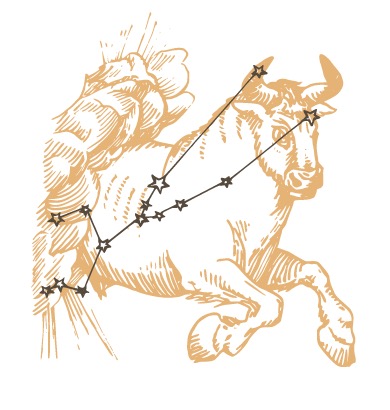
Taurus

(April 20 – May 20)

You’re a glutton for luxury, it’s true. But this month, amid the blur of artisanal cocktails and regenerative facial serums, you’ll ache for something simple: direction. As luck would have it, a Mercury cazimi in Taurus will deliver a moment of crystal clarity on May 14. Combine that with the new moon on May 16 and a slap on the hindquarters from Mars (May 18), and you’ve got yourself a road map. Pack your ahimsa silk pillowcase, sweetheart. Life may be guiding you someplace you never imagined. 

Tea leaf  “fortunes” for the rest of you:

Gemini (May 21 – June 20)

Three words: guac and chips. 

Cancer (June 21 – July 22)

Release the outcome. 

Leo (July 23 – August 22)

Beware of shiny objects. 

Virgo (August 23 – September 22)  

Don’t let the light bulb drive you crazy.

Libra (September 23 – October 22)

Opt for the linen.

Scorpio (October 23 – November 21)

Three o’clock, darling.

Sagittarius (November 22 – December 21)

Retire the busted ones. 

Capricorn (December 22 – January 19)

Delete the app.

Aquarius (January 20 – February 18)

Try taking smaller bites. 

Pisces (February 19 – March 20)

Leave a paper trail. 

Aries (March 21 – April 19) 

BYO hot sauce.

Omnivorous Reader

OMNIVOROUS READER

Doubling Down

Finding the familiar in the extraordinary

By Jim Moriarty

“If you don’t tell their story, who will?”

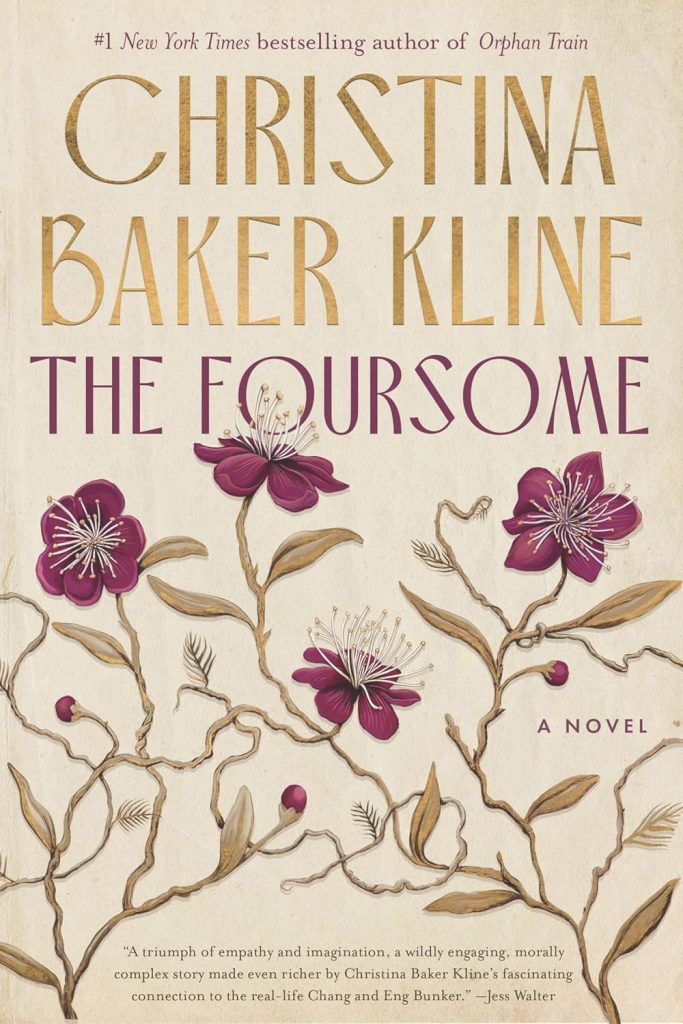
This was the question posed to Christina Baker Kline by Lesley Looper, a cousin and Duke University librarian, about the lives of the renowned “Siamese twins” Chang and Eng Bunker and their wives, Sarah and Adelaide Yates — Kline’s distant relatives.

The short answer is that a lot of people have. The famous brothers, conjoined at the chest, who came to America in 1829 and eventually settled in North Carolina, have been satirized in poetry, made cameo appearances in works by Herman Melville and Mark Twain, been used as a metaphor during the War Between the States, and been the subject — or at least the literary device — of 21st-century musicals, plays and movies. Does the fact that Kline’s genealogical family tree includes them make her imaginings somehow more prescient? Since the twins died 152 years ago, probably not. What is quite clear from the earliest pages of Kline’s The Foursome, due out this month, is that she has taken extraordinary care to imagine her characters less as curiosity and more as men and women in full, portrayed with distinct traits, virtues and flaws, and very much creatures of their age, one of America’s most turbulent times.

Here’s a Wikipedia-worthy primer: Chang and Eng were brought to the United States from Siam (today’s Thailand) by the Scottish merchant Robert Hunter and a sea captain named Abel Coffin, who put them “on tour” in Britain and America. The on-again, off-again business wound up a decade later with the brothers touring on their own with their own staff, becoming wealthy in the process. In July 1839 they made an appearance in Jefferson, North Carolina, and in October of that year, they returned to purchase 150 acres in Wilkes County, where they would meet and marry the Yates sisters. This is where the novel takes over.

When Kline realized that Sarah (Sallie) was not buried in the same resting place as Chang, Eng and her sister, Adelaide, she discovered the voice of her narrator. Sallie is as clear-eyed about herself as she is every other character in the novel. “Addie possessed the self-assurance of the beautiful. She was used to being seen, and it made her bold about being heard,” writes Kline. “I inherited our mother’s round cheeks, her solid bones and small gray eyes, her unruly auburn hair. Addie took after Papa’s family: tall and lean, with dark-fringed lashes and high cheekbones. She shone in contrast to my ordinariness. She was charming while I was shy.”

The vivacious Addie is drawn to Chang, the more dominant brother. “Addie claimed she’d fallen in love with Chang, and maybe she had. She said she felt it deeply. But Addie felt everything deeply,” writes Kline. “Somehow, though I’d voiced my misgivings from the beginning, I’d let the months unspool without taking a firm stand. Now I found myself swept up in my sister’s insistence that marrying the brothers was the right, the only, thing to do.”

Kline doesn’t shy from the physical awkwardness of this union squared, though neither does she dwell on it. The mantra for Sallie is compartmentalization. Don’t think about everything, “only the next thing.”

The sisters’ conversation on their wedding day is portrayed like this:

“Everyone will be staring at us,” I whispered.

“Of course they will. We’re the brides.”

“They’re thinking about — about tonight.”

“Don’t be silly. Nobody’s thinking about that, except maybe you. You’ll be fine. Remember: only the next thing. All right?”

“All right.”

The foursome marries in 1843. After finessing the physical, Kline does an admirable job of portraying these two families through the next 30-plus, turbulent years, through war, peace, the inevitable loss of parents, the birth, and sometimes tragic death, of children and the eventual death of Chang and Eng. In fact, it is this dramatization of the travails of two families that, in a way, normalizes that which is anything but. The couples eventually live in separate houses, one in Surrey County, one in Wilkes County, spending three days at each. “During the three days in the home of the host, the visiting brother will conduct no business and express no opinions. He is to be a silent partner,” declares Chang. Between them the two families would have 21 children who would grow into an assortment of cousins devoted to one another.

Though joined at the chest, the brothers are not the same person. “Eng liked to gamble, his eyes brightening with each new hand. Chang preferred to drink. Neither quite approved of the other’s vice.” Chang could be cruel and moody, Eng the peacemaker. “Eng’s instinct was to ignore or concede, but even he had his limits. Sometimes, like a cat poked too often, he struck back. More than ever, I saw how tightly the band bound him to his brother. What had once been a tether now felt like a shackle.”

Every time their financial picture darkens, the brothers go back on the road to refill the coffers, but the way they are perceived has changed. What once was a curiosity has given way to ridicule. They eventually hook up with P.T. Barnum, who dislikes the brothers because of their independent streak as much as they detest the famous showman for his exploitation.

Chang and Eng are free men of color who become slaveholders and supporters of the Southern cause. Two sons, one from each family, fight for the Confederacy. “The brothers had learned early on that the world is divided into those with power and those without. Those who own and those who are owned. They’d decided — perhaps from the moment they first felt the weight of coins in their palms — where they stood on that divide.” The families feel the depravations of war and struggle with issues of race. “The shortages deepened. Every stitch of fabric was repurposed, every scrap of food stretched.” Stoneman’s cavalry came. The world changes, the enslaved are enslaved no more. “The hardest part wasn’t learning to do things for ourselves, though that was difficult enough. It was learning to see people we’d spent years looking through. To acknowledge that the women who had wiped our children’s tears had children of their own whose hurts had gone unseen.”

If the world paid attention to Chang and Eng, Kline gives more than equal time to Sallie and Addie and the place of women in the 19th century, dramatized throughout, from unwanted pregnancies at the hands of unscrupulous men; to Eng, the slaveowner taking advantage of the enslaved Grace; to the assured figure of Sallie’s lesbian aunt, Joan. Given all that, The Foursome stretches beyond the voyeuristic, attempting to paint a fuller picture of two brothers and two sisters, tethered by more than just flesh. 

Wandering Billy

WANDERING BILLY

Hill Street, Lauren Hutton and . . . William Faulkner?

Returning to that dead-end boulevard of youth to unravel an unsolved mystery

By Billy Ingram

“A lot of modeling is how much crap you can take.”
Lauren Hutton

Watching a recent CBS Sunday Morning segment on “the original supermodel,” Lauren Hutton, and her improbable path from poverty to becoming one of the most successful businesswomen in America triggered a memory buried in the smoldering rubble of my brainpan. I vaguely recalled that, in the 1970s, Hutton visited someone in Greensboro, but for what I didn’t have a clue.

Soon after word spread concerning my curiosity, I heard from an old friend, Jane Vaughan Teer, who invited me to the home she shares with her husband, John. Wouldn’t you know, the Teers reside on Hill Street. There, she related the curious story behind Hutton’s surreptitious visit to the Gate City, which happened at the very height of her phenomenal career.

You may recall my slightly salacious recollections of the two-block stretch of Hill Street in Latham Park where I grew up, published in O.Henry’s January 2025 issue. (You do collect ’em all, don’tcha?)

My conversation with the Teers began with their curiosity as to exactly where it was that Mrs. Bunn gunned down her hubby before fleeing to Florida with her paramour. And the address where our 80-year-old neighbor sunbathed au naturel. What I didn’t know, that Jane told me about, was the man who shot dead a teen peeping tom still resided across the street when they the Teers moved to Hill Street in 1978 and would randomly speak about it decades later.

The Teers were surprised to learn that the house next door to theirs once belonged to a couple and their two sons — one of the boys let it slip that their parents had filmed themselves making babies then showed it to them by way of explaining the birds and the bees (I’m running out of metaphors, folks). That whisper rapidly went viral, no tweets needed on this street for speedy promulgation. Soon after, that randy fam relocated. At one point, the Teers mentioned property assessments on Hill Street skyrocketing, a common concern of late. “Don’t worry,” I assured them. “After folks get a gander at this, the city will be forced to reassess.” But I digress. When wisps of 50-year-old reminiscence subsided, discussion turned to my memory’s mystery — why Lauren Hutton ventured to Greensboro.

“I had to give up my bedroom for her,” Jane, 27 at that time, recalls of Hutton’s overnight stay in their home at 2018 Pembroke Dr. that, by her best recollection, took place late summer 1974. “It was supposed to be a very quiet thing, no publicity, but Mama had to have a party . . . of course.” Mama being the indomitable Bee Vaughan, a tentpole presence in my life I equated with the Unsinkable Molly Brown. “Mama told Lauren, ‘We’re going to have a little cocktail party.’ Lauren said she wanted to take a nap first, so she goes back into my room to rest.”

As folks began arriving at the cocktail hour, Jane was enlisted to awaken Ms. Hutton who, remember, was one of New York and Europe’s most sought-after socialites. “Lauren said, ‘This early?!? I don’t guess anywhere else in the world they have cocktail hour at 5 o’clock!’”

If you weren’t around for the so-called Me Decade, it’s difficult to unpack the impact Hutton, a small-town girl from the South, had on the fashion world globally. In 1973, she signed the first exclusive contract in modeling history and the most lucrative at $250,000 a year for 20 days work (an almost $2 million payday today) as the fresh-scrubbed face of Revlon cosmetics. That was just six years after landing her first Vogue cover in 1966 at age 23.

“From the very beginning I wanted to see the world,” Hutton told the Today show in 2016 about why she left the South. “I heard that models made this enormous amount of money, ‘a dollar a minute,’ and I said, ‘I have to do that!’ And everybody laughed.” With a gap in her teeth, a “banana-shaped nose,” standing only 5-foot-7 (in heels), she possessed none of the qualities associated with 1960s glamor gals typified by Elizabeth Taylor’s cat-eyed Cleopatra caricature, Catherine Deneuve’s icy glare or Twiggy’s pixie-like androgyny.

Her preppy-chic visage was splashed across some two dozen major magazine covers by 1974. Hutton’s unspoiled, Gulf Coast-casual resting face best expressed what modern, independent women were thirsty for from fashionistas: allure without artificiality.

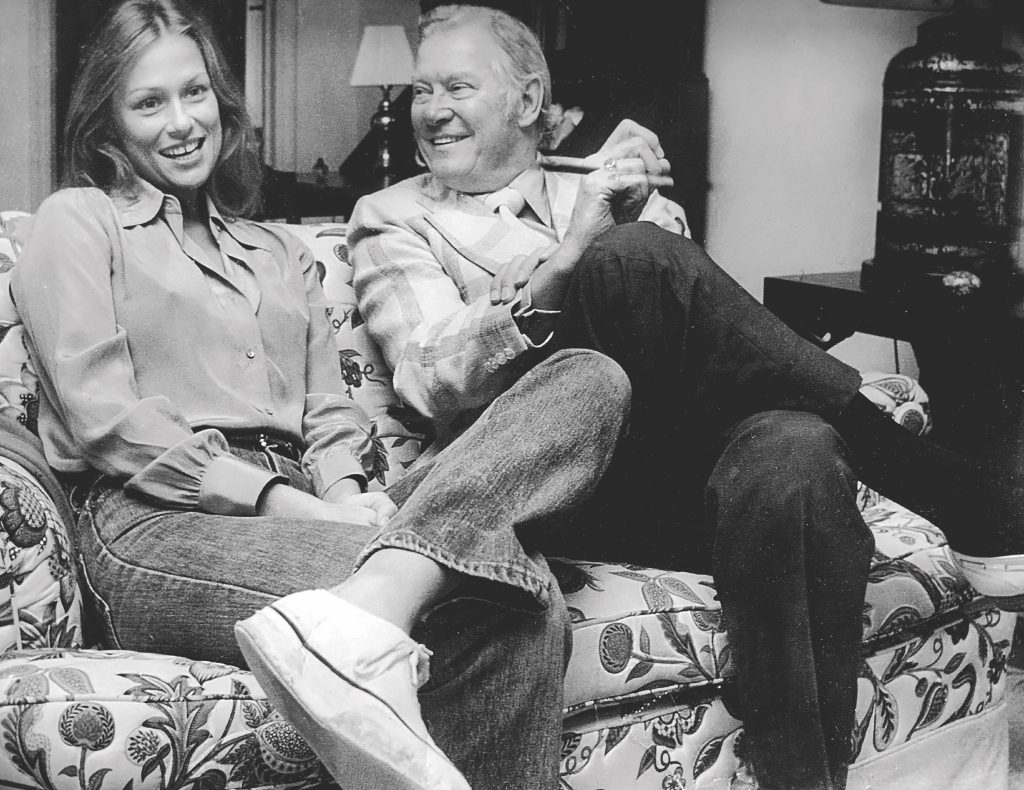
Just how glamorous was one of the world’s most photographed fashion icons? “She was regular, just plain folks,” Jane insists. That comes through in the photo reproduced here of Hutton taken alongside Bill “Hoot” Roane, the very fellow she came to town to see.

A longtime companion of Bee Vaughan’s after her husband passed, Hoot (a nickname bestowed in childhood) was blessed with a gift for gab that came in handy as a sales exec for WBIG Radio, popular as any of the station’s on-air personalities.

Hutton had come to Greensboro to query Hoot about his adolescent days in Oxford, Mississippi. Back then, Hoot was a close friend of Lawrence Bryan “Cut” Hutton, the father she never knew. “They were in a little gang together,” Jane explains about the pirate-themed crew Hoot and Cut hung with, their ship a treehouse fort for secreting cigarettes and liquor. “You can count on the fact that, however long [Hutton] was here, Hoot kept her entertained. She heard a lot about her father and about their close friendship with William Faulkner.”

The writer William Faulkner? “They were neighbors,” Jane comments casually. “Hoot used to give talks about him. Not about his writing but about neighborhood things, like Faulkner dating the school librarian.” Faulkner was around 20 years older than those boys. But then, as a youngster, I was friendly with older neighborhood folks, too.

There was a small café in Oxford where, daily, Faulkner sorted through his mail. “Hoot had some kind of a job there,” John Teer recalls. The year was 1939 when Hoot was 22. “One morning Faulkner came in with all these magazines, letters and so forth. One of them was Time magazine with his picture on the cover.” Faulkner didn’t even open the magazine, couldn’t have cared less what they said about him in it, laughingly autographing the mag before handing it over to his pal.

“After Hoot’s father passed away, the family gathered down in Oxford,” John continues. “Somebody came in and said, ‘There’s an old man at the back door. He’s kind of sketchy looking, I don’t know . . .’ Hoot went to look and it was Mr. Faulkner. He’d come over with a fifth of [Four Roses] as a gift.”

It’s reassuring that Lauren Hutton reemerges frequently, her look being timeless. Only Princess Diana, and few others, have similarly embodied Hutton’s rarified air of vulnerable likability. Asked by Harper’s Bazaar in 2023 about regrets, Hutton replied: “I would give anything to meet my father, my real father. I didn’t ever get to meet him.” Whether or not her journey here provided meaningful insight or connection, she can’t say Greensboro didn’t give a Hoot.

Home Grown

HOME GROWN

Riding Lessons

Complete with brakes and pads

By Cynthia Adams

There were two things I deeply envied as a child: having a bike of one’s own and being an adopted child.

The older boy next door had a bike that I mooched frequently. Marshall’s bike was too big for me. I could just manage by standing on the pedals. 

Meantime, my best friend, Judy, was living the good life as an adopted, only child. She had a girl’s bike, her own room and more books than she could ever read. She was doted upon but not quite spoiled. On the other hand, I was one of five kiddos — at least four more than our mother had bargained on. Sleepovers with Judy made me envy the luxury of privacy. At my house, somebody would always barge into the bathroom when I was using it. I shared a bed with a sister until I left for college.

Judy’s calm, amazing life made mine look like life in a zoo: noisy, crowded and every secret on public display. She also had Helen, a mother who knew everything worth knowing. A librarian who drove the bookmobile in the summer!

A fantasy took root. Privately, I grew convinced I was switched at birth. All signs pointed to this: Mama was a girly girl. I was a tomboy. She had never been in a fight at school; she scolded me when I arrived home sweaty and bloody-kneed after an incident with the class bully. She adored dolls. I ignored them, though an indifferent Santa brought yet another doll every Christmas.

Mama didn’t like exploring in the woods. She wasn’t into horses. Nor chocolate milk. She didn’t even like Butterfingers!

My life made no sense — unless there had been a mix-up at Union Memorial Hospital.

I probed Mama about the circumstances of my birth constantly. As she had told me since my earliest memory, she labored hard and long before giving birth. “Did you get to know any of the other mothers?” I asked probingly.

Were there other baby girls born on April 9? Was she awake when they brought me to her the first time?

“You’re mine, alright,” she would say, setting her mouth in a line.

Mama, who had loved something called “dramatic recitation” when she was a schoolgirl, repeated the hard labor story so many times and with such dramatic flair that I believed when I was very young she meant I was born on the night of April . . . as if she had been in the throes of suffering every day and night until my stubborn appearance. 

Marshall grudgingly lent me his bike one afternoon. Racing along a dirt path near our houses, I barely avoided a large rock by suddenly screeching to a stop, slamming down on the hard crossbar.

Once home, I realized I was bleeding. Rushing to my mother, I told her about how I’d hurt myself riding a boy’s bike and pleaded to be taken to the hospital. Mom rose up from reading True Romance magazine. She took me to her bathroom, presenting me with large bandages. “But I need to go to the hospital!” I protested. 

“No, you don’t,” she replied. “You will be doing this every month from now on.”  Then she returned to True Romance. Only weeks later would I realize how short-changed her answer had left me. But that was in the ’60s, when many mothers felt the less adolescents knew about reproduction, the better.

Was I a hemophiliac like the doomed Romanovs?

On the next sleepover at Judy’s house, I confided my puzzling illness.

The lower part of me, I told Judy, was permanently damaged. Prone to sudden bleeding. After my bike injury, Mama had warned me to always carry bandages.

Judy said this didn’t sound right. She wanted to seek answers from her mother.

She returned with Helen, whose face softened as I told her about the incident that had triggered my condition.

Helen took my hand. “It’s not an injury,” she reassured me. “It’s very natural.” She suggested Judy and I get a snack.

A smiling Helen was waiting with intriguing boxes labelled “The Invisible Woman” and “The Invisible Man.”

She pulled the anatomically correct dolls from their boxes and quietly explained reproduction. We both felt the importance of the moment, and she met our few questions with simple, clear answers. Helen used words like menses and did not pander.

I adored her with my whole heart.

However, none of this was especially heartening. The one truth Mama had shared was that my predicament was recurring.

When I returned home from the sleepover, I tested my knowledge with my 15-year-old sister, Sharon, who was six years older. She snorted. “Why are they telling you about the facts of life?” she demanded. “You’re just a snotty-nosed kid.”

I rolled my eyes at her ignorant self, and ran outside in search of Marshall’s bike. But the evening star had popped out over Marshall’s house, so too late to ride to the creek. I turned back; the smell of chicken frying in hot Crisco wafted through the screen door as I plopped unhappily onto the back porch to think. 

The unsolved mystery of my birth family continued.

Inside, no question about it, Mama was already cooking dinner for me and my supposed siblings.

State of Mind

STATE OF MIND

The High Ground

Finding ways to thrive

By Tommy Tomlinson

Recently we spent a fine Saturday afternoon in Mount Pleasant. I should specify that it was the Mount Pleasant in North Carolina. It turns out there are dozens of Mount Pleasants all over the country, sometimes more than one in the same state. You can see the appeal. Names can be destiny. Name yourself Mount Pleasant and you’re halfway to pleasantness itself.

The “Mount” part is trickier. I grew up near a Mount Pleasant in south Georgia that was as flat as a shuffleboard table. The North Carolina version doesn’t exactly require hiking poles either. Then again, the Piedmont is known for puffing itself up when it comes to height. One of the reasons Charlotte calls its downtown “uptown” is that there’s a slight rise from the edge of the center city to the main intersection of Trade and Tryon streets. You might not even notice if you’re driving. But it is, technically, “up,” so “uptown” it is. And if Mount Pleasant, out on the eastern edge of Cabarrus County, sits on a patch of relative high ground . . . well, a mountain can be a state of mind.

It’s not far from where we live — less than an hour’s drive — but neither my wife, Alix, nor I had spent time there. Our loss. This time we made it there for a literary festival at the Mount Pleasant library, which is bright and clean and beautiful. It doubles as a rec center. Kids were out on the fields playing baseball, and there was a line at a food truck. It was a busy spot in a busy town.

Not all small towns are like that. You’ve probably taken the back roads through some towns where you wonder if you wandered into the zombie apocalypse. Small towns have been hit hard over the last 50 or 60 years by everything from interstate highways to chain stores to the slow death of local manufacturing. Sometimes all you see is a bunch of boarded-up buildings and a Dollar General. It can make more sense to move, either into the city or out to the country. Sometimes the worst place to be is in between.

But other small towns figure out ways to thrive. Mount Pleasant has a crisp little downtown, old houses in good shape, a distillery housed in an old prison. (They make a bourbon called Conviction.) We met a guy who researches town history, a woman who worked in PR all over the country, and a flock of librarians I would follow into the deep stacks anywhere. Every time we drive through a small town, my wife glances around at the houses and I can see her daydreaming. If Alix likes what she sees, sometimes she’ll say, “What would you think about buying a house and moving somewhere like here?”

She said that about Mount Pleasant.

I grew up in a midsized town — about 30,000 people — and got most of my perspective on small towns from watching TV. For the longest time I thought of small towns as being on either end of a wide range. One end was Mayberry, where almost nothing bad ever happened, except when Aunt Bee made pickles. The other end was Cabot Cove, Maine, where somebody got poisoned, stabbed or shot to death every damn week on Murder, She Wrote. (I still can’t believe nobody figured out that Jessica Fletcher was the most prolific serial killer in human history. None of that happened before she got to town!)

Modern life has flattened a lot of the differences between small towns and everywhere else. Streaming services bring the most obscure movies and shows to anyone with Wi-Fi. Worldwide delivery can put pretty much anything you want on your doorstep by tomorrow morning. A small town might not have a fancy ramen place, but Amazon can send you the ingredients and YouTube can show you the instructions.

The truth, though, is that small towns have never been that different than everywhere else. The settings might be different, but our hearts are the same: We all need to love and be loved, to find pursuits that fulfill us, to grieve when life hands us losses, to reach for something bigger than ourselves.

Those things are true no matter whether you live in a hamlet of 200 or a city of 2 million.

Every person is complicated and so every collection of people is more complicated still. It’s easy to write off a place for thinking or acting a certain way, but remember, that might be a majority, but it’s not a monolith. I’m not sure I could get a two-thirds vote in my own family on any subject except banana pudding. Our love for one another brings us together, but our differences are what makes life interesting.

It took me a long time to learn that you can make your own Mount Pleasant, wherever you are. You can just decide to live on higher ground. You can just decide to be decent to others. You can just decide to make a small town out of your friends and loved ones, even if you live in the middle of the city.

We are not likely to move to the actual Mount Pleasant, even though we enjoyed it. What we hope to do, though, is keep the little bits of it that we brought home with us — the warm feelings, the new friendships, the sense of discovery. I’m sitting here looking at a North Carolina map right now. I’ve been all over this state but there are so many places I still haven’t been. Time to gas up the car.