Simple Life

The Kindness of Strangers

And the strangeness of some kinds of people

By Jim Dodson

Illustration by Gerry O’Neill

The other afternoon I was making a pleasant run to the garden center during early rush hour when I saw something I’ve never seen on a busy North Carolina street.

While waiting for the light to change at one of the busiest intersections in the city, a woman next to me in a large, luxury SUV began edging out into the heavy stream of traffic crossing in front of us.

At first, I thought she might simply be unaware of her dangerous drift into moving traffic. She was, after all, visibly chatting on her phone and apparently oblivious to blaring horns of those who were forced to stop to avoid a collision. Within moments, however, traffic in both directions had halted. One man was actually yelling at her out his window, shaking a fist.

But on she merrily went, indifferent to the automotive mayhem left in her wake, the first red light I’ve ever seen run in slow motion.

For an instant, I wondered if I might have somehow been teleported to Italy or France where motorists seem to regard traffic lights and road signs as simple nuisances, a quaint if daunting European tradition of civil indifference to les autorités that evolved across the ages.

Having motored across all of Britain and most of France, Italy and Greece, I long ago concluded that driving there is both a blood sport and national pastime, an automotive funhouse to be both enjoyed and feared. When in Italy, for instance, my operational motto is: drive like the teenage Romeo with the pretty girl on the back of his Vespa who just cut you off in the roundabout with a rude gesture insulting your heritage. It’s all part of the cultural exchange.

But here in America, at least in theory, most of us grew up respecting traffic laws because we were force-fed driver’s education since early teen years, programs designed to make us thoughtful citizens of the public roadways. (Quick aside: I have a dear friend whose teenage son has failed his driver’s license test — God bless his heart — for the fifth time, which must be some kind of statewide record; I’ve helpfully suggested she immediately ship him off to Sorrento, Italy, where he’s bound to find true and lasting happiness, a pretty girl, a nice Vespa scooter and no annoying driver’s test to complicate his life, rude gestures optional.)

All fooling aside, in cities across America, officials report that traffic accidents and automobile fatalities are approaching record levels. Some blame the COVID pandemic that has had the world so bottled up and locked down, presumably entitling folks behind the wheel to make up for lost time by driving like there’s no tomorrow — or at least no traffic laws.

In my town and possibly yours, is it my imagination or do more folks than ever seem to be blithely running stop signs, ignoring speed limits and driving like Mad Max on Tuscan holiday. Running a red light in slow motion may be the least of our problems.

The armchair sociologist in me naturally wonders if America’s deteriorating driving habits and growing automotive brinksmanship might simply be a symptom of the times, part of a general decline of public civility and respect for others that fuels everything from our toxic politics to the plague of violence against Asians.

Whatever is fueling the road rage and social mayhem, the remedy is profound, timeless and maddeningly elusive.

I saw the fix written on a sign my neighbor planted in her yard the other day.

Spread Happiness, it said.

I found myself thinking about my old man, an ad-man with a poet’s heart who believed kindness is the greatest of human virtues, a sign of a truly civilized mind. My nickname for him was Opti the Mystic because he believed even the smallest acts of kindness — especially to strangers — are seeds from which everything good in life grows. “If you are nothing else in life,” he used to advise my older brother and me, “being kind will take you to wonderful places.”

This from a fellow who’d been in the middle of a World War and experienced first-hand the worst things human beings can do to each other. He became the kindest man I’ve ever known.

In any case, Opti would have loved how a timely reminder of his message came home to me during another challenging automotive moment.

On a recent Saturday morning, after setting up my baker wife’s tent at the weekend farmers’ market where she sells her sinfully delicious cakes and such, I set off in my vintage Buick Roadmaster wagon to a landscape nursery on the edge of town to buy hydrangeas for my Asian garden.

On the drive home, however, I blew a front tire and barely made it off the highway into a Great Stops gas station before the tire went completely flat. I had no spare. To make matters worse, my cell phone had only one percent of a charge left just long enough to leave a quick desperate voicemail on my wife’s answering service before the dang thing went dead. The old Buick, of course, had no charger.

I walked into the service shop whispering dark oaths under my breath at such miserable timing, asking the personable young African American clerk if she could possibly give my phone a brief charge. I even offered to pay her for the help.

Her supervisor emerged from the office. When I explained that I was running errands for my wife when my day suddenly went flat, she gave me a big grin. “Bless your heart, child! Give me that phone!”

I handed it over. She shook her head and laughed. “You’re just like my husband. I can’t let that man go anywhere without him gettin’ into trouble! That’s husbands for you!”

Just like that, my good mood returned. Outside, a few minutes later, the tow truck arrived. The driver was named Danny Poindexter, a big burly white guy. He was having a long morning too. We dropped off my car at the auto service center and he graciously offered to drive me home to get my other car. It was the second surprising act of kindness from a stranger that morning. As we approached my street, I saw my neighbor’s pink Spread Happiness for the second time.

“What kind of cake do you like?” I asked Danny.

“Carrot cake,” Danny replied. “I love carrot cake.”

He dropped me off at home and I drove over to the farmers’ market and picked up a piece of my wife’s amazing carrot cake, phoned Danny and met him at a Wendy’s parking lot near his next job. He was deeply touched by the gesture. “This just makes my day,” he said, diving straight in.

I then drove back to the service station across town to pick up my phone — now fully charged — that I’d managed to forget in all the unexpected mayhem of the morning. I even offered to pay the ladies for their kindness to a stranger.

They simply laughed. “Oh, honey, that’s why we’re here!” said the manager. “I’m just glad you remembered to come back for your phone, so I didn’t have to chase your butt all over town!”

I drove home to plant my new hydrangeas in a happy state of mind, making a mental note to take the kind ladies of Great Stops my wife’s famous Southern-style caramel cake just to say thanks to strangers who are now friends.  OH

Jim Dodson is the founding editor of O.Henry.

Omnivorous Reader

Generational Trials and Trauma

Can the genetic past also be prologue?

By Stephen E. Smith

Is it possible to predict and thereby alter an individual’s spiritual destiny by analyzing emotional frailties that are inherited genetically from long-forgotten ancestors? That’s the question at the heart of Jamie Ford’s novel The Many Daughters of Afong Moy.

Afong Moy was the first known Chinese woman to immigrate to the United States. In 1834, she arrived in New York City and was exhibited as “The Chinese Lady.” Americans, most of whom had never seen a person of Asian heritage, had immense interest in her language, her clothing, and her 4-inch bound feet. She toured widely in the United States, appearing on stages in major cities on the East Coast. She met President Andrew Jackson and was employed for a time by P.T. Barnum. But her popularity waned in the 1840s, and there’s no record of Moy after the 1850s. She was, however, the first Asian woman that many Americans had seen in the flesh, and her appearances influenced perceptions of Chinese women and culture long after her disappearance from the American theatrical scene.

Ford fleshes out the unknown details of Moy’s life, and although there’s no evidence that she had children, her fictional descendants and their trials and traumas are the subject of his novel. Their stories, especially their emotional sufferings, are explained by using the theory of transgenerational epigenetic inheritance, which is, simply stated, the transmission of epigenetic information through the germline — a theory which will, for most readers, immediately beg the question: Do the emotions we feel influence our genes and those of our descendants?

Online sites explicating transgenerational epigenetic inheritance abound, but Ford offers his own simplified explanation in his Author’s Note (which conveniently relieves him of having to craft an awkward explanation in the text of the narrative): “Take a moment and think about your own family, their joys and calamities,” Ford writes. “Do you see similarities? Do you see patterns of repetition? Rhythms of good and bad decision making? Cycles of struggle and triumph?”

It’s a tenuous thread upon which to base a novel. While the inheritance of epigenetic characteristics may occur in plants and even in lab mice, the extent to which it occurs in humans remains unclear, and readers are likely to harbor doubts as to the theory’s validity. Might not the transgenerational theory be an attempt to escape our problems in the present by blaming them on distant ancestors? What could be easier than attributing our personal troubles to the dead? And how far into the past might this psychological necrophilia extend?

Nevertheless, Ford has crafted an intriguing novel that’s contingent on the reader’s acceptance of transgenerational epigenetic inheritance, a term which surely sounds impressive and therefore has enough intellectual import to entice the curious. If the novel is a protracted exercise in illustrating by use of example, there are interesting stories to be told, and Ford does a workmanlike job of telling those stories.

He explores the lives of six generations of the Moy family — Afong Moy, Lai King Moy, Fei-jin “Faye” Moy, Zoe Moy, “Greta” Moy and Dorothy MoyAnnabel — and although each character is adequately developed and the narratives interestingly interrelated, the two primary storylines involve Afong and her mid-21st century descendant Dorothy, Washington state’s former poet laureate, who is channeling dissociative episodes that are affecting her mental health.

The novel opens with Faye Moy, a nurse working with the Flying Tigers in China in 1942, who unsuccessfully attempts to save the life of a wounded pilot. After his death, she examines his personal belongings, which include a pocket watch with a newspaper article that features a photo of her — a photo she’s never seen and has no memory of having been taken. On the back of the newspaper article are written the words “FIND ME.”

Moving forward from that intriguing clue, the narrative jumps to 2045 and Dorothy’s life in Seattle, where the city is besieged by the adverse consequences of climate change. The world of the future, for better or worse, manifests itself all around her, as when a computer-generated elevator voice chats with her: “Good morning, Ms. Moy. You’re up awfully early. Might I offer you direction to a nice coffee shop or patisserie? I could summon a car for you”; or when Dorothy recalls her doctor’s explanation of transgenerational epigenetic inheritance, “How each generation is built upon the genetic ruins of the past. That our lives are merely biological waypoints. We’re not individual flowers, annuals that bloom and then die. We’re perennials.”

And so it goes with Afong’s “daughters”: in 1927 Zoe Moy is a student in England at a school run as a pure democracy; Lai King Moy is quarantined in San Francisco in 1892 during a plague epidemic and a great fire; Greta Moy is a contemporary tech executive who creates a multi-million-dollar dating app, etc. These narrative transpositions culminate when Dorothy overcomes her psychological inheritance via a plot twist that borders on science fiction/fantasy.

If this seems confusing, well, it is, and readers will be required to focus their full attention on a plotline that is crowded with characters and frustrating complexities. When the episodic storylines finally come together, readers who have bought into the transgenerational epigenetic inheritance theory will likely experience a sense of completion. Skeptical readers might well feel they’re the victims of a 350-page shaggy dog story.

The Many Daughters of Afong Moy will be in bookstores in June.  OH

Stephen E. Smith is a retired professor and the author of seven books of poetry and prose. He’s the recipient of the Poetry Northwest Young Poet’s Prize, the Zoe Kincaid Brockman Prize for poetry and four North Carolina Press Awards.

Short Stories

Short Stories

Ready, Set, Play

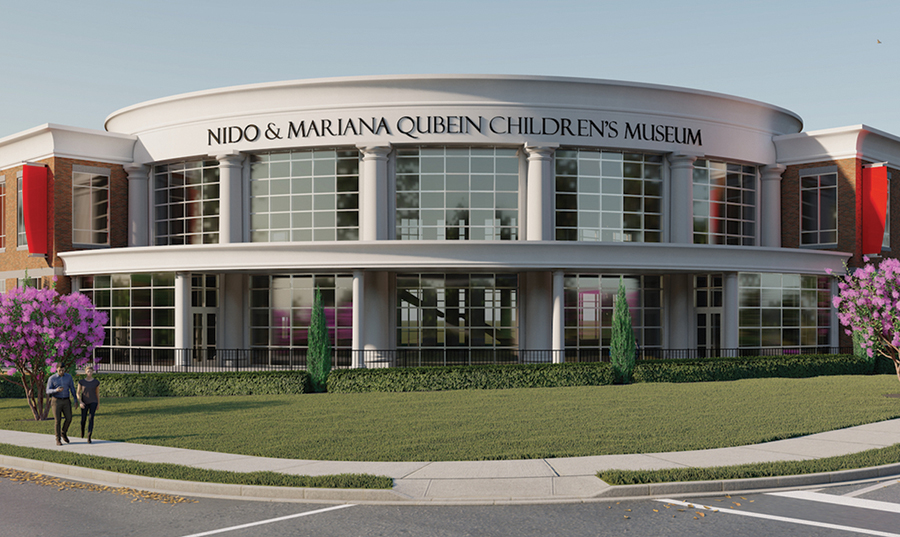
They are at it again. On March 26, Nido and Mariana Qubein hosted the grand opening of their much-anticipated children’s museum in downtown High Point. The four-acre site at 200 Quebin Ave. welcomes children and families to explore 75,000 square feet of hands-on exhibits and programming.

Attractions include Kids Point, a kid-size town modeled after High Point where children explore working at a veterinary clinic, a restaurant, a furniture design studio and more. Mars Academy invites children to travel through space to start their own Mars colony and explore the red planet’s terrain. The Hall of Mysteries is an eclectic home and laboratory offering clues to multiple mysteries visitors solve. There’s also a Big Kid’s Arcade, a STEAM Lab (science, technology, engineering, the arts and math), a vertical climber, an outdoor adventure area, a theater and a double-decker carousel.

The museum is open Tuesday through Sunday, with admission $10. The facility also offers annual memberships, gift cards, birthday parties, programs, field trips and professional development for educators. Info: QubeinChildrensMuseum.org.

Hello, Hamilton

It might be quiet uptown, but downtown is thrumming with the sounds of history being retold through hip-hop. Lin-Manuel Miranda’s award-winning show, Hamilton, hits the Steven Tanger Center for the Performing Arts April 6–24. Don’t miss your shot or you’ll be crying in your tea, which you hurl in the sea. Info: TangerCenter.com.

Makin’ Waves

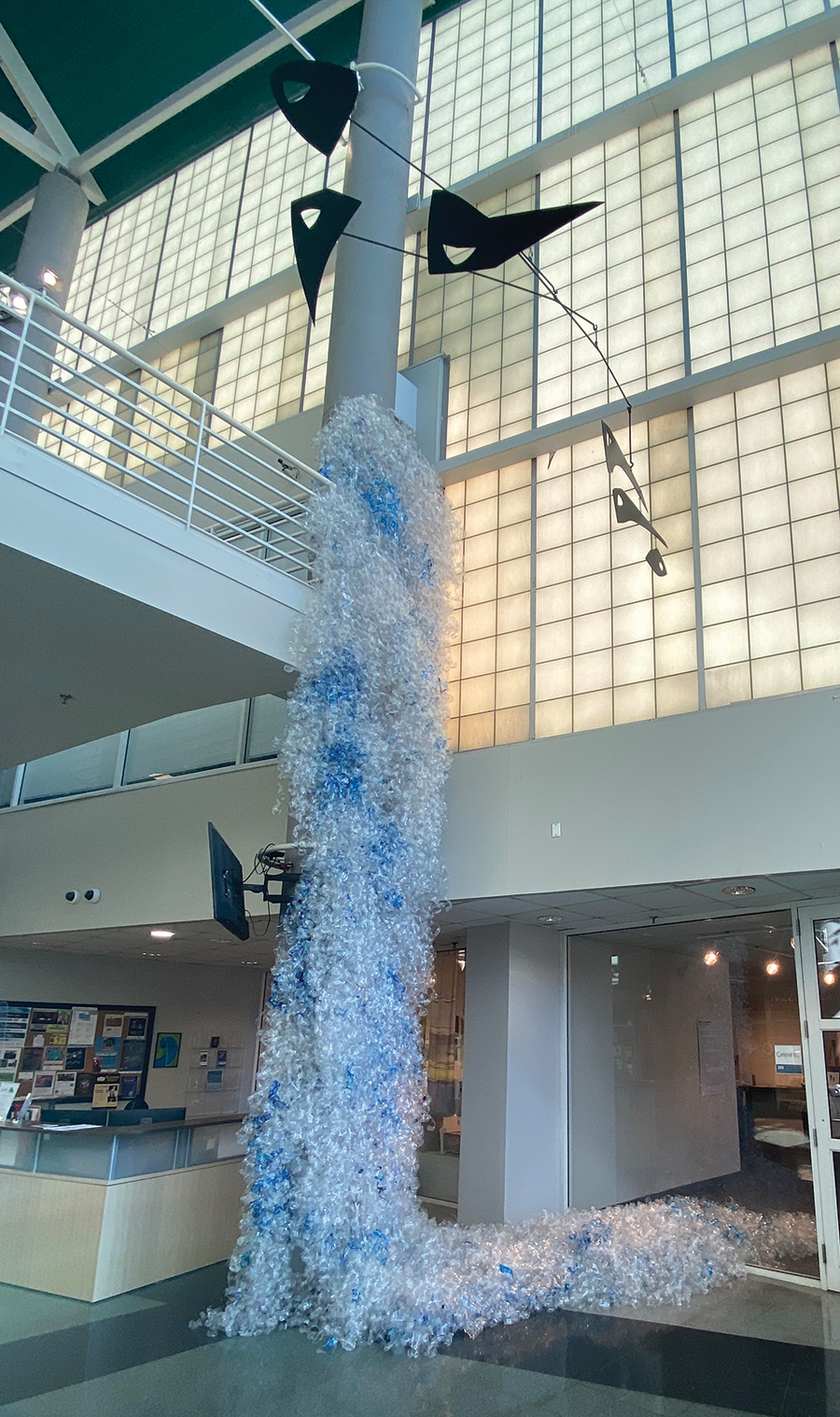
Two parts hydrogen, one part oxygen, with the covalent bond being artists concerned about the planet — and its reliance on water.H2O is GreenHill’s newest exhibit where you can check out Bryant Holsenbeck’s mammoth waterfall, made up of disposable water bottles, or his meandering stream of plastic culled from the ocean, then catch his comments on Wednesday April 13, at 5:30 p.m. Later in the month, at 5:30 p.m. on Wednesday, April 27, Will Warasila will discuss his photographs of people living in the shadow of Duke Energy’s Belews Creek Steam Station, where 12 million tons of coal ash are being cleaned up. And every Tuesday from 1–2 p.m. at LeBauer Park, GreenHill artists/instructors will host water-inspired art activities for children and their families. Water you waiting for?
Info: GreenHillNC.org/H2O.

Kudos to . . .

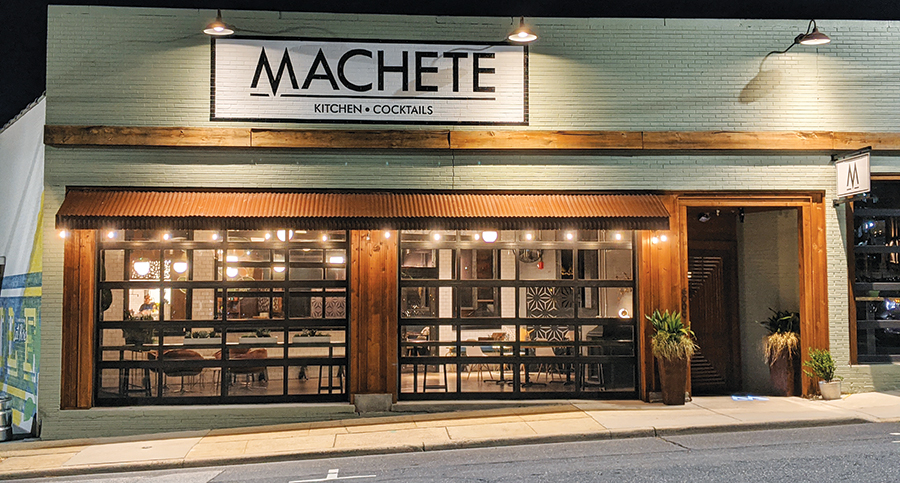
Our friends at Machete, at 600-C Battleground Ave., have been named semifinalists for a 2022 America’s Classic Award for Best New Restaurant by the James Beard Foundation. Any wonder? We don’t think so. With an exquisite plate selection from beef tartar to whole fish to heirloom carrots (to die for) in a chill atmosphere, the restaurant’s creative cuisine is as cool as its vibe.

Stars on Ice

There are a lot of things we like on ice, like scotch — and world-class figure skaters. The 2022 Stars on Ice tour glides into the Greensboro Coliseum at 7:30 p.m. Wednesday, April 20. Catch recent Olympic gold-medalist Nathan Chen with a skate squad of skill as they salchow, axel, lutz, loop and flip — things we can’t even do on dry land — their way across the arena. Info: GreensboroColiseum.com.


Flower Power

All the yard’s a stage in Shellie Ritzman’s blooming world

By Maria Johnson

Photographs by Amy Freeman

Shellie Ritzman is having a vision.

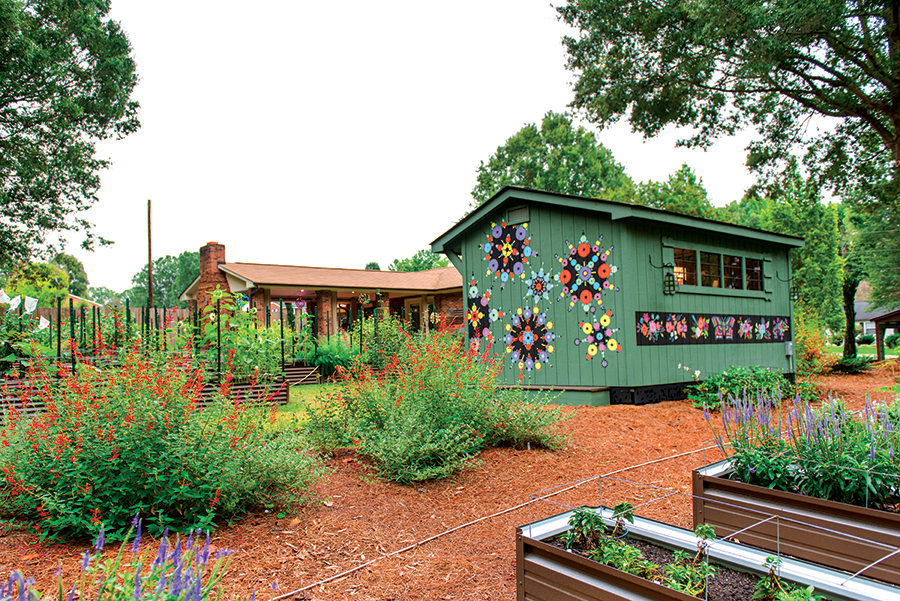
Right here, right now, standing in the dirt beside the brand new, tin-roofed workshop in her backyard in Kernersville.

She’s waving her hands. Her voice and her body are animated.

She can see the future. She points to it.

See? There’s a bright floral design — one she has painted — on the exterior wall of the workshop.

Below the design, on the ground, there’s a bench. A long bench.

The bench is filled with Boho pillows.

“You can seat probably six, seven, eight people,” she says.

Her customers will mug for pictures there, she says. Young people, especially. They want pictures to post on social media to show people their memories before they’re even memories. That’s why Ritzman has painted cheerful background graphics on other walls around the property.

But back to the vision.

Gravel will go here, Ritzman says, brushing broad strokes with her palms to the ground.

Her hands fly up, and she draws lines overhead.

Bistro lights will go here.

Anchored by a tall post here.

And, of course, she says, her fingers playing arpeggios in the air, the space will be surrounded by gorgeous flowers and plants.

“There’s so much to do,” she says, turning on the heels of her sporty flip-flops.

Somewhere, there’s a stopwatch ticking, and Ritzman — who goes by Shellie Watkins Ritzman professionally — hears it loud and clear.

“I’m always thinking of stuff,” she says. “Always.”

Her feat isn’t so much the thinking, though.

It’s the doing.

The actions that make her vision real.

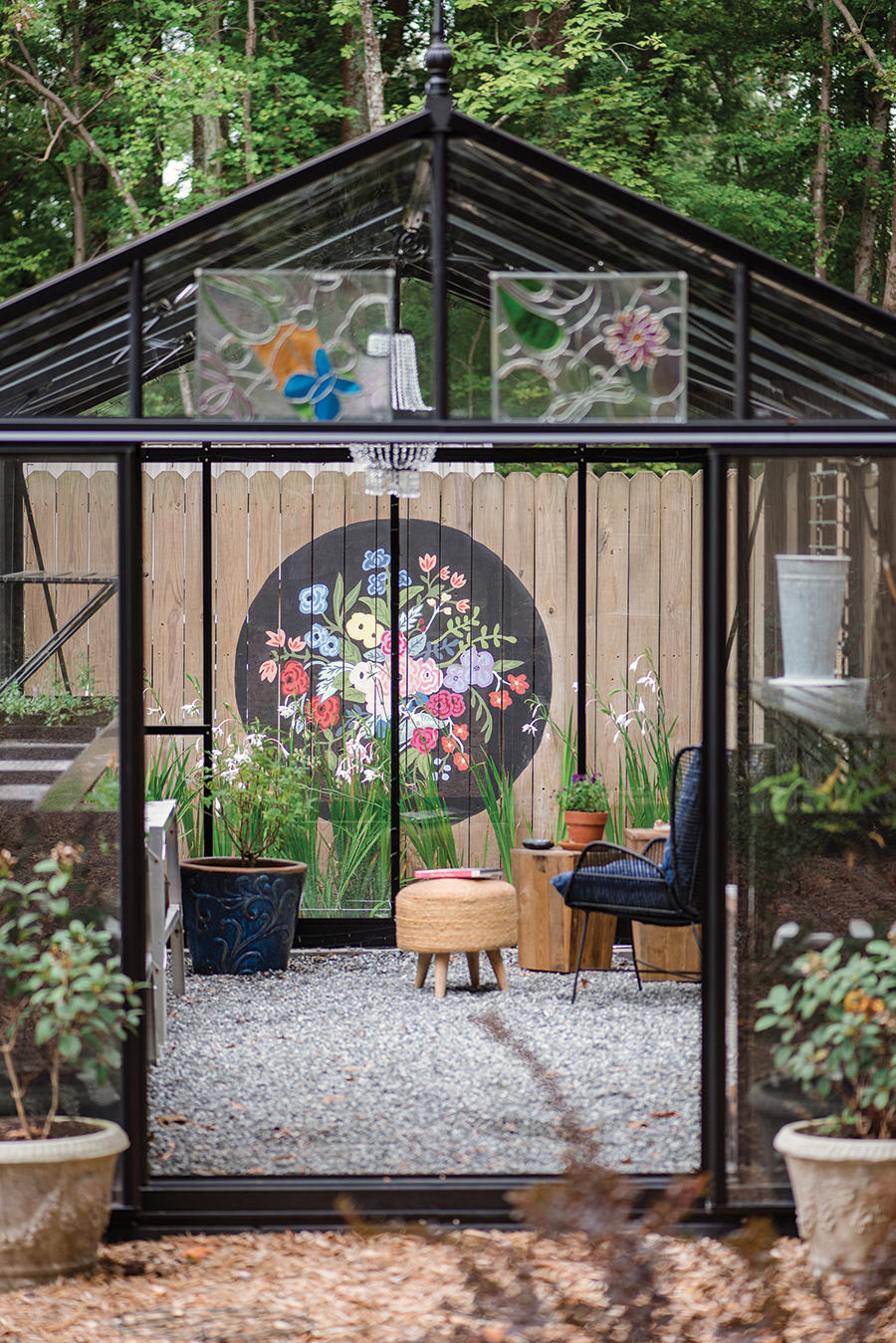
In the last two years, this semiretired executive assistant has created, from thin air and good dirt and more than a little sweat, My Garden Blooms, a homespun enterprise that wraps a cut-flower business — rooted in a backyard labyrinth of raised beds— around cozy staging areas where area artists and craftspeople conduct flower-friendly events for paying customers.

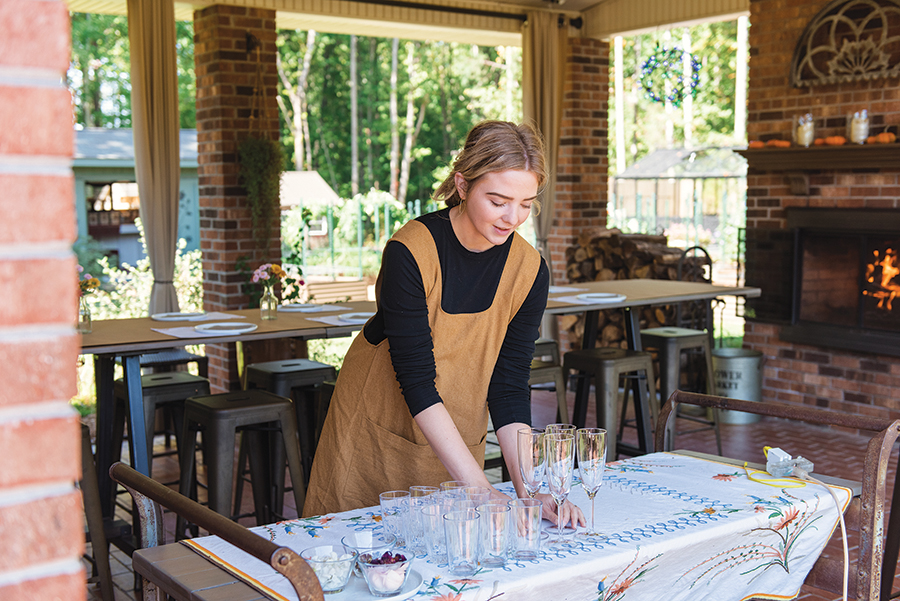
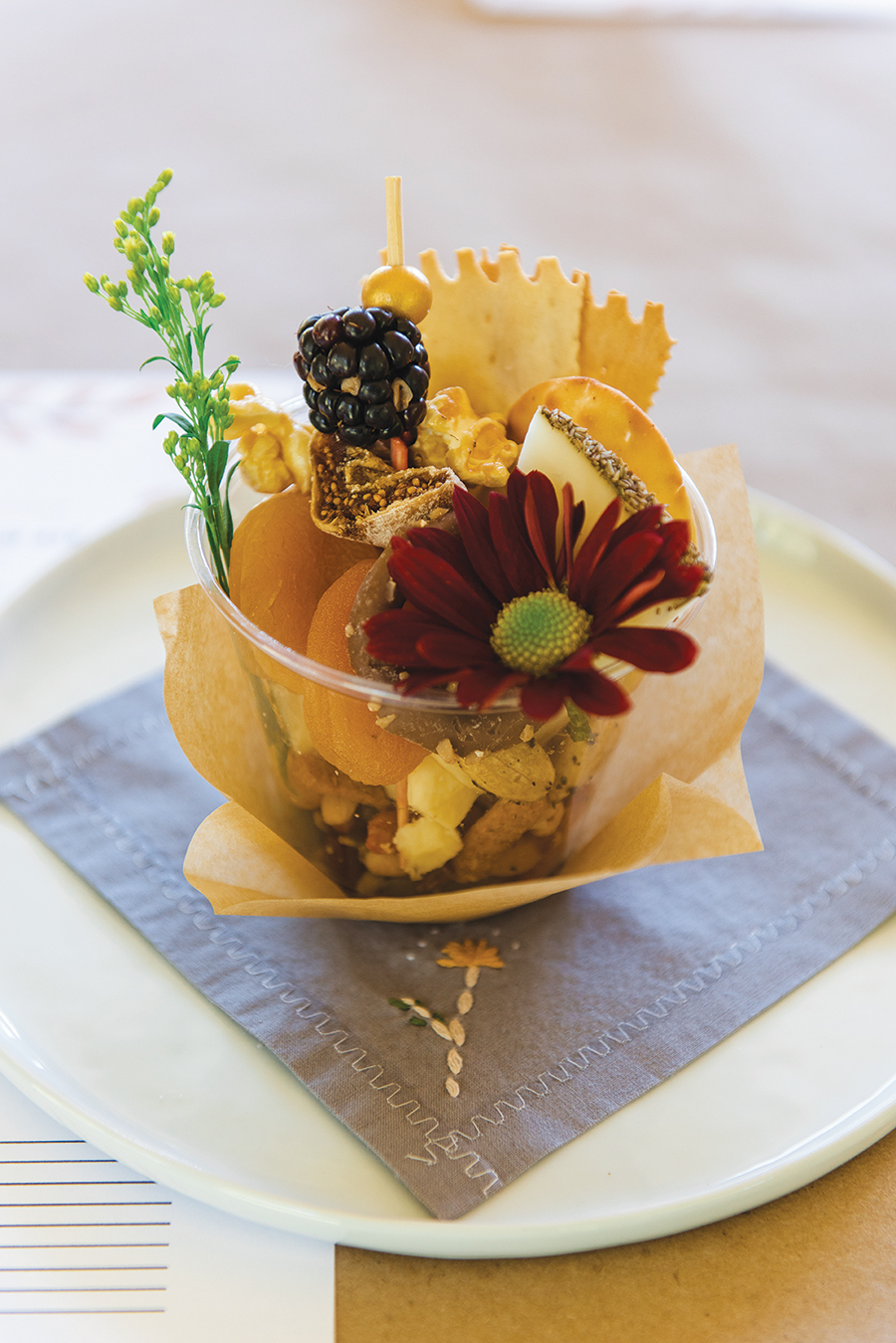
For example, later this month Ritzman will host a class called Board and Bloom Bar. For 65 bucks a head, a dozen people will gather in the breezy outdoor room that juts from the back of her ranch-style house to learn how to make a charcuterie board, the 21st-century term for a spread of meat, cheese, nuts and other antipasto.

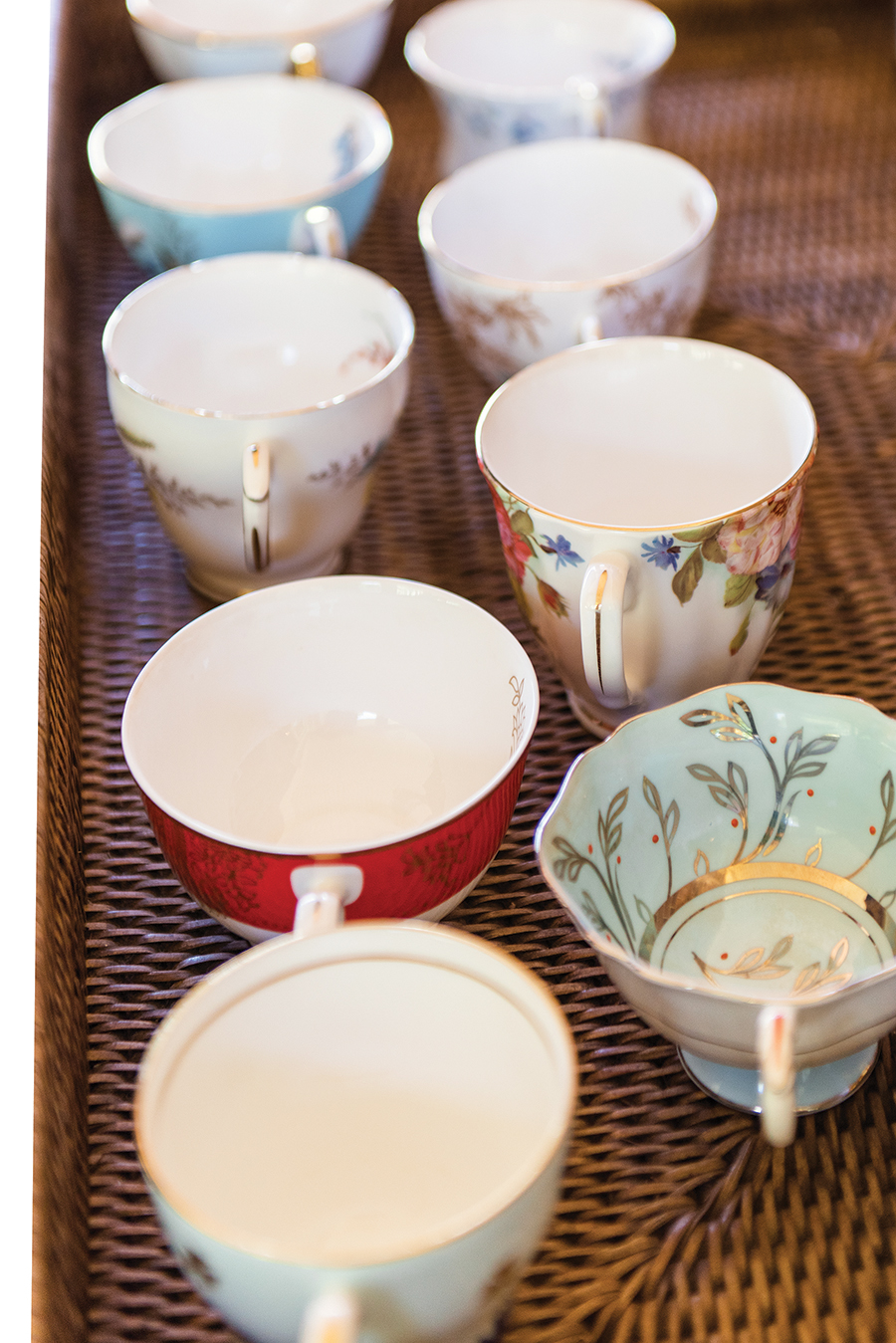
Whitney Chaney, owner of Gather & Graze Co. in Winston-Salem, will lead the session. Participants will sip botanical teas and lemonades and nibble from their own charcuterie cups. At the end, students will make a small bouquet from a selection of cut flowers to take home.

Next month, Kiley Duncan, who owns Tea + Toast, another Winston-Salem business, will show people how to make cocktails and mocktails using loose-leaf teas and botanicals. Customers will, of course, make themselves a parting bouquet. They’ll also have a chance to buy some of Kiley’s handcrafted bitters and elixirs.

Ritzman’s calendar stretches on, year-round, with tutorials on candle pouring, rock painting, flower pressing, wreath making and dried-flower arranging.

The events are good for her collaborators and for her. They raise the visibility of Ritzman’s property — which is available for private events, too — and they spotlight her primary stream of income, subscriptions to cut-flower bouquets that Ritzman wraps in brown paper and delivers weekly to pick-up points near her subscribers.

At the moment, her distributors are Cake and All Things Yummy in Kernersville and Lavender and Honey Kitchen in Winston-Salem.

“Hopefully they’ll buy a cinnamon roll and a cup of coffee while they’re in there,” Ritzman says. “I don’t know what it is about flowers and bakeries.”

Ritzman sees symbiotic relationships everywhere, especially in her second profession. Her pesticide-free flowers attract pollinators — birds, bees, butterflies and the like — which benefit the family farms that surround her. She stands in her driveway and points in three directions.

“100-year-old farm, 100-year-old farm, 100-year-old farm,” she says.

Her farmer-neighbors haven’t necessarily grown the same crops for a century. One neighbor has swapped tobacco for hemp. The point is, Ritzman sees herself as a part of the region’s agricultural tradition.

It just so happens that her boutique farm covers half an acre and that she’s wearing Ray-Ban sunglasses, a yoga studio T-shirt and cropped joggers with a snakeskin print.

“Can you tell I’m an old soul?” she asks.

She means it.

Ever since she was a girl in Amarillo, Texas — back when her mom played “tea party” with her and served graham crackers with chocolate frosting — her goal was to own a tearoom.

Then came life.

And two sons.

And the need to work as a single mom.

Ritzman typed. She took shorthand at 110 words a minute — almost as fast as most people talk.

Her fingers flew over a 10-key calculator.

“I learned real quick to say, ‘I’m finished. Is there anything else to do?’ I had a good work ethic, I guess,” she says.

She mastered bookkeeping, then spreadsheets. She transplanted her family and worked for various bosses — and their wives.

“When they said, ‘Oh, Shellie, can you design a garden club invitation?’ my little artsy self was on it,” she says.

She came by her little artsy self honestly. Her father had been a Marine, then an overall-wearing gas refinery worker, then, in a somewhat surprising turn, a self-employed commercial artist who took a mail-order course to learn to draw for profit.

He set up his own shop and designed business cards, letterhead and logos.

He painted watercolors.

He designed a commemorative coin celebrating Evel Knievel’s motorcycle jump over the Snake River at Twin Falls, Idaho, in 1974.

“The Texas Cattlemen’s Association still uses my dad’s logo,” Ritzman says.

She fed her own simmering talent with nature.

In her time off, she tended flowers in her yard — veggies never held much appeal for her — and read Victoria magazine, losing herself in slick pages filled with bowers of blossoms, smartly set garden tables and handicrafts fashioned by clever women.

Sound familiar?

When her sons graduated from college, and her boss sold his family’s Winston-Salem company, Ritzman saw blocks of time open up before her.

She bought a book called Floret Farm’s Cut Flower Garden: Grow, Harvest and Arrange Stunning Seasonal Blooms.

She followed up by taking Floret’s six-week class online.

“Their concept is, you can grow a lot of flowers in a small space,” she says.

She had the space, reclaimed from her boys’ soccer balls and go-carts.

She had the smarts.

She had the shovels.

She dug in. With the help of her second husband, Nevin Ritzman, a retired firefighter, she plopped raised beds made of corrugated metal atop islands of cypress mulch and started planting in 2018.

She made a lot of mistakes.

She buried bulbs, plugs and seeds at the wrong time of year.

She covered the beds with cloth that was too thin and shredded easily when it was removed and replaced for frost.

She misfired with flora that frowned on the climate along Cherry Vale Drive.

She tinkered until she found what worked best.

Peonies

Sweet William

Tulips

Mums

Gladiolas

Dahlias

Zinnias

Snapdragons

Sunflowers

Yarrow

and more . . .

When she hit a snag, she got advice from a supportive online community.

“I follow probably 2,000 flower farmers,” she says. “It’s not a competitive community. It’s a collective community.”

She saved what she learned in her own databases.

“People say, ‘How do you manage it?’ I say, ‘It’s a skill set: Spreadsheets out the wazoo.’ ”

In 2020, she started delivering her prepaid subscription bouquets, the only business model that made sense to her.

“I’m not go gonna sit at a farmers’ market somewhere, and nobody buys my flowers, and then I take them home, and they die,” she says.

She opened her yard for the first class later the same year. COVID delayed the startup. People still came. Some wore masks, some didn’t. Ritzman left it up to them.

Most customers felt safer knowing that the classroom was an outdoor room, essentially a covered patio anchored by a fireplace, stirred by a ceiling fan, and decorated with hanging light balls.

Last year, the Ritzmans bought a slice of land next to their yard. They colonized it with more raised beds and a heated and cooled workshop that seats 12 people — the max for events— in all kinds of weather.

Calling it a workshop is an understatement.

“I thought, ‘OK, people are going to be dining out here. It needs to be froufrou,’” she says.

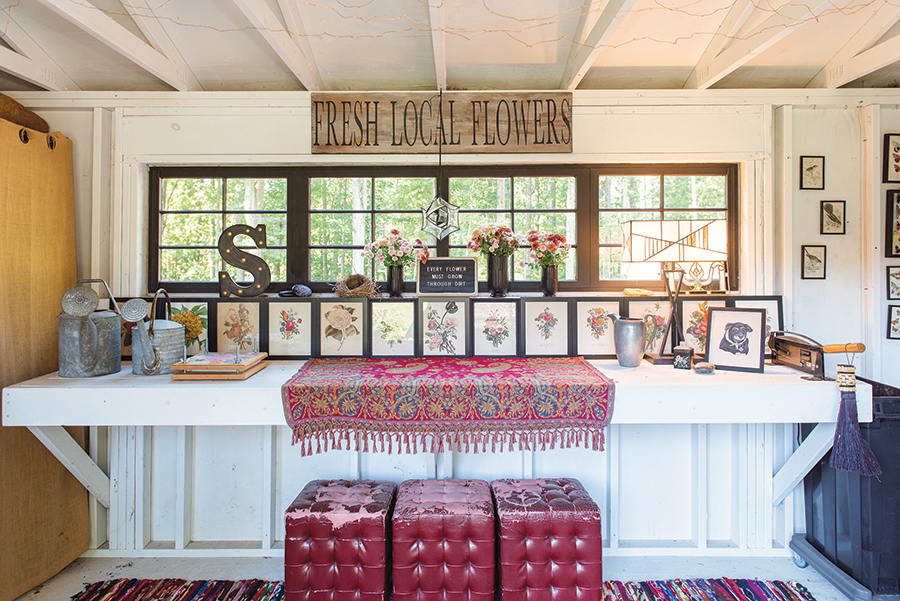
Mission accomplished. Smelling of paint and sawn lumber, swaddled in creamy fabrics, and floored with gray vinyl planks, the 14-by-28-foot space (which inspired the vision described at the beginning of this story) features a long, custom-built, bar-height table centered under an elegant light fixture.

A wallpaper mural, reminiscent of a Dutch still-life painting, reminds viewers that “In Joy or Sadness, Flowers Are Our Constant Friends.”

Apothecary jars parade dried petals of marigolds, peonies, roses and lavender.

Event participants can buy floral bookmarks, candles and other what-nots.

Ritzman will use the workshop for classes, bouquet assembly and private events, should someone want to rent it.

Her Victorian-style greenhouse also is available.

“You know the custom Boho picnic people?” she says. “If they want to offer somewhere to do a picnic, here it is.”

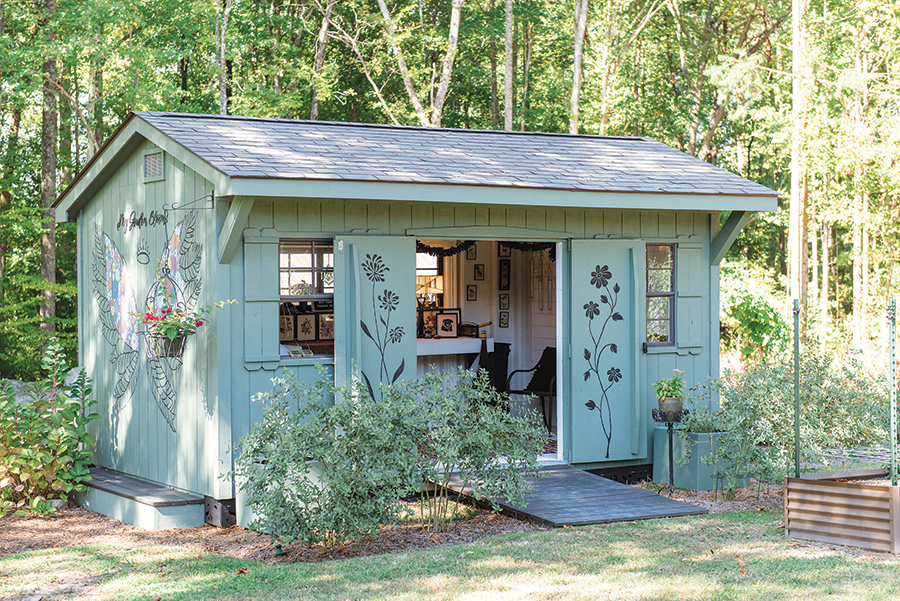
The same offer applies to the green outbuilding she calls the flower shed, which she uses chiefly as a photo studio for her wares.

“If someone calls and says, ‘Hey, can I have an intimate dinner out there with my girlfriend?’ sure, we’ll fix you up.”

Already, she makes the colorful grounds available, by the hour, for photography and video sessions.

Most visitors, though, come for the classes.

“Once they get here, they’re like, ‘OK, I get it. It’s a place to come play with flowers,’” Ritzman, 62, says.

Her customers are overwhelmingly women.

“You’ll have the sassy girls, all dressed up with their girlfriend groups. We had a group of homeschooled girls. We get a lot of sister groups, a lot of mother-daughter groups,” she says.

Recently, the first male student signed up to take a two-hour charcuterie class with his wife.

“I told my husband, ‘You have to be here so he won’t be intimidated,’” she says.

Regardless of gender, Ritzman believes, her customers are hungry for beauty and company. As the pandemic wanes, they’re emerging like the lime green knuckles of seedlings, testing the environment to see if it’s safe to bloom.

“Last year, we did really well, but this year we’re selling out quicker,” she says. “People are ready to get out.”  OH

Learn more about Ritzman’s business at her website, mygardenblooms.net or on her Instagram page, @mygardenblooms.

Maria Johnson is a contributing editor of O.Henry. She can be reached at ohenrymaria@gmail.com.

Wandering Billy

Child Star

Brody Bett’s ascent to fame began
— you guessed — in Greensboro

By Billy Eye

In 2016, when Brody Bett accepted the role of the Grand Duke in the Community Theatre of Greensboro’s production of Cinderella Kids, he had no way of knowing it would set him on a path where, a couple of years later at the ripe old age of 8, he would be circling the nation singing and dancing his chili pepper heart out as the star of two big time Broadway-touring musicals. Oh, and he has a supporting role in one of the most highly anticipated motion picture thrillers of the year, at least for moviegoers here in the Gate City.

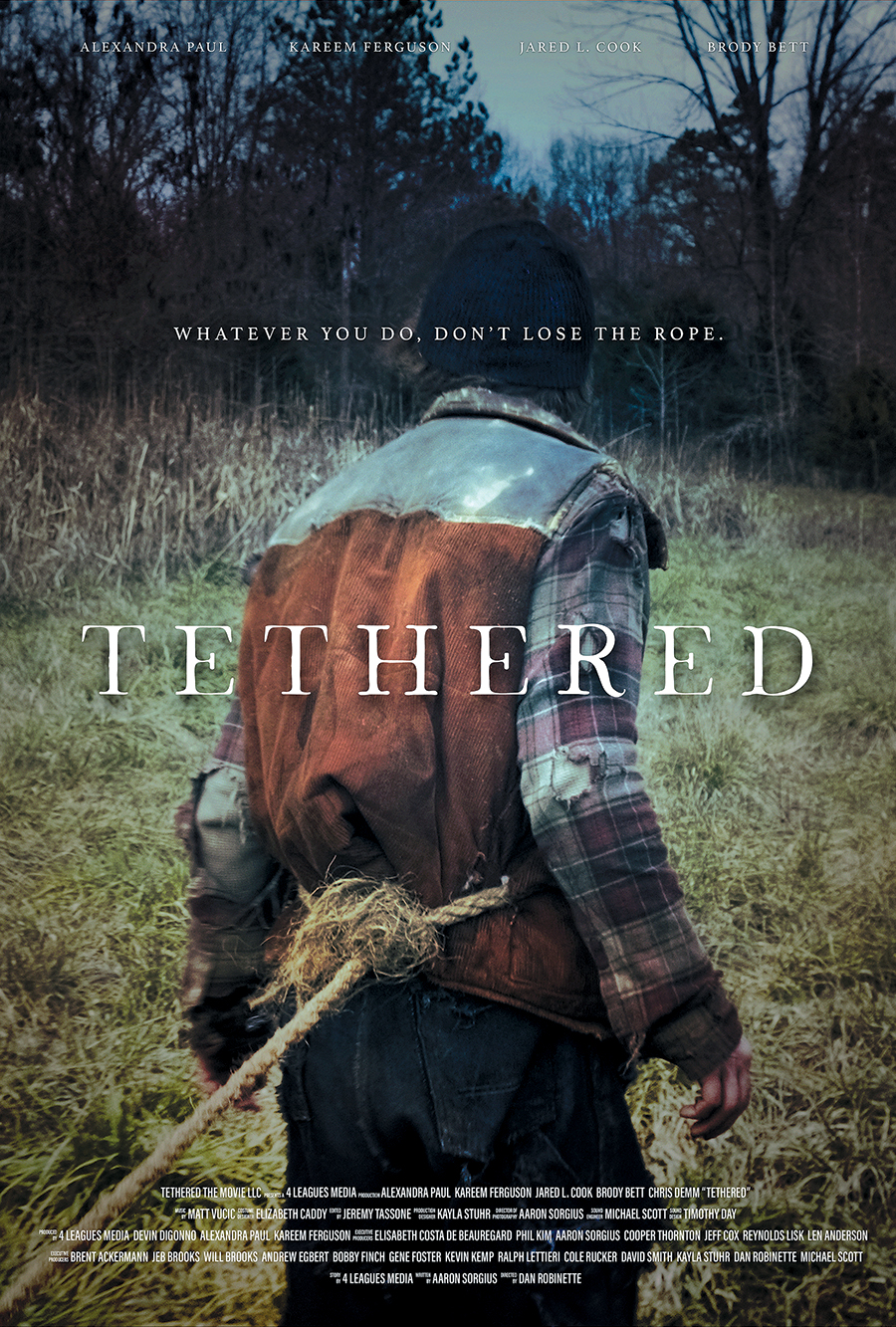
The film is Tethered, a dark, psychological thriller produced by Greensboro-based 4 Leagues Media, a consortium of local filmmakers, writers and technicians who’ve banded together to produce nine short films since 2014 and, this year, their first full-length feature.

“We always had aspirations to shoot a full-feature film,” producer/writer Jeff Cox says. Tethered is based on 4 Leagues Media’s 2017 short film of the same name. “So, by the time we began shooting Tethered, we had learned a lot about production, funding and all of that kind of thing along the way,” he says.

Directed by 4 Leagues partner Daniel Robinette, Tethered was shot at Red Wing Farm, a 400-acre hunting refuge and equestrian facility outside of Thomasville — where nary a car nor airplane could be heard. “We feel like we’ve created a little world that wasn’t like anything you’ve seen on film,” Cox says, “which is tough to do with a limited budget.” This means they can’t do the sort of computer      generated imagery or special effects available in Hollywood. “We had SAG [the Screen Actors Guild] involved so we had their regulations we had to follow, which was fine.”

The producers sought out advice from other creatives around the country who’d made feature films that ultimately found an audience. “We kept hearing we needed a name actor attached to it before distributors would even look at it,” Cox says. “One of our executive producers knew Alexandra Paul [Lt. Stephanie Holden on Baywatch] and sent her the script. She was game and signed on with us.”

Without having seen the film before press time, I can’t vouch for it, but the poster and the trailer are spot on; they got that right. It’s telling also that North American theatrical and streaming rights were immediately snatched up by Gravitas Ventures, a major distributor whose current release is the Pierce Brosnan film, The King’s Daughter. As a result of that hookup, Tethered debuted in select theaters on March 18 with video on demand via iTunes and Amazon before heading to one of the streaming platforms, according to news sources.

That’s an astonishing feat when you consider this is a low-budget indie shot in pastures and woods. But honestly, nothing terrifies me more than the idea of being isolated in the hinterlands — the trees have eyes!

In the leading role is Walkertown native Jared Laufree, who portrays Solomon, a tormented, sightless youth at the mercy of some mysterious entity lurking beyond the nearby tree line. By all accounts, Laufree’s performance is riveting. “In high school, I joined an acting class called Actors Group in Winston-Salem,” he says of his previous experience. “And I did that for four years. Since then, it’s kind of been snowballing.” Asked to describe his character, “The first word that popped in my head was lonely but then I also wanna say he’s strong too. Very strong, very brave, courageous.”

Jared Laufree also was the lead actor in the short film Tethered. “He did such a great job and got so much praise,” Cox says.  “Alexandra Paul saw the short and suggested that Jared play the lead in the feature. He did an outstanding job.”

It’s a demanding role, “because I’m so angsty myself,” Laufree says. “I liked the opportunity to get all that out.” As for continuing to pursue acting roles, “I really want to be a screenwriter. I feel like that fulfills me more right now, at least in my life, than acting.”

Playing Young Solomon in Tethered is the aforementioned Brody Bett. Thinking back to that initial role in the Community Theatre production of Cinderella as a first grader, “I loved it so much that I actually did six shows in a year,” he says. “I did five more with Community Theatre of Greensboro and one for Triad Stage.”

As an 8 year old, he commandeered one of the leading children roles (Jack/Michael) in the Broadway national tour of Finding Neverland, a high-flying musical attraction whisking him and his mom across 43 states, touching down in 102 cities in a 10-month period. Bett is what they refer to in show business as a “triple-threat” — that rare entertainer who can act, sing and dance
. . . all at once if need be. Come to think of it, considering he’s mastered five instruments — keyboard, ukulele, drums, organ and guitar — Brody’s a quadruple-threat, a potential Sammy Davis Jr., this kid.

“After Finding Neverland I got an agent out of New York, then another Broadway national tour playing the leading role ‘Charlie’ in Charlie in the Chocolate Factory,” Bell tells me. When the shutdown happened in March of 2020, he and his mom were dispatched home.

How to channel all of that energy, enough to light up an audience of thousands of theater-goers night after night? “My agent asked me if I wanted to do voice-over tryouts, so we set up this amazing recording studio in our house.” For the last couple of years, Bett’s been laying down tracks for Disney and Netflix, and he’s the singing voice of Gil in Nickelodeon’s effervescent preschooler Bubble Guppies.

It was during this period that Bett was cast as Young Solomon in Tethered, which began filming in January 2021. “My character is a sweet young boy who always tries to please his mom,” Bett says about his part, the younger version of the lead. He was paired with Alexandra Paul, who played his mother. “I can’t say enough nice things about her. It was such an honor to work with her.”

Stage and film acting are separate crafts, similarities notwithstanding. “I think I enjoyed film acting a little bit more than stage acting,” Bett says. “I got to meet so many new people and be in front of the camera, which is something I always love to do.” Having trod more boards, in short pants mind you, than actors three or four times his age, seeing himself on the big screen, “was pretty surreal, I have to say. Yeah.”

Asked to return to Charlie and the Chocolate Factory last year, Bett declined, preferring to remain home, concentrating on his burgeoning voice-over career, which is proving very lucrative for this now 12 year old. “Maybe, if I do anything with film,” Bett imagines, “I’m probably going to be a composer or the score writer.” Nothing’s stoppin’ this kid!

Producer Jeff Cox is optimistic about the future of local filmmaking. “We’re just a little niche company that’s trying, long-term, to bring back filmmaking to North Carolina,” he says. “A lot of that activity moved to the Atlanta area because the state got rid of the [financial] incentives and tax breaks. The more prevalent it is, the more incentive for the state to bring some of that back. We thought this movie turned out really well and obviously Gravitas Ventures thought so too.”  OH

Billy Eye is a former Hollywood movie poster artist. Most recently, he featured prominently in the upcoming 2022 European documentary Devil on Wheels, which chronicles Steven Spielberg’s first motion picture Duel.

Ogi Sez

Ogi Sez

While our “Winter of Discontent” has lasted eight full seasons, I truly believe that hope is on the horizon. I’m sensing a rebirth, a renewal, a reawakening that goes beyond seasonal. Yet, what better time than April being a transition month is there to shake off the shackles, divest the doldrums and breathe in the beauty? So, let’s go dancing in the moonlight, singing in the sunshine and letting the music keep our spirits high.

• April 7, Haw River Ballroom: Not long after “Americana” became au courant (circa ’95), Todd Snider ambled onto the scene to perfectly define the idiom as a nonmainstream mixture of folk, alt-country, blues, acoustic funk and all things East Nashville. He immediately became the Americana poster boy and remains so today. To say he is a revered figure would not be a stretch.

• April 8, Ziggy’s: Back when the original Ziggy’s was packin’ them in nightly, one of the prime packers was guitar whiz Keller Williams. And it does my heart good to see that both are still alive and kickin’. Yes, the reborn Ziggy’s is now in High Point, but all that means is a shorter drive from G-boro to see Keller kill it.

• April 14, The ArtsCenter (Carrboro): Apologies for sending you down the road, but when the show is James McMurtry, I trust you’ll forgive me. Few singer-songwriters dare be mentioned in the same breath as Guy Clark or Townes Van Zandt, but McMurtry has earned the comparisons. The son of famed novelist Larry McMurtry, he comes by it honest.

• April 19, Greensboro Coliseum: Where do you start in describing the career of Sir Elton John? It literally gives me chill bumps thinking of the impact he has had, not only on pop music, but on the music industry as a whole. But, yes, after 50 years, he really is saying goodbye to Yellow Brick Road and snuffing out the candle in the wind, but not before a Greensboro appearance.

• April 22-23, The Crown: This show originally was scheduled for last October but, well, you know, that thing that refused to go away . . . I feared that it would not be rescheduled, but the gods of music have smiled down on us. Bus Stop (Evan Olson, Britt “Snuzz” Uzzell, Chuck Folds, Eddie Walker) was H-U-G-E throughout the ’90s, arguably the biggest band ever to come out of Greensboro. The Crown was wise to schedule two nights for the reunion.

Against the Grain

The Remarkable Life and Legacy of Master Craftsman and Free Man of Color Thomas Day

By Jo Ramsay Leimenstoll

In the furniture and woodwork he crafted for a region’s elite, free Black Thomas Day (1801-1861) combined his cabinetmaking talents with his personal interpretations of fashionable styles to create a distinctive woodworking idiom unique to the mid-nineteenth century Dan River region of North Carolina and Virginia. His remarkable legacy of furniture and architectural woodwork reveals a familiarity with popular pattern books, mastery of furniture-making techniques, incorporation of emerging technology, and expression of a personal aesthetic that elevates him beyond the role of a craftsman to that of an artist. With his great artistic autonomy, Day is one of a few free people of color to leave behind a substantial body of work, one that includes more than 200 pieces of furniture as well as interior woodwork in more than eighty houses.

Born in Virginia to mixed-race parents, Thomas learned the woodworking trade from his father, John Day. When Thomas was a teen, the family migrated from Virginia to North Carolina, eventually settling in Warren County. In 1821, Thomas left his father’s cabinetmaking shop to set up his own shop in Hillsborough. Just two years later he joined his older brother John’s shop in the bustling town of Milton where access to the Dan River and two railroad lines generated a thriving community of artisans and merchants. Although John subsequently left for Liberia to become a Baptist missionary, Thomas remained in Milton where he continued to build his cabinetmaking business, purchasing property in 1827 and establishing his reputation as an artisan. In 1830, Day married Aquilla Wilson, a free Black from Virginia, but she could not join him because an 1826 law prohibited free people of color from migrating to North Carolina. In an unusual response that speaks to Day’s importance within the community, sixty-one prominent white men in Milton and Caswell County successfully petitioned the General Assembly to permit Aquilla to move to North Carolina. Romulus Saunders, the state’s attorney general, endorsed the petition adding:

I have known Thomas Day (in whose behalf the within petition is addressed) for several years past and I am free to say, that I consider him a free man of color, of very fair character — an excellent mechanic, industrious, honest and sober in his habits and in the event of any disturbance amongst the Blacks, I should rely with confidence upon a disclosure from him as he is the owner of slaves as well as of real estate. His case may in my opinion, with safety be made an exception to the general rule which policy at this time seems to demand.

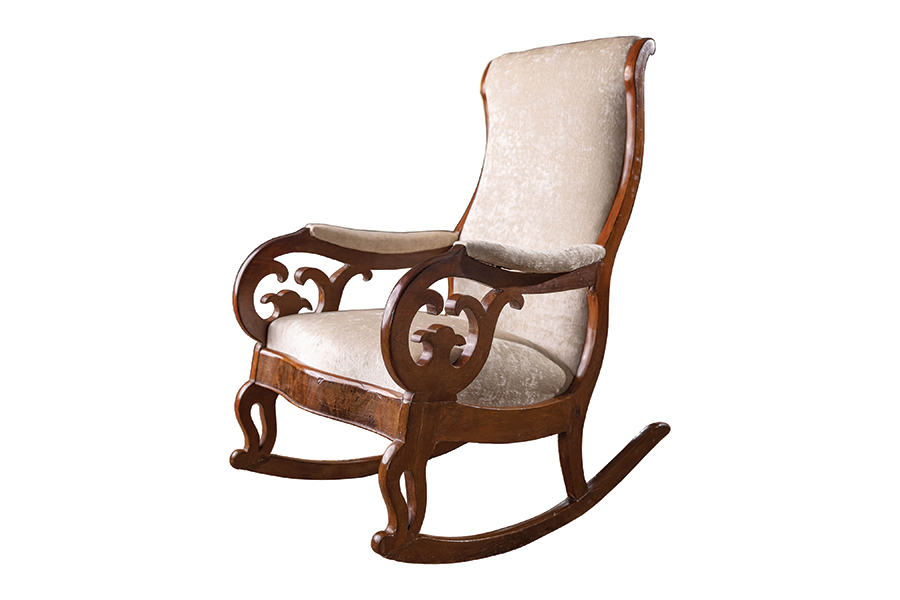
Rocking chair. Made by Thomas Day, ca. 1850. Mahogany, mahogany veneer, pine (upholstery not original).

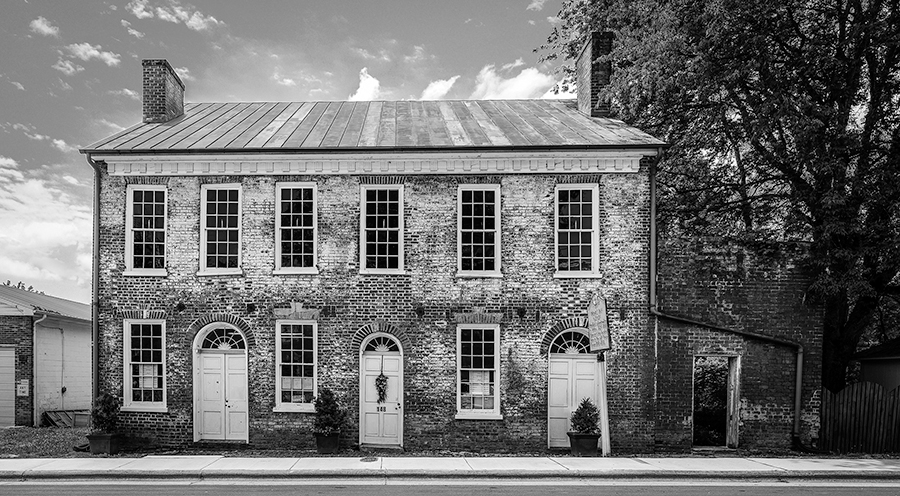
The petition was granted in late 1830, and Aquilla joined Thomas in Milton. During the decade that followed their household grew to include three children and eight enslaved people. Day was a husband, father, church-going Christian, and respected member of the community. He was also a gifted artisan and a clever businessman. As his clientele expanded and his business grew, he purchased more properties in Milton, eventually acquiring the prominent Union Tavern on Main Street to serve as his shop and residence.

Union Tavern/Thomas Day House, Caswell County, NC, ca. 1818. Jim Lamb , Capital City Camera Club, photographer. Courtesy of Preservation North Carolina.

Day benefitted from the economic boom-era in the Dan River region that sprang from the 1839 discovery of a process for curing tobacco with heat creating vivid yellow “Brightleaf” tobacco. As the wealth of white planters soared, Day was in the right place at the right time, ready to accommodate their aspirations for refinement and gentility. Many chose Day to express their status through his interpretations of the fashionable Grecian style of furniture that paralleled the emerging Greek Revival architectural style. A savvy entrepreneur, Day capitalized on the planters’ social network to establish the largest cabinetmaker’s shop in the state by 1850 — a shop with a diverse workforce of enslaved men, white and mulatto journeymen, and apprentices.

His furniture and woodwork were primarily crafted for the homes of wealthy planters and middle-class merchants, including such prominent citizens as physician and planter John T. Garland, attorneys Bartlett Yancey and Romulus Saunders, merchant John Wilson, and planters William H. Long, William H. Holderness, and Thomas M. McGehee. In addition, Day also received some institutional commissions, including furnishings for the Dialectic and Philanthropic Society Debating Hall at the University of North Carolina at Chapel Hill. He also fabricated the pews for the Milton Presbyterian Church where he and Aquilla were respected members.

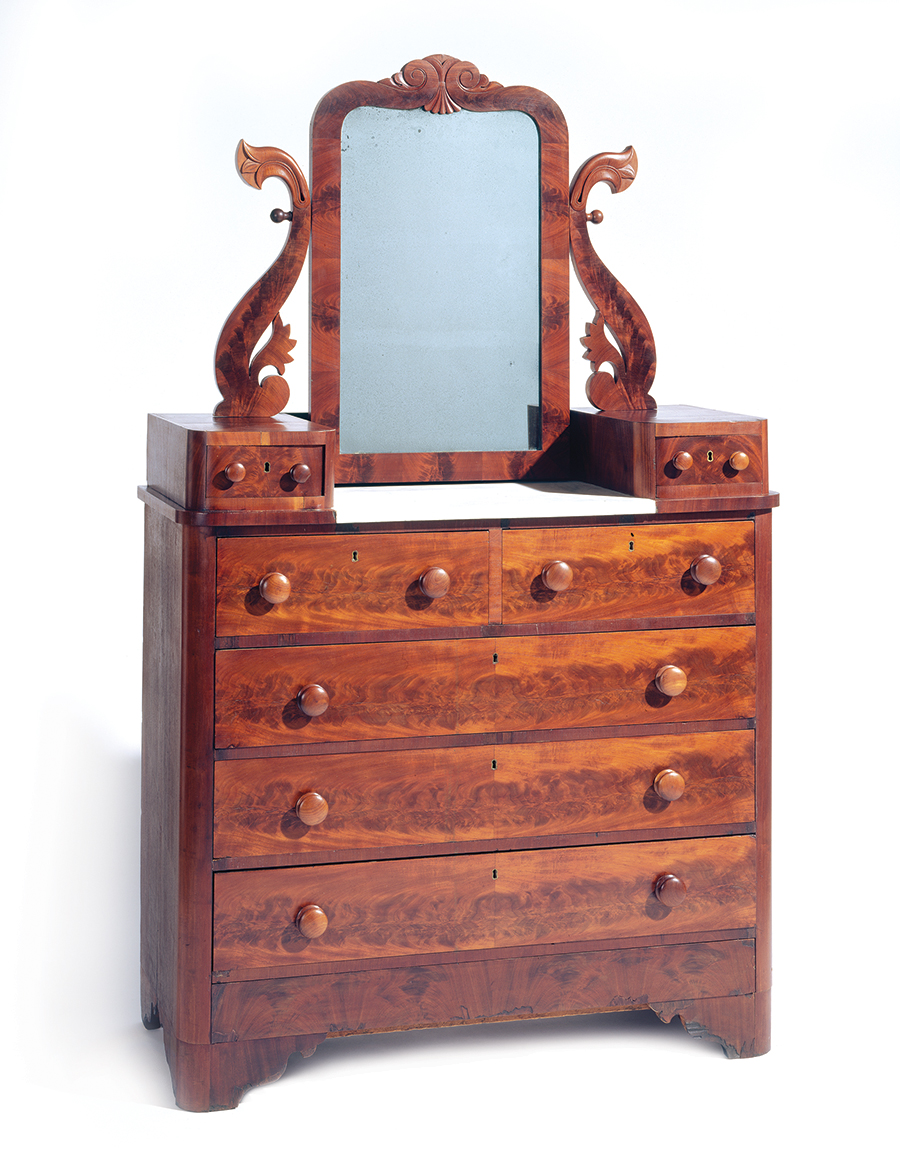
Day’s early furniture reflects a familiarity with popular pattern books illustrating classically inspired pieces he skillfully replicated. Day was also quick to incorporate the emerging stylistic trends appearing on the national scene, including French, cottage, and Gothic influences. By the 1840s he adopted a more idiosyncratic design aesthetic that distinguished his work from his contemporaries and from the pattern books and broadside posters of the period. Day fabricated much of his furniture from imported mahogany, or he employed mahogany veneers over secondary woods. His repertoire included all the pieces needed to accommodate a genteel lifestyle, and his embrace of technological innovations such as a six-horsepower steam engine dramatically enhanced his productivity. Between his steam-powered shop equipment and large workforce, Day could rapidly produce orders even as large as Governor David Settle Reid’s 1855 request for forty-seven pieces of furniture.

1850-1860 Thomas Day made bureau/chest of drawers. Originally owned and used by Gov. David Settle Reid and his wife, Henrietta Settle Reid at their plantation home in Rockingham county, NC.

Day’s custom-made cabinetry and furniture exhibit a powerful energy and a vocabulary of individualized motifs that define both form and detail. While his designs adhered to the principles of symmetry and balance, and utilized classical details, Day pushed beyond standard conventions with bold three-dimensionality, serpentine curves and exuberant ornamentation. The fluidity of his forms suggests a sense of motion that by contrast made the work of his counterparts appear staid. The popular S-shaped scroll motif is incorporated into many of his pieces such as the rocking chair arms and the mirror brackets of his open pillar bureaus. Day lightens the massiveness of Caleb Richmond’s sideboard with S-shaped pillars terminating at the base in scrolled feet, and he embellishes the mirrored gallery back with a pair of whimsical S-scrolls set on the diagonal.

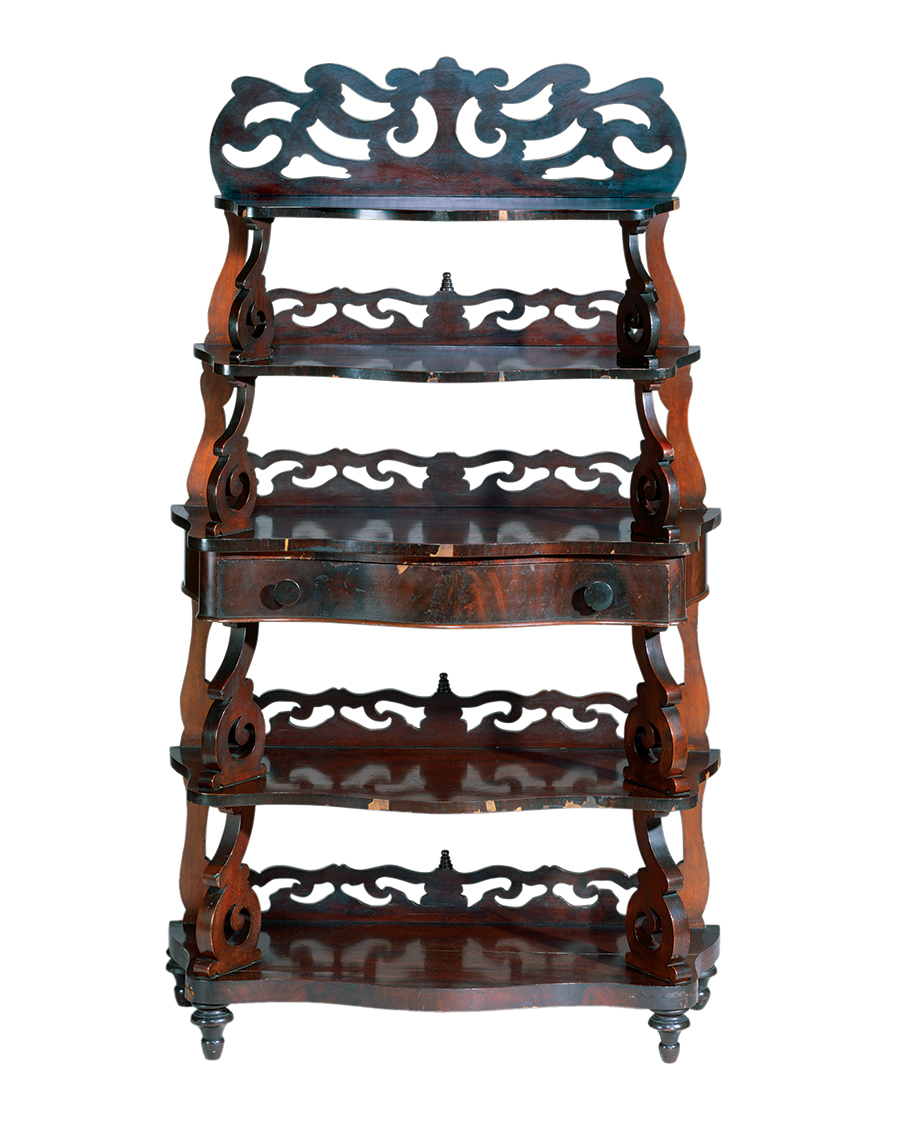
Day often detailed his side chairs and rocking chairs as well as other pieces with ornamentation composed of scroll shapes, ogee and reverse ogee forms, and foliage motifs. While such shapes are certainly not unique to Day, he applies them with more vitality and three-dimensionality than his peers. In particular, Day’s distinctive whatnots with pierced galleries illustrate his use of the jigsaw to create positive and negative shapes. Still balanced and symmetrical, these playful serpentine shapes convey motion and whimsy as do the S-shaped scrolls that support each of the shelves.

Thomas Day Whatnot Shelf, frontal view. Owned by Margaret Walker Brunson Hill, as of Oct. 2021.

The unique, signature lounge is the furniture form most closely identified with Thomas Day. It evolved from an upholstered lounge form popular in the early 1800s that incorporated a low back at one end. Day transforms this earlier model by suspending a slender backboard between arching rear pillars so it appears to float effortlessly across the length of the lounge and creates a complementary negative space in the open back below. Likewise, the side arm rails of the lounge mirror their shapes in both positive and negative forms.

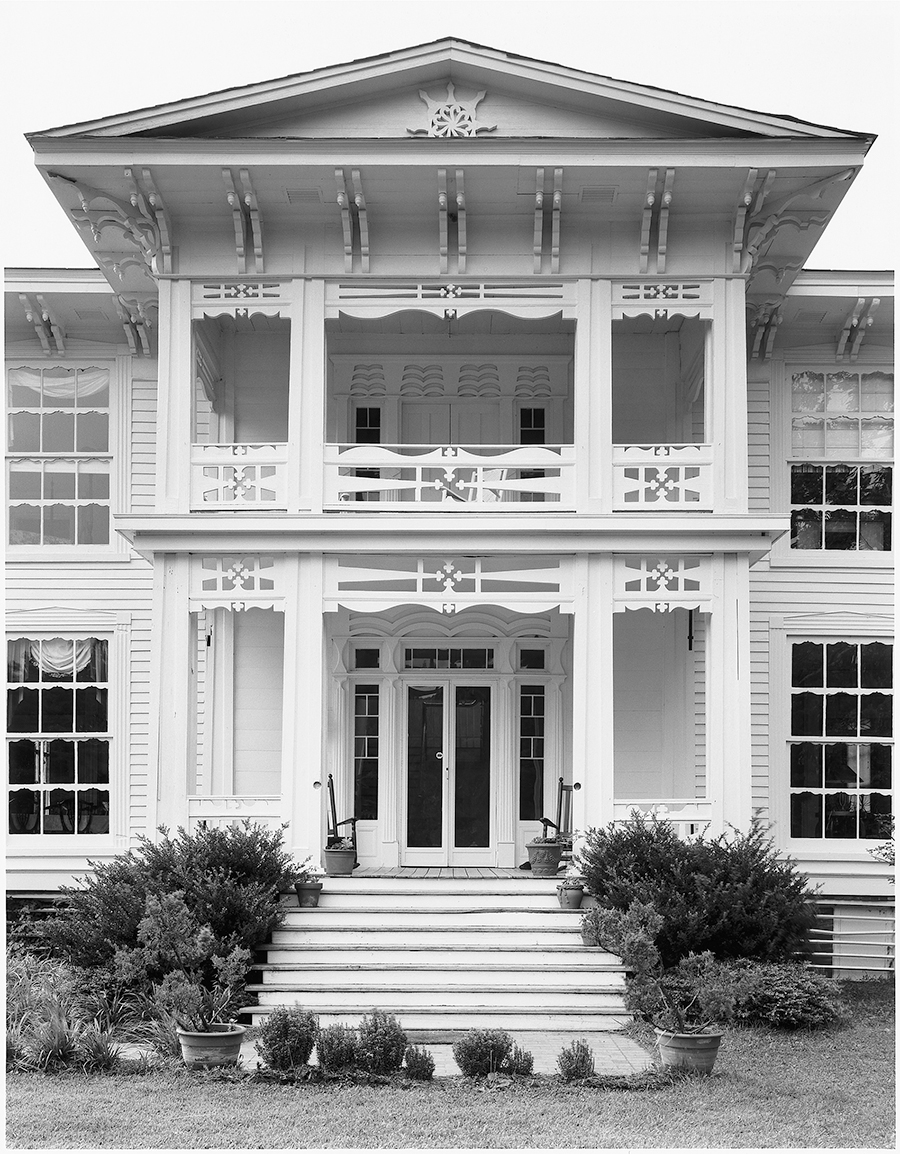
Like his furniture, the distinct and innovative architectural woodwork of cabinetmaker Thomas Day emerged from a specific context of race and place as planters in the 1840s and 1850s expressed their gentility through new boom-era Greek Revival houses and front additions to earlier homes in the Dan River region. More than eighty houses constructed or expanded over a quarter century radiate out from Day’s shop in Milton on either side of the Dan River, revealing the volume and scope of his work. Six intact North Carolina houses illustrate Day’s fully articulated woodwork ensembles of the mid-1800s. Two were built as additions to older houses: the 1856 front section of the Bartlett Yancey House and the ca. 1855 side addition to Longwood (lost to fire in 2013). The other four properties are large Greek Revival period houses: the Holderness House (ca. 1851), the Friou-Hurdle House (1858), the Richmond House (ca. 1850), and the Bass House (ca. 1855). In the next decade, Day embraced the emerging Italiante style with lively sawnwork crafted for the exterior and interior of the Garland-Buford House ( ca. 1860).

Commissions from wealthy planters provided a springboard for Day to create his own artistic signature writ large through architectural compositions. Using staircases, mantels, niches, corner blocks, baseboards, and casings as his palette to sculpt interior spaces, Day developed a fluid, exuberant, idiosyncratic interpretation of the Greek Revival style adopted throughout the Dan River region — all the while operating within the legal and social systems that constrained free Blacks at the time.

Day brought the vivacity of the curving line to his woodwork in innovative ways that continue to amaze and delight. In his entrance halls, bold and varied S-shaped newel posts with tightly coiled spirals and sinuous curves spring from the handrails, all in sharp contrast to the straightforward turned newel posts in most houses of the era. Many of these houses typically have turned newel posts or the more traditional circular ring of balusters supporting a horizontal spiral that terminates the handrail. In contrast, Day rotated the relatively serene horizontal spiral 90 degrees and enlarged the vertical spiral to form the entire newel, conveying a sense of energy and motion that extends the movement of the ramped handrail into the entry hall. Day’s signature newel posts proclaimed the owner’s social status to all who entered.

Complementing his newel posts, curvaceous stair brackets at the end of the treads display fluid-lined variations on standard patterns. While most Greek Revival staircases incorporate decorative stair brackets, only Day’s utilized coordinated motifs to reinforce the S-shaped newel post statements, such as those he crafted for the Glass-Dameron House and Hunt House staircases.

Day’s mantels, the focal point of many a planter’s parlor, invigorated standard Greek Revival idioms with robust serpentine mantel friezes to create a sense of movement unlike the static paneled friezes of their counterparts. As seen in the Holderness House parlor, Day reinforced the hierarchy of the parlor as the most formal interior space by flanking the mantel with arched niches framed by deeply fluted moldings. Likewise, around door and window openings, Day installed bold casings animated by the shifting patterns of light and shadow on their deeply fluted surfaces. The undulating forms and sharply cut sawnwork characteristic of Day’s interiors play upon the tension between positive and negative space.

Like his furniture designs, Day’s architectural woodwork grew out of the framework of classical architecture, respecting formality, symmetry and hierarchy. To his interiors, Day brought fluidity and movement as he abstracted, distorted, rotated, intensified and distilled to transform that vocabulary. Day skillfully maximized and celebrated the fluidity of form as someone who knew the rules and understood how to break them.

The remarkable design aesthetic of his furniture and architectural woodwork speaks to us of the complexity of the life and work of Thomas Day — an entrepreneurial free person of color who crafted a remarkable legacy equally complex in its style and expression. His amazing tangible body of work continues to astound and inspire far beyond the Dan River region. Day’s work also reveals the enduring power and innovative evolution of his appealing aesthetic, an aesthetic ironically empowered by the most powerful and wealthy white citizens of his time and place. 

To Learn More

If you are interested in knowing more about Thomas Day, check out Blandwood Estate current exhibit, “New Perspectives on Thomas Day — Pairing Furniture by North Carolina’s Free Black Master Craftsman With Contemporary Pieces From Governor Morehead’s Blandwood,” April 1 through Sept. 30. The exhibit will generate conversations about the acclaimed free Black cabinetmaker and artisan. Displayed with Day’s furniture are pieces once owned by Gov. John Motley Morehead. According to Blandwood, the show also examines Day’s furniture in period rooms and “introduces new approaches to understanding the work of this master craftsman as a successful Black entrepreneur operating within elite white social circles.”

“This special presentation of Day’s furniture acknowledges his role in American history and speaks for the legacy that people of color gave Blandwood,” says Benjamin Briggs, executive director of Preservation Greensboro. “This exhibit is dedicated to a more equitable approach to understanding the experiences of these individuals who have been overlooked in the past.”

A National Historic Landmark, Blandwood’s mission as a traditional house museum is to interpret historical narratives related to North Carolina history, architecture and the decorative arts. The exhibit’s mission is to expand the traditional narratives around race, gender and class in mid-19th century North Carolina during the mid-19th century.
The Day exhibit is open from April 1 through Sept. 30, Tuesdays through Saturdays 11 a.m. – 4 p.m. and Sundays 
2 p.m. – 5 p.m., with the exception of major national holidays. The last tour begins one hour prior to closing. Tickets are $8 at the door. 
OH 

Reprinted with permission from Preservation Greensboro. Jo Ramsay Leimenstoll is a preservation architect and a Professor Emerita at the University of North Carolina at Greensboro.

Birdwatch

Knock, Knock

Who’s there? Red-bellied . . .

By Susan Campbell

Here in central North Carolina, we are fortunate enough to share the landscape with six different species of woodpeckers. With pileateds being the largest and downys being the smallest, the red-bellied woodpecker is about in the middle. Often it is possible to identify these feisty birds without the aid of binoculars. And once you recognize their loud, rolling calls, you will likely realize how common and widespread the species is.

Found in mixed forests of the Piedmont, pine forests of the Sandhills, and into the flooded bottomlands of the Coastal Plain, red-bellieds are adaptable birds with a rather broad diet. They require sizable dead trees, referred to as snags, for both roosting and nesting. Their heavy chisel-shaped bills are the perfect tools for drilling a new home when need be. Typically, a new cavity is constructed each spring before nesting begins.

Interestingly, both the male and female will take part in creating the new nesting space. However, birds may take advantage of exiting cavities in live pines (created by red-cockaded woodpeckers) in the Sandhills, if the entrance is large enough for them to squeeze through.

Although adult birds do have a reddish wash on the belly during the spring, it is their red head feathers that get people’s attention. The males have bright feathers from their forehead all the way down the back of the neck, whereas the red on the females is limited to the nape. The back, as with many species of woodpeckers, is covered with black and white barring. Young of the year are easily identified by midsummer — they have gray heads with no red appearing until early fall.

Given their size, red-bellieds are most often seen hitching along the trunks and larger branches of trees, searching for food. They both look and listen for insects of all kinds on, or even in, the bark. They can pry the wood away or will pound on the outer bark to uncover prey hidden underneath. However, they will take advantage of fruit or nuts later in the season. Since they are opportunists, it is not surprising that they also take advantage of bird feeders. Not only will you see them eating suet but also black oil sunflower seeds. Sugar water feeders may even be attractive to them. The birds can become a nuisance if they become too vigorous and break the feeding ports on hummingbird feeders in their attempts to reach the nectar inside.

Red-bellieds are readily identifiable in flight, given the translucent white patches near the wingtips. Their size and undulating flight style also aid in identification. The fact that they tend to be vocal when on the wing at this time of the year also gives them away. So keep an ear out and an eye to the sky — one of these handsome birds may just get your attention sometime soon.  OH

Susan Campbell would love to receive your wildlife photos and reports. She can be reached at susan@ncaves.com.

The Creators of N.C.

The Burden and Beauty of Home

Carrying the weight of
William Paul Thomas’ art

By Wiley Cash

Photographs by Mallory Cash 

I’ve met William Paul Thomas twice, both times inside an art gallery. He wasn’t present for our first meeting, but his work was. In October last year, I encountered his portrait of Alexander Manly, editor of The Daily Record, which was North Carolina’s only daily Black newspaper, as part of the “Initiative 1897” exhibit at a gallery show in downtown Wilmington. The exhibit featured prominent Black civic leaders in the years preceding the 1898 race massacre, a violent coup d’état that saw Wilmington go from being one of America’s most successful Black cities to a place where racial terror and murder were used to take over Black-owned businesses and homes.

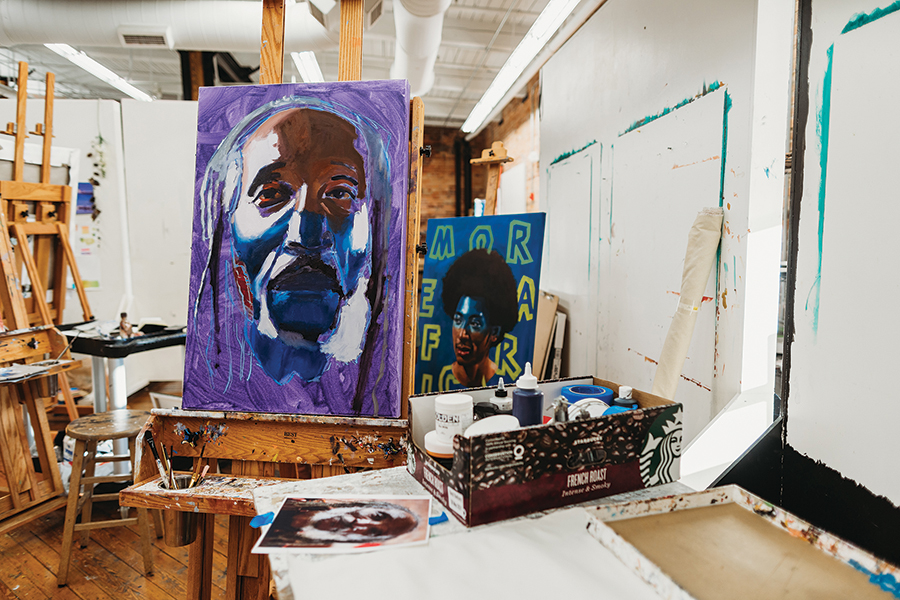
The second time I met William was in late February inside the Nasher Gallery on the campus of Duke University, where his portrait series Cyanosis was part of an exhibit titled “Reckoning and Resilience: North Carolina Art Now.” The subjects in the nine paintings in the Cyanosis exhibit are not as historically prominent as Alexander Manly, but they’re nonetheless important to William’s life. Each person is either someone he knows or someone he’s met during the course of a day, perhaps someone with whom he shared a passing conversation or a quiet moment that changed the trajectory of an afternoon.

The name of the series is taken from the medical term that refers to the blue pallor skin takes on when it is not sufficiently oxygenated. The idea first took root in a portrait William painted of his young nephew Michael. He painted half of Michael’s face blue to emphasize the color of his skin. Soon, the use of blue grew to represent the presence of deep emotions — perhaps trauma, fear or uncertainty — that lie beneath the surface of people’s lives while they present a calm face to the world. In an online interview with Artsuite, William shared the unifying theme of the series: “My question through those paintings is: What would it look like if that trauma or adversity was shown on the skin? Would it invite people to be kinder to each other?”

On the day I finally met William in person inside the Nasher Gallery, Mallory, our daughters and I arrived half an hour early. While Mallory unpacked her camera gear and set off to scout the museum for places to set up, our daughters and I wandered through the exhibits with scores of other masked patrons. When we found the exhibit featuring William’s paintings, we paused and stood in front of them. The nine paintings are all closely cropped portraits of Black men in rows of three with a self-portrait of William sitting at the center. Each of the men is looking in a different direction, some of them seeming to stare right into the viewer’s eyes. Strips of blue color their faces in various places: across the eyes like a blindfold, over the nose like a mask, or covering the mouth like a gag.

Top row: Regine’s Brother, 2021, Lindsay’s Friend, 2018, Donna’s Son From Chicago, 2017. Second row: Le frère de Nathaly, 2019, Leticia’s Dear Friend, 2021, Kenna’s Dad, 2019. Third row: Tamara’s Father, 2019, Lydia’s Only Caregiver, 2017, Stephanie Woods’ Fiancé As An Icon of Piety, 2017.

William arrived, and we all introduced ourselves to one another. I’d been following his Instagram for several months — which I will later describe to him as being “delightfully weird” — and I didn’t know what to expect from an artist who is wildly experimental and playful while still remaining earnest and sincere. The dichotomy a viewer might find in William’s work also seems present in his personality; he is formal but warm, thoughtful but quick to smile. He told us he had just returned home on a flight from Chicago after spending the weekend at a family wedding with his fiancée and their newborn daughter. We joked that he looked rested and photogenic for a man who’d spent the morning lugging bags, baby and a car seat through airport terminals. His face softened for a moment at the mention of his being a new father, and then he and Mallory got to work.

Meanwhile, our 7- and 5-year-old daughters were feeling inspired after seeing the art in the museum. I tore pages loose from my notebook and fished pencils from my bag, and we found seats in the café and ordered snacks. I must have been feeling inspired myself because, like them, I began doodling on a blank page. But I couldn’t stop thinking about the faces of the men I’d just seen in William’s paintings, that strip of blue still hovering on the edges of my vision. When I thought of deoxygenated skin I thought of the videos I’d seen of Eric Garner and George Floyd, recalled their panicked voices saying, “I can’t breathe.” I looked down at my hands, one holding a pencil and the other resting on the table, the blue veins rolling atop the backs of my palms, not because my skin was deoxygenated or because I was experiencing latent trauma, but because my skin is pale and the blue veins were visible because the blood inside them was moving freely.

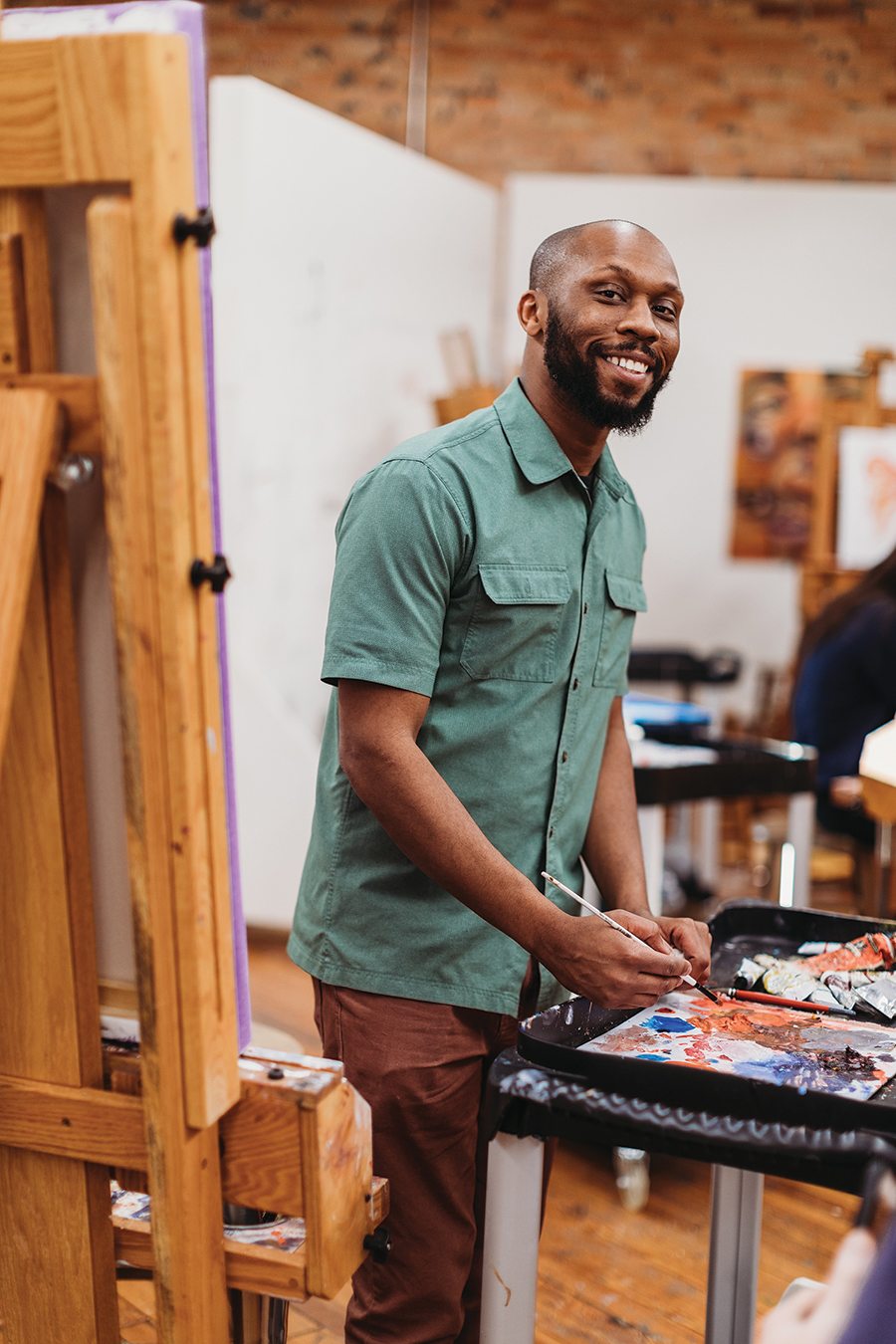
After we left the museum, we followed William across the Duke campus to the studio where he teaches a painting class to undergraduates, which is just one of the courses he teaches at several nearby universities. Inside the classroom, one of his students was behind an easel, working on a project from his class. He greeted her warmly by name, and then I watched him return to his work on a portrait of a man named Larry Reni Thomas, a Wilmington native known as Dr. Jazz because of his extensive knowledge of the music’s history. The two men met when William was working on “Initiative 1897”.

I asked William what interests him about painting people he meets. He lifted his brush from the canvas and considered my question, his eyes settling just above the top of his easel.

“For a long time, my art had been contained within an academic context,” he said, a reference to his Master of Fine Arts degree from UNC-Chapel Hill and his teaching in the undergraduate classroom. “In the portrait work, it’s important that the people that I invite (to be painted) don’t always belong to that same environment, so I’m having conversations with people who don’t necessarily have the same ties to UNC or Duke. I meet someone at the bus station and we strike up a conversation, and that’s a person I’m making a painting of. I feel like I start learning more about this area, or where I’m at, via those conversations. That’s how I’ve chosen to break away from a strictly academic environment.”

I ask him if he specifically looks for subjects outside of academic settings, and he admitted that he does, but that he’s also interested in introducing people to art who do not always think of themselves as being individuals who appreciate it.

“Sometimes I make visits to places with people because of the location. The Ackland Art Museum in Chapel Hill is right on Columbia and Franklin, and buses run all around that area. So if I was talking to somebody and having a conversation about art, there have been times — if they have the time — I’ll say, ‘Let’s take this conversation to the museum.’ Since I’ve identified museums and galleries as places I love to be as an artist and as a consumer of art, a lover of art, I don’t necessarily expect people to share that same interest, but if you tell me that you are not interested in art but you have not been inside a gallery, I question that and I challenge it and say, ‘Then let’s go check it out.’

“I have relatives, friends, people I’ve met who feel like they don’t have a direct connection to art, and I disagree right away because I’m thinking, if you dress yourself in the morning or if you like a certain model of car or if you like a certain movie, these are visual experiences where you are making choices about the visual world that suggests that you have some interest in aesthetics even if you don’t identify as an artist or a person who likes art. You can treat the museum that way, where you intuitively defer to your own tastes and go in there and judge whether or not you like whatever you see or are disinterested or feel moved by it based on your own experiences and not whatever education you have.”

When William considers how hesitant many people are to engage with art, he views his casual discussions with strangers as an opportunity that might lead them to a museum visit or to their portrait being painted: “It’s really of interest to me to engage in conversations where I try to demystify or deconstruct wherever that idea comes from.”

William is also interested in deconstructing the role art played in his own life, especially during his childhood. There could be no better representation of this than the bright pink concrete block that rested on the floor nearby. I’d already seen the block on his website, and I knew it had been painted to match a wall William’s mother had painted in the apartment where he’d grown up with his sisters in the Altgeld Garden housing project on Chicago’s South Side. He bent down and picked up the block at his feet.

“I extracted a single cinderblock as a way to represent that memory,” he said. “It became a way to carry that experience forward as a part of my narrative. How much of her decision to paint that wall influenced my decision to become an artist? This domestic alteration, how did it have an impact on the way I see the world?”

I asked him about the differences between being affected by the burden of memory and affected by the physical burden of lugging around a 40-pound block of cement.

“I did that unconsciously,” he says, referring to the burden of memory, “and now I’m doing it consciously. I’m choosing to carry this weight with me.” He smiles. “There’s never any good reason to carry a cinderblock around with you, but there might also not be a very good reason to take any traumatic or negative moments that I experienced as a child to have that affect me in the present, but nevertheless, for better or worse, the things we experience through our lives are carried with us. I’m definitely carrying home with me.”

I thought of his newborn daughter, a baby born in the Triangle, far from William’s Midwestern roots. What role would her father’s art play in her own conception of art’s role in her life? How would she carry her childhood with her?

He smiled at the questions, and then he rested the block in his lap as if it were a newborn.

“I hope she recognizes art as a normal, central fixture of her life, whether she is personally creating things or paying attention to the world around her. I hope she recognizes that it’s something valuable and precious.

“I hope she has an interest in exploring and discovery. I hope she gets to know Durham and North Carolina in a way that’s really intimate. I want her to carry with her how rich the world can be wherever she is as long as she’s paying attention.”

If William’s daughter follows the example of her father — an artist who is constantly paying attention to his surroundings with an idea toward capturing the richness of a place and the people who inhabit it — I’ll bet she’ll learn to do just that.  OH

Wiley Cash is the Alumni Author-in-Residence at the University of North Carolina Asheville. His new novel, When Ghosts Come Home, is available wherever books are sold.

Hot Trends

Spring
Forward

By Jason Oliver Nixon
and John Loecke

Green Goddess 

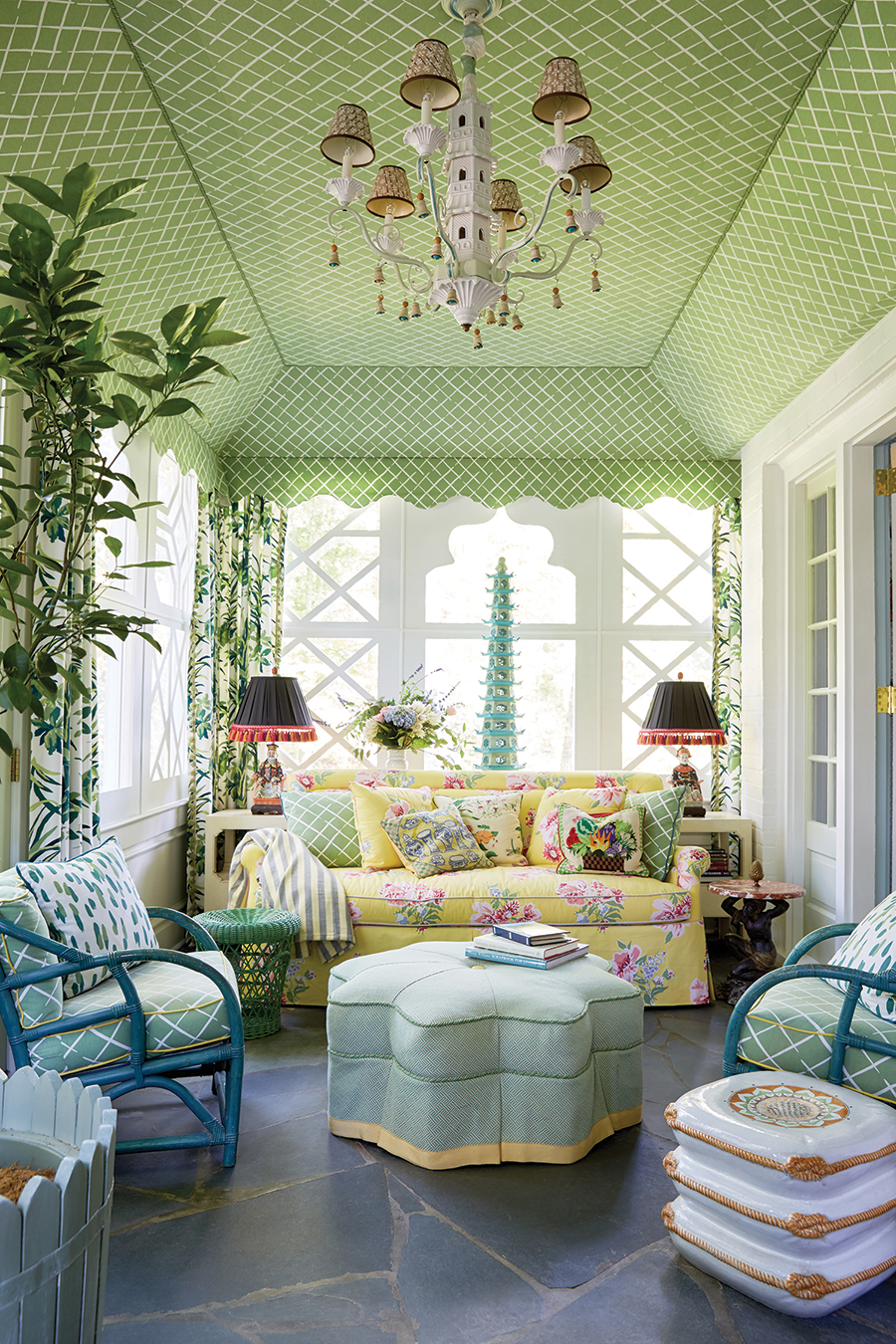
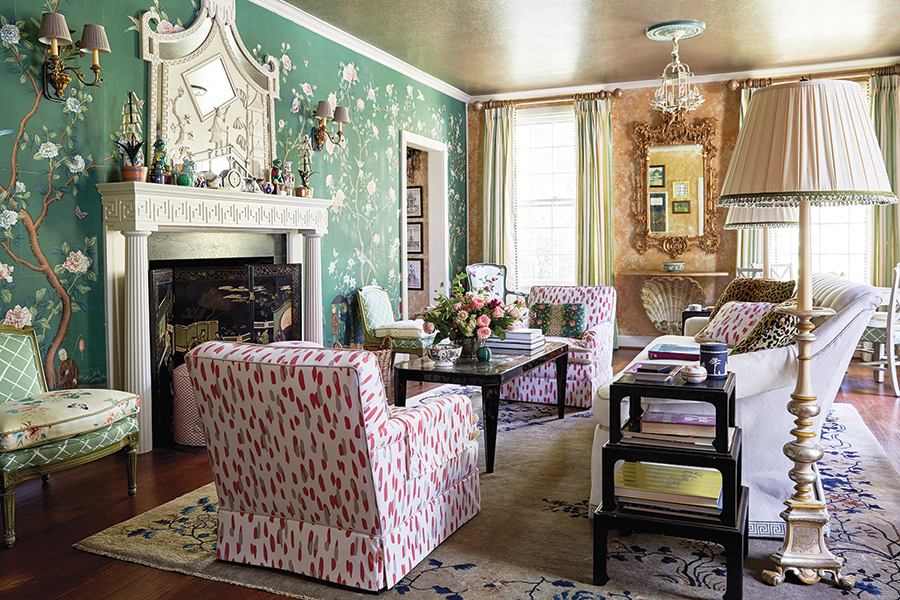
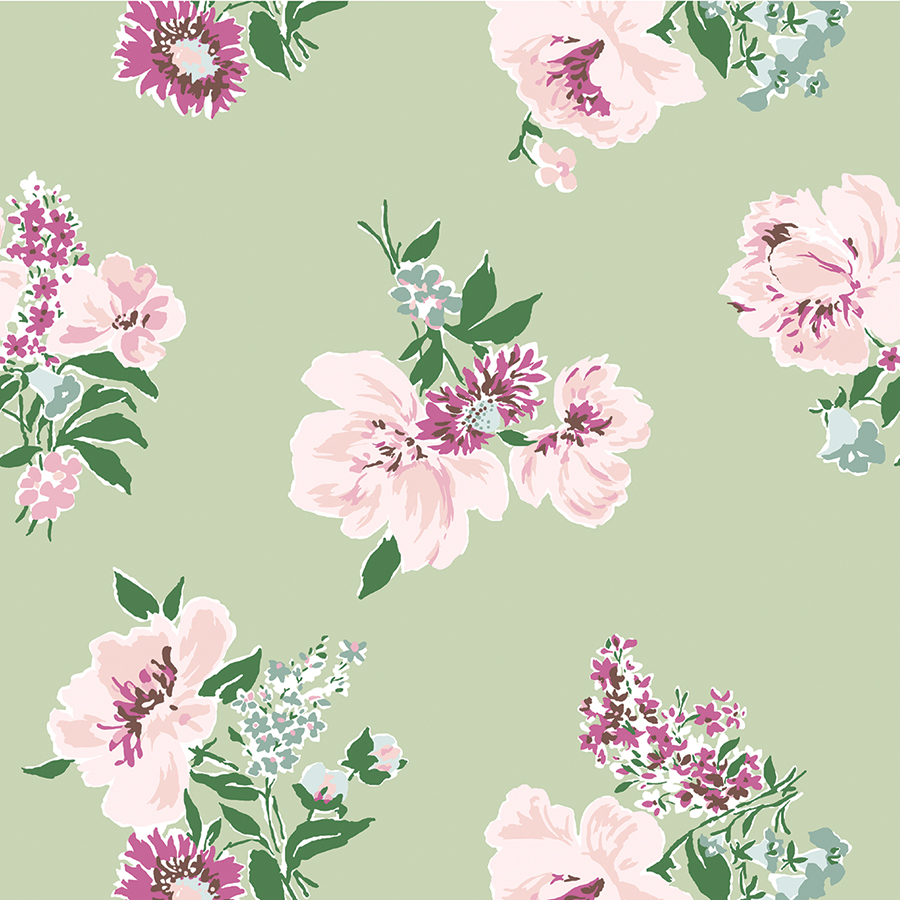
Gardening has had a massive resurgence since the pandemic began, so formerly forlorn front yards are displaying a newfound floral bounty. Trees have been trimmed, flowers are blooming blowzily, and stone masons have been busily crafting patios and terraces. But how to connect the interiors of your home with its glorious exterior? Bring the timeless, fresh charms of garden-plucked green hues within — whether in the form of paint, wallpaper, fabrics or rugs. As John says, “If it works in your yard, it will work in your home. And there’s no more cool, soothing neutral hue than green.” Think paint colors such as Soft Fern from Benjamin Moore and Dirty Martini from Clare, and fabrics such as Swans Island in Meadow Green from Madcap Cottage.

Leafy Luxe 

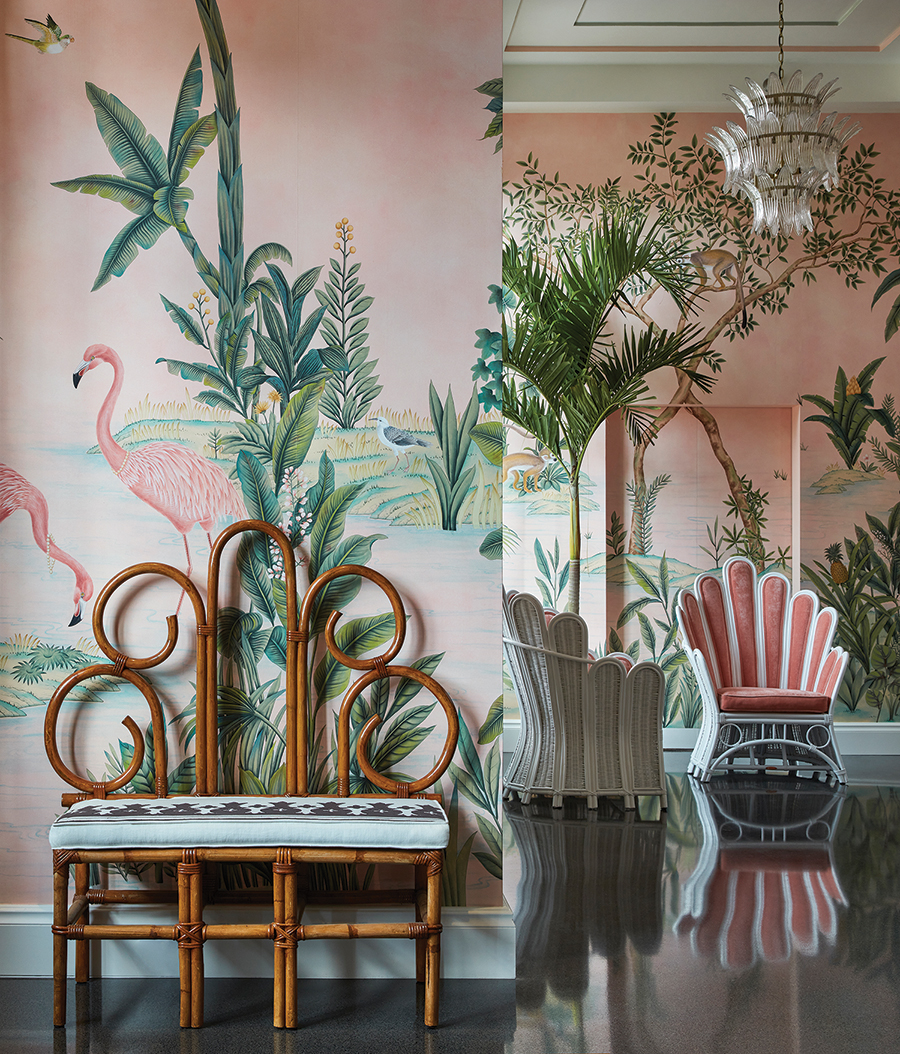
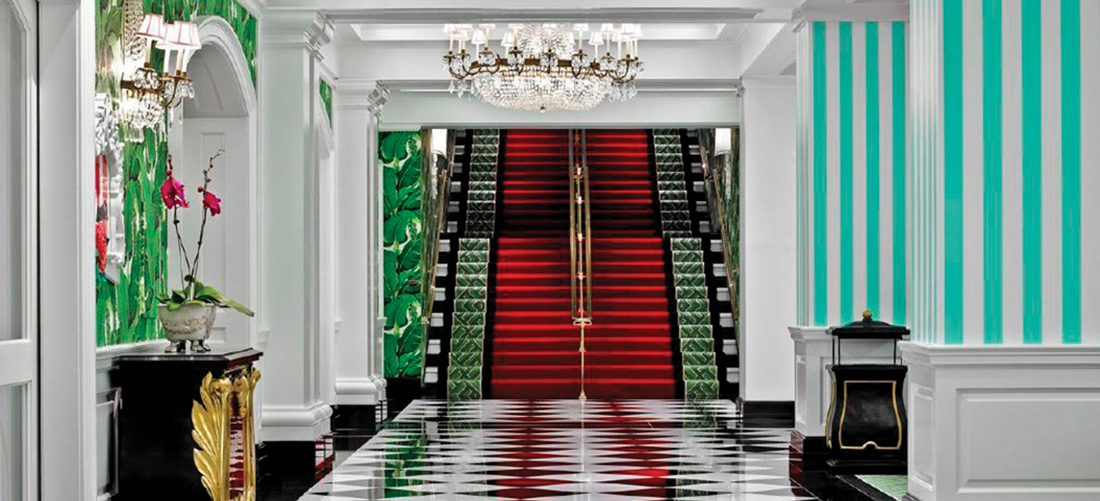
Palmy, balmy interiors — inspired by a mix of the Beverly Hills hotel paired with a jigger of The Greenbrier and Palm Beach’s Colony Hotel — are bursting into bloom. Think traveler palms reaching hither and yon upon wallpaper and lemon trees scampering across sofas. Says Liz Vaughn, a guiding force at Winston’s iconic Gazebo women’s retailer, “Gorgeous palm leaves march across the library at my home and have created a timeless vibe that is one part Dorothy Draper and another part classic escape. Stepping into this room is like taking a mini vacation, no plane tickets required. The color and scale of the grand palm print wallpaper absolutely dazzles our guests.”

Remarkable Rattan

Rattan is finally getting its moment in the sun after seemingly falling out of favor for a blip — but never at Madcap Cottage! And the woven furnishings are not just making star turns on covered porches but also in living rooms and other public spaces. Notes Morgan Cooper, the owner of the glamorous Hive, in Winston-Salem, “Our clients are loving reinterpreted rattan that boasts a dash of unexpected whimsy and wonder. This is definitely not your grandmother’s rattan. And it might be going into a master bedroom or bathroom — not just a sun porch.”

Prince of Chintz 

The pendulum always shifts, n’est-ce pas, so should you really have kept those clothes from the 1970s that made you look like Holly Hobbie to use as so-called “nap” dresses now? Rewind to the 1980s. That decade’s go-to textile, chintz, is having a big resurgence, too. “It’s not the highly polished chintz that we remember from Mario Buatta in 1987,” says John. “And we adored Mario. But today’s chintz is a bit more relaxed, less polished, and with more negative space. Perfect for a sofa or an armchair.”

Think Pink 

“Pink is such a wonderfully flattering hue,” says John. “A pink-hued room will literally take 10 years off your face. And pink can be both feminine and masculine, so the shade can really work in any room of our home — from a living room to master bedroom or bathroom.” Our go-to pink shades include Pink Ground from Farrow and Ball, Rachel Pink from Sherwin-Williams, and Dead Salmon, also from Farrow and Ball. P.S. Our most favorite escape of late is stunning, pink-toned Manor House Room 23 at the amazing Duncraig Manor and Gardens in Southern Pines. Is it the pink walls that leave us feeling so refreshed?

Heavy Metal 

We love using metallic finishes in home design schemes. But don’t think that we are referring to the old adage that “brass and glass equals class.” Think layered. Aged. Patina. Notes John, “Why not embrace metallics on a ceiling to bring light into a room that lacks luster? We often wallpaper ceilings with metallic finishes, and that gentle sparkle really brings a space to life.” A favorite is The Lost City of Silver from Phillip Jeffries — just heaven.

Tried and True 

Noted Winston-Salem landscape architect Jeff Allen turns to classic, timeless garden elements to craft his magical, cooling sanctuaries. Here’s his garden go-to cheat sheet:

1. Boxwoods: versatile, beautiful and sculptural. These classic bushes provide shape and style to any garden and pair well with everything. They can be structural or architectural or can be used as an accent. With regard to the blight, there are varieties that are disease resistant, and there are treatments available.

2. Hydrangeas: dynamic, colorful and dramatic. You can’t go wrong with large sweeps of hydrangeas for dramatic color. Underplant with bulbs to extend the bloom seasonally.

3. Pachysandra: my favorite groundcover. Used liberally in our landscape designs, pachysandra provides continuity with our planting compositions.

Fabulous Follies 

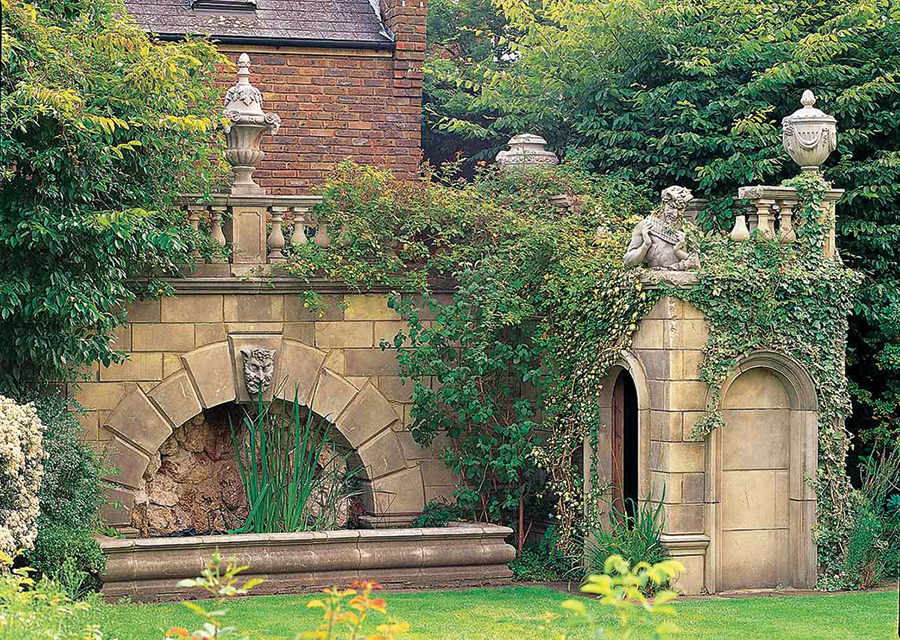
Ah, the great outdoors! But where to kick back and relax and sip a cool sauvignon blanc whilst shaded in splendor? Follies are all the rage in England, and these whimsical garden ornaments are quickly spilling across the pond. Think whimsical temples adorned with columns and plenty of space upon which to toss back on a daybed with book and hooch. Turn to Haddonstone, the England-based cast-stone manufacturer, for whimsical creations that range from temples to pavilions, pergolas and more. Plus, Haddonstone has a U.S.-based arm, so that makes the logistical bits all that much easier.

RUIN_1

Make an Entrance 

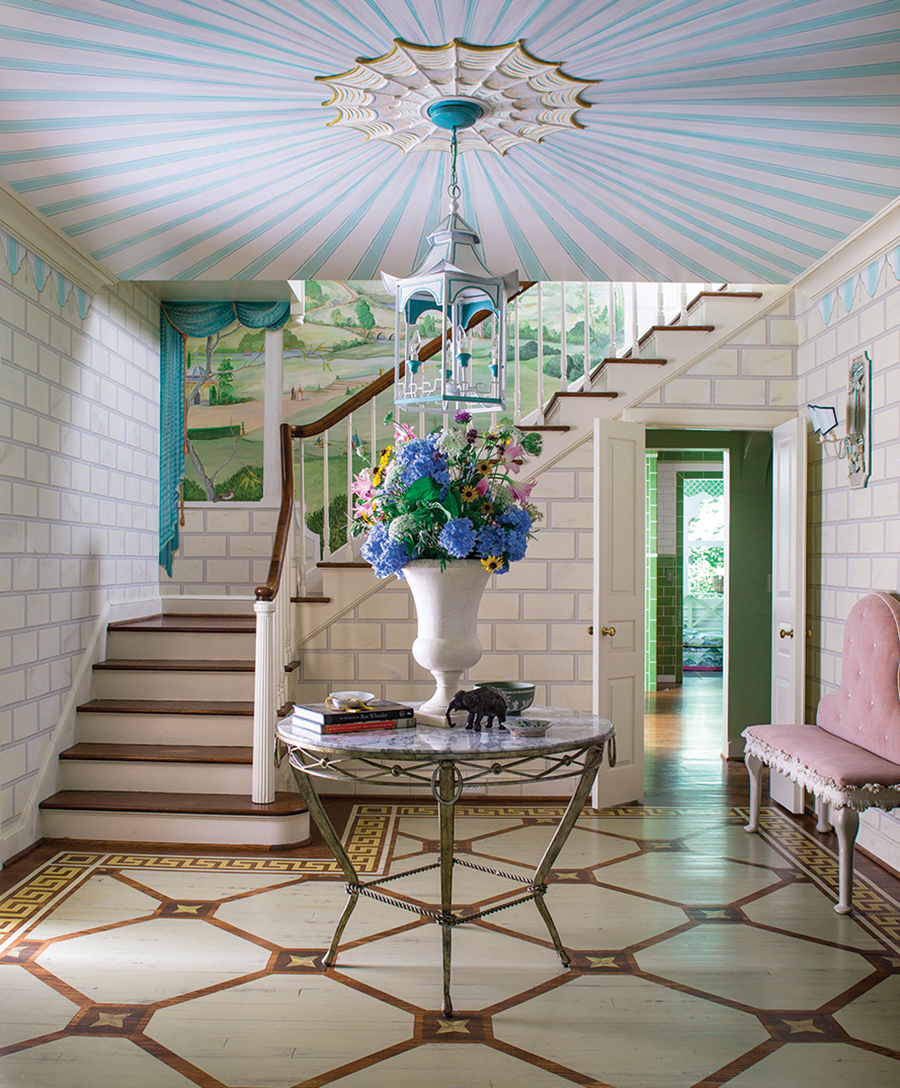
As we all paused over the past two, gulp, years, we turned our attention to fixing up our homes and addressed areas that had perhaps been long overlooked. One such space that has been a focal point for our clients has been the foyer. Says Anne Rainey Rokahr, the charismatic owner of Winston-Salem’s Trouvaille Home, “The feeling one creates in the foyer sets the tone for the entire house and should therefore never be an afterthought and definitely not a family drop zone. Even if the rest of the house looks a little messy the foyer should always be pristine. And the foyer is the spot to go grand. Pair a spectacular chandelier (always on a dimmer), a one-of-a-kind chest, and a large mirror with a couple of yards of a fine fabric, and you’re on your way!”  OH

Jason Oliver Nixon and John Loecke are the duo behind Thomasville-based Madcap Cottage.