Socially Skilled

Profile of an up-and-coming Greensboro influencer

By Maria Johnson

Photographs by John Gessner

As they prep for a podcast called “The Chewing Grounds,” host Luan K. Do (just call him Loon) and his guest, Griffen Glover, are hanging out in the show’s green room, which is actually the living room of Loon’s brand new, three-bedroom, two-bath, still-smells-like-paint home in southwest Greensboro.

The guys are pumped, literally, having just returned from an upper-body workout at the gym where Griffen, Loon’s friend since first grade, used to work as a trainer. The chat turns to social media and how many followers Loon has across all platforms.

Instagram? Probably 21,000 or 22,000 people, Loon estimates.

His YouTube channel? Maybe 5,000 subscribers.

“Does Facebook count?” Loon muses. “I really don’t use Facebook or LinkedIn any more.”

“Do you have TikTok?” Griffen quizzes.

“I have the app, but I don’t really focus on it,” says Loon. “I need to, but I want to pay someone to do it . . . Dude, it’s the future. It sucks, but it’s the future.”

Loon consults the invisible calculator in his head. Yeah, he confirms, he definitely has fewer than 40,000 followers/friends/contacts, which lands him squarely in the territory of “micro-influencer,” meaning he makes money — an average of $200 a month — by posting social-media content that attracts viewers and thus advertisers, but not as much money as a “macro-influencer,” or someone with an audience of 100,000 or more, a status that Loon, at the ripe old age of 25, hopes to reach.

“Maybe in a couple of years,” he says. “If I could do that, it would be amazing.”

But first things first. It’s time to record the podcast. The guys walk a few steps into the studio, aka Loon’s kitchen. They perch on low-backed stools, facing each other across a breakfast bar and pull on headphones. Two cameras — iPhones mounted on tripods — are trained on them. Later, Loon will edit the video into a split-screen view for YouTube. The audio will be uploaded onto multiple podcast platforms.

To start recording, Loon hits a button on the digital mixing board in front of him, pops an energy drink next to a microphone — fizzzzzz — pours the contents into a couple of ice-filled glasses, hands one to Griffen, offers cheers, and slides into the unscripted frolic that begins with recollections of an elementary school field trip, sidesteps into a promo for their “strawbango” flavored drink  — “This would go good with alcohol,” Loon offers — and pivots into a long gym-bro discussion of fitness.

“How much you weigh right now?” Loon asks.

“One seventy-three.”

“What’s the biggest you ever got?”

“One seventy-five.”

Loon exhales with admiration. “Do you ever get, like, sweats?”

“No.”

“That’s immaculate,” Loon says. “The highest I’ve ever, ever pushed myself was 165, and I felt like dog shit. I was sweating, and the sweat smelled bad, like pizza grease.”


Online life comes naturally to Loon, who spells his name like the bird because it’s the correct pronunciation of his given name, Luan, which most Americans butcher along with his last name, Do, pronounced “dough.”

Born in 1997, at the dawn of Gen Z, Loon remembers seeing his family’s first computer in the early 2000s. He was 5 or 6 years old. The machine was an outdated desktop, probably bought at a discount, with a monitor that reminded Loon of a humungous human head.

“The keyboard was dinky-dinky,” he says. “We’ll go to a museum where they’ll talk about technology, and I’ll be like, ‘That was in my house.’”

He played video games such as “Galaga” and watched turn-of-the-century movies, including Shrek and Rush Hour, on pirated CD-ROM disks provided by a family friend.

When he was about 10, he got his first cell phone, a hand-me-down Nokia that looked like a small calculator. It had a screen, buttons and offered one game, Tetris, in black-and-white.

He also created an account on Myspace, an early social-networking site.

“It was a dumpster fire of the randomest things ever,” he laughs, adding, “You could make your background really cool.”

At age 12, he owned an Xbox video gaming console and started a YouTube channel to post tutorials on how to build teams with bargain-basement players in the FIFA video soccer games. He drew a lot of negative feedback.

“They could tell I was a kid, and that I had no actual knowledge of soccer,” he says. “And I couldn’t pronounce anyone’s name.”

With his father working as a licensed plumber and his mother working in a factory that made car parts, Loon says he and older sister Thao were spoiled — with an asterisk.

They got as many material things as their parents could afford on a limited budget.

They also got spanked and grounded if they brought home disappointing grades.

“Asian-spoiled is not like American-spoiled,” Loon says. “I got to struggle, but I didn’t get to struggle like my parents.”

Loon’s father, Quang, was one of nearly a million “boat people,” refugees who fled war-ravaged Vietnam after America ended its presence in 1975.

He spent seven years in a Malaysian refugee camp known as “Hell Isle” before the camp started repatriating refugees. Quang went back to Vietnam, where he met Loon’s mother, Suong Tran. They started a family and finally got a chance to immigrate to the U.S. in 1998, after a Lutheran church in High Point agreed to sponsor them. Loon was 13 months old.

The family lived in a string of apartments before buying a small home off of Merritt Drive in Greensboro. Loon made it through Western Guilford High School with minimal corporal punishment at home — thanks to a combination of charm and cheating in class, he says. He took a student loan to attend UNC Wilmington, where he majored in business and pledged a fraternity.

“I was trying really to be an American white kid,” he says. “I found myself later.”

After selling insurance for a summer.

After becoming a personal trainer.

After figuring out that he wanted to work for himself.

“I don’t like working for someone who’s working for someone who’s working for someone,” he says. “Everyone is only looking out for themselves. They’re like, ‘Oh, you need to do better so I can look good.’”

His role model for self-employment, he says, is his sister, Thao, who’s 10 years older and whom he describes as “a superstar,” “a beast,” and “a juggernaut.” A graduate of UNCG, she owns two nail salons, a waxing studio and a beauty school. She hired her little brother to help manage the businesses about the time he rediscovered the magic of YouTube — as both a consumer and producer.

“I learned everything I know from YouTube,” he says flatly. “I don’t read.”

In 2016, he started posting fitness video blogs, or vlogs. Some focused on body-building. Some focused on healthy food. The nutrition pieces got more clicks.

Viewers also gobbled up the restaurant scenes he shared from a Los Angeles trip.

“I actually got, like, 7,000 views, which is high for my channel. I usually get, like, 2,000 or 3,000,” he says.

Loon saw a market for city-based food vlogs. Ahead of a trip to Atlanta, he arranged for restaurants to give him free meals in exchange for exposure.

In Cary, a pizzeria gave him food and $50 to boot.

In Raleigh, he did a four-part feature and asked each place for food and $100.

“I did 16 restaurants in Raleigh, and I made, like, $1,400,” he says.

 

As his YouTube subscriber base grew, YouTube started placing targeted ads in his vlogs and paying him based on the number of views.

He expanded his audience, calling ahead to establishments in Chicago, Cleveland, Miami and New York. He did the same when traveling abroad.

In vlogs full of jump cuts, spastic camera work, overlaid music and occasional segues nicked from the Sponge Bob cartoon — “twen-ty minutes lay-tah . . .” — viewers watched him eat, drink and be merry in England, France, Italy and Greece.

His focus wasn’t entirely commercial, though.

Some vlogs amounted to home movies.

“Carolina Beach Travel Blog 2021” captures a family trip to celebrate his niece’s sixth birthday.

“Guess What I Got!” focuses on opening Christmas presents and making cookies at his sister’s house a few months later.

Those are the vlogs he shows his parents, whose grasp of English is limited.

“I want to make my family proud,” he says.

His parents were happy, he says, when he showed them an Instagram video he produced for Crest toothpaste and Reach toothbrushes. The mini-commercial shows Loon forgetting his dental kit on a trip, then jumping for joy when the self-propelled toothbrush and toothpaste — they’re being pulled by a barely visible thread — catch up to him.

He made more than $1,000 for the spot.

“They paid you that much — for that?” his mother said in Vietnamese when he showed her.

His father smirked his approval, Loon says.

They also beamed when they saw him earlier this year on I Can See Your Voice, the Fox network’s TV game show hosted by Korean-American comedian Ken Jeong, who spent some of his formative years in Greensboro.

Loon is pretty sure his Instagram numbers — along with his age, gender and race — caught the eye of the show’s casting agent. The Greensboro connection probably didn’t hurt. Loon lasted for one episode and brought home $15,000, which he promptly applied to his home’s mortgage.

The outstanding balance is not as much as you might guess. Loon’s down payment was more than a third of the home’s cost because he cashed out part of his investment in the electric car company Tesla. Loon learned about the company and its founder Elon Musk — whom Loon jokingly calls “Daddy Elon” — by watching YouTube videos.

Still a shareholder, Loon says he has doubled his Tesla money since 2019. He also holds blue-chip stocks like Apple and Microsoft.

“I’m not book smart,” Loon says. “But I’m really street smart.”

To share the secrets of his financial success, he launched a YouTube channel devoted to personal money management in 2020. Shedding his earrings and covering his tattoos with a white shirt, suit and tie, he told the story of how he paid off the loan for his slightly-used car in three years.

“I’m a very frugal person, very minimalist,” he explained, exhorting viewers to follow his example. “Do anything you possibly can to lower your expenses. Don’t worry about the now. Worry about the later.”

The financial channel never caught on, but Loon is still devoted to building his coffers.

He plans to buy another house, move into it and rent the one he occupies now. He wants to repeat the process until he owns several homes and lives off the rental income.

At that point, his payments from social media will be gravy. A bigger payoff will be a heightened profile — he’s easily the most visible Asian person on social media in this area — and more connections to other influencers, brands and communities.

“I see it as a means to everything,” he says. “It satisfies my need for attention, but it also gives me so many fun adventure opportunities.”

He’s cutting back on food and travel vlogs to focus on other projects. One is stand-up comedy.

“I have material. It’s just a matter of time,” he says. “I’m also getting a license to tattoo. These are all side quests.”

He plans to continue the podcast, which sports a mouth-and-tongue logo strikingly similar to The Rolling Stones trademarked “hot lips” emblem.

Loon says he had no idea about the resemblance until his then-6-year-old niece Lana was shopping and saw a phone case bearing the rock band’s logo.

“Oh, my God,” she told her mother. “Uncle Loon is famous.”

With more than 70 podcast episodes completed — most running at least one hour — Loon dips into a reservoir of people he knows well, those he barely knows and those he wants to know. Conversations range from raunchy to wonky, from sketchy to touching.

Previous guests include former Greensboro mayoral candidate Justin Outling; Asian country singer Travis Yee of Las Vegas; and Loon’s best friend and roommate, Zoran Kulic, whom he has interviewed at least three times.

“He’s the perfect person when I can’t find another guest,” Loon says.

Then there’s Griffen, his friend from first grade, who is featured in episode No. 62.

The topics swing wildly, touching briefly on what Loon describes as Griffen’s “really good morals.” Loon wonders aloud how Griffen was affected by his dad’s death at an early age.

“I just know, him looking down on me, he’d want me to continue going,” Griffen says.

“Dude, that’s immaculate,” says Loon, speaking so quickly it’s almost indecipherable.

Then they’re off to trendier pastures.

One week later, the show appears under the provocative title, “Guns, Cults and How to Lose Weight Easily.”  OH

Christmas from the Garden

Deck the halls with boughs from your own yard

Story by Ross Howell Jr.

As a boy, I enjoyed bringing the outside inside for the holidays.

On our mountain farm, I’d cut a white pine tree, gather running cedar, snip hemlock and rhododendron boughs, and harvest black pinecones and spicewood.

Nowadays, these native wild plants aren’t readily available to most of us. But we can cultivate our gardens and yards for holiday decorations.

My go-to person on this subject is Shirley Broome of Farmland Flowers in McLeansville. Shirley started selling plant sundries at the Greensboro Farmers Curb Market as a little girl alongside her mother, Margaret Rumley, fondly remembered to this day by marketgoers and vendors as “Mom.”

Shirley mulls my question about growing plants for Christmas.

“Well, back in the day I worked a lot with holly and pyracantha,” she says.

“But those stickers and thorns,” Shirley adds. “They just got to be too much for my fingers.”

These days a favorite of Shirley’s is black cryptomeria, a compact evergreen tree. New foliage emerges in bright green shades and gradually darkens until it’s nearly black. The dark needles and layered branches provide attractive landscape contrast, and cuttings are great for your holiday table or mantel.

There are the old standbys, of course — boxwood, red cedar and juniper. These plants are available in a wide variety of sizes and shapes to fit the design of your garden. And regular winter pruning for a wreath or an arrangement can help them stay healthy and happy.

And I love using magnolia branches and leaves for decoration. Their litter can be too much for some gardeners, but, for me, their beauty and wildlife value are well worth the work.

Magnolia grandiflora is a big tree that needs lots of room, but the little gem varietal is a compact tree that can even be planted as a border.

Both provide heavenly white blossoms in spring, glistening, dark foliage year-round, and, if you beat the squirrels and birds to their fruit, velvety, brown,
cucumber-shaped pods sparkling with red berries.

And who hasn’t marveled at the spectacular scarlet berries of nandina shrubs?

“My favorite is the dwarf nandina,” says Shirley. “It keeps its foliage year-round and changes color with the seasons.”

She cautions that while dwarf nandina is pretty in the garden, it doesn’t grow as symmetrically as its larger relative.

“Sometimes it will sort of clump here and there,” she adds.

I mention aucuba, since my wife, Mary Leigh, has fond memories of her mother arranging its shiny and speckled foliage to decorate the fireplace mantel for Christmas.

“It wants to spread,” Shirley answers. “I just didn’t seem to have the space for it in my garden.”

Shirley likes working with American beautyberry, a fully deciduous shrub that sheds bright yellow fall-like foliage completely in winter. But its gorgeous purple berry clusters remain well into the colder winter days. There’s also a white variety that produces pearl-like berries.

A floral favorite of Shirley’s is the single or signet marigold, Tagetes tenuifolia.

“I really like its pungent fragrance,” she says. These small, delicate flowers can also be eaten, so you can use them to garnish a holiday plate.

Sedum, along with Christmas or Lenten roses, are other late plants Shirley likes for the holidays. In addition to their blossoms, the stiff foliage of the roses provides excellent foundation in arrangements.

“For support and contrast,” Shirley continues, “I like adding bare branches from dogwood or river birch.”

Another tree Shirley uses in her arrangements is eucalyptus. If you plant it in your landscape, put it in a sunny spot, and select a cold-hardy variety.

But the most overlooked Christmas plant?

“I’d say moss,” Shirley answers. If you have a shady, moist spot in your landscape, try propagating it. “Moss is wonderful for covering your potted Christmas bulbs, like amaryllis and narcissus,” she adds.

Year-round for Christmas, think outside inside, gardeners!  OH

Ross Howell Jr. is a contributing writer. Contact him at ross.howell1@gmail.com.

Fashion-ating Rhythm

When it comes to Greensboro’s sense of style, past is prologue

By Billy Ingram

Photograph © Carol W. Martin/Greensboro History Museum Collection

In 2009, I opened the newspaper to see an enormous color photo taken on State Street of my mother, Frances Ingram, doing what she loved most: shopping. How apropos, I thought. Mom made the rounds to her favorite shops, an ever dwindling number as she grew older, every single day.

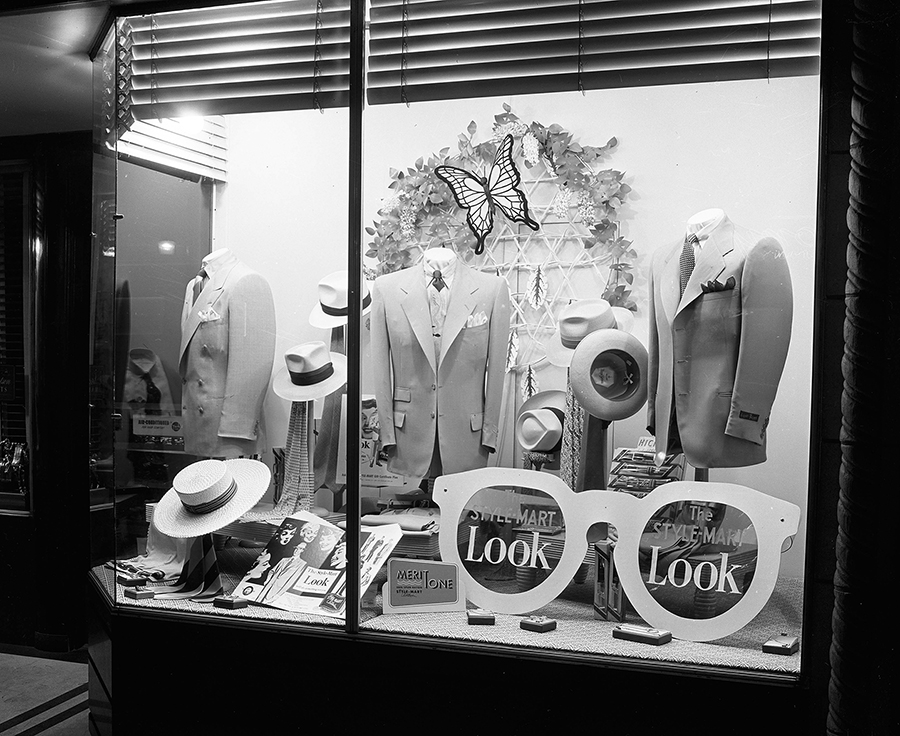
As a youngster in the early-1960s, one of my earliest memories was Mother getting all dolled up to cruise the downtown department stores for clothes to wear the next time she went out shopping. A holiday highlight was a trip to Ellis Stone to meet Santa, who handed out wrapped gifts from under a fireplace made from shoeboxes and wrapping paper. Department store windows at Belk, Meyer’s, Montaldo’s and Ellis Stone were glittering, snowy greeting cards come to life.

Julian Wright, one of the brave souls who stormed the beaches of Normandy, found his post-war calling staging those lavish, dioramic window displays for Ellis Stone in the 1950s throughout the ’60s and, then, after the store was rebranded as Thalhimers. Wright’s idealized snapshots of American life, defined and enhanced by the products being peddled, became genuine tourist attractions with adults and children alike nose-to-glass, eyes awash in every vivid detail.

Little did little-me know I was witnessing the beginning of the end of shopping as a spectator sport.

By the early 1900s, men could buy off the rack, but there was no such thing as ready-to-wear women’s clothing when Vanstory and Belk opened their small, downtown Greensboro dry goods stores alongside a newly brick-and-block paved street called Elm. Both carried everything a woman required — silk, cotton, wool, buttons, laces and lacings — to construct her own frocks and even undergarments.

For society doyennes, the fashion of the day was pleated, flared skirts down to the floor with tight-waisted bodices and Leg o’mutton sleeves. That level of intricacy required the services of Mrs. T. W. Hancock, a renowned dressmaker on West Fourth Street in Winston-Salem. “Miss Molly” purchased fabrics and finery on her frequent forays into New York City, paying a handsome price for the latest Parisian haute couture patterns. She employed a retinue of seamstresses and cutters to fabricate exquisite wardrobe pieces for everyone who was anyone in the region.


Ellis Stone was well-established in Durham before launching a Greensboro location in 1902. Today the name is enshrined above the entrance at 226 South Elm. Foreshadowing the dawn of the full-service department store, Ellis Stone began taking ladies’ measurements, then dispatching them to New York for tailor-made suits and dresses. As it gained a reputation for being the epitome of taste and style, Ellis Stone made its home across the street (most recently Elm Street Center) in a $1.5 million, starkly modern 78,000-square-foot shopping mecca with a spectacular winding marble staircase, 20-foot tall mirrors and richly appointed sales floors.

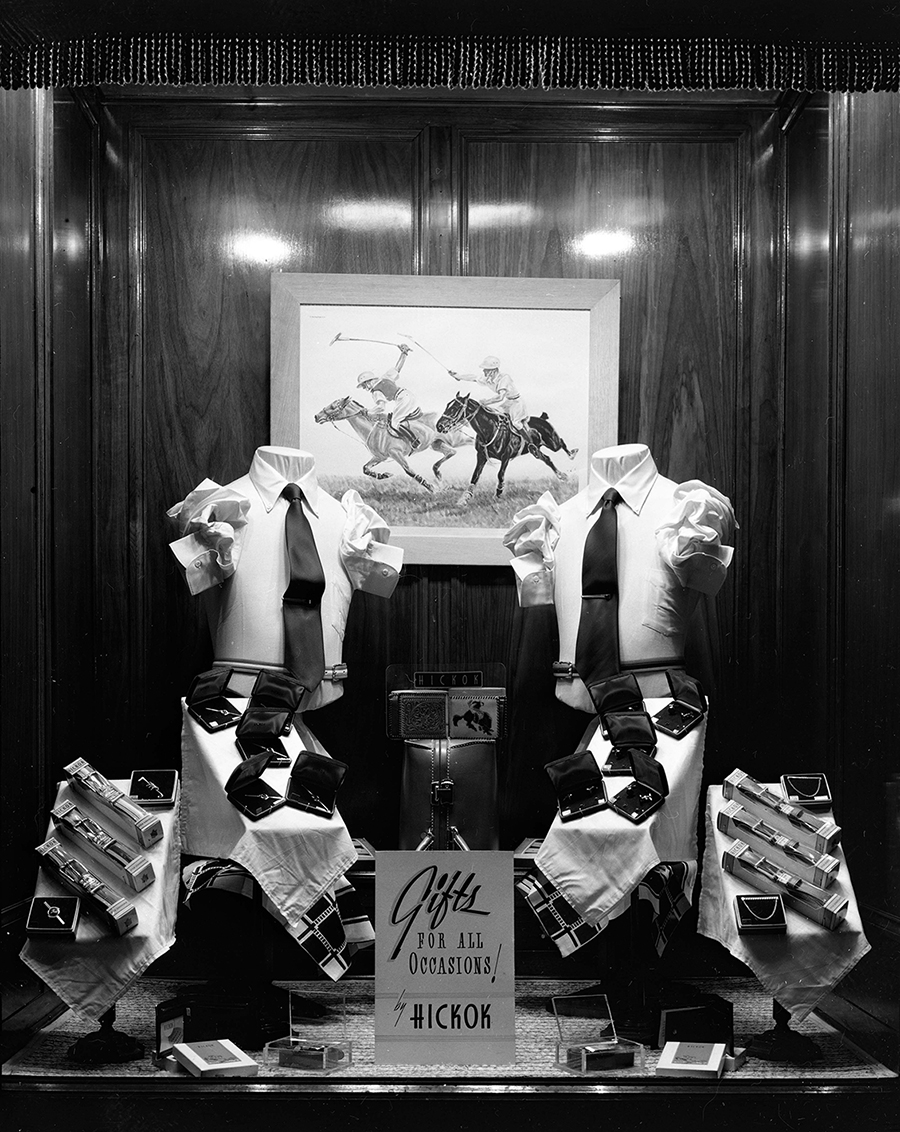
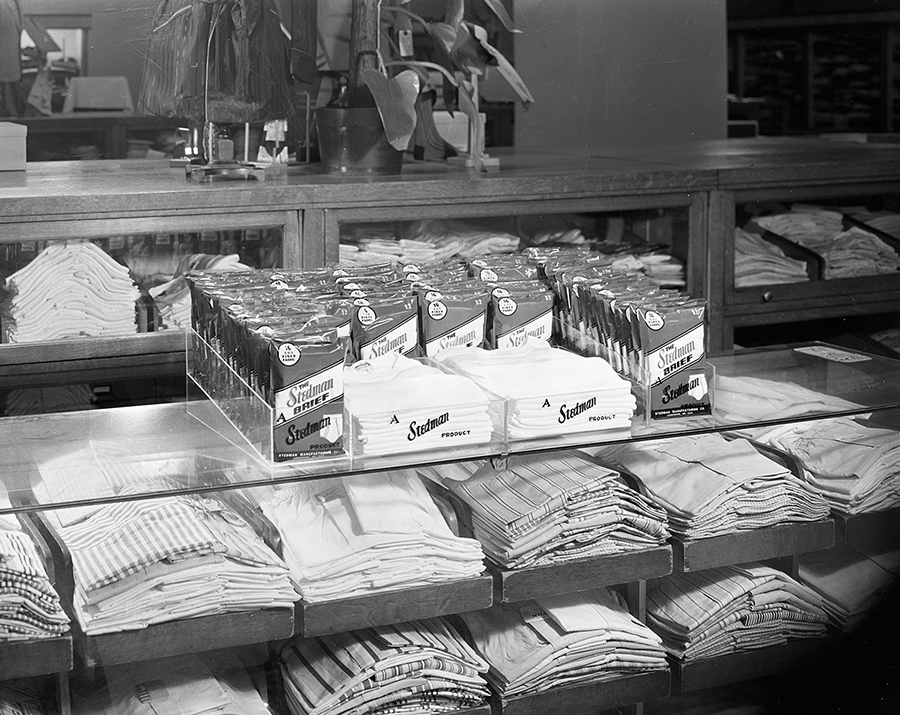
Just down the street, in 1924, the city’s first enclosed shopping mall opened on the ground floor of the Jefferson Standard Building in 1924 with a barber, dentist and clothiers including Vanstory Clothing Co., founded across the street around the turn of the century. Vanstory catered to the city’s elite, offering Botany 500 suits and Don Roper ties. Flanking Vanstory’s entrance were some positively surrealist window displays, overly-starched shirt sleeves folded meticulously into tightly wrapped geometric puzzles, everything in frame cocooned in a warmly lit, thickly lacquered wooden cavern. Very European.

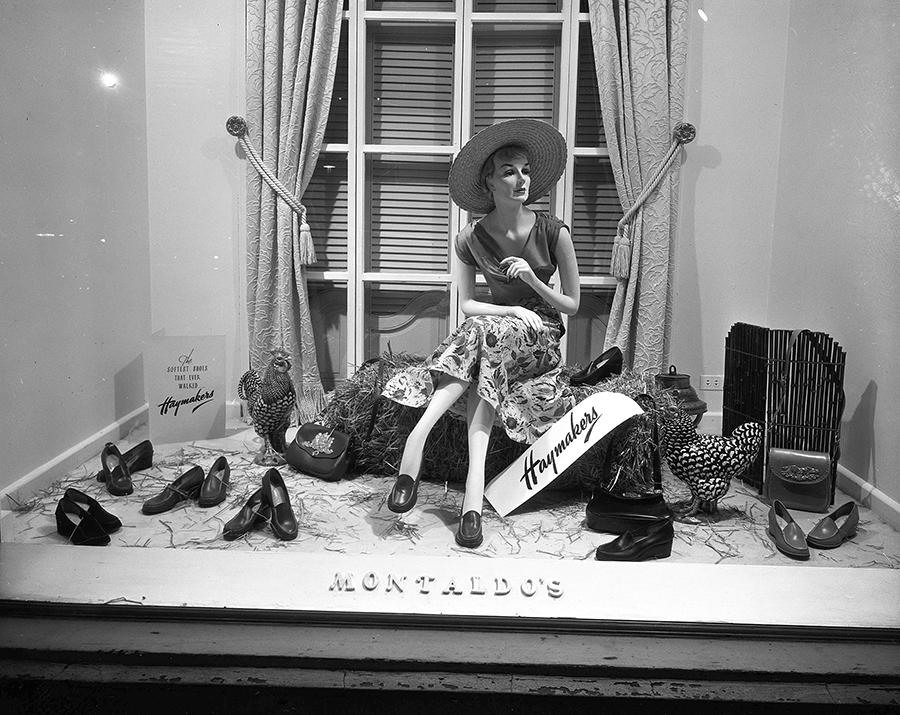
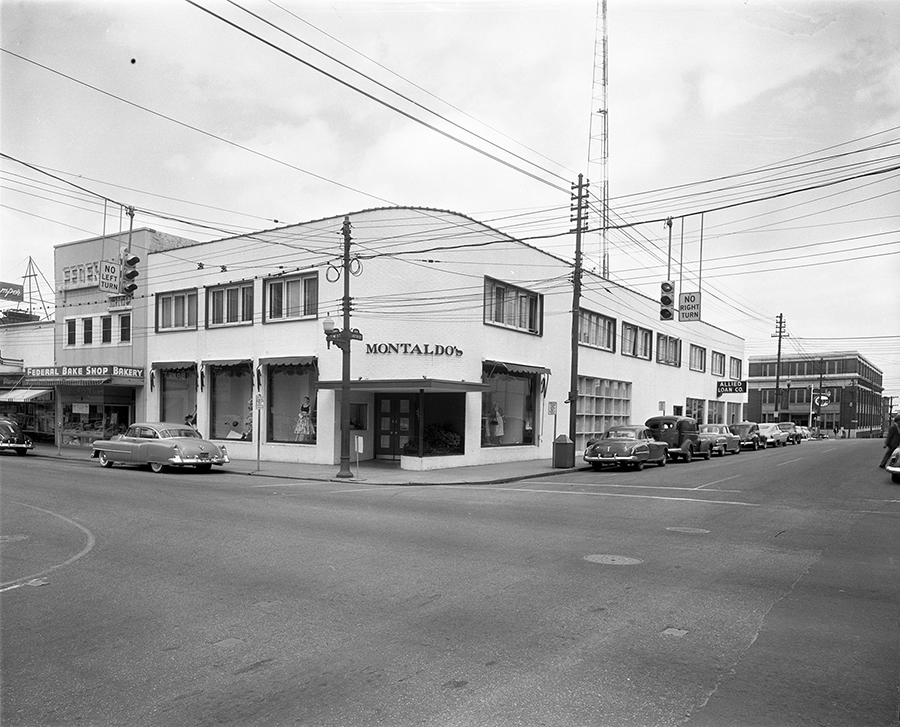
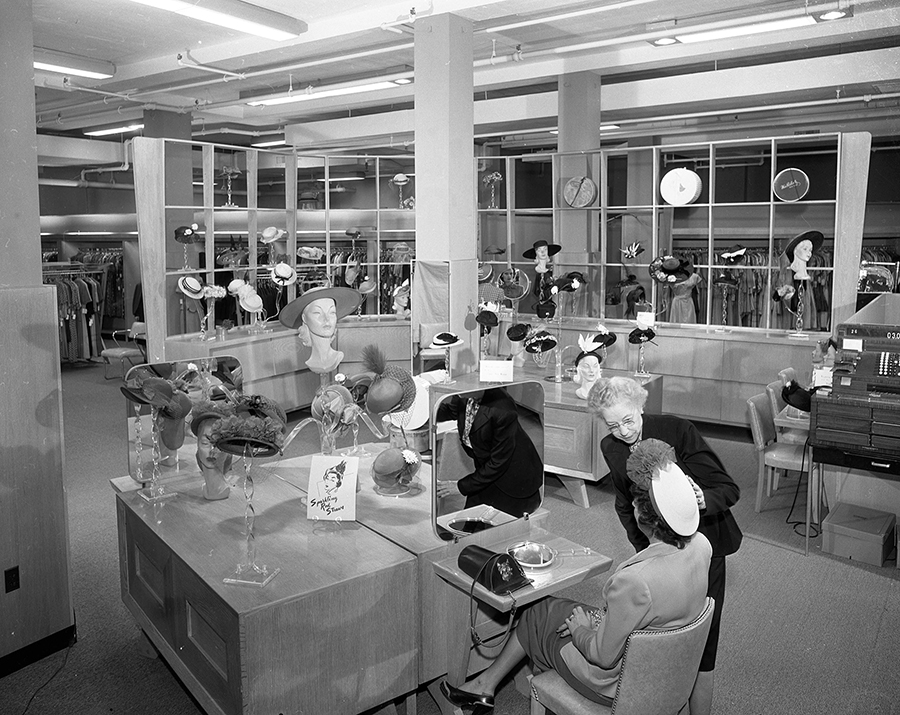
Vanstory rented out a portion of its storefront in 1933 to Montaldo’s, a small chain specializing in high end, ready-to-wear dresses run by two sisters out of Kansas. “When Montaldo’s came to Greensboro, that kind of upped the game,” fashion maven and owner of Design Archives Kit Rodenbough says. “Before that everybody had custom dress makers. Montaldo’s would have an outfit from a designer modeled in the store and women would order it in a custom fit.” Montaldo’s became a beacon of elegance on the corner of Elm and Friendly in 1942 when it moved into its curvaceous, two-story white-brick building. The front door looked more like a modern home than a commercial enterprise. And its wide windows displayed a dazzling array of wedding gowns, lingerie, millinery and cosmetics.

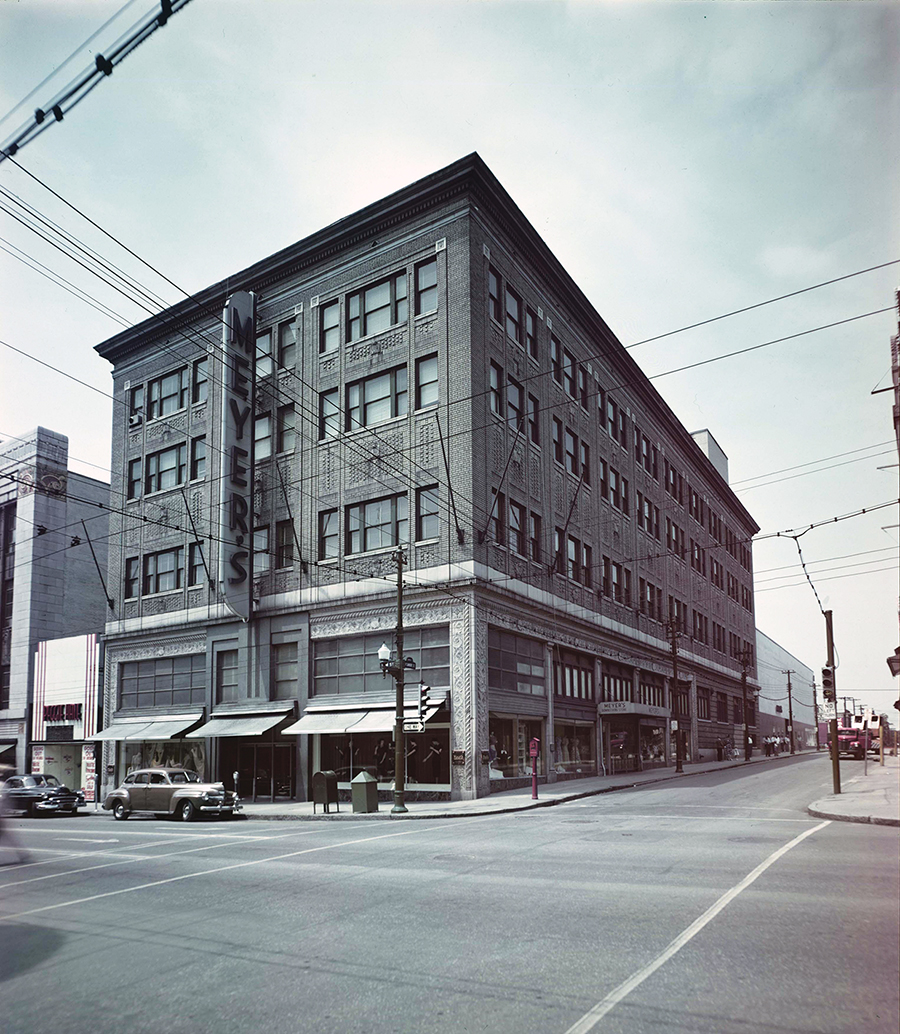
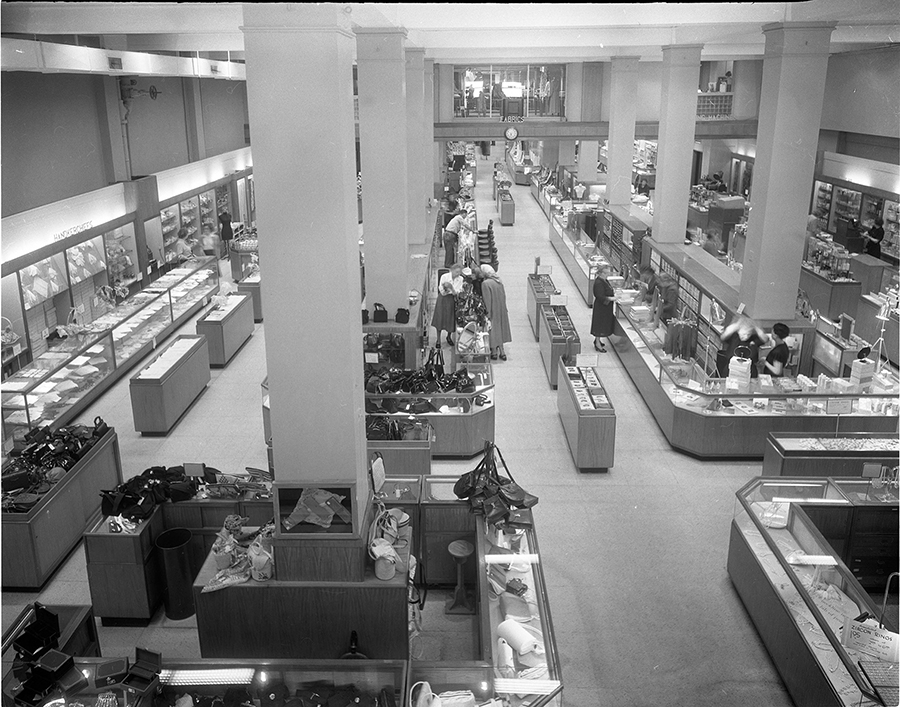
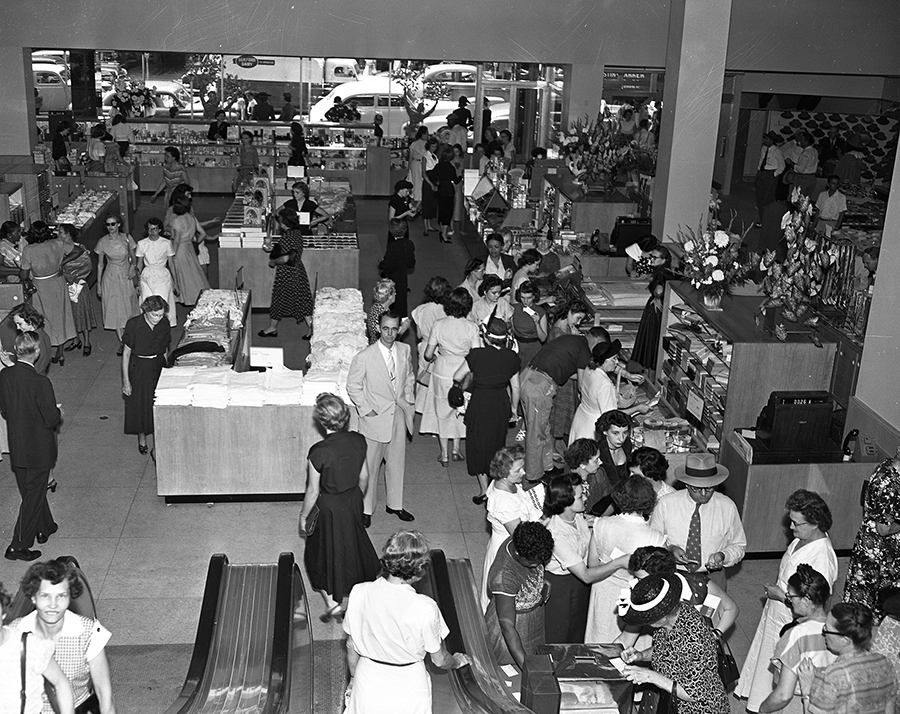
Meyer’s Department Store got underway around 1910, but it wasn’t until 1924 that it welcomed customers for the first time into a magnificent five-story showplace on the corner of Elm and Sycamore (now February One Place). Most striking to modern eyes would be the spacious aisles, neat glass and wooden cases, and finely dressed men and women standing at the ready to offer assistance. Sweaters and slacks in various colors and sizes lay neatly on tabletops with wardrobe essentials like dress shirts, gloves and undergarments displayed inside transparent enclosures. There was very little you couldn’t find at Meyer’s with its story after story sales floors staffed by over 500 employees. The operation eventually took up an entire city block, comprising a veritable shopping mall before such a thing existed, with 700 brand names under one roof, everything from “bobby pins to refrigerators.”


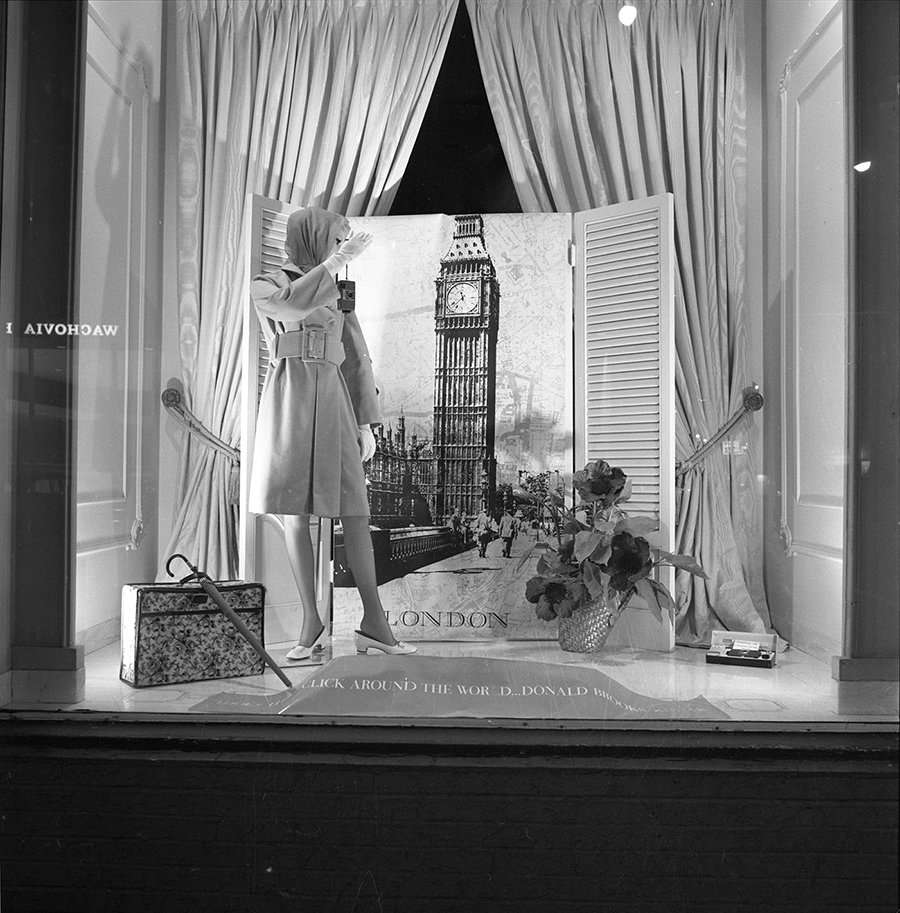
Left & Middle: Meyer’s
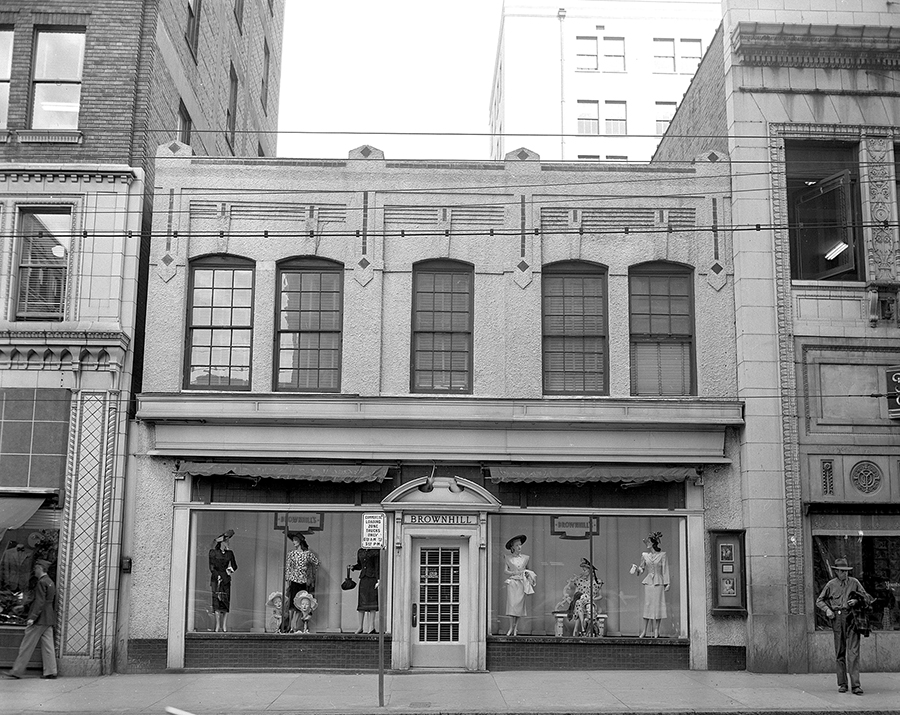
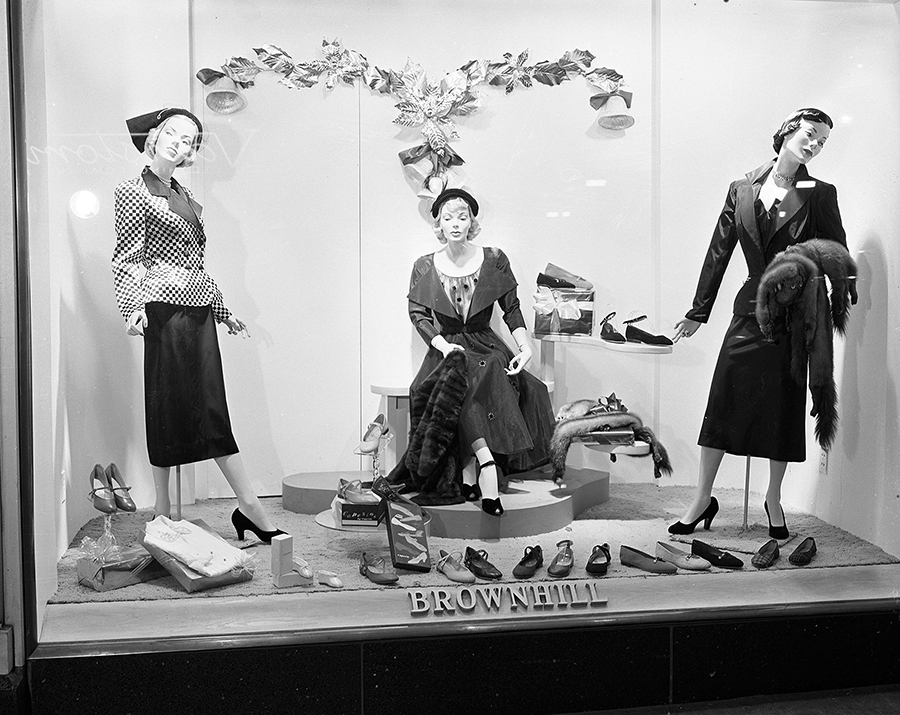
Right: Brownhill

Best of all, department stores had their own credit system. Customers need only scribble their names on the bill of sale and be on their way, merchandise in hand. Itemized bills arrived in the mail at the end of each month and were generally paid by mail.

In 1925, decorated in canary-colored walls and upholstery, primary-colored plaid curtains adorning floor-to-ceiling windows lining the Sycamore Street side, Meyer’s Tea Room opened on the second floor for afternoon light lunch. For the 53 years of its existence, the decor changed, but the menu not so much — everything prepared fresh, never canned. “My mother was a hairdresser so she always had Mondays off,” Charlie Hensley recalls of his childhood, circa 1960. “Often we would have lunch with my grandmother at Meyer’s Tea Room. The shopping experience was a lot more civilized back then, especially with the Tea Room, like an immersive experience. My mother was still wearing hat and gloves to go shopping then.”

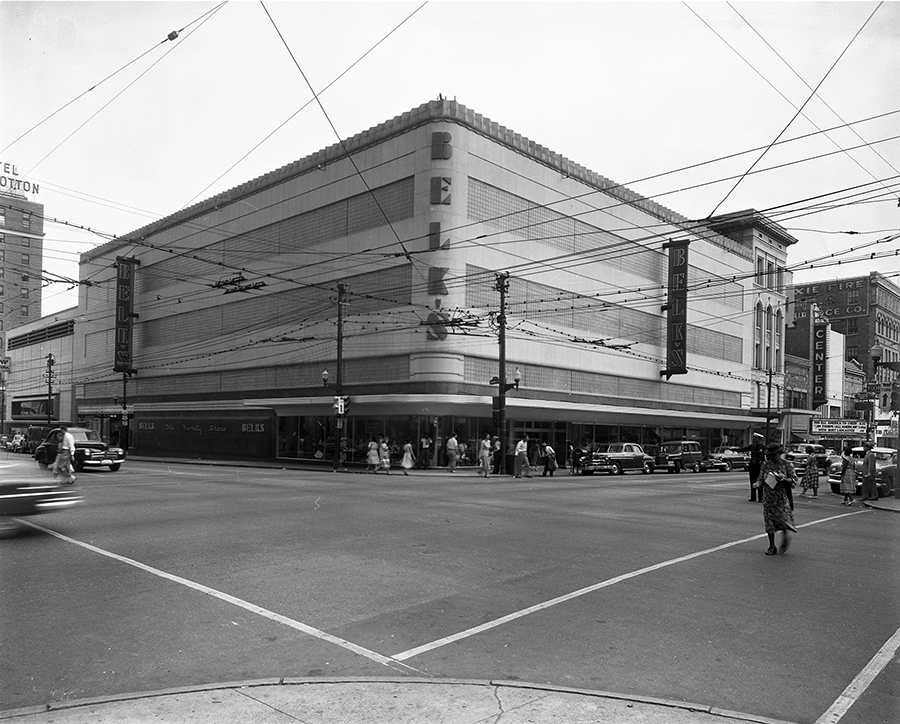
The Belk brothers of Charlotte christened their first store in Monroe in 1888. A decade later, they opened a Greensboro branch. In 1939, they cut the ribbon on a Charles C. Hartmann-designed palace at Elm and Market. An exterior of glass and stone on the street level, glass brick detailing on the second and third floors, it took three boxcars worth of walnut to construct the hundreds of display cases, accented with birds-eye maple and primavera. Besides clothing, Belk offered a full-service beauty salon, candy counter, and cosmetics department.

Hensley’s first job as a teenager was as a sales associate at Belk downtown in the late-1960s. “It was the first time that I realized if you worked retail that you got a discount,” he told me. “The guy who ran the store was Mr. D.O. Tice, who looked a little like J. Edgar Hoover. I always thought he was a bit of a bulldog. When he would come through, the crowd would part. I don’t remember him being unpleasant ever, just formidable.” Hensley’s clients were very well-dressed matrons. “Part of what they expected from me as a 14- or 15-year-old was to be the expert advising them about what their husbands would like or what their sons might want.”


Two clothiers, Sam Prago and Adolph Guyes, joined forces in 1940 to create what would become an empire with four Greensboro locations and multiple stores scattered across the state by the 1970s. Down the block from Belk at the Dixie Building, across from Woolworth’s, Prago-Guyes’ lit-from-behind, emblematic logo glowed atop an entranceway bathed in color and light. Surrounding customers as they arrived were wraparound windows adorned with the latest ensembles. Another glass casement stood in the center of this impressive frontage. Their vast shoe department tickled the air with the scent of leather and vinyl. If you wanted to be hip to the latest gear, Prago-Guyes bragged, “We’re In Touch.”


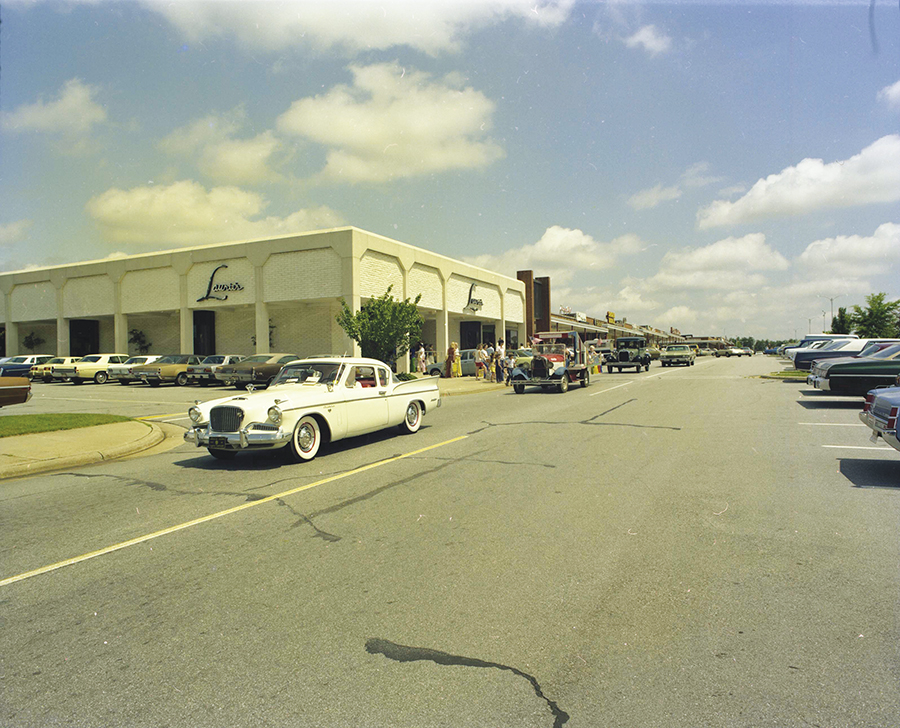
Laurie’s Sportswear, popular with the Jet Set since opening on Elm in 1951, became the first major downtown retailer to close up shop and head for the suburbs when Laurie Queen and her three brothers signed on as an original tenant of Friendly Shopping Center in 1957. “I just thought it was beautiful,” Carolyn Andrews-Allred says of the spacious showroom, since repurposed for Harper’s restaurant. “I started working for Laurie’s my last year at Grimsley in the spring of 1972. It was the only place I wanted to work.” Harland Pell was its window designer, “I learned how to ‘fly the merchandise.’ That’s what they call it, to make garments hang in the air kind of magically with fishing wire.” Managers and brothers Edward and Marshall Simon had taken over operations by then. “Very strict business people,” Andrews-Allred says. “If somebody came in two minutes late, they were fired immediately.”

Salespersons were instructed in an almost mathematical method for moving merchandise. “We used it to sell not just one item, not just a dress or a blouse,” Andrews-Allred notes, “but you could figure out how to sell an entire set of clothing.” Very effective, at least in one sense. “I was thinking, ‘Wow, these people are buying so much — this is great,’” only to discover customers returning a large percentage of their purchases. “That’s just the way the fashion business was. You bought a lot and returned a lot.”


Left & Right: Montaldo’s

After leaving Laurie’s, Andrews-Allred took a sales position at Brownhill’s downtown in the mid-1970s. “It was much tinier, very much upscale,” she recalls. “Much more formal, like Montaldo’s.” Brownhill’s was established in 1927 when Elmer Brownhill arrived from England to open “a shop for stylish gentlewomen.” Before long the image of the “Brownhill’s lady” became iconic. Lewis and Adele Rosenberg bought the store in 1945, instituting Breakfast at Brownhill’s, a catered Saturday affair with models in the latest outfits strolling the aisles. Longtime employee Jack McGinn took ownership in 1963, his refined taste further cementing Brownhill’s impeccable reputation. Plushly carpeted throughout, there was a posh mezzanine level shoe emporium that the well-heeled accessed via a curved stairway.

While Brownhill’s added a charming storefront at Friendly, they remained downtown until 1987, long after every other upper-cruster had fled the scene. Over the years it gained the reputation as the primary go-to spots for prom dresses and debutante gowns. “They made sure if they did sell a gown to somebody that they weren’t attending the same gala as someone else who bought the same dress,” Andrews-Allred says.

For decades, consistency and uncompromising quality were the hallmarks of Younts-DeBoe located across from the Jefferson building since 1929. As a pre-teen, I can recall tagging along with dear old Dad once a year to be fitted for a new spring sport coat. With ladies’ tailored clothing at ground level and men’s and boys’ on the second floor, what is most memorable to me was the elevator operated by a gentleman who greeted us with a wide grin, “Good morning Mr. Ingram, watch your step.” An anachronism by 1970, long after others automated their lifts, Younts-DeBoe steadfastly refused to break with tradition.


Left & Right: Meyer’s

Younts-DeBoe was home of the Greensboro Nettleton, a prestigious soft leather loafer that will set you back about $600 today. “The shoe originated out of New York,” says long-time fashion consultant Dan Dellinger, who bought his first pair as an eighth grader at Kiser Junior High in the ’60s. “At that time they were $27.95. It’s not the same shoe. Today it’s fully leather-lined and has a thicker sole than the original, which had a canvas lining with partial leather, a much lighter weight.” Still, adjusted for inflation, a pair of Nettleton loafter purchased in 1965 for $27.95 would cost the equivalent of $258 today.

Younts-DeBoe was acquired by Henderson Belk in 1980 with the stated intention of leaving this downtown mainstay open. Regardless, just a year later, it fell upon previous owner Hank Millican, who had been with the store from the very beginning, to oversee the dismantling of the solid oak showcases built in 1929 for a short-lived relocation to Four Seasons Mall, about which the less said the better. You can still see Younts-DeBoe’s logo inlaid in the marble flooring in the lobby and embossed into the sandstone exterior at 106 North Elm.

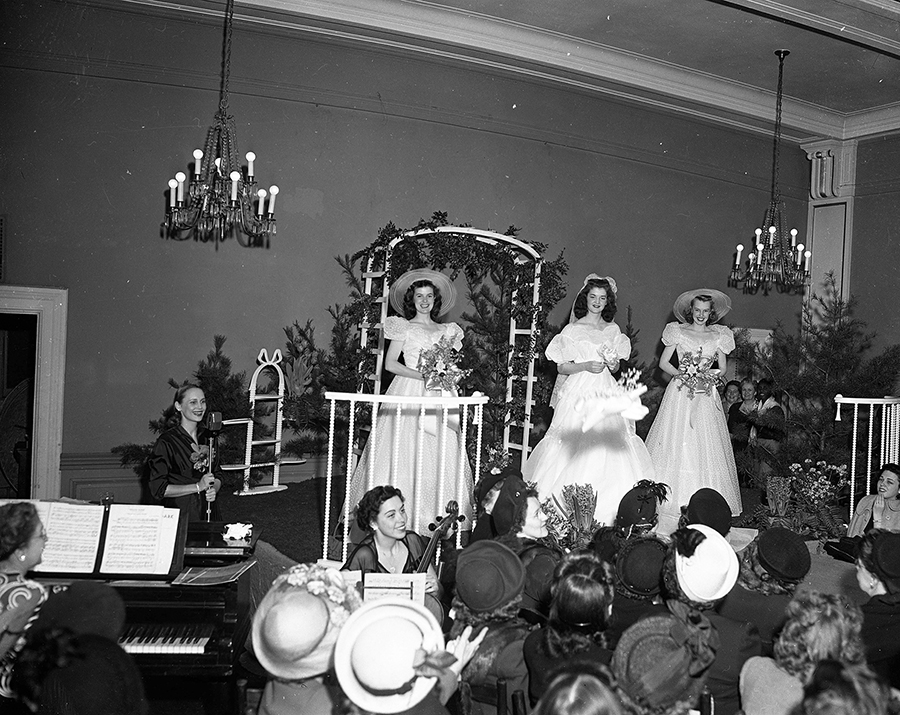
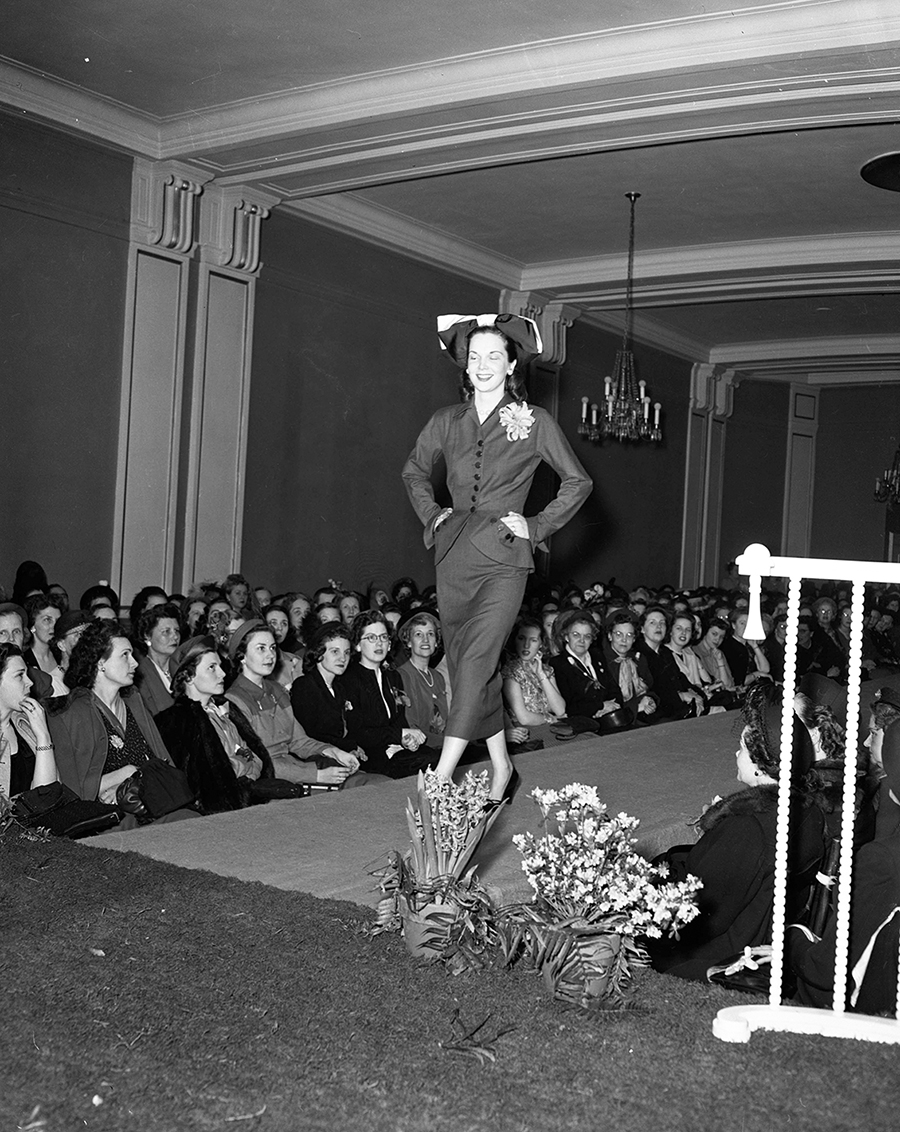
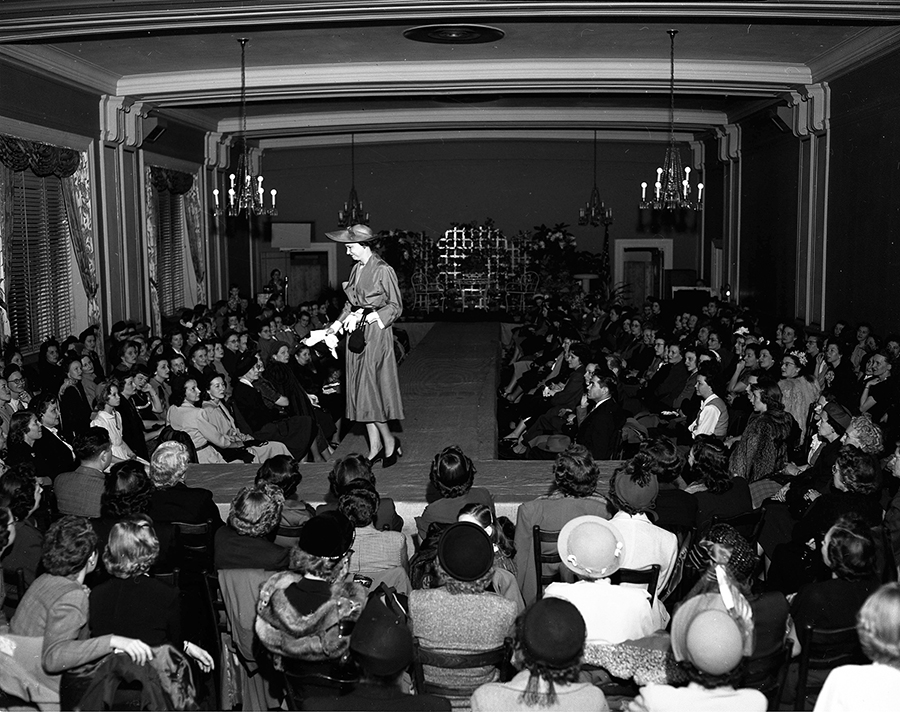
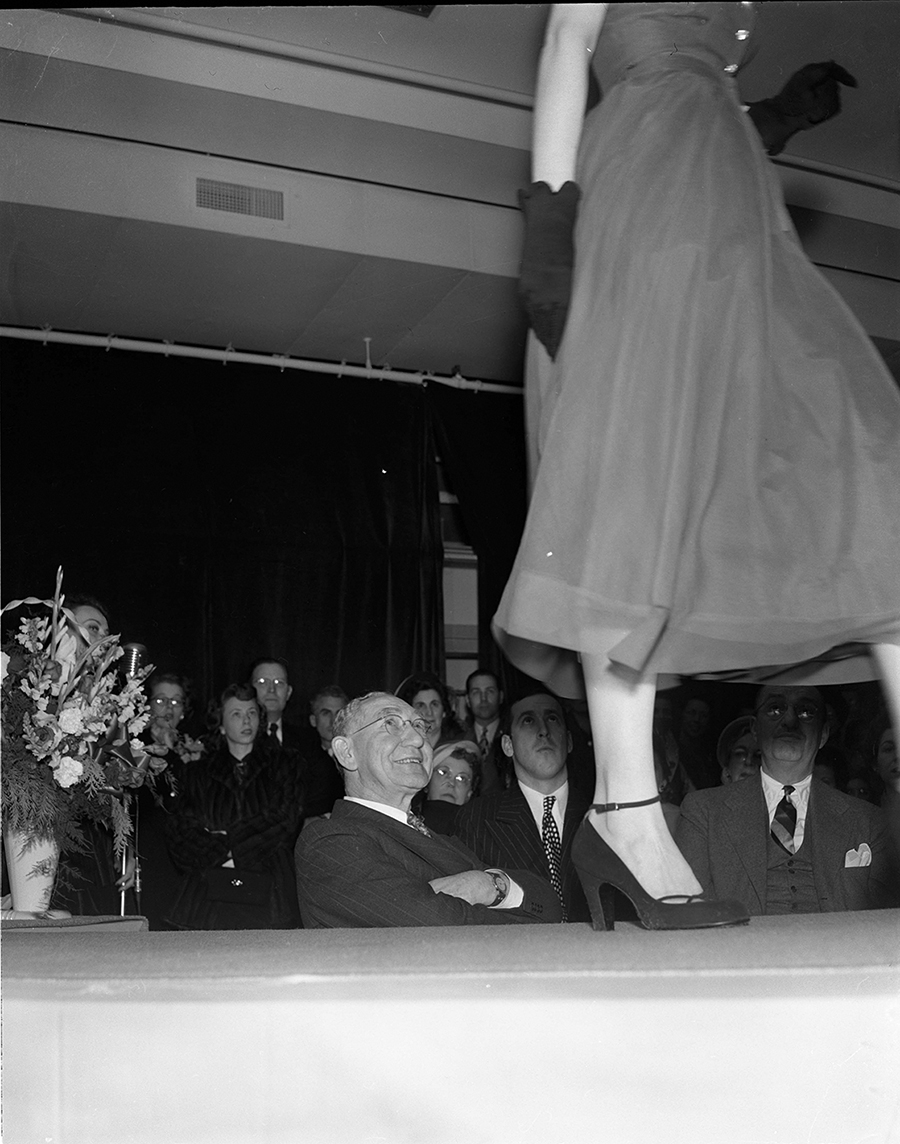
In-store fashion shows were heavily attended events in the 1940s and ’50s. By the late-1960s, Greensboro’s Fashion Week came in October with a runway show held in the main room of the Coliseum. “It was a huge thing for a few years,” Charlie Hensley told me about his brief fling as a model. “Sandy Forman used to direct this thing and it was very posh, high production values, very well mapped out.” Staging was constructed for the event and a live band accompanied the show. “Backstage they gave you boxes of clothes. Everything was racked according to the model.” A representative from every store was standing in the wings to review everyone’s look before they strutted forward. “I modeled for Joel Fleishman who had a store at Friendly. My God,” Hensley gasps, “those were beautiful clothes.”


Right: Belk’s Department Store, 1951
Left: Montaldo’s, 1953

In the ’70s, the program migrated over to the Carolina Theatre where 15-year-old John Shepherd walked the runway wearing clothing from his parents’ store, Bernard Shepherd, “which I hated but I got roped into it.” Shepherd says, “Mom would come up to all the male models and slap a Kotex mini pad under our armpits so we wouldn’t perspire on the shirts because they were going back into stock.”

My family frequented Bernard Shepherd at Friendly ever since the grand opening in 1967. It’s where the menfolk bought all of our suits while my mother was often outfitted from the ladies’ section up front. John Shepherd began working for his parents, Bernard and Eleanor, in 1987 at 19 years old. Primarily a men’s outfitter, Bernard Shepherd carried high-end traditional menswear lines with the option of being measured for a custom fitted suit. “We had a box full of swatches you could go through to pick your fabric, lining, your buttons, everything,” Shepherd says. Clothing manufacturing reps with their goods hanging on racks rolled into the office at the rear of the store, “Or they showed up in big motor homes parked behind the store. They had all of their latest styles displayed inside.”

The malling of America had a chilling effect on traditional mom-and-pop retailers. To combat this phenomenon in 1976, Starmount, Friendly Center’s owner, introduced Forum VI nearby with a promise of being Greensboro’s climate controlled, bougie apparel and dining destination. Anchored by Montaldo’s after they finally closed what had become their downtown tomb on Elm and Friendly, the city’s fashion shows were now held at the Forum.

Shopping malls were fully open on the sabbath, which is why, beginning in 1990, Starmount required all tenants at Friendly Center to conduct business seven days a week. The Shepherds were against doing so on religious grounds. They sued and won what was a pyrrhic victory. “Starmount threatened to padlock the store,” John Shepherd tells me, which they apparently had a right to do. An agreement was forged in 1990. The store could stay closed on Sundays, Shepherd recalls, “but Starmount would pay to outfit a new store and build it out at Forum VI.”


Right: Belk’s Department Store, 1951
Left: Meyer’s Department Store

That same year and for the same reason, Brownhill’s was redirected into Forum VI. Both stores experienced a steep decline in sales. For a multitude of reasons, Forum VI never really caught on. Montaldo’s liquidated all of its stores in 1995, and Bernard Shepherd was shuttered a few months later. After almost 70 years in Greensboro, Brownhill’s sold everything, down to the fixtures, in 1996.

In terms of fashion locally, it became a race to the bottom when Cone Mills instituted dress down Fridays in the 1990s. Around that same period, VF downtown went every-day-casual, with others quickly following. “As it progressed,” Dan Dellinger points out, “some people looked like they were mowing yards when they came in to buy clothes.” Employee standards dropped so low at VF, it had to initiate a dress code. “Casual Fridays at the office, that was the beginning of the end,” Kit Rodenbough says with a sigh. “Once the men didn’t have to wear neckties and suits every day, the women were like, you know, [forget] this!”

Downtown, Meyer’s intricately detailed, monolithic 1924 castle is intact, serving a useful purpose as headquarters for the Chamber of Commerce and others, but Belk and Montaldo’s former residences long ago succumbed to the wrecking ball. Ellis Stone/Elm Street Center has a date with one, having already been stripped clean of every sumptuous design element.

Laurie’s at Friendly Shopping Center, 1970s-1980s

Seeking continuity? At 530 South Elm, Laurie’s original 1951 location, you can pursue your passion for fashion at Vintage to Vogue. Plaza Shopping Center and the cluster of 1950s era bungalows behind it on Pembroke remains a fashion-forward location for women and children just as it was in the 1960s and ’70s when Prago-Guyes had a storefront there and Lollipop Shop was a long-time tenant. On Pembroke behind Plaza in the ’50s, my grandmother enjoyed the ambiance at Helen Mulvey’s Handicraft House, which sold Yankee Peddler cotton dresses and country shirts.

Locally sourced panache still bubbles over in boutiques at Plaza Shopping Center: The Feathered Nest for ladies and Polliwogs for the kiddos. Steps away, next door to the former Handicraft House, is my late mother’s favorite place in town, Carolyn Todd’s. “They have the correct cheese straws,” she would remind us every holiday season. Her last Christmas, I accompanied Mother to Carolyn Todd’s, where she procured a major portion of her presents that morning. As we were checking out I watched bemused as — this was just a few years ago — she signed for her purchases and we were on our way.  OH

Billy Ingram’s fave article of clothing is a 1960s Sy Devore short-sleeved, striped knit shirt once worn by Frank Sinatra.


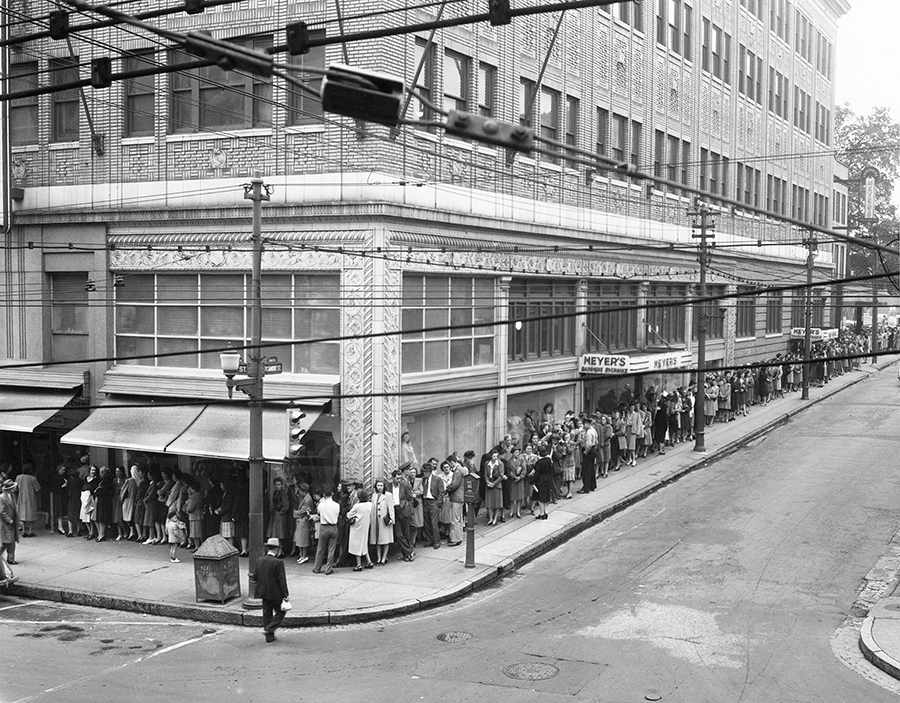
World War II brought shortages of everything from denim to nylon, essential goods diverted to shore up our troops. At war’s end, when word got around that the first shipment of nylon stockings in four years would be available at Meyer’s on a morning in 1946, a line of nattily attired ladies began forming as the sun rose. It would, over the next few hours, stretch around the corner and down the block.


Cigarette Pants

Scraps of History

One clothing retailer stubbornly remained downtown until the ground underneath became far more valuable than the business on it.

In 1926, Blumenthal’s got underway in a cubby hole at 358 South Elm. “The store with a heart” expanded into a new building built on that spot and adjoining properties in 1945 to create an 8,140 square-foot footprint specializing in denim jeans, work boots and hunting knives. Big and tall with extra, extra large sizes — a huge pair of bib overalls often on display to everyone’s amazement — could be found inside. Plus, they peddled cigarettes at prices so low, they were practically being given away just to get customers in the door. It worked. With 60 brands on hand, Blumenthal’s sold more smokes than any 10 stores combined.

Stacks upon stacks of Wrangler and Levi’s jeans, and the easy availability of Converse sneakers made Blumenthal’s back-to-school central for generation after generation. Suspended from the ceiling were three gigantic neon accented metal signs promising a free dollar bill if your receipt was incorrect or a complimentary pack of smokes if any of the numbers on your receipt matched numbers inscribed on the sign.

I won’t say this place was déclassé, but, for a time, there was a loudspeaker that allowed Abe Blumenthal to admonish people who parked too long out in front of his store. Blumenthal’s relocated to West Market in 2005 and closed its doors for good seven years later. The original location was supplanted in 2012 by an apartment complex named after the store.


Fashion Flare

Scraps of History

Proprietor John Mitchell began folding shirts and assisting his father and his uncle at Mitchell’s Clothing across the street from the Cadillac dealership when he was 12-years old. He’s a spry 95 today. In business since 1939, John Mitchell bought the place in 1962. “I changed things,” he tells me. “We were selling work clothes, work shoes, but I went into high fashion and men’s dress clothes.” Mitchell’s clientele has traditionally been and remains about 80 percent African-American.

Sales went through the roof when Mitchell picked up on an emerging unisex fashion trend out of Europe via New York City: bell bottom pants. “Belk and Meyer’s had ‘em first,” Mitchell admits. “But they couldn’t sell ’em so they quit. A year or two later, I got big into bell bottoms.” That was around 1970, when flared legs suddenly became the hot, hip-hugging style for both men and women. “For a while I was the only store in Greensboro selling bell bottoms and the Tom Jones[-style] rayon shirts with big, wide collars and stack shoes with the high heel.”

Besides Stacy Adams’ Madison shoes and crisp dress shirts, Mitchell’s is known as the place in town to find funky chapeaus from Stetson, Kangol, and more obscure designers. “People come from all around the country to buy my hats,” he says. Does he have any polyester era bell bottoms or platform shoes still hanging around? “A guy came in from California looking for those things and he bought all those old fashioned shoes and men’s clothes.”

Poem

On Disappearing

Yesterday, I found an empty turtle shell

On a leaf-littered trail by the ancient river.

Light flooded the inside

Like a tunnel through a yellow-painted mountain.

My eyes said, “No one is home”

And yet, a part of me was unconvinced.

Holding my breath, I bent down to pick it up

Hand and body ready to retract.


How often do I live this way —

Frightened to see what’s really here?

Scared to reach toward what I do not know?

Eager to hide from the truth?


Smooth and heavy in my cupped hand

The carapace was picked-clean

Vertebrae resembling some mystical symbol;

A rune, a spell, a skeleton key.

All I know is this:

There was movement within that vacant shell.

A gentle lifeforce.

A flowing river.

The bones of an unknown song.


Today, the shell sits on my bookshelf

And I shiver each time I walk by

Half-wondering when invisible legs

will carry it along. 


This subtle haunting will continue for weeks

Until, one day, the song becomes clear:

Death is not real.

We’re all just learning how

To lay down our armor

Embody the current

Disappear into the light.

— Ashley Walshe

Address: Morris Whitfield

A veteran pays homage to those who went before

By Colonel Charles A. Jones, U.S. Marine Corps Reserve (Retired)

Some people, such as Morris Whitfield, have an address known only by their first and last names. 

But, in fact, his address has additional information: Section One, Number 88. 

Morris Whitfield resides — really, rests — at that address, which is a grave in the Veteran’s Circle of Greensboro’s Forest Lawn Cemetery. 

I first learned about Morris Whitfield after my 1995 visit to Iwo Jima, the Pacific Island that was the site of perhaps the most famous battle in Marine Corps history. Marines became famous for twice raising American flags atop Iwo’s Mount Suribachi on February 23, 1945, during World War II. The second flag raising was the subject of the photograph that won Joe Rosenthal a Pulitzer Prize for Photography. His iconic photograph is one of the most famous in the history of warfare. 

But unlike many Marines and their Navy corpsman who saw the flags atop the mountain, Morris Whitfield missed the event because, like so many of Iwo Jima’s casualties, he was already dead.

After my return from Iwo Jima, which the United States returned to Japan in 1968, my parents and I visited the Veteran’s Circle of Forest Lawn Cemetery for no particular reason. By chance I spotted the Whitfield tombstone and, being a Marine myself, gravitated to it when I read part of its inscription: “PVT US MARINE CORPS,” with “PVT” representing Private, the lowest grade in the Marine Corps. Having been to Iwo Jima, I knew immediately the importance of his date of death: “FEBRUARY 19 1945,” D-Day for Iwo Jima, the date the Marines and their Navy corpsmen landed on the island to capture it from the Japanese. 

The sadness is twofold: first, his death itself, and second, his death so soon — the very day he came ashore.

When I worked at the United States Marine Corps History Division, I obtained the casualty report for Morris Whitfield (“casrep” in typical military expression). From the casrep I learned that he was a member of the 31st Replacement Draft, an organization comprising Marines in a rear area where they remained until one or more of them were sent forward when needed in frontline units, engaged in combat, to replace Marines who had been killed or who were wounded and evacuated.

The casrep reported the cause of death as “GSW mult lower extremities.” Translation: multiple gunshot wounds hit his lower extremities.

Morris Whitfield was buried on Iwo Jima with the remainder of his fallen Marine Corps and Navy comrades, but authorities decided after the war that none of our war dead would be left in what was former enemy territory. Thus began grueling, ghastly mass exhumations, and returns of the remains of our dead buried on Iwo Jima, and their transfer to the United States for burial in a national or private cemetery of the family’s choice. Since his widow had remarried, Morris Whitfield’s father requested in 1948 that his son be buried in Forest Lawn. 

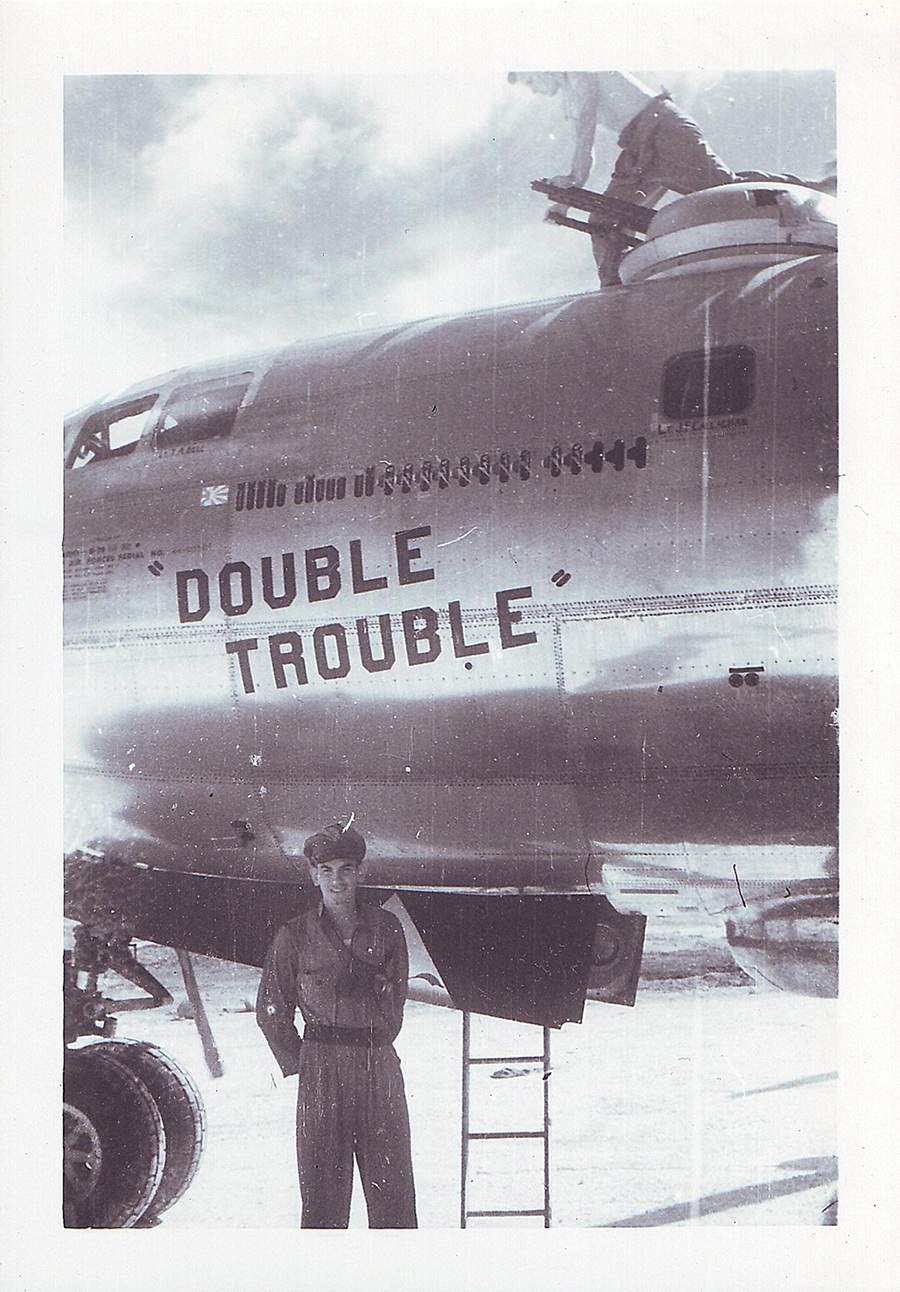
But Morris Whitfield is more than a burial for me — he and his tombstone are a reminder of what may have happened to my own father, a Glenwood “boy” who was the radar operator on a B-29 Superfortress bomber with 28 combat missions over Japan: 13 bombing missions and 15 photoreconnaissance missions. The crew named the B-29 “Double Trouble” and “City of Maywood.”

After he died in 2014, I found among his effects a handout titled “Memorial Day Program.” Obviously, his mother (my grandmother) sent it to my father during the war or gave it to him after he returned from the Pacific War. 

The program was for a Memorial Day ceremony on Sunday, May 27, 1945, at Forest Lawn to honor war dead who were listed under the title, “Roll of Honor.” Under that title was “Names Added Since Last Memorial Day,” a testament to the nonstop killing occurring during World War II and the need to honor the dead, from both Greensboro and rural Guilford county, lost during each year of the war.

The program reflected our then-segregated society, so under the heading “World War II” was a section with the names of Greensboro “White” men. Below that list was a section with the names of Greensboro “Colored” men. The rural section followed suit: Below the list for Guilford County “White” men was a list of Guilford County “Colored” men.

The name of Greensboro’s most famous airman, “Preddy, George Earle, Jr.,” was on the list of dead since he was killed by “friendly fire” on Christmas Day 1944. To this day, he remains the pilot with the most kills while flying a P-51 Mustang fighter and is the number six ace among all United States Air Forces aces (although he was, like my father, a member of the United States Army Air Forces during World War II since the Air Force was not separate from the Army until 1947). 

The sadness is in my grandmother’s markings on the program. She placed 11 “X” marks beside the names of “boys” she knew who were lost during World War II. And on the front she wrote a note to my father: “You may know some of these boys on here — I do.”

Under the heading “Rural Guilford County — White” was a familiar name: “Whitfield, M. E.”


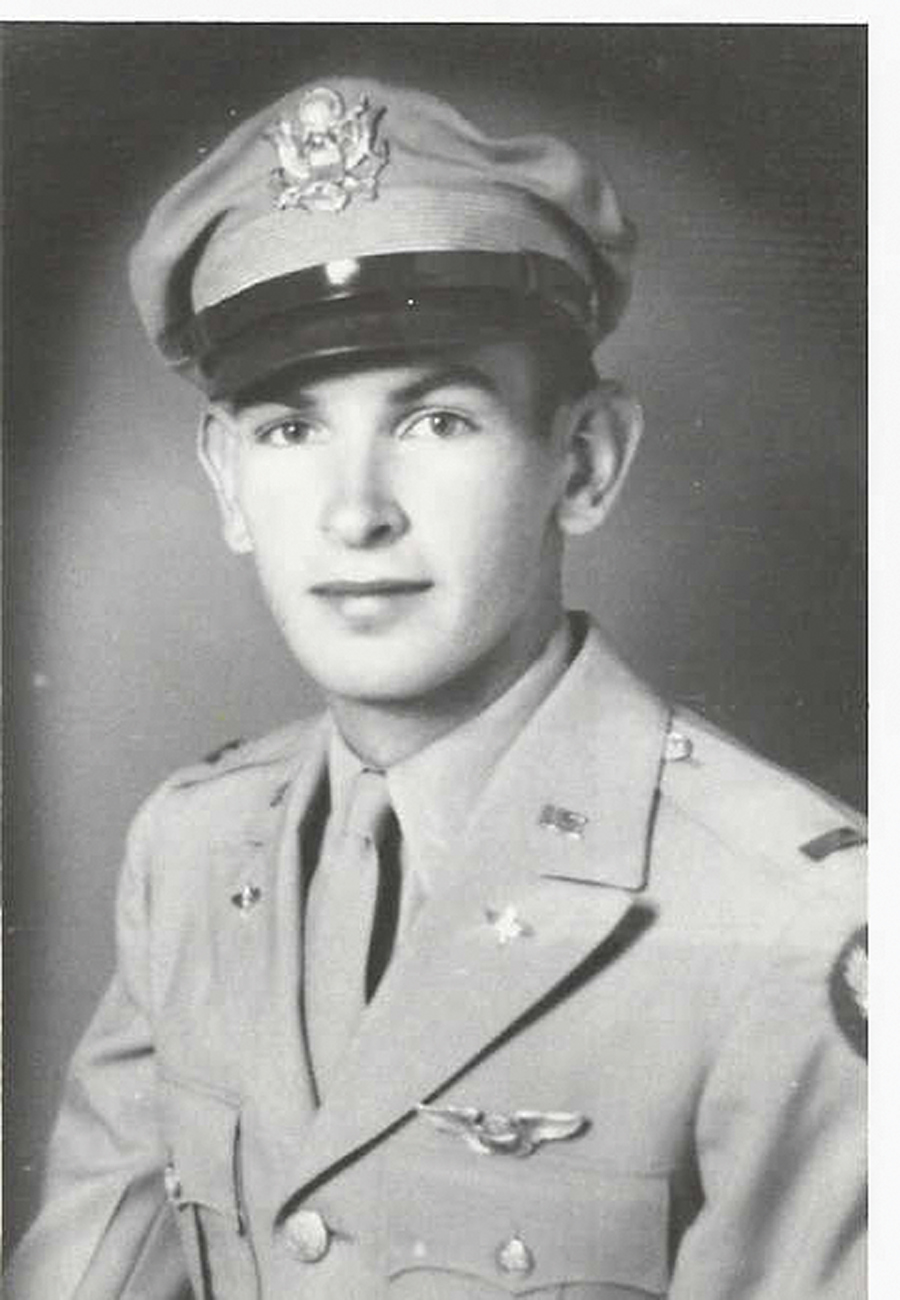
Left: Lt. Elmer Jones, 1994.
Middle: Lt. Elmer Jones below the the left nose of the B-29 Superfortress.
Right: Crew of the B-29 kneeling with six enlisted men standing behind them. Lt. Elmer Jones is kneeling second to the left.

My father has three connections to Morris Whitfield. 

First, his B-29 had to land on Iwo Jima twice during the war, once for fuel and once for repair. Had the Marines and their Navy Corpsmen not captured the island, my father may have had to parachute into the Pacific Ocean, an irony since he flew so many times over the Pacific but could not swim. Or his B-29 may have ditched in the ocean, an unpleasant and dangerous action at best. 

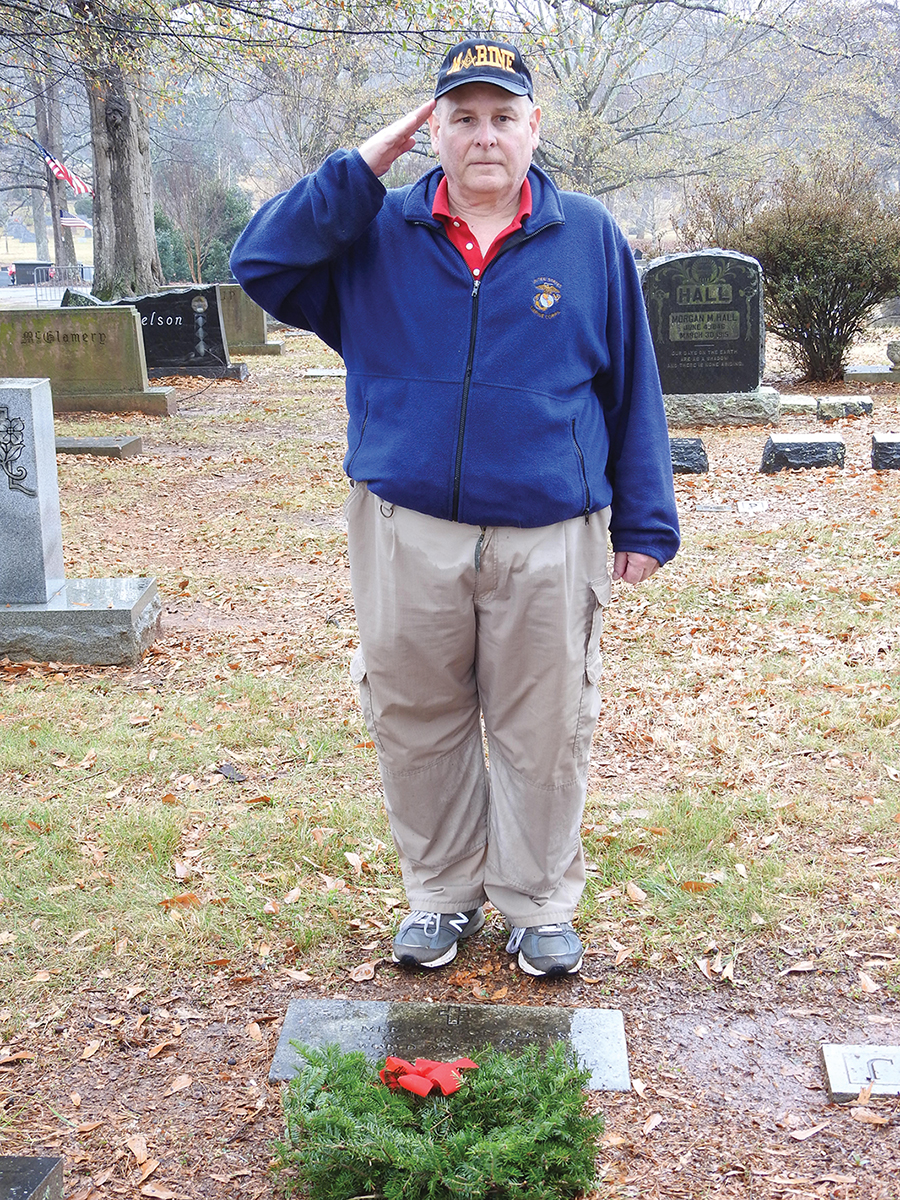
Second, my father is buried near Morris Whitfield. Each December, the Wreaths Across America program places wreaths on veteran graves in veteran sections of cemeteries. I attended in 2019 and 2021, and each time I “appropriated” two wreaths before the speaker stopped speaking so I could be the person placing a wreath against Morris Whitfield’s tombstone and one on my own father’s footstone — since he is outside the veterans section, he would not have received a wreath but for my determination that he have one.   

Third, and most importantly, my father survived the war for four reasons. His aircraft commander was a superb pilot. My father was adamant that the number of photoreconnaissance missions saved his crew since they were “single ship” missions, meaning the plane flew the mission alone; the Japanese would not shoot at a solo B-29 to keep from disclosing their antiaircraft gun locations. Another reason was luck. And the final reason was Iwo Jima: Had Marines and Navy Corpsmen not captured Iwo Jima so it could be a place for bombers to make emergency landings, my father may have perished in the ocean.

So what was most important was that my father’s name was not on the list of the dead for deaths up to Memorial Day 1945. But it could have been: From April 1945 to Memorial Day 1945, he was flying combat missions over Japan in his B-29. 

If my father were killed or missing after Memorial Day 1945, his mother may have found herself at Forest Lawn in 1946 on Memorial Day with a sad updated program — one with the name of her son under “World War II — Greensboro White.” And this story would never have been written. 

Combat death is callous, stripping almost all personal attributes from what had once been a living, breathing combatant who had an address, friends and family. Remaining is a casrep with the typed ominous acronym, “KIA” (killed in action) — a notation I thank God was not typed besides my father’s name. Also remaining is the title, “hero,” reserved for men like Morris Whitfield who did not return and were — and still are — left with only a few brief etchings on a tombstone.

Thus the address remains the same and always will — simply “MORRIS E WHITFIELD.” And that address is timeless: Morris Whitfield will never move. He will not be departing Forest Lawn Cemetery temporarily or permanently. I had to travel thousands of miles across the Pacific Ocean to reach and to visit Iwo Jima to learn the importance of the date that placed and keeps him in Section 1, Number 88.  OH

Colonel Charles A. Jones, U.S. Marine Corps Reserve, served as a judge advocate (military lawyer) in the Regular and Reserve Marine Corps for a combination of 30 years (1981 to 2011). He enjoys his major passion: researching and writing military history. He wrote a biography of his father focusing on his World War Two experiences:  B-29 “Double Trouble” is “Mister Bee” (available on Amazon). His email is cajonesdt@gmail.com.

Remembering Frank Jr.

A tribute to a leader

By Jim Jenkins


Left: Frank Daniels Jr.
Right: Publisher Frank Daniels Jr. and Raleigh Times Editor A.C. Snow look over the final edition of the Raleigh Times.

Frank Arthur Daniels Jr. died at the age of 90 on June 30, 2022, in his hometown of Raleigh. It was the peaceful conclusion of a life full of professional accomplishment, financial success, and contributions to his community and his state. But for his multitudes of friends and family, Frank Jr. — as just about everybody called him — is remembered for his capacity to give and receive love.

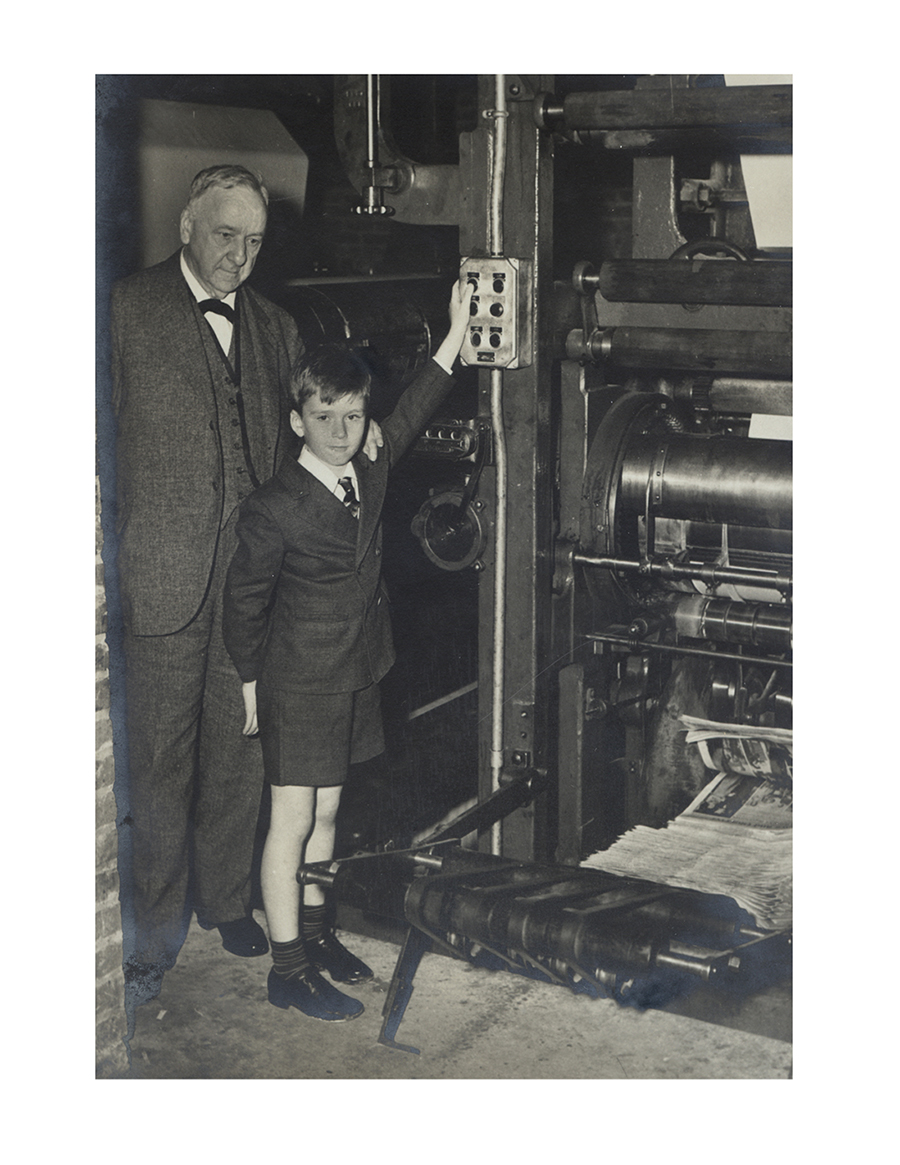
Sitting in the cavernous dining area of her parents’ home on White Oak Road, Julie Daniels, Frank Jr.’s daughter, and her husband, Tom West, scan the many family portraits and mementos. There is one of her father, then 65, in front of a printing press.

Look!” she says. Hes got the little red book in his pocket. He always had that.”

Yes, Frank Jr. always carried a book with the names of his best friends, their phone numbers and their birthdays. When he was younger, hed send cards; as he got older, he found it easier to call them and sing to them (and anyone who was with him would be expected to sing along).

Julie is one of two children of Frank Jr. and his wife, Julia, and her memories are exactly what her father would want them to be. “Oh, they had fun — parties all the time, events at the paper, things like that,” she says. But they always put me and my brother first. I dont remember that they had all kinds of money — and they didnt think of themselves that way. But when you ask me, what was his happiest day, Id say just about every day was his happiest.”

Frank Daniels Jr. was born at the Old Rex Hospital,” on Sept. 7, 1931. His father, Frank Daniels Sr., was one of four brothers, three of whom were active in running The News & Observer, which was owned by Frank Jr.s grandfather, Josephus Daniels. He attended Woodberry Forest School near Orange, Virginia, and graduated from the University of North Carolina at Chapel Hill in 1953. He did two years in the U.S. Air Force in Japan and tried a year of law school but was inevitably drawn back to The N&O, which turned out to be more than his birthright — it was his destiny.


Left: Frank Jr. at press with grandfather Josephus Daniels in 1939.
Right: Publisher Frank Daniels Jr. and Raleigh Times Editor A.C. Snow look over the final edition of the Raleigh Times. 

Though he and his sister, Patsy, were raised in comfort and power, Frank Jr. was a righteous man. He had a sense of right and wrong that transcended the views of the generation from which he came, and of the family from which he descended. His son Frank Daniels III recalls going to the ACC basketball tournament with his father in 1968, when he was 12. It was the first varsity year for Charles Scott, a UNC sophomore who was the first Black basketball player for the Tar Heels.

A man behind them began taunting Scott. It was something Franks dad tolerated until he heard the n-word. He turned around and told the guy to shut the hell up and then said, ‘We dont need you here.’ The guy left,” says Frank III. That really took something.”

Frank Jr. worked various jobs in all departments at The N&O and was popular with the other workers at the paper. Sometimes he chafed a bit working for his father (who, as the publisher, ran the business operations) and his uncle Jonathan, the editor, but he stayed the course and, after working his way up, became publisher in 1971.

A big man for his time, Frank Jr. was 6 feet, 3 inches tall and burly. He had huge hands and a booming bass voice that carried through a room, though his eyes possessed a mischievous twinkle and he loved a good joke.

Gary Pearce, a longtime political strategist, remembers his boss from his own early days as an assistant city editor at The N&O in the mid-1970s. Hed walk through the newsroom every day about 5 oclock to go talk to Claude Sitton,” says Pearce, referring to the editor of the paper at the time. One day, Franks walking through and theres a phone ringing at an empty desk. No ones there, so Frank — the publisher, now — puts down his briefcase, answers the phone, puts a piece of paper in the typewriter and takes down the item, a minor news brief. Then he sticks it in the basket, gathers his stuff and walks on down the hall, not saying a word to anybody. Most publishers wouldnt have done it. That told me a lot.”

While at The N&O, Frank Jr. took some courageous stands as a fellow who owned a newspaper too liberal for many local business and community swells. He pushed for a merger of the Wake County and Raleigh schools, supporting a controversial change that led to vastly improved, integrated schools. He supported civil rights and womens rights and didnt balk when the newspaper started asking troubling questions about the war in Vietnam.

In addition to leading the paper, Frank Jr. rose to the top of dozens of professional associations. He was chairman of The Associated Press, and part of the leadership of nearly every civic organization in Raleigh — from United Way to school support groups to the YMCA board to chairing the boards of the North Carolina Museums of History and Natural Sciences. His board memberships and chairmanships over nine decades were too numerous to name, but his son says that his favorite post was chairman of the Smithsonian Institutions National Board. He arranged partnerships between the Smithsonian and North Carolinas history and science museums. They reflected his lifelong belief that everyone, at every station in life, deserved to know about art, history and science, and that the knowledge should be free.

Frank III says that his fathers seemingly natural capacity for leadership always put him in charge of whatever organization he had been asked to join. Every group he was in, he rose to the top,” Frank III says. I think it was his capacity for empathy. He could see what people needed, and it was important for him to help them.”

The Daniels family sold The News & Observer to the McClatchy newspaper company in California in 1995, and Frank Jr. remained as publisher until he retired in 1996.

In retirement, he became busier than ever, continuing his board memberships, staying active particularly in Democratic Party politics. Virtually every governor paid him a call. No one is sure if he ever gave a campaign contribution to a Republican. During his tenure, as with his grandfather and father, The N&O never endorsed a Republican candidate for office.

Frank Jr. bought a building on Fayetteville Street in downtown Raleigh and established an office on the sixth floor, where he entertained movers and shakers and fellow board members and politicians. Through his membership in social and golf clubs he influenced another two generations of businesspeople, candidates and entrepreneurs. Until the very last month of life, he rarely had an empty lunch date or an evening without some kind of activity.


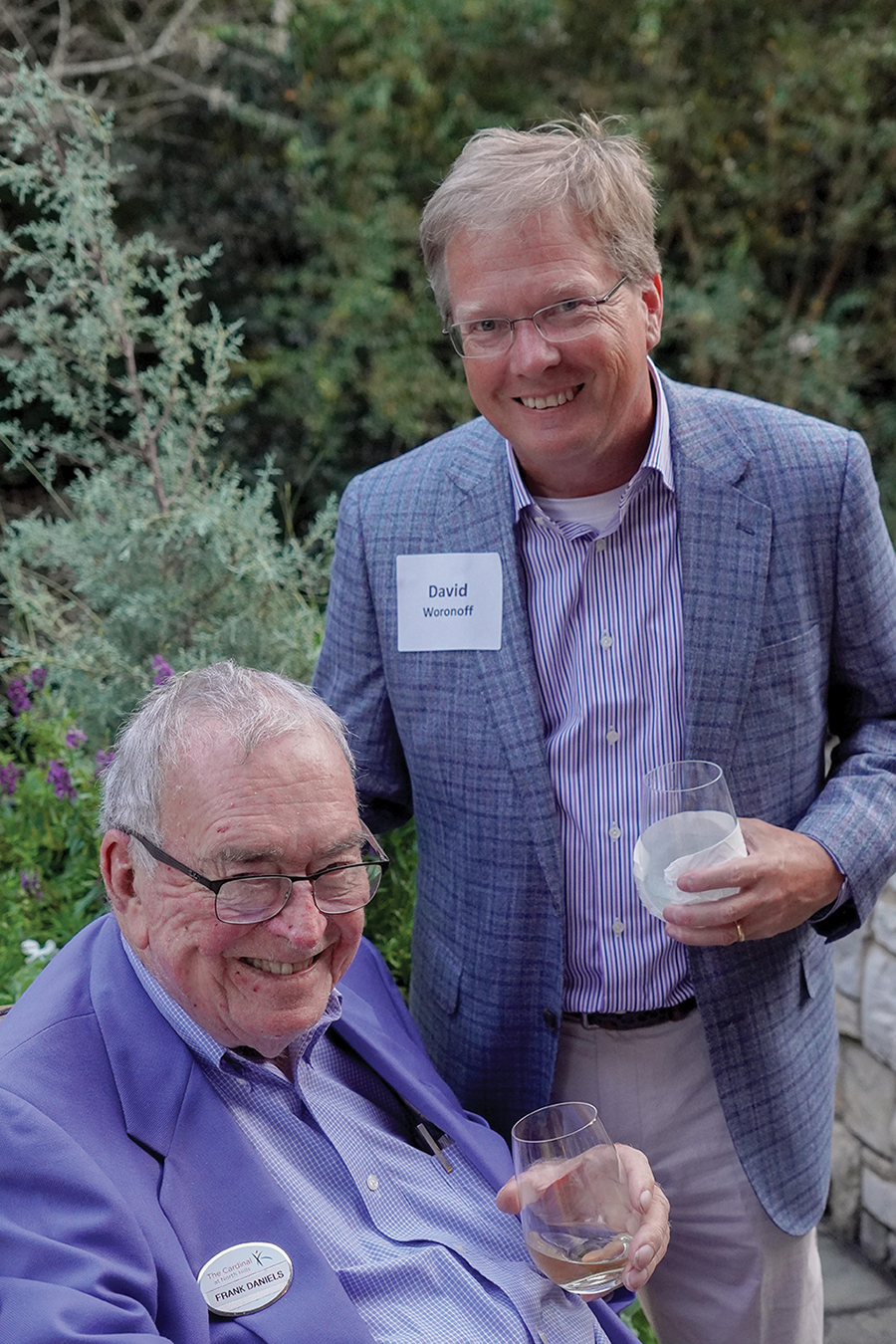
Left: Frank Jr. and David Woronoff.
Middle: Frank Jr. and Julia with Patsy Daniels-Lindley and Lucy Daniels.
Right: Frank IV, Frank Jr., Frank III.

Even after his departure from The N&O, Frank Jr. supported new ventures and publications. Shortly after his retirement, he and four others bought The Pilot in Southern Pines, then owned by Sam Ragan. Why did he do it? It just gets in your blood,” was all he ever said.

One of the other owners is David Woronoff, Frank Jr.s nephew. Woronoff, who runs the business for the partnership, was young at the beginning, confident but willing to ask his uncles advice. Hed never let me call up and say, ‘This happened, what should I do?’” Woronoff laughs. But hed give advice — not that he expected you to take it.”

In one case, a prominent Pinehurst businessman called Woronoff, the publisher of The Pilot, after the newspaper was critical of a venture in which the businessman was involved. He was screaming at me,” says Woronoff, really rough stuff.” Woronoff called his uncle and the advice Frank Jr. gave him was unequivocal. He said, ‘David, you never go wrong punching the biggest bully in town in the nose. What would be wrong would be if you didnt give the person in need a hand up.’”

Frank Jr. stayed involved in the publishing group until his death, as it added The Country Bookshop, another community paper and five magazines — Business North Carolina, PineStraw, WALTER, O.Henry and SouthPark — to its stable.

Frank Jr. built friendships from childhood that lasted him a lifetime, but what he enjoyed most about all his associations was just learning. His granddaughter, Kimberly Daniels Taws, who runs The Country Bookshop, remembers visiting the beach with her grandfather when she was young. She joined him on the deck, where he was sitting next to a foot-tall stack of unusual reading material: clippings, folders, magazines, books. I said, ‘What are you doing?’” she says. And he said, ‘Well, Im trying to figure out how I feel about nuclear power.’”

Many years ago, Frank Jr. hired attorney Wade Smith to help with some legal issues involving the newspaper. That led to a deep, lifelong friendship. To me, Frank was larger than life, but Frank was real,” Smith says. “There was no putting on airs about him. He would be straight with you in all ways, and I liked that about him.”

Communications consultant Joyce Fitzpatrick met Frank Jr. when she rented space in a downtown building he owned some 20 years ago. She began regular lunches with him and Smith once or twice a month. He was a hyper-social person,” she says. He loved to have his lunches planned. We always typed out an agenda. It covered everything — politics, world events. People would come over to sit with us, wanting to know the latest.”

One thing he didnt seem to have was inhibition. Oh,” Fitzpatrick says, wed switch from politics to golf to what happens when we die. In the last few lunches, Wade would give comfort: Well see each other again.”

Perhaps, in the end, Frank Arthur Daniels Jr. is proof that a man can be great without being perfect. Frank Jr. was the first to laugh at his own flaws; he enjoyed off-color humor, indulged in profanity and played practical jokes. But if he felt hed been too rough on someone, hed apologize.

From him I learned the beauty of friendship and being with other people. The importance of generosity. And that sense of humor!” says his daughter Julie. Sometimes you dont realize the great gifts.”

In a eulogy at his father’s funeral at White Memorial Presbyterian Church, his son, Frank III, shared a note that Frank Jr.’s longtime personal assistant, Julie Wood, found on his desk after he passed: Feed the hungry. Clothe the naked. Forgive the guilty. Welcome the stranger and the unwanted child. Care for the ill. Love your enemies.

Its a list of what he thought religion — and we — should teach,” says Frank III, who closed the eulogy with: Well do our best.” OH
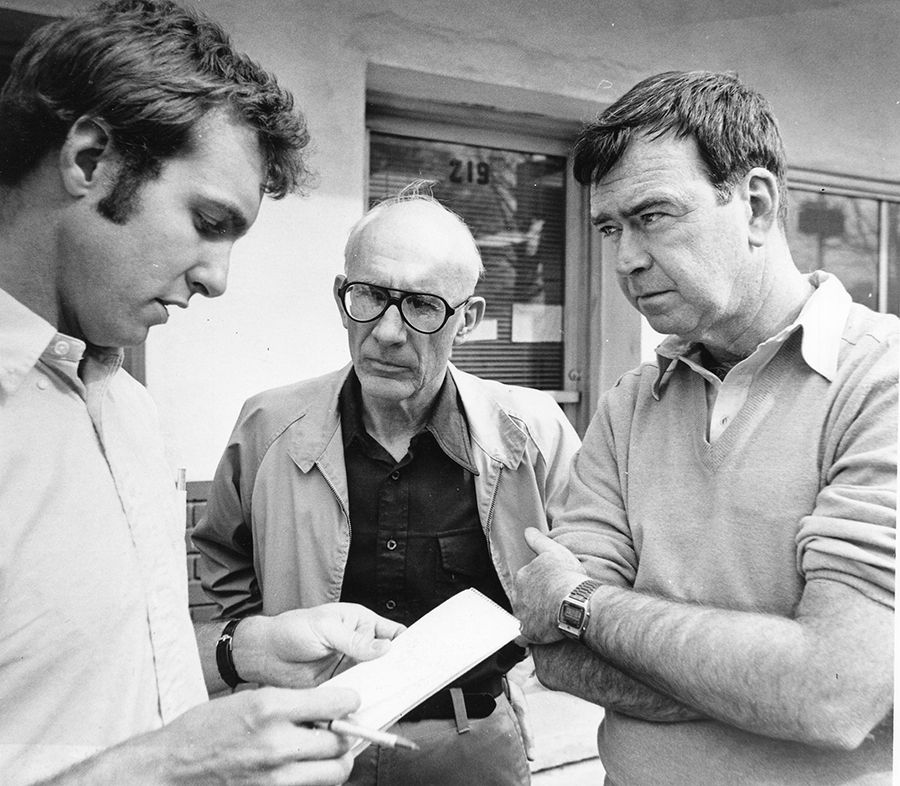
Jim Jenkins is an award-winning writer who has received North Carolina’s highest honor, the Order of the Long Leaf Pine. He retired from The News & Observer in 2018 after 31 years as an editor, columnist and chief editorial writer.

Renovation Transformation

A historic Dunleath house and the artist renovating it are forever changed

By Cynthia Adams 
Photographs by Amy Freeman

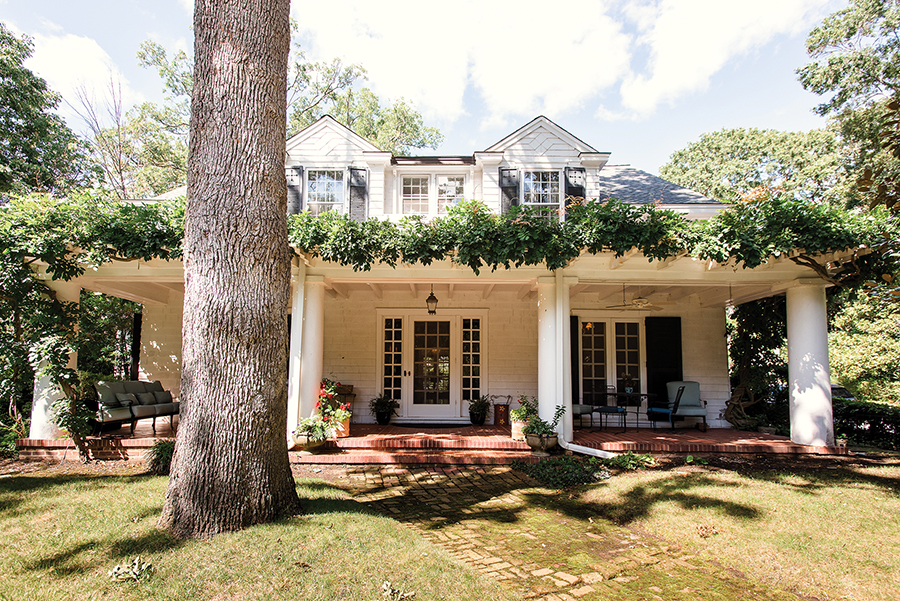
When artist Susan Harrell first toured the languishing Victorian in Greensboro’s historic Dunleath, she beheld a towering, purple two-story trimmed out in cream. And that purple? “The paint was coming off in ribbons,” she says ruefully. The house soon became the artist’s agony and ecstasy.

A partial renovation had been halted before completion and it sat empty, she explains with a frown conveying the unsaid. Then in foreclosure, it was on the edge of becoming derelict. “There were squatters in the house.”

Undaunted, she jokingly dubbed it “The Purple Palace,” and made an offer. 

And so began a true May/December relationship, given Harrell was only 34 at the time. The house was almost a century older than its new owner. Yet she unreservedly loved her Purple Palace.

The interior, too, was a confusion of ambitious ideas left unfinished.

By best estimates, the house is easily 122 years old, but darned if it doesn’t look great for its age today, thanks to an artist’s touch, and no small amount of dedicated labor, creative decisions and persistence.

(Pinpointing the exact age is tricky. According to the National Register nomination, the house dates to 1905. Greensboro city planner and historian Mike Cowhig, who works with the Greensboro Historical Commission, believes the property is at least five years older.)

As a full-time artist and avid DIYer who never met a power tool she didn’t like, Harrell immediately recognized the problem causing the peeling paint and knew how to solve it. The exterior had been sprayed, she says, twisting her mouth.

Bad idea.

“The siding is cedar, and you really need to brush it on.”

She painstakingly scraped the purple off, doing much of the work herself, renting a scissor lift, given the vertiginous height of the house.

“I had experience with lifts because I have done murals.”  (Three of Harrell’s original murals, including a restoration, are in her hometown of Asheboro.)

And The Purple Palace would require all her gifts — both her artistic and construction abilities. And it would change her life.

Although the prior owners had made some big-ticket improvements, wiring and reworking plaster walls with sheetrock, they miscalculated costly things like a posh kitchen. Hence the foreclosure.

“They spent $900 on cabinet pulls,” Harrell explains, shaking her head. Yet there was no backsplash in the mostly-completed kitchen.

And considerable cash had been outlaid on maple flooring in the entry and main area, juxtaposed against rooms with original red oak. She throws up her hands. She stored and saved boards of the original oak for reuse or resale. After all, the upstairs renovation still awaits.

Harrell, who loves millwork and carpentry, replaced a lot of wood, including a rotting rear porch. Inside, she removed new columns that cut up the main rooms.

She changed the interior crazy quilt color scheme, calming and unifying spaces with quieter tones. After Harrell’s cosmetic touches, including a calmer color palate inside and out, the onetime home to squatters was no longer a laughing matter. 

Goodbye, Purple Palace. Or “Frankenhouse,” as she started calling it.


Over the span of a century, the sizable house has led many lives, including one as a child care facility. “Maybe once a duplex, too,” Harrell guesses. “It had a parking lot in the rear.” The original staircase and entrance hall had been moved, creating an open floor plan. But an artist requires wall space for artwork.

Harrell’s plan is to eventually restore many of the original walls, truer to the house’s vintage. “There was no definition for the living room,” she laments.

Her next project? Designing a period appropriate fireplace in what is now a dining area, installing gas logs. Designed for coal, she points out, the house’s many period fireplaces were “unusually small.” On a practical level, gas logs will help with heating the 3,200 square feet of space.

Her contractor brother, “who could do things out of my realm,” is now based in Blowing Rock, managing the building of high-end homes. Having helped him on projects, she had a vision for what the restoration needed. 

She has been replicating the original historic door trim, milling it herself. (It’s often impossible to find, she points out.) Harrell owns three table saws, two drill presses, planers and jigsaws, which she regularly uses. 

At last, Harrell grins, she has a shop for her many tools. “I’ve done a lot of reno work. I built a loft in Asheboro.”

Is there anything she doesn’t do?

She laughs. Harrell admits she cannot make more time in a day, in order to both create artwork and do restoration work. Meantime, Harrell’s taking a break from renovation for her art’s sake.

Her greatest passion — art — is something she discovered a bit late, while in her early 20s. On her way to becoming an interior designer at Rockingham Community College, she uncovered an affinity for drawing and painting. 

“I would go to a local public library and look at the art section,” Harrell explains. “I ended up in the Old Masters and decided to replicate them.” Her first effort was duplicating the legendary Mona Lisa. She discovered she had a good eye for color, and kept going.

“A hare-brained idea,” she admits modestly. 

“After a few (replications), my family started noticing what I was doing. My mom has always been my biggest fan and kept encouraging me.” 

All five Harrell siblings are creative. Most of them are musical.


“They all have their own weird little super power,” she says with open admiration. One brother builds high performance race car engines, netting him “multiple world records.” 

Is this why she, too, is fearlessly creative? “Maybe so,” Harrell answers.

Art resonated with her more than interior design. “In the process of getting exposed to more of the arts, that’s when I started getting more interested in it,” she explains. However, she has no art school background. “I’m 100 percent self-taught.”

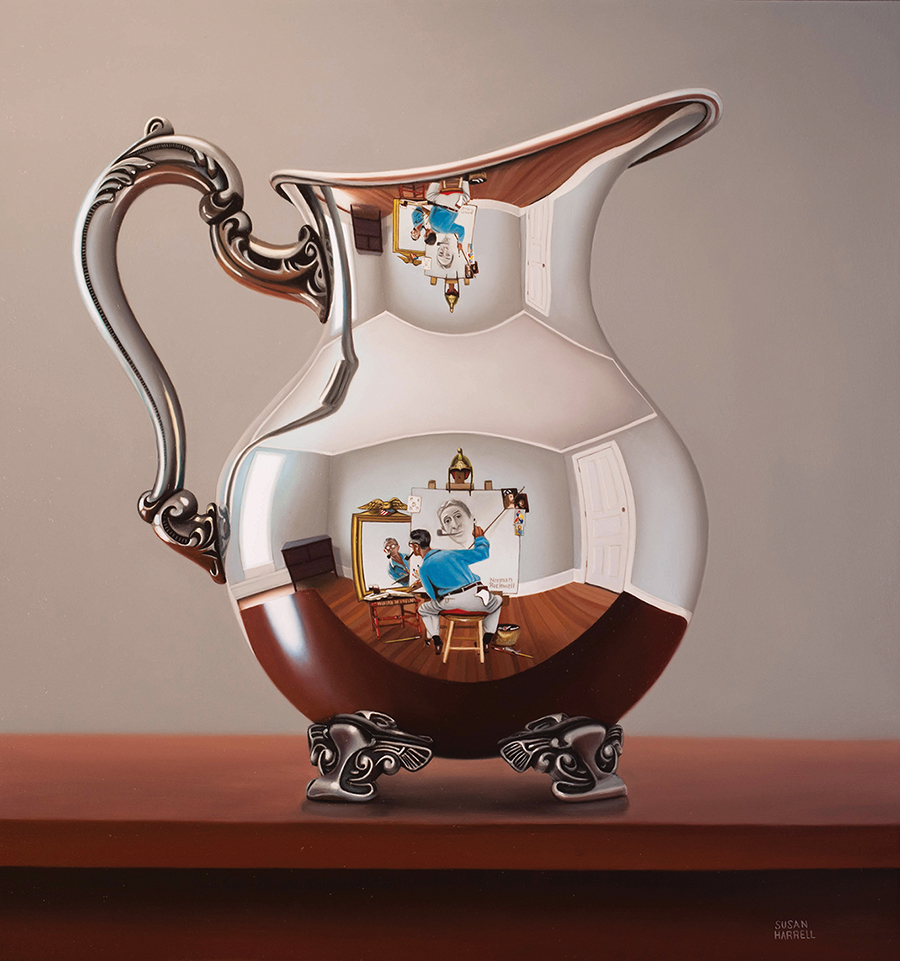
Harrell shows her “Musing” series, featuring miniature reflections of Old Masters within the compositions. These were key to her being discovered and admitted to art shows. “That was pretty popular. That’s how I learned how to paint.” According to one collector, she has perfected her own technique of oil painting on an aluminum panel. (Aluminum was practical — cheaper, she explains.)

She experimented with extremes in scale, from painstakingly reproducing famous paintings in miniature, paintings within paintings, to outdoor murals. Harrell was eventually commissioned to paint a mural for an Asheboro hospice, as well as aforementioned murals downtown.


While enrolled in community college, she met art teacher Melissa Walker, who introduced her to Ed Walker, her husband and the owner of Carolina Bronze Sculpture in Asheboro. For several years, Harrell fabricated bronze sculptures there, working with fiberglass, glass and clay. She even learned to weld. Fabrication was “extremely hot and heavy” — and dangerous, she concedes.

“I worked on the bronze and casing that surround the Declaration of Independence,” Harrell says proudly. 

In 2001 when she was still a teenager, Harrell recalls Greensboro’s News and Record featuring her working on “February One,” James Barnhill’s iconic work, completed during 2001-2002. “I was welding together the bronze statue of the four students at A&T.”

The Greensboro Four sculpture resides on the North Carolina Agricultural and Technical State University campus. 

By 2009, Harrell moved beyond replication of Renaissance works to her first original oils. She imparted the gripping power of the very photographs she often worked from.

Harrell explains, “I was interested in the process . . . and near photo-realism. The challenge: what it takes to make something look real. But when I got interested in art, realism wasn’t cool.”

Nonetheless, she soon found opportunity. 


“When I first got into art, I got what I thought was lucky, having been invited into a group show at one of the top galleries in the country in Charleston, S.C.” She sold works as quickly as the paint dried. 

For a decade, Harrell painted furiously. She looked successful.

“Everybody thought I was doing it all, right away. I was selling right away. But (some) galleries take 50 percent commissions . . . I wasn’t able to make a living.”

Harrell burned out. Flamed out, actually, and stopped exhibiting. When her contractor brother had an accident, she worked alongside him for a couple of years, learning the finer points of renovation. The physical work was satisfying. 

“I need to sweat. We’re supposed to sweat.”

Harrell found renovation rewarding. And yet . . .

“I thought I’d given up on art. If you don’t have a gallery, what do you do? And most of my work was selling out of state. So, nobody in Greensboro knew I was here, and I hadn’t made those connections.”

In a strange way, the house she was busy saving saved her.

Harrell “decided to come back to art in a different way. This house was pivotal.” 

She uses the word “transformation.” The transformation of the property feels like kismet, Harrell explains, walking through the gardens, a pleasing blend of stone and brickwork. Brick walkways define pathways and a sunken area features benches created from enormous river stones.

The house flows to the outside with both open and screened porches. The hardscaping was there when she acquired the property, as well as a rustic studio and abundant plantings.

There are 18 gardenias on the property. When they bloom in synchronicity with the garden’s heirloom roses, she finds bliss.

“I’ve never been into flowers . . . I’d never smelled good flowers until I moved here. And now I get it,” Harrell says. “And when they bloom, it’s like a fairy tale.”

Outdoor space, Harrell says, made the early months of COVID bearable — even enjoyable.

The former Purple Palace is quietly soothing. 

Harrell’s work today includes seascapes, landscapes, still lifes and figurative paintings. She is starting a new series titled “Group Think II.”

Harrell credits recent shifts, her renewed future hopes, in part “to Nathan Wainscott.”

“She’s without question the most talented artist in the state, perhaps beyond,” opines Wainscott, a commercial artist and the owner of Inspire by Color. 

He commissioned Harrell to create a painting of the Biltmore as an anniversary gift to his wife. He treasures a picture of Harrell at her easel working on the commission, saying he marvels at her work.

Wainscott calls her paintings, “stories within stories.” As a fellow artist, he finds her gifts exceptional.

Plus, he also works with both new and restoration projects, so he knows whereof he speaks. Harrell’s historic home has its own stories to tell, but he feels that she has added “the matchless talent of her artistry.”

Harrell has battled against crazy odds during the restoration, suffering brown recluse spider bites to her ankle. Given her considerable height (she is 6 feet tall) the necrotic venom “was slowed in reaching my heart and circulation.” She later fended off Lyme disease from a tick bite — all within the past six years.

Finally, it is the resurgence of her creative powers and her art that has given her a second wind.

“Something in me never wants to give up. I felt like this about the house, too.”  OH
Cynthia Adams is a contributing editor of O.Henry magazine.

City House, Country House

How the Jacksons ended up with two old homes — and contentment

By Ross Howell Jr.

Photographs by Amy Freeman


On a summer evening, I’m sitting with my neighbors, Jane and Randy Jackson, in the living room of their house overlooking Fisher Park.

Shaded by big oaks and a magnolia, it’s a graceful old home that I’ve admired ever since I moved into the neighborhood 13 years ago.

Jane grew up in Winston-Salem, graduated from Reynolds High School and went off to Agnes Scott College in Decatur, Georgia. Randy grew up in Birmingham, Alabama, moving with his family to Atlanta when he was in 10th grade.

“Football was my life in high school,” Randy says. So when the University of Alabama phoned him in Georgia, asking him to try out as a walk-on, he gave up his plan to study marine biology at the University of Florida.

After going through two-a-day practices, an injury and doubts about his ability to play at such a high level, Randy decided to give up football. He finished his freshman year at Alabama and transferred to Georgia Tech.

“My Dad was between jobs,” Randy explains, “and paying out-of-state tuition, so I decided to come back to Georgia to help with finances.”

It was a good move.

In Atlanta, Randy met Jane on a blind date. They were married during her senior year at Agnes Scott.

The next year, Randy entered his first year of study at the Medical College of Georgia.

“She went through medical school with me,” Randy says.

“In a house with no air conditioning in Augusta, Georgia,” Jane adds. “And pregnant.”

“She’s a tough, tough girl,” Randy says, beaming at his wife.


Later, the couple moved to Jane’s hometown of Winston-Salem for Randy’s internship and residency at Wake Forest University School of Medicine, then on to Greensboro for private practice in 1982.

“We loved Fisher Park,” Jane says, “but, back then, younger kids were picked up early and bussed a long way to school.” The Jacksons didn’t want their 5-year-old daughter, Alice, and 8-year-old son, Freeman, spending so much time aboard a bus.

So they settled into a small house on Elmwood Drive in Irving Park.

“There were 28 kids on that street who were between my two children’s ages,” Jane says.

“I would come home from the hospital and be attacked by these little kids,” Randy laughs. “I’m not talking about one or two. I’m talking about a whole herd of them!”

“And we had Page High School kids, too,” Jane adds.


Remembering how important sports had been to him as a youth, Randy decided to spring for a “sport court” in the backyard of their house.

“And there we were,” Jane says, “inundated with all this medical school debt.”

Randy’s facility had a basketball hoop and tennis nets. Children played there constantly, and neighborhood dads enjoyed pickup basketball games, too.

“It was like a community center,” Jane recalls. “We used to call it Jackson Park.” They smile, reflecting on the memories.

“So we lived there for a while and then we moved to another house a little bit bigger a couple blocks away,” Randy says. “Then our kids finished high school . . .”

“And went off to college,” Jane finishes.

With Freeman and Alice out of the nest, you may think we’ve come to the point in the story where the Jacksons will purchase the graceful, cedar-sided Fisher Park house where we’re sitting, with its metal-picketed fence draped with ivy and thick-columned front porch festooned with wisteria.

Nowhere near it.


Not long after the Jacksons had moved into their first little house on Elmwood, they purchased property in Summerfield.

“Randy had always wanted a farm,” Jane explains.

“We had nothing on it,” Randy says. “Just land and a pond.”

One evening, while the Jacksons were attending a pop-up supper at a home in Irving Park, they noticed a picture of a log cabin hanging over the fireplace. Seeing their interest, one of the guests commented, “There’s a cabin like that up in Virginia near Smith Mountain Lake.”

“Maybe you’d like something like that on your farm,” he added.

To which Jane replied, “I’d love that.”

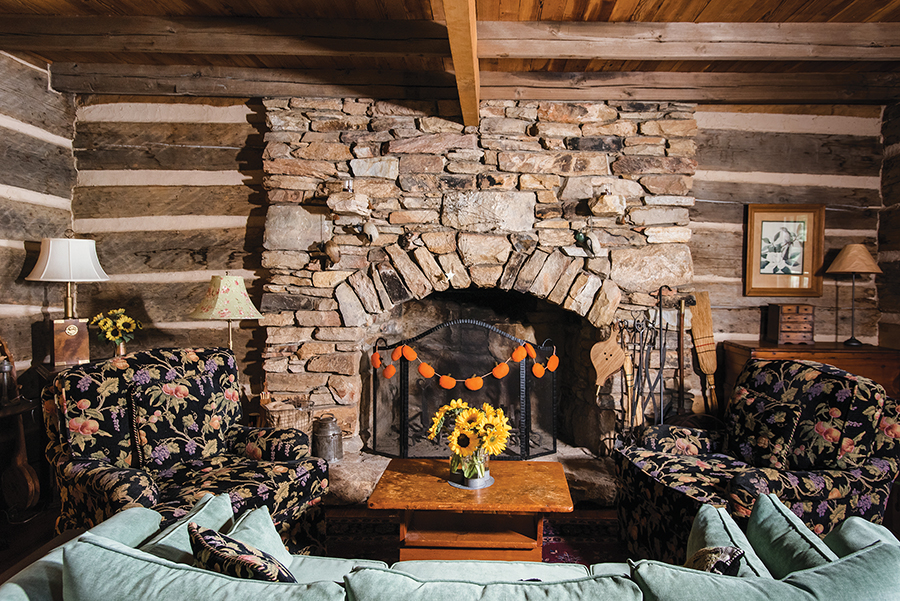
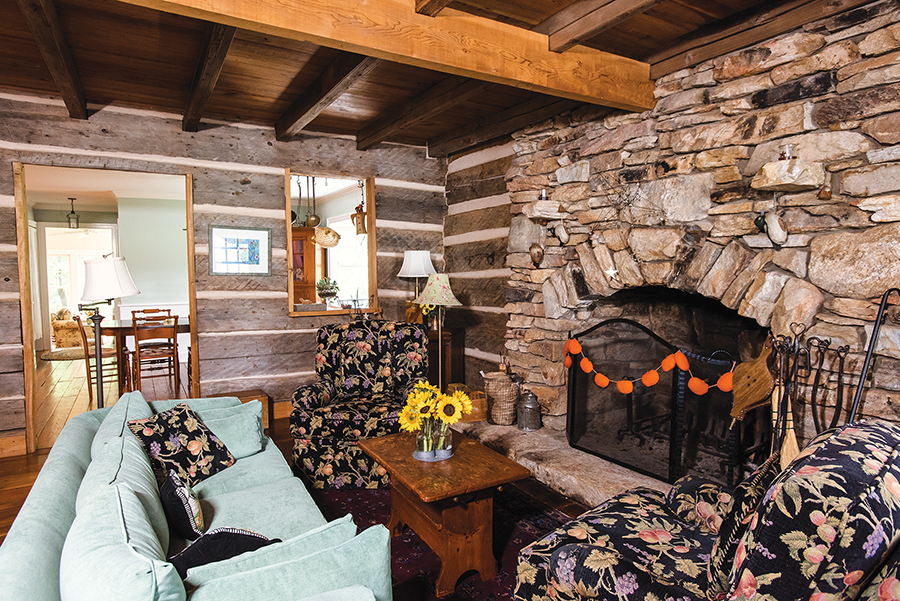
The price for the log cabin was reasonable, but it would have to be dismantled and moved to the Jacksons’ property.

“So I thought, maybe I could put it up!” Randy laughs. “I’m strong, I used to play football!”


After the cabin in Virginia had been thoroughly photographed and the logs meticulously numbered, it was Jane who followed the truck transporting them to Summerfield.

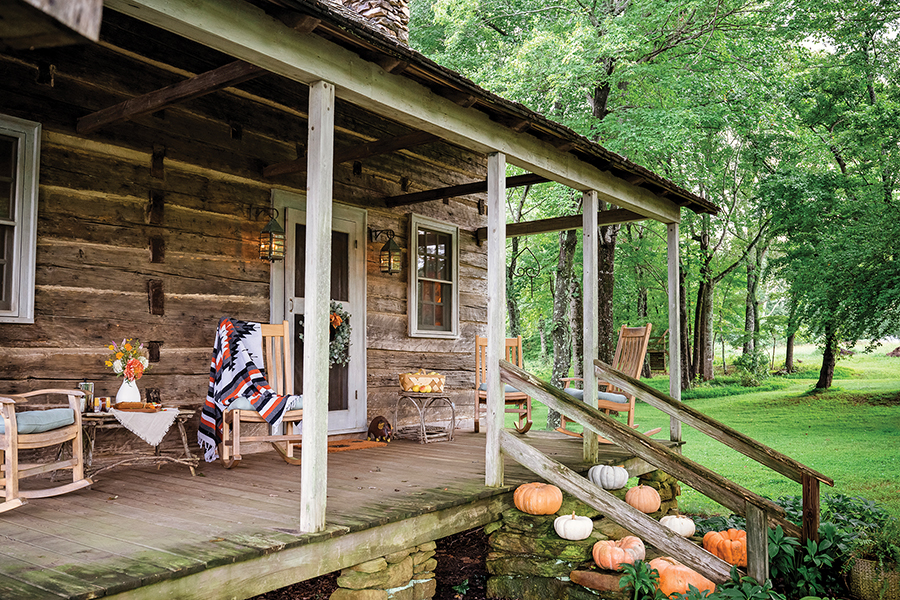
“Those logs aren’t what you see in tobacco barns,” Jane says. “They’re 16-inch oak and chestnut.”

Thinking she’d like the cabin situated with a view of the pond, she guided the truck to that corner of the property to unload.

“They dumped them like a huge pile of pickup sticks!” Randy exclaims. “And each one of those pickup sticks weighed 300 or 400 pounds.”

Then Jane reconsidered. It was humid near the pond, she reflected, plus they didn’t own the land beyond, so there was no telling how the view might change in the future.

“I don’t feel good about this,” she said to Randy. The logs would have to be moved to another location.

“All I had was a Ford Bronco,” Randy says.

“So I bought an old tractor, a John Deere 1010,” Randy says. “I had a boom and chain I’d hook up to the three-point hitch on the back of the tractor, and I’d put the chain around a log, pick it up and drag it to the new location.” He placed the logs atop rocks to help prevent rot and arranged them by number.

“Sort of like the walls had fallen over,” Randy says. “It took forever.”


“We didn’t know what we were doing,” Jane adds.

They recruited their children on weekends to remove nails and pieces of tarpaper siding that had once covered the logs.

“The kids thought it was like prison camp,” Jane chuckles. “They’d call all their friends, trying to get them to come help.”

Eventually the Jacksons built a shelter to keep the old logs out of the rain. That was the first structure on the property.

Randy asks Jane if she remembers how long the process took.

“Six years,” Jane answers, and pauses. “You know, they built the Biltmore in six years.”

She’s right —1889 to 1895 — and we share a big laugh.

Finally, the time came when the Jacksons were ready to have a foundation built and begin erecting the logs. After much research and reading, Randy decided that the task might be more than he and his antique tractor could undertake.

While driving out U.S. Highway 220 at Guilford Courthouse National Battleground Park, he’d noticed that a log barn and log house were being restored. One day when he saw men working, he decided to stop and speak with them.

There he introduced himself to the man who seemed to be supervising the work, Si Rothrock.

“I know where there’s a log house on the ground that has logs bigger and fatter than those logs,” Randy said to Rothrock. “Furthermore, the logs don’t have cathedral notches or half-dovetails, they have full dovetails.”

“You know where there’s a house like that?” Rothrock asked.

“Oh, yeah,” Randy said. “It’s only a few miles from here.”

Turns out, Rothrock was one of the owners of Reidsville Building Supply Co., a business founded in 1920 by Rothrock’s grandfather. Over the years, Rothrock had become an expert at restoring old log houses.

“He’s like a genius,” Randy says. “He could write books.”

Rothrock agreed to ride out to Summerfield with Randy to have a look. When they arrived, he began to examine the logs closely.

“This is a very rare thing you’ve got here,” Randy recalls Rothrock saying.

He told Randy because of the large size of the logs and the fact that they were fashioned with full dovetail corners, the cabin likely was built by German workmen sometime before the Revolutionary War.

“Something like this shouldn’t be wasted,” Rothrock said. “Maybe somebody who knows something about it should put this up.”

Randy agreed.

The Jacksons tell me how they marveled at the craftsmanship of Rothrock’s subcontractors. They were rough-and-tumble country boys, but they were true artists in stone and wood.

“I loved watching the stone mason,” Jane says. “You wouldn’t believe how big those boulders he worked with were. He was unbelievable.”

“His name was Frank Norton,” Randy says. “He had the best eye.” Randy tells me how the cabin foundation looks like dry stack stone from the outside, but, in fact, is held by mortar on the inside.

Even with experienced, knowledgeable workmen, “it was a long, drawn-out process,” Randy says.

Some of the original logs were in such poor condition that replacements had to be made. Randy took this handiwork on himself, cutting trees on the property and shaping them using a broadaxe, just as German workmen would’ve done back in the day.

Cleaning the old logs, and fashioning and curing new ones continued. Sometimes they were hoisted by crane into position, only to be lowered back down because the dovetails didn’t fit properly and had to be redone.


Jane recalls a plumber having trouble getting the right size elbow to install under the house. He came inside and asked to use the phone, not realizing that she could hear his conversation from the kitchen.

Jane remembers him saying to his buddy on the phone, “You won’t believe this place, it’s like The Beverly Hillbillies.”

There was a pause, and then he said, “No, before they got the crude.” Again, we enjoy a good laugh.

And the Jacksons continued to pitch in with the work. Jane installed the molding for the kitchen windows and trimmed the pantry. Randy concentrated on the never-ending task of chinking logs. They both sanded the floors by hand — some of them wood from the original cabin, some reclaimed lumber from an old schoolhouse.

“There’s absolutely nothing about this place that is anything but unusual,” Randy says.

The cabin had one bathroom. Up a stairway from the living room was a bedroom they called “the barracks,” which featured five single beds where they could pack in children coming home from college with their friends. And there was a snug little bedroom under the roofline of the kitchen. The Jacksons built a shed onto the cabin that begat another, including a large, bright sunroom.

“The house is like a chambered nautilus,” says Jane. “One thing after another.”

With the cabin now habitable and the children no longer at home, the Jacksons sold their Irving Park house and moved to Summerfield, where they remained full-time for 12 years. Daughter Alice was married at the farm. When grandchildren came along, they celebrated birthdays there and played in the pastures and woods.

“Why would you want to live anywhere else?” visiting friends would often ask the Jacksons.

Which brings us to the city house.

“Randy’s still practicing medicine then, and there’s a hospital merger,” Jane recalls.

That meant that he was on call to hospitals in Reidsville, Randleman, Siler City, Lake Norman, Statesville and elsewhere.

“Sometimes I’d be driving home after being up all night and fall asleep in the car,” Randy adds.

The Jacksons decided they needed a place in Greensboro, which is more centrally located. They were looking for a small townhome or even an apartment.

But when a tennis buddy told Randy about a home in Fisher Park on the market, the Jacksons decided to have a look in the neighborhood that had first attracted them.

“The way the house smelled, the way it looked, reminded me so much of my Grandma’s house,” Randy says. “She was the neatest lady.”

Though they knew they didn’t need the space, Randy and Jane decided they had to have this lovely old place.

“It’s an illness,” Jane laughs.

The house had once been on the Greensboro Symphony Guild’s Tour of Homes, and a News & Record article described the big front porch as its most impressive feature. The house was designed by Greensboro architect Raleigh James Hughes in the colonial revival style and was built about 1915 for F. P. Hobgood, a local attorney.

“A subsequent owner, Cadillac dealer E. B. Adamson, made considerable changes to the house in 1949,” the N&R article continues. Adamson oversaw the creation of “a 9-foot-wide hall that runs through the house and opens onto a backyard garden.”

“With its 10-foot ceiling, hardwood floor and spacious feel, the hall is the home’s second most dramatic feature,” the article concludes.

Most any visitor would agree.


While the Jacksons made improvements when they purchased the house in 2004, they’ve just recently finished another renovation, converting a sleeping porch, small bathroom and what had been a study for a previous owner, retired Guilford College professor Bill Carroll, into a large master bedroom on the first floor — as had been specified in the architect’s original drawings — along with a spacious bathroom.

The Jacksons give me a tour. Jane points out the many windows and tells me how light floods the rooms, especially in the morning. They show me the new powder room for party guests, and where the Christmas tree gets placed in the hall for the holidays.

“We’ve been in this house as long as any house we’ve been in, other than the farm,” Randy says, as I’m preparing to leave. “We love this place.”

“We goofed with the grandchildren, though,” Jane says.

There are six grandkids in all — three in Charlotte and three in Wilmington.

Randy explains that he’s asked the older grandchildren if he ever needed to sell the farm, would that be a problem? He tells me they solemnly informed him they would get together with their parents and buy the farm.

“With their allowances,” Jane adds, a twinkle in her eye.

“So many memories,” Randy says. “We could never sell the farm.”  OH
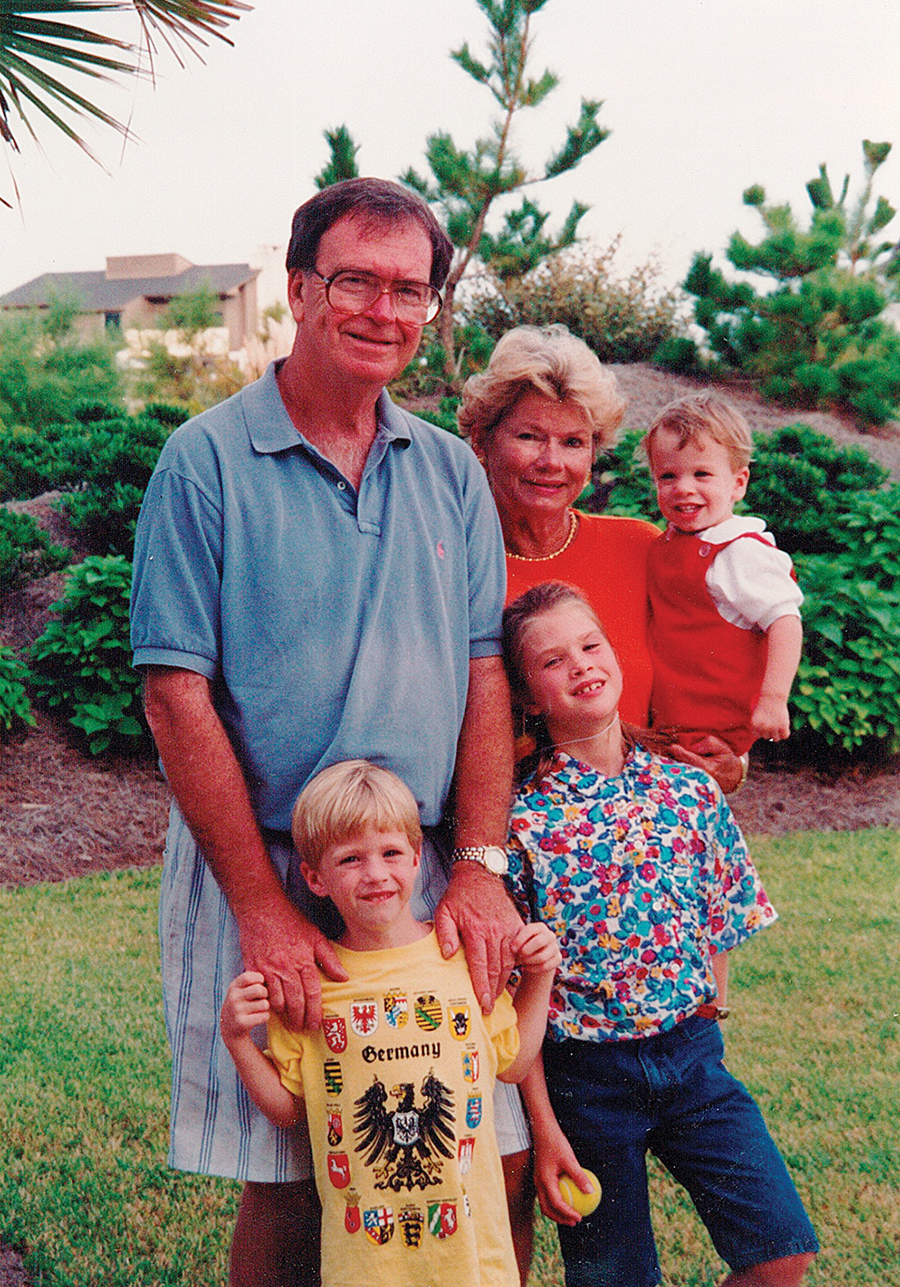
Ross Howell Jr. is a contributing writer to O.Henry. His historical novel, Forsaken, is available at bookstores and online.

Simple Abundance

A colorful and lush garden embodies the spirit of its gardener

By Cynthia Adams     Photographs by Amy Freeman


Martha Yarborough has been up since 7 a.m., the thermostat hovering at 80 degrees and nary a breeze. A lesser person would have stayed in the shade.

But not Yarborough, a petite, energetic woman in a state of perpetual, sunny-side-up motion.

Time spent weeding, hoeing, mulching, watering and fussing in 3 acres of flower beds and veggie gardens is meditative therapy for the scrappy gardener. Most of her gardens are recently created, and by her own hand.

“The gardens happened as you see them in the last three or four years.” Transformative, productive years. One sign placed by a pathway simply reads, “Gratitude.”

She insists she couldn’t be happier during these solitary hours. Nor more grateful. “On a perfect day, I’m out in the yard doing gardening, heavy labor. I enjoy people and being connected. I enjoy entertaining a lot.” But, Yarborough emphasizes, “my alone time is in the garden.”

“Listen, I feel very strongly, when we are blessed,” she adds, “we are commissioned to bless others. Gardening presents life lessons all the time. When you’re cutting flowers, giving them away, it’s cyclical. The more you give away, the more that comes.” 

“I learned from fellow gardeners and I started doing things,” she says. “You can’t be afraid; if it doesn’t work out you just change it.”

Almost organically, Yarborough found a daily rhythm. After rigorous gardening follows meditation, or reading from favorite writer Sarah Breathnach’s Simple Abundance.

She will later work with a charitable interest in town, hike or cycle.

But occasionally, Yarborough gardens for 10 hours at a go.

In the Triad, Yarborough is best known for her devotion to education, arts and culture. This May, she hosted a Shared Radiance Performing Arts production of Shakespeare in the Garden, featuring Richard III, each act taking place in differing locations on the property. The War of the Roses was waged amidst actual roses, with an actual black steed and knight in armor making a convincing appearance on her front lawn. 

Yarborough had seen the horse and rider at another event, and convinced them to come to the outdoor theatrical fundraiser.


“I take it to the hilt,” she admits. “Anything.” 

She is especially supportive of working women. “I am 78, so I would like to be living an engaged life . . . being involved in my community and with family and friends.”

Until her husband Gordon’s death in 2006 following a 20-month battle with ALS, a neurodegenerative disease, the couple dedicated themselves to education and civic projects. Gordon, aka Yogi, owned High Point furniture concern, Yarborough and Company. (She wisecracks: “Not the most original name, huh?”) 

While her husband excelled in business, Yarborough dedicated herself to education and students with special needs, ultimately working as a coordinator with exceptional children in the Guilford County Schools. In 2015, Yarborough gave $1 million to her alma mater, Greensboro College, funding scholarships.

In the mid-70s, Yarborough and Yogi moved to a mini-farm rimmed with a pond and pastures, where they raised sons Preston and Austin. When the boys were teens, she reentered the workplace and resumed teaching at-risk and special-needs students for 16 years, retiring in 2008.

But with newfound time, Yarborough leaned into gardening for its many benefits, becoming a Master Gardener in both Guilford and Davidson counties. Her gardens exponentially expanded.

Yarborough has survived more than one ordeal to arrive at this particular place of grace and fearlessness. “I learned from fellow gardeners and I started doing things,” she says. “You can’t be afraid; if it doesn’t work out you just change it.”

Sitting in the sunroom surrounded with floral paintings, she has her computer stationed with a view of the gardens. Recently installed solar lights become glowing orbs at dusk, making the garden “look like a fairyland!”


Offering a tour, Yarborough grabs a hat, surveying newly created beds in the front of the house where none existed merely a year ago. (There was a dirt track for her son’s bikes once, she points out.)

Notably, a winding path is named the Simple Abundance walk.

She stops and kneels, naming plants by both their common and botanical names. “These little seeds . . .” she coos, bending over an immaculate bed. “These seeds! You plant them and they turn into something so beautiful! It never ceases to amaze me!”

“Then, when people have given you plants — and I have plants from people who have died — I feel they are living right on,” Yarborough smiles, rising up to her feet.

How does she do this, all by herself? She thinks of her acreage like a house, albeit one with uninvited guests.

“In my head, I have many rooms. And you can’t work on every room every day. You have deer that come. You have varmints that come in . . . and you have to work around it.” She adds, “The deer have eaten all my day lilies but you have to move on!” 

Yarborough’s face clouds briefly while inspecting another bed. Vividly pink and leggy cleome, which seem to be taking over, must come out. “It’s too much!” 

She walks across colorful, hand-painted stepping stones (she is painting at least another 80 to complete a new pathway) en route to a vegetable garden, enclosed with a fence featuring a mural created by artist Dana Holliday. 

“Advice from a Butterfly” adorns the wooden fence boards. “Take yourself lightly,” is the core message, along with letting your true colors show. Holliday painted another mural of red poppies featured at the rear of Yarborough’s fastidious ranch home.

Meanwhile, Holliday, who also hikes, is in the British Cotswolds. But she emailed questions to pose to her good friend. “What drives Martha, and where does she get her endless energy and enthusiasm?” she wondered. “She can fall off a 40-foot cliff in Nova Scotia and not only survive, but come home and do a TV interview.”

A cliff?

It seems that five years ago, the 5-foot, 1-inch, 100-pounder fell into a ravine and was airlifted to a hospital by rescuers with the Royal Canadian Mounted Police.

But that traumatic event seems to be shrugged off, relegated to a footnote in Yarborough’s colorful and intrepid life. 

In short, she has long since moved on to climb another mountain. “You only live once,” Yarborough says firmly.

What she prefers discussing is having a purpose in life.

So, she talks about education, the arts, fundraising — the cliff story comes much later, after she has walked the farm. Wearing a teal-colored hat and her face wreathed in smiles, Yarborough points out the many plantings identified with descriptive markers: Blackberry lilies. Callas. Lambs ear. Dahlias. Allium.  Poppies. Lenten roses. More lilies. Clematis.

Flower beds blossom everywhere the eye falls, each lovingly nurtured. Each appropriate to its season.


“As you know,” she says, “gardening’s a lot of work. I love the manual labor. I’m not a designer. I’m a worker.”

Is this all her own work?

“I just have a mower,” Yarborough answers, meaning a man who mows the property. The weeding, the planting, the tending, she says firmly, allowing herself a modicum of pride, are hers alone.

There is detectable pride, too, in Women in Motion, which she helped found in 2015. This initiative supports working women in High Point, Jamestown, Archdale and Trinity. 

More stories tumble out. 

Yarborough describes a side gig, ushering at the Greensboro Coliseum since 2006, in order to enjoy events like bull riding, which tickle her. “I wasn’t going to sit home,” she confides, staying even busier following Yogi’s death.   

Then, pandemic isolation grounded her. She coped by staying in motion, walking and cycling. “I called a friend and I said, ‘Let’s hike every trail in Greensboro!’ We walked 10–12 miles a day.”

She learned to find joy in ordinary moments and purpose in rescuing animals.

Only after exhausting all subjects does Yarborough settle into the Canadian misadventure.

The calibration of the conversation changes, slowing. 

In 2017, she was hiking with the travel group, “Roads Scholars,” in Nova Scotia. “It was our first day out — a group of about 15 of us, with no cell phones. So, we went up to these waterfalls. And looking up, I said, ‘I want to go on up there.’ So about six of us went up the mountain. Coming down, I moved over to let somebody by me. The bank gave way. I fell 40 feet into a rock ravine. No cell phone coverage and so . . . ” Her voice trails off. 

Somersaulting to the bottom of a stony ravine, Yarborough fell atop the backpack that saved her.

“People thought I had died. They said I flipped over. Well . . . I remember, vaguely, sitting up, and then they knew I wasn’t dead,” Yarborough explains with preternatural calm.

“They airlifted me to the hospital in Halifax [Nova Scotia]. The only thing I had was a broken collar bone and a punctured lung! It was absolutely unbelievable.”

“The Canadian Mounted Police called my son Preston and said, ‘Your mother has fallen off a mountain. You need to come get her.’” 

In a few days, hospital staff asked Yarborough, “‘Where do you think you’ll be staying for the next two weeks? Because you cannot fly.’ So, Preston, who works for the Center for Creative Leadership, was in Vermont,” she recalls. “He took me to Boston. Then my son in Austin flew in and took me home.”

The aftermath of this trauma?


“I don’t have time to waste,” she says matter-of-factly of her recovery.

The next year, she hiked Montana’s Glacier National Park. She threw herself even more energetically into life. 

“I love people,” she offers, by way of explanation. Seeking connection, she hiked, biked, camped, traveled and sought every possible outlet in the natural world.

Mostly, Yarborough devoted more time to her gardens, carving 3 of 9 acres expressly for beauty, flowers and vegetables. 

Six acres remain in pasture where farm animals graze and find sanctuary. One of her two miniature donkeys, two of the three goats and a miniature horse have been rescued. Most are from Red Dog Farm Animal Rescue Network.   

At meal time, the diminutive animals come running, nearly bowling their petite mistress over. No pushover, Yarborough firmly takes charge, ordering the more aggressive goat to give shyer animals space.

“I think when I fell and not only survived, but survived without a lot of physical traumas, I realized I was left here for a reason,” Yarborough says while feeding her menagerie of animals. “It’s important to live every day with purpose.”

“People who don’t know me think I’m prim and proper all the time . . . but I’m not. I don’t perceive myself as coming across that way. Because I’m real. I try to be real.”

But people knew her that way before, didn’t they?

Yarborough pauses. She thought so. But she’s loosening up, she admits later. She is hosting a group of women for a Grace and Frankie night with a dinner she will cook, and howls at how funny the Netflix series is.

Later, she emails to say “I was in my garden at 6:45 a.m. today.” 

A week later, Yarborough sends a short message while camping during 95-degree weather and torrential rains. “Guess where I camped last week? Hagan-Stone Park. Tent. [Friend] Sherry Raeford and I camped together.” 

Near her driveway is a sign, a coda, visible while leaving:

“For each of us, there is a desert to travel. A star to discover. And a being within ourselves to bring to life.”  OH
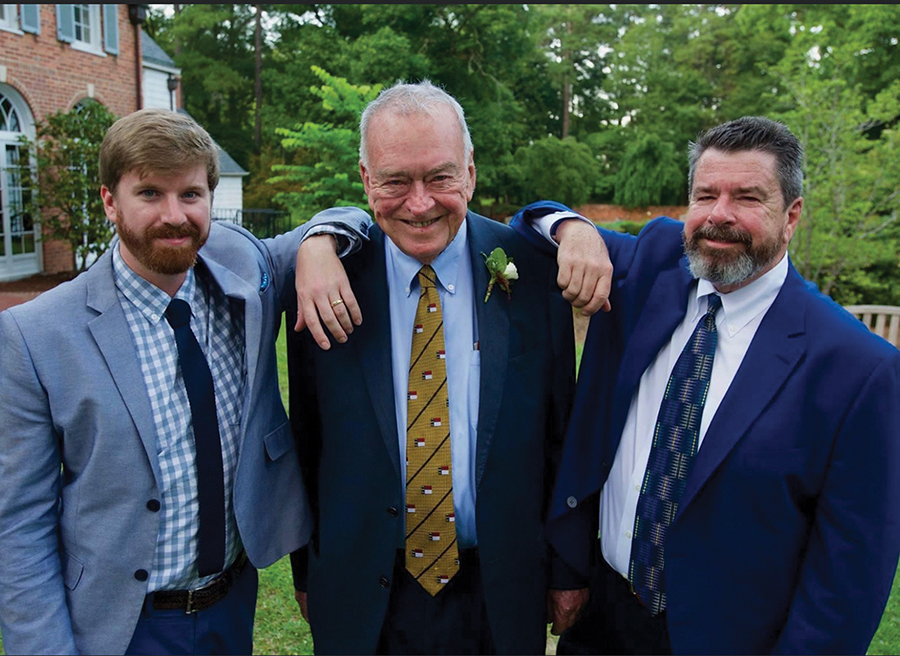
Here Be Monsters — In Carolina

Tall tales of the tall. tailed and terrifying

By John Hood  
Illustrations by Harry Blair

It happened on the Blue Ridge Parkway.

Just west of Maggie Valley, the parkway intersects with Heintooga Ridge Road. To the south is the legendary Soco Gap. To the west is the reservation of the Eastern Band of Cherokee Indians. And just up the road to the north, at the boundary of the Great Smoky Mountains National Park, is a striking monument made of stones from all over the world.

This stretch of the parkway is one of North Carolina’s most beautiful spots. One dark and foggy May night, however, Ashley Coleman saw something terrifying there. “The hairs on my arm and back of my neck stood up straight,” he says. “I have never in my life been so afraid.”

Coleman had parked at a nearby overlook to watch the setting sun. After returning to his car through the billowing mist, he began backing up — only to stop short as a huge figure dashed across the road and entered the woods. “It was entirely too large to be a black bear,” Coleman insisted, “and definitely wasn’t an elk.”

What was it? Well, I obtained these quotes from the Bigfoot Field Researchers Organization (BFRO), a 27-year-old group that bills itself as “the only scientific research organization exploring the bigfoot/sasquatch mystery.” Coleman’s reported May 30, 2021, sighting on the Blue Ridge Parkway has an official incident number (No. 69269) and designation (Class B, meaning “incidents where a possible sasquatch was observed at a great distance or in poor lighting conditions.”)

I begin with Coleman’s story in part because it’s our state’s most recent sighting. Many of North Carolina’s other BFRO cases are Class A, designating “clear sightings in circumstances where misinterpretation or misidentification of other animals can be ruled out with greater confidence.” In July 2020, for example, a Montgomery County motorist saw something bound across Highway 109. It was “large, maybe 8-feet,” she said, and covered in black fur except for lighter patches on its face and hands.

Every region of North Carolina is represented in the Bigfoot database. There’s the self-described “city boy” who went hunting near Elizabeth City and found not a deer but a furry, 8-foot-tall hominid munching on leaves.

There’s the vacationer returning to his Smithfield home and glimpsing “a bear walking upright with long legs and arms longer than a man’s.”

There’s the trucker who was headed up N.C. Highway 53 toward Jacksonville when a “very muscular” figure bolted onto the road. “It seemed to have no neck,” he reported, “just a head — sort of like a caveman.”

There’s the man in Archdale, just over the county line from High Point, who happened to peek through his front window and see a creature, also neckless and furry and 8-feet-tall, skulking around outside. After first comparing it to the ’70s cartoon character Captain Caveman, the homeowner reached back another decade for a suitable reference: “I guess it looked more like an overgrown cousin It from The Addams Family.

And then there are the multiple sightings in Buncombe, Burke, and McDowell counties of mysterious hominids variously described as bear-like, smelling like “dead garbage” and swinging their arms “like pendulums.”

You have my permission to snort.

In olden times, cartographers would fill the unexplored corners of their maps with colorful illustrations of fantastic beasts and phrases such as “Here Be Lions” or “Here Be Monsters” or (on one 16th century globe) “Here Be Dragons.” But this is the 21st century. We’re supposed to be past this sort of thing. Plus, doesn’t everyone walk around with audio/video recorders in their pockets? Surely, we don’t need to place our trust in bleary-eyed motorists, excitable hunters and varied wanderers of the night talking of monsters ill-met by moonlight. If giant ape-men truly populated the marshes, forests and hills of the Old North State, surely, we’d have hard evidence by now.

I’ve always been a skeptical sort. Plus, I spent decades covering politicians. Need I say more? Lately, though, I’ve found my critical eye drawn away from genial true believers and toward what might be called performative skeptics. The kind who loudly, self-righteously denounce other people for chasing after Bigfoot and the like — and then, with a self-satisfied grin, glance down at their smart phones to check their horoscopes, buy healing crystals, watch New Age videos on TikTok or retweet their political tribe’s latest wild-eyed conspiracy theories.

When it comes to Bigfoot, the Loch Ness monster and many other cryptids — a modern coinage derived from cryptozoology, referring to creatures known from legend or rumor but never proven to exist — the imaginative leap to belief is arguably smaller than for, say, homeopathy or ESP. After all, while the prospect is highly unlikely, it would break no fundamental law of nature for some kind of “missing link” anthropoid to persist in the wild or for some supposedly extinct reptile to lurk in a deep body of water.

You need not be a true believer to find cryptids intriguing. Just ask Joneric Bruner. He’s from the aforementioned McDowell County and one of the organizers of the WNC Bigfoot Festival in Marion, the largest event of its kind in the eastern United States. Bruner estimates some 20,000 people attended the 2022 festival. Do they all treat the existence of Bigfoot as fact? Of course not. Many just came looking for a fun weekend — and found it, by all accounts.

You know who else doesn’t believe in Bigfoot? Bruner himself. “I’m open to the idea,” he told me, “but I’m not going to conclusively say, ‘Yes, he is real.’”

Like Bruner, I’m no true believer. I’m just curious, and in the market for story ideas.

After authoring many serious history books, I decided a couple of years ago to make a turn toward speculative fiction. My Folklore Cycle series of historical-fantasy stories began with the 2021 novel Mountain Folk, continuing with a novella (The Bard: A Mountain Folk Tale) and a second novel (Forest Folk, just published). In my fictional world, fairies and monsters coexist with historical figures such as George Washington, Daniel Boone and Sojourner Truth. It’s an improbable blend, I admit, but readers seem to enjoy it. What they especially appreciate, they tell me, is that few of my fantastic elements are fabricated from whole cloth. Rather, my research took me deep into European, African and Native American folklore, from which I imported magical creatures to my otherwise-realistic depiction of early America.

Much of the action is set in North Carolina, allowing me to draw from centuries-old traditions of monster lore. Here are four Carolina cryptids that make an appearance in the Folklore Cycle. Each represents a different region and cultural origin, yet all share a gruesome trait: drinking blood!

• The Whipping Snake: Stories of lightning-fast snakes that whip their prey into unconsciousness, then sink their fangs into an exposed vein, can be found throughout the Southern United States and Northern Mexico. But one of the first written accounts dates to Revolutionary War-era North Carolina. British General Henry Clinton sailed south from Boston in early 1776 to invade the Southern colonies. Reaching Wilmington in March, he expected to meet up with reinforcements, but they weren’t there. What did lay in wait at the mouth of the Cape Fear River, Clinton later wrote, was a dangerous beast, the Whipping Snake, that “meets you in the road and lashes you most unmercifully.”

• The Gallinipper:  Several decades later, and further up the Cape Fear near modern-day Fayetteville and Dunn, the legend of the Gallinipper arose among workers harvesting timber and making tar, pitch and turpentine. They spoke of a giant mosquito, as big as a hawk, that could rise from a swamp or swoop down from a tree to attack. The Gallinipper probably reflects a blending of African and Native American lore. The Tuscarora, for example, told tales of a giant mosquito that “flew about with vast wings, making a loud noise, with a long stinger, and on whomsoever it lighted, it sucked out all the blood and killed him.”

• The Tlanusi: The Valley River runs southwest through the mountains to join the Hiwassee River in Murphy. Near the confluence is a place the Cherokee called Tlanusi’yi, “Place of the Leech.” The red-and-white-striped monster in question, the Tlanusi, was said to be as large as a house. It hid in an underwater cavern near a natural bridge of slippery rock. When someone tried to cross, the Giant Leech would break the surface, shoot a waterspout to knock the foolish traveler into the water and drag its prey below to feed.

• The Monster Cat: Tales of dangerous felines span many generations and regions. In the 19th century, the residents of Salisbury, Statesville, and other Piedmont communities spoke of encounters with the Santer, an enormous beast with glowing fur, long fangs, and a strong tail that, like the Whipping Snake, could be used to soften up its prey before going in for the bloody kill. Further north and west, mountain folk spoke of the Wampus Cat, variously described as having more than four legs, capable of walking upright on two legs or shapeshifting into human form.

North Carolina’s most-famous cat tale comes from the Sandhills. On December 29, 1953, a resident of the Bladen County town of Clarkton reported seeing an impossibly large cat on the prowl. Two days later, a local farmer reported two dead dogs. Their bodies were mangled and drained entirely of blood. Other attacks followed. On January 5, a Mrs. Kinlaw rushed outside to comfort her whimpering dogs. Something like “a big mountain lion” sprung at her, Mrs. Kinlaw later said, before retreating down a dirt road. “‘Vampire’ Charges Woman,” screamed the resulting headline in the Raleigh News & Observer. The so-called Beast of Bladenboro was never seen again — well, except on the cover of my novel, Mountain Folk.

Now, perhaps, you can guess the real reason I led off with that May 2021 report of Bigfoot on the Blue Ridge Parkway. For starters, the incident occurred just east of the Cherokee reservation, and native folklore plays an outsized role in North Carolina’s tradition of monster tales. To the south lies Soco Gap, where legend has it that local hero Junaluska confronted the famous Tecumseh and insisted he not try to bring the Cherokee into his Confederacy. Junaluska has many adventures in the pages of my new novel, Forest Folk, including a desperate battle with a Giant Leech. And, as I mentioned, just north of the purported Bigfoot crossing is a monument made from stones painstakingly assembled from many different places. From the Carolina mountains and foothills, yes, but also from the White House, the Alamo, even the Rock of Gibraltar. As it happens, all these places are featured in published or forthcoming books in my Folklore Cycle.

What does that stone monument honor? Freemasonry!

History, heroes, picturesque locales, fantastic beasts, the Masonic fount of a thousand conspiracy theories — it sure has the makings of a great story. And a great story is what countless generations wanted to hear. It’s what the crowds of people flocking to Bigfoot festivals still want to hear. They want to live in a world where not all questions have been answered, where not all mysteries have been solved, where something furry, slimy, or improbably gargantuan may yet be lurking in the darkest corners of their mental map.

I want to live in that world, too. Don’t you?  OH

John Hood is a Raleigh-based writer. The latest book in his Folklore Cycle series of historical-fantasy tales, Forest Folk, was published in April.