Life’s Funny

LIFE'S FUNNY

Not-So-Mad Scientist

Get ready for a dose of Doktor Kaboom!

By Maria Johnson

The energy level in the room rises as an effusive man sporting a spiky, bleached-blond hairdo, bug-eyed welder’s goggles and a bright-orange lab coat tromps around stage, whipping up the crowd.

“YAH???” he hollers to the assembly.

“YAH!!!” the audience roars back.

It’s the kind of joyful call-and-response you might expect to hear at a tent revival, but the leader is not a pastor; he’s Doktor Kaboom, the kooky-looking scientist character created by Charlotte native and UNCG alum David Epley.

This month, Epley — who haunted the area around Tate Street as a student in the ’80s — will bring Kaboom to Greensboro’s Carolina Theatre.

Alexandra Arpajian, who is relatively new as the theater’s executive director, booked Epley’s act because she thought it would fit Greensboro’s family-friendly vibe. The show also matches her plan for the historic venue.

“Part of the mission of being a nonprofit is to develop the next generation, not just as theater goers, but as empathetic children who are ready to go into society,” says Arpajian, who also happens to be the mom of a 4-year-old daughter.

Her goal jibes with Epley’s knack for wrapping important life lessons in a veneer of playfulness. He instructs audiences to yell “Kaboom!” back at him whenever he bellows the word. The result is a chain reaction of silliness.

“KABOOM!”

“KABOOM!”

“It’s a verbal explosion of the character’s passion,” says Epley, a thoughtful and articulate guy who explains his alter ego in a telephone interview as he drives between gigs in Colorado.

“It’s really fun because, half the time, someone in the audience yells, ‘Kaboom!’ before I do.”

At 59, Epley is glad to return to the state where he was born, never mind that his Wikipedia page says he was born in Germany. That error is a testament to the believability of his character, who speaks with a German accent and assures the audience that he hails from the Rhineland.

In fact, Epley, whose heritage is mostly English and Scottish, was born into a middle-class family in Charlotte. His mom was the personnel manager of a large printing company. His dad was a photographer.

Meanwhile, Epley was in the basement, fiddling with chemistry sets, taking apart mechanical devices and putting them back together. In high school, he was one of the “smart kids.” Teachers flagged him as a prospect for the then-new North Carolina School of Science and Mathematics in Durham.

Epley spent his junior and senior years at the school for advanced students. There, he took rigorous classes from Ph.D.-level teachers.

“It was a wonderful, magical gift from the state of North Carolina to the students who went there,” Epley says, noting that many of the school’s alumni have gone on to prestigious careers in the arts and sciences.

Bored by one class, he and some classmates made up funny personas and attended class as their characters. Afterward, they roamed campus, still in character. Some teachers did not appreciate the comic relief. Others loved it.

“A lot of people just wanted to support whatever artistic expression these weird little kids were coming up with,” he says. “That’s where I found out that I really loved performing.”

After graduating and logging a stint in the Army Reserve, he headed to UNCG to study chemistry with the idea of transferring to Duke University or N.C. State for biomedical engineering.

A funny thing happened on the way to the lab.

Epley took some acting classes in UNCG’s renowned drama department.

“I knew nothing about acting I just knew that I was enjoying it,” says Epley, whose after-class memories include eating at New York Pizza, hanging out at a bar called The Last Act and working at Crocodile’s Cafe, all along Tate Street.

He switched majors and graduated with a bachelor’s degree in fine arts. Then and now, he scoffs at the idea that people who are good scientists can’t be good artists and vice versa.

That belief, he says, has made programs devoted to STEM — science, technology, engineering and math — fall short of their potential over the last 20 years because the best scientists are also creative thinkers.

“STEM is a lovely thing to focus on, but we’ll end up with a nation of lab technicians,” he says. “If we support creativity, then we become a nation of innovators.”

It took Epley a while to figure out how to blend art and science into a career.

For nearly 20 years, he and a troupe of comic actors known as Theater in the Ground traveled the country performing at Renaissance festivals.

“Imagine the Marx Brothers doing Beowulf,” he says.

He grew more serious about comedy when he became a father in his late 30s. He needed more income, a show he could manage by himself and a shtick that would fill performance halls.

That’s when he invented Kaboom, the embodiment of his first love, science, combined with his second love, stagecraft.

To prepare, Epley listened to hours of native German speakers on compact discs. He honed his character on the streets of Oswego, N.Y., during the Sterling Renaissance Festival.

After one performance, an older lady stayed to talk with Epley, who remained in character.

“After about 40 minutes, she goes, ‘I’m talking to you because my father was German, and he passed away when I was in my 30s, and I hadn’t heard his voice again until today.’”

The thought of that encounter still gives Epley goosebumps today. But the interaction that really hit home happened a few years into Kaboom’s road show.

He brought a kid on stage and began his usual patter.

“You’re a smart kid, yah?!” He asked.

The kid replied no, that he wasn’t smart.

Epley dropped to his knees and looked directly at the boy.

“I said, ‘You are smart. That’s why I picked you. I can see it in your eyes.’” he recalls.

Then Epley turned to the crowd: “Listen, if anyone ever asks you if you’re smart or creative or clever, don’t say no. Look them right in the eye and say, “YAH!” I worked with that boy until he was saying that and meant it . . . That’s when I learned I could do more than science and humor. I could teach empowerment. If I hadn’t found that, I probably wouldn’t still be doing this. That’s the aspect that brings me the most joy.”

Of course, there’s a strong dose of education in Epley’s show.

Kaboom talks about the importance of the scientific method, of testing hypotheses, of getting repeatable results. He uses everyday chemicals and oversized props to make things fizz, whiz, foam and pop. He uses a slingshot and a banana to great effect. A demonstration with dry ice yields a “controlled explosion.”

Inspired by the challenges that students faced during COVID, Epley’s latest show, which is titled Under Pressure, demonstrates how pressure can be channeled — both physically and emotionally — to make positive things happen in science and life.

Commissioned by the Kennedy Center for the Performing Arts, where Epley took the stage as Kaboom last year, the production is being pitched to streaming apps as a family-centered comedy special.

His shows are aimed at students in grades three through eight, but his comedy has drawn kudos as entertainment for all ages.

Comedian Dave Chappelle, who was once a neighbor of Epley’s young family in Yellow Springs, Ohio, took his children to Kaboom shows, and he supplied a glowing blurb before Epley’s first appearance at the Edinburgh Fringe Festival in Scotland.

“We watched our neighbor transform into this incredible character,” writes Chappelle. “He was funny! And fun for the whole family.”

Epley believes his current show represents his best work, which comes at the right moment in U.S. history.

“I think science is being disregarded,” he says. “Television and talking heads have created doubt in people’s minds about expertise, which I think is absolutely damaging the country . . . So I really think what I do is timely and important. We’re all in this boat together, so let’s paddle in the same direction.”

Yah?

Yah. 

Poem January 2026

POEM

The Other Side of the Mirror

“Let’s pretend the glass has got all soft like gauze . . .
And certainly the glass was beginning to melt away,
just like a bright silvery mist.”

    — Lewis Caroll, Through the Looking Glass


There’s always a reason I’d rather stay home,

as I brush my hair, gaze into my reflection, sit

before the dresser where I combed my curls

as a girl, forever getting ready for the life

that hadn’t arrived yet. Mirrors remained

unfazed, as I exchanged one image for another,

changed my hairstyles and hats, traced fingers

along a scar, abandoned myself for imperfections.

I have come close to escaping into another world,

always about to leave or about to live, my eyes

child-like, clear as glass, considering what time

it must be . . . to keep from disappearing

into my own unbreakable stare.

— Linda Annas Ferguson

Birdwatch

BIRDWATCH

Cold Customers

Return of the dark-eyed juncos

By Susan Campbell

“The snowbirds are back!” No, not the thin-blooded retirees: They won’t be back until spring. These are the little black-and-white sparrowlike birds that appear under feeders when the mercury dips here in central North Carolina. They can be found in flocks, several dozen strong in some places. And, in spite of what you might think, they are far from dependent on bird seed in winter.

Dark-eyed juncos are a diverse and widely distributed species. Six populations are recognized across the U.S., Canada and Mexico. Slight but noticeable variations in appearance constitute the difference in these populations. Some have white wing bars while others sport a reddish back and the birds in the high elevations of the Rockies are recognized by extensive pinkish feathering on their flanks. Our eastern birds are known as “slate-colored juncos” for their dark brown to gray feathering. They are accustomed to cold temperatures whether in summer or winter. As with most migrant songbirds, their migratory behavior is based on food availability, not weather. Flocks will fly southward, stopping where they find abundant grasses and forbs. They will continue on once the food plants have been stripped of seed.

Dark-eyed juncos can be found throughout North America at different times of the year. During the breeding season, juncos are seen at high elevation across the boreal forests nesting in thick evergreens. Our familiar slate-colored variety breeds as close as the high elevations of the Appalachians. You can find them easily around Blowing Rock and Boone year-round. These nonmigrants actually have shorter wingspans as a result of their sedentary existence. Watch for male juncos advertising their territories up high in fir or spruce trees. They will utter sharp chirps and may string together a series of rapid call notes that sound like the noise emitted by a “phaser” of Star Trek fame.

In winter, flocks congregate in open and brushy habitats. Juncos are distinguished from other sparrows by their clean markings: dark heads with small, pale, conical bills, pale bellies and white outer tail feathers. Females have a browner wash and less of a demarcation between belly and breast than males. They hop around and feed on small seeds close to ground level. Some individuals can be quite tame once they become familiar with a specific place and particular people. Juncos do communicate frequently, using sharp trills to keep the flock together. They will not hesitate to dive for deep cover when alarmed.

So, the next time you come upon a flock along the roadside or notice juncos under your feeder, take a close look. These little birds will be with us only a few months, until day length begins to increase and they head back to the boreal forests from whence they came.

Wandering Billy

WANDERING BILLY

This Girl Is On Fire

Kennedy Caughell brings heat to Hell’s

By Billy Ingram

“The road is there. It will always be there. You just have to decide when to take it.” ― Chris Humphrey

It’s becoming increasingly commonplace for leading actors in the Tanger Center’s Broadway Series productions to have significant local community connections. In November 2024, UNCG graduate Manning Franks infused heart and soul into The Wiz’s Tin Man and, earlier last year, Elon University alum Fergie Philippe proved roaringly romantic in Beauty and the Beast’s mane role.

One of Broadway’s brightest luminaries, Kennedy Caughell, 35, former Oklahoma farm gal who’s become another incendiary lit locally, alights into town next month in New York’s hottest property, Hell’s Kitchen. In its very first season, Hip-hop hitmaker Alicia Keys’ semi-biographical coming-of-age musical garnered an astonishing 13 Tony Award nominations and was a boffo box-office smash from day one.

Caughell’s portrayal of Jersey, emotionally embattled matriarch of the Keys-inspired character Ali’s family, is reaping rave reviews. In Chicago: “A powerful portrayal by Kennedy Caughell;” in Cleveland: “Caughell impresses again and again in big, emotionally impactful moments and with powerhouse vocal efforts;” in Pittsburgh: “The woman can belt! She crushes every musical number, especially ‘Pawn It All.’” You get the idea.

Her cruise across The Great White Way began, oddly enough, on Broadway. “My mom brought both me and my sister to New York,” Caughell recalls about her elementary school epiphany. “Annie was playing on Broadway at the time. Mom says I turned to her at intermission and said, ‘I could do that!’” Coincidence that her first professional acting job at 8-and-a-half years old was hamming it up in Annie? Starting in a supporting role, she soon took the lead. (This would kick off a recurring pattern.)

When consideration for college came, Caughell selected Elon University. “It was on the list of top 10 musical theater programs in the country,” she explains. “My mom and I visited to audition and I just fell in love with the place. It was so beautiful.” Situated between Greensboro and Burlington, Elon is known for exemplary acting, dancing and vocal training. “I feel like I really got a good ‘triple-threat’ training there. They encourage originality because that’s really what gets you hired as leads in the business, what makes you unique.”

Class of ’12 grad Caughell says, “I had a job before I even left college.” Discovered by Jillian Samini, she was cast as the jilted pregnant girlfriend Heather, one of the three female leads in the international Broadway tour of Billie Joe Armstrong’s and Michael Mayer’s American Idiot, which expands on the storyline delineated in the Green Day album of the same name. “I remember graduating, then, the next day, I was on a plane [to the United Kingdom] headed to the first day of rehearsal.” Her solo was a zippy, angst-free arrangement of “Dearly Beloved.” American Idiot’s Ireland/UK tour culminated after four months at London’s HMV Hammersmith Apollo, leading into the show’s second stateside run, which ended in the summer of 2013.

No rest for the wicked, you say? The next year, Caughell was swept into the twisted world of Wicked, broomsticking across the nation for two years as a member of the ensemble while understudying that wickedest of witches, Elphaba. “I would love to return to Wicked and play a full stint as Elphaba one day,” Caughell says.

In 2016, she made her Broadway debut in Natasha, Pierre & The Great Comet of 1812 alongside two other Broadway neophytes, Denée Benton and Josh Groban, understudying two supporting characters that she eventually stepped into. Following the folding of that show, she pirouetted into Broadway’s Beautiful: The Carole King Musical in February 2018 as King’s childhood friend, Betty, while at the same time understudying three roles, including the titular star.

During rehearsals, Caughell became acquainted with King. “An example of yes, you can meet your heroes and they exceed your expectations,” she says of the Grammy Hall-of-Famer who wrote or co-wrote 118 hit songs. “She walks in and lights up a room and everyone just feels peaceful and joyful around her.” In 2019, she hit the road with Beautiful, occasionally called on to channel Carole King under the spotlight. Her fave number? “(You Make Me Feel Like) A Natural Woman,” natch.

All About Eve aside, it’s exceedingly rare for understudies to emerge from the wings and assume the leading role for the run of a major show. “When they asked me to take over on the road, how could I say no?” Crooning Carole King’s compositions is an absolute joy for her. “Her style is very set and driven like a glockenspiel. It all sits in a really warm part of my voice.” Don’t you just love the way performers speak?

Broadway’s bright lights beckoned again in 2022 for Paradise Square, a star-crossed production that, despite an impressive 10 Tony nominations, resulted in a truncated time on the boards beset by backstage back-stabbery and a recorded but unreleased original cast soundtrack.

Which brings us to the present, where, in the role of Hell’s Kitchen’s Jersey, Caughell portrays an overly-protective single mother raising a street-level prodigy navigating life in a turbulent mid-1990s New York City. “She loves her daughter fiercely — she works two jobs so that she can give her a better life.” Caughell says of her character, who is overwhelmed by conflicts and consequences related to “what happens when love goes out of alignment and leans toward controlling. And what it means to be a mother and learn to let Ali grow up.” 

From tech rehearsals through opening nights and beyond, writer/producer Alicia Keys was very much present in mounting both the Broadway and touring companies. “She had a big hand in casting each and every one of us,” Caughell points out. “It’s very evident how much heart and connection she feels to this show and it’s so wonderful to have somebody like her at the helm, just leading with grace and peace.” Keys is known to surreptitiously slip into seats along the tour route, even offering notes afterward, “but that’s a good thing, right? She’s really good at steering us in the right direction.”

Again succumbing to that siren call of the open road, Caughell says, “I’m missing a lot of family events with my niece and nephew right now. There’s a lot we sacrifice that people don’t realize.” Remaining centered and in peak form is a priority. “You’re kind of in an isolated bubble where everyone has to find their own pathway.” Of former Elon classmate and rising Broadway star Fergie Philippe, wheels up under similar circumstances, she says, “We text on a regular basis — he’s a wonderful human being.”

While Caughell loves exploring new cities, there’s the delight that comes from reengaging with familiar faces in faraway places. Edging closer to the Triad, she says, “I’m looking forward to seeing all of my professors and visiting the campus at Elon. It’s been years since I’ve had time to come back and visit, so I’m excited.”

Granted, it’s a hard knock life nightly for her tempest-tossed character in Hell’s Kitchen, but, for Kennedy Caughell herself, the sun’ll come out tomorrow… in Cincinnati, St. Louis, Greenville, Durham and, on February 24, in Greensboro prior to opening night at Tanger, where no doubt she’ll shine like the top of the Chrysler Building.

Simple Life

SIMPLE LIFE

My Own Soulful Green Books

Food for the journey ahead

By Jim Dodson

I’m often asked by readers where I find my ideas to write about each month.

“It’s simple,” I reply. “Life.” Hence the title of this column.

It helps, however, that I also have what I call my “Green Books.” Not the historic Green Book that served as a guide to safe places for accommodations and food for traveling African Americans in the mid-1900s South.

Mine are something very personal: four leather journals, several with cracked bindings from age, that I began half a century ago. In their pages, I’ve recorded memorable quotes, funny observations and the wisdom of others who graciously provided food for the journey ahead.

Today, four such books anchor my writing desk and library shelves, crammed full of helpful words — some famous, others anonymous, comical, spiritual or plain common sense — a resource I turn to when life seems out of whack, or I simply need a shot of humor or optimism to face the moment. 

A new year strikes me as the perfect time to share some of my all-time favorites.

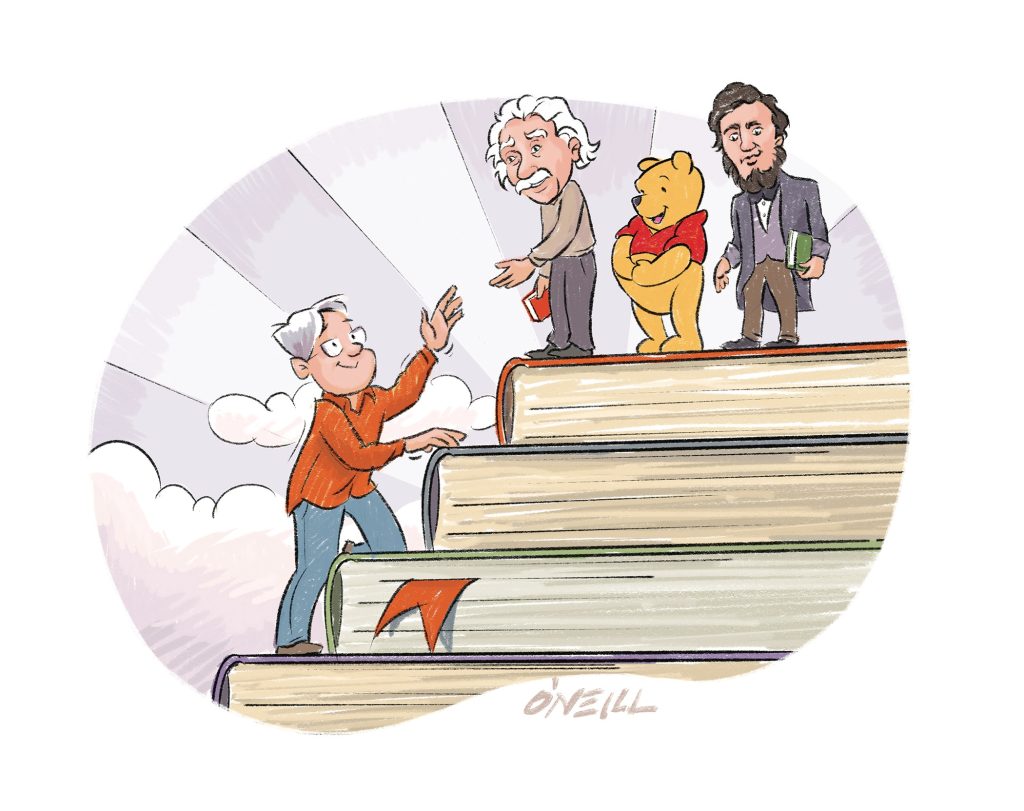
“I fear the day that technology will surpass our human interaction. The world, as a result, will have a generation of idiots.” – Albert Einstein

OK. Had to put this one out first because I’m a confirmed Luddite who writes his books with an ink pen and can only function on a computer with proper adult supervision, meaning my wife, Wendy, a techno-whiz. Recently heard a “Super” AI “expert” warn that “living authors” will eventually be a thing of the past. That’s a world I don’t wish to live in.   

“I knew when I met you an adventure was going to happen.” – from Winnie-the-Pooh by A.A. Milne

This gem hung with an illustration of Pooh, Piglet and Eeyore on my childhood bedroom wall. Stop and think for a moment about the amazing people you didn’t know until they unexpectedly, perhaps miraculously, stepped into your life — and a new adventure began.

“Tell me, what is it you plan to do with your wild and precious life?” – From “The Summer Day” by Mary Oliver

This timeless poetic question hung on a banner over my daughter Maggie’s beautiful autumn wedding three years ago at her childhood summer camp in Maine. It’s one we all must invariably answer, even late in life. Especially late in life.

“I went to the woods because I wished to live deliberately, to front only the essential facts of life, and see if I could not learn what it had to teach, and not, when I came to die, discover that I had not lived.” – from Walden: or Life in the Woods by Henry David Thoreau, poet, naturalist, Transcendental rock star.

I discovered — and memorized — this stanza in Miss Emily Dickenson’s English Lit class in 1970 (by the way, her real name). So moved by it, I vowed to someday retreat to the northern woods. Looking back, I think it partially explains why I built my house on a forested hilltop in Maine. That gold-and-green woodland enchanted my children and their papa, a would-be transcendentalist who has learned more from the solitude of the forest than in any city on Earth.

“There will be a time when you think everything is finished. That will be the beginning.” – Louis L’Amour, Western novelist

Useful advice for those of us anxious about the fate of American democracy.

“Solvitur ambulando.” Translation: It is solved by walking.
St. Augustine

Amazing what a good walk around the block or hike through the woods can do to calm the mind, work out a solution or simply remind one how life’s ever-changing landscape can clear away the cobwebs.

“Stop looking at yourself and begin looking into yourself. Life is an inside job.”

Someone once said this to me, but I can’t remember who. I sometimes remind myself of this when I’m shaving in the morning and see myself in the mirror, often followed by a second observation: I thought getting older would take more time.

“If something is lost, quit searching for it. It will find its way back to you.”

Sage advice passed along from a longtime golf pal’s mama. I’ve found it works splendidly with misplaced car keys, eyeglasses, wallets, (most) golf balls and missing Christmas candy. Not so much with politics or old romances.

“The meal is the essential act of life. It is the habitual ceremony, the long record of marriage, the school for behavior, the prelude to love. Among all peoples and in all times, every significant event in life — be it wedding, triumph, or birth — is marked by a meal or the sharing of food and drink. The meal is the emblem of civilization.” – James and Kay Salter, from Life Is Meals: A Food Lover’s Book of Days

A well-loved book in our household, one every food lover should own, a gloriously entertaining volume chock full of quirky, fun and extraordinary gems about the origins and traditions of food, drink and fellowship at the table.

“In an age of speed, I began to think, nothing could be more invigorating than going slow. In an age of distraction, nothing could feel more luxurious than paying attention. And, in an age of constant motion, nothing is more urgent than sitting still.” – from The Art of Stillness: Adventures in Going Nowhere by Pico Iyer

This note from this wise little book pretty much summarizes my personal ambition for 2026 — to go slower, to pay closer attention, to sit still as often as possible.

“Modern American society is marked by a high degree of mobility, a decline in voluntary civic activities, and an emphasis on rights (i.e. what others owe me). The result is rootlessness and detachment from family and friends. Higher crime rates, chiefly among youth, show a strong statistical correlation with lack of self-control. And moral disputes are often marked by dogmatism, the inability or unwillingness to see the moral force behind another point of view. In response, the possibilities for improvement include (1) reinvigorating our civic associations, (2) developing and inculcating self-control, and (3) demanding higher levels of mutual respect and tolerance in the way we speak to and treat one another.” – from Civility & Community by Brian Schrag

May you all have a safe and much more civil New Year. I leave you with one of my favorite wisdoms from my books:

“Do not be afraid, for I am with you. From wherever you come, I will lead you home.” – Isaiah 43:5

Dream Home

DREAM HOME

Dream Home

A Loewenstein lives on in Irving Park

By Billy Ingram • Photographs by Amy Freeman

When newlyweds Daniel and Kathy Craft set out in search of their dream home, one both idealized yet narrowly defined, it may have seemed like that impossible dream enshrined in song. What they had in mind was a place that offered a warm hearth and an enriching environment where they could raise a family, but the type of home they desired wasn’t being built anymore, and the remaining ones were being eradicated at an alarming rate. They were longing for a Loewenstein.

In those rare instances when Triad realtors happen across a listing for a “Loewenstein,” the name is spoken in revered tones. There were other mid-century architects crafting magnificent homes locally and across the Southeast, celebrated artists held in just as high regard — Charles C. Hartmann and Harry Barton being obvious options — but for sweeping super-structures limited solely by one’s imagination and, only occasionally, the laws of gravity, Edward Loewenstein was, and remains, in a class unto himself.

The unfolding of the 1950s ushered in an era of unprecedented prosperity buoyed by an abundance of unrealized real estate, an atmosphere where there could be no greater testimony to a family’s success than the home they had designed and constructed for themselves. And no address came packaged with more prestige for platforming those affluent architectural assertions than a cautiously expanding Irving Park neighborhood street encircling the Greensboro Country Club, established in 1909.

A disciple of the Modernist movement typified by Frank Lloyd Wright, Richard Neutra and other avant-garde West Coast architects, Edward Loewenstein graduated from Chicago’s Deerfield Shields High School and MIT with a B.A. in architecture in 1935. He established his Greensboro architectural firm in 1946 after having served during WWII and marrying Francis Stern, stepdaughter to denim impresario Julius Cone. He was determined to break away from the Arts and Crafts, Mission Colonial and Tudor Revivals going up north of downtown.

After completing a dozen or so conventional dwellings, as luck would have it, he was approached in 1950 by a young couple, Wilbur and Martha Carter, who had three children and a hankering for a homestead that would instill an air of distinction on their heavily wooded, 1.28-acre lot facing Country Club Drive and extending back to Cornwallis.

Given a choice between two wildly divergent designs, one a Georgian Revival fitting snugly into the neighborhood’s stately but somewhat staid motif, the Carters chose the more radical schematic Loewenstein presented them with. “I think there were other houses in Greensboro that had Modernist tendencies, but it seemed he was the only one at the time that was [dedicated to] it,” says Patrick Lee Lucas, author of the definitive book on Greensboro’s Modernist maestro: Modernism at Home: Edward Loewenstein’s Mid-Century Architectural Innovation in the Civil Rights Era.

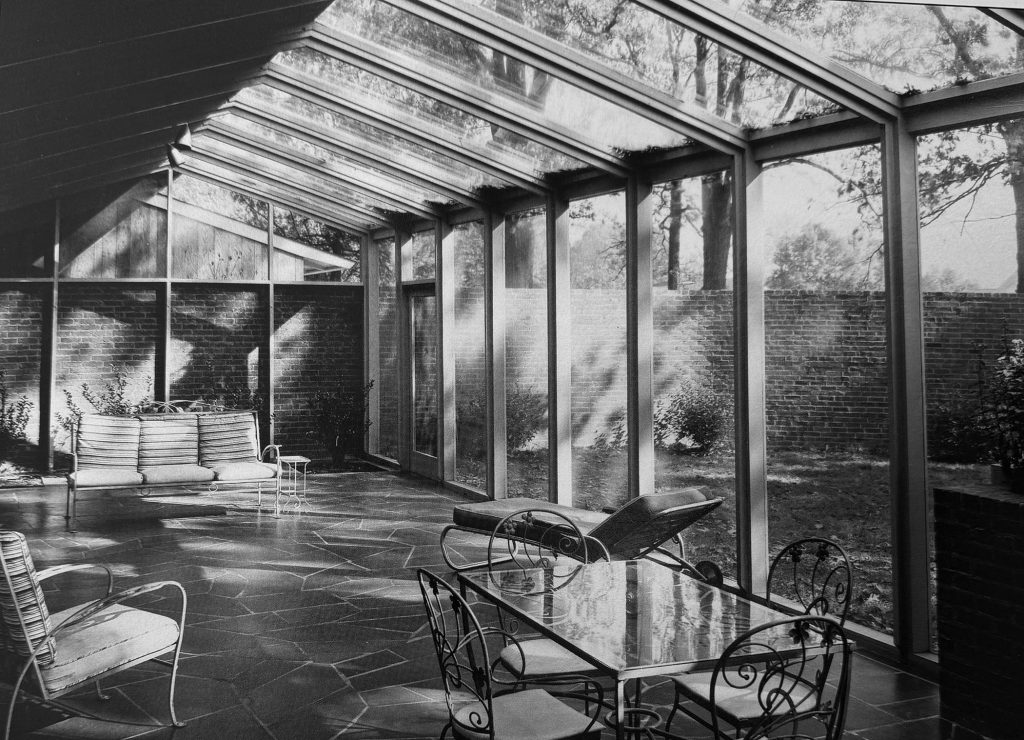
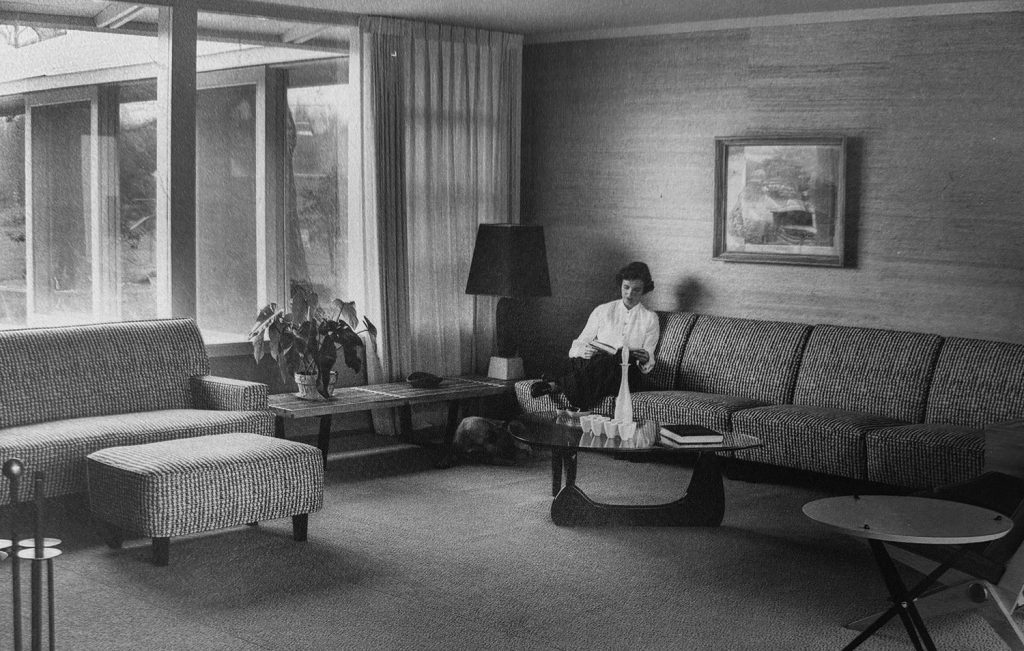
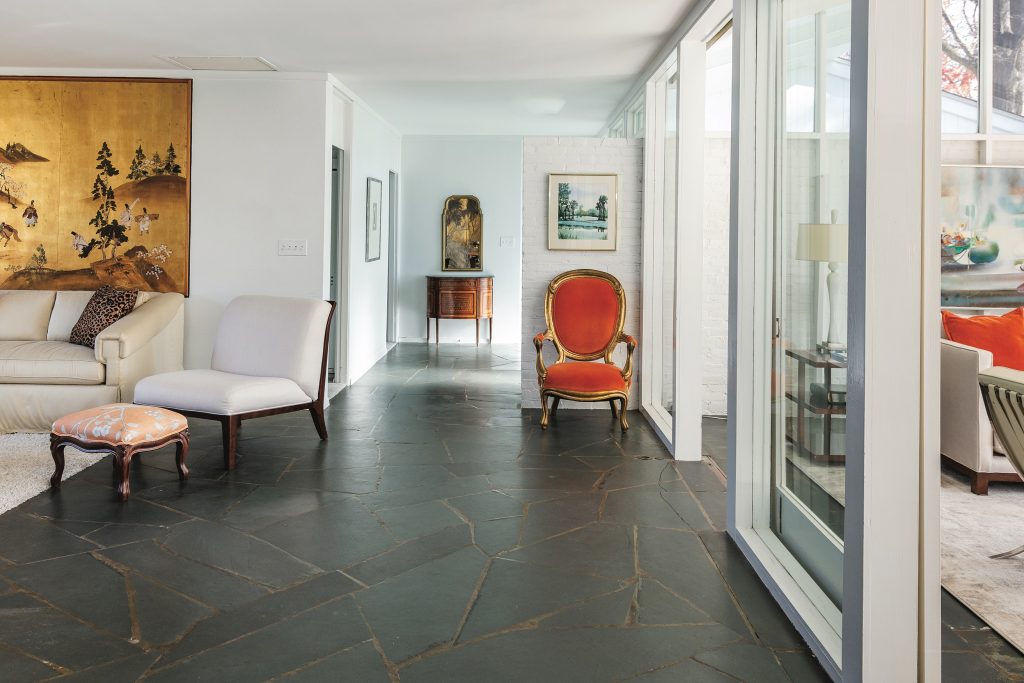
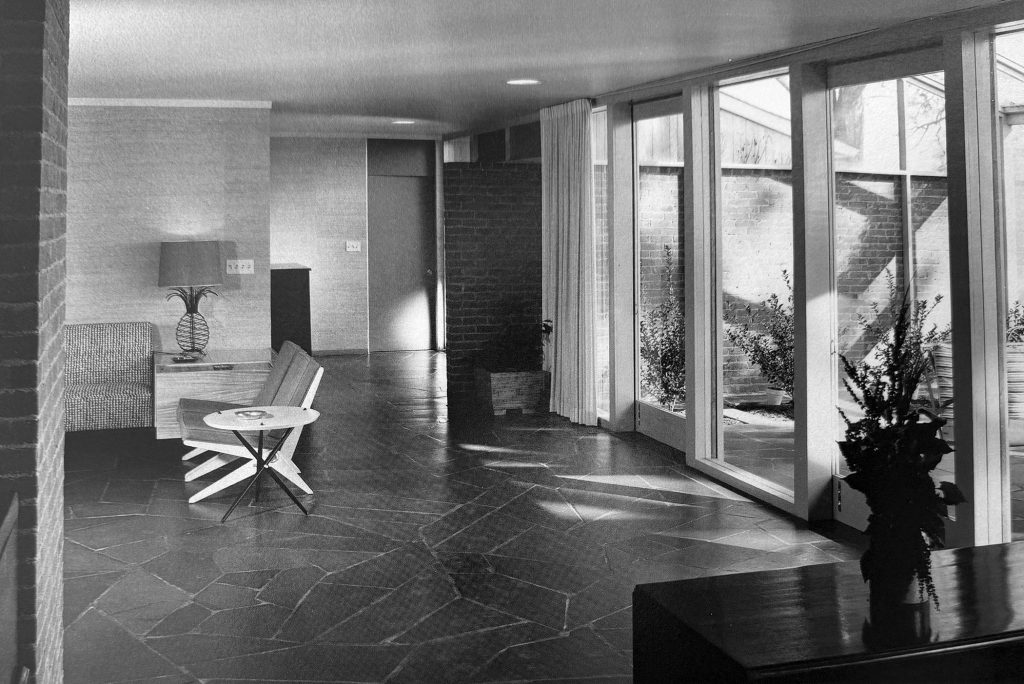
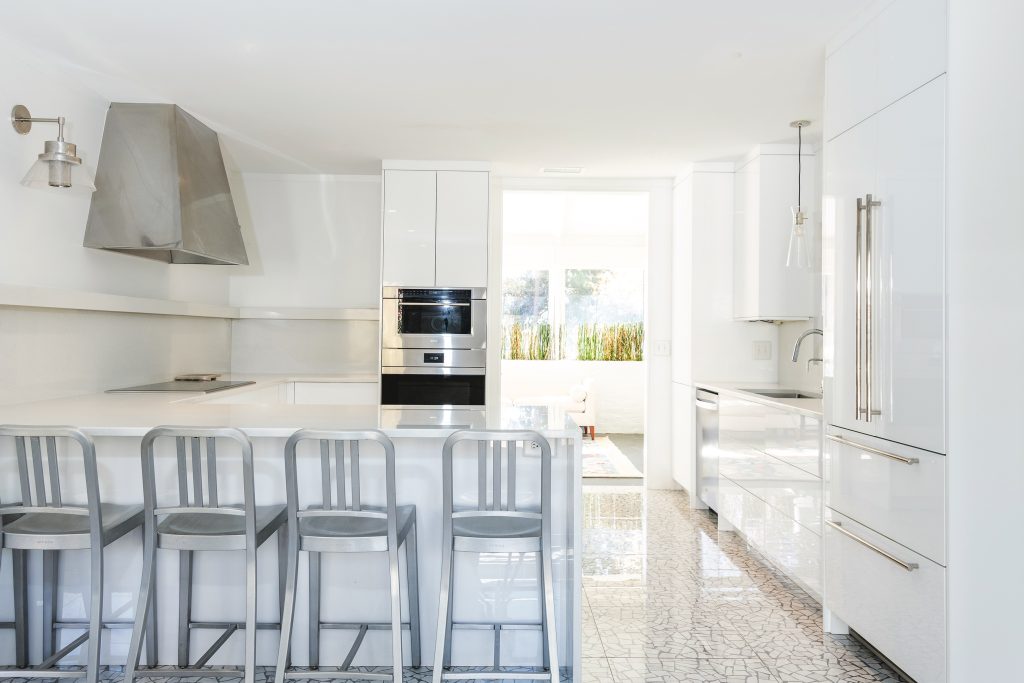
Following the precepts of international modern style, the Carters’ house was defined by a flat roof, an open floor plan, curtain windows and minimal ornamentation. Architects of the time were guided by the “rule” that “form follows function,” which prompted designers to consider what a building should achieve for the user before what it should look like. Blueprints called for a horizontal, L-shaped structure fronted with a low-pitched roof atop a screened (eventually glass) solarium, which featured bluestone flooring that stretched into the central living room. Obscuring an already sunken, single-leaf front door, an 8-foot-high brick wall extended from the front yard into the home for a short way to distinguish the bedroom corridor from communal space.

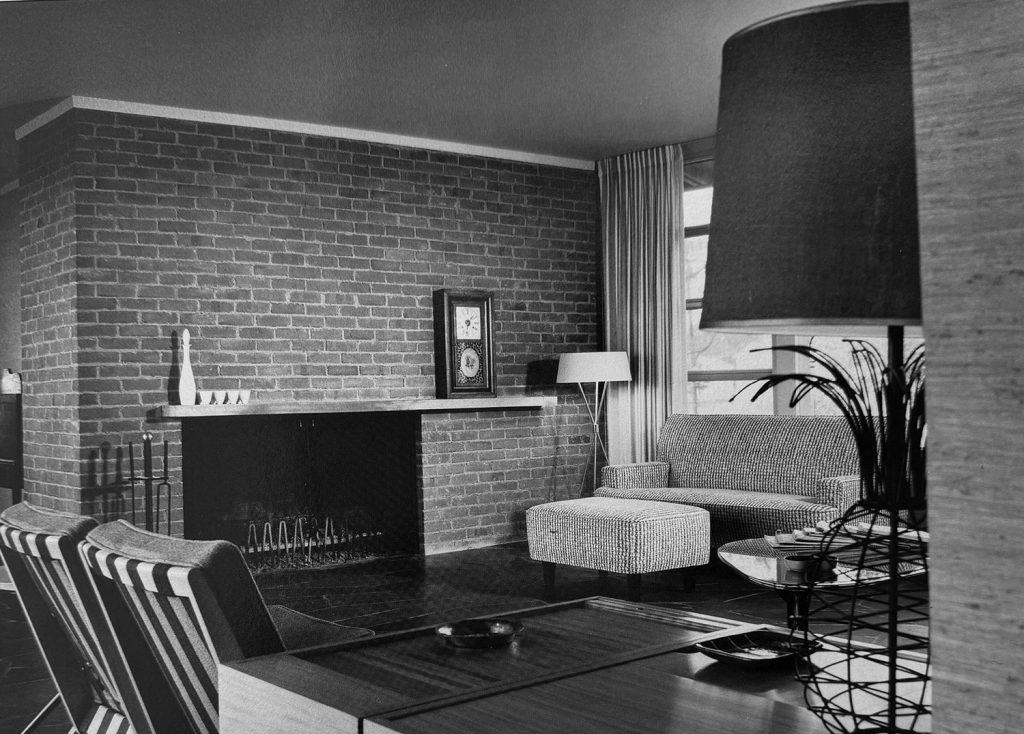
Toward the rear, hidden storage and built-in bookshelves abounded, and at the base of the windows inside the den a brick planter was enclosed. Back-to-back fireplaces were embedded in a load bearing wall facing both the living room and den. The spacious kitchen was floored in 9-by-9-inch, brown-and-marble-patterned, vinyl-asbestos tiles made by Armstrong. Employing industrial-use tiles and natural stone floors indoors were uncommon home accoutrement. The children’s rooms were connected via a Jack-and-Jill bathroom.

Rather than clearcutting, as was the custom, all of the imposing oaks on the property remained in place. “Loewenstein seemed particularly adept at using underutilized lots in Irving Park,” Lucas points out. “These were the tree lots that no one wanted or they were sold off from a bigger parcel as the neighborhood further subdivided.” Gravitating toward rugged grounds with unusual features, says Lucas, “Part of his goal, both from a Modernist sense but also from a sensitivity to the environment, was to build around the trees.”

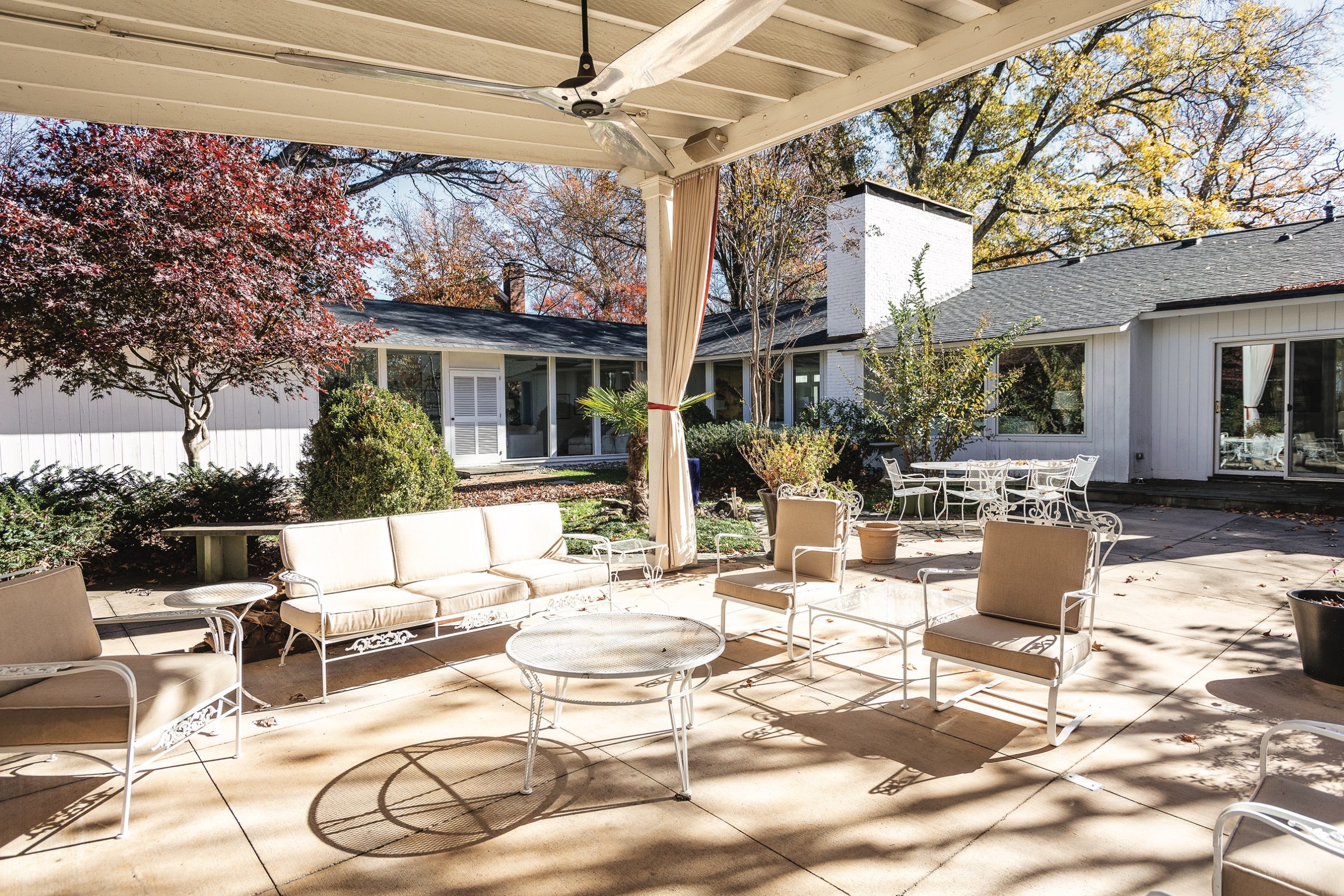
“Of all the houses that he designed, it’s the most unusual in that it has two living rooms next to one another,” Lucas notes. “One was essentially an outdoor room, so it meant that there were times of the year it couldn’t be used because it was just so cold and hard to heat in the ’50s.” The resulting perception was an innate spaciousness that gave the sense of being outside while inside the home, its wide-open interiors defined not so much by walls as where people chose to congregate.

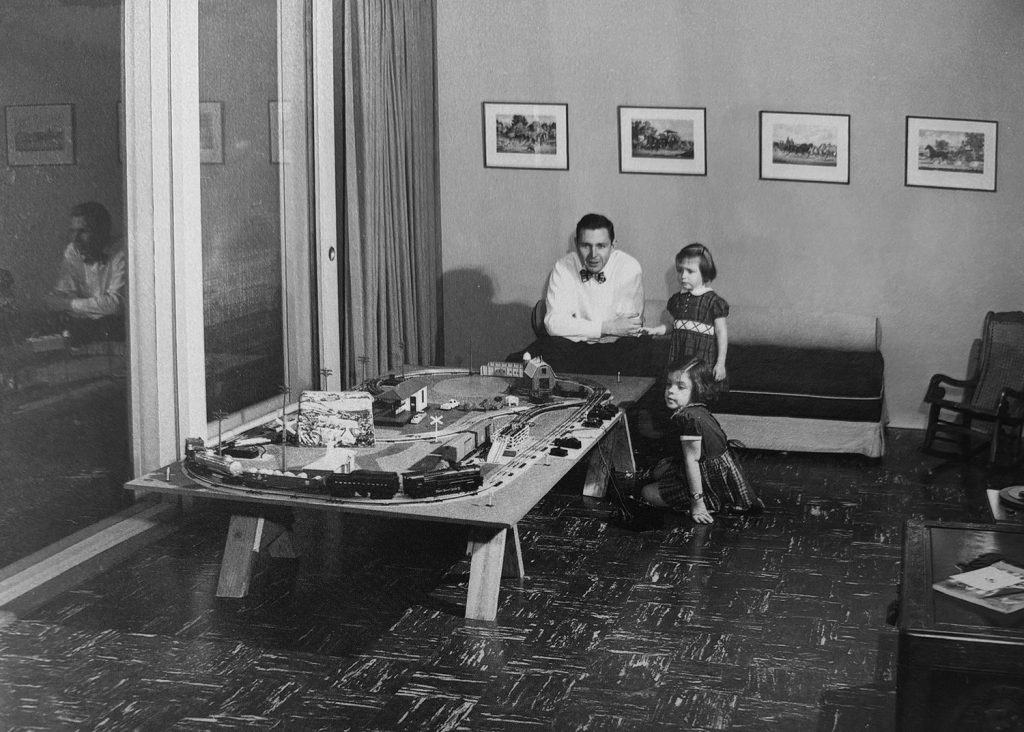
The Carter abode was such a radical departure from the norm it was practically an affront. “Some of the neighbors were like, what? And others were like, this is cool,” Lucas states. “So there was a little tug of war in that sense.” In correspondence concerning what he referred to as his “Dream Home,” Loewenstein lamented that he “received violent comments in both directions from neighbors and friends.” The Carters themselves were pleased as “they wanted it to be not something traditional,” Lucas reiterates.

Vindication arrived after the house won an American Institute of Architects North Carolina Design Award in 1951, was featured in Architectural Record in 1952, and then bestowed a 1955 Merit Award from Southern Architect magazine. Resistance to Loewenstein’s futuristic fancies melted as a subsequent Modernist home was taking shape on Princess Anne Street in nearby Kirkwood, where homeowners petitioned the Greensboro Zoning Commission to allow for a departure from the contemporary Cape Cod conformity sanctioned by its neighborhood planners.

From the beginning, Loewenstein was the first in North Carolina to hire Black architects. “Some had employed African American draftsmen before World War II, but he was the first to do it in a major way,” Lucas points out. Many, like Clinton Gravely and W. Edward Jenkins, went on to great acclaim in Greensboro with their own firms. “It was a form of protest or nonconformity in terms of the way that he operated, employing these guys who wouldn’t have an architecture firm to work for because there wasn’t one that would hire them.”

Lucas posits that marrying into the influential Cone family allowed Loewenstein to buck the system “and probably not suffer the consequences of other societal forces relative to how the rest of us had to operate.” Hailing from Chicago, where race relations were far less volatile, Lucas muses, “Maybe he was doing what he was doing and just let the chips fall where they may.” Or, perhaps, being the only prominent Jewish architect in North Carolina, it was a logical extension of his own status as an underdog.

With Loewenstein’s reputation and workload steadily growing across the Southeast he took on a partner, Robert A. Atkinson Jr. In 1950s in Irving Park alone, the firm of Loewenstein-Atkinson was responsible for ground-breaking Modernist designs such as the sumptuous Ceasar and Martha Cone house on Cornwallis (demolished for a cul-de-sac in 1994), the Sidney and Kay Stern residence at 1804 Nottingham, UNCG’s 1959 Commencement Home at 612 Rockford, the John and Evelyn Hyman home at 608 Kimberly Drive and the game-changing Robert and Bettie Chandgie hybrid two blocks away at 401 Kimberly.

Embracing Modernism allowed for a lessened emphasis on interior decoration. “What we’re going to do is just celebrate nature without having to actually reproduce it inside,” Lucas maintains about the minimalist philosophy, creating frameworks adaptable to any aesthetic. One can’t help but wonder what it was like back in the 1950s, before suburban street lamps dulled Irving Park’s nighttime skies, the warmth inside these homes contrasting with nature’s soaring flora bathed in moonlight refracted through panoramic glass apertures.

In 2004, with three kids in tow, the Crafts became only the second owners of Loewenstein’s self-described “Dream House” he had crafted for the Carters, but not without considerable effort. “We’d been looking for years,” Kathy recalls. The journey home began when they were newlyweds, but didn’t end until seven years later. “We were 28 years old and we just couldn’t turn around and buy a Loewenstein at that time.” Still, they researched, attended open houses and watched frustratingly as, one after another, Modernist monoliths fell out of favor and were leveled in favor of developing the land they occupied.

Fate stepped in after the Crafts met Lee Carter at what had been his childhood home. Kathy knew after just a few feet into the front door that this was the one. None the less, Carter wasn’t exactly a motivated seller. Witnessing what had happened to other comparable properties, he only, months later, made the decision to allow the family home to change hands, but with one stipulation — that it not be desecrated or demolished. “It was sort of destiny, it was the right timing and it was the right house,” Kathy says.

In the suitably spacious backyard, the Crafts discovered the Carters had installed a small horse stable and utility building. Structural alterations undertaken by the Carters decades earlier, overseen by Loewenstein, included decreasing the width of the wall alongside the front door while increasing the length of the roof covering the solarium. In the 1980s, brickwork inside and out was painted white. A pantry door off of the kitchen still retains the Carter family’s important names and contact information scrawled across it, reminders of a time when only five numbers were required to dial neighbors.

Foundational tweaks the Crafts have instituted are minimal. All of the window panes have been replaced and the vinyl-asbestos kitchen flooring was removed in favor of a terrazzo-like porcelain tile. After seven decades, a smattering of those old growth trees have been uprooted by necessity, flooding the home with natural light. “I never turn on a lamp until the sun goes down,” Kathy says.

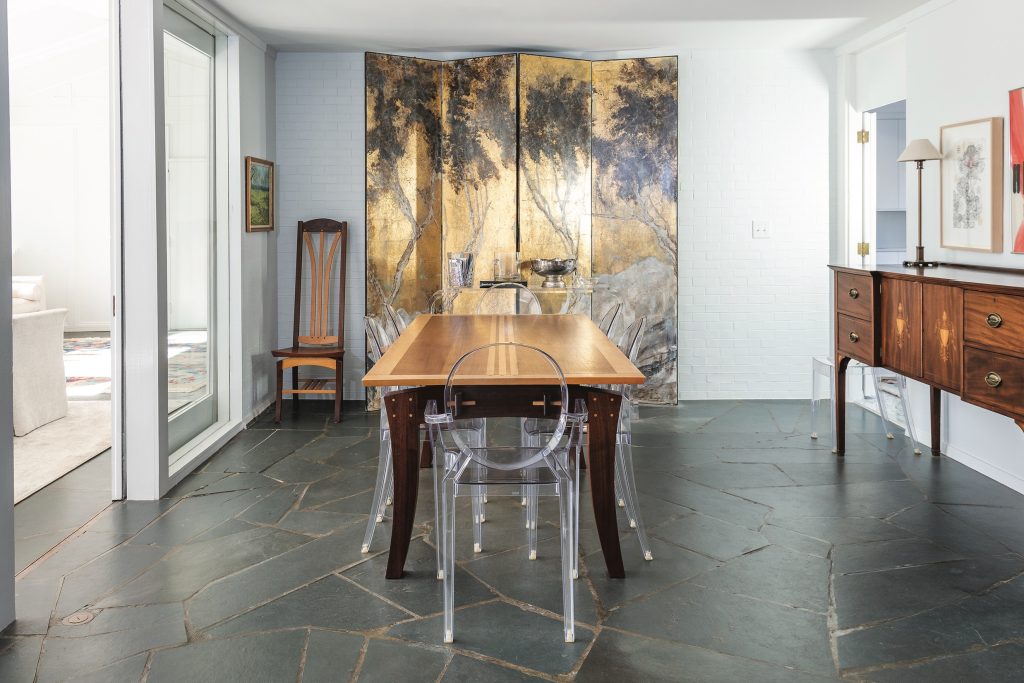
In the early 2000s, Kathy owned the Eastern Standard Gallery located in downtown’s Southend community, where she showcased, among many other exemplary artists, her brother-in-law Michael Coté’s furniture. In fact, he constructed their intricately inlaid wood dinner table. “He was not trained, never schooled. He just picked up woodworking and made that table,” says Kathy. Redeploying the matching high back chairs for accents, the Crafts instead assembled table-side a half dozen transparent, Baroque-influenced Philippe Starck Ghost Chairs with curved armrests. As actress Katherine Hepburn famously attested, “Men are unhappy sitting at a dining room table if their chairs don’t have arms.”

Behind that table, imbuing an Asian influence, is an a four-panel vintage Baker Furniture screen that Douglas Freeman painted for Daniel’s birthday in 2010. A happy match with what the Carters had acquired in 1964 and left behind that adorns the den, a Japanese byōbu from MoMA depicting Heian-period courtiers leading a formal procession. “That is actually paper adhered to the wall, then framed,” Kathy explains.

The solarium is punctuated by a painting awash in muted tones, “an abstract of the marsh by Walter Greer,” says Kathy, “a well-known artist from Hilton Head Island. Dad loved his work.” Nearby are two Ludwig Mies van der Rohe Barcelona chairs and an ottoman, reflexively reflecting an overall retro sensibility to the decor, embellishments emblematic of a sense of playful permanence and space-age proportionality this home embodies.

The Crafts’ three children have graduated college and scattered to careers in various locales, but this in no way feels like an empty nest. If anything, a welcoming environment for a potential influx of grandkids.

The mid-century Modernist movement was, for many, an optimistic harbinger for the wondrous World of Tomorrow promised us by the 1939 World’s Fair, Disneyland and Reddy Kilowatt (“Live better electrically!”). Finished in 1954, Loewenstein’s own home on Granville Road features a driveway long and wide enough to land a flying car comfortably, should it come to that. 

In his waning days, Frank Lloyd Wright was quoted as saying, “The longer I live, the more beautiful life becomes. If you foolishly ignore beauty, you will soon find yourself without it. Your life will be impoverished. But if you invest in beauty, it will remain with you all the days of your life.” Loewenstein was more laconic: “Dedicated architects die unhappy. They never get to unleash creative juices because of pressure to please clients.” He gets right to the heart of what gives the Carter House its cultural significance, so cutting-edge for the period — nobody knew enough about the direction the upstart architect was headed to get in his way.

In the end, Loewenstein’s instinct for “bringing the outside inside” backfired in terms of longevity. Eventually, some would argue inevitably, the spacious landscaping these houses were integrated into far exceeded the commercial value of the structures.

“It used to be,” Lucas says, “if you were one of these Modernist houses designed by this weird guy, Loewenstein, no big deal. We’ll just tear it down and build something bigger there.” Now the name conveys a level of esteem in the way Rolex, Ferrari and Tiffany have become synonymous with style and stature. “Most of the calls I still get are from realtors trying to prop up their property with a Loewenstein connection. So it’s kind of moved on in that regard.”

As realtor Katie Redhead related to me a few years ago about the current marketplace mindset regarding Loewensteins, “We started seeing homes that were in Westerwood, a house on East Lake Drive — let me tell you, those houses went off the charts, people went nuts. Right now we’ve got such a high demand, if one did come on the market, I think it would be well received.  And I probably wouldn’t have said that 10 years ago.”

As for the Crafts, they won’t be selling any time soon.

Throwing Stones, Sweeping Ice

THROWING STONES, SWEEPING ICE

Throwing Stones, Sweeping Ice

In the Gate City, curling is very cool

By Ross Howell Jr.    Photographs by Bert VanderVeen

Did you know you can hone your viewing skills for the 2026 Winter Olympics right in downtown Greensboro?

Most Tuesday evenings from November through January, you can bundle up and head out to LeBauer Park’s seasonal skating rink, where teams with monikers like Curl Jam, Of Ice and Men, Rolling Stones and Sultans of Sweep compete in the Greensboro Curling League.

I’m guessing that your experience with curling is like mine — you’ve watched it on TV every four years. Maybe this will help.

Think of playing cornhole on an ice rink, where you slide the bags instead of throwing them, mix in checkers or chess, where your opponent’s pieces can block your move, factor in the chance that you might slip and bust your butt, and you’ve pretty much got curling. Well, sort of.

Alternating individual players slide (“throw”) heavy, handled objects (“stones” or, familiarly, “rocks”) across the ice (“sheet” or “rink”) toward a ringed target (“house”), winning points for the stones that remain closest to the center (“button”). Teammates assist the throwing player by scrubbing (“sweeping”) the ice in front of the stone with brushes to influence its path and speed toward the house.

Got it?

To refine my vague understanding of the game, I drive over to Old Town Tavern on Spring Garden Street to meet the team that the tavern sponsors — Gate City Curling.

When I walk out on the patio, I’m greeted by Chris “Skipper” Ratliff, the team captain, who works in the financial aid and scholarships office at UNCG.

Turns out, Gate City Curling is one of the original teams in the Greensboro Curling League.

Around the time of the 2018 Winter Olympics in South Korea, Chuck Burch, manager of the Greensboro Ice House, an indoor skating facility on Landmark Center Boulevard that features two National Hockey League-size ice rinks, put out a call on Facebook for people who might be interested in seeing a demonstration about curling.

Ratliff saw it and convinced his friend, coworker in financial aid and now teammate, Spencer “Wildcard” Smith, to join him at that first session.

“We go, they do a brief demonstration and ask, ‘Who’s interested?’” Ratliff says.

“Spencer’s and my arms shot straight up,” he continues. “We started the team from that.”

Initially, there were just six teams that played a couple of matches during the season.

Teammate Raina “Queen” Barnett, who works in the registrar’s office at UNCG, recalls the humble beginnings of the league.

“The stones were actually stainless-steel salad bowls filled with concrete,” she says. One bowl was inverted over the other and joined at the seam with layers of painter’s tape.

“The handle was PVC pipe,” she adds. “It was all very backyard. We’d get brushes for sweeping the ice from Home Depot.”

“Yeah, you could break the handles putting too much force on them,” quips team member Angel “Viking” Fuentes, a general contractor who’s a native of Mexico City.

“And we still use Sharpies to draw the circle targets on the ice,” Barnett adds.

Backyard? I’ll say.

An Olympics-grade curling stone made of the rare, quartz-free granite found in only two quarries in the world — in Scotland and Wales — will carry a 5-figure price tag.

But, despite its salad bowl origins, the sport has caught on.

For the 2025-2026 season, the Greensboro Curling League boasts 16 teams of four to five players each. The season lasts for weeks and culminates with a two-day tournament, where the championship team is awarded the Mitchell/Walden Memorial Cup, named in honor of the late Katelyn Mitchell and Rob Walden, who were original members of the league. The winning team’s name is inscribed on the cup and the members hold it for a year, much like the Stanley Cup in professional hockey.

And the stones these days are greatly improved, thanks to a grant from the Community Foundation of Greater Greensboro.

“Ours are recreational league stones like they have in Canada,” Ratliff says. And these stones aren’t cheap, either. They’re priced at around $500 apiece.

While they enjoy the new trappings, both Ratliff and Smith emphasize that their matches are not like what you see on TV.

For example, Gate City Curling has never competed inside a covered facility, not even the Greensboro Ice House. In fact, the team relishes the special challenges that curling outdoors presents.

“Charlotte has a curling league, but they’re all indoor like you see in the Olympics,” Ratliff says. “That’s just not how we do it,” he continues. “We battle the elements. It’s a lot more exciting.”

“The ice changes constantly, throughout the night,” Ratliff adds. “It really comes down to which team can adapt first.”

Teammate Kevin “Hammer” Shoffner, who’s the marketing manager for Habitat for Humanity, chimes in.

“It might be 60 degrees one week,” he says. “Then, all of a sudden, we’re back to freezing.”

“One thing we’ve learned is that you can’t curl in the rain,” Ratliff adds. That’s because there’s no grain on the ice to slow the stone.

“And you cannot curl in the snow,” says Barnett. Its accumulation impedes the glide of the stone.

“A heavy snow we had years ago was terrible for curling,” Shoffner says.

“The stone wouldn’t go five feet,” Ratliff remembers.

As locals know, snow in the Piedmont often turns to slush: “It was like throwing on cat food!” Smith laughs.

“That’s what’s unbelievable,” says Fuentes.

“Even in the worst conditions,” he continues, “you just get out there and think, ‘Oh, yeah, I’m doing this!’ The weather doesn’t matter.”

Another attraction for Gate City Curling members is the sense of community they feel participating in the league.

“It takes a unique person to go outside at 9:30 at night in 30-degree temperatures and stand on ice,” says Ratliff.

“You play other sports, people can be hyper competitive,” Shoffner comments. “But this is organic. It’s not super pressure, we’re out there having fun.”

Fuentes offers a different take on this quirky community.

“What I get the most fun out of is telling people that I play curling,” he laughs. “And people go, ‘What? Curling? No, really, that can’t be real.’”

“There’s definitely shock value,” says Barnett. “People say, ‘What? Curling? In Greensboro?’”

While the teammates enjoy the notoriety and the relatively laidback competition, they’re still in it to win it.

Shoffner is known for his powerful throw and is usually designated to throw the all-important last stone, called the “hammer,” which can displace all the stones in the house.

Smith is the team’s rock, paper, scissors champion, the game by which the team determines the order in which individual members throw their stones and what color stones the team plays with.

Barnett has perfected the crucial first throw, reliably placing a stone to set up the team for a potential point.

Fuentes is the team’s finesse guy, known for finding his way to the button.

Ratliff handles the team’s promotion while consistently ranking among the top three sweepers in the league.

“We’re a pretty well-oiled machine because we’ve been doing this for seven years,” Ratliff explains.

“If we get that win on a Tuesday night, I got a little spring in my step on Wednesday,” says Fuentes.

“I may be the most competitive on the team,” Ratliff says. Since he’s captain, you’d expect that.

“I don’t know anybody who goes onto the ice and doesn’t want to win,” Barnett claims. “We still have that drive, but it’s not so competitive that it sucks all the fun out.”

“Friendly rivalry,” Smith concludes.

In competition, there are nuances that are missed by the uninitiated. Most of us would note the loudly barked directions and sometimes frantic sweeping, but we would probably miss the hand signals teammates use.

“There’s a lot of noise out on the ice at any given time,” Shoffner says.

Not only is the outside lighting dim, the Sharpie-drawn house is barely discernible from the thrower’s position. So hand signals can be critically important.

“Sometimes, you throw it and you think you’ve got it in the house, and you’re like, ‘Yeah, I’m on the button!’” says Smith. “And your teammates are like, ‘Dude, you’re 5 feet away, what are you talking about?’”

“You cannot do it by yourself,” Barnett emphasizes. “Even if your eyesight is perfect, you cannot see.”

“If you’re the one throwing and your teammate is sweeping,” she continues, “it’s like an optical illusion.”

“Your teammates are really your eyes and ears,” Barnett concludes.

So what’s the future look like for Gate City Curling?

Already, Monday nights on the rink have been set for novices to try their skills and maybe develop new teams for the Tuesday-night league.

“What I’d like the community to know is the Greensboro Curling League is a thing,” Ratliff says. “It’s been run by some really cool, independent and dedicated people who came together, created it and have run it successfully for seven years.”

“For me, seeing curling growing and having ice hockey come back to Greensboro is exciting,” Shoffner says. “It’s not exactly a movement, but there’s a rise in winter sports.”

“It’d be great if the Gargoyles had us out for a little curling exposition on the ice at half time,” says Smith.

“News 2 did a live feed of the tournament one year; maybe they’d do it again,” Ratliff muses.

“We already do one,” Smith says. “It’s just a tripod and a camera, right?”

“Yeah,” Ratliff answers. “I slipped on the ice and broke my tripod.”

Smith grins.

“I’d forgotten you fell,” he says. “Thanks for reminding us.”

“Breaking a tripod instead of a collar bone, that’s better,” Fuentes says with a laugh.

Curling in downtown Greensboro may not be the Olympics. But it’s plenty entertaining. And if you show up on a wintry Monday night to give it a try, or on a Tuesday just to hang out by the rink and watch, you’ll warm the hearts of some very dedicated people.

Home Grown

HOME GROWN

Sugar Baby

Jonesing for a fun-sized fix

By Cynthia Adams

A fantastical shot of ice cream, jawbreakers and pastries make me drool like one of Ivan Pavlov’s dogs.

This sugar-charged chassis of mine has an internal engine that purrs at the sight of gooey sweets — then splutters and stops. Demanding a refill. 

A saner person, someone free from sugar addiction, may ask how it took root. Some claim they are salty people. Or savory people. Actually, I like those food groups too.

As it happens, we were born this way.   

A taste for sugar is hard-wired into human anatomy. 

“The brain is dependent on sugar as its main fuel,” says Vera Novak, associate professor of medicine. “It cannot be without it.” Scientists have found half of all sugar energy in the body is used by — get this — the brain.

In my case, too, there was a sugar pusher. Enter my father, Warren, the alpha of sugar addiction.

A dedicated sweets guy, our dad was known to make evening forays into Charlotte to Krispy Kreme, 50 miles roundtrip, returning with two dozen raspberry- filled pastries. Was he really responsible? Obviously, he had a very large brain, one practically demanding he stoke it with sugar.

Consider this: Krispy Kreme makes 5 million doughnuts daily. Statistically, that’s a lot of sugar-munching/brain-feeding, so Warren was hardly alone. 

He never met Winston-Salem founder Vernon Rudolph, but, if he had, dad would have definitely shaken his hand and invited him home for supper. (After licking the icing from his own.)

Warren would also have shaken the hand of Forrest Mars, creator of M&M’s candies. Fun-sized fact: Initially, the hard-shelled candies were sold exclusively to the U.S. Army during WWII. 

Dad loved those multicolored, sugar-shell-covered bits of chocolate, and so did I. When I was a child, he would sometimes take me on work trips, iconic brown packets of M&M’s marching across the molded dashboard. 

“If I start nodding off or acting sleepy, shake me and keep talking to me,” he ordered, knowing the sugar high would keep me chatty.

The neighborhood “juke joint” was where my sugar fixation became, well, fixed by the age of 5. The store possessed two marvels: a juke box and a multitude of candies. My quarters were stretched between playing favorite tunes and buying sweets.

Munching on a Butterfinger or a Baby Ruth, I’d dance, joyously spinning like a Sufi.

I didn’t snack on Snickers (originally Marathon, renamed for the Mars family’s favorite horse), but rectified that mistake later. The Snickers rebrand elevated it to the top-selling candy globally.

During my childhood, adults weren’t that worried about sugar.  Mornings called for sugary cereals like Alpha-Bits. I arranged the crystalline letters with my spoon to spell SWEET, one of my favorite words, sneaking in extra spoonfuls of sugar and just enough milk to keep five letters afloat.

The only milk I actually liked was the sugar-jazzed chocolate variety.

Grape juice, more syrup than juice, kept my child-sized lips perpetually encircled with a blurry smear of purple. After school, I craved ice cream or cookies. 

Ironically, children in my household weren’t allowed sweet tea until age 12, but were permitted Tang (thank you, NASA!), Orange Crush or Nehi grape. 

Grocery shopping now as a grown woman, I don’t stick to the store perimeter, as nutritionists advise. Even if I start out in the produce or fresh fruit sections, my cart pulls itself straight to the aisle of Forbidden Fruits. Namely, fruit-flavored gummies and candies. Goodies practically throw themselves into the shopping cart, my resolve melting faster than a Dairy Queen Blizzard on a sunny July day. In go jolly-looking jars of marshmallow fluff, sweet jams and bags of chocolates.

When in need of a fast fix, I binge on Nutella (spooned straight from the jar) or, recently, handcrafted Kilwins’ fudge (a gift to my husband) — or once, an entire bag of Dr. Atkins sugar-free candies.

Resolve is a strange animal. My hand reaches for crunchy peanut butter — natural, of course — when I’m feeling resolute. When it fades, anything can happen. After resisting the priciest chocolates still in their gilded gift box, I turn instead to a beguiling tin of Marks & Spencer’s Christmas cookies (called, quaintly, “biscuits”). Next, I hit hard candies, my emergency sweets stash, crunching away like a badger.

The night before my physical, despite being fearful of bad lab results, I polished off most of a “sharable”-sized bag of plain old chocolate M&M’s after a “healthy” dinner. Then I wolfed down more M&S biscuits.

(My glucose results were not great.) 

My dopamine-hooked brain once put my sugar fixation to good use — when weaning myself from smoking. Swapping one oral fixation for another, I kept a large bag of M&M’s in my desk drawer, finally leaving cigarettes behind. 

But, sadly, not sugar.

Some years ago, Delancey Street Moving and Trucking (whose innovative work programs support those overcoming addiction) moved us from our Westerwood home to Latham Park. My husband was called away, so I hustled alongside the movers.

At day’s end, we all flopped down on the driveway, sweaty and famished. Ripping into a bag of Snickers, I offered them around. The guys shook their heads, each lighting up a cigarette.

One gave a piercing look.

“I used to use,” he said, explaining how heroin derailed his life as a pharmacist.

“What’s your addiction?” 

With a jolt, I realized he’d spotted it. 

“Sugar,” I confessed. Taking a deep drag, he nodded knowingly.

Omnivorous Reader

OMNIVOROUS READER

Sense of Urgency

The stories that need telling

By Stephen E. Smith

It happens to every writer. The moment comes, sometimes sooner than later, when it’s clear that he or she won’t live long enough to write every story that needs telling. The unwritten stories can be offered as spoken anecdotes, which, of course, vaporize the moment they’re uttered, so getting the stories down in print becomes a source of energy and inspiration. Pat Riviere-Seel’s collection, Because I Did Not Drown, derives its urgency from her desire to have the stories remembered — and to be remembered herself. “How long will the work of art last? Who will remember the artist . . . ?” she writes in her essay, “Unknown Artist.”

Reviere-Seel is the author of four poetry books, most notably the well-received The Serial Killer’s Daughter, which was published in 2009 by Charlotte-based Main Street Rag Press. Because I Did Not Drown explores both the exceptional and mundane — “kitchen talk,” the need for perseverance, the joy of pets (in this case cats), a stray fig plant growing by the back stoop, gun control, the loss of old friends, food lovingly prepared, an enthusiasm for jogging, “disenfranchised grief,” extraterrestrials, etc. Each prose chapter is written in straightforward journalistic prose and intended to convey helpful insights into contemporary life.

She begins her collection by recounting her personal experience with the COVID shutdown. She ends the book by detailing the ill effects of the pandemic’s aftermath, topics few writers have tackled (Sean Dempsey’s A Sad Collection of Short Stories, Cheap Parables, Amusing Anecdotes, & Covid-Inspired Bad Poetry is an amusing exception). This reluctance to write about the COVID experience can be attributed to what readers and writers might perceive as proximity aversion: the shock of COVID is still too much with us, and we’ve yet to sort out its spiritual and political implications. Reviere-Seel takes up the subject head-on: “But as the pandemic stretched into a second year, I became more frustrated, angry, and cranky. I missed my poetry group. I missed my friends. . . . We stayed home. We wore masks. We stayed six feet apart. We were grateful to be alive. . . . What had begun as a public health issue became a political issue. The usual anti-vaccine talk mingled with the talk of ‘the government can’t tell me what to do.’” Her concluding essay, “After the Pandemic,” suggests that kindness is the only possible remedy for a virus that continues to mutate: “Be kind. Most of us did not want to infect our family, our friends, our neighbors, or the checkout clerk at the grocery store who showed up for work every day. Genuine kindness is a balm, a gift, a grace.”

In her chapter “Talking About It,” she is straightforward about her struggles with breast cancer. “I didn’t talk about my experience with breast cancer,” she writes, but the death of an aunt who ignored a lump in her breast inspired her to share her experience. “Early detection and medical advances in treatment have meant that breast cancer is no longer the death sentence so many feared fifty years ago.” Her interaction with the medical community will be of particular interest. When she was denied an immediate needle biopsy, she reacted appropriately. “Nice was not working so I threw a fit, a nice-woman-goes-feral southern ‘hissy fit.’ A redhead-gone-rogue tantrum . . .  I was paying for a service, medical care, and I wanted — no, demanded — a say in when and how that service was delivered.” Her story is a paradigm for all women and men who find themselves caught up in our often lethargic and convoluted medical system.

The course of her disease followed a predictable path, but she made the necessary decisions to preserve her life. The description of her battle with breast cancer is timely, honest, reassuring and possibly lifesaving.

Following each of the prose passages, a poem explicates or explores the theme of the preceding chapter. The poems are well written and could stand on their own as a chapbook. “After the Diagnosis,” for example, follows the chapter on breast cancer:

There are nights — more

than you ever thought you could endure —

when sleep will not come

your thoughts — no, not thoughts —

the deep well of unknowing appears

endless. You try summoning

visions of sunrise, a shoreline, bare feet

running across packed sand. But morning

fog covers this foreign landscape.

Everything you knew for sure yesterday

washed away with the tide, predictable

too the magical thinking, maybe. Abandon

the dock, row your way into the nightmare, further

out is the only way back.

The use of verse to add emotional impact to the short personal essays may strike some readers as unnecessary. At the very least, the transition from journalistic prose to poetry is complex, requiring a complete shift in sensibility and focus. Nevertheless, she forces readers to grapple with many of our most vexing problems. 

Barbecue, Bourbon, Boutiques

BARBECUE, BOURBON, BOUTIQUES

Barbecue, Bourbon, Boutiques

A journey into Jamestown

By Danielle Rotella Guerrieri

Photographs by Laura Gingerich

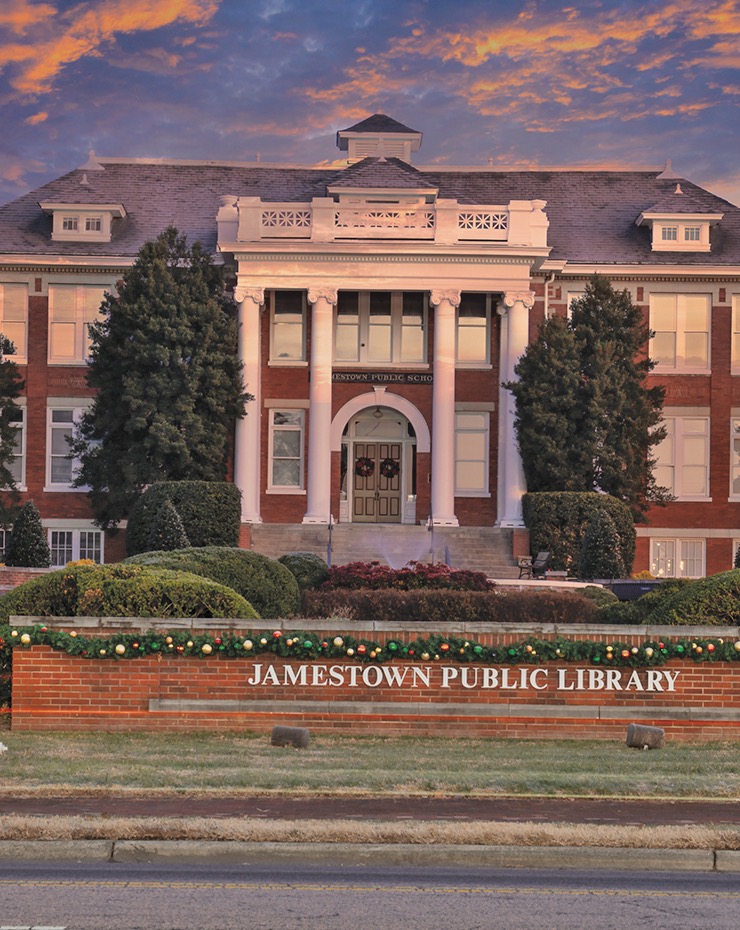
On a crisp, chilly day with a deep indigo-blue sky overhead, I maneuver my car through a couple of smooth turns into historic downtown Jamestown. Oak and cedar behemoths line my path before being replaced by skinny, black rod-iron light posts, all protecting the quaint village center, comprised of nine one-or two-level buildings. Historic Jamestown, a mere 12 miles from downtown Greensboro, is one of the oldest established communities in the Triad, a hidden gem tucked between Greensboro and High Point, offering enough locally owned eateries and boutiques to make it worth blocking out a whole day on your 2026 calendar.

Since the COVID pandemic ended, Jamestown has been focusing on revitalization in the form of newly emerging shops and eateries — an impressive transformation I’ve witnessed in the short four years since I lived there.

Excited to explore, I meet my friend, Janna, for a full day of shopping and exploring. But first, we fuel up on caffeine at Kindred Coffee. Engulfed by the smoky, rich, chocolatey aroma as we walk in the door, we’re greeted by owner Greg Pittman’s friendly face behind the counter. Pittman and his mom, Marsha, opened Kindred in late 2022 after their online coffee subscription and Cause Roast coffee truck business took off.

“We wanted to create a space where people felt loved and cared for when they’re here,” says Pittman. Jamestown didn’t have a coffee shop at the time, so it was an easy transition to shift their coffee operation to the space at River Station Twist. After sipping my cuppa espresso, I’m rarin’ to go.

At Second Chance Closet, a boutique-like thrift store that opened in the former Wells Fargo building in 2024, all proceeds go toward Chance Walters Ministry, operated by owners Kacie and her husband, Chance Walters. “The reason we succeed,” says Kacie, “is word of mouth and being part of such a tight-knit community.” Filled to the brim with clothing for all ages, it doesn’t look like a former bank until you veer to the right and notice the formal wear section housed in an old vault. Janna finds a long, alabaster sweater coat for $12.99, and I snag a funky, avocado-green, animal-print sweater for $6.99 — deals we definitely can’t pass up.

Guilford + Main, a large clothing and home goods shop that opened in 2021, is owned by Lisa Perdue and run by her daughter, Alexis Turner. Silver Gallery, its sister store, has been a shopping staple at Friendly Center in Greensboro for 25 years. But, notes Turner, “We have more space here than Silver Gallery, so we can carry more things.” A pair of earrings, gold spikes glimmering on a cream-colored loop, draws my attention, while Janna picks out a few $5 silver dangles from their sprawling bracelet bar.

Strolling back down Main Street, it’s hard to miss Jamestown artist John Firesheets’ enormous sea-blue mermaid-and-squid mural painted on the side of The Soap Lady. Flanked by inviting black front porch rockers, Soap Lady’s creaky screen door announces our arrival to owner Susan Stringer, who’s greeting us with a genuine ear-to-ear grin. In business in Jamestown for 27 years, Stringer expanded to her larger storefront in 2012, where she’s been selling her handmade artisanal soaps and lotions ever since, and has added pottery, soy candles, cards, and many other locally crafted goods to her inventory. Stringer makes all the soaps, body wash, shower gel, sugar scrub, lip balm, body powder and bath bombs using an olive oil base and other natural ingredients. “We have a lot of people going through issues like cancer and radiation, and they can’t use fragrances,” says Stringer, “and using a real soap makes a huge difference.”

Our bellies soon start growling, so we stop for lunch at Southern Roots, one of several eateries on Main Street. Full Moon Oyster Bar, Simply Thai and Black Powder Smokehouse are just as enticing, but walking into Southern Roots is similar to breezing through your favorite aunt’s sunlit beach house — you feel right at home. But, please, keep your shoes on! Owner Lisa Hawley uses her family’s Southern recipes, supporting local farmers and sustainable agriculture. As Hawley puts it, “Our food is prepared with love.”

Our charming waitress, Sydney, takes our orders. Janna can’t resist her favorite gluten-free meal: flat iron steak with a bourbon glaze, cheese grits and Crowder beans, while I select a cup of chicken-and-dumpling soup and a chicken salad sandwich half on buttery, toasted sourdough.

Satiated, we walk a few doors down for a sweet treat, as the mix of sweet and savory scents emanating from Cakes by B’s Blue House Bakery tickles our cold noses and lures us inside. There, we find owner Bridget Murphy whipping up her rosemary goat cheese quiche. Murphy has been satisfying the town’s sweet tooth in her adorable blue house for the last 10 years, preparing everything from caramel-and-pecan-pie bars to savory gluten-free cheddar biscuits. “Our quiches and chocolate chip cookies are incredibly popular,” says Murphy. “We also have a fun one called ‘What the Heck.’“ What the heck, you’re wondering. “It’s devil’s food cake,” she says, “with cookies-and-cream filling and vanilla buttercream on top.” When she first opened, she aimed to have a bakery that doubled as a community haven, and she delivers with baking and decorating classes, meet-the-candidate events during election season, food truck festivals and a trunk-or-treat every Halloween. We snag a batch of Murphy’s famous chocolate chip cookies before our next shop.

Feeling like we entered a high-end art gallery, we step into Bottone Home, a design and decor store with “home vibes on point” owned by Kody Bottone. After we ooh and aah at the exquisite leather chairs, funky modern vases, smooth-edged end tables and enormous wood sculptures, Bottone tells us the shop opened just last year and the company also manages interior design projects. My eyes are immediately captivated by Greensboro artist Erin Beck’s paintings, featuring broad brushstrokes of deep burgundies, vivid emerald greens and auburns, beautifully capturing florals, nature and still lifes. Her paintings make a vibrant splash against Bottone Home’s modern, neutral furnishings.

As 5 o’clock looms, we head up the street to meet our husbands for drinks and dinner. Crafted cocktails call our names as we enter Barrell & Co., where we’re struck by low lighting and smooth jazz and the calming, clean, soothing aroma of tobacco mixed with vanilla. Opened last year, owners Ket Jones, Matt Lokercome and Paul Lothakoun designed the space for enjoying elegant cocktails while phones take a back seat and conversation takes hold. Old fashioneds and smoked fashioneds are ordered, although, not being a huge bourbon fan myself (yet!), I sample a few varieties, courtesy of Jones, and I discover I just might like Eagle Rare.

Black Powder Smokehouse is our dinner pick — a high-energy barbecue restaurant so good they opened a second location in Asheboro. The smoked turkey breast, jalapeno sausage, and pork spare ribs beckon, but we opt for the ever popular, beef brisket, barbecue pork and chicken. Opened in 2019 by pitmaster Keith “Big Brisket” Henning, in a converted 1920s gas station, the establishment features beautifully preserved old gas pumps and massive garage doors that open for outdoor seating on warm days. Four sauces line each table, from house signature sweet sauce to “The Heat,” a hint of fire for spicy enthusiasts. Between us, we share crunchy, cool coleslaw — an excellent heat cleanser — golden-to-perfection tater-tot casserole and an elevated take on mac-and-cheese, smoked gouda kicking it up a notch.

As a yawn stretches across my face, we make plans to return another time for drinks at Potent Potables followed by live music at The Deck. Bags and belly full, I start my short drive home, the historic Jamestown street lamps flickering and fading in the rearview.

Jamestown History

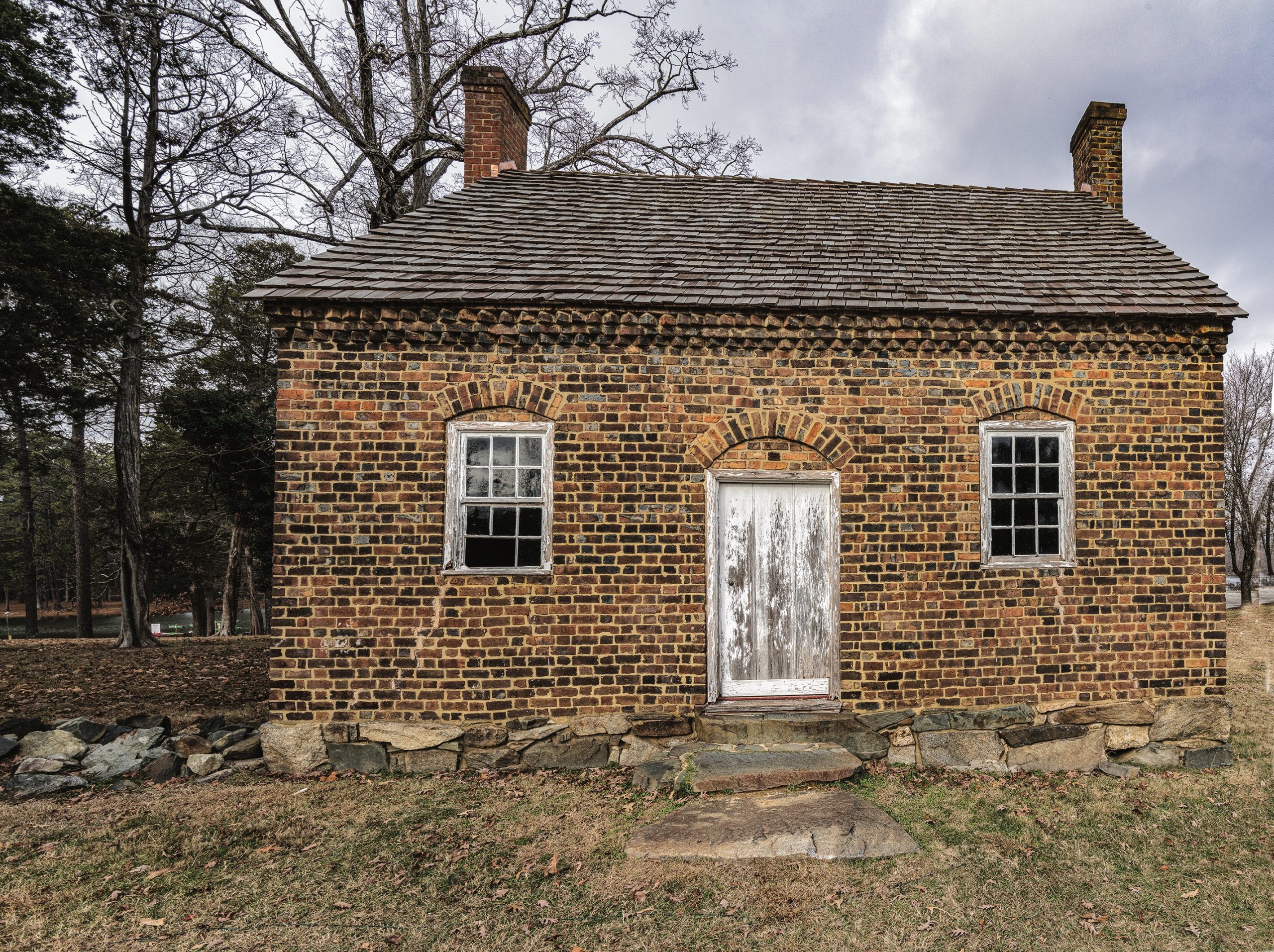
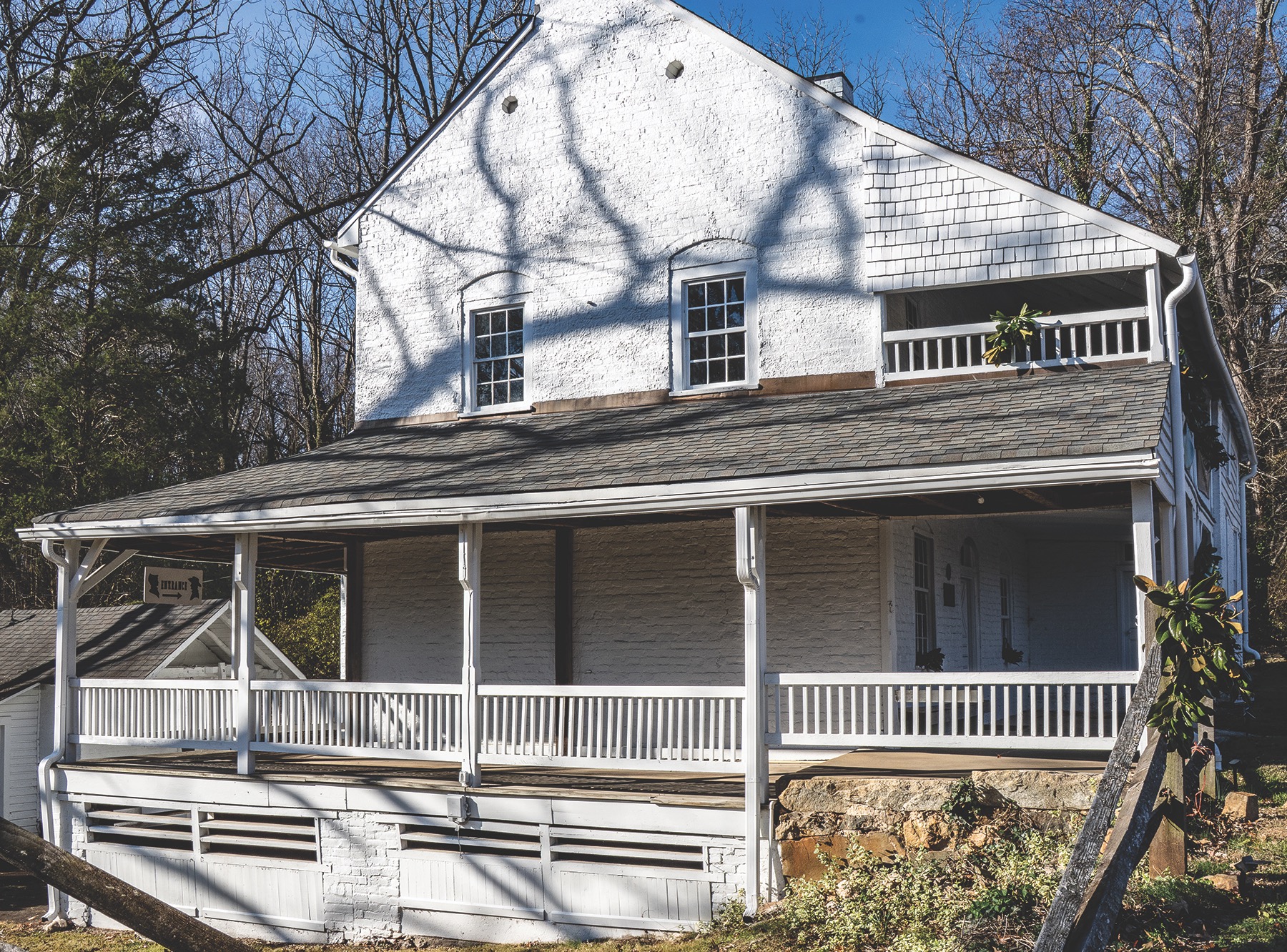
Laid out as a community in 1792 by prominent Quaker George Mendenall, the official town of Jamestown was chartered in 1816 and named for George’s father, James. At Mendenhall Homestead, the home of George Mendenhall’s son, Richard, built in 1800, I’m accompanied by two tour guides, Will Ragsdale and Jay McQuillan, members of the Historic Jamestown Society. McQuillan serves as president, and Ragsdale is the grandson of William and Mary Elizabeth Ragsdale, who previously owned the property and later donated it to the Historic Jamestown Society, which they helped start.

Walking through a sunken summer kitchen in the original part of the house, I imagine Richard taking off his wide-brimmed hat to duck into the cramped room. He expanded the home before marrying Mary Pegg in 1812, adding a parlor and sitting rooms downstairs, as well as bedrooms upstairs, which, in addition to the couple’s seven children, sometimes housed their many out-of-town visitors.

“Quakers welcomed any travelers in; it was part of their makeup and religion,” explains Ragsdale, “Quakers were also focused on education and human rights, believing that women were just as capable and able to learn and do everything men could do.” A black-and-white photo from the 1840s shows the first faculty of Guilford College, half of them women. The school was founded by Quakers, including members of the Mendenhall family.

Stored in the property’s Bank Barn, the Stanley Murrow false-bottom wagon serves as a reminder of how Quakers helped transport enslaved Black people to freedom in the early to mid-1800s. May we all take a note from the Quakers and support those in need through compassionate service and think of everyone in our community as a “friend.”