Home Grown

HOME GROWN

Max

The making — and unmaking — of a miscreant

By Cynthia Adams

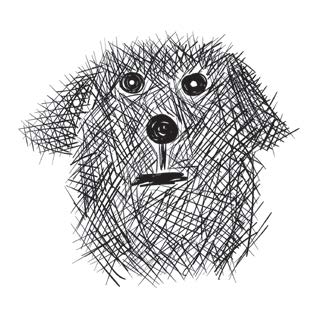
Our rescue — let’s call him Max — has a record. I worry he might be sent to juvenile hall. Or reform school for troubled terriers. 

I’ve changed our wire-haired fox terrier’s name to protect his identity should an overzealous public servant decide to pursue any of his perceived crimes. 

Max has never gained a firm grasp on boundaries. Now, skittering around on the margins of civil society, he is a wanted canine. Why? He bit the hand that feeds him.   

But first, a little background: Max, a “high-energy” dog, was foisted off on me in the paint department of a Lowe’s at the North Carolina coast. His owner, a bedraggled looking mom of children of various ages, said he stole the little ones’ rubber ducks. He had been banished to a pen in their backyard, where he had been confined for four years. She produced a picture on her cellphone: Max, a tan-and-white beauty, looked straight at me from the photo with the saddest of eyes.

From another picture, he pants breathlessly out of a passenger window, beckoning me with a “please” look in his eyes.

I later learned that two large labs lived indoors while little Max, just 14 pounds, was penned alone in the backyard. Was he underfed, too?

When we brought him home Max was so jubilant, given his newfound freedom — a dog door and fenced yard to roam — it took him weeks to settle down even a little. As forewarned, he was petrified of storms after years of suffering through them alone. Is it possible for a dog to be phobic about rain yet adore water if it doesn’t fall from the sky? Inscrutably, he loves to splash and play in water but dashes in through the dog door at even the gentlest rain. 

Max was not only jealous of our smaller, younger dog, he was a thief, stealing any toys from man or beast.

But with time, effort, consistency and affection, Max possessed moments of calm that gave us a glimpse of his future self. He gained a few pounds, showing a taste for carrots and fresh apple.

Even so, five years later, he remains neurotic to the point of terror with the slightest threat of a storm, near or far. Soft jazz helps. Medication doesn’t. He tunnels underneath the sofa, shivering until the storm passes. And yet, the mere glimpse of a water hose sends Max into a rapturous, manic, playful frenzy.

He is a creature of the morning; by evening, he prefers to be left alone in his bed, more curmudgeonly.

Yet he is exceedingly smart, able to reason and anticipate. When Max sees me sorting glass, he anticipates a car ride to the recycling center and is sent straight into a an ecstatic, hyper state.

One late afternoon when Don and I were walking him, he suddenly lunged for something on the ground. “That could be a chicken bone!” I cried, given fast-food remnants littered the area.

Don pulled Max’s leash in, hurrying to open his mouth and fish out the foreign object; Max clamped down firmly on the soft tissue between his thumb and forefinger.

When Don shouted in pain, Max clamped harder in resistance. He was not surrendering his prize.

By morning, Don’s hand was purply and swollen. Our physician was away, so he visited a clinic. The attending physician shook his head, returning with a clipboard. An official dog bite report was made to Animal Control even though Don’s injury only required precautionary antibiotics, a cursory look and rebandaging. No stitches.

State law requires that a dog who has bitten a human — even their owner — quarantine for 10 days for rabies observation. (This includes fully vaccinated canines.) Guidelines require the animal sequester at a veterinary hospital, animal control facility, or, possibly, the owner’s property. There is no exception for first-time offenders like Max.

I gasped: How would Max survive should they order confinement at the shelter? Or the vet? This was a dog whose spirit had only been restored after years of effort. He had suffered banishment once. He might not have the resilience to handle such isolation again.

Home confinement looked wonderful by comparison. 

We chewed our nails, waiting for Animal Control to knock at our door. In desperation, I displayed a published article I’d written for this magazine about Max’s first year with us. In it, he was sitting happily at his master’s side, flashing a cheery doggy smile.

We eventually resumed walking him, strictly on a shorter leash. We reasoned it was a bad idea to come between food and Max, who had possibly been underfed those many years of confinement.

Weeks, then months passed. We exhaled. Thankfully, Mad Max got the third chance he deserved.

Omnivorous Reader

OMNIVOROUS READER

A Day at the Beach

When everything goes wrong

By Anne Blythe

If you’re one of those people who likes to walk on the beach and dream up scenarios for what might be happening in some of those homes looking out over the ocean, Kristie Woodson Harvey has a whale of a tale for you.

In Beach House Rules, the Beaufort-based author takes readers inside a massive two-story oceanfront home enveloped by “the salt air and rhythmic shush of the waves” in fictional Juniper Shores, North Carolina. Harvey’s 11th book, which she describes as “an ode to female friendship,” also has mystery, a touching exploration into what makes a family and, of course, a love story or two — many of the elements for a breezy, easy beach read.

Inside Alice Bailey’s massive beach house is the “mommune,” an intriguing co-living situation that — because of a variety of individual crises — brings a cast of women and their children together. Charlotte Sitterly and her teenage daughter, Iris, are the newest “mommune” residents, having found themselves in need of shelter, hugs and support after being locked out of their five-bedroom, four-and-a-half bath shorefront home by the FBI.

Bill, husband of Charlotte and dad of Iris, is in the local jail, accused of a white collar crime that thrusts their family into the glaring spotlight of an anonymous gossipy Instagram account that revels in “sharing bad behavior and delicious drama in North Carolina’s most exclusive coastal ZIP code.”

Charlotte, Bill and Iris came to Juniper Shores during the height of the pandemic, refugees from a locked-down New York City. While snuggling on the wide-open beach during what was supposed to be a temporary visit, soaking up the orange glow of a Mayflower moon and watching their daughter make friends with a neighbor girl, Bill suggested they build a house there, miles and worlds away from their hectic and confined city life. Charlotte leaned into her husband and quickly said yes.

Fast forward to Charlotte’s meltdown in the lobby of Suncoast Bank, three days after coming home to a swarm of police cars and FBI agents combing through her dream house. With the family’s financial assets seized, Charlotte needed a job. Her work history was in finance, so she thought she would try the local bank, but convincing a bank or investment firm to take on the spouse of a man accused of stealing large sums of money from his clients was a tough sell.

Alice, known around town as the woman with three dead husbands in 12 years, offered Charlotte a supportive ear and refuge at her former bed-and-breakfast, where women and their children facing hardships comprise the “mommune.” With only enough cash to afford two more weeks at a modest hotel, Charlotte agreed. Her mind raced as she walked into the Bailey house. What if Alice was a creepy killer who’d offed her husbands? Was she a lunatic or a saint? And always in the back of her mind, what if Bill had, indeed, committed the financial crimes he was accused of? Charlotte tamped down those questions as Alice took her through the unlocked door into a haven with a chef’s kitchen, an open-plan dining room, a living room that stretched across the entire house and an array of comfortable bedrooms.

Through the alternate narratives of Charlotte, Iris and Alice, Harvey weaves in the many side stories. We learn about Julie Dartmouth, Alice’s niece and a dogged reporter who was the first woman to take up residence, along with her children, in the Bailey house. Before Charlotte and Iris arrived she “seemed to absolutely revel in writing about Bill’s arrest.” But “beach house rules” changed that.

Grace, Julie’s best friend and an Instagram influencer who has gained a large following sharing her recipes on “Growing with Grace,” was the second mom to join the so-called “lost ladies club.” She moved in after her husband split to Tokyo, leaving her with a mortgage to pay and children to raise, one of whom is a star high school quarterback and heartthrob, an added bonus for Iris, a 14-year-old navigating the highs and lows of teenage years.

Elliott Palmer, Alice’s former boyfriend who wants to reignite their love story, has the potential to upend this makeshift family. He’s not deterred by Alice’s wake of dead husbands or other claims that she’s cursed. “You’re not going to kill me,” he tells her over a bottle of Champagne and a remote table for two overlooking the water.

Harvey weaves all these storylines together, thread by thread, mystery by mystery, to an end that reveals whether or not Alice — who, not coincidentally, had taken a financial hit from the white-collar crime Bill is accused of — had ulterior motives when she invited Charlotte and her daughter to stay with her.

While there are dark clouds that hang over the many mysteries within this mystery, the romance and light fun make it more about community and the friendships that can unexpectedly occur when it seems like everything is falling apart.

According to the Beach House Rules, setbacks can be blessings in disguise.

Poem June 2025

POEM

June 2025

The Ferry from Ocracoke to Swan Quarter

Laughing gulls hover:

a story below,

their shadows slide

and crux across the deck

of the Silver Lake —

painted white by convicts

from the Hyde County camp —

bound over the slick-cam Pamlico, 

past a dredge-spoil island

where cormorants in black

frock coats congregate, exiled,

penitent, eyeing the ferry

with Calvinist reproach.

— Joseph Bathanti

Chaos Theory

CHAOS THEORY

You Must Be Tripping

A whirlwind weekend of misadventures

By Cassie Bustamante

Our oldest, 19-year-old Sawyer, does not ask for much: a roof over his head, a hand-me-down clunker of a car and a lifetime supply of Eggo waffles. So, when he comes to me with a request, I listen, knowing I’ll do what I can to grant his wish.

“Mom, wanna go to Boston with me?” he asks, knowing how I, a born-and-raised Bay Stater, am always up for a pilgrimage to my home state. “The Six Invitational is there, but,” he sheepishly adds, “it’s Valentine’s weekend.”

If you’re thinking, “The what?” right now, you’re not alone.

“It’s a tournament for my favorite video game, Rainbow Six Siege,” he says, his blue eyes hopeful while my own glaze over.

Forget what I said about making his dreams come true. “Uh, no. But maybe Dad will go? Ask him.”

A few days later, my husband, Chris, approaches me. This time his blue eyes glimmer as he tries to persuade me to join them. “We can have a Valentine’s getaway while he is at his tournament.”

Sounds lovely, right? Except he’s forgotten one thing — our other two kids. “And who will watch Wilder?” I ask. Right away, he suggests Emmy, our 18-year-old. “So, you’re saying we just leave Emmy behind to watch her little brother, who has been begging to fly on an airplane for two years, while the three of us galavant around a city she adores?”

“Uh, yeah,” he says.

“Not gonna happen. You take Sawyer,” I say. “Or, we all go.”

And so, at 6 a.m. on Valentine’s Day, we set off to make Sawyer’s dream come true and have a little family fun in the meantime.

Since it’s a rather quick trip, we don’t waste a second. We eat our way across Boston’s North End, aka Little Italy, tour Paul Revere’s home, touch stingrays at the New England Aquarium, and shop up and down Newbury Street. By Sunday morning, even the kids are zonked and ready to return home.

And that’s when Sawyer’s dream trip turns into a nightmare for us. Overnight snowfall has transformed into a mix of sleet and rain, leaving slushy puddles at every street corner. Chris and I brave the elements alone, trudging the half mile to Dunkin’ Donuts with the kids’ breakfast orders in hand.

A true New Englander, I’ve packed waterproof Timberlands, but Chris, born and raised in Miami, is wearing sneakers. By the time we return to the hotel schlepping soggy paper bags, his feet are chilled to the bone and his mood, well, dampened. Wilder takes one look at his breakfast choice —an untoasted bagel, just as he prefers at home — and whines that his bagel is cold.

Frustrated, Chris escapes into a hot shower. Ten minutes later, he emerges from the steaming bathroom, phone in hand, and says flatly, “Our flight’s been cancelled.” And, to make matters worse, the airline can’t get us back to North Carolina until Tuesday night.

With jobs to get back to and a 13-hour drive in front of us, Chris starts dialing rental car companies, juggling both of our phones, desperate for a vehicle with three rows to accommodate us comfortably. No luck. We book what we can. At the rental car counter, however, a small — mini, to be exact — miracle happens. “They have a minivan!” Chris exclaims triumphantly a moment later. At last, we’re hightailing it out of Beantown, wind blowing against the vehicle. For the next several hours, Chris stares straight ahead, navigating us through gusts up to 40 m.p.h., rain, sleet and side-blowing snow. It’s treacherous, but he’s a man on a mission. My job? Keep an eye on the radar and find a restaurant everyone will like. As soon as we are through the last of the weather map’s aqua-blue blob, I select a 4.3-Google starred spot close to Scranton, Pa., touted for pizza, pasta and sandwiches.

We’re all famished when the restaurant finally appears in the distance and its lights are out. “Closed,” a sign reads.

“Well,” I say to Chris, “I saw a Waffle House right off the exit.” And it more than does the job — everyone’s happy. Wilder, who’s up until this moment existed on a made-in-the-car peanut butter sandwich and some gummies, scarfs down his first warm meal of the day without complaint.

Carl, our friendly and chatty waiter, is bald with dark, thick eyebrows, reminding me of Food Network’s Duff Goldman. Despite our dining in several Boston tony (and pricey) eateries, he’s the best waiter we’ve had all weekend, tucked away at the most northern Pennsylvania Waffle House. According to Carl, people drive all the way from Maine just to experience the all-night diner, but we’d drive back just for Carl. We’re all overtired, perhaps a little cranky, but his kindness softens us.

Bellies full, we hit the road once again, stopping a couple hours later to check into a hotel.

We say goodnight to Sawyer and Emmy, who have the room next to us. Chris gives Wilder a quick bath and reads him Dog Man while I wash my face, brush my teeth and try to avoid thinking about how we have to wake up and do it all over again tomorrow.

I take my turn to tuck Wilder in and kiss him goodnight. “Thanks for being such a trooper, kiddo,” I say.

His little face looks happily up at me and he says, “Today was a fun day!”

His sleepy eyes close and he drifts off to dreamland. “Fun” feels like a stretch, but, only a few months later, the kids are already turning what seemed, at the time, like a huge ordeal into an adventure-filled odyssey back home. One thing I know is that our next family vacation destination will be a short road trip away.

Simple Life

SIMPLE LIFE

The Gift of Nature

And the power of the Earth to heal

By Jim Dodson

One morning this past February, I stepped out to assess how my garden had fared from one of the coldest, soggiest winters in memory.

It wasn’t a pretty sight. 

The Asian-themed shade garden I’d spent a decade creating in our backyard under towering oaks appeared to be devastated, buried beneath drifts of sodden leaves and dozens of downed tree limbs. The only visible signs of life were weeds and grass creeping over the garden beds like an insurgent army.

I’m no rookie in landscape gardening. I’ve built — and restored — three major gardens in my life, including an ambitious native garden in a forest on a coastal hilltop in Maine, where we lived for two decades.

Hard weather, as they say up in Maine, makes good timber — a theory, I’ve discovered, that’s applicable to human beings as well as gardens.

I remembered this eternal truth as I took stock of my battered garden, wondering if it would ever look as glorious as it did last summer.

After a morning of clearing debris and raking out beds that showed little to no signs of life, I ruefully joked to Wendy, my wife, that our “ruined” garden was the final insult from a winter we were both eager to forget.

It started on All Saints’ Day back in November, with the death of Wendy’s mom, a lovely Irish lady who spent her career teaching children how to love art. In the end, dementia robbed “Miss Jan” of her sparkling wit and even the ability to recognize those she loved. At least she spent her final days on our terrace, warming her face in the late autumn sunshine. The last thing she said to me was, “Look, isn’t the sun beautiful today?” She never spoke again.

For the first time ever, three of our four children, admittedly all grown-ups, failed to make it home for the holidays, which made for a too-quiet house at Thanksgiving and lots of empty stockings. Fortunately, our youngest, Liam, showed up two days before Christmas, briefly brightening the mood before I went under the knife for a full left-knee replacement that left me wondering, as the New Year dawned, what dump truck ran over me.

I skipped the narcotic painkillers in favor of Tylenol, however, because I was under the intense pressure of a tight deadline to correct and return within a fortnight my editor’s marks on the most important book of my life. As a proud Luddite, I was forced to use a complex digital editing system that left me feeling like a child trying to operate a jumbo jet. Fortunately, in the nick of time, my digitally savvy bride stepped in to get the job done. Printed manuscripts, I learned, evidently went out of fashion with handwriting. 

To make things more fun, as I wrestled with a hoisted leg and new technology, a work crew arrived to renovate our Donna Reed-era primary bathroom, knocking down walls and pulling up floors — making such a godawful racket, it seemed they were taking out half the house.

Most disturbing of all, amid this clamor and craziness, I lost my longtime gardening pal, Boo Radley, our beloved 14-year-old cat, who suffered a sudden series of seizures that grew more horrifying as the days went along. We finally put him peacefully to sleep on his favorite blanket.

Every family, of course, goes through periods of intense stress and challenge when the chaos of life seems to pile up like snow against the door. That’s just part of making the human journey. To place our winter of discontent in proper context, as my late Scottish father-in-law liked to say, ours were “pretty high-class problems in a world that is full of sorrow and woe.”

It took an unexpected birthday card from a dear old friend to lift my cloud of gloom and remind me of what’s really important in the grand scheme of things.

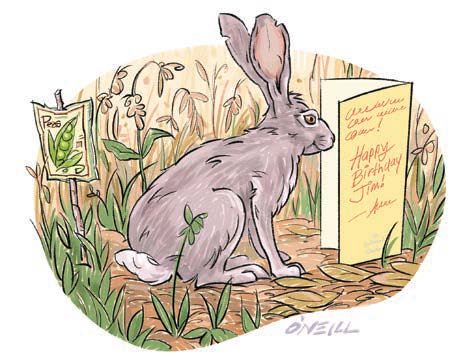
Ashley Walshe’s clever card amounted to a gentle poke from the universe, depicting an old, gray rabbit nibbling something in the garden. She knows I have a thing for woodland rabbits.

“Another year,” read the card. “Another gray hare — Happy Birthday!”

You may know Ashley from the soulful monthly Almanac she writes for the magazine, and from her many years adding earthy wisdom and wit to our editorial team. Among other things, she is a gifted poet and a true daughter of the Earth.

Not surprisingly, it was her accompanying hand-written message that reminded me of the lessons in gratitude and joy we’ve shared over the many years of friendship:

“In all seriousness,” she wrote, “thank you for showing me the joy of growing backwards . . . The secret, perhaps, to this wild, wonderful life on Earth.”

The idea of growing backwards is simply our way of describing a life in tune with nature, timeless values (some would call “old-fashioned”) that promote kindness and compassion to all living creatures and a deep reverence for the Earth.

In a year that has already seen apocalyptic wildfires out West, a record number of killer tornados in the heartland and a hurricane that will be remembered for generations, it isn’t much of a stretch to realize Mother Earth is sending us a serious message about our behavior.

Last November, Ashley and husband Alan nearly lost everything they own — including their lives — when their first home on a pretty hillside just outside Asheville was almost washed away by Hurricane Helene.

“At the height of the storm,” she remembers, “we were huddled in our house with our dog, Dirga, watching frightening torrents of water roar down the mountainside, washing away many of the houses around us. I remember asking Mother Mary to please keep us safe.”

Moments later, the couple heard a loud crash of trees that fell directly in the path of the rampaging waters, diverting the Biblical flood away from their home.

It was, she says, “a miracle. Nature saved our house.”

After escaping for a time to stay with friends outside the danger zone, the couple returned to find their home still intact but surrounded by a world of mud and debris.

“Helene brought me back to a higher level of consciousness, a desire to let go of things that don’t really matter in the course of daily life,” she says. “It also brought out an amazing amount of kindness and support among complete strangers who helped each other through the crisis. I think it changed many lives.”

The good news, she says, is that her bare yard is now a blank canvas awaiting the creation of a “wonderful new garden.”

Days after she told me this, she sent me a photograph of the lone plant that miraculously survived the Great Flood — a single, gorgeous tulip that popped up with the coming of spring. “Nature always gives us a gift,” she wrote.

That same afternoon, I noticed my own garden miraculously springing to life.

By now, it should really be something.

A More Beautiful Greensboro

A MORE BEAUTIFUL GREENSBORO

A More Beautiful Greensboro

The Greensboro Council of Garden Clubs continues planting for the future

By Ross Howell Jr.Photographs by Lynn Donovan

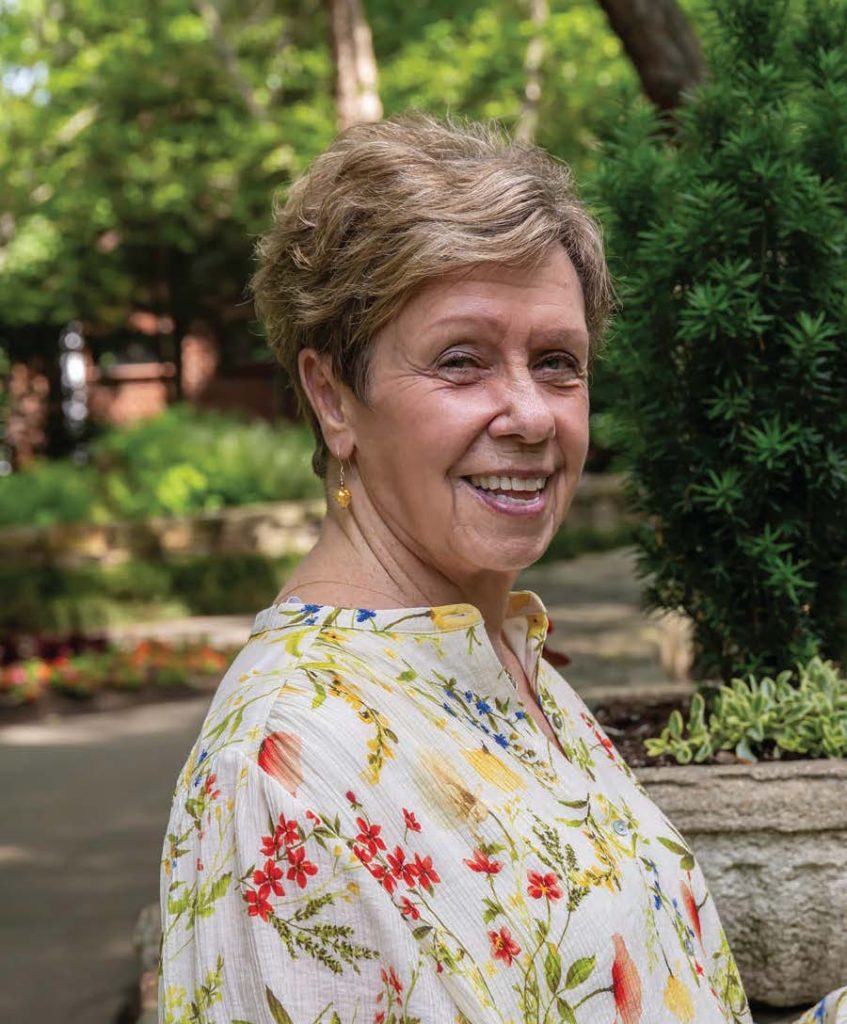
Gail Hill is proud that the Greensboro Council of Garden Clubs, where she now serves as a trustee, has been active in our community for 95 years. Not a bad run for a local civic group.

But because of changing family structure and lifestyles, Hill is concerned about its future.

Soft-spoken as Hill is, you’d probably never predict that she would have one day become president of the Garden Club of North Carolina.

But she did. And she’s played a key role in the GCGC’s longevity.

“I grew up on a tobacco farm in southern Guilford County,” Hill says.

Her grandmother “could poke a stick in the ground and it would grow,” she tells me. And her father inherited his mother’s green thumb.

“Dad was always out working in the garden, propagating some flower or other he’d started from seed,” she says.

While she enjoyed farm life, Hill spent enough time pulling suckers from tobacco plants to know that she didn’t want to marry a farmer.

So she married a businessman — her husband, Wayne, now retired. They moved around a good bit regionally for his career.

And Hill found herself becoming more involved in garden club leadership.

Back in 2005, Hill — along with the council historian and council secretary — compiled an award-winning history of the Greensboro Council of Garden Clubs to commemorate its 75th anniversary.

She was especially drawn to the history of the council, because her father — the man who’d inherited the green thumb — served in the U.S. Army Air Forces in WWII. He had been stationed where the Greensboro Council of Garden Clubs had been very active — the O.R.D. (Overseas Replacement Depot), where troops trained, awaiting orders to ship out to war.

While Hill was working on the council history, she was also serving as council president pro tem and director of District 5, the South Atlantic Region of the National Garden Clubs — comprising Kentucky, North Carolina, South Carolina, Virginia and West Virginia.

She was elected president of the Garden Club of North Carolina in 2015.

“I served two terms as president,” Hill says. “It was a lot of work and travel.”

Hill explains that, as president of the state garden club, she was responsible for eight geographical districts. Her duties included personal visits to each of those districts once a year.

Think of it. Our state comprises 100 counties reaching from the mountains to the sea.

“So I saw a lot of North Carolina,” Hill says with a wry smile. “But everywhere you went, the people were so enthusiastic.”

“It was wonderful,” she adds.

But times change.

In 1930, there were 11 neighborhood garden clubs that met together to create a citywide council with the objective of creating “A More Beautiful Greensboro.” While there are several neighborhood garden clubs today, there are just three clubs that participate in council meetings.

Hill believes that even neighborhood garden club memberships have fallen. The traditional model of afternoon meetings during the work week just isn’t practical. In most young families today, both husband and wife are often working, and if the couple have children, they must devote big chunks of time to their kids’ activities as well.

“We encourage young people just starting garden clubs to have meetings at night, have them on weekends,” Hill says.

These days, there are two types of fundraising programs that are the GCGC’s staples.

First, there are the ever-popular spring garden tours.

This May, the council’s “2025 Garden Tour” included home gardens in Irving Park, Fisher Park, Westerwood, Sunset Hills, Starmount Forest and Hamilton Forest, along with a tour of the hospice garden at Beacon Place on Summit Avenue.

“This fall, we’ll be finalizing our plans for the spring 2026 tour,” Hill says.

The second staple is a day of public educational seminars — one program in fall and one in spring — held at the Greensboro Science Center.

In March, the “Spring Gardening Seminar 2025” was held in the Sail Room at the Greensboro Science Center. Presentations included “Edible Landscapes” by Jeanne Aller, Master Gardener; “Flower Designs for Your Lifestyle” by Clark Goodin, owner and floral designer of Plants & Answers in Greensboro; and “Favorite NC Plants” by horticulturist Mike Trivette of Statesville.

Plans for the “Fall Gardening Seminar 2025” are currently underway.

Hill believes that educational opportunities hosted by the council are essential to the future of garden clubs.

“When we have these seminars, we have lots of young people come,” she says. “We can see that they love to plant and they love to grow flowers,” Hill adds. And often, she tells me, she signs up new members.

She reflects for a moment.

“A lot of us older members are just aging out,” Hill says.

“In the spring, my husband and I like to ride down Dogwood Drive to see the blossoms,” she continues. “And I think about the Greensboro Council and the Jaycees.”

Some of those trees were planted in 1954 during “Operation Dogwood,” a joint effort by the GCGC, the Jaycees and neighborhood garden clubs to plant 10,000 dogwoods throughout the city.

“Now the trees are too old,” Hill says. “We need to plant new seedlings.”

Then she smiles.

“The council is a wonderful organization,” Hill says. “It’s done itself proud.”

Greensboro Council of Garden Clubs

The lovely urban environment we take for granted has been shaped by years of dedication and selfless hours of service by generations of GCGC members. Noted here are a few of the markers in a timeline of achievement. Unmentioned are the sustaining funds provided to landmarks like Blandwood and the Greensboro Science Center; gifts to parks, gardens, schools and museums; and scholarships and community programs for young gardeners and gardeners who are young at heart.

1930 GCGC founded, Mrs. Charles (Anne) Hagan named president

1930-1932 First civic planting, Japanese cherry trees on E. Bessemer Avenue

1934-1935 Assisted development of Latham Park

1942 Called for “adequately housed farm produce market,” 12,000 people petition city

1943-1944 Gift to Red Cross for blood plasma at O.R.D. (overseas replacement depot)

1945 Planted 8,000 pansies on O.R.D. hospital grounds

1950 First home and garden tour

1954 “Operation Dogwood,” 10,000 dogwood seedlings planted in neighborhoods

1955 Planted 12 acres, Lindley Park Anniversary Garden (now Greensboro Arboretum)

1960 Planted Coliseum Memorial Court and purchased fountain

1967 Began sustained funding for City Beautiful (now Greensboro Beautiful)

1968 One of the founding sponsors of Greensboro Beautiful

1971 First Christmas tree display at Friendly Center auditorium

1971-1972 500 rose bushes planted in Anniversary Garden

1974 Major gift for creation of Bicentennial Garden

1980 Purchased sundial for Bicentennial Garden

1983 Major gift to Greensboro Beautiful for arboretum landscaping plans

2001 Construction and landscaping completed for GCGC building, Lawndale Drive

From “The Greenboro Council of Garden Clubs, Inc. History 1930-2005,” Gail Hill, president and Inez Ryals, historian.

Essay Contest Winner

ESSAY CONTEST WINNER

The Mummification of Leapy the Lizard

And the love language of science

By Karen Southall Watts

Note from the editor: This was our 2024 essay contest second place winner.

One of the ways my late father connected with us was by indulging our love of little critters. We had an elaborate aquarium setup where hundreds of mollies and swordfish lived, plus a series of cats, including one named Cedric who had his own small castle my father had built for him in the basement. Despite his decorated plywood castle, Cedric preferred to spend nights outside, where he collected mice. He would line them up on the front porch for my mother to find when she came home from work.

Once, we were allowed to bring home a huge bucket of frog eggs and hatch them. Unfortunately, we left the lid off the aquarium and hundreds of baby frogs escaped into my brother’s bedroom. Years later when we moved out of that house, we were still finding tiny, desiccated frog bodies in the cracks of the wood floors. Obviously, not all our pet experiments turned out well, which leads us to Leapy the lizard.

Leapy was an anole, which some people mistake for chameleons because they can change from green to brown, though they aren’t truly part of that family. He lived in a small, plastic cage, having been spared the huge aquarium that had seen the deaths of three iguanas. Henry I, Henry II and Henry III, all of whom, though indulged with lots of fruit-and-veggie treats, probably perished due to the lack of a heat lamp in an upstairs, suburban-Maryland bedroom. So, Leapy got smaller quarters that could be moved around.

He was green and cute, and we could not keep our little hands off of him. It should come as no surprise that this led to Leapy’s demise. The exact cause, revealed through tearful answers to adult questioning, seemed to be my little sister deciding that his red throat pouch was an injury that she needed to push back in. As yet another lizard went to the great beyond, my father looked for a way to distract us from the loss.

He told us we could mummify Leapy by following the step-by-step instructions that were, oddly enough, in the 1948 World Book Encyclopedia set my mother had inherited. Not having a source for a prime ingredient, natron, the mineral salt used by the ancients, a cough drop tin filled with Epsom salts sufficed. After a few days covered in salts, Leapy was ready for the next step. My father spray painted him gold and then mounted him on a small board he had lacquered with several layers of shiny, black paint. Then, Dad covered him with a plastic shell, making him immortal.

Just because Leapy was dead didn’t mean we stopped playing with him. He was taken to many show-and-tell days and incorporated into backyard games. Sadly, this last activity meant his golden, princely state was ended by an encounter with the lawn mower.

Many years later when I had my own children, I told them the story of Leapy the lizard. What I didn’t realize was that, when my youngest was in second grade, he retold the story at school for a Family Day activity and drew a picture to go with it. This was the first time I realized that my child was correcting his science teacher. On his class project, she had changed the word natron to nitrogen, telling my son that the first word didn’t exist. He was livid. So, on the night of the parent-teacher conference, I had to explain to his teacher that natron actually did exist and was a mineral salt, and it was, in fact, the substance used by ancient Egyptians to mummify the dead. She was not amused; nor was she amused several weeks later when my son corrected her in class because she didn’t realize that bats were mammals. Second grade was tough.

Over the years, I used the same types of strategies and science-driven activities my father had to connect with my own children. I’m sure our neighbors will never forget the archaeological dig in the yard, complete with perfectly square holes, measuring strings, and the happy accident of a long-forgotten cow bone.

Now, I’m a grandparent who routinely has to shampoo spider webs out of her hair. Recent adventures have included photographing dozens of mushrooms, fungi and insects, as well as befriending several worms and snails. Sure, I’m not as flexible as I was in my younger days, but I can still catch a toad when necessary. And, yes, it’s almost always necessary.

I was well into adulthood before I understood that my father’s unconventional parenting was the result of severe abuse and neglect. He had no memories of a happy childhood, and no example of decent parenting to guide him. He was making it up as he went along and used the part of his life where he’d found acceptance and success — science — to connect with his kids. It turns out that science can be a love language, perhaps the only one my father had. And while Leapy may not be truly immortal, his story has connected three generations of curious minds in my family.

O.Henry Ending

O.HENRY ENDING

The Album

Family photos launch a new road trip down memory lane

By Danielle Rotella Adams

My mom may remember my name today.

Or not.

I’ve come to terms with this as I enter her memory care home, walk down the bright hallway and round the corner into her room.

One of my mom’s neighbors is taking a lap down her hallway, walking toward me. I know for sure that he won’t remember my name.

“Hi, Bill, nice to see you,” I say as I walk closer. He replies with a curious, somewhat confused expression, “Nice to see . . . you?”

Last month, Bill told me that he takes 600 laps a day inside the building using his rollator. He said that he likes to keep moving.

Walking through my mom’s doorway, I don’t hear anything. Pure silence. We make eye contact and she recognizes me. I can see it in her eyes.

“Hi, Mom, how are you doing?”

The question lingers for a moment. She then breaks into her playful smile, which I’ve known my whole life. The smile I remember from countless soccer games and chorus performances.

I give her a hug and remove the cloth bag from my shoulder. “Mom, I brought another photo album for us to look through today,” I explain as she starts to look more comfortable and more herself.

A few short years ago, back in June of 2021, my mom was diagnosed with Lewy Body Dementia and Parkinson’s Disease. But I suspected something was up when I noticed that her right foot was always trembling, and she stumbled on words and phrases.

After the diagnosis, we worked together to sell her house and move her to an assisted living apartment. We carefully reviewed her financial and insurance accounts and added my name to her bank accounts.

Her disease held steady until it didn’t.

On September 30, 2024, I got the dreaded call that we couldn’t put it off any longer. She needed to move from assisted living to memory care.

Did it go smoothly? No, not really, but we got through it. She is adjusted now, our new normal taking shape.

Her speech is worse than ever, her words often jumbled or inaudible. She often knows the word she’s looking for, but can’t seem to locate it. She rarely knows what day it is and can’t operate her iPhone without help.

Despite this, I made a fortuitous discovery. Her words and memories return miraculously when we look at old photos together. As we start looking through albums, whether they are from 10, 20 or 40 years ago, she points to faces, clearly naming people she hasn’t seen in decades.

On this particular day, we’re looking at an album from 1983, reminiscing about a road trip we took to visit family in Upstate New York. Photos of my cousins, aunt and uncle gathered around my grandparents’ kitchen table transforms Mom back into the laughing, energetic young woman.

She remembers it all.

She points to her brother, my Uncle Rennie, remarking at how young and different he looked back then. Her words flow freely when talking about that summer. Photos of our 1972 Volkswagen Westfalia van bring us back to our long drive from North Carolina.

“I made those curtains on my sewing machine,” she remarks, her shaky finger pointing to the red floral pattern on the windows, which matched the faded exterior of her beloved van.

We laugh as we flip each page, surprised at how different life was in 1983. Our hairstyles were long and shaggy. No gray hair or reading glasses for either of us. No cane or walker for her.

Because at this moment, sitting on a small couch in her room on this cold, winter day, we are the 1983 versions of ourselves again — before a debilitating diagnosis had taken over.

She is once again a fearless single mom, and I am a wild, long-legged 8-year-old girl, both of us laughing back then and grinning widely now. I can almost feel the wind hitting my face as we drive southward home in the faded, familiar camper van.

Almanac June 2025

ALMANAC

June

By Ashley Walshe

June is a love poem, unrestrained.

Impossibly red poppies gaze upon achingly blue skies. Dragonflies bend for one another, clutching and curling like contortionists in flight. Swallowtails sup nectar, deep and sweet, enraptured by milkweed, sunbeams and endless summer days.

Can’t you see? All of life loses itself in itself. The rhyme is internal; the rhythm, organic; the imagery, holy refrain.

Each stanza surprises. Some, purple as passionflowers. Some, fussy as French hydrangeas. A precious few are sharp and true.

Bend your ear toward all that pulses. Get lost in the cadence of field crickets, the tranquil lilt of whippoorwill, the ballad of goldfinch and thistle. Find the harmony.

Complete the circuit. Behold poppies as poppies behold sky. Behold the dreamlike wonder.

Become a sunbeam. Become honey. Become, as wings, transparent.

Bow to the majesty of Queen Anne. Fashion a crown of singing daisies. Embellish your throne with honeysuckle and squash blossoms.

Are you dizzy yet?

Take a pause.

Rest in the dappled shade of sourwood. Let the hum of bees cradle you through afternoon. Come evening, swoon to the pink-and-yellow tune of rosy maple moth.

A good poem needs a good host. Can you be as milkweed to monarch? Sapsucker to birch?

Climbing oak to starry-eyed child?

Sup the sweetness of the moon-drenched night. Lose yourself in the wild beauty. Be, as green berry on vine, altered by the ardent kiss of
summer.

Father Sky

According to Navajo legend, Mother Earth and Father Sky were created as divine counterparts, their union essential to all life. Mother Earth gives us life. Father Sky offers the light of the sun, thirst-quenching rains and the endless mystery of the heavens.

In the spirit of Father’s Day (Sunday, June 15), consider looking skyward this month for a handful of celestial happenings.

The Full Pink Moon on June 11 is the last full moon of spring. No, it won’t be candy-colored.  According to The Old Farmer’s Almanac, Native American tribes (Algonquian, Ojibwe, Dakota and Lakota) named this month’s moon to mark the harvest of June-bearing strawberries.

On June 16 (the day after Father’s Day), you can spot the pairing of Mars and Regulus with the naked eye. Look for the fiery red planet gleaming alongside Alpha Leonis, the brightest star in the constellation Leo.

The Summer Solstice occurs on June 21. On this day — the longest day of the year — give thanks for the warmth and light of the sun and the wild abundance bursting from the Earth. And when night finally falls, you just might glimpse an early participant of the June Boötids meteor shower, which takes place June 22 through July 2 and peaks on June 27.

The Buzz, Etc.

Did you know there are 16 species of milkweed native to North Carolina? Sixteen! June is National Pollinator Month. Celebrate all that buzzes, hums and flutters by adding some native flowering plants to your little corner of the great, wide world.

Long Gone Avalon

LONG GONE AVALON

Long Gone Avalon

A what-if of what once was

By David Claude Bailey

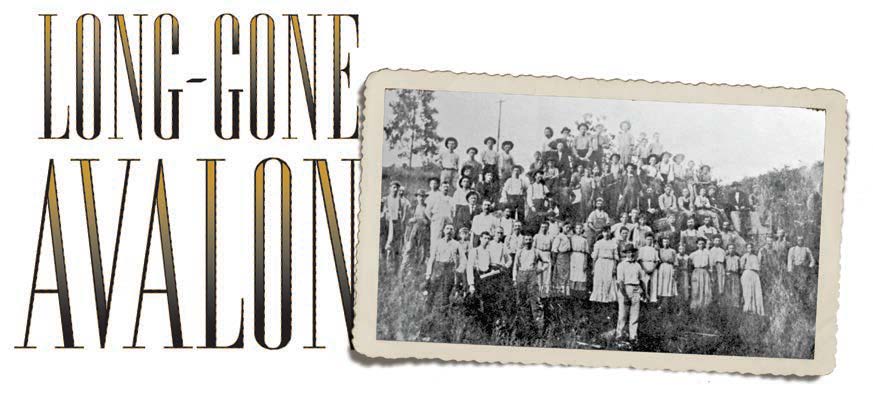
In 1977 while I was working at the Winston-Salem Journal as a cub reporter, Ola Maie Foushee sent a signed, self-published book to my dad: Avalon, a Pictorial and Sentimental Journey. The book joyfully heralded the happy, idyllic days of the now-abandoned mill town 2 miles from Mayodan. And there, on page 14 of the introduction, was my father: “Claude Bailey, a little boy next door, was my constant companion. We . . . made mud pies from dirt we mixed with water.” But sometimes there were no hand pumps or mud puddles to get water from, and my dad, Claude Colonelue Bailey, being a resourceful lad, had an idea. Ola Maie recalls, “When I needed water in a hurry, I considered him my most convenient source.” But not without consequences. “My father looked out the window just as Claude performed his favor,” she says, “And I was called home and given a good switching.” Ola Maie made no mention of my dad’s punishment, although, remembering my grandfather, Walter Fletcher Bailey, a no-nonsense, stern overseer at the cotton mill and a pillar in the Moravian Church, I suspect my father ate standing up for a few days.

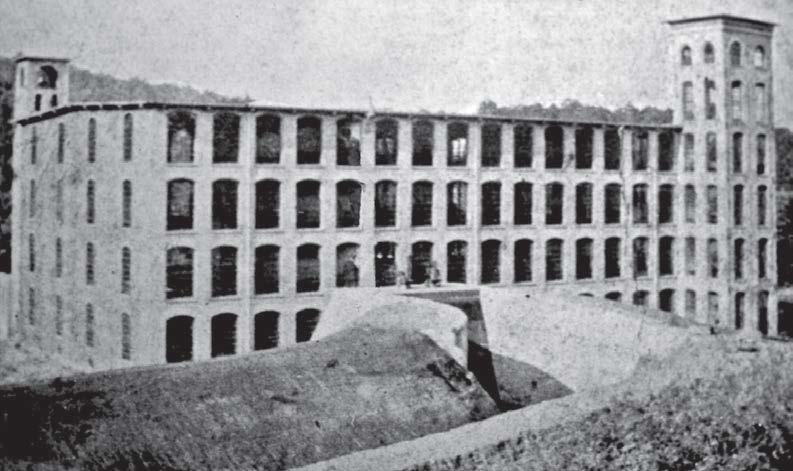
The picture Ola Maie painted of Avalon, as she emphasizes in the title, is sentimental — to a fault. “Avalon was truly a fairyland,” she writes. “Spread over an apron-like bluff on 100.33 acres of rising land, it overlooked the winding Mayo River, the Norfolk and Western railroad, and the new cotton mill — its raison d’être.”

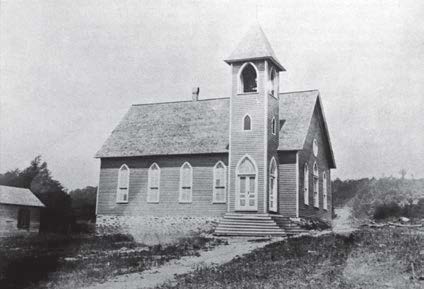
Ola Maie fondly remembers free-range children and chickens roaming up and down the streets among the 62 newly built houses, many of which had picket fences with roses and morning glories climbing them. She shares her memories of Easter egg hunts at the company-built Moravian Church, Sunday afternoons with the Avalon baseball team at play, summer picnics where watermelons cooled under the tables as cakes, pies and country ham biscuits spread out on tablecloths, boys swinging from grapevines into the river while couples courted along its banks. She tells of families cooking meals over the hearth in their company mill houses (provided at a rent significantly lower than in Mayodan or Madison), of out-of-towners coming to visit in the 11-room company hotel, of bowling and roller skating upstairs at the country store, and of town folk square dancing as old-time music echoed off the four-story-high cotton mill. At its peak, 400–500 people lived in the village.

I remember my family and relatives poring over Ola Maie’s book, finding a photo of dad looking like a young 5-year-old ruffian; another of my granddad grimly posing as a foreman on the factory floor with the workers he oversaw; and a picture of the Bailey house, where my dad was born, sitting proudly next to the hotel. Although my father’s fame as Avalon’s most infamous mud-pie maker was short-lived, it inevitably came up at Bailey family reunions.

Avalon Mills was incorporated in 1899 by tobacco tycoons R.J. Reynolds and B.N. Duke. Leading the charge was a relatively young upstart, Colonel Francis Fries, who, by the age of 45, had already helped establish the Roanoke & Southern Railway, of which he was the first president, as well as Mayo Mill in Mayodan. When Avalon Mills went into operation in 1900, it was not only a “modern,” state-of-the-art operation, but the largest textile mill in the state. By 1910, the mill employed 250 workers, a quarter of them under the age of 16 and some even younger than 12. To her credit, Ola Maie does not gloss over the issue of child labor in the mill, along with low wages, but I’ll get to that later.

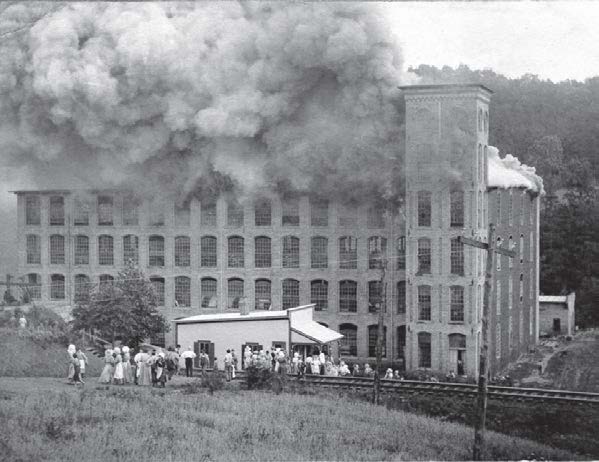
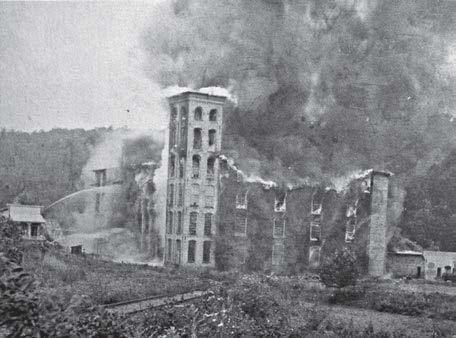
Spoiler alert. On June 15, 1911, 11 years after the mill opened, John Richardson was overseeing some spinning frames on the mill’s fourth floor. It’s worth pointing out that all the mill’s machinery was driven by leather belts that ran all the way down, floor-to-floor, to the mill’s river-driven turbine, so all the floors of the mill were open to one another. It was around 6 p.m., quitting time, when John smelled, and then saw, smoke. A bucket of water he threw on the fire proved to be too little, too late. Layers of machine oil, lint and dust covered almost every surface, and with the wind blowing through open windows, flames soon engulfed the fourth floor. In minutes, the flames spread to lower floors via the leather belt system. Although two teenage brothers ran down the stairs, screaming “FIRE” at the top of their lungs, workers heading for supper and home decided it was a prank. By dusk, all that remained of the mill was a ghostly shell, with a hulking six-story tower looming over the ruins. Miraculously, no one died, although several of the mill’s overseers had to be rescued via fire ladder. A state-of-the-art sprinkling system never activated because a bearing in the 1,000-gallon-a-minute pump failed.

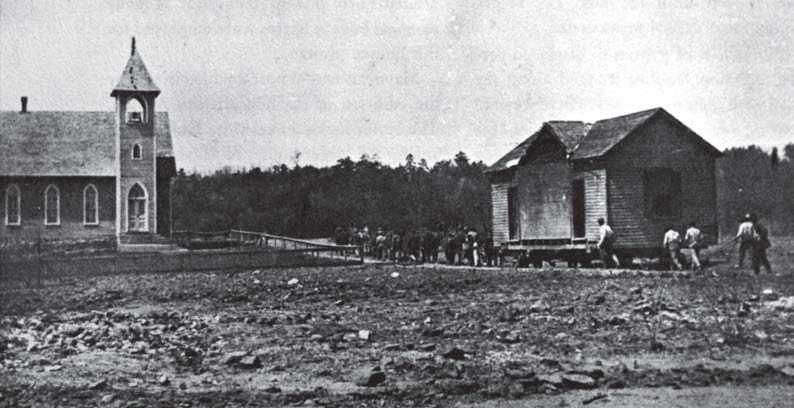
Initially, the mill’s owners talked about rebuilding, but, in the end, families lost both their jobs and their homes. The houses they had once rented were rolled atop logs by horses and mules to Mayodan, where some still stand, including the house my dad was born in. Even the church was disassembled and sold off piece by piece.

“Like bands of gypsies or displaced persons, Avalon families trudged along the road with their possessions,” Ola Maie laments. “None of us wanted to go. We were like one big family.” Many of the workers took jobs at other mills operated by Fries or found work in the plethora of mills that had sprung up along the Piedmont’s rivers. Inexplicably, my grandfather decided to go back to farming tobacco. Why, I’ve always wondered, did Walter Fletcher Bailey, in the prime of life at age 35 with five children, choose to go back to the unpredictable and back-breaking occupation of dirt farming? A foreman in the mill before it burned down and a chairman of the board of the Moravian Church, surely he would have been offered a job. My aunts and uncles had no clue.

I think maybe I do.

As someone who covered business working for O.Henry’s sister pub, Business North Carolina, I have, by choice and occupation, become something of a student of what mill life was like in the South. An excellent website, Avalon: Documenting the Rise and Fall of a Cotton Mill Village, provided me with a keener insight into the town and mill. But my eyes were really opened when I read Like a Family: The Making of a Southern Cotton Mill World, UNC Press’ landmark compilation of oral histories gathered from mill workers all across the state. BNC’s publisher at the time, David Kinney, whose mom worked in a mill, required every new hire to read the book. While many remembered a community that was, in fact, like a family, it was definitely a dysfunctional family, with an often overbearing and often heartless “father.” While former workers, like Ola Maie, waxed nostalgic about church and baseball teams and close-knit neighborhoods and picnics, mill workers interviewed for Like a Family were quick to paint a picture of life in the mill as harsh, dangerous and monotonous.

The hours at Avalon were from 6 a.m. in the morning until 6 at night, five days a week, plus nine more hours on Saturday. Lint and dust filled the air, and the atmosphere inside the mill was often almost unbearably hot and humid. The pace of work was unrelenting and overtime was common. Pay at Avalon reflected what was generally paid statewide in 1911. It ranged from $1 a day to $2.50 a day for the highest paid workers ($37–93 in today’s money). Workers who showed up minutes late could be docked from a quarter day’s work up to a full day. Children, who made up a quarter of the workforce at Avalon, were often tasked, because of their size, to crawl atop the machines or into their inner working to fix snags and snafus. They were paid $.20–.30 cents a day ($7.31–11.27). Unskilled women were paid the second-lowest wages, $.30–.75 ($11.27–28.18). So wages ranged from about $44 for a six-day week to $558 a week for the highest paid employees.

Admittedly, housing was provided at a very reasonable rate, but if you lost your job, you lost your home, encouraging workers to go with the flow. Injuries, like losing a finger, hand or arm, often meant both unemployment and homelessness. The houses, though newly built, were 600 square feet, with some accommodating four families. Plumbing was outdoors, of course, and the houses didn’t have electricity, though the mill did. Cooking happened over hearths, with no cook stoves.

Of course, life on a farm in that era was, arguably, even more grueling — harsh, dangerous and unpredictable. Crops failed and prices went unpredictably up and down. The hours were just as long as, if not longer than, in the mill, and you worked outdoors in the blazing summer sun or freezing winter weather, unlike mill work. And anyone who’s ever worked on a farm will tell you that child-labor laws don’t extend to farm families.

My father and my aunts and uncles painted a sometimes grim picture of life on the farm, but they also had warm and loving memories of rural living. I found it interesting that none of the five boys turned to mill work, with all of them distinguishing themselves by following other successful careers. My granddad was his own boss and with, eventually (God bless my grandmother), nine children, he had a captive workforce. He didn’t get rich, but made a good living and, from my memory, they sure ate well, with country ham, fried chicken and biscuits aplenty.

Over the years and little by little, I came to appreciate why — I imagine —  my grandfather decided to go back to farming.

If my father had worked in the Avalon mill as a child, I’m certain he would have told me, along with the many stories he spun about the mischief he and his brothers got up to on the farm, all about mill work. And maybe the course of history, in Avalon at least, might have been altered if he had. What if, on that fateful day, he had worked on the fourth floor and had been standing by with his “most convenient source” of water?