Sazerac May 2025

SAZERAC

May 2025

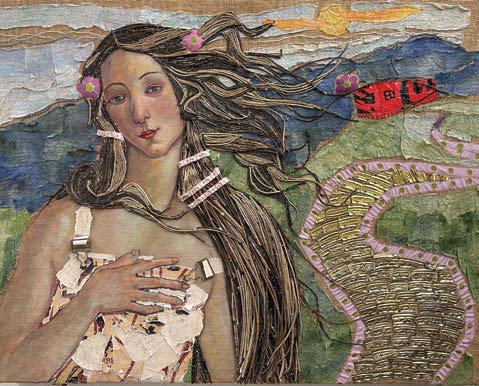
Celena Amburgey, Blue Ridge Venus, 2024. Oil Paint, vines, mason jar rings, cardboard, love letter from the artist’s father (paper), and a childhood bedsheet (fabric) on burlap, 30 x 38 x 1 ½ in.

Just One Thing

For Celena Amburgey, home is where the art is. “By intertwining paint, mixed media and deeply personal items like my daddy’s bed sheets, my work becomes a vessel for layered narratives,” says the creator of Blue Ridge Venus, which combines oil paint, vines, Mason jar rings, love letters from her father and a childhood bedsheet. “These intimate objects carry the weight of my heritage,” says the artist, who hails from Jefferson, N.C. Utilizing both personally precious as well as oft-discarded items such as plastic bags and grocery sacks, she says, “I craft a powerful dialogue on the tension between what is cherished and what is disregarded, drawing attention to how we assign worth and value in our lives.” Amburgey’s works, along with art by two other M.F.A. candidates, Paul Stanley Mensah and Nill Smith, will be on exhibit through May 25 at Weatherspoon Art Museum. Meet the artists on Thursday, May 8, from 5:30 until 7:30 p.m. Info: weatherspoonart.org/exhibitions/current-exhibitions.

May 25 Unsolicited Advice

If, like the rest of us, you’re trying — but struggling — to break up with your smartphone, this one’s for you. Those little buggers are full of dopamine hit after hit, lighting up our brain in a way that screams, “More, more, more!” When we find ourselves in a moment of quiet inaction, our fingers wander to that tempting touchscreen, desperate to fill the void. Well, we’ve come up with some digital-free ways to occupy those digits while taking a note from Depeche Mode: “Enjoy the Silence.”

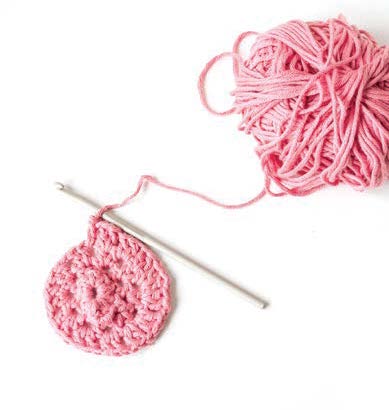
Get hooked on something new: Learn to crochet. If you start now, you’ll have an entire collection of colorful hats to gift friends and family during the holidays.

Play solitaire. And not on an app, but with a real, tactile deck of cards. Best part? No one will ever know if you cheat — not that we’re endorsing that behavior. We just have the luck of the draw.

Try your hand at building. Scandinavians are consistently ranked among the happiest in the world and it’s probably because they’re constantly creating with Legos, which originated in Denmark, or putting together Swedish-made Ikea furniture. We certainly smile — through gritted teeth while cursing — when we assemble a Kallax shelf.

Read. As the proverb goes, “A book in the hand is worth two in your library queue.” Or something like that.
Window on the Past

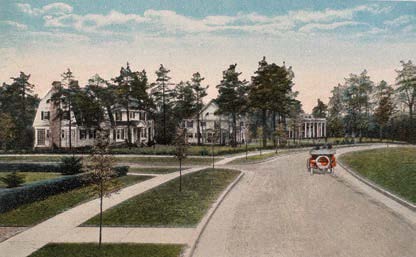
Though much of Greensboro has changed over the years, the charming facade of this Irving Park Dutch Colonial, the historic R.J. Mebane House, remains very much the same since its circa 1912–13 construction. Wondering about the interiors? See for yourself as this and many other Irving Park abodes throw open their doors, welcoming guests of Preservation Greensboro’s Historic Tour of Homes, May 17 and 18. History, architecture and design come together to help you reach your step goal. What more could you want? Tickets and info: preservationgreensbo.org/events.
Must Love Books

Reading, writing and arithmetic? No, thanks on that last part of the equation. The Greensboro Bound Festival is where reading, writing and book fanatics create a buzz of all-day literary activity descending upon the cultural epicenter of downtown Greensboro.

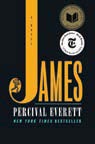
But first, at 7 p.m. on May 15, how ’bout a little pre-fest fun with . . . (if this were an audiobook, you’d hear a drumroll right now) . . . Percival Everett, The New York Times-bestselling author of several novels, including the 2024 National Book Award for Fiction winner, James? A reimagining of Mark Twain’s The Adventures of Huckleberry Finn, James is told through the eyes of the runaway, enslaved Jim. Everett is sure to draw a huge crowd, filling up UNCG’s Elliott University Center Auditorium. Registration is required ­ and is now waitlist only by May 12 and can be found via the Greensboro Bound website.

Now, hold onto your pen caps and block out May 17 in your planner because this year’s one-day festival is, well, one for the books.

Dreaming up your own manuscript? Learn every trick in the book at the Greensboro Public Library. Three O.Henry magazine contributors, plus a few local notables, help you sharpen your skills — and pencils. Our founding editor, Jim Dodson, teaches “The Art of Memoir” — something he knows a little something about after writing Final Rounds, a New York Times-bestselling memoir. Maria Johnson hones your humor and Ross Howell Jr. shows you how to easily slip between fiction and nonfiction writing. Poets Ashley Lumpkin and Elly Bookman, plus Chapel Hill-based cookbook author Sheri Castle know how to measure for success.

In the Greensboro Cultural Center’s Van Dyke Performance Space, take a page from several authors in conversation. O.Henry editor Cassie Bustamante, yours truly, interviews Winston-Salem’s New York Times-bestselling author, Sarah McCoy, and Reidsville’s Sir Walter Raleigh Award winner, Valerie Nieman, about making herstory with historical fiction. Former Wall Street Journal writer Lee Hawkins, whose 2022 nonfiction book, I Am Nobody’s Slave: How Uncovering My Family’s History Set Me Free, was a Pulitzer Prize finalist, chats with Aran Shetterly, author of the harrowing account of the KKK vs. Civil-Rights demonstrators, Morningside: The 1979 Greensboro Massacre and the Struggle for an American City’s Soul. Andy Corren, whose Dirtbag Queen: A Memoir of My Mother was born out of the obituary he wrote for her that went viral, chats with Cassie. Finally, wrap up your evening with a conversation between Christopher A. Cooper, author of Anatomy of a Purple State, and spiritual writer, preacher and community cultivator Jonathan Wilson-Hartgrove, moderated by Raw Story investigative reporter Jordan Green.

Beyond the Greensboro History Museum’s doors, Kristie Frederick Daugherty, known for her book of Taylor Swift-inspired poetry, and UNCG M.F.A. alum Elly Bookman, plus local high school poet laureates read and discuss their modern take on the ancient art form. Known for her New York Times bestsellers Wench and Take My Hand, NAACP Image Award-winning author Dolen Perkins-Valdez chats about her latest book, Happy Land, which hit the shelves last month.

And what’s a festival without something for the littlest readers and aspiring writers? The second floor of the cultural center is chock full of children’s authors including Kamal Eugene Bell, Natasha Tarpley and Patrice Gopo.
Sage Gardener

“Wait,” says our hiking companion at the head of our group. “You’re saying that bees are not native?”

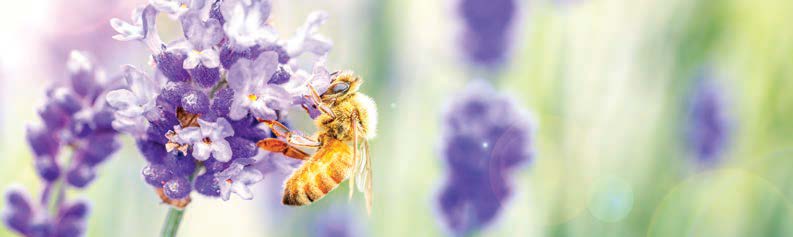
“Honey bees,” our citizen-scientist hiker responds. “It’s honey bees that are not native to the Americas. But there are hundreds of species of native bees.” (More than 500 in North Carolina alone, in fact.)

“How about honey,” the disbeliever shoots back. “Are you telling me that the honey I put on my toast in the morning is a non-native species?”

“The bees that gathered and regurgitated it are originally from Europe, brought over here to pollinate the Colonists’ crops in the 1600s,” says our apiculturist.

“Yeah, I read that the Virginia Company brought hives over when they established Jamestown,” pipes up the group’s historian. “So, yes,” says our honey bee detractor, “the honey comes from the U.S.A. — unless it’s imported from India, Argentina or Brazil, like a lot of cheap honey is.”

To say that our trail discussions are often lively is a gross understatement. At least it’s not politics this time around, I think to myself.

“I’m going to look that up,” our lead hiker says, an all too common refrain on these hikes. Moments later, Siri chirps, “Here’s an answer from gardenmyths.com: ‘The honey bee is a non-native import into North America and most other countries.”

“But honey bees pollinate our crops,” our dissenter insists. “Without them we would starve!”

Citizen scientist says, “A lot of crops are now engineered to be self-pollinating or even wind-pollinated. I’ve grown tomatoes in my living room with no bees and I still had tomatoes,” she counters. “Besides, a big hive of honey bees can outcompete native bees, sometimes the sole pollinators for certain native plants.  Without that bee, the plant can go extinct.”

You can read all about it in our Raleigh sister publication, Walter (waltermagazine.com/home/the-buzz-north-carolina-coolest-native-bees) in a piece by Mike Dunn, a Chapel Hill naturalist and educator. “Our native bees are truly bee-autiful and bee-zarre,” he writes. Plus, he points out, practically no one ever gets stung by native bees.

Or dive into the N.C. State Extension Service’s The Bees of North Carolina: An Identification Guide, available online (content.ces.ncsu.edu/the-bees-of-north-carolina-identification-guide), where you can see stunning photos of wood carder bees, rotund resin bees, cuckoo leaf cutter bees, zebra cuckoo bees, along with scintillating anatomical diagrams.

A whole ’nother subject is plants that nurture and support native pollinators. In March of last year, the Greensboro City Council adopted an official policy to promote native plants and eliminate invasive plants at city-owned facilities.

“Native plants help maintain, restore and protect the health and biodiversity of local ecosystems, supporting native pollinators, birds and other wildlife,” the City proclaimed. The Guilford County Extension Master Gardener volunteers couldn’t be more enthusiastic about those plants our native bees love, sponsoring periodic workshops on them. On Saturday, August 23, from 10 a.m. until 1 p.m. (guilford.ces.ncsu.edu/2025/02/2025-great-southeast-pollinator-census), they plan a count’em-if-you-got-them session as part of the the Great Southeast Pollinator Census.

Meanwhile, detractors of honey bees — especially lovers of native wildflowers like our citizen-scientist hiker — continue to blast Apis mellifera, that European intruder to our shores. One enthusiast at ncwildflower.org/honey-bees-friend-or-foe suggests, “Do not buy honey. Kill any wild hives you encounter. And discourage the use of domesticated hives transported to pollinate crops.” 

Y’all bee careful out there, now.     — David Claude Bailey

Birdwatch

BIRDWATCH

Big Blue

The majesty of great blue herons

By Susan Campbell

The great blue heron is a bird that will get anyone’s attention, bird lover or not. It is the largest of all the species found in the Piedmont and Sandhills and is second in wingspan only to the bald eagle. Also, the way it ever so slowly stalks its prey in the open is unique. Great blues are colonial nesters often gathering very close together in trees in wet environments where terrestrial predators are not a threat.

Great blues can be found across North Carolina year-round foraging in a variety of wet areas. However, nesting habitat can be harder to find. Many wet areas are too shallow to preclude raccoons, opossums and other climbing animals. Sizeable beaver ponds or islands in the middle of sizeable lakes with mature trees or large snags are attractive. And if a pair or two are successful in raising a brood high above the water, it is likely that the numbers of nests will grow in subsequent years to form a “heronry.” The female will weave a cup nest from the branches and then smaller, softer material (such as twigs, grasses, moss, etc.) that her mate delivers.

The bond between a pair of great blues is very strong during the breeding season. Male and female are both involved with rearing the nest generation. The large nest can accommodate up to five eggs. Both adults incubate and then brood the young. The male spends most of the daylight hours at the nest while the female is there overnight. Herons are very good parents, able to defend their young with not only their heavy, sharp bills but with very powerful wings.

It will take a year or more for the young to reach maturity. During the first several weeks they are fed mainly fish by their parents. As they begin to forage for themselves, they will become opportunistic, eating everything from large, aquatic invertebrates (such as crayfish) to frogs and even the eggs of other bird species. Some individuals will not breed until their third summer. Sexually mature birds will sport long plumes on their neck and back. They may be seen displaying to their mates by raising their crests and clapping bills together at or near the nest site.

The loud raspy croaking of herons is territorial and can be heard day or night at any time of the year. They will defend rich feeding areas as well as their nest from competitors. Great blues also call when in flight, perhaps to maintain contact with family members. In the air, these big birds have a very characteristic profile with slow, deep wingbeats, their necks coiled, and legs trailing out behind them.

These huge birds are amazingly unafraid of humans. Although they seldom tolerate a close approach, they are frequently found feeding from bulkheads, farm ponds and even small backyard water features. Many great blue herons have learned that people may provide an easy meal — even if it is in the form of fish remains or table scraps. So, keep an eye out; you may find one of these large birds closer than you think.

Almanac May 2025

ALMANAC

Almanac May

By Ashley Walshe

Come with me into the woods where spring is advancing, as it does, no matter what, not being singular or particular, but one of the forever gifts, and certainly visible.

Mary Oliver, from “Bazougey” (Dog Songs, 2013)

May is the dreamer and the dream, the artist and the muse, a wish both made and granted.

Daisies are sweet, she must think to herself, giggling as she scatters them across green spaces and rolling meadows, weaving them among butterfly weed and purple coneflower; gently tucking them alongside bluebells and Indian blanket.

A dusting of iris for the pine forest. Jack-in-the-pulpit for the wet and shady woodlands. And for the garden? Peonies, poppies, sweet peas, gardenias and roses.

“Come to me,” says flower to bee.

“Only you,” bee purrs to blossom after fragrant blossom.

And so it goes with milkweed and monarch, yarrow and ladybug, foxglove and hummingbird.

“I’ve been aching for you,” murmurs snake to sun-warmed stone.

“Ditto,” stone whispers back.

Listen to the queenking of treefrog, the whistling of robin, the moonlit chanting of whippoorwill. All of life is a call and response, even if we can’t perceive it.

Magnolia flowers titter at the touch of beetle feet. Phlox swoons at the kiss of eastern swallowtail. Cottontail quivers at the nip of wild strawberry.

New leaves reach for the generous sun. Earthworms pray for rain. Dandelions wish for children.

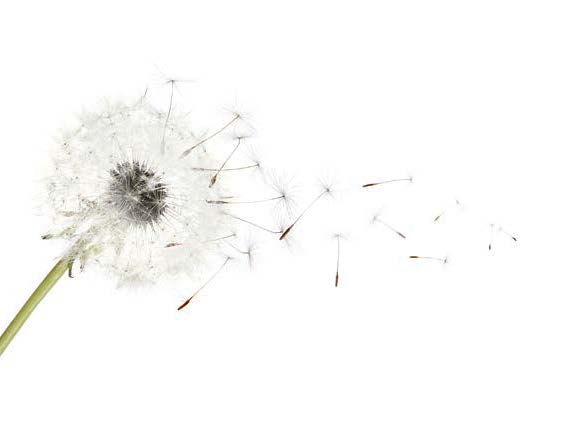
“Pick me,” a puffball whispers on a gentle breeze. A little boy answers, lifts the downy orb to the light, closes his eyes, and sends one hundred wishes soaring — ninety-nine of them dreams for the gift of an endless spring.

Legendary Sweetness

The Cherokee legend of the first strawberries tells of a quarrel between the earliest man and woman, and the sun’s role in their reconciliation.

“I shall live with you no more,” says the woman, storming away in anger. Seeing that the man is sorry for his harsh words, the sun intervenes. Casting his golden rays upon the earth, he sends plump raspberries, glistening blueberries, then luscious blackberries. The woman blasts past all of them. Finally, when sun-warmed strawberries appear gleaming at her feet, she stops in her tracks. One bite and the sweetness washes over her. Filled with the joy she shared with her husband before their fight, she gathers the strawberries to share with him.

“To this day,” writes Joseph Bruchac in The First Strawberries, a retelling of the Cherokee story, “when Cherokee people eat strawberries, they are reminded to always be kind to each other; to remember that friendship and respect are as sweet as the taste of ripe red berries.” 

Want to pick your own strawberries this month? Find PYO farms across the state at pickyourown.org.

Mama Loves You

Mother’s Day is observed on Sunday, May 11. As you celebrate all the mamas you hold dear — mother comes in many forms — don’t forget the one who holds us all. We love you, Mother Earth. Thank you for all that you give. May we learn to honor you through our choices, our actions and our grateful hearts.

O.Henry Ending

O.HENRY ENDING

A Visitation on Epiphany

Walking Kiki home

By Woodson E. Faulkner

Lingering after the resounding organ postlude, I pause to take in the Cathedral of St. John the Divine in New York. Stepping through its arched entrance is like walking into a portal of a distant time when things happened slowly, deliberately. Being one of the last to exit after the Feast of the Epiphany service, I catch a glimpse of the vicar and compliment his homily, which asked the question, “Why are we here?” In his sermon, he suggested that those of us who were present were seeking to build a community not just of believers, but of members of a “peaceable kingdom,” where common respect, kindness, and desire for truth and beauty might come together. He accepts my compliments graciously, bidding me “Happy New Year.” 

As I step outside into the night, assaulted by a cold, bracing wind that New York is famous for, I begin the journey back to my Westside Avenue apartment when suddenly, gently, a hand reaches out to my left arm. A little voice breaks my stride: “Would you please help me home? I’m blind, you see, and can’t navigate the steps and curbs very well anymore.” I extend my arm and graciously agree to guide her the two blocks to her apartment.

I finally get a good look at this tiny woman wearing a broad-brimmed hat that flops up and down in the wind, obscuring her face. She is no more than 5 feet tall, wearing an elegant overcoat and dainty shoes. She speaks to me in short, fast sentences, giving me tips on how to help someone who’s blind. “Now, you have to walk slowly and time your footsteps with mine so I can follow you.” At the first intersection, she tells me she’s a jaywalker “because they don’t see you when you’re using the zebra stripes,” aka the designated crosswalk. “They’re just looking at the light. So, you have to make them see you by walking in a way that they are not expecting.” While this seems like a risky idea, I take her advice and guide her kitty-cornered across the street. 

I’m fascinated by this lady’s spunk and determination to get around, relying on the kindness of strangers. As we time our footsteps together, I find the slower pace relaxing, devoid of the anxiety that the typical, brisk-walking New Yorker seems to exhibit. 

“Just one more block,” she says. She slides her hand up, taking hold of my shoulder as we make our way down the final terminus. “You know, I hitchhiked my way around the world when I was younger,” she exclaims. “I’ve been blind all my life, but that didn’t stop me. People expected me to shut up in my room and just wither away! I wasn’t going to do it!”

“Wow,” I say, gasping in amazement at what this little lady must have experienced. “That’s incredible. Were you afraid?” I ask.

“Well, at times, maybe a little, but most people were good to me and helped me get right along.”  

As the Cathedral bells sound their hourly peel, we arrive at her apartment. Just then, tiny, drifting snowflakes begin falling like fairy dust. “Here we are. I’m in the one way up there — you see it?” she asks, pointing with her cane to a place in the dark.

“Oh yes, it’s lovely,” I respond. Just then, the doorman opens the door. As she releases her grasp on my shoulder, I ask, “What’s your name?”

“Kiki,” she says. I stop in my tracks, jolted by suddenly remembering that tonight is the 10th anniversary of my mother’s passing. Her nickname was also Kiki. 

Passing Kiki off to the doorman, I turn and look up at the gentle snow, falling more and more fully as it caresses my face. As the door closes, I catch a faint scent of gardenia coming from the apartment building’s lobby. That was my mother’s favorite flower. 

 “Goodnight, Kiki!” I say as the snow begins to melt down my cheeks.

Simple Life

SIMPLE LIFE

Gone But Not Forgotten

The legendary newspaper woman who changed my life

By Jim Dodson

According to latest government projections, a record 3.7 million high school kids and 4.11 million college students will graduate this spring. In a world turned upside down by partisan politics and unpredictable economics, worries about the future are understandable. 

Once upon a time, I was there myself, waiting for the direction of my life to present itself.

In late spring 1976, America’s Bicentennial year, I was enrolled in a new M.F.A. writing program at UNCG and working part-time for my dad in advertising until I could figure out what to do with my life. America was slowly coming out of a powerful recession and job prospects were thin on the ground.   

Sadly — or maybe not — I turned out to be a lousy ad salesman. I could talk up a storm with my old man’s clients but never quite close the deal.

I also had an alternative plan of caddying for a year on the PGA tour, which proved to be a bust when I was assigned a tubby, wisecracking CBS TV star for the Wednesday Celebrity Pro-Am who’d never played the game. He told vulgar jokes to young women in the crowd and roguishly passed gas loudly to amuse the gallery. After a long and humiliating afternoon fetching my client’s lost golf balls from creeks, backyards and thorny bushes, he handed me a $2 tip and advised with a wink, “Don’t spend all that in one place, Sonny.”

I hurried straight to the Sedgefield Country Club bar with just that in mind.

At that early hour of the evening, the bar was empty save for an elderly gentleman sitting around the corner of the bar, nursing a cocktail.

As I drank my beer, to my shock and delight, I realized the gentleman at the end of the bar was none other than Henry Longhurst, the celebrated Sunday Times golf writer and CBS commentator — one of my literary heroes.

“Young man,” he spoke up with his charming grumble, “you look like I feel most mornings when confronting myself in the bathroom mirror.”

When I mentioned my horrible afternoon of caddying for a farting buffoon who killed my dream of caddying on the Tour, Henry “Longthirst” simply smiled. He asked what other options I had in mind. Confessing that my heart wasn’t into my graduate studies, I boldly commented that my real goal was to someday become a golf writer.

The great man nodded and slowly rose, placing a fiver on the counter. As he headed to the door, he placed his hand on my shoulder and said quietly, “Well, young man, if you do decide to write about this ancient game, you will find no shortage of rogues, bounders and peculiar characters, but also inspiring champions and some of the finest people on Earth. Good luck to you, then!”

I was thrilled by this encounter, taking it as a sign that the universe would deliver something good down the fairway of life.

A few days later, I received a phone call from Juanita Weekley, the managing editor of the city’s beloved afternoon newspaper, where I’d interned for two summers. She invited me to drop by for an interview.

“Be here at 5:30 sharp,” she said. “But don’t get your hopes up. You have lots of competition.”

I found her alone in her office the next afternoon. “Come in and close the door,” she said in her famous no-nonsense way.

Mrs. Weekley was a newspaper pioneer, the first woman to edit a major newspaper in the state, a tough, plain-spoken redhead who reminded me of Lou Grant, the crusty editor from The Mary Tyler Moore Show.

As I sat down, she pointed to a stack of folders on her desk. “These are applications from half a dozen outstanding candidates for this job. They are all female from top journalism schools. I’ve been instructed by personnel to hire a female. My question to you is, why should I even consider a skinny white kid from the west side of Greensboro?”

I understood her point. But I also had nothing to lose. I was still buzzing from meeting one of my sports journalism heroes.

Brazenly, I replied, “Because I’ll write circles around them all.”

Madam Weekley did not appear amused. Instead, she reached over her desk, picked up the wickedest-looking letter opener I’d ever seen and tapped it slowly on her desk.

“OK,” she said after a long pause. “I’m going to take a chance on you. But listen closely. If you’re not the best damn writer in this newspaper in a year, I’ll chase you out of the building with this thing.”

I spent the next year writing like mad to avoid being run off by her evil, sharp tongue and even sharper letter opener. At one point, however, Mrs. Weekley called me into her office and handed me the keys to a wheezing, 1970 day-glow orange AMC Pacer staff car and instructed me to drive a 75-mile circumference around the Gate City, searching for “good stories about country life” for the Sunday paper’s Tar Heel Living section.

“Think of it this way,” she said. “You’ll be our version of Charles Kuralt, writing about rural life and colorful characters you meet along the way. It’s right up your alley.”

She wasn’t wrong. 

Over the next six weeks, roaming the backroads of the western Piedmont and the Blue Ridge foothill country, I found an assortment of fascinating small-town stories and colorful folks to write about, including several homegrown artists, a brilliant Yale-educated physician running a clinic in an impoverished mountain town, an award-winning poet, a famous moonshiner, the biggest Bluegrass festival in history, and the winner of a Bear Creek talent show, whose mom invited me to marry her daughter after she graduated from high school. I politely declined.

Looking back, it was the best job any rookie reporter ever had — one that shaped my life.

My “country” tales won a major newspaper award and landed me a staff job at the Sunday Magazine of the Atlanta Journal-Constitution, where I was the youngest writer of the oldest Sunday magazine in the South.

Two decades later, I was back in my hometown on a national book tour for my bestselling memoir, Final Rounds. 

I stopped off to say hello to Juanita Weekley, the pioneering woman who took a chance on me way back when, and bring her a signed copy of my book.

She was in declining health. But her face lit up when she opened the door. We hugged and sat for an hour, and I thanked her for not running me off with her letter opener.

As she walked me to the door, she took my hand. “I knew you were going to be a superb writer,” she said, holding back tears. “I just didn’t want you to know that! I couldn’t be prouder of you, dear. Hiring you was one of the best things I ever did in my career.”

I kissed her cheek and thanked her. “It would never have happened,” I said, “without you.”

Juanita Weekley passed away in 2003.

Gone but never forgotten.

Life’s Funny

LIFE'S FUNNY

Type Cast

How Greensboro’s Nich Graham rocks his Royal Safari

By Maria Johnson

Tangerine, soul, gossip, smoke.

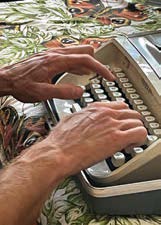
It’s an odd foursome of words, but Nich Graham has invited me to bring prompts to our coffee-shop interview to spark the free verse that he pounds out on his old-school mechanical keyboard.

It’s his schtick and his bliss. Back for the second year in a row, Nich will bring his Typewriter Poetry, a form of performance art, to the Greensboro Bound book festival this month.

Clack-clack, clack-clack.

He’s a forefinger typist, even though his 1960s manual typewriter — Royal brand, beige Safari model, complete with Williamsburg-blue, hard-shell case — harks to an era when legions of students, mostly women, learned touch-typing to prepare them for futures as secretaries.

At 31, Nich knows nothing about quick brown foxes jumping over lazy dogs. Sporting a smattering of tattoos and a cotton tee repping Osees, a psych-rock band formed in San Francisco, he’s a lank and bright-eyed creature of his time. He recalls a brush with keyboarding instruction in fifth grade.

“We didn’t do it, so the teacher gave up,” he says.

He jabs the chunky keys with his index fingers.

Clack-clack, clack-clack.

He hammers out the four words, which appear at the top of a notecard curled around the typewriter’s heavy roller. He closes his eyes to find the flow. His verse shows up in jagged lines.

Her soul glowed

        a citrus petrichor that

              billowed out

in smoke

         A perfume scented in

                        the same color

*                       tangerine

                                                         *

Just for the record, I’m not wearing perfume; neither one of us is smoking; the asterisks are a part of the poem; and petrichor means the earthy smell that arises when rain hits the ground.

I mean, he never said he was writing about me, but still.

I discreetly sniff my pits while taking notes.

Wait. Is citrus petrichor a candle scent? Do I smell like a candle?

Clack-clack, clack-clack

He uses the word “trouble” to describe himself as a young man growing up in Newark, California, on the lower lip of San Francisco Bay.

His mom, a single parent whom Nich describes as loving and tough, laid down the law when he dropped out of high school.

“You gotta figure something else out, kid, because this isn’t working,” she said.

With her blessing, Nich, who pronounces his name “Nick,” moved to the High Sierra mountains where he lived with his maternal grandmother, a “mestiza” of mixed Native American and Spanish heritage.

Together, they tended her flowers, vegetables, trees and cacti. Pulling a red wagon loaded with his grandmother’s gardening supplies, Nich absorbed lessons about time, patience and setting the right conditions for growth. He also discovered that he learned best when he was outdoors and when he worked with his hands.

A seed rooted in his teenage brain. He still hung with trouble, but, after a near-death experience, the seed sprouted.

He enrolled in a community college, where he excelled at horticulture and art. An associate’s degree later, he headed to Humboldt State College. Outside of class, he worked odd jobs and busked spoken-word poetry for donations.

A descendant of storytellers on his mother’s Southwestern side and his father’s Iranian side, Nich was a veteran of open mic competitions and poetry slams.

Spitting words came easily. The sidewalk crowds did not.

“I couldn’t compete by yelling poetry,” he says.

A friend suggested that Nich get an old typewriter as a prop and start channeling his verse via keys.

He did and added a sign: “Free-Range, Organic, Non-GMO Poetry.”

Onlookers, many of whom were too young to remember the days before computer keyboards, stepped closer, curious about the chattering machine.

If they wanted to try it, Nich let them take the beast for a spin so they could feel the bouncing action of keys under their fingertips, see the thin metal arms embossed with backwards letters striking the ribbon before dropping back into line, and hear magical rat-a-tat-tat of letters turning into words turning into thoughts.

The general reaction?

“Stoked,” Nich says. “Just stoked.”

Clack-clack, clack-clack.

Nich’s poem takes shape. Citrus petrichor wafts into another idea.

Where chisma was brought around

professional gossip

too

obtuse a term


I have to look it up. “Chisma” means rumor in Spanish.

Is “professional gossip” an obtuse term? I think not. But let me tell you who in this business is obtuse. Later.

Did Nich and I dish on work? Not really, unless you count a conversation about how writers absorb, digest and express their experiences differently.

Hmm. Maybe I don’t smell like a candle.

Clack-clack, clack-clack

Nich came to Greensboro in early 2019, intending to do a residency at Elsewhere, Greensboro’s museum of offbeat collections.

Then came a virus. And cancellations.

With no money and no way to get home, Nich repaired to the mountains of Southwest Virginia to help a woman start a goat farm. Word of mouth brought more agri-gigs, eventually leading to Greensboro’s private Canterbury School, where he still works as a garden educator, tilling, planting, weeding, watering, mulching, harvesting and composting with K-8 students.

Recently, he guided two eighth-grade girls in fixing a broken tiller.

“We sat down without YouTube and figured out how to get that thing running again,” says  Nich. “It was literally the proudest moment of my teaching career. Anytime I see them I’m like, ‘Yeah!’ ”

The younger students call him Mr. Diggy.

“I’m like, ‘Whatever you want to call me is OK, little humans,’” he says. “I like seeing them grow and develop, too.”

Now working toward a master’s degree in experiential and outdoor education at Western Carolina University, Nich also does permaculture projects for private clients. In June and July, he will be working for the Creative Aging Network of Greensboro, leading gardening sessions for grandparents and their grandchildren, as well as caregivers and their charges.

He’s stuck on growth.

Swiss chard.

Lettuce.

Watermelon.

Understanding.

Connections.

He hopes to move his mother and grandmother here from California.

“I said, ‘Just come out here. I’ll take care of you,’” he says.

He sees a home, a few acres, a family-run orchard, maybe a cider press.

Clack-clack, clack-clack.

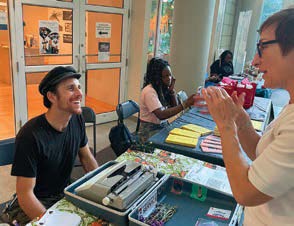
A dozen times a year, he gets paid for doing Typewriter Poetry at literary events, parties and fundraisers. On May 17, the day of the book festival, he will pop up his word shop from 1–5 p.m in the Greensboro Cultural Center.

People will feed him a few words at a time. He will type them at the top of a note card printed with his artwork, close his eyes, sway like a musician until he catches a melody of meaning, then start typing.

He can tell a lot about people, he says, by the words they toss him.

About a half give him greeting-card words: love, hope, promise — what they think they should say.

Another quarter supply words borne of turmoil. One woman started crying when she read Nich’s  interpretation. “I get the privilege of helping them process whatever they’re going through,” he says.

Another quarter hand him playthings.

Nich slaps the carriage return, a chrome lever, with confidence. His poem is coming in for a soft landing.


aspiring to

    share stories that

captured more than

essence

seeping down

  in a river formation

a journey around

ink

&

noise

&

heart

Omnivorous Reader

OMNIVOROUS READER

Duck and Cover

How to keep your personal information safe

By Stephen E. Smith

When my mother was a teenager, she was the only all-night operator in a town of about 2,000 souls. The hours were long, so she eavesdropped on private conversations. When she got home, she shared the latest gossip with my grandmother, and within a few hours, everyone in town knew everyone else’s business.

In theory, it still works that way, except, of course, that our personal data is managed by computers — our iPhones, laptops, tablets and the clandestine eavesdropping monsters that lurk in the mystical ether — which speed up and amplify the collection process while disseminating our confidential information globally. The result, however, is the same: There are no secrets, finally or ever.

This is why Lawrence Cappello’s On Privacy: Twenty Lessons to Live By is a timely little book (151 pages) that’s surely worth the few minutes it takes to read it. It won’t be the most exciting book you’ve read, but it might be one of the most important.

Cappello is a professor of U.S. legal and constitutional history at the University of Alabama. He’s the author of None of Your Damn Business: Privacy in the United States from the Gilded Age to the Digital Age, and he’s a certified information privacy professional. He’s on top of this data collection stuff, and his advice might help you sleep a little more soundly.

We’re hammered daily by claims that the equity in our homes is being stolen, our bank accounts plundered, our reputations besmirched, and our children driven to suicide. And then there are the endless scams that pop up on our screens (I consider everything a scam until it proves itself otherwise, and then I know for sure it is a scam). And now the government — who should be protecting us — has gotten into the info-distribution game via the unsupervised plundering of heretofore confidential databases.

On Privacy is written for those who are fearful about the disclosure of their personal data but who are reluctant to toss out their electronic devices. Cappello cuts through the noise and confusion and enumerates in short, sensible steps the necessary safeguards we need to adopt to be secure in the digital age. He offers practical insights into why privacy matters, how it shapes free societies, and how it rules our lives in an increasingly interconnected electronic world.

What Cappello doesn’t do is bombard his readers with terrifying stories about unfortunate fellow citizens who’ve suffered life-altering internet crimes. Horrifying examples only encourage despair. Instead, Cappello begins by addressing the requisite rationalization, “The Nothing-to-Hide Trap,” in which we maintain that if we are full-time do-gooders, we have nothing to fear from those who’d access our personal data. “Our personal information exists in snippets,” he writes. “When taken out of context, the private details of our lives . . . too often paint a picture of us that is skewed and not entirely true,” and thus we are often misrepresented. Since first impressions matter, we should focus on what computers collect and, more importantly, the distribution of our personal data.

Cappello breaks down the threats to our privacy into easy-to-read chapters that present the problems and suggest solutions. After a brief discussion of “Privacy Is Essential to Mental Health,” he appends suggestions on “How to Talk About Privacy’s Mental Health Benefits,” followed by “How to Protect Your Mental Health Through Privacy.” It’s all very straightforward.

He claims, for example, that we have the right to be forgiven our youthful transgressions. We make mistakes. “Unfortunately, the mistakes we make in life will remain instantly accessible,” he writes, “to any stranger inclined to take thirty seconds for a quick online search.”

Moreover, we are constantly under surveillance; our movements are tracked by our phones, computers and cameras on the street. If that’s not intrusive enough, outside sources can read your private electronic communications. He offers a solution: Secure your email with PGP encryption, a popular tool that scrambles your writing so that only the intended recipient can read it. The same is true for texts; encrypted text messaging apps are readily available and require only a quick download to your phone. These email and text apps also have an automatic delete option. And he recommends you buy a Faraday bag, a small pouch that blocks all signals; otherwise, you can be tracked by your phone even if you turn off your GPS.

Not only are we surveilled by private entities, but the government has, for many years, been poking into our business. Surveillance is the enemy of free expression: It discourages people from participating in political movements by instilling the fear they’ll be arrested for speaking out against the powerful, which inhibits the right of free assemblage as guaranteed by the First Amendment. Cappello reminds us that the “belief that the surveillance powers of the state must be constantly kept in check is a cornerstone of what it means to live in a free country.”

Most of Cappello’s recommendations are simple and easily implemented: “When in doubt, log out,” delete apps you aren’t using and any accounts associated with them, tape off the camera on your computer, clear your browser history, get rid of caches and cookies, turn off and lock your computer when not in use, and purchase your own Virtual Private Networks (VPNs), which makes it difficult to track your online activity. And those are just a few of the suggestions that might save you money and safeguard your reputation. 

Of course, the obvious way to protect your future information — there’s little you can do about the past — is to disappear or “go dark,” as folks are wont to say. This would necessitate the destruction of all your electronics — computers, streaming devices, tablets, phones, smartwatches, etc., and all storage systems — thumbnail drives, hard drives, data stored in the cloud (the global network of remote servers that functions as a single ecosystem), old floppy disks, credit cards, etc. Everything. All of it. Then disappear. Forever.

Growing Season

GROWING SEASON

Growing Season

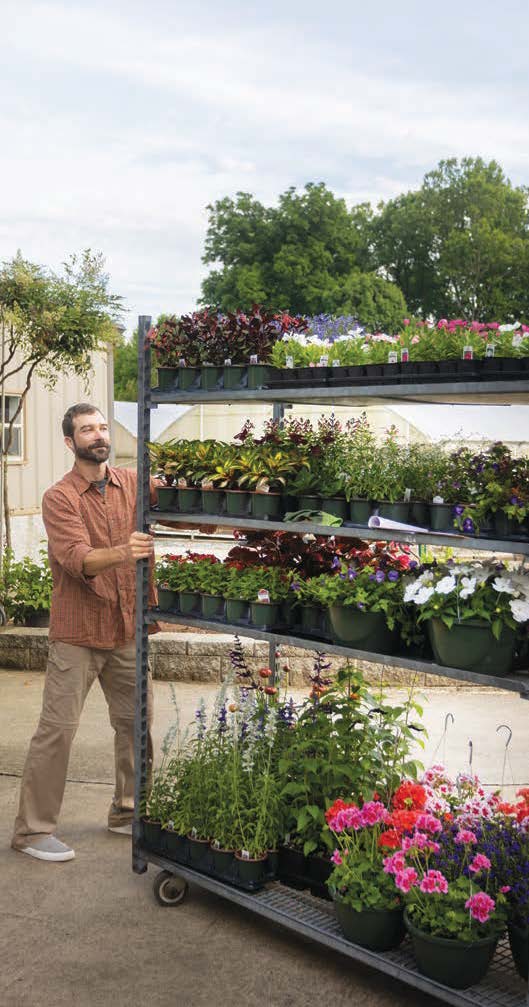
Under the Bertrand family, a 42-year-old flower farm continues to flourish

By Dawn DeCwikiel Kane   

Photographs by Becky VanderVeen

The Bertrands’ home can be busy, and sometimes a bit cramped and messy, much like that of any other young family.

“This is our life currently,” Carrie Bertrand says, as she walks through the living space she shares with husband Patrick and their children Ayla, 12; Silas, 10, and Ellie, 6. 

The family of five, plus three cats and a dog, live in a camper on Maple Grove Flower Farm, which they own and operate. (And let’s not forget the family’s pet frog, who doesn’t enter the camper, but resides in a terrarium in a building next door.)

For now, home is a 2008, 38-foot Cedar Creek Silverback, a heated and cooled fifth-wheel camper. It’s large enough for Ayla and Silas to have separate, small bedrooms, while Ellie’s bed is in another area of the camper. There’s also a primary bedroom.

They hope to soon replace it with a newer, larger living space. But for now, their camper has become not only a home, but a homeschool and home base for their flower farm on Wild Turkey Road in rural Whitsett, 15 minutes east of downtown Greensboro.

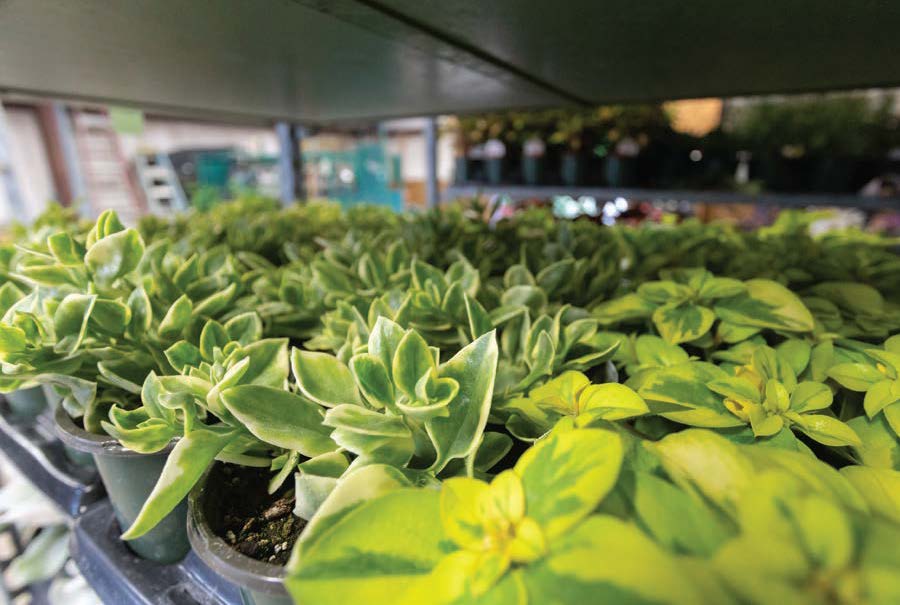
Their flowers bloom in 13 commercial-scale greenhouses covering 32,000 square feet of indoor, irrigated growing space. Nearby, on their 7.5 acres of land is a 2,500-square-foot barn built in 1913.

The Bertrands grow ornamental plants in pots, flats and hanging baskets that they sell primarily to garden centers. They grow only chrysanthemums outdoors.

They don’t sell cut flowers, or plants for eating.

No sign announces the spot just yet.

By mid-morning on this March day, Patrick and Carrie have already been out on the farm for a few hours.

“So many people have no idea about this side of agriculture,” Patrick says from a building adjacent to the camper, wiping the sweat from his face while Carrie eats a yogurt-and-granola snack and the kids build a fort.

Patrick, now 47, grew up in Greensboro, the youngest of two sons of radiologist Margaret L. Bertrand and anesthesiologist Scott A. Bertrand. He graduated from the University of Colorado at Boulder with a B.A. in economics. Carrie, 42, grew up in a small town outside Columbus, Ohio. She studied elementary education at Wheeling Jesuit University in West Virginia.

The couple met at the Church on 68 and married there more than 13 years ago. 

Carrie taught school. They owned a landscaping business. But Patrick gradually realized that the work would grow increasingly strenuous.

The couple looked for something that would involve the whole family.

“Patrick was gone from sun-up to sundown most days, and we wanted a change from that routine,” Carrie recalls.

That routine indeed has changed. The family lives together — and works together.

The children help. Ayla maintains plants with three high school girls who work part-time. Silas enjoys fixing small machinery with his dad. Ellie is in the kindergarten-grade level and “excited about it all,” her mother says.

After dinner, the Bertrands enjoy typical family fun. Patrick might take Ellie to dance class; twice a week, Carrie drives them to American Ninja Warriors in Thomasville to prepare for competitions or takes Ayla to rock-climbing. Wednesday nights are for church. Tuesday nights are typically free, so they might cuddle in the camper to watch a movie.

Life on Maple Grove Flower Farm begins at 5:30 a.m. Carrie makes breakfast in the camper and teaches their children for three hours or more. She also manages the farm with Patrick, doing greenhouse work and accounting.

Although the camper has a bathroom, the family primarily uses one of two bathrooms in the adjacent building that they call the “head house.” The head house doubles as a family kitchen and a break room for the small staff. And of course, it’s home to the family frog.

In a separate section of the head house, they stage carts of plants that will go into pots.

The flower farm has two growing seasons.

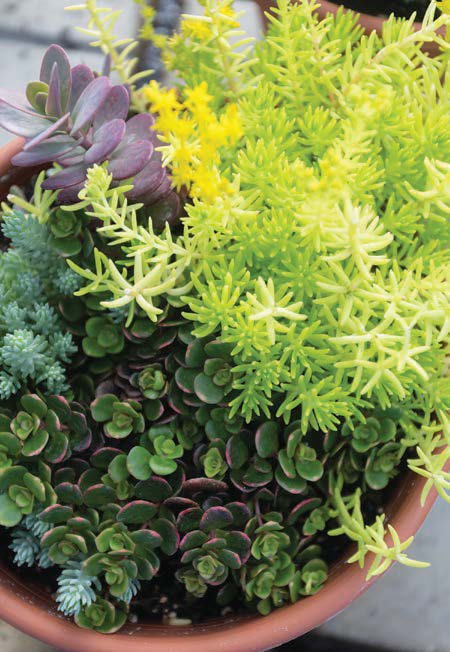
The Bertrands and a handful of employees plant 40-plus varieties of tiny begonias, geraniums, zinnias, salvia, sedum, and other annuals and perennials, and grow them for six to eight weeks. All in all, they plant about 200,000 plugs — tiny plants — for spring sale, Carrie says.

For fall, they plant about 25 varieties of pansies, chrysanthemums, violas, snapdragons and dianthuses — plus poinsettias for the holiday season.

They sell the plants wholesale, primarily to garden centers in the Triad and beyond, from Winston-Salem to Raleigh and into southern Virginia — much like original business owner and grower Greg Welker did before them.

Among their customers are Guilford Garden Center in Greensboro, Saviero’s Tri-County Garden Center in High Point, Southern States in Chapel Hill and Asheboro, A.B. Seed at the Piedmont Triad Farmers Market in Colfax, and Logan’s Garden Shop in Raleigh.

“We would love to also be selling directly to some of the landscapers,” Carrie says.

“But we felt there was so much to learn just on what he [Welker] had built already,” she adds. “He had a very successful business and had amazing relationships with the garden centers in the area. We certainly want to do what he has been doing with excellence before trying to add a bunch of new stuff.”

By one recent survey for the U.S. Department of Agriculture, North Carolina ranks 10th among the 50 states in floriculture, both in terms of dollar sales and number of operations.

Their floriculture business has nearly tripled in volume from the landscape business they had previously owned for almost 18 years. “Triple sales, probably triple expenses,” Patrick says.

They feared they would lose a significant customer when New Garden Landscaping & Nursery closed its retail side in December after more than 50 years and focused on its commercial and residential landscaping. But in March, Guilford Garden Center put down roots in a second location, the Lawndale Drive shop where New Garden’s retail and garden center space had once thrived.

Stephanie Jones, who owns Guilford Garden Center with her husband, Elliott, understands what it means to run a small family business. “We have to look after each other,” she says.

Maple Grove Flower Farms’ humble beginnings took root with Greg Welker.

A native of Washington state, Welker started the flower farm in 1983, when he had finished a year-long horticulture program at a botanical garden on Kauai in Hawaii, followed by a year-long program at Ball Seed in Chicago.

His grandfather, Dan Welker, had purchased the land in 1956 and eventually passed it on to Welker’s father, Raymond Welker. Welker used that land to grow the flower farm, naming it for maple trees that stand across the road.

“It was hard work,” Welker says. “But at the end of the day, I got to walk to the greenhouses and see all the beautiful flowers, and I knew that everything I sent was going to make people smile.”

A chance encounter with Patrick blossomed into a sale.

When Welker opened the back of his 26-foot enclosed box truck one fateful day in fall 2022, Patrick’s eyes widened at the sight of vibrantly colorful ornamental flowers in trays of pots on shelved carts.

Patrick admired row after row of planted fall flowers — giant pansies in purples, yellows, whites and burgundy, cabbage and kale in hues of green, white, purple and pink.

“He seemed to have a library of plant material in the back of his truck, beyond what was dropped at our stop,” recalls Patrick, who had closed his landscaping business and was working for another.    

After that tailgate meeting, the entire Bertrand family visited Maple Grove Flower Farm.

Patrick and Carrie remember Ayla, from a young age, picking early blooms from azalea bushes at their former home to make floating bouquets or other artwork.

“We didn’t need to sell her on the idea of moving to a flower farm,” Patrick says.

Believing that they would buy the farm, he went to work for Welker in January 2023 as an apprentice.

In May 2023, they sold their cul-de-sac home on Oak Hollow Lake in High Point.

“We would love to say that it was smooth sailing, getting from one place to another,” Carrie says. “But it was a process that tested our patience and our faith.”

They finally got a loan from the Small Business Administration to buy the flower farm, sealing the deal in July 2023.

Welker still worked there two days a week that first fall “to get us into the groove,” Carrie recalls.

He is now 63, retired and living in Chapel Hill.

“He built everything on this property from the ground up, so he knows how to fix everything,” she says. “And Patrick has had to learn, because you can’t call somebody every time you need something fixed when you have an operation like this going on.”

At first, Carrie knew few of the flowers’ names. She could identify a petunia, but didn’t know a pansy from a viola, especially with the variety of flowers that they planted and sold for spring.

She learned fast.

For four to six weeks in the winter cold and the summer heat, they get breaks from farm work, but order plugs for the following season through Ball Seed, from farms in West Virginia, Illinois and New Jersey. Winter brings maintenance work.

That gives them time for family trips.

Cold affects the wallet when propane field heaters need to run.

This past winter, several irrigation lines burst in empty, unheated greenhouses and had to be repaired.

In late January, they began planting for their second spring season.

Within a few days, they filled 6,100 pots with potting soil to have ready for the first shipment of plugs that arrived the following week.

They want flowers to look picture perfect when they sell. They ensure that they are tagged with plant names, and are clean and free of pests. They pinch off each head so that they become fuller — just as customers prepare to buy them.

Mid-March brought the first sales of their second spring season. Patrick delivered flowers in a truck four to five days each week.

Patrick and Carrie talk of the future.

Last December, they converted one of the greenhouses into a winter wonderland.

They hosted events there that featured Santa and Mrs. Claus, a life-size Candyland game, cookie decorating, and hot cocoa.   

Carrie hopes to eventually plant sections of flowers where parents can bring their children and both groups can learn.

They envision welcoming school groups for field trips.   

They would like to open a small market on the land where they sell leftover items they grow, plus goods and produce from local artisans.

“We want to add some community involvement,” Patrick says.

They hope that at least one of their children someday will run Maple Grove Flower Farm. “Either our daughters or son will have the opportunity if they would like,” Patrick says. “I have a feeling at least one of them will want to continue building the farm, from the flowers to the community outreach.”

Want to schedule a visit to Maple Grove Flower Farm? Email maplegroveflowers@gmail.com, or call or text 336-209-3607.
To learn more, go online to maplegroveflowerfarm.com or to the Facebook page for Maple Grove Flower Farm.

In Good Taste

IN GOOD TASTE

Look, Ma! No Buns!

In a pickle? This burger bowl is the answer

Story and Photograph by Jasmine Comer

About 16 years ago when I was 14, I had a memorable cooking mishap involving an excessive amount of salt. My mom was making her famous burgers and fries one Friday when a too-close encounter with with the mandolin sent her to the emergency room. Left in charge of cooking supper while my dad took Mom to the hospital, I was determined to finish the burgers that she’d started. Having only prepared very basic meals before — think eggs and bacon — I unknowingly created the world’s saltiest burgers. That evening, my teenage enthusiasm embraced the motto on the Morton salt box: “When it rains, it pours.”

That night was a pivotal moment where I learned a hard truth: Over-salting food is almost always an irreversible error. And it’s so easy to do it. Just as quickly as a pinch can enhance a dish, too much can ruin it entirely. This experience is why many of my recipes suggest seasoning with salt and pepper to taste, acknowledging individual preferences and needs. There’s a lesson in biochemistry here, but I’ll leave that to Alton Brown.

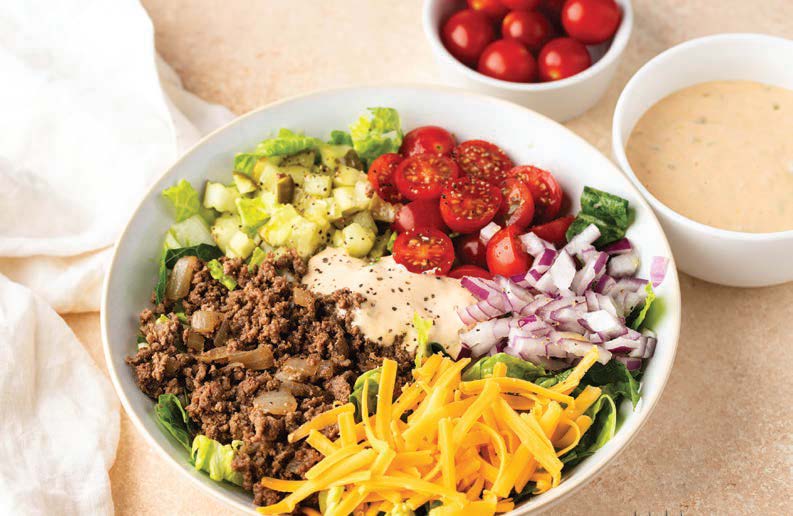
As for these burger bowls, rest assured . . . they are not overly seasoned. This is one of those meals that you can easily customize with protein and veggies of your choice. The magic is in the sauce. As a sauce enthusiast, I’ve always leaned toward homemade — dressings, too. They can completely transform a meal. This burger sauce is sweet and tangy, and it perfectly complements the heartiness of the beef and the crunchiness of the fresh vegetables. Do me a favor and learn from my mistakes — go easy on the salt?

Burger Bowls

Makes 4 servings

Ingredients

For the beef

1 pound ground beef

1/2 small yellow onion, diced

1/2 teaspoon garlic powder

2 teaspoons Worcestershire sauce

Salt and pepper to taste

Burger sauce

1/2 cup mayo

1/2 tablespoon yellow mustard

2 tablespoons ketchup

2 tablespoons sweet or dill relish

1 teaspoon white vinegar

1/2 teaspoon sugar

For the salad

1 large head romaine, chopped

1 cup cherry tomatoes, halved

1/2 red onion, diced

1 cup cheddar cheese, shredded

½ cup pickle slices, chopped

1. Heat a large skillet over medium heat. Add the ground beef, onions, garlic powder, Worcestershire, salt and pepper. Cook for 6–8 minutes or until beef is no longer pink, stirring occasionally.

2. While the beef is cooking, prepare the sauce: Whisk all the ingredients together. Place in the fridge until it is time to serve the salad.

3. Assemble the salad starting with the romaine, followed by the other toppings and the ground beef. Drizzle with burger sauce.  OH

Jasmine Comer is the creator of Lively Meals, a food blog where she shares delicious, everyday recipes. You can find her on Instagram @livelymeals.

NC Surround Around

NC SURROUND AROUND

Stepping Up

Citizen Vinyl pressed into service

By Tom Maxwell

There’s a beautiful Art Deco building at 14 O. Henry Avenue in Asheville, located on a particularly high spot in that already elevated mountain city. Completed in 1939, it was built to house owner Charles Webb’s two newspapers (the morning’s Asheville Citizen as well as the Asheville Times afternoon edition) in addition to his newly-acquired-but-already famous radio station WWNC-AM. For the last five years, Webb’s glass brick, black granite and limestone behemoth has been home to Citizen Vinyl, a unique combination of record pressing plant, recording/mastering studio, record store, art gallery and café. But in October 2024, the place served as an altogether different kind of community hub.

“We were one of the few Asheville businesses that had both power and internet a couple of weeks after the hurricane,” Citizen Vinyl founder and CEO Garland (Gar) Ragland says, “so we immediately pivoted to becoming a community resource. We ran extension cords out of our space in the building and got the word out that we had internet available and power for people to charge their digital devices and cellphones. We had hundreds of people coming every day to power their phones and text or call their loved ones to let them know they were safe.”

In September, Hurricane Helene wiped large swaths of Appalachia off the map. Entire towns in western North Carolina and eastern Tennessee in valleys near rivers or creeks were washed away. Marshall, a small town north of Asheville, was destroyed. To the east, Swannanoa suffered a blow from which it has yet to recover. The recently established Arts District, nestled alongside the French Broad river in West Asheville, was suddenly under 12 feet of water. The big Art Deco building that houses Citizen Vinyl was quicker to recover than most other businesses, thanks to its elevation and its proximity to NOAA’s Federal Climate Complex, which houses both the National Climatic Data Center as well as the country’s Climate Archive.

Soon, one of Citizen Vinyl’s food partners, Michelle Bailey, set up smokers and grills in their little parking lot and started preparing meals from food donated by far-flung friends and her regional farming network. “She started the weekend after the hurricane,” Ragland says, “and served about 1,500 hot meals every weekend for weeks. She had friends from Louisville, Kentucky, come over and bring hundreds of pounds of top-shelf smoked meats and barbecue. So, we pivoted — because we really didn’t have any other option than to just lean in and support our community in whatever way we could.”

Ragland is quick to point out that he and his friends weren’t the only people who met the moment. “There were many, many, noble efforts,” he says, “and what was revelatory to me was how unique and special this community of people is, how readily and instinctively people showed up to help one another. There were people on street corners with signs saying ‘Free Water Here,’ or ‘Hot Food.’ I was really impressed and inspired and proud to be a member of this community because we showed up for each other.”

Ragland, a native of Winston-Salem, started Citizen Vinyl in 2019. Inside Charles Webb’s three-story building, he established the pressing plant along with Sessions (the breezy bar and café) and Coda: Analog Art & Sound (a combination art gallery and record store). On the top floor, Ragland converted the hallowed space of WWNC into Citizen Studios, a recording and mastering facility. He can quote the building’s history, chapter and verse.

“Charles Webb designed and dedicated the top floor of the Citizen-Times building to be the new home for his radio station,” Ragland says. “It was state-of-the-art. He modeled it after the RCA Victor Studios in New York. By the time of the station’s construction, WWNC-AM had already become one of the most popular radio stations in the country. It was previously located a couple of blocks away in the Flatiron Building, and it was there that Jimmy Rodgers made his national radio premiere in 1927.” Immediately after the station reopened in its new location, bluegrass legends Bill Monroe and the Blue Grass Boys debuted on February 2, 1939. The group played the daily afternoon “Mountain Music” slot until WWNC became a CBS affiliate.

At the time, artists from all over the country were descending on Asheville because of WWNC’s reach. “It was the highest elevation radio station east of the Mississippi,” Ragland says. “That 570 kHz radio frequency could throw from downtown Asheville all the way to West Texas and up into southern Canada.”

The amazing thing is, despite eastbound I-40 being washed out between Old Fort and Black Mountain — while half of its westbound lanes crumbled down into a gorge outside of Knoxville — Citizen Vinyl never stopped pressing records. “Our shipping and receiving did slow down,” Ragland notes, “and we had a couple slow months.” Not that big a deal, considering the town wouldn’t have potable water for 11 weeks.

In the best of times, people tend to think of things like music and food as ephemera, as if they’re mere ornaments to the real work of producing wealth. But you’d be hard pressed to think of two things more deeply woven into the fabric of community than a mother singing a lullaby to her drowsy infant, or the connections made and deepened by a shared meal in a desperate moment.

“Being part of this community and serving as a cultural hub has been a really important part of our ethos and business,” Ragland says. “The hurricane, full disclosure, put into jeopardy our ability to sustain the café and the event space. But that said, the challenges only reinforced the values and the ethos that we’ve constructed this business to be, evidenced by our name.”

The word “citizen” has been with us since the late Middle Ages, and has specific meanings in different areas of law, religion and the military. Ragland is well aware of both the promise and potential risks of using that word.

“Obviously, there’s a history that we wanted to honor by calling the business Citizen Vinyl,” he says. “But the term itself is a very provocative name to title your business because it means different things to different people. For the undocumented person, it’s a loaded word. It can be an alienating and divisive term. But on the flip side, ‘citizen’ asks the question: What does it mean to belong to a place?’ We were intrigued by the opportunity to help shape and define what it means. We’re music nerds, not music snobs. We don’t judge people’s music tastes. We want to celebrate music, art and community. We don’t pass judgment on anyone. We want to operate our business in a way that defines ‘citizen’ in the most positive of ways. The hurricane, if nothing else, created an opportunity for us to put into practice a lot of the things that we aspire to be as members of the Asheville community.”

The quote “We may achieve climate, but weather is thrust upon us” is often attributed to O. Henry, the author Citizen Vinyl’s street is named for. The catastrophic destruction caused by Hurricane Helene may have kept you away from Asheville, but it’s time to go back, to witness firsthand the climate of resilience and community achieved by its citizens.