NC Surround Around

NC SURROUND AROUND
Stepping Up
Citizen Vinyl pressed into service
By Tom Maxwell
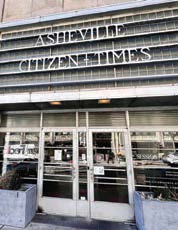
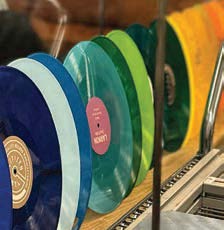
There’s a beautiful Art Deco building at 14 O. Henry Avenue in Asheville, located on a particularly high spot in that already elevated mountain city. Completed in 1939, it was built to house owner Charles Webb’s two newspapers (the morning’s Asheville Citizen as well as the Asheville Times afternoon edition) in addition to his newly-acquired-but-already famous radio station WWNC-AM. For the last five years, Webb’s glass brick, black granite and limestone behemoth has been home to Citizen Vinyl, a unique combination of record pressing plant, recording/mastering studio, record store, art gallery and café. But in October 2024, the place served as an altogether different kind of community hub.
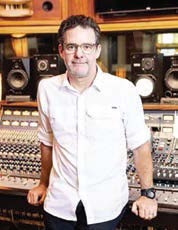
“We were one of the few Asheville businesses that had both power and internet a couple of weeks after the hurricane,” Citizen Vinyl founder and CEO Garland (Gar) Ragland says, “so we immediately pivoted to becoming a community resource. We ran extension cords out of our space in the building and got the word out that we had internet available and power for people to charge their digital devices and cellphones. We had hundreds of people coming every day to power their phones and text or call their loved ones to let them know they were safe.”
In September, Hurricane Helene wiped large swaths of Appalachia off the map. Entire towns in western North Carolina and eastern Tennessee in valleys near rivers or creeks were washed away. Marshall, a small town north of Asheville, was destroyed. To the east, Swannanoa suffered a blow from which it has yet to recover. The recently established Arts District, nestled alongside the French Broad river in West Asheville, was suddenly under 12 feet of water. The big Art Deco building that houses Citizen Vinyl was quicker to recover than most other businesses, thanks to its elevation and its proximity to NOAA’s Federal Climate Complex, which houses both the National Climatic Data Center as well as the country’s Climate Archive.
Soon, one of Citizen Vinyl’s food partners, Michelle Bailey, set up smokers and grills in their little parking lot and started preparing meals from food donated by far-flung friends and her regional farming network. “She started the weekend after the hurricane,” Ragland says, “and served about 1,500 hot meals every weekend for weeks. She had friends from Louisville, Kentucky, come over and bring hundreds of pounds of top-shelf smoked meats and barbecue. So, we pivoted — because we really didn’t have any other option than to just lean in and support our community in whatever way we could.”
Ragland is quick to point out that he and his friends weren’t the only people who met the moment. “There were many, many, noble efforts,” he says, “and what was revelatory to me was how unique and special this community of people is, how readily and instinctively people showed up to help one another. There were people on street corners with signs saying ‘Free Water Here,’ or ‘Hot Food.’ I was really impressed and inspired and proud to be a member of this community because we showed up for each other.”
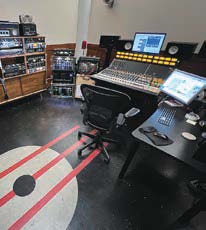
Ragland, a native of Winston-Salem, started Citizen Vinyl in 2019. Inside Charles Webb’s three-story building, he established the pressing plant along with Sessions (the breezy bar and café) and Coda: Analog Art & Sound (a combination art gallery and record store). On the top floor, Ragland converted the hallowed space of WWNC into Citizen Studios, a recording and mastering facility. He can quote the building’s history, chapter and verse.
“Charles Webb designed and dedicated the top floor of the Citizen-Times building to be the new home for his radio station,” Ragland says. “It was state-of-the-art. He modeled it after the RCA Victor Studios in New York. By the time of the station’s construction, WWNC-AM had already become one of the most popular radio stations in the country. It was previously located a couple of blocks away in the Flatiron Building, and it was there that Jimmy Rodgers made his national radio premiere in 1927.” Immediately after the station reopened in its new location, bluegrass legends Bill Monroe and the Blue Grass Boys debuted on February 2, 1939. The group played the daily afternoon “Mountain Music” slot until WWNC became a CBS affiliate.
At the time, artists from all over the country were descending on Asheville because of WWNC’s reach. “It was the highest elevation radio station east of the Mississippi,” Ragland says. “That 570 kHz radio frequency could throw from downtown Asheville all the way to West Texas and up into southern Canada.”
The amazing thing is, despite eastbound I-40 being washed out between Old Fort and Black Mountain — while half of its westbound lanes crumbled down into a gorge outside of Knoxville — Citizen Vinyl never stopped pressing records. “Our shipping and receiving did slow down,” Ragland notes, “and we had a couple slow months.” Not that big a deal, considering the town wouldn’t have potable water for 11 weeks.
In the best of times, people tend to think of things like music and food as ephemera, as if they’re mere ornaments to the real work of producing wealth. But you’d be hard pressed to think of two things more deeply woven into the fabric of community than a mother singing a lullaby to her drowsy infant, or the connections made and deepened by a shared meal in a desperate moment.
“Being part of this community and serving as a cultural hub has been a really important part of our ethos and business,” Ragland says. “The hurricane, full disclosure, put into jeopardy our ability to sustain the café and the event space. But that said, the challenges only reinforced the values and the ethos that we’ve constructed this business to be, evidenced by our name.”
The word “citizen” has been with us since the late Middle Ages, and has specific meanings in different areas of law, religion and the military. Ragland is well aware of both the promise and potential risks of using that word.
“Obviously, there’s a history that we wanted to honor by calling the business Citizen Vinyl,” he says. “But the term itself is a very provocative name to title your business because it means different things to different people. For the undocumented person, it’s a loaded word. It can be an alienating and divisive term. But on the flip side, ‘citizen’ asks the question: What does it mean to belong to a place?’ We were intrigued by the opportunity to help shape and define what it means. We’re music nerds, not music snobs. We don’t judge people’s music tastes. We want to celebrate music, art and community. We don’t pass judgment on anyone. We want to operate our business in a way that defines ‘citizen’ in the most positive of ways. The hurricane, if nothing else, created an opportunity for us to put into practice a lot of the things that we aspire to be as members of the Asheville community.”
The quote “We may achieve climate, but weather is thrust upon us” is often attributed to O. Henry, the author Citizen Vinyl’s street is named for. The catastrophic destruction caused by Hurricane Helene may have kept you away from Asheville, but it’s time to go back, to witness firsthand the climate of resilience and community achieved by its citizens.