Sazerac November 2025

SAZERAC

November 2025
Just One Thing

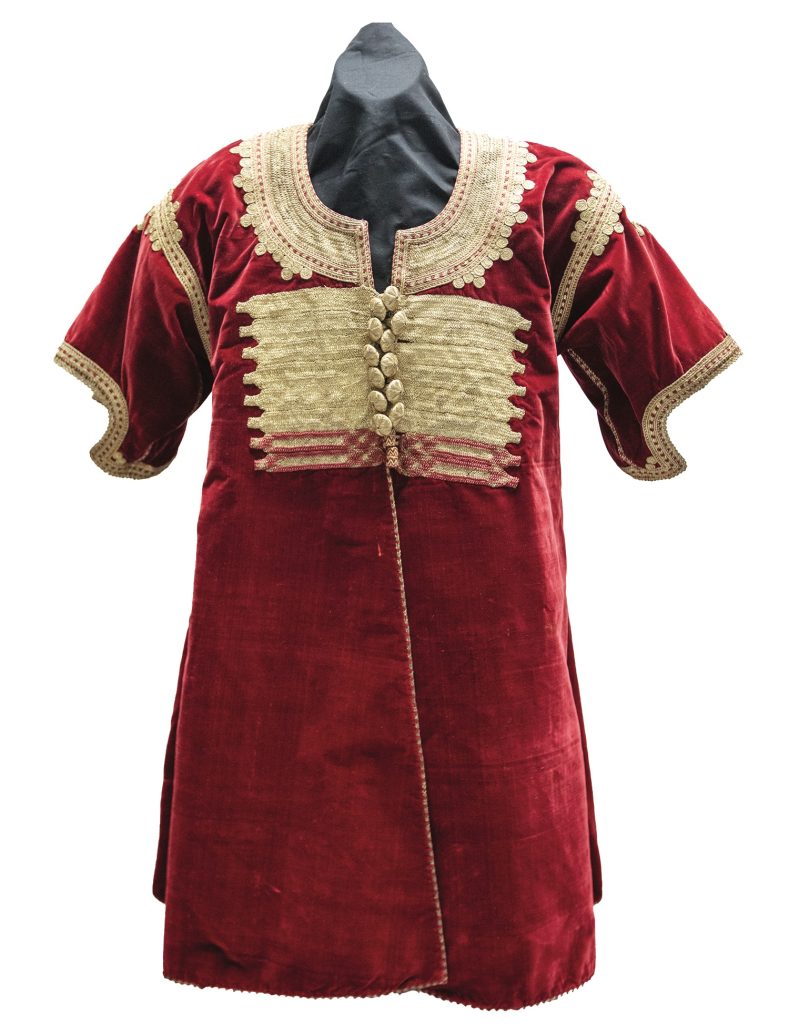
There’s nothing like a history museum celebrating, well, its own long history. On November 11, the Greensboro History Museum unveils an exhibit honoring its centennial: GHM100: Treasures. Legacies. Remix. Featured, you’ll find rarely seen museum goodies, including what Curator of Collections Ayla Amon says is her personal favorite in the collection, a Tunisian kaftan that was given to Dolley Madison in 1805 by Sidi Soliman Mellimelli. It is said that Mellimelli wrapped the Tunisian garment — made of red velvet, lined with green silk damask and decorated with gilt silver thread — around Dolley as a gift intended to bring childbearing fortune to her and husband James Madison, who was then serving as U.S. Secretary of State. Fabricated from heavy, luxury materials, it’s not just a cloak, but a work of art that Amon says is a must-see in person. Notably, Mellimelli was the first Muslim envoy to come to the United States. He came, hoping to avert a war between Tunis and the U.S., who had violated a treaty by capturing Tunisian vessels. At the conclusion of his visit, he sent a letter to James Madison. The letter concludes, “With heartfelt regret I shall leave this Country while our affairs wear so inauspicious a complexion . . .” Behold the kaftan along with 100 years of archival treasures at the Greensboro History Museum. Info: greensborohistory.org/exhibition/ghm100-treasures-legacies-remix

Window on the Past

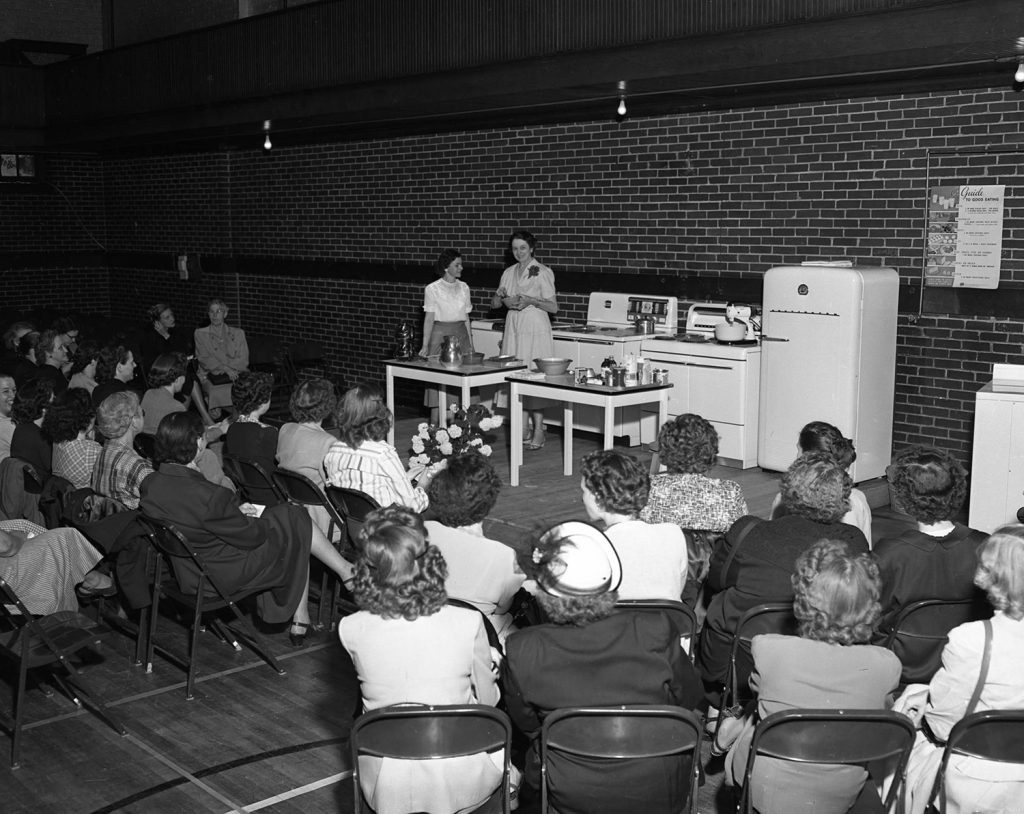
At a 1950s Cone Mills Cooking School demo, we aren’t sure what’s being said, but we imagine it’s along the lines of what came out of Lessons in Chemistry’s Elizabeth Zott: “Children, set the table. Your mother needs a moment.” As Thanksgiving chaos rolls around, we gently remind you to take a moment for yourself, too.

Sage Gardener

Why wait until New Years Day to serve collard greens? If, after reading this, collards don’t make an appearance at your Thanksgiving or Christmas feast, you’re not paying attention.

Collard greens are bristling with vitamins A, C, K and B-6, plus iron, magnesium, folate, potassium — and lots of silica in the form of sand — that is, if you don’t rinse them twice. My rule of green thumb: Rinse thrice just to be nice.

Speaking of the rinse cycle, let’s talk about cleaning your colon with fiber, which reduces inflammation and balances blood sugar. The Cool Kids comedian David Alan Grier observes that collards “get outta you faster than they get in you.”

Before they began making their appearance served upon crisp linen table cloths in tiny boîtes, collards were seen as poor folks’ food, with recipes for cooking them imported by enslaved people along with, unwillingly, themselves. They thrive in nutrient-poor soil and adverse conditions, making them ideal for hard times.

Lutein. Zeaxanthin. Don’t worry about pronouncing them. You’ll soon see that these sulfur-rich compounds (along with our old friend vitamin K) guard against age-related eye diseases. 

And go ahead and savor that second glass of wine. The sulfur-rich compounds in collards clean out your liver.

Kamala Harris confessed that her collard green recipe is so popular she uses her bathtub to wash her big mess of collards around the holidays.

If you have a slab of fatback and fry it up, and also have some leftover cornbread from your Thanksgiving Day feast, you have all the makings for a collard-green sammie as featured in Bon Appétit. May we recommend the addition of some Texas Pete.

If people are worried about eating the official state vegetable of South Carolina (where more collards are grown than anywhere else), just tell them they’re eating Brassica oleracea.  

Grey Poupon

One day, when I was 7, the jar of Grey Poupon appeared in our refrigerator, heavy and rare as an apple in our steak-and-potatoes house.

After Dad’s shift at the print shop, I asked him about this new jar of mustard. He turned to me, setting down his Busch Light, shook his head, and said, “Your mother is trying to be all fancy.”

“Have you tried it?” I asked.
“It’s just mustard,” he said.

The next morning, I peeked around the corner as my father made his daily ham and cheese. After dipping the butter knife into the Grey Poupon, he brought it to his tongue, nodded as if satisfied, then slathered a generous helping on his sandwich.

When I stepped into the kitchen, he jumped, as if I’d caught him in some dirty act.

Unsolicited Advice

November is about giving more than just thanks for your many blessings — it’s about giving back. These days, donating money to a near-and-dear cause is just a simple QR code away, but it’s not always that easy when your budget is tighter than your post-pecan-pie pants (never mind that thin slice of pumpkin pie you also ate — it barely counts). True, November might be hard on your waistline, but we’re gonna make it easier on your bottom line with things you can give other than Benjamins.

Stuff. Local organizations are often in need of gently used clothing, toys, furnishings and decor. Closet more stuffed than your vegan cousin Nina’s tofurkey? Clean it out while doing some good in the world. Somewhere, Marie Kondo is sitting at her Thanksgiving table, full of gratitude for the millions of us who are sparking some joy in the world — and her wallet.

Skills. Got a special talent that could be of service? Maybe you’re a website designer who can level up your fav nonprofit’s site. Service with a smile — and style. As MLK Jr. once said, “Life’s persistent and most urgent question is, ‘What are you doing for others?’” Don’t be caught without an answer.

Energy. Instead of giving 5K, register to run a 5K for a cause. Maybe this is the year your family turns into the one we all love to hate. You know ‘em — they show up to the Turkey Trot in matching costumes that should make it hard to jog, but they still finish in the lead, having barely broken a sweat.

Time. Carve out a little of your most precious commodity to spend it volunteering in a soup kitchen or playing with shelter pups. Bonus if you bring home Fido and give him a home for the holidays and fur-ever after. And since we’re talking about time here, maybe he could even be your loyal watch-dog.  

Up. After that last joke, this is what we’re giving.

Merry Makers

“I feel like my art is love made visible,” muses Katie Podracky, a teacher and first-time vendor at Merry Merry Market this year. “I love that people who know nothing of that story can come to it and also feel some type of hidden connection.” Katie takes inspiration from North Carolina, the state in which she was born and raised. The vibrant scenery and lively nature — who doesn’t love a galloping white-tailed deer or the sound of a rushing waterfall from time to time? — influence her canvas. After a little mountain climbing and several animal encounters from her local state parks, Katie and her husband became avid outdoor lovers. “I had a friend tell me, ‘Oh you should paint something’ and I was like, ‘Oh that’s a good idea, let’s do that’ and it really connected me to North Carolina.” Katie says she learned a lot about her home state through her art.

Katie has long loved Merry Merry Market and is excited to be on the other side of the vendor table this time around. “I tell all of my friends and my students that Merry Merry Market is such a great event because they collect quality vendors who happen to be local artists.” Katie’s paintings, plus accessories, home decor and other artisan wares, are among the many items you could buy as a gift for a family member, friend or even for yourself. We always enjoy the saying, “one for you, three for me.” And, as if that wasn’t enough to draw your attention, a portion of the $5 admission will be donated to BackPack Beginnings, a nonprofit that connects children and their families with the resources they need to develop and grow. So, mark your calendars to get some much needed holiday shopping done at Merry Merry Market, 9 a.m.–8 p.m., Wednesday, Nov. 19, at Revolution Mill’s Colonnade Events Center. Did we mention the bar opens at 5 p.m.? Info: merrymerrymarketgso.com.

Wandering Billy

WANDERING BILLY

Seas the Moment

Andy Zimmerman heads windward with a new documentary

By Billy Ingram

“That’s what sailing is, a dance, and your partner is the sea. And with the sea you never take liberties. You ask her, you don’t tell her.” ― Michael Morpurgo

Andy Zimmerman has performed a Herculean feat in transforming the downtown area south of the railroad tracks around Elm Street. What was once a losing hand of forgotten, abandoned buildings languishing for untold decades is today a royal flush of vibrant hubs where you’ll now find SouthEnd Brewing, transform GSO, Fainting Goat Spirits and Forge Greensboro among other former eyesores he’s renovated elsewhere.

I met with Zimmerman to explore his latest effort on the largely unfinished but impressive second floor of yet another recovery mission, the original Blue Bell jeans plant on South Elm and Gate City Boulevard (rechristened Old Greensborough Gateway Center). The hat he’s wearing today is not that of downtown developer but executive producer. He’s been working on an upcoming documentary entitled Mavericks & Multihulls, a tribute to the multihull legends of seafaring, those amazing young men and their sailing machines.

That’s not a non sequitur. The company Zimmerman founded and retired from before arriving in Greensboro a couple decades ago, Wilderness Systems, was a leader in the production and design of kayaks, “probably the No. 3 manufacturer in the world,” he notes. “Certainly No. 1 as it relates to brand. Between the companies that I owned and started, we made over a million kayaks.”

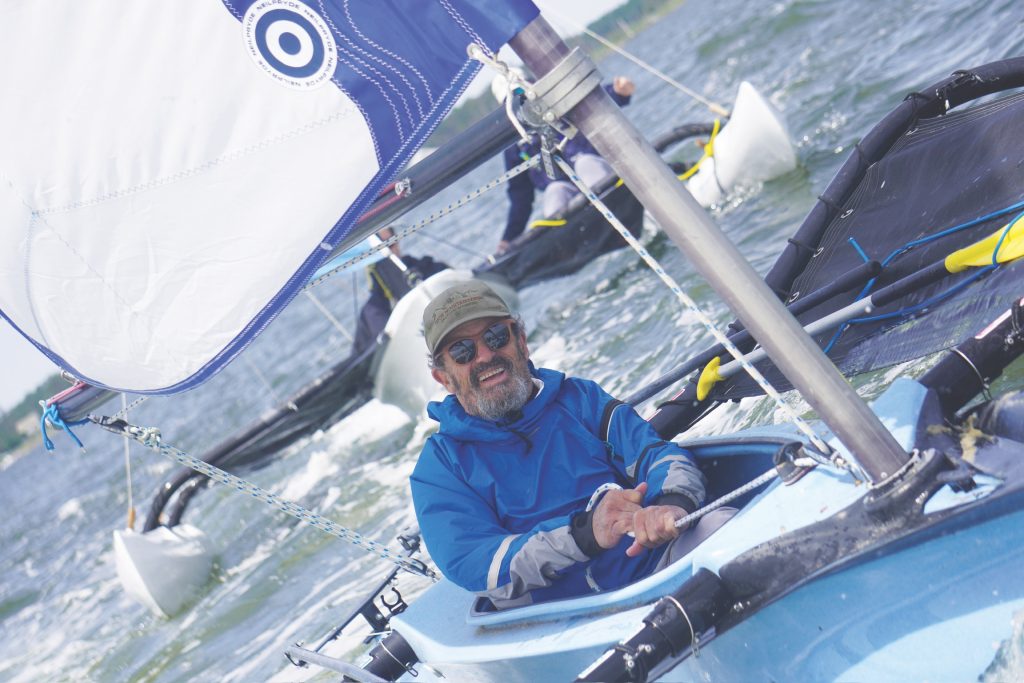
Under the WindRider label, Wilderness Systems fabricated more trimarans, a variation on the catamaran, than anyone anywhere. “The catamaran, as one of the designers likes to put it, is kind of a condo on the water — it’s commodious.”

“The trimaran has three hulls, the main hull, which is where you live,” Zimmerman points out for those who know little about watercrafts, aka me, “and then the two outriggers. You can call them training wheels,” making them faster and more stable than most other boats.

WindRider also manufactured hydrofoil sailboats, the cool, sleek models where the hull rises up out of the water at top speeds. “For me, it was a manufacturing accomplishment of a lifetime,” Zimmerman remarks about the difficulty of the build, which required some 800 components. The America’s Cup speedsters, he notes, “have trimmer ends, they’re doing 50 plus miles an hour in hydrofoils. The other boats we made money on, but the hydrofoil? No. It was the joy of creating.”

Questing for the creative is what led to his collaboration with Jim Brown, multihull sailing pioneer and high seas adventurer, as well as the impetus of this documentary. Mavericks & Multihulls chronicles the extraordinary lives of six sailing-world superstars, the aforementioned Brown, Woody Brown (no relation), Rudy Choy, Arthur Piver, James Wharram and Dick Newick.

Besides a shared connection with wind, waves and salty spray, Zimmerman points out that every one of the watermen spotlighted in this film was an extreme risk taker. “I met Jim [Brown] and was immediately attracted to his way of life,” he says. “Jim built a boat in his backyard. He took his two kids and his wife in Santa Cruz and said, ‘I don’t like the druggie scene here. I don’t like the Vietnam scene here. I wonder when the world’s going to blow up?’ And he said, ‘We’re getting on a boat.’” Brown and his family sailed the seas for three and a half years. “Went to Central America, South America and homeschooled his kids. Then came back when his wife said, ‘OK, I’m ready to get off the boat.’”

United Kingdom subject James Wharram was polyamorous, and some would call that alone off-the-charts bravery. “He’d have two, three women on his boat, they switched nights, they’d sleep together. This was back in the ’60s. Peace, love and waterbeds,” says Zimmerman. But the ultimate waterbed? “He turned people on to living on the water and adventure, traveling.”

While Wharram was all wild wanderlust — and just plain lust — Dick Newick was all about speed. “If he could take a pound out of the boat, he’d do it to make it go faster.”

Woody Brown, on the other hand, was a self proclaimed nature boy. “‘I want to be out in nature,’ he said,” quotes Zimmerman. “‘I don’t want motors, I want to sail.’” In that pursuit, he devised the first modern catamaran. “He reinvented the fin. He was a big surfer, too,” legendary, in fact. Living to the ripe age of 96, in his later years residing in Hawaii, Brown was a pioneer in chartering catamarans, taking groups of 40 or 50 people out on short oceanic sunset-viewing voyages.

Zimmerman recruited local filmmakers Michael Frierson and Kevin Wells, both with impressive documentary bona fides, to translate these stories to the big screen. To begin with, they conducted multiple interviews with Jim Brown, dating back to 2015. Many others who are passionate about sailing are featured, including Steve Callahan, who survived 76 days adrift in the Atlantic, and multihull designer and Mainer John Marples.

Frierson and Wells were busy editing when I spoke with them. “There’s an immense amount of footage shot by [Canadian cinematographer ] Scott Brown [again, no relation to Jim or Woody Brown]. That’s the primary source material from the current period,” Frierson says. In addition, Jim Brown contributed thousands of photographs along with 250 hours of footage he’d lensed over the decades.

The Mariners’ Museum and Park in Norfolk, the largest maritime museum in the country, made available their archives of motion-picture reels dating back to the dawn of the 20th century. “The footage is in every format known to man,” Wells notes. “Super 8, 16 mm film, DV cam video. So dealing with all the different resolutions has been challenging.”

Documentary filmmaking is like assembling pieces of a puzzle, or maintaining that fine line between devil and the deep blue sea, a rewarding yet daunting task crafting a narrative from random clips and pics shot by a multitude of unrelated individuals. “You’re finding the story out of all this,” Wells says about the challenging process to achieve an even keel. “You know there’s a story there — there’s probably a hundred stories there — but where is your focus? That part has been a lot of fun.”

What surprised Frierson and Wells most after diving into Mavericks & Multihulls (mavericksandmultihulls.com)? “That these guys were fairly accomplished carpenters,” Frierson replies. “They’re building their own boats and sailing them to Tahiti before GPS . . . The sense of self-reliance and guts that they had is just amazing.”

Wells concurs. “I think that’s representative of what a lot of these people think. They’re doing things, that to me, are extraordinary, but they think it’s very ordinary. Building these contraptions and sailing off with their family in the middle of the ocean is still crazy to me.”

“Jim Brown is 92. He lives life so large and he’s writing a book,” Zimmerman remarks with obvious admiration for the film’s unlikely leading man. “He just wants to stay busy and engaged in life. And I’m not sure I know anybody more engaged in life than Jim.” Legally blind now, Jim Brown can no longer navigate, but he’ll never fully surrender his life aquatic. With his own hands, no surprise, he’s constructed a tiny house on top of a trimaran, one manufactured by Zimmerman’s former company. “So he can keep his boat right there on the water at his house in Tidewater, VA. And he goes and stays in that when it’s not too hot or too cold.”

As for Zimmerman’s future, his mainsail is set for steering into the calm blue yonder. “I’ve got one big project left in me.” After that, his licked finger is in the wind. “I wouldn’t mind living on a boat. I’m a minimalist now. It goes back to the overwhelming sensation I had as a young man when I realized that freedom is actually available. I frickin’ love it!”

Glory Days

GLORY DAYS

Glory Days

These men aren’t kids anymore, but when they were, they forged a legacy

By Ross Howell Jr.

Photographs by Tibor Nemeth

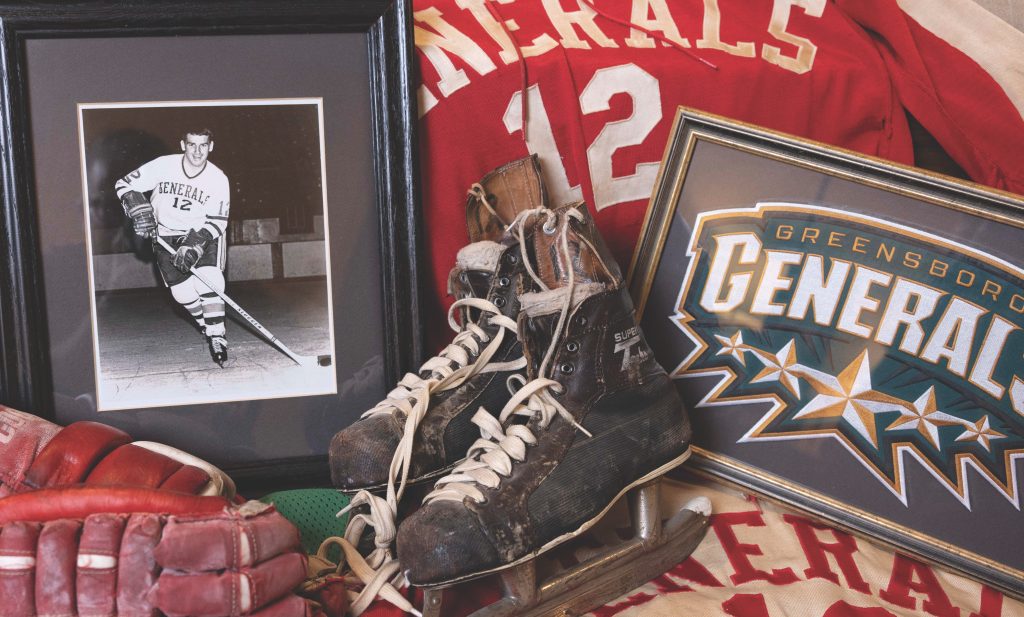
Former Greensboro Generals ice hockey players Ron Muir, Harvard Turnbull and Stu Roberts have a pretty good idea of what our new professional team, the Greensboro Gargoyles of the East Coast Hockey League, have on their minds.

A league championship.

That’s something the Generals, the city’s first professional hockey team, achieved in the 1962–1963 season of the old Eastern Hockey League. (A later franchise, the Greensboro Monarchs, won the ECHL championship title in the 1989–1990 season.)

After I schedule an interview with Ron Muir, I find it to be wonderfully apt that he lives just across the road from the Guilford Courthouse National Military Park and its monument to General Nathanael Greene.

One old general near another.

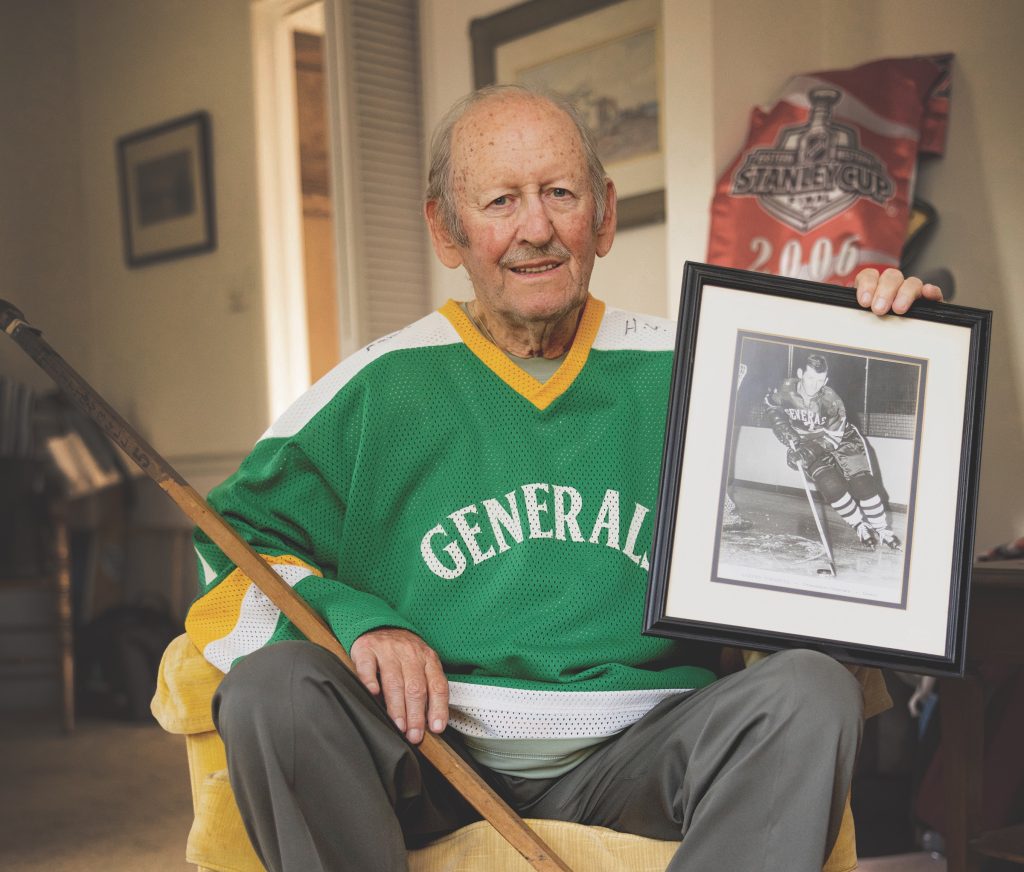
Muir’s 89 years old now, and I’m greeted at his door by two of his daughters, Elaine Miller and Susie Barham. Elaine teaches elementary school in Blowing Rock and Susie lives in Myrtle Beach.

Muir is sitting in a big recliner and is wearing a Wayne Gretzky jersey — for those of you who don’t follow the sport, Gretzky is a legendary National Hockey League player from Canada who was nicknamed “the Great One.” A hockey game set on mute slashes across the flat-screen TV facing Muir’s chair.

Hailing from small-town Seaforth, Ontario, between Lake Huron and Lake Erie, Muir was an athlete’s athlete — playing soccer, lacrosse, football, baseball and, of course, hockey.

“I decided I wanted to play professional hockey when I was about 10 years old,” Muir says.

Ron Muir

“He’s always had his goals,” Elaine laughs.

And play professional hockey he did. Before moving his young family to Greensboro for the 1960–1961 EHL season at age 25, he’d already played professionally in Canada for three years. Standing 5 feet 11 inches tall and weighing a bruising 190  pounds, Muir played left wing.

Because of his experience and age, many of his teammates looked at him as a father figure.

“Many of them were these 18-, 19-year-old boys, and their families were all back in Canada,” Elaine says.

“At Christmas, Mom and Dad would have a huge party, and the whole team would show up in our little house,” she adds.

Muir remembers that the person who convinced him to join the Generals was the late Don Carter, who was from Toronto. The two men were the same age and had first met at a Chicago Blackhawks tryout in St. Catharines, Ontario.

When they saw each other again at a training camp, Muir had been scouted by an EHL team in Johnstown, Penn., and was ready to sign with them.

Carter was already a star with the Generals. Playing defenseman, he stood 5 feet 11 inches tall, and weighed 185 pounds.

“So Carter says to me, ‘Ron, you don’t have to go to Johnstown. Come on, we’ll go to Greensboro. I played there last year and it’s a good town,’” Muir recalls.

“I thought, hell, I haven’t signed a contract,” Muir continues. “So, I signed up with the Generals’ manager, who was also at the camp, and loaded up for Greensboro.”

“My father drove us down,” Elaine says. “It was a two-day trip back then, and Susie and I were toddlers.”

“And we just ended up staying,” Muir says.

Two more daughters came along, Sandy and Cindy, and both still live in Greensboro. After Muir’s first wife passed away, he remarried, and a stepson, Jason, became family, too. Now Muir has nine grandchildren and four great grandchildren.

The first season Muir and Carter skated together as Generals, the team made the finals. The second season, they won the EHL championship.

In those days, there was no Plexiglas around the rink, just boards and wire. The girls would sit close to the ice, and, when Muir skated by them, they’d shout, “Hey, Dad!”

“The kids from the other hockey families would be all around us in the crowd,” Elaine says. “It was great.”

Greensboro was a hockey town — and “the Generals were superstars,” Elaine says.

“My husband, Eric, played little league hockey,” she adds. “So he knew about Dad long before he met me.”

Susie laughs.

“Oh, yeah, my husband knew Dad before he ever asked me out,” she chimes in.

Elaine smiles.

“We’d date these guys, and they’d say, ‘You’re Ron Muir’s daughters?’ That was a bonus.”

Harvard Turnbull suggests we meet for a drink at Fleming’s Prime Steakhouse & Wine Bar. Turnbull is 84 years old. Originally from Toronto, he skated at the center position for the Generals, standing 5 feet 9 inches tall and weighing 160 pounds.

Though he was an experienced and skilled hockey player, Turnbull was still a teenager with a dream of making the National Hockey League (NHL) when he arrived in Greensboro. Signing with the Generals represented a big step toward achieving that dream.

Turnbull met with members of the Generals’ staff at the Sedgefield home of businessman Stanley Frank, one of the founding owners of the team, to finalize his contract.

“So, they said, ‘What do you want?’” Turnbull recalls.

“I said, ‘You fill it out and I’ll sign it.’ That’s how green I was. I was going to turn pro. It was like I was going to walk on water.”

Fortunately for Turnbull, coach Ron Spong made sure the contract included generous bonuses each time the team advanced in the playoffs.

Harvard Turnbull

And that was the Generals’ championship season.

“I went out and bought a new convertible,” Turnbull laughs.

“It was amazing,” he says. “We were treated like kings.”

Turnbull tells me as many as 5,000 fans would show up to watch the team play in a charity softball game. He and his teammates could play the Sedgefield golf course anytime they wanted. They were often invited into the homes of civic leaders and successful entrepreneurs.

The late Anne Cone was one of the owners of the Generals team in its glory days. A benefactor of UNCG’s Weatherspoon Art Museum, she was the wife of Cone Mills heir Benjamin Cone, mayor of Greensboro, 1949–1951, who passed away in 1982. The couple lived in a graceful Greensboro Country Club mansion.

“Anne Cone was absolutely wonderful,” Turnbull says. “She would invite us single guys to her house for dinner about once a month.”

Among the bachelor invitees was Bob Boucher from Ottawa.

As the story is told, when Cone was in Chamonix, France, on a ski trip, she learned that Boucher, who was playing European hockey, had been arrested in Italy for fighting and couldn’t make bail. Cone managed to have him released and flown to Greensboro, where he skated for the championship team at right wing, standing 5 feet 9 inches and weighing 170 pounds.

“Bobby was a character,” Turnbull says. “So, we’d be at one of Anne’s dinner parties, and Bobby’s sitting at the head of the table where she had all these buttons, and he’d push a button and a servant would come in. Then he’d push another and a wine steward would come in.”

“He was just pushing buttons to see what would happen,” Turnbull laughs. “But Anne was cool — she didn’t have a problem with it.”

Yes, the high life was “plush,” as Turnbull likes to say, but the sport of ice hockey could be punishing, especially in those days.

He shows me a photo.

“That’s Ron Muir in front of the net and I’m taking a shot on goal,” Turnbull says. “Listen, I could really shoot the puck back then, probably get it close to 100 mph.”

He places a fingertip on the goalie’s head in the photo. The goalie’s not wearing a face mask, let alone a helmet.

“If the puck had hit him in the head,” Turnbull muses, “it probably would’ve killed him.”

He shows me another action photo, snapped right at the moment an opposing player knocked Turnbull completely over the boards and into the stands.

“That was very painful,” he says. “But I came right back out on the ice.”

Turnbull tells me that his nose was cut so badly once when he was playing in Canada that it had to be sewn back on. He’s had teeth knocked out, fingers broken and suffered numerous concussions.

“You know what they called the EHL back in my day?” Turnbull asks.

“They called it ‘the meatgrinder league,’” he says, nodding slowly. “That’s how crazy it was.”

Turnbull believes if his teams had “proper helmets, proper rules,” maybe he wouldn’t have suffered so many injuries, which continue to plague him in his golden years.

“Still,” he concludes, “I’d do it all over again.”

Stu Roberts

I meet up with Stu Roberts at the Chick-fil-A just off Battleground Avenue.

Roberts is a native of St. Catharines, Ontario, and arrived in Greensboro in 1966. Although he was just 19 years old, he had already been playing for the St. Catharines Black Hawks, a Canadian junior ice hockey team, for four seasons. He stood 5 feet 7 inches tall and weighed 175 pounds, and didn’t waste any time making an impression in the EHL.

Roberts won the rookie of the year award in 1966–1967.

“I was fast, and that was my game,” he says. “And I could score goals. One year, I scored 62 goals in 72 games. Wonderful year.”

Roberts tells me that he wasn’t a bruiser like Muir and Carter — he used his speed to avoid the hits.

And he knew how to please the crowd.

“I’m not bragging, but I’m proud of the fact that I won most popular player three years in a row,” Roberts says. “I used to tell Coach Spong I’d rather keep the people happy than win any other award.”

As long as the fans were behind him, he adds, “I knew I could keep my job.”

One of Roberts’ daughters, Ashley Barker, drops by the Chick-fil-A to show me some of her Dad’s memorabilia.

Among the items is a newspaper article written by a St. Catharines reporter the summer after Roberts’ second season as a General.

The writer called Roberts “Mr. Excitement.”

“He’s a gambler, often diving, literally, across the ice to get the puck,” the reporter wrote.

The crux of the article?

That Roberts was a huge fan of another speedster — No. 43, stock car driver Richard Petty. So much so that he visited Petty in Randleman, who obliged Roberts by letting him try out the driver’s seat in No. 43. Not on the track, of course.

I ask Roberts about the teams the Generals faced in his eight-year career here.

“I’m telling you, we had some great teams,” Roberts says.

“Our nemesis was the Charlotte Checkers,” he continues. “We used to go to Charlotte on a Friday night and fill the place, and come back to Greensboro on Saturday night and fill the place. It was really good rivalry.”

And there were the Roanoke Valley Rebels, originally the Salem Rebels, in Virginia.

“We used to skate in the old Salem Civic Center, but then they built the Roanoke Civic Center, which was a beautiful rink,” Roberts says.

There were the Nashville Dixie Flyers and the Knoxville Knights in Tennessee.

And, yes, even back then, two teams from the Sunshine state — the Jacksonville Rockets and St. Petersburg Suncoast Suns.

“We carried 18 players on the team and did most of our travel by bus,” Roberts says. The bus had about 20 seats and the remaining space was set up with double-deck bunks.

“We had some good times,” he continues. “I remember a lot of bus rides in a lot of snow, getting from Greensboro to Nashville, or Nashville to Knoxville, or Knoxville to back home.”

Roberts pauses for a moment.

“I think maybe people have forgotten about the Greensboro Generals,” he muses.

I tell him about how many fans I’ve seen — some even high school age — who’ve been wearing old Generals jerseys at the Gargoyles media events I’ve attended. His face brightens.

“You know, I want to thank Greensboro,” Roberts says. “I skated on some great teams. I met my wife, Amanda, here. We raised our kids here. It’s been a wonderful ride.”

And who knows? Maybe our Greensboro Gargoyles in their inaugural season will create some glory days of their own.

The Flying Gargoyles

THE FLYING GARGOYLES

The Flying Gargoyles

Photographs by Tibor Nemeth

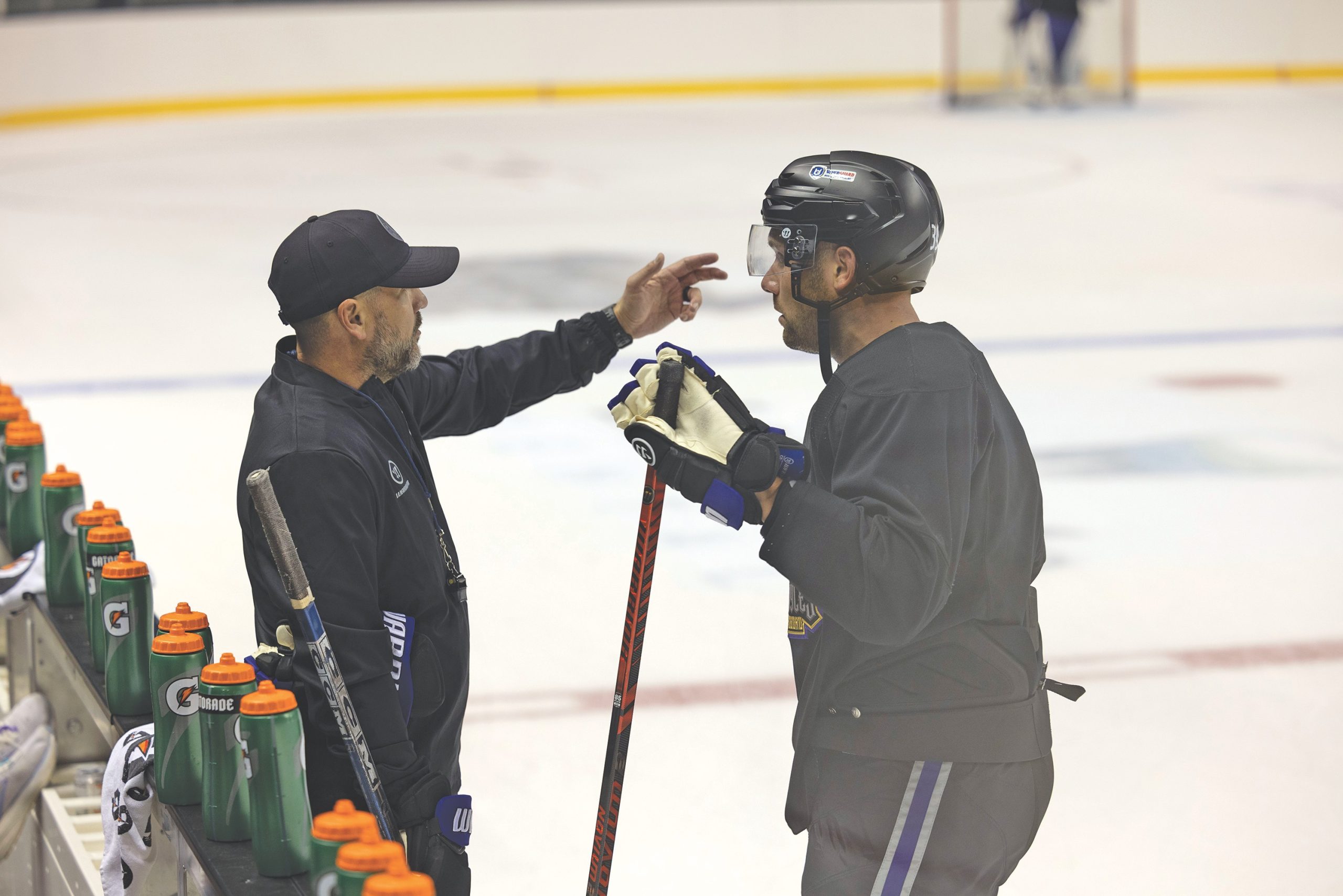
We sent photographer Tibor Nemeth to capture Gereensboro’s newest hockey team, the Gargoyles, warming up on the ice before their season kicked off in October. You can find the rest of their opening season schedule at gargoyleshockey.com.

Tea Leaf Astrologer

TEA LEAF ASTROLOGER

Scorpio

(October 23 – November 21)

There’s a fine — and in your case, blurred — line between passionate and possessive. When Venus struts into Scorpio on Nov. 6 (where she’ll glamp out until month’s end), that line is primed to become a short leash if left unchecked — and nobody wants to be on the other end of that. A word of advice: Don’t smother the fire. Tempted as you may be to cling fast and tight, a little space will keep the coals glowing red hot.

Tea leaf “fortunes” for the rest of you:

Sagittarius (November 22 – December 21)

Stick to the recipe.

Capricorn (December 22 – January 19)

Pack a lint roller.

Aquarius (January 20 – February 18)

Thaw before cooking.

Pisces (February 19 – March 20)

Don’t overwork the potatoes.

Aries (March 21 – April 19) 

The shortcut won’t be worth it.

Taurus (April 20 – May 20)

Go easy on the garlic.

Gemini (May 21 – June 20)

Cling wrap, baby.

Cancer (June 21 – July 22)

The dishes are piling up again.

Leo (July 23 – August 22)

Shake the rug, darling.

Virgo (August 23 – September 22)

Dare you to bust out the fine china.

Libra (September 23 – October 22)

Serve yourself an extra slice of grace.

NC Surround Sound

NC SURROUND SOUND

Sounds of a City

Music with a connection to place

By Tom Maxwell

Alex Maiolo is a creature of pure energy. It’s not that he talks fast or acts nervous — he’s simply an ongoing conversation about electronic music, geography and whatever else happens to capture his interest. He’s also a singular kind of globetrotter, one who doesn’t sound pretentious about it. He loves Estonia’s capital, Tallinn, so much he made music with the place, a 2021 conceptual performance he called Themes for Great Cities.

Conceived as one of his two main pandemic projects — the other was getting better at making pizza — the musical idea took on a life of its own even as the flatbread faded. He invited Danish musician Jonas Bjerre, Estonian guitarist and composer Erki Pärnoja and multi-instrumentalist Jonas Kaarnamets to collaborate. What resulted was something that felt improvised, unpredictable and exhilarating.

“Even though I was living in Chapel Hill, I was trying to think about, well, what do you miss when you miss a city?” he says.

The obvious things — favorite restaurants, familiar streets — were only part of it. Beneath that, Maiolo sensed a deeper, subconscious connection to place that might be expressed musically. He seized upon the idea of treating the city itself as a collaborator. “I wanted to write a love letter to this incredible city by gathering elements of it and assembling them in a new way,” he says. Sounds and light readings became voltages; voltages became notes. “Every synthesizer is just based on the assemblage of voltages,” Maiolo says. “So, if you have voltages — particularly between negative five and plus five volts — you can make music.”

The group collected source material across Tallinn: gulls shrieking overhead, rainwater rushing down a gutter, chatter in a market, the squeak of trams, cafeteria trays clattering at ERR (Estonia’s equivalent of the BBC). A custom-built light meter called the Mõistatus Vooluringid — “mystery circuit” — captured flickering light and converted it into voltages. These inputs were then quantized, filtered and transformed into sound. Tallinn became what Maiolo called “our fifth band member. And just like with any band member, you can say, ‘Hey, that was a terrible idea’ or ‘way to go, city — that was a good one.’”

From the outset, the goal was to create something that felt alive. “We wanted happy accidents,” Maiolo says. “Quite frankly, I wanted to be in a situation where something could go wrong.” Unlike a pre-programmed, pre-recorded synthesizer session, Themes for Great Cities was designed to court risk through completely live and mostly improvised performance — to create the same adrenaline rush that test pilots might feel, only with much lower stakes. “No one was going to crash,” Maiolo says.

That philosophy made the project’s debut even more dramatic. Originally slated for a 250-seat guild hall built in the 1500s, the show was suddenly moved to Kultuurikatel, a former power plant that holds a thousand. Then came another surprise: The performance would be broadcast live on Estonian national television, with the nation’s president in attendance. “It was far beyond anything I had imagined,” Maiolo admits. “I thought we were going to play to 30 people in a room.”

Visuals by Alyona Malcam Magdy, unseen by the musicians until the night of the show, added a surreal dimension. Estonian engineers captured the performance in pristine quality. “It all came together,” Maiolo says. “The guys I was doing this with are total pros.” The recording was later mixed and pressed to recycled vinyl at Citizen Vinyl in Asheville. Unable to afford astronomical mailing expenses, Maiolo split 150 LPs between Estonia and the United States, carrying them in his luggage.

Though imagined as a one-off, Themes for Great Cities continued to evolve. The group returned to Estonia in 2022 for a new performance in Narva, reworking parts of the score and staging it in a former Soviet theater. “We didn’t record that one because it was similar to the first. But when we do Reykjavik, we’ll record that one and hopefully release it,” he says. Yes, Iceland looks like the next destination. The plan is to work partly in the city and partly in the countryside, where light, landscape and weather can all feed into the music.

The ensemble has grown tighter, but Maiolo emphasizes the lineup will be flexible, with an eye toward incorporating local musicians. Vocals may be added in future versions, perhaps improvised or even converted into voltages to manipulate the electronics. “Anything is possible,” he says.

Though he now lives in San Francisco, Maiolo continues to think of North Carolina as part of his creative geography. He still has his house in Chapel Hill, stays connected to Asheville’s Citizen Vinyl, and carries his records home through RDU.

Maiolo and his partner of seven years, Charlotte, are to be married in Saint-Germain-des-Prés in Paris. Her father, a German who came of age during World War II, once spent a year in San Francisco immersing himself in jazz. Even now, as he struggles with dementia, he plays clarinet and listens to Fats Waller and Oscar Peterson. The sense of music as a lifelong companion, capable of anchoring memory and identity, is yet another thread running through Maiolo’s work.

Ultimately, what began as an experiment has become an ongoing series of collaborations. Each city brings its own textures, rhythms and surprises. Each performance is both a portrait and a partnership. “At the end of the day, it just kind of sounds like music,” Maiolo says nonchalantly, as if jamming with an entire city is an everyday thing.

O.Henry Ending

O.HENRY ENDING

Trot Till You Drop

A mother and son’s Thanksgiving tradition

By Cassie Bustamante

Thanksgiving traditions? Everyone has ’em. Some families habitually sign up for the local turkey-trot races, dressed in matching tees with some cutesy saying like “First we run, then we eat” paired with fall-colored tulle skirts at their waists and coordinating, striped, knee-high socks. We are not that family.

And yet, in 2023, I ambush my oldest, 18-year-old Sawyer, begging him to turkey trot with his momma in the Greensboro Gobbler 5K. My motives are not entirely self-centered: A cross-country and track athlete when he graduated from Grimsley earlier that year, since then his sneakers have been collecting dust — not the kind kicked up on a trail.

An avid, albeit slow, runner myself, I know the benefits exercise has on my mental health. Trust me when I tell you that my family has many times breathed a sigh of relief when I hit the pavement. Of course, tell a teenager you think anything would be good for them and watch their eyes roll. Even if you can’t see the movement in their eye sockets — trust me — you can feel it.

Nevertheless, Sawyer oh-so-reluctanty agrees to join me in the race. I get to work training, suggesting that he do the same. And yet the weeks tick by without him so much as glancing at his Asics. But he’s a cross-country runner, after all, and confident that he can just wing it and be absolutely fine. Oh, to have that kind of confidence!

Race day arrives and we make our way to the starting line. Music blares on nearby speakers, families decked out in the aforementioned outfits huddle together and Davie Street thrums with energy. The gun goes off, and off we go. Within seconds, Sawyer’s feet swiftly take him way ahead of me. After less than a block, Sawyer’s gone from my line of vision and I know I won’t see him again until the end, but that’s OK. I am not trying to prove anything — to my son or to myself. Surprisingly, I cross the finish line a full minute and a half earlier than I’d expected and I feel great.

Smiling and panting, I scan the crowd for my son. Finally, I spot him. He’s fair-skinned as it is, but his face is as white as a ghost. I hate to call my own child pasty, but there’s no other word to describe him just then.

“Let’s take a selfie and commemorate this moment!” I say, excitedly whipping out my phone. He winces as I snap the photo and does a quick about face. “I don’t feel so good,” he ekes out. “I think I’m going to be sick.”

So, in the middle of downtown Greensboro’s Center City Park, Sawyer leans his head over a garbage can while I look around to make sure we aren’t in the background of anyone else’s photos.

As quickly as we can, we hop in the car and head home. Sawyer, gripping a half-drunk bottle of water, once again has color in his cheeks.

When we pull up in our driveway five minutes later, the lucky teenager has bounced right back as if nothing out of the ordinary happened. He turns to me before opening his car door and says, “Well, Mom, I think we’ve just started a new tradition.”

“I’d love that! And maybe next year we can get fun outfits,” I say, already picturing them in my head and wondering if I can run with a heavy stuffed-turkey hat on my head.

“Not happening,” he says, quickly squashing that dream. “But next year I might train a little bit.” 

Birdwatch

BIRDWATCH

The Powerful Fox Sparrow

Large, handsome and hard to spot

Sparrows are a common sight throughout central North Carolina in winter. Historically, eight different species could be found in a day across the Sandhills and Piedmont. The gregarious, prolific and very adaptable house sparrow was added to the mix in the 1800s by early settlers who yearned for a familiar bird from the Western Hemisphere — as well as a means to control insect pests associated with human habitation.

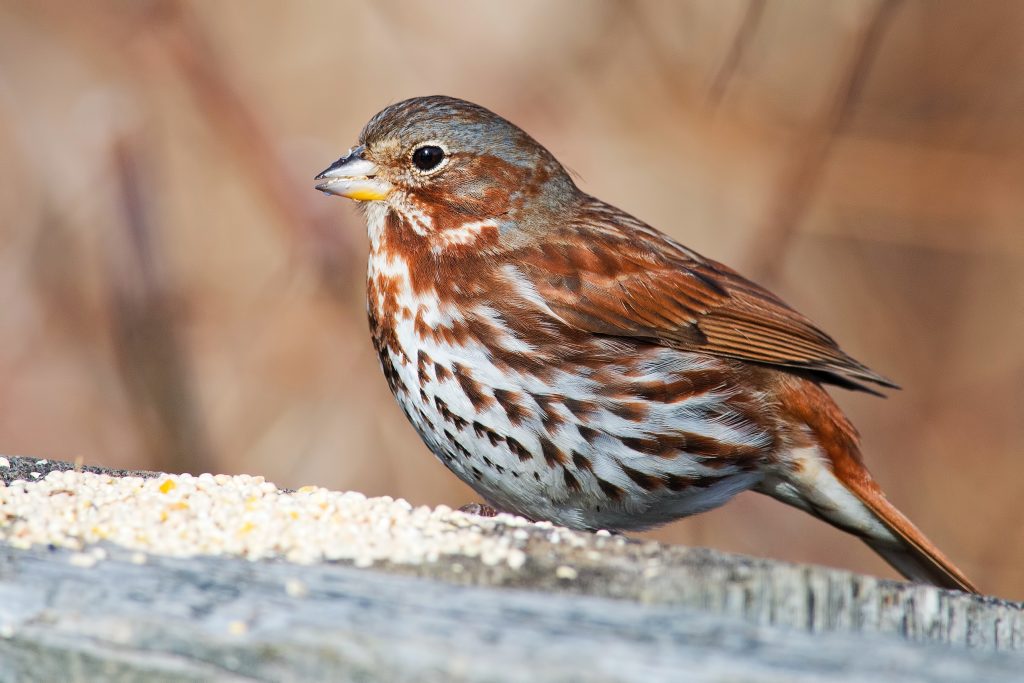
At this time of year, the largest and most handsome of the sparrows is inarguably the fox sparrow. It’s also one of the hardest species to find. Perhaps because of its size and brighter coloration, it is frequently hidden in the vegetation. The fox sparrow is typically over 8 inches in length and very stocky, with bold rufous streaking on its underparts. From the head down the back to the tip of the tail it is a “foxier” reddish in color. Several races of the fox sparrow exist in the U.S. and Canada, with those found farther west being browner all over.

The fox sparrows that we see in winter breed from northern Ontario east to Newfoundland and south into parts of Nova Scotia. They move south in fall and start to appear in North Carolina in October. They seem to flock loosely with other sparrows and finches during the colder months. They prefer habitat that is immediately adjacent to water. Although they eat mainly insects during the summer, in winter seeds and berries tend to make up much of their diet.

More often than not, fox sparrows can be found in expanses of bottomland forest, kicking vegetation and debris for food, though there are lucky backyard birdwatchers who regularly observe them taking advantage of millet and other small seeds under their feeders. During very cold and wet weather, they may move farther into drier areas in search of a meal. I don’t usually see them where I live unless it snows — our predominantly grassy yard is too open to appeal to them. However, we have wet woods with dense tangles of evergreen vegetation not too far away.

Because of their size, fox sparrows are quite strong and capable of uncovering food that is buried deep in the forest floor. They will actually use both feet together to scratch and dig beyond the reach of other small birds. If you are out in wet habitat — or if you check under your feeders after a mid-winter snowfall — you may be treated to a glimpse of one of these handsome and powerful birds.