Tea Leaf Astrologer

TEA LEAF ASTROLOGER

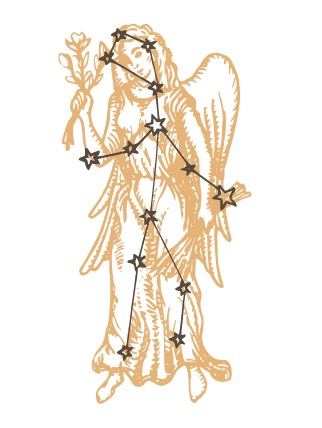
Virgo

(August 23-September 22)

Perhaps this will come as a shock: You don’t have all the answers. Let the mystery ignite your passion this month. Let it be juicy. Let it break your snarky gremlin of an ego. When Mercury guides your focus inward on Sept. 2, mind the negative self-talk as you strive toward new growth. On the 19th, Venus will shine a spotlight on unrealistic expectations. Take note. And on the 21st, the new moon and solar eclipse spell new beginnings. But not without a pickle of an ending. 

Tea leaf “fortunes” for the rest of you:

Libra (September 23 – October 22)

Inhale and lengthen the spine; exhale and gently twist.

Scorpio (October 23 – November 21)

Taste as you go.

Sagittarius (November 22 – December 21)

Just say what you mean.

Capricorn (December 22 – January 19)

Lace up your dirt-kicking boots.

Aquarius (January 20 – February 18)

It’s time for a new novel.

Pisces (February 19 – March 20)

Deep clean the fridge, stat.

Aries (March 21 – April 19)

Bring your journal along.

Taurus (April 20 – May 20)

Three words: Almond oil, darling.

Gemini (May 21 – June 20)

Your only job is to listen.

Cancer (June 21 – July 22)

Someone needs a salt bath.

Leo (July 23 – August 22)

Sign up for the workshop.

Almanac September 2025

ALMANAC

September

By Ashley Walshe

September is the letter you don’t see coming. The one you will memorize. The thorn and the balm for your aching heart.

Dear one, summer writes in florid longhand. This won’t be easy. I love you, and I must go.

Your head spins. You can smell her on the pages, in the air, on your skin — the spicy-sweet amalgam of pepperbush, honeycomb and night-blooming jasmine. You steady yourself and keep reading.

Her tone is as soft as lamb’s ear, gentle as butterfly, warm as field mouse. Still, your heart feels like an orchard floor, each word a plummeting apple. Not just the fruit wears the bruise.

You can never lose me, she writes. Close your eyes and feel me now.

Sunlight caresses your face, chest and shoulders. At once, you’re watching a movie reel of summer, recalling the riot of milkweed, the tangles of wild bramble, the deafening hum of cicadas.

Picnics and hammocks. Daydreams and dragonflies. Puffballs and palmfuls of berries. It’s all right here.

When you open your eyes, you notice a lightness in your chest — a shift.

Yes, a yellow leaf is falling. But, look. Wild muscadine climbs toward the dwindling sun, singing silent vows in golden light.

You can chase me if you wish, she writes, her script now hurried. Or, you can be as fruit on vine: purple yet unbruised, ripe with sweetness and steadfast as the seeds you hold within you.

Bird Candy

If you think our flowering dogwoods put on a show in early spring — striking white (or pink) bracts popping against the still-leafless woods — just wait until month’s end, when its ripe berries bring in waves of avian passersby.

Of course, there are the usual suspects: mockingbirds and jays; woodpeckers and warblers; cardinals, catbirds, thrashers and thrushes. But if you’re lucky, those clusters of brilliant red berries could conjure migratory wonders such as the scarlet tanager, the rose-breasted grosbeak or even a rowdy troupe of cedar waxwings to your own front yard.

According to one online database (wildfoods4wildlife.com), the flowering dogwood berry ranks No. 29 on the “Top 75” list of wildlife-preferred berries and fruits. While blackberries top the list, flowering dogwood ranks above persimmon, plum and black cherry (note: ranks were determined by the number of species that eat said fruit, not by its palatability). If curated by tastiness — or mockingbird — sun-ripened figs would have surely made the cut.

Lucky Charms

On Sept. 19, three days before the Autumnal Equinox, look to the pre-dawn sky to catch a thin crescent moon hovering ever close to brilliant Venus. Although a lunar occultation of the Morning Star will be visible from Alaska and parts of Canada (that’s when the moon passes directly in front of the planet), we’ll witness a conjunction more akin to charms dangling from an invisible chain.

The Show Must Go On

THE SHOW MUST GO ON

The Show Must Go On

UNCSA’s Chancellor Cole looks to the school’s bright future

By Billy Ingram

Over a quarter century has passed since my last visit to what was then simply known as “School of the Arts.” (Don’t call it that today — they’ve graduated!) Touring their campus over the summer, I was amazed at University of North Carolina School of the Arts’ expansion, with the addition of three enormous, Hollywood-style sound stages, extensive wardrobe and wig departments, an airplane hangar-sized set-painting facility, state-of-the-art imaging studio, and even a quaint city street backlot facade alongside a three-screen movie theater where the RiverRun International Film Festival is held each year. During that late-1990s visit, I donated a bundle of movie posters I had labored on years earlier in Tinsel Town, one of which (Superman IV) was framed outside the theater’s entrance.

I have returned to meet with Brian Cole, now in his sixth term as chancellor of UNCSA. This year marks the 60th anniversary of the university and, while there will be cake — there’s always cake — Cole is aggressively fixated on a future fraught with unprecedented challenges fueled by rapidly evolving technology and ingrained predaceous business practices threatening to upend every aspect of the arts. He’s clearly up to the task.

UNCSA concentrates on five core disciplines: drama, music, filmmaking, design & production, and dance, with both high school and college curricula. Cole comes from the symphonic side. His pro career started when he apprenticed with the Cincinnati Symphony under the tutorage of one of music’s most eminent maestros, Grammy-winning Paavo Järvi. He went on to teach at the University of Cincinnati College-Conservatory of Music before circling the globe waving his conductor’s wand before a multitude of illustrious orchestras.

“I think arts and artists are critical to our society and this place plays a critical role in producing those artists,” Cole asserts, seated in his window-rimmed chancellory overlooking a busy corner of campus. “Creativity is why we are successful — because artists are the ultimate problem solvers.”

UNCSA is home to a wealth of expert educators connected to and, in many cases, still actively participating in their attendant industries. “That hands-on experience is something we’re known for,” Cole says. “Producing people ready to create, being job-ready on day one, especially in the production areas. That’s not something other places can really claim to the same degree.” The school is on track for record enrollment this fall, maybe because of its almost unmatched media exposure in recent months. “People know of us because of the training, but also because we’ve had this incredible impact on all these industries with some notable alumni who are doing amazing work.”

Our media landscape is inexorably shifting, Artificial Intelligence being well past its nascent six-fingered-hands phase. The unexpectedly rapid acceleration of AI’s ability to seamlessly (shamelessly?) complete complex artistic tasks is a pedal to the, ahem, mettle of anyone with creative aspirations.

“We’re having some substantive conversations right now about creating a strategy for this,” Cole says. “It is definitely starting to have a substantial effect on the film and TV industry, on the visual arts, and the music industry. It is an incredibly disruptive technology that has vast potential for good and bad.” A Chancellor’s Task Force has been convened to address how to navigate a new world emerging out of generative AI. “We’re looking at our industry partners who might be able to provide resources for students, faculty and staff. What are the positive ways this is already being used? What are the negatives and how can we get out in front of that?”

While a number of universities are investing heavily in AI, there’s a tendency to focus on so-called hard skills or STEM (science, technology, engineering and mathematics). “I don’t hear as much from arts-training institutions. One of the most important things is, whether it’s music or a poster or a film, if you don’t hear or see the human’s voice in it, then it’s a failure.” Cole quotes a sports analogy coined by Oscar-winning director Steven Soderbergh about AI: “It’ll help you get down the field quicker, but it will never get you into the end zone.”

This administrator has faced game-changing outbreaks before, having barely transitioned from dean of the School of Music to chancellor when COVID shut everything down. “Solutions we came up with were incredible because of the passion and the creativity of the people on this campus,” says Cole, who may have had in mind that well-worn trope: The show must go on. “I have not seen any other institution in the country from that time period that was doing more, or, in many cases, anywhere near as much as we were and doing it safely.” Carrying on with musical, dance and drama performances, the students were on stage, but the audience caught it via livestream.

Chancellor Cole is equally mission driven when it comes to establishing an intellectual property paradigm for emerging talent. What exactly would that look like? “A nonprofit media publishing arm promoting the work of the artists of our ecosystem,” he explains. Those artists include “alumni and faculty, but to some degree current students when they are in that launch period.” For now, UNCSA Media is primarily concentrating on music with plans to venture into other artistic avenues represented on campus. “We’ve got four or five albums out or in the works. The key to creative and career success in the future is leveraging the ownership of what you create. And often that had been the thing leveraged over artists.”

It’s called show business. Taylor Swift’s years-long, multimillion dollar effort to wrest control of her early albums and songwriter royalties is an au courant example of an artist signing a lopsided deal in exchange for industry advancement.

Cole recalls discussing that conundrum with legendary pop star John Oates over dinner one evening. “Hall & Oates is the most successful musical duo of all time, Rock & Roll Hall of Fame . . . you’d be surprised how much longer it took in their career to really make any money.”

Perhaps not as well known to the public is UNCSA’s live-in high school curriculum, which emphasizes artistic pursuits while simultaneously offering more conventional course work. “We have alums that come from very small towns and now they’re in really substantial, incredible careers in the arts,” notes Cole. “There was nothing for them in their hometown but they met someone who knew of this high school in North Carolina that was training students in the arts, where you could also have a great academic education as well. For North Carolina residents, there was no financial barrier — our state supports that.”

The chancellor aspires to enroll an additional hundred high schoolers once a larger dorm is completed. “We already have programs in music and dance and drama and visual arts. We want to certainly expand those but we also want to create a filmmaking concentration. I don’t think there is another one in the country at the high school level.”

As if Cole didn’t have enough to do on-campus, he is also overseeing one major off-campus project, an $85.3-million renovation of the Stevens Center. “It is essentially our biggest high-tech classroom and learning laboratory,” he says, “an important cultural center for professional organizations in our community and for what UNCSA does there.” When completed, it will be a venue where all departments collaborate to mount major productions utilizing actors, dancers, musicians, backstage crews, costume, lighting and set designers, even atypical variables like “animatronics and robotics technicians working in live entertainment. We’re very fortunate that, through the generosity of the state, we’re keeping those skills on pace as well.”

Cole still allows time for conducting, both in country and abroad but less so on campus. “We have great artists and teachers here, so I don’t want to take too much away from them. For the last two years I conducted our Nutcracker production at the Tanger Center. Big success.” For 2025’s holiday tip-toeing at Tanger, however, Cole will pass the baton to someone else. “It’s good for students to work with different conductors — not just for the orchestra, but also the dancers.”

Reflecting on the passage of 60 scholastic cycles since that inaugural class of ’65, Chancellor Cole muses, “The founders were thinking we would be like the Juilliard of the South. And it very much was. Now I kind of think of Juilliard as the UNCSA of the Northeast.”

Just kindly try to refrain from referring to it as School of the Arts.

Behind the Curtain

Cynthia Adams

Susan Turcot, whose parents live in Greensboro, went on to have a distinguished film and television lighting career in Hollywood after attending UNCSA. Her credits include mega-hits Independence Day, The Negotiator, Titanic, Panic Room, Pleasantville, The Rat Pack and The Bird Cage. Her skill set? Dimmer board, lighting and rigging, among other specialties.

Her proud parents, Bud and Sharon Turcot, rented out a Sedgefield theater for a private showing when Titanic premiered.

“They gave out tissues and Life Savers,” she recalls with a laugh. Guests filed out of the theater wiping their eyes and Susan regaled them with stories about the set, cast and crew at an afterparty. That Titanic gig, however, couldn’t have delighted her folks more as it grossed over $2 billion, becoming the highest grossing film of its time.

She self-deprecatingly jokes that only her parents’ friends know she has rubbed elbows with the rich and famous and never name drops. Turcot also worked on the top-rated TV sitcom Two and a Half Men.

She didn’t enter UNCSA intending to specialize in dimmer board and rigging: “When I was there [at UNCSA], it was different.” She graduated in the 1980s with a concentration in design and production.

“Of course, there was no film [concentration] then, only theater. It was dance, drama, music, and design and production.”

Turcot left after graduation to pursue opportunities in California and found her niche. She keeps work options open, she says, even if she has been remiss about keeping her resume current. Now, at home in Los Angeles, where she has lived and worked most of her adult life, Turcot says a lot of her fellow graduates are active in the industry there.

In its 62 years, UNCSA has graduated alumni who work in a multiplicity of artistic careers, grabbing headlines well beyond the Triad. Many become notable musicians, actors, screenwriters, directors, producers and dancers. Much larger numbers who graduated from UNSCA’s five professional concentrations work behind the scenes in performing, visual and moving image arts.

UNCSA’s arts-based education produces many unsung heroes of the industry. Imagine a film when the lighting is too harsh — or dim. Or the sound is faulty. Or the casting is all wrong. Or the makeup and costumes are amateurish.  

Those in “above the line” roles belong to composers, graphic designers, photographers, producers, directors, actors, musicians and writers. Those who execute on a technical, granular level, include “below the line” professions such as casting directors, production designers, costume designers, editors, cinematographers, camera work, set design, sound recording, makeup artists, sound, electrical and lighting technicians.

Many of those names are not always known to the arts and entertainment audiences. But you do know these talented alumni by their work.

Paul Tazewell, BFA ’86, concentrated in costume design and technology as a student from Akron, Ohio. Since then, he has steadily contributed to a body of creative work recognized as artistically and historically significant.

On March 2 earlier this year, Tazewell made school history when he won the Academy Award for Costume Design for Wicked, becoming the first UNCSA alum to win an Oscar. 

He also made Oscar history as the first Black man to achieve that distinction. Plus, he has two Tonys on his shelf, for Death Becomes Her and Hamilton, plus a Primetime Emmy Award.

As an extra feather in the school’s cap, UNCSA quickly posted the news that Wicked was not only nominated in 10 different categories, but won two, scoring a second Oscar for production design. The original stage director, Joe Mantello, and the film’s casting director, Tiffany Little Canfield, both alums, contributed to the stage and screen versions.

Tazewell attributes much of his artistic identity to his N.C. alma mater.

“It was here that I first began to love myself — to trust my own voice. To trust my own vision of myself. And that love has shaped everything since,” he recently said in a commencement speech delivered to the school’s newest grads.

As UNCSA graduates have steadily migrated into professional careers in film, in touring productions, in music, and on Broadway — others are entering newer fields in digital media. 

Photographer and director David LaChapelle attended high school at UNCSA, which he has since called his “big break.” This coming from a man whose early work was with Andy Warhol’s Interview magazine. His museum-worthy body of work has appeared in the world’s top magazines plus a vast collection of music videos and includes signature photographs of celebrities such as Michael Jackson, Uma Thurman and Elton John.

Earlier this year, the North Carolina Museum of Art hosted two exhibitions of LaChapelle’s work. On display at its two locations in Winston-Salem and Raleigh were more than 80 prints, drawings and videos.

Tanase Popa, who graduated in 2006, studied stage management. Now, he pairs the right talent with the right project. He has since earned a Peabody and an AFI award, and has had multiple Emmy and Golden Globe nominations for his work in television and film. He has worked on popular series including Glee and American Horror Story.

The press-averse alum eschews the spotlight. “I want to be the one behind the scenes putting it together,” Popa said in a 2020 interview for the school’s website.

“I never looked at myself as someone who was creative in the sense that I need to write or be a director to put the pieces together that way. I always loved finding the right people for the right project.”

Not every career is spent on the Great White Way or working behind the Klieg lights of Hollywood. Training in production and design easily lends itself to work in an artful aspect of consumerism.

If you’ve shopped at Saks Fifth Avenue, you’ve seen the work of UNCSA alum Connor Matz, who directs the mega-retailer’s windows, visuals and interiors.   

Meanwhile, entrepreneurial alum Destinee Steele has built a successful business and career in Florida working as a wig-and-makeup artist since her professional training at UNCSA.

In each case, their creative work is their calling card.

And when you’ve finished a movie that was so good, you just don’t want to leave the theater as the cast of characters behind the scenes scrolls on and on, remember that it’s a reminder how many people work in any production. These unsung creatives get little credit beyond the mention of their name. 

Finish your popcorn and read on. Odds are good that those talents — with names like Turcot, Tazewell, Mantella, Canfield and Poppa — honed their skills at UNCSA.
Poem September 2025

POEM

September 2025

On the Way Home

from my father’s funeral,

a mime is performing on the corner,

laid out on the concrete like a corpse,

pulling herself up with an invisible rope

as if hope were a cliff to climb,

then levitates over a pretend chair

as if preparing to eat, drinking

an empty glass of air, her palms

bringing into being the nuanced

shape of bread to be broken.

I sit on the edge of a scrap of plywood,

a makeshift seat, perch as if on a ledge

heeding the gravity of all the unsaid.

Everything her eyes imply is about

the last meal I shared with my father.

“Do you hear me?” she hints

with her hands that have

become her voice, her frown

a phrase, a black drawn-on tear

a lost syllable, then,

as though life were something tangible,

sets up an imaginary ladder,

points to a nebulous cloud

she intends to reach, waving goodbye

as she begins to climb into the sky.

— Linda Annas Ferguson

Chaos Theory

CHAOS THEORY

Forever Home

Turns out, you can’t stay forever

By Cassie Bustamante

When my only daughter, Emmy, was born 18-and-a-half years ago, I was immediately overwhelmed. With love, sure, but mostly with life. I already had a 17-month-old toddler, Sawyer, at home. My husband, Chris, traveled a lot for work. How on Earth was I going to survive with two little ones in diapers by myself? Now, it’s been just a couple of weeks since we sent Emmy off to her first year of college at Penn State, and I don’t know how I will manage without her here.

While Sawyer was a busy, on-the-move preschooler, Emmy, from a very early age, could sit and color contentedly for hours. I remember leaving her once, just 2 at the time, in our playroom so I could tend to Sawyer upstairs in our little split-foyer home. I felt panicky during the minutes I was away from her, but, when I returned, she sat in the same chair, still happily doodling with crayons in an array of bright colors. Before taking my seat next to her, I stared in wonder. Who was this calm, creative child?

Don’t get me wrong. It wasn’t all Crayola rainbows and tissue-paper butterflies. With that artistic spirit comes a bit of environmental chaos. In fact, numerous studies have linked messiness with creativity. I can confirm that the spot where I sit in my home writing for this very magazine is surrounded by an impending avalanche of books, magazines, pens and papers threatening to send a half-drunk cup of room-temperature coffee flying onto the rug. Emmy’s space was her bedroom and, boy, did she express herself within its walls. For my own sanity, I usually just kept the door shut. Out of sight, out of mind. And, yes, I know this is rich coming from someone who’s just declared her space a wreck too.

But, on occasion, I’d spend the better part of my day giving her bedroom a thorough cleaning while she was in school, blissfully unaware of my intrusion. Armed with trash bags to stuff with garbage and donations, I’d sift through every nook and cranny. It was a challenge, to say the least, but the reward was worth it: little glimpses into her sparkling soul. In her desk drawers, I’d discover illustrated fairy tales she’d written. On the walls of her closet, she’d hung pictures of hearts and stars with motivational sayings, things like “You were meant to shine bright.”

She’s always used a mix of words and colors to communicate; it’s no wonder she ended up working on her Grimsley High School yearbook and plans to study journalism. Once, when she was 8 and had gotten in trouble, she left me a note on our kitchen island: “I am sorry for the way I acted. I was being a total jerk. It’s just that a lot of people have been mean to me. Love, Emmy. P.S. I hope you understand.” How can you stay mad at that?

Generally, she shied away from reading her own writing aloud, but, every once in a while, she couldn’t resist. Two weeks after leaving me that heartbreaking note, she penned a tune she titled “Forever Home.” Thankfully, 37-year-old me had the foresight to capture the moment she sang it to me, her crystal-blue eyes twinkling as she smiled proudly.

Now, a decade later, I’m back at home after loading all of her worldly belongings into our SUV and dropping her off in State College, Penn. My finger hovers for a moment and then I hit play on that video. Her squeaky little voice fills my ears as tears fill my eyes:

Forever home, you’re never alone

You’re always with someone,

Say hello, say goodbye,

Say hello, change your mind,

’Cause you’re with someone,

And even if you’re not,

You’ll still have us.

Once again, I feel overwhelmed. Somehow, I managed to get through those years of having two little ones in diapers. So much, in fact, that a decade later, we even decided to add a third, Wilder, who is almost as old as Emmy was when she wrote that song. And no, I don’t know how to keep going without her here every day, but I know I will. And I hope that she knows that no matter where life leads her over the next four years and beyond, we are always with her and we remain her steadfast “Forever Home.” 

O.Henry Ending

O.HENRY ENDING

The Sun Also Rises — and Shines Where It Shouldn’t

Hollywood fantasy versus stark-naked reality?

By Cynthia Adams

Same Time, Next Year’s setting — which movie critic Janet Maslin sniped was the only thing that saved the 1978 film from being ruinously boring — nearly upstaged star-crossed lovers Ellen Burstyn and Alan Alda. When opportunity (aka cheap airfare) allowed, I envisioned a romantically windswept trek to the rugged cliffs of Mendocino with my husband.

But Mendocino in autumn was dead but for a whistling wind. A tour of the quaint, old inn left little to do beyond admiring said cliffside. The cottage where Burstyn and Alda trysted was a set that Universal Studios transported southward to the Heritage House Resort.

Disappointed, we decided to meander back down Highway 1 to San Francisco.

Outside of Mendocino, a roadside stand turned out to be a pop-up head shop where I spied a little pink pottery pipe. This scandalized my more conventional husband, but it seemed to me the perfect souvenir.

When signs for Bodega Bay came into view, I shrieked excitedly that we couldn’t miss Hitchcock’s setting for The Birds.

Bodega Bay was another sleepy outpost — an actual bay with working fishermen. No ominously gathered birds.

Hitchcock deployed mechanical birds, plus over 25,000 live seagulls, sparrows, finches and crows. Of the 3,200 birds trained for the film, Hitch mostly used ravens. Seagulls, he told Dick Cavett, were the most aggressive. Many were trapped at the San Francisco city dump by the trainer, who revealed they instinctively “go for your eyes.” By the time the film wrapped, a traumatized Tippi Hedren had endured not only bird assaults, but Hitchcock’s, too.

Of course, I knew none of this.

Over a seafood lunch in Bodega Bay, I gloomily realized that it was not that California had changed since Hitchcock and Alda had worked their movie magic: It was me.

Yet I remained resolved to continue whatever explorations our teensy-tiny budget allowed. Discovering cut-rate fares to Key West, I pounced. Hemingway! Cuba! Key West practically screamed bucket-list adventure. Knowing little, I relied upon my hairdresser for information, booking his favorite inn.

We escaped a cold, dreary Triad to re-emerge inside a sunny haven.

A pastel golf cart driven by a gorgeous man collected us at the airport. Key West pulsed with energy. Colorful restaurants abound, including Blue Heaven, started by a Chapel Hill family, Louie’s Backyard and Pepe’s Cafe, a President Truman favorite. 

Our inn overflowed with beautiful, tanned people. With an exception: a pasty-white, portly couple who were anything but. They were improbable in such a setting; him, stentorian, Orson Wellesian, and she wore her gray hair primly coiled in a perm.

We hurriedly dropped off our bags bound for Hemingway’s house and its storied cats. The innkeepers suggested a private sunset sail for guests later.

Which, we discovered once aboard, was swimsuit optional.

As Nora Ephron quipped, our young selves had no idea we would never again look as good in — or out — of swimsuits. But the majority remained fully suited up . . . apart from the pale couple we noted at check-in. 

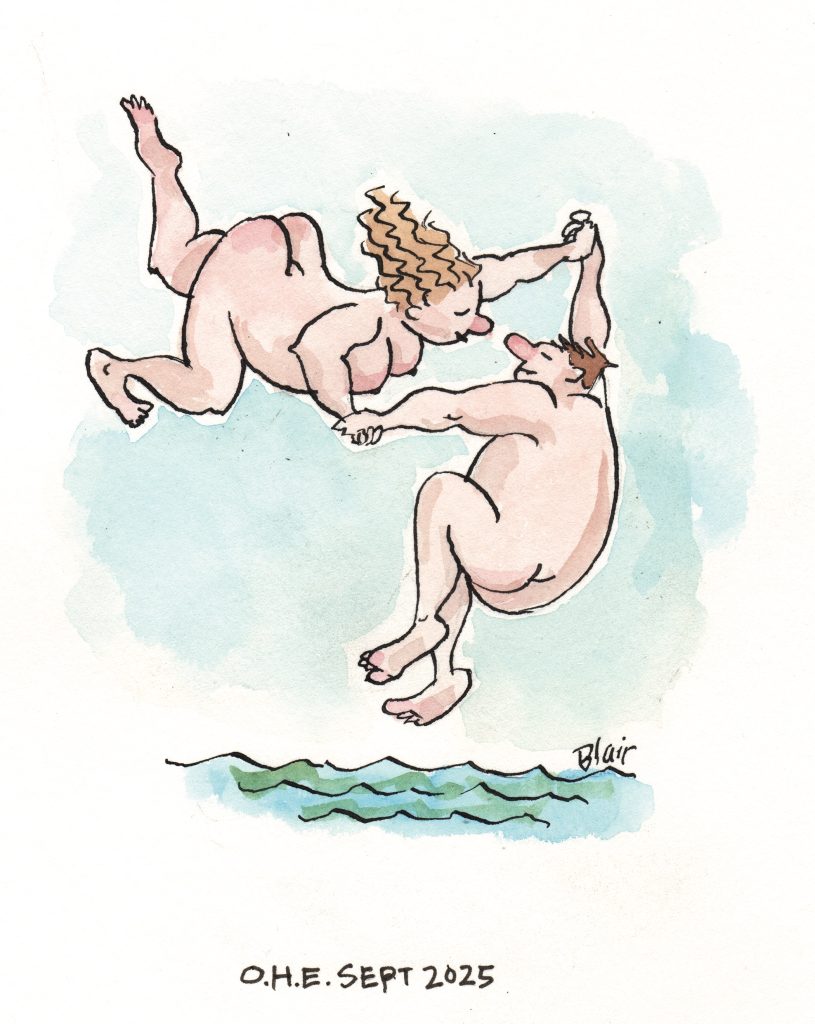
Shucking off suits, cellulite be damned, they hoisted themselves to the prow of the sailboat. There, they proceeded to suck each other’s lips off as he twined his fingers through her curls. 

The rest of us awkwardly averted our eyes as they eventually cannonballed off the bow to swim au naturel. That evening, the lovebirds padded through the lobby scantily clad, sunburned the deepest scarlet of a Key West sunset. 

Checking out days later, we inquired about their, uh, sunburns. The innkeeper leaned close. “They’re Chicagoans. A same time, next year couple,” he whispered. “She’s his secretary. He’s a big deal lawyer.  And they meet up here. Every. Single. Year.”

My husband could barely contain himself as we left, me stunned into silence. “Well, you finally got your wish,” he chortled, doing his best to stifle outright laughter. “Be careful what you wish for,” he managed to choke out as I ignored him, another illusion shattered, our golf cart streaking past a Hollywood-perfect Key West sunrise.

Wandering Billy

WANDERING BILLY

The Right Puffs

All aboard for a goo-goo-googly good time

By Billy Ingram

Chalk it up to DNA?

Being born and raised in the Gate City undoubtedly fostered in me a lifelong love for trains, so christened by our proximity to a railway hub that, from 1851 until the present, has served as a vital artery mainlining material goods and shuttling fine folks from point A to point G. Low moaning emanating from nearby locomotive horns, in unison with an underlying soundtrack of discordant notes struck by squealing, steel wheels straining against their railings, invokes an elemental tonality closely associated, in my mind, with home.

In that spirit, I wandered over to one of the twice-weekly open houses at the Carolina Model Railroaders’ studio, located above downtown’s J. Douglas Galyon Depot. There, aficionados of miniature trains, whether teens or senior citizens, were engaged in laying tracks, assembling aesthetic surroundings and, with the turn of a dial, sending scale-model boxcars, carriages and cabooses speeding around their humble hamlets, surrounded by handmade houses and fake, plastic trees affixed to mossy, green plywood.

I first visited CMR, organized over a half-century ago, in 2016, when participants were simulating an Atlantic & Yadkin ride by rail from Greensboro to Winston-Salem, complete with familiar landmarks recreated with an impressive degree of accuracy. The current layout isn’t as elaborate, but the topography is in constant flux. It’s the journey, not the destination, that keeps everyone committed to continuing this all-American activity.

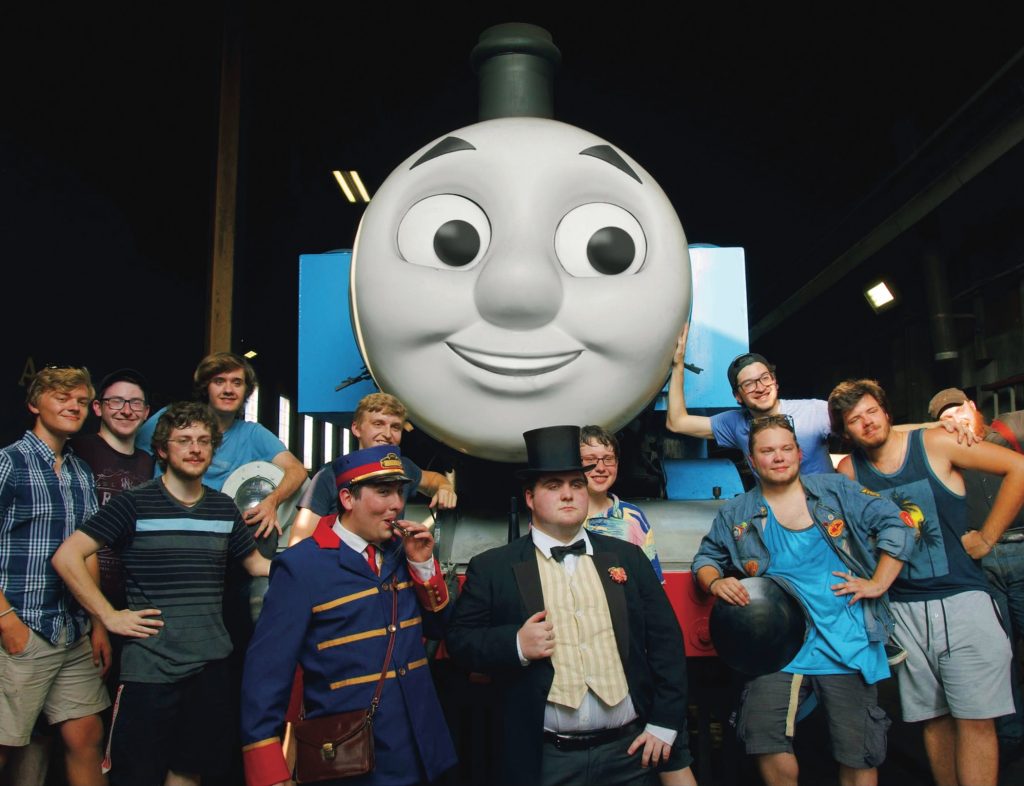
Brannon Carty is a young filmmaker I met recently who trained his documentarian lens on a different manner of miniature railroad, one criss-crossing the mythical island of Sodor, fluffy-clouded home to Thomas the Tank Engine: the stop-motion animated, toddler-oriented series touting morality tales that fuel youthful imaginations, wherever he whistles ’round the bend.

Thomas the Tank Engine & Friends made its United Kingdom debut in 1984 before crossing the pond in 1989, when it was integrated into PBS’ Shining Time Station, starring George Carlin. The show is based on a series of books that first appeared in the U.K. in 1945, written by Reverend Wilbert Vere Awdry. Awdry’s idea was to entertain his son, Christopher, the Thomas tomes’ succeeding author. Currently, the television program is broadcast in over 121 countries and translated into over 20 languages, suggesting an undeniable universal appeal.

“My older brother was into it when I was a young kid,” Carty says, explaining his budding early-2000s tele-crush. “He grew out of it, I didn’t.” Internet forums fueled his fascination, first in elementary school, then chuffing along into later years. “I was talking to all these other people about Thomas and it kind of evolved into being this community, which is really huge.” Part of the allure, Carty believes, comes from playing with the TV tie-in train sets sold in stores. “It’s the perfect storm of merchandising,” he says, paired with the show’s unique production. “It was shot on 35 millimeter so it doesn’t look like any other kid show.”

Carty earned a bachelor of arts in media studies at UNCG. “2019 was my last year. I was doing an independent study with Professor Wells, who was into documentaries. He said, ‘Hey, do a doc over this semester and, that’s it, you graduate.’” Not sufficiently interested in anything sociopolitical or overly serious, Carty says, “I knew a bunch of adult Thomas fans — I am one. So, I filmed them.” After completing his 45-minute digital dissertation and graduating, Carty decided to continue filming his story. Railroading five fellow filmmakers into his roundhouse, he says, “We wrapped our last interview in 2022 and finished the edit in November 2023.”

Carty recently returned from London, where his Kickstarter-funded documentary, An Unlikely Fandom: The Impact of Thomas the Tank Engine, was screened at a Thomas festival. The film focuses on the peregrinations of a cadre of likable lost boys, newly found, whose one-track minds refuse to apply brakes to a fervent reverence gleaned in earliest childhood memories. That adorable choo-choo with the goo-goo-googly eyes chugging full steam ahead into their hearts. 

This local locomotion picture also tunnels into the making of the television series, featuring extensive interviews with key contributors — the music producer, prop master, animators, picture book author, even Britt Allcroft, the clever British woman who created the original 1984 Thomas the Tank Engine & Friends animated series. The assembled cast of characters are all clearly enchanted yet somewhat surprised by their grownup fans’ keen interest. Superbly shot, edited and paced by Carty and his crew, the film even landed Alec Baldwin, the American narrator for a few seasons.

Allcroft especially comes across as a very sweet, ordinary lady who had the foresight to purchase Thomas’ television rights when no apparent market existed. While it took three years to complete that first season, it was a chance meeting at one of the recording sessions that led to Ringo Starr becoming the program’s original narrator. Also of interest is how divergent, yet alike, the TV version is compared to the 1940s series of books it was based on.

Carty, an avid hiker and climber who’s into fitness, admits that Thomas doesn’t gel well with his less passive pastimes. But “a love for old movies, that’s what led me down this path.” An Unlikely Fandom premiered in November 2023. “Go big or go home,” says Carty ruefully. “We all pulled together to premiere it in the Museum of the Moving Image in New York, which ended up costing so much money.” They flew in creator Britt Allcroft. “She was a little bit surprised that there were so many adult fans. I don’t think she expected it to be so normalized.”

The flying monkeys bestowing awards of excellence have yet to carry this one to heights it deserves, nor has a distributor picked it up yet. Carty, who also narrates the documentary, notes it’s still early. “We’ve just been sort of touring [the film] for the last couple years. I know The Guardian is about to do a piece on it, which we hope will get someone interested.”   

A theory posits that tots tuning into Thomas harbor a latent interest in model trains. Probably should’ve asked when I was down at the Depot watching those young-at-heart men putting their HOs through the paces I imagine Thomas feeling right at home clacking the tracks at Carolina Model Railroaders’ meetups. You may also; new members are welcome at cmrgreensboro.org.

Meanwhile, the erstwhile engine’s 80th Anniversary celebration will be pulling into nearby Spencer, when Day Out With Thomas: The Party Tour puff-puff-puffs up to the N.C. Transportation Museum, arriving September 26–28, then steaming into view again the very next weekend. It’s a genuine bargain at $30 a head, especially considering admission includes a ticket to ride the real Thomas the Tank Engine.

An Amtrak departure from GSO to Spencer will likely be a final opportunity for today’s young’uns to experience what catching a passenger train was like during the golden age of rail travel, to hear “All Aboard!” after entering our breath-taking, magnificently restored, 1927 Beaux-Arts-designed terminal, seemingly frozen in time. For now, anyway. Plans are afoot for the almost century-old Depot’s opulent lobby to be reimagined as a hip entertainment venue, for which I’m not on board.