Simple Life

Simple Life

A Little Stuffed Potato Wisdom

Lessons from full-grown tater tots

By Jim Dodson

Someone once said to me that it’s not happiness that makes one grateful, but gratitude that makes one happy.

Looking back, I may have seen this poetic syllogism scrawled on an ancient stone wall several years ago while hiking with my wife in Tuscany (where every graffiti artist is a philosopher-in-training). Or maybe I heard Oprah Winfrey say it in one of her SuperSoul Conversations that the aforementioned wife suggested that I listen to on long drives.

Whoever said it, I’m grateful for its pithy wisdom because I’ve suddenly reached an age where I know it to be true.

Back in February, I turned 70, a milestone that took me by surprise.

It’s not that I was unprepared. In truth, I’ve enjoyed getting older and slowing down a bit, giving me the chance to notice the evening sky.

Also, I am not alone in this epic journey into the great gray age and the unknown, as my late father — who lived a full and active life right up to a week before he died at 80 — used to joke. According to the U.S. Census Bureau, there are 69.2 million baby boomers alive and kicking today in America, the second-largest population group next to our children, the millennials (73.9 million born between 1981 and 1996 ). My particular group was born in 1953 ands falls somewhere in the lower middle of the boomer years between 1946 and 1964.

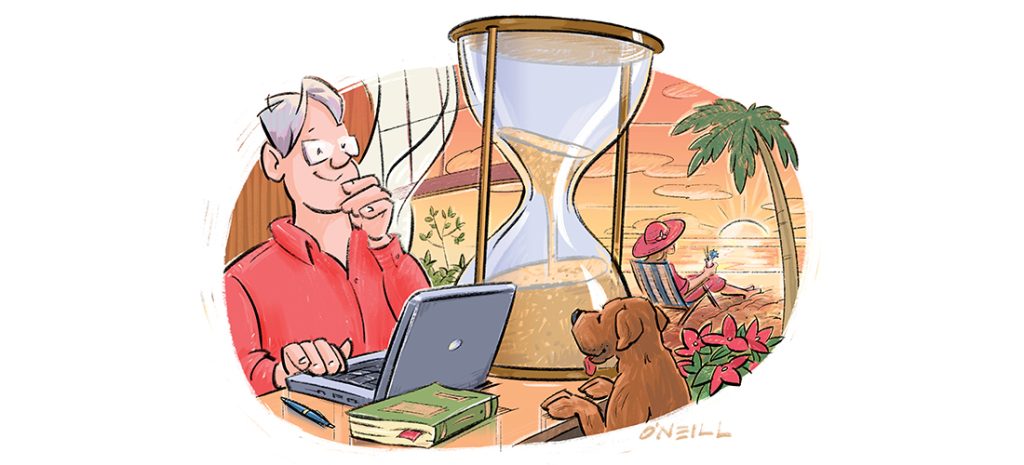
According to the latest actuarial projections used by our friends at the Social Security Administration to calculate how much longer the agency will have to give us back all the money we spent decades putting into the system, my age and gender group — males aged 70 — can expect to live another 14.5 years, while our female counterparts come in at a 16.75. Good for them, I say! Sell the house, dump the stocks, give away the dog and go sit on a beautiful beach in Tahiti for the rest of your days!

By the way, that’s exactly what my wise but cheeky and younger wife Wendy says she plans to do with her giddy 10 extra years after I check out of the Hotel California.

Meanwhile, according to the CDC’s Center for Health Statistics (NCHS), life expectancy at birth in the United States declined nearly a full year from 2020 to 2021, a worrying dip from 77.0 to 76.1 years that is the lowest level since 1996, probably due in part to a thing called COVID. The 0.9 year drop in life expectancy in 2021, along with a 1.8 year drop in 2020, was the biggest two-year decline since 1921–1923, years in which the Spanish flu wiped out millions worldwide, including my own maternal grandmother.

Actuarially speaking, it could be worse, of course. Afghanistan’s current life expectancy is just a hair over 56 years, considerably shorter if the Taliban’s Morality Police catch you whispering about the need to educate girls and women.

Singapore’s life expectancy, on the other hand, is a bonny 86.5 years. Perhaps this means that Dame Wendy — the future merry widow — should consider moving there instead of Tahiti (which has a mere life expectancy of 78.82 years) where she’s likely to make lots of older gal pals living the good life off the insurance money on a lovely Asian beach. As any veteran foreign traveler knows, however, Singaporeans are obsessed with public cleanliness and strict social order. Littering, chewing gum in public or failing to flush a public toilet can land you a whopping $1,000 fine, while showing your bare feet or skin of any sort can earn you three months in jail. That sensational black one-piece my 61-year-old lover debuted at the pool last summer probably won’t fly with Singapore’s own Morality Police. So on second thought, perhaps I won’t suggest Singapore and just leave well enough alone. That’s probably the wisest thing I’ve learned from being happily married for 20-plus years.

The point of all these dizzying numbers, as Oprah or any Tuscan street poet with spray paint can tell you, is to live the best life you can and be damned grateful for whatever time you have left.

That’s exactly what my fellow members of the Stuffed Potatoes Lunch & Philosophy Club try to do on a daily basis. 

For the moment, there’s just three of us in the club. We meet every other week or so in the shadowy booth of a popular restaurant to discuss the current state of the world, the wonders of our grown children and the enduring mystery of our wives.

Remarkably, as this March dawns, all three of us will have turned 70 by the end of the month. Joe hit the mark in late January, I did so in early February, and Patrick achieves the milestone later this month.

I’m told none of us actually looks 70 years old, though wives, golf pals and fellow Stuffed Potatoes can scarcely be considered objective sources.

For that matter, we probably don’t even act like old men, save for when we complain about dodgy knees and idiots who run red lights. As a kid, I once asked my lively grandmother on her 84th birthday if she was afraid of dying. She grinned and patted my rosy little cheek. “Not a bit, sugar pie,” she said. “Just afraid of falling.” 

None of the Stuffed Potatoes, I can reliably report, are afraid of dying. We’re too busy for that.

January Joe is a professional forester helping set aside beautiful lands for future generations. Patrick, the marketing whiz — I fondly call him the “Irish Antichrist” — is keeping the national economy afloat. And I’m just a humble scribbler trying to finish three books this year alone.

Given that we collectively amount to 210 years of accumulated life experience, I put to my fellow Stuffed Potatoes a timely question the other day: What is the one thing you’ve learned in 70 years?

January Joe, our resident sage, didn’t hesitate. “There are wonders ahead. Don’t fight them — just surrender!” This from a lovely fellow who gets to walk in the woods for a living and surrenders most weekends to the joy of several beautiful grandbabies.

My old friend, Patrick, offered with a hearty laugh, “There’s no good news or bad news. It’s all information. Just keep doing what you do and don’t look back.” The Irish Antichrist means business.

As for me, I hope to finish half a dozen more books over the 15.5 years I may or may not have left. Only time will tell.

In the meantime, we have a joyous new puppy named Winnie and a garden that is springing gloriously back to life by the minute.

I’m deeply grateful for both, not to mention a fabulous wife who says she really has no interest in going to Singapore or Tahiti. And was probably only joking. 

That makes me a really happy guy.  OH

Jim Dodson is the founding editor of O.Henry.

Scuppernong Bookshelf

In the Lonely Backwater

An excerpt from local author Valerie Nieman’s latest novel

Introduction by Cassie Bustamante

Local author Valerie Nieman knows a thing or two about weaving a thrilling tale of mystery complete with compelling and intricate characters. And her latest novel, In the Lonely Backwater, happens to be the perfect size for stuffing into your favorite reader’s stocking.

Maggie, an awkward high-schooler, is an outsider who lives on a small houseboat with her drunkard father in a sleepy North Carolina lake marina town, her mother having long run off to start a new life without her. In her disordered life, Maggie finds solace and order by losing herself in categorizing the plants around her.

Her world is disrupted when the body of her cousin Charisse is found shortly after a school dance. Because they’ve never been on the best of familial terms, Maggie is marked as a person of interest from the beginning.

Nieman tells us this book was inspired by an inscription on her senior yearbook: “A girl I barely remember wrote, ‘I hope all our misunderstandings are cleared up,’ and signed it, ‘Love.’ I do not remember the disagreement, but the emotional storms of high school came slamming back.”

Now, a peek inside:

I wondered if Detective Vann had memorized all the stuff in that little red notebook, which was nowhere in sight.

“She was messed up. I don’t know if it was drinks or something else. There was that big rip down the front of her dress.”

“Did she say anything about that?”

“Not to me. She and Nat went back in the trees and were talking. Then they came back and we all sat around and finished the bottle. I walked home.”

“Leaving Charisse and Nat and David all in the graveyard.”

“That’s right.”

“Anything else you remember?”

He doesn’t need to know all that I remember. I remember better about the real world than all this stuff with Charisse. I remember that Easter had come right when it was supposed to, the woods filling in green, with dogwood and fading redbud coloring the edges. Prom day came two weeks after Easter, even the oaks pushing out their leaves by that time. It had been a cool spring, late frosts, but the Thursday before prom the winds shifted; a breeze filled in from the southwest and put a chop on the lake. It turned really hot really fast, 90 degrees that afternoon. It was enough to raise a sweat during the day. By the time I got done with work and made it up to the gas station, it had cooled, just warm and nice, smell of cut grass and narcissus. The air began shifting around, more from the west, gusts and then dropping to nothing. By the time we headed to Old Trinity graveyard, clouds were filling in fast.

I remember in the graveyard, the smell of flowers rising up from Wisteria Lodge, a fallen-in plantation house whose owners now lived under the gravestones we sat on. I remember how headlights from cars on the highway moved across the graves in a certain way, depending if they were headed north or south. But then lights swung all the way across as a car turned onto the pike and stopped, and the lights stayed on, casting giant tree-shadows against the church for a long time. We could hear the motor running. Nat came out of his funk and was looking like WTF?, and Hulky stood up and started that way, then the lights and the engine cut off. We heard one door open and close. Next thing we knew, Charisse was standing inside the gate.

“Hey, guys?” Her voice rose way up at the end.

“Hey Charisse,” Nat blurted out. She followed his voice, uncertain as she walked across the graves, maybe because of high heels, but when she got to us we could see she was barefoot and there was a gash down the turquoise shimmer of her dress. Her face didn’t look right, but everyone looked ghoulish as the moon went in and out of the clouds.

I could feel the boys sweat, see how they repositioned themselves as they sat. Charisse was Charisse. Not Maggie.  OH

Valerie Nieman is the author of In the Lonely Backwater and four earlier novels, and books of short fiction and poetry. A graduate of West Virginia University and Queens University of Charlotte, she is professor emeritus of creative writing at North Carolina A&T State University. In the Lonely Backwater can be found wherever books are sold.

The Nature of Things

The Next Chapter

A celebration of life’s endless twists and turns


By Ashley Wahl

A novelist I know and admire once compared his writing process “to driving at night with the headlights on.” I laughed because I knew exactly what he meant — that a story never reveals itself all at once — and because life seems to unfurl that way, too.

When I met Alan, for instance, we were both dating other people. Never in my wildest dreams could I have imagined that, six years later, we would exchange rings and vows over the rush of a tumbling mountain creek. But a few weeks back, on a bright and unseasonably brisk Friday in September, that’s exactly what we did.

It seems the best stories surprise even the writer. Which brings me to another twist.

Perhaps you know that I returned to Greensboro in 2020 when Jim Dodson, my mentor of 12 years, announced he was ready to pass on the editor’s torch and take on a less demanding role with O.Henry. Prior to relocating, Alan and I were living in Asheville, where we both felt a sort of mystical attraction to the Blue Ridge Mountains. Regardless, I was excited to come back to the place I called home during my undergraduate studies at UNCG and again during this magazine’s infancy. Fortunately, Alan was up for the journey too.

Having been a part of O.Henry’s launch in 2011, you can imagine my delight to land at the helm of a magazine that had continued to evolve and yet, nearly a decade later, remained devoted to expressing its playful, authentic nature through the voices and lenses of a truly incomparable bunch of contributors. And as for Greensboro? I was awestruck. Even in the midst of a global pandemic, the creative and resilient spirit of the Gate City was palpable. That O.Henry had become a trusted fixture here was a pure reflection of this city’s deepest values.

What I didn’t know when we moved here was that the mountains would draw us back so soon — just over a year later, as it turns out.

And what a year it’s been.

During my sojourn in Greensboro, I’ve had the great privilege of reconnecting with dear friends and former colleagues, discovering new favorite haunts, writing about inspiring people and places, making new friends and once again being a part of a celebrated literary magazine that people swear that they read cover to cover.

Moving here was no mistake. Of this I’m certain. But a cue from our namesake: not all stories are meant to be long. 

As you’re reading this, O.Henry is celebrating its 10-year anniversary and settling into its new digs at Transform GSO, a shared workspace located within the historic Gateway Building at 111 Bain St. Simultaneously, my new husband and I are packing up our Fisher Park home to begin our next chapter together . . . a couple hundred miles west. 

Naturalist John Muir said it best in a letter to his sister in 1873: “The mountains are calling, and I must go.”

I don’t know where the winding road will guide us next, but I trust the journey. And as for this magazine: Twists are a part of its DNA.

Happy anniversary, O.Henry. Thanks for the grand adventures. May your next decade continue to reawaken the spirit of William Sydney Porter with fathomless beauty, wonder and joy.  OH

Contact former editor Ashley Wahl at mystical_ash@protonmail.com.

Party Line

https://www.youtube.com/watch?v=ZZ2YM9E2R_Q


Sporting Life

Remembering a Hero

A cabin, a pack of Red Man and a distant war


By Tom Bryant

Sometimes fall has a way of sneaking up right in the middle of summer, or maybe it just seems like it. That’s the way it was just prior to dove season: scorching hot days, long soft humid nights and then bam, a cool day that guarantees that summer has had its time and here we go with the next part of the year. That’s one reason I love North Carolina with its defined seasons.

Summer might bleed into fall; but when the sun rises lower on the horizon and shadows lengthen and cicadas sing in earnest, a smart man will check his woodpile, hoist out the winter clothing, and make sure his hunting coat and boots are ready. Deck shoes, shorts and knit shirts are to be put away.

That’s exactly what I was doing when the call came from Bubba. I had hunting gear piled high in the roost, our little garage apartment where I write, mess with outdoor gear and, in general, just hang out. I was making sure everything was ready for the upcoming cold months when Linda, my bride, came to the door and shouted up the stairs. “Tom, Bubba has been trying to call you. Where is your phone?”

“Oh, man. I forgot. It’s in the truck. I’ll get it and call him back.”

She laughed and said, “I don’t know why you have a phone. You never have it with you.”

I hustled down to the Bronco, found the phone under the front seat and saw where I had missed four calls from Bubba. I punched a button and returned his call.

“Coot.” Bubba had installed the nickname Cooter years before and it took. “That woman you married is too good for you. I don’t believe you would ever get a phone call if it wasn’t for her.”

I laughed and said, “You’re right, Bubba. I know it more and more every day. She does have a tendency to look out for me. What’s up? I thought you were heading to Costa Rica fishing.”

“Naw, decided to stay home and do a little dove shooting. That’s the reason I’m calling. Several of the old-timers are gonna meet at Slim’s store Saturday and talk about likely spots to hunt. Come on up and join us. We sure don’t want to leave you out. Ritter’s gonna be here with some of his apple brandy, and even Johnson is joining us. There’ll be a good crew.”

Slim’s store was a tradition in that part of the country, catering to hunters, fishermen and as Slim loved to put it, reprobates of all kinds. After Slim passed away, Bubba bought the place, kept Slim’s cousin, Leroy, to run the business on a daily basis so, as Bubba put it, “I’ll have a place to go. Plus I like the coffee.”

“I’ll be there, Bubba. I’m just in the process of checking out some gear. It sure feels like fall, doesn’t it?”

“Yep, and I’m sure ready. See you Saturday.”

I decided to drive the old Bronco up to Slim’s place to check her out. I recently had a lot of work done on the old vehicle and wanted to see how she would ride. I thought as long as I kept to the back roads, everything should be OK. She was slow, but she usually got me there.

The old crew was kicked back in rockers on the side porch when I pulled into the gravel parking lot. At one time Slim had tried selling gas, but that didn’t work. So he had the pumps removed to make room for a spot to play horseshoes. He always said he hated those gas pumps, a lot of trouble for nothing.

It was good to see the old group, and after a reasonable amount of good-natured insults, we all relaxed and enjoyed each other’s company. Old Man Time was beginning to trim the ranks of the aging crew. In the couple of years since my last visit, several had gone on to their rewards. Somehow, I’ve always had a feeling that everything would remain the same, but lately, age and time have proven me wrong.

Most of the crowd broke up early, having to get home for one reason or another, and as the sun set and the moon began to rise over the tree line where Johnson’s pasture used to be, only Bubba, Johnson, Ritter and I were left to hold forth.

“It seems funny not to see cows over there in that pasture, Johnson,” Bubba said.

“I know, but the developer had more money than them cows. I did get him to promise to keep that space green, though.”

Johnson had sold out his farm several years ago to a major developer who’d split it up into 10-acre mini-farms.

“I hope you did more than get a promise,” Bubba replied.

“I did. It’s in the contract that he has to keep that buffer like it is.”

Leroy came out, careful not to let the screen door slam. “Bubba, I’m heading home. Lock up before you leave. Good to see you guys.”

“OK, Leroy. Coot’s gonna stay overnight. We’ll be back in the cabin.” Bubba had built a small log cabin behind the store on a little pond that Slim had put in years before. He used it every now and then when he partook a little too much of Ritter’s apple brandy.

We watched Leroy’s pickup drive up the road. “That’s a good man you got there running the store, Bubba.” Johnson said.

“Yep, I’m lucky to have him. I think Slim would approve.”

Ritter reached in a pocket of the coat he had hung over the porch banister and pulled out a pouch of Red Man chewing tobacco. He answered the inquisitive looks. “I know, I started chewing again last week. I haven’t had a good chew since I was in Vietnam.”

We watched as the moon slowly rose over the pines. Bubba had gone in and turned off the outdoor lights, and when he sat back in his rocker he said, “If your brandy won’t kill you, that tobacco surely will.”

“Yep.” Ritter was quiet for a time. “You know I feel I’ve been living on borrowed time ever since that stupid war.” He had served in the Marines, and his platoon was one of the first to suffer casualties.

“I had a dream the other night about one of the boys who didn’t make it home. His name was Bud, a nickname really, picked up in boot camp. He was big, stood about 6 feet 4 inches and weighed around 250. And could he eat! Always borrowing C-rations when we were in the field. The drill instructors gave him the name Bud by calling him Big, Ugly and Dumb, shortened to Bud.

“We were still using M1 rifles then, M1As came later and then M14s, but we mostly liked the M1. Bud was so big he carried a .30-caliber machine gun. He toted that heavy thing like it was a tobacco stick.”

We sat silently watching across the old pasture. The moon was fully up now, and as a group we were surprised to hear Ritter talk about his war experience. In the past he would respond to any question about his service with only a perfunctory answer.

“Bud was a real hero,” he continued. “He’s the reason four of us in the unit came home from that stinking war.”

I don’t know if Ritter’s melancholy eloquence came from his own brandy or old age or maybe the dream he had about his friend, but in the moonlight I thought I could see a tear on his cheek. “Are you all right?” I asked.

“Yep, Coot,” he replied as he wiped his cheek. “I learned a long time ago in that war that you don’t cry for heroes, because there were so dang many. Bud was one of the best.”

No one broke the spell by speaking. We just sat silently, lost in our thoughts.  OH

Tom Bryant, a Southern Pines resident, is a lifelong outdoorsman and PineStraw’s Sporting Life columnist.