Scuppernong Bookshelf

Chow Time!

The culinary future reveals itself in several June releases

Compiled by Brian Lampkin

We’re in luck! June brings us dozens of new books on cooking, food and the culinary life. You may not yet think of algae as a food source, but maybe we can change your mind. And do you find yourself collecting cookbooks without ever using the recipes inside? We have a solution: The booksellers at the store at which you purchased said cookbook would love to taste your talents! Drop off a dish (at your convenience, of course).

June 4: The Truffle Underground: A Tale of Mystery, Mayhem, and Manipulation in the Shadowy Market of the World’s Most Expensive Fungus, by Ryan Jacobs (Clarkson Potter, $16). The New York Times says “Jacobs is an unstoppable and captivating guide through the dark underbelly of the world’s most glamorous fungus. This is the ultimate truffle true-crime tale.”

June 4: Daily Bread: What Kids Eat Around the World, by Gregg Segal (Powerhouse, $40). As globalization alters our relationship to food, photographer Gregg Segal has embarked on a global project asking kids from around the world to take his “Daily Bread” challenge. Each child keeps a detailed journal of everything he or she eats in a week, and then Segal stages an elaborate portrait of them surrounded by the foods they consumed. The colorful and hyper-detailed results tell a unique story of multiculturalism and how we nourish ourselves at the dawn of the 21st century.

June 4: The Fate of Food: What We’ll Eat in a Bigger, Hotter, Smarter World, by Amanda Little (Harmony, $27). Climate models show that global crop production will decline every decade for the rest of this century due to drought, heat and flooding. Water supplies are in jeopardy. Meanwhile, the world’s population is expected to grow another 30 percent by mid-century. So how, really, will we feed 9 billion people sustainably in the coming decades? “What we grow and how we eat are going to change radically over the next few decades. In The Fate of Food, Amanda Little takes us on a tour of the future. The journey is scary, exciting, and, ultimately, encouraging,” writes ” Elizabeth Kolbert, Pulitzer Prize-winning author of The Sixth Extinction.

June 11: Slime: How Algae Created Us, Plague Us, and Just Might Save Us, by Ruth Kassinger (Houghton Mifflin, $26). There are as many algae on Earth as stars in the universe, and they have been essential to life on our planet for eons. Algae created the Earth we know today, with its oxygen-rich atmosphere, abundant oceans and coral reefs. Crude oil is made of dead algae, and algae are the ancestors of all plants. Today, seaweed production is a multibillion dollar industry, with algae hard at work to make your sushi, chocolate milk, beer, paint, toothpaste, shampoo and so much more. In Slime we’ll meet the algae innovators working toward a sustainable future: from seaweed farmers in South Korea and scientists using it to clean the dead zones in our waterways, to entrepreneurs fighting to bring algae fuel plastics to market.

June 11: Incredible Vegan Ice Cream: Decadent, All-Natural Flavors Made with Coconut Milk, by Deena Jalal (Page Street, $21.99). Deena Jalal is the owner and founder of FoMu Ice Cream, a plant-based frozen treat company with multiple shops in the Boston area and distribution to stores along the East Coast. “Deena’s simple yet superbly flavorful ice creams are the perfect solution for a guilt-free indulgence!” says Rebecca Arnold, founder and owner of Whole Heart Provisions.

June 25: Drive-Thru Dreams: A Journey Through the Heart of America’s Fast-Food Kingdom, by Adam Chandler (Flatiron, $27.99). Most any honest person can own up to harboring at least one fast-food guilty pleasure. In Drive-Thru Dreams, Adam Chandler explores the inseparable link between fast food and American life for the past century. The dark side of the industry’s largest players has long been scrutinized and gutted, characterized as impersonal, greedy, corporate, and worse. But, in unexpected ways, fast food is also deeply personal and emblematic of a larger-than-life image of America.

June 25: The Peach Truck Cookbook: 100 Delicious Recipes for All Things Peach, by Stephen K. Rose & Jessica N. Rose (Scribner, $28). From first bites to easy lunches, from mouth-watering dinner dishes to sumptuous desserts, The Peach Truck Cookbook captures the Southern cooking renaissance with fresh, delectable, orchard-to-table recipes that feature peaches in every form. Whether you’re craving peach pecan sticky buns, peach jalapeno cornbread, white pizza with peach, pancetta and chile, or peach lavender lemonade — or have always wanted to try your hand at making a classic peach pie— Stephen and Jessica have you covered. Many of Nashville’s most celebrated hotspots and chefs, including Sean Brock, Lisa Donovan, and Tandy Wilson, have contributed recipes, so you’ll also get a how-to on cult menu items such as Burger Up’s Peach Truck Margarita.  OH

Brian Lampkin is one of the proprietors of Scuppernong Books.

O.Henry Ending

Mama’s Cookin’

Sweet memories of the most creative home chef who ever lived

By David C. Bailey

I was 16 by the time I appreciated what an incredible cook my mother was — thanks to the woman who would become my own personal chef.

“Duck sandwiches?” Anne responded incredulously when I told her what we were having for our picnic lunch, which also happened to be our first date.

“Yeah, and deviled eggs with watermelon-rind pickles and Mom’s chocolate chess pie for dessert,” I went on. In truth, I worried the repast might be a bit scant. Mom often fried chicken for picnics and packed her signature country ham biscuits, plus, if you were really lucky, homemade pimiento cheese sandwiches. Not to worry. My mother’s sister, Rachel, had also packed a picnic for our double-date, my cousin Bill and his girlfriend, Mary. She’d rustled up some of her tangy sweet-and-sour German potato salad laced with smoked side meat. Like Mom, Rachel blended lessons learned from her Pennsylvania Dutch upbringing with what she knew we Southerners loved. Add some of her simple but simply delicious sugar cookies, and our picnic made a pretty decent feed. (And yet, I remember the sweetest treat of all was that kiss I stole underneath the cotton blanket we tented over our heads against the rain.)

I now realize that my mother — and excuse me for expressing what may be a painful truth to you — was a way better cook than anyone else’s.

Look back on your own youth. Did your mom ever cook you duck à l’orange or Indian curry served with homemade chutney? OK, so maybe she did, but was she also able to Southern-fry chicken so crisp that it was a shame to smother it in milk gravy? And did your mom also wrap quail in bacon and stuff them with chestnuts and mushrooms? Was every single meal she served accompanied by some form of hot bread, plus a homemade dessert? Did you — and do you still — regularly dream about your mom’s cooking?

Other cooks may shine at the holidays — and Mother’s sweet potatoes with black walnuts, her shoo-fly pie and her whole baked country ham or goose were by no means shabby. But what my mother excelled at was cooking every dish day-after-day with the utmost creativity and care. Greek meatloaf she’d seen in a magazine. Deep-fat-fried zucchini or okra. Exotic specialties like borscht that she’d plucked from her beloved 12-volume Woman’s Day Encyclopedia (A set I still cherish and use frequently).

As my wife once remarked with amazement after experiencing a typical fresh-from-the-garden summer lunch of freshly picked corn on the cob, green beans tangled with bacon, fresh sliced tomatoes, cracklin’ cornbread, plus some leftover pork chops, “Every meal at your house is an event.”

My parents were foodies way before that word had any currency. My cousins would come and peer in wonder into our cupboard containing olives, pâté, anchovies, capers, four or five types of mustard, even caviar on occasion. Dad was a Belk store manager who traveled to New York City regularly and brought home shopping bags of pastrami, pickles and smoked fish, along with epic tales of lobster dinners and elaborate, multicourse Chinese feasts, which Mom would replicate, like his favorite, angels-on-horseback (oysters wrapped with bacon and broiled with onions and hoisin sauce). She fully embraced the ’50s hot trend of cooking what was then termed international or gourmet food, but she never abandoned the comfort food she — and Daddy — grew up eating on the farms they were raised on during the Depression — chicken-fried steak, sauerbraten, buckwheat cakes, chicken and dumplings, cider-braised rabbit and apples, all served with a heaping helping of their tradition, passed on from her mother and grandmother.

But her real creativity came into play with leftovers. As she would be piling bowls from the fridge onto the counter, my sister would say, “Uh oh, time for must-go soup.” Quoting my grandmother, Mom would counter,  “Better bad belly burst than good food waste.” Roast beef hash. Spicy gumbo from leftover okra and other vegetables. Stuffed baked potatoes or green peppers. And her pièce de résistance: schnitz un knepp from leftover ham paired with apples and dumplings.

Mom was not a demonstrative person. She wasn’t huggy, and even her filial kisses might be termed polite and correct. She said, “I love you” to each of us regularly, but with just a tad of awkwardness. This despite the fact that she was a hopeless romantic who gobbled up Hemingway, Fitzgerald and massive Russian novels one after another.

Dad would finish his favorite dessert, mopping up one of Mom’s fluffy biscuits in a slurry of molasses, give a satisfied groan, push his chair away from the table and say, “Aren’t we glad we married her,” maybe the most affectionate thing I ever heard him say to Mom.

“Nothing says lovin’ like something from the oven,” the Pillsbury Doughboy used to say, and Mom’s cooking said it best. OH

O.Henry’s Contributing Editor David Claude Bailey learned to cook late in life at Print Works Bistro after working his way up from dishwasher to backline chef: cueconfessions.wordpress.com/2009/04/

Birdwatch

Shy and Dry

This time of year, the fields are teeming with Killdeer that call their own name day or night

By Susan Campbell

The killdeer is a small, brown-and-white shorebird that breeds in the Sandhills and Piedmont of North Carolina but is widespread throughout North America. It can be found here year round in the right habitat, but that doesn’t mean you should go looking for it in wetlands. Despite its classification as a shorebird, most of the population lives away from the water’s edge. In fact, for egg-laying, the drier the spot, the better! And in truth, sandy soil like that in the Sandhills, is not that much different from the beaches, where one would expect a shorebird to nest.

This robin-sized bird, not surprisingly, gets its name from its call: a loud “kill-deer, kill-deer” which can be heard day or night. During migration, individuals frequently vocalize on the wing, high in the air. Adults will also circle above their territory calling incessantly in early spring.

On the ground, killdeer are a challenge to spot. They blend in well with the dark ground and practically disappear against the mottled background of a tilled field or a gravel surface. Killdeer employ a “run-and-stop” foraging strategy as they search for insect prey on the ground. As they run, they may sir up insects, which will be easily gobbled up as the birds come to a quick halt. Although they live in close proximity to humans, they are quite shy. Killdeer are more likely to run than fly if approached. When alarmed, they frequently use a quick head bob or two. This may be a strategy to make the birds seem larger than they appear.

During the winter months, flocks of killdeer concentrate in open, insect-rich habitat such as ball fields, golf courses, or harvested croplands. Come spring, pairs will search out drier substrates, preferring sandy or rocky areas for nesting. They may even use flat, gravel rooftops. The female merely scrapes a slight depression where she lays four to six speckled eggs that blend in with the surroundings. She will sit perfectly still on her nest and incubate the eggs for three to four weeks. If disturbed by a potential predator, the female killdeer will employ distractive displays to draw the intruder away from the eggs. This may go so far as to involve feigning a broken wing. Calling loudly and spreading out her tail, the mother bird makes herself as noticeable as possible, limping along and dragging a wing on the ground. This “broken wing act” can be very convincing, giving the predator the idea that following the female will result in an easy meal. Once far enough from the nest, the killdeer will fly off, not returning to the eggs until she is convinced the coast is clear. Should distractions by the adults not be effective, the pair will find a new nesting location and begin again. The species is a very determined nester. Killdeer are capable of producing up to three broods in a summer.

Normally, the eggs hatch almost all at the same time. As soon as they have dried off, the downy, long-legged young will immediately follow their mother away from the nest to a safer, more protected area nearby. They will follow her around for several weeks, being fed and brooded along the way. Once they are fully feathered, the young will have learned not only how to escape danger but how and where to find food for themselves.

So, if you hear a “kill-deer” over the next couple months, stop and look closely: you may be rewarded with a peek into the summer life of this fascinating little bird.  OH

Susan would love to receive your wildlife sightings and photos. She can be contacted by email at susan@ncaves.com.

Botanicus

Paw de Deux

Or as we say in the South, “Paw Paw”

By Ross Howell

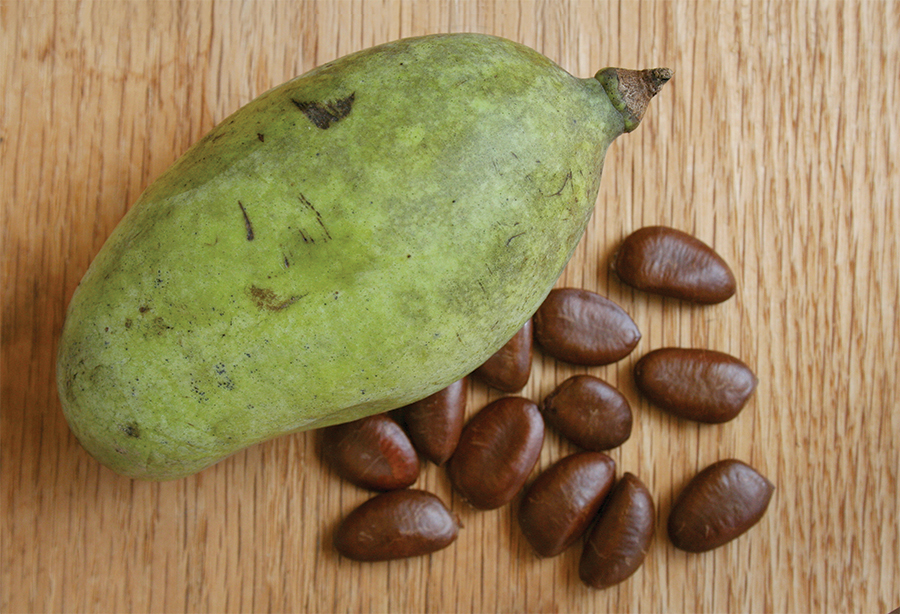
A simina triloba — a.k.a. pawpaw, papaw, paw paw, paw-paw, American custard apple, poor man’s banana, Quaker delight, hillbilly mango, Appalachian banana — is a small, deciduous tree native to the eastern United States and Canada, growing as far west as Nebraska. Mature trees can reach a height of 35 feet, producing maroon-colored flowers and sweet-tasting, aromatic fruit, the largest edible fruit native to North America, if you don’t count squash — and who other than the most persnickety of botanists would count squash as a fruit?

The pawpaw once enjoyed considerable popularity. Its earliest documented mention — according to Owen Native Foods of Cross Junction, Virginia, — is found in a 1541 expedition report of the Spanish explorer Hernando de Soto, who discovered Native Americans cultivating the plant east of the Mississippi River.

During the Lewis and Clark Expedition, 1804–1806, the adventurers consumed pawpaws during their journey. Chilled pawpaw fruit was a favorite dessert of George Washington at Mount Vernon, and Thomas Jefferson planted pawpaws at his home, Monticello.

The pawpaw has a folk tradition, too. As part of my elementary school education in the mountains of Virginia, I learned to sing this little ditty:

Where, oh where is pretty little Susie? [repeated three times]

Way down yonder in the pawpaw patch.

Pickin’ up pawpaws, puttin’ ’em in her pocket, [repeated three times]

Way down yonder in the pawpaw patch.

Important safety tip! Pretty little Susie’s “pocket” was an apron. Pawpaw fruit is remarkably mushy when ripe, so you don’t want to tuck one in the hip pocket of your new Wranglers.

In the wild, pawpaws are understory trees, flourishing in fertile bottomland under the shade of taller trees, often propagating by sending up new saplings from their roots. So they’re often encountered in a “patch,” as in the lyrics of my boyhood song.

But there are exceptions.

Dara Dobson, who owns 7 Pines Native Plant Nursery near Defuniak Springs, Florida, explains that “more mature pawpaw trees are better able to stand strong sunlight.” Charlie Headington, a professor in UNCG’s Master’s in Applied Arts & Sciences program and advocate for low-maintenance, organic, edible and diverse community gardens, notes there are two pawpaws growing in full sunlight at Greensboro Montessori School on Horse Pen Creek Road. “They’re 10 to 12 feet tall and are located to the left of the school building in a terraced garden,” Headington says. “You can’t get in the gate but you can look at them over the fence that has scuppernong grapevines woven through it.

“There are two smaller pawpaws in the Meeting Place garden at the corner of Smith and Prescott streets,” Headington adds. “They’re labeled for identification.”

In addition to sending up saplings from their root systems, pawpaws also reproduce by way of flowers and the big seeds their fruit encases.

To my knowledge there are no songs celebrating the fragrance of the pawpaw flower, and for good reason. They produce little to no odor at all, but what fragrance they do emit smells remarkably like roadkill. Alas, the trees’ leaves, twigs and bark are also foul-smelling, loaded with natural insecticides called acetogenins. Rarely are their leaves eaten by rabbits or deer.

But they’re quite tasty to the palates of zebra swallowtail butterfly larvae. Not only do the larvae enjoy protection from the predation of birds and other critters by virtue of the acetogenins they ingest with the leaves, the spectacularly colored adult butterflies do, as well.

Raccoons, squirrels, opossums and other critters enjoy eating the ripe fruit of the pawpaw, thus helping spread its seed in the forest.

“Opossums are traditionally the raiders of the pawpaw patch,” says Greensboro resident David Waller, professor emeritus of the department of Biological Sciences at Kentucky State University, “but I bet bears were more important to the tree in pre-settlement America.”

Waller first heard about the pawpaw during a discussion with a KSU botanist friend about guanabana, a fruit found in Mexico that’s a relative of the pawpaw. Later he discovered a pawpaw patch thriving in a marshy area on the KSU campus.

“On sunny days, it was so pleasant to visit there and be in the bright green light under the huge leaves close overhead,” Waller says. “In spring the shocking, big, brown-petaled flowers popped out of woody branches, then came the lumpy-sausage fruits, fragrant when ripe in late summer — all surprisingly exotic, yet it’s a native tree!”

KSU has the only full-time pawpaw research program in the world. Focusing on issues like propagation, genetic diversity, orchard management, and techniques to improve fruit ripening and transport, the university hosts an international festival, which last year drew representatives from 19 states and European countries including Holland, Slovenia and Germany.

National Public Radio’s Ally Schweitzer, writing about a couple who’d planted a pawpaw orchard in rural Maryland, notes that with consumers’ increasing desire for fresh, locally produced foods, farmers markets and trendy breweries and eateries have “embraced the fruit.” These developments have even earned the pawpaw a new alias — “hipster banana.”

Interested in learning more about the resurgent pawpaw?

The 21st Annual Ohio Pawpaw Fest 2019 is scheduled for September 13–15 near Lake Snowden, Albany, Ohio. Waller has attended the festival a couple of times. “It’s an enthusiastic social event with plenty of pawpaw information, souvenirs and some saplings in pots to plant in your own back yard,” he says. “Along with other nature stuff by local groups.”

Closer by is the N.C. Cooperative Extension’s North Carolina Pawpaw Festival, which takes place in Forsyth County, usually on the last Saturday in August. While an event isn’t planned for 2019, vendors at past N.C. festivals have offered seeds and saplings for planting, ripe fruit for eating, along with samples of pawpaw and spiceberry jam, pawpaw gelato and pawpaw beer! You can follow the N.C. Pawpaw Festival on Facebook using the handle @ncpawpaw.  OH

Ross Howell Jr. planted a native pawpaw in a wet area at the far end of the lot at his wife Mary Leigh’s house in Florida. There was no discussion about the fragrance of pawpaw flowers before he planted the sapling, and he hopes there never will be.

Drinking with Writers

One Man’s Good Advice

Clyde Edgerton and the art of negotiation

By Wiley Cash     Photographs by Mallory Cash

In 2011, my wife and I were living in West Virginia when I learned that my first novel was going to be published. My editor asked me to reach out to any well-known authors I knew to see if they would offer a blurb for the book jacket. The problem? I didn’t know many well-known authors, so I began sleuthing for email addresses. Clyde Edgerton’s was one of the first I found. I wrote to him and told him that I, like him, was a North Carolina native who had written a North Carolina novel, and I wondered if he would be willing to give it a read and consider offering some kind words. He not only read my novel and offered some kind words that ended up on the front of the hardcover, he offered some criticism as well. There was one particular scene in the novel that he felt went on a little too long, and he suggested some edits. I made the edits; they were the last I made before the novel went to print, and they improved the novel in ways I never could have imagined. I had never met Clyde Edgerton. I had never been one of his students. He was just being kind, giving more of his time and talent than I ever expected.

Clyde’s kindness and giving of time continued in the spring of 2012 when he appeared at Pomegranate Books in Wilmington, North Carolina, to attend one of the first events of my book tour. I had not expected him to be there, and it was a little like shooting free throws while Michael Jordan watched from the stands, but I will never forget how deeply honored I felt. At the conclusion of that event, I spoke a little about a new novel that I was working on, and I expressed the difficulty I was having with the ending. A few days later, I received an email from Clyde, sharing his ideas about how to end novels in ways that satisfied both writers and readers.

Clyde and I struck up a friendship after my wife and I moved back to North Carolina and settled in Wilmington in 2013. He christened our second child. Our kids go to the same school. We have shared the stage with other authors at literary events and fundraisers around the South, and over the past few months we have fallen into a routine of eating omelets and biscuits and gravy and sharing sliced tomatoes in a booth at White Front Breakfast House at the corner of Market and 16th Street.

That was where we were sitting recently when I sought Clyde’s advice about a particularly difficult ethical situation I was facing in my professional life. Aside from the respect I have for Clyde as a writer, it is exceeded only by my respect for him as a citizen and altruist. After asking for his advice, Clyde shared some wisdom he had gleaned from a local reverend, friend and ally named Dante Murphy.

“Don’t get angry at people in these situations,” he said. “When it becomes personal that anger can poison you. Get angry at institutions. You can change an institution. It’s harder to change a person.”

Clyde knows what he is talking about. For the past few years he has been one of a handful of citizens leading the charge to uncover racial inequities in the New Hanover County School System, something he first encountered while tutoring students at Forest Hills Elementary. The school had a Spanish language immersion program, and while the student body was 46 percent African-American, every single one of the 40 slots in the language program had been taken by white students before open enrollment even began. Since then, the former principal and school system have given a number of excuses — some laughable, some offensive — about the racial disparity in the program. None of it has deterred Clyde and a group of citizens from following leads, learning of other instances of discrimination or wrongdoing, and meeting with parents, school board members and city and county employees.

None of the students on whose behalf Clyde is working have ever met him. They are not his children, but he is working for them regardless. It is similar to the compassion and care he showed me all those years ago, but the kindness he showed me never got him banned from county school property.

How does Clyde address these issues with school leaders? The same way he approaches finding a satisfying conclusion to a piece of fiction he is writing.

“Some writers think that story comes from conflict,” he says. “I don’t think that’s always true. Conflict can be impassable, and there’s no story with an impasse. I think good stories come from negotiation. Good stories happen when everyone can see they have a stake in a good outcome.”

For a good outcome, whether in a community or a novel or a literary friendship, negotiation is key. Clyde, please pass the sliced tomatoes.   OH

Wiley Cash lives in Wilmington with his wife and their two daughters. His latest novel, The Last Ballad, is available wherever books are sold.

Life’s Funny

Chop House

The sport of axe-throwing lands in the Piedmont

By Maria Johnson

Tony Wohlgemuth, the wizard of Kersey Valley amusement park in Archdale, has noticed an invasion of sorts along our northern border: Lots of trends in entertainment attractions come from Canada.

Take escape rooms, the group puzzle solving exercises built around storylines. They were a craze up yonder before they migrated here.

Now, the maple-flavored sport of axe-throwing — think of it as darts on steroids — is sweeping the United States, mostly as a bar game because, you know, who can resist mixing sharp blades with alcohol?

In this area, Wohlgemuth was the first to take a whack at it, having opened his indoor and outdoor venues earlier this year, but his attractions are a bit of a throwback. They’re alcohol-free in keeping with Kersey Valley’s family-friendly atmosphere.

Just good, old-fashioned blade-chucking here. In case you’re picturing long-handled axes à la Paul Bunyan, be advised the instruments of the sport are more like hatchets. They’re 14 inches long and weigh about a pound each, so they’re fairly easy to hurl end-over-end.

“It’s kind of Medievalish. There’s something empowering about it,” says Wohlgemuth, who started Kersey Valley on his family farm in 1985 and has grown it — with the help of his wife Donna, and his business partner David Rundberg — into an entertainment hub, with escape rooms, laser tag, zip line, high-ropes course, a corn maize and — the real haymaker — Spookywoods in the fall.

Wohlgemuth constantly scans the horizon for new attractions, so his interest was piqued when he spotted axe-throwing on YouTube back in 2016.

He checked with his insurance guy.

“Forget about it,” came the reply.

Wohlgemuth kept his eye on axe-throwing. He watched competitions on ESPN and delved into the rules and regulations of WATL, the World Axe Throwing League.

In January, Wohlgemuth was getting ready to refresh his oldest escape room, which had rough-cut pine walls and smelled of pitch, when an idea struck him: what if they used the room for axe-throwing?

He measured to make sure two 12-foot lanes would fit — they would — and he called a Chicago outfit, Axe Insurance Co., that has carved a real niche, so to speak.

Yes, they said, they would cover participants and spectators at Kersey Valley.

Wohlgemuth prodded. Would they cover an outdoor axe-throwing experience with 11 stations along a trail once used for Segway tours?

Well, you’d be the first to try that, but shurrrrrrrrre, came the answer.

Wohlgemuth was in business. He opened his axe attractions in early February.

“We’ve been booked every Saturday since then,” he says.

Corporate groups, clubs, couples, friends and families have given the sport a whirl.

On a recent weekday afternoon, 33-year-old Meghan Williams of Charlotte, and 33-year-old Greg Collins of Greensboro, celebrated their second year of dating with a 90-minute trip to the axe room, which Greg heard about from a friend where he works at . . . wait for it . . . a hospital.

Truth is so much better than fiction.

During a safety session, they learned the basic rules of axe-throwing, which include, but are not limited to:

Never hand an axe to anyone.

Never throw an axe at anyone.

Never touch the sharp edge of an axe while asking, “Is it sharp?”

Their “Axe-pert Instructor” Sydney Parks explained the throwing motion: a chop from the elbow rather than a throw from the shoulder. The axe should make one rotation before hitting the target, which is painted on pine planks. Ideally, the top corner of the blade will sink into the soft wood.

After a few dozen practice throws, Greg and Meghan started their games. An electronic scoreboard kept track. Eighties music played in the background at their request.

Greg, who grew up throwing axes at stumps on a farm in Ohio, narrowly won the first game.

He celebrated a bullseye by vigorously ringing a brass bell on the wall.

“That was forceful,” Meghan observed dryly.

A couple of throws later, she stuck the bullseye, swaggered to the bell and gave it a hearty clang.

“What’s that, Collins?” She teased.

They laughed.

Women tend to do better than men at axe-throwing, says Wohlgemuth. “Men try to muscle it, but it takes more finesse than brute strength. It’s a great equalizer.”

In fact, the record for most points on the outdoor course is held by a 10-year-old boy. Kersey Valley recommends that children be 13 to play, but if a young ’un is able to handle it, they can fling an axe, too.

“It’s all in the technique,” says Wohlgemuth. “If the technique is right, it doesn’t take much strength.”

And that may be the kindest cut of all.  OH

Maria Johnson is a contributing editor of O.Henry. To see a slow-motion video of Greg Collins in action, go to O.Henry’s Facebook page.

Heart of Red Oak

Beer — and Bill Sherrill — are proof that God loves us and wants us to be happy

By Jim Dodson  • Photographs by Laura Gingerich

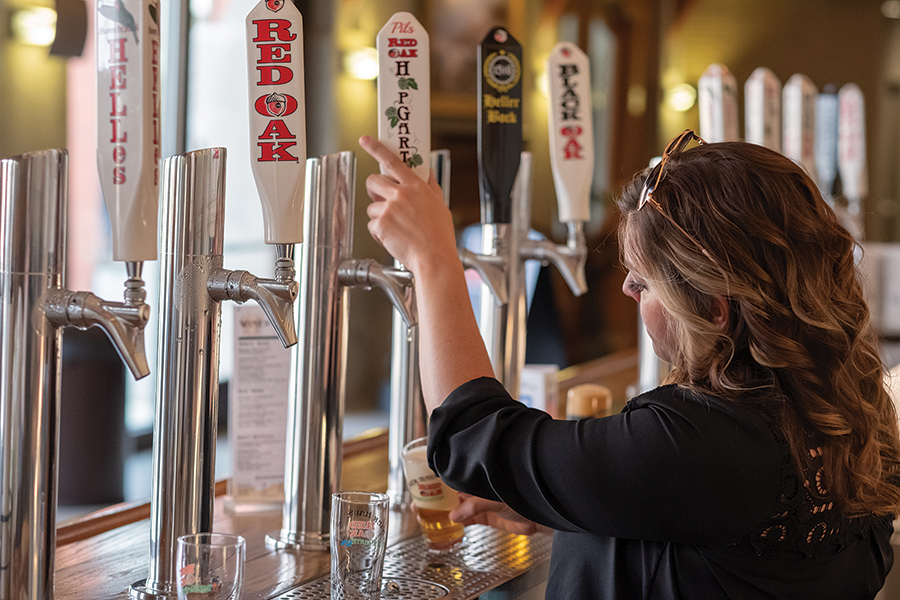
On a recent warm spring Friday evening, the bar at Red Oak Brewery’s spanking new Lager Haus and its newly completed Biergarten are filled with happy customers and an air of cheerful gratitude that another workweek is in the books. It’s time to hoist a cold Red Oak or one of half a dozen house-crafted beers on tap to toast the start of a warm and welcome weekend. 

At least that’s the feeling of the colorful owner and creator of this festive little piece of Munich, Germany — a pretty happy guy in his own right. Earlier in the day, Bill Sherrill, arguably one of the godfathers of artisan brewing in North Carolina, received some very good news about the future of crafted beer in the state.

A friend who works as a lobbyist in the North Carolina General Assembly phoned to let him know that a lengthy campaign led by Sherrill and other craft brewers to change a state law that prohibited them from producing and selling more than 25,000 barrels of beer without contracting with a wholesale distributor had succeeded.

Under the revised law, the state’s 200 craft brewers could now make and distribute 50,000 barrels on their own. It’s a victory not only for thirsty beer drinkers across the state but also a shot in the arm for smaller, independent craft brewers like Sherrill who’d essentially bumped up against the 25,000-barrel cap, limiting further growth without turning their beer over to a distributor, who probably wouldn’t keep, for instance, Red Oak refrigerated during transport as classic German lagers should be.

“It’s definitely a reason to celebrate because this will mean more jobs in the long run and be great for the state’s economy,” says a visibly pleased Sherrill. His illuminated sign by his Red Oak brewery hard by the southern flank of I-40/85 in tiny Whitsett has become something of a roadside icon and a growing attraction in recent years, underscored by the opening last fall of the brewery’s capacious Munich-style Lager Haus.

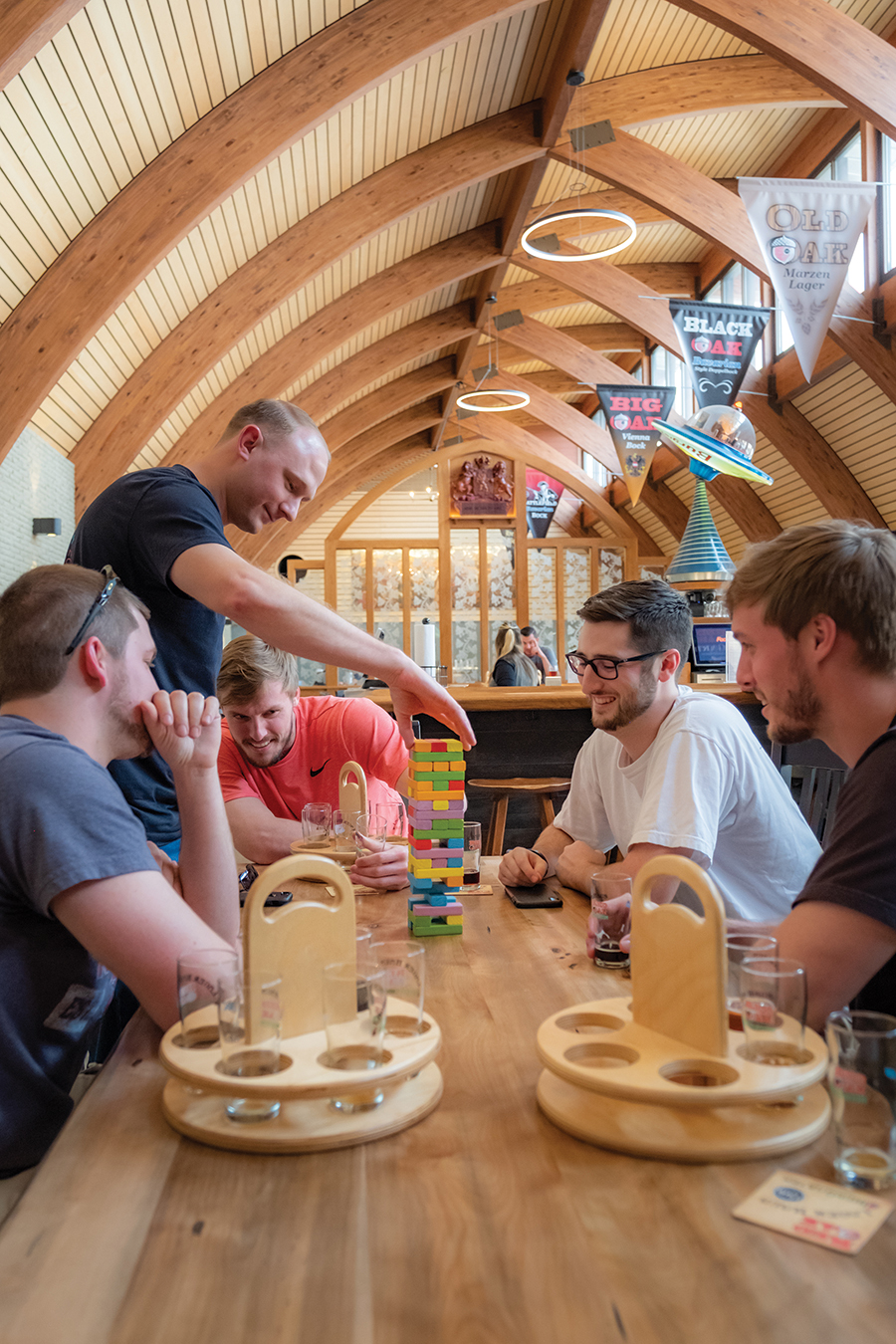
The aforementioned Biergarten, with its neat communal tables and fire pit beneath a grove of lacy bark elms, is simply the latest addition to meister Sherrill’s complex. Next up is a 10,000-square-foot office and art gallery that will showcase major North Carolina and Southern visual artists when completed sometime late this year or early next. In the meantime, his popular Lager Haus features its own eclectic works of art in the form of a 17th-century wedding settle (bench) that was given in 1640 to the Earl of Northumberland, a pair of royal family crests from England’s House of Windsor and the Royal House of Holland, a 500-year-old coat of arms from the German Millers Guild, oil paintings from ice skating legend Dick Buttons’ private collection, antiques and an illuminated “Burgie” (i.e. a vintage Burgermeister Beer sign) from the Sputnik years rotating over the bar.

“I found that during an art crawl 21 years ago in Scottsdale, Arizona,” relates Sherrill over the convivial din of his patrons. “Pretty special, isn’t it? It seems to make people happy. That’s the point.”

Indeed it seems to be one of many reasons the festive Lager Haus has become both a roadside destination and a routine gathering spot for everything from local civic groups to book clubs, family reunions and alumni evenings — even a Bible class that meets there every other Thursday.

“We have probably the widest range of patrons imaginable,” says director of customer services, Ashley Justice, with a laugh. “I’m talking about lawyers from Raleigh, college students and professors from Greensboro and Chapel Hill, business folks and Harley bikers.” Plus, she says, there are game boards for families, NASCAR on Sunday, musical Bingo on Wednesday evenings and trivia nights on Thursdays. “We host events for the sheriff’s department and local hospitals. This really is an Old World place where everyone feels welcome.”

Dogs are welcome too — treated to their own special watering holes — while  gourmet food trucks feed their masters on a rotating basis. A highlight of this ongoing festive calendar is the gifted German oom-pah band that shows up annually to perform on weekends through Oktoberfest. Sherrill also plans to add an authentic Brat Stube (Kiosk) selling German sausage.

All three entities — craft brewery, Lager Haus and art gallery — are the kind of yeoman dreams Bill Sherrill has spent a career bringing to life. In 1979, Sherrill opened Franklins Off Friendly with a talented chef named John Berres and a charismatic young house manager named Dennis Quaintance, the three of them creating one of the Gate City’s hottest restaurants over the next decade and a half. From there, Quaintance went on to start a successful wine brokerage and later partnered with construction guru Mike Weaver to open Lucky 32 restaurant; the two would later bring a pair of award-winning luxury boutique hotels, the O.Henry and Proximity, to life.

“I can’t imagine what my life and many others would have been like without Bill,” says Quaintance, who met Sherrill when he was 17 and followed him east after working for him in hotels and restaurants in California and Seattle. “He is such an original thinker. For Bill, it’s not about the money. It’s about creating things that make people happy. Bill doesn’t conform to any formula. He is completely unconventional and creates what makes him happy and shares that with the people around him.”

In 1989, after expanding the footprint of Franklin’s to include a Top 100 wine cellar, Sherrill decided to shut it down and concentrate on making the kind of German lager he’d developed a taste for while attending high school in Switzerland and traveling around the world for a full year after finishing Duke University. He went on to earn a master’s degree in hotel management at Cornell University.

His quest to find the perfect brew and the kind of equipment that could make the Bavarian-style amber lager he had in mind took him on a tour of West Coast craft breweries and across Germany before he settled on equipment found at Chesapeake Brewing Company.

He brewed his first beer in 1990, selling it mainly for the next year through his small chain of bar and grills in Winston-Salem, Chapel Hill and Charlotte.

In 2008, Sherill opened his Red Oak Brewery on a patch of family land in Whitsett, officially the state’s second-oldest craft brewing company, with eight employees and an unpasteurized beer that was so fresh it required refrigeration at all times. Today, the brewery occupies close to 30,000-square-feet and is closing in on 70 full- and part-time employees who seem to find Sherrill’s take of the Golden Rule in management style agreeable. “We have just three rules,” he notes — “Be honest, work hard and treat the customers the way you would want to be treated.”

His eight different beers are distributed as far west as Boone and Morganton, as far east as Little Washington and Calabash.

When it eventually opens, Red Oak’s art gallery will not only house a bounty of original works Sherrill has collected over decades from North Carolina and Southern artists, but also works he’s brought home from some of the 95 foreign countries he’s visited over the past half century. Among other things, he hopes the gallery will also serve as a place for seminars and round tables on the arts.

“I know it’s kind of crazy,” Sherrill allows while sharing a brew with several of his old friends from college days at Duke. “I mean, who would spend this kind of money on good beer and great art?”

He knows the answer to his own question, of course.

“Here,” he says with the Old World charm of a proud Biermeister. “It’s been a long week. Have another beer and relax.”  OH

Jim Dodson’s antidote to the brouhaha of publishing is a brew-ha-ha with one of Bill Sherrill’s craft beers.

Short Stories

Flower Power

We take them for granted as we’re tearing down Interstates 40 and 85 in a mad rush (and one hopes, not texting and driving). But why not stop and smell, if not the roses, the wildflowers that carpet medians and roadsides of our highways? Or at least learn about the Wildflower Program from Derek Smith, environmental engineer at the North Carolina Department of Transportation. An employee of NCDOT for 26 years, Smith will discuss the types of wildflowers grown and different agronomic challenges across the state at noon on Thursday, May 9 at the Chip Callaway Lecture Series hosted by Paul J. Ciener Botanical Garden (215 South Main Street, Kernersville). The lunch and learn will also reveal how you can grow wildflowers in your own garden. To register: (336) 996-7888 or cienerbotanicalgarden.org. 

Dare to Dream

Double your pleasure with not one but two local productions of Man of La Mancha, the popular Broadway musical based on Miguel de Cervantes’ epic, 17th-century novel, Don Quixote. Scripted by Dale Wasserman as a play-within-a-play, the show begins with the character of Cervantes awaiting trial in prison during the Spanish Inquisition. His fellow prisoners insist he hand over his possessions if he is found guilty. Cervantes agrees and in the mock trial that follows, mounts his “defense” in the form of a play: the story of a mad knight errant under the assumed name, Don Quixote de la Mancha, who is determined to return chivalric honor to a dreary world. With its theme of upholding ideals (no matter how grim life gets) and stirring score (including the showstopper “The Impossible Dream”), it’s no wonder Man of La Mancha garnered six Tony awards in 1966, including Best Musical. Catch it May 1–26 at Triad Stage (232 South Elm Street, Greensboro) or May 3–5 and 9–12, at the Little Theatre of Winston-Salem (Southeastern Center for Contemporary Art or SECCA, 750 Marguerite Drive, Winston-Salem). Tickets: (336) 272-0160 or triadstage.org; (336) 725-4001 for tickets or LTofWS.org.

Mutable Mangum

Just when you think you’ve identified William Mangum’s artistic style, better think again. The artist is unveiling his latest works in the exhibition, Transitions at dual receptions on Thursday and Friday, May 30 and 31, and at an open studio on Saturday, June 1 (303 West Smith Street). Consisting of more than 50 new works, the show reveals the range of Mangum’s talent, from representational paintings to abstracts and underscores that however constant a presence he is in the city and the state, his only constant is, of course, change. To attend an opening reception or learn more about the exhibition, contact Joy Ross at (336) 379-9200 or joy@williammangum.com.

A Walk in the Park

Lindley Park, that is. Hard nowdays to imagine one of Greensboro’s best-loved neighborhoods as an amusement park at the end of a trolley line with dancing, vaudeville, a casino and a manmade lake, but that’s exactly what occupied the 60 acres once belonging to local businessman and entrepreneur, John Van Lindley. By 1917, when the amusement park had had its run and share of fun, the city hired landscape architect Earl Sumner Draper to design the planned neighborhood with winding streets and sidewalks with the park as its focal point. So enjoy the green space, with its arboretum, and get to know the turn-of-the-century and mid-century homes surrounding it on Preservation Greensboro’s Ninth Annual Tour of Historic Homes & Gardens (Saturday and Sunday, May 18 & 19). As the nonprofit’s flagship fundraiser, the tour supports future historic preservation efforts in the Gate City and Guilford County. For more info about tickets and downloading the walking app, go to preservationgreensboro.org/tour-of-historic-homes-gardens/.

The Beef People

Got a legitimate grievance? Need to gripe or get something off your chest? Well, for heaven’s sake, don’t keep all that ire bottled up — or take it out on fellow motorists in the form of road rage, or shout at coworkers, friends or family members or the TV, and please, don’t kick the dog, either. Just head to the newly formed Curmudgeons Corner and air your diatribe(s) to like-minded folk at 10 a.m. every second Wednesday at Scuppernong Books (304 South Elm Street). If you’re seeking more information about the group you can call the Curmudgeon-in-Chief at (336) 897-0283, who may not be inclined to answer. Best just to show up and vent. There, now, feel better?

Creative Campers

With summer vacation around the corner, why let the kiddos while away the hours of the long hot days in front of a video screen, when they can tap into their inner Van Gogh or Michelangelo? From June through August children ranging from pre-kindergarteners to rising sixth-graders can engage in a variety of creative pursuits at one of GreenHill’s weeklong camps. Little tots can explore colors by making their own paints and tools, or recreate their own version of the popular game “Candyland,” while first-, second- and third-graders can choose from craftmaking or creative problem-solving, among other classes. There are camps devoted exclusively to paper-making, drawing and painting, and getting your hands dirty in paint, mud or clay. Whatever you choose, the time to register is now! To do so, go to greenhillnc.org/summer-camps.

Home of the Grave

Or graves, plural. Not to mention an insane variety of exotic trees, thanks to the late, great green thumb of local plantsman and polymath Bill Craft. Yes, we’re referring to historic Greenhill Cemetery, which is really, really green this time of year, given the amount of rainfall these past several months. See what’s sprouting and blooming, and learn about the storied lives of the cemetery’s, um, permanent residents, many of whom shaped Greensboro, on Friends of Greenhill’s springtime tour on Sunday, May 12 at 2 p.m. Meet at the southern gate on Wharton Street with the oh-so-reasonable admission of $5. Info: friendsofgreenhillcemetery.org.

Barnburner

The French Farmer’s Wife (1987 Beeson Road, Kernersville) returns Thursday, May 2 through Saturday May 4 with its first barn sale of the year. With an emphasis on, but not limited to, French provincial antiques and vintage pieces, the sale features fetchingly curated and staged finds, such as large pieces of furniture, baskets, glassware, linens, soaps, garden accouterments and considerably more. As a special treat, Debbie Dion Hayes will be on hand to sign her book, Paint, Stencil & Design on Saturday from noon to 4 p.m. Can’t make the sale? No worries, la fermière française will open her doors again July 25–27 and October 24–26. Info: facebook.com/TheFrenchFarmersWifeNC.

Winning Innings

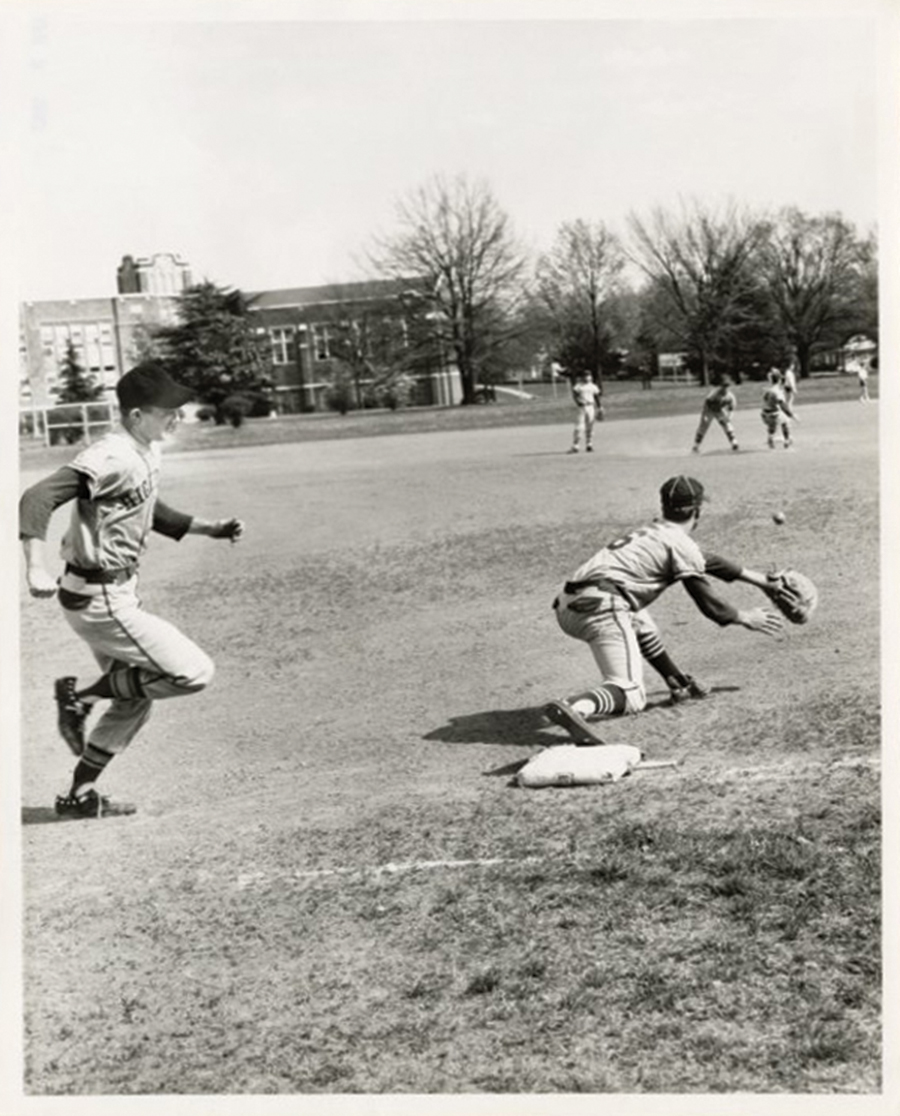
The High Point Rockers are the newest ball club in the Triad, but did you know The International City has been hosting baseball games since the 1880s? It’s just one of several tidbits you can learn by visiting the exhibition, At the Old Ball Game, which opened late last month at the High Point Museum (1859 E. Lexington Avenue) Not only does the show cast a backward glance at local enthusiasm for America’s National Pastime, it also examines the current climate for the game with various lectures, events and programs, including the chance, on Saturday, May 4, for a free appraisal of your baseball cards and memorabilia. Now that’s what we call a homerun. Info: highpointmusuem.org.

Ogi Sez

Ogi Overman

I can’t prove it, but if asked their favorite month, I bet most folks would answer “May.” There’s just not much to dislike about it. As Goldilocks would say, “Not too hot, not too cold, but just right.” Plus, the outdoor concerts and street festivals are kicking off, making this a music-lover’s paradise. So, enjoy, there’s lots to choose from.

• May 2, Carolina Theatre:
For their Command Performance this year, the Showplace of the Carolinas has chosen Three Dog Night. The iconic rockers who ruled the early ’70s with 21 consecutive Top 40 hits, including three No. 1s, are still actively touring with original member Danny Hutton. Those patented “Joy to the World” three-part harmonies are still intact.

• May 10, High Point Theatre:
Not that it ever recedes for true believers, but May means that beach music again kicks into high gear. And the group that (one could argue) started it all, The Embers, are in the area, along with The Collegiates. If you saw them at the N.C. Folk Festival last year, you know that with Craig Woolard back in the fold, The Embers remain at the top of the “sand in my shoes” heap.

• May 18, LeBauer Park: Last year the Piedmont Blues Preservation Society moved its 32nd annual Carolina Blues Festival back downtown to rave reviews. They’ll be back there this year with another power-packed lineup of five stellar acts, headlined by the incredible Dom Flemons. The perfect way to spend a May afternoon and evening.

• May 30, Greensboro Coliseum: If, like me, harmony is your thing, Pentatonix needs no introduction. With the recent emergence of a capella vocal groups as a musical force, they have emerged as the cream of the crop. Their five parts can be literally chillbump-inducing.

• May 30, Ramkat: Did you happen to catch CBS’ recent Sunday Morning segment on Marty Stuart’s country music memorabilia museum? He is what Nashville used to be, and if he has his way, will one day be again. He looks and sounds the part, and His Fabulous Superlatives, ain’t bad, either.

Drinking with Writers

Blood Memory

Five friends and a meal to remember

By Wiley Cash     Photographs by Mallory Cash

In his first poetry collection, 1998’s Eureka Mill, Ron Rash writes about the connection he feels to his father, grandmother, and grandfather, especially their waking before dawn to work in textile mills. Rash refers to this connection, the connection to an ancestor’s experience without the experience itself, as “blood memory.”

I have always felt a kinship with Ron, and it is not just because our people come from the same places — the South Carolina Upstate and western North Carolina. I feel a deep bond with the experiences he writes about, the people he portrays, and the often disappearing landscapes he puts on the page. Is it blood that connects us? No, but when I read his work I feel like I understand Ron and the people he writes about as much as I understand my mother and father and the people who came before them.

This is what I was thinking about — this blood memory — when I left my adopted hometown of Wilmington and drove across the state, where the Appalachian Studies Association was hosting its annual conference on the campus of the University of North Carolina-Asheville. Normally, I am not someone who enjoys conferences: the academic talk, the nametag gazing, the feeling that everyone there is vying for the same thing, whether it is publication, notoriety, or the keys to both. But I felt at ease as the elevation increased and the air cooled because I knew I would be spending the weekend with writers and scholars who view the world in much the same way I do.

There were many people I was looking forward to seeing again or meeting the first time during our stay in Asheville, but I would be lying if I said I was not giddy at the thought of spending time with Lee Smith, someone I do not see as often as I would like and someone I will go to my grave believing is the most charming and warm-hearted person in all of American literature.

Along with novelist Silas House and his husband, writer Jason Howard, my wife Mallory and I had plans to have dinner with Lee in Asheville on Friday night before Saturday’s conference keynote event: a discussion between Lee and Ron Rash with me serving as the moderator.

I had met Silas House a few times over the years, but I really got to know him after we spent an evening in Swain County, North Carolina, last spring, facilitating creative writing workshops and readings with groups of high school students from western North Carolina and New York City who were participating in a literary exchange program. I had never met Jason before, but I knew his work, much of it focused on Kentucky’s rich music history and environmental issues like mountaintop removal. 

For dinner, the five of us met at Rhubarb in downtown Asheville. Asheville has become a culinary mecca over the past decade, and while you may hear a lot about restaurants like Cúrate and Cucina 24, Rhubarb serves consistently incredible food comprised of regional ingredients. John Fleer, a Winston-Salem native and Rhubarb’s owner and chef, is the former executive chef at Blackberry Farm, and he was named one of the “Rising Stars of the 21st Century” by the James Beard Foundation. After a meal at Rhubarb that might include crispy fried hominy dusted with chili and lime alongside wood-roasted sunburst trout you can see how Fleer is steering into the 21st century with the roots of his Southern history fully intact. Rhubarb is one of my and Mallory’s favorite restaurants in Asheville, and we were proud to share it with Lee, Silas and Jason.

Over dinner and drinks, I asked Silas how he had come to know Lee.

“Over 20 years ago I submitted a story to a workshop Lee was teaching at the Hindman Settlement School in Kentucky,” Silas said. “And a few weeks later I went to one of Lee’s book signings. I was so nervous to meet her because I loved her books, and I wanted to be in her workshop.”

Lee laughed and picked up the story.

“And when you came through the line and told me your name so I could sign your book, I said, ‘How funny. I just read a very good story by someone named Silas.’”

“And it changed my life,” Silas said. And his life is still changing. His most recent novel, Southernmost, received rave reviews and kept him on a book tour for most of the spring and summer.

Over the years, Jason came to love Lee just as much as Silas does.

“I was in Washington, D.C. a few years ago,” Jason said, “and suddenly I heard Lee’s voice on The Diane Rehm Show. I dropped what I was doing and drove right to the NPR station. The receptionist asked me what I needed, and I said, ‘I’m just waiting on Lee Smith to finish her interview.”

Lee burst out laughing.

“I came out of the studio, and there you were. It was like we planned it.”

Before dinner, Mallory and I had discussed whether or not she should bring her camera gear, but we decided against it. We wanted to enjoy the evening talking to people we do not get to see that often. But Mallory did take one photo with her cell phone; in it, Lee, Silas, Jason and I are all squeezed onto one side of the table. If you did not know better, you might think we were family.

The next afternoon, during the conference keynote, Lee, Ron Rash, and I spent an hour or so onstage in a packed auditorium talking about Appalachian writers and literature and issues specific to the region.

“I think it’s important to be able to steer students toward writing that reveals something about themselves,” Lee said. “There’s value in seeing your life on the page.”

“Robert Morgan did that for me,” Ron said. “And so did Fred Chappell’s book I Am One of
You Forever
.”

After our discussion, we took questions from the audience. Someone stood in the dark theater and asked if any of us have ever felt slighted because of the place we call home or how we speak.

“For me personally, that’s why I don’t want to ever lose my accent,” Ron said, “Because that to me is a rejection of your heritage. The way I look at it is, OK, you can make fun of my accent, but we can out-write you, we can out-music you, and we can out-cook you.”

I agree with Ron. I am proud of the place and the people I am from, and I am proud to share stages and dinner tables with them. They feel like family. They feel like blood.  OH

Wiley Cash lives in Wilmington with his wife and their two daughters. His latest novel, The Last Ballad, is available wherever books are sold.

The Omnivorous Reader

On the Lighter Side

The study of humor can be serious business

By Stephen E. Smith

“Who was Alexander the Great’s father?” my 11th grade history teacher asked (this was back in the day when educators expected students to know a little something about world history). Before anyone could raise his or her hand, my friend Norman Alton, slumped in the desk beside me, blurted out his answer: “Philip’s Milk of Macedonia!”

Norman wasn’t the class clown. He didn’t make monkey faces or squawk like a jungle bird. He was the class wit, a usually subdued presence whose occasional response to teachers’ questions exhibited a startling degree of wordplay and a remarkable, if somewhat perverse, intellectual insight. Philip’s Milk of Macedonia: Everyone laughed, even the thickheaded ones. Even the teacher.

James Geary’s latest book, Wit’s End: What Wit Is, How It Works, and Why We Need It, explains how Norman’s agile, word-warping mind worked, analyzing the bits and pieces of intellect and psychology that conspire to make wit and its resultant humor a force in our lives. And Geary would seem to be the man for the job. He’s deputy curator of the Nieman Foundation for Journalism at Harvard and the author of I Is an Other: The Secret Life of Metaphor and How It Shapes the Way We See the World, the New York Times best-selling The World in a Phrase: A Brief History of the Aphorism and Geary’s Guide to the World’s Great Aphorists.

The book opens with a dissertation on the pun. Punning is typically regarded as the lowest form of humor (make a pun and you’ll elicit a chorus of groans), but it isn’t a simplistic exercise; it involves two incongruent concepts connected by sound and, if it’s a truly clever pun, it demonstrates a degree of insight that delights with its absurdity. “Puns straddle the happy fault where sound and sense collide,” writes Geary, “where surface similarities of spelling and pronunciation meet above conflicting seams of meaning.” Philip of Macedonia and Phillips’ Milk of Magnesia have nothing in common except, when spliced together, an unexpected degree of silliness and a certain similarity in sound and structure.

Apparently, Geary counted the puns in Shakespeare’s plays: “There are some 200 puns in Love’s Labour’s Lost, 175 in Romeo and Juliet, 150 in each of the Henry IV plays, and upward to 100 in Much Ado About Nothing and All’s Well That Ends Well.” And he offers fascinating facts aplenty: Lincoln was an avid punster. The notion that Adam and Eve chomped into an apple is a misinterpretation of the Vulgate where the adjective form of “evil” malus, is malum, which happens to be the word for apple, thus fixing the misidentification of the apple as the offending fruit. Geary also includes enough obscure puns to last a lifetime, e.g., English essayist Charles Lamb was introduced by a friend who asked him, “Promise, Lamb, not to be sheepish.” Lamb replied, “I wool.” Lamb went on to write an essay entitled: “That the Worst Puns are the Best.” And when Groucho walked into a restaurant where his ex-wife was dining, he proved Lamb right: “Marx spots the ex.”  All right, you can groan now.

Geary then delves into “witty banter,” couching his observations in an original faux 18th century play riddled with contemporary allusions. Using research paper format (who among us wants to read another research paper?), Geary explains how the brain reacts to wit and humor, and in a slightly more interesting chapter he explores the neurobiological mechanism of wit — the ability to hold in mind two differing ideas about the same thing at the same time — asserting that comedians who are bipolar have an advantage over their less afflicted peers. If you’re an old-timer, you’ll be reminded of Jonathan Winters, who gave us Maude Frickert and Elwood P. Suggins from Bellbrook, Ohio, a yokel who’d seen “some 76” flying saucers. But Geary focuses on a more derivative and annoying comedian, Robin Williams, as a prime example of a bipolar individual who could make instant disconnected connections. He also presents numerous examples of individuals who suffered bouts of unrestrained wit, such as the case of a 57-year-old man who began constantly joking, laughing, and singing. “After the patient’s death, his wife discovered scores of Groucho Marx glasses, spinning bow ties, hand buzzers, and squirting lapel flowers in their garage. An autopsy showed asymmetric frontotemporal atrophy and Pick’s disease.”

Neurological mechanisms notwithstanding, readers are likely to find their attention waning in chapters such as “Perfect Witty Expressions and How to Make Them” (can we be taught to be witty?), “Advanced Banter” and “An Ode to Wit,” which falls with a predictable thud. In an especially cringe-worthy chapter on “jive,” Geary explains “Dozens,” a form of interactive insult which is “a part of African-American tradition of competitive verbal invention” in which combatants face off before a crowd and “direct aspersions at their adversary’s shortcoming”: Your mother is so ugly that she has to . . . ” He also includes a lengthy out-of-date jive glossary — “Cat: A cool, witty person,” “Chippies: Young women,” “Eighty-eight (88): Piano,” “Knowledge box: Brain,” etc., — which is completely unnecessary.

Do we need to understand the mechanisms at work in the creation of humor? Probably not. But quick-witted people charm and amuse us; we appreciate them, crediting them, whether they deserve it or not, with a high degree of intelligence. Any understanding of how the witty mind works only deepened our appreciation of their talent. And there’s much that’s entertaining and informative in Wit’s End; unfortunately, Geary’s use of various literary conceits and his incessant cleverness wears thin and eventually begs the question: Is it possible to be too clever when investigating cleverness?

My old friend Norman Alton, who is by now on a first name basis with Phillips’ Milk of Magnesia, knew a good quip when he’d delivered one. He didn’t push it. As we all cackled, he remained silent and straight-faced, accepting our laughter as praise.  OH

Stephen E. Smith is a retired professor and the author of seven books of poetry and prose. He’s the recipient of the Poetry Northwest Young Poet’s Prize, the Zoe Kincaid Brockman Prize for poetry and four North Carolina Press awards.