True South

Only in the South

When layaway simply won’t do

By Susan S. Kelly

Admit it: There are scenes and situations that could only happen in the South. I’m not talking about moonshine, magnolias, accents or tobacco. Collards, however, are involved.

Exhibit A:

One bitter-cold, sleeting January, my mother was hosting her luncheon bridge club gathering at her house (it’s worth noting, and also probably apropos to Only in the South, that my mother had lived in a different town for 18 years, and her bridge club had never replaced her; they’d used substitutes. For 18 years).

Never mind that these were the ’70s, they were still — again, Only in the South — the days of linen tablecloths, sterling silver, crystal goblets, and what I term girl food: lemon bars, asparagus spears, and a chicken casserole concocted with Campbell’s mushroom soup. Somewhere between the shuffling and the cleaning, the disposal backed up, the dishwasher broke down, and water from ice-damming in the gutters began running down the walls. The luncheon was not a success.

The minute the last guest left, my mother drove straight to Montaldo’s and bought herself a mink coat. (Also worth noting: All through my childhood, when I watched game shows on TV, and fur coats were the ultimate prize, my mother was very firm in her belief that no one under 50 should own a fur coat. She’d reached the required age, but only just.) However, she had to put the mink coat on layaway. That night, she told her mother, my grandmother, who lived in the ultra-sophisticated burg of Walnut Cove in Stokes County, what her day had been like.

The next morning, my grandmother drove straight to Montaldo’s, bought the mink coat herself, and delivered it to my mother. Not so much because she felt sorry for my mother — which she no doubt did — but because there was just no way that a daughter of hers was going to have anything on layaway at Montaldo’s.

Exhibit B:

A friend of my mother’s — we’ll call her Joan — was having a meeting at her house, necessitating finery, flowers, decorum, and girl food (see above). Minutes before the meeting, Joan smelled something awful. The maid had elected that particular morning to cook up a mess of collards (not girl food).

Joan panicked. “You can’t cook collards now, Myrna!” she scolded, revolted by the stench, and that a dozen grande dames were about to descend into her stinking living room. (Did I mention the meeting involved debutantes? Also Only in the South.) “You’ve got to get rid of those collards!” So, Myrna did what she was told. She took the big pot of greens off the stove and emptied the whole malodorous mess down the toilet. Which promptly stopped up and overflowed. And no embroidered hand towels in a powder room, or asparagus spears with hollandaise, can overcome a clogged commode, collards, and matrons clad in ultrasuede.

Exhibit C:

My friend Betty grew up with an irascible, alcoholic mother. A real character, who I loved, but was, nevertheless, a drunk. Years later, at a party, Betty was talking to a friend who was married to another adult child of an alcoholic, in a family that might have had even more dysfunction and irregularities than Betty’s. Still, the son — we’ll call him James — had survived and thrived. Thinking she was delivering a compliment, Betty said, “Look at James. He’s successful. Normal. Happy. With all that was going on in his house, how in the world did he turn out so well?”

The friend didn’t miss a beat. “Just like you did, Betty. Good help.”

Debutantes, collards, Montaldo’s, and good help. Only in the South.  OH

Susan S. Kelly is a blithe spirit, author of several novels, and a proud grandmother.

Wandering Billy

Hamming it Up

Going Hollywood, a birthday bash and new life for urban spaces

By Billy Eye

“I never worry about diets. The only carrots that interest me are the number you get in a diamond.” — Mae West

This summer marks my 50th year in show business. No, almost really.

It all began back when I was 12 years old, after I noticed that the back porch at 1200 Hill Street looked an awful lot like a stage. So I rounded up the neighborhood kids, including Trudy and Ann Warren who lived there, and put on a play using a parody of Dragnet from Cracked magazine for a script. Within days, we were invited out to channel 48’s studio off Wendover to videotape our sophomoric shenanigans for a segment on that station’s afternoon cartoon-fest, The Kiddie Scene with Mr. Green, introduced as “The Hill Street Moppets.” The only thing I remember about the program was they played the song “Yakety Sax” incessantly and broadcast those dreadful Mighty Hercules animated shorts (“Herc! Herc!”).

Actually, I got my start a few years earlier, when I wrote and starred in the fifth grade play at Irving Park Elementary. I was “The Flying Nut.” But, TV baby, that was the big time, with our skit screened at least a dozen times on Channel 48. Later this year, you can catch me portraying a sleazy music company executive in a motion picture shot here in Greensboro, directed by Maurice Hicks, entitled Rap & Rhyme. I’ve seen a rough cut and, if I say so myself it’s amazing . . . stay tuned.

***

Attended a gala luncheon at the Greensboro Country Club celebrating recently retired businesswoman and lumber magnate Marion Hubbard’s 90th birthday thrown by her daughters Libby and Ada. There must have been at least 150 of her closest friends there, if the fire marshall had shown up they’d have shut the place down.

The food was wonderful, the cake divine. I’m guessing half the residents of Well-Spring were present. I saw a lot of familiar faces and was lucky to be introduced to a few new folks, as well. By coincidence, I sat next to a couple I’d never met, Joel Funderburk and his lovely wife Norma.

“Funderburk,” I said shaking hands. “That name sounds really familiar!” Duh, that’s because our February 2018 issue featured the ultramodern home on Cornwallis that Joel designed and built in the 1970s, adjacent to Medford Lake, where the couple lived for 40 years. I had just read Nancy Oakley’s story literally the night before, while researching another subject, but I never made the connection (typical!). Not only that, O.Henry magazine scribe Susan Kelly’s mother was also at the table.

Joel and I traded stories about Old Greensboro, about Otto Zenke and why there are log cabins in Pinecroft, but when Norma asked if young people today know what Hamburger Square is, I was very excited to tell her about the meeting I attended the day before.

You see, big changes are afoot around Hamburger Square.

For the uninitiated, the corner of South Elm and McGee earned the moniker “Hamburger Square” back in the 1930s when there were diners on three of the four corners — California Sandwich, where Natty Greene’s is today; Jim’s Lunch, now Two Brothers Brewing; and Sunrise Lunch, currently home to Just Be. Within steps there were a half dozen other restaurants, including New York Lunch, the Hotel Clegg’s Coffee Shop in the newly remodeled Christman-Cascade Building  alongside the tracks on South Elm. While they all served hamburgers, California Sandwich and Jim’s (both remained in business for more than 40 years) were distinguished for their longstanding rivalry over who made the best hot dogs, which admittedly doesn’t shed a lot of clarity about why the area was called “Hamburger Square.” Nevertheless, the corner has remained remarkably intact for nearly a century now, and in my not-so-humble opinion, downtown’s crown jewel.

The renovation of Hamburger Square is Greensboro Beautiful’s 50th anniversary project, spearheaded by April Harris, David Craft and Randall Romie. Kitty Robinson was in attendance, Greensboro Beautiful’s first coordinator, back when the group was formalized in 1968. Before that, Kitty and her compadres had been undertaking beautification projects around town under the name City Beautiful, for example the green space along Cone Boulevard and dogwood trails. “Before, the money had to go through the Parks and Recreation department of the city,” Kitty tells me about those early days. “We incorporated as Greensboro Beautiful because we wanted our money to go directly into our projects.”

First up for Hamburger Square’s facelift will be a colorful new coat of paint for that weathered trestle above Davie Street, transforming what is now a drab and uninteresting view. “We’ve had lots of community input,” April explains about the next step, to brighten up the pedestrian and car thoroughfare underneath the trestle. “A lighting person came and showed us ways to have swatches of light to achieve different effects. You can set these LED lights to gradually change colors or be static.” The lights will be mounted up high to shine down.

Future enhancements will include a train-viewing area and as a complement to the existing 100-year-old shade trees, additional plantings to create greener spaces. Also in the works is some paving designed to increase pedestrian safety.

Everything new is old again!

***

Half a block north of Hamburger Square, specifically that alley between the Biltmore Hotel and the shops on South Elm and Washington, there’s an ambitious undertaking meant to revamp this dreary back street, where workers take cigarette breaks and stray cats mate. Ryan Saunders of Create Greensboro is behind it, “In 2018, I was living on the third story above Scuppernong Books which backs up into that alley. So I was using that alley on a daily basis.” He was struck by the wasted potential this corridor possessed.

For years, Ryan has been infusing life into dead spaces, both here and in High Point, “Obviously, there are a lot of hurdles to jump over to make this happen,” he admits. “But we want to create an alley that has that open, street-square feeling, where there’s landscaping and seating, so cars, bikes and people can share it,” he says. At night, he muses, “Gates would close so you could buy coffee from the coffee shop, you could buy a beer, get food and hang out. There’s an entertainment stage we envision for concerts.”

The first step is paving the alley, which is underway, but this grand scheme will rely on ingenuity, adaptability and a bit of providence. “If you take the first step today, the rest will follow,” is Ryan’s philosophy. Currently there are two large storefronts on the 300 block that have been vacant since the 1980s. “Those are really deep buildings, very old buildings,” Ryan points out. “From a real estate standpoint, the owners are going to have to invest a lot of money, really do a lot of improvements to get a tenant in there.”

Create Greensboro’s concept would accommodate a subdivision of those 3,000-square-foot former furniture stores into micro-shops, with an entrance facing the alley. “Because you have a smaller space, you’re paying less rent,” Ryan says. “So it’s more approachable for an entrepreneur. Washington Alley is not just a beautification process, this is basically an incubator for small businesses. That’s really what incremental development is all about.”

Relatively small projects like these have a huge impact on day-to-day life for those of us who live and work downtown, and help foster an environment that may encourage young creatives to stick around and not leave town at the first opportunity. Like I did.”

***

Traverse a few blocks down South Elm to find my fave noshery, Chez Genèse. Not that they need the publicity, this charming bistro is nearly always at capacity and will be even more so, I suspect, when Centric Brands relocates its headquarters into the former Blue Bell plant next door.

No matter how packed this comfy corner cafe can get, one is always able to enjoy a quiet conversation, and Eye was pleased to discover potato leek soup on the menu on my last visit, one of my go-to dishes. Don’t know if it’s still on the board but it was the best I’ve ever tasted, richly creamy with miniature wedges of potato to make it hearty enough for a meal. I also recommend the quiche of the morning — tall, silky smooth.

Anyone lunching or breakfasting with me at Chez Genèse becomes an instant fan. You will too.  OH

Billy Eye is always at a loss as to what to write here, how can anyone encapsulate that much fabulousness into mere words?

May Poem 2019

Four Egrets at the Reservoir

Four great egrets,

the wands of their

slender necks waving,

wade through tall

reeds and tranquil

water to the sound

of a kingfisher’s

call. The tops of

surrounding trees

are lit from above,

and the ground below

them, shadowed.

All is serene, from

the gander swimming

in circles to water

striders, skating

across the reservoir’s

still surface. In

summer, lilies

bloom and multiply,

their petals a delicate

shade of pink. But

the wedding-veil-

white of the egrets’

feathers is stark

in early spring,

against umber,

sienna, and olive,

and the evening air,

cool and weightless

here, where egrets

come and go — like

darkness and the light.

— Terri Kirby Erickson

Bohemian Rhapsody in Blue

Catherine Harrill pushes aside old boundaries in her brilliantly edited new home

By Cynthia Adams   •   Photographs by Amy Freeman

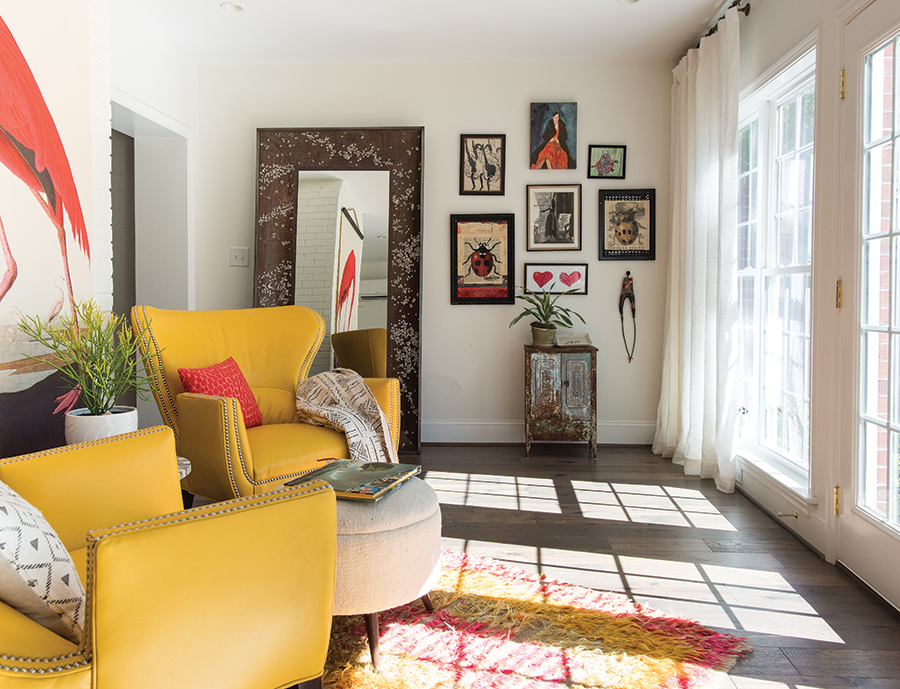
Jazz plays softly in Catherine Harrill’s Fountain Manor townhouse when she opens the airy double French doors (ones that contractor Gary Jobe installed ages ago for a previous owner). That she says, is serendipitous. So is the fact that she already possessed the gleaming French Regency brass doorknobs now affixed to the doors. Those helped kick things up a notch from the get-go.

Like so many of the furnishings that survived a severe edit, Harrill nabbed the brass knobs at a vintage store. “I bought them without knowing where I would use them,” she says with a smile. She fondly mentions vintage resellers like Adelaide’s, The Red Collection and Carriage House as she points out old loves — that is, longtime favorites enjoying a new life after making the curating cut.

A ghost-style acrylic fixture with brass accents hangs over the entryway. Just inside the entry, a grand gold pier mirror (another vintage score) bounces light into the serene kitchen.

The house reverses the kitchen-out-of-view plan. The sleek kitchen is primary.  With white marble tile and white quartz, it is an understated study in how to create a white kitchen that isn’t sterile — and worthy of being right upfront and on view.

The refined and well-lighted space provides a sight line through the downstairs all the way to the sunroom and rear terrace — something Harrill methodically created via a gut job.

Just beyond the monochromatic kitchen is the unexpected: Fully saturated color!

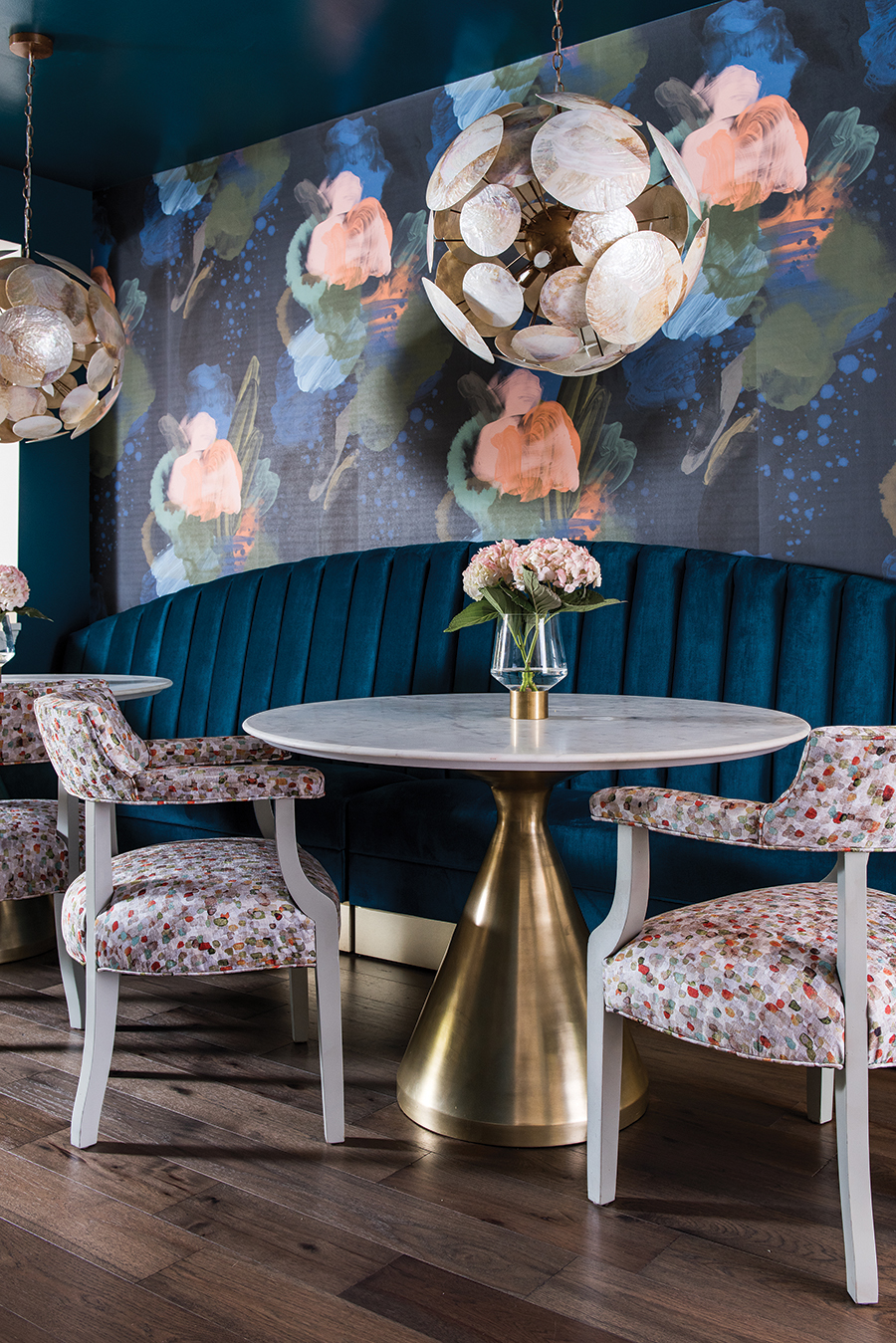
The once conventional dining room was opened up and now is done in broody, bohemian blues, even on the ceiling. It is now a space with a frisson of excitement —featuring a long and sexy velvet banquette with button tufting, two gleaming white bistro tables, vibrant wallpaper and two sculpture-like fixtures.

Is this Greensboro?

Harrill’s condo synthesizes departures from the norm, while still creating a satisfying and exciting whole — an unmistakably conscious design. Here, Bohemian chic meets Zen.

It is a revelation.

Forget Builder Bob clichés. This homeowner wasn’t having it. “I’d had enough chair rail to do me for a lifetime,” Harrill jokes, taking a seat at a sleekly modern bistro table and serving a pizza that combined fig preserves, brie and pistachios.

The combo elevating pizza to an unexpected and savory plateau is worthy of the kicky dining room.

“I have dinner here every night,” she adds with a smile of pleasure.

The soundtrack for dining in such a space is, rightly, jazz. Comprised of counterpoint, improvisation, with a hipster cachet, it is the music of creative breakthroughs. All indications are that after Harrill retired as a clinical social worker at Cone Health, she had a literal breakthrough of her own.

For not only did she discover a soundtrack for her new digs, she also blew out the rear wall in order to accommodate a creative revision, adding another 200 square feet to her living space.

She banished chair rail, along with decades of stuff during a year and a half of serious evaluation.

And she wisely chose to have her expansive vision drafted, vetted and then drawn by Greensboro residential designer Jim Weisner before she even talked to anyone about costs, avoiding the expensive mistakes witnessed on home design shows.

“He does architectural drawings. I hired Jim to do renderings before I talked to contractors. I knew from the inspection report that I needed to discuss with a professional what could be opened up structurally,” Harrill explains. He came back to discuss a few things — and they were resolved.” As it happened, they had attended the same high school.  Serendipity indeed.

Using Weisner’s plans to obtain renovation quotes, she settled upon general contractor Gary Jobe. The renovation went without a hitch.

Here’s what you should also know about why she got it all so right. Harrill is a former home stager. Aware that she was going for something different, she understood the need for a crack team to get there, from pen on paper to hammer and demo, right down to paint and fabric.

Long before Harrill became a health professional, she developed a business working with Realtors in staging listings when the HGTV network and Designed to Sell were new.  “People’s stuff intruded upon their ability to see a space.” Once decluttered and staged, homes sold.

I think we’re all ADD,” she offers. “Just having a cleaner space where your eye can rest is so different.”

Now Harrill sought aesthetic advice. “I walked in Vivid [Interiors] on Elm Street by chance, she says. “It felt right — all the color!  I wanted to break out of my comfort zone.”

Ultimately, designers Gina Hicks and Laura Mensch at Vivid guided the renovation of the dining room from concept to installation and consulted on the master bedroom, but the majority of the choices were Harrill’s.

Whereas Harrill once favored a heavier and “layered look” her new home called for something else. She points to a substantial primitive table serving as a desk in the sunroom. “Imagine putting that table here,” she reflects. The designers quickly understood that the new dining room needed something completely different than traditional furnishings. And a design which allowed for through traffic to the rooms beyond.

“Vivid’s designers, Gina and Laura, came to my apartment and I showed them a file of ideas and inspirations,” Harrill says, recalling the designers’ array of fabric swatches, paint samples and wallpaper for inspiration. Things clicked.

“Gina suggested the banquette and two tables,” she continues. The idea required a complete shift for Harrill. “But, I said, ‘OK!’ surprising us all.”

Ultimately, Harrill landed upon vintage office chairs she had painted and recovered for additional seating in the dining space.

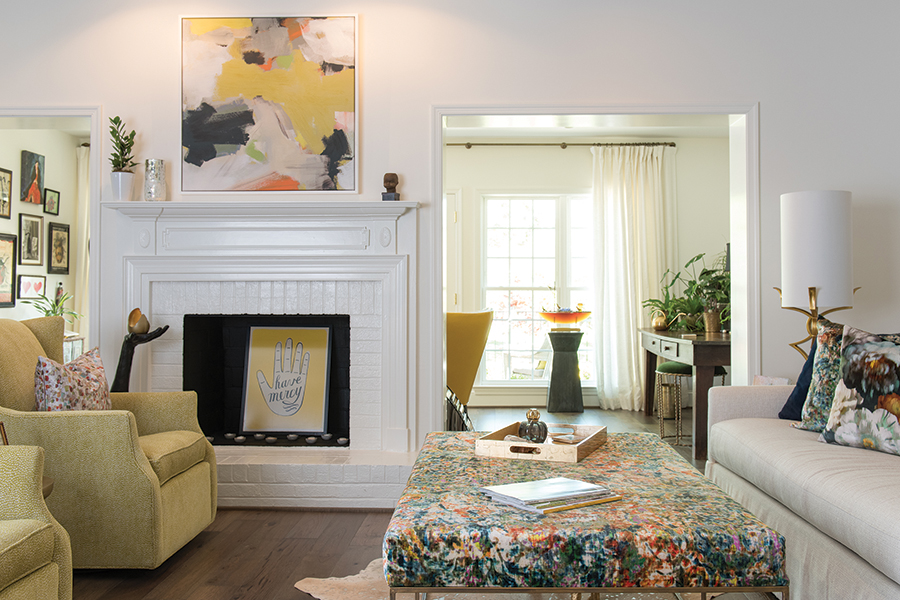
“They consulted with me, and helped me with other furniture, which included some seating and a few pieces of art.” One major piece they selected hangs over the fireplace. But the majority of the art choices are from Harrill’s own collection.

It had all incubated before the fortuitous estate sale. In the year before Harrill wandered into the sale, she had determinedly kept an eye on Fountain Manor. The community off north Elm was developed in 1973. It became her habit to drive through almost weekly noting For Sale signs. “The units sell so quickly,” she explains.

At the same time, she considered another freestanding house, having left a 4,200 square foot home in Wedgewood. Meanwhile, she rented an apartment and took stock of her possessions. “I wanted high ceilings and sidewalks,” she says, not to mention a neighborhood suited to walking.

“I realized the reason I had been looking at Fountain Manor was, I didn’t want to be isolated. I’m somewhat of a loner.” A friend, Katrina Solomon, was a resident. “I knew her 15 years,” she adds with a contented smile.

Harrill had even attempted to buy another Fountain Manor condo still languishing in bankruptcy after eight years. It was not moving according to plan and the bank was in no hurry to sell.

One day in August of 2017, Harrill was waiting for her Realtor to show her a house on Northwood, and before she could even see it the Realtor phoned to inform her someone had snapped it up. Something made Harrill drive over to Fountain Manor, where she spied an estate sale notice. She entered the sale and walked right into her future.

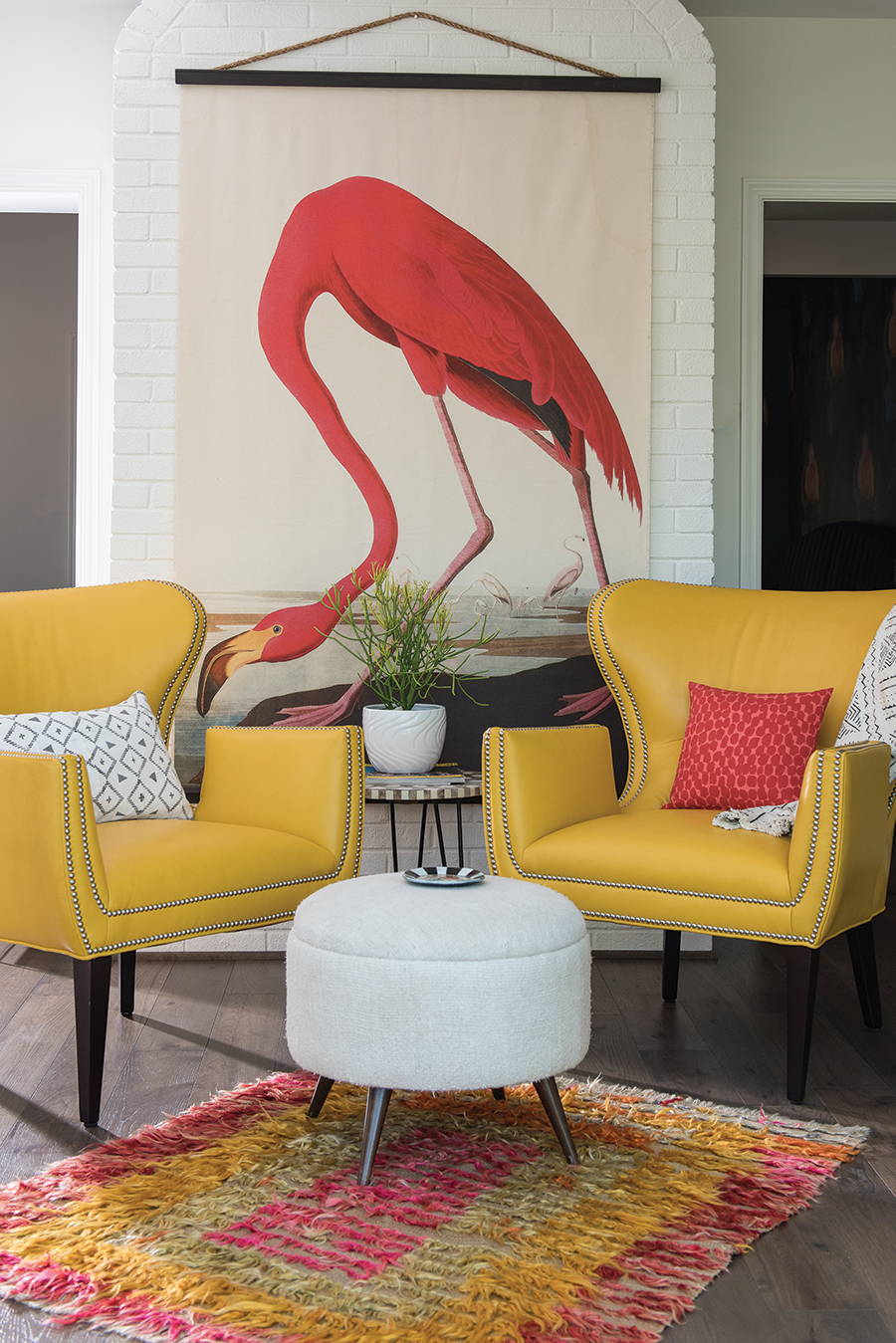
“I bought a yellow curio cabinet that day,” Harrill notes. (The cabinet is in the all-white kitchen — yellow has become one of her favorite punctuation points in the very edited home.) “And noted just as I was on my way out a notice that the house was going on the market that coming Monday. I called my Realtor, who came over, and we made an offer that night.”

A house and a yellow curio cabinet, all in one fell swoop. “I got the high ceilings,” she says, as another smile creeps across her face.

Time spent in an apartment had prepared Harrill for transitioning from a large home to half the space. It caused her to embrace the new, and make downsizing a creative experiment. Was it consciously planned that way? It evolved that way.

Harrill visualized something very different: a space with room for art, discovery and joy.

“I had also just retired. And, I wanted a place where I felt comfortable, that offered peace, serenity. Stuff doesn’t make you happy.” After retiring from Cone Health, her life’s routine was changing.

Harrill was, by design, shedding things that no longer fit into her life.

She was going to Marie Kondo her way to serenity.

“When I went to the apartment, I took all the stuff I wanted. When you get there, and start moving in, unpacking, you think, I’ve done this enough.” This meant family antiques. Then her cousin visited with even more family heirlooms, including china and a dining room table. She determinedly culled, aided by her former training in helping others declutter, while applying the Kondo question:  Does this spark joy?

Although Harrill had two adult children, Harrison and Hannah, she realized, “The younger people don’t have these attachments. Why was I going to save it?”

Even so, she checked in with them while culling heirlooms. “My daughter wanted my grandmother’s china. It’s beautiful, and she had a lot of happy associations with it. I kept the flatware and I use my mother’s sterling everyday — why not? — we only got to use it twice a year.” She laughs a bit ruefully. Her mother died in recent years, but her father lives in Greensboro.

There are a few nostalgic items that made the cut. “My mother and I both loved shoes. That’s a shoe mirror from Montaldo’s when it used to be downtown,” she says, pointing out the delightful mirror, which complements the velvet banquette  in the dining room. “My mother scored it. I’m not sure how.”

Montaldo’s figured into a happy memory, so the joy-sparking mirror has a place of prominence.

On Christmas Eve, she and her mother would head to the iconic downtown department store for its annual shoe sale which began at 3 p.m. “There was a gentleman who worked there with great taste. We had two hours before they closed.” Invariably, great shoes came home with the duo.

She remained in the apartment as home renovations began after Christmas of 2017, once construction permits were in place. Work proceeded smoothly, thanks to Harrill’s crack team.

The kitchen, gutted, allowed for new cabinetry to run to the ceiling and for a spacious island. With the downstairs revised, the space opened and its potential revealed itself. The awkwardly steep stairs were replaced with wider risers. The rear wall’s bump-out allowed for a generously-sized sunroom and remaining space for a smaller patio.

Harrill moved into her new home on April 10, 2018.

Her personal space is quietly neutral. The master bedroom features a graphic, Brutalist black-and-white, grass papered wall behind the bed. “Gina said it goes with the traditional kinds of things I liked in here. I have a lot more color than I’ve ever had downstairs. But for my living space, I kept it calmer,” Harrill explains.

A French gilded chaise found in a vintage store is central to the room’s edgy look, featuring hand-painted black-and-white upholstery. She accented her space with brass touches. “I’d never had matching bedside tables,” she says. “It seemed like a luxury I wanted to go for.”

A black-and-white painting by local artist Billy Cone hangs on the bedroom wall.

Baths throughout the house were redone. The master bath now features a deep soaking tub.

“The bathrooms aren’t really big,” Harrill says, but the closets are. Perfect for her beloved shoe collection.

With paint, paper and new furniture in place, and Harrill’s many pieces of art hung, there was a mere moment of self-doubt as she walked through the expansive, Bohemian space.

“I had a period of anxiety, wondering, did I make it too fancy?” admits Harrill. “I’ve always made do with whatever I could get, and that was fine. But to do a dining room like that with a banquette?”

But as Harrill came to realize, the new dining room made entertaining  easier and less formal, whereas most dining rooms molder unused. She can now place food and beverages on the large kitchen island and seat anywhere from six to nine guests — no ancestral dining table required.

And there was the joy factor.

Her kids take on the outcome? “Harrison is 27, and my daughter, Hannah Morecraft, is 30. And they like it.”

Morecraft, who lives in Raleigh, later sent an email:

“My mom’s new place is exactly her personality — creative, fun, eclectic and warm. My brother, my husband and I, and maybe especially our Bernese Mountain dog, Bear, love visiting whenever we can and spending time chatting on the patio or around the big kitchen island. I’m so glad she found a great team to help her pull it all together.”

Standing on the redesigned patio, Harrill pointed out the trees beyond a new wrought-iron fence, which affords an unobstructed view.

“I was sitting out here one day and looked at the crepe myrtles and counted them.  There were seven of them. I realized I felt like I was at home. There were crepe myrtles lining my driveway at my former home — exactly seven.”

Some things need no editing.  OH

Cynthia Adams is a contributing editor to O.Henry.

The Accidental Astrologer

Stardust Memories

Forget the Vegas floor show and look to the skies for a spectacle you’ll never forget

By Astrid Stellanova

If you’re a fan of the fantastic, find a good spot for sky-watching around May 4–6 when the Eta Aquarids put on a show that will rival the Bellagio’s dancing fountains to dazzle us. This is one of the year’s best meteor showers. A waxing moon will mean low illumination, offering a good gander at falling stars galore.

Star Gazers, try not to fall off your fishing stool when shooting stars reflect off the pond and fish jump right outta the water. If ya’ll should miss out, pass out or fall out, you get a second chance for gawking at something be-yoo-teefull next month when the Arietids occur on June 7.

Taurus (April 20–May 20)

There’s you, bullish and charged up, and then there’s everybody else in the room fighting for the leftover oxygen. You have big appetites, needs and dreams. If you weren’t so dadgum full of life force, it would be tempting to just lure your wild self into a padded room, lock the door and keep walking. But who can walk away? Boring you ain’t. Amazing you are, when you harness all that star power for the good. If you don’t find the discipline, you exhaust friends and confound enemies.

Gemini (May 21–June 20)

You can’t motivate some people, even if you gave them a job in a MoonPie factory licking marshmallow crème off spoons. Motivating somebody else in your life just ain’t your job, Sugar, but motivating yourself, is.

Cancer (June 21–July 22)

Third time’s the charm, and, Honey, you can bet your stars and garters you are gonna succeed. If you can tap, yodel or clog, or have a dog who can, get yourself to Nashville. The stars are in your favor.

Leo (July 23–August 22)

The enemy of your enemy ain’t necessarily your friend, Honey Child. You trusted a conniving devil, and you found out you don’t like sharing the same lumpy bed, do you? Kick ’em out and put ’em in your past.

Virgo (August 23–September 22)

Your secret desire may be to play Cher in a tribute band. Whether that happens or not, you will at least be able to find both an open mic and the courage to read that poem you wrote. Sometimes you gotta be you.

Libra (September 23–October 22)

Don’t just use your head as a hat rack. Modesty ain’t working right now. Put your good brain to use, Honey, and notice how opportunity is right smack dab in front of you. It’s your turn to show ’em what you got!

Scorpio (October 23–November 21)

You’ve been so dang disconnected you don’t even know when to shout Bingo. Speak up, Sugar! Everything is pointing to the fact that you need to act. If you do, you avert a big old problem, and if you don’t, you won’t.

Sagittarius (November 22–December 21)

You got an epic surprise. Someone shocked you silly and sucked the sugar right out of your cheeks. In this case, it is plain wonderful to be wrong. You counted this someone out, but found they counted for something.

Capricorn (December 22–January 19)

Your mouth was wide as Texas but nothing came out. Stage fright, Sugar? Looks like it. Practice speaking up to somebody who gets your goat until the words comes naturally. Meantime, get yourself a good calming mantra.

Aquarius (January 20–February 18)

You buttered their butt and tore it up like a stale biscuit. Feel better? Vengeance was yours, and now you can mark that fool off the list. Focus on your better angels, not the avenging ones.

Pisces (February 19–March 20)

Sugar, you love who you love, and you just despise everybody else. Except, you don’t exactly say that. In the interest of world peace, end a grudge you’ve been nursing since fifth grade. Have some gumption.

Aries (March 21–April 19)

Lordamercy, watching Aries Star Children gets my eyebrows raised up so high my hairline has to beg for space. Let up on the ambition, and pick up on downshifting. You ain’t got to be first all the dang time.  OH

For years, Astrid Stellanova owned and operated Curl Up and Dye Beauty Salon in the boondocks of North Carolina until arthritic fingers and her popular astrological readings provoked a new career path.

Simple Life

Dirty Hands, Happy Heart

And other gifts from the universe

By Jim Dodson

When all else fails, Mulligan the dog and I head for the garden.

Possibly because I hail from a family of Carolina farmers and rabbit tobacco preachers, digging in the dirt is not only second nature and something that draws me closer to my maker, but also serves as a cheap and effective therapy in a world that seems increasingly shaped by the insatiable gods of work and money.

For many Americans, work has become something of its own secular religion. According to Gallup, Americans average more hours of work per year than any of our fellow developed nations, yet 87 percent of U.S employees don’t feel fulfilled by how they earn their living. That’s a staggering problem that helps contribute to rising depression and addiction across all sectors of society.

In 1919, as Fast Company recently noted, 4 million Americans went on strike to demand fairer wages and a five-day work week — the beginning, historians point out, of the so-called American leisure class. As a result, weekends became enshrined in the culture. The bad news? We’re losing ground to our obsession to work longer and harder with diminishing returns, the average American working a full day longer than the 40-hour work week fought for by our early 20th century ancestors.

Maybe you’re one of the fortunate ones who loves what you do. I certainly am, having enjoyed a varied journalism career and book-writing life that has taken me to places I only dreamed about as a kid. Today, I own the privilege of serving as editor of four robust arts-and-culture magazines staffed by a talented crew of folks across this state. We’re a merry band of storytellers and artists who love what we do and never take that gift from the gods for granted. How we spend our time away from the job says a lot about us, a lesson some of us had to learn the hard way.

At age 30, in 1983, I was the senior writer for the largest news magazine in the South, the Sunday Magazine of the Atlanta Journal-Constitution, a magazine where Margaret Mitchell once worked and the South’s finest writers appeared. Over my seven years in Atlanta, covering everything from Klan rallies to presidential candidacies, I took only two or three full weeks of vacation. When I finally received the summons to Washington, D.C., for the interview I’d grown up hoping for, I felt utterly empty, burned-out, ready to find a new way of earning my daily crust.

The unexpected epiphany came following my big interview in Washington when I phoned my father from the outer office of Vice President George H. W. Bush. I’d been one of the first reporters to travel with Bush during the 1980 presidential campaign and gotten to know him fairly well — sharing a love of baseball, beer and New England.

My dad asked how the job interview went. I told him it seemed to go well,  save for one small problem: I wasn’t sure I wanted the job — or even to be a journalist any more.

“I have an idea,” he said calmly. “Why don’t you change your flight plans back to Atlanta and stop off in North Carolina?”

The next morning, he picked me up at Raleigh’s airport and drove us to Pinehurst.

My Haig Ultra golf clubs were in the back seat of his car. They hadn’t been touched by me in years. For at that point, almost incomprehensibly I hadn’t played a full round of golf — the game I loved best — more than once or twice while living in the hometown of Bobby Jones. Instead, I’d worked myself into an early grave — or so I feared.

After our round on famed No. 2 we sat together on the porch of the Donald Ross Grill and talked over beers about what I feared might be a premature midlife crisis, or worse.

He could have laughed at my youthful angst. But he didn’t. My old man was one great fellow, a former newsman and advertising executive with a poet’s heart. My nickname for him was Opti the Mystic.

After listening to me pour out my tale of existential career woe, he smiled and remarked, “I wouldn’t give up on journalism just yet, sport. You have a God-given talent for stringing together words and telling stories of the heart. I do, however, have a small suggestion for you. You may laugh.”

“Try me,” I said, desperate for any guidance from Opti.

“Perhaps you should try writing about things you love instead of things you don’t.”

I looked at him and laughed.

“What kinds of things?” I asked.

He shrugged and sipped his beer. He was 66 years old, the age I am today.

“Only you can answer that. Use your imagination. What do you love? You’ll find the best answer there. It may sound ridiculously corny to you, but try telling the universe what you love and you may be surprised at the results. The path is never straight. But trust your gut. One thing leads to another, including people.”

Humoring him, I admitted that I loved golf and being in nature but didn’t know a soul in either of those worlds and couldn’t imagine how I would find my way into them. Once a single-handicap golfer, as I’d proven that day at No. 2, I couldn’t even break a hundred on the golf course anymore. Having grown up hiking and camping in the mountains and forests of my home state, it had been years since I’d been deep in the woods. I’d even loved mowing neihborhood lawns and working in my mom’s garden, but hadn’t done that in almost a decade.

Still, something got into my head. Or maybe it was my gut. 

A short time later, I withdrew my name from consideration for jobs in Washington, quit my gig in Atlanta and took a 2-month writing sabbatical at the Virginia Center for Creative Arts at Sweet Briar College.

It was springtime in Virginia. I wrote for three or four hours every morning, working on a novel about a Georgia farm family for a legendary editor at Harper & Row.

In the afternoons, I took long walks through the pasturelands, fields and woods of beautiful Amherst County, Patrick Henry country.

One afternoon I helped an elderly couple down the road weed their garden and took home a stunning bunch of peonies that reminded me of my mom’s garden back home in Greensboro.

The novel was a dud. My heart was never in it. But the legendary editor, pointing out that books would come when the timing was right, insisted that I call Judson Hale at Yankee Magazine in New Hampshire. I followed up on his advice and soon found myself working as the first Southerner and senior writer in Yankee Magazine’s history. I got myself a pup from a Vermont Humane Society, lived in a cottage by the Green River and taught myself to fly-fish. My heartbeat slowed. I even rediscovered my lost passion for golf on an old course where Rudyard Kipling once chased the game.

A few years after that, a story I wrote about a forgotten hero of women’s golf even landed me a sweet job at Golf Magazine and a decade’s service as the golf editor for American Express, a job that took me around the world and inspired me to take my dad back to England and Scotland where he learned to play golf as a soldier during the war. He was dying of cancer. It was our final journey. The little book I wrote about, Final Rounds, became a bestseller that’s still in print.

Opti had been right about all of it — the power of doing what you love, listening to heart and gut while expressing your desires and gratitude to a generous universe. Whatever else may be true, I am proof that one good thing — and more important, one good person — can invariably lead to another.

Over the next two decades, I built a house on a forested hill on the coast of Maine, fathered two wonderful children and basically invested their college funds into a massive English garden in the woods. A dozen books followed, including Arnold Palmer’s memoirs.

That job brought me home again thanks to a chance to teach writing at Hollins University in Virginia and simultaneously help my partners create distinctive arts-and-culture magazines that people in this state seem almost as passionate about as we are.

Today, I consciously belong to an intentionally slower world, taking time to do the work I love but never failing to spend time in the garden with my dog, Mulligan. A golf round with my childhood pal never hurts, either.

Perhaps I’ve just come full circle. In any case, friends tell me I’m more productive than ever. If so, that’s probably because dirty hands make for a happy heart, as an aging gardener once said to me.

That aging gardener was my mom, who had a magical way with peonies and roses.

May was her favorite month, the month where spring gardens reach their glory.

Mulligan agrees with me that our roses and peonies have never looked better. OH

Contact Editor Jim Dodson at jim@thepilot.com.

Recipe for Success

At Greensboro’s lone homegrown kitchen store, friendly is the extra ingredient

By Maria Johnson   •   Photographs by Sam Froleich

As you might expect, Julia (as in Julia Child) and Jacques (as in Jacques Pépin) love hanging out at The Extra Ingredient, a gourmet kitchen store in Greensboro.

The duo usually show up after lunch and chill in the back room, which doubles as a business office, stockroom and a surprisingly utilitarian break room, albeit one with very nice Cuisinart coffee makers.

On this particular day, Jacques and Julia are jazzed. Jacques jumps on a visitor, literally, and Julia pulls used paper napkins out of the trash and chews them with great interest.

Hmm. Flaky. Layered. One might say parchment-like.

Inspired, Jacques sniffs out a tennis ball and commences gnawing.

Felty, he seems to say, with a hint of rubber.

True, hunger makes animals of us all — and Jacques and Julia are part golden retriever — but spending time at The Extra Ingredient has a way of boosting the appetite and the ability to satisfy it.

How else to explain Art and Martha Nading’s 34 years in business? In a time when mom-and-pop stores are dropping like — sorry, foodies — flies, the shop stands as one of 17 locally owned, non-franchise stores among Friendly Center’s 130 tenants.
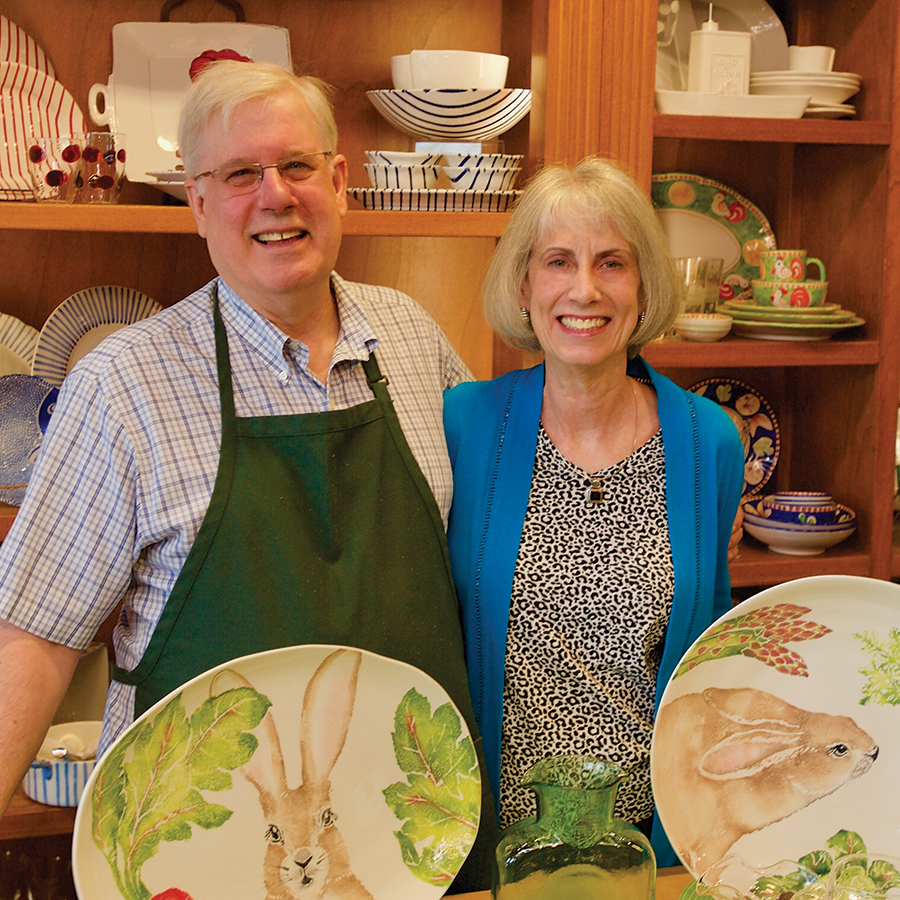
They’re also the only homegrown kitchen store in town.

Gone are Cook’s Corner and its later iteration, Roosters. Rest in peace, Tobacco USA. The Extra Ingredient is the only local player left on the bricks-and-mortar field with chains Williams Sonoma and Sur La Table and a few department stores with “better” home sections.

Then there’s the elephant in every retail room: the internet.

“Is Amazon going to own the entire world?” Art asks earnestly. “These things are out of our control, but we are trying to adapt. We have totally reinvented ourselves.”

The Nadings wrote the original recipe in the early 1980s. Art had just earned an M.B.A. at Wake Forest University, and he had planted a foot on the first rung of the corporate ladder at Western Electric in Greensboro.

He spent his days formulating business plans.

“I was bored,” he says. “It wasn’t very creative and everybody around me was saying, ‘I can’t wait to retire.’ It was all about what they were going to do, not what they were doing now. It was very sad.”

His bride, Martha, a UNCG alumna and a native of Winston-Salem like Art, applied her fashion merchandizing smarts at upscale women’s stores — Images in Clemmons and Montaldo’s in Greensboro, both locally owned.

An idea stirred in the young couple’s minds: What if they opened their own kitchenware store?

They loved to cook and entertain, and they relished the swell of nouvelle American cuisine or “something besides a steak,” as Art puts it. Martha Stewart’s first book, Entertaining, was published in 1982, and the Nadings ate up the do-it-yourself ethos.

At home, they served homemade bread, shrimp scampi and cannoli to their supper club friends. Heck, they even had a pasta maker, which put them in the culinary elite at the time.

Using his analytical skills, Art wrote a business plan for himself and Martha. They studied magazines about food and franchising, and they scouted the few gourmet stores that existed in the area. Winston-Salem had The Stocked Pot. Greensboro had Cook’s Corner.

Charlotte had zip. The Nadings considered launching their business there, but an opportunity appeared closer to home. A space now occupied by Athleta became vacant in Friendly Center.

Art’s father, Henry, a real estate agent who had managed Thruway Shopping Center in Winston-Salem, urged the couple to grab the chance.

“He felt Friendly Center was the best location in North Carolina,” Art says.

With financial backing from their parents — plus the young couple’s savings and a bank loan — Art and Martha opened The Extra Ingredient in 1985.

Martha came up with the store’s name while sitting — where else? — at the kitchen table. Art pounced on it because the name suggested more than cooking utensils.

‘’To me, it opened up the doors for us to be more,” he says. “It put us in the category we had to be in.”

Looking back, Art describes those early years as a relatively easy time for an energetic pair of young folks to open a store.

“People weren’t as sophisticated as they are now, “ he observes. “There was lots of room for error. It was a beautiful time to be who you wanted to be.”

Shoppers back then would have found essentially the same things they find in the store today: soothing music, helpful staff, high-end pots, pans and prep tools, serving dishes and utensils, tabletop and glassware, gadgets, linens and something exotic for the time — fresh, whole-bean coffee.

The perky smell filled the store, and the Nadings kept a pot of hot java, with tasting cups, on standby for customers. Martha made it her mission to educate people about the nature of good coffee. To wit, it’s a perishable food meant to be consumed while fresh.

“In the grocery stores, it should be with the oranges and apples,” she says.

The Joe was a hit from day one.

Then, now and always, roasted coffee beans have been the store’s top seller.

The rest of sales depended on customer tastes. For a long time, the Nadings had a secret weapon in sussing out the trends: Joel McLendon.

McLendon, a rep for various kitchen supply lines, was in his mid-70s when the Nadings were just getting off the ground. He had started out by selling toasters for Sears at age 18.

“He nurtured us along,” Martha remembers. “He had this great positivity, continuously.”

“I miss him so much,” says Art.

McLendon died in Dallas, Texas, at age 99, in 2012.

By then, the Nadings were experienced riders on the retail roller coaster.  They’d opened and closed a store in Myrtle Beach and moved to a new slot, their current location, in Friendly Center. They’d watched sales climb on the strength of the nesting boom and the proliferation of TV cooking shows  — then nose dive in the Great Recession of 2008, when sales flopped like a soufflé on standby.

A decade later, the Nadings and their dedicated staff of part-timers are still climbing back in a retail landscape altered by another major force: the roaring machine of the internet. Their strategy? Embrace it, figure it out, use it.

“You have to have Facebook. You have to have Instagram. You have to have a website,” says Martha.

“You can’t move back in time,” adds Art. “You have to move forward. It’s growing all the time, the multichannel, multimedia approach.”

Three years ago, they started selling their wares — including whole-bean coffee — from a comprehensive website. Online sales have grown steadily as customers have figured out that, item for item, the store’s prices are competitive.

“Everybody’s becoming educated to the fact that Amazon has the same prices as everybody else,” Martha notes. “Sometimes, we’re cheaper.”

The store also competes well with other bricks-and-mortar operations, says Art.

Foot traffic, while slimmer than pre-2008 levels, is steady at The Extra Ingredient, the Nadings say. They have loyal customers who are addicted to the coffee and social interaction, while others are brought in by an increasingly diverse stock.

In recent years, the store has added more packaged food — sauces, jellies, cookies, candy and such. Frames, candles, mugs and decorative umbrellas lend a gift-shop feeling. The snarky dish towels are a hit. So are trendy pieces like the Supoon, a goose-necked silicone spoon and scraper, and novelty items like the “Li’l Wieners” erasers packaged in a can like Vienna sausages.

Every Saturday, the store hosts an event for customers, whether it’s a demonstration of cobbler-making or a tasting of local honey.

“We are constantly looking for ways to make it more exciting,” says Art. “We often say we’re in the entertainment business.”

“People want to be dazzled,” adds Martha.

In some ways, the Nadings’ customers have changed over the years. No longer is the kitchen the province of women only. More men shop for kitchenware, alone or with their mates. The Nadings and their suppliers try to cultivate culinary families; couples who register for wedding gifts at the store receive a free Vietri dish that says “Amore.”

The Nadings also target shoppers who want healthy and environmentally friendly choices. The store carries reusable silicone straws — a replacement for disposable plastic ones — cast iron cookware, which is growing in popularity with young people.

Often, people come in looking for an item they remember their mothers or  grandmothers using in the kitchen. Longtime saleswoman Kelly Albright remembers a man who didn’t know the name of the tool he wanted, so she did what she usually does with stumped customers.

“You just start showing them things, and eventually you figure it out,” she says.

He wanted a pastry cutter.

Another challenge: kitchen vocabulary is often regional.

“ ‘Spatula’ has many different meanings,” Albright says laughing, adding that it can be used to describe a flipper, a bowl scraper or a flat metal blade.

Saleswoman Karen Dolan notices that many customers like to talk about what they’re cooking, and they ask for advice.

“When they come in for a springform pan for a cheesecake, they want to know how you do it,” she says.

For this reason, the Nadings hire salespeople who know their way around the kitchen and provide them with hands-on training, often by vendors, so they can explain how to use products.

“When you say, ‘I’ve used that,’ it makes a big difference to people,” says Dolan.

Shoppers appreciate the store’s community roots, too, says salesman David Hagaman.

“I think customers are aware that we are local and will specifically shop with us because of that,” he says.

The Nadings, in turn, lean local in their business dealings because they want their spending nourish the area.

“We live here,” Art says.

“It’s our community,” says Martha.

They buy coffee beans from four roasters, two of them local: Fortuna Enterprises and Piedmont Roasting Company. They also support local causes and programs such as Greensboro Urban Ministry; the Edible Schoolyard at the Greensboro Children’s Museum; The Arc of Greensboro, which provides services to people with development disabilities; and Alight Foundation, which supports local breast cancer patients and their families.

Though they’re stalking traditional retirement age — he’s 63, she’s 64 — the Nadings have no plans to turn off the lights any time soon. With their two sons grown and living elsewhere — one in Houston, Texas, and one in Telluride, Colorado — and their own parents now deceased, the couple are happy to have the store to occupy their hearts and minds.

“We are very blessed,” says Martha.

“We are in fairly decent health,” says Art. “For me, the stimulation is a way to stay healthy.”

The challenge of running a small business in the Age of Big keeps them as sharp as the premium carbon steel knives they sell.

“You can’t just be local,” says Art. “You gotta be good.”  OH

Maria Johnson is a contributing editor of O.Henry

Doodad

Shain! Come Back!

International Blues Challenge winner Jon Shain returns to the Piedmont

Jon Shain is a fighter.

For his latest bout in January, he knocked out more than 260 opponents to take the title for the International Blues Challenge’s Best Solo/Duo challenge in Memphis, Tennessee. Shain has been in training for decades, a fixture on the Triangle blues/folk circuit since he was a history major at Duke. He honed his Piedmont Blues guitar skills playing with Big Boy Henry and John Dee Holeman after joining Music Maker Relief Foundation’s Slewfoot Blues Band. Following graduation in 1989, Shain and John Whitehead formed Flyin’ Mice, ostensibly a blues/rock duo that specialized in line-blurring.

“We always had kind of a fingerstyle blues approach in Flyin’ Mice even after we got a drummer,” the musician says. “Then we mixed in bluegrass and country elements, and my own material has always kinda bordered on blues.” The blurred lines sometimes confound people, as Shain quips: “In folk circles they all think of me as a blues player.” How is he regarded by fans of the blues? “In blues circles I’m definitely kinda folksy.”

The Mice were an eclectic bunch that Shain says “didn’t let any genre keep us from trying something.” Started as a blues duo in ’89, the band expanded in membership and genre, covering Bill Monroe and Ralph Stanley when the guitarist got a banjo. WAKE, a four-piece active from’96–’98, had a country-rock flavor, a folkier version of the Flyin’ Mice.

Incidentally, Shain initially entered the IBC 10 years ago as a duo with F.J. Ventre, getting to the finals before getting knocked out. “Maybe the difference in 10 years was my ability to connect with the audience more,” Shain says of his win, which got him a slot at this month’s Carolina Blues Festival, as well as a booking in the Las Vegas Big Blues Bender in September and a spot on the West Coast/Mexican Riviera Rhythm & Blues Cruise, with artists including Los Lobos onboard. 

“We just go where we want,” Shain says of his output, including his latest, Tomorrow Will Be Yesterday Soon, partnering with Ventre. “The album I did before that was a solo fingerstyle blues album tribute to W.C. Handy, ragtime and blues picking with nothing but guitar and vocal,” adding that it was a chance to get his guitar ya-yas out. “Now that we have this blues challenge winner on my mantle too, the next album we do is gonna try to return to blues a little bit more.” — Grant Britt  OH

John Shain will appear at Carolina Blues Festival, held May 18 & 19 at LeBauer Park, and Grove Winery on May 26. Info: carolinabluesfestival.com; grovewinery.com.

O. Henry Ending

Stitches in Time

A mother’s miracles with needle and thread

By Kate Goodrich

When I was very small, my mother worked small miracles in cloth and wool. Tiny clothes, too small for me, she fashioned for my doll. The very sweetest, my favorite by far, was a pale yellow sweater, with each of its little pearly buttons in the shape of a bunny. These treasures just appeared: I never saw the knitting and purling, the cutting and stitching, the post-bedtime hours and all the love that went into creations such as that lump of yellow wool no bigger than her hand.

Much later, I tried my own hand at knitting under her guidance. But my “scarf” came to a desultory halt at 6 inches in length, the needles jammed into immobility by the intensity of my efforts. I never took up needles again but marveled as off the ends of hers spun such intricate patterns as the curved heel of an argyle sock.

No project was too small — or too large — for this seamstress extraordinaire. She did not hesitate to tackle reupholstering a couch or fashioning a set of lined floor-to-ceiling drapes for our dining room. To most every piece of clothing she made for us, she set her unique signature — a creative trim or appliqué or fringe plucked out by deft hands.

But there is one creation of hers, indelible in my memory, that also carries a great burden of guilt. On a Saturday expedition to an old fabric emporium in a run-down section of Philadelphia — where normally we would never have ventured without my father — my mother patiently endured my rejection of one bolt of cloth after another as she roamed the store’s dusty, claustrophobic aisles hoping that her next suggestion would prove to be The One. The ivory brocade we finally selected was so lovely that I almost wished I were getting married instead of merely singing in the high school chorale affair.

Having resurrected five yards of the stuff from its dusty sepulchre, my mother proceeded to construct a wonder that Cinderella’s fairy godmother would have envied: The shimmering ivory brocade was slowly transformed into a floor-length sleeveless gown with a wide, rose-colored moiré sash. My pleasure and anticipation grew each time I stood for another fitting and stroked the gown’s folds, feeling like that glass-shod princess. And like the fairytale heroine, I wore my lovely dress only once. It grieves me to say that a case of nerves during the evening’s big performance caused me to sweat profusely. The dress was stained beyond repair.

I didn’t know then that, over a lifetime, “favorite” clothes flow in and out of a woman’s closet like money in the bank: I figured this would be my favorite dress forever. I thought only with guilt and deep regret of the dozens of hours and zillions of stitches my mother had invested to make — what? Make a dress? Not really.

Like the new drapes and the transformed couch — and the yellow sweater with bunny buttons — the dress, as an object of beauty, was ephemeral. But as an act of love, it is permanent. For my mother’s only desire was to make her eldest daughter happy and, for one special evening at least, to feel very beautiful and grown up.

So, thanks Mom. I haven’t forgotten. Never will.  OH

After living and working in Boston for more than 40 years, Kate Goodrich retired to Wilmington in 2013 to be near the beach, where she can be found most seasons in a chair engrossed in a good book.