The Waddell/Whitlatch Home Revival

The Waddell/Whitlatch Home Revival

Light, love and good taste in Glencoe Village

By Cynthia Adams 

Photographs by Amy Freeman

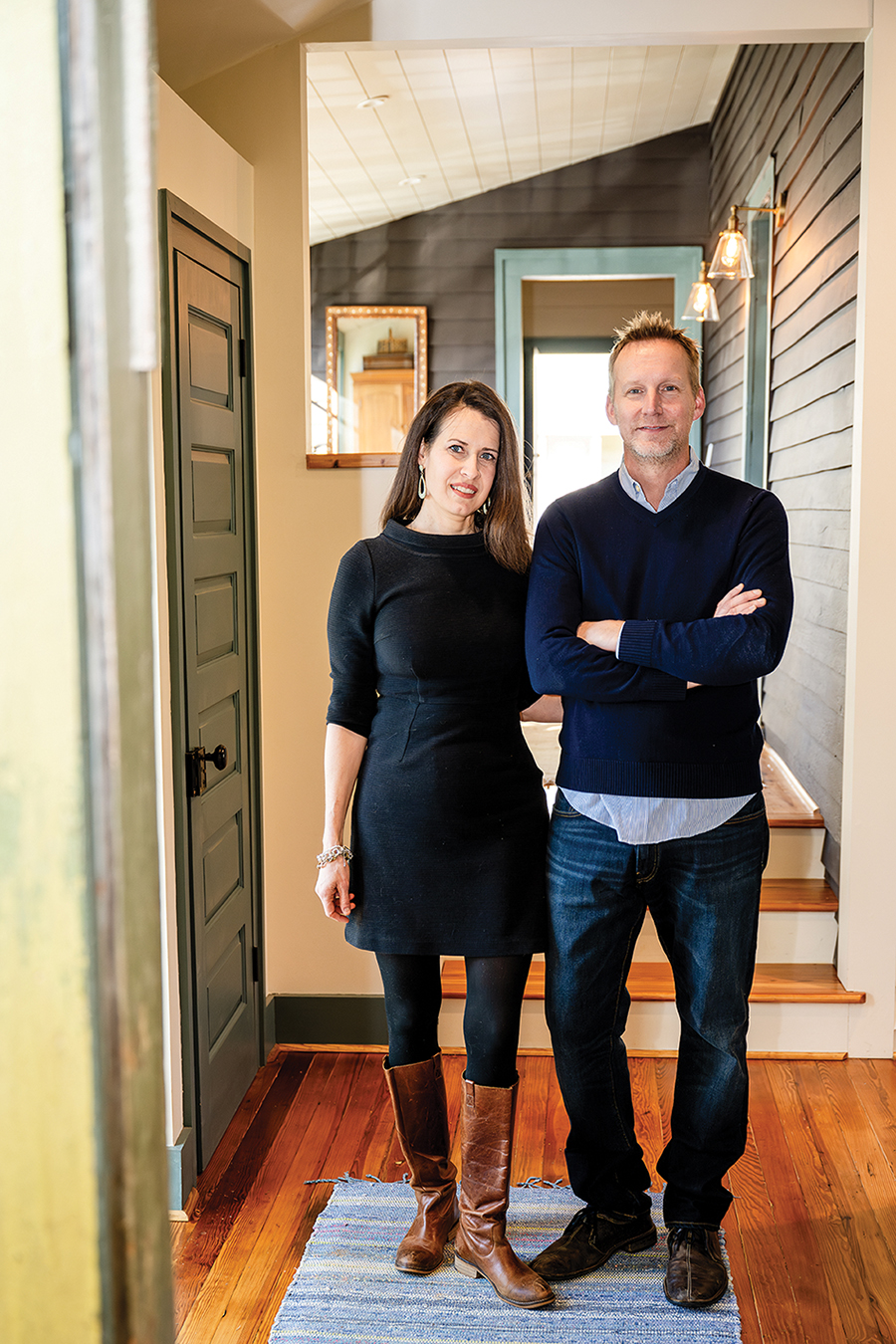
Glencoe Mill Village in Alamance County, home to new residents Molly and Jonathan Whitlatch, is among the most intact mill villages in the country. The 95-acre community affords a rare look at something once commonplace, built along the Piedmont’s rivers and streams, when mill owners created housing to attract laborers, often employing entire families, including children.

Now listed on the National Register of Historic Places and designated as a Burlington historic district, the private restoration of surviving Glencoe homes, found three miles north of Burlington along the Haw River, began after 1999.

The newly restored Whitlatch home had its own story to tell.

Just two weeks before last Thanksgiving, Molly and Jonathan Whitlatch finally moved into their two-story clapboard historic home on Glencoe Street. They were both elated and exhausted. House proud, they still shucked off shoes at the door, not daring to scar newly refinished, hand-planed, wide-board floors, which already bore the marks of nearly a century and a half of use.

Almost immediately, the couple opened their home as part of Glencoe’s annual tour of homes, a fundraising effort Molly had helped initiate in 2017. The fundraiser helps support grants for restoration projects like their own.

For the homeowners, the tour was a time for celebration — a once neglected, derelict house was successfully revived. From the street, it appeared largely unchanged; in actuality, that was far from true. It had required a deft restoration that demanded much more than cosmetics. Much of the house, left unoccupied after a remodel that was begun and abandoned more than 20 years ago, was essentially a shell, lacking heat or air conditioning, plumbing, or even electricity. It required, admits Molly, “a lot.”

Tour-goers were treated to a viewing of what had been achieved. 

Molly, Jonathan and Molly’s father, George Orndorff, acted as docents, telling the story of the 1880 “Waddell” house. Among the original 45 rental houses for Glencoe mill employees, James Waddell, manager of the company store, lived there with his wife, Lou Ada Councilman Waddell, known as Lou, and their children from 1916–40. 

The nearby store he once managed houses today’s Textiles Heritage Museum. From that vantage point, museum volunteer Nancy Earl, a retiree who previously worked at a textile museum in Oregon, had a bird’s eye view to observe the Waddell home’s rehabilitation.

She admired both the restoration and the owners’ enthusiasm.

As did fellow volunteer and long-time preservationist Katherine Rowe, now an interior designer. “The couple had just barely gotten a COA (Certificate of Appropriateness) for the home, days before being featured on the home tour,” she says.

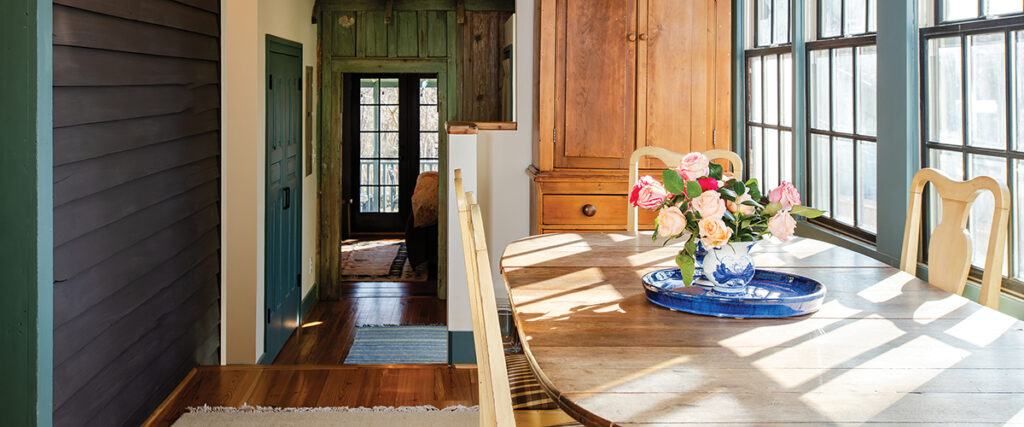
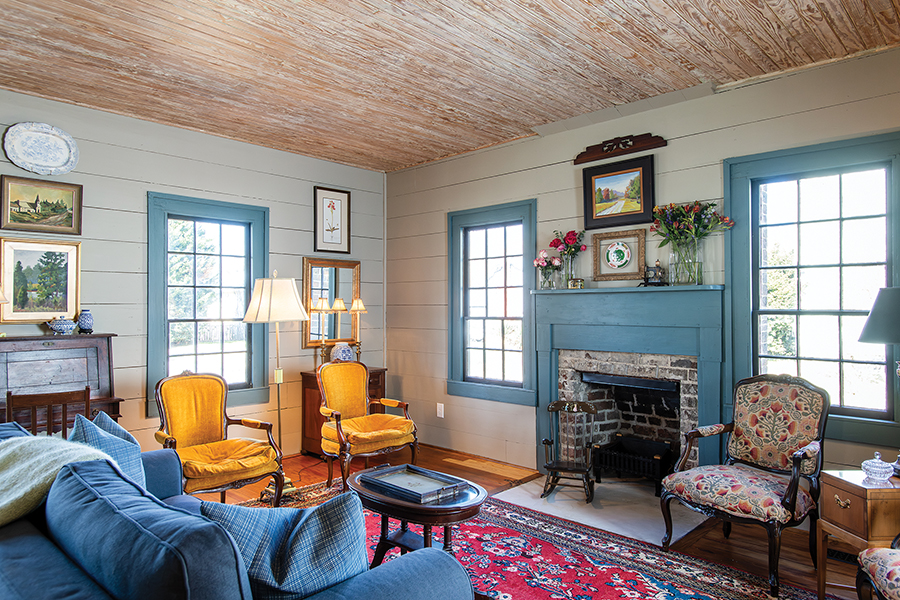
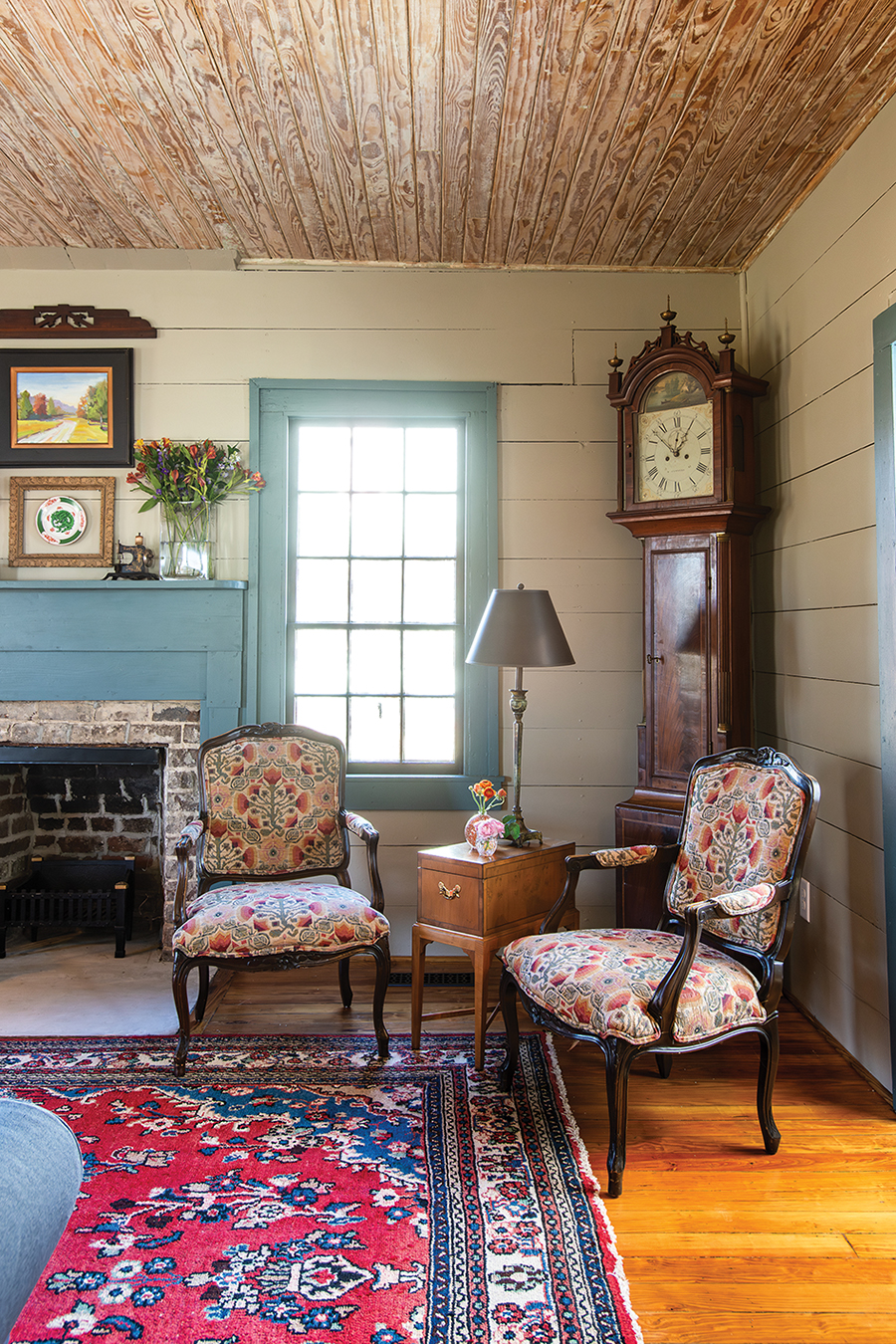
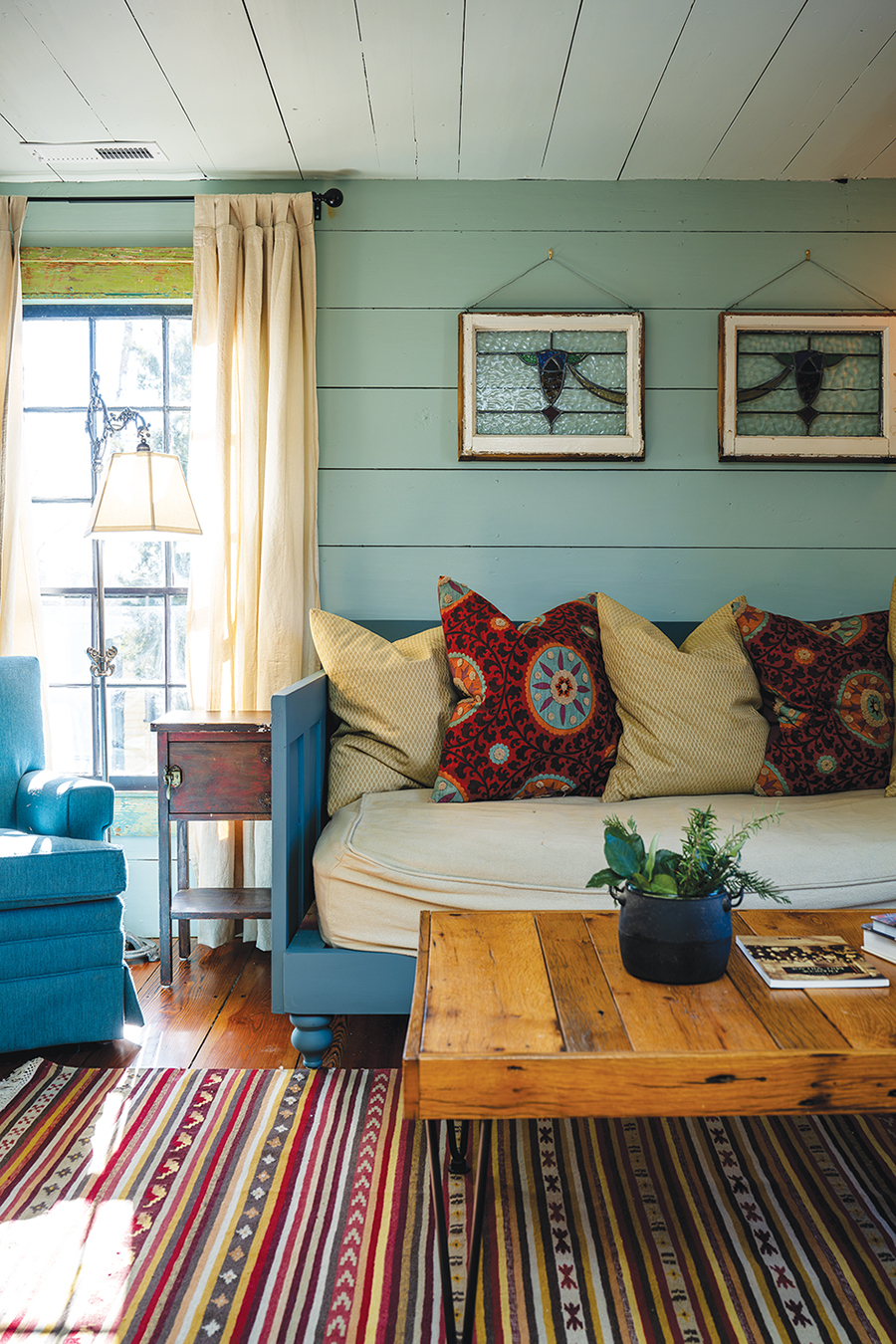
Entering from the front porch, the restored living room’s velvety chairs, colorful heirloom rugs, and vintage furnishings and artwork warm the rustic interiors. The couple doggedly worked to retain the original and rough-hewn shiplap walls and bead-board ceilings, but softened it with accenting trim and quiet touches such as luxurious textiles.

Thanks to the Whitlatches’ passion for preservation and good guidance from the governing bodies overseeing Glencoe, the home’s past wasn’t erased, but integrated. The former Waddell house bears the artful evidence of a sleight of hand that had made the historic home ready for a new era. 

Just days after moving in, the new owners celebrated their first holiday meal on Thanksgiving.

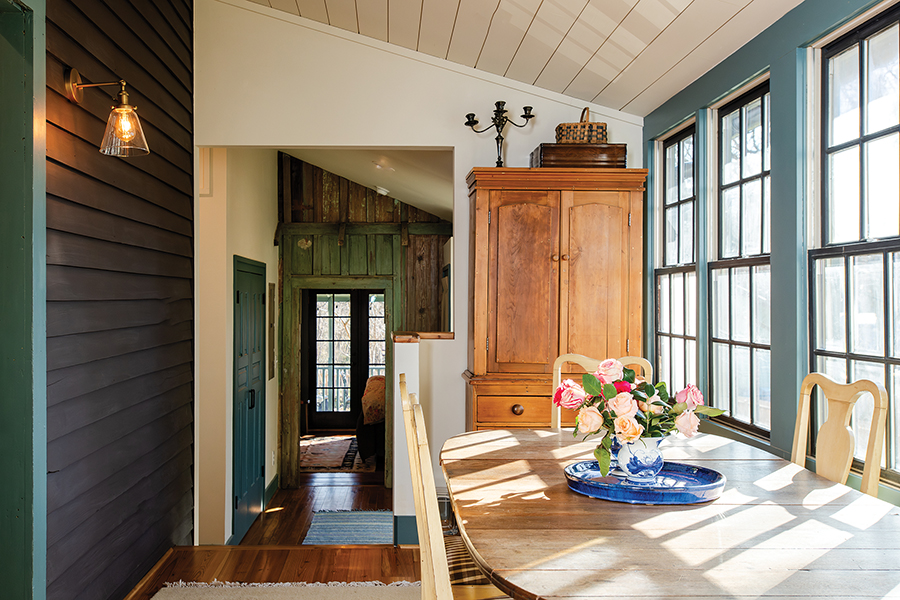
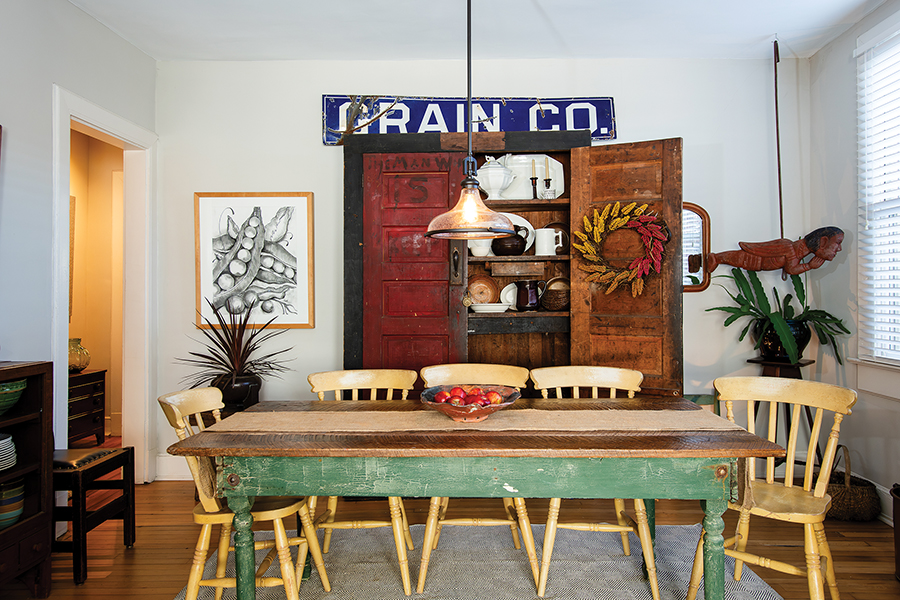
The couple dined in an enclosed space pressed into service as a dining room on a friend’s loaned table as they still searched for the perfect one to fit the space.

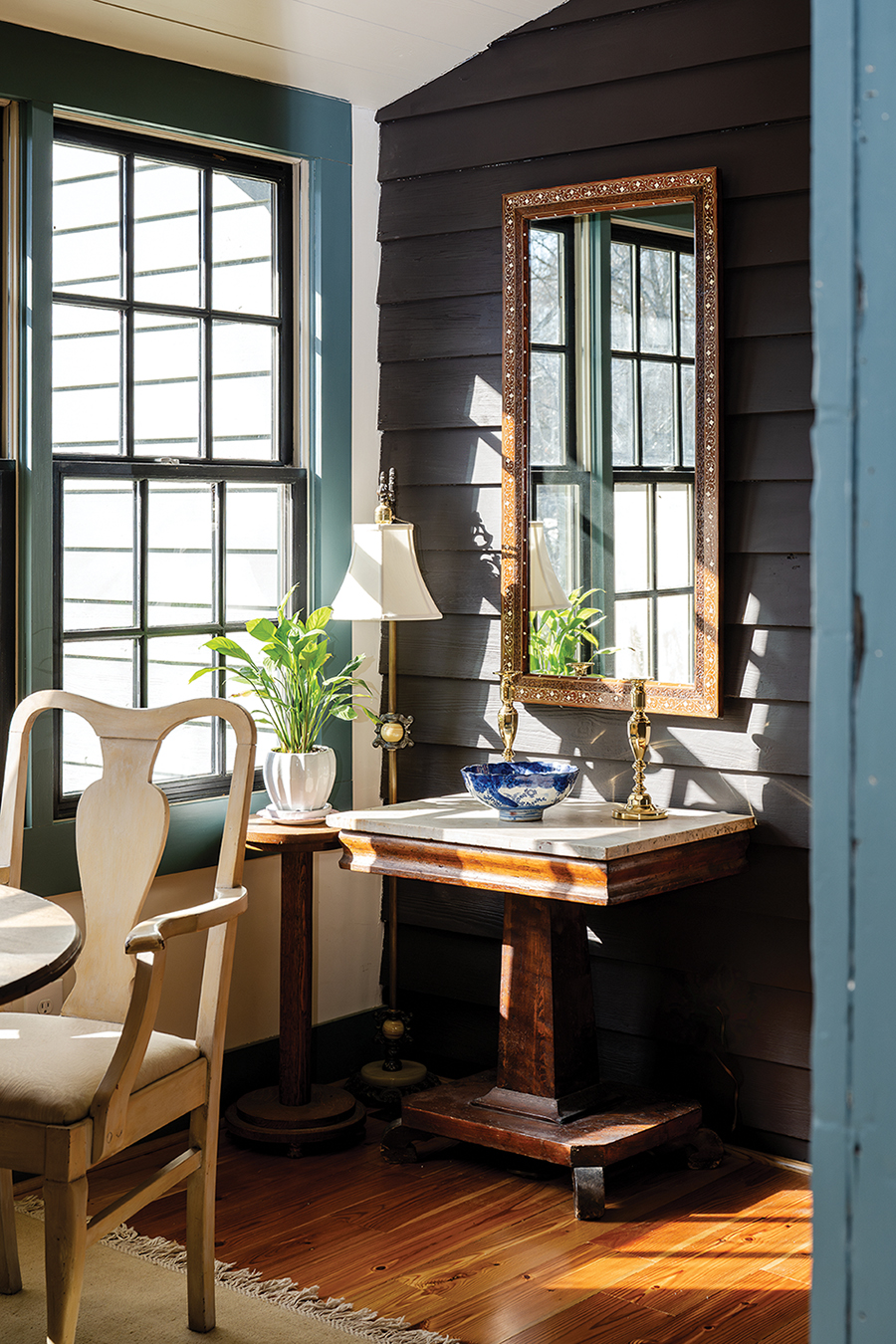
“A hallway filled with windows and a chunky farm table in front of them,” admires Rowe, who saw the home furnished for the open house event. Light shimmers through the porch’s five windows.

The Waddell family wouldn’t have recognized it. For Rowe, it is among her favorite spots in the house. Rowe met the Whitlatches when, as a founder of Preservation Burlington, Molly sought out help from Rowe, who volunteers for Preservation Greensboro.

“They are charming and have filled the home with light, life and a lot of good taste!” she says, praising the Whitlatches. And equally energetic.

The certificate legally allowing occupancy only arrived on Halloween.

How did the Whitlatch couple wind up restoring the 1880s home?

In part, because they had friends who lived there and the opportunity arose. In July of 2022, they were vacationing when they learned that a Glencoe house they had long watched had caught the interest of a flipper. 

They couldn’t allow that to happen.

Plus, they had begun contemplating leaving their home in Burlington for a rural property. Glencoe offered some of what they were seeking — the lots had ample room for a garden.

“We were living in the historic district in Burlington, explains Molly. We really wanted chickens, and the City of Burlington decided not to allow chickens downtown. So, we decided we wanted to buy some property.”

But they had friends in Glencoe and already loved the location. “One of my best friends lives right across the street.” Long before buying it, Molly had often come over and peeked through the windows while visiting her friend. 

The incomplete and debris-filled Waddell house wasn’t quite what they had envisioned. It was only a few miles from Burlington’s city limits, but the village rose above the banks of the meandering Haw River and was just down the street from a county park.

It wasn’t even an architectural gem, but it could be made remarkable, they decided. The history buff in Molly was taken with the idea of taking on such a project. “We had to make a snap decision.”

Up the hill live two more friends, Tom and Lynn Cowan, preservation experts. 

“He’s a carpenter, and she is a designer,” Molly explains. “They said, ‘If you do it, we’ll help you.’ I was in transition with a job. It was one of those things, where . . .” she pauses. “We made a somewhat impulsive decision.” 

Did they want chickens that badly? 

“We really wanted chickens, but, we really wanted to save the house,” Molly answers with a wry laugh. “Kind of like Preservation Burlington, we didn’t know what we didn’t know.” (As cofounder, Molly points out how that leap of faith also had a happy outcome.)

So, we walked through it and said, ‘We’ll buy it.’” 

Their decision was quickly made; however, the hard work of making the shell of a house into a home would consume another 14 long months.

They tackled trash removal and plotted a renovation that began in earnest in August 2022.   

The renovation demanded nights and weekends of manual labor — cleaning, scraping, patching and painting while working their day jobs. 

“My dad and stepmother, Becki Orndorff, helped us work on the house many weekends as well,” says Molly.

The transformation was furthered by good friends, neighbors and advisors from the preservation community; it had literally taken a village to complete.

Preservation requirements dictated that the home’s original architectural features — all walls, wood, doors, floors, mantles, detailing and ceilings — ought to be preserved wherever possible.

Well-versed in the restrictions and requirements, she knew the ropes and how to navigate legal covenants and restrictions dictating a historic district.

“We actually did it as an N.C. preservation tax credit project,” explains Molly. While softening the financial impact of a full-on restoration project, it meant adhering to strict guidelines. 

“My husband’s very handy and had done a little bit of work on our previous house, but nothing like this.”

Molly jokes, “I’m a lawyer, so I don’t have any skills.” YouTube tutorials helped. “Jonathan’s now a self-taught handyman,” she adds with pride.

The DIYers had to hire professionals, given that there was “no plumbing, electricity, nor heating or air conditioning. “It was just a shell,” she says, noting that there had once been some primitive electricity. (Many Glencoe homes were built in an era before it was common.)

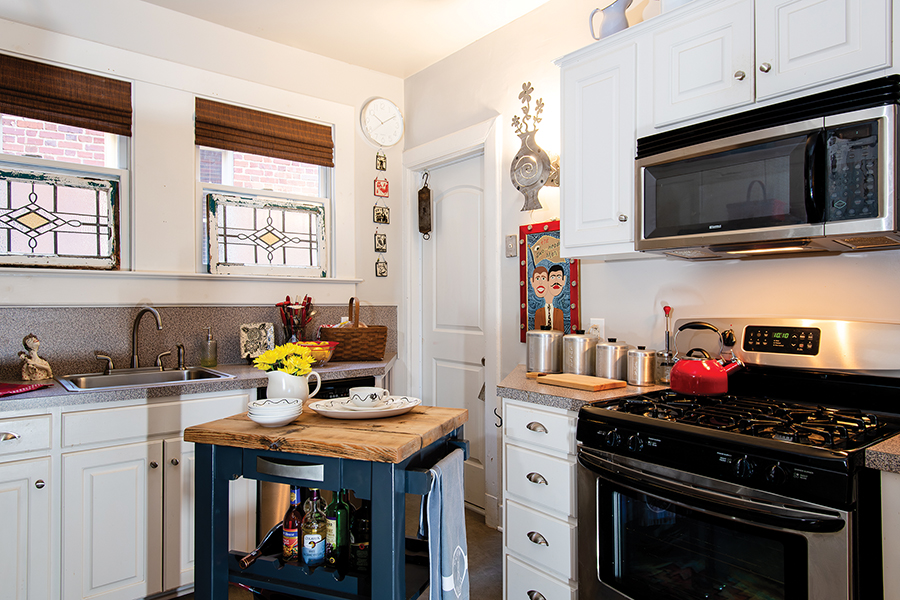
While brewing a cup of tea on a spanking-new professional range, she points out where that primitive electricity existed. The kitchen, by definition, is always a huge budgetary item, especially when there is scant wiring. What existed was installed at the dawn of electrification. 

You can see two small holes in the kitchen wall, where knob and tube wiring came into the house to a light bulb. The mill would turn the electricity on in the morning and off at 9 p.m.

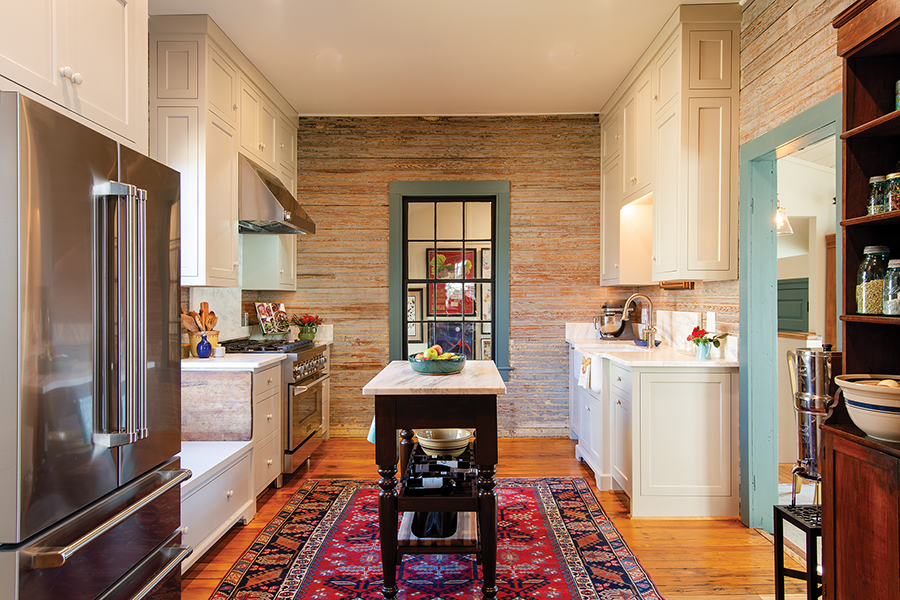
The kitchen design was influenced by British country style. “I draw inspiration from English magazines.” Custom cabinets of Shaker style design were built by Alcorn, a Reidsville company that had built a friend’s cabinetry. (“A father-and-daughter business.” The cabinets are maximum height for extra storage. “We ran them to the ceiling.”) 

“The room we’re using as the kitchen was originally added to most of the houses around 1900,” explains Molly, standing at a center island featuring white, honed Danby marble from Vermont. “The original portion [of the house] dates to 1880, when the mill was built.”

Molly, who “cooks from scratch,” required a functional kitchen. A porcelain farm sink is another nod to European style.

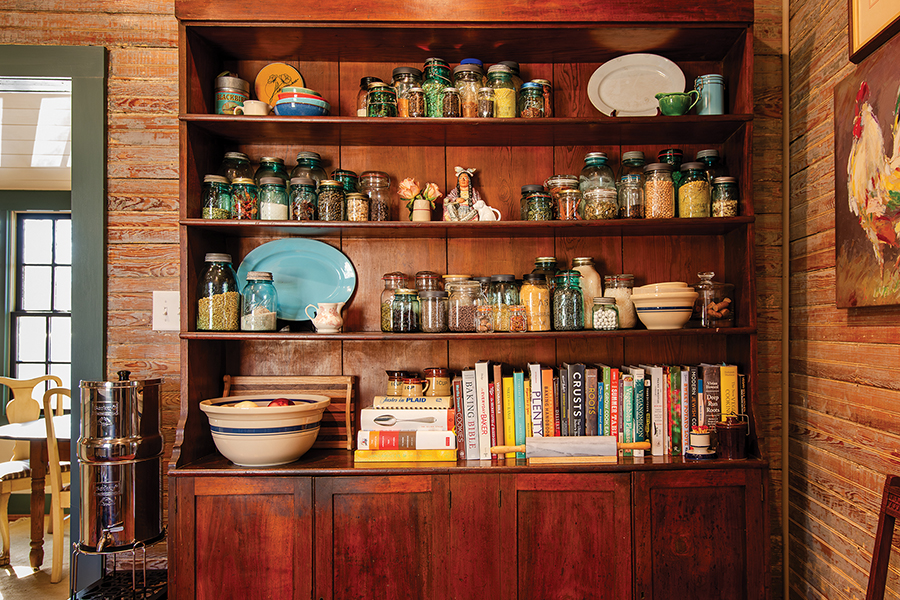
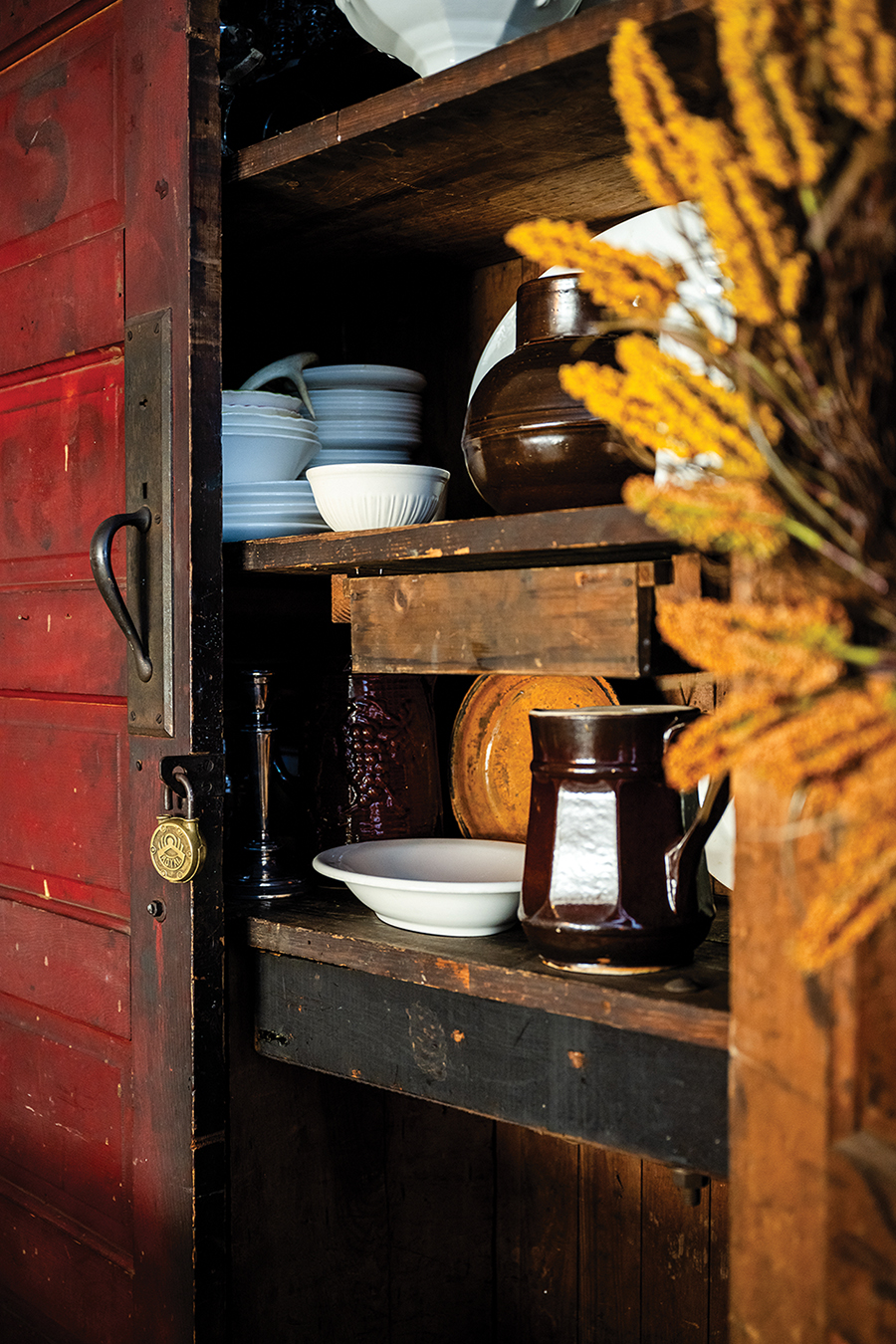
A shallow pewter cabinet hugs the kitchen wall, found at a Mebane auction. “It’s one of the only things we bought for the house.” She filled it with vintage blue Mason jars that store pantry basics.

The kitchen ceiling height is 10–11 feet, Molly approximates. 

“Every room is a little different. Even where there are dropped ceilings, it is still higher than usual,” she says. 

She appreciates the sense of space the soaring heights lend the smaller rooms. Village homes were modestly sized with two rooms upstairs and two rooms down.

Helped by their friends, the couple undertook much of the carpentry work, salvaging wood to patch gaps and resolve rot. They innovated, appropriating beaded board, where it would be concealed behind the new kitchen cabinets, for use elsewhere. 

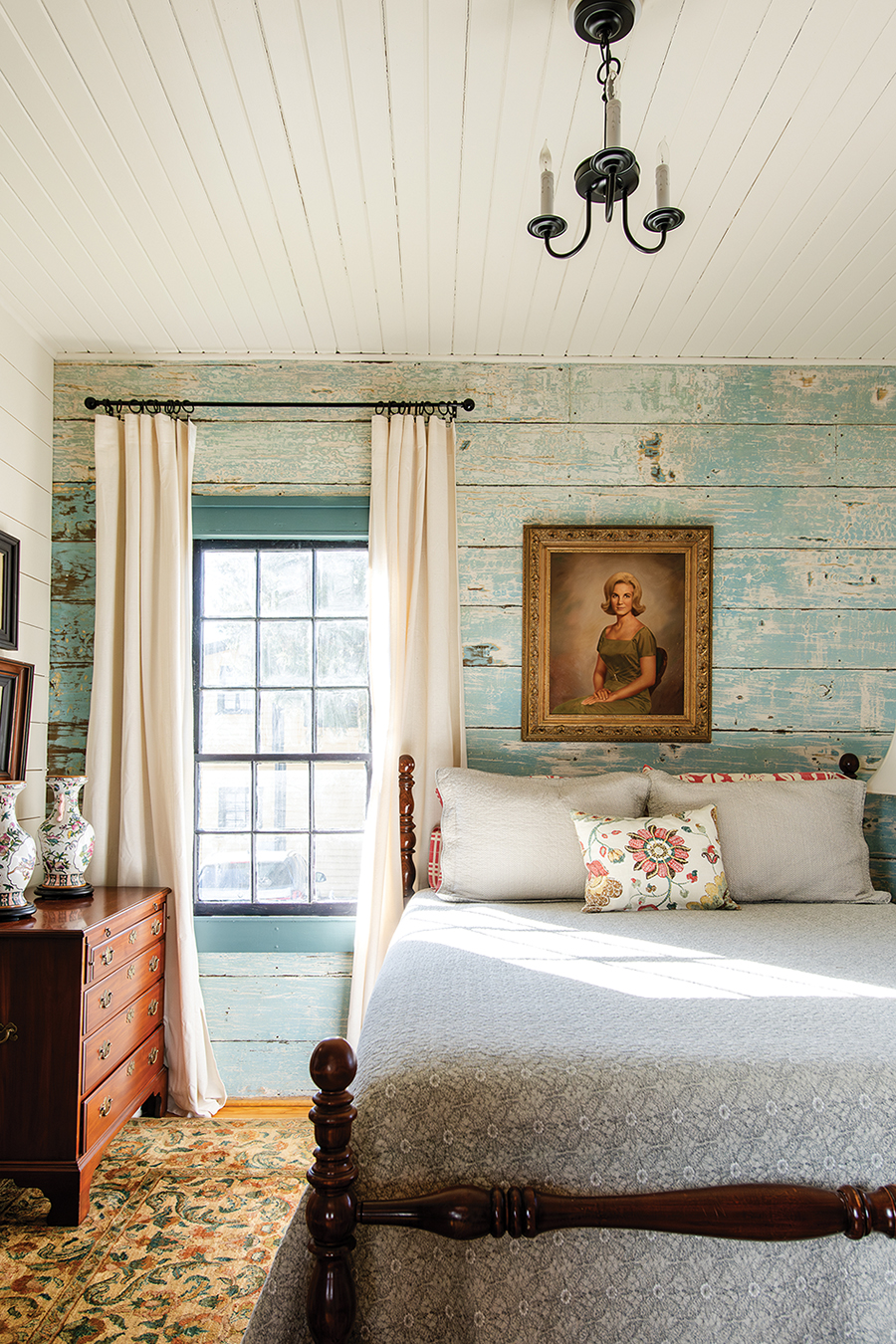
They retained as much of the original finishes and architecture as possible, right down to teal blue initially covering most interior surfaces. However, they toned it down, integrating it with contrasting color or neutrals, adding in rough-luxe touches to soften the primitive authenticity. Now, it is an accent, given in the original rooms all surfaces were wood.

State and local preservationists were helpful in maintaining the home’s original character. “Everything they asked us to do I was later grateful for; it ended up being better than I would have done,” acknowledges Molly.

Even what was originally an exterior window was retained in the kitchen. It opens into an enclosed entrance/mudroom. Rather than being an oddity, it elevates the kitchen’s charm quotient.

An outside building, married to the rear of the house by the previous owner, expanded the downstairs footprint. But it had long languished, abandoned. “It was open framing when we came here,” says Molly.

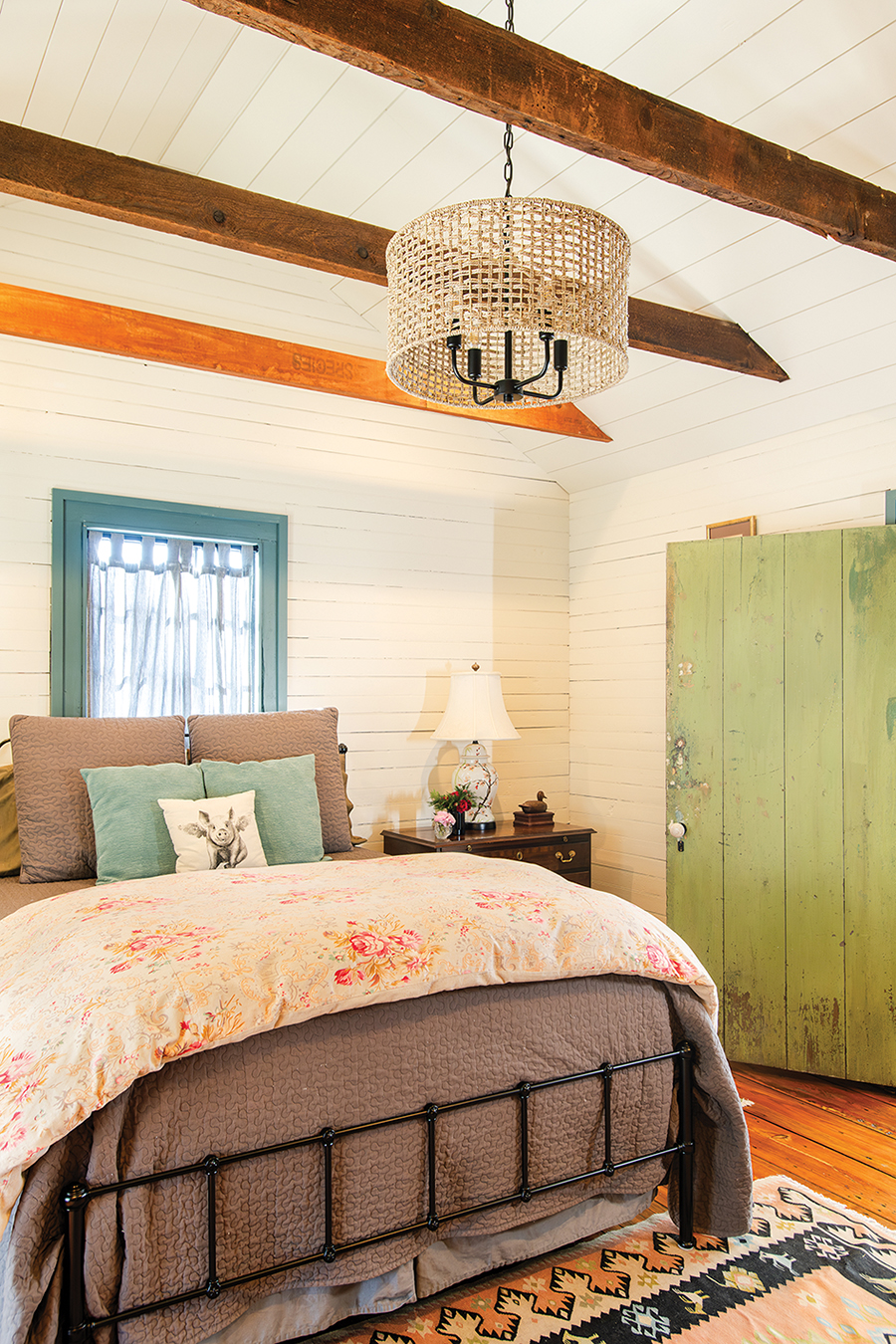
This became a main bedroom and bath suite, complete with porch (that will eventually be screened), opening to the rear of the property.

“Anywhere there’s drywall, it’s where the previous owner had worked on the new construction/addition,” Molly explains. “There’s a small mudroom. And he attached the detached summer kitchen to the house.” Those alterations (pre-historic designation) proved invaluable, even if unfinished. For example, the addition created what most Glencoe homes lack, storage and some closets.

But when they first saw the expansion, it was joltingly Barbiecore. 

“It was bright pink,” Molly frowns. Hardly historic.

They added door frames and doors, using a bedroom door found under the house. Over the doorway leading into the main suite are original “rafter tails,” or rafter ends that overhang the eaves.

Overhead, the exposed beams from the former kitchen wore accumulated layers of grime and soot. “Three or four of us spent six hours one day scrubbing them,” Molly groans.   

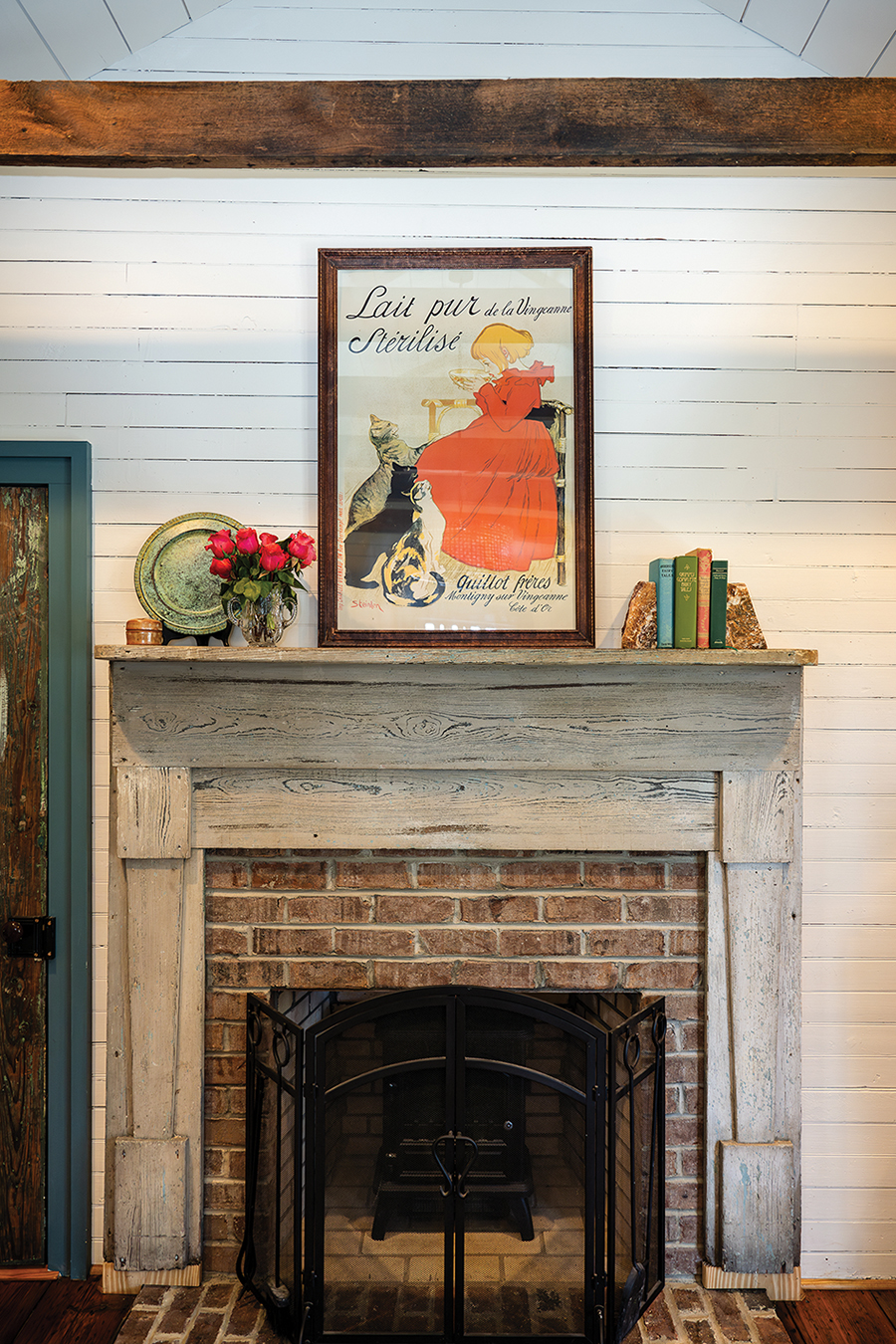
The room’s original fireplace was restored, featuring a salvaged mantle bearing original paint from another Glencoe home. Nothing was wasted.

With the help of friends, they painstakingly pulled up the wooden flooring where the prior owner had married the addition to the house, revealing beautiful wide boards beneath. Both subfloor and floor boards were carefully removed, cleaned and refinished for reuse. As Molly explains, “Free flooring!”

Variations of flooring, walls and ceilings added patina and interest, thanks to an artful interior redesign.

Inside a downstairs ensuite bathroom is a favorite compromise occurring when they created a bath for their main bedroom.

“They didn’t want us to cut into the (detached kitchen) wall, which was original,” she says, “so I asked, what if we didn’t remove it, but cut into it and created a door?” Now a jib door is among their favorite features.

Facing their main bedroom doorway, a stretch of hallway extends to the front of the house, offering a long sight line.

“It reminds me of the shotgun homes of New Orleans,” Molly says. “I like how this rambles.” With the physical work resolved, they could turn to gilding the lily: finding that perfect table, for example, and other furnishings and treasures.

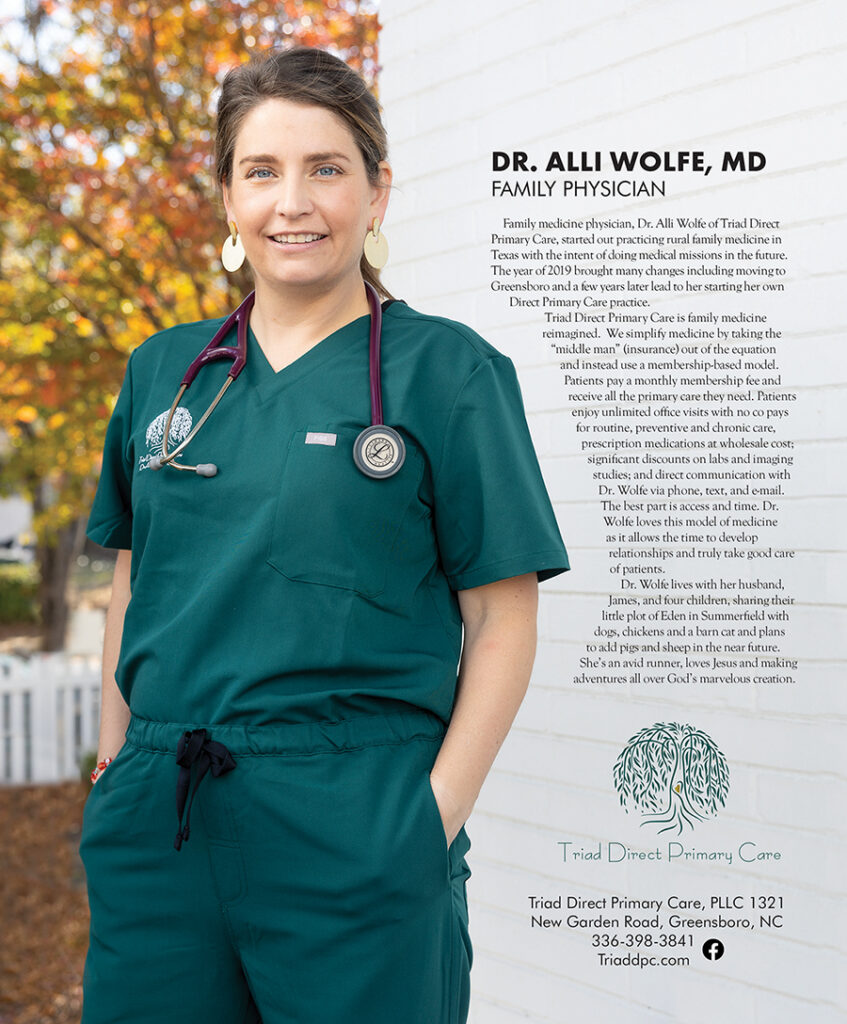
The living room, which opens to the front porch, is also a favorite of their friend, Rowe, who describes the Whitlatch living room as an artful fusion of styles and collected artwork.

Art by Jonathan’s grandmother hangs opposite a piece by the front door painted by Molly’s grandmother.

Upstairs, a steep stairway to the second floor has a railing created from old wine barrels. “A nod to my husband’s work,” says Molly. The vintage light fixture in the stairwell was another fortunate salvage find. 

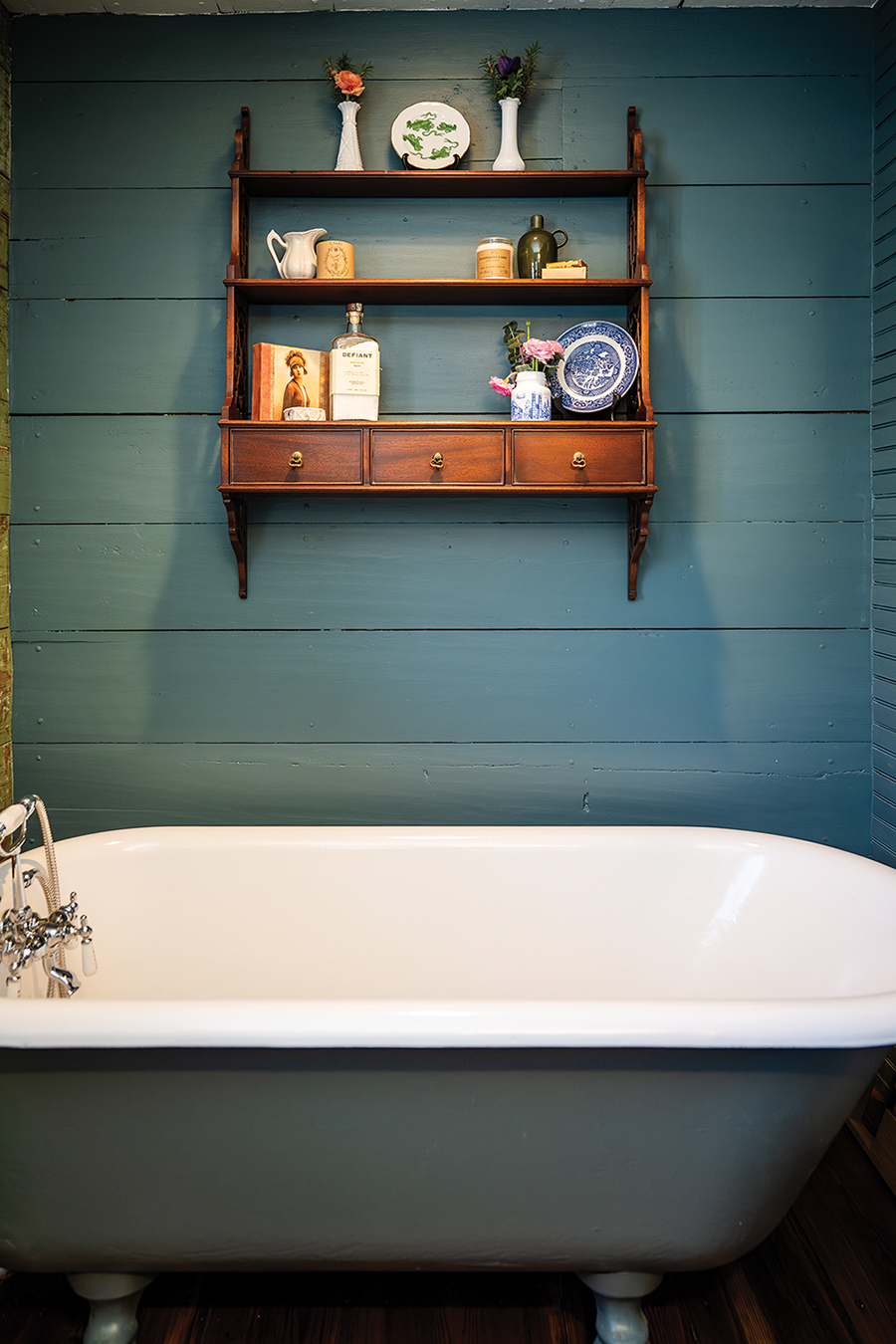
On the second floor, they’ve created a comfortable room with a daybed and another full bath, which was stacked over the downstairs guest bath when they were creating needed bathrooms. Hewing closely to simple fixtures and trim, they used a vintage sink and tub, both architectural salvages. The tub was too massive to get upstairs via the narrow stairway, forcing them to remove an upstairs window to hoist it from outside. “That was exciting,” says Molly. 

She used linen towels with a café rod and rings for the bathroom’s window treatment.

The upstairs features a third bedroom and the home’s third fireplace. Again, moving in furniture to the second floor was not simple.

They used bungee ratchet straps to bend the mattress, folding it in half, in order to navigate the stairs. A double bed was the largest they could manage.

Molly’s desk and office share the guest room space. 

The wide-plank upstairs floors are in fine condition, like the ones in their main bedroom downstairs. 

“And these wood walls,” says Molly. “Someone hand scraped these walls.” She runs her hand appreciatively over the wall, pausing a moment. 

“I think this is a cool feature,” she says, pointing to a craftsman’s mark on the bedroom’s handmade door, “when he took a knife and marked where to put the nails.” 

Her favorite thing, however, isn’t merely about the aesthetics of historic architecture. It is “old school” hospitality and neighborliness. It’s the village.

Throughout the renovation, neighbors commiserated over the trials and tribulations, pitched in and arrived bearing freshly baked pies and casseroles. Even the kayak business behind their home, grandfathered into Glencoe’s commercial district, was helpful. They allowed the Whitlatches to use their restroom whenever they were working on the house. 

Thus far, Molly would change nothing. True, it was a long process, she admits, and they underestimated how long it would take, plus how hard to find contractors willing to work on old houses.

“I just have a feeling about houses, not even necessarily tied to a specific thing,” says the contented owner of a renewed old house. 

“It feels cozy.”

As one who lives in a century-old home, I pose a final question: Has Molly ever sensed the Waddell’s presence there?

Molly immediately texts in answer. Neighbors had reported seeing a lady in the upstairs window when the house was still sitting vacant. 

“Anytime we heard weird noises or things were not going as planned, we would say it was the lady in the red dress.”

She forwards a grainy, silent video of the Waddell family circa 1940 “standing in front of our house.” 

“You can see a lady in a red dress,” she writes, “so that could be her.”  OH


About Glencoe Mills and the Village

According to the historic inventory when Glencoe village was acquired for preservation in 1979, the homes were “typical of North Carolina rural housing of the late 19th and early 20th centuries.”

Glencoe Mills, which closed in 1954, was founded in the late 1880s by James H. and William Holt, sons of Edwin M. Holt. Edwin was a textile “pioneer,” developing Alamance County’s textile industry. 

Holt family descendants still live in the Triad.

Glencoe comprised a 95-acre village, with a main mill complex, church, school, Sunday school building and barbershop, general store, post office, men’s lodge, hydroelectric plant, plus 45 rental properties reserved for mill workers. The mill, dam and some of the defunct power system still remain, along with 29 houses on Glencoe Street and Hodges Road. 

At the mill’s closing in 1954, some former workers continued to rent homes there. Eventually, the homes were left abandoned. In 1979, Glencoe was placed on the National Register of Historic Places. Preservation North Carolina acquired the property in the late 1990s, giving rise to private ownership and restoration.

The Textile Heritage Museum occupies the former Glencoe Mill offices and company store. Today, it contains historic information about Glencoe Mills and the socioeconomics of textiles, lending a clear picture of mill life in the 19th and 20th centuries.

In 1890, Glencoe employed 133 workers in the manufacturing of plaid fabric. The mill recruited labor by creating housing (rent was anywhere from $1.40–2.00 a month) and extending employment to entire families. Demographically, women and children comprised 70 percent of its workforce. 

According to online N.C. educational archives, “as soon as the cotton mill industry began booming in the 1880s, critics began speaking out against child labor.” Circa 1907–08, 90 percent of all spinners working in Southern textile mills were below age 21. By 1924, two children remained as Glencoe employees.

Social reform photographer Lewis Hine photographed children working in cotton mills throughout the South, then publishing and showing his work, raising awareness about the issue.

In 1933, North Carolina enacted a law prohibiting child labor, as new technologies had already begun lessening the need for large numbers of workers.

Glencoe, however, had the distinction of being the first mill in North Carolina stipulating that its child laborers receive some schooling.

The village offered “three basic house configurations.”

Most featured “brick pier foundations, tin roofs and simple, functional design. Few houses, with the exception of the mill superintendent’s house, have indoor plumbing. Some houses, particularly on Hodges Road, may never have had electricity.”   

Houses ranged from three to six rooms, averaging 16 by 16 feet. Most of the rental homes were four-room, two stories with a front porch.   

Because they were a fire hazard, detached kitchens, 12 by 12 feet in size, constructed of board and batten, were built at the rear. “Later, kitchens were attached at the back of the north end of the main block, forming an ell.” By 1910, attached kitchens had replaced most of the detached ones.    

Others were one-story, with two rooms and a front porch. A few were duplexes. The third Glencoe design was a one-and-a-half story with a side gable house and a central chimney.   

By the late 1970s when the architectural survey was completed, Glencoe’s surviving homes were deteriorating — a few beyond saving. Rotting sills, missing porches and water damage were common. Yet preservationists felt certain: The majority of homes could be restored.


About the Salvage Shop at Glencoe Village

In one neatly contained package, you can not only visit the textile museum for a closer look at work life in the late 1800s, but also buy a piece of Glencoe history. 

Housed in a World War II-era Quonset hut, the Salvage Shop contains architectural salvage and is managed by Preservation Burlington. 

Once used for mill storage, most likely cotton, the hut contains tidily organized salvage artifacts. “It’s all volunteer staffed,” says Molly. “We open to the public one Saturday a month.” Proceeds fund various grants and projects in the Glencoe historic district. 

It began in October 2016, when Molly and three other women met for coffee, agreeing they needed a nonprofit similar to Preservation Greensboro. They also looked to Greensboro to style Preservation Burlington’s eventual architectural salvage program.

“Three [of the women] are still on the board,” she explains. 

“We started our first fundraiser in 2017, a Christmas tour of homes.  People were still full of concern about the costs of historic homes.” The tour of homes became their largest revenue source, but was halted by the pandemic in 2020. 

They pivoted towards the salvage operation, which had also begun in 2017. “We’ve been successful because we didn’t know we couldn’t do it.” 

Molly heads the salvage work portion, “even though I have no construction experience. I organize electricians and carpenters.”

She met Greensboro preservationist Katherine Rowe, who occasionally volunteers, through Martha Canipe (a board member of Preservation Forsyth). “Old house people getting together,” explains Molly.

Love Bytes

Love Bytes

Illustrations by Harry Blair

Last fall, a few of O.Henry’s writers, armed with notebooks and recording devices, hit up Greensboro’s
Corner Farmers Market to gather local tales of love. The results will
melt your winter heart.

Jordan and I met in college. One of our friends was working at a haunted trail in Gibsonville and she hired us as actors. I was a zombie and he was a scarecrow. I was walking down the trail trying to get to my spot and he popped out of the bushes and scared me. It was love at first Boo.  Abigail Hart


While a graduate student in Princeton, I was studying in the library of a house I had rented with a few friends. One of my roommates came back with this woman he had met. We all sat around, got stoned, of course, and had fun together. I was really attracted to her and she to me, but she had met Evan. Well, as fate decided, he was leaving the next day for a four-week camping trip out West — so I made my moves, and Jane and I were together for 44 years until she died.  Ken Caneva


I was working at a wine store here in Greensboro called Wine Warehouse. I would do wine tastings on Fridays and Saturdays. Brownlee would come into the store and I didn’t notice her for, I don’t know, she says at least a year. But one Saturday afternoon, I’m in the store by myself and she comes in, and I notice her, still in her yard-working clothes. She came in to buy a bottle of wine or two for a birthday party. She leaves with a case of wine. After I close up the shop, I go by a friend’s house and he says, “I have a birthday party to go to. Why don’t you come with me?” We go through the front door and down into the basement where the party is and I round the corner, look across the room and there she is. One of the first things we both said was “Did you notice me noticing you?” And we both said yes! After that, it was just the two of us talking throughout the evening. Lo and behold, we’ve been together 17 years.  Jimmy King


Her version: We met in college. I was 20 years old. Denis was 22. I took an extra credit class in college, and Denis had to take it because he was an international student. He walked into the class and I thought, That guy looks so crabby — I hope he’s not in my group. He ended up in my group. He was from France. I invited him to my 21st birthday party and he actually came and he’s been in love with me ever since. He’s obsessed with me.


His version: It’s about the same except — no, it’s the same. Maybe not as enthusiastic.  Susel & Denis Dépinoy

My real dad died when I was 10. My mother, Janey, met Lanny when I was 18, 37 years ago. Somebody sent him over because she needed something fixed at her house. She was a big church lady and the first place he invited her? Church. They started dating, got married. Mom and Lanny were very sweet to each other. They would make everybody uncomfortable when they were in their 60s at Thanksgiving because my mother would announce that they were going to die making love. Lanny got dementia this past February and it went downhill really, really quickly. She tried to take care of him at home and could not. Now, every morning, she pulls up his picture on her phone and kisses it. But when she goes over to see him he still recognizes her. The longterm is that, at 85, one person is going to take care of the other and the end is going to be taken care of in a very loving, romantic way. That’s what true love is.  Michael Moore


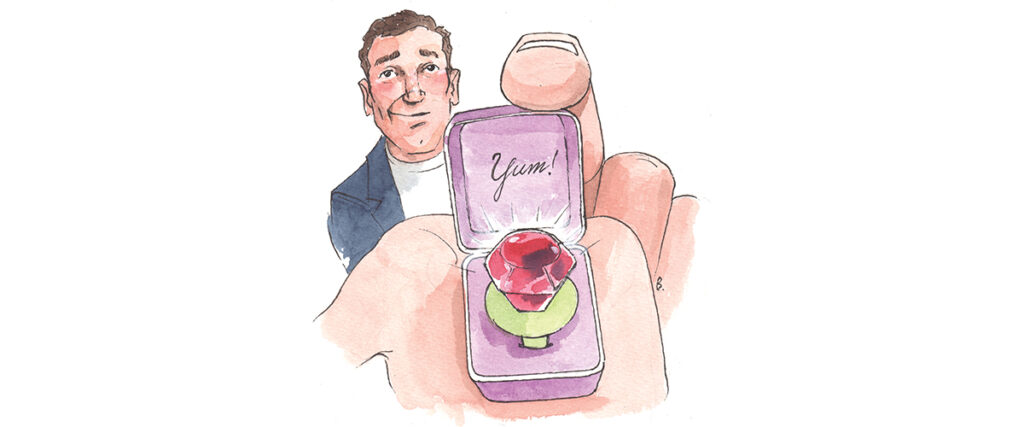
Can I share a patients story? I was treating this lady and she and her husband have been married for over 30 years. They met in the ’90s, right, when they had those brick cell phones. They were both on a flight to Michigan State University and it got cancelled. She was sitting underneath an airport payphone and he went to go use the payphone and was really pissed off that she was right under it using her big brick cell phone. While they were fighting they realized they were headed to the same place. His work paid for him to have a rental car so they road-tripped together as strangers to Michigan State University. When she got there, she couldnt find her group so she had nowhere to stay. He offered his hotel room. There was no funny business, she assured me. They flew back together on the same flight and when they got back, he proposed to her with a ring pop from a gumball machine. And for one of their anniversaries, he got her a mini gumball machine.  Dr. Kaitlin Herzog

We worked together and I had to have surgery. I was out for a little while and Kristin came over to my house with my paycheck and a couple other things I needed for work, oh, and a giant fruit basket that the guys in my group got for me. My mom was there. Kristin came in and stayed for dinner with us. The night was on and Kristin said, “Well, I better get back over the hill.” I said, “See you when I get back.” And as soon as she walked out the door, my mom said, “She really likes you. I think you two are going to get married.” And she was right. We’re coming up on 12 years.  Andy Zeiner


We were not looking for a dog. It had been about three years since we’d had one. Someone left her at an apartment without food or water. We were out shopping one day and her rescue foster was there with Daisy Mae following her. We just fell in love with her and asked for a sleepover. It’s been about a month. She’s all things daisy — just the light of our life and our little love story.  Kim Hilton


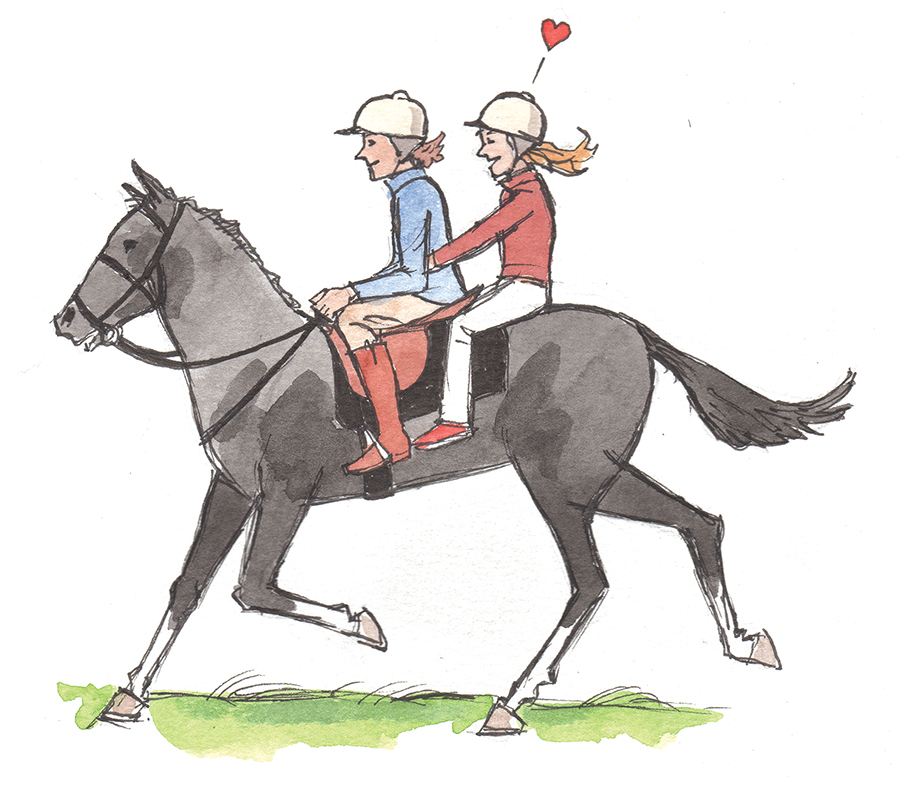
I was 12 years old and had a horrible horseback-riding accident. My mother took me up to Massachusetts for a couple days to get away after I’d been in the hospital for a week. We went up to this resort and there were all these horses outside. I was not allowed around horses for at least six months because of the accident. I started asking around, who owned the horses, and was told the resort owner’s daughter rode. I went knocking and met her. The next morning, there was this big knock on the door of our hotel room, which opened to the outside. There was Betsy on her horse, Cinnamon. She said, “You wanna go for a ride?” She literally grabbed me, swung me up onto her horse behind her, and, like in a movie, we went galloping off into the sunset together. I am 65 years old now and we are still the best of friends. That’s my love story.       Lisa Pritchard

Anthony and I got married in 2004 and are getting ready to celebrate our 20th anniversary. We went to college together in Raleigh and dated from my freshman year. My senior year I decided I was going to live in Australia and travel for eight months to a year. I wanted to be free. So I broke up with him and I said to my dad, “What if I get there and I realize I still love him and he moves on?” And my dad said, “Well, if he moves on then hes not the right person for you and it wasnt meant to be.” So that gave me the permission. I went and I dated someone else down there — my mom thought I was never going to come home. She sent me a very long and detailed letter about how she felt like I was throwing away somebody that was very important to me. That made me very angry. How dare she think she knows me so well — ha! I actually broke up with the other guy, went to meet my friends from here in Tahiti and we all decided we were done traveling and homesick. We all called our families and said, “Its been eight months and were ready to come home.” I called Anthony and said, “Will you pick me up from the airport?” He picked me up and weve been together ever since.  Thea DeLoreto


I met my husband at A&T University in summer school. It was a humanities class and I was a student at Bennett College. A group of us were over at A&T taking a class because we’d heard it was an easy “A.” So this guy comes in, good-looking guy, and I saw his eyes. They were green. I said, “Oh my God, I’ve never seen a Black guy with green eyes.” And I’m like, “He’s special.” 

As a group of us were talking about a class we had to take, science with a lab, he overheard our conversation and offered us his lab book. They said, “You go,” meaning me because I didn’t have a boyfriend. So I did. And from there we started talking and dated for 11 years. Too long for me . . . but we married and he was true to his word about what he wanted out of a relationship. His name is Bobby and he’s a good guy still.  Page Motley Mims 


I love the Greensboro History Museum. It used to be the library when I was a little girl. And I used to love for my Mama to take me there. — Melinda Crawford

My love story is about me and a little rescue filly. Her mother was a very famous endurance racer. She and her baby had gone to auction with the fancy horses, but they put the baby in the kill pen. The Homestretch Thoroughbred Rescue, which rescues ex-racehorses, saw this little baby and they pulled her. She wasnt a wild horse, but she was feral. So I spent eight hours a day just standing in her stall, letting her get near me. She didnt trust people so she would rear, which is very dangerous. So we had two things to train her with from the beginning: one, boundaries. And two, trust. Eventually we added other skills. I was thinking, What am I going to name this little Arabian horse? And my girlfriend, who is a musician, suggested Scheherazade after the Tales of 1,001 Nights princess. Scheherazade was called to the evil prince, who would stay with the women for one night, then kill them. But she told him a story and he spared her life and asked her to come back to finish the story. So Scheherazade is the Arabian princess whose life was spared because she had so many stories left to tell, just like my little horse.  — Megan Blake


Deltas Sky magazine wanted to do an issue celebrating their 75th anniversary of air travel and they wanted people to write in about their stories. I did and they ended up printing the story in that edition. The short version is that we met on an airplane. Actually twice. The first time he didnt call me. But we sort of reconnected and then the second time, he did call me. Weve been together ever since, 22 years.  Kim Littrell

We met at a party dancing — a year before we ever started dating. I was 28 and I thought she was 18, way too young for me. And then I realized that were only 11 months apart. We began dating and were long distance for a year before she moved here to North Carolina. She was leaving a career in the legal field to follow her dream to be an interior designer and I was leaving a career in accounting to follow my dream to be a potter. We moved to Durham together having no idea what we were going to do or how we were going to make money. A decade later, weve really established ourselves and fallen in love with our family — theres a little one right here!   Chris Pence


So I rescued my little sweet baby Papillon from a crackhead who was selling her on the street for a dollar. Shes the sweetest dog in the whole wide world. Precious little angel. She really saved me. Shes so patient, loyal. She has little butterfly ears but her names Bat Baby — she looks like a little bat.  —  Kim McHone


I’ve been married 46 years, I think. Id have to do the math. Still married to my high school sweetheart. We met doing a local theater production in Stuart, Florida, where we grew up. I was playing the Conjure Man in Dark of the Moon. She was an usher and she came and sprayed the back of my hair silver for me. Now its silver all the time, but at the time it had to be silver for the show. And weve been together ever since. — John Vettel


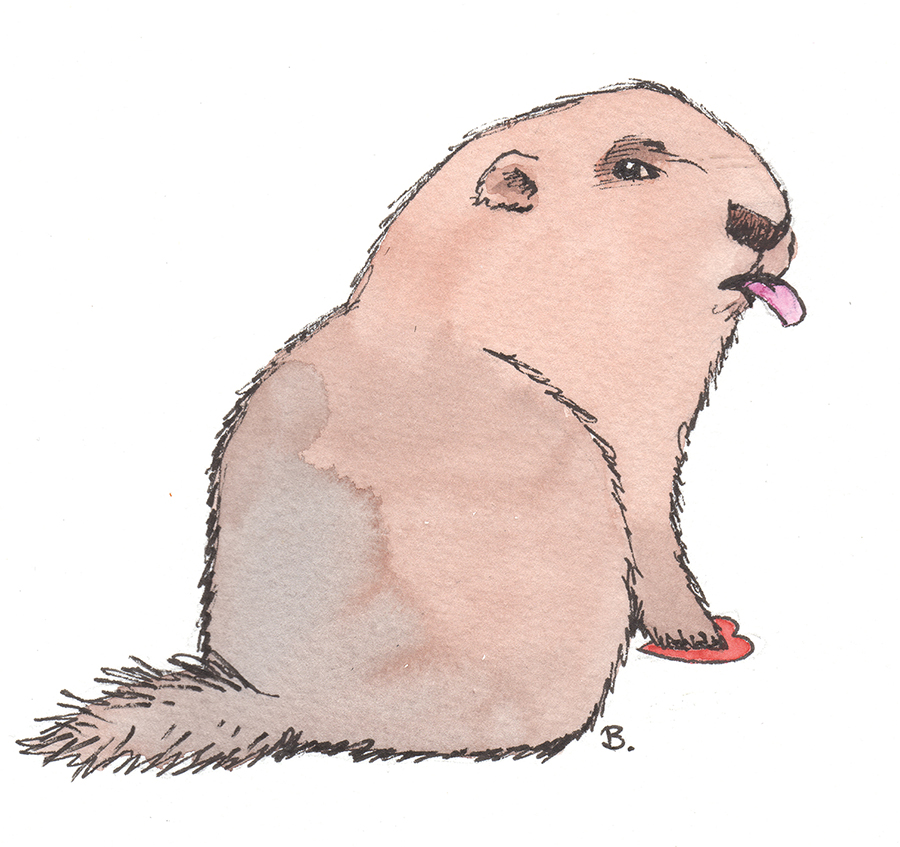
Were staying in a rental while our house is being worked on and theres a really adorable groundhog that lives in the backyard.
I just love watching him — he is totally chill.
We
re kind of sharing this space, but I just enjoy him doing his thing. I’m not trying to make it out that hes something like a pet. If I tried to pet him, he would bite me. Thats something that people forget about because theyre so cute. It’s kind of an interesting love story in that I love him and he definitely does not love me. Ashley Duez


Ive been married to my husband, Roch, for 61 years. We met as teenagers on Hollywood Beach, Florida, and he went his way and I went my way. What attracted us? We were in our bathing suits on the beach in Florida! We got engaged in 1960, got married and had three sons. We knew the importance of education so Roch went back to school to get his Ph.D. at Emory, where we lived in student housing with our three sons. Then we came back here after our children graduated from college and I got my B.A. and M.A. at UNCG. So weve been residents here in Greensboro for 53 years, connected to UNCG. — Elaine Smith


You know how you think you know someone and then you meet them all over again and you fall in love all over again? It was my son. Yes, I gave birth to him, I loved him all his life. And then I met him anew as an adult and fell in love again. — Sandy Reiser

A long time ago — because we’ve now been married for 53 years — I had my eye on this guy in my graduate program.

My roommate and I were disgusted with having to spend the whole summer in Chapel Hill taking courses, and we decided things would be better if we fell in love . . . So we each picked out a target and went to work. It was like a competition between the two of us. It meant that I had to spend the whole summer going to the university library because this guy was quite dedicated to his studies, and so I was throwing myself in front of him so he would notice me and decide I was wonderful and he wanted to marry me.

It worked, ultimately, but along the way I had to say to my roommate, “I’m out of the game. This is it; this is serious. This is the one I want.”  
Virginia Haskett


So we first saw each other at Panda Express and then we ran into each other at Breakers. We met at the bar. Brittany happened to lose her cell phone. I found it, returned it to her, and then we went on our first date. We’ve been married six years. — Felipe Tejeda


I went to Grimsley High School and a guy had been calling me all summer to go out . . . This was in the day when your parents had a phone line and you had a children’s line. He always called the children’s line about the same time of day and I would say, “Mom, please answer it; I don’t want to go out with this guy.” And so finally, she answered it and said, “Yes, she’s right here.” And I was like, “Mom!” 

He said, “We’re going to see the movie Purple Rain and we’re going on a double date with my friend, Ronnie Majors, and the girl he’s dating.” 

And I said, “OK, that’ll be great.” So, we got to the Janus Theater, and we sat [together] — my date, me, Ronnie, and his date. And Ronnie, who’s my husband now, we sat beside each other and talked the whole time. 

So fast forward to the next day. 

I used to work at Carolina Circle Mall at the Peanut Shack out by the ice-skating rink, and he came out to see me. And we get home and walk into the back door — also, we had known Ronnie’s mom for years, because she worked at our orthodontist — and I said to Mom, “Look who I picked up at the mall!”

A couple of years later, my husband said, “I felt like the biggest mall loser when you said you picked me up at the mall!” We started dating, and the rest is history!

It will be 30 years in June. —  Jenny Majors  OH

Well, 40 is a good year! When I was turning 40, my friends threw me a birthday party. The party took place in Atlanta. And, unbeknownst to me, a mutual friend who had moved to Charlotte came and talked a friend of his into coming with him. Long story short, when my now husband walked into the party, he saw my picture. And he told me later that he knew. So, we met at my 40th birthday party and, a year and a half later, we were married. And neither of us had ever been married before! No kids. But God is good. And our marriage is great . . . 26 years now. — Barbara Banks

Keepers of the Heart

Keepers of the Heart

The N.C. Zoo makes strides for the Great Ape Heart Project

By Cassie Bustamante

Photographs by Bert VanderVeen

Eeew, no,” said Stephanie Tien, N.C. Zoo gorilla keeper, a decade ago when she was first offered an intern position working with gorillas and orangutans at the Columbus Zoo. But she ended up falling in love with the job, she says, as she slowly came to realize “how much I loved gorillas.”

Similarly, Tori Hanlin, chimp keeper at the N.C. Zoo, wasn’t exactly enthusiastic about working with primates. However, she reflects, “You go wherever you can get your first job and my first job was with chimps.” In 2017, two weeks after starting that first full-time gig, great ape caregiver at Florida’s Center for Great Apes, she also fell in love. Now, she says, “I can never go back from chimps.”

With passion for the primates that they train, these two keepers pour their whole hearts into their work with these two species, both endangered. But they are so much more than caretakers. They are participating in a project that promises to not just help their charges, but other primates. With a similar goal, they are painstakingly trying to train the gorillas and chimps to voluntarily tolerate the collection of cardiac information so they won’t have to be anesthetized, a risky procedure. The information they gather is shared with the Great Ape Heart Project, a Detroit Zoo-based organization that seeks to “investigate and understand cardiovascular disease in great apes.” Currently, over 80 zoos across the nation are contributing data. As it turns out, a major killer of great apes when in human care? Heart disease. Not so different from us humans. After all, we share over 98 percent of our DNA with both gorillas and chimpanzees.

For both Tien and Hanlin, participating in the Great Ape Heart Project is about more than just training apes and gathering data. It’s personal — it’s about providing the animals they love — and the entire great ape species — with longer, healthier lives.

One of the very first gorillas Tien interacted with during her Columbus Zoo internship was a feisty male named Macombo. “That gorilla put me through the wringer,” she says, recalling how she wept the entire car ride back to Ohio State University’s campus after her first day on the job.

And yet, five years later when she was offered the job at the N.C. Zoo, she jumped at the chance to work with none other than his twin bother, Mosuba. Why? Turns out the behavior that had frightened her, such as banging loudly on the mesh to make Tien jump, was a game to him. And she learned to enjoy their playful banter. After just a few weeks with Macombo — or Mac, as she calls him — he’d won her heart.

And halfway across the country, his twin brother has done exactly the same. “There he is — that’s the star of the show,” says Tien, her chestnut hair pulled back into a low bun. Through the mesh of the enclosure, he follows his keeper with his brown-black eyes, deeply set into his serene face — a face that might be familiar if you’ve streamed Secrets of the Zoo: North Carolina on Disney+. For Tien, he’s certainly the star of Forest Glade, the western lowland gorilla habitat. “He’s my favorite gorilla on the planet. I will credit him for all of my success.”

At 40 years old, Mosuba is what’s considered to be geriatric. While gorillas in human care can live into their 40s, some show signs of heart disease as early as in their 20s and 30s. Even in his old age, Mosuba appears to be in good health, something Tien attributes to the “heart-healthy diet” of leafy greens, carrots and celery that the zoo’s director of conservation, education and science, Rich Bergl, co-developed to mimic the eating habits of gorillas in the wild.

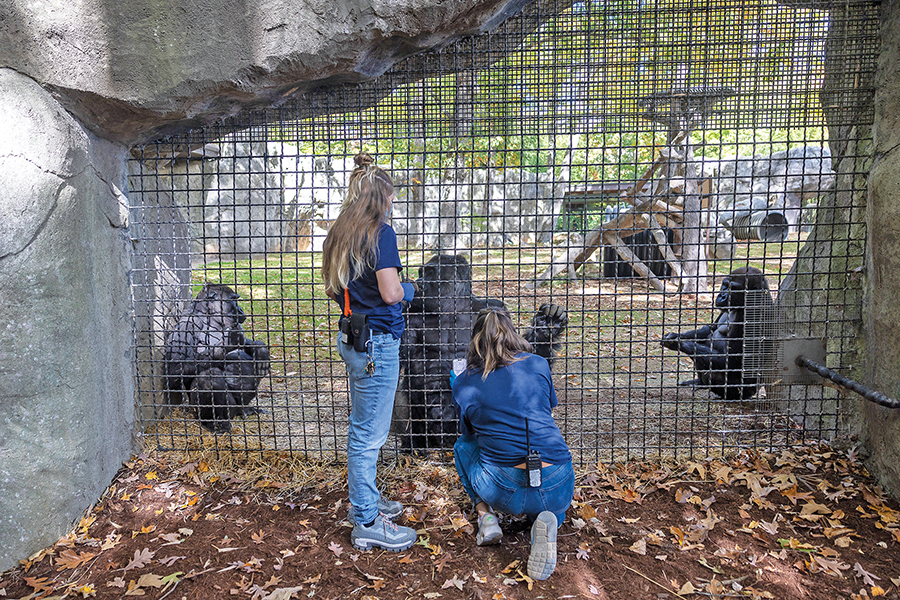
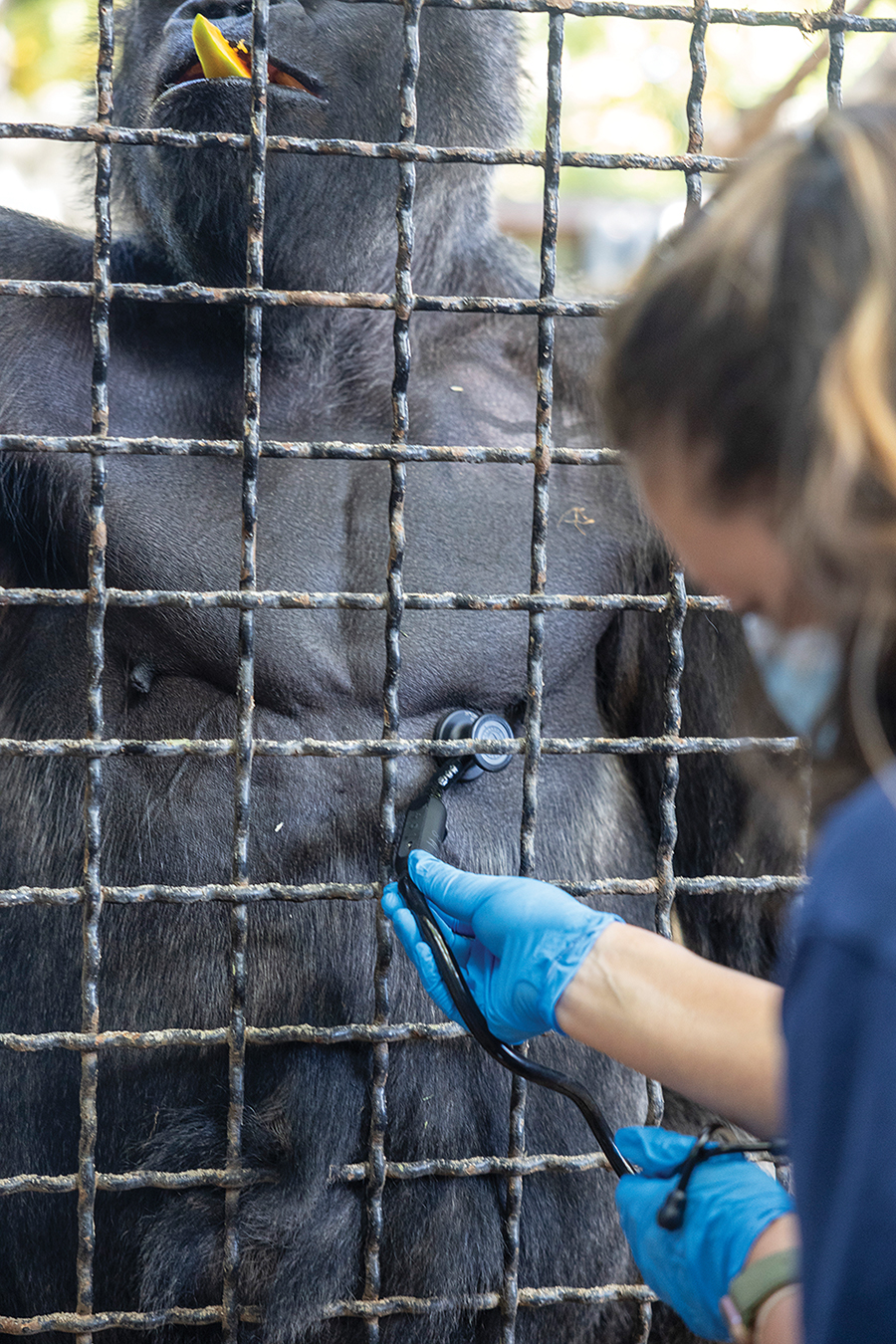
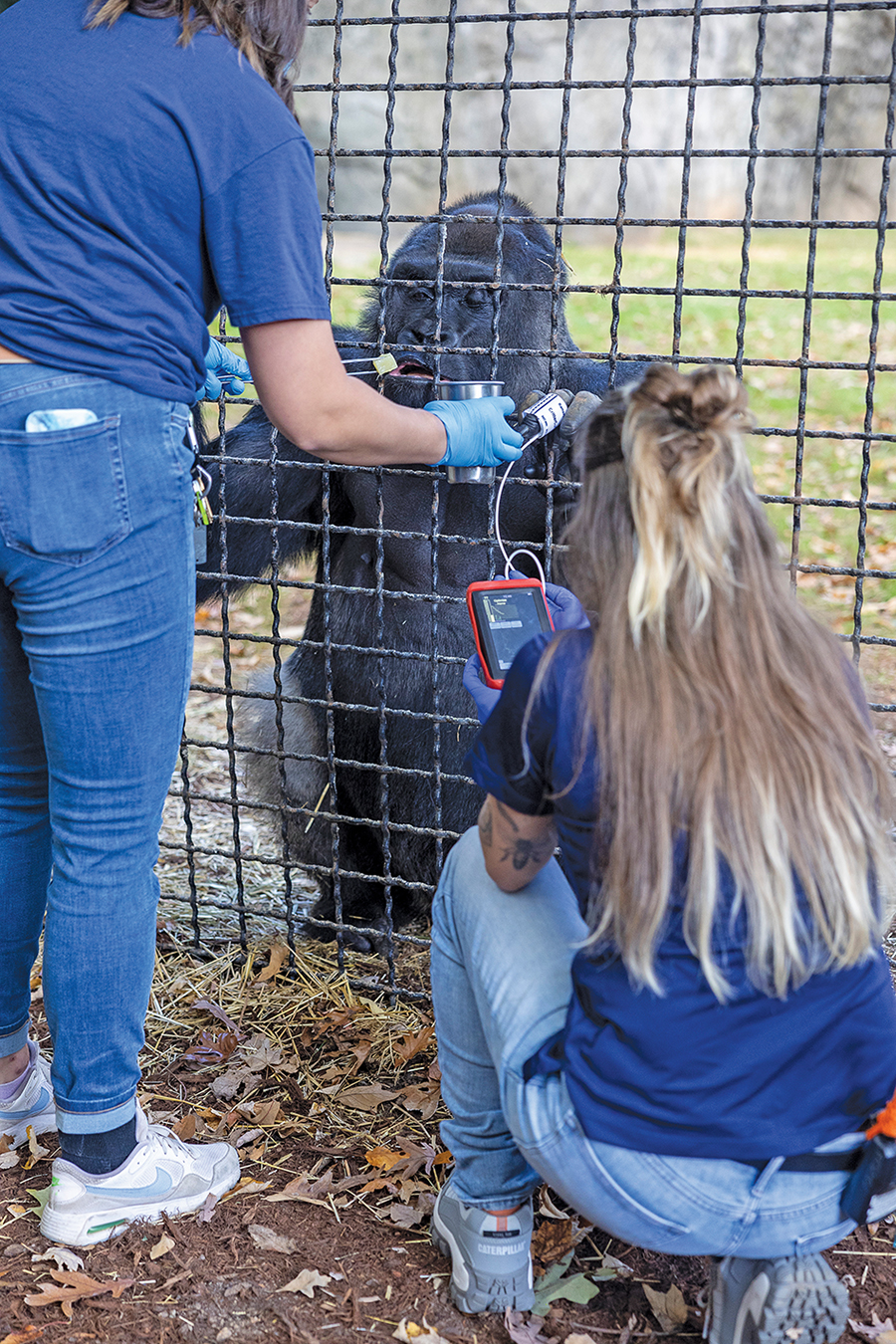
As the silverback and leader of the pack, Mosuba has been the focus of Tien’s training for voluntary data collection since she started working there, though all five of the zoo’s gorillas participate in data collection in some way or another, sometimes through anesthesia. However, because anesthesia can be stressful for both the gorillas as well as their keepers and vets, the zoo’s goal is to reach a point where all five gorillas voluntarily participate in EKGs, blood draws and and blood pressure readings.

Beginning with Mosuba made sense. “We train everything with him first because he’s a gentle giant,” says Tien. “I mean, when we’re using equipment, we’re talking thousands of dollars of equipment.”

By the time he arrived in North Carolina in 2015, Mosuba was able to perform a seated cardiac ultrasound, thanks to the trainers at his previous zoo in Omaha. Tien wanted to take this further and train him to lie down for an ultrasound because “the heart rotates into a better position and you can get a better view of different valves and chambers.”

“That was the first behavior I trained with Mosuba,” says Tien. “He picked it up right away.” The ease of that experience opened doors to new training opportunities. Since then, Mosuba has learned how to use KardiaMobile, a device he sets his fingers in while it connects to a phone via bluetooth and performs an EKG. He also tolerates his blood being drawn, something many gorillas balk at. “There are roughly 350–360 gorillas in human care across the United States,” Tien says. Her face beams with pride as she continues: “There are 10 that can do a voluntary blood draw and Mosuba is one of them.”

What motivates Mosuba to complete these tasks? “He loves grapes, kiwis, orange slices, pineapple chunks,” says Tien. But apart from food, he thrives on human interaction, which works well for Tien, who says, “I am loud and boisterous!” However, she admits, each gorilla is different and responds to different cues and enticements. Fourteen-year-old Hadari is aggravated by the very behavior that inspires Mosuba. “It’s better for someone else to take the training lead on Hadari because I am not great at being quiet and calm.”

And while working reinforcements might vary between gorillas, they can also vary between trained behaviors for the same gorilla. “What is strong enough to do a blood draw for Mosuba has proven not to be strong enough for blood pressure,” the voluntary behavior they’re currently working toward, according to Tien.

As of now, Mosuba can perform a finger blood pressure reading, but, Tien admits, “We don’t know how accurate that is.” Slowly, she’s been working her way up to using an arm cuff. How do you put an arm cuff on a 350-pound gorilla? Obviously, the answer is slowly and very carefully. However, there’s a device created specifically for the purpose, the Gorilla Tough Cuff. Inside of a mesh sleeve — picture an arm-sized metal enclosure similar to a pet crate — the Gorilla Tough Cuff houses a standard fabric inflatable cuff, just like the one your doctor uses at your annual checkup. However, Mosuba doesn’t seem to like the squeeze as it begins to fill with air and pulls his arm back.

In fact, during a training session, Mosuba retracted his arm from the Tough Cuff, accidentally bringing the blood pressure cuff with him. “A typical gorilla would probably start ripping it apart and investigating it. He just took it off his arm, shoved it back in the sleeve like ‘I know this isn’t mine — this is yours,’” says Tien.

While it hasn’t yet happened, Tien continues to work toward a cuff reading with Mosuba, but training is never forced. If he gets up and walks away, his choice is respected. “Every training session for them and for us is a learning experience.”

For now, Tien and her team will keep putting one foot in front of the other, with an end goal of having all of the zoo’s gorillas participating in voluntary data collection to submit to the Great Ape Heart Project. And from there, the hope is that heart disease in gorillas will be easier to detect and treat, allowing them to live longer, healthier lives in human care. After all, Tien says ruefully as she considers the inevitable passing of Macombo and Mosuba one day, “They will leave big shoes to fill.” At that time, their hearts will be sent to the Great Ape Heart Project for continued research. But, of course, they will also leave gorilla-sized holes in Tien’s own heart.

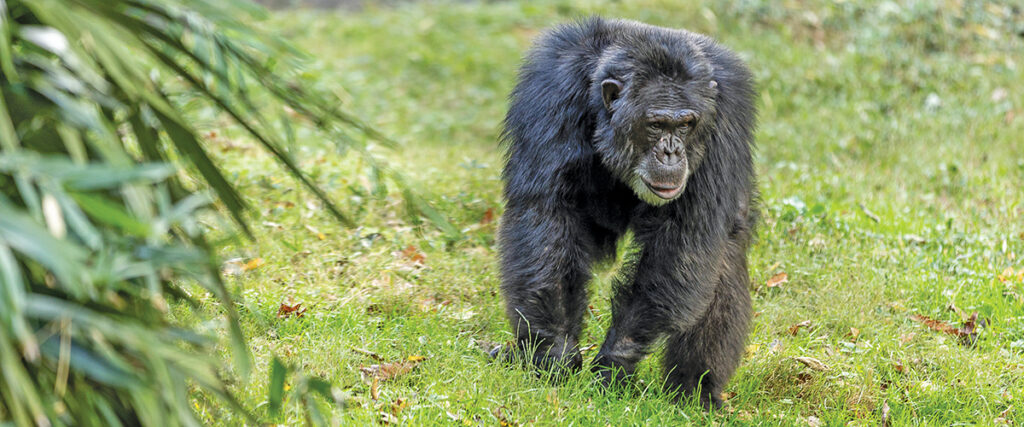
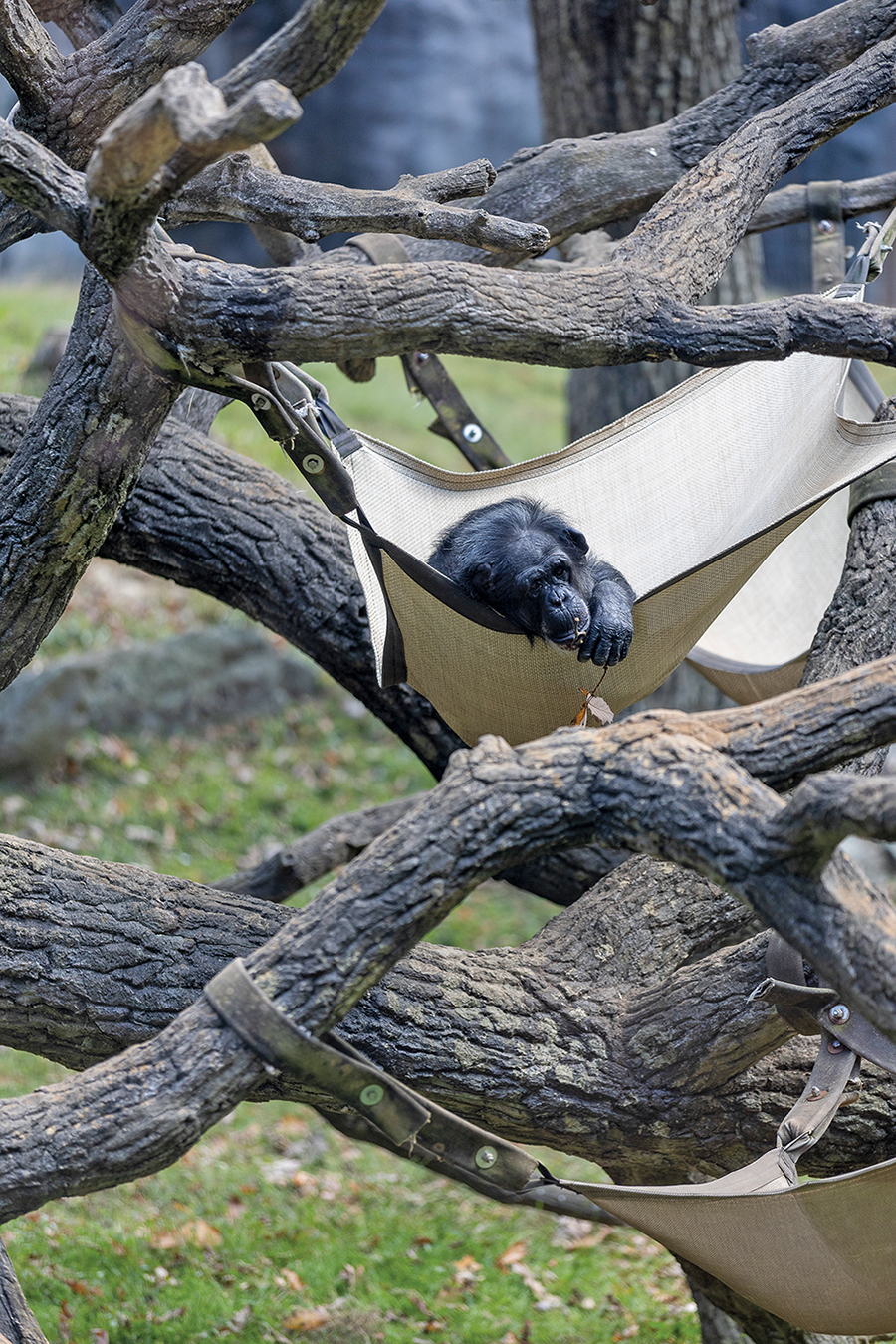
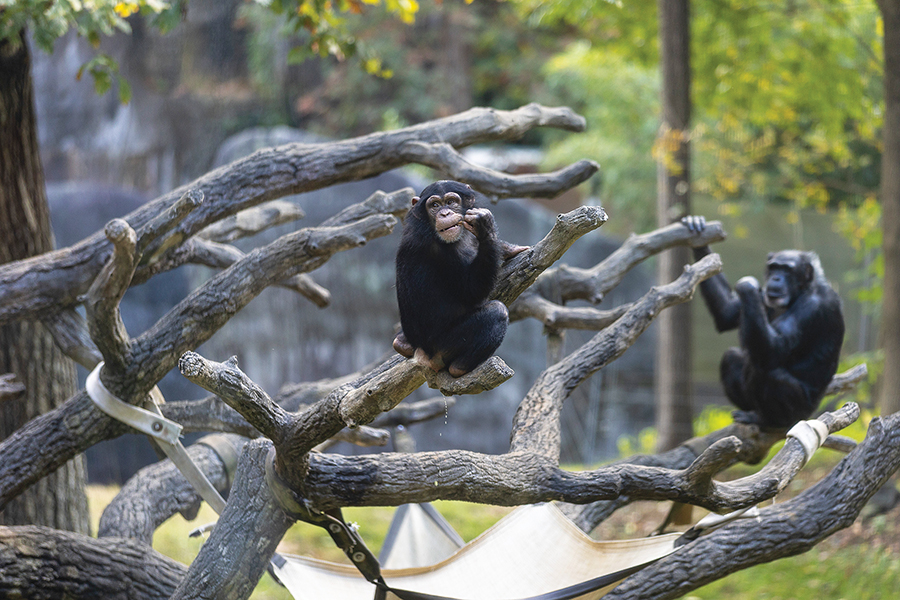
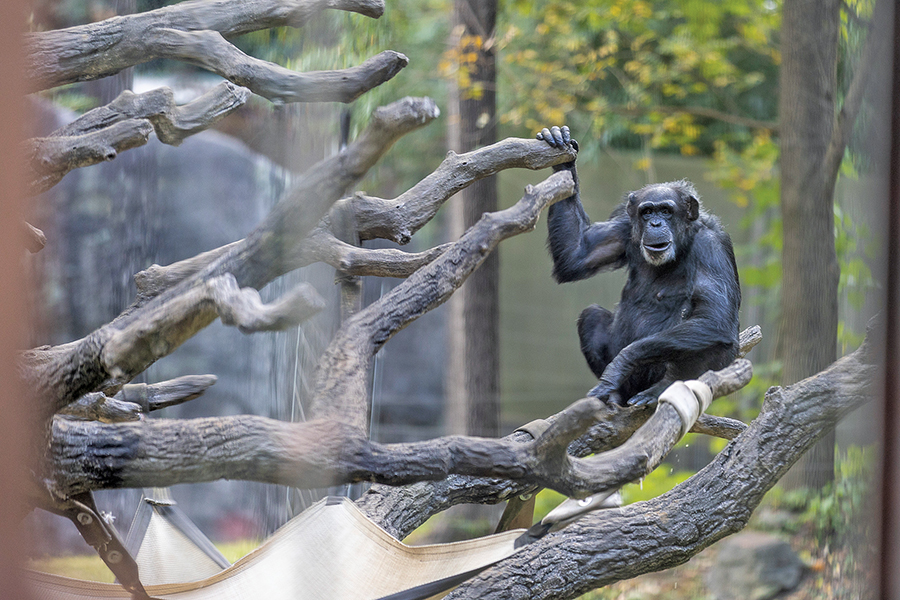
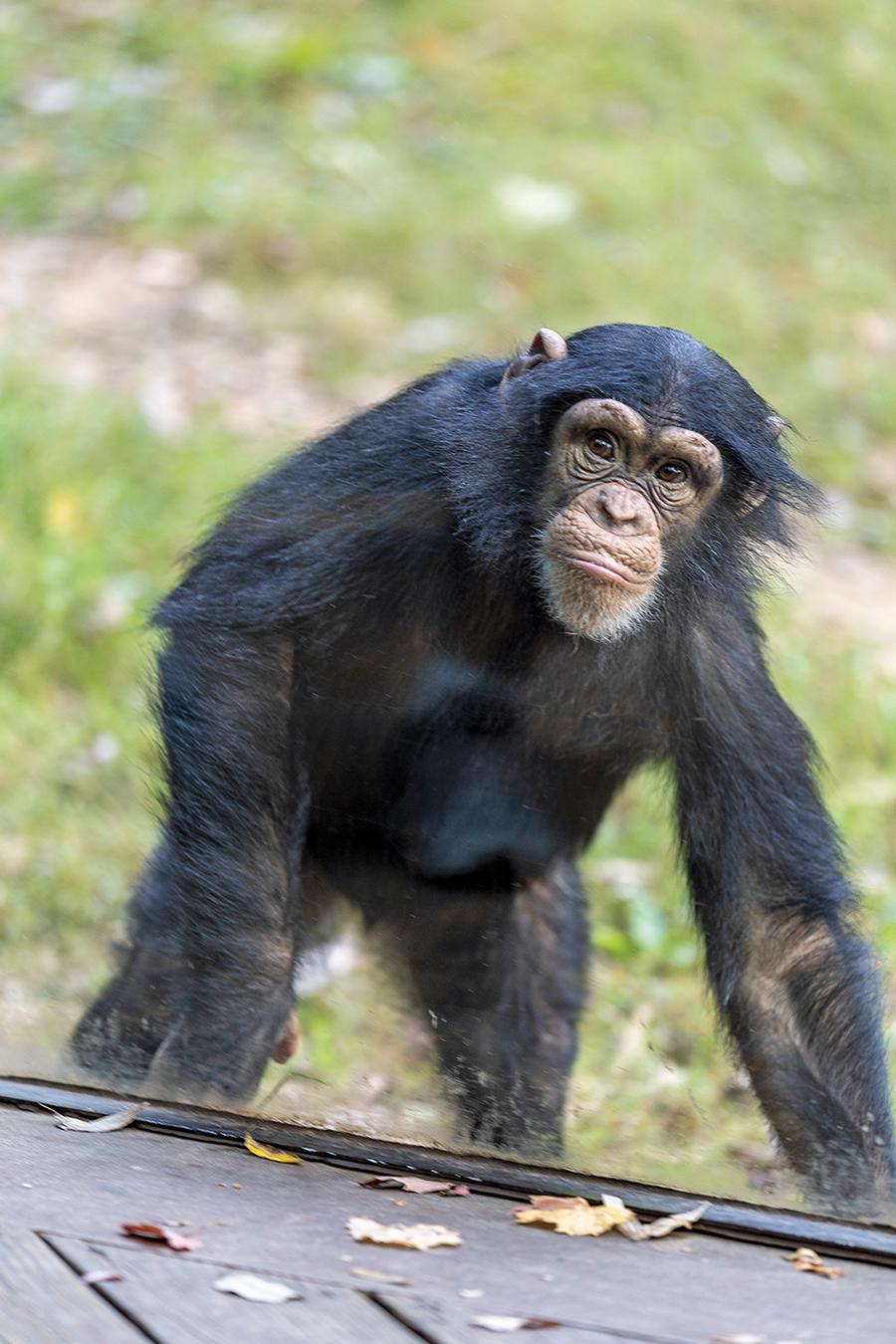
Outside from a deck that looks down on the chimp enclosure, Tori Hanlin points out and names the many chimps in her care — a feat that would not be so easy to anyone else. “Hi, gorgeous!” she says, greeting Gigi and her 8-month-old son, Gombe. John, the leader, though at 25 not the eldest, spots Hanlin as she passes by and opens his mouth wide, ready for food — which she does not offer at this moment. “They have no shame whatsoever,” she quips. Here among the chimps at the N.C. Zoo, Hanlin is right at home.

“I just want to be like Jane Goodall and hang out with chimps all day and make some groundbreaking research and discoveries to help save the species,” says Hanlin. In fact, there’s a Goodall quote that serves as inspiration for her work: “Only if we understand, will we care. Only if we care, will we help. Only if we help shall all be saved.”

Since coming to the N.C. Zoo in September 2019, Hanlin works with two groups of chimps, totaling 17, many of which have been saved from labs or were previously pets. One adult male, Kendall, was rescued from the entertainment industry. While Hanlin’s training is separate from that of the gorillas, she and Tien often collaborate to support each other’s work.
“In humans, it’s very studied — the normal blood pressure range, the normal arterial pressure range, the normal heart rate range, resting and working out,” says Hanlin. Her hope is that the Great Ape Heart Project’s data will eventually be able to provide normal ranges for animals in human care.

And, Hanlin notes, while information can be collected when chimps are anesthetized, it’s not nearly the same as gathering it voluntarily as the heart can react differently under its influence. “We want to get these animals to participate in their own welfare. We want it to be a positive experience for them. We want to make it fun and interactive.” And, she muses, “How many people can say, ‘I’ve trained a voluntary blood pressure on a chimp?’”

While she knows heart disease is not 100 percent preventable, she has her own heart set on doing what she can with the technology the N.C. Zoo provides, including the $2,000 blood pressure device she helped it acquire through a Friends of the Zoo grant.

Currently, blood pressure training is Hanlin’s primary focus, with an end goal of having all 17 chimps trained to do it voluntarily. Right now, most of the seven males can successfully complete the task and a few females are not far behind. Why more males? It all boils down to the species’ complicated social hierarchy. “The boys will displace the females to train.” In other words, males dominate females, as they do in so many other activities.

In fact, John is always first to train. “He is alpha male in the way that he feels entitled to food,” says Hanlin, “and he is going to be the first one to get it.”

Pointing to the blood pressure device, she says, “This beeps a little bit, so we have to make sure that they are comfortable with the beeping and extra noises.” With the cost of equipment, Hanlin uses a two-keeper process: one to handle equipment and one whose eyes are on the chimp. Training starts with broken cuffs before using a functioning cuff.

And, of course, for the chimps, food serves as motivation during training sessions. The reward that gets them going? Very diluted Ensure, a ready-to-drink shake packed with protein and nutrients, generally intended for adults who are struggling with malnutrition or unwanted weight loss. “It’s very high value, it’s very yummy,” says Hanlin. So yummy that Hanlin found herself drinking it too. “I was like, wait a minute, I am putting on too much weight,” she recalls with a laugh.

The high calorie count in Ensure, even diluted, means it can’t be repeatedly used as the keepers monitor the chimps’ intake. Once Hanlin’s got them engaged, she switches to diluted juice. And when a task is completed? “Jackpot!” Fruit such as apple slices and frozen strawberries are the reward.

Are there other reinforcements that work for these social creatures? “Definitely,” says Hanlin, noting that the chimps respond to verbal praise, such as “You’re such a good chimp!” Or “Look at you, you accomplished this incredible thing!” But at the end of the day, a food reward is king.

“Everything is through positive reinforcement,” says Hanlin, noting that the chimps train daily but have the option to walk away from a task they don’t want to do. In that case, they don’t get to skip training completely. Sometimes, it’s “back to kindergarten” for them. What does that mean? Back to basics. Hanlin asks them to point to their fingers or toes, or open their mouths. “And that’s another confidence-booster for them.”

For now, she hopes that the work she and Tien are doing encourages more zoos across the country to perform voluntary data collection on their great apes. “If you have the support of your curators, your vet staff and your coworkers at the zookeeper level, it can be done and this can be the new normal of collecting data.”

Most of the time when heart disease is the cause of death, Hanlin notes, “We don’t find out until the animal passes suddenly and necropsy is performed.”

Such was the case with Katie, a chimp Hanlin worked with closely in Florida who passed away suddenly in January 2019. “She just vomited one day and wouldn’t move,” she says, recalling how she and her team thought Katie was suffering from gastrointestinal issues. She now knows better. “Looking back on it, that was her first heart attack.” The second one, which would prove fatal, came two weeks later.

Hanlin holds out her left forearm. On its inside is a tattoo of two chimps — Katie and her beloved companion, Murray — facing each other, their lips barely grazing as they gaze into one another’s eyes. “I wish I could get all the chimps and animals Ive worked with as tattoos, but Katie and Murray will forever hold a special place in my heart.”

Every day, Hanlin moves the needle on training the chimps in her care, who inevitably make a mark on her. The hope for this young keeper is that she will make her own mark on them, creating a lasting impact on their species. As her hero, Jane Goodall, once said, “I do have reasons for hope: our clever brains, the resilience of nature, the indomitable human spirit, and above all, the commitment of young people when theyre empowered to take action.”  OH

At the end of December 2023, Tien and Hanlin were awarded the 2023 Engage Award from the Animal Behavior Management Alliance for a piece they contributed entitled Great Ape Training at the North Carolina Zoo. ABMAs Engage magazine publishes articles about training and behavior from around the world, so this is quite an achievement.

Birdwatch

Birdwatch

A Winter Visitor

The handsome yellow-bellied sapsucker

By Susan Campbell

Woodpeckers abound in central North Carolina, even more so in the Sandhills. On a given day, you might see up to eight different species. Only one, however, is a winter visitor: the handsome yellow-bellied sapsucker. This medium-sized, black-and-white bird is well camouflaged against the tree trunks where it is typically found. It also sports red plumage on the head, as so many North American species do. The female has only a red crown, whereas the male also sports a red throat. And, as their name implies, both sexes have a yellow tinge to their bellies. However, young of the year arriving in late October to early November are drab, with grayish plumage and lacking the colorful markings of their parents. By the time they head back north in March, they too, will be well-patterned.

There are four sapsucker species found in North America. The yellow-bellied has the largest range and is the only one seen east of the Rockies. Sapsuckers do, in fact, feed on sap year round. They seek out softer hardwood trees and drill holes through the bark into the living tissue. This wound will ooze sap in short order. Not only do the carbohydrates in the liquid provide nourishment to the birds, but insects also get trapped in the sticky substance. Holes made by yellow-bellied sapsuckers form neat rows in the bark of red maples, tulip poplars and even Bradford pears in our area. Pines, however, not only tend to have bark that is too thick for sapsuckers to penetrate but rapidly scab over, rendering only a very brief flow of sap.

The injury caused by sapsuckers is generally not fatal to the tree, as long as it is healthy to begin with. Infection of the wound by fungi or other diseases may occur in older or stressed trees. Although the relationship is not mutually beneficial, sapsuckers need the trees for their survival. It is also interesting to note that others use the wells created by sapsuckers. Birds known to have a “sweet tooth,” such as orioles and hummingbirds, will take advantage of the yellow-bellied sapsucker’s handiwork.

The species breeds in pine forests throughout boreal Canada, the upper Midwest as well as New England. We do have summering populations at elevation in western North Carolina. It is not unusual to find them around Blowing Rock in the warmer months. As is typical for woodpeckers, sapsuckers create cavities in dead trees for nesting purposes. They use calls as well as drumming to advertise their territory. The typical call note is a short, high-pitched, cat-like mewing sound. They use more emphatic squealing and rapid tapping of their bills against dead wood or other suitable resonating surfaces to warn would-be competitors of their presence.

In winter, yellow-bellieds quietly coexist with the other woodpeckers in the area. They will seek out holly and other berries in addition to feeding on sap. These birds will feed on suet, too, and may be attracted to backyard feeding stations. Generally, the yellow-bellied does not drink sugar water, since feeders designed for hummingbirds or orioles are not configured for use by clinging species. Of course, as with all birds, it may be lured in by fresh water: another reason to maintain a birdbath or two — even if you live on a lake.

Seeing a sapsucker at close range is always a treat, so keep an eye out for this unusual woodpecker.  OH

Susan Campbell would love to hear from you. Feel free to send questions or wildlife observations to susan@ncaves.com.

Home Grown

Home Grown

Taking a Breather

A nose that worked on the company dime

By Cynthia Adams

I leaned close to the restroom mirror, examining my nose. With the company newspaper I edited (the last in the state) going to press, I took a breather.  A breather — ironic given my breathing had been permanently altered following a painful childhood swing incident. Nosebleeds and sinusitis became commonplace.

But after 20 years, that would finally change when I decided I’d see a doctor about my nose. A few weeks later, I remained mostly silent while a surgeon studied my X-rays, pointing out the years-old damage that led to a deviated septum.

Merely 2.5 inches of cartilage and bone gone wrong. Easily corrected, he explained. 

Seeking out a surgical remedy had been set in motion after a human resources exec visited my office, requesting we publicize a company-wide insurance campaign, specifically to encourage outpatient surgery — not yet commonplace. It would save the company, which was self-insured, significant money. As an incentive, company insurance would cover the entire cost of outpatient surgery — every dime. 

“Find someone who needs outpatient surgery and write an article about it,” the HR guy said matter-of-factly. 

My mind raced as he stood there waiting to be congratulated for his brilliant idea. Who the heck was going to volunteer for surgery? 

“How the . . . ?” I began, but stopped before insulting the same person who okayed my raises.

So I mumbled, “Well, I . . . ”

Then I surprised us both by blurting out there was a possibility of someone: Me!

He brightened.

“Great! Just be sure it’s medically necessary.” 

I was already wearing adult braces to correct a misaligned jaw and bite; maybe it was time to address another problem. My constantly blocked nose.

I agreed to a consultation with an ENT who was experienced with trauma surgeries. It was during the second consult he presented my X-rays. Pointing to damaged cartilage and bone, adding sunnily, “There’s complete blockage!” He sounded exactly like a plumber.

With a notepad in hand, I asked nuts-and-bolts questions and made notes. The surgery was called septoplasty. The benefits included fewer infections and nosebleeds, and, with mouth breathing remedied, no snoring. 

But I looked down as he spoke and wrote the question, Will he break my nose?, heavily underscoring the last three words. 

Mentally, I sketched an enormous mallet, a target inked onto my schnoz, and me, a hapless fool, reluctantly holding still. 

But I took a small step back when the surgeon explained the how of the surgery: It would necessitate internal incisions and a tiny flap opened up over my nose in order to clear the passages.

I revised my mental cartoon: not so much a mallet; more like miniature miners excavating a cave with tiny picks and shovels. Except, excavating cartilage. And, perhaps a little bone, he added. I must have blanched.

“You won’t feel the procedure,” he reassured.

How would I not feel that? With fearful misgivings, I shakily booked a date for surgery.

An older friend had a deviated septum corrected years before. She, too, couldn’t breathe properly; she also snored (to the great irritation of her former partner, a cranky artist). 

Over drinks she told me about the worst of the aftermath, nearly swallowing the gauze packing her nose when she dozed off once home. Of course, she didn’t choke to death, but she did have a frantic ER trip.

At the pre-dawn check in for surgery, my blood pressure was elevated (terror will do that), but this didn’t halt the procedure. I remember my nostrils being swabbed with something to staunch bleeding. Then an IV was inserted.

Blissful indifference streamed into the veins of my wrist. 

Picks? Shovels? Bring them on, I mumbled to the nurse, who smilingly reassured me they would use neither.

I remembered nothing until the nurse called my name, telling me the procedure was over. Still blissed out, she helped me sit and, soon, stand. When my mother met wobbly-legged me in reception, she looked stricken. 

“Hey, Mama! I’m fine and dandy!” I chirped with drugged-up enthusiasm. “Actually, I’m gonna bake these nice people a cake!” 

The nurses tittered knowingly behind me, according to my mother. I never baked anything more ambitious than box brownies.

Indeed, there was packing extending deeply into my nasal passages, the thing I feared the most. My under eyes were lightly bruised. But, in my happy daze, I was mightily relieved it was all over. 

Days later, during a post-surgical visit, I waited with other patients. But this was the A-team, apparently, who had opted for the more thrilling cosmetic procedure: rhinoplasty. 

A nose job.

I curiously scrutinized them with a side eye. Some wore tiny casts over their softly feminine, narrow noses. Each had a refined tip.

They had all been given a celebrity nose; specifically, they had supermodel Christy Turlington’s nose. (That was then. Now, Kate Middleton, the Duchess of Cambridge, has the most requested nose.) Though it intrigued me that ordinary folk could alter their face to look like a star, I was there to report on my less thrilling, non-cosmetic surgery. But — a nose was a key feature! I obsessed with how they would look once all swelling resolved, imagining them on a catwalk, a procession of proud noses, raised high.

After my brief check, I stood stock-still on the sidewalk, inhaling; was that great smell the restaurant a block away?

The corners of my mouth tilted upwards following my gauze-free nostrils. A world of fresh air and sensations awaited; I followed them straight to a lunch spot. The former Ham’s on Friendly was a greasy spoon I’d frequented before — but this was next level. Seems I had never really tasted the deep-fried fries. Bliss again!  Pausing to sniff the catsup (a condiment that didn’t smell so much after all, I discovered), I savored my lunch as if it were a Michelin Star experience. What could Christy Turlington possibly eat that could top this, I wondered, happily popping fry after fry into my mouth.

Like my nose, possibilities seemed wide open.  OH

Cynthia Adam is a contributing editor to O.Henry magazine.

Chaos Theory

Chaos Theory

Starting Over

The magic of wiping the slate clean — at any time

By Cassie Bustamante

A new year is the perfect time to wipe the slate clean and make a fresh start. Over 20 years ago, I learned just how to do it in Austin, Texas.

In 2002, Chris, now my husband, and I moved to a new apartment on the north side of the city, relocating for his job with Abercrombie & Fitch. His role as district manager came with perks, including a brand-new company car. And not just any vehicle. It was my dream car: a Jeep Wrangler.

He traveled a lot for work and when he left one weekend for an out-of-state business trip, unbeknownst to the powers-that-be at A&F, he handed me the keys to his ride.

With Jimmy Eat World blaring from the speakers and the soft top rolled down, I blissfully cruised south like a Texas cowgirl without a care in the world to the now defunct Highland Mall, where I’d taken a job as a manager for J.Crew. Being new, I was determined to make a good impression despite it being a boring job.

My hours on the clock ticked slowly by. Finally, 5 p.m. struck and my shift was over. Freedom, the kind you feel when you’re blissfully young and the wind rushes through your hair, awaited. However, when I stepped out of the mall doors, dark gray, threatening clouds were rolling in.

Chris hadn’t shown me how to put the Jeep’s soft top back up before he’d jetted off, but how hard could it be? I did my best and was pretty sure I had it right. Five miles along at a clip of 75 mph, the rain about to burst from the clouds, the front of the vehicle roof caught the wind, reared up into the air like a hand waving at incomers and nearly ripped right off the Jeep. Whoops.

I pulled over and wrestled with it. And it wrestled back. (I’m a writer and not an engineer for many reasons.) In the end, I limped home with sweat instead of wind in my hair, grasping the steering wheel with one hand and barely managing to hold the roof in place with the other hand as rain began to pelt the top.

Back at our apartment and feeling like a royal idiot, my arm tingled and ached, and I dreaded calling Chris to tell him that rain had soaked the seats — surely the Texas heat would have them dry in no time, right? So I didn’t. Instead, I poured myself a glass of wine and decided tomorrow was another day, and I’d be driving my own car, a reliable, practical Volkswagen Jetta. But sometimes the universe has a good laugh at our expense, doesn’t it?

The next day, as I began my 20-minute trek to the mall, I felt a sudden thud, thud, thud. A flat tire. Are you kidding me? Once again, I resisted calling Chris, but I did manage to convince a good friend of his, a fellow Demon Deacon who lived nearby, to come to my rescue, giving me a lift to work while my car was being towed into a garage.

Sweaty and flustered, I arrived to the store late, immediately hopping on the sales floor. As it turned out, I was scheduled with my favorite associate. Pam was a woman in her mid-30s, who seemed older and wiser to my naive 22-year-old self.

Reading my expression, Pam offered a calming smile and asked if everything was alright. On the verge of tears, the words spilled out in a jumble: the roof nearly ripped off Chris’ brand new Jeep in the rain and then the flat tire. The floodgates opened and I told her about the immense isolation I felt in a city where I knew no one with Chris being frequently away and my not wanting to bother him. And what was going to happen next? “It’s just been a really bad 24 hours,” I said.

Pam looked at me, her face serene and soothing. “Take a deep breath and just start over,” she said. “Right now.”

Just start over? That’s your solution?

Seeing bewilderment on my face, Pam nodded encouragingly. “Yep, just start over,” she said. “You know, I’m a recovering alcoholic. And on my journey to sobriety, there were days that I’d slip, but it didn’t mean that things couldn’t get better, that it was over for me. Because the beauty of starting over is that you can do it any time.” She paused. “Like right now.”

I took a deep breath. I hadn’t been hurt. Nor were either of the cars permanently damaged. Chris would be back tomorrow, and I sure had one good friend who knew just what to say.

Three children later and a long list of things gone awry that have proved to be so much worse than a flat tire or a cantankerous Jeep top, Pam’s comforting words and her serene smile have come back to me many times.

Just start over. Right now. Wise words from a woman who understood and had lived their meaning.  OH

Cassie Bustamante is editor of O.Henry magazine.

O.Henry Ending

O.Henry Ending

Queen of Bath

It’s a bit of a stretch, sure. But this dream tub sorta works

By Ashley Walshe

If you’re a bath person like me — that is to say, someone who soaks ritualistically — then perhaps you’ve spent time imagining what life could be like if your tub was just a little wider; a little deeper; a little more picturesque.

An elegant garden tub aglow with flickering candles. A cast iron clawfoot laced with salt and rose petals. An hourglass drop-in complete with whirlpool jets.

Such visions used to rule my mind.    

Now, having spent the last two years living in a 32-foot travel trailer with my husband and my canine shadow, my dream tub has but one requirement: I can bathe in it.

Which brings me to my current situation.

A standard bathtub holds about 70 gallons of water. Suffice it to say that our RV tub does not. Think farmhouse sink with bobsleigh undertones. Bigger than a breadbox, smaller than a storage tote.

I’ll be honest. It took a while to see potential here. The tub’s fun-size dimensions combined with our 6-gallon hot water heater don’t exactly add up to a space for quiet contemplation and long, soulful soaks. Quick showers are fine. But when baths are your primary indulgence, you consider all your options.

My first bath attempt was, frankly, valiant. I’m no bobsled pilot, but given my daily yoga practice, I was deftly able to navigate the tub’s shallow waters. A knees-to-chest pose, for instance, followed by seated pigeon, a gentle variation of boat pose and — after a bit of ocean breathing — a legs-up-the-wall inversion. 

Despite this series of postures, most of my body was not, in fact, wet. Still, half baths are better than no bath in my book. I lit a candle and resumed my lazy pigeon.

All of this was fine. Really. But when the ankle-deep water began cooling with unholy swiftness, my efforts seemed altogether fruitless.

“I wish we had more hot water,” I mumbled as the basin drained.

“We can try using the electric kettle next time,” my husband offered from the living space. “I’ll even be your bath butler.”

I felt my lips explore the foreign words.   

“Bath butler.” I liked the sound of it.

My bath butler has changed my life. Weekly, per my request or his proposal, I luxuriate in what I’ve taken to calling my Queen’s Bath — a modified version of a full bath, sure, but a yogi can dream.

Pre-kettle, I add a swirl of Epsom salt into the finger-pour of steaming water, get the candle going, flip off the lights and climb in.

If I fits, they say, I sits. 

By now, my bath butler has mastered water control. He knows that, after adding a kettle to my bath, it’s time to heat up the next one. Sensitive and compassionate, he keeps things strictly professional, a trait any honorable bath butler should possess.

“How’s the temperature?” he might ask. Or, “May I bring you a beverage?” Most often, he simply pours and gives a courtly head bow. Role playing at its finest.

Four kettles in, the water nearly hugs my waist. By kettle five, I’m beginning to feel like a Greek goddess. Kettle six? I could not ask for more.

You don’t opt for camper life without sacrificing some modern comforts. Still, we have everything we need: clean, running water; electricity; full bellies and warm hearts.

My butler is the bath bomb on top. 

If it’s true that gratitude is the quickest path to happiness, I think I’m already there. As for my husband?

“I’m happy to bring you water,” he assures me. Although he insists on maintaining his professional butler pose, I pry.

“What’s in it for you?” I ask.

He pours the kettle, shrugs, then clears his throat. “I guess I like the view.”  OH

Ashley Walshe is a former editor and regular contributor of
O.Henry magazine.

The Collected & Collaged Home

The Collected & Collaged Home

An artist pastes together his story

By Cassie Bustamante

 Photographs by Amy Freeman

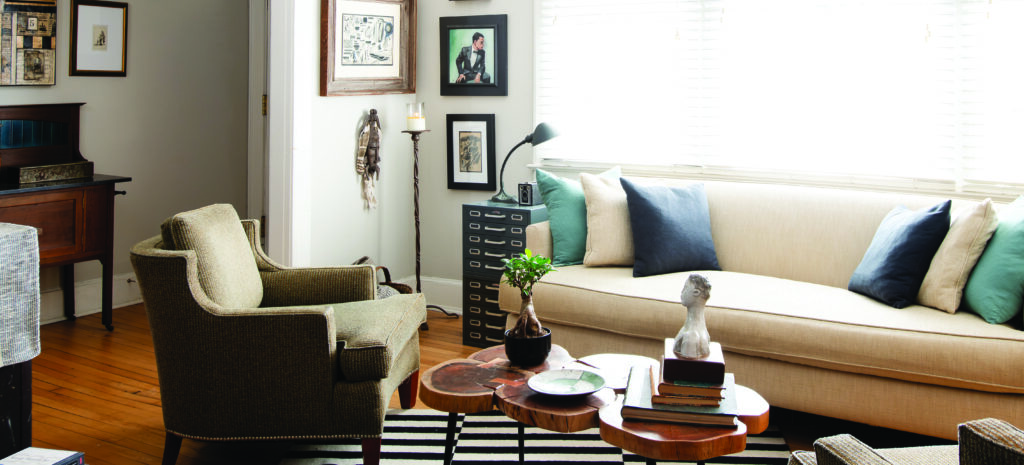
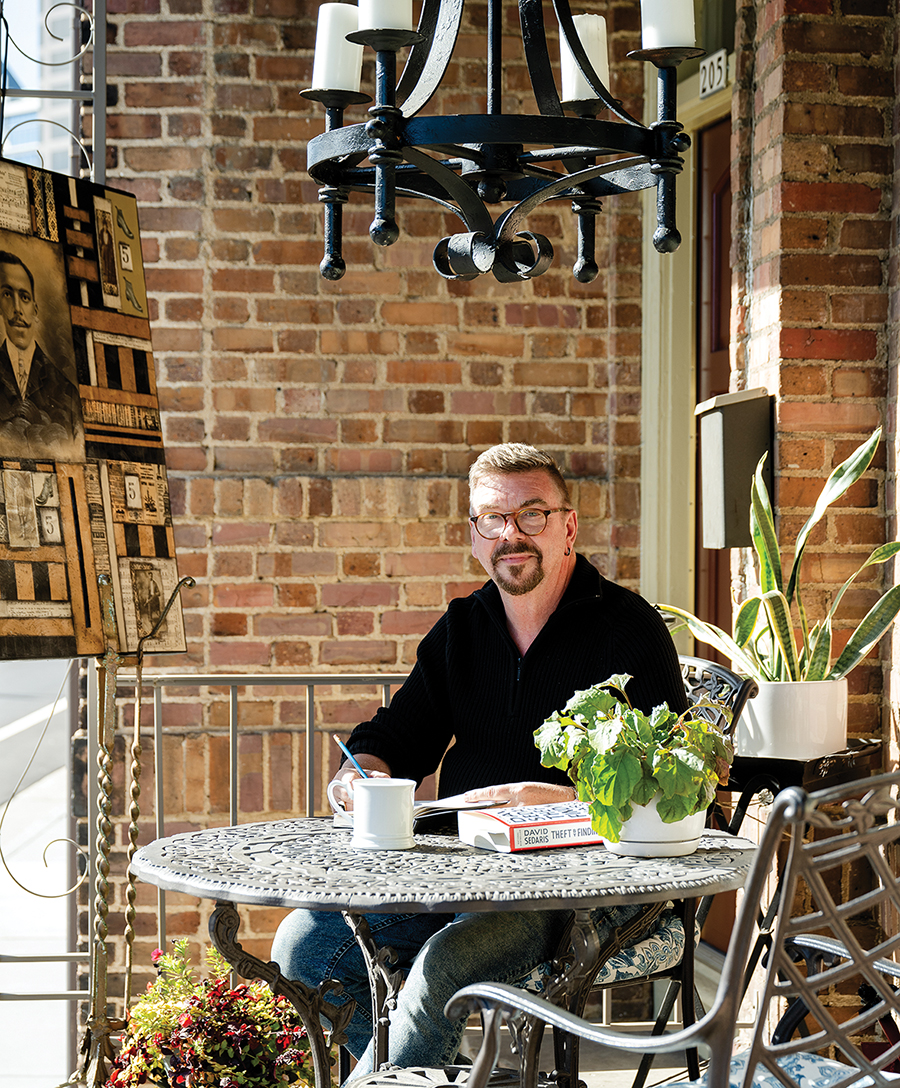
Just beyond the front door of Perry Boswell’s downtown Summit Avenue condo hangs a large collaged canvas created by the artist himself. The Dandy is a collection of black-and-white images from the late 1800s and early 1900s, including three photos of suited Black men — one with a handlebar mustache — and a photo of a behatted Black woman adorned in fur.

Why these images? “I would find pictures that had no story and, for whatever reason, they would tell me they need a story,” Boswell says. So he got to work, cutting and pasting, weaving in advertisements and minstrel music from the same era, plus notebook writings of his own.

“And here is the thing about putting your comments in a different time,” Boswell says of working with old ephemera, “you can say something really pertinent — what needs to be said about things.”

At a show of his collage work, Boswell once overheard a friend comment on The Dandy to a gallery visitor, “You know what, if you knew him, you would realize it is also a story about him, too.”

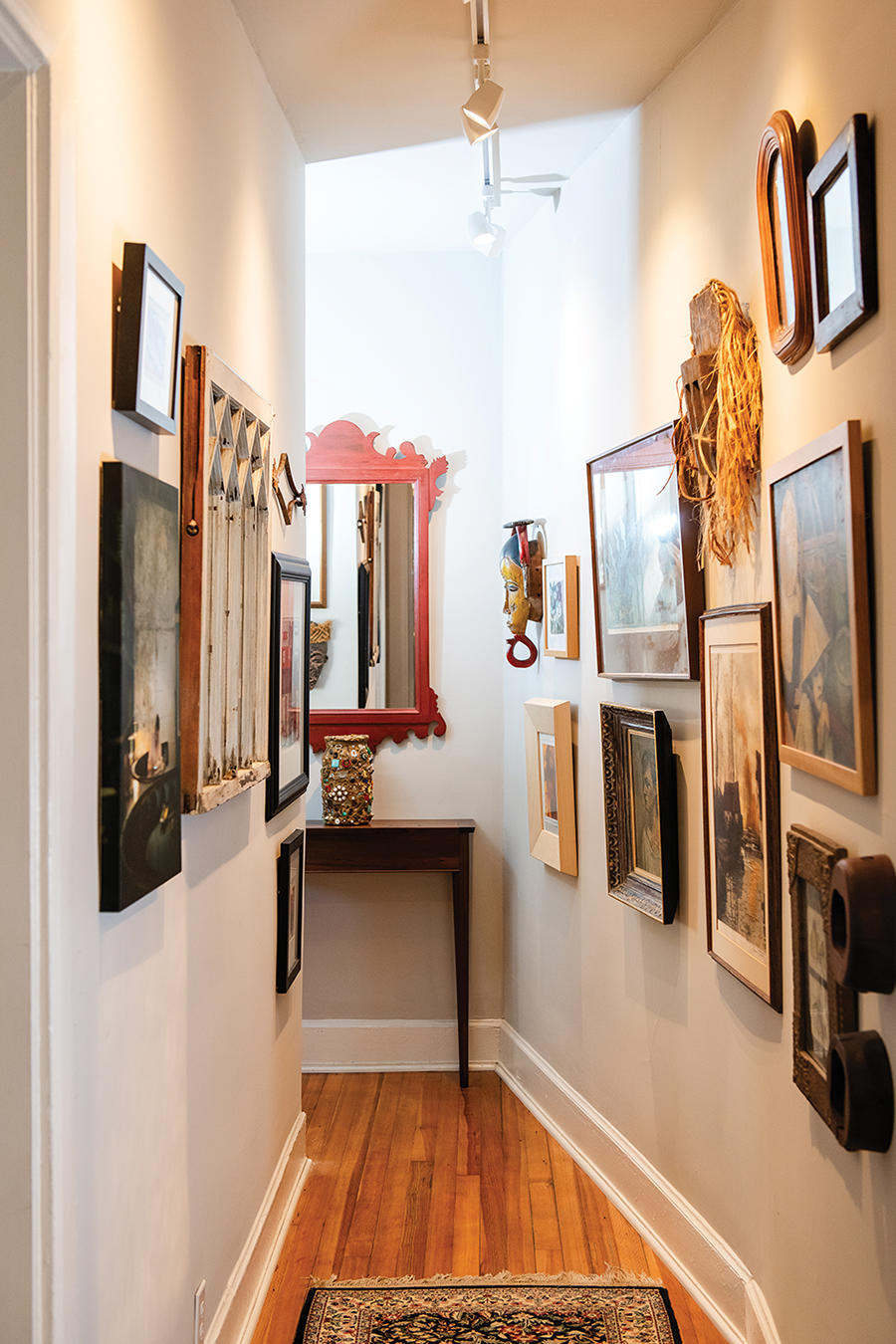
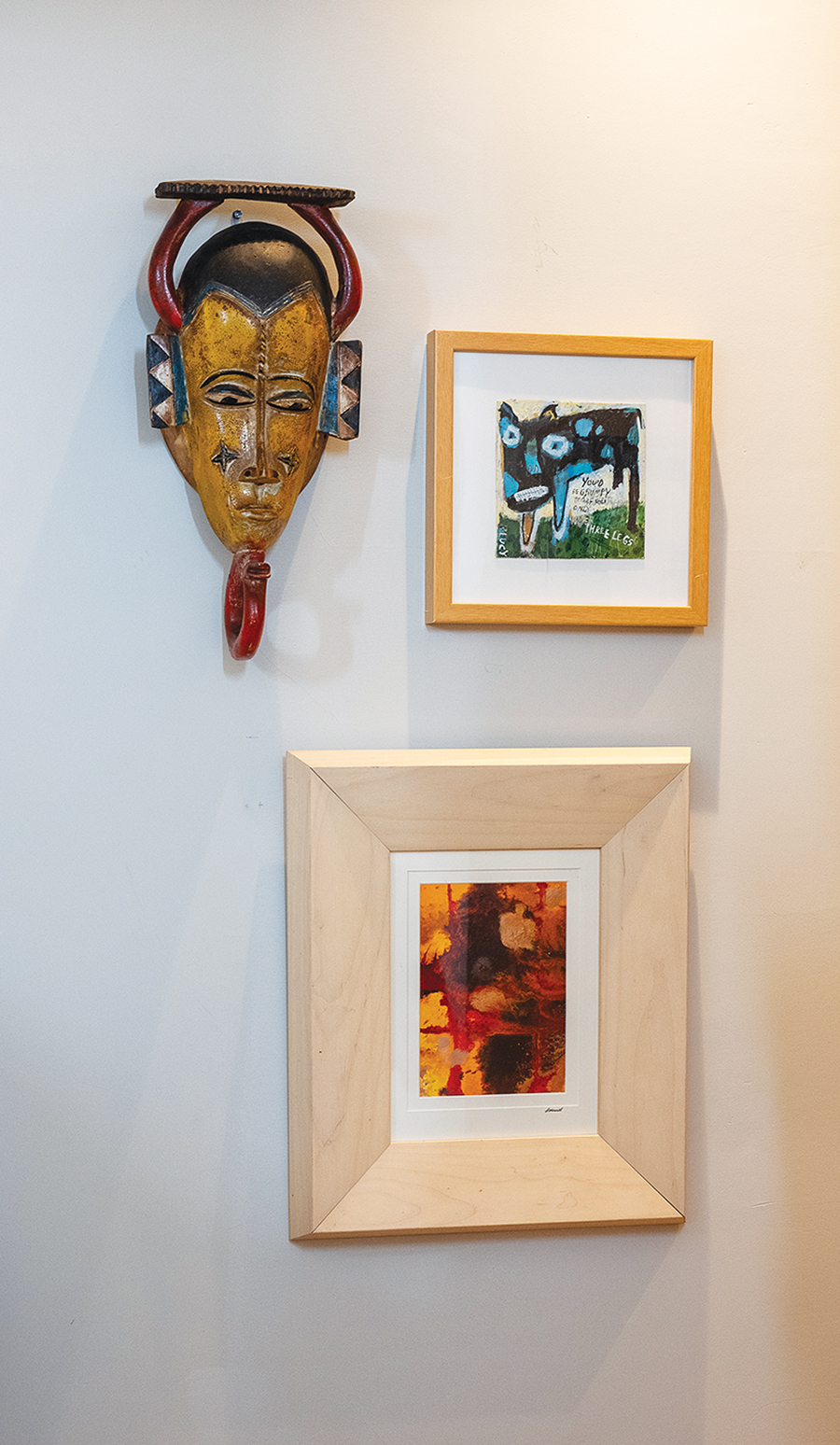
While the canvases decorated with his own two hands are created as a means to share a bit of his story, he’s drawn to art that does the same. Beyond the entry, his home unfurls like a gallery, art, thoughtfully curated, and one-of-a-kind treasures inviting the visitor to pause and take it all in. One of his quirkiest pieces is a carnival-colored painting of a two-headed man he purchased at the Fearrington Folk Art Show. Painted on an old door, one face features dark shaped brows, pale blue eyes, a serious expression and is as dapper as The Dandy, down to the handlebar mustache. The other, its opposite, wears a toothy grin, bushier brows and dark eyes. The humor, color and use of recycled salvage drew him to it immediately. But what made him purchase it? “I was figuring me out and it spoke to me in a way that we’re all two-headed because we’re many people in one,” he says.

And has he figured himself out? Dressed in a gray shawl-collar, chunky wool sweater, dark denim and stylish black glasses, Boswell, a retired Davidson County High school art teacher, is, like his house, carefully put together. The effect? Refined ruggedness — a phrase that could easily describe his home, too. What his ensemble can’t illustrate on its own is the comfort he feels in his skin. But just as creating art or a home is often a slow and sometimes challenging process, so has it been with his inner journey.

That passage, he says, has involved “a lot of change. It’s age. It’s a divorce. It’s a lot of things,” says Boswell. Still, he says he feels as if he’s approaching his destination “because I can be at ease with all the things I am.”

Since growing up in his parents’ house, built on his grandparents’ 100-acre Thomasville tobacco farm, Boswell has called a few other places home in his 61 years. As a newlywed fresh out of college, he purchased his first house, a charming 1930s bungalow in Welcome. Later, when a son was born, the family packed up and headed to suburbia. And when that son flew the coop, he and his former wife moved to Greensboro into a 1920s Latham Park home, complete with a backyard art studio.

“I like a place that has a story, a soul,” says Boswell. So it’s no surprise that when his marriage ended, a topic he opts not to touch upon, he knew exactly where he wanted to land — the 1922 Flatiron Building on Summit Avenue. Designed by Jefferson Standard Building architect Charles Hartmann, the structure, originally intended to house four family-sized apartments, now features eight units and, of course, Flat Iron cocktail bar and music venue.


At a potluck dinner hosted by fellow Sternberger Artists Center tenant Molly Amsler, who lives in one of the eight units, Boswell immediately felt a strong pull toward the building. “When I stepped into it, I knew I was going to live here,” he says. “I just knew it.”

The stars aligned and a street level unit with a porch view of the Greensboro History Museum popped up on the market just when Boswell needed it. But, he adds, it was by choice that he made the purchase.

A stone’s throw from his studio space at Sternberger, his new Summit Avenue home is within walking or, as he points out, trolley distance, to some of his favorite haunts: the public library, the museums and the booming coffee shop scene. “It seems like downtown is becoming little Seattle,” Boswell quips gleefully. Or, he can simply sit on his porch and enjoy the cast of characters that walk by.

That thriving downtown cultural scene is fuel for this artist’s soul. “I can, on a Saturday night, go down here and hear Latin music and see families dancing with each other. How wonderful that is!” he says. “Hearing different stories but seeing the commonality of it is important to me.”

As a retired teacher, where does he find the funds to support his collecting and coffee shop habits? Of course, he has a pension, but he chose to get a part-time job as well. During his 30 years in the classroom, he often worked side hustles — painting houses with his father or designing High Point showrooms — and relishes in the opportunity to interact with people. Shoppers, he says, love to talk to him while he works, allowing him to meet interesting people that might inspire his artistic work. Plus, “I know how to work an apron,” he jokes of his role as stock boy at Bestway Marketplace at UNCG, where he earned both his B.A. and M.F.A.

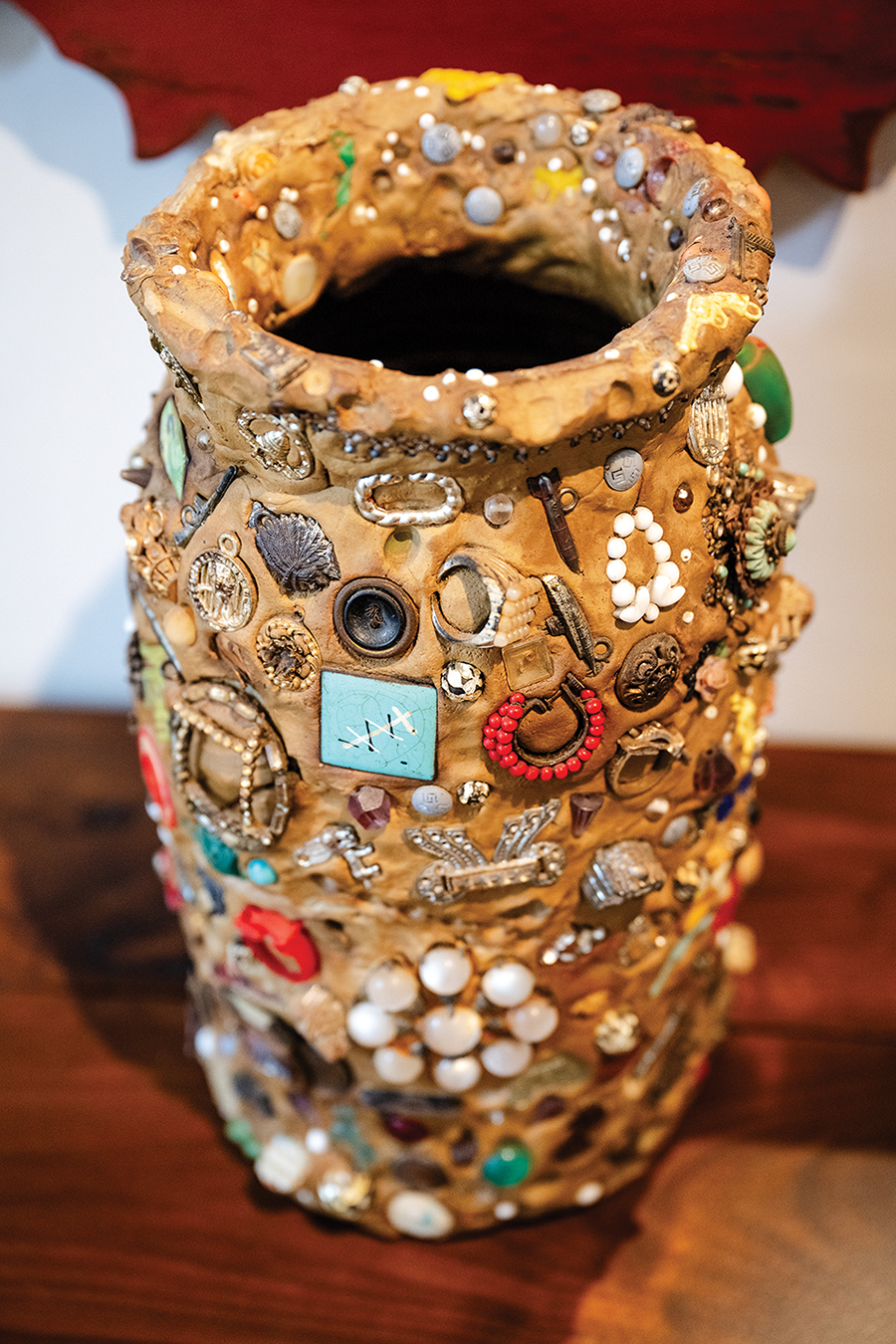
Is there a common thread that ties together the quirky art and vintage pieces that make his condo as much a museum as a home? He laughs: “There is a fine line between collector and hoarder,” but the furnishings placed throughout his condo and adorning his walls are clearly curated to tell Boswell’s own story. When making a purchase for the home, he doesn’t consider whether something will “match.” Instead he asks himself, “Will it give me something positive?”

As someone who has been to High Point Furniture Market as both a guest and showroom designer, Boswell says, “There are beautiful, wonderful, expensive things . . . but you don’t feel anything about it.” And as an artist who admits to a studio space where creativity is born of chaos, he’s made his home more of a gallery than a workplace, filled with art, antiques and oddities that give him what he calls “good energy.”

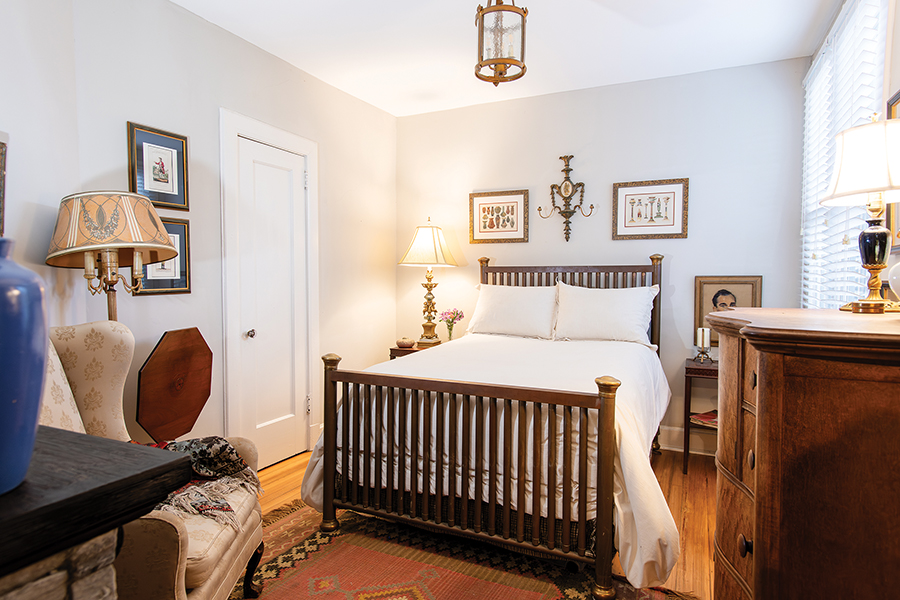
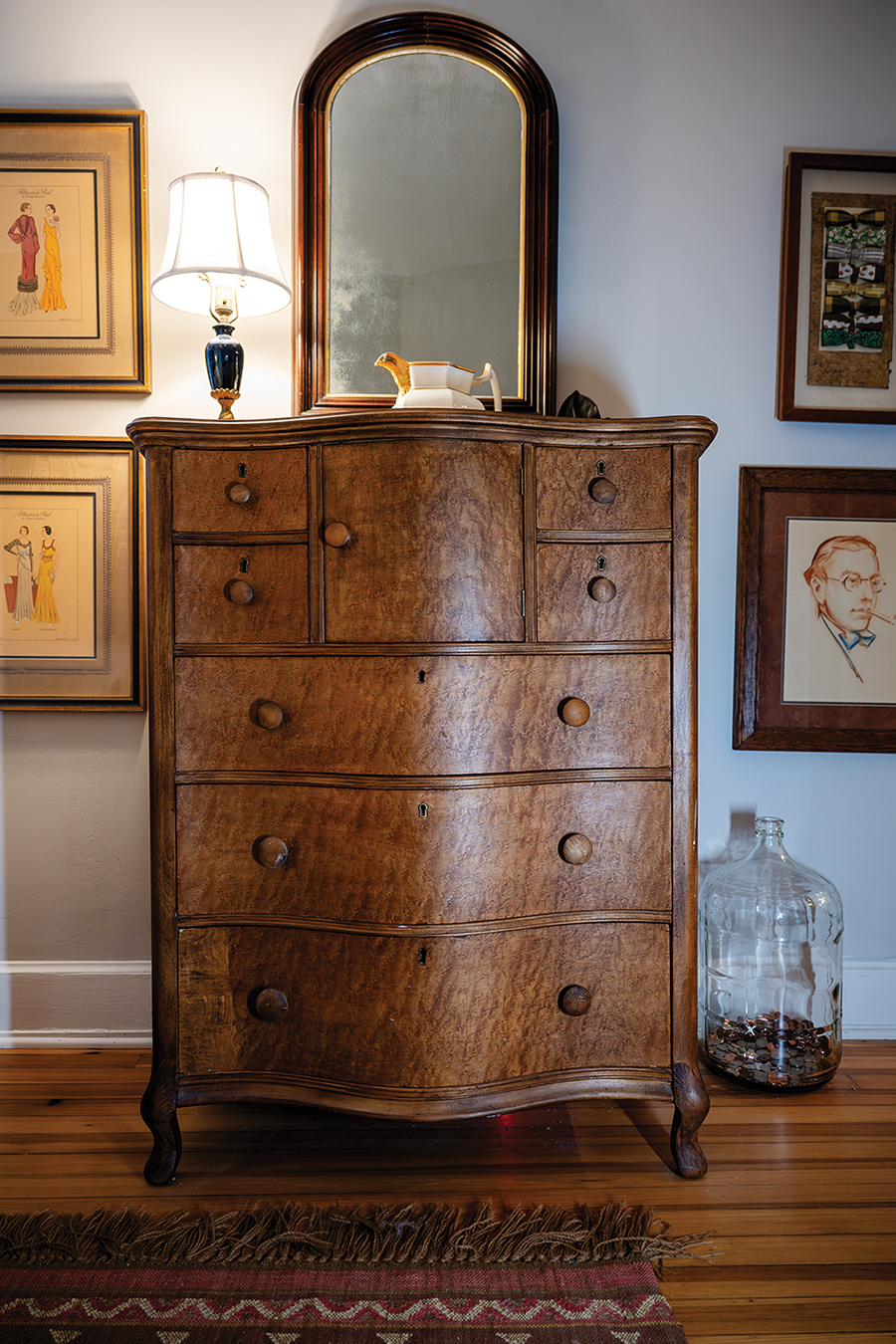
Back in the single bedroom of his unit, Boswell, who has traveled quite a bit in his lifetime, purposefully created a retreat that feels like an old European hotel. On its gray walls, his appreciation for fashion, especially vintage, is on display. Genuine 1920s drawings from Paris fashion houses, gifted to him by a friend, add a sprinkle of vibrant color to the serene space. And next to his antique oak highboy, a framed salesman’s sheet of sample bowties from, he guesses, the 1940s is paired with its perfect complement, discovered later at a flea market — a vintage sketch of a dapper gentleman in a bowtie, smoking a pipe.

Anchoring the space, an antique brass bed with simple white bedding is flanked by a pair of sleek mahogany-colored vintage nightstands. Above the headboard, on either side of a French-inspired sconce scored at Adelaide’s, two muted but colorful German prints featuring Arts-and-Crafts-era pottery and candlesticks hang, a souvenir from his many summers spent teaching at Reynolda House’s summer enrichment program. “I got as much out of it as the kids did,” he muses.

The bedroom’s counterpart, his white kitchen, is where he shows off his fondness for folk and outsider art. A set of clay tiles featuring farm animals created by local artist Leanne Pizio fills a skinny strip of wall by his back door. He takes one down and flips it over, revealing a simple saying on the back. “I love these for the tiles and the writings,” says Boswell. As luck would have it, he also scored a couple of bright Leanne Pizio chicken paintings at a second-hand shop.

Boswell opens his pantry door to reveal a hidden gem. “This is a Mary piece,” he says. Featured on PBS, Mary Paulsen is a coastal North Carolina creator who makes folk art out of found objects. Boswell’s “Mary” is a verre églomisé — backward painting on glass — merman. Art lovers from as far as Europe now come to buy her work, so he’s happy to have one hanging in his home and hopes to acquire more.

Across the hall from the kitchen, the dining room’s furnishings piece together, much like a collage, his own family’s history. A green-based farm table was rescued from his grandparent’s farm and served him as an art table for many years, moving with him from house to house. The table, Boswell knew, had been built by his great-grandfather and formerly used in a smokehouse to hold hams. He loves to imagine all of the conversations his ancestors have had around this very table. “Wow,” he muses, “if this thing could talk.”

Now, it serves as a place for Boswell to take his turn hosting monthly artist potlucks. At 700 square feet, according to Zillow, “My home is not big,” he says without a hint of humor at the understatement, “but I can have dinner parties.”

And what’s a dinner party without the perfect cocktail corner? Serving as his bar, a tool chest that belonged to his father holds various glassware. “When I found this, my father’s badge from work was in here,” he says, tears pricking the corners of his blue eyes. He opens the drawer and, with admiration, shows off his father’s Western Electric photo ID card. “Now, my father didn’t drink. He would probably have a stroke about this,” he says with a chuckle.

On the wall just above the cabinet? More quirky art, naturally. A colorful piece passed down from a friend features a bar scene that reminds Boswell of a Van Gogh work. When he placed it over the tool-chest-turned-bar, a chorus of yesssss rang through his head.

An unassuming, elongated octagonal ironstone platter on display in an open dining room cabinet boasts an unexpected story. “Maya Angelou lived in Winston-Salem and I went to the estate sale!” says Boswell, who paired his undergrad art degree with a minor in literature. Showing up on the last day, not a whole lot was left to choose from, but in the garage, hiding on a shelf, he spotted the plain white platter, which had a large chip. “I paid 25 bucks for it,” he says, and then took it to Replacements, Ltd., which, in turn, recommended a local couple who could repair it. He had it mended, but requested it maintain a little knick. “The imperfections of things make them much more livable and homey to me.”

Ever the collector, Boswell recently purchased an old glass cabinet from a Pittsboro shop, though it originated in an Albemarle farmhouse as a kitchen upper. Inside is a collection of vintage books found locally at Bargain Box. An avid reader, he bought the whole set and has been making his way through reading them — Thoreau, Oscar Wilde, Emerson and more classics.

In the hallway, which runs the length of his living and dining rooms, Boswell has turned the narrow passage into an art exhibition featuring more of his collected pieces plus a couple of his own. He points out a recent acquisition, a French lithograph featuring a rural autumnal scene. Across from it, hangs a lone photograph of Boswell himself, a gift from a filmmaking friend. In the image, he was caught unawares, head-down at a table in Winston-Salem’s Joyner’s Bar, sketching with an old fashioned, his cocktail of choice.

His rarest find, his pièce de résistance, sits at the very end of the hallway underneath a vintage mirror. A memory jug is a form of African-American folk art that pays homage to the dead and is crafted from bits and pieces of their life, almost like a mosaic. “I’ve never seen one outside of a museum,” he says.

Although this piece is likely valuable, that’s not the reason he bought it. So why does he call this particular piece his pride and joy? It’s simple — the story it tells.

“The storytelling part of all this old stuff is what is important,” he says. And Boswell continues to tell his story to the world through his paintings and collages. But perhaps his biggest piece of collage art to date is this very home: a series of bits and pieces meticulously crafted together into what has become his favorite — and likely his last — residence. “Our story is all we have to give each other. We come into this world alone, we leave alone and we’re lucky to have people to love in between. But if this is all there is, our story is all we’ve got to give each other.”  OH

Perry Boswell’s work can be found at Sternberger Artists Center and on his own website: perryboswell.art.

Cornered By Flavor

Cornered By Flavor

Cornered By Flavor

Appetizing aromas draw foodies to two new restaurants reclaiming a busy Greensboro crossroads

By Maria Johnson
Photographs by Bert VanderVeen


The pandemic stuck a fork in the restaurant life of Latham Park.

The Iron Hen — a lunch-brunch favorite that leaned on fresh, local ingredients — and its chain-driven neighbor, Dunkin’ Donuts, always good for a pop of caffeine and sugar, both shuttered during the shutdowns.

Local bellies rumbled for salads dotted with creamy goat cheese medallions and for confections crusted with rainbow sprinkles — though not necessarily at the same time.

Now, a new crop of flavor has sprung up at the corner of West Wendover Avenue and Cridland Road, thanks to two locally-owned restaurants: Saint Louis Saveurs, which fills the former Dunkin’ space, and Ava’s Cuisine & Catering, which occupies the Iron Hen’s old roost.

Both places serve down-home chow with a delicious twist: The owners come from different places, so their flavors are distinctly diverse, and their menus expand the rich, multi-ethnic flavor of Greensboro.

Still, their stories are remarkably similar.

For Mouhamadou “Mo” Cissé and his wife, Bator, both in their early 40s, home is the west African country of Senegal, specifically the coastal city of Saint Louis, which is about the size of Greensboro and which they pronounce the same way the region’s French colonizers did: san lou-EE.

Saveurs means “flavors” in French, so, literally, the Cissés serve up the flavors of their hometown, most notably the warm, homey notes of garlic — an ingredient brought by the French — mingling with the sweet earthy tang of onions and peppers.

The piquant aroma hovers outside the restaurant, signaling that this is no slapdash joint; someone inside knows their way around the kitchen.

“The experience, the love of cooking and making something really, really good, that’s what makes the difference,” Bator says. “It’s all about the depth of the flavor.”

You can taste her practiced hand in dishes such as djolof, a fried-rice entree made with your choice of fish, chicken or lamb. Each protein is cooked slowly and separately.

“That’s the traditional way of cooking back home, for safety, so the food is well-cooked,” says Mo, adding that the method concentrates flavor.

The protein dictates which kind of homemade onion sauce is used in the dish, and each meat gets its own array of vegetables. For example, the lamb is paired with carrots, peas and corn, while the fish swims with cabbage, carrots, yams and eggplant in season.

Yassa, made with white rice, uses some of the same ingredients as djolof, but the outcome is singular. “The order of cooking is different,” says Mo. “And the quantities of ingredients are different.”

Saint Louis tweaks some American favorites, too.

“Our burger is not going to be the burger you buy anywhere else, I can guarantee that,” Mo says proudly.

The Saint Louis Special Burger boasts a thick beef patty that’s mixed with jalapeños, eggs and cheese before hitting the griddle to coax out the juices.

The restaurant’s cheesesteak is a savory marriage of marinated beef or chicken, melted cheese, and a generous drizzle of homemade vinaigrette-based sauce on a sub roll. Customers yearning for crunch can ask for a garden finish of crispy lettuce or cucumber.

“That’s something you don’t see everyday on a cheesesteak,” says Bator.

Their down-home offerings extend to a zesty homemade ginger-pineapple drink and a scarlet-hued hibiscus tea known as bissap.

Bator, who directs the kitchen — “I want the food to be 100 percent” — learned to cook as a child. “At the age of 12, I started cooking lunch for the whole family,” she says.

Even more important in her business, she absorbed the Senegalese ethos of teranga, which means warmth and hospitality. She embodies teranga with her megawatt smile.

She also reflects the discipline she learned by playing center on her high school and university basketball teams. Wearing a sporty pullover and a Nike ball cap over her tied-back hair, she radiates the confidence of an athlete who knows how to give and take in the paint.

“I was always a hustler, and I always believe in myself,” she says. “Anywhere I am, I’m gonna make it.”

Mo, who earned a Master’s degree in accounting in his hometown, worked for a bank before coming to the United States for more education and work opportunities.

Bator left her extended family and a three-bedroom home, where she had a housekeeper, to join him in New York City. Life was tougher than they expected. Mo worked as a gas station clerk, and Bator rung up orders at Burger Heaven on Manhattan’s Upper East Side, traveling an hour by train from a small apartment in the Bronx, then logging 13-hour shifts before commuting home.

“It was really, really hard,” she says. “I believe God sent us a test.”

A Senegalese business contact suggested that Mo move to Greensboro, where he lived, and take classes at N.C. A&T. The couple relocated and again found themselves working menial jobs and unable to save money. Their first daughter, Aminata, was born.

Something had to change.

Bator had an idea.

Newfound friends in Greensboro paid her to do what she loved to do anyway: create extra plates of Senegalese food, which is known throughout Africa for its quality.

What if she and Mo opened a restaurant, something small, mostly take-out?

Mo was on it. He scouted spaces for rent.

The Dunkin’ niche, an appendage of a Circle K gas station at the bustling intersection, was empty of anything that suggested food prep. The couple traveled to restaurant auctions to pick up kitchen equipment.

They opened Saint Louis Saveurs for lunch and dinner in 2022.

Ten to 15 percent of their orders come through food delivery services such as DoorDash and UberEats. Evenings find drivers standing outside the restaurant, waiting for their fragrant dispatches.

Walk-ins come from all over. 

Some work at nearby Moses Cone Hospital; in the medical offices along Wendover Avenue; or in downtown Greensboro, a few minutes away.

Some customers are visiting Greensboro and discover Saint Louis by googling African restaurants.

Others live nearby, in the well-heeled neighborhoods of Irving Park, Latham Park and Fisher Park.

“Being in this restaurant, I realize that a lot of people in Greensboro travel,” says Bator. “I have people coming in here, telling me about my country. I’m so happy to hear that. Greensboro is a very diverse place. That’s why I love it,” she says.

Another mainstay of the restaurant has been the African community in Greensboro, estimated to be at least 9,000 people, according to the Center for New North Carolinians at UNCG.

Papa Seck, a Greensboro resident who’s also from Senegal, eats at the restaurant every few weeks. To enter, he steps under an awning depicting the distinctively scalloped Faidherbe Bridge in Saint Louis and pulls on a fat “D-shaped” door handle, a vestige of doughnut days gone by.

On the bright yellow walls — the color appears in the Senegalese flag and is also a favorite of the Cissés’ younger daughter, Fatima — Bator and Mo have hung reminders of home: a wooden map of the world, where they sometimes point out Senegal to customers, and colorful, flat baskets woven by Bator and arranged in an artful display.

Feeling more comfortable already, Papa Seck slides into his native language. Behind the counter, Bator catches the lilt of home and returns his greeting with enthusiasm.

Teranga.

Papa orders his usual, mafé, a white-rice dish laden with bites of beef, cabbage, carrots and yams, all under a creamy peanut sauce made sassy by onions, garlic and peppers.

Waiting at one of a few bar-height tables, Seck says there is no other place like Saint Louis in this area.

“Reminds me of home,” he says.

Two doors away — the restaurants are separated by a convenience store — customers feel a similar warmth at Ava’s Cuisine & Catering, where there’s also a ready supply of smiles, plus an ample helping of nods and “heys.”

Former Iron Hen diners will notice several changes immediately. Gone are the tables. Take-out is the theme here, though voracious diners are welcome to sit on benches inside and outside and dig into their clamshell boxes with plastic ware.

Most of the concrete floor — remodeled with an epoxy finish that resembles black marble — is given over to a line of people waiting for their turn at a cafeteria style hot bar. The choices are vast — usually 12 meats, 20 side dishes and a selection of homemade pound cakes — and they recall the homestyle food that owner Alexis Hefney, 30, ate while growing up in Charlotte. She modeled the hot bar after a Piccadilly cafeteria, where she inched along, in a steamy, chatty queue with her family after church. Behind glass, a line-up of salads, vegetables, meats, desserts, breads waited for diners to nod and point their choices to aproned servers.

“I can vividly remember the macaroni-and-cheese and the red velvet cake,” Hefney says.

Her mother and grandmother taught her how to cook. Her mother, an insurance adjuster, also taught her daughter how to calculate risk and reward.

Her stepfather, a marketing specialist for companies including Food Lion and Red Lobster, imparted the importance of image and trend.

Hefney honed her sense of value and fashion by working at the Community Thrift Store near her high school. The store was a typical second-hand shop, but occasionally people donated furs, designer handbags and other pricey pieces. Hefney routinely checked the back of the store, where the better quality pieces were displayed.

Lesson: “You can mix nice pieces with cheap pieces and pull it all together,” she says.

She added restaurant skills by working as a server at Smokey Bones, TGI Fridays and a fish house while studying at UNCG. She majored in biology with an eye toward becoming a dentist. An internship revealed an important obstacle.

“I realized that I absolutely hated teeth,” she says, laughing.

She pivoted by snaring a Master’s degree in secondary education and getting certified to teach science at Dudley High School, where she worked for several years.

It was emotionally satisfying work. Financially, not so much.

“Let’s face it, teachers don’t make much money,” she says.

Hefney — by then, mother to Ava, the restaurant’s namesake —  took stock of her skills and passions, which included cooking for friends and family.

Her apartment was often the site of Friendsgivings and other holiday gatherings. People jumped at a chance to sample her candied yams, fried chicken or macaroni-and-cheese.

“Most of all, I love people. Number two, I love food,” she says, spelling out her logic. “Food brings people together.”

She drew up a detailed plan for a catering business, focusing on cost efficiency.

She spent some of her savings on a truck and trailer that had been used to sell Mexican food in Texas.

She advertised her services on Thumbtack.

On weekends, she hauled a prescribed amount of food to her clients’ weddings, graduation parties, birthdays, anniversaries.

Positive reviews brought more bookings, and Hefney moved operations to The City Kitch, a cook-sharing space inside a former cafeteria in Greensboro’s Quaker Village. She rented a 10-by-20-foot office off South Holden Road to host tastings for clients.

She continued teaching at Dudley until fall 2022, when the catering business was prosperous enough for her to give up the county paycheck.

Another turning point came last spring, when she hosted a food tent at the Dreamville Festival, a rap and R&B event in Raleigh.

“People were raving about Ava’s Cuisine,” she says. “That’s what pushed me to say, ‘Hey, I think we should open up a restaurant.’”

Ava’s Cuisine & Catering, the walk-in space, debuted in September 2023.

The biggest crowds show up for the Thursday special, ox tails.

Braised, seasoned and served over rice, the tails — which are similar to beef short ribs — could be described as Caribbean soul food.

“We put our own twist to it,” Hefney says. “They do have a little bite to them.”

Another hot seller is smothered turkey legs, which are seasoned and baked until they’re falling off the bone then served with chicken gravy over mashed potatoes or rice.

The deep-fried chicken relies on a family recipe with a couple of unusual ingredients, which Hefney keeps to herself.

“The way we season our food is what makes it a little bit different,” she says with a smile.

And Ava’s best-selling side dish? The macaroni-and-cheese made from a blend of cheddar cheeses, elbow noodles and a white sauce with butter and eggs that form a golden, cheesy crust when baked.

“From the time you walk into the restaurant, you can feel the love we put into the food,” Hefney says.

She runs her catering business out of the restaurant’s kitchen. The front of the house is open Thursdays through Mondays for lunch and dinner, with the other days given to hosting private tastings in the updated space.

Improvements include a new stone-clad counter, LED menu boards, upholstered bench seating and the pièce de résistance: a double-wide Rococo-style throne, covered with pink upholstery and tufted with chunky rhinestones.

Wise to the power of selfies and TikTok videos with a recognizable backdrop, Hefney nabbed the throne online.

“I ran across this and I was like, ‘Oh, yeah.’ I wanted something that was like, ‘Wow,’” she says. “Social media is everything now. It’s like instant advertising.”

A fashionista who’s mindful of comfort, Hefney is wrapped in a long, fuzzy, pink sweater over a white T-shirt and dark jeans grounded by a pair of popular multicolored Nike Dunks.

Her restaurant reflects the changing times, too.

Ten years ago, opening a restaurant in Greensboro would have meant offering sit-down service, perhaps with a sideline of take-out. Post-pandemic, more customers are comfortable with grab-and-go, a boost for budding restaurateurs who are looking to keep costs low and traffic high.

On Thursdays, ox tail days, 250 people will stream through Ava’s, Hefney says.

Long deprived of the aromas of home, folks in the area are grateful. Some stopped by during the renovation to see when Ava’s would open.

“People were excited to see us,” says Hefney. “I had one lady comment on our Facebook page, ‘Thank you so much for bringing the smells to our neighborhood.’  OH