O.Henry Ending

O.HENRY ENDING

My Roommate

A dapper apparition

By Renee Skudra

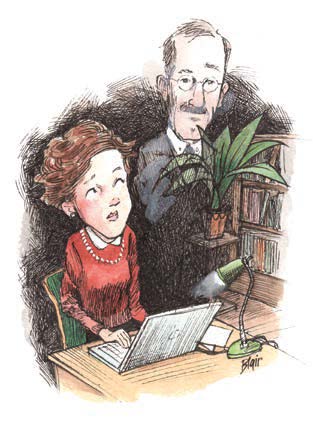
I have only seen him once, in profile, passing from the living room into the kitchen: a dapper, middle-aged man in 1940s clothing — attired in a patterned knit vest, double-pleated gabardine trousers, dark brown loafers and a fedora. Startled, as I jumped up from my seat at the kitchen table, he vanished.

I’m a largely rational creature and once considered myself the sort of person who didn’t believe in ghosts. I’ve read in paranormal literature that a ghost sighting is often referred to as an example of “ontological shock,” an event that causes one to question one’s worldview. Believe me. It has.

I have witnessed lights and spigots turning on and off, objects moving or falling, shadows that pass through walls, freezing cold spots with the central heating set at 74 degrees, a voice from my computer screaming “You’ve got mail!” at 3 a.m.

I have had to conclude that a dead person interacting with the living world — aka a ghost — inhabits my house. While you may scoff at that, spending only one night in my house would make you a believer. For the moment, my ghost and I have reached an uneasy peace. Neither of us is leaving.

However, I am in good company in believing that my roommate/apparition exists. According to a survey conducted by the Pew Research Center, close to 20 percent of people say they have seen a ghost. That equates to more than 50 million ghosts out there in the U.S. alone. A 2019 Ipsos poll found that 46 percent of Americans say they believe in ghosts.

The idea that the dead remain with us in spirit is indeed an ancient and abiding concept. From the Bible to Shakespeare’s Macbeth, from TV ghost hunting shows to my own kitchen, we’re obsessed by specters. Skeptics keep the debate going. They argue that, if ghosts are real, their existence will be verified through controlled experiments. They posit that reports of ghosts can be explained by psychology, misperceptions, mistakes and hoaxes. According to a 2019 article entitled “The Science of Ghosts” in Science News Explores, scientists found zero evidence that ghosts exist. What scientists have discovered, though, are a multitude of reasons why people might feel they have had ghostly encounters — hallucinations and pareidolia top the list. Pareidolia is a tendency for the human brain to find patterns amongst ambiguous stimuli. Is that a face you see in a cloud? Effectively, the brain finds meaning in the meaningless.

Still ghost stories persist. Prime Minister Winston Churchill and First Lady Grace Coolidge swore they saw Abraham Lincoln in the Yellow Oval Room. George Washington is said to have regularly revisited the historic chamber at Mount Vernon where he died in 1799. The ghost of former N.C. Governor Daniel Fowle has been haunting the Governor’s mansion. 

As I’m writing this, the light suddenly flickers in the den and once again my volume of Black’s Law Dictionary has fallen from its shelf and lies, open, in the middle of the floor. I replace the book, as I have so many times before, and calmly say, “Please leave the law books alone.” When you live with things that go bump in the night, you have to give them a modicum of respect and hope they do the same for you.

Art of the State

ART OF THE STATE

Earth Is at the Center

Christina Lorena Weisner’s art explores new frontiers

By Liza Roberts

Christina Lorena Weisner’s art emerges from her deep connection to the earth, to its systems and rhythms, its elements and mysteries. She studies the planet like a scientist and discovers it like an explorer, venturing to its far ends to record its extremes in person, to live within its phenomena. She turns her insights into art she hopes will inspire awe for our planet’s grandeur and empathy for its vulnerability.

Her latest fascination is the North Pole, where she spent two weeks immersing herself last spring with an expeditionary art and science residency called The Arctic Circle. “I can only describe it as the most impactful experience of my life,” Weisner says. “I’ve been interested in water for a long time, and I wanted to immerse myself into this landscape of glaciers in order to better understand it.” 

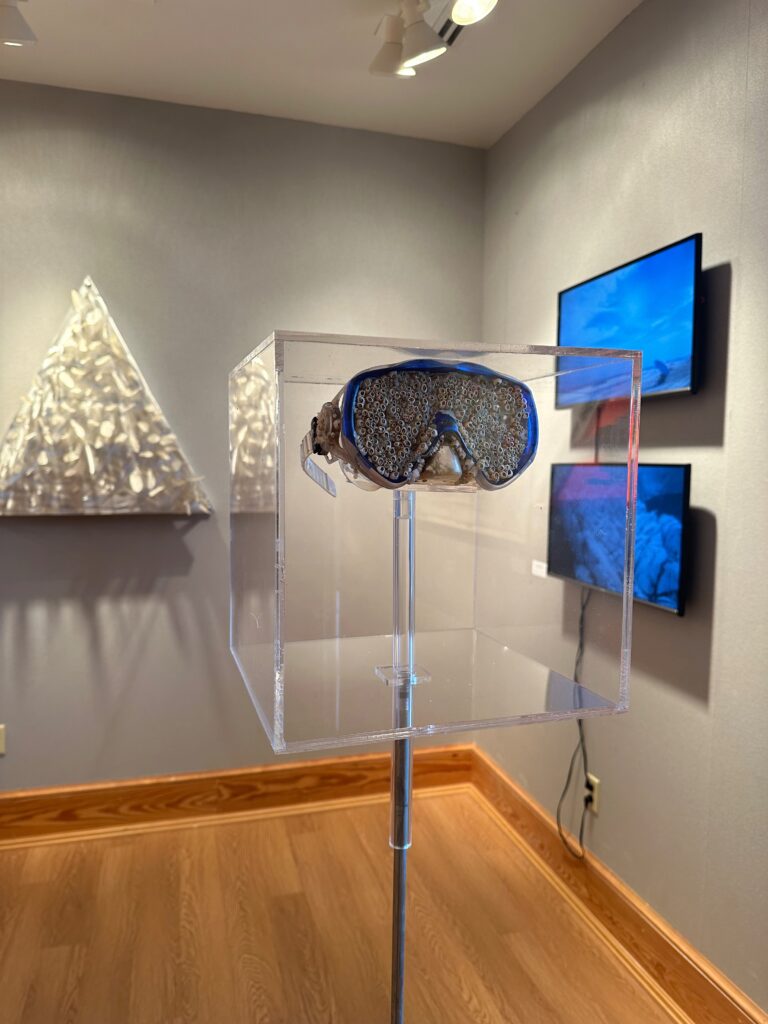
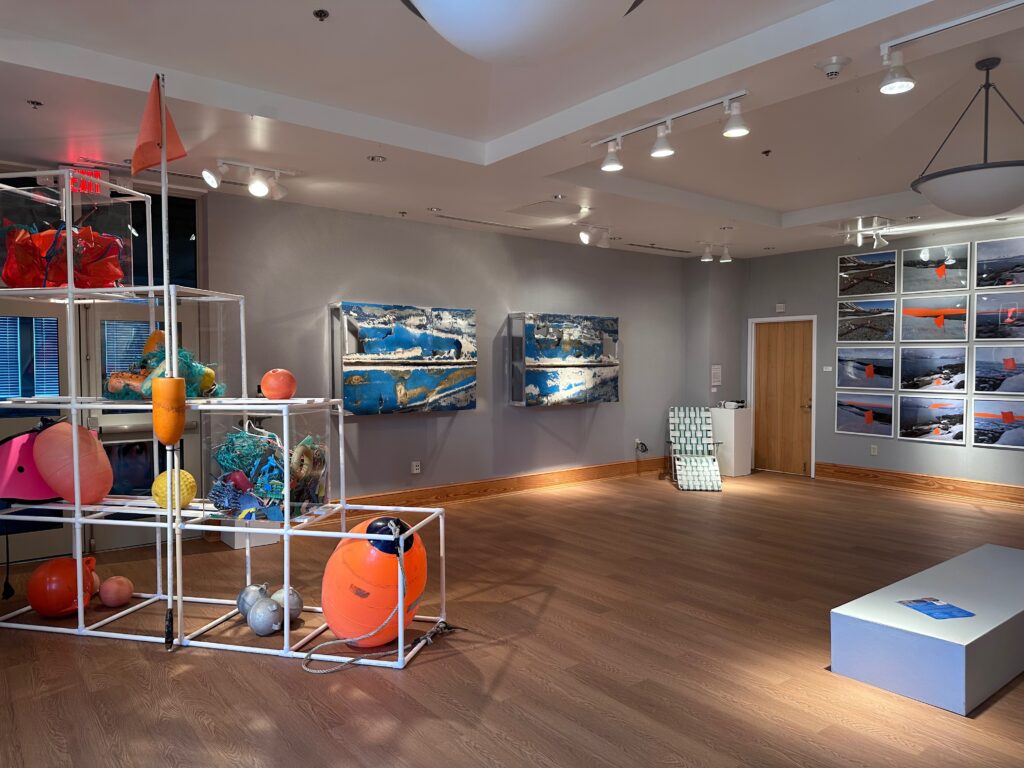
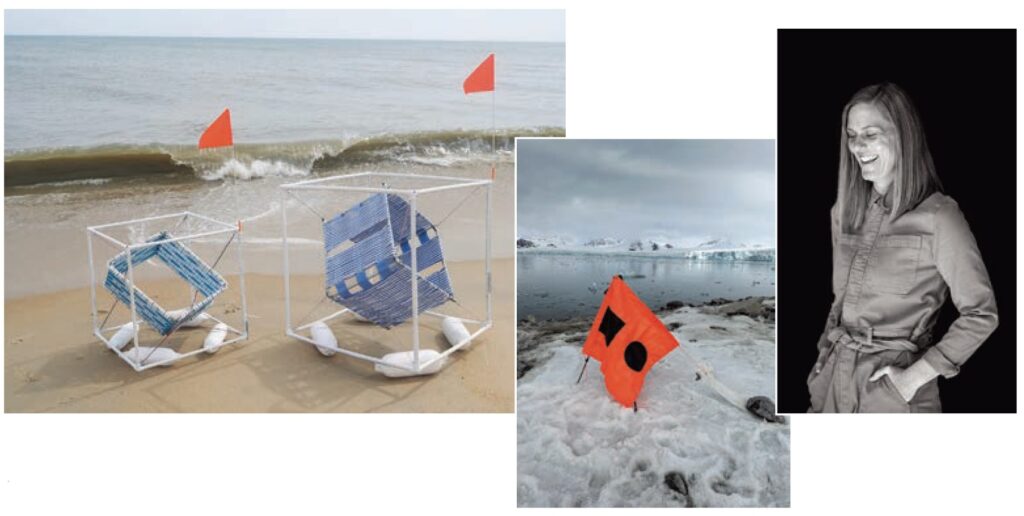
The expedition’s ship, which carried 30 fellow resident artists and scientists, took Weisner and others to the Svalbard Archipelago by outboard Zodiacs twice a day, always surrounded by “a triangulation of guards with guns” to protect them against polar bears. While ashore, Weisner planted an orange safety flag in the icescape, making it a recurring motif in her photos. She also used a drone to shoot video from above and collected plastic. 

“You’re in a land that you know is changing, you’re looking at a glacier that might not be there in 100 years. You’re looking at history,” she says. That history was evident in other ways, too, like a massive pile of whale bones left behind by 19th century whalers, and the detritus left behind by scientific explorers of that time. “There were many instances where I was thinking of human history as it relates to geological time,” Weisner says. 

The trip “was the catalyst for a whole new body of work,” says Weisner, who is headed back next May. That work includes still photography of that mythic frontier, sweeping video and installations that incorporate pieces of plastic she collected in and around Svalbard.  

Recently, her work was in Surface and Undercurrents, a group show at Dare Arts in Manteo, and this month she is part of a group exhibit at Emerge Gallery & Art Center in Greenville. Next April she will be featured in a group show at Central Connecticut State University on climate change in the Arctic, and in June her work will be exhibited in a solo show at the Museum of Contemporary Art in Arlington, Virginia. 

A native of Richmond, Virginia, Weisner says she can trace the beginnings of her work as an artist to a job she had with Nag’s Head Ocean Rescue in her early 20s. When she wasn’t saving swimmers, she stared out at the ocean for 10 hours a day. “I would watch the sun move across the sky and the moon come up,” she says. “I was very aware of these bigger processes — these large-scale movements, like waves coming over from the coast of Africa — that we’re not often aware of.

Other little-seen influences in her work come from her wide-ranging education, which includes an MFA from University of Texas at Austin and separate undergraduate degrees in both world studies and fine arts from Virginia Commonwealth University. The interplay between humans, time and the planet has long been a theme in her work. As a former competitive swimmer and regular runner and biker, she experiences the world in a visceral way, creating art that is informed by the way we live within the world and the way the world lives with us. 

From her home in Kitty Hawk (she’s soon to move to Duck, two Outer Banks towns away), Weisner rides a bike or runs along the beach every day to note its transformations. “It’s the same beach, but it’s completely different, the water color, the form of the waves, the temperature of the wind,” she says. Sometimes she finds objects to incorporate into sculpture as she goes. 

Waves and wavelengths — audio, seismic and light — all inspire her. A meteorite impact crater in Southern Germany was the subject of sculpture and installation art she created with the Fulbright Grant she was awarded in 2013; she used seismometers to record earthquakes as part of a Mint Museum installation in 2018.

One early morning in March 2022, I had the chance to witness her in action. On the shores of Kitty Hawk Sound, I watched as she zipped up her wetsuit, assembled a series of floating sculptures, and waded with them into the frigid waters. The sun wasn’t fully up, the air was barely 40 degrees and the art she was wrangling was bigger than she was. Weisner took it all in stride. In a matter of minutes, she’d glided 50 yards from shore and her art was floating all around her.

The largest of the three pieces of art with her that morning was one she’d attached to her outrigger kayak and towed 275 miles down parts of the Eno and Neuse Rivers and through the Ocracoke Inlet in 2019, recording audiovisual information and environmental data (including a panther sighting) along the way. Two smaller works included discarded beach chairs from one of her regular oceanside jogs.

Her approach with every subject, Weisner says, is to embrace what she doesn’t know, and to let her new knowledge as well as her material guide her. 

“I’m still a process-oriented artist,” she says, one focused on “openness to material and play, not taking my work too seriously . . . and not being too pigeonholed.” She thrives when she can employ all of her senses in the making of her art, especially work that involves nature. And she loves making connections across time and place. 

When the polar vortex winds of 2022 washed an old canoe up on the side of the road near her house, for instance, she picked it up and brought it home. “It had beautiful layering on it,” she says. “The water had rotted holes into it. I think it had been submerged in the sound for a couple of years.” 

The fact that winds from the Arctic dislodged it and brought it to her North Carolina shore fascinated her, she says, and that canoe has become part of her latest Arctic-inspired installations. “No place is an isolated place,” says Weisner. “Everything we do — everything that happens in one geographic location — impacts other geographic locations.” 

The Modern Day Evolution of the Industrial Revolution

THE MODERN DAY EVOLUTION OF THE INDUSTRIAL REVOLUTION

The Modern Day Evolution of the Industrial Revolution

Heavy metal makes a comeback

By Billy Ingram

Covered in rust, covered in scale grease — no one wants that in their home.” That’s Chris Lutzweiler describing the Industrial Age metallic mastodons he scours the country for. Lurking under the surface of this Jurassic junk is what he sees as unimaginable beauty. Hidden for decades, fallowing in forgotten warehouses or lying flat in furrowed fields, there’s an unmistakable allure that is, as he puts it, “all hiding underneath.”

Hiding in plain sight to him, yet, to the untrained eye, nothing more than the detritus of a bygone era, unwanted, dilapidated tatterdemalions transform when, conducting business as The Rustic Factory, this metallurgical magician performs his extraordinary act of restoration prestidigitation.

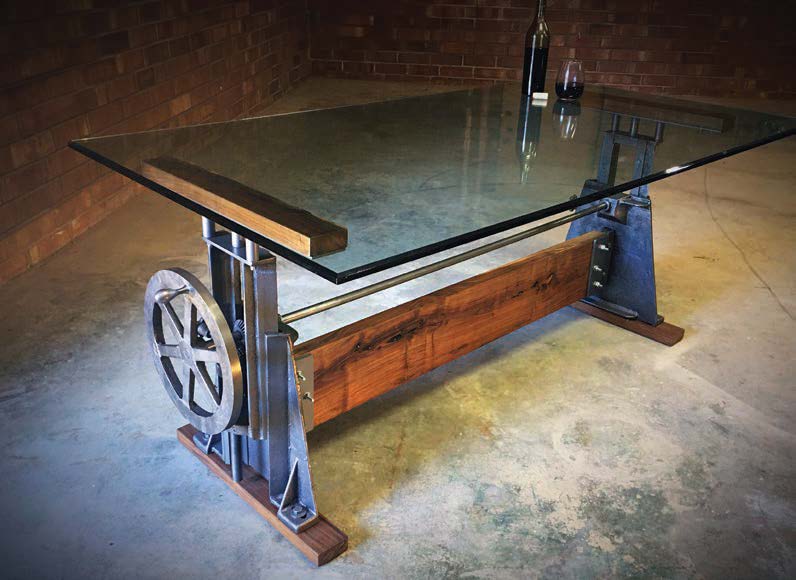
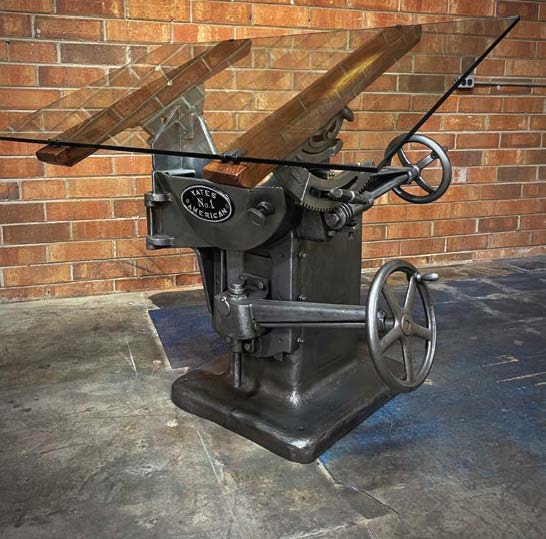
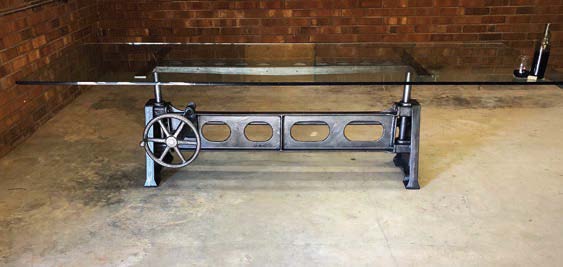
A heavy-duty table saw dated 1930 has been converted into an impressive 30-by-50-inch drafting table featuring a new glass surface, easily adjustable both up and down, and vertical to horizontal. In a similar vein is a commanding boardroom table, spanning approximately 14-by-14-foot with an 8-foot base, topped with a $5,000 glass surface weighing over a quarter- ton. “You can literally crank it higher or lower with just one hand.”

Fashioning furniture from outmoded heavy machinery was a shabby — not- so-chic — concept embraced in the 1960s and ’70s, when lofts carved out of shuttered manufacturing plants were leased to bohemian artists and musician-types. These creative free spirits mounted tabletops over abandoned hulking monstrosities that weighed hundreds or thousands of pounds and were forevermore bolted into hardwood floors, thereby rendering the intractable practical.

Somewhere along the line, that forward thinking, backward-leaning sensibility tilted from hippie to Haut. High-end lifestyle purveyors like RHA and Restoration Hardware began marketing vaguely reminiscent specimens of industrial-looking home and office furnishings.

There are entire lines of steampunk-inspired executive desks and home furnishings scattered about the marketplace today, pleasing enough to the eye. But these too-cleverly designed pieces betray an overly-labored approach at approximating some fictitious exactness, so overwrought that any minor adjustment requires motorization. Mere superficial “reproductions,” they lack any genuineness or authenticity that made the genre appealing to begin with. Researching this stylistic phenomenon, Chris Lutzweiler realized that most of these ersatz thingamabobs-cum-household-accoutrements actually originate overseas. “I still loved the look,” he insists, “but I wondered what inspired that style? Where’s the real deal?” What he discovered is that those real deals “are egregiously expensive, shockingly so, and incredibly difficult to source.”

Born in Chaska, Minnesota, but raised in Greensboro, Lutzweiler never envisioned pursuing a career crafting one-of-a-kind furniture from sidelined tool-and-die contraptions resurrected from the turn of the last century. And yet, the attraction came naturally. “I’ve always been fascinated by the mechanical nature of machines,” he explains. “Any kind of machinery, any kind of engine, moving parts, anything like that.”

After about a year with little clue as to what he was actually doing, he says, “I spent a small fortune, but got started with a couple of authentic pieces.” Lutzweiler began retooling and simplifying complex machinery that could be employed as resolute office desks, dining room tables and the like from discarded dinosaurs of the industrial age.

No matter the source material, this is a labor-intensive undertaking. “There are people that like this style but can’t really go for the authentic thing because there’s a cost to it,” Lutzweiler says. “It’s not cheap, but a lot of people who reach out to me want the real thing.”

The first step is bathing any moving mechanical parts in a strong, penetrating oil — hardware, bolts, pulleys or anything else that will need to be extracted.

After allowing the oil to penetrate over several days, the original piece is carefully and painstakingly disassembled and cataloged for reassembly. “At this point, larger components are glass blasted with heavy industrial equipment outside of my facility,” Lutzweiler explains. “Smaller and more manageable components are done myself by hand.” After a century’s worth of rust, paint, scales, grease, and dirt are eradicated, only the cast iron or underlying steel remains. “This is a critical time as bare iron or steel will actually ‘flash rust’ within minutes.” The next step is mission critical, Lutzweiler insists, and if not performed immediately, the time- consuming blasting process will have to be repeated. “Freshly blasted metal is usually a dull gray or white, and full of residue and salts,” so removing that corrosive patina and achieving a desired, cast iron finish requires hours of high-speed polishing and wire brushing. “This is the longest and most intense portion of the process that brings out the beautiful, natural color of the metal.”

The clock begins ticking again, buffed metal needs sealing as quickly as possible before any rust can form. “Each individual component is sprayed with clear coating, then the entire piece reassembled and clear-coated again several times over, ensuring that natural finish is protected.” Lutzweiler once spent an entire workday preserving a single fastener: “Nearly eight hours to save the original bolt, where a new one would have sufficed. However, the customer wanted it as original as possible.”

When it comes to maintaining the structural and period-perfect integrity of these armored antiquities, Lutzweiler occasionally needs a capability beyond his capacity. With those unusually hard cases, he has turned to Scott Cain at GFC Machine in High Point, an automotive machine shop specializing in race car chassis construction, repairs and custom fabrication.

Cain recalls when this wannabe furniture-maker (prior to Lutzweiler even entertaining such a thought) first entered his shop: “It was years ago, when he was at GTCC’s automotive program.” For college credits while still in high school, Lutzweiler attended GTCC’s middle college, where, one afternoon, an instructor guided students through GFC’s workplace, offering some insight into what machine shops are capable of.

“I’m going to say, maybe five years ago, Chris started coming here to get me to do little odds and ends for him,” Cain recalls. Those “little odds and ends” often entailed work-arounds that would likely stretch the capabilities of the most accomplished machinist. “His stuff is extremely old and just a little problematic to get what he wants done with it, to get pieces to break loose without damaging the parts.”

“Scott is a great guy — he shakes his head every time I come in the door,” Lutzweiler remarks with a grin. “I have to give him a lot of credit because the man is a genius with anything metal and I want things to be authentic. If that’s how it was originally done, I want to do it that way; I don’t want to improvise. And he just wants to shake me sometimes.” It’s a fortuitous match.

“Any time there is a customer-facing welding spot, I’ll ask Scott to do ‘NASCAR-style’ welds that are cleaner and more rhythmic,” says Lutzweiler.

“Honestly, it’s all in a day’s work,” is Cain’s response. Recalling a particularly complex collaboration, he adds, “One of his tables had a set of gears that had four individual Acme thread posts that would elevate the tabletop. Yeah, that one was difficult. When it worked right, it kinda made me feel good because it was such a challenge.”

That particular item, a Portelvator adjustable hand-crank cart made by The Hamilton Tool Co. circa 1890–1930, was sitting, nonfunctional, in the lobby of a high-end fitness studio in Detroit, presently enjoying new life as a deceptively simple bar cart. “What made the whole thing tricky was every component had to be precisely in sync or the gears would lock up,” Lutzweiler explains, down to the threaded rods, sun gears, worm gears, pins and chains.

Lutzweiler’s venture has him traversing across East Coast byways, exploring the Rust Belt’s every loop, in pursuit of technologically primitive behemoths originally manufactured for carving out cabinets, window frames, dining room tables and the like; those machines that once made the furniture, in turn, will become furnishings. “Ohio and Pennsylvania are a treasure trove of authentic turn-of-the-century pieces.”

Of particular interest, many of the most desirable mechanical manifestations of Industrial Revolution ingenuity were forged right here in Greensboro. Lutzweiler describes one of those transformations as “a Wysong & Miles crank table for a molding sander that can now be a dining room table or an office desk. You can turn the hand wheel and it will raise and lower.”

Augmented with a glass top weighing in at 300 pounds, “you can adjust it with two fingers, it’s so smooth. It even says ‘Greensboro, North Carolina’ right there on it.” Wysong (sans Miles) has significantly downsized, but is still doing business locally.

A hefty Wysong & Miles Co. belt sander currently serves as the base for an executive desk, where floor-level hand-wheels turn with incredible ease to lift the 150-pound glass top effortlessly. “I actually polished each individual chain link by hand,” says Lutzweiler. While he can’t be sure of the exact date, he notes, “the machine had a patent number on it dating to 1896.”

In most cases the fossilized relics he’s uncovering were one-offs, built at great expense to specifications for specialized tasks. Inevitably, they ended up discarded by the companies that utilized them after an ignominious descent into uselessness, shoved into cobwebbed corners or piled outside into junk-heaped islands of misfit toys. Take, for example, a Pennsylvania casket factory crank table Lutzweiler unearthed. “It had been sitting there since it was purchased, according to the fourth-generation owner; they’d never used it in his lifetime.”

Although these aging bulls no longer emit whatever pitch they once played — one can imagine cacophonies of sense-dulling grinding, scraping, jangling — in silent repose, they elicit an instantly recognizable, weighty vibe. Native to hardwood floors, these pillars of grand austerity can’t help but add momentously to the vocabulary of any room, in particular lending an unmistakable sense of architectural symmetry when situated in an equally distinctive environment.

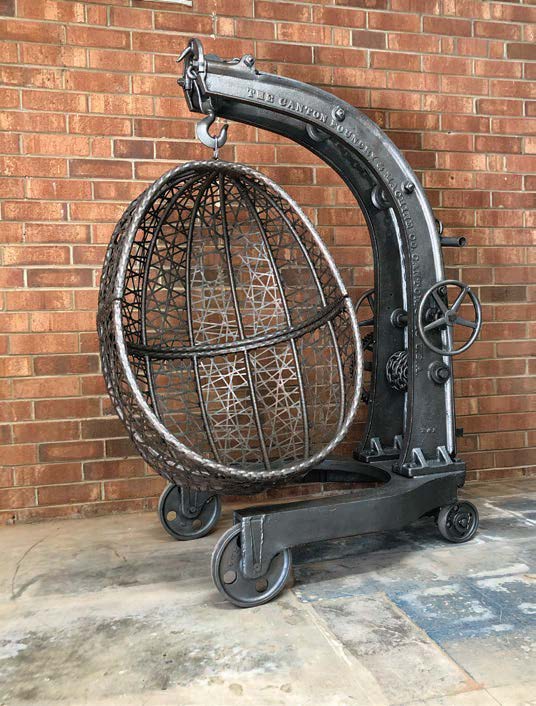
A celebration of hardware pre-software, there’s timeless beauty in a hanging throne, fit for royalty, improbably adapted out of a rusting artifact resembling something rightfully left behind on Skull Island. These theatric lounge chairs are constructed around pre-World War II engine cranes and elephantine factory winches once used to maneuver heavy equipment. “You can literally sit in there, take a nap, read a book, fall asleep, watch TV,” Lutzweiler says. And they’ve proved popular.

Although his company has a web site (therusticfactory.com), if mid-century Mad Men taught us anything, it’s that word-of-mouth advertising is the only sure-fire campaign — can’t fake that. “Clients will have somebody over for dinner,” Lutzweiler points out, “and somebody will say, ‘I want that for my boardroom, or a beach house — where do I get a table like this?’ And they’ll put them in contact with me.” Repeat business is something he’s become accustomed to. One gentleman, who’d previously acquired creations from The Rustic Factory, “asked if I could repurpose the wooden trusses of a vintage pre-World War I airplane into a chandelier with wings on either side. It’s all wood and completely encased in glass with run lights throughout it. This thing is probably 30 feet long.” Lutzweiler explains, “The wing lowers when he wants more light, raises when he wants it to spread out more, and it’s just a few turns of a handle. It was such a massive project, GTCC’s aviation program was kind enough to let me use their facilities to assemble it.”

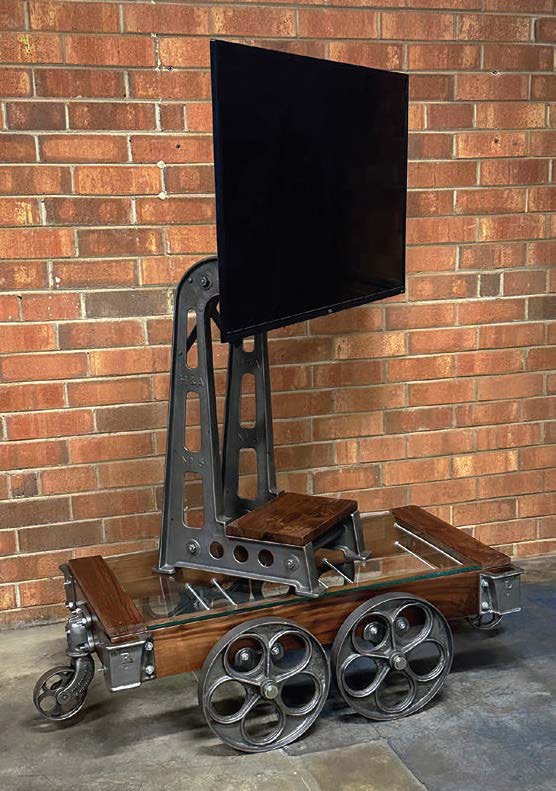
For the same client, Lutzweiler painstakingly restored then assembled four Lineberry carts sourced locally from North Wilkesboro — and “usually fairly gross” to begin with — into a train to fabricate a TV stand. “It goes in a long, long pattern and it’s got a handle at the end. What I love about this is, it’s so ridiculously heavy — egregiously heavy — but we figured out how to make it so anyone can move them.” That handle consists of a pivot with a pin. “You just pick it up with literally two fingers and you’re moving a thousand pound train. It’s insane how effortlessly these things move.” Typically in that instance, artisans will take the existing wooden top, sand it down then scuff it up a bit. “However, I don’t want to do what everybody else does. I actually installed black walnut to achieve a book-match effect.” As much as Chris Lutzweiler is in the groove right now, there’s an inherent finality to the direction his life has taken. “These are depleting assets,” he says. “There’s only so many of them left.” It’s become something akin to a treasure hunt, rooting out what few oxidizing dinosaurs may be remaining, yet to be revealed. “People that know what these are in the industry, they all go for them at once, and it’s who can get there first and fastest. Sad part is, eventually I’ll have to change business models or do something different, which is fine — when the authentic pieces do dry up.”

Poem

POEM

October 2024

The Doorman at the Washington Hilton

Regal in his red cap and Nehru tunic,

he summons with a silver whistle,

depended from a silver tassel

around his neck,

a taxi for Jacob,

our first-born –

mere minutes to make his train

to Philadelphia, then another

to New York, and the plane

to Dubai, then Zambia.

How can it be that you raise children

for the world and they rush off to it,

places and people you’ll never see.

Is that your son, the doorman asks.

When I am unable to answer,

he tells me of his son, in Iraq,

his fear of the telephone

he can’t bear to answer.

All week, this man has held doors for me,

hailed cabs,

smiled as if he did not have such a son.

    — Joseph Bathanti

Chaos Theory

CHAOS THEORY

A Haunting Tale

Yes, ghosts are real. Unless you’re my kid who’s going to bed — then no

By Cassie Bustamante

“Ghosts aren’t real,” I tell my 5-year-old, Wilder, as I tuck him in for the night, regretting that I let him watch Scooby-Doo. I don’t actually believe what I am saying, but parents will say whatever they have to to get their kids to just go to sleep. Just ask Adam Mansbach, author of the infamous Go the F*** to Sleep.

But back to the matter at hand. “Ghosts are very real,” I tell my husband, Chris, once Wilder is asleep. He doesn’t agree — and always sleeps like a champ. “Don’t worry. If I die first, I’ll prove it to you,” I say. “I can’t wait to haunt you!” (Actually, yes, I can.)

Do I have proof? No, but I have stories.

When I was a teen growing up in a small town in western Massachusetts, my godmother, Aunt Debbie — my mom’s sister, younger by just a year — would take me on weekend shopping trips, east to Boston or west to Stockbridge. She didn’t have kids of her own so she treated me like her daughter, buying me dangling jewelry she called “baubles.” We’d jam to the tunes of Gloria Estefan and Steve Winwood, and she’d regale me with stories from her life, which seemed much more dazzling and whimsical than my family’s boring white-picket-fence, suburban existence. What I didn’t understand at the time was that those seemingly exhilarating moments were part of her ups. She never shared the downs of her bipolar disorder with me.

Debbie was somewhat of a widow. She’d lost her husband, Michael, to ALS, but they’d been separated at the time of his diagnosis, remaining legally married for insurance purposes. As his illness progressed, despite each having new significant others, their friendship became stronger than ever.

Immediately after his funeral, friends would drop in to share memories, drinks and laughs. But then she threw a party akin to the wild ones they threw when Michael was alive, certainly not your typical post-burial get-together.

On one particular godmother-and-goddaughter weekend as we’re on our way to the Berkshires, she spills the details. “I had a cake made with his face on it and put candles in his eyes,” she says. Already, I’m intrigued and we’re both giggling over the absurdity of it all. After all, this was 1995 and face cakes weren’t really a thing yet. “We turned off the lights and had a seance. One of his friends said, ‘Debbie, you shouldn’t do this! He’d be so mad!’”

That night, she continues, a vicious storm passed through, knocking out power and tossing a tree onto her little Honda sedan, which was parked in the driveway. Coincidence? Maybe, but there’s more.

Pictures fell off a stable living room shelf.

“The alarm by the hall closet kept turning on when I would walk by,” Debbie says. Not just any hall closet, but the place where she stored Michael’s suits, soon to be passed on to his younger brother. “I said, ‘OK, Michael. I get it — you’re telling me something!’” she says as we cruise down the highway. “I decided to rifle through the pockets and discovered a watch he didn’t want his brother to have.” And, as soon as she retrieved it, the alarm was silent.

On the morning of April 2, 1996, just as I was getting ready for school, my mom received a call. Her sister had taken her own life — just shy of her 40th birthday — the night before. Though tragic, it wasn’t a complete surprise, although we’d hoped things were turning around for her. She’d found a new love, bought a house with him and was, it appeared, happy. But you never know the demons someone battles.

In the months that followed Debbie’s passing, I looked for signs of her presence everywhere. I watched for lights to flicker or alarms to sound seemingly on their own. I played the Mary Chapin Carpenter cassettes that I inherited from her collection, hoping a message might come through. But no visitations followed and I decided she was finally resting in peace.

Ten years later to the day Debbie died, it is April 1, 2006.

I’m in Maryland visiting my parents with my first baby, 8-month-old Sawyer, who has slept solidly through the night since he was 6 weeks old. At midnight on the nose, something startles me awake: a noise over the baby monitor.

But Sawyer isn’t crying. In fact, he’s cooing and chatting away happily, as if talking to someone. And in that moment, I know exactly who: Debbie, who always loved babies, but never had her own. Debbie, who loved me like a daughter and would have loved this baby as if he were her own grandchild. Paralyzed by this realization — and slightly terrified, if I am being honest — I decide not to go to him. He babbles. He gurgles. He coos. And, as if lulled by an unsung lullaby, he drifts to sleep. I, of course, check on him later and find him snoozing peacefully, the corners of his mouth forming a sweet smile behind his pacifier.

So while I tell a little white lie to Wilder because I’m ready to go to bed myself, I do, in fact, think ghosts are real. And perhaps one day, hopefully 50 years from now if I am lucky, Chris will be telling our grown children and grandkids about the little ways I’m letting him know I’m still around. No matter what, I’ll make a believer out of him yet.

Tea Leaf Astrologer

TEA LEAF ASTROLOGER

Libra

(September 23 – October 22)

When the shoe no longer fits, no amount of stretching or bending will change that. This year has given you loads of opportunities to release what no longer serves your highest path. And with the solar south node eclipse in your sign on October 2, suffice it to say that this month is going to be more of the same — uncomfortable yet, ultimately, liberating. A word of advice on moving forward: You’re going to want arch support.

Tea leaf “fortunes” for the rest of you:

Scorpio (October 23 – November 21)

Be the squeaky wheel.

Sagittarius (November 22 – December 21)

Dog-ear the page for later.

Capricorn (December 22 – January 19)

Best not to download the app.

Aquarius (January 20 – February 18)

Lie down if you start feeling dizzy.

Pisces (February 19 – March 20)

Hint: They can’t read your mind.

Aries (March 21 – April 19) 

Book the trip.

Taurus (April 20 – May 20)

Bypass the candy corn.

Gemini (May 21 – June 20)

It’s time to call the shots.

Cancer (June 21 – July 22)

Write a love note to yourself.

Leo (July 23 – August 22)

Prepare for liftoff.

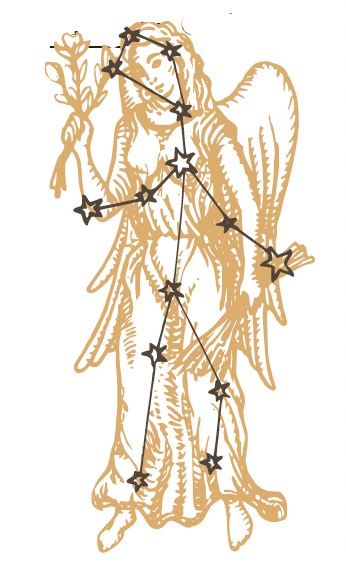
Virgo (August 23 – September 22

Sometimes more is more.

Wandering Billy

12 DAYS OF CHRISTMAS

How I learned to always give credit where credit is contractually obligated

By Billy Ingram

For reasons I’ll never understand, from the mid-1980s until the mid-1990s, I found myself working as an artist for Seiniger Advertising in Beverly Hills, a movie poster design team that became known as “The New York Yankees of Motion Picture Advertising.” During the last century, when movies were enjoying the industry’s most lucrative period, a lean, mean design team of about 30 of us found ourselves creating one-sheets — the movie posters you see in theaters — and trailers for the biggest blockbusters ever.

We cranked out hundreds of posters for movies such as Pretty Woman, Hook, Ghost, and Field of Dreams, and worked on films that became franchises, including James Bond, Die Hard, Lethal Weapon, Indiana Jones, Beverly Hills Cop, Star Trek and Rocky. And that’s not even mentioning every Tom Cruise, Harrison Ford, Kevin Costner and John Hughes release. They all came out of the Seiniger studio. Here are a few meaningless yet entertaining anecdotes from a time when I was Hollywood swingin’…

The Prince of Tides: Barbra Streisand was/is famous for micromanaging her projects, all the way down to creative control over all advertising and publicity, including movie posters. For a couple of weeks after shooting wrapped, Streisand would send over suggestions for the Prince of Tides poster and I would work them up — usually consisting of a photo for the background, another for the foreground. They would arrive, about half a dozen at a time, promptly at 6 p.m. and she needed to see completed comps by 9 a.m. If at first glance I thought her choices odd, inevitably they turned out to be very attractive and astute. However, there was one particular on-set photo she liked a lot of her and co-star Nick Nolte in bed, Barbra in a nurturing position. Trouble was, she kept wanting to see her head larger, which naturally meant Nolte’s noggin got bigger. Eventually, the context was lost. That became obvious when someone passed by my desk, saw this mockup and remarked, “That looks like Barbra Streisand with her pet head!”

Boomerang: We were toiling away on a typical campaign for a romantic comedy starring Paramount Picture’s biggest star until one afternoon, when we were instructed to stop and switch directions. Seems the star decided he wanted to be the next James Bond. And, as it happened, that franchise was in limbo after License to Kill bombed at the box office. From that point on, every poster design for that Paramount romcom had to make the star look as “007” as possible. Bond being another studio’s property, what could have been an unusual casting choice (to say the least) was ultimately nixed — but, if Ian Fleming’s creation had belonged to Paramount, there’s no doubt the next entry in that franchise would have starred . . . Eddie Murphy as James Bond.

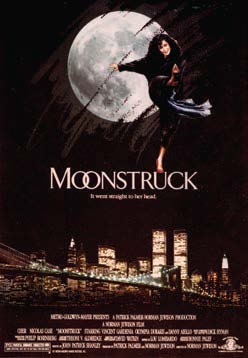
Moonstruck: The image of Cher on the Moonstruck poster (from a location shoot in Central Park by Annie Leibovitz) is one that almost everyone remembers. In fact, it won what is now the Academy Award for Best Movie Poster that year, another home run for the Tony Seiniger shop. That image is actually composed from three different photos — the head, the torso and arms, and the skirt with legs all came from separate frames.

This also-ran for Moonstruck (shown) has some of the same elements as the final poster, but . . . why is Cher up in the night sky lashing out at the logo? What’s even more puzzling is why is the moon moving so dangerously close to the Earth? File this one away for Cher’s sci-fi sequel: Moonstruck the Earth!

Star Trek VI: This particular comp, I had very little — if anything — to do with, but, whenever I drifted into a new project, I would pull the actors’ publicity contracts that we kept on file just in case. While this design by Bob Peak, a highly-acclaimed artist who rendered the illustration for the first Star Trek motion picture one-sheet, is striking and effective, I warned the art director that it would never fly. William Shatner’s contract stipulated that only Leonard Nimoy, DeForest Kelley and Shatner himself could appear on the movie poster, so this was a nonstarter.

Bugsy: One day, I noticed an older gentleman meandering around our bullpen, observing with interest how we were manipulating images, so I struck up a conversation. He was none other than George Hurrell, the photographic genius who captured indelible portraits of 1930s/1940s Tinsel Town immortals such as Garland, Harlow, Crawford, Bogart, Gable and Garbo. I was fascinated as he explained his technique of touching up those picture-perfect images directly on 8-by-10-inch negatives. This was 1991; he still had his studio, but confessed he felt his work had been forgotten in the business, and was grateful Warren Beatty had requested a photo shoot with him for the Bugsy poster. Hurrell passed away the next year.

With all the different directions and rush-order variations requested over several months, primarily by Warren Beatty, the one-sheet for Bugsy somehow became the most expensive of all time (a record I doubt will ever be broken) — around one million dollars just for the movie poster alone. And yet, as gorgeous as George Hurrell’s stark depiction of Beatty was on the final design that both star and studio agreed on (shown fronted by Annette Bening, photographed by Bruce Weber), Bugsy’s director, Barry Levinson, was so miffed at having been left out of the process, he rejected it and demanded input. As a result, the final poster was merely a generic tango pose of the two stars lensed by a more au currant Hollywood photographer, Herb Ritts. They could have photographed it at Glamour shots in the mall.

Before working at Seiniger Advertising (a company so exclusive the phone number was unlisted), I never gave one thought to how movie posters came into being. I just fell into it. During this almost 10-year period, I actually provided the illustration for The Hunt For Red October poster and generated graphics for award-winning trailers and main titles including The Fugitive and Robin Hood: Prince of Thieves.

Glamorous? Hardly. Almost every night, we had no clue when we might be able to go home; relentless deadlines resulting in 14-, 16-, even 26-hour days were expected. Working under the most stressful conditions one can imagine for long periods of time, we formed familial bonds that extend to this day, friendships and harsh relationships that I look back fondly on — and paydays I wouldn’t mind becoming reacquainted with.

Almanac

ALMANAC

Almanac October

October speaks through the beaks of 1,000 crows.

Can you feel them gathering? Murders of 20, 40, 60 strong, each bird like a sibyl gone mad.

“The sun is sinking, sinking, sinking,” they shriek, raspy voices harsh and urgent.

You know it’s true. The days are much too dark, too soon. And yet, right now, the sky is a cloudless blue; the maple is thick with yellow leaves; the light has washed everything golden.

Don’t let the raucous birds rip you from the moment: The warmth of sunlight on your face; the scent of wet earth; the swirl of amber leaves somersaulting through endless azure.

The crows kick it up a notch, throw back their ink-black heads, blurt their ghastly premonitions until their babble turns to laughter.

Dark and maniacal, their howling conjures a mighty wind. Do not be frightened by the glossy-winged seers. Let them rally in the shadows while the days are still honeyed. Let them pull you more fully into the luminous now.

Cock your head sideways as the crows do. Can’t you see? It’s all here — the freshness of the season; the bitter whiffs of sweet decay.

Notice that the crunch of dead leaves somehow enlivens you. “Yes, the sun is sinking,” you want to call back. “But . . . the air is alive! The leaves are turning cartwheels!”
A wild laugh rises from deep within you. The light is fading. The crows are cackling. As autumn picks at her own golden thread, even the dead leaves seem to snicker.
Patch v. Orchard

Nothing says wholesome autumn fun like a pumpkin patch. Adorable. But if you’re looking for a pick-your-own adventure with an edge, venture to an apple orchard.

Spend a quiet hour among the trees. Study the gnarled branches. Listen for the thud of ripe fruit knocking against the sleepy earth. Dance with the shadows.

About 75 percent of our state’s apple crop is grown south of Asheville in Henderson County. Should you head west to peep and marvel at the turning leaves, consider stopping by an orchard — or farm stand — for the freshest of the fresh. 

At the very least, snag a gallon of cider to-go.

I remember it as
October days are always
remembered, cloudless,
maple-flavored,
the air gold and
so clean it quivers.

— Leif Enger,
Peace Like a River

Color Crescendo

True leaf peepers will tell you that the best time to hit the Great Smoky Mountains or Blue Ridge Parkway for peak fall colors is the second week of October. Go a week early and be underwhelmed; a week late and you’ll miss it.

Whether or not you take the drive, the color show will surely find you — if not through leaves then through flowers. Kaleidoscopic chrysanthemums. Luminous marigolds. Tender snapdragons. Drifts of brilliant pansies.

And just watch how autumn light transforms every gorgeous hue.

Worth the Wait

12 DAYS OF CHRISTMAS

Worth the Wait

A designer and a contractor pair up and push the envelope

By Cassie Bustamante  
Photographs by Amy Freeman

When it comes to communicating exactly what she wants, longtime pal Erica Worth hasn’t been the easiest client interior designer Kara Cox has worked with. For instance, when it came to the design of the Figure Eight family beach house, Erica simply told her, “I want the house to look like linen feels.”

Erica straightens up in her seat and tosses her friend a side-eye, the corners of her mouth turning up: “I wanna make Kara work for her money.”

Kara continues to needle her friend, whose Irving Park house project the two have just wrapped up. The inspiration this time around? Erica presented Kara with one solitary item: a throw blanket she’d brought home from Ireland.

“Seriously?” Kara recalls saying. “A throw — that’s it?”

Her order was simple: “Make it look good in every room.” The wool plaid throw — in shades of plum, tan, gray and green — currently rests on the back of their family room sectional, just visible as you enter through the home’s front door.

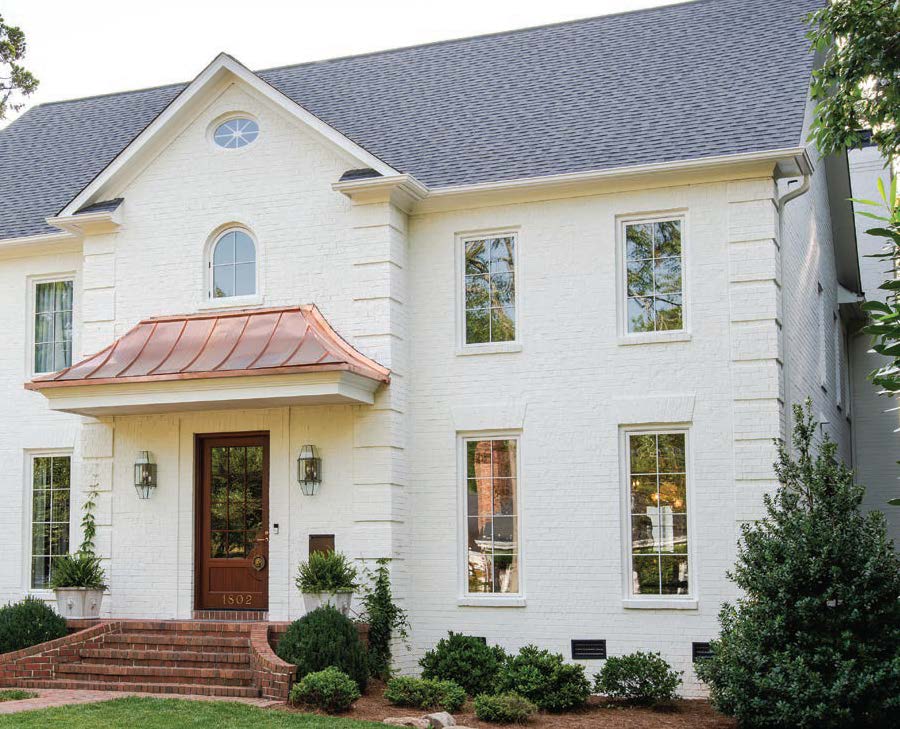
The door itself is a work of art, expressly designed with a circular space intended for a large-scale, brass lion-head knocker reminiscent of Narnia, original to the 1996 home. “A labor of love,” according to Erica, it’s a custom-built, glass-paneled beauty that allows plenty of light to shine on the newly remodeled foyer and interiors, making it easy to see that the mission was indeed accomplished.

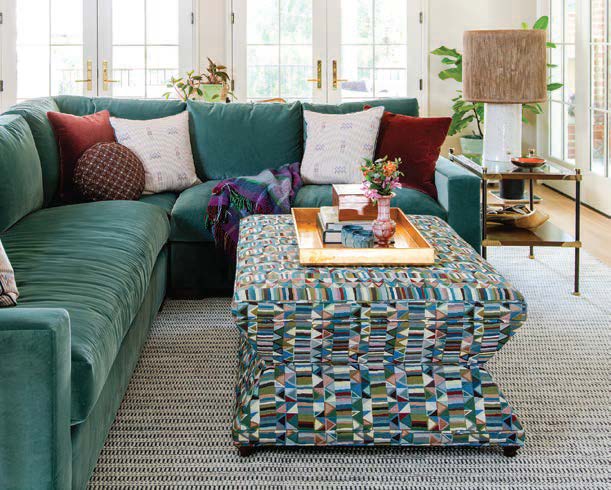
“In every house that I build, I try to put something that was there originally, whether it’s a light fixture or a door knocker or a piece of ironwork or something that belonged to that house,” says Erica. Serving as her own general contractor, she ended up taking the entire first floor of the two-story brick home down to the studs.

She hasn’t always been a contractor, though. In fact, Erica says, “I am fairly new in my industry,” having earned her contractor’s license in 2018 and subsequently establishing her LLC, Worth Builders. While the construction business was in her blood — her own father owned a lumber business and worked in real estate — by trade, Erica had been a practicing accountant for most of her career.

Originally from Elizabethtown, Erica moved to Greensboro in 2003 to work as an accountant for VF Corporation. Soon after, she was introduced to her husband, David, who grew up around the corner from their current home and is now CEO of Worth Industries, “a family of businesses,” including Innisbrook, Shamrock, Lewis Logistics and Capitol Medals. While the two had crossed paths at UNC-Chapel Hill, it wasn’t until they were both living in the Gate City that they really got to know one another.

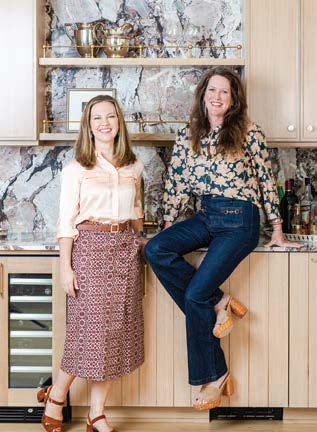
“It was love at first sight,” says Erica, seated on a blue channel-back chair and wearing a knee-length chambray dress, her brown hair pulled back casually in a loose bun. With a laugh, she adds, “He didn’t know it, but I did.”

Eventually, the couple married, bought a house in Kirkwood, and started a family. With little ones at home, Elsa (now 17) and Percy (now 15), Erica left her full-time job, but, in order to keep some skin in the accounting game, sought a part-time role.

Through mutual friends and activities, Erica became acquainted with Kara Cox, who had just launched Kara Cox Interiors. The two even had daughters in preschool together and their second children, both boys, were just a year apart. They each understood the demands of being working mothers.

“I was looking for a bookkeeper and part-time office manager,” says Kara. “My office was so small we could not work there at the same time!”

“I was picking up paperwork and bringing it back to my house,” adds Erica.

The business growth exceeded Kara’s expectations, who assumed she’d work part-time while raising her own children. “Then it just snowballed and it got to the point where I was like, this is getting bigger than I thought it would.” Her office would move from the closet-sized space at Revolution Mill to a larger site on Banking Street and finally to its current location on State Street.

With that rapid growth came a greater workload for Erica. “Too much,” she says. “And Kara needed more out of me.” In 2016, after working for Kara Cox interiors for five years, Erica decided to leave.

Plus, in the meantime, Erica’s family — and its needs — had grown with the birth of her last baby, Percy, now 12. In early 2014, the Worth family moved into their current Irving Park home.

While no longer employee-employer, the two women remained friends and have collaborated on a handful of projects, adding a new relationship to the mix: contractor-designer. Now, Kara says, “We don’t really remember not knowing each other.”

But that time working for Kara opened Erica’s eyes. She left knowing two things for certain: One, like Kara, she wanted to work for herself; and two, she wanted to be a part of the construction and real estate world. “If I hadn’t gone to work for Kara,” she says, “I probably wouldn’t have been as inspired.”

Newly invigorated, she began snatching up and rehabbing rental properties not far from home, maintaining a part-time schedule and working within a 2-mile radius. But she and David had always said that when their youngest, Percy, headed into second grade, it would be time for Erica to go back to full-time work. Her solution? Become a licensed contractor. That way, she could make her own hours. These days, she plans her projects to run September through May, allowing her to be flexible for her family’s needs while also making time for the things that feed her soul — tennis, yoga, the beach and her beloved mahjong matches.

Green in her industry, she called up Kathy Cross of Southern Cross Homes, a general contractor with over two decades of experience under her tool belt, and asked her to meet for coffee. They traded pleasantries, Erica recalls, “And then finally she’s like, ‘What do you want from me?’”

“I want you to be my mentor,” Erica told her. Since then, she and Kathy have partnered on projects, including some brand-new builds. “She’s been able to show me the ropes.”

Shortly after Erica earned her license, she and Kara once again entered a working relationship when the Worths hired Kara Cox Interiors to design the family beach house in Figure Eight, damaged by a hurricane and in need of a revamp.

“Erica hired a contractor who really didn’t — ,” Kara starts.“ — pan out,” Erica finishes. She hadn’t anticipated taking over the job that far away from home, but she stepped up to get it done.

“Basically, during that process, she ended up becoming the contractor,” adds Kara. And that project became their first collaboration, followed soon by an addition on Kara’s Greensboro home, a client project on Dover Road and, most recently, the Worths’ own Irving Park home.

When the Worth family moved in 10 years ago, they knew they would eventually renovate. What they didn’t know was how long they’d wait to do it. “We thought it would be in the five-year time period and then time just keeps slipping by,” says Erica. “And so here we are.”

But that wait served them well, because now Erica was able to take on the role of general contractor on her own home. And, when it came to construction, she had lots of ideas stirring around in her mind.

However, when it came to the design aspect, she knew she wanted to once again hire Kara Cox Interiors for the job from the get-go.

“I learned a lot when I worked with Kara and I just know that bringing the team together from the beginning creates the best result in the end,” says Erica. So before construction even began, she worked on the building plans, bringing Kara along at that early stage in the game.

Together, the two women picked out cabinetry, floor stains, hardware, a new marble mantel for the living room. When it came to all of the finishes, “it was collaborative,” says Kara.

“For sure,” echoes Erica.

And, together, they enjoy trying new things, challenging subcontractors to tackle projects they’ve never before tried. “The only way to really change the trajectory of architecture and design in a city is to push the envelope a little bit,” quips Kara. Both women wanted to experiment with new ideas in this home.

Case in point? The cabinetmaker told Erica he’d never created the style of cabinetry she and Kara had selected for this project. Her response? “Good, I’m glad that you’re getting a challenge.” In the end, she says, he was thrilled with the result — streamlined, flat-front cabinetry with beveled edges lending to a classically modern aesthetic.

Were there challenges that came with working together? Of course. “We’re strong women,” says Kara. “We have opinions. I think that’s what makes us great friends. We appreciate that in each other.”

With a plan in place, the Worth family moved out in June 2023 and construction on their home began the following month. David’s brother, Jon, a bachelor, lives a couple streets over and welcomed the family into his home for the time being. Fitz and Percy lived in the main house with Jon, while Elsa stayed on the ground floor of the garage, David and Erica just above her.

While it was a little chaotic, Erica notes that their relationship with Jon grew stronger and her kids know him so much better than before. With a hint of sarcasm, she adds, “He probably misses the rowdiness.”

“He probably misses you cooking for him!” adds Kara.

“That, too,” Erica agrees.

On May 6 of this year, the Worths left their temporary quarters behind and headed for home,  ready to be in their own space once again.

There’s a moment in every big project, says Kara, where the clients are exhausted and just want to be done. “They have decision fatigue, budget fatigue. They just want to get back in their house.”

She likens a renovation to childbirth “because the moment is so painful, but when it’s finished, you’re like, ‘Oh, I can’t wait to do that again!’”

Standing in the newly renovated front entry, the year-long renovation feels well worth the disruption.

Before, you could barely even see the rest of the main floor beyond the ’90s-style foyer. And behind that? “A maze of hallways,” says Erica, resulting in an awkward flow and tight quarters. Everything felt choppy and discombobulated. To get to the kitchen, you had to walk through the dining room. And to make that happen, the dining room table had to be off center to allow for a walkthrough.

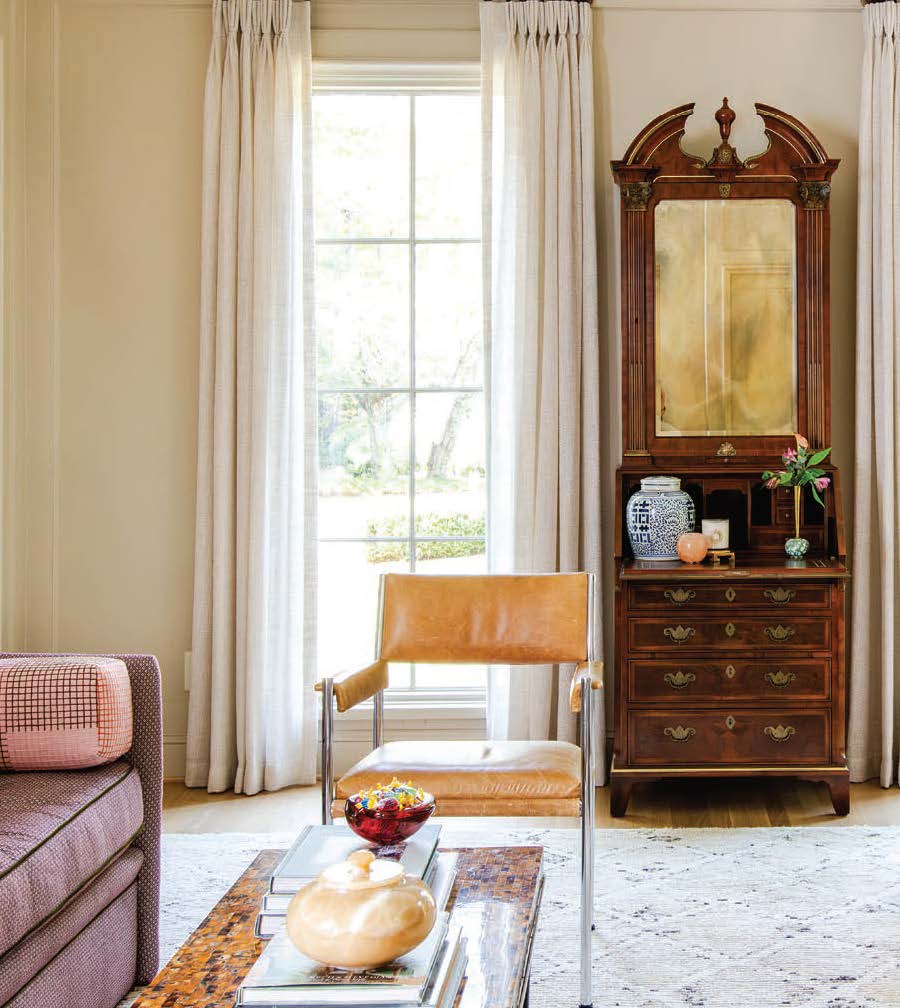
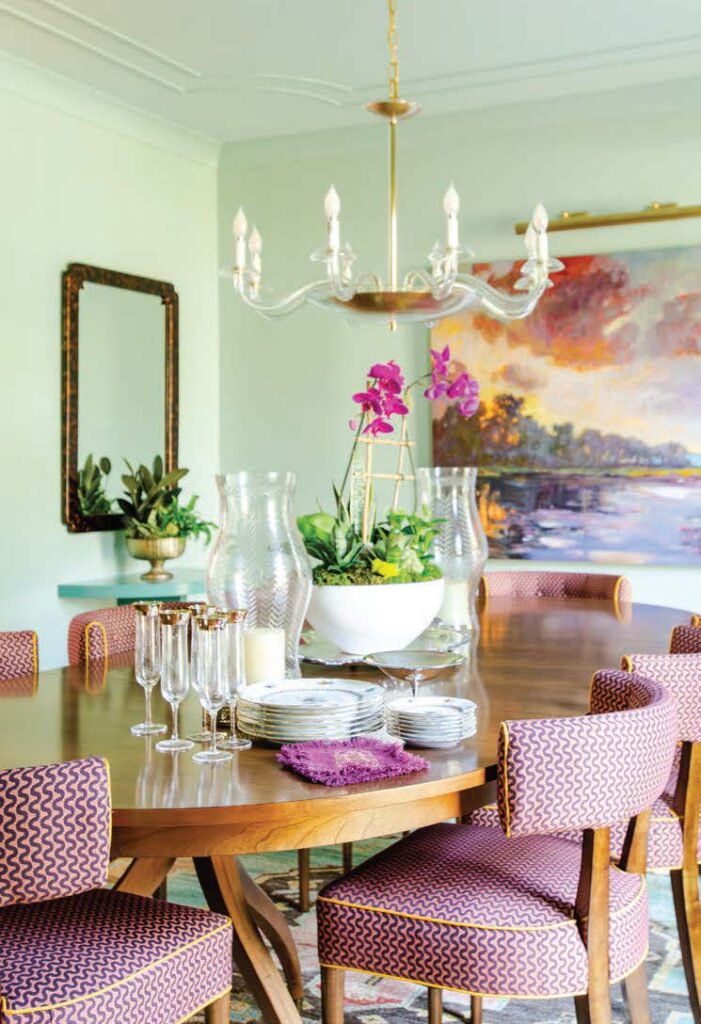
Now, the dining room features a new, warm-wood table Kara calls “modern classic” — centered, of course — surrounded by Klismos chairs. On the wall, flanking the newly installed almost floor-to-ceiling windows, drapes pick up on the purply-red tones in the Irish throw, the vibrant fabric popping off the cool green-gray walls. The pièce de résistance? Under a gold gallery light, a large landscape painting that looks like it was made for this room.

“When we did the presentation, we had all the colors and things selected,” says Kara. That day, Erica pulled out the painting, which had previously hung in David’s mother’s home. Kara couldn’t believe her eyes — it was perfect.

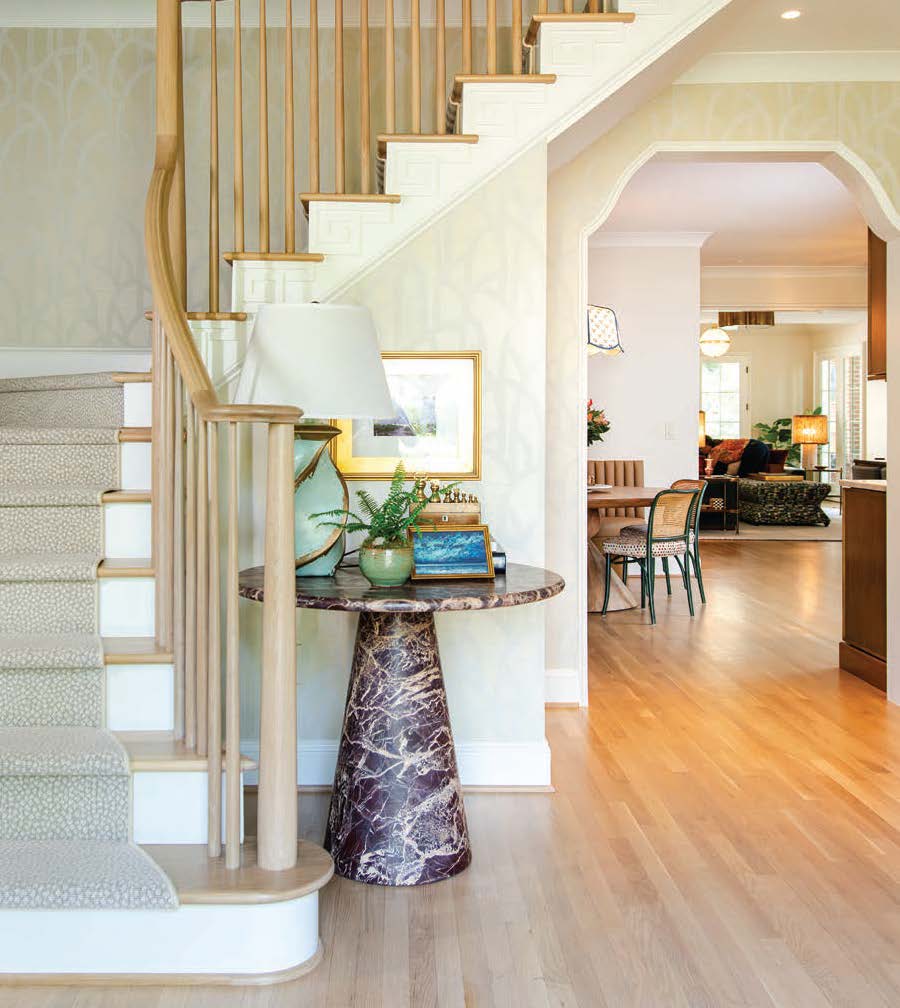
In the entry itself, Erica re-oriented the entire staircase, taking the foyer from two-story to one and adding a second laundry room upstairs — a huge plus for a family of five, including active, sweaty teenagers.

“We made a proper foyer and you aren’t confused about where you’re going,” says Erica. Plus, she points out three seamless doors that are practically hidden to the naked eye, wallpapered and disappearing right into the walls.

The wallpaper pattern is a simple tan-and-cream, large-scale, modern print. It took her some time to settle on that choice, she admits. “Kara was about to give up on me!”

“I was like, ‘We’ve seen every wallpaper there is!’” Kara chimes in.

In a “ta-da” manner, Erica waves her arms at the walls with a smile on her face. “Finally!”

With neutral walls, an entry rug features colors that unify the adjacent dining room and living room. “That’s all Kara,” says Erica.

The feature Erica is proudest of in the entry is a small architectural detail some may overlook — a brand new arched doorway that connects to the heart of the home. It’s a classic detail designed to give the house — not yet 30 years in age — a feeling of permanence.

“It was purposeful to make it feel older than it was,” notes Erica. Plus, she says, “I really do prefer classical architecture.”

“It didn’t feel like an old house before the renovation,” adds Kara.

As in an older home, that arched detail was carried throughout the main floor, repeated several times: in the trim on the dining room ceiling, in the family room fireplace surround, on the marble built-in bench in the en suite bathroom’s shower — off of a brand-new primary bedroom addition — and, lastly, in the tray ceiling created over the family room extension off the back.

They both pause and admire the new ceiling shape. “We’re the only people who will probably ever notice that this matches,” muses Kara.

“But I do think that women in general have a higher attention to detail than men do,” says Erica. “So when it comes to Kara being on a job site and me being on a job site, the details are in the project.”

On the far side of the addition, a built-in wet bar features light, modern cabinetry. But the standout? The aubergine-and-cream countertop and backsplash. While shopping for another client project in Charlotte, Kara spied this slab and immediately recalled Erica’s throw blanket.

“I sent her a picture of this slab and I was like, ‘Erica, this is it. This is to die for,’” recalls Kara.

Indeed, the details are in this project.

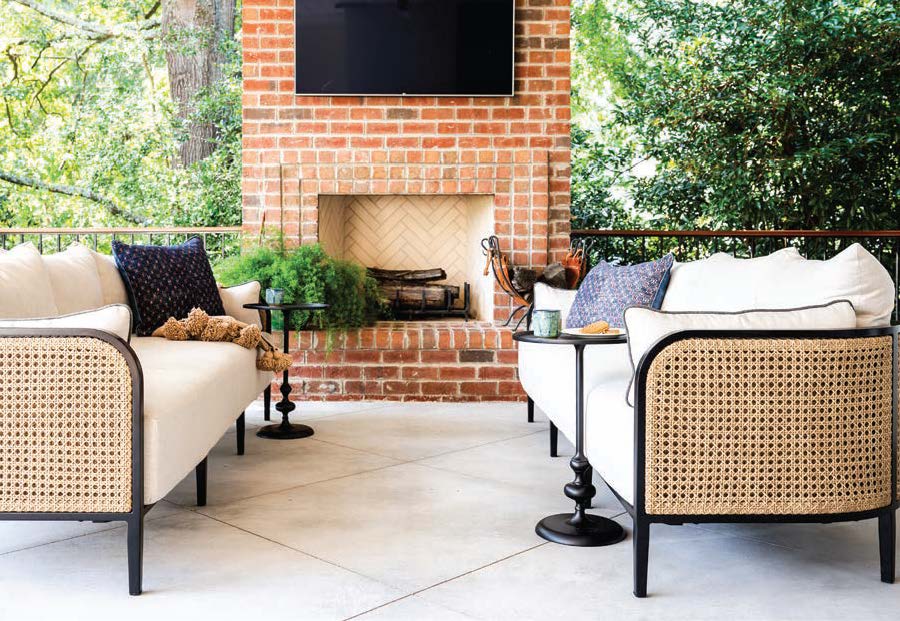
Beyond the back doors of the newly enlarged family room, the Worths added a large porch with a living space and outdoor kitchen. Eventually a patio with a grill will be added below, but, for now, the outdoor kitchen gets loads of use with its griddle, which Erica calls “a blessing.” Why? Because David loves to use it and often cooks the family dinner now.

While the interior kitchen remained where it was originally, the walls surrounding it were opened up and a larger window was installed. Surrounding the new window is a marble casing that matches the countertops. “Kara suggested that,” says Erica.

“That’s where I felt like we had a good time,” Kara adds, referring to the kitchen. Anchoring the space, a large oval island with fluted panels is topped by a dark gray-black marble. Opposite the side with stools is what Erica calls “the turkey oven,” because it’s large enough to roast the family’s Thanksgiving main course.

Another double oven is tucked away in the pantry. “Percy’s oven,” quips Erica, noting that the narrower capacity makes it perfect for baking pizza or chicken tenders. The pantry floors are classic, old-world black-and-white marble tiles. French doors inside are mirrored to create the illusion of more light and space. And on the counter reflected in those mirrored doors is the family pet, a cobalt beta, Le Bleu, named after Le Bleu water because “we own the Le Bleu distributorships around here.”

“What made you get a fish?” asks Kara.

“We’re not getting a dog,” says Erica with a laugh. Le Bleu swims peacefully, peering out from his glass bowl. Erica leaves the pantry light on for him.

Just around the corner from the pantry is a new custom-built, channel-back banquette, ideal for cozying around the table for family meals. A fabric pendant light hangs, adding a touch of color and shapely drama over the neutral table, chairs and upholstery. Too much drama? The baby of the family, Percy, seems to thinks so.

“There needs to be a crib underneath it,” he said when his mom showed it to the family before installation.

“A what?” she asked, certain she’d misunderstood.

“A crib.”

“Well, let’s just hang it and we can change it if it’s not what y’all are feeling,” Eric replied, ending the conversation.

Standing in the kitchen now, Kara rubs her hands together. “Oh, it’s so good!”

Plus, she defends her choice: “It needs that cool pop of color.”

It seems she’s a fan of the colors in the custom-made pendant shade. The dress she’s wearing features Grecian urns and she suddenly realizes it’s as if she meant to match the house’s color scheme.

“Oh, did I?” Kara says, looking down at her frock. “That’s funny!”

“She usually does match her projects,” notes Erica.

While this project is just nearing its end after a little over a year, Kara notes that she likes to “leave room for things to evolve,” even after a client moves back into their space.

“Take it slow,” she continues. “There’s a beauty to collecting and finding the perfect little odd or end and layering that in.”

What’s next for these two? Erica would love to do a custom build with Kara, starting from the ground up. “That would be fun,” Kara agrees. And though Kara is about to celebrate 15 years in business, she admits that she’s feeling inspired by the schedule and life Erica’s built for herself. Her own two kids are close to college-age — she’ll be an empty-nester at just 48 — and she wants more flexibility, too. “I am ready to take fewer projects and have more free time,” she says.

“I may be the only person in Greensboro who doesn’t play mahjong . . . because I have to work!” Kara says.

“I can teach you,” says Erica.

Life’s Funny

LIFE'S FUNNY

Cloak & Wagger

Halloween costumes have gone to the dogs . . . and cats . . . and hamsters . . . and ferrets . . . and bearded dragons

By Maria Johnson

Two years ago, Millie was a ladybug for Halloween.

She wore a smart red-and-black velour jacket, cinched at the waist, with a shawl collar that pooled elegantly around her neck.

OK, it wasn’t really a shawl collar. It was a ladybug hood with antennae that Millie, a petite hound, kept shaking off because she can’t stand things on her ears.

The point is, red is Millie’s color, and she was quite fetching when I took her to the annual dog-o-ween parade in my mom’s townhouse community, which is not officially a retirement village, but is, shall we say, very silver.

As a result, small dogs are plentiful. So one Sunday afternoon before Halloween, residents gussy up their pups and take a lap around the neighborhood, stopping at homes where the few non-dog-owners sit outside with treats.

The dogs gobble as they go. They remind me of the chunky trick-or-treater who once came to my childhood home.

“Where’s your bag?” my dad asked as he doled out candy bars.

“Right here,” the kid said, slapping his belly with both hands.

Unlike the belly slapper, who snarfed his Baby Ruth as he walked away, the dogs at dog-o-ween usually inhale their first treats on the spot then stare down the giver, implying that a second, third or  — why not? — fourth treat is customary.

Sometimes, the furry beggars get downright aggressive, snouting their way into a bag of Beggin’ Strips that’s held too close.

If a small human tried this with, say, a bag of fun-size Snickers, he would end up in a doorbell video on social media the next morning with the plea, “DOES ANYONE KNOW THIS CHILD?”

For dogs, though, people respond with a grace reserved for four-legged animals.

“Ha-ha-ha,” they say. “You scamp!”

This kind of cheerful generosity is more in line with the origins of dressing up at Halloween, which some historians trace back to the 19th-century Scottish practice of “guising,” or putting on costumes and performing in exchange for food and drink.

Over in Germany, they played a similar game, “Belsnickeling,” which called for children to don masks and costumes at Christmastime. If no one guessed their true identities, the tykes were rewarded with food.

Going back even further in time, the ancient Celts — who lived across what’s now Great Britain — observed an autumn festival called Samhain (pronounced SAH-win).

These pagan partygoers dressed as ghouls to blend in with the mischievous ghosts they believed roamed the earth during harvest time, when the veil between living and dead was the thinnest.

The locals lit bonfires and left food, drink, crops and other offerings to appease the spirits.

You could draw a couple of conclusions from these traditions.

One: There wasn’t a whole heck of lot going on in Western Europe back in the day.

Two: People are happy to play dress-up if there’s an immediate payoff, such as food, drink or not getting swept off to the netherworld.

The same reward system goes for dogs. Because Millie associates wearing a Halloween costume with getting food, she doesn’t seem to mind being dolled up.

Last year, she wore a simple jester’s collar, partly because of the ear sensitivity issue and partly because I didn’t make enough time to shop for a proper costume. This year, I started early.

There are so many choices.

For several years, pet owners were limited to dog costumes and only a smattering of cat costumes, which makes sense. Dogs will work for food, even if it means wearing a wonky costume. Cats, not so much.

If I see you on Halloween, bloodied and dressed in tatters, I will not assume that you’re headed to a party dressed as a zombie. I will assume you tried to dress your cat as a Minion.

Nevertheless, the selection of get-ups for cats and dogs has mushroomed to hundreds, enough to break into subcategories. One pet supply website has costume tabs for “Trending” (stegosaurus, happy cow, granny); “TV and movie” (Buzz Lightyear, R2D2, Cookie Monster): “Funny” (snail, werewolf, hula girl, skunk); and “Career” (mail carrier, UPS driver, chef).

Many are so-called front-walking costumes featuring pants that make a dog’s front legs look like human legs, along with stuffed arms that stick out and hold a prop.

So if you squint your eyes and pretend you don’t see the other 95 percent of your neighbor’s Bichon frisé, you could believe that a 1-foot-tall UPS driver in dire need of facial waxing is delivering a tiny package to your door.

Believable, given the current hiring situation.

On the other hand, it’s highly unlikely that this delivery “person” would be focused on anything other than ripping open the box and gnawing off its own arms.

If your dog is small enough, you might try a variation of the front-walking costume: the no-walking costume.

I give you the winner of last year’s Fort Greene Park dog costume contest in Brooklyn, N.Y., a chihuahua mix that rode in a pet carrier draped with a small pale suit and white button-down shirt. It helped that the dog, which lent only its head to the ensemble, bore an uncanny resemblance to Talking Heads singer David Byrne.

The crowd roared its approval.

Basically, no creature is safe from human merriment. These days, websites offer costumes for multiple species. The fashionable guinea pig or ferret might show up for Halloween — though God knows where — dressed as a bumblebee, butterfly or leprechaun.

A bearded dragon, meanwhile, could turn out as a small lobster, a cowboy, a unicorn or, cruelly, a cricket.

I’m not sure who thought that one up. Probably the same sadist who decided it would be funny to make a dog costume with stuffed squirrels frolicking on the back, while the dog wears an acorn cap.

Ha-ha-ha, said no dog, ever.

Thank goodness, none of the front-walking costumes are in play for Millie, though I truly wish she would tolerate a wig with a red bandana, long braided pigtails and guitar-holding arms.

Then she could be Millie Nelson.

After much consideration, though, I’ve ordered her a tennis dress. Like her mama, she’s obsessed with chasing tennis balls, and after all, who wouldn’t want to be recognized as the great Millie Jean King?.