What’s Old is Nu Again

WHAT'S OLD IS NU AGAIN
What's Old is Nu Again

The former owners of Double Oaks make their mark on North Carolina’s oldest hotel — the NuWray. Now, a new generation is discovering why Jimmy Carter, Mark Twain and Elvis all stayed here.

By Page Leggett

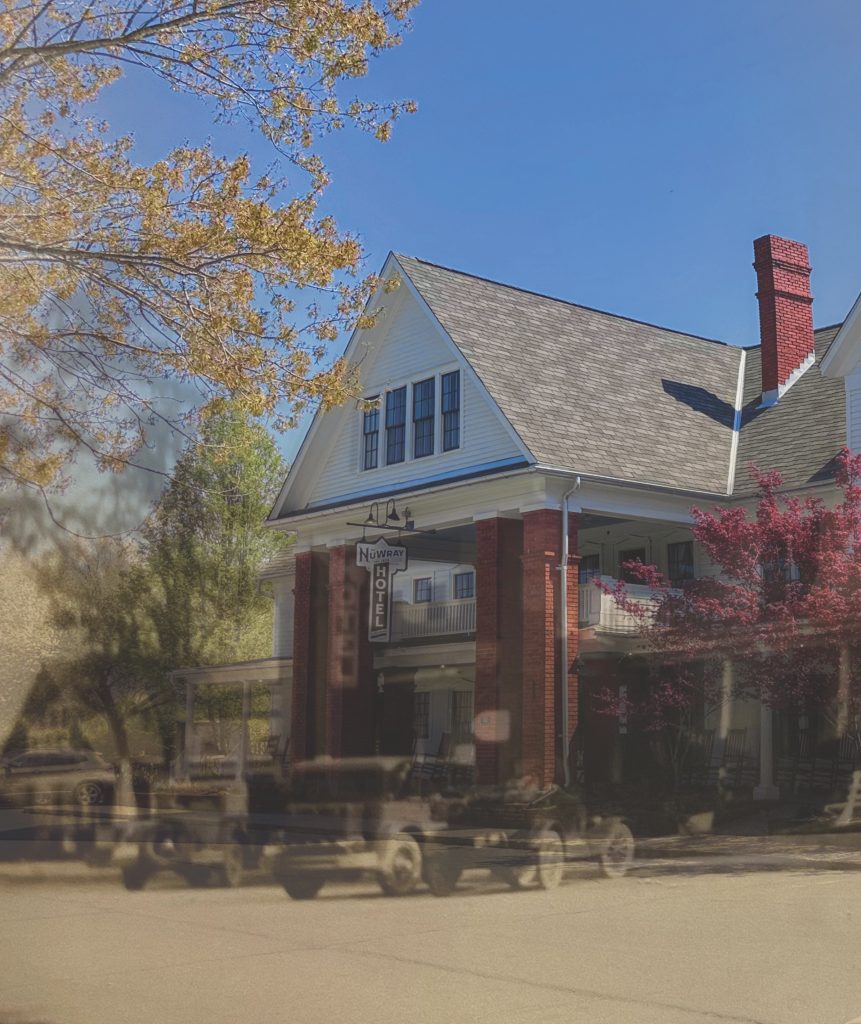
When you pull into downtown Burnsville — a little mountain town (pop: 1,612) in Yancey County — you might think you’ve stumbled onto a movie set. Surely, some studio honcho ordered up the charming square complete with a historic inn and its rocking chair-filled front porches on two levels.

That’s the NuWray, North Carolina’s oldest continuously operating hotel.

The first time I saw it, while visiting the area for the twice-yearly Toe River Arts Studio Tour, it was closed for an overhaul. But I was captivated and knew I had to return.

The NuWray opened in 1833 as an eight-room log structure called Ray’s Hotel. 
Owner Garrett Deweese Ray’s daughter, Julia, married William Brian Wray, and the couple inherited the hotel after Ray’s death in 1932. Locals began referring to the inn as the NuWray to distinguish it from its predecessor, the “Old Ray.”

The Wrays added the now-iconic stone fireplace in the lobby in the 1930s, although you’d swear it must’ve been there all along. The inn remained in the family for four generations before being sold in the 1990s, changing hands frequently and falling into disrepair.

That is, until an enterprising Greensboro couple intervened.

The ultimate DIYers.

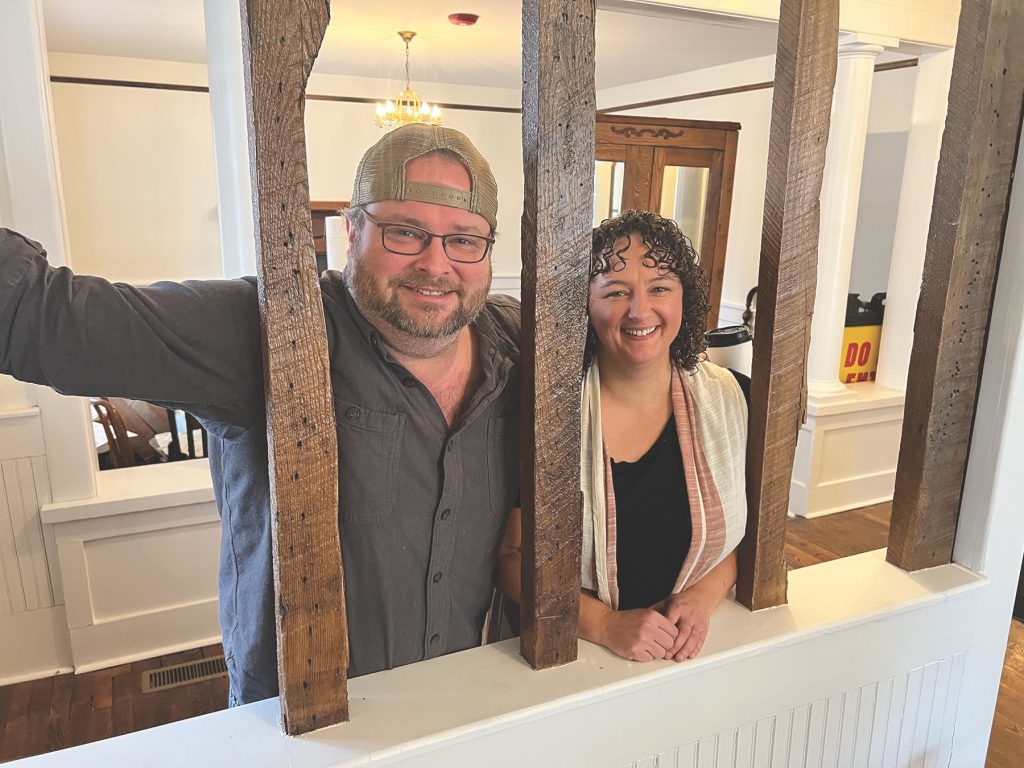
Amanda and James Keith discovered a penchant for historic preservation while renovating a home in Greensboro. Their second renovation became the Double Oaks Bed & Breakfast, which they owned and operated from 2016 to 2024.

James is an electrician — among other things — who does much of the work himself.

Both the Keiths had full-time jobs while running their B&B: James was a music minister at First Presbyterian, and Amanda ran the Wake Forest University press. But both loved hospitality and went looking for a project that would allow them to be full-time innkeepers.

When they discovered the NuWray, it appeared down and out. But the Keiths were undaunted. The inn had “good bones,” as real-estate agents say of ramshackle properties.

And it had a pedigree. “People from all over knew the NuWray in its heyday,” Amanda says. Jimmy Carter and Elvis Presley stayed here. Christopher Reeve is rumored to have been a guest. And the NuWray has hosted so many writers — Mark Twain, Thomas Wolfe, O. Henry, F. Scott Fitzgerald — that Amanda was inspired to name one of the rooms “The Writer.”

But the inn’s biggest fans may be the people of Burnsville.

“If you ask just about any local, they’ll have a story,” Amanda says. “They worked here, their mother worked here, they had their wedding here. I don’t think there are many locals the NuWray hasn’t touched in some way.”

Staying true to the original

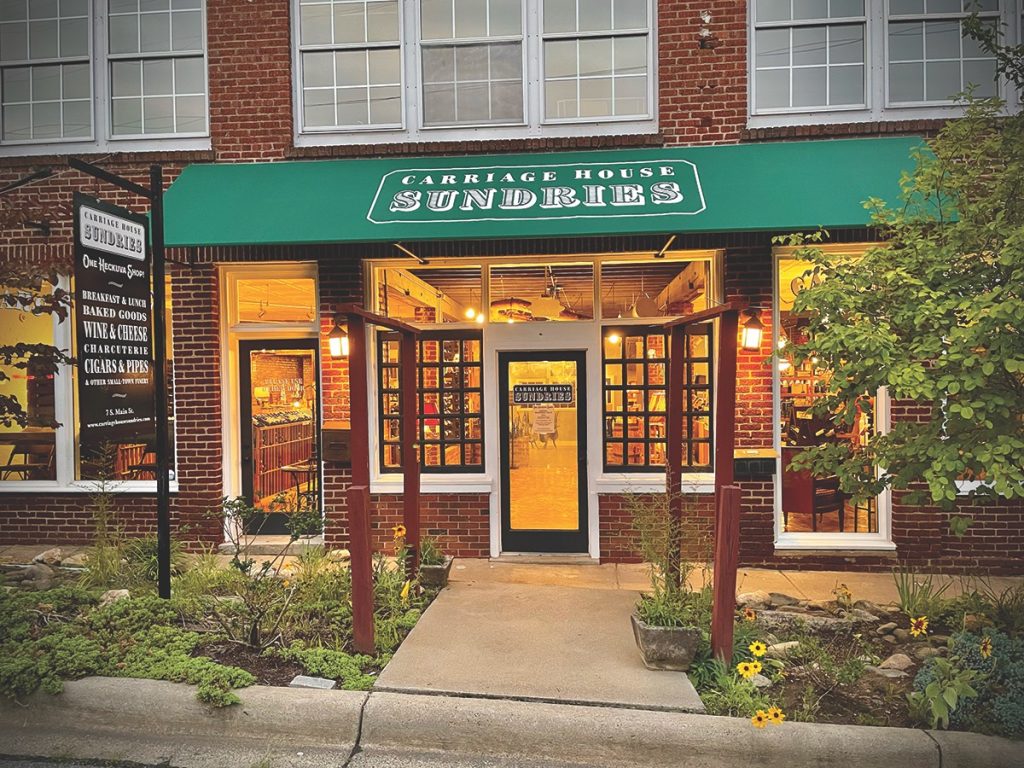
The Keiths bought the inn in October 2021, moved to Burnsville that December and started renovating in January 2022. They also bought the property adjacent to the inn and converted it into Carriage House Sundries, an art-filled coffee shop by day/wine bar by night with a humidor for cigar aficionados.

They wanted a big project, and they found it. “With historic properties, nothing is straightforward,” Amanda says. “You have to do a lot of it on the fly; you never know what you’ll find when you open up a wall.”

Amanda, who designed the interiors, found five layers of wallpaper in some places. “The wallpaper tells the story of the inn,” she says. Visitors can see preserved samples in several places.

The NuWray never had central air until the Keiths added it. They kept what furniture was usable, and Amanda scoured antique shops and Facebook Marketplace to source other pieces almost exclusively from the area.

The community was central to the restoration. Local crews worked on it, and, throughout the inn, you’ll see paintings by local artist Melissa Flattery and quirky lighting made from books, antique typewriters and other found objects by craftsman Ed Doyle.

When Amanda learned that a member of the Wray family, Joy Bennett, is a potter in town, she commissioned her to make ceramic name plates for each guest room.

A taste of history

In 1915, the Wrays started a restaurant, which really put the NuWray on the map, Amanda says. The Southern “country-cooking” recipes had been passed down through generations. Meals were served family-style.

“That’s difficult to pull off nowadays,” Amanda says. “The health department doesn’t particularly like it, and it’s wasteful.”

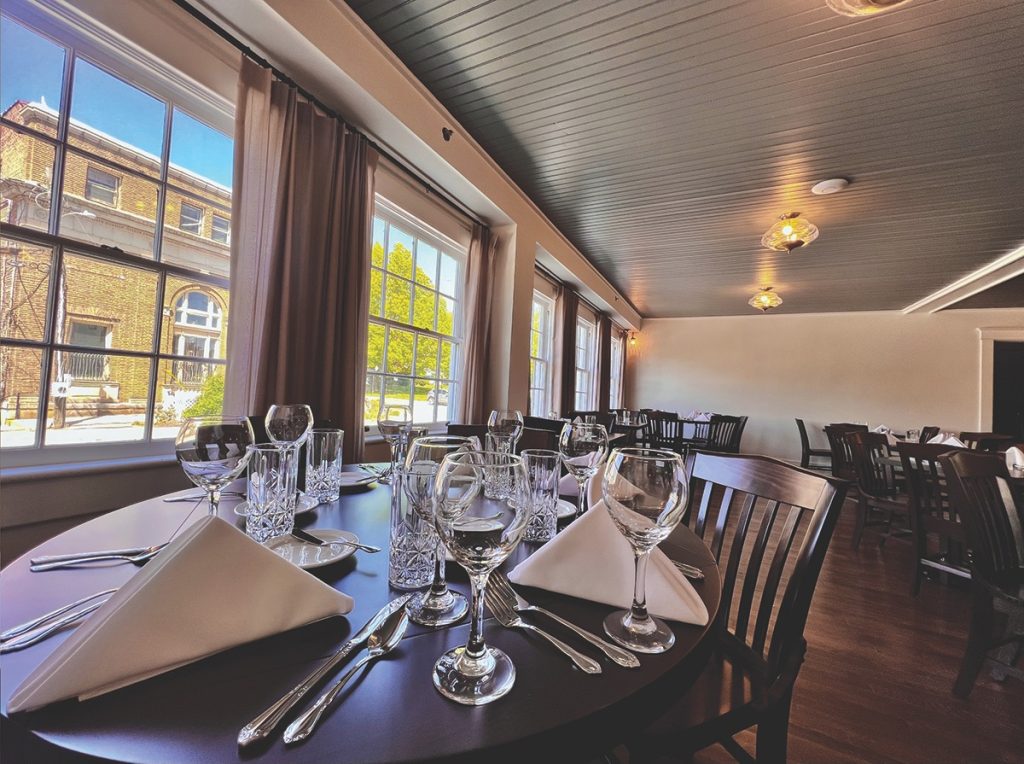
But the revamped restaurant, open for breakfast, supper and Sunday brunch, honors the NuWray’s history with updated recipes from the hotel’s historic cookbooks, such as “Will’s Sunday Cake” (custard-filled chocolate sponge cake with chocolate meringue frosting) and a “Smothered Salad” (mixed greens with warm bacon vinaigrette). Duck and dumplings, chicken-fried steak and a tomato tarte with goat cheese mousse are other standouts.

While James Keith was the chef at Double Oaks — what can’t he do? — the Keiths wanted someone with experience running a bigger kitchen for the 26-room hotel.

They lured Chef Peter Crockett to Burnsville from Asheville. “We really appreciate the environment he creates in the kitchen,” Amanda says. “He’s a strong leader and mentor. That was important to us because it helps attract and keep staff.” 

The original smokehouse — now called Roland’s in honor of Will Roland, the hotel chef for over 40 years — serves al fresco drinks and snacks on Fridays and Saturdays from 4 to 10 p.m. The former laundry facilities in the basement are being converted into a bar with a speakeasy vibe.
Burnsville’s post-Helene hub

The hotel reopened to much fanfare in August 2024. Just a few weeks later, on Sept. 27, Hurricane Helene tore through Western North Carolina. In its aftermath, the NuWray became a lifeline.

“Immediately after the storm passed, people began pouring into the square,” Amanda says. “No one had phone service, so this was the logical place to find out what was happening.

“Everyone was either looking for information or trying to pass information along. We started paper lists of what roads were passable, who’s missing, who’s looking for whom, what supplies are needed and where.” Those paper lists soon morphed into whiteboards.

The flooded restaurant was cleaned and the kitchen pressed into service. Townsfolk needed to be fed, and the NuWray needed to use stocked food before it went bad.

The staff of Carriage House Sundries, which had been open for almost a year, “showed up ready to help,” Amanda says. “Everybody jumped in and prepared what we could without electricity: sandwiches. We smoked all the meat we had in our fridges and freezers on our outdoor smoker, the Smok-O-Motive. Then, people started bringing their meat for us to cook.”

A 60 Minutes crew, including correspondent Sharyn Alfonsi, documented Helene’s devastation and the recovery efforts in October 2024. Of course, they stayed at the NuWray.

The hotel reopened for a second time in May with a “Restoration Shindig,” a celebration of the hotel’s — and town’s — resilience.

“This wasn’t the opening season we pictured,” Amanda says, “but I’m grateful we got as far as we did before the storm hit. If we hadn’t, there’s no way we could’ve contributed what we did. And I think it’s so poignant that this is now part of the NuWray’s history. It’s been a beacon for a long time.”

Make your way to The NuWray. Learn more about Burnsville’s pride and joy and book a room at nuwray.com. The inn has 26 unique guest rooms with en-suite baths. Four are dog-friendly. There’s no elevator, but the inn has two first-floor guest rooms.

Welcome to the Neigh-borhood

Welcome to the Neigh-borhood

Welcome to the Neigh-borhood

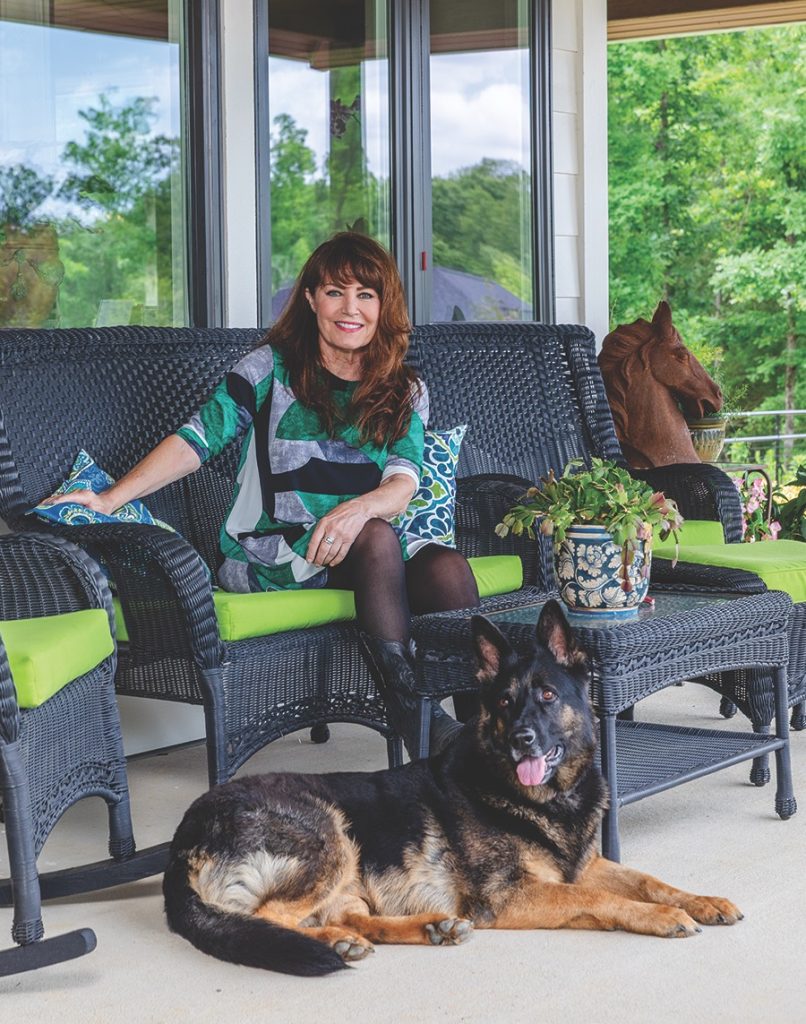
Terry Christian’s barndominium houses creatures great and small

By Maria Johnson  
Photographs by John Gessner

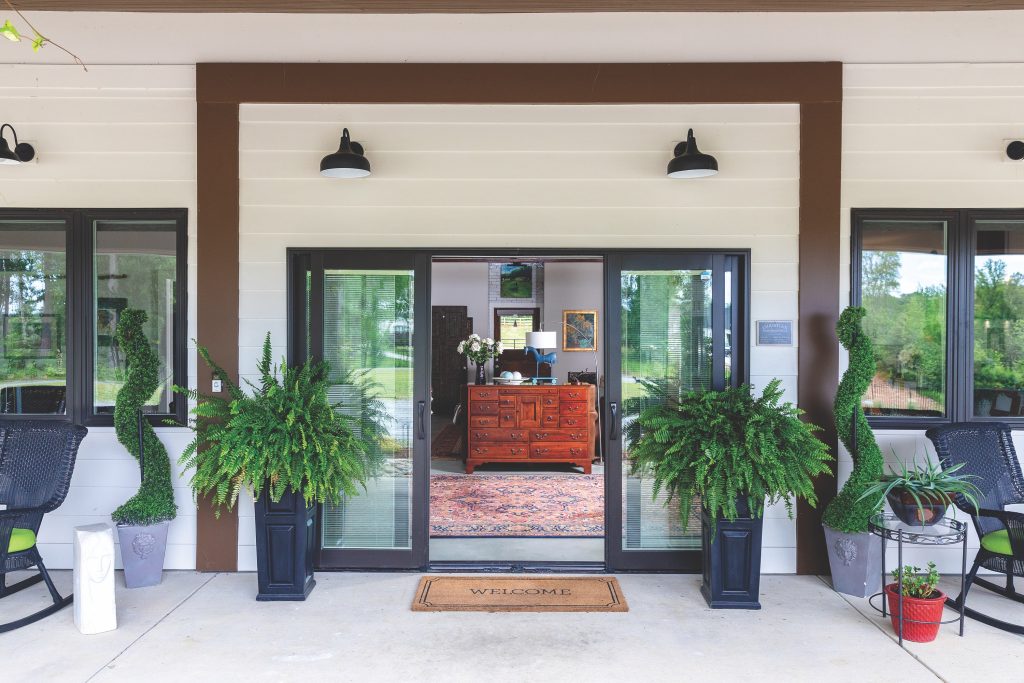
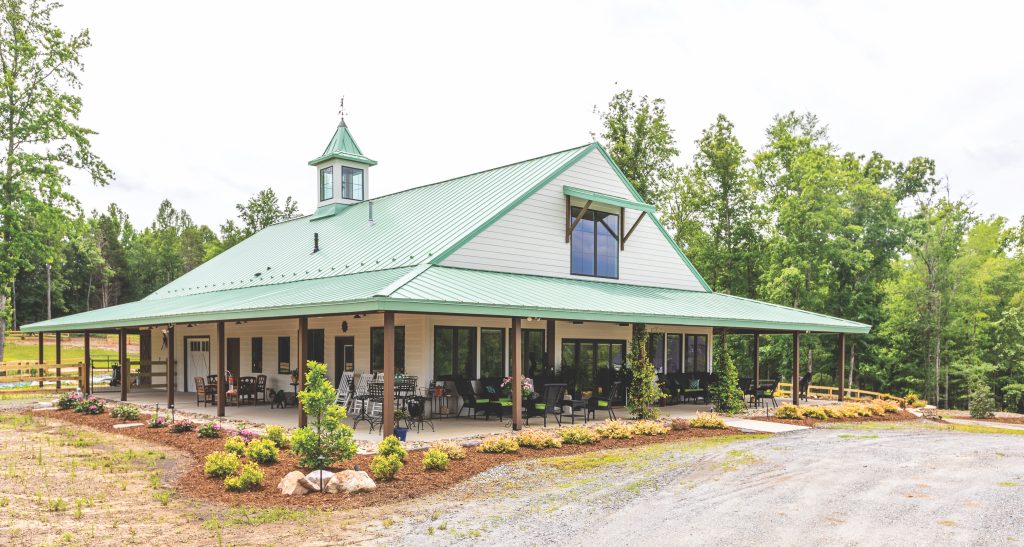
Last year, before the gated entrance was installed at Terry Christian’s new home, some neighbors drove up to the gleaming barn-like structure — the one that’s topped with a weathervane shaped like a dancing pig holding a martini glass — and asked, reasonably, if the building was a clubhouse provided by the homeowners’ association.

No, Terry explained. She was “in” the neighborhood, a freshly minted cul-de-sac community in Summerfield, but she was not “of” the neighborhood.

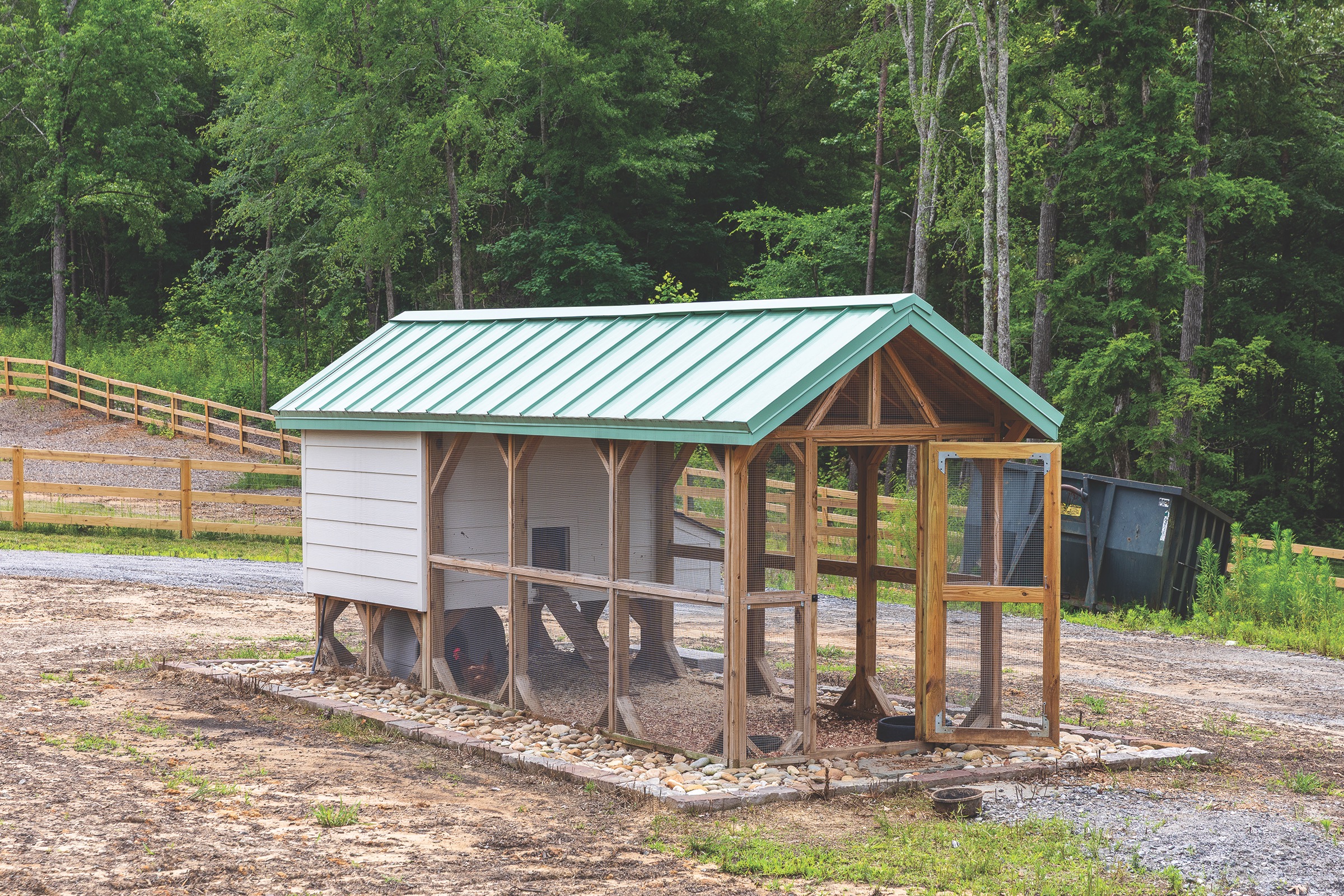
The wide-set building with a green, metal roof and deep wrap-around porch was her private dwelling, she informed them.

She would share the hybrid house-barn with her horses, dogs, cats, a pig, a mini-donkey and other “Old MacDonald”-worthy characters in her critter-based life.

Some of the neighbors thought it was cool.

Others thought it was “ew.”

Unbeknownst to both groups, they had crunched up the gravel driveway of a dream that hatched in Terry’s mind when she was an animal-loving girl growing up in Greensboro’s Old Starmount area in the 1960s.

Where did the dream come from?

Terry herself is not sure. Maybe she was influenced by Mister Ed, a TV sitcom that ran during her childhood. The show featured a horse that stuck his head through the top half of a Dutch door — very much like the portals in Terry’s barn — and conversed in voice-dubbed dialogue with his owner, Wilbur.

Maybe her dreams were genetic in nature, the combination of her refined Southern mother’s compassion for the less fortunate, along with her father’s affinity for helping things grow and flourish.

Her dad, Dr. Joe Christian, was a well-known general practitioner in Greensboro. He was an avid gardener, too.

He imagined the city’s Bog Garden in 1987 while walking the family’s Boykin spaniel around the marshes near Northline Avenue and Holden Road. He appealed to landowner Blanche Sternberger Benjamin, widow of Friendly Center developer Edward Benjamin, to give the land to the city. The rest is wetland history.

That genealogy alone could explain Terry’s desire to live close to the land.

It’s also possible that her aspirations were totally unique, the sum of nature and nurture — plus more nature — including hours spent playing in a creek and slogging home with lightning bugs in jars and frogs in her pockets.

Whatever the source of her dream, it took root.

And grew.

And now, nearly 60 years later, it has flowered.

“I finally get to have my passion,” Terry says.

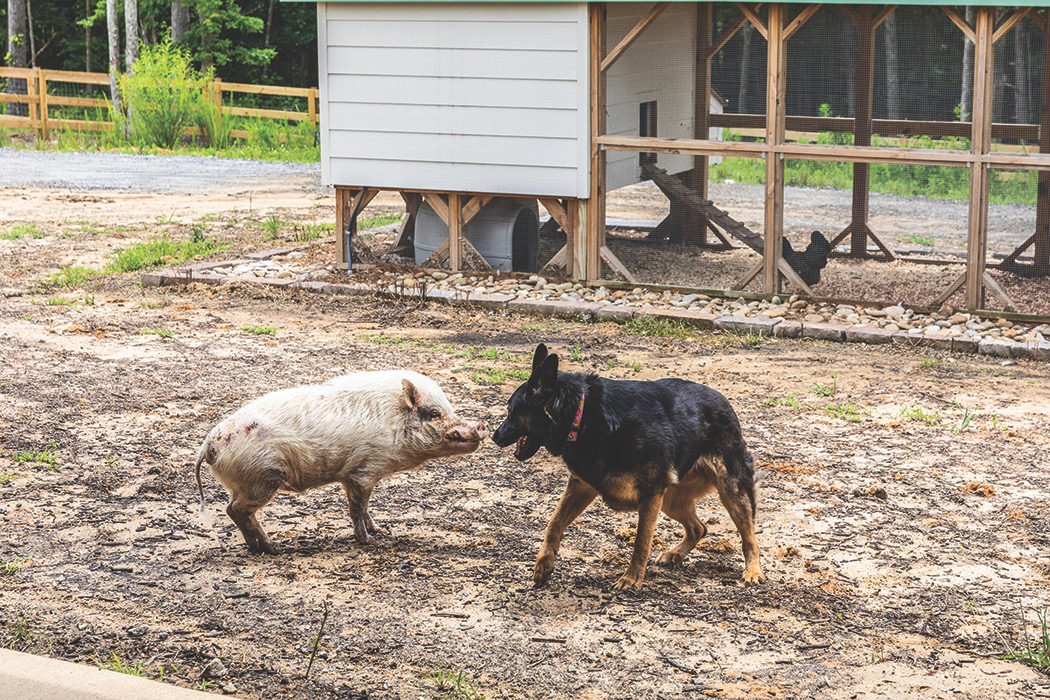
Terry seems genuinely surprised that her pet pig, Hamlet, is caked with mud as he emerges from his dome-shaped “pigloo” in the side yard, snorting as he trots toward her with porcine purpose.

(Insert pig grunts here.)

“You are soooo dirty,” Terry coos to Hamlet.

(Grunts of acknowledgement.)

Indeed, Hamlet — a bristly, blond Vietnamese pot-bellied pig Terry bought as a piglet nearly 14 years ago — is not your average porker.

First, he cuts a svelte figure. For a pig.

Even the vet noticed.

“I’ve never said this before, but your pig is too skinny,” the vet told Terry, who is addressing the situation with supplemental puppy chow.

Second, Hamlet seems to engage in earnest conversation with Terry, who notices that he is favoring his right front hoof.

“What happened to your foot, little one?” she asks.

(Grunts of explanation.)

Terry watches and listens, as if making a diagnosis. She comes by that skill honestly.

Often, when her father, “Dr. Joe,” went on a house call for humans, young Terry — the third of four kids — tagged along. Sometimes, patients who were short on money paid her father in animals. Terry wanted to be there.

Finally, her mom said no more house calls for Terry, who was amassing a small zoo of cats, dogs, rabbits, a guinea pig and a duck named Donald, who imprinted on Terry.

“Wherever I went, that damn duck would follow me,” says Terry.

She wanted a pig and a monkey, too, but her parents said that pigs and monkeys would not fly, in any sense, in their home on Mistletoe Drive, a short suburban walk from the then-new Friendly Center.

She lobbied for a pony in the backyard. Her family gave her riding lessons at Gambolay Farm off Old Battleground Road.

Later, Terry got her own mount, a black horse named Tar Baby, who was stabled at Reedy Fork Ranch, off U.S. 29.

She, her sisters and their friends spent long hours at the farm, riding trails and getting into mischief with horses, hound dogs and barn snakes.

“I should have been a vet,” says Terry, “but I was more interested in cheerleading than chemistry.”

After graduating from Grimsley High School, she spent a year traveling with the nonprofit organization Up with People, a network of young musical troupes that sing and dance and otherwise exude positivity on stages around the world.

Terry’s casts traveled the U.S. in Greyhound buses, staying with host families and napping in hammocks strung up inside the buses.

“I was small enough to sleep on the luggage rack,” Terry says.

A talented alto, she loved being on stage. She earned degrees in theater and voice from UNCG. A friend lobbied her to move to New York and try Broadway.

But Terry stuck around Greensboro. She had found another love. She married Greg Johns and had two daughters, Austin and Anne-Christian.

She stayed in the public eye, too, by modeling, performing in community theater and acting in commercials, including those she wrote for her family’s business, Johns Plumbing.

To many, Terry had a picture-perfect life, including a sprawling estate in Summerfield, where she and her family maintained a 5,300-square-foot home and an 8,000-square-foot barn.

They kept horses plus peacocks, chicken, sheep and cows, and, for a while, a small vineyard with Sangiovese grapes.

Terry lived in fifth gear.

Then came 2020. Her eldest daughter, Austin, married. The pandemic hit. She and her husband split and sold the farm.

Terry moved in with her mother, by then a widow, who was happy to have the company.

Moving home at age 63 was strange for Terry.

She slept in her old bedroom.

“I kept thinking I should be sneaking out,” she quips.

Terry brought Hamlet and several of her chickens home to roost on Mistletoe Drive.

One day, she saw a Facebook post reporting a pig on nearby Madison Avenue.

Terry ran right over.

Another time, a neighbor reported a fox trotting down Mistletoe Drive with a white chicken in its mouth.

Something had to change.

Terry’s vision popped up again. What if she built her animal-filled dream home and took her mom with her?

Home design websites were full of barndominiums, a trend among rural-minded design buffs.

Terry made a list of architects.

Her lifelong friend, Laura Griffin, who had converted an old dairy barn in Wallburg into a chic bed-and-breakfast (see the Spring 2017 issue of O.Henry’s design-minded Seasons magazine), recommended Greensboro modernist architect Carl Myatt.

After one conversation with Myatt, who had tackled many challenging projects in his 60-plus-year career, Terry decided to look no further.

“Don’t laugh,” she instructed Myatt as she drew her dream floor plan with a crayon on a paper napkin.

She drew a rectangle with a line down the middle, short ways. Half barn. Half house. See?

Myatt listened. And asked questions.

Was she prepared to live with the smell of barn animals?

Terry assured him that she was obsessive about cleanliness and that smells would not be an issue.

What about the flies? Myatt asked.

I’ll hang pest strips, she answered.

Land?

Working on it, Terry answered.

Intrigued, Myatt started sketching.

“I’d done barns, and I’d done houses, but I’d never connected them,” he says.

The final plan amounted to 3,000 square feet, split evenly between home and barn.

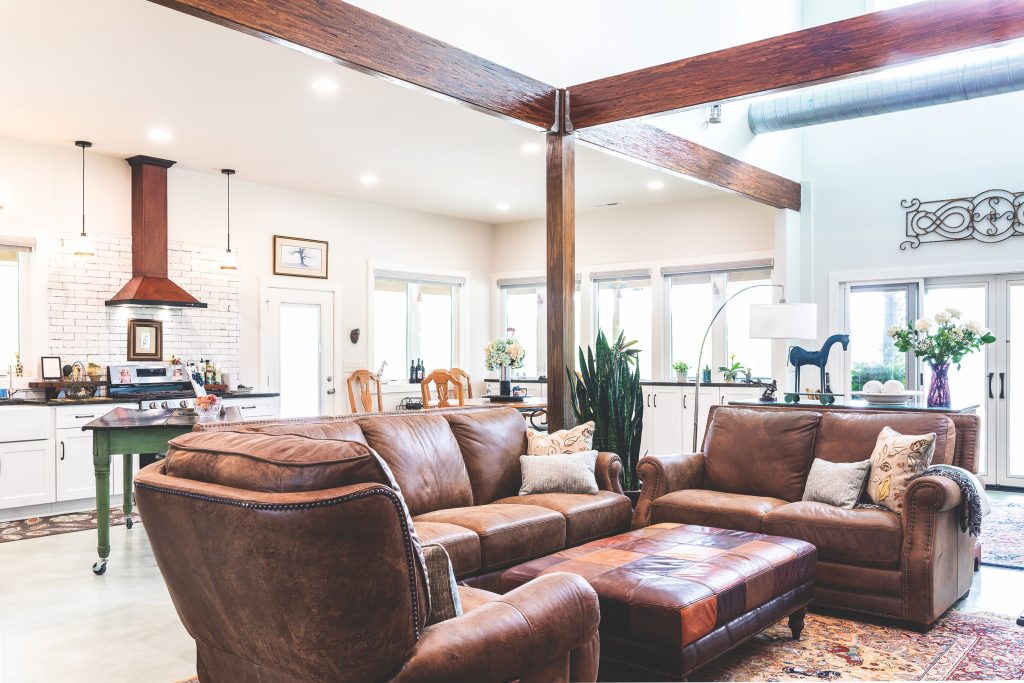
The human quarters include an open kitchen and living area plus space for a pottery studio, and two en suite bedrooms. The home would be a significant downsizing for Terry, but the space was all she needed or wanted. 
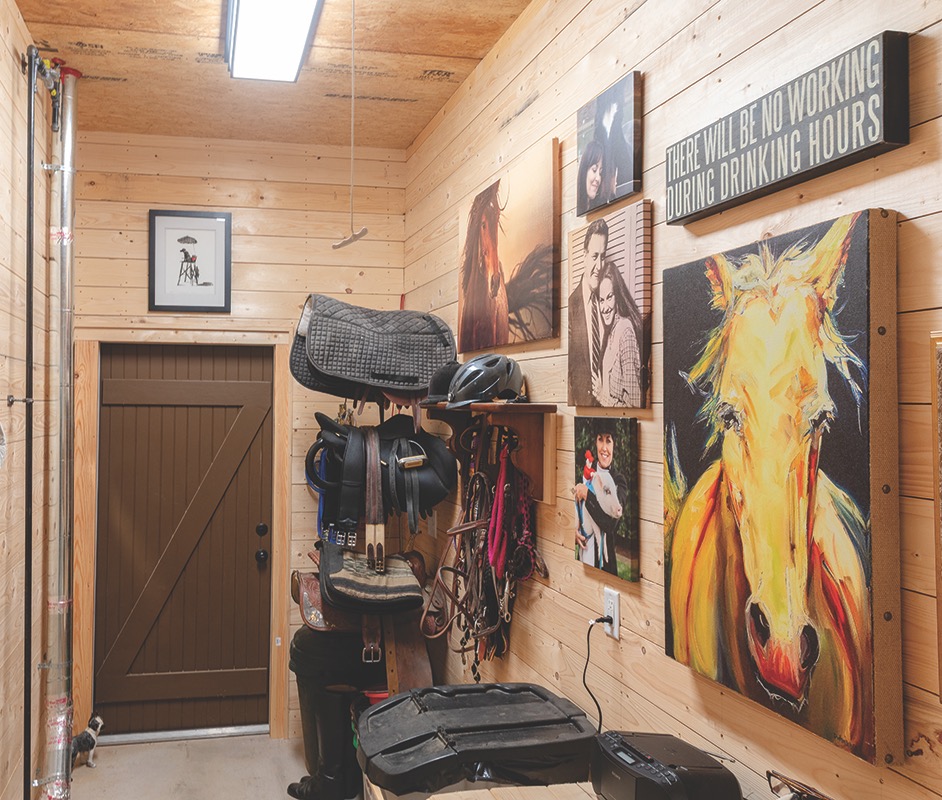
The barn would have three stalls, a tack room and an equipment bay. The center aisle would be flooded with natural light streaming in from a custom-made cupola.

Myatt finished the plans.

Then everything froze.

COVID was still mucking with supply chains and the prices of construction materials. Terry waited for prices to fall and rejiggered financing.

Lenders wanted to know: Was the structure a house or a barn?

Yes, said Terry, who still owns part of the plumbing business.

Construction started in 2021 and sputtered along.

Terry’s mom moved to a memory care center in 2022.

“She knew it was time,” says Terry.

The residential part of the barndominium was finished in 2023, and Terry moved in without her mom.

Later that year, Anne “Annie B.” Christian died.

“Both she and Daddy are still here,” Terry says confidently. Many of her parents’ treasured objects surround her in her new place.

Her doctor-gardener-father, who was a talented sculptor as well, made a bust of Mark Twain. The caricature rests on a pedestal near the front door.

Nearby stands her mother’s upright piano, which Terry’s grandson, 2-year-old Forrest, brings to life when he visits.

Artwork by his 5-year-old sister, Bridger, splashes the space with energy.

With the help of designer Lou Walter of High Point, Terry brought polished warmth to her museum-like space, which is bound by high ceilings, white walls, banks of windows and a concrete floor.

Playing off exposed beams overhead, the duo grounded the kitchen and living area with bass notes of leather furniture, Oriental-style rugs, bronze artwork and pottery, some of which is by Terry’s own hand.

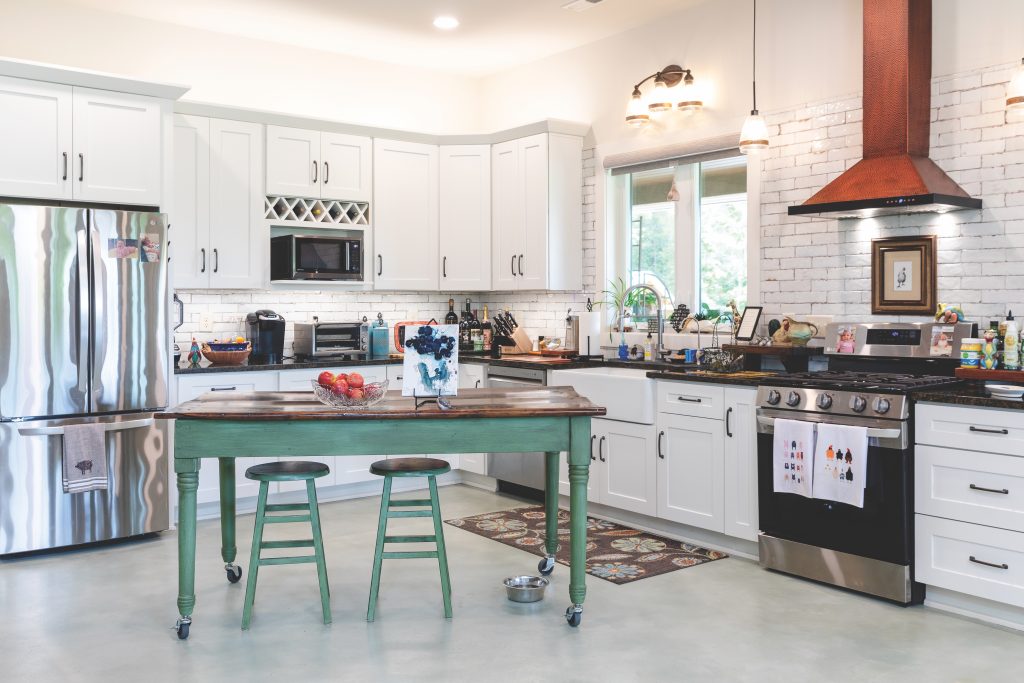
A hammered copper stove hood and dark, speckled, peacock granite countertops anchor the kitchen.

Greensboro artist Lisa Cox used her faux brushwork to add interest and depth to the concrete floor and a vintage table-turned-kitchen-island. She copied the kitchen’s subway tile backsplash in a doorway leading to the barn, which was finished earlier this year.

General contractor Earl Waddell applied his woodworking skills in the equine wing, finishing the interior with handsome tongue-in-groove, yellow-pine walls and doors.

The stalls received their first occupants, rescue mares Midnight and Cinnamon, in July.

Their luxury compartments include automatic watering troughs, rubberized floor mats, stylish wrought-iron hay racks and modern ceiling fans just out of reach of curious muzzles.

The third stall belongs to a mini-donkey, Faith.

“I want the place to be swarming with animals,” says Terry, who is well on her way to populating her hilltop ark.

Her housemates include a fiercely protective, 75-pound German shepherd, Xena, who is named after the Warrior Princess, as well as a Scottish Fold cat named Gabby and a Siamese-tabby, Taz.

Confident of having a few more lives, Taz spars with Xena on the rug at Terry’s feet.

Certain humans are welcome in this setting.

Terry envisions a nearby knoll as a possible future home for her grandchildren, who could traipse over the rise to YaYa’s house. A family compound on 22 acres, some of which skirt the Haw River, would suit Terry just fine.

She will add creatures as she sees fit.

Her green eyes flicker.

“I still want that monkey,” she says. 

Omnivorous Reader

OMNIVOROUS READER

Getting Semi-Real

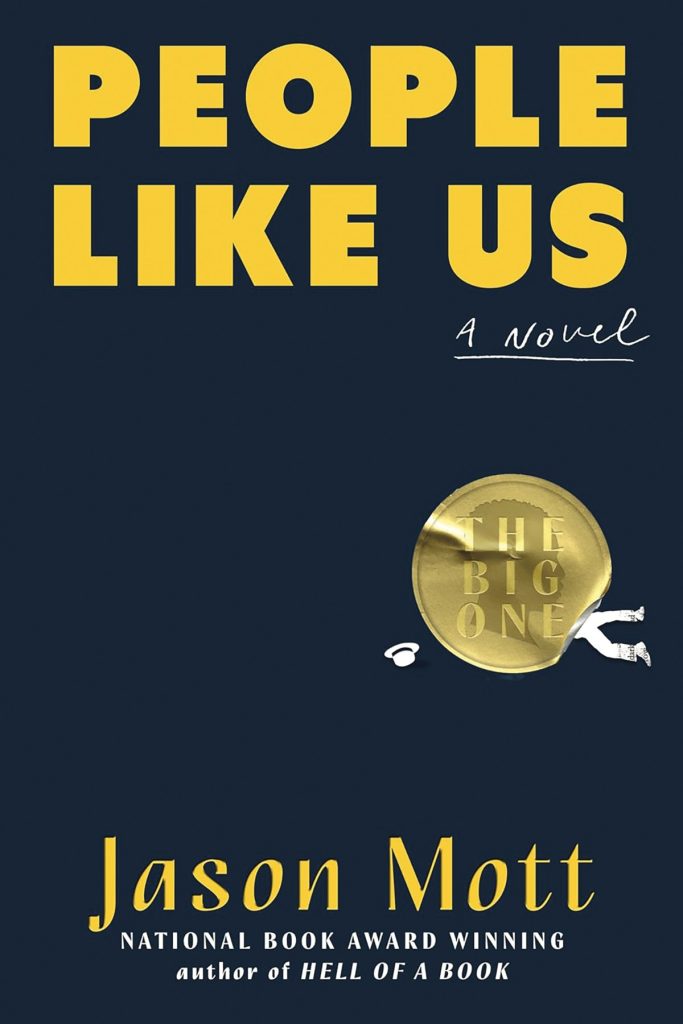
Jason Mott’s People Like Us

By Anne Blythe

Jason Mott gets one thing out of the way right off the bat in People Like Us — his latest novel is semi-fictional. Or at least that’s what the National Book Award-winning author of Hell of a Book wants you to believe.

“Whole fistfuls of this actually happened, sister!” he tells us in the forward. “So, to keep the lawyers cooling their heels instead of kicking down the front door with those high-priced Italian loafers of theirs, some names and places have been given the three-card monte treatment and this whole damned thing has been fitted with a fictional overcoat.”

People Like Us is the story of two Black authors — one on tour in the wintry climes of Minnesota after a school shooting, and the other being chauffeured around Europe, or “Euroland,” as he calls it, as the guest of a super-wealthy benefactor we know only as “Frenchie.”

They’re both exploring the idea of the American dream and whether such a notion is truly attainable within the confines of their lives. One is pondering that question from inside U.S. borders, the other from the outside.

Readers likely will notice many parallels between the real life of the acclaimed Columbus County resident and UNC Wilmington professor who’s a five-time author now. Mott started writing People Like Us as a memoir that delved into his relationship with America.

But along the way a couple of his Hell of a Book characters — Soot and The Kid — kept dropping into his story. So it evolved into this description-defying, pseudo-memoir/novel that will make you laugh out loud at its devilishly delicious humor, then sink into the grave realization that Mott is deftly addressing some serious social commentary.

Because both protagonists feel compelled to travel with concealed weapons, the gun culture in America and abroad is one such theme. So is the precarious state of the nation.

Mott is not preachy about these topics. He is subtle and inviting as he gets readers to think about American identity, and the complexities that Black Americans confront in a land where racial “othering” still exists.

One of the beauties of his writing is he can turn a phrase that will stop you dead in your tracks and force you to linger for a minute or two to admire his imagination, wit and way with words. Mott describes a scene about a seismic shift on a par with the protests that followed the murder of George Floyd this way: “It was like watching Sisyphus — a man who never skips leg day — finally get that super-size rock of his farther up the hill than he ever did before. And, just for a second, you can believe that, hell, maybe he’ll finally get it over the top.”

Mott’s prose will take you on a madcap adventure or somber journey with a cast of intriguing characters. We reconnect with Soot, the character in Hell of a Book who becomes invisible or one of “The Unseen” after witnessing his father shot by police while out on a jog. He’s an author now, in Minnesota, reckoning with the suicide death of his daughter, Mia, amid the aftermath of a school shooting.

Then there’s The Kid, who is older than he was in Hell of a Book, mysteriously seizure-prone now, living in France and going by the name Dylan — or at least the author living it up bourgeois-style in Europe believes the two are one and the same despite being told otherwise.

We get to know The Goon, the giant Black Scottish bodyguard and driver employed by the eccentric Frenchie to squire around the nameless author in a Citroën so decrepit and aged it seems like it’s “about to pull a hamstring.” 

Dylan is with them as they go from book event to book event in Italy and France. Along the way, the author, who sometimes pretends to be the better-known Colson Whitehead or Ta-Nehisi Coates, runs into Kelly, a funeral director and former girlfriend from the States. She hops in with the trio as the four of them seek a “Brown Man’s Paradise.”

Just as the gun used in an accidental shooting toward the end of the book hangs suspended in air “like a steel question mark,” so too does the notion of whether leaving America, as Mott poses, “just might be the new American dream.”

Dylan, who fled to “Euroland,” sheds light on that idea in deep conversation with the author, who is debating himself whether a comfortable home can really be had outside the homeland for people like him.

“There’s a hierarchy here, just like everywhere,” Dylan told him. “You’re either French-born White or Italian-born White or English-born White or Whatever-born Whatever . . . or you’re an Other. Well, where do the Others go? What do you do when your home doesn’t love you and all the other homes you tried to make a life in don’t love you either?”

That question lingers as Mott wraps People Like Us, fodder for one more semi-fictional book.

Sazerac October 2025

SAZERAC

Sage Gardener

I thought I knew what chow chow was, a traditional Southern relish that my daddy put on pinto beans and my mother whipped up using up the tail end of the garden — cabbage, onions, green tomatoes and peppers, accented with mustard seeds. When I run out of the version I make myself, similar to Mama’s, I buy what I consider a really decent alternative, Mrs. Campbell’s Chow Chow, made mostly from cabbage, red bell peppers and onions, and produced by Winston-Salem’s Golding Farms. (Tony Golding got started in 1972, making and distributing Mr. and Mrs. John Campbell’s homemade version.)

Then I started poking around. Southern? Hardly. Food historian John Mariani informed me that the name of chow chow may come from Mandarin Chinese “cha” and originated in America in 1785, when Chinese laborers working on railroads in the West introduced it, amped up with ginger and orange peel. North Carolina-born “Southern Fork” blogger Stephanie Burt muses that the French Acadians from Canada might have brought chow chow to the United States, since their word for cabbage was “chau.” But her personal theory is that “the Carolina version I know originated with the Pennsylvania German and Dutch settlers, who traveled the wagon road to the South bringing their love of relishes and mustard with them.”
My Pennsylvania Dutch mother might have consulted her Mennonite Community Cookbook, but she sure didn’t put any lima beans, green beans or cucumbers in hers. She used the version, as I do, from the Rockingham County Home Demonstration Cookbook, featuring, like Mrs. Campbell’s, cabbage, onions and peppers, but also green tomatoes. Head north and chow chow gets even greener, made predominantly with green tomatoes, especially in Nova Scotia and New Brunswick.

If you want to make some from the remnants of your garden veggies, type into Google what you have too much of and you’ll find oodles of recipes.

But what really grabbed my attention was what some people do with it. Sure, I heap it on hamburgers, hot dogs and collard greens. And it’s the secret ingredient in my devilishly delicious deviled eggs. But, really, fish cakes and mashed potatoes? Heaped on biscuits and gravy or on corn bread? Don’t even mention ice cream — unless it’s chocolate.

Unsolicited Advice

You know the house that the kids clamor to every Halloween? It’s the one with the flashing lights, “Monster Mash” blaring and a fire pit out front surrounded by witches and werewolves sipping their brews. Green with envy? Don’t be — we’ve got tips to make your front door the top stop on the block.

Don’t dole out off-brand candy imposters. No one wants your Crisp-Cat, Wacky Taffy or Chuckles bar. Even toddlers know they’re a cheap imitation of the real thing and taste like chocolate-covered disappointment.

The biggest fright of the night? Nothing screams “I’m a dentist” like handing out toothbrushes at the door. If you’re going to do it, at least toss in some sugar-free candy, too. Plus, from a business standpoint, more cavities means more income.

Ambience? More like zombie-ence. Think eerie mood music, orange and purple lights and — the icing on the individually packaged Tastykake, which also makes a great treat — a frightful ’fit for yourself. And we all know nothing is scarier than a homemade Halloween costume.

Window on the Past

Captured on the heels of the Great Depression, these two goblins are prepared for the coldest of winters and the largest of pumpkin pies. Better stock up on the whipped cream!

Just One Thing

While one red balloon floating up from a drain says “Stephen King-level creepy,” soon, several red balloons in front of an art studio will scream creativity. Since 1996, ArtStock Studio Tour has offered art collectors and lovers the opportunity to tour several local studios — marked by red balloon bouquets — where they can peruse and perhaps purchase a piece for their own homes. This year, ArtStock is stretching that canvas all the way into High Point. Witness here the work of Greensboro resident and mixed-media artist Linda Spitsen, who is participating for her third year. For the first time, she plans to open the doors to her in-home studio. Spitsen says she traces her creativity all the way back to kindergarten. “For forever, people have always received a handmade card from me for their birthdays,” she says. But that creativity was reignited on a larger scale in 2016 when she retired from a longtime career as vice president of HR at a tech company. Now, Spitsen has collectors all over the globe — “in all the continents but Antartica,” she quips. Her brush, she finds, generally yields works that are floral or earthy in nature, as seen here in Thursday’s Child, a bold acrylic on gallery-wrapped canvas. Asked who, exactly, Thursday’s Child is, Spitsen simply says, “I was born on a Thursday.” As was her husband, Stu Nichols, she notes. The painting, as it turns out, was completed on the eve of her birthday earlier this year. Just follow the red ArtStock balloons to see Spitsen’s work as well as that of 30+ local artists, Oct. 2–5. Info: artstocktour.com

All Bark

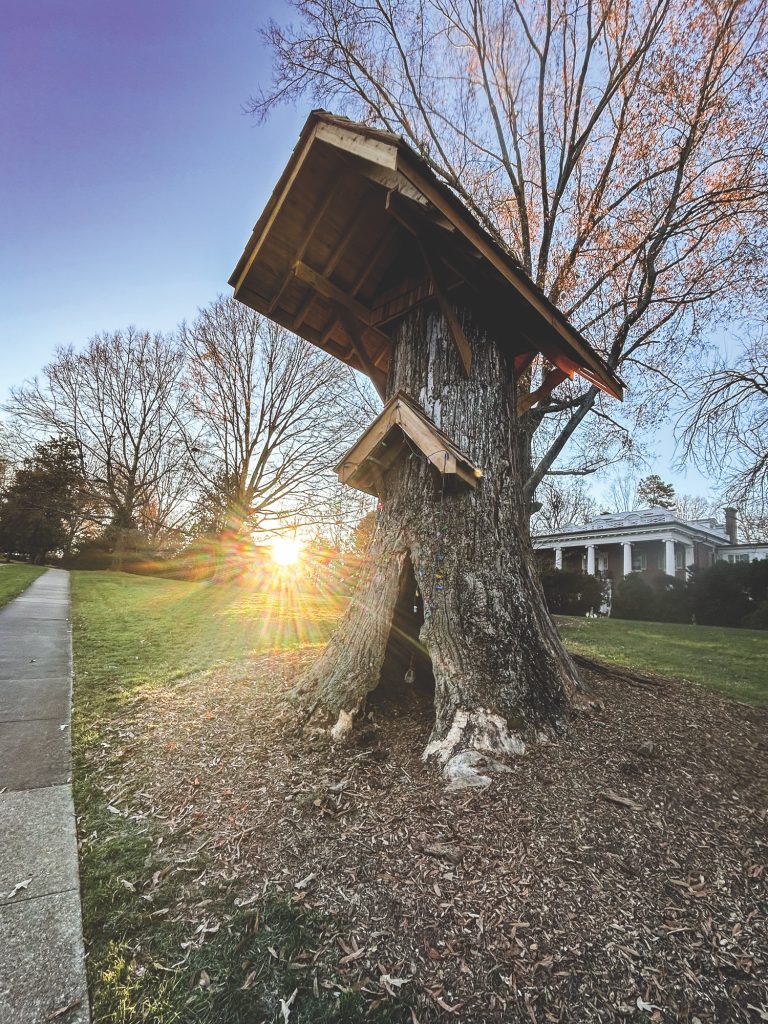
Poplar Hall, a Neoclassical Revival home in Irving Park, now features what may be the first tree that’s been remodeled of its kind — notable in a neighborhood where grand old mansions routinely receive every imaginable home improvement.

You read that correctly. If tree superlatives were handed out, this tree would win “Most Improved,” hands down! 

The much-loved poplar stands on the lawn of the historic 1914 family home of politician and lawyer Aubrey Brooks. Poplar Hall was among the first houses built in Irving Park. In recent years, arborists and experts could be seen administering TLC to a particular tree, across from the entrance to the Greensboro Country Club. 

Why care so for this tree? It had star power, an earthly wonder to all who passed by.

The same feature that made the tree charmingly irresistible, sparking the imagination, also indicated its vulnerability. Its heartwood having died, its center was enchantingly hollowed out so much so, a child could disappear into its interior.

Generations of fans have visited the tree, standing conveniently by a public sidewalk. Passersby, runners, walkers and parents with strollers have invariably slowed for a better look. Like the Angel Oak in Charleston, South Carolina, it had quietly become a natural attraction, one the children in my family always requested to visit. 

Years ago, a fire was set inside the hollow. Though it bore the signs on the charred interior, the tree seemed to defy death.

But, despite the care of intergenerational owners who gave it their best efforts, the tree steadily declined.

Advancing decay and time further ravaged the tree. And who could even guess its age? Hardwoods such as this often live over 250 years, according to treehuggers.com.   

The ailing tree recently underwent a series of incredible transformations. First, a breathtaking amputation. The dying top was lopped off, leaving it truncated and sad-looking. Fans and neighbors worried. What next?

The tree trunk — the main attraction — remained with at least 20 feet of its magnificence intact. The natural “doorway” was saved, its ancient portal still open.

Since then, a cedar shake roof was constructed, reinforcing the tree’s appeal and storybook charm. More embellishments followed: gingerbread trim and two charming windows. Delighted children dubbed it the “Keebler Elf tree” after the well-known cookie commercials, where elves whip up Fudge Stripes in such a tree.

As a final, playful touch, garden gnomes — perhaps Keebler kin — appeared inside the hollow, establishing residency, proving the remodel was a habitable success.

It was a remarkable save for a tree with legions of fans.

But not everyone unreservedly loves the elf tree at Poplar Hall. Occasionally, the darkness of the walk-in tree spooks little ones, fearful of encountering unseen guests.

When my niece, Bailey Sparks, visited the tree, we urged her to step inside for the full experience. Just as she entered the shadowy hollow, she screamed out in pain and fright. A bee had stung her.

Later, she shakily recorded the event on a blackboard in my home, which bears chalk-scrawled messages from visiting children. “I will never forget this day! The first day I got a bee sting! July 15, 2007,” she wrote. The child had no more to say on the subject, wishing to never return.

But the majority of those paying homage to the tree get a pleasurable shot of dopamine rather than bee venom. Most of us are tree lovers, like generations of the Brooks family seem to be.

According to historic records, the name itself is proof. Poplar Hall is the namesake “of a stately tulip poplar” that stood on the front lawn of the property more than a century ago.

Art of the State

ART OF THE STATE

Taking a Breath

Daniel Johnston’s art and life find new meaning

By Liza Roberts

Celebrated Seagrove ceramic artist Daniel Johnston has always asked his work to carry a lot of weight. The clay vessels and pillars and bricks he forms and fires in Randolph County are beautiful; they’re also packed with a powerful purpose that has fueled his ambition for years. His works carry complicated stories about land, especially the place where he makes them and his life there. They’re dense with technical prowess, the multicultural lineage of that learning, and the demonstration of those skills. And they’re conceptual, freighted with ideas, wise to the history of art and its evolutions.

But lately, Johnston has begun making art differently. He’s thinking about it differently. The catalyst has been his marriage to artist Kelsey Wiskirchen and the February birth of their first child, Joseph Elliott Johnston.

“There’s the feeling that I have a greater purpose in life as a father,” he says. “The work, I can see, has had a bit of a breath. In a way, if it had a life of its own, it would thank me for taking the pressure off of it a bit.” If his art no longer needs to prove his human worth, Johnston muses, perhaps it can begin to speak for itself: “It frees my work up to be more mature.”

At the moment, that new work is destined for a substantial fall installation at the Gerald Peters Gallery in Santa Fe, New Mexico. He plans to install his pieces there — as many as 50 large pots and several of the wall-hung clay brick assemblages he calls “block paintings” — in a series of rooms he’ll create out of 80-odd discarded wooden walls he salvaged from the High Point Furniture Market.

Building environments for his work is not new for Johnston. “So much work that is impactful and changes people’s lives, it’s all content in context. The architecture of the room, it gives it context, and, in a way, it removes the pressure from that object. [The installation is] a bit of a Trojan horse, so that the viewer can softly let [the object] in,” he says. “If I can start controlling how you feel, then I’m able to allow you to see my work in the way I want to communicate it.”

Also on display within this context, possibly: previously unseen paintings made not of clay, but of paint on canvas or board. “This would be the first time I’ve ever exhibited paintings that weren’t three dimensional,” he says. His constructed wood-walled installation would be a good place to show them, he says, because they’d become part of a larger artistic immersion. “If you go into an installation, you are walking into an installation, you’re not walking into an exhibition of paintings.” Still, he’s not yet ready to commit. “Maybe I won’t exhibit them if I don’t feel they’re strong enough.”

Taking his time is part of his practice. Abstracted, sketch-like paintings of vessel-shaped forms have shown up on his studio walls in recent years, but the paintings he may include in the Santa Fe installation are likely to be inspired by the landscape of New Mexico and the tobacco barns of North Carolina. Some will be painted on land he owns next to Carson National Forest in New Mexico, and some will be painted at home in Seagrove. “I’m absolutely in love, architecturally, with the tobacco barn,” he says. “It’s just such a brilliant piece of architecture.”

Homeplace

Johnston lives and works in a house and studio he built with his own hands. It reflects his long-held appreciation of the tall, timbered barns traditionally used to cure tobacco. It’s a log cabin the size of two barns put together, with big pots all around it, some sunken in the grass and some on pedestals.

It sits on 10 acres of land he bought at age 16 with money he’d originally saved for a Ford Mustang — land where, at that young age, he built himself a shack to live in, alone, after he dropped out of school. Years later he felled the trees to build this house and studio.

When I first met Johnston there seven years ago, he was humble as he told his story and surveyed his place. Growing up not far from there in extreme poverty as the child of tenant farmers, “in my mind,” he says, “land was power.” He told himself early on he would make for himself a different kind of fate. 

The same could be said of his art.

About 15 years ago, after lengthy apprenticeships with potters in Thailand and England and with Seagrove’s internationally revered Mark Hewitt, Johnston became a leading American maker of big pots. He perfected a technique to turn 100-pound lumps of clay into giant vessels that could hold 40 gallons apiece and made them in huge numbers, a series of 100 pots one time, 50 pots another. The acclaim was exciting, but then became disillusioning. It broke his heart to see them carted away, one by one. It was the groupings, he realized, that held the meaning: “People had to have a piece of it. As soon as they had that jar, it had no context.”

Johnston eschews that kind of work today. Now, he’s not concerned with demonstrating his finesse or with making beautiful objects unless they have conceptual meaning. At the North Carolina Museum of Art in 2019, he sunk 183 individual wood-fired ceramic pillars in a permanent installation across the gentle hills of the park landscape to evoke an organic border, fence or outcropping. In 2021 at NC State University’s Gregg Museum of Art & Design, he built a massive wire-mesh, house-shaped frame — a temporary building at once empty and full — to hold several giant pots, many irregularly shaped, and some put together like bricks in a foundation. It was a paradox: lonely but inhabited, open but caged, refined but deformed.

“I’ve never thought of myself as a potter, and I don’t really like the title. I want to work with my mind, not my hands,” he says. “Like Duchamp’s Fountain.” He’s referring to a porcelain urinal the French conceptual artist Marcel Duchamp exhibited in 1917, considered a seminal moment in 20th-century art. Duchamp rejected what he called “retinal” art, or art designed to please the eye, and wanted his art to provoke the mind instead. “I think about that a lot,” Johnston says.

Recently, caring for his newborn son and also for his aging father, who suffers from dementia, has allowed Johnston to spend more time in thought than his typical schedule of constant studio work allows.

“I’ve been working my mind, which is really probably the place that I spent the least time before he was born,” he says. “I can look back now and see that I had filled my time with things that kept me from using that bit of my brain. And so now it’s the opposite of it. I’ve had a huge amount of space to use that part of my brain.” The result, he says, is the kind of artistic evolution that lies beyond the acquisition of skills. “The nice thing is that once you have the security of your skills and your abilities under your belt, there’s always a huge amount of room to improve. But so much of the work is mental and thought at that point. And so I have been working that way.” 

Birdwatch

BIRDWATCH

Surprise Sightings

The rarest of hummingbirds

By Susan Campbell

If you happen to look out the window and see a flash of white at your hummingbird feeder or flowers, you may not be imagining things. Typically, late summer is when I receive a report or two from hosts who have glimpsed a rare pale-colored hummingbird. Birds in unusual plumage tend to be noticed and, given the network of bird enthusiasts I am familiar with, reports of unusual hummingbirds find their way to my phone or computer pretty quickly.

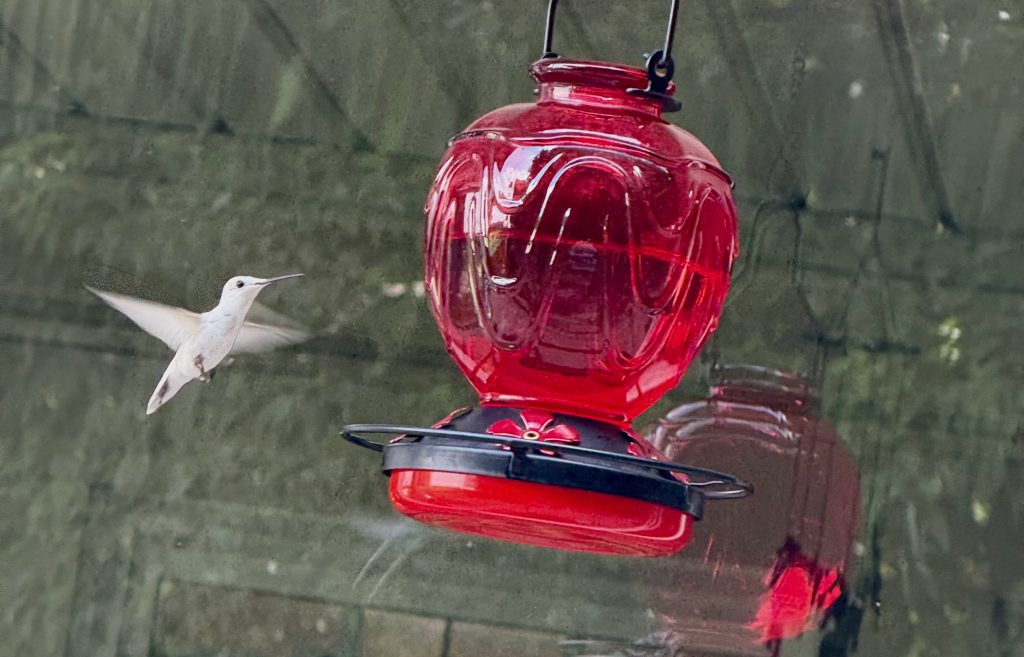
White hummingbirds include both leucistic (pale individuals) as well as true albinos (completely lacking pigment). Gray or tan hummers are more likely than full albinos. Light-colored individuals have normal, dark-colored soft parts such as dark eyes, feet and bills. Albinos, on the other hand, are very rare. These snow-white birds sport pink eyes, feet and bills, and have been documented fewer than 10 times in North Carolina. To date, only three have been banded and studied closely in our state.

It isn’t unusual for people to think they are seeing a moth rather than a hummingbird when they encounter a white individual, not realizing that these beautiful creatures are even possible. In fact, we know very little about white hummingbirds. Opportunities to study these unique individuals are few and far between. What we do know is that they tend to appear in July or August as young of the year and do not survive into their second season. White feathers are very brittle and likely cannot withstand the stress of rapid wing beats and long-distance migration. Another very curious characteristic is that all these eye-catching birds have been females. So, it’s likely that this trait is genetically sex linked.

The first white hummer I managed to band was a creamy bird in Taylortown, near Pinehurst, over 20 years ago. She was an aggressive individual that roamed the neighborhood terrorizing the other ruby-throateds. The first true albino I documented was in Apex, and that individual was even more aggressive; chasing all the other birds that made the mistake of entering her airspace. To have a chance of studying a white hummer, I must get word of it quickly before the bird heads out on fall migration. I have missed more than one by less than a day.

Just recently I heard about a white hummer in the Triangle area. Excited, I followed up and received permission to try to band the bird. She was mixed in with dozens of other hummingbirds using feeders and flowers on a rural property outside Chapel Hill. Although it took two tries, I was able to get her in-hand. This beautiful hummer was very pale, but had some gray in the tail as well as some tan marbling on the back. Her eyes, bill and feet were still the expected black color.

I hope to hear about another of these tiny marvels before all of the hummingbirds in central North Carolina have headed south. Each one is so unique.

Life’s Funny

LIFE'S FUNNY

A New Lens on Life

The case of the masked bandit and his five-finger discount

By Maria Johnson

Years ago, when our sons were little, they gave me a Mother’s Day gift.

Their eyes gleamed as I peeled away the wrapping paper.

“Oh,” I said, aware of the tender hearts in front of me. “A LEGO set. How . . . cool!”

“Look, Mom!” they bubbled as they grabbed the box from me, flipped it over and pointed to pictures of all of the things that could be made with the multicolored bricks. “Isn’t it great?”

“It is great,” I said.

And I meant it. Because I knew how they meant it. Inside that box were hours — OK, maybe minutes, considering my impatience and their facility with LEGOs — of a shared experience, of making something together.

They knew I would be down, as in down on the floor, with anything they wanted to do. That was a compliment that I treasured. And, honestly, whenever I went with their flow, I experienced the joy of knowing them more deeply, of learning something new and, often, of cracking up at the result of our collaboration.

Fast forward to the moment when I unwrapped a gift from my husband, Jeff, on our recent anniversary.

“Oh,” I said. “A solar-powered . . . Bluetooth-enabled . . . motion-activated . . . bird-cam-feeder . . . equipped with AI identification . . . and a voice alarm. How . . . cool.”

His eyes were gleaming. Once installed, the bird-cam-feeder would be easily the most technologically advanced device in our home. OK, just outside our home.

I realized that the gift represented something we could do together, even though he’s way more into birds than I am. Plus, I had to admit his choice made sense, given the events of the past year. To wit:

I did ask for, he did give me, and I did love reading Amy Tan’s nonfiction work, The Backyard Bird Chronicles, a beautifully illustrated book about how Tan survived COVID by becoming an intense observer, and sketcher, of birds.

I do luvvvvvv watching, and re-watching, the adventures of avid birder and ace Detective Cordelia Cupp in the brilliantly absurd Netflix series, The Residence. (Seriously, Netflix execs, what are you thinking by not renewing that show?)

I did express enthusiasm, in a polite way, when a friend described his bird-cam-feeder equipped with AI identification.

Also tangentially true: I have been known to commit aspirational gifting. Consider the pickleball paddles I gave Jeff a couple of birthdays ago. (“Look, honey! Aren’t they great?!” I said, rising from the table to demonstrate my dinking technique.)

But back to our fine feathered friends: Basically, I like watching birders more than birds, which is why I enjoyed watching Jeff carefully determine the best location for the bird-cam-feeder, in front of our garden Buddha, who understandably wears a slight smile.

He — Jeff, not Buddha — spent many hours figuring out how to mount the bird-cam-feeder (atop a black metal pole); how to make the couplings aesthetically pleasing to me (no radiator clamps allowed); and how to use the app that would notify us whenever the camera spotted a creature.

The first sightings, I must say, were of some truly scary specimens: The Sweaty-Headed Sucker Pluckers.

That’s right. Us. The camera picked us up every time we walked by, headed to the garden to pinch the suckers from our tomato plants.

Jeff tweaked the phone-based app settings to detect only creatures that alighted on the feeder. At first, I was amazed at the different birds that stopped in for a beak full.

There was our friend, the cardinal.

And a purple finch.

And a house sparrow.

And a Carolina wren.

And a thrush.

And a titmouse.

And another titmouse.

And, OK, another titmouse.

And then came the crows.

Oh. Em. Gee.

The crows.

Here, I would like to make a prediction: When the world as we know it comes to an end, it will not become the the planet of the apes. No. It will become the planet of the crows, an obviously superior species that knows how to work together for mutual benefit.

I say “obviously” because once they discovered the bird-cam-feeder, it was a nonstop milo-millet-cracked-corn-and-sunflower-seed hoedown in our side yard.

You know how revelers toss beads from floats in Mardi Gras parades in New Orleans?

Like that. Only instead of throwing beads, the captain of the Crow Krewe would hop up on the perch, bob side to side, and sling seed to all of his crow buds on the ground until, voila, no more beads.

I mean seeds.

This happened over and over again, until Jeff went into the app and figured out how to sound the alarm to scare off unwanted diners.

BZZZZZZ! Gone.

We were satisfied. For a minute. Then we noticed that the feeder would be full of seed at sunset and empty in the morning.

Hmm. Most birds around here, owls notwithstanding, do not feed at night.

Further, the camera recorded no birds overnight.

But something was triggering the camera to record blurs.

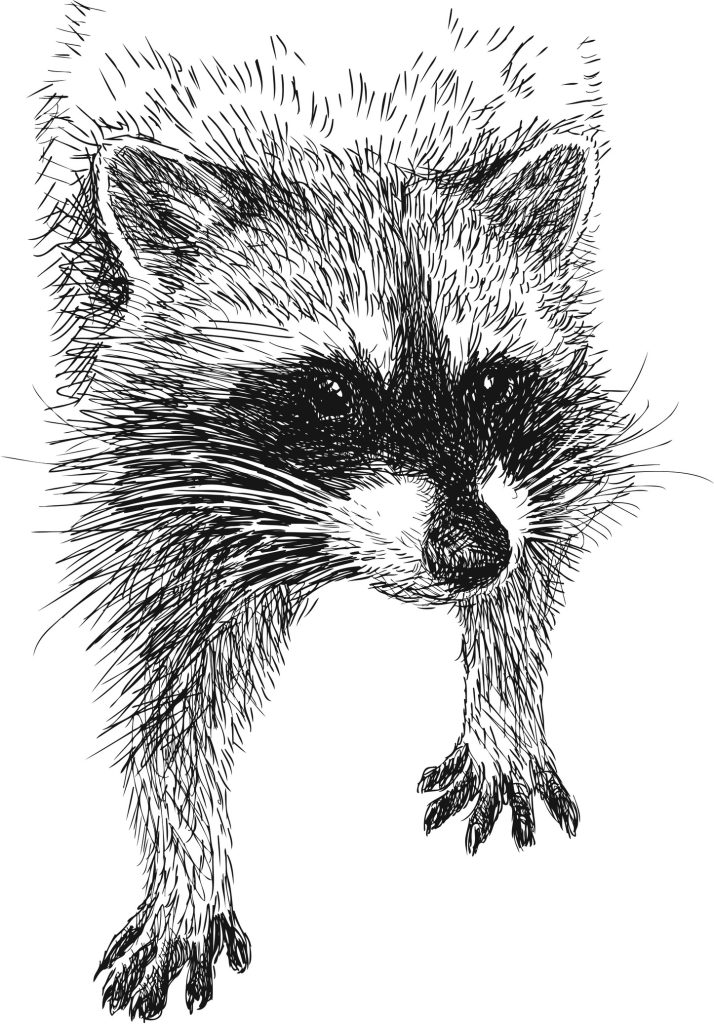
We went into Cordelia Cupp mode, zooming in on the fuzzy photos frame by frame until we spotted a hand. But not just any hand. A hand worthy of a 1950s horror flick. A small, gnarly, five-fingered black hand surrounded by a cloud of fur.

“Barnacle goose,” AI declared.

Huh?

A few frames later, we observed a closeup of sharp little teeth.

“Bonin petrel,” said AI, suggesting a seabird that nests on Pacific islands.

A few frames later, we made out a bushy tail.

“Mute swan,” AI ventured.

A few pics hence, we saw a pointy snout with a sliver of a dark mask.

We didn’t care what the AI bird brain said.

It was a raccoon.

We looked at each other. But how?

We dived into the literature and found out that raccoons have thumbs, which means they can grasp things, like aesthetically pleasing black iron poles, and climb said poles, hand-over-hand, past dome-shaped baffles, to arrive at sunflower seed jackpots.

Nom-nom-nom.

Suddenly, we were aware of a pattern, not that it mattered.

About this time last summer, we were engaged in the War of the Chipmunks, a dramedy that pitted us, the innocent homeowners, against the rally-striped varmints who maintain a thriving chip-o-polis around our home.

This year’s instant classic was the Battle of the Birdseed, starring that insidious urban bandit, the raccoon, which, in truth, I would have been tempted to think of as cute, if not for the fact that it was cleaning out my bird-cam-feeder, which I was suddenly very possessive of.

Ask any politician about the unifying emotions of people who feel they are threatened by “others,” even if the others are, you know, raccoons.

The fortification began.

Problem solver that he is, Jeff hopped on the internet to search “raccoon baffles.” He found one model, a wide-mouth, metal pipe that no raccoon could get a grip on, for $60.

His Scottish heritage — best paraphrased as, “By God, I’ll not pay $60 for a two-foot length of stove pipe”— prompted him to drive to a rural hardware store to buy . . . wait for it . . . a two-foot length of stove pipe for $20.

Which meant that very night I hit “Place Your Order” on the $40 skin cream I’d been dithering about for weeks.

It’s yet another way that we balance each other.

But I digress.

The point is, after many more hours at his workbench, Jeff installed the homemade raccoon baffle, and now we are now the proud owners of a maximum-security bird-cam-feeder, which is highly effective.

How do we know?

The morning after installation, there was plenty of seed for the morning feeders.

And, upon closer inspection, we saw that the stove pipe was covered with muddy, five-fingered handprints that appeared to be sliding downward.

(Insert sound of raccoon fingernails scraping black stove pipe, followed by sharp-toothed expletives.)

We looked at each other and cracked up.

Sazerac September 2025

SAZERAC

September 2025

Sage Gardener

With the end of summer comes the inevitable garden turnover, and the Sage Gardener is thinking about what he can grow without even stepping foot outdoors. You can get a kit delivered right to your front door, from $20 for a 10-piece ensemble found on Amazon all the way to an $899, smart technology, hydroponic, LED-lit, automatically-watered unit (remote camera extra) from Gardyn.com. But a quick survey of my friends suggests you don’t have to break the bank to bring the outdoors in. “I buy basil and parsley at the local Harris Teeter and torture them until they wither,” says an artist friend. “I’ve begun to notice that when I go by the baby plants in the produce aisle, they’ve started recoiling at me.”

Another friend fills her kitchen with herbs from Trader Joe’s, popping the ones that don’t thrive from the pot into the frying pan. Her partner has labeled the sunny little corner of their kitchen, “The Rainforest.” She’s found that mint in particular thrives like kudzu until Derby Day, when it tends to disappear.

Another friend restricts his indoor gardening to chives, which he snips and puts on salads and baked potatoes. My wife and I have found that “mowable” plants are the best bet for our window garden: herbs or leaf lettuce, spinach, endive and Swiss chard. We also grow root veggies for their edible greens. Think beets, turnips, mustard greens and radishes.

A friend in New York City warns that you need the right angle of sun for certain plants to thrive: “The growing season on our south-facing back deck lacks the early spring warmth of North Carolina, but my reliable winter-overs are lovage, chives and sage. This year’s sage plants are almost teenagers.”

A hiking buddy who actually harvested tomatoes from her potted plants says, “I’m no expert but I’ve learned the importance of light, food and water. The key lies in figuring out how much of each, when, and then adjusting the ratio to fit their needs.”

O.Henry colleague Maria Johnson takes her struggling plants to “the urgent plant-care clinic at Plants & Answers on Spring Garden Drive for a quick diagnosis.” If declared fatally wilted on arrival, “there are plenty of healthy replacements to choose from.”

If you’re really serious about all this, I suggest that you google “indoor garden links by Guilford County Master Gardeners.” Or check out a primer written by an extension agent in Person County, who, among many other tips, suggests using equal portions of peat and vermiculite for your soil; fertilizing your plants with a water soluble 15-30-15 formula; and choosing the right window or spot on the patio so that fruiting plants get at least 12 hours of bright light a day. Finally, remember, says the gardening-in-the-kitchen magician, that, except for root and leaf plants such as carrots and lettuce, “vegetables must be artificially pollinated for fruit development. Pollination can be accomplished by taking the powdery pollen from the bead-like anthers with a camel’s hair brush and placing it upon the stalk-like pistil.” And by now we all know plants respond well to music, so may I suggest you set the mood with your Marvin Gaye album? Because it’s time for your plants to get it on.

Just One Thing

Harriet Tubman, Mohandas Gandhi, Frederick Douglas and, seen here, Marian Anderson are just some of the familiar figures artist William H. Johnson (1901–1970) painted in his mid-1930s Fighters for Freedom series. Born to a poor African American family in Florence, S.C., in 1901, Johnson left his hometown behind at the age of 17, following his dreams of being an artist to the Big Apple. There, he worked a variety of odd jobs, saving money to put himself through the National Academy of Design and later serving as general handyman at the Cape Cod School of Art in Provincetown, Mass., where he studied with painter Charles Webster Hawthorne. It was Hawthorne who influenced Johnson’s bold use of color, seen throughout this series, which was created to honor African American activists. Featured were scientists, teachers and performers, as well as international heads of state who were valiantly working toward peace. Among his Fighters stands Marian Anderson, mouth open in song. A contralto, she was the first Black soloist to perform at both the Metropolitan Opera and the White House. In 1939, just a few years before Johnson painted this series, the head of the Daughters of the American Revolution denied Anderson permission to perform at the DAR Constitution Hall because of the color of her skin. Subsequently, First Lady Eleanor Roosevelt resigned from DAR and, just a couple months later,  presented Anderson with the Spingarn Medal, which recognizes outstanding achievement by an African American. Anderson died in 1993 at the age of 96. You can admire her vibrant, colorful portrait, along with several Fighters for Freedom, at Weatherspoon Art Museum’s exhibit, Sept. 6–Nov. 29. Info: weatherspoonart.org/exhibitions_list/fighters-for-freedom-william-h-johnson-picturing-justice.

Window on the Past

Among the vast vinyl collection of the Greensboro History Museum, one shines brightly — the 1976 Rick Dees gold record of the satyrical novelty song “Disco Duck.” Dees, who graduated from Grimsley decades ago, is still rocking a smashing radio broadcasting career. You can tune in to his voice on his syndicated Rick Dees Weekly Top 40 Countdown, and, if you’re a really lucky duck, you might catch him going quack-quack, quack-quack.

Unsolicited Advice

You’ve seen them already, the early signs of fall. No, we’re not talking about foliage — this is North Carolina, folks. But Starbucks released its seasonal menu late last month, so don’t be surprised to catch a whiff of pumpkin spice on someone’s breath. Get used to it. How about some ideas to get into the spirit of the season, Southern style?

Haul out the flannel shirt! But rip off the sleeves for a look that says, “I love fall!” Or, “Wanna hop on my hog?” Either way, we’re into it. And you can repurpose the sleeve by filling it with maize to use as a door draft stopper for when the fall breezes actually start blowing.

Forget the steaming cup of mulled cider. Since we’re in Piedmont North Carolina and it’s still September, cool off with a chilled cider slushy. Sugar, spice and loads of crushed ice. And a dash of brandy for the 21+ crowd.

Crank up the oven for fall baking. Think chocolate-chip pumpkin bread, homemade cider donuts or apple spice cake, the cozy scent of cinnamon and nutmeg wafting throughout your home. Just don’t forget to also crank up the AC, or hints of perspiration will also be in the air.

Take a leaf-peeping road trip. According to Google Maps, it’s only about 17 1/2 hours to Maine’s Mount Katahdin.

And if there’s one thing no other region can top, it’s college football season. Where else is it warm enough to go shirtless and paint your entire torso for game day? Take it from us and spring for the sweatproof paint or you’ll be a puddle of school colors by halftime.

Off the Record

OFF THE RECORD

Off the Record

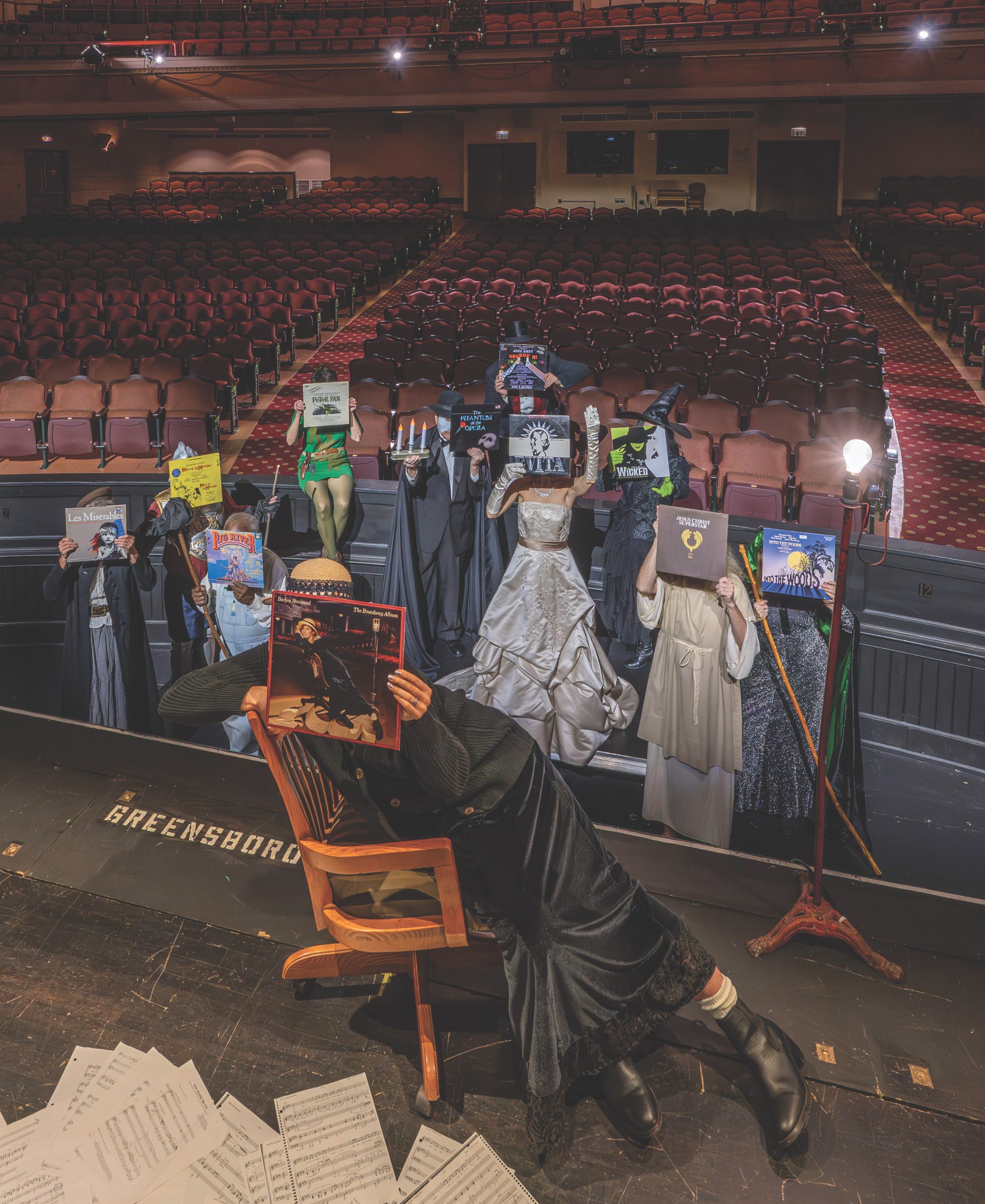
We asked our photographers to think outside the cardboard sleeve. The results? Record setting.

What: Peter Frampton/Frampton comes Alive

Who: Julie Borshak

Where: Keith Borshak’s studio

Photograph: Keith Borshak

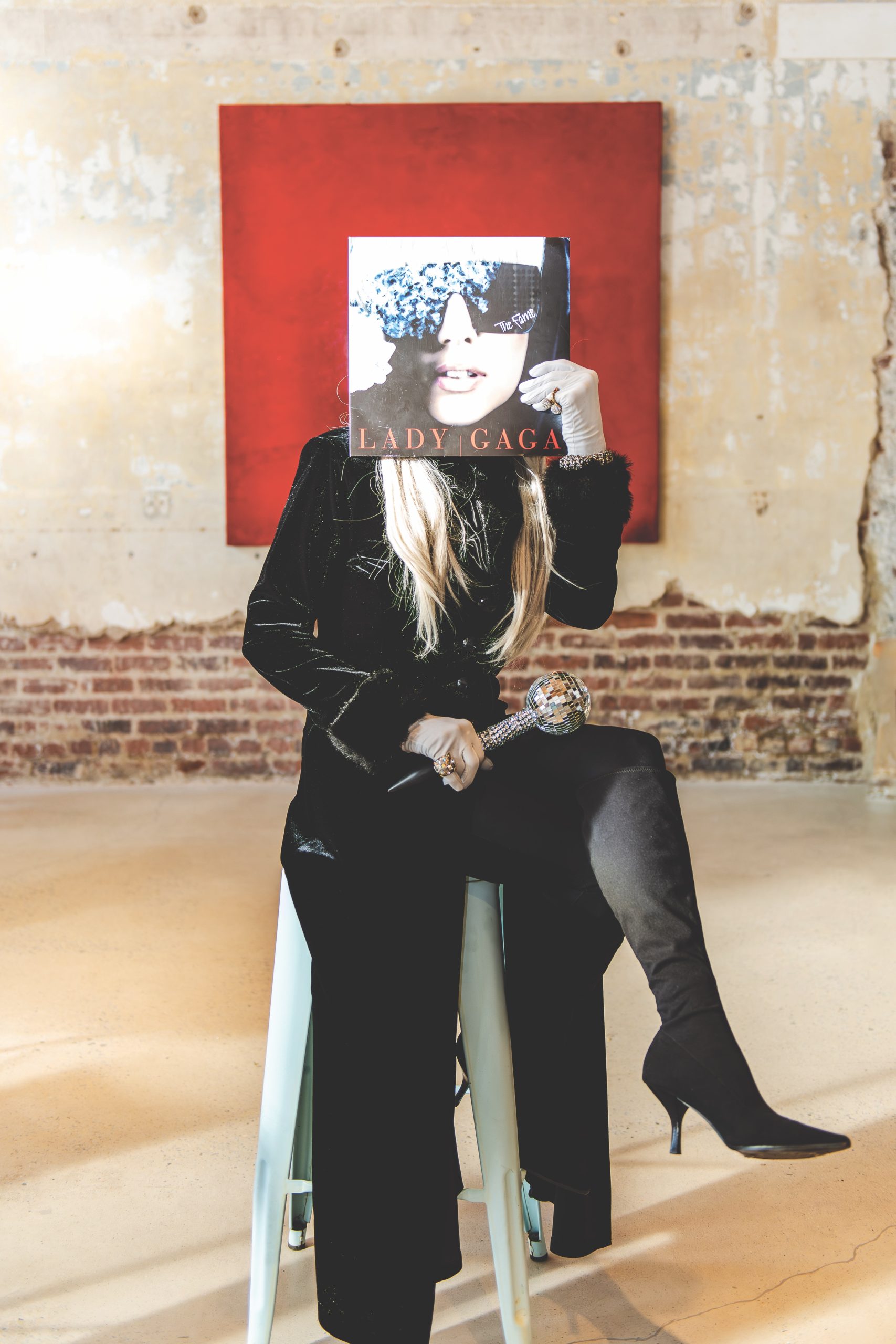
What: Lady Gaga/Fame

Who: Leslie Gill

Where: Cohab.Space, High Point

Photograph: Amy Freeman

What: B.B. King/Live in County Cook Jail

Who: Tony Hall - Guitar borrowed from Steward Fortune

Where: Downtown on Washington Street

Photograph: Mark Wagoner

What: Lionel Hampton/Silver Vibes

Who: Byron Grimes

Where: Mark Wagoner’s music studio

Photograph: Mark Wagoner

What: The Rolling Stones/Sticky Fingers

Where: Kontoor Brands World Headquarters

Photograph: Becky VanderVeen

What: The Rolling Stones/Tattoo You

Who: Nathan James Hall

Where: Legacy Irons Tattoo

Photograph:  Bert VanderVeen

What: Barbra Streisand/The Broadway Album

Who: Cassie Bustamante as Barbra Streisand

Eloise McCain Hassell as Éponine, Les Misérables
J.P. Swisher as Don Quixote, Man of La Mancha
Ralph Shaw as Jim, Big River, Mary Ries as Peter, Peter Pan
Lee Kirkman as The Phantom, The Phantom of the Opera
A. Robinson Hassell as George M. Cohan, George M!
Amber Engel as Eva Perón, Evita Pam Wheeler as Elphaba, Wicked
Chip Potter as Jesus, Jesus Christ Superstar
Carole Lindsey-Potter as The Witch, Into the Woods Lighting by Kendall Thompson
Costumes & Props by Winston-Salem Theatre Alliance,
Lynn Donovan & cast
Album covers borrowed from the collections of
Eloise & Robby Hassell, J.P. Swisher, Rachelle Walsh,
Mark & Lynn Wagoner, Brenda Studt,
Carole Lindsey-Potter, Lynn Donovan

Where: Carolina Theatre

Photograph: Lynn Donovan

What: Herb Alpert’s Tijuana Brass/Whipped Cream & Other Delights

Who: Venée Pawlowski

Where: Black Magnolia Southern Patisserie

Photograph: Lynn Donovan

Simple Life

SIMPLE LIFE

Gone East

How a love affair that never happened changed my life

By Jim Dodson

September may be the ultimate month of change.

As summer’s lease runs out, the garden fades, and days become noticeably shorter and sometimes even cooler, hinting at autumn on the doorstep. After Labor Day, summer’s farewell gig, in 39 percent of American households — those with school-age kids — the days bring new schedules and an accelerated pace of life.

Just down the street, a dear neighbor’s firstborn is settling into her dorm at Penn State University. Her mom admits to having tender emotions over this rite of passage.

I know the feeling well. I remember driving both my children to their respective universities in Vermont and North Carolina, sharing stories with their mother on the way about their growing up and marveling how time could possibly have passed so quickly. Without question, dropping my kids off at college was a ritual of parting that stirred both pride and emotion.    

On a funnier note, September’s arrival reminds me of my own unexpected journey to East Carolina University half a century ago. On a blazing afternoon, my folks dropped me off at Aycock dorm, now Legacy Hall, with my bicycle, a new window fan and 50 bucks for the university food plan.

Not surprisingly, my mom hugged and kissed me, and wiped away a tiny tear; my dad merely smiled and wished me good luck. He also looked visibly relieved.

“You made the right decision, son,” he said. “I think you’ll really enjoy it here.” 

The previous winter, you see, I fell hard for a beautiful French exchange student at my high school named Francoise Roux. During the last few weeks before she headed home to France, we had a two-week courtship that included long walks and deep conversations about life, love and the future.

I was too nervous to kiss her. Instead, on the last night before she flew away, sitting together by a lake in a park, I played her a traditional French lullaby on my guitar, an ancient song her father sang to her when she was little. During the drive back to her host’s residence, we even discussed the crazy idea that, when I graduated in the spring, I might forego college in America for the time being in favor of finding a newspaper job in France so we could stay together.

As we said goodbye under the porch light, she leaned forward and gave me our first — and last — kiss. 

It was a sweet but improbable dream. Yet, having won Greensboro’s annual O. Henry Writing Award the previous spring (and consumed far too much Ernest Hemingway for my own good), I decided to skip applying to college and seek a job in Paris. Touting my “major” writing award and one full summer internship at my hometown newspaper, I brazenly applied for a job as a stringer for the International Herald Tribune’s Paris bureau. 

Amazingly, I never heard back from the famous newspaper.

Come middle May, still waiting for a reply, I was having lunch with my dad at his favorite deli when he casually wondered why “we” hadn’t yet heard from the four colleges I’d applied to for admission.

“Actually, Dad,” I said, “I didn’t apply to them. I have a better plan in mind.”

I sketched out my grand scheme to spend a year working in Paris, where I would cover important news stories and gain valuable life experience in the same “City of Lights” that he fell in love with during the last days of World War II. I mentioned that I was waiting for a job offer from the International Herald Tribune.

He listened politely and smiled. At least he didn’t laugh out loud. He was an adman with a poet’s heart. 

“This wouldn’t have anything to do with a certain pretty French girl named Francoise, would it?”

“Not really,” I said. “Well, a little bit.”

He nodded, evidently understanding. “Unfortunately, Bo, you will have to get a draft number this September. And if you get a low number and aren’t in a college somewhere, you might well be drafted. That will break your mother’s heart. How about this idea?”

He suggested that I simply get admitted to a college somewhere — anywhere — until we could see how things panned out with the draft. There were rumors that Nixon might soon end it. Until then, a college deferment would keep me from going to Vietnam.

Reluctantly, I took his advice and applied to several top universities. None had room for me, though UNC-Chapel Hill said I could apply for the spring term. Too late to be of use.

On a lark at the end of May, my buddy Virgil Hudson said he was going down to East Carolina University for an orientation weekend and invited me to tag along. I’d never been east of Raleigh.

On our way into Greenville that beautiful spring afternoon, we passed the Kappa Alpha fraternity house, where a lively keg party was happening on the lawn. I’d never seen more beautiful girls in my life. Young love, as sages warn, is both fickle and fleeting.

“Hey, Virge,” I said, “could you drop me off at the admissions office?”

The office was about to close, but the kind admissions director allowed me to phone my guidance counselor back home and have my transcripts faxed. I filled out the form and paid the $30 admission fee on the spot, leaving me 10 bucks for the weekend.

By some miracle I still can’t fathom, ECU took me in.

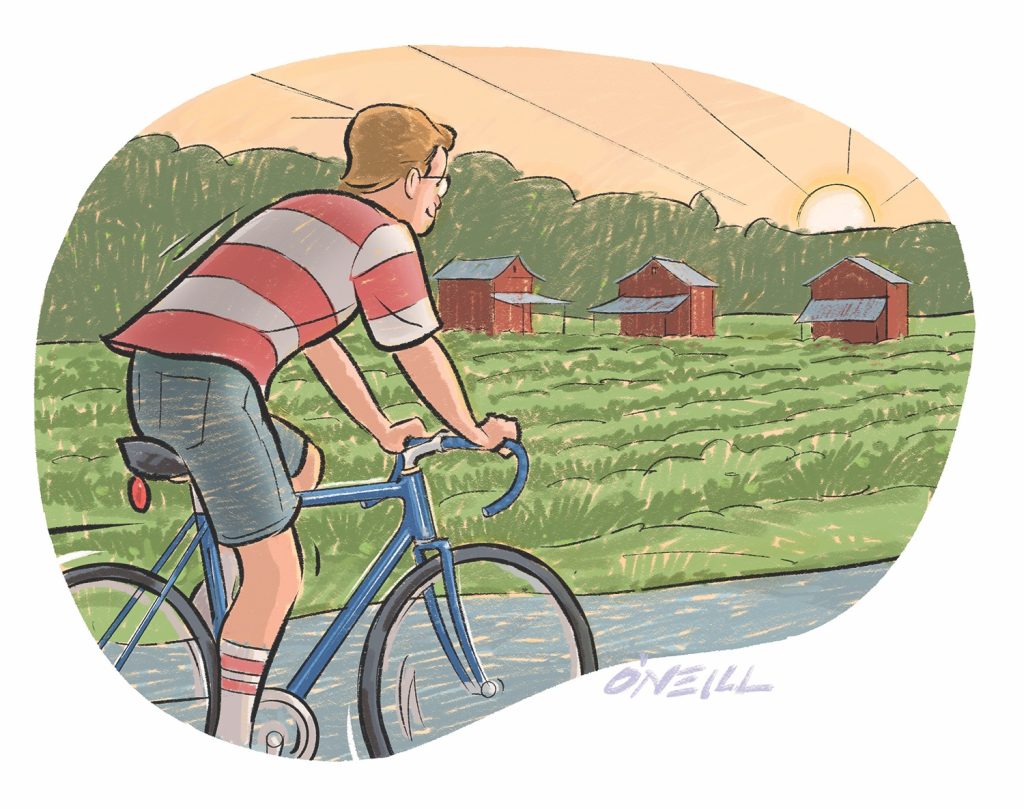
The first thing I did on the September morning before classes got underway was get on my bike and ride due east toward New Bern. As a son of the western hills, I simply wanted to see what this new, green countryside looked like.

The land was flat as a pancake and the old highway wound through beautiful farm fields and dense pine forests. A couple hours later, I stopped at a roadside produce stand to buy a peach and had a nice conversation with an older farming couple who’d been married since the Great Depression. 

I had no idea how far I’d pedaled. “Why, sonny, you only have 10 more miles to New Bern,” the old gent told me with a soft cackle. I got back to my dorm room after dusk — having fallen in a different sort of love.

There was something about this vast, green land with its rich, black soil and friendly people that quietly took hold of my heart.

My freshman year turned out to be a joy. My professors were terrific, and my new friend and future roommate was a lanky country kid from Watts Crossroads, wherever the hell that was. His name was Hugh Kluttz.

We are best friends to this day.

Having “gone east and fallen in love,” as my mother liked to tell her chums at church, I became features editor of the school newspaper — artfully named The Fountainhead — where I wrote a silly column that undoubtedly shaped my writing life.

In 2002, upon being named Outstanding Alumni for my books and journalism career, I confessed to an audience of old friends and university bigwigs that “going east and becoming an accidental Pirate turned out to be the smartest move of my young life — one I indirectly owe to a beautiful French exchange student I never saw again.”

Funny how life surprises us. A few years ago, out of the blue, I received a charming email from Francoise Roux, wondering if I was the same “romantic boy who once played me a lullaby on his guitar?”

We’ve exchanged many emails since then, sharing how our lives have gone along since that first and last kiss under the porch light. Francoise is a devoted grandmother and I’m about to become a first-time grandfather around Christmas. Soon enough, I’ll be playing that old French lullaby to a new baby girl, marveling alongside my daughter and her husband as they embark on their own, uncharted journey.