O.Henry Ending

Wag More, Bark Less

Happiness is a dog named Fritz

By Brian Faulkner

Illustration by Harry Blair

My next door neighbor has a dog down the street. It’s not his dog, but the pup hasn’t figured that out. So, every time my friend approaches the house where the little guy lives, the thing starts to bark and shimmy and shake until Gordon gets there and scratches the dog’s neck. It’s quite the sight, all that love, which makes me think that maybe Charles Schulz was right about happiness being a warm puppy.

“Why not get yourself a dog like that?” I quiz my neighbor. “No need,” he says. “Fritz and I are happy with things the way they are.”

This isn’t an essay about dogs, although it does seem to be drifting that way — I could tell you about one dog I met who had been taught to smile on command or another who could back up on request, both to great merriment. So it may be that dogs and happiness come from the same place. The light in my youngest brother’s eyes when I brought a puppy home in a box one summer’s day in 1965 could almost make me think so.

We can do things that might lead to happiness, but there’s no guarantee that happiness will appear. But then, just when we finally think we’ve got a grip on it, happiness, slides away and hides out in life’s tall grass until it’s ready to show up again.

“Happiness ain’t a thing in itself,” declares a Mark Twain character who’s trying to figure what heaven might be like. “It’s only a contrast with something that ain’t pleasant.”

“It just seems that if you hang on for a while longer, there is always something bright right around the corner,” observed Schulz, who strung both happiness and heartache through his comic strips like multicolored ribbons. You may remember Charlie Brown each autumn, ready to kick the football Lucy is holding upright for him, eager to let fly with it but knowing that she probably will snatch the ball away just as he gets there. We know what’s going to happen, but in our story — the one in our hearts, Lucy holds fast and Charlie Brown sends the ball sailing. We’re all Charlie Browns, and disappointments thread their way through our lives like insistent melodies. The trick lies in learning to let whatever happiness may come our way just happen.

I enjoy poking around in vintage stores like The Red Collection, where from time to time I’m delighted to find old pictures with a bit of happiness still clinging to them, memories long separated from their people. One of the happiest pictures I’ve ever seen — anywhere — was shot by Matthew Lewis Jr., a Pulitzer-winning news photographer known mostly for his civil rights era work: two little girls swinging together — one black child, one white, soaring through the sky and having the time of their young lives. Anybody who claims that “happiness ain’t what it’s cracked up to be” should see that picture.

Sometimes happiness simply surprises, like the time I covered a news story for a radio station. A rather robust lady had fallen through her outhouse seat into the mire below. It took a winch to crank her out, and as her considerable bulk emerged from the darkness, she showered her audience with laughter. What a joy! It’s refreshing to see people happy despite their circumstance, people who know they are blessed and who bless us in return. It could be someone working in their garden and holding up a handful of fresh-pulled weeds in a wave as you pass by. Or Fritz, waiting up the road for my neighbor to come scratch his neck.

Despite scientific research that says happiness ain’t so hot because happy people are more likely to be “influenced by stereotypes” and have other discouraging traits, I for one am all for it — happiness, that is. My suggestion is to take the risk that things won’t turn out perfectly, jump on the happiness train and let it take you down the tracks. Let your spirits rise. Float off in the air, like a balloon that’s escaped from a child’s birthday party, exulting in the moment with no worry about where the wind may take you . . . if anywhere. Breathe in the fresh, breathe out the foul. Divest yourself of the things that gnaw at you, that bring you down, if just for a moment.

Then, as Mark Twain puts it, in no time at all you’ll be “happy as a dog with two tails.” OH

Brian Faulkner says he’s happiest when writing, which he’s done more or less successfully all his life, including a series of Emmy award–winning public television programs, the occasional essay and a children’s story now and then. He lives in Lewisville, which he claims is close enough for Greensboro to claim as kin. 

Doodad

Phone Home

Downtown Greensboro’s Passport to Summer goes digital

If your summer dreams include sampling Laotian food, tasting fine Italian wines or touring airy museums, maybe you want to skip the airline reservations and TSA lines for a change of pace. Just grab your “Passport” and head to Greensboro. For the third year, Downtown Greensboro (DGSO) is hosting its Passport program, encouraging locals and visitors to explore the heart of the city. Through August 31, participants can earn prizes by visiting local “ports of call” — restaurants, bars, and shops any number of other attractions about town.

This year, DGSO has gone digital, eschewing the printed passport and physical stamps for an app that gets local adventurers in the game within minutes. “We received feedback from participants over the past two years. People would often say ‘I wish this were on my phone. I forget my Passport, but I always have my phone with me,’ so we took that to heart,” says Director of Operations Julia Roach.

To get started, download the DGSO app from the App Store or Google Play and choose from three passports: Food + Drink, Shops, and Things To Do. Visit one of the participating businesses, and complete the required task to check in and receive a stamp. Six stamps in one of the passports earns you Tourist status with a prize of two Downtown Greensboro koozies. Backpackers (12 stamps) will receive a DGSO T-shirt, while Globetrotters with 20 stamps will get a water bottle and be entered for a chance to win a night out in downtown Greensboro including a stay at the new Hyatt Place hotel.

Alexa Wilde, owner of Antlers and Astronauts on South Elm Street gives her, well, stamp of approval for the program. “It’s not just for people who live in Greensboro. It’s a great resource for anyone in surrounding areas, too. The Passport is like a guidebook to summer.” The program is, of course, designed to boost sales for downtown businesses. And it seems to be working. “All of the people that have checked in so far this year have made a purchase,” says Wilde.

Roach is following the initiative with anticipation. “I’m just really excited to see how people react to the change to digital. It’s given new energy to the project, so we’re really excited to see where it goes from here.” The prizes aren’t the only reason to get involved. On August 2, O.Henry’s own O.Hey is hosting a Passport Party at Preyer Brewing Co., a fitting way to top off the program . . . and snag another Passport stamp. — Annie Vorys  OH

Simple Life

The Road to Happiness

It’s an upward climb filled with twists and turns, but joy is in the journey

By Jim Dodson

A dear friend phoned the other day just to say hello, a gifted young poet I hired many years ago as our organization’s first staff writer, who went on to become the senior editor of this magazine. I always knew the time would come when Ashley would fly away to new horizons, which she did after many years of our working together, moving to the mountains where she became a teacher, artist and musician. Lucky for us, her soulful perspective continues to grace the magazine’s pages.

As old friends do, we spent a full half hour catching up on each other’s lives.

I was pleased to learn about her current boyfriend and their travels to art festivals across the Southeast, where they sell handmade crafts created from sea glass, answering the muse and enjoying life on the road.

“You sound pretty happy,” I ventured at one point.

“I am. Maybe never happier. How about you?”

I replied that I was happy at that moment because I was talking to her while sitting in a well-worn Adirondack chair on the lawn where I begin and end most of my day in quiet reflection, watching the dawn arrive and the day depart, usually with Mulligan the dog and Boo the cat by my side. When she called, my companions and I happened to be watching the first fireflies of the season dance in the dusk.

During our years working together, Ashley and I often fell into lengthy conversations about life, love, matters of faith and favorite poets. Among other things, we share an Aquarian sensibility about the future and how we must spiritually evolve in order to get there in one piece as a race of scattered and fractured human beings.

I wasn’t surprised when she asked what things make me happy these days.

I gave her my short and simple list: rainy Sundays, walks with my wife and our dogs, working in my garden, driving back roads, early church, books and movies that stir the heart, phone calls from my grown children and suppers on the porch with friends.

“What about writing?” she asked.

“Cheap therapy.”

She laughed.

“Maybe you should write a book about happiness.”

This notion made me laugh.

Somewhere I’d read that there are more than 500 books on the subject of happiness in print, proving happiness is purely in the eye — or soul — of the beholder.

Besides, I confessed, my kind of happiness was increasingly fueled by things I’d given up or simply no longer needed for the journey, a list that included, but was not limited to, late-night fears of failure, desires for wealth or fame, judging other flawed human beings, even my once all-consuming love of sports was practically gone.

True to the spirit of our talks, I turned the question around on her. Ashley didn’t hesitate.

“I think happiness comes when you are following your heart and doing good things for others.”

Her prescription reminded me of something I’d just read in commentator David Brooks’ outstanding new book The Second Mountain — The Quest for a Moral Life.

“Often,” Brooks writes, “we say a good life is a happy life. We live, as it says in our founding document, in pursuit of happiness. In all forms of happiness we feel good, elated, uplifted. But the word ‘happiness’ can mean a lot of different things.”

Brooks makes an important distinction, for instance, between things that make us happy — a good marriage, a successful career, a sense of material achievement — and the rarer experience of joy.

“Happiness involves a victory for the self, an expansion of self. Happiness comes when we move toward our goals, when things go our way. You get a big promotion. You graduate from college. Your team wins the Super Bowl. You have a delicious meal. Happiness often has to do with some success, some new ability, or some heightened sensual pleasure.”

Joy, on the other hand, he posits, has to do with some transcendence of self, comes almost unbidden when “the skin barrier between you and some other person or entity fades away and you feel fused together. Joy is present when mother and baby are gazing adoringly into each other’s eyes, when a hiker is overwhelmed by the beauty in the woods and feels at one with nature, when a gaggle of friends are dancing deliriously in union. Joy often involves self-forgetting.

”We can help create happiness,” Brooks concludes, “but we are seized by joy. We are pleased by happiness, but we are transformed by joy.”

The day after catching up with Ashley, I was on a winding road deep in the Blue Ridge mountains of Virginia, chasing pieces of Wagon Road history and human stories for my next book — something that always makes me happy — unable to get our conversation about happiness out of my head.

The art of happiness, my version of it anyway, seems to be about an inward journey cultivated by intentionally making room in life for small restorative acts and daily rituals that invite you to step out of your hectic, overscheduled life into what Irish mystics called a thin space, a place where duty and obligation are put on hold and deeper mindfulness is possible. Without my early morning communion with the stars and the grateful prayers I send up like sparks from a signal fire to the gods, my day is curiously never fully complete.

For what it’s worth, I also agree with Ashley the poet and Brooks the wise counselor that service of the smallest order to others in a world where there is so much isolation, loneliness and suffering may be the truest pathway to a happier, more meaningful life, a true “Second Mountain” existence.

Since most of my days are spent in quiet working isolation — Hemingway, not a happy camper, called writing the “loneliest art” — I find myself these days almost unconsciously seeking out opportunities to commit some kind of tiny random act of kindness to a fellow stranger in need. The other day, I chased down a harried mother’s runaway grocery cart in the parking lot of Harris-Teeter. She had an infant on her hip and was struggling to unlock her SUV. Her grateful smile and warm thanks were like a liberating breeze to a weary brain that had been arm-wrestling words and sentences onto the page most of that day.

During our pre-dawn walks around the neighborhood each day, my wife began stopping by the house of an elderly shut-in lady to walk her newspaper from the curb to a chair by her front door. We’ve never seen our neighbor’s face. But the dogs insist on stopping to deliver her paper the final 50 feet. To paraphrase C.S. Lewis on prayer, this minuscule act of neighborliness may do nothing whatsoever for God, but it sure makes us all feel a tiny bit happier.

The 17th-century Buddhist monk Gensei wrote, “With the happiness held in one inch-square heart, you can fill the whole space between heaven and Earth.”

Sometimes, we need to be reminded of this fact. A friend who works with the homeless explained to me that perhaps the hardest things homeless people deal with on a daily basis is a feeling that they are not worthy of noticing or speaking to — are, in effect, invisible travelers in our midst.

This prompted a change a shift in my awareness and behavior, from that of feeling uneasy and even slightly resentful whenever I reach into my pocket to offer whatever modest sum may be there, to making a point of looking in the eyes and sharing a few words of ordinary greeting or simple recognition, maybe even learning a name and sharing mine. We are, after all, all traveling the same road between Earth and heaven.

It’s a lesson I seem destined to repeatedly learn. Watching Notre Dame cathedral in Paris burn live on CNN back in the spring, I was suddenly transported to a rainy July day 18 years ago when my son, Jack, then 10, and I were coming out of the famous cathedral in a thunderstorm. Surrounded by a swarm of tourist umbrellas dashing for cover, as we hurried past a lone ragged man with blind eyes standing in the downpour, simply holding out an upturned palm, a character straight from Victor Hugo, a dignified beggar for God.

No one was stopping. But when I saw my son glance back, something stopped me. I gave my son 100 francs and asked him to go and give it to the man. Without hesitation, he threaded back through the on-rushing umbrellas and placed the folded money into the man’s outstretched hand.

What happened next still gives me goose bumps of unexpected joy — the kind of self-forgetting transcendence David Brooks speaks of.

The blind man placed his free hand gently on Jack’s head, as if bestowing a blessing. Watching, my eyes filled with tears, or maybe simply rain. Or both. “What did he say to you?” I asked as we hurried off to find a dry lunch in a cozy Left Bank bistro.

“I don’t know,” he said with a happy smile. “But it was in French and it sounded nice.”

Last summer, at the end of a walking pilgrimage across Tuscany with my wife and 30 other pilgrims, I skipped the private tour of the Vatican’s famous Sistine Chapel in favor of climbing a leafy Roman hill to a small Greek Orthodox Church where I sat on a simple wooden pew for God knows how long listening to morning prayers being sung in Greek by three exquisite voices.

Save for an elderly woman manning a small stand at the rear entrance of the church, I was the only worshipper in the building, sitting beneath the tiny dome of a stunning blue ceiling painted with stars, angels and saints.

Time completely vanished, taking my weary feet with it.

Unexpectedly, it was the happiest moment of my long journey that week.

On the way out, the old woman smiled and waved me over to her stand, handing me a small gilt-framed portrait of an Eastern Saint. I’m still not sure which one.

When I reached into my pocket to pay, she gave me a gentle smile and nod, waving me on with gentle words.

I have no idea what she said to me. I believe it was in Greek and it sounded nice.  OH

Contact Editor Jim Dodson at jim@thepilot.com.

True South

Reminders

A kind of grief

By Susan S. Kelly

This is the month that I turn 65. I suspect I’ll have a breakdown.

I don’t put much store by birthdays typically. As a child, a July birthday meant that my friends were away on family vacations, so no one was around for a party. A summer birthday meant no cupcakes in elementary school, or care packages from Hickory Farms — the standard-but-thrilling gift — at boarding school. As an adult, I seem often to be at the beach, where my mother annually suggests that we have a “nice piece of fish” to celebrate my birthday — a roll-eye refrain the entire family now uses whenever we’re referring to celebrations of any kind.

My sister has a breakdown every time we leave the beach, crying and honking the car horn until she’s out of sight. She’s worried that by the next time we’re all together again, someone will have died, divorced or been irreparably altered in some way.  Cheerful, no? I made her a Breakdown CD full of mournful songs from James Taylor, Pachelbel’s Canon, the themes from To Kill A Mockingbird and The Thorn Birds, so she’ll have background music to wail with during the four-hour drive home.

The last time I had a breakdown birthday was 3 1/2 decades ago, when I turned 30. I was waiting at a stoplight and was suddenly just  . . .  overcome. I bowed my heard and laid my forehead against the hard, ridged, steering wheel and wept. I did not want to be 30 with children and a mortgage and a yard. I wanted to be a sorority girl wearing Topsiders and drinking beer at The Shack with my hair pulled back in a grosgrain ribbon on a Thursday afternoon. There was nothing for my despair but for my husband to take me to Chapel Hill for the weekend. But The Shack was a parking lot. Beers at the gleaming wood bar in Spanky’s didn’t cut it.

The good part about A Big Birthday year means that my friends are turning 65 too.  Bridge buddies, hiking homies, college pals, boarding school classmates — all of us. Meaning that every day brings a veritable blizzard of emails filled with dates, pleas, opinions, rebuttals, suggestions, complaints, reminders, asides, and the occasional joke, all in the service of organizing what I term Girl Gigs. Girl Gigs deserve a column of their own, but I’ll give you a teaser: One friend, for a Girl Gig in the mountains every January, flies in from Greenwich, Connecticut, and brings nothing but a mink coat and 3 pairs of pajamas. Stay tuned.

I don’t care a whit about getting old, or dying (proved by my Funeral File, a topic addressed earlier in these pages). I’ll admit to a fear of my house smelling like old people, and wondering whether it’s time to go ahead and lock into what one friend calls a “terminal hairdo,” the one you wear to the grave. And I drive a Mini Cooper, which seems to be the universally acknowledged car for females of a certain age. But otherwise, nope. No fear, no dread, no anxiety.

I also have zero regrets about those things in the past that I’ve done or left undone, or shoulda, woulda, coulda. Furthering my career? More me time? Taken that trip, accepted that offer? No, no, and no. Do-overs don’t interest me.

Wherefore the melancholy, then?  Just this: 1,277 photographs — give or take a couple dozen travel pictures — on a digital frame. A New Year’s resolution labor of love with a scanner that rotates continuously all day, every day, showing me 1,277 times what I cannot have back. That summer twilight evening of my oldest in his tacky polyester pajamas blowing dime-store bubbles in the driveway before bedtime. That child wearing a mask while he watches television, oblivious that he’s even wearing a mask. That child blowing out candles on what is surely the most hideous homemade birthday cake ever, shaped and iced like a sharpened pencil. The grin the day the braces came off. A husband mowing the lawn with a toddler draped around his neck like a pashmina.

What was I doing during these ordinary, everyday moments?  What was I saying, thinking, hoping, cooking, even?  I don’t want to time travel, to swallow a magic youth pill, to go back and re-live. What stops and saddens me is the simple yet incontrovertible fact that, no matter what, I cannot get that Tuesday morning in that picture, where the child with the trike, or the new backpack for the first day of school, or that Sunday afternoon when a young husband tosses free throws at the driveway basketball goal — long since vanished — back. Not a single, commonplace, inconsequential second of them. Nothing I can do will return them to me. No begging. No money. No who-you-know. No good deeds. No nothing.

Thornton Wilder knew the kind of grief I’m talking about, and in his play, Our Town, has Emily Webb, who’s dead, ask the Stage Manager, “Does anyone ever realize life while they live it . . . every, every minute?”

“No,” the Stage Manager replies. “Saints and poets maybe . . . they do some.”

And I’m neither.

So, this July, if you see someone pulled over with her head against the steering wheel, it’s just me, in my Mini, in the breakdown lane.  OH

Susan S. Kelly is a blithe spirit, author of several novels, and a proud grandmother.

Wandering Billy

The Boys Of Summer

Meet the chairmen of the boards of Greensboro’s skate parks and beyond

By Billy Eye

Photograph by Bry Seyez

“A smile is the shortest distance between people.”
— Victor Borge

Every time I run into Chris Roberts — and it’s quite frequently — besides an engaging grin, he almost always sports a different hairstyle. Not too long ago, his head was shaved. Today he’s coiffed in a green bowl cut pointing skyward. That’s not all that unusual when you consider he’s studying to be a barber.

Chris is a 25-year old Greensboro native, working full-time while attending school in Winston-Salem. He’s an impressive young man possessing unmistakable leadership skills with a passion for sidewalk surfing. Good thing, a skateboard is his main means of conveyance. Many times I’ve witnessed him whizzing by, neatly dressed, passing cars while perched on his board, left foot forward, riding to work. He’s one of perhaps hundreds of similarly inclined city dwellers gravitating from place to place primarily via wheels of urethane.

I wondered when Chris received his first skateboard. “It was a hand-me-down from my dad,” he replies. “I was probably about 3 or 4. At that point I would just scoot around on it on my knee. I couldn’t really stand up on it.”

He received his first “sick board” at 10 or 11. (The slang word “sick,” in the same way that “bad” really means “good,” indicates the board is anything but feeble.) “A World Industries [model], I got it at Board Paradise,” he recalls. “My dad took me there, it was one of the only times I’d ever been to a skate shop.” What impressed him was the art on the World Industries’ boards: “As I’m older, I realize that there are different shapes and sizes and different reasons for riding different boards. But for me, World Industries had the coolest art on the bottom, with this cartoon-style water droplet and fire droplet battling each other.”

Chris felt an affinity for the lifestyle right away. “About that same time I went to my first skatepark, 915. It was run by Cricket Hooks at the time. I met life-long friends there.” Established in 1999 on West Lee Street, 915 Skate Park and Skate Shop’s retail store were located in a former Guilford Dairy Bar. (They even preserved Guilford Dairy’s signage along the top of the building.)

“It doesn’t matter who you are, what you look like, where you come from,” Chris says. “If you see someone with a skateboard, you just automatically have this connection.” For the longest time, he says, skateboarding was looked on as something juvenile or criminal even. Not at 915. “So kids have a sense of community because we know we have each other to look out for. A lot of people walking down the street, they don’t see it, it’s kind of secret and kind of cool.”

Skateboard culture has evolved dramatically since the board’s invention in the late 1940s, originally marketed to bored California surfers when flat conditions forced them to seek thrills elsewhere, onto sidewalks lining the beaches, even if it meant wiping out on considerably harder surfaces.   

Eye received a primitive skateboard as a youngster in the 1960s, a lacquered wood plank on clay wheels that would catch in a crack in the sidewalk, lock up, then send the rider flying. It served the neighborhood well; however, getting nailed to the bottom of orange crates and refrigerator boxes, or whatever we wanted to transform into some makeshift, Little Rascals–type vehicle. That was when we were living two blocks north of what would become Greensboro’s new skate park on Hill Street.

“That skate park has brought a lot of outside revenue to Greensboro,” Chris says. “So many people are traveling here because it’s such a great layout.” Centrally located, “That gives an opportunity for young kids who only have a skateboard, not even a nice one necessarily, they can come to this place and focus on something that’s positive with positive people around them.”

Chris’ thoughts are echoed by his friend John Pearce. Originally from Fuquay-Varina, John is a 21-year-old vocal performance major at UNCG who grew up skating around downtown Raleigh and the skate park in Apex.

“I was about 8 years old,” John tells me about his first rig. “It was brand-new, my dad got it for me for Christmas. He was big into skating when he was younger. He got me a whole complete deck, it was awesome. Spitfire [wheels] with Royal [trucks] and a Birdhouse board.” John turns his board around to show us the underside. “It’s kinda funny, I still have the same trucks from when I was 8 years old.” (Trucks are the front and rear axle assemblies.)

With the rigors of full-time studies and part-time employment, skating is more than mere recreation. “Music used to be my outlet in high school,” John says. “Music and skating. Now that I’m in school, music kinda stresses me out so I skate to get rid of the stress. I never get sick of skating, you can always go to the skate park and learn new stuff.”

For 21-year-old Josh Acosta, who hails from Palm Springs, California, but relocated five years ago to Greensboro after his parents retired here, “Skateboarding is so much bigger in Southern California so I’ve been skating since I don’t even remember, on one of my older brothers’ boards probably.”

Skaters often talk about entering a state of bliss, not unlike an actor immersing himself in a role. That’s true for Josh, “It’s the sense of freedom of being on your board,” he explains. “It’s such an overwhelmingly calming thing. It’s weird to say ‘overwhelmingly calm,’ being overwhelmed is one thing but being overwhelmed by calmness is bliss, very relaxing.”

Not that this sport is without hazards, automotive collisions for one are being somewhat inevitable. “It hurts,” Josh replies nonchalantly. “You just get up and walk away, not much you can do.”

Chris Roberts has experienced more than a few scrapes and bruises over the years. “From top to bottom,” is how he characterizes his past injuries. “Both collar bones, both wrists, my left elbow four or five times, my right patella, my right ankle, and few toes here and there. I think that’s it.”

Regardless, or perhaps due to those occasional mishaps, skateboarding provides an excellent vehicle for teaching youngsters critical life skills. “It’s hard,” Chris notes. “You keep trying over and over again. It teaches you perseverance and also courage because it’s scary. It’s healthy, you’re outside, you’re not staring at a screen.” That’s why he’ll continue skating: “Until I can’t stand up on it anymore.”

***

As I was preparing to submit this article, I received devastating news that Taylor Bays had passed away. He was 34. Taylor was a towering presence in our underground music scene, a gifted collaborator, solo performer and lead singer for a number of bands including his own, Taylor Bays and The Laser Rays. He was consistently present in the audience whenever and wherever other local bands were gigging or when cult faves like Green Jellÿ came to town.

Could anyone ever get over losing a friend like Taylor Bays? Not grief whoring, just a simple statement of fact. One of the smartest, wittiest, most talented individuals I’ve ever met, whose death blows a gaping hole in our arts community and in our hearts; a mercurial singer/songwriter whose coat of many colors was woven from the thousands of people he inspired, supported, influenced, and loved. Whenever I spent time with Taylor, we were like kids catching minnows in a creek. Now I’m gasping for air. OH

Billy Eye will be summering this year in a large icebox.

The Omnivorous Reader

Ferlinghetti’s Torrent of Words

Little Boy  offers little wisdom

By Stephen E. Smith

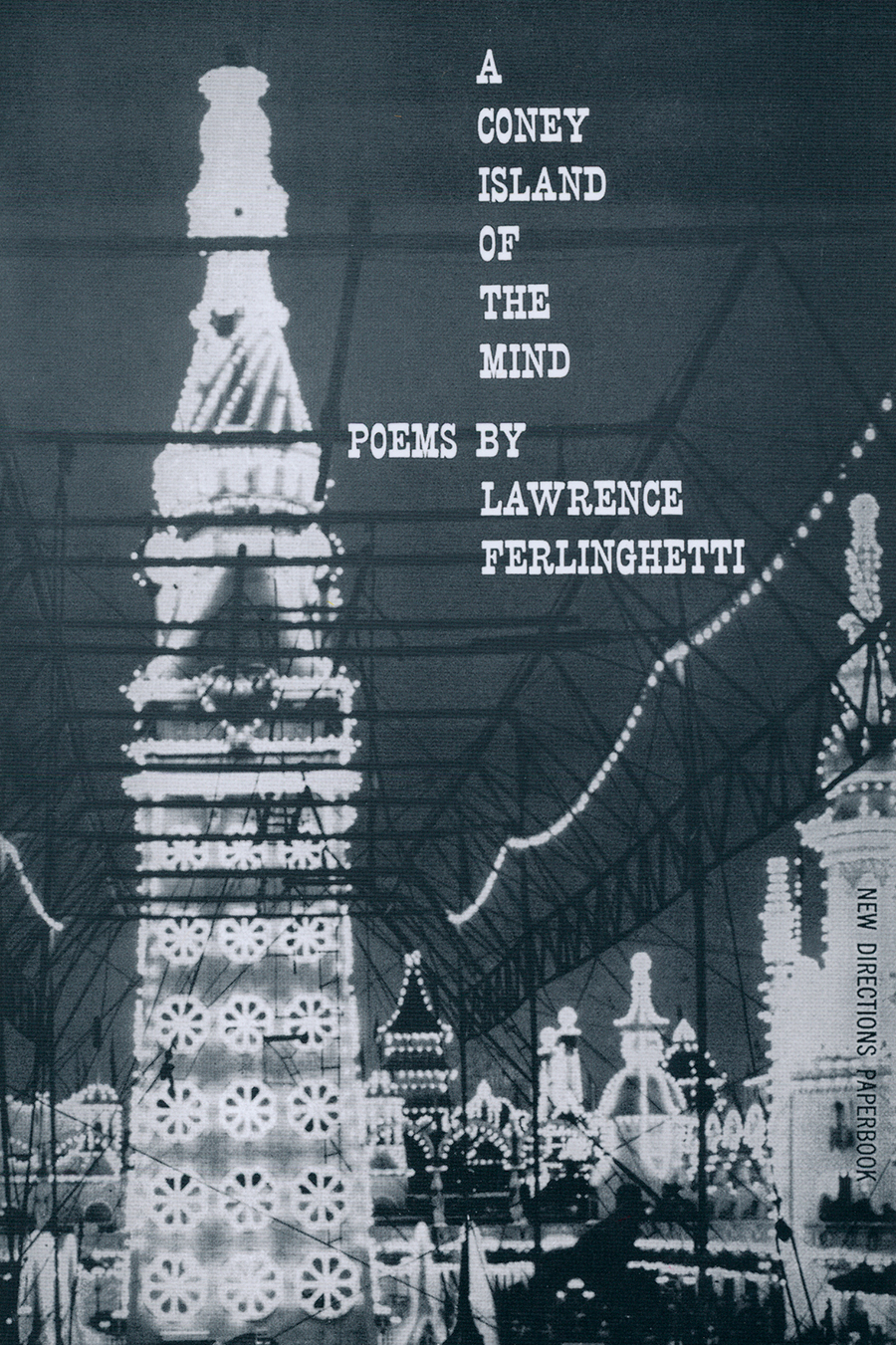
Here’s the theory: If a writer drags his audience into unknown intellectual territory — even if the journey’s destination is an unpleasant one — he’s lifted his readers out of the familiar and allowed them to perceive the world from a new and revelatory perspective. Lawrence Ferlinghetti’s A Coney Island of the Mind did that for a generation of poets, and the book remains one of the best-selling collections with over a million copies in print.

Ferlinghetti also achieved literary fame by publishing and defending in federal court Allen Ginsberg’s Howl. The lengthy First Amendment trial became a literary cause célèbre, and in the years since the Howl controversy, Ferlinghetti has continued to support leftist social and political causes while producing his own volumes of poetry and prose.

His latest book, Little Boy, was published on the author’s 100th birthday and immediately climbed the best-sellers list. Billed by its publisher as “a novel” and “last will and testament,” the book isn’t a novel, not in the traditional sense, and it isn’t the last word on anything. Call it bait and switch or simple misrepresentation, but Little Boy is, for better or worse, an adventurous, effusive, stream-of-consciousness rant that begins promisingly as a memoir complete with punctuation, plot and character development, and lapses almost immediately into an unpunctuated acerbic toxic word dump that occasionally sweeps up the reader in its rebellious energy.

If the designation “novel” is misleading, Ferlinghetti manages to hide a cursory explanation deep in his tangled text: “Ah yes indeed I must revert instead to the recounting and accounting of my own fantasies my ideas and agitations and dumb contemplations of the workings of the mind and heart  . . .  And so do I return to the monologue of my life seen as an endless novel simply because I don’t know how to end any life.”

The opening 15 pages of Little Boy recount how Ferlinghetti was separated from his mother shortly after birth, grew up in both privilege and poverty, and eventually graduated from the University of North Carolina at Chapel Hill, completing his doctoral study in comparative literature in France — all of which is conveyed in straightforward third-person prose.  Then the structure of the narrative abruptly transforms, launching into a torrent of words sans grammatical niceties, e.g.: “ . . . the Greeks really all gone now down the drain And shall we tally it up now and see what’s left after capitalism hits the fan But in any case now it’s time it’s high tide time to try to make some sense or cents of our little life on earth and is it not all a dumb show of mummery a blindman’s bluff a buffoon’s antic asininities with clowns in masks jumping over the moon as in a Chagall painting or as if we each were dropped out of a womb into this earth so naked and alone we come to this world and blind in our courses, where do we wander and know not where we go nor what we do, with no assigned destinies . . . .”

There’s nothing new about this narrative technique (Joyce gave us Molly Bloom’s monologue more than a century ago), and Ferlinghetti’s deluge of words wears thin with surprising alacrity.

With the exception of an occasional brief interlude of traditional storytelling, he continues in this vein for the remainder of the novel. Since the monologue is essentially plotless, he rails again about global warming, capitalism, fascism, socialism, people with cellphones — “can you imagine millions of them a whole new generation on earth computing their lives in pixels” —  and the world in general: “. . . it’s all like the old film The King of Hearts in which the inmates of an asylum consider themselves the only sane people in the world, while the people outside go forth every day to murder their dreams and ecstasies in the general conflagration of everyday life in the twenty-first century . . . .” 

Allusions abound, most of them employed as similes or used as foils or objects of derision as in “‘Tea Ass’ Elliot” or twisted into puns as in “Let’s not fall deep into romanticism again for the warming world is too much with us late and soon . . . .” And there are literary references galore, if you can identify them: “Let us go then you and me-me-me . . .” “Drive she said,” or “a tale of sound and furry animals.”

And the name-dropping goes on ad nauseam: Thorstein Veblen, Nelson Algren, Louise Brooks, Mikhail Lermontov, J. M.W. Turner, Jean-Jacques Rousseau, Sri Aurobindo, Giacometti, Edward Bellcamp, etc., personages with whom most readers are probably unfamiliar. Unfortunately, Ferlinghetti makes no use of these allusions. He’s in a position to supply important scholarly insights into Ginsberg, Burroughs, Corso, Beckett, Kerouac, Sartre, etc., but the mention of literary celebrities has all the intellectual import of the cover of the Beatles’ Sgt. Pepper’s or an academic adaptation of Where’s Waldo? Readers can research the luminaries Ferlinghetti mentions — how likely is that? — or they can let the allusions ride and go plunging through the text, which is, of course, the more likely scenario.

Readers might presume, given Ferlinghetti’s appetite for social and political causes, that he’d have something to say about the political state of the country in which he’s lived for a century. It’s not unreasonable, after all, to expect a little wisdom from our elders, but Ferlinghetti disappoints on this count. Perhaps he’s correct when he writes: “. . . so I am just an onion peeling myself down to the core to find there is nothing there at all. . . .” The opening lines of his Coney Island poem “I Am Waiting”— “. . . and I am waiting/for the American Eagle/to really spread its wings/and straighten up and fly right . . .” — has more political oomph than all the words in Little Boy, and the sum of all the complaints and observations spewed forth in the novel tell us little more than we learned in A Coney Island of the Mind

Ferlinghetti’s longevity and literary reputation have earned him the right to offer a parting public thought. For better or worse, this might be it: “. . . so bye-bye civilization as we know it and should I just let everybody else die as long as I got my piece of prime cheese oh man it’s all beyond me-me-me . . . .”    OH

D.G. Martin hosts North Carolina Bookwatch Sunday at 11 a.m. and Tuesday at 5 p.m. on UNC-TV. The program also airs on the North Carolina Channel Tuesday at 8 p.m. To view prior programs go to: http://video.unctv.org/show/nc-bookwatch/episodes/.

Birdwatch

Beak House

This time of year sees a hot real estate market for house wrens

By Susan Campbell

Throughout the Piedmont and Sandhills, Carolina wrens are year-round residents easily recognized by their handsome rufous coloring, prominent white eyebrows, cocked up tails and loud voices. The emphatic “chirpity, chirpity, chirp” calls are made primarily by males, although, from time to time, females may join the chorus. These inquisitive birds, foraging almost nonstop in all sorts of nooks and crannies looking for bugs, are known to find their way into garages and even homes if there is a crack large enough for them to squeeze through. In addition, they seek out protected places to nest, often using front door wreaths, mailboxes, hanging baskets and manmade objects of all kinds.

House wrens, on the other hand, are a bit smaller and drabber in coloration. Both the male and female are gray-brown with faint streaking on wings and tail. These diminutive birds are just as feisty as their more familiar cousins. Their song, however, is a lovely mix of bubbling notes that carries quite a way. House wrens, too, are voracious insectivores, found in close association with people.

Once upon a time, they were considered seasonal migratory visitors to both the Piedmont and Sandhills, skulking in thick vegetation during spring and fall migration. In 1922, house wrens were seen nesting in the Piedmont and are now found commonly around Raleigh, and from Greensboro to Charlotte. The first documented, known successful breeding attempt in Moore County was sighted in Pinehurst during the summer of 2007. Since then a few pairs have been reported from Whispering Pines, as well as pockets around the Village of Pinehurst. However, these birds are easily overlooked by folks unfamiliar with the species. At this point, they are almost certainly breeding in more locations in at least the northern half of the Sandhills.

House wrens have a breeding strategy that allows them to colonize new habitat quickly. Females typically produce two sets of four to seven young each summer. The males are frequently polygamous. Interestingly, a female may move to the territory of a different male for the second nesting. And female house wrens are known to raise broods in quick succession. The male may finish raising the first brood as the female begins nest-building for round two.

Unlike Carolina wrens, house wrens are cavity nesters, so they will use bird boxes readily. Small holes are hard to come by on the human-altered landscape — but birdhouses are not. With increased urbanization and the widespread interest in providing for birds, more boxes are appearing on the landscape every spring. Although house wrens will use a box that is pole-mounted, they actually prefer hanging houses. It is possible that this is because dangling accommodations are less likely to be invaded by predators.

The challenge that house wrens no doubt have been facing here in the Sandhills as they attempt to become established, is available “real estate.” When they return to nest in mid-April, the bluebirds, as well as our nonmigratory chickadees, nuthatches and titmice have not only claimed a large percentage of the available bird houses but are also well into incubation. House wrens then must search for an empty box. If you are interested in providing for these uncommon little birds, it is best to wait to hang a suitable box until about April 15. Also you might want to consider a box with a smaller (1-inch or 1 1/2-inch) entrance that will exclude larger cavity nesters. If you happen to attract house wrens, please let me know. We are still very interested in the progress of these birds as they continue their southward dispersal here in central North Carolina.  OH

Susan would love to receive your wildlife sightings and photos. She can be contacted by email at susan@ncaves.com.

Scuppernong Bookshelf

Liberty for All

July’s releases include reflections on the state of the republic

Compiled by Brian Lampkin

We’re still hanging on. Two hundred-forty-three years later and the republic continues to function. These July books help us imagine a way forward while acknowledging a past both admirable and devastating.

July 2: It Occurs to Me That I Am America: New Stories and Art (Atria Books, $19.99). When Donald Trump claimed victory in the November 2016 election, the U.S. literary and art world erupted in indignation. Many of America’s pre-eminent writers and artists are stridently opposed to the administration’s agenda and executive orders — and they’re not about to go gentle into that good night. In this “masterful literary achievement,” more than 30 of the most acclaimed writers at work today consider the fundamental ideals of a free, just and compassionate democracy through fiction in an anthology that “promises to be both a powerful tool in the fight to uphold our values and a tribute to the remarkable voices behind it” (Anthony D. Romero, executive director of the ACLU).

July 2: A Dream Called Home: A Memoir, by Reyna Grande (Washington Square Press, $17). As an immigrant in an unfamiliar country, with an indifferent mother and abusive father, Reyna had few resources at her disposal. Taking refuge in words, Reyna’s love of reading and writing propels her to rise above until she achieves the impossible and is accepted to the University of California, Santa Cruz.

Through it all, Reyna is determined to make the impossible possible, going from undocumented immigrant of little means to “a fierce, smart, shimmering light of a writer” (Cheryl Strayed, author of Wild.

July 2: Last Witnesses: An Oral History of the Children of World War II, by Svetlana Alexievich (Random House, $30). For more than three decades, Svetlana Alexievich has been the memory and conscience of the 20th century. When the Swedish Academy awarded her the Nobel Prize, it cited her for inventing “a new kind of literary genre,” describing her work as “a history of emotions . . . a history of the soul.”

Bringing together dozens of voices in her distinctive style, Last Witnesses is Alexievich’s collection of the memories of those who were children during World War II. They had sometimes been soldiers as well as witnesses, and their generation grew up with the trauma of the war deeply embedded — a trauma that would change the course of the Russian nation.

July 9: When Islam Is Not a Religion: Inside America’s Fight for Religious Freedom, by Asma Uddin (Pegasus, $27.99). Religious liberty lawyer Asma Uddin has long considered her work defending people of all faiths to be a calling more than a job. Yet even as she seeks equal protection for Evangelicals, Sikhs, Hindus, Muslims, Native Americans, Jews and Catholics alike, she has seen an ominous increase in attempts to criminalize Islam and exclude American Muslims from their inalienable rights. 

July 16: The Nickel Boys, by Colson Whitehead (Doubleday, $24.95). As the civil rights movement begins to reach the black enclave of Frenchtown in segregated Tallahassee, Florida, Elwood Curtis is abandoned by his parents, but kept on the straight and narrow by his grandmother. Although he enrolls in the local black college, one innocent mistake is enough to destroy the future for a black boy in the Jim Crow South. Elwood is sentenced to a juvenile reformatory called the Nickel Academy. 

Based on the real story of that reform school that operated for 111 years and warped the lives of thousands of children, The Nickel Boys is a devastating, driven narrative that showcases a great American novelist writing at the height of his powers.

July 30: Beyond Charlottesville: Taking a Stand Against White Nationalism, by Terry McAuliffe (Thomas Dunne, $24.95). In Beyond Charlottesville, McAuliffe looks at the forces and events that led to the tragedy in Charlottesville, including the murder of Heather Heyer and the death of two state troopers in a helicopter accident. He doesn’t whitewash Virginia history and his discussion of the KKK protest over the removal of a statue of Robert E. Lee is a hard, real-time, behind-the-scenes look at the actions of everyone on that fateful August 12, including himself, to see what could have been done. OH

Brian Lampkin is one of the proprietors of Scuppernong Books.

Life’s Funny

Hairs to Ya

An essay on living, (not) dyeing, in the gray areas of life

By Maria Johnson

It’s been a year since I stopped coloring my hair.

Almost all of the chestnut dye has grown out.

The last time I sat in my stylist’s chair, she combed up a long swath to trim — wet hair clamped between her fingers, scissors snipping at an angle — and I could see the line of demarcation, the zone where faded brown gave way to translucent strands.

“Only a couple of inches to go,” I said.

“You’re almost there!” she said enthusiastically.

Last year, when I first pitched the idea of growing out my gray, she smiled and crinkled her nose: hairdresser-ese for “oh-hell-no.”

I made my case, using a variation of what I tell myself whenever one of my sons wears his hair in way I don’t like: It’s only hair. Eventually it’ll grow out — or be cut. Maybe. At the very worst, if I didn’t like the gray, I could start coloring it again.

I was ready to walk on the wild side. Woo-hoo.

What tipped the scale?

First, my boss’s wife — who’s also in her late 50s. I hadn’t seen her in a while. She’s a radiant woman, and she looked even more so when I saw her around the holidays.

“You look different,” I said.

“I’m letting my hair go gray,” she said.

Honest to God, she looked younger because of it. Her pretty brown eyes took center stage.

Then there was my brother, who for a while experimented with “touching up,” as they say when men color their hair.

I launched into a treatise: The only men who color their hair are car salesmen and news anchors, and you’re neither, so stop it.

Why is it OK for women and not men? he pressed.

Because, I said, most women color their hair as they age, so it looks normal. Most men, on the other hand, don’t color their hair, so it jumps out when they do.

It’s stone-cold sexism, I continued, but take advantage of the fact that no one expects you to color your hair.

He listened and reverted to his handsome salt-and-pepper self.

I listened, too. To myself.

If I really believed hair-coloring was a sexist expectation for women, why had I been meeting it for 20 years?

Was it to look younger?

Or did I — Ms. Independent-Won’t-Be-Herded-Like-a-Sheep — do it because I feared standing out?

I looked in the mirror.

Ba-ah-ah-ah-ah.

It was time to find out how old I really looked. And I won’t lie. It was tough, especially for the first few months, a.k.a. The Skunk Period, the time when you have a white stripe running down the center of an otherwise dark head.

During conversations, other women didn’t look me in the eye. They looked me in the hair. I knew what they were thinking: “Doesn’t she realize how bad her roots look? Should I tell her?”

Of course, they never did.

One white-headed woman had the courage to bring it up the first time we met.

“Letting your color go, huh?”

“Yep.”

“You’ll never get whistled at again,” she said flatly.

Wow. Well. OK.

I thought about it for a minute. Really, for years, the only time anyone had whistled in my direction was when I was standing between them and their dog at the dog park.

As the Skunk Period ended, another period began. Just when I thought I was done with periods.

This was the Hurry-Up-And-Dye-Already phase, when it’s clear that you’re doing this on purpose.

This is when your female friends finally will speak up, usually aided by chardonnay.

“Why are you doing this?” they’ll ask gravely.

“Because I want to see what it looks like. Plus, I’m tired of paying to get it colored every three weeks.”

“You’ll look older.”

“Maybe I am older.”

Sometimes, at this point, a look of horror will cross their faces because  . . . they’re the same age as you are.

The grayer my hair grew, the more it grew on me. And others. My stylist reported that my silver strands looked good with my coloring — better than she thought they would. Anyway, she offered, going gray is a thing now.

To wit: models of a certain age, and younger women whose idea of “going gray” involves violet tinges to their processed tresses.

Both of my sons claimed to like the lighter version of me. So did my husband, who has a very “distinguished” head himself. My graying male friends joked that they must’ve inspired me.

They did. By being themselves.

Mind you, I’m not without vanity. I hit the gym and the eye make-up a little harder now, and I use snazzy earrings and colorful reading glasses to show I’m down — or as down as woman in 2.5 readers can be.

Occasionally, a woman my age will sidle up and say she wants to stop coloring her hair, too. Inevitably, she’ll say, “But my gray isn’t a pretty gray.”

I feel ya on the fear, sister.

But who defines pretty?

And what is your true color?

You’ll never know until you let it grow.  OH

Maria Johnson is a contributing editor of O.Henry. Her email is ohenrymaria@gmail.com.

Sporting Life

Keepin’ It Cool

Fans, porches and a visit to the ice plant

By Tom Bryant

Good night nurse, it was hot! Fry-an-egg-on-the-sidewalk kind of hot, and I was in the woods at a little farm pond trying to fish. The morning had started off pleasant enough. I was up and at ’em early, anticipating the scorcher promised by the Weather Channel, another of their disaster predictions, and I hoped to catch a mess of bream before the sun could cook my brain.

Fishing was slow, as I knew it would be, and I was going at it the lazy way. I cast a couple of lines baited with night crawlers, anchored the rods securely on the bank, and looked for some shade. The tree line was too far from the pond, so I pulled the old Bronco close to my set and kicked back on a camp chair in her shade. That made it right tolerable.

Growing up when air-conditioning meant an opened window and, if we were lucky, a strong window fan, I think people knew how to handle the scorching summer heat. As kids, we would head to Pinebluff Lake. It was fed by springs and a little creek, and I can still remember swimming into a cool spot created by one of the natural springs. We spent hours in the little lake, devising all kinds of games to play in the naturally cool water.

Probably one of the reasons I don’t like swimming pools today is that I feel like I’m cooped up in an oversized bathtub.

I was also fortunate that my dad ran the massive ice plant located next to the railroad tracks in Aberdeen, and if the summer temperatures got completely out of hand, I could always cool down in one of the storage rooms that were wall-to-wall with ice. Typically, I didn’t stay long. The average temperature in those rooms was about 28 degrees. It’s a pretty good shock to your system when it’s summer outside and, all of a sudden, you’re freezing.

We kids had a routine: Pinebluff Lake in the morning, home for lunch and a nap, and back to the lake in the late afternoon. It was not just a normal nap. Dad had installed a window fan in my sisters’ bedroom, the kind of fan that had four speeds and was reversible, and I knew exactly how to make that thing work. My little brother and I had the bedroom right across the hall from our sisters. We were upstairs so I could close the door at the bottom of the stairs, open our bedroom doors, put the fan blowing out, switch it to “high,” and stand back. That fan would have the curtains in my bedroom standing straight out from the window, and the cool breeze was constant. The sound of the fan and the cool air wafting through the room were almost hypnotic, and in no time I was in the midst of a great nap. I think that’s the reason I nap today and have a sound machine nearby.

I was jolted out of my reverie by the zinging of one of my rods as the line was being pulled in the lake. I raced to catch it and yanked to set the hook. Nothing. Whatever was on it was gone. I reeled in, rebaited the hook and went back to the Bronco. The sun had angled around the corner of the truck, so I rearranged the chair and kicked back again.

The lake, naps and ice plant weren’t the only ways we had to cool down. Most of the Aberdeen downtown businesses were just beginning to install air-conditioning, and the movie theater was one of the first. The mothers in Pinebluff alternated carpooling us kids to the theater on Saturday afternoons. It was 15 cents to get in, 5 cents for a drink and 10 cents for popcorn; and we really got our money’s worth when there was a double feature. The cowboys — Roy Rogers, Gene Autry, Lash LaRue and Rex Allen — reigned supreme in those early movies. Air-conditioning, a novelty at first but soon to become a necessity, made for a kid’s great afternoon of fun.

My ancestors in the 1800s weren’t so lucky. A South Carolina low country summer could be unbearable. Our old family home place was built to provide a little relief from the heat.

First, there’s a rain porch that stretches across the entire front of the house with columns to the ground. The roof’s overhang is far out from the edge of the porch so that during a storm, a person won’t get wet while relaxing in the swing. Next, a long entrance hall runs the length of the house to the back door that opens onto a screened sleeping porch. The house also faces east to catch the prevailing breezes, and the foundation pillars are about 4 feet tall and connected with latticed skirting, allowing air to flow beneath the house. Big rooms with 14-foot tall ceilings and 8-foot windows also helped.

All of these features were great in the summer, but winter was another story. Every room has a fireplace, and in those days, using them kept at least one person busy hauling wood. I guess those early relatives thought that frostbite was preferable to heat stroke.

I checked the lines on the fishing rods to make sure they still had bait, went to the back of the truck for a cool libation, moved my chair to the diminishing shade, and sat back down. The ride home was going to be a hot one because the Bronco doesn’t have air-conditioning.

That thought got me thinking about our first air-conditioned car, a 1969 Buick LeSabre. Prior to that, I thought air-conditioning a car was an expensive add-on that we could do without. Needless to say, after a couple of summer trips to Florida in our un-air-conditioned 1962 MGB, my bride, Linda, helped me to think otherwise. So, along came car air-conditioning.

The sun was now almost directly overhead, so I decided to give up the fishing expedition and try again in a few days when it got a little cooler. I felt a little like a wimp, though, as I loaded the gear in the back of the Bronco. Back in the day, I would have stuck it out till dark, and did that many times. It made me wonder if the reason we suffer so much from the heat is that, as a general population, we’ve become softer and more acclimated to modern conveniences.

That observation needs more study, I thought, something to think about when I take my afternoon nap. I hope Linda turned down the air-conditioning. I fired up the Bronco and headed home.  OH

Tom Bryant, a Southern Pines resident, is a lifelong outdoorsman whose work is familiar to sportsmen throughout the Triad.