Out of the Woods

Out of the Woods

Three Team U.S.A. Olympians redefine themselves in the Gate City

By Cassie Bustamante  

Photographs by Mark Wagoner

“Woods are not like other spaces . . . They make you feel small and confused and vulnerable, like a small child
lost in a crowd of strange legs . . . They are a vast, featureless nowhere. And they are alive.”

— Bill Bryson, from A Walk in the Woods

This month, the City of Light will be aglow with 10,500 athletes from all over the world competing in the 2024 Summer Olympics, plus an estimated 15 million visitors.
To say the world will be watching is an understatement. But who are these athletes — heroes for a glorified moment in time — after the paddles have been stowed, the Nikes unlaced and the skates hung up for the last time? We caught up with three local Team U.S.A. Olympians, including two gold medalists, to answer that question.

Joey Cheek, Gold Medal Olympic Speed Skater

Tamara Cheek, Olympic Canoeist

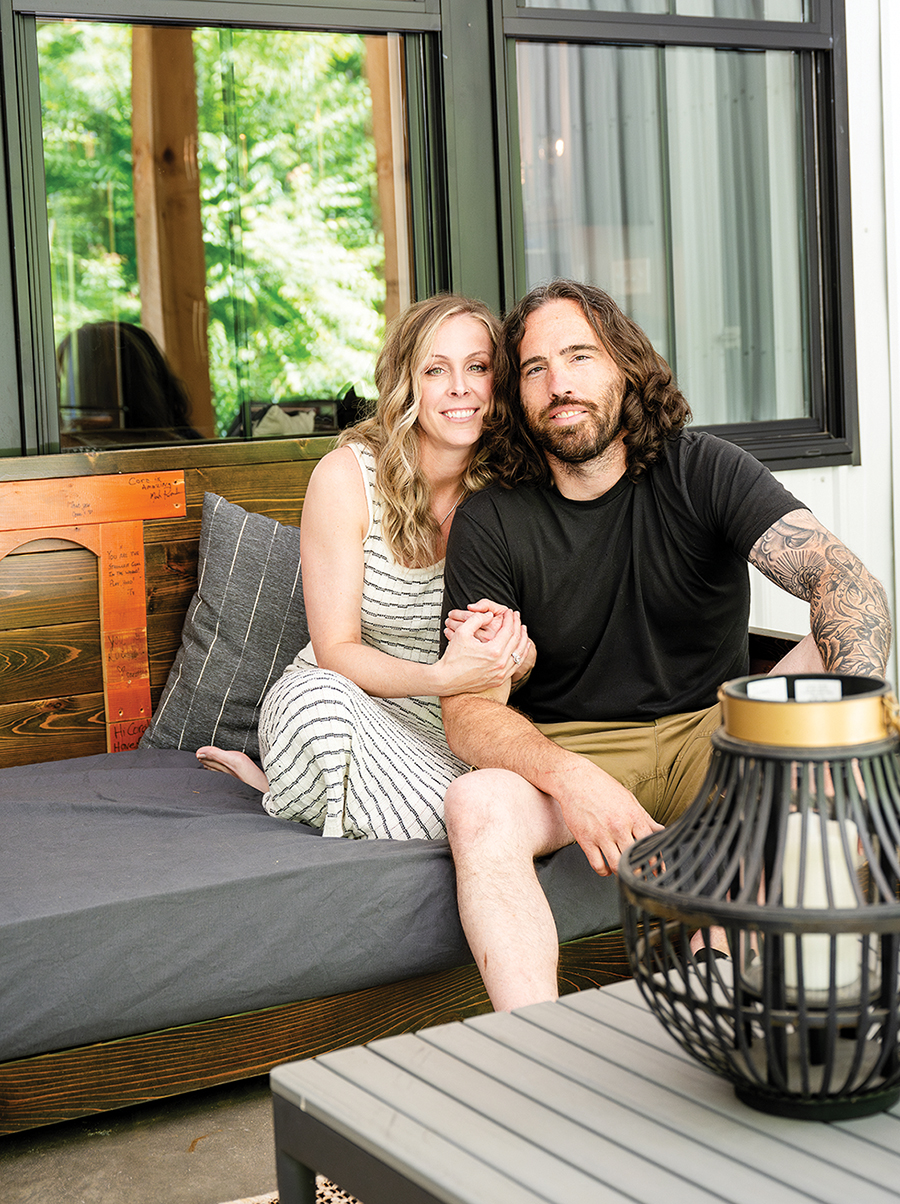
Sprawled out on his charcoal gray sofa, 2006 gold-medal Olympic speed skater Joey Cheek rests one hand on his chestnut-brown boxer, Cashew, who lets out a contented sigh. Both man and dog are totally at ease in this snapshot of daily life. But, Joey, now 45, admits that was not always the case for him.

“The years after the Olympics are — ,” he begins and then pauses. Tamara Cheek, also 45 and an Olympian herself, jumps in.

“Oh, are we at the walk in the woods?” After checking on Jack, the couple’s 4-year-old son, who’s happily scooting his Paw Patrol vehicles across the floor of the nearby playroom, she explains.

A Walk in the Woods, Bill Bryson’s New York Times-bestselling book about his ups and downs — both literately and figuratively — along the Appalachian trail, is a metaphor for how the Cheeks and some of their fellow Olympians describe life after the games. One reviewer called Bryson’s trek “A journey of discovery and renewal.” And that’s certainly been true for both Tamara and Joey.

For Joey, the path to the Olympics began when he was a roller-blading middle-schooler in Greensboro. His parents made sacrifices to support his fledgling athletic career. He recalls a home with sparse furniture and beat-up cars. “I had everything I needed, which was also all I ever wanted.” At 16, he left home to train in Calgary and made the leap from wheels to blades.

In 2002, 22-year-old Joey made it to the Salt Lake City Olympic Games, where he won the bronze medal in the 1,000-meter speed-skating event. Four years later he returned to the Olympic rink, this time in Turin, Italy.

As he headed back, he had an inkling that this would be his last time skating on Olympic ice. Plus, he wondered, “What am I going to get from four more years of this that I haven’t already gotten?” Turns out, that thing was a gold medal — as well as a silver.

Without taking a pause, he hung the skates and hit the ground running, enrolling in Princeton and cofounding Team Darfur to raise awareness about the ethnic cleansing and genocide in Sudan. His humanitarian activism caught the eye of Hollywood star George Clooney, who invited Joey to accompany him to China via private jet to lobby the government there. In 2007, Clooney reached back out to invite him to be in a film he was shooting in South Carolina. “And to give you an idea of the hubris I was feeling at the time,” says Joey, shaking his head, “I said, ‘I’ve got a bunch of big parties I am going to. I can’t make it.’”

He was seemingly skating through life. “Nothing is indicating that this system isn’t flawless,” says Joey, “that you have not cracked it.”

The path was clear: “gold medal, ivy league, billionaire.” Upon graduation, he was off to New York City to launch a sports-streaming start-up.

But, for the first time in his life, “some of the wheels had started falling off,” he says. “And that was crippling for me. Crippling.”

So how did he get out of the woods? “A huge part of it is her,” he says, looking at his wife.

“She had me do this exercise,” he says. Tamara helped him analyze his life up to that point so that he could see the arc of his career — which, he notes, was worse than ever at that moment.

But, soon after, “the arc turned.” He adds, “And it’s only gotten better.”

Did Tamara know from her own experience? Did she have a moment of “who I am without this?” she asks, then answers. “Yeah.”

But, Tamara admits, her moment of truth was not nearly as challenging as Joey’s. Hers came when a a friend who was a philosophy major at the University of California in San Diego (where she enrolled after the Olympics) pointed out to her that when you are young, you look to institutions to assign meaning to yourself. But once you leave academia — or the Olympics — and enter the real world, you’re on your own, and meaning and purpose must be generated internally.

“You might feel a little bit lost,” she admits and, as a mom of a superhero-loving preschooler, likens it to being Bruce Wayne instead of Batman. But, in the end, what was crippling for Joey was liberating for her.

Tamara is a dark-haired beauty who bears resemblance to — and has been mistaken for — supermodel Linda Evangelista. In fact, she opens to a page in her scrapbook, a gift a best friend created for a birthday, to a torn-out page from a 2000 Esquire magazine story, titled “The Girls of Summer.” Among 10 female Summer Olympians headed to Sydney, Australia, there’s an image of then 21-year-old Tamara, strong and tanned, and wearing a white tankini as she stands in a kayak and holds a paddle in her right hand. “I definitely shunned any further movement in that direction,” she says of her short-lived modeling gig.

Where Joey says that part of the reason you strive for the Olympics is to “chisel your name on a tablet somewhere,” Tamara’s approach as a flat-water canoeist was quite different. “I didn’t really have a gold medal as a goal ever.” She adds, “I just wanted to win races.”

Until she picked up paddles, competition was a foreign concept to Tamara. She describes the progressive Waldorf school she attended as the kind of place where “no blade of grass should be taller than the next.” But, at the age of 16, Tamara recalls seeing kayakers on a lake in Seattle, where she grew up. Instantly drawn to the beauty of the sport, she quickly discovered she took to it like a fish to water.

In another photo album, she opens to an old black-and-white photo of an athletic young woman, her grandmother, who died at the age of 36. She wonders aloud if that’s where her own inherent talent comes from. “I like to think that in some way I was carrying on her spirit when I was in Sydney.”

But, according to Joey, Tamara’s superpower is her ability to pick up anything she sets her mind to and excel. He laughs and adds how it sometimes drives him nuts “because there seems to be no method and all I am is process.”

While Tamara won the U.S. Olympic trials in the K-2 500-meter sprint as well as the 1999 World Cup silver medal in the K-2 1,000-meter kayak sprint, she did not land on the podium in Sydney and decided to leave her career as a canoeist after just six years. She admits that she was likely only halfway up the arc, but she was ready to move on. “I wanted to go to school and have a life after the Olympics.”

During college, Tamara continued to work closely with Team U.S.A. Canoe/Kayak, which was temporarily without a coach. Testing the waters of her own coaching skills, she filled in, discovering it was not the job for her.

Upon graduation, she was offered a role as a marketing director in Charlotte, working for the National Governing Body for Olympic Canoe/Kayak. While in that position, she also founded her own company — a platform-that connects creative service providers with real estate professionals — directed an award winning documentary and continued to serve the Olympic movement in professional and volunteer capacities. But her favorite career moment? Being on the team that won the rights to bring the 2028 Summer Games back to the states.

It was in Charlotte, says Tamara, “where our story begins.”

Her boss, late businessman David Yarborough, who became a mentor to her, asked her to attend a speech that Joey was giving. “For some reason, I didn’t go,” she adds.

But the “subconscious seed,” as Joey calls it, was planted.

Their stars were in orbit, says Tamara.

“Circling and never knowing each other,” adds Joey.

“You can’t fight fate,” he says.

Their stars would finally collide when both were in their upper 30s and involved with the Olympic Alumni Association, now the U.S. Olympians and Paralympians Association.

On January 1, 2019, Tamara, dressed in a white puffy jacket, and Joey, in the matching black, said “I do” atop snowy Lookout Mountain in Colorado, where they lived at the time. A year-and-a-half later, Jack was born amidst a global pandemic. Eventually, in 2021, with Joey working remotely for a venture firm he’d cofounded, the family piled into their Jeep with their dog and most of their belongings and headed for Greensboro, Joey’s hometown. The plan was to stay until they figured out their next move.

But, as he looked around a room full of family, Cashew happily playing with his brother’s dog, he says it dawned on him: “We are not leaving!”

The couple settled into a home where Joey kept an office, but his work was making him miserable and costing precious time with family. “I left with no plan. And I do not do that,” says Joey.

Encouraged by Tamara, Joey headed to a Downtown Greensboro event to learn about upcoming projects.

“You hadn’t been out of your office for three years,” she says to Joey.

While at the event, Joey met Thompson co-founder and president Clifford Thompson, who, Joey says, “is very active in wanting to see a startup community here.” Things began to click into place. In October 2023, he became the Greensboro Chamber of Commerce’s executive vice president for entrepreneurship.

And while the role is still quite fresh, Joey has big dreams for his hometown. “I want to be able to take Jackie downtown and say, ‘Look what we did in this town.’”

As for Tamara, she’s currently doing consulting work with the N.C. Folk Fest and serving on the Miriam Brenner Children’s Museum gala committee. And her community here? “Maybe I like it so much because it feels a little bit like it was training for the Olympics, like everyone is on the same page, “ she says, “that we believe in this place and we mostly want the same things for it.”

Now that these two Olympic speedsters are no longer racing to win, they have time for family, friends, community involvement. A walk in the woods these days? It’s a Sunday family hike along one of Greensboro’s many trails. And while life with a preschooler offers its own set of challenges, Joey says, “I would trade the worst day hanging out with Jack over winning medals.” He pauses and takes it a step further. “I will trade one back if it would give me one more day with him.”

Middle: Johnson works with N.C. A&T student Shadajah Ballard

Right: Johnson chats with Olympic hopeful Daniel Roberts

Allen Johnson, Gold Medal Olympic Hurdler

At 53, Allen Johnson doesn’t look much different than he did when he crossed the 100-meter hurdle finish line at the 1996 Olympics in Atlanta, taking home gold for the United States. His head is clean shaven these days, but his 5’10” frame remains slender and athletic. Sitting behind his desk at N.C. A&T State University’s Truist Stadium, where he has worked as director of the track and field programs since June 2022, Johnson is at ease, comfortable in his navy-blue Nike A&T-branded polo shirt and proverbial coach’s hat.

Is this where he imagined he’d be? No way. As an Olympic athlete training with coaching legend Curtis Frye, Johnson says that was not the life he envisioned for himself. “Being a college coach in track and field was the absolute last thing on Earth I wanted to do. I mean last thing.” Driving it home, he adds, “Last, last, last!”

But when his body could no longer achieve previous heights, Johnson had to take his own walk in the woods. “A part of you dies and you have to mourn it.”

As a young man entering UNC-Chapel Hill in 1989, Johnson, a D.C. native, assumed he’d major in business. “It was the ’80s,” he says with a laugh. “I wanted to get a BMW, big house, have money, live life.” His dream? His own car dealership. “I was always into cars,” says Johnson, who now drives a Tesla.

But his athleticism opened doors for him and he left Chapel Hill during his senior year, not before setting several school records that still stand as well as winning four ACC titles. (He went back to finish his degree, which he earned in sociology, in 2012, when daughter Tristine was an undergrad. He even had a class with her.) Johnson’s pursuit paid off with a full-time track and field career that spanned 17 years, from 1993 until 2010.

During that time, Johnson, participated in three Olympics: 1996 in Atlanta, where he won the gold; 2000 in Sydney, Australia, where he fought a hamstring injury and just missed the podium, placing fourth; and 2004 in Athens, Greece, where he was captain of the U.S.A. Track and Field Team but did not place. For most of that time, he had endorsements from Nike (1994, 1996–2008) and Oakley (1995–2004) to support him. But, he says, “The last two years I was kind of on my own.”

“I was going to run until the wheels fell off, which meant I was going to stay too long,” he says, confessing he ran two years too long. “In a perfect world, I would just love to get up in the morning every day and go race.” But, he admits, his body could no longer physically handle the work.

In 2008, just two years before his running career crossed its finish line, Johnson recalls seeing Marion Jones on Oprah, discussing her use of illegal performance-enhancing drugs. Jones likened being an elite athlete to wearing a mask, playing a part. And when those running days are over? “The mask has to come off,” says Johnson.

“You don’t feel invincible, emotionally — or anything — because you become a regular person again.”

But, he adds, “you’re reborn.”

For Johnson, an opportunity to become something new was found in the last, last, last place he ever expected.

It began organically. People came to him, seeking his expertise and offering to pay. He volunteered as assistant under Coach Frye at the University of South Carolina. “I never got paid, but I looked forward to getting up and going out there the next day to work with the people I was working with.”

In the fall of 2011, he was offered a paid position as assistant coach at the United States Air Force Academy in Colorado Springs, Colo. He was nervous. Not only was it something he hadn’t done professionally, but it was far from the Mid-Atlantic states he’d called home for most of his life.

“That was a leap,” he says. But without risk there’s no reward. During his first year there, he led the 4×400-meter relay team to the Mountain West titles. He stayed there for five years before returning to the East Coast as assistant coach for the N.C. State Wolfpack, where he worked for six years.

While not every athlete makes a great coach, Johnson seems to have cracked the code. “You know the whole cliché, meet them where they are,” he says.

That doesn’t mean just physically. Johnson connects with his athletes on an emotional level, too. He looks for triggers, good and bad, creating strategies to handle those that arise. He helps them stay away from the negative while embracing the positive. Plus, he makes himself available. “I have a policy: If you need to talk to me, call me any time.” With a coy smile, he adds, “But try to keep it between 7 a.m. and 11 p.m.”

Now, in his first head coaching position at N.C. A&T, that policy’s expanded to include staff as well. “Be ready for anything” is his daily mantra. Emails and calls come from every which way, sun up to sun down and beyond. “One thing I tell people about being a college track and field coach is the job is never done. You just pick a stopping point each day.” And when he finally makes it home, he spends time with his wife, Olympic bronze-medal-winning track sprinter Torri Edwards-Johnson, and plays with their 2-and-a-half year old daughter.

While his days can be filled with chaos, he’s got a small network of friends who are also first-time head coaches, similar to having Olympic teammates. “We all have had aspirations of being a head coach and what we thought it was going to be like,” says Johnson. And is this it? No, he says, “You don’t know what it is until you actually do it.”

It’s challenging him in a new way. But he’s got sound advice when it comes to tough times: “It’s what you do on the bad days that is going to define your success.” He adds, “It’s not really that hard on a good day. It’s hard on the bad day when you don’t feel like doing it, but you dig down deep, mentally, physically, and you get it done.”

Are there moments he wishes he could be 25 again and line up with the athletes? Of course. “But I can’t do it anymore.”

Instead, he’s found joy in helping others. As for his student athletes, he wants to make sure their college experience is happy and meaningful, and that he pushes them to move the stopwatch needle.

Plus, Johnson has been working with Olympic hopeful Daniel Roberts, who, like Johnson, is a 110-meter hurdler. Roberts won the bronze medal in the 2023 World Championships and Johnson’s goal this year is to get him the gold at the Paris Olympics later this month. “I wish I could still run — can’t — but getting to coach him, coach Trayvon [Bromell] and the other athletes, I guess for me it’s kind of a natural progression to the next phase.”

Is it the same as competing? No, Johnson admits. “But I have no regrets. I love track and field.” And while it’s the last thing he thought he’d be doing, turns out the next best thing is helping someone else reach their highest potential.  OH

*At the time this story was written, Roberts was training with Johnson for the Olympic Trials, which were held June 21–June 30. We will update you on his progress in our biweekly newsletter, found at oheygreensboro.com.


Poem July 2024

Poem July 2024

Cicada Rondeau

They don’t so much sing as plead

In their droning sound stampede.

I hope they find the love they need —

Something more than meet-and-breed.

Can that even be with insects —

To have sensations beyond touch?

Do they know joy as well as sex?

They don’t so much.

                              — Paul Jones

Paul Jones is a professor emeritus at the University of North Carolina at Chapel Hill and the author of the collection Something Wonderful.

Peace and Purpose

Peace and Purpose

A spirited little girl’s art offers solace — and hope

By Ross Howell Jr.  

Photographs by Amy Freeman

The home that Austin and Shelby Tew built sits outside Stokesdale at the end of a long gravel drive surrounded by 10 acres of hardwoods. It’s unique and its story is bittersweet — even heart-breaking.

And I didn’t arrive at the house in the way you’d expect.

I began the journey at the MM Interior Design Group offices on State Street in Greensboro, where I was greeted by Mark Mitchell, business administration manager. Mark walks me into the design area. Marta Mitchell, founder, president and partner of the firm, is looking at fabric samples and stops to greet me.

Marta’s firm recently reached out to the magazine about the Tew house, a project she’s been working on for some three years. She’s a stylish woman with a wonderfully calm voice and an accent I don’t recognize.

When I ask her about it, Marta tells me her family was from the Mato Grosso region of Brazil. She grew up in the outskirts of São Paulo.

“I still have an accent, but I’ve been in Greensboro for about 40 years,” Marta says, smiling. She moved here with her husband, Peter, who’s now the marketing manager of the firm.

“My husband came for graduate school and was later offered a job, so Greensboro became home,” she adds. “Our two sons were born here.” It was the younger of the two, Mark, who met me at the door.

Marta explains that she had been trained as an interior designer — “we still called it ‘interior decorator’ back when I was in school,” she adds — and started the business in 1989, working alone.

“Now, we work in teams of three designers on every project,” Marta says. Her most senior staff are design directors — there are three of them, including her. They manage the work of lead interior designers, who serve as the main client contacts and bear overall responsibility for individual projects. The lead interior designers work in tandem with assigned interior designers on individual projects day-to-day.

“There are 14 of us now,” Marta says. “There aren’t many interior design firms this size.”

Typically, her firm is hired by a client before construction even begins. Marta guides me over to the design pod where Angela Austin — one of the company’s lead interior designers — has the computer-assisted design model of a client’s waterfront house up on her computer screen.

She shows me the floor plan for an attached guest house.

“Right now, I’m working on some selections for cabinetry,” Angela says. With a keystroke here and mouse click there, she shows me a variety of cabinet styles in place, some stained, some painted, along with variations on ceramic tile and its placement — as well as a floor plan with chairs and sofas.

“All of this was done before the contractor even broke ground,” Marta says.

In addition to using 3D models, renderings and video walkthroughs, Marta’s design group takes visualization to the next level — producing virtual reality tours.

Marta guides me to a large conference room.

Awaiting us are Shannon Harvey, the lead interior designer for the Tew house, and Chloe Fields, interior designer for the project. Shannon is an experienced interior designer born in Mississippi, who lived for a time in Germany. Chloe is a recent UNCG graduate with a degree in interior architecture. Marta is the team’s design director.

I sit down in a swivel chair.

“Here, this goes over your head,” Shannon says, handing me the VR headset.

And boom.

There I am, inside the Tew house.

“You can look up and you can look down and you can turn around in your chair to see more,” Marta says. She explains how the VR program brings daylight in, so what I’m seeing is more realistic than the 3D computer models.

I look up at wooden rafters and industrial-sized heating and cooling ducts hanging from the ceiling. I look straight ahead toward an enormous kitchen island in a long great room. Beyond the island is a bank of windows and doors looking out into woods.

“You can turn around in your chair to see more,” Marta says.

Now I’m looking at the entry wall of the house. There’s a spiral metal staircase leading up to a loft.

“The Tew project was really interesting,” Marta says, as I continue looking around, “because the house was already built when Austin came to us.”

Since he had work experience in construction, Austin personally completed or oversaw the building of the house, from pouring concrete to framing.

“It was empty, just walls,” Marta adds. “Then Shannon started working on it.”

Guests were always the first consideration, Shannon tells me, not the comfort of the Tews themselves. They also stressed that they were on a limited budget, so Shannon provided images of her furniture recommendations to Shelby, who searched for similar, less expensive pieces, while Austin implemented Shannon’s painting or finishing ideas himself.

“He’s so handy,” Chloe says. “He’s built dressers, beds . . . that concrete countertop you see.”

And there was another essential consideration — their young daughters, Braylen and Cora.

Shannon tells me to swivel clockwise in the chair.

“There,” she says. “The big piece of art on the wall. That’s Cora’s.” It’s a whimsical, colorful painting of hearts set among strokes of pure, bright colors with a single word: LOVE.

As we continue my tour, Marta explains some of the design elements that Shannon introduced — painting sections of the enormous wall with contrasting colors to break up the space and placing big pieces of furniture strategically for the same purpose.

When I’m set to remove the VR headset, Shannon gives me a hand.

“The Tews started building this home when Cora’s cancer was in remission,” she says. “But the cancer came back.”

Now, fast-forward with me from virtual to real — the heart-breaking part of the story — as my car tires crunch along the gravel driveway in Stokesdale.

Austin Tew greets me at the door and invites me in. He’s accompanied by a romping, blue-and-white pit bull rescue named Dolly. She brings me a couple toys to inspect, decides I’m not as interesting as I first seemed and returns to her bed.

I stand there, looking around the great room. It’s big, feeling even larger than the space I saw in the VR headset. If it weren’t furnished, you could drive a semi-truck and trailer inside and park. The concrete floor is polished. The windows are metal-framed. The house exterior is clad with white aluminum siding.

Turns out, Austin is the owner of Key Automotive Group in Stokesdale, so it makes sense.

“You see, I’m pretty industrial,” he says, smiling. “So we really had to find a designer who could think outside the box.”

“Marta was the only one who got it,” Austin adds. And got it, Marta’s team did. The house feels like a home.

Shelby emerges from her office at the back of the house. She’s a CPA with her own practice. Since it’s tax season during my visit, she’s in need of a well-deserved break and joins us.

The first room we step into is Braylen’s bedroom. She’s the Tews’ older daughter. The couple herd me through the bedroom quickly, since it looks just as you’d expect from a 10-year-old in a hurry to get to basketball practice on time.

We pass by a Jack-and-Jill bathroom to another bedroom.

“This is Cora’s room,” Austin says quietly.

Feeling awkward, I turn my eyes to a corner, where a rainbow is painted on the wall.

“Cora had picked out a rainbow and I promised her she would have one,” Shelby says.

“Marta found a pretty design online,” Shelby continues. “We got in touch with a mural artist named Lacey Crime, who painted this for us.” The artist also painted a lovely frame of flowers around the mirror in Cora’s end of the Jack-and-Jill.

“She never saw the rainbow or the flowers,” Shelby says quietly. She directs my attention to the ceiling of Cora’s bedroom. It’s covered in clouds.

“Marta picked out that wallpaper,” she says.

Austin clears his throat and we continue our tour.

As we walk, they tell me their story.

The Tews were living in Madison, just over the Virginia state line. They had gone out for dinner and Cora had fallen at the restaurant, hurting her leg. The Tews felt a small lump and thought it was from the fall, but the toddler cried through the night.

Shelby decided the next morning to take Cora to see her pediatrician. Later, she called Austin from Brenner’s Children’s Hospital in Winston-Salem and said an oncologist was going to run some tests. The results showed Cora had cancer.

Wanting a second opinion, Shelby dove into research and found that one of the leading treatment facilities in the country specializing in pediatric cancer was the Cincinnati Children’s Hospital Medical Center.

There, on Feb. 14, Valentine’s Day, 2019, Cora was diagnosed with rhabdomyosarcoma, a highly aggressive form of pediatric cancer. She was 2 years old.

Between February and June, the Tews made frequent trips to Cincinnati. In mid-June, the doctors scheduled surgery for Cora.

“So we packed our stuff and hauled it up there,” Austin says. It would be an extended stay.

Surgery was followed by 23 days of radiation and chemotherapy.

Cora’s lab tests looked good. Doctors removed her intravenous port. She was clear of cancer.

The family returned to North Carolina and broke ground for construction of a new home on the Stokesdale land they had purchased before Cora’s diagnosis.

Then, on Cora’s second, 3-month checkup back in Cincinnati, scans revealed her cancer had returned.

“We couldn’t believe this was happening,” Austin says.

Shelby tells me that, during the grueling, 12-hour days of treatment at the hospital, she and Austin noticed how much Cora enjoyed coloring or drawing pictures to take her mind off the beeping machines and busy nurses — how working on the art seemed to give her strength. And they found that big sister Braylen — just two years older than Cora — would use painting to let her emotions out.

Despite their situation, the Tews understood they were among the fortunate, because they were self-employed.

“You’d see some kid all alone in the hospital during the day because their parents couldn’t be there,” Austin says. “They had to work to keep their jobs.”

And, as happened with the Tews, families would find insurance companies denying payment for life-saving treatments.

“You see these situations, and it’s devastating,” Austin says. “You want to find a way to help.”

They decided they would use their individual skills to create a business — Faith and Healing Arts — that helps other families struggling financially with childhood cancer.

Building on their love for their own children’s art, they’ve found suppliers who reproduce their own and other children’s art in large sizes on high-quality art paper or canvas. Austin builds the frames and mounts the art.

Already, Faith and Healing Arts has retailers selling the work of children from some 25 families. The art can also be purchased on the Faith and Healing Arts website. All proceeds from sales go to participating families.

For two years, Cora received chemotherapy at Brenner’s Children’s Hospital in Winston-Salem, with 3-month scans at Cincinnati Children’s Hospital.

All the while, she played with her sister as her father poured concrete and framed the walls of her new house.

“But it was like she knew she wasn’t going to be around,” Austin says. “She never really staked a claim.”

Cora passed away in 2021. She was 5 years old.

We pause by a group of photographs on a wall so I can have a look.

“There’s my little mini-me,” Shelby whispers. “My little Cora Grace.”

They take me to the back corner of the house and I have a peek at Shelby’s office looking out on the woods. When she sees the client messages queued up in her inbox, she realizes she’d better get back to work. I thank her for her time and we say goodbye.

In the great room, Austin shows me a grouping of Cora and Braylen’s art. Then we go through a door into the beautiful private suite they’ve built and furnished, where families going through cancer treatment can stay when needed.

Austin leads me back to the kitchen area, where along the wall there’s a commercial-sized refrigerator, lots of cabinets and a hidden, walk-in pantry. A stove and sink are located in the expansive, concrete-slab kitchen island.

He pats the slab.

“There’s a ton of concrete here,” Austin says. “And a steel bar to hold it up.”

He tells me about the concrete safe room in the house, built strong enough to withstand a tornado, where Braylen and Cora used to play just after the concrete had been poured and the framing was going up.

Austin tells me about the radiant heat system in the concrete floors, proudly showing me the utility room he designed and built — each duct, fan and pipe gleamingly clean, easily accessible for maintenance.

“All the fan motors are in here,” he says. “You turn on a bathroom fan when you’re in the guest suite, you don’t hear a thing.”

It’s a great house, a one-of-a-kind house. It’s a house blessed with peace and purpose.

Recently Austin celebrated his 40th birthday.

“We had our daughter’s basketball team’s kids and parents here, we threw corn hole in the living room, we did it all,” he says, reflecting for a moment.

“You know, an empty house sucks,” Austin says. “What matters now is to live life.”  OH

For more information on the Tews’ art program to help the families of children who have cancer, visit www.faithandhealingarts.com.

Ross Howell Jr. is a contributing writer.

Wild and Wonderful

Wild and Wonderful

Pinehurst No. 2 prepares to test the best

By Lee Pace

Feature Photo: 2014 U.S. Open Photograph by Joann Dost

A December day in 1935. A man approaches the house at 120 Midland Road in Pinehurst, notices the Scottish-style stonework and arches of Dornoch Cottage, and rings the bell.

Donald Ross opens the door and greets A.W. Tillinghast.

What a meeting of the minds of the early days of golf course architecture.

Ross, 63, the son of a Scottish stonemason, apprentice in his 20s to legendary pro Old Tom Morris at St Andrews, an immigrant to the United States who set up shop in Pinehurst in 1900 and designed notable courses across the eastern United States — from Seminole Golf Club in Florida to Inverness Club in Ohio to Oak Hill Country Club in upstate New York. His tour de force, Pinehurst No. 2, sits just behind his house.

And Tillinghast, 59, the son of a wealthy rubber goods magnate in Philadelphia, who grew up playing cricket and fell under the spell of golf on a visit to St Andrews in 1896 where he established a mentor-mentee relationship with Morris. Tillinghast’s design acumen was on display across the land as well — from San Francisco Golf Club on the West Coast to Winged Foot Golf Club and Baltusrol Golf Club in the shadows of the New York City skyscrapers.

Oh, to have been a fly on the wall, to hear these friends and sometime competitors talk about their shared experiences — their formative years at St Andrews, their design philosophies, the challenges of maintaining businesses and servicing clients when travel was by train and communication by post.

Surely Tillinghast espoused, to some degree, his belief that “a round of golf should present eighteen inspirations, not necessarily eighteen thrills.”

And no doubt Ross would have looked at the 72-hole facility at Pinehurst Country Club and talked about how it had become the epicenter of golf in America. “I wholeheartedly believe in golf,” Ross once said. “A country which gets golf-minded need not worry about the honor, the integrity and the honesty of its people.”

Tillinghast’s visit came at the behest of the PGA of America and his role as a consultant with the organization which in 11 months would conduct its flagship competition, the 1936 PGA Championship, on Pinehurst No. 2. They carried their golf clubs past Ross’ masterful rose garden in the backyard, through the wrought-iron gates and onto the third green.

Ross showed his guest the green complexes that he had just converted, with the help of green superintendent Frank Maples, from their previous flattish sand/clay structure to undulating Bermuda grass, shaping the sandy soil around them into a cacophony of dips and swales. He noted the roll-offs around the greens, how they penalized shots even slightly mishit and propelled balls into the hollows nearby.

Ross led Tillinghast to the fourth tee and explained how he had just added that hole and the fifth to the routing, taking them from a previous employee-only nine holes, and had arrived at the final (and current) configuration after originally unveiling the course in 1907.

They felt the taut turf under their feet, reveling in how the drainage qualities of the sandy loam made for the ideal golf playing surface. As they went, Ross explained the choices golfers had off the tee — on the par-4 second, for example — showing his friend what a lovely view it was into the green from the left side of the fairway but pointed to the gnarly bunker complex a player had to flirt with to get there. Ross nodded to the native wiregrass that grew in profusion along the fairways and how it reminded him of the whins of his native Scotland.

Did the man known in the business as “Tilly” dip into his bag for a flask and a wee snort as he was wont to do? Did Ross grouse that this new and improved No. 2 was better than any new-fangled effort from Bobby Jones and Alister MacKenzie down in the red clay of north Georgia?

All of this, we’ll never know. What we do know is what Tillinghast said after his visit.

“Without any doubt Ross regards this as his greatest achievement, which is saying a great deal,” Tillinghast offered. “Every touch is Donald’s own, and I doubt if a single contour was fashioned unless he stood hard by with a critical eye. As we stood on hole after hole, the great architect proudly called my attention to each subtle feature, certain that my appreciation of his artistry must be greater than that taken in by a less practiced eye. Nothing was lost on me, and after our round together, I told him with all honesty that his course was magnificent, without a single weakness, and one which must rank with the truly great courses in the world today.”

And, 89 years later, the show goes on.

Pinehurst No. 2 would continue to be the site of the North & South Open on the PGA Tour through 1951, with Ben Hogan, Sam Snead, Byron Nelson and Ross himself among the winners. It would host the 1936 PGA (won by Denny Shute) and the 1951 Ryder Cup (won by the Americans, 9 1/2to 2 1/2, over the team from Great Britain and Ireland).

But it wasn’t in the mix to host a U.S. Open.

Left: Donald Ross (Courtesy Tufts Archives)

Middle: The Ninth hole of Pinehurst No. 2 (Copyright USGA//Fred Vuich_

Right: A.W. Tillinghast (Courtesy USGA Archives)


Through the 1970s that union was simply impossible because Pinehurst shut down for the summer (the founding Tufts family and the staff went to Linville or Roaring Gap in North Carolina or traveled north to Maine), and the American national championship was played always in June.

When the resort went to air-conditioning and a year-round operating calendar, the idea was still problematic because of the USGA’s preference for playing courses with firm and fast greens, a challenging task on Southern courses during hot weather months. The U.S. Open was not played in the muggy Southeast until venturing to Atlanta Athletic Club in 1975, though it had already visited hot spots in Houston, St. Louis, Dallas and Fort Worth.

About the time Jerry Pate was winning in Atlanta, officials at Pinehurst Country Club began floating the idea of an Open for No. 2. The Diamondhead Corporation was five years into its ownership of Pinehurst after purchasing it in 1970 from the Tufts family, whose patriarch, James W. Tufts, launched the town and resort in 1895 as a refuge from the cold winters of New England. The Diamondhead president, Bill Maurer, conceived the World Open on the PGA Tour and the World Golf Hall of Fame in the early 1970s and wanted all the traffic, attention and accolades he could muster for Pinehurst and its No. 2 course.

It took two more decades to figure out how to bring the National Open there.

First, there was the dodgy financial bona fides of the resort and club, which eventually went bankrupt and was taken over by eight banks for two years beginning in March 1982. Robert Dedman Sr. and his Club Corporation of America bought the facility in 1984 and provided what has turned into four decades of stability, innovation and financial security, with Robert Dedman Jr. taking the baton after his father died in 2002.

Second, there was the issue of the playing surfaces.

Pinehurst and other golf courses in the Mid-Atlantic, or so-called “transition zone,” have forever been vexed over the choice for their putting surfaces between Bermuda grass, the de facto choice for Florida and warm weather climes, and bent grass, which thrives in the North. Pinehurst officials experimented with new strains of both over the 1970s and ’80s, walking that tightrope between offering smooth and playable greens for members and resort guests for 12 months of the year, and yet having the ability to get them lightning-quick while not dying in the summer for an elite competition. Pinehurst old-timers still remembered Hale Irwin and Johnny Miller taking dead aim at flagsticks during PGA Tour competitions on No. 2 in the late summer and their approach shots going splat and stopping mere feet from the hole (Hale Irwin shot 62 and Johnny Miller 63 in mid-1970s birdie-fests).

Donald Ross must have raged in his grave.

By the early 1990s, the USGA and Pinehurst officials agreed that advances in grass technology and green foundation construction would allow them to rebuild the greens and have them stand up to the world’s best players on a 90-degree day in June. The USGA announced in June 1993 that it would conduct the 1999 Open at Pinehurst. The competition was a rousing success from the perspective of ticket sales, corporate support, traffic ebb and flow, housing and, certainly, the golf course itself.

“It’s the most draining course I’ve played in a long time,” said European Ryder Cup team member Lee Westwood.

“People sometimes ask what’s the hardest course I’ve ever played,” said two-time U.S. Open champion Lee Janzen. “Now I know.”

The Open has been contested on No. 2 twice more, and the course has played as a par-70 for each championship. The scores validate that what Ross completed in 1935 stands in fine fettle in the next century.

Payne Stewart was 1-under in winning the Open in 1999, Phil Mickelson was even-par, and Vijay Singh and Tiger Woods were 1-over. Michael Campbell won with an even-par total in 2005, with Woods at 2-over. Martin Kaymer has been low man in the three Opens, shooting 9-under in 2014, but his nearest competitors were a mile back, with Ricky Fowler and Eric Compton tied for second at 2-over.

The firm greens, the delicate chipping areas, the flow of the holes and the strategic nuances led Tom Weiskopf to venture in a 1995 conversation that Pinehurst No. 2 is a better year-round test than Augusta National Golf Club.

“Augusta National is good one week a year,” Weiskopf said. “I’ve played Augusta two or three weeks before (The Masters) and it’s a piece of cake — a piece of cake. Pinehurst No. 2 is never a piece of cake.”

The 2024 Open at Pinehurst will be the first played on the Champion Bermuda greens installed after the 2014 Open and the second of the Coore & Crenshaw restoration era. Bill Coore, a native of Davidson County who played No. 2 often during his boyhood summers, and Ben Crenshaw, the two-time Masters champion, coordinated an extensive makeover in 2010-11 that included stripping out hundreds of acres of Bermuda rough, recontouring fairways and bunkers to Ross’ design, and rebuilding the perimeters with firm hardpan sand dotted with wiregrass, pine needles and whatever natural vegetation and debris might accumulate.

“In the early days, this golf course was disheveled and brown, and the ball rolled and rolled and rolled,” Coore says. “That’s what gave it its character. There was width here, the ability to work your ball to get the best angles. Over time, that was lost. It was too green and too organized.”

“Bowling alley fairways,” Crenshaw adds. “Straight and narrow, just like a bowling alley.”

Don Padgett II was the Pinehurst president and chief operating officer from 2004-14 and the man who convinced Dedman that hiring Coore & Crenshaw and taking No. 2 back to its “golden age” from 1935 through the 1960s was the correct move. Padgett is a “golf guy,” in industry parlance, coming to the resort with a background as a PGA Tour player in the early 1970s and a longtime club professional. His father, Don Sr., was director of golf at Pinehurst from 1987-2002.

One March afternoon a decade into his retirement, Padgett is sitting in a rocking chair on the porch overlooking the 18th green of No. 2. It’s sunny and 55 degrees. The tee sheet on No. 2 is full.

“I think this is what the Tufts envisioned,” Padgett says. “If you’re from Boston, this is balmy. My dad used to say if you’re in the golf business, stand here because everyone will come to see you.”

The world of golf is coming to Pinehurst in June, and the game’s top players will find the 18 holes that so impressed A.W. Tillinghast in 1935 and will vex them in 2024.

“I think the golf course today probably presents itself as the best it ever has,” Padgett says. “It’s Ross’ concepts with modern maintenance behind it. I think he would look at this golf course and say, ‘Wow, I wish I’d had the ability to grow grass like this.’ These are his concepts with modern turf. It’s not distorted, it’s enhanced. I think he would bless it.”  OH

Chapel Hill-based writer Lee Pace has authored four books about golf in Pinehurst, including The Golden Age of Pinehurst — The Rebirth of No. 2. Write him at leepace7@gmail.com and follow him @LeePaceTweet.

Thinking Outside the Jewelry Box

Thinking Outside the Jewelry Box

With his grandfather’s tools, Jake Wosinski makes his mark on McGee Street

By Cassie Bustamante  

Photographs by John Gessner

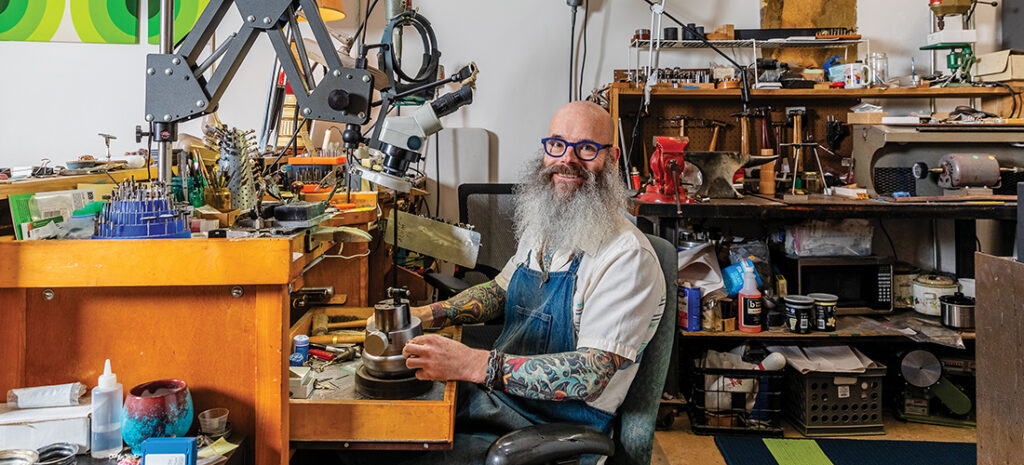
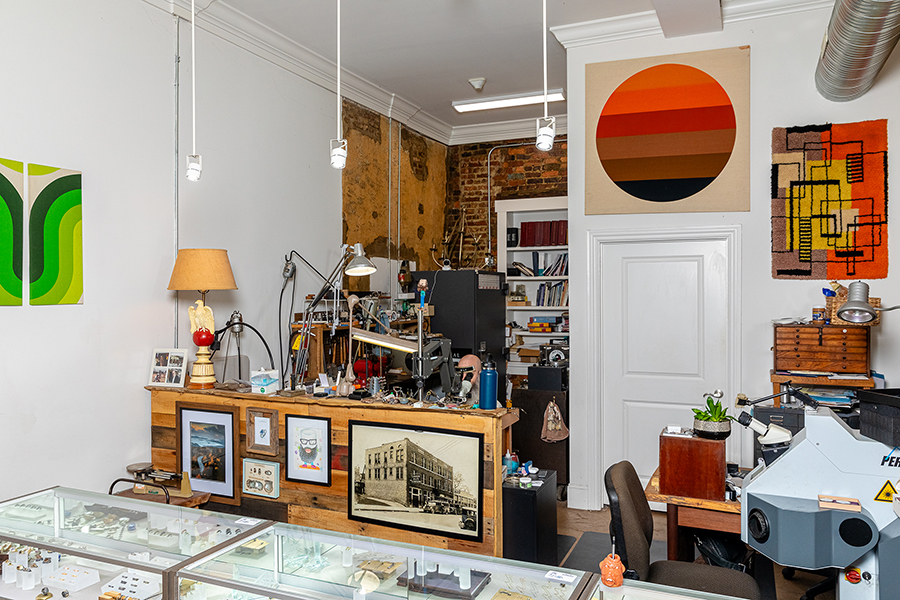
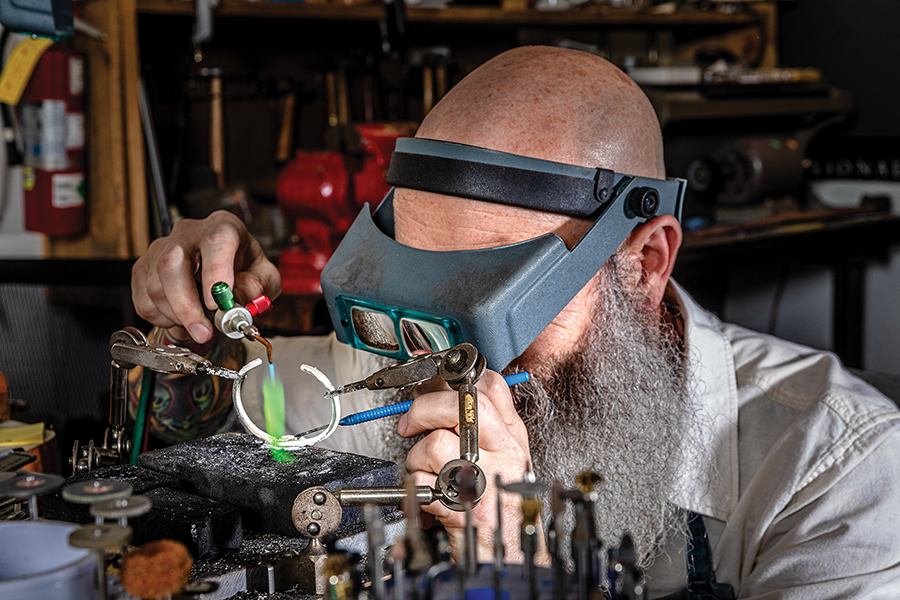
Behind the jewelry case at Jacob Raymond Jewelry on McGee Street sits the artisan and proprietor. His bald head is counterbalanced by a large, full gray beard and atop his long, narrow nose sits a pair of blue-framed glasses behind which dark brown eyes peer outward. The sleeves of his plaid shirt are rolled up to his elbows, revealing tattoos on both forearms. In short, Jake Wosinski, 52, is not someone you’d expect to be selling engagement rings.

And yes, you read that right: His last name isn’t Raymond. The Raymond in his shop’s name comes from his grandfather — his father’s father — who first sparked his interest in jewelry making. In fact, Wosinski still uses many of the tools he inherited from his grandfather. He holds out a pair of dividers engraved with a patent date of June 2, 1885, by Starrett, a company that Wosinski notes is “still in business in Boston, still making these.” The dividers also feature the engraved initials of those who have used them before. Pointing to a tiny set of curlicue letters, Wosinski says, “And so I scribed my initials on there.”

Among the tools he inherited and uses on a daily basis are these nearly 140-year-old dividers, a large polisher and a steel ring mandrel, which aids in shaping and sizing. While he isn’t sure how far back the mandrel goes, it dates at least to the ’50s because it bears the inscription of a name familiar to Wosinski: George Beaudet.

Beaudet was the jeweler who originally taught Wosinski’s grandfather, Raymond, the craft in Milwaukee, where Wosinski originally hails from. When Raymond moved to California — where Wosinski’s own family headed soon after — he took his skills and tools with him and continued the trade. “I kinda grew up around it,” says Wosinski.

While the first jeweler in the family that Wosinski can recall is his grandfather, he comes from a long line of men who’ve worked with their hands. “Most of my family on my dad’s side were tool and dye makers, or mold makers,” he says.

He thought he’d follow suit, but decided to attend the University of South Carolina Upstate in Spartanburg, where his family had relocated when he was 16. He began working toward earning a degree in English, but the family once again moved, this time to Greensboro. After working for a year, he planned to switch gears and study structural engineering at N.C. State as soon as he qualified for in-state tuition. “But I never made it back [to college].”

Wosinski’s brother, Brad, worked with a bartender who also happened to be a gemologist. Through him, Wosinski discovered the Gemological Institute of America and, at the age of 20, began a correspondence course. The institute would send him gems to identify with equipment he’d purchased — a microscope, a polariscope and a refractometer. From there, he ventured into a gem-cutting class at Randolph Community College.

The class itself bored him, but in it he first learned about the Sawtooth School for Visual Art in Winston-Salem. He enrolled in a jewelry making course that would change his life. “As soon as I took that class, I was like, yeah, this is what I am doing.” At that moment, the dream of having his own jewelry business one day was born.


Had he always been an artist? In training, no. “Maybe I could have done better if I had taken an art class,” he says, “but at the same time, since I don’t have rules of art or whatever, I am just doing whatever I want, thinking more outside of the box.”

A man on a mission, he sold his motorcycle to buy the tools he needed, set up shop in his parents’ garage and tried to get a job working for a jeweler. Lacking experience, “No one would hire me,” he says. “Finally, I went into a jewelry store and said, ‘I will work for you for free. Just let me learn.’” A shop in Winston-Salem took him up on the offer. After two years, he left in search of a paying job. Despite his experience, he still came up empty.

Not willing to give up, Wosinski decided it was time to attend an actual jeweler’s school and left for the now defunct Atlanta Jewelry Institute. Lo and behold, right after graduating, he landed his first paying jewelry job at a Greensboro store where he did repairs.

“But I wanted to make jewelry,” adds Wosinski.

Next stop? A shop in Winston-Salem, where he worked for six-and-a-half years.

“I made lots of awesome jewelry,” he says, “but it wasn’t my design.” At the same time, Wosinski worked on designing and creating jewelry at home, with plans to create wholesale pieces to sell to stores — both one-of-a-kind pieces as well as manufactured pieces that he could reproduce in mass. When he wasn’t at work, he was building his inventory in preparation of launching that business. In the meantime, he’d also gotten married to his wife, Liz, and had three young kids at home to consider.

“It was just too much,” he says. “I thought, ‘I will never see my family.’” Being the sole provider, he opted instead to look for a job where he could continue to hone his skills and offer design services while waiting for “a later date” to pursue a business of his own.

Armed with a collection of his designs, Wosinski went to an interview at a Chapel Hill jewelry store. “[The owner] actually bought $3,500 worth of jewelry at the interview!” Naturally, he was hired and the family relocated to Mebane to be closer to his job. While there, rings he designed won 10 American Gem Trade Association Spectrum Awards. But because it wasn’t his shop, his name was not on the awards.

After 10 years there, “a later date” had arrived. It was finally time to take a chance on his dream. He’d mentioned to his friend, Nate Hall, owner of Legacy Irons Tattoo Co. on McGee Street, that he was contemplating a move back to Greensboro and wrestling with the idea of finally opening his own place.

“He basically said, ‘Well, the jewelry store two doors down? I think they want out of their lease.’”

The landlord, Jeff Yetter, confirmed and put Wosinski in touch with the shop owners.

“We were at the grocery store on a Saturday night and I get a call,” he says. The jewelry store owners were heading out of town for six weeks and told him that if he wanted to come take a look, he could come now. Or he’d have to wait.

“We bought our groceries, went home, hopped in the car and drove to Greensboro.”

As luck would have it, the owners wanted to sell their jewelry cases and safe, items that would have been costly at startup. Everything was outfitted exactly as he’d need it.

He recruited his former Winston-Salem employer to come take a look at the shop and share her thoughts. Her response? “You need to do this.”

It felt as though it was meant to be, Wosinski muses. After working his last Friday in Chapel Hill, he opened the doors to Jacob Raymond Jewelry for the first time the following day and assumed his business, like that of his previous employers, would go “gangbusters from the beginning.”

And? “It didn’t go as planned,” he admits. “I don’t know anything about running a business.”

After a year of commuting from Mebane, the family moved to Greensboro, renting a home and using the equity from the sale of the previous house to survive. Bank accounts dwindling, Wosinski feared that his dream was over, that he was doomed to failure. What are we going to do echoed in his mind.

Liz had left behind her own job with the move and struggled to find employment in Greensboro, but still, she remained supportive.

“That kind of financial difficulty and hardship can make a couple draw apart or fight,” he says. “We just leaned into each other more. And we did a lot of praying.”

Wosinski admits that he holds a certain amount of pride in his natural talent and capabilities. And God was just taking him down a notch, saying to him, “You’re taking credit for things I have done.”

So that financial struggle? “God was just showing me, you may be great at this, but unless somebody comes in the door and buys it, you’re done.” It was, for Wosinski, a lesson in humility.

Slowly, organically, the business picked up steam. Liz now handles the company’s managerial tasks, such as shipping, accounting and banking. “Every year we’ve been here, we’ve grown.” While it’s not the growth he’d envisioned, his circle has widened and he enjoys the sense of community cultivated by downtown Greensboro business owners and regulars. And he’s able to do what he loves— create one-of-a-kind jewelry pieces. Award-winning one-of-a-kind pieces. Since opening his doors, he’s won two awards under his own name: the 2018 Platinum Innovation Award in the evening wear category and the 2020 Platinum Innovation Award in the bridal wear category.

No surprise there. His favorite pieces to create? Engagement rings. “That’s always like, this is for life,” he muses.

His designs begin, he says, in his design sketchbooks. He’s currently on his fourth. Inside, he loosely draws a plan just to get an idea out of his head and onto paper before it’s forgotten. “But then, every time I go to start making a ring,” he says, “other ideas pop into my head.” It’s very rare that a final product matches its original design. And most often, he notes, his pieces are “one and done” — no other in the world exists.

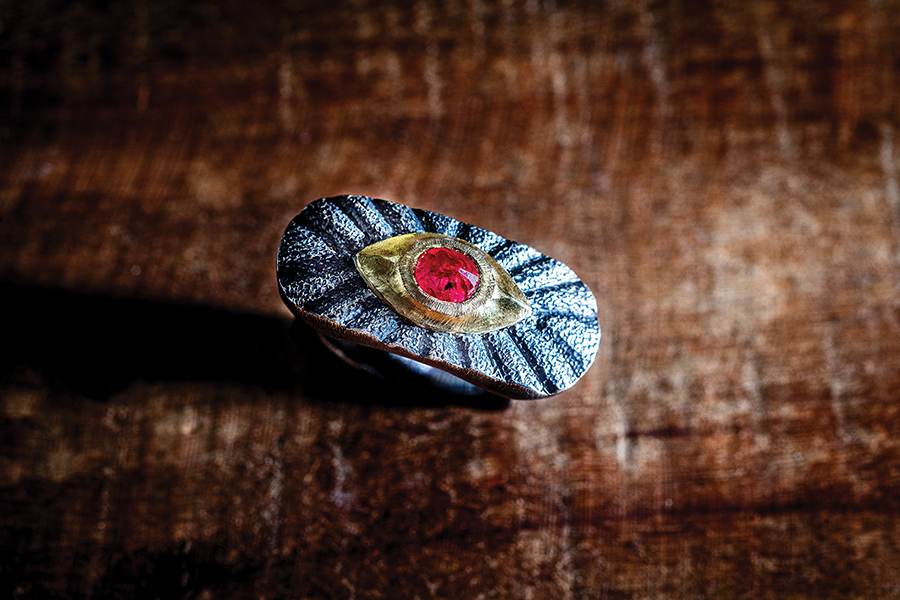
“As you can see, I’m all over the board,” he says, peering over his glass case filled with all sorts of bejeweled oddities. The artist in him appreciates — and designs — in a variety of aesthetics, from Art Deco to his “contemporary estate style. I love doing what I call my ancient style, which looks like something from the Middle Ages or Roman times.” A cuff bracelet looks like something that would have graced Cleopatra’s arm.

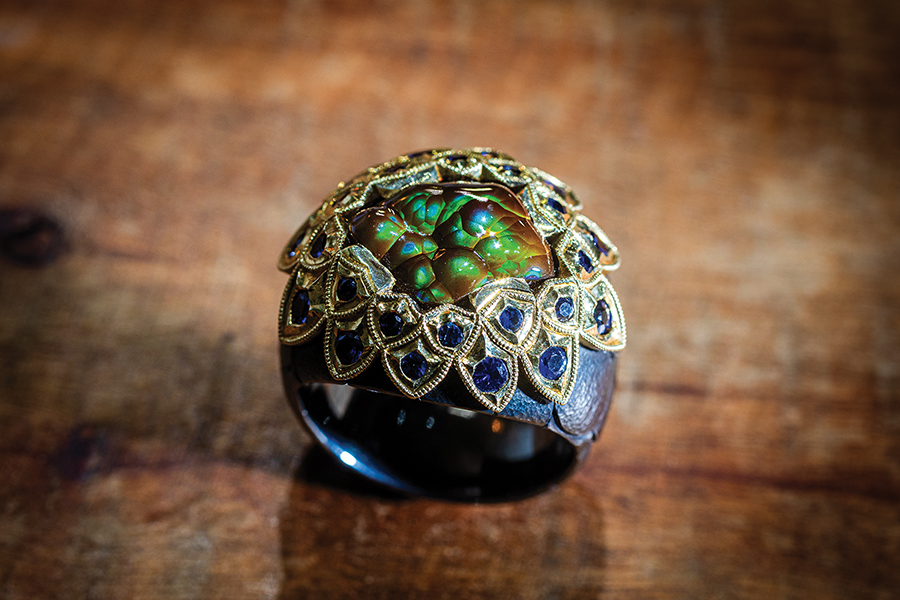
Wosinski loves working with sapphires because of their durability and the rainbow of colors they’re available in, but what really sparks him is fire agate. This rare opalescent stone shines in oranges, greens and purples, and is found in the American Southwest as well as northern Mexico. What appeals to him about this stone is exactly what appeals to customers about his jewelry: “Every one is different.”

Sparked by fire agate’s kaleidoscopic luster, Wosinski is determined to create a market for it. According to crystaldigest.com, fire agate is associated with passion and creativity and “is said to help one actualize their highest potential.”

These days, though most clients come to him locally, he serves several customers across the states — even across the globe. He recently completed two custom pieces for a doctor from the U.K. “He’s been following me on Instagram for years, threatening to have me do something for him,” Wosinski quips. Finally, the doctor made good on his promise and visited the United States, bringing with him a 44-carat lab-grown sapphire and a 22-carat lab-grown ruby. He dropped his gems off in November with plans for a March return and pickup.

With those gems, Wosinski crafted a pendant that resembles an amulet and a ring. The doctor’s reaction? “He was like ‘aaaah’ and I was like, ‘Is that a good aaaah or a bad aaaah?’” Palms sweating, Wosinski stood by with bated breath. “It was a good 30 seconds before I knew that he liked it!” After all these years, Wosinski admits that nerves strike when presenting custom orders.

Back on U.K. soil, the doctor sent Wosinski a message: “Thank you for making my dreams come true in jewelry form.”

As for his own dreams? He’s still taking it day-by-day. Since 2017, he’s had only one employee other than himself, and that’s his dad, who — much like he once did — works for free. “I pay him with pretzels and peanuts,” he says with a laugh.

He hopes that perhaps his own 23-year-old son will take an interest and join him down the road. No pressure, though: “We all have our path that we need to go,” he notes.

The ultimate goal is to have a team of employees who can work with clients on custom orders but also create pieces of their own design. He dreams of one day employing jewelers he can mentor, and yes, they’ll be allowed to label it with their own names.

But he’s not there yet. “I can still go two days and not have anybody walk in.”

Just then, the shop door chimes, announcing a customer.

“Hi there!” Wosinksi greets her. “What can I help you with?”

“I want you to make me a ring,” she answers. She tells him that her daughter, a client, says he’s the go-to guy to for custom work.

Woskinski’s face lights up at the opportunity to make her something, something beyond anything she could ever imagine.  OH


One and Done

In 2003, just before our wedding, my soon-to-be-husband, Chris, and I stepped into a tiny jewelry shop in New Orleans. Our mission? The rings, with which we’d wed.

As we perused the glass cases, Chris selected a simple, wide, gold band for him. And for me? I looked up and down that store, waiting for something to speak — no, sing — to me. After all, this was eternity we were talking about here!

In the end, under the pressure of time, I chose a $40 plain, gold band “for now” that was similar in width to the diamond ring that had been handed down from his grandmother and which I happily wore for years. It was made from simple, yellow gold, with a solitaire diamond. (I’m told her first ring was prettier, but she lost it in the ocean.)

For years, I was too busy raising kids to think about replacing my “for now” ring with my “forever” ring. Though I loved honoring tradition, truth be told, the diamond was constantly snagging on things and I was afraid I’d be responsible for losing Chris’ grandmother’s second diamond. Buying a third was not an option at the time, so I took it off.

When we moved to Greensboro in 2019, Liz Wosinski reached out to me via Instagram messenger to introduce herself. She’d been following me there and, as it turned out, lived in my neighborhood. She told me about her jeweler husband, Jake, whom she was very proud of, and I immediately followed him on Instagram, showing Chris his art.

Of course, shortly after that, the pandemic hit. Finally, in February 2022, 19 years after shopping in New Orleans, Chris and I walked into Jake’s McGee Street establishment. My wish? Something unique — anyone else an Enneagram 4 out there? — that would use the gold and diamond from my existing bands to create one wider ring. And this time, an organic style with mixed metals, because sometimes ya feel like silver and sometimes ya feel like gold. Plus, the diamond needed to be inset and snag-free.

Just eight weeks later inside the walls of Jacob Raymond Jewelry, Chris slipped a work of art onto my finger. The diamond, encircled in gold, sparkled along with the silver of the band. It hasn’t once gotten snagged on anything. But the best part? Knowing that my ring, as well as my marriage, is “one and done,” as Jake says.
— Cassie Bustamante

Poem June 2024

Poem June 2024

Poetry

This came before Hip Hop

This plants street crops

Won’t stop for red octagons

This thing sings songs

Prolongs life after death

Moves in stealth

Improves the quality of your life

Flows through pipes to irrigate land and turn grass green

This thing steams the wrinkles out of my daily

Therefore you’ve got to pay me

For this is Poetry

And. I never realized the power of my voice in this world

The power of this ink merged with this paper

And each day I laugh at my countless attempts to make sense of this gift

And each day it lifts me higher

Lights my soul on fire

And I wire these words like a telegraph to anyone that will listen

And some that won’t, so please don’t test me

Because this is dangerous

It’s like skin to me, it’s like kin to me

This thing befriends me when all else seems lost

I’ve paid my way by showing a way to the lost

And it came before Hip Hop

This plants street crops

Won’t stop for red octagons

This thing sings songs

Prolongs life after death

Moves in stealth

Improves the quality of your life

Flows through pipes to irrigate land and turn grass green

This thing steams the wrinkles out of my daily

Therefore you’ve got to pay me

For this is Poetry

                  — Josephus Thompson III

Greensboro’s first poet laureate, Josephus Thompson III, has created both a
song and a book out of this poem. The book,
Poetry Is Life, can be found here: josephusiii.com/product-category/books; the song can be found here: youtube/91K-WmDcMpQ.

Wooden It Be Nice?

Wooden It Be Nice?

With Gary Lowell at the helm, weathered vessels take on the waters again

By Billy Ingram  

Photographs by Mark Wagoner

There’s a cautionary, oft-shared adage among well-healed seafarers that I’ve heard more than once: “You don’t own a boat; the boat owns you.” That commonly refers to those unwieldy, 130-foot floating hotels with which few of us will ever be financially burdened. But it may also be true, albeit in a much different sense, when it comes to smaller, vintage, wooden watercrafts, where ownership manifests itself as more of an emotional, familial connection.

There’s an unmistakable allure to those magnificent American-made maritime machines of the 20th century — the bold contours and fanciful interior chrome accents of a 1958 Century Arabian; the elegant simplicity associated with a 1949 Chris-Craft Racing Runabout; the playful luxury that defines a 1941 Gar Wood Flagship Streamliner; the distinctive shark-like fin of the 1955 Chris-Craft Cobra, a genuine aquatic hot rod, powered by a 331 Hemi Chrysler Marine Engine; or consider the aerodynamic sleekness of a Glastron GT-150, which James Bond piloted (on land, sea and air!) across the Louisiana bayou in Live and Let Die.

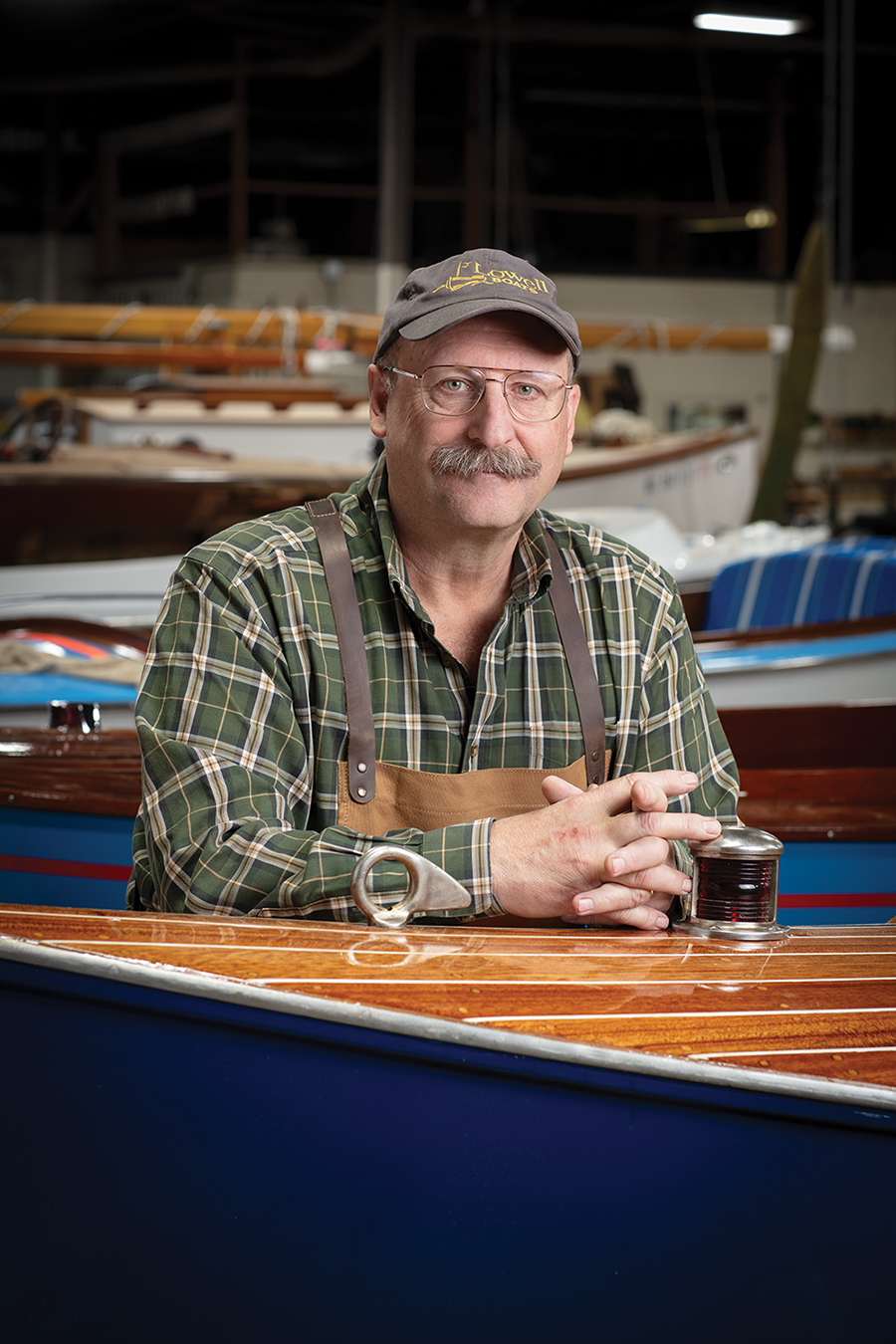
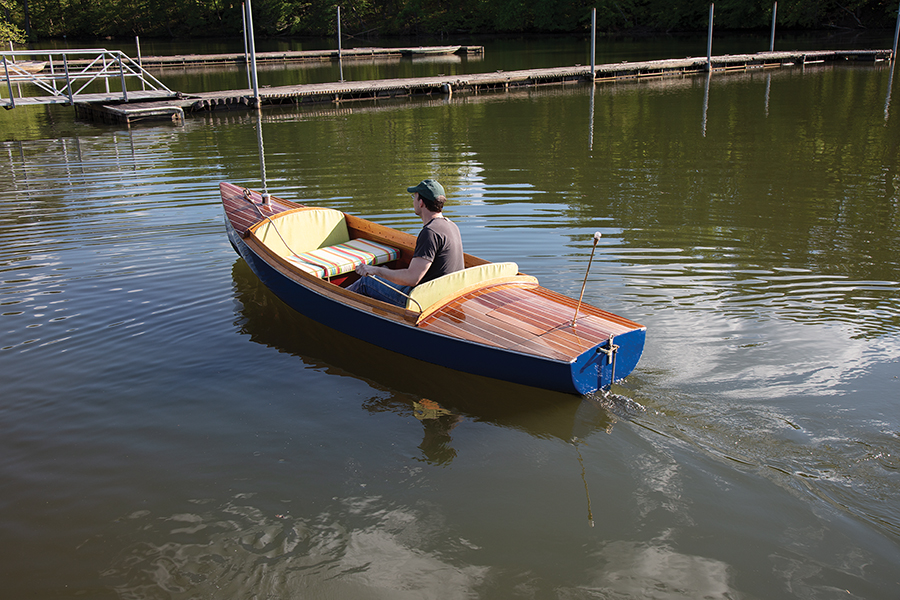
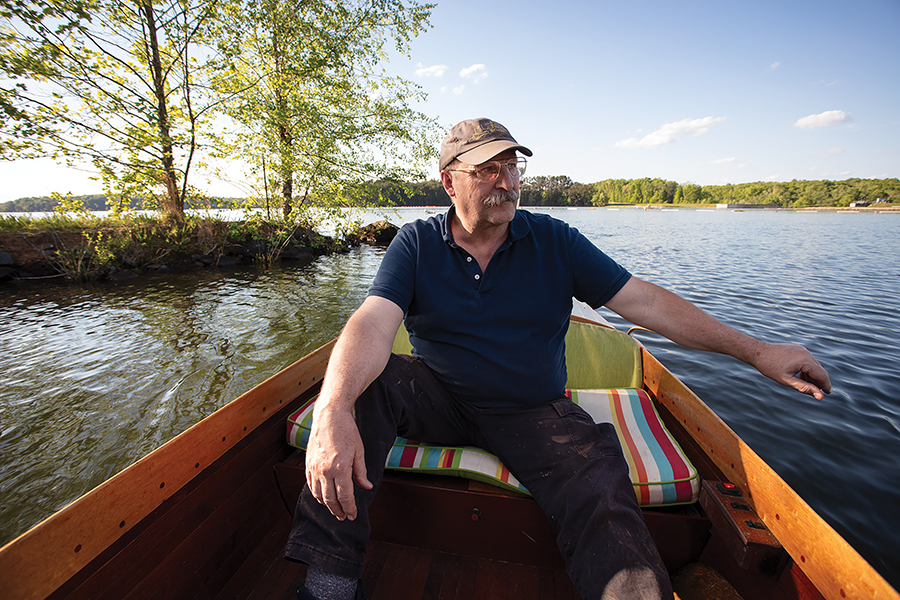
It’s been 30 years since Gary Lowell dropped anchor on a career restoring — in many cases, resuscitating — these highly sought after collectors items, having discovered his love of vintage boats at an early age. “When I was about 10 years old, my dad bought his first wooden boat and I just got into them then,” Lowell says of that initial spark. “My first job right out of high school was in television. I was the director of The Good Morning Show at WFMY and a puppeteer for The Old Rebel Show.” On weekends, Lowell would make a run for the coast to haul back some old wrecked vessel in an effort to make it seaworthy once again.

Emblematic of one’s personal style and appreciation for the finer things in life, any boat from a bygone era is sure to attract attention and spark lively conversations. And ones crafted from wood almost universally are regarded as the most impressive in any harbor, partly because each plank is meticulously handcrafted and laid. These veritable works of art are imbued with a singular personality not merely reflected in their appearance but also in the idiomatic sensations its skipper feels when breaking through choppy waters, rocking to rest in a slip or quietly cruising placid waterways.

Those salvaged boats he dragged home to restore? Inevitably, “Somebody would say to me, ‘That’s nice. Let me buy it from you.’” That pattern continued until Lowell realized he’d unknowingly stumbled upon his true calling. “I started working in my backyard and then I got a little shop — and then a bigger one.”

Lowell expanded his operation from 1,800 square feet to his present day cavernous 18,000-square-foot studio on Blue Bell Road, where dozens of boats are dry docked or hanging from the rafters in various stages of completion. While he has clients here in the Gate City, “the regional lakes like Lake Norman, Lake Gaston, Kerr Lake and Smith Mountain are where a lot of my customers come from.”

The golden age of compact wooden boats is considered to be 1948 through about 1959, which tracks with the rise of automobile ownership in America. “Some of those boats actually took on the look of cars,” Lowell notes of the time when molded fiberglass chassis offered a viable alternative to wood, allowing for more extravagant body types. “Especially in the ʼ50s with the tail fins, cars loaded with chrome and big ornate steering wheels.” Indeed, from 1956 into the early-1960s, independent manufacturers began using more sculptural fiberglass to create outboard motorboats that mimicked the streamlined modernity of automobiles.

For vacationers seeking motorized symmetry, a tail-finned 1959 Chevrolet Impala land yacht could be paired with a virtually indistinguishable (from the rear) Reinell Jet Flight runabout. A ’57 DeSoto (“Tell ‘em Groucho sent you!”) might have been cruising that year over one of the nation’s brand new interstate highways in tandem with its Hurters Flying Fish doppelgänger. The iconic red-and-white 1957 Corvette convertible sporting a powerful, 265 cubic-inch V8 under the hood could easily tow behind it a matching two-toned, Fiber-Glassic Lone Star Meteor speedboat — the ultimate in after-market automotive accessories. But those once-fashionable hybrids are of little interest to Lowell, who focuses his efforts exclusively on refurbishing mahogany- and oak-framed watercraft.

Every classic boat comes with a backstory, having weathered the elements for a half-century or more. Gesturing to a gas-powered Sea Skiff designed to ferry a dozen or so revelers, Lowell explains, “A teacher over in Wake County bought this because he used to spend a lot of time on the lakes up in upstate New York.” After stripping away the paint on both sides, “We found carved into it the name ‘Canoe Island Lodge.’ We looked it up and [that resort] is still in operation. So I contacted them and sent them a picture of it, and they sent me a photo from a 1958 brochure that showed people on their lake in this very boat.” The boat’s owner told Lowell his grandfather used to vacation at Canoe Island Lodge. “By coincidence, he’d bought a boat that his grandfather had actually ridden in.”

Naturally, what every client wants to know up front is: how much is it going to cost and how long is it going to take? It’s a great deal more complicated estimating how much time and effort will go into reconstructing a craft that spends most of its life in the water, which lends itself to harboring unseen damage that doesn’t come to light until peeling back the lower layers. That’s why, as an investment, the return is not going to be a financial one. “It will cost more to restore a boat than the resale value,” Lowell says. “You have a boat that you might be able to sell for $25,000 but we’re going to have to put $75,000 into it. But if it’s your grandfather’s boat and you want to fix it up for your grandkids, which some of these projects are, then it’s worth it.” Sentimental value? Priceless.

While an automotive “barn find” is unusual, it does occasionally still happen; the maritime equivalent might more likely be uncovering a watercraft that’s been sleeping with the fishes. “I had one project we called the ‘Fish Boat,’” Lowell recalls. “It belonged to an older couple, one of whom had a grandfather who kept a boat on Lake Norman.” To their dismay, the couple discovered the boathouse had structurally collapsed, causing the boat inside to become fully submerged for an extended period. “When we hauled it up, it was full of fish, hundreds of them. It stunk for months so we kept it outside here, ripped it apart, hosed it down and restored it. It’s just a gorgeous boat that’s now on the show circuit going around the country.”

While he’s taken in fixer-uppers from as far away as the West Coast and New England, most of Lowell’s clientele reside in the mid-Atlantic area. “This is the typical boat that we do today. This one is in for a touchup,” he says, pointing to a compact Chris-Craft runabout. In the past, he’d already worked maritime magic on this very boat. “We ripped everything off, flipped the boat over, replaced the broken framing, then installed an all new bottom on it.”

Utilizing tools and techniques boatbuilders have employed for hundreds of years, there’s very little that can’t be accomplished under this studio’s towering roof. “The engines, if it’s minor, like the external workings and regular tuning up and all of that, we do in-house,” Lowell says. Many of those old boat motors were originally installed in tractors, tanks, and landing craft during World War II. “So there’s a lot of that left over, but the actual mechanical parts are sometimes hard to find.” As for the seat coverings, some higher-end boats are appointed in marine leather, others covered in a marine vinyl with a faux leather texture. These can be repaired using remnants on site. “In a lot of older boats, you’ll find the upholstery is in good shape. If it needs all new foam and cushions we have vendors that specialize in that.” Lowell turns to a local artist for the calligraphic flourishes that spell out the often clever nicknames inscribed across these crafts. “There’s a guy in town I use, Mike Gregson, who does all the gold leaf on the county’s fire trucks.” Lowell insists one of his hardest tasks was coming up with names for his personal vessels. “Most powerboat names are tacky or even crude,” he says referring to double entendres often based on the term “wood.” “The best are ones that are named after someone’s grandmother, such as Lena, Maren, Mozel or Amelia Jean.”

Mahogany and oak are the main boat-building materials so, with Greensboro’s proximity to the furniture capital of the world, there are ample avenues for acquiring hardwoods. Currently, Lowell is restoring several mid- to late-1950s, 18-foot and 23-foot Chris-Craft Continentals, an almost iconic mid-sized model adorned in dark mahogany siding with white pin striping up top. “Just a fluke that we’ve got all of these Continentals in at the same time,” he quips. He’s also putting the finishing touches on a 1954, 18-foot Riviera, which connoisseurs regard as the “quintessential 1950s Chris-Craft runabout.”

Some of the more unusual water crafts Lowell and his crew have on deck are a fleet of small electric models from 1934 and 1935. “They reside at a lake up in the North Carolina mountains,” Lowell says. “Most people don’t realize there are electric boats that old.”

While it wasn’t uncommon for manufacturers to install easily attainable automobile steering wheels in their boats, customized chrome ornaments, frames, and dial casings can be difficult to come by at times. “Even with a rare car, they still made thousands of them. Some of these boats, they maybe only made two of some models.” Making such a limited number wouldn’t have been the plan but, “if they made a 16-footer in 1953, but everybody bought the 18- or 20-foot versions, the next model year they’re not going to make the 16 anymore. You end up with a rare 16-footer you can’t find parts for, so you have to recreate them yourself.”

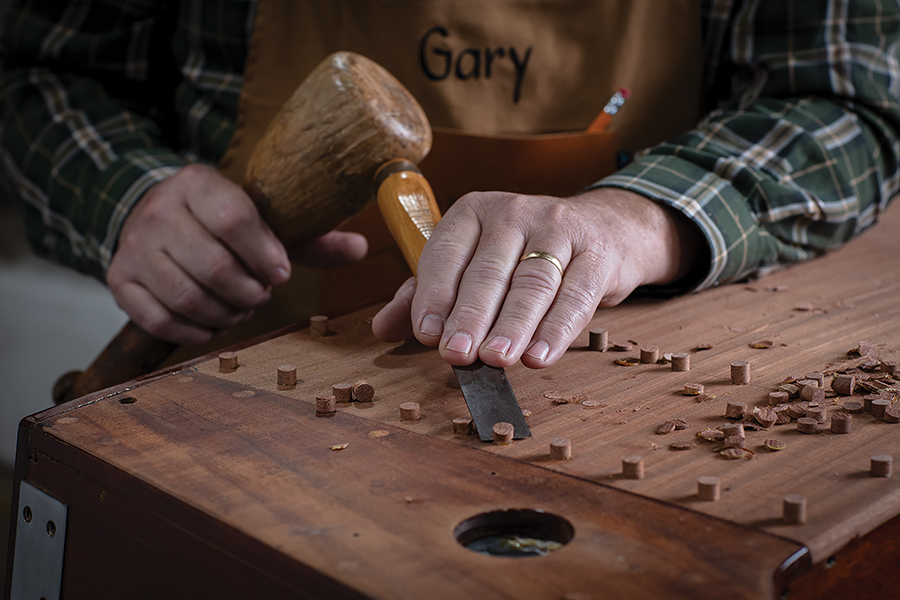
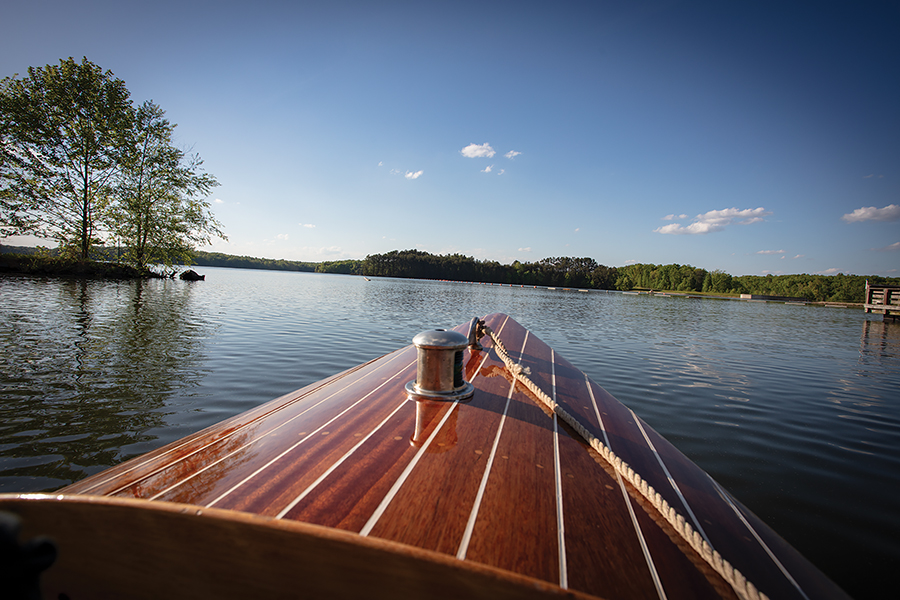
When it comes to bending those long mahogany planks to conform with a boat’s outline, Lowell explains, “They go into a big box that we hook up to a beer keg with a burner under it to boil water and we steam the wood for about an hour or so. When it’s ready, we pull it out and fold it around a mold or sometimes directly on the boat so it takes in not only the curve but the twists as well. That’s kind of a fun process.”

While he and his precision-oriented crew will take on any type of boat as long as it’s wooden, sailboats are Gary Lowell’s true passion. What’s their “it” factor? “Something about the mast and the rigging that I like better than the mechanical power.” Not to go all Christopher Cross here, but there is a majestic quality to the art of sailing where sun, wind, canvas, punctuated by the ocean’s salty spray, induces an unparalleled level of serenity that, for thousands of years, sailors and adventurers have continued to chase.

“It wasn’t until years later that I came to find out that I’m part of a famous Lowell boat-building tradition that dates back to 1793.” Distant relative Simeon Lowell is credited for producing the earliest shallow-draft American Dory fishing vessels, for which his shop became famous. Positioned alongside the lower Merrimack River shore in Massachusetts, Lowell’s Boat Shop, the nation’s oldest, still operating, remains dedicated to the art of “preserving and perpetuating the art and craft of wooden boat building.” Lowells are still building watercraft in Maine and throughout the rest of New England.

Born in Greensboro but raised in Maine, Lowell returns to The Pine Tree State every summer to visit family and to teach restoration, marine painting and varnishing techniques at the prestigious Wooden Boat School in Brookline, which he’s done for 25 years. Closer to home, he’s conducted seminars at the N.C. Maritime Museum in Beaufort. Plus, one of his crew is a graduate of Cape Fear Community College, where a degree in traditional woodworking skills and precise joinery techniques required for assembling wooden boats is offered, as well as a diploma in composite boat manufacturing and service.

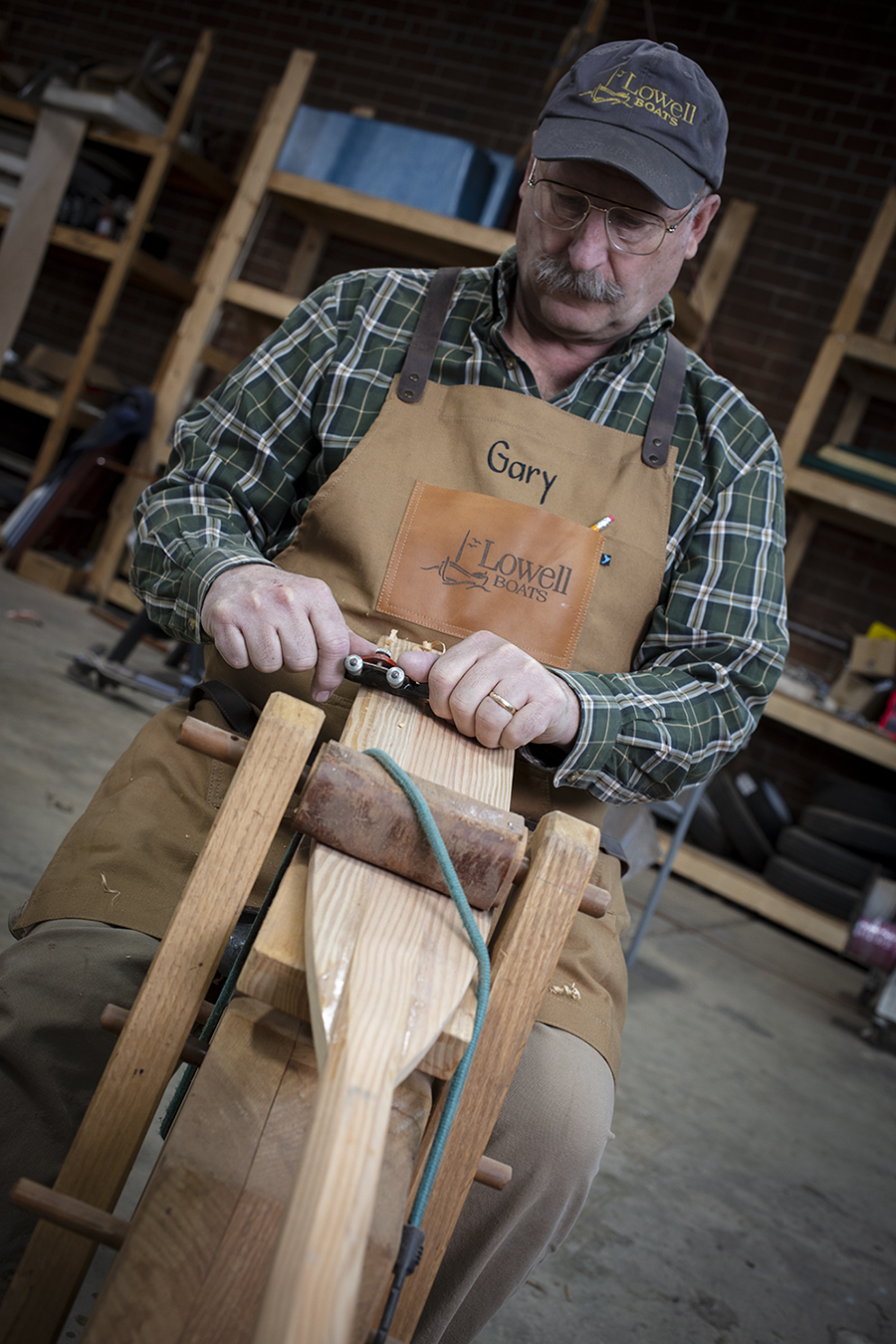
Lowell also invites interns and school groups to drop by the shop. “With one intern, we’re making several oars to be donated to Greensboro Parks and Recreation to use on row boats they rent.” He’s also a part of TWSBA, Teaching with Small Boats Alliance, an international organization of boat builders educating young people on subjects related to boating, such as geometry.

Wooden boat shows, like their classic car counterparts, are always a big draw, where 40 or 50 antique crafts will be gawked over by thousands of boating enthusiasts converging from around the country. In September, Smith Mountain Lake will host one of these festivals, where you’re bound to encounter an array of Lowell’s cultured pearls-of-the-sea. If you’re thinking of dipping your toe into the water, so to speak, the 34th annual Georgetown Wooden Boat Show in South Carolina will be held in October, an event that kicks off with the Goat Island Regatta Auction. Bring your checkbook, but leave room for plenty of zeros.

Perhaps one of these gatherings will ignite your own infatuation for navigating cool waters in a vintage custom-crafted wooden boat, unleashing your inner James (or Jane) Bond.  OH

Poem May 2024

Poem May 2024

Beguiled by the Frailties of Those Who Precede Us

Scrub your face with a vengeance.

Brush your teeth till your gums bleed.

Comb your hair into a pompadour, braid it

into cornrows, buzz cut a flattop with side skirts,

spit-paste that cowlick to your forehead.

That’s how it begins, this becoming who you aren’t.

A twitch or tic or two you may inherit, but the face

in the mirror you recognized only once

before you’re beguiled by the frailties of those who

precede you — your wayward Aunt Amelia,

the lying politician, tongue flickering through his false

teeth, the long-legged temptress slyly sipping a latté

at the corner coffee shop, your scapegrace 

one-eyed Uncle Bill — all of them competing

for your attention, all of them wanting you to become

who they believed they were going to be.

Between intention and action, take a deep breath

and welcome the moment you become who you aren’t.

Slap on Uncle Bill’s black eye patch,

stuff those willful curls under Aunt Amelia’s cloche,

pluck your eyebrows, rouge your cheeks, bleach

those teeth whiter than light: then stare deep into

the reflection behind the mirror: who you’ve become

will trouble you, even if you shut your eyes.  

            — Stephen E. Smith

Stephen E. Smith is a retired professor and the author of seven books of poetry and prose. His memoir The Year We Danced is being released this month by Apprentice House Press.

When the Spirit of a House Departs

When the Spirit of a House Departs

The carriage house of Diane Stallworth

By Cynthia Adams  

Photographs by Amy Freeman

Diane Stallworth enjoyed matters of design, especially in her charming Fisher Park carriage house and its “sculpture” garden. Once settled in, she gave herself over to it, contentedly staying put until her last breath.

In a real sense, it encapsulated Stallworth’s external style and interior history. The carriage house was edited and re-edited, ultimately imbricating her past and present. This is in memoriam to Diane, who died January 14 this year.

Over the years, Diane Stallworth quietly hinted that she hoped her home would one day be featured in this magazine. On our last visit in her home, she took me upstairs to show a project still underway. 

“Once this is done, it will be ready for you to do an article,” she said, meaning worthy. 

It already was, I assured her. 

Stallworth never lost interest in the granular details of her charming historic Fisher Park residence, says her longtime friend, designer Terry Lowdermilk, who also became a longstanding sounding board, aide-de-camp and curator.

The carriage house, a once common sight but now a rarity, dated to 1913. Built on the grounds of the Prairie-style home of cotton broker and developer James Edwin Latham, both structures featured distinctively rock-faced granite, a construction that best explains how the carriage house also survived over a century beyond the era of horse-and-carriages.

Latham (also the namesake of nearby Latham Park) lived there until 1932, when the home was sold to R. W.  Baker, a Blue Bell executive, who died in 1956. Baker’s widow resided in the mansion until her death in 1980. 

“In 1982, Brown Investment Properties converted into 12 condos the main mansion and its large stone servants’ quarters and garage [the carriage house] in a joint venture,” according to the November 2011 Fisher Park newsletter, which included architects, JMD Contractors and Boone, Higgins, Chestaw, Dennis & Case. According to historic records, the carriage house was originally a barn for horses and carriage, housing servants upstairs. Later it became a three-car garage. Featuring three dormers and two chimneys, the roof was originally the same green terra cotta tile as the main house.

By 1982, the mansion, carriage house and condos became officially known as Baker Place. The carriage house was converted into its final iteration, a two-story, single-family home. Garage doors on the first level were replaced with three sets of French doors.

In the same issue, Stallworth recalled, “Now and then, people who remember when Baker Place was a single home [the Baker-Latham mansion] drive-up and they tell us how they visited or played in the back yard.”

At the time of the conversion of the Baker-Latham property into condos, Stallworth lived in the Lofts at Greensborough Court. Her apartment there was also in a historic building. It, too, featured ample charms only age can impart — exposed brick walls, vaulted ceilings, a fireplace and architectural details new builds lacked. 

One day in 1987, Stallworth walked into Lowdermilk’s downtown studio to seek decor advice.

He remembers the day clearly. 

When they met, Stallworth was in her 50s and active. In her youth, she was peripatetic and athletic, becoming a Canadian Junior Ski Champion, thanks to regular skiing trips to Quebec with her family, who lived in Fitchburg, Mass. 

After graduating from Briarcliff College, Stallworth had moved to Bermuda, where she pursued work in fashion. (Her family vacationed there in their island home.) 

A few years after living in Bermuda, she moved near New Orleans’ French Quarter. There she met her first husband, William N. Crawford Jr., from Greensboro. The couple returned to the Triad where their daughter, Merrimon Crawford, was born. As a nod to her fashion background, Stallworth co-founded The Briar Patch, a children’s clothing store in Greensboro. 

After remarriage, she relocated to Charleston, West Virginia, throwing herself into designing her home and gardens, entertaining and traveling. Years later, she returned to Greensboro.

Stallworth was a longtime member of the Fitchburg Art Museum since childhood, attending programs and exhibitions. In Greensboro, she remained active in the Junior League, gardening and, always, fluffing her nest. She and Lowdermilk developed a connection beyond business, becoming fast friends. Lowdermilk admired his friend’s patrician manners. She was highly educated, he describes, traveled and curious.

Stallworth became a fixture in continuing education classes, many of which were hosted at Holy Trinity, her church. Here she met sculptor and UNCG professor emeritus Billy Lee, whose work she later collected for her home and courtyard. 

“She was there [in the downtown apartment] a number of years,” recalls Lowdermilk. 

He recounts how she became aware of the historic Latham-Baker property when the carriage house was listed for sale. Lowdermilk remembers she visited the property while he was on a vacation trip to the coast. She called him, entreating him to leave the coast and see it before she made an offer. He urged her to buy if she loved it. 

“The only reason she made the change was she tired of renting and she wanted something that would be hers,” he explains.

By the time he returned to Greensboro, she had bought the carriage house. According to property records, the year was 2003.

Truman Capote once told House Beautiful, “I have always been aware of rooms, their atmosphere, the emotions they induce,” after permitting the magazine to photograph his own home.

He went further: Capote preferred either the sterility of a well-cleaned hotel room, or a subjective room. He deplored rooms lacking the owner’s personal stamp, style and humanity — the things that imbue an otherwise attractive room with meaning. 

Stallworth’s home was the sort that Capote would likely have loved. When she liked something, she kept it. Her style was unwavering — she hewed to certain colors and a restrained, earthy palate, in both her home and her clothing, preferring neutrals and black. 

What was to become a grand passion unfurled — a creative collaboration and friendship between Stallworth and Lowdermilk that continued two decades as she threw herself into making the carriage house uniquely her own.    

“She was not the kind of person who you told what to do,” the designer stresses. “She knew what she wanted. We saw eye-to-eye on a lot of things. I liked the fact that she wanted to be involved” — even, Lowdermilk adds, in the granular details, from painting to plumbing. 

“She wanted to know the hows and whys of everything.” 

Neighbor Jayne Ericourt came to know both Stallworth and Lowdermilk years later, interacting with both socially. “She knew everyone here,” says Ericourt.

In 1982, Ericourt and her husband, Daniel, “went to see what they were going to do at Baker Place. There was nothing for sale but the mansion itself.” Brown Investment Properties was just promoting 12 new condos to be built on the mansion’s grounds. The concert pianists discovered they could plan their own design to accommodate two baby grand pianos and a love of all things Spanish.

In 1983, the Ericourts condo was completed. Twenty years later, Stallworth moved into the Baker Place carriage house directly across from the Ericourts and would become its longest occupant. 

Ericourt says that before Stallworth took ownership, previous occupants had done renovation work to the carriage house interior.

As she planned her new home, Stallworth began to refresh and recover upholstered pieces from her apartment. “She loved charcoal, white, taupe and beige with a little terra cotta,” says Lowdermilk. Having bought “the best,” he says, little needed replacing. 

“When she moved here, she changed the color of the walls, reupholstered the sofa and chairs, and did new bedding.” But much of what she had was repurposed, he points out. 

Stallworth chose art and antiques that remained with her for a lifetime, with occasional touches aided by Lowdermilk. Each room, by design, spoke to her life journey. 

The much-used kitchen features an unusual and custom-made piece, a kitchen island, fashioned around a panel of clear leaded glass. Using Lowdermilk’s design, Greensboro iron artist Jeffrey Barbour incorporated the glass into a functional piece. 

A collection by illustrator and political cartoonist Taylor Jones fills a kitchen wall. The syndicated artist, whose work has appeared in newspapers and magazines worldwide, is a former illustrator for U.S. News & World Report

“She bought the [entire] set,” says Lowdermilk. “He’s renowned for his caricatures.” He points out some famous subjects. “Diane was good friends with Jay and Sharon Rockefeller [former West Virginia Senator John D. ‘Jay’ Rockefeller IV and his wife]. The collection meant a lot to her.”

A few design tweaks were brand new, however, like a signature piece showing Lowdermilk’s sleight of hand. He created a leaded glass window featuring poppies for the downstairs powder room.

“I came up with a design that was kind of organic,” says Lowdermilk, who commissioned the Glass Art Studio to create the window. (The owners have since moved their studio to Virginia Beach.) After it was installed, Stallworth decided it was one of her favorite things about the new house.

The artists whose work she collected often became friends. Sculptor Billy Lee, who lives a few blocks away, recalls countless happy times “spent in Diane’s kitchen.” 

“She loved my work and was always very supportive. She was very curious about all forms of creativity and we had many long conversations about it,” says Lee.

“It must be at least 15 years since she first bought my work. She knew I made the black marble pieces in China and wanted to see them — and bought one.” Stallworth had noticed one of Lee’s pieces installed in the courtyard at UNCG’s Weatherspoon Art Museum. 

“She liked the steel piece in Weatherspoon and asked if I had a smaller one for her garden.”

Lee did.

She kept things not only from her old apartment, but integrated family pieces. A bow front chest that once belonged in her parents’ historic home in Fitchburg, Mass., features prominently in the living room. Pointing to a sofa, Lowdermilk muses, “It’s still classic; this many years later. That’s 34 years old.” 

From her parents’ house in Bermuda are a pair of antique campaign chests that once furnished a room aboard a ship; “the real thing,” says Lowdermilk. They now serve as bedside tables in the upstairs guest room. In various rooms, she restored and used an array of wicker and rattan family pieces, emblems of quiet wealth.

On the wall of the upstairs study is a picture of Stallworth’s parents’ estate in Massachusetts. Displaying it in a private area versus a main room, she downplayed her family’s wealth.

“It sits on 50 acres. Right outside Boston,” says Lowdermilk.

Suddenly, standing in Stallworth’s private rooms upstairs, the power goes out and her study darkens.

“Diane, are you here?” Lowdermilk calls out, pausing. 

Quietly, almost whispering, he discusses framed pieces that Stallworth valued, including favorites by Merrimon Crawford, her photographer daughter.

“She really appreciated Merrimon’s work,” he says.

Stallworth’s main bedroom also contains family pieces from Bermuda. It’s an understated, peaceful room, with plantation shutters consistent with other rooms, also redolent of her Bermuda experiences. 

The collaboration between Lowdermilk and Stallworth even extended to her wardrobe. Every year, he helped Stallworth weed out her clothes closet, which is enviably organized and pristine. 

“I reminded her, look at the colors in your home.” When she bought an unusual hot pink piece, it remained in her closet unworn. He urged her to let it go. “We tend to wear the colors that we use in our homes.”

Over her lifetime, he continued with projects both inside and out. A hall bath was gutted. They changed or added wallpapers. Somehow, there were always projects, things being finessed. 

“I love to say that I live in a three-car garage and a barn!” Stallworth had joked in the neighborhood newsletter. The downstairs windows, historians noted, were where the horses once stuck their heads out. Lee’s larger sculpture was placed in the courtyard, where she could enjoy it while having coffee, cocktails with friends, or while reading.

Though she didn’t have a huge circle, and she had lost friends due to age, “she liked young people,” mentions Lowdermilk.

What would Ericourt say people should have known about Diane?

“She was a very good friend to her friends, I’m sure,” says Jayne.

“She would have been there for me if I really needed her,” adds Lowdermilk, who was at Stallworth’s so often he came to know many of her neighbors. “She was very particular about who became her friend,” says Ericourt. 

“She had her own set of rules,” Lowdermilk agrees. 

“Diane would size people up” before deciding if they could be friends or not. “But not in a snooty way,” he adds.

“That’s not stupid,” inserts Ericourt, who then laughs. “You can’t have everybody as your best friend.”

The two neighbors even shared the same cleaning lady.  “Carolyn — I found her first,” says Ericourt with a smile. They shared Nathan Herman, a gardener. Later Lowdermilk hired the gardener as well when he moved to a new home in Asheboro in recent years.

“She loved that man like a son,” they both say in unison.

But Ericourt and Stallworth had more in common than sharing services.

“We were never late,” says Ericourt, who recommended Stallworth join the Friday Afternoon Club, a social club. “We were ready ahead of time.”

Punctuality mattered to them, she says.

Yet when it came to her inner life, Stallworth’s past factored heavily into her present.

“One thing you can mention about her, which is certainly true, is that she talked a lot about her education in New England. Going to the tea dances, talking as if she was reliving it. And New Orleans. Every day, going on the Street Car Named Desire. She was tied to it [her New Orleans’ past]. A lot,” says Ericourt. 

On an unseasonably warm February day, roughly 40 people attended her service. A few were younger. “Her gym friends,” observes Ericourt. 

As a nod to her New Orleans past, a “praise band” played “When the Saints Go Marching In,” leading the grieving down the street from the chapel to Stallworth’s home, where abundant food and drink awaited. It was a proper New Orleans send-off, a party and Stallworth’s expressed wish. (She will be interred in a Fitchburg family plot this spring.)

Friends shimmied down the street to the music as police held back traffic and smiled, watching the procession pass as if it were a Mardi Gras parade and disappear into the carriage house. Her niece, Nadine “Dini” Price of Pittsfield, Vt., greeted guests with Lowdermilk. Stallworth’s daughter, Merrimon Crawford, son-in-law, Glenn Pladsen, and sister, Nadine Martel, attended virtually, given respective health issues, and extended family also watched online.

Stallworth’s home, made lovely with her favorite green-and-white flowers and welcoming trays of hors d’oeuvres, was ready for its last toast to its owner as the band played on.  OH

Crunch Time

Crunch Time

How Tanya McCaskill-Dickens went from hairdressing to homeschooling mom to the creator of the Crunch Cheesecake

By Cassie Bustamante  

Photographs by Mark Wagoner

When a fire caused extensive smoke damage to her Florida salon 29 years ago, Tanya McCaskill-Dickens decided it was time for a change. With no frame of reference for North Carolina except for what she’d seen on The Andy Griffith Show, she packed up her bags, kissed her parents goodbye and headed to her new place of employment, Dudley Beauty.

These days, McCaskill-Dickens is owner of Savor the Moment Dessert Bar downtown, known for its trademarked Crunch Cheesecake. Nevermind that she’s also mother and teacher to the five children she and husband James, Greensboro’s deputy city attorney, adopted. How does one go from working in the haircare industry to owning a confectionary shop?

“I seize opportunities,” she says. Owning a dessert cafe wasn’t always the plan, but neither was moving to North Carolina. Or adopting more than one child. “I told my mom I was going to have a newspaper route and I was going to buy her a house and everything,” she recalls of her childhood with a laugh.

Instead of pursuing a career in the newspaper biz, McCaskill-Dickens set her sights on studying prelaw after high school. Sadly and suddenly, her brother was murdered the summer after graduation. “It kind of threw me off a bit,” she says. Changing course, she opted to enroll in cosmetology school.

After completion, she opened her own salon and was soon bringing in an income of six figures at just 23 years old. But that building blaze set her in motion. “I would have never left otherwise,” she says. Accepting an educator position with Dudley Beauty, she walked away from owning her own business.

Just a year into her employment, McCaskill-Dickens says she missed being an entrepreneur and approached the company’s founder and CEO, Joe Dudley. “He increased my salary by $20,000, but it wasn’t the money.” She reiterates, “It wasn’t the money.” That entrepreneurial itch still needed to be scratched. A couple months later, she once again spoke to Dudley, who, seeing her drive, offered her a salon on campus, which held her over for a little while.

Dudley, who passed away in February, became her most impactful mentor, an integral part of her entrepreneurial story, she says. “He is essential to it.” In fact, she says with a chuckle, sometimes “I open my mouth and out he comes.”

As a child, Dudley was believed to have limitations and was held back twice in his schooling. And yet, he persevered, eventually earning a degree in business administration from N.C. A&T State. He went on to build an empire, creating a business that still thrives today in Dudley Beauty.

Even though he was by any measure highly successful, he still faced challenges. McCaskill-Dickens recalls a coworker saying to Dudley, “I don’t want to be disrespectful, but I am just so embarrassed whenever you go speak because you don’t speak very well.” And Dudley’s response? Jokingly, he quipped, “I’d rather say ‘I is rich’ than ‘I am poor.’” She laughs heartily at the memory.

“He was a great communicator,” she says. And he invested in the enrichment and education of employees. Every morning at 6:30 a.m., seven days a week, Dudley hosted voluntary reading and discussions sessions on campus. “We were reading Napoleon Hill’s The Law of Success — all these amazing books —Think and Grow Rich.”

McCaskill-Dickens stayed at Dudley Beauty for just under four years, opting to once again own her own salon. At the time, her grandmother asked her, “You’re going to leave the company where you get a steady check?” But that confidence that had been instilled in her as a young entrepreneur — backed now by the mentorship of Dudley — made itself known. “There was something inside of me that said, ‘Yeah, that’s what I am going to do.’”

And that is exactly what she did do for another 12-and-a-half years until “retiring” in 2009, when she and James exponentially grew their family. At an early age, McCaskill-Dickens saw her grandmother foster lots of children and knew that when she married one day, she’d want to adopt a child. “We were going to have one kid,” she says. With James in private practice and her owning not one, but two salons, that was reasonable. “We weren’t trying to slow down like that.”

But the first photo Children’s Home Society sent to them for consideration was two little girls. And McCaskill-Dickens did what she always does — she seized the opportunity.

The couple then decided to add a boy to the family. “They called me and they said, ‘We have the perfect little boy for you . . . but he has a sister.’” So two children became four. And didn’t the singular boy need a brother? Of course. “That’s how that happened,” she says of their five adopted children.

In the role of stay-at-home, homeschooling mom, she put her entrepreneurial spirit to use in other ways. When her sons interest in robotics piqued and there was not a program to be found, McCaskill-Dickens started one, which went on to win two awards. And, after putting her leadership skills to use serving as president of a High Point homeschooling co-op, she started her own, plus a STEM co-op.

“We had a mission statement for our home school,” she says, noting the three facets of community service, entrepreneurship and faith. Why teach kids entrepreneurship? Confidence, she says, that can translate into anything.

While fostering that entrepreneurial spirit in her kids, something she’s written about extensively in her book, Raising Generational Entrepreneurs: Keys to Building a Legacy, she found herself cooking up a new business plan.

“I feel like God gives me these great ideas to do stuff, like in the middle of the night, and I don’t know how to turn that off,” she says. “So I just go with it.”

With her mom, who’d always been a baker and had moved here when McCaskill-Dickens’ father passed away, she launched Savor the Moment in late 2012 as a licensed in-home bakery, using her home’s second kitchen for business. “We started like that, kind of laissez-faire,” she recalls, setting up at the Piedmont Triad Farmers Market and taking on enough orders that allowed her to continue homeschooling. But a brick-and-mortar? That wasn’t the plan.

When former salon client Teresa Crawford, who owned a bakery, called to say she was retiring, McCaskill-Dickens wondered what that had to do with her. “Your mom loves to bake and you’ve got a built-in staff with all those kids,” she recalls Crawford saying. Crawford wanted McCaskill-Dickens to buy her out, a purchase that would include everything from the supplies to the location. She went to James for his opinion, expecting to be shut down. Instead, he suggested she give it a go. “Even then, I didn’t fully understand what that meant,” she says. “But what I did know, it was an opportunity.”

In 2017, Savor the Moment opened its doors on Coliseum Boulevard at Crawford’s former location, which featured a great parking lot as well as a party room. Because the kids were homeschooled, McCaskill-Dickens utilized the space to create an environment that was conducive to their education, hosting a chess club, a 4H club around entrepreneurship and homeschool holiday parties. While there, she and a friend, Penn Griffin assistant principal Charnelle Shephard, whose daughter had started a business at 14 making a squishy goo similar to Slime, launched an annual kidpreneur expo they still run today.

At the time, Savor the Moment was a traditional bakery, peddling custom wedding and birthday cakes. But when COVID descended upon the country in 2020 and people were requesting small and individual cakes for virtual weddings, McCaskill-Dickens quickly realized that her business could not sustain itself.

“OK, we’re going to do something different,” she recalls thinking. That something? A product that would set Savor the Moment apart and could be sold by the slice: its now trademarked Crunch Cheesecake. Make no mistake, this is not New York-style cheesecake. It’s a fluffier, creamier base perfected by her mom, “a mad chemist when it comes to baking.” On top of that, a layer of Sundae Cream, a white sweet cream she’d already been using in strawberry shortcakes. And the pièce de résistance? An element of crunch, inspired by a cake that was popular at the time, Strawberry Crunch Cake.

“And I tell you, it took off!” she says, noting the “support local” push that was a result of the pandemic. She and her staff started with just four pans, which produced eight slices each. “We were up until 2 o’clock in the morning, baking for the next day,” trying to meet the demand of customers. Not to mention the supply shortage the pandemic brought on. “I was spending half of my day running around,” she says, in search of eggs, butter and cream cheese.

And yet, McCaskill-Dickens continued to pound the pavement every day. “Because I know we have a good product,” she says. “And I am telling you right now, I know this product will be successful.” By the end of that year, the “Home of the Crunch Cheesecakes” relocated to its current downtown Davie Street spot, where there’s more foot traffic.

All of this, mind you, was done while McCaskill-Dickens was enrolled at N.C. A&T State. With five teens approaching university age, she wanted to instill in them the importance of earning a degree — and that meant finally earning her own in cultural studies. In December 2022, she walked the stage, Summa Cum Laude.

Currently, Savor the Moment puts out 800 Crunch Cheesecake slices a week with an expanded menu of 16 regular flavors, including nostalgic nods such as banana pudding and peach cobbler. McCaskill-Dickens’ personal favorite? White chocolate raspberry.

Plus, she says, inspired by favorite haunt Coldstone Creamery, “Let them build their own!”

Even with such a unique product and a loyal following, the struggle is getting people to simply give it a chance. She’s often met with replies of, “Oh, I don’t like cheesecake.” But in those victorious moments where future customers succumb and take a bite, McCaskill-Dickens says, “I have never not had anyone say, ‘Oh my God, this is different.’’

Different enough, in fact, that aside from having it trademarked, McCaskill-Dickens imagines turning Savor the Moment into a franchise. That dream prompted her to open a second location in High Point, closer to her home. And, as mentors have pointed out to her, if you want to create a franchise, you have to first show that it can successfully be done. So, in creating the High Point location, she’s created the model of what a franchise could look like. Next, she’s got her sights set on Durham.

Will McCaskill-Dickens ever slow down? “I retired in 2009 from a business and never thought I would start another business like this,” she says. “So the goal has been to leave a legacy, something my kids . . . would want to continue.” And even at that point, she admits, she has dreams of going into politics and making strides in the state’s foster care system.

At 54, just a decade away from so-called retirement age in America, she looks back on all of the “yeses” she answered with when opportunity knocked. “You don’t know where it’s going to lead you,” she says, but sometimes you just gotta take the leap.”  OH