
All Roads Lead Home

All Roads Lead Home

Five young professionals return to the city that raised them

By Cassie Bustamante

Photographs by John Gessner

Sometimes it takes a wild adventure in a faraway land to appreciate what’s been under your nose all along. Just as Dorothy in L. Frank Baum’s classic tale, The Wizard of Oz, has to be whisked away via a tornado and led on a magical adventure to the glittering Emerald City, many of Greensboro’s rising young professionals have followed their own yellow brick roads, only to discover that they “had the power all along” to find what they were seeking, right where their journey began.

Cecelia Thompson, executive director of Action Greensboro and creator of Boomerang Greensboro, acts as our city’s very own Glenda the Good Witch, helping those who wish to return home to Greensboro land safely and securely. While it takes more than the click of one’s heels, Thompson tells us that Boomerang concierge Erin Sherrill is there to make connections, set up realtors and provide resources that roll out the emerald carpet.

“Greensboro’s a small enough town that you run into people you’ve helped make those connections,” says Thompson. “To see them settled, happy and thriving in Greensboro, that’s the goal.”

We spoke to five recent “Boomerangs” who, aided by Thompson and Sherrill, have come back to Greensboro, seeing for themselves that their greatest desires are right here in their own backyards. After all, there’s no place like home.

Do you know someone you’d like to recruit back to Greensboro? Let Boomerang Greensboro help by referring them here: boomeranggso.com/boomerang-referral-form.
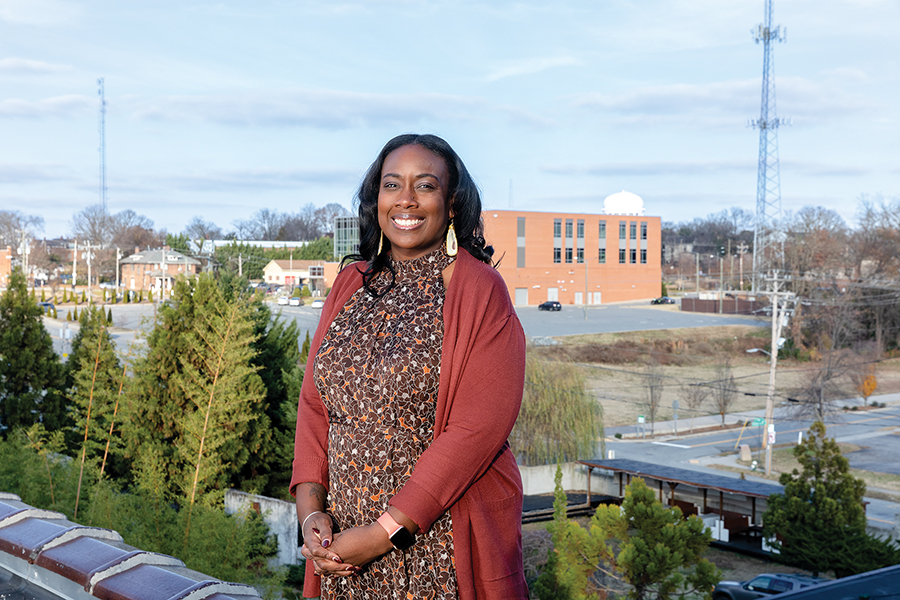
 

April Albritton

The assistant to Greensboros city manager hopes to boost the fortune of young citizens

April Albritton stepped onto UNCG’s campus as a prospective student and suddenly understood what love at first sight was all about. After growing up in Charlotte, she knew the lush campus, friendly students and accepting faculty would make her feel at home for the next four years. Upon graduating in 2006, this young professional with a heart full of wanderlust craved change and cultivated a career in college athletics that would take her all over the country. But three years ago, Albritton (pronounced ALL-Britain) returned to Greensboro to plant roots without letting go of her sense of adventure.

As a UNCG undergrad, Albritton managed the men’s basketball team while studying kinesiology (the study of the mechanics of human movement and how physical activity and sports affect us). She doesn’t consider herself an athlete, but loves that sports “bring people together” no matter “what socioeconomic background” they come from. During her three years as manager, the team became her second family and some of the players remain her best friends today.

Despite the strong bonds she formed at UNCG, Albritton “couldn’t wait to get out.” When an opportunity to be assistant director in a Seattle university athletic department came her way, she took the leap. That “rainy and gloomy” city left an imprint on her heart and she still travels back once a year, but eventually left for a job in Charleston, S.C., followed by Long Island, N.Y.

But when her dad got sick, Albritton moved back to Charlotte, which eventually led her to a fundraising position for a Carolina Panthers player whose board she still sits on.

Four years after her return to North Carolina, UNCG called and said there was a position for her if she was interested. “I absolutely wanted a chance to go back to the place I love that started everything in my life,” she says.

In fact, shortly after her return, she knocked off a bucket list item and bought her first home, citing Greensboro’s housing affordability. “I’m making a commitment to stay down South, to stay in North Carolina,” she says. “I thought I had one more — maybe a Chicago in me — but I’m actually really happy here. And that’s a good feeling.”

After two years as director of Spartan Club, a chance to work for the City of Greensboro popped up. Although still heavily involved in volunteer work at UNCG, Albritton left her job there to take on the position of assistant to the city manager, Taiwo Jaiyeoba (TY-woh JAH-ye-aw-bah). The two had “developed a really good rapport” when a mutual friend connected them so that she could give him the scoop on Greensboro after he relocated from Charlotte. When he reinstated the assistant position, she applied.

Sports remains a huge part of her life and she holds tight to the dream of one day running an NFL team or becoming a conference commissioner, but it’s that community aspect of athletics that reverberates through everything she does in her current role. Her “passion project”? Seeing Greensboro develop into a dynamic creative, cultural and economic magnet that would boost the fortune of its young people.

Having lived in Seattle and spent a lot of time in some of America’s hippest urbanscapes, doesn’t Greensboro get a little boring? With lunchtime walks to LeBauer Park, a steady stream of shows at the Tanger Center, UNCG athletics to cheer on, giant chocolate chip cookies from Revolution Mill’s Black Magnolia Southern Patisserie and live jazz during Wine Wednesday at Double Oaks B&B, Albritton finds the city far from dull.

But it was the 2022 NC FolkFest that marked a defining moment. Headliner George Clinton was the favorite artist of her late father. When Albritton heard he was performing, she prepared for rain or shine and ventured downtown. “I actually caught the sunglasses he was wearing during the concert, and then snuck backstage and got a picture, too . . . These are the things you can do in Greensboro.”

With so much to explore in her own backyard, Albritton is excited for even more to come. “My commitment is to watching Greensboro grow,” she says. While work at the city is often about long-range planning, she adds, “I want to stick around and be part of that before I say, ‘What’s next?’”

 

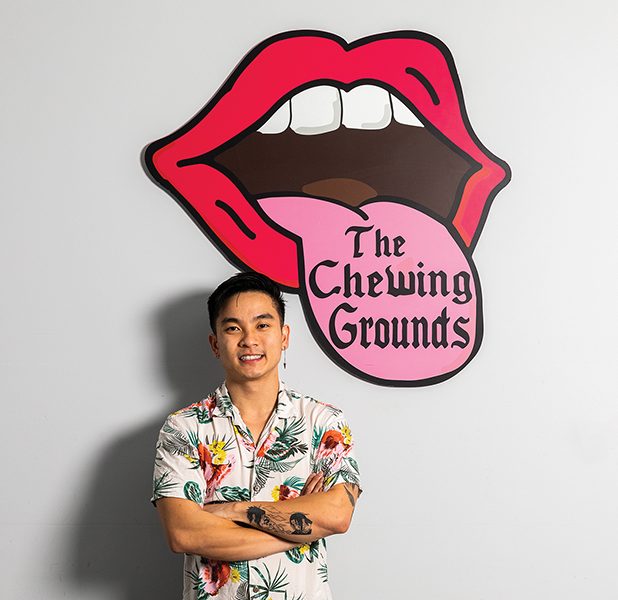
Ethan James

A YouTube carpenter builds a home base in Greensboro

Ethan James knows all about what it means to be a one-man show. When it comes to content creation, scripting, filming and editing for his successful YouTube channel, The Honest Carpenter, everything you see has been done using only his own two hands. Though he lacks a team of coworkers, his online community consists of over 674,000 subscribers. And when it came time to establish a base for his operations, he heard the siren — perhaps it was Minerva — of his alma mater calling him back.

At age 13, James began working for his father in the Raleigh and Wake Forest area where they lived. “My dad was a builder and he was also a carpenter’s son,” he says. Even with the trade running deep in his veins, he vowed to never become a carpenter. He also recalls once telling a friend, “If there’s one thing I can absolutely swear to you up and down, it’s that I will never have a YouTube channel — ever.”

In 2000, James began attending UNCG, where he majored in English. During his time there, he worked at the defunct Borders’ chain of bookstores while still working construction for his dad when he was home during breaks. “I’m book obsessed,” laughs James. “In my ideal life, I’d be an author, not a video person.”

His love of books led him into McKay’s — then Ed McKay Used Books & More — to look for work after graduation. Ironically, it was his construction background that earned him the job since McKay knew he might have use for someone with his abilities on staff. One day, due to the burden of hefty textbooks, a set of bookshelves collapsed. James made repairs and “pretty soon they pulled me off the sales floor and I did handyman stuff for them for a few years.”

With that experience under his tool belt, James decided, after all, to go into carpentry on his own, landing him back in the Raleigh area, where he stayed for seven years. Which of course means, he concedes, “I’m a third-generation carpenter.” He also teamed up with his father to create a consultancy business and started making videos to market it. But the videos took on a life of their own and The Honest Carpenter channel was born. “I never intended any of this,” says James, referring to his YouTube success. “It was an accident — a fortunate accident.”

Because of his self-made career being almost entirely online, James can live almost anywhere as long as he has a shop studio space, which he found at The Nussbaum Center for Entrepreneurship. Greensboro has everything he desires, plus the community feel and welcoming energy he craves. “There’s just a vibe here and I haven’t been able to find it anywhere else, so I came back.”

Now that he’s back, he finds himself often at one of his favorite spots, Tate Street Coffee House, writing and editing, just as he did during his studies at UNCG.

These days, he’s creating videos to speak out about a major concern — the missing next generation of builders — including one titled “Where Have All the Carpenters Gone?” He’s distraught about the lack of messaging reaching younger audiences. “There is no Bob the Builder anymore . . . they cancelled it.”

But James, who has published five fantasy books for kids already, has big dreams and a plan to solve that problem.

A few years ago, he introduced a cartoon character —  fittingly named James the Honest Carpenter — on his YouTube show. James’ ultimate goal is to find a willing publishing partner to meet young audiences where they are, bringing forth the next Bob the Builder type of franchise, with a show and graphic novels that will “help kids become aware that the world they’re walking in was actually built by someone.”

If anyone can make that happen, it’s James. As he’s learned throughout his journey, “Doors open when you least expect it,” and one should never say never.

 

Afika Nxumalo

A singer-songwriter tunes into himself in order to help others

Every morning since moving into his Burlington fixer-upper on Lake Cammack in June of 2021, Afika Nxumalo (pronounced New-MALL-Oh, with a click incorporated for the “X”) pours himself a mug of fresh brewed coffee, steps off his back deck into a shaded backyard abutting the shore and takes a moment before starting the day. For this singer-songwriter — who once penned a song called “Morning Depression” — it’s a welcome change from the small space living and busyness of Brooklyn, New York.

Now his morning routine consists of affirmations, some of which are written on mirrors throughout his home, as well as the meditation to “see what God is trying to tell me before the sun comes up.”

Nxumalo, who grew up in Greensboro and was once part of local hip hop groups The Urban Sophisticates and Phive, has spent almost a decade in Brooklyn and London launching his solo career. Eventually, this “Grimsley kid” landed himself a spot on NBC’s Songland.

When he was first in talks with producers, the plan was to use a song titled “Neverland.” But as Nxumalo can only assume, the infamous Leaving Neverland documentary came out around that time and the song was dropped. He didn’t hear from Songland’s producers for a while, but at his birthday celebration with friends that year, he chose to raise a glass and give thanks for making it that far.

As he’s learned throughout his life, when he lets go of the outcome, the universe responds. Just two days after that toast, he received an email that the show wanted to use another song, “Chosen.”

“If I had one song in my entire catalog that I would like the public to know me by,” he says, “ . . . it would have been that song.”

Whoever won the episode would have his or her song played on the trailer of Hobbs & Shaw, a Fast & Furious spinoff. He didn’t win, but it turned out to be a blessing in disguise. “Chosen” caught the ears of Warner Brothers and it was used in the trailer for Judas and the Black Messiah.

Nxumalo says that if he’d had the chance to sit down with God and was asked to choose which trailer he’d prefer his song accompany, his answer would have been the one he got. “God, you know me!” he exclaims.

What a gift he was given, he muses, to be recognized for a song that expresses who he is an artist. And now he hopes to share that feeling with other aspiring singer-songwriters. “I really hope all artists get to have some form of the universe saying ‘yes’ to them in that way,” he says.

The lake house he’s living in began as a plan to form an artists’ retreat, a “Muscle Shoals type of spot,” where he could cultivate songwriters, but when his Brooklyn landlord began rent renegotiations, he decided to make the move into the property.

Now, he’s got his sights set on bringing his knowledge and expertise to the local community through Pop College, his music education company that he dubs “The World’s Only Ivy League Songwriting School.” His workshops — which he hopes to host at Revolution Mill or Transform GSO — would include songwriting for artists, songwriting as team building for businesses and even songwriting therapy, a format he’s led before in New York.

The songwriting therapy model works so well, he says, because it “has a latent effect of turning something so painful into something so beautiful” and connection is built upon “shared identity and shared experience, but especially if that shared experience is shared suffering.”

As he looks out onto Lake Cammack, a head full of visions for his future, he says, “I’ve been doing a lot of soul-searching out here, like, how do I want to spend my life?”

Almost answering himself, he says, “All I have to do is be me and that’s my unique selling point. Ya know, that’s it.”

 

Brandi Nicole Johnson

All roads lead back to Greensboro for this leadership development expert

From the time she was a little girl, Brandi Nicole Johnson was clear about what she wanted from life, to the point of planning her own birthday parties a year in advance. She’s a natural leader who knows what she wants and doesn’t settle for less. In fact, it’s that strong sense of self that first landed her in Greensboro in 2005.

An only child from Butner, Johnson dove into her college search with “really weird requirements.” She knew, “I didn’t want to share a bathroom . . . and I really preferred to be in a room by myself.” UNCG, it turned out, ticked off many of her boxes, and although she didn’t get a room to herself she was able to room with someone she knew, a fellow Girl Scout.

During her senior year at UNCG, Johnson had an opportunity to do a work study with the community organization, National Conference for Community and Justice of the Piedmont Triad, which ended up launching her career in leadership development.

Unfortunately, illness took Johnson back to Butner for a few months, but she once again returned to Greensboro, this time with a full-time job as membership services manager for Girl Scouts Carolinas Peaks to Piedmont. She’d grown up in the organization and, over the years, has earned several accolades and awards which she attributes to how she came to understand how important leadership is.

“It’s in the [Girl Scout] commitment of making the world a better place,” says Johnson, “and I think for the world to be a better place we need to have better leaders.”

After a year-and-a-half at Girl Scouts, what Johnson thought was her “dream job” opened up at the Center for Creative Leadership. She’d first learned of the organization as a college junior and had “made it my mission” to one day work there, so she applied. While she didn’t land that role, the hiring manager was so impressed that she called Johnson and told her about another position that hadn’t as yet been posted. “Interested?” she wondered. “Heck, yes,” Johnson replied.

After spending much of her career at CCL, a role she’d dreamed of taking on — executive director — took her back to Butner. She left Greensboro for what she now calls “the most painful career experience” of her life.” After growing the organization and leading it through tragedy, she says, “I was tired, so I took four months off.” She watched Dr. Quinn, Medicine Woman, binged on Chick-fil-A waffle fries and finally said to herself, “Brandi, you need a job. You gotta figure this out.”

Never lacking gumption, Johnson founded her own people development brand, Estella Elaine (named after her grandmothers). She’s also worked for Red Hat, WeWork — she notes, “before we saw the documentaries on Apple TV!” — and DoorDash, all while still running her own business and working in an on-call capacity at CCL.

With her last corporate role, Johnson was supposed to move to New York, but relocation never came to fruition. Now, Johnson says, “many companies are saying the future of work is flexible” and she decided to take advantage of that.

Johnson began to weigh living options and found her way back to Greensboro, citing the cost of living as a big draw. She now works out of the comfort of her home. Plus, she says, “The people here have a different vibe. There’s a warmth that I love.”

In 2021, Johnson purchased her first house, a four-bedroom, which she jokes that she never needs to leave, surrounded by an abundance of her favorite restaurants that will deliver right to her front door.

And, as a bonus, the Gate City is ripe with opportunity for Johnson to put her skills to work. “I can see me becoming more of a philanthropist, getting involved in venture and whatever that looks like here, really thinking about how do we invest in talent development and growth in a meaningful way.”

 

Elijah Cone

A Crooked Media big city dweller seeks a more rounded life

Like many young people who are born and raised in one place, Elijah Cone couldn’t wait to venture out into the world upon graduating from Greensboro Day School in 2010. After living in the cosmopolitan cities of both New York and Los Angeles while beginning what would turn out to be a successful career in digital media, he ultimately chose to return to his childhood roots for lifestyle opportunities that could’t be found elsewhere.

Shortly after YouTube emerged as an online platform, Cone, then a teenager, learned how to edit video on his computer, tapping into a “trend that has only accelerated in the last 10 years.” Interest piqued, he earned a degree in film, cinema and video studies from Wesleyan University in Middletown, Connecticut. Since graduating in 2014, Cone has worked for both the NBA and Fox Sports, editing and producing video, but it’s his current role as Crooked Media’s director of digital development that enabled his return to Greensboro to be closer to his family.

As the fifth hire at Crooked Media, Cone has been with the brand and worked in its Los Angeles headquarters on podcasts such as Pod Save America almost from the inception. But in 2020, he says, the pandemic “made remote work a necessity for a lot of places and for my company for a long time,” which meant he could work as easily from Greensboro as anywhere else. “The [film editing] industry has changed so you can do it anywhere with your own tools.”

With a soon-to-be bride — also from North Carolina — by his side, he made the decision to move cross-country back to Greensboro in search of a more “rounded life.” Los Angeles offered “so much to do and see,” but Cone and his fiancé, Daixi, knew they wanted to start a family. Envisioning life with small children in California, he says, “You’re in this big, expensive city that’s great, but you can’t really experience it.”

“My hope for my life in Greensboro is much more family — not just starting my own,” says Cone, who recently bought a home with his now wife. He looks forward to spending time with his parents, Ed and Lisa. “My mom went through a very long battle with cancer and now she’s on the other end of that . . . [My dad] was there taking care of her. It feels like they’ve been through a lot.” Being back in the city where he was raised might one day, he says, provide the perk of “getting free childcare.”

While Cone has spent more than half of his career with Crooked Media, he says, “I have a great relationship with the hosts of the show [Pod Save America] and people that work at the company, but you can never tell.” If things changed tomorrow and the company wanted him back in Los Angeles, what then?

“What makes me confident I could continue to be successful is connections outside of Greensboro, people I’ve met and people who know what I can do, what my skill set is,” Cone says, adding that he could probably work remotely for one of them. “But I also know that there’s this path for potentially bringing what I do to people here.”

With Greensboro’s growing entrepreneurial spirit, Cone recognizes that he could start his own business that would benefit other small business-owners. “Giving people who are super talented around Guilford County an option to stay here and not have to go out of state would be great.”

But he also wants to give back “in the most literal sense, in the charitable, volunteer work capacity.” Cone, who is the great-great-great-nephew of Moses Cone acknowledges how Greensboro has been “incredible” to his family. Reflecting on his time away, he says, “It feels kind of selfish to get all the great things from this city, then pack up and leave.”

Plentiful parks, quality of family life and opportunities for business and philanthropy are just some of the reasons Cone felt the pull back to Greensboro. “Look, if you have a great option of living in a place like this where your life is well rounded,” says Cone, “why not try? Who knows if it’s the right call, but I am comfortable taking that bet.”  OH

Cassie Bustamante is managing editor of O.Henry magazine.

Poem January 2023

Poem January 2023

New Year, New You

It’s a new year and the 

world keeps screaming 

that I need 

a new me. 

I respond with 

a quiet, calm: 

“I like the old me. 

I think I’ll keep her.”

— Erienne Jones

Almanac

Almanac January 2023

January is a creation story.

It begins with the wrinkled hands of a grandmother — perhaps your own grandmother — in the darkest hour of morning.

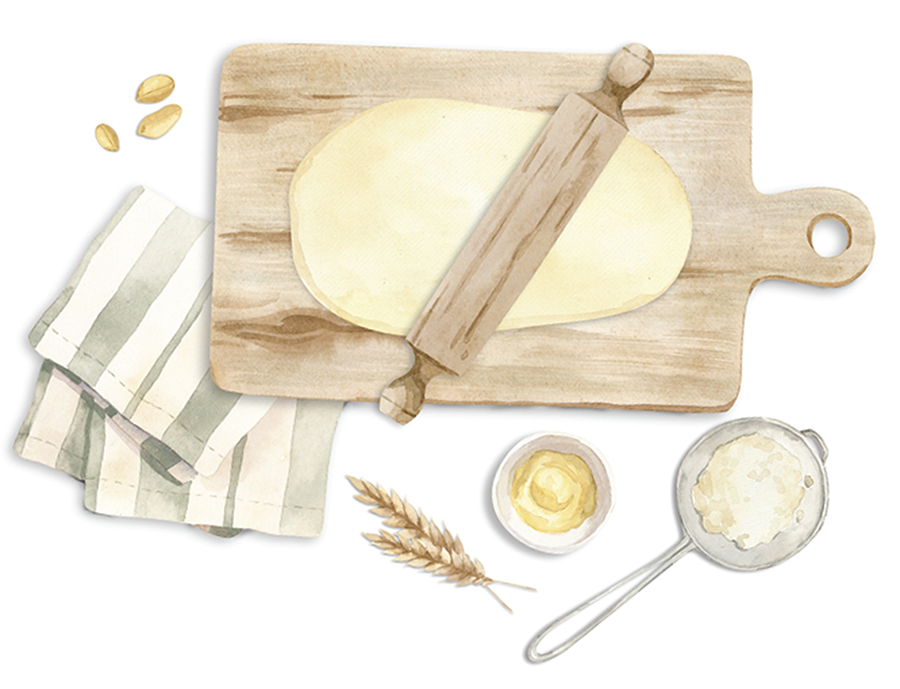
The wise woman knows the secrets of this barren season. She’s found warmth in the bone-chilling air; comfort in the aching silence; promise in the dwindling pulse of winter. When the frozen earth has nothing left to give, she reaches for the mother dough — the breath of life — then steadies herself for the tedious ritual.

The mother dough is a myth of its own: a wild yeast kept bubbling since the dawn of time. The grandmother feeds it once more — a bit of flour, a bit of water — then walks away. 

Breadmaking is a dance of time and space.

Tonight, she’ll make the leaven. Tomorrow, the dough. The rest is as crucial as the work.

At first light, a nuthatch sings its rhythmic song. Grandmother washes her ancient hands, folds the dough four times over, then lets it sit.

Two, three, four — sit.

Two, three, four — sit.

Again. And, again. And, again.

The hours tick by. The dough rises. The grandmother hums as she dusts the work surface. 

Creation is a process. After she shapes and scores the loaves, she bakes and cools them. Neither bread nor spring can be rushed. Such is the wisdom of this bitter season. Such is the wisdom of the grandmother.


Year of the Rabbit

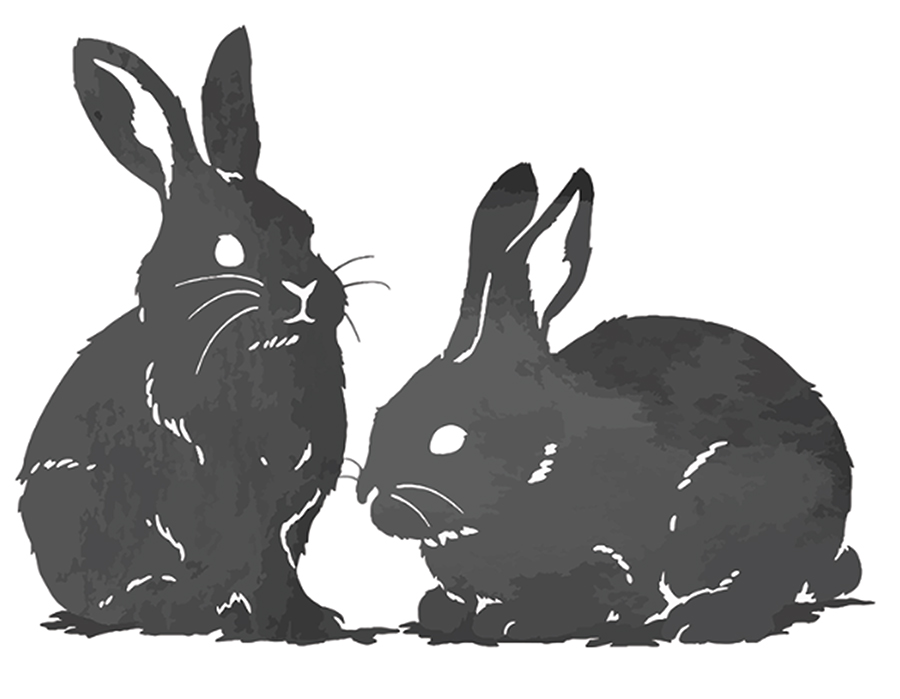
The Lunar New Year begins on Sunday, Jan. 22. Goodbye, tiger. Hello, rabbit.

Considered the luckiest animal in the Chinese zodiac, the rabbit is a calm and gentle creature known for its grace, compassion and ability to take swift action. Those born in rabbit years are said to embody these desirable traits. Never mind their fickle nature and escapist tendencies.

But what does the Year of the Water Rabbit have in store for the whole fluffle (yes, that means bunch) of us? 

Some say peace. Some say hope. The rabbits in the yard suggest more rabbits.


Anyone who thinks gardening begins in the spring and ends in the fall is missing the best part of the whole year, for gardening begins in January with a dream.   — Josephine Nuese


The Blank Canvas

January is for dreaming. Every gardener knows that. Fetch the sketch pad. Reflect on last year’s highs and lows. Ask what your garden is missing.

This frosty month of seed catalogs and new beginnings, allow yourself to think outside the planter box. Or inside, if that’s your preference.

Is yours a kitchen garden? Butterfly garden? Purely ornamental?

Suppose you added more fragrance. Snowdrops in the springtime. Aromatic herbs in summer. Chrysanthemums in autumn. Honeysuckle and jasmine woven in between.

Color outside the lines. After all, nature does it all the time.   PS

Relax, It’s All in the Stars

Relax, It’s All in the Stars

Our dueling psychics forecast the year ahead

Concerned how 2023 will unfold? No worries, star children. We’ve got the psychic skinny on the year ahead from two of our favorite soothsayers. That’s the good news. The bad news? They can’t seem to agree — on anything.

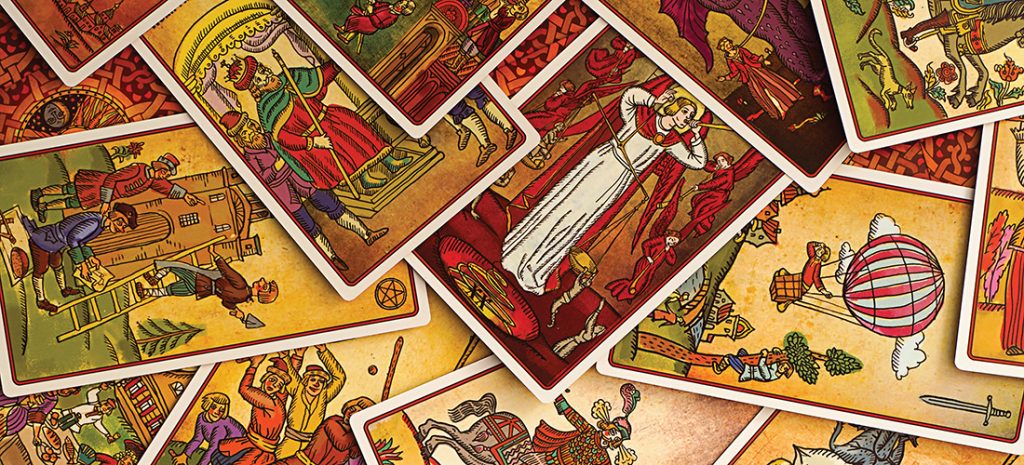
Five years ago, if you’d told me that I’d be staring into dirty teacups for a living, I’d have asked to have a bite of your brownie. Yet, here I am. Getting intimate with a wet clump of tea leaves shaped for all the world like a great, prehistoric chicken. But more on the bird and its prophecies later.

A brief backstory for you first.

I started divining with tea leaves quite by accident. It was an ordinary Sunday in 2019. I was cradling a warm cup of tea — a loose-leaf pu-erh from my favorite aunt — and Lyla was curled up beside me for Game of Thrones. (Much too grisly for my taste, but Lyla lived for that show. You should have seen how she’d twitch and chatter at the screen, whiskers bristling. Scratched the high heavens out of my couch, too. But I digress.)

There I was, sipping the last of my brew when I happened to look down. Staring up at me from the bottom of the cup was a face not unlike that of the Virgin Mother, though undoubtedly more seductive. As I gazed back, trying to place those immaculate features, I noticed the two fish-like tails encircling her like an ouroboros. That’s when it clicked. My tea leaves were shaped exactly like the Starbucks siren. You know the one. Crown, flowing locks and the like. 

Well, this is when I started feeling dizzy. Not two minutes later, during a celebratory scene at Winterfell, I saw it: the iconic white cup famously left on set. The siren was calling to me. I took it as a sign from the cosmos.

The Game of Thrones howler marked the first of many oracular visions I would receive while drinking tea. Although I knew nothing of tasseomancy (divining with tea leaves), a sixth sense was awakening within me. I began studying every tea-ringed guidebook I could get my hands on. Eventually, I even sought out a mentor — a third-generation “tea-seer” whose childhood tea parties, as you might imagine, were not about the crustless finger sandwiches. Here’s the part that still makes the hairs on my arms rise: She’d been waiting for me. Had seen my name emerge from a puddle of red rooibos.

“Tea-seeing is your destiny,” she told me, sending an affirmative shiver down my spine.

I could feel it in my gut. A deep knowing. Couldn’t fight it if I tried.

Like all forms of divination, the clarity of a tea reading hinges upon the purity of the seer’s intention. In other words, it must never be used for selfish gain.

The ritual itself is quite simple:

First, select your teacup. Bone china is nice, but a simple cup is often best. Just be sure it has a handle. And a saucer. Minor details, really.

Next, add a pinch of loose tea leaves. Some seers swear by oolong, but I’m a sucker for the herbal blends. (I try not to swear.)

Pour your hot water — careful not to scald the leaves — then give it a minute or three.

Now, contemplate your question as you sip the tea, slowly and thoughtfully, straining the bits with your teeth. Once you’re staring into a pool of tea sludge — “The Mystery Mire,” as I like to call it — there’s a bit of swirling involved, an inversion, then more swirling.

Finally, you must let the tea speak.

Which brings me back to the chicken in my cup . . . well, almost.

Considering how the last couple of years played out, you can imagine my hesitation to pry too far into the future. But as my mentor likes to say, “It ain’t all about you, Sweetheart.” She’s right, of course. It ain’t about me. Which is why I asked for a glimpse into 2023. Perhaps this reading is for you?

In any case, I opted for a soothing blend of tulsi, kava and rose hips to steady my nerves. As I swirled round the mire, I whispered a simple prayer: Que sera, sera.

Whatever will be, will be.

For better or worse, here’s what the tea says:

Near the rim of the cup, which indicates the present, is what looks like a bird’s nest cradling a single egg — a very good omen. Could it represent a new relationship? A new vision? A financial boon? Give thanks. You know what this is about.

Not far from the rim — the near future — I’m seeing what’s either a cattail or a rattlesnake. (I know, I know. The range of interpretations can be all over the map. You get used to it.) If it is, in fact, the reed-like plant, suffice it to say that someone’s looking out for you. An ally. Alternatively, the rattlesnake asks that you listen to what your fears are trying to tell you. Perhaps you’ll be surprised to discover what’s behind — and just beyond — them.

A bit further down the cup — late March? — I’m seeing a heart. Love is surely on the horizon. But more importantly, love is already within you. Now is a fertile time to focus inward. Cultivate what brings you joy. This is your path to lasting happiness.

There are several animals in this reading: A bat with a damaged wing (check the attic); a cockroach (check the basement); a fox (keep an eye on the aforementioned egg).

As for the big-ass bird? I can hardly believe its auspicious position! The bottom of the cup? Highly favorable. But what, exactly, is it trying to say about the year ahead?

Well, as I mentioned earlier, the bird is ancient-looking. A prehistoric “wonderchicken.” Chickens are believed to represent good fortune. That this particular fowl resembles a beast that might have pecked and scratched upon the Earth millions of years ago gives it an unusual twist. I’m getting the sense that this year will evoke some kind of primal awakening within each of us. Something that our ancestors knew in their bones. Something we buried long ago. A nugget of intrinsic value.

More will be revealed as the year unfurls. That said, when this “remembering” occurs — and I’m not sure what stirs it — we’ll have a choice: Use it or lose it. Which, dear reader, will it be? 

— Zora Stellanova


Update, Star Children:

I moved to the Happy Hills trailer park two years ago. Can you hear my snort? Happy Hills, my happy ass! Long story short, my beau and I lost our lease. And that’s when our problems began.

My ex, Daniel P. Justice*, caught me in a weak moment with my roots showing. Vulnerable. I caught sight of myself in a mirror, grays popping, one of my knee-highs with the elastic shot, sagging down like a worn-out grandma. Ironic. I was once considered very good looking. 

But I couldn’t find my usual hair dye during COVID! Or knee-highs!

Dan suggested we just try dropping out. He was convinced we were being bombarded with microwaves when he started losing his naturally curly hair. Then, the Cubans shot microwaves at somebodies somewhere. Ironic, I said to Dan, halfway agreeing with him.

So, we had a yard sale — outside, socially distant, all that — and I let go of all my Hummels and Beanie Babies. A low point, having spent my inheritance on fine collectibles. 

A legacy, right down the drain! Don’t get me started. But back to that RV thing. What started out as a big-time adventure wasn’t. For example, during lockdown, people started hoarding toilet paper, alcohol and peroxide, not to mention canned goods. Well, in an RV, there’s nowhere to hoard. Or hide.

We began living a one-toilet-paper-sheet-at-a-time reality.

If you have IBS like moi, or just a gassiness problem, too durned bad. RV life is the death of mystery and romance, I am here to tell you.

Wherever you go, there you are, just worse looking.

Lockdown was Y2K squared. On replay.

Lady Destiny can and will track you down and kill you with experience.

But back to life advice: If you go off the grid, don’t do it during a plague. Sketchy internet and TV. One little can of Planters, GI problemos and one tee-nine-sy toilet between the two of you. And a boyfriend — whose hair is falling out — constantly griping about privacy. Seriously? We ain’t got none when I can lean over and touch the other side of the RV with my nose. And who in bloody HE double L is surveilling us? It wasn’t like we were Kardashians or something. 

So ironic it makes my stomach cramp up just writing about it.

It didn’t take long for us to blow all my fine collectibles money on essentials.

There was no possibility of giving in-person readings, given what Dan calls The COVID. Like he insists on calling Walmart The Walmart. And with the general public in the USA getting angrier and stranger.

Understandably, I was leery of meeting strangers in the Happy Hills camp site woods for picnic table readings.

Most especially when good fortune was in as short supply as toilet paper. 

Then my chakras got all blocked up and nothing whatsoever flowed out of me but blankness. I sat still, waiting, looked into the crystal ball.

And so on and so forth.

Looking into my crystal ball was like awaiting the results of an at-home COVID test.

Nothing. No little pink line. It was a total whiteout. Spirit could not get through to me. So, I spent a whole lot of COVID like that, eyeballs drying up from staring. 

To my mind, the universe was deliberately on lockdown.

Forecast for 2021: crystal ball cloudy with a 100 percent chance of ongoing storms.

Forecast for 2022: If you can believe it, 2022 looks worse than 2021.  Strap yourself in.

So, I just stopped altogether, and tried my hand at writing a memoir: Fortunes and Misfortunes.    

Then, early one morning, I swear, when the sun was just peeking over the tippy tops of the trees came something — a message. Crystal clear. An epiphany!   

Birkenstocks.

Just that. It was like “Rosebud” in Citizen Kane

First communication from the astral plane in months, and it was the name of a shoe that resembles a potato. 

I didn’t know what to do with that, so I shook it off. But after some Nescafé transformed me into a human, I decided just one more time to attempt a reading. And spidery letters appeared in the ball, clear as Dan’s shiftless ways: B, I, R, K . . .

Yeah. Birkenstocks!

What could that portend?

Well, I had been wearing my Birks during the COVID, living in this stupid little cramped RV. Wearing sweats, day in and day out.

Was Spirit telling me to get more comfortable? Was it saying the opposite, time to stop being so comfortable

Or, was Spirit saying, you are too damned poor to afford genuine Birks? Buy The Walmart knock-offs.

(Or, was Spirit saying potato shoes and RV life are as good as it’s ever going to get for you, Astrid Stellanova?)

I can’t tell you, because I don’t even know myself.

Meanwhile, a blind psychic in India has been laying down a whole lot of hard-to-swallow stuff. And none of it was rosy.

If you’re reading this, you are a fellow survivor of 2022, and a few things have, at long last, come through. Call this my free reading for all of you outside the Happy Hills Park.

Star Children, this much finally has come clear to me. It don’t matter if death is imminent, or you’ve got a hot date. Either way, Honey, you’re getting laid.

Speaking of which: Death row meals aren’t something only inmates should think about. What do you love and need? And if you have the power to make it happen, Sugar, time’s ticking like that gator that swallowed Hook’s clock in Peter Pan.

And while you’re at it, think about humility, you attention hogs out there. So full of yourselves! Time after time, we take credit for too much. We stand on the shoulders of everyone in our ancestral line, those who have delivered us to this point in time. 

Turns out somebody else loosened the pickle jar lid a lifetime ago; you just opened it.

And if anybody out there can help this sister out, let me know what the H-E—double L you think Birkenstock means.  OH

Still Living the Mystery,

— Astrid Stellanova


*A deliberate irony. Name of my ex changed because of a court order. The ex has moved back in with his Grandma, and I remain temporarily domiciled at Happy Hills for the immediate future.

The Fezziwigs Among Us

Five locals embody the true spirit of giving

By Jim Dodson

In A Christmas Carol, the beloved novella of greed and redemption published by Charles Dickens in 1843, the character of Nigel Fezziwig serves as a reminder of Ebenezer Scrooge’s forgotten youth, representing a time of innocence before Scrooge was infected with a money-making avarice that overwhelmed and tainted everything it touched in his life.

As the generous, big-hearted London businessman celebrating the arrival of Christmas by inviting people from every corner of society to share in the joy of food and dance, Old Fezziwig becomes an enduring symbol of the spirit of the holiday — one of sharing, caring, giving and believing in the goodness of humanity.

“The happiness he gives,” writes Dickens, “is quite as great as if it cost a fortune.”

Fezziwig, in short, is the true spirit of secular Christmas.

If we’re lucky, we’ve all known someone just like him. Look around with open eyes and you might be surprised how many Fezziwigs there are among us.


Cooper Dunning

The Spirit of Spreading Light

Photograph by Lynn Donovan

Cooper Dunning is one of those bright young folks who gives you hope that America’s future might be in good hands after all. When you mention the spirit of Nigel Fezziwig, the Grimsley freshman lights up like the famous twinkling Christmas balls that illuminate the trees of Sunset Hills every Christmas  — which, as it happens, Coop probably knows more about than anyone.

When he was just 9 years old, the enterprising youngster played Tiny Tim in a High Point Community Theater production of A Christmas Carol. “It was so much fun,” he reports. “And the story really gets you thinking about others.” About that same time, Coop became so fascinated with the lighted balls that annually transform Sunset Hills into a glowing and magical forest during the holiday season, he decided to start making his own.

“We already had 40 or 50 of them in our own yard,” he points out, which he and his father, Matt Dunning, who owns a Greensboro landscaping business, made together. “But I discovered there was a lot of demand for them from people in the neighborhood who wanted their own. I thought there might be a small business opportunity in making them to sell — and a chance to do some good with the profits.”

His entrepreneurial instincts proved to be sharper than Jacob Marley’s pangs of regret. That first Christmas season Cooper produced 50 lighted balls and sold them all through Sunset Hills’ popular Corner Farmers Market, which included a plan to donate 20 percent of sales to the market’s innovative Greens for Greens program, which assists lower income shoppers. That first year, he cleared enough to donate $150 to the program, including a canned food drive that benefited the Second Harvest food bank.

The next year — during the shut-down days we’d all like to forget — he was up to 700 lighted balls that netted $1,000 for Greens for Greens and Greensboro Urban Ministry. Last year, his sales ballooned to 800 multicolored lighted balls and a holly jolly $2,000 for his chosen charities.

True to his mission of spreading light and feeding neighbors, this year the young business prodigy — now a worldly 14 — is aiming to make and sell 1,000 lighted balls, hoping to boost his annual donation to help others to $3,000.

“That’s why my bedroom is kind of crowded right now,” he admits as his seven-week production run-up to the holidays got under way back in middle October. One factor that makes Cooper’s lights so popular is the thick-gauge, high quality fencing wire he uses instead of traditional chicken wire to fashion the balls. In his bedroom off South Elam Street this particular day, half of an interior wall is covered by finished wire balls — he refers to them as “shells” —  ready for lighting. At the foot of his bed and filling a bedroom closet are hundreds of boxes of holiday lights, in all colors. “I just made a run to Lowe’s and pretty well cleaned them out,” he says with a laugh.

“We do have a bit of a storage issue,” admits his mom, Sarah, a communications professor at UNCG, poking her head into her son’s remarkably well-organized bedroom. “But he loves what he does and seems to get so much out of it.”

On average, Cooper can make 41 shells in about six hours, followed by another six hours of “wrapping” the balls with lights. “I’ve gotten much better at it,” he says, “and developed a system that works pretty smoothly. It helps that my forearms have gotten stronger over the years.” The added muscle, he explains, comes from playing tennis, swimming and rock climbing with friends.

One wonders when this young Fezziwig finds time to sleep, for he also produces a quarterly magazine that features the works of budding Gate City photographers and hosts a digital platform for their works.  On the day O.Henry dropped by to see how production was going, he was preparing to dye his hair pink for Grimsley’s Friday night football game against Western Guilford — “It’s pink-out night this week,” he cheerfully explains. Coop’s older brother, Tobyn, plays linebacker for the Whirlies.

For the moment at least, this grown-up Tiny Tim has no immediate plans beyond looking forward to driver’s training class, growing his photography skills and continuing to bring a little more light to a darkened world by feeding others. “I’ve got time to figure out what comes next,” he says, sounding much wiser than his years. “In the meantime, this is something I love to do. It really makes people happy. Isn’t that the message of A Christmas Carol?”

Spoken like a true Fezziwig.


Andrew Levitt

The Spirit of Spreading Laughter

Photograph by Bert VanderVeen

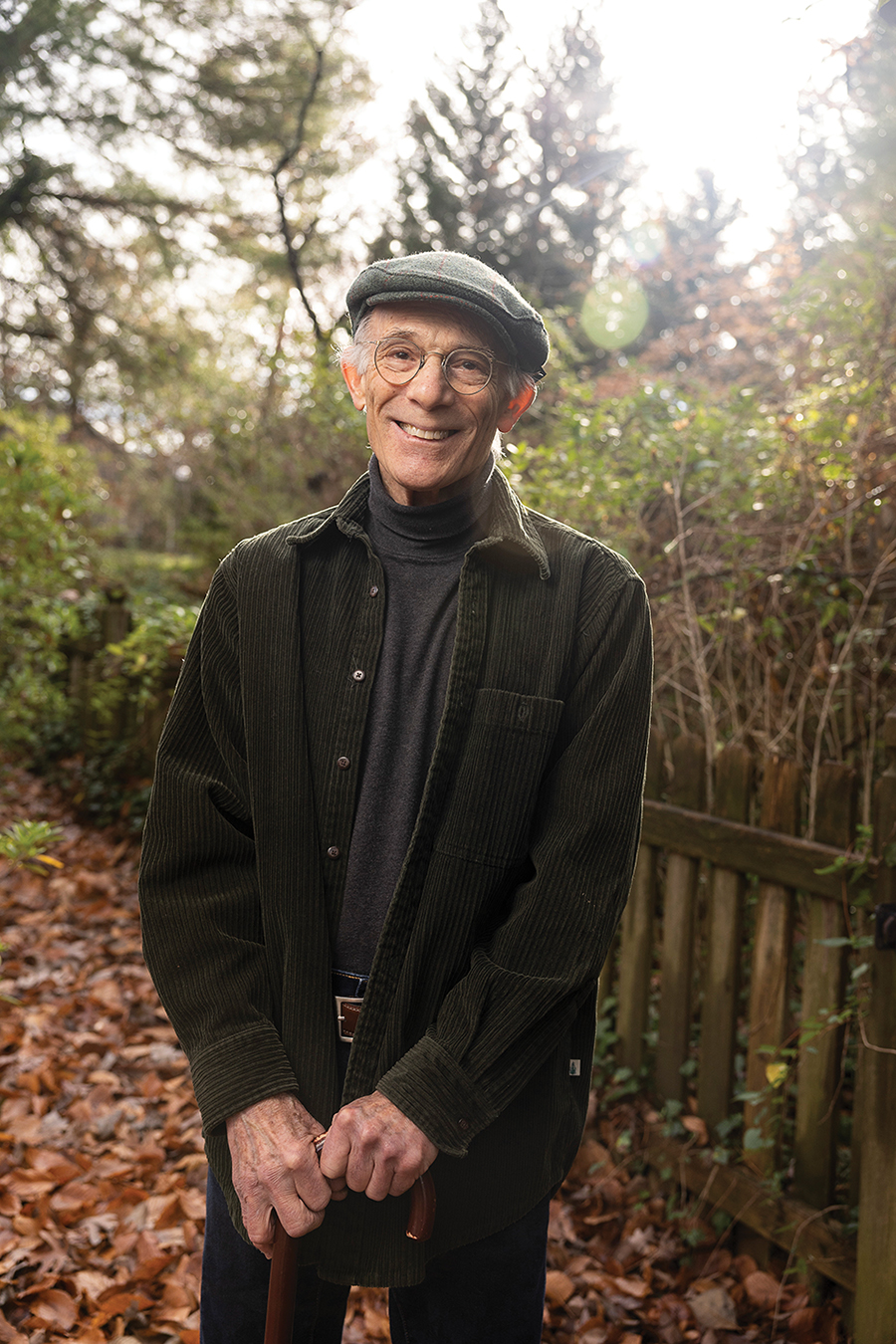
Andrew Levitt is one of those quiet souls who surprise you by the scope of their life and vision. Raised in a prominent Long Island family of sailors, early on he pictured a romantic life of racing sailboats to the West Indies — “In other words, your basic sailing bum,” he says with a laugh. “Fortunately, the universe had other plans for me.”

Indeed it did. After studying English literature at Yale, he became a Civil Rights activist who attended M.L. Kings’ funeral in Atlanta, joined the Peace Corps to teach school in Southeast Asia, and earned a Ph.d. in folklore from the University of Pennsylvania, where he met his wife, Peggy. He also became a gifted professional mime and nationally respected theater and live-performance educator, as well as an English teacher and published author and poet, not to mention a close friend of the late environmentalist — and Greensboro native — Thomas Berry. In tribute to his late mentor, Andrew wrote and performed a one-man show at the Greensboro History Museum based on the writings of his friend, dazzling an audience that included Berry’s brother, Leo, with his ability to replicate his hero’s voice.

Today, Andrew’s wife, Peggy Whalen-Levitt, is the director of the Center for Education, Imagination and the Natural World, a resource for teaching a new vision of the relationship between the inner life of the child and the beauty, wonder and intimacy of the universe. It’s these sacred values of life and nature that infuse every word of Andrew’s latest book, Heron Mornings, published in 2017, a poetic diary of one man’s moments of communion with the natural world while he walked his dog, Sasha, in the hours before dawn. “We’re all children of the forest,” he likes to point out, invoking one of Thomas Berry’s favorite sayings.

It was during one of our own predawn morning walks with the dogs several years ago that my wife and I met this remarkable fellow and his handsome samoyed, Misha, making their daily stroll through the neighborhood. As neighbors tend to do, brief greetings became casual conversations that eventually revealed this gifted poet and philosopher-naturalist in our midst.

During one of his own early walks years ago with Sasha — Andrew was teaching freshman English at Guilford at the time — he fell into conversation with a neighbor named Ernie Schiller who worked as a pediatric physician at Moses Cone Hospital. “I mentioned that many years ago my sister, who owns a successful art gallery in New York, put on a show that focused on medical clowns the Big Apple trains to work in area hospitals. It struck me that it might be fun to try do something like that around here — maybe at Duke University Hospital.”

“Good idea,” Schiller told him. “But you’re not going to Duke. You’re coming to Moses Cone!”

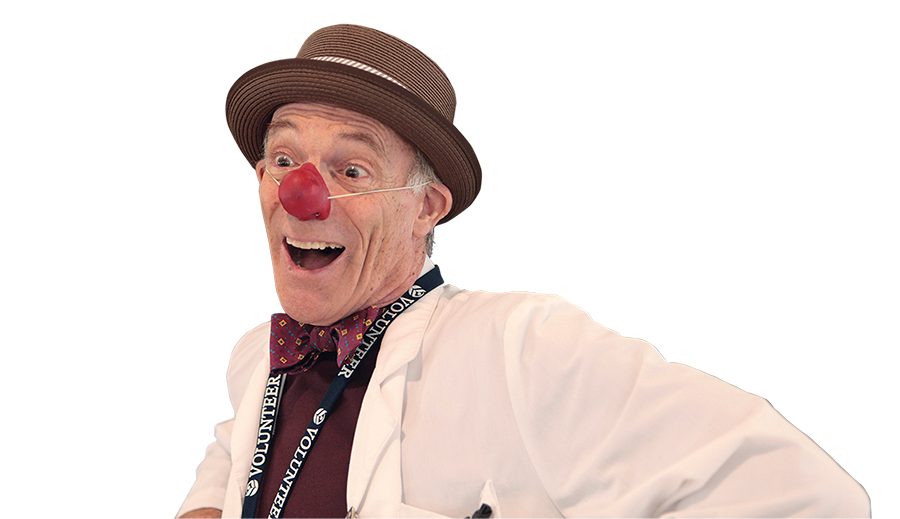
Fueled by his passion for narrative storytelling and live performance, a star with a big red rubber nose was born.

His first gig in April 2010 involved three days in the pediatric emergency department at Cone, which quickly turned into seven days a week. “I’d never seen the Patch Adams movie, but I basically made up my own repertoire of characters, a chimney sweep who sweeps away illness, a baker who bakes the pain away, no scary clown makeup — just a doctor with a funny red nose who comes in and announces, ‘I’m the doctor who treats your ills / With tales and folly instead of pills.’ I brought puppets and props. It made the kids laugh — even the parents and the real physicians.” Eventually, his colorful characters even found their way into a book.

“Andrew was a great person to have in the Children’s ED,” says Dr. Ross Kuhner, medical director of the children’s emergency department at Cone. “He helped ease the family and patient’s anxiety, and was always friendly and trying to be helpful. He had a wonderful disposition, always cheerful. I always felt bad about interrupting his puppet shows with the patients, and often watched along with the families.”

“Our clown was wonderful,” agrees Registered Nurse Deedee Jamison. “He came to the Peds ED every day he was in the hospital. Children giggled and he played with his puppets. He was a friend who took time to care for each of us. He remembered my children and he made sure he took extra care to everyone who needed a smile. I loved him! Different bow ties for each day. . . . He was wonderful. . . . brilliant.”
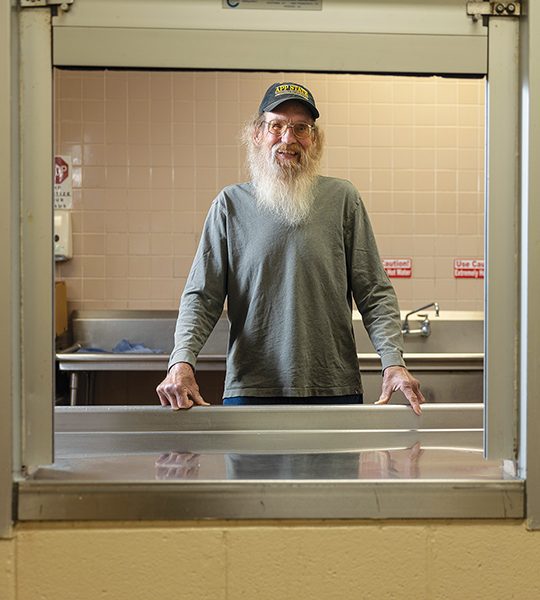
Andrew Levitt’s charming medical clowning lasted almost a decade, touching the lives and cheering up thousands of kids, young people, parents and staff. It took the arrival of a worldwide pandemic to finally close down the show.

“I still think about the kids I met and entertained,” he says not long ago, during a walk around his block. “When I started out, I had no clue how to help a child who was on an IV or was suffering. But — you know? — it came to me. All my training helped. I would wave a light shield around my young patients — protecting them from worry and harm. Can you imagine that?”

Happily, we can.


Joe Campbell

The Spirit of Serving Others

Photograph by Bert VanderVeen

Joe Campbell is one of those folks you probably will never meet — until you need him.
For many years he’s been a mainstay and volunteer at Greensboro’s Urban Ministry, serving warm meals and the wisdom of one who has been there and back to those who have fallen between the cracks of life.

A Greensboro native and self-described child of the ’70s, Joe took himself off to college and adopted a lifestyle of drugs and alcohol that led him to a place he never imagined going. “It was such a sad lifestyle,” he explains one chilly autumn morning over breakfast with a friend. “I drifted into it and met people who led me deeper into a lifestyle that had no value to anyone, including me. I had to finally reach the bottom. That’s when I found the way out.”

At his low point in 1979, he was consuming a case of beer daily and working at a curb market on Lawndale Drive. “One night this fella comes in and we start talking. He said some things about the power of God to change and heal that struck a strong chord with me — just a few words that changed my life. A few days later, he came by my house and we had a deeper conversation about the Holy Spirit and he posed a simple question to me: In a perfect world, what would I eliminate? I told him I would end lying and cheating and stealing — so that nobody would ever have to lock their doors at night.”

The stranger invited Joe to pray with him. It was his Road to Damascus experience.

“I got things off my back that night I’d been carrying for a very long time,” he explains. “I turned my back on them and walked with him to the Lord.”

Joe looks up and smiles, a trim, gray-bearded man who looks like a cross between Santa Claus and the patriarch of Duck Dynasty.

“I made a promise to God that night to give up alcohol, to pray, read my Bible and go with Jesus. The things I’d been doing in the past suddenly melted away. I never touched alcohol again. That was 43 years ago. In more ways than one, I was saved.”

He never learned the stranger’s full name. “His name was Don. Just Don. He wouldn’t even tell me where he went to church, said it didn’t matter. Just never go back to my old haunts, read and pray and tell others what happened to me. I never saw him again.”

Rather like Scrooge, as the result of the nighttime visitation, Joe was a changed man.

He found his salvation in following Jesus while selling antiques and working in lawn service. Over decades, he has helped others find their way back to the light of a good and sacred life. Best of all, he is part of a rotating team of dedicated Urban Ministry volunteers who provide food, shelter and spiritual wisdom to thousands of our neighbors in need each year. This means the world to Joe Campbell.

“Each of us has a different story,” he explains. “Mistakes and misfortune occur in every life. When I give my five-minute meditations, I like to share my own experience of finding a new life through faith and the gift of service to the Lord and others.”

The holidays always remind Joe of the gift he’s been given, especially at Christmas. He and wife, Marie, will welcome 30 family members to the holiday table this year. “That’s six children, 12 grandchildren and six great grandchildren,” he says with a twinkle. “We sort of blend Thanksgiving and Christmas together.”

But one old habit endures. “I like to find gifts at Goodwill or even on the streets of the city, used things people place at the curb. It’s amazing what you can find if you open your eyes. Really beautiful things that people overlook or cast aside.”

He would know.


First Moravian Church

The Spirit of Love, Candlelight and Good Things to Eat

Photographs by Lynn Donovan

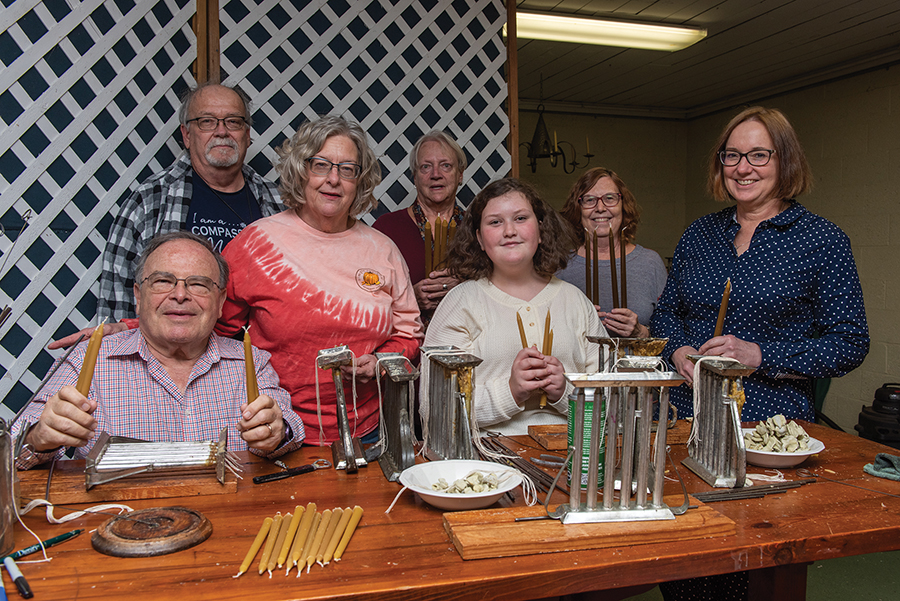
As a chilly late October evening settles over Lindley Park, the fright lights of Halloween are shining brightly across the neighborhood. Inside the cozy candle hut at First Moravian Church on Elam Avenue, however, just down the walk past the church’s new community garden, it’s the light of a holy infant’s birth in late December that illuminates the spirits of seven volunteers as they work.

“It’s like this every year, a true church-wide effort,” says volunteer candle stringer Beverly Lozano, who along with husband David — an assembler of plastic Moravian stars and a chicken pie specialist — have gathered on a Friday evening to make more than 1,500 beeswax candles by Christmas week. “Over the six or seven weeks before Christmas,” she says, “we’ll have anywhere from 40 to 50 members helping out. It’s a lot of work, but also a lot of fun — what the season is really all about for us. Sharing love and candlelight and good things to eat.”

First Moravian’s annual Candle Tea and Christmas Eve Candlelight Lovefeast are beloved traditions. They date back centuries in the world’s oldest continuing Protestant denomination. The services are a longtime holiday staple in the lives of thousands of Greensboro residents from all faith traditions who grew up attending the church’s annual candle tea and love feast as school kids, a practice that continues today.

In an increasingly commercialized world made all but inescapable by smart phones and roaming Amazon vans, there’s something about the simplicity of fragrant handmade beeswax candles, distinctive Moravian stars, delicious homemade chicken pies, sinfully sweet sugar cake, handmade crafts and simple advent wreaths that stirs fond memories of a slower time when waiting for Christmas was all about waiting for the birth of a child.

“Like many people, as a young adult,” confides Sam Post, a retired real estate attorney and longtime member, “I got caught up in all the holiday’s commercialism. But coming back here reminded our family of what the essence of Christmas is all about, literally bringing light and love into the world.”


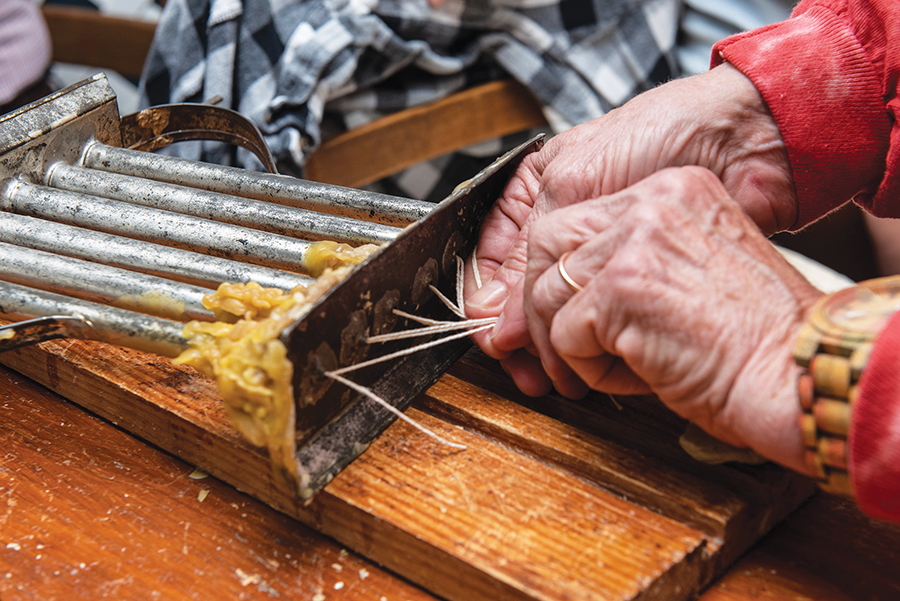
For many years, as a result, Post has served as something of the church’s de facto artisan-in-chief who makes the fragrant wax candles in vintage molds. He also creates spectacular paper stars and even builds sets for the candle tea’s annual “Putz,” German for “place,” a popular display that occupies the entire stage in the new fellowship hall with recreated scenes from Bethlehem, the Nativity, and an early Moravian village.

“The Putz simply wouldn’t happen without Sam and many others who give their talents to make the tea and lovefeast special every year,” allows volunteer Lisa Salo, who points out that early Moravians used such displays to illustrate Biblical stories for children and to share the spirit of the season with their neighbors.

Back in the candle hut, volunteer Addie Joplin, a UNCG international business major who will graduate in December, is busy stringing the candle molds before the wax is poured. “This is literally something that means so much to me because I grew up attending the candle teas and lovefeasts at my church up in Hickory [New Hope Moravian]. The light and scent of the candles on Christmas Eve is just about the most beautiful thing you’ll ever see.”

A few feet away, longtime volunteer Nancy Wall is trimming and polishing the candles with, of all things, women’s nylon stockings. “It’s one of our trade secrets,” she quips. “We give up our pantyhose to make the candles shine.” She jokes that she “married a Moravian and was forced into the church,” but wouldn’t have it any other way. This is her 25th year as a volunteer, she explains.

“We do this,” sums up Beverly Lozano, a Baptist-turned-Moravian who moved to Greensboro from New Jersey with David eight years ago, “because we consider it our gift to the community, whatever faith tradition people follow. It’s all about sharing love and candlelight, a beautiful tradition that’s passed down to us. It’s our joy to share it with everyone — and shine a light into the darkness.”

“Not to mention, our delicious chicken pie,” adds David Lozano, heading off to the kitchen where more than 1,500 pies are currently in production. “The men chop the chicken. The women make the dough. We think ours are the best you can find anywhere — the reason they sell out every year!”

For more information, contact greensboromoravian.org/ or phone (336) 272-2196.


Körner’s Folly

The Spirit of Surprise and Joy

Photograph by Lynn Donovan

It may take a village to raise a child, as the familiar African proverb goes. But nothing less than a community of volunteer decorators is required to get historic Körner’s Folly in Kernersville annually decked out for its over-the-top Christmas display.

“The work begins around Halloween,” says Suzanna Ritz, “when a small army of folks from all over town devote their time and imagination to transforming this wonderful old house into something magical. Volunteers are the heart and soul of this incredible house.”

Eccentric Kernersville designer, artist and decorator Jule Gilmer Körner built his marvelously eclectic 5,600-square-foot, brick dreamhouse with its unique cross-gabled shingled roof in 1880, in part to promote his popular designs and custom furniture to potential customers — a classic Victorian “folly” that featured 27 rooms, 15 fireplaces, trap doors, a full theater, and no two doors or windows alike. Körner is best known as the marketing genius who created the national Bull Durham logo campaign that netted him a fortune.

Following Jule’s death in 1924, as Nancy Oakley, O.Henry’s once-senior editor, engagingly profiled in 2018, the impact of the Great Depression and two World Wars prompted the Körner family to board up the house, “which fell prey to vandals and looters. It became a haunt of local teenagers, some of whom carved their initials in one of the upstairs hallways. Even after the property’s purchase and protective placement on the National Register, the property was manned solely by volunteers for 30 years.”

In 1970, 26 local families — including Körner heirs — banded together to save the house from demolition, achieving protective status from the National Register of Historic Places three years later. A foundation was created to bring the house slowly back to life.

In the 1980s, family member Connie Körner not only directed the extensive renovation of the house/museum but inaugurated a lavish holiday decorating tradition in 2010 that echoes the Folly’s original Victorian splendor and seems to outdo itself every year. Hewing to a different Victorian theme each year, every room and nook of the house is lavishly decorated in period style by dozens of local volunteer decorators ranging from the local Boy Scout troop from the Moravian Church across the street to the Young Professionals Network from the Chamber of Commerce.

Over the past decade, the imaginative handiwork of longtime volunteers Ann Stoebe and Tim Burrow has come to define the kind of high-energy creativity that makes the decorated house a treasured holiday destination for more than 3,000 visitors annually during the holiday season.

Stoebe, 79, a native of Bedford, England, relies on her love of Christmas and cherished childhood memories to stir her creative juices. “You never quite know until you start where this will lead you,” she says. “But it’s really quite magical how it happens. I dream about decorations, even go to bed envisioning what I will do. For me, there’s so many wonderful memories of Christmas that are attached to this project.”

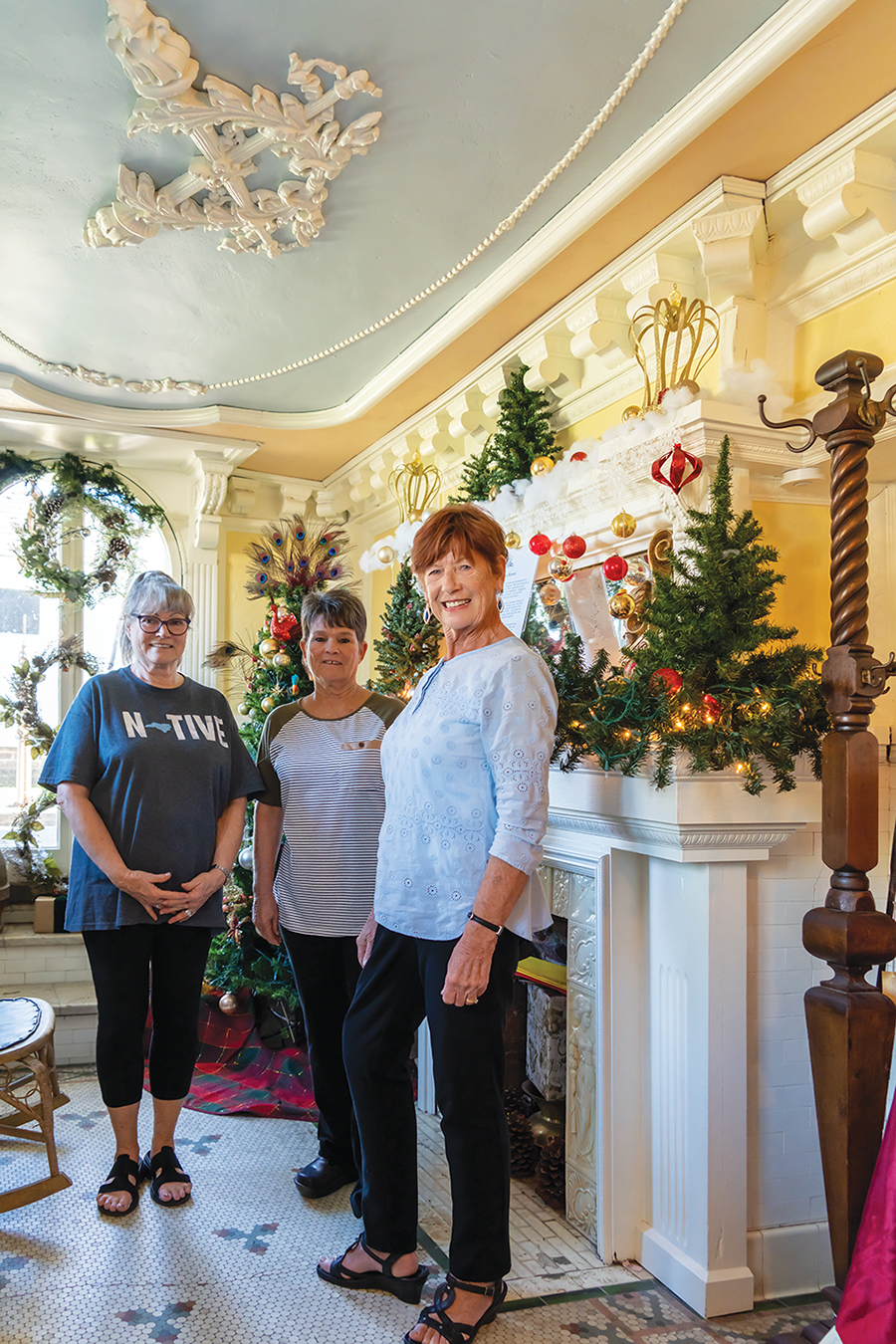
Famous for her bright red plaid ribbons and decidedly English touches, Stoebe has decorated a score of the house’s more eccentric rooms, including the tidy “Rose” room she did some years back with help from her daughter, Michelle, and granddaughter, Emma. This year, Stoebe’s assigned space is the cozy “Smoke Room,” which she aims to transform into an “Orient Express” theme using vintage leather suitcases, walking canes, Homburg hats, German humidors and an electric fireplace.

“I tried to give all of this up three years ago when my husband and I downsized our own house big time and got rid of a lot of my props,” she adds with a laugh. “But every year they say please and I come back. I just love it!”

She playfully points a finger at Tim Burrow. “Fortunately, Tim has a house full of props for any theme you can think of. He’s the source of true Christmas magic.”

Burrow is a resident of Asheboro who works with an estate sale company. “The entire second floor of my house is filled with nothing but props and decorations,” he explains, including all kinds of artificial trees and greenery. “You name it, I’ve probably got it.” In recent years, his portfolio of uber-festive rooms has included an upside down Christmas Tree with Victorian China tea cups, and trees covered with vintage postcards and Victoran musical instruments.

Since 2022’s theme is “A Storybook Christmas,” Burrow is turning the house’s library into a workshop for elves and a shoemaker, using 50 marionettes and puppets. Visitors will also find one of his vintage sleighs sitting on the lawn outside for use in holiday family photographs. He loves to dress in period costumes and visit with guests as they walk through rooms on the tours, including once as the ghost of Jacob Marley.

“I love to chat with visitors just to see their faces when they see what we’ve done to these rooms. It never fails. Their faces truly light up with joy. That’s what Christmas is all about – surprise and joy. That makes all our work such a pleasure.”  OH

Körner’s Folly’s popular Candlelight Tours are scheduled for December 3 and 17, featuring carolers, costumed guides, hot cider and Moravian cookies. Information: kornersfolly.org or (336) 996-7922.

Painting With Paper

Greensboro’s Ronda Szymanski cuts to the heart with her spirited collages

By Maria Johnson 
Photographs by Amy Freeman

Anyone else would have seen the publication for what it was: a full-color arts and culture magazine packed with stylish fonts, catchy headlines, fetching photographs and comely advertising.

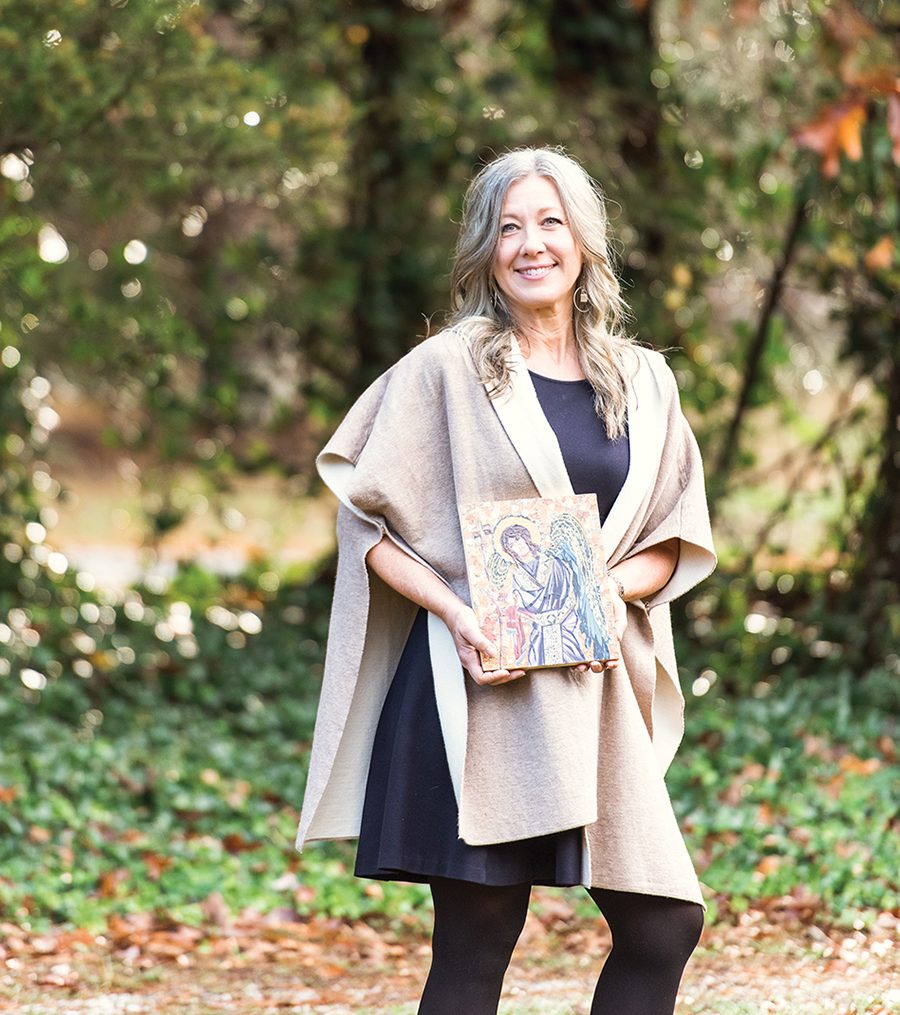
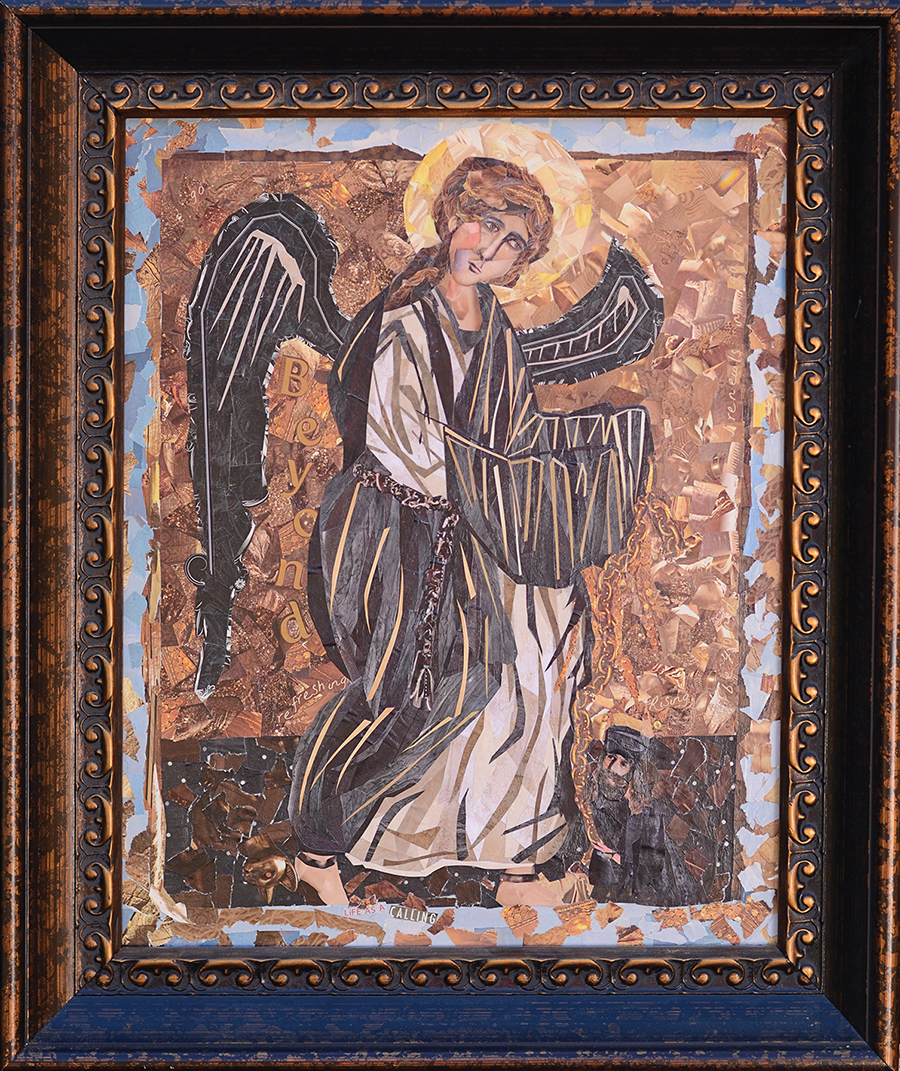
Ronda Szymanski saw that — and something else hidden in the pages: an angel.

An angel named Ariel. In a garden.

Szymanski (pronounced sha-MAN-ski) sketched her vision on a wooden panel, then flipped through the magazine and snipped the raw ingredients of the collage that resided, for the time being, in her head.

A smiling face.

A sandaled foot.

Folds of fabric.

A golden halo.

A pair of butterfly wings.

Clusters of roses.

Banks of greenery.

She pasted down the background first, then went to work on the angel.

But this was no pious affair. Szymanski punched up her heavenly hostess with clippings of words and images that blended from a distance and brought a smile upon closer inspection.

A whole fish and a close-up of a cat’s tongue tucked into the angel’s skirt.

A wee sketch of a cowboy hanging out by the roses.

A dragonfly.

A book slapped with the word “Gratitude”.

“It’s a go-with-the-flow process,” she says. “I can’t know what I need until I get there.”

In the end, Szymanski decided that Ariel — a figure from Christian and Jewish mysticism — was more holistic than holy.

“She turned out to be more of a faerie — whimsical and playful . . . Maybe she lost her religion,” Szymanski muses with a spritely smile.

At 55, she reads much younger than her age in her denim shirtdress and bright white Keds. Her frosted blonde hair is mostly contained in a top knot, but a few wisps have busted out — or been allowed to free-range — to frame an oval face set with blue-green eyes.

She’s a familiar sight in Greensboro art and civic circles. A Junior Leaguer, she has served on the boards of the symphony guild and opera company.

Others know her from her Greensboro business, Salt & Soul, a wellness spa that offers hydromassage (a massage chair filled with warm, pulsing water), an infrared sauna and halotherapy.

Trending around the country, halotherapy is the practice of going into a salt room or “cave” in hopes of boosting respiratory health.


“Halotherapy is used in medical centers in Eastern Europe for COPD, asthma and even cystic fibrosis,” says Szymanski, who launched her business in 2021, mid-pandemic, and rebooted with a second grand opening last month.

For halotherapy, Salt & Soul customers enter a white room that suggests a salt cave; Szymanski and her husband literally threw a fluffy salt-rich coating onto the walls to create the effect.

Then clients step over beds of pink Himalayan salt and recline in zero-gravity chairs.

“They’re like lawn chairs,” Szymanski explains. “They take the weight off your spine.”

Soft instrumental music plays. The lights are low. If customers want, they can cuddle with a soft blanket as they breathe aerosolized salt.

“I like to say a little blessing that people get what they need in the salt room,” Szymanski adds. “If that’s a nap, that’s OK.”

She displays a few of her collages at the spa. Following the salt theme, those works evoke the seaside. A Soft Landing is an abstract harbor scene, heavy on blues and whites with a wink of red.

“That’s to symbolize drama and passion,” says Szymanski. “It reminds me of the coast at the Mediterranean.”

She hopes to use her shop to exhibit the work of other artists, as well as her own not-so-beachy pieces, which she stows at her home, a ranch house on four acres near Summerfield.

Szymanksi leads the way to her basement sanctuary like a tour guide, weaving past pockets of the practical (bunk beds, old refrigerator, exercise equipment, her husband’s coffee roaster) and the meditative (candles, pillows, icons).

Szymanski’s tiny studio — where the cutting and pasting happens — is a collage itself, a salad of cork boards and finished works surrounding a folding wooden card table that she bought at Costco about 20 years ago.

The square surface has functioned, at various times, as kitchen table and dining room table. Now, it’s Art Central, layered with scraps of paper that Szymanski has snipped from a motherlode of city magazines stacked in a blue plastic bin.


“This is my palette,” she says with a wave of the hand. She is watched over by the kindly countenances of her subjects.

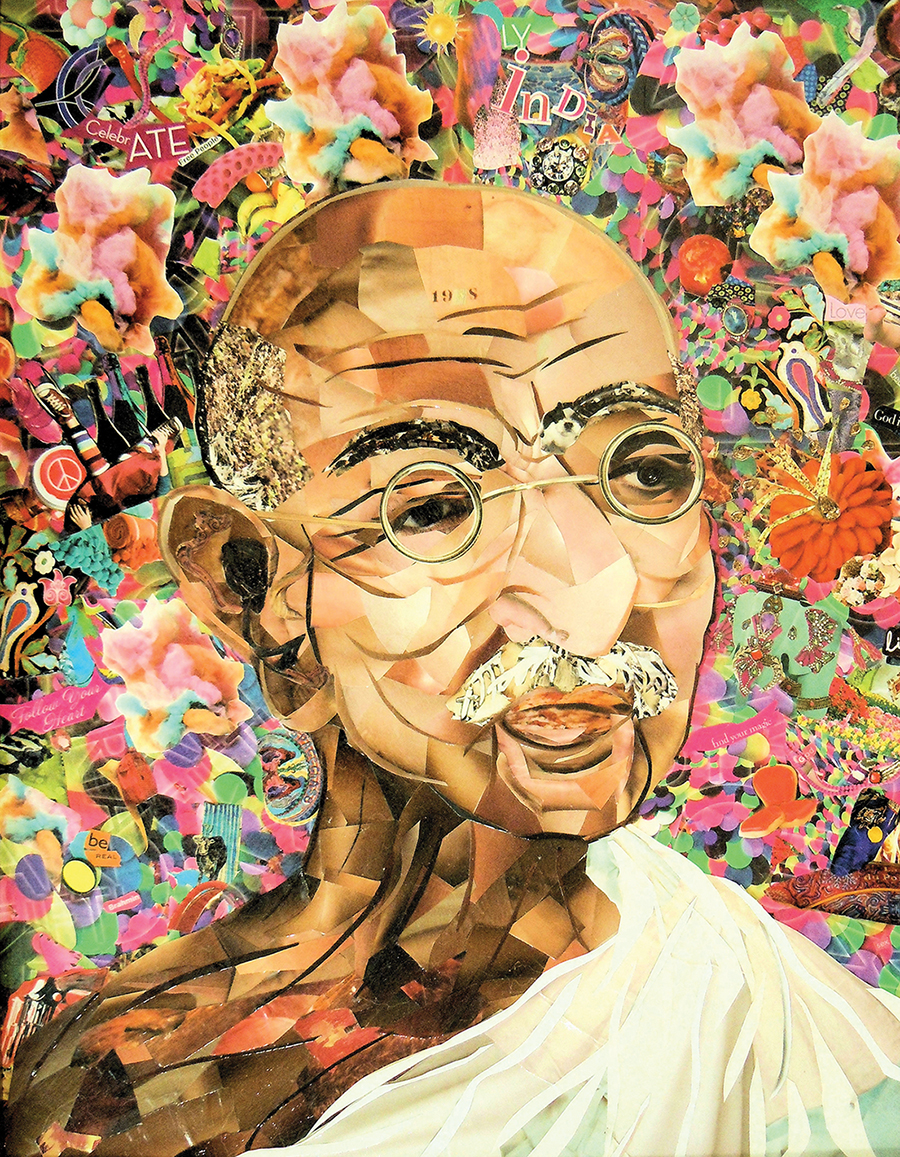
“There’s an elephant. There’s Gandhi. Here’s the Queen,” she says, picking up a portrait of the recently-deceased British monarch, who is vibrant in a fuchsia hat and suit.

The image appears to be painted, thanks to Szymanski’s skill at laying down snippets printed with various colors, textures and patterns.

Her first-ever work is propped nearby. It’s a solemn rendition of the Virgin Mary titled Joy of All Who Sorrow.

Szymanski did the piece in 2009, when she lived in Texas and worked as a life coach for a man with mental illness. They took an art class together at Southern Methodist University in Dallas.

The assignment was to make a collage. A fan of Byzantine icons — Szymanski and her husband, Chris, were married in an Eastern Orthodox Church — she choose the Virgin as a symbol of love and forgiveness. The work is grounded with hellish scenes and figures at the bottom. Higher up, Szymanski glued words of hope and direction.

“It’s the story of my life,” she says. “It was about healing and overcoming the sorrows of your past.”

Her classmates loved the work. Szymanski kept going. A piece called “The Fall” shows Jesus in the Garden of Eden, alongside Adam, Eve and the serpent.

Never mind the biblical timeline, she says, Christ represents the presence of God in the garden.

She entered the collage in a show, won a special merit award and collected a $250 prize.

“I thought, ‘Well, maybe I am an artist,’” she says.

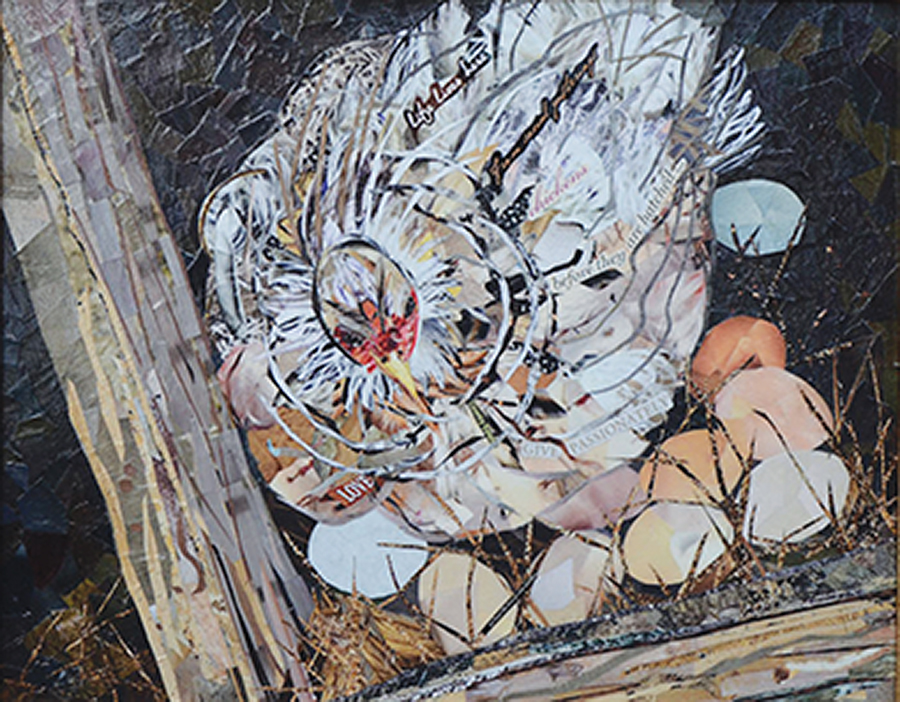
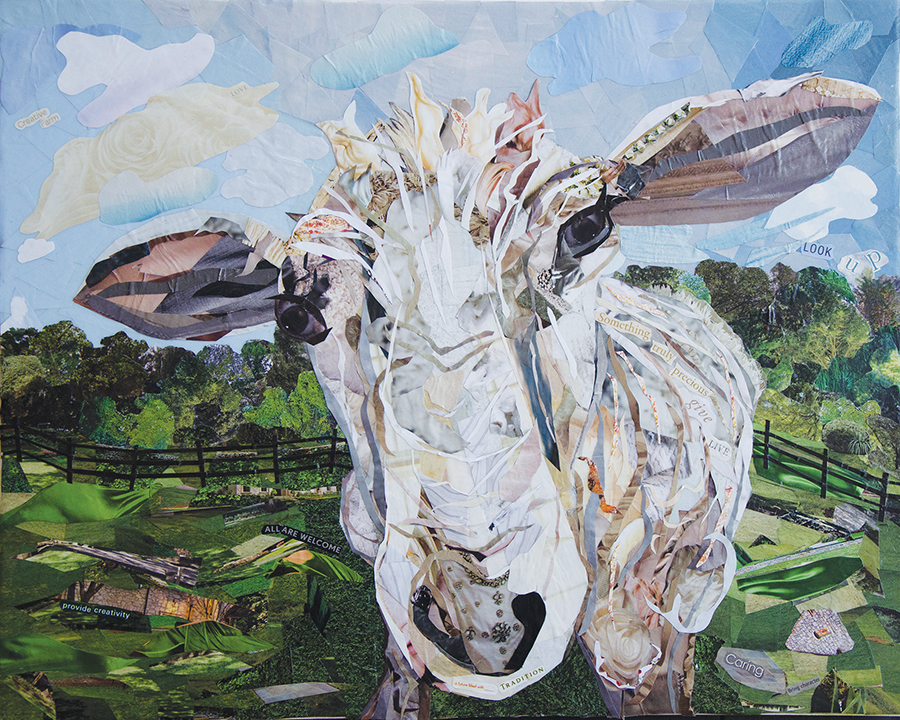
Today, she finds inspiration everywhere, whether it’s in a book about iconography, in her backyard chicken coop or in her pen of Nigerian Dwarf goats.

Animal portraits are among her most popular works.

“I love nature,” says Szymanski, who was born on a dairy farm in rural Illinois. “I’m a Midwest farmer’s daughter.”

She also considers herself perpetually spiritual, but not necessarily religious.

“My religion is love, and my journey is to seek the path that will get me the closest to that,” she says. “It’s a long journey.”  OH

Poem

Chime

We were birds then

at thirteen, a chime

of wrens chirping,

carbonated goddesses

blowing bubbles,

spilling secrets,

dancing the latest dances,

we did each others’ hair,

practiced kissing,

gossiped (a girl’s

first step toward insight),

we shook the magic eight ball,

could not imagine

a path toward our future —


we only knew we didn’t want

our mothers’ lives,

taking dictation,

cleaning up messes,

hiding tins of money,


we were angels falling,

wingless, trusting

the wind to lift

our bodies of light

far above the silver

water tower,

to let us down kindly

somewhere, anywhere

wild and broad and new.

— Debra Kaufman

Debra Kaufman’s latest collection of poetry is God Shattered.

A Cressman Christmas Carol

A historic Irving Park house glitters with Christmas present and the stories of those past

By Cynthia Adams

Photographs by Amy Freeman


The house spoke to me,” the expression goes. If it speaks, what does it say? Does it whisper of families past, who have infused the very walls with memory and meaning?

Lisa Cressman, who is passionate about the story of her family’s home, knows as well as anyone that houses have a dynamic all their own. Case in point: Add a rich backstory to a beautiful house, surround it with neighborly people and you’ve got a powerful elixir. Next, add a dash of serendipity. For good measure, add a dusting of Christmas sparkle — courtesy of Lisa’s favorite time of the year. All combined, you’ve got true magic within — and without — those walls.

But for years, Lisa didn’t know the Colonial Revival house she adored was truly meant for her all along. As soon as it became hers, a cast of characters worthy of Dickens’ Christmas Carol walked straight out of its past.

Lisa’s story begins in the stifling heat of July 2019 — with Christmas six months away. Her heart suddenly raced with the realization that this particular house was meant for her family. It was a wedding cake of a house: perfectly, pleasingly symmetrical, filled with character, and beautifully maintained.

The Cressman family moved to the Triad 21 years ago, relocating from Canada. Nathan, president of Magnussen Home Furnishings, worked in the company’s Greensboro offices. The family business was established by Lisa’s grandfather, Ingwer Magnussen, a carpenter who immigrated to Canada from Germany in the late 1920s. Lisa had long admired a particular Irving Park charmer when cutting through the neighborhood. She considered it “the most beautiful house in Greensboro.”


But the Cressmans, including Lisa and husband Nathan, plus college-aged children, Ty, 22, and Georgia, 21, were already settled, having just “built and moved into our ‘forever home,’” she says. 

The Cressmans’ Summerfield house was set on five acres, with high ceilings built to accommodate their son’s height — 6-foot-7. And, yes, he plays basketball — for Auburn, which his younger sister also attends.

But everything changed one summer’s day.

“Nate was looking on Zillow,” Lisa recalls, on a Saturday in late June, “when he noticed a nice house for sale in Irving Park.” Lisa stepped over to the computer to look at the listing, feigning interest. “I had no desire to move,” she admits. And then she changed her mind.

“I said, ‘Oh, that’s, like, my favorite house in Greensboro!’” Even so, she didn’t want to move, but was curious. “I acted like I was interested,” she confesses, wondering if the interior equaled its exterior. Realtor Marti Tyler scheduled a showing of the recently vacated house. Lisa and Nate arrived for the appointment with their daughter, Georgia. “But I stepped into that house and thought, ‘Oh my gosh, I love this house!’ You could feel the soul,” says Lisa, describing her surprising, visceral reaction.

Lisa whispered to her daughter, “I could live here.” Georgia replied, “I could, too.” She describes the moment in the way one describes a great love match: with a shock of realization and recognition.   

An excited Nathan asked Lisa, “Are you for real?” Lisa was already aware he was ready to leave the country and move into town. When she nodded yes, Nathan wasted no time.

“OK,” he replied. “Let’s put in an offer.”

Turned out the Cressmans’ Summerfield home wasn’t forever after all. But this was! And what a contrast between the two houses. The historic Mebane house, listed on the National Register, was over a century old. According to Benjamin Briggs, executive director of Preservation Greensboro, it was among the earliest constructed in Irving Park, quite possibly the second built.


“I can say with confidence that the Robert Jesse Mebane House was built 1912–1913 and designed by A. Raymond Ellis,” says Briggs. (The first, at 301 Wentworth Street, is profiled in “Southern Revival,” in the October 2016 O. Henry. See ohenrymag.com/southern-revival/.)

The stars had aligned — something that was to happen again once the Cressmans entered the house’s magnetic force field. Lisa sensed that the seller’s Realtor, Marti Tyler, loved the integrity of the house and was pleased to learn the couple wasn’t interested in a teardown. The three-story house had already been expanded by prior owners, was recently updated and was spacious by any standard

Lisa recalls assuring Tyler that she didn’t want to tear the house apart. “We wanted to preserve the house. I’ve always loved that Gilded Age, turn-of-the-century era,” she stresses.

By August 19, a home she had admired but never guessed she would possess became her own. And that “forever home”? It was on the market.

Not all the Cressmans were thrilled. Although “Nate and Georgia were with me on the decision,” Lisa says, “Ty was so annoyed that we moved. He wasn’t very happy when he came to visit. He did hit his head in several places . . . The house wasn’t built for people so tall.”  He quickly adjusted.

Lisa discovered a neighbor, Chip Hagan, grew up in the house and now lived only blocks away. The Hagan family had lived in the Mebane house for the longest tenure in its provenance. In the 1960s, the Hagans had acquired the house from Robert Edward Holt’s widow, Frances Garner Holt, after his death.


As neighborhood block parties became a way to connect with others during the pandemic, the Hagans and Cressmans soon met and became friends.

Then Lisa met Frances Taylor during Christmas holidays in 2021. Taylor’s mother, Martha (Marty) Holt Ruffin, had grown up in the Mebane house. Ruffin’s mother was Frances Garner Holt, the same widow who sold the house to the Hagans. That connection led to a chain of discoveries, including a trove of vintage photos of the Holts at home over years.

“Through the preserving of the house, we got reconnected with the house,” marvels Lisa.  “There are stories, histories — connection with the people who lived here. That has been the joy of living here, honestly!”

Slowly, the Cressmans unearthed more about the home’s unusual beauty and condition. It had always been lovingly maintained, as photos and history revealed. With the trusted assistance of Canadian transplant and longtime friend, Magnussen designer Sil (Silvana) Lewis, the historic Mebane house received the Cressmans’ personal imprint.

“It’s a house loved by generations of people,” says Lewis, who is also involved with decorating the home for the holidays.

The Cressmans moved in during September three years ago. Before long, Lewis was planning the first Christmas decorations in the family’s new house.

By Christmastime each year since, the house is completely decked out in strands of twinkling lights. Windows and entryways are wreathed in greenery.

The exterior trees, shrubs, windows and doors are infused with more glimmering lights, and bedecked with ribbon and holiday sparkle. And it is magical to behold.

The setting itself was planned to best effect — over a century ago. And the park-like neighborhood, populated with elegant homes set on generous lots, was designed for a pleasing impact.

Irving Park was intended as the “urban ideal,” set a mere mile from city limits, soon after the development of nearby Fisher Park. According to Briggs, it was created in 1911 by the Irving Park Company. Alexander W. McAlister, Alfred M. Scales and R. G. Vaughn were central to the neighborhood’s planning.


At that time, Briggs writes, the once rural development was created as a “planned, heavily restricted and landscaped community that set a standard for suburban development in Greensboro for the next century and establishing it as Greensboro’s most exclusive neighborhood.”

And executives responded to the luxury of spacious lots and homes. The original owner of the Cressmans’ home, Robert “Jesse” Mebane, was a busy executive who juggled multiple roles.

“At the time of construction, Mebane was assistant manager, Southern Life and Trust Company, though later acquired new titles and interests [developer of Durham’s Hope Valley and owner of Mebane Motor Company.] “In the 1920 Census he lists himself in the automotive industry as a distributor, and he lived next door to Aubrey Brooks . . . which was true,” says Briggs. “Around 1924 he sold the company to his brother-in-law, Rossell. The company was renamed Mebane, Rossell, Cress, Inc.” The house remained Mebane’s for 10 years, before buying another and moving just around the corner. 

Yet the Mebane Colonial Revival was graced with a balanced design and pleasing symmetry. A steep, slate-covered gambrel roof, front and rear shed dormers, tapered brick chimneys, and a central, classical entrance porch combined for charming effect. The west side featured a sun porch and symmetrical boxwoods lined the front walk.

A century later, the home is in fine fettle, thanks to the ministrations of the families who once lived there.

The Cressman family would come to know some personally. Three years later, Lisa smiles thinking of eureka moments. But first — back to August 19, 2019, when the Cressmans’ offer was accepted and the home became theirs.

The house had six baths and five bedrooms, unusual for the period. The third floor was once servant quarters, according to Marty Ruffin, who moved there in 1947 as an 8-year-old with her brother, Ed, and her parents.

“Then the Hagans bought it,” confirms Marty. “My father had died, and so my mother built on Lafayette.” Thereafter, she says it became best known in the present era as the “Hagan house.” After Lisa met Martys daughter, she urged Frances to bring her mother for a holiday visit. The house, which featured countless confection-colored tabletop trees and too-many-to-count full-sized trees, twinkled like a star ready for its close up.

Lisa welcomed Marty and Frances for tea last December, igniting an immediate friendship. Marty, now 83, was overwhelmed with nostalgia. She had not returned to her childhood home since her marriage in the early 1960s. “I never had gone back,” says Marty.

“It was such a delight to go — sixty years later,” she muses. “I cannot even believe it!”

Marty laughs, “And, I did not realize my room was so small!” As they explored the house together, Lisa plied Marty with questions, curious about the diminutive closet doors and other idiosyncrasies. Like all old house lovers, she mentioned often visualizing the house and those who had lived there in years past. Marty brought photos to share with Lisa, and they happily pored over them, spread across the kitchen counter.

In an extraordinary way, both women expressed love for the house. And it was especially beautiful when all dolled up in holiday finery. “We believe Christmas is much more than Christmas lights,” says Lisa, who chose to be a Christmas bride in 1996, when she married Nathan. Of course, she had long known Nathan, as their parents were best friends.

“My mom so loved decorating for Christmas, so I inherited it from her,” she says. “It’s a time to bring the people you love together. I love Christmas for that reason . . . I think that is when we do make a house a home!”

She was only 19 when she married Nathan during Christmas 26 years ago. She wore a fur-lined cape that kept her warm in the midst of Canadian cold. Of course, she would marry at Christmas, she smiles. “It’s my favorite time of the year.”

As has long been the case, the spirit of Christmas manifests early in the Cressman household. Lisa decorates before Thanksgiving. (Canadian Thanksgiving falls earlier.) “The lights on the tree at night — I decorate early so I can enjoy it! I have people over for tea, and we’ve had neighborhood parties. And connect again, with neighbors who share stories about the house . . .”

The holidays are the starting point of so many things the owners hold dear: family, tradition, even their wedding anniversary.

“A home is who lives there, and the memories that are created,” says Lisa. “I am so happy. That was the draw; I don’t know why, but she (the house) felt like a grand old lady to me!”

Over three years, the serendipitous has become the norm for the Cressmans as people continue to enrich the story of their home.

“Even people who would walk in to do the renovation, would say, ‘Oh my gosh, I remember when my dad did the floors 50 years ago,’ or, ‘My parents used to come here when they were teenagers.’ There is a thread through the neighborhood about this house,” says Lisa, “and fond memories. And you’re a part of the story. Preserving the history.”  OH

Socially Skilled

Profile of an up-and-coming Greensboro influencer

By Maria Johnson

Photographs by John Gessner

As they prep for a podcast called “The Chewing Grounds,” host Luan K. Do (just call him Loon) and his guest, Griffen Glover, are hanging out in the show’s green room, which is actually the living room of Loon’s brand new, three-bedroom, two-bath, still-smells-like-paint home in southwest Greensboro.

The guys are pumped, literally, having just returned from an upper-body workout at the gym where Griffen, Loon’s friend since first grade, used to work as a trainer. The chat turns to social media and how many followers Loon has across all platforms.

Instagram? Probably 21,000 or 22,000 people, Loon estimates.

His YouTube channel? Maybe 5,000 subscribers.

“Does Facebook count?” Loon muses. “I really don’t use Facebook or LinkedIn any more.”

“Do you have TikTok?” Griffen quizzes.

“I have the app, but I don’t really focus on it,” says Loon. “I need to, but I want to pay someone to do it . . . Dude, it’s the future. It sucks, but it’s the future.”

Loon consults the invisible calculator in his head. Yeah, he confirms, he definitely has fewer than 40,000 followers/friends/contacts, which lands him squarely in the territory of “micro-influencer,” meaning he makes money — an average of $200 a month — by posting social-media content that attracts viewers and thus advertisers, but not as much money as a “macro-influencer,” or someone with an audience of 100,000 or more, a status that Loon, at the ripe old age of 25, hopes to reach.

“Maybe in a couple of years,” he says. “If I could do that, it would be amazing.”

But first things first. It’s time to record the podcast. The guys walk a few steps into the studio, aka Loon’s kitchen. They perch on low-backed stools, facing each other across a breakfast bar and pull on headphones. Two cameras — iPhones mounted on tripods — are trained on them. Later, Loon will edit the video into a split-screen view for YouTube. The audio will be uploaded onto multiple podcast platforms.

To start recording, Loon hits a button on the digital mixing board in front of him, pops an energy drink next to a microphone — fizzzzzz — pours the contents into a couple of ice-filled glasses, hands one to Griffen, offers cheers, and slides into the unscripted frolic that begins with recollections of an elementary school field trip, sidesteps into a promo for their “strawbango” flavored drink  — “This would go good with alcohol,” Loon offers — and pivots into a long gym-bro discussion of fitness.

“How much you weigh right now?” Loon asks.

“One seventy-three.”

“What’s the biggest you ever got?”

“One seventy-five.”

Loon exhales with admiration. “Do you ever get, like, sweats?”

“No.”

“That’s immaculate,” Loon says. “The highest I’ve ever, ever pushed myself was 165, and I felt like dog shit. I was sweating, and the sweat smelled bad, like pizza grease.”


Online life comes naturally to Loon, who spells his name like the bird because it’s the correct pronunciation of his given name, Luan, which most Americans butcher along with his last name, Do, pronounced “dough.”

Born in 1997, at the dawn of Gen Z, Loon remembers seeing his family’s first computer in the early 2000s. He was 5 or 6 years old. The machine was an outdated desktop, probably bought at a discount, with a monitor that reminded Loon of a humungous human head.

“The keyboard was dinky-dinky,” he says. “We’ll go to a museum where they’ll talk about technology, and I’ll be like, ‘That was in my house.’”

He played video games such as “Galaga” and watched turn-of-the-century movies, including Shrek and Rush Hour, on pirated CD-ROM disks provided by a family friend.

When he was about 10, he got his first cell phone, a hand-me-down Nokia that looked like a small calculator. It had a screen, buttons and offered one game, Tetris, in black-and-white.

He also created an account on Myspace, an early social-networking site.

“It was a dumpster fire of the randomest things ever,” he laughs, adding, “You could make your background really cool.”

At age 12, he owned an Xbox video gaming console and started a YouTube channel to post tutorials on how to build teams with bargain-basement players in the FIFA video soccer games. He drew a lot of negative feedback.

“They could tell I was a kid, and that I had no actual knowledge of soccer,” he says. “And I couldn’t pronounce anyone’s name.”

With his father working as a licensed plumber and his mother working in a factory that made car parts, Loon says he and older sister Thao were spoiled — with an asterisk.

They got as many material things as their parents could afford on a limited budget.

They also got spanked and grounded if they brought home disappointing grades.

“Asian-spoiled is not like American-spoiled,” Loon says. “I got to struggle, but I didn’t get to struggle like my parents.”

Loon’s father, Quang, was one of nearly a million “boat people,” refugees who fled war-ravaged Vietnam after America ended its presence in 1975.

He spent seven years in a Malaysian refugee camp known as “Hell Isle” before the camp started repatriating refugees. Quang went back to Vietnam, where he met Loon’s mother, Suong Tran. They started a family and finally got a chance to immigrate to the U.S. in 1998, after a Lutheran church in High Point agreed to sponsor them. Loon was 13 months old.

The family lived in a string of apartments before buying a small home off of Merritt Drive in Greensboro. Loon made it through Western Guilford High School with minimal corporal punishment at home — thanks to a combination of charm and cheating in class, he says. He took a student loan to attend UNC Wilmington, where he majored in business and pledged a fraternity.

“I was trying really to be an American white kid,” he says. “I found myself later.”

After selling insurance for a summer.

After becoming a personal trainer.

After figuring out that he wanted to work for himself.

“I don’t like working for someone who’s working for someone who’s working for someone,” he says. “Everyone is only looking out for themselves. They’re like, ‘Oh, you need to do better so I can look good.’”

His role model for self-employment, he says, is his sister, Thao, who’s 10 years older and whom he describes as “a superstar,” “a beast,” and “a juggernaut.” A graduate of UNCG, she owns two nail salons, a waxing studio and a beauty school. She hired her little brother to help manage the businesses about the time he rediscovered the magic of YouTube — as both a consumer and producer.

“I learned everything I know from YouTube,” he says flatly. “I don’t read.”

In 2016, he started posting fitness video blogs, or vlogs. Some focused on body-building. Some focused on healthy food. The nutrition pieces got more clicks.

Viewers also gobbled up the restaurant scenes he shared from a Los Angeles trip.

“I actually got, like, 7,000 views, which is high for my channel. I usually get, like, 2,000 or 3,000,” he says.

Loon saw a market for city-based food vlogs. Ahead of a trip to Atlanta, he arranged for restaurants to give him free meals in exchange for exposure.

In Cary, a pizzeria gave him food and $50 to boot.

In Raleigh, he did a four-part feature and asked each place for food and $100.

“I did 16 restaurants in Raleigh, and I made, like, $1,400,” he says.


As his YouTube subscriber base grew, YouTube started placing targeted ads in his vlogs and paying him based on the number of views.

He expanded his audience, calling ahead to establishments in Chicago, Cleveland, Miami and New York. He did the same when traveling abroad.

In vlogs full of jump cuts, spastic camera work, overlaid music and occasional segues nicked from the Sponge Bob cartoon — “twen-ty minutes lay-tah . . .” — viewers watched him eat, drink and be merry in England, France, Italy and Greece.

His focus wasn’t entirely commercial, though.

Some vlogs amounted to home movies.

“Carolina Beach Travel Blog 2021” captures a family trip to celebrate his niece’s sixth birthday.

“Guess What I Got!” focuses on opening Christmas presents and making cookies at his sister’s house a few months later.

Those are the vlogs he shows his parents, whose grasp of English is limited.

“I want to make my family proud,” he says.

His parents were happy, he says, when he showed them an Instagram video he produced for Crest toothpaste and Reach toothbrushes. The mini-commercial shows Loon forgetting his dental kit on a trip, then jumping for joy when the self-propelled toothbrush and toothpaste — they’re being pulled by a barely visible thread — catch up to him.

He made more than $1,000 for the spot.

“They paid you that much — for that?” his mother said in Vietnamese when he showed her.

His father smirked his approval, Loon says.

They also beamed when they saw him earlier this year on I Can See Your Voice, the Fox network’s TV game show hosted by Korean-American comedian Ken Jeong, who spent some of his formative years in Greensboro.

Loon is pretty sure his Instagram numbers — along with his age, gender and race — caught the eye of the show’s casting agent. The Greensboro connection probably didn’t hurt. Loon lasted for one episode and brought home $15,000, which he promptly applied to his home’s mortgage.

The outstanding balance is not as much as you might guess. Loon’s down payment was more than a third of the home’s cost because he cashed out part of his investment in the electric car company Tesla. Loon learned about the company and its founder Elon Musk — whom Loon jokingly calls “Daddy Elon” — by watching YouTube videos.

Still a shareholder, Loon says he has doubled his Tesla money since 2019. He also holds blue-chip stocks like Apple and Microsoft.

“I’m not book smart,” Loon says. “But I’m really street smart.”

To share the secrets of his financial success, he launched a YouTube channel devoted to personal money management in 2020. Shedding his earrings and covering his tattoos with a white shirt, suit and tie, he told the story of how he paid off the loan for his slightly-used car in three years.

“I’m a very frugal person, very minimalist,” he explained, exhorting viewers to follow his example. “Do anything you possibly can to lower your expenses. Don’t worry about the now. Worry about the later.”

The financial channel never caught on, but Loon is still devoted to building his coffers.

He plans to buy another house, move into it and rent the one he occupies now. He wants to repeat the process until he owns several homes and lives off the rental income.

At that point, his payments from social media will be gravy. A bigger payoff will be a heightened profile — he’s easily the most visible Asian person on social media in this area — and more connections to other influencers, brands and communities.

“I see it as a means to everything,” he says. “It satisfies my need for attention, but it also gives me so many fun adventure opportunities.”

He’s cutting back on food and travel vlogs to focus on other projects. One is stand-up comedy.

“I have material. It’s just a matter of time,” he says. “I’m also getting a license to tattoo. These are all side quests.”

He plans to continue the podcast, which sports a mouth-and-tongue logo strikingly similar to The Rolling Stones trademarked “hot lips” emblem.

Loon says he had no idea about the resemblance until his then-6-year-old niece Lana was shopping and saw a phone case bearing the rock band’s logo.

“Oh, my God,” she told her mother. “Uncle Loon is famous.”

With more than 70 podcast episodes completed — most running at least one hour — Loon dips into a reservoir of people he knows well, those he barely knows and those he wants to know. Conversations range from raunchy to wonky, from sketchy to touching.

Previous guests include former Greensboro mayoral candidate Justin Outling; Asian country singer Travis Yee of Las Vegas; and Loon’s best friend and roommate, Zoran Kulic, whom he has interviewed at least three times.

“He’s the perfect person when I can’t find another guest,” Loon says.

Then there’s Griffen, his friend from first grade, who is featured in episode No. 62.

The topics swing wildly, touching briefly on what Loon describes as Griffen’s “really good morals.” Loon wonders aloud how Griffen was affected by his dad’s death at an early age.

“I just know, him looking down on me, he’d want me to continue going,” Griffen says.

“Dude, that’s immaculate,” says Loon, speaking so quickly it’s almost indecipherable.

Then they’re off to trendier pastures.

One week later, the show appears under the provocative title, “Guns, Cults and How to Lose Weight Easily.”  OH

Christmas from the Garden

Deck the halls with boughs from your own yard

Story by Ross Howell Jr.

As a boy, I enjoyed bringing the outside inside for the holidays.

On our mountain farm, I’d cut a white pine tree, gather running cedar, snip hemlock and rhododendron boughs, and harvest black pinecones and spicewood.

Nowadays, these native wild plants aren’t readily available to most of us. But we can cultivate our gardens and yards for holiday decorations.

My go-to person on this subject is Shirley Broome of Farmland Flowers in McLeansville. Shirley started selling plant sundries at the Greensboro Farmers Curb Market as a little girl alongside her mother, Margaret Rumley, fondly remembered to this day by marketgoers and vendors as “Mom.”

Shirley mulls my question about growing plants for Christmas.

“Well, back in the day I worked a lot with holly and pyracantha,” she says.

“But those stickers and thorns,” Shirley adds. “They just got to be too much for my fingers.”

These days a favorite of Shirley’s is black cryptomeria, a compact evergreen tree. New foliage emerges in bright green shades and gradually darkens until it’s nearly black. The dark needles and layered branches provide attractive landscape contrast, and cuttings are great for your holiday table or mantel.

There are the old standbys, of course — boxwood, red cedar and juniper. These plants are available in a wide variety of sizes and shapes to fit the design of your garden. And regular winter pruning for a wreath or an arrangement can help them stay healthy and happy.

And I love using magnolia branches and leaves for decoration. Their litter can be too much for some gardeners, but, for me, their beauty and wildlife value are well worth the work.

Magnolia grandiflora is a big tree that needs lots of room, but the little gem varietal is a compact tree that can even be planted as a border.

Both provide heavenly white blossoms in spring, glistening, dark foliage year-round, and, if you beat the squirrels and birds to their fruit, velvety, brown,
cucumber-shaped pods sparkling with red berries.

And who hasn’t marveled at the spectacular scarlet berries of nandina shrubs?

“My favorite is the dwarf nandina,” says Shirley. “It keeps its foliage year-round and changes color with the seasons.”

She cautions that while dwarf nandina is pretty in the garden, it doesn’t grow as symmetrically as its larger relative.

“Sometimes it will sort of clump here and there,” she adds.

I mention aucuba, since my wife, Mary Leigh, has fond memories of her mother arranging its shiny and speckled foliage to decorate the fireplace mantel for Christmas.

“It wants to spread,” Shirley answers. “I just didn’t seem to have the space for it in my garden.”

Shirley likes working with American beautyberry, a fully deciduous shrub that sheds bright yellow fall-like foliage completely in winter. But its gorgeous purple berry clusters remain well into the colder winter days. There’s also a white variety that produces pearl-like berries.

A floral favorite of Shirley’s is the single or signet marigold, Tagetes tenuifolia.

“I really like its pungent fragrance,” she says. These small, delicate flowers can also be eaten, so you can use them to garnish a holiday plate.

Sedum, along with Christmas or Lenten roses, are other late plants Shirley likes for the holidays. In addition to their blossoms, the stiff foliage of the roses provides excellent foundation in arrangements.

“For support and contrast,” Shirley continues, “I like adding bare branches from dogwood or river birch.”

Another tree Shirley uses in her arrangements is eucalyptus. If you plant it in your landscape, put it in a sunny spot, and select a cold-hardy variety.

But the most overlooked Christmas plant?

“I’d say moss,” Shirley answers. If you have a shady, moist spot in your landscape, try propagating it. “Moss is wonderful for covering your potted Christmas bulbs, like amaryllis and narcissus,” she adds.

Year-round for Christmas, think outside inside, gardeners!  OH

Ross Howell Jr. is a contributing writer. Contact him at ross.howell1@gmail.com.