
Poem October 2026


Terri Kirby Erickson
One of my parents’ dish towels
hangs on the handle of our stove.
It is aqua-blue, covered with red
and yellow poppies. How many of
their dishes this towel must have
buffed, plus silverware, glasses,
cookpots and pans. For decades
Mom washed them and Dad did
the drying. But after he died, she
stood alone at their sink, letting
the water grow cold—soap suds
like glaciers slipping into the sea.
Six months a widow and she, too,
was gone, leaving a lone bowl in
the drainer, a single spoon, a fresh
dish towel draped just so on a ring.
Terri Kirby Erickson is a widely published poet and the author of eight collections of award-winning poetry, including The Light That Follows Us Home.


By Cassie Bustamante
My mom loves to recount the story of how my older brother, Dana, used to sing along loudly to Sesame Street’s “The People in Your Neighborhood.” That Sesame Street story is second only to the one where the show once featured cows as milk producers and Dana, 2 at the time, turned to Mom, who was nursing me, and said, “Mommy, you’re like that cow!”
Bovine likeness aside, Mom was always involved with our neighborhood herd. She found women to take fitness walks with, arms pumping as they talked a mile-a-minute — leg warmers may or may not have been involved. At Christmas, all of our neighbors received her famous cookie baskets, filled with about 20 varieties of treats. When anyone needed anything, she was there. She drove home the point that the people in your neighborhood are vital to your wellbeing.
I’ve tried to follow suit and connect with people who live in proximity to me wherever I go, but, in 2012, I found out the hard way just how much truth there is in her lesson. You may, in fact, one day find you really need the helping hand of a friendly neighbor.
The school year had just begun and I am home with Emmy, my kindergartener, after sending Sawyer off to his second day of second grade. Chris, my husband, has already left for work and is spending the day traveling with a couple of his bosses all over Maryland, where we live — in rural Myersville.
After Emmy and I gobble down breakfast, we’ve planned a day of doing our favorite things together — thrifting and crafting. But first, I clear our plates and see the trash is overflowing. I slide the bag out of the bin and take it outside, where I feel a sharp poke into my right shin. Ouch, I think, and move the bag across my body. As I do, something cuts the outside of my left calf.
Ouch, I think again. That feels like it might need a bandaid.
But when I look down, I see that a bandaid is no match. A thick, broken drinking glass with two jagged protrusions has made parallel cuts. And I know just who it was that put it straight into the garbage: Chris. Scots-Irish temper flaring, I’m seeing red in more ways than one.
I run inside the house and immediately flop down onto our kitchen floor, my mind reeling. Panicking, I yell for Emmy to bring me a roll of paper towels and my phone. I might be bleeding out, but I will not ruin a good towel.
You might think I’d be using the phone for immediate emergency assistance, but you’d be wrong. No, I have other fish to fry first.
I dial Chris, who is in a car with his bosses. “You tossed a broken drinking glass in the trash and I’ve cut myself badly on it,” I wail.
“OK,” he says calmly, “I can’t do anything from here.”
“It’s your fault!” I scream.
“I need you to hang up with me and call someone who can help you, Cassie,” he says, his voice level and as even as it always is when I’m losing it. “And then please let me know you are OK. I’m sorry.”
Sitting on the floor with my leg straight in front of me, I think. We haven’t even lived here a year and I don’t know many people, but, thankfully, a family with a child Sawyer’s age lives not too far up the hill behind us. Debbie is a social butterfly who immediately invited us to her Family Fun Fridays — formerly called Happy Hour Fridays until all the kiddos grew into school age and began telling their teachers they were going to happy hour. Travis, her husband, is tall and slim, a gentle soul. Morgan, their daughter, inherited her mother’s blonde hair and beauty, and her father’s soft-spokenness. I dial their landline.
After several rings, I’ve just about given up when Travis picks up. Instead of driving Morgan to school, he jumps in his truck and is soon roaring up our long driveway, his daughter in tow. In his hands he’s carrying gauze and medical tape. He carefully wraps my leg and drives me, Emmy and Morgan to the closest hospital ER.
While I’m being literally stapled back together, Travis spends the entire morning with Emmy, who rides with him to bring Morgan to school, then back to the hospital waiting room, where he reads to her and buys her snack after snack from the hospital vending machine.
When I am finally released to go home, Travis is still there with Emmy, who has had the time of her life doing two of her favorite things — reading and eating. Travis pulls the truck up to the door and lifts Emmy into her seat and gently helps me climb in, bandaged Franken-leg and all.
Would I have ultimately called 9-1-1? Sure, but not without bleeding all over the kitchen floor first. And what about Emmy? Would they have let her ride in the ambulance with me? Luckily for me, Travis was one of those people in my neighborhood and was exactly the grounding presence she and I both needed.
Travis and Debbie were, hands down, some of the best neighbors we’ve ever had. From Family Fun Fridays to the time Travis trapped and released a squirrel that had somehow gotten into my house, they were always there for our family.
When we moved to Greensboro seven and a half years ago, I was sad to say goodbye to them. But I’ve gotten to know neighbors here, a whole cast of characters who make my life better. There’s Carey, whose kids play with my youngest, Wilder, and who has been my sourdough mentor. There’s Laura, who gave my kids rides to school when bus service was halted during the pandemic. And, of course, there’s Jim Dodson, without whom I wouldn’t be here writing about my chaotic life.
So, still today, Sesame Street asks its viewers like you, “Who are the people in your neighborhood?” And I hope you have an answer — because you never know when you might need to hitch a ride to the ER or simply borrow some milk. OH
Cassie Bustamante is editor of O.Henry magazine.


By Cynthia Adams
The detective’s office wasted nothing on aesthetics. Beige blinds, desks stacked with folders. A diploma from somewhere on the wall. Stiff chairs faced his desk, where we perched awkwardly as the detective sank into a swivel chair.
Forget the trench coat. Who expected “dad” clothes — a short-sleeved shirt and shorts? He was folksy. Affable.
“Sara” sat wide-eyed beside me as the detective presented a stack of papers, part of a background investigation of a much younger woman involved with her ailing brother.
Like everyone with a streaming subscription, I’d watched scammer sagas. The detective thumbing through a fat file seemed scripted. Yet this was personal, lives laid bare. The work often done for lawyers, which is how Sara found hers.
Investigating deadbeat dads, cheating spouses. Insurance fraudsters. Grifters.
The detective began reading, pausing as Sara gasped.
“Sonya” — the focus of this investigation — maintained multiple identities in various states. Her date and place of birth was apparently fluid; Sonya was 34, 36, 37 or 38 and had six different email accounts.
A phone number was the sole consistency.
Her record included DUIs, open-carry charges, reckless driving, speeding. Drug possession. Fake IDs.
Many serious charges were dropped.
“Despite the fact that she uses fake driver’s licenses?” asked Sara.
The detective nodded. “And an expensive lawyer.”
Two hours later, we had a slippery grasp as to who Sonya actually was.
Since meeting in a bar, Sonya occasionally lived with Sara’s brother, “Ralph,” who was decades older. He claimed it was platonic.
Sara had spent the last two years helping her brother survive cancer treatments. Cleaning his home. Buying his food. Sonya was seldom seen. By happenstance, Sara learned he had recently changed his will, leaving Sonya everything.
She had come to me for solace and advice. “I believe he loves her,” she choked out.
Sonya was comparatively young; her brother, though frail, was stubbornly obsessed.
Deaths had decimated Sara’s prosperous family. Now there was only her and Ralph, her remaining brother. Sonya, too, had brothers.
The detective produced snapshots of Sonya’s siblings. One, with The Illustrated Man tattoos covering face and body, had a criminal record. The other, sometimes bearded and masculine, was also photographed cleanly shaved and dressed as a woman. Wait, was that actually Sonya? Was he a doppelganger?
Fabrications and aliases underscored their criminality.
“It could be very serious. When I see a background report like this, it often points to drugs. And the things that . . .” the detective paused . . . “go with that.”
Were Sonya or her brothers coercing Ralph?
They could be dangerous to challenge, the detective warned. Our eyes fell upon the thick file.
“And, you know, I tend to think your brother already knows who she is.”
Sara’s face crumpled.
The detective seemed downcast — apologetic for being the bearer of bad news. Everywhere around the world, similar stories unfolded. Sonya’s was an old story, the detective had said tiredly, closing the folder. In Netflix dramas, there’s some closure at the finale. In real life, seldom.
Outside the sun was beating down, but the humidity had dropped, suggesting summer’s grip was loosening. We slid into Ralph’s luxury sedan, which he had urged Sara to use.
“Keep it,” he had said.
“I’ll give it to Sonya,” Sara said now quietly, turning the ignition. “I think I’m going to stop the investigation. The detective is right.”
We drove through streets dappled with golden light. Sara dropped me off, her hand fluttering goodbye as we turned away in tandem.
A leaf blower, the main instrument in our urban soundtrack, moved towards a crescendo as a neighbor tidied up the detritus at their door. OH
Cynthia Adams is a contributing editor to O.Henry magazine. Email her at inklyadams@aol.com.

By Cynthia Adams
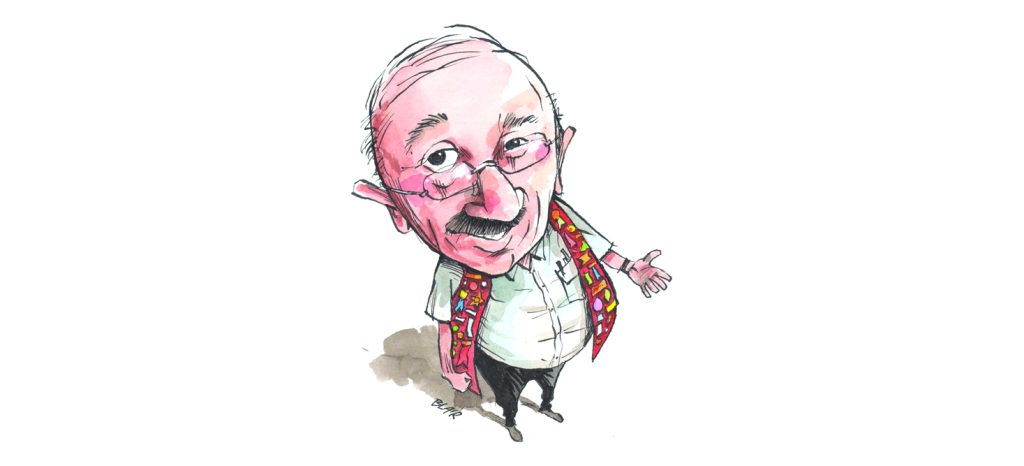
“Rich,” who works at a big-box hardware store, excels at customer service. You will be sure to recognize this right away because his vest is covered in countless award badges, all thanks to the fact that customers relate and respond to his brand of affability. The multiple badges, affixed by carabiners to both sides of his vest, noticeably rattle against one another, calling to mind the old-fashioned take-a-numbers at the butcher counters of old.
He wears a big smile below a bushy mustache, is average height, and, he’s not shy about cheerfully calling attention to a pot belly, one he points out to you himself.
Then, out tumbles his spiel, full of PG-rated dad jokes and deadpanned as if he were a Wes Andersen character.
“How ya folks doin’ today?” he asks, grinning. As soon as you mumble something about being pooped from weekend yard work, gesturing to the additional flat of pansies you’re buying, he starts up.
“Oh, pooped out?” Rich gestures towards his (pleasingly plump) abdomen. “Me too. But hey, turns out I’m in shape. Round is a shape.”
You laugh despite yourself.
“I’ve started an exercise regime,” he continues. “Doin’ fork lifts.” Naturally, he gestures, pretending to lift a fork to his mouth. “And diddly squats.”
You laugh again. Rich is just warming up.
“It’s not that running runs in my family,” he says, then pauses. “Nobody runs in my family.”
His eyes are wide. He’s watching your face, gauging his timing; an underappreciated stand-up comedian who literally must be on his feet on a concrete floor wearing steel-toed safety shoes for hours on end. One who has filled the yawning, monotonous hours with possibilities while manning a register. Someone who realizes he’s been invisible. An anonymous figure who scans products and accepts payments hour after hour, who must keep an eye out for shoplifters and miscreants the livelong day.
Now, he’s a guy who’s quipping away, perfecting his schtick and inserting himself firmly into your field of vision.
Rich, dammit, is determined to make you see him and make you laugh.
Meanwhile, the register is doing its machine tasks, calculating, whirring and spitting out receipts. Waiting, you politely smile at Rich, because, well, not to would be like slapping a baby.
Handing the receipts over he resumes his riff adding, “We don’t run like the wind . . . When I run, I’m winded.”
As you turn to leave, he takes care of business, asking you to complete the survey at the bottom of the receipt.
“That’s how I got all these badges,” he says proudly. And you guesstimate he might be wearing 50 of the things.
Is it heavy, you wonder, wearing all those badges?
Walking to the car, it’s tempting to look back, to see if Rich is already doing his routine with the next customer. How long can he sustain this, you also wonder?
Then it hits you, the most obvious thing. On reflection, you realize Rich, in fact, has a knack for getting others in shape as a crescent-shaped smile plants itself on your face, a gift from the man of many badges. OH


By Susan Campbell
The raven is one of the most widely recognized and intriguing birds in the Northern Hemisphere, being a species that has associated with mankind for thousands of years. It is certainly not one that is common in the Piedmont of North Carolina — however, it is a bird seen more frequently each year, even in more urbanized areas such as the Triad and even in the Triangle area. The common raven is a rarity in the Sandhills, but that is likely to change before long.
In our state, common ravens breed at elevation in the Appalachians and can be found roaming the mountains year-round. For several decades now the species has been frequently found farther east, across the foothills, no doubt a range expansion facilitated by human activity. Ravens, as well as their crow cousins, are opportunistic feeders. Roadkill is a major and easy source of food — as are landfills, parks and campgrounds. Even pet food bowls and bird feeders have been known to attract their attention. Some birds have even learned that gunshots during hunting season may mean a meal in the not-too-distant future. Ravens are also capable of taking eggs, chicks and even newborn small animals such as lambs.
Common ravens are massive, jet-black birds, half again as large as a crow. They have heavy, serrated bills and long wedge-shaped tails. Their wings are designed for soaring, since they typically have large territories across forested, as well as open, expanses. Individuals or pairs can be seen soaring effortlessly high in the sky. Their vocalizations often give them away, especially in remote areas. The common raven’s call is a harsh or gurgling croak that, not surprisingly, carries a long way. They may learn to mimic a variety of sounds, including human vocalizations if they are kept in captivity.
These birds are exceptionally intelligent and are likely the smartest of all birds found in North America. Not only do they readily figure out where to find their next meal, they will work in pairs to acquire certain types of food. One individual will divert the attention of a nesting adult bird while its mate steals an egg or nestling. Common ravens can be destructive in their search for food, tearing into campers’ tents and other manmade structures and, in numbers, can foul sensitive equipment. They can certainly become a nuisance if they linger too often or too long around human habitation. This can be very problematic given how long-lived the birds are and that they are also non-migratory.
It is a real shock each time I spot one of these impressive birds. There seem to be individuals that regularly patrol Interstates I-40 and I-540 west of Raleigh year-round. I have also noticed them above U.S. 1 just north of Sanford. I would not be surprised if a pair is breeding in the area along the Deep River. Riverside bluffs at lower elevations mimic the cliff habitat where common ravens usually nest. They also make the ledges on tall buildings their home as well.
Ravens are clearly adaptable and perfectly happy to live alongside us — more and more, all of the time. OH
Susan Campbell would love to receive your wildlife sightings and photos. She can be contacted by email at susan@ncaves.com.


By Cassie Bustamante
Photographs by Amy Freeman


A strawberry pie burbles in the oven, its jammy, crimson fruit seeping from the crust as its buttery aroma permeates the 85-year-old house that David and Anna Caton made theirs in 2018. “Anna has some of her mom’s handwritten recipes,” says David. Beyond the pie, there’s also the classic cornbread his mother-in-law, Juanita Hendrix, would make just for him.
“I am just kind of sentimental,” says Anna, pointing out a side table here, a small painting there, that once belonged to her late parents and now adorn their only child’s Starmount Forest home.
The Colonial Revival home is just around the corner from where the Catons lived for 15 years. When it came on the market in 2017, they snagged it. Although they knew they wanted to remodel, they didn’t start right away. “We let the house speak to us,” says Anna.
Featured on the Preservation Greensboro Historic Home Tour this past May, the Catons’ home was originally built in 1941 for Pattie and Clyde Jackson and, from the beginning, served as a place of gathering. The Jacksons and their two sons were socially active and threw numerous parties, club meetings, luncheons, you name it. After Clyde’s untimely passing in 1954, Pattie eventually remarried. She and her second husband, Lee Coltrane, stayed there until selling in 1971 to Vernon and Dixie Wimberley, who owned the home until the Catons bought it.
Just a few years in, the house had spoken — in a vernacular that conveys the traditional Southern style and hospitality Anna, a “born-and-reared” Greensborian, inherited from her mother.
In 2021, the Catons hired architect Dan Huckabee to help them come up with a plan, including bumping out the back to create a much larger kitchen. “Because every time we had parties, everybody’s standing in the kitchen,” says David, “and that kitchen was so small originally.”
They enlisted Pat Parr of Classic Construction of North Carolina to do the build while the Catons designed everything themselves. “We’re both very classic,” says David, IT operations manager for The Fresh Market. “So this is kind of timeless in a sense.”
Featuring traditional white custom cabinets from Classic Construction and white quartz countertops from Ivey Lane, the kitchen now offers ample space to move and work — a must for a couple that enjoys a team effort when it comes to preparing meals. Guilford Plumbing designer Ellen Pete helped Anna, a rental property manager, select large-scale gold hardware and fixtures as the crowning jewels. “My mother always said, ‘Go big or go home,’” says Anna. Over the island, two gold, oversized lanterns shed light on an expansive workspace.
The kitchen opens to a roomy, comfortable den with a wet bar that includes a beer-and-wine fridge. Where the refrigerator once sat, the Catons made use of existing waterlines and electrical. Glass-doored upper cabinets illuminate within, allowing goblets, flutes and highballs to sparkle. The backsplash and countertop, which were crafted from an Ivey Lane remnant, contrast the cabinets in black with striking white veining. “The hammered sink that’s in there,” says David, “we both love that.” Anna notes that it’s from Thompson Traders, a local family-owned company.
Charleston, it turns out, is a favorite place to visit. In fact, the couple celebrated their very first wedding anniversary — and more recently their 28th earlier this year — in The Holy City. Over the years, they’ve gone on several home-and-garden tours that Anna says have inspired her own Southern style. “That’s what I kind of wanted to bring here,” she says, waving her hand at the den’s cushy white furnishings paired with blue-and-white pillows and antiques.
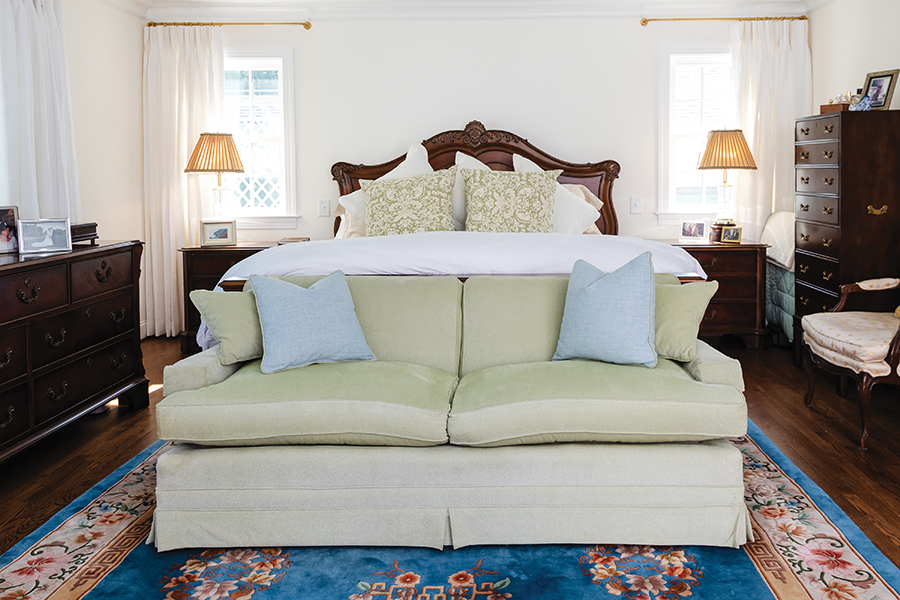
Adding onto the home allowed the Catons space for a main-floor en suite primary bedroom. While they originally thought they’d remodel the second-floor primary, friends pointed out that, as they age, they might want the convenience of living primarily on one floor. The couple furnished the brand-new space with dressers and nightstands that once sat in Anna’s childhood home in Green Valley and added a gas fireplace that warms them on cool nights.
But it’s the bathroom that echoes Juanita’s philosophy of going big. A large soaking tub — big enough for even a tall guy like David to stretch his legs — made of volcanic rock keeps its water so hot that “you sometimes have to add a little bit of cool water just to be able to tolerate it,” quips David. Around the corner from the tub is a walk-in shower with a rain head and a regular head, plus a wand to make it easier to wash as they age. The couple’s favorite aspect of it? It’s low maintenance — no shower curtain to wash or glass door to squeegee. In fact, Anna praises Harris Teeter’s budget-friendly Mold and Mildew Remover — her “saving grace.”
David is keen on the bathroom’s heated floors, which are especially nice “in the middle of the night in cold winter.” Anna wasn’t so sure they really needed the luxury of heated floors. “Then our contractor said, ‘Well, it’ll prevent mildew from forming,” recalls the ever-practical Anna. “I said, ‘Sold!’”
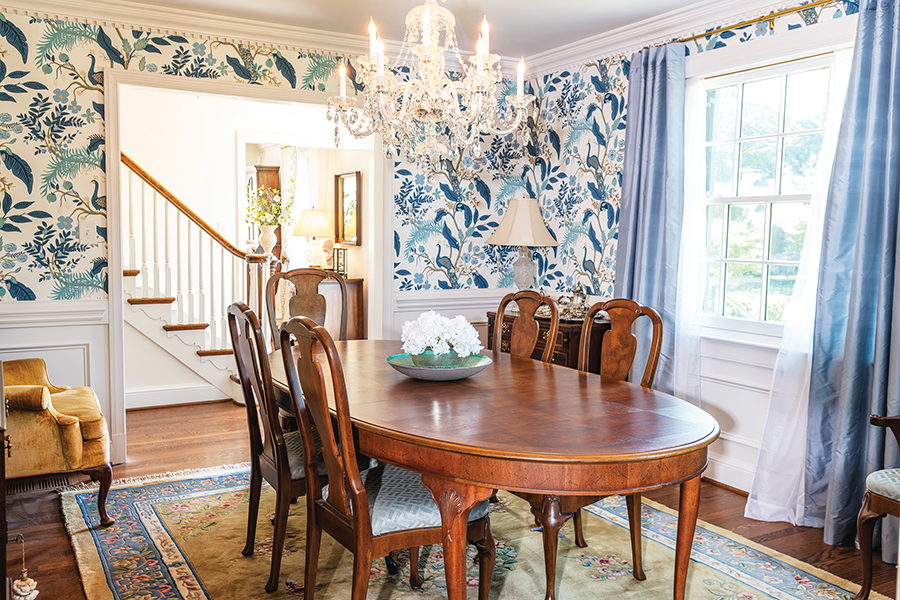



Some rooms were left mostly untouched by renovations, but made theirs by design. Anna dreamed of mimicking her childhood home’s dining room, right down to the wallpaper, a “barely there” pattern. However, the one she selected sold out. “So I went another route — I went a little bit more bold.” Now, Rifle Paper’s Co.’s blue peacock wallpaper makes a dramatic statement, with her parents’ traditional dining set taking center stage. The table has been set for dinner service with silver-and-blue rimmed plates, crystal chalices and silverware, all meticulously placed. Inside the matching breakfront, glassware and silver serving pieces reflect the glimmering light an ornate crystal chandelier that came straight from Anna’s parents’ home provides. “I feel like they’re still here with me,” she muses.
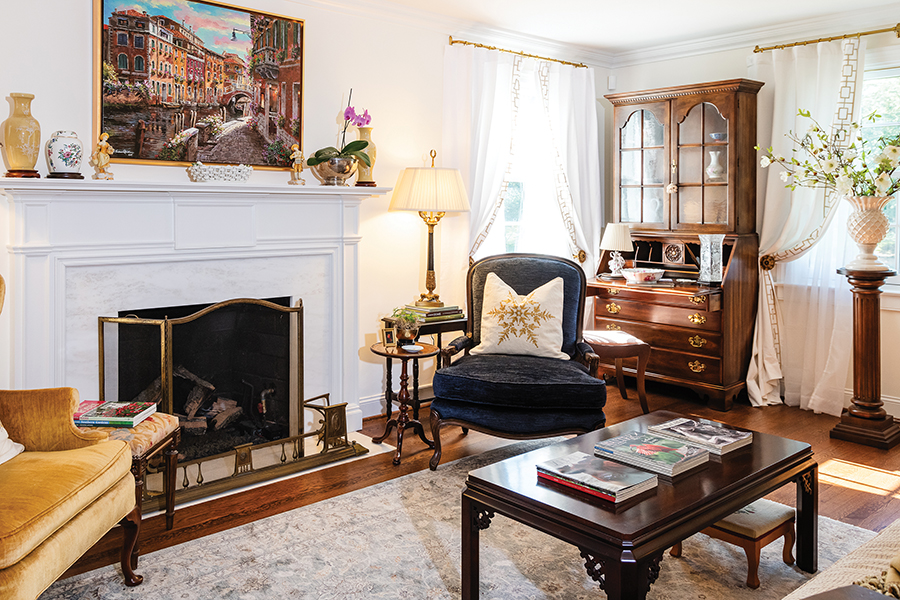
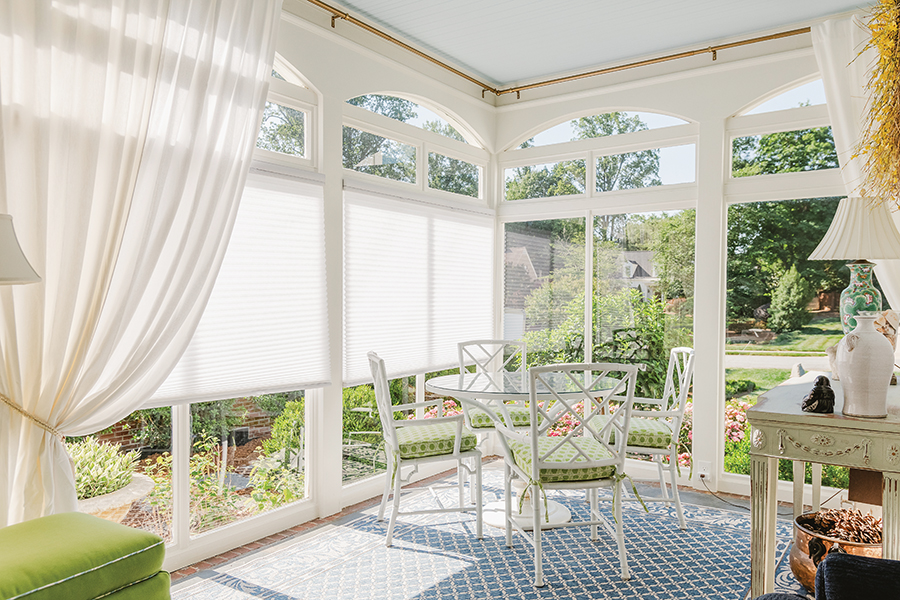
Painted in a warm white, the living room and adjacent, light-filled sunporch are also filled with reminders of Anna’s parents — several chairs, an ottoman, a chinoiserie dinette set. Turns out, the Catons sent much of their former house’s furniture to an estate sale. They added personal touches with a couple of special paintings. For their 10th anniversary, the Catons traveled to Venice. At an Art Shop show, David couldn’t believe his eyes when he spied Korean American artist Sam Park’s painting featuring the very same walkway just outside of where they had stayed. “I saved up for that,” says Anna.
Over the sofa, a large, commissioned oil landscape by European artist Gerhard Nesvadba hangs. Anna connected with him through the Art Shop, where she fell in love with a similar piece that was much larger. She “begged and pleaded” for him to create something smaller. “It’s hard to find what you want. And this is it.” Featuring a walking path, a field of poppies, rolling hills and a body of bright-blue water, David imagines it reminds Anna of the time she backpacked solo through Europe, right after their anniversary trip to Italy.
The glass-enclosed sunporch overlooks one of several rose gardens the Catons added, maintained by The Perfect Rose. Juanita, Anna recalls, had a rose garden, too. Anna loves to clip them and place them in vases around the house — one next to the kitchen sink, another on the original, curved built-ins leading out back — reminders of her roots.
There’s also a newly added rose garden on the side of the home, where several varieties are neatly labeled, including Moonlight in Paris, a favorite of hers and her mom’s. “Her favorite colors were peach, soft peach.”
The abundance of pink roses on either side of their front walkway burst with color against the white exterior. And the carriage green front door and dark shutters add a touch of contrast. Anna wanted something that read, “Is it black or is it green?”
“Charleston inspired,” notes David.
On either side of the door, large gas lanterns from New Orleans-based Parc Lighting greet guests with Southern flair and soft flames.
But it’s the backyard, utterly transformed, that is where the couple most enjoys entertaining. Anna explained her vision to Huckabee, who told her, “We can’t do that.”
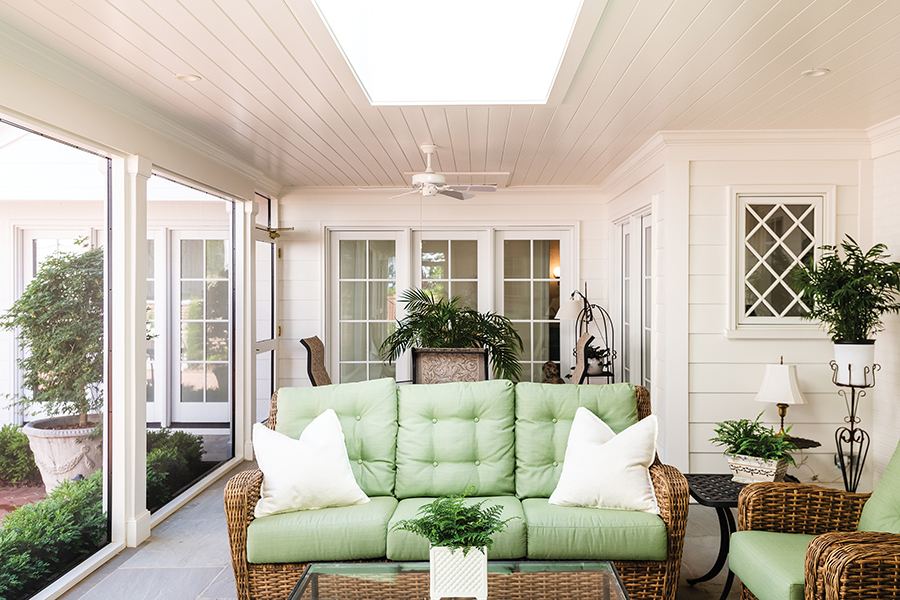
“But I could see it,” she muses, and convinced him. Now, thanks to the hardscaping from Jeff Allen Landscape Architecture and landscaping from Green Visions, it’s an oasis. David cites the screened porch as one of his favorite additions. The comfy sofa and chairs from Casual Furniture make for excellent napping, says Anna. The couple’s shy cat, Angel, who once belonged to Juanita, agrees and especially enjoys basking in the porch’s warm patches of sunshine.
Beyond the porch’s door, they added an outdoor fireplace and a Mackie Brothers pool that “is not a kids’ pool,” according to David. “It’s an adult pool,” complete with a corner hot tub. There’s a cabana with a bathroom of its own so no one treks through the house with dripping suits or muddy feet. In it, a repurposed bamboo chandelier that once hung in the home’s breakfast room provides light. While it was originally white, Anna, who inherited some of her dad’s handiness, painted it black. “My dad was very hands-on. He could do anything.”
David recalls Walter reverently. “Her dad was a very big guy,” he says, “very big and very —”
“Intimidating,” Anna says, her bright blue eyes shimmering as she completes the sentence.
David’s own father is an “almost retired” oral surgeon whose work took the family to Gainesville, Florida, where David grew up and his parents still live today. As a child, he spent many summers traveling to the mountains of North Carolina, visiting grandparents or attending Camp Carolina in Brevard.
Growing up so close to the University of Florida, a school that currently boasts an undergrad population of over 40,000, made him keenly aware that he wanted to attend a much smaller liberal arts school. “I visited Elon when it was one of those snowy days where the campus looks perfect,” he recalls. Plus, Elon College (now Elon University) offered a degree in communications with the corporate specialty he wanted.
Anna also graduated from Elon, one year after David, in 1994. But the two never crossed paths while they were students because she had her nose in thick accounting books. Plus, she says, “I was working three jobs, living off campus.”

Not long after Anna graduated, the two finally met at an event for the Burlington Indians, a former minor league baseball team. She attended with her roommate, Kelly, a mutual friend. At the time, Anna worked for the team while David, who was there because of his involvement with the Alamance County Area Chamber of Commerce, worked in sales for Eric Henry’s responsible clothing brand, TS Designs. “Who’s your friend?” he asked Kelly.
Soon after, they began dating. Early into the relationship, David invited Anna to visit his hometown during the Fourth of July and, of course, meet his parents. They hit the road with David’s roommate and his girlfriend, reaching their destination at 2 a.m. Even though it was the middle of the night, Anna was using the car mirror to preen. “David goes, ‘What are you doing?’” Anna recalls. “I said, ‘I’m primping! I’m getting ready to see your mother.’”
David recalls one of his first encounters with Anna’s parents: “I remember the tray with all the different little like pickled okra or little pickles and all kinds of — you know, they just put on the spread.”
Just a few years later, he was working up the nerve to ask Walter and Juanita for their daughter’s hand. After sweating it out at Lucky 32, David hadn’t yet managed to spit out his question. Time was running out — lunch was nearing its end. “Her mother graciously said, ‘Would you like to come to the house for some dessert?’”
“It was much more comfortable,” he continues, “and I was finally able to get through it.” Of course, they gave him their blessing.
“Otherwise, she wouldn’t be here,” he says with a chuckle. The night of the proposal, David had booked a table at the now-closed Noble’s, where Kerry Thomas, chef and co-creator of underground dining pop-up experience The Next Supper, was working as a manager. Thomas, who barely knew David then, held onto the ring until it was time to pop the question. After a beat, she said yes. “It was a long minute,” quips David.
“Because I was enjoying the moment,” says Anna with a soft laugh.
“Kerrie’s been in our lives since then,” says David. “Wherever he goes to work, we just follow.”
In fact, the Catons opened their home for one of Thomas’ Next Supper events. Thomas later returned to cater a Friendsgiving gathering, where the Catons set up a table spanning the length of their entire screened porch and filled 26 seats with loved ones.
In the handful of years since their remodel, the couple has hosted numerous events back there. Of course, there are pool parties, but there was also a “bourbon and bubbles” party where they hired beloved Greensboro bartender Mark Weddle, best known for his work at 1618 West. “Twenty-something people RSVP-ed,” says David.
“Seventy people came,” quips Anna. While it felt a bit like mayhem, looking back, she says, “It was a perfect evening, a fun evening.”
They’ve also hosted a Christmas party — the list goes on. “We just love to host,” says Anna. David especially enjoys bringing people from all corners of the world together and seeing how everyone connects.
Then there was the chicken pot pie taste-off. “Maria’s had closed and that’s where I used to get my chicken pot pies,” says Anna. So, she did the ultimate crowd sourcing and invited friends to bring over their favorite catered chicken pot pie so she could sample several. Pretty genius.
“Any kind of theme,” says David, “all of a sudden you get people buying into it.”
And it’s likely this home will see countless parties for years to come. “I want to live here for a lifetime,” says Anna, scooping up the last bite of her mom’s strawberry pie.
Next up? “Cornbread,” they both say. Though nothing can compete with Juanita’s recipe. OH


By Ashley Walshe
In October, life and death walk hand in hand, giggling.
Can you hear them through the crisp breeze? The eddies of fallen leaves? Press your ear to pine bark and hear the sap slow.
Acorns drop to the earth like runes tossed upon a casting cloth. Gray squirrels scramble to secure an unknown future. The crows blurt their dismal premonitions.
Frost! Silence! Death! Rot!
Yes, it’s all coming. And yet, the squirrels build their caches; the crickets are still singing; earthworms and fungi hum of alchemy and fertile soil.
All of life weaves itself into the endless fabric of existence — even through death.
Become food. Become earth. Become eternal.
And on this day, when the sky is blue and sunlight transforms colors to exalted states, become acutely aware of this fleeting moment.
Cascades of crimson maple leaves. Kaleidoscopes of monarchs. Murmurations of starlings. Here and gone — at least from sight — in a brisk autumnal flash.
At once, a crow cracks a nut with its sleek, sharp beak. Woodpecker tucks them into dead, damp trees. A squirrel buries a soon-to-be-forgotten reserve where, weeks from now, an acorn will sprout a taproot.
The orb weavers spin their final webs, wrapping their eggs in tear-shaped sacs of silk.
Can you hear the laughter now?
Life! Death! the crows chant. Rebirth!
The light is fading; the air smells of musk and mischief; the tapestry continues to surprise and delight.
 The maple tree in front of the doorstep burned like a gigantic red torch. The oaks along the roadway glowed yellow and bronze. The fields stretched like a carpet of jewels, emerald and topaz and garnet. Everywhere she walked the color shouted and sang around her.
— Elizabeth George Speare, The Witch of Blackbird Pond
Nothing like the gentle thuds of acorns raining down upon the quietly turning earth.
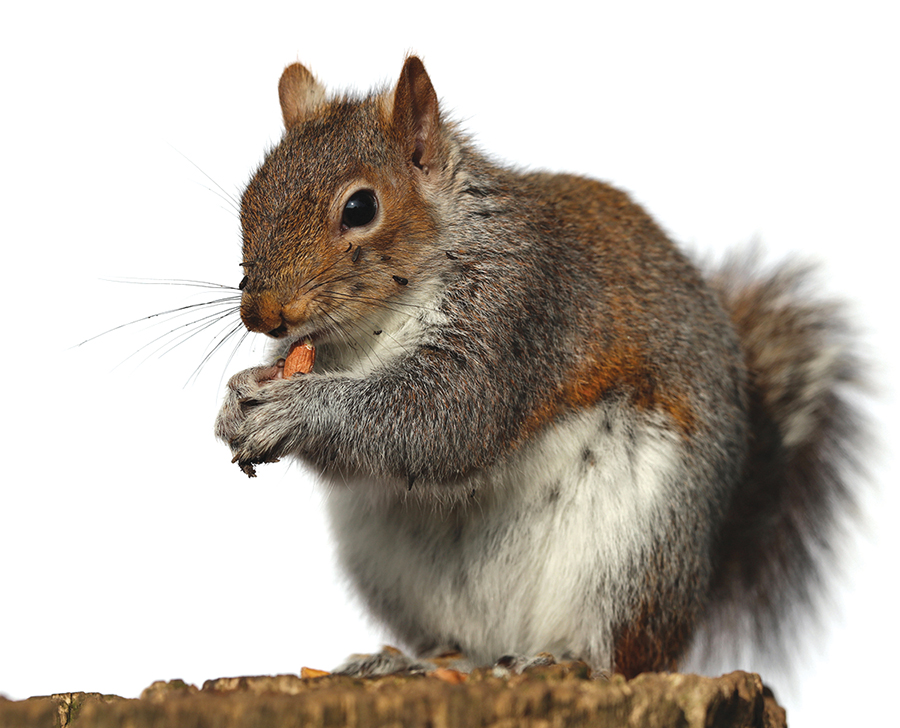
Did you know that a single gray squirrel will scatter-hoard up to 10,000 of them over the course of one season? And fail to unearth roughly three-quarters?
Oak knows.
That’s a lot of potential — entire forests — safely cradled by the wet, dark soil.
The squirrels eat their fill. The oak trees continue their wild giving. The seeds of life sleep underground, patiently awaiting the return of spring. OH
(with apologies to Shakespeare)
Hoot of owl and hush of frog, caw of crow and whiff of dog . . .
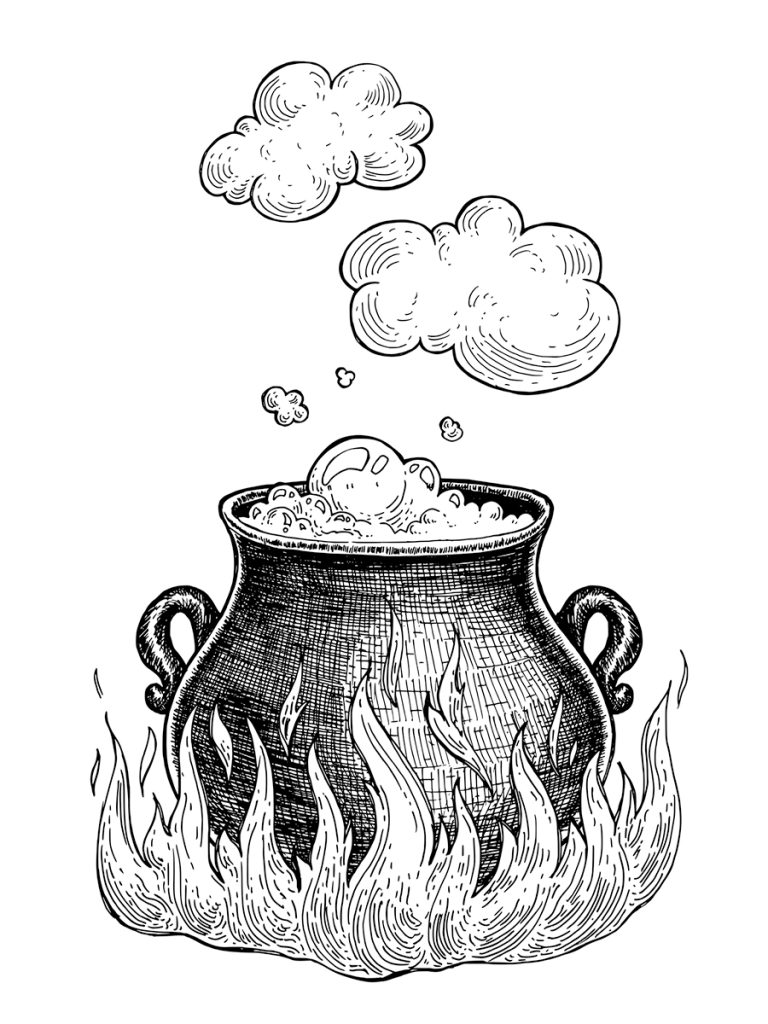
The autumn cauldron bubbles.
Can you smell it? The richness of wet earth and fallen leaves; the punch of stink bug and walnut husk; the heavy musk of slow decay?
Add to that the woody depth of warming spices: cinnamon, nutmeg, cardamom and clove.
Now, throw in some texture.
The howl of coyote and wind. The crackle of fire. Dried corn stalks, wine-colored berries, pine sap, turtle shell and bone.
Sweeten with pumpkin and apple. Brighten with blue skies and luminous foliage. Deepen with red wigglers, spoiled fruit and mushroom spores.
Double, double, watch it bubble.


By Billy Ingram
“I went up and got me two hot dogs and a big orange drink.” — “Deacon” Andy Griffith
Headphones clamped to both ears in the spring of 1953, 19-year-old College Hill resident Milton Alderfer switched the selector dial to record mode on his portable magnetic reel-to-reel deck, clueless to the enormous impact the next six minutes he taped would have on American pop culture.
Spools turning, he glanced upstage at the noticeably nervous novice he was hired to record. Alderfer recalled several nerve-racking attempts recording this routine at other venues. However, as the skinny comic, who styled himself as country parson “Deacon Andy Griffith,” stood before the congregation at a Jefferson Standard Life Insurance Company convention, somehow, “What It Was, Was Football” finally clicked.
Alderfer’s recording was pressed and distributed by Chapel Hill indie label Colonial Records in November of ’53. “What It Was, Was Football” quickly sold 50,000 copies regionally, spurring Capitol Records to acquire the master for rerelease nationwide, sending that single soaring into the Billboard Top 10 in 1954. On that record, Griffith repeatedly expresses his love for “big orange” drinks, so naturally Andy’s first product endorsement was for Sun Crest Orange Soda out of Atlanta.
Griffith’s comedy records led to tremendous success, portraying country bumpkins on Broadway and in motion pictures such as 1958’s No Time For Sargents. When the Carolina Theatre screened that film, with Griffith in attendance, the City Council officially declared him an honorary citizen of Greensboro, presumably exempt from municipal taxes.
Two years later, The Andy Griffith Show debuted on CBS, a ratings smash from the very beginning. For the first season wrap party, the star had $500 worth of barbecue from Casey’s Sunset Hills location shipped to Los Angeles so cast and crew could taste genuine Piedmont-style pulled pork.
After eight seasons of TAGS solidly nestled in the Nielsen top five, Griffith walked away from the weekly grind to focus once again on a film career. Meanwhile, his sitcom continued on, rebranded as Mayberry R.F.D., with no significant drop in ratings. Unfortunately, his highly anticipated 1969 big-screen family-fluff nugget, Angel in My Pocket, was a comedy lacking in laughs. Moviegoers avoided it as if it were a fresh batch of Aunt Bee’s pickles.
In 1970, Griffith, smarting from that cinematic shellacking, returned to CBS primetime with a weekly half-hour comedy-drama entitled Headmaster, wherein Griffith portrayed Andy Thompson, stern yet fair administrator of a California co-ed prep school. On the opening episode of Headmaster, Butch Patrick (best known for portraying Eddie Munster in The Munsters) is forced to choose between getting high or being ostracized by the cool druggies on the football team. Playing against type, Ron Howard, aka Opie on TAGS, turns up on one show as a rebellious reprobate.
That same year, Griffith and his business partner, former N.C. governor Terry Sanford, opened a chain of Andy Griffith’s “gooood eatin’” restaurants in Burlington, Wilson, Fayetteville and Greenville, plus two Raleigh locations, one of which was situated where Crabtree Valley Mall is today. Wooden exteriors resembled a country farmhouse, and the down-home menu featured barbecue sandwiches, country ham biscuits, baked beans, fish filets and hot dogs. Griffith was in Burlington for the ribbon cutting at the Huffine Mill Road store, where, that day, patrons were given a free bottle of “big orange” when purchasing a barbecue sandwich or fried chicken.
In tandem, the partners launched a line of Andy Griffith brand canned beans and black-eyed peas (“with a little more pork and just a pinch of sugar”), whole-hog sausage, bacon and country ham steaks, each with colorful, gingham labels promising, you guessed it, “Gooood eatin’.”
With all this activity, Andy was flying high by the fall of 1970. It all came crashing down in short order.
Tune-in for Headmaster’s first outing in September was substantial, making it the third most popular new series after The Mary Tyler Moore Show. But, when audiences realized what a low-key bore it was, Headmaster ultimately finished as the 12th least popular show that season. In November 1970, the network announced the start of production for the program they probably should have put forward in the first place, The New Andy Griffith Show.
On the New show, Griffith portrays Andy Sawyer, who boomerangs back to his mid-sized North Carolina hometown of Greenwood (code for Greensboro?) with his wife, two kids and live-in aunt. While settling into a home similar to those found along Tate Street, an act of inexplicable political maneuvering by the City Council results in Sawyer being installed as Mayor Pro Tem.
On the debut episode in January 1971, Emmett and Goober travel from Mayberry to Greenwood to ask their old pal — who oddly has a new last name and life — to use his influence to rezone a plot of land they each want to buy. Also desiring the same plot of real estate is an unnamed character played by Don Knotts, wearing the same salt-and-pepper suit Barney Fife favored on The Andy Griffith Show; heck, he even wore that getup to Taylor’s and Helen Crump’s wedding on Mayberry R.F.D. While Andy greets him like a long-lost friend, Goober and Emmett have no idea who he is.
Like Greensboro in the ’70s, Greenwood was a town fueled by gossip and jealousy. Sawyer’s Aunt Nora fits right in, a Bizarro World Aunt Bee. As portrayed by Ann Morgan Guilbert (The Dick Van Dyke Show, The Nanny), Nora is a nagging, meddling, superstitious, hypochondriac. And Sawyer’s son is no Opie either, wandering around with a paper sack over his head, trying to conquer his fear of darkness. Again, ratings for the initial outing were big before steadily eroding to nearly last place.
Not only was his TV series cancelled, over the next year all seven Andy Griffith Restaurants were closed, while his eponymous line of grocery store items quietly disappeared from shelves.
Throughout the 1970s, Griffith was relegated to starring in lurid TV movies such as Savages, Winter Kill and The Girl in the Empty Grave and portraying hicks on vapid variety shows, his income reliant on commercial endorsements for Ritz crackers, Kraft cheeses, Jell-O and A.1. Steak Sauce. It wasn’t until “North Carolina’s Favorite Son” let go of the idea of being everyone’s “Andy,” returning to the air as NBC’s Matlock in 1986, that Griffith was once again welcomed weekly into American homes.
As for teenager Alderfer who recorded Griffith’s breakthrough football routine? At that time, he had been serving as program director of a local radio station and operating Fidelicraft Recording Studios out of a Queen Anne style home on West Market Street that also housed Moore Music. Moore Music still rents instruments at that address today in a building that replaced the old structure, destroyed by fire in 1974. Alderfer relocated to Florida in 1955 to teach, no evidence he ever coached football. If he had, what it was, was an O. Henry gooood endin’. OH
The creator of TVparty.com, now in its 32nd year online, Billy Ingram is one of the nation’s leading television historians.

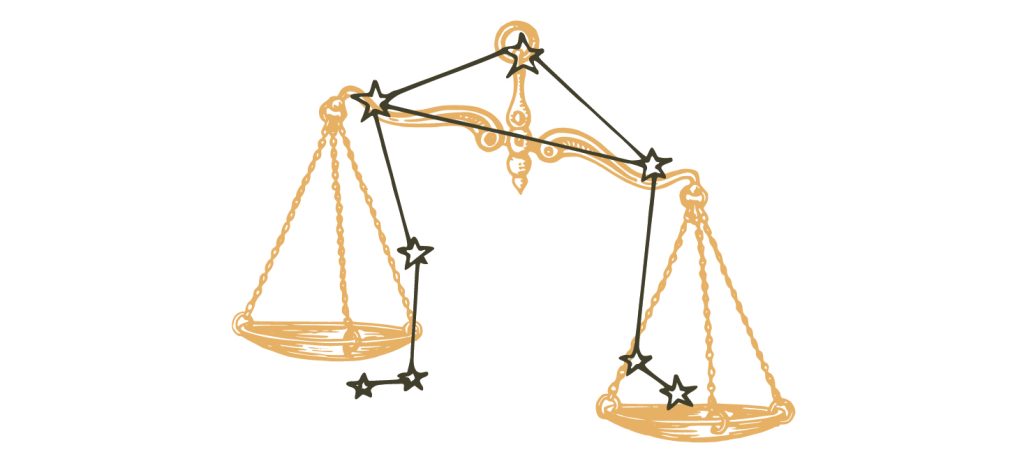
Someone’s feeling extra flirty this month. Mirror face aside, get ready for a cosmic reset on Oct. 10 sure to set your gaze in a bold new direction. Of course, this does mean you’ll need to make a choice. And with your ruling planet Venus in retrograde now through mid-November, one choice you ought to make is self-restraint, particularly when it comes to extraneous spending. Hint: Shop your own closet, sweetheart. You’re already extra.
Scorpio (October 23 – November 21)
Let yourself be surprised.
Sagittarius (November 22 – December 21)
Listen for the crows.
Capricorn (December 22 – January 19)
Host a soup swap.
Aquarius (January 20 – February 18)
Check the air filters.
Pisces (February 19 – March 20)
Change the batteries.
Aries (March 21 – April 19)
There’s a first for everything.
Taurus (April 20 – May 20)
Add more nutmeg.
Gemini (May 21 – June 20)
Do the words bobtail cat mean anything to you?
Cancer (June 21 – July 22)
Explore moon meditations.
Leo (July 23 – August 22)
It’s time for a color refresh.
Virgo (August 23 – September 22)
Embrace the wild rumpus. OH
Zora Stellanova lives in the N.C. mountains with her wolfdogs, Venus and Lilith. Although she prefers divining with loose-leaf pu-erh, she recommends a mugwort and passionflower blend for those seeking wisdom and clarity from the dream realm.


Photographs by Betsy Blake & Lynn Donovan
Much to our delight and occasional horror, porches and front stoops around the city are terrifyingly tricked out in this time of year. From bats to black cats, ghosts to goblins, and witches to wickedly woven webs, the spirited touches these homes sprinkled on are enough to make Salem’s Sanderson sisters squeal with glee.
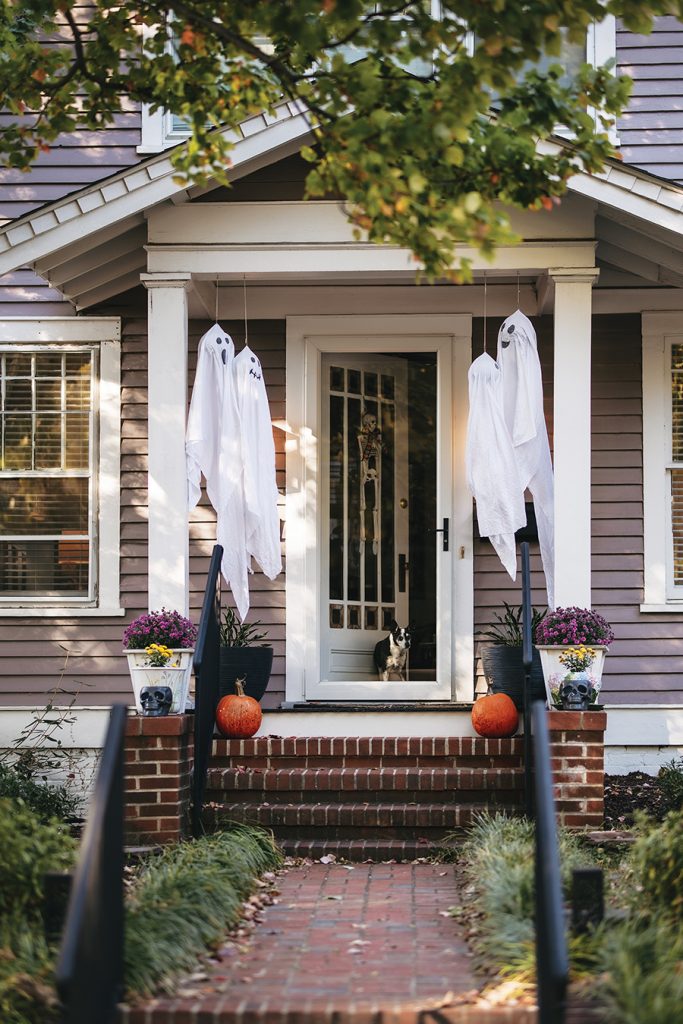
At the home of Chris Wilson and Cecelia Thompson, spiders big and small are crawling out of the woodwork to give you the heebie-jeebies. But don’t let them scare you — leave that to the scarecrow. It’s his job, after all.

We can practically hear this circle of witches burbling— Double, double, toil and trouble, fire burn and cauldron bubble. Between the evil pumpkins, black-draped entry and broomstick-lined walkway in the Robinson family’s front yard, we’re certainly under their spell.

What a tangled web the McCord family weaves. Before approaching their door, ask yourself: Who is the spider and who is the fly?
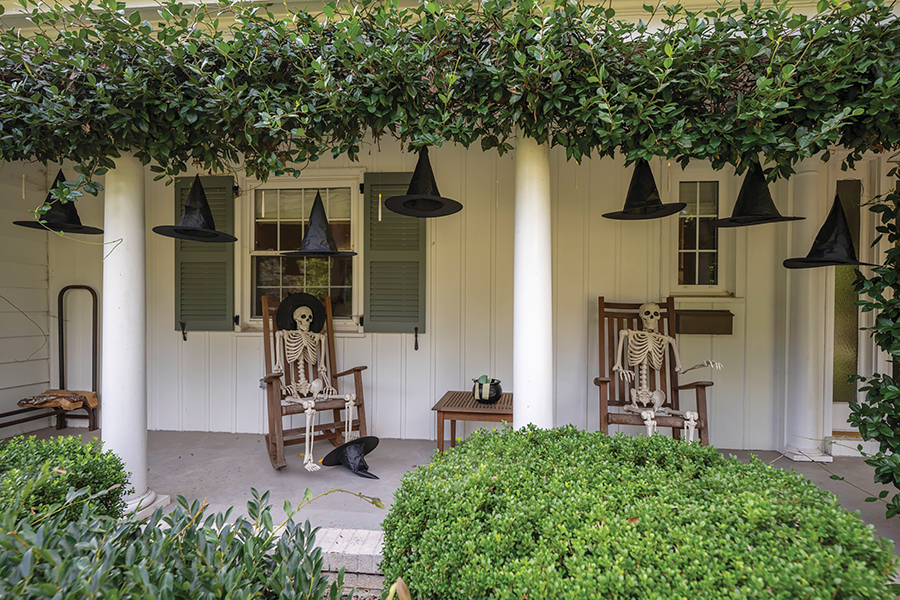
The Hogwarts Great Hall? Nope, it’s the home of The Rodenbough family, who bedecked and bewitched their porch with floating candles and witch hats. We solemnly swear they are up to no good.
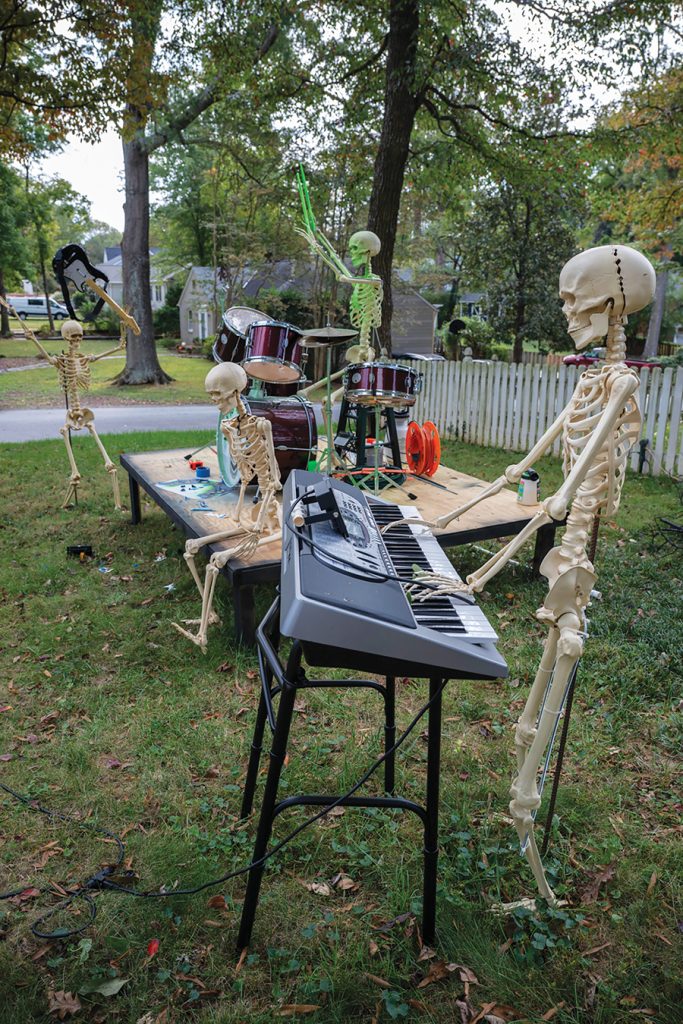
Dead Zeppelin? Nope, it’s Bad to the Bone, performing live-ish at a neighborhood block party. The Shilling — or is it Chilling? — family’s skeletons are out of the closet and cranking up the tunes, complete with their own security team.
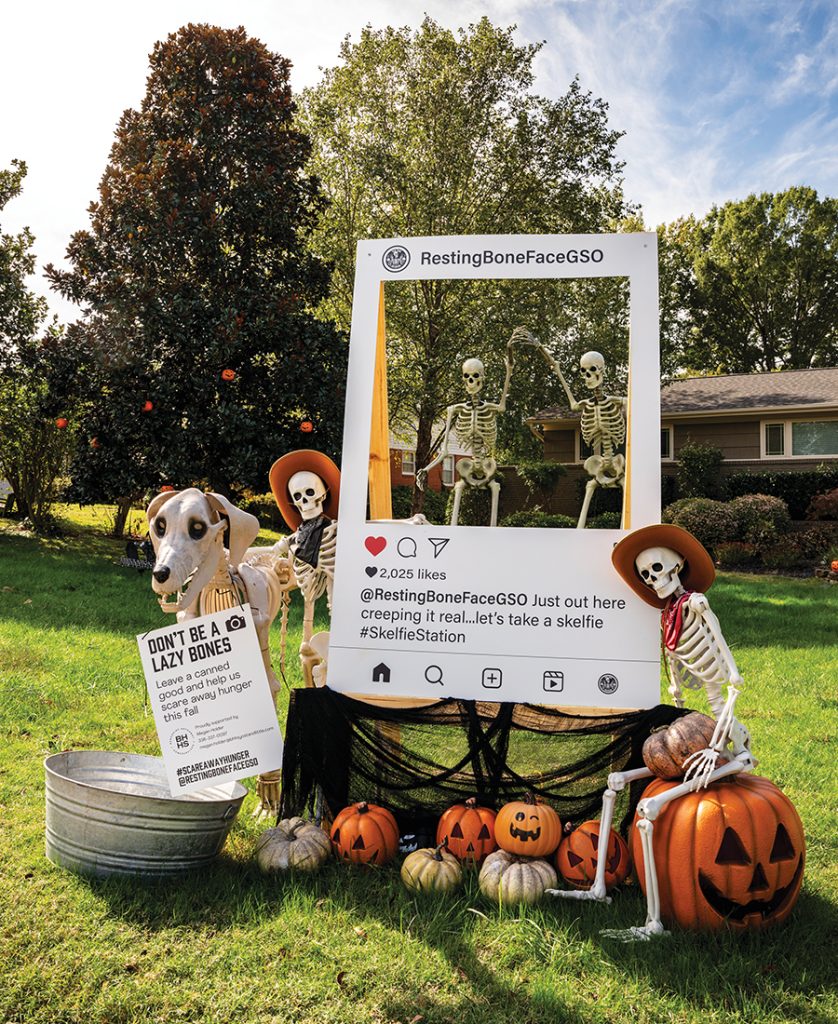
Looks like some cowboys visiting from the Bone Star State are inviting you to pose for a “skelfie” in front of the Arthur family’s home. Beware: your photo op comes with a price. (Note: This year’s theme will be Jurassic Park After Dark with donations supporting a local animal adoption agency. Follow @RestingBoneFaceGSO for info.)

What’s black and white and webbed all over? The Sherouse family’s porch, which spiders and bats have made their favorite haunt. You might just stick around, too.

At the home of Chris Wilson and Cecelia Thompson, spiders big and small are crawling out of the woodwork to give you the heebie-jeebies. But don’t let them scare you — leave that to the scarecrow. It’s his job, after all.
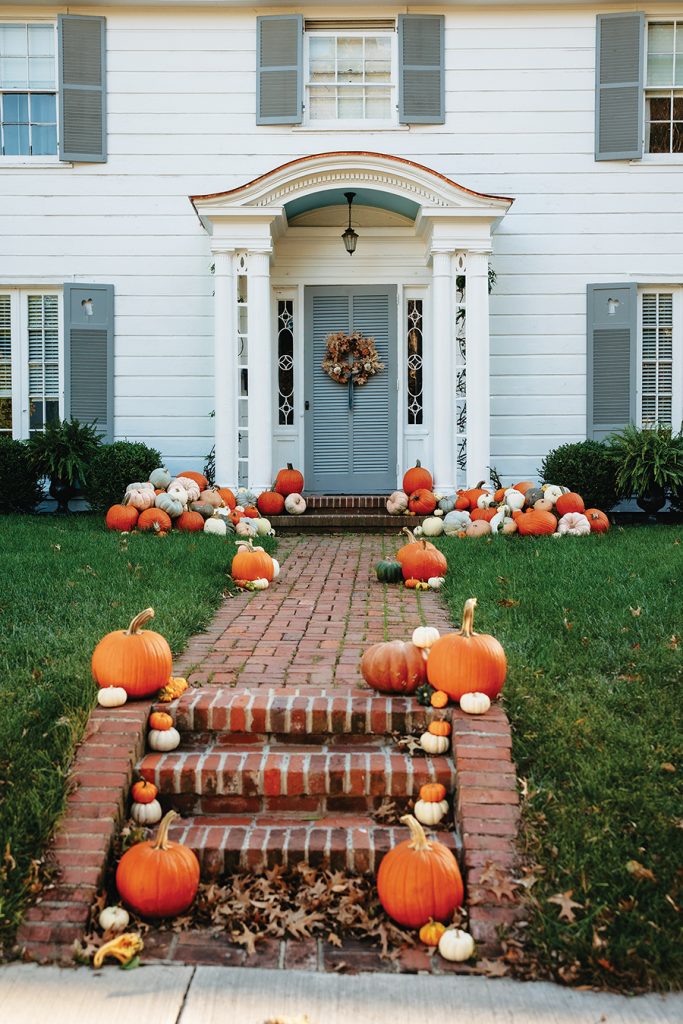
Just one more . . . Jennifer Maston enlisted the help of Jamie Mostofian Design, who perfectly piled gourds of all sizes and sorts, creating a warm welcome to trick-or-treaters hoping the candy heap’s just as plentiful.

A smattering of skulls and animal skeletons, pumpkins in a muted palette and a bony-fingered, white-haired crone up the creep factor of the Boger family’s front stoop. But our favorite part? New life — or death — breathed into “half-dead” summer ferns with a coat of black spray paint.
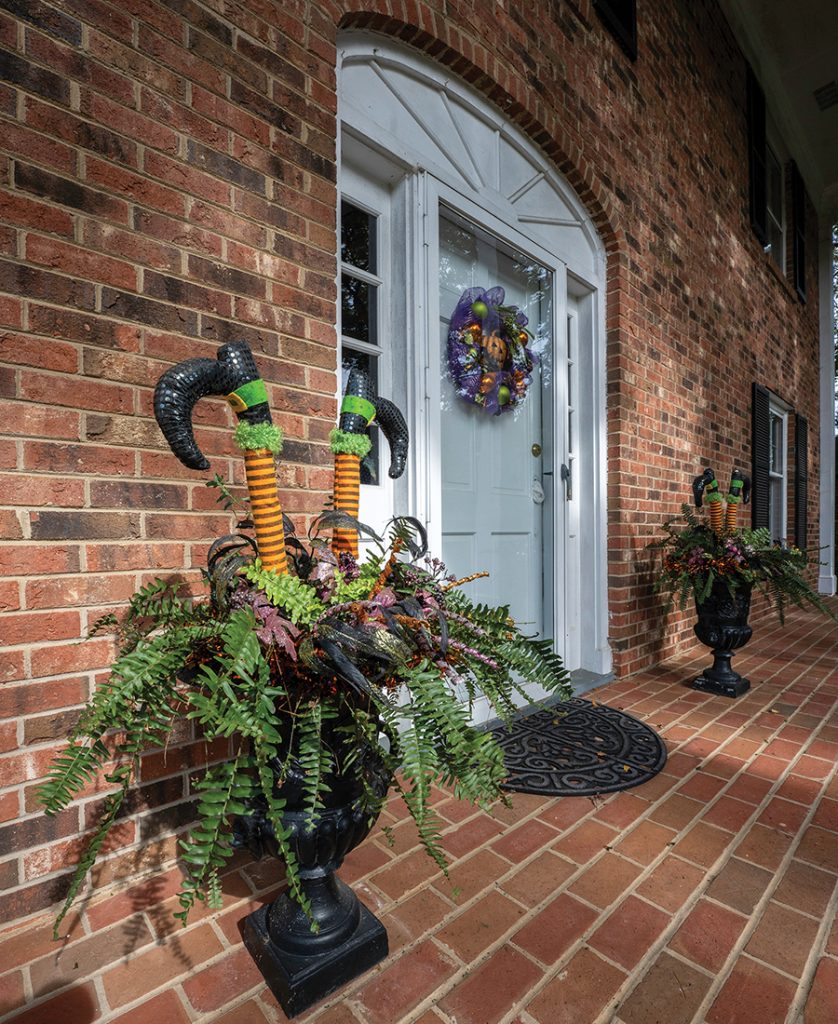
Witch way is up? Sometimes, a simple, whimsical touch sticking out of a porch planter, such as legs in striped tights with sparkling hag’s feet, is all you need to conjure up what sometimes goes bump in the night. OH
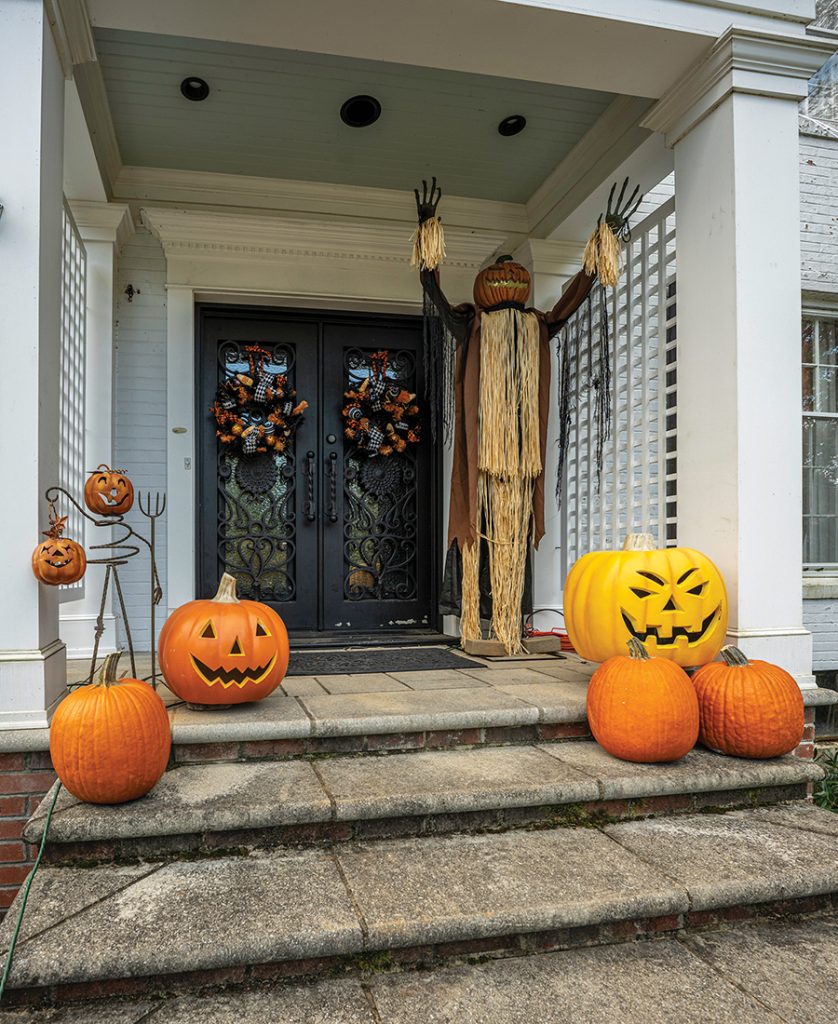
Washington Irving’s “The Legend of Sleepy Hollow” is alive and well on the Hayes family’s porch. Have no fear — if you lose your head over this nightmare of a scene, they’ve got plenty of Jack-‘o’-lanterns you can pop into place.
We use cookies to improve your experience on our site. By using our site, you consent to cookies.
Manage your cookie preferences below:
Essential cookies enable basic functions and are necessary for the proper function of the website.
Statistics cookies collect information anonymously. This information helps us understand how visitors use our website.
Google Analytics is a powerful tool that tracks and analyzes website traffic for informed marketing decisions.
Service URL: policies.google.com (opens in a new window)
SourceBuster is used by WooCommerce for order attribution based on user source.