The Accidental Astrologer

Whoa Is Me!

And you, too, with this month’s alignment of Jupiter in idealistic Sadge and foggy Neptune in Pisces

By Astrid Stellanova

We’ve seen our share of cosmic conniption fits, Star Children, but just remember that half of 2019 is already over. And astrological rarities keep coming. The Arietids are on June 7, and on June 18, there’s an unusual alignment when Jupiter in Sagittarius meets Neptune in Pisces at 90 degrees.

If all that means zip to you, consider that the alignment hasn’t happened in 13 years, since 2006. But this year it happens three times — the next time is on November 8. Circle that on your Day-Timers, Sweet Peas. Some seers say this planetary dust-up pits idealism (yep, thanks to Neptune) against ideologies (Sagittarius). Bottom line? Pay attention to excesses. Rein in your appetites and sit tall in the saddle. But especially, just hold your horses.

Gemini (May 21–June 20)

Hot balls of fire, you may be twitchier than Jerry Lee Lewis. But the soundtrack to your life is more like that song, “Same Trailer, Different Park.” If that ain’t a song, well then it should be, given how you Geminis are wrestling with lots of energy and no place to put it. Good works, my Twins, might just make you do something with that nutsy energy.

Cancer (June 21–July 22)

Honey, you have been getting waaaay too intense. Like, you are 50 shades of black and white. If your saga gets any more black and white, somebody needs to take a brush to your head and start painting your life in rainbow colors. Nothing in life is this cut and dried.

Leo (July 23–August 22)

Like sweet little Sally Struthers says, save them jagwires, Darlin! Or pick an animal that will make your heart bleed. She’s always saving something, and you got to love her for it. But there is a part of you, little Lion Heart, that needs rescuing. It is possible you have a lot more at risk than you like to show.

Virgo (August 23–September 22)

Yes, you have got some talent and you have got plenty of desire to take center stage and blow away the competition. Breaking wind is not a musical event, Sugar. When you put in the work to compete, everybody and his brother will be calling.

Libra (September 23-–October 22)

How do you even walk when you keep one foot in your mouth? It was just that bad when you marched into a situation with all the sensitivity of Bigfoot at Cracker Barrel. Next time you open your pie hole, fill it with a big ole slice of double chocolate fudge Co’ Cola Cake.

Scorpio (October 23–November 21)

Oh, yes, Honey, you got some axes to grind and you could split some skulls right about now. Thinking of something nice to say about your exes is like trying to divide by zero. But pull in your horns, ’cause they are about to dive into a tripwire.

Sagittarius (November 22–December 21)

Honey, stopped in your tracks, you been grounded like fog closing in on an airport. Frustration ain’t even a big enough word for it. If there was ever a time for you to stop, chill out and go inside, it’s N-O-W. It will save you a whole lot of struggle next month.

Capricorn (December 22–January 19)

That silver-tongued devil you like couldn’t be trusted if his tongue had a notary seal on it. Gets you every time. Right about now is a good time to politely walk back on plans you made together. Just give it a week to cool off before signing up.

Aquarius (January 20–February 18)

You got a backbone. But where is your funny bone? If you want to have a happy life, Sugar, you will have to find what is hilarious in the not so good, and what is at least worth a smile in the hardest times. There lies the greatest strength.

Pisces (February 19–March 20)

That bottle of lightning may or may not be the cure for what ails you. When somebody says grab it while you can, you may have just been had, Honey. And when you open the lid on that bottle, it may just be more hot air. They can keep it.

Aries (March 21–April 19)

You feel like a dog without a tail, which is a doggone shame because this month you will have reason to wag it. In the run-up to the wag-worthy time ahead, you are going to have to overcome some big barkers who suck the oxygen away.

Taurus (April 20–May 20)

Did you mean to plow that same row twice? Sugar, you were as nervous as a cheerleader at the prison football game. That is not you; you’re off your game but if you can focus, find your mark and breathe, you are set to take the prize on home.  OH

For years, Astrid Stellanova owned and operated Curl Up and Dye Beauty Salon in the boondocks of North Carolina until arthritic fingers and her popular astrological readings provoked a new career path.

The Omnivorous Reader

The Mothers of Invention

A peek inside the private lives of writers

By D.G. Martin

How much impact do mothers of great authors have on their children’s writings?

Ask Daniel Wallace, creative writing professor at UNC-Chapel Hill and author of the humorous and poignant Big Fish.

In a new book, Mothers and Strangers: Essays on Motherhood from the New South, edited by North Carolina writers Lee Smith and Samia Serageldin, Wallace writes about his mother.

“My mother was twelve years old the first time she got married; her husband seventeen. This is how she told it, anyway, over and over again how she was married when she was twelve, and her husband’s name was John Stephens, and they ran off together to Columbiana, Alabama, where they found a judge who would marry them.”

As Wallace explains, his mother, Joan, and John were at a community swimming pool, and “with the crazy logic of two kids who were in love and in the grip of some uncontrollable hormones — trying to find any way to be together, to have sex with each other and make it right, make it okay somehow — they decided to get married, And they decided to get married that very day. Still in their bathing suits . . . ”

Joan set out, writes Wallace, “not to live as man and wife with John, because that wasn’t going to happen, but to have sex as a newly married couple might: with a feral eagerness. But ‘legally,’ and with the unintentional blessing of her mother. Where they had sex is unclear to me — my mother just said ‘everywhere they could’ — and they continued thusly until somehow my grandparents found out about it and had the marriage annulled. ‘It was a summer marriage,’ she said.”

Wallace’s mom told this story to everyone. “It was the perfect story,” Wallace writes, “because it cut to the chase of the kind of woman my mother was and who she always had been: defiant, sexual, shocking.”

Wallace says he got his “oversharing” storytelling gifts from her.

“She was a great storyteller, and much more creative than I ever gave her credit for. Because what I came to learn after a little bit of sleuthing, is that it wasn’t really true, this story she told. It didn’t happen like this at all.”

You will have to read Wallace’s entire essay to get something closer to the real truth. But even before we get to that point we can ask, why did Wallace’s mom lie about this story? Wallace tries to answer, “We learn more about people through the lies they tell than we do from the truths they share. I think this is why I became a fiction writer in the first place. It’s how I was raised.”

Thank goodness. Otherwise, we would have missed Big Fish, Extraordinary Adventures, and Wallace’s four other imagination-filled novels.

Wallace’s essay is just one of 28 about authors’ mothers collected by Smith and Serageldin in Mothers and Strangers. The contributors, all respected authors, include Wallace, Belle Boggs, Marshall Chapman, Hal Crowther, Clyde Edgerton, Marianne Gingher, Jaki Shelton Green, Sally Greene, Stephanie Elizondo Griest, Jacquelyn Dowd Hall, Eldridge “Redge” Hanes, Lynden Harris, Randall Kenan, Phillip Lopate, Michael Malone, Frances Mayes, Jill McCorkle, Melody Moezzi, Elaine Neil Orr, Steven Petrow, Margaret Rich, Omid Safi, James Seay, Alan Shapiro, Bland Simpson, Sharon K. Swanson and, of course, the two editors.

In comments about the book, Smith emphasizes that the relationships and experiences between mothers and children are varied. Each is unique. She explains, “America’s traditional Hallmark conception of Motherhood (note the caps) takes a real beating in these essays. The whole idea of motherhood is hampered by the stereotypes and preconceptions associated with it — mothers are selfless, right? Automatically loving and giving and happy with their biological and limited role, making biscuits from scratch and sewing all our clothes, yadayada. Almost nobody had a mother like that.”

Then she confesses, “Except me, I guess. Actually, my own sweet mother really did all these things, though she suffered terribly from depression when she quit teaching, which she had loved, to ‘stay home and take care of you.’”

In the book’s foreword Smith explains, “She sent me down to visit my lovely Aunt Gay-Gay in Birmingham, Alabama, every summer for two weeks of honest-to-God Lady Lessons. Here I’d learn to wear white gloves, sit up straight, and walk in little Cuban heels. I’d learn proper table manners, which would then be tested by fancy lunches at ‘The Club’ on top of Shades Mountain. I’d learn the rules: ‘A lady does not point. A lady eats before the party. A lady never lets a silence fall. A lady does not sit like that!’”

Smith’s description of her feelings for her loving parents and traditional upbringing will not surprise her fans, who have come to admire the loving respect with which Smith treats the main characters of her novels and short stories.

Jill McCorkle’s mother had a full-time job as a secretary while other mothers “were staying home and doing the June Cleaver thing.” McCorkle never felt slighted. She marvels at how her mother and her postal worker dad “owned a home and sent two children to college and faithfully tithed to the church.”

“Of course,” she continues, “the answer to that question is that they did without a lot for themselves.”

Her latest book, Life After Life, is set in a nursing-retirement home, where some residents are struggling with dementia. In her essay, she describes her mother’s current dementia. Most often she does not recognize her daughter. McCorkle writes, “If there is a sliver of grace to be pulled from the gnarled up tangle of dementia, it is that little bit of time given to loved ones to fully appreciate the scope of a whole life while the individual is still there and breathing and every now and then, for the briefest second, visible.”

Other writers describe different experiences with their mothers. Serageldin grew up in a prominent Egyptian family that was put into a stressful situation after the 1952 revolution. Threatened confiscation and arrests were part of the picture, but “she colluded with her mother’s pretense of normality, sensing that the illusion was more for the adult’s sake.”

Clyde Edgerton’s mother, Truma, was born to sharecropper parents who worked land in what is now the Umstead State Park near the Raleigh-Durham airport. When her father died, the family moved to Durham, taking a cow with them. When she was 12 years old, she went to work in a hosiery mill. Edgerton writes, “To my knowledge she never considered her upbringing to be in any way adverse.”

Edgerton lists some of her habits: “She’d never waste water. If she turned on a faucet for warm water, she’d collect the water that was getting warm and use it to water plants.

“She loved to listen to and tell and laugh about family stories — often the same ones over and over. Those stories were among my most special inheritances.”

Clyde says that Truma and her two sisters raised him.

He includes sections from his second novel, Walking Across Egypt, that are based on his mother. Then he writes, “That’s my mother. I wish you could have known her in person as I did. I think of her almost every day. I know I find solace in natural things, simple things — like trees, flowers, and birds — because of her inspired example of embracing and finding pleasure in the simple free gifts the earth provides . . . She never guessed that the son she hoped would be a concert pianist or a missionary would end up writing ‘talk’ for a living.”

These essays and all of the others are readers’ treasures. Short, written crisply by some of the region’s best authors, each one gives an inside look at the writer’s private life and how the mother faced and dealt with different sets of challenges, ones that have, for better or worse, helped make the writings of each author what they are today.  OH

D.G. Martin hosts North Carolina Bookwatch Sunday at 11 a.m. and Tuesday at 5 p.m. on UNC-TV. The program also airs on the North Carolina Channel Tuesday at 8 p.m. To view prior programs go to: http://video.unctv.org/show/nc-bookwatch/episodes/.

Life’s Funny

Turf Luck

Mowing with the flow in suburbia

By Maria Johnson

Timing is everything, but the more seasons that pass, the more I see that timing is nothing unless you have the right tools and experience to use when opportunity presents itself.

Take our lawn mower.

Please.

For 20-plus years, we — and by “we” I mean my husband — managed our half-acre Eden with a gigantic walk-behind mower, a self-propelled Troy-Bilt purchased soon after we moved in.

Jeff claimed to love using Big Red. Lulled by the motor’s drone, marching to whatever cadence the height of the grass dictated, he entered a Zen state that full-throated shouts and piercing whistles failed to penetrate.

He passed (pressed?) the experience onto our sons, who learned that walking behind a 300-pound machine is one thing. Turning it is quite another. Hence, one learns to smooth corners into curves.

Jeff tended Big Red lovingly, changing the oil, replacing the air filter, replacing the front wheels as needed, carving out a snug parking place in the garage. It was a beautiful relationship. Until the mower wouldn’t crank.

Jeff called in my motor-head brother for a garage consultation. They circled the patient, prodded, postulated. Indicating the severity of the situation, they consulted the owner’s manual and diagnosed the problem: a bad valve.

They carried their findings to a farm machinery dealer, who delivered a grim news: It would cost almost as much to fix the engine as it would to buy a new mower.

We all knew what that meant: Big Red was a goner.

“Oh, well,” I said. After all, we had a smaller mower, too, and over the years, we’d expanded the natural areas and shrunk the lawn. That was a good thing, right?

Jeff was morose.

He parked Big Red in its usual berth, where it lay in state for weeks.

Occasionally, I asked when we could shuck our black armbands and wheel the deceased to the curb. Soon, he promised. Soon.

Yard life moved on, but the garage was getting crowded and therefore, ladies and gentlemen of the jury, I submit that a reasonable person could expect that one night I would pull our new car into the garage and scratch the bumper a little — OK, a lot — on a seed spreader that had been displaced by a new de-thatcher because Big Red was taking up so much space.

This on the eve of our neighborhood yard sale.

Early the next morning, Jeff and Big Red said their goodbyes. I gave them time alone.

The dew was still on the clover when Jeff donned his mowing cap and green-stained running shoes and wheeled the mower to a grassy corner where curb met driveway. He walked back to the house, head down.

He had taped a sign to the handle: “FREE. DOES NOT RUN.”

Acceptance being the final stage of grief, I reasoned, it was time to enjoy the show.

I poured another cup of coffee and perched by a window as the cul-de-sac clogged with cars full of early morning bargain hunters. In less than three minutes, a pickup truck backed up to the curb. A young man and two women got out, flipped down the tailgate and circled the mower. The guy stooped to lift the front. The women took the sides.

“They’re never gonna lift that thing,” Jeff said.

He was right. The trio rotated: Nada.

Rotated again: Nope.

The guy leaned on the handles and popped a wheelie as the women tried to lift the front: Sorry.

They piled in the truck and drove away, we guessed in search of a ramp.

Would the mower be there when they returned? The drama intensified.

In less than two minutes, another truck backed up to the same spot.

This time, two middle-aged fellows — obviously in need of hernias — emerged.

Same dance steps — heave-sigh, heave-sigh, heave-sigh, damn — plus a good measure of spitting and standing with hands on hips. They, too, rumbled away frustrated.

Oh, to have had a stand selling lemonade and ramps.

I found it rather honorable that neither group had removed the mower’s up-for-grabs sign. It enhanced my faith in humans.

But not as much as the next guy who walked up. He was a white-haired fellow with a belly that said he’d digested whatever life had served. He studied the mower, disappeared for a moment, and reappeared in the driveway in his surfer-style Chevy wagon, an ideal vehicle for stuffing with yard sale finds.

Aha. A different approach.

Using the slight incline of the driveway as a ramp, he rolled the mower to the truck, tipped it back and rested the front wheels on his bumper.

“Still too heavy,” Jeff said.

Sure enough.

But the old fellow was too close to quit. He drew a bead on the house across the street, which had attracted a crowd. Leaving the mower propped on his bumper — in other words, “It’s mine” — he walked across the street and returned a few minutes later with two strapping guys.

Together, they easily picked up the rear end of the mower and slid it into the hold.

Violà.

Granddad had the right tool — the low-slung surfer truck. He used the advantage at hand — the driveway. He claimed the ground he’d gained. Plus, he asked for help. We couldn’t help but laugh and feel good about whatever lay in Big Red’s next life.

Mow in peace.  OH

Maria Johnson is a contributing editor of O.Henry.

June 2019 Short Stories

To the Tables

Meaning, Community Tables, which, for 32 years, has served Thanksgiving dinner to community members in need. We know what you’re thinkin’: Why mention Thanksgiving in June? Because in order to feed the masses this year, the organization needs your help now, especially considering the tables were, well, turned on Community Tables last year — with reduced funds and higher turkey prices owing to the hurricanes that flooded poultry farms Down East. It cost about $5 to feed each person (and that number will likely rise). That’s 1,060 pounds of turkey, 960 pounds of mashed potatoes, 900 pounds of green beans and 900 pounds of cornbread stuffing, to give you an idea. In spite of its struggles, the nonprofit has bigger plans: Partnering with Simple Gesture, which collects donations of canned goods each month, it will extend its mission to local schools. Care to lend a hand? Then please feel free to make a tax-deductible donations to the Community Foundation of Greater Greensboro (noted for the Thanksgiving Day Operations Fund), 330 South Greene Street, Suite100, Greensboro, NC 27401.

Toque-ville

Forget the wienies and ’s’mores, but encourage your kids to keep the campfires burning at French Week (June 24–28), a weeklong Junior Chefs Summer Camp, courtesy of Reto’s Kitchen (600 South Elam Avenue). In addition to honing their culinary chops, your young ’uns will also learn the particulars of menu-planning, make crafts, meet local farmers and potentially become the next Alain Ducasse or Jacques Pépin, learning la cuisine française. Later in the summer, at Reto’s Ciao! Italian Week (July 8–12) they’ll get the opportunity to become premier pasta makers. Other themes cover world cuisine, good ole American classics (chicken pot pie, anyone?) and Mediterranean munchies. Camps last Monday–Friday, 9 a.m. until 2 p.m. — just in time for Junior to fix dinner before you get home from work! For dates and registration: ticketmetriad.com.

Eye Candy

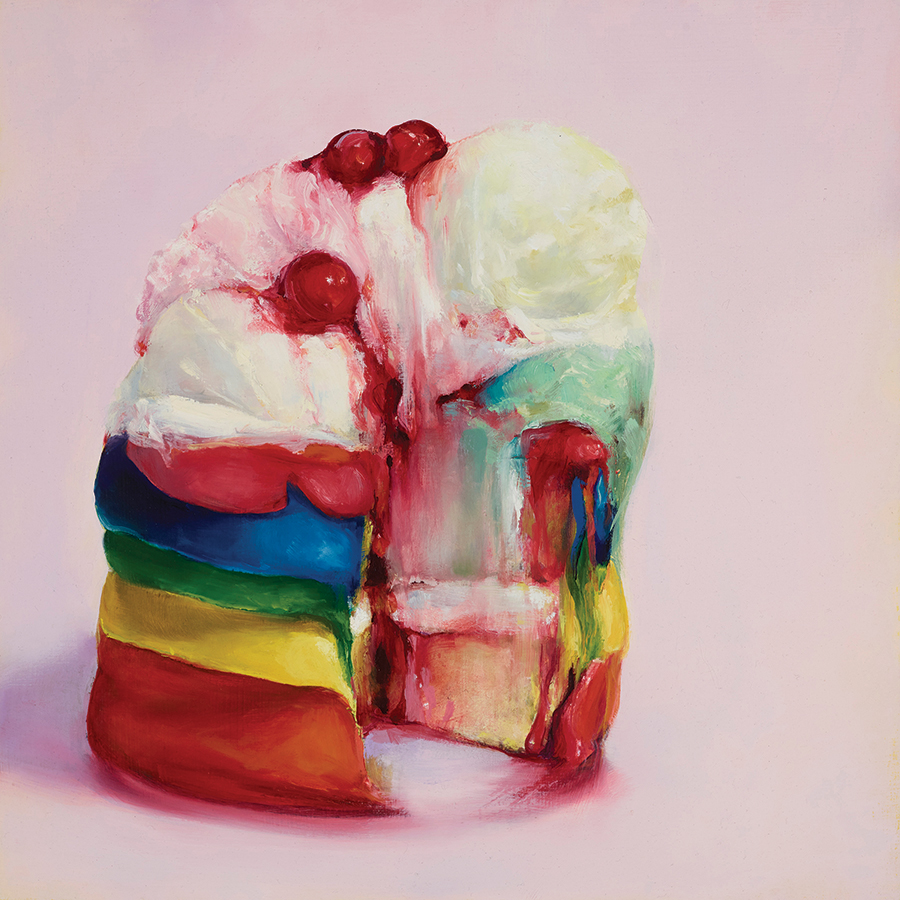
Looking for a sugar buzz without the guilt? Then head to GreenHill (200 North Davie Street) to have a gander at Sweet, which opened last month. On view through July 14, the exhibition explores sweet and processed foods as pop culture bellwethers through the paintings of Rachel Campbell, Bethany Pierce and Stacy Crabill, and multimedia installations of Kristin Baumlier-Faber, Jillian Ohl, Paul Russo, among others. Look for related activities, such as discussions of food, artists talks, and a food-and-art party on July 13, featuring cake-decorating demos, still-life painting, vegetable carving, food fonts — and as you’d expect, tasty eats. Info: greenhillnc.org.

Ploughed Shares

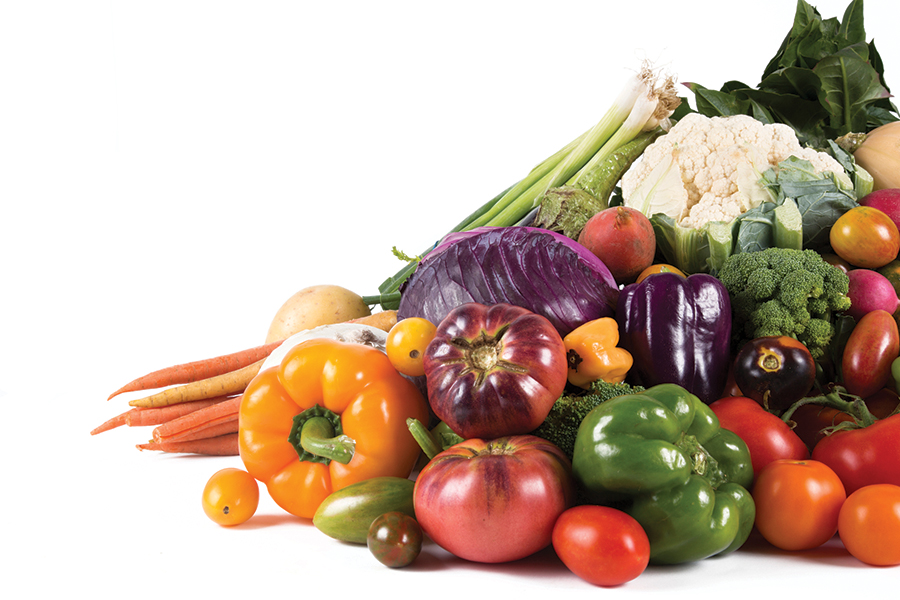
So you got a little carried away planting tomatoes, zucchinis, green beans and peppers, and now that you’ve picked ’em all, they’ve taken over your kitchen counter. How to avoid wasting perfectly good vegetables? With Share the Harvest, a program of the North Carolina Cooperative Extension of Guilford County. Taking a cue from Plant a Row for the Hungry, an initiative of the Garden Writers’ Association of America, the Extension calls on its extensive network — community gardens, food agencies, individuals, to name a few — to deliver any unwanted, fresh produce at various drop-off sites around the county. Once it’s collected and sorted at Interactive Resource Center, various hunger-fighting agencies, such as Triad Health Project, Backpack Beginnings and Mustard Seed Community Health will deliver the produce to those in need. Drop-off sites will be open from June 3 to September 30. For a complete list, go to: sharetheharvestguilfordcounty.org.

Little Boys Blue

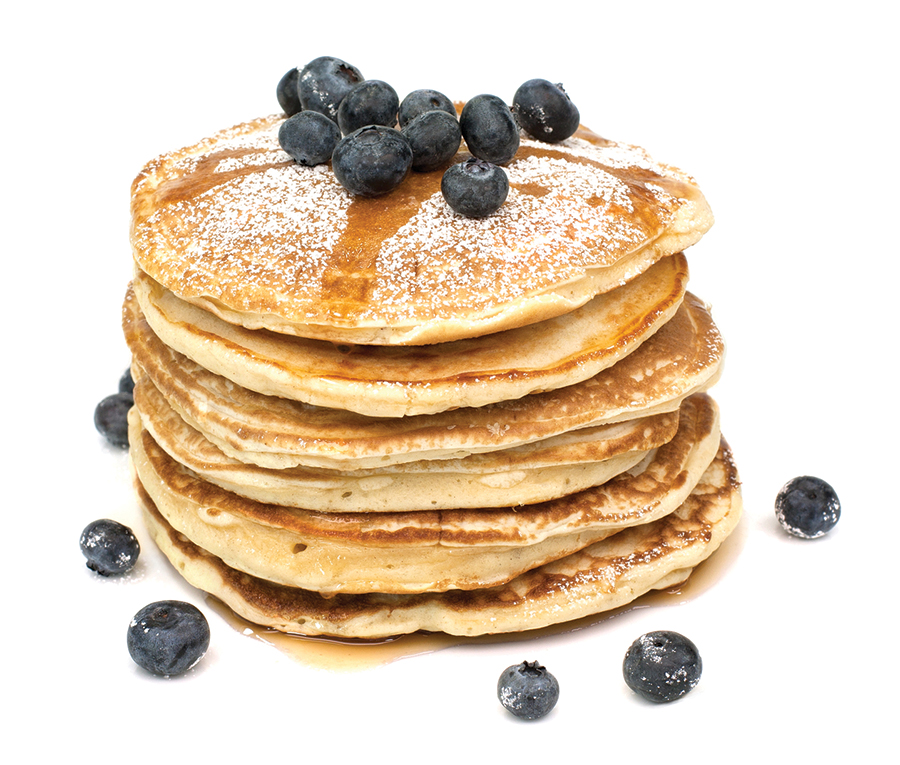
Meaning, Chef Tim & Clay, who will preside over Blueberry Pancake and Celebration Day on June 22 at Greensboro Farmers Curb Market (501 Yanceyville Street). Just think about all those antioxidants coursing through your veins — all from the humble, tiny, just-plucked globes of blue fruit. Never mind the fact that they’ll be sizzling in a sea of batter on a butter-coated griddle and smothered in a layer of thick, gooey syrup oozing from a carafe; they’re the perfect salute to the lazy, hazy days of summer. So stock up on a shortstack and enjoy! Info: gsofarmersmarket.org.

Who’s Your Crawdaddy?

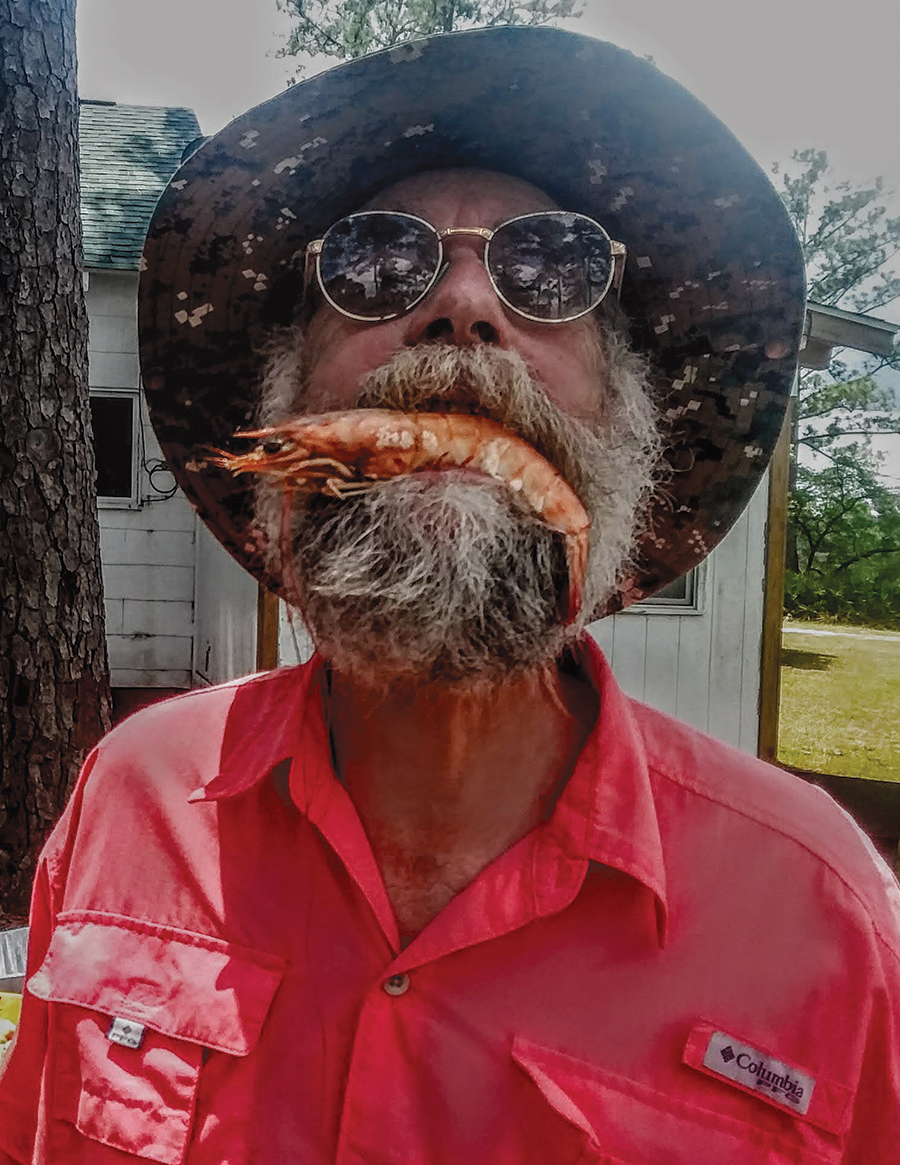
You are! That is, if you’re an early bird at the Piedmont Triad Farmers Market (2914 Sandy Ridge Road, Colfax), which is hosting a Crawfish Boil on June 15. Starting at 10 a.m. until the crustaceans run out, you can purchase a minimum of one pound of crawfish cooked in Cajun seasonings or five pounds of fresh, uncooked critters (there’s a limit of 25 pounds per person). Vendors will accept cash only, and you’ll need a cooler for carrying home this delicacy. And when it’s time to spread out your feast and laisser les bons temps rouler, we dare you to suck the heads after you’ve scarfed down the tails. Info: ncar.gov.

Hogs and Heads

That’s code for beer and barbecue. On June 15,
Little Brother Brewing and smoke master Skip Purcell will team up to explore the nuances of these beloved American classics at Adult Cooking: Brews and ‘Cue Dinner, hosted by Greensboro Children’s Museum (220 North Church Street). Learn about regional differences in barbecuing meat, and sample pairings of three meats and beers before sitting down to a good ole, NC-style pig pickin’ with sides. We can hear you squeal with delight. Participants must be 21 or older to register at gcmuseum.com.

Dolled Up

One lump, or two? Regardless of how you prefer your cuppa — sipping it with pinkie extended or not — you’ll still be doing your part to preserve our local history by joining in the Dolly and Me Tea (O.Henry Hotel, 624 Green Valley Road). Benefiting the Greensboro History Museum, the tea welcomes families — and their favorite dolls — while an interpreter in the guise of Greensboro’s own favorite doll, Dolley Madison, makes the rounds. There will be craft stations, storytelling, tasty eats of course, and a silent auction — all in the name of keeping the Gate City’s past alive. Tickets: (336) 373-2982 or greensborohistory.org.

Ogi Sez

Ogi Overman

With apologies to Rodgers & Hammerstein and anyone who performed in their musical Carousel, June really is bustin’ out all over. The evidence is everywhere, but for our purposes, it’s at the music venues in and around the Triad, both indoor and outdoor. So take in a show or three and celebrate the season.

• June 6, Ramkat: If I were limited to one show and one show only this month, I must say that Shinyribs would be it. The Austin-based octet is the personification of the aforementioned celebration of life. Call it country-soul or swamp-funk or whatever, just don’t call in sick when this no-holds-barred band is within driving distance.

• June 14, Carolina Theatre: Did you catch last month’s 60 years of Motown special on TV? If you didn’t (or did) there’s also a road show with a similar theme, titled Forever Motown. It features no fewer than seven vocalists, including original Spinners lead singer G.C. Cameron and former Temptations lead singer Glenn Leonard. It hits all the highlights, from Marvin to Smokey from Diana to Stevie, and then some.

• June 19, Carolina Theatre, Durham: I wouldn’t run folks down to Durham for just any act, but when it’s Steve Earle I have to make an exception. In my book he’s among the finest of a small handful of living American songwriters. His ability to find humor and meaning in the gut-punches of life puts him in that elite space inhabited by Jackson Browne, Rodney Crowell and few others.

• June 22, Greensboro Arboretum: Time to break out the faerie wings and funky costumes for the 15th annual Summer Solstice celebration. While hardly contained to a musical event, it nonetheless features eight big acts on three stages, headlined by Soul Central and including Crystal Bright and the Silver Hands. Prepare to be glittered.

• June 27, LeBauer Park: The Children’s Home Society Beach Blast has been going strong for 16 years and has become a downtown after-work institution. The lineup is killer again (check local listings) but they may have saved the best for last with the Tams. I feared that when Joe Pope died, so would the Tams, but I’m happy to report that I was way wrong. With Little Red at the helm, they put on a show every bit as good as the Castaways in 1969. Millennials, ask your parents.

Scuppernong Bookshelf

Chow Time!

The culinary future reveals itself in several June releases

Compiled by Brian Lampkin

We’re in luck! June brings us dozens of new books on cooking, food and the culinary life. You may not yet think of algae as a food source, but maybe we can change your mind. And do you find yourself collecting cookbooks without ever using the recipes inside? We have a solution: The booksellers at the store at which you purchased said cookbook would love to taste your talents! Drop off a dish (at your convenience, of course).

June 4: The Truffle Underground: A Tale of Mystery, Mayhem, and Manipulation in the Shadowy Market of the World’s Most Expensive Fungus, by Ryan Jacobs (Clarkson Potter, $16). The New York Times says “Jacobs is an unstoppable and captivating guide through the dark underbelly of the world’s most glamorous fungus. This is the ultimate truffle true-crime tale.”

June 4: Daily Bread: What Kids Eat Around the World, by Gregg Segal (Powerhouse, $40). As globalization alters our relationship to food, photographer Gregg Segal has embarked on a global project asking kids from around the world to take his “Daily Bread” challenge. Each child keeps a detailed journal of everything he or she eats in a week, and then Segal stages an elaborate portrait of them surrounded by the foods they consumed. The colorful and hyper-detailed results tell a unique story of multiculturalism and how we nourish ourselves at the dawn of the 21st century.

June 4: The Fate of Food: What We’ll Eat in a Bigger, Hotter, Smarter World, by Amanda Little (Harmony, $27). Climate models show that global crop production will decline every decade for the rest of this century due to drought, heat and flooding. Water supplies are in jeopardy. Meanwhile, the world’s population is expected to grow another 30 percent by mid-century. So how, really, will we feed 9 billion people sustainably in the coming decades? “What we grow and how we eat are going to change radically over the next few decades. In The Fate of Food, Amanda Little takes us on a tour of the future. The journey is scary, exciting, and, ultimately, encouraging,” writes ” Elizabeth Kolbert, Pulitzer Prize-winning author of The Sixth Extinction.

June 11: Slime: How Algae Created Us, Plague Us, and Just Might Save Us, by Ruth Kassinger (Houghton Mifflin, $26). There are as many algae on Earth as stars in the universe, and they have been essential to life on our planet for eons. Algae created the Earth we know today, with its oxygen-rich atmosphere, abundant oceans and coral reefs. Crude oil is made of dead algae, and algae are the ancestors of all plants. Today, seaweed production is a multibillion dollar industry, with algae hard at work to make your sushi, chocolate milk, beer, paint, toothpaste, shampoo and so much more. In Slime we’ll meet the algae innovators working toward a sustainable future: from seaweed farmers in South Korea and scientists using it to clean the dead zones in our waterways, to entrepreneurs fighting to bring algae fuel plastics to market.

June 11: Incredible Vegan Ice Cream: Decadent, All-Natural Flavors Made with Coconut Milk, by Deena Jalal (Page Street, $21.99). Deena Jalal is the owner and founder of FoMu Ice Cream, a plant-based frozen treat company with multiple shops in the Boston area and distribution to stores along the East Coast. “Deena’s simple yet superbly flavorful ice creams are the perfect solution for a guilt-free indulgence!” says Rebecca Arnold, founder and owner of Whole Heart Provisions.

June 25: Drive-Thru Dreams: A Journey Through the Heart of America’s Fast-Food Kingdom, by Adam Chandler (Flatiron, $27.99). Most any honest person can own up to harboring at least one fast-food guilty pleasure. In Drive-Thru Dreams, Adam Chandler explores the inseparable link between fast food and American life for the past century. The dark side of the industry’s largest players has long been scrutinized and gutted, characterized as impersonal, greedy, corporate, and worse. But, in unexpected ways, fast food is also deeply personal and emblematic of a larger-than-life image of America.

June 25: The Peach Truck Cookbook: 100 Delicious Recipes for All Things Peach, by Stephen K. Rose & Jessica N. Rose (Scribner, $28). From first bites to easy lunches, from mouth-watering dinner dishes to sumptuous desserts, The Peach Truck Cookbook captures the Southern cooking renaissance with fresh, delectable, orchard-to-table recipes that feature peaches in every form. Whether you’re craving peach pecan sticky buns, peach jalapeno cornbread, white pizza with peach, pancetta and chile, or peach lavender lemonade — or have always wanted to try your hand at making a classic peach pie— Stephen and Jessica have you covered. Many of Nashville’s most celebrated hotspots and chefs, including Sean Brock, Lisa Donovan, and Tandy Wilson, have contributed recipes, so you’ll also get a how-to on cult menu items such as Burger Up’s Peach Truck Margarita.  OH

Brian Lampkin is one of the proprietors of Scuppernong Books.

O.Henry Ending

Mama’s Cookin’

Sweet memories of the most creative home chef who ever lived

By David C. Bailey

I was 16 by the time I appreciated what an incredible cook my mother was — thanks to the woman who would become my own personal chef.

“Duck sandwiches?” Anne responded incredulously when I told her what we were having for our picnic lunch, which also happened to be our first date.

“Yeah, and deviled eggs with watermelon-rind pickles and Mom’s chocolate chess pie for dessert,” I went on. In truth, I worried the repast might be a bit scant. Mom often fried chicken for picnics and packed her signature country ham biscuits, plus, if you were really lucky, homemade pimiento cheese sandwiches. Not to worry. My mother’s sister, Rachel, had also packed a picnic for our double-date, my cousin Bill and his girlfriend, Mary. She’d rustled up some of her tangy sweet-and-sour German potato salad laced with smoked side meat. Like Mom, Rachel blended lessons learned from her Pennsylvania Dutch upbringing with what she knew we Southerners loved. Add some of her simple but simply delicious sugar cookies, and our picnic made a pretty decent feed. (And yet, I remember the sweetest treat of all was that kiss I stole underneath the cotton blanket we tented over our heads against the rain.)

I now realize that my mother — and excuse me for expressing what may be a painful truth to you — was a way better cook than anyone else’s.

Look back on your own youth. Did your mom ever cook you duck à l’orange or Indian curry served with homemade chutney? OK, so maybe she did, but was she also able to Southern-fry chicken so crisp that it was a shame to smother it in milk gravy? And did your mom also wrap quail in bacon and stuff them with chestnuts and mushrooms? Was every single meal she served accompanied by some form of hot bread, plus a homemade dessert? Did you — and do you still — regularly dream about your mom’s cooking?

Other cooks may shine at the holidays — and Mother’s sweet potatoes with black walnuts, her shoo-fly pie and her whole baked country ham or goose were by no means shabby. But what my mother excelled at was cooking every dish day-after-day with the utmost creativity and care. Greek meatloaf she’d seen in a magazine. Deep-fat-fried zucchini or okra. Exotic specialties like borscht that she’d plucked from her beloved 12-volume Woman’s Day Encyclopedia (A set I still cherish and use frequently).

As my wife once remarked with amazement after experiencing a typical fresh-from-the-garden summer lunch of freshly picked corn on the cob, green beans tangled with bacon, fresh sliced tomatoes, cracklin’ cornbread, plus some leftover pork chops, “Every meal at your house is an event.”

My parents were foodies way before that word had any currency. My cousins would come and peer in wonder into our cupboard containing olives, pâté, anchovies, capers, four or five types of mustard, even caviar on occasion. Dad was a Belk store manager who traveled to New York City regularly and brought home shopping bags of pastrami, pickles and smoked fish, along with epic tales of lobster dinners and elaborate, multicourse Chinese feasts, which Mom would replicate, like his favorite, angels-on-horseback (oysters wrapped with bacon and broiled with onions and hoisin sauce). She fully embraced the ’50s hot trend of cooking what was then termed international or gourmet food, but she never abandoned the comfort food she — and Daddy — grew up eating on the farms they were raised on during the Depression — chicken-fried steak, sauerbraten, buckwheat cakes, chicken and dumplings, cider-braised rabbit and apples, all served with a heaping helping of their tradition, passed on from her mother and grandmother.

But her real creativity came into play with leftovers. As she would be piling bowls from the fridge onto the counter, my sister would say, “Uh oh, time for must-go soup.” Quoting my grandmother, Mom would counter,  “Better bad belly burst than good food waste.” Roast beef hash. Spicy gumbo from leftover okra and other vegetables. Stuffed baked potatoes or green peppers. And her pièce de résistance: schnitz un knepp from leftover ham paired with apples and dumplings.

Mom was not a demonstrative person. She wasn’t huggy, and even her filial kisses might be termed polite and correct. She said, “I love you” to each of us regularly, but with just a tad of awkwardness. This despite the fact that she was a hopeless romantic who gobbled up Hemingway, Fitzgerald and massive Russian novels one after another.

Dad would finish his favorite dessert, mopping up one of Mom’s fluffy biscuits in a slurry of molasses, give a satisfied groan, push his chair away from the table and say, “Aren’t we glad we married her,” maybe the most affectionate thing I ever heard him say to Mom.

“Nothing says lovin’ like something from the oven,” the Pillsbury Doughboy used to say, and Mom’s cooking said it best. OH

O.Henry’s Contributing Editor David Claude Bailey learned to cook late in life at Print Works Bistro after working his way up from dishwasher to backline chef: cueconfessions.wordpress.com/2009/04/

Birdwatch

Shy and Dry

This time of year, the fields are teeming with Killdeer that call their own name day or night

By Susan Campbell

The killdeer is a small, brown-and-white shorebird that breeds in the Sandhills and Piedmont of North Carolina but is widespread throughout North America. It can be found here year round in the right habitat, but that doesn’t mean you should go looking for it in wetlands. Despite its classification as a shorebird, most of the population lives away from the water’s edge. In fact, for egg-laying, the drier the spot, the better! And in truth, sandy soil like that in the Sandhills, is not that much different from the beaches, where one would expect a shorebird to nest.

This robin-sized bird, not surprisingly, gets its name from its call: a loud “kill-deer, kill-deer” which can be heard day or night. During migration, individuals frequently vocalize on the wing, high in the air. Adults will also circle above their territory calling incessantly in early spring.

On the ground, killdeer are a challenge to spot. They blend in well with the dark ground and practically disappear against the mottled background of a tilled field or a gravel surface. Killdeer employ a “run-and-stop” foraging strategy as they search for insect prey on the ground. As they run, they may sir up insects, which will be easily gobbled up as the birds come to a quick halt. Although they live in close proximity to humans, they are quite shy. Killdeer are more likely to run than fly if approached. When alarmed, they frequently use a quick head bob or two. This may be a strategy to make the birds seem larger than they appear.

During the winter months, flocks of killdeer concentrate in open, insect-rich habitat such as ball fields, golf courses, or harvested croplands. Come spring, pairs will search out drier substrates, preferring sandy or rocky areas for nesting. They may even use flat, gravel rooftops. The female merely scrapes a slight depression where she lays four to six speckled eggs that blend in with the surroundings. She will sit perfectly still on her nest and incubate the eggs for three to four weeks. If disturbed by a potential predator, the female killdeer will employ distractive displays to draw the intruder away from the eggs. This may go so far as to involve feigning a broken wing. Calling loudly and spreading out her tail, the mother bird makes herself as noticeable as possible, limping along and dragging a wing on the ground. This “broken wing act” can be very convincing, giving the predator the idea that following the female will result in an easy meal. Once far enough from the nest, the killdeer will fly off, not returning to the eggs until she is convinced the coast is clear. Should distractions by the adults not be effective, the pair will find a new nesting location and begin again. The species is a very determined nester. Killdeer are capable of producing up to three broods in a summer.

Normally, the eggs hatch almost all at the same time. As soon as they have dried off, the downy, long-legged young will immediately follow their mother away from the nest to a safer, more protected area nearby. They will follow her around for several weeks, being fed and brooded along the way. Once they are fully feathered, the young will have learned not only how to escape danger but how and where to find food for themselves.

So, if you hear a “kill-deer” over the next couple months, stop and look closely: you may be rewarded with a peek into the summer life of this fascinating little bird.  OH

Susan would love to receive your wildlife sightings and photos. She can be contacted by email at susan@ncaves.com.

Botanicus

Paw de Deux

Or as we say in the South, “Paw Paw”

By Ross Howell

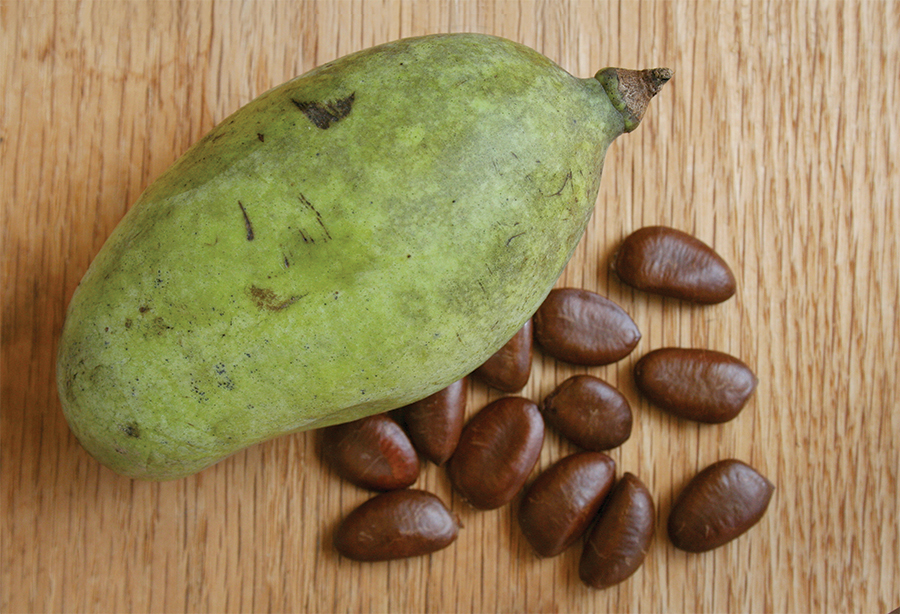
A simina triloba — a.k.a. pawpaw, papaw, paw paw, paw-paw, American custard apple, poor man’s banana, Quaker delight, hillbilly mango, Appalachian banana — is a small, deciduous tree native to the eastern United States and Canada, growing as far west as Nebraska. Mature trees can reach a height of 35 feet, producing maroon-colored flowers and sweet-tasting, aromatic fruit, the largest edible fruit native to North America, if you don’t count squash — and who other than the most persnickety of botanists would count squash as a fruit?

The pawpaw once enjoyed considerable popularity. Its earliest documented mention — according to Owen Native Foods of Cross Junction, Virginia, — is found in a 1541 expedition report of the Spanish explorer Hernando de Soto, who discovered Native Americans cultivating the plant east of the Mississippi River.

During the Lewis and Clark Expedition, 1804–1806, the adventurers consumed pawpaws during their journey. Chilled pawpaw fruit was a favorite dessert of George Washington at Mount Vernon, and Thomas Jefferson planted pawpaws at his home, Monticello.

The pawpaw has a folk tradition, too. As part of my elementary school education in the mountains of Virginia, I learned to sing this little ditty:

Where, oh where is pretty little Susie? [repeated three times]

Way down yonder in the pawpaw patch.

Pickin’ up pawpaws, puttin’ ’em in her pocket, [repeated three times]

Way down yonder in the pawpaw patch.

Important safety tip! Pretty little Susie’s “pocket” was an apron. Pawpaw fruit is remarkably mushy when ripe, so you don’t want to tuck one in the hip pocket of your new Wranglers.

In the wild, pawpaws are understory trees, flourishing in fertile bottomland under the shade of taller trees, often propagating by sending up new saplings from their roots. So they’re often encountered in a “patch,” as in the lyrics of my boyhood song.

But there are exceptions.

Dara Dobson, who owns 7 Pines Native Plant Nursery near Defuniak Springs, Florida, explains that “more mature pawpaw trees are better able to stand strong sunlight.” Charlie Headington, a professor in UNCG’s Master’s in Applied Arts & Sciences program and advocate for low-maintenance, organic, edible and diverse community gardens, notes there are two pawpaws growing in full sunlight at Greensboro Montessori School on Horse Pen Creek Road. “They’re 10 to 12 feet tall and are located to the left of the school building in a terraced garden,” Headington says. “You can’t get in the gate but you can look at them over the fence that has scuppernong grapevines woven through it.

“There are two smaller pawpaws in the Meeting Place garden at the corner of Smith and Prescott streets,” Headington adds. “They’re labeled for identification.”

In addition to sending up saplings from their root systems, pawpaws also reproduce by way of flowers and the big seeds their fruit encases.

To my knowledge there are no songs celebrating the fragrance of the pawpaw flower, and for good reason. They produce little to no odor at all, but what fragrance they do emit smells remarkably like roadkill. Alas, the trees’ leaves, twigs and bark are also foul-smelling, loaded with natural insecticides called acetogenins. Rarely are their leaves eaten by rabbits or deer.

But they’re quite tasty to the palates of zebra swallowtail butterfly larvae. Not only do the larvae enjoy protection from the predation of birds and other critters by virtue of the acetogenins they ingest with the leaves, the spectacularly colored adult butterflies do, as well.

Raccoons, squirrels, opossums and other critters enjoy eating the ripe fruit of the pawpaw, thus helping spread its seed in the forest.

“Opossums are traditionally the raiders of the pawpaw patch,” says Greensboro resident David Waller, professor emeritus of the department of Biological Sciences at Kentucky State University, “but I bet bears were more important to the tree in pre-settlement America.”

Waller first heard about the pawpaw during a discussion with a KSU botanist friend about guanabana, a fruit found in Mexico that’s a relative of the pawpaw. Later he discovered a pawpaw patch thriving in a marshy area on the KSU campus.

“On sunny days, it was so pleasant to visit there and be in the bright green light under the huge leaves close overhead,” Waller says. “In spring the shocking, big, brown-petaled flowers popped out of woody branches, then came the lumpy-sausage fruits, fragrant when ripe in late summer — all surprisingly exotic, yet it’s a native tree!”

KSU has the only full-time pawpaw research program in the world. Focusing on issues like propagation, genetic diversity, orchard management, and techniques to improve fruit ripening and transport, the university hosts an international festival, which last year drew representatives from 19 states and European countries including Holland, Slovenia and Germany.

National Public Radio’s Ally Schweitzer, writing about a couple who’d planted a pawpaw orchard in rural Maryland, notes that with consumers’ increasing desire for fresh, locally produced foods, farmers markets and trendy breweries and eateries have “embraced the fruit.” These developments have even earned the pawpaw a new alias — “hipster banana.”

Interested in learning more about the resurgent pawpaw?

The 21st Annual Ohio Pawpaw Fest 2019 is scheduled for September 13–15 near Lake Snowden, Albany, Ohio. Waller has attended the festival a couple of times. “It’s an enthusiastic social event with plenty of pawpaw information, souvenirs and some saplings in pots to plant in your own back yard,” he says. “Along with other nature stuff by local groups.”

Closer by is the N.C. Cooperative Extension’s North Carolina Pawpaw Festival, which takes place in Forsyth County, usually on the last Saturday in August. While an event isn’t planned for 2019, vendors at past N.C. festivals have offered seeds and saplings for planting, ripe fruit for eating, along with samples of pawpaw and spiceberry jam, pawpaw gelato and pawpaw beer! You can follow the N.C. Pawpaw Festival on Facebook using the handle @ncpawpaw.  OH

Ross Howell Jr. planted a native pawpaw in a wet area at the far end of the lot at his wife Mary Leigh’s house in Florida. There was no discussion about the fragrance of pawpaw flowers before he planted the sapling, and he hopes there never will be.

Drinking with Writers

One Man’s Good Advice

Clyde Edgerton and the art of negotiation

By Wiley Cash     Photographs by Mallory Cash

In 2011, my wife and I were living in West Virginia when I learned that my first novel was going to be published. My editor asked me to reach out to any well-known authors I knew to see if they would offer a blurb for the book jacket. The problem? I didn’t know many well-known authors, so I began sleuthing for email addresses. Clyde Edgerton’s was one of the first I found. I wrote to him and told him that I, like him, was a North Carolina native who had written a North Carolina novel, and I wondered if he would be willing to give it a read and consider offering some kind words. He not only read my novel and offered some kind words that ended up on the front of the hardcover, he offered some criticism as well. There was one particular scene in the novel that he felt went on a little too long, and he suggested some edits. I made the edits; they were the last I made before the novel went to print, and they improved the novel in ways I never could have imagined. I had never met Clyde Edgerton. I had never been one of his students. He was just being kind, giving more of his time and talent than I ever expected.

Clyde’s kindness and giving of time continued in the spring of 2012 when he appeared at Pomegranate Books in Wilmington, North Carolina, to attend one of the first events of my book tour. I had not expected him to be there, and it was a little like shooting free throws while Michael Jordan watched from the stands, but I will never forget how deeply honored I felt. At the conclusion of that event, I spoke a little about a new novel that I was working on, and I expressed the difficulty I was having with the ending. A few days later, I received an email from Clyde, sharing his ideas about how to end novels in ways that satisfied both writers and readers.

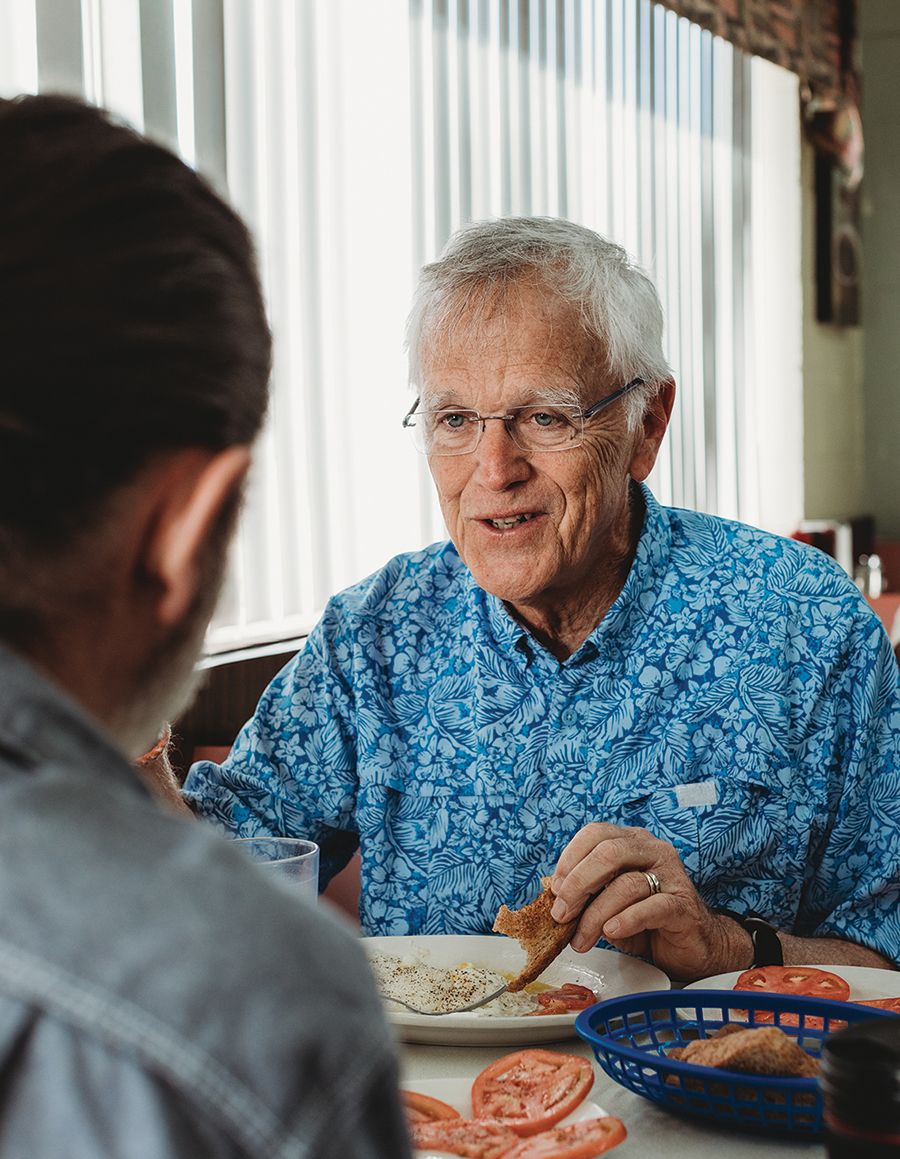
Clyde and I struck up a friendship after my wife and I moved back to North Carolina and settled in Wilmington in 2013. He christened our second child. Our kids go to the same school. We have shared the stage with other authors at literary events and fundraisers around the South, and over the past few months we have fallen into a routine of eating omelets and biscuits and gravy and sharing sliced tomatoes in a booth at White Front Breakfast House at the corner of Market and 16th Street.

That was where we were sitting recently when I sought Clyde’s advice about a particularly difficult ethical situation I was facing in my professional life. Aside from the respect I have for Clyde as a writer, it is exceeded only by my respect for him as a citizen and altruist. After asking for his advice, Clyde shared some wisdom he had gleaned from a local reverend, friend and ally named Dante Murphy.

“Don’t get angry at people in these situations,” he said. “When it becomes personal that anger can poison you. Get angry at institutions. You can change an institution. It’s harder to change a person.”

Clyde knows what he is talking about. For the past few years he has been one of a handful of citizens leading the charge to uncover racial inequities in the New Hanover County School System, something he first encountered while tutoring students at Forest Hills Elementary. The school had a Spanish language immersion program, and while the student body was 46 percent African-American, every single one of the 40 slots in the language program had been taken by white students before open enrollment even began. Since then, the former principal and school system have given a number of excuses — some laughable, some offensive — about the racial disparity in the program. None of it has deterred Clyde and a group of citizens from following leads, learning of other instances of discrimination or wrongdoing, and meeting with parents, school board members and city and county employees.

None of the students on whose behalf Clyde is working have ever met him. They are not his children, but he is working for them regardless. It is similar to the compassion and care he showed me all those years ago, but the kindness he showed me never got him banned from county school property.

How does Clyde address these issues with school leaders? The same way he approaches finding a satisfying conclusion to a piece of fiction he is writing.

“Some writers think that story comes from conflict,” he says. “I don’t think that’s always true. Conflict can be impassable, and there’s no story with an impasse. I think good stories come from negotiation. Good stories happen when everyone can see they have a stake in a good outcome.”

For a good outcome, whether in a community or a novel or a literary friendship, negotiation is key. Clyde, please pass the sliced tomatoes.   OH

Wiley Cash lives in Wilmington with his wife and their two daughters. His latest novel, The Last Ballad, is available wherever books are sold.

Heart of Red Oak

Beer — and Bill Sherrill — are proof that God loves us and wants us to be happy

By Jim Dodson  • Photographs by Laura Gingerich

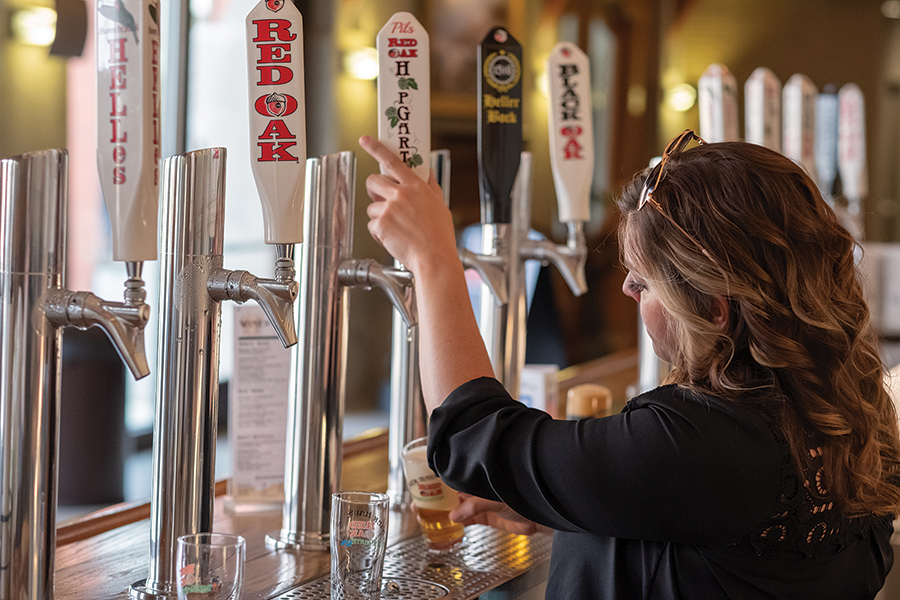
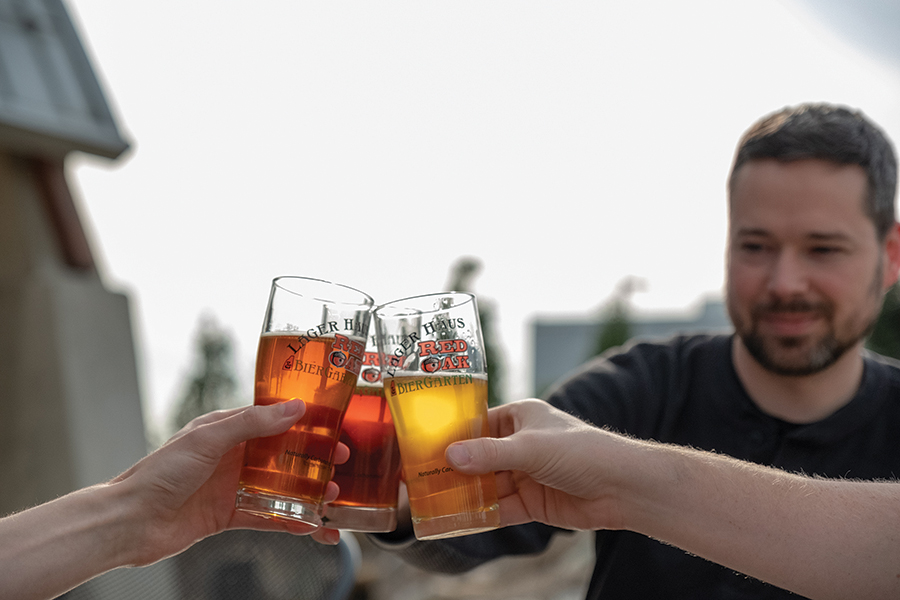
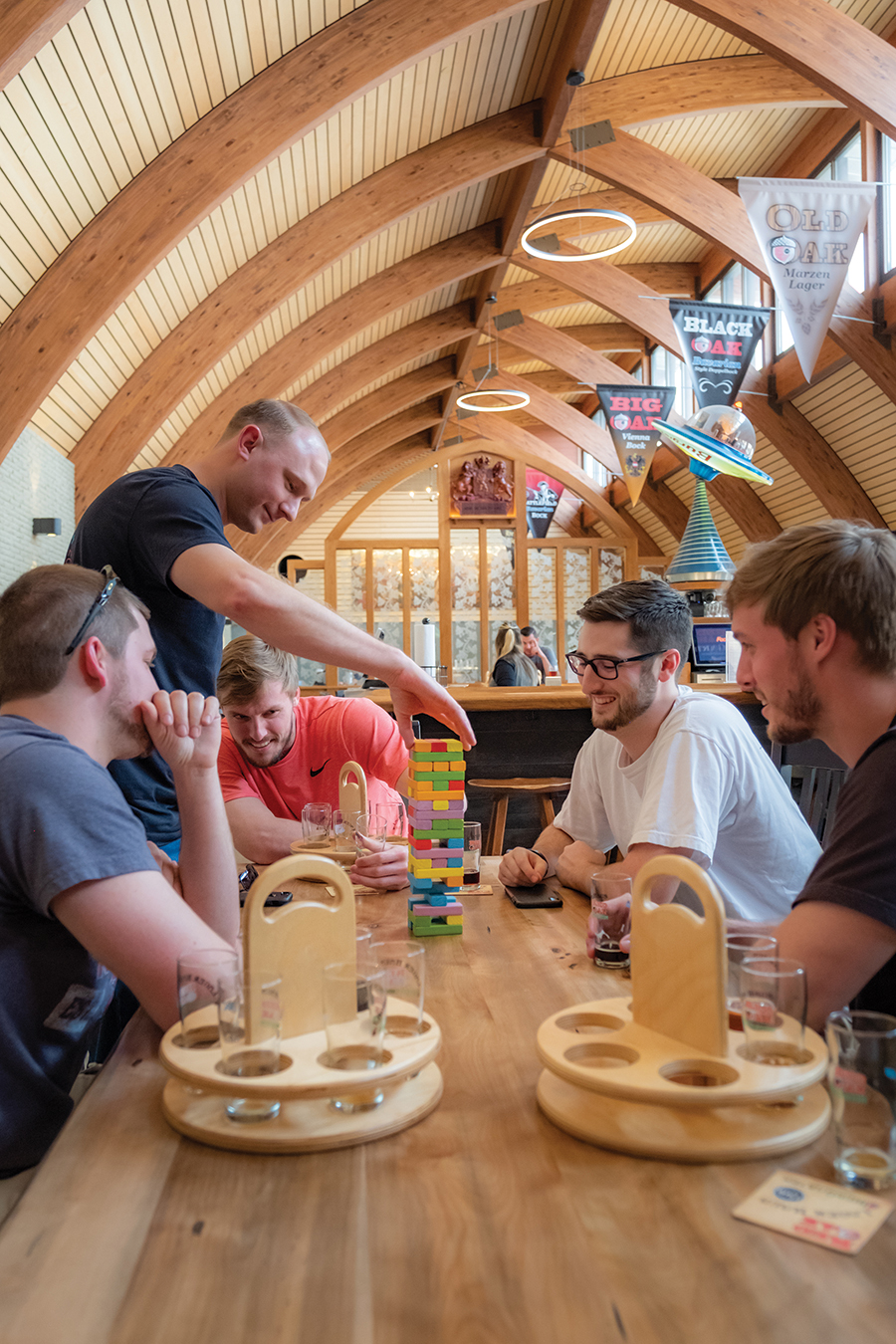
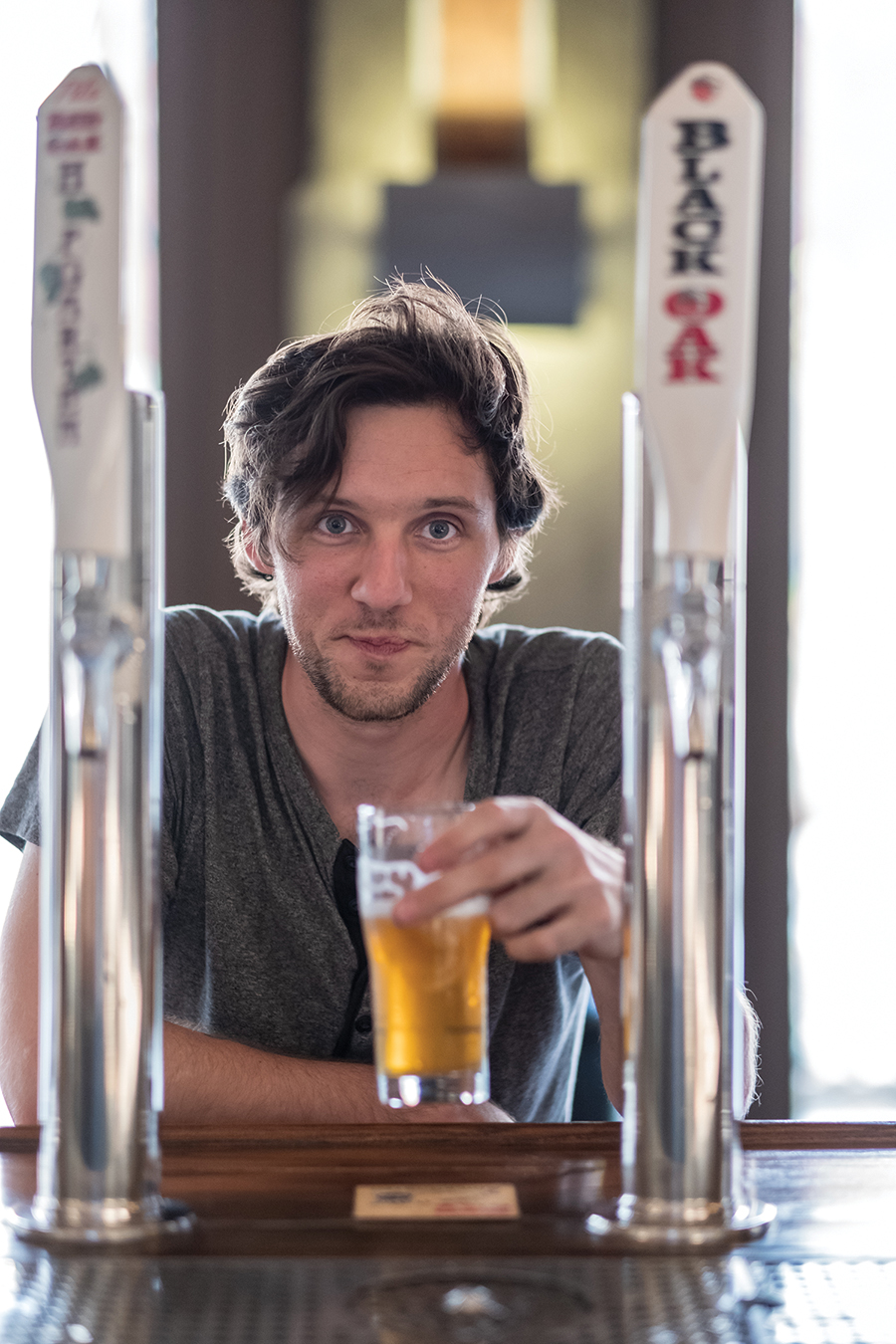
On a recent warm spring Friday evening, the bar at Red Oak Brewery’s spanking new Lager Haus and its newly completed Biergarten are filled with happy customers and an air of cheerful gratitude that another workweek is in the books. It’s time to hoist a cold Red Oak or one of half a dozen house-crafted beers on tap to toast the start of a warm and welcome weekend. 

At least that’s the feeling of the colorful owner and creator of this festive little piece of Munich, Germany — a pretty happy guy in his own right. Earlier in the day, Bill Sherrill, arguably one of the godfathers of artisan brewing in North Carolina, received some very good news about the future of crafted beer in the state.

A friend who works as a lobbyist in the North Carolina General Assembly phoned to let him know that a lengthy campaign led by Sherrill and other craft brewers to change a state law that prohibited them from producing and selling more than 25,000 barrels of beer without contracting with a wholesale distributor had succeeded.

Under the revised law, the state’s 200 craft brewers could now make and distribute 50,000 barrels on their own. It’s a victory not only for thirsty beer drinkers across the state but also a shot in the arm for smaller, independent craft brewers like Sherrill who’d essentially bumped up against the 25,000-barrel cap, limiting further growth without turning their beer over to a distributor, who probably wouldn’t keep, for instance, Red Oak refrigerated during transport as classic German lagers should be.

“It’s definitely a reason to celebrate because this will mean more jobs in the long run and be great for the state’s economy,” says a visibly pleased Sherrill. His illuminated sign by his Red Oak brewery hard by the southern flank of I-40/85 in tiny Whitsett has become something of a roadside icon and a growing attraction in recent years, underscored by the opening last fall of the brewery’s capacious Munich-style Lager Haus.

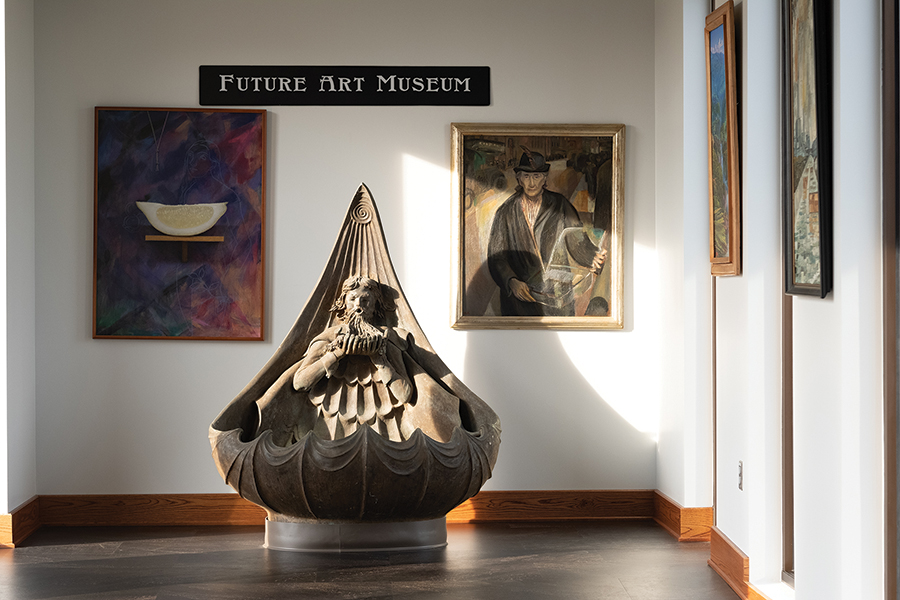
The aforementioned Biergarten, with its neat communal tables and fire pit beneath a grove of lacy bark elms, is simply the latest addition to meister Sherrill’s complex. Next up is a 10,000-square-foot office and art gallery that will showcase major North Carolina and Southern visual artists when completed sometime late this year or early next. In the meantime, his popular Lager Haus features its own eclectic works of art in the form of a 17th-century wedding settle (bench) that was given in 1640 to the Earl of Northumberland, a pair of royal family crests from England’s House of Windsor and the Royal House of Holland, a 500-year-old coat of arms from the German Millers Guild, oil paintings from ice skating legend Dick Buttons’ private collection, antiques and an illuminated “Burgie” (i.e. a vintage Burgermeister Beer sign) from the Sputnik years rotating over the bar.

“I found that during an art crawl 21 years ago in Scottsdale, Arizona,” relates Sherrill over the convivial din of his patrons. “Pretty special, isn’t it? It seems to make people happy. That’s the point.”

Indeed it seems to be one of many reasons the festive Lager Haus has become both a roadside destination and a routine gathering spot for everything from local civic groups to book clubs, family reunions and alumni evenings — even a Bible class that meets there every other Thursday.

“We have probably the widest range of patrons imaginable,” says director of customer services, Ashley Justice, with a laugh. “I’m talking about lawyers from Raleigh, college students and professors from Greensboro and Chapel Hill, business folks and Harley bikers.” Plus, she says, there are game boards for families, NASCAR on Sunday, musical Bingo on Wednesday evenings and trivia nights on Thursdays. “We host events for the sheriff’s department and local hospitals. This really is an Old World place where everyone feels welcome.”

Dogs are welcome too — treated to their own special watering holes — while  gourmet food trucks feed their masters on a rotating basis. A highlight of this ongoing festive calendar is the gifted German oom-pah band that shows up annually to perform on weekends through Oktoberfest. Sherrill also plans to add an authentic Brat Stube (Kiosk) selling German sausage.

All three entities — craft brewery, Lager Haus and art gallery — are the kind of yeoman dreams Bill Sherrill has spent a career bringing to life. In 1979, Sherrill opened Franklins Off Friendly with a talented chef named John Berres and a charismatic young house manager named Dennis Quaintance, the three of them creating one of the Gate City’s hottest restaurants over the next decade and a half. From there, Quaintance went on to start a successful wine brokerage and later partnered with construction guru Mike Weaver to open Lucky 32 restaurant; the two would later bring a pair of award-winning luxury boutique hotels, the O.Henry and Proximity, to life.

“I can’t imagine what my life and many others would have been like without Bill,” says Quaintance, who met Sherrill when he was 17 and followed him east after working for him in hotels and restaurants in California and Seattle. “He is such an original thinker. For Bill, it’s not about the money. It’s about creating things that make people happy. Bill doesn’t conform to any formula. He is completely unconventional and creates what makes him happy and shares that with the people around him.”

In 1989, after expanding the footprint of Franklin’s to include a Top 100 wine cellar, Sherrill decided to shut it down and concentrate on making the kind of German lager he’d developed a taste for while attending high school in Switzerland and traveling around the world for a full year after finishing Duke University. He went on to earn a master’s degree in hotel management at Cornell University.

His quest to find the perfect brew and the kind of equipment that could make the Bavarian-style amber lager he had in mind took him on a tour of West Coast craft breweries and across Germany before he settled on equipment found at Chesapeake Brewing Company.

He brewed his first beer in 1990, selling it mainly for the next year through his small chain of bar and grills in Winston-Salem, Chapel Hill and Charlotte.

In 2008, Sherill opened his Red Oak Brewery on a patch of family land in Whitsett, officially the state’s second-oldest craft brewing company, with eight employees and an unpasteurized beer that was so fresh it required refrigeration at all times. Today, the brewery occupies close to 30,000-square-feet and is closing in on 70 full- and part-time employees who seem to find Sherrill’s take of the Golden Rule in management style agreeable. “We have just three rules,” he notes — “Be honest, work hard and treat the customers the way you would want to be treated.”

His eight different beers are distributed as far west as Boone and Morganton, as far east as Little Washington and Calabash.

When it eventually opens, Red Oak’s art gallery will not only house a bounty of original works Sherrill has collected over decades from North Carolina and Southern artists, but also works he’s brought home from some of the 95 foreign countries he’s visited over the past half century. Among other things, he hopes the gallery will also serve as a place for seminars and round tables on the arts.

“I know it’s kind of crazy,” Sherrill allows while sharing a brew with several of his old friends from college days at Duke. “I mean, who would spend this kind of money on good beer and great art?”

He knows the answer to his own question, of course.

“Here,” he says with the Old World charm of a proud Biermeister. “It’s been a long week. Have another beer and relax.”  OH

Jim Dodson’s antidote to the brouhaha of publishing is a brew-ha-ha with one of Bill Sherrill’s craft beers.