It’s Her Churn

IT'S HER CHURN

It's Her Churn

For Shafna Shamsuddin, cardamom is the spice of life

By Cassie Bustamante

Photographs by Bert VanderVeen

Dessert is just a way to tell the stories,” says Shafna Shamsuddin, creator of her own cardamom-infused and globally-inspired ice cream company, Elaka Treats. Even though she’s inspired by the Indian traditions of her childhood, she’ll tell you with a laugh that her own story doesn’t begin there.

“My story started at Williams-Sonoma,” Shamsuddin admits with an easy smile. Born and raised in United Arab Emirates by Indian immigrant parents, Shamsuddin, as well as her siblings, came to America for college. She began her studies at Purdue University in Indiana, studying psychology and Earth science. From the time she was a child, she had her sights set on becoming a psychologist. However, she was matched with her husband during her undergrad years and relocated with him to Gastonia. In the end, she earned her bachelor’s degree from UNC-Charlotte. From there, her plan was to enroll in a clinical psychology graduate program at Duke University. “But due to personal reasons . . .” she trails off, preferring to look forward instead of into the past.

After a moment, she picks back up. Pressure from her community was overwhelming and first loneliness and then restlessness followed. “Everyone advised that I should focus on my marriage,” she says. “I am not Indian enough for Indians because I am not born and raised there,” she says. “And I am not American either, so, it’s like, where do I belong?” So she put her goals on the back burner, “hoping that one day I could pick it up and go back.” But, little by little, she began throwing herself into all sorts of projects: “plumbing, electrical, carpentry — I’ve done all kinds of stuff.” She found herself often wandering through the glimmering displays of kitchen-and-entertaining merchandise at Williams-Sonoma. “The kitchen tools and gadgets really fascinate me,” she says.

But there was one small appliance in particular that she kept coming back to. “I used to see the Cuisinart ice cream maker and that always caught my eye.” However, she says, the price tag was too much for her wallet. After years of gazing at the machine in wonder, she says, “finally, one day, I was like I am going to make the splurge.”

That small and mighty Cuisinart has long since been retired, but it got Shamsuddin’s wheels churning. Her first endeavor with it was kulfi ice cream, a traditional frozen Indian treat flavored with pistachio, cardamom and saffron. While kulfi is generally a no-churn dessert, Shamsuddin gave it a whirl in her ice cream maker.

But all of that tinkering didn’t ease her homesickness. She started dreaming of the anything-but-frozen unnakai, a sweet treat from back home, “especially where my parents are from in India, from their home state of Kerala.” The labor-intensive dessert, according to Shamsuddin, is made of a mashed plantain that’s been stuffed with coconut, cardamom and cashew nuts, then deep-fried. And while the flavors indeed melt in your mouth, it was the ritual around it, tea time, that she was missing.

“I was really craving having that experience of not just having the treat, but the experience of getting together with people and family and relatives, and just sitting and chatting over tea and tea-time snacks,” she says wistfully. But, she adds, “I felt that it was really sad for me to go through that process and eat it alone.”
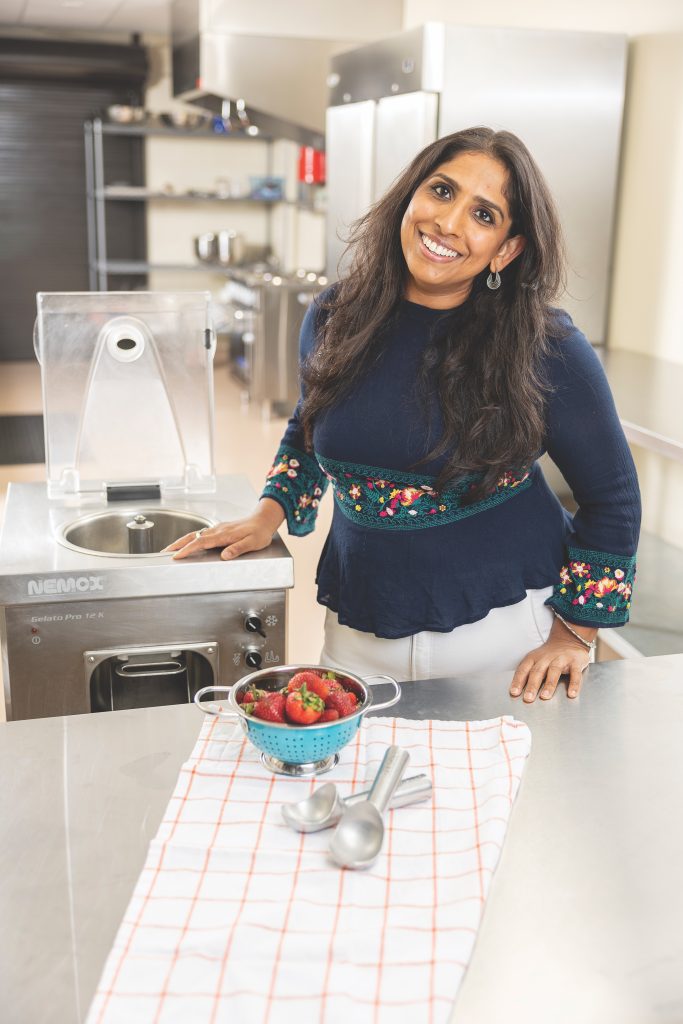
Shamsuddin wondered how she could take the unnakai flavors and create a frozen dessert that she could enjoy. An idea hit her: Use plantains as the base. “I knew I had something here,” she says.

She began testing out her confections on friends when she’d host dinner parties. The result? “Everyone loved it.” Shamsuddin found gratification in serving others. And watching people savor her creations filled her cup. “It’s something that gives me a lot of pleasure.”

Plus, she says, the Indian tradition she learned from her own mother is that, when you entertain, you make everything from scratch as a way to celebrate your guests’ presence at your table. As her dinner-party pals spooned in bite after bite, they confirmed what she’d suspected — she was indeed onto something.

By the early-2010s, Shamsuddin and her husband had settled in Greensboro and later that decade welcomed their only son, Zahin. But that desire to make her confections into something bigger kept nagging at her. The only problem was she had no idea how to start a business. And she knew that she’d be on her own in this endeavor.

In Greensboro, Shamsuddin began to find her way. She joined a training group at Club Fitness, but she got much more than she expected out of those gym sessions. Her workout comrades and trainer also became her support system, her social circle and her laboratory, allowing her to test samples on them. “My gym buddies, they were really my everything,” Shamsuddin says.

As luck would have it, her trainer coached another client, Lindsay Bisbee, who had launched the homemade pickle brand Kyōōkz. He connected the two women, and Bisbee, in turn, introduced Shamsuddin to the Piedmont Food Processing Center, aka PFAP. The 10,000-square-foot building in Hillsborough offers commercial kitchen space as well as support for food entrepreneurs.

But the biggest thing Shamsuddin picked up at the gym wasn’t the heavy weights, nor was it the connections. It was confidence. Shamsuddin, who describes herself on LinkedIn as a “Rule Breaker,” learned, she says, “I am physically strong and mentally strong, so what is holding me back? Nothing, I can depend on myself.”

With a new-found belief in herself, Shamsuddin began her production in 2019 at PFAP, where executive director L. Eric Hallman provided her with the guidance she’d desperately needed. “It was Eric who kind of gave me that first big missing piece of the puzzle,” she says, laughing about how basic those missing pieces were — business registration, insurance, scheduling inspections.

Registration meant Shamsuddin needed a business name, which was something she hadn’t even considered. Elaka is what people in the Indian state of Kerala call cardamom. Every confection Shamsuddin offers features the exotic flavor — a warm, aromatic spice known for its peppery and piney palate. So, she decided, why not call her business Elaka Treats? Officially in business at PFAP, Shamsuddin learned how to navigate a commercial kitchen, essential in the ice cream business. After months of back and forth between Greensboro and Hillsborough, often hauling Z with her and hiring a babysitter there, she scheduled her Department of Agriculture inspection for March, and, a week later, was due to officially launch at the 2020 RiverRun International Film Festival, held in Winston-Salem each year. “And then COVID hit, cancels the RiverRun International Film Festival, cancels my inspection,” she says, “and I panicked.” In tears, she called her brother, feeling as if she’d brought the pandemic upon herself. “You think the whole world is going through a pandemic because you decided to run a business?” he asked her. She laughs now at the memory, but, at the time, she answered him with a resounding, “Yes.” After her momentary meltdown, Shamsuddin picked herself up off the floor and trudged onward. “I wasn’t ready to give up. I’d barely started.” While inspections were on pause, Shamsuddin says, “I found out that if I can convince the Department of Agriculture that I am going to do everything per code and my product is safe to consume, then they will give me a letter that says . . . it is OK for us to be in business.” She was able to obtain the approval letter and, like many businesses in 2020, made a new plan.

“I started thinking, How did Coke create a market?” Salesmen originally went door-to-door, coming face-to-face with potential customers, she says. And now? “There isn’t a soul on this planet that if you tell them ‘Coke,’ they don’t know what it is.”

Shamsuddin, donning a mask, began peddling her pints at farmers markets, everywhere from Raleigh to Charlotte, and at The People’s Market in Greensboro. She ran pop-up shops, even setting up where it all began — at Friendly Center’s Williams-Sonoma.

Farmers markets opened doors, allowing Shamsuddin to take steps toward her goal of eventually adopting a business-to-business (B2B) model. At the Chapel Hill Farmers’ Market, Vimala Rajendran, owner of Vimala’s Curryblossom Café, introduced herself — and, soon after, Shamsuddin had her first wholesale account.

Since then, she’s grown to having a dozen wholesale accounts. “It’s been a slow build,” she admits. But that pace has given her room to expand her small but mighty part-time teams. She’s also relocated her operations to the much more conveniently located Nussbaum Center for Entrepreneurship, where she rents an office and a warehouse-style storage space, and utilizes the shared-use kitchen, which is managed by Out of the Garden Project, for production.

Her menu has grown, too, including a half-dozen collaborations with local brands. She’s added a variety of cream-based flavors as well as vegan options and says that every flavor has its own story. Z’s lemonade, a flavor her son requested on his fifth birthday, is popular among the kiddos.

Zucchini orange blossom resulted from the purchase of a giant zucchini. “It was really big, more than my whole family needs,” she says, and it was the last remaining piece of produce a young girl had under her People’s Market tent. With no idea of what to do with it — she just wanted that young vendor to have the satisfaction of a sold-out day — she bought it. Zucchini, which she says “doesn’t have much of a flavor,” is popular in Middle Eastern cuisine, as is orange blossom, which tickles the tongue with hints of honey and citrus. Shamsuddin blended a cream base with the two, plus, naturally, her signature cardamom.

And then there’s the time that she added dates to ice cream. Working on a batch of plantain ice cream, Shamsuddin knocked the last of her plantains onto the floor. In an attempt to save the rest of her ingredients, she grabbed some dates to use in their place. “Sometimes it’s accidental!” she quips.
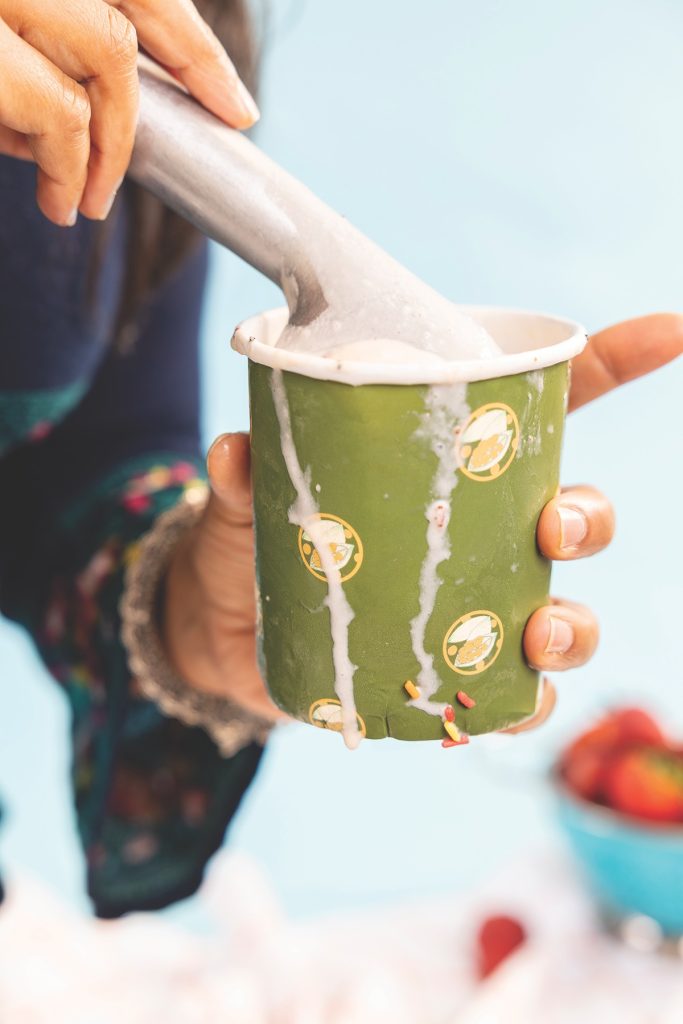
One day, Shamsuddin would like to see Elaka Treats stocked in national grocers’ freezers. In fact, her desserts are under review at Whole Foods currently and she feels hopeful. “It’s a global brand, that’s what the dream is.” And the cherry on top? That would be to see Elaka pods, self-serving freezers, in every cultural space.

“Initially, Elaka was about me. It was about telling my story,” says Shamsuddin. Over the past six years, it’s grown into something else. It’s about community, belonging “and how, through food, you can see how we’re all connected.”

Art of the State

ART OF THE STATE

Without Stopping

Juan Logan keeps creating

By Liza Roberts

On a sprawling industrial site on the banks of the Catawba River, beyond a cabinet maker, a boat rental and a rum distillery, past hundreds and hundreds of pallets of overstocked, shrink-wrapped, big-box merchandise, lies a repository of an entirely different sort.

Here, in an open, 5,000-square-foot space, stand sculptures and paintings, drawings, prints and multimedia creations that address, mostly through abstraction, many of the issues of our time: race and memory, history and geography, stereotype and expectation, imagination and potential. This is the studio of the artist Juan Logan, the place where he creates and stores the work from a career spanning more than 50 years. He is one of our state’s most accomplished contemporary artists, and one of its most prolific.

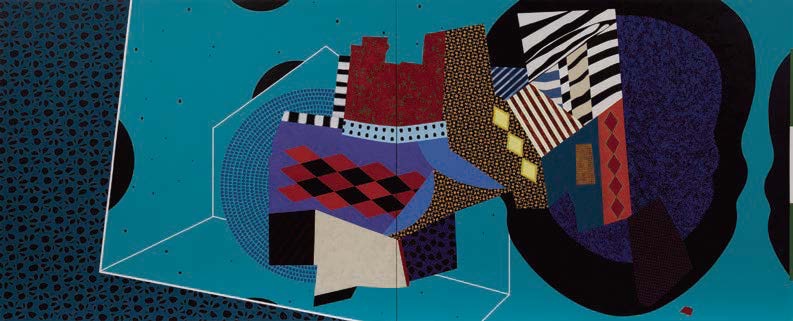
In May, a major exhibition of his work, Without Stopping: Juan Logan, opened at the Mobile Museum of Art in Mobile, Alabama, where it will run until Feb. 14, 2026. Featuring 48 works from Logan’s decade-long Elegies series, including many never before seen in public, the exhibit will feature a massive new piece commissioned by the museum to commemorate the residents of Africatown, an area of Mobile founded by the descendants of enslaved people brought in 1860 to Mobile Bay aboard a wooden ship called the Clotilda. At 6 1/2-feet tall and 16-feet wide, Logan’s commissioned piece, Elegy CLXXXVI, Without Stopping, is by far the largest of this seminal series.

“I think of it as a series on memory, but not just mine,” he says. “Collective memories.”

Though the word “elegy” often refers to a poem for the dead, “it can also mean a serious reflection,” Logan says. With abstract shapes and symbols, Logan reflects on the fragmented, imperfect and haunting nature of memory, including cultural memories shared in various and ever-changing ways. He mentions the Japanese notion of wabi-sabi, which finds beauty in imperfection and impermanence. “There are no perfect memories. And I don’t have any trouble portraying them that way.” Forgotten memories, too: “The absence of memory, how it depletes us . . . how it kills us. It leaves us very alive, but missing so much. We are so sure we hold on to things, even happy memories, but they fade away as well.”

A repeated image throughout his work over decades, beginning in the late 1970s and regularly appearing in his Elegies series, is the silhouette of a black head. The subtle shape shows up in painting, drawing, collage and sculpture (including Beacon outside Charlotte’s Harvey Gantt Center) as a symbol of memory, loneliness, identity and of the Black experience.

Lately, the head shape on its side may represent a boat, Logan says, a boat transporting memories, knowledge, thoughts, hopes and ideas: “Sometimes it’s completely filled, sometimes it’s empty. Such is the nature of humanity. We hold on to things, we lose things.” But always, he says, the head represents humanity: “All of our imaginings, and everything we ever were or will be takes place there first. It is who we are.” The featureless cameo offers a blank-slate Rorschachian challenge to the viewer: What do you fill in here?

Other symbols that make regular appearances in Logan’s colorful, abstract work include starry skies, clouds, maps and boats. Like a poet, Logan uses these allegorical images in individual works and as leitmotifs to represent many things: the collective unconscious; the workings of the world and the role of the individual in creating it; reserves of knowledge; the power of imagination and perception. Most important, Logan says, is not what he says these things mean, or what his own point of view might be, but what they provoke or challenge in the viewer.

Logan has been challenging viewers over the decades of a celebrated career that has seen his work shown across the country and around the world in solo and group shows. He has pieces in the permanent collections of some of the nation’s foremost museums, including the Whitney Museum of American Art, the Philadelphia Museum of Art, the Smithsonian’s National Museum of African American History and Culture, the Baltimore Museum of Art and Charlotte’s Mint Museum.

Storyteller

Wearing the uniform of black T-shirt and jeans that he has made his own for at least 40 years, the former University of North Carolina at Chapel Hill professor of studio art is a voluble host in his Belmont studio, eager to unpack the meaning and message of his work, which surrounds him in a vibrant, living archive. He does it through story.

There’s the story of a treacherous treadmill used to try to break the spirit of enslaved people in Jamaica in 1837 that inspired The Sugar House, a 16-foot canvas of paint, glitter, lottery tickets and thousands of glued-on puzzle pieces.

There’s the story about the high school shop teacher who encouraged him to make his first work of art, an eagle carved of white birch. This is a man Logan is so determined to credit with launching his life’s trajectory that he spells his name: “Harold McLean, That’s M, C, capital L, E, A, N.” McLean told Logan that what he made didn’t have to be like anyone else’s. “It can just be yours,” the teacher said. The words unleashed something in Logan: “It changed everything.”

There’s the tragic story of his father dying of a heart attack after a doctor didn’t believe his chest pains were real. It’s an example, Logan says, of racial bias, and one of his many inspirations for work that address injustice, oppression and alienation.

And then there are the many stories of home. The shape of a canted roofline in one of his works has him describing his own 114-year-old house, which was built by his great-grandfather and grandfather. It’s a 10-minute drive from his studio in a neighborhood Logan illustrates with a quickly jotted map: “Here’s my house right here. Here’s my mom’s house over here. Here’s my aunt’s house, here. There’s another aunt here. Here’s my sister’s house, here. Here’s my uncle’s house down here. And then my grandfather’s road, that’s named after him . . .” The foundation of another house his great-grandfather built out of handmade bricks and lived in after slavery still stands in the woods nearby. “These things serve to anchor you in a particular way,” Logan says. “I think more than perhaps other places, the South does that for so many people.”

Asking Better Questions

“For many years now,” Logan says, “I’ve tried to simply ask better questions. I think that’s the only thing that allows us to deepen our investigations about what we’re doing, regardless of discipline. If we can ask better questions, we’ll learn more, be able to do more.”

Doing more is clearly not a problem for Logan. At any given time, he’s got a dozen new projects in various stages underway. After the Mobile show opens, his work will be featured in an exhibit in Chattanooga in July and one on American and German abstractionists in Berlin in October.

“We want so much out of this,” he says. “And we are here for such a brief period of time. So we try to do as much as we can for as long as we can, with the hope that someone will take the time to preserve it and pass it on and share it with others.”

NC Surround Sound

NC SURROUND SOUND

Feast of Festivals

A magical musical tour

By Tom Maxwell

There are music festivals across the length and breadth of North Carolina this year — more than you will have either the time or gas money to attend. July alone features four worthy of mention, existing on the widest possible spectrum of musical and geographic diversity. We’ve got fiddles in the highlands, jazz on the beach, classical quartets in the Nantahala National Forest and a regular smorgasbord of sounds in the Piedmont.

The 46th annual Festival for the Eno kicks off in Durham on Friday, July 4. The two-day event features over 60 artists performing on four different stages, including former Carolina Chocolate Drops’ Dom Flemons, local poet and musician Shirlette Ammons and the Empire Strikes Brass.

There will be some novel attractions as well. “Since the festival’s inception, our Grove stage has focused primarily on traditional music through the lens of Americana,” festival director Bryan Iler says. “This year, there is still going be all that bluegrass and country and clogging, but there’s also going be a wider representation of traditional cultural music that I think is a little more representative of the Triangle community. We’re going to feature a full mariachi band, a traditional West African Senegalese pop band and Congolese percussionists. Oh, and Rabbi Solomon [Hoffman] from Chapel Hill has put together a klezmer group.”

And there’s more than just music. Attendees can learn fly-fishing, poster-making or browse handmade arts and crafts from 80 different vendors. “It’s really a salad bar of ways to have a good time and plug into at a deeper level with our community,” says Iler.

July 4 is also opening day for the Ocean City Jazz Festival on Topsail Island. “It’s a three-day event with three artists per night,” says Carla Torrey, who has organized the festival with her husband, Craig, for the past 12 of its 15 years. “We are trying to promote the history of the community and support its legacy.”

The Ocean City Beach Community is a neighborhood 3 miles north of Surf City that stretches from beach to sound. It was founded in the late 1940s as an interracial corporation where African Americans could own beach property in the days of segregation. A 700-foot lighted pier constructed in 1958 — at the time the only pier in the South Atlantic open to people of color — and many of its 100 or so Black-owned homes were destroyed by Hurricane Fran in 1996. Though those structures were not rebuilt, the community remains, and the festival is committed to preserving and expanding on its legacy.

This year’s Ocean City Jazz Festival features artists like Jackiem Joyner, Jazz Funk Soul, Nathan Mitchell, The Double Bass Experience and the John Brown Little Big Band, featuring Camille Thurman. Related events include an exhibition of paintings by artist Rik Freeman called “Black Beaches During Segregation” (on display starting June 28), day parties featuring line dancing instructors, food vendors and a boozy “Uncle Nearest Experience” with executive bourbon steward David Neeley. (Uncle Nearest Premium Whiskey honors the memory of Nathan “Nearest” Green, the formerly enslaved man who taught Jack Daniel the art of distilling.)

“We’re truly a jazz festival,” Torrey says. “All the music is going to be jazz, and we do a mix of smooth and straight ahead so that everybody gets to appreciate it as a genre.” Music plus an ocean breeze and sand between your toes? Sounds like a plan.

The 44th annual Highlands-Cashiers Chamber Music Festival kicks off July 5 in the southwestern counties of Jackson and Macon, roughly 400 miles from Topsail Island. You don’t have to be in a rush to get there, though; this festival lasts until August 10, featuring four concerts every weekend.

“It is a six-week festival of predominantly classical music,” Executive Director Nancy Gould-Aaron says, “but we do bring in other things to mix it up a little bit. We have jazz versus classical this year. In the past we’ve brought in Mark and Maggie O’Connor, so we’ve had a little bit of bluegrass, too. We probably have three or four quartets a season. Not too many duos, but we have a lot of soloists and put them together. For our gala event, we’ll have enough musicians to make up an orchestra.”

This year’s Highlands-Cashiers Chamber Music Festival features the North Carolina debut of Paul Colletti’s Viola Quintet featuring The Viano Quartet, poet laureate Rita Dove, the Whitehead Family Young Pianist Concert with Zitong Wang, the Pacifica Quartet featuring Sharon Isbin on classical guitar; and, a final gala “Cellobration” — a concert with eight cellos led by the Grammy-winning cellist Zuill Bailey.

The two-day 54th annual Old Time Fiddlers Convention, held in Ashe County Park in the state’s northwest corner, begins July 25. It takes place rain or shine, so bring your camping gear and get ready to hear a slew of banjo, fiddle, guitar and mandolin by the likes of Sassafras and the New Ballards Branch Bogtrotters. As usual, there will be open jam sessions galore, as well as competitions for young and old musicians alike, featuring several thousand dollars in prizes. Proceeds from the festival go to support JAM, the Junior Appalachian Musicians program, an organization that instructs third- to fifth-graders in fiddle, banjo and guitar.

This quartet of festivals barely scratches the surface of North Carolina’s musical itch. What an opportunity to explore the state and expand your musical horizons.

Sazerac July 2025

SAZERAC

Sazerac July 2025

Unsolicited Advice

Nothing makes us prouder to be American than watching people stuff their faces with as many hot dogs as possible in 10 minutes. No, we’re not talking about mealtime around your cousin’s table. We’re talking about the Nathan’s Famous International Hot Dog Eating Contest, held annually on the Fourth of July. We don’t recommend you try it at home, unless you’re up for more explosions than the celebratory fireworks that night. But how ’bout a trip across America (courtesy of hotdog.org) to discover which toppings reign supreme in each region. And don’t forget to try ’em on a veggie dog. We’re not saying it will help the flavor, but it might just mask it enough.

In our home state, chili, slaw and onions are the name of the game. Because nothing pairs better with meat than more meat. And nothing follows it better than breath mints.

Boston’s Fenway Frank is both boiled and grilled, then served with mustard and relish, sometimes topped with baked beans. It’s basically a Beantown protein bar when you think about it.

The New Jersey boasts strong Italian vibes, served up on thick pizza bread and topped with onions, peppers and deep-fried potatoes. Fun fact: For just $3,500 a night, you can stay at the actual Jersey Shore house, but this hot dog will whisk you there for about $5 a pop.

Chicago-style dogs are more loaded than the bases at Wrigley when the visiting team is at bat. May we recommend going all the way with yellow mustard, dark-green relish, chopped raw onion, pickle spear, sport peppers, tomato slices and a dash of celery salt, which might just be enough explosive flavor to make that vegan dog palatable?

Window on the Past

Greensboro’s  love for downtown’s Zesto soft-serve ice cream shop, frozen in time in this early-1950s image, must have melted quickly because, according to records, the establishment lasted only a little longer than a soft-serve cone on a hot July day. Too bad — a 15-cent sweet treat would hit the spot right now.

Just One Thing

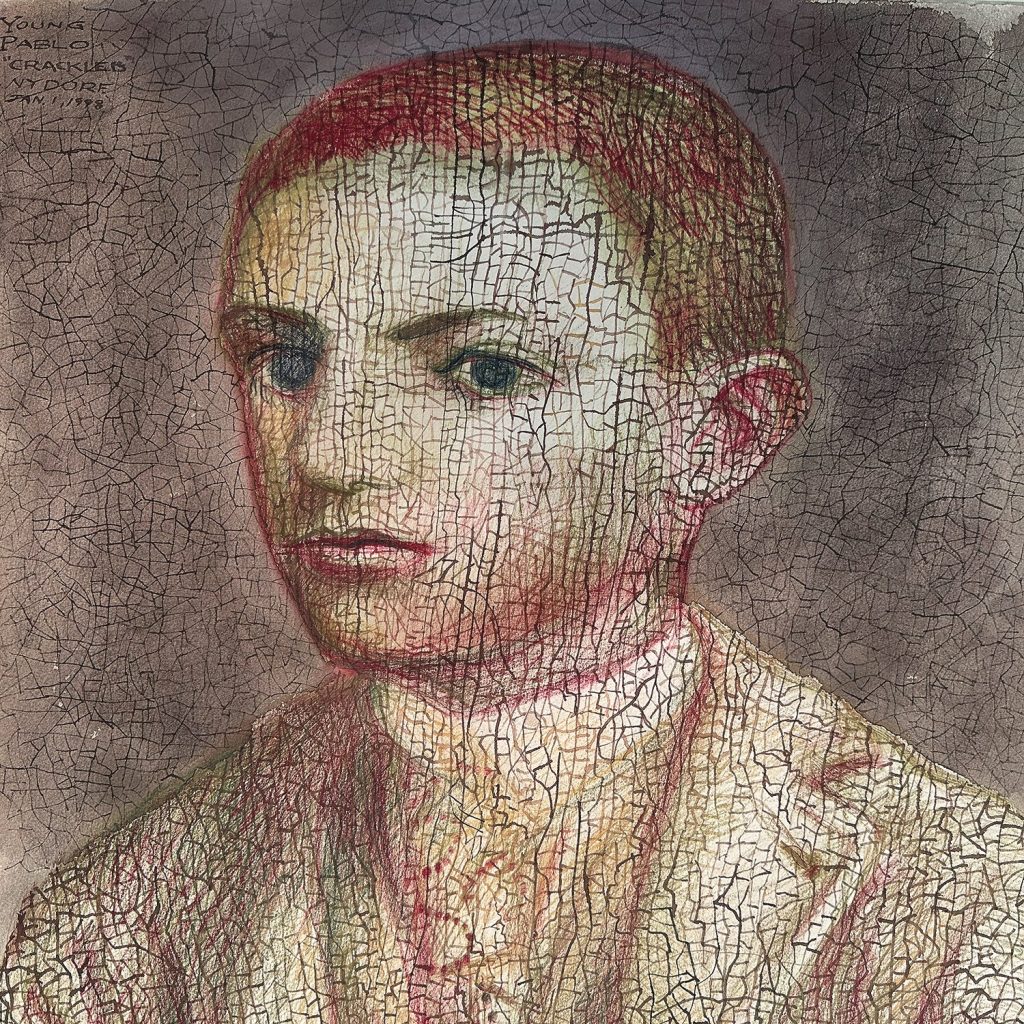
The intense stare of a 15-year-old Pablo Picasso reaches across one-and-a-third centuries vis-a-vis an India-ink-and-watercolor-pencil sketch by Greensboro artist Roy Nydorf. The retired Guilford College professor has works in the Hirshhorn, the Smithsonian, the Honolulu Academy, Weatherspoon — and now in the theater wings of the Steven Tanger Center for the Performing Arts. Curated by GreenHill Center for NC Art and on display until December, the exhibit features portraiture by a rich and varied cross-section of artists who have strong connections to the Triad area, including Sachi Dely, Aimée García, Zoe Grace Kamiya, Travis Lee Hicks, Jalen T. Jackson, Isabel Lu, Zaire Miles-Moultrie, William Paul Thomas and Joyce Williams. Nydorf once said, “If the simple image contains a vast complexity while retaining its purity and grace, then I have achieved my purpose.” We think Picasso would have agreed. Info: greenhillnc.org/portraits-from-the-triad.

Sage Gardener

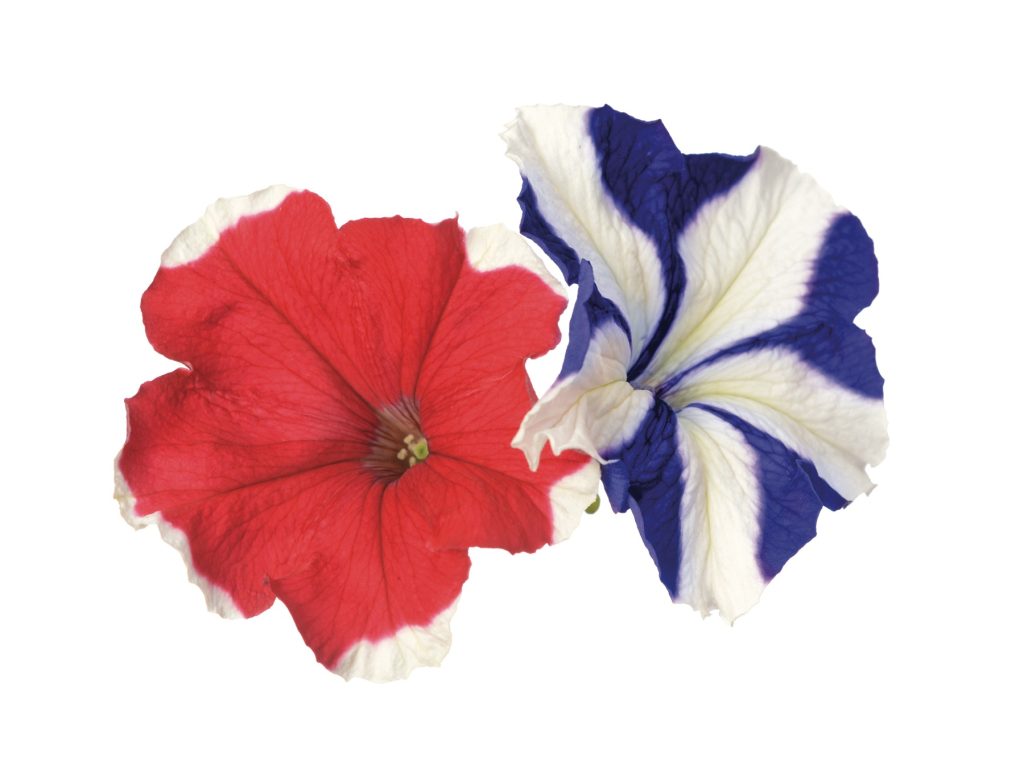
Happy 249 years of flowering Democracy, America! And what better way to celebrate your birthday than to reflect on what the Founding Fathers would think of cultivars such as Stars-and-Stripes Petunia, the Freedom Flame Tulip and the Presidential Peony? 

These are just some of the star-spangled blooms that sprang from my hiking buddy’s iPhone when he asked it for a list of patriotic flowers. 

Randall’s a big fan of artificial intelligence, while I have my serious doubts. 

“American Beauty Rose,” Chat GPT chirped, “is a classic red rose symbolizing love and patriotism, and Liberty Bell Iris is a bearded iris named after the famous American symbol.” Not bad for a brain made up of ones and zeros, I conceded.

Next he turned to Microsoft Copilot. American Gold Rush Coneflowers led the list, “reflecting the historic pursuit of American dreams.” What? “Wasn’t the gold rush inspired more by greed than dreams,” I asked. Picky, picky, picky. Copilot also came up with Union Jack Phlox! Isn’t the Union Jack the national flag of Britain, whom we fought to become the United States? Copilot also recommended Edelweiss, puzzlingly, with the following explanation: “While not exclusively American, its white, star-like shape can symbolize the stars in the American flag, and it also symbolizes bravery.” Really? We both decided if we were students desperately using AI to write a term paper for American History the night before it was due, we might want another copilot.

Then Randall turned to his favorite artificial brain, DeepSeek, the Chinese latecomer that’s shaking up the whole AI industry by delivering high performance at a fraction of the development cost. Although it may not be particularly patriotic to point out, DeepSeek was, in our opinion, smarter, much more conversational and able to produce 20 decent candidates, compared to Chat GPT’s 12 and Copilot’s 13. And it sussed out some salute-the-flag names the other artificial brainiacs missed: the Betsy Ross Rose, for instance, “named after the historic flag maker, this white rose with a red blush honors early American history.” Sorta poetic, eh? Also, the Yankee Doodle Coreopsis, “a cultivar with red-and-yellow blooms, referencing the patriotic song.” And, finally, the “Old Glory Rose, named after the iconic U.S. flag’s nickname, often featuring red, white or blue hues.” These were well-penned, we decided, and certainly not sounding as if they had been made in China. 

Which got us thinking about how the Founding Fathers themselves would have reacted to the emergence of artificial intelligence. The answer came in seconds using Meta AI, a division of the company that owns and operates Facebook and Instagram. 

Thomas Jefferson would have been fascinated by it, we’re told. Benjamin Franklin would likely see it as a natural extension of human ingenuity. George Washington and John Adams would have been wary of it, worrying about job displacement, privacy concerns and its implications on social structures, morality and the human condition.

How about Alexander Hamilton? “Hamilton’s creative and imaginative nature might have inspired him to explore AI’s potential in science fiction or speculative writings, envisioning a future where humans and machines coexist.” 

At that point, we decided to put our phones away and be thankful for the fireworks display of wildflowers all along the trail.   — David Claude Bailey

Writing Contest Last Call

We will accept submission to our 2025 writing contest only until the end of the month. What are you waiting for? This one is a bit unique in that we’re asking you to write your own obituary — a faux-obituary, that is. Get to your keyboard and let it RIP. Is this an exercise in imagining how you want to live the rest of your days or is it all about what you want to be remembered for? Whether dead serious or playful and fun, let it be something to make O.Henry readers remember you forever.

Don’t forget the rules.

  • Submit no more than 250 words in a digital format – Word or Pages document, a PDF. Paste it into an email, or carve into stone. More than 250 words? You’re dead to us.
  • One submission per person: Email entries to cassie@ohenrymag.com
  • Deadline to enter is July 31, 2025.
  • Winners will be contacted via email and their submissions will be printed in a forthcoming issue.
  • Lastly, life is short. Have fun with this assignment!

Poem July 2025

POEM

July 2025

Balancing Act


I was once content with walking railroad
tracks to school, stone walls to church,
touching my toes to the sidewalk
for balance, stepping over cracks
that needed mending.

I balanced on city curbs,
my arms extended like wings
that would fly me to a nearby tree,
a wild turkey perching safely
on the lowest limb.

In school we balanced skinny legs
on beams six inches off the floor
to please Miss Brown,
especially proud
to do it backwards,

and I heard the story of
Dayton’s Great Flood of 1913,
how victims inched their escape
across telephone wires from the railway
station to Apple Street and safety.

Now I walk one tight rope after another,
and wonder about people
who tread on pavement with no cracks,
no broken mothers’ backs,
in sensible shoes, arms to their sides,
with no inclination to fly.

— Marsha Warren

Home Grown

HOME GROWN

Max

The making — and unmaking — of a miscreant

By Cynthia Adams

Our rescue — let’s call him Max — has a record. I worry he might be sent to juvenile hall. Or reform school for troubled terriers. 

I’ve changed our wire-haired fox terrier’s name to protect his identity should an overzealous public servant decide to pursue any of his perceived crimes. 

Max has never gained a firm grasp on boundaries. Now, skittering around on the margins of civil society, he is a wanted canine. Why? He bit the hand that feeds him.   

But first, a little background: Max, a “high-energy” dog, was foisted off on me in the paint department of a Lowe’s at the North Carolina coast. His owner, a bedraggled looking mom of children of various ages, said he stole the little ones’ rubber ducks. He had been banished to a pen in their backyard, where he had been confined for four years. She produced a picture on her cellphone: Max, a tan-and-white beauty, looked straight at me from the photo with the saddest of eyes.

From another picture, he pants breathlessly out of a passenger window, beckoning me with a “please” look in his eyes.

I later learned that two large labs lived indoors while little Max, just 14 pounds, was penned alone in the backyard. Was he underfed, too?

When we brought him home Max was so jubilant, given his newfound freedom — a dog door and fenced yard to roam — it took him weeks to settle down even a little. As forewarned, he was petrified of storms after years of suffering through them alone. Is it possible for a dog to be phobic about rain yet adore water if it doesn’t fall from the sky? Inscrutably, he loves to splash and play in water but dashes in through the dog door at even the gentlest rain. 

Max was not only jealous of our smaller, younger dog, he was a thief, stealing any toys from man or beast.

But with time, effort, consistency and affection, Max possessed moments of calm that gave us a glimpse of his future self. He gained a few pounds, showing a taste for carrots and fresh apple.

Even so, five years later, he remains neurotic to the point of terror with the slightest threat of a storm, near or far. Soft jazz helps. Medication doesn’t. He tunnels underneath the sofa, shivering until the storm passes. And yet, the mere glimpse of a water hose sends Max into a rapturous, manic, playful frenzy.

He is a creature of the morning; by evening, he prefers to be left alone in his bed, more curmudgeonly.

Yet he is exceedingly smart, able to reason and anticipate. When Max sees me sorting glass, he anticipates a car ride to the recycling center and is sent straight into a an ecstatic, hyper state.

One late afternoon when Don and I were walking him, he suddenly lunged for something on the ground. “That could be a chicken bone!” I cried, given fast-food remnants littered the area.

Don pulled Max’s leash in, hurrying to open his mouth and fish out the foreign object; Max clamped down firmly on the soft tissue between his thumb and forefinger.

When Don shouted in pain, Max clamped harder in resistance. He was not surrendering his prize.

By morning, Don’s hand was purply and swollen. Our physician was away, so he visited a clinic. The attending physician shook his head, returning with a clipboard. An official dog bite report was made to Animal Control even though Don’s injury only required precautionary antibiotics, a cursory look and rebandaging. No stitches.

State law requires that a dog who has bitten a human — even their owner — quarantine for 10 days for rabies observation. (This includes fully vaccinated canines.) Guidelines require the animal sequester at a veterinary hospital, animal control facility, or, possibly, the owner’s property. There is no exception for first-time offenders like Max.

I gasped: How would Max survive should they order confinement at the shelter? Or the vet? This was a dog whose spirit had only been restored after years of effort. He had suffered banishment once. He might not have the resilience to handle such isolation again.

Home confinement looked wonderful by comparison. 

We chewed our nails, waiting for Animal Control to knock at our door. In desperation, I displayed a published article I’d written for this magazine about Max’s first year with us. In it, he was sitting happily at his master’s side, flashing a cheery doggy smile.

We eventually resumed walking him, strictly on a shorter leash. We reasoned it was a bad idea to come between food and Max, who had possibly been underfed those many years of confinement.

Weeks, then months passed. We exhaled. Thankfully, Mad Max got the third chance he deserved.

Omnivorous Reader

OMNIVOROUS READER

A Day at the Beach

When everything goes wrong

By Anne Blythe

If you’re one of those people who likes to walk on the beach and dream up scenarios for what might be happening in some of those homes looking out over the ocean, Kristie Woodson Harvey has a whale of a tale for you.

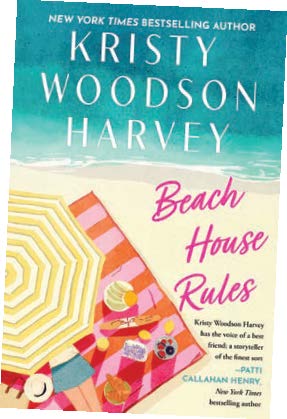
In Beach House Rules, the Beaufort-based author takes readers inside a massive two-story oceanfront home enveloped by “the salt air and rhythmic shush of the waves” in fictional Juniper Shores, North Carolina. Harvey’s 11th book, which she describes as “an ode to female friendship,” also has mystery, a touching exploration into what makes a family and, of course, a love story or two — many of the elements for a breezy, easy beach read.

Inside Alice Bailey’s massive beach house is the “mommune,” an intriguing co-living situation that — because of a variety of individual crises — brings a cast of women and their children together. Charlotte Sitterly and her teenage daughter, Iris, are the newest “mommune” residents, having found themselves in need of shelter, hugs and support after being locked out of their five-bedroom, four-and-a-half bath shorefront home by the FBI.

Bill, husband of Charlotte and dad of Iris, is in the local jail, accused of a white collar crime that thrusts their family into the glaring spotlight of an anonymous gossipy Instagram account that revels in “sharing bad behavior and delicious drama in North Carolina’s most exclusive coastal ZIP code.”

Charlotte, Bill and Iris came to Juniper Shores during the height of the pandemic, refugees from a locked-down New York City. While snuggling on the wide-open beach during what was supposed to be a temporary visit, soaking up the orange glow of a Mayflower moon and watching their daughter make friends with a neighbor girl, Bill suggested they build a house there, miles and worlds away from their hectic and confined city life. Charlotte leaned into her husband and quickly said yes.

Fast forward to Charlotte’s meltdown in the lobby of Suncoast Bank, three days after coming home to a swarm of police cars and FBI agents combing through her dream house. With the family’s financial assets seized, Charlotte needed a job. Her work history was in finance, so she thought she would try the local bank, but convincing a bank or investment firm to take on the spouse of a man accused of stealing large sums of money from his clients was a tough sell.

Alice, known around town as the woman with three dead husbands in 12 years, offered Charlotte a supportive ear and refuge at her former bed-and-breakfast, where women and their children facing hardships comprise the “mommune.” With only enough cash to afford two more weeks at a modest hotel, Charlotte agreed. Her mind raced as she walked into the Bailey house. What if Alice was a creepy killer who’d offed her husbands? Was she a lunatic or a saint? And always in the back of her mind, what if Bill had, indeed, committed the financial crimes he was accused of? Charlotte tamped down those questions as Alice took her through the unlocked door into a haven with a chef’s kitchen, an open-plan dining room, a living room that stretched across the entire house and an array of comfortable bedrooms.

Through the alternate narratives of Charlotte, Iris and Alice, Harvey weaves in the many side stories. We learn about Julie Dartmouth, Alice’s niece and a dogged reporter who was the first woman to take up residence, along with her children, in the Bailey house. Before Charlotte and Iris arrived she “seemed to absolutely revel in writing about Bill’s arrest.” But “beach house rules” changed that.

Grace, Julie’s best friend and an Instagram influencer who has gained a large following sharing her recipes on “Growing with Grace,” was the second mom to join the so-called “lost ladies club.” She moved in after her husband split to Tokyo, leaving her with a mortgage to pay and children to raise, one of whom is a star high school quarterback and heartthrob, an added bonus for Iris, a 14-year-old navigating the highs and lows of teenage years.

Elliott Palmer, Alice’s former boyfriend who wants to reignite their love story, has the potential to upend this makeshift family. He’s not deterred by Alice’s wake of dead husbands or other claims that she’s cursed. “You’re not going to kill me,” he tells her over a bottle of Champagne and a remote table for two overlooking the water.

Harvey weaves all these storylines together, thread by thread, mystery by mystery, to an end that reveals whether or not Alice — who, not coincidentally, had taken a financial hit from the white-collar crime Bill is accused of — had ulterior motives when she invited Charlotte and her daughter to stay with her.

While there are dark clouds that hang over the many mysteries within this mystery, the romance and light fun make it more about community and the friendships that can unexpectedly occur when it seems like everything is falling apart.

According to the Beach House Rules, setbacks can be blessings in disguise.

Poem June 2025

POEM

June 2025

The Ferry from Ocracoke to Swan Quarter

Laughing gulls hover:

a story below,

their shadows slide

and crux across the deck

of the Silver Lake —

painted white by convicts

from the Hyde County camp —

bound over the slick-cam Pamlico, 

past a dredge-spoil island

where cormorants in black

frock coats congregate, exiled,

penitent, eyeing the ferry

with Calvinist reproach.

— Joseph Bathanti

Chaos Theory

CHAOS THEORY

You Must Be Tripping

A whirlwind weekend of misadventures

By Cassie Bustamante

Our oldest, 19-year-old Sawyer, does not ask for much: a roof over his head, a hand-me-down clunker of a car and a lifetime supply of Eggo waffles. So, when he comes to me with a request, I listen, knowing I’ll do what I can to grant his wish.

“Mom, wanna go to Boston with me?” he asks, knowing how I, a born-and-raised Bay Stater, am always up for a pilgrimage to my home state. “The Six Invitational is there, but,” he sheepishly adds, “it’s Valentine’s weekend.”

If you’re thinking, “The what?” right now, you’re not alone.

“It’s a tournament for my favorite video game, Rainbow Six Siege,” he says, his blue eyes hopeful while my own glaze over.

Forget what I said about making his dreams come true. “Uh, no. But maybe Dad will go? Ask him.”

A few days later, my husband, Chris, approaches me. This time his blue eyes glimmer as he tries to persuade me to join them. “We can have a Valentine’s getaway while he is at his tournament.”

Sounds lovely, right? Except he’s forgotten one thing — our other two kids. “And who will watch Wilder?” I ask. Right away, he suggests Emmy, our 18-year-old. “So, you’re saying we just leave Emmy behind to watch her little brother, who has been begging to fly on an airplane for two years, while the three of us galavant around a city she adores?”

“Uh, yeah,” he says.

“Not gonna happen. You take Sawyer,” I say. “Or, we all go.”

And so, at 6 a.m. on Valentine’s Day, we set off to make Sawyer’s dream come true and have a little family fun in the meantime.

Since it’s a rather quick trip, we don’t waste a second. We eat our way across Boston’s North End, aka Little Italy, tour Paul Revere’s home, touch stingrays at the New England Aquarium, and shop up and down Newbury Street. By Sunday morning, even the kids are zonked and ready to return home.

And that’s when Sawyer’s dream trip turns into a nightmare for us. Overnight snowfall has transformed into a mix of sleet and rain, leaving slushy puddles at every street corner. Chris and I brave the elements alone, trudging the half mile to Dunkin’ Donuts with the kids’ breakfast orders in hand.

A true New Englander, I’ve packed waterproof Timberlands, but Chris, born and raised in Miami, is wearing sneakers. By the time we return to the hotel schlepping soggy paper bags, his feet are chilled to the bone and his mood, well, dampened. Wilder takes one look at his breakfast choice —an untoasted bagel, just as he prefers at home — and whines that his bagel is cold.

Frustrated, Chris escapes into a hot shower. Ten minutes later, he emerges from the steaming bathroom, phone in hand, and says flatly, “Our flight’s been cancelled.” And, to make matters worse, the airline can’t get us back to North Carolina until Tuesday night.

With jobs to get back to and a 13-hour drive in front of us, Chris starts dialing rental car companies, juggling both of our phones, desperate for a vehicle with three rows to accommodate us comfortably. No luck. We book what we can. At the rental car counter, however, a small — mini, to be exact — miracle happens. “They have a minivan!” Chris exclaims triumphantly a moment later. At last, we’re hightailing it out of Beantown, wind blowing against the vehicle. For the next several hours, Chris stares straight ahead, navigating us through gusts up to 40 m.p.h., rain, sleet and side-blowing snow. It’s treacherous, but he’s a man on a mission. My job? Keep an eye on the radar and find a restaurant everyone will like. As soon as we are through the last of the weather map’s aqua-blue blob, I select a 4.3-Google starred spot close to Scranton, Pa., touted for pizza, pasta and sandwiches.

We’re all famished when the restaurant finally appears in the distance and its lights are out. “Closed,” a sign reads.

“Well,” I say to Chris, “I saw a Waffle House right off the exit.” And it more than does the job — everyone’s happy. Wilder, who’s up until this moment existed on a made-in-the-car peanut butter sandwich and some gummies, scarfs down his first warm meal of the day without complaint.

Carl, our friendly and chatty waiter, is bald with dark, thick eyebrows, reminding me of Food Network’s Duff Goldman. Despite our dining in several Boston tony (and pricey) eateries, he’s the best waiter we’ve had all weekend, tucked away at the most northern Pennsylvania Waffle House. According to Carl, people drive all the way from Maine just to experience the all-night diner, but we’d drive back just for Carl. We’re all overtired, perhaps a little cranky, but his kindness softens us.

Bellies full, we hit the road once again, stopping a couple hours later to check into a hotel.

We say goodnight to Sawyer and Emmy, who have the room next to us. Chris gives Wilder a quick bath and reads him Dog Man while I wash my face, brush my teeth and try to avoid thinking about how we have to wake up and do it all over again tomorrow.

I take my turn to tuck Wilder in and kiss him goodnight. “Thanks for being such a trooper, kiddo,” I say.

His little face looks happily up at me and he says, “Today was a fun day!”

His sleepy eyes close and he drifts off to dreamland. “Fun” feels like a stretch, but, only a few months later, the kids are already turning what seemed, at the time, like a huge ordeal into an adventure-filled odyssey back home. One thing I know is that our next family vacation destination will be a short road trip away.

Simple Life

SIMPLE LIFE

The Gift of Nature

And the power of the Earth to heal

By Jim Dodson

One morning this past February, I stepped out to assess how my garden had fared from one of the coldest, soggiest winters in memory.

It wasn’t a pretty sight. 

The Asian-themed shade garden I’d spent a decade creating in our backyard under towering oaks appeared to be devastated, buried beneath drifts of sodden leaves and dozens of downed tree limbs. The only visible signs of life were weeds and grass creeping over the garden beds like an insurgent army.

I’m no rookie in landscape gardening. I’ve built — and restored — three major gardens in my life, including an ambitious native garden in a forest on a coastal hilltop in Maine, where we lived for two decades.

Hard weather, as they say up in Maine, makes good timber — a theory, I’ve discovered, that’s applicable to human beings as well as gardens.

I remembered this eternal truth as I took stock of my battered garden, wondering if it would ever look as glorious as it did last summer.

After a morning of clearing debris and raking out beds that showed little to no signs of life, I ruefully joked to Wendy, my wife, that our “ruined” garden was the final insult from a winter we were both eager to forget.

It started on All Saints’ Day back in November, with the death of Wendy’s mom, a lovely Irish lady who spent her career teaching children how to love art. In the end, dementia robbed “Miss Jan” of her sparkling wit and even the ability to recognize those she loved. At least she spent her final days on our terrace, warming her face in the late autumn sunshine. The last thing she said to me was, “Look, isn’t the sun beautiful today?” She never spoke again.

For the first time ever, three of our four children, admittedly all grown-ups, failed to make it home for the holidays, which made for a too-quiet house at Thanksgiving and lots of empty stockings. Fortunately, our youngest, Liam, showed up two days before Christmas, briefly brightening the mood before I went under the knife for a full left-knee replacement that left me wondering, as the New Year dawned, what dump truck ran over me.

I skipped the narcotic painkillers in favor of Tylenol, however, because I was under the intense pressure of a tight deadline to correct and return within a fortnight my editor’s marks on the most important book of my life. As a proud Luddite, I was forced to use a complex digital editing system that left me feeling like a child trying to operate a jumbo jet. Fortunately, in the nick of time, my digitally savvy bride stepped in to get the job done. Printed manuscripts, I learned, evidently went out of fashion with handwriting. 

To make things more fun, as I wrestled with a hoisted leg and new technology, a work crew arrived to renovate our Donna Reed-era primary bathroom, knocking down walls and pulling up floors — making such a godawful racket, it seemed they were taking out half the house.

Most disturbing of all, amid this clamor and craziness, I lost my longtime gardening pal, Boo Radley, our beloved 14-year-old cat, who suffered a sudden series of seizures that grew more horrifying as the days went along. We finally put him peacefully to sleep on his favorite blanket.

Every family, of course, goes through periods of intense stress and challenge when the chaos of life seems to pile up like snow against the door. That’s just part of making the human journey. To place our winter of discontent in proper context, as my late Scottish father-in-law liked to say, ours were “pretty high-class problems in a world that is full of sorrow and woe.”

It took an unexpected birthday card from a dear old friend to lift my cloud of gloom and remind me of what’s really important in the grand scheme of things.

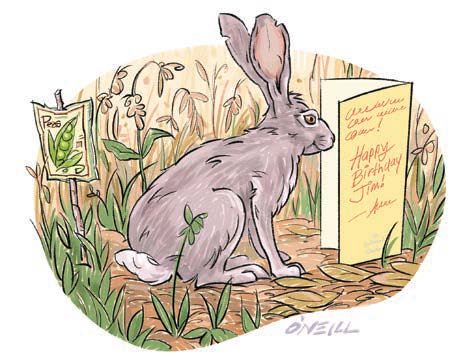
Ashley Walshe’s clever card amounted to a gentle poke from the universe, depicting an old, gray rabbit nibbling something in the garden. She knows I have a thing for woodland rabbits.

“Another year,” read the card. “Another gray hare — Happy Birthday!”

You may know Ashley from the soulful monthly Almanac she writes for the magazine, and from her many years adding earthy wisdom and wit to our editorial team. Among other things, she is a gifted poet and a true daughter of the Earth.

Not surprisingly, it was her accompanying hand-written message that reminded me of the lessons in gratitude and joy we’ve shared over the many years of friendship:

“In all seriousness,” she wrote, “thank you for showing me the joy of growing backwards . . . The secret, perhaps, to this wild, wonderful life on Earth.”

The idea of growing backwards is simply our way of describing a life in tune with nature, timeless values (some would call “old-fashioned”) that promote kindness and compassion to all living creatures and a deep reverence for the Earth.

In a year that has already seen apocalyptic wildfires out West, a record number of killer tornados in the heartland and a hurricane that will be remembered for generations, it isn’t much of a stretch to realize Mother Earth is sending us a serious message about our behavior.

Last November, Ashley and husband Alan nearly lost everything they own — including their lives — when their first home on a pretty hillside just outside Asheville was almost washed away by Hurricane Helene.

“At the height of the storm,” she remembers, “we were huddled in our house with our dog, Dirga, watching frightening torrents of water roar down the mountainside, washing away many of the houses around us. I remember asking Mother Mary to please keep us safe.”

Moments later, the couple heard a loud crash of trees that fell directly in the path of the rampaging waters, diverting the Biblical flood away from their home.

It was, she says, “a miracle. Nature saved our house.”

After escaping for a time to stay with friends outside the danger zone, the couple returned to find their home still intact but surrounded by a world of mud and debris.

“Helene brought me back to a higher level of consciousness, a desire to let go of things that don’t really matter in the course of daily life,” she says. “It also brought out an amazing amount of kindness and support among complete strangers who helped each other through the crisis. I think it changed many lives.”

The good news, she says, is that her bare yard is now a blank canvas awaiting the creation of a “wonderful new garden.”

Days after she told me this, she sent me a photograph of the lone plant that miraculously survived the Great Flood — a single, gorgeous tulip that popped up with the coming of spring. “Nature always gives us a gift,” she wrote.

That same afternoon, I noticed my own garden miraculously springing to life.

By now, it should really be something.