Home by Design

Better My Biscuit

A mother and daughter come together over a happy meal

By Cynthia Adams

Mama was a big reader, and we talked books until her end. Her bedroom was overtaken by John Grisham novels. Yet cookbooks and cooking became her favorite topics of conversation.

Digesting cookbooks is a distinct pleasure. Writer Ruth Reichl beguiled the most reluctant cooks with purring, perfect prose, that lured us into the kitchen.

Our family kitchen was a soul-killing level of ugliness, with appliances, counter tops and linoleum flooring all matching in a lurid avocado-green. The wall phone was the color of canned peas. Stark fluorescence meant none of that greenness could hide. Still, Mama failed to see the point of modern, sculptural kitchens — ones with cavernous fridges, sky lights, waterfall counters and commercial stoves “But nobody cooks!” she would splutter.

What Mama saw were hot ovens and years spent rolling out biscuit dough and making gravy.

Our kitchen was poorly equipped, given that she produced as much food as the equivalent of a small cafeteria: No double ovens nor toaster oven. No microwave, because, well, radiation. The fridge was small, requiring manual defrosting. When the dishwasher died, Dad refused to waste good money repairing it, claiming “we have plenty of dishwashers” — giving us daughters a hard stare.

Otherwise liberal, he was a chauvinist pig on the topic of women and cooking, once lamenting I would never marry unless I found a man who did not like to eat.

“Or find someone much older,” he advised. “A lot older. He won’t expect you to cook.”

Mama had married a man who did expect cooking. On rotation were dishes meant to sate hearty appetites. She made her version of spaghetti sauce, supplemented by glugs of catsup when low on tomato sauce (also deployed in meat loaves that bobbed in bubbling fat). She concocted vats of chow mein, a peculiar church cookbook interpretation no Asian person would recognize. Pot roasts, chicken and “stew beef” were tenderized in a pressure cooker.

Mostly, Mama fried fish, chicken and pork, seldom draining fat. On Saturday, Dad grilled marbled steaks, giving her a break. By the time Dad’s arteries shut down at age 61, Mama had already moved on, done with life as a short order cook. She later moved to a Cornelius townhouse nearer grandchildren, acquiring a galley kitchen painted a buttery yellow. At 91, Mama now survived on Boost, ice cream sandwiches and dainty cubes of Cheddar cheese impaled on toothpicks. We began bringing her McDonald’s biscuits over her protests. When my brothers visited, she still felt the urge to pull out the rolling pin and make biscuits. Mama grew so slight and weak, she sometimes fell backwards opening the oven. One visit, I mentioned that humorist Rick Bragg was in Athens, Georgia while I was working there, promoting “The Best Cook in the World,” honoring his own mother, Margaret.

Mama shot an arch look. “So, I know you don’t think I’m the best cook in the world,” she said, fishing. Clearing my throat, I recited her greatest hits: chocolate cake, ambrosia, corn soup and the McClellan family vegetable soup.

“You hate my biscuits,” she accused.

“I’m not a biscuit person, Mom,” I said — a rookie mistake.

“I’m not either,” she retorted testily, “but that didn’t stop me from getting up and making them for five children. Every. Single. Morning.”

Years ago, I blurted out my preference for — wait for it — toast.

“Your mother made canned biscuits, because real ones were too much trouble,” I ventured. But Mama was not in a fighting mood. Instead, she laughed over Bragg’s devotion to the cuisine of Possum Trot, Alabama.

“You know,” she confided, her voice quaking as if she was about to betray a state secret. “McDonald’s sausage biscuit is really not bad at all. I actually like them.”

Her eyes widened. And we collapsed into giggles as if this were easily the funniest joke in all the world.  OH

Cynthia Adams is a contributing editor to O.Henry.

Almanac

June holds nothing back. Dripping with decadence, she drapes her frills and trimmings across limbs, stems and wild earth. She isn’t afraid to take up space, nor is she afraid to ask for more.

More beauty. More bramble. More texture. More color.

And nothing shy of the full spectrum.

Red poppies speckle sunny meadows. Orange tiger lilies brighten the foreground. Yellow swallowtail flit hither and yon.

Green — as in every sumptuous shade of it — shoots and sweeps across the landscape.

Blue chicory dances along roadsides. Indigo buntings flicker among the woodland fringe. Violet hydrangeas sweeten the lawn. 

“More is more is more,” she says, weaving among peach and coral roses; the first stunning wave of star-shaped clematis; a swell of multicolor zinnia.

The air is an amalgam of honeysuckle, lemon balm, basil and gardenia.

More fragrance? If it’s good enough for the hummingbirds, bring it on: Rivers of feathery bee balm, cascades of trumpet creeper, explosions of flowering salvia.

Bring on the music-makers, too. The buzzers and screamers. All who twitter, chirp and croon. Listen for the rattle call of the northern flicker. The coo of the pigeon. The lusty moan of the lonely bullfrog.

In the garden, the squash plants runneth over. Green tomatoes fatten on the vine. Salad greens reach for the rising sun.

Bring on your glorious wildness, June. Your luscious too-muchness. Your sultry, voluptuous summer.

No need to hold back.


June is bustin’ out all over.     — Oscar Hammerstein II


All That Glitters

According to Smithsonian Magazine, two of this year’s most “dazzling celestial events” happen this month, beginning with the first supermoon of the year on Tuesday, June 14.

What, you ask, is a supermoon? It’s when the moon is full at its perigee (aka, closest proximity to Earth). According to NASA, a supermoon can appear up to 14 percent larger and 30 percent more luminous than a full moon at its apogee (farthest point from Earth). As if June needed one more reason for us to swoon.

Next on the don’t-miss-it docket: five planets in rare alignment from June 19–27. Make that six if you’ve got a telescope and minimal light pollution. Just before sunrise, gaze toward the eastern sky for a chance to spot Mercury low on the horizon, then Venus (always the brightest planet), Mars, Jupiter (second brightest) and Saturn (high in the south) in a diagonal line visible to the naked eye. Those with proper optics may also spot Uranus — yep, that bright green speck — just above Venus.

Do look up. At the very least, you might catch some fireflies.


The Color Purple(ish)

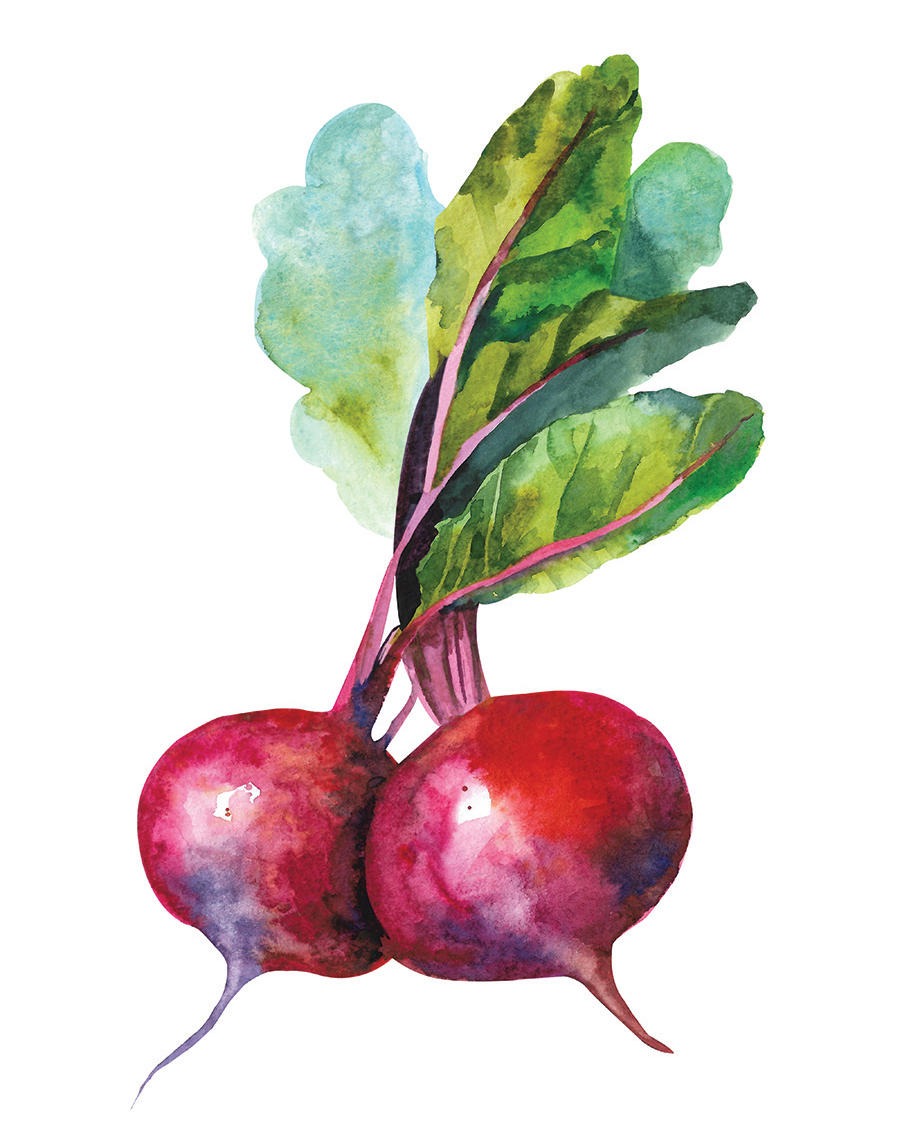
It’s beet season. If their vibrant magenta color wasn’t reason enough to love them, consider that these earthy roots are loaded with antioxidants, fiber, folic acid and potassium. Even their greens are a superfood. And nothing says summer like a cold beetroot salad.

Boil them until tender. Once cool, peel them under cold running water, then cut into 2-inch cubes.

Toss them with olive oil, orange juice, cumin, salt, fresh mint and cilantro.

Admire your stained fingers . . . and enjoy.  OH

The Artist’s Eye

Debuting a Culture to America

Montagnard-American artist Sachi Dely uses her creative skills to share her experiences with the world

By Allen Siegler

Sachi Dely steps back from one of her favorite paintings, Refuge, and reflects on the toddler girl on a cotton candy-colored background. A blossoming red flower covers the girl’s mouth, and her face and neck are entwined with plant roots that creep toward her eyes. A small red bird perches on the toddler’s left shoulder, picking at one of the roots on her neck; another flies backwards as it tugs a worm out of the girl’s right ear.

“It was basically about my experience as a refugee,” says Dely, 23. “The birds are taking refuge within me.”

Since her sophomore year at Guilford College, Dely has used her art to explore her involuntary exit from the Highlands of Vietnam as a 1-year-old. Her works focus on Montagnards, indigenous people from areas mainly within Vietnam’s borders, and how she and they are adapting to Western culture.

“There’s the indigenous art they brought with them, but here in their new country there is no tradition of Montagnard-American art,” says Andrew Young, Dely’s mentor and a volunteer training coordinator for Guilford’s Bonner Center for Community Service & Learning. “She is embarking on something that has no real background or history.”

Dely describes the Montagnard struggle for a place in the world as similar to being “pushed under a rug. If I have the chance to let our community be known about, I’m going to do it . . . I’m proud of my culture. I’m proud of who I am. I want the world to know about us.”

Montagnards have lived in the Indochina Highlands for more than 2,000 years. For at least the last 200, both foreign colonialists and Vietnamese authorities in cities like Hanoi and Saigon have suppressed Montagnard culture and attempted to seize control of the Highlands.

A 2002 U.S. government cultural profile called the relationship between Montagnard and Vietnamese “comparable to the tension between American Indians and the mainstream population in the United States.”

The tension deepened after Montagnards aided the U.S. military during the Vietnam War. When Saigon fell to the North Vietnamese communist forces, the new government viewed the Highland tribes as enemies. That was the situation the Delys found themselves in when Sachi was born into her Montagnard Bunong tribe in 1998.

When Dely was a year and a half, some Montagnards held a peaceful protest against the Vietnamese government about the right to practice Christianity in an atheist country.

“It turned out to be very violent,” Dely says. “The Vietnamese government arrested people and put them in re-education camps. Basically, whoever they arrested, they would torture and ask, ‘Who else was there?’”

Although her family didn’t attend the demonstration, the Vietnamese government suspected her father of involvement. He fled their village soon after the protest and trekked to a refugee camp on the Cambodian border. Six months later, Dely and her mother walked for two to three days with hundreds of other Montagnards to the same camp.

“My friend remembers being under a bridge and her mom telling her to breathe quietly,” Dely says. “Above the bridge, police were looking for people who were running away.”

The Delys spent a few months there until moving to another camp in central Cambodia, uncertain of what the future held. At one point, Dely’s maternal grandfather walked from his village to Cambodia and begged Dely’s mother to return home.

“He told her there’s nothing here for you, they’re not going to do anything to you,” Dely recalls. “But there was this man who spoke English really well, and he was like ‘We’re going to America soon. Just stick it out a little longer and we’re gonna go.’”

After a year in Cambodia, the U.S. government did, in fact, grant Dely’s family refugee status. They resettled in Greensboro, as have thousands of other Montagnards beginning with 209 in 1986.


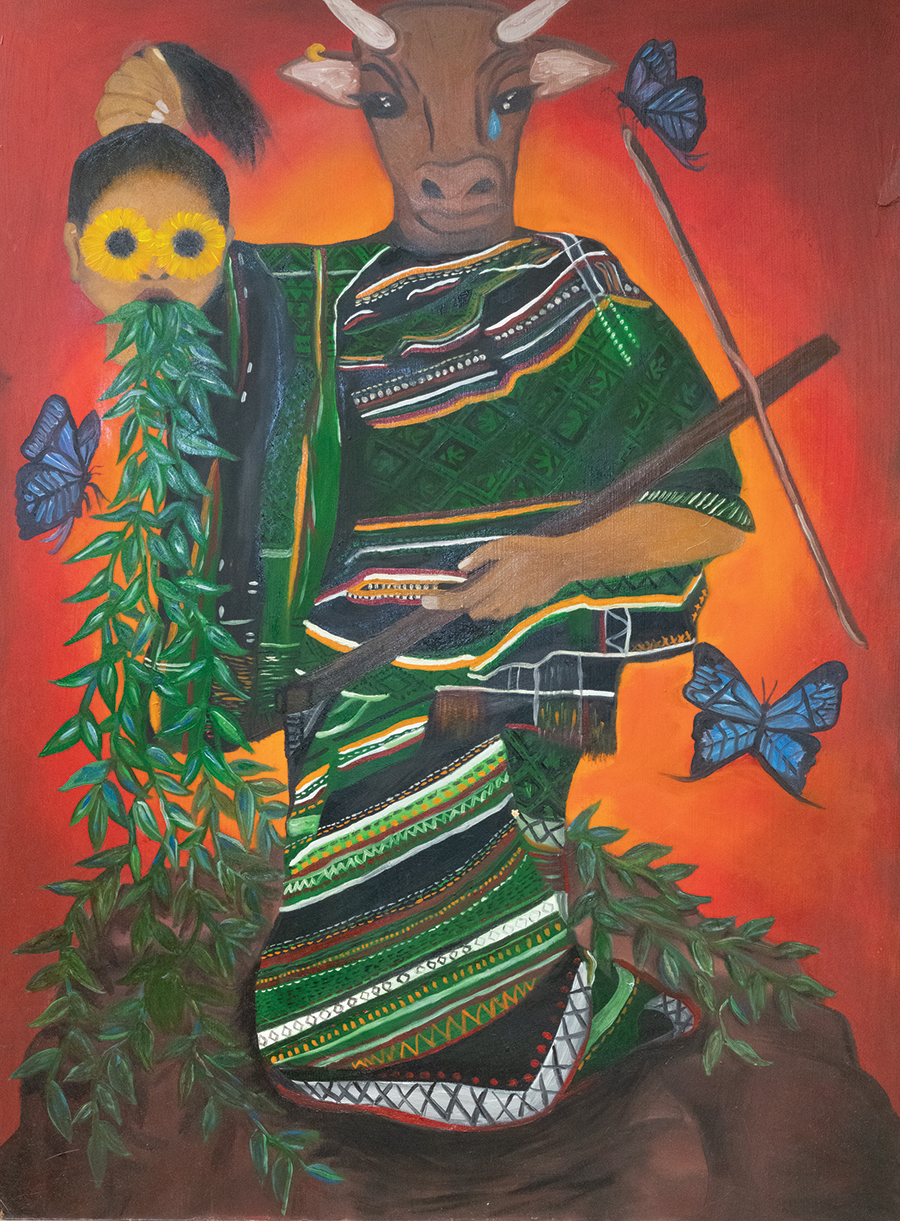
In her Greensboro art studio, Dely pulls out another painting. A woman, centered on the canvas, is wrapped in a green-patterned dress and rests a traditional Bunong bow and arrow in her left arm. The woman’s right arm is held outstretched and holds a severed head.

From the neck up, she is an ox. A tear runs down her cheek. Dely has entitled it Crying Ox.

“This was me expressing how I was feeling at the time,” she says. “Like I was just this head on this body that I didn’t understand. I didn’t really understand what it meant to be Bunong.”

Despite being raised in a tight-knit Greensboro-based Montagnard community, Dely had trouble connecting with her Bunong identity. “Growing up, I never understood myself or my culture or why I was here,” Dely says, “I got to a point where, being in a public school, I realized ‘Oh, I’m really different than most people,’”

“Because she was young [in the camps] and didn’t have all these direct memories, she was shaping her own view of who she was,” reflects Sel Mpang, Dely’s roommate and lifelong friend. Mpang and Dely were part of the same group that walked from the Vietnam Highlands to the Cambodian refugee camp. “She didn’t really talk about those experiences also because they were traumatic.”

In January 2020, Dely, her mother and her two younger siblings finally had a chance to return to their Bunong village. There, Dely reunited with aunts, uncles and grandparents who had not seen her in nearly 20 years.

“I was expecting myself to be more emotional,” she says. “I thought about it for so long and thought maybe when I get there I’ll cry and have this type of awakening.” Surprisingly, that was not the case: “It was fine. I was there, and I felt very at peace there.”

Now, Dely can reflect on Crying Ox from a different perspective. On her return, she looked at her painting and reflected, “Even though a lot of sad things have happened and there’s this whole history, at the end of the day when I was there, my family was just happy and smiling.”

One of the last paintings Dely turns to has three scenes. In the top right part of the canvas, a North Carolina neighborhood of shingled-roofed houses glow under a moonlit sky. In the top left, an orange-tinted sun lights up Saigon skyscrapers. The dividing point between the two settings is transformed as it runs down the image. It changes from a line into a river that flows through the painting’s final section, a village in the Highlands. Dely calls it Home.

Home is being used as a poster to promote Fighting for Family, a documentary about a Montagnard refugee who was deported by U.S. Immigration and Customs Enforcement to Vietnam without his family.

“The idea came from them being so far from each other,” Dely says. “They’re using my prints to sell to help raise money for the family.”

Catherine Panter-Brick, an anthropologist and expert on resilience, once said, “What matters to resilience is a sense of hope that life does indeed make sense, despite chaos, brutality, stress, worry or despair.” For Dely, that sense of hope comes from her creative expression and how it can help her community.

“My purpose in life is to be creative and to pull my culture and my ethnic group out into the public,” she says. “I also think it’s to be a teacher . . . teaching about my culture, teaching about creativity, incorporating both, and being more than what the Western eye sees us to be.”  OH

Allen Siegler is a freelance journalist based in Chapel Hill, North Carolina. His works have appeared in Indy Week, North Carolina Health News and The San Diego Union-Tribune.

Bookshelf

June Books

Compiled by Shannon Purdy Jones

Do you ever sit back and think, “Wow, how did I get so lucky?”

It’s a thought that pops into my head at least once a summer, every summer, usually while I’m out paddleboarding on Lake Brandt or camping with my kids at Badin Lake. Because, really, is there any better place to live than North Carolina in the summertime? Whether it’s trails to be trod in our gorgeous mountains and Piedmont, waves to be surfed on the Outer Banks, or backwaters to be kayaked, our beautiful state has so much to offer. So much, in fact, that I invariably end up with a N.C. summer bucket list too long to ever finish.

While you’re busy exploring all our home state has to offer, you need a good summer read — set in North Carolina, naturally — or two (or five!). Between mysteries and romance, historical fiction and nature exploration, there’s something for everyone. Dive in and get in that North Carolina state of mind this summer.

Smile Beach Murder (Outer Banks Bookshop Mystery) by Alicia Bessette

When Callie is laid off from her reporting job, she returns to her hometown of Cattail Island and lands a gig at the local bookstore — the same one where she found comfort after her mother died, tumbling from the top of the lighthouse.

As the anniversary of her mother’s death approaches, islanders are once again gossiping about the tragedy. Then, devastating news strikes. The lighthouse has claimed another victim, Eva Meeks, of Meeks Hardware.

The police are calling it suicide, but Callie is not buying it.

In Callie’s search for answers, she enlists the help of some beloved books and several new friends, including the handsome local martial arts instructor, Toby Dodge. As she earns enemies in pursuit of the truth, Callie knows she will either uncover the killer or become a victim herself.

Where the Crawdads Sing by Delia Owens

Sensitive and intelligent, Kya Clark, known as the Marsh Girl, has survived for years alone in the marsh that she calls home, finding friends in the gulls and lessons in the sand. Then the time comes when she yearns to be touched and loved. When two young men from town become intrigued by her wild beauty, Kya opens herself to a new life — until she become a murder suspect.

Where the Crawdads Sing is at once an exquisite ode to the natural world, a heartbreaking coming-of-age story, and a surprising tale of murder. Owens reminds us that we are forever shaped by the children we once were, and that we are all subject to the beautiful and violent secrets nature keeps.

The Night Swim by Megan Goldin

Ever since her true-crime podcast became an overnight sensation and set an innocent man free, Rachel Krall has become a household name — and the last hope for people seeking justice.

The new season of Rachel’s podcast has brought her to a small town being torn apart by the trial of a local golden boy, a swimmer destined for Olympic greatness, accused of raping the beloved granddaughter of the police chief. Meanwhile, someone is following her and won’t stop until Rachel finds out what happened to the anonymous writer’s sister 25 years ago.

Electrifying and propulsive, The Night Swim asks: What is the price of a reputation? Can a small town ever right the wrongs of its past? And what really happened to Jenny?

Under a Gilded Moon by Joy Jordan-Lake

Biltmore House, a palatial mansion being built by American “royalty,” the Vanderbilts, is in its final stages of construction. The country’s grandest example of privilege, it symbolizes the aspirations of its owner and the dreams of a girl, just as driven, who lives in its shadow.

After two years in college in New York City, family obligations call Kerry McGrefor home to the beautiful Appalachians where her family’s land is among the last pieces required to complete the Biltmore Estate. One by one, outsiders descend on the changing landscape — a fugitive from Sicily, a reporter chasing a groundbreaking story, a debutante tainted by scandal and a conservationist prepared to put anyone at risk to stoke the resentment of the locals.

As Kerry finds herself caught in a war between wealth and poverty, innocence and corruption, she must navigate not only her own pride and desperation to survive but also the temptations of fortune and the men who control it.

The Watery Part of the World by Michael Parker

Michael Parker’s vast and involving novel about pirates and slaves, treason and treasures, madness and devotion, takes place on a remote and tiny island battered by storms. Inspired by two little-known moments in history, the tale begins in 1813, when Theodosia Burr, en route to New York by ship to meet her father, Aaron Burr, disappears off the coast of North Carolina. A hundred and fifty years later, the last three inhabitants of a remote island — two elderly white women and the black man who takes care of them — are forced to leave their beloved spot of land. Parker tells an enduring story about what we’ll sacrifice for love and what we won’t.

Book Lovers by Emily Henry (And it’s the Scuppernong Books Romance Book Club’s June read!)

Nora Stephens’ life as a cutthroat literary agent is books — she’s read them all. But she is not that type of heroine. Not the plucky one, not the laidback dream girl and especially not the sweetheart. She’s a hero to her clients and her beloved little sister, Libby.

Which is why she agrees to go to Sunshine Falls, North Carolina, for the month of August when Libby begs her for a sisters’ trip away — with visions of a small town transformation for Nora. Libby is convinced Nora needs to become the heroine in her own story. But instead of picnics in meadows, or run-ins with a handsome country doctor, Nora keeps bumping into Charlie Lastra, a bookish, brooding editor from the city. It would be a meet-cute if not for the fact that they’ve met many times — and it’s never been cute.

If Nora knows she’s not an ideal heroine, Charlie knows he’s nobody’s hero. But as they are thrown together again and again — in a series of coincidences no editor worth their salt would allow — what they discover might just unravel the carefully crafted stories they’ve written about themselves.

Forest Walking: Discovering the Trees and Woodlands of North America by Peter Wohlleben and Jill Billinghurst

With Forest Walking, German forester Peter Wohlleben teams up with his longtime editor, Jane Billinghurst, as the two co-author their first book together. Together, they will teach you how to listen to what the forest is saying, no matter where you live or which trees you plan to visit next, such as:

What can you learn by following the spread of a root, by tasting the tip of a branch, by searching out that bitter almond smell? What creatures can be found in a stream if you turn over a rock — and what is the best way to cross a forest stream?

How can you understand a forest’s history by the feel of the path underfoot, the scars on the trees along the trail, or the play of sunlight through the branches? How can we safely explore the forest at night? What activities can we use to engage children with the forest?

How to Read a North Carolina Beach: Bubble Holes, Barking Sands, and Rippled Runnels by Orrin H. Pilkey, Tracy Monegan Rice and William J. Neal

In How to Read a North Carolina Beach, three leading experts in coastal geology provide a guidebook to North Carolina beach characteristics for recreational beachgoers and naturalists. Topics include the interaction of wind, waves and sand in the formation of dunes and barrier islands; smaller features such as sea foam, bubble holes and sharks’ teeth; and strategies for conservation.

What makes sea foam? What are those tiny sand volcanoes along the waterline? You’ll find the answers to these questions and dozens more in this comprehensive field guide to the state’s beaches. Shannon Purdy Jones is store manager, children’s book buyer and one of the co-owners of Scuppernong Books.  OH

Shannon Purdy Jones is co-owner of Scuppernong Books.

Omnivorous Reader

Dame Agatha’s Mystery

A novel look at Christie’s 11-day disappearance

By Anne Blythe

Dame Agatha Christie, the famed author who wrote 66 detective novels in her 85 years, left the conclusion of one very public mystery untold.

While some details are known about what happened in December 1926 when the prolific writer famously went missing for 11 days, much remains unknown. That has led to an array of books and films in which writers attempt to piece together clues, fill in gaps and offer theories about Christie’s perplexing disappearance.

Nina de Gramont, a creative writing professor at the University of North Carolina Wilmington, has put forward an intriguing and inventive account in her latest novel, The Christie Affair. She tells her story from the perspective of the mistress who, history tells us, broke up the marriage of Christie and her first husband, Archie.

Here’s what we know from newspaper accounts.

The search for Christie included hundreds of police officers, planes, amateur sleuths on bicycles and in cars, musings from fellow mystery writers Sir Arthur Conan Doyle and Dorothy Sayers, and even a séance at the site where her green Morris Cowley was found deserted in a ditch in the English countryside.

Many theories were posed about what happened to the “lady novelist,” as some journalists described Christie. Was her body at the bottom of the Silent Pool, the lake in Surrey, England, near the abandoned car? Could the mystery writer, not so well-known at the time, be pulling a publicity stunt?

The hunt ended some 200 miles north of Sunningdale, where the author lived with her husband Archie and their daughter, when it was revealed that Christie had checked into the Swan Hydropathic Hotel in Harrogate using the name Theresa Neele. It was not known at the time by the public, but Neele was the last name of Archie’s mistress, the woman he planned to leave his wife for.

Christie’s only public explanation of her whereabouts came in a February 1928 interview with the Daily Mail, in which she described being in a state of depression after her mother’s death in 1926 and suffering from “private troubles,” which she said she preferred not to get into with the reporter. The Daily Mail reported that Christie contemplated death by suicide several times before driving her car into the remote ditch, hitting something, being flung against the steering wheel and bumping her head. It has long been questioned whether Christie truly had amnesia as the family reported after a public outcry about the extensive search and cost of it when it was revealed the author had been staying in the hotel under an assumed name.

“Up to this moment, I was Mrs. Christie,” she told the Daily Mail.

In her book, Gramont names her narrator Nan O’Dea, a departure from Nancy Neele, the real-life other woman. Without giving short shrift to details of the headline-grabbing disappearance available in newspaper archives around the world, de Gramont devises a double-pronged plot. She alternates between Nan’s account of the days and crucial moments before Christie went missing and a backstory filled with sadness and grief that drives the fictional narrator.

We’re transported from London to Ireland and the worlds of the haves and have-nots amid World War I. We move back and forth between Nan’s early days and her first powerful love in Ireland to Christie’s unraveling marriage and the 11 days that inspired the novel. Slowly, we find out why Nan sets her sights on Archie and aggressively works to woo him away from Agatha to achieve a greater love that becomes clearer as the suspense unravels.

Like the “Queen of Crime,” Gramont has a knack for mystery. She lures her readers in with her first sentence: “A long time ago in another country, I almost killed a woman.”

The North Carolina author also has a gift for leaving subtle signs of what lies ahead, putting pointers in plain sight in the style of Christie.

“Anyone who says I have no regrets is either a psychopath or a liar,” Nan, the narrator, says in the opening chapter when asked by her sister whether she regrets what she did. “I am neither of those things, simply adept at keeping secrets. In this way, the first Mrs. Christie and the second are very much alike. We both know you can’t tell your own story without exposing someone else’s. Her whole life, Agatha refused to answer any questions about the eleven days she was missing, and it wasn’t only because she needed to protect herself. I would have refused to answer, too, if anyone had thought to ask.”

Right at the start, we find out what will become clear in the end — Nan ends up with Archie and Agatha does not.

What we get from de Gramont’s evocative and layered scenes between the beginning and end are often twists, steamy romance, deadpan humor, an unexpected body (as necessary in any Christie mystery) and adventures to old-fashioned villages with a cast of mostly affable, but complicated characters.

“As readers our minds reach toward longed for conclusions,” de Gramont writes as Nan brings her own narrative to a close with an ending that’s not all rosy.

Her storyline for Agatha, though, concludes with a happier image.

“A mystery should end with a killer revealed, and so it has,” de Gramont writes toward the end of her book. “A quest should end with a treasure restored. And so it has. A tragic love story should end with its lovers dead or departed. But a romance. That should end with lovers reunited. Beyond the confines of these pages, life will go tumbling forward. But this is my story. I can make anything happen, unbeholden to a future that now has become the past. I can leave you with a single image, and we pretend it lasts forever. So for this part of the story, let’s stop here.”

The author’s masterful storytelling leaves you longing for more.  OH

Anne Blythe has been a reporter in North Carolina for more than three decades. She has covered city halls, higher education, the courts, crime, hurricanes, ice storms, droughts, floods, college sports, health care and many wonderful characters who make this state such an interesting place.

Short Stories & Ogi Sez

Short Stories

Juneteenth

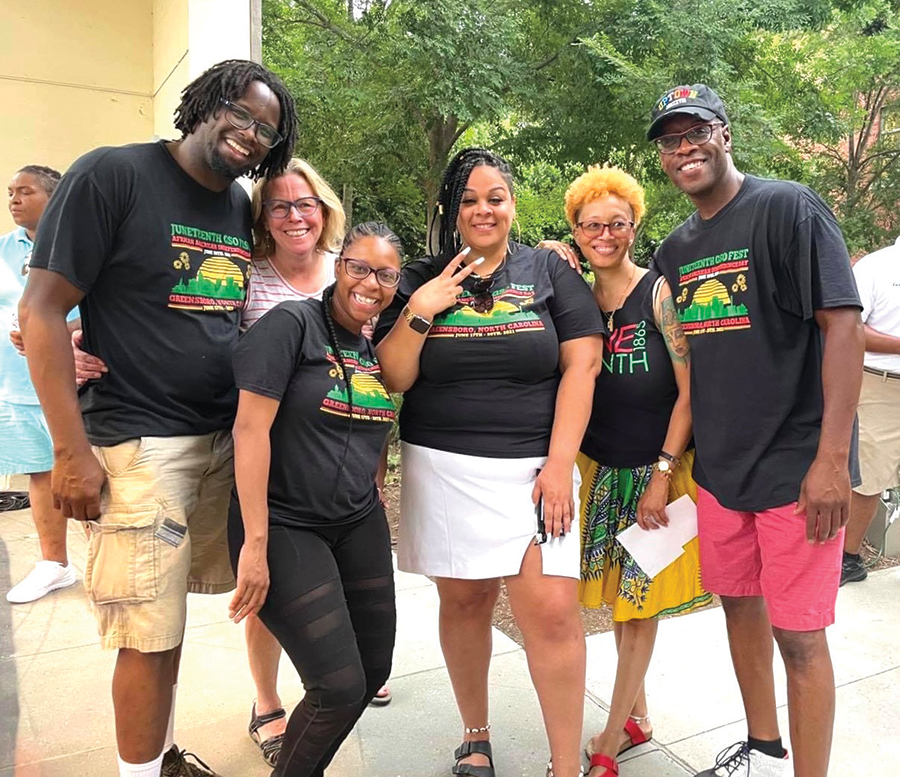
Last year, Juneteenth became a national holiday, commemorating June 19, 1865, when Blacks in Galveston, Texas were liberated from the institution of slavery. To highlight the resilience, solidarity and culture of Juneteenth specifically and Black heritage in general, Greensboro is hosting a three-day celebration. Kick things off at 8 p.m. on Thursday, June 16, when Sistars of Juneteenth fill the stage with Black female artistry in multiple forms, from live-painting to hip-hop dance and poetry. Move over Cinderella — at 8 p.m., Friday, June 17, ditch those glass slippers and don your fanciest kicks plus your best black-tie affair attire for the Uptown FRESH Sneakerball. Also on Friday, from 7:30–9 p.m., the Arts Legacy Awards honor the impact Black artists have had in Greensboro. On Sunday, June 19, festivities continue with loads of park-hopping fun. From 11 a.m.–7 p.m., Douglas Park comes alive with Family Day, filled with activities for the whole crew. Hit Barber Park from 2:30–5:30 p.m. for an interfaith Gospel Superfest. And finally, end Juneteenth full of joy — and delicious eats — at a Black Food Truck Fest, featuring sweet and savory bites, a DJ and an open mic from 6–8 p.m. at LeBauer Park. Info: juneteenthgso.com.


Run Hard, Speakeasy

If your favorite things to pound are pours and pavement, lace up your sneakers and put on your jazziest glow gear. At 8:30 p.m., Saturday, June 11, the Greensboro Distilling Speakeasy 5K takes off for an after-dark, out-and-back run through downtown — with a finish line conveniently located at Fainting Goat Spirits. Once you’ve completed the course, enjoy live jazz music and sip artisanal grain-to-glass cocktails that pair well with salty perspiration. Who knew running could be such whiskey business? Race ya to the bar! Use code ohey15 to receive a %15 registration discount. Info: www.triviumracing.com; to subscribe to receive weekly happenings in the O.Hey voice, visit oheygreensboro.com.


All the Porch is a Stage

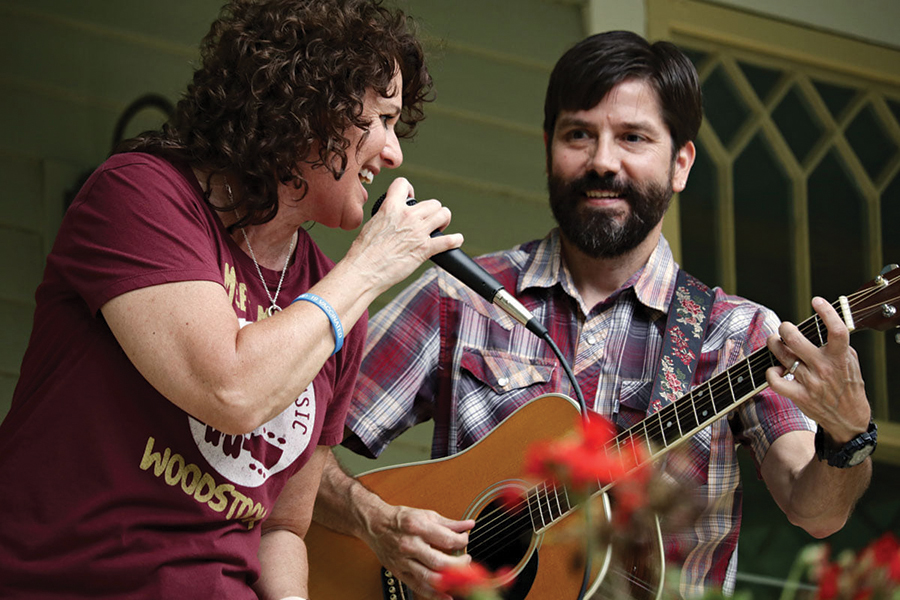
If this porch is rocking, you’d better come a’knockin’! Actually, no need to announce your entry. Just pull up a blanket or chair on one of many concert meadows — aka front lawns — during Dunleath Porchfest from noon until 5 p.m. on Saturday, June 11. During this free, family-friendly event, porches transform into stages for local musicians sharing their talents. Stroll from one historic bungalow to the next, taking in the fiddling, guitar-picking and soulful harmonizing of performers such as the Headless Chickens, The Alley Rabbits and the Goodbye Horses, plus 46 others that may or may not charm children with animals in their names. End the day with a final performance at Sternberger Park. Attendees are encouraged to show their community spirit by bringing nonperishable food items for the Triad Health Project food pantry. Info: dunleath.org.


Are You Ready for Some Hank Williams Jr.?

Beginning his musical career at the age of 8 by singing his father’s songs in a Swainsboro, Georgia show, Hank Williams Jr. has proven over his seven decades of performing that a country boy can indeed survive. Since his young, young debut, Williams has earned himself a place in the Nashville Songwriters Hall of Fame, won Emmy and Grammy awards, and has been named Entertainer of the year multiple times by the Country Music Association and the Academy of Country Music. He’s not only survived — he’s thrived. At 8 p.m on Friday, June 24, round up all your rowdy friends for a night of honky-tonk at the Greensboro Coliseum as only Hank Williams Jr. can deliver. Info: greensborocoliseum.com.


Do You Believe in Magic?

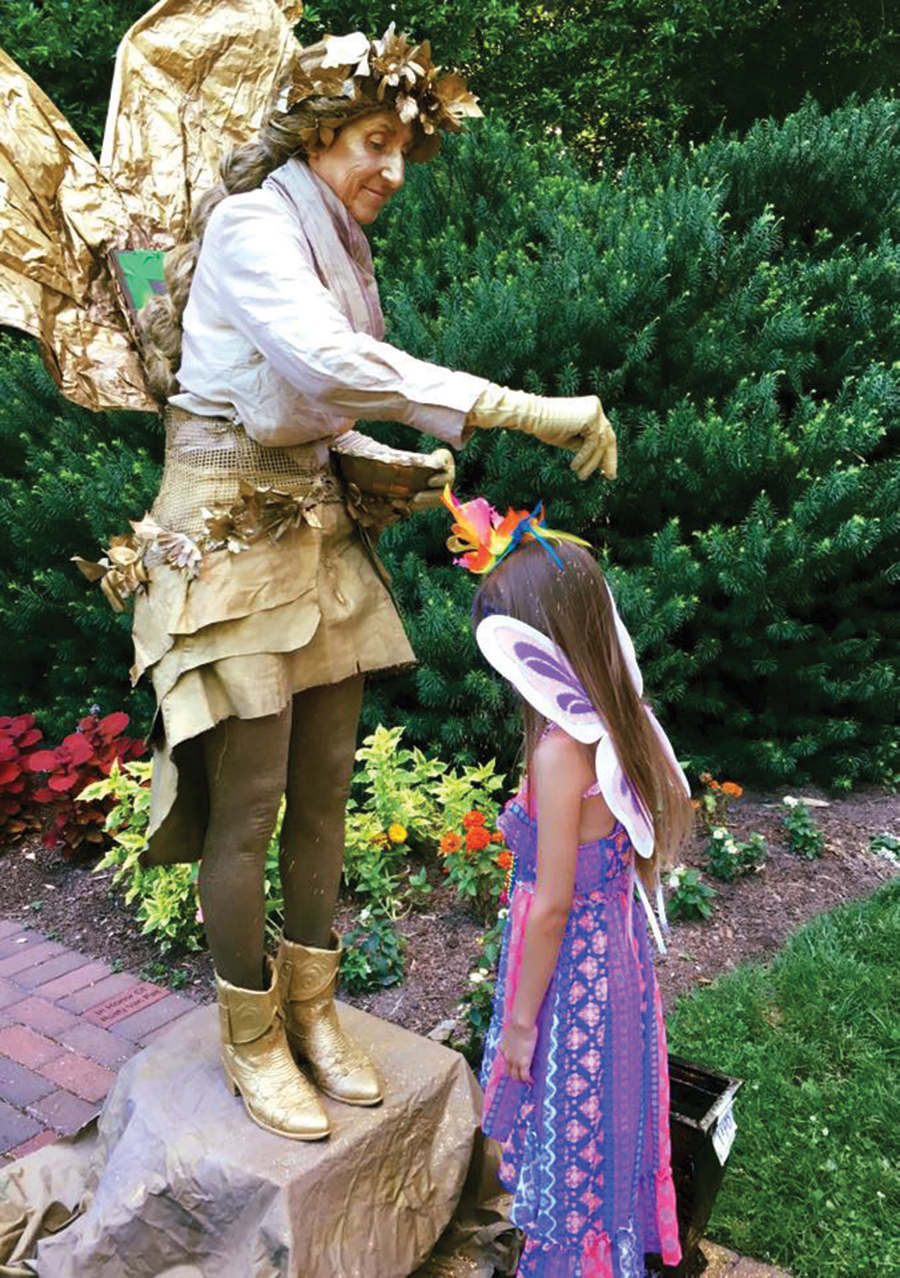
Calling all mythical and magical beings, woodland witches and wannabe wizards! Sprinkle yourself with fairy dust, twinkle your nose and flit over to Lindley Park for the Greensboro Summer Solstice Festival from 2–10 p.m. on Saturday, June 18. No wings? No problem. Behold vendors peddling everything you need to nourish (and become) your most mystical self. Throughout the day (and it is the longest in 364 days), two stages come alive with musicians, dancers and enchantresses. An hour-long participatory drum circle resounds to the heartbeat of the diverse community the festival honors. And finally, at 9 p.m., pull up a toadstool and watch as the night ends with a blazing finale, glowing with LED hoopers and fire spinners. Welcome the season of the sun by celebrating its many gifts. Info: greensborosummersolstice.org.


Ogi Sez

You can look at June one of two ways. Either the bugs and snakes are out, the lawn needs mowing, the heat and humidity are dreadful, and football season is still four months away. Or, the pollen is mercifully gone, the flowers are blooming, the evenings are perfect and it’s baseball season. All the above are true, so you decide whether to whine or celebrate. I’d wager, though, that almost all music lovers fall in the celebratory category. Further, that if the whiners listened to more music and went to more live shows, many would ease on over to the bright side. Just as June, the tunes are bustin’ out all over, so what better time to start?

• June 4, Ramkat (W-S): My dear departed friend, John Stephenson, owner of School Kids Records, befriended Robert Earl Keen before anyone knew who he was. During John’s last days, Robert Earl gave him and his wife Diane a closed-door show with an audience of two before his gig that night at Ziggy’s. Aside from his boundless talent and song craftsmanship, you need to know what kind of man he is.

• June 8, Tanger Center: I started to say there’s no royalty like Sir Elton John on the bill at Tanger this month, but then I realized that, title or not, Bonnie Raitt is pure royalty. Both her voice and slide wizardry are instantly recognizable; there’s simply no one like her.

• June 9, Carolina Theatre: I must admit, I was late to the party for JJ Grey & Mofro. But I am definitely making up for lost time. His chill-bump-inducing voice does the impossible, going from a Rod Stewart rasp to an upper-register Adele warble — in the same song. Plus, Mofro includes a horn section, two killer harmony vocalists and a Hammond B3, as well as Grey’s sweet guitar work.

• June 11, Greensboro Coliseum: I can’t prove it, but it seems plausible that the genre “Urban Contemporary” was invented for Keith Sweat. There’s not much he hasn’t done as a performer, producer, songwriter, radio show host and mentor to aspiring talent. He has released 15 albums and was given the Soul Train Lifetime Achievement Award in 2013, which speaks volumes.

• June 25, Ziggy’s.Space (HP): I was initially intrigued by Flatland Cavalry because of their looks. They remind me of, say, Goose Creek Symphony and New Riders of the Purple Sage, two of my favs from the hippie days. And their sound is not unlike that bevy of country rock bands of the era. Plus, it didn’t hurt a bit that they’re from Buddy Holly’s hometown of Lubbock, Texas. All that aside, there is nothing derivative about them; they stand on their own.

Life’s Funny

Paper Chase

The joys of springtime shredding return

By Maria Johnson

My heart leapt in my chest.

There, on my laptop screen, was a solid sign that the pre-pandemic pleasures of life were returning.

Shredding events were back.

Yee-ha!

In case you’ve had your head stuck in a pile of papers, shredding events are community gatherings that involve long lines of cars dropping off loads of personal documents at designated sites, where boxy trucks with huge metal teeth grind them to ribbons — grrrunch, grrrunch, grrrunch — in front of your very eyes.

It’s a contemporary phenomenon, this voluntary destruction of docs, and it usually happens on Saturdays, which adds to the going-to-the-fair feeling.

For your viewing pleasure, some shredding trucks are outfitted with screens showing live feeds from cameras focused on the churning blades and the mountain of pulp inside the truck.

“People like looking at their stuff getting shredded. They really like that,” says 33-year-old Jorge Acosta, who drives for a company called Shred Ace Inc. “It’s a peace of mind thing. I get it. Once those documents go in, they’re not coming out.”

That’s comforting in an age when almost everyone knows what it means to be hacked, breached or compromised.

Bottom line: Public shredding is one of the most cathartic, satisfying experiences I’ve ever had, so much so that I’m willing to overlook my disdain for the word “event,” as in “weather event” (tornado) or “cardiac event” (heart attack).

Every spring — peak season, as any master shredder knows — I schlep old records to an advertised event, where I feel a deep kinship with other defenders of the PIN.

That’s one reason 2020 was small-T traumatic for me.

Not only did COVID inflict true suffering on millions, it cancelled public shreddings far and wide for two years.

Sniff-sniff. I missed myyyyyyy evennnnnnnnnnts.

So imagine my joy when mass shredding resumed this spring. Finally, the mountain of old files that kept me from reconfiguring the closet in my office could be cleared.

Now, the hard work — weighing what to keep and what to shred — began.

Some of them were no-brainers.

Paycheck stubs, expense reports and tax returns more than a few years old? Gone.

Receipts from ancient purchases and routine medical appointments? Outta here.

Statements from accounts closed long ago? Sayonara, suckers.

Other papers, that stirred memories, were harder to part with.

A tattered file marked “Furniture” stopped me.

I leafed through receipts and notes about pieces my husband and I bought when we first started housekeeping 30-plus years ago.

I smiled at copies of letters — typed on a chunky computer monitor, spat out of a dot-matrix printer and mailed with a stamp — that I’d sent to a furniture retailer, insisting that they replace our brand new (cracked) dining room chairs with a new batch after their attempted repairs on the first set of chairs failed.

Lord, I was feisty. And probably over the top. But effective. My grandmother had given us money to buy that dining room furniture, and I was going to make her gift right.

She’s been gone for 25 years now, but when I thought about how much she liked that furniture, and how proud she was to have had a hand in making our home, she was with me again.

I kept the letters and pitched the receipts.

My husband got into the game, combing through files stuffed with his college course work. He kept a few tests marked “100.”

We joked that we should start a new file called “Damn, I Was Good.”

And maybe another one called, “Damn, That Was Stupid,” which we’d fill with evidence of the investments we’d sold right before they took off. Expensive lessons in patience, indeed.

We loaded the car with boxes and bags of old files and headed to the event. My pulse quickened when I saw a line of cars backed out onto the street, like a queue of concert-goers waiting to get into the venue.

Doubt crept in. What if we were throwing away something we’d need later? I crawled into the backseat and started pulling files. Then I said to heck with it. There probably was a mistake, a future regret, in there somewhere. So be it.

Half an hour later, we forked over a donation of $5 per box — some organizations use shredding events as fundraisers — and pulled up beside the hungry truck. Volunteers emptied our boxes into a huge plastic trash bin and rolled it to the truck.

We watched as mechanical arms clasped, raised and tipped the bin into the shredder.

Grrrunch, grrrunch, grrrunch.

Gone for good. Ashes to ashes. Pulp to pulp.

It’s the best show in town. On paper, anyway.  OH

Maria Johnson is a contributing editor of O.Henry magazine. You can reach her at ohenrymaria@gmail.com.

The Creators of N.C.

Imprinting the Land

The artistry of printmaker Katie Hayes

By Wiley Cash

Photographs by Mallory Cash 

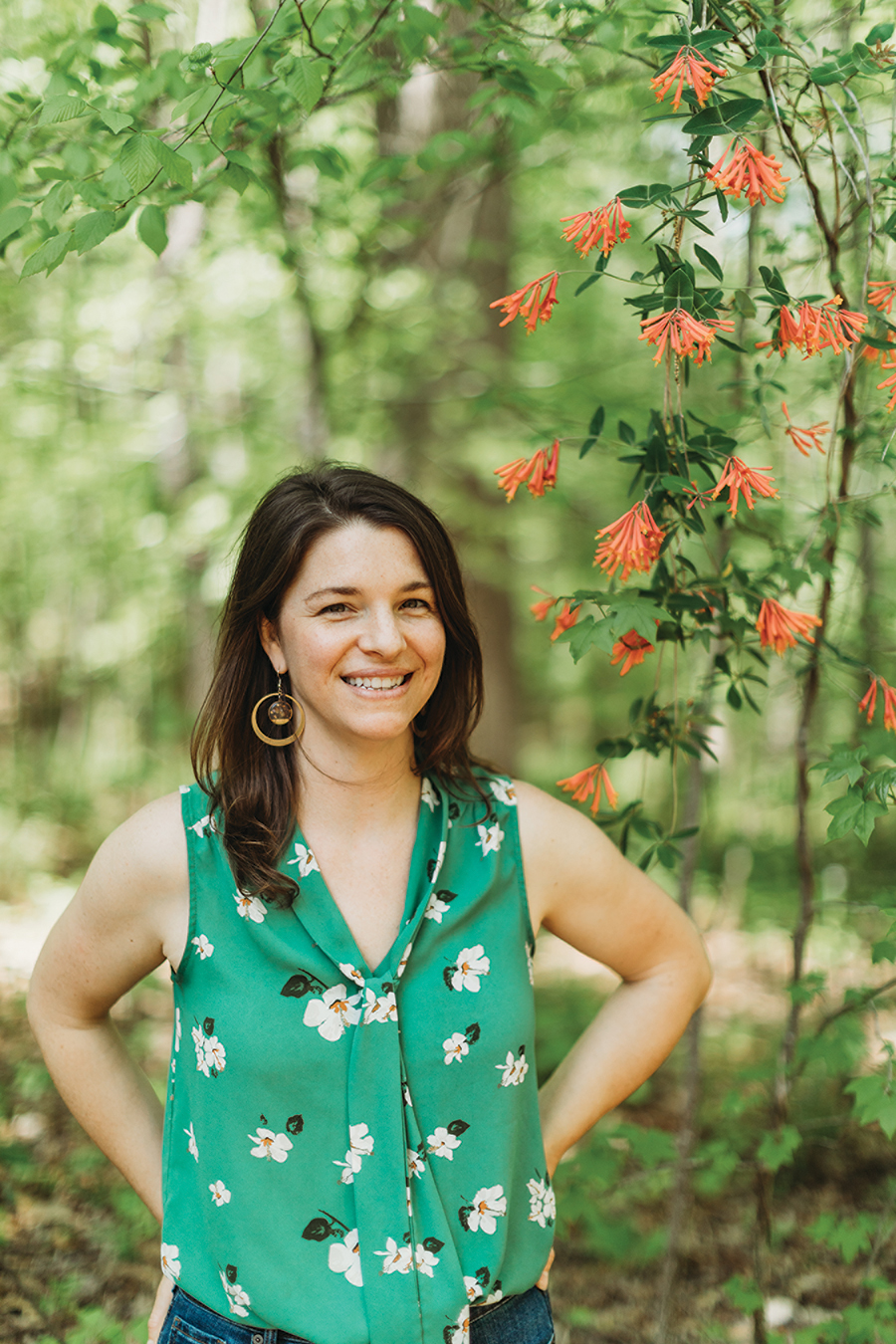
About half a mile down a gravel road off a two-lane highway in rural Hillsborough, block printmaker Katie Hayes is working in a light-filled studio above her garage. It’s midday on a warm afternoon in late April. Sunlight slants through a canopy of tulip poplars and oaks, trickling down to the dogwoods that make up an understory that shades countless azaleas wild with blooms. I can’t see it from where I stand, gazing at the forest from the sliding glass door at the back of Katie’s studio, but I can hear a nearby cardinal chirping against a backdrop of birdcalls that echo through the trees.

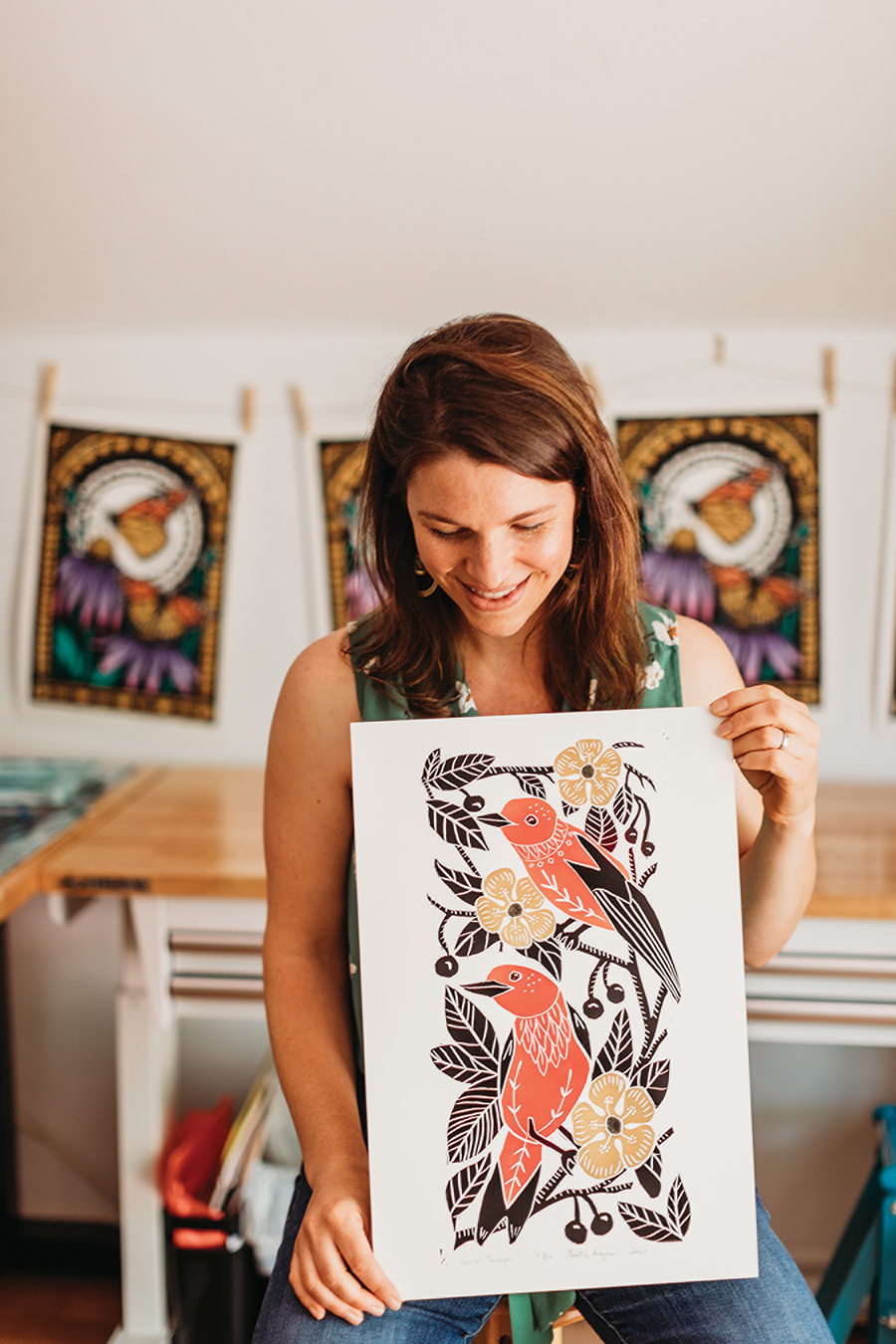
It’s not a stretch to say that the living things outside Katie’s studio parallel the flora and fauna portrayed in her prints: All around me, jet black herons with indigo wings stalk through shallow pools; brilliant monarchs and viceroys alight on purple coneflowers; scarlet tanagers perch on branches surrounded by yellow blossoms. Here, the wild things outside the studio’s walls have been tamed and contained, framed and matted, but no less alive than they would be in the natural world.

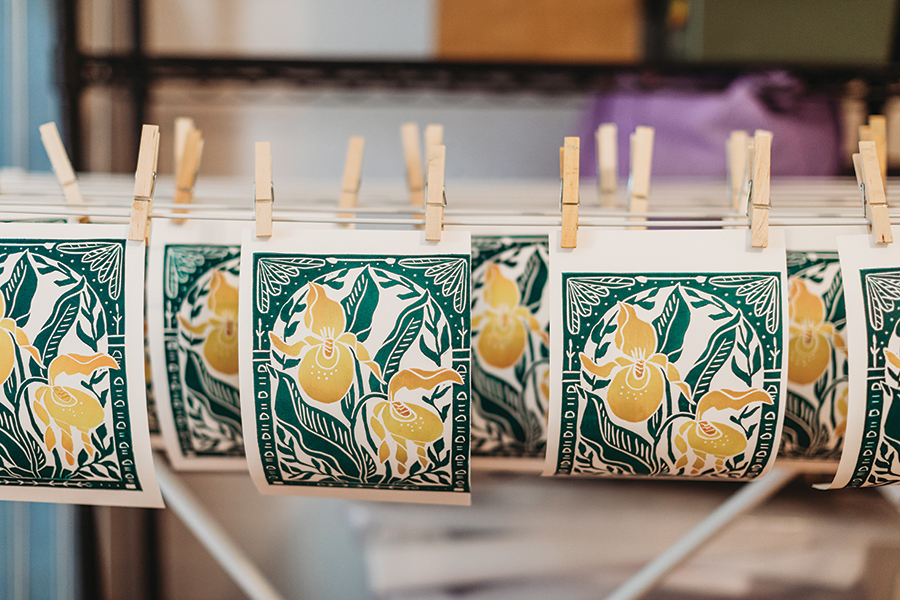
Unlike the wildness of the woods, Katie’s studio space is meticulously managed. Drying prints lean against the wall on one side of the studio. Rollers — known as brayers — and ink and instruments made for cutting or measuring hang in various places within easy reach. A basket of pre-ordered prints featuring a yellow lady’s slipper rest in a basket, each print partnered with a personalized handwritten note from Katie. The airy space is orderly and organized, a far cry from the world outside its walls.

“Setting this place up exactly as I need it feels really good,” Katie says. She is rolling midnight black ink onto a piece of plexiglass. “I never thought I’d have a place like this.”

I know that Katie is talking about her studio, but she could be referring to the 10 acres she shares with Sean and their daughter, Millie, and son, Ben. Or she could just as easily be talking about Hillsborough, or even North Carolina, for that matter. Although she was raised in Cullowhee, North Carolina, at one point in her life she’d lived in 13 houses in four states, and that was before she and Sean settled in Ohio, where Sean worked for Oberlin College and Katie worked for a nonprofit, assisting high school students with everything from completing college applications to tasks like locating their Social Security numbers. With each move, whether it was from the mountains of North Carolina to the Piedmont to attend UNC-Chapel Hill, or from Carrboro to Ohio, Katie began to see her regional identity more clearly.

“It wasn’t until I really left the South that I realized that being a Southerner was part of my identity, like I didn’t realize that being a rural mountain kid was part of my identity until I went to Carolina,” she says.

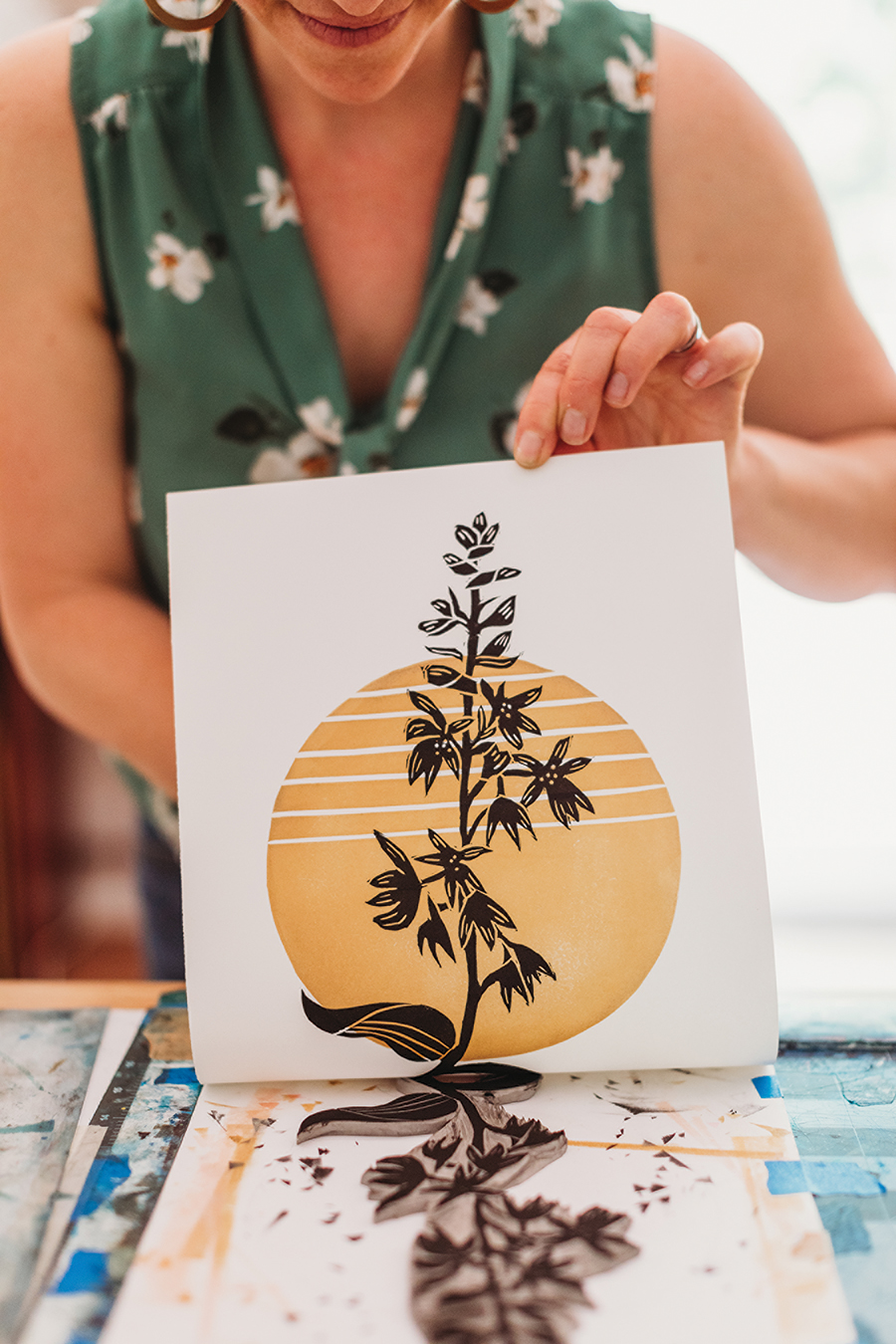
At the moment, Katie is using a heavy glass baren to smooth paper atop the block cut in order for it to absorb the ink that covers the block. The process of making a single print is long and tedious. After cutting a design into a block of linoleum, which can take anywhere from a couple of hours to a couple of days depending on the complexity of the image, Katie uses a brayer to evenly smear ink across a piece of plexiglass before using the same brayer to cover the block in ink. She then lays the paper over the block and runs the baren across the back of it. Most prints make use of more than one color ink, so each print goes through this process at least twice.

Katie made her first print in an art class at Smoky Mountain High School in Jackson County. She carved a linocut of a rabbit, and after her teacher put it on display someone offered to buy it. She sold it for $15, and while she didn’t return to printmaking for many years because she didn’t have the tools and materials, the early satisfaction of knowing that her work had spoken to someone stayed with her.

What also stayed with her was the effect her grandmother’s art and practice had on her. Shirley O’Neill was an accomplished amateur watercolorist, and she always made sure that Katie had good materials — high quality paints, brushes and paper — in order to do her best work.

I watch Katie make print after print, nervous that our conversation will distract her and cause her to make a mistake, and also impressed at how she seems both careful and carefree. The block she is working from now is for a 12×16 inch matboard print from her limited edition Mid-Century Botanical series. Each print features a colorful design — a gold sun, a soft pink segmented circle, a gray oval — overlaid by the black shapes of various flora: Virginia bluebells, native ferns and peonies. She peels back the matboard, revealing a cardinal flower set against a segmented gold sun. I watch her repeat the process of imprinting cardinal flowers on several more matboards with various colorful shapes already set onto them, and each time she reveals the flower her face lights up in a smile.

“It feels so good,” she says. “When it works, it’s so good.”

While the process is repetitive, it doesn’t allow Katie to shut off her brain and rely on rote memory. She is constantly assessing the amount of ink on the brayer, the placement of the paper against the block, and the countless other adjustments she makes during a single print run, which she limits to 100. There are no reproductions. Every print is handmade, distinct and limited.

Katie’s designs don’t only end up as hand-pulled prints made in her studio; her designs are also printed on everything from fabric to wallpaper by Spoonflower, a global marketplace based in Durham that manufactures textiles, connecting artists directly to consumers with no overhead costs for the artists.

Katie creates images of the flora and fauna of the Southern landscape she knows so well not only because she’s a native, but also because she gave birth to a daughter in Ohio who was upset by the family’s move south to Durham five years ago, when Sean took a job running operations for a firm that services solar farms.

“The move was a chance to get back closer to family,” Katie says, “but my daughter was 4 1/2 at the time, and when we moved it was really hard for her. She had a newborn baby brother. We had lived in a great neighborhood in Ohio, and she’d had tons of friends at a great school, and she was uprooted. The way I got started creating these images was at night. When she would go to bed, I would make her these coloring pages, where I would illustrate different native Southeastern flora and fauna. During the day I would have my hands full with the baby, but I would whisper to her, ‘Pssst, I made you some new coloring pages. These are passion flowers. They grow wild here and look like jungle plants.’

“For a long time I resisted doing art professionally. I always saw the art world as something really exclusive,” she adds. “It wasn’t for redneck girls from Cullowhee.”

But moving to Ohio made her reconsider the role art could play in her life, and the lives of people both inside and outside the region.

“When I moved to Oberlin, people always had all these misconceptions about North Carolina and the South; it’s either Gone with the Wind or Duck Dynasty. Neither of those are authentic to my experience,” she says. This, combined with connecting her daughter to their new home via images of the Southern landscape, inspired Katie to develop a library of images, eventually culminating in a printmaking shop she calls the New South Pattern House.

“As parents we’re always trying to curate the best parts of our childhood,” she says. “That’s how I think of my Southern identity with my kids and, frankly, my business. What parts do I want to highlight? We have this incredibly rich biodiversity. We have beautiful, vibrant cities. What are the parts we want to move away from? When people think of Southerners, do I want them to think of the Confederate flag? No, not for me. I want them to think of coneflowers.”  OH

Wiley Cash is the Alumni Author-in-Residence at the University of North Carolina at Asheville. His new novel, When Ghosts Come Home, is available wherever books are sold.

O.Henry Ending

Splash or not Splash?

A risk taken to prove a point

By Mary Best

As the youngest of five dangerously independent — and always mischievous — children of a couple of educators in the Greensboro school system, I weathered many storms as a toddler. Don’t get me wrong: I grew up in a loving home with devoted parents. But being the runt of the litter, I suffered a disadvantage — the last to receive nourishment at mealtime, endless ribbing about my clothes and toys, relentless teasing about being “sweet.” Why were my three brothers so different from me? They didn’t play with dolls, for heaven’s sake. Who doesn’t play with dolls? And don’t even get me started about Barbie.

When I wanted to play with the “big kids,” I sometimes bit off more than I could chew. For example, my family belonged to Lawndale pool, and for hours I would watch my brothers climb to the top of the high dive and plunge into the deep end. Effortlessly. Joyfully. Thoughtlessly.

So, when I was about 3 or so — younger than I could count my years on one hand — I decided to follow in their footsteps and jump off the high diving board. I had watched them master it many times. If they could do it, I thought, how hard could it be?

Fearlessly, I climbed the ladder to the top of the diving board. As I neared the end of the board, lifeguards, pool members and my poor parents froze and watched as a kid who couldn’t recite the alphabet was about to take a death-defying leap.

Up until then, my greatest adventure had been getting lost in Meyer’s downtown. Oh, and that misadventure in Franklin Drugs, when I had to go to the restroom but couldn’t read the signs on the door. Yikes, I chose the wrong door.

But I digress. Back to the pool.

My father quietly ascended the ladder, and when he reached the top, he gently, calmly, called my name. “Mary Frances,” he nearly whispered, “I’d like for you to come to me. I have something I want to tell you.”

I frowned. “But I want to show my brothers I’m as tough as they are.”

“They know, Sweetheart,” he replied. “I was the youngest too. And I endured my share of teasing.”

I never thought about other kids being teased. I had assumed it was some unique, degenerative condition from which only my brothers suffered. I had no idea their ceaseless mocking could be a sign of a pandemic, an epidemic or — even worse — ubiquitous.

The pool crowd silenced. Swimmers, sunbathers and hungry patrons in line at the concession stand held their breath as my father coaxed me toward him.

“Can you make them stop picking on me?” I pleaded. Why the hell not? I wasn’t exactly a prosecutor or defense attorney, but I felt pretty darn powerful for someone who only recently had mastered 4 + 4 = 7, right?

“I can’t promise you that,” my dad said. “But I can promise this: I will never let anyone hurt you. I know your brothers don’t show it because they are knuckleheads, but they love you, and they will always be there for you.”

Convincing. Plus, the water seemed much farther away than it did a few minutes ago.

As my father shepherded my descent from the ladder, I saw my brothers surrounding the area around the foot of the diving board. As sentinels. At that point, I knew they loved me — as protectors, friends, brothers. The teasing didn’t stop, but I knew that day at the pool they loved me.  OH

Mary Best is a freelance writer living in Greensboro. Contact her at marybest04@gmail.com.

The Creators of N.C.

A Shared Life

Judy Goldman looks back on the Jim Crow South

By Wiley Cash

Photographs by Mallory Cash 

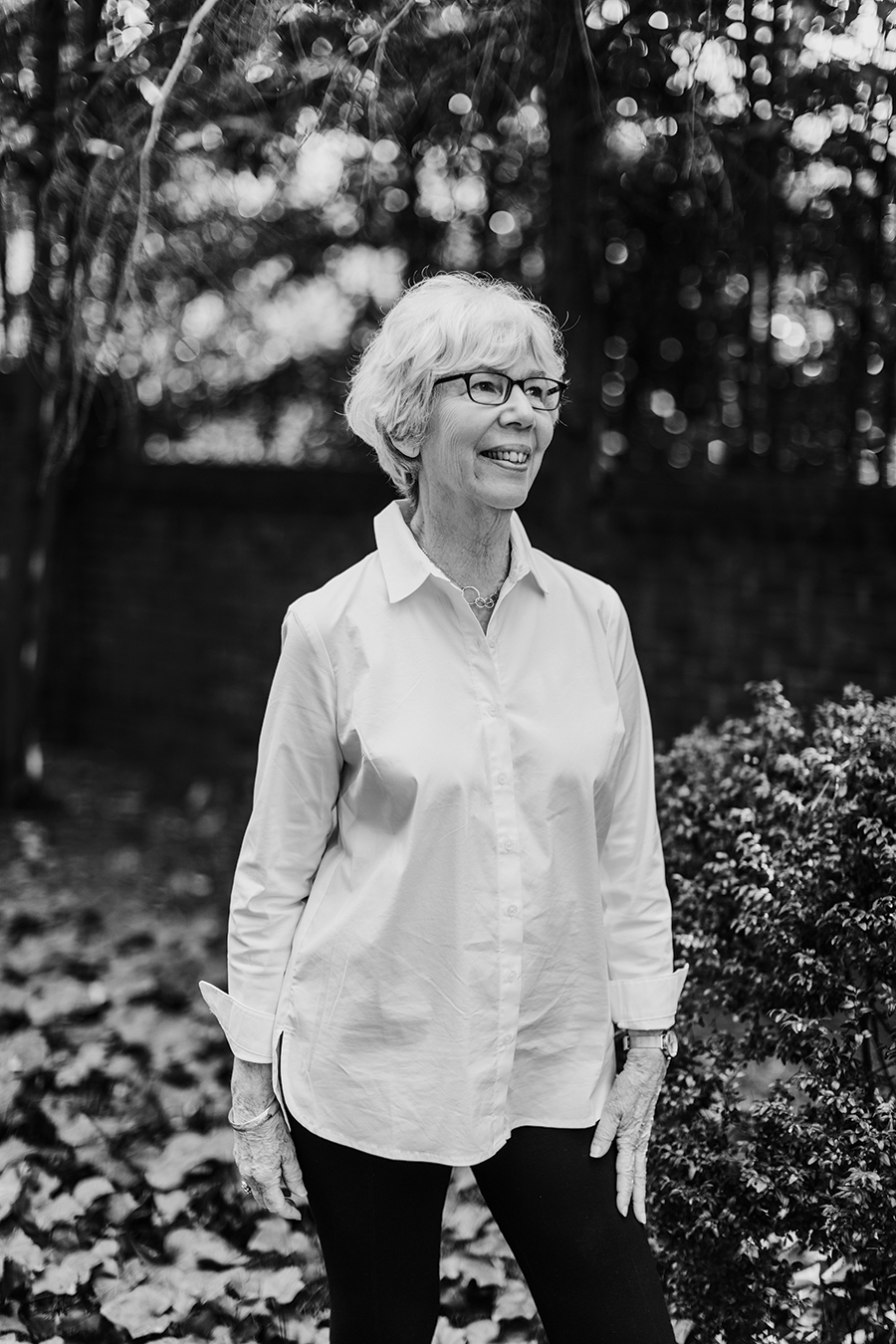
I first met author Judy Kurtz Goldman in the summer of 2013 when we were seated beside one another at a dinner sponsored by a local bookstore in Spartanburg, South Carolina. Of that evening, I can remember Judy’s elegant Southern accent, her self-deprecating humor, and her teasing me that my calling her “ma’am” made her feel old. But Southerners like Judy know that the conventions you were raised under are hard to buck, regardless of whether they are based on something as benign as manners or as oppressive as prejudice.

According to the late Pat Conroy, Judy Goldman is a writer of “great luminous beauty,” and I happen to agree with him. She’s published two previous memoirs, two novels, two collections of poetry, and she has won the Sir Walter Raleigh Prize for fiction and the Hobson Award for Distinguished Achievement in Arts and Letters. In her new memoir, Child, Judy confronts the horrible legacy of the Jim Crow South while coming to terms with the fact that the customs and laws born from Jim Crow delivered one of the most meaningful and long lasting relationships of Judy’s life. The memoir explores the life she shared with her family’s live-in domestic worker, a Black woman named Mattie Culp, who came to live with and work for the Kurtz family in Rock Hill, South Carolina, when she was 26 and Judy was 3. From the moment of Mattie’s arrival, she and Judy were close physically and emotionally. They shared a bedroom and a bed. (Mattie shared the single bathroom with Judy’s parents and two older siblings.) Judy and Mattie also shared one another’s love, and that love would cement their indescribably close bond up until Mattie’s death in 2007 at age 89. 

“Our love was unwavering,” Judy writes in the book’s prologue. “But it was, by definition, uneven.”

There is an old saying that writers write because we have questions, and while Judy has no questions about the depth of her love for Mattie or the depth of Mattie’s love for her, she has spent much of her adult life pondering questions about the era and place in which she was raised. Judy came of age in the 1940s and ’50s, and although she has spent decades living and raising a family in Charlotte, Rock Hill is the defining landscape of her literature. 

“Rock Hill is in every book I’ve ever written,” she tells me one morning in early March. “It’s a love affair.”

But love, as Judy makes clear in writing about her relationship with Mattie, is a complicated emotion. While Judy’s childhood in Rock Hill was blissful on the surface, as an adult she looks back on her life with a discerning eye that is able to appraise the dichotomy of the Southern childhood. This act of remembering and then re-seeing brings a whiplash of honest realizations to the memoir’s pages.

For example, as a child, Judy was proud of the beautiful school with the new playground that she and other white children attended. She did not know that Mattie, who regularly walked Judy to school, walked her home and took her to play on the playground, had attended a Rosenwald School built for Black children in 1925 in the countryside 10 miles outside of Rock Hill. Judy only learned this information while writing her memoir, and she was able to find old photographs of the school: a two-room wood frame building with an outhouse, a far cry from where Judy had spent her school days.

As she grew older, Judy would wonder why Mattie and her boyfriend would sit in his car in the Kurtzes’ driveway and chat instead of going out on dates like regular couples did. “I wondered why they never went anywhere,” she writes. “I know now there was no place for those two Black people to go in Rock Hill.”

Life was good in the Rock Hill of Judy’s youth, but it was not always good to everyone. In one reminiscence, she recalls the lush gardens in her neighborhood where blossoms and blooms abounded in manicured yards. But when she would least expect it, a snake could slither free from the grass and cross her path on the sidewalk where she and Mattie walked together. “Camellias and snakes,” Judy writes. “The particulars of our lives. The irregular ground on which our life stories were built.”

The irregular ground of Judy’s childhood was laid by her parents. Her father owned a clothing store and went against local custom in the 1950s by hiring a Black saleswoman named Thelma to serve the all-white customers. (In one of the memoir’s most harrowing scenes, a white saleswoman’s husband shows up in the middle of the night at the Kurtz home and drunkenly demands that Thelma not be allowed to use the one restroom available to the store’s staff. Her father refused the request and sent the man on his way.) Judy’s mother kept the books at the store, and while Judy claims that her mother “couldn’t boil water,” she never missed an opportunity to celebrate, meaning that the Jewish Kurtz family hid Easter eggs and put up a Christmas tree every year.

These irregularities — going against local custom and religious practice — are somewhat easy to explain, considering that Judy describes her father as fair and her mother as someone who loved joy. But there were other, harder to explain inconsistencies. The Kurtzes were a progressive family, so how could they employ a live-in domestic worker who never shared meals with them? Judy, the youngest child in the family, was being raised by a Black woman who, when just a child herself, had given birth to a daughter of her own named Minnie. Why wasn’t Mattie raising her? Judy has spent much of her life pondering these questions, and she decided that taking them to the page was the best way to try to answer them, but the answers would not be easy to find, and even if Judy found them, could she trust how she had arrived there?

“Can we trust anything inside the system we were brought up in?” she writes.

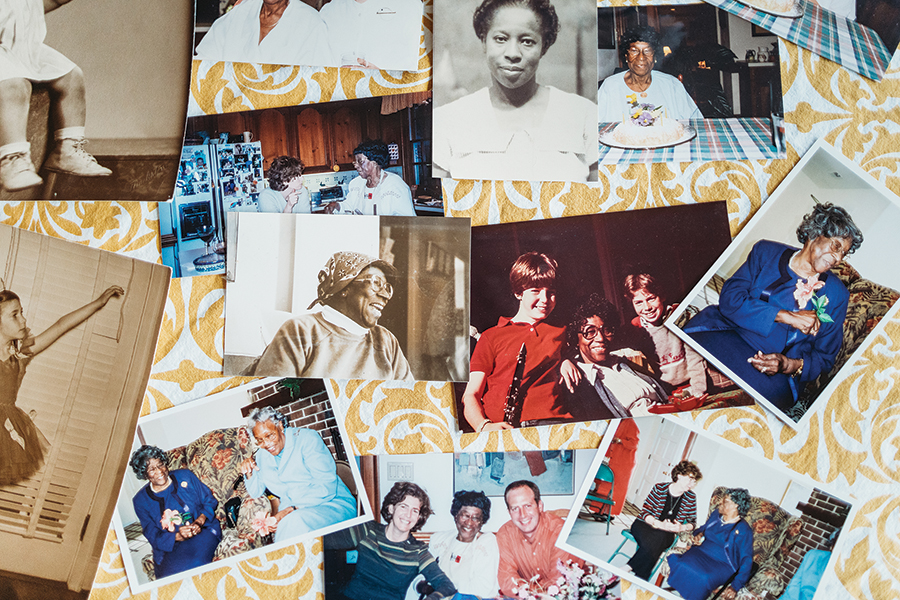
Judy and I are standing at the dining room table in the third floor apartment she shares with her husband, Henry, near Queens University in Charlotte. Family photographs are scattered on the table in front of us. In the living room, my daughters Early and Juniper peck away at the piano while Mallory breaks down lighting equipment and talks to Henry. He stands with the cane he has used since recovering from what was supposed to be a routine back surgery that ended up briefly paralyzing him, resulting in years of physical therapy just to be able to stand and walk again.

Judy’s last memoir, Together, which was published in 2018 and received lavish praise, including a starred review from Library Journal, is about Henry’s surgery and its aftermath, but it is also about their long and loving marriage. I look down at the photos of Mattie and recognize her from the photograph on the cover of Together. In that photo, a newly married Henry and Judy are coming down the steps of her parents’ home while smiling friends toss rice into the air. Mattie stands in the background, smiling as if her own youngest child has just gotten hitched.

I ask Judy, after a lifetime of knowing Mattie, what made her want to publish a memoir about her now.

“I think it felt right to publish it when I turned 80,” she says. “I thought, if I don’t do it now, I’m not going to do it, it won’t get done.” She pauses, looks down at the photographs. One of them, a black and white portrait of Mattie taken around 1944, which was when she came to work for the Kurtz family, stares back at us. “I never thought I had the right to tell this story,” she says. “A privileged white child in the Jim Crow South talking about her Black live-in maid. The more details you hear, the worse it sounds.”

But over the years Judy came to understand that her and Mattie’s story differed from the stories some of Judy’s friends and acquaintances would tell about the hired women who had raised them. Judy often came away from those conversations with the full understanding that many of those people had not truly examined the inequity of those childhood relationships, choosing instead to focus only on the love Black women had shown their white charges, not the full scope of what the price of that love might have been.

“I don’t want to join them in that,” Judy says. “If my book did not really examine that situation with Mattie and me, then I wasn’t going to publish it.”

Child is full of Judy asking tough questions of herself, her family, and the place she has always called home. “How do I cross-examine the way it was?” she asks in one scene. “Can we ever tell the whole truth to ourselves?” she asks in another.

Child shows that truth — at least truth of a sort — can be found. When she was a teenager, Mattie’s daughter Minnie learned that the woman she had long assumed was her aunt was actually her mother, and Mattie eventually put Minnie through college. She would end up earning a master’s degree, as would Mattie’s three grandchildren. The irregular ground of life’s stories. Camellias and snakes. Jim Crow and a lifelong connection that endures beyond death. As Judy writes in her closing lines, “It is possible for love to co-exist with ugliness.”  OH

Wiley Cash is the Alumni Author-in-Residence at the University of North Carolina Asheville. His new novel, When Ghosts Come Home, is available wherever books are sold.