Life’s Funny

LIFE'S FUNNY

Shhh!

Learning to read (in) a room full of people

By Maria Johnson
A few years ago, an editor pitched me a column idea.

“You know what would be fun?” he said.

“What would be fun?” I asked, taking the bait.

“For you to go someplace where you couldn’t talk and write about it later,” he teased.

“Fun for you,” I shot back.

But I remembered that challenge when I saw a local calendar listing called “Greensboro Silent Book Club.” Here was my chance to be still and know . . . something.

I rang up the group’s founder, 32-year-old Maria Perdomo, who explained that she started the local SBC chapter in the fall of 2019 after hearing an NPR story about the first club in San Francisco.

Members brought their own books and read quietly in a shared space for an hour. Conversation before and after was optional. The practice spread and gelled into a national organization.

The concept made sense to Perdomo, who grew up in Colombia, in a culture that exalted storytelling. Her father, a writer, and her brother devoured books. By comparison, Perdomo was a literary slow-poke.

“It kinda kept me from wanting to engage with books in my own way,” she says.

Eventually, she found her way back to words. She started blogging while she was an international studies student at UNCG, and she yearned for a community of like-minded readers.

Cue the NPR story. Perdomo checked the SBC website — “Welcome to introvert happy hour,” it trumpets quietly — and saw a chapter in the Triangle, but nothing in the Triad. So she and a friend started a monthly meet-up in Greensboro’s independent book store, Scuppernong.

The group met a handful of times before COVID and resumed their regular hushed assemblies in 2023.

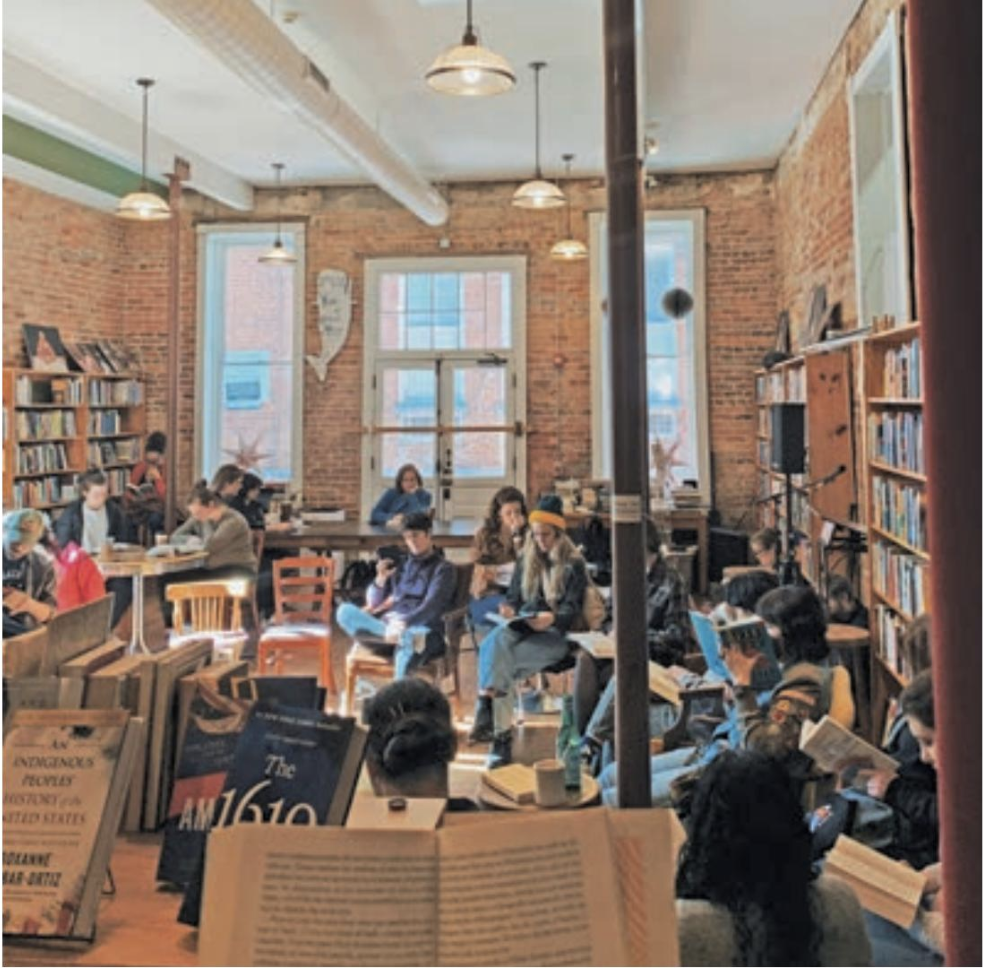
Every second Sunday of the month, they draw a core of 10 to 20 people, just enough to fill every seat in the comfortable space at the back of the store.

“My goal is to make it a space that’s not stressful,” says Perdomo, who now writes a Substack newsletter. “We hear all the time, ‘I’m a slow reader,’ but here no one is going to look down on you because you haven’t finished that massive book you started.”

I’m intrigued. I’m not an introvert, but I am a rather slow reader.

Also, my husband has just given me The Backyard Bird Chronicles, a nonfiction handbook by celebrated novelist Amy Tan. I tote the book to the next SBC meeting and take a short-term vow of silence.

Beforehand, Rachel Wasden, who leads the gathering in Perdomo’s absence, explains that people will show up with stories in a variety of platforms — traditional books, tablets, e-readers and audiobooks.

Once, a guy worked on writing his own book.

The point is, everyone will do their own thing, quietly, together.

“Every time I tell someone about it, they say, ‘That’s so weird. Why wouldn’t you read at home, in silence?’” Wasden says.

Her answer: It’s about choice. And energy, a precious commodity for introverts.

“You get to participate, or not participate, as much as you want,” she says.

The funny thing is, by the time I make it to the back of the store, these introverts — average age mid-30s — are chatting up a storm. Rachel asks folks to introduce themselves with names, pronouns and a short description of what they’re reading.

Jeff is working his way though The Greatest Beer Run Ever, the true account of a Vietnam vet who returns to the war as a sort of civilian beer fairy to U.S. troops.

Priya is reading Fairy Tales of Ireland.

Enid has brought the same book she brought last time, Notes on an Execution, the story of a serial killer’s life as seen through the eyes of women in his life. But she might crochet instead.

Kelli, a first-timer, is well into The Yellow Wallpaper.

Heaven, another first-timer, is nibbling away at Rilke’s Letters to a Young Poet.

The reading list goes on. Rachel, who is plowing through She Who Became the Sun, a re-telling of the Chinese myth of Mulan, calls the meeting to order.

It’s 12:25 p.m., not that anyone is counting the minutes she’ll have to remain quiet.

Ready. Set. Silence.

Whoa. They weren’t kidding. Everyone is reading.

My attention snags on the store’s creaking wooden floorboards.

On the violin music that wafts through speakers at the front of the shop.

On the crispy whiff of pages turning.

I look up and scan the group. Does anyone want to . . . ?

Nope. All heads are down.

Surrounded by stories that I’m forbidden to tap via conversation, I wade into the book in my lap. It’s good stuff.

Tan, who, as a child, liked to draw and play in creeks, outgrew those joys as an adult. Only at age 64 did she sign up for a birding group that sketched their subjects in the field.

It makes me wonder: What could a “new thing” be for me? How long would it take to learn? And . . . what time is it now?

I check my phone. 12:49. Hmm.

Quite the variety of footwear we have in this circle. I need a pedicure. And who is that crooning on the speakers now? Andrea Bocelli?

I rub my eyebrows to reset. It occurs to me how much reading is like meditating, bringing focus to the moment, noticing how the mind wanders and reeling it in again. It also dawns on me why I’m a relatively slow reader.

Finally, Rachel speaks: “If you want to finish the page you’re on, we’ll come together in another minute or so.”

It’s 1:24 p.m.

I pretend to read for the last minute.

Rachel welcomes us back into communion with a prompt for discussion.

“Where does your mind go when you read?” she asks.

I can’t help but laugh. Silently, of course.  OH

Maria Johnson is a contributing editor of O.Henry magazine. Email her at ohenrymaria@gmail.com. Find an SBC chapter near you at silentbook.club. Maria Perdomo’s newsletter, “here I am,” can be found at mariamillefois.substack.com.


SAZERAC August 2024

SAZERAC AUGUST 2024

Sage Gardener

After reading The Orchid Thief (which I unreservedly recommend), I’ve started calling Anne, my wife, the Seed Thief. Her cache of stolen — and also saved-from-the-garden — seeds is vast. One day, she said, “Why don’t you write about saving seeds, O Sage Gardener.”

So . . .  here’s why I’m NOT writing a column about saving seeds.

Let’s start with this response from an online permaculture forum: “Why do something poorly, when I could instead support someone who does an amazing job at seed saving/plant breeding?” The permaculture curmudgeon adds, “In my region, there is no shortage of amazing small farmers selling open-pollinated, regionally-adapted, unique varieties.”

Guilford County’s annual Passalong Plant Sale comes to mind. And there’s also the annual Sown and Grown Seed Swap Weekend at Old Salem, which has featured heirloom dinners in the past.

But let’s get down to the nitty-gritty topic of plant sex. Whether plants have sex with themselves or with insects is a topic that’s way above my pay grade. However, the N.C. State Extension Service has an army of plant experts who understand the mysteries of the birds-and-bees that produce the next generation of plants. “When saving seeds, make sure you are collecting from open-pollinated varieties,” advises Emilee Morrison from Onslow County. (More about open-pollinators in a minute.) “Because of their diverse parentage, hybrid plants will not produce consistent, reliable offspring when you save their seeds.”

Dusty Hancock, a Master Gardener volunteer from Chatham County, has even more discouraging words about plants with diverse parentage: “Seeds from hybrid plants may be sterile, but, if not, it is difficult to predict the characters of the resulting offspring.” He goes on to say that plants from hybrid seeds will be a new combination of the best and worst traits of the original parents. In other words, the seeds you save from that extraordinary okra plant with boocoodles of perfect pods might have the characteristics of a parent that, though drought resistant, produced itty-bitty pods.

So . . . if you really want to play it safe, you need to make sure that the seeds you’re saving come from heirloom plants, all of which are so-called open pollinators, meaning they are pollinated naturally by birds, insects, wind or human hands.

So far, so good — but there’s a catch, says Emilee: “If you grow more than one variety of a crop, you will need to take some precautions to prevent cross-pollination between varieties. Cross-pollination will result in unexpected characteristics in your plants in subsequent generations.” I’m not about to venture into the area of scraping the seeds out, drying them on a screen or in a hydrator, storing them so bugs and humidity don’t ruin them . . . because I’m not going to write about saving seeds. And, from the permaculture curmudgeon, here’s a compelling reason: “I just really, really love buying seeds. Maybe it’s materialistic of me, but pouring through catalogues is what gets me through the winter!”

David Claude Bailey

Window to the Past

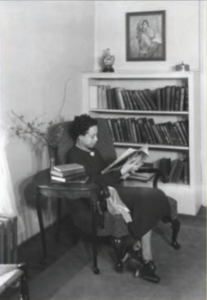
“Then it was that books began to happen to me, and I began to believe in nothing but books and the wonderful world in books — where if people suffered, they suffered in beautiful language, not in monosyllables as we did in Kansas.” — Langston Hughes, The Big Sea

Unsolicited Advice

Soon enough, we’ll see the flashing lights and hear the squeaking brakes of big, yellow buses as they roll through our neighborhoods. Kids will be going full-STEAM ahead — as in Science, Technology, Engineering, Art, Math — as they head back to school.

But, now that we are grown adults, according to our driver’s licenses, we have some ideas about necessary school subjects.

Phone Basics: More Than a Texting Device. We know, we know. Your smartphone features a handy-dandy voice mailbox that allows you to avoid calls, and, instead, listen to messages and respond via text, safely steering clear from any potentially empathetic human contact whatsoever. But — this may come as a shock —  you can actually answer your phone. Repeat after us: “Hello?”

Taxes and You: Sam Is Not the Fun Uncle. Pythagoras’ theorem about right triangles is really a-cute, but Uncle Ben Franklin once observed that nothing is certain other than death and taxes. So why not study deductions and learn how to properly fill out W9s? Had we done that, we would’t be left feeling so, well, obtuse.

Handwriting: The Wet Signature & the Curse of the Cursive. In our modern, digital world, penmanship doesn’t seem so important. And frankly, we’re coming up dry on a good reason why you might need it. But hey, we’re an arts publication and we don’t want to see any form of art lost. Don’t agree? Please mail a handwritten letter to the editor.

Just One Thing

Go ahead. Try not to be drawn into this photograph, taken in 1913 to herald the screening of a silent movie starring Smilin’ Cowboy Louis Bennison as Randy Burke — smiling even when held at gunpoint by Virginia Lee, as seen in the poster. Is that her or a local look-alike posing none too enthusiastically for a promotion in Newport, Rhode Island? Who are those children on the right, one impudently staring at the photographer, Marshall Hall, an AP correspondent? 

When artfully reprinting the photo in 1970, Brian Pelletier obviously was unwilling to crop out the bystander heedlessly walking right into the photo just as the shutter closed. Featured in Weatherspoon’s exhibit that goes up on Aug. 13, “Interpreting America: Photographs from the Collection,” the images on display “illustrate what artists have had to say about American culture from the late-19th to the early-21st centuries.” Americans have always loved sappy Westerns, like this one in which our brave hero saves an orphan after her father is killed in a saloon, is mistaken for a desperado, wins enough money in a poker game to pay off the Widow Mackey’s mortgage, and falls head over heels for a rancher’s daughter, who “takes his revolvers and orders him to put his hands up — and then around her.”

The Write Stuff

When Andrew Levitt set out to brighten children’s spirits in their hospital rooms, he wasn’t just clowning around. In our December 2022 issue’s “The Fezziwigs Among Us,” founding editor Jim Dodson introduced us to Levitt, whose “charming medical clowning lasted almost a decade, touching the lives and cheering up thousands of kids, young people, parents and staff.” Levitt, who had a lifetime of performance under his belt — everything from miming to acting and clowning — officially became Dr. Merryandrew on April Fools’ Day years ago. The date? A funny coincidence. And, yes, Levitt does, indeed, hold a bona fide University of Pennsylvania Ph.D. — in folklore, fittingly. In his new memoir, With Tales and Folly Instead of Pills, Levitt takes us behind the doors of Moses Cone Hospital, sharing stories he regaled patients with to bring, well, levity to hardship. After all, he writes, “Maybe if more people hear the old stories, there will be more people around who know that life is full of magic and miracle.”

O.Henry Ending

O.Henry Ending

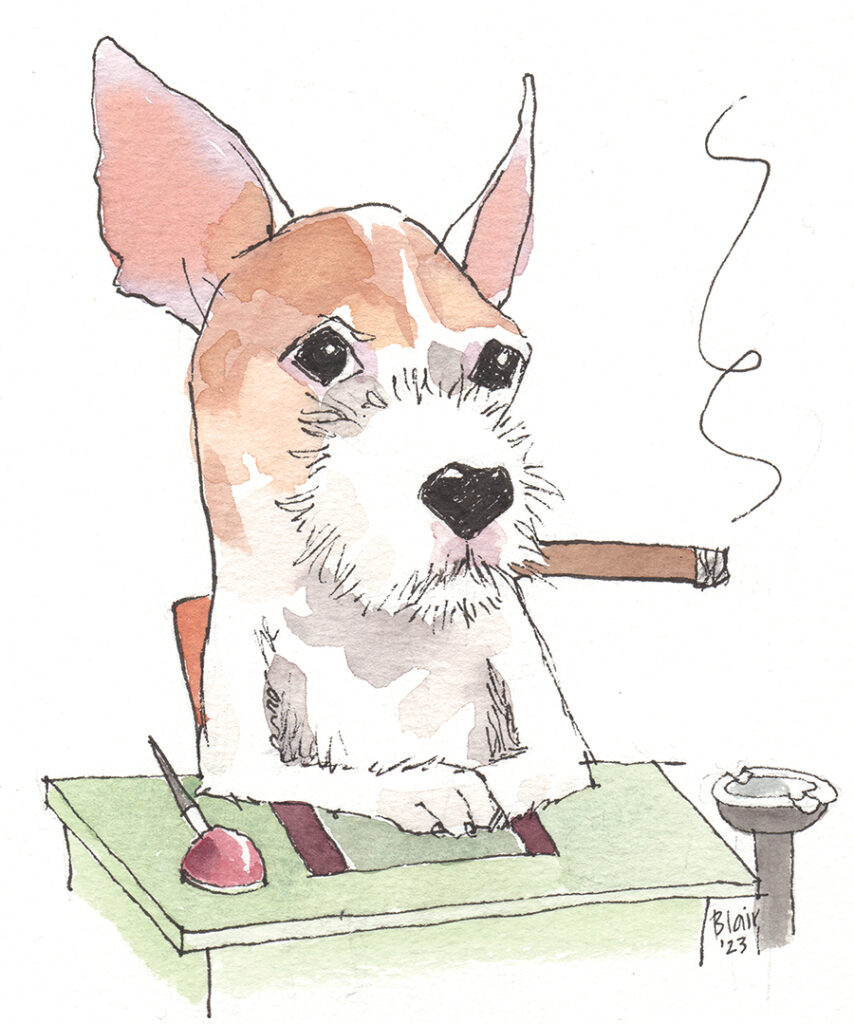
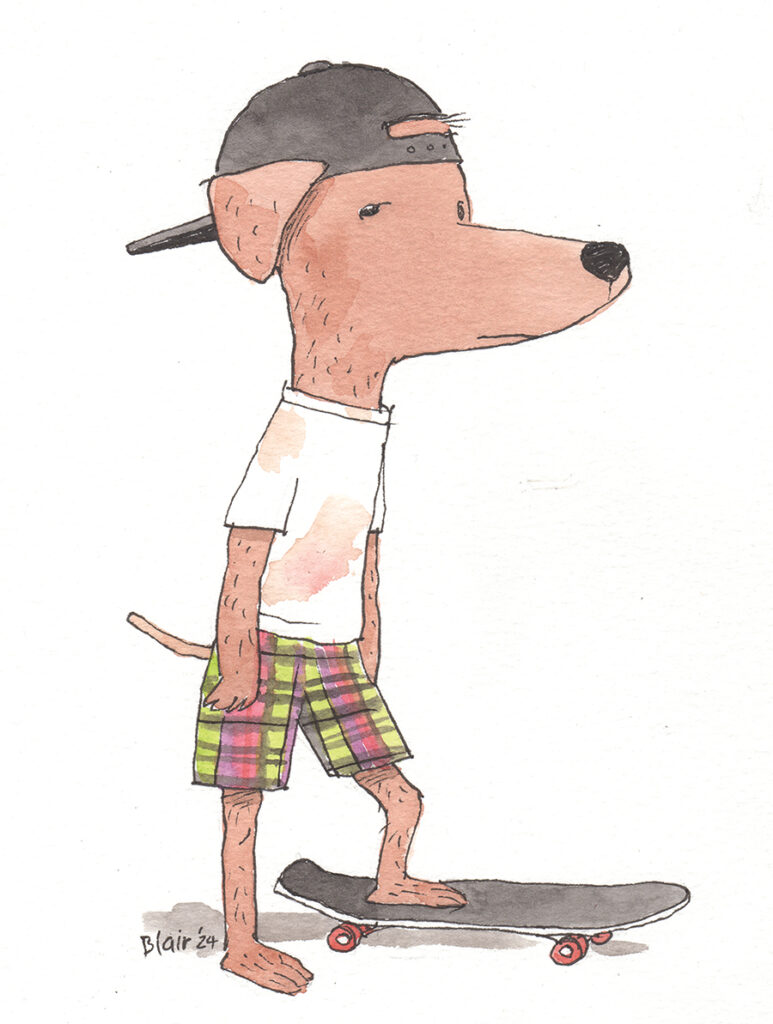
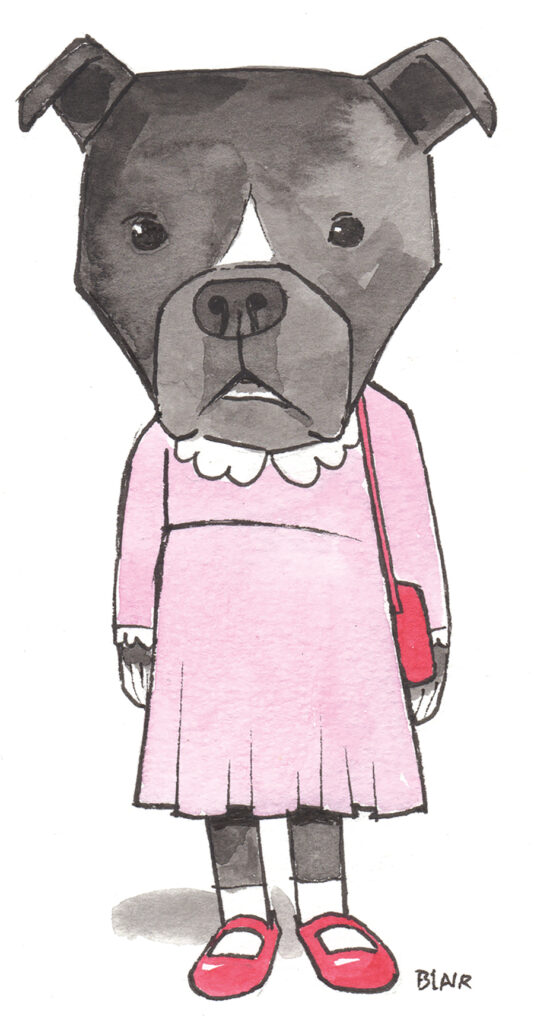
Illustrations by Harry Blair

What started as a fun creative undertaking inspired by his own Henderson Road neighborhood dogs turned into a furry fury of ink across illustrator extraordinaire Harry Blair’s desk. He certainly gave these pups paws-onality plus! Coming soon to a Greensboro near you, Blair plans to draw precious pooches for their humans at a small charge, half of which will go to local rescue operations. De-tails to come.  OH

Sazerac July 2024

Sazerac July 2024

What’s Cooking?

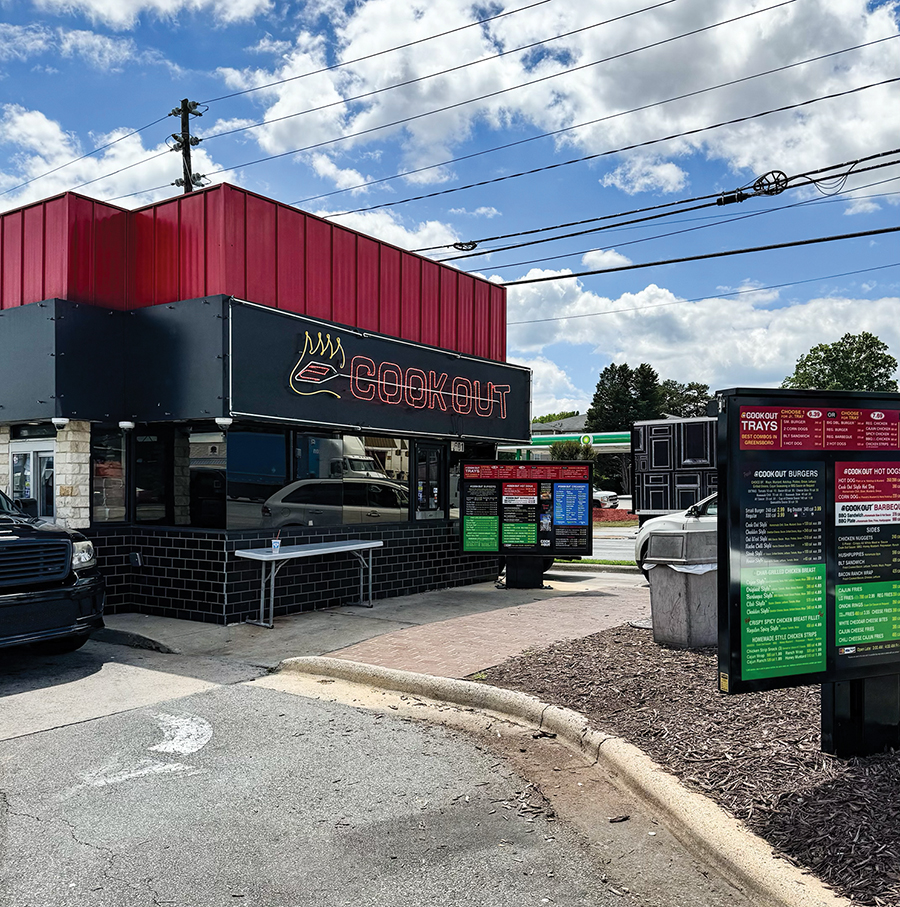
It’s been 35 years since entrepreneur Morris Reaves launched his revolutionary drive-through restaurant concept, opening the very first Cook Out on Randleman Road, where the aroma of fresh grilled burgers still bellows from the chimney.

Reaves got his start in the restaurant business as a short-order cook for Waffle House before becoming the youngest Wendy’s franchisee at the age of 20. In the 1970s, to obtain that franchise, Reaves appealed directly to Wendy’s founder Dave Thomas. Initially hesitant, Thomas remembered that, as a young man two decades earlier, Col. Harland Sanders had taken him under his wing (pun intended), granting him the Kentucky Fried Chicken lease that jumpstarted his career. (Among many other innovations he came up with, it was Thomas who convinced the Colonel to appear in KFC’s commercials.)

While he cooked up that original Cook Out concept in his home state of Florida, Reaves chose our fair city for the rollout in 1989. With expansion into 10 Southern states since then, 117 locations in North Carolina alone, you could cruise up to a different Cook Out menu board every day for a year and still not visit them all.

How does Cook Out compare with another beloved regional chain, the West Coast’s In-N-Out Burger? No contest. Because burgers and hot dogs aren’t the only lure. Cook Out not only has the best barbecue sandwich for my money, it’s also famous for offering N.C.’s own Cheerwine — on tap in states where the beverage isn’t distributed — along with something like 40 flavors of milkshakes including cappuccino, hot fudge, blueberry cheesecake, watermelon (in July and August only) and, had he lived to enjoy it, a Peanut Butter Banana shake that would surely have enticed Elvis to the nearest location. Morris Reaves and his son Jeremy, who serves as current CEO of Cook Out, are reportedly deeply spiritual Christians, so much so that every beverage cup comes imprinted with a Bible verse.

For such a sprawling enterprise, Cook Out is notoriously tight-lipped when it comes to press and publicity. Neither father nor son has ever granted even a cursory interview, nor does the company employ a spokesperson. The marketing department declines to answer the phone or return calls.

What’s next for the restaurant chain? We hope you’re sitting down for this: indoor seating, apparently. There’s already a Cook Out dining room in Kernersville and, rumor has it, the former Mrs. Winner’s on Summit Avenue will be our city’s first sit-down site.

      — Billy Ingram

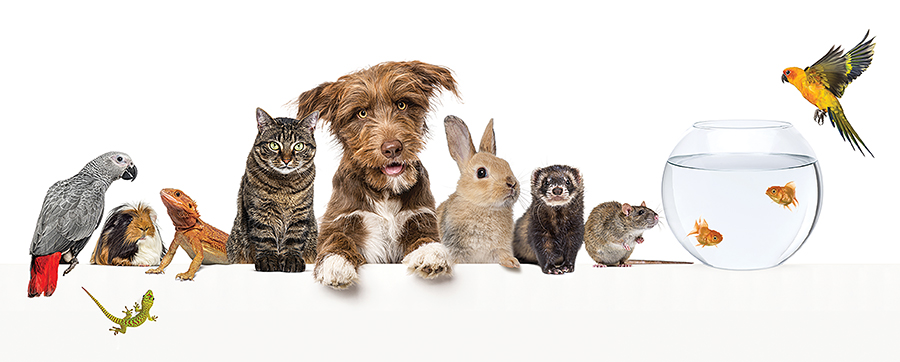
Strike a Paws: Pet Photo Contest

Does your cat’s expression say, “Mr. DeMeow, I’m ready for my claws-up?” Perhaps your Fido is especially photogenic. Or your Beta is fishing for its moment to shine. Whatever feathered, finned, furry — or even hairless — pet you call yours, take your best shot! From now through July 22, you can upload a photo of your beloved critter to our website’s contest page. Voting will open on July 16. But that’s only half the fun. Pet-loving O.Henry readers will be invited to vote on the finest photo, so make sure you beg friends and family to cast their ballots! The winner will fetch a $100 gift card from our contest sponsor, All Pets Considered; plus their photo will appear in our September issue. We’ll be printing several contenders as well, so — who knows? — your pet could be on their way to Sunset Boulevard after all. Visit ohenrymag.com/contests for details and to enter.

Window to the Past

Photographs © Carol W. Martin/Greensboro History Museum Collection

Where’s my TV dinner?

Unsolicited Advice

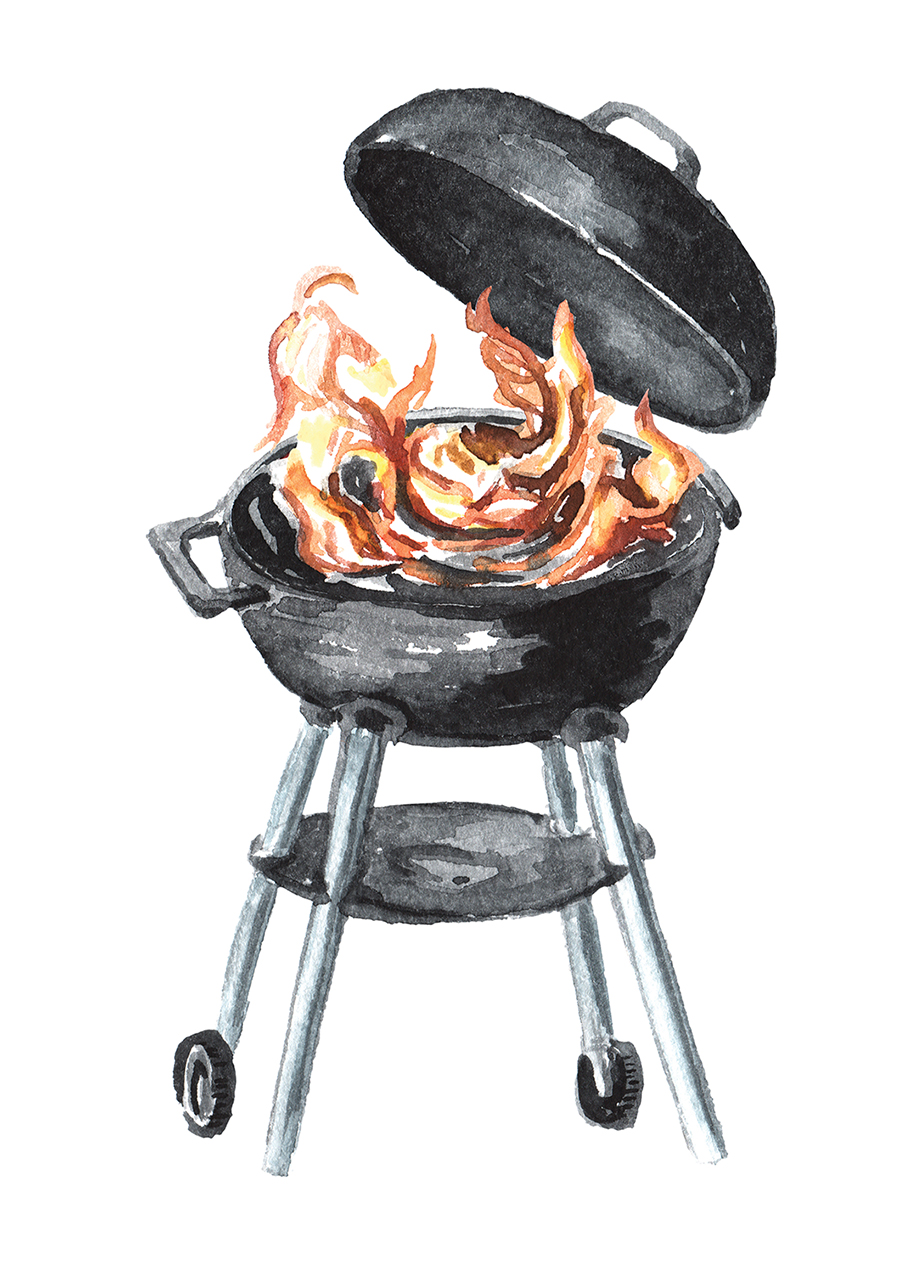
Backyard barbecue season is upon us and Dad’s raring to put some cheeseburgers on that new grill he just got for Father’s Day, along with his “This Guy Lights Our Fire” apron. But your daughter just announced she’s vegan and your son is lactose intolerant, so how about tossin’ some non-carnivorous alternatives to tube steak  and juicy burgers? We’ve got some ideas that are sure to sizzle.

You heard it here in May from our resident Sage Gardener. Cabbage is having a moment. Cut it into slices, brush on EVOO and sprinkle it with seasonings. Might we recommend Montreal Steak Seasoning? It’s like lipstick on a pig, minus the pork. Note: discriminating vegetarians say, “All cabbages are not created equal. The freshest heads feel heavy and are compact for their size.”

A portobello mushroom cap fits perfectly inside a hamburger bun. Coincidence? We think not. And will it fill your porto-belly? We also think not. Unless that cap is stuffed with, say, plant-based sausage.

Looking for something you can put your satisfying, blackened grill mark on? Tofu. Its rubbery quality will simulate that overcooked steak Dad’s famous for. And the “hot” trend is to freeze it before grilling it? Cool, eh?

Lastly, grill your kids (but not in the way Jonathan Swift recommended). You’ve got questions. They’ve got answers they’re probably not as readily willing to share as they are to pass you that plate of charred cabbage.

Sage Gardener

Best-selling American novelist Belva Plain once said, “Danger hides in beauty” — as in poinsettias, lenten roses, bleeding heart, larkspur and lantana — all stunningly beautiful and all poison.

And whoever said, “If danger comes from anywhere, then your eyes must look everywhere,” surely had a house full of children, pets — and plenty of plants. 

C’mon. You’ve heard it before, but here’s a friendly reminder in this, our issue focusing on pets: Even an itty-bitty amount of an ingested lily plant — any part, the stem, flower, leaf — can trash a kitty’s kidney. Your furry friend munching on one or two sago palm seeds can suffer vomiting, seizures and liver failure. Azaleas and rhododendrons, if snacked on, can lead to coma and death from cardiovascular collapse. The  ASPCA’s got a top-17 DON’T-EVEN-THINK-ABOUT-IT list (www.aspcapro.org/resource/17-plants-poisionous-pets). Still, the association’s Animal Control Center ended up assisting more than 400,000 animals in distress in 2022, up from 2021. And it’s not just plants. The top-10 toxins include recreational drugs, OTC meds and, yes, chocolate: https://www.aspca.org/sites/default/files/top_10_toxins_2022.png (who leaves chocolate lying about?).

And please. Keep your children from eating berries from the holly, yew, jack-in-the-pulpit, juniper and pokeweed plants, as tempting as they may look. And no castor beans. (The horrifying poison ricin is made out of castor beans.)

“Away! Thou’rt poison to my blood,” said Will Shakespeare. So before you go hog-wild with houseplants or that garden extension this summer, remember what happened to Romeo and Juliet. Go wisely.
  — David Claude Bailey

Home Grown

12 DAYS OF CHRISTMAS

The Dog Who Owned Us

Goodbye to a good girl

By Cynthia Adams

Paintings by Dana Holliday


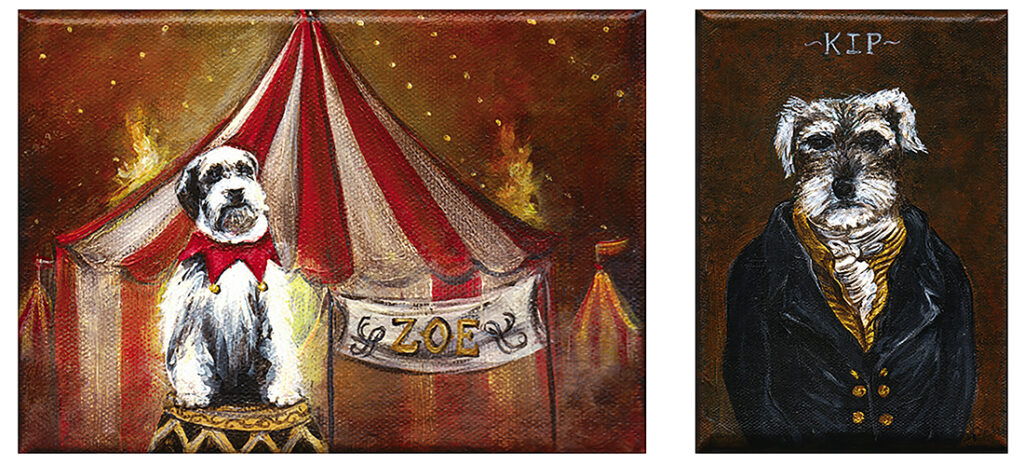
Left: Zoe loved to wear a circus-like collar and do tricks 

Right: Kip was a take-charge (versus a take-commands) dog . . . who wore his authority seriously


A gray February fog clung to us as we walked. Our shoulders slumped in the slackened posture of sorrow. Clasping hot cups of coffee couldn’t ease the chill; the worst of the cold was soul deep. 

Our eyes flickered towards one another, then slid away to the marsh grasses our two dogs sniffed, then to the sea beyond. Zoe, a gentle-natured mutt, stumbled, stiffly hinged as if her body parts no longer worked together as a coherent whole. Once, she had moved with loose-limbed grace.

Kip, the younger, trailed slowly and I tugged at his leash, wondering. With a canine’s exquisite sixth sense, did he grasp the reason for our sad silence?

Zoe came from humble beginnings as a “pound puppy” 16 years earlier at the Guilford County animal shelter. She was a terrier mix, part Australian shepherd; the greater part was a sweet mystery. 

When we had first sought a pet, I produced a picture of a small terrier torn from a magazine long ago. My husband pocketed it, and so began frequent forays to the animal shelter. 

“I’ll find our dog,” he assured. “Just be patient. ” On weekly walks through the shelter, the picture in hand, he did.

The story of our charismatic Zoe’s adoption — how my husband got into a lottery with others who also wanted her, then lost out — only underscored the pleasant shock when Zoe was discovered there again, returned. (“She found us. It’s because she was meant to be ours all along,” Don explained.) 

Amazingly, Zoe was a look-alike to the dog in the now dog-eared picture.

Initially, she was so well behaved she wouldn’t even bark. Don coaxed her with pats, treats and constant assurances that she was “a good — no — a wonderful girl.” 

Zoe wanted nothing more than to please and be pleasing. In her, we discovered a clever dog quickly mastering David Letterman’s stupid pet tricks (she unfailingly chose the larger of two bills when asked!). Zoe also trained us well. 

What she loved most was to walk twice daily — even on several-mile-long treks. She also had endless reserves of gratitude, sweetly thanking us for small favors with devotion. Her bright eyes seemingly welled with gratitude. Initially healthy, Zoe battled with nerve sheath tumors in middle age. But inoperable retinal disease left her completely blind. By age 12, cognitive changes began as well, then deafness.

She had found her voice, and used it — now barking at nothing. Still, Zoe demanded twice-daily walks along routes so frequent they had names, so familiar she needed neither her sight nor hearing to follow them. The “Homer route” looped past the home of a corgi Zoe liked. The “Belle route” passed a sweet yellow lab’s home. The “Weaver” looped past a business park. In Zoe’s older age, a half-mile loop in front of the house could only be managed in a no-hurries gait. 

Our slightly younger terrier, Kip, had pancreatitis. Both geriatric dogs’ medical files grew thicker. Both required carrying up and down stairs. 

Left to Right: Zoe and Kip

We discovered Zoe was in renal failure while vacationing at the coast. The kindly emergency vet gently advised: “It is time.”

We determined to make those final days Zoe’s best. We took exceedingly slow walks, keeping to our routine. We gave her cheeseburgers. No matter what special wine we uncorked, nor what gorgeous, pink-tinged sunset played out that weekend, we soldiered on, miserable. Kip sniffed Zoe’s frail body knowingly. 

The appointed day arrived with impenetrable fog low over the Intracoastal Waterway. As Zoe sniffled and snuffled the marsh grasses, I snapped one last picture with my cell phone. Her eyes showed a ghostly blue-white, otherworldly iris.

Zoe had chosen us 16 years ago; now, it was our final gift to surrender her to the sweet hereafter. The vet stroked her, too, as Zoe’s eyes closed. She left us as she had come to us, in trusting innocence. 

A good — no — a wonderful girl.  OH

Cynthia Adam is a contributing editor to O.Henry magazine.

Animal Tales

Animal Tales

Mr. Moon Meets His Match

Just who has nine lives here?

Story and Illustration by Marianne Gingher

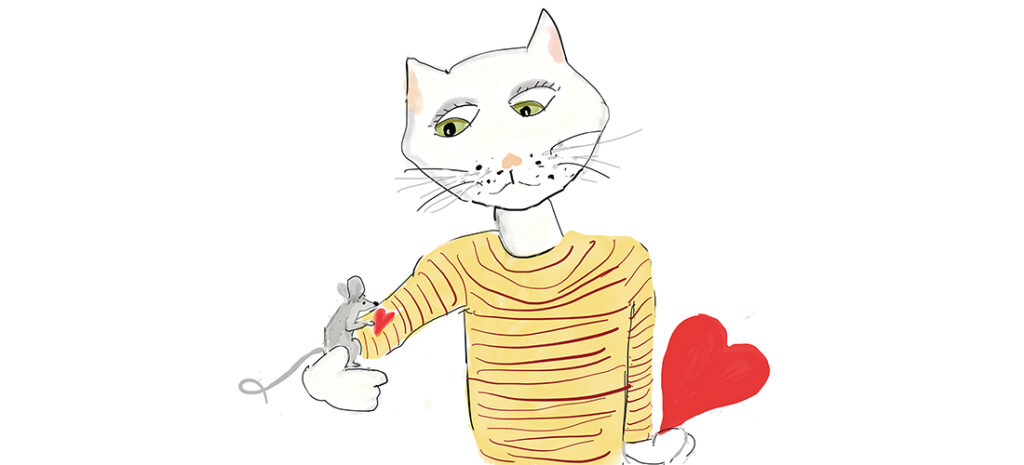
I’m reading peacefully in bed one night when my cat, Mr. Moon, struts into the room, a small, limp mouse dangling from his jaws. Oh dear. Of course, I praise him — after all, it’s what cats are supposed to do to earn their keep, right? They’ve been dispatching vermin from human habitats since before the ancient Egyptians, and the Egyptians deified them for their efforts. My cat drops his little trophy on the rug and preens.

I slide out of bed, fetch tissue to shroud the victim before removing it. Mr. Moon’s nudging the poor thing, hoping it will resume their play date. I do feel sorry for the mouse in some tender Snow White way, until suddenly it leaps from the dead and is on the run again. Eeek! I jump back in bed and watch the rodeo of cat-and-mouse for a good 10 minutes before the cat loses it again beneath the bathroom radiator. He’s clasped it in his paws several times, tossed it, carried it in his jaws, set it down and waited for it to sprint again and again. Has he talked the mouse into being his pet?  The mouse appears to have figured out that pretending to be dead for a few minutes will leave his adversary puzzled and less inclined to play rough.

But this is not Mickey’s Playhouse. There’s a life-or-death drama going on in my bedroom. Now I hear them scuffling near the bathroom — Rocky Balboa vs. Jiminy Cricket — then all is quiet. I can see the cat sitting on the rug, his tail twitching, waiting for the critter to catch its breath and declare game on! But the mouse has other plans and eventually Mr. Moon abandons his vigil, curling himself at the foot of my bed. Believe it or not, I turn out my light. Everybody’s exhausted, and I trust that my cat’s got my back should the little pipsqueak revive.   

In the morning, Mr. Moon doesn’t revisit the crime scene. He believes his mouse toy is broken. I check behind the radiator and see it lying there, lusterless, still as a stone. I follow Mr. Moon to the kitchen, feed him, eat my breakfast, read the news and sip a second cup of coffee before I remember my grave chore. Back in the bathroom, paper towel in hand, I stoop over the radiator. But Houdini the Mouse has vanished!

I’m always cheered by the prospect of tiny besting big: mouse besting cat, David besting Goliath, Ukraine besting Russia, little Greta Thunberg calling out world leaders on laxity regarding climate change. Small is beautiful, some of us folks used to say in the ’70s.

These days of big seeming to gobble up small every place we look, I think rooting for the underdog — or mouse, in this case — is irresistible. Its valor and escape artistry are inspiring, its ferocious will to live. I could write a poem! But wait, I’ve still got a mouse in my house.

“Oh, Mr. Moon,” I call. “Let’s catch that mouse, pal!”

He’s grooming himself in a living room chair, getting ready for his morning nap. “Let’s?” he says. “Did you say ‘Let’s?’ Don’t make me laugh.” 

Off I go on my lone safari to find that clever mouse and diminish (humanely) its small but potent influence as it wanders at-large through my house. “Courage!” says Mr. Moon, grinning his crescent grin like the Cheshire cat he’s not.  OH

Marianne Gingher has published seven books, both fiction and nonfiction. She recently retired from teaching creative writing at UNC-Chapel Hill for 100 years.

Pleasures of Life Dept.

Pleasures of Life Dept.

Blast from the Past

Or why chemistry sets are no longer fun

By David Claude Bailey

In October of 1957, my parents and their 11-year-old son — that would be me — walked out into our backyard to watch Sputnik-1 arch across the sky. And so began the Reidsville Rocket Boys Space Race.

Admittedly, years earlier, all my friends and I had acquired chemistry sets manufactured by A.C. Gilbert, the man who invented the Erector Set. That was way before they removed all the fun stuff from the sets — saltpeter, sulfur, sodium ferrocyanide! and, I’m not kidding you, uranium dust. My friend, Jack, and I had been experimenting with gunpowder (a simple mixture of saltpeter, sulfur and charcoal) for months, as in lighting a trail of it to streak across the ground like in Western movies, perfect for scaring cats, dogs and sisters.

That was also back in the good ol’ days when boys could buy almost any chemical from their friendly local apothecary as well as dynamite fuses from the hardware store — not to mention dynamite itself if you were only old enough.

The firecrackers and smoke bombs we made with gunpowder were disappointing, but it did not take long for our inquiring minds to begin designing miniature rockets. We’d take one of those cardboard tubes fused on coat hangers to keep pants from having a crease in them, fill it with gunpowder and close one end. Once fins were added, it soared out of sight.

Half of the fun was thinking we were conducting our launches in secret, but surely our parents learned of our purchases from the owners of the hardware store and apothecary. I now suspect they thought they might be raising budding space engineers — or even astronauts. After all, on January 31, 1958, America successfully launched into orbit the cylindrical Explorer 1, 80 inches long compared to Russia’s pitiful “beach ball,” only 23 inches in diameter —  which prompted more trips into the backyard.

My mom mailed some of the drawings covering my school notebooks to my uncle Bob, who was studying civil engineering at Georgia Tech. He amped them up into what looked like professional, technical blueprints. After I took them to school, I walked  around for a few days convinced I was an aerospace genius.

The space race in Reidsville soon mirrored the Cold War. Jack’s cousin, Fred, spied on his older brother and another cousin to provide us with intel regarding their potentially more advanced technology. Erector Sets were cannibalized to build launch gantries; we discovered that match heads glued to flashbulb filaments could ignite a dynamite fuse from a safe distance.

Meanwhile, just as we were foolishly considering trying brass plumbing pipes in place of the clothes hanger tubes (never mind the danger of exploding shrapnel or the elementary physics principle that what goes up comes down), Jack and I connected with some outside support. Across town, Carl, whose parents were at least a generation younger and cooler than ours, had helped him assemble an extensive chemistry lab in the furnace closet of his family’s stylishly modern, flat-roofed house. The shelves were lined with bottles of chemicals imprinted with scientific-looking typefaces. Beakers, flasks and test tubes covered a counter on which sat an actual Bunsen burner. Carl demonstrated how, when you mixed zinc dust and sulfur, the result was a propellant several times more powerful than gunpowder.

And so, on a Saturday morning, four of us were closeted in his laboratory-furnace room, where he promised to show us his methodology. We started out with a bottle of zinc dust into which we mixed increasing amounts of sulfur. When the mixture was perfect, a sample of it, when introduced to the flame of the Bunsen burner, would burn with an intense and blinding white flash. Some advice: Do NOT use the eraser end of a pencil, which a member of our elite test unit (who will go unnamed) happened to have in his pocket, because erasers are flammable, as was the zinc-dust-and-sulfur. The ensuing explosion blew both double doors of the furnace room wide open and turned the glassware of Carl’s chemistry set into little bits of silica that we combed out of our hair for days afterwards. Why we all were not blinded, I’ll never know.

Somehow our enthusiasm for our rocket projects began to dim after that. Jack, in particular, seemed to lose interest. However, I recently learned that his father had effectively shut down our launch operations by bribing Jack with a used Hamilton “Tank” watch, in the style of the ones worn by WWI tank drivers. Although a history buff, Jack now feels that he sold out cheaply. He remembers that the watch’s style wasn’t 1950s hip. Plus, the dial’s Roman numerals left Jack, neither good at math nor foreign languages, guessing about what time it really was.

So, we did not, in fact, end up becoming astronauts or aerospace engineers, though Carl went on to become a highly popular high school science teacher. Jack, soaring to heights few of us could have imagined, is now one of the nation’s top immigration lawyers. I came closest to going into orbit by becoming an aerospace editor for Cocoa TODAY, covering the Space Shuttle. And although I’d like to say that our friend, the eraser-head igniter, became a Navy Seal demolition expert, in truth he avoided the military altogether and ended up building some of the most innovative houses in Chapel Hill.

Arms races may last forever, but not so for little boys. Secret propellants and proprietary fins “make way for other toys . . . one gray night it happened,” like Puff the Magic Dragon, our launches were no more — replaced by Boy Scouts and basketball. And once we learned what girls were for, our rockets ceased to roar.  OH

David Claude Bailey raised daughters and, while he never taught them how to create explosions, did blow their minds with his extensive knowledge of Latin.

Almanac July 2024

Almanac July 2024

July is the scratch of wild bramble, a rogue rumble of thunder, the snap, crackle, pop of grasshoppers on the wing.

The soundtrack of summer is alive and swelling. As the temperature rises, the cicadas turn the dial from lusty to deafening. Gentle crescendos are for the birds.

Catbird sings of blueberries. Mockingbird, too. Red-bellied woodpecker gorges on fruit.

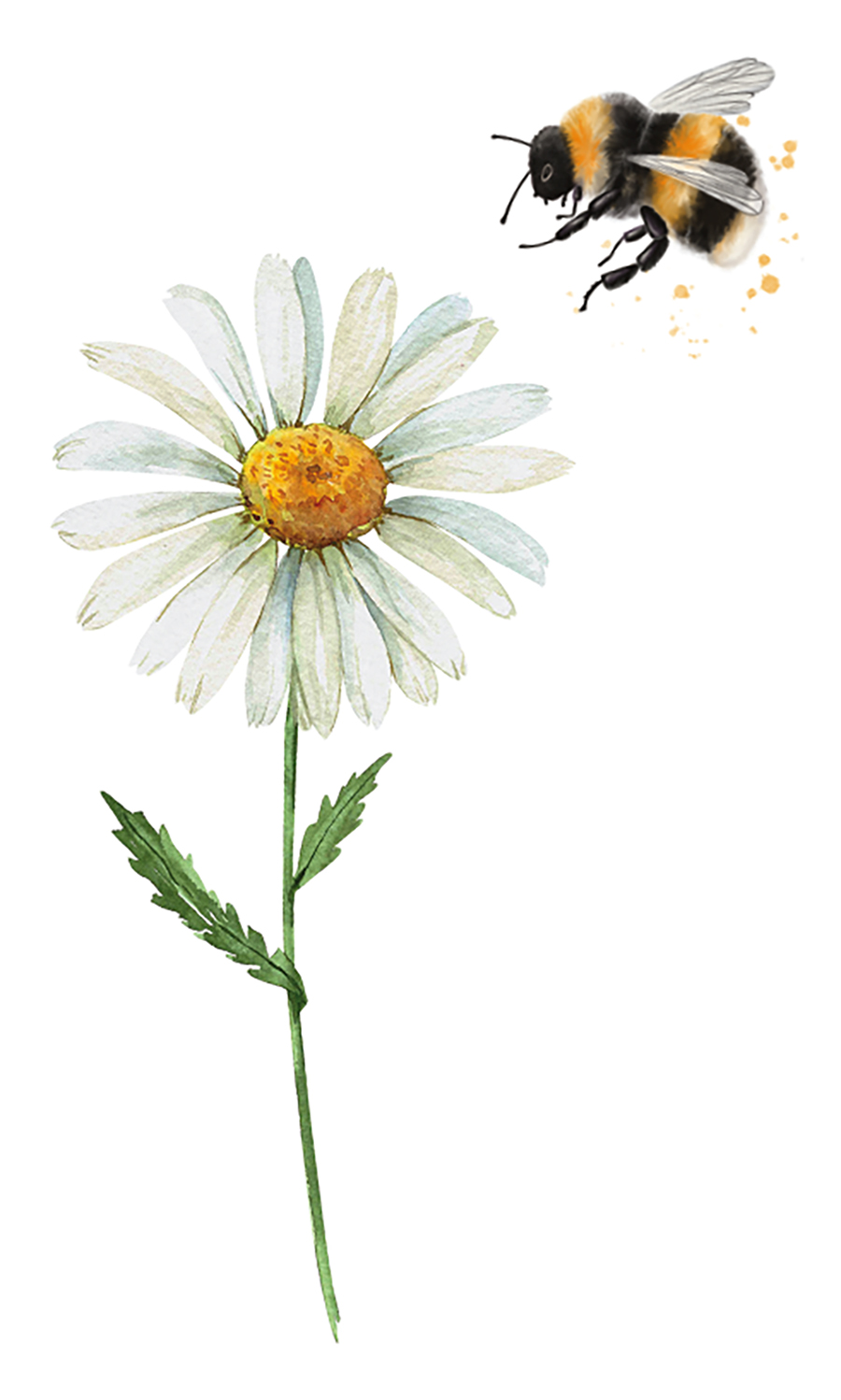
Among ditch daisies and dancing grasses, meadow-beauty and blooming Joe Pye, the crickets declare their sole intention. It’s time now, they announce. Let’s do this! We came here on a mission!

Life wants to live. All beings know some version of this tune. The dream of every cricket is next summer’s mating song.

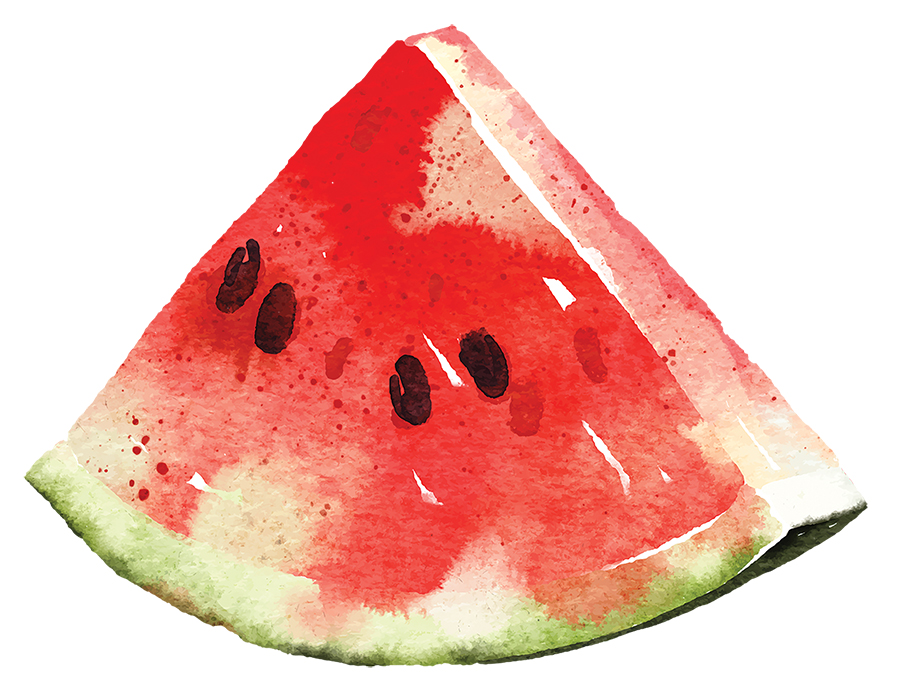
In the garden, mantis munches on June beetles. Honeybees serenade black-eyed Susans. A watermelon whispers that it’s time, now. 

One look and you know it’s true. Still, you give the rind a solid thwack.

Yep. Music.

As you gently twist the whopper from the stem, the cicadas scream with primal knowing.

This is when you choose to slow down. Feel the weight of swollen fruit as you hold it close. Give thanks for the soundscape, the sweetness, the sweat on your brow.

Despite these endless summer days, the transience of this season is palpable.

Let’s do this, the crickets trill. It’s time now. Life as we know it depends on us.


Summer was our best season: it was sleeping on the back screened porch in cots, or trying to sleep in the tree house; summer was everything good to eat; it was a thousand colors in a parched landscape; but most of all, summer was Dill.    — Harper Lee, To Kill a Mockingbird

All That Glitters

Grab the binoculars. A Mars-Uranus conjunction will grace the Eastern sky an hour before sunrise on Monday, July 15. Look to Taurus (the white bull) for this rare glimpse of two planets, seemingly close enough to kiss.

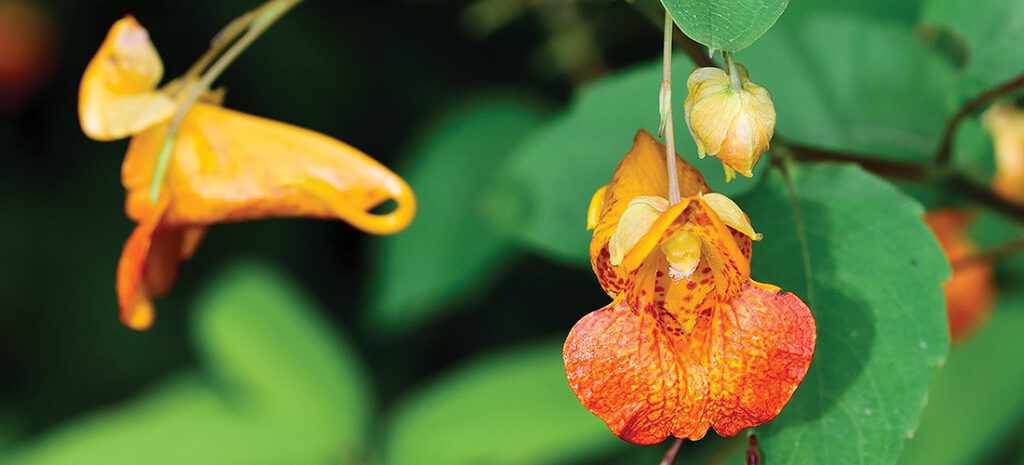
On the subject of shining moments, jewelweed is having one this month, too. In other words: It’s blooming.

With its small-but-showy orange flowers (they do look like tiny charms dangling from slender stalks), you’re likely to spot this native medicinal along forest edges — especially near poison ivy. As Nature has arranged it, the sap from jewelweed leaves and stems can be applied topically to help soothe itchy rashes. Simply brilliant.   

En Plein Air

Did you know that National Play Outside Day is celebrated on the first Saturday of every month? This Fourth of July weekend, turn off the screens. It’s time for some old-fashioned yard fun. Hopscotch. Double Dutch. Corn-shucking on the porch.

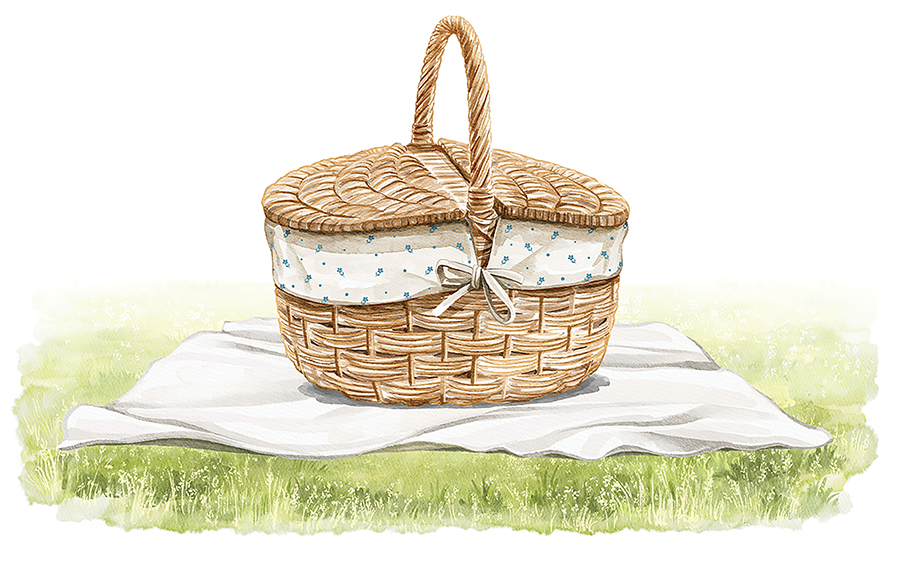
Bust out the freeze pops. The hammock. The threadbare picnic blanket.

Is your kid the next egg-and-spoon race champion? Watermelon seed-spitting extraordinaire? Double-dog dare you to find out.   OH

Botanicus

Botanicus

The Jewelweed Experiment

One man’s weed patch can be another’s wild garden

By Ross Howell Jr.

Ross Lackey is the first person I ever heard use the word “curating” to describe sustainable agriculture and landscaping. I met him years ago on a tour at Juneberry Ridge, a 750-acre spread just outside Norwood. Lackey thinks of farmers and gardeners as stewards, responsible for the elements that nature provides — earth, stone, water, trees, shrubs, grasses and flowers — protecting them, nourishing them, arranging them so they are presented in the most beautiful, sustainable and balanced way possible.

We gardeners are curating all the time. We thumb through our collection of catalogs, scroll websites and visit nurseries, selecting this or that bulb, flower, shrub or tree for its size, shape and color, and thinking about just where we want to plant it.

But, one day, I wondered, what would I get if I stopped gardening in the traditional way and simply curated nature?

“You’d get weeds,” the gardener in you just blurted.

And you’d be exactly right.

My Blowing Rock garden offered the opportunity for an accelerated and diverse experiment. The land slopes steeply from the crest of a high ridge, where the wind howls like a wolf in winter and eddies in the woods below, just beyond our split-rail fence.

My first spring there, I’d noticed jewelweed — eager, lime-colored, round-leaf sprouts — all along the rail fence. I recognized it from my days on the farm, where it grew by the creek next to our springhouse. Just as I’d been taught as a boy, I dutifully whacked down the sprouts with a string trimmer.

But the first year of my experiment, I let the jewelweed grow and reveled in its waist-high profusion of foliage and orange, red-speckled, pitcher-shaped flowers, where bees and other pollinators droned from morning till dusk. Hummingbirds fed on the jewelweed, too, one even keeping a perch in a wild cherry tree by the fence.

And once I put down the weed whacker, I found that the howling wind planted other gifts.

It blew seeds from mullein, milkweed, thistles and dandelions. It blew seeds that yielded the pink blossoms of fleabane and the yellow blooms of tickseed. It blew native daisies, clover, sundrops and yarrow.

Wild violets popped up here and there, and I moved them together in small beds, for effect. I discovered Jack-in-the-pulpit and Christmas ferns in the shade of a white oak by the fence.

As summer progressed, I found black-eyed Susans volunteering, along with wild asters, Queen Anne’s lace and bushy St. John’s wort. Later, the garden was dazzling with the delicate spikes of low-growing, rough goldenrod, along with the bursts of bloom atop 6-foot-tall spikes of Eastern goldenrod.

As the wild garden created itself, something was blooming somewhere in it throughout the growing season.

These days, with my experiment well into its third year, I’ve become a more active curator.

Thanks to gardening friends in Greensboro and Blowing Rock, I’ve added wild geraniums, mountain mint and wild ginger. I’ve purchased and planted purple coneflowers, Eastern columbine and oakleaf hydrangeas, plus a fire azalea bush and redbud trees.

In the fall, I cover the art in my natural museum with leaves and hardwood bark mulch, leaving the seed stalks for the birds and critters. In spring I administer a modest dose of composted cow manure and more mulch.

I’m happy. My wild garden looks happy.

All because of a conversation with Ross Lackey.  OH

Ross Howell Jr. is a contributing writer. Ross Lackey and his wife, Tiffany, a chef, are headquartered at Holly Hill Farm in the community of Whynot, near Seagrove, where Lackey offers land design consulting and services. Tiffany recently opened Seagrove Café, where her cinnamon buns are in high demand. For more information, visit www.hollyhillfarmnc.com.