Memento Mori

Memento Mori

The affirming life of Leslie Deaton

By Cynthia Adams 

Photographs by Amy Freeman

The ache for home lives in all of us,” wrote poet Maya Angelou. “The safe place where we can go as we are . . .” 

For Leslie Deaton, sanctuary is a Dutch Colonial in the historic Fisher Park district. “My story is one of breath-stealing tragedy, but also love in its wildest form, of soul-crushing pain and new mercies every morning,” she says. On leave as a Northern Guilford High School counselor, she’s fighting cancer while drawing comfort from her beautifully realized retreat.

The home, a slate-gray charmer, tells a visual version of Deaton’s story. This is a place of meaning, its well-appointed rooms say. Of warmth. Of joy.

As she found it only a few years ago, it was move-in ready, which was a particular boon, after a sensitive and full restoration by Dunleath residents Camilla Cornelius and Stephen Ruzicka. 

“The house was built in 1922; it looked great,” she praises. Cornelius, who formerly housed a counseling practice there, presented Deaton with four pages of itemized renovations, including specialty faucets.

It was a turnkey home with curb appeal, given the on-trend gray exterior with crisp white trim. “So perfect for me,” Deaton adds, having bought the property in August 2020, “in the heart of COVID.” 

She made the move well before she became ill, and a year before she lost her only child, William Walton Finch, at age 23.

“Losing my son . . . ” she falters, explaining. “He took a Xanax that was pressed with Fentanyl on July 28, 2021. I believe that is why I have cancer. I just could not endure it.” She pauses. “The love of my life. My only child.” 

Her son graduated a semester early from N.C. State University with magna cum laude honors, she adds. Nothing fit.

She sighs raggedly. Tears fall.

Deaton understands those tears are therapeutic and necessary. Ironically, she has seldom been able to enjoy much leisure time at home prior to her illness, given a busy professional life. 

Fueled by her longtime work with young adults, she has continued to speak to students and anyone who will listen about the lethal threat street drugs pose to young people, even after a shocking diagnosis last year.

She believes “the trauma of losing Will opened me up to invasion. Losing a child is a different type of loss.” Losing an older child is no less challenging, she says. “It’s different.” Two people in her life who lost children subsequently “ended up with breast cancer.”

In February 2023, she chose to share her son’s story with 700 students, parents and educators at Northern Guilford. She was joined that night by Amy Neville, a California parent who lost a 14-year-old son. 

“Tragedy would hurl me without warning into a spotlight I never in a million years asked for but felt required to assume in order to tell the most soul-crushing story of my lifetime.”

Publicly, she drew back the curtain on pain following the loss “of my sun, my moon and all my stars — my beautiful son and my only child.” The title of her presentation? One Pill Can Kill.

In a televised interview with WFMY-TV, Deaton shared the nature of her personal trauma. “I got the absolute worst phone call of the human experience. I was informed that I lost my child to a horrific poison, Fentanyl,” she explained

She met Jane Gibson at Authoracare while grieving.

“I was touched by the love and the pride she shared with me about her son,” says Gibson, a recently-retired staff member. “And despite her great sorrow, she was not crawling away into a hole.” Even though it was a busy time in the academic year for her and her students, it was clear to her that “she would find healing by providing counseling support for these teens. What an amazing, loving woman!”

As long ago as 2022, Deaton began experiencing persistent stomach pain. Late that year, nagging back pain worsened.

“I was trying so hard to resist painkillers,” she recalls. “To honor what I’d been so vocal about.” Instead, she bought a new mattress to help her back, still suspecting she also had a stomach ulcer. 

“Then we got new office chairs. Each member of our counseling department had back complaints . . . But guess what? I still had agonizing pain.”

She turned to Ibuprofen, Tums and a heating pad in order to make it through the work day. “One morning in May [2023], our well-intentioned counseling secretary stood at my desk and said, ‘I’m not going to move until you call the doctor.’”

Deaton eventually capitulated, seeking help. When a radiology interventionist proposed a nerve block to alleviate back pain, she tried it.    

It helped briefly. Then her pain roared back. 

During follow-up, her blood work was normal. But an endoscopy and a CT scan detected a large mass in her pancreas. 

Deaton was diagnosed with stage four pancreatic cancer on May 31, 2023. “I was told to get my affairs in order while I still had cognition.” When she learned her diagnosis, she was at home alone. It was a phone call “that cruelly propelled me off my axis once more.”

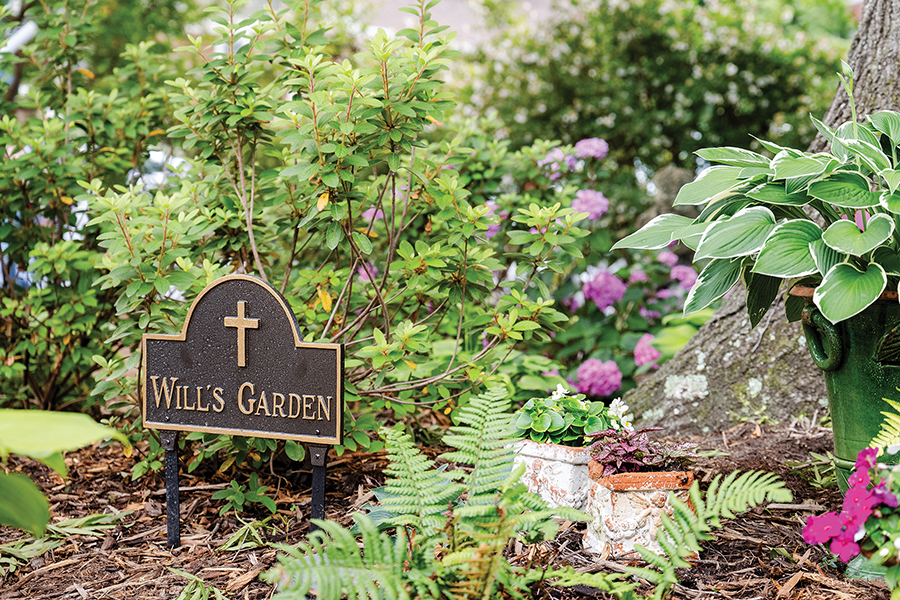
“Yes, I know I have a terminal diagnosis, but I don’t know what that means,” she says calmly, gazing out a kitchen window. “I could be in a car wreck today,” she says unemotionally. Outside, colorful plants await planting in a garden she plans to call “Will’s Garden.”

She makes plans and continues home projects.

“I’ve not asked my life expectancy from my doctors, and the reason I haven’t is, I feel it’s a guess, at best. I’m focused on today. Today is a gift,” she muses. Shortly after her diagnosis when she realized she wouldn’t be going back to work in the fall, she recalls deliberating over “this silly little rug from Ballard Design. And my friend, Jane Harrill, was here. And she said, ‘You’re going to be here a lot. If that rug gives you happiness, get it.’”

Harrill is Will’s former kindergarten teacher, explains Deaton, as well as an artist. She helps Deaton following treatments. 

Deaton’s close, longtime friend, Todd Nabors, who met her at First Presbyterian church, agrees with Harrill. 

“We’re the same age,” he says. “We’ve been friends forever.” They see each other nearly every Sunday. Deaton admires his aesthetic and relied upon his point of view when it came to her home.

Nabors, who works for furniture company Thayer Coggin and also consults on design, offered similar advice. “Beauty matters,” he told her.

And so, Deaton ordered the sisal rug. 

Deaton has always found “feathering her nest” therapeutic. Years ago, she frequented Summer House, a home decor shop. There she met Kaylee Phillips.

Phillips, who now works in antiques and collectibles at Carriage House, says, “She collects beautiful things. And along the way, she collects beautiful friendships.”

“Beauty does matter to me. And surrounding myself with joy and cheer is a medicine of sorts. It’s a therapy. It’s treatment,” says Deaton. There’s sorrow here, too, of course: the elephant in the room, as the expression goes. Yet there’s an aura of peace, too, and light. It streams through the house’s many windows.

At home, the gentle colors of a spa surround her.

Along those lines, she has selected a fabric with which she wants to reupholster an upstairs den chair. The room is softly feminine, accented with the pastel art she collects. Inside sit her desk, a vintage French chair found at Carriage House, along with a television, chaise lounge and cushy seating. After treatments — a more aggressive regimen of chemo and radiation began in April — she often rests here.

She cocoons here in the beautiful room, sometimes tossing a toy to her dog, Charley, whom she shares with her dad, and Virginia, her cat.

She resists staying in bed when under the weather, and refuses to recover in pajamas but prefers regular clothes. To be as normal as possible. “When I go to treatment, they say, ‘We love seeing what you come in wearing.’” Deaton takes pride in this, saying it is a form of self-care.

Even while wearing yoga pants, she stacks delicate beaded bracelets along her arm — many are gifts from devoted friends.

She refuses to give in or stop making an effort.

This applies equally to her personal environment.

She has just chosen a new fabric by Elliston House for a favorite bedroom chair. “The company is owned by [Greensboro residents] Morgan Hood and Ally Holderness. And I just admire them for taking that leap of faith,” she says of their venture into business.

“At times I’m tethered to that chair.” 

She chose Elliston House for Roman shade fabrics in the same space and the company’s wallpaper to line a breakfront she uses for storage. She’s deliberating another Elliston House fabric for an often-recovered armchair.

She, perhaps, values art and personal mementos above all else. Art is present in every room, as are personal touches. Many of the works she’s acquired have been created by local and regional artists.

Winston-Salem artist Carolyn Blaylock is a favorite. She collects North Carolina artists Bee Sieburg, Libby Smart, Sharon Schwenk, Sue Scoggins, Helen Farson, Amy Heywood, Yvonne Kimbrough, Crystal Eadie Miller and Murray Parker. She describes their styles as “warm and inviting.” She treasures pieces by artist (and fellow educator) friend Harrill.

Virginia artist Martha Dick and Georgia artist Lisa Moore are also part of her collection.

Favorite places and influences?

Deaton admires the Carolina Inn, in the “most classic of ways.” (She’s a UNC-Chapel Hill grad.) She loves “going room to room and seeing the differences.”

Home magazines are a constant source of inspiration. She again mentions former home decor shop Summer House. “It had a great influence. I loved it.” She uses painted pieces acquired there, including chests and breakfronts. 

Once, a man delivered something to her prior home and exclaimed, “You’ve shopped at Summer House!” 

“Everybody who’s ever encountered her loves her,” says Phillips, musing about the friendship that originated in that store. “We’ve all become friends with her. It was deepened due to the connection with our children,” she adds.

Often, too, Deaton finds Randy McManus’ floral shop “very therapeutic for me.” 

She picks up a small plate displayed in her den, found in a Pawley’s Island shop in 2019. 

“It simply says, ‘Tell stories.’ It’s funny because I didn’t buy it initially, but it popped into my mind several times before our departure, so I scooped it up on our way out of town, never dreaming of its significance, completely oblivious that it would ultimately become my life’s theme song.” 

Deaton still considers her home a creative outlet and she now has time to contemplate every detail. She considers a colorful pink Elliston House lampshade. (Pink is a favorite color. There is even a pink Keurig coffeemaker on the kitchen counter and a pink leopard print sisal on the kitchen floor). 

She just replaced the upstairs bath’s colorful mirror with a high gloss white-framed one. Satisfied, she says it calms the effect of a lively wallpaper.

This is part of “living my life,” she explains. Design, color and beauty bring her great joy.

When Deaton walks into her son’s former bedroom, her voice is softer. “His special, special things,” she says quietly. “I just had to totally redo it . . . ”

She pauses, as if she is seeing the room as it was before it became a guest room, adding a white Matelassé coverlet, crisp linens and French blue accents. One wall displays diplomas, pictures and mementos from her son.

Everything in here is something about Will, she says.

After his dad left when he was young, Will and his mom had years together. “We had such a unique and special relationship. I weep. And I will never stop weeping. I tell people, I do not cry over my cancer, but I cry over Will.”

She reads aloud framed stickies he wrote to her, struggling with her emotions.

“I have beautiful portraits of him,” she says of her son. “I am so thankful.”

Friends who know of Deaton’s loss and health issues have donated wallpaper, fabrics, bedding, a specially monogrammed neckroll with Will’s initials from Matouk bedding — even a special commission by Triad artist Amy Heywood. 

“She gave that [painting] to me. Came into the home, looked at all my art. And that’s what she created.” Fresh flowers appear at her doorstep. Letters with donations arrive from strangers.

“Never did I dream when I redid this room that so many different people would be using it to stay with me,” she continues, lingering in Will’s former room. She is pleased when they tell her they find peace here.

If memories of Will are the dominant focus of her home, the underlying theme is serenity.

The lighting fixture in her room was a gift from a friend. “It’s a very visual comfort,” she says. “It’s so beautiful at night.” This is a real place of sanctuary, she repeats.

She picks up and cuddles Virginia, the blue-eyed rescue cat. “She has a little dot on her nose,” Deaton says delightedly. She imagined her “walking up Virginia Street. to find me.” 

Deaton rehabilitated her. She is epileptic, Deaton says, and takes phenobarbital; once, a well-meaning friend almost gave her Virginia’s medicine. She winces, but smiles, quipping, “Wonder what that would have been like?” 

The downstairs rooms are tasteful yet casual with cream-colored walls, accented with French finds, collections and artwork. The eating nook off the kitchen had original benches and table, which she decided to keep but stash in storage. It was original, and Deaton says she didn’t want “to be disloyal to the Ruzicka’s renovation.” While she would “never get rid of it,” she stored it in the basement so she could add a table that better worked for her 6’3”-tall son when he lived with her.

Each room in her home sparks a return to the subject of her son.

Will chose to enter treatment at Fellowship Hall, she says quietly, standing in the breakfast nook where they ate together when he was staying here. 

He had completed treatment for addiction. Will had just qualified for Navy Seal training, “when this all happened.” Deaton would never know if it was his first relapse either. At the time, her son was living in Charlotte and doing incredibly well, according to his roommate. He had, for months, endured miles of running and swimming. “He doesn’t fit the mold,” she stresses.

Nonetheless, Deaton extols the virtue of a recovery program. “But when you are 22, and everything about socializing is a drinking event . . .” 

Alcohol, she explains, lowers our inhibitions. “And opioids are the worst. Instantly addictive. I’m not minimizing alcohol,” she stresses, “but it’s a different beast.”

“It’s a tragic, tragic story,” she says. “An incredible, stinging hurt and [emotional] pain followed him,” she says. “But Will was definitely trying to find a way to deal with that pain. And he went at it the wrong way.”

“But he was always outstanding, and he will always be my greatest accomplishment,” she says. 

Coping with extreme pain, Deaton has had to learn how to handle her own fears regarding painkillers. She credits the Palliative Care Program at Cone for guidance.

“Dr. Beth Golding took me under her wing and has gotten control of my pain,” says Deaton. Controlling pain enables her to walk again, go to the grocery store, to do chores. “Transformative,” she adds.

She recalls Dr. Golding saying “we don’t see thriving in pancreatic patients. But you are doing life.”

With Deaton’s pain lessened, she occasionally found diversion working a few hours at Watkins Sydnor, a home store. Earlier last year, she even managed 5-mile walks from Fisher Park to Irving Park, feeling completely energized.

“For me, time with my friends is what matters. It’s not about stuff. Funny, because this article is about stuff, in a way. But what this disease has taught me is that time together is all that matters.”  OH

Dog Is Love

Dog Is Love

Sedgefield Presbyterian Church laps up its new congregational canine

By Maria Johnson 
Photographs by Mark Wagoner

It’s been several weeks since 79-year-old Sue Lucado could make it to church.

She had a cold.

She had guests.

She had COVID.

It’s been one thing after another, but she’s here, at Greensboro’s Sedgefield Presbyterian Church, this Sunday morning. She steps into the vestibule and receives an unusually robust welcome.

She is sniffed

She is licked.

Her shoelaces are tasted.

In an instant, Lucado’s expression changes from somber to smiling.

She leans over and sticks a hand into the mass of apricot curls dancing around her feet.

Two gleaming brown eyes look up.

Two floppy ears emerge.

A finger-length tail covered with wispy tendrils thumps the carpet.

The furry swirl slows enough to reveal Chloe Grace, the church’s 3-month-old, 8-pounds-and-gaining, congregational dog.

Genetically speaking, Chloe Grace is a cavapoo, meaning she’s part poodle, part King Charles Cavalier spaniel.

Spiritually speaking, she’s heaven-sent.

“She’s the most beautiful thing,” Lucado gushes. “Bless her heart!”

The good news about Chloe Grace reached Lucado a couple of weeks ago, when she cut the pup’s picture out of a church newsletter, stuck the picture on her refrigerator, and made an announcement to her own beloved dog, Katie, a Yorkshire terrier.

“I said, ‘Katie, we have a little friend at church,’” she says.

Now that Lucado has met Chloe Grace, she is smitten.

She takes a program from human greeter Paul Durant, who owns the dog with his wife, the church’s pastor, Rev. Kim Priddy.

“You know me and dogs,” Lucado tells him. “I like them better than people.”“Don’t tell anyone, but me, too,” Durant confides playfully.

Lucado nods, still smiling, and finds a pew.


Priddy, the shepherd of this flock, swiped the idea of a pastoral pup from a friend, Rev. Michelle Funk in Pennsylvania.

Funk, who got a church dog last year, had toyed with the idea of a congregational canine for years. Using a therapy dog for church work made sense to her, but when she pastored a church in Burlington, N.C., a few years ago, she had two beagles.

“Neither of them was church therapy dog material,” Funk says in a phone interview.

“You know beagles. They follow their noses. They’re very loving, but they have a mind of their own.”

Then, in 2022, she was called to her current church, Heidelberg Union Church in Slatington, Pa.

The time and place seemed right.

One member trained seeing-eye dogs and often brought the trainees to church. A past member had attended with his personal service dog, who sometimes sat in on messages for the children.

“Dogs in church was not a new concept in this congregation,” Funk says.

She resurrected her hunt for a four-legged staffer. Her research turned up a handful of pastoral pooches nationwide. The cavapoo breed, known for being warm, intelligent and hypoallergenic, was a popular choice.

Funk visited a reputable cavapoo breeder and brought home a 4-month-old pup that her family — fans of the Harry Potter franchise — named Muggles.

At a pastoral retreat last year, Funk told Priddy about taking Muggles, in his first week on the job, to see a church member who was living at home under hospice care.

Funk placed Muggles in the woman’s lap. As the woman stroked Muggles’ soft coat, she opened her heart. Words poured out.

Muggles knew what to do. He relaxed, stayed put and let the woman talk.

She was scared of dying, she said. She had things she wanted to do in life. As faithful as she was, she wondered if God would be present at her passing.

Funk reminded her of Jesus’ words on the cross: “My God, why have you forsaken me?”

She reassured her that fear and doubt were normal.

She prayed with the woman.

It was clear to Funk that Muggles had helped the woman tap a vein of emotion that she, the pastor, might not have been able to reach alone.

The story lit a fire in Priddy, who’d grown up with dogs and owned dogs when her three children were young.

“I knew that dogs made people happy, but when Michelle talked about her visit, I realized the potential of reaching church members in a new way,” she says.

She ran the idea past her husband, Durant.

“I said, “As long as it’s for a purpose . . . ’” he recalls.

Historically a “big dog person,” he agreed to getting a smaller, more portable cavapoo — with a mature weight of 15 to 20 pounds — for the church gig.

Priddy pitched the plan to her session, the congregation’s ruling body. She told the story of Muggles.

If she got a similar dog, she said, she would bring the dog to work, take it to visit sick and homebound members, and have it certified as a therapy dog as soon as possible.

The idea was consistent with other forward-leaning projects that Priddy has backed to improve the church’s outreach, relevance and membership — an Earth-care committee; a yoga class that meets during the Sunday school hour; guest speakers on the war in Gaza.

Like many mainline churches, the Sedgefield congregation has shrunk over the last several decades. Today, riding an uptick following the doldrums of COVID, there are about 85 active members. About half are seniors. Many live alone.

A dog, Priddy hoped, would comfort those who missed touching and holding another living being.

She also aimed to delight children in the church’s preschool program and signal to potential members that the congregation was open to new ideas.

The session agreed unanimously.

On a Friday in March, Priddy and her husband brought their 8-week-old bundle of joy home from a breeder in Charlotte.

That Sunday, they toted the puppy to church.

Priddy invited church members to vote on a name for the dog by dropping dollars into red Solo cups bearing the names suggested by children of the church.

After the service, $125 in votes were tallied. The top two vote-getters were Chloe and Grace.


“Helllllllo, Miss Helen,” Priddy singsongs as she steps through the door of an apartment at the River Landing retirement community in Colfax. “I’ve brought all kinds of guests today.”

Across the room, church member Helen Boyer, 98, sits in a recliner with her feet up, watching daytime television.

“Where’s Amazing Grace?” She calls out in a bright voice. “I call her Amazing Grace. Amazing Grace is better for a church dog.”

Priddy leads the pup into the studio, detaches a leash and lifts the dog into the chair with Boyer, a stalwart church member who attended services regularly until she gave up driving about seven years ago. These days, she watches on YouTube or, if her daughter is with her, on Facebook Live.

“Get up here, Amazing,” says Boyer, whose manicured fingers slide into the pastoral pup’s curly coat and begin massaging. “How are you, missy? It’s been a while.”

Soon, Boyer is talking about how she misses the dogs she used to own — what good company they were and how they kept her on her toes. One dog, Suzy, a Doberman, lived with her when she moved to a cottage in the retirement community 20 years ago.

Suzy died about 10 years ago, but Boyer still feels close to her.

Literally.

“She’s over there, in that drawer,” Boyer says, pointing to a bureau that holds her beloved dog’s ashes. “She’s going to be inurned with me.”

Chloe Grace is not impressed. She nibbles Boyer’s unguarded toes.

“No biting!” Priddy says, removing her charge.

Priddy pulls out a bag of treats and hands some to Boyer. For a tasty price, they finish their visit peacefully.

In closing, Priddy scoots closer to the recliner and offers Boyer a hand in prayer. She thanks the Lord for this time together, for Boyer’s devotion to the church and for the opportunity to talk about their dogs.


Ask almost any question about Chloe Grace, and the answer is probably “yes.”

Has Chloe Grace had any accidents at church?

Yes, but none in the sanctuary. As of this writing.

Did Chloe Grace participate in this year’s Easter egg hunt?

Yes. She quickly found a candy-filled egg, at which point Priddy and Durant pulled her from the hunt.

Has Chloe Grace been invited to children’s birthday parties?

Several. One girl requested the gift of being chased around her party by the puppy.

Do adults drop by the church just to see Chloe Grace?

Yes. The clerk of session, Karen Johnson, who is retired and lives near the church, sometimes texts Priddy to see if she has brought the pup to work. If the answer is yes, Johnson heads to the church.

Are people sometimes disappointed if Priddy shows up to a church meeting alone?

Yes. “I thought Chloe Grace would be here,” they say sadly.

Does Durant tease his wife that more people come to church to see Chloe Grace than to see her?

Yes. Priddy’s reply: “I don’t care, as long as they come.”

Does Chloe Grace attend Sunday services?

Yes. Usually, she hangs out in the back of the sanctuary with her usher-dad, Durant, and her clerk-of-session-pet-sitter Johnson.

Does Chloe Grace help take up the offering?

Yes. She has a flair for opening hearts and wallets. Someone suggested training her to stare at people until they drop money in the offering plate — and to bark if they don’t give enough.

Does Chloe Grace occasionally run under the pews, causing a visible ripple of heads turning to catch the flash of fur under their feet?

Yes. Sometimes, they step on Chloe Grace accidentally. She seems to forgive those who trespass against, and on, her.

Does Chloe Grace have a time-out spot for when she is too excited?

Yes. See the playpen in the church library.

Does Chloe Grace have an Instagram account?

Yes, @chloe_the_spc_pup. Follow her colleague, Muggles in Pennsylvania, @pupminhuc.

Are there members of the church who aren’t crazy about dogs in general, or Chloe Grace in particular?

Yes, probably. But they haven’t whined to the leadership.

Do people seem to be smiling more around Sedgefield Presbyterian these days?

Definitely. Johnson credits Chloe Grace with lifting spirits.

“She’s a ray of sunshine for people. When she greets you, how can you not have a better day?” she muses. “She doesn’t care if you’re walking with a cane or if you’re in a wheelchair, if you’re 2 feet tall or 5 feet tall, if you’re Black or white, gay or lesbian. She doesn’t care. She’s there to give you love, like God is.”  OH

Omnivorous Reader

12 DAYS OF CHRISTMAS

Civil War: Past and Present

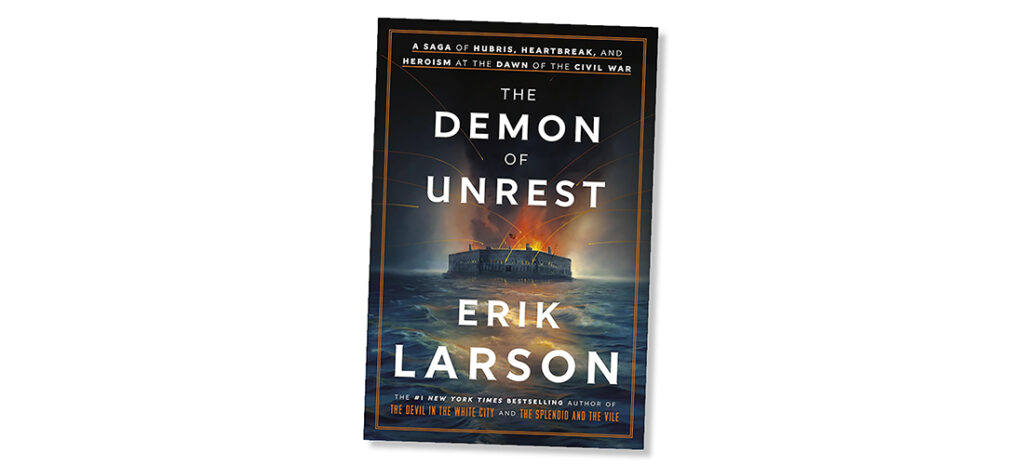
Erik Larson’s The Demon of Unrest

By Stephen E. Smith

Books about the American Civil War sell themselves. Publishers know there’s a loyal audience eager to buy reasonably well-researched volumes about the most tragic event in American history, and that’s enough to keep the bookstore shelves stuffed with warmed-over and newly discovered material. But how does a Civil War historian appeal to a broader audience? Simple: link the events explicated in his book to the present or, even better, to the future.

Erik Larson’s The Demon of Unrest: A Saga of Hubris, Heartbreak, and Heroism at the Dawn of the Civil War purports to do just that. Larson states in his introduction: “I was well into my research on the saga of Fort Sumter and the advent of the American Civil War when the events of January 6, 2021, took place. As I watched the Capitol assault unfold on camera, I had the eerie feeling that present and past had merged. It is unsettling that in 1861 two of the greatest moments of national dread centered on the certification of the Electoral College vote and the presidential inauguration . . . I suspect your sense of dread will be all the more pronounced in light of today’s political discord, which, incredibly, has led some benighted Americans to whisper once again of secession and civil war.”

The major news networks have been quick to focus on the book’s possible implications, and Larson has appeared on cable news, NPR, and at bookstores and lecture venues across the country to address the possible parallels between the people, places and events of the spring of 1861 and those of the upcoming presidential election.

Which begs two questions. First, is The Demon of Unrest a well-written, thoroughly researched history deserving of the intense scrutiny it is receiving? And second, does the history of the fall of Fort Sumter offer readers insights into the cultural and political divisions in which Americans now find themselves?

The answer to the first question is a resounding yes. Larson is a conscientious researcher, and everything he presents “comes from some form of historical document; likewise, any reference to a gesture, smile, or other physical action comes from an account by one who made it or witnessed it.” He has analyzed a myriad of primary and secondary sources and produced a narrative that proceeds logically from chapter to chapter, illustrating how a false sense of honor and faulty decision-making on both sides of the conflict facilitated the terrible suffering that would be occasioned by the war.

Larson accomplishes this by drawing on the papers and records of the usual suspects — Mary Chesnut, Maj. Robert Anderson (Fort Sumter’s commander), Lincoln, Edmund Ruffin, Abner Doubleday, James Buchanan, Gideon Welles, William Seward, etc. — but he also delves more deeply than earlier historians into more obscure sources, all of which are noted in his extensive bibliography. Much of what he discloses will be revelatory to readers of popular Civil War histories.

The disreputable activities of South Carolina Gov. James Hammond are a startling example. (Hammond is credited with having uttered the oft-repeated “You dare not make war on cotton — no power on earth dares make war upon it. Cotton is king.”) In May 1857, Hammond, an active player in the Fort Sumter narrative, was being considered to fill a vacant seat in the U.S. Senate, even though he was a confessed child predator who molested his four nieces. Hammond wrote in his diary: “Here were four lovely creatures, from the tender but precious girl of 13 to the mature but fresh and blooming woman nearly 19, each contending for my love . . . and permitting my hands to stray unchecked over every part of them and to rest without the slightest shrinking from it.” Hammond not only recorded his misdeeds, he disclosed his indiscretions to friends and suffered no negative political consequences when his pedophilia became public knowledge.

Larson reminds readers that Lincoln’s election also occasioned a demonstration at the Capitol. The crowd might have turned violent, but Gen. Winfield Scott was prepared: “Soldiers manned the entrances and demanded to see passes before letting anyone in. Scott had positioned caches of arms throughout the building. A regiment of troops in plainclothes circulated among the crowd to stop any trouble before it started.”

In a lengthy narrative aside detailing Lincoln’s trip from Springfield to Washington, Larson reveals that the president-elect had to hold a yard sale to pay for his journey to the inaugural and that despite precautions to ensure his safety, an elaborate subterfuge had to be undertaken to sneak Lincoln into the District of Columbia. He was accompanied on the trip by detective Allan Pinkerton, who was determined to foil a supposed plot to assassinate Lincoln before he could be sworn in.

What readers will find most surprising is the degree to which the 19th-century concept of “honor” held sway over events surrounding the fall of Sumter. As South Carolina authorities constructed gun emplacements in preparation for a bombardment of the fort, mail service continued with messages to and from Washington passing through Confederate hands without being opened and read. While attempting to starve the fort into surrender, the city of Charleston also attempted to accommodate the garrison with deliveries of beef and vegetables, which Maj. Anderson rejected on the grounds that such resupply was dishonorable.

After months of political finagling, the fort endured an intense 34-hour bombardment before being evacuated. Neither side suffered any dead or wounded; thus, the battle that initiated the bloodiest conflict in American history was bloodless.

The second question — Do the events that followed Fort Sumter’s fall suggest that violent consequences will likewise follow the 2024 presidential election? — is easily answered: No. Cliches such as Santayana’s “Those who forget history are condemned to repeat it” or Twain’s “History doesn’t repeat itself, but it does rhyme” short circuit critical thinking. Nothing is preordained.

Documentary filmmaker Ken Burns, who knows something about the Civil War, recently addressed this question in a commencement speech at Brandeis University. The text of Burns’ address is available online, and readers who believe we’re headed into a second civil war should read what Burns has to say.

The obvious message conveyed by The Demon of Unest is clear: Human beings are foolish, arrogant and too often given to emotional irrationality that’s self-destructive. There’s nothing new under the sun. Ecclesiastes got that right.  OH

Stephen E. Smith is a retired professor and the author of seven books of poetry and prose. He’s the recipient of the Poetry Northwest Young Poet’s Prize, the Zoe Kincaid Brockman Prize for poetry and four North Carolina Press Awards.

Out of the Woods

Out of the Woods

Three Team U.S.A. Olympians redefine themselves in the Gate City

By Cassie Bustamante  

Photographs by Mark Wagoner

“Woods are not like other spaces . . . They make you feel small and confused and vulnerable, like a small child
lost in a crowd of strange legs . . . They are a vast, featureless nowhere. And they are alive.”

— Bill Bryson, from A Walk in the Woods

This month, the City of Light will be aglow with 10,500 athletes from all over the world competing in the 2024 Summer Olympics, plus an estimated 15 million visitors.
To say the world will be watching is an understatement. But who are these athletes — heroes for a glorified moment in time — after the paddles have been stowed, the Nikes unlaced and the skates hung up for the last time? We caught up with three local Team U.S.A. Olympians, including two gold medalists, to answer that question.

Joey Cheek, Gold Medal Olympic Speed Skater

Tamara Cheek, Olympic Canoeist

Sprawled out on his charcoal gray sofa, 2006 gold-medal Olympic speed skater Joey Cheek rests one hand on his chestnut-brown boxer, Cashew, who lets out a contented sigh. Both man and dog are totally at ease in this snapshot of daily life. But, Joey, now 45, admits that was not always the case for him.

“The years after the Olympics are — ,” he begins and then pauses. Tamara Cheek, also 45 and an Olympian herself, jumps in.

“Oh, are we at the walk in the woods?” After checking on Jack, the couple’s 4-year-old son, who’s happily scooting his Paw Patrol vehicles across the floor of the nearby playroom, she explains.

A Walk in the Woods, Bill Bryson’s New York Times-bestselling book about his ups and downs — both literately and figuratively — along the Appalachian trail, is a metaphor for how the Cheeks and some of their fellow Olympians describe life after the games. One reviewer called Bryson’s trek “A journey of discovery and renewal.” And that’s certainly been true for both Tamara and Joey.

For Joey, the path to the Olympics began when he was a roller-blading middle-schooler in Greensboro. His parents made sacrifices to support his fledgling athletic career. He recalls a home with sparse furniture and beat-up cars. “I had everything I needed, which was also all I ever wanted.” At 16, he left home to train in Calgary and made the leap from wheels to blades.

In 2002, 22-year-old Joey made it to the Salt Lake City Olympic Games, where he won the bronze medal in the 1,000-meter speed-skating event. Four years later he returned to the Olympic rink, this time in Turin, Italy.

As he headed back, he had an inkling that this would be his last time skating on Olympic ice. Plus, he wondered, “What am I going to get from four more years of this that I haven’t already gotten?” Turns out, that thing was a gold medal — as well as a silver.

Without taking a pause, he hung the skates and hit the ground running, enrolling in Princeton and cofounding Team Darfur to raise awareness about the ethnic cleansing and genocide in Sudan. His humanitarian activism caught the eye of Hollywood star George Clooney, who invited Joey to accompany him to China via private jet to lobby the government there. In 2007, Clooney reached back out to invite him to be in a film he was shooting in South Carolina. “And to give you an idea of the hubris I was feeling at the time,” says Joey, shaking his head, “I said, ‘I’ve got a bunch of big parties I am going to. I can’t make it.’”

He was seemingly skating through life. “Nothing is indicating that this system isn’t flawless,” says Joey, “that you have not cracked it.”

The path was clear: “gold medal, ivy league, billionaire.” Upon graduation, he was off to New York City to launch a sports-streaming start-up.

But, for the first time in his life, “some of the wheels had started falling off,” he says. “And that was crippling for me. Crippling.”

So how did he get out of the woods? “A huge part of it is her,” he says, looking at his wife.

“She had me do this exercise,” he says. Tamara helped him analyze his life up to that point so that he could see the arc of his career — which, he notes, was worse than ever at that moment.

But, soon after, “the arc turned.” He adds, “And it’s only gotten better.”

Did Tamara know from her own experience? Did she have a moment of “who I am without this?” she asks, then answers. “Yeah.”

But, Tamara admits, her moment of truth was not nearly as challenging as Joey’s. Hers came when a a friend who was a philosophy major at the University of California in San Diego (where she enrolled after the Olympics) pointed out to her that when you are young, you look to institutions to assign meaning to yourself. But once you leave academia — or the Olympics — and enter the real world, you’re on your own, and meaning and purpose must be generated internally.

“You might feel a little bit lost,” she admits and, as a mom of a superhero-loving preschooler, likens it to being Bruce Wayne instead of Batman. But, in the end, what was crippling for Joey was liberating for her.

Tamara is a dark-haired beauty who bears resemblance to — and has been mistaken for — supermodel Linda Evangelista. In fact, she opens to a page in her scrapbook, a gift a best friend created for a birthday, to a torn-out page from a 2000 Esquire magazine story, titled “The Girls of Summer.” Among 10 female Summer Olympians headed to Sydney, Australia, there’s an image of then 21-year-old Tamara, strong and tanned, and wearing a white tankini as she stands in a kayak and holds a paddle in her right hand. “I definitely shunned any further movement in that direction,” she says of her short-lived modeling gig.

Where Joey says that part of the reason you strive for the Olympics is to “chisel your name on a tablet somewhere,” Tamara’s approach as a flat-water canoeist was quite different. “I didn’t really have a gold medal as a goal ever.” She adds, “I just wanted to win races.”

Until she picked up paddles, competition was a foreign concept to Tamara. She describes the progressive Waldorf school she attended as the kind of place where “no blade of grass should be taller than the next.” But, at the age of 16, Tamara recalls seeing kayakers on a lake in Seattle, where she grew up. Instantly drawn to the beauty of the sport, she quickly discovered she took to it like a fish to water.

In another photo album, she opens to an old black-and-white photo of an athletic young woman, her grandmother, who died at the age of 36. She wonders aloud if that’s where her own inherent talent comes from. “I like to think that in some way I was carrying on her spirit when I was in Sydney.”

But, according to Joey, Tamara’s superpower is her ability to pick up anything she sets her mind to and excel. He laughs and adds how it sometimes drives him nuts “because there seems to be no method and all I am is process.”

While Tamara won the U.S. Olympic trials in the K-2 500-meter sprint as well as the 1999 World Cup silver medal in the K-2 1,000-meter kayak sprint, she did not land on the podium in Sydney and decided to leave her career as a canoeist after just six years. She admits that she was likely only halfway up the arc, but she was ready to move on. “I wanted to go to school and have a life after the Olympics.”

During college, Tamara continued to work closely with Team U.S.A. Canoe/Kayak, which was temporarily without a coach. Testing the waters of her own coaching skills, she filled in, discovering it was not the job for her.

Upon graduation, she was offered a role as a marketing director in Charlotte, working for the National Governing Body for Olympic Canoe/Kayak. While in that position, she also founded her own company — a platform-that connects creative service providers with real estate professionals — directed an award winning documentary and continued to serve the Olympic movement in professional and volunteer capacities. But her favorite career moment? Being on the team that won the rights to bring the 2028 Summer Games back to the states.

It was in Charlotte, says Tamara, “where our story begins.”

Her boss, late businessman David Yarborough, who became a mentor to her, asked her to attend a speech that Joey was giving. “For some reason, I didn’t go,” she adds.

But the “subconscious seed,” as Joey calls it, was planted.

Their stars were in orbit, says Tamara.

“Circling and never knowing each other,” adds Joey.

“You can’t fight fate,” he says.

Their stars would finally collide when both were in their upper 30s and involved with the Olympic Alumni Association, now the U.S. Olympians and Paralympians Association.

On January 1, 2019, Tamara, dressed in a white puffy jacket, and Joey, in the matching black, said “I do” atop snowy Lookout Mountain in Colorado, where they lived at the time. A year-and-a-half later, Jack was born amidst a global pandemic. Eventually, in 2021, with Joey working remotely for a venture firm he’d cofounded, the family piled into their Jeep with their dog and most of their belongings and headed for Greensboro, Joey’s hometown. The plan was to stay until they figured out their next move.

But, as he looked around a room full of family, Cashew happily playing with his brother’s dog, he says it dawned on him: “We are not leaving!”

The couple settled into a home where Joey kept an office, but his work was making him miserable and costing precious time with family. “I left with no plan. And I do not do that,” says Joey.

Encouraged by Tamara, Joey headed to a Downtown Greensboro event to learn about upcoming projects.

“You hadn’t been out of your office for three years,” she says to Joey.

While at the event, Joey met Thompson co-founder and president Clifford Thompson, who, Joey says, “is very active in wanting to see a startup community here.” Things began to click into place. In October 2023, he became the Greensboro Chamber of Commerce’s executive vice president for entrepreneurship.

And while the role is still quite fresh, Joey has big dreams for his hometown. “I want to be able to take Jackie downtown and say, ‘Look what we did in this town.’”

As for Tamara, she’s currently doing consulting work with the N.C. Folk Fest and serving on the Miriam Brenner Children’s Museum gala committee. And her community here? “Maybe I like it so much because it feels a little bit like it was training for the Olympics, like everyone is on the same page, “ she says, “that we believe in this place and we mostly want the same things for it.”

Now that these two Olympic speedsters are no longer racing to win, they have time for family, friends, community involvement. A walk in the woods these days? It’s a Sunday family hike along one of Greensboro’s many trails. And while life with a preschooler offers its own set of challenges, Joey says, “I would trade the worst day hanging out with Jack over winning medals.” He pauses and takes it a step further. “I will trade one back if it would give me one more day with him.”

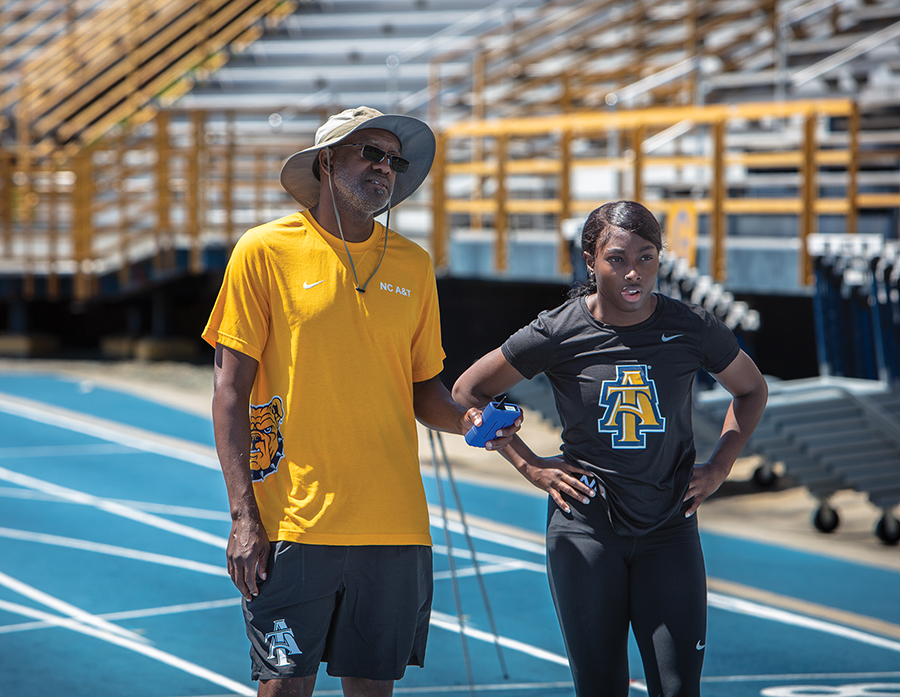
Middle: Johnson works with N.C. A&T student Shadajah Ballard

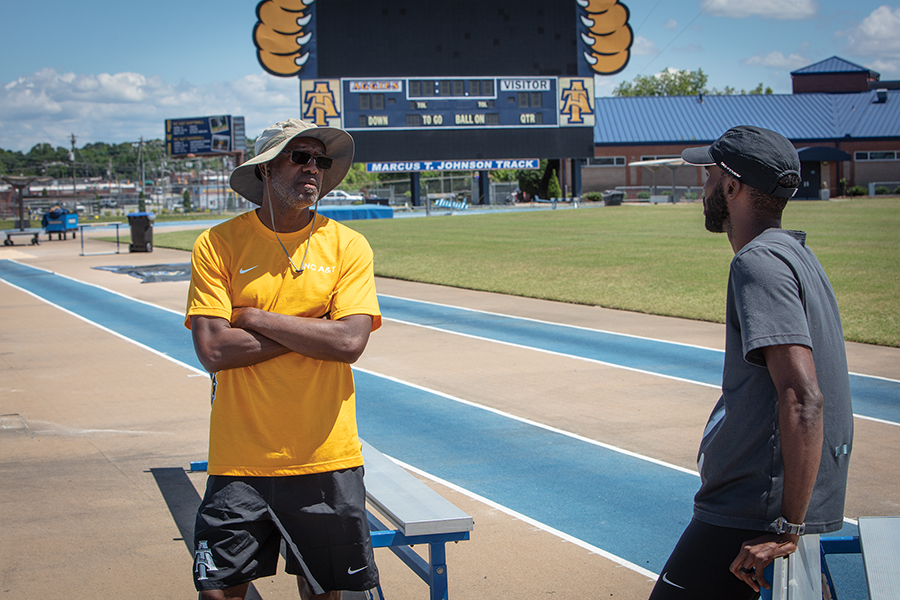
Right: Johnson chats with Olympic hopeful Daniel Roberts

Allen Johnson, Gold Medal Olympic Hurdler

At 53, Allen Johnson doesn’t look much different than he did when he crossed the 100-meter hurdle finish line at the 1996 Olympics in Atlanta, taking home gold for the United States. His head is clean shaven these days, but his 5’10” frame remains slender and athletic. Sitting behind his desk at N.C. A&T State University’s Truist Stadium, where he has worked as director of the track and field programs since June 2022, Johnson is at ease, comfortable in his navy-blue Nike A&T-branded polo shirt and proverbial coach’s hat.

Is this where he imagined he’d be? No way. As an Olympic athlete training with coaching legend Curtis Frye, Johnson says that was not the life he envisioned for himself. “Being a college coach in track and field was the absolute last thing on Earth I wanted to do. I mean last thing.” Driving it home, he adds, “Last, last, last!”

But when his body could no longer achieve previous heights, Johnson had to take his own walk in the woods. “A part of you dies and you have to mourn it.”

As a young man entering UNC-Chapel Hill in 1989, Johnson, a D.C. native, assumed he’d major in business. “It was the ’80s,” he says with a laugh. “I wanted to get a BMW, big house, have money, live life.” His dream? His own car dealership. “I was always into cars,” says Johnson, who now drives a Tesla.

But his athleticism opened doors for him and he left Chapel Hill during his senior year, not before setting several school records that still stand as well as winning four ACC titles. (He went back to finish his degree, which he earned in sociology, in 2012, when daughter Tristine was an undergrad. He even had a class with her.) Johnson’s pursuit paid off with a full-time track and field career that spanned 17 years, from 1993 until 2010.

During that time, Johnson, participated in three Olympics: 1996 in Atlanta, where he won the gold; 2000 in Sydney, Australia, where he fought a hamstring injury and just missed the podium, placing fourth; and 2004 in Athens, Greece, where he was captain of the U.S.A. Track and Field Team but did not place. For most of that time, he had endorsements from Nike (1994, 1996–2008) and Oakley (1995–2004) to support him. But, he says, “The last two years I was kind of on my own.”

“I was going to run until the wheels fell off, which meant I was going to stay too long,” he says, confessing he ran two years too long. “In a perfect world, I would just love to get up in the morning every day and go race.” But, he admits, his body could no longer physically handle the work.

In 2008, just two years before his running career crossed its finish line, Johnson recalls seeing Marion Jones on Oprah, discussing her use of illegal performance-enhancing drugs. Jones likened being an elite athlete to wearing a mask, playing a part. And when those running days are over? “The mask has to come off,” says Johnson.

“You don’t feel invincible, emotionally — or anything — because you become a regular person again.”

But, he adds, “you’re reborn.”

For Johnson, an opportunity to become something new was found in the last, last, last place he ever expected.

It began organically. People came to him, seeking his expertise and offering to pay. He volunteered as assistant under Coach Frye at the University of South Carolina. “I never got paid, but I looked forward to getting up and going out there the next day to work with the people I was working with.”

In the fall of 2011, he was offered a paid position as assistant coach at the United States Air Force Academy in Colorado Springs, Colo. He was nervous. Not only was it something he hadn’t done professionally, but it was far from the Mid-Atlantic states he’d called home for most of his life.

“That was a leap,” he says. But without risk there’s no reward. During his first year there, he led the 4×400-meter relay team to the Mountain West titles. He stayed there for five years before returning to the East Coast as assistant coach for the N.C. State Wolfpack, where he worked for six years.

While not every athlete makes a great coach, Johnson seems to have cracked the code. “You know the whole cliché, meet them where they are,” he says.

That doesn’t mean just physically. Johnson connects with his athletes on an emotional level, too. He looks for triggers, good and bad, creating strategies to handle those that arise. He helps them stay away from the negative while embracing the positive. Plus, he makes himself available. “I have a policy: If you need to talk to me, call me any time.” With a coy smile, he adds, “But try to keep it between 7 a.m. and 11 p.m.”

Now, in his first head coaching position at N.C. A&T, that policy’s expanded to include staff as well. “Be ready for anything” is his daily mantra. Emails and calls come from every which way, sun up to sun down and beyond. “One thing I tell people about being a college track and field coach is the job is never done. You just pick a stopping point each day.” And when he finally makes it home, he spends time with his wife, Olympic bronze-medal-winning track sprinter Torri Edwards-Johnson, and plays with their 2-and-a-half year old daughter.

While his days can be filled with chaos, he’s got a small network of friends who are also first-time head coaches, similar to having Olympic teammates. “We all have had aspirations of being a head coach and what we thought it was going to be like,” says Johnson. And is this it? No, he says, “You don’t know what it is until you actually do it.”

It’s challenging him in a new way. But he’s got sound advice when it comes to tough times: “It’s what you do on the bad days that is going to define your success.” He adds, “It’s not really that hard on a good day. It’s hard on the bad day when you don’t feel like doing it, but you dig down deep, mentally, physically, and you get it done.”

Are there moments he wishes he could be 25 again and line up with the athletes? Of course. “But I can’t do it anymore.”

Instead, he’s found joy in helping others. As for his student athletes, he wants to make sure their college experience is happy and meaningful, and that he pushes them to move the stopwatch needle.

Plus, Johnson has been working with Olympic hopeful Daniel Roberts, who, like Johnson, is a 110-meter hurdler. Roberts won the bronze medal in the 2023 World Championships and Johnson’s goal this year is to get him the gold at the Paris Olympics later this month. “I wish I could still run — can’t — but getting to coach him, coach Trayvon [Bromell] and the other athletes, I guess for me it’s kind of a natural progression to the next phase.”

Is it the same as competing? No, Johnson admits. “But I have no regrets. I love track and field.” And while it’s the last thing he thought he’d be doing, turns out the next best thing is helping someone else reach their highest potential.  OH

*At the time this story was written, Roberts was training with Johnson for the Olympic Trials, which were held June 21–June 30. We will update you on his progress in our biweekly newsletter, found at oheygreensboro.com.

Poem July 2024

Poem July 2024

Cicada Rondeau

They don’t so much sing as plead

In their droning sound stampede.

I hope they find the love they need —

Something more than meet-and-breed.

Can that even be with insects —

To have sensations beyond touch?

Do they know joy as well as sex?

They don’t so much.

                              — Paul Jones

Paul Jones is a professor emeritus at the University of North Carolina at Chapel Hill and the author of the collection Something Wonderful.

Chaos Theory

Chaos Theory

Outfoxed

A tale of rescue

By Cassie Bustamante

Before we had kids, I’d stop for any stray dog I saw. Once, with a friend, I rescued a flea-covered female dog who’d clearly had puppies and been left to fend for herself in a field. That dog, Gracie, went on to become my friend’s most loyal pal, seeing her through moves and devastating breakups. The last time I brought home a stray dog, my husband, Chris, looked out the window at the unfamiliar animal, then pointedly at me, my pregnant belly carrying our first child protruding, and said, “You’ve got to stop bringing home strays.”

And while I did, I still do what I can when I see an animal, especially a domestic one that’s possibly someone’s beloved pet, in need.

So one Sunday morning in June, the spring sun already shining through the green grass, turning its blades a glowing shade of chartreuse, I’m out for a leisurely stroll with my two rescue dogs, Catcher and Snowball. The neighborhood is quiet outside, but the smell of bacon wafts through the air. Almost home, where my own breakfast and French press await, I spy something unusual.

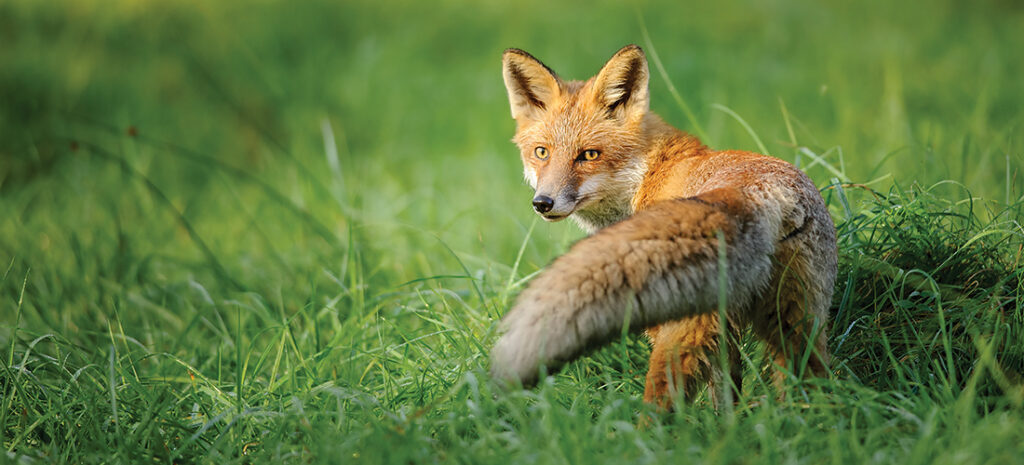
In the front yard of a stately brick house in Wedgewood, a neighborhood that runs adjacent to my own, Starmount Forest, an orange fox, shoulders hunched, and a fluffy black cat are having a standoff. The fox bares its teeth and stares, eyes narrowed, at the feline, whose back is arched.

I watch as they continue to hold eye contact. This is someone’s beloved pet, I think. My wild imagination takes off and I picture a family with small children, dressed in their Sunday best on their way to church, opening their front door to find their precious kitty mangled and left for dead.

My thoughts break when suddenly the cat lunges for the fox. For a moment my worries subside. I should’ve known a cat would be able to fend for itself. After all, are they not domesticated relatives of the king of the jungle, the lion?

The fox backs far enough off that the cat turns to walk away victoriously. And that’s when the fox makes his move. But he isn’t the only one to make a move.

“Hey!” I shout from about 40 feet away. “Leave the cat alone!” As if the fox, is going to say, “Oh, sorry! Right, I don’t know what I was thinking. Toodles.” Instead, the fox shifts its head in the direction of me and my entourage of dogs. Uh-oh.

And yes, I should’ve thought, This animal is a rabid beast — just get you and your dogs home safely. But, nope, I couldn’t get the image of a heartbroken family mourning their beloved cat out of my mind.

My dogs, who’ve been by my side, watching all of this unfold, peer up at me with worried eyes as I yank their leashes and hustle-walk toward home, still a quarter of a mile away.

I pick up my pace, the sound of my sneakers slapping the pavement almost matching my racing heart. Glancing over my shoulder, I keep an eye on the fox’s proximity. He seems cocky but intent, skulking behind us in a quick, yet not rushed, trot. All he has to do is sprint and we’ll become his Sunday breakfast.

Just then, a white pickup truck appears around the bend in the road. Oh, thank God! I think. But the truck passes me. However, when I look behind me, I see that the driver has parked between me and the fox, creating a literal roadblock for the wild animal.

This time, I don’t stick around to see what happens next. Catcher, Snowball and I take our chance to hightail it home to safety. To my hero on a white horse — or, rather, in a white armored pickup truck — whoever you are and wherever you are, thank you. Sometimes, as it turns out, the rescuer needs a bit of rescuing, too.  OH

Cassie Bustamante is editor of O.Henry magazine.

Wandering Billy

Wandering Billy

Elvis Hasn’t Left the Building

No other recording star had a more enduring relationship with our city than Elvis

By Billy Ingram

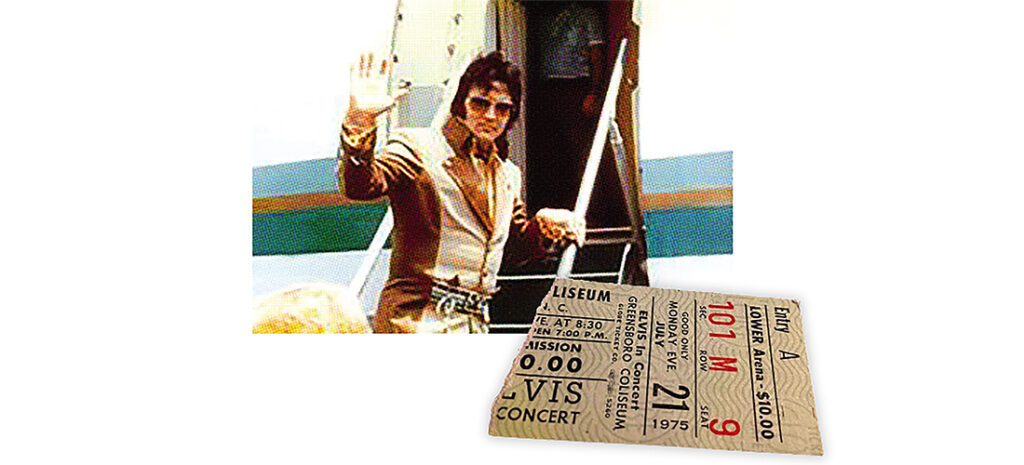
Feature Photo: Elvis Presley boarding the Lisa Marie to leave Greensboro, N.C. for Asheville

“Of all the places we’ve been to, you’re one of the most fantastic audiences we’ve had.”     — Elvis Presley to a Greensboro crowd

A few minutes after midnight on Monday, July 21, 1975, a Lockheed JetStar glided to a halt on a secluded spot at the Greensboro-High Point Airport’s tarmac. A fleet of limousines awaited the colorful parade of passengers as they deplaned, followed by the greatest superstar of the 20th century, Elvis Presley. The King was in town to electrify what would be a record-breaking crowd at the Greensboro Coliseum that night.

Within half an hour of touchdown, Elvis and his enormous entourage pulled up behind the high-rise Hilton Hotel on West Market, located across from Greensboro College, where an advance team had already covered every window on the top two floors with aluminum foil, preventing even a ray of daylight from encroaching. Elvis was escorted to the Wedgewood Suite, encompassing the western end of the 10th floor, familiar to him from two previous stays in 1972 and 1974. Shortly after arrival, the Memphis Mafia called down to the kitchen to order a fruit tray.

Normally closed by midnight, the Hilton’s kitchen was fully staffed and prepared to fulfill room service orders not only from the ninth and 10th floors but for the two levels below, where The King’s less crepuscular courtiers were holed up. When the order for that fruit tray came in from Elvis’ suite, a tower of melons, grapes, bananas and cottage cheese was prepared, oddly enough, by Greensboro Daily News reporter Jerry Kenion, who had taken a part-time job in the kitchen in an attempt to score an interview with Presley. The closest she came was catching a glance of the star while wheeling the food cart into the suite’s living room.

Around 3:30 a.m., word went out from Presley’s personal physician, Dr. George Nichopoulos, to Greensboro Coliseum general manager Jim Oshust that Elvis was suffering from a major toothache. Armed with the City Directory, Oshust began ringing up local dentists one by one. Officer Judy Allen, part of a security task force assigned to serve the King, had a better idea. She suggested her longtime practitioner, Dr. J. Baxter Caldwell.

Minutes later at 1100 Sunset Drive, the cacophonous ringing from 1970s-era landlines interrupted the stillness of what was an unusually hot summer night. On the line, the voice of an all-night operator informed Caldwell that the most famous mouth in America was in need of emergency oral surgery. Could he be of assistance?

Caldwell agreed to attend to Presley, dressed hurriedly, and arranged to meet his receptionist, Mrs. Ann Wright, at his practice located just up the street at 1817 Pembroke Road (still a dental office today with the same phone number). Officer Allen drove Presley’s limo to the physician’s back door around 5 a.m. while another stretch transporting two bodyguards and Elvis’ physician, the infamous “Dr. Nick,” followed closely behind.

What the dentist didn’t know was that it had become common for Presley to remove one of his fillings, then arrange to be seen on a rush basis for what would eventually yield him a prescription or two. What Elvis didn’t know was that Dr. Caldwell was especially reticent to prescribe painkillers to his patients. But Presley’s predicament was entirely legit this time. Dr. Caldwell determined there was an abscessed tooth under the bridge in the lower right bicuspid, which he went right to work on. Returning to the Hilton around sunup and before retiring for the day, Elvis finally noshed on that fruit tray he’d ordered earlier.

Around 8 p.m., Elvis, attired in his bedazzled Aztec-inspired outfit, and his posse descended the elevator to encounter about a dozen fans congregating outside the Hilton’s rear exit. Bodyguards had advised the assembled that Presley was suffering from a toothache and wouldn’t be hanging around to talk.

During the previous night’s concert in Norfolk, Elvis began inexplicably pestering his female backup singers, The Sweet Inspirations, with crude insults. Most of his vitriol was reserved for on-again, off-again girlfriend Kathy Westmoreland, who harmonized with the girl singers. All but one of the women walked off stage midperformance. Determined to quit for good, “The Sweets” reconsidered in Greensboro after a preshow heartfelt apology from Elvis. On July 21, all but Westmoreland performed at the coliseum.

To the tune of “CC Rider” at 8:30 sharp, a newly slimmed-down Elvis glided confidently but casually on stage, his mere presence causing 16,300 fans to erupt into screaming and squealing conniption fits. Before he ever sang a note. One local reviewer declared this 1975 appearance “better than ever.”

As the concert progressed, Elvis became increasingly obsessed with a rough spot on his reconstructed tooth that kept rubbing his tongue. Not a small distraction. A midnight call went out to Dr. Caldwell. The entire staff was on hand when Elvis arrived around 1 a.m., including two dental assistants who had been in the audience that night. Receptionist Ann Wright noted that the entertainer didn’t look particularly tired, considering he’d given such a high voltage performance, while Dr. Caldwell told The Greensboro Record, “He was a nice fellow. It was ‘Yes sir this’ and ‘Yes sir that’ with him.”

Upon returning to his 10th-floor Hilton penthouse, Kathy Westmoreland reluctantly met with a morose Elvis as he sat on the bed, clad in karate pajamas. Brandishing a gun in one hand and a gift-wrapped jewelry box in the other, Elvis offered her a choice: “Which do you want? This or this?” Nervously accepting and opening the gift, a watch, she agreed to remain by his side until the end of the tour.

More bewildering, at the airport the next afternoon, Elvis’ retinue discovered that he had flown ahead to their next engagement in Asheville without them. After the jet was piloted back to Greensboro and everyone finally settled in at Asheville’s Rodeway Inn, Elvis demonstrated his remorsefulness by showering his entourage with what the jeweler who traveled with Presley, Lowell Hayes, called “Practically a whole jewelry store!”

That erratic behavior continued. There were multiple accounts that Elvis was angry that his personal physician had confiscated the drugs he’d just scored from another dentist. His temper also flared up when the vertical hold on the TV screen went haywire, a not frequent occurrence. According to those reports, he fired a bullet into the Rodeway Inn television set, which ricocheted into Dr. Nick’s chest but caused no injury.

Frustrated by the lack of standing ovations in the last of his three Asheville dates, Elvis doled out a diamond ring from the stage, worth $6,500 (about $38,000 today), and handed over to a random fan perhaps his most iconic guitar, a Gibson Ebony Dove with a mother-of-pearl “Elvis Presley” inlaid into the black rosewood fret board. Prominently featured in his 1973 Aloha From Hawaii TV special and strummed onstage frequently, that guitar sold at auction in 2016 for $334,000.

Elvis triumphantly returned to the Greensboro Coliseum and the Hilton (now called The District at West Market) in June 1976 and April 1977, the latter being opening night for the last concert tour before The King’s untimely death in August that year. Employees at The District swear to me that Elvis’ spirit hasn’t left the building. I’ll believe that when a late night phone call goes out to Dr. Caldwell’s office. After all, he has the number.  OH

Billy Ingram is a hunka hunka burnt-out love.