Time Waits for No One but Pauses for You

TIME WAITS FOR NO ONE BUT PAUSES FOR YOU
The stories within Greensboro History Museum’s stories are seen through an ever-evolving lens

By Billy Ingram     Photographs by Bert VanderVeen

One hundred years ago this month, history buff Mrs. Alice Bell founded the Greensboro Historical Museum, at first a purely aspirational effort seeking to canonize treasures of living memory related to the establishment and rapid growth of this then unassuming small town. That objective surely proved challenging for those who followed in Bell’s footsteps, when the 20th century unfolded and Greensboro became synonymous in the minds of too many Americans as being, all too often, most decidedly, on the wrong side of history.

Coinciding with the seventh anniversary of Armistice Day, the Greensboro Historical Museum’s first public showing in 1925 consisted primarily of war era relics (Revolutionary, Spanish-American, Confederate and WWI), along with examples of evolving women’s fashions. Located in the downtown library’s basement, hundreds of historically significant curios salvaged from attics and closets around town neatly presented in five display cases “all that the museum association had funds for.” Admission for the couple of hundred people in attendance then, as it is now, was free.
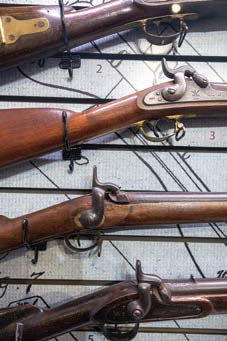
In 1930, the museum, an all-volunteer, mostly female effort, took up residence in a former schoolhouse on Cypress Street until 1939, when the public library, with the museum and other civic organizations in tow, was installed in the original First Presbyterian Church building facing Summit Avenue. In 1964, the Greensboro Public Library relocated to North Greene Street, where Elon University School of Law is today, allowing the museum to expand into the entire 17,000-square-foot space, since expanded, it still occupies today.

Carol Ghiorsi Hart, director of the Greensboro History Museum for the last 12 years, and Curator of Community History Glenn Perkins walked me through the challenging yet inspiring task involved in weaving relevant and engrossing narratives around our city for limited-run events while simultaneously nurturing and preserving a sanctuary devoted to Greensboro’s pivotal role in major historical events — the fight for our nation’s independence; the ending of the Civil War, sparking an Industrial Revolution in the South; sitting at the forefront of women’s suffrage; being a major military presence during World War II; and, its decades spent suspended on a razor’s edge during the struggle for civil rights and equality.

The staff must be in harmony with whomever it was that said “history gives answers only to those who know how to ask questions.” A fairly recent acquisition, but one of the oldest American artifacts the museum owns, is a knitted cap from the Revolutionary War. “We’ve done some DNA analysis on what may be a blood stain from that cap.” Awaiting the results, Perkins contends that just possessing a historical item is only the beginning of a journey of discovery, but “If you take good care of these things, they’ll continue to tell stories.”

Because of its affiliation with the Smithsonian Institute, not long ago, an original copy of the Emancipation Proclamation signed by Abraham Lincoln was on loan to our museum. Of course, anyone could find a scan of the document online or purchase a reproduction. “But,” Director Hart says, “the number of people who came to be in the presence of something Lincoln signed, who literally wept seeing it, was such a powerful moment.”

Museums in general are struggling, but the key to survival lies in adapting to an ever-shifting culture, with the focus no longer pointing inward. “Although we do have incredibly talented people, very knowledgeable,” Hart emphasizes, “there’s a recognition that, especially for a history museum, members of our community are authorities as well as we are — that we are all working together not only to document history, but to help shape what history looks like.”

That means taking what some might consider to be small family stories and placing them on equal footing with more well-known names around town. “Greensboro’s history is one of arrival,” Hart says. “There’s a reason we’re called The Gate City and why, when people are drawn here for whatever reason, they bring change and vitality to the city.”

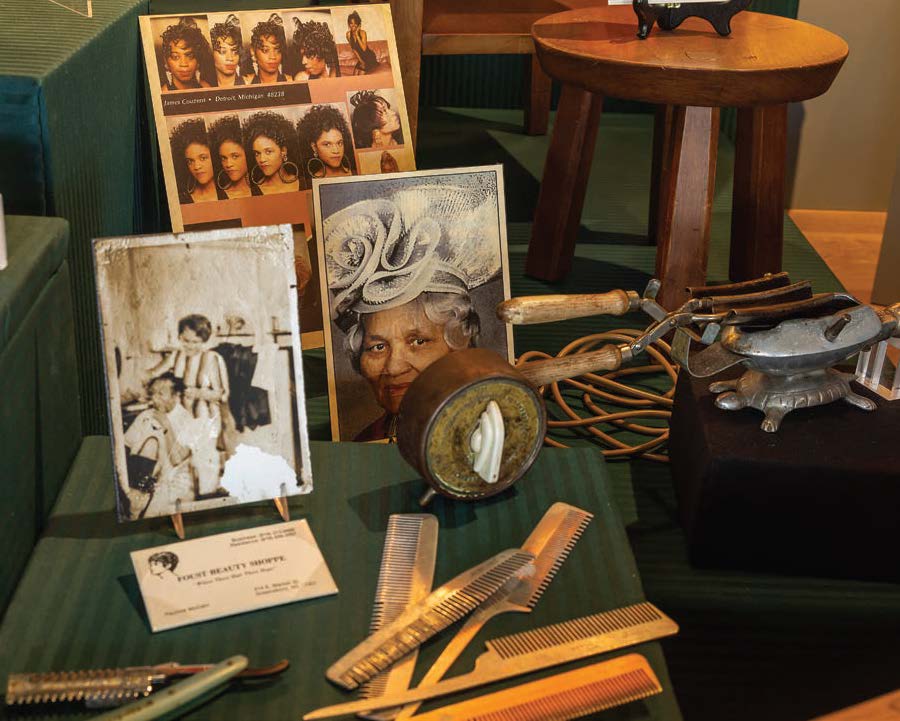
Inside the “This Just In” case greeting visitors on the second floor there’s a collection of hair crimpers, turners and curlers used by entrepreneur Pauline Farrar McCain, who attended Maco Beauty College in the late-1940s. “Maco was a Black-owned hair business,” an institution that trained over 1,000 beauticians between 1935 and 1969, Perkins explains, “established by folks who came to this city, the Londons, to make their own fortune.” After graduating, McCain went to work for Foust Beauty Shoppe (“Where There’s Hair There’s Hope”) on East Market, subsequently purchasing it in 1960.

While hairstyles were being set back at her shop in the ’60s, McCain could often be found just blocks away participating in Civil Rights marches. For the last five decades, Foust Beauty Shoppe was located at 414 E. Market, where Mrs. McCain continued to oversee operations until her passing in 2020. “She was a community hub,” says Director Hart. “Often it’s not just about what we have on display, but how we can build on some of these stories and fill in some gaps.”
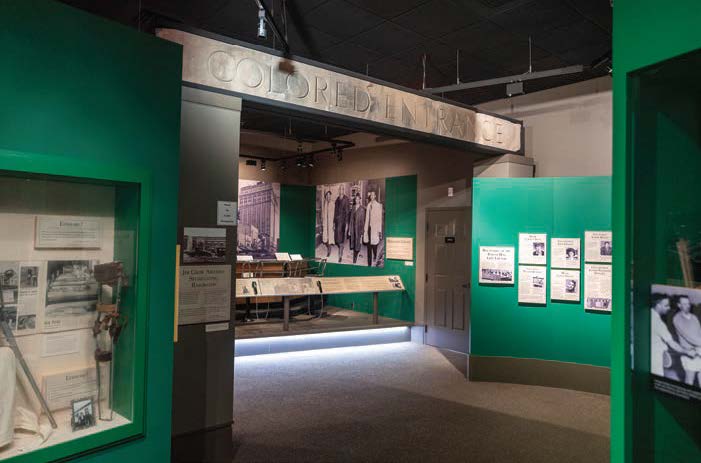
There was an exhibit 10 years ago on the Warnersville community that not only brought forth “a lot of oral histories, but also photographs and other things we hadn’t collected previously,” Perkins says. “We had another focusing on second generation Asian Americans, another story that goes way back to the turn of last century, and the different businesses that were owned by Chinese immigrants.”

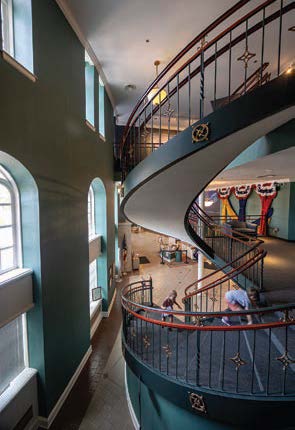
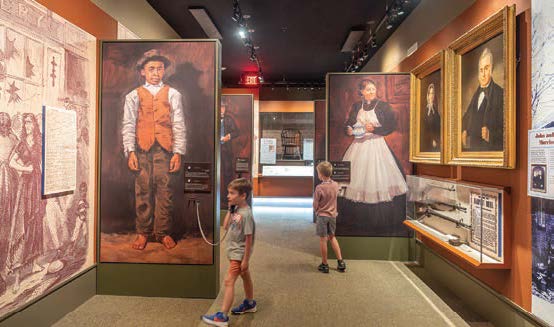
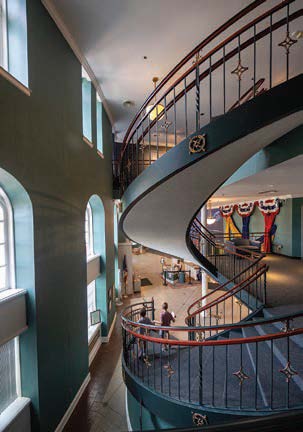
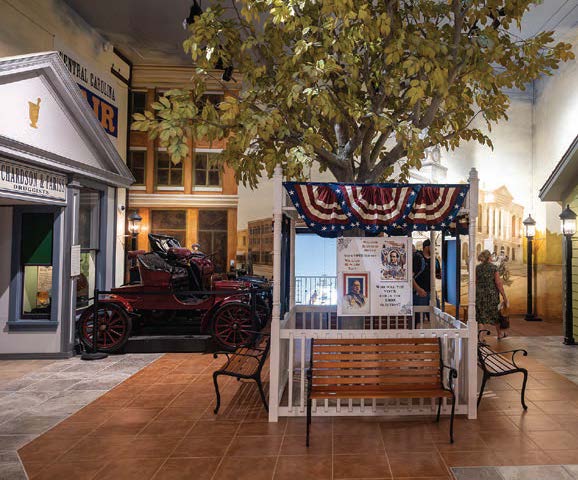
“Voices of a City” is the main attraction on the second floor, an Aladdin’s cave of life-sized, interactive dioramas arranged in a panoramic maze, each corner and corridor along this veritable time tunnel a snapshot of life from pioneer days forward. At the push of a button, excerpts from oral histories and historical testimonies augment the visuals, which are both exhaustive and stunning in their presentation.

For instance, one exhibit in this hall might seem incongruous, but is actually a clever juxtaposition. A familiar metal-and-neon sign that hung for decades in Blumenthal’s clothing store, enticing customers with a free pack of cigarettes if their receipt matched the numbers listed on the sign, that now hangs above an assortment of early contraptions used in denim manufacturing. Near the railroad tracks on South Elm, Blumenthal’s, from 1926 until 2005, was the young folks’ go-to retailer for Levis and Wranglers, while selling cigarettes manufactured locally at cost, even giving smokes away, to boost denim jeans sales.
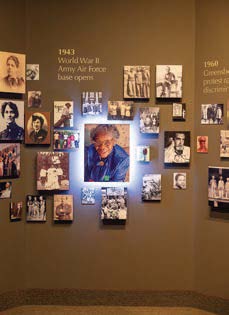
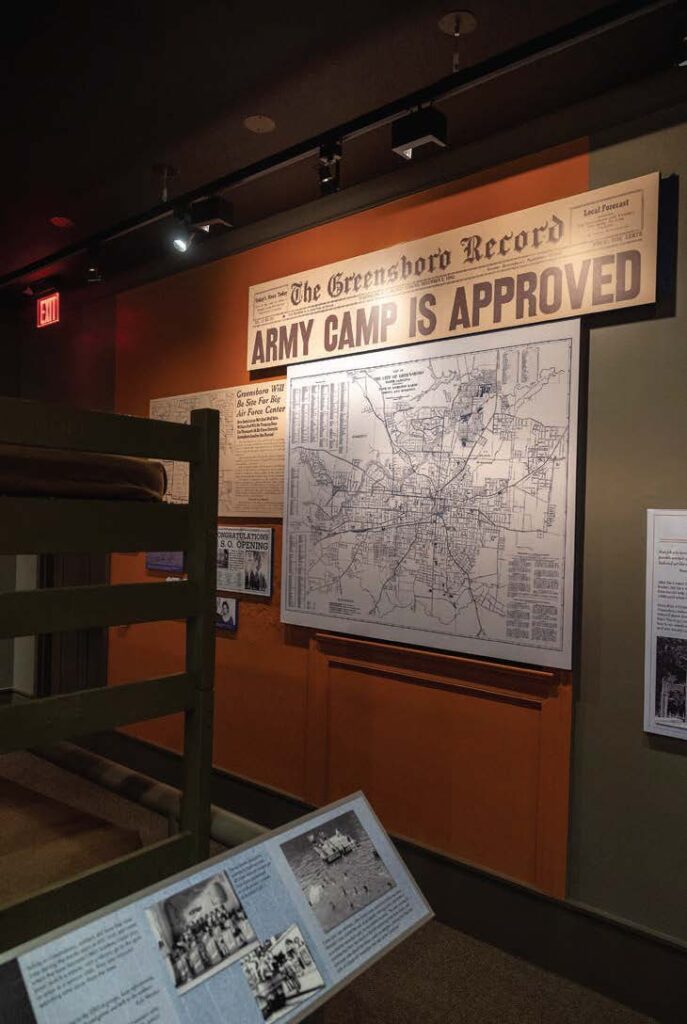
There’s an alcove devoted to Army Air Force’s (AAF) Basic Training Center No. 10, later designated ORD (Overseas Replacement Depot). Surrounded by colorful propaganda posters enticing folks to “Buy Bonds” is one of the bunk beds tens of thousands of inductees slept in while being trained in ground and air combat for some of the most decisive battles of World War II. The largest U.S. military base located inside the limits of a city was situated down and around East Bessemer Avenue from 1943 until 1946.

“Most people think a history museum is going to be filled with a lot of dusty old stuff and be sort of boring and be all about dates and places,” Hart points out. “So one of the things we’re trying to do is to shift that perception a little bit.”

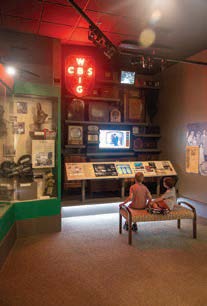
Where else could one experience the momentary joy of reconnecting with ripples from a past thought to be lost forever? For me, it was seeing once again the Art Deco neon WBIG Radio sign that hung in its studio, beginning in the 1930s, recently restored at great effort — then, hearing the voice of WBIG’s legendary morning show DJ and family friend Bob Poole. A nod to our city’s rich broadcasting legacy, with tributes to George Perry and Sandra Hughes of WFMY-TV, WGHP sportscaster Charlie Harville, and WEAL’s Alfred G. Richard.

A bone of contention for museums lately has been an inadvertent stockpiling of culturally significant items appropriated by amateur archeologists or gathered up unthinkingly on foreign shores as souvenirs. “We sent back a number of things that were treasures of war during World War II that came into the museum.” Consisting of Japanese dog tags, good luck flags and other ephemera that American soldiers brought home with them, Perkins says they realized, “Those don’t belong here. Part of our work is returning things to appropriate places, and that can be part of the inhale-exhale of a museum.”

Making collections more readily accessible to the public is a primary goal moving forward, with transcripts of oral histories and some 15,000 photographs already easily searchable online through UNCG’s Gateway project (gateway.uncg.edu/greensboromuseum).

Bernard Cone’s photo albums from 1900 through the 1910s; The Art Shop owner Charles Farrell’s photographs highlighting the city’s growth from the 1920s into the 1940s; Greensboro Fire Department scrapbooks; maps of Greensboro and Guilford County dating back to the 1870s; documents pertaining to local union organizing; the Abraham H. Peeler Papers, chronicling the evolution of African American education locally; letters, memorabilia and documents belonging to writer William Sydney Porter (O. Henry); these are just an inkling of the museum’s digital footprint.
Greensboro History Museum members receive a twice-a-month digital newsletter, a printed ROAR newsletter, early notice on happenings, plus invitations to members-only gatherings. There are also behind the scenes tours for contributors. “People love to go behind locked doors,” Director Hart says. “We have on the order of 30,000 objects, most are in storage but not in dusty boxes in the basement, they’re well cared for and numbered.”

During one of those “backstage” tours you can view rarities not currently on display or possibly never before seen by the public. Take, for instance, a pristine velvet, silk-lined cloak, embroidered with Indian or Iranian gold stitching from 1805 and gifted to future First Lady Dolley Madison by the first Muslim diplomatic ambassador to visit the United States. This item of clothing is significant for a number of reasons, not the least being that, back in 1789, Morocco was the very first country to recognize the United States as an independent nation, before the Revolutionary War had been won.
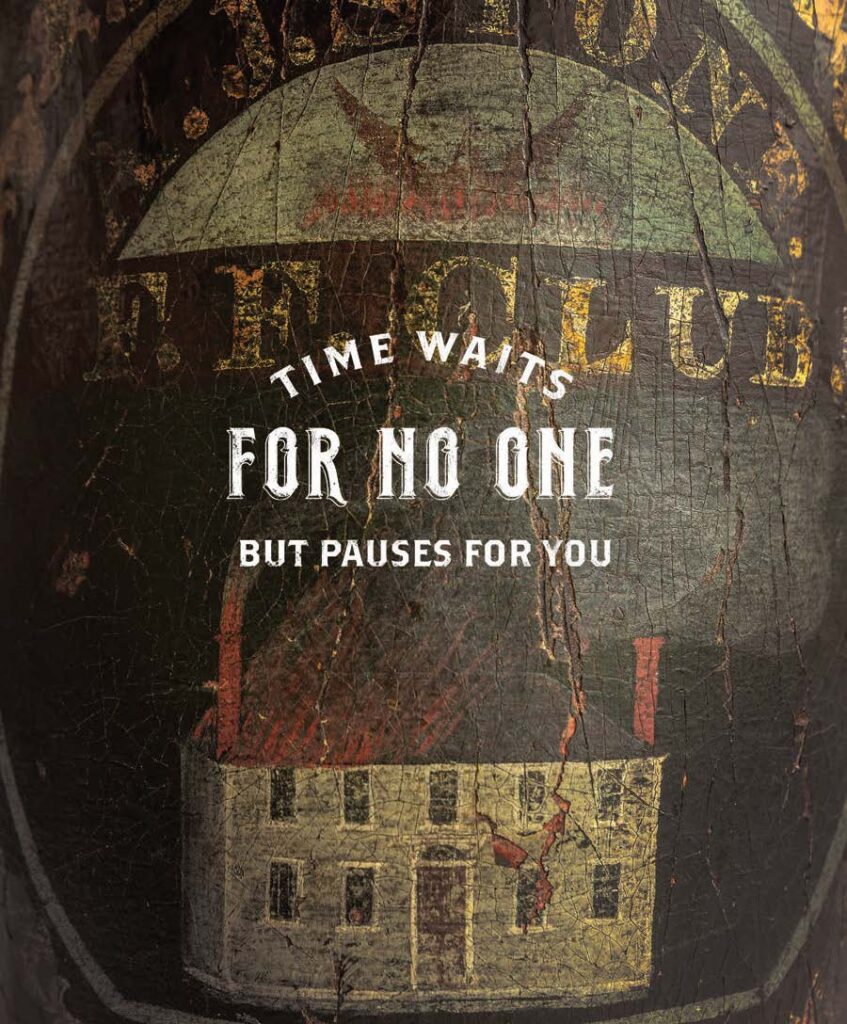
Because I have great admiration for our world class GFD, a wooden bucket with a leather strap dated 1828 was brought down from storage for us to photograph, typical of those used by fire brigades long before Greensboro had any form of an organized fire department. Two hundred years ago, first responders (neighbors) would pass one bucketful of water at a time down a line of volunteers, from the well to the flames and back again to refill. Taking great pride in their efforts, those sturdy pails were decorated with the brigade’s logo and other flame-related flourishes.

It’s true, we will never again walk casually through the unencumbered doorways of youth, bathed in the warmth of worlds that long ago ceased revolving. Tipping back into the deepest recesses of memory, connecting even momentarily to people and places associated with what the march of time has mercilessly (or mercifully) bulldozed in its path, is the continuing contribution our Greensboro History Museum offers all of our lives, year in and year out, hopefully for the next 200 years.


Sazerac November 2024

SAZERAC NOVEMBER 2024

Sage Gardener

As I’m writing this, most Americans are a lot more interested in who will be president than what sort of garden they’ll plant.

Not Marta McDowell, who penned All The Presidents’ Gardens in 2016. From George Washington to Barack Obama, she digs up the dirt, so to speak, about who had a perennial obsession with plants. George and Martha Washington, John and Abigail Adams, along with Thomas Jefferson, had gardens and ambitious plans for plants — before the British burned down the White House in 1814 (after the U.S. Army burned down what became Toronto). At the very least, presidents had vegetable gardens since expenses for family food and banquets came out of their own pockets.

James Monroe moved into a mansion under construction, inheriting a yard with the sort of mucky mess that accompanies reconstruction projects. It was John Quincy Adams, McDowell points out, who, faced with a tumultuous presidency and the death of his father, sought solace in, as he described it, “botany, the natural lighting of trees and the purpose of naturalizing exotics.”

To give you an idea of what Adams had to work with, McDowell writes, “To keep the lawns at least roughly trimmed, he arranged for mowers with scythes to cut the long grass for hay, and sometimes borrowed flocks of sheep.” Adams did have a full-time gardener to help him, John Ousley, an Irish immigrant. Following a plan that the plant-and-garden-crazed Jefferson had drafted, the duo got down and dirty. Each morning, after a brisk swim in the nearby Potomac, Adams spent several hours in his garden to “persevere in seeking health by laborious exercise.” McDowell writes, “His was a garden of celebrated variety.” In the two acres he carved out, Adams boasted that you would find “forest and fruit trees, shrubs, herbs, esculent (edible) vegetables, kitchen and medicinal herbs, hot-house plants, flowers — and weeds,” he added, revealing how honest a gardener he was. Adams also collected white oaks, chestnuts, elms and other native trees with an environmental objective: “to preserve the precious plants native to our country from the certain destruction to which they are tending.”

As the latest occupant — and gardener — moves into the White House in January, may I suggest that McDowell’s book might serve as a soothing antidote to the inevitable drama of nightly news and daily headlines.
David Claude Bailey

That Computes

We say “data boy” to Patrick Fannes, who freely offers his time and knowledge to turning tech trash into treasure. Caching a collection of Windows- and Mac-based tablets, laptops and desktop computers (no more than seven years old), Fannes wipes them clean of all private data, refurbishing as needed before placing them in the hands of disadvantaged children. Though he holds a degree in computer science, he says, “In life I am a lay, ordained Buddhist monk and a doctor of Chinese medicine, serving my community to make this world a better and kinder place.” His friends and associates call him Shifu, the Chinese word for master or teacher, a term of respect. Through Big Brothers Big Sisters, Shifu has worked to provide 200 computers over the last 15 years. If you have an old computer collecting dust, let him give it a second life. And don’t worry — “Your private data will be erased from the computer hard drive and a binary code will be written across the entire surface of the drive nine times so that retrieving any information is impossible.” By donating your tech trash, you’ll not only make your house and the Earth cleaner; you’ll be giving a local child the necessary tools to set them up for success in life. To donate, email Fannes: onecodebreaker@gmail.com.
Booked for a Cause

In Asheville author Robert Beatty’s latest book, Sylvia Doe and the 100-Year Flood, Sylvia Doe doesn’t know where she was born or the people she came from. She doesn’t even know her real last name. When Hurricane Jessamine causes the remote mountain valley where she lives to flood, Sylvia must rescue her beloved horses. But she begins to encounter strange and wondrous things floating down the river. Glittering gemstones and wild animals that don’t belong — everything’s out of place. Then she spots an unconscious boy floating in the water. As she fights to rescue the boy — and their adventure together begins — Sylvia wonders who he is and where he came from. And why does she feel such a strong connection to this mysterious boy?

Known for his Serafina series, Beatty will be donating 100 percent of his earned royalties from Sylvia Doe and the 100-Year Flood — a story he’s been writing for several years — to the people impacted by the catastrophic floods caused by Hurricane Helene in Asheville, North Carolina where he lives. The real-life 100-year flood struck at the same time the book was scheduled to launch. (Ages 8 -12.)

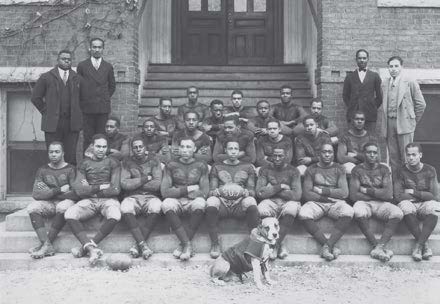
When the photographer says, "Look tough," but there's always that one guy who's trying not to crack a smile.
N.C. A&T's football team, circa late 1930s.

Simple Life

SIMPLE LIFE

The Sacred Month

A time to go inside

By Jim Dodson

Long ago, I decided that November is the most sacred month.

To my way of thinking, on so many levels, no other holds as much mystery, beauty and spiritual meaning as the 11th month of the calendar.

The landscape gardener in me is always relieved when the weather turns sharply cooler and there’s an end to the constant fever of pruning and weeding, plus fretting over plants struggling from the heat and drought of a summer that seems to grow more punishing each year.

Once the leaves are gathered up, and everything is cut back and mulched for the winter, not only does my planning “mind” kick in with what’s to be done for next year, but the beautifully bare contours of the Earth around me become a living symbol — and annual reminder — of life’s bittersweet circularity and the relative brevity of our journey through it.

The hilly old neighborhood where we reside is called Starmount Forest for good reason, owing to the mammoth oaks and sprawling maples that kindly shelter us with shade in summer and stand like druid guardians throughout the year, season after season. Beginning this month, the skies become clearer and the nighttime stars glimmer like diamonds on black velvet through their bare and mighty arms, hence the neighborhood’s name: a “mount” where the “stars” shine at night.

Of course, there is risk living among such monarchs of the forest. Every now and then, one of these elderly giants drops a large limb or, worse, topples over, proving their own mortality, sometimes taking out part of a house or a garage, or just blocking the street until work crews arrive with chainsaws. As far as I know, no one has ever been seriously injured or killed by our neighborhood trees, though the growing intensity of summer storms seems to elevate the danger. Lately, some neighborhood newcomers, prefiguring catastrophe, have taken to cutting down their largest oaks as an extra measure of security in a world where, as actuaries and sages agree, there really is no guaranteed thing. In the meantime, the rest of us have made something of a Faustian bargain with these soulful giants for the privilege of living among them. We care for them and (sometimes) they don’t fall on us.

Speaking of “soul,” no month spiritually embodies it better than November.

All Souls’ Day, also called The Commemoration of All the Faithful Departed, comes on the second day of the 11th month, a day of prayer and remembrance for the faithful departed observed by Christians for centuries. The day before All Souls’ is All Saints’ Day, also known as All Hallows’ Day or the Feast of All Saints, a celebration in honor of all the saints of the church, whether they are known or unknown.

Every four years, the first Tuesday that follows the first Monday of November is our national Election Day, a day considered sacred by citizens who believe in the right to vote their conscience and tend the garden of democracy.

Congress established this curious weekday of voting in 1845 on the theory that, since a majority of Americans were (at that moment) farmers or residents of rural communities, their harvests would generally have been completed, with severe winter weather yet to arrive that could impede travel. Tuesday was also chosen so that voters could attend church on Sunday and have a full day to travel to and from their polling place on Monday, arriving home on Wednesday, just in time for traditional market day across America.

Like daylight saving time (which, by the way, ends Sunday, Nov. 3) some critics believe “Tuesday voting” is a relic of a bygone time, requiring modern voters to balance a busy workday with the sacred obligation of voting. For what it’s worth, I tend to fall into the camp that advocates a newly established voting “holiday weekend” that would begin with the first Friday that follows the first Thursday of November, allowing three full days to exercise one’s civic obligation, throw a nice neighborhood cookout and mow the lawn for the last time.

While we’re in the spirit of reforming the calendar, would someone please ditch daylight saving time, a genuine relic of the past that totally wrecks the human body’s natural circadian rhythms? Farmers had it right: Rise with the sun and go to bed when it sets.

Next up in November’s parade of sacred moments is Veterans Day, which arrives on the 11th, a historic federal holiday that honors military veterans of the U.S. Armed Forces, established in the aftermath of World War I with the signing of the Armistice with Germany that went into effect at the 11th hour of the 11th day of the 11th month of 1918. In 1954, Armistice Day was renamed Veterans Day at the urging of major U.S. military organizations. 

November’s gentler sunlight — at least here in the Northern Hemisphere — feels like a benediction falling across the leafless landscape, quite fitting for a month where we go “inside” literally and figuratively to celebrate the bounty of living on Earth. In the Celtic mind, late autumn is the time of the “inner harvest,” when gratitude and memory yield their own kind of fertility.

“Correspondingly, when it is autumn in your life, the things that happened in the past, the experiences that were sown in the clay of your heart, almost unknown to you, now yield their fruit,” writes the late Irish poet John O’Donohue.

First shared by Squanto and the pilgrims in 1621, Thanksgiving was decreed  “a day of public Thanksgiving and Prayer” on November  26, 1789, by George Washington. Then it was proclaimed a national holiday on the last Thursday of November by Abe Lincoln. Finally, during the Great Depression in 1939, it was moved to the third Thursday of the month by Franklin Roosevelt to extend Christmas shopping days. But for most folks, the observance of Thanksgiving embodies, I suspect, many of the things we hold sacred in life:

The gathering of families, memories of loved ones, lots of laughter, good food and friendly debates over football and politics.

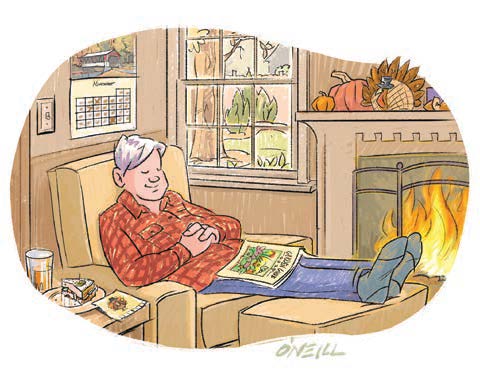
I give extra thanks for Thanksgiving every year, especially the day after when some who hold bargain-hunting on “Black Friday” a sacred ritual thankfully disappear and I am free to enjoy my favorite “loaded” turkey sandwich and take a nice long afternoon nap by the fire to celebrate my favorite holiday.

O.Henry Ending

O.HENRY ENDING

Fleischmann for President!

A man with real intelligence

By Richie Zweigenhaft

Not long ago, one of my geezer b-ball buddies sent me an article about pick-up basketball. I liked it, and I also liked the 31 comments that followed from various readers. I decided to add my own. A few minutes after I submitted it, I received a message telling me it had been denied — either because of inappropriate wording or because I had otherwise not followed the guidelines. I was told I could appeal. So I did, asking what I naively thought was a person just why it had been rejected. 


Too long? I asked. Or was it because I had (shamelessly) included a URL promoting my book about our pickup basketball game? Or was it some other transgression (I was unable to find their guidelines online)? Ten minutes later, I was told my appeal had been rejected, and my question about the cause of the rejection remained unanswered. 

Stubbornly, I attempted to submit my comment twice more, first taking out the URL, and then shortening the comment. Both times, it was rejected. Then I removed “geezer” and, presto, it was accepted. The term “geezer,” which I use affectionately, clearly was not acceptable based on the algorithm. It dawned on me that I had been “communicating” with a machine. 

Subsequently, I had a radically different experience when I submitted an email to Phillip Fleischmann, the director of Greensboro’s Parks & Recreation. I addressed a fairly long (and somewhat rambling) message to him, asking him to forward it to the right person. The gist?  Just some observations I had made on my regular bike rides about the tennis courts, ball fields, basketball courts and the skateboard park I frequently ride by. It also included a query about the removal of planted areas along Buffalo Creek, plus about some renovations near the Latham Park tennis courts. And then I boldly suggested that some pickleball courts be added to the changes taking place in Latham Park. I even included a parenthetical comment informing him that, in 1975, as I was about to leave for a vacation, I had sent the Parks & Recreation department a letter encouraging them to build a basketball court in my Lake Daniel neighborhood. When I got back three weeks later, there was a court.   

I had no idea if I would hear back this time either from a human or via artificial intelligence.

The response was quite human, and more than I could have hoped for. He responded to every issue I raised, with explanations about the tennis courts — why some had pickleball lines but others did not — the reason for the removal of the planted areas along Buffalo Creek, the department’s hopes to increase the number of pickleball courts, and why some basketball courts allow for full court and others don’t. He even congratulated me for my 1975 letter: “Seeing the use of the basketball court at Lake Daniel, it is evident that your suggestion to Parks & Recreation in the 1970s was an impactful one!”

When I shared this email with a friend, his response was “Fleischmann for President!”

It was reassuring, especially in light of my earlier online experience trading emails with a machine. The incursion of artificial intelligence may be inevitable, and may feel like it is pervasive, so responses like the one I got from Phil Fleischmann are increasingly valuable, especially to geezers like me who still value the printed word — written by humans.

Tea Leaf Astrologer

TEA LEAF ASTROLOGER

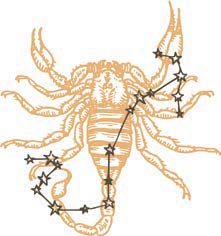
Scorpio

(October 23 – November 21)

Nothing like an old sweater, huh? So comfy and familiar. But so not doing you any favors. This month, self-worth is the name of the game. And here’s the thing: You’re destined to win. It’s simply a matter of ditching the security blanket — be that a threadbare sweater or an outdated (read, self-effacing) MO. Oh, and when Juno enters your sign on Nov. 3, get ready for a next-level soul connection. We’re talking oceanic depths. How do you feel about whale songs?

Tea leaf “fortunes” for the rest of you:

Sagittarius (November 22 – December 21)

Throw out the candy.

Capricorn (December 22 – January 19)

Get ready for a boon.

Aquarius (January 20 – February 18)

Turn the dial just a hair.

Pisces (February 19 – March 20)

More root vegetables.

Aries (March 21 – April 19) 

Try softening your gaze.

Taurus (April 20 – May 20)

Just ask for directions.

Gemini (May 21 – June 20)

Lay off the caffeine for a bit.

Cancer (June 21 – July 22)

Someone’s got your back.

Leo (July 23 – August 22)

Get cozy with the silence.

Virgo (August 23 – September 22)

Worrying won’t help.

Libra (September 23 – October 22)

Don’t be a doormat.

Home Grown

12 DAYS OF CHRISTMAS

Helping Mrs. Davis

The sunset days of an elderly neighbor

By Cynthia Adams

Ethel Davis questioned my pen and note-taking.

“I’m a retired English teacher,” she said, eyes sharp. “Mrs. Davis.” Pause. “And you are?” 

So began a friendship lasting well beyond a community project that brought me to her door. A year later, she asked that I help with ending her life.

Mrs. Davis lived near the 1911 house we were reviving. Her own home was in a death rattle. Leaves idled on a rickety porch. Inside, paint peeled from the ceilings, surrendering to the tropical heat she preferred. Rugs, curtains, and upholstery dry rotted. 

Mrs. Davis and her house were aging in sync. Her bony elbows jutted through a sweater which she pulled closer as I shucked mine off.

When I brought clothing, she protested. “But, my dear, I have so many beautiful clothes!” I brought food, too, which she accepted protesting, “Oh, Mary could prepare something.”

“Mary?”

“My housekeeper.” Having never seen another soul in the house, day nor night, Mary was either a ruse or imagined helpmate. My heart twisted at her fierce pride.

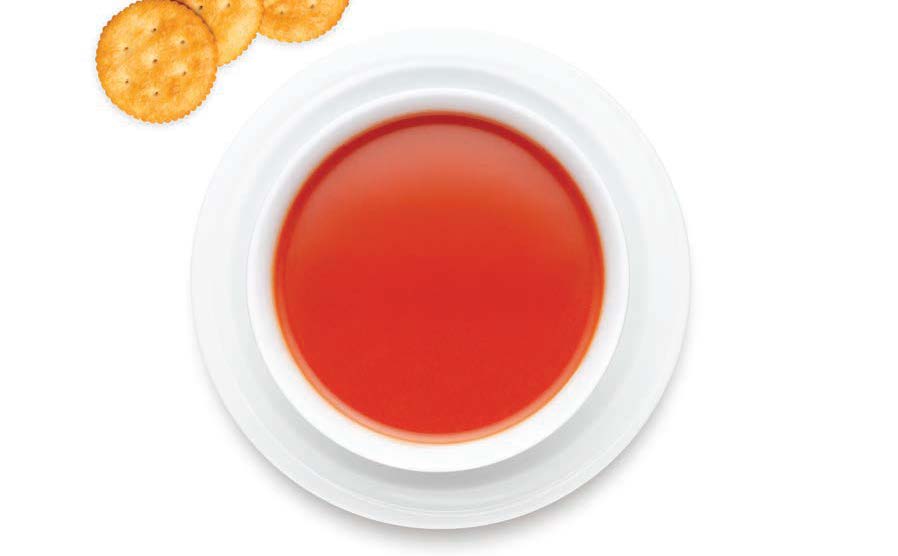
I grew increasingly anxious for the feisty 95-year-old. The mysterious “Mary” had just left or was late, according to Mrs. Davis, who subsisted upon Campbell’s soup. A sleeve of Ritz crackers sat alongside crossword puzzles, pencil stubs, paper clips, rubber bands and an ancient flash light.

If I brought treats, she insisted, “I’ve plenty, my dear.” Mrs. Davis had a well-supplied imagination.

“My sweet Herman visited last night! He stood right there!” She mentioned nocturnal visits from a long dead sister, too. These apparitions comforted her while alarming me. Was the membrane between life and death dissolving? 

Reciting Tennyson’s “Crossing the Bar,” she taped it to her headboard, warbling, “Sunset and evening star, and one clear call for me!”

Whenever she didn’t answer, I circled outside, calling her name. One autumn afternoon, colorful leaves fluttering onto her porch, Mrs. Davis peered from a cloudy window as I arrived unannounced. 

“My dear,” she asked in her mannered way, “could you possibly take me banking?” Donning an ancient wool coat and dishwater gray scarf, she carried a clutch purse dated to the Eisenhower administration.

Entering the bank, she trilled “Hello, Helpers!” pulling out a passbook wrapped by 10 rubber bands. 

An eager banker bounded up. “Let’s go to my office!” 

Discombobulated, I mumbled, “I’ll wait.” She reemerged, regal, like the aristocrat she was. 

We crisscrossed Friendly Shopping Center, where banks safeguarded the widow’s wealth. “My Herman always said, ‘Count the pennies and the dollars take care of themselves.’” She patted the purse filled with passbooks. “My daughter wants her hands on his money.”

Mrs. Davis had a daughter?

At the drugstore counter she ordered soup and water, inquiring if crackers were complimentary.

Studying a flier, she brightened. “A treat for us! Danish cookies are on sale for $1.99! Or, would you prefer an alarm clock?”

“My dear,” she ventured mid-spoonful, “I’ve decided I’m ready to join Mr. Davis.”   

My pulse swooshed in my ears — Twilight and evening bell, And after that the dark!

“Will you help me?”

“How?”

“I don’t know yet. But, my dear, will you?”

Over dinner, my husband’s jaw tightened. “What does she want exactly? Look, you cannot kill Mrs. Davis!”

“Of course not,” I agreed.

Days later, I banged on her door. Silence. I circled the house. Nothing. Mrs. Davis finally answered her ancient rotary phone, murmuring, “Sorry, dear, I was in the back talking to Mary.”

Soon, her hearing dimmed. She grew even thinner. She recited Tennyson, discussed her ghostly visitors — never again mentioning euthanasia. 

One afternoon she failed to answer the doorbell or my phone calls. After a sleepless night, I went to a neighbor. Her daughter had arrived the prior morning in a U-Haul, collecting a visibly upset Mrs. Davis and some furniture. 

No number. No forwarding address.

And may there be no sadness of farewell, When I embark.

Leaves, darkening with mildew, cluttered her porch alongside fliers advertising Danish cookies and alarm clocks. I paused there on walks as dinner smells wafted through the neighborhood and stars blinked on.

Sunset and evening star, I mouthed softly.

Winter deepened. And mysteries, too, of life or its absence.

A Day at the Museum

A DAY AT THE MUSEUM

A Day at the Museum

Young minds bring exhibits to life

By Billy Ingram     Photographs by Bert VanderVeen

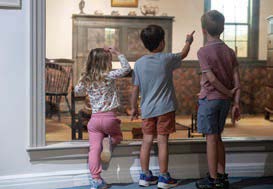
On one otherwise uneventful afternoon, two working moms unleash unleash their three adorable offspring — Owen (6) and Ellie Thompson (3), along with Wilder Bustamante (6) — on the Greensboro History Museum.

We tend to think of museums as being focused on adult interests, so these mothers must wonder if anything they encounter will fully engage with a modern child’s iPad-oriented attention span.

In a stuffy old museum?!?

Wilder and Owen are excited about what discoveries await them. “Some museums have dinosaur bones,” Wilder exclaims. Do the boys secretly hope that, somewhere up ahead, dinosaur skeletons will spring to life at any moment?

By design perhaps, a young mind will instantly recognize museums as safe spaces where imagination flourishes, fueled by their innate curiosity and sense of wonder. Plus, this place has multiple stages for play acting.

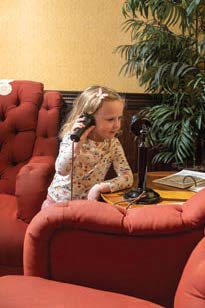
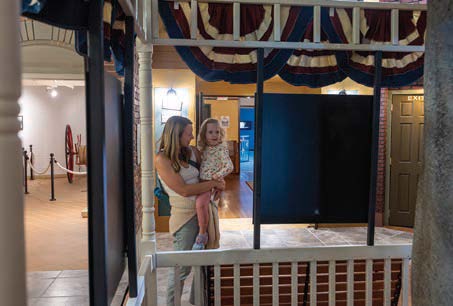
“I’ll get it!!!” little miss Ellie shouts as the family telephone rings. It’s Ellie’s new beau calling, asking her out to the Carolina Theatre to see Clara Bow’s latest moving picture. Ellie exclaims, “That’s the cat’s meow!”

Following the picture show, they’ll stroll a few blocks to lean dreamingly over the soda fountain at Fordham’s Drug Store downtown, sharing a lavender malted milkshake — two straws, of course.

They grow up so quickly, don’t they?

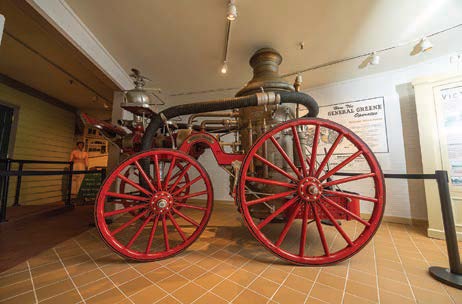
Tumbling into another room, our three adventurers happen upon an early mobile fire-fighting vehicle used by our own fire department. Owen informs everyone, “Those fire engines are so old, they must be from the 1980s.” Owen’s mom is actually from the 1980s and lets out a laugh!

At the dawning of the 20th century, this Greensboro fire truck, the General Greene, was yanked into action by a horse named Prince, the most photographed and talked about equine of that time.

Why was that? Because, after dousing the flames, firefighters would get the horse drunk on the most expensive whiskey available. But there’s no reason for these young’uns to know anything about that!

Wilder may be pointing out the many ways these kids are lucky to be living in modern times and not in the days before any form of entertainment they are familiar with was ever even imagined in the wildest science fiction stories.

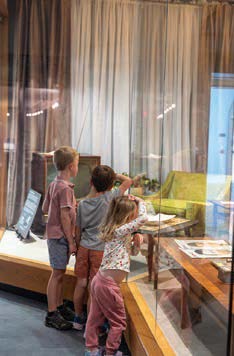
For a passing moment, a mid-century living room captures their attention, back when the TV set was furniture you couldn’t sit too close to. Why did everything from lounge chairs to refrigerators come in shades of lime green? To this day, no one knows.

Like squaresville, man.

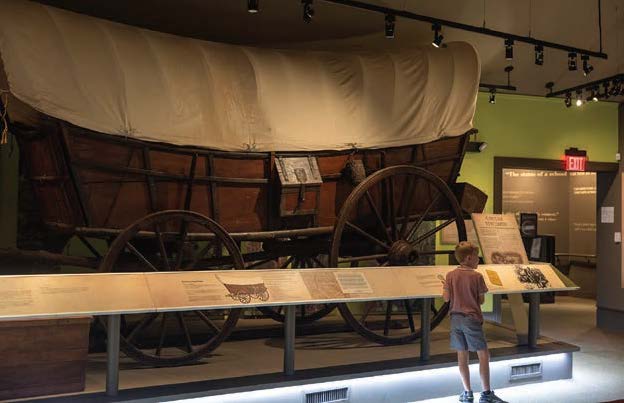
A lone child standing alongside an actual covered wagon from the 1750s accentuates the enormous undertaking pioneer families were faced with, all of their belongings bundled inside, making their way South down the Great Wagon Road in search of a better life.

This road wagon was first class travel for those traversing an untamed wilderness before the advent of railroads.

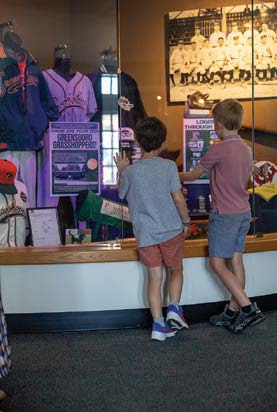
Li’l sluggers Owen and Wilder enjoy attending games at the nearby baseball stadium, so they’re staring in awe at uniforms and equipment used by both the Greensboro Bats and Grasshoppers. “It looks like toys,” Wilder says about the display they both agree is their favorite in all of the museum.

A simple encapsulation, yet they returned repeatedly because it’s history that relates to their life experience.

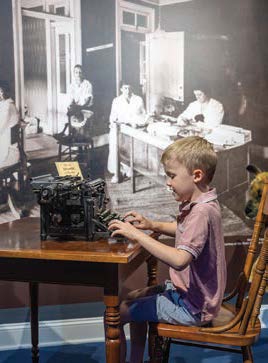
Owen positions himself in front of a keyboard, ready to type out tall tales of knights in shining armor slaying fire-breathing dragons, damsels in distress being rescued from watery ponds, or, perhaps, the thrill of hitting a World Series-winning home run?

The possibilities are endless, but, while the letters and numbers on the keys all look familiar, the battery appears to be dead . . . and where did they hide the “send” button?

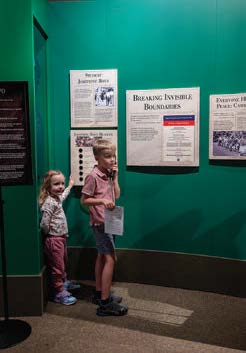
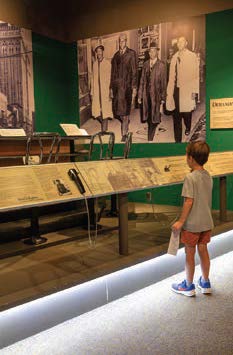
Kiddos are naturally inquisitive and curious. These boys are just now learning to read, but that’s no hurdle with information at their fingertips. But how would modern kids know which end of the receiver to put to their ears? It’s evolutionary, my dear Watson!

Not all superheroes wear capes. Back in 1957, Josephine Boyd was hassled and bullied constantly in high school, but served as an inspiration to millions of young people by bravely being the first to attend a school where she was unwelcome simply because she was Black. She graduated with honors.

Today, the road in front of that high school is named Josephine Boyd Street.

Wilder instinctively runs toward the Woolworth’s sit-in exhibit. Is it a fascination with the shiny chromed seats and lunch counter accents or the voices of societal change he’s tuned into?

Wilder and Owen went running back into the Voices of a City exhibit to experience what went unnoticed the first time through. They are found, fascinated by broadcast technology from more than 50 years ago, watching George (Old Rebel) Perry, who entertained local kiddies for 25 years on WFMY.

In the ‘60s and ’70s, George Perry would carpool kids from the Hayes-Taylor YMCA to appear in the audience so that viewers at home would see how diverse our community was . . . and still is.

“Time to go!”

Mrs. Thompson calls out. But where are those boys?

All good things must end but these indefatigable imps demand a return visit, despite encountering exactly zero dinosaurs stomping around the grounds.

On the way out, our two moms drop a few dollars into the donation box. “Anything keeping our Energizer bunnies entertained for an hour or two gets a big tip from us!”

Wandering Billy

WANDERING BILLY

Finding Otto

How stalwarts of justice became stewards of style

By Billy Ingram

For 30 years, beginning in 1950, Otto Zenke was one of the nation’s most respected interior designers. Based in Greensboro with offices in Palm Beach and London, he created spectacular environments for the finest homes along the East Coast including the mansion of the late Julian Price in Irving Park and Reynolda House in Winston-Salem. A year from now, however, a major portion of Zenke’s legacy will be erased forever when his former home and showroom is demolished for a parking lot.

Bridging the lifestyle gap between the old and new South, Zenke lent his 18th-century-influenced stateliness to residences surrounding golf courses in Pinehurst; country manors in Virginia and South Carolina; seaside abodes in Palm Beach; estates in Newport and Los Angeles; and homes appearing on covers and in photo spreads for House Beautiful and Architectural Digest. Elegance and beauty were his trademark,” declared Connoisseur magazine.

Georgian fireplaces, cut-glass chandeliers hung from high ceilings, gabled archways and boldly carved pilasters were just a few of Zenke’s signature touches. For select clients, lavishly illustrated, hand-painted murals of pastoral splendor or sprawling foxhunting scenes and delicately rendered chinoiserie panels adorned dining and living room walls. It’s doubtful most of those murals survive today but I’d heard rumors that one was extant, oddly enough, in the Guilford County Sheriff’s office.

In 1968, Zenke constructed a 3,000-square-foot home and showroom on the corner of Washington and Eugene Streets after the city had appropriated — by eminent domain — his extraordinarily beautiful residence and workspace across Eugene for use as the Governmental Center. The L-shaped English Regency-style complex he developed in ’68 was joined to, and fronted by, a two-story, New Orleans-inspired dwelling built in the late-1800s, one of the oldest houses still standing in downtown Greensboro.

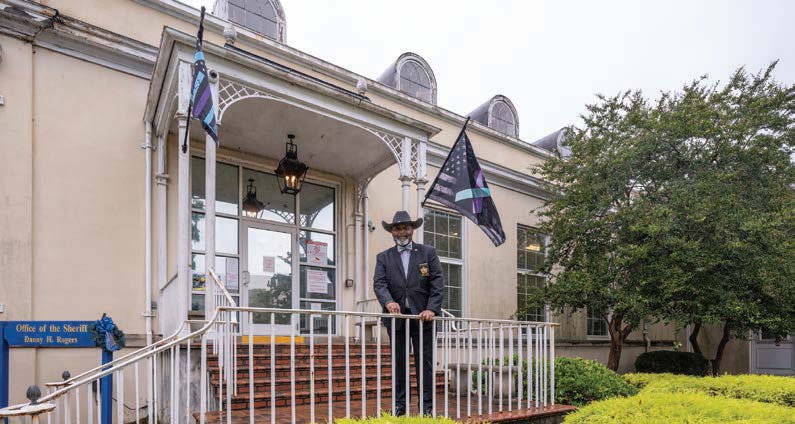
After Zenke’s death in 1984, the county purchased the property and, today, within those hallowed walls, Guilford County Sheriff Danny H. Rogers presides over one of the largest sheriff’s offices in the state with 557 employees split between operations and detention bureaus.

Elected in 2018, Rogers is Guilford County’s first Black sheriff. Growing up in High Point in the 1960s, the few African American law enforcement officers that existed locally were an inspiration to the very young Rogers, who learned by observing them — both how to interact with people and to “be who I am.”

In 1985 Sheriff Jim Proffitt allowed Rogers to work as a non-sworn detention officer. “The county had frozen the positions for sworn officers. Well, on my first day as a non-sworn detention officer, there were two of my white counterparts and they were sworn. I asked, ‘How long have you guys been here?’ Turns out their hire dates were the same as mine. I questioned it. I worked with the sheriff’s office for a little over a year and a half, then I went to the High Point Police Department, where they gave me an opportunity to be sworn and paid me to go to school. I was there for a little over three and a half years before coming back to the sheriff’s office.” After another three years or so, he was released from the department; it wasn’t until roughly 25 years later that he ran for and became sheriff for Guilford County.

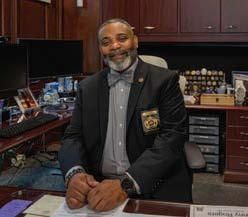
During his time away from the sheriff’s office, Rogers earned a master’s degree in criminal justice and a theology degree. An open Bible sits on a shelf behind his desk. “I had a chance to understand the community from a different perspective,” Rogers says about his well-spent time away. “Getting out there, meeting the people and walking the streets was key when I first started.”

Whenever a new administrator takes over an organization, pushback inevitably follows. “There’s always a lot of behind the scenes conversation,” Rogers says about the transition after becoming sheriff. Those who want to stay will stay. Those who want to leave will leave.

“A positive change began within myself,” Rogers says. “But the real positive change began in the mindset of the men and women who work here, so they can go out in the community and help bring about that positive change. And it’s working. It’s not working like a grand slam or the perfect engine, but it’s working at the pace that it needs to.”

Naturally, I was curious to have a look around Zenke’s former showroom, imaging what you might see on modern TV police dramas, when detectives paste photos of hapless victims on the walls with a cat’s cradle of string tying them to some unknown serial killer. I could not have been more mistaken.

Rogers’ office, once the designer’s living room, is enshrined in 130-year old wood paneling embedded with 15-foot high, built-in floor-to-ceiling bookcases framed in intricately carved crown molding. The bathroom is equipped with an unused sunken marble tub.

Zenke’s stylistic fingerprints are everywhere throughout this palatial domain: entranceways topped with half-moon transom windows; individually painted tiles in the kitchen; a restroom swathed in emboldened Asian-flavored floral wallpaper — all in pristine condition after more than half a century. Touring these offices a few years ago, one former North Carolina chief executive remarked that it was nicer than the governor’s mansion.

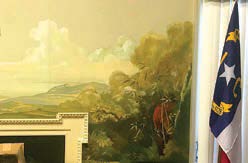
Surrounding the largest open space, to my delight and surprise, unscathed and perfectly preserved, was a panoramic hand-painted mural replicating the verdant patio of an Italian villa opening to the unspoiled countryside with realistically rendered black urns perched on either side. Nearly hidden in one corner, a peasant boy is relieving himself in the bushes, a naughty detail Zenke no doubt delighted clients with privately.

Atop another room’s mahogany bookcase is a marble inlay centered by a nobleman’s face. It has an unintended design element — a pronounced bullet hole piercing an interior glass door, shattered three years ago after gunfire erupted across the street. Soon after, all exterior windows were made bulletproof.

After visiting Zenke’s former digs, photographer Lynn Donovan and I were chatting as she packed cameras into the trunk of her car. A female detention center deputy stopped to question what a couple of suspicious-looking customers like us were doing meandering in the parking lot. “Oh, we’re here to shoot the sheriff,” I replied. That wasn’t a smile crossing the deputy’s lips as one hand inched closer to her baton. Donovan explained that we just wrapped up a photoshoot with the county’s top lawman. While we had, in fact, shot the sheriff, after the jailer moved on Donovan noted, “we did not shoot the deputy.”

After completion of the new Guilford County Sheriff’s Law Enforcement Administration Building in 2025, Otto Zenke’s former home/showroom next door will be demolished for a parking lot — naughty peasant boy and all.

Poem November 2024

POEM NOVEMBER 2024

Great Blue Heron

He looked like an old man hunkered down
in a faded blue overcoat, his collar turned up,
shoulders hunched. He didn’t seem bothered

by the shallow water his feet were covered

by, nor the chill winter air blowing around
his bare pate. But then his narrow head rose

like a periscope, higher and higher — swiveled
in the direction of a hardly perceptible splash.

Slowly, he moved toward the sound on legs
as skinny as walking sticks, to the place where
dinner was served and eaten so fast, any cook

would wonder if he tasted it. It was enough,
however, to restore his quiet contemplations.

Hunger sated, he curled his long neck into its
warm collar, and stood as still as a painting

while the sun sank and the snow moon kept

rising like a white balloon over the darkening
lake, the stark tree branches, and a lone heron
blending, bit by bit, into the blue light of dusk.

Terri Kirby Erickson

The Family Meal

THE FAMILY MEAL

The Family Meal

Gather ’round the table and serve up one of Greensboro’s global chefs’ favorite dishes

By Cassie Bustamante     Photographs by Amy Freeman

In the spirit of celebratory feasts, we asked four local chefs — whose roots lie elsewhere around the world — to share a dish that’s a favorite around their own family tables. With so much to be grateful for in the Gate City, our bellies are especially thankful for the rich diversity of world-class hospitality and global fare available without having to travel far.

Jorge Castillo and daughter Jennifer, Embur Fire Fusion

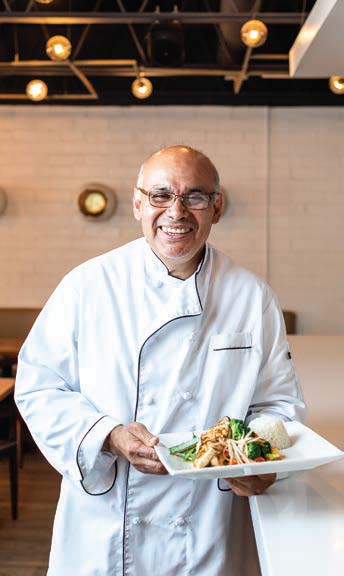
“Food is a symphony,” says Embur chef-owner Jorge Castillo. “Everything that is in the dish, you have to put together in order to feel that.” Castillo, who trained at the Culinary Institute of America’s New York campus, originally hails from the Peruvian coast, where fresh seafood is abundant. “You ever sit with Peruvian people?” he asks. “They eat!” And much of what they eat is a Japanese-Peruvian fusion cuisine known as Nikkei. His youngest daughter, Jennifer, who is working with her father until she attends law school next year, notes that Peru is home to a large number of Japanese immigrants who have influenced the culture. This dish, homemade Peruvian Nikkei-style fish, is a blend of veggies — snow peas, zucchini, peppers, Napa cabbage and bean sprouts — paired with fish and rice. When the smell of Castillo’s homemade sweet-and-sour sauce bristling with fresh spices tickles her nose, Jennifer says, “Oh, there’s about to be a big ol’ feast here!”

Homemade Peruvian
Nikkei-Style Fish for Two

12-ounces white fish fillet
(Chef Jorge recommends grouper) 

3/4–1 cup broccoli, chopped

1/2 cup cauliflower, chopped

1/2 cup green beans (cut into thirds) 

1/2 cup snow peas

1 green bell pepper, chopped

1 red bell pepper, chopped

2 cups Napa cabbage, chopped into small pieces

1 handful of bean sprouts

1 teaspoon fresh minced ginger, divided

1 teaspoon minced garlic, divided 

1 tablespoon oyster sauce, plus more for drizzling

1/2 tablespoon soy sauce, plus more for drizzling

1–1 1/2 tablespoons olive oil, plus more for drizzling

1 teaspoon sweet and sour sauce 

1 teaspoon sesame oil 

Salt and pepper, to taste 

Red chili flakes, to taste

1 cup any choice of cooked rice (white rice preferably), divided into two servings

Directions: 

Preheat the oven to 375 degrees Fahrenheit. 

Bring a large pot of lightly salted water to a boil. Once the water has started boiling, add the broccoli and cauliflower and cook for about two minutes. (If using green beans instead of snow peas, boil them now as well). Then remove the broccoli and cauliflower, place into an ice water bath and set aside. After a few minutes, drain the water. Cut the 12-ounce fish fillet into two pieces. Place in a bowl and add salt, pepper, 1/2 teaspoon of minced ginger and 1/2 teaspoon of garlic. Drizzle equal parts of soy sauce and oyster sauce, and then add olive oil. 

Heat a large nonstick pan over medium heat. Place the seasoned fish on the pan. Cook until lightly golden-brown on one side, about two minutes. Turn the fish over and repeat to the other side. Place the fish in a baking dish or keep in oven-safe pan.

In the preheated oven, bake the fish in the oven for about five minutes. (Time can vary depending on fish used, but the internal temperature should be 135 degrees Fahrenheit). 

Meanwhile, in a separate pan, heat about 1–1 1/2 tablespoons of olive oil in a large pan over high heat. Add the bell peppers and snow peas (or prepared green beans if used). Sauté for 30–45 seconds and then add 1/2 teaspoon of minced garlic. 

Once the garlic is lightly golden, add the cauliflower, broccoli, Napa cabbage and bean sprouts to the pan with the bell peppers and snow peas/greens beans. Sauté for another minute.

Add 1 tablespoon oyster sauce and 1/2 tablespoon soy sauce to the vegetables and toss together. 

Remove the pan from heat. Add sweet and sour sauce, sesame oil and red chili flakes. Toss and set aside. 

Divide fish among two plates, top it with the vegetables and serve with choice of rice.

Ginah & Mike Soufia, Wallstreet Deli & Catering

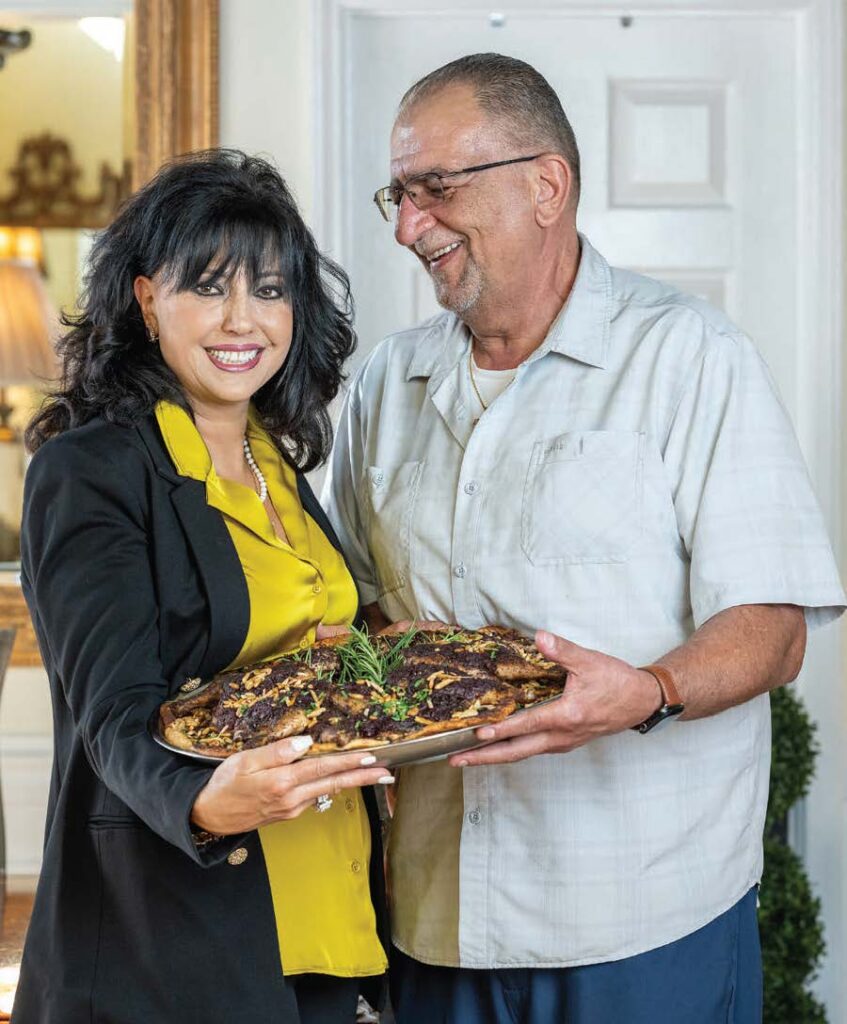
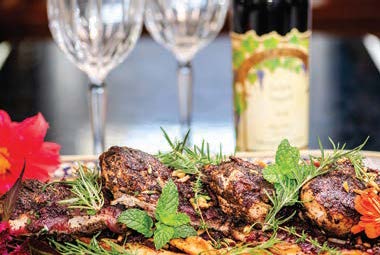
“My sister-in-law, who is American, calls this purple chicken,” says Ginah Soufia. A first-generation Palestinian American, Gina has owned Wallstreet Deli & Catering for 26 years with her Palestinian-born husband, Mike. “The aroma . . .  it takes me back to my childhood,” she says, recalling the scent of sizzling, sumac-infused onions and golden-toasted pine nuts that drifted through the modest three-bedroom home. The table was always loaded with food and family — three generations living under one roof. To this day, she believes in setting a longer table to make room for others. “The great thing about the Palestinian culture is our hospitality — it is unmatched.” Musakhan, the national dish of Palestine, is often prepared at home by Ginah, with Mike — “the baker” — making the flatbread, Taboon, which sops up the flavor. What tradition does she hope to pass on to her own three grown children? “I want my kids to know that no matter what, your family will be there for you,” she says. “No matter what, your family is your family.”

Musakhan

Without chicken:

8 large red onions, medium-chopped

2 cups extra virgin olive oil

Chicken bouillon powder, to taste

1/3 cup good-quality sumac (a bright-red spice made from ground dried sumac berries), plus more for sprinkling

6 Taboon or plain naan bread pieces

Pine nuts, fried or roasted

With chicken (same as above, plus):

3 small chickens

1/4 cup olive oil

1 tablespoon sumac

1 tablespoon seven spices

1 tablespoon ground coriander

1 tablespoon garlic powder

2 tablespoons salt

Without chicken:

Heat olive oil over low heat. Add onions to pan and sauté. Keep mixing until the onions become soft, have a bright pink color to them and have released all their water.

Continue to mix and add bouillon powder and sumac.

Spread onion mixture on each piece of bread and sprinkle with pine nuts and a little more sumac. Repeat and layer as you go, creating a stack.

With chicken:

Preheat oven to 450 degrees Fahrenheit.

Cut each chicken into either two halves or four pieces. Pat dry with paper towel.

Mix the olive oil and spices in a small bowl then brush on chicken from all sides. Place on a baking sheet lined with parchment paper, allowing room between each piece of chicken.

Cover with aluminum foil and bake for about one hour, then uncover and bake an additional 5–10 minutes until the skin is crispy and golden-brown.

Follow steps 1–3 from the vegetarian version above. Layer as many pieces of bread and onion mixture as you’d like, followed by a piece of chicken on top. For a single serving, one piece of bread topped with onions and one piece of chicken is recommended.

Joseph Ozbey, Cugino Forno

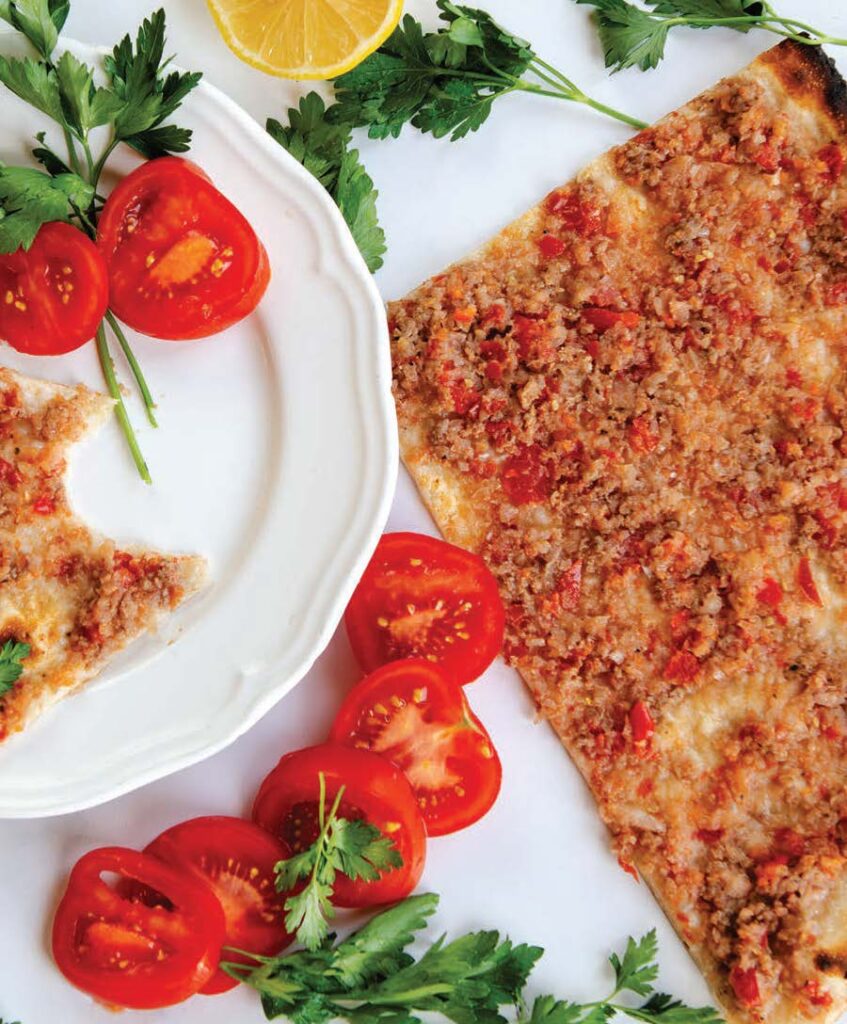
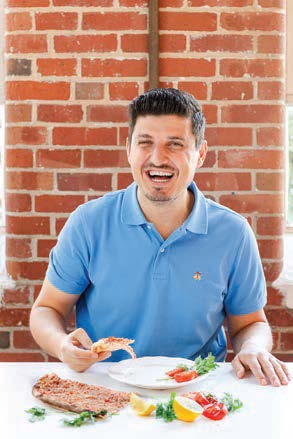
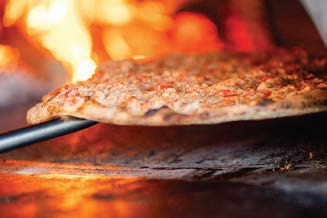
Born and raised in Turkey, Cugino Forno Pizzeria co-owner Joseph Ozbey has fond recollections of family meals centered around Lahmacun, aka Turkish pizza. “Every time I have this dish, it reminds me of our Sundays when I was a little kid.” Armed with the toppings his mother had prepared and some pocket change, Ozbey would go to the local baker, who would put the topping on crusts and bake. When Ozbey returned home with the fragrant, steaming Lahmacun, the table would be prepared — with salads, herbs, tomatoes, yogurt drinks — and the family would eat together. Soon, God willing, he will have a few of his own little ones sitting around the family table and he can share the rich history of his Turkish heritage. “Even a simple dish,” he says, “reminds you of your culture, reminds you of your roots.”

Lahmacun (Turkish Pizza)

Makes six 10-inch pizzas

For the crust:

2 cups all-purpose flour

2 teaspoons kosher salt

1 1/2 teaspoons cane sugar

2 teaspoons dried instant yeast

1 2/3 cups water

For the topping:

1/3 cup small red bell pepper

1/2 cup onion

1/3 cup parsley

2 cloves garlic

1 teaspoon dried oregano

1/2 teaspoon dried mint

1 teaspoon cumin

1/4 teaspoon black pepper

2 tablespoons Turkish red pepper paste (can substitute tomato paste with a dash of hot sauce)

1/2 pound ground beef

For the crust:

Combine all of the dry ingredients in a large mixing bowl. Whisk together.

Add the water and fold and mix until a ball of dough forms. Allow to rise for about one hour.

Transfer the dough to a floured surface. Cut the dough into six even pieces. Shape each piece by hand and then use a rolling pin to create a thin circular shape. (Add additional flour to the surface, to your hands and to the rolling pin when necessary.)

For the topping:

Fine-dice the red peppers and onion, mince the garlic and finely chop the parsley. Aim for tiny pieces of everything — the tinier, the better. Add the chopped and minced ingredients, the rest of the seasonings and the red pepper paste to the ground beef. Massage and mix with your hands for no less than five minutes,

Evenly spread the meat mixture on your prepared crusts. Bake for 20–25 minutes in an oven preheated to 350 degrees Fahrenheit.

Aurelio Ruiz and daughter Alondra Ruiz Fowler,
Kiosco Mexican Grill

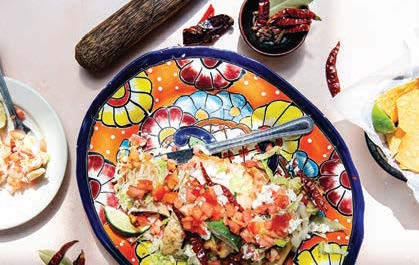
“Every tamale is different,” says 25-year-old Alondra Ruiz Fowler, eldest daughter of Kiosco owner and chef Aurelio Ruiz. “Every family makes them differently.” Her own grandmother, who lived with them when Fowler was a child, still, to this day, insists on thoroughly mixing the masa dough by hand. “I am never fast enough to do it,” Fowler admits. As for the accompanying chili sauce, she says that Mexicans make their own by burning the chilis, releasing a come-hither-if-you-like-spicy aroma throughout the home. “The worse my throat hurts, the hotter it’s going to be,” she says with a laugh. This dish, a tradition at big get-togethers, is one that Fowler hopes to keep alive for future generations. As for the restaurant, her dad talks about one day passing that on, too. “But he’s a workaholic, so he’s going to be here until he can’t walk anymore!” Either way, Fowler says she can’t ever imagine the 35-year-old restaurant not being there. Just another part of the family legacy..

Tamales

Corn

1 pack of corn husks 

Masa

1 cup manteca (lard)

1 teaspoon baking powder 

Salt to taste 

5-pounds “masa para tamales” (pre-packaged dough found at local Mexican markets)

1 cup of broth from cooked meat 

Chicken 

1 1/2 pound chicken breast, cut into cubes 

1/2 white onion, peeled

2 1/2 cloves garlic, peeled 

1 teaspoon ground cumin 

1 teaspoon kosher salt 

1 teaspoon chicken bouillon 

1/4 teaspoon ground black pepper 

Chile Sauce 

3 ancho chiles* 

3 guajillo chiles* 

2 tablespoons plus 1 teaspoon manteca

2 1/2 cloves garlic, peeled 

1/2 teaspoon kosher salt 

1 teaspoon chicken bouillon 

1/2 teaspoon ground cumin 

1/4 teaspoon black pepper 

*Remove chile seeds to tone down the spiciness

Directions

Husks: Soak husks in a large bowl with hot water while cooking, ensuring they stay completely immersed for about 75 minutes. Dry thoroughly after soaking.

Chicken: Place chicken in a pot of water to boil. Add white onion, garlic, ground cumin, kosher salt, chicken bouillon and ground black pepper. Allow the pot to boil, then simmer for 75 minutes. Throughout this process, remove the foam that rises to the top of the pot. Once the chicken is cool, shred it all and place in a bowl, removing the bones. Reserve one cup of broth for Masa step. If using a different part of the chicken, shred and remove all the bones prior to assembling tamale. 

Chile Sauce: In a pan, fry the chile and garlic in 2 tablespoons manteca for about three minutes. Once fried, add chiles to a pot of 1 1/2 cups of boiling water. Allow the chiles to boil for about 10–15 minutes. After 15 minutes, remove chiles plus a cup of the boiling water used and add to a blender. Add seasonings and blend until mixture reaches a paste consistency. Fry mixture in a pan with 1 teaspoon of manteca over medium heat. Add about 1 cup of water and allow it to simmer for about 20 minutes until thick. Be careful not to burn the sauce during this step. Once thick, add to the bowl of shredded chicken and combine. 

Masa: In a large, clean, open counter space, mix the manteca and baking powder together. Once mixed, add half of the amount of salt. As you are consistently kneading the mix, add your Masa. Do not add Masa all at once. Add it in parts. Continuously kneading the mixture, work in the one cup of chicken broth. Add remaining salt and mix. Taste Masa and add salt if needed at this step. 

Assemble Tamales: Using a dry corn husk, spread about 3–4 tablespoons of the masa on the smooth part of the husk. You want to make about a 3 x 3 inch square that leaves about 1/2 of an inch at the bottom of the husk. Once your masa is spread on husk, put about 2–3 spoonfuls of the chicken and sauce mixture in the middle of the masa. Fold one long side of the corn husk, then fold the other long side over top. Finally, fold the bottom of the corn husk upward. You can secure the tamale by placing the folding side of the tamale downwards in the steaming pot in the next step or you can shred an unused corn husk into pieces to use as string, tying a knot over the tamale. 

Cooking Tamales: Using a stockpot with water in it and a steamer on top, distribute the tamales evenly and upright. The water should be low enough where the steamer basket can be inserted without touching the water. You want to place your tamales in the steamer basket upright where the tamale is exposed. Once you have evenly spread the tamales in the steamer basket, cover the pot and let it steam on medium for about 75 to 90 minutes. Water may need to be added periodically, depending on the depth; always make sure it is not touching the steamer basket. Once you can see that the corn husks are easily removed, your tamales are fully cooked. 

Serving: Remove the corn husk from cooked tamale and place on a plate. Garnish with shredded lettuce, chopped tomato, sour cream and a crumble of queso fresco. Take a bite and enjoy a delicious taste of a traditional Mexican meal!