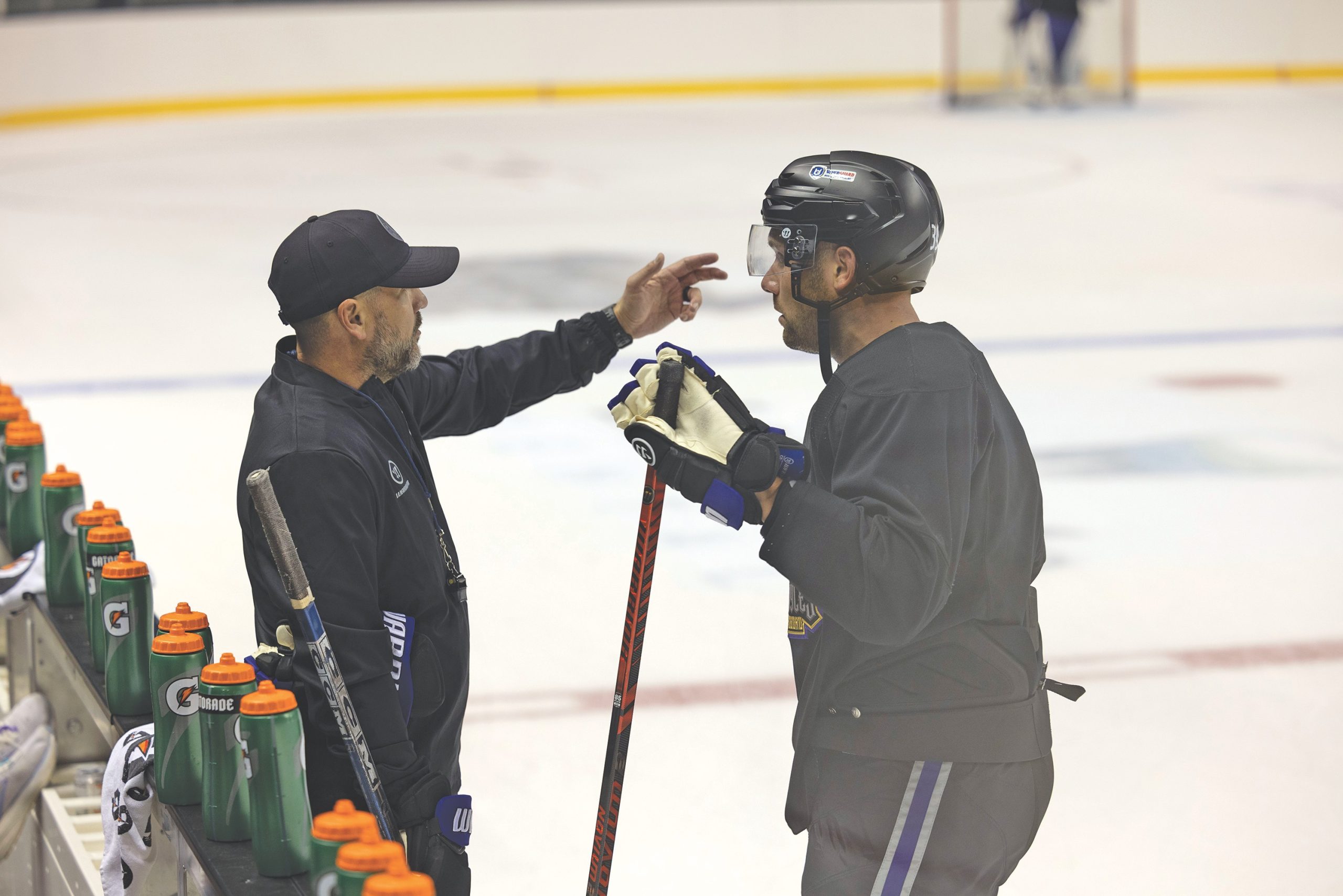
Glory Days

GLORY DAYS

Glory Days

These men aren’t kids anymore, but when they were, they forged a legacy

By Ross Howell Jr.

Photographs by Tibor Nemeth

Former Greensboro Generals ice hockey players Ron Muir, Harvard Turnbull and Stu Roberts have a pretty good idea of what our new professional team, the Greensboro Gargoyles of the East Coast Hockey League, have on their minds.

A league championship.

That’s something the Generals, the city’s first professional hockey team, achieved in the 1962–1963 season of the old Eastern Hockey League. (A later franchise, the Greensboro Monarchs, won the ECHL championship title in the 1989–1990 season.)

After I schedule an interview with Ron Muir, I find it to be wonderfully apt that he lives just across the road from the Guilford Courthouse National Military Park and its monument to General Nathanael Greene.

One old general near another.

Muir’s 89 years old now, and I’m greeted at his door by two of his daughters, Elaine Miller and Susie Barham. Elaine teaches elementary school in Blowing Rock and Susie lives in Myrtle Beach.

Muir is sitting in a big recliner and is wearing a Wayne Gretzky jersey — for those of you who don’t follow the sport, Gretzky is a legendary National Hockey League player from Canada who was nicknamed “the Great One.” A hockey game set on mute slashes across the flat-screen TV facing Muir’s chair.

Hailing from small-town Seaforth, Ontario, between Lake Huron and Lake Erie, Muir was an athlete’s athlete — playing soccer, lacrosse, football, baseball and, of course, hockey.

“I decided I wanted to play professional hockey when I was about 10 years old,” Muir says.

Ron Muir

“He’s always had his goals,” Elaine laughs.

And play professional hockey he did. Before moving his young family to Greensboro for the 1960–1961 EHL season at age 25, he’d already played professionally in Canada for three years. Standing 5 feet 11 inches tall and weighing a bruising 190  pounds, Muir played left wing.

Because of his experience and age, many of his teammates looked at him as a father figure.

“Many of them were these 18-, 19-year-old boys, and their families were all back in Canada,” Elaine says.

“At Christmas, Mom and Dad would have a huge party, and the whole team would show up in our little house,” she adds.

Muir remembers that the person who convinced him to join the Generals was the late Don Carter, who was from Toronto. The two men were the same age and had first met at a Chicago Blackhawks tryout in St. Catharines, Ontario.

When they saw each other again at a training camp, Muir had been scouted by an EHL team in Johnstown, Penn., and was ready to sign with them.

Carter was already a star with the Generals. Playing defenseman, he stood 5 feet 11 inches tall, and weighed 185 pounds.

“So Carter says to me, ‘Ron, you don’t have to go to Johnstown. Come on, we’ll go to Greensboro. I played there last year and it’s a good town,’” Muir recalls.

“I thought, hell, I haven’t signed a contract,” Muir continues. “So, I signed up with the Generals’ manager, who was also at the camp, and loaded up for Greensboro.”

“My father drove us down,” Elaine says. “It was a two-day trip back then, and Susie and I were toddlers.”

“And we just ended up staying,” Muir says.

Two more daughters came along, Sandy and Cindy, and both still live in Greensboro. After Muir’s first wife passed away, he remarried, and a stepson, Jason, became family, too. Now Muir has nine grandchildren and four great grandchildren.

The first season Muir and Carter skated together as Generals, the team made the finals. The second season, they won the EHL championship.

In those days, there was no Plexiglas around the rink, just boards and wire. The girls would sit close to the ice, and, when Muir skated by them, they’d shout, “Hey, Dad!”

“The kids from the other hockey families would be all around us in the crowd,” Elaine says. “It was great.”

Greensboro was a hockey town — and “the Generals were superstars,” Elaine says.

“My husband, Eric, played little league hockey,” she adds. “So he knew about Dad long before he met me.”

Susie laughs.

“Oh, yeah, my husband knew Dad before he ever asked me out,” she chimes in.

Elaine smiles.

“We’d date these guys, and they’d say, ‘You’re Ron Muir’s daughters?’ That was a bonus.”

Harvard Turnbull suggests we meet for a drink at Fleming’s Prime Steakhouse & Wine Bar. Turnbull is 84 years old. Originally from Toronto, he skated at the center position for the Generals, standing 5 feet 9 inches tall and weighing 160 pounds.

Though he was an experienced and skilled hockey player, Turnbull was still a teenager with a dream of making the National Hockey League (NHL) when he arrived in Greensboro. Signing with the Generals represented a big step toward achieving that dream.

Turnbull met with members of the Generals’ staff at the Sedgefield home of businessman Stanley Frank, one of the founding owners of the team, to finalize his contract.

“So, they said, ‘What do you want?’” Turnbull recalls.

“I said, ‘You fill it out and I’ll sign it.’ That’s how green I was. I was going to turn pro. It was like I was going to walk on water.”

Fortunately for Turnbull, coach Ron Spong made sure the contract included generous bonuses each time the team advanced in the playoffs.
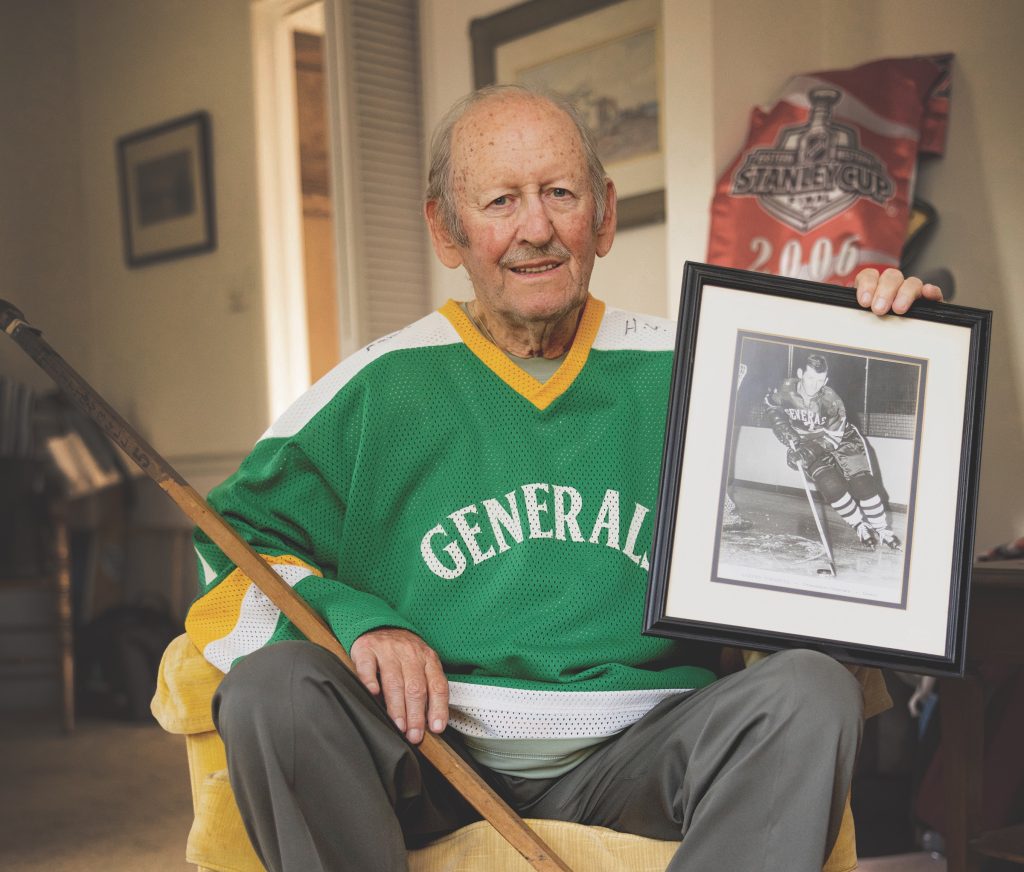
Harvard Turnbull

And that was the Generals’ championship season.

“I went out and bought a new convertible,” Turnbull laughs.

“It was amazing,” he says. “We were treated like kings.”

Turnbull tells me as many as 5,000 fans would show up to watch the team play in a charity softball game. He and his teammates could play the Sedgefield golf course anytime they wanted. They were often invited into the homes of civic leaders and successful entrepreneurs.

The late Anne Cone was one of the owners of the Generals team in its glory days. A benefactor of UNCG’s Weatherspoon Art Museum, she was the wife of Cone Mills heir Benjamin Cone, mayor of Greensboro, 1949–1951, who passed away in 1982. The couple lived in a graceful Greensboro Country Club mansion.

“Anne Cone was absolutely wonderful,” Turnbull says. “She would invite us single guys to her house for dinner about once a month.”

Among the bachelor invitees was Bob Boucher from Ottawa.

As the story is told, when Cone was in Chamonix, France, on a ski trip, she learned that Boucher, who was playing European hockey, had been arrested in Italy for fighting and couldn’t make bail. Cone managed to have him released and flown to Greensboro, where he skated for the championship team at right wing, standing 5 feet 9 inches and weighing 170 pounds.

“Bobby was a character,” Turnbull says. “So, we’d be at one of Anne’s dinner parties, and Bobby’s sitting at the head of the table where she had all these buttons, and he’d push a button and a servant would come in. Then he’d push another and a wine steward would come in.”

“He was just pushing buttons to see what would happen,” Turnbull laughs. “But Anne was cool — she didn’t have a problem with it.”

Yes, the high life was “plush,” as Turnbull likes to say, but the sport of ice hockey could be punishing, especially in those days.

He shows me a photo.

“That’s Ron Muir in front of the net and I’m taking a shot on goal,” Turnbull says. “Listen, I could really shoot the puck back then, probably get it close to 100 mph.”

He places a fingertip on the goalie’s head in the photo. The goalie’s not wearing a face mask, let alone a helmet.

“If the puck had hit him in the head,” Turnbull muses, “it probably would’ve killed him.”

He shows me another action photo, snapped right at the moment an opposing player knocked Turnbull completely over the boards and into the stands.

“That was very painful,” he says. “But I came right back out on the ice.”

Turnbull tells me that his nose was cut so badly once when he was playing in Canada that it had to be sewn back on. He’s had teeth knocked out, fingers broken and suffered numerous concussions.

“You know what they called the EHL back in my day?” Turnbull asks.

“They called it ‘the meatgrinder league,’” he says, nodding slowly. “That’s how crazy it was.”

Turnbull believes if his teams had “proper helmets, proper rules,” maybe he wouldn’t have suffered so many injuries, which continue to plague him in his golden years.

“Still,” he concludes, “I’d do it all over again.”

Stu Roberts

I meet up with Stu Roberts at the Chick-fil-A just off Battleground Avenue.

Roberts is a native of St. Catharines, Ontario, and arrived in Greensboro in 1966. Although he was just 19 years old, he had already been playing for the St. Catharines Black Hawks, a Canadian junior ice hockey team, for four seasons. He stood 5 feet 7 inches tall and weighed 175 pounds, and didn’t waste any time making an impression in the EHL.

Roberts won the rookie of the year award in 1966–1967.

“I was fast, and that was my game,” he says. “And I could score goals. One year, I scored 62 goals in 72 games. Wonderful year.”

Roberts tells me that he wasn’t a bruiser like Muir and Carter — he used his speed to avoid the hits.

And he knew how to please the crowd.

“I’m not bragging, but I’m proud of the fact that I won most popular player three years in a row,” Roberts says. “I used to tell Coach Spong I’d rather keep the people happy than win any other award.”

As long as the fans were behind him, he adds, “I knew I could keep my job.”

One of Roberts’ daughters, Ashley Barker, drops by the Chick-fil-A to show me some of her Dad’s memorabilia.

Among the items is a newspaper article written by a St. Catharines reporter the summer after Roberts’ second season as a General.

The writer called Roberts “Mr. Excitement.”

“He’s a gambler, often diving, literally, across the ice to get the puck,” the reporter wrote.

The crux of the article?

That Roberts was a huge fan of another speedster — No. 43, stock car driver Richard Petty. So much so that he visited Petty in Randleman, who obliged Roberts by letting him try out the driver’s seat in No. 43. Not on the track, of course.

I ask Roberts about the teams the Generals faced in his eight-year career here.

“I’m telling you, we had some great teams,” Roberts says.

“Our nemesis was the Charlotte Checkers,” he continues. “We used to go to Charlotte on a Friday night and fill the place, and come back to Greensboro on Saturday night and fill the place. It was really good rivalry.”

And there were the Roanoke Valley Rebels, originally the Salem Rebels, in Virginia.

“We used to skate in the old Salem Civic Center, but then they built the Roanoke Civic Center, which was a beautiful rink,” Roberts says.

There were the Nashville Dixie Flyers and the Knoxville Knights in Tennessee.

And, yes, even back then, two teams from the Sunshine state — the Jacksonville Rockets and St. Petersburg Suncoast Suns.

“We carried 18 players on the team and did most of our travel by bus,” Roberts says. The bus had about 20 seats and the remaining space was set up with double-deck bunks.

“We had some good times,” he continues. “I remember a lot of bus rides in a lot of snow, getting from Greensboro to Nashville, or Nashville to Knoxville, or Knoxville to back home.”

Roberts pauses for a moment.

“I think maybe people have forgotten about the Greensboro Generals,” he muses.

I tell him about how many fans I’ve seen — some even high school age — who’ve been wearing old Generals jerseys at the Gargoyles media events I’ve attended. His face brightens.

“You know, I want to thank Greensboro,” Roberts says. “I skated on some great teams. I met my wife, Amanda, here. We raised our kids here. It’s been a wonderful ride.”

And who knows? Maybe our Greensboro Gargoyles in their inaugural season will create some glory days of their own.

The Flying Gargoyles

THE FLYING GARGOYLES

The Flying Gargoyles

Photographs by Tibor Nemeth

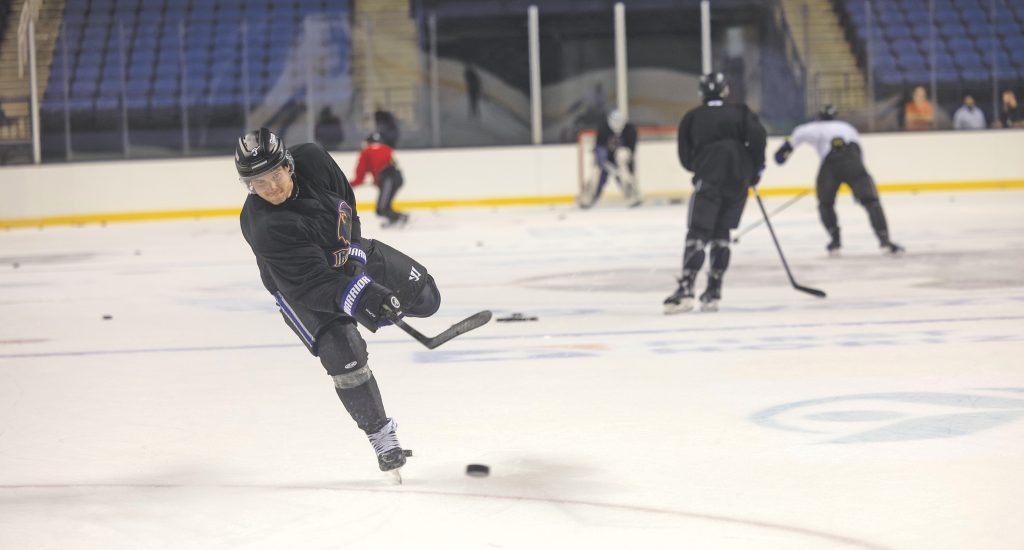
We sent photographer Tibor Nemeth to capture Gereensboro’s newest hockey team, the Gargoyles, warming up on the ice before their season kicked off in October. You can find the rest of their opening season schedule at gargoyleshockey.com.

Tea Leaf Astrologer

TEA LEAF ASTROLOGER

Scorpio

(October 23 – November 21)

There’s a fine — and in your case, blurred — line between passionate and possessive. When Venus struts into Scorpio on Nov. 6 (where she’ll glamp out until month’s end), that line is primed to become a short leash if left unchecked — and nobody wants to be on the other end of that. A word of advice: Don’t smother the fire. Tempted as you may be to cling fast and tight, a little space will keep the coals glowing red hot.

Tea leaf “fortunes” for the rest of you:

Sagittarius (November 22 – December 21)

Stick to the recipe.

Capricorn (December 22 – January 19)

Pack a lint roller.

Aquarius (January 20 – February 18)

Thaw before cooking.

Pisces (February 19 – March 20)

Don’t overwork the potatoes.

Aries (March 21 – April 19) 

The shortcut won’t be worth it.

Taurus (April 20 – May 20)

Go easy on the garlic.

Gemini (May 21 – June 20)

Cling wrap, baby.

Cancer (June 21 – July 22)

The dishes are piling up again.

Leo (July 23 – August 22)

Shake the rug, darling.

Virgo (August 23 – September 22)

Dare you to bust out the fine china.

Libra (September 23 – October 22)

Serve yourself an extra slice of grace.

NC Surround Sound

NC SURROUND SOUND

Sounds of a City

Music with a connection to place

By Tom Maxwell

Alex Maiolo is a creature of pure energy. It’s not that he talks fast or acts nervous — he’s simply an ongoing conversation about electronic music, geography and whatever else happens to capture his interest. He’s also a singular kind of globetrotter, one who doesn’t sound pretentious about it. He loves Estonia’s capital, Tallinn, so much he made music with the place, a 2021 conceptual performance he called Themes for Great Cities.

Conceived as one of his two main pandemic projects — the other was getting better at making pizza — the musical idea took on a life of its own even as the flatbread faded. He invited Danish musician Jonas Bjerre, Estonian guitarist and composer Erki Pärnoja and multi-instrumentalist Jonas Kaarnamets to collaborate. What resulted was something that felt improvised, unpredictable and exhilarating.

“Even though I was living in Chapel Hill, I was trying to think about, well, what do you miss when you miss a city?” he says.

The obvious things — favorite restaurants, familiar streets — were only part of it. Beneath that, Maiolo sensed a deeper, subconscious connection to place that might be expressed musically. He seized upon the idea of treating the city itself as a collaborator. “I wanted to write a love letter to this incredible city by gathering elements of it and assembling them in a new way,” he says. Sounds and light readings became voltages; voltages became notes. “Every synthesizer is just based on the assemblage of voltages,” Maiolo says. “So, if you have voltages — particularly between negative five and plus five volts — you can make music.”

The group collected source material across Tallinn: gulls shrieking overhead, rainwater rushing down a gutter, chatter in a market, the squeak of trams, cafeteria trays clattering at ERR (Estonia’s equivalent of the BBC). A custom-built light meter called the Mõistatus Vooluringid — “mystery circuit” — captured flickering light and converted it into voltages. These inputs were then quantized, filtered and transformed into sound. Tallinn became what Maiolo called “our fifth band member. And just like with any band member, you can say, ‘Hey, that was a terrible idea’ or ‘way to go, city — that was a good one.’”

From the outset, the goal was to create something that felt alive. “We wanted happy accidents,” Maiolo says. “Quite frankly, I wanted to be in a situation where something could go wrong.” Unlike a pre-programmed, pre-recorded synthesizer session, Themes for Great Cities was designed to court risk through completely live and mostly improvised performance — to create the same adrenaline rush that test pilots might feel, only with much lower stakes. “No one was going to crash,” Maiolo says.

That philosophy made the project’s debut even more dramatic. Originally slated for a 250-seat guild hall built in the 1500s, the show was suddenly moved to Kultuurikatel, a former power plant that holds a thousand. Then came another surprise: The performance would be broadcast live on Estonian national television, with the nation’s president in attendance. “It was far beyond anything I had imagined,” Maiolo admits. “I thought we were going to play to 30 people in a room.”

Visuals by Alyona Malcam Magdy, unseen by the musicians until the night of the show, added a surreal dimension. Estonian engineers captured the performance in pristine quality. “It all came together,” Maiolo says. “The guys I was doing this with are total pros.” The recording was later mixed and pressed to recycled vinyl at Citizen Vinyl in Asheville. Unable to afford astronomical mailing expenses, Maiolo split 150 LPs between Estonia and the United States, carrying them in his luggage.

Though imagined as a one-off, Themes for Great Cities continued to evolve. The group returned to Estonia in 2022 for a new performance in Narva, reworking parts of the score and staging it in a former Soviet theater. “We didn’t record that one because it was similar to the first. But when we do Reykjavik, we’ll record that one and hopefully release it,” he says. Yes, Iceland looks like the next destination. The plan is to work partly in the city and partly in the countryside, where light, landscape and weather can all feed into the music.

The ensemble has grown tighter, but Maiolo emphasizes the lineup will be flexible, with an eye toward incorporating local musicians. Vocals may be added in future versions, perhaps improvised or even converted into voltages to manipulate the electronics. “Anything is possible,” he says.

Though he now lives in San Francisco, Maiolo continues to think of North Carolina as part of his creative geography. He still has his house in Chapel Hill, stays connected to Asheville’s Citizen Vinyl, and carries his records home through RDU.

Maiolo and his partner of seven years, Charlotte, are to be married in Saint-Germain-des-Prés in Paris. Her father, a German who came of age during World War II, once spent a year in San Francisco immersing himself in jazz. Even now, as he struggles with dementia, he plays clarinet and listens to Fats Waller and Oscar Peterson. The sense of music as a lifelong companion, capable of anchoring memory and identity, is yet another thread running through Maiolo’s work.

Ultimately, what began as an experiment has become an ongoing series of collaborations. Each city brings its own textures, rhythms and surprises. Each performance is both a portrait and a partnership. “At the end of the day, it just kind of sounds like music,” Maiolo says nonchalantly, as if jamming with an entire city is an everyday thing.

O.Henry Ending

O.HENRY ENDING

Trot Till You Drop

A mother and son’s Thanksgiving tradition

By Cassie Bustamante

Thanksgiving traditions? Everyone has ’em. Some families habitually sign up for the local turkey-trot races, dressed in matching tees with some cutesy saying like “First we run, then we eat” paired with fall-colored tulle skirts at their waists and coordinating, striped, knee-high socks. We are not that family.

And yet, in 2023, I ambush my oldest, 18-year-old Sawyer, begging him to turkey trot with his momma in the Greensboro Gobbler 5K. My motives are not entirely self-centered: A cross-country and track athlete when he graduated from Grimsley earlier that year, since then his sneakers have been collecting dust — not the kind kicked up on a trail.

An avid, albeit slow, runner myself, I know the benefits exercise has on my mental health. Trust me when I tell you that my family has many times breathed a sigh of relief when I hit the pavement. Of course, tell a teenager you think anything would be good for them and watch their eyes roll. Even if you can’t see the movement in their eye sockets — trust me — you can feel it.

Nevertheless, Sawyer oh-so-reluctanty agrees to join me in the race. I get to work training, suggesting that he do the same. And yet the weeks tick by without him so much as glancing at his Asics. But he’s a cross-country runner, after all, and confident that he can just wing it and be absolutely fine. Oh, to have that kind of confidence!

Race day arrives and we make our way to the starting line. Music blares on nearby speakers, families decked out in the aforementioned outfits huddle together and Davie Street thrums with energy. The gun goes off, and off we go. Within seconds, Sawyer’s feet swiftly take him way ahead of me. After less than a block, Sawyer’s gone from my line of vision and I know I won’t see him again until the end, but that’s OK. I am not trying to prove anything — to my son or to myself. Surprisingly, I cross the finish line a full minute and a half earlier than I’d expected and I feel great.

Smiling and panting, I scan the crowd for my son. Finally, I spot him. He’s fair-skinned as it is, but his face is as white as a ghost. I hate to call my own child pasty, but there’s no other word to describe him just then.

“Let’s take a selfie and commemorate this moment!” I say, excitedly whipping out my phone. He winces as I snap the photo and does a quick about face. “I don’t feel so good,” he ekes out. “I think I’m going to be sick.”

So, in the middle of downtown Greensboro’s Center City Park, Sawyer leans his head over a garbage can while I look around to make sure we aren’t in the background of anyone else’s photos.

As quickly as we can, we hop in the car and head home. Sawyer, gripping a half-drunk bottle of water, once again has color in his cheeks.

When we pull up in our driveway five minutes later, the lucky teenager has bounced right back as if nothing out of the ordinary happened. He turns to me before opening his car door and says, “Well, Mom, I think we’ve just started a new tradition.”

“I’d love that! And maybe next year we can get fun outfits,” I say, already picturing them in my head and wondering if I can run with a heavy stuffed-turkey hat on my head.

“Not happening,” he says, quickly squashing that dream. “But next year I might train a little bit.” 

Birdwatch

BIRDWATCH

The Powerful Fox Sparrow

Large, handsome and hard to spot

Sparrows are a common sight throughout central North Carolina in winter. Historically, eight different species could be found in a day across the Sandhills and Piedmont. The gregarious, prolific and very adaptable house sparrow was added to the mix in the 1800s by early settlers who yearned for a familiar bird from the Western Hemisphere — as well as a means to control insect pests associated with human habitation.

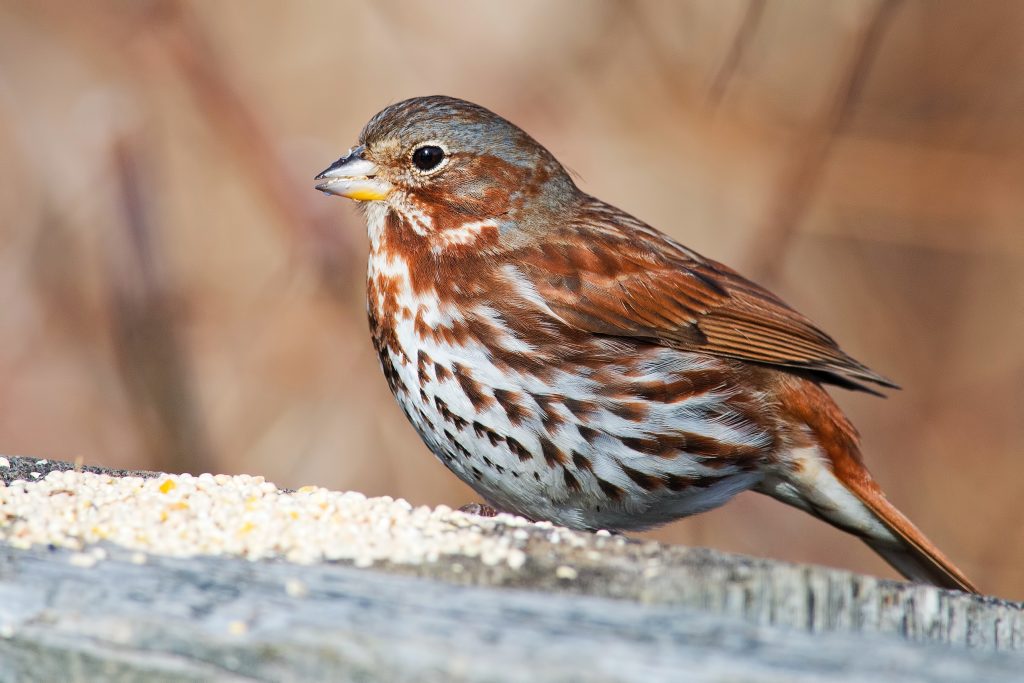
At this time of year, the largest and most handsome of the sparrows is inarguably the fox sparrow. It’s also one of the hardest species to find. Perhaps because of its size and brighter coloration, it is frequently hidden in the vegetation. The fox sparrow is typically over 8 inches in length and very stocky, with bold rufous streaking on its underparts. From the head down the back to the tip of the tail it is a “foxier” reddish in color. Several races of the fox sparrow exist in the U.S. and Canada, with those found farther west being browner all over.

The fox sparrows that we see in winter breed from northern Ontario east to Newfoundland and south into parts of Nova Scotia. They move south in fall and start to appear in North Carolina in October. They seem to flock loosely with other sparrows and finches during the colder months. They prefer habitat that is immediately adjacent to water. Although they eat mainly insects during the summer, in winter seeds and berries tend to make up much of their diet.

More often than not, fox sparrows can be found in expanses of bottomland forest, kicking vegetation and debris for food, though there are lucky backyard birdwatchers who regularly observe them taking advantage of millet and other small seeds under their feeders. During very cold and wet weather, they may move farther into drier areas in search of a meal. I don’t usually see them where I live unless it snows — our predominantly grassy yard is too open to appeal to them. However, we have wet woods with dense tangles of evergreen vegetation not too far away.

Because of their size, fox sparrows are quite strong and capable of uncovering food that is buried deep in the forest floor. They will actually use both feet together to scratch and dig beyond the reach of other small birds. If you are out in wet habitat — or if you check under your feeders after a mid-winter snowfall — you may be treated to a glimpse of one of these handsome and powerful birds.

O.Henry Ending

O.HENRY ENDING

Bad, Bad Baby

He’s the one to blame

By Cynthia Adams

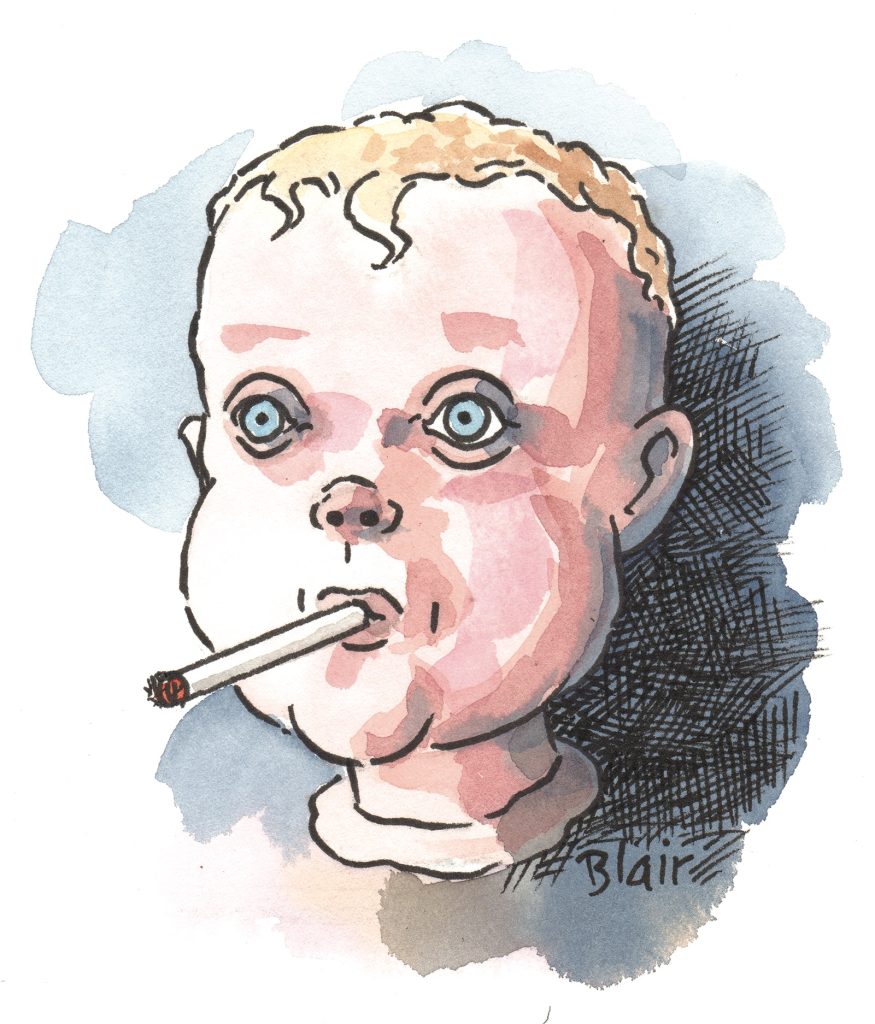
Some years ago, I bought a blue-eyed, Gerber-perfect baby boy. With molded blonde curls, an upturned nose, and wide eyes, his expression features bow-like lips, opened slightly, frozen in permanent surprise.  

My baby is a cherubic-looking bust. Picture a 1950s-era doll head. He presides over my work life.

It soon struck me that those rosebud lips were parted just enough for a cigarette.

Which, I discovered, they handily accommodated. 

The ciggie, a fake one I’ve used in a cigarette holder when I dressed as a flapper for a Halloween party, appears lighted. This took Gerber baby to another dimension. Unexpected. Unsettling.

There and then he became Bad Baby, official muse. Bad Baby, office mascot.  

Bad Baby has presided over many false starts and rewrites. He sits right above my computer, where Bad Baby never fails to make me smile when I need it. An artist friend, Dana, was particularly delighted when she popped into my office and spotted Bad Baby, who is parked beside a primitive painted folk-art bus with “Guanajuato” scrawled on it. 

The most compelling thing about the bus is the various clay figures of passengers. It’s difficult to say exactly what the crudely formed figures are doing, their arms raised in a gesture of helplessness, but it is appears they are trying to bail out. One figure stands on top of the hood and two on the roof, with others at the rear, appearing ready to leap into the unknown. I like the irony.  

Who hasn’t felt like bailing? Who hasn’t had feet of clay? I identified with the hapless figures wanting to exit.

Dana has no shortage of creative projects. So, when I confessed to having a creative dry spell, she laughed.

“Blame it on Bad Baby,” she drawled. Problem solved!

Bad Baby as scapegoat.  

Bad Baby is responsible for many things in my daily life. Typos. Missing the postal carrier when something needs to go out. Buying a greeting card and bungling the address.

Hangnails. Hangovers.   

When my iPhone texts were hacked (something that Apple aficionados suggest cannot happen), it didn’t occur to me to blame Bad Baby for the psycho-gibberish, disturbing rant, given he has no texting fingers.  

The recipient, a good friend, believed I had actually sent them. He asked his colleague to find out what had so provoked me. 

No, I assured her, I had sent no such messages. Yet there they were, on my phone.  

Also embarrassing? Misspellings, poor grammatical construction, and lack of sense. Worse, too, that a friend would think that a writer sent something so garbled. 

With red hot cheeks, I erased the texts (wouldn’t that make sense?), urged my friend to do the same, and dialed Apple support, immediately learning they needed the texts to trace the source.   

Calls are spoofed. Seems texts are as well.

So, a few months later, I flinched when Dana reacted to a jokey text, responding that I was a filthy animal.  

Was this real? Or had she also been hacked? Or had I been hacked again?

Shaken, I phoned her. She snorted, saying her text was merely a joke, a riff borrowed from the flick, Home Alone. Explaining how unnerved I’d been since the texting spoof, she snorted again.

“Blame it on Bad Baby,” my friend suggested again and laughed.

Just in case you’re wondering, Bad Baby is my invention. The OG. Turns out there is a 20-year-old rapper, Danielle Peskowitz Bregoli, who assumed the name Bhad Bhabie. I firmly believe my Bad Baby predates her Bhad Bhabie.  

And I like old-school spellings far better. No phat bhabie nor brat bhabie for me. Just plain old, conventional, ciggie-puffing Bad Baby.

“You can be too old for a lot of things, but you’re never too old to be afraid,” seems apropos, another line borrowed from Home Alone. Some are frightened by dolls — an actual phobia called pediophobia. 

An inexplicable text that appears to be from me but isn’t? That scares me.

And so, now I sit, scowling with narrowed eyes at Bad Baby, afraid to wonder just what havoc he might wreak next. But — if you should get a text rant from Bad Baby, please ignore it.

Almanac October 2025

ALMANAC

Almanac October

By Ashley Walshe

October is an ancient oak, quiet and delighted.

“Come, sit with me,” he whispers gleefully. “We’re nearly to the best part.”

The air is ripe with mischief and mystery. Can you smell the soil shifting? Feel the seasons turning in your bones?

Come, now. Rest at the roots of the mighty oak. Press your back against the furrowed bark and listen.

Goldenrod glows in the distance. Blackgum and sourwood blush crimson. A roost of crows howls of imminent darkness.

“Of course,” breathes the oak, hushed and peaceful. “But the darkness only sweetens the light.”

As a swallowtail sails across the crisp blue sky, birch leaves tremble on slender limbs; a crow shrieks of wet earth and swan songs.

You close your eyes, feel the vibration of sapsucker rapping upon sturdy trunk.

“Do you feel that?” you ask the oak.

“I feel everything,” he murmurs.

When you open your eyes, the colors are different. The green has been stripped from poplar and maple, reds and yellows made luminous by the autumn sun. 

At once, the great oak shakes loose a smattering of acorns.

“Watch this,” he softly chuckles, sending the gray squirrels scurrying.

A sudden rush of wind sends a shiver down your spine. Leaves descend in all directions, wave after fluttering wave, in kaleidoscopic glory.

The goldenrod is fading. The sunlight, too. The swallowtail,
gone with the wind.

“Things are getting good now,” smiles the oak, his mottled leaves gently rustling.

You sense your own soil shifting. Feel the sweet ache of new beginnings. Let yourself drop into ever deepening stillness.

Soup’s On

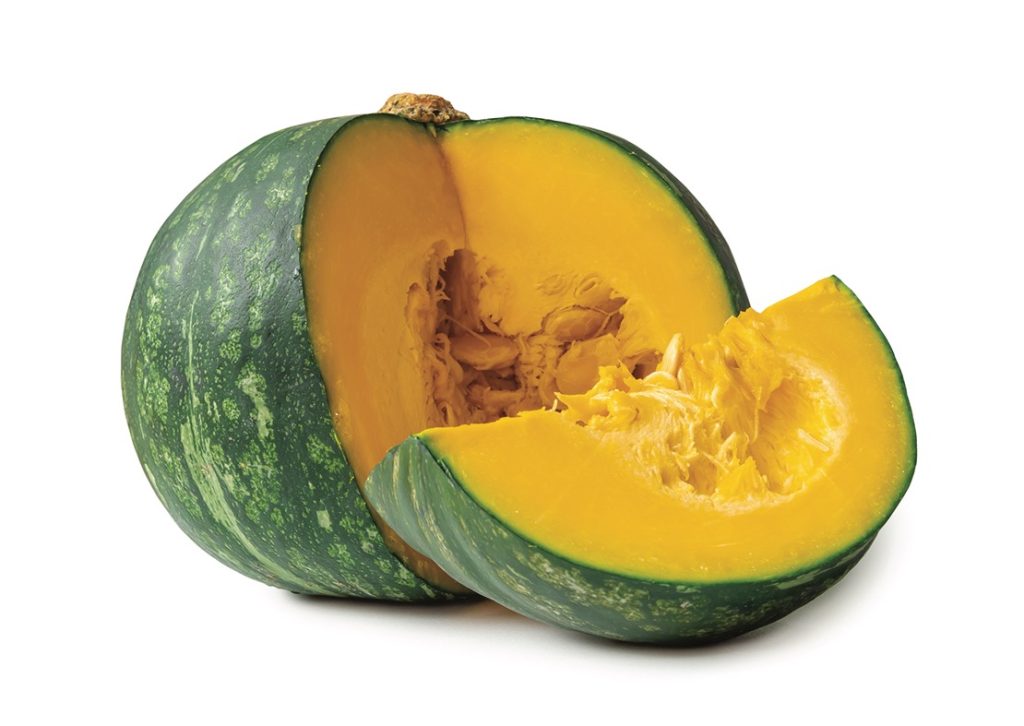
It’s winter squash season. As the autumn days shift from crisp to chilling, what could be sweeter — or more savory — than roasted delicata, cinnamon-laced and fork tender? Acorn squash tart with maple, ricotta and walnuts? Cream of squash soup (butternut or kabocha) served with a crispy hunk of sourdough?

And let’s not forget pumpkin (and pumpkin spice) mania. It’s all here. Enjoy!

Center of the Cosmos

Until the first frost arrives — weeks or days or blinks from now — delicate blossoms sway on tall, slender stems, brightening the garden with color and whimsy.

Hello, cosmos.

One of October’s birth flowers (marigold, the other), cosmos are said to symbolize harmony and balance, their orderly petals having inspired their genus name. Native to Mexico, this daisy-like annual thrives in hot, dry climes. It’s the traditional flower for a second wedding anniversary gift and, according to The Old Farmer’s Almanac, was once thought to attract fairies to the garden.

Could be true. Just look how the butterflies take to them.

Wandering Billy

WANDERING BILLY

Picture This

Mac Barnett’s illustrated children’s books draw on connections between generations

By Billy Ingram

“There are perhaps no days of our childhood we lived so fully as those we spent with a favorite book.” 
— Marcel Proust

Is there a beloved storybook you fondly recall being read to you as a child? For me, it was Pat the Bunny by Dorothy Kunhardt. Credited with being the very first interactive book, it offered tots a “touch and feel” experience in lieu of a narrative. Bound with white plastic ribbing, each turn of its pages reminded toddlers of everyday experiences, like feeling Daddy’s stubble (a schmear of sandpaper), inhaling the scent of wild flowers, playing peek-a-boo with a patch of cloth and patting an upright, bunny-shaped fluff of faux fur.

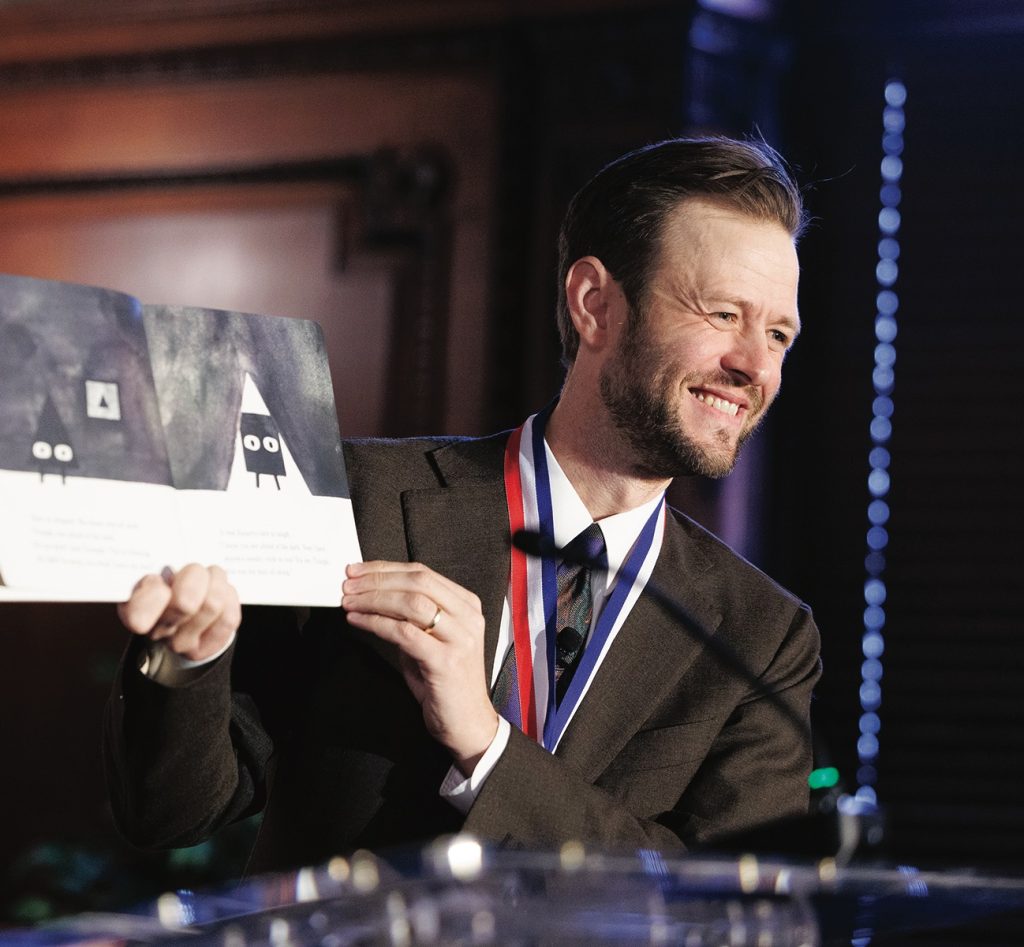
For lovers of children’s pictorial storybooks, there’s something really special happening this month. Out of 380 proposals submitted by cities around the nation, Greensboro was one of only five boroughs selected to host the Library of Congress’ National Ambassador for Young People’s Literature, Mac Barnett. The ninth to hold this title, he will be presenting Behold, The Picture Book! Let’s Celebrate Stories We Can Feel, Hear, and See, his tribute to the colorful legacy of children’s literature.

Barnett has authored 62 books for youngsters (he estimates) and has received two Caldecott Honors, three New York Times/New York Public Library Best Illustrated Awards, three E.B. White Read Aloud Awards — the accolades go on and on. Now in its second season on Apple TV+, he’s the co-creator, with illustrator Jon Klassen, of Shape Island, an animated series based on their New York Times-bestselling graphic novels for toddlers, The Shapes Trilogy, cloud-seeding infantile imaginations while simultaneously encouraging critical-thinking skills.

Barnett’s The First Cat in Space series, in collaboration with illustrator Shawn Harris, is rendered in a sparkling, modern style with a subtle hat tip to comic artist Jack Kirby’s square-fingered, forced perspective. “Shawn and I have been friends since we were 6 years old,” the author reveals. “And now Shawn is one of the finest children’s illustrators working today. When I was a kid, I loved comic strips like Calvin and Hobbes and Garfield.” Admittedly intimidated by the superhero genre, he says, “Shawn read all that stuff and he would explain to me a run of Spider-Man or what was happening to Superman and I would get it all filtered through him.” No dust on these jackets, infectiously fusing a Calvin-ism whimsy with 1980s Marvel super-heroic showmanship, the resulting outta-sight escapades of this far-out feline are what The New York Times proclaims “hilarious.”

For early readers eager for enigmatic entertainment, Barnett’s Brixton Brothers whodunnits serve as a mod nod to circa 1960s Hardy Boys mysteries. School Library Journal declares Brixton Brothers’ premiere volume, The Case of the Case of Mistaken Identity, “one of the funniest and most promising series openers in years.” The author’s attraction to those juvenile novels written long ago is rooted in the macabre. “As a kid, I was terrified of being kidnapped,” he quips, “and the Hardy Boys get kidnapped like three times per book.”

Barnett was especially fascinated by the sleuthing siblings’ escape strategy after being tied up. “They would flex their muscles, the bad guys would leave the room; then, they would relax their muscles and the ropes would just fall to the ground,” he recalls. “And I was like, this is what I am going to do when I get kidnapped.” To test this technique, in second grade he convinced Harris to secure him with a jump rope using knots Harris had learned in the Boy Scouts. “I relaxed and, of course, the ropes just stayed there. And I realized the Hardy Boys worked out a lot harder than I did at age 7.” This eventually formed the genesis for his Brixton Brothers’ exploits “about a kid who tries and fails to be a Hardy Boy.”

There is unambiguous, statistical information that reading to children has a lifelong educational impact. “The picture book is one of the great American art forms,” Barnett insists. “And reading out loud to kids is an intergenerational, artistic experience — an adult and a kid coming together over artwork, experiencing it, having feelings about it, and then, hopefully, talking to each other about whether they like it, what they think it means.”

According to Barnett, the first illustrated storybook for kids was Wanda Gag’s Millions of Cats in 1928. “There were books for children before that, primarily though, they were illustrated nursery rhymes, Bible stories, folk tales.” Gag pioneered the use of text and pictures in tandem to tell a story.

“The first book that I really remember living inside of was In the Night Kitchen.” Barnett discovered the absurdist dreamworld of Maurice Sendak as a youngster in the early 1980s. “It just made perfect sense to me. This is what it’s like inside my brain, that recognition of a kindred consciousness. And you read it as an adult and you’re like, this is such a wild experimental text.”

If offered the opportunity, I think just about anyone would write a children’s book. What advice can Barnett offer? “You’ve got to learn how picture books work,” he contends. “This is a way of telling stories in a very specific way. It’s easy to write a picture book, it’s very difficult to write a great picture book. And the first step is to learn the history of the art form to really understand how stories are told this way.”

Here’s an opportunity to do just that. The free event, Behold, The Picture Book! Let’s Celebrate Stories We Can Feel, Hear, and See, will be held at 10 a.m, Saturday, October 25, in N.C. A&T State University’s Harrison Auditorium. While he’s in the ’Boro for two days, Barnett will also host programs at area schools, where every student will receive one of his endlessly engaging picture books donated by Candlewick Press (as will the young ones attending the Harris Auditorium celebration, courtesy of Greensboro Bound).

“Greenboro just had an incredible proposal,” Barnett says about the selection process coordinated between The Library of Congress and Every Child a Reader, a literacy charity. “They were looking for communities with strong libraries and bookstores to make sure that these events were of value to the community. A big part of this is talking to adults about why kids’ books matter, why they are real literature and how to make sure that kids have good books to read.” He believes that, for Greensboro, “it’s just a great opportunity to talk to educators, families and even kids about the value of children’s literature in a young person’s life.”

Award-winning American (and sometimes) children’s author Emilie Buchwald (Gildaen: The Heroic Adventures of a Most Unusual Rabbit) once observed, “Children are made readers on the laps of their parents.” True, it’s never too soon to fold back colorful covers and expose spongy youngsters to worlds of wonder and limitless curiosity. Or just to pet the fluffy cartoon bunny.

For information about the free public event, visit greensborobound.com. Registration is strongly encouraged.

Poem October 2025

POEM

October 2025

Little Betsy

A ghost is no good to a child.

Maybe he crooks a finger, as if to beckon

the girl to play. Maybe he bounds spritely

down corridors, into kitchens.

But if she hands him a dolly or ball

and he reaches with his spectral hand,

he cannot clutch the gift, and if his failed grasp

surprises him, if the lack of resistance —

for everything real resists the touch —

unbalances him, his incorporeal fingers

might graze the child’s offering hand.

What would you call the gooseflesh

raised by the frolicsome dead?

There is no joy in it, only a deep well

of longing cold, the kind that claws

through every crack in the wall.

— Ross White