Poem May 2023




By Cynthia Adams
Photographs by Lynn Donovan
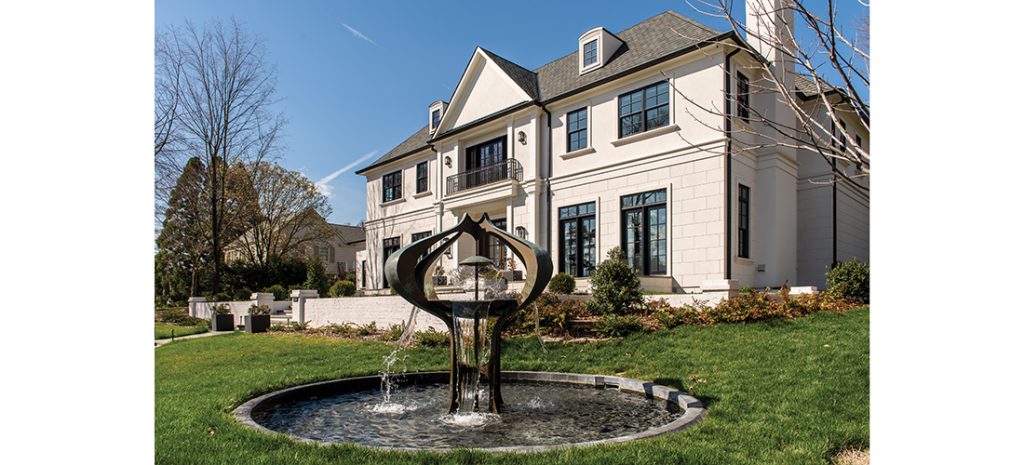
For decades, a Paul Billingsley-designed fountain was a centerpiece during the glory days of the sprawling Southcenter Mall near Seattle, Washington. Now, the unique work has been rescued, brought thousands of mile across country to occupy pride-of-place at a new home in Greensboro’s Irving Park.
How — and why — did this happen?
The phone call came early one frigid winter’s morning.
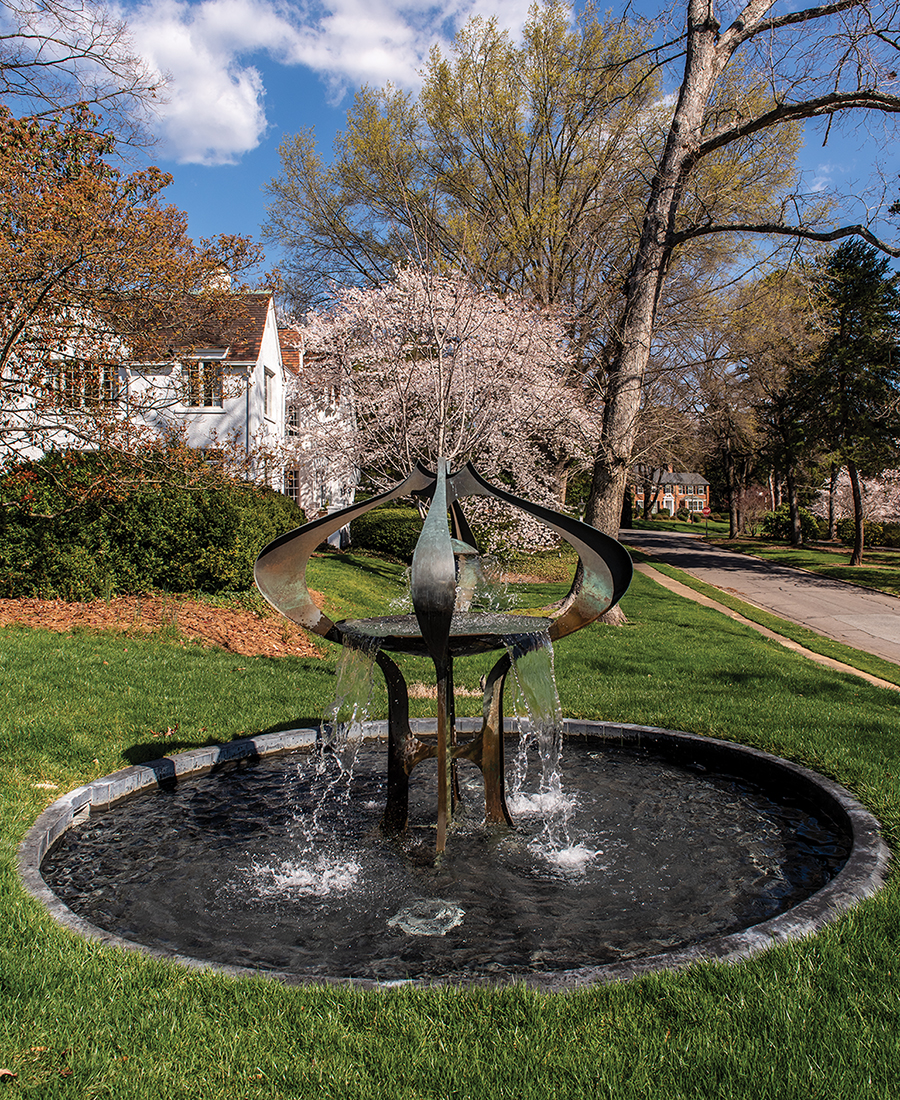
“Hey, go check out this fountain. It’s really neat, and you’ll want to get some pictures while it’s partially frozen,” said lover-of-the-great-outdoors Daniel Craft, who called me with the tip. He dangled a tantalizing tidbit: “There’s a great story that goes along with it.”
Having admired the striking water feature — a lotus flower — that was equal parts bronze sculpture and fountain, Craft was curious about the distinctive fountain. He contacted neighbors Marius and Hilary Andersen to learn more.
He learned the mesmerizing beauty was more than a graceful fountain—it held a mystery at its heart. And its provenance spanned from Seattle to Greensboro — with a story that began 55 years ago.
More than one fountain was intertwined with its history, too, the Andersens explained.
In 1968, a fountain was commissioned from noted Washington state sculptor George Tsutakawa by developers of the Southcenter Mall and was ready for installation. Tsutakawa had designed and built scores of fountains and works of public art; this particular piece was intended for a 1-million-square-foot mall being built in Tukwila, Washington, outside Seattle. He had produced another in 1962 for Northgate Shopping Center, also in Washington.
The Tsutakawa fountain, however, went missing. It was stolen shortly after delivery at the site — before it was installed.
Hilary Andersen’s father, Don Samuelson, a Seattle native, was a young executive with Bon Marché, a primary anchor of the new mall. He remembers the fountain’s disappearance well. (And though he doesn’t have a photo of the original work, he recalls details which were well known to his daughter, Hilary, and her husband, Marius.)
“It was made in bronze, and people steal copper and bronze all the time,” relates Marius. “It could have been hauled off for scrap — who knows?”
That, too, remains a mystery, as the fountain was never recovered.
Tsutakawa was known for sculptures that fused Japanese and American styles. Among a slew of other notable works found throughout America, Canada and Japan, he designed the medals for the 1962 Seattle World’s Fair and the 1976 Spokane Exposition.
The mall developers reached back to Tsutakawa to request a replacement, but his work was in such high demand he was unable to accept another commission. Instead, his student assistant, Paul Billingsley III, also a fine artist, took on the project. The resulting fountain, a graceful lotus flower, was his own design. Naturally, he was influenced by the master artist.
“I think if you look at the lotus flower, you’d be hard pressed to say that it’s not along the lines of other sculptures that Tsutakawa made.” Not a replica of the lost original, explains Marius, but done in the spirit of the original.
Fortunately, the replacement fountain Billingsley created was safely delivered and escaped theft.
“They install it, have an opening and big party in the mall — this was installed inside the mall. Fast forward. It’s part of the mall for many years, until the mid-’90s when they’re remodeling,” says Marius. “By this time, Hilary’s dad has been an exec with Bon Marché, traveling throughout the Pacific Northwest.”
“It was probably 1996,” adds Hilary.
As fate would have it, her father, now a vice president, returned to Washington State’s Tukwila mall where he began his career nearly 30 years earlier. And he brought fond memories of the graceful fountain. He well remembered the fountain’s backstory, which was part of his own experiences, having participated in the opening celebration when the work was first installed at Southcenter.
When Samuelson learned of a scheduled remodel, he asked the mall owners what they were going to do with the fountain. Learning it was slated to be removed, he offered to buy it. His offer was accepted.
For many years, Tsutakawa’s name was renowned in the Northwest, especially the Puget Sound area, and so was Billingsley’s. The initials “TUB” had frequently appeared on Tsutakawa’s installations — “B” for Billingsley.
Billingsley earned a fine arts degree at the University of Washington, and, after a stint in the Army, returned to Seattle and worked for Tsutakawa. According to his obituary, fountains they created were displayed in Seattle, Los Angeles, Honolulu and abroad.
Hilary’s father, Samuelson, called Marius, who then lived nearby, with an S.O.S. “I need you to bring your pickup truck and help me,” he told his son-in-law.
“We took it home to his house,” says Marius. In a vintage photo, he shows the work loaded on the back of a truck.
Samuelson wanted the fountain to be saved and enjoyed. He planned to donate it to the city of Tukwila for a public space or park. As is frequently the case with donated works of public art, there are costs associated with siting a piece, maintaining and also insuring it.
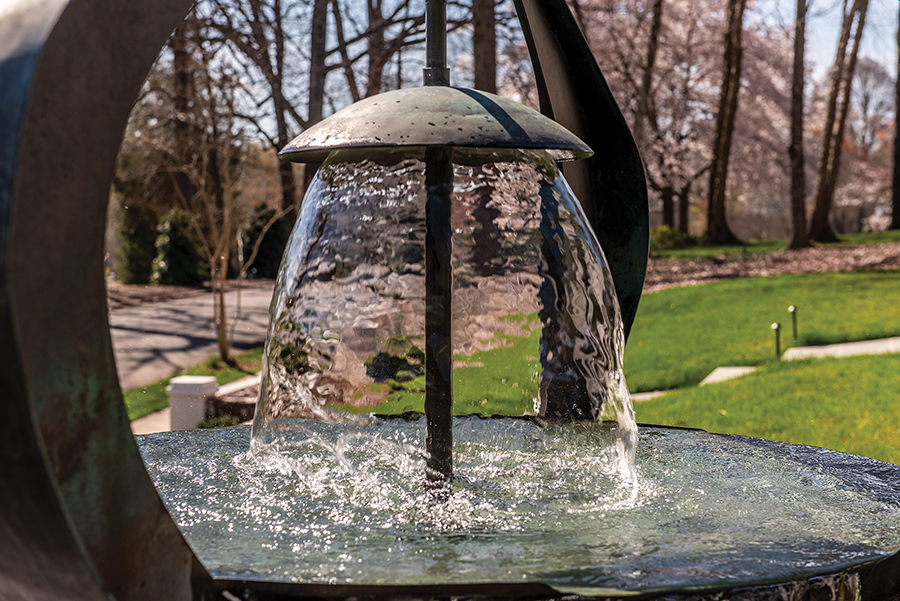
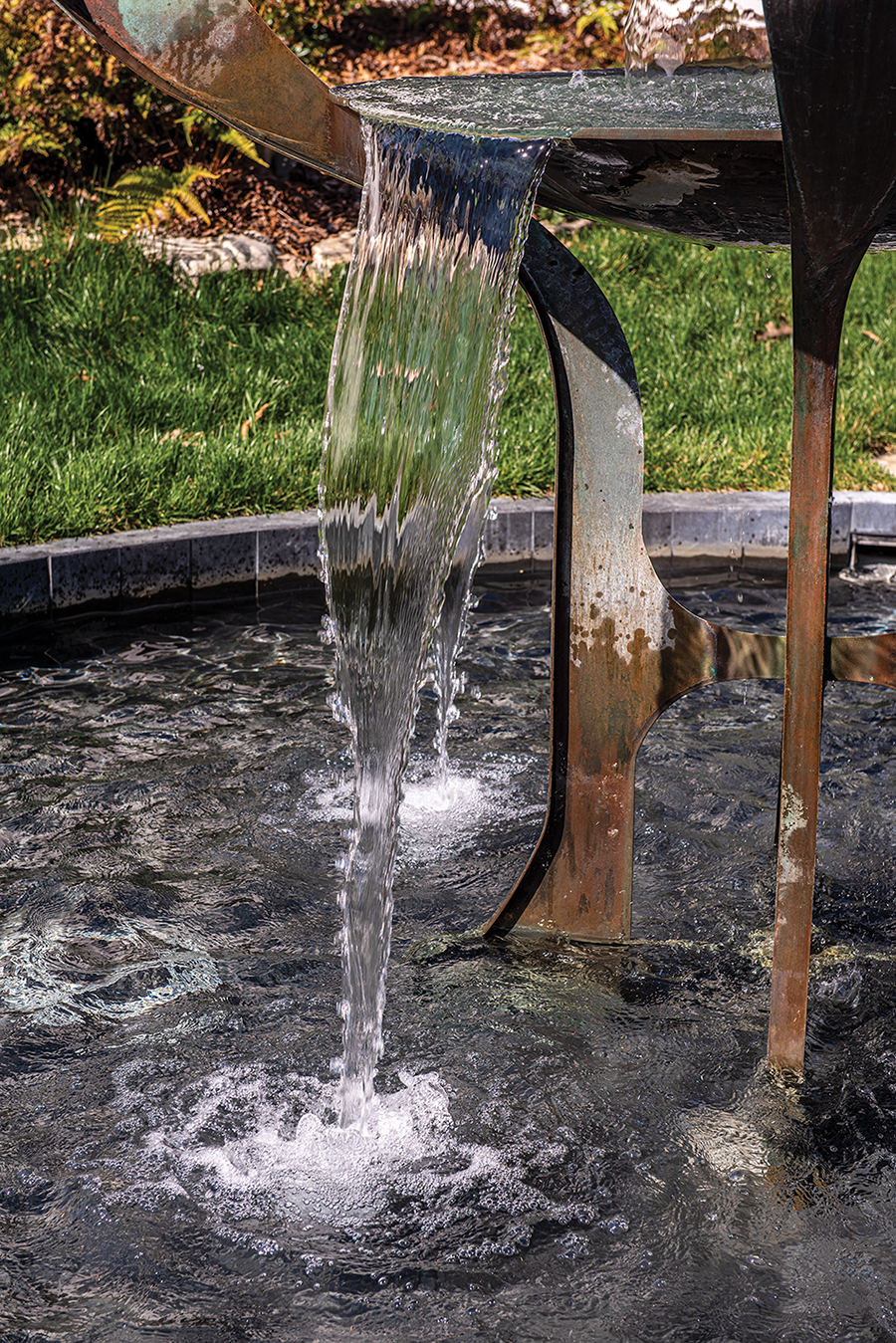
Instead, the fountain landed in Samuelson’s backyard, explains Marius. “He didn’t install it with a pump as a fountain, just as a sculpture.”
At the time, neither Hilary nor her mom were sure about it. But Marius and his father-in-law were true fans.
Fast forward to 2020. The couple, founders of Creative Snacks, had relocated to the Triad.
Once their new North Carolina home was built, Samuelson, knowing how Marius loved the fountain, approached him. “He says, ‘This deserves a home. Would you want it?’” Marius relates.
But now Hilary, who had developed her eye for art, truly admired the work, too. The couple agreed, and made plans for the piece to be shipped from the West Coast to Greensboro in the fall of 2020 as they were completing their home.
“I had to get a crate built for it to be shipped; then ship it and set it up. So, this is the most expensive gift I’ve ever been given,” Marius says and shrugs with a laugh.
But once it arrived, they discovered the fountain was too big for the courtyard outside their bedroom as initially discussed. Plus, nobody would see it there.
Instead, the Andersens decided to place it in the front yard, where it was installed by the summer of 2021. Once up and running, it became an instant showstopper.
Eventually, new pieces of information flowed, too. Billingsley had died in November of 2013, and his family sought information about his works.
“My father-in-law is a Seattle native,” says Marius. “He has a Facebook presence. Paul Billingsley’s son, Peter, posts there, and asks, does anybody knows what happened to this fountain? Hilary’s dad says, ‘Hey, I know exactly what happened!’”
Samuelson tried to learn more about the artist, Paul Billingsley, and his works. Peter told him that at least two other fountains created by his father were purchased and placed in North Carolina — possibly as close by as the Triangle or Wilmington.
He learned of Billingsley’s many talents. In addition to using his creative skills in art, Billingsley contributed to designing molds used in the fabrication of artificial bones for Pacific Research. He designed a double-keel boat, and was a prolific bluegrass musician who built his own instruments. He also designed and built his own home, and converted a VW bug into an electric car, according to his obituary.
The fact that the fountain was going to be hauled away was the part, Marius says, that deeply motivated him. A marvelous artwork might have been lost, destroyed for scrap.
“What’s wrong with people? That’s not going to happen,” he determined.
With the fountain in Greensboro, the couple realized it was originally built for indoor use. Concerned about the cold of winter, Marius went to Tractor Supply and found heaters farmers use to keep livestock watering troughs from freezing. Once in place, the heaters worked to his great satisfaction.
Ultimately, the fountain’s biggest advocate, Samuelson, traveled to Greensboro in May 2022 for a grandchild’s graduation and finally saw the fountain restored to its former glory, fully installed and operational.
“Our neighbors, Kerry and John Ellison, said ‘Thank you for this.’ The fountain reminds them of being in Aspen, given the way the light dances on the leaves. They have coffee on their porch and enjoy the white noise of it,” says Hilary.
When Hilary learned a few people didn’t necessarily like the fountain, she grew protective. “What do you mean? How can you not love it?”
But Marius likes that not everyone agreed. “I love that some think it’s terrible and some love it.” He feels that’s what art does — it stimulates.
The couple mentions other Greensboro homes with avant garde sculptures, something they have come to admire.
“We don’t pretend to be art connoisseurs,” the couple stresses. But their daughter, an artist, is attending the prestigious Rhode Island School of Design this fall.
Meanwhile, the family hopes to visit Billingsley’s other North Carolina-based fountains.
Who knows how many exist in total? When Tsutakawa retired from teaching, he undertook 60 commissions between 1960–69. That time period dovetails with when Billingsley worked beside him as a valued student assistant. An impressive body of work also includes sculptures, gates and fountains. Among others, Tsutakawa created the East Cloister Garth Fountain at the National Cathedral in Washington, D.C.
The likelihood is strong that Paul Billingsley was working alongside as these notable installations were created — and they may even bear the tell-tale “TUB” initials.
In Antique Road Show parlance, check artwork for the all-important signature — even outdoor statuary. They may reveal a surprising history and perhaps an odyssey. OH

A Reidsville attorney’s beautiful living legacy
By Ross Howell Jr.
Photographs by Lynn Donovan

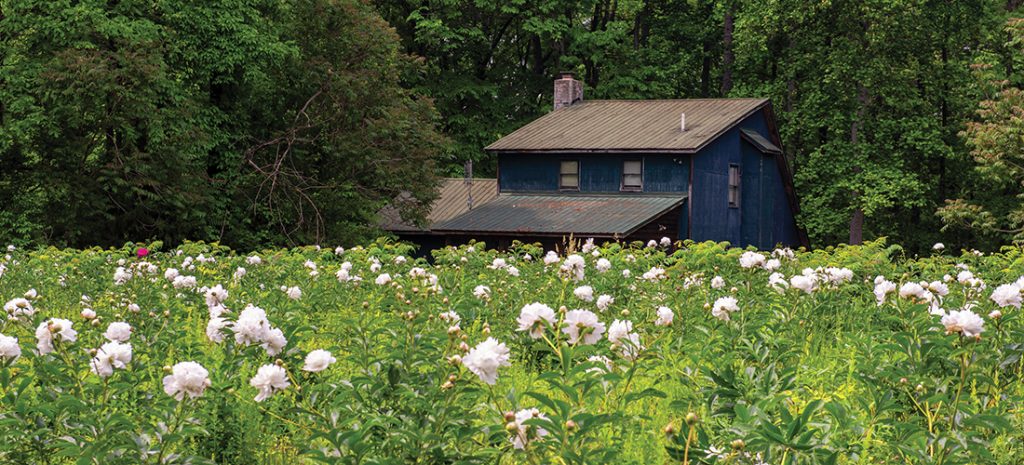
At the end of a woodsy farm road near Reidsville, I drive up to a snug, modest house that was built by the late Benjamin Ross Wrenn.
I park on a circular drive in front of the house. As I get out of the car, I notice a horse paddock just beyond the yard.
Wrenn’s daughters, Nancy and Heather, accompanied by a shaggy farm dog, come out the front door of the house to greet me.
Born in Greensboro to a mother who’d kept lovely perennial gardens in her native Virginia and a father who was a renowned greenskeeper, “Benny” Wrenn grew up loving the outdoors. He was given a pony by a friend of the family, Edward Benjamin, the developer of the Starmount neighborhood and Friendly Shopping Center.
“When the neighborhood boys were out riding bikes,” Heather says, “Dad’d show up riding his pony.”
Young Wrenn was the namesake of developer Benjamin and famed golf course designer Donald Ross, another family friend.
He attended Wake Forest University on a golf scholarship and earned his law degree there. For 55 years, Wrenn ran a successful criminal law practice in Reidsville. And he was a man of many interests.
“Dad taught himself to read, write and speak Spanish at the age of 70,” Heather tells me. “He was a lifelong learner.”
I take a seat at the dining room table with his daughters.
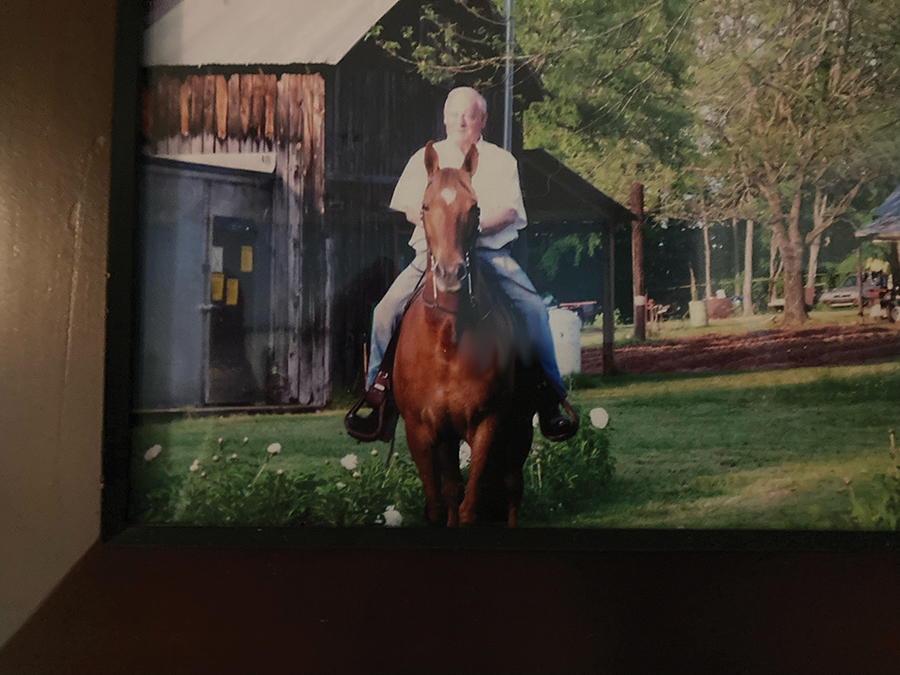
Though he passed away in 2017, Wrenn’s presence suffuses the place. Facing me is a floor-to-ceiling mural of rolling Piedmont farmland painted by an artist friend. Heather points out a cabinet that her father made by hand. There are paintings of horses hanging on the walls, along with photos of Wrenn and his daughters on horseback.
“He rode right up to age 75,” Nancy says. “He always thought of himself as a cowboy.” The sisters smile at each other.
Over the entrance to the adjoining room hangs a sign that reads “Benny’s Kitchen.”
“He loved to cook, too,” Heather says. “He was a phenomenal cook!”
The farm dog that greeted me whines to go out, and Nancy rises to open the door.
She tells me her father purchased the 70-acre farm in 1965.
“The farmer who owned the place was mowing the bottom pasture with his mule,” Nancy continues, returning to her seat. “Dad bought it from him right there on the spot.”
“I think initially he thought of the farm as his respite, his getaway from law work, where he could follow his passion,” she adds. “This was his happy place.”
But her father also wanted the farm to sustain itself financially. Ever the visionary, he set up a corporation, naming it Heathernan Inc., in honor of his daughters, to provide the framework.
Wrenn started with livestock.
“He named the farm the Cherokee Cattle Company,” Heather says. But raising cattle didn’t prove to be profitable. And since he wasn’t living on the property full-time, there were other problems.
“It always seemed like in the middle of the night, somebody would call Dad to tell him his cows were out in the road,” Heather says.
Wrenn gave up on the livestock and decided to plant Christmas trees. But the summer sun of the Piedmont proved to be too strong for the white pines he’d brought from the North Carolina mountains.
“Dad was always thinking about the future, how to sustain the farm, how to get revenues coming in,” Nancy says.
So he decided to build greenhouses.
“We started with five greenhouses to propagate annuals,” Heather says. Wrenn purchased flats of flowering plants from suppliers, then potted them in terra cotta containers he’d found at a good price in Georgia.
Ever resourceful, Wrenn designed a production line.
“He built this great big box,” Heather continues, “and he’d take his bulldozer and shove mulch and good soil in, and everybody had a cubbyhole, and you’d grab your soil, pop your plant in a pot. It was mass production!”
The potted annuals were so well received at farmers’ markets that Wrenn and his daughters expanded their selection, offering hostas, daylilies and tuberoses.
“Remember those beautiful tuberoses?” Nancy asks.
Heather nods.
But again, there were problems, especially for a father with a full-time law practice. Even with perennials, potting was labor-intensive. The greenhouses were expensive to maintain and costly to irrigate, heat and cool.
Then Wrenn announced his semi-retirement from his law practice.
“He got real serious about what he was going to do next on the farm,” Heather says.
“So he started his research,” Nancy adds.
This was before the internet. Wrenn read book after book. He researched plants and growing zones. He studied soil types.
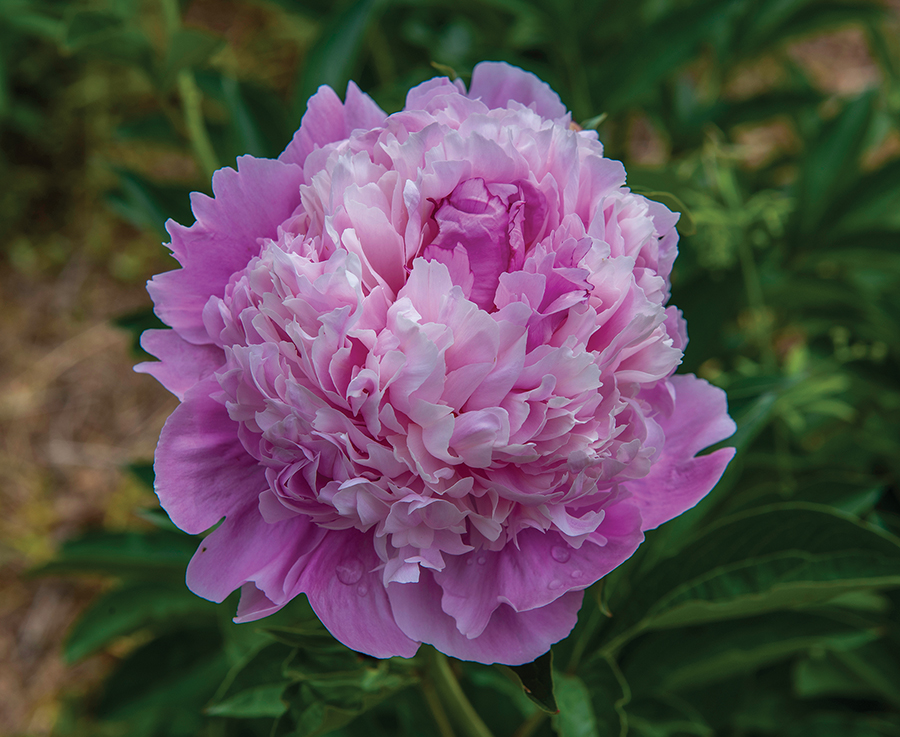
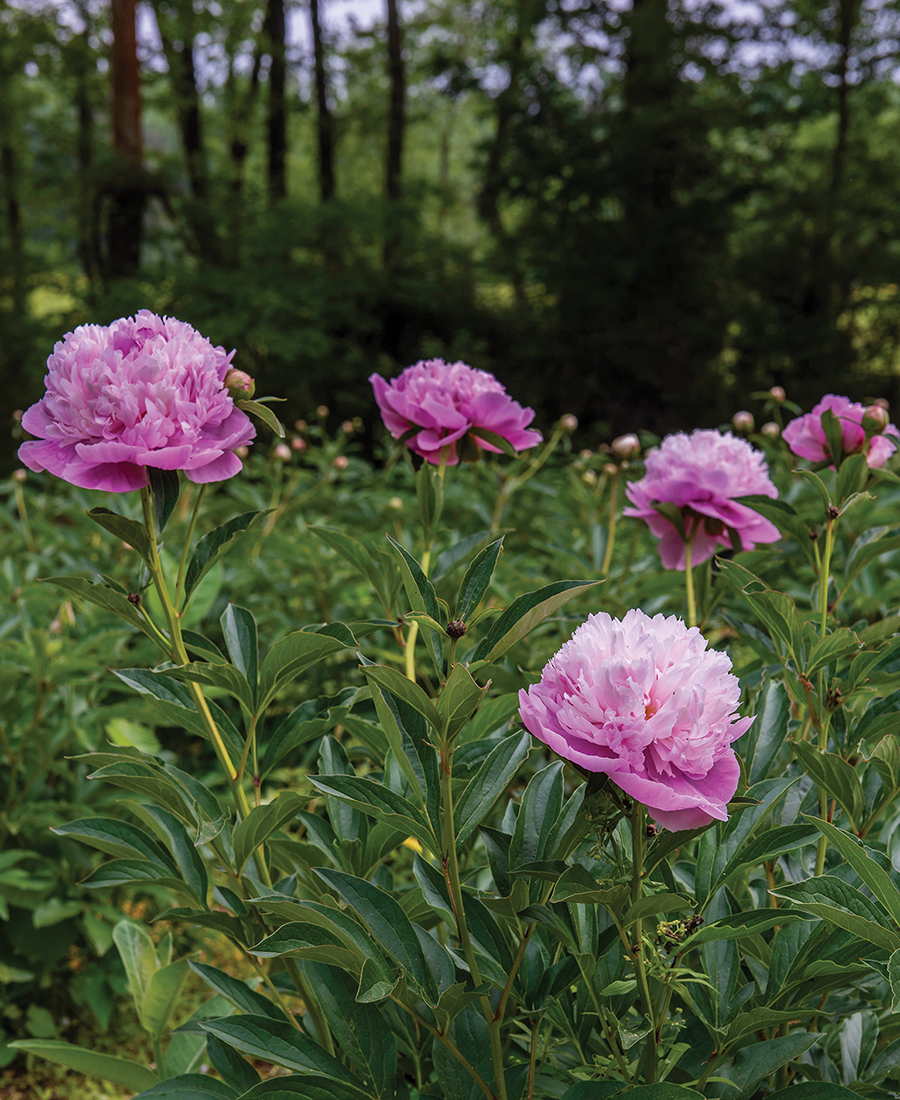
What he discovered was that the farm was situated in a region well-suited to grow an elegantly beautiful flower that had been cultivated in China for millennia. Even better, it was a hardy flower requiring relatively little maintenance in order to thrive.
“And deer won’t eat them,” Nancy adds.
Genus Paeonia. The peony.
And so, in time, Cherokee Cattle Company became The Peony Patch.
“He bought bulbs in batches direct from Holland,” Heather says.
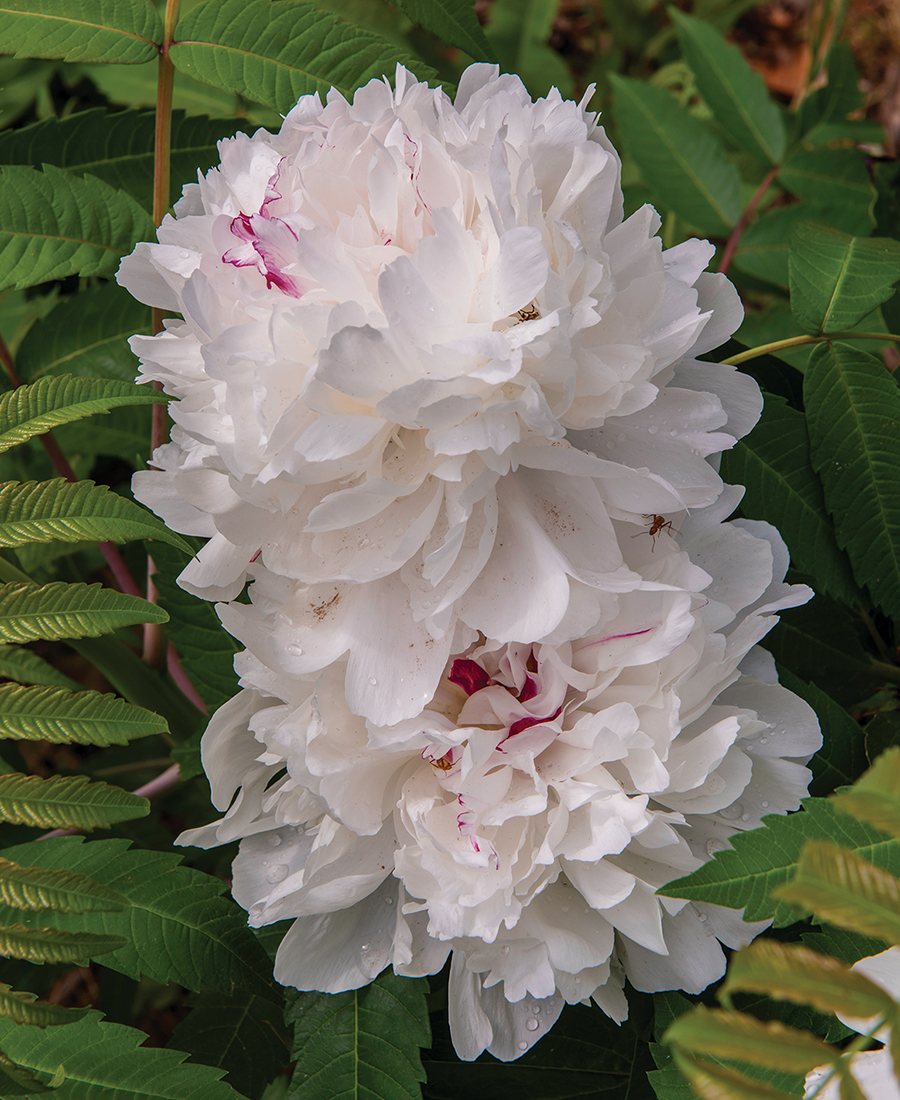
“He started very simple, with whites and pinks,” Nancy continues. “He was thinking about marketability. Peonies are a big flower for weddings. Brides love the whites.”
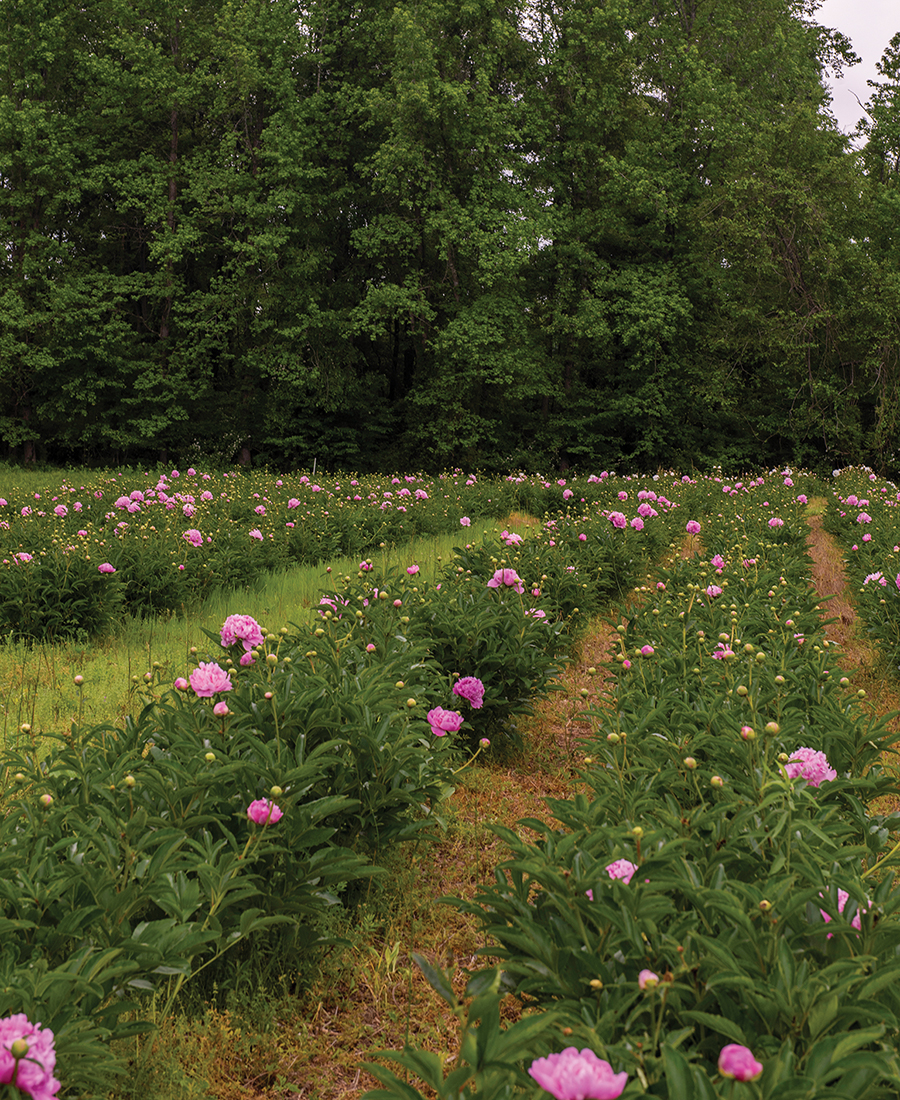
Initially, Wrenn planted 2 acres, carefully measuring the distances between the bulbs, their depth in the soil and the grassy paths between rows. The peonies flowered beautifully the first year, but there could be no harvest.
“It’s a long-term investment,” Heather says. “By rule, you should not cut stems from a peony till it’s 3 years old.”
Seeing that first “blush,” with the peonies in peak bloom, Wrenn wanted more.
“He made me cut my horse pasture in half,” Heather laughs.
Carefully, incrementally, Wrenn added field after field.
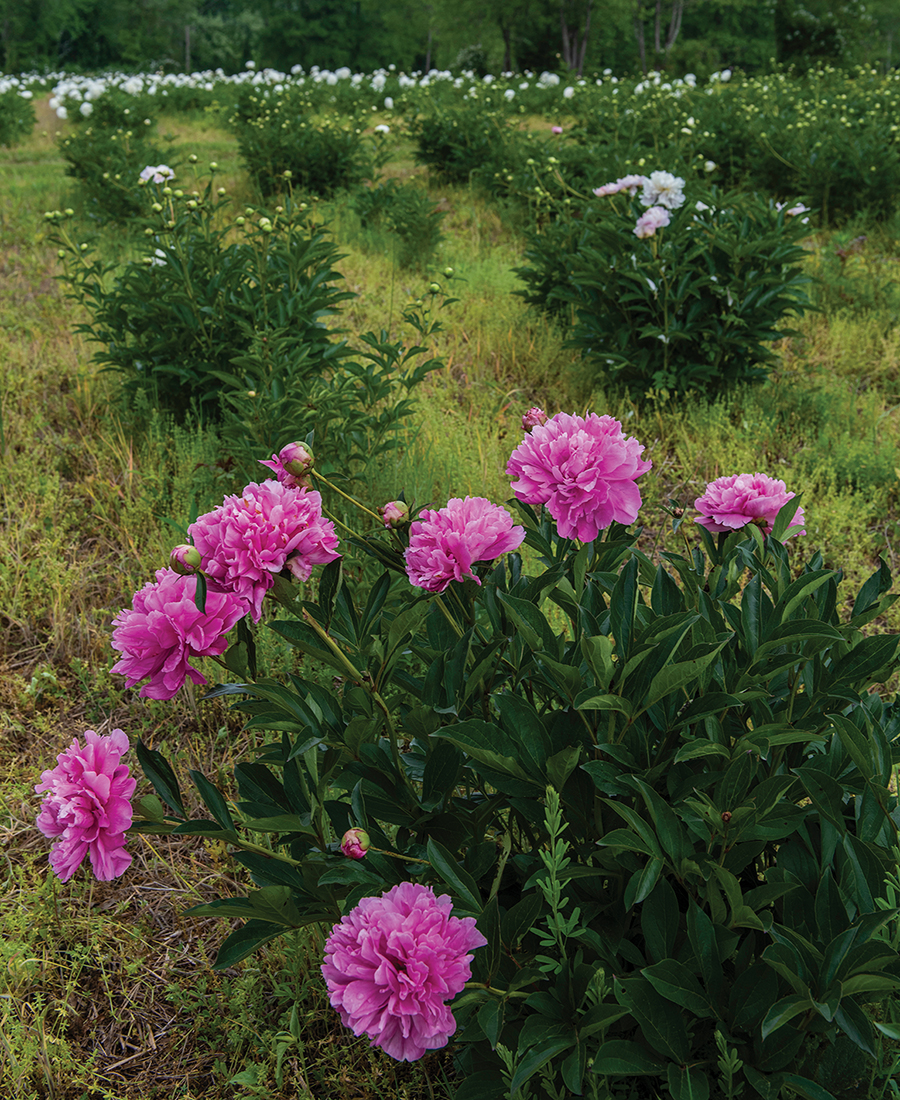
Today, The Peony Patch comprises some 15 acres, with more than 50,000 bulbs in the ground.
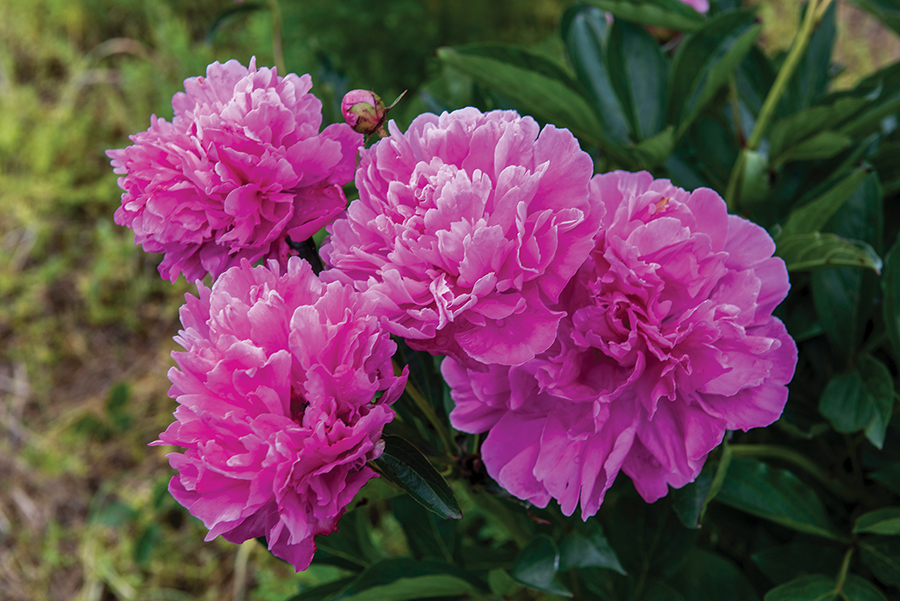
There are four varieties. Duchesse de Nemours and Festiva Maxima are the whites, and Monsieur Jules Elie and Sarah Bernhardt are the pinks. All are double-blossom varieties, so they’re enormous.
In a typical year, the peonies are cut over a 14- to 21-day period beginning May 1, depending upon the weather.
This is a time of intense labor.
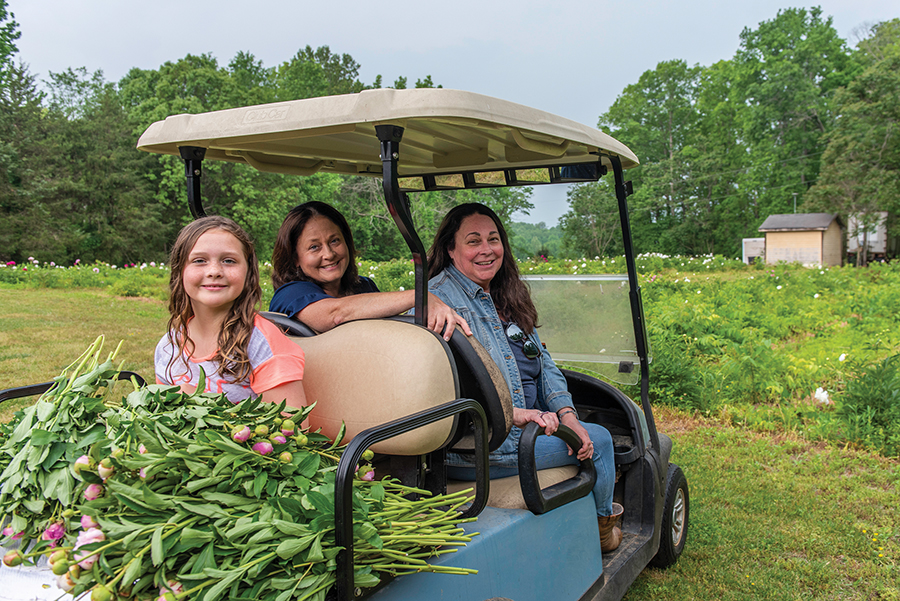
“The first couple days, we’re cutting maybe a couple hundred stems, walking each row, each field,” Nancy says. By the third or fourth day — especially if there’s a day of full sunshine with temperatures in the 70s or 80s — the cutters might harvest 3,000 to 4,000 stems a day.
Fortunately, there are three laborers who have been with the farm for years. They see to it that each stem is individually cut, placed carefully in stackable bins and stored in a walk-in cooler at 34–36 degrees Fahrenheit for no more than two weeks.
“The flowers have to be cut at just the right time,” says Heather. “You can have one that’s not just right at 7 o’clock in the morning but at 4 o’clock in the afternoon that same day, you’d better get it.” Cutters walk each row in each field, gathering flowers, sometimes twice a day.
“Ideally we harvest stems that are at least 24 inches long,” Nancy says. “And since the blossoms are so big, they’re very heavy.”
The primary market for the peonies is wholesalers. Many come directly to the farm to pick up their orders, though Nancy or Heather might make deliveries on a limited basis as far away as Raleigh or Charlotte.
One of their most loyal customers is Randy McManus of Randy McManus Designs in Greensboro.
“Randy has been a real business partner since my Dad put his first peony in the ground,” Nancy says. “He’s a true peony lover.”
After the back-breaking surge of the blush, the harvest gradually tapers off. In a typical season, The Peony Patch will sell 10,000–12,000 stems. Even after harvest, the fields remain colorful for a few more days.
“We always leave at least three blossoms on each bush,” Heather says.
In preparation for the next season, the stackable bins will be washed and stored. The cooler will be shut down and cleaned with bleach. The fields will be bush hogged. Later — and only after at least two hard frosts — the fields are burned and raked for debris, as wind and rain permit.
Usually Nancy and her family — including grandchildren — will drive up from her home in Wilmington to celebrate Christmas at the farm with Heather and her husband.
Then it’s a waiting game. Waiting to see when the tiny red buttons of new peony shoots begin to show themselves for spring.
There are ongoing challenges for Wrenn’s daughters, of course. The need to replace equipment costing thousands of dollars. A new species of tree invading the fields. The creeping vines of poison oak choking the bulbs. And, since fields have yielded cuttings for well more than 20 years, they are long past the time when most growers dig up, clean and sterilize bulbs to rotate them into new fields.
And there’s slim payoff on the investment and work after expenses. Nancy and Heather tell me it’s actually the income from rental houses their father put on the farm that goes farthest to sustain it.
So why continue?
“Sometimes the phone rings during harvest and it’s a little old man looking for peonies to give his wife for their 70th anniversary celebration,” Heather says. “Or it’s a bride’s mother who says all her daughter wants for her wedding are peonies. Or it’s just someone who remembers the flowers that grew in their grandmother’s garden. People feel such passion for the peony. I think that’s why Dad selected it.”
Wrenn’s other daughter answers this way.
“I’m a project manager for an information technology company and Heather’s a nurse,” says Nancy. “The peonies are a real change of pace for us. Here we go from service jobs to production jobs, where we can work hard and see what we’ve accomplished during the day. That’s rewarding.”
“But mainly I do it out of honor and love and respect for my sister and Dad,” Nancy concludes. “When I’m on this farm, I feel very close to him.” OH
For more information or to contact Nancy and Heather, visit www.thepeonypatch.com.
Ross Howell Jr. is a peony lover and an O.Henry contributing writer. Email him at ross.howell1@gmail.com.

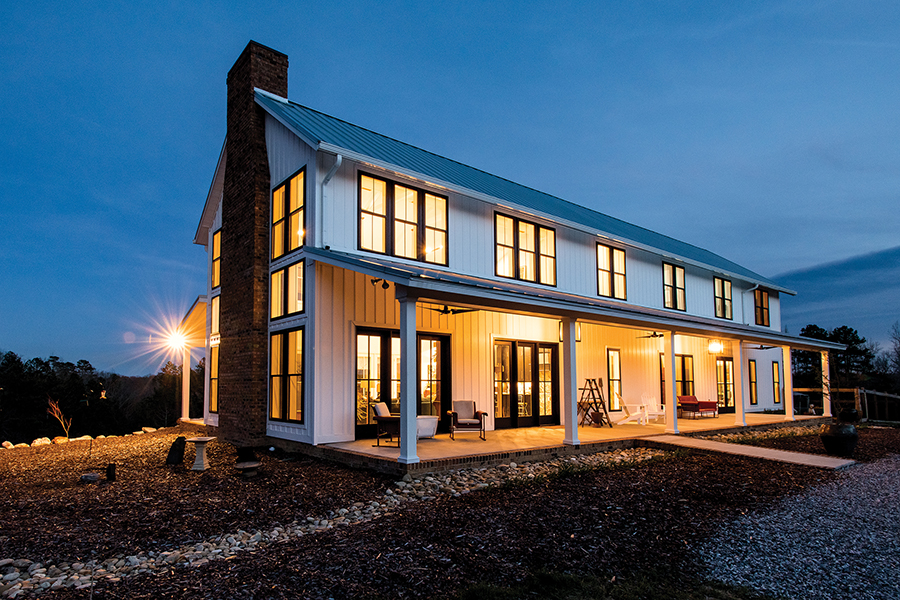
What’s black and white and artistic all over? The barn-inspired home of Janine Wagers and Ty Pruitt
By Maria Johnson Photographs by Amy Freeman
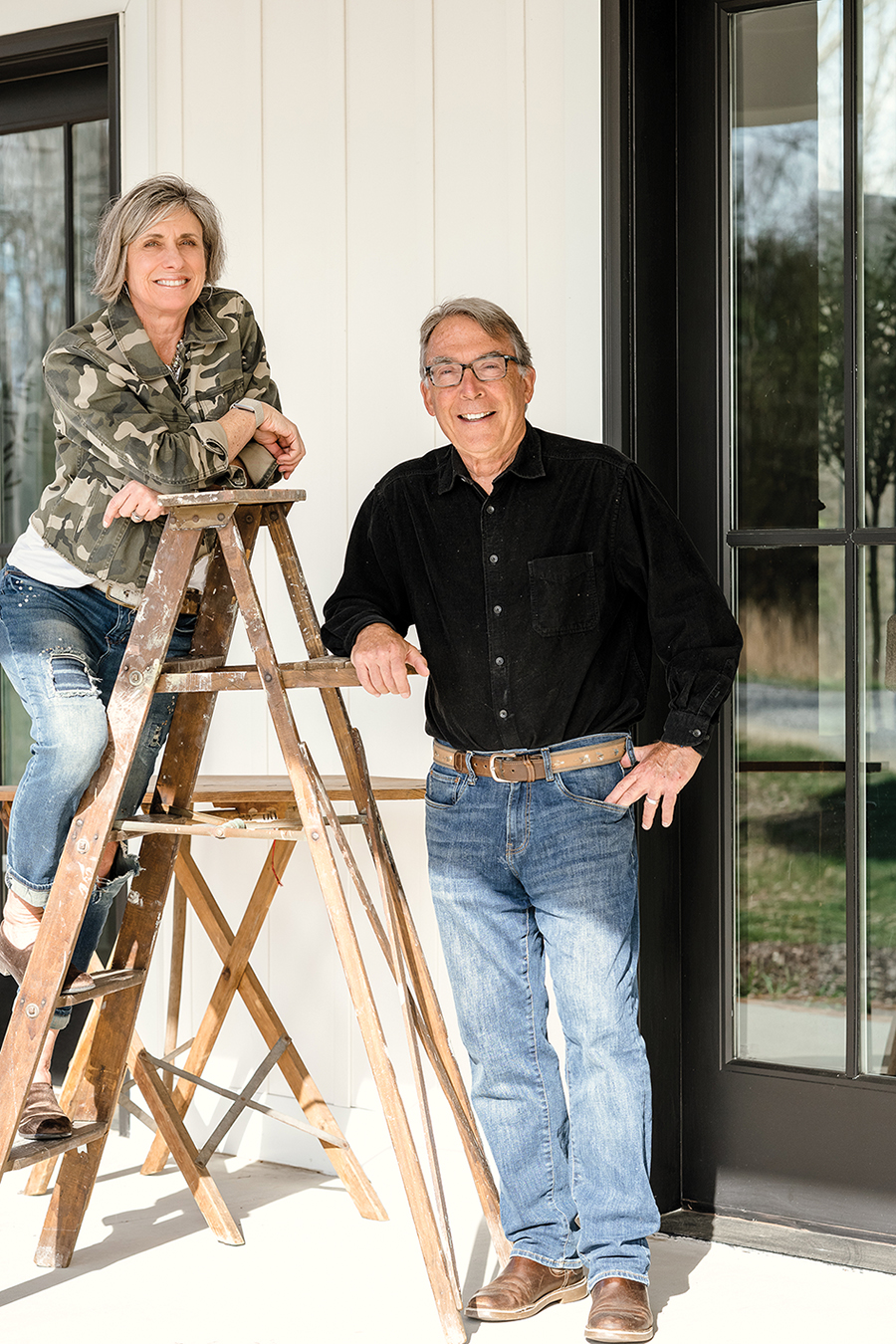
She drove the building contractor and subcontractors crazy, she admits.
But Janine Wagers knew what she wanted her and her husband’s new home to look like: a barn.
A gussied up barn, to be sure. Stylish. On point. Artistic. But still, a barn.
“A modern barn,” Wagers says.
Design-wise, she was confident she could mold the details, inside and out, to achieve the desired effect. After all, she’s the director of visual merchandising for High Point-based Universal Furniture, a stalwart of the contemporary furniture world.
A 38-year veteran of the industry, Wagers supervises all-things-eyeball in the company’s massive local showroom, open to trade customers only, and on other carefully curated sets around the country.
Comfy in a barrel-back chair covered with plush lavender, she pauses our interview to take a call about an upcoming show in the Hollywood Hills to promote a new line of furniture bearing the name of Australian model Miranda Kerr. The line is sold exclusively through retailer One Kings Lane, a collaborator in the show.
She hangs up and apologizes for the four cats and three dogs that rush inside through a door that she has left open. There’s a brisk breeze outside, and, well, why not invite it in, too? Flies? No worries. She uses a leaf blower to knock their bodies off the upper window sills, should they not find the exits.
“Welcome to the funny farm!” she announces.
The farm part is true. The home of Wagers and her husband, Ty Pruitt — who retired from the veneer business last year — occupies land that belonged to a working farm in northeast Davidson County in the not too distant past.
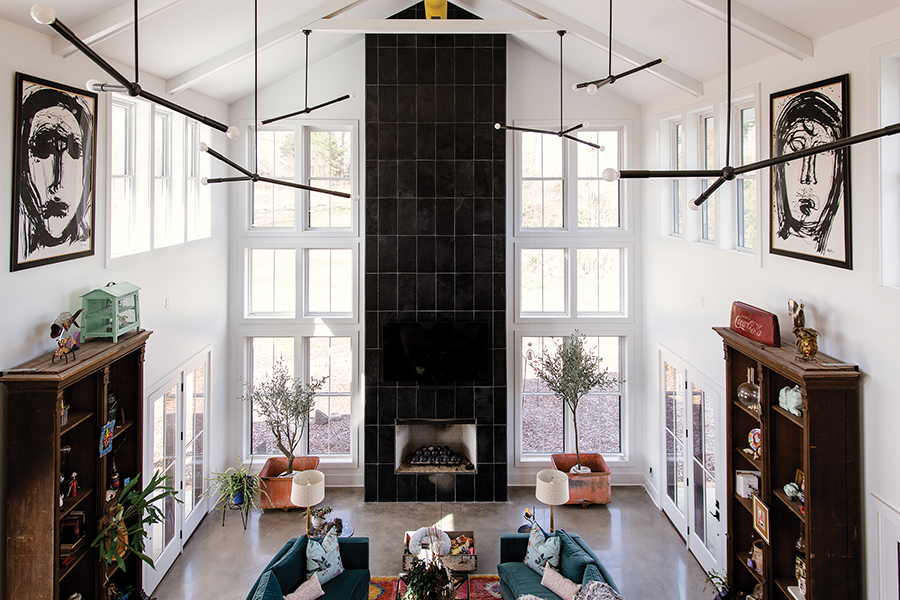
A horse barn stood on the graveled flat that doubles as the home’s front yard and parking area. The old barn had collapsed by the time the couple bought their 50-acre parcel in 2019. They paid someone to raze the structure before the 2021 construction of their new digs, a stylized homage to its vanished cousin.
Rooted in a simple rectangular footprint and flanked by lean-to porches, the three-bedroom, 3,300-square-foot home stands like a glowing beacon — with silver roof and milky board-and-batten siding — on a grassy hill. From this crest, Wagers and Pruitt look out, through 55 windows with nary a blind or drape, over the swells and troughs of their land. In most directions, horizon meets tree line
“It’s wonderful waking up in the morning. You can see the sun coming up. It’s very freeing,” says Wagers, who sits in the great room, which might be better described as a great big ol’ room.
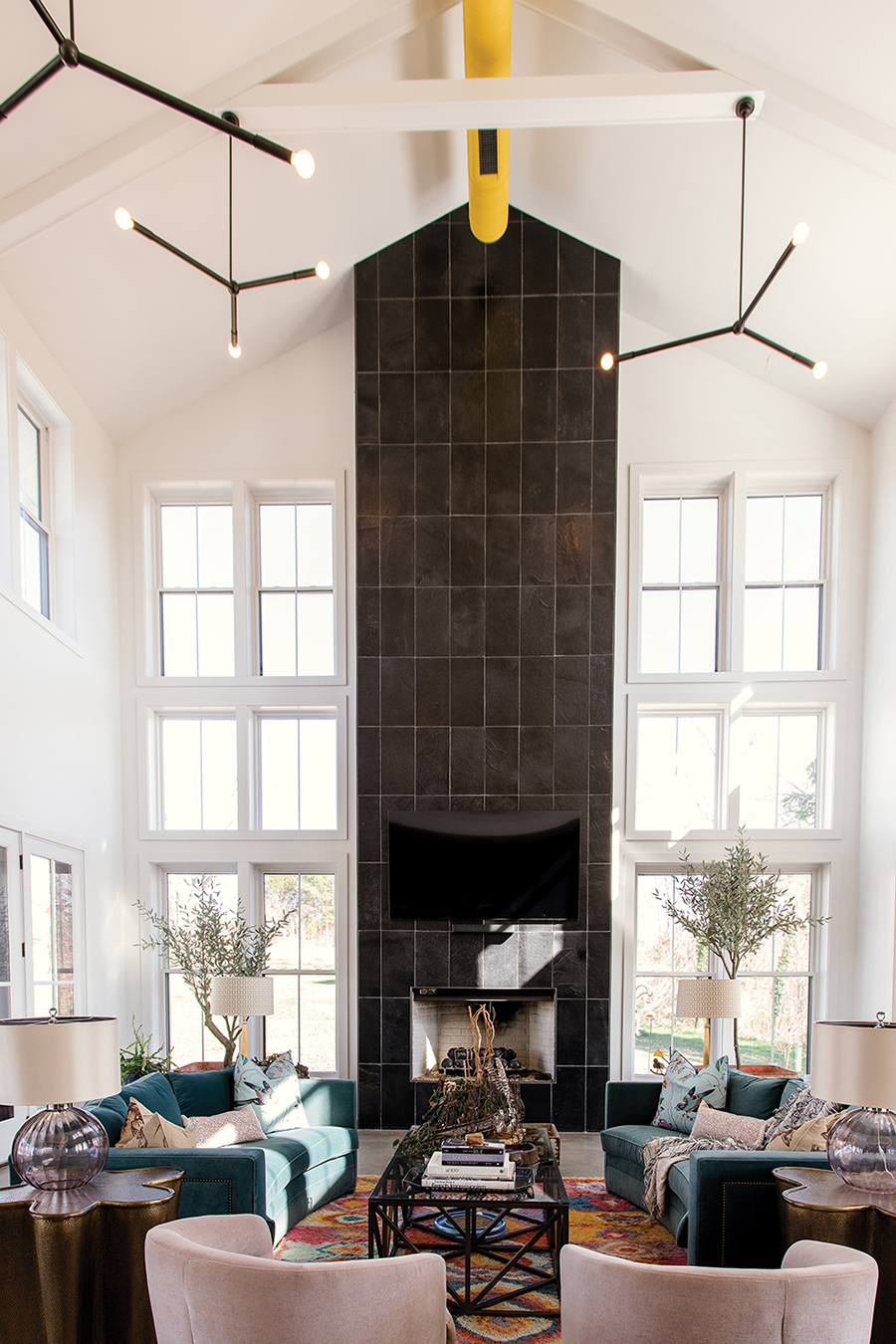
It is vast, a white-walled space that soars 24 feet, past dangling geometric lighting fixtures, to the vaulted ceiling above. The expansive room is anchored to the Earth by thoughtful tethers, most notably a black, slate chimney chase that stretches all the way up one wall, gleaming like a monolithic monument.
Contractors worried about the weight of the slate.
You’ll figure it out, Wagers said.
They did.
The result: a visual wow that slacks the jaw and bends a smile in appreciation of creative nerve.
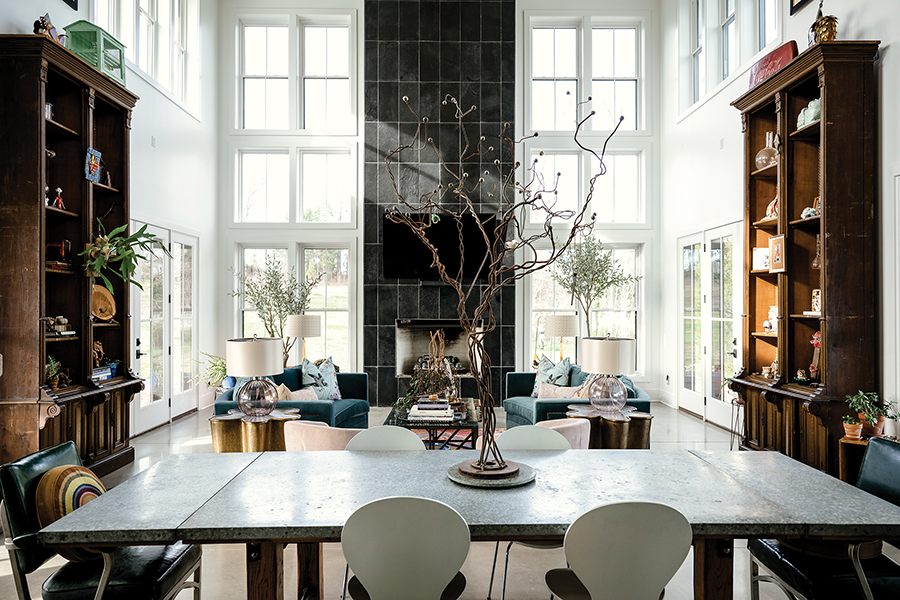
You could think of the home as a series of abstract paintings. Most of the canvases — walls in this case — are left blank, white. The frames, in the form of black-mullioned windows and other hard lines, are inky. The energy comes from splashes of color, in this case furniture and accessories, and from Wagers herself.
A fusion of down-home and up-to-date, she’s dressed in strategically ripped, cuffed jeans, a loose gray pullover and clear rectangular earrings. Her naturally gray hair, cut into a sharp A-line bob, still contains more coal than ash. Her eyes stand out like blue, steel rivets.
When she pours her honeyed Georgia accent (born in Dalton, schooled in Athens, go ’Dawgs) over her observations, you can’t help but laugh.
Example: The three-pronged lighting fixtures hanging overhead are called “talons” in the catalog.
“I call ’em chicken feet,” she muses. “But ‘talons’ is much more refined.”
She is surrounded by the trappings of her professional life.
Two curved, teal-green sofas face each other like parentheses in the center of the room. They clasp a shaggy, splashy rug and a glass-topped coffee table with a truss-like base. The end tables are amoeba-shaped pillars. All of the pieces, save the rug, are by Universal.
It makes sense. Wagers has spent the bulk of her career — a 10-year stint in the ’80s and ’90s and the current 15-year run — with the outfit.
But her home is no company showroom.
Ironically and honestly, Wagers pooh-poohs interiors that are lifted straight from showroom floors, especially if the cutting-and-pasting happens all at once.
Instead, she favors the picker approach. Pick the pieces you like. Fold them into what you have. Take your time. Don’t be afraid to veer off the designer-approved path into yard sales, flea markets, family attics, antique shops and consignment stores. See what calls to you.
Gradually, bring the pieces into concert. They should tell a story. Your story.
She has painted the couple’s own story with care and a keen eye.
“Want a tour?” she asks.
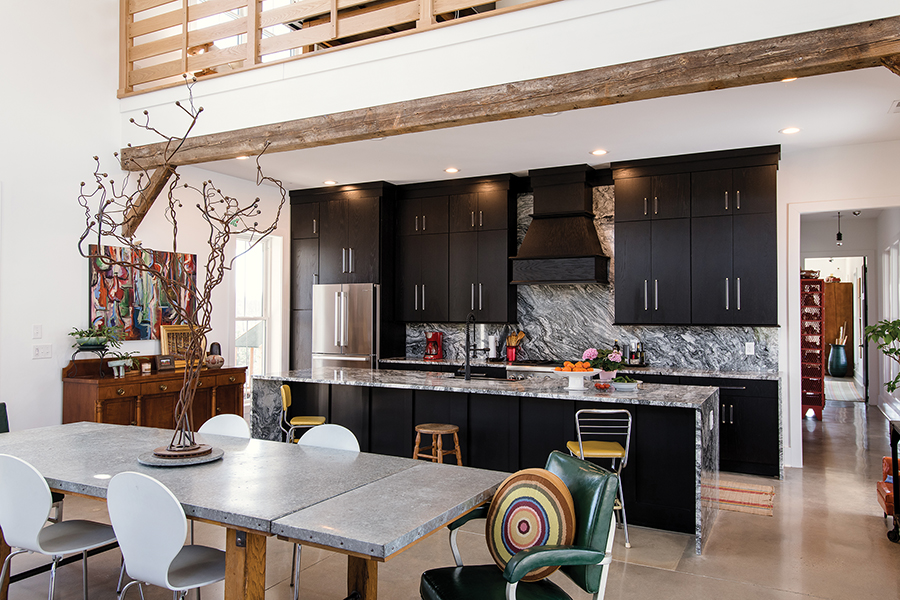
First stop, kitchen and dining area, which is really a part of the great big ol’ room, though the kitchen is technically tucked under a second-story loft that serves as the couple’s home office with side-by-side desks.
The overhang is underlined by a cosmetic beam salvaged from the barn that once sat outside.
Directly below, the metal-topped family table is headed by two office chairs, businesslike in gray steel and dark green Naugahyde, that were plucked from a Salvation Army store. As looser counterpoints, modular plastic chairs from Target line the sides. Wagers has her eyes peeled for replacement chairs. Ditto a new tabletop.
“I want to put a brass top on it,” she says.
She’s happier with the kitchen, where waterfall granite countertops fold over the island and base cabinets. The black wall-mounted cabinets extend to the 10-foot ceiling. She insisted.
The cabinets installers pushed back: “What will you do with the top cabinets?”
Wagers countered: “Store my once-a-year things. I have a folding ladder.”
She tilts her head back to eye the upper cupboards. Her grandmother’s stemware is up there, she assures. Word taken.
“The look is important,” she says of the cabinets.
Don’t confuse “the look” with perfection. Wagers not only tolerates imperfections, she insists on leaving the naturally occurring ones. She points to gouges in the sealed-but-unstained concrete floor. The contractor wanted to fill them with epoxy.
“I was like, ‘No! I like it messed up!’” she recalls.
The same goes for a section of the kitchen floor that had to be cut out to reach a clogged pipe. She taps the spot with the toe of a leopard print bootie. The patched floor is going to be a slightly different color, the concrete people warned.
Fine, she said.

“I like defects,” she explains. “I find it easier to live life with defects.”
Her heels peck the imperfect floor as the tour proceeds past a gigantic blackboard where she and her granddaughter like to doodle everyday hieroglyphics in white chalk.
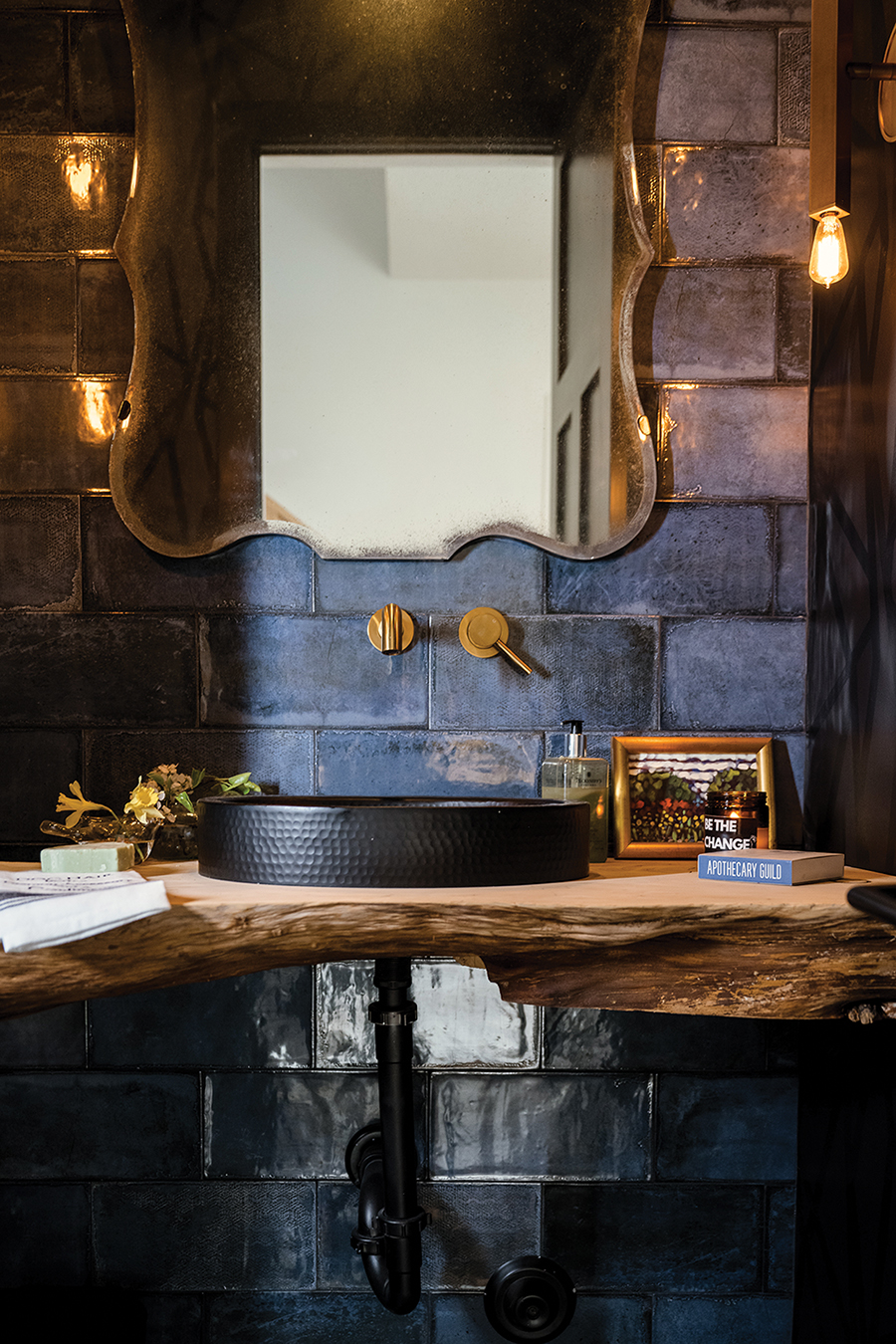
She stops at the powder room, an exception to the rule of blanched backgrounds. The room is a visual sink hole, but in a good way, sucking the eye into a dramatic statement uttered with black peel-and-stick wallpaper, navy-hued subway tile, smoky floor tile and a counter hewn from a cedar tree that Wagers saved from road-widening near the couple’s former home in Sedgefield. Most of the tree’s wood went into Universal pieces. She nabbed a nub.
“You can have fun with a powder room,” she says.
Click-click-click to the primary bedroom.
Does she mean the master bedroom?
Nope, that term is out, she says. Think about it.
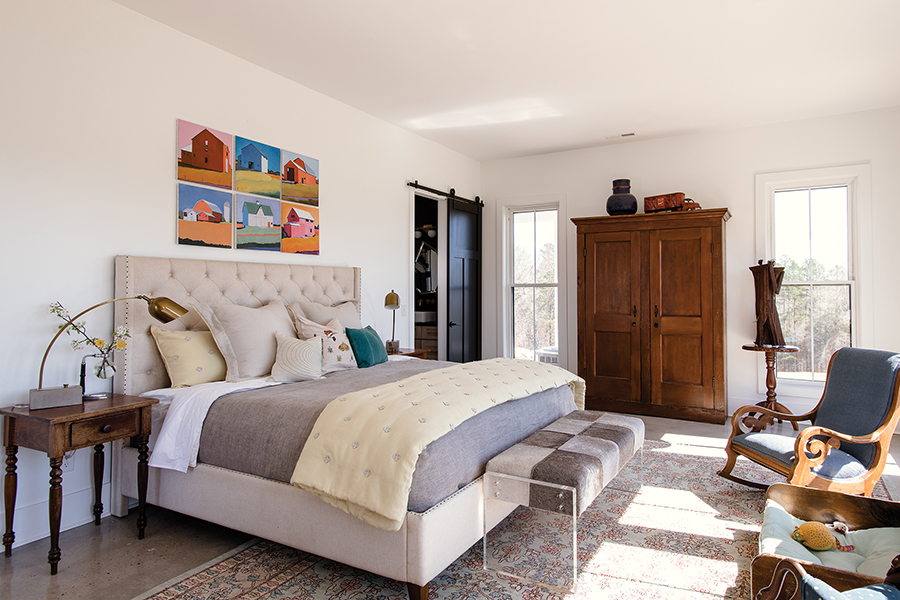
Used to changing with the times, Wagers absorbs the update and moves on. The couple’s bedroom is simple and airy. Ballast comes from wooden wardrobes on opposing walls. The cabinets came from the school where her parents taught in Dalton, Georgia.
Chipped, dinged and dated with black-marker graffiti on the shelves, Wager’s free-standing closet is home to T-shirts, socks and other dresser staples. For hanging clothes, she and Ty share a walk-in closet in the bathroom. They use the same flat-bottomed tub and glass-enclosed shower, too, but they “go” their separate ways with his-and-hers toilet rooms.
“This is my favorite room in the house because it’s all mine,” she says. “Don’t come in here. Don’t use it.”
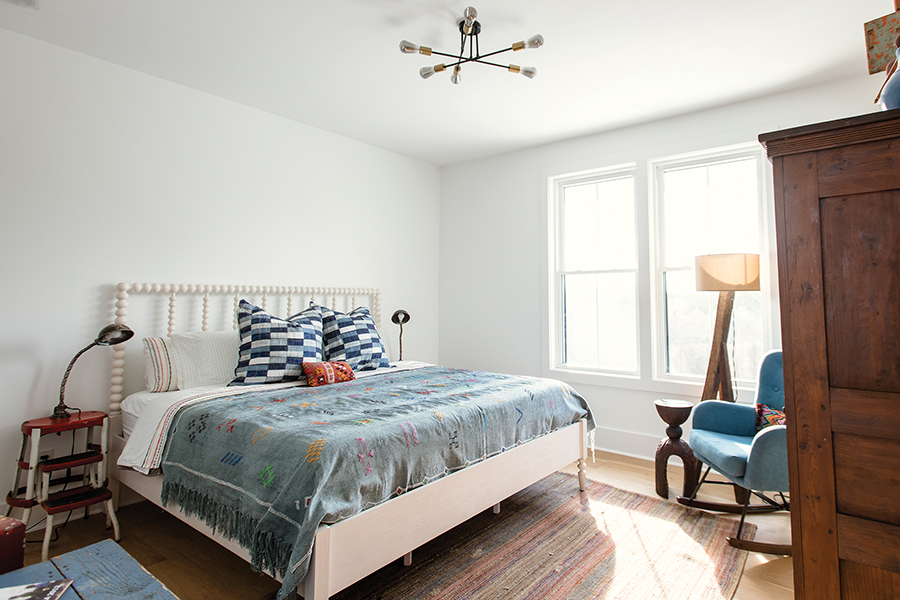
She has personalized the room with a wall full of necklaces that hang from nickel drawer pulls screwed directly into the wall. Practical. Funky. Changeable. A vertical playground.
That sense of fun permeates the house. One hallway pops with a bank of orange basket-style gym lockers found in a junk store. Their son, Will, used the array in his room while growing up.
More mirth lurks in an upstairs TV room, where a jigsaw puzzle sprawls on a lemony Formica table ringed by vintage Bertoia-style wire chairs. On a nearby wall, Wagers assembled a collage of family memories.
A watercolor painting by Will.
A plaque recognizing Ty’s service as Wolf Tribal Chief at the High Point YMCA.
A postcard with a wry drawing of eggs dripping from a shower head, a memory of the sulfur-smelling water they encountered in Iceland.
Wagers tinkered with more than a dozen pieces, hanging and rearranging until she was satisfied.
“What was the worst that could happen?” she shrugs. “A few extra holes in the wall?”


She was more deliberate with a gallery of family photographs that plaster both sides of another hallway, an allée of DNA.
“That’s my son. That’s my step-daughter. That’s my dad and his sister. That’s Ty when he was a baby,” Wagers says, pointing as she goes.
To get the composition right, she measured the frames — all in tawny tones — and laid them out on a computer. Most of the pictures are rendered in black and white, an intentional stroke. The exhibit includes a non-photographic item: a note written in ink and torn from a small memo pad.
“Janine, I love you. Grandma.”
Wagers’ grandmother pressed the paper into her hand when Wagers visited her in assisted living. Wagers carried the note in her billfold for a long time before she flattened it and surrounded it with a sumptuous gold frame — a jot of personal history elevated to its rightful place in the emotional pantheon.
Wagers, soon to be 60, smiles at her grandmother’s shaky script. These days, she catches tiny changes in her own handwriting, a reminder that she must make hay while she can.
A modern barn is a good place for that. OH




April is a quivering brood, a bellyful of earthworms, a fledgling’s maiden flight.
The sun is out. A banquet of wild violets glistens in the wake of a spring rain. The birdbath runneth over.
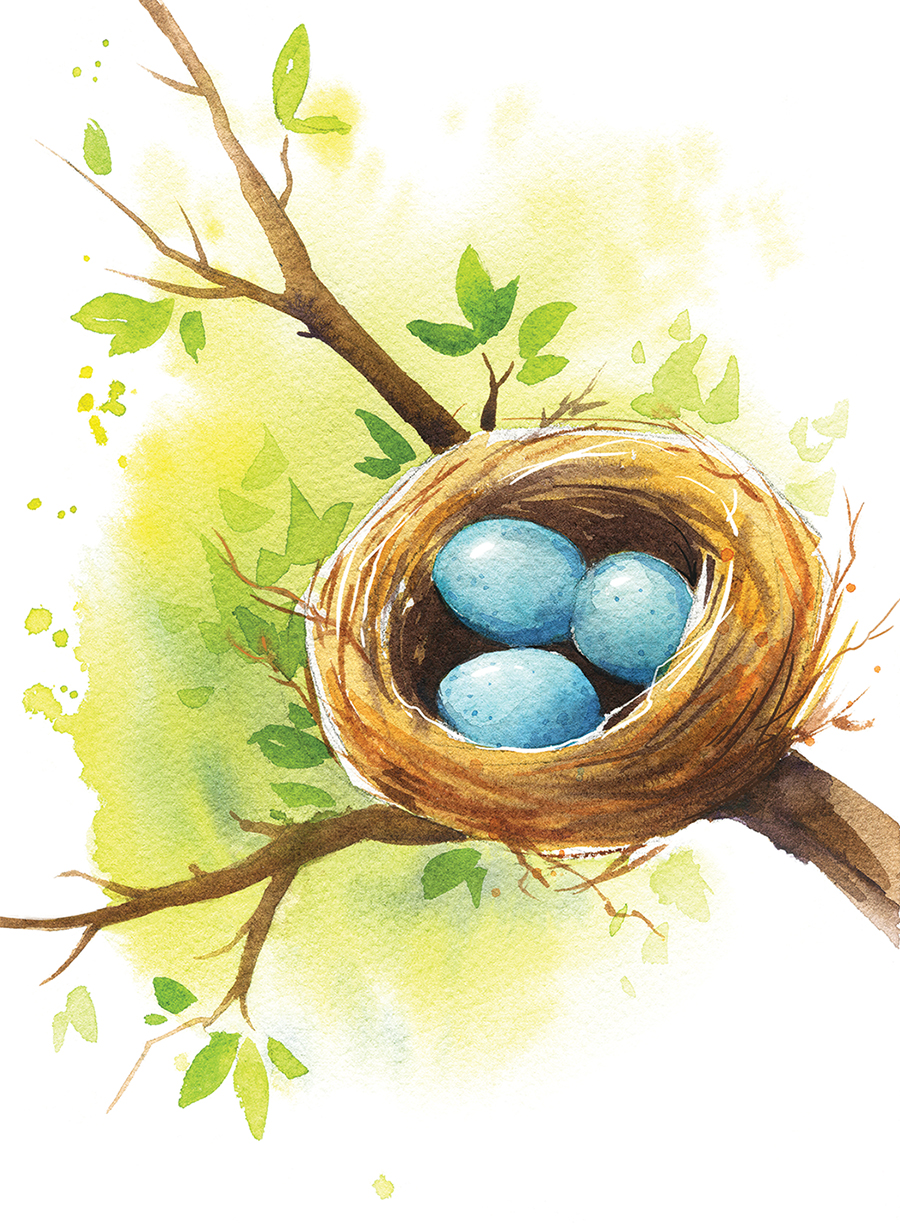
In the garden, a pair of robins scurry from worm to worm, flit from soft earth to wriggling nest, from wriggling nest to soft earth. There are mouths to feed. Four beaks, bright as buttercups, open and urging for more, more, more.
Born pink and blind, the robin hatchlings know nothing of rat snakes or corvids; nothing of cold winds or the bloodthirsty cat by the birdbath. By some miracle, the chicks emerged from pale blue eggs into a world that is soft, safe and kindly. By some miracle, they know only the warmth of their mother, the warmth of the nest, the warmth inside their plump, translucent bellies.
Days from now, everything will change. First, tiny quills will appear on the nestlings’ feeble bodies. Next, their eyes will crack open, the sudden light revealing a world of color and danger and new horizons.
In two weeks, when the dandelions have multiplied and the earliest strawberries blossom, the speckled fledglings will jump the nest.
What happens next?
For the young robins: peril or miracle.
For the robin pair: another nest, another clutch, another thousand trips from quivering brood to soft earth.

The Full Pink Moon rises on Thursday, April 6. Native Americans named this moon for the creeping phlox now blushing across the tender earth. This year, the Pink Moon also happens to be the Paschal Moon — the first full moon of spring.
Also called moss phlox, the fragrant blossoms of this herbaceous perennial make it a butterfly magnet.
But it’s not the only pink flower in bloom. Tulips come in 50 shades of it.
There’s the pink-flowering dogwood, the eastern redbud (pardon the misleading name) and the showstopping cherry.
Don’t forget the pink azaleas, coming soon.
Easter (aka, the moveable feast) always falls on the first Sunday following the Paschal full moon. This year, Easter is celebrated on Sunday, April 9. If you’re planning to hide eggs, careful where you stash the pink ones.

Today has been a day dropped out of June into April. — L.M. Montgomery, Anne of Windy Poplars
 April Shower
According to Smithsonian magazine, the Lyrid meteor shower is one of the 10 most “dazzling” events for stargazers in 2023. This year’s shower peaks on Saturday, April 22 (Earth Day).
“Observers are usually able to see about 18 meteors per hour in a clear, dark sky,” the article states, “though on rare occasions, the Lyrids can surprise viewers with as many as 100 meteors in an hour.”
At 6 percent illumination, the waxing crescent moon should make for favorable viewing conditions.
As for a clear sky? We’ll see. Or, we won’t. OH

March is a born artist, wide-eyed and unbridled, creating for the sake of life itself.
The genius begins with a single daffodil, warm and bright, nodding in a stream of honeyed light. Each petal is a world of yellow. Each leaf, a meditation on green.
The artist becomes obsessed.
One daffodil becomes a series, progressively abstract, until each flower is more essence than form.
Paintings expand into wild landscapes. Quick as the hand can move, a rolling sea of yellow starbursts stretches from one canvas to the next. The foreground softens. Thick and messy brushstrokes evoke a tender, playful light.
Crested irises and yellow violets now spill from the frenzied brush, followed by flowering clover, purple deadnettle, wild onions, chickweed and a downy flush of dandelions.
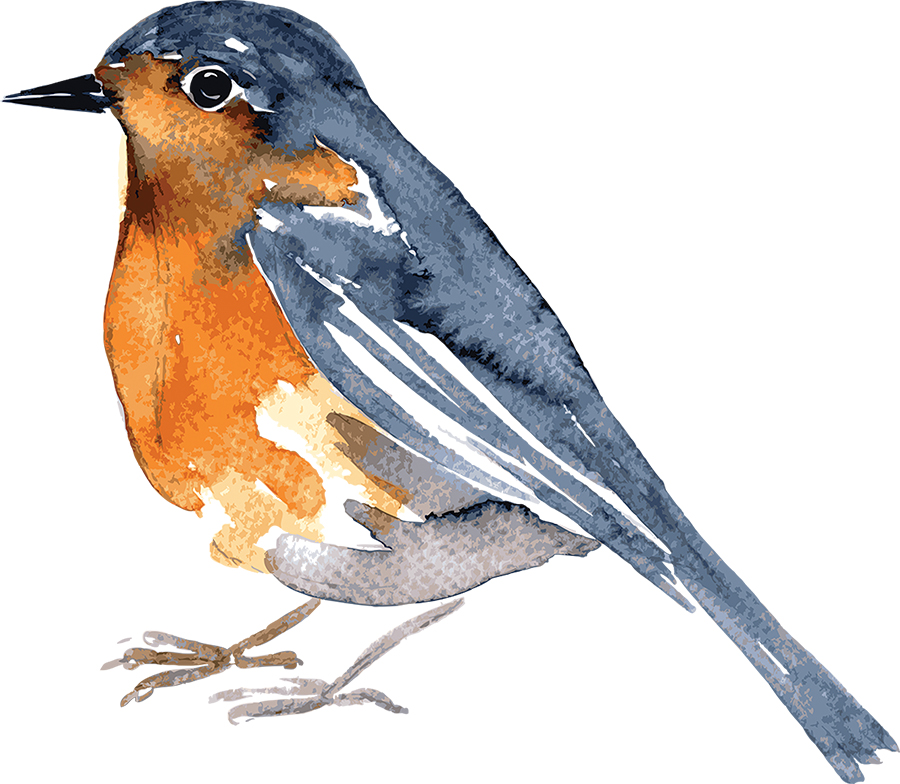
Robins begin to appear. Bluebirds, too. Tree swallows and towhees and red-winged blackbirds. The painting nearly sings out.
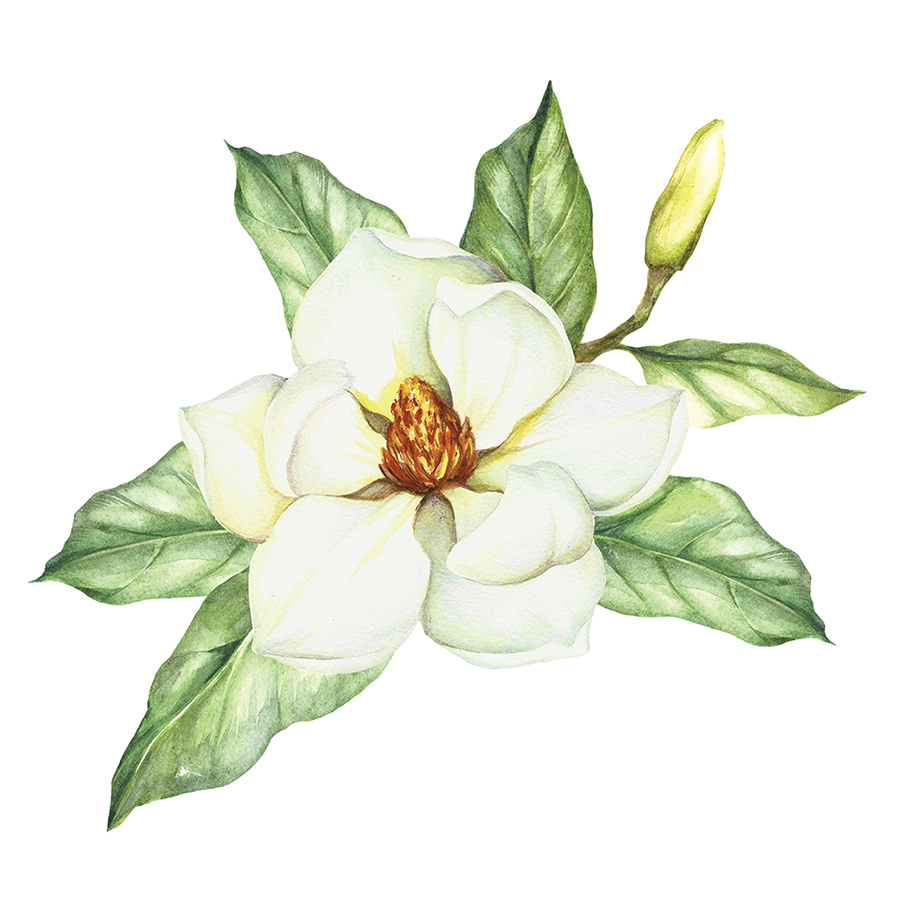
Leafless branches, stark among the luscious earth, are suddenly laden with clusters of crimson whirligigs. Redbuds are studded with bright fuchsia blossoms. Soft pink swirls adorn silver-limbed saucer magnolias.
The brush strokes quicken. A sweep of tulips colors the earth magnificent. As spring bursts forth, flower by brilliant, quivering flower, the artist surrenders to the muse.

Among the wild blossoms beginning to carpet the soft earth — fig buttercups and field mustard, blood root and Johnny jump-ups, dimpled trout lilies and Carolina jessamine — the common blue violet is one you’ll likely spot in damp woods and shady meadows. Also called the woolly blue violet, wood violet or common meadow violet, this short-stemmed perennial is known for its heart-shaped leaves (edible) and white-throated purple flowers (also edible).
But have you ever seen a bird’s foot violet? Named for the shape of its narrowly lobed leaves (they do, in fact, resemble bird feet), this viola species prefers dry, sandy soil and pine lands. The five-petaled flower, lilac or bicolored with bright orange anthers, is largely considered to be the most beautiful violet in the world. But what spring bloomer isn’t a bewitching vision to our winter-weary eyes?
Our life is March weather, savage and serene in one hour. — Ralph Waldo Emerson
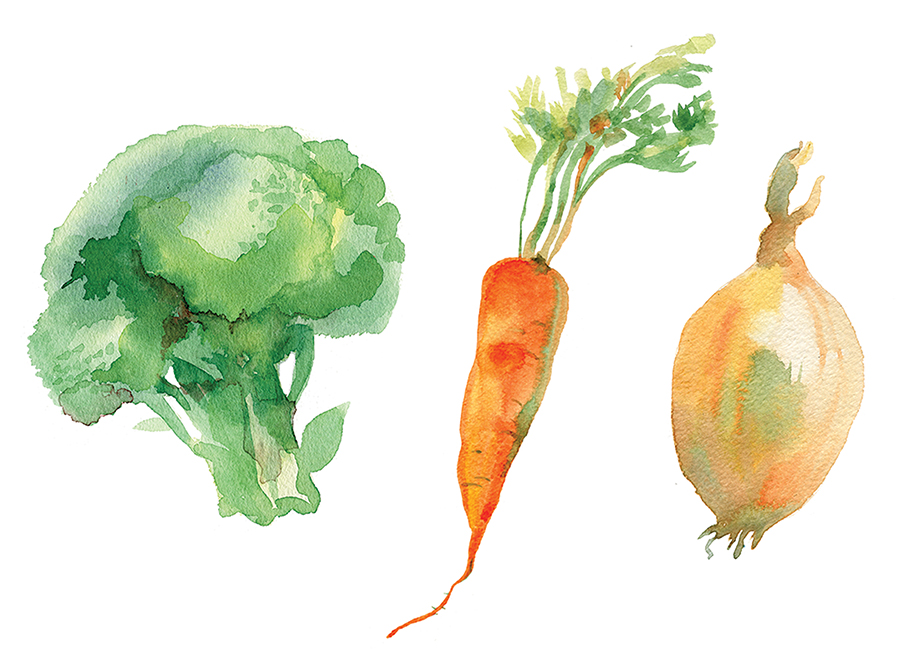

The cold earth is thawing. The Full Sap Moon rises on Tuesday, March 7. The maple sap is flowing once again.
The vernal equinox occurs on Monday, March 20 — along with a dark, balsamic moon. As a new season and cycle begin, we return to the garden.
In early March, sow carrot, spinach, radish, pea and turnip seeds directly into the softening earth. Mid-month, sow chives, parsley, onion and parsnips. At month’s end: beet and arugula seeds.
Broccoli, cauliflower and cabbage seedlings can be transplanted outdoors mid- to late-month. Ditto kale, Swiss chard, lettuce and kohlrabi.
Growing season has commenced. As the days grow warmer still, behold the simple miracle of spring’s return. The miracle of life itself. PS



From the Mountains to the Sea
By David Menconi
Type design by Keith Borshak
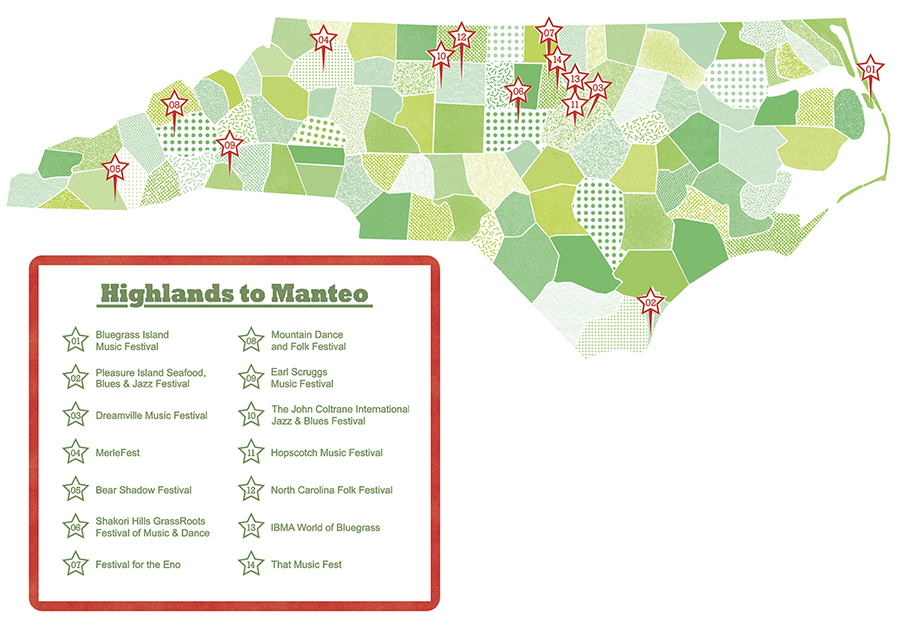
Map Illustration By Miranda Glyder
Springtime in North Carolina means college basketball madness, azaleas blooming — and the earliest days of outdoor music. Our state has a staggering array of A-list music festivals spanning numerous genres from now until fall. Here are some of what you should be making plans for.



Dreamville Festival
Between apocalyptic weather and the coronavirus pandemic, rapper J. Cole’s Dreamville Festival has had a rocky existence in its short history. But in spite of multiple postponements, Dreamville has been a huge success, starting with 2019’s sold-out debut at downtown Raleigh’s Dorothea Dix Park that immediately established it as one of the nation’s top hip-hop festivals. Dreamville’s second edition in 2022 expanded from one day to two with an onstage lineup featuring the entire roster of Cole’s Dreamville Records label, and it also sold out. Round three returns to Dix Park the first weekend of April as another multi-day affair. It should be another big success, with Cole himself in the headline slot.
April 1 – 2, Raleigh; dreamvillefest.com
MerleFest
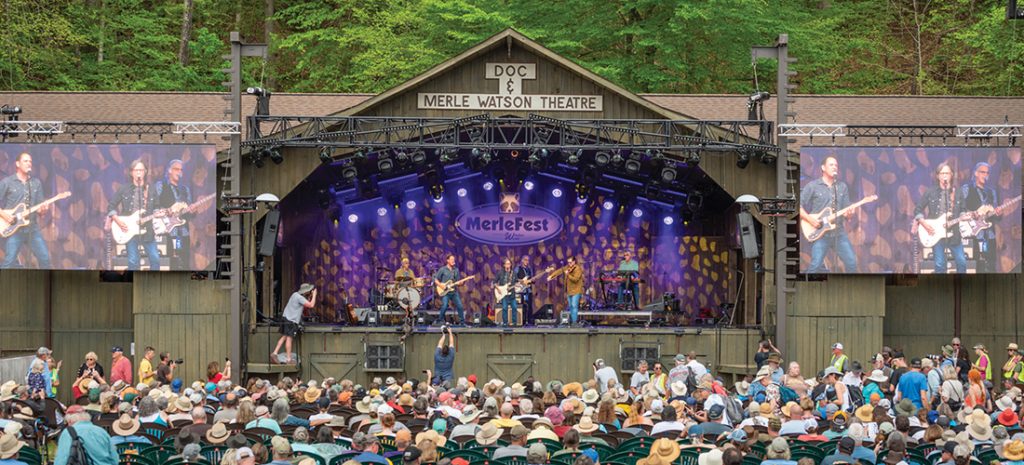
Centered on the multi-style “traditional plus” music played and loved by its late, great founder, Doc Watson, MerleFest has been a tradition at Wilkes Community College since 1988. The venerable roots-music festival is a signpost event on the Americana circuit. And after the same pandemic problems that every other live-music event faced in recent years, it’s back with an impressive lineup featuring the Avett Brothers, Maren Morris, Little Feat, Tanya Tucker and more.
April 27 – 30, Wilkesboro; merlefest.org

Bear Shadow
The mountains of the far western corner of North Carolina are the setting for this springtime festival, which happens the same weekend as MerleFest. First conceived in 2021, this year’s model has a first-rate alternative-leaning lineup featuring Spoon, The Head and the Heart, Jason Isbell and Amythyst Kiah.
April 28 – 30, The Highlands Plateau; bearshadownc.com

Shakori Hills GrassRoots Festival of Music & Dance
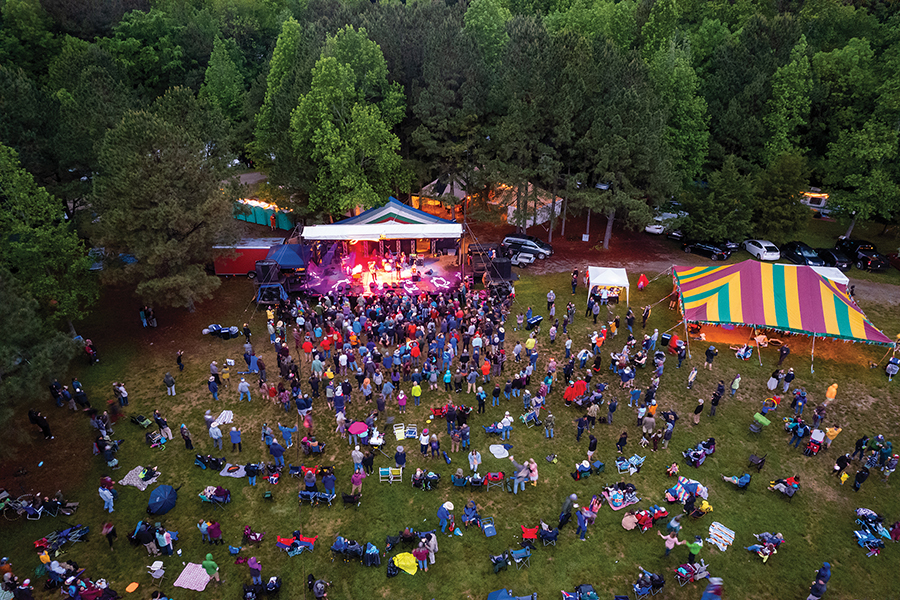
Started in 2003 as a nonprofit music and dance festival, Shakori Hills takes place on a bucolic 9,000-acre spread in rural Chatham County. It’s probably the top camping festival in the greater Triangle region, with solid Americana lineups. Marty Stuart & His Fabulous Superlatives, Malian singer/guitarist Vieux Farka Touré, beach legends Chairmen of the Board and festival regulars Donna the Buffalo. There’s also a fall version of Shakori Hills, which happens every October.
May 4 – 7, Pittsboro; shakorihillsgrassroots.org
Annual Carolina Beach Music Festival
Dance to beach music with your toes in the sand at the 37th Annual Carolina Beach Music Festival on Saturday, June 3 from 11:00 a.m. to 5:00 p.m. Billed as “the biggest and only beach music festival actually held on the beach on the North Carolina coast,” three bands will be performing. Shows are accessible from the Carolina Beach Boardwalk at Cape Fear Blvd. and Carolina Beach Ave. S. For information on tickets call (910) 458-8434.
June 3, Carolina Beach
Festival for the Eno
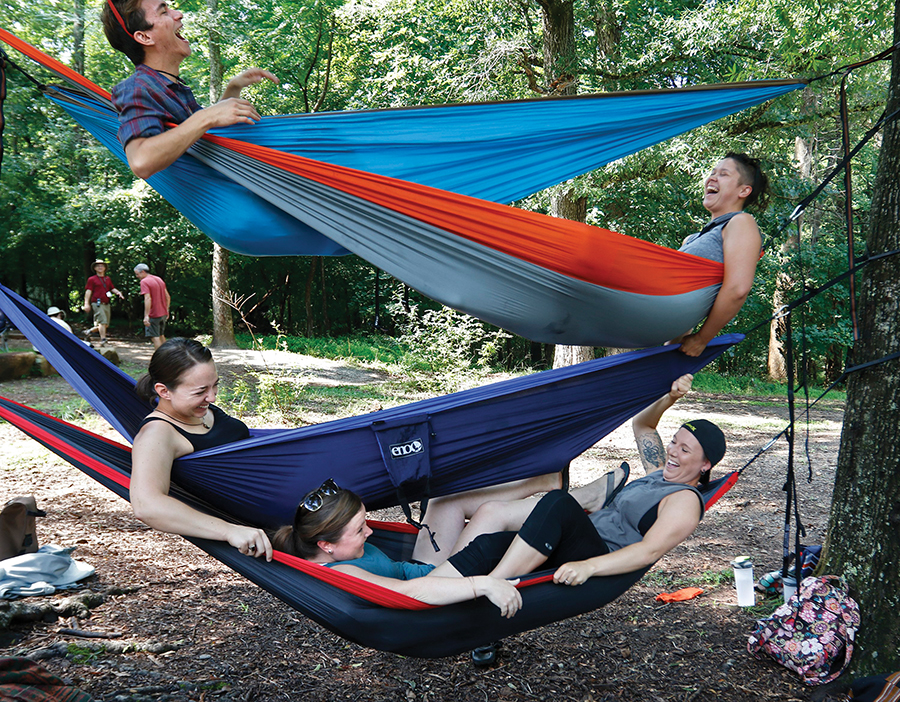
The granddaddy of music festivals in the Triangle, Festival for the Eno dates back to 1980 and happens on the grounds of Durham’s West Point Park. Started as a fundraiser for the Eno River Association, the festival — which also offers a craft and food market — has hosted a who’s who of Americana-adjacent and roots artists including Emmylou Harris, Doc Watson and Loudon Wainwright III. Recent years have featured rising regional acts including Mipso, Rainbow Kitten Surprise and Indigo De Souza.
July 1 and 4, Durham; enofest.org
Mountain Dance and Folk Festival
Reputedly the first event in America to be called a “folk festival,” Asheville’s Mountain Dance and Folk Festival was founded in 1928 by the folk music legend, Bascom Lamar Lunsford. It remains the longest continuously running folk festival in the country, and it’s as much about the folk dance traditions of Western North Carolina as the music.
Aug. 3 – 5, Asheville; folkheritage.org
Earl Scruggs Music Festival
A newcomer to the North Carolina festival circuit, the Earl Scruggs Music Festival debuted last year at the Tryon International Equestrian Center in Mill Spring. As you’d expect for a festival named after the man who invented the three-finger style of bluegrass banjo, the lineup trends toward classic bluegrass and Americana.
Sept. 1-3, Mill Spring; earlscruggsmusicfest.com
John Coltrane International Jazz and Blues Festival
Although he made his mark as an artist elsewhere, John Coltrane was born and raised in Hamlet, North Carolina. He was one of the towering figures of 20th century jazz, a key collaborator with Miles Davis, Duke Ellington and his fellow North Carolina native Thelonious Monk. The John Coltrane International Jazz and Blues Festival has been paying tribute to his legacy every Labor Day weekend since 2011 with solid lineups — 2022 featured trumpeter Chris Botti, singer Patti LaBelle and saxophonist Kirk Whalum, among others.
Sept. 2 – 3, High Point; coltranejazzfest.com
Hopscotch Music Festival
Downtown Raleigh has a well-earned reputation for doing music festivals right, and one of the events that helped pave the way is the alternative-slanted Hopscotch. Originally started in 2010 under the auspices of the Indy Week newspaper, it showed off Raleigh’s walkable grid of downtown nightclubs and outdoor stages to fantastic effect. Past headliners have included Flaming Lips, The Roots, Solange Knowles and St. Vincent. Hopscotch director Nathan Price reports that this year’s model should feature “an expanded lineup closer to pre-COVID size.” Here’s hoping.
Sept. 7 – 9, Raleigh; hopscotchmusicfest.com
North Carolina Folk Festival
In 2015, the National Council for the Traditional Arts brought the long-running National Folk Festival (which has been around since 1934) to Greensboro for a three-year run. It was such a success that, after the national festival’s Greensboro run ended, the city opted to keep it going as the rebranded North Carolina Folk Festival. Last year’s lineup was typically eclectic, featuring everything from George Clinton’s P-Funk All-Stars to the Winston-Salem Symphony String Quartet. Expect more of the same in 2023.
Sept. 8 – 10, Greensboro; ncfolkfestival.com

World of Bluegrass
The International Bluegrass Music Association moved its annual business convention and festival to Raleigh in 2013, where it has been a huge success. Between the convention, trade show, “Bluegrass Ramble” nightclub showcases, awards show and street festival, total attendance can top 200,000 when the weather’s good. Past headliners have included Steve Martin, Alison Krauss, Béla Fleck and just about every notable picker and singer in the genre. Year in and year out, it’s downtown Raleigh’s biggest music festival.
Sept. 26-30, Raleigh; worldofbluegrass.org
That Music Festival
Sponsored by Raleigh’s Americana/roots radio station, That Station, 95.7-FM, That Music Festival made its debut in June 2022 at Durham Bulls Athletic Park with an all-North Carolina lineup featuring American Aquarium, Steep Canyon Rangers, Mountain Goats, Rissi Palmer and more. The sophomore edition is tentatively scheduled for October, most likely in Durham again.
October, Durham; thatstation.net/that-music-fest
Annual Bluegrass Island Music Festival
Music lovers will be flocking to the Outer Banks, beach chairs in hand, for the 12th Annual Bluegrass Island Music Festival October 19-21 held at the Roanoke Island Festival Park overlooking miles of the pristine waters of Roanoke Sound. Buy your tickets and book your lodging well ahead of time. Acts this year include The Goodwin Brothers, Seth Mulder & Midnight Run, Rhonda Vincent & The Rage, Po’ Ramblin’ Boys, Leftover Salmon, The Kody Norris Show, Thunder & Rain, AJ Lee & Blue Summit, The Kitchen Dwellers, The Steeldrivers, Darin & Brooke Aldridge, Breaking Grass, Tim O’Brien and the incomparable Sam Bush.
October 19-21, Manteo; bluegrassisland.com PS