Beyond the Back Door

Beyond the Back Door

Three backyard buildings allow room for growth, sanctuary and entertainment

By Cassie Bustamante • Photographs by Amy Freeman

With a little out-of-the-box thinking, a backyard building can become so much more than a place to park your lawnmower. A dilapidated storage structure can open doors to mixing work and play. Take it from these three home and business owners, who unearthed the hidden potential in their own backyards. One turned a shanty of a shed into an employee haven. Another repurposed windows to form a whimsical greenhouse. The third transformed a single-car garage into a hidden guest retreat.


The Shed

In 2020, during the height of the pandemic, Dudley Moore Jr. would meet up with a few buddies on the back deck of his High Point office building for a few beers and a little escape from stay-at-home-life. Moore, who is president and co-owner of Otto & Moore Furniture Design with sister Carolyn Shaw, recalls his pal Lin Amos saying, “You know, that’s a cool building. You ought to do something with that.”

The building in question, now lovingly known as “The Shed,” was an old garage that Moore guesses to be almost 100 years old. Visible from their vantage point on the deck, it looked like it was on its last legs and was serving as a home to snakes and spiders. It’s been a fixture on the Otto & Moore property since the day the company, founded in 1960 by Shaw and Moore’s father, Dudley Moore, set up its office there. “We’ve been here since 1970 and it was already old and decrepit then,” says Moore.
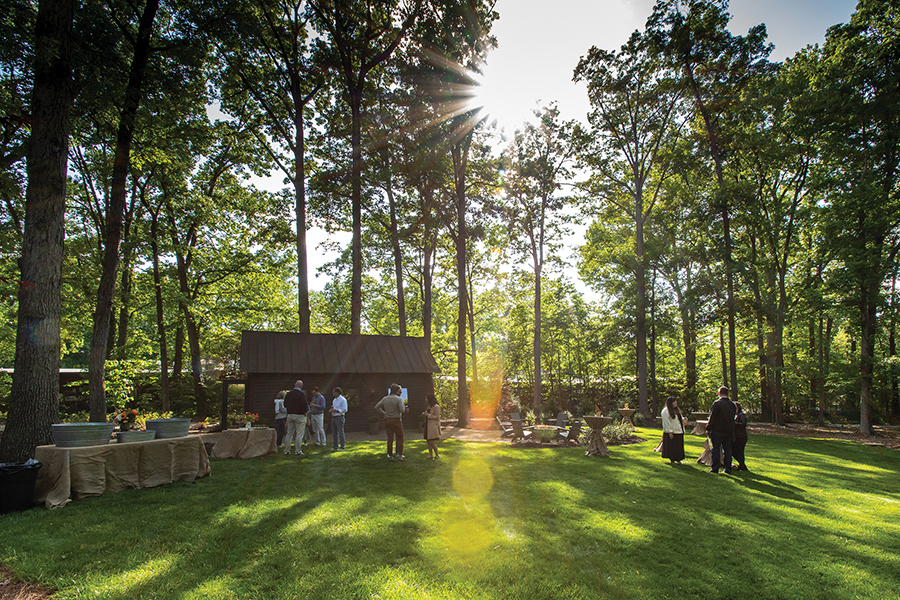
    Aside from critters, the shabby structure stored old chair samples and engineered drawings in tubes. “It just sorta became a catch-all for junk,” says Shaw. “It was a disaster!”

But, with a nudge from Amos, the wheels started turning.

“It just got my imagination going,” says Moore, who planned to turn it into functional storage. A furniture designer by trade, he notes that “it had a certain beautiful symmetry to it.”

Moore and Shaw enlisted the help of Scott Dunbar, vice president of Dunbar & Smith general contractors and, “very fortunately,” husband of their office manager, Lora. Once the project started, Moore nixed the original plan. “It’s too cool for that,” he says. “So then we decided to make it a party shed.”


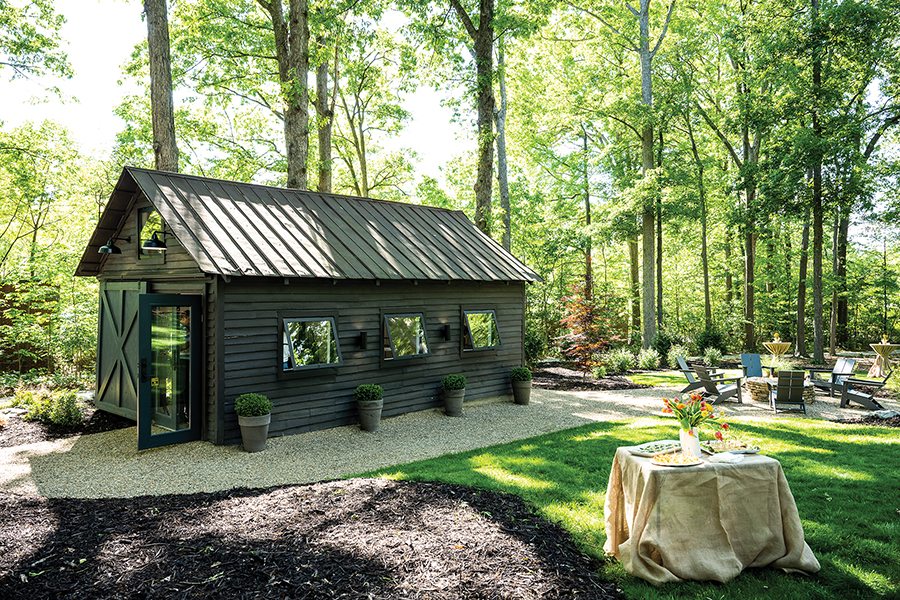
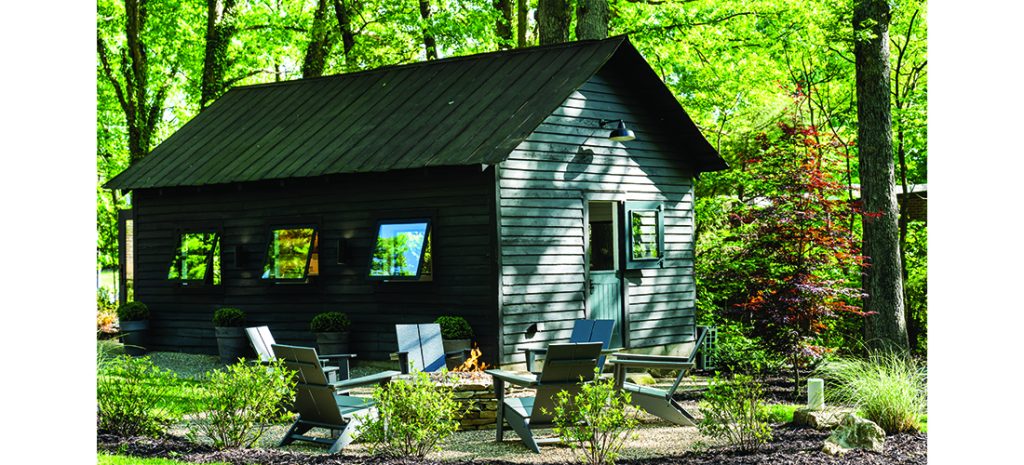
The exterior was first to be transformed and now resembles a modern Scandinavian cottage. The original metal roof was patched, and the once chippy siding was sandblasted and repainted in a dark, almost-black brown. Because they wanted to maintain its garage-style charm, a new slate-blue, sliding barn door was added, concealing a pair of glass paneled doors, which function to keep the critters out.

Thanks to the creative collaboration between Moore and Otto & Moore designer Laura Niece, the once ramshackle interior reflects the exterior aesthetic, complete with a Dutch door and a fireplace shipped from Denmark. A pair of timeworn leather chairs from the Netherlands, found at Antiques & Design Center of High Point during Market, invite one to cozy up, fireside.

With a built-in bar area and a record player with speakers inside and out, The Shed is now host to a wide range of events, from board meetings to employee baby showers. “We use it for business purposes as well as fun,” says Shaw, whose own son spent lunch breaks watching Stranger Things there during last year’s summer internship with Otto & Moore.

Are they worried about too much merrymaking on the job? “Honestly,” says Moore, “we like to think — with creative people in particular — if you can make the job fun as well as work, then it actually helps breed creativity and productivity.” So, is Otto & Moore hiring? Sadly, no, but you can add “party shed” to your list of employer must-haves.


Greenhouse Affection


When Jamie and John Hizer, plus their five kids, moved into their Westridge Heights home in March of 2020, the backyard was an overgrown tangle. Yet, underneath a mess of English ivy, Jamie could see its hidden potential.

The Hizers enlisted a crew to bulldoze the backyard, leaving them with a “blank landscape.” After tossing around different ideas for their open space, Jamie stumbled upon a beautiful greenhouse kit from an online retailer. “I fell in love with it,” she recalls, though she didn’t love the $10,000 price tag.

But the greenhouse seed had been planted, and Jamie, after researching, became convinced that they could create something special using old windows, a little elbow grease and out-of-the-box thinking. She saw it clearly in her mind, operating to extend their growing season and as an entrepreneurial endeavor, a space for small events and photo opps. John, a safety consultant for an insurance company, thought, “You’ve lost your mind!”

Ever determined, Jamie began collecting windows from several sources — never paying more than $5 dollars a pop — then scraping, sanding, glazing and refinishing each. John? “He would just shake his head and help me stack the windows,” says Jamie.

When it came time to build, the Hizers laid windows out on the ground to work out a configuration. Over a two-month period of project weekends, the four walls went up, one by one, followed by the trusses and, finally, the plexiglass roof.

In April of 2021, “we put the last nail in and I burst into tears,” recalls Jamie. Just one month later, Pinetop Greenhouse opened its sunny yellow doors for its first event, Mother’s Day mini photo sessions amidst seedlings sprouting all around them.

Now, a once neglected yard thrives, the upcycled greenhouse its pièce de résistance. Though not heated or cooled, the glass enclosure allows Jamie to start her seeds in early spring and protect plants from frosts. Just outside, garden beds lush with vegetables, herbs and flowers flourish, interwoven with gravel and stone paths.

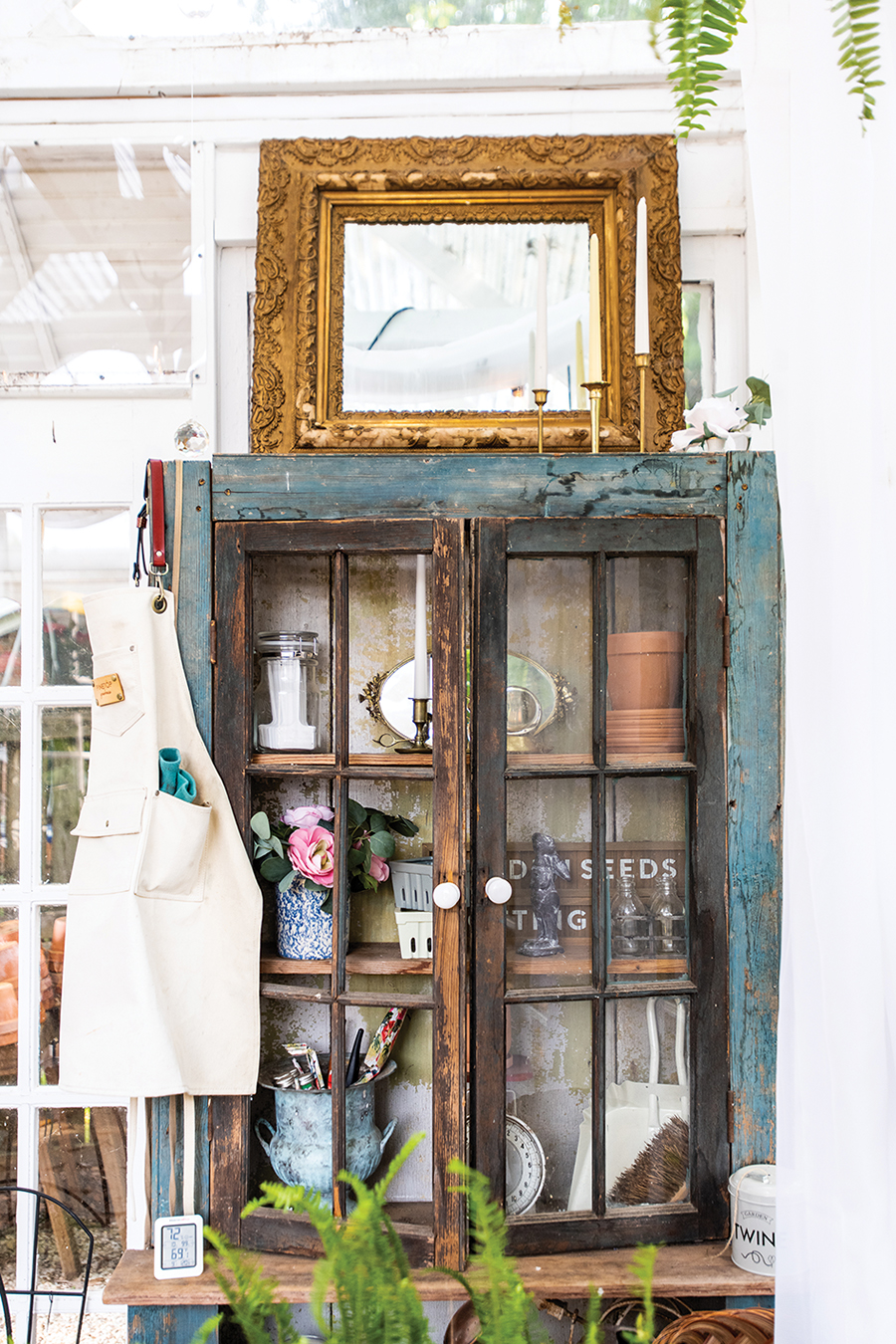
   

Pinetop Greenhouse provides fruits of the labor that can’t be seen to the naked eye, too, and connects Jamie, who grew up on a small farm, to her own roots.

A full-time nurse by trade, she finds much-needed sanctuary in her own backyard. While navigating her professional role during the pandemic, she also faced personal challenges. “My mom almost died of COVID — two weeks in the ICU,” she recalls. Working in the greenhouse and garden offered Jamie a chance to “take back some form of control” in a world that felt like it was spiraling.

“Good days, bad days, stressful days,” says Jamie, “I just come get in the dirt and it works itself out.”

These days, she often calls her mom for gardening advice and hopes that the cycle continues with her own kids seeking her help one day.

For now, the greenhouse nurtures Jamie’s creative spirit. She loves “the thrill of the hunt” and shops local thrift stores, often scooping up vintage finds that inspire a complete overhaul of the interior design.

She points to a floral painting paired with a gold gesso-framed mirror. Those two pieces snowballed into a day spent flipping the entire aesthetic. “For $20 bucks,” says Jamie,”I was feeling inspired here.”

What’s next for this greenhouse that, according to Jamie, “constantly evolves?” She’s currently dreaming of adding a butterfly house. “I’ve kind of slipped that into conversation and gotten the side eye [from John],” she says. But, the seed has been planted and, no doubt, her new dream will take flight soon.

For more information, visit pinetopgreenhouse.com.


Ohana Cabana


Nestled into the corner of Kimberly Paisley’s backyard, among blooming rhododendron, twittering birds and lush landscaping, a peaceful retreat awaits. Six years ago, on the day Paisley first toured the Old Starmount Forest abode and spied its detached garage, a vision began forming in her mind.

The previous owners had already been using the building as extra living space, having furnished it with a bed and a small sofa. “When I looked at the house to begin with, the guy showed me around — the husband — and the wife was sitting in there on her computer, so that immediately gave me an idea,” says Paisley.

No stranger to renovation, Paisley has purchased and remodeled several homes in her time. (She’s currently turning a 130-year-old home into a duplex that “is going to be absolutely breathtaking.”) In early 2021, finally ready for her budding idea to come to life in her own backyard, she drew a rough sketch in a notepad.

Needing the motivation to get started, Paisley purchased a vintage-style, cherry-red refrigerator for what would become her retreat’s kitchen. “I bought it first thing and worked the whole [design] around it,” she says. “It was the incentive I needed to go.”

But there was one major hurdle to overcome before work could begin. While the former garage had been outfitted with electricity and heat, it was missing one vital ingredient that would make it completely livable: water.

Of course, installing new plumbing meant tearing out much of the existing concrete, which Paisley, as someone who works as her own contractor, hauled to the dump herself in 90-degree weather. “I thought I was going to have a heart attack — I mean, just sweating. You know, I’m the only woman out there. The men are like, ‘Let us help you,’” she says and laughs. “I was like, ‘I’m not gonna turn that down.’”

After the plumbing was installed and the new concrete poured, “it went fairly smoothly.” The last room to be finished — her favorite — was the small-scale Ikea-inspired kitchen. And to counterbalance Ikea’s “simplicity, functionality and beauty,” the kitchen’s pièce de résistance was, yes, her newly purchased, bright red retro refrigerator.

With the interior work just about complete, the retreat opened its doors to its first guest, a girlfriend who was moving back to the continental U.S. from Hawaii. “She stayed probably six months until she found her own place, but it was the perfect little space for her.” And did they meet on the backyard deck for drinks during that period? “Every day!”

It was a gift, a wooden sign, from that friend that would inspire the exterior palette of pale yellow siding, green shutters and purple doors, as well as the cottage’s name, Ohana. “Ohana means friendship in Hawaii,” says Paisley, pointing to the sign hanging on the facade as a greeting.

Airbnb? “As you’ve seen on NextDoor, people are really not wanting that,” she replies. She’s considering opening it up to just people in the neighborhood who have visitors coming in: “golfers who need a place to stay,” for instance. “I would love to offer it for that. But otherwise, no.”

For now, the aptly named former garage remains a peaceful respite for friends. “It’s just so pleasant! It’s quiet — it’s like you’re in a whole different place, but you’re not,” muses Paisley. “You’re just in the backyard.”  OH

Visual language

Visual Language

Jennifer Meanley creates kaleidoscopic realities

By Liza Roberts

.   

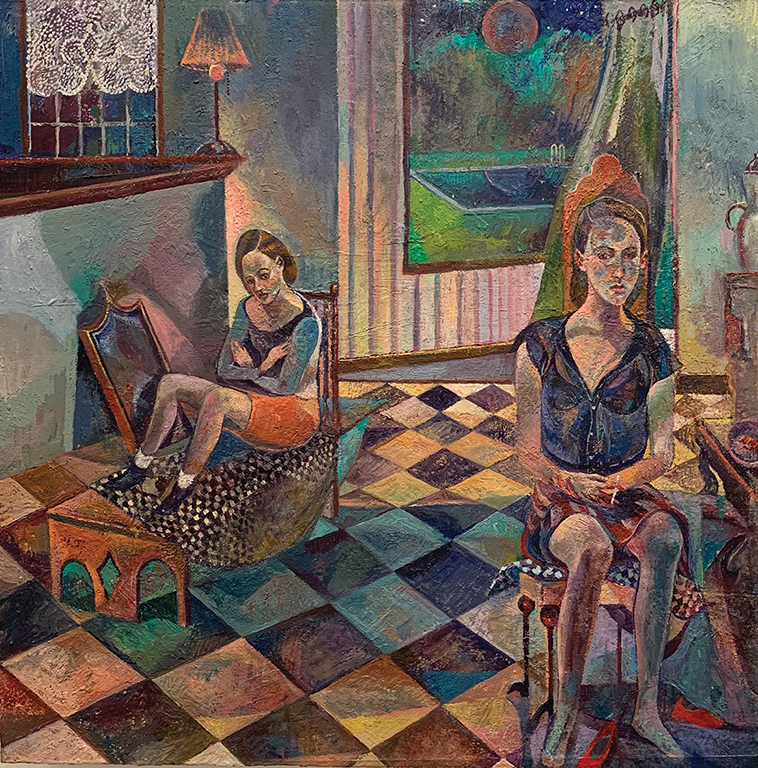
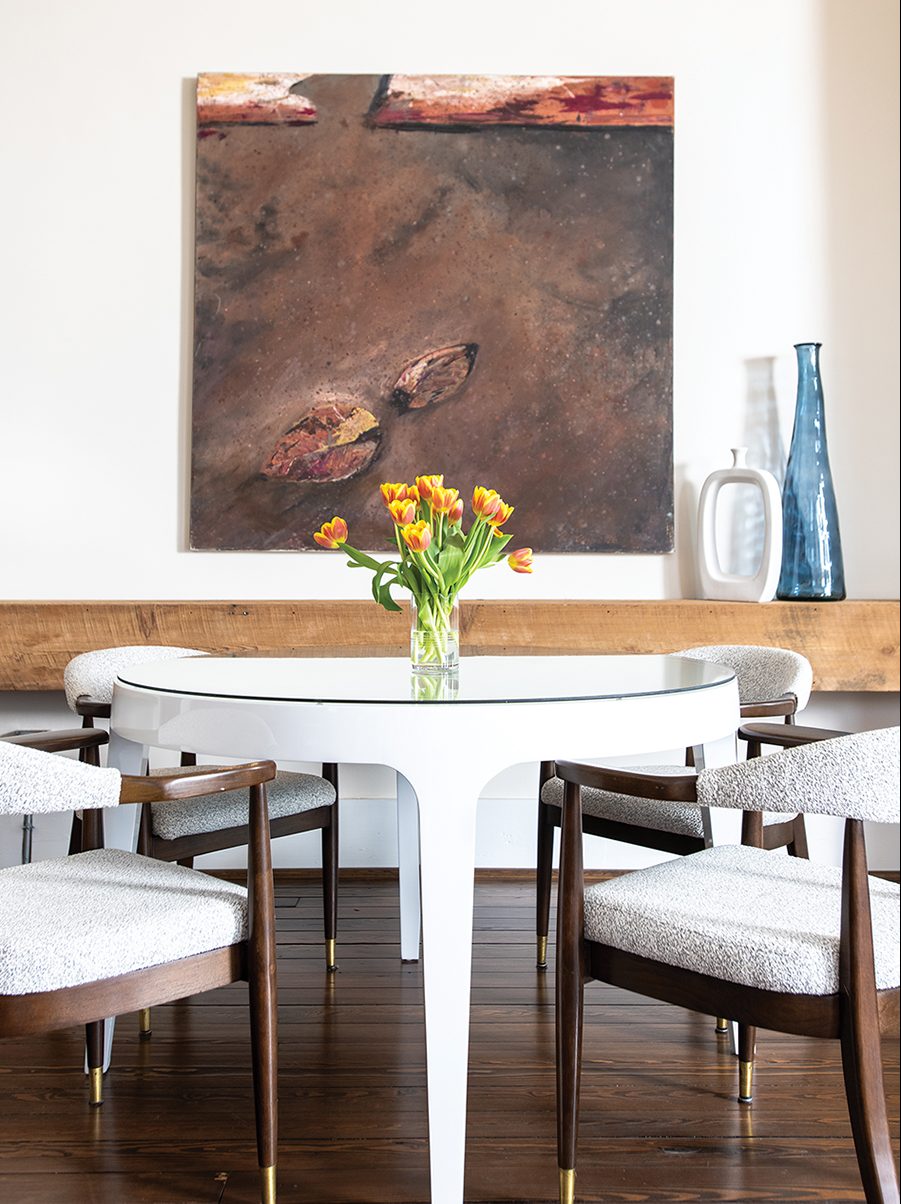
Center: As if smoldering and smoke were oneness evoked by thought and expression, oil on paper mounted on panel, 15 x 15 inches, 2019.

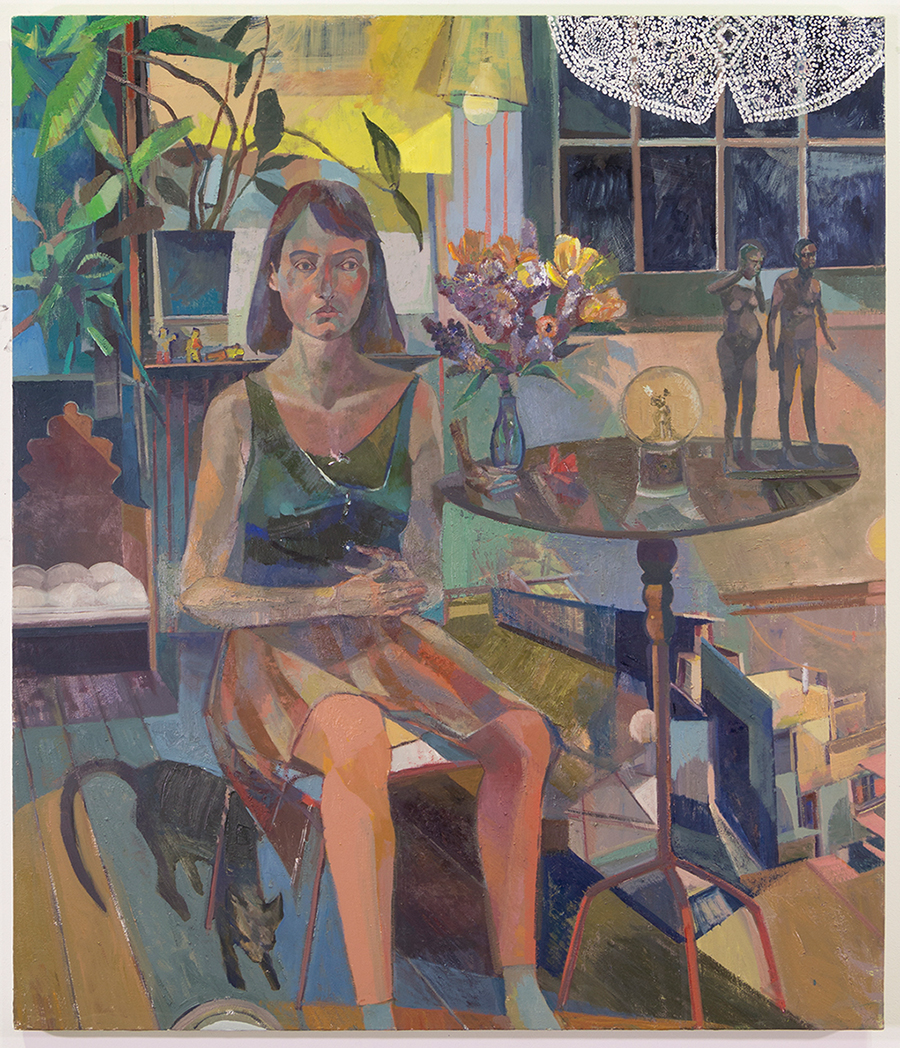
Right: Milk-Ersatz, spilt, oil on canvas, 48 x 56 inches, 2017.

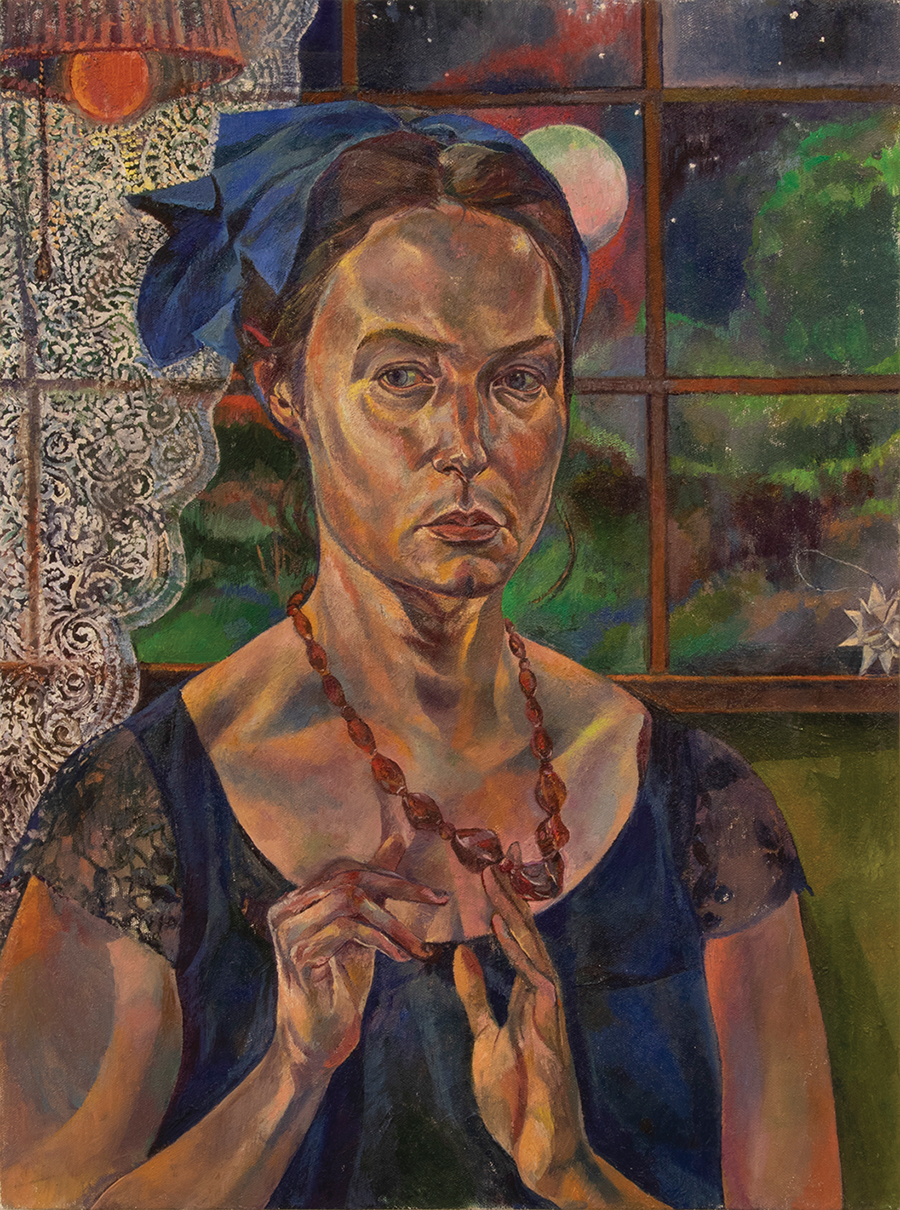
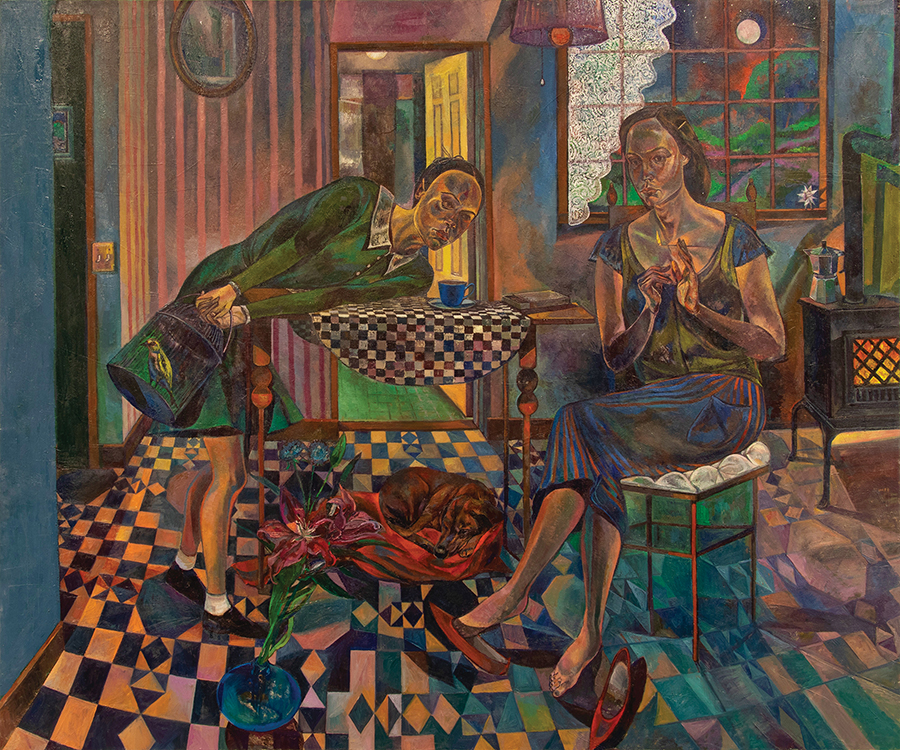
Intimate but alienating, lush and allegorical, Jennifer Meanley’s paintings appear to capture the moments upon which events hinge. Figures, often out of scale with their environments, gaze at odd angles within untamed, kaleidoscopic settings, more consumed with their interior lives than with the discordant scenes they inhabit. Animals, alive and dead, sometimes share the space. Something’s clearly about to happen, or might be happening, or perhaps already has happened. Are her subjects aware? 

“There is often a sense of lack of synchronicity between how we experience our bodies and how we experience our mind, our emotional states,” Meanley says. Her paintings “often register that paradox, whether that’s with the animals, or the symbolism with the space itself . . . or whether the figure seems to be looking and registering and connecting” to reality. Or not.

    

At UNC-Greensboro, where she teaches drawing and painting, Meanley paints these large-scale depictions of human experience. Simultaneously capturing the spheres of action, memory, participation and observation, she invites a viewer to examine the parts and absorb the whole. Like poetry, her works reveal themselves in stages and elements: image, rhythm, tone, vocabulary, story. Color plays a major role. “I’ve always had a penchant for really saturated colors,” she says, especially as a way to indicate atmosphere, like light, air, wind and the grounding element of earth.

Does she begin with a narrative? Not really, or not always. In a painting underway on her working wall — in which a caped, gamine figure gazes upon a flayed animal, possibly a deer, within a riotously overgrown landscape — the New Hampshire native describes her impetus: “I was thinking of this sort of crazy Bacchanal,” she says, “or of a surplus, imagination as a kind of surplus.” Anything is possible in the abundant realm of the imagined, she points out. The real world is another matter.

It’s no surprise to learn that Meanley writes regularly in forms she compares to short stories that emerge from streams of consciousness. It’s a process she describes as if it’s a place where she goes: Language is “like a field that I experience, stepping in and noticing punctuation, noticing the spaces between things, or the pauses, the way breath might be taken. That’s all really, really fascinating to me.” When she’s teaching, she tries to create a corollary to visual language in much the same way: “What does it mean to literally punctuate a drawing, in a way that you would take a sentence that essentially had no meaning, and make it comprehensible?” she asks her students. “Through timing, and space, and rhythm, and breath.”

All of which connects to physical movement, another practice Meanley credits with fueling her creative process. Long walks with her dog in the woods spark marathon writing sessions, which then engender drawings and paintings.

In the last year, her writing sessions have taken on new importance, Meanley says. Writing “is a way for me to deepen my personal exploration of my own psychic space, which is the origins of the paintings as well.” Though she doesn’t intend to publish these writings, Meanley is open to the possibility of including some of her words in new paintings. “I think the world that I’m exploring has to do with the idea of psychological interiority and how that can find representation” through words and images. In the meantime, the kinetic activity of walking continues to fire her imagination.

It has also attuned Meanley to the natural environment of the South, so different from what surrounded her in New Hampshire, where she grew up, and where she also earned her BFA at the University of New Hampshire, or even at Indiana University, where she received her MFA. In and around Greensboro, she finds nature so lush, so green, so impressive. “I started realizing that there’s this battle within the landscape. Just to even maintain my yard, I feel like I’m battling the natural growth here. It did amplify that sense of tension, of creating landscape as a narrative event . . .  as an important space to contemplate hierarchies of power.”
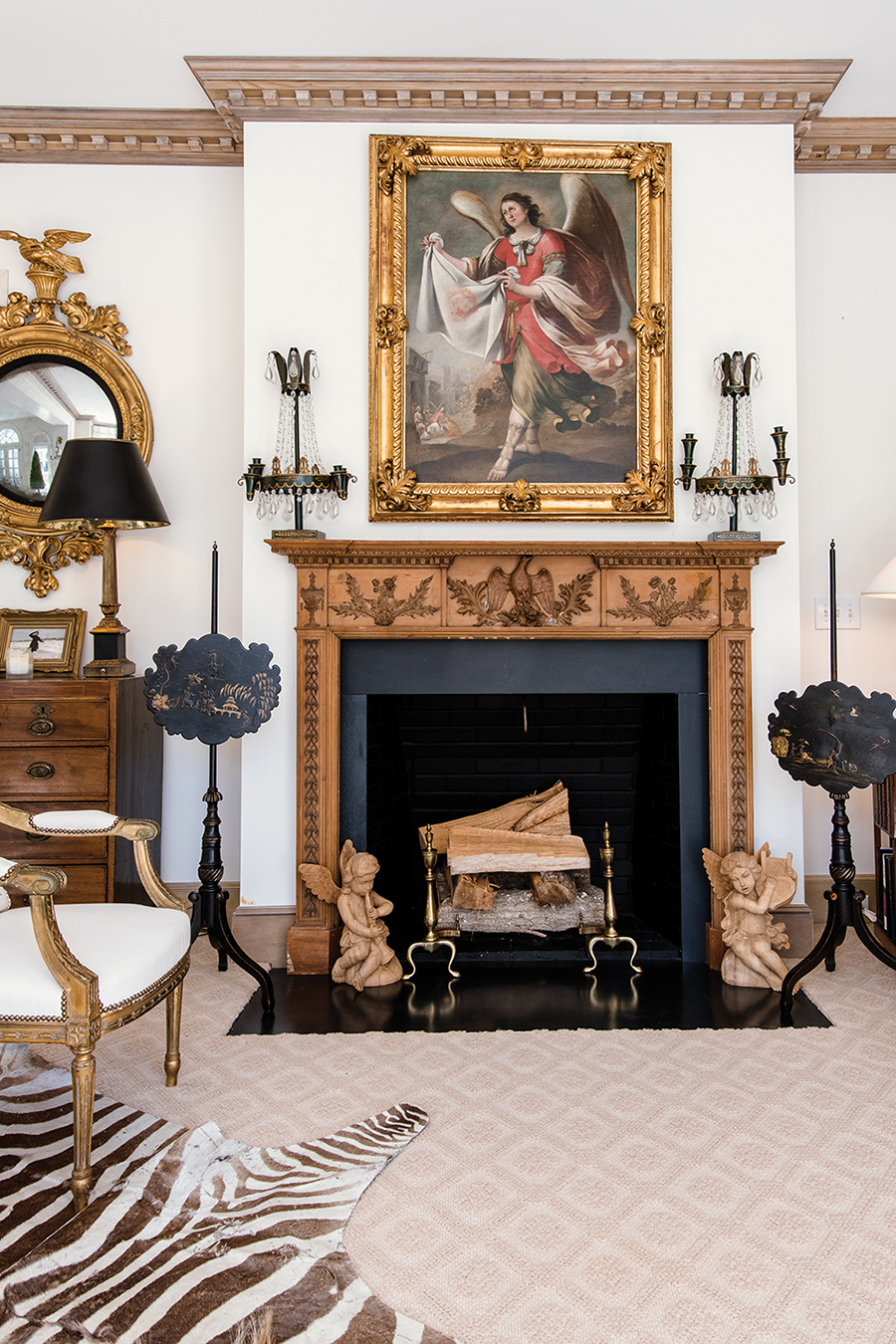
Summer, with its time away from the demands of academia, provides Meanley with more time for outdoor exploration and for contemplations of all kinds. She’s also looking forward to having time to tackle larger works, with the hope of a solo exhibition later this year or in 2024. “Doing a solo show is an endeavor,” she says. “Right now I’m gearing up.”  OH

This is an excerpt from Art of the State: Celebrating the Art of North Carolina, published by UNC Press.

Almanac June 2023

Almanac June 2023

June is a daydream; a picnic; a long, sweet song.

Beyond the sunlit meadow — thick with thistle and crickets and Queen Anne’s lace — the grandfather oak has gone moony. Most days, he is patient. Steadfast and uncomplaining. But on this day, when the painted lady drifts past the sea of red clover, he is fraught with expectation. The children of summer are coming.

As they float through the meadow, blankets and baskets in tow, the oak is awestruck. They could go anywhere. Bring their banquet to the altar of some other worthy tree. But they don’t. As they make their way through towering thistle, past bee balm and poppies and raves of day lilies, the grandfather knows: The children of summer will be here soon.

They come singing. Come with just-picked daisies. Come with a spread of luscious offerings:

A palmful of wineberries.

Pickled cucumbers.

Mint, marigolds and beets.

Roasted potatoes.

Dandelion shortbread.

Honeysuckle and homemade mead.

In the shade of the grand old tree, the children sprawl in dappled light, laughing and feasting and giving thanks. For them, hours pass like minutes. For the oak, time stands still.

When you’ve seen as many summers as he has — not to mention all the winters — these are the days you live for. Days of abundance. Days of praise and cicadas. When youth is a state of the heart, each breath is a banquet, and nature gets a glimpse of its own reflection.


Citronelly! Citronelly!

A summer without mosquitos isn’t a summer. No way around ’em, but we’ve got allies. Citronella, anyone?

Also known as scented geranium, citronella is one of the best-known pest repellents to add to the garden. But there are others.

Basil: Not just for pesto! This fragrant, prolific herb deters both mosquitos and flies. Learn how to trim it for larger yields. 

Rosemary: Likes it hot. Thankfully, the woodsy aroma that we know and love sends the swamp devils onward. 

Marigolds: Easy to grow? Check. Better yet, their lovely flowers attract predatory insects.

Bee balm: Out with the nippers, in with the bees and skippers.

Other plant allies include lavender, mint, lemon grass, catnip, sage and allium. Play around to see which plants work best for your garden. Besides mosquitos, what do you have to lose?


Strawberry Moon

The full Strawberry Moon rises on Saturday, June 3. It won’t be pink, but it will appear golden just after sunset, reaching peak illumination by midnight.

A new moon on Sunday, June 18 — Father’s Day — means clear skies for stargazing. See if you can spot Boötes (the herdsman), Libra (the scales), Lupus (the wolf) and Ursa Minor (the little bear) this month. Bonus points for a firefly constellation.   OH

A Fresh Start

A Fresh Start

Morning routines that get — and keep — three professionals going

By Cynthia Adams

A newswoman arrives at work at 3 a.m. An architect seeks to establish a natural flow to each day. An on-call nurse routinely leaves her work after daybreak. Their routines share a singular intention: grounding themselves, finding a rhythm with each new day.


Waking up with WFMY’s Tracey McCain

Tracey McCain’s morning-is-breaking, upbeat smile is familiar after appearing on Triad television soon after her career began. Sure, she could have gone to a bigger market — Dallas was interested — but Triad TV viewers should thank their lucky, local star that she decided to come back to her hometown.

Her first stint at WFMY was the weekend Good Morning Show, later moving to weekdays. She now appears on the Good Morning Show, America’s oldest and longest-running morning show.

Since last September, the program now airs in bifurcated segments, first from 4:30–7 a.m., interrupted by the CBS national newscast, This Morning. WFMY’s local program resumes with McCain from 9–10 a.m.

“You know, I quite enjoy it,” she says cheerfully about the added hour. “It’s a different show format, which allows us to tell the news but also relate to our viewers and each other in a nontraditional way.”

McCain says the key to an early bird lifestyle is her husband, Jaron, who juggles a demanding law practice with parenting. “He’s a great dad, and we’re great partners. I don’t think I could do this with anybody else.”

Jaron, who understands what’s required of his wife’s job, continually earns fresh respect. 

“He tells me every day, ‘I appreciate you so much.’ I don’t think I could do this if he didn’t.” McCain admits that even a morning lark like her requires a choreographed routine. 

It begins with a 2 a.m. wakeup call: “I’m out of my bed and start the process to go from mother-of-the-year to newswoman.”

First, she allows herself one cup of joe — her favorite is Breakfast Blend — light, with cream and a teaspoon of sugar, before reaching the Phillips Avenue station as Jaron, and three young children— ages 2–7 — still sleep.

After nearly two decades, the indefatigable WFMY newswoman, wife and mother says she understands if we feel we know her. Born in Guilford County, McCain graduated from Eastern Guilford High School before earning degrees at the University of Connecticut and Quinnipiac University.

She launched her career at WSHM in Springfield, Massachusetts, moving to WFSB in Hartford, Connecticut, before finding her way home in 2006.

From McCain’s perspective, being in her hometown in a job she loves validates her maternal juggling act.

As part of a high-profile morning anchor team, McCain must be ready to go before the crack of dawn, no matter what.

“It’s just like the postal service,” she jokes, saying she has driven through every type of weather. “Whether there is snow, sleet, rain, hurricane or a tropical storm.”

All part of the job. 

But she leaves little to chance. In order to get out the door on time, McCain has developed a strict routine that seldom wavers. Hair, makeup, everything is done before walking into the studio. “And I pack my bag and I’m out the door.”

“I’m into fitness. Healthy attitudes and healthy meals. So, I prepackage my meals the night before so I don’t have to think about it.”

Not only meals, mind you, but snacks to power her until the early afternoon. “I make certain I have my necessary amount of water — everything I’ll need.”

There is scarce opportunity to leave.     

“If there’s breaking news — shootings like this week — I have no time.” 

Once settled into a work rhythm, McCain allows herself a second cup of coffee before broadcast, mindful that she will be on live television for the next two-and-a-half hours.

Fortunately, the early hours of the day are her favorite.

“I’ve always been a morning person,” she declares convincingly, although it is nearing noon and she admittedly longs for a quick shut-eye. A radiant smile breaks again. “I’ve been waking up at 2 a.m. for 15 of those [last] 18 years. On off-days, I sleep in until 6 a.m. I can do a lot in an hour before the kids are up — laundry or cook a meal.” Even at rest, she even keeps a notebook bedside for jotting down ideas.

Her evening routine? While getting her kids ready for bed, McCain addresses things like her next day’s wardrobe. “I’ll set their toothbrushes up and go into my closet and choose what I’ll wear. Kids lunches are made.”

Finally, she says, “My night ends after the last child goes to bed. That could be 9 or 9:30 p.m. I have extreme child guilt, like most moms do, because I’m not there for the mornings . . . I don’t want to miss a thing.  So, I want to be there for them.”

Recalling her own upbringing, McCain says, “My parents gave me the best childhood! My mom made dinner every night. I try to do that for my kids.”

She reads with her children nightly, marveling over oldest son Josiah’s thinking and problem solving. Her daughter, Simone, 5, “dances and sings,” McCain praises. Her youngest, Julian, “is super tall, super-fast, he’s like lightning. He wants to be like his older brother . . . If I say ‘the baby,’ he says, ‘I’m not the baby!  Who’s the baby?’” 


At midday, moving into “mom mode,” McCain’s energy falters. Yes, she answers. She is sleep-deprived all the time. 

“I learned how to function with great coffee and naps. Sometimes I’ll take a nap in the carpool lane as I’m getting my child. The teachers know,” she says, smiling broadly. “If they see my car, they know I’m probably taking a nap.”

Keys to her productivity, besides cat naps, are a healthy diet and high intensity interval training. 

McCain so believes in her fitness routine she became a certified personal trainer forming a partnership with AWOL Fitness in Greensboro called “Train with Tracey.” She teaches classes Mondays and Wednesdays at 6 p.m., and Saturday mornings at 9 p.m. “I pour daily motivation into them.”

McCain reminds, “This is a great day to have a great purpose/time and have a great time with great people. I use ‘great’ all the time.”

She makes it a point “to be kind/nice/respectful of everyone, including myself,” she texts after work one afternoon. “And I’m going to love my children from the time they wake up until they go to bed. And love my husband. I’m a positive, happy, person.”

Although her friends call her “superwoman” McCain is realistic. “I’m selective. I cannot do it all.”

“I don’t know why, but for some reason, people think I’m a diva,” she says, shaking her head. “I’m not! I’m so down-to-earth.”

What is most challenging about being a local celebrity?

She responds to actor Rob Lowe saying he likes going out in public, wearing a ball cap and seeing if he is spotted, which he calls “giraffing.”

McCain enjoys being recognized. “If I’m wearing a hat, it’s not because I’m hiding . . . it’s because I’m having a bad hair day. You live in the South! My grandmother said hello to everyone — so I do!”

She relies upon feedback from viewers, but best of all, Josiah. Before Jaron drops him at school, he watches a few minutes of the Good Morning Show.

As if part of his own morning routine, her son calls her every morning, with his own positive affirmation. “He says, ‘Great job . . . you really did a great job!’”

McCain swallows. “I mean, what a sweetheart!

“He’s learning from my husband.”


Mornings with Michael Clapp, Architect and Artist

Michael Clapp has two nonnegotiables in his workday routine: caffeine in a cup and crunch in a bowl.

The 30-something architect and visual artist doesn’t even want to imagine a morning that doesn’t include espresso and at least a few bowls of his favorite Honey Nut Cheerios while he digests the news on his iPad. Maybe, he adds with a small laugh, he’ll have three or four bowls of cereal with milk.

As a naturally slender man, this requires confirmation. But Clapp isn’t kidding.

“I’m very much a morning person,” he says. “I love the feeling of getting an early start to things and hate the feeling of getting up late and having to rush through my morning preparations and out the door.”

A typical morning begins with only two cups of his go-to. An Italian espresso machine is one of the hardest working appliances in his tidy kitchen.

Clapp, a full-time architect with STITCH Design Shop, has worn other hats. He has been a lecturer in the School of Architecture at UNC-Charlotte, while also starting his own firm, Schemata, having earned a master’s degree of architecture at Harvard. His Whitsett barn conversion, “Resonant Dwelling,” appeared in the March 2019 O.Henry. In the October 2021 issue, I wrote “His Father’s Son” about a cabin retreat of his design, a collaboration with his father, who also works in a creative field as owner of an advertising agency.

So, what is his morning routine like? Variable. “So, to speak to your question . . .  it’s complicated! I would say I had a much different morning ritual when just working for myself at Schemata than I do now that I work full-time [in addition to maintaining a few jobs specific to Schemata] for STITCH Design Shop.” 

If there is such a thing as an “ideal scenario,” Clapp describes it as this:

“I’d get to bed at a reasonable hour such that even if setting an alarm, I’d generally be able to wake up naturally around the proper time to allow a slow easing into the day.” He loves taking a quick walk outside before doing anything else. “And in the winter [especially if there’s snow] it’s something that makes such a difference to how the rest of the day goes.”

On weekends, Clapp pulls on boots and heads out for a walk, “even before cereal and news.”   

Yoga helps him “feel more centered throughout each day” when he can work it into his schedule.

Now, with assorted meetings, travel and sundry work requirements, Clapp finds himself lucky “if I can get to the downtown Greensboro YMCA gym before making it to the office.”

The demands of his exacting work and art can complicate his daily rituals. An out-of-the-ordinary day may have him taking an early morning sauna [he’s building his own at home] and sweating a deadline that afternoon. But, when life is in balance, there’s a natural stasis — an equilibrium.

What follows is well-known as “flow state,” which is almost effortless creativity and the ultimate achievement within a well-calibrated day. “Uninterrupted time,” he clarifies, is critical to entering this sought-after, creative and relaxed state of mind. 

“Uninterrupted time . . . that luxury,” Clapp repeats and sighs.

When working, sketching or drafting, Clapp is very methodical. Creatives often report that when achieving the flow state their work is almost unconscious — having attained a mental state from which their work simply flows, hence the term.

All thanks to an equilibrium that for Clapp begins simply and ritually with a leisurely cuppa and a bowl of cereal. While outwardly simple, such things are significant. Clapp is seeking mindfulness and “healthy ways of living habitually.”

There is a fully-caffeinated coffee in his hand although it is late afternoon. No worries, he reassures. He can even enjoy a late-night coffee and sleep deeply. 

And with that, he walks back to his office, returning to put the finishing touches on a project, renderings he says he cannot wait to show favorite clients.


Daybreak reflections with Jessica Smith, R.N.

On-call hospice nurse Jessica Smith lives with an upside-down schedule: Mornings mark the end of her workday — not the beginning. 

Smith works after hours, on call while her family, like much of the city, is tucked into bed. So, the trick for her is to create some semblance of a morning routine during the work week before she, too, finally rests.

As day breaks, mornings often vacillate between peaceful and chaotic — seldom predictable or routine.  And yet, she says, “I’m so thankful for my job. Not everybody gets to experience the full circle of life. I do. How precious are our lives?”

Smith has been at Authoracare Collective for 17 years, working in the Triad “and as far as King, Madison, Mayodan, Sophia, Wilson and Chapel Hill.” She sings as she drives, centering herself.

Her blonde curls, blue eyes and cherubic face resemble a pre-Raphaelite painting. At first meeting, family and patients often assume she is younger, asking, “How long have you been doing this?” 

Smith, approaching 20 years in her job, hopes her longevity reassures. “They say it does.”

“I’m going to be calm for the family,” she says. “Nothing’s an emergency with hospice.” Her equanimity improves her patients’ experience. This requires establishing a routine which helps her find this. 

Her blue eyes reflect this, pools of surprising serenity.     

“If you’re not calm, the family’s not calm. And you have to be the quiet authority.” This propels her through long nights when she responds to calls that take her into varying situations and needs.

So, with each daybreak, the previous night dictates her morning routine. Sometimes, family members are waking up to discover their loved one has died, she explains. Or a patient is nearing the end. Her schedule varies out of necessity. After each night shift, Smith completes patient notes for the primary nurse and social worker before returning home for a brief walk, some devotional time to reflect and then, finally, sleep.

On difficult mornings, coffee must wait. Otherwise, Smith logs 3 miles in the morning, squeezing in a 1-mile walk when it isn’t. She takes Zumba and Peloton classes. Her Yorkie, Lexie, knows exactly how to give comfort when needed after a difficult night.

With years of experience, Smith is exquisitely aware of life stages. She can anticipate a patient’s end of life.

Sensing that death is nearing, she remains even when the family tells her she can leave. “No, I’ll stay,” she gently insists. 

Smith formerly worked as an oncology nurse, seeing patients daily. On-call, she sees many different patients, often for the first time.

While in nursing school, she had to inform her own father that he was dying. “He had the look. That is just one of those things . . . I knew.” 

“I told him, it’s not going to be long — Thanksgiving was when he entered hospice care. He looked at me and asked, ‘Do I have till Christmas?’ I said no.” 

Smith’s father died at the end of that November. Her honesty allowed time for important things to be said.

Originally, she studied voice. But by age 26, she discovered her true calling was nursing the critically ill.

As for singing? She is a fan of gospel singer Cee Cee Wynans’ Goodness of God. “I try to listen to it every day and it reminds me of where I’ve been and thankfulness: You’ve made it through.”

Smith often sings for an audience of one. 

“Even patients — and I hope it doesn’t sound creepy — we have patients who are wards of the state and they don’t have family, and they’re alone,” says Smith. “And I sometimes sing to them when they die. Even afterward.” 

“In the middle of the night, they [the family] call because they’re in a crisis. And I make them feel better, but I’m not the primary nurse.” For that reason, she speculates that no one will remember her. No matter.

Her eyes soften. “I’m in service to something bigger than myself. I could go in my pajamas and not brush my teeth and they [the patient and family] would be just be grateful I’m there. Of course, I don’t do that,” she adds. 

Well-dressed, her blonde curls tamed, Smith assumes the mantle of reassuring professional, navigating an incredible journey with families and patients. This journey, according to her, “is some of the most precious times you will ever have, apart from being born.”

It struck her from the beginning that death is a great equalizer. “It all comes down to [my] being by the bedside. I would go to one home in Smith Homes, and one home in Irving Park. And they all end the same way,” she observes.

After a hard night of helping a patient reach that end as peacefully as possible, Smith allows herself time — time to love herself and critique what she can do better, she explains. She sings, too, often unaware she is singing.

On free days, Smith sleeps in a bit. “The only difference is, I don’t go back to sleep after I walk. I try to set aside a little time with Jackson, my son. We sit and talk a lot.”

She remarried seven years ago, acquiring two “bonus” children in addition to her two sons, including a daughter, Krista, who had Type 1 diabetes.

“She was fascinated by death,” says Smith — especially hospice work.

In 2020, 17-year-old Krista passed away unexpectedly in her sleep. 

“It was a good death,” Smith says softly. “Peaceful. There is no better death than that.”

At the urging of Krista’s older brother, Caeleb, the family established the Krista Smith Foundation in support of juvenile diabetes. 

“What helps me is the work I do, and knowing how short our lives are. And that we are living exactly as long as we are supposed to. It has helped me be a better hospice nurse.”

Come nightfall, Smith will do it all again.  OH

A New Dawn on Sunset

A New Dawn on Sunset

A couple breathes life into an old downtown Asheboro building

By Cassie Bustamante
Photographs by Amy Freeman 


Right: Photograph by Lauren Brooks of Hello Cheetah Photography and Monclay, LLC Media

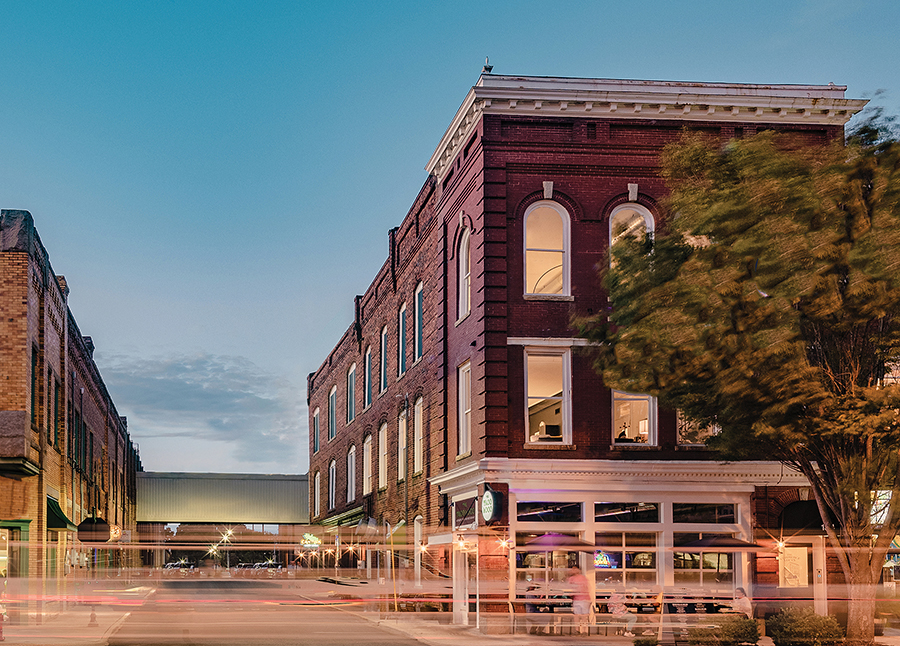
In the heart of downtown Asheboro sits a three-story, brick building that, over the last 100-plus years, has housed, among other things, a post office, a doctor’s office, a tailor, a clothier and even a photography studio. Now, thanks to designer Christie Luckenbach and her husband, Eric, the Sunset Avenue structure they’ve dubbed “The Commerce Building” is home to The Taco Loco as well as five modernized apartments, including that of the Luckenbachs.

Their own home, which takes up a majority of the top floor, is a perfect balance of sleek modern lines and time-worn patina no professional faux-finisher could duplicate. But it wasn’t even close to move-in ready when they originally purchased the building.

It was a glorified “pigeon roost — just nasty,” Eric recalls of the entire third floor. But Eric knew that Christie could make it into something special. “That’s the beauty of her talent.”

Eric knew immediately he wanted to purchase the building after visiting it with its then owner, former Asheboro Mayor David Jarrell. But “he did not want to sell it,” says Eric, who countered: “If you give us a chance, we will do it right. And we’ll spend the money. We had it in our minds that we wanted to invest in Asheboro.”

While the Luckenbachs, both born and raised in Asheboro, had not previously considered themselves property developers, their close friend, Jen Parrish, challenged them to “put the money where their mouth is.” After spending much of their 32 years together traveling, Christie and Eric felt ready to apply what they’d seen in cities all over the world. “We’re just always looking at buildings and what you can do with them,” says Eric, blue eyes full of wanderlust. “That’s kind of our fun in a way.”

Finally, with Mayor Jarrell’s blessing and Parrish’s encouragement, the Luckenbachs bought 134 Sunset Avenue in January of 2018 and started making plans to recruit a dining establishment that would anchor the first floor before working on the rest. As huge fans of The Taco Loco, a popular dive on the outskirts of town at that time, the Luckenbachs set their sights on bringing the restaurant downtown. Christie got to work designing the entire space with The Taco Loco in mind to show its owners what was possible for their business.


Christie says the inspiration for the eatery’s eggplant-colored walls paired with green accents came from a photo of bright, vivid guacamole ingredients. The choice of purple became a sizzling debate between the couple, but, in the end, Christie won. And her designs lured The Taco Loco to The Commerce Building. (The Taco Loco is currently closed for renovations and due to reopen soon. Its adjacent cantina remains open.)

“Without her drawings,” says Eric, who has come around to the purple, “it probably never would have happened.”

The biggest perk? “We eat it all the time,” says Eric. “Last night!” they say in unison.

And, of course, the restaurant owners are happy customers as well. “It’s completely changed their lives,” says Christie.

Once The Taco Loco was in place, Christie began designing the top two levels, which would eventually become five apartments — three on the second floor and two on the top floor, including what they call the “premiere” apartment, their current residence.

However, the original plan was to claim the entire third floor for the couple and their two sons, Beau and Ben. But during their renovation process, life threw them a curveball that changed their plans — and their lives — forever. In July of 2020, 14-year-old Ben Luckenbach passed away suddenly.

“Brilliant child, just brilliant,” recalls Eric of his younger son, Ben, who was working towards being a master level chess player.

“Playing chess blindfolded! I said, ‘Ben, you really gotta rub that in?’” adds Christie, her soft freckles crinkling as she laughs.

Despite suffering through a parent’s worst nightmare, the Luckenbachs, feeling bolstered by the empathy and support of their Asheboro community, remained strong and pushed through the project. “It was a really good distraction,” says Christie. “In all the bad,” adds Eric, “you gotta keep going forward.”

The couple adjusted their plans and decided instead to split the top floor into two apartments, a one-bedroom intended for 21-year-old Beau and their own two-bedroom.

With the help of Trollinger Construction, Christie worked to maintain as much of the original footprint as possible throughout both the second and the third floor. “It’s easy to demo,” she says, “but it’s expensive to build back.”

She salvaged anything she could. Original wood floors have been refinished throughout, with Christie keeping some of the quirky characteristics created over time, such as burn marks made by a tailor’s iron on the second floor.

In the couple’s own apartment, a long rustic beam operates as a shelf. Is it original? Not exactly. It’s been fabricated from a first floor joist that had suffered water and termite damage. Recovering what they could, they simply repurposed the rescued pieces.

While some features aren’t original, they are purposefully of the era. Christie, who has a self-proclaimed “door fetish,” knew she wanted six-panel doors throughout, but “they became popular as headboards and became really expensive.” Luckily, she “caught wind of this house being torn down on the corner of Park and Church.” After some investigating, it turned out the owner was a former client who gladly gave her all of the doors — enough for this project and another, plus some to spare.

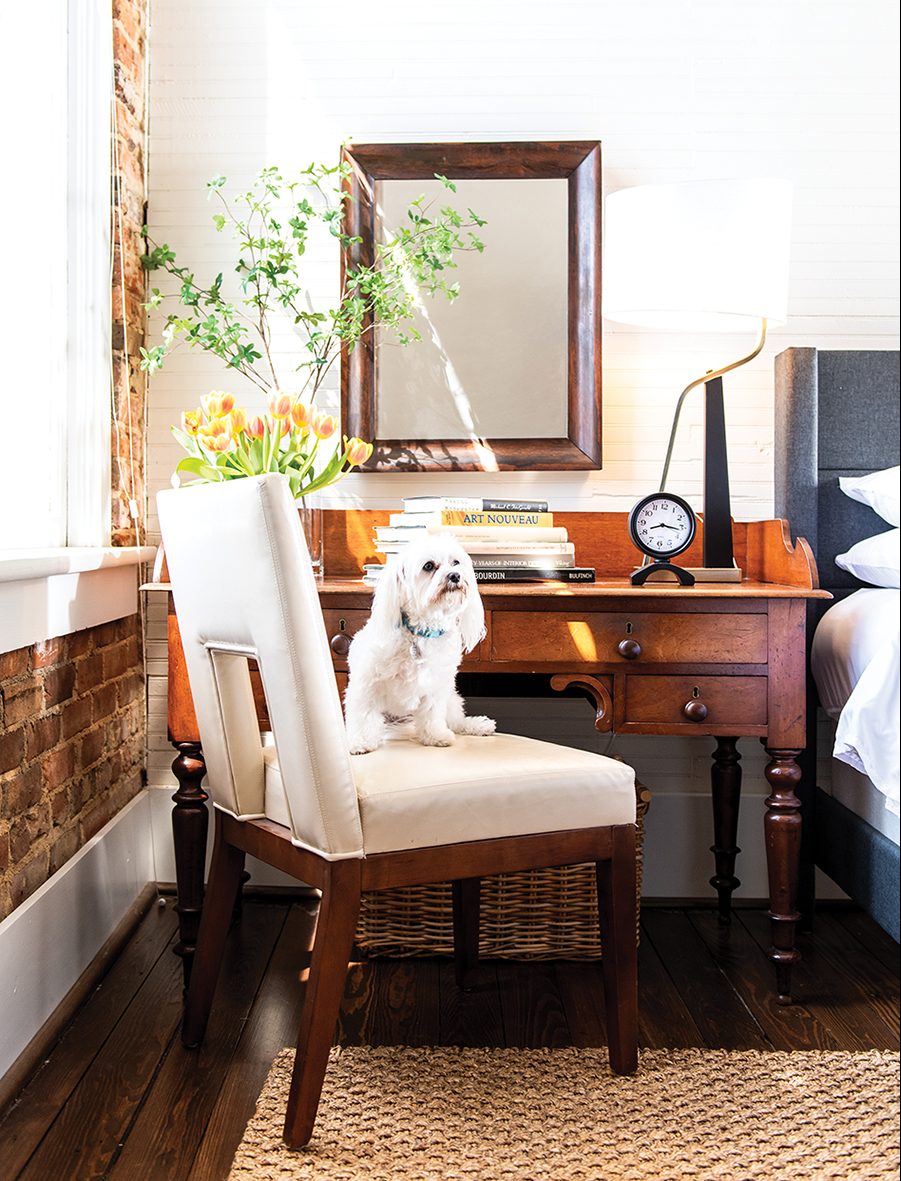
In the studio-style living space, original exposed-brick walls and arched windows lend a historic atmosphere while sleek light fixtures plus a cozy Italian leather sofa afford modern comforts.

Another new addition is the floor-to-very-high-14-foot ceiling gas fireplace that quietly displays dancing and mesmerizing flames, and, according to Christie, “does put off heat” while creating a calming ambience.

In the kitchen, European style stainless appliances pair with dark cabinetry and black granite countertops and slab backsplash with white veining and hints of taupe and brown. It’s a modern chef’s dream kitchen — and Eric loves to cook.

But the best feature in the main living space has got to be the location and the view. From their apartment windows, Christie and Eric can see and hear — what some people might consider a bug, not a bonus — the train going by. “It’s awesome,” says Christie. “We’re like children.”

Eric interjects, “This has not gotten old!”

And when downtown Asheboro hosts its summer concert series, can they hear that, too? “Yes!” the couple exclaim.


“They’ll have like a Fleetwood Mac cover band and you can just open the window and you’re a part of it,” says Eric. “It’s awesome — so awesome,” adds Christie.

Tucked away from the main living space, the two bedrooms boast original beadboard walls with layers of old crusty paint that create nostalgic appeal. “I don’t think they did any repairs on these walls so they’re a little rough, but I love it,” muses Christie.

Outside of their apartment door is another space with beadboard. Here, both the walls and banister are painted black with exception to one exposed brick wall and one taupe wall. “That’s original because I knew I would never be able to duplicate this patina,” says Christie of the latter. “It’s incredible . . . but don’t touch it!” Why? Well, for one thing, it hasn’t been painted in decades so as to preserve a little signature from former Mayor Jarrell’s granddaughter, left there when he owned the building.

Opposite the “autographed” wall, a collection of rustic antler mounts brings a touch of their former country home to the city. “Beau and Eric harvested those off of our farm,” says Christie. “I just imagined them being on that wall. It’s modern, but natural.”

The Luckenbachs refer to this hall outside their apartment’s door as their “foyer,” originally created and intended to be shared with older son Beau, who planned to live in the one-bedroom apartment adjacent to theirs. However, two days before the big move, Beau expressed his doubts. Christie recalls Beau saying, “I don’t think I can move into the city.” She adds, “He loves four-wheelers and side-by-sides.”


With the growth Asheboro is experiencing, it wasn’t hard to rent out Beau’s apartment, which went in an “instant,” just as the three units below them did.

Although he’s not living right beside his parents, Beau visits often these days. In fact, with their convenient location in the heart of Asheboro, “He’ll call and say, ‘I am getting ready to drive by,’” says Christie. “And we’ll run to the window and we’re waving at each other!”

Photos of Beau’s little brother, Ben, as well as mementos and reminders are also sprinkled throughout the apartment and even in the rest of the building. On the second floor, an original miniature door in the wall opens to a tiny cubby, which holds a memorial to the Luckenbachs’ son. On top of that is a chess piece, a white knight. “Because he was like a knight,” says Christie.

And right outside their apartment door on the wall, a trio of artwork makes up a little gallery dedicated to Ben. There’s a sketch of Ben being welcomed into Jesus’ arms, a gift from Christie’s hairdresser. An old wooden chessboard that Nic, one of Christie’s favorite workers, unearthed towards the tail-end of the renovation, hangs below the drawing. When Christie arrived at the site and saw it leaning against a wall, she couldn’t believe it. She asked Nic to protect it and make sure it did not get thrown away. She looks at the board, her brown eyes filled with tears. Knowing that the chessboard had been in that building throughout the renovation process, Christie vocalizes what it meant to her: “Ben has been with us the whole time.”

The last piece hanging in the trio on the wall was created by Nic and his wife, Morgan. It’s a wall hanging featuring two black-and-white rainbows, one inverted, to represent the circle of community. Specifically, for Christie, it represents “how we’re giving back to the community that had given to us when we lost Ben.”

And the Luckenbachs hope to keep on giving back to Asheboro, a city that raised them and carried them through some of life’s biggest challenges. “It kinda goes back to our friend Jen,” Eric says of the friend who encouraged them to invest in their hometown. “She has a saying: ‘You can’t change the world, but you can start right where you are and start making changes.’”  OH

Poem June 2023

Poem June 2023

this I know for sure

We are the breath the skin the muscles the heart the hands the unmeasurable bones whispering across the Atlantic Ocean. We are the bellies of Middle Passage ships. We are the blue door of no return on Goree Island. We are the mornings that broke with our living and our dead fastened together. We are the eyes bearing witness to sharks following our human cargo waiting for the feast of dead or sick bodies tossed overboard. We are the shadows in the back of the eyes of daughters throwing themselves and their babies overboard. Our blood is the red that stole the blue of the ocean. We are scattered bones rising up from the bottom of the Atlantic revealing a pathway marking the route. We are the fruit of those bone trees planted deep in the fertile Atlantic. We carry a DNA of survival, strength, extraordinary will. From forced migration to slave market we are all the links of all the chains of the past and future. Binding spiritual links from the bones in the Atlantic to the bones of slaves in a place like Galveston Texas where ancestral whispers became the wind… Caressing tired bones with a timeless spirit of rebirth and love. The wind heard first. Whispering from the trees, from the ground beneath their feet, whispering…

Freedom

Freedom

Freedom                                                                                   

The wind knew and rattled tiny bones beneath the feathers of birds. The wind knew. Giving voice to the rain falling creating fertile freedom ground. The wind whispered to every butterfly, every insect pollinating from flower to flower. Freedom. Freedom. Freedom. Eagles stopped in midair to listen to the wind’s song… Freedom came today. Freedom came today… And because our people are a chosen people we could understand the dance of the trees, the tremble of the water. Hoes stopped striking. Hands stopped picking. Feet stood still. A mighty storm named freedom rained over them. Soaked them clean. Mothers kissed hope into the air above babies’ heads. Grandmothers and grandfathers stretched prayers into a sky that would not bend. Men asked where will this freedom live. Children asked what does this freedom taste like. What does this freedom smell like. What does this freedom sound like.  What does this freedom look like. Mama, tell me what this freedom gonna feel like. We screamed a jubilee into the clouds. We shed the skin of a slave. We shed the rags of a slave into the river. Our freedom skin was a shining brand-new nakedness that outshined the sun. We be clothed in freedom’s gold. On Juneteenth dead bones came alive and flew on the wings of Sankofa birds all the way back to the river where blood is born… All the way back to the womb that never forgets. We are the Juneteenth resurrection… We are the ancient prayers answered. We are the cup overflowing inviting generations to this feast of freedom. 

— Jaki Shelton Green

Love’s Labor Lost?

Love’s Labor Lost?

J. Spencer Love’s storied Irving Park mansion faces a new era

By Ross Howell Jr.     Photographs by Amy Freeman 

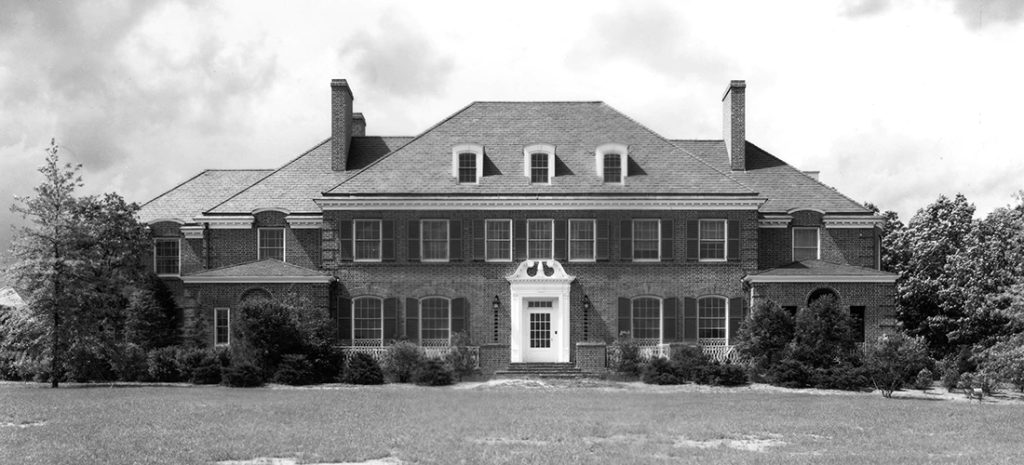
Feature image: Photograph © Greensboro History Museum Collection


In 1936, when J. Spencer Love sat down in his company’s Greensboro headquarters to review local architect William C. Holleyman Jr.’s drawings for a new house, he saw a Georgian Revival masterpiece, a mansion that reflected the majesty of Westover, the plantation residence of William Byrd II of Virginia. Built in 1730, Westover is considered to be one of the finest examples of Georgian architecture in America.

Greensboro had never seen such a house and probably never will again. Its history can’t be repeated. Its craftsmanship can’t be replicated.

When writer Meredith Barkley asked current owner Bonnie McElveen-Hunter back in 1997 why she bought the Love house, she responded, “I cannot tell.”

She reflected a moment, then continued.

“There’s no rational reason why you would buy a house like this. It’s totally emotional, irrational,” McElveen-Hunter said.

One chilly morning this spring, Benjamin Briggs, executive director of Preservation Greensboro, along with Katie Redhead and Gail Casper, took me on a grand tour of Love and Holleyman’s showpiece.

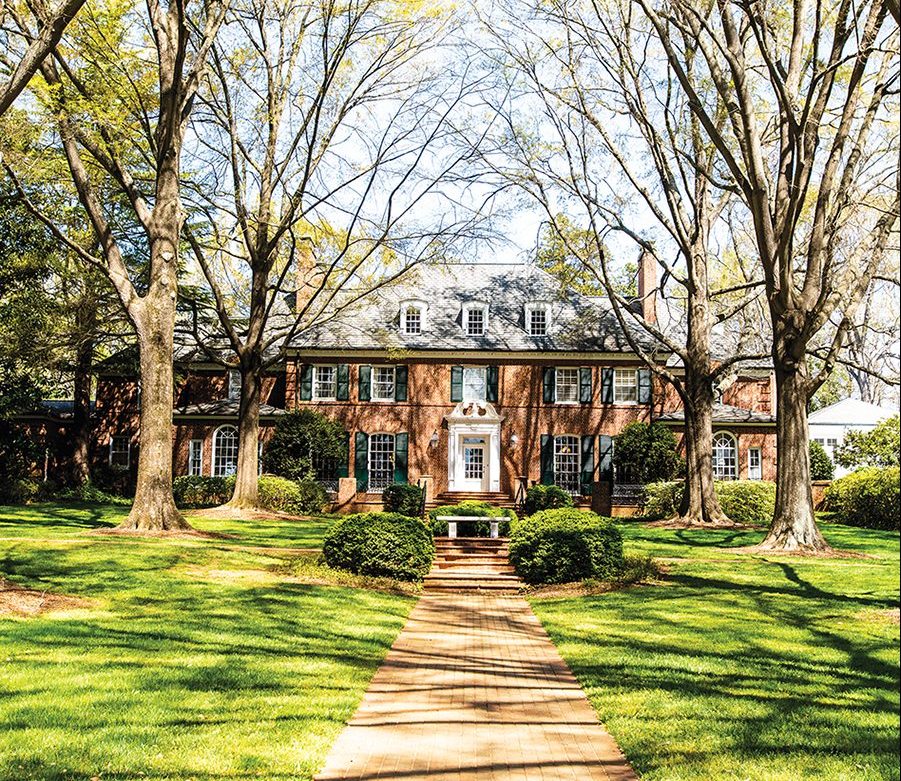
Briggs and I are standing on the stately brick walkway lined with oak trees and boxwood plantings that leads to the front entrance of the Love house.

Briggs tells me back in the day, guests would have probably been let off at Country Club Drive, so they would sense the expanse and balance of the house as they made their way up the walk — as we’re doing now.

He explains the language of Georgian architecture, its symmetry and balance, points out the wide, Palladian floor-to-ceiling windows of the first floor, the use of quoins at the corners of the house, the modillions — ornate brackets at the eaves supporting the roof.

The brick work, Briggs tells me, is “Flemish bond,” where the bricks alternate between end (header) and length (stretcher), short and long — like Morse code.

The entrance itself is classic Georgian.

“The frontispiece around the door is called a broken pediment,” Briggs says. He points to shapes above the door that look almost like scrolls.


“That’s called a swan neck,” he continues. “The pineapple at the center is a symbol of welcome.”

The pilasters on either side of the door are topped with Ionic capitals — again, typically Georgian.

But Briggs notes anomalies in the elliptical design of the metal railings of the walkways and grills protecting the windows.

“Otto Zenke,” he says.

Zenke was a legendary interior designer who came to Greens-boro in 1937, when Love was building his house.

Born in Brooklyn in 1909, Zenke was employed at B. Altman & Co. in New York before accepting a position as chief decorator for Morrison-Neese Furniture Company in Greensboro. In time he would establish his own design studio, with offices here and in London and Palm Beach.

(Handmade, miniature-scale rooms crafted by Zenke that reflect his passion for late 18th-century English interiors are part of the permanent collection of the Greensboro History Museum.) Zenke was the designer of choice for numerous homes and buildings during his career.

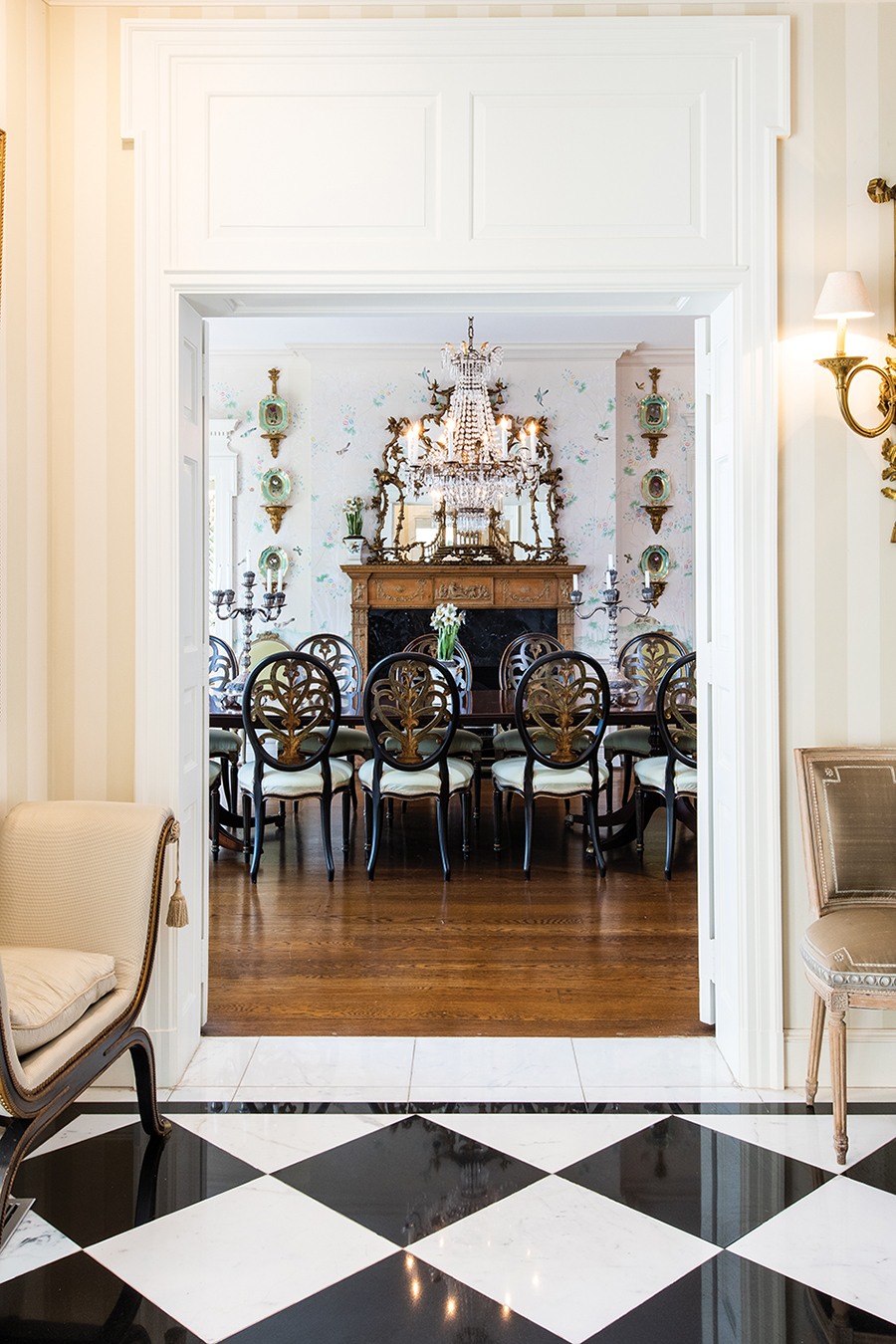
Stepping through the front door, Briggs and I are met with a grand foyer, its marble floor set with alternating black-and-white tiles. At the far end of the foyer is a sweeping, elegantly curved staircase with Chippendale railings.

“More Zenke,” Briggs says. “There’s ceremony as you enter and drama at the stairs, where the lady of the house would make her entrance for a party.”

“Bonnie really opened this house up to people,” Redhead tells us. She recalls Christmas celebrations when McElveen-Hunter would invite carolers to come in and all would sing carols together in the foyer.

“She held an evening charity event for Habitat for Humanity of Greater Greensboro,” Casper says. “She raised $1 million in one night. Can you imagine?”

In addition to entertaining neighbors, friends and business associates, and accommodating fundraising events for a panoply of nonprofit and charitable organizations, McElveen-Hunter provided lodgings for a number of national political leaders.

“Vice President Dan Quayle, Secretary of State Henry Kissinger, President George W. Bush, Justice Sandra Day O’Connor, Secretary of State Colin Powell . . . ,” Redhead recollects.

“And a number of governors and candidates,” she adds.

We walk to the elegant stairway to take a closer look. The skill of the handwork in the curved Chippendale railings is humbling.


“Lord help the carpenters who installed this,” Briggs says. “It’s like a jigsaw puzzle.”

The rest of my tour is like this. We visit the stately, light-filled living room; the Cone room — where former owner Anne Cone especially enjoyed entertaining her friends. We admire the handsome, mahogany-paneled library with its curved wooden doors; and the latticed breakfast room.

Then we journey outside to see three other buildings that were renovated or added by various owners over the years. A pool house — redolent with Palm Beach charm and an elegantly landscaped pool; the carriage house — a three-bay garage renovated into living quarters; and just beyond the tennis courts, a two-story cottage with the ambiance of a European hunting lodge — formerly the greasy garage where fourth owner Rusty Taylor kept his RV parked.

And there are the more than three acres of gardens and grounds, private and woodsy, right in the heart of Irving Park.

Spencer Love built his house at a time when many Americans were struggling just to make ends meet. After the 1929 stock market crash, America had plummeted into the Great Depression. Unemployment and despair worsened in 1934, when drought forced struggling Midwestern farm families from their homesteads into nomadic Dust Bowl work camps.

Meanwhile, “Greensboro’s textile industry emerged essentially unscathed from the Depression,” writes architectural historian Marvin A. Brown. And that is a fact woven intricately into the fabric of our city’s history.

So why shouldn’t the wealthy president of Burlington Mills be planning a grand house to be built on a knoll overlooking the Greensboro Country Club golf course?

Word about construction of Love’s house appeared in an April 1936 article in the Greensboro Daily News under the headline, “New Home for President of Burlington Mills Company to Be One of Finest in City.”

Work on the foundations had already commenced. The reporter proclaimed that the “new residence will be of the colonial type, constructed of red brick. It will be a 10-room, two-story structure, modern in every respect.” It’s said that the house featured the first central air-conditioning in North Carolina — a system of forced air flowing over coils that circulated water.

Born in Cambridge, Massachusetts, where his father was professor of mathematics at the Lawrence Scientific School of Harvard University, Love studied at Harvard Business School before enlisting with the U.S. Army during World War I.

In 1919, Love returned to Boston, looking for work. Deciding better opportunities might lie elsewhere, he moved to Gastonia, where his paternal grandfather had been a pioneer in the textile industry.

With borrowed money, Love purchased the Gastonia Cotton Manufacturing Company. Eventually he sold the company’s building and land, and — after receiving financial assistance from the local chamber of commerce — moved his manufacturing equipment to Burlington.

In 1923, Love chartered a new company, aptly named Burlington Mills.

Built in the middle of a cornfield, the facility employed 200 people and manufactured all-cotton textiles, including flag cloth, bunting, scrims, curtain and dress fabrics, as well as cloth for diapers.

Then Love decided to experiment with a new synthetic fiber called rayon and began to manufacture bedspreads.

By 1936, Love had moved his company’s headquarters from Burlington to downtown Greensboro.

By then, Burlington Mills, the business he’d chartered in 1923, comprised 22 manufacturing facilities located in nine different communities. Annual sales had reached $25 million. Lawyers and accountants were preparing documents for the company to be listed on the New York Stock Exchange.


Some said that as a native New Englander, Love saw himself as an “outsider.”

Briggs believes Love was building his house to make a statement.

“He’s building a grand house overlooking the golf course in the midst of the Depression,” says Briggs. “He was staking a claim.”

For his architect, Love had chosen an individual who was somewhat of an outsider, too.

“Holleyman was not the obvious choice to be the architect for such a house,” Briggs says. “By contrast, someone like Charles Hartmann was well-known to the community,” Briggs adds. Architect Hartmann had been recruited from New York by financier Julian Price to design the Jefferson Standard Building and had designed many imposing structures and residences in Greensboro, including Price’s landmark home.

In contrast, when Holleyman arrived in Greensboro in 1922, he was still in his 20s and relatively inexperienced. A native of Atlanta, he had studied at the Georgia Institute of Technology before moving to New York, where he worked as an architect for two years.

Young Holleyman was winning contracts in Greensboro, designing not only homes here and in Pinehurst, but also larger structures for Woman’s College (UNC-Greensboro) and A. and T. (North Carolina A&T State University).

And it was Holleyman whom Love had chosen to design his new Burlington Mills headquarters in Greensboro.

Sadly, Holleyman’s enjoyment of his professional triumph was cut short.

In 1939, the Greensboro Daily News announced funeral services “for William Crumley Holleyman Jr., 45, prominent Greensboro architect who died shortly before noon yesterday of a heart attack.”

Also short-lived was Spencer Love’s enjoyment of his magnificent new home.

He was forced to give up the house in his 1940 divorce settlement with his first wife, Sarah Elizabeth, who remained there for a short while before moving to Connecticut.

The house was then purchased by Love’s friend, Benjamin Cone.

The son of Ceasar Cone — co-founder of the Proximity Manufacturing Company, Revolution Mills and White Oak Mills, among other textile holdings — Benjamin Cone was a friend of Love’s and one of the few people in Greensboro with enough money to buy his palatial estate.

Benjamin Jr., Cone’s son, said his father enjoyed teasing his pal, Love, about purchasing the house from his ex-wife, calling it “Love’s Labor Lost,” a cheeky allusion to William Shakespeare’s comedic play.

Born in New York, Benjamin Cone attended grade school and high school in Greensboro and graduated from UNC-Chapel Hill, where he was a classmate of writer Thomas Wolfe.

Following his service in the U.S. Navy in World War II, Cone resumed responsibilities in the family business as well as following a life of public and charitable service. He was elected to the Greensboro city council and later served as mayor. Over the years, he also provided leadership to various charitable organizations and Moses H. Cone Memorial Hospital.

Cone and his wife, Anne, lived in the Love house from 1941 until 1977.

Their big house was often aglow with activity.

During World War II, the Cones sometimes entertained troops who were stationed at Greensboro’s Overseas Replacement Depot. There were frequent parties for business and community leaders, political figures, and neighbors.

According to News & Record writer Meredith Barkley, Benjamin Jr. remembers as many as seven servants “keeping the house going.”

English stage, television and screen actor Sir Michael Redgrave visited the Cones many times. Redgrave met the couple during the war years in Virginia Beach, when Redgrave’s ship was being retrofitted at the Norfolk Naval Shipyard.

Nominated for an Academy Award in 1947 and knighted by the late Queen Elizabeth II in 1959, Redgrave was famously the father of sisters Vanessa and Lynn Redgrave, acclaimed stage and film stars themselves. Vanessa reportedly spent a Christmas at the Love house.

Tyrone Power, the star of swash-buckling films such as The Mark of Zorro and The Black Swan, was a WWII U.S. Marine Corps pilot and a frequent guest of the Cones.

When the Cones decided to sell the house in 1977, the buyer was the late Richard Love, one of Spencer’s sons.

Richard — a successful builder in the region for nearly 50 years — undertook a major exterior project at the house his father had built.

“He added brick walks in front and put up a brick wall along Country Club Drive, giving the home a more formal look,” writes Barkley.

For his improvements, Love went back to the company his father had originally used — Old Virginia Brick Co. of Salem, Va. He ordered twice as many bricks as he thought he would need, culling out those he didn’t feel matched precisely, which were repurposed in other building projects.

In 1983 Love sold the property to the late John Russell “Rusty” Taylor Jr., a native of Battle Creek, Mich., who grew up in Greensboro. He was president of the first senior class to graduate from Walter Hines Page High School in 1961, attended Harvard University and received his law degree at UNC-Chapel Hill. He trained as a U.S. Marine Corps pilot during the Vietnam war and later joined his father’s real estate firm in Greensboro.

Taylor concentrated on updating the house’s electrical and mechanical systems, modernizing the telephone and security systems, repairing the leaky roof, and adding a workout facility and sauna in the basement. Taylor passed away suddenly in 1995.

And that brings us to the current owner.

Bonnie McElveen-Hunter and her husband, the late Bynum Merritt Hunter, moved into the Love house in 1997 with their son, Bynum Jr.

Bynum Hunter grew up in Fisher Park, attended Woodberry Forest School and served in the U.S. Navy in the Pacific during WWII. After military service, he was a star track athlete at UNC-Chapel Hill and received his law degree there. An admired courtroom attorney, he rose to become a senior partner with the firm of Smith Moore Smith Schell & Hunter in Greensboro and served as attorney for the Atlantic Coast Conference for more than 25 years.

Bonnie McElveen-Hunter was married to Hunter for 38 years. A businesswoman, philanthropist and diplomat, she was born in Columbia, S.C., the daughter of a U.S. Air Force P-51 pilot in WWII and a school teacher.

As a military kid, McElveen-Hunter moved with her parents as a toddler to Germany and later to Washington, Texas, Oklahoma, Louisiana, California and Nebraska.

She graduated from high school in Nebraska and attended Stephens College in Missouri.
After graduation, she moved to Charlotte to work for Bank of America and later as an advertising executive for Charlotte Magazine.

In 1972 McElveen-Hunter moved to Greensboro to work for Congressman Walter E. Johnston III and started Pace Magazine, the inflight publication of Piedmont Airlines. Adding magazines for United Airlines, Delta Air Lines, U.S. Airways, Southwestern Airlines and others, CEO McEveen-Hunter built her company into Pace Communications, a firm providing publishing services for travel, automotive, luxury, finance and technology clients. Pace Communications is now the largest independently owned custom content agency in the country.

In 2001, McElveen-Hunter was appointed as ambassador to Finland by President George W. Bush and served until 2004, when she became the first female chairperson of the American Red Cross.

Surveying the extensive renovations undertaken by McIveen-Hunter in 1997, News & Record writer Barkley noted the dust, debris, exposed steel beams and general mayhem. She noted the soon-to-be master bedroom suite upstairs “looked like a bomb hit it.” Upstairs walls were moved for comfortable new bedrooms, walk-in closets, dressing areas and elegantly appointed his-and-her bathrooms.

Downstairs the kitchen was completely gutted and a fireplace, wet bar, handcrafted library shelves and custom cabinets, and hand-milled crown molding were installed in the Cone room. That carpentry work was done by Ren Putnam, a master woodworker and furniture maker in Reidsville with a degree from Duke Divinity School.

“What people don’t realize is that the Love house was built to industrial standards,” Putnam says, noting the use of masonry and concrete throughout.

“I think Spencer Love wanted to build a place that was nearly fireproof,” Putnam adds.

Masonry increased the difficulty of installing the custom wood cabinets. Even more difficult was the installation of the intricate, handmade crown molding throughout the Cone room, where the wall and windows overlooking the swimming pool are built on the curve.

“We had to use a jack to bend the molding into the curve,” says Putnam. “Then getting it fixed to that masonry wall? Now that was something.”

Later, in 2008, McElveen-Hunter decided to install a geothermal heating and cooling system at the Love house. She asked Putnam to supervise the project.

Installing a modern geothermal system in an old house built like a fortress was quite a challenge.

“The men dug 16 dry wells 400 feet deep,” Putnam says.

The drilling left deep piles of stone dust all over the property. Geothermal tubing was installed in the dry wells and run to the carriage house, pool house, cottage and main house.

“Then Bonnie decided she wanted a well for irrigation,” Putnam says. “So we asked this country boy to come in with his divining rods.” In a short while, the man marked a place toward the back of the property and told them to drill.

“Sure enough,” Putnam says, “we hit water at about 300 feet.”

The entire geothermal project took months to complete.

“I don’t know of anything like it around here,” Putnam adds.

And that’s the point of it.

Greensboro has never seen anything quite like the Love house, where — over the years — owners have lavished additions and updates that boggle the mind.

After my tour, I feel as if I’ve just been inside something important. And now that the home is for sale again, its future is uncertain.

I’m feeling disquiet. Could this magnificent historical home one day be torn down?

“Sadly,” says Briggs, “we’ve seen such things happen.”

I think about McElveen-Hunter’s answer about why she purchased the Love house 26 years ago. So I reach out to her.

When she calls me from her home in Palm Beach, I ask her why anyone would want to buy the house now?

“This place is more than a home,” she responds. “It’s relationships. Experiences. Memories. It belongs to the community.”

“I’ll never leave this house,” McElveen-Hunter concludes. “I’m just passing it on. I hope someone else will love it just as much as I do.”

Greensboro’s unique Love’s labor. May it never be lost.  OH

Ross Howell Jr. is a contributing writer to O.Henry. He’s currently working on a novel about the 1935 Labor Day hurricane in Florida.

Minding Her Own Business

Minding Her Own Business

Three single moms push the envelope in entrepreneurialism

By Cassie Bustamante

Photographs by Bert VanderVeen

It’s often been said that motherhood is one of the hardest jobs on the planet. Its emotional, physical and mental requirements make for a job description no employer would put on paper: “We need you to take good care of this child. Feed it, teach it, nourish it, make sure it’s socialized and set it up for success in the world. Oh, and there are no days off.” On the other hand, entrepreneurship can be almost as demanding.

And yet, plenty of women undertake both jobs at the same time, running households while simultaneously building and running their own businesses. An audacious few are doing it as single parents.

We talked with three mothers who own their own companies — a retail store, a service business and an e-commerce shop —  while raising kids and doing so as single parents. These women are making their own way in the world, while showing their kids and other women what’s possible when you have a family, a dream and drive.


Lindsay Hirth

Owner of Scent Workshop

In the spring of 2017, Lindsay Hirth took a trip to Paris that would change the trajectory of her life. She’d already been toying with making soy candles at home, but during a visit to the City of Light, an idea ignited that would spark a candle and perfume making workshop in Friendly Center.

While soaking up la vie en Paree, Hirth attended a perfuming workshop and learned how to mix scents to create custom blends. She knew she could translate this new skill to candle-making. “I absolutely fell in love with it and I realized, number one, it’s not that hard to make a really great product if you have all these tools,” she says. “And number two, there was no place in the United States that had all these tools.” She called her new venture Scent Workshop.

Years ago, Hirth tried her hand at making soy candles when she noticed that commercial scented wall plugins were making her and her two children, now 14 and 10, feel ill. After researching, she discovered that many available products on the market are full of harmful chemicals. “So, I thought, well, how hard could it be to make my own soy candles?” She laughs, her blonde curls bouncing, and answers, “Turns out it’s really hard . . . There are a million things that can go wrong and I found all of them.”

That trip to Paris not only gave her the skills she needed to finally master candle-making. It also planted a seed. “This idea of starting a similar workshop in the United States but on a different scale, it became a whisper in my head and then it was a fire in my belly,” she recalls. “And I couldn’t stop thinking about it.”

A friend told her, “You have to do it.” But a conversation with her dad sealed the deal. He asked her, “What’s going to happen if you don’t do it?” Her gut response? “I’m going to regret it for the rest of my life.”

Hirth, who was and still is also working full-time, initially set up shop at Revolution Mill, using late nights after the kids were in bed to prepare for weekend workshops. Her goal? To create not only candles and perfumes, but a sense of community among participants.

“It was 21 strangers in a room and everybody is working on this thing, but they’re also connecting,” she recalls of those early days. “And I always loved that by the end of the workshop, it was so loud in there that I would have to shout because everybody’s talking.”

She adds, “And it’s not just connection to each other, but it was also seeing people connect to their inner selves.” In particular, she recalls a customer who, when told to close her eyes, (a practice Hirth uses to help customers evoke feelings) would not. She told Hirth later, “I am going through a really bad divorce and I knew that if I closed my eyes, I would just fall apart — I need something that’s going to make me feel strong.” Hirth reports that by the end of that workshop, “she looked three inches taller.”

While starting the business and mastering making the perfect candle were challenges of their own, Hirth didn’t know what hardships still laid ahead.

In 2020, something no business forecaster could have predicted happened: COVID. Hirth was sure that it meant the end for Scent Workshop, which was fully booked at the time. “I remember sobbing for days and then finally I just sat in front of my computer and pressed refund over and over and over,” she says.

Closing up shop in Revolution Mill but not ready to throw in the towel, she pivoted and boxed up at-home candle-making kits. The orders poured in, keeping her afloat.

And then, just a few months later, Brianne Van Hemert, one of Hirth’s best friends, decided to open a Scent Workshop in Galena, Illinois. Hirth suddenly became a franchise owner, setting up shop in Greensboro again. The Galena store opened in October 2020 and, one month later, Scent Workshop opened its doors at its current location for the first time.

With the help of her staff, Hirth took every precaution to keep the new space safe, mandating masks, sanitizing everything and limiting workshops to six attendees, which made it “hard to pay the bills.” But the community she’d cultivated within those very first Revolution Mill workshops showed up. “They’d say, ‘You didn’t give up, I am so glad you made it,’” recalls Hirth, blue eyes tearing up at the memory. “And those moments really motivated me to keep going because I knew I had this beautiful community of support that I didn’t deserve but was there.”

And then in 2021, Hirth faced another unforeseen challenge. She and her former husband decided to call it quits, impacting her business in the sense that there was no longer “anyone to share that risk with and that’s a little scary.”

Hirth says that starting the business in 2017 taught her well to prioritize and “to be really, really present in those segments of time” with her kids, a skill she’s carried over into her new family situation.

Now, the time she spends with her kids has become even more precious. “When the kids are there with me, I don’t get any work done because I don’t want to,” she says, adding, “And as soon as they go spend time with their dad, I am cranking out work.” Of course, she still has that fire in her belly which keeps her burning the midnight candle long after their heads hit the pillow.

While she hopes her kids learn from her example of time management, she also wants them to see what it looks like to chase your dream. “I want to show them that it’s OK to invest in yourself and grow something that you love,” she says. “And I think it’s important that they see there’s not just one path for a career and creating a life that you love.”

In fact, her daughter often indicates how proud she is of her mom’s business, her own little dream in sight. “She’ll say things like ‘When do I get to start working there?’ And I think,” Hirth muses, “‘well, I better make sure that this lasts long enough for her to be able to work here.’”

Of course, Hirth has hopes of her own to keep growing the business, with a goal of opening many more locations country-wide. She’s already garnered lots of interest from customers in Florida and Texas. And she’d love to eventually get to a point where she can comfortably quit her day job, making Scent Workshop her sole source of income.

No matter where the future takes Scent Workshop, Hirth says, “It’s nice to be able to look at something that I created that is still there even though so much has changed. And it’s more about looking at what the business has given me, too,” she pauses. “It’s given me all my best friends, it’s given me my village. And I don’t think I would have gotten through the last three years without them.”

For more information, visit scentworkshop.com.


Soumya Iyer

President of Allwave Site Solutions

On December 6, 2011, 27-year old Soumya Iyer became a first-time mother, welcoming her baby boy into the world at Greensboro’s Moses H. Cone Memorial Hospital. Just over three weeks later as the new year was ringing in, Iyer became a solo parent when her husband walked away. Ever since then, she’s been on her own, raising a son, running her own company while maintaining another career, and buying a house four doors down from her parents, who had emigrated from India before she was born. How has she done it all?

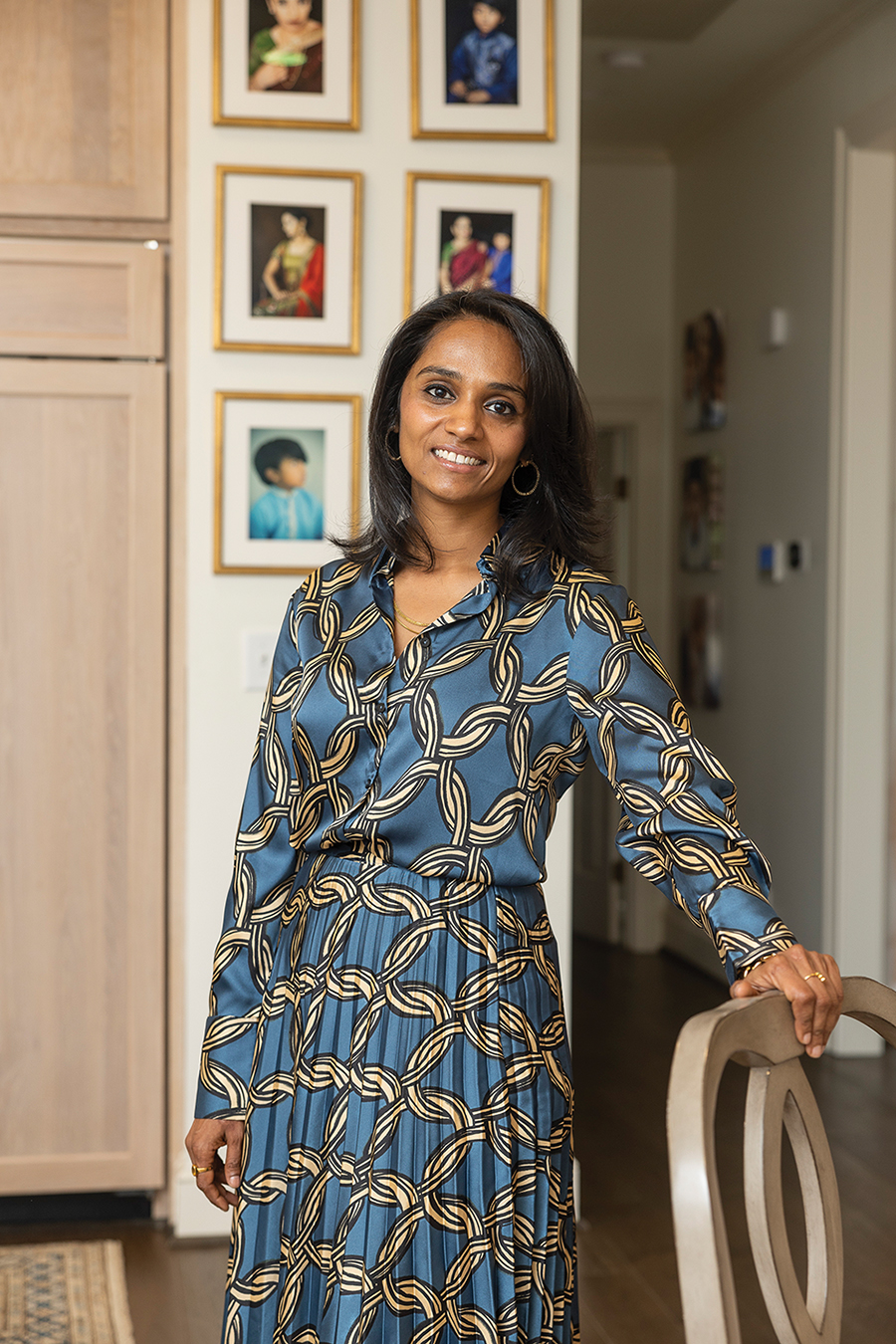
“I don’t have a choice,” says Iyer (pronounced eye-er) as she sits on her living room sofa in a casual chambray dress, bare feet tucked under her. With a son who’s fully in her care, she’s had to keep moving forward, often at a breakneck pace, and has done so admirably and humbly. “I still don’t think I’ve had the time to really be comfortable with my stretch marks. I just haven’t had a moment to deal with it.”

Thankfully, being born and raised in Greensboro has provided Iyer with a network of family and friends. “My parents are my other half. We still have dinner there every day,” says Iyer, who works from her own home. “In the morning, if I’m on a call and don’t have time to make a pot [of coffee], I will actually walk over there on the call and then come back rather than make a pot.”

Childhood friends have also jumped in to offer help. Shortly after moving into her current home in 2021, Iyer renovated her large kitchen and wanted to follow a timeless Indian tradition. “In Indian culture, you want the blessings of the elders,” she says, “but I don’t cook — I don’t know how to cook.”

Swati Argade, who babysat Iyer as a child, pulled the blessing event together for her by organizing a group chat, selecting a menu and assigning tasks to other friends. “That is what has kept me afloat,” says Iyer of her community, despite “not having that perfect world I thought of as a family. I am making my own normal.”

Even with her “great village,” at the end of the day, Iyer must lean on herself. “Do I have people that are keeping me from working in a vacuum?” she asks. “Yes, but nobody’s helping me with my bills and nobody’s helping me with the decisions. And that is very, very hard.” She does it all not only because she has to in order to put food on the table, but also because she loves her son with an energy that radiates from her body.

She points to a wall of photos featuring her son at age 6, her mother and herself, dressed in glamorous and colorful saris with gold accents. For a long time, she says, “I wouldn’t take pictures of us because to me it was sealing the deal that it’s just the two of us.” But, after seeing a friend’s portraits taken by a fantasy photographer, she decided to creatively re-interpret how she viewed her circumstance.

“I am the queen now. I am the head of the family,” she says. “And I wanted to be proud. And this is it. This is my family and we’re gonna seal the deal and that’s that.”

What does she hope her child learns from her example? “I hope that he sees as he goes on that there is not just one way to skin the cat,” she says, and that anything he can dream is possible. “It’s a very clichéd saying, but anything you put your mind to, you can do.”

In 2011, Iyer moved back from Atlanta where she’d been living to have her baby. Although she originally planned to return to Atlanta, she remained in Greensboro. She was working as business manager of the engineering company nsoro LLC reporting to her boss and mentor, owner Darrell J. Mays. She began her career with him as a college sophomore at Clemson — an internship that led to a strong professional relationship.

When it was clear that she was not going to be able to return to Atlanta and needed to stay in Greensboro where her parents could provide childcare as needed, she approached Mays about her job. “His answer was, ‘Soumya, I don’t care where you live. Do what you have to do, but I still need you on that 8 a.m. call . . . If I need you to travel, I need you to do it,’” she recalls.

She knew it would be hard, but, as she says, “Life is not fair. The only fare is f-a-r-e, right?” It was challenging, but one thing her career has taught her is to take things “just a day at a time. Solve the problems that have to be solved today today.”

Nsoro LLC grew as Mays — a successful entrepreneur with a proven track record — sold and acquired various businesses. In February of 2016, Mays started a new venture, Pensare Technology Group, bringing Iyer with him. But, he told her, it would mean a huge cut in salary in exchange for shares. As a solo working parent, she decided to do some consulting on the side to generate extra income.

Soon after, an opportunity arose through consulting client Mark Key, founder of Allwave Site Solutions, a company that installs equipment on cell phone towers. Then, in September of 2016, Iyer made the move to partner with Key while maintaining her job at Pensare. But, by 2017, she had bought him out. Allwave Site Solutions became a certified WMBE — a women minority owned business — something Iyer is incredibly proud of.

Just a few years later, Iyer, with an eye on scaling, approached her then subcontractor, Joel Banos, who co-owned Skytell Wireless Services with his wife, Lindsey. Her idea was to buy him out while keeping him aboard because she recognized in Banos, who now holds the title of chief executive officer of Allwave, a skill set that complements her own. “He’s really good at managing the guys [on our crews]. He’s really good on the site,” she says. “And I am very good at strategic planning and growing the business.”

She credits her mentor, Mays, for teaching her the lesson of hiring those who are smarter than you, saying “If I am the smartest person in the room, we all have a problem. You better get out of that room fast.”

Following Mays’ lead on growth through acquisition, Iyer has her sights set on doubling Allwave in size and revenue, and stays open to the idea of selling.

When Mays sold a division of Pensare Technology Group in 2020, Iyer was hired by the acquiring  operating company, now named Calian Corp, in the IT and Cyber Solutions division as VP of customer success and service delivery. “It was like cutting the umbilical cord,” she recalls of moving into a new role with a much larger corporation, boasting about 4,500 employees.

And she’s got her own mind set on reaching C-suite level while making changes that will support other working women in the corporate world.

Starting at a smaller level, she’s hired a woman whose young twins can often be heard on calls. “We have to give grace to our mothers,” she says, fully understanding the juggling act. “The work she is doing is so impressive! And I am able to bring it to light.”

Already, under her leadership, change is brewing. Recently, Iyer was asked to cochair an internal women’s employee resource group. While she expected only a few to attend the first panel, 40 people showed up.

With one bare foot in front of the other, Iyer is making waves in her company, career and at home, providing a good life for her son, filled with opportunity. “It is scary, but my child adores me,” she says as tears spring to her dark brown eyes. “I hope he sees that I am trying for him.”

For more information, visit allwavesites.com.


Erienne Jones

Owner of Some Call Me Crunchy

Fifteen years ago at age 23, Erienne Jones began experiencing debilitating migraine headaches. Medicine eased the pain, but left her feeling lethargic. A few years later, a seemingly endless battle with vertigo arose, making her job as a teaching assistant and her grad school coursework a challenge. Finally, relief came in an unexpected way, setting her on an entirely new path, one that showed her that sometimes the most beautiful things in life are born of pain. Through self care and entrepreneurship, Jones discovered that taking care of business also means taking care of yourself.

Looking at Jones now, she is the picture of health with long, thick and shiny, dark brown hair, bright blue eyes, and radiant skin. She’s proud of how far she’s come, often showing her smiling visage on social media while promoting her natural face and body care online store, Some Call Me Crunchy. But that was not always the case.

When she first sought treatment for migraines, doctors prescribed Topamax. “It just made me feel horrible,” she says, cringing at the memory. “I had no appetite . . . I was scrawny.” When vertigo struck a few years later, doctors ran tests only to inform her that it was a symptom of an ongoing silent migraine — basically a migraine without the accompanying pain.

Desperate to feel better, Jones was willing to try anything and learned about Whole30 from some friends at her gym. She went on the 30-day eating program that eliminated processed foods through nutritionally balanced meals. “Within 30 days, the vertigo had gone away completely,” she recalls. “And I had had it for months and months.”

Thinking there might be a connection between her health and cleaner living, Jones began researching not only what she was putting into her body, but also what she was putting on her body and in her environment.

On a grad student budget, naturally made products were harder to access, so Jones decided to try her hand at making her own lotions, deodorants, facial cleansers and house-cleaning solutions, adding essential oils for a touch of aromatherapy. In just months, she noticed many changes for the better. No longer on prescription drugs, her migraines had eased up, her energy was back and her skin was on its way to looking better than ever. Before, she says, pointing across her jawline, “I had cystic acne from here to here.”

Excited about the results she was seeing and, more importantly, feeling better, she documented her experiences on a blog she called Some Call Me Crunchy, long before it would evolve into the online shop it is today. She continued blogging as a hobby while earning her master’s degree in library and information science and beginning her career as a Guilford County school librarian in 2013.

Meanwhile, she gave birth to two children, daughter Harper, now 8, and son Elias, now 5. Eventually she left her job to stay home and raise her kids, but, as she recalls, “That was the hardest job I have ever had.”

Knowing she needed something more to feel whole, Jones, encouraged by friends who swore by the products she shared with them, decided to try to sell her products online. While finding the time to dedicate to a new business was somewhat challenging, Jones discovered that the success of entrepreneurship changed how she viewed herself. “It made it so that I was filled up and I was able to love on my kids.” It proved to be just the thing to make her feel she was not only taking care of her children, but of herself: “Doing my business in and of itself is a form of self care for me.”

What had started as a quest to feel her best began to take root locally. She started selling at the Corner Market, located in Lindley Park (at that time) while her blog grew into a platform to market and sell her goods.

According to Jones, Greensboro is the “perfect-sized town” for a business like hers to bloom. While she now sells online and offers shipping, much of her customer base was built locally and remains here. “It’s small enough just to have these touch points with people and these connections with people,” she says.

Jones has also welcomed the opportunity to collaborate with local businesses, setting up pop-up shops at The Tasting Room. She’s also creating custom essential oil candles for her own online store with Scent Workshop, a candle-making shop in Friendly Center, plus selling paintings by local artist Thea DeLoreto and stickers from Tiny Plant Market. “I just didn’t know how much that would mean to me,” says Jones of both her community and collaborations, “how much the people that I met through my business would just be such a big deal for me.”

In addition to Scent Workshop, her products can be found locally at Vida Pour Tea. She recalls popping into Vida several years ago with Harper, who spied Some Call Me Crunchy products on the store’s shelves. “She was just so excited for me that I was almost in tears,” recalls Jones, who hopes that owning her own business inspires her kids to pursue their passions. Already, Harper, who dresses in bold colors and patterns, exhibits her mother’s creative spirit.

Surprisingly, it was through journaling and poetry, of all things, that she resolved the conflicting emotions involving motherhood and divorce into acceptance and respect for who she was. “I have been going through a divorce and just losing myself a little bit through that,” says Jones. “But all in an effort to find myself again, I have discovered poetry.” (Her poem, “New Year, New You,” can be found in the January 2023 issue of O.Henry.)  Eventually, she worked up the courage to share her written words on Instagram, where her themes of motherhood, grief, self love and acceptance resonated with her followers. Now, her printed poems are part of her seasonal collections.

These days, Jones, reenergized and renewed, can be found curled up in bed with her kids as they read through the Harry Potter series together. With shared custody of her children, she values her time with them more than ever, making every minute count. After being apart for a few days, she says through happy tears, “They come back to me and I am just overjoyed to be with them. It’s such a gift.”

Now, as Jones moves forward as a single mother, this business of self care, which evolved organically and carried her through some of life’s hardest challenges, must support her financially. But if she has learned anything from the last 15 years, it’s that some of life’s most beautiful surprises sprout up through the cracks of the most painful of circumstances.

For more information, visit somecallmecrunchy.com.

Uwharrie Here (You are here)

Uwharrie Here (You are here)

A seasoned hiker shares five favorite trails

By David Claude Bailey

As a travel writer and former airline-magazine editor, I’ve visited a mountain or two — Mount Olympus, the seat of Zeus in Greece, the north and south rims of the Grand Canyon, Mammoth Mountain in California, the Grand Tetons, and Yellowstone. But all mountains are not created equal. Without getting New Age woo-woo on you, on some of them I get a feeling that transcends the five senses, an eerie, almost spiritual sense of connection.

I felt it first at Delphi, the ancient precinct that was home of the Delphic oracle. I felt it again among the ancient ruins near Ayacucho in Peru. And I feel it every time I go to the Uwharries, a Piedmont mountain range near Asheboro, where the peaks have been worn down from a whopping 20,000 feet to a mere 1,100.

How did that happen? More than 500 million years is one answer. When you tread the trails along Big Island Creek, you are walking on ground that belonged to the ancient landmass of Gondwana, a megacontinent that was once part of modern-day South America and Africa. Somewhere between 460 and 430 million years ago, part of Gondwana broke off and merged into ancient North America, piling up the Uwharrie mountains. Books and websites insist the Uwharries are the oldest mountains in North America, but that’s by no means the case. “The Rocky Mountains are between about 70 and 35 million years old,” says Kevin Stewart, a UNC Chapel Hill professor in the department of Earth, marine and environmental sciences. “Ancient mountains in the northern midwest stretch back to 2.5 billion years,” he says. And you want really old? Some mountains in South Africa are 6.3 billion years old.

In more recent years, the Uwharries have been the scene of gold mining, timbering, farming, bootlegging and, now, recreation, especially in 2023, N.C.’s official Year of the Trail. Running from south to north, the Uwharrie Trail is the longest single-track footpath in central North Carolina at 40 miles in length. Numerous other trails snake through the 52,000-acre National Forest, established in 1961.  

What I’ve attempted to convey here is a thumbnail, a personality portrait, if you will, of five of my favorite trails, paired with a number of unique hiking partners. This is not a hiking guide. Excellent guides to individual trails are available from websites such as alltrails.com and gaiagps.com. Don Childrey’s comprehensive Uwharries Lake Region Trail Guide covers more than 215 miles of trails in the area. I urge you to consult a guide or map before setting out. And happy trails.


Jumping Off Mountain Trailhead

Length | Two hikes are available from the trailhead, an 8-mile out-and-back and a 3.9-mile out-and-back.

Difficulty | Both hikes are challenging with significant elevation gain.

Dontʼt Miss | The sign in the parking lot that outlines a number of other nearby hikes.

Good to Know | The actual Jumping Off Rock, if you want to see it, is west, just a hop, skip and a jump up Flint Hill Road on the left.

Address | 2015 A Flint Hill Rd., Troy

“Keep on the sunny side, always on the sunny side, keep on the sunny side of life,” the Carter family warbles, and it’s not bad advice. If a sunny walk in the woods is what you want, get yourself to the Jumping Off Rock Trailhead. Cross Flint Hill Road and hike up about a half-mile to the overnight camp cabin. There, you can enjoy a stunning, 360-degree view of the Uwharrie Mountains and have a picnic while reading the camp log. Keep going and you’ll bag an exhilarating 8-mile out-and-back hike to King Mountain, the highest point on the Uwharrie Trail.

However, as A.P., Sara, Ezra and Maybelle admit in the very same song, “There is a dark and a troubled side of life.” And maybe that’s just the sort of thing that appeals to you. If so, don’t cross that road. Trek right up in the shadow of the appropriately named Dark Mountain, as recommended in An Afternoon Hike into the Past, penned by the late Joe Moffitt, a trapper’s son who grew up in the Uhwarries during the Great Depression. That will put you on a trail trod by murderers, moonshiners, and the odd haint or two. Which is what we did.

Mind you, the switchbacks up Dark Mountain are challenging. Gaining 400 feet of elevation in less than a mile, twice, hikers not quite as old and in the way as we are pass us. After about three-quarters of a mile, you reach the ridge line. Follow the white blazes on the Uwharrie Trail and you’ll enjoy a glorious 3.9-mile out-and-back jaunt.

But we’ve come to see Paint Rock, which we look for along a deserted road to the left. “They all look kind of painted,” says Lin Marie, pointing to dark spots and orangish-brown splatters that are clearly lichen. A naturalist who worked for a nature museum and a state park, Lin knows a thing or two about plants and fungal identification. As we’re poking around, she briefs us on how fungal substrates allow fungi to respond to changing availability of resources. And how she’d just read a book on the way “mother trees” communicate with their offspring.

Lin is our resident polymath. If she doesn’t know it, she’ll look it up on the spot.

But back to Paint Rock. Moffitt, the legendary Uwharrie Trail-blazer, insists in his book that there’s a rock in the woods that still “bleeds” from where a giant man ran his sword through a diminutive Civil War deserter. As far as we can tell, there are numerous Paint Rocks. And maybe that fits Moffitt’s narrative: Three Civil War deserters were murdered near Dark Mountain in 1865. Bootleggers also killed two revenuers at nearby Licker Spring. And all of this in the environs of Jumping Off Rock Trailhead, named after another story that did not end well, as you might guess.

As we come across some of the largest boulders in the forest — larger than dumpsters and the Nifty Rocks near Badin Lake —  Lin, who helped Ohio State monitor butterflies for 15 years, is on the lookout. Lin, by the way, raises moths, which she adores. Honeybees not so much. “Alien invaders,” she calls them, just like earthworms. “Look it up,” she says, as we stare at her in disbelief.

We don’t find the cave where a bootlegger and his family once hid out. Nor do we see the ghost of the sacred white deer slain by Indian braves, nor any of the other ghosts Moffitt wrote about inhabiting the area. But as Moffitt observed, wandering around these shady hills is a bit unnerving: “I always seemed to feel as if someone is watching me.”

Better to get back in the sun and remember what the Carters sang about the sunny side: “It will help us every day, it will brighten all the way, if we’ll keep on the sunny side of life.”


Thornburg Trailhead


Length | 3.4 miles out and back, with side trails.

Difficulty | Moderately challenging with a fair amount of elevation gain.

Dontʼt Miss | The rocks strategically paced across the creek near the bridge.

Good to Know | As Wilder noted, it can be quite muddy.

Address | 3977 Lassiter Mill Rd., Asheboro

Getting Wilder out of his car seat when he’s raring to go is a little like untangling an octopus from a ball of yarn. So as soon as Cassie, his mom, finally gets his feet on the ground, he rips off across the farmyard like the Road Runner pursued by Wile E. Coyote.

“STOP!” the 4-year-old shouts all at once, holding up his hands as if to stop a train in its tracks. “I love birds,” he proclaims at the top of his voice, scaring away every song sparrow, robin, purple finch and chickadee within 100 yards. And as soon as he sees the circa 1850, two-story, apple-green Lewis-Thornburg farmhouse, surrounded by scraggly boxwoods, he also announces, “I love farmhouses.” Charging full throttle onto the porch, he’s fascinated by the screen door with its self-closing wheeze and whine, followed by a shuddering slam — for a solid minute. 

The National Register of Historic Places’ listing says not to miss the rambling farmhouse’s wide, heart-pine floorboards, the square balusters and moulded handrails on the staircase, the narrow, distinctive beadboard on the walls and ceiling. Wilder, though, is entranced by the mix of soot, feathers and leaves that have spilled out of the chimney onto the circa 1940s linoleum.

“I love holes in the wall,” he says of a crawl-space door left open on the second floor. Spotting a trap door overhead, I boost him up through the cutout and after peering around into the dim recesses off the attic, he says, “Spooky.” It is.

Ripping down the stairs, we’re on the back porch by the kitchen, where the well crank makes a mournful moan. Again and again and again.

“I love tractors,” Wilder says, lighting out across the yard to a brand spanking new John Deere behind the house. “Where’s the key?” he asks as he clambers up the steps and peers into a locked compartment where the shiny gear shift and steering wheel beckon. 

Then it’s shed exploration time. “Well, guys, someone’s been working here,” he says, discovering a coffee can filled with screws and nails in a tool shed. On to the corn crib, smokehouse, chicken houses, dog house, pigeon boxes, tack shed, hog shelter, animal chute . . . and an outhouse! Cassie restrains the Wilder unit from going head over heels through one of the two-seater holes. “Ewwwww, yucky,” he says as it dawns on him what’s what.

Finally, we’re on the actual trail heading down toward the creek. “STOP!” he says, stooping over. “Sparkles!” Yes, the red mud is alive with tiny, shimmering mica bits. Specimens of quartz from tiny to basketball-sized are everywhere, pieces of which he stuffs into his already overloaded pockets. On a little side trail across sage brush beaten down by rabbits, possums and the previous day’s rain, we’re soon surrounded by milkweed pods, which explode into a white flurry that swirls off into the wind, seeding next year’s crop.

Back on the main trail, Wilder halts progress again: “It’s a little ocean,” he pronounces as Cassie navigates him around a mud puddle, which Wilder stirs with a stick like a pot on the stove. A bridge twisted catawampus crosses Betty McGee’s creek. “Want some help?” Mom wonders. “Nawp,” he says, clamoring perilously near the creek. Then: “I can’t. I can’t. I can’t,” he admits. Pieces of bark torn from a shedding tree quickly become boats, which race down the creek. A pair of termites are minutely examined before they, too, float downstream.

We veer off onto another game trail and snake the edge of a field, where blackberry brambles soon occasion a cry of “Ouchy, ouchy, ouchy,” but no tears. “Snack,” comes to the rescue.

“STOP! It’s a gem,” Wilder says, holding up a rare piece of rosy quartz. No room left in his pockets, he casts it aside. “This is Quartz World,” Wilder decides. And he’s absolutely right. It might just be the second most magical place on Earth.


Purgatory Trail, North Carolina Zoo

“David, the entrance to the zoo is over there,” my wife, Anne, says as I slide into the North Carolina Zoo’s totally empty Parking Lot A.

“I thought we’d take a short walk in the woods before looking at the animals,” I tell her. “You’re gonna climb a mountain today.”

“The sign says ‘Purgatory Mountain,’” my knee-challenged wife points out.

“Trust me,” I say. She’s heard that before.

“It’s a gentle stroll, suitable for people with mobility issues,” I say pointing to a sign. “Even in wheelchairs.”

“The sign says it’s wheelchair accessible for only 0.125 miles.”

And so it is — on a wide path paved with very fine gravel, that too soon segues into a little more rugged trail that winds its way up through towering pines and mature hardwoods. “You’ve hiked 1/8 mile,” says an un-milepost.

“That vulture is following us,” says Anne as its shadow swoops across the fallen leaves.

Through the trees on our right we see the seedy underbelly of the zoo, piles of rocks, dirt and debris. I, of course, want to explore, but Anne keeps me on the not-so-straight and not particularly narrow path. To our left, deep woods and massive boulders the size of baby elephants stretch to the horizon.

“Acadian fly catcher,” my resident birder says. “No, a peewee. No, eastern phoebe.”

We breeze past the sign heralding the endangered Schweinitz’s sunflower; past the sign explaining woodland seeps (small pools), which sometimes harbor the rare four-toed salamander; past the sign marking the half-mile point.

“I’m doing OK,” reports Anniel Boone.

“Elevation 900 feet, with 150 feet of vertical ascent,” I announce after consulting my Gaia GPS app.

At the summit, where we’re congratulated for walking 5,280 feet, it’s 950 feet above sea level, only 60 feet shy of the highest point on the Uwharrie Trail. After enjoying the vista, we read all about ghosts, Indians, legendary critters, bootleggers, Confederate objectors and why the mountain was named Purgatory.

“Maybe because it’s just short of Hell’s Gate,” jests Anne, who, in the end, admits it’s a great trail and worth the climb, mobility issues or not.

“Climb every mountain, ford every stream . . .” I counter, breaking into song.


Tot Hill Farm Trailhead


Length | Our “lollipop” trek totaled 7.4 miles. If you just hiked to Camp 5 and back, it would be 6.4 miles.

Difficulty | More than moderately challenging with 607 feet of elevation gain.

Dontʼt Miss | The gold mines. You can visit them without making the loop by taking a left after 2 miles onto the Coolers Knob/Camp 3 trail. They’re about a mile down the trail.

Good to Know | There’s not a sign on the road marking the Tot Hill Trailhead. Slow down and look for it as soon as you see the golf course.

Address | 3091 Tot Hill Farm Rd., Asheboro 27205

My friend Randall’s German shepherd is a free-range critter. Unlike his urban canine counterparts, the Pia dog is untrammeled by leashes, fences or property lines. Randall lets her out whenever there’s a need . . . and Pia rings the doorbell to be let back in. German shepherds are like that, though she has yet to master the TV remote control. Pia has learned, for instance, how to roll down the rear window of Randall’s truck whenever we sit in the front seat piddling with our GPS apps.

“I’ve got her child-locked in — or maybe I should say dog-locked,” says Randall as Pia paws the rear-window button in the parking lot of the Tot Hill Farm Trailhead, the northernmost point of the Birkhead Mountain Wilderness Area.

Pia’s jet-black “eyebrows” shoot up and down in consternation. She twists her head quizzically to one side as if to say, “Did we come here just to sit around?”

We did not. We came to roam free, just like Pia and the couple of kids we turn back into as soon as we hit the trail. Our playground is the 52,000-plus-acre Uwharrie National Forest that stretches into Montgomery, Randolph and Davidson Counties.

Note that I said National Forest, not park. Under National Forest rules, Pia can run free. As can we. Cross-country trekking is allowed, as is horseback riding, ATV riding, camping, panning for gold, hunting and fishing — all, of course, with some reasonable restrictions. (You must “control” your pets.) While National Parks emphasize preservation of pristine areas, National Forests are managed for many purposes, including cattle grazing, mining and lumbering — permits required.

Our inner child kicks in as we cross Talbotts Branch. We pass the stone remains of a dam and watch Pia sniff dismissively at some coyote scat. At about a mile into the walk, we rest while Pia fetches.

At the tippy top of Coolers Knob our GPS says we’ve clocked 333 feet of vertical ascent in 1.2 miles. We pant. Pia pants. We keep booking it, heading for Camp 5, one of a number of campsites established by Joe Moffitt. In 1972, he started his Uwharrie Trail Project, backed literally by troops of Boy Scouts. Now, 40-some miles of trails later, Pia examines the camp for any scraps of Beanie-Weenies. At the 3-mile mark, we hang a left and take the Camp 3 Trail, which is marked as the Coolers Knob Mountain Trail on some maps. This initiates a loop that will take us back to Coolers Knob. Serious hikers call this a lollipop trek because of its shape on the map. Whatever you call it, it’s one of the most magical hikes in the Uwharries. We descend to the inviting Camp 3 site, checking out an enclosed spring, where we would never drink the water without purifying it first, especially after Pia drinks out of it. Decades peel away and we’re soon frolicking knee-deep in a maze, aptly named fern valley.  At 3.9 miles, we cross a cascading brook. A gentle waterfall is punctuated with islands of wildflowers.


At four miles, we come to a series of open-pit gold mines, each of which Pia explores extensively. These are the remains of a gold mining era that began in 1799 when a 12-year-old found a 17-pound nugget of gold in a creek near Charlotte. Farmers riddled their land with open pits and shafts like the ones that surround us. At one time, as many as 600 mines dotted the nine counties surrounding Montgomery County. Randall, Pia and I once panned the Uwharrie’s streams for gold (www.ohenrymag.com/the-pleasures-of-life-dept-15/).

We did not strike it rich. And that’s OK. The riches of the Uwharries are less tangible — its lush vegetation and wildlife, its wilderness, and its storied past. Pia knows all about what, to her, is most precious in the Uwharries: running without a leash, uninhibited by paths and private property. Although I hike for exercise and adventure, I’m always looking for something else — for the child who once roamed free without a care. And for the ties that bind us to the land and to those who inhabited it millennia before we did. Whether it’s the plane crash site a mile from where we are, or the Moonshine Run Trail, or the hike to Bingham’s Graveyard, the treasures of the Uwharrie Mountains always beckon.


Wildlife Resources Commission Birkhead Wilderness Area Trail

Length | 4 miles, more or less, depending on when you want to turn around. It’s not a loop trail.

Difficulty | Easy-peasy. Fairly flat and wide.

Dontʼt Miss | The graveyard if you can find it. And be careful not to venture out of the Wilderness Area. It borders private property.

Good to Know | The entrance is easy to miss. Slow down!

Address | 3800 High Pines Road, Asheboro

I smell onions,” Randall says.

“My cheese-and-raw-onion sandwich,” Joe replies between munches.

“At least Bailey’s not eating kippered herring. Move downwind,” suggests Randall.

For me, half of the joy of hiking comes from what my daddy called picking at your friends.

“Where’s this slave graveyard,” Joe wonders as we blaze our way through an explosion of hollies, their red berries punctuating dotting the understory of dogwoods and sourwoods.

Randall, who lives in the Uwharries, leads us, again and again, down one remote, wild and off-the-beaten path after another. And that’s exactly what we encounter at the clumsily-named Wildlife Resources Commission Birkhead Wilderness Area Trail. (Let’s just call it the WRCBWAT.) It’s connected to — and about 2.5 miles southeast of — the heavily-trod Tot Hill Farm Trailhead.

By contrast, the WRCBWAT is practically untrammeled. 

“This looks more like an old road than a trail,” Joe observes.

“It is, in fact, a former road,” says Randall.

For onion-eating history buffs like Joe, hiking in the Uwharries is like walking back into the pages of a leafy anthology. On our 4-mile trek, we encounter, among other artifacts, a series of abandoned but open gold mines (very common in the Uwharries), the stone remnants of a chimney, vestiges of several homesteads (aka junk piles), the aforementioned graveyard and the ghost of a housing development.

It turns out that the trail we’re on had been graded decades ago by a developer for a 40-unit tract, but was rescued by the Three Rivers Land Trust. That enabled the folks at N.C. Wildlife Resources Commission to buy a prime piece of forest adjacent to the 52,000-acre-plus Uwharrie National Forest, which became the 6,000-acre Birkhead Mountain Wildnerness Area.

Our path surely overlaps the trail of pioneers who’d settled in the area as early as the 1760s, having traveled down the Occaneechi Path (aka Great Trading Path). At least 12,000 years ago, the Catawba Indians hunted in the very woods around us, now designated as N.C. game lands. (Always wear orange in the Uwharries during hunting season.)

“That’s it,” I say, pointing to a flat area. Standing erect in two rows are more than a dozen rough-hewn markers, some larger than others, all without inscriptions. “Maybe tenant farmers. Maybe slaves. Who knows?” I say. “And, yes, I do know ‘enslaved’ is now preferred among politically-correct speakers.”

“Children’s graves,” Randall speculates of the rocks that are the size of serving platters.

“King of the hill,” Joe suggests, pointing to one stone much larger than the rest.

We fall silent, gazing at the markers of those who once lived and loved and worked and played where we now stand.

“You’re never alone in the woods,” I say.

David Claude Bailey is grateful to former Greensboro News & Record columnist Jerry Bledsoe for writing about the Uwharries way back when.

Almanac May 2023

Almanac May 2023

May is the nimble bard, back again, rendering tales of romance and revelry.

When the peonies sing out and the black snake sheds his winter skin, the bard slinks in with an age-old poem, jubilant and familiar. You recognize the words but the tune has changed. It’s more florid, less restrained.

A bard never sings the same song twice.

The poem is a constellation of roses, a bouquet of wild songbirds, a quivering fawn, wet from birth. It is a bluebird’s first flight, a canopy of tree frogs, a fox kit emerging from the den.

It’s a tale of first love — a whisper, a giggle, a kiss — a sacred song between two hearts and the ancient, flowering magnolia.

The rhythm quickens for the ballad of the bee and the lady’s slipper; the waltz of the foxglove and hummingbird; the butterfly’s ode to red clover.

Honeysuckle on the tongue, the bard weaves from wild place to formal garden, from strawberry patch to rabbit burrow, from poppy field to chrysalis. 

She sings of earthworms and spring rain; soft grass and bare feet; the boy and his mud castle.

Listen for the girl in the sunhat. Snap peas on the trellis. Dandelions and cartwheels and picnic baskets.

The wind sings along, carrying her tune through the leafed-out trees until we are nectar-drunk and flushed. Each word pulses with ecstasy. We cannot help but sing along.


Among the Wildflowers

National Wildflower Week, celebrated during the first full week of May, is spring at its finest. The air is sweet. Roadsides and meadows are bursting with life and color. The pollinators are here for the party.

Perhaps you know that in 2016, the North Carolina Wildlife Federation launched The Butterfly Highway project in response to the alarming decline of native bees and monarch butterflies. This conservation restoration initiative continues to expand its “network of native flowering plants” to help sustain our pollen- and nectar-dependent wild ones. Interested in adding a “Pollinator Pitstop” to the map? Visit ncwf.org/habitat/butterfly-highway, where you can find N.C. native pollinator seed packets, discover what’s blooming this month, and learn more.


The word May is a perfumed word . . . It means youth, love, song; and all that is beautiful in life.    

— Henry Wadsworth Longfellow, journal, 1861

The Great Mother

Creation stories of the Lenape and Iroquois people evoke images of a great cosmic turtle carrying the world on its back. Surely all mothers have felt like that turtle from time to time.

This year, Mother’s Day lands on Sunday, May 14. Perhaps fittingly, World Turtle Day is celebrated this month, too — on Tuesday, May 23.

The Eastern box turtle, N.C.’s state reptile, begins nesting at the end of this month. Although common across the state, the Eastern box turtle population is declining. When next you see one, wish it well. She could be carrying eggs — or tending a clutch of tiny, delicate worlds.  OH