Tiny Tale

Tiny Tale

Youth Is Nothing . . .

But the absence of excess

By Elena Yarmak

Illustration by Miranda Glyder

Grandma Lena’s dog-grooming salon sprang up right in the kitchen.

She declared her wish to trim the family dog, Axel, at home:

“Our elderly and sensitive Axel will be less stressed,” she said, “and $70 will stay in the family budget.”

The family loved the idea. Her son-in-law even bought a dog clipper, complete with a set of attachments.

The very first haircut transformed Axel beyond recognition. From an old, curly mutt, he turned into a sleek, smooth-coated, young-looking spaniel. His muzzle sharpened, his eyes opened to the world, his legs seemed longer. On walks, neighbors praised Grandma Lena’s skill.

Encouraged by success, she took on Zoe — her daughter’s friend’s lapdog. The client was promised a free “rejuvenation.”

An hour later, Zoe had become a mysterious exhibit: Her fur was gone entirely, leaving only smooth skin, and on her tail a coquettish tuft stuck out — like a cocktail umbrella.

Grandma beamed, proclaiming, “Exotic! Short, bold, with a twist!”

Reactions split. Her daughter called Zoe “a rat — a bald rat.” Her grandkids wanted to know where Zoe’s T-shirt was. A friend sat in stunned silence. But Grandma? She felt absolute confidence in her genius.

Now on walks, Zoe enjoyed heightened attention from the local gentlemen. Every male dog changed his route to confess love at first sight.

“What did you expect?” Grandma shrugged, like an artist certain of her masterpiece. “Youth is nothing but the absence of excess.”  OH

Elena Yarmak is a writer of short, observant stories that find humor in everyday life.

State of Mind

State of Mind

Doing the Wave

From Ocracoke to Rockingham

By Tommy Tomlinson

Illustration by Gary Palmer

Summer comes in waves.

Many years ago I went through a rough stretch, mostly of my own making, and ended up needing to clear my head for a while. I drove to the Outer Banks, traveling alone. I took the ferry from Swan Quarter to Ocracoke, piddled around in the village for a couple of hours, then aimed the car for Hatteras.

Ocracoke tapers to a thin strand that can be secluded even in high season. I found a spot to pull over and stepped between dunes onto an empty beach. Not a soul in either direction. The only sounds were the wind and the waves. Those waves: calm and steady, a wet metronome. I got in and rolled in the warm ocean like an otter. Every so often a wave would give me a gentle slap. Snap out of it, son. Everything’s going to be fine.

The waves are even milder on rivers and lakes, at least usually. When you see whitecaps on fresh water you know a storm is coming. That’s when you pull up anchor and gun the outboard and hope you get back to the landing before the sky breaks open. Waves can be a warning, too.

They can also be a mirage. When I was a kid I was mesmerized every summer by the shining puddles that always appeared up ahead on the road, only to disappear when we got close. Much later I found out it’s called heat shimmer, and it happens when a surface like asphalt gets much hotter than the air just above it, refracting the light in between. The same thing on sand creates a false oasis — the thing that drives desert wanderers crazy in the movies.

That road shimmer was my introduction to the idea that some things in life are always dancing just out of your reach, and that maybe they were never really there in the first place.

It takes time to learn some lessons. For example, when waves of heat are rising from a car, it’s not a good time to sit on the hood wearing shorts. The backs of my thighs learned that one the hard way.

It also took time to learn that people in other places don’t wave the way we do in the South. This especially applies to what I think of as the two-lane wave — the wave you give somebody when you’re slowly passing them in a car. To me, there are a couple of times when that wave is mandatory. One, if you’re out in the country and drive by somebody on the side of the road. Two, if you’re on a narrow street or at a four-way stop and somebody lets you through. I live in a neighborhood with a lot of narrow streets, and my experience is that you get the wave about half the time. Every time I don’t get the wave, I always wonder where up North the driver came from. This is not fair. But barring any proper research I’m gonna roll with it.

You might know about the debate over exactly what Bruce Springsteen sings in the first line of “Thunder Road.” The screen door slams / Mary’s dress . . .  What’s the next word? On the record it’s hard to tell. I have always heard it as Mary’s dress sways. Springsteen’s manager has said that it’s definitely “sways.” It feels to me like the most poetic word, the most evocative. But many other Springsteen fans — including my dear friend Joe Posnanski, a fellow Charlottean — swear that the line is, or at least should be, Mary’s dress waves. Joe has written thousands of words about this over the years. It is one of those debates that means everything and nothing, much the same way that it means everything and nothing to argue about the greatest baseball player of all time. (Joe, who wrote an entire book called The Baseball 100, says Willie Mays; the correct answer is Henry Aaron.) Joe has not convinced me on “waves” and probably never will. But when I play “Thunder Road,” I always listen close to that first line. I kind of want to hear “waves,” at least one time. Not because I want Joe to be right, but because you should try, when you can, to feel what someone else feels.

I had a neighbor one time who loved to listen to NASCAR on the radio. Every Sunday afternoon in the summer he would take his old AM/FM portable out to the patio behind his trailer and turn on the race from Rockingham or Martinsville or wherever. This was back in the ’70s, when Richard Petty won most of the time, Cale Yarborough and Bobby Allison occasionally gave him hell, and David Pearson lingered at the back of the pack, waiting to strike. I wasn’t much of a fan of racing, but I was a fan of my neighbor. So sometimes I’d go over there and we’d drink cold Cokes and listen to the howling engines, those sound waves traveling from the track through the radio to our ears in ways that I still do not fully understand.

The one thing waves have in common is that they carry energy. Something desires to get from one place to another and a wave is the vehicle. That can be a pulse from somewhere deep in the ocean or the attraction from someone who caught your eye across the room. We are out more this time of year, exposed to the energies of the universe, and open to the waves that life brings our way.

Sometimes they are so powerful they can knock you sideways. But most of the time they’re just a pleasant ride, carrying us through the shimmer of a summer day and the promise of a summer night. OH

Tommy Tomlinson is the author of two books, The Elephant in the Room and Dogland. He was a longtime columnist for the Charlotte Observer and has written for Esquire, The Atlantic, ESPN the Magazine and many other publications. His online newsletter is called The Writing Shed. He lives in Charlotte with his wife, Alix Felsing.

A French Dream in the Triad

A French Dream in the Triad

A French Dream in the Triad

And it will only get better with age

By Cynthia Adams

Photographs by Amy Freeman

With an upbeat persona and eye for beauty, Caitlin Covington is a force in social media, proving the power of the positive. With more than 1 million followers, she has leaned into her love of the fall, family and fashion. Her new home reveals a deep affection for all things French.

Home base for Caitlin Covington is a far cry from the UNC-Chapel Hill dorm room where her blogging life began 15 years ago on a lark. Of course, back then, no one really understood that it could grow into a lucrative career.

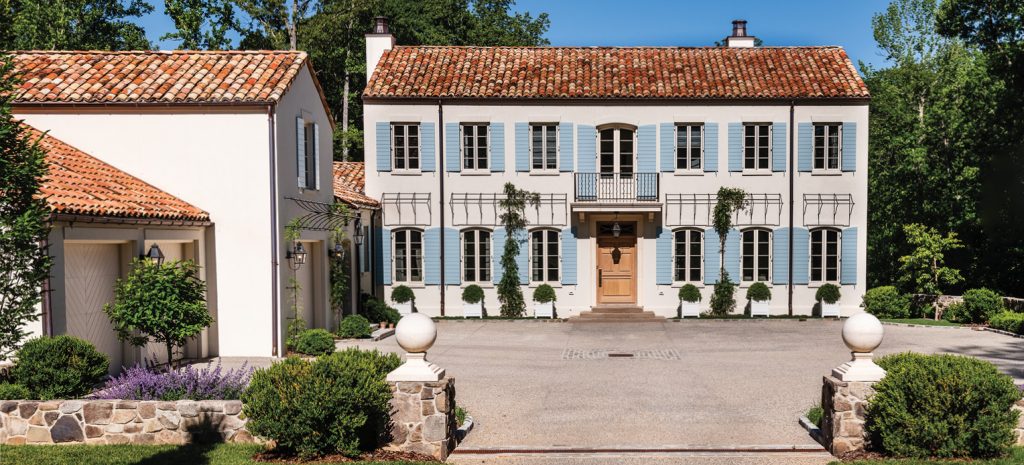
It is a Provencal beauty set in Winston-Salem that she and her husband, Chris Dorsch, began building in 2021.

First, there is un courette, a small courtyard, with trimmed boxwoods in Versailles planters. A low stone wall defines the perimeter of the front of the home where Covington captures life en famille.

Wisteria vines are in place and will eventually climb the creamy stucco exterior. Cornflower-blue working shutters, complete with shutter dogs, punctuate the dual-sash windows. A walk-out balcony overlooks the handsomely limed door at the front entrance.

Cue a bluebird — er, rather, a French magpie!

Set in a secluded residential pocket within the city, the overall effect makes you forget this isn’t a French suburb. Designed by Asheville architect Greg Koester, the home’s understated beauty relies upon architectural touches he sourced.

“The barrel tiles used on the roof are from France — the marble floors, too,” says Covington. In fact, the foyer’s aged-to-perfection marble tile was recycled from a French cathedral.

Limestone fireplaces convey classical French style. The exposed beams, multiple fireplaces, elevated ceilings and architectural flourishes include custom-designed doors and even air vents.

The appeal of those materials is that they deepen with age. Patina, Covington mentions, inspired their conversations with the architect from the very start.

Even the family pet is winsomely charming. The 9-year-old teacup Goldendoodle, Winnie, is a nod to Winston-Salem.

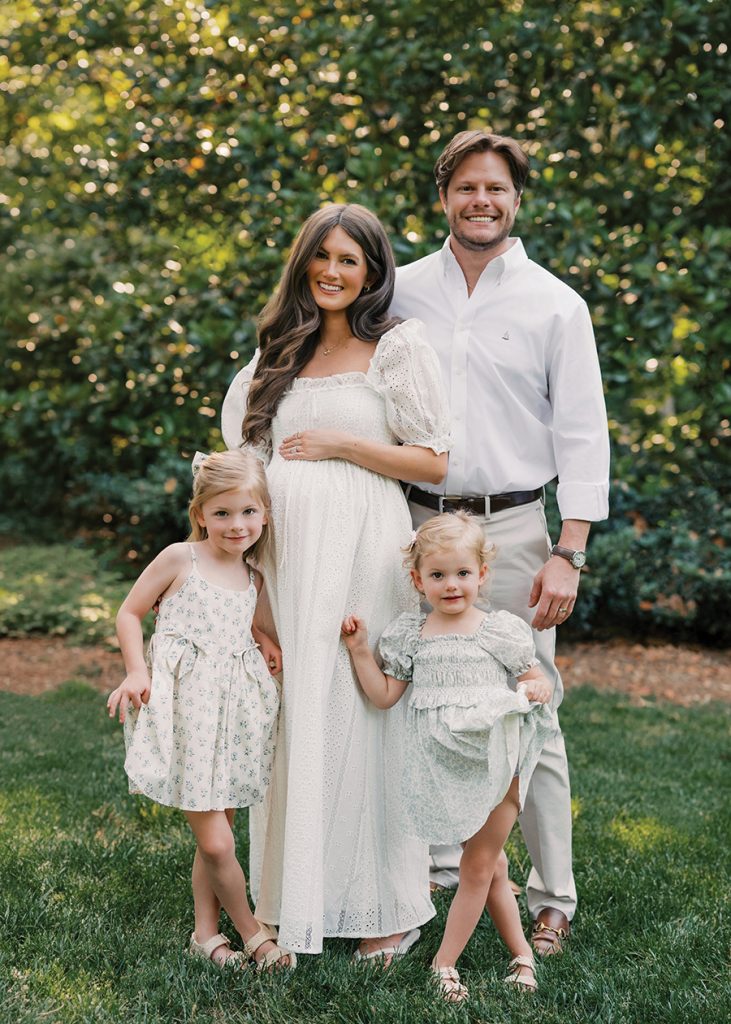
From the very beginning, Covington has invited readers into her life. Her 1.3 million Instagram followers, along with daughters Kennedy, 5, and Collins, 2, were awaiting baby number three in May. People Magazine reported on the viral influencer’s latest pregnancy when it was announced on Instagram last November.

Followers vicariously experienced the couple’s 2012 meeting in Greenville, S.C., when she worked in public relations, and Dorsch was then a mortgage banker. A six-year courtship ensued.

“We met through mutual friends at a group dinner just a few weeks after I started my job. A favorite story of ours is that our first date was actually a lunch date because Chris insisted that lunch dates were ‘harmless’ — in an effort to convince me to go on a date with him, ha-ha,” she shares.

Dorsch left Greenville the next fall to attend graduate school at Wake Forest University. “We both got apartments,” he says. “By then, Caitlin was blogging full time.” Covington’s social media work was now successful enough for her to leave public relations.

“Chris and I got married in Charleston, S.C., in June of 2018,” she says. Fans watched the couple’s romantic wedding unfold in posts. By then, Covington was an old hand at content creation.

After marriage, they lived in Clemmons in a new home, but jumped when, in 2021, they learned of a development in one of Winston-Salem’s oldest residential neighborhoods.

Although only in their 30s they both gravitate to homes that feel timeless.

“It is really rare to find undeveloped land in the Buena Vista area of Winston-Salem, so we quickly acted on it, and we were able to buy the land,” she explains. The developer required all new builds to be architect-designed.

Covington had followed the work of designer-architect duo Brooke and Steve Giannetti, former Californians now living in Tennessee.

“This book is where the inspiration for this house came from,” she says, holding up the Giannettis’ Patina Homes, chock-full of their French and European-inspired designs, all leaning toward simplicity.

Covington and Dorsch interviewed builders, architects and interior designers before breaking ground in 2022. The couple met with Koester, who showed them some of his projects. She showed him her favorite images from the book.

“I said, this is the kind of house that I would like, and he was so on board with the project,” she recalls, referencing the book. “He was like, you know, let’s go to France and let us do research. He was just so excited.” While a group trek never materialized, the project did inspire the couple to plan a trip to France.

A Triad native, the architect began his career in New York and bases Gregory Koester Designs in Asheville. His residential projects span the state and nation, including new houses and renovations and additions to older ones. 

Covington deeply admires how French style softens with imperfections and age. As they refined their ideas for the home, the couple considered their favorite details in Koester’s existing designs.

“Houses that he has done just spoke for themselves,” says Covington.

Koester assured the couple he could make their environs seem intimate even given spacious public rooms, five bedrooms, and four-and-a-half baths. “One of the things that Greg told us when we first met him is, ‘I like designing big houses, but ones that feel really cozy.’”

He translated nearly 6,000 square feet into functional, human-scale spaces. “You don’t need a big house with tons of big rooms,” she recalls he first advised.

Covington heaps further praise on the team that created what she and Dorsch call a dream home. Koester enlivened the French Provincial design they wanted. There is ample praise, too, for builder Jonathan Lee, who “was able to take our vision and make it a reality!” 

The core design team, including architect, builder and landscape designer, had worked together previously. “And we loved that familiarity between them,” says Covington.

They chose Kate Marker Interiors out of Chicago as the interior designer.

Jeffrey Allen Landscape Architecture created an exterior design for the property.

“Our house was officially finished in October of 2024,” she says. 

Despite the distance between the Triad and Chicago, the couple worked collaboratively with Marker, exchanging ideas. The designer kept in step with the personality of their family. Nothing too stuffy nor period made the cut; the interior colors and furnishings were kept tonally quiet and soothing.

Marker has described the resulting interiors as “refined French with a relaxed soul.” 

The house is famous in its own right. It has been featured in the Robb Report and House Beautiful.

When completed, Covington posted a video tour of their home.

In the caption, she wrote: “Someone pinch me; I’m pretty sure I’m dreaming.”

Covington smiles at the memory. “We really wanted the house to look like someone had picked it up out of France and dropped it in Winston-Salem.”

Given that Covington once posted from her dorm room in Chapel Hill, it was certainly an upgrade. Avid followers of her blog, Southern Curls and Pearls, now frequently glimpse the interiors, especially her study and the open kitchen.

Their work lives melded when Dorsch left his role at Hanesbrand as chief financial officer in April 2023 to devote his time to their social media advertising and promotion company.

As both work at home and nontraditional hours, the spacious kitchen is put to good use, he says. A multiburner French stove, pot filler and deep sinks aren’t merely there for optics.

“I cook a lot, so this is where we’re spending a lot of our energy,” says Dorsch, who enjoys creating healthy, savory meals.

The butler’s pantry features a coffee nook with a hard-working Breville espresso machine taking pride of place, points out Covington.

The ceilings and walls throughout the downstairs feature atmospheric beams hewn from reclaimed wood.

The living room is a favorite for the couple, where she loves reading and entertaining. There’s no TV to offer a distraction. At Christmas, the tree goes right into a front corner, just as envisioned, she says.

Heading upstairs, pastels, scalloped effects, and delicate floral Riley Sheehey wallpapers echoing French style dominate the girls’ rooms. Recently, the older girls began sharing a room, making way for the new arrival’s nursery.

“They won’t share rooms forever,” Covington says, given three upstairs bedrooms.

Dorsch jokes with his wife as they both digest what lies ahead with three children under age 6. Humor may just be their superpower, especially in navigating life beneath the glare of social media.

“He’s a great girl dad,” says Covington. “And I think God just meant him to be a girl dad.”

Dorsch smiles. He has learned to “lean into pink,” he says good-naturedly, pointing out his wife’s pink maxi dress, fetchingly belted above a baby bump.

Sometimes appearing in videos with his daughters, he plays to a sweet fish-out-of-water appeal — a father happily engulfed by his daughters’ femininity. He is deeply aware of the privilege of working at home during their childhoods, mindful of how fleeting these years are. He lost his own parents as a young adult.

He is also helping manage the sheer volume of business that social media has generated. And with that volume of business come numerous collaborations, which means receiving and reviewing products.

In preparation for that, the architect had considered the heavy influx of products coming into their home. Some of his best ideas are tucked out of view.

“Greg designed storage and what he calls my warehouse.” Here, Covington stows seasonal clothing and the surplus of autumn-themed items, often received as part of a brand partnership.

Dorsch points to their work with brands including Rufflebutts, Lululemon, Nordstrom, MacKenzie-Childs, Abercrombie & Fitch, Ballard Designs and Walmart Fashion.

“I was just telling Chris yesterday, that’s one of the things that I’ve been getting frustrated over lately, is just the accumulation of stuff. We have to constantly purge.” 

In The Parenting PATH, a nonprofit, she has found the perfect outlet for excess. Covington donates to Pinwheels, a thrift store that helps finance their programs.

Dorsch jumps in to add, “She’s being humble. She does a lot of work. She’s on the board of directors of Parenting PATH and has helped them for several years now.” 

He leads the way through custom-designed French doors opening into Covington’s study, where she often spends time working after hours.

Nearby, the primary bedroom suite features a similarly soft color palette.  It’s soothing, without jarring color or art. The fireplace, flanked by comfy chairs, is designed for a timeout with a book, sometimes with a child curled on their lap.

We are a family of readers, the couple stresses.

She favors using Kindle. Dorsch, who just completed 1984, prefers to hold a book in his hand.

“I’m one of those old souls, I guess,” he explains. “I have to physically turn a page.”

He credits his wife for the family’s reading ritual. “We finish the night reading to the girls, and our daughter — our oldest — is going to be going to kindergarten next year. All she wants to do is learn how to read, just because she sees Caitlin and me doing this.”

Covington enjoys the reading and research social media requires, especially when creating travel guides and itineraries.

The children have passports and have used them, benefiting from unusual travel experiences. A recent trip allowed 2-year-old Collins to try falconry. Covington stresses that it only sounds dangerous.

“This was part of a collaboration that we were doing with this hotel. I was standing right next to her,” she says. 

“But she had to wear that heavy glove — and she had the biggest smile on her face,” says a proud mother.

This fall, they will have lived in their new home for two years. Outside, the property has begun maturing as planned. The wisteria and roses will slowly climb walls in the European way, erasing signs of newness. It will slowly acquire the patina that inspired the design from the very start.

Outdoors, at the rear of the house, a classically simple pool and an outdoor kitchen surrounded by pea gravel keep with the low-key style they favor. Here, their girls have tea parties and make poolside videos, playfully lip-syncing to dialogue. Hydrangea, a Southern favorite, blooms.

“The roses are maturing,” she comments, taking stock of the back of the property. “So eventually, they are going to start growing all around the fence that we have there. But we are still in the very early stages of that growth.”

She, too, has weathered changes and growth, experiencing marriage, motherhood and, more recently, the sudden loss of her father, Roy Covington, in May.

Roses are a metaphor, too; with the roses come thorns, a necessary part of the beauty. Cognizant of this, she has developed a healthy relationship with her followers.

The couple considers how the media has changed, anticipating that changes will continue. Some of those will be liberating. One day, they will play a less visible role, Dorsch predicts.

Back inside, Winnie burrows deeply into a sofa cushion. A heavily pregnant Covington sinks beside her, pulling the sweet-natured dog closer for a snuggle. Together, they are comfortably cocooned in their piece of Provençal paradise, en famille.  OH

Making Lemonade

Good Graces Photography

(Instagram @goodgracesphoto)

Given all the internet noise, how did Caitlin Covington’s blog springboard from an impulse in 2011 to a social media phenomenon?

Drive, explains Covington’s husband, Chris Dorsch.

“I just recently started working more with Caitlin,” he says, “but seeing it firsthand, in this type of profession, she can never turn off — from the moment we are up till the moment we go to sleep. It is our business.”

And it is sometimes as demanding as a child, he explains. His wife unstintingly puts in the hours — both early mornings and late nights.

Timing was another factor. For an early adopter of blogging and a student of journalism, creating content came easily for Covington, who planned to enter magazine journalism. Her natural good looks, fashion sense and Southern charm didn’t hurt.

Fifteen years later, Wired magazine called Covington a blogging pioneer with “Disney princess beauty.” As fate would have it, her whole family, including mom Carla Covington (also a blogger), has Disneyesque good looks.

Now, age 35, she and Dorsch run a digital media business, Covington Media Group, Inc., with Covington frequently cited in The New York Times, Forbes, The New York Post, People and WWD.

In 2023, Covington ranked sixth among the top 100 influencers with 1.3 million Instagram followers. Such success is unusual; Business.com estimates that 48% of creator-earners typically make $15,000 or less.

Also that year, she was one of three influencers profiled in journalist Stephanie McNeal’s book, Swipe Up for More. 

Naturally, there have been potholes along the way.

In 2019, Covington, who loves all things autumn, went viral when another influencer reposted a photo of Covington with another blogger friend, captioned, “Hot Girl Summer is coming to an end, get ready for Christian Girl Autumn.” (The “hot girl” reference to a Megan Thee Stallion song made a playful jab at the two women as personifying entitled Christian girls.) 

She “hadn’t coined those terms,” as Dorsch points out. “Then she made lemonade out of lemons.” 

She took the ensuing backlash in stride, pointing out that the meme wasn’t even one of her own making. She decided to go all-in on the autumn themes.

Covington good-naturedly mugged, playing with the stereotypes: pumpkin-flavored everything, thickly knitted sweaters and apple harvests.

The Times Magazine reported on how deftly Covington pushed back — quipping she was a fan of pumpkin-flavored lattes. EntertainmentNow.com profiled her, noting her “amazing sense of humor.”

The lighthearted response was a masterstroke, serving to heighten her popularity. Since then, autumnal trips and outfits make “Christian girl autumn posts” both an annual staple and a fan favorite.

Dorsch weighs in. She excels in the art of civility. Her posts are always diplomatic.

Had she known how intertwined she would become with the blog name Southern Curls and Pearls, she might have chosen differently. She shrugs.

Nowadays, the public is never more engaged than when she features travel content. Fortunately, she enjoys doing research and creating itineraries. Travels sometimes include her mom, daughters, and their girls’ nanny, Alyssa Emmel. (Carla sometimes appears with her daughter and shoots some of her photographs.)

As for traveling solely for the joy of travel, Covington admits she cannot recall any such trips. 

That is the reality of audience engagement.

She faces the challenge of keeping up the need to entertain — she uses that phrase carefully — ever mindful that blogging is a hybrid form of infotainment.

When Emmel returns from picking up the girls from school, she makes sandwiches and mentions that her own mother is also an influencer.

The fresh-faced young woman joined them five years ago, having graduated from UNCG 10 years ago with a degree in early childhood education.

“She helps the engine run around here,” praises Dorsch.

At this writing, some of the blog posts are deeply personal, as she is on official baby watch. Followers are posting Covington baby names, offering suggestions.

Most are alliterative.

Dorsch smiles mysteriously, without saying whether they correctly guessed their top choice for the third baby’s name. “It’s amazing,” he adds. “Some are very good ideas.”

But, for now, until it’s Instagram official, they’re keeping it to themselves.

Omnivorous Reader

Omnivorous Reader

The Skill of Perseverance

The remarkable second act of John Quincy Adams

By Jim Moriarty

If your American history IQ, like mine, falls somewhere between Animal House’s Flounder — “fat, drunk and stupid is no way to go through life, son” — and the great David McCullough, you’ll find America’s Founding Son both an enlightening and rewarding portrayal of our sixth president, John Quincy Adams.

It’s written by Bob Crawford, something of an oddity in itself given he’s the upright bass player for The Avett Brothers band. “For more than two decades, I’ve studied American history while rambling up and down the interstates, freeways, and back roads of America,” Crawford writes in his introduction. While not exactly an autodidact, his lifelong fascination, beginning as a kid collecting fliers about historic landmarks at highway welcome centers, places him in the company of another member of the band, Scott Avett, who has a side hustle as an admired visual artist.

With the recent passing of Ted Turner, one is reminded of the quote he often attributed to his father, “Be sure to set your goals so high that you can’t possibly accomplish them in one lifetime.” This is, in fact, the crux of Crawford’s thesis about Adams and the goal was, or became, the abolition of slavery. His primary source is Adams’ own diaries, written faithfully on a daily basis, that illuminate the arc of JQA’s understanding of how America must eventually, and tragically, cope with its most egregious and contradictory failing.

Jimmy Carter is often extolled as a man who, in the modern age at least, made the most of his post presidency, but he was a piker compared to John Quincy, who, after losing the presidential race of 1828, briefly considered retiring from public life but instead won election to the U.S. House of Representatives. He served the citizens of Massachusetts in that capacity from 1831 until his death in 1848, when he collapsed at his desk in the House chamber and died two days later on a couch in the Speaker’s Room in the Capitol building. During those 17 years, Adams became a formidable opponent of slavery, argued the Amistad case before the Supreme Court, defeated the “gag” rule designed to muffle anti-slavery petitions, and outmaneuvered efforts, led by representatives of the “slavocracy,” as Crawford calls it, to censure him.

“John Quincy Adams may not have been an extraordinary president like Washington and Lincoln, but he is our most extraordinary ex-president. A maverick. A public servant. An American hero,” Crawford concludes.

Adams’ opposition to slavery was never in question, but his theories on what exactly to do about it evolved over time, a transition Crawford illustrates through Adams’ diary and speeches. “America’s founding son had reached the end of his patience,” Crawford writes of an 1844 clash on the House floor. “He shuddered in 1820, when he prophesied a violent dissolution of the Union, but all he had experienced in the nearly twenty-five years since proved to him that the South would never, ever, voluntarily or otherwise, give up being the enslavers.”

Crawford’s fascination with the period of American history between the War of 1812 and the Civil War came into focus after reading Sean Wilentz’s The Rise of American Democracy: Jefferson to Lincoln. His own study of John Quincy is divided into three acts. The first begins with Adams’ appointment as secretary of state under James Monroe, covers his election to the presidency in the House of Representatives in 1824 (the second time the young republic picked a president in that manner), his loss to Andrew Jackson in their rematch in 1828 and concludes with the voters of Plymouth, Massachusetts, sending him to the House as their representative. In act two Crawford does an admirable job of setting the table. “In 1835, the slavery issue was tearing the fabric of the nation apart. Its threads tossed into a smoldering furnace of bigotry and hate. And there was Adams. A witness to all of it. Sitting on the fence. Waiting for his moment.” That moment builds to a crescendo in act three.

The political figures of the day — Jackson, Henry Clay, John C. Calhoun, Martin Van Buren — are carefully drawn, as are the central issues of nullification (What if the federal government says one thing and a state refuses?) and what to do about Texas. Of equal, or even greater, interest are the abolitionists: Benjamin Lundy, Charles Finney, Theodore Weld, Arthur Tappan (full disclosure, the square at my alma mater is named Tappan Square), William Lloyd Garrison and the writings of David Walker.

When Crawford first pitched the idea of America’s Founding Son to his agent, he thought he’d be paired with a writer to produce the final work. Instead, he was left to his own devices. The result is highly readable, no small feat when you’re bound to be leaning on quotes written in the first half of the 19th century. If there is any complaint — and it is admittedly minor — it’s that on a rare occasion or two he strays too far into the vernacular of his own day, seemingly trying a bit too hard to prove that history doesn’t have to be tedious and dense. This is, perhaps, an innocent byproduct of cohosting his history podcast, “The Road to Now.”

Where Crawford ends up is in praise of a historical figure most of us, I’d venture to say, don’t often associate with greatness. “Adams brought the issue of slavery out of the darkness and into the light of the center of politics in the United States — the People’s House. John Quincy Adams preserved and protected the American democracy established by the founding generation — his father’s generation,” writes Crawford. “As the man standing in the breach, Adams passed the aspirations of the Declaration of Independence on to the next generation. With one hand reaching back to the founding and the other reaching forward toward the Civil War, John Quincy Adams is a bridge and perhaps the best representation of America’s tortured adolescence.”

If, in reading Founding Son, you see traces of modern America — our deeply flawed and fractured America — so does Crawford. “I can’t say for sure whether history repeats or rhymes, but I do notice echoes from the past in our present. That’s because history is driven by people — and people haven’t changed since 1776,” he writes. “Truth be told, people haven’t changed since Adam and Eve, or however you signify the beginning of time (or should I say history?). Spend a little time reading about the 1830s and 1840s, and you’ll encounter figures who feel eerily familiar. They dressed differently, used different slang and communicated via what now seem like antiquated technologies — but in a very real sense, we are them and they are us.”   OH

Jim Moriarty is the editor of PineStraw. He can be reached at jjmpinestraw@gmail.com.

Life’s Funny

Life’s Funny

Begin the Begats

A longstanding Greensboro church makes room for an up-and-coming flock

By Maria Johnson

Photograph by Lynn Donovan

You might remember my January 2023 column about a venerable, old Greensboro church’s plan to sell their property and downsize, a sort of spiritual and physical transformation.

Well, the 120-year-old Presbyterian Church of the Covenant — worshippers affectionately call the place “peacock,” the phonetic version of PCOC — finally has a reason to flash its feathers.

The small congregation has sold their massive complex and found a more suitable space that’s literally across the street.

At the same time, the old church property has been assumed by a younger, up-and-coming congregation, the Citadel of Praise Church & Campus Ministries, which has occupied different rental spaces around Greensboro since its founding 23 years ago. Finally, the nondenominational, charismatic congregation has a home of its own.

In many ways, it’s a story of generational and societal change written on the back of a church program.

“It feels like a torch is being passed,” says Joyce Powers, an 83-year-old PCOC member and self-described “catalyst” of the hand-off.

First, a little history.

PCOC, then called the Walker Avenue Presbyterian Church, started in 1906 as an offshoot of First Presbyterian Church and Westminster Presbyterian, both on the edges of downtown Greensboro.

The upstart church, which changed its name a few years later, focused on serving young people around Greensboro College and the state-run school that would later become UNCG.

For years, the congregation worshipped in a small, wooden church. Then, backed by several prominent families, they hired notable architect Harry Barton — who also drew plans for the Guilford County courthouse, as well as UNCG’s auditorium and chancellor’s house — to design a stately house of worship.

Done in the Neoclassical Revival style, the 1919 building hunkers at the corner of Mendenhall Street and Walker Avenue. Additions eventually covered much of that block.

From the beginning, PCOC was an activist church.

Members nursed the sick during the recurring flu pandemic of the late 1910s.

They fed soldiers who paused at Greensboro’s Overseas Replacement Depot in World War II.

They housed programs that provided child care, counseling, a preschool for blind children, and enrichment for disabled adults.

More recently, as their numbers dwindled, they leased out worship space to different denominations and nondenominational groups, as well as to artists and musicians.

In 2019, Greensboro native and Grammy-winning musician Rhiannon Giddens, who once attended PCOC, joined other local musicians at the church for a concert benefitting the Experiential School of Greensboro.

By the time the COVID pandemic hit — nearly 100 years after the flu pandemic — the congregation, which numbered 30 on a good Sunday, knew they had to make a change. As with many mainline U.S. churches, shrinking membership made it difficult to keep the physical plant going.

They had a grand vision.

They would sell their sprawling complex to a developer who would keep the property largely intact, rehab it into an affordable live-work-play space and, hopefully, rent back a space to PCOC so the congregation could continue to worship there.

The church entertained potential buyers starting in 2023.

Several developers looked at the fixer-upper.

And passed.

“There was hope. Then there was not. Then there was hope. Then there was not. We went through a roller coaster,” Powers says.

Finally, the church hired an agency that specializes in selling churches nationwide, and the property was listed for sale “as is.”

That’s how the Rev. Greg Drumwright, who started his church in 2003, just before graduating from N.C. A&T, found out about the property. Someone else had filled out an online contact form using his name, and an agent followed up.

Drumwright — who had indeed been searching for a permanent home for his flock but had no idea PCOC was up for grabs — went with the flow.

A showing was arranged.

Drumwright met PCOC’s minister, Rev. Mark Sandlin, and common threads quickly emerged. Both had attended divinity school at Wake Forest University.

Drumwright also learned that PCOC was once pastored by the Rev. Z. Holler, a well-known civil and labor rights activist. A social justice advocate in the same vein, Drumwright — who received national attention for ministering to George Floyd’s family during the 2021 trial of Floyd’s killer, a former Minneapolis police officer — felt a kinship between the churches.

“It felt like we were meeting our aunts and uncles and grandparents,” he says. “I would call that providential.”

Like the PCOC of yore, the Citadel is known for its outreach to college students and for its hands-on involvement in social and political issues. Drumwright walks his talk; he’s the Democratic candidate for an at-large seat on the Guilford County Board of Commissioners, and Powers says PCOC members back him.

“This is a guy who makes things happen,” she says.

In December, PCOC members, most of whom are white, worshipped in their old home for the last time, alongside the Citadel’s mostly Black congregation.

PCOC mustered most of its 40 members, many of them silver-haired.

The Citadel, which boasts a congregation of more than 250 people, most in their 20s, 30s and 40s, filled the rest of the pews. The Citadel choir belted out hymns of praise.

“They shook the dust off the chandeliers,” says Powers. “It was wonderful.”

“It felt transitional and transformational,” says Drumwright.

The churches closed the sale on the last day of 2025.

Knowing that the property went to a growing church, PCOC members leased another space right across Walker Avenue, inside the Victorian home known as the Holderness House, which was built for the current owner, the Presbyterian Campus Ministry.

The resettled congregation will hold an open house with music, lemonade and watermelon  from 5–7:30 p.m., Saturday, July 18, with a rain date of Sunday, July 19.

Drumwright says the Citadel, too, plans an open house, probably in the late summer or early fall, once they’ve spruced up the sanctuary and fellowship hall.

Like elderly homeowners who sell their property to younger families, Powers says PCOC members delight in watching from across the street as the Citadel’s energetic members plant flowers and work to restore the aging church home.

And who knows? Maybe someday PCOC members will move back in with their spiritual children.

“We’ve told them: ‘You can always come home,’” says Drumwright.  OH

Maria Johnson is a contributing editor of O.Henry. Email her at ohenrymaria@gmail.com.

Tea Leaf Astrologer

Tea Leaf Astrologer

Cancer

(June 21 – July 22)

It wouldn’t be Cancer season without a few tears, your basic mood swings and a new pair of house slippers. That said, with Mercury retrograde in your sign until July 23, expect more introspection and — you know you love it — a bit more time at home. Pick up a bodice ripper that you can’t put down. Make a playlist of hits from the year you were born. In other words: Distract yourself from making rash decisions until month’s end. And even then, try not to get swept up by your own swell. 

Tea leaf “fortunes” for the rest of you:

Leo (July 23 – August 22)

Listen to your gurgling gut. 

Virgo (August 23 – September 22)  

Clean the baseboards. 

Libra (September 23 – October 22)

Pass on the potato salad. 

Scorpio (October 23 – November 21)

Look for the silver lining. 

Sagittarius (November 22 – December 21)

Just let things steep.

Capricorn (December 22 – January 19)

Trust what you already know. 

Aquarius (January 20 – February 18)

Stop at the farmstand. 

Pisces (February 19 – March 20)

Try firefly therapy. 

Aries (March 21 – April 19) 

Bring something to the potluck. 

Taurus (April 20 – May 20)

Three words: homemade ice cream. 

Gemini (May 21 – June 20)

Hit refresh. OH

Zora Stellanova lives in the N.C. mountains with her wolfdogs, Venus and Lilith. Although she prefers divining with loose-leaf pu-erh, she recommends a mugwort and passionflower blend for those seeking wisdom and clarity from the dream realm. 

Sazerac July 2026

Sazerac July 2026

Sazerac July 2026

Unsolicited Advice

If you have never owned a pooch, then visiting a dog owner’s home may seem a little strange to you. They don’t operate like houses without wagging-tail greetings. You’ll hear phrases or words yelled over and over again. And, if you neglect to use them while visiting, you might be met with fluffy ears cocked in confusion. Take it from us, you don’t want to be caught without the proper puppy parlance. Don’t fret, we’ve compiled a list of useful common phrases to know before you hit the homes of these happy hounds.

About twice a day you’ll hear “Walk?” Say this and watch every flappy ear in sight shoot up and you’d better get ready for the barrage of wagging tails running straight toward you. Just be cautious: If you accidentally drop it into conversation, you may find yourself guilt-tripped into a late-night stroll, holding the leash of a cheerful canine.

“Who’s a good boy/girl?” you’ll hear a dog owner say as they scrunch, ruffle and scratch behind their pups ears. Don’t be tricked. “Good” probably refers to the dog having decided to chew on their bone instead of the living room furniture. So what if they respond to the question by masticating a choice Birkenstock? It’s all relative.

“Treat,” anyone? The easiest way to a dog’s heart is through the stomach — that’s just the way the bone-shaped biscuit crumbles. Whether they’ve eaten an hour ago or five minutes ago, a treat will always be happily wolfed down. Who doesn’t love a mid-day Scooby snack? It’s guaranteed to sweeten the bond between the two of you.

Window on the Past

Photograph courtesy of the Greensboro History Museum

A pet sheep may not sound ideal, but, in the early 1900s, you never knew what might wander onto the lawn around Ceasar and Jeanette Cone’s first Greensboro mansion. Still, we’d bet counting sheep there contributed to some much needed slumber — and honestly, that doesn’t sound too baaaaaad.

Sketch Artist

This rising artist —  the 11-year-old winner of our Dolley Madison sketch contest — Josephine (Jo) Reese clearly has a knack for drawing picture-perfect first ladies. With creativity and skill already peeking through, she is well on her way to painting her own path — quite literally!

Just One Thing

If you haven’t yet wandered through The Marshall Muse Gallery’s newest exhibit, “Nature’s Kingdom,” take a cue from a curious deer and stop in to discover what animal-inspired artworks are waiting around the bend. For instance, Linda Reville’s Strength & Courage watercolor features three bucks and a bald eagle, and dips deeply into Mother Nature’s palette, from earth tones to indigo blues. Other works, says gallery owner Tracey Marshall-Becker, are “very diverse from pottery, wood, sculpture, fiber art, paintings, acrylic oil and watercolor,” July 1–25. Info: themarshallmusegallery.com.

Animal Tale

Sun’s out, scales out: The days are getting hotter, but we’re not the only ones with an affinity for soaking up vitamin D. Olivander, Forrest Pfaff’s cold-blooded bearded dragon, naturally loves the sunlight, so, when the temperatures started rising in late March, he decided to take his little legs for a three-day solo journey off the beaten path. “He doesn’t really escape a lot,” says Pfaff. Although he’s apt to run and hide, “he’s never flown the coop before. I guess he decided this was his Ferris Bueller’s Day Off.” Like most bearded dragons, Olivander refuses to stay in his cage. Instead, he roams around the house and front lawn as he pleases. But on this particular day, Olivander hit the road to warmer pastures. Usually, he hides himself during the day, always returning for his evening feast. So, when he didn’t, Pfaff and his 13-year-old daughter knew something was wrong. Instead of panicking, they did what any modern pet owner does — they ran to Facebook. “We typed in ‘missing bearded dragon’ and the first thing to pop up was Olivander,” says Pfaff. His merry jaunt had taken him all the way to the parking lot between the Downtown Greenway and the Greensboro College campus, where Tom Saitta, senior director of marketing and communication at the college, spotted him. How did Saitta know Pfaff was in fact the rightful lizard owner? When the two spoke on the phone, Olivander recognized Pfaff’s voice and ran toward the sound, head-bumping Saitta — his signature move. Safely back at home, Olivander’s owners keep a more watchful eye on him, but, as free-spirited as he is, it’s doubtful we’ve seen the last of this rambling reptile.

   Joi Floyd

JOI DE VIVRE

A nosy Nelly knocks at our door: In my second year of college at UNCG, I went back home to Goldsboro during fall break, where I met our family’s newest addition, Nelly — or what I like to call her, Nosy Nelly. There she lay, bright-eyed and bushy-tailed, pulling the threads from the comforter on my bed. A bit shy and reserved — and occasionally snoopy — our white-furred cat with blue eyes isn’t the sweetest kitty on the block, but somehow she found a soft spot for my sister, Bre, and me. Our soon-to-be-Nelly was first found in a loved one’s garden, digging up more than just weeds, and had to be moved to a home that would accept her, claws and all. And if anyone will take in a stray, misbehaving cat who doesn’t listen, it’s my sister. We’d fostered many cats since moving to our latest house and, like the rest of them, our mother let us keep Nelly until we could find her a forever home — which turned out to be closer than we thought. A few months passed and my mother finally gave up the pretense. Nelly had settled in our house with no intention of leaving. When guests visit, she’ll peek out curiously from underneath our beds, ultimately deciding it’s not worth her time, and slide back into hiding. Sometimes considered rude or aloof, she just might surprise you. In fact, if you’re lucky enough — or shake a treat in your hand — she may find her merry way to your lap for an evening nap. A year ago, I asked my sister why she chose the name Nelly, half expecting it to have originated from the phrase “nosy Nelly,” fitting for a curious cat who’s torn up our blinds to sneak a peek outside, but that seems not to be the case. To this day, my question remains unanswered. All we know is that the name fits her all too well.
    Joi Floyd

Paw Patrol

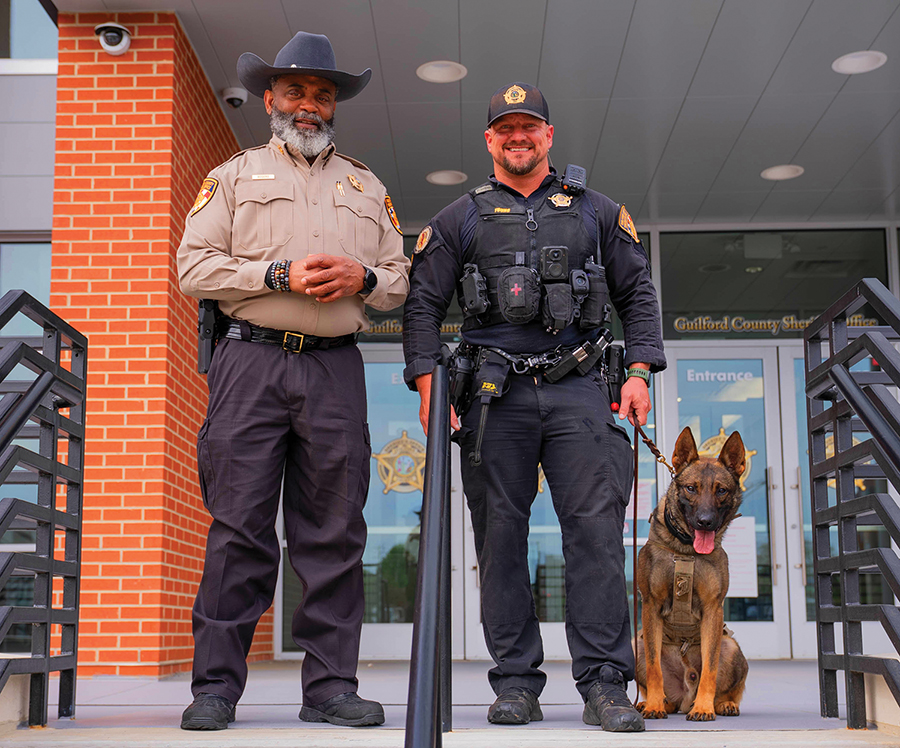
Pictured in this mutt-shot, alongside esteemed Guilford County Sheriff Danny H. Rogers (left) is Master Corporal C. Young and his patrol K-9 partner, Rook. Rook is a 2-year-old Belgian Malinois-German Shepherd mix from Hungary who was deputized by the sheriff’s office just last year — a K-9 with canines for takin’ a bite outta crime.

In his dogged pursuit of two-legged desperados, Rook is trained in narcotics detection, suspect tracking, evidence recovery and missing-person searches. Already, he’s assisted in seizing pounds of illegal snout candy, and a doggy bowl’s fill of fentanyl, plus he recently collared a criminal suspect currently cooling his heels in the county kennel. That’s a good boy!

Corporal Young admits one of the most rewarding aspects of his job is observing these K-9 crime-fighters as they grow into reliable, indispensable deputies trailing errant assailants. Fun fact: Young and Rook even share the same birthday and will one day be the same age — in doggie years, natch.

— Billy Ingram

Simple Life

Simple Life

My Miss American Pie

And our slice of heaven together

By Jim Dodson

Illustration by Gerry O’Neill

She has a birthday this month. It’s one of the biggies.

It’s not every day you reach an age when you’re permitted — even expected — to kick back and reflect on a long journey that has shaped so many lives for the better.

Her kindness is exemplary, guided by a heart that is as compassionate as it is brave. Over the years, I’ve seen her take on tasks that seemed almost hopeless, inspiring significant change in others around her. That’s just her nature. 

No wonder her birthday is a national holiday — at least in France.

It’s hard to believe that my wife, Wendy, born on Bastille Day, is 65. She’s never looked more youthful and beautiful. 

Yes, I know. America also has a big birthday this month. So, roll out the bunting, strike up the band, hand out the confetti poppers and light the fireworks. Even in times that try men’s souls, it’s good to pause and reflect on how our beloved nation got here — and where it may be headed, for better or worse.

My birthday gal, Wendy, is as all-American as apple pie and just gets better with age, an infectious optimist and embodiment of what it means to be a fully engaged citizen, a wise counselor and the most capable human being I’ve ever known. 

Because she’s also a gifted baker, I call her my Miss American Pie. 

I’ve said for years that she’d make a great president. But please don’t spread that notion around. I’d hate to give up her enlightened leadership skills to a struggling nation and lose her famous roasted apple-crumb pie in the deal.   

Meeting her almost 30 years ago was the luckiest day of my life — an encounter in retrospect that seems providential, if not presidential. It’s a story I’ve told only once in a book many years ago. This is as good a moment to share it with you as any.

On the heels of a wearying, month-long, national book tour for Final Rounds, I was invited to give the keynote speech during the American Lung Association of New York’s three-day golf event and fundraiser in Syracuse.

I’d been amicably divorced for a couple years and shared custody of our two goslings with my former wife. The last thing I wanted to do, however, was trek to Syracuse for yet another golf event and rubber-chicken speech. 

But my host was relentless. He not only talked me into coming but set me up with dinner “companions” for the three nights of the event. I don’t know why I said yes. 

But I’m glad I did.

The first night’s blind date met me, my host and his wife at the stately Onondaga Country Club where Walter Hagen once belonged. My date was a local poet who showed up late to the table and said nothing until I was asked by my host’s sunny wife if it was true that I received (and replied to) hundreds of letters from fans of my new book. I confirmed that I did. 

“That’s nothing,” piped up the poet. “I get pictures from prisoners. They send me photos of their [use your imagination].”

The formal dining room around us was full of elderly diners. Audible gasps and crashing crystal sounded throughout the room. As I walked her to her car, the poet laughed merrily and declared, “I love making rich Republicans uncomfortable!”

“Everybody needs a hobby,” I told her.

The next night’s match was worse. She was the town’s historian. I borrowed my host’s car to take her to a lovely restaurant in the Finger Lakes. She wasn’t planted on the seat beside me for two full seconds before she exclaimed, “I hear you wrote some beloved book about golf. I hate golf. It’s a fascist sport. Golfers are fascist doughboys.”

“So, I guess hitting a bucket of balls before dinner is out of the question,” I remarked.

“You’re &%$#@! right,” she declared. Please use your imagination again. Every other word was a charming expletive. I guess she hated history as well. I got her home in record time.

I asked my host for Number Three’s phone number to cancel the final date. He refused. I demanded her phone number. He wouldn’t budge.

“Her name is Wendy. She’s an incredible baker and mother of two young boys. Everyone in the neighborhood adores her. If you break this date, Sparky, I’ll be as lonely as you are and sleeping on the couch for a month.”

The final dinner was held at the home of our hosts with two additional couples. At the appointed hour, I forgot to go down the block to meet Wendy Ann Buynak at her house. She walked up by herself bearing a plate of homemade chocolate chip shortbread cookies in the shape of acorns. They looked too good to eat and tasted even better.

The minute I saw her standing in the open doorway with that plate of cookies, I realized there was a God (who probably played golf) after all. Third time was the charm. We sat at the end of the table talking only to each other for three solid hours. Then I walked her home.

The next afternoon, we went for a drive and wound up at a local golf course, where I kissed her. She smiled and kissed me back.

Two weeks later, I drove seven hours for our first date. She put me to work helping to box up 75 beautifully made miniature wedding cakes for a Syracuse bride. I got to eat the 76th cake. It was love at first bite. She also made me a roasted apple-crumb pie to take home to my kids.

Is this an All-American love story or what?  

Three months later, I introduced Wendy Ann to my two little ones, who instantly fell in love with her and her key lime pie. Two summers later, she and her two young boys joined our family, doubling our size in a lovely backyard marriage ceremony in Maine. I saw the spectacular cake she made but never got a taste. It vanished without a trace before I could get a piece.

This summer marks our 25th wedding anniversary. Miss American Pie and I plan to slip away to our favorite inn for a few days of golf, relaxation, and — use your imagination again.

Later this summer, we plan to renew our vows.

I’m reliably informed there will be pie.  OH

Jim Dodson is founding editor of O.Henry.

O.Henry Leading Women July 2026

O.Henry Leading Women July 2026

O.Henry Leading Women

July 2026​

 Written by Danielle Adams

Photographs by Betsy Blake Photography & Bert VanderVeen

Sponsored Section | July 2026

Blowouts & Bubbles

Community Foundation of Greater Greensboro

Fellowship Hall

GenCrest Capital Partners

The Jaree Todd Team

Lindsey Architecture

Monkee’s of Burlington

The Marshall Muse Gallery

South 23rd Porch Pops

Weatherspoon Art Gallery

Wilkerson Bakery

Winston-Salem Symphony