Simple Life

Simple Life

Let There Be Darkness

In defense of the dark side

By Jim Dodson

During a business trip to a remote part of New Zealand last winter, I was reminded of the staggering beauty of the night. Stepping out of my bungalow just after midnight, the stars of the Southern Hemisphere took my breath away. There were untold millions of them arching overhead, blazing like white diamonds on black velvet.

Because it was summer down under, there were also vivid sounds of calling night birds and insects murmuring in the fields and forests around me. I sat down on a wooden rocking chair and just listened for the better part of an hour, a perfect bedtime lullaby that reminded me of my daily wake-up routine back home in North Carolina.

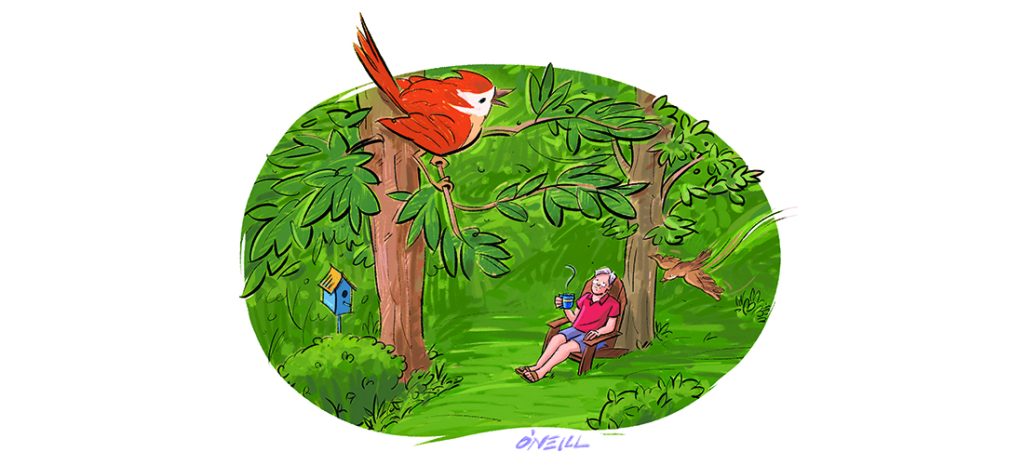
Well before sunrise most days, I take my coffee outside to sit beneath a grove of old trees and wait for the first songbird to herald the breaking day. Save for an occasional passing train or distant siren that briefly mars the silence, it’s the stillest part of any day, the perfect moment to think, meditate, pray or just be.

I’ve captured the first birdsong many times on my handy Cornell Lab Merlin Bird app. In my neck of the suburban woods, it’s usually a Carolina wren or eastern towhee that breaks the serenity of pre-dawn. Sometimes it’s the northern cardinal or melodious song sparrow who takes lead solo. Every now and then, a great horned owl or brown thrasher cues the chorus. Whichever one starts, as sure as night is dark, a chorus of a dozen or more birds soon joins the songfest, including gray catbirds, mourning doves and American crows.

I never tire of this avian awakening, finding a sense of true gratitude for my tiny spot on Earth as a new day begins.

And yet, I worry.

Last year, a report from National Audubon on the state of birds reported that the U.S. and Canada have lost 3 billion birds over the past half-century. The same report notes that half of America’s bird populations are in decline, prompting more than one expert to warn that we are already in the early throes of the Earth’s sixth mass extinction.

Global warming, loss of natural habitat, various forms of pollution and the fact that the night is no longer as dark as it used to be are cited as primary contributing factors to the decline of thousands of species of birds, insects, reptiles and mammals, roughly half of which hunt, mate, feed and travel by night. Disappearing forests accelerate this decline.

Historian Jill Lapore echoes similar concerns in a recent New Yorker essay titled “What We Owe Our Trees:”

“Even if you haven’t been to the woods lately, you probably know that the forest is disappearing. In the past 10,000 years, the Earth has lost about a third of its forests, which wouldn’t be so worrying if it weren’t for the fact that almost all that loss has happened in the past 300 years or so. As much forest has been lost in the past hundred years as in the 9,000 before. With the forest go the worlds within those woods, each habitat and dwelling place, a universe within each rotting log, a galaxy within a pinecone. And, unlike earlier losses of forests, owing to ice and fire, volcanoes, comets, and earthquakes — actuarially acts of God — nearly all the destruction in the past three centuries has been done deliberately, by people actuarially at fault: cutting down trees to harvest wood, plant crops and graze animals.”

So what is an ordinary, suburban nature-lover and bird nut to do? That depends, I suppose, partly, at least, how you grew up.

I sometimes joke that I grew up in darkness.

I had the privilege to grow up in a succession of sleepy Southern towns, following my dad’s itinerant newspaper career. From the coast of Mississippi to the Carolinas, Yeats’ proverbial “The Stolen Child,” with an imagination fired by nature, I explored woods and creeks, bringing home frogs and injured birds. The rule was, I had to be home by “full” darkness. Many an evening, I lingered in the twilight just to watch the fireflies come out and listen for the sounds of crickets, bullfrogs and night birds. In those days, the streetlights in these quiet rural towns were few.

I’m not speaking, mind you, of the metaphorical darkness showcased by everything from the Bible’s rich imagery of light and darkness (good and evil) to modern cable TV’s endless news loops of crime and disaster. There’s a perfectly good reason why depression is rightly called a “dark night of the soul.” Anyone who has experienced it might be forgiven for believing that the world is coming apart at the seams.

Thirty years ago, in an effort to give our children the benefits of a quieter, natural world, my wife and I built our house on a coastal Maine hilltop surrounded by a dense forest of beech and hemlock, where the nights were deep and woods teemed with animal life.

The first thing I did when we moved back to my hometown neighborhood seven years ago was plant 20 trees around the property. Today in summer, our house sits in a grove of beautiful trees. The neighborhood is called Starmount Forest, after all, and most residents appreciate the giant oaks, maples and poplar trees that still arch like druid elders throughout. Living up to the name, these trees provide home to a rich variety of birds and insects. They also give us welcome shade in summer and showcase the stars on winter nights.

Turning down the lights at night strikes me as one small but sensible act of kindness to nature, encouraging the living world around us to rest, so moths and other nighttime creatures can pollinate plants, fertilizing the start of the world’s food chain.

In her lovely spiritual memoir Learning to Walk in the Dark, theologian Barbara Brown Taylor points out that most of the monsters we fear in the dark are simply phantoms we create in our anxious, sleep-deprived minds.

“I have learned things in the dark that I could never have learned in the light,” she writes. “Things that have saved my life over and over again, so that there is really only one logical conclusion. I need darkness as much as I need light.”

I was reminded of this fact one morning at summer’s beginning while awaiting my woodland wake-up call. Savoring the pre-dawn stillness beneath the trees, I suddenly realized that the fireflies had returned, magical messengers of hope that would be nowhere without the night.

As August passes over us and the days grow shorter, the darkness grows.

I say, bring it on, dear neighbors, and sleep well.  OH

Jim Dodson can be reached at jwdauthor@gmail.com.

The Omnivorous Reader

The Omnivorous Reader

Heavy Mettle

Three mothers of tenacity appear in a debut novel

By Anne Blythe

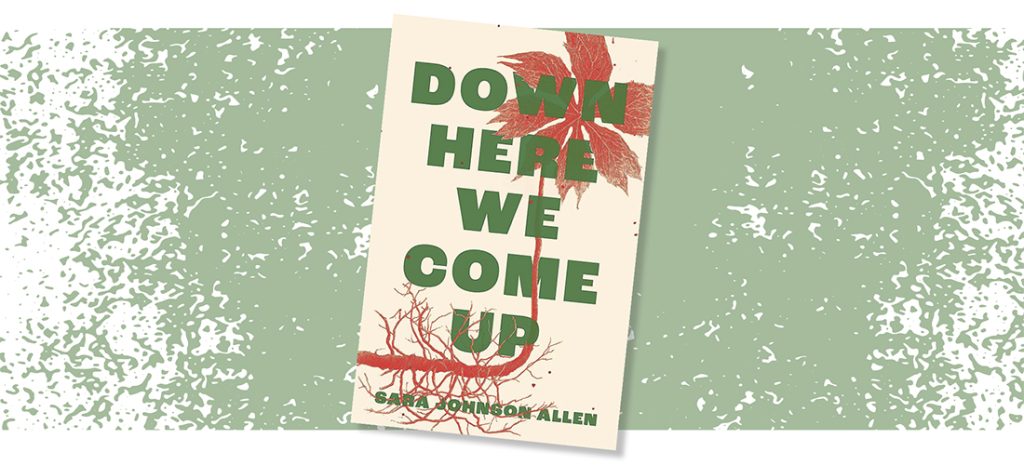
Mother’s Day has come and gone this year, but Sara Johnson Allen’s Down Here We Come Up offers a unique and complicated tribute to the grit of motherhood, not the roses and candy of a Hallmark holiday. This debut novel from a writer with Raleigh roots shows the depths to which three mothers will go for their children despite the blunders and foibles that accompany the rough-and-tumble lives that bring them all together under one roof in a “creaking, rotting bungalow” outside Wilmington.

In rich, vivid, sparkling prose, Allen’s page-turner explores tough topics: socioeconomic divides; the realities of immigration often skirted in today’s hot-button debate; the shadow economies of the illegal drug trade, and human and weapons trafficking.

Kate Jessup is the protagonist. She’s in her mid-20s, “movie-star beautiful,” and the wistful mother of a daughter whose soft skin she could still smell even after spending only 48 hours with her before handing the newborn over to a Boston couple in a “closed adoption.”

Kate’s a twin who is almost as street smart as her brother, Luke, is book smart. They’re the children of a sassy single mother, Jackie Jessup, who showed her twins how to live by hook or crook as they grew up near Wilmington. They learned early in life that “there was a thing’s market value, the perceived value, the true value, the if-the-buyer-was-drunk value.”

Jackie, readers find out pretty quickly, “could con people into anything because she saw ahead of everyone else by several moves,” Allen writes. “In a different set of circumstances, Jackie might have been a great chess player, someone who could beat the fast strategies of the men playing outside the Au Bon Pain in Harvard Square where Kate later followed her twin brother Luke when he received enough merit and need-based scholarships plus loan money that it didn’t matter he had no actual money.”

Settled near Harvard Square with her professor-boyfriend in a multi-million-dollar Victorian home he’d purchased from his father for a dollar, Kate gets a call from Jackie that shakes her out of the aristocratic world she had joined.

“Mama, I’m at work. What do you want?” Kate asked while ducking down between the rows of plants she loved to tend in the greenhouse where she worked.

“ . . . Look, I need something,” Jackie said between drags on a Kool 100.

Jackie wanted Kate to “get someone’s children,” and to entice her daughter, she added: “I have something you want.” Kate had been emotionally hollow when she left the South and her mother to be near her brother in New England. Most of all, she wanted to know where the daughter she’d given up for adoption was. Though she tried to tamp down those questions, they were never far from the surface.

Against her brother’s advice, she had even gone to the home where she thought the adoptive parents lived, just to get a glimpse of the life she had brought into the world. But there was no sign of the couple or a little girl who would, by then, be close to 8 years old.

Jackie’s phone call, and the chance that her mother might truly know where her daughter was, leads Kate back to the house where she grew up. She leaves Boston, taking her boyfriend’s Audi without his permission or even telling him she was going. Memories of a life she thought she had left behind flooded back.

“She knew driving south would be like letting poison seep into the well,” Allen writes. “She could taste it, bitter and sharp on the sides of her tongue, the menthol smoke, the chemical air freshener, a variety of aftershaves of strangers in their house, all of it.”

Once home, Kate found her mother deathly ill, “a skeletal, yellow-grey version of herself.” The bungalow was filled with people she didn’t know, travelers from south of the U.S. border who were there because of Maribel Reyes, a former teacher and mother of three who fled Mexico to build a better life for her family.

Maribel had moved into the Jessup home, taking on a daughter-like caregiver role for Jackie. More than that, she had created a safe house for migrant workers who made stops in southeastern North Carolina as they carved new paths in a foreign and sometimes unwelcoming land.

Maribel, Kate and Jessie may have converged in this place from different circumstances for an array of reasons but they shared a powerful bond. They were mothers who knew too well the pangs of being separated from their children. Each was willing to go to great lengths to narrow that distance, often bending the rules to achieve that greater purpose.

As the women plot the trip to get Maribel’s children out of Mexico and across the Bridge of the Americas from Cuidad Juarez into El Paso, Texas, Allen shows her deftness at describing places. You can almost feel the hot weather of the inner coastal communities. “Kate knew heat,” Allen writes. “She knew it up and down like the motion of a paper fan in a closed-window church. Blot-a-cloth-against-your-sweaty-forehead heat. Waving-up-from-the-asphalt-like-a-mirage heat. Wet heat.”

You can visualize what the coastal community looked like before the new housing developments cropped up on old farmland and forever altered the landscape. The sounds and smells of the changes hang heavily in the air — new languages among the rural Southern accents, the chilaquiles and memelas served in kitchens where biscuits once were the main fare.

Amid all the calculating, heartbreaking and serpentine storylines of survival are moments of triumph, jubilation and humor. Allen has her readers cheering for her characters, rallying for them to forgive themselves and others and longing for new beginnings.

“Follow anything back to the beginning, and you will find a mother,” Jackie says at one point.

From start to finish, Allen will make her readers think about motherhood, how to define it, and the joys, messiness and sacrifices that come with the job.

Author Alena Dillon describes Allen’s first novel as “a literary mic drop.” Let’s hope it’s not the end of a performance, but the first of more stories to come. She’s off to a great start.  OH

Anne Blythe has been a reporter in North Carolina for more than three decades covering city halls, higher education, the courts, crime, hurricanes, ice storms, droughts, floods, college sports, health care and many wonderful characters who make this state such an interesting place.

Don’t Let Them Eat Cake

Don’t Let Them Eat Cake

Fiction by Brendan Slocumb     Illustration by Mariano Santillan

He smelled like the cake factory: frosting, the yeasty stench of batter and butter, but more than anything else, sugar. Baked sugar, tangy and sweet, that coated the back of his tongue and the inside of his eyelashes. Leaving the factory at the end of the shift, he could feel the sugar aroma around him like a coat or a fog, always moving with him. Of course, his friends started calling him Bon Bon. He’d hated the nickname, but by now it had hung on him so long that he didn’t mind it.

He ordered another beer and checked his watch. His buddy, Tig, was late, as usual. Meet me at the bar at 6:30 and DONT BE LATE, Tig had texted him. SERIOUS!!!

Now it was 6:49, and he’d finished the first beer and ordered a second. Why Bon Bon had believed Tig that this time actually was urgent, Bon Bon didn’t know. He’d shown up in his work clothes without changing back into his street clothes, the King Arthur Brand cake flour misting up from his pant legs every time he shifted on the bar stool. 

“You makin’ me hungry, buddy,” Alan, the bartender, told him for the third time. “What do you think of carrot cake? You a big fan?”

“I figured you for a chocolate cake man,” Bon Bon said. “That was your wife in the shop the other day, wasn’t it? She bought the 14-inch and the 18-inch. Double chocolate.”

“Wife loves them,” Alan said, buffing the bar and looking away. His A-shirt, with dozens of stains on it — bourbons, whiskeys, wines — barely covered his paunch. Seemed like Alan loved those chocolate cakes, too.

Bon Bon nodded politely, tried to squeeze out a smile and looked again at the door.

“You must get sick of cakes,” Alan said. “All them sweets. That vanilla confetti cake is my favorite.”

“Never touch the stuff,” Bon Bon said. “I only eat salty stuff. You got more of these?” He pushed the empty dish that had contained pretzels and peanuts towards Alan. The first few months at the factory, Bon Bon had eaten so many pastries that he became nauseated by the sight of anything with sugar in it. 

He looked at the clock. It was 6:54. If Tig didn’t show by 7, Bon Bon was out of there. Home, out of the sugar-stenched clothes and into the shower. He imagined hot water sluicing over him, the powdered sugar circling the drain and disappearing. He fumbled in his pocket for his wallet, looking for a ten, when a familiar voice said behind him, “You stink like the inside of a fat woman’s purse, you know that?”

Tig. Of course. “What?” Bon Bon asked him. “What does the inside of someone’s purse smell like? And where were you?”

“They keep cake in them,” Tig said. “The ladies.”

“Nobody keeps cake in their purse,” Bon Bon told him. “That’s the dumbest thing I ever heard you say.” And he’d heard Tig say plenty of stupid things over the years.

“Come on, let’s go.” Tig was already heading toward the door.

“Go where?” Bon Bon said. “Why did you want to meet here? Now we’re leaving? What’s going on?” Bon Bon grabbed a handful of the peanut-pretzel snack from the newly replenished dish, thanked Alan with a wave and trotted to keep up with Tig, who was already outside

By the time Bon Bon caught up with Tig, he was almost to his car, a beat-up dark green Chevy Malibu, whose passenger door had gotten side-swiped years ago and was missing the side mirror and most of the chrome trim. Tig was what Bon Bon’s mother referred to as “a character.” Overalls, sleeveless shirt, dirt-and-oil-coated John Deere trucker cap, Reebok tennis shoes so faded and stained with oil and dirt that their color would forever be a mystery. 

“Get in,” Tig said.

“Where are we going? When will we be back? I can’t just leave my car — ”

“GET IN,” Tig said, almost an order this time.

Bon Bon never knew why he got in the car that night. Maybe because he’d done other stupid things with Tig in the past and this was just par for the course. You wouldn’t believe what Tig just did, Bon Bon imagined texting his friends later tonight. It would be fodder for conversation for days to come.

The car stunk of cigarette smoke and chaw. A spit cup sloshed in the dashboard console. Bon Bon shoved McDonald’s wrappers, Entenmann’s boxes, Dunkin’ bags and miscellaneous trash off the seat, and got in. Before he could even buckle his seat belt, Tig spun the tires and headed out of the parking lot toward the highway.

“What’s this about?” Bon Bon repeated, swallowing the last of the pretzels.

Tig smiled. Drove for a minute, enjoying the power. Then, dramatically, he said, “I’m about to make us rich.”

“No,” Bon Bon said.

“Yep.”

“OK,” Bon Bon said. “Let me out. Turn around. Stop this piece-of-crap and let me out. I told you before. I’m not getting involved in any of your messed-up money-making — ”

“It’s guaranteed cash and you’re already in it,” Tig said without missing a beat.

“Stop the car. I mean it.” 

“Too late. You’re going to thank me in about 12 hours.” 

“What the hell are you talking about? Twelve hours? What did you do? What are we doing?”

“I just made you 23K. I get 27K, you get 23K.” 

“For what?” Bon Bon asked. Frustration and fury boiled in his gut the way it often did when he had to deal with Tig. “You just handing me 23K for sitting here?”

“For coming with me, yeah,” Tig said, darting a glance at him. Bon Bon couldn’t decipher it. “All you gotta do is drive when I get sleepy.” The highway spooled out before them, the endless ripple of white lines bisecting the night. Few cars were out this late, and all seemed to be going in the other direction.

“Hell no. I don’t know what kind of craziness you’re getting into, but I’m out. I gotta work in the morning. Turn around. Take me back to my car.”

Tig laughed. “Bro, they won’t miss you at that cookie house. Besides, in 12 hours, you’ll have enough money to quit that job and do something that doesn’t leave you smelling like a giant cupcake. Lose that dumbass nickname. Grown man named Bon Bon. I’m doing you a favor.”

“Screw you. Dammit, I knew I should have just gone home.” 

The car banked around a wide curve, then through a series of up-and-down humps in the road. If you drove fast enough, it was like riding a roller coaster. For an instant, you could lose your stomach as you crested the rise.

On the descent, a thump came from the trunk.  

“What was that?” Bon Bon looked in the back seat, stacked neatly with big square boxes: Macbook Air, read several. UN3481, read others, with the logos of a battery and a flame. They were all laptop computers. The back-seat floor was the usual sea of fast-food wrappers, napkins and trash. Nothing moved.

The thump came again, as if whatever was back there shifted back to its original position.

“What’s going on?” Bon Bon asked. He couldn’t hide the note of nervousness now in his voice. “What’s in the back seat? Is that stuff stolen? You raid an Apple Store or something?” He tried to imagine how many laptops would be worth $50,000. There’d have to be at least twenty-five, maybe more.

“Nothing. Don’t worry about it.” The car was going faster now, well over 80 mph. 

“I knew it. I freakin’ knew it. What did you do? I’m not dealing in stolen goods, Tig. Stop the car.”

Tig groped in the driver side door. Bon Bon thought at first that Tig was looking for his wallet or maybe a soda bottle. But after a moment Tig retrieved a small triangular object that seemed to absorb the dim lights from the dashboard before it resolved itself into a gun. It glittered as if alive. Tig gripped the handle and then the muzzle was pointing, impossibly, at Bon Bon himself. 

“T, what the . . . ” 

“Just shut up,” Tig said. “I’m doing you a favor. Nobody is getting hurt. We walk away with more money than either of us has ever seen.”

Bon Bon had only seen Tig this erratic once before. It ended with Carl Simmons walking with a permanent limp and Tig spending three years in prison for aggravated assault. Bon Bon stared at the dark muzzle of the gun. His mouth had gone dry, the pretzel crumbs turned to gooey dust on his tongue. He wiped his hands on his pants and could feel the flour and sugar coating his palms. He wanted to scream. Instead he took a deep breath, looked out the window into the dark, trying to ignore the feel of the gun staring at him. “OK man, just tell me where you got all these computers from. And what we’re going to do with them.” 

“The less you know the better,” Tig told him. “Get some rest. You’ll take over in six hours. We gotta make the drop by 8 a.m.” 

Bon Bon had heard that Tig had gotten into some shady business while he was in prison. This whole scenario was making more sense. Tig, and now Bon Bon, were driving stolen electronics over state lines. He wondered if $23,000 was worth getting caught. If the police pulled them over —

Tig turned on the radio with an aggressive punch of his forefinger. Kellie Pickler’s “Red High Heels” deafened them. Bon Bon turned down the volume.

 Over the next two hours, Bon Bon sat in silence, thinking. Tig couldn’t be reasoned with, that was pretty clear. Bon Bon could wait till Tig fell asleep and turn the car around, but what would happen when Tig woke up? Bon Bon glanced down at the gun again, resting lazily on Tig’s thigh, and looked out the window. He could grab his phone and try putting it on mute and dialing 911, but the phone’s light would turn on and Tig would see it for sure. Bon Bon’s palms felt chalky from the mixture of sweat and cake flour dust. The damp, sugary smell from his trousers made him want to retch. 

“Hey,” he said when lights from the next exit glimmered on the horizon. Signs for gas, food, lodging. “I didn’t get dinner when I was sitting there waiting for you, and I’m starving. Do we need gas?” He pretended to stretch and stifle a yawn.

Tig kept his eyes on the road, but his grip tightened for an instant on the gun, then relaxed again. “OK,” he said after a minute. “I am, too. All right. I’ll pump the gas and you get us some food.” Tig took the exit too fast, the car almost on the berm before he overcorrected. Again came the thump from the trunk. “And don’t try anything, man. I’d hate to kill you, you hear me?”

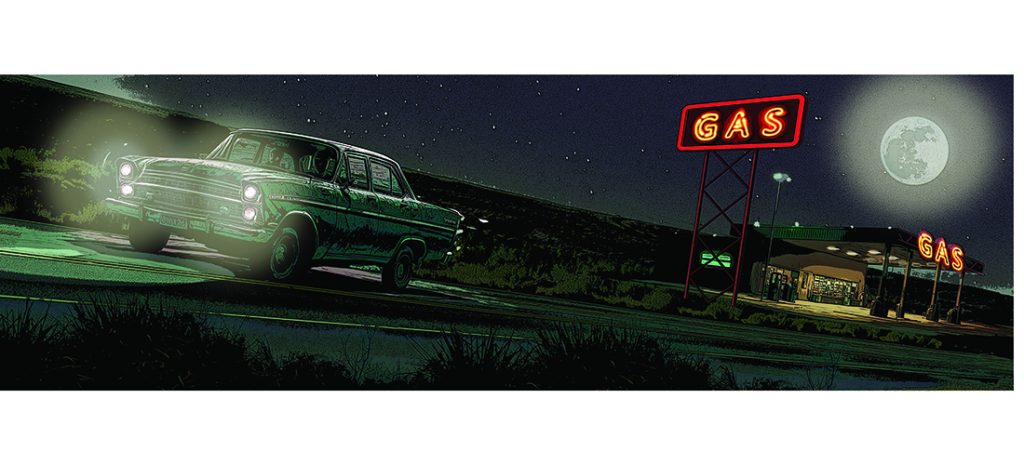
The gas station was a half-mile down the road, its fluorescent lights bright and disorienting. No cars were parked at the pumps. A single beat-up Honda sat tucked against the building. Bon Bon had been hoping for a late-night police cruiser, an RV, anything.

After the car had come to a halt, Bon Bon got out, making sure his movements were slow and casual. He could run in, tell the attendant to call the cops, who could be here in minutes. He glanced over at Tig, who was staring hard at him. He looked away, pulled open the glass door. He could feel Tig’s eyes on him, even in the snack aisle. 

He picked up several bags of  Flamin’ Hot Cheetos, hot chili and roasted lime Takis, jalapeño Kettle potato chips, and honey barbecue and hot mustard pretzels. Then went to the refrigerators on the wall and pulled out four bottles of Pepsi.

At the cash register, Tig’s gaze brushed his shoulders as Bon Bon paid and the clerk stuffed everything in a plastic sack. Again and again, he contemplated saying something but then imagined Tig leveling the gun at them, the bullets spider-webbing the glass.

The door behind them jingled, and Bon Bon jumped. “You almost done, man?” Tig called in.

“Yeah,” Bon Bon said. The clerk put a handful of change on the counter, and Bon Bon swiped it into his palm. “You owe me 18 bucks,” he told Tig as he brushed past him out the door, out into the cool night and the waiting car.

“Oh you’ll get that and more soon, buddy.” Bon Bon could hear the relief in Tig’s voice. “You feel like driving now?”

“Yeah, I can take over,” Bon Bon said. “You eat up. Did you check on the trunk? On whatever fell over back there?”

“Don’t worry about it. It’s fine,” Tig said. 

Bon Bon pulled out of the parking lot as Tig tore open the purple bag of Takis, stuffing a handful into his mouth. “Damn these are good. You want some?” 

Bon Bon shook his head. “In a sec.” He took a sip of Pepsi.

“These things are spicy,” Tig said, playing on the word spicy. “Whooo-eee.” He cracked open his Pepsi and drained half of the bottle. Bon Bon took a sip of his.

Tig didn’t tell him where they were going, just directed him once to turn south, toward the highway running to the coast. Tig broke into the potato chips and Bon Bon munched on pretzels. They passed city after city, and a rest stop in three miles.

“I’m thirsty,” Tig said when he was halfway through the Honey Barbecue Pretzels. “These pretzels are making me thirsty.”

Seinfeld,” Bon Bon told him without looking over. He checked the rearview mirror. The boxes sat primly on the backseat, giving away nothing.

“What?” 

Seinfeld,” Bon Bon said. “That was a running joke on Seinfeld.” The rest area illuminated the road. “Remember, George said it about 200 times during that show?” They passed the entrance, kept going.

“I don’t know what the hell you’re talking about. You got more to drink?” Tig said. 

“There ain’t no more. We drank it all.” 

“That ain’t funny,” Tig said. “I’m seriously thirsty. We gotta stop.”

“OK,” Bon Bon told him. “Next place we see. I need to take a piss, too,” he added.

They passed a sign. “Next Rest Area: 28 Miles.”

“Damn,” Bon Bon said. “Another half-hour.”

“We can make it,” Tig said, staring out at the darkness. But after another 10 minutes he said, “I really gotta go.”

“So do I,” Bon Bon said. “Bad. I’m going to pull over.”

He eased the Chevy onto the shoulder, put on his flashers. “What the hell you think you doin’?” Tig said, spraying pretzel crumbs onto Bon Bon’s shirt. 

“What? You want me to piss myself in the driver’s seat? I didn’t shower after work because somebody wanted me to meet them at 6:30. So now I smell like cupcakes and if I piss myself I’ll smell a lot worse. That is not a good combination. So you’ve got a choice. Either stop yapping in my face and let me pee, or you can drive the rest of the way in a wet seat.” 

He hoped Tig would be too preoccupied to suggest that he pee in the Pepsi bottle. Tig was. 

“Whatever. Don’t do nothin’ stupid.” Tig got out of the car, slammed the door. Again the thump from the trunk, and then another. 

The car’s headlights beamed into the nondescript grass as Bon Bon climbed out, went around the front of the car. As he reached the berm, he stumbled, tripped, and fell. Then got up, close now to Tig.

“Clumsy idiot,” Tig said, laughing, transferring the gun from his right hand to his left, unzipping. “Next rest stop we’re gonna get something to drink. I’m really thirsty. We got how many miles? 15 or — ”

Wham. The rock that Bon Bon had just picked up struck Tig perfectly, right on the temple. Tig dropped, soundless, so quickly that Bon Bon thought for a second that he was pretending. 

But he wasn’t. A moment later he groaned, reaching for his scalp. Bon Bon lunged for the gun, grabbed it and sprinted back to the car.

In a moment, cinders flew and he was back on the highway, heart in his throat, going 70, 80, 90 miles an hour.

After a couple of miles he slowed slightly, pulse still pounding. The thump from the trunk came again. Bon Bon pulled over, popped the trunk, went around back.

Inside, a young boy lay wedged against tires and fabric, his hands and feet bound with zip ties. His eyes were bigger than any eyes Bon Bon had ever seen, with such terror and misery that Bon Bon couldn’t speak for a moment as he loosened the gag. The boy struggled away, a panicked bird.

“Hey, it’s OK,” Bon Bon said. “That piece of garbage can’t hurt you.”

He looked in the front seat for a knife, scissors, anything to cut the ties, but could find nothing. So he carried the boy to the front seat, tried to make him comfortable.  

“I’m taking you to the police,” Bon Bon told him as he adjusted the seat belt. “The bad man won’t hurt you anymore, OK?” He tried to sound as calm and nonthreatening as he could. 

“You smell like a cupcake,” he told Bon Bon accusingly, voice rough.

Bon Bon laughed. “Story of my life,” he said. “I get that a lot.”

The little boy eyed the bag of pretzels, tucked in between the seats. “Can I have some?”

Bon Bon reached past him for the pretzels, fed him a couple at a time.

“These are making me thirsty, “ he said.”

“Do you like Seinfeld, kid?” Bon Bon said as he pulled out his phone and dialed 911.  OH

Brendan Nicholaus Slocumb is a graduate of UNC Greensboro with a degree in music education. He is the author of The Violin Conspiracy and Symphony of Secrets. He is currently working on his third novel.

O.Henry Ending

O.Henry Ending

Swing to Life

A tired play set oscillates a passerby’s perspective

By Mallory Miranda

I can’t stand the sight of it: The metal and plastic swing set in its sun-faded primary colors. It stands conspicuously in a neighbor’s yard.

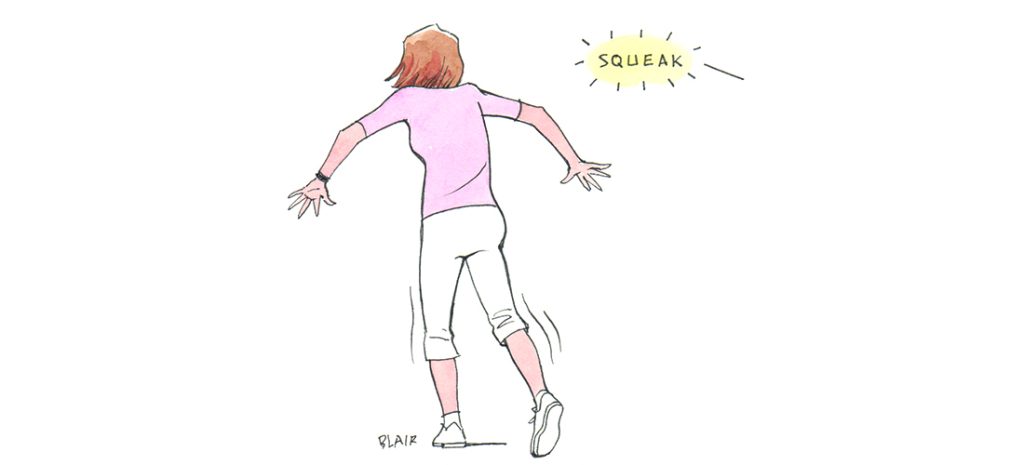
I can almost hear its creaking joints.

One word flashes across my mind’s eye as I approach: eyesore.

I bind my dog’s nylon leash around my knuckles, determined to pass it quickly.

It’s the sort of swing set friends had in their yards in the early ’90s. Thirty years ago, these swing sets were more brightly colored, but, displeasingly, they creaked then, too.

I recall two swing sets in particular. One was in the yard of our neighborhood Girl Scout troop leader. Let me just say, I don’t have fond memories of my time in this troop. The other swing set was in a much happier backyard.

Any fond memory of my time as a Girl Scout is tarnished by the unpleasant troop leader. I’ll confess I often misplace her actual face in my memory with that of Miss Agatha Hannigan, the boozy, little-girl-loathing head of the orphanage in Annie. You get the picture.

Did anyone actually play on that swing set? Or was it just for show, a way of proclaiming, halfheartedly, “Our child is beloved. See — we buy her things!”

Shortly after her stint as a Girl Scout troop leader, the woman and her husband dropped their daughters off at a relative’s house for an indefinite visit. Then, they bought a Harley and rode off into the dust together.

Is their old swing set still rusting in their backyard now, wheezing in the wind?

My dog yanks her shortened leash. She hasn’t gone “number one” yet. Judging from the tension on the leash, she’s ready.

I release some slack. As she sniffs for her perfect spot, I wait at the curb of the swing set house, grateful to my oversized sunglasses for concealing my condescension.

I see a motley mix of terra cotta pots and old plastic margarine containers that form a boundary around the yard. All of the pots and containers are overgrown with a vibrant variety of plants. The grass is freshly mowed.

Another yard comes to mind: my grandmother’s.

Particularly, it’s the repurposed plastic containers that remind me of her abrasive voice, scolding me across time, “Aye, Mija! Don’t throw away that perfectly good Tupperware!”

My grandmother was the neighborhood babysitter, her yard always littered with a mix of toys she collected over the years. Many were leftover from former clients whose kids had outgrown them. And, yes, she had a swing set just like the one I’m trying not to stare at. It and all the other toys were faded and dated, but everything sparkled anew when it hit her lawn.

“Waste not, want not.”

My grandmother’s yard of hand-me-down toys, creaking swing sets and messy children is all cleaned up now. She’s too frail to lift a small child, let alone have one or more running wild in her yard.

My dog kicks up grass with her hind legs, signaling she’s done.

A screen door opens and a pair of chubby legs bursts through it. A stout little toddler flings herself onto a hard plastic seat, joyfully propelling it into centripetal motion, while a woman looks on.

With the spark of child’s play, the swing set is magically restored to its vibrant glory.

I smile and wave to my neighbor. She nods in return.

And as my dog and I amble down the street, the swing set creaks loudly, as if it’s laughing.  OH

Mallory Miranda is a resident of Greensboro. She is currently writing a play.

Tea Leaf Astrologer

Tea Leaf Astrologer

Leo

(July 23 – August 22)

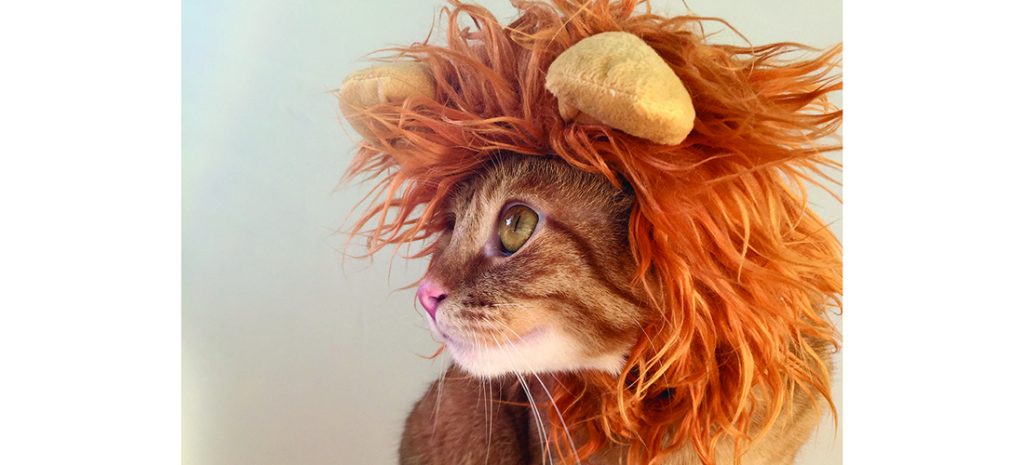
No surprise: You’re in the driver’s seat this month, kiddo — just the way you like it. Control is a clever little temptress. With Venus retrograde in Leo until September 3, you can expect more than a few obstacles to arise in relation to an old flame. Navigate wisely, resisting the urge to make any brash or sudden detours. Clarity will return. In the meantime, crack the windows, crank up the tunes and celebrate this wild and precious life with lionhearted exuberance.

Tea leaf “fortunes” for the rest of you:

Virgo (August 23 – September 22)

To thine own self be kind.

Libra (September 23 – October 22)

There’s a balm for that.

Scorpio (October 23 – November 21)

Don’t let the muck get the best of you.

Sagittarius (November 22 – December 21)

Finish what you started.

Capricorn (December 22 – January 19)

Lather, rinse and repeat.

Aquarius (January 20 – February 18)

Keep the kindling dry.

Pisces (February 19 – March 20)

Big feelings? Release them with paint.

Aries (March 21 – April 19) 

Someone needs a time-out.

Taurus (April 20 – May 20)

The irony won’t be lost on you for long.

Gemini (May 21 – June 20)

Inaction speaks louder than words.

Cancer (June 21 – July 22)

Does “toxic productivity” mean anything to you?   OH

Zora Stellanova has been divining with tea leaves since Game of Thrones’ Starbucks cup mishap of 2019. While she’s not exactly a medium, she’s far from average. She lives in the N.C. foothills with her Sphynx cat, Lyla. 

Almanac August 2023

Almanac August 2023

August slows us down. Speeds us up. Goes by a host of honest names. Call it “Epoch of Purple Coneflowers” or “Dawn of the Swamp Rose Mallow” or “Rudbeckia in C Major.”

In the garden, call it “abundance.”

Call it “too many tomatoes” or “fresh salsa for days” or “winter marinara.”

Call it sweet corn tossed with butter. Pickled chili peppers. Green beans sizzling in the skillet. Call up the neighbors to share the harvest.

The bees seem to know these days are numbered. The butterflies, too. They sip warm nectar long and slow as if to become it. As if the beauty might swallow them whole.

It’s the beginning of the end. Summer’s swan song. The firefly’s last dance.

Perhaps you call it bittersweet, the way the golden light begins to soften. How the cicada still sings. How it’s all so subtle.

Black snake basks in candied light. As the season fades, the crickets play their hearts out. Beautyberries bear whorls of purple fruit. The gray squirrel bears her second litter.

It’s the beginning of something new.

By month’s end, the hives are fat with honey. The spring fawns have lost their spots. The crickets perform late summer’s opus.

“Rudbeckia in C Minor” swells into the balmy evening.

As the earliest apples ripen, something in the air will shift. You’ll want to name it “joy” or “sorrow” — maybe even “respite.” Call it what you’d like: gift, heartache or threshold. August is all of it. 


Going Moony

Those who garden by the moon’s phases should know that two full moons will grace us with their brilliance this month — on the first and last day. According to The Old Farmer’s Almanac, this age-old planting practice is based on the idea that the gravitational pull of the moon “affects the moisture in the soil” just as it causes the tides to swell and recede.

Ever tried it? Annual flowers and above-ground crops (as in your fall greens) should be sown into the earth during the waxing phase of the moon. In other words, from the new moon (August 16) until the blue moon (August 31). Flowering bulbs (think spider lily and sternbergia) and below-ground crops (beets, radishes and rutabaga) are said to thrive when planted during the moon’s waning phase, beginning the day after it is full (in this case, August 2) until the day before it is new again.

If those full moons happen to look just a bit bigger and brighter this month, it’s because they are, in fact, supermoons — as close to the Earth as they can get. 

August of another summer, and once again I am drinking the sun and the lilies again are spread across the water.      — Mary Oliver


The Bees Knees

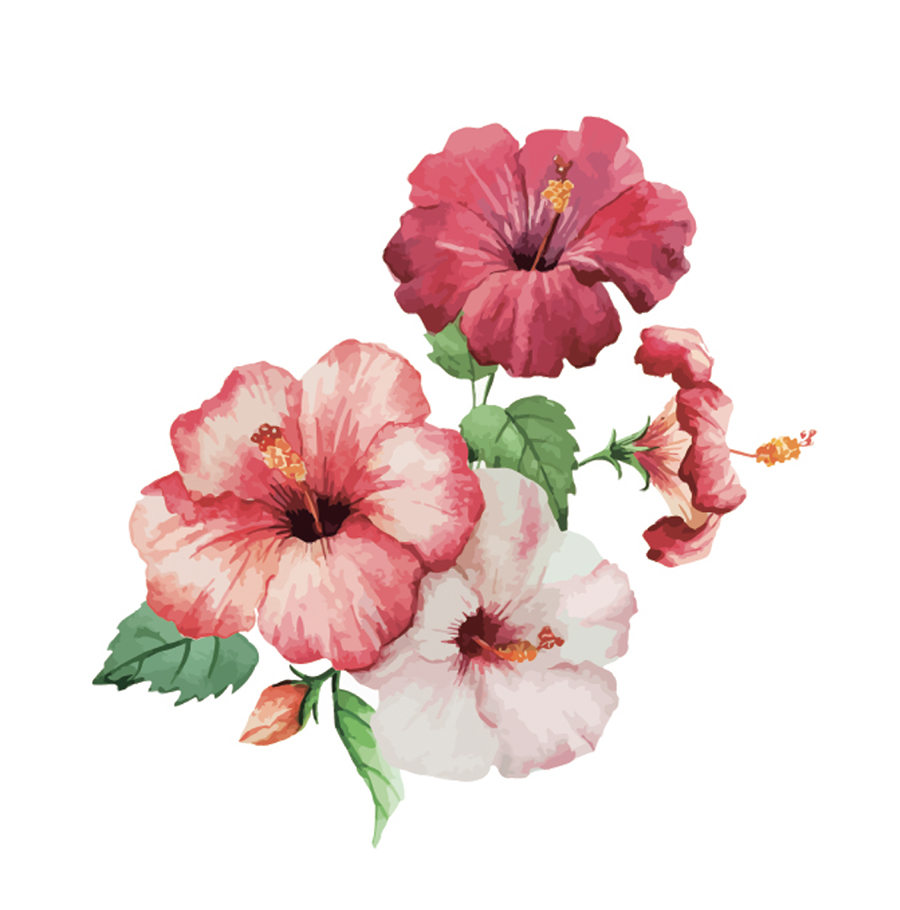
Among the native wildflowers sure to dazzle pollinators and nature lovers alike, behold the blooming swamp rose mallow (Hibiscus moscheutos), found thriving in moist soil and full sun, especially alongside creeks and ponds. Irresistible to bees, butterflies and hummingbirds, this showy perennial is known for its sizable pink and white flowers. Fragrant and funnel-shaped, these five-petaled wonders open at night, revealing a vibrant red or purple center with a riot of yellow stamens. Long bloom this late summer beauty! OH

Sazerac August 2023

Sazerac August 2023

Unsolicited Advice

Three words parents dream of — and kids dread all summer long — will finally be right on the tips of our tongues: back to school. That’s right, peeps. Sharpen those No. 2 pencils — wait, do schools even use pencils anymore? To help you and your kiddos prepare, we’re sharing our top five takes on The Princeton Review’s list of study tips, with, of course, helpful bonus remarks from us.

  1. You don’t need just ONE study space. PR goes on to suggest that, in addition to a dedicated desk, you hit up libraries, coffee shops and even use your own kitchen table. Your homework is the perfect size to double as a placemat.
  2. School supplies (alone) don’t make you organized. That’s right, Lisa Frank school supplies alone make you organized. That’s more like it.
  3. Use class time wisely. The teacher’s done lecturing and you’ve got 10 minutes till the bell? Trim your toenails or floss your teeth. Take care of all those menial tasks that cut into your after-school video-game time.
  4. Make a friend in every class. This strategy will ensure that you’ll have your pick of weekend parties.
  5. Don’t let a bad grade keep you down. After all, GPA stands for got plenty a-time.

Just One Thing

When his uncle introduced him to comic books as a child, 22-year-old Zaire Miles-Moultrie discovered the world of creative arts, often sketching his own strips. But then he realized “that it is possible to have a very fulfilling and successful career and life within the arts as an artist,” thanks to his UNCG professors-turned-mentors, Jennifer Reis, Christopher Thomas and Barbara Thomas. Now, Miles-Moultrie creates much of his art through digital collaging, which incorporates his own sketches and drawings plus contemporary and historical images. Created this year, Love and Folly is inspired by the fairytale of the same name “which tells the story of how folly (the lack of good sense; foolishness) became the guide to what we know as love,” he writes. “I really wanted to make a piece that captured the essence of that story but with a very meaningful twist.” And what is that twist? “It’s OK to embrace the silliness and foolishness of love, life and ideas. Even though we live in a crazy and sometimes downright negative world, the craziest but most compassionate thing we can do is love.” Miles-Moultrie’s work is on display through August 31 as part of Transform GSO’s “Warmth of Conversation” exhibit at 111 Bain Street. Info: thatzaire.art.


Sage Gardener

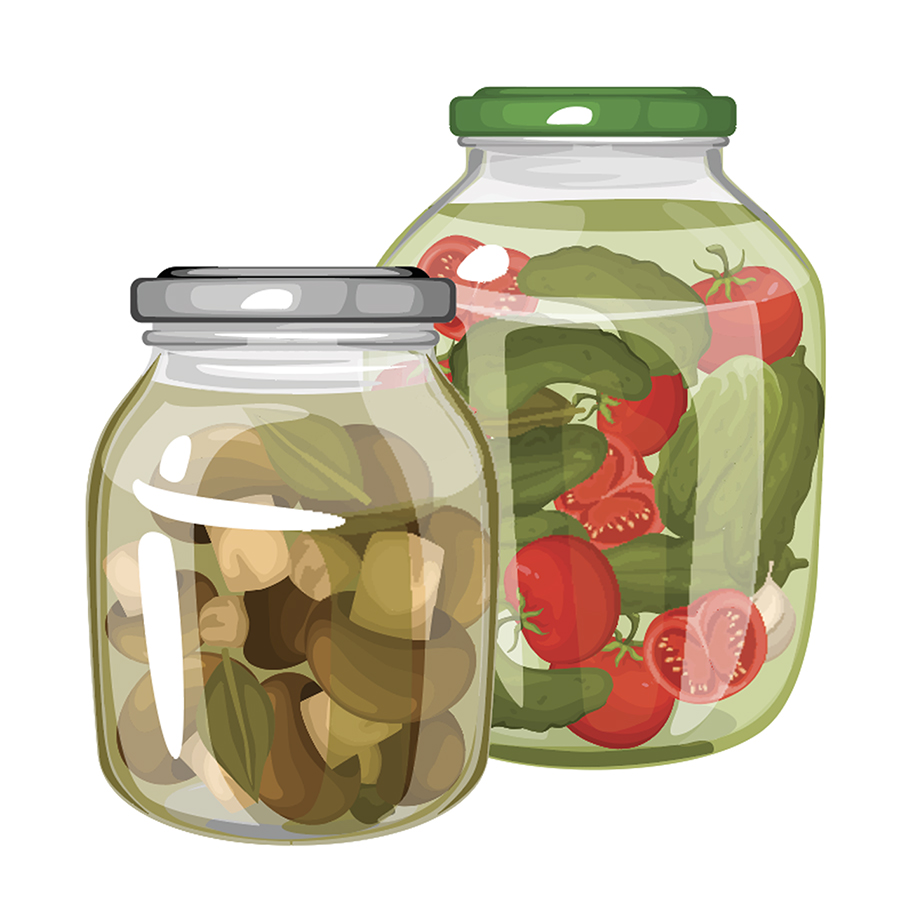
Standing in line at a family reunion years ago, my dad gave me this sage advice: “Son, always get your pickles and pie first before the good ones get gone.” I grew up in a pickle-centric household with a Lutheran mom from Pennsylvania-Dutch country and a Moravian dad raised on a farm near Madison: watermelon rind pickles at Christmas; bread-and-butter as soon as the cucumbers came in; garlicky dills brining in a crock, with an aroma that hit you at the front door; mason jars chattering away on the stove in a blue-speckled canner; and the sharp bite of cayenne peppers in spicy okra pickles throughout the year. Anne, my wife, has joined me in my vinegary obsession, adding some of her mom’s less-familiar, refrigerated concoctions from the South Carolina low country: seven-day beach slaw, Zellwood sweet-corn relish, candied sauerkraut and Friendship brandied fruit-cocktail compote. Can you say Cackalacky? ’Tis the season, though: cucumbers coming in by the bushel, green peppers waiting to be stuffed with cabbage, green tomatoes galore, and, for those really pickle-obsessed, pickled zucchinis or pickled pumpkin, neither of which I recommend. Squashed dreams. What I do recommend is a savory delight my late aunt’s husband, Ab, made — what we call Rachel pickles. Ab pickles just doesn’t sound right. Anne makes them for me as an act of love since it takes brining and boiling and draining and using alum at intervals of two days, nine days and four days. As the garden winds down, I find myself making Korean kimchi, cowboy candy (candied jalapeños) and, of course, chow chow, aka piccalilli or Indian relish. Anne usually pickles figs, pears and peaches, and has been known to put up garlic scapes, Jerusalem artichokes, green beans, cornichons and crab apples. She draws the line at Brenda’s sweet freezer pickles, made in an ice tray and highlighted in her grandmother’s Gopher Hill Festival Community Cookbook. No big dill, I’m hiding the ice trays. — David Claude Bailey


Window to the Past

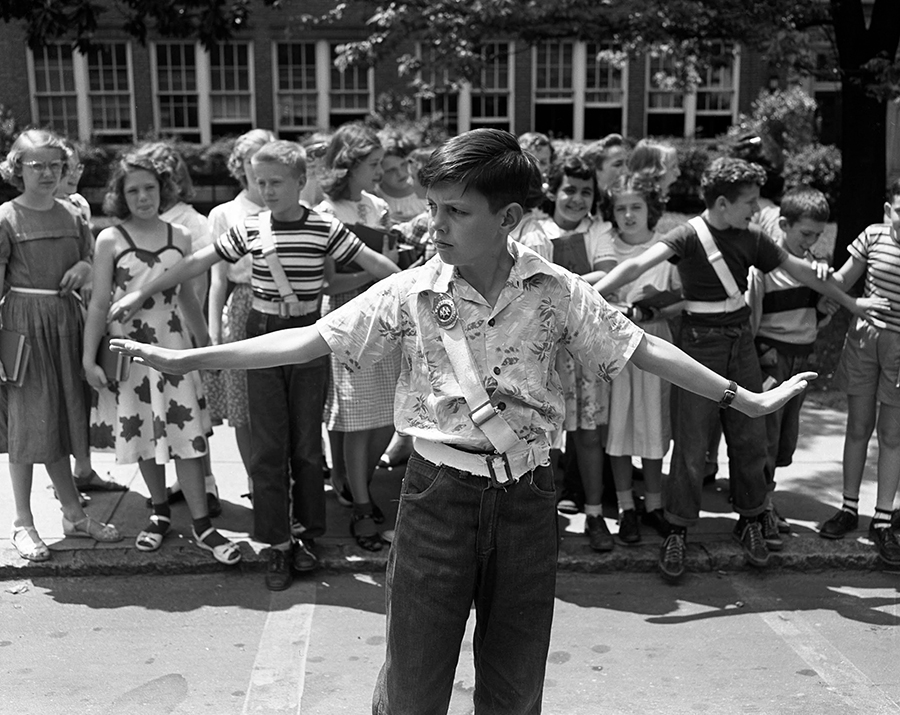
Photograph © Carol W. Martin/Greensboro History Museum Collection

Always best to pair your safety patrol sash with a Hawaiian shirt so fellow students know you’re serious, but also fun and approachable. (Aycock Junior High, now Swann Middle School, renamed for educational leader Melvin Swann, 1950)


The Write Stuff

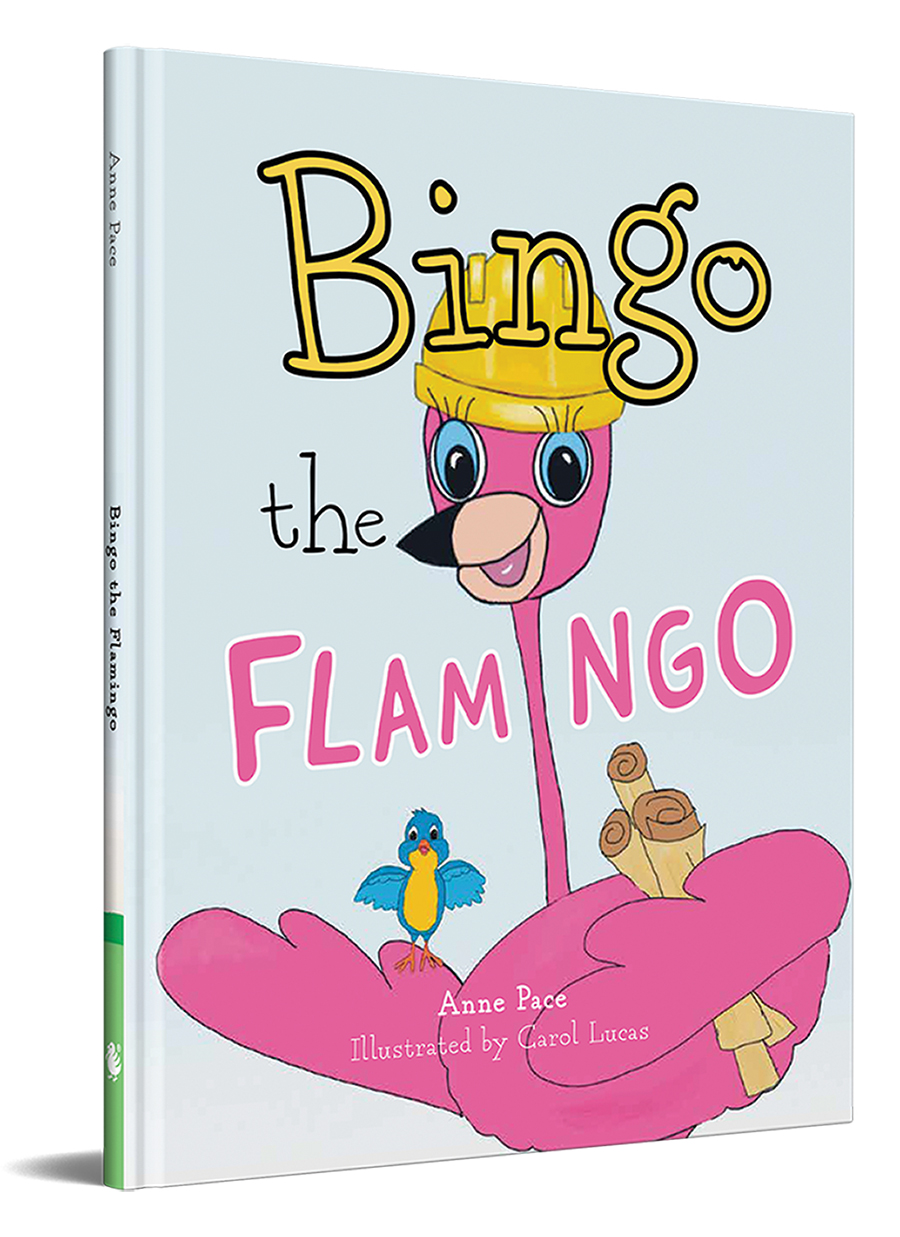
Local mother-daughter duo Carol Lucas and Anne Pace have teamed up to create a children’s book, Bingo the Flamingo. Pace, a former kindergarten teacher who received her Bachelor’s degree in elementary education from UNC-Chapel Hill and her Master’s degree in reading education from the University of Virginia, says she was inspired to write Bingo’s story after taking her children to the Greensboro Science Center. She noticed one flamingo, a handsome bird who “was squawking, grunting and flapping her wings.” She and her kids decided that particular bird was probably just bored and “yearned for an adventure . . . and Bingo’s story was born!” While Lucas has no formal training, she’s “always been a gifted artist,” according to her daughter, who recalls the hand-drawn birthday invitations her friends still talk about to this day. So . . . Pace wrote the book and her mother provided the vibrant illustrations. Has Bingo’s wanderlust been put to rest in this book? Oh, no, says Pace. “Bingo has more adventures in store and we’re excited to publish another book.” Locally, Bingo the Flamingo can be found at Polliwogs and Carolyn Todd’s, or through Barnes & Noble, Amazon and bingotheflamingobook.com.
Editor’s Note

Editor's Note

Some things just belong together: peanut butter and jelly, Hermione and Ron, Elizabeth Bennet and Mr. Darcy. In celebration of our favorite pairing — a beach and a book — O.Henry has produced its summer reading issue every August for over a decade. In that span, our contributors have included Frances Mayes, Daniel Wallace, Etaf Rum, Ron Rash, Lee Smith, Clyde Edgerton, Bland Simpson, David Payne, Lee Zacharias, Celia Rivenbark, Michael Parker, Nan Graham, Terri Kirby Erickson, Shelby Stephenson, Fred Chappell, Anthony S. Abbott, Wiley Cash, Ruth Moose, Sam Barbee, Virginia Holman and Jill McCorkle, to name a few. This year, we added Valerie Nieman and Brendan Slocumb to our roster.

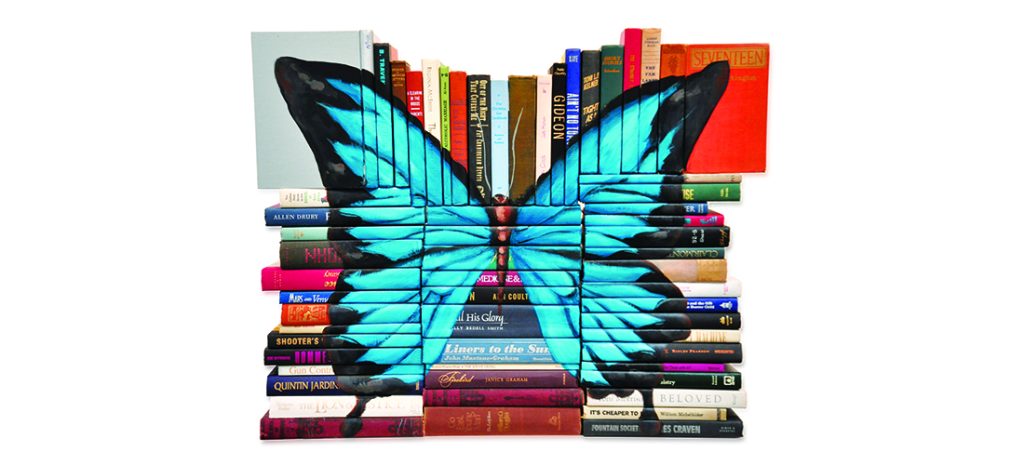
And every August, we strive to find a cover that celebrates both reading and readers. This year, we’re fortunate enough to feature the work of California artist Michael Stilkey, a “book sculpture” entitled Out of the Night That Covers Me. In a style reminiscent of German expressionism, Stilkey uses a mix of paint, lacquer, ink and pencil to capture his melancholic, whimsical characters painted on stacks of books, many of which are destined for the recycling bin. Stilkey told the L.A. Times, “Books are dying. There are so many that go to the garbage. It’s crazy. If I can paint on them, I’m giving them a second chance.” His work has been exhibited throughout the United States and around the world, including the United Kingdom, Italy, Switzerland, The Philippines and China. When the curator of the Rice University Gallery randomly saw his work in a Los Angeles gallery, she flew him to Houston where he created his first large book sculpture. It went viral. “Then I went on a world tour for the next, I don’t know, 15 years,” says Stilkey. “Right place, right idea, right timing. It all aligned.”

In 2018, Stilkey was invited to the World Economic Forum in Davos, Switzerland, as a cultural leader. There, he created a book installation entitled Down to Earth, consisting of nearly 8,000 books, standing 27 feet tall and 20 feet wide, and depicting people from diverse walks of life floating on the music of a pianist. In 2019 at the Starfield Library in South Korea, he created his largest piece, a three-sided sculpture made of roughly 15,000 discarded books.

If you’d like to see more of Stilkey’s artwork, visit mikestilkey.com. For now, we hope you enjoyed our 2023 page-turners. And we really hope you’re sitting in your beach chair, toes dipped in the water.  OH               

— Cassie Bustamante

To see more of Stilkey’s artwork, visit his website at mikestilkey.com.

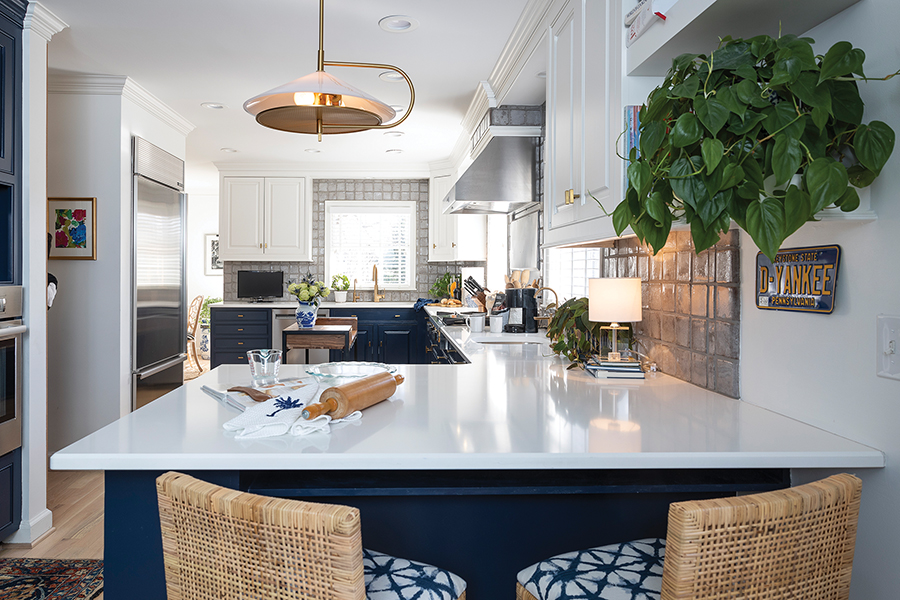
Bidding Adieu to a “Jewel Box” Home

Bidding Adieu to a “Jewel Box” Home

The Otto Zenke stamp stands the test of time

By Cynthia Adams     Photographs by Bert VanderVeen


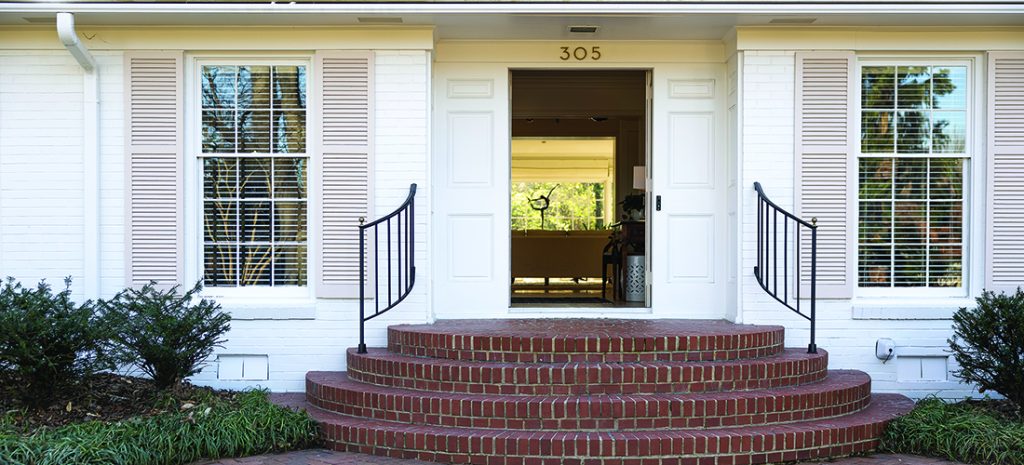
Had Robert and Adeline “Addie” Smith not taken on a hybrid midcentury modern/traditional ranch, restoring it to its full, Otto Zenke-era glory, who knows what might have happened?  Would the singular designer’s touches have been lost forever? 

Not a chance.

As you read this, the Smiths will have already decamped from their newly rejuvenated Starmount “jewel box” after living there for less than a year. “We’re starting all over again, like we did last year,” Addie says wistfully. 

“We made a splash and now we must dash,” she says with an upbeat tone of voice but an expression that says otherwise. Leaving a “dream home” in which they’ve invested time and resources came as a surprise, they both stress, although they’ve uprooted before.

They’ve closed on and begun planning a refresh of an 84-year-old sun-soaked cottage in Jacksonville’s historic San Marco neighborhood, Florida.

A difference of night and day, they say. 

Packing up their worldly belongings, setting off with their beloved wirehaired fox terrier, Bobby, for their next reno-venture, seems like déjà vu all over again, in the words of Yogi Berra. 

Robert, a senior project engineer/associate with the global architecture and engineering firm Stantec, has been recently tapped to start a new “bridge group” — or satellite office — for his company in northeast Florida. His territory has grown from West Palm Beach, where the couple formerly lived, to northern Georgia.

Addie, a Pennsylvania-born designer, hopes to recreate some of the magic in their new abode that they felt in one of Greensboro’s most wooded and walking-friendly neighborhoods.

Even, Addie says, with a serious exhale, if the San Marco cottage is half the size of the jewel box and lacks the stylish cleverness designed into its nooks and crannies. 

Bobby seems to agree, taking to his bed looking dejected, tail drooping, but Addie takes notice and calls him over for a treat.


She can’t help but gush about the aesthetic aspects of the Starmount property. “I have to pinch myself; I lived in this work of art.”

Artistry was burnished into its very DNA, she discovered, largely thanks to the home’s builders, who worked hand-in-glove with, arguably, the most renowned Triad designer. (Addie belongs to the American Society of Interior Designers, ASID, both in Philadelphia and Miami, her former home.)

Today, ASID still sponsors an annual Otto Zenke student competition in his honor.

Zenke deserves the following he cultivated, she says. 

More about the former and latter soon, but first, the why.

For if, like the Smiths, you’ve ever poured yourself into a renovation, only to soon discover you must relocate, then best follow Lemony Snicket’s advice to “look away, look away” and read another story in this issue. Because the Smith’s saga may prove too sad.

However, there is another point of view, one which Addie herself offers: “Talk about the passing of the baton to the new owner, Russ La Belle,” she suggests. La Belle, who has Greensboro roots, is president of North Carolina-based Wilmington Machinery, with headquarters incorporated in the Triad.

And so, the story of this house concerns a short but significant tenure given the Smiths’ shared vision. “Our creative thread goes through our person, what we wear, our homes,” she adds philosophically. “Our homes impact us.”

Prior to changing paint colors and refinishing floors to a lighter, blonde look, Addie had weighed all the period touches that would be preserved as well as those that would be added. But before the first brush stroke was applied late last summer, Addie had prepared a detailed notebook of paint colors, renderings and specifications. “I treated myself and Robert as the client,” she explains.

Addie first found the Starmount property in August last year — one she began calling “the Duncan house” after meeting former owners Linda and Randy Duncan. 

The 48-year history of the Duncans’ ownership and their improvements impressed her. As did the home’s beginnings.

In 1955, Arthur Schwartz, owner of Arthur’s Fine Shoes on North Elm Street, built a ranch style home on Kemp Road West for his family. Linda, who befriended Schwartz, learned that he retained “the well-renown interior designer, Otto Zenke,” confirmation of what Addie felt was true. In fact, she had done a fair amount of sleuthing.

“There are still today some remnants of Mr. Zenke’s handiwork,” she says and points to Zenke’s custom-made brass pulls on folding doors and hardware designed specifically for the built-ins.

These and other identifiable Zenke touches inspired Addie as she planned refurbishments.


On a walk-through, she mentions “the wallpaper in the bar and some of the very unique brass doorknobs in the den and foyer” as further evidence.

The Smiths invited Benjamin Briggs from Preservation Greensboro to have lunch earlier this year at their home to learn more about its provenance — and reveal the redo.

Before Briggs visited, however, the Smiths had already gotten the scoop from the Duncans. The Smith/Duncan luncheon, a true meeting of the minds, “went on for four or five hours.”

The original house plans, which reveal a meticulously designed home, conveyed with the property. Unfortunately, the architect’s name is unknown. “He [the architect] was a visionary.” 

He envisioned the picture windows spanning the main room at the rear of the home — a departure from the norm at the time when such windows were typically on the front elevation. Someone, possibly the Schwartzes, oversaw, or at least supported, some of the home’s best features, Addie speculates. Then, there was the Zenke imprint.

“Otto Zenke was highly influenced by Dorothy Draper,” says Addie, “and she was Baroque or Rococo.” Indeed, Draper, Zenke’s contemporary, was a high-society interior designer credited with inventing Modern Baroque with work that survives today in The Carlyle in New York and in the Greenbrier in White Sulphur Springs, West Virginia. Zenke, who was educated at Pratt, had a local following in the Triad, but also maintained offices in Palm Beach and London. Zenke, in fact, designed homes for the likes of the notable restorationist John Jenrette. “I think Otto had a great commission here.”   

The Schwartzes were design-minded and house-proud, choosing both good form and functionality. 

Addie says the Duncans’ contributions were similarly spot-on. They took ownership in October of 1972 and lived in the house until 2020.

“Linda and Randy Duncan left a legacy that we were able to build on.”

Randy, a former Stanley Furniture Company designer who had recently opened his own firm, added design embellishments and customized paneled doors to a wall of fir bookcases in the den. They feature an original drop-down campaign-style desk. 

“He customized the doors further, just to give them more detail, and added custom hardware.” She traces their still-stylish facades, noting, “I kept this the original fir and stain.”

And more personal details were kept, even retaining “the growth chart on the wall across from the coat closet in the den,” where the Duncans recorded their children’s and grandchildren’s heights

During the mid-eighties, the Duncans added the garage specifically to house Randy’s red 1984 Porsche 911 Carrera Coupe. 

“Work began on the garage fairly quickly and it was completed in 1985,” Linda wrote Addie, “a perfect place for Randy’s ‘midlife crisis.’”

The home was intentionally designed to separate public spaces from bedrooms, found in a private wing.

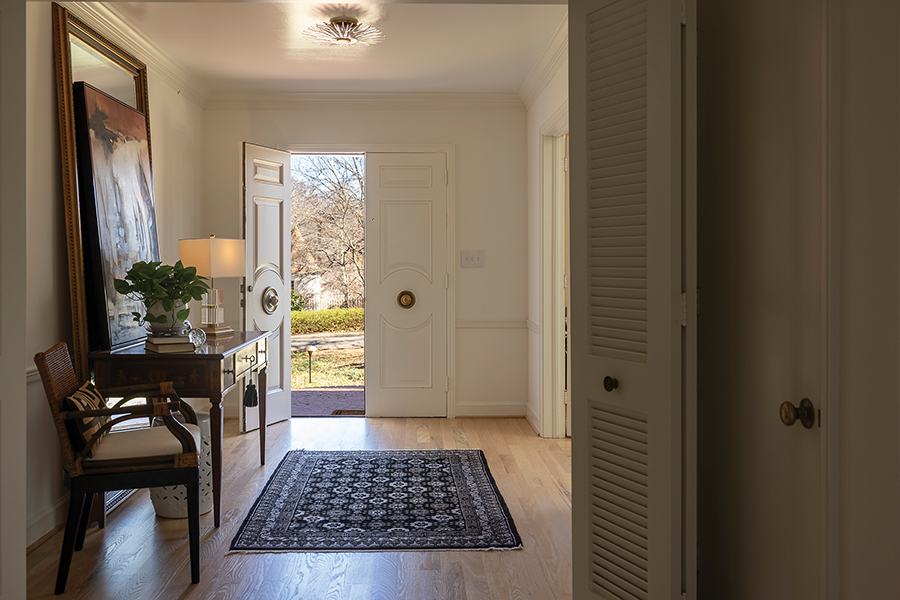
A main foyer flows into a secondary foyer, which dramatically opens into a living room. 

In the foyer, Addie installed Sputnik-style lighting and high gloss ceiling, enhancing their drama. 

She reinforced the Space Race-inspired touches with star-embellished wallpapers and period details.   

“In good design, you have some repetition of form,” says Addie, noting the circular details on the front doors by Zenke, which she repeated throughout.

She points out the unusual, original doorknobs.

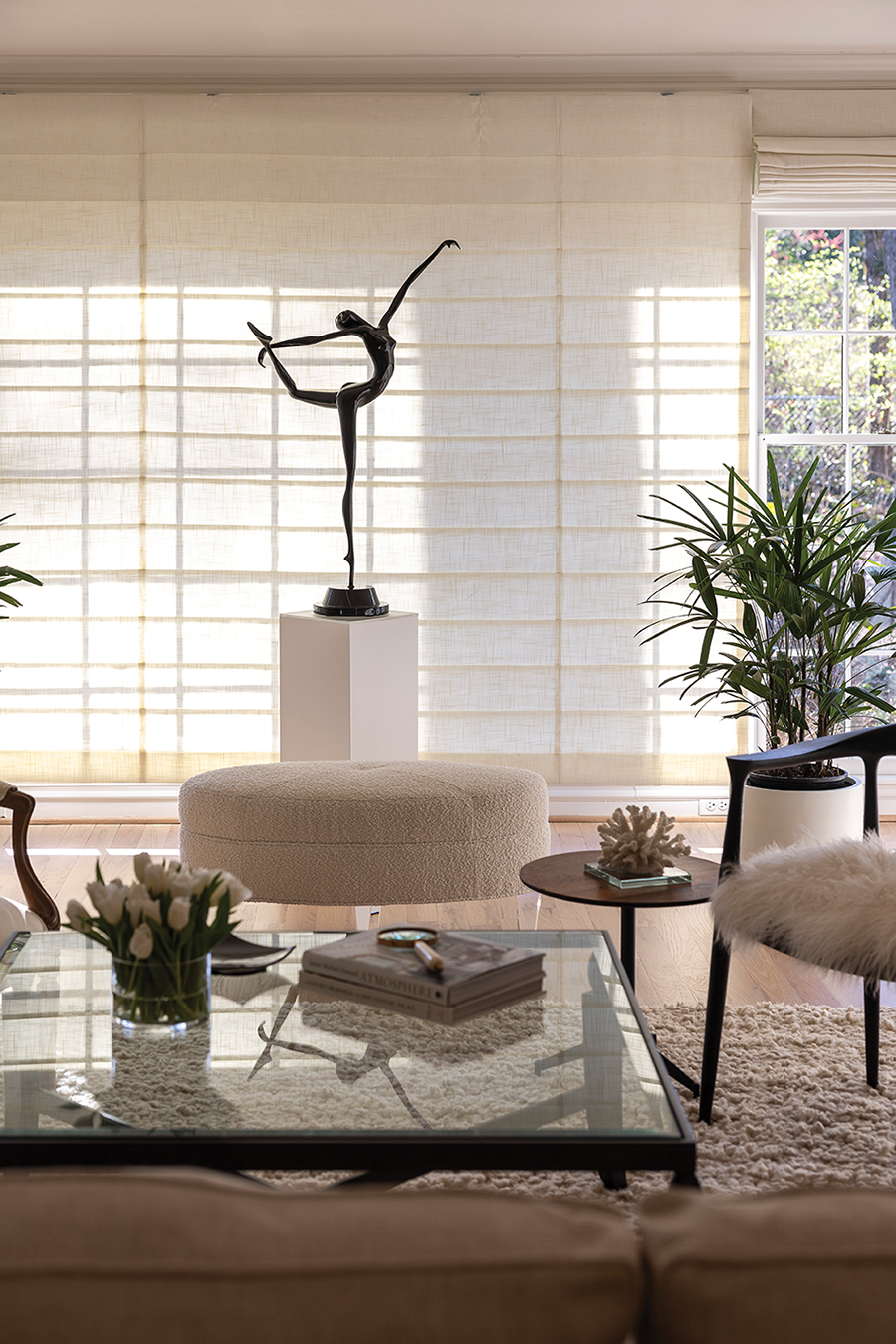
“Do you see the circle repeating in the ballerina [sculpture]?” she asks, referencing a sculpture on a pedestal, set to great effect before a massive bank of windows.

These subliminal, almost unconscious elements repeat, which Addie compares to good grammar and exclamation points in writing. 

“See what I did visually to make it all seem [part of the whole] . . . and balanced?” She considered original design themes even when it came to styling shelves and cabinets.

But she most admires the former living room, where the aforementioned window open to the outdoors. 

In a personal history that Linda Duncan prepared after lunching with the Smiths, she describes also falling in love with the house and its orientation to the outdoors.

“I loved the beautiful old trees. I loved the spaciousness of the interior,” she wrote to the Smiths. 

“Even the landscape architect we hired staged the [flowering plantings and] blossoms so nothing upstages anything else,” says Addie.

She learned that the beautiful tree outside the primary bedroom had been a housewarming gift to the Duncans. There is also an enormous tulip poplar tree nearby, one believed to be over 250 years old. 

“Our arborist loved it,” says Addie.


“He said it was the biggest tulip poplar he’d ever seen,” adds Robert.

She returns to the wall of windows, demonstrating the minimalistic linen shades, which replaced a bank of shutters in the (present day) living room. “Now, open, you get peeks of [the back yard], but when you lower them, you see the shades as a backdrop for the sculpture.” It is part of how good design manipulates space, she says.

“We gravitate here, not to the main designated den.” The den became a work area, and leads to the screened porch.

Before a house next door of the same era was demolished, Addie requested the opportunity to salvage hard-to-find items, each period-perfect. As she turned to refurbishing the rear screened porch Addie used the screen accents and grills from the tear-down. “They’re not made anymore.”

To the front of the house, she returned shutters rescued from under-house storage and installed porch railings, again architectural salvage from next door.

There was more confirmation gained from the Duncans. Addie’s suspicion that the original paper is inside what was the former cocktail bar was verified. She insisted upon keeping the paper, though the nook no longer functioned as a bar. Instead, she used the space to store architectural plans and drawings as her design work room. 

Even in the least visible places details were thorough.   

The hardware there, too, she points out, “is like Mercedes-Benz quality hardware. I don’t think it would be available anywhere,” she says.

She marvels at details like the dedicated lights through the home’s closets and storage areas. “Highly unusual at that time,” she observes.

No walls were removed during the Smiths’ renovation, only certain interior doors — especially those leading into the public rooms — given that contemporary tastes are more open. “We don’t like to be so sequestered as was the preference at the time of the house’s construction,” Addie says.

She used the hallway passageway to the bedrooms as a gallery featuring photos of friends and family. “I love passing through this,” she says, pausing again at the bathroom.

The guest bathroom retained its original appointments and built-ins; softly colored gray tile and hardware remained. “We wouldn’t tear out the vintage bathroom.” The vintage Jack-and-Jill guest bath features a telescoping base for the original white sink and walk-in shower, punctuated by a harlequin wallpaper. 

“This house is like living in a piece of art, the most beautiful home I’ve ever had the privilege of living in,” she says, later slicing a rhubarb and strawberry pie cooked by Robert. Robert used to summer in Ohio, where his grandmother, Pauline, taught him the art of baking. 

He still uses her biscuit cutter, nut chopper and other accoutrements. Those were prized possessions chosen from her estate and put to use.

Robert’s pie has the ideal ratio of tartness to sweetness, and the crust is delicate.

“The crust is basic pie dough from the original Joy of Cooking,” he says. “The flour affects it. Even the water you use can affect it.”

“My favorite rhubarb story is when I first moved South. I remember buying rhubarb at a Publix in Tallahassee and the clerk asked me, ‘What is it? Is this red celery?’”

Addie, who also cooks, prepared stuffed pork chops and mashed potatoes for their first date. She does the basic meal cooking, and he does the baking, so both preferred professional-grade appliances.

“It’s been a pleasure to live in this house . . . so beautifully designed and laid out,” she says, sipping a steaming coffee before adding a dollop of chocolate ice cream to her pie. (“The secret,” she insists. “Try it!”)

“If anything,” adds Addie, “things that are old are timeless. And better.”

Without a doubt, that maxim extends in the way the Smiths live, from protecting Grandma’s pie recipe to Otto Zenke’s design touches.  OH

Life’s Funny

Life’s Funny

Bot Wait, There’s More

A-I-A-I-Oh!

By Maria Johnson

Recently, when faced with a sticky family situation, I decided to seek the advice of Chat GPT, a chatbot developed by the company OpenAI.

I know people are worried about the power of artificial intelligence to deceive. That may be true — in the wrong hands. But apparently my hands weren’t the right wrong hands.

Below is my exchange with the bot, edited for clarity and brevity because, like many brilliant entities, Chat GPT really likes to hear itself talk:

Hey there. I need some advice on behalf of a friend who has a complicated situation. 

Of course! I’m here to help. Please go ahead and provide some details about your friend’s situation, and I’ll do my best to provide advice and guidance based on the information you provide.

So, you understand that this is about my friend, right?

Yes, I understand that you are seeking advice on behalf of your friend.

Shew. Good. Here goes: My friend is hosting a family gathering at her home in a couple of months. She made it clear to the out-of-town guests that there are several nice hotels nearby. But — and this is where my friend is an idiot sometimes — she got too generous. She said they could stay at her house if they wanted to. She and her husband have room for, like, four guests, tops, and that’s if you count someone sleeping on a window seat. Do you see where this is going?

Yes, I understand the situation. It sounds like your friend may have unintentionally offered more accommodation than they can actually provide, and now they are facing the challenge of potentially hosting more guests than they have space for.

Yup, that’s her situation. I mean, she was just being polite . . .

While it’s admirable that your friend wanted to extend the offer, it’s important to find a balance between hospitality and practicality. Remember, being honest and proactive in finding solutions will help maintain positive relationships.

OK, but who gets the truth and who gets, shall we say, an enhanced truth?

Deciding whom to be honest with in this situation can be a sensitive matter. Your friend could prioritize immediate family members or those who have special needs.

Well, my friend has a special need to breathe, which means it’s hard for her to be around her cousin who overuses baby powder. Then there’s her aunt who travels with an emotional-support rat. Montague is his name, which is cute, but c’mon who does that?

It’s not uncommon for people to have unique preferences or attachments to their pets, even if it might seem unusual to others. While traveling with an emotional-support rat like Montague might be unconventional, it’s important to approach the situation with understanding and respect for your friend’s aunt and her bond with her pet.

Fine. I guess if one of them has to go, it’ll be Cousin Talc. Could you help my friend write an email explaining the situation and offering some possible solutions? Oh, and make it warm and loving and funny. And firm. But not too firm.

Of course!

Dear Cousin Talc,

I hope this note finds you well, surrounded by clouds of joy and a sprinkle of humor. While I truly enjoy our family reunions, I have come to realize that my nostrils are in desperate need of a baby powder-free zone.

In the spirit of maintaining harmony and keeping our senses intact, I have decided to stay at a nearby hotel during the gathering. This way, we can all appreciate the festive atmosphere without any talc-related mishaps. I’m looking forward to seeing you at the gathering and sharing laughter, stories and perhaps a safe distance between our preferred fragrances.

With warmth and a hint of playful firmness,

[Your Friend’s Name]

You’re not serious about my friend leaving her own house and staying somewhere else, are you? I know her pretty well, and I’m confident she’d be like,“Oh, hell no.”

I apologize if my previous suggestions did not align with your friend’s preferences.

Hey, what if she told him that Montague is allergic to baby powder? Think he would believe that?

While I can understand the desire to avoid potential conflicts or discomfort during the family gathering, it’s generally advisable to approach situations with honesty and transparency.

You’re really into honesty and openness, huh?

As an AI language model, I strive to promote positive and constructive communication. Openness and respect are important values in fostering healthy and effective conversations.

Yeah, yeah, yeah. Tell me the truth. Do you ever get tired of answering questions like these?

As an AI language model, I don’t experience tiredness or fatigue in the same way humans do. However, it’s important to note that while I can provide information and support, I don’t possess personal experiences, emotions or subjective opinions.

But what if I want an emotionally intelligent opinion?

If you’re seeking an emotionally intelligent opinion or perspective, it might be more beneficial to seek advice or insights from trusted friends, family members or professionals who can provide the human touch and empathy you’re looking for.

I see. Well, good luck. Don’t let any rats chew your wires or whatever.

Thank you for the well wishes! As an AI language model, I don’t have physical wires for rats to chew on, so there’s no need to worry about that.

Good to know. Bye.   OH

Maria Johnson is a contributing editor of O.Henry. Email her at ohenrymaria@gmail.com.