Brake for Estate Sales

BRAKE FOR ESTATE SALES

Brake for Estate Sales

More than a junking junket

By Cynthia Adams    Photographs by Amy Freeman

Garage sales are familiar ground — few rules and no commitment. Slow the car, rubberneck, and cruise on past if you notice more trash than treasures. Estate sales, however, are a different matter altogether.

Catnip, too, for admirers of antiques, collectibles and all things vintage. “There is a whole community,” says Sarah Ferrell, owner of Working Decor. “A community of shoppers! A big friend group.”

But what about those of us on the outside looking in, those who love the quirky and fascinating pre-used and well-loved items? Perhaps you’ve seen signs for an estate sale at an intriguing home and wanted to join the line of antique hunters, but felt out of your league.

Ferrell says not to worry. You don’t need deep pockets, nor even a driving reason, to steer your car straight towards a sale. Allow Ferrell’s considerable experience to guide you.

Don’t be intimidated. “People who hold estate sales are thrilled to see people coming through the door,” she reminds us. A good estate sale can refine your eye. Or at least, entertain.

Southerners lean towards the look of collected homes, writes Patricia Shannon in Southern Living. Plus, sales give us license to be snoopy. “Southerners, as a whole, are big fans of any kind of sale that sees us sifting through someone else’s personal belongings.” 

Ferrell grew up “with people who went flea marketing or antiquing. It is in our culture to go junking.” She muses, “I really think it’s a very Southern thing.”

Prepare. Often, virtual previews of the estate’s offerings let you prescreen items of interest. Know before you go by checking estatesales.net, says Ferrell. Entering a zip code reveals upcoming sales with much of the inventory. “You can see pictures. And get a clear idea of what you want to do for the day.”

She speaks from experience that finds can surface in unlikely places. Antiquing in Ferrell’s family remains a professional calling.

For years, Ferrell’s father, Gene Crowder, and his late brother, Bill, helmed Crowder Designs, a Triad design business. Clients relied upon their instincts.

“They definitely had a huge stash of antiques to sell to clients,” recalls Ferrell. Gene has sustained a following for his antique chandelier and lighting restoration business, which continued after his brother died in 2021. Later, she spent eight years at a traditional estate sale company, where she learned to organize, evaluate and sell. Called in to assist after the death of a prominent community figure six years ago, Ferrell undertook her first solo liquidation, and Working Decor was born.

Very often, she now goes directly to collectors in her database, rather than holding a public sale.

Be mindful of the rules, as they can vary by estate sale. The stated rules are typically on the company’s website or at the entry point. Register upon arrival, as numbers are often issued before admittance, and hold your place in line. People who shop for businesses, or “pickers,” are commonplace, but so are casual collectors.

There’s a reason for the adage, “one man’s trash is another man’s treasure.” Oddities at sales may shock, excite, or entertain. But Ferrell empathizes with families selling loved ones’ possessions. “Things should be dispersed in a mindful way.”

Do not rush the door or line. There is a protocol, says Martha Stewart Living’s “9 Tips for Estate Sales,” which published last summer. Writer Wendy Rose Gould stresses that estate sales occur in the previous owner’s home. Be respectful, she says.

Don’t hesitate to look in other towns and cities. Larry Richardson, a close friend of the Ferrells, often rises predawn in search of treasures, most recently schlepping all the way to Charlotte’s affluent Myers Park. He seconds Gould: “It’s so helpful if everyone honors the process.”

He has scored vintage Louis Vuitton luggage and even a garaged Mercedes in like-new condition.

Educate and focus your eye. “I think original artwork is timeless,” Ferrell says. But focus on a niche. She often buys colorful art books.

Ferrell is still amazed by the wide variety of things people amass. (She mentions her own affection for vintage medical objects, including a physician’s cabinet and a skull used in teaching dentistry.) She repurposed the workbench to use as a table.

“I have such eclectic tastes,” Ferrell admits. But she knows exactly what she likes. When she sees rare, chunky pieces of glass art, her heart beats faster. Ditto for all things green, she says, with favorite pieces of their personal collection in the kitchen.

Think about complementing what you have with affordable finds. “An effortless way to decorate is to look for coffee table books. They are extremely expensive new, but at estate sales, they are cheap. You can look for them by color or style,” she says.

Ferrell also has a soft spot for what she calls “orphaned” chairs from a former set, usually bargain-priced. “Don’t sleep on an orphaned chair!” Mismatched is more visually interesting

Pricing. As for pricing, even estate sale prices may be negotiable. “Sometimes you can negotiate,” says Ferrell. It may be a no, but if you never ask, it is a no. Sometimes, too, “the first day is full price and later days are discounted.” Cash does not always rule, but it may help secure a deal.

Be realistic about whether you have room for the acquisition. “If I bring something in . . . something goes out.” Unless it is something rare, which, in her collector’s parlance, is a “unicorn.”

For Ferrell, it was a green glass chandelier (which she recognized from when it appeared in this magazine in July 2024). Sold to the homeowner by her father, it recently resurfaced at Carriage House, a local antique store. Ferrell found the coveted (albeit broken) light once again, restoring it with her father’s help.

With persistence, “You can find that one unicorn piece you’ve been looking for.”

Appearances can deceive. “Don’t underestimate a sale by the way a house looks on the outside,” Ferrell advises. “I found some wonderful, rare things in an unexpected house. Sometimes you find a treasure.” Do not overlook the garage and outbuildings.

“One of my most prized finds is an old wooden workbench complete with splashes of paint and hammer marks.” 

Don’t be reluctant just to browse around. However, don’t shun the occasional “reality check,” offers Ferrell. It is valuable to see prevailing prices. Professional estate sales can help shoppers “become more realistic about what their [own] items are worth.”

Estate sales are opportunities to upcycle items that might otherwise wind up in the landfill. “People don’t think about the sustainability aspect with an estate sale,” Ferrell adds, noting the ever-cyclical nature of tastes. “You can get the 1950s version versus the reproduction.”

Find your tribe. Ferrell enjoys that estate sales unify many for a shared experience and “bring together the most widely eclectic people . . . all in different fields.” Here, she has made friends and connections. 

She points out yet another reason to be an estate sale goer, even if you leave empty-handed. At estate sales, you glimpse the inner worlds of fellow collectors. “It’s a wonderful way to see some wonderful homes,” says Ferrell.

Go forth confidently in the direction of the estate sale sign’s arrows. You may just find your unicorn.

The Trend Cycle — and Upcycle

Among those who never fail to hit the brakes for an estate sale? Then you are possibly a reseller or someone passionate about upcycling, says the former owner of a vintage store. 

Long-time estate sale fans like Kevin and Kim Gunther report that reselling helps tame their collecting addiction. It also allows them to indulge in one of their favorite pastimes, that age-old thrill of the hunt.

Part-time resellers with full-time jobs, the Gunthers completely understand the impulse to scrutinize every sale and hit the road. For some years, they have spent their free time seeking inventory for three antique booths (at Blue Horseshoe in Ramseur, Blue Octopus in Eden and Main St. Market & Gallery in Randleman). Estate sales are their prime hunting ground.

They happily report that their first date was at an auction.

“Cheap date,” they say in unison. “Free popcorn and cheap Cokes!” Later, as a married couple, the tradition continues. They remain passionate about each other and their favorite shared hobby. Kevin admits they recently “hit an estate sale on our way out of town to go celebrate our anniversary.”

They’ve figured out a way to monetize their, well, mutual addiction, while spending scarce free time together. 

He is fixated on sourcing vintage records.

“I only buy what I like, hoping other people will like it, too. I have tunnel vision,” he says.

Kim looks elsewhere. “I love furniture. Primitive. A certain look. If it is 100 or 50 years old, that does not matter to me. I buy the look.” She searches for shelves and hutches, which are practical. “People who collect need places to show off their treasures.”

Of course, not everything on offer excites. It may not hit the mark or look current. Trends are meant to be broken — and will be. So don’t discount a special find if it bucks current trends, Sarah Ferrell suggests. Once disparaged as “brown furniture,” unpainted pieces in original condition are back in style.

“Oh, it’s coming back,” Ferrell declares. “Which thrills me to death . . . I am tired of people painting things, especially pretty pieces that should not be.”

Having logged many estate sales miles in their pursuits, the Gunthers have lugged home many acquisitions, sometimes those that counter trends. 

The Gunthers agree with Ferrell. Given time, the trend will turn in your favor, they predict, and that is the beauty of upcycling at work.


Pleasures of Life

PLEASURES OF LIFE

Changing the World

One poem at a time

By Josephus III

There I was, nervous, excited, dressed in a Carolina-blue, sheer top, looking like the African Tooth Fairy. My first hours in Nairobi and I’m already on stage, closing a dance performance at the 10th Annual Kenya International Theatre Festival with a choreographer from London. How did I get there? Community is the short answer. And poetry, because, for me, Poetry is Life and it continues to open doors into rooms that were too big for me to even fathom.

You see, 20 years ago I worked on a project with the Community Theatre of Greensboro, which, at the time, was being run by Mitchel Sommers. Together, we fused hip hop and poetry into Schoolhouse Rock, remixed some classics and toured Guilford County Schools with a little “Conjunction, Junction, what’s your function.”

Fast forward several years and Mitchel is retired, vacationing in Nairobi, where he happens to connect with people who run this festival. So, when they mention they are looking for a U.S. poet, guess who he recommends? You guessed it, me! Josephus III, Greensboro’s first poet laureate and the author of Poetry is Life, my book about how poetry is all around us, permeating everyday life, from hip hop and R&B to the rhythmic pattern of what comes out of our mouths.

I jump at the chance to share my art on a global stage.

The plan is for Poetry is Life to be performed as a one-man show. Plus, I’ll teach a master class on “The Beautiful Struggle” and perform at closing ceremonies.

As I move from day one to day two, still in transit, the idea of Nairobi keeps me on my toes; anticipation keeps my mind and body tingling like I have Spidey senses. Finally, I touch down, grab my bag and as my prearranged transportation makes its way to the hotel, the streets are alive with people — hugging, smiling, living. There is a cow in the median. I take it all in, my senses vibrant. I am in awe — poetry continues to provide and prove to me its power.

By the time I arrive, the festival has been drumming for a week, like heartbeats and Sasquatch feet, and I am the new kid on the block. I breakfast with thespians and creatives from Botswana, Zimbabwe, France, Switzerland and all over the planet — a community a world away. Plate full of sausages, potatoes and an omelet, plus a glass of mango juice in my hand, I “Greensboro Grub,” code for how I meet, greet and eat my way through this Olympic village for art and culture.

The first person I meet, Michael from London, invites me to have a seat at his table. Conversation, like poetry, flows and I learn that the dance show he’s been choreographing, Trickster, is happening that very evening. His eyes light up when he hears I am a poet. “There is a poem in the end of our piece,” he says. “We were going to project it on the screen to close the show, but we would love if you could read it.” I’ve only known him for 10 minutes and now he wants me to help close a show that he’s been prepping for a week? When in Rome — or shall I say Nairobi . . .

So here I stand in my blue, see-through top, looking like an African Tooth Fairy adorned with tribal face paint and purpose and passion and, above all else, poetry, surrounded by community filled with a feeling of fellowship with others, cultivating creativity and culture for a common cause on a stage in Nairobi, Kenya, changing the world one poem at a time.

And as the dance comes to an end and the stage lights fade, these are the words I speak:

So here’s the moral for the rich and the poor

For the ones who search and for those hearts that have already found the truth

The trickster never sleeps, he watches every move

He’s wicked and he’s strong

He’s magical and fast

But spirits from the ancestors may gather from the past to free your soul

And gently guide you back into your own

Have faith and courage friend,

You are not alone.

Birdwatch

BIRDWATCH

Harbingers of Spring

Return of the swooping swallows

By Susan Campbell

As the days lengthen and the air begins to warm, many of us look forward to the return of migrant songbirds. Dozens of species that breed here spend their winters far to the south, and dozens more spend time feeding here as they migrate to summer haunts in New England and points farther north. Of these, the first to return in central North Carolina are the swallows. In early April, it’s possible to see six different species: barn, rough-winged, tree, bank and cliff, as well as the more familiar purple martin. And since swallows move in mixed flocks at this time of year, encountering three or four kinds in close proximity is not unusual.

Swallows are almost exclusively insectivorous and are built to catch their prey on the wing. They have strong pointed wings and forked tails, which allow for excellent aerial maneuverability. Except for adult male martins, they are all dark on top and light colored below. But each species has a characteristic flight pattern that can be used to identify it even if field marks cannot be discerned. Modern field guides include descriptions of the patterns — where a species flies and how it flies (the combination of flapping and soaring) are unique. This is very helpful, since swallows spend most of their time on the wing and tend to be quite high in the air, so plumage is difficult, if not impossible, to see.

Without a doubt, the best place to find swallows is around water, where insects are most abundant during the warmer months. If one is lucky and there is a snag or wire adjacent to a wet area, the birds may be perched at close range, which should make for ideal viewing conditions. Except for purple martins, sexes are identical. To the human eye, male and female size, coloration and behavior are the same. However, you may be able to pick out the drabber plumage of a juvenile in late summer if you have a pair of binoculars — and a good bit of patience.

Purple martins are the largest of the group and have the darkest feathering. Adult males are a distinctive bluish-black. Females and second-year males have some blue feathering on the back and head but are mainly a dingy gray. Juveniles will be a paler gray with little or no blue feathers in late summer.

Barn swallows have a dark-bluish back, orange face and yellowish underparts. They also have a deeply forked tail. Given this superior rudder, they are capable of low and erratic flight, scooping up insects close to water level or over large grassy expanses such as horse pastures or golf course fairways.

By comparison, rough-winged swallows are stocky and brown above, whitish below with a drab, buffy throat. They spend a lot of time soaring high in the air and, therefore, have a more squared-off tail.

Bank, tree and cliff swallows are less likely to be encountered in central North Carolina. All three have less distinct plumage and short, forked tails. Bank swallows, which may be found in the western part of the state, have light brown backs, thinner wings and quick wing beats. Tree swallows have dark-green backs, broad, long wings and more direct flight behavior with less wheeling involved. Increasingly, they can be found using tree cavities or nest boxes near large bodies of water in the northern Piedmont. And they are quite common in the coastal plain. Cliff swallows, which resemble barn swallows with a short tail and a pale rump patch, fly more deliberately, with slightly slower, more powerful strokes. They favor the protection of overhangs associated with man-made structures such as bridges and overpasses to affix their unique mud nests. Interestingly, for reasons we are not sure of, cliffs are being found in more locations across the state each season.

Although these little birds are well-engineered for flight, they are not known for their song. In fact, their vocalizations consist of short raspy or mechanical calls. Nevertheless, swallows can be quite noisy, whether they are migrating as a flock or in pairs defending a breeding territory. Try to remember to listen and look up this spring; you might just spot some fancy fliers.

Wandering Billy

WANDERING BILLY

A Multi-Storied House

If these walls could talk . . . occasionally, they do

By Billy Ingram

“How cruelly sweet are the echoes that start, when memory plays an old tune on the heart!” – Eliza Cook

Rarely do time, temperature and opportunity coalesce to create conditions rife for recapturing carefree memories of sunshiny, youthful afternoons. In this instance, it’s an unplanned springtime saunter through Fisher Park — a frequent footpath in my teenage meanderings when hoofing it from Latham Park to First Presbyterian or onward Downtown, sketchbook and graphite at hand for rendering fascinations like that bulbous Weeping Willow billowing at the entrance (long since withered away), those cobblestone arches crossing creeks, masonry stairways and hardwood hickory trees.

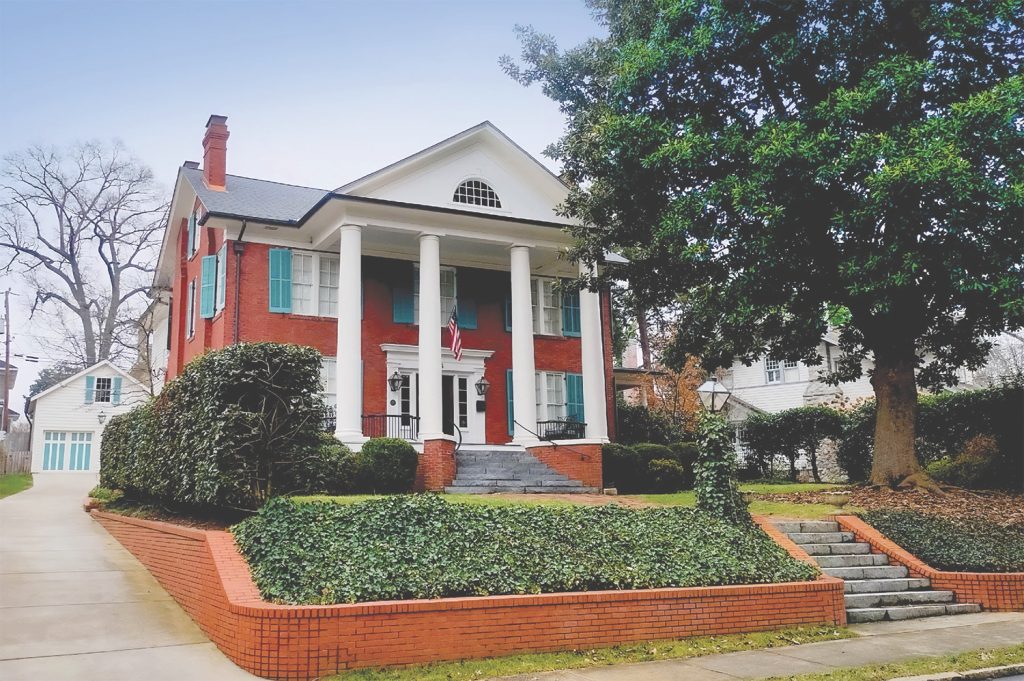
Only once did I attempt drawing any of the surrounding houses, and that was 106 Fisher Park Circle, a majestic, two-story Neoclassical Revival with inviting slate steps that lead to a grand portico canopied by a tympanum accented with a whimsical lunette window that, even then, I suspected had witnessed its share of illustrious people and familial felicity. This graceful home is a centerpiece of Greensboro’s very first residential development, one that broke ground in the 1890s then grew exponentially throughout the Roaring ’20s.

If every picture is worth a thousand words, then, surely, every vintage home has potential to inspire an entire novel. In theory, one could select randomly any period property and undoubtedly uncover countless intriguing untold — or untoward — tales, walls eagerly awaiting listening ears. That recent midday wandering into wistfulness led to wondering: Why not honor 106 Fisher Park Circle for this “novel” experiment?

Knowing little more than that 106 had been dubbed “R. D. Douglas House,” I began researching in my own library of local lore. Tucked into unread recesses was a nondescript paperback inscribed to my mother on her birthday in 2005 entitled The Best 90 Years of My Life, written and self-published two years earlier by Robert Dick Douglas Jr. Born in 1912, the author’s chronicle commences with recollections of growing up with his three siblings at . . . 106 Fisher Park Circle. In his opening paragraph, Douglas Jr. describes the stately five-bedroom manor his parents had built back in 1906: “The house was high above the street and had four large cement two-story columns in the front. On the north side of the house was a concrete driveway leading from the street up the hill to a red wooden barn at the back of the lot.”

That barn originally housed a horse that pulled the family’s four-wheeled carriage. Before long, the Douglases were motoring in touring cars (with Eisenglass curtains, no less) east down North Park Drive to arrive at 480 Church St., where the children’s great-grandmother lived in the estate known as Dunleith. The striking three-story mansion had been built around 1858 by her husband, N.C. Supreme Court Justice Robert P. Dick. One of the nation’s earliest examples of Italianate architecture, it was briefly requisitioned for Union Headquarters as the Civil War drew to a close. Descending into disrepair, that elegant dwelling was demolished in the late 1960s. More recently, the former Aycock neighborhood was renamed Dunleath (close enough, right?) in its honor.

In the 1910s, public transportation was incredibly convenient for citizens of the newly-named Gate City. “We had electric trolleys running on rails in the street and getting electric power from overhead trolley wires,” Douglas Jr. writes. “Streetcars ran from downtown out North Elm Street to about where Wendover crosses now. Later, they went all the way out to Sunset Drive where you could walk to the Greensboro Country Club.”

Douglas Jr.’s youth revolved around the single Catholic Church in town, St. Benedict, within easy walking distance. “Father Vincent was a great golfer and a member of the Greensboro Country Club,” he writes. “I think a lot of anti-Catholic prejudice was dispelled by his charm and golfing ability.” The Parish’s Sunday School was taught by the Sisters of Charity, who established St. Leo’s, Greensboro’s first hospital in 1906.

As an Eagle Scout, Douglas Jr. spent a summer hunting big game alongside Serengeti natives, about which he wrote a book, Three Boy Scouts in Africa: On Safari with Martin Johnson, published by Putman. He followed that up with a second memoir published one year later in 1929 about bear hunting on Kodiak Island, A Boy Scout in the Grizzly Country. He later returned to Alaska, exploring steaming volcanos, graduated Georgetown Law School and, by 1941, was rounding up Axis collaborators as an FBI agent. In 1945, he resettled with his wife and toddler son in Greensboro to specialize in labor law. Multiple cases he argued were heard before the Supreme Court. Douglas Jr. passed away in 2015 at age 103, remarkable in itself. The Best 90 Years of My Life was republished in 2007 by Vantage Press but remains elusive to locate.

In 1936, 106 Fisher Park Circle welcomed Dr. Luther L. Gobbel, the same year he was appointed president of Greensboro College, where, two years later, he presided over the school’s centennial commencement. My mother was an undergrad there during his tenure, her 1945 sophomore yearbook fronted by an appropriately placid portrait of Gobbel as an archetypical, armchair-seated academic doyen projecting an air of professorial steadfastness.

Gobbel relocated around 1941, when this Fisher Park landmark was purchased by Dr. Samuel F. Ravenel, founder of one of North Carolina’s first pediatric practices in 1925, positioned on the third floor of the Jefferson Standard Building.

In 1948, Ravenel rallied city leaders to raise $100,000 (roughly $1,350,000 today) in just 12 days. The funds were needed to convert a former rec hall on the recently-vacated Army Air Corps base, located off Bessemer, into an emergency, M.A.S.H.-like triage infirmary where he and new associate, Dr. Jean McAlister (pioneer female physician), risked their lives combating — and promptly conquering — a polio outbreak crippling Guilford County’s children by the hundreds.

“Dr. Jean” was our beloved family pediatrician in the ’60s. When she was away, it was Dr. Ravenel’s stethoscope pressed to our chests in their modest, rectangular office suite on East Northwood Street (improbably still standing among Cone’s expansions). What those well-healed patients’ parents likely didn’t know was that Dr. Ravenel spent spare hours at Children’s Home Society charitably attending to some 9,000 infants that would otherwise have gone untreated. Revered across every community, his 51-year devotion to the health and wellbeing of Greensboro’s most vulnerable ended tragically with a 1976 car accident.

A mere three chapters in, if we do indeed have elements necessary for an intriguing historical novel, it’s going to need a satisfying wrap-up. Turns out my old pal, Bill Baites, along with Stephen Dull, restored this gem to shine anew while residing there in the 2000s, undertaking a million-dollar renovation recognized with a Preservation Greensboro Award for excellence in 2006. I had no idea! 

Then again, many casual readers crave conclusions couched in cloying profundity. The epitaph engraved on Dr. Jean McAlister’s monument at Green Hill Cemetery could decisively serve as a suitable swan song for those selfless souls once resting their heads at 106 Fisher Park Circle:

Good and faithful servant of God

Well done

Rest from thy loved employ

The Battle fought, the victory won

Enter thy Master’s joy.

Beat By Beat

BEAT BY BEAT

Beat By Beat

Greensboro’s newest poet laureate aims to build bridges

By Cassie Bustamante    Portraits by Liz Nemeth

I didn’t really start off wanting to be a poet,” says Greensboro’s newest poet laureate, James Daniels. “I always wanted to be a rapper.”

But, says Daniels, “I had a Dead Poets Society moment.” That was while he was attending Johnston County Early College Academy. Just like the students in the film who were inspired by their professor (played by Robin Williams), Daniels remembers how a couple of his own teachers, Amanda Rowland and Dawn Blankenship, kindled the spark that ignited his love of poetry. They introduced him to Poetry Out Loud, a high school poetry recitation competition. And though his gut reaction was a big heck no, “I took the leap.” And, turns out, the spoken word spoke to him.

As he listened to poets and poetry, he recalls, “I started to absorb the power of the word — just understanding that there are so many different mediums it could go in. So I just started trying all of them and poetry was the one that stuck.”

Later, at N.C. State, where he was earning a B.S. in education, he discovered open mics, where anyone, from beginners to pros, can step up on a stage and share whatever is in their hearts and minds. Greensboro’s inaugural poet laureate, Josephus III, visited the campus, leading a Poetry Cafe session (an interactive open-mic event). “I went up and, of course, embarrassed myself on that mic, too. You know, you got to step out.”

Daniels got even more involved with Poetry Cafe while working on his M.F.A. at UNCG. At first, he says, he was “a table boy, bringing people in.” But soon Josephus was asking Daniels to teach at events for kids when he wasn’t available to do it himself.

When it came time for his two-year term as poet laureate to come to an end, Josephus III reached out to Daniels, who notes, “a bunch of dope poets in the city also got that call.”

At the time, Daniels was deep in the application process of another position — assistant professor and director of creative writing at N.C. A&T — which he soon landed. Thinking it might be too much to take it all on, he made calls to other poets, suggesting they go for it. But one question kept bouncing back to him: “You’re applying, too, right?”

His response? Of course, he told them, even though that wasn’t his intention. “But I was like, I can’t lie to 20 people,” he says. “Now you said it, so now you’re doing it.” He sat down and got to work on his own application after all.

He ran it by his most trusted critic, his wife of three years, Ajani Anderson, who “tore it up.” Through some tough love from Anderson, a visual artist who Daniels says “makes me better everywhere,” the application was ready to submit.

Loving metaphors as all poets do, Daniels is constantly talking about building bridges “between creatives, institutions and other artistic mediums — through the power of poetry.” A bridge, of course, is the sum of many trusses and supports. Daniels envisions a city where organizations and creative people across multiple genres reach out to each other collaboratively. One man cannot bear the load on his own, but he hopes to continue building on the foundation Josephus has laid.

“I’m grateful for this position. I’m grateful for all of the positions that I’ve received thus far,” he says. But don’t for a second think that he’s given up on his initial dream of becoming a rapper: “That’s still a goal,” he says.  OH

The following poems are by James Daniels. 

Simple Life

SIMPLE LIFE

Garden Reborn

And just maybe, ready for prime time

By Jim Dodson

On a warm and dry afternoon last October, as I mulched and watered my front yard’s 35 parched azaleas in the middle of the most punishing drought in memory, a shiny, white Volvo eased into my driveway.

A pair of well-dressed women emerged.

They introduced themselves as Candy Gessner and Lorraine Neill, committee members from the Greensboro Council of Garden Clubs. They had something to discuss.

For an instant, I wondered what crime against nature I might have unwittingly committed. Unnecessary strain on municipal water supplies? Had neighbors complained about my loud (and entirely inappropriate) oaths issued at a rainless sky?

Instead, Candy smiled and reached for my grubby hand.

“We understand you have a lovely garden,” she said. “We’ve come hoping to view it and ask if you would be interested in having your garden featured on the 2026 garden tour in June.”

Between us, they could have knocked me over with a packet of Burpee seeds. In my time on this Earth, I’ve built three ambitious landscape gardens and never given a passing thought that somebody might wish to see them. Especially a lot of serious gardening somebodies.

My first garden was built on a heavily forested hilltop in Maine, a classic New England woodland garden created on the remains of a vanished  19th-century farm that my cheeky Scottish mother-in-law nicknamed “Slightly Off in the Woods.” It was the perfect name because the only people who ever saw it were the FedEx guy and tourists who’d taken a wrong turn onto our dirt road.

“Nice layout,” the FedEx guy once remarked with a smirk. “But why build a garden like this that nobody will ever see?”

“Because I see it,” I said. “It keeps me sane in a crazy world.”

He thought I was joking. But any serious gardener will tell you that time spent in their garden is a cure for whatever ails the spirit. Most of us, in fact, never imagine that others will desire to see our gardens. We create them for us. The closest we can get to playing God, as a famous English gardener named Mirabel Osler once said to me.

My second garden belonged to a cute little cottage in Pinehurst that my wife, Wendy, and I rented in hopes of eventually buying. The previous owner had been an elderly gardener who let his 2-acre garden run amok. I spent a year cutting back overgrown azalea bushes and battling wicked wisteria vines and even recovered a “lost” serpentine brick fence that had been swallowed whole by English ivy. I also built a beautiful wooden fence around the fully restored garden — just in time for disaster to hit.

The week we planned to officially buy the place, the kitchen floor collapsed, and we discovered that black mold was running like a medieval plague through the walls and floors. We moved out that same afternoon. At least the garden looked fantastic. 

Finally, there is the garden where the women from the garden council and I stood on that afternoon. It is, without question, my final garden and, therefore, a serious labor of love.

A decade ago, we moved back to my hometown, taking possession of a charming mid-century bungalow that the Corry family built in 1951. I grew up two doors away from this lovely old house and always admired it. Al and Merle Corry were my parents’ best friends. Their grown children were thrilled when they learned that a pair of Dodsons would be their childhood home’s second owners.

And so, we set off to fully restore the property.

As Wendy got to work on the interior, I confronted “Miss Merle’s” long-neglected garden. It took a year of weekends just to clear dying trees and dead shrubs from the front yard before I could turn my attention to the backyard so wildly overgrown, I nicknamed it “The Lost Kingdom.”

Over the next decade, neighbors and friends got used to the sight of me getting gloriously dirty every weekend, rain or shine — digging holes, building beds, hauling in new soil and manure, eventually planting a dozen flowering trees in the front yard alone, with banks of hydrangeas and 30-plus azalea bushes, inspired by a former neighbor who did the same during my childhood years.

In due course, our “east” garden became a flowering space with a tiered stone pathway and lush beds that are home to autumn sage, Mexican sunflowers, purple salvia, society garlic, Mexican petunias, Gerbera daisies and red-hot pokers. Knock Out and old-garden rose varieties preside over a trio of butterfly bushes that monarchs swarm upon on late-summer days.

In the former Lost Kingdom out back, I built an Asian-themed shade garden that’s home to nine Japanese maples, scores of autumn ferns and monster-sized hosta plants (I imported from my Maine garden). The final touch was a stone pathway that winds through this tranquil, hidden space, though only I and our three dogs have ever followed it.

Which brings me back to the lovely women from the council.

I thanked them for considering my garden for their June tour but pointed out that drought had taken an alarming toll. Moreover, mine was still a young garden, a mere decade old. It needed time to heal and find its way.

“Another year perhaps?” I suggested.

They wouldn’t hear of it. “Everyone’s garden has been beaten up,” Candy reminded me. “But come spring, they always bounce back like a miracle. Yours will, too.”

So now, friends, April is here and I’m a man in constant motion, fussing, fixing, weeding, mulching, trimming, planting new things and getting gloriously dirty. A garden, of course, is never finished. There is always something to do, to change, to add or subtract, or simply fix. Nature abides no slackers.

Nothing could make me happier than to welcome folks to my reborn garden come June 6-7.

Don’t mind my grubby hands, though. A gardener’s job is never done. 

Tea Leaf Astrologer

TEA LEAF ASTROLOGER

Aries

(March 21 – April 19)

This month, you’re giving theatrical bravado — and we’re lapping it up. Mars in your sign from April 9 through mid-May is the energy shot you didn’t need but surely won’t squander. Just don’t move so fast you miss a stellar career opportunity that aligns with yourlong-term goals. A friendly tip: Passion and impulse aren’t always synonymous. Now, channel your inner Freddie Mercury and watch the world respond.

Tea leaf  “fortunes” for the rest of you:

Taurus (April 20 – May 20)

Taste as you go.

Gemini (May 21 – June 20)

Double the recipe. 

Cancer (June 21 – July 22)

Best not to overextend yourself. 

Leo (July 23 – August 22)

Slow down and proceed with wonder.

Virgo (August 23 – September 22)  

Go waffles-for-dinner wild. 

Libra (September 23 – October 22)

Check the expiration date. 

Scorpio (October 23 – November 21)

Try changing the lens. 

Sagittarius (November 22 – December 21)

Two words: flameless candles. 

Capricorn (December 22 – January 19)

It’s time to turn the compost. 

Aquarius (January 20 – February 18)

Read the room, Darling. 

Pisces (February 19 – March 20)

Schedule the oil change. 

Chaos Theory

CHAOS THEORY

Why DIY today what you can DIY tomorrow?

Ceilings and other unfinished projects

By Cassie Bustamante

When it comes to house projects, my husband, Chris, and I have an unspoken motto: Why do today what you can put off until right before you need to sell your home?

Just before we moved to Greensboro, our project procrastination caught up with us. I kneel atop a 5-foot-tall, mint-green, vintage shelving unit in our kitchen, my neck craned toward the ceiling I’m painting. Tiny, white droplets fleck my dark-brown hair. Nearby, Chris feeds our infant son, Wilder, stuffing lukewarm spoonfuls of mushy, Gerber oatmeal with a touch of homemade applesauce into the little guy’s hungry, gummy, baby-bird maw.

In our house, painting is a tag-team endeavor. Chris is the roller, while I am the cutter-inner. After many years spent creating content for my DIY blog — mostly paint projects — and refinishing furniture for my vintage-furniture storefront, I’ve got a steady hand, one that requires no blue tape. Chris, on the other hand, is more like a bull in a paint-your-own-pottery shop — not so good with the details but great with the brute force required for rolling. So, as soon as I swipe paint on the last of the kitchen ceiling edges, I hop down and swap places with him. He douses a roller in white paint while I take over with Wilder.

“Why do we do this to ourselves?” I say, exasperated. “All of these projects we let pile up over the seven years we’ve lived here and now we’re cramming them into seven weeks!” Light fixtures to replace, countertops to update, a half-dead maple tree along the driveway to chop down and, obviously, ceilings to paint.

“And, you know,” says Chris, “none of these projects are that bad. It’s the getting them all done in rapid succession that’s killer.” He pauses and I can practically read the thought bubble that’s forming over his head. “Let’s not do this in our next house.”

I nod enthusiastically. “Let’s get things done over time so that we can actually enjoy the results of our own blood, sweat and tears,” I say, rubbing 6-month-old Wilder’s button nose with my own. “That’s right, Mommy and Daddy are not going to procrastinate in our new house!”

A couple short months later, we say goodbye to that home and its freshly-painted ceilings, and make our way to Greensboro, where a 1966 Starmount Forest ranch home waits for us. Sure, it needs some updating, but it ticks so many of our boxes as a family of five — four bedrooms, three bathrooms and a great location.

The kitchen, however, is never going to work for us. While I am a huge fan of reusing what you can, the original cabinetry only allows space for a 24-inch oven. A baking sheet full of dino-shaped chicken nuggets? Forget it. And I can stop fantasizing about hosting Thanksgiving with an oven like that. So, just months after moving in, we hire a contractor to renovate our kitchen, updating it with new cabinetry, new flooring and fixtures, a hammered-brass sink from locally-owned Thompson Traders, and, of course, new appliances, including a gorgeous, white-and-gold, 30-inch Café oven.

As the renovation crawls closer to its completion many months later, I tell the contractor, “We’ll take care of all the painting.” We just want our house back — no more workers tromping around, no more plastic sheeting, no more construction dust. “Trust me, we can handle that part.”

“OK, if you’re sure,” he says.

“Oh, I’m sure.”

Once the contractor and his accoutrements have quite literally left the building, we spend a weekend coating the walls in white. I give the new built-in banquette and molding a touch of easy-to-clean sheen with semigloss in the same shade. And it looks fresh and finished — as long as you don’t look up. “We’ll save the ceiling for next weekend,” I say to Chris as I scrub my brush clean. “I’m too tired to think about it right now.”

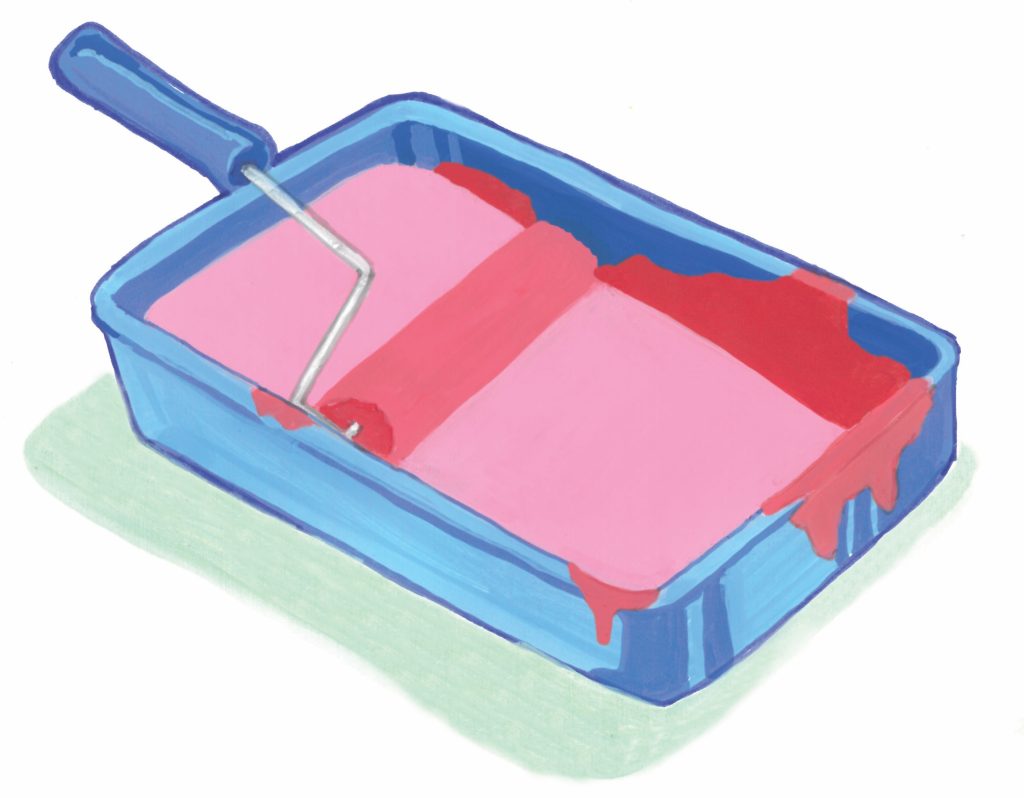
Approximately 150 weekends — or three years — later, our ceiling finally has its moment with paint. While we’ve grown so tired of looking at the dull, drab ceiling in its primed state, apparently we haven’t been tired enough to actually push up our sleeves and do it ourselves. Nope, the first thing we do when I go back to work full-time is hire out the work. All I have to do is select the color: Sherwin Williams’ Romance at 75% saturation, a lovely, warm shade of blush. No argument from Chris, who’s just happy to have it done.

Well, almost done. You see, the painters arrive on a sweltering July day and our AC is working overtime. The two vents in the kitchen ceiling are dripping with condensation, making it impossible for paint to stick to them.

“Don’t worry about it,” I tell the concerned painter as he shows me the issue. “We can easily get to it when the weather cools this fall.”

It’s been almost four years and, as I sit at my kitchen banquette writing, I steal an upwards glance at the vent closest to me, stark white against the soft-pink ceiling. Really, how hard could it be to just slap some paint on it when I’m done writing? Not hard at all, but we’re not ready to list our home anytime soon.

In Good Taste

IN GOOD TASTE

Sweet Spring Layers

A strawberry cheesecake parfait

Story and Photograph by Jasmine Comer

I’m currently in a full-blown parfait phase. While they’re traditionally served as a dessert using ice cream, health-conscious millennials now think of them as yogurt bowls, and they’ve become my breakfast staple. But really, they’re good any time of day. I usually start with a Greek yogurt base and layer in seasonal fruits — it was apples all winter — plus granola, nuts or a drizzle of nut butter. Once you add a sweetener of your choice, something like honey or natural maple syrup, you are all set. The real draw for me is the texture and flavor play: You get that perfect mix of creamy, crunchy, salty and sweet. But the best part? How little effort it actually takes. Of course, you can go full-on indulgence and make it a true, rich and decadent dessert. Though I’m not suggesting you eat that for breakfast.

This recipe is a love letter to effortless kitchen adventures. Even for those of us who find peace in cooking, there are days when standing by the stove feels like a chore — especially as the temperature rises and the last thing you want to be is tethered to a hot oven.

Enter the strawberry cheesecake parfait: Think of it as cheesecake’s laid-back, sophisticated cousin. It’s a deconstructed masterpiece that layers silky cheesecake mousse with the bright, macerated sweetness of seasonal strawberries and the salty-sweet crunch of buttery graham cracker crumbs. This may be your first foray into dessert parfaits, but given the high-reward, low-effort ratio, it certainly won’t be your last.

Strawberry Cheesecake Parfait

Ingredients

Cheesecake Filling

14-ounce can sweetened condensed milk not skim, please

Two 8-ounce blocks cream cheese, room temperature

1 teaspoon vanilla extract or paste

Graham Cracker “Crust”

1 1/2 cups graham cracker crumbs

1/4 cup melted butter

2 tablespoons sugar

Pinch of salt

Cinnamon to taste, optional

Strawberry Topping

1 pound strawberries, sliced

1/4 cup sugar

1 tablespoon lemon juice

Zest of half a lemon

Directions

For the cheesecake filling: In a large bowl, using a hand or stand mixer, blend ingredients until smooth and creamy. Refrigerate for at least 30 minutes, or overnight; the longer the better.

For the graham cracker layer: Right before you are ready to assemble your parfait, using a spoon, mix ingredients until combined in a medium bowl.

For the strawberry topping: Just as you are ready to assemble your parfait, mix the strawberries with the sugar, lemon juice and zest together until combined in a medium bowl. Let sit for 20 minutes so the strawberries can release their natural juices.

Using a glass of your choice, start with a layer of graham cracker crumbs, followed by a layer of the cream cheese mixture and then the strawberries, using approximately 3 tablespoons of for each layer.