Chaos Theory

CHAOS THEORY

Partners in Grime

A bit of a fixer-upper

By Cassie Bustamante

The summer I turned 7, my family moved from small-town Upstate New York to Wilbraham, a small-town in Western Massachusetts. Picture quaint, 200-year-old homes, churches surrounded by old, stone walls and even a very old, red schoolhouse-turned abode. Everywhere you looked, the streets bubbled over with New England charm. But our new house? Not so much. It bubbled over with ick.

My mother and I made the trek across states together, leaving my father behind to cheer on my older brother, Dana, who was playing in a little league tournament. I hadn’t yet seen any photos of the new digs, but I’ve always thrived on change and the opportunity to meet new people. And, this time, we were moving to be closer to family. We’d be in the same town as both sets of grandparents and close to all sorts of cousins, aunts and uncles.

In fact, Wilbraham was the town where my parents met as high school students with backyards abutting one another. Back then, my dad wore his white-blonde hair in a 1970s swoop that cascaded in front of his eyes, suiting his shy personality. My mom, a petite brunette with a Farrah Fawcett ’do, was gregarious and often teacher’s pet. Come to think of it, a lot like me. It wasn’t until they both enrolled at Springfield College in the fall of 1974 that sparks flew.

All along the drive, I chattered away excitedly, driving Mom bonkers. The anticipation came to a jarring halt when we pulled into a driveway. This could not be it. I prayed that this was some kind of joke and, surely, Mom was about to shout, “Gotcha!” In front of me stood a dilapidated, brown 1964 Colonial with red shutters — the worst color combination known to man — and an attached two-car garage. The paint was blistered and peeling, rot everywhere. This was it? I wept.

When my brother arrived a week later, he had the same reaction. In fact, he packed a suitcase and said he was going to ride his bike back to New York and live with friends. I wondered how he’d manage the suitcase while pedaling, but I never witnessed that level of stunt mastery because he stayed.

Beyond the front door, the family room featured the inevitable ’60s faux-bois paneled walls and linoleum flooring that vaguely resembled bricks. The tacky residue left behind by a rug adhesive attracted the fur of our golden retriever, Butterscotch. In fact, every surface seemed sticky and dirty.

But it was as if Mom and Dad could see into a crystal ball, which magically showed them something I couldn’t see — the spark of potential underneath all that grime. They rolled up their sleeves and got to work. In sections, they replaced wooden siding along with rotten windows. They repainted the exterior a soft gray and gave it new barn-red shutters, a color combo that still remains in place today, according to my Google search, almost 40 years later. I recall many days spent outside, flipping over rocks in search of salamanders, while Dad sat atop the house with his cousins, hammering down a new roof.

Grampa, Dad’s dad, was a self-made entrepreneur who owned a wholesale hardware company, and thus understood the world of home renovation. He’d appear from time to time to “help” Dad with weekend warrior projects. But not until he’d sat on the porch munching on a donut and sipping coffee, followed by playing basketball with me and my brother in the driveway. And then, “Oh, would you look at that? I’ve got to go if I am going to make my tee time!” Maybe he took it too easy, but we all look back on those moments with laughter. Cancer took his life way too soon just a couple years later when he was just 59.

On weekends when repairs weren’t being made, Bob Vila’s voice rang through the kitchen while I ate my grilled peanut butter sandwich, This Old House playing on our wooden console television set in the nearby family room. YouTube and TikTok were still decades away from being created, kids. My parents had to learn about DIY through reading books and checking the Sunday paper’s TV schedule to make sure they didn’t miss their favorite DIY shows.

Mom, an avid gardener who knew just what would thrive where, planted flowers aplenty to create a lush and vibrant yard. Lilac bushes lined our white picket fence. Just outside the back door, an herb garden’s fragrance wafted through our kitchen window all summer long. We teasingly called it the “Herb”— with a hard “H” — garden, naming it after the endearing, out-of-shape man in one of Mom’s Jane Fonda exercise videos.

My parents poured everything — blood, sweat, tears and what little money they had — into making that hideous monstrosity a jewel of the neighborhood. As a 6-year-old, I hadn’t understood the possibility, but as a 46-year-old I’ve learned something about compromise and seeking out hidden potential.

Over the 21 years that my husband, Chris, and I have been married, we’ve bought a few well-worn homes. And every one, we’ve made our own with paint and — like my parents — blood, sweat, tears and all the money we could muster. When we arrived in Greensboro in January 2019, the 1960s Starmount Forest ranch home we moved into was far from a looker, but it ticked the boxes for a family of five. Though our new house was not nearly as neglected as my childhood home in New England, my own kids felt a little like I had the day I arrived in Wilbraham with my mom. The magic simply wasn’t there. But, thanks to my parents, I’ve realized that magic is something you create through a combination of creativity, hard work and collaboration that includes the kids. And as the months have turned into years, we’ve turned a house into a home, one that our two older kiddos will look forward to returning to next fall when they’re both away at college. That is, until they have their own fixer upper to make their own.


Wandering Billy

WANDERING BILLY

Playing the Market

For over 30 years, Ron C. Curlee II has stretched his artistic limits

By Billy Ingram

“All great change in America begins at the dinner table.” — Ronald Reagan

In 1994, Ron C. Curlee II was the first intriguingly talented individual I met in our fair city after relocating mere days before from Los Angeles. I’d wandered into Babylon, an infamous rave club located on South Elm in the long-dead heart of downtown Greensboro. Babylon was notorious for shoveling underaged kids through its doors. For all I knew, Ron may have fallen into that category.

As it happens, that den of iniquity was sponsoring an art opening of Ron’s Crimes Against Nature series — enormous canvases featuring, for the era, bold, lurid and graphic imagery of exactly what the work’s title suggests. We instantly hit it off and, since then, it has always been a pleasure in those too rare instances when our divergent paths cross; laughter is always sure to follow, sparked by his gregarious personality, somehow both serious and fun.

I marvel that today Ron remains on the cutting edge, a key component of his career being his three decades participating in the High Point Market as a painter of extraordinarily original abstracts, as well as a designer and merchandiser.

Accomplished in both art and design, his career has had an internal reach. In addition to dozens of local shows and commissions, his artwork has been featured in most of the well-known furniture showrooms, including Highland House, Harden, Francesco Molon, Excelsior, Century, Hickory Hill and Drexel Heritage.

This area has grown significantly since the mid-1990s, when the impact that Market made all across the Triad was seismic. Families back then were renting out their homes to attendees for $1,500 a week, due to lack of available hotel rooms. Venturing out to dinner, even in Greensboro, became a challenge during those two-week periods, the nicer restaurants being predictably overbooked. On those occasions when I would dine out with my parents during April and October Market, generally at some out-of-the-way steakhouse such as Jordan’s on Church Street, we’d amuse ourselves by observing nearby tables where sales reps were expense accounting the night away with obvious ladies of the evening who flocked from near and far to service this influx of out-of-towners.

Ron grew up in Lenoir and attended the University of Georgia’s studies abroad program, where he studied painting in Italy. But it was actually the lure of the Market that brought him to Greensboro in the 1990s. I recently caught up with him in his richly appointed, downtown Greensboro home-studio duplex (thestudioandgallery.square.site) to look back on some of his more colorful experiences at High Point Market.

Following the death of Diana, Princess of Wales, Paul Burrell, her former butler and one-time footman for Queen Elizabeth II, began licensing his name for various upscale goods that included furniture. “I was director of visual merchandising for an upholstery company that paid to use Burrell’s name,” Ron tells me. “So we made up all the stories behind his collection that was [supposedly] based on his travels with Princess Diana.”

This was following the “uppity” butler’s trial for stealing various personal items from the beloved Princess and after Prince Harry publicly accused him of “milking” his mother’s death in Burrell’s scandalous book, A Royal Duty. “I traveled around England with him,” Ron recalls. “People either loved him because they wanted to know about Princess Diana or they despised him because he had risen above his station. So it was very awkward.” At gallery openings and tea parties, Burrell would regale audiences with stories about how Diana’s boys would sit on chairs like the one on display or the way Princess Diana would relax on a sofa resembling that model. “And we wrote all of that for him.”

On one occasion, while imbibing a bit heavily on a rather empty stomach, Ron recalls, “I may have told [Burrell] that he was just the front man who didn’t know anything, that I was doing everything while he was getting all the credit.” The next morning, he says, “They told me Paul didn’t have anything to say and just up and left.” Not long after, Ron got wind that Burrell was talking with a friend in New York who was getting him drunk and secretly recording their conversation about the Queen and Princess Margaret, then selling it to a tabloid for a million dollars. “And I was like, why didn’t I think of that?!?”

Ron has also rubbed elbows with Hollywood royalty and recalls a furniture collection introduced at Market that he thought was immediately fabulous and very successful. “The Humphrey Bogart Collection from Thomasville,” he replies. “I have pieces from that line in my living room. It was like Old Hollywood, a little deco with lots of unique woods, veneers and different applications. A mixture of skins and veneers like shagreen shark skin, tiger-eye maple, zebra wood.” Bogart and Lauren Bacall’s son, Stephen, had input into the designs and made an appearance in 2002 at the presentation party.

Was there a ruinous collection he was saddled with showcasing that was an absolute disaster? “At Fine Furniture Design, they’re no longer in the United States,” Ron says with a laugh. “They were high end and introduced a collection that was entirely covered in mirrors. They had a mirrored poster bed, entertainment cabinet, occasional end tables, cocktail tables and a dining table that sat 12.” Ron was flabbergasted. “I was just like, what the hell is this? It was so ostentatious, so over the top and it didn’t sell.” Upon reflection, the manufacturer blamed Ron for the line’s failure. “I was told that I didn’t paint the rooms the right color, I didn’t do the right presentation. I was thinking, my accessories should have been razor blades and straws!”

Collections are generally only offered for a year or so and then quietly disappear. “They can last longer but Market is fashion driven,” Ron points out. “Everybody wants something new. So you may add a few pieces and continue a collection for a couple seasons, maybe a year and a half or two years. But you want to be fashion forward.” To that end, designers tend to lean into Pantone’s Color of the Year — in 2025, it’s Mocha Mouse. “So buyers are looking at mocha fabrics; yarns will be dyed that, too. Last year it was Peach Fuzz.”

Both during and outside of Market, folks generally approach Ron when they’re looking for artwork to complete a room. “I’m known for large abstracts, so I can build up to 10 feet by 10 feet,” he says. “At Market, they’re not going to offer something custom. It’s going to be what’s on the wall and buyers will order 10 of them or whatever. But all of my creations are going to be original and custom.”

For the next few weeks, it’s once more into the breach for Ron C. Curlee II: “So I’ll merchandise several showrooms and then, when they’re completed, I head to the Suites at Market Square and put my own showroom together to sell my artwork.” He’s been showing at Market Square for about four years now. “Sometimes I have other artists or product designers in my space but I’m not going to sell a container full of merchandise. A lot of my clients are designers, so they’ll come to market, see what I have and what I’ve done and then commission artwork in specific sizes, specific colors. Seeing me at Market is a reminder that I’m still here.”

Almanac April 2025

ALMANAC

Almanac April 2025

By Ashley Walshe

April is a drift of dandelions, cheerful and bright.

Can you hear them giggling? Listen. It helps if you slip off your shoes.

Somehow, bare feet in the cool grass, you can access new frequencies: the whir of tiny wings, the swelling of tender buds, the rhythmic flow of nectar.

Wiggle your toes. Breathe into your belly. Surrender to the urge to lie down.

Yes, that’s better. Draped across the softening earth, the sun on your skin is medicinal. You close your eyes, brush fingertips across feathery blossoms, let your inner child run wild.

Perceive the world through the eyes of a dandelion. Anticipate the tickle of bee feet, the tender kiss of mourning cloak, the ecstasy of thunder and rain.

Are you giggling yet?

Listen.

The song of spring rises in all directions.

In the distance, a chorus of peepers rouses the burgeoning woods. Wet and trembling, a swallowtail clings to its chrysalis, pumping crumpled wings at the speed of grace. A bluebird whistles tu-a-wee

Open your eyes. Turn your gaze toward the flowering dogwood, the mighty tulip, the small, ambrosial apple tree. Everywhere you look, spring spills forth.

The dandelions are chattering now. Turn a cartwheel, one squeals. Dance for rain, blurts another. Pick me, whispers a third. 

Smiling, you reach for a fat, yellow blossom, pluck the stem, tuck the flower behind your ear. Eyes closed once more, you drift into blissful reverie. Among this sea of sprightly yellow orbs, you drink in the playful hum of this budding season, let the song revive your every cell.

Floriography

The Victorians used tussie-mussies (nosegays) to express their true feelings. Apple blossoms and dogwood were code for I like you. Purple violets murmured true love. Tulips? Well, that would depend on the color, of course.

While the language of flowers has withered in these less-than-modest times, we can’t help but ascribe meaning. Surely, every gifted flower says, I’m thinking of you. But what is it that you hear in the presence of flame azalea, redbud, cherry blossom? What do you glean from the iris and bluebell?

The Great Egg Hunt

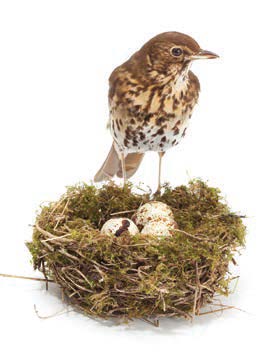
There, nestled in the branches of dogwood, sugar maple, hawthorn and pine; in gutters, rain boots and dense shrubs; within the cavities of dead and living trees: eggs, eggs, beautiful eggs. Creamy white ones, speckled brown (chickadee, cardinal and nuthatch). Bright and muted blue ones (robin and bluebird). Pale green with rust-colored blotches (mockingbird). And guess who’s out searching for them? Opossums, snakes, skunks, racoons, crows and jays.

Spring is as harsh as it is lovely. And, yet, this circle of life is indeed what makes each spark of creation all the more precious.

Poem April 2025

POEM APRIL 2025

Greedy

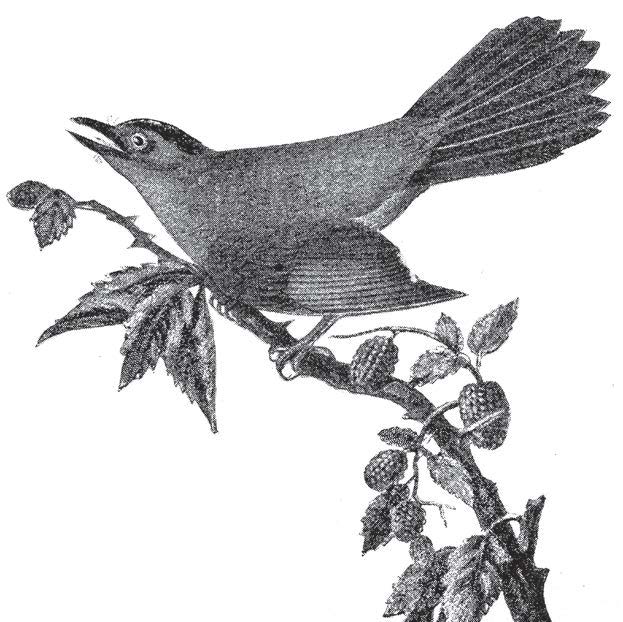
The catbird is pecking away

at two ripe tomatoes.

I wave my hands and shout,

My tomatoes! as though 

I’d produced them

from my breasts or belly.


The catbird aerializes

on the tomato cage,

jabbing and jabbing the red fruit.

I have more on the counter

that I won’t eat before they rot,

or that I’ll give away.


It’s unseemly, this stinginess,

a memory of not-enough,

the necessity of preserving

a crop from rabbits and deer,

the otherwise marvelous

round-backed bugs, grasshoppers

flaring red underwings,


or birds like this one,

gray as a civil servant,

an actuary of ripeness,

that tilts its head to eye the fruit

and flaunts its rusty bottom

in salute.

— Valerie Nieman

Animal Tales

ANIMAL TALES

I Know Not Where I Go

Lessons from the lodge

By Eric Schaefer

An oriole sings to me from the top of a hickory, and I rush to put out orange slices and pots of grape jelly. But he won’t stay. Every spring, he flies off as if he has some important place to go. “Stay a while,” I say. “There is no hurry.” But he’s off to an unknown destination. I can’t stay much longer either.

We bought the place because of the lake. The house was a wreck. We hauled out a dozen soiled mattresses, a pickup load of beer cans and various detritus. The work was hard, but there was always the lake. We took lots of breaks to lounge and try to find the cool places where the springs came up from the bottom. One day, an engineer from the state came around and inspected the dam. He said the trees on the back side of the dam should not have been allowed to grow up. Their roots would undermine the dam’s integrity, but cutting them down now might be worse because rotting roots were more dangerous. Telling us what should have happened before we arrived was not helpful, but he was right. The dam grew weaker and more vulnerable each year but held on until the remnants of a hurricane backed up water, and it gave up in a sudden, catastrophic collapse. Three acres of water, fish, turtles and flotsam went downstream overnight. In the morning, there was nothing but mud. 

Since fixing the dam was prohibitively expensive, we were forced to watch nature reclaim the land. Initially, it was depressing, but nature didn’t waste time providing us with a show. Grasses and shrubs were quick to sprout, and it wasn’t long before willows, sycamores and sweet gums covered the old lake bed. We traded kingfishers and hooded mergansers for common yellow throats and a chat or two who liked the new growth. Then, one morning, walking the stream that runs down the middle of the old lake bed, I came across a stick that had been stripped of its bark. 

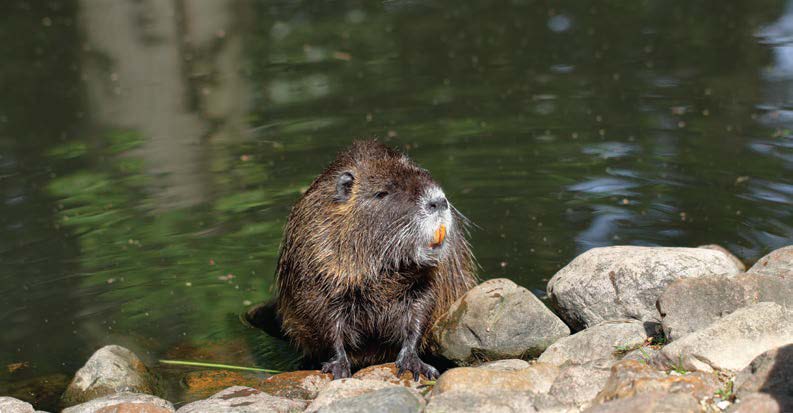
Beavers are often considered a nuisance, but, in my old lake bed, they were welcome. It took them just a few days to construct their first dam. While working, they lived in a burrow in the stream bank and came out to work crepuscularly. I thought their first dam should have been located further downstream, but my wife said, “Don’t argue with the engineers. They’ve been doing this for a long time.”

She’s right. Castor canadensis has been shaping the landscape for 7 million years or so. They not only build dams and lodges, but, once water backs up enough, they dredge channels in their new pond so they can swim deep enough to keep out of reach of predators. When they cut down a tree that is too big to drag, they either cut it up or make a canal to float the wood to where they want it.

I wanted to watch the endeavor, so I started going down to the stream early in the morning and evening. The first animal I encountered slapped his tail on the water hard enough to sound like a gunshot, making me nearly jump out of my boots. But  I knew the pond wasn’t big enough for him to hide for long, so I sat down to wait. Sure enough, he stuck his nose out of the water in a minute or two. He lay motionless with just his nose above water, looking me over until he decided I wasn’t a threat, and then he glided across his pond to where there was a freshly cut willow branch. He sat on his haunches in the shallow water, held the stick in his front paws and started eating the bark off the stick like you would eat corn on the cob. 

I began to visit him regularly in the evening. Sometimes, I’d bring a snack and eat with him. He never gave that warning tail slap again. He’d pause when I’d arrive —  I fancy he was making sure it was only me — then he’d go about his business, unperturbed.  Sometimes, a more petite beaver, perhaps his girlfriend, would show up. They built an impressive mound of sticks on the pond’s bank, and I could imagine its cozy interior, where I hoped they would be raising kits in the winter. Beavers are laid back about their accommodations. They have been known to share their lodge with otters, muskrats and other wetland neighbors. If I had been smaller and a little younger, I might have tried to visit them in their home.

Tragedy struck one day in the form of another storm that raised the water enough to wash away the beaver lodge and completely destroy their dam. I don’t know where they ended up; I haven’t seen them again. The lake bed is now filled with willow stabs and brambles. They didn’t like the sycamores much and left them pretty much alone, so the area has taken a new turn. I’d like to watch and see what develops, but my wife and I can’t take care of the place anymore. Can’t keep the house from falling down or the yard from turning into a jungle. We can’t keep enough wood to keep the fire going. We’ll be moving on soon. I know not where, but there will be a different assortment of birds, perhaps an unfamiliar flowering shrub might catch my eye, or a butterfly new to me will land on the bench where I’ve come to sit and watch. I might even land where the oriole makes his home.

Birdwatch

BIRDWATCH

Long Trek North

Louisiana waterthrush leads the way

By Susan Campbell

In early spring, birdwatchers such as myself are eager to spot the first returning migrants of the season. These are northbound birds that have spent the cooler months far to our south, in Central or South America. There, the living is easy, with plentiful food and a mild climate. But as the days begin to lengthen, these birds begin their return flight to the breeding grounds. Many may fly both day and night as the urgency of their mission increases. Hormone levels drive them to make their way swiftly to their natal area. Some return to the exact patch of woods, marsh or lake where they themselves hatched.

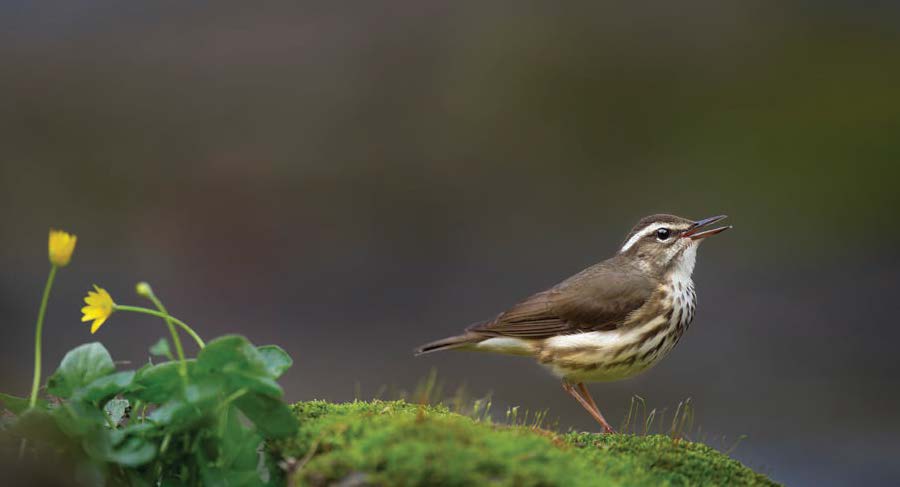
One of the earliest to return here in central North Carolina is the Louisiana waterthrush. A small, drab warbler, it is far more likely to be heard than seen at first. Its plumage is streaky brown and white. Birds can be recognized by their prominent broad white eyebrows and pink legs. As its name implies, the species prefers wet habitat, being at home along streams and rivers where it not only feeds in the trees, but along banks and around rocks at the water’s edge.

In the spring, Louisiana waterthrushes will call or sing as they move from place to place. As with so many species, the male’s vocalizing serves not only to attract a mate, but to establish territory. They have a loud, melodic song that carries well over the sound of moving water. The species’ call note, too, is a high volume “chip” that is easy to pick up in thick vegetation or above a gurgling stream.

Louisiana waterthrushes are insectivorous and so will consume any fly, midge or beetle that it sees. Also, waterthrushes will pick hatching aquatic insects such as mayflies or stoneflies out of the water. Individuals may wade in the shallows as they forage, making short jabs at potential prey items.

After pairs find one another and begin to raise the next generation of waterthrushes, they become virtually silent. This no doubt enables them to protect their nesting site and their young from would-be predators. Nests are built on or near the ground, making them relatively vulnerable to disturbance. Secretive behavior also reduces the chances that they will be parasitized by brown-headed cowbirds, which are known to seek out open cup nests such as those made by waterthrushes to deposit a single egg. The resulting nestling will be unwittingly cared for by waterthrush parents to the detriment of their own young.

Being one of the earliest warblers to return in the early spring, they are also likely to disperse in early summer after their young leave the nest. They may return to their Central American wintering grounds by the end of July. If you are fortunate enough to encounter a Louisiana waterthrush in the weeks to come, enjoy it because it is not likely to be around for very long.

Home Grown

HOME GROWN

Who really holds the power?

By Cynthia Adams

My friend, Pratt, is laid up with woes: a serious illness that has taken a number of medical tests to diagnose and more pain pills than he cares to swallow.

But this week just takes the cake, he tells me. A favorite Toby jug slipped from his hands and shattered. His microwave won’t cook beyond seven minutes before halting. “Is it protesting, or just broken?” I ask. I suggested what my tech-savvy husband always tells me: power off and restart.

Then his smart TV died.

“I’m reduced to using my old, stupid TV,” he mutters. 

From my experience, smart TVs are just as stupid.

Ours regularly seems to freeze up — much like I used to do before a Toastmaster’s speech. It goes into sputtering spasms mid-streaming, just before the second to last episode of a compelling Netflix drama.

Our so-called smart TV doesn’t especially like being told what to do by Roku and regularly strikes until rebooting.

Rebooting heretofore sounded like something you’d have a cobbler do, versus a tech fix.

Sadly, even if my TV is getting smarter, I am not. The mechanisms of technology mystify me as much as ever. When my bank’s online bill-paying function abruptly stopped working this past weekend, I developed hives, fearing I’d been hacked.

Nope.

The banking IT pros were the guilty party behind this sabotage, all due to an update. Post said improvement, nothing functioned properly for days. Trying to resolve this over the phone — during which I was asked such things as “have you cleared your cache?” — I shuddered and felt mildly sick.

Actually, no, I had not even touched my cache. 

“What about your VPN?” Before I embarrassed myself by blurting out something about my VCR (long ago consigned to recycling), I answered honestly. “VP what?”

The customer service representative sighed. “Try logging in via a search engine other than your usual.” Flustered and fumbling as she stayed on the phone with me, I faced another hurdle. I could not read my own scribbled passwords.

My head throbbed. Meantime, Citibank hit me with a $28 late fee for a balance of $18 I couldn’t manage logging on to pay.

By day five of this technological marathon, I had a low-tech solution. Maybe I’d move elsewhere. But I was soon notified of a national data breach. My response? To freeze my credit and change all auto payments, and google distant archipelagos where no one uses the word “breach.”

My cell phone immediately began doing a curious thing, cutting out calls as quickly as I could answer them, perversely trying to connect to my headphones each time. 

I took the same advice I’d rattled off to Pratt and gave it the ol’ power off and reboot.

It worked!

Seems you don’t have to have the smarts to hold the power. But before I clear my cache, I’m doing a juice fast, pulling olive oil and visual meditation.

Then I’m powering my entire self completely down.

O.Henry Ending

O.HENRY ENDING

Flight Risk

Didya hear the tale of a rooster on the lam?

By Cynthia Adams

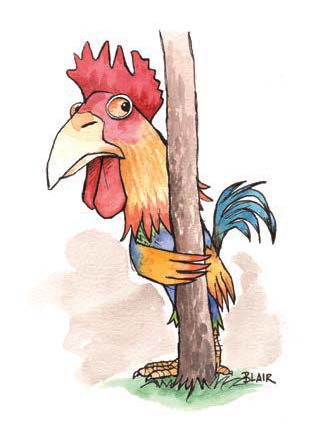
The rooster crowed predawn. A rousing, rooster reveille. 

Was it a lucid dream, a subliminal sound? After all, I had fallen asleep reading David Sedaris, whose brother, Paul, is nicknamed “the Rooster.”

Unmistakable, again. A rooster’s lusty crow.

“Didya hear that?”

Don nodded, splashing his face. Our morning-has-broken repartee is mostly “Uh huh” or “Not yet,” in answer to “Ready for coffee?” or “Ready to walk the dogs?” 

Not “Was that a rooster?”

We live in town, on a park, and have seen foxes, deer, raccoon, possums, chipmunks and squirrels. Once, I encountered a juvenile bear during a morning run. We’ve a variety of birdlife, including hawks and owls. But a rooster? Never.

The real secret to our relationship, we’ve silently agreed, is keeping things muted until coffee cups are filled and emptied, the paper skimmed, and we’ve dressed without walking into closet walls. Neither of us are morning people. 

Pulling on sneakers and grabbing dog leashes, we both understood we were going to look for the rooster.

“Sounded close,” Don muttered, and we set out, as if we were advance scouts nearing enemy lines. A Delft-blue sky rimmed the horizon above our usual trail into Latham Park. There was no birdsong beyond harsh complaints from an agitated murder of crows congregating along power lines, and the plaintive moans of mourning doves. 

The rooster was nowhere to be seen, but day after day we kept hearing him.

We redoubled efforts to find him during morning and afternoon walks. We began inhaling our cuppa joe and I waved the paper off, determined. 

“Didya hear him this morning?” I began asking first off. It felt portentous.

Along the park trail, seeking confirmation from others, too, I’d ask perfect strangers, “Didya hear that?”

“A rooster!” they’d marvel, squinting at me with interest as if I had conjured the bird up. Sometimes his crowing sounded well beyond the prior day’s perimeter, surprising us.    

Then, finally, he just appeared as we gardened one Saturday. The Dude himself!

Our wildest terrier alerted us when the rooster strolled over for a drink from our fountain. Bax trembled with excitement, as if to say, “I found him, and I’m keeping him!”

When I approached the rooster, he nonchalantly disappeared into the woods, strutting along our neighbor’s fence line. His plumage was colorful; a gorgeous fellow. 

My grandmothers had kept chickens, and I’d written about raising urban chickens for this magazine; I knew enough to give him space.

A few days later, we spotted him in the shaded perimeter of a parking lot. We froze, pulling the terriers closer. Soon after, we discovered the rooster was gaining an online presence on Nextdoor.

Some had names in mind, including Leghorn Foghorn. Don called him Russell Crowe.

Our editor once had a rooster cleverly called Brewster Roostamante. 

But the person resolved to capture the rooster dubbed him the innocuous sounding Todd. (Didn’t he deserve better?) After organizing a small posse for the weekend, a trap was sprung after his fourth or fifth reveille.

Soon after, we both started hearing phantom crowing. 

“Didya hear that?” I asked Don, pausing my weeding the weekend of Todd’s entrapment.

“I keep thinking I hear him, too.” He pulled a sad face.

Trundling him off to suburbia, Todd’s captor posted a mugshot. “Todd” was captive, pacing in a dog kennel. Gone was his devil-may-care swagger. Can a rooster look dispirited? 

Within 24 hours Todd was transported away to God-knows-where by God-knows-who. I imagine the clever bird had already figured out how things lay, so to speak.

Because the pairing of roosters and life in a high-density neighborhood, it turns out, is a foul, foul affair.

Omnivorous Reader

OMNIVOROUS READER

Mountain Thriller

Murder in the Grove Park Inn

By Anne Blythe

If you’re someone who likes to armchair travel through the pages of a good book, Terry Roberts, a native of the North Carolina mountains, has a thriller of a journey for you.

In The Devil Hath a Pleasing Shape, Roberts transports his readers to the luxurious Grove Park Inn, a stately and historic resort in Asheville that serves as the dark yet alluring backdrop for a murder mystery that exposes the tiers of a justice system that doesn’t always treat the wealthy and the poor equally.

The book starts with a bang when a nameless man standing near a tousled bed pulls out a pearl-handled derringer, shoots a naked college girl and leaves her on the thick, soft carpet to die in a pool of her own blood.

We quickly meet Stephen Baird Robbins in his home in Hot Springs, 30 miles downriver from Asheville. He’s a twice-married, once-divorced and once-widowed man who has stood trial twice for murder and been acquitted both times.

It’s October 1924, and Robbins, a retired investigator with a reputation for solving seemingly unsolvable crimes, is living a somewhat relaxed existence in a rental home with Luke, his 3-year-old son whose mother died in childbirth. Life had dealt them some wounds and bruises, but Robbins and his two neighbors were optimistic that together, they could raise Luke to adulthood.

When Robbins received a letter on fancy stationery from Benjamin Loftis, owner of the Grove Park Inn, trying to stir him out of his secluded piece of the world, he balled it up and threw it in the fireplace. Loftis persevered, first with a telegram telling Robbins his “presence is required due to a matter of some urgency,” and then with a personal follow-up in a chauffeur-driven trip to Hot Springs.

Loftis, a “newspaperman, chemist, pharmaceutical manufacturer, self-styled architect and — this is important —hotel man,” gave his pitch to Robbins. The hotel’s renown was in jeopardy after a college girl was found dead in one of the plush rooms.

“So in sum, you have a murder on your hands, and not just any murder, but the worst kind — a supposedly innocent young woman,” Robbins responds to Loftin. “The publicity is killing you. Two weeks have gone by and the sheriff hasn’t been able to nail anybody for it and you are getting desperate.” Robbins, a character who has appeared in two previous books by Roberts, let the hotel owner know from the start that he might not like the results.

“I want the murderer caught and punished, so that the inn’s reputation will remain unsullied,” Loftin responds.

Thus begins a tale that takes Robbins, who describes himself as “hill born and runaway” with “rarely two bills in my wallet to rub together,” to a resort where a man of his socioeconomic background is rarely a favored guest. Given wide access to the large granite stone inn described as “the finest pile of rocks ever built,” in October, “when fall began to wrap its cold hands around the mountains,” Robbins checks into the third floor hotel room next door to the murder scene.

The cast of characters includes an array of hotel workers and well-heeled guests such as judges, politicians and other townspeople who want to mingle and be seen among the wealthy travelers seeking retreat.

The hotel workers, its dining room servers, front desk managers and dutiful housekeepers are an interesting lot. The hotel itself, with all its corridors, luxurious amenities and nooks and crannies, becomes its own character.

Then there are the “girls” — the young women brought in to “keep the party lively” for events that might draw mostly men and a few bored wives. Robbins, a tenacious investigator with a knack for building rapport with the working people, has no qualms about standing up to the powerful. He is determined to find out who killed Rosalind Caldwell, or “Rosie,” as the locals called the young woman found dead in the hotel.

“Perhaps only Stephen Robbins could do what must be done here,” Roberts writes in his acknowledgements thanking the character for yet another appearance in one of his books. “After all, this is a book about prostitution and politics — a timely topic — and it required a hard hand and true voice to find justice.”

The Devil Hath a Pleasing Shape is about social status, privilege, racial injustices a wrongful arrest and a forthright observation that things are not always as they seem, even if that’s what the wider community wants you to believe. In fast-moving, descriptive prose, Roberts takes readers on a pursuit filled with danger and love that reveals the deaths of two other young women found lifeless in circumstances eerily similar to Rosie’s.

These were not the sort of women whose deaths would typically draw big headlines in Prohibition Era Asheville, Robbins notes. Their bodies were not discovered in a fancy hotel, nor did they come from the well-to-do neighborhoods of the town’s rich and famous.

Even if there are enough clues to figure out the likely killer long before the story ends, Roberts is adept at pulling his readers through to the conclusion to find out whether or not there will be justice for these victims. It’s an entertaining pursuit, a journey to another place and another time well worth taking.

O.Henry Ending

O.HENRY ENDING

The Donor

Giving of yourself in acts great and small

By Cynthia Adams

Ann Deaton wears her niece Leslie’s citrus-quartz pendant, fingering it gently as we talk. When I mention how lovely it is, a smile flickers. She eats slowly, sipping tea during our lunch in a Middle Eastern restaurant. The retired high school counselor, with intelligent blue eyes behind gold wire-rimmed glasses, is just regaining the ability to laugh after months of being hamstrung by grief at the loss of her niece. 

Leslie inherited Ann’s charismatic personality and valiantly fought cancer for months until her recent death. Ann had been a constant presence in Leslie’s abbreviated life. She watched her battle pancreatic cancer with a pilgrim’s fervor, both expecting a miracle.

In a sense, Ann believes Leslie experienced one. The singular miracle was that, until her end, she remained lucid, engaged, even questioning. At one point, Ann thought that if Leslie got into a new drug trial, she might triumph. Her smile tightens. 

“She was so ill at that point; the drug itself would have killed her. I think Leslie lost hope when she learned that.”    Today, however, Ann doesn’t weep. She is cried out.

Bearing witness to suffering has taken a toll.

She wraps half the sandwich, saying, “My appetite isn’t really great.” Ann has just returned from Key West, a trip she has made often with old friends. 

“I needed it,” she admits. “Those sunsets.” 

“It’s so kind of them to invite me.” She casually mentions it might have something to do with “the kidney.”

Without missing a beat, she tells me how she takes trips and celebrates holidays with the family.

The kidney?    

“My kidney.” 

Ann gave their daughter a kidney on September 25, 2002.

She laughs as my mouth drops open. The recipient survived many years. “Her kidney lasted until her death from cancer.”

“I was in the hospital at Duke overnight. That’s all,” Ann replies, batting questions away.

She looks past my shoulder into space, reflective. Ann remains other-focused. 

I tell her my stepfather died of kidney failure after many years on dialysis. 

Every eight minutes another person is added to the national transplant waiting list. Only one out of every four needing a transplant receives a kidney, with a typical wait of five years. 

Ann is aware of the statistics. She tries to convince others that she is living proof that organ donation “is no big deal.” The transplant is done laparoscopically and generally requires just one overnight hospital stay. A friend, Realtor Kathy Haines, chose to follow her lead, donating a kidney to a stranger.

Ann knows how grateful her recipient’s family remains. At the young woman’s death, she was told that “a part of me is already in heaven.”

“Wasn’t that nice of them to say?” she asks, dabbing a napkin at her mouth. 

We part. Ann is off to feed the feral cat colonies around town that she supports. It’s another cause near and dear to her. 

With a warm smile she winds a scarf around her neck.  Ann walks purposefully, off into the winter’s day. 

Afterward, I call a friend whose son died one year after receiving a kidney from a living donor and complete stranger.

I relate what Ann has just shared — that the transplant pain was not significant and recovery was straightforward. My friend’s voice quavers. 

“I’ve always dreaded asking the donor, that wonderful man, about the pain he suffered.” 

She collects herself.

“Thank you for that. And please, please, thank Ann for me.” 

Outside, the sun emerges, pushing back against earlier grayness. I think of Ann making her faithful rounds in a RAV4, feeding cats in a colony near a shopping center and then another off Spring Garden, where wary felines gather and await her. At home she cares for Leslie’s cat, Virginia, and other rescues.

There is always an Ann, I think, to show us our better selves.

Winter will yield to spring. The sun, defiant, climbs higher until its magnificent sunset.