Omnivorous Reader

OMNIVOROUS READER

The Theft That Wasn’t

The tale of the lost and found Picasso

By Anne Blythe

Most of us have heard that old cliché “Kids say the darnedest things,” but few of us could imagine getting the kind of phone call that Whitcomb Mercer Rummel Sr. received in March 1969 from his eldest child. There was nothing cliché or cutesy about it.

“Hey, Dad, I accidentally stole a Picasso,” Bill Rummel said to his father nearly 57 years ago. What happened afterward is a bit of creative skullduggery that has been concealed in the annals of one family’s history far longer than one of the key participants would have liked.

Whit Rummel Jr., a filmmaker who lives in Chapel Hill, and Noah Charney, an American art historian and fiction writer based in Slovenia, have written The Accidental Picasso Thief: The True Story of a Reverse Heist, Outrunning the FBI and Fleeing the Boston Mob to share that story with the rest of the world.

Disclosure: I have known Whit Rummel, the author, for many years, relishing in his stories and adventures. Although I’ve heard bits and pieces of this story before, this is the first time I’ve been able to soak it all in.

As Whit Rummel, the only surviving member of the trio that pulled off the so-called “reverse heist” writes, the book — part memoir, part true crime — “is the story of one of the oddest art crimes in American history.”

It’s a tale Rummel has wanted to share in full for decades but couldn’t — for reasons ranging from fear of the famous mobster Whitey Bulger, to respect for a brother’s wishes and a dogged hunt for the location of the painting. In June 2023 The New York Times ran a story titled “Hey Dad, Can You Help Me Return the Picasso I Stole?” but Rummel had more to say.

It begins in 1969. Whit Sr. was an empty-nester with his wife in Waterville, Maine. He was the owner of a popular restaurant near Interstate 95 and an ice cream store with in-house creamery serving up unique and enticing flavors like Icky Orgy.

Bill Rummel was in his mid-20s at the time, working as a forklift operator at Logan Airport in Boston moving crates around the world for Emery Air Freight. A historic snowstorm hit the East Coast, leaving chaos in its wake. As flights were delayed and diverted, Bill loaded several flats into the trunk of his car from pesky “orphan” piles clogging up the outbound area. Wrapped up in one of those flats was a Pablo Picasso original, Portrait of a Woman and a Musketeer, that was en route from Paris to a gallery owner in Milwaukee.

Unlike his younger brother, Whitcomb Mercer Jr., Bill wasn’t particularly interested nor appreciative of art and didn’t realize a valuable painting was in his possession. When he found out what he’d inadvertently done, he called his brother, a passionate art lover, who was at Tulane University at the time. After several phone calls, Bill and Whit decided it was time to call their dad, a man they called “the fixer.”

Whit Sr. and his wife, Ann, had moved to Maine in the ’50s and raised their sons there. The boys had a mischievous streak in them, perhaps inherited from a father who relished taking them on “wild goose chases.”

Whit and Bill, now in young adulthood, needed their father’s guidance. What should they do with the stolen Picasso? This was no wild goose chase. They had heard the FBI was on the hunt for the painting. To make matters worse, rumor was that Whitey Bulger’s notorious Winter Hill Gang also was searching for it, threatening anyone trying to move in on their airport turf.

“Our father, after all, was the grand fixer. The one guy who’d always been there for us, pulling us out of whatever kind of jam we’d found ourselves in (and there had been many),” Whit writes. Their dad reeled off several options. One was keep the painting, bury it under the floor of the Waterville restaurant and uncover it some years later, feigning shock and surprise. The other option? “He said maybe there was a way to return it. Without letting anybody know who took it,” Bill told his brother.

That’s the option they chose. Whit Jr. got instructions from his dad. “I want you to write a brief note to accompany the return of the painting,” his dad said. “Nothing long or complex. Just a few mysterious sentences to put them off the track of someone like Bill.”

To this day, Whit chuckles at the note he composed with intentional “grammatical quirks.”

PLEASE ACCEPT THIS TO
REPLACE IN PART SOME OF THE PAINTINGS REMOVED FROM MUSEUMS ACROSS THE COUNTRY. —  ROBBIN’ HOOD.

Whit Sr. and Bill would don costumes, fake mustaches and fedoras, get in a Chevy Impala and set off to return the Picasso at the Boston Museum of Fine Arts. An unexpected sighting of an employee near the loading dock upset their plans, but eventually the painting made it to the museum. A blurb announcing its return was in the news, and the Rummels went on with their lives, though their dad would die suddenly just a few years later, in 1972.

As the years went by Whit wanted to make a movie about the unwitting theft, but his brother wanted it to remain a secret, though Bill did do an interview about the incident with This American Life that never aired. He passed away in 2015.

There are some differences in the version Bill told then and what Whit remembers from their phone calls when his brother first told him he had “a friggin’ Picasso.” In the book, Whit shares both versions of how his brother recounted coming into possession of the crate. Though Whit never accuses his brother of knowingly taking the painting, he acknowledges there could be doubts about his intentions.

The book details the surviving Rummel brother’s search for the painting now and his hope to one day have his picture taken in front of it with his son, another Whit Rummel, and a nephew who shares their name, too. If that were to happen, the three — named for “the fixer” — would be “smiling proudly and loudly now, because our story has finally been told.”

For anybody who cares about art, the creation of it, and the quirkiness that makes families special, it’s a story worth telling, reading and even telling again.


Almanac February 2026

ALMANAC

February 2026

By Ashley Walshe

February leans in close, icy breath tingling the nape of your neck, and asks you to pick a door.

“A what?” you blurt, turning toward the raspy voice. No one. But that’s when you see it. A door straight out of a fantasy novel.

Approaching slowly, you take in the intricate details and lifelike carvings: apple blossoms and honeybees; pregnant doe and spring ephemerals; fiddleheads and fox kits.

Wood as frozen as the earth below, your fingers ache as they trace the grooves and ridges, then fumble across a secret panel. Beneath it? A round peep window with an unobstructed view to spring.

Bone-cold and weary, you press your face against the cold glass and glimpse a drift of wild violets, trees gleaming with sunlit leaves, a bouquet of ruby-throated hummingbirds.

“Yes, please,” you nearly sing, reaching for the frigid brass knob. Your heart sinks when you find that it’s locked.

Rapping the knocker for what feels like ages, desire becomes agony.

You wait, desperate for the door to open — desperate to bypass the bitter cold and step into the warm embrace of spring.

That’s when you remember the voice.

Pick a door.

Of course, there’s another. You spin on your heel and set out to find it.

As you walk, you notice how the frost resembles glittering stardust; the moon, a silver smile in the crystalline sky. How naked trees stand in praise and wonder of what pulses, unseen.

This is the doorway, you realize, feeling your breath deepen, your heart open, your jaw and belly soften.

There is peace here, at this threshold of endings and beginnings, where life moves slowly, where early crocuses burst through the wintry soil. Peace and wonder. But only if you choose it.

Early Signs of Spring

Love and birdsong are in the air. On mild days, mourning cloaks trail yellow-bellied sapsuckers, sipping maple, birch and apple sap from tidy rows of wells.

No vintage perfume smells as delicate and sweet as the trailing arbutus blooming in our sandy woodlands. And — oh, dear — a striped skunk rejects an unwanted suitor.

Soon, toads will begin calling. Gray squirrels will bear their spring litters. Bluebirds will craft their cup-shaped nests.

Spring makes her slow and subtle entrance, even when we can’t yet see it. 

Year of the Horse

The Year of the Fire Horse (aka, the Red Horse Year) begins on Tuesday, Feb. 17. According to the Chinese Zodiac, 2026 will be a spirited year of passion, dynamism and boundless freedom.

In other words: It won’t be a year for the sidelines.

Souls born this year are said to be bold, adventurous leaders, quick-witted and headstrong, magnetic and rebellious. Parents of Fire Horse children: Let it be known that they can’t be tamed. 

Tea Leaf Astrologer

TEA LEAF ASTROLOGER

Aquarius

January 20 – February 18

Buckle up, space cadet. The new moon eclipse on February 17 is going to be what the normies call “a moment” — especially for you. Yes, you’re different. We know, we know. But when you’re done trying on hats for the thrill of it, a seismic shift will occur in the quirky little core of your being. Reinvention is no longer performative. It’s the only path forward. Believe it or not, the world is ready for the weirdest version of you. Are you ready?

Tea leaf “fortunes” for the rest of you:

Pisces (February 19 – March 20)

Wear the lacy blue ones.

Aries (March 21 – April 19) 

A little dab will do.

Taurus (April 20 – May 20)

Milk and honey, darling.

Gemini (May 21 – June 20)

Don’t forget the reservations.

Cancer (June 21 – July 22)

Three words: breakfast in bed.

Leo (July 23 – August 22)

You can buy yourself flowers.

Virgo (August 23 – September 22)  

Order the fancy entrée.

Libra (September 23 – October 22)

Just tell them how you feel already.

Scorpio (October 23 – November 21)

Edible is the operative word.

Sagittarius (November 22 – December 21)

Try flirting with a deeper perspective.

Capricorn (December 22 – January 19)

Hint: polka dots.

Home Grown

HOME GROWN

Kissing Fashion Crimes Goodbye

Confessing to questionable dressing

By Cynthia Adams

A few friends met at a wine bar where our topics flowed as freely as the wine. We’re a book club, yet we discuss (in no particular order) books, travel, headlines and get-ups we deeply regretted having ever worn outside the house.

It took getting wine-d up to confess regrettables we not only had worn but that we still had hanging in our closets. Bohemian garb the late Diane Keaton might have managed to swan around in, but not us mere mortals.

Somehow, crimes of the heart figured into our respective fashion offense confessionals.

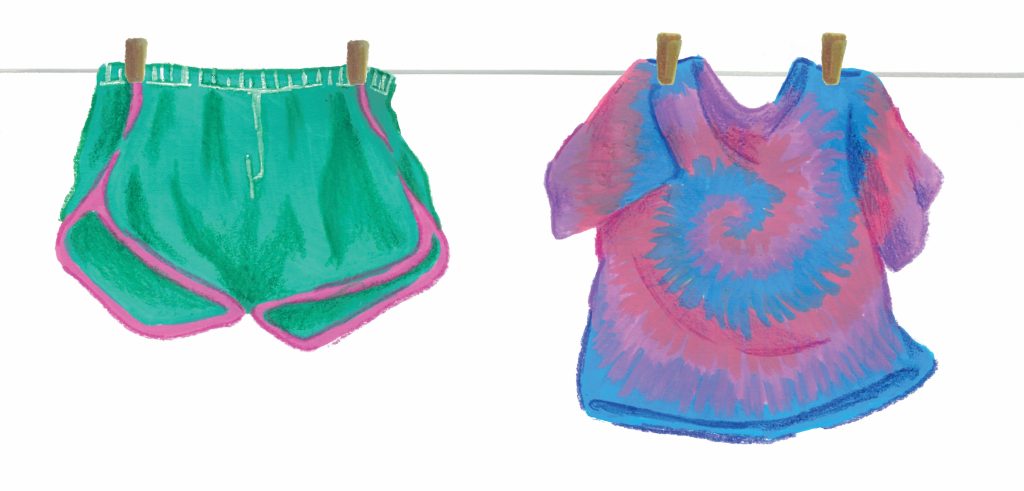
I will not name names, but, among other things, one friend confesses to wearing Boogie Nights-like neon running shorts with pantyhose, topped by a yellow scoop-neck shirt (sporting a frog graphic). This was her “kiss outfit,” so-named not after Kiss the band, but because it was worn to sneak with her sixth-grade boyfriend to the attic for a long-planned smooching session. 

She lost her nerve and bolted before kiss consummation, a shame because the boyfriend moved away and became an actor in Friends.

“He was much more complex than the character he played,” she insists as we mopped tears of laughter from our eyes.

Another friend, who formerly owned a vintage clothing store, thought nothing of wearing a head-to-toe tie-dyed ensemble. “I thought I looked great,” she says, laughing and choking on a sip.

Tie-dye, overalls, suede jackets with long fringe were all cherished fashion staples. She especially enjoyed sporting a beloved polka-dotted tent dress.

A favorite admission following a pinot noir: “If the hemline of my skirt was longer than my fingertips, then it was too long.” We envision our friend twirling away in her polka-dotted dress and laugh even harder.

My own confession centers around a big yellow school bus and Johnny Teeter, my first big crush, who drove No. 15 to Bethel Elementary. 

Love for Johnny drove me to commit a most regrettable fashion misfire.

As Mom tamed my hair into a ponytail most mornings, Johnny honked the horn and waited. My skinny knees knocked together as I ran down the gravel drive, kicking up a cloud of dust. I was breathless by the time the bus door swung open; not due to exertion but the thundering of my heart as Johnny flashed his beautiful pearly whites. He had many assets, but I thought he had the most amazing smile I’d ever seen.

If I got into a scuffle with Buddy the bus bully, Johnny would stop the bus and intervene, pulling me safely to a seat.

Johnny was the perfect guy.

Regrettably, he thought I was too young, which increased my ardor to prove a 12-year difference between a 6- and 18-year-old meant nothing. 

But how?

One fine morning, I slipped out of the house wearing my mother’s purloined girdle (pinned up) and sexy stockings. It was my version of a kiss outfit, hoping to strike Johnny with just how mature I had grown in recent weeks. As I crossed the road with shoulders high, hoping to catch his eye, the thing fell down, puddled around my brown penny loafers. 

I had certainly caught his eye.

Johnny jumped out, bundling the girdle and hose into my book bag. Red faced, I took a seat on the bus as Buddy bellowed with laughter. 

Was it love that was driving me and my friends to assorted, well-intended, fashion mortifications? 

Like toting my awkward leather prison purse — the one my father tooled during his unfortunate incarceration at Maxwell Air Force Base. 

Dad, you see, was a free spirit — so free he stopped paying his income tax until the actual Men in Black from the IRS came to our door and served notice that his life was about to change. 

Say what you will about minimum-security prisons: The godawful fact was that Dad just so happened to be incarcerated with White House counsel Charles Colson. My father protested to the warden that being sent to the same prison as a Nixon defender was cruel and unusual punishment.

He and Colson peeled potatoes while dissecting the finer points of Watergate. They made prison purses and string art. Despite a wary truce, Dad never trusted Colson’s “jailhouse religion.”

When Dad returned, he presented the leather bag to a daughter who had missed him so with pride. After all, he had spent much of his three months at Maxwell making it. The purse accessorized my permed hair, maxi dresses, pink corduroy hip huggers. It could have been worse. 

But I never wore a girdle and hose again, not even in the name of love.

White House Drawing Room

WHITE HOUSE DRAWING ROOM

White House Drawing Room

John Hutton says he can teach anyone to draw U.S. presidents and first ladies. We put him to the test.

By Maria Johnson

Photographs by Mark Wagoner

A Friday afternoon.

A few cans of seltzer water.

A half dozen No. 2 pencils.

A projector.

A teacher who knows what he’s doing.

And a half dozen good-humored students.

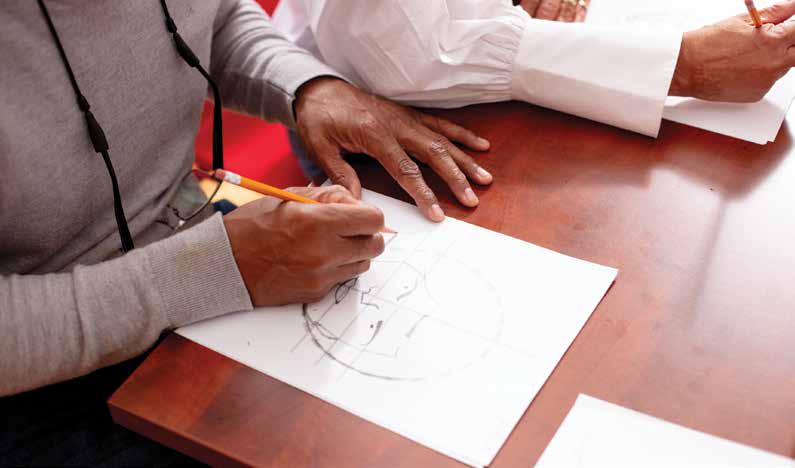
Welcome to art class, O.Henry style.

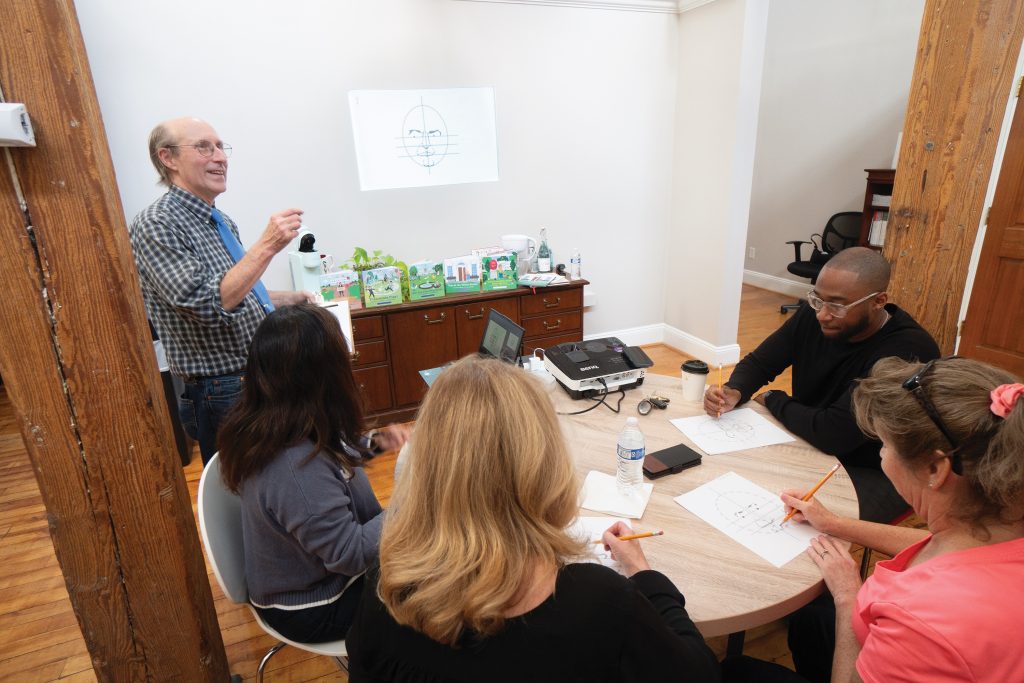
Recently, we drafted a sketchy crew, in the best sense, to mosey over to the magazine’s office in Greensboro’s Revolution Mill.

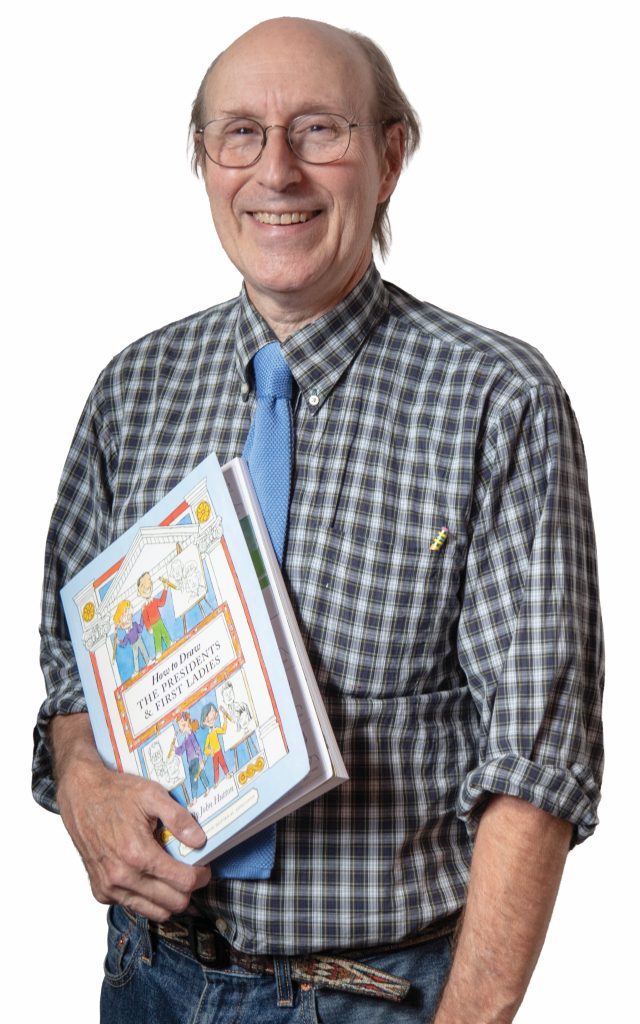
Our recruits accepted the invitation — OK, it was more of a plea sweetened by the promise of snacks — to test the skills of John Hutton, a professor of art history at Salem College in Winton-Salem.

Hutton claims that he can teach anyone to draw a U.S. president or first lady, and he’s willing to put his executive powers on the line, with good reason.

Last year, his book, aptly named How to Draw U.S. Presidents and First Ladies, was published by the White House Historical Association and won the 2025 American Book Fest Book Award for Best Children’s Novelty and Gift Book.

The workbook gives step-by-step instructions for rendering the 45 men who have served as president.

The book also depicts 47 women — most of whom were actually married to a POTUS.

Two presidents — Woodrow Wilson and John Tyler — were widowed and remarried while in office. They’re shown with two wives each.

One prez, James Buchanan, was a lifelong bachelor. His niece, Harriet Lane, served as the de facto first lady, socially speaking, so she graces Hutton’s pages just as she graced 1600 Pennsylvania Avenue.

Back to art class. On the day we gather, Hutton is full of fun facts for our students, who are friends and office neighbors of the magazine.

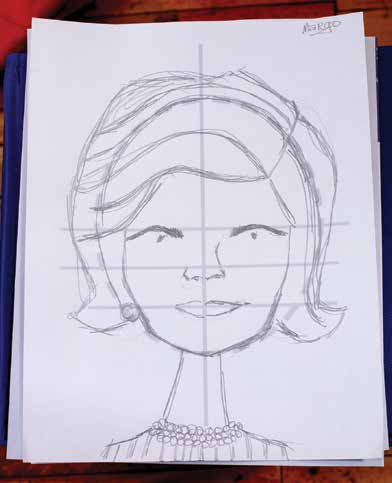
Participants include State Farm Insurance agents Margo and Archie Herring; Susan Sinnott, office manager of Alem Dickey Keel Interior Design; Pam Garner, president of Triad Sales & Recruiting Solutions; Harsha Mirchandani, development director for College Pathways of the Triad; and Moe Miles, who, with his wife Autumn, owns and operates Greenlove Coffee.

As they arrive, everyone wants to make one thing clear: In no way does their drawing ability reflect their professional prowess.

1Notch a “V” just below the second horizontal line on the grid, he tells them. That’s the tip of the nose.

Add flared nostrils and keep your pencils moving upward.

This brings you to the eyes, which land smack dab on the first horizontal line. Start simply: dot, dot. Brows undulate above that.

Now, drop down to the mouth. Abe’s lips fall just above the bottom line.

At this point, the faces on everyone’s papers — as well as the image that Hutton projects on the wall — bear no resemblance to Abe.

The magic happens when Hutton instructs his pupils to add high cheek bones — “question marks,” he calls them — and the sidelines of a lean face.

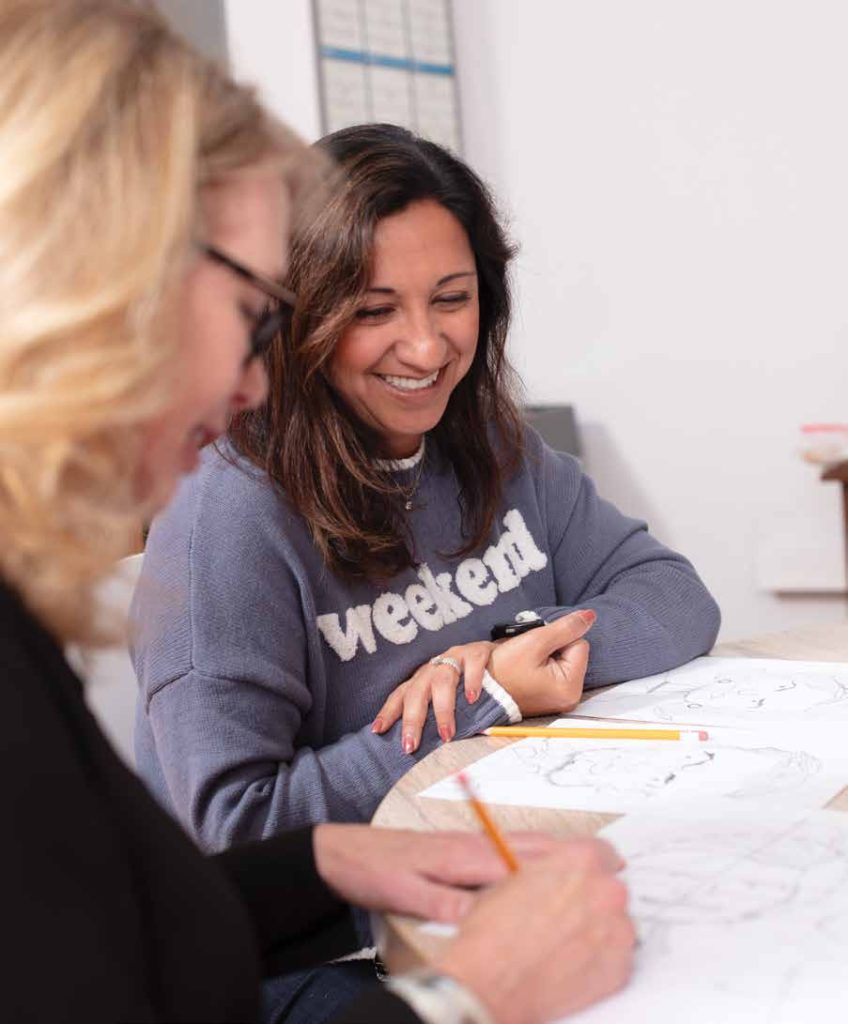
Suddenly, six Abes emerge.

And so do astonished smiles on the faces of our of budding artists.

They can draw.

The mood loosens as Hutton guides them through Abe’s wrinkles.

Obviously, Abe lived preplastic-surgery era, several people observe. His elevens — worry lines between his eyebrows — also indicate that the late unpleasantness might have been even more unpleasant, cosmetically speaking, owing to the absence of Botox.

A few lines later, Abe’s face is fully fleshed out with his wavy hair, large ears and real-deal bow tie. No clips-ons for No. 16.

He looks fit for a play-money penny in each of the students’ drawings.

“Everybody does it a little bit differently,” says Hutton.

Except for Margo and Archie’s Abes. They’re essentially twins.

What is it they say about married couples? After a while, their drawings of Abe Lincoln start to look alike?

Chitchat flows between our newborn Picassos as Hutton brings up the second subject of the day:

Jacqueline Kennedy Onassis, the wife and later widow of John F. Kennedy. She also founded the White House Historical Association.

There’s another piece of trivia worth preserving.

In sharp contrast to Lincoln, Jackie was a style maker, setting fashion standards with her bouffant hairdo, flip curls and pearl chokers.

Hutton flashes his example on the wall and instructs his students to start again with the nose.

“She has a broad nose, but not as broad as Abraham’s,” he says. “Her eyes are going to be well below the eye-line. They’re fairly wide set, much more than ordinary.”

Jackie’s lips, he points out, are rather full, and her mouth turns up slightly at the corners.

“That’s what makes her look friendly,” he says.

By this time, our students are getting friendly with each other.

“Do you need an eraser?” Harsha asks Susan.

“You don’t have any left,” Susan teases back.

They speculate about whether Jackie’s lips were plumped by filler.

When Susan draws one of Jackie’s bob earrings next to her jaw, Harsha joshes that it looks like a cyst: “She’s got to get that thing drained!”

Pam texts her husband to ask what he’s doing at work. She sends him pics of her sketches to flaunt her fun.

Moe is so impressed with his work that he considers adding it to the Greenlove menu.

Next to a decaf Lincoln latte perhaps? A caramel Jack-iat-O.?

These reluctant creatives — who initially wanted to leave their names off their papers for fear of being ridiculed — now want to show off their works.

“I have skills!” marvels Archie, looking at his handiwork.

Margo asks Hutton if he’s ever met an unteachable student.

Every ounce the teacher, Hutton refuses to say yes.

Learning is a process, he says, and the important thing is to stay at the process.

“I try to help them do it better,” he says.

In the end, the class gives Hutton thumbs-up on his teaching ability.

“I think your method is highly effective, the way you break it down,” says Harsha.

Class is dismissed and everyone leaves clutching sketches worthy of the White House — refrigerator. 

Well, Hello, Dolley!

Try your hand at drawing Greensboro’s
own Dolley Madison

She was the OG of FLs.

Before anyone called the first ladies “first ladies,” Dolley Todd Madison, who spent her babyhood in what’s now Greensboro, shaped what people would later regard as the role of a first lady.

She was married to James Madison, who would become the country’s fourth POTUS, but before that, she handled the White House social life of their friend, Thomas Jefferson, whose wife had died before he assumed office as the third U.S. president.

Dolley, who famously threw small parties called “squeezes” — think what you will — was known as the D.C. hostess with the most-est, which is probably why the Hostess snack cake company once had a line of Dolly (with no “e”) Madison baked goods.

Raise your hand if you remember raspberry Zingers.

Anyhoo, Dolley was on-point, stylistically, and more than a little rebellious for her time.

She made turbans with tassels a thing.

She dipped snuff.

She also turned the White House into a veritable Baskin-Robbins on the Potomac, generously dishing out the frozen confection that Thomas Jefferson, a former ambassador to France, first introduced to the White House as a taste of continental culture.

Let’s face it: if Dolley were around today, the girl probably would be pierced and tatted, though maybe not for her official portrait.

Which brings us to an actual portrait of Ms. Madison. Because no one posted pics — or even took pics — back in Dolley’s day, paintings are the only way we have of knowing what she looked like.

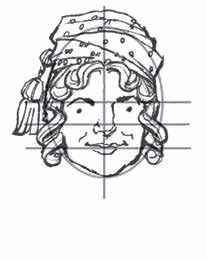
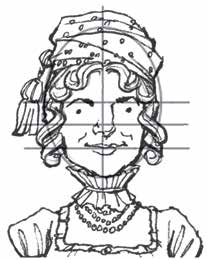
If you want to try John Hutton’s method for yourself, pick up some colored pencils and use the grid we’ve provided to create your own version of DM. Feel free to take some creative liberties and send your best sketch to cassie@ohenrymag.com or drop your work in an in-feed Instagram post and tag us in the image: @o.henrymag.

The winner will receive a copy of John Hutton’s book and a place in a forthcoming issue.

Step 1

Step 2

Step 3

Step 4

Chaos Theory

CHAOS THEORY

By Cassie Bustamante

“Help! I need a furniture therapy!” Angelique texts me early one recent morning. Even earlier for her since she moved from Maryland to Colorado a year after our family jumped ship from the Old Line State to the Old North State. But we’re both early risers, especially now that we’re middle-aged, and those predawn conversations are frequent — focusing on anything from perimenopausal insomnia and parenting to what smutty books we’re currently reading. Or, as in this case, which Facebook marketplace chairs will look best at her dining table.

When Gail, a mutual friend of ours, got wind that I was packing up and heading to the rolling hills of rural Myersville, Md., she said, “You’ve got to meet Angelique! She has a vintage business, just like you. You two will hit it off.” Plus, I discovered, Angelique had three kids, two who were the same ages as mine — Sawyer and Emmy, just 6 and 4 at the time. It felt like a fated friendship. And yet, things didn’t simply fall into place.

Once our boxes were unpacked, I dialed the number Gail had given me and burbled on as I do when I’m nervous and unsure of myself. “Hi, I’m Cassie, and Gail has told me so much about you and I’d love to hang out sometime and our kids are the same age and . . .” Yep, oral diarrhea, technically diagnosed as logorrhea, and I just can’t make it stop. But I suppose that’s better than the actual kind.

As luck would have it, I discovered that Sawyer and Angelique’s middle daughter were on the same soccer team. And at practice one afternoon, Angelique was there on the sidelines — tall, goddess-like, striking with dark-chocolate hair and, although I don’t quite recall the outfit, I do remember thinking at the time, “that’s pretty chic for soccer practice.” Angelique, I began to realize, had impeccable style, both in fashion and, I learned as the months went by, in what had become increasingly an interest of mine, interiors.

I fought the immediate urge to run over and say hi. And I didn’t. In fact, we didn’t really become good friends for months after that. As I sat on a blanket with Emmy watching Sawyer run down the soccer field, I took one look at myself and the word that came to mind was “frumpy.” Ill-fitting jeans, a worn T-shirt and hair that had been plopped up on top of my head just to keep it out of my tired face. Ultrachic Angelique seemed clearly out of my leggings-count-as-pants league.

But, as the years trotted along in Myersville, our kids got to know each other in school. Soon, Emmy was asking to play with Angelique’s youngest daughter, Genevieve. The girls were too young to make those plans themselves but old enough to choose their own playmates. I can’t remember who broke the ice first, but once we started chipping away, the rest melted.

Slowly, Angelique and I got to know each other. What started as a mutual passion for design and fashion blossomed into a deep interest in what else we held dear and what terrified us. We are both dreamers who thrive on the creative back-and-forth more than the final product. But where I am all fire and have a “go” kind of energy, Angelique is a soft place to land, contemplative, compassionate and an incredible listener. Day by day, week by week, month by month, as we allowed ourselves to become more vulnerable and share our innermost trials, tribulation and triumphs, we became trusted confidantes through all of life’s beauty and messiness.

When she became caretaker for her elderly father, I listened as she navigated a new stage in life. And when I suffered several miscarriages, Angelique’s nonjudgmental, empathetic ear saw me through. In fact, so thrilled that baby Wilder was finally growing in my belly, she insisted on throwing me a baby shower. I assured her I didn’t need one and was met with, “But I want to do this for you, Cassie.” While it may have taken years, Gail was right. No, off the bat, we didn’t hit it off, but practice makes perfect and now we’re each others biggest cheerleaders.

One of our favorite outings was to make the hour-long trek to Ikea, lists in our hands and dreams of affordable Swedish-made furniture and decor in our heads. The drive offered the opportunity for coffee and conversation. On one occasion, as we glided south on I-95, the topic of women supporting women came up — after all, we both co-owned female-led businesses. I said something to the effect of, “Sometimes it’s a case of feeling mutually intimidated that can lead to two women missing out on what could actually be a great friendship.”

While I hadn’t actually been referring to us, Angelique, in the passenger seat, sheepishly peered at me out of the corner of her eye and quipped, “Yeah, let’s not let that happen again.”

That’s the moment it dawned on me. All that time I’d lost thinking I wasn’t worthy of Angelique, she had been intimidated by me. She saw me as smart, casually stylish and totally confident in who I was. Turns out, that intimidation was just mutual admiration.

I pick up my phone, press Angelique’s number and wait for her to pick up.

Wandering Billy

WANDERING BILLY

Greensboro Is Your Oyster

And The Pyrle aims to cultivate Elm Street

By Billy Ingram

“I regarded home as a place I left behind in order to come back to it afterward.”  Ernest Hemingway

Game-changing.

Will that jaundiced misnomer ever cease being bandied about when depicting every precious pearl newly strung to downtown Greensboro’s asymmetrical necklace? Fifty years ago that meant widening sidewalks to create a mall-like experience; truly a game-changer in that it caused retailers to hightail it elsewhere.

Equally emblematic yet undeniably more effective are 21st-century sparklers lit with optimistic expectations for jumpstarting the heart of a city: LeBauer and Center City Parks, the Downtown Greenway pedestrian path, a $22-million baseball stadium, free shuttle-bus rides and Lewis Street’s impressive redevelopments. A new hotel here, a refurbished dry cleaners serving shoyu there — I delight in them all.

While downtown nightclubs light up late nights, there are scant advantages for nearby businesses. Tanger has been a boon, but its positioning at downtown’s outer edge results in attendees transacting predominantly with municipal parking decks. Sauntering southward on Elm reveals vacated storefronts with restaurants rarely slammed. I’ve witnessed first-hand downtown’s glacial evolution from a zip code to be avoided three decades ago into an uneven periphery, one that is populated with pulsating pockets of genuine excitement tucked in and around a central business district seemingly adrift, lacking a metaphorical pair of jeans, if you will, to stitch those pockets onto.

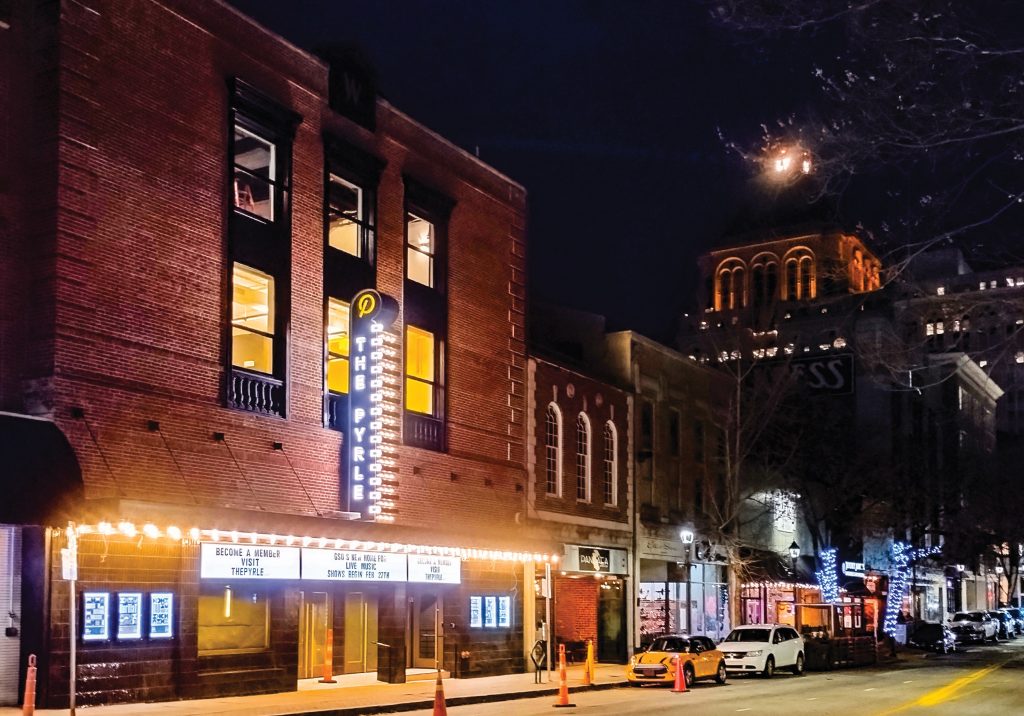
A seismic shift in that dynamic is all but assured as The Pyrle emerges from its makeshift shell later this month, a 1,000-person-capacity music venue and event space at 232 South Elm, just south of Crafted The Art of the Taco. Its mission? To cauterize that chasm currently preventing performers with audiences too zaftig for Ziggy’s from gigging here but lacking in fannies needed to pack Tanger’s 3,000 seats or top off the Coliseum’s 23,000-capacity arena. 

The Pyrle (named for Pyrle Gibson in honor of her contributions to our local arts scene) is a total and consummate reimagining of a palatial, dearly-departed department store built almost a century ago for Montgomery Ward; a four-story monument to 20th-century merchandizing that was, for decades, a darkened abyss until Triad Stage stoked some semblance of life into its cavernous maw beginning in 1999 and lasting through 2023’s le scandale. Over the last year, the entire 35,000-square-foot interior was gutted then reanimated, arising not only as a rarified, state-of-the-art performance platform, but also encompassing staging areas for community events and even two unrelated office spaces.

Durant Bell is one of five active investors in this high-stakes venture. “I grew up in Greensboro, went away for school, lived in D.C. for about four years and then moved back about 20 years ago,” he says. In fact, all of The Pyrle’s principal players are longtime Gate City residents and/or boomerangs such as general manager Dominick Amendum, who attended Greensboro College then “moved away, had the first stage of my career before returning about six years ago. I jumped on board with these guys in March of 2024.” One keen interest all of these principals have in common? “We love music,” Bell insists. “One of the great connectors amongst us was finding ourselves going to a lot of shows outside of Greensboro.” And, they thought, why not bring those shows here?

Lacking a mid-plex like The Pyrle has resulted in indie, post-punk, R&B and EDM fans making weekend exoduses, sometimes hours long, just to see their favorite acts. The Pyrle partnered with The Knitting Factory, a well-established national talent broker. What that means is that Greensboro will become a logical stop for touring bands. “Coming from Richmond to Wilmington to Asheville, we can pick up a lot of these regional bands that are already on that pathway,” says Amendum.  “So we got really excited about this opportunity to be a catalyst for Elm Street and for the city.”

Let’s face it, a vibrant live-music culture is one major reason Durham is booming, yet Greensboro, despite numerous well-intentioned pavings, remains perpetually tethered to the proverbial starting gate. “To have a healthy music ecosystem,” Bell claps back, “you need a continuum of venue sizes so that you’re attracting artists at all different [levels].” Initially, The Pyrle will mount around two shows a week, ramping up to a goal of about 150 shows a year. “Officially, we are a genre agnostic,” Amendum adds. “We’re going to try a lot of everything over these first couple of years.”

Those in the know can snag tickets to four free February shows (visit thepyrle.com/events). Then, after Americana singer-songwriter Anders Osborne closes out the month, early bookings continue to reflect that refreshingly eclectic POV — reggae royalty The Wailers, country crooner Ricky Skaggs and alt-rockers Silversun Pickups, for instance. Sprinkled throughout are North Carolina-rooted headliners such as Southern pop-rockers The Connells and the so-called “most underappreciated band on the face of the planet” Watchhouse. Plus, hop over to catch the tantalizing twang of Chatham Rabbits with Holler Choir opening.

What impact will this have for the mother lode of unparalleled creative artists undergirding our scattershot music scene? Amendum’s answer is encouraging: “That’s a big thing on my radar right now, how we bring the community onto our stage. Whether it’s monthly showcases featuring two or three local bands or as openers for some of these national acts.”

VIP sections, cozy alcoves and aerie overhangs provide for a surprisingly intimate setting with no bad sight lines. “There’s not another venue like this in the Southeast,” says Bell, who even queried touring acts for what amenities they’d like, then implemented those suggestions. “When you look at the hospitality suite we have for artists, people’s minds are going to be blown. The Knitting Factory, who manage venues all over the country, were here last week and they were like, ‘No other venue has an LED screen this size.’ In five years, they will all have them, but we’re on the cutting edge.”

Planning to be open six days a week, The Pyrle’s polish is its cosmopolitan cocktail lounge at the entrance, lacquered in leather and wood grain. “We’re going to do a bar differently than your typical music venue,” Bell says. “People can go back out to the bar and enjoy basking in the afterglow of that awesome show they just saw. Maybe the band is feeling frisky and wants to come down from the green room and have a drink.” Ambient screens are tuned to the stage during performances, but on non-show nights, says Amendum, “I love the idea of an ’80s MTV music video night on Tuesdays or maybe Wednesday nights they’re playing some live show that was taped at Red Rock.”

Won’t be long before word gets around, up and down I-85 and 40, that Greensboro’s got game (for a change).

A Full-Circle Journey Home

A FULL-CIRCLE JOURNEY HOME

A Full-Circle Journey Home

After many moves, the Lacenskis return to where their story began

By Cassie Bustamante

Photographs by Liz Nemeth

When Jordan and Evan Lacenski were looking for a more family-friendly home after their son’s birth in 2020, they saw a sleek, black, midcentury Modern beauty in Hamilton Lakes. But, says Jordan, “My husband and I had never paid anything like that for a house and we were like, ‘That’s insane!’” Then, a Zillow listing caught Jordan’s eye: an abandoned house with an overgrown yard in New Irving Park. A vision of what could be hit her. With her knack for design — and a great general contractor — a clean-lined gem, just like the one that had been beyond reach, materialized.

Today, the Lacenski home, built in 1985, has a bold, black, white and wood exterior that lends to a Modern vibe. What was once empty is now full of life: with Evan, Jordan, Everett, their 5-year-old son, and Austen, their almost 2-year-old daughter, plus the family dog, Bullet. Seeing the original Zillow listing, you understand what an ambitious dream Jordan had for the diamond in the rough. The listing images, as it turns out, are still online. “I hope they never take it down,” she says, because the photos remind her of just how far their home has come.

Thanks to both having parents with jobs that relocated them, Jordan and Evan originally met as middle schoolers in Greensboro. When Jordan was entering the seventh grade in Cleveland, Ohio, her father took a job in the furniture industry that meant a big move to North Carolina. Not wanting to leave her friends behind, 12-year-old Jordan “went outside with my sleeping bag and my goldfish” and told her parents she was staying put. Naturally, Mom and Dad won that battle.

Evan, on the other hand, was used to moving. His father worked as a criminal investigator for the IRS, a job that required frequent relocation. In his nearly 40 years, Evan, a Green Beret veteran, has lived in 19 houses total. “I got to meet lots of new people,” he says, “but I wouldn’t want it for my kids.”

He was a quiet kid, Jordan recalls, but a part of her friend trio, which consisted of her, Evan and their friend, Ian, aka “Spanky.” She’d safely placed him in the friend zone until “he wrote me a love poem,” she says, a poem that he still knows by heart. Yet, she wasn’t convinced — “and then he moved.”

Their paths diverged and wouldn’t physically cross again for several years. And yet, through the wonders of social media, they kept up with one another and remained Facebook friends. When Jordan was a student at Northwest Guilford High School, her father lost his job. While she’d had big dreams of attending college out of state — even as far as Hawaii — her dad encouraged her to apply to affordable in-state schools. She enrolled at N.C. State, where she began studying art and design. “I thought I was going to be an architect.” Until: “Math — maybe not.”

Tuition money ran dry after a few semesters and, while her father eventually found a new job, he moved out of state and her parents divorced. After taking a semester off, she enrolled at UNCG. “And I loooooved UNCG,” she says. She found the faculty especially approachable and empathetic, on top of being innovative. She recalls one particularly tough life moment when she — in tears — asked her professor for a project extension. “I am sobbing and then I am saying I am sorry,” Jordan recalls. “And she said, ‘Why would you ever apologize for being a human being? Human beings cry.’ It was the first time anyone had ever said that to me.”

At UNCG, she pivoted to studying communications and graduated in 2008, right on time for the Great Recession. Since then, she notes, she’s also experienced a global pandemic while pregnant. “We’ve just lived through it all.”

Eventually, Jordan landed a job in her field. With craft beer coming heavily onto the scene, Caffey Distributing created a new position. As the the local beer distributor’s first craft brand manager at the age of 25, Jordan says, “The amount of business that I got to learn because I was sitting in the room with all these C-suite dudes was wild.” Financially secure, she got a dog, a beagle named Siler, and purchased her first home, a foreclosed condo that she and friends painted together while sipping wine. “I was so proud of it,” she says.

Meanwhile, after graduating from the University of Oklahoma on an ROTC scholarship, Evan was stationed in Germany with the U.S. Army. But he’d never forgotten about his middle school flame after all these years and distances. In fact, when she went through a breakup, “He sent me chocolate lava cake to cheer me up.” She recalls Skyping with him afterward while her mom, Sandi Reasoner, was off screen, whisper-yelling to her: “Are you kidding me? Tell him thank you. He is so cute!”

As luck would have it, Evan ended up taking the Special Forces Qualification course at Fort Bragg and, while there, offered — several times — to take Jordan to dinner. A former relationship with someone in the military made her apprehensive about accepting. Plus, she says, “Army spouses have to make a ton of sacrifices, often at the expense of their own careers and ambitions.” After repeatedly turning him down, she eventually agreed, “and that was that.” A year after that first date in 2012, they were married.

Soon after, Evan found himself stationed at Eglin Air Force Base, and the couple hauled their belongings and their two dogs, Cider and Lucy, a great dane, to the sunny, seaside town of Destin, where, Jordan quips, it’s “spring break all the time.” They bought a house, and, as if two dogs were not enough, Jordan came home one day to find Evan on the phone with people at Animal Planet. Soon, Cheech, a rescue he’d seen on Pit Bulls & Parolees, joined their canine brood and the family subsequently appeared on a 2014 episode featuring his homecoming (a real tearjerker — grab the tissues if you watch!). “He had a human soul,” says Jordan wistfully. A wall in their bathroom serves as a memorial to those three dogs, filled with their pictures.

After a year in Destin, Jordan landed a job as the director of marketing and communications for Destin Charity Wine Auction Foundation. While Evan was deployed much of the time they spent in Florida, Jordan launched a side hustle, SheWolf Collaborative — a “non-agency agency” for women in the marketing industry to come together and work collaboratively, no matter where in the country they lived.

Finally, after eight years of service, Evan could take a desk job or transition out. His last deployment to Afghanistan had been tough and he’d lost a teammate, Andy. “Everett’s middle name is Andrew after Andy,” says Jordan. “They were a really tight-knit squad, so I think that changed his perspective and he opted to get out.”

Evan enrolled in the Army’s program that provides counseling, employment and workshops to transition to civilian life, but pivoted when, on family vacation in Montana, he noticed Svallin, an organization that trains protection dogs. He knew of a veteran who trained dogs for them and the idea appealed to him.

Once again, the Lacenskis moved across the country to Bozeman, Mont. There, says Jordan, SheWolf blew up. The area itself is entrepreneurial and the women who live there thrive on collaboration, “like sunshine for everybody.”

Evan’s dog ranch job, however, did not pan out as planned. “He basically was supposed to manage a ranch in Montana and one in South Africa, where dogs were trained to counter poach,” says Jordan. “And that never happened, so half of the salary that we expected him to get never happened.” Back to transitional training he went, where he learned to work in medical device sales. When he was ready to start applying for jobs, one opened up in Greensboro, of all places, and, in 2017, the couple found themselves back where they began.

They moved into a brick Tudor on Walker Avenue, but, once Everett was born, knew a change needed to happen. “He was downstairs, we were upstairs,” says Jordan.

With the help of Matthew MacLanders (“our realtor since I bought that first condo”), they visited what would become their home. Jordan and Matt were going a mile a minute, talking excitedly about what could be done to the house. “And my husband is standing there holding Everett,” quips Jordan, “like, ‘What are you talking about?’”

Jordan brought over her pal, Jodee Rupell, a “total badass” who had loads of remodeling experience. Jodee suggested not just renovating the kitchen, but moving it entirely. Jodee also pushed up her sleeves and got to work: “She was out here one day with her husband’s tractor and hedge clippers at 7 a.m.”

With a design of her own making in place, Jordan reached out to several general contractors for quotes. “And we ended up with the company that actually renovated the Hamilton Lakes house, Donny Root, Building Roots.” With a renovation loan secured, the bank allowed just six months for work to be completed, so Donny, his brother and his nephew worked on the house almost every day and became like family to the Lacenskis.

Jordan sourced materials herself for much of the renovation: tile from Floor & Decor, cabinets from Kitchen Cabinet Worx, light fixtures from “a smorgasbord of Wayfair and all that.”

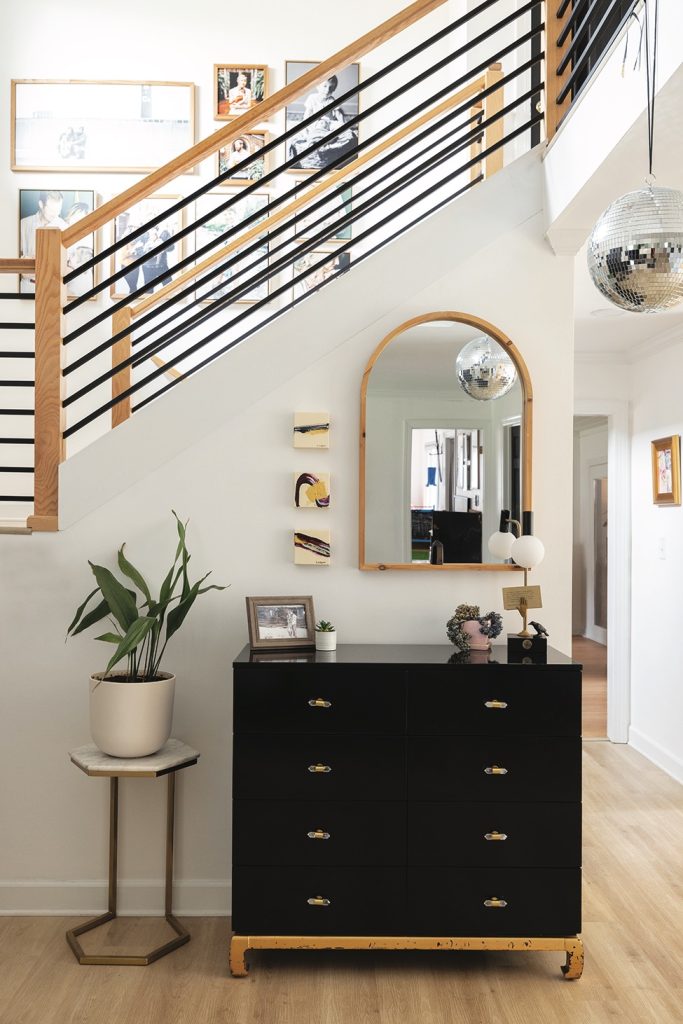
Entering through the original double front doors, which the couple updated with paint, one of the first things you see is a disco ball hanging in between the entry and kitchen, which are now part of an open-concept central space. The family hung it for New Year’s, but loved it so much that it became a fixture. “At 1 or 1:30 p.m., it does its thing,” says Jordan.

“Only in the winter,” adds Evan, because of the sun’s placement.

Previously, the entry housed a dated grandfather clock where you’d expect to find a secret passage leading upstairs — just like the one in the 1980s sitcom Webster. Now, the wall is open and freshly updated with visible stair railings that have been given a modern look inspired by an image Jordan spied on Pinterest. Donny ran with it, Jordan says. “They just figured it out and they built that.”

The bright, modern kitchen now faces the backyard, where they extended the deck — the “brilliant idea” of Jordan’s mom, who let the family and their dogs crash with her during renovations. (Sandi, as it turns out, loves to spend time on that very deck, sitting by the pool in the summertime.) Light, warm wood cabinets pair with cool, gray, chevron backsplash tiles and white quartz countertops with gray veining. An island with a waterfall countertop offers seating for casual family meals.

Where the kitchen previously sat now serves as a playroom for the kids, complete with three Nugget play couches — “You can’t have enough Nuggets,” says Jordan. The family uses them to build forts, even opting to create “dinner forts,” where they sometimes eat meals.

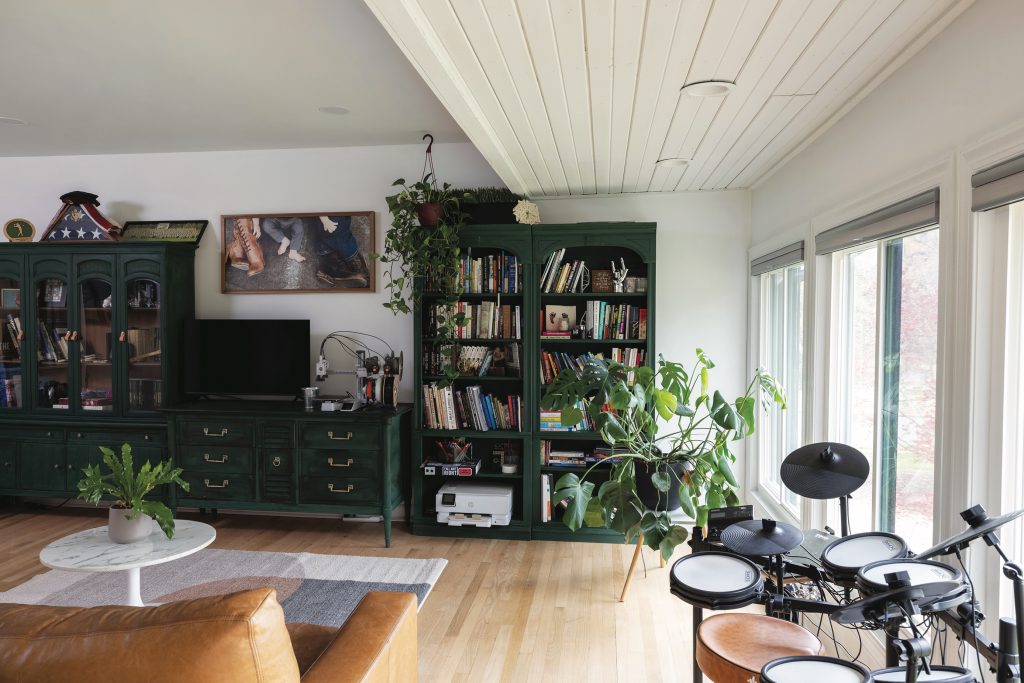
Just off the playroom is the very thing that sealed the deal. “What sold me was all these windows,” she muses, gesturing to the home office’s wall of tall windows. These days, both she and Evan each work at home frequently, so they have their own desk spaces, with a small desk for Everett in-between the two. Jordan has taken on a new role as director of marketing for ExecBrand Authority, but she’s also pivoted SheWolf away from being a marketing collaborative, turning it into an inclusive space for women from all walks of life. Because she herself was seeking community, she decided to create a platform for it, offering outings, such as kayaking, watercolor lessons and Mahjong, plus opportunities to give back. “At the end of the day, every time I do something outside in community or adventurous in community or creative in community, I always leave happy at the end of it,” she says.

On another wall in the office, Jordan had hoped for builtins, but when the exterior landscaping cost more than she’d expected, some corners were cut. Instead, Jordan painted a series of three freestanding cabinets in a dark-green Annie Sloan chalk paint. Evan’s drum set and 3D printer also take up real estate. Evan, says Jordan, has multiple hobbies. His latest? Ice hockey.

On the opposite end of the main floor, the living room features a large, cushy sectional stuffed with pillows, perfect for cozying up and lounging. A soft, fuzzy, blanket on the sofa welcomes Bullet, the 115-pound gentle giant who serves as door greeter and crumb picker-upper. An array of art climbs the wall behind the couch, a collection of the family’s treasured pieces, including a watercolor painting of Evan and Everett by local artist Alisha Wielfaert. “Art is the way to my heart,” says Jordan.

Before, the room was still in its 1980s heyday, complete with a bar. “Cabinets came out to right here and ran the whole length to that window and in the corner there was a sink,” says Evan. “It was really weird.”

“Because people were partying!” quips Jordan. “At their houses!”

Just off the living room, the couple added a screened-in porch, where Evan’s cold plunge and sauna sit. Once that was constructed, less natural light flowed into the living room, so they brightened it up by painting the wood-paneled ceiling white.

Heading upstairs, another gallery wall, now visible from the home’s entry, adorns the wall. This one features family photos taken throughout the years, most by Winston-Salem photographer Jo Lindsay. “We just added photos of Austen,” says Jordan. “She’s officially part of the fam,” she adds with a laugh, noting that life with two young kids keeps one too busy to keep up with actually printing, framing and hanging said photos.

At the top of the landing, Jordan has assembled a smattering of Tin Nichos, whimsical, colorful 3D shadowboxes crafted by local maker Jayme White, to splash color onto the white wall. Jordan’s collection includes a “cereal killer” and a woman who inspires her, Lucille Ball.

While downstairs features a guest room, the family’s bedrooms are all upstairs. “And where we used to be on different floors, now we are all real close,” says Jordan.

Everett and Austen each have a playful mural in their bedrooms. Everett’s is a mountain scene in rich earth tones, cool gray-greens and tans that Jordan painted herself. And his dresser and nightstands are hand-me-downs from Dad, given a fresh look with chalk paint. “We just repurpose what we can, you know,” says Jordan.

Austen’s wall was a collaborative effort between Jordan and local artist Kara Lewis, a former art teacher at Greensboro Day School. Using “an old-school projector,” Kara painted the black flower outlines and Jordan added splashes of color. Jordan selected flowers that hold special meaning, including hydrangea for abundance, heartfelt emotion and gratitude, and ranunculus for charm, admiration and joy, among others.

In the primary bedroom, Jordan got a wild hair to paint the wall behind their bed. When Evan saw it finished, she recalls, “Evan said, ‘You just said you want to paint that 10 hours ago!’” In her own words, Jordan often takes an idea and runs with it from “zero to 100.” Now, the wall anchors the space in a warm rust, a mixture of two colors “because one was too red brick and one was too Arizona.”

On the opposite wall, next to a dresser Jordan scored at Red Collection, an array of hats surrounds an arched mirror, some from their time in Montana. “This one,” she says, “this is my pride and joy.” Even though there’s a Stetson in her collection, the hat she’s holding was crafted by the Montana Territory Hat company. Underneath its rim, it’s been branded with the word “howl,” a nod to SheWolf.

Of course, Everett saw his mom and her pal writing on the wall and wondered if he could join in the fun. So, on the space that hides behind his bedroom door when it’s open, Jordan wrote “Everett’s Wall” at the top and let him go to town on it. Now, “Everett is very proud of his room.”

The en suite bathroom was completely renovated. A new, modern tub was installed and long, wooden shelves built by local woodworker Amanda Marley float above it on the wall. But Jordan’s favorite added feature? A skylight just above the shower. “No one can see you except for the birds,” she says.

What was once an empty, dated house is now an inviting home filled with art and life, perfect for a modern family. In fact, Evan says, when they first bought it, they had it appraised. Two years later, they had it appraised again. Little did they know, they’d end up with the same appraiser. He called Evan afterwards to ask who had designed it so he could recommend them. “And I was like, ‘My wife did it,’” says Evan. “And he said, ‘That is literally one of the best renovations I have ever seen of an original home. Tell her that she should pursue a career in this.’”
Jordan lets out a squawk of a laugh. While reinventing herself as someone who updates and redesigns houses may not be in the cards, there’s no doubt that she’s made their New Irving Park fixer upper — and Greensboro — into a home she never wants to leave.

“We’ve seen a lot of the country, and we’re here, I think, longterm,” says Evan. Plus, every time he returns from travel, he finds himself saying, “I am happy to be back home.” 

Birdwatch

BIRDWATCH

Swamp Song

A liquid stream of notes

By Susan Campbell

To most folks, especially non-birders, a sparrow is just a sparrow — a small brown bird with varying amounts of streaking and a stubby little bill. Not very impressive. However, in Central and Eastern North Carolina, and especially in winter, nothing could be further from the truth.

Although few sparrow species can readily be found during the breeding season in our area, we have 10 different kinds that regularly spend the cooler months here. These range in size from the husky fox sparrow down to the diminutive chipping sparrow. Without a doubt, my favorite in this group is the swamp sparrow, whose handsome appearance and unique adaptations make it a definite standout.

At this time of the year, these medium-sized sparrows are a warm brown above with black streaking — like so many others — but swamps have a significant amount of chestnut apparent in the wings. The gray face, dark eye line and crown streak contrast sharply with the white throat and breast. The tail is relatively long and rounded, a very good rudder for moving around in the tight quarters where these birds live.

As the bird’s name implies, it is usually found in wetter habitat year-round. With longer legs than their conspecifics, swamp sparrows readily forage in the shallows, searching not only for fallen seeds and berries, but also for aquatic invertebrates. Individuals are even known to flip submerged vegetation with their bills in search of a meal.

The song is a liquid stream of notes that we rarely hear during the cooler months. The call note, however, is very loud and distinctive and uttered frequently. I hear far more of these birds calling from thick, wet habitat than I see along our coast. Swamps give themselves away with a metallic “chink.” If they are disturbed, they are hesitant to fly — probably due to their excellent camouflage. Instead, these birds usually choose to run from potential danger. They can maneuver deftly through sticks, stems and branches when pursued.

If a swamp sparrow does fly, it will not be over a great distance. A leery individual will sail to the nearest perch and survey the source of the disturbance, and then it will quickly vanish into thick vegetation.

Birds of wet areas such as these can be attracted to your yard even if you do not live in a coastal or riparian area. They may show up during the spring or fall migration if you can create cover for them. Adding low, thick shrubs such as blueberries or gallberry will help. A simple brush pile adjacent to your feeding station may be enough to get their attention, but in order to really up the odds of attracting a few swamp sparrows, consider creating a small wetland garden. A small depression will attract more than just this species: It will provide for a multitude of native critters and can be used to naturally treat (i.e., filter) household wastewater. Water features of all sizes have become a very popular way to increase wildlife, even on small properties.

Swamp sparrows have been studied for almost a century. It was one of the first species to be banded by ornithologists using modern methodology in the early 1900s. In fact, a banded bird from Massachusetts in October 1937 was relocated in central Florida in January of 1938 having covered a whopping 1,125 miles. This information was some of the earliest data produced on the migration of songbirds in the United States.

The next time you are out walking along the edge of a marshy area or paddling in the shallows, watch and listen for this neat little winter resident. One may pop into view and treat you with a short look. 

Sazerac February 2026

SAZERAC

February 2026

Window on the Past

Guilford County has many ties to historical figures, but one of the most significant is the upbringing of former First Lady Dolley Madison. She was renowned for her social grace and writing, which is evident in this poem written to her friend, Madeleine Dahlgren, on Valentine’s Day, 1849.

For Miss Dahlgren

Deliberate on all things, with thy friend,

But since friends grow not thick on every bough,

First, on thy friend deliberate with thyself,

Then, ponder self, not eager in the choice,

Nor jealous of the chosen fixing, fix

Judge before friendship, then confide till death.

Sage Gardener

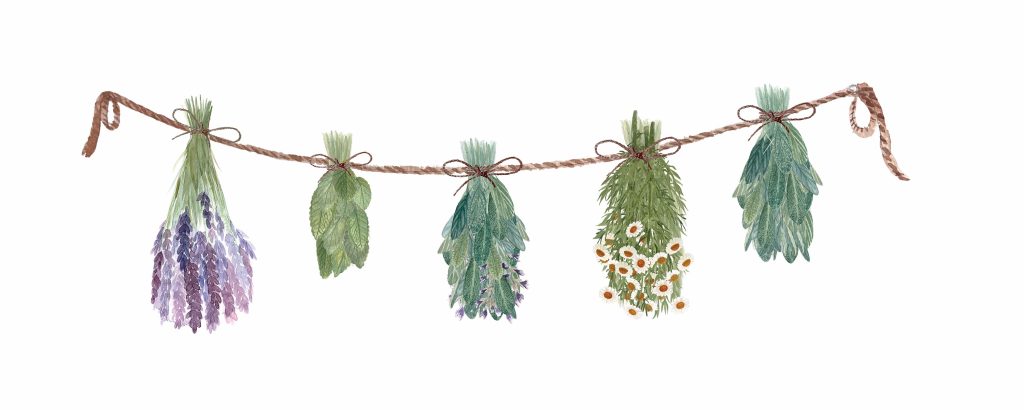
An earwig can be as irritating as it is haunting, especially at 3 a.m., when you can’t quite remember the correct lyrics to the song: “She once was a true love of mine” swirl around with “parsley, sage, rosemary and thyme,” which triggers a mental inventory of the state of my herb garden. Rosemary? Check, big bush of it near the goldfish pond. Thyme? Got it in spades. Parsley? It’s struggling but will rebound. Sage? I’ll need to order seeds or find some plants.

Now can I go back to sleep?

Not until I get up and listen to “Scarborough Fair” — and learn (just in time for Valentine’s Day) that the four herbs combined constitute a love potion, parsley for comfort, sage for strength, rosemary for love and thyme for courage. And also that Paul Simon once sang the song on The Muppet Show in duet with Miss Piggy, both dressed as Renaissance minstrels.

That’s the sort of thing you discover when, in the middle of the night, you go down the gopher-tortoise hole (because gopher tortoise burrows contain the likes of coral snakes, beetles, skunks, gopher frogs and other critters you’d never find going down a rabbit hole).

Parsley, Petroselinum (from the Greek “rock celery”) crispum: While Greeks fed parsley to their race horses, the Romans spread parsley throughout their empire, convinced it warded off infection and masked the smell of garlic. (Do not try this at home.) In medieval times, it was thought to provoke lust and love. So, who wouldn’t want this excellent companion plant in their garden, warding off asparagus beetles and attracting bees and hoverflies, which everybody knows feast on aphids and thrips? Any chef realizes that it brightens even the most complex dish when sprinkled just before serving and anything grilled benefits from the addition of parsley, butter and lemon.

Sage, Salvia (from the Latin “salvere,” meaning “to be saved”) officinalis: Sage is native to the Mediterranean region, but naturalized throughout the world, including here in North America, where some Indian tribes consider it a sacred herb. In fact, many have adopted the Native American tradition of burning sage for spiritual purification. It thrives in well-drained, slightly acidic soil and needs lots of sun to create maximum flavor. Avoid overwatering or too much fertilizer. Its earthy flavor blends with almost anything and is such an essential Southern spice in pork that the Neese’s sausage people offer an “extra sage” variety. Green cheese? English Derby with sage added.

Rosemary, Rosmarinus (Latin for dew of the sea) officinalis: Just so you know, Napoleon’s eau de cologne was based on rosemary. Greeks thought that wearing a garland of it improved memory and there’s some current scientific evidence supporting that. In medieval times, rosemary was used in both funeral and weddings as a symbol of happiness, loyalty and love, but was also thought to attract elves. Rosemary does not grow well in containers, needing light, well-drained soil. Harvest rosemary just before it flowers for maximum flavor.

Thyme, Thymus vulgaris (although there are hundreds of varieties): Among other mythical and historical applications,  thyme was burned to rid homes and temples of insects and snakes; carried by Roman soldiers into battle for courage and strength; used in charms to enable one to see fairies; and seen as an antidote to snake and spider bites. Thyme is hardy, loves sunlight and can spread like a miniature form of kudzu once established. Besides being an excellent food preservative, thyme oil is antioxidant, antifungal and antibacterial.

The song itself? The melody is centuries old and was collected from a retired lead miner by Ewan MacColl, a British folklorist, singer and songwriter. Simon & Garfunkel, in turn, collected and recorded the melody. The lyrics about unrequited love became famous after its inclusion in a movie about the very same thing: The Graduate. Except for the presumed availability of the four herbs in medieval Scarborough in Yorkshire, England, the lyrics contain a lot more advice for the lovelorn than for gardeners, true of most rock’n’roll. But my lady did indeed find me an acre of land, and that’s true love.
                                  David Claude Bailey

Unsolicited Advice

As soon as the last of the leftover Super Bowl chicken wings are finished, we’ll finally be done with football season and we can then focus on what’s more important: crafting! Galentine’s Day is right around the corner and — we don’t know about you, but after all the touchdown talk — we’re in desperate need of a girls’ night. So while the boys sulk about their team not making it to the playoffs — yet, again — we cooked up some fun activities for you to do with your gal pals.

When was the last time you put your creative skills to the test? Watercolor paint, a couple of canvases and a bottle of wine is all that is needed to uncork a proper sip-and-paint night for the gals. And as the cups fill and the paint strokes the canvas, your abstract art will look a lot like Picasso’s, especially through wine goggles. 

Even with the simplest of instructions, baking can be difficult. But as bad at baking as we are, two is often better than one in the kitchen, especially if your friend is a little more skillful with a whisk. As long as you fake it until you bake it, the toughest of recipes can become smooth as batter and you can show that pound cake who’s boss. So grab a friend and make that pie recipe — it’s as easy as, well, pie.

There’s something so freeing about making a mess, especially when it allows for a perfect display of memories. Scrapbooking lets you fly your freak flag without any judgement. It’s all for you, the girls and no one else. We are a patchwork of pieces, so our scrapbooks should be too. Now, pull out the scissors, paper and your hot glue gun and make a mess — a hot mess.

Just One Thing

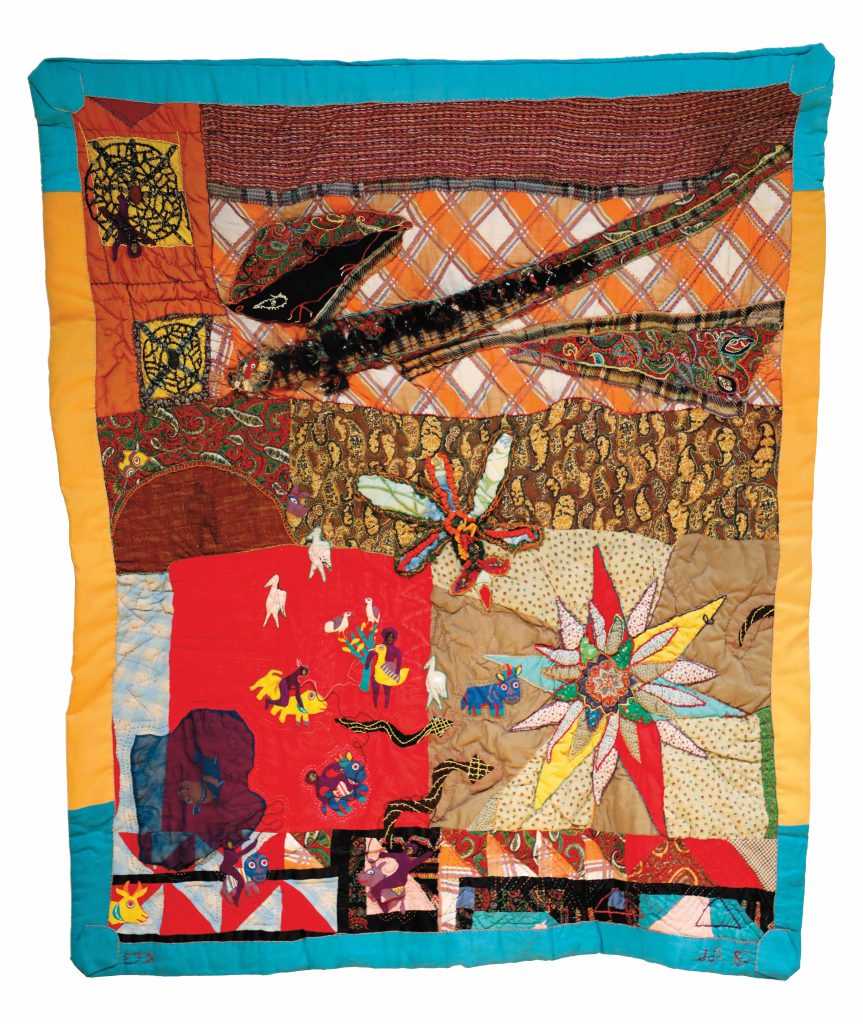
Renowned artist Joyce J. Scott, nicknamed the “Queen of Beads,” has stitched a path of her own through the quilting world, which obviously includes beadwork. But mothers are often the first to guide us through our crafting journeys, and, with the quilt Monsters, Dragons and Flies, it’s no different. Joyce and her mother, Elizabeth T. Scott, pieced together retrospective work that expands upon the traditional ideas of quiltmaking. With its appliquéd patterns and series of hand-embroidered images, the quilt the mother-daughter duo collaborated on found its way across the country. Catch this piece and many more by other African American quilters at the Weatherspoon Art Museum’s Of Salt and Spirit: Black Quilters in the American South exhibit, on view from Feb. 7–Aug. 1 — an exhibit fit for a queen.