Almost Heaven on Buffalo Lake

Almost Heaven on Buffalo Lake

Almost Heaven on Buffalo Lake
Mike Fowle’s boats create a ripple effect on quiet waters

By Cynthia Adams

Photographs By John Gessner

The motor catches, a muted, whispery sound, as Mike Fowle casts his boat off from Dana Smith’s lakeside dock. “It uses the most cutting-edge battery technology on the market right now,” he says, watching our surprised faces. “Lithium phosphate.”

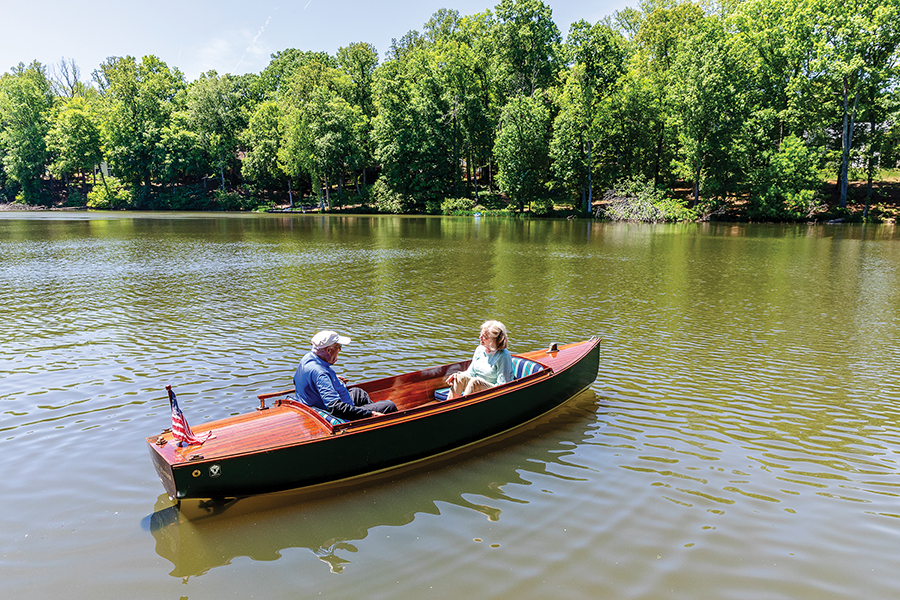
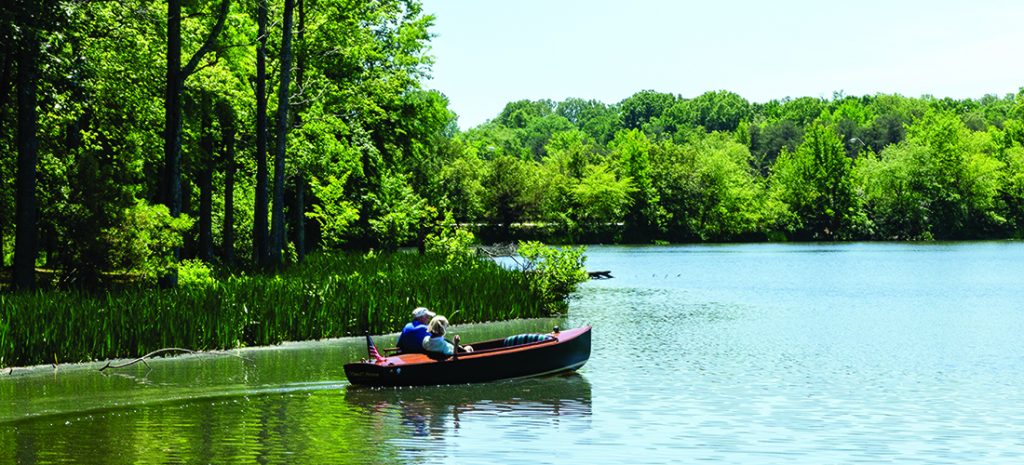
Three of us glide across Greensboro’s private Buffalo Lake in a modified version of the 1982 vintage Pelican skiff, aptly named Almost Heaven. 

Almost soundlessly.

Fowle grins. “That’s what you want.” 

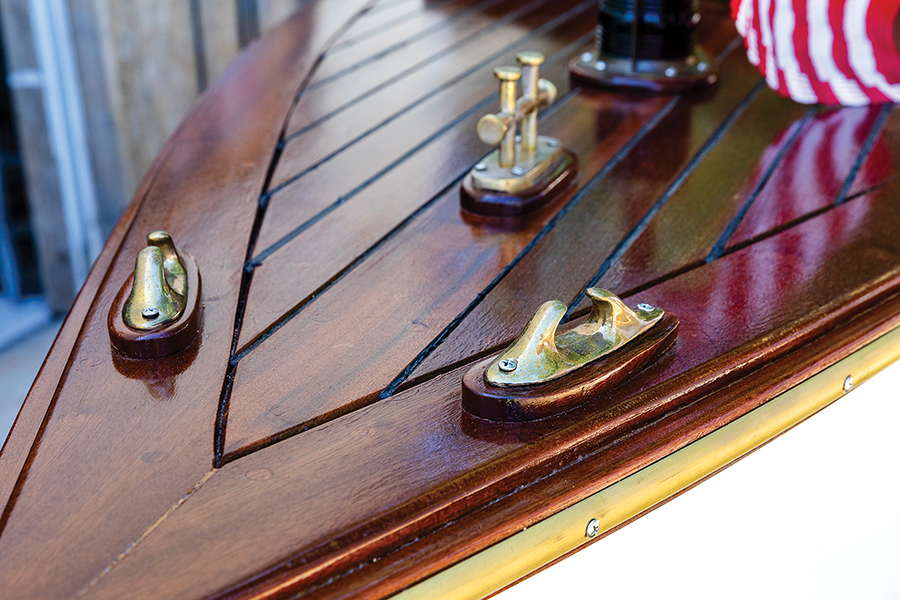
On a perfect spring day on the water, the most impressive aspect is what you do not hear. You do not hear the unmistakable roar of a standard-issue outboard motor. In fact, even with my hushed voice hoarse from allergies, conversation flows easily as Fowle describes retrofitting this small cedar-and-mahogany craft (outfitted with an electric motor) for owner Dana Smith.
If you think EVs on the roadways are remarkably silent, try an EV-powered watercraft. Practically noiseless — plus, it does not chew up gas, spew oil or foul the water. And the motor seems up to the task as three adults skirt around the lake’s edge, as pleased as children. 

Fowle assures us the boat is sufficiently powered to carry four, smoothly cruising at the allowed 5 miles per hour.

An egret is unruffled when we slip past the shoreline, not even a wake betraying us.

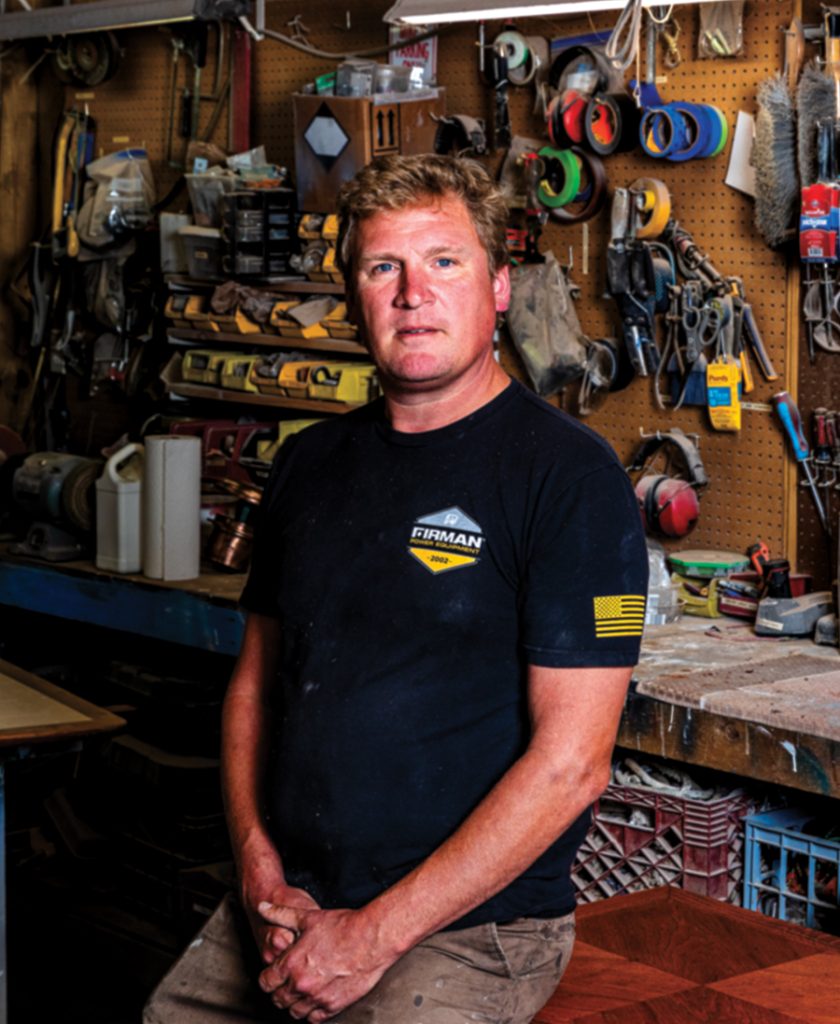
With the tousled blond hair and energetic brio of a younger man, Fowle is now 44. He is a man who loves water, but is more often wending Greensboro roadways for UPS, as he has for the last 25 years.

But his spare time is devoted to twin passions: cars and boats. His latest score is a 1958 red Corvette convertible.

While delivering packages on his route, he affably notices which customers are into cars. Occasionally, he will return on his days off to take the lucky ones out for a spin in a vintage car. 

Since his teenage years, Fowle has tinkered. He repairs, paints and undertakes car and boat restoration projects in his free time. Fowle learned much of what he knows from his father and the family’s wood-finishing business, which manufactured varnishes and finishes. 

In 2020, he began Fowle Garage. The garage bursts with projects — a new boat he is working on awaits completion, and various car projects wait in the queue.

On a recent Saturday afternoon, he estimates having a day’s worth of tasks ahead. “I have — let’s see — there’s one, two, three, four, five, six, seven projects here,” he counts as he walks through the garage and grounds.

Fowle and Smith became acquainted through previous boat restorations, he notes, “when I worked at a wooden boat shop.”

Smith contacted Fowle to help him find an electric Pelican. He already knew what he would do with it. 

“He had bought this new house, sight unseen, with the idea that he was going to get one of these little boats and put a dock in.”

The house Smith had bought unseen? It was exactly where he wanted to be, Fowle explains. It was on a cul-de-sac at Ascot Point, with the advantage of having Buffalo Lake at its back door. “It gave him water access.”

By coincidence, Fowle knew about such a boat for sale — the exact model Smith was searching for — and it happened to need work. He connected the owner with Smith, who then worked out the sale. 

The thoroughly modernized vintage boat was ready to glide in April 2025.

But homeowners on the lake did not own land on the lake perimeter.

Enter Jess Washburn, who did.

Washburn made headlines in 2017 when he became co-owner of two Greensboro private lakes, Buffalo Lake and Lake Jeanette. (His own party pontoon was featured just last month in O.Henry.) The former, smaller lake, only 69 acres, had disallowed lake access. But the much larger Lake Jeanette, at 270 acres, allowed restricted boating access via the homeowner’s private marina. Both lakes had buffer zones; neither had historically allowed docks. 

One workday, Fowle took his lunch break at home when his meal was suddenly interrupted.

“I get a knock on my door. It’s Dana and this other gentleman named Jess Washburn.”

Washburn, who also lives on Buffalo Lake, was working with various homeowner associations around the lake regarding access for residents.

Traditional motorboats and Ski-Doos were strictly disallowed. The Pelican, an electric boat, had Washburn’s attention. He had wanted to put electric boats into service on the lakes from the start, given strict speed limitations and other homeowner association restrictions.

The two men told Fowle, “We want more of these boats to go on this lake because they’re quiet.”

Electric-powered boats were a logical answer to the puzzle posed in 2017 by John Hammer, former editor of Rhino Times, concerning the fate of Buffalo Lake and Lake Jeanette after their sale by textile concern ITG.

“What do you do with a couple of lakes, particularly since the land around them has largely been developed?” he asked in his publication.

An adapted version of the Pelican proved to be Washburn’s solution.

Fowle says the new version far exceeds the original. “The idea came from Dana’s boat. I retrofitted his boat with a keel and steering system, and the electronics for the motor.”

He further modified Smith’s boat, adding a foot in length and 4 inches in width, changing the shape. Originally, he says with a laugh, it “looked a bit like a kayak.” He added stability by redesigning the keel, devising a pocket for the propeller drive unit and adding a tiller steering mechanism. “Everything was handmade to steer the rudder.”

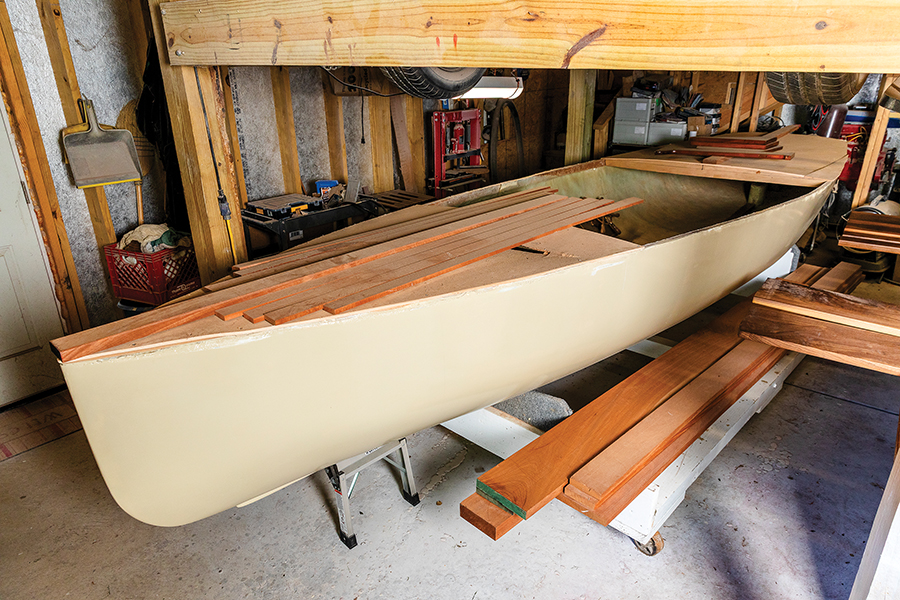
In the eight months since Almost Heaven was altered and put into service, Fowle and his team have created a fiberglass mold for a next-generation hull. They now have the capacity to reproduce a boat adapted from the 1982 original in a matter of days.

Once encased in wood and painted, the fiberglass boat appears to be a dead ringer for an original Pelican. It’s upscaled without sacrificing the good, traditional looks of a wooden boat now that Fowle has worked his magic. And fiberglass is not prone to leaks.

You would not know the difference visually, Fowle assures us. “This has all the appeal of a yacht in a super small package.”

Fowle’s passion doesn’t wane when it comes to refining restoration projects. At present, his grandfather’s 1931 Ford Model A pickup sits in his garage awaiting repairs. He says affectionately, “I basically got it running and learned to drive on it when I was 14 or 15.” 

Just for fun, he borrows his father’s 1930 Ford Model A De luxe Tudor, driving around town, honking the goose-like horn for appreciative motorists. The 1930s car earned its “deluxe” designation, with handsome detailing, tweed upholstery and upscale finishes, such as a custom-made wooden trunk on the rear. When he stops to dash into a grocery store for a Gatorade, admirers stroll over for a look and flash a thumbs up. Kept in mint condition and fully roadworthy, it recently made an appearance at a Gate City Rotary Club Great Gatsby-themed function.

Now, thanks to Fowle, Smith’s new-and-improved Pelican is proving relevant. 

And it appears to be a win-win for all parties, plus water and nature enthusiasts who are equally environmentally interested.

Invariably, bottles and trash end up in the bodies of water he owns. Washburn adopted a stretch of Elm Street near his lake, where he cleans litter.

Smith and his wife, Zell, keen nature lovers, are often found trolling Buffalo Lake, fishing out ugly debris to ferry away.

“They are creating a positive impact on the environment, carting away as much trash as they can manage,” says Fowle.

Almost Heaven, agile and maneuverable, makes cleanup fun for the citizen environmentalists. It weathers the winter just fine, says Fowle, allowing the Smiths to keep it docked behind their home. 

As residents and lake owners have worked through the approval process, more docks are reportedly pending on Buffalo Lake. Access remains carefully restricted to kayaking, paddleboats and quiet boats. Fowle anticipates a growing demand for more electric boats.

“Don’t you think that’s cool?” he asks, an enormous grin on his face. 

It’s Almost Heaven.  OH

Adventure Awaits

Adventures Await

Adventures Await

A globe-trotting couple creates a child-centric house of fun

By Cassie Bustamante

Photographs by Betsy Blake

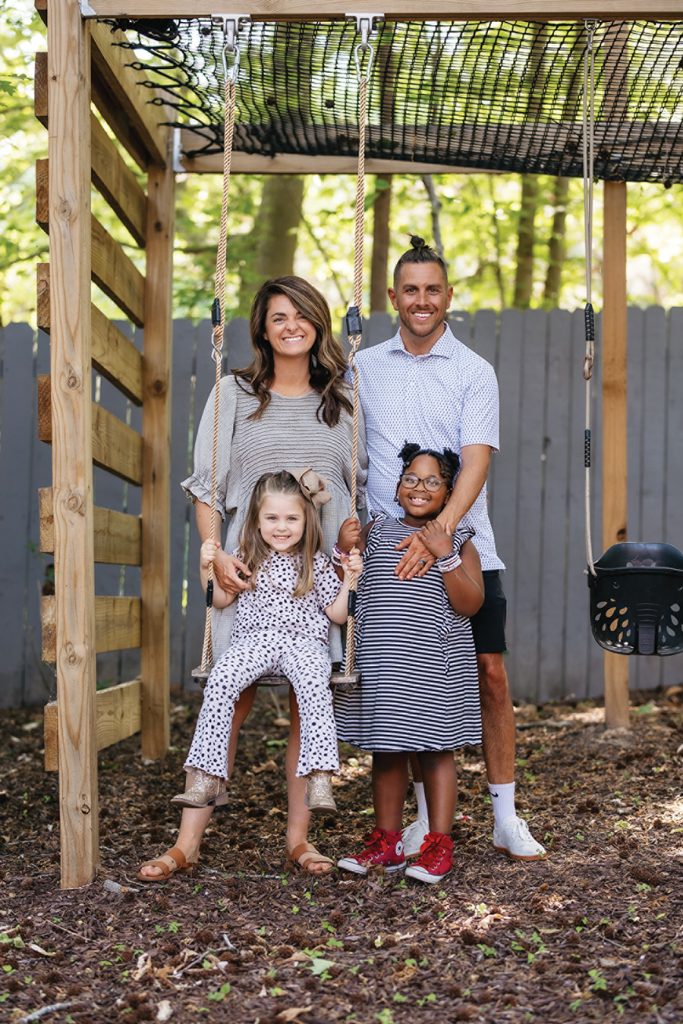
“Last week we got a phone call about a little girl,” says Ashlee Wagner, lounging on her plush living room sectional while her two daughters, 7-year-old Lowina and 4-year-old Lizzie, play nearby. Her husband, John, is busy helping Lowina find the Beyoncé song she’s looking for on her device.

Lizzie twirls in a Disney princess dress, lost in magical reverie, while Lowina’s ears perk up at her mother’s words. “Mom, are we getting a new sister?”

“Yes, baby,” answers Ashlee. Lowina cheers enthusiastically.

“You know how there are little girls who dream of getting married and getting pregnant?” Ashlee asks. “I was never that kid.” Her own father and his siblings were all adopted and she knew that, when it came time to start her own family, she wanted to adopt.

John, who owns his own State Farm Insurance Agency, jumps feet first and wholeheartedly into Ashlee’s plans. “I think I feed into her sometimes, and that’s probably why we’re so wild with everything going on in life,” he says. “But it’s fun.”

When the Wagners bought their traditional, brick house in 2017, they imagined filling the New Irving Park home with kids. “That was always the plan,” says Ashlee, who owns her own travel company, Just Another Wagner Adventure. Just as they kicked off their adoption journey, they got to work renovating — first, the first floor, followed by the pool and backyard, then the basement and, finally, upstairs. “We basically built this house to be our forever dream home,” muses Ashlee.

“I want to keep this house forever,” says Lowina, who officially became a Wagner just before she turned 3. With renovations underway in 2019, John and Ashlee initiated that first adoption, but what is already a lengthy process was stalled even more by the COVID pandemic. Finally, in January 2022, the couple headed to South Africa to bring home Lowina.

Of course, a few months before that trip, one that was to last about six months, life caught them by surprise. “I found out I was pregnant,” says Ashlee. When they finally returned to the States in the summer of 2022, they brought home both Lowina and her infant sister, Lizzie, who was also born in South Africa — a bond Ashlee is thrilled all three of her girls will share. And the place her soon-to-be-three girls will be lucky enough to grow up in together? Well, the Wagners are determined to turn it into an at-home adventure haven that would exceed any child’s wildest fantasies.

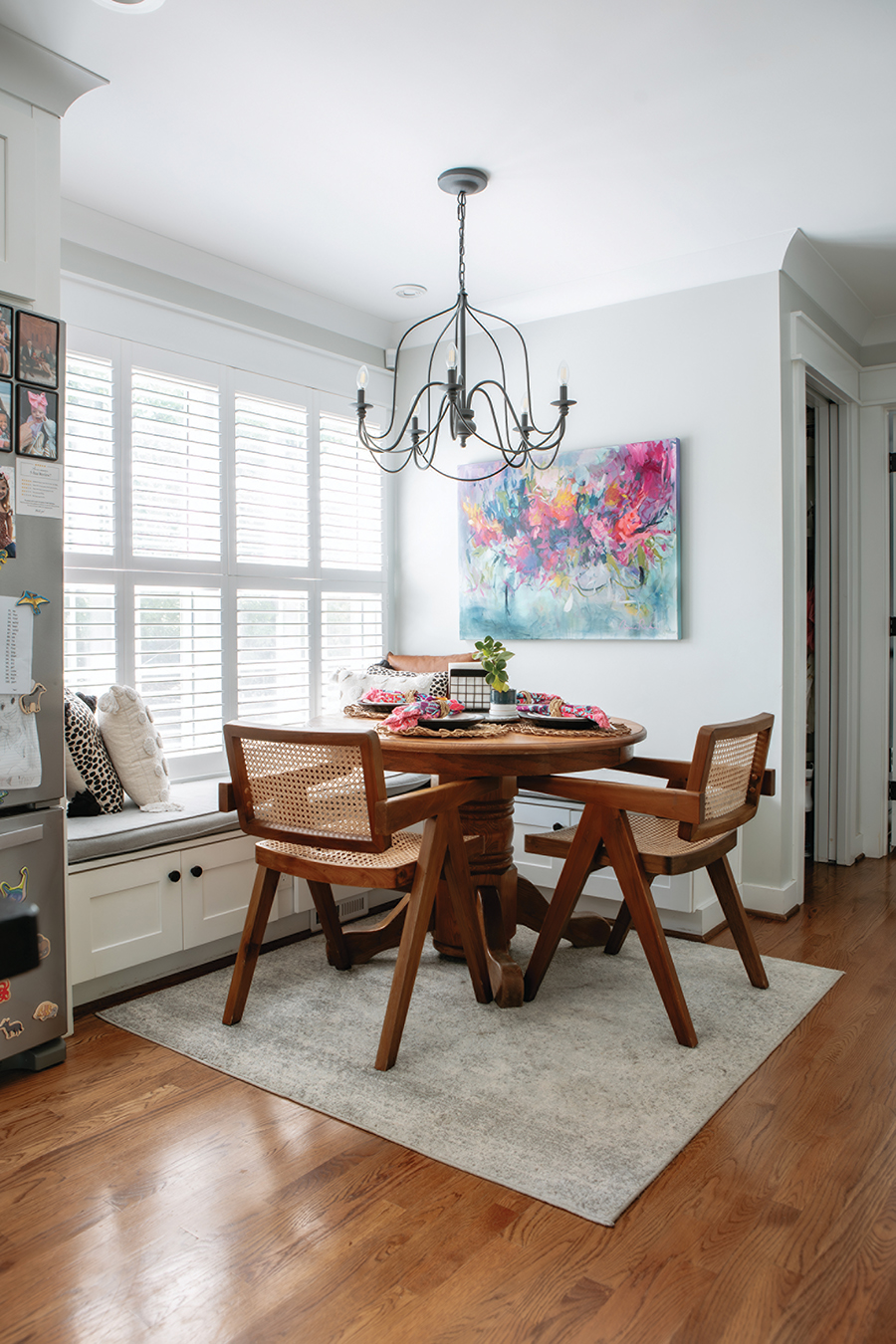
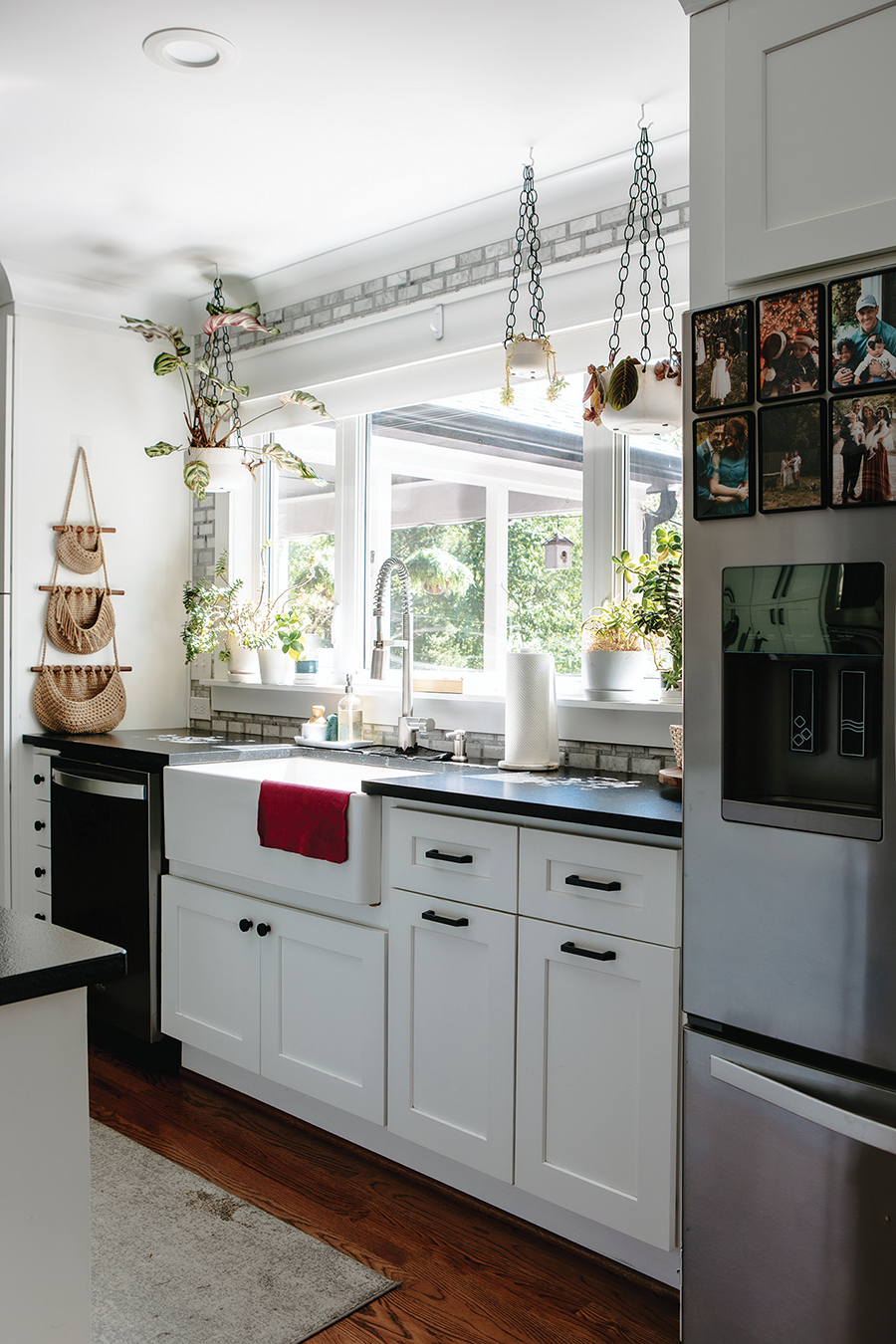
They started renovations with the living room and kitchen, which open to one another, adding white, shaker-style built-ins and revamping the fireplace with a simpler look that features a thick, rustic slab mantel. The small “U”-shaped kitchen was reconfigured to fit an island and banquette seating. “I always had that dream of, you know, you’re washing dishes and you look outside.” Over the banquette, a painting by artist Amira Rahim, aka “The Color Poet,” adds a vibrant splash to the otherwise neutral space.

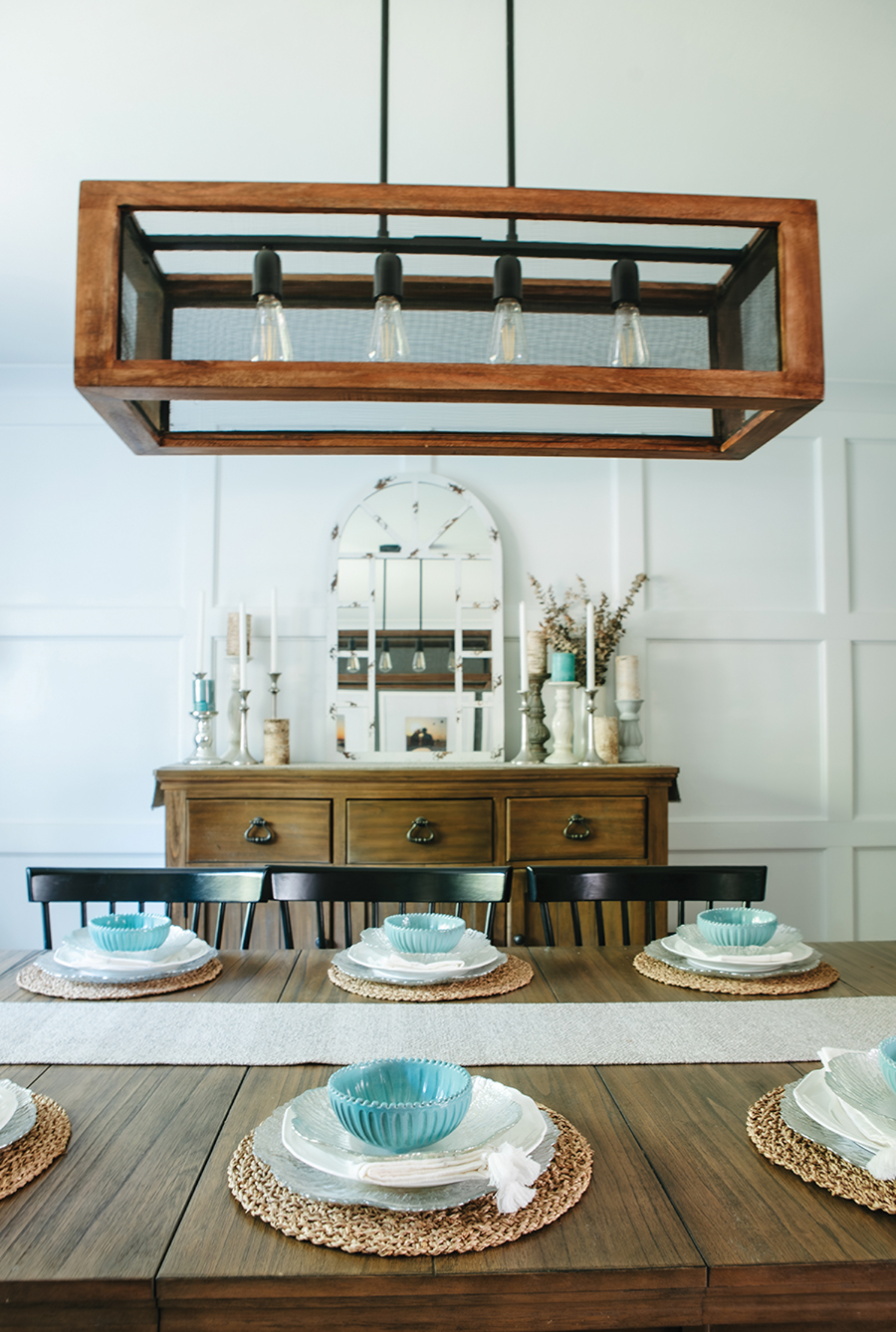
The walls on the main level are coated in various shades of gray and filled with accessories and art from their travels all over the world, a passion that slowly turned into an avocation. (More about that later.) In the dining room, a grid of eight square photos glows with the oranges and yellows of global sunsets from various destinations. One photo that Ashlee took using a tripod shows the silhouette of John and Ashlee caught in a kiss, the sun’s orb illuminated behind her while hot air balloons in the distance fleck the sky.

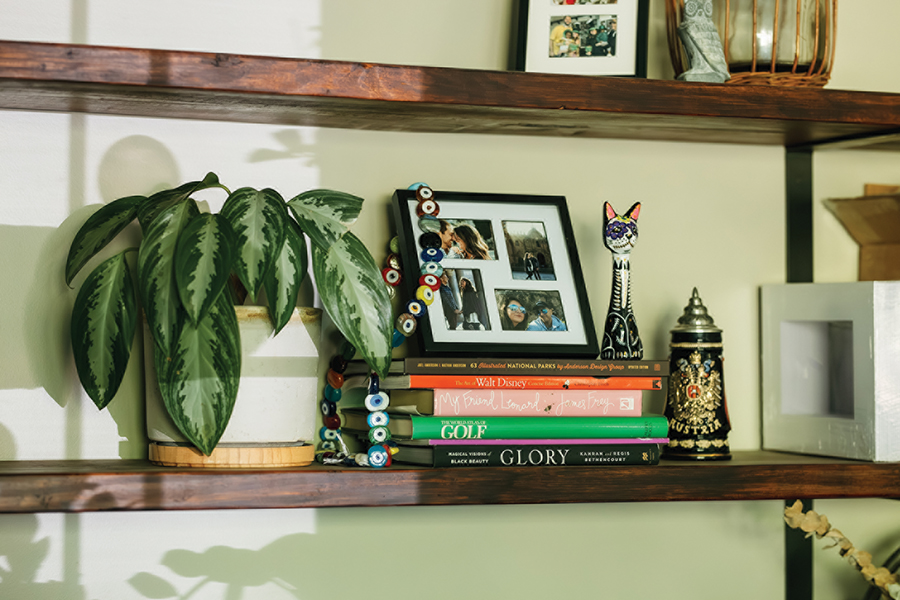
Nearby in the den, long, wooden shelves line an entire wall. Ashlee points to various tchotchkes and lists the countries they’re from: “This is Egypt or Jordan. That is Tanzania. Lolo, where did we get this?” She asks her oldest. “Was this Mexico or Honduras?” Their souvenirs include a Day-of-the-Dead-inspired cat, a beer stein, artisan-made glass elephant bookends, a strand of beads featuring evil eyes. “We have evil eyes kind of hidden everywhere to keep the bad spirits out.”

When it’s time to go upstairs, the girls race ahead, shouting, “My room’s cooler!”

“My room first!” says Lowina. What color is it? “You’ll see when you get there.”

“Oh, Lowina,” Ashlee says with a laugh. “Silly girl!”

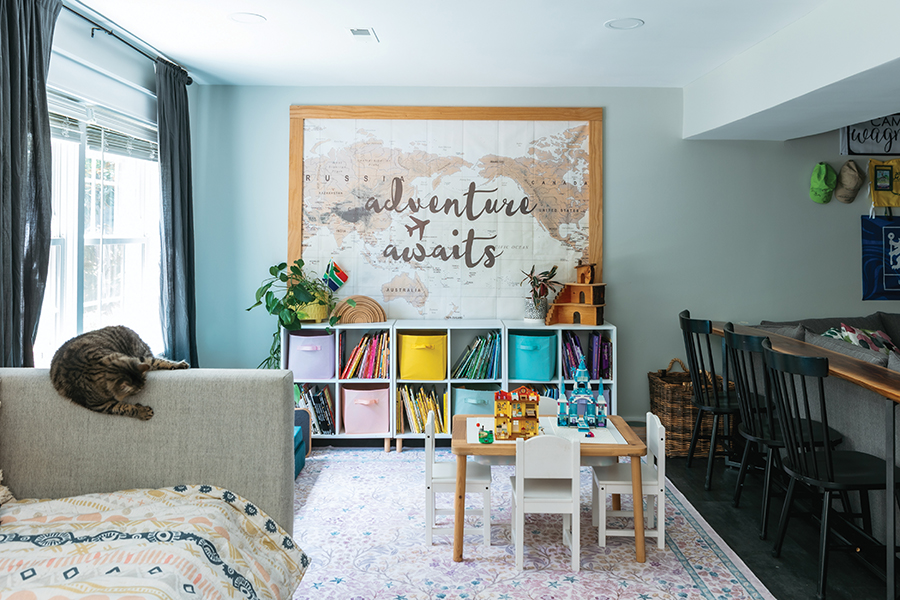
All of the bedrooms, including the primary, are painted in shades of blue or teal, with the girls each having pink accents. Lowina’s features a giant map of the world, a lace teepee, blush scalloped curtains, a muted-rose rug and a pair of twin beds adorned in — you guessed it — pink. Does Lizzie sometimes bunk with big sis? Nope, says Lowina, the other bed is where the family’s two cats sleep.

Though she’s younger, Lizzie’s bed is a queen. Her room, says Ashlee, used to have a tent bed and a “true safari theme.” But, as the family prepares for a longer stint of summer travel as well as another period in South Africa, she’s planning to rent the home short-term and is leaning into practicality. A large stuffed giraffe still stands in the corner and a circular, golden-yellow lion pillow rests on a hanging chair.

Just down the hall from their bedrooms, the girls share a bathroom and — wait for it — an indoor jungle gym. Ashlee and John have created a bunk room, where the twin-on-top and full-on-bottom beds have been built in. And, on another wall in that space, sits a large, wooden playset, complete with rings. “Come look at my trick,” cries Lizzie as she hangs upside down.

Lowina, not to be outdone by her little sister, performs a Little Mermaid-style hair swoosh move while Mom walks into her own bedroom, adjacent to the bunk room, which was originally part of the primary bedroom. Ashlee and John reconfigured the two rooms on that side of the house, creating the bunk room and adding a large walk-in closet with French sliders. On either side of their bed, Ashlee hung funky lanterns they found in Turkey and, on the front-facing wall, they added built-ins and a window seat. A hands-on couple, they did much of the work upstairs themselves and hired J&K Builders to do what they could not.

On the basement level of the home, where they continued working with J&K, yet another play gym keeps the girls busy. “Mommy, I’m going to slide!” Lizzie exclaims, landing in the middle of a ball pit as lightweight balls in aqua, red, lavender, pink and orange fly.

Nearby, a projector hangs from the ceiling, aimed at a blank, white wall standing in as a screen. “This is our movie area,” says Ashlee. Another comfy sofa provides the perfect space for a family snuggle sesh while they watch modern and classic Disney hits together. Lizzie opens a large trunk that serves as a coffee table. Inside, it’s filled to the brim with more princess dresses and costumes — time for an outfit change!

A kitchenette, bedroom and bathroom take up the rest of the basement space, plus a little bonus. “Yeah, I got a sauna,” says Ashlee. “I thought, why not?” Sometimes, Mom needs a quiet space to escape.

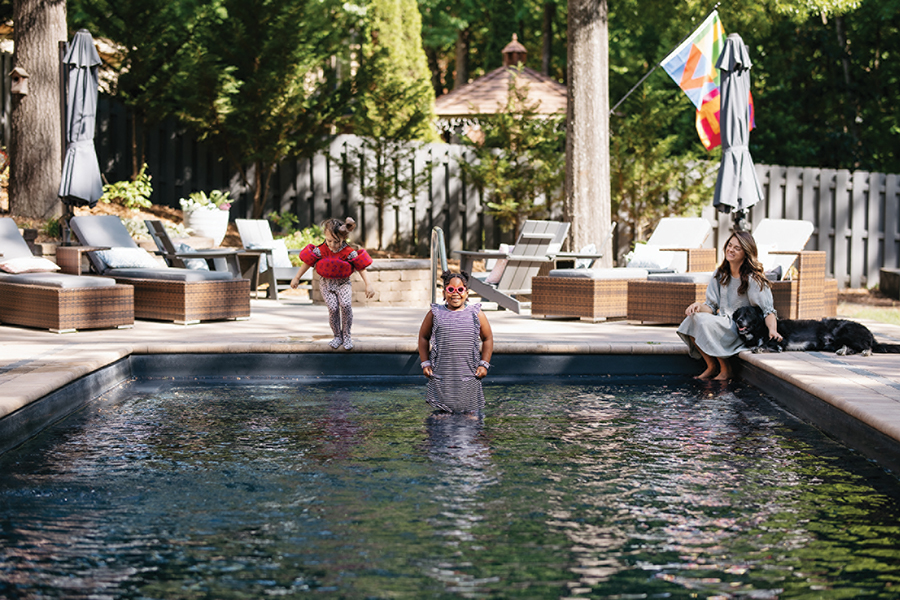
From the basement sliders, the girls are ready to run outside as dappled afternoon sunlight shadows the lawn. The backyard, just as she’d once dreamed, can be seen while Ashlee stands at her apron sink. There, she can watch the girls play in their treehouse, gaze at the peaceful surface of the pool or watch John and his sticks at work on the putting green.

Yes, a putting green. John’s a big golfer and, while he’s got his own bucket list of course destinations, he wanted to bring a bit of The Masters look to his own backyard. So, the couple dug in, adding an abundance of azaleas, mimicking the look of Augusta National Golf Course in Georgia. In fact, while they worked with Summit Landscaping Innovations alongside Guilford Pools on all hardscaping and the pool, John and Ashlee did all of the planting.

Tucked alongside the back fence, a modern-looking treehouse sits high, nestled among a few trees. Ashlee looked at some ideas on Pinterest and John ran with it, building his kiddos a dreamy, lofted playhouse. While a ladder will get you up, a tunneled slide is definitely the way down. A jungle gym extends to the treehouse’s left and, nearby, a disc swing gets plenty of use. “Mama, go fast!” shouts Lizzie as her mom pushes her.

“They like to go really high,” says Ashlee. After all, the sky is the limit. “I want to raise my kids to where they can go blow the world open if they want to.”  OH

Go Your Own Way

John and Ashlee Wagner met in the fall of 2008 as freshman at UNCG. “In Business 101 class, funny enough,” says Ashlee. John sat right behind her. Soon after meeting, the two began dating. But, midway through the first year, John decided to “retire from school” and returned home to Wilmington.

“John’s been a rebel his whole life,” quips Ashlee. “He likes to defy what the norm is.”

A year and a half later, Ashlee visited friends in Wilmington. “And somehow John pops back up and we’re dating the next week.”

In 2014, after Ashlee earned her bachelor’s degree in business administration, the Wagners tied the knot in Ocean Isle, honeymooned in Cancun and then, months later, took a bigger, second honeymoon in Ireland. That same year, Ashlee accepted a new role at an executive search company. Finally, John says, “Finances felt stable,” and the honeymooners found themselves bitten by the travel bug, booking two big trips a year.

“Each trip was three or four countries,” says John.

“And what’s crazy is,” says Ashlee, “I think we’ve only been to 40 countries.” OK, that’s a lot, she acknowledges with a laugh.

But, notes John, referencing a world map that graces their wall, a pin in each place they’ve visited, “There are still so many places we haven’t even touched.”

In 2022, once she was back at home with her daughters, Ashlee began contemplating what she wanted out of life. Now as a VP, she was working some 80 hours a week. Plus, she notes, being a woman in leadership in the South comes with its own set of challenges. She asked herself, “If my kids were in this environment, what advice would I give them?” The answer was clear: “My advice would be to quit and go do something you love.”

Friends and family had been telling her all along that she should think about pursuing a career in travel, but a voice in her head kept talking her out of it.

But now, with four —soon to be six — little female eyes on her, she says, “I decided I was just as worthy of that advice.”

Today, she runs her own company, works with John a bit and even manages some properties they have acquired over the years as well as some for local, woman-owned Nomad Vacation Rentals. With a flexible schedule, the family jet-sets all over the world and roadtrips all over the U.S. Plus, she’s got the freedom to now be the mom who goes on field trips or helps out in class. “I can do whatever I want,” she says, “and that has been very fulfilling.”

“That’s why I have my own business,” notes John, who says their Greensboro home is his eventual retirement plan — meaning, he’ll sell it in 20 years or so and travel the world, perhaps buy a new property, maybe in another country. Though Ashlee says they created it to be their forever home, her wheels are always turning, too. “My dream would be running a safari.”

“Tomorrow’s not promised,” he says. “You can always earn money tomorrow. Make the experiences right now.” Plus, he says, they were lucky enough as a young couple to purchase “all the toys I ever wanted,” silly things like drones that end up in a closet somewhere. “I’d much rather book the plane ticket.”

Last summer, the family of four, plus their two large dogs — their cats stayed behind — traveled much of the United States in a 20-foot camper. “Wild,” says Ashlee. Once again, this summer, they’re hitting the road for one more long-term adventure as a family of four. And soon, they’ll be headed back South Africa, returning to the States as a family of five.

Queen of the Flowers

xx

Queen of the Flowers

For this gardener from Kazakhstan, roses reign supreme

By Ross Howell Jr.

Photographs by Lynn Donovan

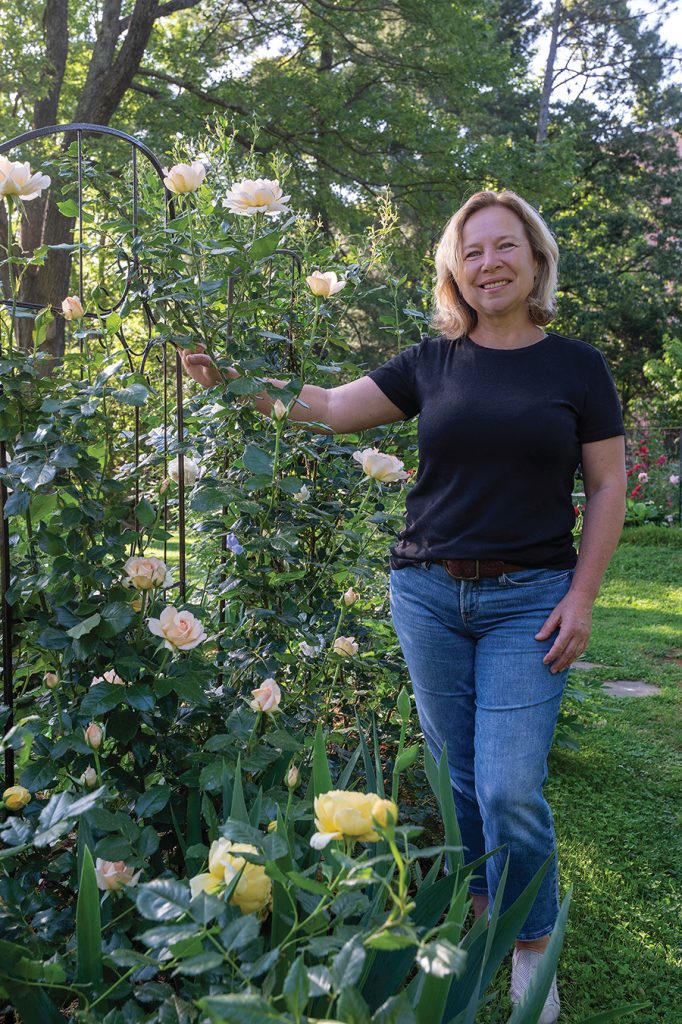
Before Yelena Belyayeva and her husband, Randall Bean, moved to Greensboro from Trinity, she tended lilies in her garden.

But roses were always on her mind.

“I grew a lot of lilies — they were so easy!” she says with a laugh. “At that time, I would think, ‘Oh, the rose, queen of the flowers, she is too much effort.’”

“But, in gardening, I want people not to be afraid,” she continues, “because roses are not as hard as people think.”

Yelena grew up in Temirtau, a city on the steppe of central Kazakhstan — still part of the Soviet Union until she was a young woman.

“My father was Russian and my mother was Ukrainian,” Yelena says. Though they lived in an apartment, her mom “was very, very passionate about gardening.”

Outside the city, they had what is called a “summer house.”

Along with a vegetable garden and fruit trees, she remembers her mother growing irises, daisies, peonies, lilies, lilacs and snowbush. But the plains of Kazakhstan were harsh.

“My mom had a few roses, but we had to cover them,” Yelena says, noting that they didn’t fare well in the cold or snow.

“To tell you the truth, I didn’t like the garden work as a kid,” she confesses, smiling, “but I enjoyed the beauty, not just of the flowers, but of everything in nature.”

After high school, she attended Moscow State Forest University, where she dreamed of becoming a forest ranger.

“I wanted to be among the animals and woods,” Yelena says.

Since no forestry positions were available when she graduated, she returned to her hometown to take a job with the Temirtau Winter Garden, a public botanical garden conservatory of tropical and subtropical plants in a very cold place.

“Most of the work was indoors, but it appealed to my passion,” Yelena says.

Eventually, a close friend in Kazakhstan who had met and married an American, suggested that she knew someone who would be a perfect match for Yelena — her husband’s best friend, Randall.

But communication between the two was a challenge.

“I studied English when I was in school but I was not so good,” she explains. “My teacher said, ‘Yelena, you will never learn English.’” She smiles and shakes her head.

“But Randall bought one of these portable electronic translators and that is how we corresponded at first,” Yelena continues.

Following a two-year courtship, the couple married in Kazakhstan and moved stateside to Trinity in 2006 with Yelena’s 10-year-old son. (He went on to attend N.C. State and lives in Raleigh now.)

When Randall’s father, who had been living in the same Greensboro house since 1955, decided to move into assisted living, Yelena and Randall relocated to his old residence.

The house sits on a lot that’s nearly an acre in size. Randall’s father grew vegetables for years after his wife passed away, though he had neglected the vestiges of her flower garden.

“Mama Sarah had azaleas, camellias and big boxwoods,” Yelena says.

She also found remnants of candytuft and a row of peonies that she estimates are around 40 years old. And, while Randall remembers his mother growing roses, none of them were still living when Yelena began tending the garden.

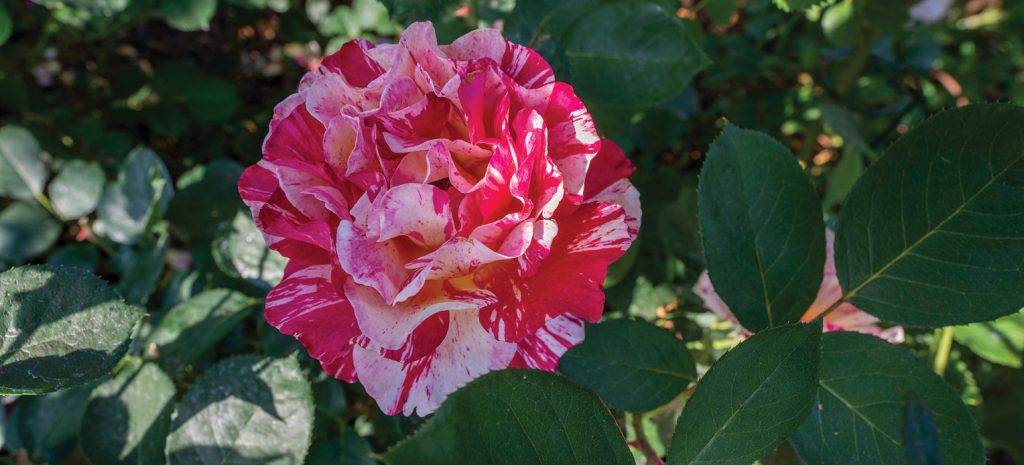
“So all 200 of the roses are mine!” she quips. “I have been collecting them for more than 10 years.”

Starting with the original flower beds, Yelena kept “extending, extending, extending” — and digging holes to plant her roses. The work was difficult because of the heavy clay soil and the big roots of old trees.

“Randall even bought an augur, but that did not work so well,” she says.

And for several years, she was working full time.

Now that she is retired and the garden is established, Yelena finds that she still spends at least six hours a day in the garden for 11 months of the year.

“With our seasons, there is no break for gardeners,” Yelena explains. “We just finished raking leaves from these huge oak trees in January and in February. I’m already planting my first roses again.”

She smiles.

“But I love it,” she muses.

Yelena prefers planting roses with bare roots. And while she put in her newest roses this February, she believes the best time planting time for Greensboro is the first week of March.

“You can find all kinds of information about when and how to do it,” she says.

A source Yelena especially recommends is Witherspoon Rose Culture in Durham (www.witherspoonrose.com).

“I have several roses from them,” she says. “They give you everything you need.”

For the first year after planting, Yelena concentrates on keeping the new rose well watered. Depending upon the type of rose, she may use a systemic treatment to help prevent disease.

The greatest potential cause of disease in our area?

“It’s the humidity,” Yelena responds.

To promote blooming, she will fertilize her roses two or three times during the growing season, though she doesn’t like putting fertilizer in the ground. She prefers fertilizers she can spray onto the foliage.

“It’s easier for me and the plants absorb it faster,” Yelena explains.

To counter Japanese beetles, destructive pests that usually appear in June to feast on rosebuds and flowers, she has discovered a commonsense solution.

“This is what I learned from an Instagram friend in Japan,” Yelena says. (The friend grows 1,500 varieties of roses in her garden!)

After the first wave of blossoms in May, Yelena pinches back the new buds as they appear for at least two weeks and closer to a full month.

“Every morning, I go out watering and I pinch the buds,” Yelena continues. “If you have five bushes, it’s not a big deal, but for me? Well, it’s a lot!”

So, when the Japanese beetles appear, their salad bar is closed, as it were. They move on for the most part, leaving Yelena with healthier roses. The downside is that a wave of blooms is lost, but she assures me she can still count on two or three more waves in a typical season.

I ask Yelena about which types — tea rose, grandiflora, floribunda, climbers, ramblers — seem to be best suited to her garden.

“You know, it’s more about, who is the father of the roses?” she replies. “Oh, what is the word?”

Yelena consults her phone to translate.

“The breeder!” she says, nodding happily. “Kordes in Germany is my favorite. They breed very healthy roses.”

As we walk about, Yelena shows me the abundance of plants in her garden.

“I have 80 peonies,” she says proudly.

I spot tulips, hydrangeas, creeping phlox, cone flowers, azaleas, hostas, zinnias, columbines and ferns. She shows me a robust vegetable garden along with cherry trees, crabapple trees and pawpaws.

“I don’t plant peaches anymore,” Yelena says. “We have so many squirrels, I just gave up.”

And, as you’d expect, there are roses everywhere, many cascading over trellises that Randall installed for her.

“This is a rambler called Peggy Martin,” Yelena says, pointing out an enormous rose bush. “She is absolutely gorgeous when she’s blooming.” The thornless rose variety is named after an avid gardener in Louisiana whose property stood under seawater for two weeks after Hurricane Katrina. The rambler was one of the few plants in her garden that lived.

“I guess because she is a survivor, she can grow crazy big!” Yelena says, laughing.

She points out two more roses that cascade from a trellis.

“This one is a climbing rose called White Lady Banks and you see next to her the yellow, also a climber.” I comment on the clusters of smaller flowers.

“Yes, the flowers are smaller than Peggy Martin,” she replies. “But the big difference between the ramblers and the climbers is that the climbers keep blooming all through the summer — the ramblers only bloom one time a season.”

But that one time? “It is spectacular!” Yelena adds.

She shows me how she prunes the ends of the roses to increase the cascading effect as they grow.

“There is a woman on Instagram from Italy,” Yelena continues. “She plants her climbers and ramblers close to her trees so they grow all the way over them!”

When I ask her if she has irrigation for the plants, she answers that it wouldn’t be economical to use city water, since she has so many roses and the beds are so spread out. Recently, she added three barrels to collect rainwater. She also carefully mulches her roses with pine bark nuggets to help them hold moisture. If the summer is very dry, she waters her roses by hand.

“But roses are hardy,” Yelena says. “You must choose the right variety from the right breeder, but once they are established, roses are very strong!”

“The beauty, the joy to see them and smell their flowers,” she muses. “Every year, I plant more and I think, ‘OK, it’s enough.’ But it’s never enough!”

Once again, Yelena smiles, surveying her garden.  OH

Ross Howell Jr. is a contributing writer.

You can follow Yelena Belyayeva on Facebook and on Instagram @belyayevayelena.

Chaos Theory

Chaos Theory

The Stuff of  Dreams

Walking, talking and laughing in our sleep

By Cassie Bustamante

Illustration by Miranda Glyder

From a very young age, I’ve been a very heavy sleeper. My mom has gleefully recounted tales of my sleepwalking as a small child through our little raised ranch, making it back to the safety of my bed, thanks to her guidance. In college once, a friend called me just before midnight and we had a long and soulful chat. At least, according to her. The next day when she recalled our conversation, I had no idea what she was talking about. Apparently, I’d just picked up the receiver in my sleep and gabbed coherently enough to pass for awake. (I’m not sure what that says about my real-life conversational skills.)

And so, many years later when my husband, Chris, and I had kids, they were quickly trained to go to Dad with their middle-of-the-night wake-ups. Mom? Out cold, oblivious. But Dad? He’s sure to hear their pleas. Otherwise, our poor kiddos would be battling nightmares on their own.

In my deep state of sleep, I often have wild, vivid dreams, which I sometimes recount in detail to Chris in the morning. “But what do you think this one means?” I’ll ask.

His response? Typically, a shake of the head, an amused smirk, followed by ”I don’t pretend to know what goes on in that head of yours.” And, unlike me, he doesn’t give his dreams — or mine, for that matter — a second thought.

As a light sleeper, he doesn’t tend to have the intense dreams that I do. I’m no sleep scientist, so that could be a theory of my own making, but it works for me. At any rate, one morning, I found out that he, too, is actually capable of memorable dreams.

It’s 4 a.m. and I’m suddenly wide awake, a solid hour before my alarm is due to go off, something that happens often in my middle agedness. I slip off the satin eye mask I wear to prevent wrinkles from worsening and stare into the darkness, considering all of my productive options — writing, brainstorming, meditating — and instead reach for my phone. Mindlessly scrolling, I squint at its tiny screen. So much for anything that satin mask may have done for my skin.

A few moments later, a giggle, followed by a contented sigh, escapes Chris’ lips. I know this laugh well and it’s one he delivers with love — for me. But, it’s the middle of the night and my anxious, exhausted brain races with “what if” scenarios. Is he dreaming about me? And, If not, then WHO? Mind you, Chris is totally trustworthy. There is no rational reason for me to doubt him. But who ever said I was rational, especially at 4 a.m.? As far as I’m concerned, he’s guilty until proven innocent.

After sulking for a while, I lace up and put my anxious energy to use outside on the pavement with my dog. The dark stillness of the morning always helps to quiet my thoughts.

Back inside and a little less on the verge of lashing out at Chris for what his dream self may have done, I pour myself a mug of steaming black coffee while contemplating my next move. I keep my back to him as he works on his laptop at our dining table, blissfully unaware that I’m stewing over something he probably didn’t even do in his waking life.

“You know, I woke up at 4 a.m. and could not fall back asleep,” I say as calmly as I can. “Meanwhile, you were over there giggling like a schoolgirl in your sleep.”

I turn to face him, a challenge in my eyes.

He looks up from his computer and smiles at me. “Ah, yes. I was dreaming we were on a dinner date at Machete.”

My tight-lipped expression breaks into a giddy grin and I let out a laugh as every trace of doubt vanishes into thin air. It’s me! I am the girl of his dreams!

“We were having a good time,” he says.

“And I must have said something hilarious,” I retort.

He rolls his eyes because I’m well known around our house full of young adults — and a second-grader— for entertaining myself and no one else.

After a beat, he lets out that laugh, quietly, almost to himself — a soft echo of the one I heard just hours ago.  OH

Cassie Bustamante is editor of O.Henry magazine.

Poem June 2026

Poem June 2026

A Swift Thought

A car engine rattling.

A busted radio preaching the end 

of the world. That soft, hazy sun racing 

behind the horizon, peaking only for the 

thought of crashing. The Earth’s breath, 

hot and fast, blowing the trickled sweat 

from my hairline to my forehead. A swished 

whiskey hits the adrenaline, causing 

a swerve left, then right. The radio speaks, 

Blazing temperatures bring hysteria!” I turn it 

off without a care in the world and without a 

second to spare.

— Joi Floyd

Joi Floyd is the assistant editor of O.Henry magazine. Should you wish to contact her, just look for a woman writing under a tree — or email her at joi@ohenrymag.com.

Alamanc June 2026

Alamanc June 2026​

Alamanc June 2026

June is a blueberry banquet, a living shrine, a procession of sun-loving pilgrims.

Here they come, with their sun hats and baskets. Wonderstruck and reverent; wide-eyed and ravenous.

There’s no wrong way to worship.

Aging fingers work methodically, rolling over ripe berries as if they were prayer beads on an endless mala. Mothers guide tiny hands from fruits of red to deepest blue. Kitchen mystics pluck to the mantra of blueberry ice cream, blueberry cobbler, blueberries all summer through.

Life buzzes in all directions.

Cat stalks field crickets. Puppy chases swallowtails. Children sneak plump berries from brimming buckets by the handful.

The seekers come and go, each with their simple offerings: bliss, open palms, purple-stained prayers.

At blueberry church, Mmmmmmm is a sacred hymn. A pop of sweetness spells amen.

As balmy morning melts into sun-drenched afternoon, the hum of bees could bring one to their dirt-smudged knees.

Thank you, a berry pilgrim sings, praising the miracle of all creation.

Between the spike of mosquitos and the early fireflies, the birds blurt Glory! Glory!, same as they did at sunrise.

And so it goes, summer day after summer day. Baskets runneth over. Bellies fill with sweetness. All who seek shall find magic at the blueberry jubilee.

And what is so rare as a day in June? Then, if ever, come perfect days.   — James Russell Lowell 

All Warmed Up

It’s not too late to sow some garden magic. Cucumbers, squash, pumpkins and melons. Beets, carrots, chard and scallions. Beans, basil, marigolds and sunflowers. The soil is warm and ready. Plant the seeds. Woo the pollinators. Behold miracles.  OH

Midsummer Nights

Watercolor Strawberry MoonWhat could be dreamier than a day in June? A midsummer night.

The field crickets crackle like warm vinyl. Moonflower and night-blooming jasmine perfume the balmy air. Drink it in. And don’t forget to look up.

According to NASA, the Venus and Jupiter conjunction on June 8 and 9 is one of the most notable astronomical events of the year. Look low in the western sky a half-hour after sunset to see these two luminous planets seemingly close enough to touch, no telescope required.

The strawberry moon — first full moon of summer — will rise on June 29, one week after the solstice (June 21). The Old Farmer’s Almanac notes that Native American Algonquian tribes, and the Ojibwe, Dakota and Lakota peoples, marked this month’s moon by the “ripening of June-bearing strawberries” across the fertile land. Other names for this month’s moon include the berries ripen moon (Haida), the hatching moon (Cree), the honey moon and the mead moon. One could also call it dreamy.

O.Henry Ending

O.Henry Ending

Uncle Dan’s Quarter

A man who changed the way I saw the world

By Cynthia Adams

Illustration by Harry Blair

My dad bought a 75-acre farm near Reed Gold Mine in Cabarrus County, site of the first documented commercial gold found in 1799, way before the California 49ers struck gold out West. The story goes that Conrad Reed, son of a farmer, discovered a glittery, 17-pound rock in Little Meadow Creek that proved a useful doorstop. Three years later a jeweler in Fayetteville recognized the Reed doorstop was actually a hunk of solid gold. 

Conrad’s father, John, eventually developed a bona fide mining operation, encouraged by the discovery of a 28-pound nugget a few years after the doorstop find. Other mines in neighboring counties opened and flourished, including one with a thriving town dubbed Gold Hill.

Gold Hill eventually produced sufficient gold to result in the establishment of the Charlotte Mint. Charlotte city fathers fretted, wishing the Queen City would thrive like Gold Hill seemed to be doing. It is more than a little ironic that Charlotte’s present-day fortunes were built upon cold, hard cash.

Mining in the state continued until the Civil War claimed able-bodied men, and underground mining ceased altogether at Reed Mine in 1912. Most North Carolina mines were shuttered, even after Cornish miners immigrated there seeking their fortunes once tin mining was exhausted in Cornwall.

Another doorstop never surfaced. But the hope never died. There were rumors, always, of small nuggets found in the Rocky River, which threaded through Cabarrus County past our family farm. 

Frequently, my dad would muse that our horses and livestock were probably making their deposits on top of veins of gold.

As kids, we would climb down the weedy banks into the swift river current, risking snapping turtles and water moccasins to pretend we were panning for gold.

We even knew a prospector, Uncle Dan, who lived in a dirt-floored shack on a dirt road, which lacked electricity or running water well into the 1960s. He was a hermit, a raggedy-looking man, and a source of fascination to all the children in our small community.

Uncle Dan spent most of his days panning in the river, hoping to find a nugget. Unbeknownst to our parents, we would knock at his rickety door and visit. I was too young to attend school, and, in that time, we were allowed to play and roam freely with the understanding we were to be home for meals and bath time. If he was home, we would delightedly crowd into his dark shack, with the only light shining through the boards and the open door as the primary illumination.

Uncle Dan, painfully shy and pitifully poor, was gentle and always kind to us. He was our friend. Sometimes he would show us minute bits of gold and we would gawk.

We children wished him luck and hoped he would have a windfall.

Once, as I played outside busily outlining a playhouse in the dirt with sticks, Uncle Dan passed by the chain link fence separating our farm from the neighbors. “Morning,” I called to him. He stopped. 

“Morning, Miss Cindy,” he answered.

This exchange felt very grown-up, having an adult friend. I grinned a toothy grin — the Tooth Fairy had recently visited — showing the gap in my teeth.

His sun-battered face, wrinkled and dry, spread into a smile. Uncle Dan reached into his pocket and offered something. I stepped closer. He pushed a quarter to me through the fence.

I thanked him and pocketed the prize. Now I had two quarters — one from the Tooth Fairy and one from Uncle Dan!

Were there any coins left for him to feed himself? Even we kids noticed the cans in his shack of pork-and-beans and Vienna sausages.

Quarters still remind me of this moment. A man who had nothing to give freely offered something that was most likely needed and precious to him. 

And that act opened something in me that has never closed. OH