O.Henry Ending

O.HENRY ENDING

Bad, Bad Baby

He’s the one to blame

By Cynthia Adams

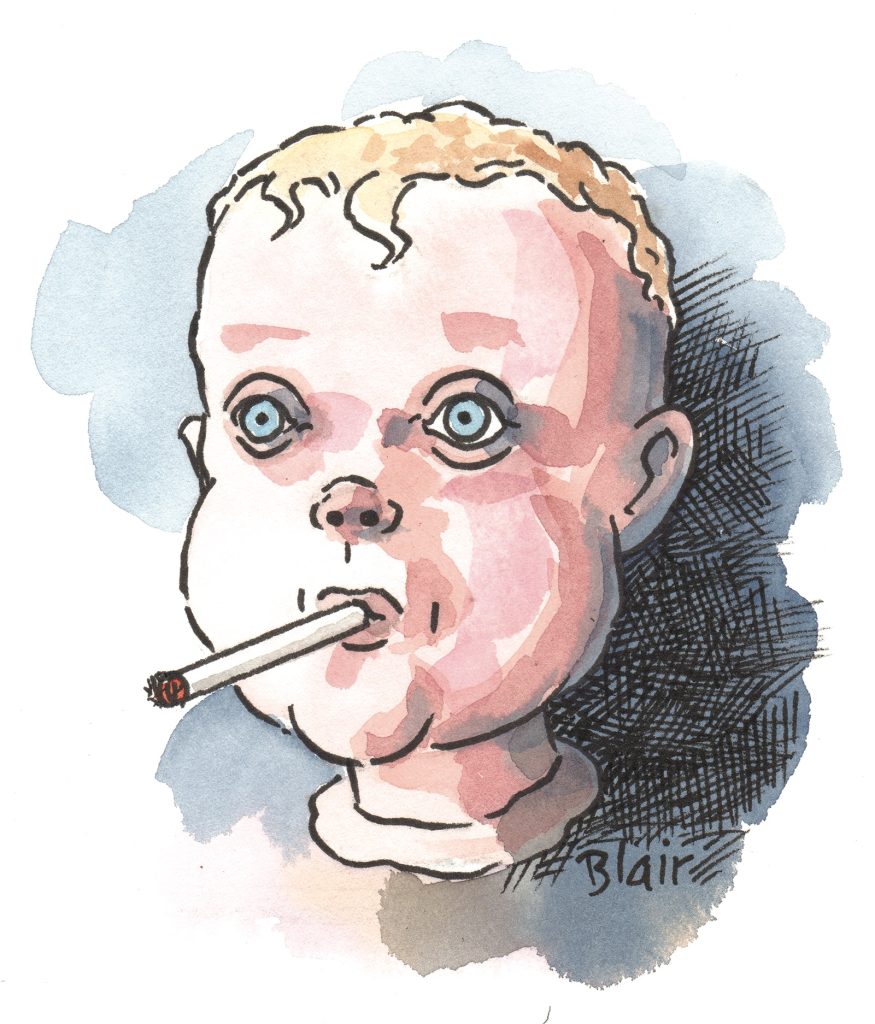
Some years ago, I bought a blue-eyed, Gerber-perfect baby boy. With molded blonde curls, an upturned nose, and wide eyes, his expression features bow-like lips, opened slightly, frozen in permanent surprise.  

My baby is a cherubic-looking bust. Picture a 1950s-era doll head. He presides over my work life.

It soon struck me that those rosebud lips were parted just enough for a cigarette.

Which, I discovered, they handily accommodated. 

The ciggie, a fake one I’ve used in a cigarette holder when I dressed as a flapper for a Halloween party, appears lighted. This took Gerber baby to another dimension. Unexpected. Unsettling.

There and then he became Bad Baby, official muse. Bad Baby, office mascot.  

Bad Baby has presided over many false starts and rewrites. He sits right above my computer, where Bad Baby never fails to make me smile when I need it. An artist friend, Dana, was particularly delighted when she popped into my office and spotted Bad Baby, who is parked beside a primitive painted folk-art bus with “Guanajuato” scrawled on it. 

The most compelling thing about the bus is the various clay figures of passengers. It’s difficult to say exactly what the crudely formed figures are doing, their arms raised in a gesture of helplessness, but it is appears they are trying to bail out. One figure stands on top of the hood and two on the roof, with others at the rear, appearing ready to leap into the unknown. I like the irony.  

Who hasn’t felt like bailing? Who hasn’t had feet of clay? I identified with the hapless figures wanting to exit.

Dana has no shortage of creative projects. So, when I confessed to having a creative dry spell, she laughed.

“Blame it on Bad Baby,” she drawled. Problem solved!

Bad Baby as scapegoat.  

Bad Baby is responsible for many things in my daily life. Typos. Missing the postal carrier when something needs to go out. Buying a greeting card and bungling the address.

Hangnails. Hangovers.   

When my iPhone texts were hacked (something that Apple aficionados suggest cannot happen), it didn’t occur to me to blame Bad Baby for the psycho-gibberish, disturbing rant, given he has no texting fingers.  

The recipient, a good friend, believed I had actually sent them. He asked his colleague to find out what had so provoked me. 

No, I assured her, I had sent no such messages. Yet there they were, on my phone.  

Also embarrassing? Misspellings, poor grammatical construction, and lack of sense. Worse, too, that a friend would think that a writer sent something so garbled. 

With red hot cheeks, I erased the texts (wouldn’t that make sense?), urged my friend to do the same, and dialed Apple support, immediately learning they needed the texts to trace the source.   

Calls are spoofed. Seems texts are as well.

So, a few months later, I flinched when Dana reacted to a jokey text, responding that I was a filthy animal.  

Was this real? Or had she also been hacked? Or had I been hacked again?

Shaken, I phoned her. She snorted, saying her text was merely a joke, a riff borrowed from the flick, Home Alone. Explaining how unnerved I’d been since the texting spoof, she snorted again.

“Blame it on Bad Baby,” my friend suggested again and laughed.

Just in case you’re wondering, Bad Baby is my invention. The OG. Turns out there is a 20-year-old rapper, Danielle Peskowitz Bregoli, who assumed the name Bhad Bhabie. I firmly believe my Bad Baby predates her Bhad Bhabie.  

And I like old-school spellings far better. No phat bhabie nor brat bhabie for me. Just plain old, conventional, ciggie-puffing Bad Baby.

“You can be too old for a lot of things, but you’re never too old to be afraid,” seems apropos, another line borrowed from Home Alone. Some are frightened by dolls — an actual phobia called pediophobia. 

An inexplicable text that appears to be from me but isn’t? That scares me.

And so, now I sit, scowling with narrowed eyes at Bad Baby, afraid to wonder just what havoc he might wreak next. But — if you should get a text rant from Bad Baby, please ignore it.

Almanac October 2025

ALMANAC

Almanac October

By Ashley Walshe

October is an ancient oak, quiet and delighted.

“Come, sit with me,” he whispers gleefully. “We’re nearly to the best part.”

The air is ripe with mischief and mystery. Can you smell the soil shifting? Feel the seasons turning in your bones?

Come, now. Rest at the roots of the mighty oak. Press your back against the furrowed bark and listen.

Goldenrod glows in the distance. Blackgum and sourwood blush crimson. A roost of crows howls of imminent darkness.

“Of course,” breathes the oak, hushed and peaceful. “But the darkness only sweetens the light.”

As a swallowtail sails across the crisp blue sky, birch leaves tremble on slender limbs; a crow shrieks of wet earth and swan songs.

You close your eyes, feel the vibration of sapsucker rapping upon sturdy trunk.

“Do you feel that?” you ask the oak.

“I feel everything,” he murmurs.

When you open your eyes, the colors are different. The green has been stripped from poplar and maple, reds and yellows made luminous by the autumn sun. 

At once, the great oak shakes loose a smattering of acorns.

“Watch this,” he softly chuckles, sending the gray squirrels scurrying.

A sudden rush of wind sends a shiver down your spine. Leaves descend in all directions, wave after fluttering wave, in kaleidoscopic glory.

The goldenrod is fading. The sunlight, too. The swallowtail,
gone with the wind.

“Things are getting good now,” smiles the oak, his mottled leaves gently rustling.

You sense your own soil shifting. Feel the sweet ache of new beginnings. Let yourself drop into ever deepening stillness.

Soup’s On

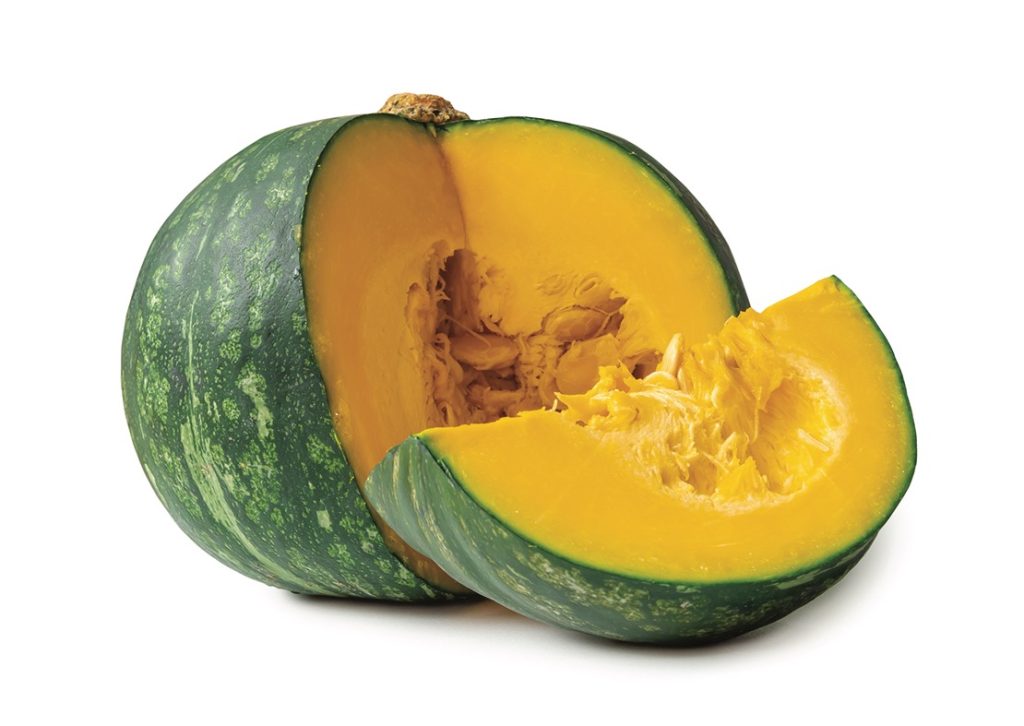
It’s winter squash season. As the autumn days shift from crisp to chilling, what could be sweeter — or more savory — than roasted delicata, cinnamon-laced and fork tender? Acorn squash tart with maple, ricotta and walnuts? Cream of squash soup (butternut or kabocha) served with a crispy hunk of sourdough?

And let’s not forget pumpkin (and pumpkin spice) mania. It’s all here. Enjoy!

Center of the Cosmos

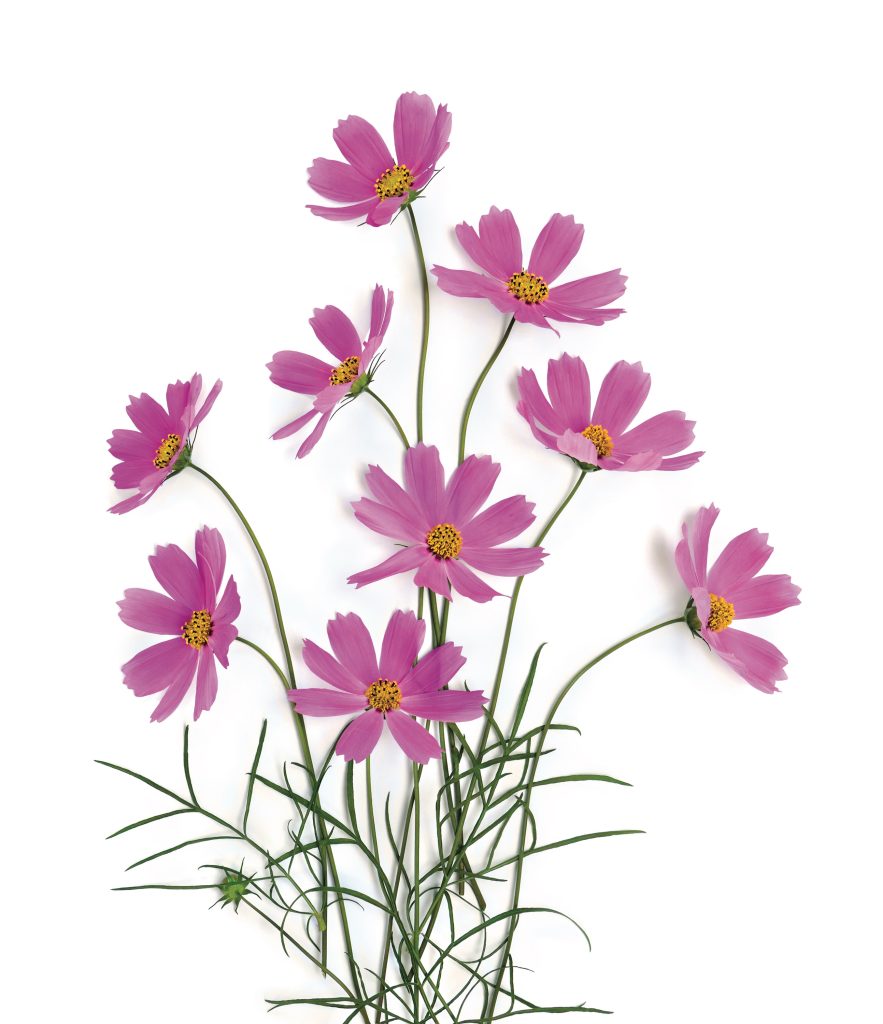
Until the first frost arrives — weeks or days or blinks from now — delicate blossoms sway on tall, slender stems, brightening the garden with color and whimsy.

Hello, cosmos.

One of October’s birth flowers (marigold, the other), cosmos are said to symbolize harmony and balance, their orderly petals having inspired their genus name. Native to Mexico, this daisy-like annual thrives in hot, dry climes. It’s the traditional flower for a second wedding anniversary gift and, according to The Old Farmer’s Almanac, was once thought to attract fairies to the garden.

Could be true. Just look how the butterflies take to them.

Wandering Billy

WANDERING BILLY

Picture This

Mac Barnett’s illustrated children’s books draw on connections between generations

By Billy Ingram

“There are perhaps no days of our childhood we lived so fully as those we spent with a favorite book.” 
— Marcel Proust

Is there a beloved storybook you fondly recall being read to you as a child? For me, it was Pat the Bunny by Dorothy Kunhardt. Credited with being the very first interactive book, it offered tots a “touch and feel” experience in lieu of a narrative. Bound with white plastic ribbing, each turn of its pages reminded toddlers of everyday experiences, like feeling Daddy’s stubble (a schmear of sandpaper), inhaling the scent of wild flowers, playing peek-a-boo with a patch of cloth and patting an upright, bunny-shaped fluff of faux fur.

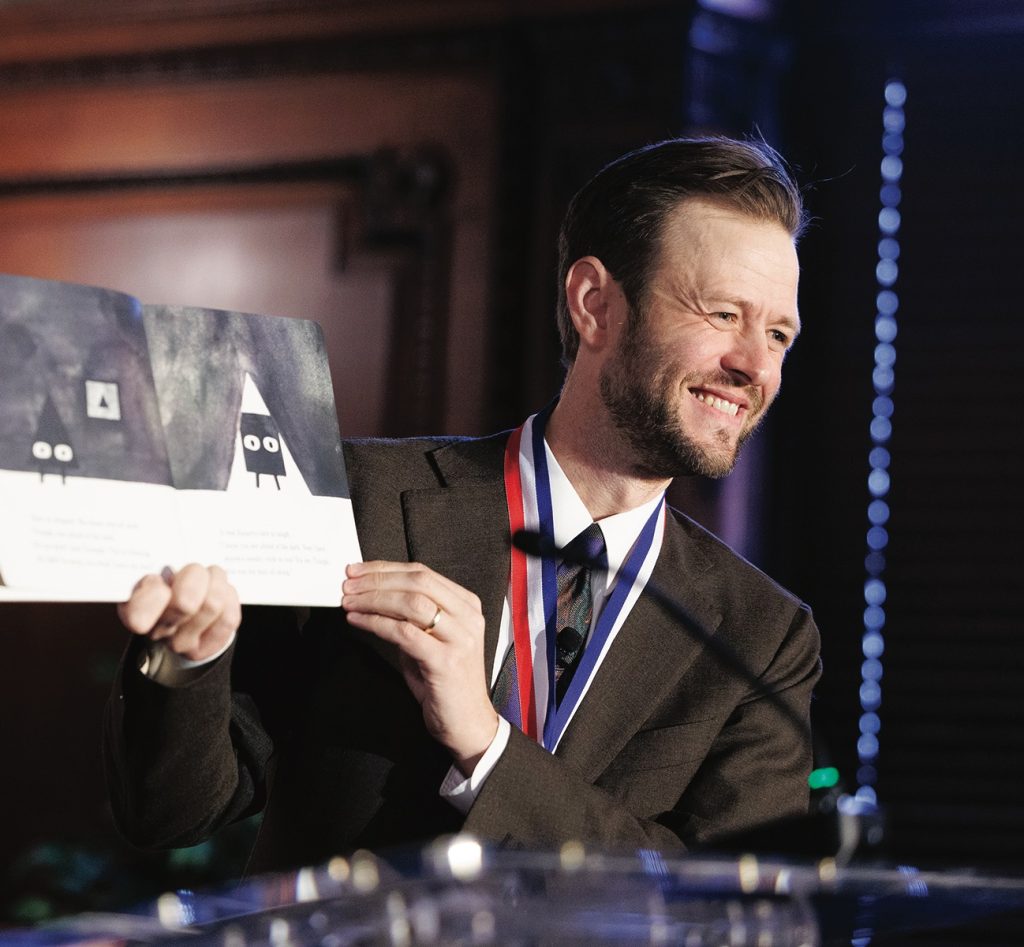
For lovers of children’s pictorial storybooks, there’s something really special happening this month. Out of 380 proposals submitted by cities around the nation, Greensboro was one of only five boroughs selected to host the Library of Congress’ National Ambassador for Young People’s Literature, Mac Barnett. The ninth to hold this title, he will be presenting Behold, The Picture Book! Let’s Celebrate Stories We Can Feel, Hear, and See, his tribute to the colorful legacy of children’s literature.

Barnett has authored 62 books for youngsters (he estimates) and has received two Caldecott Honors, three New York Times/New York Public Library Best Illustrated Awards, three E.B. White Read Aloud Awards — the accolades go on and on. Now in its second season on Apple TV+, he’s the co-creator, with illustrator Jon Klassen, of Shape Island, an animated series based on their New York Times-bestselling graphic novels for toddlers, The Shapes Trilogy, cloud-seeding infantile imaginations while simultaneously encouraging critical-thinking skills.

Barnett’s The First Cat in Space series, in collaboration with illustrator Shawn Harris, is rendered in a sparkling, modern style with a subtle hat tip to comic artist Jack Kirby’s square-fingered, forced perspective. “Shawn and I have been friends since we were 6 years old,” the author reveals. “And now Shawn is one of the finest children’s illustrators working today. When I was a kid, I loved comic strips like Calvin and Hobbes and Garfield.” Admittedly intimidated by the superhero genre, he says, “Shawn read all that stuff and he would explain to me a run of Spider-Man or what was happening to Superman and I would get it all filtered through him.” No dust on these jackets, infectiously fusing a Calvin-ism whimsy with 1980s Marvel super-heroic showmanship, the resulting outta-sight escapades of this far-out feline are what The New York Times proclaims “hilarious.”

For early readers eager for enigmatic entertainment, Barnett’s Brixton Brothers whodunnits serve as a mod nod to circa 1960s Hardy Boys mysteries. School Library Journal declares Brixton Brothers’ premiere volume, The Case of the Case of Mistaken Identity, “one of the funniest and most promising series openers in years.” The author’s attraction to those juvenile novels written long ago is rooted in the macabre. “As a kid, I was terrified of being kidnapped,” he quips, “and the Hardy Boys get kidnapped like three times per book.”

Barnett was especially fascinated by the sleuthing siblings’ escape strategy after being tied up. “They would flex their muscles, the bad guys would leave the room; then, they would relax their muscles and the ropes would just fall to the ground,” he recalls. “And I was like, this is what I am going to do when I get kidnapped.” To test this technique, in second grade he convinced Harris to secure him with a jump rope using knots Harris had learned in the Boy Scouts. “I relaxed and, of course, the ropes just stayed there. And I realized the Hardy Boys worked out a lot harder than I did at age 7.” This eventually formed the genesis for his Brixton Brothers’ exploits “about a kid who tries and fails to be a Hardy Boy.”

There is unambiguous, statistical information that reading to children has a lifelong educational impact. “The picture book is one of the great American art forms,” Barnett insists. “And reading out loud to kids is an intergenerational, artistic experience — an adult and a kid coming together over artwork, experiencing it, having feelings about it, and then, hopefully, talking to each other about whether they like it, what they think it means.”

According to Barnett, the first illustrated storybook for kids was Wanda Gag’s Millions of Cats in 1928. “There were books for children before that, primarily though, they were illustrated nursery rhymes, Bible stories, folk tales.” Gag pioneered the use of text and pictures in tandem to tell a story.

“The first book that I really remember living inside of was In the Night Kitchen.” Barnett discovered the absurdist dreamworld of Maurice Sendak as a youngster in the early 1980s. “It just made perfect sense to me. This is what it’s like inside my brain, that recognition of a kindred consciousness. And you read it as an adult and you’re like, this is such a wild experimental text.”

If offered the opportunity, I think just about anyone would write a children’s book. What advice can Barnett offer? “You’ve got to learn how picture books work,” he contends. “This is a way of telling stories in a very specific way. It’s easy to write a picture book, it’s very difficult to write a great picture book. And the first step is to learn the history of the art form to really understand how stories are told this way.”

Here’s an opportunity to do just that. The free event, Behold, The Picture Book! Let’s Celebrate Stories We Can Feel, Hear, and See, will be held at 10 a.m, Saturday, October 25, in N.C. A&T State University’s Harrison Auditorium. While he’s in the ’Boro for two days, Barnett will also host programs at area schools, where every student will receive one of his endlessly engaging picture books donated by Candlewick Press (as will the young ones attending the Harris Auditorium celebration, courtesy of Greensboro Bound).

“Greenboro just had an incredible proposal,” Barnett says about the selection process coordinated between The Library of Congress and Every Child a Reader, a literacy charity. “They were looking for communities with strong libraries and bookstores to make sure that these events were of value to the community. A big part of this is talking to adults about why kids’ books matter, why they are real literature and how to make sure that kids have good books to read.” He believes that, for Greensboro, “it’s just a great opportunity to talk to educators, families and even kids about the value of children’s literature in a young person’s life.”

Award-winning American (and sometimes) children’s author Emilie Buchwald (Gildaen: The Heroic Adventures of a Most Unusual Rabbit) once observed, “Children are made readers on the laps of their parents.” True, it’s never too soon to fold back colorful covers and expose spongy youngsters to worlds of wonder and limitless curiosity. Or just to pet the fluffy cartoon bunny.

For information about the free public event, visit greensborobound.com. Registration is strongly encouraged.

Poem October 2025

POEM

October 2025

Little Betsy

A ghost is no good to a child.

Maybe he crooks a finger, as if to beckon

the girl to play. Maybe he bounds spritely

down corridors, into kitchens.

But if she hands him a dolly or ball

and he reaches with his spectral hand,

he cannot clutch the gift, and if his failed grasp

surprises him, if the lack of resistance —

for everything real resists the touch —

unbalances him, his incorporeal fingers

might graze the child’s offering hand.

What would you call the gooseflesh

raised by the frolicsome dead?

There is no joy in it, only a deep well

of longing cold, the kind that claws

through every crack in the wall.

— Ross White

Pleasures of Life

PLEASURES OF LIFE

Bat Girl

A summer of darkness to spread my wings

By Sarah Ross Thompson

It’s May 2002, and I make my way up the stairs of Winston Hall at Wake Forest University to meet up with Nick, the graduate student in charge of the bat lab — or The Batman, as I come to call him. He uses his key card, leading me through a labyrinth of locked doors and staircases that end in a dark basement room — a bat cave, if you will. You see, I’ve taken a summer position as an undergraduate research assistant studying bat echolocation. As an eager biology major, I’m ready to get started on this dream job, rabies vaccinations and all. In my first week, we insulate the cave with foam pads to make it fully soundproof for recording bat calls. Nick and I work side-by-side for several days, listening to The Best of Sade CD on repeat while he tells me about his home country, Bulgaria, and his dog, Max. By week’s end we finish the room, and I’m gifted a container of fresh feta cheese, a surprising but welcome gesture. The Batman continues to pay me in feta all summer as I hurry along by his side, carrying stacks of notebooks and tools. Just call me Robin.

Our next mission involves collecting bats from the field. And by “field,” I mean anywhere a colony of bats may be living. During the first expedition, I find myself stabilizing a ladder in the dark while The Batman climbs underneath bleachers at a local high school, using gloved hands to carefully scoop bats and bring them down one-by-one to a carrying case. The next week, an exterminator tips us off that a woman wants bats removed from her attic. We speed over in our bat mobile (an ’80s hatchback), crawl into the hot, clammy attic space, and secure the bats.

Once the great migration of bats to the bat cave is complete, I’m tasked with cleaning their cages and providing them with daily food and water. Simple enough, except that, believe it or not, I don’t particularly like bats. In fact, years of media villainization have left me terrified of them — especially that they’ll somehow get caught in my hair. As I peek inside a cage, psyching myself up to clean, I see a cauldron of bats hanging upside down, their beady eyes glistening in the red light of my headlamp, and I draw back with a gasp. In another cage, a bat is gripping the wire door, so when I open it, he swings open to greet me. The stuff of nightmares. Only after some serious self-negotiation am I able to squeeze my hand through the smallest crack in each door. Mission accomplished.

Finally, what we’ve been waiting for — we begin our experiments with bats and moths in the lab. It turns out that moths can emit a buzzing sound to “jam” a bat signal and avoid being eaten. We want to capture the sound waves of that particular moment of survival. Nick turns on the sound recording device, we turn off our headlamps and crouch down, waiting in the darkness, as Hercules (our favorite bat – yes, we name them all) starts to circle the cave. In his quest for food he repeatedly flies within inches of my face, close enough to feel the wind from his wings tickle my skin. Each time he swoops by he slows just enough to get a look at me, and I at him. I surprise myself by not being afraid, but instead feel a tingle of exhilaration each time he passes.

Mere weeks later, I’m now feeding the bats by hand (Holy Toledo, Batman!) and spending hours alone in the bat cave running experiments. There’s a tranquility found in that room, the bats whirring around me again and again, and I grow to enjoy the dark. “I am darkness, I am the night.”

We also raise baby bats in the lab, and I find I am falling all over myself to help. Wrapped up in tiny bundles, the babies greedily accept formula we feed them through droppers. Just like with human babies, we wake to feed them in the middle of the night. I leave a summer party at 2 a.m., announcing that I must go feed baby bats (surprisingly, no one questions this). In the stillness of the lab, my ears still ringing from the blaring music of the party, I drop milk into their little mouths.

When the babies are older, I take them out one-by-one and walk around the bat cave while each bat hangs upside down from my finger. As they feel the air under their wings, they begin to open them, eventually extending them fully to push off and take their first flight. I sit in awe. I’ve just taught baby bats to fly.

Throughout my summer in the bat cave, I meet other bat lovers. Led by The Batman, we’re a motley crew all of us used to spending hours alone in darkn ess. One has a bat tattoo, another a bat navel ring. We have cookouts and gatherings. We give each other bat-themed gifts (the children’s book, Stellaluna, being one). As the summer ends, I sign up to work in the bat lab during the next academic year and again the following summer, having found my place in Gotham City.

These days, I no longer study bats, but I sometimes wish I did. In those quiet moments in the lab, I experienced a peace that I’ve never quite been able to replicate. One that comes from watching, from listening and from being still in the dark. A few years ago, I met up with The Batman, who now is an internationally recognized professor. We enjoyed a glass of wine and discussed the research that we each do. As a lifelong Robin, I’m hopeful that we can work together again one day. I’ll await the bat signal.

Strolling with Fungi

STROLLING WITH FUNGI

Strolling with Fungi

A woodland garden flourishes in an old Winston-Salem neighborhood

By Ross Howell Jr.    Photographs by Lynn Donovan

Managed by the Piedmont Land Conservancy, the Emily Allen Wildflower Preserve is a reminder that the natural world lies right at our feet.

In 1954, Allen and her husband, O. G., moved into the dream home they’d built on 6 acres of land — with a creek — in a leafy Winston-Salem neighborhood.

One spring, Allen noticed the purple-and-white petals of a wildflower emerging beneath what she described as “a mess with poison ivy, honeysuckle and blackberries growing everywhere” near the creek.

That wildflower was a showy orchid (Galearis spectabilis) and, somehow, it sparked a passion in Allen to learn everything she could about North Carolina native plants.

She took a botany class at Wake Forest University and went on to serve as president of the North Carolina Native Plant Society. Over some 40 years, Allen collected wild plants from the mountains of Western North Carolina, nursing them in her backyard.

Emily and O. G. donated their land through easement to the PLC in 2000. Since then, Allen’s care for what she always called her “Friendship Garden” has been bolstered by PLC staff and stalwart volunteers.

O. G. passed away in 2006 and Emily in 2015. Upon her death, their home was donated to the conservancy to be developed as an educational center.

Allen’s wildflower garden and house feature not just flowers from the mountains, but also a bounty of eastern North American trillium, along with native ferns, creeping phlox, Dutchman’s breeches, cranesbill geranium, flame azalea, Carolina buttercups, columbine, plus Oconee bells (Shortia galacifolia), a rare wildflower found in the southern Appalachian Mountains.

As you’d expect, the site is best known for its spring wildflower group tours, which are available by appointment only.

But photographer Lynn Donovan and I are here to participate in a fall “Mushroom Stroll,” one of several programs offered annually at the garden.

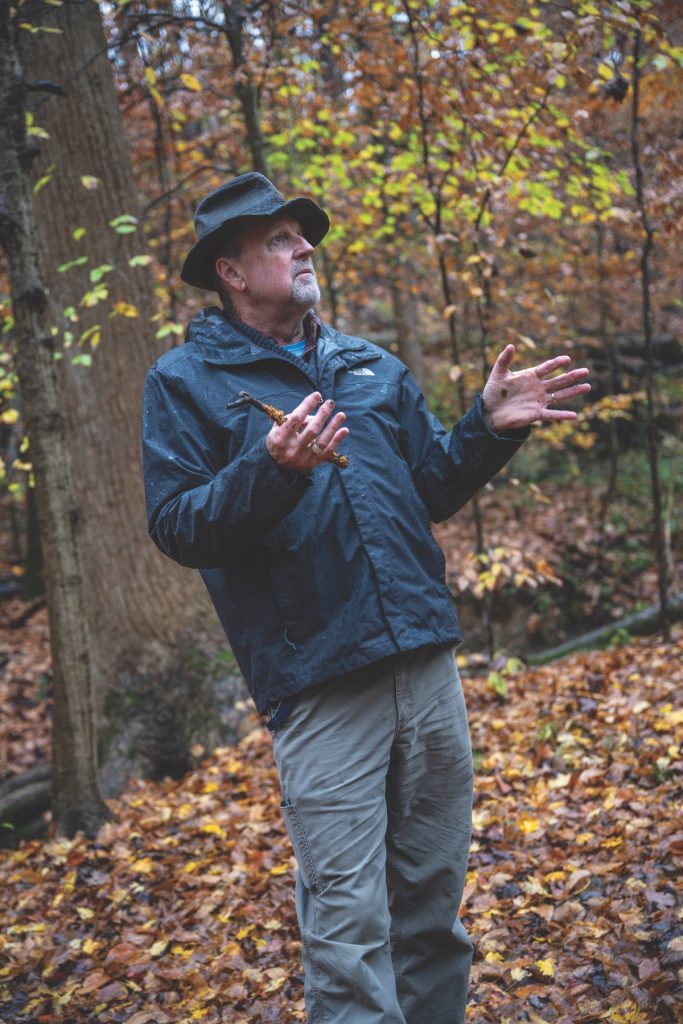
It’s raining steadily, and I should’ve given more thought to my outerwear. Veteran photojournalist Donovan has wisely brought a slicker and hood.

We’re greeted at the door by Janice Lancaster, manager of the garden. Lancaster received her undergraduate degree in dance from the University of North Carolina School of the Arts. In addition to her work with the PLC, Lancaster has developed a dance-ecology course at Wake Forest University and her choreography often features environmental themes.

A group of mushroom strollers are already inside, as is Kenneth Bridle, who will lead our tour.

Bridle has a Ph.D. in biology from Wake Forest and has worked with the PLC for more than 30 years. Recently, he retired from his position as stewardship director and now acts as a conservation adviser, leading nature walks and other activities.

Bridle’s career in environmental preservation is truly remarkable.

He is the author of several natural heritage inventories as well as rare plant and animal surveys. A founding member of the Dan River Basin Association, the Carolina Butterfly Society and the Triad Mushroom Club, he also teaches classes in a selective and rigorous Master Naturalists’ program that prepares volunteers to lead stewardship, education outreach and citizen science projects.

Bridle gives us a quick tour of the improvements to the Allen house.

Split units now replace the original heating system. A downstairs bathroom was remodeled to serve as a wheelchair-accessible restroom.

“The last part is taking out cabinets and countertops in the old laundry room,” Bridle says. In their place, a catering kitchen will be installed.

“It’s slowly turning into more usable space, which is what Emily always wanted,” Bridle says.

He should know. He met Allen when he came to her garden as a graduate student.

That started a friendship that lasted for years. Bridle often served as Allen’s driver on her plant-collecting expeditions and, like her, Bridle would go on to serve as president of North Carolina Native Plant Society.

“After a hot, dry summer, we usually have some kind of rain event,” Bridle says, “and the following week, the mushrooms go crazy.”

Bridle clears his throat.

“So, we’re going to wander around outside,” he announces to our group. “Everybody keep your eyes peeled.”

As we go outside, we can hear the steady drum of raindrops in the leaf canopy.

After a few steps along the path, Bridle pauses and points to the ground.

“Right there, bird’s nest fungi,” he exclaims. Bird’s nest fungi (family Nidulariaceae) are small, cup-shaped fungi containing spore-filled discs that resemble tiny eggs. The fungi feed on decomposing organic matter, such as wood and plant debris.

“When a drop of water falls in the nest,” Bridle says, “those spores blast out.”

He points out a dark mass spreading among leaves and sticks.

“That’s a whole colony of them,” he explains.

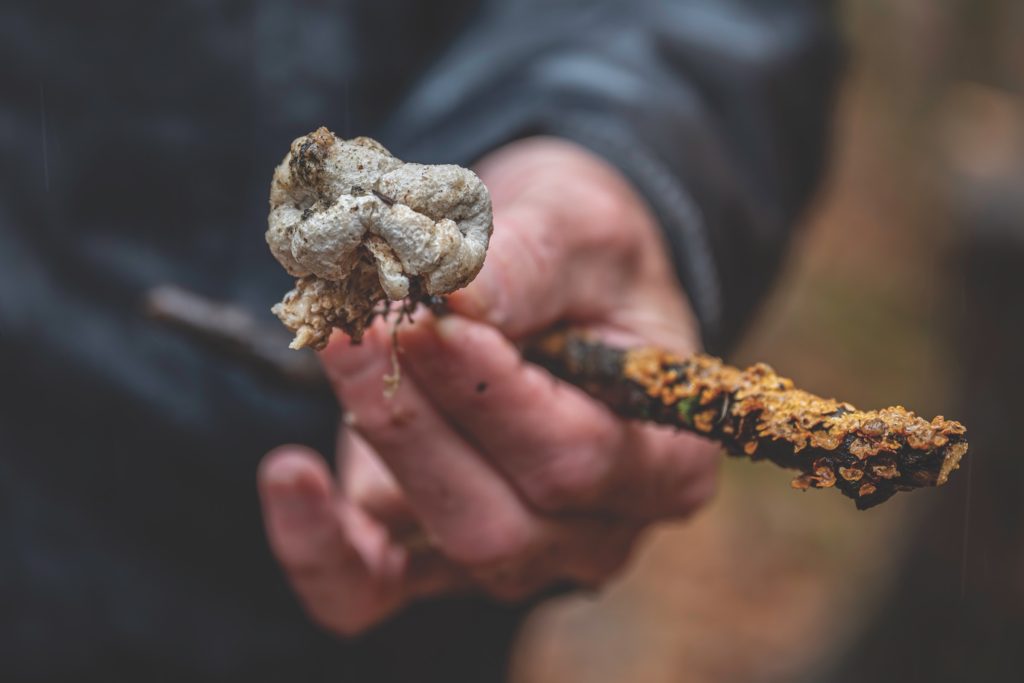
A few more steps into the woods, we spy a tree trunk glistening in the rain. On its side are orange-colored growths with the texture and shape of oyster shells.

“That’s shelf fungi called orange crust,” Bridle says. “They come in many different versions.”

Shelf fungi have a tough exterior and are a favorite of mushroom enthusiasts because they can be observed year-round, even when other types of mushrooms might not be in season.

Bridle tells us that an unusual variety grows in the Blue Ridge Mountains, feeding on decaying rhododendrons.

“Those are iridescent blue and will glow in the dark,” he says.

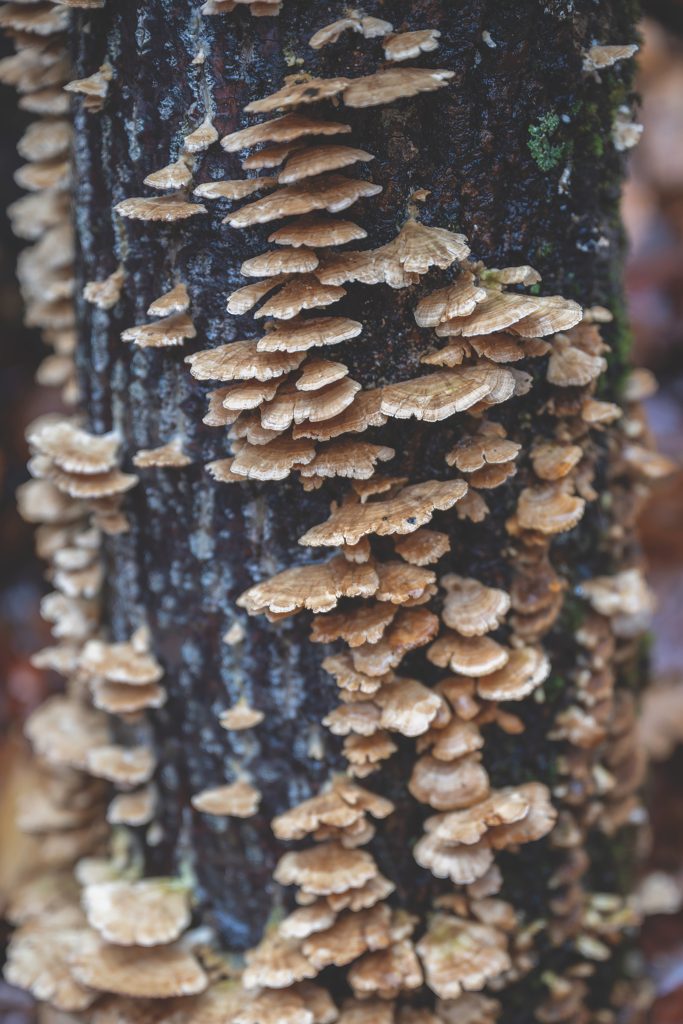
Farther along, we come upon more shelf fungi. These are called turkey tails. They’re nestled in groups along a rotting limb, bearing the shape and color of a tiny tom turkey displaying his tail feathers.

“They always have those nice, multicolored, concentric rings,” Bridle says. “And they have a long tradition in Asian medicine.”

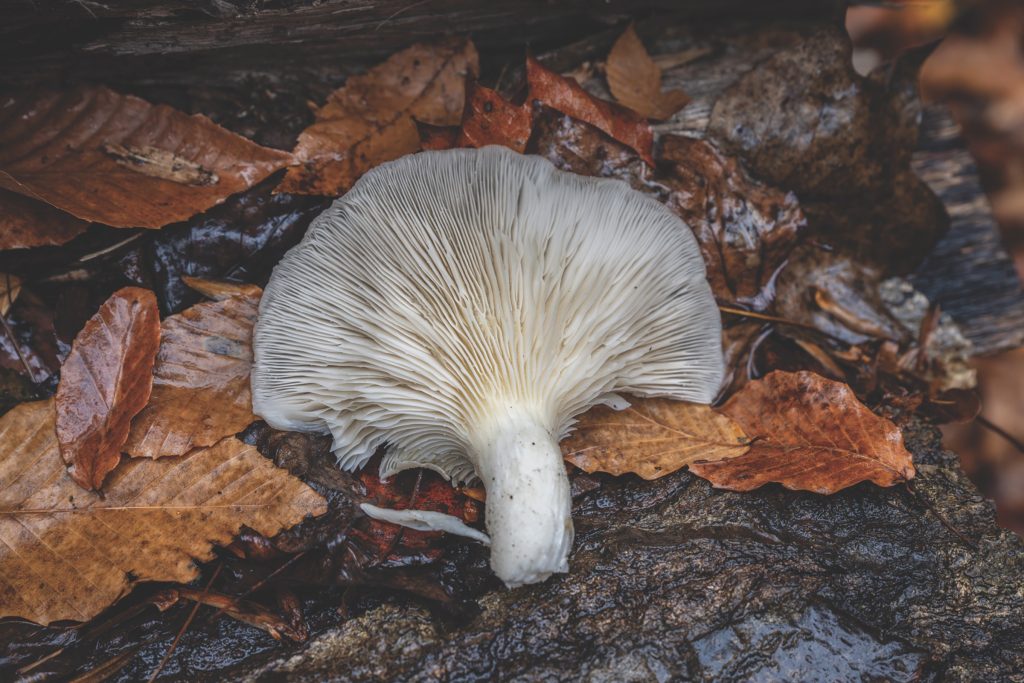
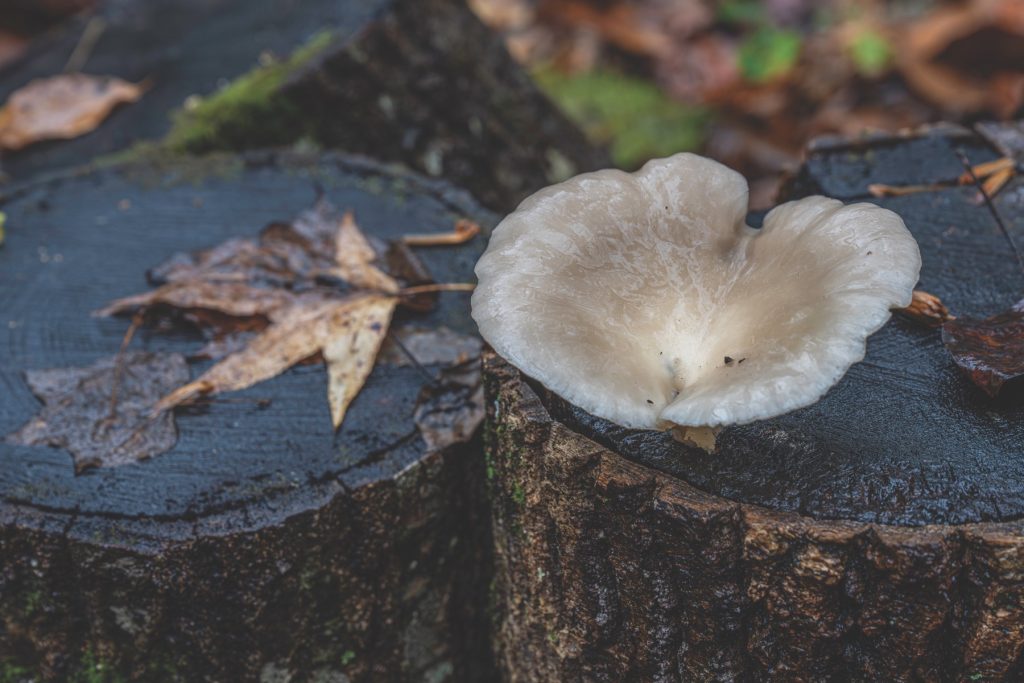
As we make our way farther down the swale toward the creek, we come upon oyster mushrooms (Pleurotus ostreatus). Pale and serene, they’re edible, prized for their delicate texture and flavor.

“Of the mushrooms we find in the woods, the oysters are probably the most common,” Bridle says.

Nearby, Bridle points out another mushroom growing on a tree stump. It’s a resinous polypore (family Fomitopsidaceae).

“See that orange resin?” he asks. “They produce that resin even in the driest of summers.” These mushrooms are perennials, producing a new ring of growth each year.

On a decaying log farther along the path, Bridle spots a small specimen of an edible shelf mushroom. It’s called chicken of the woods (genus Laetiporus) and can grow to be quite large, stacked in shelves, some 10 inches in width.

He tells us that the flesh of the mushroom is soft and tasty, and stores well wrapped in a paper bag and kept in the refrigerator. Vegans often prepare it as a substitute for meat, cooking it in a variety of ways.

“Anything you can do with a chicken finger you can do with chicken of the woods,” Bridle says.

He describes other fungi that are common to the area — hen of the woods, shrimp of the woods and lion’s mane.

“You’ll often find lion’s mane high up in a standing, dead tree,” Bridle says.

No excursion into the world of fungi is complete without at least one bizarre fact, and Bridle points out some beech trees growing on the other side of the creek.

“In September, I always take people down among those trees,” he says, “because that’s where you’ll find the beech aphid poop-eater.”

Our group laughs nervously. Sometimes with a mycologist (a scientist who studies mushrooms), you wonder if they’re just pulling your leg.

Bridle explains that beech trees in September are hosts to colonies of beech blight aphids.

“We call them boogie-woogie aphids, because, if you tap on the tree branch, all the aphids do the wave.” That is, the aphids all at once start throbbing in unison.

See what I was saying about a mycologist?

These tiny insects suck sap from the beech trees, feeding on the sugar. Their excretions are politely referred to as “honeydew.”

So, on the limbs and leaves beneath the aphid colony, you’ll see masses of black fungus that look like sooty sponges.

That’s Scorias spongiosa, the beech aphid poop-eater.

“Everybody remembers that one,” Bridle concludes.

The rain is falling in earnest now, so even the well-equipped are ready to retreat. My barn coat feels like it’s holding about a gallon of water.

Donovan stows her camera gear and we get into the car.

We’re wet as bird dogs after a hunt. But we’re both grinning like crazy.

High on mushrooms, you might say. And filled with wonder for the natural world.

Life’s Funny

LIFE'S FUNNY

Volunteers Needed

Identifying de-vine intervention

By Maria Johnson

I stoop in the dew and get to work, left hand sorting, plucking and tossing the intruders from our vegetable garden.

Don’t ask me why someone who strongly favors her right hand for all other pursuits always weeds with her left hand.

All I know is, my south paw is more sensitive to plants. It’s the hand that caresses leaves and blossoms. It’s also the hand that gauges, with a slight tug, if I can uproot a weed with one yank or if I need to wrap the stalk around my fingers for more leverage.

Is my left hand the gateway to my loosey-goosey right brain, cross-wired hemispheres being what they are? Is that why I enjoy weeding so much? Because it connects me to another brain space?

For my mom, that activity was ironing, the rote chore that allowed her to enter the zen zone, a place where her hands did necessary work while her mind moseyed.

I did not inherit her need to press fabric from rumpled foothills into starched flatlands.

But I do respect, and have my own version of, making things visibly better and finding oneself by getting lost in the mundane.

When I need to get grounded, and think fresh thoughts, you’ll find me literally down in the weeds.

There’s always a bumper crop around our raised beds where, in summer, we intentionally grow tomatoes, peppers, basil, oregano, green beans, eggplant, parsley and leeks.

Unintentionally, we provide a nursery for crabgrass, mock strawberry, knotweed, wild violets and clover.

I cringe as I type “wild violets and clover.” How could I discard them? They sound so Simon & Garfunkel.

Then I remind myself of the truest definition of a weed: Something that grows where and when you don’t want it.

I’ll see you in the cover-crop days of winter, clover. For now, you’re out of here. You, too, tiny pines and oaks and maples. Go make a grove elsewhere.

Here, I tell myself, in order to bring order, and to practice the “culture” in agriculture, I must be a ruthless editor.

And that, of course, is the moment I see an odd interloper.

It peeks, broad-leafed and hearty, from a clump of daylilies in the flower border around the garden.

Squash? Is that you?

We tried growing yellow squash in one of the raised beds a few summers ago. Soon enough, the squash bugs moved in and we, being averse to pesticides and herbicides, let them sap the sunshine from our stir-fried dreams.

Is this a descendant of those ill-fated plants, or a bird-borne volunteer that found a fertile niche in the shelter of the lilies?

I study the outlier, consider yanking it from its safe harbor, and decide to let it be.

Why? Curiosity maybe. What will you become, oh bold and fuzzy one?

A few days pass. The volunteer grows quickly. Already it has bounded over a patch of struggling dianthus and jumped the low barrier that keeps Bermuda grass out of the garden.

Once again, I come close to pulling it out of the ground, but the truth is, I like a vine with chutzpah.

I hold off.

A week later, the vine has advanced a couple of feet on the diagonal. Its goal: to cut the corner of the garden to the sunniest spot in the yard.

In 2020, when we built the raised beds as a COVID project, both to occupy our stay-at-home time and to feed ourselves should broken supply chains threaten our arugula consumption, we did a sun study.

We took pictures of our yard at various times of day, from the same vantage point, and compared the pictures to see which area stayed sunniest the longest.

We built the beds as close as possible to that spot, avoiding a grassy drainage path that, during thunderstorms, concentrates rain water into an overland river.

But this headstrong vine does not care about drainage; it is racing toward maximum sunlight, as if it has a copy of our sun study.

“Follow me,” the volunteer seems to be saying, “I shall lead you to brighter days.”

Baloop. Over the other corner of the Bermuda grass barrier.

Baloop. Over a clump of phlox in the border, into the open yard,

We let it go. Jeff even mows around it.

I am reminded of children. They might not take the path you thought they would, but, when they are full of vigor and confidence, there is indescribable pleasure in standing back and letting them become whatever they will be.

This is why I garden: for lessons and metaphors writ small, in the dirt.

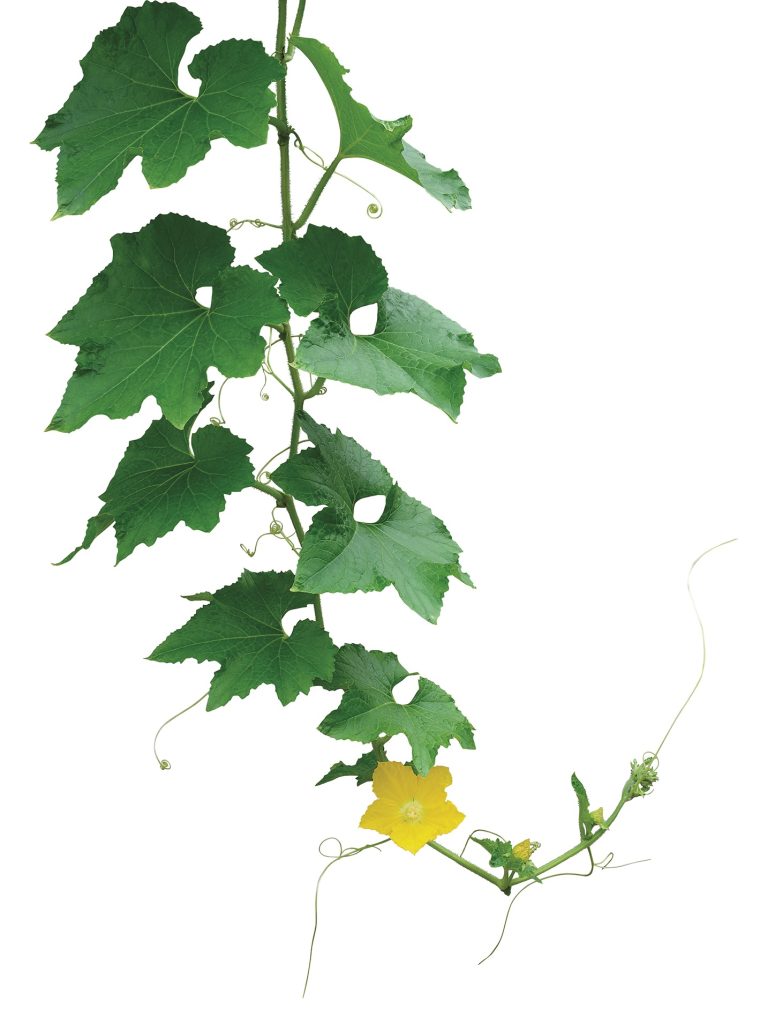
Overnight, it seems, the vine marches on, popping open more green umbrellas, large five-lobed leaves, as solar energy collectors.

It’s now 15 feet away from its starting point. I joke, with uneasy ha-has, about how it’s coming for the house.

I part the hairy leaves and look for evidence of squash. I see lots of bright yellow blossoms, some with bulbous bases, and lots of woody curlycues.

I cave to artificial intelligence, take a few pics with my phone, and ask Google to identify the plant.

My hopes for yellow squash are squashed. But my hopes for jack-o’-lanterns are lit.

This is field pumpkin.

We leave for a week’s vacation, informing our house sitter that, yes, we know about the runaway vine and, we think it’s harmless, but, you know, call 911 if you hear a window slide open in the middle of the night.

We return to a new development. The vine has decided to divide and conquer. One branch has made a U-turn and is charging for the garden gate.

The other fork is running up the grassy swale.

Both offshoots lead the way with closed, green blossoms that sprout tendrils like catfish whiskers.

We are in the homestretch of summer, the giant leaves are showing their age. They are mottled with mildew. Bugs have chewed some of their edges into brown lace. The main trunk of the vine, woody and pale, has been bored in places. Many of the blossoms, including the ones pregnant with fruit bulbs, have been snipped clean off, probably by the family of rabbits that live under the knockout roses and drive our hound nuts.

She has caught at least four bunnies this summer, and we have scolded her each time. Now, we look the other way.

Ruthless editing.

One tiny, round green fruit survives at this writing.

We make it a straw bed and surround the vine with plastic rabbit fence.

We are won over by the vine’s will to survive, its ruthless pursuit of light and life.

Tea Leaf Astrologer

TEA LEAF ASTROLOGER

Libra

(September 23-October 22)

True luxury comes in many forms: Egyptian cotton, Belgian linen, Mongolian cashmere and Ahimsa silk. But have you ever felt the plushness of making a decision sans agony, anxiety spirals or paralysis? The ethereal lightness of refusing to overthink? When Venus enters your sign on Oct. 13, be open to receiving a new kind of abundance — that of an unshakeable inner peace. Everyone wins, and you’ll get to dodge the rabbit hole.

Tea leaf “fortunes” for the rest of you:

Scorpio (October 23 – November 21)

Stop settling for crumbs.

Sagittarius (November 22 – December 21)

Just unsubscribe already.

Capricorn (December 22 – January 19)

Cozy up with the chaos, baby.

Aquarius (January 20 – February 18)

Hint: Add cardamom.

Pisces (February 19 – March 20)

The truth is always a mercy.

Aries (March 21 – April 19)

Mind your tongue.

Taurus (April 20 – May 20)

Address the energy leak.

Gemini (May 21 – June 20)

Resist the urge to ghost.

Cancer (June 21 – July 22)

It’s time to update your software.

Leo (July 23 – August 22)

Listen for the crows.

Virgo (August 23 – September 22)

Embrace your feral nature.

Chaos Theory

CHAOS THEORY

Signs

. . . from the other side

By Cassie Bustamante

Signs are everywhere, if only we pay attention. Too fixated on where we are going and knocking out miles-long to-do lists, we often miss them. But, in my case, sometimes the universe gives me a little auditory nudge — a snap of its fingers, so to speak — before showing me the sign I need. Four years ago, it was a song.

I am driving south on Church Street with my teenage daughter, Emmy, riding shotgun on a clear, crisp day. We’re on our way home from Sunset Market Gardens, where I’ve loaded up on veggies, greens and eggs for the week. One of the perks to running errands with Mom, especially early morning weekend ones? Control of the music. Her playlist of every song ever released by Taylor Swift shuffles through the car speakers. When “Marjorie” comes on, Emmy casts me a sideways glance and offers a gentle smile, knowing that when I hear it, I think of Sarah, my best friend and former business partner who’s just passed away.

If I didn’t know better

I’d think you were still around

What died didn’t stay dead

What died didn’t stay dead

You’re alive, you’re alive in my head

Just then, in an all-but-blue sky punctuated by a cloud or two, a rainbow appears. No sign of rain anywhere, yet there it is in its vivid ribbons of color. Emmy and I both gasp.

Two years later, I’ve just ended an exhausting month. My husband, Chris, has traveled three out of four weeks, while my kindergartener, Wilder, and I have both been sick. There’s only so much rage-vacuuming my house can take. Of course, with three kids and two dogs, the house isn’t actually clean, but the loud hum of the vacuum drowns out the noise nicely. I’ve heard it said that being an adult is a constant loop of saying “I just have to get through this week.” By that measure, I should be very grown up by now, though the jury’s still out.

Thanks to antibiotics, Wilder heads back to school and I’ve got a day to catch up on writing. Settled in at my favorite writing desk, the kitchen table, I tap away at my keyboard while a cool breeze blows through the open windows. Happy with my progress, I gift myself a little brain-break and mindlessly open up Facebook. A “memory” reminds me that today is the anniversary of Sarahs’s death. Immediately, a wash of shame spreads from my cheeks all the way to my toes. How could I have forgotten?

My eyes dart upward, to a place where I imagine Sarah can hear me. “I’m so sorry,” I whisper.

Not a moment later, before I even have time to pause to await a reply, I hear the familiar jingle of a dog’s collar. My own two pups are safely curled up on our leather sofa, but I peer onto our lawn and spy a dog I don’t recognize moseying around, no owner in sight.

Ugh, I don’t have time for this right now, I think. But I consider how I’d feel if my own dog was out there loose. Plus, I am a bit of a softie. In fact, when I became pregnant with our first child 19 years ago, Chris, worried I might put myself and the baby in danger, had to tell me to stop bringing home strays. But this shaggy, golden-amber dog looks innocent enough.

I step off my porch. “Hi, puppy.”

She saunters over slowly, tongue lagging out the side of her mouth, as I reach down to scratch behind her ears and catch a glimpse of the purple bone-shaped tag engraved with her name.

“Brownie,” I say, “aren’t you a sweet girl?” She rolls gently onto her back, inviting a belly rub.

I locate the tag with the owner’s number, and dial. The phone begins to ring and just before the owner answers, I catch the name on the tag so I know how to address her: Sarah.

I can’t believe it. And yet I can.

Sarah, the dog owner, and Brownie reunite with licks and snuggles on my front lawn as I look to the sky, where I imagine my friend smiling down at me.

It’s been four years since her death. Like waves of grief, the signs don’t stop coming, but have lessened, more time passing between each. And now, when I notice them, I don’t cry anymore. I smile, grateful in the knowledge that Sarah is still around.

Home Grown

HOME GROWN

You Are What You Wear

Like it or not

By Cynthia Adams

My father never had to be asked twice to go shopping, especially for groceries. What he didn’t like was being hurried. Choosing the best rib eye might require a solid 10 minutes.

“Marbling,” he’d murmur, scrutinizing the fat flecks of a steak with surgical interest as the butcher waited. 

Clothes shopping was no different. He often joined my mother, egging her on to try dress after dress, evaluating each frock. Was it too short?  Too frumpy? Did it overpower her small frame? Mama, an impulsive shopper, had little patience for long deliberations. 

She liked flash and bling as much as Dad liked fat-streaked T-bones. Whether a pork chop or a pant suit, he analyzed purchases with a strange dedication.

Dad earnestly believed he could save Mama from fashion crimes. He steered her towards classics, well-tailored and simple, long before the quiet luxury trend. But Mama leaned into flamboyant femininity — heels, furs and cocktail wear in the daytime. Liz Taylor and Joan Collins were lifestyle icons.

Mama wore a cocktail ring and negligee while rolling out biscuit dough at breakfast. Come evening, she never missed a Dallas or Dynasty episode. Afterward, she took long baths, emerging dewy-skinned in something diaphanous, trailing cologne de nuit.

She reminisced about starring in Fairview High School’s play, imagining a career on stage. If not for the traditional life she chose, including five children and an annoyingly opinionated husband, she might have lived the life of Liz.

At the very least, she planned to look the part.

Their shopping forays were certainly like watching Liz and Burton spar.

In answer to “What do you think Warren?” as she pivoted, he would artlessly offer his first reaction: “Shug, that dress is wearing you.” 

Mama would purse her lips, burnished red with Revlon’s Cherries in the Snow, and shoot him a withering look. 

Nonetheless, Dad wanted his opinions sought when it came to dressing what he considered “his” women. When I needed a prom dress, he volunteered to take me shopping. Inwardly, I dreaded the inevitable critique before we drew up outside the Belk store in Monroe.

He zeroed in on the most chaste dress in the junior department — a ballerina-pink dress prettily embroidered with rosebuds. I emerged from the dressing room looking like a cupcake. This was not what I was aiming for, but he practically cheered with approval. 

My father adored a dress that made me look like a Nutcracker extra.   

When I tried on a less modest number more like what my friends were wearing, he dropped a truth bomb. 

“Honey, you don’t have the bustline to pull that off,” he observed. My face flamed with heat. 

This was the kind of feedback Mama loathed.

Dad thrust the rosebud dress into the clerk’s hands, despite my fallen face. Come prom night, the virginal dress paired with my slumped posture read more Patty Duke than the sultry Daisy Duke I’d hoped for.

Cheerleaders and majorettes swanned past me in spaghetti straps and push-up bras as I spent the night loitering by the punch bowl with a completely tongue-tied date. My main activity was ruing my reflection during nervous restroom treks.

Mama would never have worn that dress. She’d have fought him on that. After all, she fought him all the way to divorce court.

Afterwards, she went full-tilt glam without Dad there to inhibit her impulses. Mama’s hairdo grew so high no one but her hairdresser could say where her scalp ended and hair began. She wore the highest heels even when her bunions screamed.

On a trip to Florida, she bought a door-knocker of a cocktail ring with a purported connection to the Super Bowl. The governor was off the accelerator and Mama swiftly blew through her divorce settlement. 

Nearly broke, she took a job at a new consignment shop.

Wealthy women with nearby lake homes consigned their finery there and Mama got first dibs. While she had seldom dressed better, she loathed wearing “second-hand” fashion, even while enjoying more wardrobe changes than Cher. 

None of that mattered.

When I praised a chic Chanel dupe she wore to a family dinner, she hissed at me, annoyed, “It isn’t real!”

As soon as she left that job, she resumed her preferred buying habit of new only.

I turned out to be quite the opposite, thrilled whenever I score a good knockoff, vintage find or a designer hand-me-down. 

Nonetheless, while Mama may not have inspired thrift, she modeled individuality, conformity be damned.

Recently, a young friend met me for a drink sporting turquoise-colored hair.  How could I not comment? I complimented her, privately thinking I have never been so free, nor so brave. She replied, “You can be ruled by all of the things that everyone else wants from you, or you can just have fun with your life.”

And just like that, I imagined Mama, radiating approval.