Drinking with Writers

The Art of Civil Discourse

A little healthy organic juicing with Rachel Lewis Hilburn

By Wiley Cash   •   Photographs by Mallory Cash

Last year I attended a literary event with some of the best known writers in the country, but as soon as the event began it became clear that the crowd was more interested in seeing emcee Rachel Lewis Hilburn, a woman whose disembodied voice had been speaking to them for years from the studios of WHQR Public Media. She joined the station in 2011, and she was named news director in 2012. A year later she anchored the pilot episode of CoastLine, a show that focuses primarily on local and statewide issues and the people they affect. Over the past six years, Rachel and her guests have discussed issues as diverse as gun control, water quality, film incentives and Thanksgiving recipes. No matter what the topic, Rachel always finds a fascinating angle. I will admit that I once sat in my driveway for 15 minutes and listened as Rachel and a county official discussed recycling. Like her voice, Rachel’s questions are direct and smooth. Her interactions with people are civil and genuine, and she gives her guests an opportunity to tell their stories as well as the expectation that they will be held accountable for the stories they tell.

This is not to say that Rachel does not ask hard questions. I sat for a CoastLine interview when my last novel was released, and at one point Rachel read a quote from a terrible review I had received in a major newspaper. Then she asked, “How do you keep that dagger from staying inside you?” Ouch! No one had ever asked me how I recover from bad reviews, and that question forced me to be honest about the vulnerability of artists. I look back on that hour I spent on-air with Rachel as perhaps the best interview experience I have ever had.

I took an opportunity to ask Rachel a few questions of my own one chilly morning in late January. We met at Clean Juice in downtown Wilmington on the corner of Grace and North Front Street. I ordered the Immunity One, an organic blend of carrots, lemons, oranges, pineapples and turmeric. Rachel ordered the Glow One, a mix of organic apples, cucumbers, kale and spinach. We found seats by the huge windows that look out on Grace Street. While I serve on the board of directors at WHQR and have known Rachel for several years, there was one question I had never asked her.

“What was your path to public radio?” 

“I started life thinking I would be an actor,” Rachel said. “And I went to the North Carolina School of the Arts, and then I moved to New York and L.A. and did some theater.”

“Acting?”

“Yes,” she said. “At one point, when I was in L.A., I decided I wanted to have a steady income and see what other things I could do.” She laughed and took a sip of her juice. “So I became a financial adviser, but only for about two years.”

“How did you get to Wilmington?”

“I knew people in Wilmington, and I loved the East Coast,” she said. “I was tired of the desert in Los Angeles, and I just loved the texture of the weather here. I came to Wilmington and embarked on a process of finding the next version of myself.” During that process Rachel wrote and produced television news broadcasts for WWAY; she wrote and produced a documentary about the 1898 Wilmington race massacre; and she served as the executive director of the homeowners association at Bald Head Island.

When you stack all these jobs together — financial adviser, news writer, producer, documentarian and executive director of a homeowners association — it becomes clear that Rachel has been perfectly prepared for a career in public radio. Over the course of her diverse work history she has managed personalities, produced content, sought facts, and listened closely to people’s concerns and this is exactly what she is doing with an exciting new serialized program called CoastLine: Beneath the Surface.

According to the description on the program’s website, the community members who will participate in Beneath the Surface are “thoughtful and engaged listeners who’ve agreed to be part of a yearlong conversation. They are black and white, youngish and older. Their politics cover the spectrum left, right and center.”

In this politically charged environment, what happens when you put a group of diverse strangers in a room? Rachel has the answer: She assembled the group for a meet and greet a few days before their first on-air discussion.

“I thought I would have to do some goofy icebreaker,” Rachel said. “But no icebreaker was needed. People freely went around the room introducing themselves. They seemed really enthusiastic about being there, and they didn’t want to leave!”

Rachel said that, at least initially, conversations on Beneath the Surface will focus on local issues because she believes that is the place where people who are sitting together in the same room can achieve some level of civil discourse. Hopefully, that civility will trickle up.

“I happen to think the political dynamic, that super division and vitriol on Capitol Hill, and even at the state level, isn’t going to change until regular folks change,” Rachel said. “Public radio can pull back the curtain and introduce you to a situation in its context. It can introduce these whole human beings, and it makes it hard to put them in a box.”

In keeping with Rachel’s history of discussing timely topics and asking hard questions, the first topic broached on Beneath the Surface was the issue of Wilmington’s Confederate monuments. I listened to the show, and I could hear the strain in people’s voices, their discomfort in defending positions that may not be popular. But I could also hear other things: the click of boxes opening as people grew comfortable with one another; the sound of voices speaking calmly while sharing ideas and experiences. These were the sounds of whole human beings coming together and being civil.

Wiley Cash lives in Wilmington with his wife and their two daughters. His latest novel, The Last Ballad, is available wherever books are sold.

Resonant Dwelling

Architect Michael Clapp’s poetic barn conversion in Whitsett

By Cynthia Adams   •   Photographs by Amy Freeman

Michael Clapp is living what he calls “the poetics of architecture.” His vision, expressed in a family barn in the countryside that is his new home, reveals what is extraordinary in the ordinary.

Clapp, a practicing architect and a lecturer in the School of Architecture at UNC-Charlotte, is wiry and slim, dressed in monotones of gray: jeans, sweater, shirt and scarf. Only his tan-colored shoes differ; they are neatly polished and laced.

In describing the project located on a Whitsett farm, he compares his architecture to poetry. As poetry lovers understand, taut writing must reveal, not conceal, essences.

Much like poetry, effective architecture must also be deliberately devised, revised and constructed. Nothing extraneous, nothing left to chance. Multiple interpretations, however, are both expected and welcome.

Now on rural land that has long been in his family, Clapp grew up in the Adams Farm community in southwest Greensboro. He and his partner, Méric Ozgen, moved into their barn conversion in December last year. The barn always spoke to him.

“For years, I saw it and thought there was potential to create a really wonderful space.”

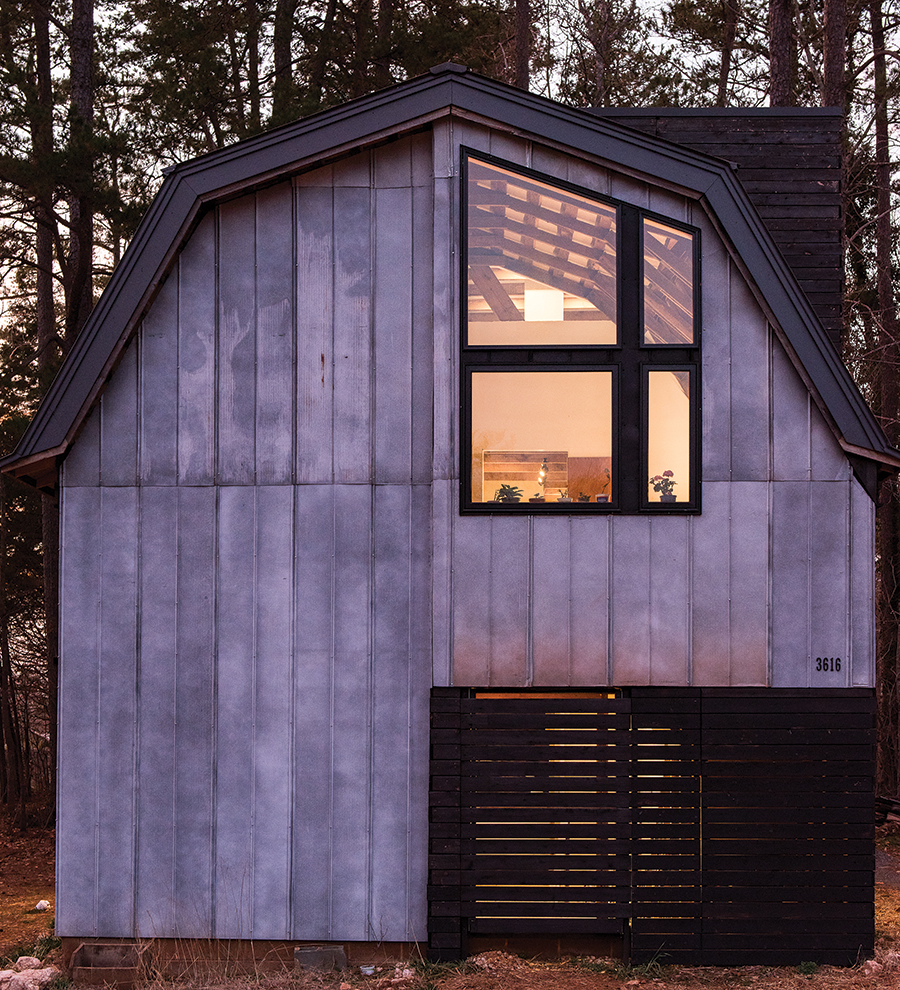
Work on the structure began in 2017, the year Clapp launched his practice, Schemata Studio, after finishing graduate school. The barn functions as both home and studio with 940 square feet of heated space — there is additional unheated footage on the ground level, which features a laundry room, outdoor shower, storage and a garage. It has been reinvented yet not. It still possesses its barn essence, honest and rough-hewn. As Clapp knew it must: “It retains vestiges of the past.”

“My grandparents lived next door,” he explains, gray gravel crunching beneath the impeccable shoes. The barn is adjacent to his grandparents’ traditional clapboard farmhouse. And while the farmhouse is a rental now, Clapp’s older sister may consider returning to what could grow into a small family compound. At this, he smiles.

A cabin across the road from the barn was restored to his father’s specifications — another story altogether — Clapp says as he circles the barn’s exterior. He points out the outdoor shower and space where animals and farm equipment were once kept; they reveal the history and yes, even the granular poetics of the place.

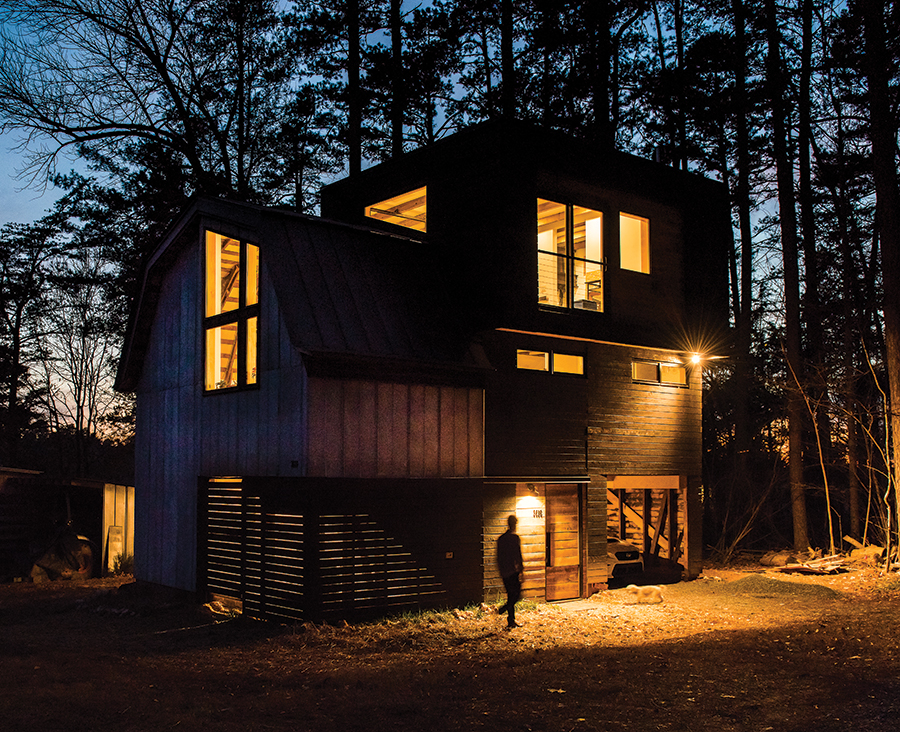
The barn does a curious thing. It disappears. UPS drivers miss it constantly, Clapp explains. Brown trucks whizz past the gravel drive, which wends by a bisected felled tree, a pine lost in a winter storm, which he laughingly calls “the gate.”

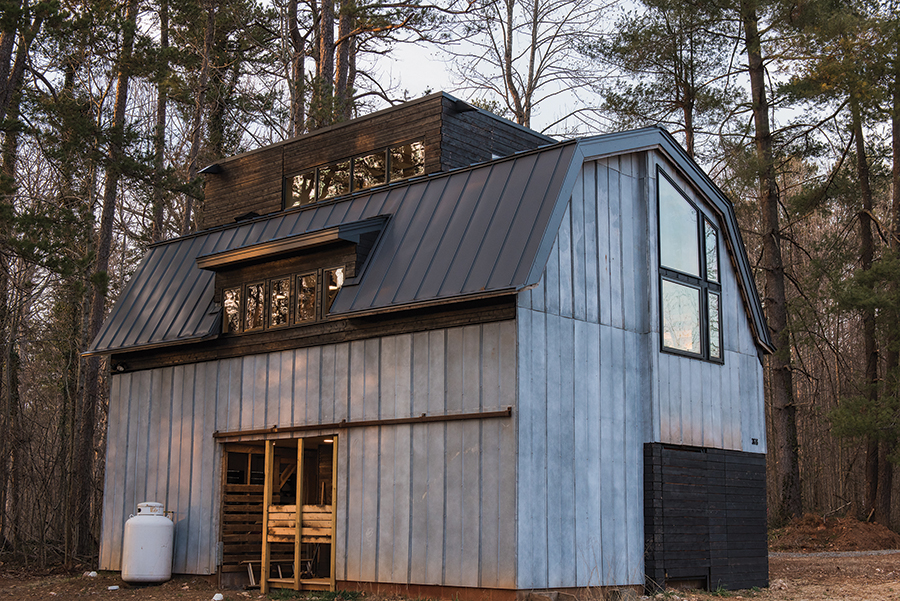
The barn hides in plain sight, with charred board siding, metal roof and a separate shed, so organically conceived it blends into the winter’s landscape. The exterior form is a combination, Clapp says, of the original tin panels and oak plank. The rain screen, an architectural modification to the original barn, is made of charred slat siding, a Japanese technique, not stained, he qualifies. The charring technique is redolent, too, recalling a family home that was lost in a fire.

So, altered, the barn echoes the past but it is changed. It is of the place, yet not. Clapp will explain later; this, too, concerns resonance.

There are small innovations to be seen from the very first glimpse. The large front door, wood and metal-edged, has a load-bearing wheel on the inside that is both quirky and industrial-chic.

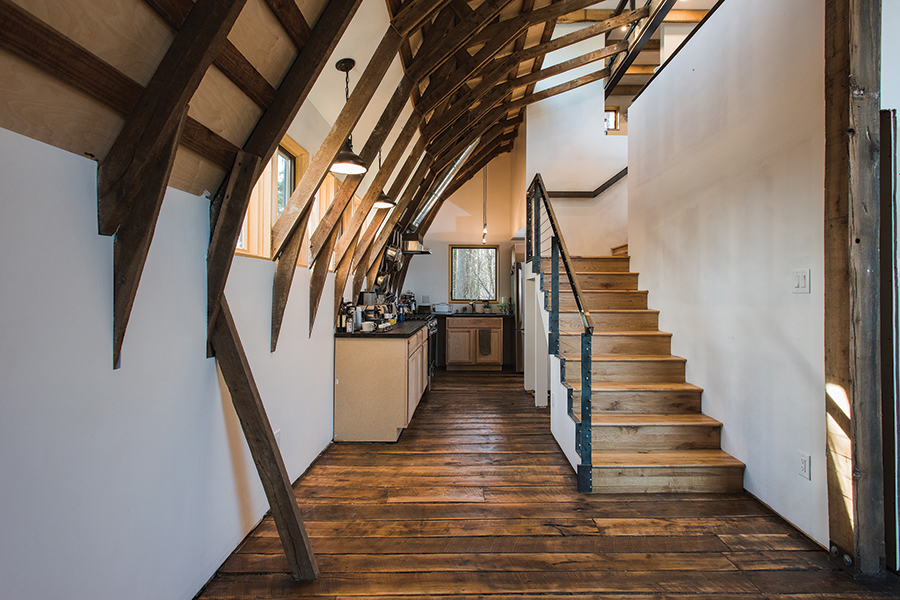
Stairs lead up from the entry, through a grid-like exposure of rough beams. Clapp says code modifications were made to the stair treads, in order to retain the original wood yet make them compliant. The original treads, he says, “are articulated with new rough cut oak.”

There is the undeniable romance of hefty timber beams, raw edges and decades-old wood.

Where once there was a hayloft, there is now work and living space. Overhead, the gambrel roof is a show-stopper, a humbler version of a vaulted ceiling in a European cathedral. The beams were cleaned, faced with plywood, and serve as the most impressive feature, the one that no doubt inspired everything. Windows artfully sliced into the upper walls provide light yet recede, more generous than traditional barns allow.

Clapp discusses the way “the new space was grafted” onto the old. He mentions palimpsest, usually defined as discernible traces of writing, as on a pad, or it can mean something that has been altered yet bears the traces of its earlier form.

“We are standing on the original floor and under the gambrel roof structure,” Clapp says, his blue eyes narrowing in emphasis. “All original,” he adds, right down to the insects they had to shoo away. “We had to vacuum off the cobwebs and dirt dauber nests. We seemed to find new ones every day.”

Clapp points out that the revealed oak rafters are 24 inches on center. “It gives a harmonious feel. The vernacular resonates towards that end.”

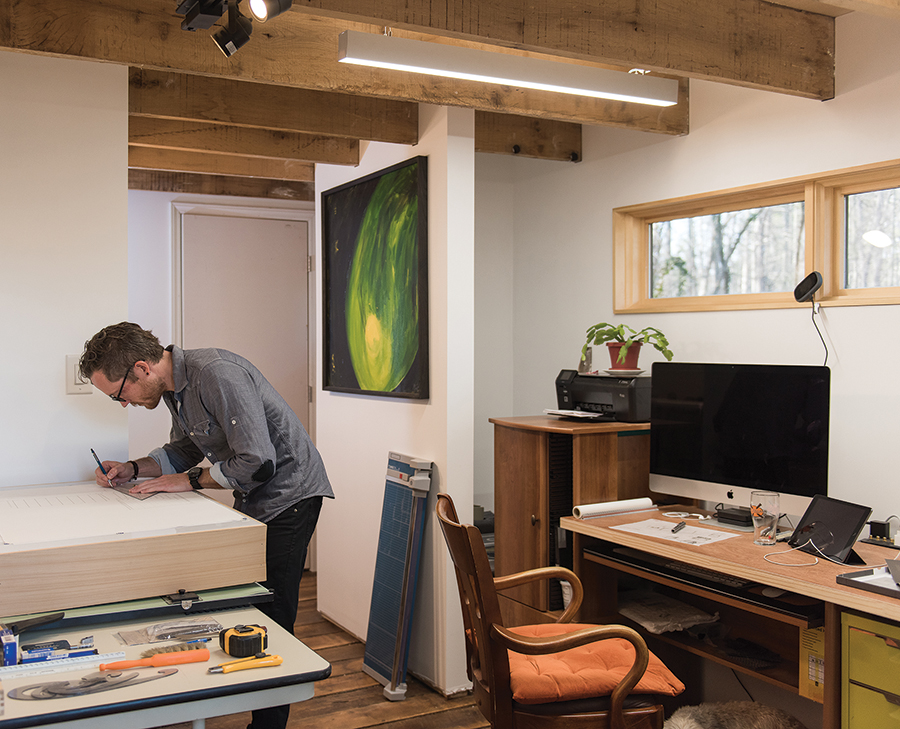
He also mentions pondering the finer points of a baseboard finish only feet from where his desk is, neatly stacked with multidimensional studies. Clapp anticipates growing the business, and requiring another, separate location. Then he and Ozgen will claim the nearly 1,000 square feet of the barn as their living space only.

As he makes an espresso on the stovetop in the L-shaped (surprisingly spacious and workable) kitchen, he sets cups and cream onto a dark-stained butcher block counter.

Both Clapp and Ozgen are avid cooks who did not want to scrimp on the kitchen, which he admits appeared smaller on paper before being built. So the fridge was carefully deliberated — they eschewed French-style doors to maximize space.

There are three levels, the third comprising a sleeping loft. The loft contains a bathroom, with exposed copper pipes in the industrial-styled tiled shower. The bedroom features a Juliet balcony across from the bed, providing a tree-filled view. There are evergreens and deciduous trees, whose stark branches will soon leaf out, filling the frame in a profusion of green like an animated painting.

The interior is largely complete with some finishing touches still in process. Clapp points out that furniture is on order but not yet arrived. Two camp chairs provide seating near the office where the couple are still testing various details within the space and revising ideas. There is the baseboard, for example. He points to a raised metal lip along the baseboard behind one of the camp chairs. The original idea, he explains, for the entire floor. The more practical option, he says, is one being tested on another wall called a shadow line — which appears to delineate the base of the wall without complicating construction and housekeeping.

The couple, both in their 30s, are the occupants and also the makers. They are doing the work largely themselves. Clapp sprinkles conversation with ideas about living minimally, of craft, of intention. There is discovery, tweaking and refinement all ongoing as the makers explore, as they have been, since taking occupancy last December.

He discusses conservation versus preservation, saying conservation focuses on retaining the past, preserving the flavor of the place. “Done in a way that can be sensible.” Clapp uses a professorial term: “resonant dwelling.” He has dubbed the barn project that.

“Farm architecture is what you build when you can’t afford to get it wrong,” N.C. architect Frank Harmon once commented. It is a quote found on Clapp’s website, though Clapp received his architectural training at the University of Tennessee and Harvard, where he also met Ozgen. So what if the barn was once a humble outbuilding on a farm? In the architectural context, Clapp says, good design can lend identity and a sense of place.

Only briefly did he doubt his vision.

As he recalls, there was a particular memory before the project began. It occurred after they cleared out all the detritus and items stored in the barn. For the first time, he could see the barn he had long admired emptied out.

“There was a weird moment,” Clapp confesses. “The essence of the space was exposed.”

It seemed larger. And he recalls feeling sudden reservation about altering it at all, thinking, “Oh, no, we’re going to start breaking this space down and compartmentalizing it. But once fully realized, the vision enhanced the existing space. We retained certain aspects of the original structure, so you could tell the story.”

Later, Clapp shows some of his elaborate sketches. Three days a week he travels to UNC-Charlotte, where he lectures on architecture. The remaining days, he works here in Whitsett, occupying the project nearest to his heart.

The family dog, Kar, snuggles into a bed near his desk, also reporting for work. “Kar,” he explains, “is the Turkish word for snow.” Ozgen is Turkish.

She works with Gensler, a Raleigh architectural firm but also is involved with Schemata, something Clapp long contemplated opening.

“A schema is an organizational tool that our minds use to understand certain situations. Schemata, as its plural form in Greek, help bridge between images and concepts to facilitate that understanding. We seek to challenge traditional ways of thinking about architecture and space to create pleasing new forms of occupations and residences.”

Standing on the ground level, which still has relics of its farm-past, Clapp says they are still pondering how the unfinished footage may one day be used. But he very much likes the fact that the old feed bins and stalls where his grandparents kept a pony and other animals are visible. Palimpsest personified.

“I think architects are uniquely positioned to help expose hidden value through thoughtful design,” Clapp reflects.

He adds that the “Amazon-ized society and culture have come to equate the lowest price with the best value but this couldn’t be further from the truth . . . “I like to ask: ‘When’s the last time you were truly delighted by something?’ Architecture and the space that is designed within and around it has the ability to present that.”

The grounds will change, too. Come spring, the couple envisions there will be planting in the field outside, just as there once was. Clapp says they are discussing planting pecans and mulberries. “A true Turkish breakfast will have mulberry jam,” something that he says Ozgen anticipates. The delicate mulberries are shaken from the branches, then caught in linen sheets before they hit the ground and are bruised, he explains.

Part of the poetics of architecture concern how man relates to the land. Clapp honors the place where his father and uncle came of age, and where his grandparents farmed.

“Christmas Day, we opened one of the few remaining canned jars of green beans from my grandmother,” he recalls. “She also made fresh apple pies,” he adds.

So inasmuch as Clapp is a philosopher, he too, is also a “maker,” just as he says.

Cynthia Adams is a contributing editor to O.Henry. Many of her happiest childhood moments were spent playing inside a Cabarrus County barn, observing life from the hayloft.

From Here to Ubiquity

Barn conversions are not uncommon in New England and certainly the U.K. But in the South, like the barn of my childhood, many have been lost, erased from the landscape by the ravages of time or a developer’s bulldozer. Ours fell to the latter.

Mike Cowhig is a longtime community planner with the City of Greensboro who works historic districts and guides the Historic Preservation Commission. He and Benjamin Briggs, the head of Preservation Greensboro, pondered how many barn conversions exist in Greensboro. Neither possesses an inventory of the county’s barns.

In an email, they mention the Carlson Farms barn conversion (part of the Greensboro Country Club), Stancil Farm, and Starlight Meadow, which is also near Whitsett. Then Briggs’ emails a quip about how such facilities often pop up and disappear, joking that anyone with a cow, a barn, and a golf cart is suddenly a wedding venue. There is something egalitarian about a barn, after all. — C.A.

Doodad

Hum-dinger

Greensboro Opera launches a new production in a new performance space

We all know the story: A brother and sister lose their way in a forest and come upon a gingerbread house laden with sweets; weak with hunger, they start nibbling at the confection . . . only to discover it is the property of a witch who uses the sugary structure to lure young children for her own consumption. Grim and grisly stuff, as written by the Brothers Grimm. Though the story is well-worn, the operatic adaptation of Hansel and Gretel by 19th-century German composter Engelbert Humperdinck “has some of the most beautiful music,” says David Holley, director of Greensboro Opera.

He has equal praise for the new venue where the production will be performed March 8, 9 and 10: Well-Spring Theatre, situated on the campus of Well-Spring retirement community. “It’s just a gem,” Holley affirms. “It’s got great acoustics, great sightlines and there’s not a bad seat in the house.” Accommodating 330, the performance space consists of a traditional proscenium theater, but as Holley observes, it’s designed in such a way to serve multiple purposes. “It’s intimate, inviting, yet spacious.”

He should know, having watched the theater’s construction from the time it was “a concrete slab.” About four years ago, Holley’s colleague on the UNCG music faculty and Well-Spring’s director of programs Garrett Saake made an attractive offer: “He said, ‘We want to get professional arts organizations booked in the new performance space,’” Holley recalls. “I immediately said, ‘yes!’” (As did Five By O.Henry, Greensboro Symphony and Bel Canto Company). Ever since, the opera company has used Well-Spring for rehearsals of Daughter of the Regiment, Madame Butterfly, Carmen and Cinderella. “It’s great, because the residents can come and go,” Holley says.

Now it’s the general public’s turn to get in on the act. Or more specifically, the three acts of Hansel and Gretel, which was chosen for its popularity among opera buffs and novices alike. In addition to the familiar plot, “it’s an hour-and-a-half and in English,” Holley notes. But just as that gingerbread house in the forest enchants the opera’s protagonists, it’s the music that enchants audiences. Holley waxes poetic about the sublime “Evening Prayer,” and the, well, sweet sounds of Greensboro Youth Chorus filling cast as the other child victims of the witch’s evil spells. “A lot of it is folk-based, simple, accessible,” he says of the score. “It is one opera where people will leave humming a tune.” — Nancy Oakley  OH

Tickets: ticketmetriad.com

The Omnivorous Reader

The Definitive Douglass

Revealing a multifaceted American icon

By Stephen E. Smith

Readers who’ve been inspired by Frederick Douglass’ eloquent autobiographies will likely find David Blight’s 900-page Frederick Douglass: Prophet of Freedom — touted by its publisher as “the definitive, dramatic biography of the most important African American of the nineteenth century” — a demanding read. The complexities of race relations in America make it so, and the fact that Frederick Douglass, our first nationally recognized black civil rights leader, is one of the most multifaceted and controversial Americans to have shaped 19th-century thought, only amplifies the challenge. But Blight’s insights into Douglass’ radical evolution and the obvious correlation with the state of race relations in contemporary America make this meticulously researched and beautifully written biography well worth the time and effort.

Douglass was born Frederick Augustus Washington Bailey around 1818 and lived his early years on the Delmarva Peninsula, a few miles from the small town where this reviewer was born and raised. At age 13, he was sent to Baltimore, where he was taught to read by his owner’s wife, Lucretia Auld. He was eventually hired out to a “slaver breaker” in St. Michaels, a bayside village 10 miles west of my hometown of Easton, and after an attempted escape in 1836, he was briefly incarcerated in the Talbot County jail, an ominous stone structure adjacent to the courthouse I passed daily.

During my school years, I never once heard the name Frederick Douglass. There was no historical marker identifying the Sage of Anacostia as a local luminary (the only public monument in town, a bronze figure of a Confederate soldier cloaked in the stars and bars, was dedicated “To the Talbot Boys/1861-1865/C.S.A.”). No school or municipal building was named for the great man, and he wasn’t discussed in the Maryland history book we studied in the fifth grade. None of my childhood friends can recall any reference to Douglass. I was a college student before I learned of his extraordinary accomplishments and was compelled by curiosity to read his three autobiographies. Only then did it occur to me that growing up in Frederick Douglass’ backyard without learning about him was tantamount to being raised in Springfield, Illinois, without hearing the name Abraham Lincoln.

I mention this lapse in my education, occurring about the time the Supreme Court ruled against segregation and Jim Crow laws, because it’s an example of what Douglass struggled with all his adult life: the notion that a black man couldn’t possibly demonstrate a profound philosophical wisdom and achieve worldwide fame. Perhaps the good citizens of Talbot County thought it best not to mention Douglass. Other than the accident of birth, they couldn’t claim credit for his success. And who, after all, is a prophet in his own land?

Blight’s biography adds little new information concerning Douglass’ prewar years as a social reformer and abolitionist, other than to note that a self-reliant Frederick Bailey transformed himself by force of will into Frederick Douglass, one of the great thinkers of his time, a writer and public speaker whose talents were equal to those of Lincoln and whose determination to end the “peculiar institution” that was the economic lifeblood of the South surpassed that of the martyred president. “Douglass offered an original American to those who sought such images,” Blight writes, “he was the sui generis former slave who found books, the boy beaten into a benumbed field hand who fought back and mastered language and wielded a King James – inspired prose at the world’s oppressions with a genius to behold.”

Douglass biographies are numerous and range in quality from Benjamin Quarles’ excellent Frederick Douglass to Leigh Fought’s Women in the World of Frederick Douglass, a misguided effort that occasionally borders on fiction. Blight’s biography is exceptional because he had access to untapped primary sources contained in the collection of Walter Evans of Savannah. He’s made good use of these sources to explicate Douglass’ postwar struggles to secure the rights of freed slaves and to banish the scourge of lynching from the South. 

Blight also thoroughly examines Douglass’ varied causes and obsessions. He backed John Brown’s violent anti-slavery activities and was a staunch supporter of women’s rights. He carried on a long-term relationship with Ottilie Assing, a German feminist, freethinker and abolitionist, who sheltered him when he was charged with conspiracy in connection with John Brown’s raid on Harpers Ferry. He served as minister to Haiti from 1889 to 1891 and was deeply involved with the 1893 Haitian pavilion at the World’s Columbian Exposition in Chicago.

In 1884, Douglass married Helen Pitts, a white abolitionist from a prominent New York family, thus crossing the color line. All the while, Douglass continued to speak out against racial injustice, Jim Crow and peonage laws that in effect locked freedmen in a state of perpetual servitude. Late in his life, he was still railing on the effects of the pernicious color line: “(It) hurts us at midnight, it denies us accommodations in hotels and justice in the courts, excludes our children from schools, refuses our sons the right to learn trades and compels us to pursue only such labor that will bring the least reward.” The South won that war of attrition.

Blight’s biography is, for the moment, the definitive work on Frederick Douglass, although there is a need for a more insightful inquiry into the great orator’s religious, political and philosophical beliefs. After 900 pages of text, Douglass remains something of an enigma, a man whose intelligence, eloquence and determination almost changed America for the better

On the courthouse lawn in my hometown of Easton, Maryland there are now two statues, one celebrating the “The Talbot Boys” and another bronze that depicts Douglass, one hand on a lectern, the other raised beseechingly skyward. The town celebrates their most famous son “throughout the year, including Frederick Douglass Day in September and the annual Juneteenth celebration of abolition.” It’s about time.

Stephen E. Smith is a retired professor and the author of seven books of poetry and prose. He’s the recipient of the Poetry Northwest Young Poet’s Prize, the Zoe Kincaid Brockman Prize for poetry and four North Carolina Press awards.

The Accidental Astrologer

The Originals

Leave it to the March-born to break the mold

By Astrid Stellanova

March madness doesn’t just apply to basketball, boys and girls. It applies to the whole universe. We astrologers already knew the universe held all kinds of spooky entanglements before the physicists did.

Happens that Fred Rogers and Albert Einstein were March-born Star Children. And so were Vincent Van Gogh and Ruth Bader Ginsburg. Quincy Jones and Aretha Franklin, too.

Creative, artistic, occasionally mystic, but almost always completely original — the birthright of those born this month.

Pisces (February 19–March 20)

Making. It. Rain. Boo-ya! That’s rainmaker you this birthday and year. You roar right into the lead with one good idea after another and the energy to make them happen. If the rest of the pack cannot keep up, and not many can, then they have to eat your dust. It will be hard to dampen your enthusiasm and to contain your excitement as precious dreams are realized. Take a bow!

Aries (March 21–April 19)

You’ve had some hard knocks and rude shocks, most of them from thinking you could do the next to the impossible for the undermotivated. If you are feeling like the Mayor of Underachiever Town, just remember there’s no way to change others and most of your suffering is from that.

Taurus (April 20–May 20)

You’ve been generous, Star Child, especially when out on the town, but now you’re feeling hard-pressed. You act like I don’t know your moola from your hula lately. As fun as it was, visit the great state of Austerity for a serious time-out. Clip both coupons and your wings for a while.

Gemini (May 21–June 20)

Careless and reckless comes to mind, my twin. Yet you wonder why you feel like you’re Tito in the Jackson family? You were born with gifts and talent but you have not used them.

Cancer (June 21–July 22)

Be firm with somebody who knows how to play you. Make Midas let go of the greenbacks and be generous with you for a change. Visit places you haven’t been, like the province of Reality Checkville.

Leo (July 23–August 22)

You’ve been spinning it to win it, like a revitalized Vanna White at the wheel. Fun to watch, and fun to be you during this sun cycle. It will delight your friends and depress your enemies to see your sparkle.

Virgo (August 23–September 22)

Darling, you’ve been a Jittery Joe. It is discombobulating to trade roles with a close alliance, but you have bravely experimented with self-discovery. Don’t give up now; it leads you to a whole new paradigm.

Libra (September 23–October 22)

Sneaky! Those who think they can predict everything about you are going to have to put a bell around your neck to find you. You have privately begun explorations they will find amazing. Amaze yourself, too!

Scorpio (October 23–November 21)

Sugar, don’t look back unless you plan to go that route. Now that a new endeavor is under way, all signs point to success. Keep your cool. Also, find one person who needs your mentoring. It will be a revelation.

Sagittarius (November 22–December 21)

Shake it. Bake it. But don’t just lie there and take it! You are at a key place, and you’ve invested a lot emotionally in a good outcome. Fight for what you want, and be as inclusive as you can if you want to lead.

Capricorn (December 22–January 19)

Namaste doesn’t mean nah, may stay. You may want to stay put and not budge, but where you are now is all about finding peace in a time where you feel at war with yourself.

Aquarius (January 20–February18)

In another 364 days you will ask yourself if you made a dint or difference in the world. You already have. Someone is trying to express just how important you are, and what you have done, and honor you.

For years, Astrid Stellanova owned and operated Curl Up and Dye Beauty Salon in the boondocks of North Carolina until arthritic fingers and her popular astrological readings provoked a new career path.

Gate City Journal

Deep Dish

Free Pizza, a Greensboro podcast that celebrates up-and-coming creatives, bites into its third year

By Maria Johnson

Welcome to the Free Pizza studio.

Actually, it’s a sunroom on the back of a 1948 rental house that has sheltered roughly 1,948 students and others who orbit in the gravitational field of UNCG.

That’s an exaggeration, of course.

Two thousand people have not lived here.

It just looks like it.

But back to the studio, which is adorned with — among other things — strings of bistro lights, anime posters, a photo of the Washington Monument, speakers, a turntable, a guitar, chess pieces, an empty water bottle, a container of ibuprofen, and a covey of furniture thrifted from yard sales and estate auctions.

One of the finer pieces, a marshmallow of a black recliner in the corner, absorbs the frame of Kenrick Jobe, an affable 23-year-old portrait painter who grew up in Lexington, graduated from ECU and now lives in Durham.

A few feet and a couple of microphones away, on another puffy recliner, perches his interviewer, Daniel White, an effusive fellow who wears a wide smile, beard and watch cap as a seemingly inseparable unit. He consults an extra large iPad that’s propped in front of him on someone’s grandmother’s side table, complete with water rings.

“You guys ready?” says Jacob Beeson, whose back is turned to the duo. He’s earplugged to a laptop that’s running an audio recording app.

Nods and yeps all around.

“Today, we have the wonderful Kenrick here,” says White. “You are an amazing painter and graphic designer . . .”

Thus begins another episode of Free Pizza, a weekly podcast featuring interviews with artists you’ve probably never heard of.

Podcasts, for the untuned, are basically radio shows on the internet.

They cover scads of topics including politics, art, science, travel and all manner of exotica. Some podcasts spring from slick studios affiliated with major media outlets, like NPR. Others — most, in fact — come from grassroots creators who record in basements, garages and, ta-da, sunrooms.

Worldwide, more than half a million podcasts are zipping around the cybersphere. According to a recent survey, in this country alone, an estimated 44 percent of people older than 12 have listened to a podcast.

Which brings us back to Greensboro’s own Daniel White and Jacob Beeson, who are 28 and 26 respectively. This month, they celebrate, with a smidgeon of surprise, Free Pizza’s second anniversary.

“Obviously, we were hoping for the best, but I definitely didn’t think we’d still be going with this much momentum and steam,” says Beeson. “We’ve been overwhelmed by support.”

Listeners tap into the show on several platforms. Earlier this year, Free Pizza started uploading episodes onto Spotify, a major audio streaming service. Apple iTunes and SoundCloud also distribute the show, and there’s always the show’s website, freepizzapodcast.com.

All told, Free Pizza gets 100 to 300 downloads per episode from all sources combined, according to Beeson. Since they started, they’ve racked up north of 20,000 downloads on about 80 episodes.

Their traffic resembles that of other locally produced podcasts, including the city government’s Gate City Chatter, which is recorded in a community podcasting studio in the Greensboro Cultural Center, and a podcast called The Open Micers, which is run by comedians J.D. Etheridge and Micah Hanner.

Another area podcast, Name Redacted, is recorded in Colfax and leans toward comics and gaming. Alexander Folmar, who created Name Redacted with his friend Chris Nielsen six years ago, says Free Pizza fills a niche — showcasing grassroots artists — with easy style.

“Those dudes crush, and the reason they crush is Daniel has been a Greensboro staple for so long. He’s so personable, and his personality is not over-the-top. He does a really, really good job of asking the question and stepping away,” says Folmar.

Nielsen concurs: “In terms of local artists and creatives, they really have their finger on the beat like nobody else.”

All of this because of cars and music — with a 21st-century twist.

In the late aughts, White and Beeson, both from High Point, were teenagers swimming in the hardcore punk music scene around Greensboro. Beeson played bass in a band called Barrow. White was a fan and budding photographer who snapped pics at concerts. They had lots of mutual friends and contacts on social media.

Then, around 2011, White, who graduated with a degree in information systems at UNCG, was cruising Facebook for a job, and Beeson — who’d dallied in business studies at High Point University and Gardner-Webb University before surrendering to music — responded that there were vacancies at CarMax, where he worked. White jumped on board as a photographer for the used-car dealer, and a friendship was born.

Both guys were big fans of podcasts, then in their infancy. White was hooked on No Jumper, a Los Angeles–based program heavy on underground rappers. Jacob was tuned into Serial, an early NPR podcast. A few DIYers were streaming around Greensboro.

White and Beeson were drawn by the close-to-the-ground nature of the medium.

“I wanted to do that here, with artists and people who were not super on-the-radar,” says White. “It’s mind-blowing how many artists are around here.”

He was determined to avoid musicians because he felt they had enough exposure in zines, or small special-interest magazines.

“I think his first text said, ‘I want to do a podcast for everybody but musicians,’” Beeson remembers. “He was like, ‘How many podcasts have you ever seen where they interview painters?’”

Beeson — a sound geek who already had most of the recording equipment they would need — would be the audio engineer.

White would do most of the interviewing. He wanted to catch creatives early in their careers before their struggles and mistakes faded from memory. He wanted other artists to take heart and know that they weren’t alone.

Beeson was in. They would record several episodes on the weekends, and they would post one interview — lasting an average 30 to 45 minutes — every week.

They had no journalistic experience — they’d been interviewed by small publications about their photography and music, but that was it — so they prepared by listening to podcasts and by sharing links and notes on their phones.

They dissected interviews, figuring out how to ask questions so the session flowed naturally, as a conversation rather than an inquisition.

White came up with the name Free Pizza because . . . who isn’t attracted by free pizza? Not that they would serve free pizza because, hey, no money. But still, it had a nice ring.

After three months of preparation, Beeson opened a recording app, Apple’s Logic Pro X, on his laptop, and White sat across from his subjects, pen and pad in hand.

“I was terrified,” says White.

“The first episodes were pretty bad,” says Beeson laughing. “It was mostly us interviewing our friends. It’s the easiest thing to do when you have no credentials.”

They invited interviewees to the basement of the home where Beeson was living at the time.

“It was kinda sketchy,” admits Beeson. “It was a little damp, very cold, overwhelming concrete.”

Their first guest was their friend Savannah Patterson, an illustrator and graphic designer from Greensboro.

Another early interview: Winston-Salem videographer Justin Reich, who has worked with musicians including Ozzy Osbourne and Zakk Wylde.

Beeson was shocked by how quickly people agreed to be interviewed. He and White started reaching out to artists who lived beyond the Triad; if their audience could be anywhere, via the internet, so could their subjects.

Example: a May 2018 interview with Jessamyn Stanley, a Durham yoga instructor who has been featured in Forbes and People magazines and on BuzzFeed.

“Her story touched me on an emotional level,” says White.

At first, episodes of Free Pizza appeared only as a tab on Amplifier, a now defunct Greensboro arts and entertainment website. Free Pizza had no website of its own. But White and Beeson had lots of friends who told other friends, on social media, about Free Pizza.

A year into the project, the podcast caught the ear of Jeremy Hyler, creative director at PhotoBiz and its sister firm Zibster, website design companies in Greensboro.

Hyler was intrigued by the show’s emphasis on up-and-coming artists. Growing up in Eden, N.C., Hyler had felt the isolation of being a creative kid who knew very few kindred spirits. Free Pizza was full of those souls.

“Their stories really captured me,” he says. “We’re all kind of cut from the same fabric.”

Hyler offered White and Beeson a sponsorship agreement — a website in exchange for shout-outs during the interviews. Every couple of months, the trio huddles to map out their next steps. They’re talking about adding video and other website content for a nominal fee.

White and Beeson plan other activities for the coming year. They hope to dish up real free pizza — as in slices — at a public party and podcast with a new partner, Greensboro’s Center for Visual Artists, a nonprofit gallery that also focuses on emerging artists.

Half of Free Pizza’s subjects live in the Greensboro area, and three-quarters call North Carolina home, but the duo plan to keep expanding their geographic reach. Last year, they interviewed people — whom they knew personally or through Instagram — in Scotland and England.

“I think it’s important to know what’s going on in other places,” says White.

They also plan a road trip, maybe to Wilmington. Last spring, they did a three-day swing through Winston-Salem and the Triangle. They recorded almost 20 episodes, enough to last several months.

The pair haven’t quit their day jobs yet — White still works at CarMax, though he’s moved into doing appraisals, and Beeson works at an insurance company in Burlington.

They cling to their own creative dreams: White nurtures his photography business (www.danielwhitephoto.com) and Beeson refines his audio skills.

“Please hire me to make your record,” he says unabashedly to the universe.

Meanwhile, they’ll serve Free Pizza as long as they’re able. Financially, there’s no incentive — not yet, anyway.

“I don’t think either one of us has even gotten a dollar from it,” says Beeson.

“It’s a passion,” says White. “That’s what you see here.”

Back in the studio/sunroom, White prompts Jobe to share his story — how he started calling himself an artist at age 17 because a career aptitude test said that’s what he was; how he began by doing portraits of TV personalities like Miley Cyrus and Raven Symoné; how he carries a sketchbook and pencil at all times, but he paints in a program called Procreate on his iPad Pro; how his parents worry about him putting his work on Instagram where people could rip it off (“I’m like, ‘Mom and Dad, I gotta get it out there.’”); and how his Instagram account, @KenrickJobe, is probably his biggest marketing tool. Among his followers: Actor Caleb McLaughlin of the Netflix series Stranger Things.

“I know if the right person sees it, that’s all it takes,” says Jobe. “I just want to be able to do this for a living while providing for a family. If I’ve done that, I’ve made it, in my opinion.”

“I feel like so many people are just one break away,” says White.

Maria Johnson is a contributing editor of O.Henry. She can be reached at ohenrymaria@gmail.com

Poem March 2019

Tilt Toward Spring

Night’s frozen mantle sparks

in early morning rays, luminous

as a bride’s new diamonds.

Tree’s crystalline coatings

slip soundlessly from drooping

branches, twinkling fairy lights

pirouetting to the ground.

Ice sheets slide from the eaves

dropping iridescence on unsuspecting

tender daffodils waking from winter

slumber.

Air comes alive with birdsong

and fluttering wings.

Lawn strewn with early robins,

pecking for sustenance, puffing

their breasts for warmth.

Signaling Earth’s inevitable tilt

toward spring.

— Patricia Bergan Coe

Birdwatch

Babes in the Woods

Early spring is nesting time for wood ducks

By Susan Campbell

Love is in the air for the most beautiful of all the waterfowl: the wood duck. These lovely creatures begin courtship in January, and by the end of the month seek out suitable nesting sites. They are busy raising what is usually a very large family by early spring.

“Woodies” as they are affectionately known by waterfowl lovers, are found commonly in marshes, beaver swamps and along streams throughout most of North Carolina. Here in the middle of the state they are year-round residents, although the population swells in the winter to include birds from farther north. Nonresident birds tend to be very skittish and flush very quickly upon approach. Our local wood ducks can become very tame, especially in locations where they are being fed by people. On more than one occasion, I have approached individuals at Reservoir Park in Southern Pines, where they were feeding on corn with a variety of other ducks and geese.

Wood ducks are smaller and more slender than our familiar mallards. The hen is nondescript — grayish with white spotted flanks and white around the eye. The drake, on the other hand, is a patchwork of red, brown, yellow and green. He sports a drooping green crest and a bright red bill and eye. Don’t expect quacking. Wood ducks’ vocalizations are a series of squeals and whistles. In the air these ducks are fast fliers and remarkably maneuverable, threading their way through forested bottomlands, their preferred habitat.

This species of waterfowl spends most of its time foraging on aquatic vegetation and insects found in shallow bodies of water. But when it comes time to breed, they may be found up to a mile from water, searching for a suitable nesting site. They are unique in that they are the only ducks that nest in trees in our area. Hens will typically look for holes in dead or dying trees in which to lay their eggs. It is not unusual for them to lay a clutch of 20 eggs in a cavity over a hundred feet up in an old tree. At Weymouth Woods, wood ducks frequently use old pileated woodpecker holes that were, in turn, created initially by red-cockaded woodpeckers.

As uncanny as it sounds, the ducklings have no trouble whatsoever dropping to the ground when they are called by their mother soon after hatching. They will all then quickly walk downhill to the nearest body of water. Unsurprisingly, this is when they are most vulnerable, not only to ground predators such as foxes but also to being separated from their mother as they make their way around obstacles.

Of course, with natural snags being less common on the landscape, wood ducks have taken to using man-made housing. Many folks in the Sandhills and Piedmont have been successful at attracting woodies to their property with wood duck houses adjacent to wetlands. A box should be mounted on a pole and fitted with a baffle to keep predators such as raccoons and opposums from getting to the nest. It is also important to be aware that these ducks regularly produce two sets of young each year, so a box may contain a female on eggs any time from February through May. In addition, do not be surprised if the box is used by other birds during the course of the year. Screech-owls, great crested flycatchers and even bluebirds may take advantage of a duck box as well.

Susan would love to receive your wildlife sightings and photos. She can be contacted by email at susan@ncaves.com.

The Art of Reinvention

Agnes Preston-Brame’s take on Abstract Expressionism

By Nancy Oakley

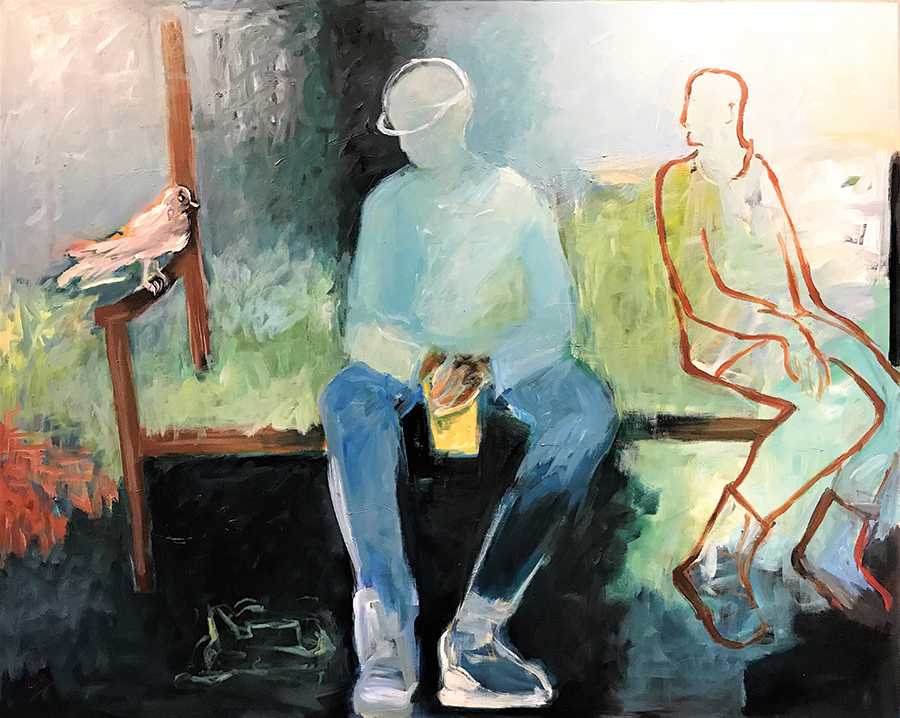
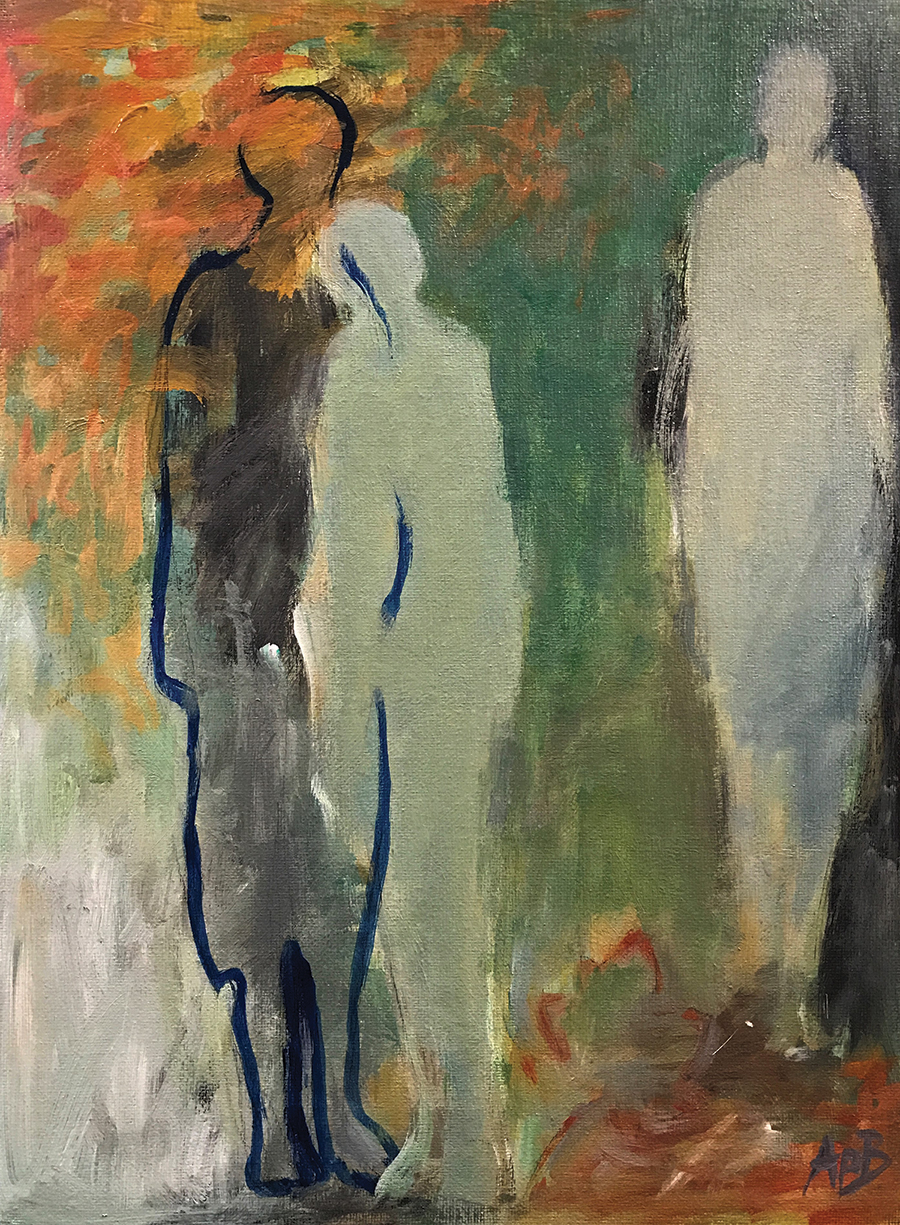
“I’m reinventing myself, as I always say,” Agnes Preston-Brame chuckles from her perch on her living room sofa, which just so happens to be upholstered in an elegant fleur-de-lys pattern that she designed. Behind her hang two large paintings, one of a group of faceless figures swathed in broad strokes of blue and green paint, another of a single ghostlike figure, entirely in white, save for a red splotch where its heart might be. “Well, I had breast cancer on that side. Because of that, it will never be sold,” Agnes allows, with just a trace of her native Hungarian accenting her words.

The two canvases are among several adorning the walls of the Southside Greensboro home that the prolific painter and self-described Abstract Expressionist shares with her husband, Gary Brame. In an earlier painting, two white, feathery figures spring in opposite directions from a blue-gray background, as if rising from an ocean’s depth to its surface. “It’s called Separating,” Agnes says, explaining that at one point she held a fascination for trees, the inspiration for the unusually elongated lines of the human forms.

She has always been attracted to figures, since her childhood in Budapest, Hungary, when, “I started doodling, like most kids.” For an only child of divorced parents, art was an escape. Agnes also recalls a talented classmate from that period: “She was always drawing models. I admired her doing it. I think maybe she poked something in me early, because I always went right to figures.” In time, Agnes would attend the Desi Huber School of Art and later the Academy of Fine Art (no mean feat, as husband Gary points out: “It was the Soviet system; you did not get into an advanced school unless you were a straight-A student.”)

But the curriculum was rigid. “You start out in art school doing shapes, you know, balls and squares and then you get into the figure from models, for portraits,” Agnes recalls. She didn’t realize just how stifling her education was until she was allowed to visit her mother, who had remarried and escaped Hungary’s revolution in 1956, and had become an American citizen. After several appeals to Hungarian authorities, Agnes, then 19, was at last granted a passport and flew to Montreal, where her mother was then living. It was to be a three-month visit.

Or so the young artist thought. “My mom, obviously, insisted that I stay and wanted me to stay. But she did a very tricky thing.” She drove the impressionable teenager down to New York City and took her to all the museums and all the galleries. “I was blown away by the different styles — Expressionism and Abstract Expressionism — that we were censored from in Hungary.” The ruse worked, as Agnes realized, “I probably couldn’t have achieved what I really wanted to achieve to become a professional artist, because it was still very difficult under communism, under Russians.”

She defected, much to her father’s ire. Years later, after his death and the fall of communism, Agnes and Gary traveled to her father’s flat in Budapest, which they’d inherited. There, hidden in the back of what Gary describes as a “primitive storage unit,” was a box of sketches. “Wonderful little sketches of her grandfather,” Gary remembers. “They were not childish in any way. Very professional.”

But for Agnes, a truly professional artist’s path would take many twists and turns. Because of her mother’s status as an American citizen, Agnes, who spoke no English, had to live in America, not Montreal. So her mother deposited her daughter at the YWCA in New York, and appealed to some wealthy restaurateur friends to secure for her daughter a hat-checking job. Agnes had created a portfolio while living with her mother in Canada, but the language barrier foiled her chances of attending Cooper Union, as she had hoped. She enrolled in the prestigious Art Student’s League of New York, whose alums include the likes of Thomas Eakins, Jackson Pollock, Alexander Caldwell, Helen Frankenthaler, Willem de Kooning and others in recent years, including Chinese dissident Ai Weiwei. Though the institution offered instruction without academic credit, Agnes benefited from the tutelage of Modernist painter Vaclav Vytlacil, who preached the gospel of Hans Hoffmann, which is to say Abstract Expressionism, the style that had so captivated her.

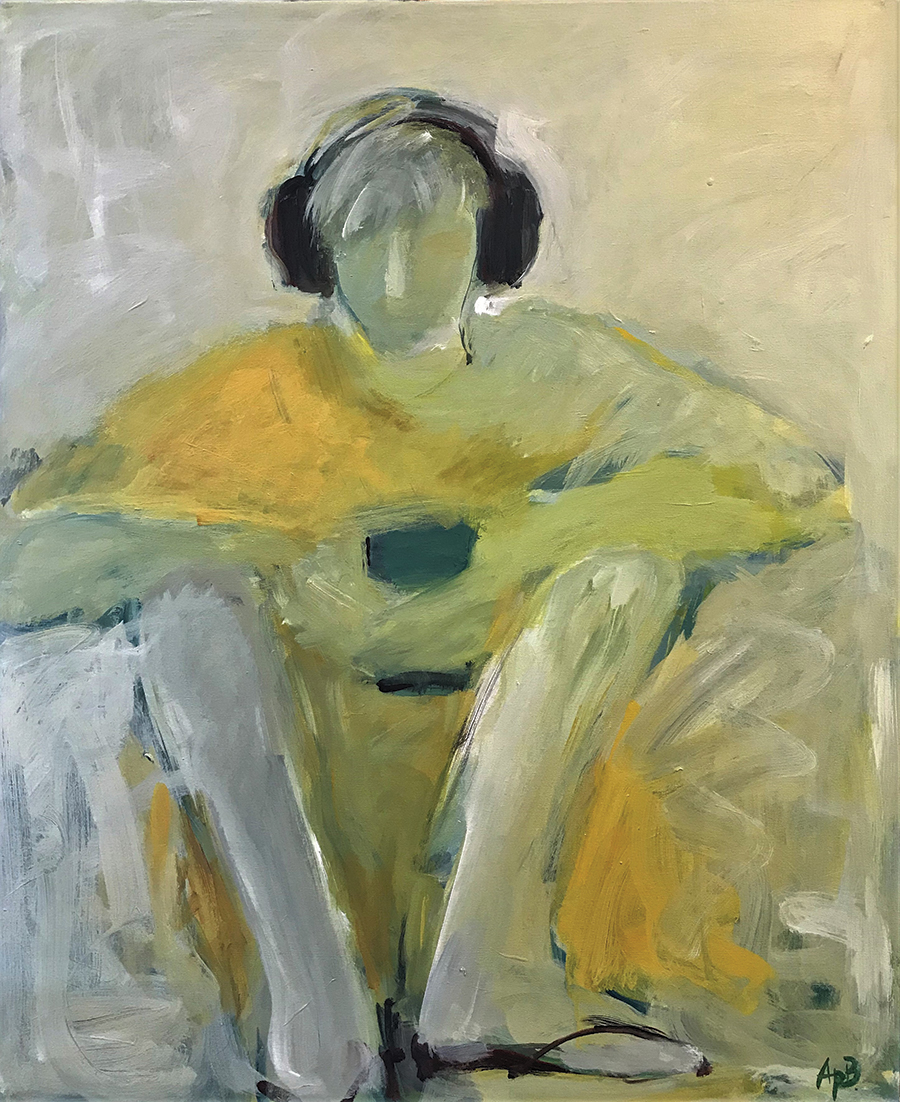
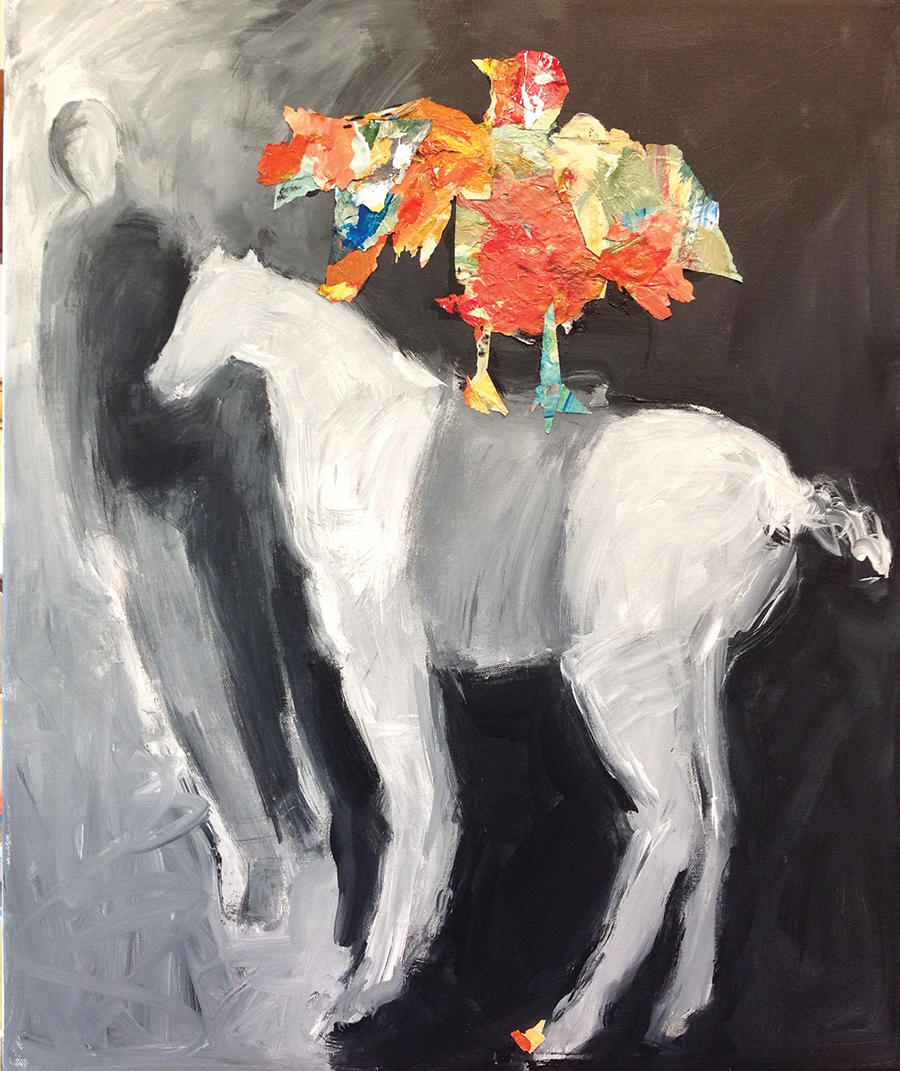
But she never abandoned her love of painting figures and ultimately blended the two passions, a signature style that underpin her work today: fluid, faceless figures whose poses or gestures convey multiple possible meanings. “To me, the body expresses a tremendous amount,” says Agnes. In a recent painting titled In Another World, a seated figure in a bright yellow background wears a pair of headphones while staring at a hazy object, presumably an iPhone. Is he or she engaged? Bored? It’s up to the viewer to decide. In another called Wish You Hadn’t Told Me, a seated woman carries herself in such a way as to appear concerned, while another woman — the messenger implied in the painting’s title — walks away in the background. Has she delivered devastating news? Or merely conveyed something annoying and trivial? Again, it depends on the viewer’s imagination. “I often call my work ‘situational,’ because they are stories,” Agnes explains.

She continued her studies, thanks to a scholarship to the League’s summer campus in Woodstock, New York, where again, she flourished under the instruction of mentors like Arnold Blanch and painter Philip Guston, and garnered yet another — and full — scholarship to New York University at New Paltz. Here, she obtained a fine arts degree, graduating summa cum laude, and met her first husband, Steve Preston. “My maiden name, nobody could pronounce. So I was happy when I married my first husband because his last name was easy enough to pronounce!” Agnes jokes.

But his fellowship at Columbia University landed the couple back in New York City — where Agnes’ fine arts degree held little, if any cachet among prospective employers. “They were like, ‘You don’t know how to type,’” Agnes recalls. She had to reinvent herself again.

After seeing an advertisement for a textile designer at a Broadway address, Agnes armed herself with her portfolio and went to apply. She discovered that the entire building was filled entirely with textile companies. “So, I decided, ‘to heck with the one I looked up.’ So I went up to the 24th floor and started. And on the second floor they hired me,” Agnes says with a laugh. It marked the beginning of her career as a textile designer.

As a trainee, she learned the trade from the ground up, visiting various mills and learning the entire fabrication process. In less than two years, Agnes left the job to her own business designing for high-end companies, such as Brunschwig & Fils, Schumacher, among others — including the one that employed Gary Brame. He and Agnes met almost immediately after his arrival in New York in the mid-1970s. At the time, he recalls proudly, “She was one of the most pre-eminent designers.”

The two married (“She accepted me when she learned I could dance,” Gary quips), and lived the good life in the Big Apple. Agnes’ business flourished while she put her painting on hold, but another revolution would affect her life’s course: “Computers started to come into being,” Agnes says. “Some of my good buddies who were designing, we had good jobs, we were out of jobs because the computers started making the designs, copying what we tried to do.” It was time to move on — literally, for Gary had gotten a job offer in Greensboro. “It worked perfectly, because I could still do some design work,” Agnes says (at one point she scored a freelance gig with a High Point manufacturer resulting in many years of travel to China.) “But I really started painting.”

She began exhibiting across the country, and became a stalwart of the local art scene, involving herself with United Arts Council, serving for nine years as president of Center for Visual Artists, exhibiting in GreenHill’s Winter Show for several years, and as Gary, her most ardent champion likes to point out, “winning” a certificate for a piece, Beach Scene exhibited in Weatherspoon’s Art on Paper juried show. It is a tongue-in-cheek portrayal of midlife ennui in which a paunchy, vacationing couple stand at water’s edge, she gazing out to sea, he turned toward the viewer, but too preoccupied to return the viewer’s gaze.

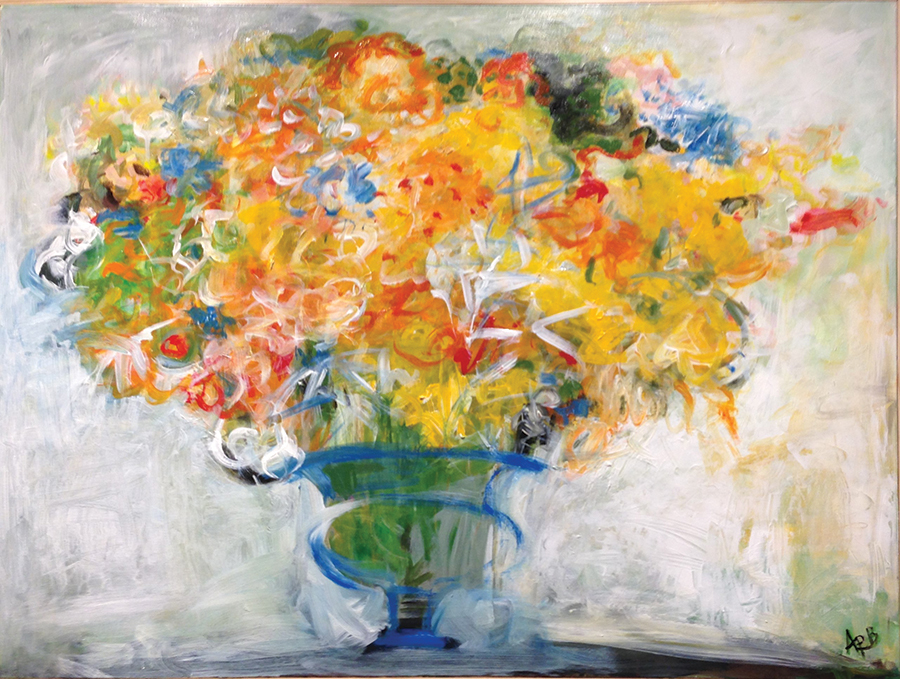
The work is one of several in Gary’s office, which also contains the painting that garnered Agnes the scholarship and a splashy still life of colorful flowers. “To some extent, I call myself a colorist. Partly because of the textiles I designed, and because I like color. But I like black and white, too,” Agnes says. In another “airport” series, figures rendered in black and white and tones of gray express the frustrations of air travel — cancelled flights, the boredom of waiting in line, checking luggage and so forth. The series came about after Agnes and Gary were stranded in the Brussels airport during a snowstorm last winter. “It was a miserable experience,” Agnes concedes. “Shoulder-to-shoulder,” Gary adds, “You couldn’t even find which line you were supposed to be in.” By the time they got to their destination, Budapest, the memories stayed with Agnes and ultimately filled her canvases.

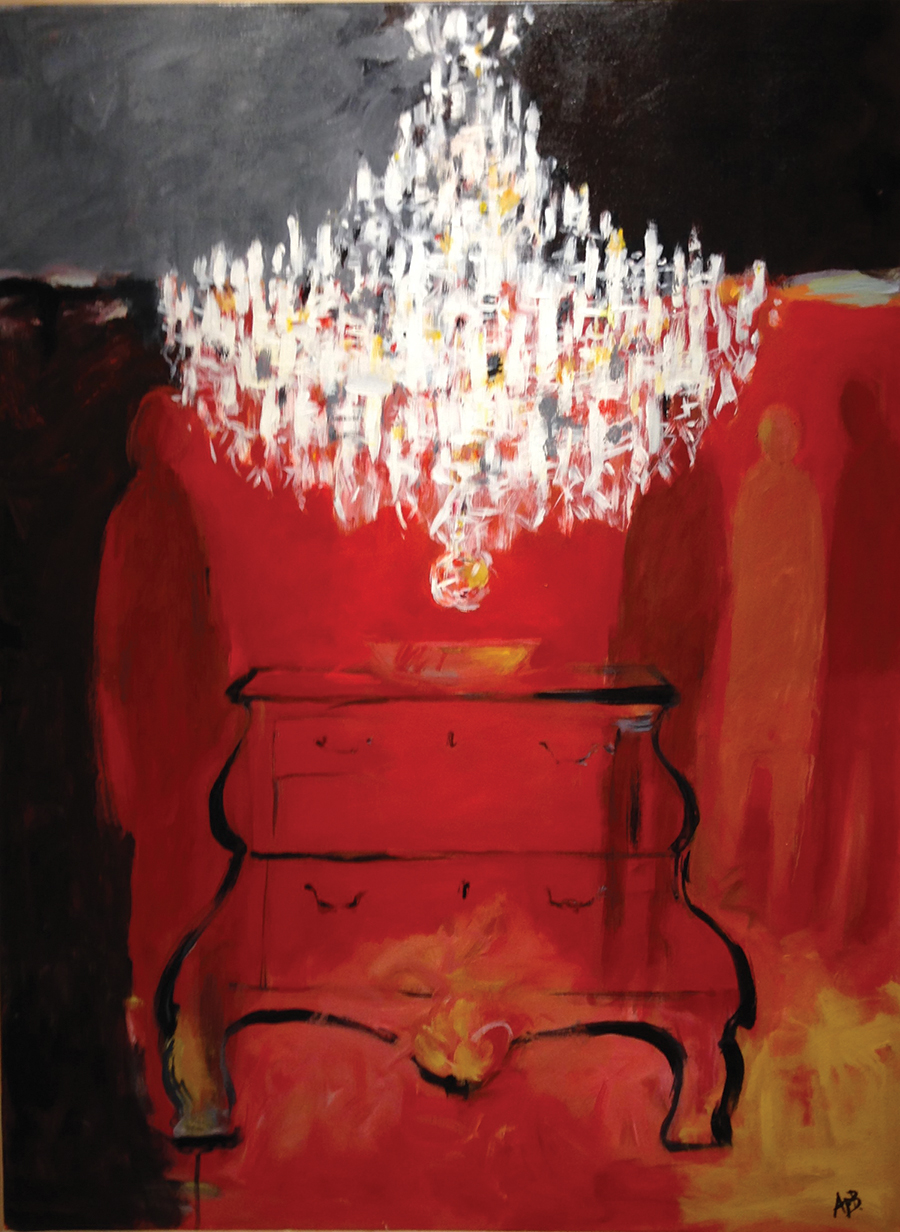
Always painting from memory, she prefers to “give in to my intuitions and emotions. I don’t really have a preconceived idea when I start working. I just kind of start with colors and lines on canvas or paper, and so it’s very spontaneous. And then some image starts coming. And the painting goes through a metamorphosis.”  Like the one of the cat on a red background in her studio. Or the small pen-and-ink doodles or “diaries” that she does every day. Or perhaps she’ll infuse a painting with memories, such as the series of chairs, tables and other pieces of furniture, inspired by the antiques business that she and Gary owned for about 10 years.

On a whim in 2006 the Brames, both antiques buffs, bought Jules Antiques & Fine Art in the old Curran Bank Building on South Elm (now occupied by the consignment boutique, Vintage to Vogue), where Agnes had an office on the second floor. By then, she had also gotten into interior design under the aptly chosen handle, Metamorphosis. “We had famous First Fridays,” Agnes says of the antique store’s wine-fueled openings. “Hundreds of people came through. It was a very nice store.” The two especially loved getting to know the clientele and learning the backstories and provenance of their inventory. “I thought of layering the people and the objects. Some of the stories people brought in with their things — it gives me chills,” Agnes reflects.

And it’s impossible not to feel a frisson, looking at the large rectangular painting, Chippendale, featuring the outlines of a chair in the foreground, while muted figures hover in the background. Are they admiring the chair? Will it remain empty and unsold? There is an air of melancholy to the painting. All the more so, when one considers how the Great Recession, not to mention grueling hours for Gary, prompted the Brames to shutter Jules Antiques a couple of years ago.

In contrast, a lively profusion of musical notes and instruments fairly blasts from another nearby canvas in Agnes’ tidy studio, a playbill that she designed for the Greensboro Symphony. “Over the years I did a lot of musical themes,” she explains. Birds also appear frequently in her work, though the artist is at a loss to explain why. She is more prolific than ever, with her design business moving at a slower pace since the Recession, and a few solo shows under her belt and another at Ambleside Gallery this month. Meantime, Agnes and Gary “are on the road again,” seeking out galleries for representation.

One, the Present Thyme in Roanoke, Virginia, has accepted seven paintings, much to the artist’s relief. “I love to paint big,” she says, laughing about the freed-up space in her garage. No doubt she’ll fill it right back again, as suggested by several works in progress scattered near her worktable filled with accoutrements of her avocation — oil and acrylic paint, brushes, frames (made by Gary, who also does personal property appraisals on the side). One painting is a commission that requires her painting a car — a first. But firsts are part and parcel of the reinvention game. “I don’t even remember wanting to be anything else but an artist,” Agnes muses. “Even though I’ve changed course from time to time: I have been doing what I like and what I was trained for, you know? . . . And I didn’t have to waitress all my life!”

Nancy Oakley is the senior editor of O.Henry.

For more information about Agnes Preston-Brame and her paintings, visit paintingsbyapb.com. Ambleside Gallery: amblesidearts.com.

March Almanac 2019

“And here is the serpent again,” wrote the late poet Mary Oliver, “dragging himself out from his nest of darkness . . . looking for the sun.”

Three decades after she wrote it, Oliver’s “Spring” slides into consciousness. Oh, how you’ve missed these sunny mornings. As soft light filters through the kitchen window, you think of the snake, moving “like oil” over pine needles, tasting the air with its tongue.

March is here, and as an owl cries out from its distant nest, you taste the glorious poetry of spring.

Pink blossoms against leafless branches on the saucer magnolia.

Pink squirrel babes, blind and wriggling in their drey.

Pink rain jacket left hanging on the porch, pocket full of pine straw, blue bird flitting in and out of periphery. 

This year, the spring equinox arrives on March 20, in tandem with World Poetry Day on March 21.

Fitting.

And as you gently scoop the contents from your jacket pocket — a beautiful tapestry of needles and grasses — you think again of Mary Oliver, and of the delicate treasures she wove with nature and light.

Thank you, blue bird, for starting over.

Thank you, black snake, winding round the rising grass.

Thank you, poet within each of us, for acknowledging the beauty that is always waiting for us, like sunlight after a long, dark winter.

Hello, sun in my face. Hello you who made the morning and spread it over the fields . . . Watch, now, how I start the day in happiness, in kindness. — Mary Oliver

Nature’s Bard

In honor of the beloved and recently departed best-selling poet Mary Oliver, who made tangible the heart-breaking beauty of the natural world, and World Poetry Day on March 21, below is an excerpt from “When Death Comes,” in which the poet “considers eternity as another possibility.”

When it’s over, I want to say: all my life
I was a bride married to amazement.
I was the bridegroom, taking the world into my arms.

When it’s over, I don’t want to wonder
if I have made of my life something particular, and real.

I don’t want to find myself sighing and frightened,

or full of argument.

I don’t want to end up simply having visited this world.

Thank you, dear poet, for taking such transient beauty into your arms. And for those considering eternity: Oliver’s “Such Singing in the Wild Branches” is good medicine.

Amethyst Falls

I once heard someone dub wisteria the “evil overlord of the plant kingdom” and, for better or worse, have never been able to shake it. If ever you’ve battled with wisteria in your backyard, perhaps you’ve given it a comparable name. But if you’re still reading this . . . if ever you’ve wished to make friends with this intoxicatingly fragrant vine, consider introducing a native cultivar, amethyst falls.

Less aggressive than its exotic Asian relatives known for choking out trees and, yep, swallowing houses, amethyst falls blooms on new growth, making the vines easier to prune back and train. Although the leaves and cascading purple flowers are smaller than the common wisteria you may have given a less-than-kind name, an established amethyst falls plant can climb 15–20 feet per season.

Bonus points: It’s drought tolerant and deer resistant.

March Garden To-Do

Replace winter mulch

Sharpen dull mower blades

Sow seeds for spinach, radishes, turnips, and kale

Stop and smell the flowering redbud and dogwood.