Short Stories

Book Covers of Darkness

It might have caught the corner of your eye at Polliwog’s, or Scuppernong Books: a slim volume vaguely reminiscent of the children’s classic, Goodnight, Moon. But on closer inspection, you’ll discover a familiar landscape on the book’s cover: darkness falling over an illuminated Gate City skyline under the title, Good Night Greensboro: A Charming Bedtime Story About Our Beloved City. Written by Dana Hall, a former schoolteacher, and beautifully illustrated by local painter C.P. Logan, the book bids good night to Greensboro icons — the Grasshoppers and Miss Babe Ruth, Woolworth’s lunch counter, Nathanael Greene’s statue presiding over a verdant Guilford Battlefield, an autumnal Bog Garden. The simple text and colorful paintings are sure to soothe any reader (or insomniac) of any age . . . and offer a good reason to wake up in the morning. Info: goodnightgreensboro.com.

Fresh Paint(ings)

Behold new visions at O’Brien Gallery (307 State Street) with the April 12 launch of Uncovering the Layers, featuring the works of painter Jenny Fuller. It’s a homecoming of sorts for the Gate City artist who now resides in Charlotte and whose artistic mission is to “understand the radiance, color, shadow and wonder that surrounds each of us in nature.” Before meeting the artist at a reception at 6 p.m., get to know a new talent, colorist Carolyn Blaylock, at a lunch-and-learn at 11:30 a.m. Info: (336) 379-1124 or kathylovesart@aol.com.

Begging His Pardon

And no, we’re not referring to a certain soon-to-be resident of Club Fed, but none other than our magazine’s namesake, O. Henry. In a letter that landed on our desks recently, a one Jonathan Paris pleads the case for a full presidential pardon for William Sydney Porter, who served time in the Ohio State Penitentiary on charges of bank fraud. As we detailed in the pages of our September 2017 issue, Porter once worked as a teller for First National Bank in Austin, Texas, notorious for its lax recordkeeping, such as employees’ dipping into the till without leaving IOUs. So when the hammer fell on Porter, “he essentially became the fall guy for years of malfeasance,” writes Paris in his letter. “I know that posthumous pardons are rare but there is always a first for something,” he continues. “Having read his short stories and recalling many of them now, it is time to think of all the good this American did instead of a small amount of bad. Please send your votes to overturn the embezzlement charges to the Office of the Pardon Attorney in Washington, D.C.” It’s up to you, faithful readers; if you want to help clear the name of O.Henry, please send your plea in an email to: USPardon.Attorney@usdoj.gov.

Speaking of O.Henry . . .

We’re pleased to announce a new partnership with Center for Visual Artists, the Greensboro nonprofit dedicated to promoting local artists of all levels, from novices who’ve quietly been realizing their dreams from the privacy of home to established veterans who want to take their calling to the next level. Starting this month, CVA will designate the front lobby area in its perch inside the Greensoro Cultural Center (200 North Davie Street) as the O.Henry Featured Artists Space. There you will see works on view by artists featured in our magazine. We thought it apropos to launch the endeavor with our own Lynn Donovan, whose photographs of spring birds appear on page 80 of this issue. In addition to some of the original shots reproduced among these pages, you’ll also see some of her photos of exotic birds of Costa Rica. So stop by CVA’s galleries and have a, well, gander.

JAM Slam

Meaning Jazz Appreciation Month, as observed by the city of High Point, starting with a proclamation by Mayor Jay Wagner at City Hall on April 1. As the childhood home of jazz legend John Coltrane, High Point has dreamed up all kinds of jazz-related events throughout the month: On April 9th, Guilford County Schools All-County Jazz Ensemble, and Lunch and Jazz at the High Point Museum (which also hosts a Coltrane exhibit); Kids Night Out Jazz Painting on the 14th; a jazz poetry slam on the 26th. Of course, you’ll have plenty of opportunities to swing and groove to the sounds of local jazz cats, such as Gary Woodard, Melvin Holland Quartet, Brandon Vaughan and Wally West & Friends. And while you’re in town, drop by Sunrise Books to check out a selection of jazz-related tomes, before paying homage to the statue of  ’Trane downtown, where you can give thanks for such a vibrant and truly original American art form. Info: highpointarts.org.

Ham, Eggs and Greens

But not just any ol’ ham, but glazed ham, carved to your liking. And not just any ol’ eggs, but eggs Benedict or baked in a quiche with spinach, mushroom and Emmentaler cheese. And not just any ol’ greens but French green beans, or an orange, fennel and hazelnut spinach salad. But wait! There’s more! Lots more to choose from at the Easter Buffet served up on April 21 at Proximity Hotel’s Weaver Room (704 Green Valley Road). Think: shrimp cocktail, fresh fruit, homemade pastries, grilled salmon, prime rib . . . We could go on and on, but the mere thought of such a feast is making us swoon. Reserve now, before the hungry hordes fill up all the spaces, by calling the hotel’s Happenings Hotline: (336) 215-2868.

Bom-Bard-ment

“To be or not to be, that is the question.” “Shall I compare thee to a summer’s day?” “Lord what fools these mortals be!” Well, yeah, baby, fools for Shakespeare. At 7 p.m. on April 15th, The Greensboro Public Library hosts Shakespeare (and Poetry) in the Park at LeBauer Park (208 North Davie Street), as an early celebration for the Bard of Avon’s 455th birthday. Shared Radiance Performing Arts Company will deliver a fast-paced, interactive montage that will include monologues, soliloquys, speeches and sonnets from Shakespeare’s greatest works, and audience members are invited to step up to the mic and recite their own Bard-inspired verse. Can’t make the poetry slam? Then hoist an elbow on Will’s actual date of birth, April 23, at Gibb’s Hundred (504 State Street), while Shared Radiance revives its act. As Popeye the Sailor might say: “Iamb what iamb what iamb.” Info: Contact Beth Sheffield at (336) 373-3617.

Question! Question!

Who’s got the answer? The Extension Master Gardener Volunteers, of course! From 9 a.m. to noon on Saturday, April 27, these past masters of planting host their annual spring gardening open house at the N.C. Cooperative Extension Guilford County Center (3309 Burlington Road). Pop into the Ask a Master Gardener booth with questions about cultivating — well, anything. Get advice on landscaping and gardening, take a garden tour, check out a demo on soil preparation or garden tool sharpening. Learn the ins and outs of pond care, gardening with worms, growing vegetables, herbs and things in small spaces, and how to care for fussy roses. And bring some, uh, cabbage, too, because plants and gardening supplies will be on sale, ya dig? Info: (336) 341-2400.

Ogi Sez

Ogi Overman

We’re going to ignore the old saying about April showers — we’ve had quite enough of those, thank you — and go straight to the things that make this a charming month. As we wave buh-bye to a yucky winter, we concurrently wave hello to baseball season, warm breezes, barbecues and later sunsets. And, lest we forget, an uptick in the live concert season. Trust me, there are some good ones coming up.

• April 5, Greensboro Coliseum: Say what you will, but Alabama singlehandedly changed the face of country music. They were the first to legitimize bands, rather than solo artists, and importantly — to me, at least — brought three-part harmony to the forefront. Plus, they really did record some good tunes, and I’m happy to see them reunite for this tour.

• April 6, The Crown: I’m a bit prejudiced here because Abigail Dowd is a dear friend. But, friendship aside, she has finished her second album and will hold the release party here. I’ve heard her live at least a dozen times, including listening to some cuts off this project, and predict she’s ready for some much bigger stages.

• April 12, Ramkat: Anytime Robert Earl Keen is this close to home, a 26-mile drive to Winston is nothing. He has practically become the voice of Americana music, and his writing seems destined to eventually put him in the Guy Clark/Townes Van Zandt stratosphere. And his live shows are a party from the first note to the last.

• April 13, Blue Note Grill: I am hesitant to send anyone to Durham, but when the Subdudes are playing, I would be remiss by leaving them out. I’ve loved these guys for 20 years but was afraid they’d broken up. Thankfully, they haven’t. N’awleans funk, killer harmony, slide guitar, horns, clever lyrics — that’s where I live.

• April 17, LJVM Coliseum: Did you, like me, get caught up in what appeared at first to be a silly TV show, The Masked Singer? Well, it was silly, but the caliber of talent was exceptional. The eventual winner, T-Pain, beat out the likes of Gladys Knight, Latoya Jackson and Donny Osmond. A full-on rapper no more, this guy is a crooner of the Donny Hathaway order. And that, my friends, is a high compliment.

Drinking with Writers

With the Author Himself

An internal dialog

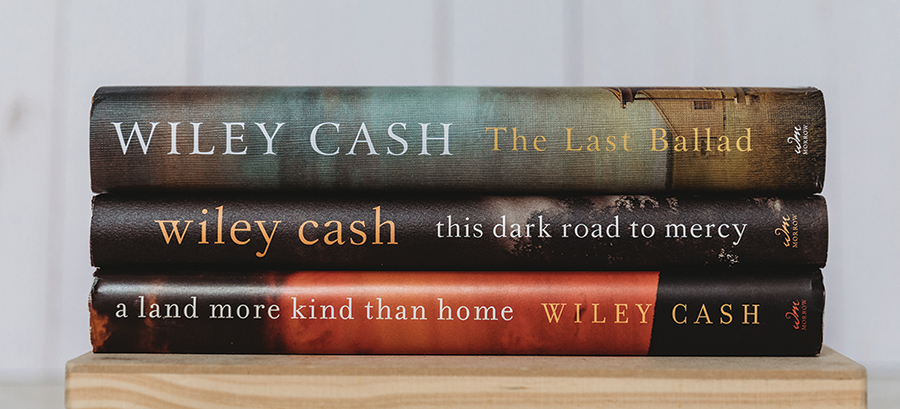
By Wiley Cash   •   Photographs by Mallory Cash

Wiley Cash and I have known one another for almost 42 years, but I do not see him very often. Work as writer-in-residence at the state university in Asheville has him driving back and forth across the state quite a bit, and if you are to believe his social media accounts, he is usually sprinting through one airport or another, behind on a writing deadline and struggling to find Wi-Fi to return students’ emails. That’s what he gets for giving up his smartphone.

Life has been pretty busy since Wiley’s first novel, A Land More Kind Than Home, was released in the spring of 2012. Since then he has published two more novels, taken a few teaching positions, and moved a couple times. He and his wife, Mallory, who is a photographer, are also the parents of two young daughters.

A few weeks ago I sent him a text. (He can still text with a flip phone. It just takes him longer.)

Me: let’s get a beer

Wiley: high cholesterol. Been jogging. Coffee?

Me: does beer give you high cholesterol?

Wiley: beer makes it harder to jog

Me: where should we meet for coffee? Prefer a place that also serves beer.

Wiley: our house Thursday morning

Mallory meets me at the door when I arrive at their home near Carolina Beach.

“His majesty is still in his robe,” she says.

“Late night?” I ask.

“No,” she says. “He just works from home. His robe is like his employee uniform.”

“You work from home too,” I say. “You’re not wearing your pajamas.”

“Maybe the robe life is the exclusive lifestyle of authors.”

I look up and see Wiley coming down the stairs in a bright red robe and gray bedroom slippers. We shake hands.

“It’s been a while,” Wiley says. “When did you get glasses?”

“Last year,” I say.

He strokes his white beard and tucks his (graying?!) hair behind his ear.

“We’re getting old,” he says. He smiles. “At least you are.”

“I guess that means we’re having coffee instead of beer.”

He smiles and leads me down the hallway, past the kitchen, and into a sitting room that has recently been converted into his daughters’ playroom. He offers me a seat in one of two tattered yellow armchairs.

“When we bought this house we thought it would be a great place to host parties,” he says. He smiles and looks around the room. “Turns out it’s been a great place to host children’s books and games and toys.”

While Wiley makes coffee in a French press, we discuss what has kept him busy since his most recent novel, The Last Ballad, was published in the fall of 2017. He tells me about the Open Canon Book Club, an online book club he founded to introduce readers to diverse books by diverse authors, and the Land More Kind Appalachian Artists’ Residency, a retreat he and Mallory and two friends founded in West Virginia. He is also teaching, a lot: Aside from his work as writer-in-residence at the University of North Carolina-Asheville, he also teaches in the Mountainview Low-Residency MFA Program. In his spare time he is trying to work on a new novel, one that is already behind deadline.

“How are you finding the time and space to write?” I ask.

He pours me a cup of black coffee, pours one for himself, and then sits back in his chair.

“It’s hard,” he said. “I’m really busy, but everything I do is about writing in one way or another. When I teach, I teach writing. When I give a talk at a library or university, I’m talking about writing. When I’m reading books for the book club or reading through applications for the artists’ residency, I’m thinking about the written word and how it works to achieve an author’s intentions. Literally everything I do pertains to writing. My life is one huge literary conversation that never stops.”

“It all sounds like a lot of work,” I say. “Are there many rewards?”

“Aside from my mom constantly asking if my editor’s mad at me because my novel is late? Sure. There are a lot of rewards,” he says. “I’m so lucky that my one-time hobby has become my full-time occupation, or occupations.” He looks over his shoulder at a wall of glassed-in bookshelves in the living room. “Speaking of rewards,” he says, “you want to see a really cool one?”

He gets up and walks into the other room. When he returns he is carrying a small statue on a pedestal. “Meet Sir Walter Raleigh,” he says. He slides one of his girl’s chairs away from a children’s table and sets the statue on the chair. He makes a show of polishing it. “I received this a few weeks ago from the North Carolina Historical Book Club. I love it.”

“You seem like a proud father,” I say. “Speaking of fatherhood, how has it changed your writing?”

“Being a parent has deepened the experience of storytelling in ways that have really surprised me,” he says. “Our oldest, who’s 4, is obsessed with narrative. I probably tell six or seven stories a day about saber tooth tigers and early people and ghosts and pirates. A few nights ago I heard her telling Mallory about how telling stories can cause them to feel true. That left a huge impression on me because that’s what I want to do as a writer. I want to tell my readers fictional stories that they believe nonetheless.

“And our 3-year-old is really interested in telling stories. A few days ago, she told Mallory a story that began It was the first day of school. His mother came to get him. He was not sad, but quiet. Are you kidding me? I don’t write opening lines that beautiful.”

“If your girls told a story about you, what would it be?” I ask. Wiley takes a sip of his coffee and looks toward the window.

“It was the first day of writing a new novel,” he says. “His mother had already called to check on his progress. He was not sad, but tired.”

“Pretty good lines,” I say.

“Thanks,” he says. “They’re yours if you write my biography.”  OH

Wiley Cash lives in Wilmington with his wife and their two daughters. His latest novel, The Last Ballad, is available wherever books are sold.

Return of the Birds

John James Audubon on exhibit again

By Jim Moriarty

It is such a small space to hold the passion of a lifetime.

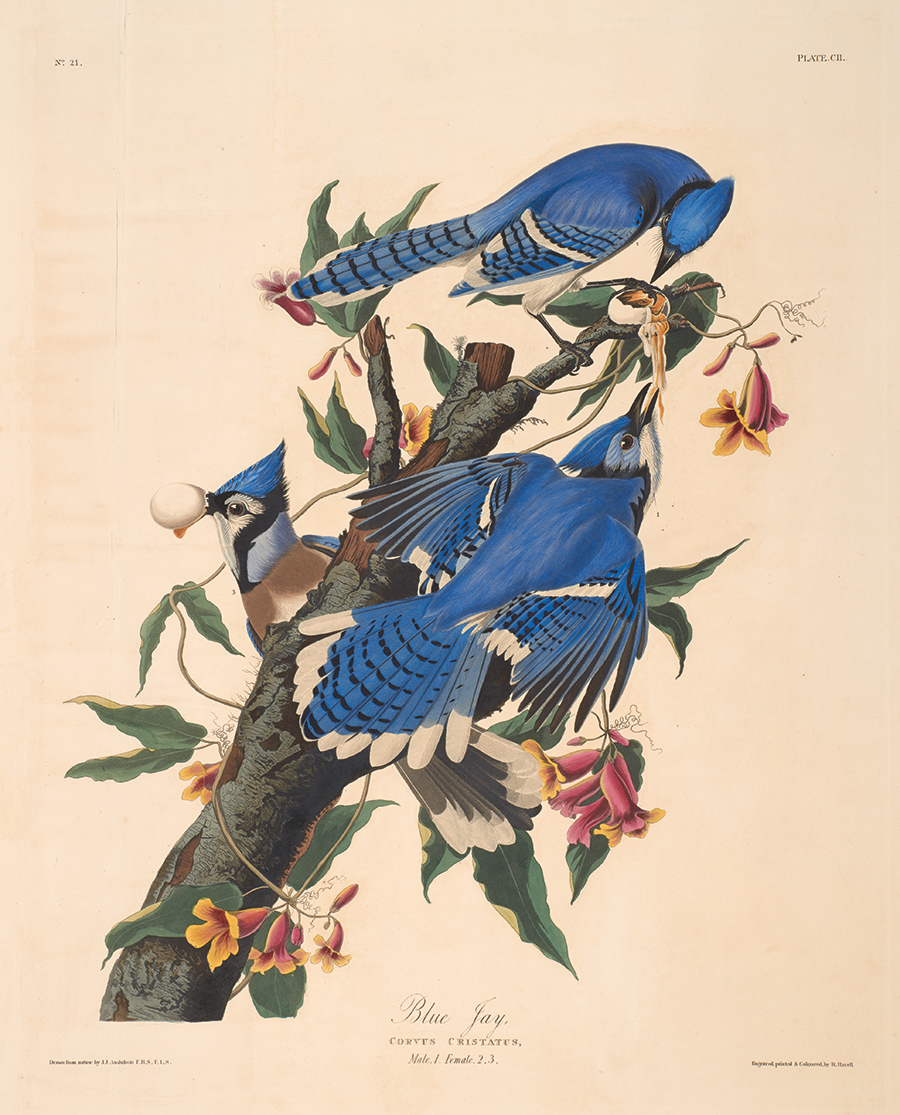
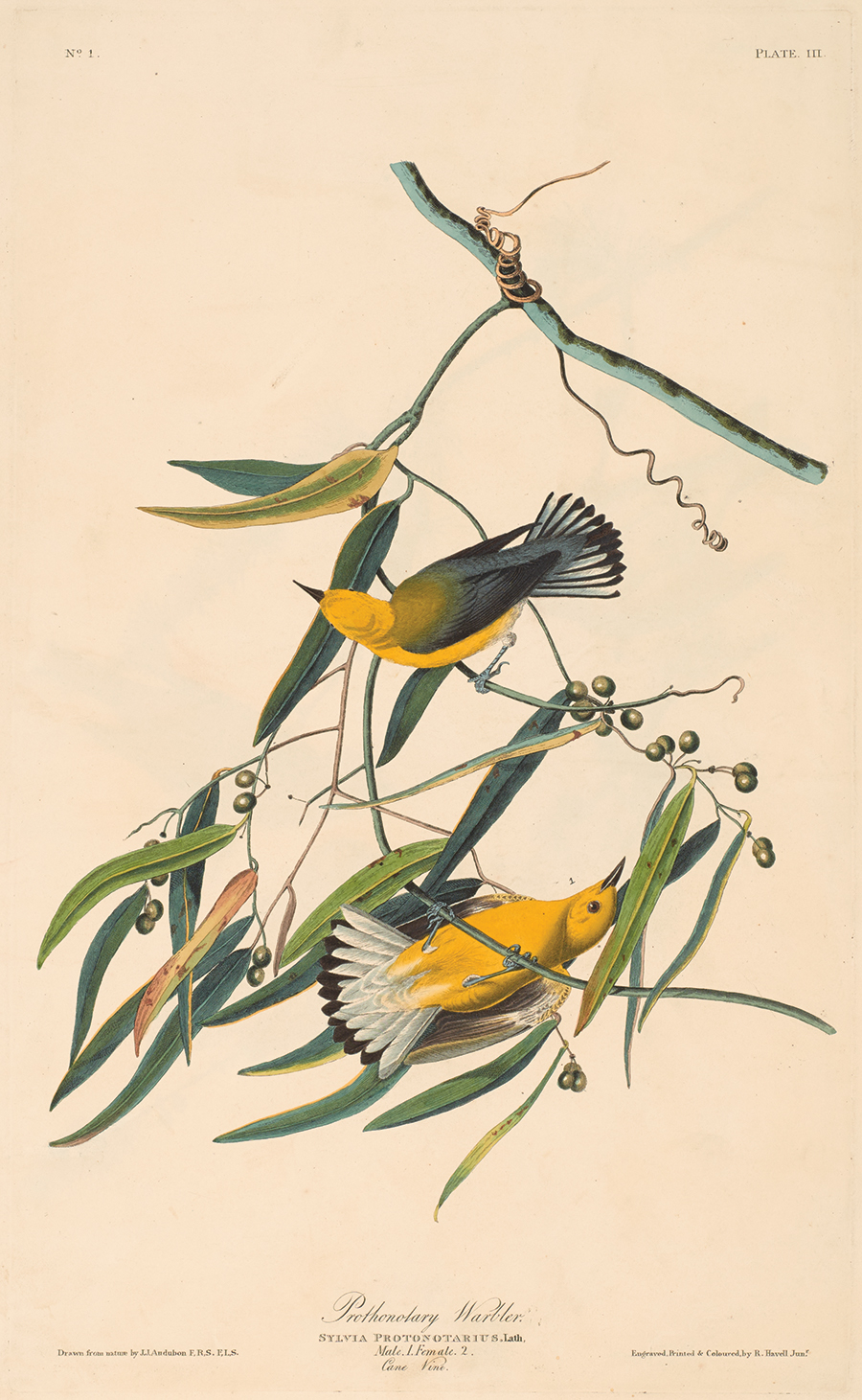
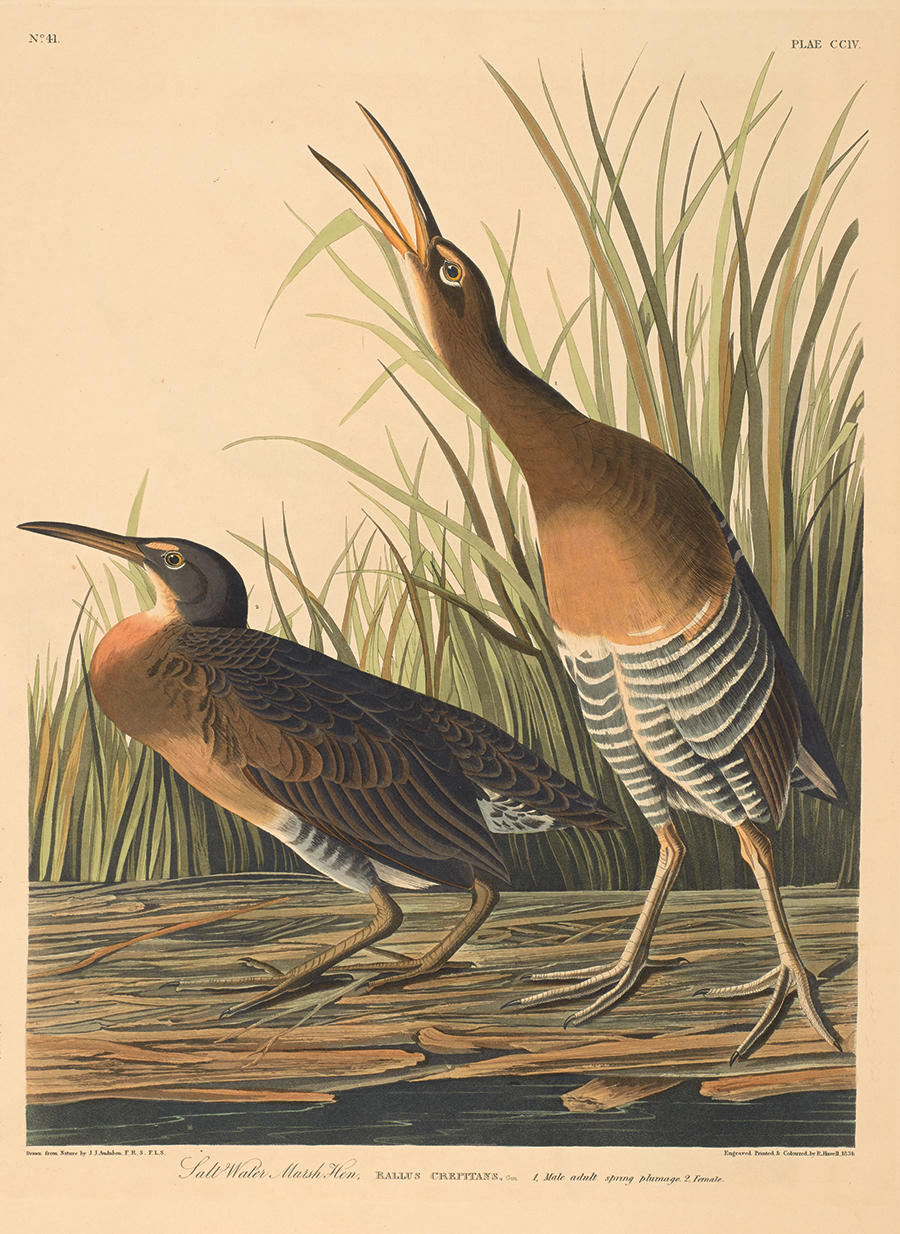
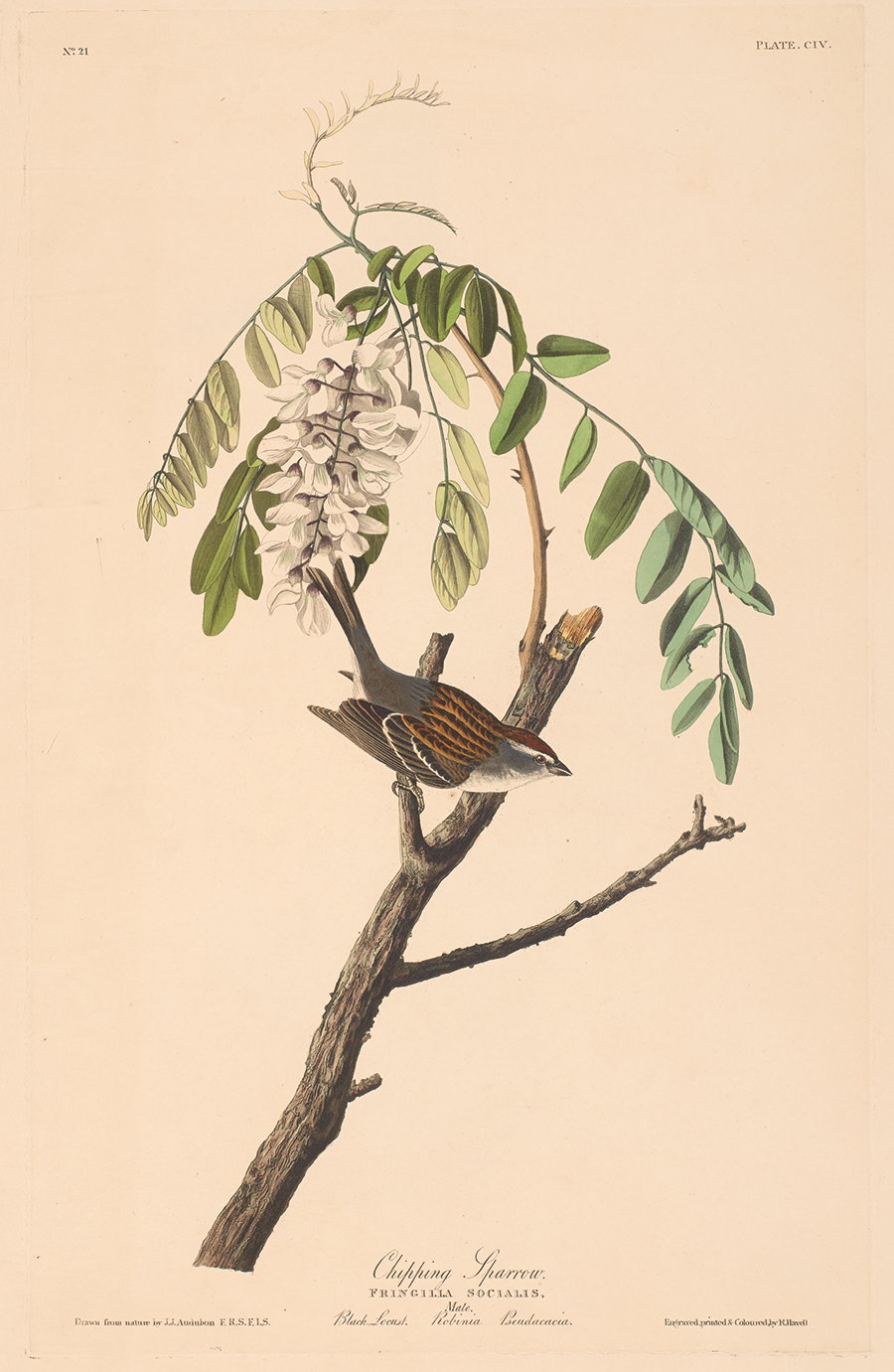
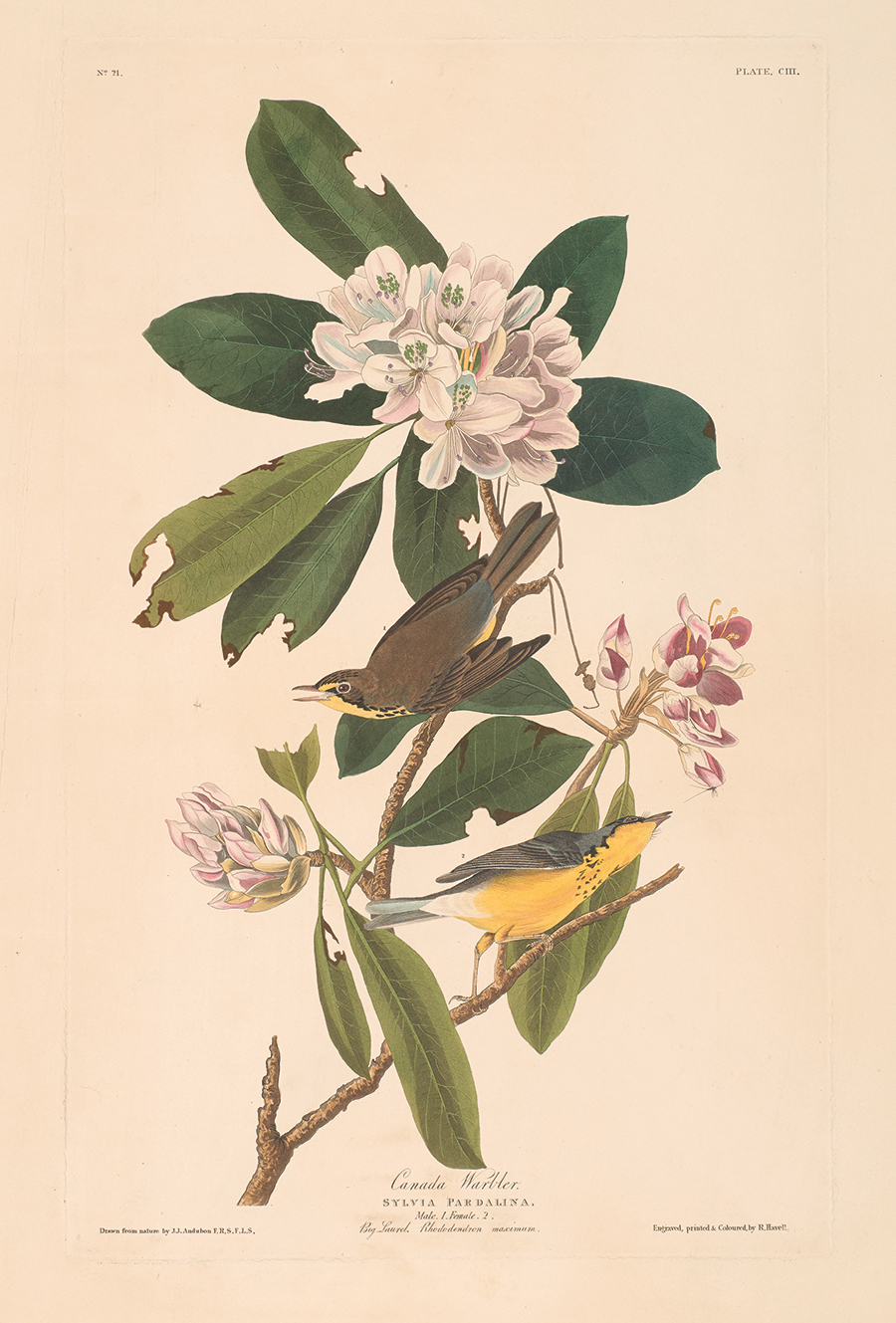
In a corner on Level B of the North Carolina Museum of Art, John James Audubon’s four bound volumes of The Birds of America are back on exhibit, joined by instructive videos and an immersive wilderness experience. There are roughly 200 extant copies of the so-called double-elephant folio version, comprised of 435 hand-colored, life-size prints. North Carolina’s copy — minus two pages that were added later — was acquired in 1846 from Joseph Green Cogswell, a book dealer in New York, as part of a larger purchase by North Carolina’s then-governor, William Alexander Graham, who was intent on expanding the state’s library. It was transferred from the N.C. State Library to the museum in 1974. The last time the four volumes, each enclosed in its own specially constructed case, were on exhibit was July of 2016.

The engravings will be shown one page per volume — so, naturally, four at a time — for three months before changing them in the open-ended exhibit. The four on exhibit now include a wild turkey looking back as it crosses a Louisiana canebrake — the first plate produced in the project that consumed near the entirety of Audubon’s life. “The hand-coloring is light sensitive so we don’t want to expose it too long,” says John W. Coffey, the museum’s deputy director for Collections and Research. “People approach any art exhibit with different expectations. You have people that just stumble into the exhibition and, hopefully, they’re engaged by the story of Audubon. And then there are people who are bird lovers. There are lots of those who venerate Audubon as a naturalist. There are people who just like fine art. What Audubon created were not just accurate renditions of the birds of America but also quite beautiful compositions. They held their own as works of art in their own right.”

John James Audubon was born Jean Rabin, the “backstairs” child of the sea captain Jean Audubon and a French chambermaid, Jeanne Rabin, on Audubon’s sugar plantation in Les Cayes, Saint-Domingue. The child’s mother passed away from an infection mere months after the boy’s birth. The sea captain had his son and the boy’s half-sister (the daughter of a second mistress) transported to his home in Nantes, France, in advance of the revolution that engulfed Saint-Domingue, eventually establishing the Republic of Haiti. His lineage a closely held secret to preserve his inheritance, the boy grew up in Nantes as Jacques Fougère Audubon during the Vendéan counterrevolution and the terror that accompanied it.

“Losing his mother in infancy, separated from whoever mothered him afterward on Saint-Domingue when he was shipped off to France at six, just months ahead of a bloody revolution, enduring dreadful days as a young boy in Nantes when Carrier [Jean-Baptiste Carrier] was emptying the prisons with slaughter and his family feared for its life, was a full burden of trauma for a child,” writes Pulitzer Prize-winning Audubon biographer Richard Rhodes. “In maturity Audubon would expunge the stigma and the trauma from his family story by relocating his birth to Louisiana and to ‘a lady of Spanish extraction . . . as beautiful as she was wealthy’ when he knew full well that he was the bastard son of the chambermaid Jeanne Rabin.” And, if in the fullness of time, he found his résumé in need of further padding, Audubon would sometimes claim to have studied under Jacques-Louis David, Napoleon Bonaparte’s favorite neoclassicist painter.

Sent to America by his father to avoid conscription into Napoleon’s army, Jacques Fougère Audubon became John James Audubon on his transatlantic journey, settling on his father’s Pennsylvania farm, Mill Grove. “He had begun drawing birds in France,” writes Rhodes. “Now, ‘prompted by an innate desire to acquire a thorough knowledge of the birds of this happy country, I formed the resolution, immediately on my landing, to spend, if not all my time in that study, at least all that portion generally called leisure, and to draw each individual of its natural size and coloring.’ This is retrospect, of course, but it catches the eighteen-year-old’s excitement and bravado.”

Audubon cut a dashing figure. The wife of a physician friend would describe the 30-something ornithologist and painter this way: “Audubon was one of the handsomest men I ever saw. In person he was tall and slender, his blue eyes were an eagle’s in brightness, his teeth were white and even, his hair a beautiful chestnut brown, very glossy and curly. His bearing was courteous and refined, simple and unassuming. Added to these personal advantages he was a natural sportsman and natural artist.”

While at Mill Grove, Audubon met his wife, Lucy Bakewell. He would begin a career as a merchant, floating down the Ohio River to Louisville and Henderson, Kentucky, and eventual bankruptcy. It was in Louisville that Audubon met Alexander Wilson, who was selling subscriptions (the method of the day to finance costly reproductions) to his own book, American Ornithology, but Audubon’s work was already vastly superior to Wilson’s.

Like any artist, Audubon’s style matured. One of the earliest innovations was the creation of his “board,” allowing him to pose the birds he killed — alas, it wasn’t as though he could hire them as models; besides, some made excellent eating — in the positions he observed in life. By May of 1812, he was drawing birds in flight. “Unlike birds posed on branches or standing on the ground, birds in flight required foreshortening to create the illusion of depth across the span of their wings or down the length of their bodies,” writes Rhodes. “Since Audubon’s limited formal art training had not progressed to foreshortening, he had to learn that complicated technique on his own by trial and error.”

Another breakthrough came when he added color chalk. “I resorted to a piece that matched the tint intended for the part, applied the pigment, rubbed the place with a cork stump and at once produced the desired effect!” he wrote. Then, in 1821 and ’22, he revamped his style again. “He already knew the traditional French medium of pastel very well; he had been perfecting it since he was a young man. Now he added to his repertoire a crystal-clear watercolor technique, the ability to use gouache effectively, and an extraordinary varied use of the pencil, together with the talent for combining all of these graphic means to render a single bird,” writes art critic Theodore E. Stebbins, Jr. “No one in America equaled him for graphic inventiveness until Winslow Homer some sixty years later; as for European parallels, one can only think of the great English watercolorists, both contemporaries of Audubon: J.M.W. Turner and Samuel Palmer.” The original watercolors for The Birds of America are in the collection of the New-York Historical Society and rarely seen because of their sensitivity to light.

Having run financially aground in the Panic of 1819, Audubon journeyed to New Orleans to collect a debt from Samuel Bowen that involved the ownership of a steamboat. Things didn’t go well. Bowen had already given the boat over to settle debts of his own. One thing led to another and Bowen attacked Audubon. As it turned out, he brought a cudgel to a knife fight, and Audubon stabbed him with his dagger. Later, appearing in front of Judge Henry P. Broadnax, Audubon defended himself before the court and was acquitted by reason of self-defense. “Mr. Audubon,” the judge added, “you committed a serious offense — an exceedingly serious offense, sir — in failing to kill the damned rascal.”

Having lost everything in Henderson, Audubon turned to portrait painting to make a living. Then, envisioning himself as “a one-man ornithological expeditionary force,” as Rhodes put it, he went back down the Mississippi, returning to New Orleans in 1821 with his assistant, Joseph Mason (one of several assistants who painted the backgrounds in Audubon’s works). His commercial portraits included the nude of a woman, Mrs. André, a mysterious client requiring his absolute discretion and to whom he referred as “The Fair Incognito” in his diaries. Eventually, he was joined in New Orleans by his wife, Lucy, living at what is now 505 Dauphine Street. Audubon was producing his ornithological paintings at a dizzying pace. After New Orleans it was up to Natchez, Mississippi, then Louisville and Philadelphia and Pittsburgh and on and on. His sources of income weren’t confined to portraits. He taught dancing, drawing, even fencing.

Knowing that obtaining engravings of the number and quality necessary to produce The Birds of America could only be done in Europe, Audubon sailed from New Orleans on the Delos on May 18th, 1826. The ship was carrying 924 bales of cotton and a seasick John James Audubon with more than 300 drawings in tin-lined wooden portfolios.

An American backwoodsman with crates full of art proved a topic of considerable novelty in an Old World keen for knowledge of the new one. Audubon was well received. The first engraver to take on his project was William Lizars in Edinburgh. Lizars did approximately 10 engravings before a strike by his colorists forced Audubon to turn to Robert Havell Sr. and his son in London.

“Robert Havell Jr. was a more painstaking engraver than William Lizars and his father supervised the London colorers perhaps more carefully but there was a qualitative difference between the technologies Lizars and the Havells used to make Audubon’s colored plates,” writes Rhodes. “The Havells used a process known as aquatint, which allowed them to print shadows and shadings in a range from light gray to black, leaving the colorists only the more limited task of applying a uniform wash of color over the aquatinted area: the shading made the color appear darker.” Havell retouched the early Lizars plates, something that’s noted in the lower right-hand corner of the wild turkey engraving currently on view. While even the Havells had their ups and downs satisfying Audubon’s very specific instructions and expectations, it proved a match made in artistic heaven.

The last plate of The Birds of America was completed in June of 1838. Audubon was 53. His estimate of the project’s cost, monies he raised himself, was “$115,640 — in today’s dollars, about $2,141,000,” reckons Rhodes. He began work on the octavo edition (a smaller and, hence, more profitable version) two years later. Audubon would suffer a stroke in 1848, and begin slipping into dementia. “His vivid personality faded into vacancy,” says Rhodes. He passed away in January of 1851.

“What’s beautiful about Audubon is that these birds are so dynamic and alive, it feels like they’re almost jumping out of the page,” says Silvia Fantoni, the director of Audience Engagement and Public Programs who put together the immersive exhibit comprised of 19 of Audubon’s birds in varied habitats over a 24 hour period. “That’s what we wanted to do. I find his work fascinating, how driven he was by this project. It’s always interesting to see when an artist has this kind of obsession and vision and dedicated his life to do that. That’s why we still celebrate him almost 200 years later.”  OH

Jim Moriarty is senior editor for PineStraw magazine.

Simple Life

Confessions of a Happy Old Guy

And the joys of life in the slow lane

By Jim Dodson

A close colleague needed to speak in confidence the other day. She looked so serious.

“I don’t know how to tell you this,” she said, “but I have to tell you something important.”

I feared she might be quitting her job to join a kazoo band or something even worse, appear on a reality show. So I braced for impact.

“I was behind you in traffic yesterday. You drive like an old man!”

She burst out laughing.

I laughed, too — and agreed with her. She wasn’t the first to point out my maddening old-fashioned driving habits, or as I prefer to simply call them, careful. For the record I haven’t had a moving violation in 40 years, something one can accomplish only by moving slowly through the busy intersections of life. Knock wood.

A year ago, however, I turned 65. In the eyes of my government, my insurance agent and my beloved colleague, this apparently means I’ve achieved official Old Man status. So essentially, my driving habits are finally catching up to my age.

Over this year, in fact, since word has spread like kudzu on a redneck barn, I’ve received several “special dinner” invitations from companies eager to tell me all about their exciting products and services designed to “make your senior years happier, safer and more fulfilling.”

One was from a lawyer pointing out the dangers of failing to update my final will and testament, presumably so craven heirs don’t rob me blind. Another was from a financial firm eager to feed me at the Olive Garden in order to convince me that I should try a reverse mortgage that would allow me to sell my house piece-by-piece in order to finance a speedboat or buy a timeshare in Cabo San Lucas. Not long after that, two dinner invites from local funeral homes offered a fancy last supper with small talk of coffins over coffee.

The truth is, I’m perfectly fine officially being an Old Guy. I’ve never felt happier or more fulfilled than at this very moment, even without a speedboat. My health is good, the important parts all seem to work, I love what I do every day and look forward to many years of doing it as I chug along in the slow lane of life.

I never plan to retire or even slow down because I’ve always moved at more or less the same modest speed. Slow and steady wins the race, as the moral goes, assuming you even care about winning the rat race. Never hurry, never worry was the personal motto of the late great Walter Hagen, a dapper fellow who walked slow and lived large while winning 45 golf tournaments, a total that included 11 major championships and four British Opens. Successful living, said the late great Leroy Robert Paige, a.k.a. “Satchel,” — hall-of-fame Major League pitcher who played his last game for the Peninsula Grays of the Carolina League at age 60 in 1966 — is really a question of mind over matter. “If you don’t mind,” he counseled, “it don’t matter.”

Besides, the evidence is pretty compelling that I’ve been an old man since the day I was born.

A small chronological sampling:

It’s February, 1953, and I am born. My mother thinks I’m the cutest baby ever. My father jokes that I look like Dwight D. Eisenhower. My mother doesn’t think this is funny, doesn’t speak to my father for a week. Years later, whenever she’s annoyed with me, she’ll sigh and say, “I guess you were just born an old man, Sugar Pie.”

It’s 12 years later, 1965. My favorite Beatle is George Harrison, the “quiet one” whose guitar gently weeps. I teach myself guitar and spend endless solitary hours learning to play like George. Paul McCartney tells the Associated Press that “George is the old man of the group.” In tribute, I try growing a beard like George. It goes nowhere. Then again, I’m only in fifth grade.

Now we’re in the early avocado-colored ’70s. The music, the cars, the groovy way college girls look — it’s all quite wonderful. I grow my hair long and spend an entire summer at college smoking pot, which only puts me to sleep. So I quit smoking pot, buy a Dr. Grabow pipe and a corduroy sports coat with leather elbow patches. My hippie girlfriend jokes that she’s dating William F. Buckley and is shocked when I admit digging the music of Burt Bacharach. I am the only guy in my dorm who watches the Watergate Hearings from beginning to end — and enjoys it.

Now it’s the 1980s and I’m an investigative reporter for a magazine in Atlanta, engaged to a beautiful TV anchorwoman who works late on weekends. Way past my normal bedtime, she likes to unwind from her job by dragging me to glamorous late-night parties where everyone is buzzing from funny white powder inhaled off the bathroom counter. More than once I sneak off to a stranger’s bedroom to grab a quick nap or watch reruns of Hee Haw with a Falstaff beer. The engagement is predictably short.

In the late 1990s, I become a father of two, the happiest thing that’s ever happened to me. I build my own house and a faux English garden deep in a beech forest near the coast of Maine. I love reading books to our little ones and normally fall asleep before they do. We like the same G-rated movies and yellow food group. They grow way too soon. Apparently I never did. But at least I am fully trained for grandparenthood.

Two summers ago, while driving my vintage Buick Roadmaster in crazy rush hour traffic outside Philadelphia, a snarky young dude in a BMW opened his window and yelled, “Hey, Chevy, wanna drag race me to Wallyworld?” He howled at his own wit. I smiled politely back. When the light changed, however, I opened up my Roadmaster’s massive 350-hp, eight-cylinder Corvette engine and taught that little twerp never to mess with an old man driving his old man’s Buick.

For the record, old guys like shirts with roomy pockets. This is a known fact and I’m no different. I want a shirt with pockets large enough for car keys, screwdrivers, grocery store lists, directions to the party, a sandwich for later, a tape measure, various auto parts, mysterious things you find in the yard and so forth. Pocket protectors, however, are ridiculous. What do you take me for, a complete old geek?

Also, long ago, I decided that certain essentials in life should primarily be basic white. This includes, but is not limited to, golf balls, toilet paper, underwear, snow, vanilla ice cream, dress shirts, and the look on any idiot BMW owner’s face who thinks he can beat my Buick to Wallyworld. (By the way, genius, Chevy’s wagon was a Ford).

If you’re going to jabber during the movie, please do us both a big favor and sit elsewhere, preferably in another county. I have a hard enough time hearing what’s going on in the movie without having to listen to your witless commentary. And if you speak to me in a crowded party, don’t be surprised if I just smile at you like a drooling village idiot because I can’t understand a blessed word anyone says to me in noisy, crowded places.

Ditto if I forget your name. Please don’t take it personally. Next time just wear your name tag — preferably written in LARGE EASILY DISCERNIBLE LETTERS. For the record, I forget lots of names of things these days, including those of movie stars, old flames, neighbors, song titles, state capitals, sports stars, candidates I voted for, candidates I wish I voted for and so on. On the other hand, I can name every dog I ever owned, just one of many reasons a dog really is an old man’s best friend. You never forget them.

Finally, I love going to the grocery store without a shopping list. Talk about free-range fun for Old Guys! Roaming the aisles like a man on a mission who can’t remember what he’s looking for, I just grab whatever catches my fancy on the oft chance it might include whatever item my wife specifically asked me to bring home. True, this often means a quick return to the store to get the correct item but, hey, that just means you can repeat the process and double your fun, taking home other great stuff that captures your fancy.

Frankly, I could rattle on forever about the simple pleasures of finally being a certified Old Guy — going to bed early and rising before the chickens, reading poetry, biographies and histories in my tree house office, long walks with the dogs and road trips with my bride, small suppers with friends, stargazing, classical music, lonely back roads, rainy Sundays, weekend gardening, watching birds, early church, late afternoon naps, Kate Hepburn movies, historic battlegrounds, old houses, Scottish golf courses, expensive bourbon, bumping into old friends I actually remember, and other stuff I invariably forget how much I enjoy.

Whew, just the thought of all that activity exhausts me.

I’d better go grab a quick nap before I run to the store to fetch supper items I probably won’t remember to get.

Contact Editor Jim Dodson at jim@thepilot.com.

10 Things You Never Knew about the Battle of Guilford Courthouse

By Jim Dodson   •   Photograph by Lynn Donovan

Many of us had the great fortune to grow up with the historic Guilford Battleground  in our backyard, the place where the city’s namesake General Nathanael Greene met British General Cornwallis’ army. The fateful showdown on March 15, 1781, helped turn the tide of the Revolutionary War in favor of the Patriot struggle for independence from Great Britain. Today, when you are driving over streets named New Garden and Battleground or through neighborhoods called Kirkwood and British Woods, you are covering bloody ground where arguably the pivotal battle for American independence took place. One local story holds that the name “Brassfield” derives from brass military ornaments recovered in the vicinity of Horse Pen Creek where the shopping center exists today.

If you’ve never witnessed the battle’s annual series of re-enactments live, an event that attracts hundreds of “Rev War” re-enactors and battlefield buffs from across the nation to what is now officially called Guilford Courthouse National Military Park, you are in for a real treat. It’s the perfect mix of history and military pageantry on an early spring day. 

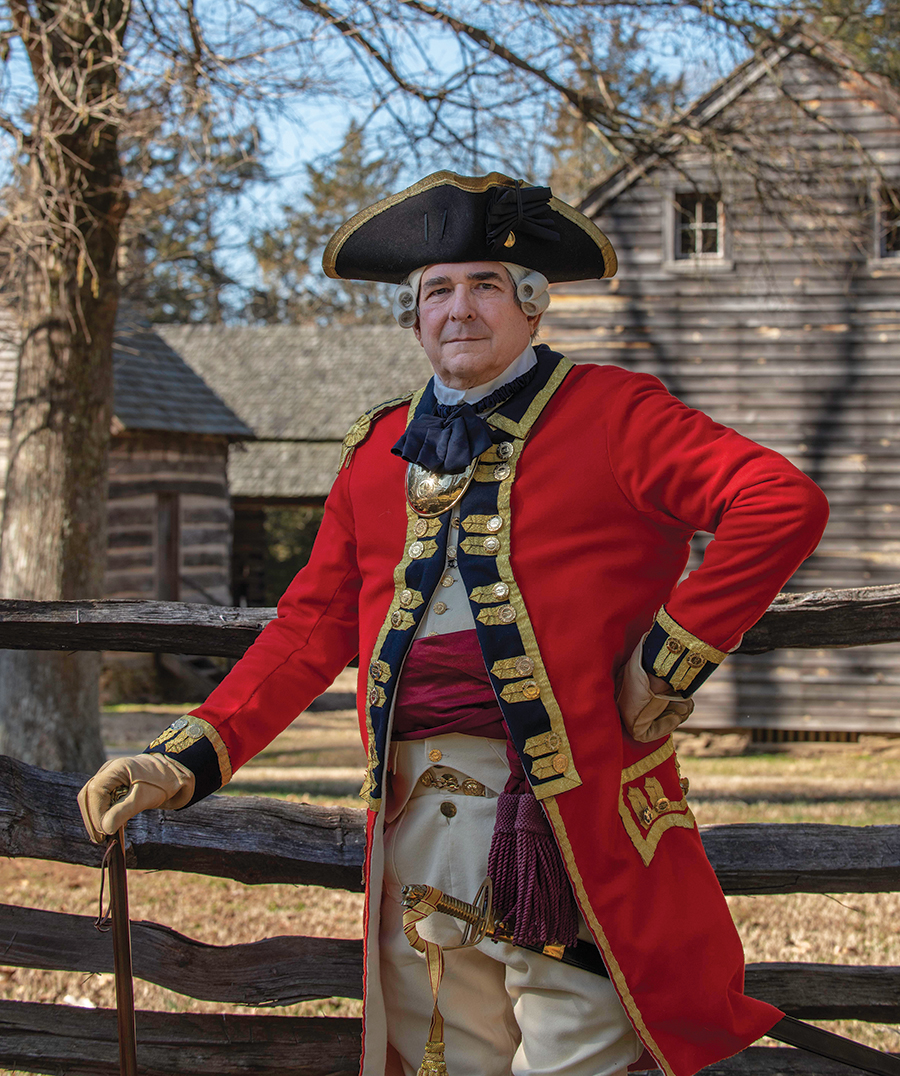
Jay Callaham not only happens to be an expert on military history and a veteran re-enactor of more than 50 years, but also the narrator of the action at Guilford Courthouse for approaching 20 years. Among other things, he also served as an advisor on the film The Patriot. Callaham portrays an officer of the Coldstream Guards, and for many years acted as a British field commander, and has performed the role of Lord Cornwallis. During his nearly 20 years of narrating the battle presentations, he is typically uniformed as a British Officer.

We caught up to the retired communications executive and former Army major on a recent afternoon at the Greensboro Masonic Temple on Market Street, wondering if there might be 10 curious and lesser-known facts about the famous battle.

Lord Callaham happily obliged.

1. The Super Bowl of the Revolutionary War

By the time Cornwallis marched his troops to Deep River Friends, where he camped prior to the battle, having unsuccessfully engaged  General Greene’s army for six weeks across the Carolinas to the Dan River and back, both armies were showing serious wear and tear. “Both were in pretty terrible shape. Cornwallis halted his march in Salisbury, for example, just to find shoes for his troops. As they came through Old Salem,” notes Callaham, “the British and their camp followers stole clothes off lines. Despite their worn appearance, Cornwallis’ 33rd Regiment was among the best in the world. His force included the renowned Royal Welch Fusiliers, and veteran 71st Highland Regiment, as well as the battle-hardened Brigade of Guards and Hessian Regiment von Bose (pronounced bose-a), all led by seasoned commanders. Not to mention American Loyalist or Tory troops. Greene’s force was a mix of militia troops from the Carolinas and Virginia, many of whom had prior experience and training in the Continental Army, as well as the 1st and 2nd Maryland Continental Regiments and Kirkwood’s Delaware Continentals. One army was led by a British General who’d never lost a fight in the field, the other by a Colonial general who’d never won a fight in the field — and wouldn’t win this one. In many respects, despite their tattered condition, this was the Super Bowl of the American Revolution, the battle that changed the whole complexion of the war and brought it to a close.

2. The Myth that the North Carolina Militia failed to hold its ground.

In his report following the battle, General Greene asserted that the front line of the deployed Americans — manned by the North Carolina Militia — failed to hold its ground during the first assault by the British.  “He wrote that the Carolina militia broke and ran at the start of the action. It’s simply not true,” says Callaham. “They weren’t even a true militia, rather a mix of local farmers and tradesmen and highly seasoned Continental troops that had proven themselves in plenty of action. They were deployed behind split rail fences overlooking Horse Pen Creek. The next line up was the Virginia militia followed by the 1st and 2nd Maryland. The commander of the 71st Highland Regiment — one of the finest units in the British army — reported that the lost half his company in the first volley. The North Carolina Militia troops did their job splendidly, in fact, enduring a 30-minute cannonade from three-pounder Royal Artillery cannons. Greene was simply trying to cover his rear end for losing the battle, which broke out everywhere and was mostly one of complete chaos. Fighting was brutal and bloody, hand-to-hand at times.”

3. The Scope of the Battlefield

The scope of the battlefield was huge, stretching from New Garden Friends — where Kirkwood’s Delaware troops engaged along New Garden Road — to the Guilford Courthouse site, a distance of about four miles. Cornwallis’s 2,000 troops were deployed along what is now Battleground Avenue, roughly from where Lowe’s Home Improvement is today all the way to Walmart. Artifacts from the battle have been found around both big box stores and along Battleground. The national battlefield encompasses only about a third of the actual battleground, and does not include skirmish sites along New Garden Road. Other parts of the battlefield are under Forest Lawn Cemetery and Greensboro Jaycee Park, both places where many artifacts have been found.

4. Rifles vs. Muskets

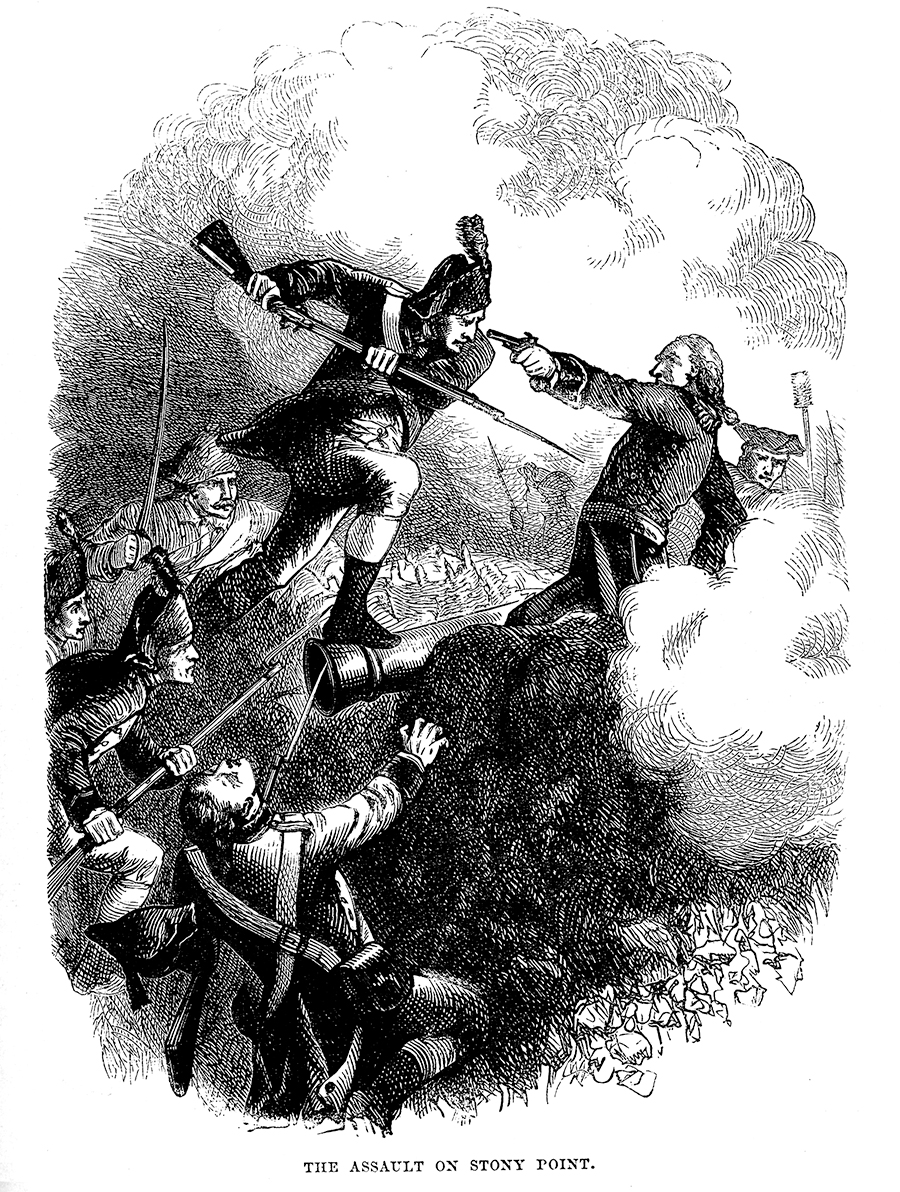
Soldiers in both armies used similar weapons, mostly muskets made in France or the venerable British Brown Bess muskets commonly used by infantrymen on both sides. Muskets fired a ball about three-quarters of an inch in diameter, loaded from paper cartridges containing powder and bullet or buckshot, rammed down the unrifled, smooth-bore barrel to the breech. A skilled fighter with a musket could load and fire his musket three times within a minute. The musket had an auxiliary weapon as well — a fixed bayonet — used effectively by the tenacious 1st Maryland at the Battle of Guilford (though by the 18th century, deaths in battle from bayonets were becoming less common). Rifles were a more specialized weapon, defined by a barrel with twisted grooves along its interior that allowed for a more accurate shot. The problem was a slower loading process that could be problematic in close-quarter fighting. On the other hand, rifles had extended ranges of accuracy — up to 300 yards — and were used effectively by both sides during Britain’s failed Southern Campaign, whose objective was to sever the South from the North, destroying the “bread basket” of the Colonial Army and ending the war in Britain’s favor. Rifles affected the outcome of at least three major Southern battles — at Kings Mountain, Cowpens in South Carolina and to some extent Guilford Courthouse, where the British used Jäger riflemen from Germany to great effect. These were skilled hunters dressed in green, whose deadly accuracy and discipline made them formidable foes. “The Jägers were professional huntsmen and were crack shots. The problem was every rifle had its own caliber, which often meant a rifleman had to make his own ammunition. Rifles played a significant role but muskets and bayonets won the war,” says Callaham.   

5. Question: Which Side was dressed in Blue? Answer: Both sides

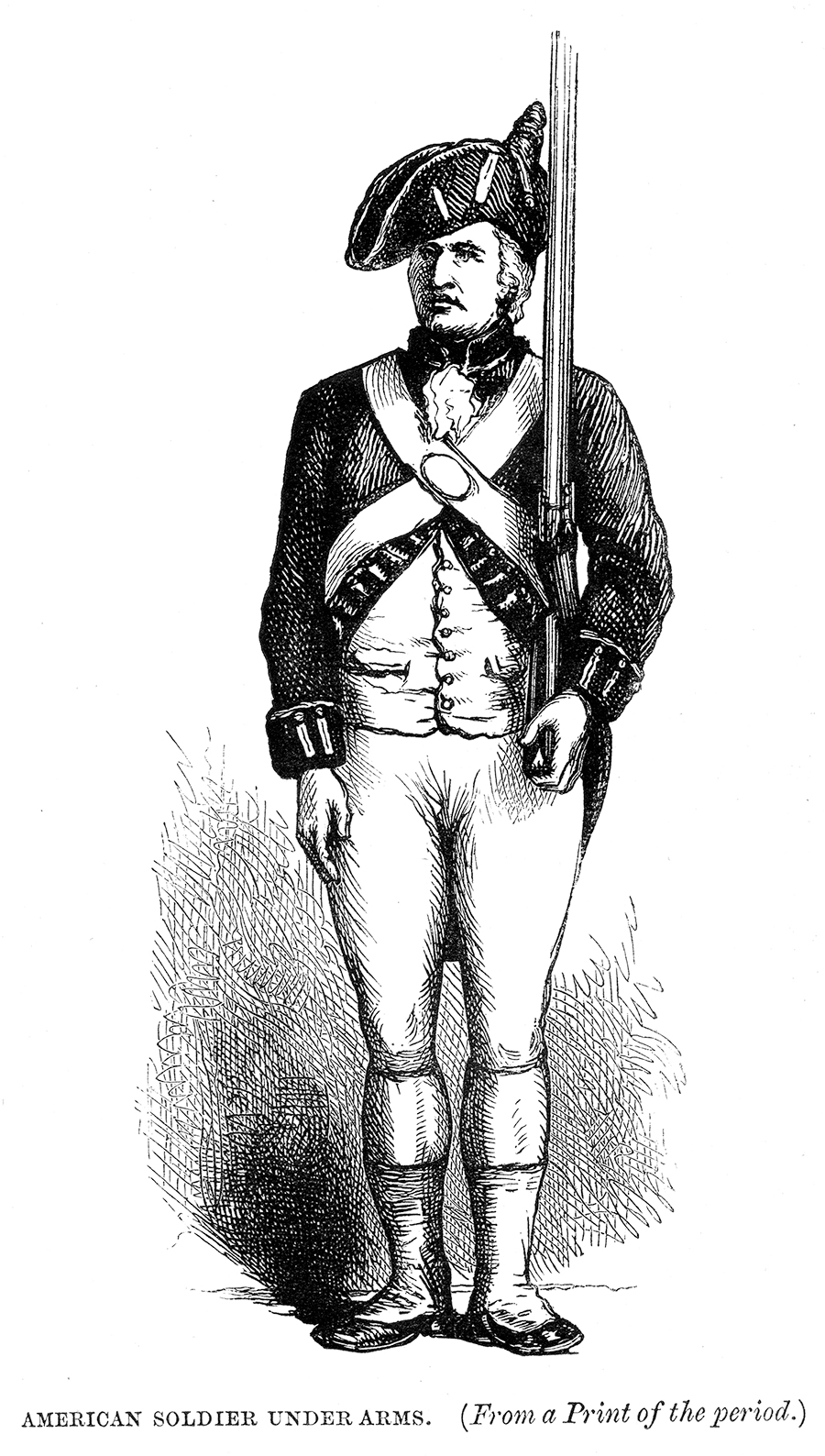
A key regiment of the British force at Guilford that saw intense action was the von Bose regiment composed of well-drilled German soldiers who wore dark blue uniforms that resembled the uniforms worn by both the Colonial Army, and both British and Continental artillery units — producing confusion in the fog of battle. The British army’s uniforms were bright red so they would stand out in the smoke of battle. The proud von Bose unit was composed of Hessians who came from a number of places across Germany, leased to the British army by King George III’s German allies. Fighting on the right flank of the advancing British force, the von Bose unit was savagely attacked both front and back by the Americans, distinguishing themselves and affecting the outcome of the battle. “Contrary to the myth, these troops were not mercenaries. They belonged to the lord of their home principality. An interesting postscript: Most Hessians who were captured were sent as prisoners to Pennsylvania where German farmers employed them. Many were encouraged to stay in America and were even given land. Many became American citizens.”

6. Did Cornwallis really fire upon his own troops?

Not intentionally, insists Callaham. “That’s one of the biggest myths about the battle. At one point in the battle, he came upon a melee in close combat between the 2nd Battalion of the Guards and 1st Maryland and ordered his soldiers to use a 3-pounder [cannon] to fire on Lt. Col William Washington’s light dragoons [calvary] that had attacked the Guards and in so doing had come between Cornwallis and his troops. Cannon doesn’t discriminate between red and blue. But the decision halted the Dragoons, separated the Guards from the 1st Maryland, prompting Greene to leave the field to preserve his Continental troops — and allowed Cornwallis to escape. It would have been very bad for the British if he’d been killed or taken prisoner. General Cornwallis also had at least one horse shot out from under him and was almost captured during the confused fighting in the woods. The fighting was that intense, neither side yielding, convincing General Greene to leave the field, in good order, to preserve his Continental troops.

7. Light Horse Harry Lee vs. Banastre Tarleton

Both were legendary cavalrymen. Tarleton was commander of the green-clad British Legion and the subject of a rebel American campaign, which claimed that his men terrorized the countryside and massacred surrendering Continental Army troops at the Battle of Waxhaws, South Carolina, in 1780. The alleged outrage earned him the nickname “Bloody Ban.” As leader of the highly mobile Continental Light Dragoons, cavalry and infantry, Lee won fame for his hit-and-run guerilla-style harassment that helped stymie the British army during General Greene’s “Race to the Dan.” Both men saw action at Guilford Courthouse. Both men presided over the massacre of unarmed soldiers — Tarleton at Waxhaws, Lee in Alamance County, whose Legions cut down a large group of royalist volunteers marching to join up with Cornwallis, camped in Hillsborough, N.C. before returning to Guilford County. “Light Horse Harry’s Legion basically slaughtered them, hacked them to pieces,” Calaham says. Adding insult to injury, the survivors were fired upon by British sentries when they sought shelter with Cornwallis. Harry Lee went on to become governor of Virginia and father to Robert E. Lee. Tarleton lost two fingers on his right hand in the battle at Guilford Courthouse and back home was elected to Parliament. “The truth of the matter is, Harry Lee wasn’t as great as he’s made out to be and Tarleton wasn’t as bad,” Callaham allows. Lee, he notes, was a terrible businessman who went bankrupt and nearly lost the Lee family estate, Stratford Hall — placed in trust, allowing Henry Lee IV to inherit it. “Tarleton had taken the town of Charlottesville, Virginia on a raid prior to the investment of the army at Yorktown. He had also taken Monticello, and could have destroyed it, but didn’t. There were good and bad men on both sides of the fight. The war brought out both aspects in them.”

8. The Numbers Game

No one knows for sure how many men were involved in the Battle of Guilford Courthouse, but the accepted number includes 4,000 Patriots and 1,700 men fighting for the Crown. “They were the best troops in both armies,” says Callaham, “the most elite troops with the best leaders. One of the most fascinating aspects is the disparity in their numbers.” The Brigade of Guards went into the battle with about 700 men and lost almost 50 percent of them — their worst day in the war, in part because the Americans had roughly a 2-to-1 advantage in numbers. “Traditional battlefield strategy holds that, if you’re going to attack an enemy, you should have at least a 3-to-1 superiority. Cornwallis had almost a 50 percent inferiority in numbers and still won the battle.” That was good news for the visitors. The bad news is that the British general lost a quarter of his troops. They were never quite the same after that. After withdrawing to Wilmington to rest and refit, Cornwallis abandoned the Carolinas, and moved into Virginia, joining his troops to another British force. Before marching into Virginia. Weeks later, Cornwallis surrendered 7,000 troops at Yorktown, ending the war.

9. A Dark Legacy

Col. Charles Lynch was also present at the Battle of Guilford Courthouse, commander of a rifle unit for the Virginia militia, a planter-class judge who was infamous for the harsh brand of frontier justice he meted out to British spies and Tories during and after the war. Lynch coined the phrase “Lynch’s Law” to describe the hasty trials and punishment he meted out, particularly if the sympathizer happened to be a loyalist. Legend holds that his worst offenders were tied by their thumbs to branches of a black walnut tree and given 39 lashes with a whip known as the cat o’nine tails. If the convicted individual hollered “Liberty forever!”, so the story went, he would be spared the remaining lashes and forced to enter American military service for one year.  “Basically,” says Jay Callaham, “he loved to hang Tories.” The term “Lynching” is commonly believed to have derived from his name and dark legacy. A young Sam Houston — who later avenged the Alamo and gave his name to the largest city in Texas, saw his first action as a sharpshooter serving in the Virginia Rifles at Guilford. Supposedly, he walked home to western Virginia after the battle.

10. On and a brighter note, Spring is back — Let’s Play Ball!

After you’ve checked out this year’s re-enactment scheduled on Saturday, March 16 and, Sunday, March 17, weather permitting, why not be a super patriot and show up for opening day of our beloved Greensboro Grasshoppers on Thursday, April 4, at 7 p.m.? The Hoppers, at least in part, take their name for the highly mobile and effective 3-pounder cannon used so effectively by the Americans at the Battle of Guilford Courthouse. Look sharp and you’ll find the replica of the famous cannon owner Donald Moore acquired for the occasion. “Our park, after all, sits only five or six miles from the scene of the battle,” says Moore with a laugh. “You probably could have heard the cannon fire from home plate — if there’d been one in those days.”

O.Henry Editor Jim Dodson has attended two re-enactments — one almost two decades ago and again in 2018. He plans to be there this year with his camera and tricorn hat.

Life’s Funny

Crying Time

The art of pre-infant bonding

By Maria Johnson

Dear Future Grandchild,

I realize it’s brazen of me to write this directly to you because — as far as I know from both of my unmarried sons — you don’t exist yet.

I say “as far as I know “ because I wouldn’t be entirely surprised if one of them walked in with a small child, and I said, “Who’s this?” and he said, “Oh, didn’t I tell you? This is your grandchild. My bad. I thought I texted you.”

So let’s just assume you’re an unborn angel — and able to read (It’s a big ask, but humor me.)

Here’s what I want you to know: I want to hold you, gush over you, coo in a whispery voice to you. But there’s something going around that might make that difficult for a while: bonding.

Feel free to spit up in heaven.

Here, according to several of my friends, is how it works:

1. Your parents tell us, your grandparents-to-be, that you are on the way.

2. We, your grandparents-to-be, are beside ourselves with joy because, let’s face it, this is why we had your parents: to be able to spend time with you, our grandchild, without the responsibility of parenting. It’s like winning the Powerball of Procreation. You’ll understand one day.

3. We, the grandparents-to-be, start buying toys, clothes and other accessories for you. We marvel at the advances in baby technology. For example, back in our day, we had radio-based nursery monitors. Now, cameras allow parents to watch you on their phones, which is . . . an improvement? We recall the story of a father of our generation who went golfing while his wife was away. He took the radio monitor (range: oh, 500 feet), finished his round, and heard no sign of trouble. Until that night. This story could be apocryphal. But it’s probably not.

4. The time of your arrival nears.

5. Bing! The email arrives.

6. We, your grandparents-to-be, say: “WHAT THE **** IS A POST-PARTUM PLAN?”

7. Sorry, we promised we wouldn’t curse around you.

8. Yes, it’s a detailed plan. For the first days, weeks, or even months of your life. It spells out who’s allowed to visit, when, and for how long. It lists permissible behaviors. Taking out the trash, washing dishes and doing laundry are highly encouraged. Pets, perfumes and pathogens are out. Holding you is negotiable. Kissing you is highly unlikely. Forget pushing your stroller (which probably carries a “No Touching” sign, no joke). Like high-schoolers after try-outs, we read the list hoping to make the varsity squad: Those allowed to see you at the hospital.

9. If we don’t make the team, we’ll say what we swore we’d never say because it makes us sound too much like our own parents: “This world is going to hell.”

10. See Number 7.

11. Distraught, we, your grandparents — OK, just me, your grandmother — turns to friends to see if any of them have experienced this phenomenon.

12. “Yes,” they say, “This world is going to hell.” Then they tell stories about “smash cakes,” which are first-birthday cakes designed to be smashed by babies for video purposes, then thrown away.

Fair warning: If your parents throw away a birthday cake that’s perfectly good — save a few claw marks — the videos will show this grandmother diving into the trash after it. Hahaha, my ass.

Oops. See Number 7.

Back to bonding. According to my sources, the goal of bonding is that your parents will feel (air quote) connected enough to meet your needs and so that you will not grow up to scream “IHATEYOUIHATEYOUIHATEYOU,” which, newsflash, you’re going to do anyway, but your parents don’t know this yet, so let’s not ruin the party.

The point here is that baby ducks imprint on their parents in a few days, but you’re a human, so this whole step-away-from-the-child thing seems like a bit much.

Understand, I get the drive to attach to your newborn. On the nights my boys were born, I held them in my hospital bed and studied them fiercely, memorizing their eyes, noses, hair, ears, fingers — everything, lest we take home a stuffed animal by mistake.

Such cementing is largely due to hormones, which also usher in postpartum crying jags. Been there, too.

I get how visitors at this point can grate.

I get how new parents want to do everything right.

I get that every generation changes how they do things.

I also understand that it’s nice to have a pair of loving, experienced hands take a squalling baby so you can get a nap, or a shower, or escape to Walmart, which can seem like a dream vacation, especially if your child has colic, a condition that causes babies to cry pretty much nonstop for the first three months of their lives, for no discernible reason.

Oh, didn’t I tell you? My bad. Colic runs in our family.

Seeya soon.

Granny

Maria Johnson is a contributing editor of O.Henry magazine. Contact her at ohenrymaria@gmail.com.

Scuppernong Bookshelf

Blair Fare

Thanks to Carolina Wren Press, veteran N.C. publisher John F. Blair finds an owner, adopts a new name and offers up several new releases

Compiled by Brian Lampkin

Some big-name writers from big-name publishers have books arriving in March: Oprah Winfrey (Flatiron Books) Dave Eggers (Knopf), Peter Wohlleben (Greystone), Helen Oyeyemi (Riverhead), Preet Bharara (Knopf) and Amy Hempel (Scribner), to name a few. Advertising budgets for all of those books will be significant (To be sure, no Super Bowl ads, but maybe a 1/2-page ad in Mother Jones!). Instead, let’s use our own meagre “advertising budget” to highlight a North Carolina publisher that’s bringing superb books to us in 2019.

Blair is a publishing house located in Durham, North Carolina, recently created by the purchase of Winston-Salem’s John F. Blair Publisher by Carolina Wren Press. Publisher Lynn York says that for several years, he had been trying to find a way to expand Carolina Wren Press, founded in 1976. “When we heard that the folks at John F. Blair were ready to retire, it seemed like a natural fit,” he says. “We were really happy to be able to purchase their titles and pull them into our nonprofit.”

Along with senior editor Robin Miura, York has embarked on an ambitious path. They recently announced that poet Ada Limón is their new poetry editor. Limón has credibility of the highest order in the poetry world. With all these changes, York still believes that their “mission remains the same: to publish new and underrepresented writers. With the addition of the John F. Blair titles, this also means that we publish lots of books that relate to the South, and especially to North Carolina.”

Here are forthcoming titles from Blair:

April 2: The Little Turkle, by Deborah Van Dyken ($16.95). The Little Turkle hatches into a world full of wonder on a barrier island off the Atlantic Coast where some people still call turtles “turkles.” Van Dyken lives in Beaufort, N.C., where she practices family law and watches sea turtles and their nests at the Cape Lookout National Seashore.

April 23: Any Other Place: Stories, by Michael Croley ($16.95) In his debut collection, Michael Croley takes us from the Appalachian region of rural Kentucky and Ohio to a village in South Korea in 13 engaging stories in which characters find themselves, wherever they are, in states of displacement. Croley uses his absorbing prose and relentless intent to uncover his characters’ hidden disquiet and to bring us a remarkable and unique collection that expands the scope of modern American literature. Croley will also be featured at the Greensboro Bound Literary Festival, May 16–19, 2019.

May 7: Cape Fear Rising, by Philip Gerard ($18.95). Based on actual events, Cape Fear Rising tells a story of one city’s racial nightmare — a scenario that was repeated throughout the South at the turn of the century. Although told as fiction, the core of this novel strikes at the heart of racial strife in America.

May 7: North Carolina Ghost Lights and Legends, by Charles F. Gritzner ($15.95). North Carolina is considered one of the U.S. headquarters for ghost lights — that is, for spooky and unexplained luminous phenomena. Nearly half of all reported ghost lights shine, blink, burn, dance or float somewhere in the state. These ghost lights are well-known in their localities. There are scary and fascinating stories associated with them, and they attract many visitors, each hoping to see a ball of fire floating over a cemetery or a jack-o’-lantern illuminating a corner of the Great Dismal Swamp or, better yet, a long-dead railroad man swinging his lantern in search of his severed head.

Author Charles “Fritz” Gritzner has been chasing ghost lights for many years. A geography professor and luminous phenomenon buff, he has visited the sites, researched possible scientific explanations for the lights and recorded the legends surrounding them. In this charming and fascinating book, he does not seek to debunk these phenomena, but to illuminate them as a part of the folk culture of North Carolina.

August 13: Gullah Days: Hilton Head Islanders Before the Bridge, by Thomas C. Barnwell, Emily Shaw Campbell and Carolyn Grant ($21.95). The Gullah culture, though borne of isolation and slavery, thrived on the U.S. East Coast sea islands from pre–Civil War times until today, and nowhere more prominently than on Hilton Head Island, South Carolina. On this small barrier island, descendants of the first generations of Gullah people continue to preserve Gullah language, customs, arts and cuisine. The three authors of Gullah Days: Hilton Head Islanders Before the Bridge are among those descendants, and in this book, they chronicle the amazing history of their secluded community from the Civil War through the 1950s, when real estate development connected Hilton Head Island to the mainland with a bridge.

Brian Lampkin is one of the proprietors of Scuppernong Books.


Wandering Billy

Caps ’n’ Taps

A different kind of brewing company serves up a sip of the past alongside current faves

By Billy Eye

“Everybody’s got to believe in something. I believe I’ll have another beer.” — W.C. Fields

I had the pleasure one afternoon of meeting with Jan Oden at the site of one of the most exciting resurrections of architectural relics since the Revolution Mill project.

Jan and her husband, Bill, are forging a brewery, beer garden and entertainment complex at the southern edge of the College Hill neighborhood, crafted out of a handsome two-story brick manufacturing plant flanked on both sides by four Craftsman-style bungalows built around the turn of the last century. The imposing rustic building at the center of this facility, most recently a metal finishing business, was erected in 1940 for the Good Luck Bottling Company.

Greensboro is known for many things. Dolley Madison’s stitches, Wrangler britches, Vaporub for itches, the South’s sassiest (that next word didn’t get past my editor). It may surprise you to know our fair city was also a soda pop fountainhead for the Southeast.

North Carolina’s very first Coca-Cola bottler began filling 5-cent bottles on South Elm in 1902. Soon after, Pepsi-Cola was brewing on nearby Lewis Street. By the 1940s, Nehi was bubbling up on Battleground, 7up over on Walker, Orange Crush on Westover Terrace, Canada Dry Ginger Ale on West Market, and Dr Pepper (“Drink a Bite to Eat at 10, 2, and 4 o’clock”) on Lee Street. At one time or another, we’ve been home to Chero-Cola, Lime-Cola, Gin-Gera (“It Gingers You Up”), Pal Ade, Nesbitt’s Orange, Mint Cola, Big Frosty, Necto, and Tru-Ade. Greensboro was selected for the world’s most modern Pepsi bottling plant in 1957 where no less a superstar than motion picture dominatrix Joan Crawford herself stilettoed into position on Spring Garden near Holden to cut the ribbon, flanked on either side by WWII ack-ack guns and the combined Army, Navy and Marine Corps Color Guards.

Lesser known but just as effervescent was Greensboro’s own Good Luck Bottling from the mid-1930s into the 1950s. Founded by William Lafayette Oden, more informally known as “Fate” (if you saw his portrait you might imagine why), Good Luck began operations on Davie Street with 3 Centa cola. With every other bottle of pop selling for a nickel, 3 Centa had a 40 percent price advantage. In 1940, Oden expanded his operations to include a spicy ginger ale originating out of Birmingham. It wasn’t happenstance that he chose to build his larger plant on Lee Street (now Gate City Boulevard) near Tate. “He did some research,” Jan says of her great-grandfather. “And found this spot had the best water possible, so he had a deep well dug.” The water was so pure, Oden was bottling spring water here with the slogan, “Feel better, live longer.”

Around the same time, that spicy ’Bama ginger ale was renamed Buffalo Rock. Was it because of our own Buffalo Creek? “That’s one of the things I’m trying to figure out,” Jan tells me. “Exactly what my great-grandfather’s involvement was.”

Jan is so dedicated to this exciting endeavor she relocated her family here from Wilmington in the fall of 2017. As we tour one of the charming houses serving as her makeshift office, filled with shabby chic antiquities, she tells me of her commitment to preserving these historic properties: “We want to keep everything close to the way they are built. The Avett Brothers’ ‘Salvation Song,’ that’s our theme song.”

For years serving as college student rentals, these four homes will be integrated into the overall complex, each remarkably intact, cozy and true to its roots. “We could have a restaurant in here with seating inside,” Jan remarks about her office. “While food could be served out of the back window to the beer garden.” When I visited, one of the homes had just been moved to the side, opening up the rear of the property for parking and an expansive open-air patio with a stage for local bands.

As someone residing in the area, known to tip a glass or 10, I for one can’t wait to see — and taste — the results when this ambitious undertaking is completed in late summer. The brewmaster for what will be christened Oden Brewing Company, Brian Carter, late of Natty Greene’s, will have 15 taps flowing. “There are a lot of places taking ‘creative’ way beyond where I think it needs to be,” he says. “We’ll have a good variety, so that there is something for the beer nerds who want that new crazy thing, but if somebody just wants a damn beer, they’ll have something to drink too. The whole first year will be figuring out what people are clamoring for.”

There’ll be more than brewskis on draft. The plan is to make kombucha in-house and, Brian promises, “Once we figure out how to carbonate the water, some craft sodas,” A spicy ginger ale, natch, along with other flavors. “Just like the beer rotation,” he says. “When that batch runs out, we’ll replace it with something else.”

This area was undisturbed for so long it remains encircled by towering oaks and leafy shrubs, an idyllic environment for a friendly neighborhood brewpub filling the gap between coffeehouses and corner bars. “There’s nothing else like it here,” Jan points out. “People want that walking distance spot, a place where the family can eat and hang out and bring the kids.”

Billy Eye is O.G. — Original Greensboro.

O.Henry Ending

Nettleton Nightmare

The nettlesome side of “Greensboro’s Shoe”

By Charles A. Jones

When I recently noticed my accountant was wearing non-Nettleton tassel loafers, I winced. In 2012, O.Henry magazine glorified Nettletons as “The Greensboro Shoe [in] the golden age of haberdashery.”

I frankly do not understand all this bootlicking heaped upon a brand of shoes that evokes, for some, painful memories of being bullied and mocked by the fashion police in junior and senior high schools.

My time in hell was three years at Kiser from 1967–1970 and one year at Grimsley ’70–’71. The “uniform” of our generation’s equivalent of the Hitler Youth (aka “Brownshirts”) was a pair of Nettletons, black socks, and often an Izod shirt featuring, appropriately, a vicious alligator. Penny loafers were allowed as an alternative to Nettletons but never with pennies in the slots at the front of the loafers — unless you had a death wish. Such fashion deviations brought instant and brutal punishment by the Brownshirts. Another taboo: wearing “fake Nettletons”

But not everyone who sported Nettletons was a bully. I remember a good guy from the Kiser years whom I will call John Brandt, who wore the prized loafers. When a bully stepped on the tip of his Nettleton and turned his foot to grind the shoe’s toe, John hit the guy in the face the very next day at his father’s suggestion and dragged the bleeding offender to the principal’s office.

My parents for whatever reason would not let me buy Nettletons. My feet were also too big and too wide for the shiny penny loafers (which my parents did allow) flattening the inside edges of the shoes.

Another fashion offense that put me in harm’s way was donning a pair of white or light colored socks, a lightning rod that drew instant fire. I remember a dangerous duo — let’s call them Lane Smith and Paul Downing, who were both Nettleton-wearers — seeing me commit just such a fashion offense. Rocking back and forth on their feet, they mocked me by sarcastically singing “We like those WHITE SOCKS!” Lane once expressed his disapproval of me by spitting on me through the gap in his front teeth. Once, when the bottoms of my feet were badly cut and I had to wear white socks, I covered them with a pair of dark ones so I would live another day.

Nettletons or “Neds” as they were called, became meaningless after I left Greensboro’s public schools. At Oak Ridge Military Academy, Wake Forest University and Campbell College Law School, one’s academic performance and character were much more important than a shoe brand.

In 1981 I joined the Marines and never had to worry about what to wear — and I didn’t have to go to Younts-DeBoe and spend a week’s pay on a pair of shoes. For field duty, the uniform was “boots and utes” — combat boots and a standard utility uniform (camouflage). I became elite based on merit, not on footwear.

Ironically, shoe problems still haunted me during my initial Marine training. My wide, flat feet didn’t fit comfortably inside narrow combat boots with little support. What were benignly termed “conditioning hikes” were in fact long marches on gravel roads (a great way to see Virginia’s countryside while wearing a helmet and pack, and carrying a rifle). My feet began to look like bleeding hamburgers. I tried everything for relief, including wearing hose and — get this — white socks. The only relief came when I got wider boots.

Civilian clothing was permitted after hours, but fellow Marines, despite their regimented training and esprit de corps, never ragged anyone for wearing faux Nettletons or white socks. I doubt they even knew what Nettletons were. I realized that high school was over and that mature adults do not really care what shoes or socks one wears as long as one is a competent, humane individual.

Despite the very strong signal I got from the beautiful people and show-offs that I was CLEARLY not one of them, I have led a successful and fulfilling life to age 64. And I will never be nostalgic about a status symbol that symbolized, at least for me, the cruelty that insecure adolescents are capable of inflicting upon one another.

Without fear I wear white socks as I write and edit this article, and I — who still have the fire of a Marine — look forward to meeting Lane Smith and Paul Downing one day to revisit the good old times and maybe even using the end of my fist to point their chins to their “Neds.”

Charles A. Jones is a retired Marine Corps Reserve colonel, a lawyer and a writer. He changed the names of those mentioned in this article to protect the guilty.

Short Stories March ’19

Branching Out

Help the Gate City keep another moniker, Tree City USA, as designated by the National Arbor Day Foundation. And you don’t have to, er, go out on a limb. Just join Greensboro Beautiful on March 16 — Arbor Day — at 10 a.m. for a tree planting at Kings Forest Park (1501 Larchmont Drive). The event will also launch the local nonprofit’s NeigbhorWoods Community Tree Planting Program, which helps provide canopy for hardwoods and evergreens lost in storm damage — as we all witnessed during Hurricanes Florence and Michael last fall — or for utility work. Info: greensborobeautiful.org.

Pickled and Preserved

Not that we’re suggesting you tie one on, but you can order a bowl of pickled veggies and yes, hoist a brew or two — or even a few — while helping out Preservation Greensboro. Just head to Natty Greene’s Brewpub in the historic Jones Building (345 South Elm Street) on March 20, aka “Good Work Wednesday” between 5 p.m. and 11:30 p.m. and order your favorite frostie, be it a Buckshot Amber, a Southern Session IPA or an Old Town Brown. While you’re at it, place an order of Cajun fries to go with those pickles, knowing that when you pay your tab, 10 percent of it — along with 10 percent of other bar patrons’ tabs — will go directly to the nonprofit dedicated to saving revered places and vital links to the Gate City’s past. Info: preservationgreensboro.org.

The Body Eclectic

As in, eclectic ways artists have used to portray the human figure, as seen in Here We Are: Painting and Sculpting the Human Form, opening March 9 at Weatherspoon Art Museum (500 Tate Street). Drawing from Modern and contemporary works from the museum’s collection, the exhibit consists of self-portraits, celebrity portraits or renderings of body fragments, to show that our mortal coils are a means to express identity, societal trends and fragility. So show a little esprit de corporeal, and catch the installation, which will be on view through October 20. Info: weatherspoon.uncg.edu.

Marvelous Maguy

It was a book reading.

But the writer, Greensboro’s Maguy (pronounced Maggie) Thomson, who is 75 and bent by rheumatoid arthritis, could not speak above a whisper, so her husband, Tim, introduced her work, Marguerite de Bourgogne, a self-published memoir via LifeRich Publishing, an imprint of Readers Digest.

Reading from a copy bookmarked with sticky notes, Brenda Schleunes, founder of the Touring Theatre of North Carolina, freed Maguy’s stories:

Of her father as a young Jewish man in Austria, fleeing Hitler’s police in 1936.

Of her mother, who was from the Burgundy region of France and who lived, as young woman, in Paris, where she and Maguy’s father met.

Of Maguy’s childhood, which included an 8-year-old boy who wrapped her 4-year-old finger with a blade of grass and announced to Maguy’s grandfather, “We are married whether you like it or not.”

At this, Marguerite of Burgundy — and later of Paris, of Chicago and four more U.S. cities before she landed, five years ago, in Greensboro — closed her eyes in the den-like coziness of Scuppernong Books and smiled. So did everyone else. Info: maguey.org or scuppernong.com —M.J.

Couture de Coeur

You don’t have to be a fashionista to appreciate Restoration Runway, the fashion show and silent auction benefiting Restoration Place Counseling, which offers affordable, faith-based services to women suffering trauma, depression or dependence. On March 28 Restoration Runway will celebrate its 10th year at Greensboro Country Club (410 Sunset Drive) with a reception, runway show and silent auction, but under the  theme, “Joy,” it celebrates something more important: inner beauty. Tickets: one.bidpal.net/joyfuljoyful/ticketing.

Footloose

Step to it, get into the groove, drag your heels, toe the line and give it a whirl. Dance Project’s Dance Marathon, that is. From 9 a.m. to 9 p.m. on March 30, Dance Project will set up in LeBauer Park and Van Dyke Performance Center (200 North Davie Street) for a day of classes, performances, dance relays, prizes and then some. The point is not only to have a great time but also to raise money for the programs and activities at Dance Project’s School at City Arts. So grab those dancing shoes and get ready to cut a rug. Info: (336) 373-2727 or danceproject.org.

Irish Trad

Long before Celtic Woman or other renowned folk bands from the Emerald Isle — De Dannan, Planxty, even The Irish Rovers of “The Unicorn” fame — The Chieftains set the bar for traditional Irish music. Established in 1962 by front man Paddy Moloney, the group boasts a staggering discography of 40-some albums, six Grammy awards and numerous collaborations with musicians of various genres, from rocker Mick Jagger to late opera tenor Luciano Pavarotti. As cultural ambassadors, The Chieftains have performed for monarchs, heads of state, Pope John Paul II and, at the invitation of the Chinese government, on the Great Wall of China, the first western group to do so. In its 57 years, the band has expanded and contracted with various members’ passing or leaving, but Moloney still leads, playing the tin whistle and uilleann pipes. With Kevin Conneff on vocals and bodhrán (drum) and Matt Malloy on flute they continue to delight and mesmerize audiences with their enticing blend of Celtic airs, ballads and reels, along with  classical compositions. Be similarly mesmerized on March 7 at 8 p.m. the Carolina Theatre (301 S. Greene Street). Tickets: (336) 333-2605 or carolinatheatre.com.

Spring Forward

To Springfest! OK, so we’re brazen enough to toot our own horn, but we strongly feel you won’t want to miss this year’s event, hosted by our sister publication Seasons Style & Design, a quarterly devoted to all things home and garden in the Triad. Now in its second year, Springfest will be held on Saturday March 24 from 1 to 5 p.m. at Grandover Resort (1000 Club Road). With the theme, “How Does Your Garden Grow,” it will feature — if you’ll pardon our alliteration — garden gab from hort luminaries Tony Avent and Chip Calloway. In between talks you can enjoy a splendid tea, replete with nibbles, and meander among vendors’ displays, and home and garden demos. Rumor has it that flower guru Randy McManus may even make an appearance. Find out for yourself! Tickets: ticketmetriad.com.