Scuppernong Bookshelf

Greensboro Bound: Year Two!

The local literary festival extends its reach far beyond the Gate City

Compiled by Brian Lampkin

In May of 2018, the Greensboro Bound Literary Festival turned the Gate City into the destination for writers and readers across North Carolina. This year, from May 16 to 19, Greensboro Bound will reach across the ocean and around the country to bring more than 70 writers to locations throughout downtown. Our profound thanks to all of them that are accommodating the Festival’s events.

Our keynote speaker for Saturday evening, May 18, from London is literary sensation Zadie Smith, author of Michelle Obama’s favorite novel, White Teeth. Her other works include Autograph Man, On Beauty, NW and Swing Time. Her recent collection of essays, Feel Free, is a nominee for a 2019 PEN Literary Award, and she has been shortlisted for the Man Booker, had a novel named one of the 100 best in the English language (among those published between 1923 and 2005), and won the Orange Prize for Fiction. We thank the UNCG Libraries — and its dean Martin Halbert’s generous partnership with the Festival —for Smith’s appearance in the Cone Ballroom on the UNCG campus at 7 p.m. To ensure a seat to this event, you must RSVP here: www.eventbrite.com/e/an-evening-with-zadie-smith-tickets-54371396310.

A lineup of children’s and young adult authors will charm and delight families from our city’s diverse neighborhoods. Our partnership with the City of Greensboro and the Greensboro Public Libraries means the downtown library will host: Bill Konigsberg (The Music of What Happens), Lamar Giles, (Fresh Ink, Black Enough), plus 18 more amazing children’s writers.

On the adult side, 2018 National Book Award finalist Rebecca Makkai will be here to talk about her novel, The Great Believers, and 2016 National Book Award Finalist Ross Gay will talk about his new collection of essays, The Book of Delights. We’ll have an all-day tract of writing on Appalachia with a diverse group of scribes: Wiley Cash, Mesha Maren, Robert Gipe, Carter Sickels, Michael Croley, Val Nieman, and Meredith McCarroll (editor of Appalachian Reckoning, in which many of these writers appear).

For some, the highlight of the Festival will be the conversation between Heath Lee, author of The League of Wives: The Untold Story of the Women Who Took on the U.S. Government to Bring Their Husbands Home, and Claire Gibson, author of the novel Beyond the Point, which centers on the lives of women at West Point. Others will come primarily to see the fabulous Lee Brothers! Yes, Matt and Ted Lee will be at the Van Dyke Performance Space to talk about Southern cooking and their new book Hotbox: Inside Catering, the Food World’s Riskiest Business.

Permeating the Festival will be engaging, ongoing conversation on social justice, climate change and civil rights. Adam Parker, author of Outside Agitator: The Civil Rights Struggle of Cleveland Sellers Jr., will be here as will Cleveland Sellers himself as they discuss the Orangeburg Massacre and the ongoing movement in its wake. Sudden Spring: Stories of Adaptation in a Climate-Changed South, by Rick Van Noy, reflects on the loss of some of our most cherished landscapes. Van Noy will be on panel with Susan Hand Shetterly. She’s the author of Seaweed Chronicles: A World at the Water’s Edge and the mother-in-law of Margot Shetterly, who wrote Hidden Figures.

The weekend kicks off with an Opening Night celebration on Thursday, May 16 at 5:30 p.m at the Weatherspoon Art Museum with the multitalented Astra Taylor. Formerly with the influential indie band Neutral Milk Hotel, but she has moved on to become one of the leading voices on what’s failing in our democracy. Greensboro Bound will screen her film What Is Democracy? Taylor will talk about the film and her knew book Democracy May Not Exist, But We’ll Miss It When It’s Gone.

Face plant! I didn’t mention the Greensboro Opera, the Greensboro Symphony’s OrKIDStra, puppets with Fred Chappell and puppets of Fred Chappell in my race to the finish: the Festival’s closing Extravaganza on May 19 at A&T State’s Harrison Auditorium. This year, the Righteous Babe herself, Ani DiFranco, will preside over the event in tandem with the May release of her memoir, No Walls and the Recurring Dream. We’re one of 10 cities across the country on her initial book tour. DiFranco’s music has empowered several generations and her commitment to making music on her own terms is a significant contribution to the “art of business.” A true American tour-de-force. As if that weren’t enough, she will be in conversation with Greensboro’s own tour-de-force, Rhiannon Giddens. Expect more surprises when we publish the full schedule in the May issue of O.Henry.  OH

Brian Lampkin is one of the proprietors of Scuppernong Books.


Papadaddy’s Mindfield

Getaway

Or, how to start your own Vacation Club

By Clyde Edgerton

When my wife, Kristina, was told we could get four days and three nights in a Marriott hotel luxury suite with two bedrooms, two baths, kitchen, three or four TVs in Myrtle Beach for $9 (OK: $134) if we’d sit together for a one-and-a-half-hour lecture about time-shares, I said: Goodness. Why not?

Excuse me — not time-share, but some other name, like: Marriott Vacation Worldwide Club Getaway. “Time-share” is out of fashion in some quarters . . . the name, not the concept. There’s a guy who comes on cable radio and says, “I’m a lawyer, not very smart, but mean, and I’ll get you out of your time-share contract by suing the hell out of the time-share company, and if that doesn’t work, I’ll burn down your time-share and we will split the insurance.”

But with the Marriott Vacation Worldwide Club Getaway, rather than buying a two-weeks-a-year stay at one hotel suite, apartment, small closet or room (after which other people use it for the rest of the year, and get it dirty), you — in this new kind of setup — buy the possibility of staying in a luxury hotel about anywhere in the world when you go on vacation, and you use up a certain number of points each time that happens, depending on how big your abode is. You buy so many points a year for the rest of your life. If you don’t like the deal, that’s OK because you will die and leave it to your heirs, and they can do the same, like a home. Resale value? I don’t know.

Let’s jump ahead about one hour and 15 minutes into our lecture. I asked: “What’s your return rate?”

“Excuse me?”

“How many couples out of 10 buy in?”

“Three.”

“Wow, I’m surprised it’s that high. That’s pretty good.”

Now mind you, Kristina and I had decided that there was no way we could buy in. I mean there was the very slightest chance, but we vowed we would not be swayed. 

The luxury hotel was, well, luxurious. The January weather was nice, there were several football-field-size heated pools, a Jacuzzi. Our suite was two big bedrooms, two baths, kitchen, living room, all that. We just kind of relaxed. Our kids did what they do at home: They sat on a bed and looked into a cellphone. Well, that’s not fair — they do other things. Perceptions are sometimes a product of fear.

We got there on a Friday, and on Saturday morning, while the kids sit on their beds looking into their cellphones, Kristina and I head for the lecture. On the way, we walk around, out onto the beach and back. I mean, who needs the beach when you are at a luxury hotel? There is this bevy of nice grills near the beach area (inside the gate to the beach), these big cabinets of dark wooden cubbyholes for your beach paraphernalia (inside the gate to the beach). There are beach chairs, ping-pong tables, a gym (inside the gate to the beach). Suddenly, I realized the thing you go to the beach for, the beach, was not central to a Marriott Worldwide Vacation Club Getaway. Why? A guess: Nobody makes money when you go for a walk on the beach. And the gate keeps out the undesirables who might be walking by on the beach.

Just before the lecture, we enter a large room with bar, snacks, drinks, many couches, big green plants and lamps. I’d thought other folks would be coming in. Nope. It ended up, at first, being just three of us.

A nice young man, very relaxed, open collar, sports jacket, sits down with us and says, “This is definitely going to be low key. No high-pressure stuff.” We talk about where he’s from, his brothers and sisters, where he went to school. I like him. Surely he thinks we’re not interested, I think.

It is very low pressure . . . for about 40 minutes. After about 45 minutes we have taken a little stroll past beautiful, large 3-D photos of resort areas around the world, and we are now in a very small room. A guy who looks like Pancho Villa comes in. He wears two belts of ammo, crossed on his chest. He starts putting numbers on a white board with a blue felt-tipped pen — what our payments will be for a certain number of points a year. He’s good. I will later admit to Kristina that I was almost swayed. Then I think to ask, “Is there a maintenance fee?” Well, there is. Two grand a year for the moderate package we’re examining, and I think to myself: If we get away for only four nights in a certain year, that’s $500 a night out the gate.

We say to Pancho: “We are not doing this, sir. The end.” He changes tactics, halves all the numbers on the board, unclicks the safety-guard strap on his pistol.

We persist. Pancho gives up, and they run a woman in on us. No ammo belts. She says if we call her by 1 p.m. that day, we can get three nights and four days at any Marriott luxury hotel for $199 if we promise to come together for a 1-hour, 30-minute lecture. This is true. I realize that it’s the three out of 10 that’s driving the bus. I say, no thanks. She says $149. I say no. She gives us a business card and says, “Call me if you change your mind.”

We return to our suite, relax, enjoy our stay for another day, talk about how lucky we are to be one of the seven in 10. We gather our kids and their cellphones off their beds, return to Wilmington a day early, and have a family meeting. We’re going to start spending time at the beach, and in the yard, and walking, and going to state parks. We’re going to start our own Vacation Nature Getaway Club.

Features? Yard, beach, state parks.

Cost: Nada  OH

Clyde Edgerton is the author of 10 novels, a memoir and most recently, Papadaddy’s Book for New Fathers. He is the Thomas S. Keenan III Distinguished Professor of Creative Writing at UNCW.

Doodad

Girls’ Club

Two young Piedmont golfers make the finals of Drive, Chip & Putt

Check it out, Wyndham Championship. You aren’t the only reason the Piedmont gets national TV attention for its golf chops.

This month, for the first time, the Triad will be represented at Drive, Chip & Putt, a youth golf competition held on the eve of the hallowed Masters Tournament — and not by one but by two local golfers: 9-year-old Gabriella “Gabbie” Moorehead of Burlington and 11-year-old Ellen Yu of High Point.

The Golf Channel will televise the competition on Sunday, April 7, the day before practice rounds begin at Augusta National Golf Club.

Started in 2013, Drive, Chip & Putt culls 80 of the country’s top male and female golfers, ages 7 to 15, for the contest every year. Competitors accumulate points based on three drives, three chips and three putts.

To make the finals, Gabbie bested 7-to-9-year-old girls in the regional round at The Honors Course near Chattanooga. Ellen topped the 10- and 11-year-olds at Congressional Country Club in Bethesda, Maryland.

Both girls were introduced to golf by their parents. Ellen, the daughter of Kale and Julia Yu, started playing at age 7.

“I saw athletic gifts in her that I thought would translate well to golf. She has good eye-hand coordination, good attention to detail and a lot of power for a girl her age,” says Kale Yu, Ellen’s dad.

Ellen is home schooled and plays every day, weather permitting, sometimes for seven hours at a stretch. She carries a 4.9 handicap, and her best score on nine holes is 30 strokes.

“She’s totally focused on her golf,” says former PGA player Mike O’Briant, who coaches Ellen at Thomasville’s Colonial Country Club. “She enjoys playing and practicing as much as any youngster I’ve been around.”

Gabbie, who can be seen on the greens at Stoney Creek Golf Club and Starmount Forest Country Club, picked up toy clubs about age 4 and quickly cottoned to the game, often playing with her parents, Erin and Matt, and with her grandmother, Barbara Fry of Greensboro.

Her instructor, Precision Golf School’s Ted Bonham, says Gabbie’s strength is putting. Her drives — she can tag it 160 yards; not bad for someone who weighs 55 pounds — will get better with time because she naturally has the lifting finish that’s the cornerstone of the modern drive, he says, and because she picks up on his pointers quickly.

“She understands what I’m telling her, and she accomplishes it,” he says.

Aside from golf, Gabbie enjoys playing violin, taking dance classes, doing taekwondo and Girl Scouts, and hanging out with her new baby sister, Madilyn.

In a questionnaire for DC&P, she said her ideal Champions Dinner after the junior competition would be Kraft macaroni and cheese, grapes and chocolate cake. We say, dig in! — Maria Johnson  OH

Life’s Funny

Are We Having Fun Yeti?

Putting Greensboro’s biggest foot forward

By Maria Johnson

Hanging out in the baggage claim area at Piedmont Triad International Airport, waiting for my son, I had the feeling that I was being watched, not an altogether unjustified feeling in an airport. Bully for keen security. But the surveillance felt immediate, as if someone were staring at me from close range, so I turned around and . . .

WHAA?!

It was Bigfoot, hulking beside the escalator. I’d heard reports of Sasquatch sightings in the area over the years, mostly in the Uwharrie Mountains south of Greensboro.

But I never expected to see the big guy at the airport, much less at baggage claim, even though airports are great melting pots. He was a hirsute chap — about 7 feet tall — with sympathetic eyes and a friendly, bemused expression. Not at all what I expected.

“Yeah, I fly only when I have to,” he seemed to say.

Honestly, I was charmed by this fiberglass fellow, but I was puzzled by his presence at the airport, especially when I realized he was part of an advertisement for a furniture showroom, International Manufacturers Showroom in High Point.

Presumably Biggie was one of many, um, home accessories available in the showroom; he was accompanied by a giant mirrored bass fiddle, a metal sculpture of two wading birds taking flight and a live-edge bar table with leather-topped stools. Standing in a slight crouch, Biggie appeared to be resting one cheek on a barstool.

In a way, he fit right in. I mean, hairy dudes on barstools aren’t exactly rare in airports, and neither is eye-catching art. Airports use all kinds of mosaics, fountains, mobiles, sculptures, and light-and-sound effects to entertain travelers and dress up the fact that they’re basically camping around a big driveway.

Advertisers — especially furniture manufacturers — get into the eyeball game, too, often putting their edgiest pieces on concourses. Around here, you can bet those displays are aimed at retailers, who stride by on their way to High Point Market, a twice-a-year event that’s rolling out the spring offerings this month.

Was I missing a Sasquatch trend for home and garden?

For answers, I turned to Ikea — and by that I mean a woman named Ikea, who works in the American Airlines baggage claim office, with a clear view to Biggie. She didn’t want to tell me her last name, but she didn’t mind sharing that, yes, she was there when the showroom installed Biggie about a year and a half ago.

“I was like, ‘Well . . . OK,” she says.

Since then, Biggie has become the star of baggage claim.

“People take pictures of it all the time, every day. They love that Sasquatch,” she says.

Some people take selfies with the beast, but more often, they snap group pics. People love to mug with Biggie.

“They’ll hug it or put their finger in its belly button — it’s an innie — or they’ll touch its nipples,” reports Ikea. “It’s got nipples.”

Indeed it does. And Ikea is not being disrespectful by referring to Biggie as “it.” Thanks to careful sculpting, Biggie’s gender is not clear.

Still, the creature exudes an undeniable animal magnetism, which is why, Ikea guesses, the showroom set up a velvet rope around Biggie not long ago — to cut down on intimate encounters.

Bingo, says George Eouse, the CEO of International Manufacturers Showroom.

“The airport was concerned we were getting a little too much interaction with our stuff,” says Eouse, who brainstormed with his team to create  attention-getting displays at PTI.

That’s when they settled on “the Yeti,” as Eouse calls it.

An Australian artist carved the original, he says. Weatherproof reproductions, like the one at the airport, are fabricated in the Philippines and imported by another of Eouse’s companies, one of more than 30 manufacturers represented in IMS showroom, across the road from Furnitureland South.

During furniture market, IMS is closed to the public. But outside of market dates, the public is welcome to buy market samples of exotic furniture, rugs and trophy pieces similar to Biggie.

“It’s actually a very popular item,” Eouse says, guessing that he has sold about 100 Biggies, at a wholesale price of $750 each, mostly to retailers. Who ends up owning them? You name it: Bigfoot groupies, clubs, people with a quirky sense of humor.

“We see people put them out in the tree lines,” Eouse says. “It’s not for everybody, but for someone with a unique sense of fun . . . I’ve had people to go berserk when they find out they’re able to own one.”

So don’t be surprised if you hear more reports of Biggie sightings, never mind a shrinking natural habitat. Whether in the flesh or in fiberglass, it seems, the legend has legs.

“He sells enough that he’s going to be around,” says Eouse. “He’s going to survive.”  OH

Maria Johnson is a contributing editor of O.Henry magazine. Contact her at ohenrymaria@gmail.com.

Food for Thought

Greens, Eggs and Ham

The Devil in the details

By Jane Lear

Something about April makes me nostalgic for — well, I’m not sure what, exactly. The first young vegetables are juicy, tender and exquisite; they are what spring tastes like. Farmers and home gardeners alike have earth-caked hands and knees. They are working hard, being patient. Waiting for the world to wake up and warm up.

As a child, my Aprils were often spent chasing after my mother, who was intent on foraging wild watercress before it flowered and then disappeared until the following year. She’d picked up the knowledge that the plant had been used both culinarily and medicinally during ancient times, and as we waded in frigid creeks and teetered on rocks midstream, she’d treat me to a homily on how brilliant the Greeks were and how exceptional watercress was. (Watercress is indeed rich in vitamins K, A, C, E and B6, as well as phosphorus, magnesium and calcium. Ounce for ounce it contains more antioxidants than broccoli.)

For Easter and other spring occasions, we might be treated to watercress soup served in my grandmother’s thinnest porcelain cups. For the most part, though, we enjoyed the peppery, pungent sprigs fresh in a salad, dressed with nothing more than salt, lemon juice and olive oil — back then, not all that easy to find down South, and thus one of my mother’s most valued condiments.

These days, I avoid wild cress unless I know for sure that the stream it comes from is pristine; instead, I go for the cultivated stuff at the supermarket. It wilts beautifully under a steak, roast chicken or seared piece of fish.

And it makes a wonderful bed for deviled, or stuffed, eggs — the quintessential springtime hors d’oeuvre. I’m crazy about them, especially those made by my longtime friend Rick Ellis. He’s a noted food stylist and culinary historian who is never afraid to serve stuffed eggs at the fanciest dinner party. “They’re always the first thing to disappear,” he said, and he’s right.

What gives Rick’s eggs their rich, round flavor is butter, and he credits Julia Child with the idea. One of the things you learn from someone like Rick (or Julia) is that simplicity doesn’t necessarily mean ease of preparation, but instead perfection and balance in a dish. That’s why it’s important, for instance, to push the cooked egg yolks through a fine-mesh sieve rather than mash them with a fork. It’s what gives the filling such great body.

Another great spring favorite is deviled ham — reason alone for serving a tender, juicy baked ham at Easter. The use of the culinary term “deviled” to mean highly seasoned with spices or condiments dates from at least the early 19th century, but the kind of deviling most Southerners come across isn’t fiery at all, but instead gets a sharp nip from Dijon mustard, often with an assist from a pinch of cayenne.

And if you spoon it onto toast points, you have lovely little canapés, which were, Rick told me, one of the first types of hors d’oeuvre served with drinks. My mind leapt immediately to Jack Benny, who once defined an hors d’oeuvre as a ham sandwich cut into 40 pieces.

Rick, however, was thinking about another icon, Fannie Farmer, and after a quick search in his library, read aloud from his 1918 edition of Fannie Farmer’s Boston Cooking School Cook Book, which laid out the newfangled concept of canapés. “Canapés are made by cutting bread in slices one fourth inch thick, and cutting the slices in strips . . . or circular pieces. The bread is toasted, fried in deep fat, or buttered and browned in the oven, and covered with a seasoned mixture of eggs, cheese, fish, or meat.”

As for the deviled ham, Rick found a recipe for ham sandwich spread seasoned with mustard, salt, pepper and vinegar in the original (1931) edition of The Joy of Cooking. It rightly belongs to the far older category of potted meats, of course. Two centuries ago, I would have had to pound the cooked ham (or partridge, ox tongue, hare, etc.) to a smooth paste with butter in a stone mortar, then season it with salt, pepper and perhaps mace or cayenne. Pressed into small crocks and sealed with clarified butter, my potted ham would have kept about two weeks in a cool, dry place.

No recipe re-enactments for me: I’ll take my food processor and refrigerator and be grateful, thank you. The recipe for deviled ham, which is based on Marion Cunningham’s reborn classic, The Fannie Farmer Cookbook (published in 1979), is simple and delicious. No way it’ll last two weeks.

Rick Ellis’ Stuffed Eggs

Makes 24

1 dozen large eggs

1/4 cup mayonnaise

1/4 cup Dijon mustard

4 tablespoons unsalted butter, softened to room temperature

1 teaspoon fresh lemon juice

1/4 teaspoon cayenne

Coarse salt and ground white pepper

Finely snipped fresh chives for garnish

1. Place the eggs in a pan large enough to hold them in 1 layer and cover with cold water. Bring to a boil, cover the pot, and let sit 15 minutes. Drain and run under cold water until eggs are completely cool.

2. Peel the eggs and cut in half lengthwise. Remove the yolks and rub through a fine-mesh sieve into a bowl. Add the mayo, mustard and butter, and mix until smooth. Stir in the lemon juice, cayenne, and a generous amount of salt and white pepper. Transfer the filling to a pastry bag fitted with a 1/2-inch tip (or jury-rig out of a plastic zip-top bag with a corner snipped off).

3. Pipe the filling into the egg white halves and sprinkle with chives.

Deviled Ham with

Toast Points

Makes 2 cups

About 8 slices best-quality white sandwich bread

2 cups (about 1/2 pound) chopped cooked city-cured (baked) ham

1 tablespoon minced onion

2 to 3 teaspoons Dijon mustard

A small pinch cayenne

An even smaller pinch ground mace (optional)

1 tablespoon minced sweet pickle

2 tablespoons mayonnaise or unsalted butter, softened to room temperature

Coarse salt and freshly ground pepper to taste

1. Heat oven to broil and set rack about 6 inches from heat. Put the bread slices on a baking sheet and broil until pale golden and crisp on top, about 1 minute or so. Flip the slices and broil until pale golden on other side, about 1 minute. While bread is still hot, trim crusts and cut into triangles or strips. Once cool, the toast points will keep in an airtight container up to 1 day.

2. Purée the ham until smooth in a food processor. Scrape it into a bowl, then stir in the rest of the ingredients. Pack the deviled ham into a small crock and refrigerate, covered.  OH

Jane Lear was the senior articles editor at Gourmet and features director at Martha Stewart Living.

O.Henry Ending

Hammered

The nuts and bolts of hardware therapy

By Bill McConnell

Let’s be brutally honest: We all desperately need it. It can transform a moment from mundane to memorable, capture our imagination, fuel our inspiration and send us gleefully tripping down memory lane. Of course, I can only be talking about one thing — hardware therapy.

Don’t laugh, it’s a real thing. I’ve seen it, lived it, in fact. One minute you are kind of down, a little depressed. Not to the point of being suicidal, but not quite ready for prime time. Hmmm, you think, What are my options?

You could quell the funk with an ice-cold adult beverage. Lots of folks do and far be it from me to be a buzzkill. But just for the sake of silly argument, let’s say you’re not in the mood for booze. You could resort to one of the fine mood-altering pharmaceuticals advertised incessantly, if you can manage to ignore the pesky side effects the fast-talker spends half the commercial warning us about.

Or, option 3 — trumpet fanfare — hardware therapy. Surely, you’ve heard of it.

It typically starts with a hardware store shopper in the loosest sense of the word. These shoppers, women as well as men, normally have no shopping cart or basket, no friend or business acquaintance to interrupt the dream-state. They have no real intention of buying . . . well, anything.

Therapy is serious stuff, and thus must be done with a singular mindset. You wouldn’t want to compromise any gains with idle chitchat or — an actual purchase. Instead, the dreamer ambles along the aisles of the local hardware store, perhaps munching some free popcorn, stopping occasionally, carefully inspecting a New Age glue guaranteed to fix a boat or stick your fingers permanently together.

The shopper-turned-dreamer may wander down the aisle of death where all manner of potent pesticides and traps await. The happily illustrated label of a fire-ant poison looks inviting. A plastic owl with a rotating head watches every move. One might wonder why the fire ants haven’t figured out why everyone’s suddenly dropping dead.

Pushing on, our patient of hardware inevitably runs into the Pinewood Derby display, a sure trigger of lost youth. The 7-inch-long wooden blocks call out, beckoning to be transformed into Indy racers. The display has weights, shaping tools, body skins and polishing compound that promises to make the axles spin faster. Wind tunnel testing would be a nice touch, the dreamer muses.

Finally, like a hammer drawn to a sixpenny nail, the dreamer comes to the tool aisle, a must-stop on the therapy tour. This is where hardware therapy truly taps into the gray matter twixt our ears. Souls are soothed by the anticipation of the gentle buzz of the palm sander and the quiet whir of a compound miter saw. Problems fade away like sawdust in the breeze.

The tool aisle is the retail equivalent of an old-fashioned river baptism. Here, the sins of past projects are washed away. Dreamers know this and immerse themselves shamelessly in a sea of router bits and wrench sockets. About this time, a beautiful thing happens: Tranquility sets in like a slow-drying caulk and real hardware healing takes place.

It starts with a quiet self-confession: “I’m not sure I can do this.” This is the ground zero confession of all do-it-yourselfers. We know the deck has to be rebuilt and the sink isn’t going to stop dripping on its own, but are we worthy? Jesus was a carpenter and he didn’t have a set of modern tools, so maybe there’s hope, the dreamer reasons. Slowly but surely, hardware therapy works its magic. It illuminates the possibilities.

Before you know it, the clouds of doubt are parting. The time to hesitate is over. A plan begins to take shape. Boom! Just like that, our dreamer transforms into a do-it-yourselfer. So next time you need a little lift, consider a session with the nuts at your local hardware store. Where the next project is but a dream away. Oh, and don’t forget the popcorn. OH

Bill McConnell is an award-winning freelance writer and reluctant DIYer. You can shoot the nuts and bolts with him at mcconnell@carolina.rr.com.

The House & Garden of Earthly Delights

Lee and Bill Britt’s Japanese-inspired retreat echoes with the cycles of life

By Jim Dodson   •   Photographs by Amy Freeman

Daffodils are in bloom but snowflakes dance in the air on the chilly mid-March afternoon Lee Britt greets a visitor at her front door facing Green Valley Road.

“It’s always like this in March, isn’t it?” Britt says with a musical laugh. “It’s like we are between seasons!”

Discreetly hidden from street view behind two longleaf pines and a trio of magnificent Cryptomeria (Japanese cedars), the charming mid-century, bungalow-style wood and stone house the Britts built in 1968 from plans Lee clipped from the News and Record’s lifestyle pages, is the result of a half century of thoughtful living and Lee Britt’s evolving fascination with — and spiritual connection to — Asian culture.

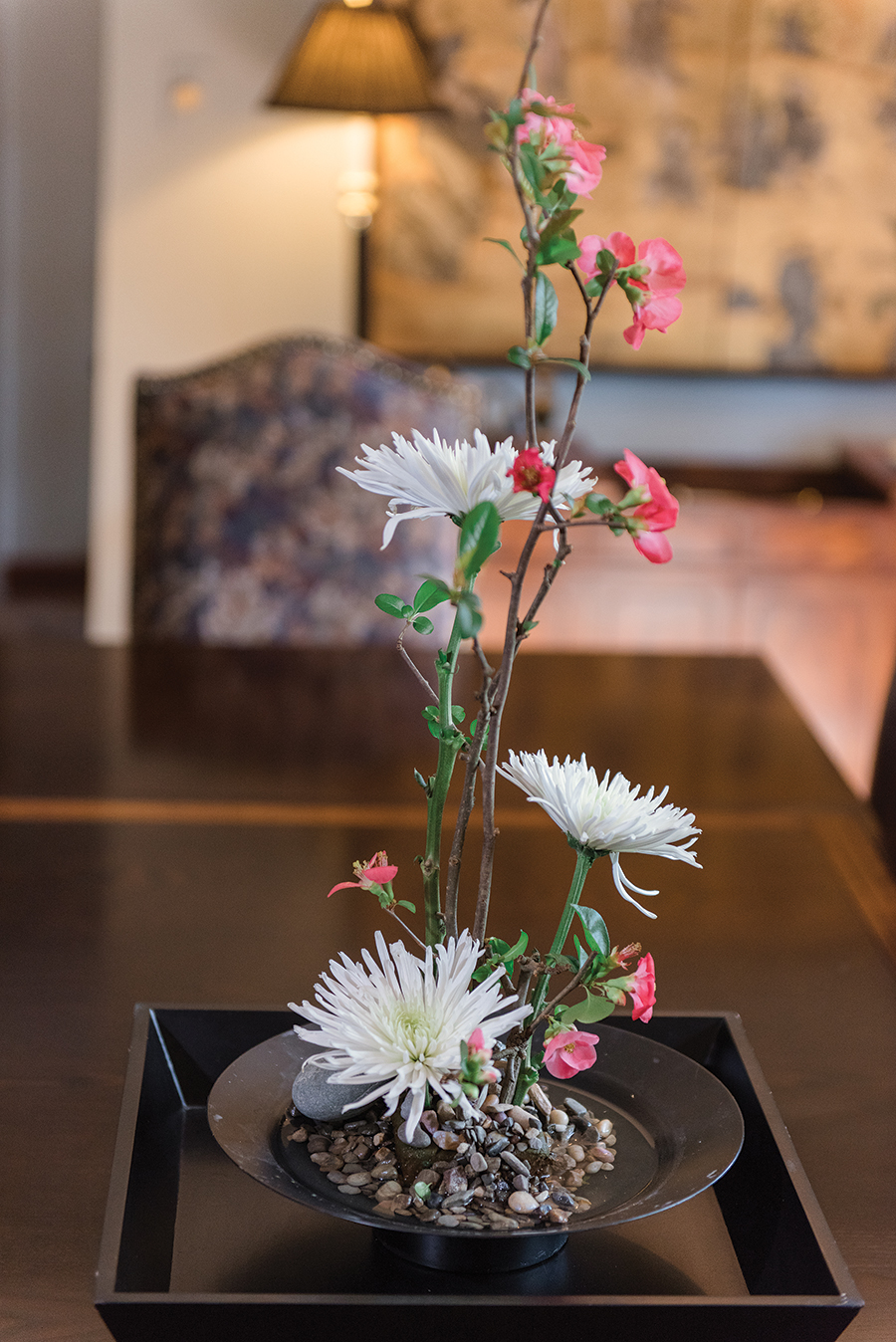
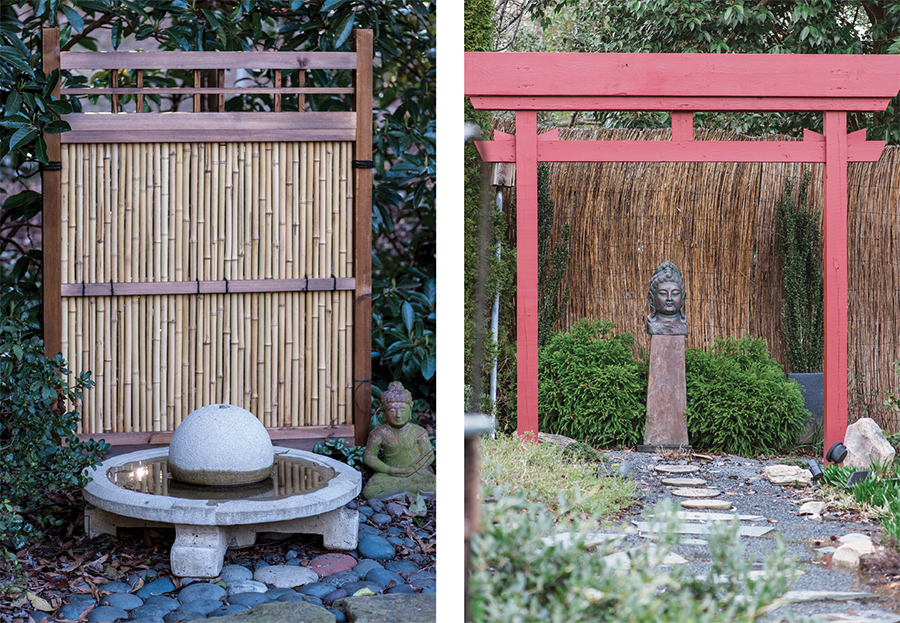
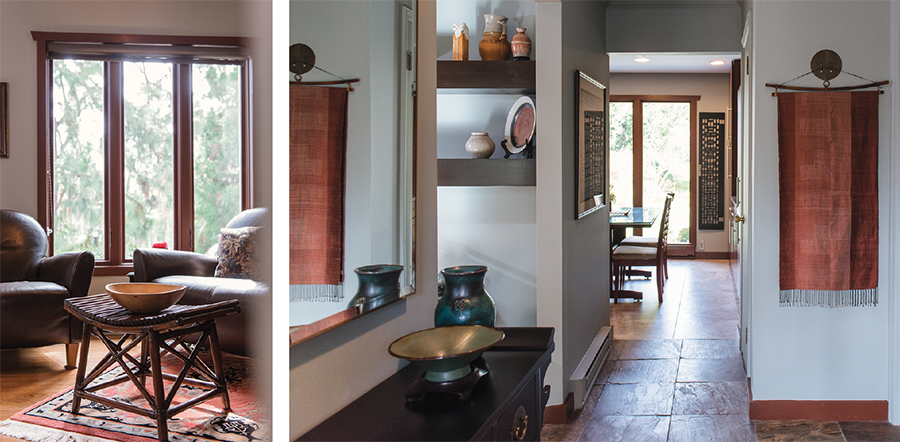
This becomes even more apparent in the tidy foyer of the house, where slate underfoot, a silk wall hanging from the Asian Art Museum of San Francisco and the handiwork of Seagrove master potter Ben Owen III, among others, make the entry feel a bit like stepping into a Kyoto teahouse — complete with a view of the garden. The hues are earth-toned, muted and invitingly intimate. Light seems to stream from several sources; straight ahead an elegant Asian-style window frames a vignette of Britt’s spectacular backyard, inviting the eye up a meandering pebble and stone pathway that symbolizes a tranquil stream. It winds to the rear of the property to a focal point, an earthen red torii gate commonly found at the entrances to Shinto shrines in Japan.

The effect is remarkable: a spacious sense of life flowing into nature, a sudden feeling of peace and unity one feels even before seeing the rest of a modestly sized house that seems much larger than its 2,200 square feet. When her visitor comments on this fact, she smiles and confirms, “That’s nice to know. I’ve had people say that before — especially my garden club, which likes to hold meetings here.”

Britt breaks the spell “That [window] was originally supposed to be a large circular window like you find throughout the Far East. But when our builder was doing the big renovation here in 2006, he drew a peace symbol in the circle I’d placed on the wall, causing me to think that might be a little too pretentious.”

In the next breath, she is quick to point out that both the house and garden, with their unmistakable references to Eastern simplicity and style, are not specifically Japanese. “I prefer to think of [them] as Asian, featuring elements that are common to many Japanese gardens and houses — my interpretation of them, at least. It’s been a fun evolution for me, to see it all come together and change over time.”

At the time Bill and Lee Britt purchased the last lot available on Green Valley Road and began building in 1968, most of the houses around the Britts in Starmount Forest — still newlyweds — were traditional brick affairs with classic Southern details. 

“But I wanted something different, something very contemporary, clean and simple,” she explains. “At that time I really didn’t know much about Asian design principles of home and garden. I just knew what I liked,” Lee explains. “They more I learned about the importance and care the Japanese put into sense of home and place, and certainly their gardens, the more I was drawn to their concepts. I’m really self-taught. Nature is all about evolution, isn’t it?”

For the Britts, this process began in earnest when they expanded their garage into a sunroom in the early 1980s. “We had two teenager girls and needed the room for them to have their friends over. Teenage boys have large feet,” she says with her ever-ready laugh. “They needed somewhere to place their feet.”

About that same time, Lee joined the Tar Heel Garden Club, the Guilford County Horticultural Society and Greensboro Beautiful, volunteering for projects that enabled her to absorb knowledge and ideas from local gardening icons like Irene McIver, Jeannette Windham and Dr. Graham Ray.
“Jeannette and Mrs. McIver knew everything about gardening. They were really the first of many mentors I’ve had in Greensboro. I knew so little, to begin with. But I was fortunate to have the opportunity to listen and learn directly from them,” Lee says. “That’s where it all really took off for me — the desire to create my own house and garden in Asian style. That’s what gardeners do. They share plants and knowledge and learn from each other, and each other’s gardens.”

It was during this period that Bill Britt, who ran the Gate City’s sports programs for Parks and Recreation for 33 years, collaborated with McIver, Windham and others to create the Greensboro Arboretum and Bicentennial Garden, ultimately overseeing the creation of three major public gardens that came to define Greensboro’s love affair with the natural world. Lee Britt had a hand in creating the city’s fourth public garden — Gateway — following Bill’s retirement.

Something of a Greensboro icon for transforming the city’s various sports programs into a national model, Bill Britt joined Parks and Recreation straight out of NC State in 1959. At that time Greensboro boasted 66 youth teams in four sports. By the time he retired in 1992, there were more than 1,200 teams representing 11 different sports. Among his many notable accomplishments, Britt played a major role in creating the Spencer Love Tennis Complex and the golf courses at Bryan Park.

He also served on the national board of directors of Pony League Baseball, a post that carried him to Japan to represent the organization in 2004, allowing Lee — newly elected chair of Greensboro Beautiful — to tag along and explore some of the finest pubic and sacred gardens of Tokyo and Kyoto, the country’s fabled garden city.

“One of the pluses of spending my married life sitting on bleachers,” she says half in jest, “is that wherever we went to see games, I was able to see gardens and meet gardeners. We did this all over America. The trip to Japan, however, was very special, really the culmination of things I’d been learning and picking up on my own study of Japanese culture and gardens for years. I picked up lots of ideas and inspiration.”

“I don’t think she missed a garden,” Bill chips in with a chuckle.

“That’s true,” Lee allows. “But it’s the peaceful quality and strong connection to nature that I find so appealing in their traditional houses and gardens. If it’s authentic, that sort of thing just comes to you. It’s all about natural elements found in nature — stone, water, trees and shrubs.” She catches herself and smiles. “I love tree bark.”
As she says this, music with an unmistakable Asian influence filters gently through the Britts’ great room. An invitingly calm and open space done in soothing tones of muted browns and grays, it is the result of a significant house renovation the Britt’s undertook upon their return from Japan.

In 2006, father-son builders Bob and Scott Richardson incorporated Lee’s ideas into reality by flipping the traditional living spaces, removing a major wall and creating the great room that “flowed” beautifully into the kitchen and small dining area overlooking the garden.

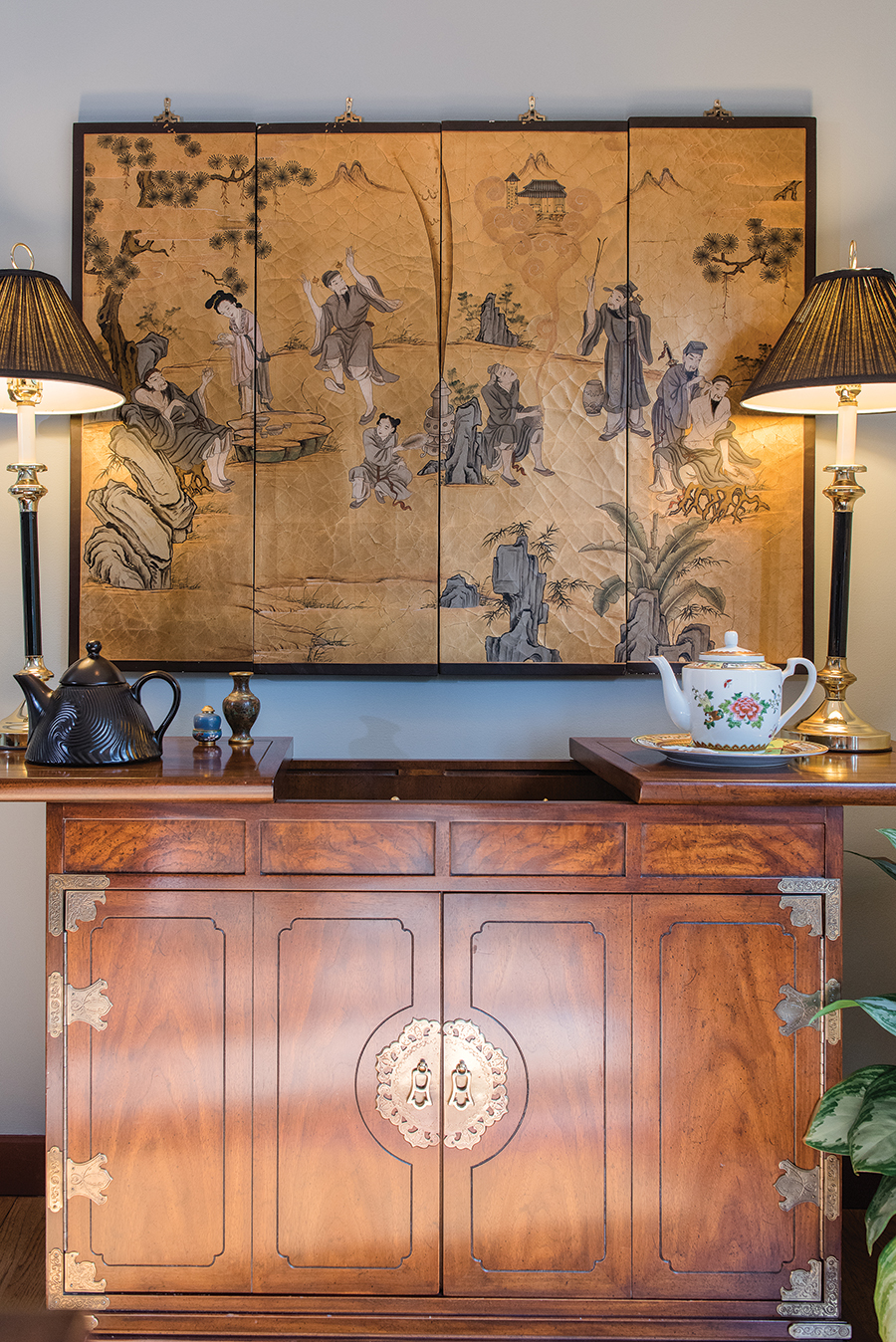
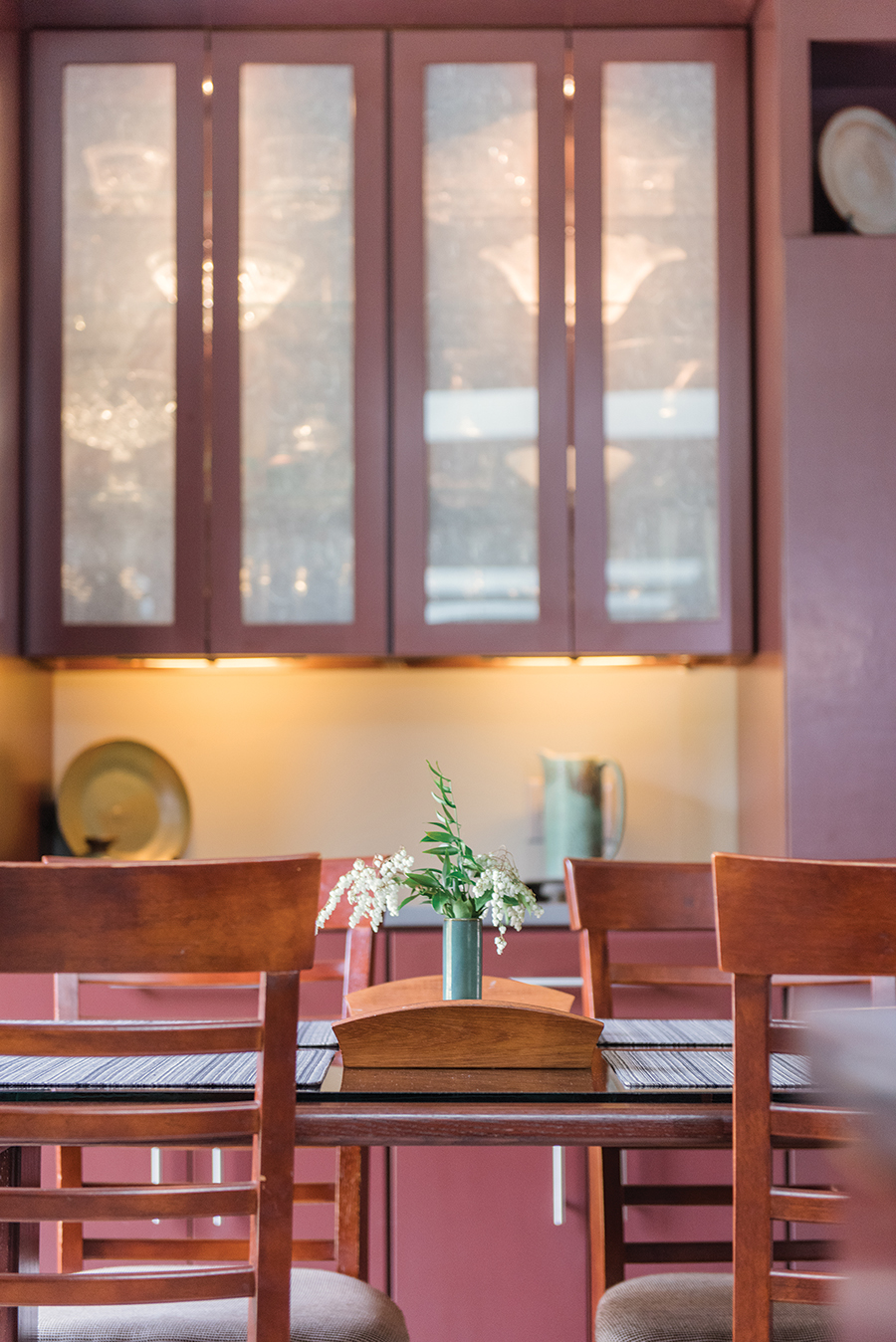
Where their sunroom and former garage formerly existed, the great room took shape with oversized windows overlooking the back garden. Anchoring the south end of the room, a wall of custom-built birch cabinetry by local craftsman Pete Williams, stained a rich burgundy red, provided shelves for displaying books, artwork, pottery and other Asian treasures the Britts have collected from their many journeys.

Tucked discreetly around a corner, meanwhile, sits perhaps the only laundry room in the Triad that features an Asian shoji screen door. “We actually found that at Home Depot,” Lee explains with her beguiling laugh.

Simplicity and practicality also shaped their expanded dining room, a beautiful gathering place done in the same soothing tones of earth and sky, with a formidable Hurtado table, handcrafted in Spain, as a centerpiece, and Henredon buffet with Asian screens. At the south end of the room is a reading nook with a cozy leather chair.

“Our family is rather large and everyone comes at Thanksgiving, at least 30 people,” Lee explains. “The larger dining room really solved a problem for us.”
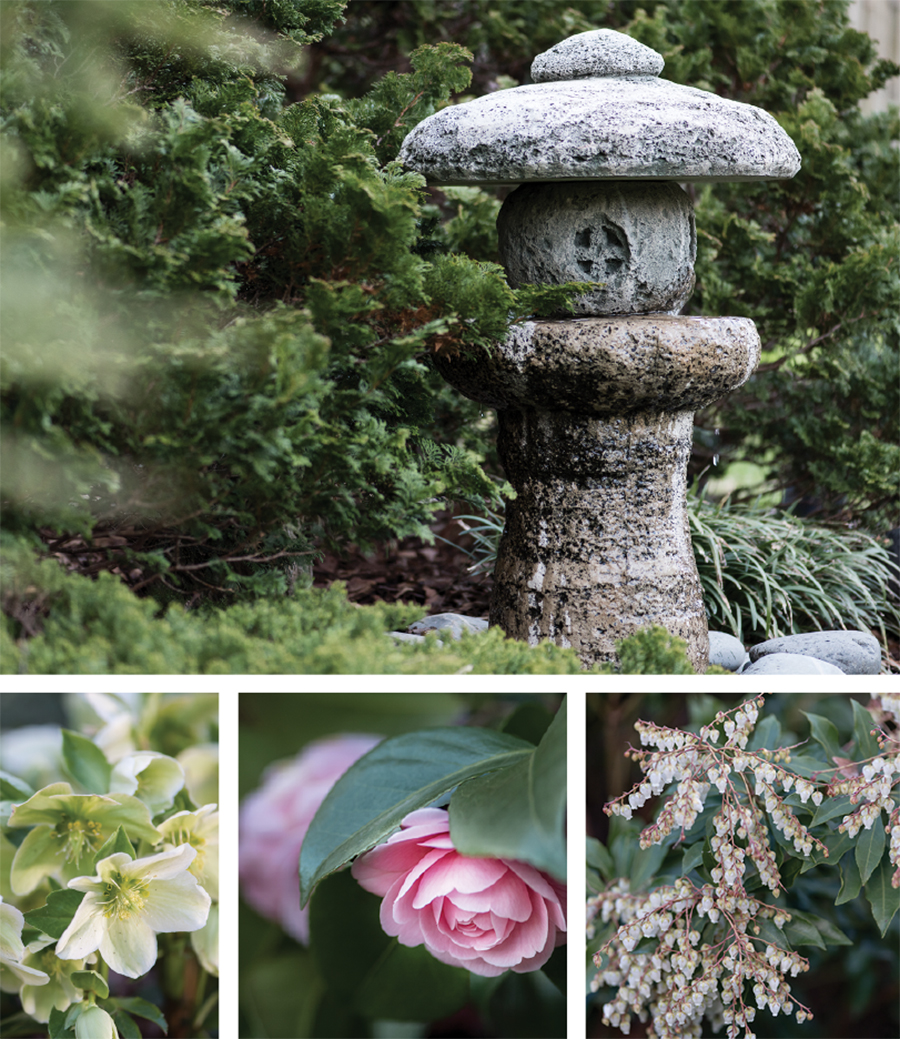
Three basic design principals anchor the foundation of traditional Japanese gardens. The first has to do with intimacy with nature, a connection that copies rather than creates something new. Or as famed Japanese garden designer Shiro Nakane once told Architectural Digest, his goal is “not to make a new nature but to make a copy of existing, desirable nature.”

Since most Japanese gardens are traditionally contained in smaller spaces, the landscape becomes a living metaphor for the world beyond, its natural elements scaled to reflect this symbolism. Streams replicate rivers, rocks stand in for mountain ranges, and winding gravel pathways are roads through a peaceful world in miniature.

Finally, quite often one finds Asian gardens enclosed by fences or conifer surrounds, becoming sanctuaries meant to inspire one to step away from the hubbub of daily life, a spiritual retreat that is never complete and forever changing, a reflection of nature itself.

These are some the ideas Lee Britt had in mind when she began her garden and half a lifetime ago, eventually growing it into a cozy paradise that is Asian in influence that is hers alone.

On a walking tour as the snowflakes still dance, she relates intimate stories of how her garden took shape — how the twin longleaf giants out front have somehow survived years of winter storms, reciting both the Latin and common names of mugo pines, Japanese hollies, yews, camellias and ground covers that are just awakening to Carolina spring.

At the top of her driveway, where a trio of large cherry trees, pink azaleas and hostas are about to rise and burst into bloom, a small iron Eastern symbol stands guard.

“What does that mean?” asks her visitor.

“I believe it simply means good luck.”
On the nearby deck stands a collection of garden gnomes, a congregation of tiny figurines that represent a beautiful story of remembrance and continuity in this peaceful household.

In 2011, the Britt’s son-in-law, Will Caviness, a Greensboro firefighter, collapsed and died while running in the Chicago Marathon on behalf of the International Association of Fire Fighters Burn Foundation that helps burn victims.

“It was devastating. Will was such a vibrant young man, seemingly in the peak of good health,” Lee relates, smiling at the gnomes. “He loved to tease me by placing gnomes in my garden where I’d find them in the oddest places. Once, while we were attending the Christmas Eve services, he put an illuminated Santa on our roof. That was Will. Such a wonderful guy.”

The city of Greensboro, she adds, as the garden tour continues, “wrapped their arms around our daughter Jenny and their children, Jack and Caroline, who continue this tradition today. They love to show up when we’re not here and hide these gnomes in the garden. It’s such a lovely way to remember their father.” At a young age, their third grandchild, Elizabeth, announced that someday she planned to buy this house and garden of earthly delights.

Following the pebble and stone “stream” that winds serenely around and through her Asian garden, the story of life and death and rebirth flows on. One learns about the large sweet gum that a storm toppled onto a 40-year-old wax myrtle, requiring the garden keeper to change out shade plants for sun-loving perennials; about the benches and stone borders she built herself; the old fashioned “Pink Perfection” japonica she took from her mother’s garden on a tobacco farm in Creedmoor, and so forth. Every planting has its own life story, including the twin crab apple trees, the false yews and a large summer perennial bed that will achieve its glory in mid summer.

“You’ll have to come in June to see it because it has everything — phlox, salvias, rosemary, sedums. . .” she pauses and laughs again. “Goodness, everything. It’s always changing. Come see.”

And at the end of the day, that is the beauty of the house and garden that the family Britt has made, a personal sanctuary from the madding world beyond the trees, a loving balance between east and west, sunrise and sunset, death and rebirth and endless new beginnings in the natural world that is their home.  OH

The peace of Jim Dodson’s own Asian-inspired garden has been disrupted by the rapacious Star of Bethlehem that has overrun his garden beds.

True South

All Pumped Up

Or just wait until the urge passes

By Susan S. Kelly

And now, a few concise words about exercising: I loathe it.

I was never on a sports team. No one wanted to double-Dutch jump rope with me as a partner. I’m so uncoordinated that I tend to fall down just putting on my underwear. In high school, while I kind of coveted the flippy kilts my field-hockey playing classmates got to wear, I preferred the passive, less-participatory exercise of wearing a weighted belt Velcroed around my waist under clothes. Worked just fine until you drank a glass of water. After study hall, we’d “walk” down the long dorm hall linoleum on our butt cheeks while listening to Cat Stevens singing “Wild World” from the Tea for the Tillerman album. An effort, in retrospect, that would have probably been a lot more effective if we’d just ceased and desisted with toast-eating contests at breakfast.

Despite years of sitting in stadiums, I never understood football until I watched Friday Night Lights on Netflix and had to figure out first downs to follow the plot. As for tennis or golf, why would anyone do anything that requires putting on sunscreen, much less sweating? I’d be perfectly content never to put on sneakers again — and I realize they’re not called sneakers anymore. In my opinion, anyone who changes the sheets on a king bed has had ample exercise for the day, what with all that walking around from one side of the bed to the other.

In defense of all this inactivity, I’d like to point out that I wear no ace bandages anywhere, have no joint, tendon, muscle, back, knee or other issues, and have no idea what an ACL or meniscus is or where they’re located; all of which I attribute to the fact that for five decades I never engaged in anything competitive or, well, physical, when you come right down to it. Just sayin’. And I do like to think that balancing on one foot while brushing my teeth counts for something. At least it beats my friend who’s figured out that she can set the treadmill speed at 3.8 before the wine starts sloshing out of the cup holder. Never mind my friend who’s eating Big Macs because the people at Weight Watchers told her she’s not fat enough to qualify.

Still, when a fitness facility opened up practically in my own backyard the year I turned 50, I decided it was Time To Get With The Program, as my father would say. Not that I would even consider walking the one-eighth mile over there when I could drive. Please. It quickly became clear that I don’t have the personality for yoga. The first time the instructor told me to quit wearing baggy tops — so she could correct my position — was the last time I went to yoga class. Besides, the whole time we were supposed to be clearing our minds or assuming the Savasana pose or whatever you’re meant to Om, I was thinking about all the things I needed to be doing and wishing the session would just end so I could get on with it. One friend’s husband wanted to go to yoga class with her, so she gave him a set of sessions for Christmas. Unfortunately, his first class became his last class, because, as is often the case with yoga, he publicly pooted. There’s no namaste for that. Somewhat similar to my sister’s issue with a chocolate power bar in her back pocket that melted and squished and looked — well, let’s just say it’s best to always wear black exercise clothes.

Beware of classes disguised as cults, in which Fitness Barbies and Kens are demoralizingly superior to you. I’m sorry, but if you have makeup on at the gym, I don’t care how long you can plank; you’ve lost all credibility. But I do like the way, in a class, the teacher will run down the quick-quick chop-chop single-syllable system checklist of to-dos or have-dones: quads, pecs, lats, delts, abs, glutes, biceps, etc. They come in handy for doing crosswords. (While sitting down.) The main argument for classes with scary titles like Pump It Up, Power Flex, yada yada, is the punch line to that old joke about why the guy keeps hitting himself on the head with a hammer: Because it feels so good when you quit.

Best, then, to stick with the treadmill, where you can multitask otherwise sedentary activities like online bridge and Netflix. At 79, a friend’s father began memorizing T. S. Eliot to pass time on the stationary bike. He’d repeatedly take a laminated card from his pocket, consult it, put it back, and pedal on. The discipline proved so popular to fellow cyclers that he formed a club with seven other men who meet three times a week to recite. In case you’re wondering, “The Waste Land” takes 40 minutes to recite.

Me, I’m reveling in a smaller triumph: The nurse who administered my flu shot asked, “Do you work out?”

“How did you know?” I returned.

“Your arm muscle,” she replied.

Score!  OH

Susan S. Kelly is a blithe spirit, author of several novels, and proud grandmother.

Simple Life

Life and Limb

My cabins in the sky

By Jim Dodson

One of my secret pleasures is a mind-candy house program on Animal Planet called Treehouse Masters, in which an infectiously enthusiastic house designer and self-described “tree whisperer” named Pete Nelson and his merry band of workers create mind-boggling treehouse retreats for clients. His stated mission is to help customers get back to nature and in touch with their inner kid.

It’s a pure fantasy show that combines three of my favorite things — houses, trees and memories of climbing them during my childhood. It was probably inevitable for a kid who grew up on a diet of adventure books, and camping and hiking forests all over the western portions of this state and neighboring Virginia, that I would eventually get around to building a treehouse, especially after I saw Disney’s 1960 version of Swiss Family Robinson. The shipwrecked but enterprising Robinson clan lashed together a furnished treehouse palace that featured running water from a turning wheel, thatch-roofed bedrooms, a full-service kitchen and salvaged ship’s wheel that raised the ladder each evening to protect against wild animals or unwelcome visitors. They lived with a pair of large friendly dogs and a parrot, and even had a piano that somehow survived the shipwreck.

In my opinion, those lucky Robinsons had the perfect life.

Of course, I was only 7, a kid who’d had a happy but fairly solitary life building forts in the woods and reading adventure books, the son of a Southern newspaperman who hauled his young family across the Deep South to his various posts before coming permanently home to Greensboro in 1959 — shortly before the shipwrecked Robinsons showed up in Cinemascope on the big screen.

My first treehouse was a distinctly modest platform affair — more lookout stand that actual shelter. Perched in a patch of hardwoods in a public park across the street from the apartment we rented while our first house was being built in a rural subdivision, it was probably illegal. But so were the Robinsons. You reached the platform by inching up a thick-knotted rope. The platform was probably only 10 feet off the ground but it felt amazingly close to heaven in the trees, the ideal place for me to sit and read and keep an eye out for wild animals or unwanted visitors.

At the rear of our new property, my father knocked together an impressive one-room treehouse he furnished with a second-hand dining room table, four mismatched chairs and an old rickety bookcase. I spent a year furnishing that rustic pied-à-terre in the sky with my favorite childhood books and “interesting” stuff I found all over creation until one regrettable summer afternoon I found three girls from the neighborhood having an unauthorized tea party with their dolls in my cherished aerie. Without thinking of the consequences, I fetched a garden hose to cool off the party and quickly felt the wrath of several outraged mothers, hastening the demise of my beloved place on high.

That’s why, when I stumbled across Treehouse Masters, my inner child was set loose from detention.

The New Age treehouses Pete Nelson and his crew create are elaborate affairs that make the industrious Robinsons look like rank beginners. They typically include all the creature comforts of the modern Earth-bound home and then some: fancy woodstoves and electric lights; flush toilets and outdoor showers; kitted-out gourmet kitchens and decks with breathtaking views from high in the trees, rivaling anything you would find in a swanky vacation home.

My favorite segment of the show, however, is when the host calls on fellow treehouse nuts who have created their own unique handcrafted cabins in the sky, retreats that display incredible craftsmanship, artistry and ecological harmony.

One I particularly enjoyed involved a bearded chap who built himself a gorgeous treehouse that was more like a storybook chapel over a stony brook in the Connecticut woods. It was essentially a meditation and reading room with large windows, a simple desk, woodstove, small functioning kitchen and a room where he could sit for hours watching nature through the seasons, forgetting the rest of the world.

His was a slightly more elaborate version of the treehouse I fully intended to someday create above a vernal pool in the forest behind the post-and-beam house I helped build with my own hands on a forested hill in Maine.

The spot — on a beautiful hillside deep among hemlock and birch and proximate to geologic kettles left by the receding ice age — overlooked a seasonal stream and vernal pool dominated by a large lichen-covered stone that I named my “Thinking Rock.” This is where the transcendental kid in me often escaped with my dogs to read, think, smoke a pipe and get right with God and nature.

The bittersweet irony is that the forested retreat I long had in mind never got off the ground, so to speak, because, in the blink of an eye, my own kids were grown and heading off to college, and I was feeling an unexpected gravitational pull of my old Carolina home.

Impossible as it once seemed, I said goodbye to the rugged timbered house and English garden-in-the-woods that I spent nearly two decades building and cultivating, a place where I fully expected to end my days and eventually become part of the landscape when who I am moved on, leaving only a trail of ashes behind.

But life, to paraphrase Emerson, is full of compensations. A few years back, my wife and I purchased a lovely old bungalow that once upon a time was my favorite house in the heavily forested neighborhood where I grew up — two doors away, in fact, from the house where my family lived for almost 40 years.

I joke that I’ve all but completed the Sacred Redneck Circle of Life.

A large part of the place’s allure, I must admit, was the two-car and workshop garage in back that featured a funky little second-floor apartment you reach by climbing a set of rickety wooden steps that take you to rooftop height amidst century-old white oak trees.

Because the house sits on perhaps the highest point in the entire neighborhood, the first time I climbed those steps and turned around to check out the view, my heart leapt like a kid up a tree.

From just under the white oak canopy that reminded me of the arched ceiling of a Medieval cathedral — providing wonderful cooling shade all summer — I could see the world with a bird’s-eye-view: vaulting trees and rooftops across the neighborhood, not to mention birds and squirrels galore, passing clouds, a huge patch of sky by day, a glorious quilt of stars by night.

Suddenly I had the treehouse I’d always dreamed of owning, this one equipped with electric power and heat, small kitchenette and bathroom with fully functioning toilet and shower. The cheap dark-wood paneling gives it a perfect rustic air and a couple of overhead fans keeps the place cool in summer. If it isn’t quite worthy of Treehouse Masters, it fits me like lichens on a thinking rock.

Just outside the door, I hung a large set of Canterbury chimes from a stout limb of the massive white oak at the foot of the steps. When the wind blows a certain way, I swear I hear the first five notes of “Amazing Grace.”

These days, if you visit my “treehouse,” you will find a pair of comfortable reading chairs (one of which my dog Mulligan occupies when she’s officially on duty), several bookcases filled with favorite books, a French baker’s table where I write, a wicker daybed where I sometimes seek horizontal inspiration on late afternoons, various vintage posters and prints I’ve collected from four decades of journalism and travel, a cabinet case filled with some of my own books and a few awards, a second cabinet that holds “Uncle Jimmy’s Genuine Real Stuff Museum,” framed photos of my children and a pair of large rare portraits of Walter Hagen and young Fidel Castro, themed lamps (a blue coat soldier, a Bengali elephant, a monkey climbing a palm tree), several busts (Ben Franklin, Alexander the Great, a Templar knight), three sets of old golf clubs, a full golf library, several checkered golf flags, and a large replica of the first American flag with thirteen stars in a circle of blue.

Nobody in their right mind would want all this stuff in their real house. But like the Swiss Family Robinson, this oddball collection from a long journey home has finally found the perfect place in my cabin in the sky. OH

Contact Editor Jim Dodson at jim@thepilot.com.