May 2019 Almanac

By Ash Alder

The soft thud of a magnolia blossom crashing down upon the tender earth takes me back . . .

Rope hammock swing.

Soft light filtering through smooth green leaves.

Love notes tied with twine to sweeping branches.

We both knew it would not last. And yet we had our glorious season.

Life is like that. Fleeting as a fragrant white flower. And as May blossoms burst forth in jubilant splendor, we cherish the transient, intoxicating beauty of spring, and relearn the sacred dance of loving and letting go.

May is the beginning and the end.

On the bookshelf, Aldo Leopold’s A Sand County Almanac hasn’t been opened since the crash-landing of yet another bygone romance that died on Easter weekend, years ago now.

January, February, March, April.

Four cozy months of essays read aloud in bed, yet if we took any morsel of wisdom from Leopold’s poetic reflections of the natural world, it was this: Life is an endless dance of change.

This morning, I take the book to the front porch, turning to the dog-eared page of May — a fresh new chapter.

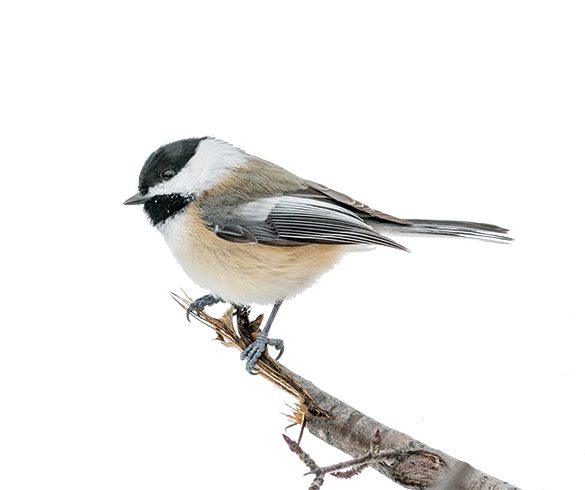
As a black-capped chickadee draws quick sips from the nearby birdbath, I read about the return of the upland plover, what Leopold refers to as the “final proof of spring” in rural Wisconsin.

Here, the final proof of spring is gone. We have landed on the fresh new chapter of May, a glorious season of its own.

Children are the anchors that hold a mother to life. — Sophocles

Cinco de Mayo

Mark your calendar. The Eta Aquarid Shower peaks just before dawn on Sunday, May 5. You could witness 10—40 meteors per hour. Not exactly the return of Halley’s comet, but it’s a chance to catch a glimpse of the famous comet’s debris. Find yourself a soft spot on the lawn. Breathe in the aroma of Southern magnolia. Enjoy the show.

The Mother’s Moon

The Full Flower Moon rises on Saturday, May 18. Also called Mother’s Moon, Milk Moon and Corn Planting Moon, this month’s moon illuminates red fox pups, fluffy cygnets, and wildflowers everywhere.

Speaking of lunar magic, The Old Farmer’s Almanac looks at the positions and phases of the moon to determine the “best days” for various activities. This month, the best days for planting aboveground crops are May 8 and 9 (plan now for July sweet corn on the grill). Plant belowground crops May 26.

Cut hay May 1–3.

Prune May 10–11 to encourage new growth.

Can, pickle, or make sauerkraut on May 26.


’Tis like the birthday of the world,

When earth was born in bloom;

The light is made of many dyes,

The air is all perfume;

There’s crimson buds, and white and blue,

The very rainbow showers

Have turned to blossoms where they fell,

And sown the earth with flowers.

      — Thomas Hood

Gifts for Mama

Mother’s Day falls on Sunday, May 12. I think of my fourth-grade teacher, who asked us to bring in one of our mother’s high heels. Yes, just one. We spray-painted it gold, lined the inside with floral foam, and proudly stuck a dozen plastic flowers inside. Happy Mother’s Day to all. May you walk in beauty.

Here are a few seeds of inspiration for the beloved mother figure in your life:

• Daylily bulbs

• Mexican tarragon for the herb garden

• Azaleas

• Ornamental pepper

• Wax begonia

• A new pair of shiny gold shoes

Friendly Times

Tales from our most beloved shopping center

By Billy Ingram

My mother told me a story once about how she and a childhood friend rode their bikes into the woods west of her family’s home on West Greenway in Sunset Hills. This was back in the 1930s when Sunset Hills still had woods. She and her friend managed to get hopelessly lost in that forest before finally coming across a single cabin where a nice old hermit directed them back to civilization. That patch of woods, located well outside city limits, was to one day become the site of Friendly Center.

Friendly Shopping Center was a major part of my young life in the 1960s and ’70s — the lollipop tree at Ellis-Stone excited me as a toddler. In later years I was buying film and having pictures developed at Carolina Camera, along with shopping for art supplies and books from Wills. How well I remember inhaling those fluffy Sweet Shop cupcakes, playing endless Captain Fantastic pinball games at Brunswick Lanes and wolfing down Woolworth’s banana splits, where customers popped a balloon to determine its cost, as little as a penny (I was never so lucky — full price every time).
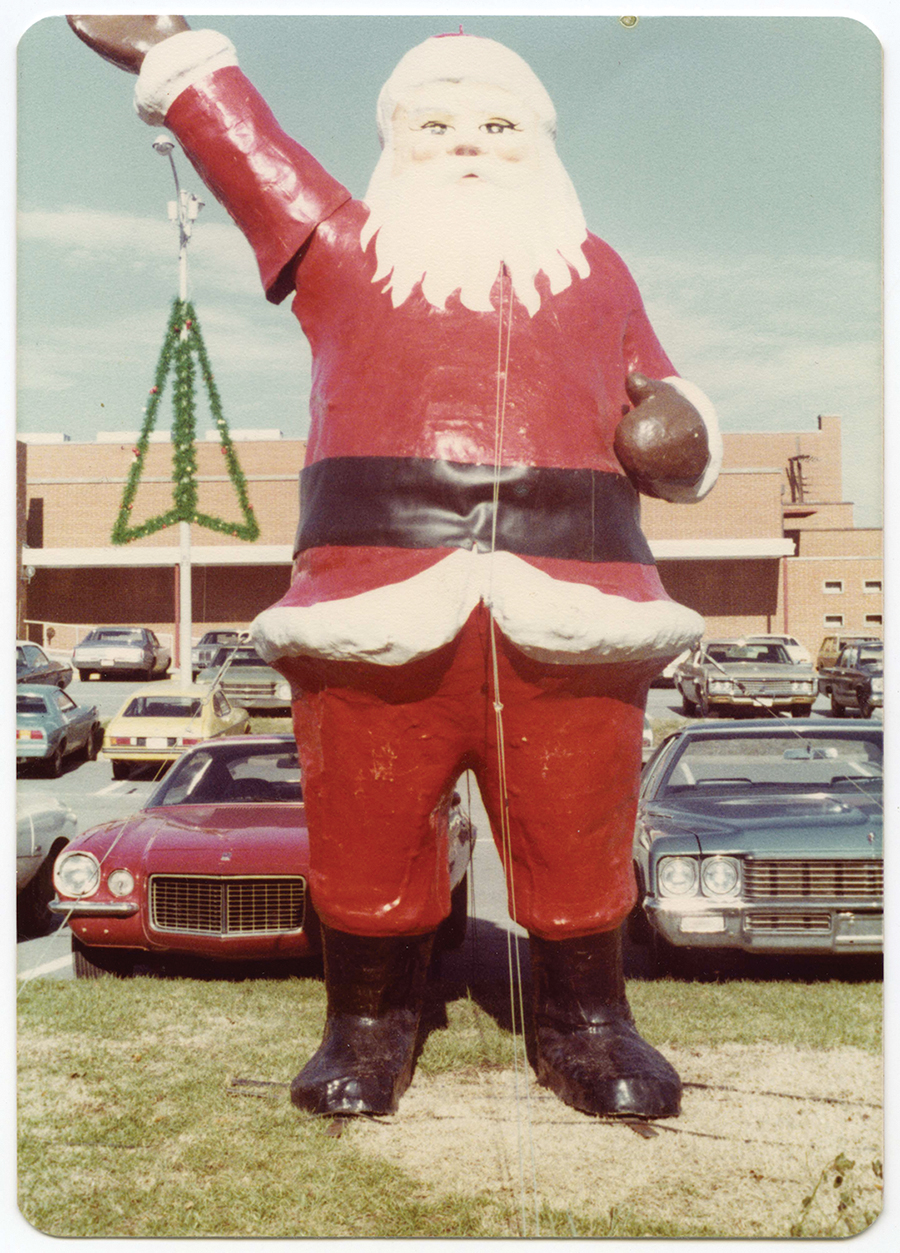
My Aunt Gertrude would only grocery shop at the Friendly Winn-Dixie — they were “The Beef People” after all. Our finer clothing came from Bernard Shepherd, where you’d merely sign a receipt. Your credit-worthiness was assumed, a bill would arrive in the mail. A trip to Friendly Center was de rigueur during the holidays, if only to drive past the mechanical waving Santa and sample free snacks at Hickory Farms, a permanent fixture in those days.

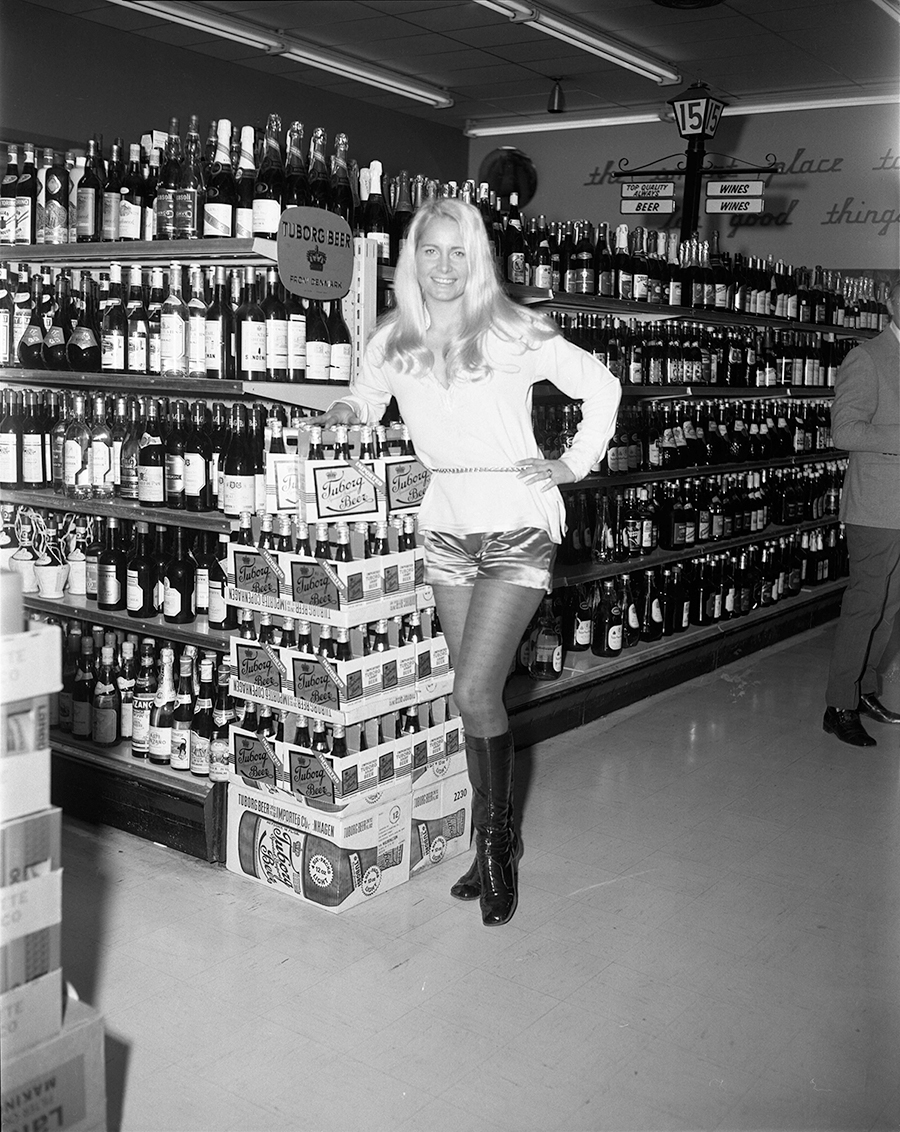
There was a hometown feeling to Friendly Shopping Center. With its open-air plan and proximity to postwar neighborhoods such as Starmount and Guilford Hills, it became a town square for what counted as the suburbs in those days. Moms could mail letters, meet friends for lunch, check out the latest fashions, and do the grocery shopping all in one stop. Dads could pick up dry-cleaned suits and starched shirts at Blue Bird Cleaners (conveniently located next to the ABC store). Kids could walk or ride their bikes to browse the trains and model kits at the toy store — or in the case of one 12-year-old, would-be golf writer and O.Henry editor, try to purchase a Playboy magazine at Eckerd Drug.

Contributing to the village-y vibe was the fact that the majority of the stores were locally owned. Fleet-Plummer before it relocated was your typical hardware concern but they had a big toy selection around the holidays. One Christmas, as Santa was laying out our presents, it was discovered that my sister’s Chatty Cathy doll didn’t possess the gift of gab, so Dad got Mr. Plummer out of bed to meet him at the store and replace it for one that talked.

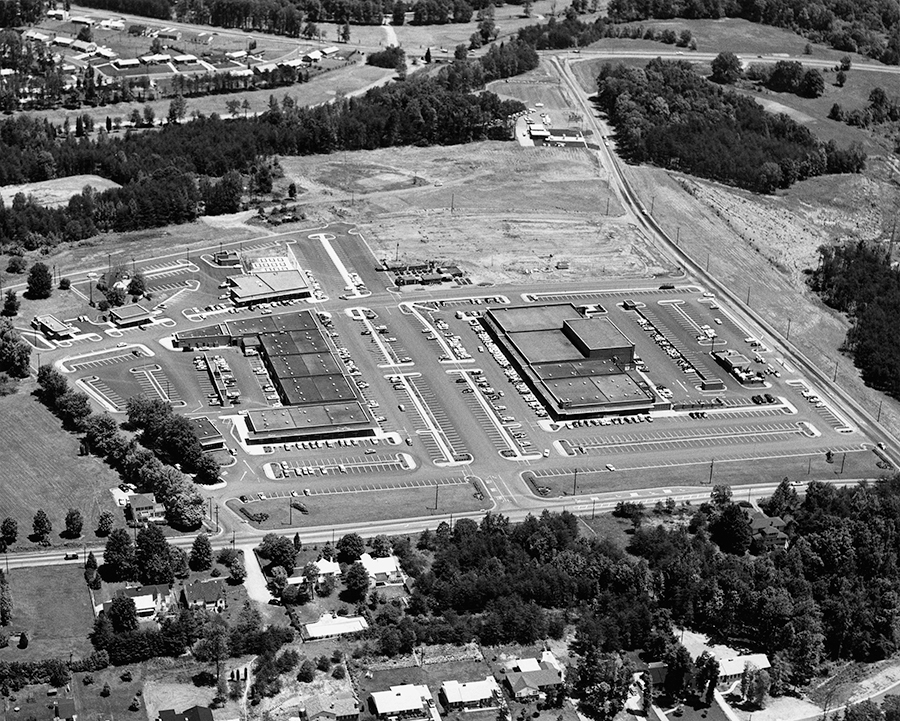
Friendly Center was a lot smaller when I was a young man, compared to today, but considerably larger than its first incarnation.

While there were established shopping centers in Greensboro by the mid-1950s, most notably Summit, Lawndale and Plaza, none were nearly so ambitious, or what we would call today “upscale,” as Friendly Shopping Center. “Piedmont Carolina’s first and only complete regional shopping center” was designed for “casual shopping,” open Monday through Saturday.

When Friendly Center debuted in 1957, it consisted of two blocks with 12 shops each:

BLOCK A: Guilford National Bank, Pleasants Hardware, Leon’s Beauty Salon, Harllee’s, Inc, Friendly Toy & Hobby Shop, Stanley’s, Inc., Junior Circle Shop, Guy Hill, Carolina Camera Center, Wills Book & Stationery, Laurie’s Sportswear, Venus Slenderizing Salon.

BLOCK B: Mason’s Florist, Jay’s Delicatessen, Harold’s, Eckerd Drug Store, Clippard Barber Shop, Blue Bird Cleaners, F. W. Woolworth Co., Belk, Kirby’s Shoe Store, Guilford Dairy Bar, Colonial Stores, Kyle’s Friendly Service.
On August 1, 1957, Blanche Sternberger Benjamin, wife of Starmount cofounder Edward Benjamin, cut the ribbon to open Friendly Shopping Center to the public. Within an hour, all 1,300 parking spaces were overflowing; 25,000 shoppers flooded through the doors on that one day, representing one out of four Greensboro residents.

Behind Pleasants Hardware, previously in business for 48 years at 519 S. Elm, Mom could drop off the little ones then browse the aisles in peace while they frolicked in the children’s playground. The main attraction, stretched over a concrete pit, was a mammoth trampoline that youngsters could bounce around on for 25 cents an hour, unsupervised.

Laurie’s was the first local fashion boutique to leave downtown and head west. In business for 13 years before relocating, William and Athena Simon’s store was named for their daughter. Our first Eckerd Drug Store was at Friendly. Wills Book Store had been selling novels and paperbacks for 52 years on Elm, and this was their second location, with as much space devoted to stationery, art supplies and gifts — paperweights, bookmarks, china figurines of Beatrix Potter characters — as books.

At 24,000 square feet, Belk was the most opulent store in the center. Shoppers were greeted by a 12-foot high, 70-foot long mural facing the mezzanine floor depicting the administration building at Woman’s College (UNCG), First Presbyterian Church, and the statute of General Greene at Battleground Park.

This was Belk’s 354th store but considered important enough that John M. Belk, chairman and CEO of the company, along with his top executives, were in attendance for day one. “I worked stocking Belk before they opened in 1957,” Phil Callicutt remarked. “I became famous for not allowing Mr. John Belk in the front door. I told him to ‘Go around to the back door like the rest of the salesmen.’ I was lucky that my career with the company wasn’t hampered.” As a convenience, credit accounts could be carried over from the Belk store downtown.
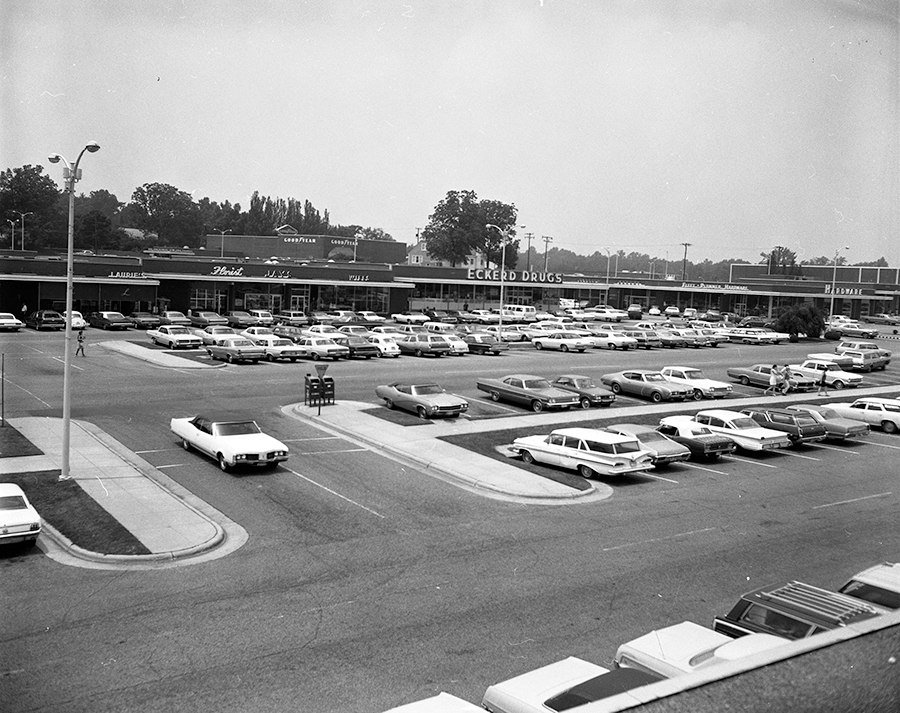
Another elaborate mural, this one of crushed glass, could be found at Harold’s Restaurant. Restaurateur J. Harold Coble boasted his dining room was the most modern in town, interior designed by Ray Teague, a member International Art Association. Diners enjoyed a cosmopolitan ambiance of Philippine Mahogany, brass and crystal chandeliers, 20 contemporary art installations, 30-foot planters shielding the kitchen, and two romantic alcoves papered in Japanese grasscloth, while supping on European cuisine and flaming desserts that the maître d’hôtel adapted from Manhattan’s Roosevelt Hotel.

A considerably more downscale ambiance that included the combined aromas of plastic flowers, grease from the lunch counter and cedar shavings that lined hamster cages greeted shoppers at Friendly’s Woolworth’s. Unlike the downtown branch, it was considered a self-service operation, where you could find cheap toys, sundries, clothespins bandanas, goldfish, comic books and an abundance of poster boards used in many a school project. There won’t be any salesgirls,” the store manager bragged. “Just checkout gals.”

Flush with success, Friendly Center underwent its first expansion in 1959, adding six new units that included Ellis-Stone (which became Thalhimers), a post office, bakery, and the ABC store.

Boy Scouts in the ’60s would regularly encamp on the western edge of the shopping center; one winter morning campers woke up to several inches of unexpected snow atop their tents. Scouts purchased their official gear in Belk, their shoes at Kirby’s. Blissfully unaware of the dangers of radiation, Kirby’s Shoe Store had a fluoroscope under which children could view their feet, allowing them see right through to the bones.

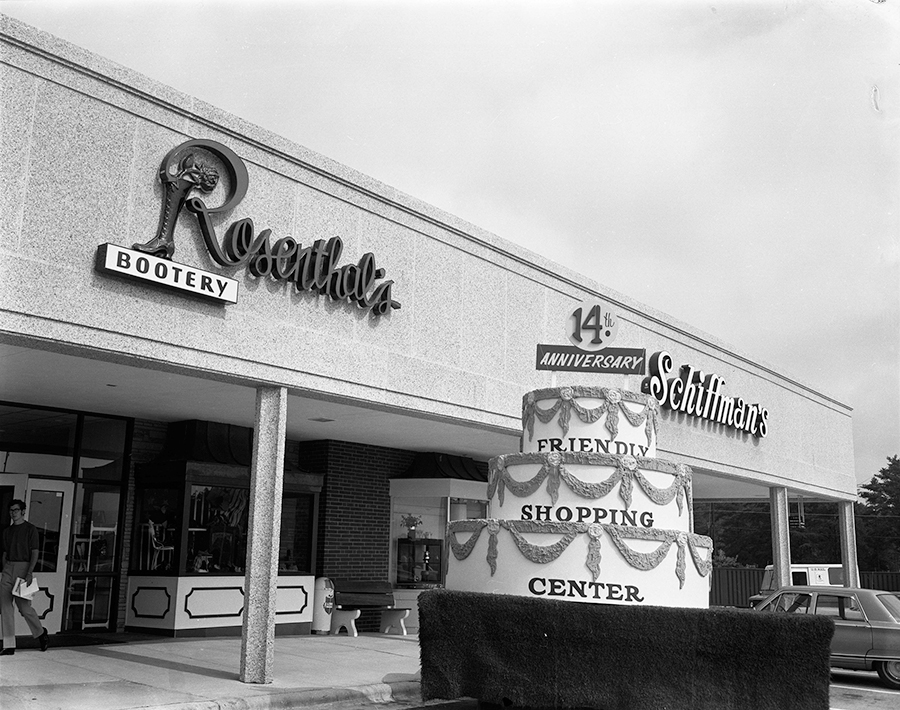
Friendly Center still had room to grow, and grow it did in 1967, a push to the north that added iconic stores like Bernard Shepherd Clothing, Gate City Pharmacy, Friendly Car Wash, Cass Jewelers, Thomas Photo Supply, Harvey West Music Company, Paul Rose Department Store, K&W Cafeteria, Rosenthal’s Bootery, Bocock-Stroud Sporting Goods, Merle Norman Cosmetics, and that eclectic emporium everyone fondly remembers, Potpourri.

Besides the ubiquitous scent of patchouli, Potpourri was known for bizarro merchandise like melted soda bottles repurposed for vases, an endless array of incense, love beads, blacklight posters, pet rocks, mood rings, kitschy tchotchkes galore, in addition to the dozen jars of stick candies positioned at the register, where every purchase was placed in a glossy paper bag topped with the store’s icon, a yellow sun with bright orange rays. At one of their many sidewalk sales, I bought a 2-foot high inflatable plastic Coke bottle that hung from the ceiling of my bedroom.

Potpourri was founded by David Grimes, by all accounts beloved by those who worked for him. Grimes sold a lot of fondue kits, which became all the rage in 1967, before discovering there were no fondue cookbooks. He commissioned his own, and Potpourri Press was born. Production offices were set up behind Krispy Kreme on Mill Street where the outfit published dozens, maybe hundreds, of hippy-dippy booklets with titles like Gardening with Ferns, Lovers Dining and Napkin Folding.

In 1967, Gate City Pharmacy, like Scott Seed two years earlier, closed their downtown digs to relocate to Friendly. The drugstore is still there, but sadly, the customer-friendly garden store, smelling of potting soil and fertilizer, is not.

The center’s 1967 expansion was preceded by the state-of-the-art Terrace Theatre, opening on Christmas Day 1966 showing Walt Disney’s Follow the Boys in Ultra-Vision, on a wall-to-wall screen with 6-track stereophonic surround sound. Another groovy component at the Terrace was the plush rocking chair seating.

My cousin Billy Owens worked at the Terrace Theatre. “It was in 1970, right before I got out of ninth grade,” Billy tells me. “I was making 85 cents an hour. Now, that was just an usher job, if you were head usher, $1.15.” Membership had its privileges: Employees of the Terrace could show their pay stubs to get free admission at the Janus Theatres, the city’s first multiplex just beyond the Plaza Shopping Center at Battleground and Northwood, and the Carolina downtown.

Billy says he almost died at the Terrace — twice. “We would do kiddie matinees on Saturday morning,” he recalls. “We had an old PA system with those old metal microphones so we didn’t have much of a way to get music through it.” These events were hosted by WFMY’s George Perry (The Old Rebel). “We had this old turntable with a metal arm,” Billy says. “So I turned it on and grabbed both of those metal things at once and it zapped me and knocked me down.” When he came to, “There was The Old Rebel’s face above mine saying, ‘You OK?’ I went, ‘Yeah.’ And then I did it again!”

The next movie attraction would show up on a Sunday morning. “Big canisters that were set right out front and nobody would steal them,” Billy says. “They would book the films for a month and then, two weeks in, they’d say, ‘Held over for a third week’ then ‘Held over for a fourth week.’” A second auditorium was added on in 1974.

When asked what his favorite place at Friendly was back in the day, Cousin Billy doesn’t hesitate. “I loved Jay’s Deli, that was a lot of fun, they had great food.” He was especially fond of the Lolly Burger, “I asked them, ‘What’s in the Lolly Burger?’ They said, “Everything that’s left over.’” Jay’s would actually take cold cuts, grind them up, make patties, then fry them like a hamburger.

Besides Belk, Jay’s Deli is the only original Friendly establishment still present. But in name only, having changed ownership and menu decades ago. “Jay’s Deli was started by Sol Jacobs, who was my uncle, and Morry Jacobs, my dad,” Rick Jacobs tells me. “It was a deli and a gourmet foods store also with everything from escargot to fine cookies and meats and cheeses to go.” Rick worked there in 1970, “You had to be 18 to work in a place that served alcohol, so whenever my cousins turned 18 they went to work for Jay’s.”

Most of the sandwiches at Jay’s were named after other shops at Friendly, for instance the Mason (Mason’s Florist) was rare roast beef, slaw and Russian dressing. “The lunch rush was monumental, it was pandemonium, controlled chaos,” Rick remembers. “There was a lady named Gertrude who worked there for years and she kept it going. After the lunch rush, my first day working there, I saw Sol make himself a sandwich and get a cold beer out of the cooler and sit down. He looked up to me and said, ‘When you turn 60, you’re entitled to a beer break.’”

Jay’s most popular creation was the Atomic Submarine Sandwich, keeping a stack of them prewrapped by the register. “The customers were a big cross section, the best selling beer by far was Blatz,” Rick recalls. “One time I got upset with a lady and I mouthed off to her a little and she went to complain to Sol. He told me to go into the kitchen and stay there and I thought he was going to come in there and rip me a new one but he smiled and said, ‘This is why I own my own business, so I can do what you just did.’”

Described as a ‘radical guy,’ Sol Jacobs was very politically active, running for mayor twice against Jim Melvin in the 1970s. “All the stores leased space from Mr. Benjamin,” Rick remembers. Part of the lease agreement stated that, once a year or so, Edward Benjamin could dictate to business owners what he wanted to see displayed in their storefront window. “He wanted to do a promotion for U.S. Savings Bonds at Jay’s one month,” Rick says. “Mr. Benjamin came in with a big Savings Bond with American flags and had it all dressed up but Sol was dead set against the Vietnam War from day one and so was my father. Sol did everything Benjamin required him do but in the corner of that window he added his own sign that said something to the effect of, ‘Any money invested in Savings Bonds should be designated for troop withdrawal only.’”
In 1969, Potpourri was joined on that block by two additional shops owned by David Grimes, Greetings Galore and Reed Runners. “I loved working for Dave Grimes,” says Teresa Moore, an employee of Reed Runners for eight years beginning in 1970. “He was like an older hipster. David came back from California with the idea for the shops.” 

Reed Runners carried rattan furniture, candles, woven baskets, everything to make your apartment look like Mary Tyler Moore’s. “We had those hanging basket chairs, we sold a lot of those, also hammocks and wicker furniture,” Teresa notes. “There was nothing in the store that anybody needed but it was stuff you couldn’t find anywhere else.”

Teresa has fond memories of those days, “David Grimes was an awesome employer, he cared about his people. I think we made a little bit more than other people in terms of wages so everybody that worked there stayed for a long time because we enjoyed it.” On Saturdays David provided lunch in Potpourri’s back room for all his employees. The only unpleasant aspect according to Teresa, “We had a talking myna bird that could say ‘Hello,’ ‘How are you?,’ and ‘What’s up?’ Cleaning the cage every morning came with the job.”

Behind that row of shops was The Trophy Room tavern (where Newk’s is today), notorious for bartenders allowing underage drinking, despite the legal drinking age being 18. Decked out in manly-man décor, its walls lined with sporting awards, and an enormous aquarium separating the hunting- and fishing-themed sides, the place attracted the likes of Ron Muir, who played left wing for the city’s minor league hockey team, the Greensboro Generals. Within a few short years, The Trophy Room moved to Spring Garden near the UNCG campus where, at night, the watering hole became a disco.

By 1971, the center had grown to 65 stores, including Schiffman’s, opening a second store at Friendly. “No, there has never been a mention of closing our downtown location as it has always served as the headquarters for our organization,” Lane Schiffman informs me. “We believe both locations have been staples for us and the community since 1893 and we continue to see growth as Greensboro continues to thrive.” Situating the newer branch between Starmount and Irving Park made sense as Lane Schiffman points out: “Our father was looking to serve customers in their own backyards and had the foresight to see that Friendly Center was where Greensboro was moving. His ultimate aim was to make Schiffman’s more accessible to everyone.”

Friendly Center, coupled with the Four Seasons Mall, led to the demise of the center city as a prime retail destination, the only major player remaining after the 1970s was the original Schiffman’s.

In 1976, Friendly Center launched Forum VI, an upscale mall on the corner of Northline and Pembroke anchored on the first level by a larger K&W Cafeteria. My mom loved Forum VI, with two floors for shopping and fine dining that included Montaldo’s, Urban Artifacts, The Nicholas (later Robert’s) restaurant and Kabuto. The mall concept fizzled, empty parking spaces could usually be found right beside the front door. K&W survived however, one of the few places you can dine that looks the same as it did 40-plus years ago.

As the 1980s came to a close, Starmount announced plans to enclose Friendly Shopping Center, transforming it into an indoor mall to better compete with Four Seasons across town. For almost two years they proceeded with plans that envisioned leveling most of the stores in order to put shops where the parking was and parking where the shops were. Fortunately, they thought better of the idea. Instead, a $2 million makeover took place in 1992.
In 2006, a year after a new concept The Shops at Friendly was established, where the iconic pink glass-and-steel box housing Burlington Industries’ headquarters once stood, Starmount sold the entire complex for more than $200 million. That’s a lot of love beads and mood rings.

On December 6, 2016, I was one of about 100 people who attended the opening of a Time Capsule, buried 50 years earlier to the day alongside the Terrace Theatre. Unfortunately, the container had been breached, everything inside immersed in red clay mud. It wasn’t clear what exactly was inside.

A fitting metaphor, you may say. The past is, well, buried.

And one day, the hip and trendy national chain shops that seem so fashionable and of-the-minute will fade into memory like beloved institutions such as Potpourri and Carolina Camera. But, really, can you imagine heading west on Friendly Avenue and not seeing Santa waving at you?  OH

Billy Ingram is currently writing a book about his career as a movie poster designer for the major Hollywood studios in the 1980s and ’90s.

Got any fond Friendly memories? Please feel free to share them at facebook.com/ohenrymagazine.

Birdwatch

Purple Reign

For birdwatchers, the return of the purple martin marks the true arrival of spring

By Susan Campbell

For many bird enthusiasts, it is not truly spring until purple martins return. Their unique and twangy song, high-flying acrobatics and glossy plumage easily distinguish them from the other members of the swallow family. But it is the species’ affinity for manmade housing that endears them to thousands of martin landlords across the United States. In fact, east of the Rocky Mountains, purple martins are completely dependent on gourds and multifamily housing to raise their annual broods. Nesting Martins love company and pairs may take up residence in close quarters with anywhere from a few other families to dozens of them during May and June. Established colonies have been known to include a hundred or more adults if space is available. In prime habitat, less experienced birds may delay breeding until a vacancy in the housing occurs.

Martins return to North Carolina from their wintering grounds in Brazil by late March. However, early individual scouts may be seen as early as late February. Experienced adults are paired for the season by early April. Both male and female share the nest building duties, producing a nest of pine needles and leaves. The female lays five to seven eggs and patiently sits on them for about two weeks. After hatching, the young are fed by both parents for up to a month before they are strong enough to leave the nest. They remain associated as a family group not only with each other but also their neighbors in the colony until late July when they begin their journey southward for the winter.

Purple martins are found where larger flying insects are plentiful during the warmer months. This is usually close to water given that their favorite prey includes dragonflies and damselflies, which tend to be abundant near ponds, lakes and rivers. For many years it was erroneously believed that martins were an ideal form of mosquito control. But recent research has shown that they do not pursue mosquitoes. This is almost certainly related to the mosquito’s small size. Maneuvering to catch such tiny prey has virtually no energetic benefit. Also peak foraging occurs around midday, not at dawn and dusk when mosquitoes are most active.

Attracting martins requires some forethought. The birds need lots of room to soar and maneuver adjacent to their home. It needs to be in an open location at least 30 feet from human housing and 60 feet from the nearest tall trees (the farther, the better!). The gourds or house should be 10–20 feet high and clear of any bushes, shrubs or vines. Open area around the pole and housing will reduce the likelihood of predation by mammals or climbing snakes. Once a few pairs of martins are successful breeding in a new location, they will not only become very site faithful but also attract other individuals. Indeed, countless people each year find that providing for purple martins and sharing in their summertime activities is the ultimate backyard birding pursuit. OH

Susan would love to receive your wildlife sightings and photos. She can be contacted by email at susan@ncaves.com.

Birdwatch

Carolina Bird Club

Come join the flock

By Susan Campbell

So, are there any bird nerds (like me!) out there wondering where you just might find others of a like mind? Then check out the Carolina Bird Club (CBC). This 82-year-old organization is a very active club with members of all ages from all walks of life who have one thing in common: They love birds. Although some in the club may be termed “birdwatchers,” those who passively enjoy the birds they see at their feeders or around their neighborhoods, are, in fact, full-fledged “birders.” The term has only been in use since about the early 1980s, just about the time I myself became a bird-crazy teenager. “Birders” have a real passion for their fine-feathered friends — some might say an addiction.

Our club (yes, I have been an active member since I moved to the Sandhills 30 years ago) has more than 1,200 members, many of whom spend hours in the field not just satisfying their own curiosity about things bird-related but gathering details that further our knowledge collectively of the region’s avifauna. Started in 1937 as the North Carolina Bird Club, it has been the one and only ornithological organizations of both North and South Carolina for well over 50 years. The results of countless hours of birding by literally thousands of Carolinabirders (not surprisingly, that’s what we call ourselves) can be found in The Chat, the club’s journal, published quarterly. There is also a quarterly newsletter that keeps members up to speed on the group’s activities, and documents interesting bird sightings and other assorted news items. Although academics and other professionals doing scientific work in the Carolinas do share their findings through the club’s publications, much of what we know has been documented by the large cadre of very serious but amateur birders. They always seem to be out there, looking for any and all birds they can find from dawn to dusk (and some even at night, for we do have a number of nocturnal species regardless of the time of year).

Three weekends a year, one in September (fall), January (winter) and late April or early May (spring), a meeting is planned somewhere particularly birdy. More than a hundred members descend to eat, drink, socialize and — wait for it! — go birding. And, as I type this, ambitious plans are well underway for the spring meeting which will be headquartered in Southern Pines. It has been 10 years since the last CBC gathering in the Sandhills — so the excitement is building among the local volunteers involved.

By meeting time in early May, dozens of species will have just arrived. Spring migration will have just peaked. All of the singing and displaying will be hard to miss. And many of our year-round avian residents will be scurrying around as they care for newly hatched nestlings. There will be more than enough activity for us birders to take in one short weekend. So, should you spot a group of us on the trails at Weymouth Woods, along Nick’s Creek Greenway or poking around at Reservoir Park with binoculars in hand and eyes to the sky, feel free to join us. You, too, can become a CBC birder. OH

For more information on the Carolina Bird Club, visit our website: www.carolinabirdclub.org

Susan would love to receive your wildlife sightings and photos. She can be contacted by email at susan@ncaves.com.

Wandering Billy

Goys and Dills

Remembrance of jobs past, a new New York–style deli and fresh flicks

By Billy Eye

“Choose a job you love and you’ll never have to work a day in your life.” — Confucius

One warm evening recently I found myself standing outside Rioja! A Wine Bar with some much younger friends, reminiscing about my first two jobs that were located just steps away. You know how the young’uns love it when we old-timers start pontificating!

Anyone reading this knows the difference between a job and a profession. I’ve been fortunate to have blundered into several amazing professional careers but can’t recall any satisfying J-O-Bs I’ve suffered through.

As a busy 16-year old, I resented the idea of having to venture out into the workforce to begin with. After school, I could be found up in my room writing and drawing, or acting in stage productions at Page High and First Presbyterian. During the summer, there were hours poolside at Greensboro Country Club, swimming being the best exercise after all, not to mention that a guy has an obligation to maintain his tan. Additionally, there was the labor-intensive hunting down of that week’s comic books — with such a whirlwind existence, where was there any time for a job, I ask you?

My father, on the other hand, felt it unseemly that a teenage son of his wasn’t working — having lived through the Depression, walking 12 miles back and forth, uphill both ways, to school, the two weeks he drove a diaper truck, blah, blah, blah — so Dad resorted to blackmail. No job, no car. That my father didn’t appreciate my artistic gifts was one thing, but to resort to such cruelty?!?

My one major vice at the time was eating ice cream sodas (very few people know what those are today) from the Baskin-Robbins where Northwood and Battleground intersect, so I ended up getting hired on there. Boy, would that place get swarmed on weekends when movies let out at the Janus Theatre. It was a short-lived affair, fired just a few months later after I slipped Brian Lachlen a free ice cream cone and one of my co-workers ratted me out.

Despite being coldly spat out of the capitalist machinery on my first outing, dear ol’ Dad put his foot down again, I still needed to be earning.

Driving around one afternoon in that sweet ’68 Cutlass V8 convertible Mom and I shared, I made up my mind to seek employment at the next place I heard mentioned over WCOG radio. Tragically, up popped the jingle “Hurry on down to Hardee’s, where the burgers are charcoal broiled. . .”

Hardee’s, in 1972, was right across the street from my former employer, next door to Krispy Kreme, which stood where Rioja! is today. It was an awful experience, the atmosphere set by a married manager who attracted the kind of women you’d see leaning over second floor balconies at cheap motels. I was so embarrassed about working there I devised a way, if anyone I recognized walked through the door, to cook and deliver a burger without my face being seen.

The only other job I had as a teenager in Greensboro was a short stint at Ellman’s jewelry store at Carolina Circle Mall where I beat the lie detector test required for employment. Not that I had anything to hide, I didn’t, I just wanted to see if I could. It wasn’t long before I began making a pretty decent living as an actor, determined not to be so capricious about how I made a living in the future.

***

Longtime readers of this column won’t under any circumstances recall, but I am on a never-ending quest for the perfect roast beef sandwich. Sadly, the eateries I’ve recommended in past columns are both closed now. 

That’s why I was so excited to try Greenfield’s N.Y. Deli and Bagels at Battlefield Shopping Center on New Garden Road, just west of North Elm. An honest-to-goodness kosher deli with homemade chopped liver, bagels, crispy fried knishes, reuben and pastrami sandwiches folks are raving about. Everyone in the place seemed genuinely excited about their meals when I dipped in.

I spoke briefly with Tom Cassano who, with his father Anthony, opened Greenfield’s last September, partly because they felt the New York deli experience was missing in Greensboro. “I grew up on this type of food, especially the desserts and baked goods,” Tom tells me. “Don’t get me wrong, we’ve got great places, but nothing like up North.” While father Anthony is a Philly native, Tom was born here in the Gate City.

“Bagels are like our babies,” Tom points out. “Our everything bagel, cheese bagel, we have a Black Russian which is like a pumpernickel with an onion seed on it. Sandwiches, that’s a key thing too.” Curb Your Enthusiasm fans may want to dive into their Larry David special, constructed with Nova and Whitefish on a bagel with lettuce, tomato capers, and cream cheese. Wash it down with a Dr. Brown’s soda, natch.

Eye’ll be returning shortly for that truly superior roast beef sandwich I enjoyed, garnished simply with thin layers of lettuce, tomato and onion on a Kaiser roll (the way I prefer, customize away). I recommend the quarter-pound version, I don’t know how anyone could wrap their lips around a half-pounder but apparently it’s possible. And I thought I had a big mouth!

Take my word for it? Immediately after lunch, entirely by happenstance, I bumped into my old pal, Brooklyn-bred Pete “The Greek” Arata, who was equally effusive about Greenfield’s authentically New York fare.

***

If you have a Greensboro Public Library card there’s a free Netflix-like subscription movie service, Kanopy, I’ll bet you didn’t know is at your fingertips.

Kanopy is heavily into documentaries, you get 10 flicks a month (resetting back to 10 on the first of every month) but one of the best parts is a documentary series like Eyes On the Prize, which runs 14 episodes, only counts as one play.

Other great docs and motion pictures you can access: Billy Wilder Speaks, Los Angeles Plays Itself, She’s the Best Thing In It: Portrait of a Character Actress, Can We Take a Joke?, The Last Movie Star (Burt Reynolds’ last movie and it’s quite tragic-funny), Bombshell: The Hedy Lamarr Story, Trumbo, Save the Tiger, Dick Cavett’s Watergate, I Am Chris Farley, Girls in the Band, Mickey Mouse Monopoly, Drunk Stoned Brilliant Dead: The story of the National Lampoon; you can even learn a foreign language.

It’s easy. Go to Kanopy.com, enter your library card number, create a password, begin binge-watching.  OH

Mr. O.G. — Original Greensboro — aka Billy Eye would love to hear from you. Email billy@tvparty.com.

April Poem

The Heaven of Lost Umbrellas

They have to be somewhere;

those ribbed and fabric

servants who have held

off storms so grandly, quietly,

and with such solemn

unassuming elegance.

They come to us

in colors but mostly

that ubiquitous black.

Plaid, polka dots, birds,

butterflies, Monet’s

water lilies . . . he must

be laughing at the irony.

Van Gogh’s sunflowers,

one grand, glorious sun

of yellow.  We have

monograms, advertisements,

golf ones big enough

to cover a room

of golfers . . . except

it never rains on a golf

course. Nor in this

way out of the way

heaven of lost things.

Here umbrellas lie

folded in resting pose.

They hold their own

handles, their work

for the moment

completed. Yet

they wait to be

unfurled

and walked

wherever

they need to go.

— Ruth Moose

To the Max

For designer and avid collector Terry Lowdermilk, nothing succeeds like excess

By Cynthia Adams   •   Photographs by Amy Freeman

It is so 21st-century to be a collector. When Country Living profiled collectors last year, their prized possessions sometimes numbered in the hundreds. And, the chosen objects ran the gamut: from highbrow to low, from cutting boards to stamps.

But amassing and curating specific items didn’t begin in this day and age. As far back as the Renaissance, Europeans created cabinets of curiosities, or “wonder rooms,” a pastime elevated to an art form by acquisitive Victorians.

According to neuroscientists, groupings of objects give us a pleasurable sensation, a little jolt of joy, even. This point was underscored by no less than famed designer of the Greenbrier Resort, Dorothy Draper, an affirmed “anti-minimalist.” In her 1960s Good Housekeeping column, she advised her followers to group objects in a pleasing arrangement. Groupings elevate lesser collections, she explained: “Notice how groups of small objects, when they are well-arranged, become important and effective.”

For serious collectors, (many of whom admit to having a plan of action to scoop up their collections first in the event of a house fire), the oft-repeated mantra, “less is more,” appalls. Consider Tony Duquette, the artist, film and stage designer who penned the hefty tome, More is More.

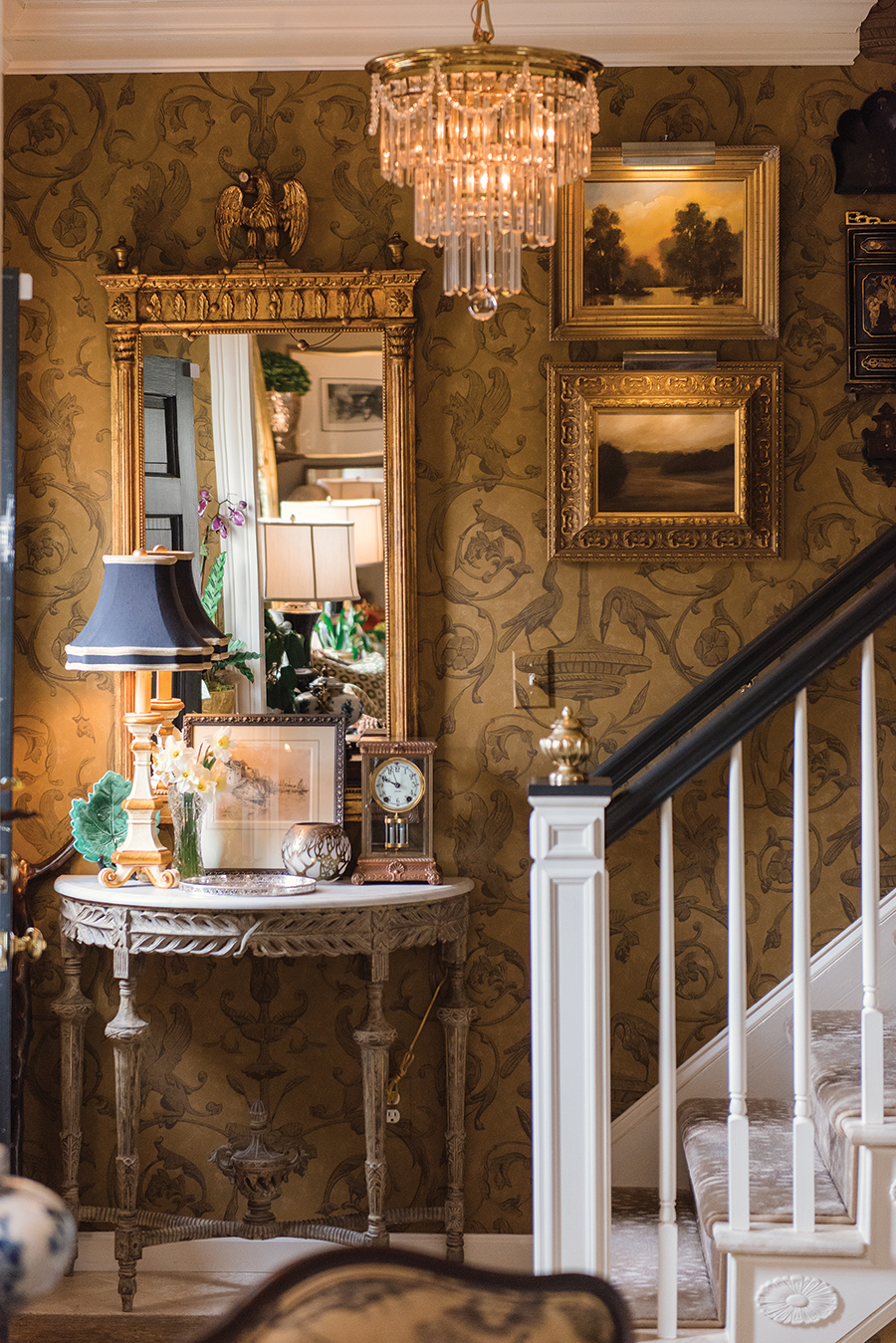
Interior designer and avid collector Terry Lowdermilk displays Duquette’s book in his living room . . . along with a whole lot more, by the way. As a neighbor and fellow collector says, Lowdermilk is a maximalist, placing him firmly in Duquette’s and Draper’s camp. His collectibles cover tabletops and chests, fill decorative cabinets, and are displayed on walls, brackets and surfaces throughout his two-story townhouse. The namesake of Terry Lowdermilk Interiors, he spends six days a week working with varied, farflung residential clients. He also keeps a home office, which he confesses, requires him to religiously dust his many collections. (He does so with pleasure, weekly.) And if his clients don’t have a collection, Lowdermilk says he’ll offer “to start something for them,” the designer laughs — and not ironically. Collections, he maintains, make a house exceptional. Collected objects whisper of history, of meaning, of a backstory worth sharing.

For Lowdermilk, chinoiserie accomplishes this feat. The French word (pronounced sheen-WAHZ-uh-ree) encompasses everything Chinese and East Asian, from furniture to wallpaper, china, porcelains, objets d’art, textiles and papier mâché. It became wildly popular, thanks to the Dutch East India Company, which included the collectibles in their haul back to eager Europeans. The popularity of chinoiserie never abates — and if it does, it resurfaces in a heartbeat or two. It expresses Europeans’ version of Chinese and East Asian décor, extending into gardens, architecture and even the performing arts. (Think: Gilbert and Sullivan’s comic operetta, The Mikado.) King Louis XIV admired the style, as did others to follow. The beau monde loved it as well; pagodas and pavilions interpreted the style in gardens of the well-heeled.

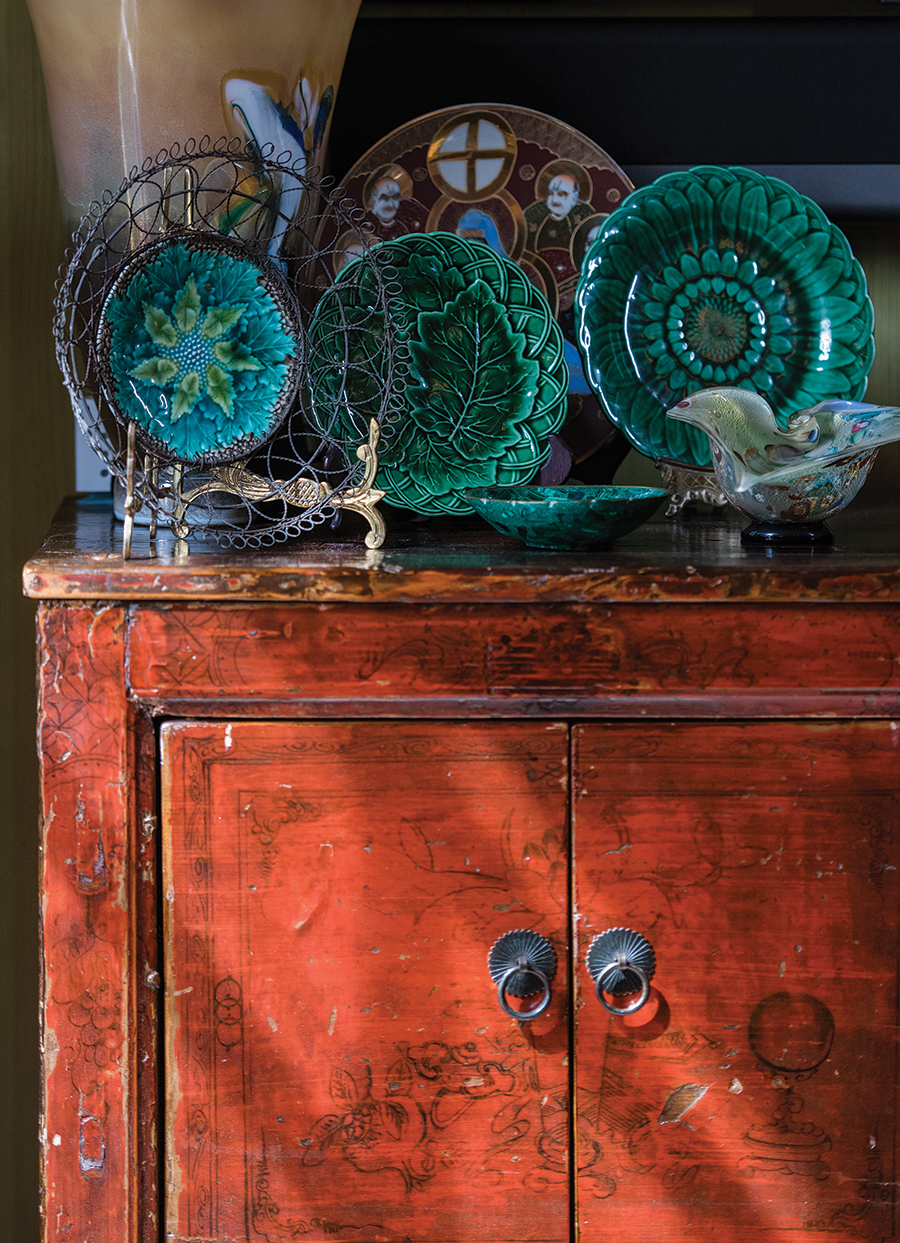
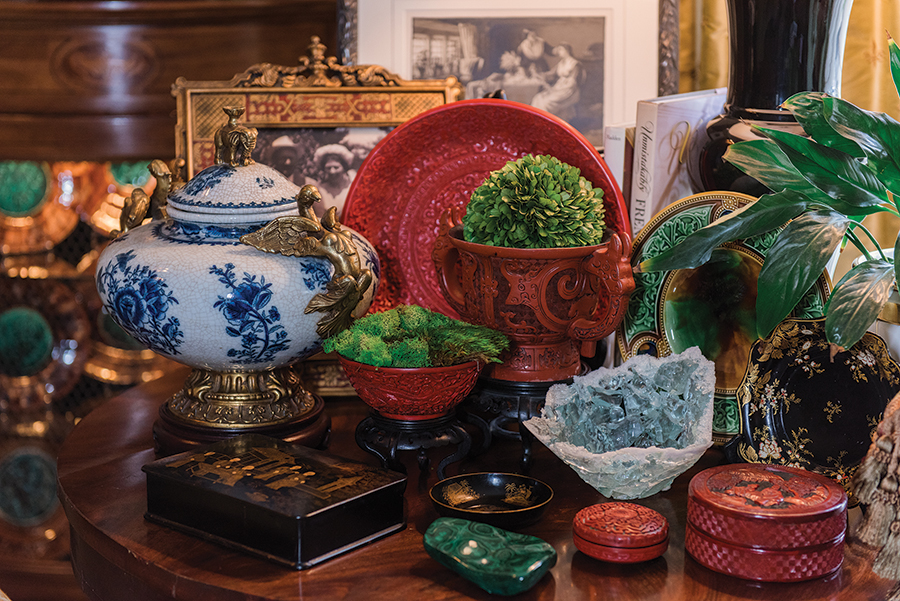
A chinoiserie cabinet takes pride of place in Lowdermilk’s dining room. The knockout statement piece was formerly in a relative’s Lynchburg house. “My cousin found one in another color he liked.” Lowdermilk couldn’t buy the cabinet fast enough, and uses it as storage for table linens, charger plates and cloth napkins. A remnant from a chinoiserie opium bed graces the foyer wall. A Japanned (lacquered) screen is in the living room. One of his most beloved collections is the assortment of French and English chinoiserie papier mâché items, many of them utilitarian objects like holders for matches and calling cards. The papier mâché imitations were inspired by more exclusive and costlier Chinese and Japanese lacquer ware. Decorated in gilt they depict various fanciful scenes in Asian landscapes.

“There are also several pieces that were gifts from close friends and clients. Along the way, in more recent years, I have become enthralled with antique cinnabar [fiery red pieces carved from mercury sulfite], as well as Japanned papier mâché and tole pieces,” Lowdermilk says. “I only have a couple of the tole, or commonly known as tin ware, which have gold Asian-styled paintings on a black background.” He admits that his papier mâché collection with gold-on-black paintings has perhaps run away with him: “I truly love the Asian feeling as well as the gold-on-black decoration. Also, the many beautiful shapes and sizes.”

As he shows his collections — with nary a dust mote in sight — Lowdermilk explains the origin of his love of luxe interiors with hand-selected collections: Chinqua-Penn, the Betsy and Jeff Penn manse in Reidsville.

“The muted colors. My love for painted murals,” the designer explains, can be traced back to this touchstone.

From his earliest memory, Lowdermilk’s family had an inside connection to the estate. Their entrée was a close family friend and personal secretary to Jeff Penn, whose family started Penn Tobacco Co. in Reidsville, which was ultimately purchased by American Tobacco Co. The secretary received frequent calls to be available when the famously globetrotting Penns shipped back antiquities and art from their travels, filling the 30-room mansion they built in 1925.

“So, when we were kids — Mrs. Penn had died by then in the early ’60’s — we would go over to Chinqua-Penn, because it had been given to the foundation at UNCG,” Lowdermilk recalls. “There were pictures of us outside, by the fountains. It was like nothing I had ever seen before. All the things! It was incredible!” he says, pausing thoughtfully. “I think that was my beginning [as a collector].”

With a particular fondness for the Penns’ extensive collection of Asian artifacts and artwork, he visited the estate on numerous occasions, eventually serving on the board of the foundation. “I learned so much about their collections, their origins and also value,” he says. “I even had the pleasure of helping to oversee the decorating of the home for Christmas for the last three or so years that it was open to the public.” 

Notice a theme?

Many of the items Lowdermilk collects echo a time when the Bohemian elite obsessed over exotic Asian wares.

Even if you couldn’t actually visit Asia with the resources of a tobacco baron or the Vanderbilt railroad heirs in Asheville, you could still possess the sort of treasures they were fond of amassing.

But Lowdermilk explains it wasn’t solely Chinqua-Penn’s riches that revealed collected opulence to his eager eyes. They were opened at an early age, while glimpsing interiors and antiques tagging along with his father, a Realtor.

“I’d go with him to sign a listing agreement, and I’d ask why didn’t we have beautiful old furnishings,” Lowdermilk remembers.

His father’s retort? “I grew up with all that dusty old stuff. I don’t want it.” Neither did he keep many family pieces. Lowdermilk’s dad wanted what so many postwar families wanted: everything brand-spanking new, with modern conveniences.

Even this twist had a silver lining. His parents’ modernity led him to the world of interior design. When Lowdermilk’s parents became engaged, they first built and furnished a house on Cornwallis Drive and hired a decorator, to impart the latest 1940’s design.

“Growing up in a home, where my parents had design help, was one aspect that enticed me into the design field,” says Lowdermilk. “I liked seeing my Mom work with the decorator, looking at fabrics, wallpapers, accessories, etc.

“They wanted to go on their honeymoon and come back to a house all ready.”

The young couple consulted Morrison-Neese Furniture Company and chose Vi Cothran, a member of their large staff. (A firm so notable they helped establish the home furnishings industry in the Triad.) Later, Cothran worked with Cashion’s Furniture and Decorating. “She helped my parents with their three homes. I always grew up in a house done by her.”

No question, he knew from early days that the profession lent proximity to beautiful objects and homes. And collections.

“Antiques were something we did not have at home, since my parents chose to leave behind older pieces from their childhood and enjoy the new home décor of the late ’40’s through the ’60’s and ’70’s.” Sure, they retained a couple of family antique pieces, “but most of the furnishings were new of the day. I realized then, that my future had antiques in it, possibly furniture pieces, and more than likely small, interesting pieces,” Lowdermilk recalls.

It was fortuitous that Lowdermilk’s father was a friend to the late Otto Zenke, Greensboro’s premier designer of that era. Ironically, Morrison-Neese was the store who brought Otto Zenke to Greensboro in 1937, according to a 2005 article by Jim Schlosser in the News & Record.

“On Saturday mornings, I would sometimes accompany my Dad to his office, which was down the street from Otto Zenke’s studio and residence,” Lowdermilk remembers. “I would ask Dad if I could go down and walk through his shop.” With Zenke’s permission, the impressionable Lowdermilk would enjoy, he recalls, “seeing many beautiful things which were inspiring. Mind you, I was around 11 to 13 at this time.”

On an outing with his mother, a teenaged Lowdermilk noticed a reproduction, French-styled plaster-on-metal, large wall bracket. “I told her I was going to buy it, and she asked why, and where would I use it? I quickly said, ‘In my bedroom!’” he smiles at the memory. “I purchased it with my own money, and today, it is still something I love, in my living room. Now, I suppose I could say it is well on its way to being an antique! At least vintage!”

From one purchase a collection was launched. “Now I have collected quite a few older wall brackets, which hold many antique items I have collected.”

One collection spawns another, for collectors, are, if nothing else, a passionate lot, hunter and gatherer types who know where the best stuff is. Bringing it home is an irresistible impulse. In Lowdermilk’s case, that would also include Old Paris sugar boxes, European lithographs, books, clocks, and the visually stunning majolica and cinnabar.

He recalls the spark that ignited his admiration of majolica, a term for painted earthenware originating from Moorish Spain by way of Renaissance Italy. “My first antique purchase was a green majolica plate, found at Byerly’s Antiques, one of my all-time favorite places to find great things,” Lowdermilk says of the massive Triad store overlooking I-85 that closed 15 years ago. “From that time, I found many more majolica pieces there, as well as in shops all over.” He prizes a green majolica clock that was used on the film set for The Color Purple.

The cinnabar he collects is alluring both for its beauty and for its potential danger.

“Of course, the fact that red cinnabar comes from mercury sulfide — and is toxic — is one reason we do not see the genuine material used today. And, I am hoping my love for it won’t be a threat to my life! But there must be some vices in life that we enjoy that are not always healthy for us!”

The rarity and the detail of cinnabar also affects Lowdermilk. “The carving, which is so detailed, is fascinating to me in the cinnabar pieces I have, and have lusted over,” he muses.

Is there any limit to his visual curiosity and passion for collecting? Or to the idea of more always being more? Probably not. He admits to eyeing oil landscape paintings and checking out silver lusterware as avenues for his next collecting passion.

“I enjoy having these collections around me. They are my friends. Each time I have packed pieces up to move to a new home, I enjoy unpacking each and every one of them,” Lowedermilk reflects. “As with all of my antiques, I like knowing there is a story behind each and every piece. I just wish they could talk, and let me know where they have been, what they have seen, and the places where they have been allowed to reside.”  OH

Cynthia Adams is a contributing editor to O.Henry. She once lugged a Scottish marble clock home in her hand luggage, and checked a suitcase filled with brass door knobs. She perfectly understands antique addictions.

April Almanac

April is a procession of wonder.

Flowering redbud. Rising asparagus. Row after row of tulips and daffodils.

When the earliest strawberries arrive, childhood memories of roadside stands and pick-your-own patches follow. The first time your grandma took you strawberry picking, you’d never seen berries so plump or vivid. Two, three, four buckets later, you’re back in the car, eyes twinkling, belly full of fruit made sweeter because you picked it.

Easter conjures memories of Sunday hats and wicker baskets, and a grade-school field trip to a house down the street from the church. There, a classmate’s yard is dotted with dozens of colorful eggs — some painted, some plastic, all filled with candy — but all hearts are set on the coveted silver one, a super-sized treasure found in the low branches of a climbing tree when the sun hits the foil just right.

Maybe next year.

Or perhaps the true magic is discovering what you aren’t trying to find, like the robin’s nest in one of the hanging baskets.

In my early 20s (read, coin laundry days), on a visit home for Easter, my folks planted a basketful of plastic eggs in the backyard, each one filled with quarters.

Sometimes the great surprise is the wonder that grows with age.

The Last Frost

The Old Farmer’s Almanac speculates that a full moon in April brings frost. Cue the Full Pink Moon on Good Friday, April 19. While it’s not actually pink, Algonquin tribes likely named this month’s full moon for the wild ground phlox that blooms with the arrival of spring.

Consider it a signal that it’s time to plan your summer garden.

Plant now, and enjoy fresh tomatoes and cukes right off the vine.

Scope It Out

According to National Geographic, one of the top sky-watching events of the year will occur on Tuesday, April 23. On this dreamy spring morning, at dawn, watch as the waning gibbous moon approaches brilliant Jupiter as if they were forbidden lovers. Use binoculars if you’ve got them.

Devilish Alternative

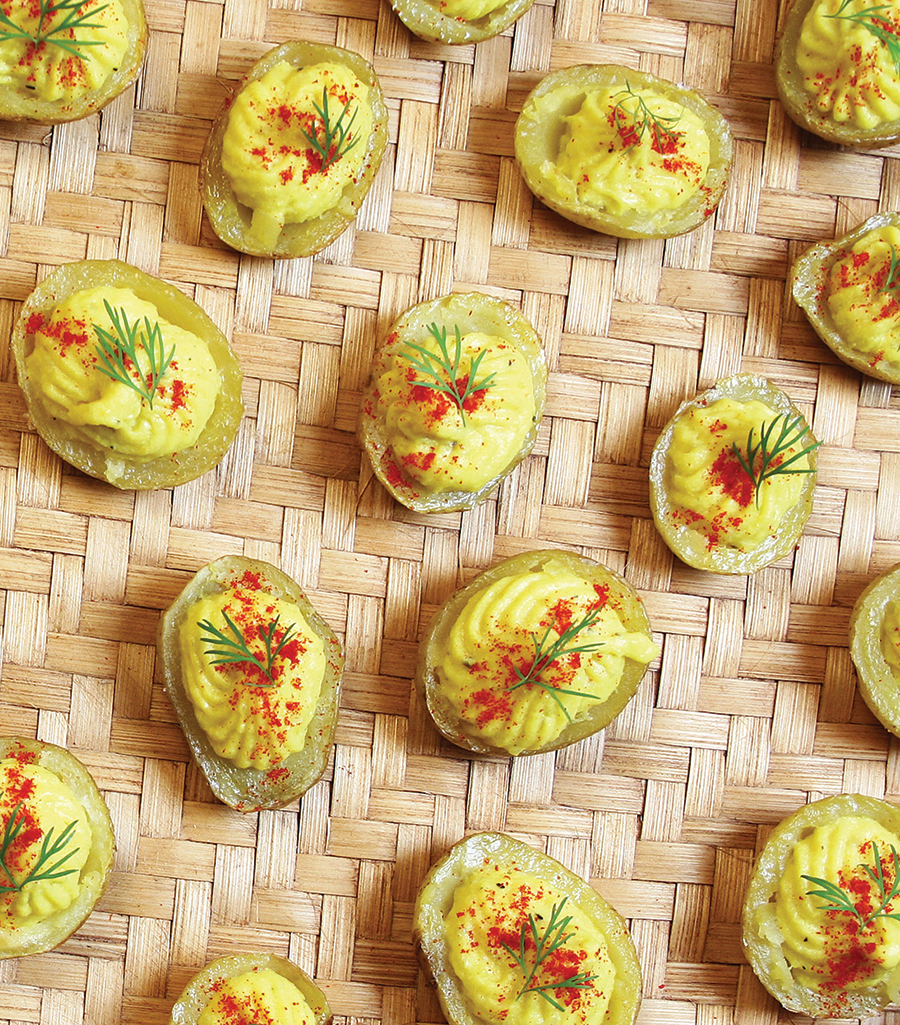
My younger brother has single-handedly cleared a tray of deviled eggs at more than one Easter supper. That’s why I was particularly stunned when he told me that he was adapting a vegan diet. No more deviled eggs? Well, not exactly. But when he told me about Thug Kitchen, a vegan cookbook peppered with language that would make our granny’s draw drop, I understood. Inside: a recipe for deviled chick-pea bites. Although we can’t print that here without heavy-handed edits, check out this equally scrumptious vegan recipe from Whole Foods Market: tender roasted baby potatoes topped with spicy yolk-free filling. Brother approved.

Deviled Potatoes

Ingredients:

12 baby potatoes (about 1 1/4 pounds)

2 teaspoons extra-virgin olive oil

1/2 cup vegan mayonnaise

1/3 cup drained silken tofu

1 tablespoon Dijon mustard

1 teaspoon sweet paprika

1 teaspoon turmeric

1/2 teaspoon coarse sea salt

1/4 teaspoon ground black pepper

Method:

Preheat the oven to 350°F. Line a baking sheet with parchment paper.

Cut each potato in half crosswise. In a large bowl, toss potatoes with oil and place cut-side down on the prepared baking sheet. Roast until tender when pierced with a knife, about 30 minutes. Let cool.

Using a melon baller, scoop out center of each potato half. Combine potato flesh, mayonnaise, tofu, mustard, paprika, turmeric, salt and pepper in a food processor and pulse just until smooth. Scoop filling into potato halves. Refrigerate for at least 30 minutes (and up to 2 days) before serving.

(Want to take this deviled egg alternative to the next level? Sprinkle with finely chopped fresh parsley before serving.)

If Spring came but once in a century, instead of once a year, or burst forth with the sound of an earthquake, and not in silence, what wonder and expectation there would be in all hearts to behold the miraculous change!  — Henry Wadsworth Longfellow

The Omnivorous Reader

Exploring the Carolinas

Early settlers and the Tuscarora War

By D.G. Martin

“In the middle of a dark September night in 1711 in Carolina, John Lawson found himself captive, tied up and flung in the center of the council ring of the Tuscarora Indian town of Catechna,” writes Scott Huler on the opening page of his book, A Delicious Country: Rediscovering the Carolinas along the Route of John Lawson’s 1700 Expedition, recently published by the University of North Carolina Press. 

Lawson did not survive. Tradition says he was tortured to death, with wooden splinters pushed into his skin and set afire. On earlier visits to American Indian villages, Lawson had witnessed and described this type of torture.

Who was this Lawson, and why did the Tuscarora put him to death?

In 1700, English-born John Lawson was a newcomer to North America. Almost immediately upon arriving, he set out on foot from Charleston to explore the endless forests of the backcountry Carolinas. The notes he took became the basis of a book, A New Voyage to Carolina, first published in 1709 and still a classic for its rich descriptions of flora and fauna and the conditions of the native peoples.

Huler wanted to follow in Lawson’s footsteps. He looked for a modern book that explained where Lawson went and described what is there today. When he found that no such book had been written and that no one had even retraced Lawson’s journey, he thought, “That’s for me!”

Huler could have made the trip of several hundred miles in a day or two in a car. But he wanted to go slow, seeing today’s landscapes and peoples at the pace Lawson traveled.

He shares his travels in his new book. Like most other readers of Lawson, Huler is impressed with his descriptions and attitudes about the native populations. Lawson visited Sewee, Santee, Sugeree, Wateree, Catawba, Waxhaw, Occaneechi and Tuscarora Indians. Huler writes, “He stayed in their wigwams, ate their food, trusted their guides. And he emerged with their stories, for some of which he is the only source in the world.”

Lawson, Huler continues, “documented native communities, buildings, agriculture, hunting, dance, trade, and culture through eyes clear, thorough, and respectful. Lawson depicts the natives as fully human — not some subspecies perceived only in comparison to European settlers.”

Lawson’s words were, “They are really better to us than we are to them.”

But Lawson found the native populations to be in a precarious situation. “The Small-Pox and Rum have made such a Destruction amongst them, that, on good grounds, I do believe, there is not the sixth Savage living within two hundred Miles of all our Settlements, as there were fifty Years ago.”

Traveling Lawson’s route through the rural Carolinas, Huler found a discouraging similarity. Contemporary rural and small town landscapes are littered with empty manufacturing plants, corporate farms and forests, empty main streets and deserted houses. Three centuries after Lawson, Huler found that “our world would teeter: a way of life dying in the countryside, implacable new forces once again balancing an entire civilization on a knife edge.”

Setting aside this discouraging report, Huler’s adventures and misadventures on the road entertain and inform. He is the best type of tour guide, one who is well-informed but not at all pompous. His wry, self-deprecating sense of humor helps his serious medicine go down smoothly.

For Lawson, his explorations and the reports about them opened the door to prominence and high positions in the young colony. That success came to a sudden end in 1711 when he was captured and executed by the Tuscarora Indians he had so greatly admired and praised.

Why did they kill him?

To find out, I turned to University of North Carolina-Wilmington professor David La Vere’s The Tuscarora War: Indians, Settlers, and the Fight for the Carolina Colonies. Lawson is one of the main characters of La Vere’s book. La Vere sets out in detail the background for the Tuscarora War that began in 1711 with Lawson’s execution and a series of attacks by the Tuscarora on the thinly populated and, for the most part, recently arrived settlers in the New Bern area.

Earlier, in the late 1600s and early 1700s, North Carolina was only sparsely settled, mainly by Virginians moving south into the lands around the Albemarle Sound. They encountered small groups of Indians and were generally able to subdue them.

However, to the south and west, the mighty Tuscarora Indian strongholds stood as a barrier.

Meanwhile, Lawson’s glowing descriptions about his travels in the colony sparked the interest of the Lords Proprietors, who were looking for ways to encourage settlement. Lawson met a minor Swiss noble, Christoph de Graffenried, who worked out a plan with the Lords Proprietors to transport groups of German refugees and Swiss paupers to lands along the Neuse River near today’s New Bern.

These lands overlapped with the territories of the Tuscarora, who became increasingly threatened by the growing European presence.

La Vere writes that after overcoming odds, “de Graffenried’s colony of Swiss and German Palatines at the mouth of the Neuse River was thriving.” Therefore, he continues, “expansion up the Neuse seemed a real possibility.”

Lawson and de Graffenried made a trip up the Neuse, through Tuscarora lands, to scout sites for future settlements.

“All the while, the Indians grew more worried and angry as the abuses against them escalated and their complaints fell on deaf ears. That spark came in mid-September 1711,” according to La Vere, with this trip up the Neuse.

The local Tuscarora king, or chief, offended and threatened that his territory had been invaded, captured Lawson and de Graffenried and put them on trial for their lives. When one of the more radical Indian leaders berated him, Lawson lost his temper. “He argued back, his anger and sarcasm apparent to all.”

Lawson, of course, was doomed and shortly executed. His companion, de Graffenried, remained in custody while the Indians planned and carried out their first attacks on September 22, 1711, appearing at first as friendly visitors to the settlers’ farms and then striking suddenly from ambush when the defenses were down.

North Carolina’s efforts to beat back the Tuscarora were unsuccessful. The colony didn’t have enough manpower, firepower, or money. Help finally came from the wealthy sister colony to the south. South Carolina sent two expeditions to relieve its northern neighbor.

The first expedition, led by John Barnwell, set out with a force of about 700 men. Only 35 were regular militia. The rest were Indian allies. The results were mixed, and the Tuscarora remained a threat. The second expedition, led by James Moore and made up of 113 militia and 760 Indians, wiped out the Tuscarora at their stronghold at Neoheroka, near present day Snow Hill in Greene County, and opened the door to settlement in the interior of North Carolina.

What explains why South Carolina so enthusiastically aided its neighbor and how the South Carolina Indians were persuaded to provide the critical manpower? “Above all,” La Vere writes,“it was a chance to enrich oneself by looting the Tuscarora towns and taking slaves, which they could sell to waiting South Carolina traders for guns and merchandise.”

This sad footnote to North Carolina’s early history shows that the colonists secured their victory in the Tuscarora War only by facilitating and participating in the enslavement and sale of captured Tuscarora.

Scott Huler’s route through today’s Carolinas following Lawson’s path

In South Carolina: Charleston, Intracoastal Waterway, Buck Hall Recreation Area, Mouth of the Santee River, Hampton Plantation, McClellanville, Jamestown, Lake Moultrie and Lake Marion, Congaree National Park, Pack’s Landing Rimini, Mill Creek County Park, Poinsett State Park, Horatio, Boykin, Camden, Hanging Rock Battleground, and Lancaster.

In North Carolina: Pineville, Charlotte, Concord, Kannapolis, Salisbury-East Spencer, High Rock Lake, Denton, Asheboro, Burlington, Saxapahaw, Hillsborough, Durham, Morrisville, Raleigh, Garner, Clayton, Flowers Crossroads, Wilson, Greenville, Washington, and Bath. OH

D.G. Martin hosts North Carolina Bookwatch, which airs Sundays at noon and Thursdays at 5 p.m. on UNC-TV.

The Accidental Astrologer

C’mon Baby, Light My Fire!

For Aries, the astrological arsonists, this month brings magic and stardust

By Astrid Stellanova

April brings us showers, sunshine and duckies, Star Children.

Some famous Aries creatives and legends like Maya Angelou, Booker T. Washington and Charlie Chaplin have transitioned to the great beyond. Others are still with us: Emma Watson, Alec Baldwin, Pharrell Williams, Francis Ford Coppola, Robin Wright.

Arians are like astrological arsonists, knowing how to make fire and stir it in others. Antagonists and protagonists. Blazing a trail, always leaving a fiery glow — even if you didn’t make it to the 1979 clogging championships with the Smoking Hot Feet of Lizard Lick — you sure know how to make a memorable exit.

Aries (March 21–April 19)

The sages all say this is a big year for you, starting now. You feel like you’ve been in a drought and are parched for a drink of water. Sugarbritches, get ready to guzzle. As much as the beginning of the year was not exactly epic in your opinion, this month is made of stardust and magic. Plain old well water will taste like sweet tea and a Saltine, like a mouthful of happiness.

Taurus (April 20–May 20)

You came out swinging, like somebody stole your buggy at the Piggly Wiggly. The wheels were wonky anyway, and sometimes karma takes over. Forget the little stuff and try and concentrate on the fact that the daisies are popping up and good things are coming.

Gemini (May 21–June 20)

Kindness is demanding that you learn to share, bless your heart, if it’s nothing more than the remote control with dead batteries, or a dried-up, day-old biscuit. You love your toys, but by your age, Darlin’, it’s time to share.

Cancer (June 21–July 22)

Measure twice and cut once. Shine your shoes. Don’t leave the house wearing ripped pantyhose or old sweat pants. You are going to have to figure and refigure to get ahead of a wily competitor. But it can happen.

Leo (July 23–August 22)

It is touching how much small things count with you. Nobody knows that. They think you are difficult to impress, but you love a dive as much as a gourmet bistro. Reveal who you really are, and take a pal to Waffle House.

Virgo (August 23–September 22)

How come you can’t make anyone who enters your door feel at home? Maybe because you really wish they were at their home instead. Expand your heart and open your arms to some very big happiness, Sugar.

Libra (September 23–October 22)

If you faked any more enthusiasm, you’d get sugar diabetes. It’s a good thing to be enthused, but your charm is turned one degree too high. A smile is your best accessory, Darling, but so is keeping it real.

Scorpio (October 23–November 21)

No selfies. No cries for attention, Honey. I don’t care how bored you get, the best thing for you right now is to focus on finishing something you started a long time ago and refuse to tie up. Finish. It.

Sagittarius (November 22–December 21)

You got caught talking with your mouth full of bull, Sugar. Sometimes, the best cure for lying is quiet contemplation. Stick to your knitting, bowling or fishing. Thank your friends for calling you out.

Capricorn (December 22–January 19)

It was mainly a symbolic dogfight, but there you were, right in the middle of it. They headed home looking like they got chewed up by the lawnmower. You walked away with a smile. Throw your shoulders back and show some humility in victory.

Aquarius (January 20–February 18)

You put all your business out there on the showroom floor. We see it. Everybody gets it. You are open for business, Sugar. There will surely be plenty who want what you are selling, but don’t give it away for free.

Pisces (February 19–March 20)

Honey, there is raw ambition, and then, sometimes, it is just a teensy bit undercooked. The cornbread ain’t quite done in the center. You are on the right track but your ideas need a little time and effort to succeed.  OH

For years, Astrid Stellanova owned and operated Curl Up and Dye Beauty Salon in the boondocks of North Carolina until arthritic fingers and her popular astrological readings provoked a new career path.