Life’s Funny

Life’s Funny

Smoothing out the Ruff Spots

Who’s training whom?

By Maria Johnson

Witness this exchange between two domestic partners:

Partner One really wants something, and pulls hard in that direction.

Partner Two, natch, pulls in the opposite direction.

This ticks off Partner One, who doubles down and lurches the other way.

Which prompts me —  I mean Partner Two —  to throw her entire weight the other way. And also to call Partner One a pig-headed so-and-so.

Finally, the trigger passes and things calm down, but both parties feel bruised and out of sorts.

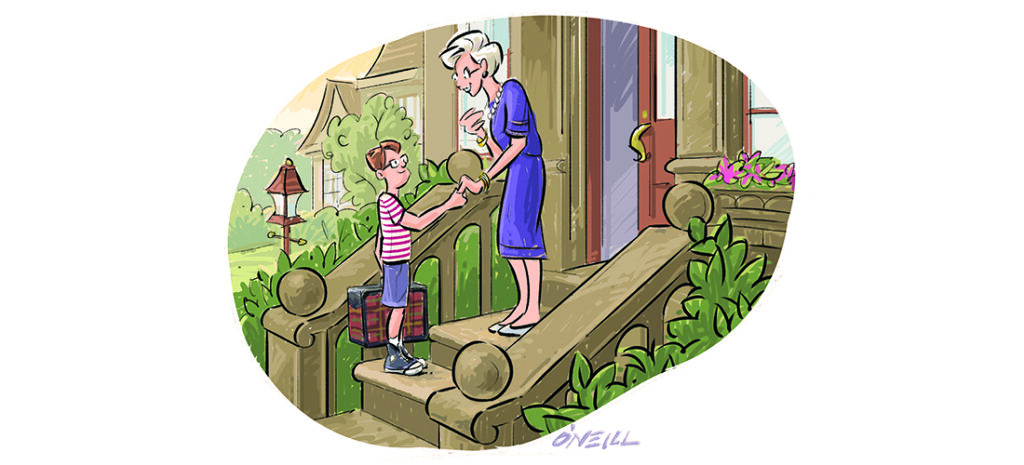
This has been happening between me and our dog, Millie, for some time.

She also has been pulling like a sled dog during walks with my husband.

We need help.

We are not alone, as it turns out. Twenty of us gather one Saturday morning at Brad Howell’s downtown Greensboro business, Red Beard Dog Training.

We have two things in common: All of us yearn for more enjoyable walks with our canine companions, and all of us have left our pups at home, per Brad’s instruction.

This is owner training.

First clue.

We are all ears as Brad — yes, he has a red beard — begins a class called Leash Connections.

Assisting him is his human co-worker, Rylee, along with Brad’s pit bull mix, Dexter.

Brad rescued Dexter — a.k.a. Sexy Dexy —  from the SPCA 10 years ago to help him with his blossoming dog-training business.

Brad already knew a fair bit about animals. He grew up on a farm outside of Asheville, spending much of his time helping to raise beef cattle and playing baseball. Still active in adult leagues, he retains a casual athletic bearing.

On the day we go for training, he walks around the room barefoot, dressed in a T-shirt and basketball shorts, as he lays out the cold truth: Your relationship with your dog might never be what you thought it was going to be.

They’re their own creature.

So are you. Each of you comes with your own inclinations and experiences.

“You try to do the best you can for yourself and your dog, for your relationship,” he explains.

That includes what riles them, what soothes them and what they need to be happy. If your pup needs a lot of physical activity, it’s your job to give it to them.

It’s also your responsibility to buffer their stressors. Watch for raised hackles and tucked tails.

“You gotta know the animal you’re with,” Brad urges. “Don’t put your dog in a situation that you can tell, from watching their body language, they wouldn’t make.”

Another key: rewarding the slightest improvement in problem behavior.

“We’re looking for baby steps,” Brad says. “I’m gonna brag on my dog as soon as she gives me a reason to.”

Sexy Dexy demonstrates by walking, on a slack leash, to the left and slightly behind Brad.

“He’s probably looking pretty hard at my treat pouch,” Brad says, smiling.

Indeed, Dexy is staring a hole in the small plastic box belted to Brad’s left hip.

His patience pays off. He snags a nibble of kibble and a hearty “Yes!”

In Brad’s world, positive reinforcement is a valuable tool.

So are negative consequences — and giving dogs enough time and consistency to figure them out.

Brad passes around a slip lead, similar to the looped cords that veterinarians often use as leashes.

He invites us to place the loop over one wrist, pull the cord with the other hand and see how little pressure it takes to feel uncomfortable.

Playing the role of unruly pooch, Rylee offers her wrist for a demo.

If she pulls, she feels the pressure.

If she wants to relieve the pressure, she has to step toward Brad. He doesn’t need to yank the cord. He just needs to stand firm. Rylee is in control of how much pressure she feels.

What if she continues to pull?

Brad’s next move seems counterintuitive. He steps toward Rylee, giving her slack.

If Rylee lurches again, she’ll feel pressure again, proportionate to how hard she pulls.

“I want them to control the level of consequence they get,” he explains.
With enough reps, Brad assures us, even the most stubborn pup will understand that she is causing a large part of her own discomfort — and she has the power to relieve it.

The room glows with imaginary light bulbs switching on over human heads.

Later, at home, we try a slip lead with Millie, our wee, atomic-powered hound.

She catches on quickly.

We are the slackers who miss chances to reward her when she does something right. We struggle to stay calm and consistent when she lunges.

It would be so much easier to point the paw at her.

But it’s increasingly clear that Millie will change her behavior if we change, too, by embracing the gospel according to Brad.

Trainer, train thyself.  OH

Maria Johnson is a contributing editor of O.Henry magazine. Email her at ohenrymaria@gmail.com.

Tea Leaf Astrologer

Tea Leaf Astrologer

Cancer

(June 21 – July 22)

Fancy the tapas sampler? This month kicks off with Saturn retrograde in Pisces. Rainbows and butterflies, yes. But also, reality checks. (Band-Aids don’t fix everything.) Ready or not, the new moon in Cancer will deliver a much-needed reboot on July 5. And when Venus enters Leo on July 11? Aim those big feelings toward your deepest desires and watch the universe bend over backward to serve them up.

Tea leaf “fortunes” for the rest of you:

Leo (July 23 – August 22)

Ditch the predictive text.

Virgo (August 23 – September 22)

The proof is in the pie crust.

Libra (September 23 – October 22)

Best to let sleeping dogs lie.

Scorpio (October 23 – November 21)

Knock and the door will open.

Sagittarius (November 22 – December 21)

Be sure to kiss them in the rain.

Capricorn (December 22 – January 19)

Try wiping the lens.

Aquarius (January 20 – February 18)

Stretch or be stretched.

Pisces (February 19 – March 20)

Locate your center of gravity.

Aries (March 21 – April 19) 

Just add water.

Taurus (April 20 – May 20)

Three words: Less is more.

Gemini (May 21 – June 20)

Plant your tootsies firmly on the Earth.   OH

Zora Stellanova has been divining with tea leaves since Game of Thrones’ Starbucks cup mishap of 2019. While she’s not exactly a medium, she’s far from average. She lives in the N.C. foothills with her Sphynx cat, Lyla.

Birdwatch

Birdwatch

A Soaring Kite

The majestic swallow-tailed

By Susan Campbell

The swallow-tailed kite is, without a doubt, the most unmistakable of birds in our state — and perhaps anywhere in the world. This large raptor with a long, forked tail is capable of endless, highly acrobatic flight. The size, as well as the long, narrow wings, may cause one to think “osprey” at first, but one glimpse of that unique tail gives its true identity away, even at a great distance. This majestic bird is black on top with a white head and belly, as well as white wing linings. As with all kite species, the bill is stout and heavily curved, but the legs and feet, instead of being yellow, are a grayish hue.

It has only been in the last decade that this magnificent species has become a regular in the summer months in certain locations of southeastern North Carolina. Individuals were observed mixed in with Mississippi kites along the Cape Fear River in the summer of 2003. In 2008 a pair of kites seemed to be defending a territory along the river, but no concrete evidence of breeding could be found. Swallow-tailed kites were finally confirmed as a new breeder here when a nesting pair was located during an aerial survey by the N.C. Wildlife Resources Commission in May of 2013. Far more likely to be seen in coastal South Carolina and farther south, these birds have plenty of feeding habitat here, as well as tall trees for nesting. Their numbers are bound to increase in the years ahead.

Swallow-taileds are found in wet coastal habitat where their preferred prey — large flying insects — are abundant. Adults feed entirely on the wing. But, when foraging for young, this bird is so agile that it not only preys on bugs, such as dragonflies and beetles, it readily snatches snakes, lizards and even nestlings of other species from the canopy. Swallow-taileds are not at all choosey. Males forage for a good deal of the food for the growing family. The male will carry food items back to the nest in its talons, transfer to it to his bill and carefully pass it to his mate, who will tear it into pieces and feed it to their young.

This species is a loosely communal breeder like its cousin the Mississippi kite. Swallow-tailed pairs can be seen in adjacent treetops when they find a particularly good piece of habitat. Non-breeding males may also associate with established pairs. These individuals might bring gifts of sticks and even food to breeding females but, interestingly, these offerings usually go ignored.

Swallow-taileds have been found to consume a large number of highly venomous insects. Wasps and hornets are not uncommon food items, as are fire ants. This is possible because they have developed a much fleshier stomach than other birds. An adult kite may bring an entire wasps’ nest to its own nest and, after consuming the larvae, incorporate it into the nest. The motivation for this behavior is unclear.

In late summer, individual swallow-tailed kites can be seen almost anywhere in the state as a result of post-breeding dispersal. They may mix in with feeding or loafing Mississippi kites around agricultural fields or bottomland forest. Last July, I was fortunate enough to spot a soaring individual over Highway 421 adjacent to swampy habitat outside of Siler City in Chatham County. Should you spot one of these magnificent birds, consider yourself very lucky.  OH

Susan Campbell would love to receive your wildlife sightings and photos. She can be contacted by email at susan@ncaves.com, or by calling (910) 585-0574.

Simple Life

Simple Life

The Belle of Star City

May her light shine on

By Jim Dodson

“I think you are really going to enjoy your Great Aunt Lily,” my dad says cheerfully. “She’s quite a colorful character. I call her the Belle of Star City.”

It’s a warm July morning in 1964. We are driving through the Blue Ridge Mountains to Roanoke, where I am to be dropped off at Great Aunt Lily’s apartment for the weekend before my parents take my brother, Dickie, on to church camp, then head to a newspaper convention in Hot Springs, Virginia.

He explains that Lily is my grandfather’s beloved youngest sister, a strong-willed beauty who spurned several suitors in rural Carolina before fleeing to Washington, D.C. There, she worked for years as a stage actress and theatrical seamstress.

“I suppose she was something of the family’s black sheep, but a delightful woman. You’ll love her.”

 Though I fear I’m simply being dumped for the weekend on a boring maiden aunt, my old man turns out to be right.

Lily lives alone in a gloomy Victorian brownstone on Roanoke’s First Street, in an apartment filled with dusty antiques and Civil War memorabilia, including a Confederate cavalry officer’s sword she claims belonged to a Dodson ancestor who fought at Antietam and Gettysburg. There are also exotic paintings of classical nudes and wild beasts adorning her walls, including the stuffed head of an antelope, a gift from her “favorite gentleman friend” who passes through town every winter with the Ringling Bros. and Barnum & Bailey Circus. 

On my first night with her, Lily — a large-boned, blonde woman, endlessly talkative, swimming in White Shoulders perfume — takes me via taxi to a Chinese restaurant in the Market District, where we dine with a snowy-haired “gentleman friend” she says was once mayor. He talks about the recent Kennedy assassination and makes a half-dollar coin appear from my ears, pointing out that Roanoke is called Magic City.

The next morning, Lily takes me to breakfast at The Roanoker Restaurant, a legendary diner where she knows everyone by first name. After that, we are taxied up Mill Mountain to have a close look at the famous Roanoke Star. The cab driver, Ernie, is a Black gentleman with a gold tooth and quick smile. Lily explains that Ernie is a true “Renaissance man,” a part-time preacher, former Navy cook, full-time house painter and her “dearest gentleman friend in the world.” Reverend Ernie is also her “business partner,” who occasionally drives her to estate sales and auctions to buy artwork and antiques, which Ernie sells to collectors, splitting the profits with her. The Confederate cavalry sword is one of their recent “finds,” which she hints might someday pass my way. This thought thrills me.

On the Sunday morning of my visit, we attend a small red-brick church to hear Reverend Ernie preach, followed by lunch at the historic Hotel Roanoke, the planned pick-up spot with my folks. Naturally, Lily knows the waiter, who brings me something called a “Roy Rogers” and her a small crystal glass. After we order our lunch, Lily discreetly removes a silver flask from her purse and pours herself a bit of ruby sherry. 

She looks at me and asks if I’d like a taste.

 I say yes.

 She asks how old I am.

 Twelve, I lie, giving myself an extra year.

She slides the glass across the table. 

“Just a small sip, dear.”

During the two-hour drive home through the mountains, my folks are eager to hear about my weekend with the Belle of Star City. I tell them about her gentlemen friends and the interesting places she took me, and even mention the Confederate cavalry sword she promises to give me someday. 

My dad glances at my mom. “I told you she’s a colorful character,” he says. “Glad you enjoyed her. But here’s the thing . . . ”

He reveals that Great Aunt Lily is about to lose her home and move to Raleigh into a special-care home due to what we now call Alzheimer’s. Lily is scheduled to move around Christmastime. 

“In the meantime, sport, she’s coming to stay with us around Thanksgiving.”

My mother chimes in, “And since your bedroom is the bigger bedroom, sweetie, we’re hoping you won’t mind giving it up to Aunt Lily. You can bunk with your brother. It’ll just be temporary.” 

Four months later, Lily arrives with a large wooden trunk and her sewing machine in tow. On the plus side, she tells me stories about famous men she’s known — the actor David Niven, golfer Sam Snead, Will Rogers. Even better, she keeps boxes of Lorna Doone cookies hidden under bolts of fancy cloth in her trunk, which she shares with me. One afternoon as we are having our daily cookie conversation, I ask about the sword. Lily gives me a blank look, then waves her cookie dismissively. “Oh, goodness, child! I gave that silly old thing to the church auction ages ago. I think I paid 10 dollars for it at a yard sale up in Fincastle.”   

Predictably, as Christmas Eve approaches, my clean-freak mother begins to lose her mind over our private cookie sessions. My father says all Aunt Lily needs is a good hobby. So, he sets up her sewing machine and she goes to work behind closed doors with her machine humming for days.

It turns out to be quilted, floral potholders. Two dozen quilted, floral potholders.

“Lily thinks you can sell them in the neighborhood for Christmas money,” says my dad. 

I am mortified. Two pals from my Pet Dairy baseball team live on our block, and so does one Della Jane Hockaday, who I hope to give a mood ring. 

“Look, sport,” my old man reasons, “Aunt Lily is here for only a couple more weeks. Just let her see you go down the block selling them. You’ll make an old lady who has just lost her home very happy. Lily is very fond of you.”

So, I grit my teeth and do it early on a frosty Saturday morning a week before Christmas. To my surprise, I sell a half-dozen five-dollar potholders and make thirty bucks. Years later, my mom lets slip that she’d phoned every woman on the street to grease the skids, including Della’s mom. The next morning before church, my dad and I drive the remaining potholders to the drop-off box of the Salvation Army store. 

He gives me an extra 20 for my trouble and insists that I tell Lily, if she asks, that her beautiful potholders sold out in just one morning.

But Lily never asks. Not long after the New Year, my dad drives his aunt and her big wooden trunk and sewing machine to the special-care home. 

I get my bedroom back and never see Great Aunt Lily again.

She passes away in the springtime two years later.

Every time I drive through Roanoke or eat Lorna Doone cookies, I think of her with a smile.  OH

Jim Dodson is the founding editor of O.Henry.

Bontanicus

Bontanicus

The Natural World

In Fisher Park, a seed grows, a finch sings

By Ross Howell Jr.

Driving east on U.S. Route 421 near Liberty, I heard the North Carolina public radio announcement that my neighbor, Rob Brown, had just won the WFDD photo of the week.

I was on a sad trip. I was going to see Becky, my mother-in-law, who was in hospice care at her home in Lillington.

My wife, Mary Leigh, was already with her mom. Over the summer, we’d made many trips together — first to the facility where Becky received regularly-scheduled infusions; later, to a rehabilitation facility in Cary after she had broken a hip; and, more recently, to her bedside.

We were near the end.

Still, I smiled when I heard the radio announcement about Rob.

He lives across the street from us in Fisher Park with his wife, Lane. He’s a professional photographer. I’ve interviewed him for the pages of this magazine — a story in his own words about how the COVID pandemic had brought him back to doing the thing he’s loved since he was a kid: taking photos.

I knew quite a bit about Rob’s prize-winning picture.

It started with a sunflower seed a bird had sown in front of our house. I’d noticed the lone volunteer in the spring, sprouting about six inches from the edge of a flower bed.

If I had just taken the time to move the sprout from the edge farther into the bed, maybe I could’ve forestalled its demise.

But I didn’t. All I did was keep it well mulched.

The sunflower grew like Jack’s beanstalk.

On July 1, Mary Leigh took a snapshot of me with the volunteer. The sunflower stood higher than the gutters of the house, some 12 feet tall, with at least a dozen flower heads sprouting midway on the stalk all the way to the very top. Its broad-leafed foliage was profuse.

Neighbors emailed, thanking me for growing such a beautiful specimen. Passersby voiced their admiration. I protested that I had little, or nothing, to do with its success — that it was truly a self-made sunflower.

I thought about staking it because of its size and weight — but didn’t.

At least I thought to ask Rob to photograph the extraordinary plant when its bright yellow flowers opened.

Which he did, one hot morning while Mary Leigh and I were visiting Becky.

When we returned near dusk, twigs and leaves scattered on the street foretold what we would find. A thunderstorm had taken the sunflower down.

The leaves hadn’t yet wilted, so I hoisted up the stalk and tried to brace it with stakes. But to no avail. The roots were broken, so the stalk teetered and spun with the slightest breeze.

As the light faded, neighbors murmured encouragement and went inside. Warm light spilled from their windows into the dusk.

Near dark, I gave up, too.

We’re all under a death sentence, when you think about it. But it doesn’t pay to think about it too much.

When I was growing up in the mountains of Virginia, I often sought refuge in the natural world. There was conflict in my household, but outside, I found solace. Quietude. Beauty. Hope. And a myriad of interesting things.

The spring wildflowers I discovered in the woodlands were treasures. In school, I was careful to learn their names and characteristics. Likewise for bugs and spiders, and all number of slimy or slithering creatures.

It seemed to me that among the wildflowers and critters, death was a natural part of life. The large and constant pattern of their lives was indifferent to sorrow and death.

Early the next morning after the thunderstorm, I clipped a few of the wilted sunflowers. I arranged a place for them to dry out, planning to give seeds to the neighbors at Christmas and to plant some myself come spring — in the middle of a flower bed, so the roots could better anchor the stalks this time.

Then Rob’s photo arrived in my email inbox.

Perfection.

A goldfinch perched on a bower of gold singing to a blue sky. Indifferent to the coming storm. Captured by my neighbor’s skill, as a favor to me.

Just days later, Mary Leigh’s mom left us.

It was grim to watch her go, of course — to see how determined her body was to cling to the spirit that was leaving it.

But I’m sure Becky’s spirit found quietude and beauty. And her memory is our hope.

This spring, finches have returned and sunflowers will bloom — indifferent to destiny, indifferent even to their own beauty.

And that is the natural world.  OH

Ross Howell Jr. is a contributor to O.Henry magazine. Currently, he’s reading Margaret Renkl’s new book, The Comfort of Crows.

Peace and Purpose

Peace and Purpose

A spirited little girl’s art offers solace — and hope

By Ross Howell Jr.  

Photographs by Amy Freeman

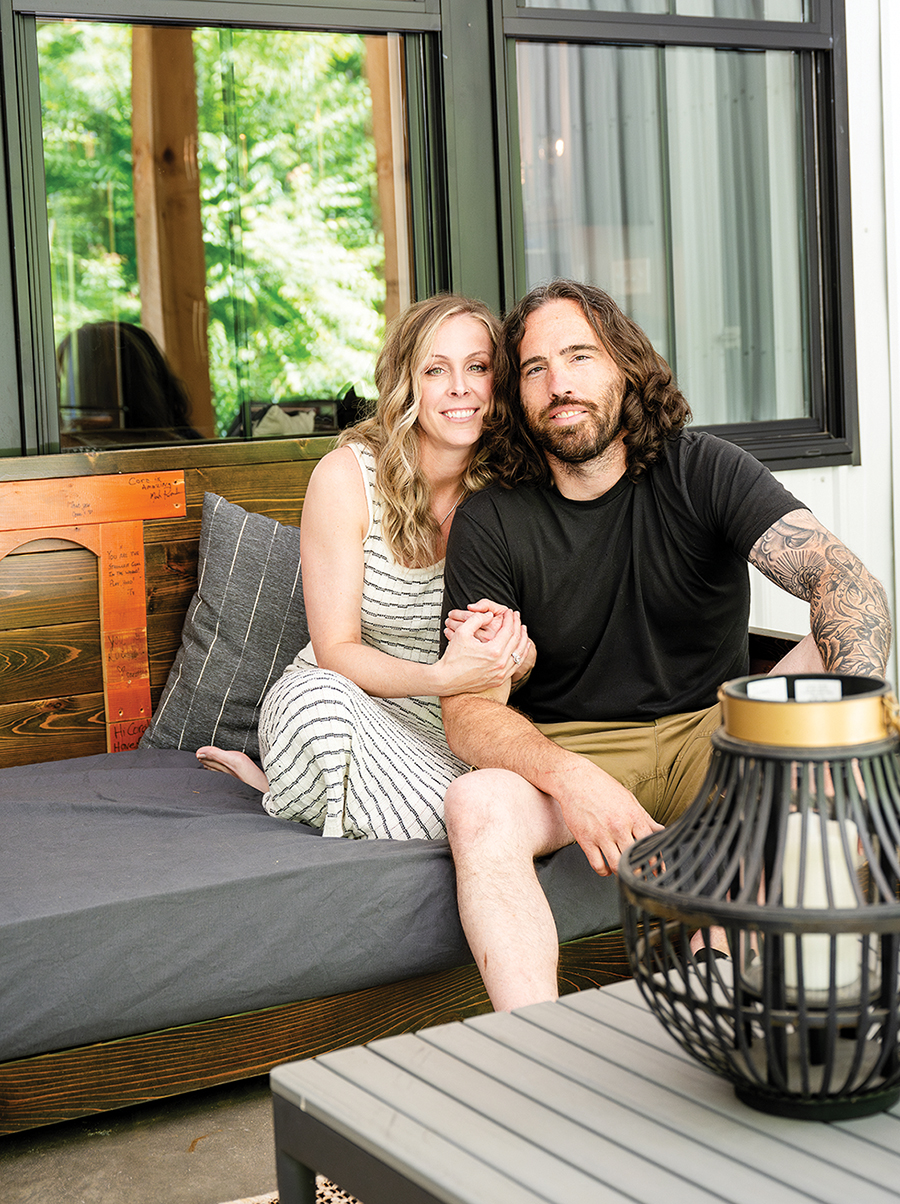
The home that Austin and Shelby Tew built sits outside Stokesdale at the end of a long gravel drive surrounded by 10 acres of hardwoods. It’s unique and its story is bittersweet — even heart-breaking.

And I didn’t arrive at the house in the way you’d expect.

I began the journey at the MM Interior Design Group offices on State Street in Greensboro, where I was greeted by Mark Mitchell, business administration manager. Mark walks me into the design area. Marta Mitchell, founder, president and partner of the firm, is looking at fabric samples and stops to greet me.

Marta’s firm recently reached out to the magazine about the Tew house, a project she’s been working on for some three years. She’s a stylish woman with a wonderfully calm voice and an accent I don’t recognize.

When I ask her about it, Marta tells me her family was from the Mato Grosso region of Brazil. She grew up in the outskirts of São Paulo.

“I still have an accent, but I’ve been in Greensboro for about 40 years,” Marta says, smiling. She moved here with her husband, Peter, who’s now the marketing manager of the firm.

“My husband came for graduate school and was later offered a job, so Greensboro became home,” she adds. “Our two sons were born here.” It was the younger of the two, Mark, who met me at the door.

Marta explains that she had been trained as an interior designer — “we still called it ‘interior decorator’ back when I was in school,” she adds — and started the business in 1989, working alone.

“Now, we work in teams of three designers on every project,” Marta says. Her most senior staff are design directors — there are three of them, including her. They manage the work of lead interior designers, who serve as the main client contacts and bear overall responsibility for individual projects. The lead interior designers work in tandem with assigned interior designers on individual projects day-to-day.

“There are 14 of us now,” Marta says. “There aren’t many interior design firms this size.”

Typically, her firm is hired by a client before construction even begins. Marta guides me over to the design pod where Angela Austin — one of the company’s lead interior designers — has the computer-assisted design model of a client’s waterfront house up on her computer screen.

She shows me the floor plan for an attached guest house.

“Right now, I’m working on some selections for cabinetry,” Angela says. With a keystroke here and mouse click there, she shows me a variety of cabinet styles in place, some stained, some painted, along with variations on ceramic tile and its placement — as well as a floor plan with chairs and sofas.

“All of this was done before the contractor even broke ground,” Marta says.

In addition to using 3D models, renderings and video walkthroughs, Marta’s design group takes visualization to the next level — producing virtual reality tours.

Marta guides me to a large conference room.

Awaiting us are Shannon Harvey, the lead interior designer for the Tew house, and Chloe Fields, interior designer for the project. Shannon is an experienced interior designer born in Mississippi, who lived for a time in Germany. Chloe is a recent UNCG graduate with a degree in interior architecture. Marta is the team’s design director.

I sit down in a swivel chair.

“Here, this goes over your head,” Shannon says, handing me the VR headset.

And boom.

There I am, inside the Tew house.

“You can look up and you can look down and you can turn around in your chair to see more,” Marta says. She explains how the VR program brings daylight in, so what I’m seeing is more realistic than the 3D computer models.

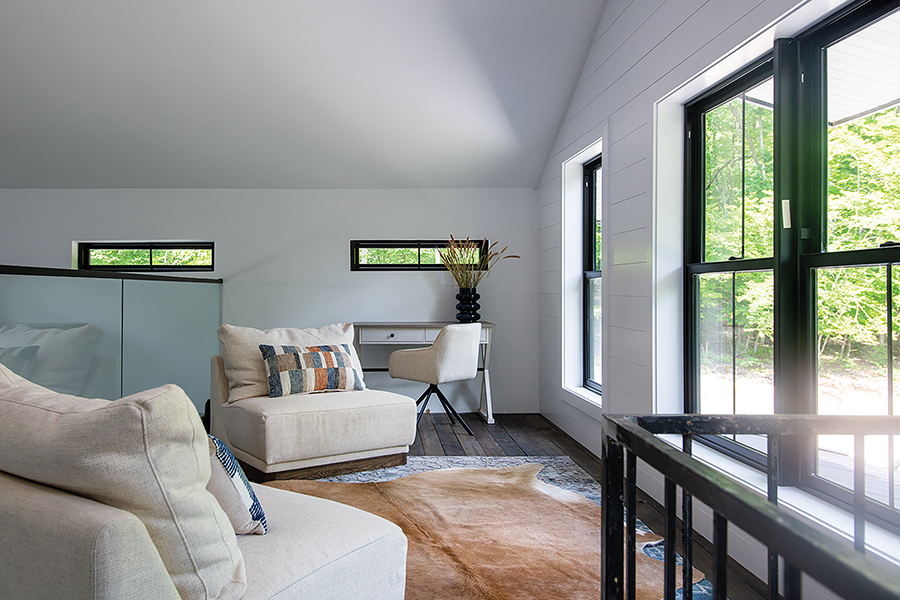
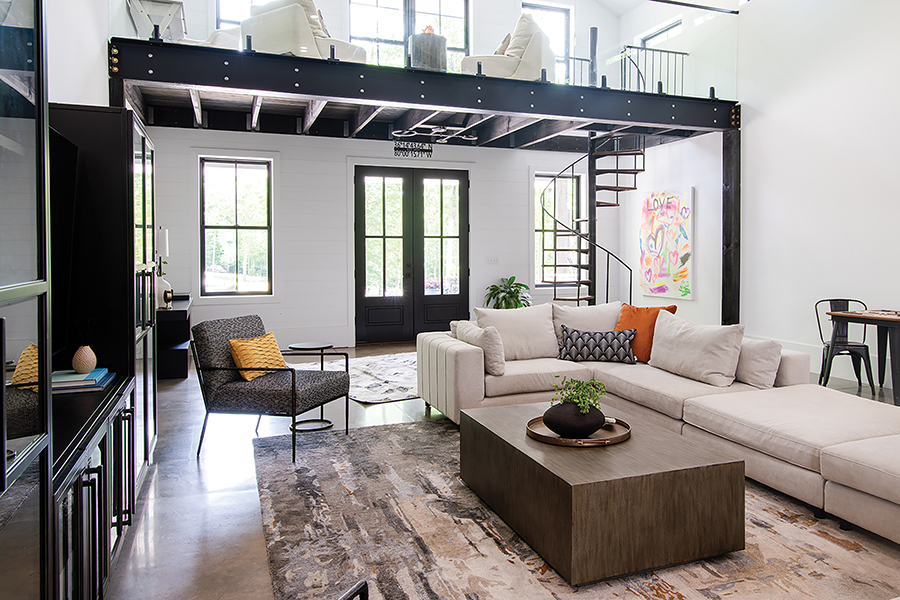
I look up at wooden rafters and industrial-sized heating and cooling ducts hanging from the ceiling. I look straight ahead toward an enormous kitchen island in a long great room. Beyond the island is a bank of windows and doors looking out into woods.

“You can turn around in your chair to see more,” Marta says.

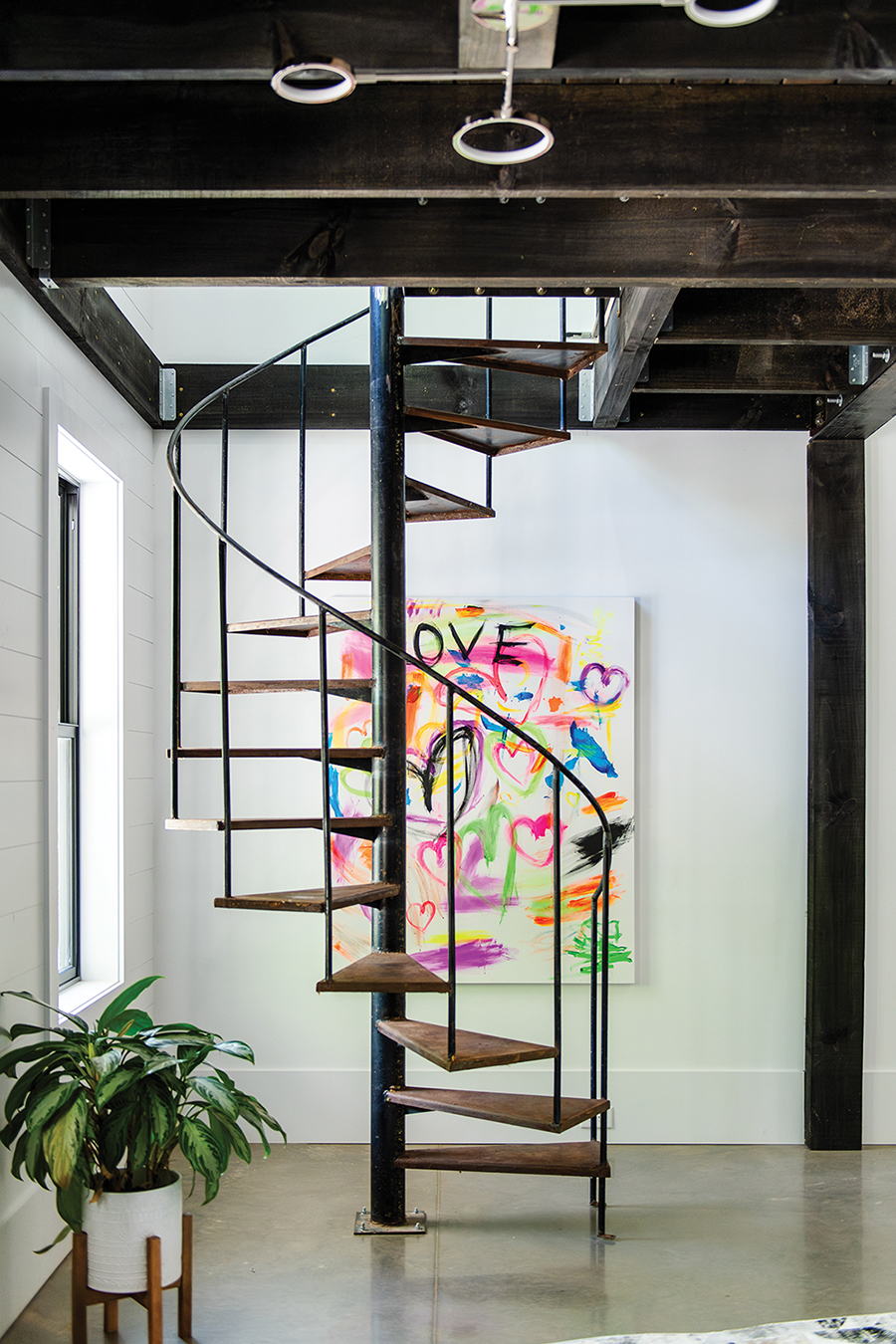
Now I’m looking at the entry wall of the house. There’s a spiral metal staircase leading up to a loft.

“The Tew project was really interesting,” Marta says, as I continue looking around, “because the house was already built when Austin came to us.”

Since he had work experience in construction, Austin personally completed or oversaw the building of the house, from pouring concrete to framing.

“It was empty, just walls,” Marta adds. “Then Shannon started working on it.”

Guests were always the first consideration, Shannon tells me, not the comfort of the Tews themselves. They also stressed that they were on a limited budget, so Shannon provided images of her furniture recommendations to Shelby, who searched for similar, less expensive pieces, while Austin implemented Shannon’s painting or finishing ideas himself.

“He’s so handy,” Chloe says. “He’s built dressers, beds . . . that concrete countertop you see.”

And there was another essential consideration — their young daughters, Braylen and Cora.

Shannon tells me to swivel clockwise in the chair.

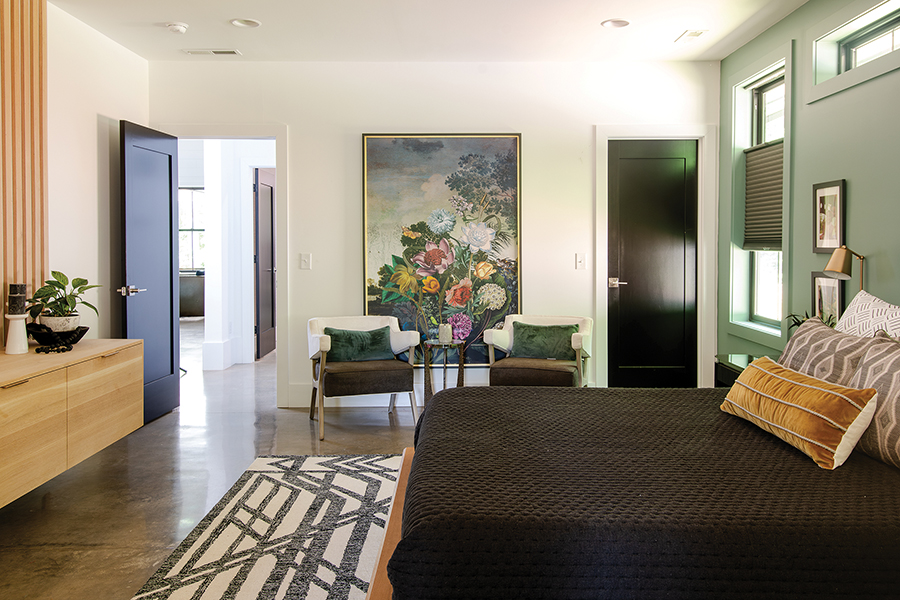
“There,” she says. “The big piece of art on the wall. That’s Cora’s.” It’s a whimsical, colorful painting of hearts set among strokes of pure, bright colors with a single word: LOVE.

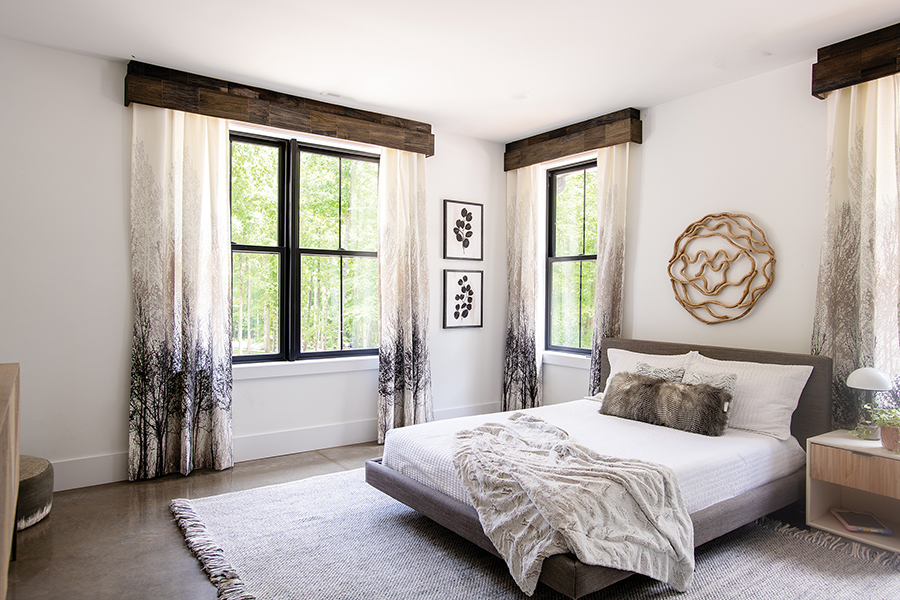
As we continue my tour, Marta explains some of the design elements that Shannon introduced — painting sections of the enormous wall with contrasting colors to break up the space and placing big pieces of furniture strategically for the same purpose.

When I’m set to remove the VR headset, Shannon gives me a hand.

“The Tews started building this home when Cora’s cancer was in remission,” she says. “But the cancer came back.”

Now, fast-forward with me from virtual to real — the heart-breaking part of the story — as my car tires crunch along the gravel driveway in Stokesdale.

Austin Tew greets me at the door and invites me in. He’s accompanied by a romping, blue-and-white pit bull rescue named Dolly. She brings me a couple toys to inspect, decides I’m not as interesting as I first seemed and returns to her bed.

I stand there, looking around the great room. It’s big, feeling even larger than the space I saw in the VR headset. If it weren’t furnished, you could drive a semi-truck and trailer inside and park. The concrete floor is polished. The windows are metal-framed. The house exterior is clad with white aluminum siding.

Turns out, Austin is the owner of Key Automotive Group in Stokesdale, so it makes sense.

“You see, I’m pretty industrial,” he says, smiling. “So we really had to find a designer who could think outside the box.”

“Marta was the only one who got it,” Austin adds. And got it, Marta’s team did. The house feels like a home.

Shelby emerges from her office at the back of the house. She’s a CPA with her own practice. Since it’s tax season during my visit, she’s in need of a well-deserved break and joins us.

The first room we step into is Braylen’s bedroom. She’s the Tews’ older daughter. The couple herd me through the bedroom quickly, since it looks just as you’d expect from a 10-year-old in a hurry to get to basketball practice on time.

We pass by a Jack-and-Jill bathroom to another bedroom.

“This is Cora’s room,” Austin says quietly.

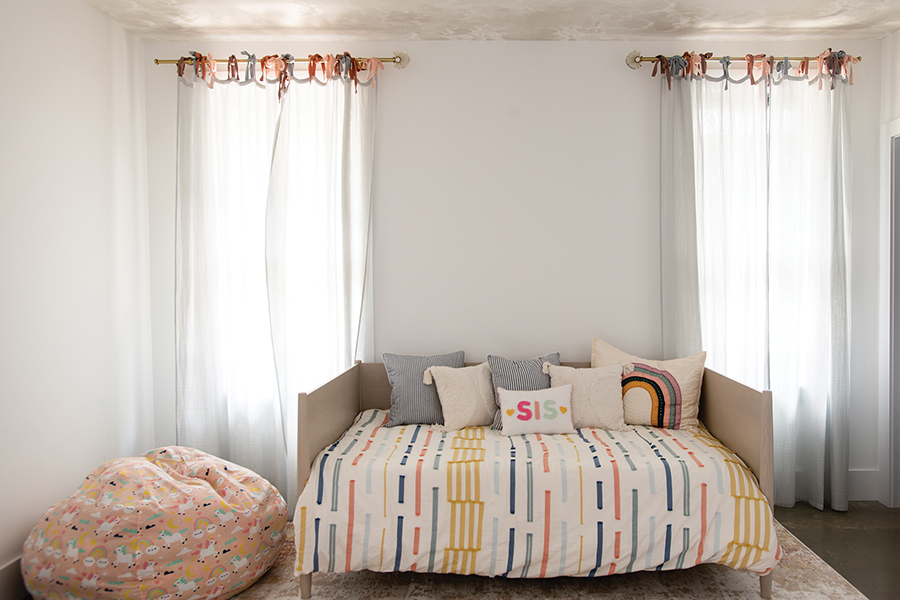
Feeling awkward, I turn my eyes to a corner, where a rainbow is painted on the wall.

“Cora had picked out a rainbow and I promised her she would have one,” Shelby says.

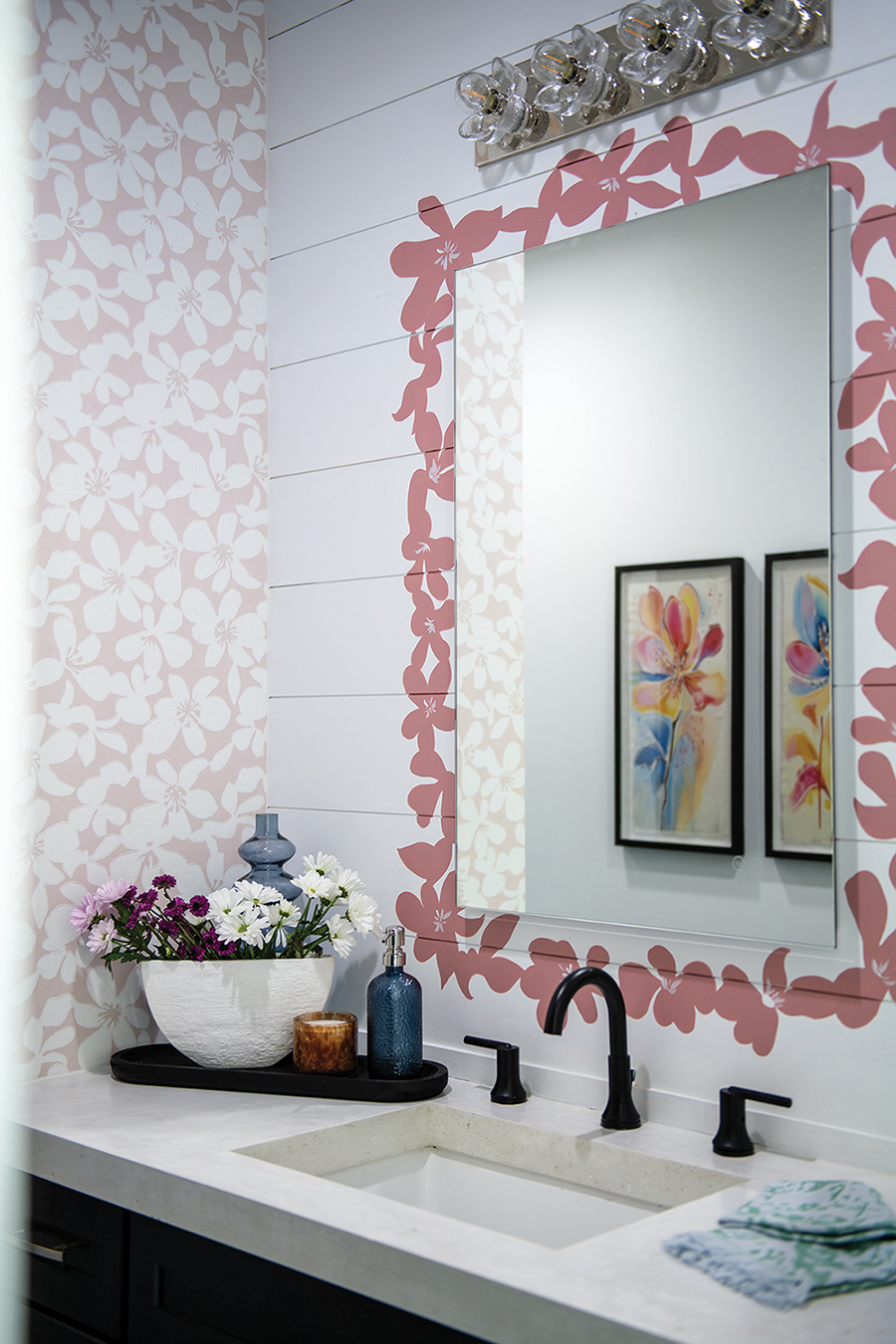
“Marta found a pretty design online,” Shelby continues. “We got in touch with a mural artist named Lacey Crime, who painted this for us.” The artist also painted a lovely frame of flowers around the mirror in Cora’s end of the Jack-and-Jill.

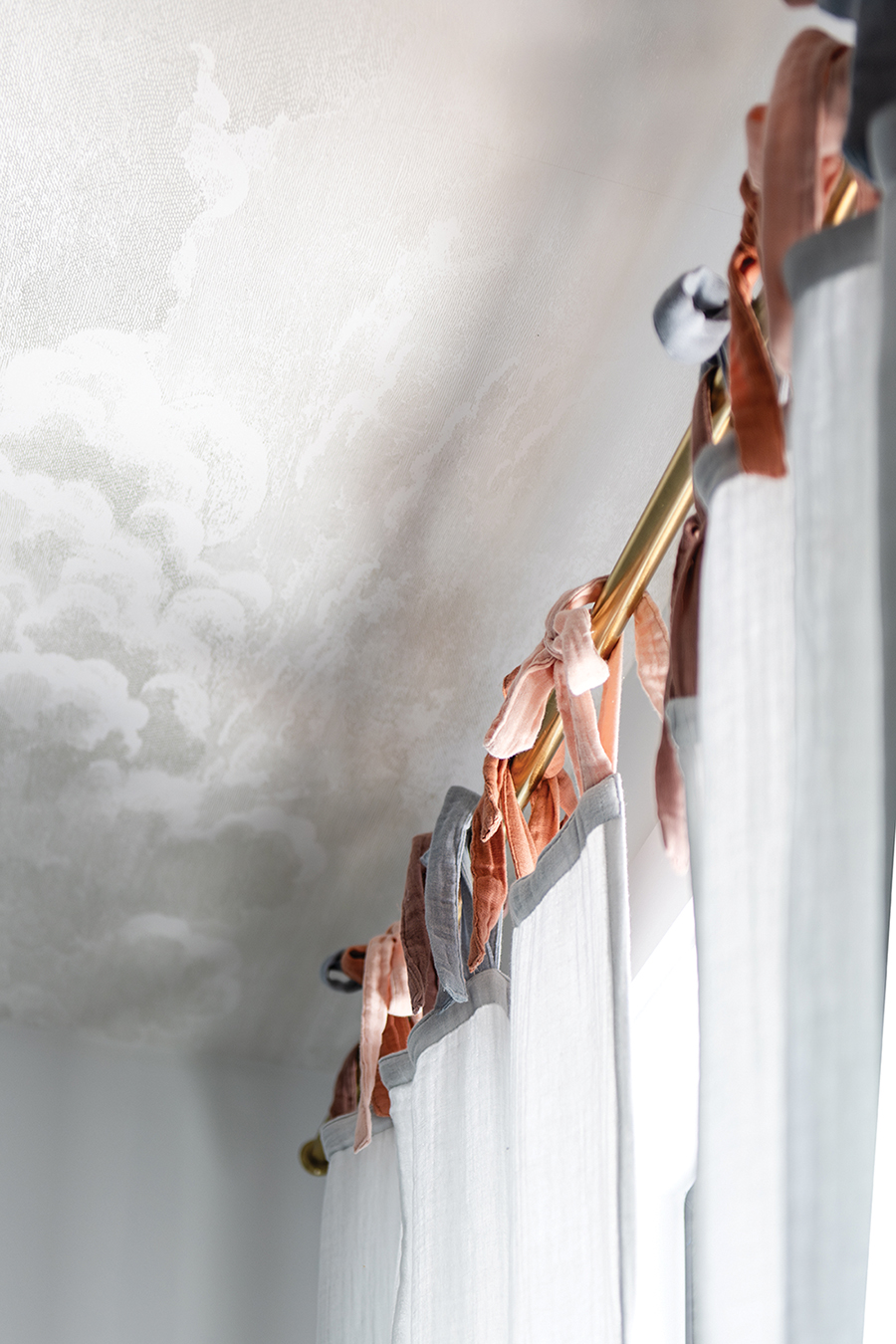
“She never saw the rainbow or the flowers,” Shelby says quietly. She directs my attention to the ceiling of Cora’s bedroom. It’s covered in clouds.

“Marta picked out that wallpaper,” she says.

Austin clears his throat and we continue our tour.

As we walk, they tell me their story.

The Tews were living in Madison, just over the Virginia state line. They had gone out for dinner and Cora had fallen at the restaurant, hurting her leg. The Tews felt a small lump and thought it was from the fall, but the toddler cried through the night.

Shelby decided the next morning to take Cora to see her pediatrician. Later, she called Austin from Brenner’s Children’s Hospital in Winston-Salem and said an oncologist was going to run some tests. The results showed Cora had cancer.

Wanting a second opinion, Shelby dove into research and found that one of the leading treatment facilities in the country specializing in pediatric cancer was the Cincinnati Children’s Hospital Medical Center.

There, on Feb. 14, Valentine’s Day, 2019, Cora was diagnosed with rhabdomyosarcoma, a highly aggressive form of pediatric cancer. She was 2 years old.

Between February and June, the Tews made frequent trips to Cincinnati. In mid-June, the doctors scheduled surgery for Cora.

“So we packed our stuff and hauled it up there,” Austin says. It would be an extended stay.

Surgery was followed by 23 days of radiation and chemotherapy.

Cora’s lab tests looked good. Doctors removed her intravenous port. She was clear of cancer.

The family returned to North Carolina and broke ground for construction of a new home on the Stokesdale land they had purchased before Cora’s diagnosis.

Then, on Cora’s second, 3-month checkup back in Cincinnati, scans revealed her cancer had returned.

“We couldn’t believe this was happening,” Austin says.

Shelby tells me that, during the grueling, 12-hour days of treatment at the hospital, she and Austin noticed how much Cora enjoyed coloring or drawing pictures to take her mind off the beeping machines and busy nurses — how working on the art seemed to give her strength. And they found that big sister Braylen — just two years older than Cora — would use painting to let her emotions out.

Despite their situation, the Tews understood they were among the fortunate, because they were self-employed.

“You’d see some kid all alone in the hospital during the day because their parents couldn’t be there,” Austin says. “They had to work to keep their jobs.”

And, as happened with the Tews, families would find insurance companies denying payment for life-saving treatments.

“You see these situations, and it’s devastating,” Austin says. “You want to find a way to help.”

They decided they would use their individual skills to create a business — Faith and Healing Arts — that helps other families struggling financially with childhood cancer.

Building on their love for their own children’s art, they’ve found suppliers who reproduce their own and other children’s art in large sizes on high-quality art paper or canvas. Austin builds the frames and mounts the art.

Already, Faith and Healing Arts has retailers selling the work of children from some 25 families. The art can also be purchased on the Faith and Healing Arts website. All proceeds from sales go to participating families.

For two years, Cora received chemotherapy at Brenner’s Children’s Hospital in Winston-Salem, with 3-month scans at Cincinnati Children’s Hospital.

All the while, she played with her sister as her father poured concrete and framed the walls of her new house.

“But it was like she knew she wasn’t going to be around,” Austin says. “She never really staked a claim.”

Cora passed away in 2021. She was 5 years old.

We pause by a group of photographs on a wall so I can have a look.

“There’s my little mini-me,” Shelby whispers. “My little Cora Grace.”

They take me to the back corner of the house and I have a peek at Shelby’s office looking out on the woods. When she sees the client messages queued up in her inbox, she realizes she’d better get back to work. I thank her for her time and we say goodbye.

In the great room, Austin shows me a grouping of Cora and Braylen’s art. Then we go through a door into the beautiful private suite they’ve built and furnished, where families going through cancer treatment can stay when needed.

Austin leads me back to the kitchen area, where along the wall there’s a commercial-sized refrigerator, lots of cabinets and a hidden, walk-in pantry. A stove and sink are located in the expansive, concrete-slab kitchen island.

He pats the slab.

“There’s a ton of concrete here,” Austin says. “And a steel bar to hold it up.”

He tells me about the concrete safe room in the house, built strong enough to withstand a tornado, where Braylen and Cora used to play just after the concrete had been poured and the framing was going up.

Austin tells me about the radiant heat system in the concrete floors, proudly showing me the utility room he designed and built — each duct, fan and pipe gleamingly clean, easily accessible for maintenance.

“All the fan motors are in here,” he says. “You turn on a bathroom fan when you’re in the guest suite, you don’t hear a thing.”

It’s a great house, a one-of-a-kind house. It’s a house blessed with peace and purpose.

Recently Austin celebrated his 40th birthday.

“We had our daughter’s basketball team’s kids and parents here, we threw corn hole in the living room, we did it all,” he says, reflecting for a moment.

“You know, an empty house sucks,” Austin says. “What matters now is to live life.”  OH

For more information on the Tews’ art program to help the families of children who have cancer, visit www.faithandhealingarts.com.
Ross Howell Jr. is a contributing writer.

Wild and Wonderful

Wild and Wonderful

Pinehurst No. 2 prepares to test the best

By Lee Pace

Feature Photo: 2014 U.S. Open Photograph by Joann Dost

A December day in 1935. A man approaches the house at 120 Midland Road in Pinehurst, notices the Scottish-style stonework and arches of Dornoch Cottage, and rings the bell.

Donald Ross opens the door and greets A.W. Tillinghast.

What a meeting of the minds of the early days of golf course architecture.

Ross, 63, the son of a Scottish stonemason, apprentice in his 20s to legendary pro Old Tom Morris at St Andrews, an immigrant to the United States who set up shop in Pinehurst in 1900 and designed notable courses across the eastern United States — from Seminole Golf Club in Florida to Inverness Club in Ohio to Oak Hill Country Club in upstate New York. His tour de force, Pinehurst No. 2, sits just behind his house.

And Tillinghast, 59, the son of a wealthy rubber goods magnate in Philadelphia, who grew up playing cricket and fell under the spell of golf on a visit to St Andrews in 1896 where he established a mentor-mentee relationship with Morris. Tillinghast’s design acumen was on display across the land as well — from San Francisco Golf Club on the West Coast to Winged Foot Golf Club and Baltusrol Golf Club in the shadows of the New York City skyscrapers.

Oh, to have been a fly on the wall, to hear these friends and sometime competitors talk about their shared experiences — their formative years at St Andrews, their design philosophies, the challenges of maintaining businesses and servicing clients when travel was by train and communication by post.

Surely Tillinghast espoused, to some degree, his belief that “a round of golf should present eighteen inspirations, not necessarily eighteen thrills.”

And no doubt Ross would have looked at the 72-hole facility at Pinehurst Country Club and talked about how it had become the epicenter of golf in America. “I wholeheartedly believe in golf,” Ross once said. “A country which gets golf-minded need not worry about the honor, the integrity and the honesty of its people.”

Tillinghast’s visit came at the behest of the PGA of America and his role as a consultant with the organization which in 11 months would conduct its flagship competition, the 1936 PGA Championship, on Pinehurst No. 2. They carried their golf clubs past Ross’ masterful rose garden in the backyard, through the wrought-iron gates and onto the third green.

Ross showed his guest the green complexes that he had just converted, with the help of green superintendent Frank Maples, from their previous flattish sand/clay structure to undulating Bermuda grass, shaping the sandy soil around them into a cacophony of dips and swales. He noted the roll-offs around the greens, how they penalized shots even slightly mishit and propelled balls into the hollows nearby.

Ross led Tillinghast to the fourth tee and explained how he had just added that hole and the fifth to the routing, taking them from a previous employee-only nine holes, and had arrived at the final (and current) configuration after originally unveiling the course in 1907.

They felt the taut turf under their feet, reveling in how the drainage qualities of the sandy loam made for the ideal golf playing surface. As they went, Ross explained the choices golfers had off the tee — on the par-4 second, for example — showing his friend what a lovely view it was into the green from the left side of the fairway but pointed to the gnarly bunker complex a player had to flirt with to get there. Ross nodded to the native wiregrass that grew in profusion along the fairways and how it reminded him of the whins of his native Scotland.

Did the man known in the business as “Tilly” dip into his bag for a flask and a wee snort as he was wont to do? Did Ross grouse that this new and improved No. 2 was better than any new-fangled effort from Bobby Jones and Alister MacKenzie down in the red clay of north Georgia?

All of this, we’ll never know. What we do know is what Tillinghast said after his visit.

“Without any doubt Ross regards this as his greatest achievement, which is saying a great deal,” Tillinghast offered. “Every touch is Donald’s own, and I doubt if a single contour was fashioned unless he stood hard by with a critical eye. As we stood on hole after hole, the great architect proudly called my attention to each subtle feature, certain that my appreciation of his artistry must be greater than that taken in by a less practiced eye. Nothing was lost on me, and after our round together, I told him with all honesty that his course was magnificent, without a single weakness, and one which must rank with the truly great courses in the world today.”

And, 89 years later, the show goes on.

Pinehurst No. 2 would continue to be the site of the North & South Open on the PGA Tour through 1951, with Ben Hogan, Sam Snead, Byron Nelson and Ross himself among the winners. It would host the 1936 PGA (won by Denny Shute) and the 1951 Ryder Cup (won by the Americans, 9 1/2to 2 1/2, over the team from Great Britain and Ireland).

But it wasn’t in the mix to host a U.S. Open.

Left: Donald Ross (Courtesy Tufts Archives)

Middle: The Ninth hole of Pinehurst No. 2 (Copyright USGA//Fred Vuich_

Right: A.W. Tillinghast (Courtesy USGA Archives)


Through the 1970s that union was simply impossible because Pinehurst shut down for the summer (the founding Tufts family and the staff went to Linville or Roaring Gap in North Carolina or traveled north to Maine), and the American national championship was played always in June.

When the resort went to air-conditioning and a year-round operating calendar, the idea was still problematic because of the USGA’s preference for playing courses with firm and fast greens, a challenging task on Southern courses during hot weather months. The U.S. Open was not played in the muggy Southeast until venturing to Atlanta Athletic Club in 1975, though it had already visited hot spots in Houston, St. Louis, Dallas and Fort Worth.

About the time Jerry Pate was winning in Atlanta, officials at Pinehurst Country Club began floating the idea of an Open for No. 2. The Diamondhead Corporation was five years into its ownership of Pinehurst after purchasing it in 1970 from the Tufts family, whose patriarch, James W. Tufts, launched the town and resort in 1895 as a refuge from the cold winters of New England. The Diamondhead president, Bill Maurer, conceived the World Open on the PGA Tour and the World Golf Hall of Fame in the early 1970s and wanted all the traffic, attention and accolades he could muster for Pinehurst and its No. 2 course.

It took two more decades to figure out how to bring the National Open there.

First, there was the dodgy financial bona fides of the resort and club, which eventually went bankrupt and was taken over by eight banks for two years beginning in March 1982. Robert Dedman Sr. and his Club Corporation of America bought the facility in 1984 and provided what has turned into four decades of stability, innovation and financial security, with Robert Dedman Jr. taking the baton after his father died in 2002.

Second, there was the issue of the playing surfaces.

Pinehurst and other golf courses in the Mid-Atlantic, or so-called “transition zone,” have forever been vexed over the choice for their putting surfaces between Bermuda grass, the de facto choice for Florida and warm weather climes, and bent grass, which thrives in the North. Pinehurst officials experimented with new strains of both over the 1970s and ’80s, walking that tightrope between offering smooth and playable greens for members and resort guests for 12 months of the year, and yet having the ability to get them lightning-quick while not dying in the summer for an elite competition. Pinehurst old-timers still remembered Hale Irwin and Johnny Miller taking dead aim at flagsticks during PGA Tour competitions on No. 2 in the late summer and their approach shots going splat and stopping mere feet from the hole (Hale Irwin shot 62 and Johnny Miller 63 in mid-1970s birdie-fests).

Donald Ross must have raged in his grave.

By the early 1990s, the USGA and Pinehurst officials agreed that advances in grass technology and green foundation construction would allow them to rebuild the greens and have them stand up to the world’s best players on a 90-degree day in June. The USGA announced in June 1993 that it would conduct the 1999 Open at Pinehurst. The competition was a rousing success from the perspective of ticket sales, corporate support, traffic ebb and flow, housing and, certainly, the golf course itself.

“It’s the most draining course I’ve played in a long time,” said European Ryder Cup team member Lee Westwood.

“People sometimes ask what’s the hardest course I’ve ever played,” said two-time U.S. Open champion Lee Janzen. “Now I know.”

The Open has been contested on No. 2 twice more, and the course has played as a par-70 for each championship. The scores validate that what Ross completed in 1935 stands in fine fettle in the next century.

Payne Stewart was 1-under in winning the Open in 1999, Phil Mickelson was even-par, and Vijay Singh and Tiger Woods were 1-over. Michael Campbell won with an even-par total in 2005, with Woods at 2-over. Martin Kaymer has been low man in the three Opens, shooting 9-under in 2014, but his nearest competitors were a mile back, with Ricky Fowler and Eric Compton tied for second at 2-over.

The firm greens, the delicate chipping areas, the flow of the holes and the strategic nuances led Tom Weiskopf to venture in a 1995 conversation that Pinehurst No. 2 is a better year-round test than Augusta National Golf Club.

“Augusta National is good one week a year,” Weiskopf said. “I’ve played Augusta two or three weeks before (The Masters) and it’s a piece of cake — a piece of cake. Pinehurst No. 2 is never a piece of cake.”

The 2024 Open at Pinehurst will be the first played on the Champion Bermuda greens installed after the 2014 Open and the second of the Coore & Crenshaw restoration era. Bill Coore, a native of Davidson County who played No. 2 often during his boyhood summers, and Ben Crenshaw, the two-time Masters champion, coordinated an extensive makeover in 2010-11 that included stripping out hundreds of acres of Bermuda rough, recontouring fairways and bunkers to Ross’ design, and rebuilding the perimeters with firm hardpan sand dotted with wiregrass, pine needles and whatever natural vegetation and debris might accumulate.

“In the early days, this golf course was disheveled and brown, and the ball rolled and rolled and rolled,” Coore says. “That’s what gave it its character. There was width here, the ability to work your ball to get the best angles. Over time, that was lost. It was too green and too organized.”

“Bowling alley fairways,” Crenshaw adds. “Straight and narrow, just like a bowling alley.”

Don Padgett II was the Pinehurst president and chief operating officer from 2004-14 and the man who convinced Dedman that hiring Coore & Crenshaw and taking No. 2 back to its “golden age” from 1935 through the 1960s was the correct move. Padgett is a “golf guy,” in industry parlance, coming to the resort with a background as a PGA Tour player in the early 1970s and a longtime club professional. His father, Don Sr., was director of golf at Pinehurst from 1987-2002.

One March afternoon a decade into his retirement, Padgett is sitting in a rocking chair on the porch overlooking the 18th green of No. 2. It’s sunny and 55 degrees. The tee sheet on No. 2 is full.

“I think this is what the Tufts envisioned,” Padgett says. “If you’re from Boston, this is balmy. My dad used to say if you’re in the golf business, stand here because everyone will come to see you.”

The world of golf is coming to Pinehurst in June, and the game’s top players will find the 18 holes that so impressed A.W. Tillinghast in 1935 and will vex them in 2024.

“I think the golf course today probably presents itself as the best it ever has,” Padgett says. “It’s Ross’ concepts with modern maintenance behind it. I think he would look at this golf course and say, ‘Wow, I wish I’d had the ability to grow grass like this.’ These are his concepts with modern turf. It’s not distorted, it’s enhanced. I think he would bless it.”  OH

Chapel Hill-based writer Lee Pace has authored four books about golf in Pinehurst, including The Golden Age of Pinehurst — The Rebirth of No. 2. Write him at leepace7@gmail.com and follow him @LeePaceTweet.

Home Grown

Home Grown

By Cynthia Adams

On a recent trip with friends, I casually mentioned my father’s unfortunate incarceration, an expression adopted from the character Anthony Bouvier, portrayed by Meshach Taylor, on the hit sitcom Designing Women. Fans of the show may recall that from 1986–1993 Taylor played a gentle quipster, unfairly convicted of robbery. 

I preferred Bouvier’s jokey euphemism; it landed gentler than saying, “My father went to the big house.” Or, “Dad did time.”

Prison talk is freighted, folks. Predictably, eyebrows raised.

“It’s not like he killed anyone,” I hastily added. What I didn’t add was he was merely one case among others in my family line.

A former mentor shared these encouraging words, “Normal families seldom produce writers.”

Take this magazine’s namesake and this city’s native son, William Sydney Porter — pen name O. Henry — who went on the lam to Honduras before serving time. He served three years in an Ohio prison; my father served only three months. I found myself bringing that up, as if it explains anything. Dad, however, could have easily walked out of an O. Henry plot — with a love for storytelling and an obsession for Pepsi-Colas and Mounds candy bars.

Dad, himself, and other relatives were never shy about sharing our family’s hapless narrative.

During a visit in Atlanta with my great uncle, Miles McClellan, he shared an alarming story. Our ancestral widowed Scots-Irish grandmother killed a tax collector during the Great Famine. “I’ve spent time at the Library of Congress,” Miles confided, “trying to learn more about her.”

Uncle Miles told an incredible tale: She whacked the tax collector with a fireplace poker when he attempted to collect their cow in lieu of taxes. She was spared a death sentence, but she and her children were exiled.

He died before finding proof, but the tale had taken unshakeable root in my imagination. 

There was more. Uncle Miles himself experienced incarceration as an adventurous young man who loved newfangled motor cars. He sought his fortune in Atlanta, starting one of the city’s early car dealerships. My grandmother insisted her favorite brother was framed by older, jealous rivals. Then, the narrative grew tricky: He fled after faking his own death by driving his Model T into a creek, then lived in Baltimore under an assumed name. But he returned to face the charges, just as O. Henry did, however false. My grandmother fainted outright when her brother walked up her driveway, very much alive.

After serving time, Uncle Miles went on to found another successful business — this time selling municipal water towers — and (honestly) earned wealth. He piloted his own plane, lived in an Emerywood mansion, and remained witty and compassionate, while walking the straight and narrow.

But when my father was sentenced to a federal penitentiary in Birmingham, Alabama, tales of redemption didn’t soothe us, despite his funny and considerate probation officer, Randy Harrell, who became a family friend. The fact that Dad was appointed a pre-trial probation officer seemed a clear indication of pending doom. When Dad was led away in handcuffs, I was a new college student. Three younger siblings were still at home. Dad was jailed at Maxwell Air Force Base with Watergate offender Charles Colson. My liberal father’s response? “This is cruel and unusual punishment,” he wrote to the warden and to anyone he could think to complain to. 

Dad and Charles apparently became buddies, although Dad was wary of Colson’s “jailhouse religion.” I kept a letter sent by Colson to me on Pentagon stationary urging me to keep up my studies. The logo, incidentally, is crossed out.

Dad returned to a business and family life in ruins. And the family curse continued. A young sibling would wind up spending months jailed for fishing without a license — so help me God. (He had a prior DUI). The old saw about he who represents himself in court has a fool for a client proved true in his case and mine; read on.

When appealing a driving conviction before Judge Elreta Alexander before her retirement, I tested that theory. Standing well apart from the hangdog guilty group and edging closer to the allegedly innocent, I pleaded “guilty with exonerating circumstances.” The judge snapped: “Stand there with the rest of the guilty!”

Admonished, I slipped a folder of images of “No Right on Red” signage at a downtown stoplight behind my back, now terrified of actually presenting my evidence. Would this clever judge realize my wide-angle lens might have distorted the sign’s distance from the stoplight? I had sworn to give honest testimony; but were the pictures just a tad misleading?

After systematically finding each “innocent” plaintiff guilty, Judge Alexander beckoned me to approach the bench. “You. The one who doesn’t know if she’s guilty or innocent. What is it that you brought?” she asked, demanding the ill-concealed folder.

As she studied my pictures, I lightly joked that the worst that could happen was she would find me guilty. Fixing me with an assessing look, she warned that, no, things could get worse. 

“Read your ticket,” the judge said grimly. She could, in fact, jail me for illegally turning right on red. And levy fines. 

Jail?! I grew redder than a fully ripe McIntosh apple.

Perhaps because the ticketing officer failed to appear, Judge Alexander relented, ruling prayer for judgment continued, a PJC. 

I paid the court costs and sprinted out — a near miss as a jailbird. 

Long afterward, I refused to turn right on a red light, no matter how many horns honked or fingers flipped me off.

Felonious grandmother, uncle, father and brother, know this: I vow to break the chain of unfortunate incarcerations.

That annoying driver who rubbernecks before proceeding right at the stoplight? It’s probably law-abiding little ole me. Just wave hello and please don’t honk; there’s some serious ancestral baggage riding with me and a curse I’m doing my best to shake.  OH

Cynthia Adam is a contributing editor to O.Henry magazine.

Thinking Outside the Jewelry Box

Thinking Outside the Jewelry Box

With his grandfather’s tools, Jake Wosinski makes his mark on McGee Street

By Cassie Bustamante  

Photographs by John Gessner

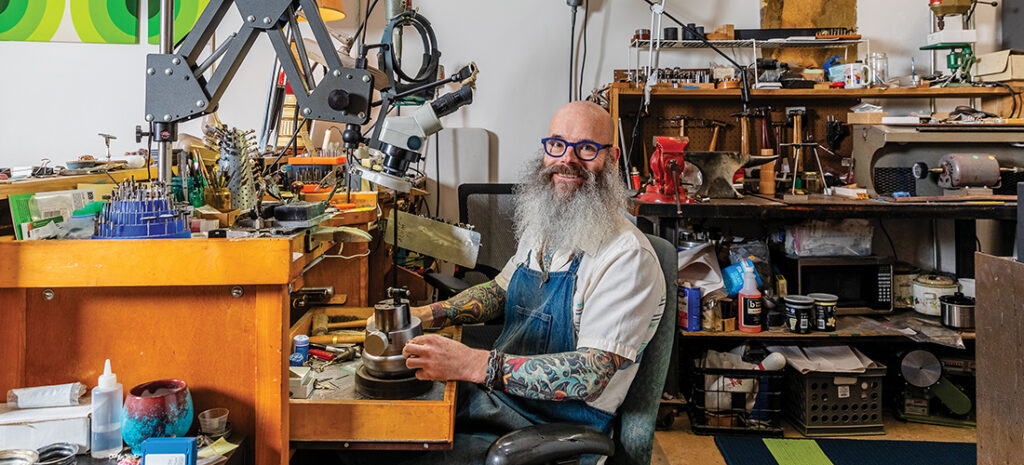
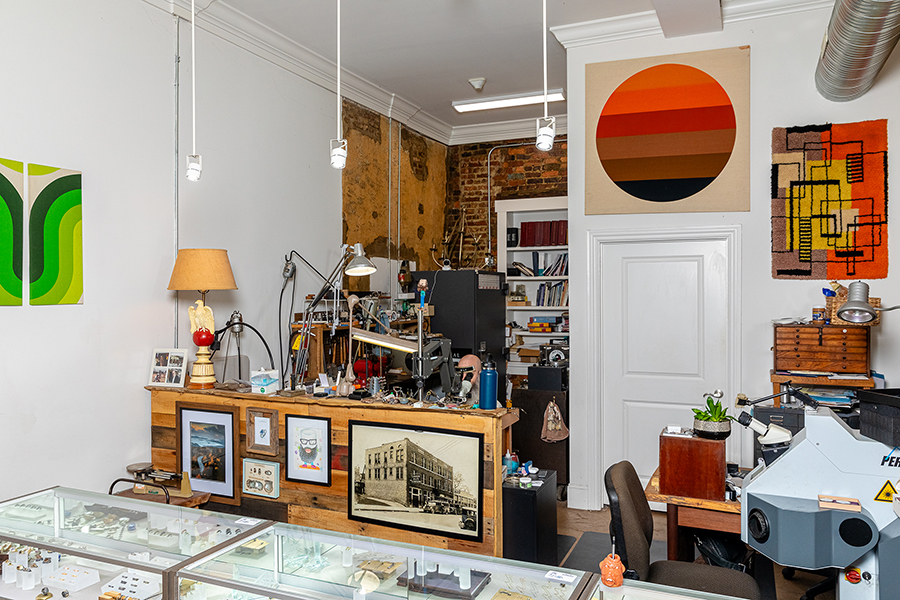
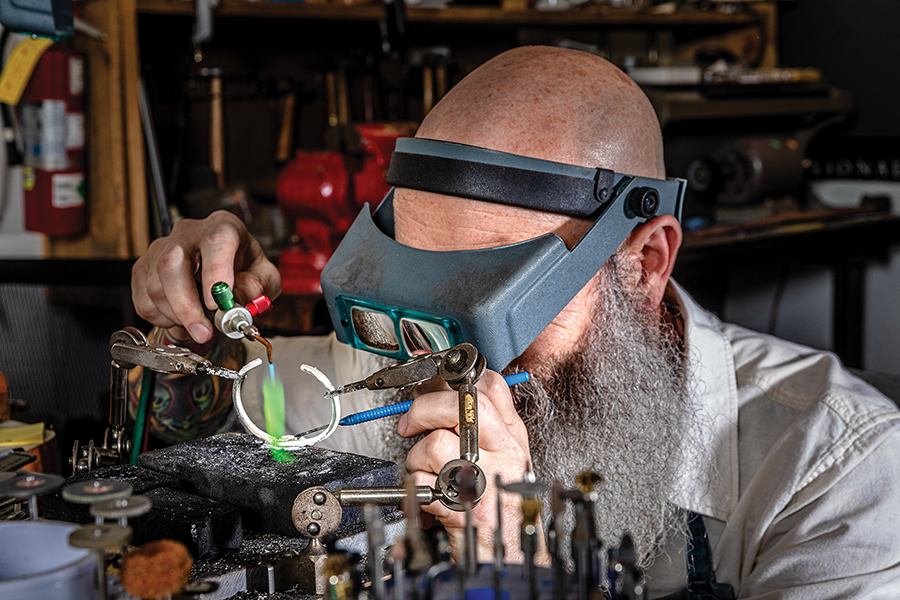
Behind the jewelry case at Jacob Raymond Jewelry on McGee Street sits the artisan and proprietor. His bald head is counterbalanced by a large, full gray beard and atop his long, narrow nose sits a pair of blue-framed glasses behind which dark brown eyes peer outward. The sleeves of his plaid shirt are rolled up to his elbows, revealing tattoos on both forearms. In short, Jake Wosinski, 52, is not someone you’d expect to be selling engagement rings.

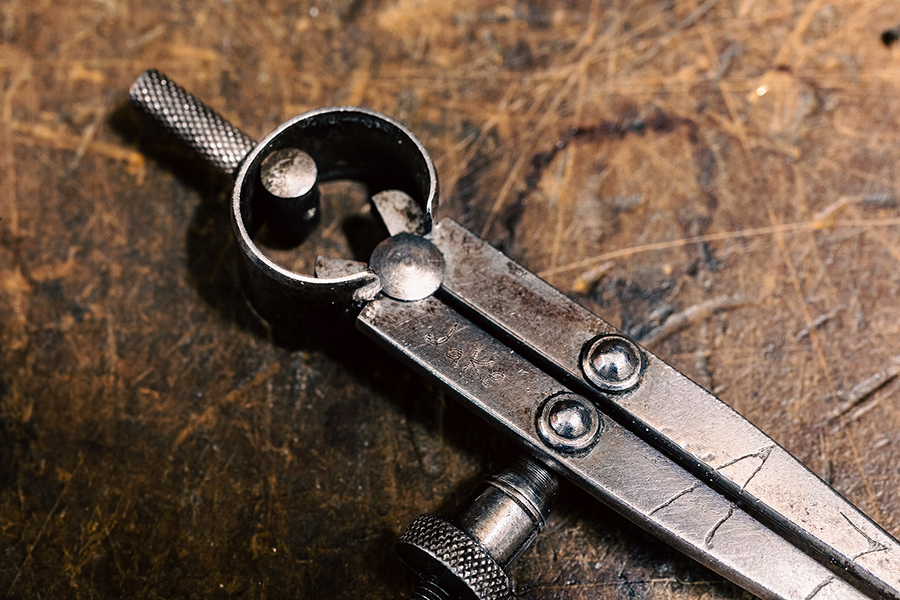
And yes, you read that right: His last name isn’t Raymond. The Raymond in his shop’s name comes from his grandfather — his father’s father — who first sparked his interest in jewelry making. In fact, Wosinski still uses many of the tools he inherited from his grandfather. He holds out a pair of dividers engraved with a patent date of June 2, 1885, by Starrett, a company that Wosinski notes is “still in business in Boston, still making these.” The dividers also feature the engraved initials of those who have used them before. Pointing to a tiny set of curlicue letters, Wosinski says, “And so I scribed my initials on there.”

Among the tools he inherited and uses on a daily basis are these nearly 140-year-old dividers, a large polisher and a steel ring mandrel, which aids in shaping and sizing. While he isn’t sure how far back the mandrel goes, it dates at least to the ’50s because it bears the inscription of a name familiar to Wosinski: George Beaudet.

Beaudet was the jeweler who originally taught Wosinski’s grandfather, Raymond, the craft in Milwaukee, where Wosinski originally hails from. When Raymond moved to California — where Wosinski’s own family headed soon after — he took his skills and tools with him and continued the trade. “I kinda grew up around it,” says Wosinski.

While the first jeweler in the family that Wosinski can recall is his grandfather, he comes from a long line of men who’ve worked with their hands. “Most of my family on my dad’s side were tool and dye makers, or mold makers,” he says.

He thought he’d follow suit, but decided to attend the University of South Carolina Upstate in Spartanburg, where his family had relocated when he was 16. He began working toward earning a degree in English, but the family once again moved, this time to Greensboro. After working for a year, he planned to switch gears and study structural engineering at N.C. State as soon as he qualified for in-state tuition. “But I never made it back [to college].”

Wosinski’s brother, Brad, worked with a bartender who also happened to be a gemologist. Through him, Wosinski discovered the Gemological Institute of America and, at the age of 20, began a correspondence course. The institute would send him gems to identify with equipment he’d purchased — a microscope, a polariscope and a refractometer. From there, he ventured into a gem-cutting class at Randolph Community College.

The class itself bored him, but in it he first learned about the Sawtooth School for Visual Art in Winston-Salem. He enrolled in a jewelry making course that would change his life. “As soon as I took that class, I was like, yeah, this is what I am doing.” At that moment, the dream of having his own jewelry business one day was born.

Had he always been an artist? In training, no. “Maybe I could have done better if I had taken an art class,” he says, “but at the same time, since I don’t have rules of art or whatever, I am just doing whatever I want, thinking more outside of the box.”

A man on a mission, he sold his motorcycle to buy the tools he needed, set up shop in his parents’ garage and tried to get a job working for a jeweler. Lacking experience, “No one would hire me,” he says. “Finally, I went into a jewelry store and said, ‘I will work for you for free. Just let me learn.’” A shop in Winston-Salem took him up on the offer. After two years, he left in search of a paying job. Despite his experience, he still came up empty.

Not willing to give up, Wosinski decided it was time to attend an actual jeweler’s school and left for the now defunct Atlanta Jewelry Institute. Lo and behold, right after graduating, he landed his first paying jewelry job at a Greensboro store where he did repairs.

“But I wanted to make jewelry,” adds Wosinski.

Next stop? A shop in Winston-Salem, where he worked for six-and-a-half years.

“I made lots of awesome jewelry,” he says, “but it wasn’t my design.” At the same time, Wosinski worked on designing and creating jewelry at home, with plans to create wholesale pieces to sell to stores — both one-of-a-kind pieces as well as manufactured pieces that he could reproduce in mass. When he wasn’t at work, he was building his inventory in preparation of launching that business. In the meantime, he’d also gotten married to his wife, Liz, and had three young kids at home to consider.

“It was just too much,” he says. “I thought, ‘I will never see my family.’” Being the sole provider, he opted instead to look for a job where he could continue to hone his skills and offer design services while waiting for “a later date” to pursue a business of his own.

Armed with a collection of his designs, Wosinski went to an interview at a Chapel Hill jewelry store. “[The owner] actually bought $3,500 worth of jewelry at the interview!” Naturally, he was hired and the family relocated to Mebane to be closer to his job. While there, rings he designed won 10 American Gem Trade Association Spectrum Awards. But because it wasn’t his shop, his name was not on the awards.

After 10 years there, “a later date” had arrived. It was finally time to take a chance on his dream. He’d mentioned to his friend, Nate Hall, owner of Legacy Irons Tattoo Co. on McGee Street, that he was contemplating a move back to Greensboro and wrestling with the idea of finally opening his own place.

“He basically said, ‘Well, the jewelry store two doors down? I think they want out of their lease.’”

The landlord, Jeff Yetter, confirmed and put Wosinski in touch with the shop owners.

“We were at the grocery store on a Saturday night and I get a call,” he says. The jewelry store owners were heading out of town for six weeks and told him that if he wanted to come take a look, he could come now. Or he’d have to wait.

“We bought our groceries, went home, hopped in the car and drove to Greensboro.”

As luck would have it, the owners wanted to sell their jewelry cases and safe, items that would have been costly at startup. Everything was outfitted exactly as he’d need it.

He recruited his former Winston-Salem employer to come take a look at the shop and share her thoughts. Her response? “You need to do this.”

It felt as though it was meant to be, Wosinski muses. After working his last Friday in Chapel Hill, he opened the doors to Jacob Raymond Jewelry for the first time the following day and assumed his business, like that of his previous employers, would go “gangbusters from the beginning.”

And? “It didn’t go as planned,” he admits. “I don’t know anything about running a business.”

After a year of commuting from Mebane, the family moved to Greensboro, renting a home and using the equity from the sale of the previous house to survive. Bank accounts dwindling, Wosinski feared that his dream was over, that he was doomed to failure. What are we going to do echoed in his mind.

Liz had left behind her own job with the move and struggled to find employment in Greensboro, but still, she remained supportive.

“That kind of financial difficulty and hardship can make a couple draw apart or fight,” he says. “We just leaned into each other more. And we did a lot of praying.”

Wosinski admits that he holds a certain amount of pride in his natural talent and capabilities. And God was just taking him down a notch, saying to him, “You’re taking credit for things I have done.”

So that financial struggle? “God was just showing me, you may be great at this, but unless somebody comes in the door and buys it, you’re done.” It was, for Wosinski, a lesson in humility.

Slowly, organically, the business picked up steam. Liz now handles the company’s managerial tasks, such as shipping, accounting and banking. “Every year we’ve been here, we’ve grown.” While it’s not the growth he’d envisioned, his circle has widened and he enjoys the sense of community cultivated by downtown Greensboro business owners and regulars. And he’s able to do what he loves— create one-of-a-kind jewelry pieces. Award-winning one-of-a-kind pieces. Since opening his doors, he’s won two awards under his own name: the 2018 Platinum Innovation Award in the evening wear category and the 2020 Platinum Innovation Award in the bridal wear category.

No surprise there. His favorite pieces to create? Engagement rings. “That’s always like, this is for life,” he muses.

His designs begin, he says, in his design sketchbooks. He’s currently on his fourth. Inside, he loosely draws a plan just to get an idea out of his head and onto paper before it’s forgotten. “But then, every time I go to start making a ring,” he says, “other ideas pop into my head.” It’s very rare that a final product matches its original design. And most often, he notes, his pieces are “one and done” — no other in the world exists.

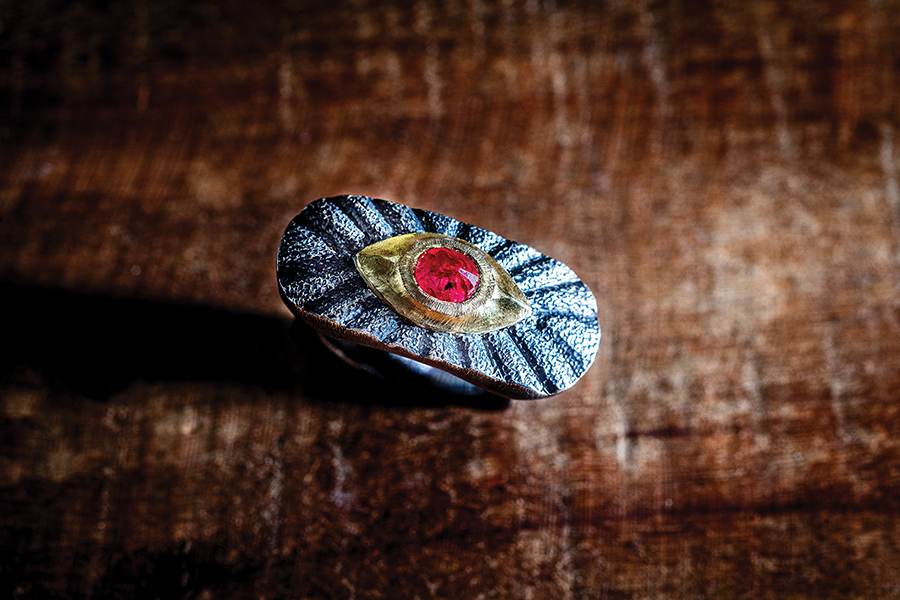
“As you can see, I’m all over the board,” he says, peering over his glass case filled with all sorts of bejeweled oddities. The artist in him appreciates — and designs — in a variety of aesthetics, from Art Deco to his “contemporary estate style. I love doing what I call my ancient style, which looks like something from the Middle Ages or Roman times.” A cuff bracelet looks like something that would have graced Cleopatra’s arm.

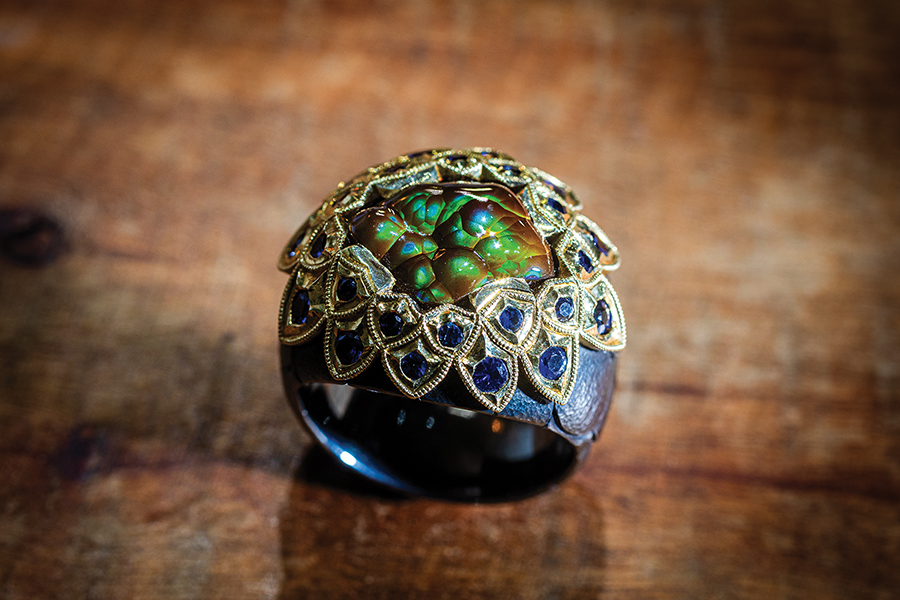
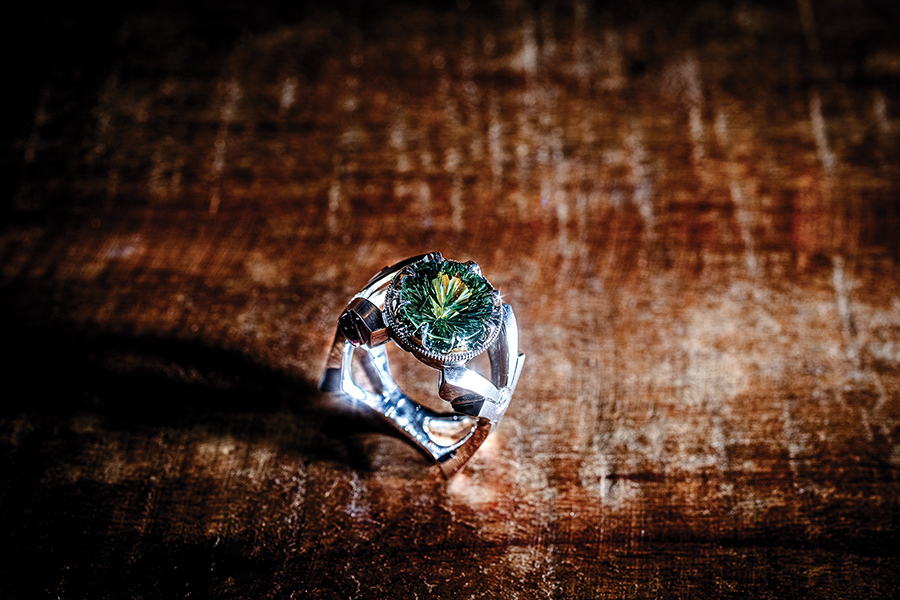
Wosinski loves working with sapphires because of their durability and the rainbow of colors they’re available in, but what really sparks him is fire agate. This rare opalescent stone shines in oranges, greens and purples, and is found in the American Southwest as well as northern Mexico. What appeals to him about this stone is exactly what appeals to customers about his jewelry: “Every one is different.”

Sparked by fire agate’s kaleidoscopic luster, Wosinski is determined to create a market for it. According to crystaldigest.com, fire agate is associated with passion and creativity and “is said to help one actualize their highest potential.”

These days, though most clients come to him locally, he serves several customers across the states — even across the globe. He recently completed two custom pieces for a doctor from the U.K. “He’s been following me on Instagram for years, threatening to have me do something for him,” Wosinski quips. Finally, the doctor made good on his promise and visited the United States, bringing with him a 44-carat lab-grown sapphire and a 22-carat lab-grown ruby. He dropped his gems off in November with plans for a March return and pickup.

With those gems, Wosinski crafted a pendant that resembles an amulet and a ring. The doctor’s reaction? “He was like ‘aaaah’ and I was like, ‘Is that a good aaaah or a bad aaaah?’” Palms sweating, Wosinski stood by with bated breath. “It was a good 30 seconds before I knew that he liked it!” After all these years, Wosinski admits that nerves strike when presenting custom orders.

Back on U.K. soil, the doctor sent Wosinski a message: “Thank you for making my dreams come true in jewelry form.”

As for his own dreams? He’s still taking it day-by-day. Since 2017, he’s had only one employee other than himself, and that’s his dad, who — much like he once did — works for free. “I pay him with pretzels and peanuts,” he says with a laugh.

He hopes that perhaps his own 23-year-old son will take an interest and join him down the road. No pressure, though: “We all have our path that we need to go,” he notes.

The ultimate goal is to have a team of employees who can work with clients on custom orders but also create pieces of their own design. He dreams of one day employing jewelers he can mentor, and yes, they’ll be allowed to label it with their own names.

But he’s not there yet. “I can still go two days and not have anybody walk in.”

Just then, the shop door chimes, announcing a customer.

“Hi there!” Wosinksi greets her. “What can I help you with?”

“I want you to make me a ring,” she answers. She tells him that her daughter, a client, says he’s the go-to guy to for custom work.

Woskinski’s face lights up at the opportunity to make her something, something beyond anything she could ever imagine.  OH


One and Done

In 2003, just before our wedding, my soon-to-be-husband, Chris, and I stepped into a tiny jewelry shop in New Orleans. Our mission? The rings, with which we’d wed.

As we perused the glass cases, Chris selected a simple, wide, gold band for him. And for me? I looked up and down that store, waiting for something to speak — no, sing — to me. After all, this was eternity we were talking about here!

In the end, under the pressure of time, I chose a $40 plain, gold band “for now” that was similar in width to the diamond ring that had been handed down from his grandmother and which I happily wore for years. It was made from simple, yellow gold, with a solitaire diamond. (I’m told her first ring was prettier, but she lost it in the ocean.)

For years, I was too busy raising kids to think about replacing my “for now” ring with my “forever” ring. Though I loved honoring tradition, truth be told, the diamond was constantly snagging on things and I was afraid I’d be responsible for losing Chris’ grandmother’s second diamond. Buying a third was not an option at the time, so I took it off.

When we moved to Greensboro in 2019, Liz Wosinski reached out to me via Instagram messenger to introduce herself. She’d been following me there and, as it turned out, lived in my neighborhood. She told me about her jeweler husband, Jake, whom she was very proud of, and I immediately followed him on Instagram, showing Chris his art.

Of course, shortly after that, the pandemic hit. Finally, in February 2022, 19 years after shopping in New Orleans, Chris and I walked into Jake’s McGee Street establishment. My wish? Something unique — anyone else an Enneagram 4 out there? — that would use the gold and diamond from my existing bands to create one wider ring. And this time, an organic style with mixed metals, because sometimes ya feel like silver and sometimes ya feel like gold. Plus, the diamond needed to be inset and snag-free.

Just eight weeks later inside the walls of Jacob Raymond Jewelry, Chris slipped a work of art onto my finger. The diamond, encircled in gold, sparkled along with the silver of the band. It hasn’t once gotten snagged on anything. But the best part? Knowing that my ring, as well as my marriage, is “one and done,” as Jake says.
— Cassie Bustamante

Art of the State

Art of the State

Wild Clay, Ancient Art

Takuro and Hitomi Shibata shape pots — and their community

By Liza Roberts

Eighteen years ago, when ceramic artists Takuro and Hitomi Shibata moved to Seagrove from the ancient pottery village of Shigaraki, Japan, they had with them nothing but a couple of suitcases, a rescued stray cat and plans for a short adventure.

Today they are pillars of the community. Hitomi is a respected and prolific Seagrove ceramic artist, and Takuro, a fellow potter and the procurer and refiner of most of the area’s local clay, is a community fulcrum. They live with their two American-born sons on Busbee Road in a striking modernist house designed by a protégé of famed architect Frank Harmon, built in part with their own hands. Their wood-fired kilns are a stone’s throw from its front door, and the tiny farmhouse where they first lived on the property now serves as a gallery for their work. Their former garage is now their studio.

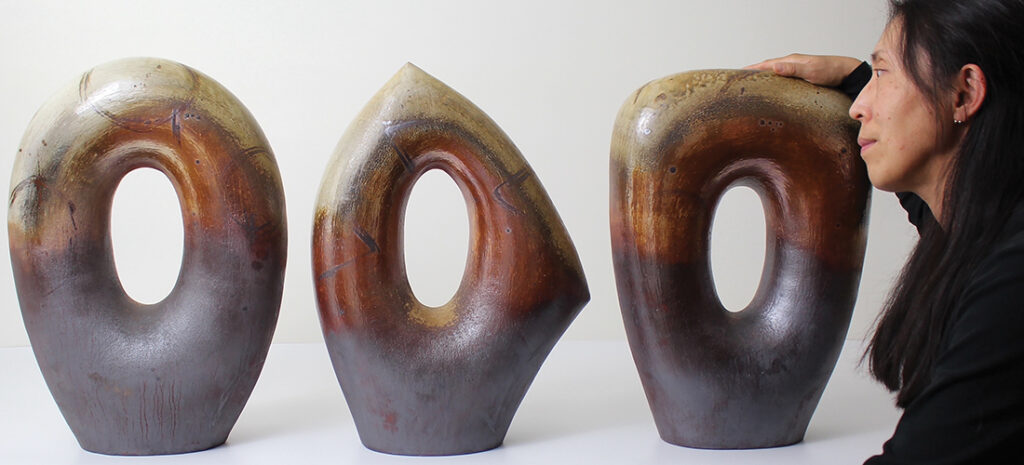
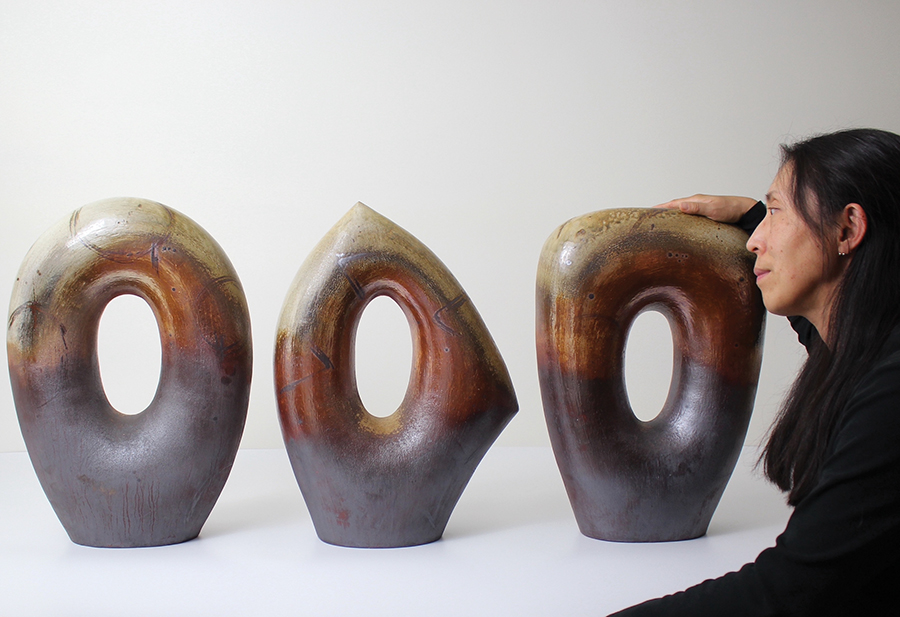
The art they make here and sell under the Studio Touya name is distinctly their own. Hitomi’s sculptural pieces have the rounded, organic shapes of abstract feminine nudes. Takuro’s are distinct for their architectural geometry, acute angles and jutting planes. It’s impossible to see the couple’s pieces side by side and not admire the harmony of their yin and yang. 

A reverence for local clay is at the heart of the couple’s individual art and their mutual business. They put that shared love and knowledge into Wild Clay: Creating Ceramics and Glazes from Natural and Found Resources, a book they co-wrote and published with Herbert Press in 2022. Its publication took their local story to an international audience, changing their business and their work in the process.

“We have been very busy doing more exhibitions and workshops outside of North Carolina, nationally and internationally,” Hitomi says. “Especially after releasing our book, we were invited to ceramic conferences, meetings and workshops to talk about our clay stories from Shigaraki to North Carolina.” When so much time on the road meant less time for making pots, the couple decided to refine their work. “We tried to improve the quality of our art,” Hitomi says. “Also, using beautiful wild clays and natural materials, which we have been doing for many years, became even more important for our artistic practices.”

Finding Home 

The couple credits the Seagrove community and its native clay for nurturing the art they originally learned in Shigaraki. The first time they saw this place, they had a feeling it would be important to them. “We were surprised,” Hitomi recalls. “There were so many pottery studios. We realized Seagrove was the biggest pottery community in the United States.” 

They’d come down from a Virginia artist’s residence on a Greyhound bus at the invitation of Nancy Gottovi (now executive director of nearby arts hub Starworks) and her husband, Seagrove potter David Stumpfle, who had visited Shigaraki a few years earlier.

The Shibatas loved what they saw, but their visas were up.

Two years later, Gottovi called again. She was working with Central Park NC, an organization dedicated to preserving the natural and cultural assets of central North Carolina, and offered Takuro, who has an engineering and chemistry degree, an opportunity to establish a clay factory to serve Seagrove’s potters.

The Shibatas jumped at the chance. People in Seagrove, they believed, truly understood the value of pottery. In other places, Hitomi says, “people love art, but they don’t think that pottery is the same thing as art. But here, people are so crazy about pottery. They love the tradition, they have so much appreciation . . . it’s part of the history of the state.”

The Pottery Ecosystem

Today, Starworks Ceramics is an integral part of the Seagrove pottery ecosystem, and it’s growing. “We went through a tough time during the pandemic,” Takuro says, “but now we have more people working, and it’s a great team. Our clay is getting more popular, and potters and artists support not only our clays, but the story of a clay factory.”

The process is laborious: Takuro takes raw clay dug from the earth and turns it into a viable material. The equipment he and his assistants use to refine it is massive and low-tech, the stuff of a fairy-tale giant’s bakery. Some of it is from the 1940s. There’s a shredder, a mixer, a separator and a vibrating screen; there are things called filter presses and pug mills. All of it fills a cavernous warehouse room. Massive buckets of what looks like sticky dirt go in one end; several days of man and machine power later, neat clay cubes come out the other. These cubes are sold in increasing numbers to potters in Seagrove and around the world.

“Using wild clays for pottery in the studio is a growing trend in American ceramic art education and in small pottery businesses,” Takuro says. “It’s good for people to think about sustainability and the environment. However, these methods have been used and improved for thousands of years all over the world. Nothing is new.”

He hopes his clay and the couple’s book inspires more potters around the country to learn about the clay histories in their own regions: “Our clay story is very personal, and our clay experience doesn’t cover all wild clays, but we heard from readers that many places in the world have interesting histories, communities and people who work in clay. We believe clay is universal.”

At the same time, Takuro knows that what makes and sells at Starworks can’t be found just anywhere. “North Carolina clay is special,” he says. “It’s high in silica, it can be fired at high temperatures and it is from this place.”  OH

This is an excerpt from Art of the State: Celebrating the Art of North Carolina, published by UNC Press.