Wandering Billy

Wandering Billy

Remembering Gangrene-sboro Days and Nights

Or how to get your foot into show business

By Billy Ingram

“They [The Beatles] had no idea who we were. I walked over to John Lennon and said, ‘John, a lot of people mistake me for you.’ He laughed. I had the Zulu haircut. There’s a great photo of them playing with my hair.”     — Marty Allen

The first superstar I ever met was Andy Williams, who bounced me on his knee at The Plantation Supper Club on High Point Road, or so my parents reminded me ad infinitum. I was 2 years old at the time. Ten years passed before I met another celebrity . . . and I’ll wear the scar from that encounter until my dying day.

Early one Saturday morning in 1968, I found myself pedaling barefoot up Northwood to Greensboro’s newest Winn-Dixie at (what is now) 1616 Battleground, a large retail center fronted by Main & Taylor and Huntington Learning Center. The reason? On hand to greet the fine folks entering the home of “The Beef People” that day, Winn-Dixie had booked Las Vegas comedy headliners Allen & Rossi. No idea why. Maybe they were playing the Plantation.

Even though Allen & Rossi’s blunt-force attempts at laughter largely left me cold, I still wanted to roll my grapes over two real Tinsel Town TV stars. Comedian Marty Allen and singer Steve Rossi blended their two disparate acts in 1957, not-so-coincidentally a year after the incredibly lucrative Dean Martin and Jerry Lewis nightclub act busted up. As a result, Allen & Rossi became the most successful of a multitude of Martin & Lewis imitators that chased that improbable dream of sold-out club dates and marquee dominance. Like Deano, Steve Rossi was a handsome, statuesque Italian crooner (“Al Di La”) plagued with a befuddled-looking, bushy-headed nincompoop, Marty Allen, complete with his own lame catch phrase: “Hello Dere!”

A mainstay of The Ed Sullivan Show, Allen & Rossi were on the broadcast the night The Beatles made their American debut. Infiltrating some 700 talk and variety shows in the ’60s, they were perhaps best known for the summer of ’66 big screen flop The Last of the Secret Agents?, a lethargic James Bond spoof where Nancy Sinatra languished as the film’s femme foil. That movie was directed by a true legend — a guy I had the pleasure to collaborate with years later — Norman Abbott (The Munsters, Sanford and Son).

In one of mankind’s greatest leaps in technology  — that is, until the impending moon landing — when Winn-Dixie customers at this location stepped on a rubber mat at the entrance, those heavy, metal-framed doors whooshed open automatically. Land o’Goshin, I don’t believe anyone ’round here had ever witnessed such a mechanical marvel. At least, I hadn’t. When those doors swung open with no effort for the little old lady in front of me, she stopped, looked skyward, then whispered, “Thank you, Jesus.” (I may be wrong, Big Bear at Lawndale could have boasted the first automatic doors, but bear with me.)

As I approached the famous comedy team, who were meandering by WD’s meat display, Allen spun around unexpectedly, crushing the big toe on my left foot under the heel of his impeccably shined black, patent-leather shoes, the kind I’d only seen gangsters wear in movies. As I cried out in pain, Allen sneered, looked over at his partner, muttering under his breath, “Can you believe people walk around barefoot in a grocery store? What kind of hick town is this?!?”

In all fairness, it really wasn’t that unusual for kids to wander around everywhere shoeless back then, before “No Shirt, No Shoes, No Service” signs began popping up. I probably wasn’t wearing a shirt either.

Pedaling painfully home, I showed the injured toe to my dad, who declared it fine. A week later socks began sticking to that scabbed-over appendage, but my parents, who, as was the style of the day, took an arm’s length approach to raising children, assured me everything would be OK. When red vines began creeping up my leg, I once again asked if this was still in the vein of what they considered normal. Dad, who had served in the Army (quite literally, he was a Mess Sergeant), recognized immediately that a serious infection was underway. We secured an emergency appointment with a podiatrist, who told us in no uncertain terms, “Obviously the foot will have to go, but we might be able to save the leg.” I told the doc, “Oh, heck no! That’s not gonna happen.”

That podiatrist proffered what admittedly was a long-shot solution: There may be a chance to save my foot by soaking it in scalding water and Epsom salts pretty much every waking hour. Doc operated on my big toe, carving away the worst of it, as well as half of the toenail in the process, then wrapped that melange in so much gauze I had to cut an opening out of the tip of my left Topsider to accommodate the bulk.

Returning to Mendenhall Junior High (Home of the Mustangs!) on Monday, teachers were sympathetic to my plight, until I limped into Coach Loflin’s gym class. Perpetually clad in a gray polyester polo shirt with the requisite whistle around his neck, Loflin was a pretty decent guy, sterling I suspect, but had this annoying habit of bestowing demeaning nicknames on classmates who weren’t athletically inclined; his chosen epithet for me was “Stick” (I was skinny, sue me). That wasn’t so bad. He referred to another kid as “Chigger.”

Spying my crutched hobble upon entering his inner sanctorum, Loflin bellowed, “Everybody gather around!” then whistled. “Stick is trying to get out of gym class with some dumb stunt or another.” So sure I was faking, Coach instructed everyone — even the girls dressed out in their faded blue bloomers — in the gymnasium to assemble around me as he knelt down and began unbraiding that bulbous bandage.

As yellow hues that Pantone still hasn’t replicated slowly emerged, Loflin glared up at me and said, “You’re good, Stick, but I’m onto you!” He continued unraveling until coming close to the bloody red center of my tootsie pop — then he began re-raveling.

Mere months after rubbing elbows and toes with the rubes at Winn-Dixie, Allen & Rossi split up suddenly. Exiled to a kitchen stool mornings and evenings before and after school, I dunked my digits in that scorching Epsom salt brew for a month or so before getting the podiatrist’s all-clear.

One would have to employ the Hubble Telescope to detect what is today a minute defect on the toe of what many forensic pathologists consider to be a flawless physique. That minor imperfection nonetheless serves as a daily reminder to steer clear of two-bit gagsters wearing mobbed up footwear.  OH

Of the six books published by Billy Ingram thus far, two are (mostly) about Greensboro history — Hamburger² and Eye on GSO — both breezy summer reads. The author can frequently be found weekends enjoying the lobster bisque at The Pied Pier.

Almanac June 2024

Almanac June 2024

June is a luscious muse, generous with her wisdom, lips to the ears of all who seek her.

Want to know how to dance? Move as the dragonfly moves, she whispers, guiding your eyes to shallow waters. Iridescent wings shimmer in hypnotic circles. The pond reflects the magic back.

In the meadow, the muse beckons a gentle wind. Be danced, she sings among the rolling grasses. Let the movement find you.

Artists: Dip your brush in milkwort and rosinweed. Watch sunlight transmute meadow-beauty. Express with the boldness of spider lily.

Poets: Attune to the frequency of bees. Can you taste the earth through your fingertips? Spend the day supping honeysuckle and catmint, then cover your legs in clover pollen.

It’s all for pleasure, the goddess intones. You cannot do it wrong.

See for yourself.

Study the language of lark sparrows. Become fluent in butterfly pea and blooming thistle. Chime in with a choir of cicadas.

Dress yourself in Queen Anne’s lace. Map out the route of a swallowtail. Translate the essence of snap beans and squash blossoms.

Let listening be an artform. Or seeing. Or tasting. 

How fully can you receive the richness of sound and color? The texture of nectar on your tongue? The depth and sweetness of these early summer days?

It’s simple. Surrender to the wild beauty. Let it move you. This is the mastery of June.


It was June, and the world smelled of roses. The sunshine was like powdered gold over the grassy hillside.   — Maud Hart Lovelace, Betsy-Tacy and Tib, 1941

Night Bloomers

The full strawberry moon rises on Friday, June 21 (one day after summer solstice). What could be dreamier than a near-full moon on a midsummer’s night? Enter the moon garden. Breathe in the earthy-fresh fragrance of evening primrose (Oenothera laciniata). The sugary sweetness of moonflower (Ipomoea alba). The citrus-laced ecstasy of night-blooming jasmine (Cestrum nocturnum).

While not technically a night bloomer, the timeless aroma of gardenia (Gardenia jasminoides) is anything but subtle. Awash in the gentle glow of moonlight, the delicate white blossoms of this evergreen shrub are a wonder to behold. Linger among them. Tell them the quiet longings of your heart. If you lean close, you just might hear their secrets, too.

Puck & Co.

Nature spirits have long been associated with the magic of summer solstice. Fae folk in particular. But what kind of mythical being is that?

The rosy maple moth is as storybook as it gets. With its woolly body, bushy antennae and candy-like pink and yellow coloration, this small silk moth is nearly unmistakable. As its name implies, maple trees are the preferred host for this visual wonder, which can be seen fluttering near forest edges throughout the state.

Perhaps you’ll catch a glimpse of one this month. Though who’s to say it won’t be Puck, stirring up a bit of mischief?  OH

Pleasures of Life Dept.

Pleasures of Life Dept.

The Kindness of Strangers

Found in unlikely places

By Ronald Winter

Note from the editor: This was our 2023 O.Henry Essay Contest winner.

I suppose I should tell you right away that this took place during a war, and wars are more likely to make the evening news for acts of inhumanity rather than human kindness.

It was November 1968 in Quang Tri, South Vietnam, a beautiful place that at the moment in question for many was lethal. The U.S. Marine Corps maintained an airstrip there that served as a staging point and northernmost helicopter base for operations in the Demilitarized Zone or the Laotian border, both of which were major infiltration routes for communist troops from North Vietnam.

I arrived there in May with the Marine helicopter squadron I had joined nearly two years earlier in Camp Lejeune, North Carolina. Since then, the tide had definitely been turned against the communists after the so-called “strong points” defenses envisioned by the former Secretary of Defense had been replaced by a highly mobile interdiction strategy, which required lots of helicopters flying thousands of missions.

But on Nov. 28, 1968, Thanksgiving Day, the action subsided as a mutually agreed upon, and mutually distrusted, ceasefire took place for 24 hours. I had been trained as a helicopter electronic/electrical technician, but also volunteered to fly as a door gunner. So each month I spent half of my time fixing helicopters and half flying in combat.

But on this day, our job was to simply deliver canisters of turkey, potatoes, stuffing, cranberry sauce, gravy, desserts and beer to outposts and landing zones in our area. The aromas of  those meals tantalized us all day as we visited landing zone after landing zone, giving the Marine infantry the first hot meal many had seen in weeks, if not months, making it the toughest duty I had seen in the more than 200 missions I had completed thus far.

By mid-afternoon we were done, and it was back to Quang Tri, where the Seabees had completed construction of a mess hall for us. We couldn’t wait to dive in to our own Thanksgiving dinners. After our post-flight duties, a group of us headed for the mess hall where, to our dismay, we found not a noisy jam-packed hall full of Marines scarfing down turkey dinners, but an empty building and, even more distressing, a barren chow line, devoid of anything but crumbs left from what obviously had been a sumptuous feast.

I think we went into a collective shock, which wasn’t helped when we approached the mess sergeant, a senior NCO, asking where the meals were for the flight crews. “Should have gotten here earlier,” was his caustic, wholly uninformed and certainly unsympathetic reply.

We drifted back to the squadron enlisted living area as dejected a group of Marines as could be imagined. It looked as though C-rations was going to be it for us — packaged meals that are unappetizing at best, even when heated, and not belonging in the same universe as a turkey dinner.

As I sat on my cot and pondered the ramifications of what we had just experienced, the door to my hooch burst open and in strode Billy Bazemore, another electrician and a relative newcomer to the squadron, who also had been flying that day and had just discovered that in his absence mail had been delivered, including packages from home. Billy, who had an incredibly ebullient personality, especially considering our current situation, triumphantly reached under his cot, pulling out package after package.

He displayed a large, precooked, canned turkey and more containers with potatoes, gravy, cranberry sauce — yes it was the canned variety, but really, where were we going to cook up fresh cranberries in that environment? — and more.

At his invitation a half-dozen of us gathered around Billy’s cot, bringing our own contributions from hoarded C-rations — pound cake, peaches, fruit cocktail, even turkey loaf — and adding them to the growing feast. Then the hooch door opened again and in came another electrician, Tommy Lenz, carrying an armful of Lone Star beer in 12-ounce cans that had been arriving from his mother in small batches to escape detection. He had been secretly saving them for such an occasion. Where Billy was outgoing, Tommy was taciturn, tall and lean — a Texan. But he had a huge smile on his face that day!

And just when we thought we had it all, I discovered that I too had received a package. Upon opening it I found to our great joy a Sara Lee chocolate cake that, thanks to modern chemical preservatives, not only survived the 12,000-mile voyage from upstate New York intact, but arrived reasonably fresh!

Most of us didn’t know the benefactors, who realized that Thanksgiving in a war zone might be difficult and did something about it. But they rescued the day for us and I have never forgotten our appreciation for them.

I wish I could say that this story has a happy ending, but five months later, on April 22, 1969, Tommy and Billy were flying as gunners together near the DMZ when their helicopter was hit by a command-detonated mine as it settled into a landing zone. They both died.

A month later, with more than 300 missions under my belt, I left Vietnam, physically unscathed. But more than five decades later, I still remember that Thanksgiving with far more detail than any other holiday meal during my time in the service.

I have lived a good life, far away from the war, in both time and distance, but I haven’t forgotten the people who created a memorable day for a bunch of Marines they never knew. And every Thanksgiving I stop for a moment, by myself, with no fanfare, and quietly raise a glass to them, and to Billy Bazemore and Tommy Lenz, to say, “Thank you. Semper Fi!”  OH

Ronald Winter is an author, www.RonaldWinterbooks.com. He is a decorated Marine Corps Vietnam veteran who spent nearly 20 years as a print journalist, earning numerous awards and a Pulitzer Prize nomination. He is a public speaker, competitive powerlifter and media relations specialist, living in Eden, N.C.

O.Henry Ending

O.Henry Ending

A Fairytale Ending

I Think That I Shall Never See Myself as Other Than a Tree

By  Christine Garton

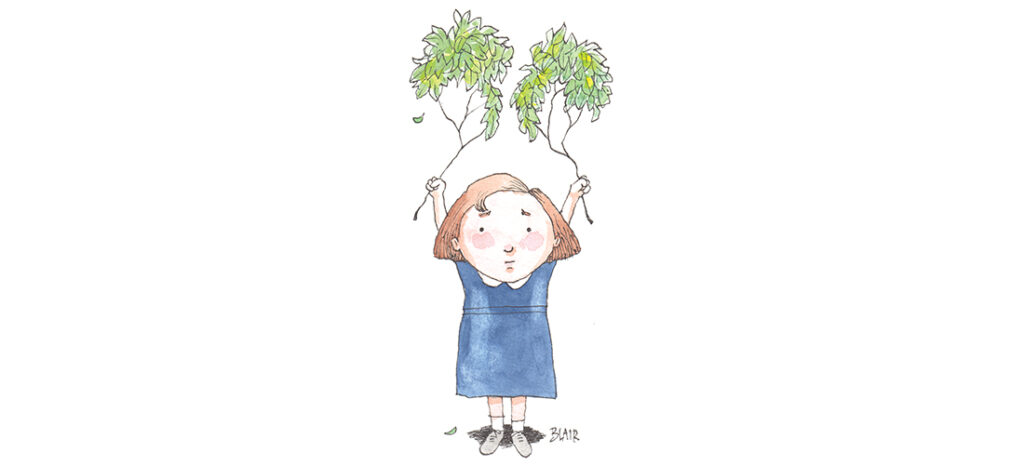
Our fourth-grade Christmas pageant offered an opportunity I yearned for — the role of a fairy! While I dreamed of wands and sparkling wings, I knew I would face competition from my pixie-like classmate, Anne. For days I practiced flitting about while singing, “I’m a fairy, so light and airy.” Alas, Anne received the fairy assignment, and our teacher proclaimed that “a big ol’ healthy girl” like me would play . . .  a tree. “Well,” Mother said, “maybe you will be draped with tinsel and wear a star on your head.” No. I was to wear my blue velveteen Sunday school jumper, stand in one spot and utter one line.

I first met Anne when the black taxicab picked us and the other 4-year-olds up for delivery to Mrs. Teensy Davis’ in-home nursery school. Memories of that year consist mainly of finger painting and two horrid little boys who terrified me by saying they were going to climb under the hood of Daddy’s car and kill him. For some reason my father did not take this as a serious threat, but Anne consoled me and thus became my friend.

The following year, Anne cut through her backyard to meet me, and together we walked to kindergarten. Anne was a tiny girl with blonde, Alice-in-Wonderland hair she wore in braids. At her temples I saw delicate blue veins, like rivers on a map. Mother said Anne was born “premature,” which I interpreted as “dainty.” Built like a fireplug with a Dutch-boy bob, I longed for braids like Anne’s, so I nagged Mother into allowing my hair to grow. Although the resulting plaits were so thin that rubber bands slipped off the ends, Scotch Tape worked just fine.

I coveted the sleek, black penny loafers Anne wore in first grade. I hated my spud feet, clad in sturdy, lace-up, tan Hush Puppies, and hooked my ankles around the legs of my desk to keep them out of view. I campaigned to convince Mother to buy me loafers. “You’d tear them up in a week,” she said. In retaliation, I rode my bike for an hour, dragging the toes of my Hush Puppies along the pavement, but the shoes were indestructible.

The after-school YMCA program yielded no outlet for my inner Thumbelina. President Kennedy had determined that America’s youth were soft, so an intense fitness regimen was inflicted upon us: “Go, You Chicken Fat, Go!” We performed sit-ups and jumping jacks. Bird-like, Anne flew to and fro in the potato relay as I plodded behind on turkey drumstick legs. I could barely hoist myself halfway on the climbing rope, while Anne skittered up and down like a spider.

I mostly gave up any notion of being like Anne. I worked at kicking a ball hard and swinging a softball bat. I beat up the runty boy across the street who called me “Moose” and eventually outgrew my stocky phase.

Years later, reeling from an abrupt end to my marriage, I found myself rearing a son on my own. No time for fairies, daily life was consumed with his care and paying the bills. But I was determined to make sure my boy was rooted securely by his mother’s love.

In his early teens, my son applied for a job at the boys’ summer camp he had loved throughout childhood. One day, I received an unexpected phone call from the camp director wanting to discuss a junior counselor position. “You know, Grey had to describe his hero on the job application,” he said. “His hero is you.”

My perplexed silence prompted him to continue.

“He wrote about the big tree in your backyard where you hung his swing. He said like that tree, you are strong and give him support, but with the swing, you also let him fly.”

After thanking him and hanging up, I pondered this revelation: Was I wrong all along? Perhaps being a tree was not the indignity I’d thought.  OH

Christine Garton is a staff writer for UNCG’s Advancement Communications. She holds great pride in the fact that her son earned the rank of Eagle Scout, albeit with her foot planted firmly on his derriere . . .

Tea Leaf Astrologer

Tea Leaf Astrologer

Taurus

(April 20 – May 20)

While it’s true you tend to be a bit self-absorbed, who can blame you? Ruled by the planet of love, money, romance, art and beauty, your sensual nature is part of what makes you so utterly magnetic. This month, both Venus and Jupiter will amplify your charm factor, creating a “golden ticket” effect in relation to your wildest longings. Here’s the catch:
You’ve got to be willing to ditch your plans.

Tea leaf “fortunes” for the rest of you:

Gemini (May 21 – June 20) 

Choose a focal point.

Cancer (June 21 – July 22)

One word: hummingbird.

Leo (July 23 – August 22)

Just take the ride.

Virgo (August 23 – September 22)

Step away from your comfort zone.

Libra (September 23 – October 22)

Expect a miracle.

Scorpio (October 23 – November 21)

Try slowing down.

Sagittarius (November 22 – December 21)

Mind your tone.

Capricorn (December 22 – January 19)

Read the care instructions.

Aquarius (January 20 – February 18)

Find your true north.

Pisces (February 19 – March 20)

Dust the fan blades.

Aries (March 21 – April 19) 

Let the butterfly come to you.   OH

Zora Stellanova has been divining with tea leaves since Game of Thrones’ Starbucks cup mishap of 2019. While she’s not exactly a medium, she’s far from average. She lives in the N.C. foothills with her Sphynx cat, Lyla.

Omnivorous Reader

Omnivorous Reader

Sweet Memories

A year on the journey to adulthood

By Jim Moriarty

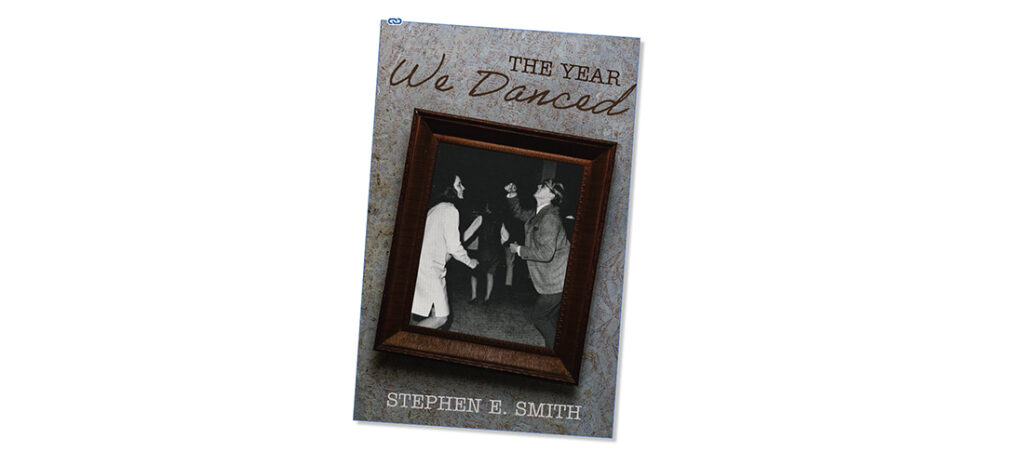
My freshman year in college was nothing like the one Stephen E. Smith writes about in his memoir The Year We Danced. And yet it was exactly the same.

For any memoir to rise above the level of that dusty old book sitting on the mantel in your grandchildren’s house, it has to reach a level of universality — no easy feat — and The Year We Danced does it without breaking a sweat. Except on the dance floor, that is.

Written with a touch of humor and a bit of heartache by one of North Carolina’s finest poets, Smith’s tale of his freshman year at, then, Elon College in 1965-66 is sweet without being sentimental, poignant without being preachy. While simultaneously being tethered to and free from his family back in Maryland, and with the escalating war in Vietnam a kind of constant buzz in the background, The Year We Danced is nothing less than the launchpad of a life, a survey course in Adult 101 — complete with its own soundtrack. Along the way we’re introduced to an endlessly entertaining cast of characters, drawn by Smith in distinctive, rich detail.

Smith’s father, the boxing coach at the U.S. Naval Academy, had taken control of his son’s college admission process in March and delivered the results in June like an uppercut:

“We were devouring Mrs. Paul’s fish sticks and oven-baked frozen French fries smothered in Hunt’s ketchup, our standard Wednesday evening fare, when he stared at me across the dinner table and stated matter-of-factly, ‘You’re going to North Carolina in the fall.’

“I froze in mid-bite, a flaky chunk of trans-fat-engrossed fish stick balanced on my fork. ‘I am?’

“‘Yeah, you’re going to Elon College,’ he continued. ‘It’s far enough away that you won’t be running home every fifteen minutes.’”

We are introduced to Grandma Drager, who “never forgave her wayward first husband and never passed up a chance to deliver a sermon on the evils of drink,” who travels 350 miles by bus to hand-deliver to a young man about to venture forth into the world a baffling bit of wisdom in six words, memorable only in their towering insignificance — “Promise me you’ll wear tennis shoes.”

Once at Elon, where Smith’s father delivers both him and the message that he doesn’t expect his son to make it through the first semester, Stephen meets his roommate, Carl, who has arranged his shoes in the closet alphabetically by brand and has a pricy collection of 30 or 40 bottles of men’s cologne in parade formation on top of his dresser. “Unfortunately, Carl was the loquacious sort. He was going to sign up for physics and run for class president in addition to majoring in German. Then he started in on his personal life. I had no choice but to lie there in the dark and listen to him brag about his girlfriend, who was a freshman at a college in Virginia, and how they were going to get married before the year was out, a notion that struck me as utterly demented.”

As it turns out, it becomes clear rather quickly that Carl could have benefited from one, or several, of Grandma Drager’s exhortations on demon rum. “In the time we shared room 218, Carl never once exchanged his sheets for clean ones, and the pile of dirty laundry on his desk had spilled onto the floor beside his bed and included many of the garments he’d so neatly arranged in the closet on the first day of orientation. He’d sold off most of his bottles of cologne for beer money, and, as nearly as I could determine, he’d quit going to class altogether.”

On the plus side, Carl became the subject of an essay written by Smith for the spine-chilling professor of English 111, Tully Reed. Smith picked a subject he knew and wrote the hell out of it. When the “The Making of a Derelict,” with copy as clean as anything that ever ran in The New Yorker, gained nothing better than a C– (the highest grade in the class), Smith screwed up the courage to find Tully in his office and ask the fearsome man why.

“‘It’s not A or B work,’ he said, shaking his head, ‘not for a college freshman.’ He handed me my essay, took a drag on his Lucky Strike and returned to slinging red ink.”

Smith’s dance partner, and surely one of the first honest loves of his life, is Blondie, an upperclassman (they weren’t gender neutral in 1965), who can power drink a PBR and dance until curfew, if not dawn. At their favored club, the Castaways, she takes flight. “As I watched, the simple truth dawned on me: We might be at a club where there was only one acceptable dance step, but if Blondie didn’t want to dance the Shag, she didn’t have to. She was beautiful, unique, and she didn’t give a damn about attracting undue attention. She wasn’t there to prove herself to anyone; she was there to have a good time, and she intended to do just that.”

Also unique, and on the other end of the spectrum from the fearsome Tully, was another English professor, Manly Wade Wellman, a prolific author who would eventually call the Sandhills home, just as Smith would and does. “Wellman was barrel-chested and wide-shouldered, his graying hair combed back from his broad forehead. His round, open face was accentuated with heavy eyebrows and a prominent nose below which was cultivated a tweedy, slightly skewed Clark Gable mustache. What was immediately appreciable was the peculiar way in which his eyes reflected light. The very tops of his dark irises flickered, suggesting an inner illumination. . . . If Wellman was insistent, he was also endearing. I was immediately convinced that this guy had a sincere interest in who I was and what I thought. He wanted to know about my latest writing project as if it were of immense concern to the literary community. ‘What are you working on?’ he asked.”

In a few short months, Smith had met both the carrot and the stick.

In the end, Blondie moves on. As all of our Blondies do. Then Smith gets the news that a boyhood friend has been killed in combat. “The spring of ’66 was early in the war, and although the weekly casualties were the highest since our involvement in Vietnam, I doubted anyone at Elon could name a friend who’d died in that distant war. I kept the news to myself.”

But not the sense of helplessness and futility. “I reviewed the times Barrie and I had spent together, my memory sliding from one image to another in no particular sequence — the hours playing hide-and-seek on dusky evenings in the little town of Easton, Maryland, the summer days I visited with him in Salisbury, where we skipped stones from the banks of the Wicomico. But what I remembered most vividly was a summer afternoon in 1957 — we were both eleven — when Barrie and I were singing our favorite top ten rock ‘n’ roll songs and I mentioned that I was fond of a country song, ‘The Tennessee Waltz.’ ‘I can teach you how to play it on the piano,’ he said, and then he sat down at the family’s upright Baldwin and with uncharacteristic purposefulness showed me how to pick out the melody on the white keys. It was a good moment to hold in memory, affirmative and focused, his casual smile, his fingers walking along the ivories.”

Smith’s memoir, to be released this month by Apprentice House Press, is packed full of good moments. If you know someone who is going to be a college freshman — or if you were ever young once yourself — this trip down memory lane is well worth taking.  OH

Jim Moriarty is the editor of PineStraw and can be reached at jjmpinestraw@gmail.com.


Creators of N.C.

Creators of N.C.

The Late Drive Home

The music of David Childers

By Wiley Cash

Photographs By Mallory Cash

One chilly evening in early March, I parked in front of WiredCoffeeEspress in Kannapolis, North Carolina. I waited in the car for a few moments, wondering if I had the right place. The coffee shop sat in a strip mall between a discount store and a supermercado, and it seemed like a surprising spot to find one of my favorite living musicians on a Tuesday night. But then I remembered that I was there to see Mount Holly native David Childers, a universally beloved songwriter who is as at home sitting in on an intimate showcase of local musicians in front of a weeknight crowd as he is performing with the Avett Brothers in the Greensboro Coliseum.

Inside I found Childers already seated on the small stage, tuning his acoustic guitar and adjusting the harmonica holder around his neck. He and two other men about his age spent the next hour-and-a-half taking turns playing original songs, each performing five or six numbers. I knew most of the songs Childers played, but I couldn’t help but be struck by their beauty and nuance, how he was able to create rich tension between two lines that revealed a complicated duality that most songwriters aren’t capable of reaching for, much less grasping.

“There are moments of greatness,” he sang during his last song of the evening, “but this ain’t one of those.”

He could’ve fooled me.

By 10 p.m. Childers and I were sitting at a table on the sidewalk in front of the coffee shop as patrons loaded into their cars and trucks to head home for the evening, but not before several of them stopped by our table to say hello. One of them offered Childers condolences on the recent passing of Malcolm Holcombe, a singer/songwriter from western North Carolina whom Childers knew for years and who recently lost a long battle with cancer. Childers had honored his friend that evening by performing one of Holcombe’s songs.

“I’m sorry we lost Malcolm,” the man said.

“Yeah,” Childers responded, “but I think Malcolm’s in a better place.” He smiled a sly smile. “We’ll probably run into him.”

Holcombe and Childers came up together in the North Carolina music scene, two literary singer/songwriters who both seemed haunted by the South, its religious iconography, its mystery, and its hardscrabble economics. Both men released their debut albums in 1999 and spent the years before and after touring incessantly, making regular jaunts across Europe.

“I couldn’t get a gig around here in Charlotte,” Childers said, referring to a time when most bars wanted cover bands, not poets with guitars singing blue collar stories about mill closures and lost souls. “I was pretty much by myself, although I would get these bands together and eventually started getting gigs. One place was Dilworth Brewing. That let me get some experience because I started late.” Childers, in his mid-60s now, was around 38 years old when he began performing publicly while he and his wife, Linda, raised a young family, all while Childers worked 50 and 60 hours a week as an attorney in Mount Holly.

In 2007 he looked around and decided that life on the road wasn’t for him, especially when he realized that by the end of November he’d only spent four weekends at home during the entire year. There were things he wanted to do in Mount Holly: spend time with his wife and kids, work in the yard, paint.

“I’d been playing overseas, and there had been some good things, but there was a lot of disappointment, a very mixed bag. And I just realized, I don’t want to be in an airplane all the time or in strange hotels or riding in buses and cars. And Charlotte was changing, North Carolina was changing. The music scene was opening up, and I was getting more of a name, so I had more opportunities. Why fly all over the place if you can stay here and make a living?

“I don’t have the wanderlust anymore,” he said. “I don’t really want to go anywhere.”

And that makes sense if you listen closely to Childers’ more recent music, almost all of which is firmly grounded in the Mount Holly soil that rests along the Catawba River dividing Gaston and Mecklenburg counties. The songs from The Next Best Thing (2013), Run Skeleton Run (2017), Melancholy Angel (2023), and especially 2020’s Interstate Lullaby play like soundtracks of mill culture, zeroing in on the hope born in the post-war years of the 1950s and the despair felt once the lifeblood of local industries began to seep away.

“It’s there in those songs,” he said. “Those two emotions — hope and despair — they give you a conflict, and that’s a good thing to have in a song.”

A young man was standing nearby, and Childers looked up and saw him.

“Hey, man,” Childers said. He shook the young guy’s hand. “I’m glad you came out. I’ve seen you play.”

The guy seemed surprised and genuinely touched, and, before walking toward the parking lot, he invited Childers to an upcoming show. Childers promised to try and make it.

“That boy’s a hell of a songwriter,” Childers said.

We talked for a few more minutes, and then it was time for Childers to step inside the coffee shop to pack up his gear. I asked him how long the drive home to Mount Holly would take.

“It’s about 40 minutes,” he said. He stood from his chair and stretched his back.

I apologized for keeping him so long after the show ended.

“It’s OK,” he said. “It was a good show, and it was nice to chat.”

“I hope it was worth the late drive home on dark roads,” I said.

He smiled. “Hope and despair,” he said.  OH

Wiley Cash is the executive director of Literary Arts at the University of North Carolina at Asheville and the founder of This Is Working, an online community for writers.

Home Grown

Home Grown

Angel on Her Shoulder, Nape and Wrists

Mama picks her pungent poison

By Cynthia Adams

My Mama was wild for big, strong fragrances, favoring those that grew stronger as the day grew longer. In terms of chemical warfare, Mama could have taken out a small village with her perfume alone.

For years, I questioned whether Mama had any sense of smell whatsoever. She navigated her Yank tank of a car with Avon perfume samples at the ready inside the trunk that seeped so powerfully into the interior, it would make my eyes water. Mama put the “stinking” into her Lincoln.

Typically, Mama didn’t wear the fragrances she briefly sold. No, she was a fan of more precious perfumes. Nina Ricci’s line was a long-time fave. But she was quick to jump ship in favor of celebrity-hyped scents. Joy became a favorite after reading it was then the costliest perfume on the market. She also favored anything worn by her style idols, Elizabeth Taylor or Joan Collins.

She positively flipped for Opium, a scent so powerful that I dreaded being in her vapor trail.

The last thing you wanted to do was hug Mama early in the morning. You, too, would wear Nina, Opium, Black Diamonds or her perfume du jour for the rest of the day.

Her fragrances tracked alongside a timeline of popular culture.

That changed when she remarried in her 70s after meeting a man who loved fragrances as much as she did. He would buy a huge (refillable) bottle of Angel for Mama and Polo for himself.

Between them, they could never sneak up on a person. You smelled them coming.

By then, Mama had abandoned all other fragrances for Angel. It still lingers on the clothing I saved after she “went to her reward” — its ironic name not lost upon her family.

All of which suddenly rushed back to me after entering a bathroom as a young woman exited. I had the equivalent of an olfactory flash back, including the gag reflex.

Covering my face with a tissue, I fled and immediately phoned an academic friend who positively excels at one topic in particular: pop culture. He shares the snappy sensibilities of late comedian Leslie Jordan. 

When he answered, his speech, always slightly breathless, was crackling with wait-till-you-get-a-load-of-this energy before I could even mention my prime reason for phoning — loathsome colognes. 

We immediately fell into our old-friends patter, talking over one another and half-listening, which is oddly comforting. These free-for-alls take peculiar turns that make us cry with laughter. 

I delight in dragging his intellectual self to my idiotic level, which is a bit like taking David Niven to a tractor pull.

But, this time, he was way ahead of me.

“Google ‘actors with dentures,’” my friend said with urgency, which admittedly threw me for a nanosecond, given our last chat was about Jimmy Carter, whom he had met on several occasions. For ages, he had hinted he might get me permission for a media visit to the Carter family compound in Plains, Georgia, where he had consulted on a preservation project. 

After a pause, he cackled with laughter — just as I feared he had lost it. 

I scribbled a note to myself as we nattered on, assuring him he’d just handed me a column idea. At least we were hewing to the general subject area of smells.

Assuring him I would google “dentures,” I steered him back to what was uppermost in mind: compiling a list of the worst fragrances of all time. Without hesitation, he ticked off the most odious of men’s colognes: Pub. Hai Karate. Polo. British Sterling. Jungle Gardenia. Straw Hat.

And hiccuped with laughter.

Delighted, I mentioned Tom Ford’s unisex fragrance — “F––––g Fabulous” — one which a clerk at Belk’s fragrance counter told me her store would not stock.

“Indecent,” she sniffed. I only knew such a scent as “F––––g Fabulous” fragrance existed because my niece spotted it at Charlotte’s SouthPark Mall.

“It stinks,” she texted, “but I sure want the bottle.”

Meanwhile, my friend zigzagged back to dentures, insisting Clark Gable’s horrid breath caused leading ladies to stuff their nose with cotton. (Explaining why Scarlet was so disgusted by Rhett?) A denture-wearing Tom Cruise and others surprised. (Go ahead. I’ll wait while you do your own search. I’ll be here when you return from that rabbit hole.)

Seeking bias-confirmation, I absently googled “most reviled fragrances” as my friend gabbed about the challenged chops of stars.

Angel popped right up. 

“Not very original,” posted a disgusted Reddit respondent, who just might be a chemist. “Angel, the progenitor of every sickly-sweet gourmand, its ramifications still being felt nearly 30 years later. OK, it wasn’t the first to use the caramel/chocolate ethyl maltol but it WAS the first to use it in those quantities, to that effect.” He ranted: “What makes it worse is that they squandered that bottle, that name and that beautiful blue color on THAT juice.”

Describing Angel as “carnal and sensual,” another Redditor claimed it was worn by model Jerry Hall. But I halted at the heading, “What perfume is good for body odor in monsoon?” Soap! my mind screamed.

For years I refused to wear any fragrance. It took most of early adulthood for my sense of smell to normalize after a childhood spent in mom’s flagrantly fragrant wake. Eventually, make-up maven Bobbi Brown created Beach, a clean, uncomplicated scent, reminiscent of Coppertone and sunlight. Fleeting, too, as a weekend idyll by the sea; it was truth in advertising, that name.

Some things, like Beach, wear well —
and, more importantly, fade like your favorite denim shirt. Some things grind. A lot like Cruise’s original teeth, come to think of it.

Meantime, my friend was still cracking on about celebrities and dentures. But my head, frankly, was lost in a fragrant cloud — one that had Mama’s name all over it.  OH

Cynthia Adam is a contributing editor to O.Henry magazine.

Birdwatch

Birdwatch

The Hidden Hawk

Looking for the elusive broad-winged

By Susan Campbell

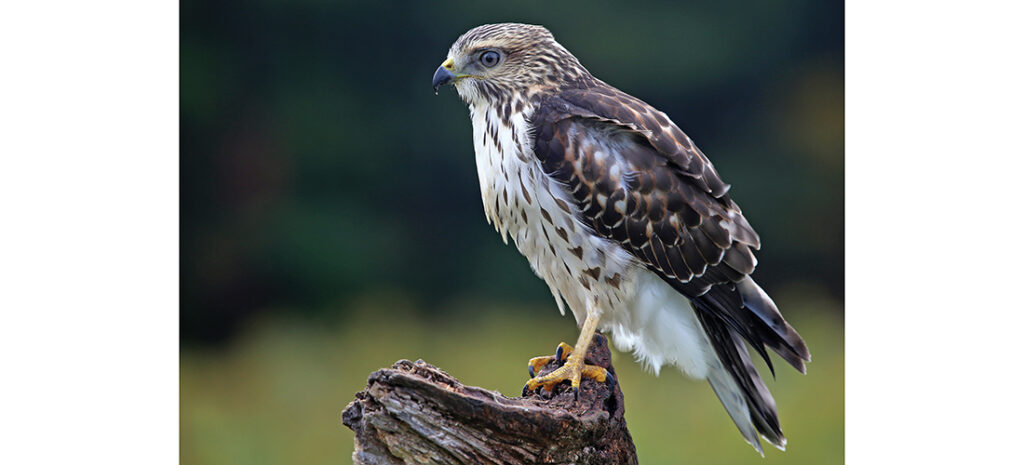
All of us are aware of hawks in the landscape — no matter where in North Carolina we may be. We are fortunate to have a diversity of raptors in our state. These birds are formidable hunters that use their talons to grab unsuspecting prey of varying kinds. The most noticeable are larger species such as red-tailed hawks that sit in the open on stout branches or snags, and in the absence of natural perches, can be seen on fence posts or telephone poles. But there are hawks that are more secretive and spend most of their time hidden. One of these is the broad-winged hawk. This species is smaller in size and is more likely to be found in swampy woods. Happily, they are now returning from their wintering grounds in Central and South America.

These birds seem to enjoy the diversity of prey in wetter habitats. Mind you, I do not see these diminutive but magnificent birds regularly but, as with so many species during the breeding season, I hear them advertising their presence. Their call is a high-pitched whistle, unlike any other bird in our area. Being heard and not seen may be a strategy for these birds, given their smaller size: close to that of a crow. Often living within the boundaries of other, larger hawks — such as a red-shouldered — being less visible is a distinct advantage.

Not surprisingly, given their size, broad-wingeds often go unnoticed. They are birds of the forest and, given their dark coloration, blend in well with their surroundings. But that doesn’t mean they’re drab. These stocky little hawks have reddish heads and handsome barred underparts that match their boldly barred tails. Only the keenest of birders will likely spot them, unless they’re migrating, when they congregate in large numbers (even into the thousands) in certain locations. At these raptor “hot spots” the birds can be seen soaring in circles, forming large “kettles” on updrafts, gaining altitude early in the day. Broad-wingeds, like many other hawks, use upper air currents to make their long journey a bit easier. Unlike most of our local hawk species, these birds move back and forth between the eastern United States and central to northern South America during the year.

In the Piedmont, the species can be found in hardwood or mixed pine/hardwood forest. The courtship ritual is breathtaking, involving “skydiving” — circling high in the sky followed by a rapid dive. The pair will nest in the lower limbs of a mature tree, usually close to water or some sort of opening in the canopy. The parent hawks will feed their young everything from mice to frogs, lizards to large insects. Since broad-winged hawks are easily disturbed, they are rarely seen outside of rural areas.

Should you be out hiking at Haw River State Park in Browns Summit or at, say, Weymouth Woods Sandhills Nature Preserve in Southern Pines, keep an eye out — as well as an ear — you just may spot an elusive broad-winged.  OH

Susan Campbell would love to hear from you. Feel free to send questions or wildlife observations to susan@ncaves.com.

Wandering Billy

Wandering Billy

A Building for a Song

Ivan Battle’s dream of musical education plays on

By Billy Ingram

“Everything in the universe has a rhythm, everything dances.”
                                                          
— Maya Angelou

There’s plenty of activity surrounding what’s become known as Midtown, where flashy attractions like Mac’s Speed Shop, RED Cinemas, Scratch and Doggos Dog Park & Pub are the obvious lures. Just behind those establishments, along a shady lane named Beaman Place, there’s a newly minted coffee klatch on the corner followed by two enchanting gift boutiques you really should check out.

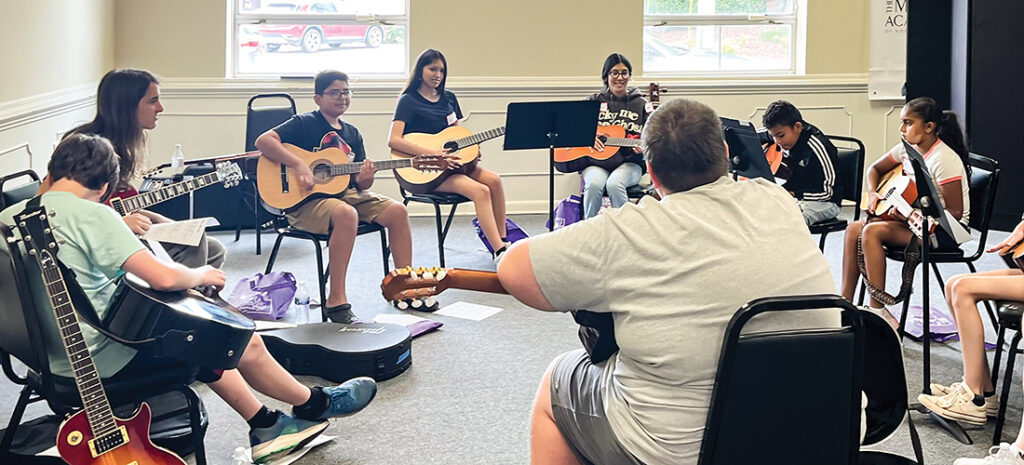
Near the top of the crest on Beaman Place, Midtown is anchored by what has been one of this city’s creative bedrocks for more than four decades: The Music Academy of North Carolina. Serene on the outside, this two-story ensemble of studios, rehearsal and performance spaces is harmonically sonorous as you step inside. “Cool place!” is how seasoned musician Zac Richey described his experience, having won a guitar competition there when he was 15 years old. That mirrors others with similarly gratifying stories about fine tuning their skills in pursuit of dreams both large and small under the academy’s expert tutorage.

Armed with a UNCG degree in musicology and a doctorate from the University of Kansas, Ivan Battle — a musician, performer, composer and recording artist — was 25 in 1982 when he kicked off the first term at what was then called Greensboro Music Academy. With just two teachers and fewer than a couple dozen students, the organization operated out of his small home on Pisgah Church Road.   

As a teenager growing up in Greensboro in the early-1970s, Battle recognized that our fair city was, to a great extent, a virtual musical desert. He felt budding musicians, no matter their age or experience, would benefit from an academic environment employing a collaborative approach in addition to one-on-one instruction.

With the help of co-founder Rev. Joe Flora, former associate minister at First Presbyterian Church, where Battle played the organ as a youngster, Greensboro Music Academy grew exponentially over the years. Its success led it first into a two-story house on Bessemer, then, in 1988, to its decade-long headquarters on Westover Terrace, where Chipotle is today.

Described by those who knew him as “informal and playful,” Ivan Battle passed away in 1995, but not before witnessing enrollment top some 700 attendees. Still, that was a few short years before the academy moved into its current digs on Beaman Place, where Battle’s vision — that one day his nascent organization would occupy a suitably sized space dedicated entirely to musical education — began inching toward reality.

A quarter-century later, Music Academy of North Carolina remains a vibrant community asset for those with a song in their hearts

“The benefits of music-making are far reaching,” says executive director Kellie Burgess. “It makes us smarter, gives us more confidence, teaches us discipline and gives us an opportunity to express ourselves, to work with others.” In a recent partnership with Lindley Elementary School, MANC instructors discovered that non-English speaking kids learned the language much more quickly by singing words set to melodies.

Referencing our public school music teachers, Burgess insists, “I think they’re doing a great job. They just have a lot on them.” One of MANC’s major outreach efforts is providing sectionals to school choirs, orchestras and bands. For instance, Burgess mentions a recent trip to Ragsdale High to work with violin students. “We will do whatever we can do to build their confidence and help them hone their skills so that they can have a stronger collaborative group.”

Chris Rachal, director of student relations, touts the “top tier, well-educated in music teachers” on deck as one reason this nonprofit’s methodology is so effective. “I teach recording at the Music Academy,” Rachal says, noting he has both older and younger students. “I love both. I enjoy the younger students’ enthusiasm for learning and the older students’ willingness to learn something new.”

“We have the whole broad spectrum,” says Burgess. “Some younger students may not want to be here. You can tell because mom is making them play.” Others, though, are very ambitious and look forward to every visit, committing for semester-long courses.

“We meet students where they are, then just guide them on their own journey,” Burgess says. And the instructors each offer a unique curriculum and style. “We give them a good bit of guidance because sometimes students don’t want to play scales or don’t want to learn this or that, but we know it’s important that they do.”

The centerpiece of the first floor is a large recital hall, where Sunday recitals are often held. “We can also do workshops and group classes in here,” says Burgess. “We actually have a monthly jazz workshop. It’s free and open to the public and this is a perfect space for it.” (See musicacademync.org for schedule.)

Participants in the jazz workshop have an opportunity to perform in a manner similar to a jam session. “It’s basically for students of any age who have an interest in jazz,” Burgess points out, “to learn more about the language of jazz, learn more about the history.” Unlike standard jams where the group plays one song after another, with individuals standing to solo, this program tends to be more free flowing. “We have so many young students and adult students that come not knowing anything about jazz. So we want to make sure they’ve got the right tools to navigate the sessions.”

It was relatively quiet when I toured the Beaman Place facility on a recent afternoon, most kids still in school. “We do have adult students and homeschool families that’ll come during the day,” Burgess explains. “Most of our students start trickling in around 2, 2:30, and hang around until about 7 or 8. Our core is private lessons — that’s what we’re probably most known for.”

Ivan Battle’s dream for a stable future of Music Academy of North Carolina became even more solidified just last year. “The Murphy family . . . enabled us to buy our building in October,” Burgess says. (Pam Murphy is the owner of Greensboro’s flavor-maker, Mother Murphy’s.) “It was a huge donation and we’re very grateful for their commitment to music education and to the Music Academy and the community.” Being spared that monthly rental expense allows additional resources for extended outreach.

This summer, MANC will conduct its annual symphonic summer camp in harmony with Eastern Music Festival, held on the Guilford College campus. “We’ve been doing this one for, gosh, probably close to 20 years,” Burgess tells me. “Students get to visit the orchestra each day, sit and watch a rehearsal, and sometimes actually get up on stage with the musicians.”

Dreams do come true, it could happen to you . . . but it does take practice.  OH

An internet pioneer, Billy Ingram’s TVparty! was the first to combine text, pictures and embedded media via a web page, the experience we’ve now come to expect online, and the first to broadcast television clips over the net.