Pleasures of Life

PLEASURES OF LIFE

Bat Girl

A summer of darkness to spread my wings

By Sarah Ross Thompson

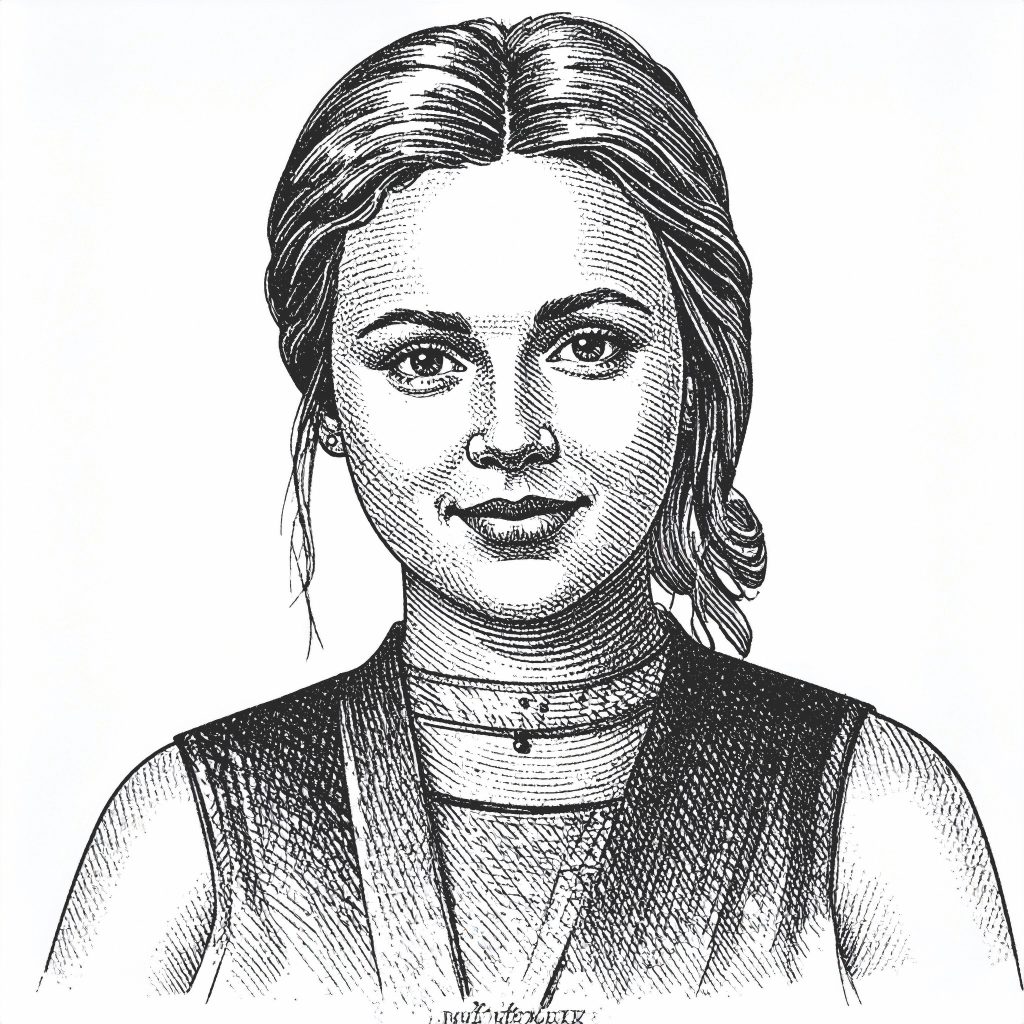
It’s May 2002, and I make my way up the stairs of Winston Hall at Wake Forest University to meet up with Nick, the graduate student in charge of the bat lab — or The Batman, as I come to call him. He uses his key card, leading me through a labyrinth of locked doors and staircases that end in a dark basement room — a bat cave, if you will. You see, I’ve taken a summer position as an undergraduate research assistant studying bat echolocation. As an eager biology major, I’m ready to get started on this dream job, rabies vaccinations and all. In my first week, we insulate the cave with foam pads to make it fully soundproof for recording bat calls. Nick and I work side-by-side for several days, listening to The Best of Sade CD on repeat while he tells me about his home country, Bulgaria, and his dog, Max. By week’s end we finish the room, and I’m gifted a container of fresh feta cheese, a surprising but welcome gesture. The Batman continues to pay me in feta all summer as I hurry along by his side, carrying stacks of notebooks and tools. Just call me Robin.

Our next mission involves collecting bats from the field. And by “field,” I mean anywhere a colony of bats may be living. During the first expedition, I find myself stabilizing a ladder in the dark while The Batman climbs underneath bleachers at a local high school, using gloved hands to carefully scoop bats and bring them down one-by-one to a carrying case. The next week, an exterminator tips us off that a woman wants bats removed from her attic. We speed over in our bat mobile (an ’80s hatchback), crawl into the hot, clammy attic space, and secure the bats.

Once the great migration of bats to the bat cave is complete, I’m tasked with cleaning their cages and providing them with daily food and water. Simple enough, except that, believe it or not, I don’t particularly like bats. In fact, years of media villainization have left me terrified of them — especially that they’ll somehow get caught in my hair. As I peek inside a cage, psyching myself up to clean, I see a cauldron of bats hanging upside down, their beady eyes glistening in the red light of my headlamp, and I draw back with a gasp. In another cage, a bat is gripping the wire door, so when I open it, he swings open to greet me. The stuff of nightmares. Only after some serious self-negotiation am I able to squeeze my hand through the smallest crack in each door. Mission accomplished.

Finally, what we’ve been waiting for — we begin our experiments with bats and moths in the lab. It turns out that moths can emit a buzzing sound to “jam” a bat signal and avoid being eaten. We want to capture the sound waves of that particular moment of survival. Nick turns on the sound recording device, we turn off our headlamps and crouch down, waiting in the darkness, as Hercules (our favorite bat – yes, we name them all) starts to circle the cave. In his quest for food he repeatedly flies within inches of my face, close enough to feel the wind from his wings tickle my skin. Each time he swoops by he slows just enough to get a look at me, and I at him. I surprise myself by not being afraid, but instead feel a tingle of exhilaration each time he passes.

Mere weeks later, I’m now feeding the bats by hand (Holy Toledo, Batman!) and spending hours alone in the bat cave running experiments. There’s a tranquility found in that room, the bats whirring around me again and again, and I grow to enjoy the dark. “I am darkness, I am the night.”

We also raise baby bats in the lab, and I find I am falling all over myself to help. Wrapped up in tiny bundles, the babies greedily accept formula we feed them through droppers. Just like with human babies, we wake to feed them in the middle of the night. I leave a summer party at 2 a.m., announcing that I must go feed baby bats (surprisingly, no one questions this). In the stillness of the lab, my ears still ringing from the blaring music of the party, I drop milk into their little mouths.

When the babies are older, I take them out one-by-one and walk around the bat cave while each bat hangs upside down from my finger. As they feel the air under their wings, they begin to open them, eventually extending them fully to push off and take their first flight. I sit in awe. I’ve just taught baby bats to fly.

Throughout my summer in the bat cave, I meet other bat lovers. Led by The Batman, we’re a motley crew all of us used to spending hours alone in darkn ess. One has a bat tattoo, another a bat navel ring. We have cookouts and gatherings. We give each other bat-themed gifts (the children’s book, Stellaluna, being one). As the summer ends, I sign up to work in the bat lab during the next academic year and again the following summer, having found my place in Gotham City.

These days, I no longer study bats, but I sometimes wish I did. In those quiet moments in the lab, I experienced a peace that I’ve never quite been able to replicate. One that comes from watching, from listening and from being still in the dark. A few years ago, I met up with The Batman, who now is an internationally recognized professor. We enjoyed a glass of wine and discussed the research that we each do. As a lifelong Robin, I’m hopeful that we can work together again one day. I’ll await the bat signal.

Strolling with Fungi

STROLLING WITH FUNGI

Strolling with Fungi

A woodland garden flourishes in an old Winston-Salem neighborhood

By Ross Howell Jr.    Photographs by Lynn Donovan

Managed by the Piedmont Land Conservancy, the Emily Allen Wildflower Preserve is a reminder that the natural world lies right at our feet.

In 1954, Allen and her husband, O. G., moved into the dream home they’d built on 6 acres of land — with a creek — in a leafy Winston-Salem neighborhood.

One spring, Allen noticed the purple-and-white petals of a wildflower emerging beneath what she described as “a mess with poison ivy, honeysuckle and blackberries growing everywhere” near the creek.

That wildflower was a showy orchid (Galearis spectabilis) and, somehow, it sparked a passion in Allen to learn everything she could about North Carolina native plants.

She took a botany class at Wake Forest University and went on to serve as president of the North Carolina Native Plant Society. Over some 40 years, Allen collected wild plants from the mountains of Western North Carolina, nursing them in her backyard.

Emily and O. G. donated their land through easement to the PLC in 2000. Since then, Allen’s care for what she always called her “Friendship Garden” has been bolstered by PLC staff and stalwart volunteers.

O. G. passed away in 2006 and Emily in 2015. Upon her death, their home was donated to the conservancy to be developed as an educational center.

Allen’s wildflower garden and house feature not just flowers from the mountains, but also a bounty of eastern North American trillium, along with native ferns, creeping phlox, Dutchman’s breeches, cranesbill geranium, flame azalea, Carolina buttercups, columbine, plus Oconee bells (Shortia galacifolia), a rare wildflower found in the southern Appalachian Mountains.

As you’d expect, the site is best known for its spring wildflower group tours, which are available by appointment only.

But photographer Lynn Donovan and I are here to participate in a fall “Mushroom Stroll,” one of several programs offered annually at the garden.

It’s raining steadily, and I should’ve given more thought to my outerwear. Veteran photojournalist Donovan has wisely brought a slicker and hood.

We’re greeted at the door by Janice Lancaster, manager of the garden. Lancaster received her undergraduate degree in dance from the University of North Carolina School of the Arts. In addition to her work with the PLC, Lancaster has developed a dance-ecology course at Wake Forest University and her choreography often features environmental themes.

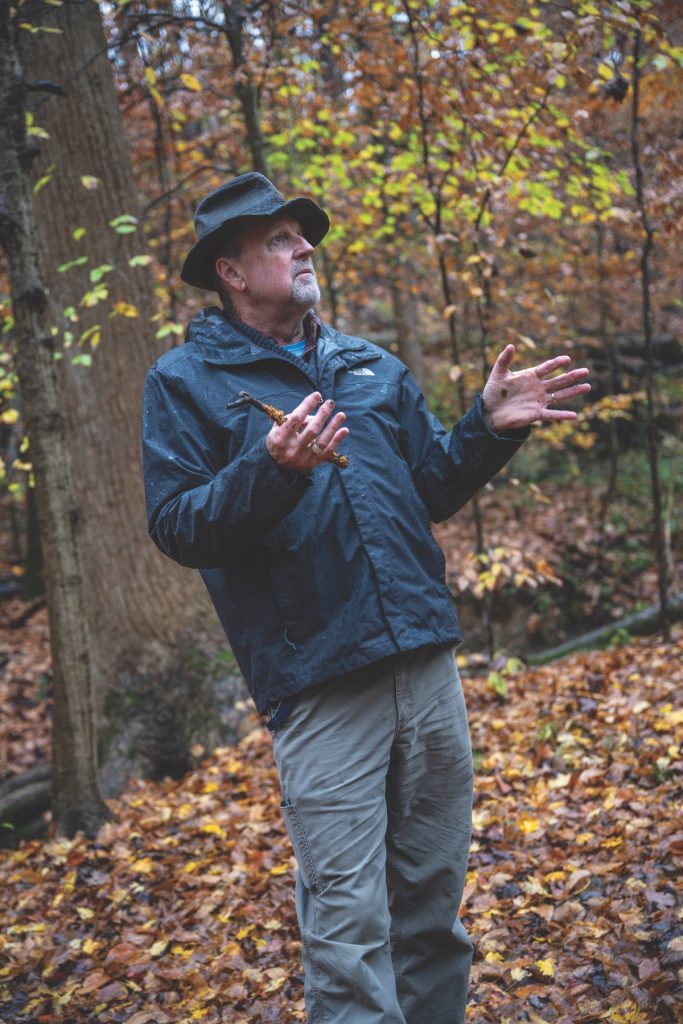
A group of mushroom strollers are already inside, as is Kenneth Bridle, who will lead our tour.

Bridle has a Ph.D. in biology from Wake Forest and has worked with the PLC for more than 30 years. Recently, he retired from his position as stewardship director and now acts as a conservation adviser, leading nature walks and other activities.

Bridle’s career in environmental preservation is truly remarkable.

He is the author of several natural heritage inventories as well as rare plant and animal surveys. A founding member of the Dan River Basin Association, the Carolina Butterfly Society and the Triad Mushroom Club, he also teaches classes in a selective and rigorous Master Naturalists’ program that prepares volunteers to lead stewardship, education outreach and citizen science projects.

Bridle gives us a quick tour of the improvements to the Allen house.

Split units now replace the original heating system. A downstairs bathroom was remodeled to serve as a wheelchair-accessible restroom.

“The last part is taking out cabinets and countertops in the old laundry room,” Bridle says. In their place, a catering kitchen will be installed.

“It’s slowly turning into more usable space, which is what Emily always wanted,” Bridle says.

He should know. He met Allen when he came to her garden as a graduate student.

That started a friendship that lasted for years. Bridle often served as Allen’s driver on her plant-collecting expeditions and, like her, Bridle would go on to serve as president of North Carolina Native Plant Society.

“After a hot, dry summer, we usually have some kind of rain event,” Bridle says, “and the following week, the mushrooms go crazy.”

Bridle clears his throat.

“So, we’re going to wander around outside,” he announces to our group. “Everybody keep your eyes peeled.”

As we go outside, we can hear the steady drum of raindrops in the leaf canopy.

After a few steps along the path, Bridle pauses and points to the ground.

“Right there, bird’s nest fungi,” he exclaims. Bird’s nest fungi (family Nidulariaceae) are small, cup-shaped fungi containing spore-filled discs that resemble tiny eggs. The fungi feed on decomposing organic matter, such as wood and plant debris.

“When a drop of water falls in the nest,” Bridle says, “those spores blast out.”

He points out a dark mass spreading among leaves and sticks.

“That’s a whole colony of them,” he explains.

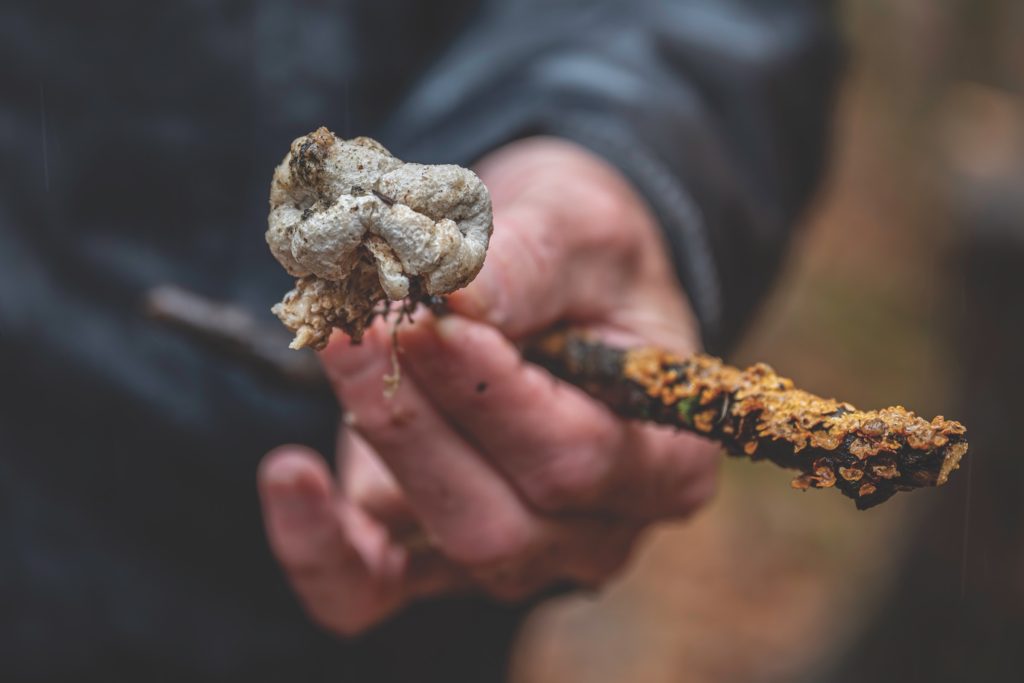
A few more steps into the woods, we spy a tree trunk glistening in the rain. On its side are orange-colored growths with the texture and shape of oyster shells.

“That’s shelf fungi called orange crust,” Bridle says. “They come in many different versions.”

Shelf fungi have a tough exterior and are a favorite of mushroom enthusiasts because they can be observed year-round, even when other types of mushrooms might not be in season.

Bridle tells us that an unusual variety grows in the Blue Ridge Mountains, feeding on decaying rhododendrons.

“Those are iridescent blue and will glow in the dark,” he says.

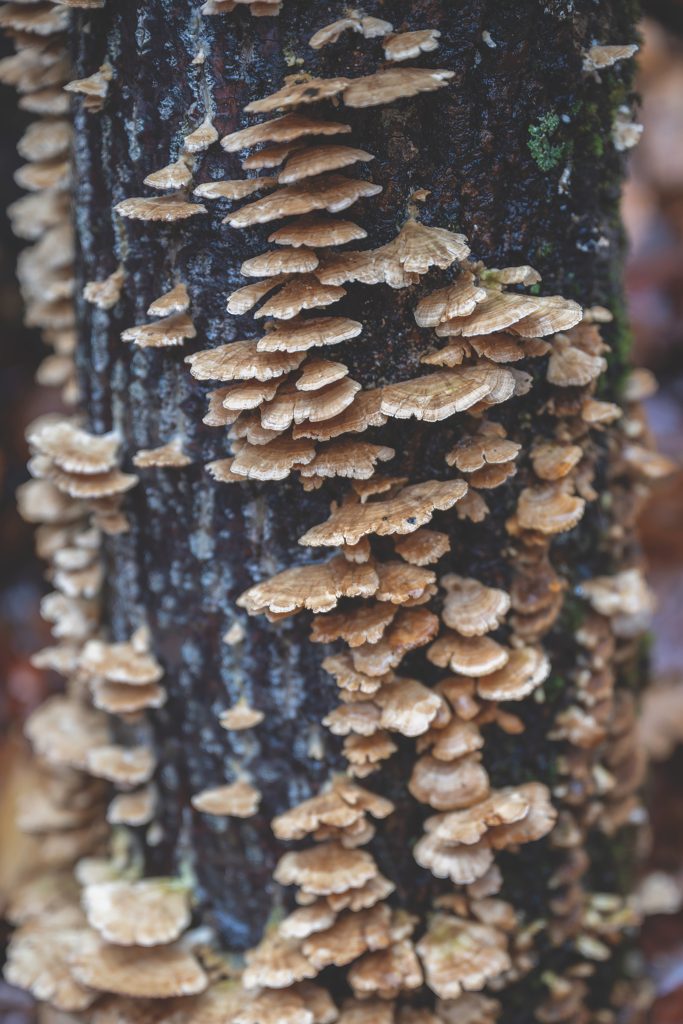
Farther along, we come upon more shelf fungi. These are called turkey tails. They’re nestled in groups along a rotting limb, bearing the shape and color of a tiny tom turkey displaying his tail feathers.

“They always have those nice, multicolored, concentric rings,” Bridle says. “And they have a long tradition in Asian medicine.”

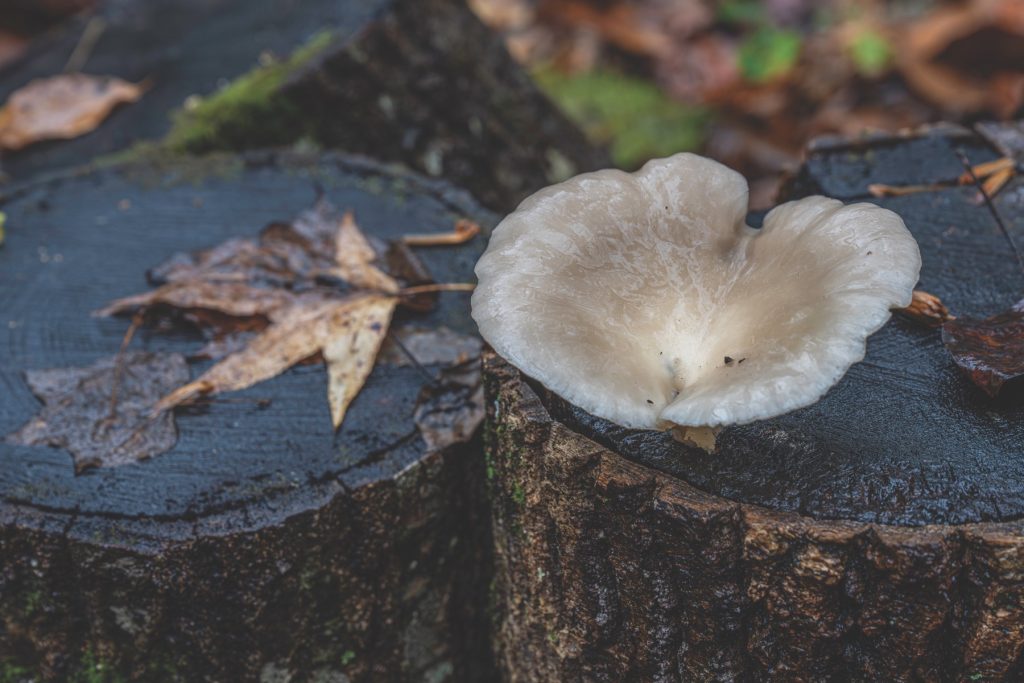
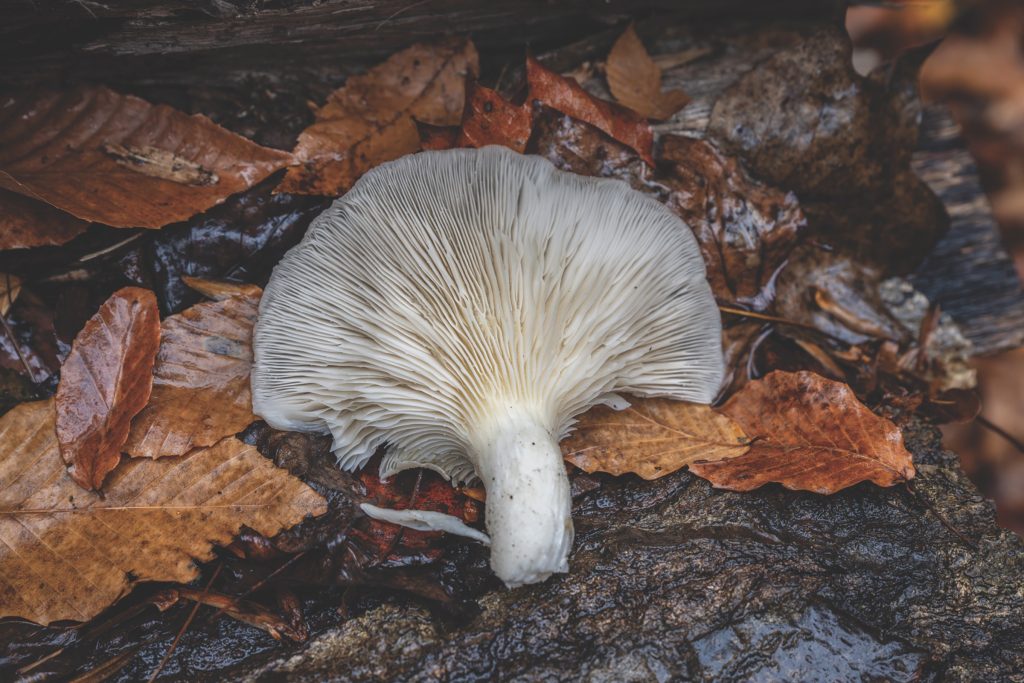
As we make our way farther down the swale toward the creek, we come upon oyster mushrooms (Pleurotus ostreatus). Pale and serene, they’re edible, prized for their delicate texture and flavor.

“Of the mushrooms we find in the woods, the oysters are probably the most common,” Bridle says.

Nearby, Bridle points out another mushroom growing on a tree stump. It’s a resinous polypore (family Fomitopsidaceae).

“See that orange resin?” he asks. “They produce that resin even in the driest of summers.” These mushrooms are perennials, producing a new ring of growth each year.

On a decaying log farther along the path, Bridle spots a small specimen of an edible shelf mushroom. It’s called chicken of the woods (genus Laetiporus) and can grow to be quite large, stacked in shelves, some 10 inches in width.

He tells us that the flesh of the mushroom is soft and tasty, and stores well wrapped in a paper bag and kept in the refrigerator. Vegans often prepare it as a substitute for meat, cooking it in a variety of ways.

“Anything you can do with a chicken finger you can do with chicken of the woods,” Bridle says.

He describes other fungi that are common to the area — hen of the woods, shrimp of the woods and lion’s mane.

“You’ll often find lion’s mane high up in a standing, dead tree,” Bridle says.

No excursion into the world of fungi is complete without at least one bizarre fact, and Bridle points out some beech trees growing on the other side of the creek.

“In September, I always take people down among those trees,” he says, “because that’s where you’ll find the beech aphid poop-eater.”

Our group laughs nervously. Sometimes with a mycologist (a scientist who studies mushrooms), you wonder if they’re just pulling your leg.

Bridle explains that beech trees in September are hosts to colonies of beech blight aphids.

“We call them boogie-woogie aphids, because, if you tap on the tree branch, all the aphids do the wave.” That is, the aphids all at once start throbbing in unison.

See what I was saying about a mycologist?

These tiny insects suck sap from the beech trees, feeding on the sugar. Their excretions are politely referred to as “honeydew.”

So, on the limbs and leaves beneath the aphid colony, you’ll see masses of black fungus that look like sooty sponges.

That’s Scorias spongiosa, the beech aphid poop-eater.

“Everybody remembers that one,” Bridle concludes.

The rain is falling in earnest now, so even the well-equipped are ready to retreat. My barn coat feels like it’s holding about a gallon of water.

Donovan stows her camera gear and we get into the car.

We’re wet as bird dogs after a hunt. But we’re both grinning like crazy.

High on mushrooms, you might say. And filled with wonder for the natural world.

Life’s Funny

LIFE'S FUNNY

Volunteers Needed

Identifying de-vine intervention

By Maria Johnson

I stoop in the dew and get to work, left hand sorting, plucking and tossing the intruders from our vegetable garden.

Don’t ask me why someone who strongly favors her right hand for all other pursuits always weeds with her left hand.

All I know is, my south paw is more sensitive to plants. It’s the hand that caresses leaves and blossoms. It’s also the hand that gauges, with a slight tug, if I can uproot a weed with one yank or if I need to wrap the stalk around my fingers for more leverage.

Is my left hand the gateway to my loosey-goosey right brain, cross-wired hemispheres being what they are? Is that why I enjoy weeding so much? Because it connects me to another brain space?

For my mom, that activity was ironing, the rote chore that allowed her to enter the zen zone, a place where her hands did necessary work while her mind moseyed.

I did not inherit her need to press fabric from rumpled foothills into starched flatlands.

But I do respect, and have my own version of, making things visibly better and finding oneself by getting lost in the mundane.

When I need to get grounded, and think fresh thoughts, you’ll find me literally down in the weeds.

There’s always a bumper crop around our raised beds where, in summer, we intentionally grow tomatoes, peppers, basil, oregano, green beans, eggplant, parsley and leeks.

Unintentionally, we provide a nursery for crabgrass, mock strawberry, knotweed, wild violets and clover.

I cringe as I type “wild violets and clover.” How could I discard them? They sound so Simon & Garfunkel.

Then I remind myself of the truest definition of a weed: Something that grows where and when you don’t want it.

I’ll see you in the cover-crop days of winter, clover. For now, you’re out of here. You, too, tiny pines and oaks and maples. Go make a grove elsewhere.

Here, I tell myself, in order to bring order, and to practice the “culture” in agriculture, I must be a ruthless editor.

And that, of course, is the moment I see an odd interloper.

It peeks, broad-leafed and hearty, from a clump of daylilies in the flower border around the garden.

Squash? Is that you?

We tried growing yellow squash in one of the raised beds a few summers ago. Soon enough, the squash bugs moved in and we, being averse to pesticides and herbicides, let them sap the sunshine from our stir-fried dreams.

Is this a descendant of those ill-fated plants, or a bird-borne volunteer that found a fertile niche in the shelter of the lilies?

I study the outlier, consider yanking it from its safe harbor, and decide to let it be.

Why? Curiosity maybe. What will you become, oh bold and fuzzy one?

A few days pass. The volunteer grows quickly. Already it has bounded over a patch of struggling dianthus and jumped the low barrier that keeps Bermuda grass out of the garden.

Once again, I come close to pulling it out of the ground, but the truth is, I like a vine with chutzpah.

I hold off.

A week later, the vine has advanced a couple of feet on the diagonal. Its goal: to cut the corner of the garden to the sunniest spot in the yard.

In 2020, when we built the raised beds as a COVID project, both to occupy our stay-at-home time and to feed ourselves should broken supply chains threaten our arugula consumption, we did a sun study.

We took pictures of our yard at various times of day, from the same vantage point, and compared the pictures to see which area stayed sunniest the longest.

We built the beds as close as possible to that spot, avoiding a grassy drainage path that, during thunderstorms, concentrates rain water into an overland river.

But this headstrong vine does not care about drainage; it is racing toward maximum sunlight, as if it has a copy of our sun study.

“Follow me,” the volunteer seems to be saying, “I shall lead you to brighter days.”

Baloop. Over the other corner of the Bermuda grass barrier.

Baloop. Over a clump of phlox in the border, into the open yard,

We let it go. Jeff even mows around it.

I am reminded of children. They might not take the path you thought they would, but, when they are full of vigor and confidence, there is indescribable pleasure in standing back and letting them become whatever they will be.

This is why I garden: for lessons and metaphors writ small, in the dirt.

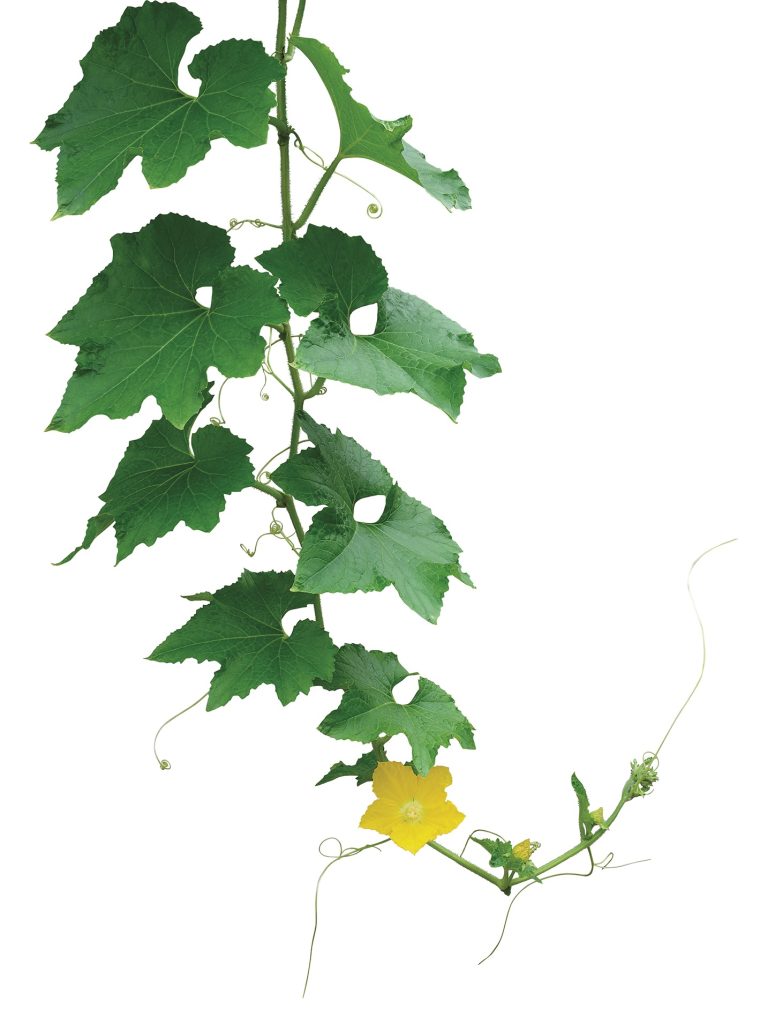
Overnight, it seems, the vine marches on, popping open more green umbrellas, large five-lobed leaves, as solar energy collectors.

It’s now 15 feet away from its starting point. I joke, with uneasy ha-has, about how it’s coming for the house.

I part the hairy leaves and look for evidence of squash. I see lots of bright yellow blossoms, some with bulbous bases, and lots of woody curlycues.

I cave to artificial intelligence, take a few pics with my phone, and ask Google to identify the plant.

My hopes for yellow squash are squashed. But my hopes for jack-o’-lanterns are lit.

This is field pumpkin.

We leave for a week’s vacation, informing our house sitter that, yes, we know about the runaway vine and, we think it’s harmless, but, you know, call 911 if you hear a window slide open in the middle of the night.

We return to a new development. The vine has decided to divide and conquer. One branch has made a U-turn and is charging for the garden gate.

The other fork is running up the grassy swale.

Both offshoots lead the way with closed, green blossoms that sprout tendrils like catfish whiskers.

We are in the homestretch of summer, the giant leaves are showing their age. They are mottled with mildew. Bugs have chewed some of their edges into brown lace. The main trunk of the vine, woody and pale, has been bored in places. Many of the blossoms, including the ones pregnant with fruit bulbs, have been snipped clean off, probably by the family of rabbits that live under the knockout roses and drive our hound nuts.

She has caught at least four bunnies this summer, and we have scolded her each time. Now, we look the other way.

Ruthless editing.

One tiny, round green fruit survives at this writing.

We make it a straw bed and surround the vine with plastic rabbit fence.

We are won over by the vine’s will to survive, its ruthless pursuit of light and life.

Tea Leaf Astrologer

TEA LEAF ASTROLOGER

Libra

(September 23-October 22)

True luxury comes in many forms: Egyptian cotton, Belgian linen, Mongolian cashmere and Ahimsa silk. But have you ever felt the plushness of making a decision sans agony, anxiety spirals or paralysis? The ethereal lightness of refusing to overthink? When Venus enters your sign on Oct. 13, be open to receiving a new kind of abundance — that of an unshakeable inner peace. Everyone wins, and you’ll get to dodge the rabbit hole.

Tea leaf “fortunes” for the rest of you:

Scorpio (October 23 – November 21)

Stop settling for crumbs.

Sagittarius (November 22 – December 21)

Just unsubscribe already.

Capricorn (December 22 – January 19)

Cozy up with the chaos, baby.

Aquarius (January 20 – February 18)

Hint: Add cardamom.

Pisces (February 19 – March 20)

The truth is always a mercy.

Aries (March 21 – April 19)

Mind your tongue.

Taurus (April 20 – May 20)

Address the energy leak.

Gemini (May 21 – June 20)

Resist the urge to ghost.

Cancer (June 21 – July 22)

It’s time to update your software.

Leo (July 23 – August 22)

Listen for the crows.

Virgo (August 23 – September 22)

Embrace your feral nature.

Home Grown

HOME GROWN

You Are What You Wear

Like it or not

By Cynthia Adams

My father never had to be asked twice to go shopping, especially for groceries. What he didn’t like was being hurried. Choosing the best rib eye might require a solid 10 minutes.

“Marbling,” he’d murmur, scrutinizing the fat flecks of a steak with surgical interest as the butcher waited. 

Clothes shopping was no different. He often joined my mother, egging her on to try dress after dress, evaluating each frock. Was it too short?  Too frumpy? Did it overpower her small frame? Mama, an impulsive shopper, had little patience for long deliberations. 

She liked flash and bling as much as Dad liked fat-streaked T-bones. Whether a pork chop or a pant suit, he analyzed purchases with a strange dedication.

Dad earnestly believed he could save Mama from fashion crimes. He steered her towards classics, well-tailored and simple, long before the quiet luxury trend. But Mama leaned into flamboyant femininity — heels, furs and cocktail wear in the daytime. Liz Taylor and Joan Collins were lifestyle icons.

Mama wore a cocktail ring and negligee while rolling out biscuit dough at breakfast. Come evening, she never missed a Dallas or Dynasty episode. Afterward, she took long baths, emerging dewy-skinned in something diaphanous, trailing cologne de nuit.

She reminisced about starring in Fairview High School’s play, imagining a career on stage. If not for the traditional life she chose, including five children and an annoyingly opinionated husband, she might have lived the life of Liz.

At the very least, she planned to look the part.

Their shopping forays were certainly like watching Liz and Burton spar.

In answer to “What do you think Warren?” as she pivoted, he would artlessly offer his first reaction: “Shug, that dress is wearing you.” 

Mama would purse her lips, burnished red with Revlon’s Cherries in the Snow, and shoot him a withering look. 

Nonetheless, Dad wanted his opinions sought when it came to dressing what he considered “his” women. When I needed a prom dress, he volunteered to take me shopping. Inwardly, I dreaded the inevitable critique before we drew up outside the Belk store in Monroe.

He zeroed in on the most chaste dress in the junior department — a ballerina-pink dress prettily embroidered with rosebuds. I emerged from the dressing room looking like a cupcake. This was not what I was aiming for, but he practically cheered with approval. 

My father adored a dress that made me look like a Nutcracker extra.   

When I tried on a less modest number more like what my friends were wearing, he dropped a truth bomb. 

“Honey, you don’t have the bustline to pull that off,” he observed. My face flamed with heat. 

This was the kind of feedback Mama loathed.

Dad thrust the rosebud dress into the clerk’s hands, despite my fallen face. Come prom night, the virginal dress paired with my slumped posture read more Patty Duke than the sultry Daisy Duke I’d hoped for.

Cheerleaders and majorettes swanned past me in spaghetti straps and push-up bras as I spent the night loitering by the punch bowl with a completely tongue-tied date. My main activity was ruing my reflection during nervous restroom treks.

Mama would never have worn that dress. She’d have fought him on that. After all, she fought him all the way to divorce court.

Afterwards, she went full-tilt glam without Dad there to inhibit her impulses. Mama’s hairdo grew so high no one but her hairdresser could say where her scalp ended and hair began. She wore the highest heels even when her bunions screamed.

On a trip to Florida, she bought a door-knocker of a cocktail ring with a purported connection to the Super Bowl. The governor was off the accelerator and Mama swiftly blew through her divorce settlement. 

Nearly broke, she took a job at a new consignment shop.

Wealthy women with nearby lake homes consigned their finery there and Mama got first dibs. While she had seldom dressed better, she loathed wearing “second-hand” fashion, even while enjoying more wardrobe changes than Cher. 

None of that mattered.

When I praised a chic Chanel dupe she wore to a family dinner, she hissed at me, annoyed, “It isn’t real!”

As soon as she left that job, she resumed her preferred buying habit of new only.

I turned out to be quite the opposite, thrilled whenever I score a good knockoff, vintage find or a designer hand-me-down. 

Nonetheless, while Mama may not have inspired thrift, she modeled individuality, conformity be damned.

Recently, a young friend met me for a drink sporting turquoise-colored hair.  How could I not comment? I complimented her, privately thinking I have never been so free, nor so brave. She replied, “You can be ruled by all of the things that everyone else wants from you, or you can just have fun with your life.”

And just like that, I imagined Mama, radiating approval.

Chaos Theory

CHAOS THEORY

Signs

. . . from the other side

By Cassie Bustamante

Signs are everywhere, if only we pay attention. Too fixated on where we are going and knocking out miles-long to-do lists, we often miss them. But, in my case, sometimes the universe gives me a little auditory nudge — a snap of its fingers, so to speak — before showing me the sign I need. Four years ago, it was a song.

I am driving south on Church Street with my teenage daughter, Emmy, riding shotgun on a clear, crisp day. We’re on our way home from Sunset Market Gardens, where I’ve loaded up on veggies, greens and eggs for the week. One of the perks to running errands with Mom, especially early morning weekend ones? Control of the music. Her playlist of every song ever released by Taylor Swift shuffles through the car speakers. When “Marjorie” comes on, Emmy casts me a sideways glance and offers a gentle smile, knowing that when I hear it, I think of Sarah, my best friend and former business partner who’s just passed away.

If I didn’t know better

I’d think you were still around

What died didn’t stay dead

What died didn’t stay dead

You’re alive, you’re alive in my head

Just then, in an all-but-blue sky punctuated by a cloud or two, a rainbow appears. No sign of rain anywhere, yet there it is in its vivid ribbons of color. Emmy and I both gasp.

Two years later, I’ve just ended an exhausting month. My husband, Chris, has traveled three out of four weeks, while my kindergartener, Wilder, and I have both been sick. There’s only so much rage-vacuuming my house can take. Of course, with three kids and two dogs, the house isn’t actually clean, but the loud hum of the vacuum drowns out the noise nicely. I’ve heard it said that being an adult is a constant loop of saying “I just have to get through this week.” By that measure, I should be very grown up by now, though the jury’s still out.

Thanks to antibiotics, Wilder heads back to school and I’ve got a day to catch up on writing. Settled in at my favorite writing desk, the kitchen table, I tap away at my keyboard while a cool breeze blows through the open windows. Happy with my progress, I gift myself a little brain-break and mindlessly open up Facebook. A “memory” reminds me that today is the anniversary of Sarahs’s death. Immediately, a wash of shame spreads from my cheeks all the way to my toes. How could I have forgotten?

My eyes dart upward, to a place where I imagine Sarah can hear me. “I’m so sorry,” I whisper.

Not a moment later, before I even have time to pause to await a reply, I hear the familiar jingle of a dog’s collar. My own two pups are safely curled up on our leather sofa, but I peer onto our lawn and spy a dog I don’t recognize moseying around, no owner in sight.

Ugh, I don’t have time for this right now, I think. But I consider how I’d feel if my own dog was out there loose. Plus, I am a bit of a softie. In fact, when I became pregnant with our first child 19 years ago, Chris, worried I might put myself and the baby in danger, had to tell me to stop bringing home strays. But this shaggy, golden-amber dog looks innocent enough.

I step off my porch. “Hi, puppy.”

She saunters over slowly, tongue lagging out the side of her mouth, as I reach down to scratch behind her ears and catch a glimpse of the purple bone-shaped tag engraved with her name.

“Brownie,” I say, “aren’t you a sweet girl?” She rolls gently onto her back, inviting a belly rub.

I locate the tag with the owner’s number, and dial. The phone begins to ring and just before the owner answers, I catch the name on the tag so I know how to address her: Sarah.

I can’t believe it. And yet I can.

Sarah, the dog owner, and Brownie reunite with licks and snuggles on my front lawn as I look to the sky, where I imagine my friend smiling down at me.

It’s been four years since her death. Like waves of grief, the signs don’t stop coming, but have lessened, more time passing between each. And now, when I notice them, I don’t cry anymore. I smile, grateful in the knowledge that Sarah is still around.

Birdwatch

BIRDWATCH

Cleanup on Aisle 9

The unparalleled scavenger

By Susan Campbell

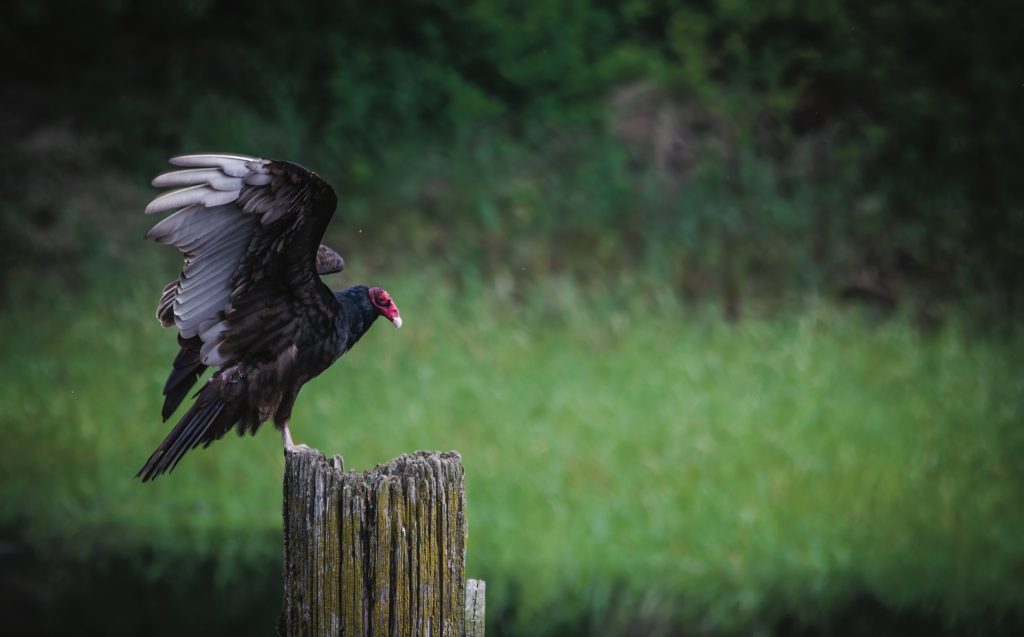
There! By the edge of the road: It’s a big, dark bird. It looks like it could be a wild turkey. But . . . is it? A closer view reveals a red head and face with a pale hooked bill, but a neck with feathers and a shorter tail. Definitely not the right look for a turkey — but perfect for a turkey vulture. This bird is also referred to as a buzzard or, for short, a “TV.”

Making an identification of these odd-looking individuals is somewhat harder these days since wild turkeys have made a good comeback in the Piedmont of North Carolina. Turkey vultures and turkeys can occasionally be seen sitting near one another in an agricultural field where they may both find food or are taking advantage of the warmth of the dark ground on a cool morning.

Turkey vultures, however, are far more likely to be seen soaring overhead or perhaps perched high in a dead tree or cell tower. They have a very large wingspan with apparent fingers, created by the feathers at the end of the wing. The tail serves as a rudder, allowing the bird to navigate effortlessly as it’s lifted and transported by thermals and currents high above the ground. These birds have an unmistakable appearance in the air, forming a deep V-shape as they circle, sometimes for hours on end.

It’s from this lofty vantage that turkey vultures travel in search of their next meal. Although their vision is poor, their sense of smell is keen. They can detect the aroma of a dead animal a mile or more away. They soar in circles, moving across the landscape with wings outstretched, sniffing all the while until a familiar odor catches their attention.

Turkey vultures are most likely to feed on dead mammals, but they will not hesitate to eat the remains of a variety of foods, including other birds, reptiles and fish. They prefer freshly dead foods but may have to wait to get through the thick hide of larger animals if there is no wound or soft tissue allowing access. Toothed scavengers such as coyotes may actually provide that opportunity. Once vultures can get to flesh, they are quick to devour their food. With no feathers on their head, there are none to become soiled as they reach into larger carcasses for the morsels deep inside.

Vulture populations are increasing across North Carolina — probably due to human activity. Roadways create feeding opportunities year-round. Landfills, believe it or not, also present easy meals. In winter, the northern population is migratory and shifts southward, so we see very large concentrations in the colder months. The large roosting aggregations can be problematic. A hundred or more large birds inhabiting a stand of mature pines or loitering on a water tower does not go unnoticed. 

Except for birdwatchers and those who live near a roost site, most people overlook these impressive birds. Often taken for granted, they are unparalleled scavengers, devouring the roadkill our highways inevitably produce.

Ghost Town

GHOST TOWN

Ghost Town

Apparitions in the area

By Cynthia Adams

As Halloween approaches, stories of the paranormal pique our curiosity.

In 1876, British composer Henry Clay Work was inspired to write “My Grandfather’s Clock” by eerie events in a hotel where he stayed, where a tall clock stopped working at the death of one of the brothers who owned it. 

The song’s popularity endured. Johnny Cash and Burl Ives recorded the ballad decades later, and countless schoolchildren learned the lyrics. 

Yet, Sherri Raeford directly experienced this phenomenon. 

“The backstory first,” begins Raeford, a playwright who stages the works of Shakespeare. She appreciates context. 

Her mother received a one-of-a-kind Christmas gift 45 years ago from Raeford’s father, Marshall Weavil, who worked for Sovereign Limited, a grandfather clock company in High Point.

“He designed the machines that made the decorative trim, the curlicues on the clock,” Raeford explains. 

“He gave my mom a clock — the first ever made by that company.” Inside, it was signed: To Lois with love, Marshall, Dec. 25, 1980.

At his death, his daughter received a grand example representing his life’s work. 

“He gave me a bigger, better clock when he passed away,” Raeford says.

Shortly after, Raeford’s mother, suffering dementia, came to live with her. “It was a stressful time.”   

Strangely, the clock her father bequeathed her developed a mystifying tendency.  “The grandfather clock would stop and go,” Raeford says, seemingly “according to what was happening.”

“The last year of Mom’s life . . . when I would grow impatient with her, the clock would gong at me!” Raeford was incredulous, having never before heard these sounds.

“The last week of Mom’s life, it quit working. I restarted the pendulum, and said, ‘Daddy, she’s not ready.’” Raeford waited. 

“The second time it quit, I realized, maybe I’m hanging on to her and she is ready.”

Raeford’s mother died two days later. The gonging stopped forevermore.

“It quit working.” 

Raeford inherited her mother’s smaller clock and gave the larger one to a friend.

Aptly, she quotes Hamlet. “There are more things in heaven and Earth, Horatio, than are dreamt of in your philosophy.”

The T. Austin Finch House

Thomasville’s Finch House is a Renaissance Revival mansion built in 1921 for T. Austin Finch, whose family founded Thomasville Furniture, and his wife, Ernestine Lambeth Finch. 

With Thomasville Furniture’s factories shuttered, the mansion fell into decline. In the summer of 2017, Greensboro residents Andrew and Hilary Clement took on its restoration.

Andrew, a contractor, looked beyond the decades of mold and decay. With much of its grandeur intact, he envisioned wedding ceremonies occurring onsite. 

The Clements transformed the house into a blushing beauty (Labor of Love: ohenrymag.com/labor-of-love). One too lovely to leave?

“Some of the local police and other residents swear the house is haunted,” Andrew replies.   

Ernestine? Out of respect “for the family and their legacy,” Andrew hesitates before admitting to sensing a feminine energy in the primary bedroom and library.   

“I have not seen anything, but I feel her presence in both of those spaces, especially at night when the house is empty. One of my construction guys lived upstairs for a period of time and he saw her in old-fashioned clothes several times in that room.”

Later, he sends a detail.

“She’s definitely a benevolent spirit and not scary. One of my girls has smelled her perfume several times in that bedroom.” 

Thomasville Apparition

On June 26, 1970, Dana Holliday’s father was mortally injured in a tractor accident at age 70.

As his frantic son, Derek Kanoy, tried to resuscitate him, the father calmly reassured him. “He said, ‘Don’t worry about me, I’ll be fine.’”

But he slipped away before paramedics arrived.   

“They used to call him Bucky Buddha,” Holliday says. “He was bigger than life.” 

Afterward, the brokenhearted family held a reception to honor Bucky Buddha’s amazing vitality. “It was unbelievable, says Holliday. “Friends lined the road leading to the farm. He didn’t want a funeral. Instead, we danced and told stories.”

The family have since created a compound on the farm and live near one another.

One April day in 2020, Derek and his wife Kim snapped a photo while walking from the barn to their house. In the picture, taken at sunset, a small, glowing orb appears directly over the spot where the fatal accident occurred, almost 50 years later.

“Kim was stunned,” says Holliday. “She might have been taking a picture of the sunset.” Perhaps the sphere of light had appeared before, but this time it was documented. Holliday says the extraordinary sighting was as if Bucky Buddha was signaling all was, indeed, well.  “I think it helped.”

Two years before Bucky’s death, Tomiko Smith, a consulting medium who once worked at the Rhyne Research Center at Duke University, told Holliday that she should be “intentional about the way I spent time with him.” Now, she understands.

A Haunting on Mendenhall Street

After years of admiring it, a 1914 Craftsman in a charming Greensboro neighborhood went up for sale. We spent months repairing plaster, painting and scrubbing, thoroughly excising the smell of cat urine and viscous nicotine residue coating each wall of the Westerwood house before finally spending a night.

After moving in, we were utterly exhausted that first night. Around 1:15 a.m., I was awakened by the unmistakable creaking of the stairs.

Heart hammering, I rose quietly. The stairs were flooded with moonlight by a large window at the top. I crept toward the landing and crouched, watching. The sound of footfalls upon each tread was distinct — but no one appeared.

I returned to bed when the steps stopped, but sleep eluded me. Had it been a lucid dream?

But the scenario repeated the following night. The disembodied footfalls on the stairs returned, at the same hour.

On the third night, again crouching at the top, I jumped when a hand touched my shoulder. “I hear it, too,” my husband said quietly.

I scoured old deeds and newspapers for clues. What had happened in our new home? Whose spirit mounted the stairs each night?   

Nothing gave much insight, apart from the fact that records revealed the house had changed hands often, once resold mere months after being bought. 

Was it due to what seemed to be a benign ghost?

During an overnight visit from my young nephew, I caught him racing upstairs, his child legs pumping. I chided him about running in the house. He turned to me, eyes wide. “That man’s watching me!” 

He pointed back to the empty stairs. I hurriedly distracted him with a children’s book.

Gradually, we made peace with the restless spirit who walked the stairs. Ironically — a tale for another day — a paranormal experience awaited us in our next home.

Writers of Passage

WRITERS OF PASSAGE

This year’s O.Henry writing contest had a twist. Or was it twisted? We asked you to write your own obituary — because it’s never too late. Until, of course, you are. A team of editors pored (and even argued) over the words of our nearly departed entrants for hours — it was a stiff competition. In the end, several wowed us with the use of humor, quirkiness and literary tools, but there can only be one winner. Between two, it was just about a dead heat, so we also selected a runner up. The rest? Well, they were still cherished by all who read them. And now it’s your turn: Read ’em and weep.

With Heavy Hearts, We Announce Our Winner

Jane Kester Took the Last Train

With almost no regrets, Jane Kester caught the last train. The one whose daily whistling formed the backdrop of her growing-up days in her Guilford County home with the midtown depot. The same one that delivered assurance that life chugs along, mostly at an even pace. She spent most of her life within earshot of the train, each boxcar filled with the cargo of a peak or valley. It seems her time passed by as quickly as the blurred scenery on that moving train; yet the pauses captured in still-shots were the ones that, strung together, formed a panorama of her Earth time.

A  series of clips: of a first date in a red-and-white convertible and a lavender dress; of birthing babies and watching them mother their own; of watercolors painted for baby nurseries; of a hand raised at the back of the classroom. There were glimpses of a child saved by a miracle; a daughter’s embrace. Another car held ocean storms and mountain sunsets, Scrabble games and scorched boxer shorts left to dry on a space heater. And there were the snapshots of falling in love for life and falling in love with life. Above the engine’s roar could be heard the laughter, and the music, and the dance. All engineered by the Almighty conductor, keeping it all on track.

The last whistle stop is a fitting landing place.

Our Dearly Beloved Runner Up

David Who?

In a sad testament to squandered opportunity and a truly half-assed effort at life, the family of David Theall announce his passing from this world. Born in the Midwest and raised in the South, David’s childhood was notable only for a complete lack of anything interesting happening at all. Of his three remaining siblings, only one even remembers his name.

Teen years were marked by a muted rebellious period that his parents failed to notice except when his hair extended beyond his collar. Their belief that a close-cropped haircut would protect you from the evils of becoming a “hippy” was the solid foundation upon which they raised all of their children. (This was particularly difficult for their daughter.) David, an average student who set no academic records, did make it to college, but achieved nothing notable within the hallowed halls. His college roommate remembers him as a quiet type who “may have been a mute.”

After earning a degree in journalism and entering the job market, his colleagues always said, “David has a face for radio and a voice for print, but don’t let him write anything either.” His career spanned several decades of mediocrity, punctuated by a retirement party with only three guests in attendance.

The list of lifetime achievements deserving mention in a forum that charges by the word is, frankly, not worth the extra nickel. Never even close to the brink of greatness, his life will be forgotten by most who knew him and mourned by none.

Greatly Missed

Mary E. Lewis Took the Trip of a Lifetime

November 8, 1998 – August 29, 2025 

We are sad to report that Mary Ellen Lewis is no longer with us. To the surprise of none who knew her, she brained herself tripping over the first flagstone of the path leading to her car,  which she walked at least three times daily. 

Known as Mellon to her friends (due to an inspired misspelling of her name that happened to resemble the word for “friend” in a fictitious Elvish language), she is survived by her family, two good-as-sisters in other states, and a raunchy Dungeons and Dragons group that still can’t get their initiative order correct.

Her final wishes, verbally conferred, detail that her body is to be thrown into a stratovolcano so that she can finally fulfill her life-long wish of seeing one up close. Barring that, she would like an urn of her ashes to be placed on the doorstep of the local grammar-Nazi, with a hand-written note reading, “your next.” 

The measly funds she accrued while living are to go towards buying violins for young students so that they too may know the joys of musicianship (and their parents the bliss of silence following a half-hour of scraping that sounds like a dying feline). Her own violin is to be immolated alongside her. 

Any flower arrangements procured for the wake are to be illicitly-and-hand-picked from the  neighbors’ gardens. Libations of green tea are an acceptable substitute. 

RIP Mellon

Larry Queen, Overachiever

“He tried.”

Rhonda S. Shelton Ends Tour of Duty

Well . . .

She never imagined she would laugh so much or cry so much doing a job she loved!

Three of many:

A white-headed old man who loved his liquor and had ankyloglossia (tongue-tie). Well, she could hardly contain her laughter in an argument with him. It was a daily occurrence, but she enjoyed it. Later in her career, she saw him one Sunday after a long absence. He was dressed in a three-piece, lime-green suit and sneakers, his white hair washed and combed. He told her he had accepted Jesus and was a new man. He was! Thank you, Jesus!

Second, a shooting incident she was involved in, scared her to her core, but she survived. A drug deal gone bad, vehicle chase and gunfight. He was down, she was still standing! Thank you, Jesus!!

Third, a drowning of a female. A local drunk she thought they had dealt with a million times. It’s raining, with thunder and lightning. Ugh, the Fire Department made it to the call before us, and a fireman is carrying a small child. She cried for hours. Death made her understand just how fragile a life is, made her stop and realize how resigned she had become to being a police officer rather than a human being. All three shaped her into an officer, but it took the acceptance of Jesus Christ to make her a better person. The good, the bad and the ugly. 10-42.

Sarah Thompson Gained Her Wings

True to form, with no planning, even less prep, and, of course, leaving breakfast dishes scattered and one wet load of laundry undried, Sarah Thompson, mother and part-time person, has died. A child of nature and bare feet, she fell victim to the grind in her early years, only to later return to her actual purpose in life, which was walking through creeks, searching for salamanders with her children. A psychologist by training, she became disillusioned with the rigid classifications of her profession and instead believed primarily in compassion, embracing Joseph Heller’s idea that no one should be OK given all of (gestures wildly) “this.” Conversations took surprising turns, as she made a career out of studying suicide, but also once made a fairy mailbox out of a matchbox with her son, each with great passion.

She cried often, rarely passed over a discarded item on the curb, listened to the Indigo Girls’ “Romeo and Juliet” over 10,000 times, gardened without gloves and found peace in painting watercolor fruit on tiny paper. She loved her husband. She cherished her children. Her phone was almost never charged. She found life to be savagely heartbreaking and just as beautiful.

We know that Sarah did not fear death. Instead, she had decided to return in her next life as a bird, just as her grandmothers (cardinal and yellow finch) and her mother (bluebird) had done before. She did not yet know which bird she would be and was looking forward to the surprise.

From $21 to Doctor: The Beautiful Hot Mess That Is Lobel Lurie

Born in the Philippines, where babies cry in karaoke pitch and rice is a love language, Lobel “Label-Lulubel-Nabel-Hey-You” Lurie entered life already slightly weird and wildly determined.

When she left the Philippines, she carried exactly $21 in her pocket, one sturdy suitcase and enough stubbornness to terrify immigration officers. She didn’t just cross oceans — she crossed entire expectations.

Breast cancer survivor. Doctor of Nursing. International speaker. Rockstar nurse. Human spinach detector.

She traveled the world saving lives and occasionally saving people from public humiliation — zipping flies, flicking toilet paper off shoes and praying nobody noticed.

Despite scraping the last bit of toothpaste because small things matter, she consistently carried at least 10 open lip glosses in every purse — proving chaos was part of the brand.

She once gave a major lecture in Spain with a full lettuce leaf stuck in her teeth. Nobody dared interrupt. Probably because she also had the energy of a woman who would fix your life and your fly without blinking.

Her motto:

“Slightly weird but wildly together is the best you can hope for. And if your fly is down, fix it before you embarrass your ancestors.”

Survived by:

•Her daughter, who inherited her spirit.

•Friends and communities now compulsively checking their teeth.

•Half-used toothpaste tubes and a lifetime of fully used dreams.

Long live Lobel Lurie — beautiful, messy, unstoppable.

Mallory Miranda Booked It Outta Here

Mallory Miranda died today, aged 112, just like she always told you all she would, damn it. Don’t bother googling her. A prolific writer, she wrote under pseudonyms so none could pursue her after mistaking her characters as representations of themselves. You will, if googling, find salacious videos made by someone whose stage name was the same as hers. For clarity, her epitaph will read “Mallory Miranda, pseudonyms:” followed by a list of her pseudonyms, concluded “Bite me!”

Mallory was born in California in 1989. She lived comfortably until the 2008 Great Recession. During this period, she learned the traitorous quality of money, then opted to spend her life in willful avoidance of it. She insists this was intentional — not because she spent her entire income on books. Ignore that TBR pile. It’s nothing to do with her lack of fortune. Sir! Madam! Please, let’s — is that drone delivering more books? Ugh —

As Mallory promised, her COD: None are shocked she finally fell down one too many rabbit holes. Literally. This was not another research deep dive. It was bunnies she refused to exterminate from her yard. Her yard became a sanctuary for critters after neighbors poisoned their yards to the point of no biological return. She always knew moving to North Carolina would kill her, and surely, it was one of these local bunnies’ holes that tripped her. Her calcium-deprived bones couldn’t take it.

Mallory is preceded in death by her husband and survived by her son and library.

Walt Pilcher Had the Last Laugh

As Walt Pilcher, 83, of Colfax was preparing to shuffle off this mortal coil, he looked up “shuffle off this mortal coil” and changed his mind about dying, preferring unlike the tragic Hamlet to invoke his personal 11th Commandment, “Thou Shalt Not Take Thyself Too Seriously,” and dreading the cloyingly glowing and therefore ironically all-the-more funereal sentiments he imagined might make up his obituary, like these:

Walt lived life to the fullest and was an inspiration to all. He had a zest for life, chose his own path and died doing what he loved, his way. He loved deeply and laughed often with a heart of gold bigger than the sky, an unbreakable spirit and a smile that lit up the room, a beacon of light in dark times and a guiding light to friends and family. He always had a twinkle in his eye and a story to tell. He was the glue that held us together. Taken too soon, gone from our sight but not from our hearts, Walt never met a stranger and left an indelible mark on everyone who knew him, always putting others first with benevolence and generosity that knew no bounds, touching countless lives with kindness and grace, he was loved by all who crossed his path. His was a life well lived, a legacy of selfless service that endures. Walt will be sorely missed, but Heaven has gained another angel. May his memory be a blessing.

Funeral arrangements are incomplete.

Simple Life

SIMPLE LIFE

The Comforts of October

Cooler days, evening fires and scary-good cookies

By Jim Dodson

My late mother liked to tell how, once upon a time, I loved to stand at the fence of the community-owned pasture behind our house in North Dallas feeding prairie grass to a donkey named Oscar.

I was barely walking and talking.

“You weren’t much of a talker, but seemed to have a lot to say to Oscar, far more than to anyone else,” she would add with a laugh. “We always wondered what you two were talking about.” 

Oscar’s kind, old face, in fact, is my first memory. Though I have no idea what “we” were talking about, I do have a pretty good hunch.

My mom also liked to tell me stories about growing up in the deep snows of Western Maryland, which sounded like something from a Hans Brinker tale, fueling my hope to someday see the real stuff. Quite possibly, I was asking Oscar if it ever snowed in Texas. 

I finally got my wish when we visited my mom’s wintery German clan for Christmas, days after a major snowstorm. It was love at first snowball fight with my crazy Kessell cousins. We spent that week sledding down Braddock Mountain and building an igloo in my Aunt Fanny’s backyard in LaVale. I hardly came indoors. I was in snowy heaven.

My mom took notice. “You’re such a kid of winter,” she told me. “Maybe someday you will live in snow country.”

Her lips to God’s ears.

Twenty years later, I moved to a forested hill on the coast of Maine where the snows were deep and winters long. My idea of the perfect winter day was a long walk with the dogs through the forest after a big snowstorm, followed by supper near the fire and silly bedtime tales I made up about our woodland neighbors as I tucked my young ones into bed. On many arctic nights, I lugged a 50-pound bag of sorghum to a spot at the edge of the woods where a family of white-tailed deer and other residents of the forest gathered to feed. Tramping back to the house through knee-deep snow, I often paused to look up at the dazzling winter stars that never failed to make me glad I was alive.

Perhaps this explains why I love winter as much as my wife does summer.

The good news is that we find our meteorological balance come October, a month that provides the last vestiges of summer’s warmth even as it announces the coming of winter with shorter days and sharply cooler afternoons. We share the pleasure of October’s many comforts.

As Wendy can confirm, her baking business ramps up dramatically in October as customers at the weekend farmers market clamor for her ginger scones, carrot cake and popular seasonal pies — pumpkin, pecan and especially roasted apple crumb — which typically sell out long before the market closes at noon. October marks the beginning of her busiest and happiest baking season.

Meanwhile, back home in the garden, I will be joyfully cutting down the last of the wilted hydrangeas, cleaning out overgrown perennial beds, spreading mulch on young plants and already planning next summer’s garden adventures — that is, when I’m not raking up piles of falling leaves, a timeless task I generally find rather pleasing until the noise of industrial-strength leaf blowers fire up around the neighborhood.

Their infernal racket can shatter the peace of an October morn and make this aging English major resort to bad poetry, with apologies to Robert Frost:

I shall be telling this with a sigh

two roads diverged in a yellow wood

and I one weary gardener stood

and took the path less traveled by

with rake in hand and shake of fist

oh, how these blowers leave me pissed! 

With the air conditioning shut off and the furnace yet to fire up, on the other hand, October brings with it the best time of the year to fling open bedroom windows and sleep like footsore pilgrims at journey’s end. At least our three dogs seem to think so. Our pricey, new, king-sized marital bed begins to feel like a crowded elevator on chilly October nights.

Among October’s other comforts are clearer skies, golden afternoon light and the first log fire of the season, celebrated by a wee dram with friends and thoughtful conversation that drifts well into the night until the host falls asleep in his favorite chair. That would be me.

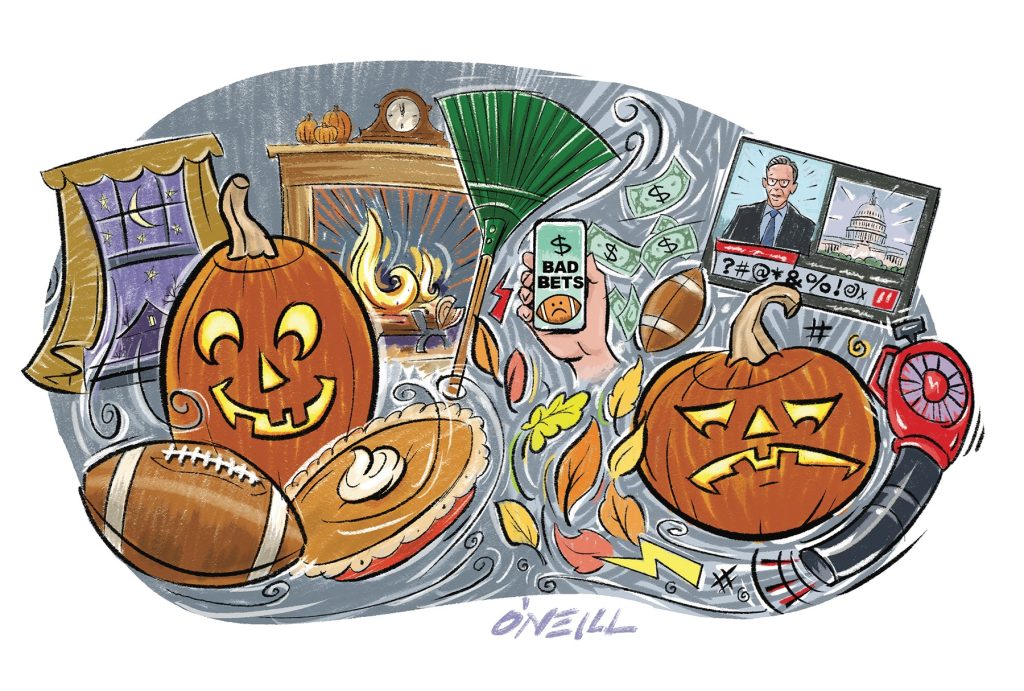
Everything from my mood to my golf game, in fact, improves with the arrival of October. And even though my interest in all sports seems to dim a little bit more with each passing year (and the worrying growth of online betting), the World Series and college football can still revive my waning boyhood attention on a brisk October weekend.

Halloween, of course, is the grand finale of October’s comforts. What’s scary is how much money Americans shell out annually on costumes, candy and creepy, inflated yard decorations (something like $11.6 billion last year, according to LendingTree), which suggests to me that being happily frightened by the sight of lighted ghouls on the lawn and kids who come in search of candy dressed as the walking dead is simply a welcome break from the daily horrors of cable news.

Our Halloween routine is one I cherish. Wendy’s elaborately decorated Halloween cookies disappear as fast as she can make them (I’m partially to blame, but who can resist biting the head off a screeching black cat or a delicious, bloody eyeball?) and I take special pleasure in carving a pair of large jack-o’-lanterns, one smiling, the other scowling, which I light at dusk on Halloween. Years ago, I used to camp on the front steps dressed as a friendly vampire until I realized how scary I looked, with or without the makeup.

Now, the dogs and I simply enjoy handing out candy to the parade of pint-sized pirates and princesses and other creatively costumed kids who turn up on our doorstep.

The best thing about October’s final night is that it ushers in November, a month of remembrance that invariably makes me think of my late mother’s stories of snow and a gentle donkey named Oscar.

Last year, my lovely mother-in-law passed away on All Souls Day, the morning after Halloween. Miss Jan was a beloved art teacher of preschool kids, whose creativity and sparkling Irish laugh brought joy and inspiration to untold numbers of children.

And me.

What a gift she left to the world.