Art of the State

ART OF THE STATE

Warp & Weft

The color-jangled painting of Barbara Campbell Thomas

By Liza Roberts

The paintings of Barbara Campbell Thomas are often warped, subtly but unmistakably. Their geometry, the linear shapes and pieces and colors that comprise them, have a slightly distorted quality. Rectangles implied, but some appear to have had a bounce or inhaled a lungful of air. Others seem to have been shaken up or spun around. That’s partly due to the kinetic energy they capture, which seems to indicate recent — even ongoing — movement.

It’s also because they are surprising. Campbell Thomas calls these works paintings, but a careful look makes it clear they are made mostly of pieced fabric. They’re quiltlike, hand-sewn, dimensional. Stretched in unexpected ways. And then painted.

“The pulling and the tension is still an important part of it,” she says. “It’s become even more magical. I spend all of this time in this initial phase, and I kind of have an idea of what it’s going to look like when I finish. Then I put it up, and it’s interesting to see what has been pulled and how the image has come to life in a different way.”
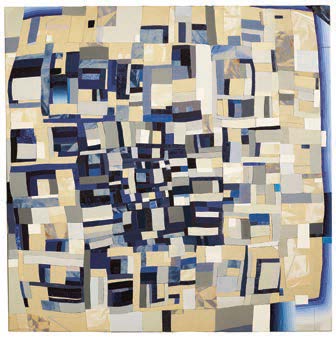
Campbell Thomas is the director of the School of Art at the University of North Carolina Greensboro and has taught there for more than two decades. Her resume is filled with solo and group exhibitions at museums and galleries around the country. Last year alone, her work was shown in solo and two-person exhibitions in Chicago, Illinois; Milwaukee, Wisconsin; Charlottesville, Virginia; and Columbus, Ohio. She has been awarded a number of prestigious residencies including at the Virginia Center for Creative Arts, and has been a recipient of a North Carolina Arts Council fellowship.

When she takes on a new body of work (like the 10 paintings she’s currently preparing for a November exhibition at Charlotte’s Hidell Brooks Gallery), she approaches it with the businesslike, step-by-step planning of a senior academic administrator — but she executes that work with daring and intuition. Campbell Thomas has learned to navigate this duality effectively with time, even as her art has become increasingly complex and her process more fully immersive.

“The piecing and sewing portion has become more complicated and elaborate, involving a lot more small pieces of fabric,” she says. “I’m understanding that layer of the process in a deeper way, so I’m spending more time in that part of the process.”

The stretching of the pieced fabric, which creates its cantilevered quality, comes next.

Once this “ground” of her paintings is set, Campbell Thomas hangs them all around her in her studio. In that way, her physical space can better reflect her “headspace,” she says, “and then the imagery: I understand better what it wants to be.” She can visualize how paint and collage will eventually come together upon these sewn surfaces: “The visual movement of the pieces feels like the big strokes,” she says, “and the collage will be how I refine them, add nuances or cover things that need to be pushed back down. The paintings become more refined. I begin to understand how to contend with the edges.”

Inside and Out

The studio where she does this work, next to her house in rural Climax, North Carolina, is about 14 miles south of Greensboro. It is a color-jangled, layered collage of a space, overflowing with textiles, history, tradition, mysticism, books, paints and threads and fabrics of every imaginable color, pattern, size and shape.

What’s outside — the fields and trees and open expanse of nature — is just as important. “I live out in the country and walking has been very important to me for my whole life. Walking on country roads, being in a beautiful landscape, has always been a touchstone,” she says.

Lately, Campbell Thomas has been trying to create “landscapes” of a different sort. “What would it be to create landscapes that are suggestive of our interior landscape? How do we create spaciousness for ourselves internally? I’ve been thinking about inhabiting a body, and what it means to inhibit a body that feels somehow spacious internally.”

The fractalized nature of her paintings, and the way they often begin in the center and move out to the edges, is her way of representing that phenomenon: “That’s me grappling with that question: how do we inhibit interior spaciousness?’

Fabric as Paint

Navigating dichotomies fuels other types of her work, too. The line where quilting ends and painting begins is one more puzzle to ponder, as is the difference between a painting (or, her version of a painting) and a quilt (a distinct form of art which she also makes).

It’s something she’s often asked about, and something she thinks about a lot. But even as piecing and sewing has become a more comprehensive part of her painting process, she has no doubt that what she makes are paintings. “My orientation as an artist is born in paint, absolutely, and the framework I still operate within has matured and evolved from an understanding of paint as a material,” she says. “That continues to inform everything.”

That dialogue began many years ago with her mother. She’s the one who taught her daughter how to quilt. But it extends through her family tree, to her grandmother and great-grandmothers, makers and stitchers and quilters all. Campbell Thomas has their names listed on her studio wall as inspiration and as a reminder of her heritage. The art journals she carefully keeps are bound with cloth covers made by her mother, who sends her a regular supply.

In these journals, she examines her process and her purpose. Abstraction, she says, allows her to say things she can’t with more literal or figurative types of work. “I’m really fascinated with my sense that there is more to the world than what we can see, and of course that starts to tap into realms of the spirit,” she says. “On the one hand, I’m engaging in this intensely material endeavor, through paint; through fabric. But there’s also this way that this engagement, which is now well over 20 years for me, is a way into spirit.”


Home Grown

HOME GROWN

If Life is a Highway, Where’s the Off Ramp?

Tales of peril on the open road

By Cynthia Adams

Recent legislature forbidding distracted driving briefly flickered in the news. Its marketing featured a driver speeding along with a shaggy dog, its head hanging out the window.

Plenty of us recall a time when children or pets could pretty much ride anywhere they would fit inside a vehicle. Heck, even plopped on open-air truck beds. Which is actually still legal for farmers going to and from market.

The 1950s and ’60s ushered in a new era for family travels, and plenty of us couldn’t wait to hit the road. My imaginary friend, Pixie, and I had no trouble squeezing into the family sedan or Dad’s old pickup at any opportunity — I loved riding standing up beside my father with my left arm looped around his neck. There was always room for Pixie beside me, of course.

A nation newly traversed by interstates, thanks to initiatives by President Eisenhower, made a journey a heckuva lot easier. (My Great Uncle Miles regaled us with stories about him and his brother John navigating a trek westward in a “Tin Lizzie,” an atlas their only guide. Upon reaching the Rockies, Uncle Miles said the Model T ended their crossing by rolling backwards down the mountain, having insufficient engine power.

But now the road was open and calling, and rural folk were catching the travel bug.

A friend recalled squeezing above the back seat into the rear window niche of a two-toned, yellow-and-white ’56 Chevy destined for the nation’s capital. (He, too, grew up in a time before children’s safety car seats, seatbelts or any safety constraints.)

“You’d be arrested now,” he chuckled, recalling napping in that window nook as the family vehicle set off. His grandmother, along with his mother, and great uncle and aunt “piled into one car and drove seven hours.” 

He woke as they rolled to a stop when they neared D.C., his aunt seeking directions to the closest dime store. He was ordered to remain in the car with his uncle, forestalling the inevitable begging for a toy. 

His Aunt Nettie huffed back after leaving the dime store, “We’re going home!”

His crestfallen mother entreated, “But why?”

“You can tell all you need to know about a town by the quality of their dime store,” she answered scornfully. “We haven’t lost anything here.”   

His Uncle Elmer turned the Chevy around, driving straight back to Burlington. 

Whatever happened in the dime store was not discussed. Did they fail to stock her favorite snuff? “Aunt Nettie was a closet snuff dipper. Beehive [brand].”

I remembered a misadventure of my own in my aunt’s drab-green, ungainly Plymouth she’d named Zesta.

One summer’s morning, my aunt and my mother packed the car for a husband-free trip to Cherry Grove, a family beach, suitcases strapped to the roof. 

There was ample room for 5-year-old me to stand on the Naugahyde rear seat and watch the road retreating behind us as morning dissolved into afternoon. Pixie, my compact friend who looked exactly like Speedy in the Alka-Seltzer ads, was not along for the adventure.

Suddenly, the green Samsonite cases the two sisters had lashed to the roof broke free and I delightedly watched them bounce along the highway in our wake. Out spilled pajamas, clothing, toiletries and unmentionables. I giggled as motorists did their best to avoid them, veering wildly behind us. 

My mother swiveled around. “What is so funny?”

I pointed to the scene behind us. “Our clothes! In the highway!” 

My mother screamed.

My aunt screeched to the side of the road, Zesta’s white-wall tires kicking up a dust cyclone. 

“What in the world?” my mother shouted at me. “Why didn’t you tell us?”

Our aunt was a striking woman, leggy, tanned and outdoorsy. More than one driver slowed just to get a better look at the blonde wearing beige Bermuda shorts, a halter top and white Keds. I myself couldn’t take my eyes off my aunt as she gathered up our belongings as best she could, darting in and out of traffic. Passing cars tooted. 

My mother, the prissy one, shouted at her older sister to be careful as she stood cautiously by in a sundress, her hair and makeup just so.

My aunt rescued some pieces from the ditches and roadside, all of it soiled. We continued on our way, the sisters sobered and quiet. “I had a brand-new bottle of Tweed cologne,” my aunt sighed. 

“Did ya’ll get new clothes,” asked my friend as we laughed about our road trips gone sideways. 

“Of course not,” I answered. 

Once at Cherry Grove, we would sit in the sand and eat grape popsicles, plus I  rode the surf in an inflatable float.

I still had my blue bathing suit, which I called my “bathing soup.” And my Teddy, too, which I was wise enough to know could not have survived being stuffed into the airless suitcase.

Pixie was away on an Alaskan adventure, which was just as well, I decided. There would be much to tell him when we both returned.

Omnivorous Reader

OMNIVOROUS READER

Horrors at Sea

The sordid tale of the Zorg

By Stephen E. Smith

A few chapters into Siddharth Kara’s The Zorg: A Tale of Greed and Murder That Inspired the Abolition of Slavery, you might consider putting the book aside. After all, we live in a world fraught with grievance. Why burden ourselves with crimes committed 245 years ago?

The answer is obvious: Ancient injustices are the source of contemporary injustices. Cruelty begets cruelty. So you’ll likely continue reading The Zorg, despite the graphic inhumanity it depicts.

Kara is an author and activist who studies modern slavery. He has written several books on slavery and child labor, including the New York Times bestseller and Pulitzer Prize finalist, Cobalt Red, and he has much to tell us in his thoroughly researched and skillfully crafted narrative of the Zorg massacre, which serves as a disturbing yet obligatory lesson for contemporary audiences. 

In late 1780, the Zorg, a Dutch ship, set sail for Africa’s Gold Coast to take on a cargo of Africans to be sold in the New World. Such slaving enterprises were common. It’s estimated that more than 12 million captive human beings were transported on 35,000 voyages between the 16th and mid-19th centuries, so the Zorg was unusual only in the exceptional misfortunes that befell its crew and captive cargo.

After reaching its initial destination in Africa, the Zorg was captured by British privateers, and the ship was loaded with more than 440 enslaved humans, twice the number it was equipped to carry. The British captain, who had little experience commanding a slave ship, and his crew were ill-prepared to make the journey; nevertheless, they set sail for Jamaica. Poor seamanship, faulty navigation, rough seas, and a lack of food and water plagued the enterprise. The Zorg missed Jamaica and had to retrace its journey. The human cargo suffered greatly, sickness took its toll on the crew, and the ship’s water supply ran low. Eventually, the crew had to decide who would live and who would die.

The first to be tossed overboard were the women and children, followed by the weaker male captives. It was a heartless and brutal business, and 140 human beings were sacrificed for the “greater good.”

Such atrocities were not uncommon in the slave trade. Still, Kara’s graphic, novelistic description of these events is compelling without being gratuitous. The massacre of the innocent Black captives will be disturbing for anyone unfamiliar with the horrors of the Middle Passage, and those readers schooled in the inhumanity of the slave trade will find themselves moved to a new level of compassion. Kara’s skills as a writer and his deft storytelling bring history to life, and readers with any sense of empathy will react with genuine horror.

But the story of the Zorg doesn’t end there. When the captain, crew and surviving slaves found their way to Jamaica, the slave trading syndicate that had financed the voyage made a claim against the insurers of the enterprise, hoping to recoup the value of the human cargo that had been jettisoned. A trial followed, and a jury found that the murder of Africans was legal — they were simply a commodity — and the insurers must pay. Each lost slave was valued at $70, about the price of a horse.

Still, the controversy might have faded from memory — what was the loss of a few African captives? — but it was soon learned that the Zorg had arrived in Jamaica with a surplus of fresh water that had been taken aboard during a storm at sea. With the water supply replenished, the crew continued to dispose of the weaker captives so they might obtain more insurance money — in other words, the captain and crew committed insurance fraud. The verdict was appealed, and a protracted legal battle ensued between the insurers and the trading syndicate. The resulting public uproar catapulted the sensational story onto the front pages of England’s most prominent newspapers, transforming what might have been an insignificant controversy into a protracted struggle that would end the English slave trade with the Slave Trade Act of 1807, which in turn ignited the abolitionist movement in the United States. It would take the cataclysmic Civil War to decide the matter in America.

Slavery may be outlawed in every country, but it persists. According to the latest Global Estimates of Modern Slavery (2022) from Walk Free, the International Labour Organization and the International Organization for Migration, 49.6 million people live in modern slavery in forced labor and forced marriage, and roughly a quarter of all victims of modern slavery are children. The concept of slavery — the notion that a dominant culture or race remains superior to a once enslaved race — has not been purged from our hearts and minds.

For readers who aren’t interested in history but are fascinated by horrific tales, The Zorg fits the bill. The Russian writer Maxim Gorky, who knew something about imprisonment and slavery, understood our fascination with the terrible. “I know of genuine horrors, everyday terrors,” he wrote, “and I have the undeniable right to excite you unpleasantly by telling you about them in order that you may know how we live and under what circumstances. A low and unclean life it is, and that is the truth . . . one must not be sentimental, nor hide the grim truth with the motley words of beautiful lies. Let us face life as it is.”

At the very least, Kara’s skillfully crafted narrative will leave readers wondering how future generations will perceive the inequities and struggles of the tragic times we live in.

The Zorg will be available online and in bookstores Oct. 14.

Tea Leaf Astrologer

TEA LEAF ASTROLOGER

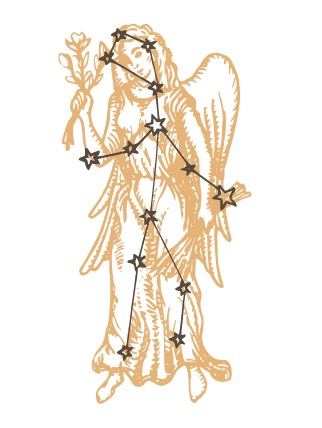
Virgo

(August 23-September 22)

Perhaps this will come as a shock: You don’t have all the answers. Let the mystery ignite your passion this month. Let it be juicy. Let it break your snarky gremlin of an ego. When Mercury guides your focus inward on Sept. 2, mind the negative self-talk as you strive toward new growth. On the 19th, Venus will shine a spotlight on unrealistic expectations. Take note. And on the 21st, the new moon and solar eclipse spell new beginnings. But not without a pickle of an ending. 

Tea leaf “fortunes” for the rest of you:

Libra (September 23 – October 22)

Inhale and lengthen the spine; exhale and gently twist.

Scorpio (October 23 – November 21)

Taste as you go.

Sagittarius (November 22 – December 21)

Just say what you mean.

Capricorn (December 22 – January 19)

Lace up your dirt-kicking boots.

Aquarius (January 20 – February 18)

It’s time for a new novel.

Pisces (February 19 – March 20)

Deep clean the fridge, stat.

Aries (March 21 – April 19)

Bring your journal along.

Taurus (April 20 – May 20)

Three words: Almond oil, darling.

Gemini (May 21 – June 20)

Your only job is to listen.

Cancer (June 21 – July 22)

Someone needs a salt bath.

Leo (July 23 – August 22)

Sign up for the workshop.

Almanac September 2025

ALMANAC

September

By Ashley Walshe

September is the letter you don’t see coming. The one you will memorize. The thorn and the balm for your aching heart.

Dear one, summer writes in florid longhand. This won’t be easy. I love you, and I must go.

Your head spins. You can smell her on the pages, in the air, on your skin — the spicy-sweet amalgam of pepperbush, honeycomb and night-blooming jasmine. You steady yourself and keep reading.

Her tone is as soft as lamb’s ear, gentle as butterfly, warm as field mouse. Still, your heart feels like an orchard floor, each word a plummeting apple. Not just the fruit wears the bruise.

You can never lose me, she writes. Close your eyes and feel me now.

Sunlight caresses your face, chest and shoulders. At once, you’re watching a movie reel of summer, recalling the riot of milkweed, the tangles of wild bramble, the deafening hum of cicadas.

Picnics and hammocks. Daydreams and dragonflies. Puffballs and palmfuls of berries. It’s all right here.

When you open your eyes, you notice a lightness in your chest — a shift.

Yes, a yellow leaf is falling. But, look. Wild muscadine climbs toward the dwindling sun, singing silent vows in golden light.

You can chase me if you wish, she writes, her script now hurried. Or, you can be as fruit on vine: purple yet unbruised, ripe with sweetness and steadfast as the seeds you hold within you.

Bird Candy

If you think our flowering dogwoods put on a show in early spring — striking white (or pink) bracts popping against the still-leafless woods — just wait until month’s end, when its ripe berries bring in waves of avian passersby.

Of course, there are the usual suspects: mockingbirds and jays; woodpeckers and warblers; cardinals, catbirds, thrashers and thrushes. But if you’re lucky, those clusters of brilliant red berries could conjure migratory wonders such as the scarlet tanager, the rose-breasted grosbeak or even a rowdy troupe of cedar waxwings to your own front yard.

According to one online database (wildfoods4wildlife.com), the flowering dogwood berry ranks No. 29 on the “Top 75” list of wildlife-preferred berries and fruits. While blackberries top the list, flowering dogwood ranks above persimmon, plum and black cherry (note: ranks were determined by the number of species that eat said fruit, not by its palatability). If curated by tastiness — or mockingbird — sun-ripened figs would have surely made the cut.

Lucky Charms

On Sept. 19, three days before the Autumnal Equinox, look to the pre-dawn sky to catch a thin crescent moon hovering ever close to brilliant Venus. Although a lunar occultation of the Morning Star will be visible from Alaska and parts of Canada (that’s when the moon passes directly in front of the planet), we’ll witness a conjunction more akin to charms dangling from an invisible chain.

Poem September 2025

POEM

September 2025

On the Way Home

from my father’s funeral,

a mime is performing on the corner,

laid out on the concrete like a corpse,

pulling herself up with an invisible rope

as if hope were a cliff to climb,

then levitates over a pretend chair

as if preparing to eat, drinking

an empty glass of air, her palms

bringing into being the nuanced

shape of bread to be broken.

I sit on the edge of a scrap of plywood,

a makeshift seat, perch as if on a ledge

heeding the gravity of all the unsaid.

Everything her eyes imply is about

the last meal I shared with my father.

“Do you hear me?” she hints

with her hands that have

become her voice, her frown

a phrase, a black drawn-on tear

a lost syllable, then,

as though life were something tangible,

sets up an imaginary ladder,

points to a nebulous cloud

she intends to reach, waving goodbye

as she begins to climb into the sky.

— Linda Annas Ferguson

Chaos Theory

CHAOS THEORY

Forever Home

Turns out, you can’t stay forever

By Cassie Bustamante

When my only daughter, Emmy, was born 18-and-a-half years ago, I was immediately overwhelmed. With love, sure, but mostly with life. I already had a 17-month-old toddler, Sawyer, at home. My husband, Chris, traveled a lot for work. How on Earth was I going to survive with two little ones in diapers by myself? Now, it’s been just a couple of weeks since we sent Emmy off to her first year of college at Penn State, and I don’t know how I will manage without her here.

While Sawyer was a busy, on-the-move preschooler, Emmy, from a very early age, could sit and color contentedly for hours. I remember leaving her once, just 2 at the time, in our playroom so I could tend to Sawyer upstairs in our little split-foyer home. I felt panicky during the minutes I was away from her, but, when I returned, she sat in the same chair, still happily doodling with crayons in an array of bright colors. Before taking my seat next to her, I stared in wonder. Who was this calm, creative child?

Don’t get me wrong. It wasn’t all Crayola rainbows and tissue-paper butterflies. With that artistic spirit comes a bit of environmental chaos. In fact, numerous studies have linked messiness with creativity. I can confirm that the spot where I sit in my home writing for this very magazine is surrounded by an impending avalanche of books, magazines, pens and papers threatening to send a half-drunk cup of room-temperature coffee flying onto the rug. Emmy’s space was her bedroom and, boy, did she express herself within its walls. For my own sanity, I usually just kept the door shut. Out of sight, out of mind. And, yes, I know this is rich coming from someone who’s just declared her space a wreck too.

But, on occasion, I’d spend the better part of my day giving her bedroom a thorough cleaning while she was in school, blissfully unaware of my intrusion. Armed with trash bags to stuff with garbage and donations, I’d sift through every nook and cranny. It was a challenge, to say the least, but the reward was worth it: little glimpses into her sparkling soul. In her desk drawers, I’d discover illustrated fairy tales she’d written. On the walls of her closet, she’d hung pictures of hearts and stars with motivational sayings, things like “You were meant to shine bright.”

She’s always used a mix of words and colors to communicate; it’s no wonder she ended up working on her Grimsley High School yearbook and plans to study journalism. Once, when she was 8 and had gotten in trouble, she left me a note on our kitchen island: “I am sorry for the way I acted. I was being a total jerk. It’s just that a lot of people have been mean to me. Love, Emmy. P.S. I hope you understand.” How can you stay mad at that?

Generally, she shied away from reading her own writing aloud, but, every once in a while, she couldn’t resist. Two weeks after leaving me that heartbreaking note, she penned a tune she titled “Forever Home.” Thankfully, 37-year-old me had the foresight to capture the moment she sang it to me, her crystal-blue eyes twinkling as she smiled proudly.

Now, a decade later, I’m back at home after loading all of her worldly belongings into our SUV and dropping her off in State College, Penn. My finger hovers for a moment and then I hit play on that video. Her squeaky little voice fills my ears as tears fill my eyes:

Forever home, you’re never alone

You’re always with someone,

Say hello, say goodbye,

Say hello, change your mind,

’Cause you’re with someone,

And even if you’re not,

You’ll still have us.

Once again, I feel overwhelmed. Somehow, I managed to get through those years of having two little ones in diapers. So much, in fact, that a decade later, we even decided to add a third, Wilder, who is almost as old as Emmy was when she wrote that song. And no, I don’t know how to keep going without her here every day, but I know I will. And I hope that she knows that no matter where life leads her over the next four years and beyond, we are always with her and we remain her steadfast “Forever Home.” 

O.Henry Ending

O.HENRY ENDING

The Sun Also Rises — and Shines Where It Shouldn’t

Hollywood fantasy versus stark-naked reality?

By Cynthia Adams

Same Time, Next Year’s setting — which movie critic Janet Maslin sniped was the only thing that saved the 1978 film from being ruinously boring — nearly upstaged star-crossed lovers Ellen Burstyn and Alan Alda. When opportunity (aka cheap airfare) allowed, I envisioned a romantically windswept trek to the rugged cliffs of Mendocino with my husband.

But Mendocino in autumn was dead but for a whistling wind. A tour of the quaint, old inn left little to do beyond admiring said cliffside. The cottage where Burstyn and Alda trysted was a set that Universal Studios transported southward to the Heritage House Resort.

Disappointed, we decided to meander back down Highway 1 to San Francisco.

Outside of Mendocino, a roadside stand turned out to be a pop-up head shop where I spied a little pink pottery pipe. This scandalized my more conventional husband, but it seemed to me the perfect souvenir.

When signs for Bodega Bay came into view, I shrieked excitedly that we couldn’t miss Hitchcock’s setting for The Birds.

Bodega Bay was another sleepy outpost — an actual bay with working fishermen. No ominously gathered birds.

Hitchcock deployed mechanical birds, plus over 25,000 live seagulls, sparrows, finches and crows. Of the 3,200 birds trained for the film, Hitch mostly used ravens. Seagulls, he told Dick Cavett, were the most aggressive. Many were trapped at the San Francisco city dump by the trainer, who revealed they instinctively “go for your eyes.” By the time the film wrapped, a traumatized Tippi Hedren had endured not only bird assaults, but Hitchcock’s, too.

Of course, I knew none of this.

Over a seafood lunch in Bodega Bay, I gloomily realized that it was not that California had changed since Hitchcock and Alda had worked their movie magic: It was me.

Yet I remained resolved to continue whatever explorations our teensy-tiny budget allowed. Discovering cut-rate fares to Key West, I pounced. Hemingway! Cuba! Key West practically screamed bucket-list adventure. Knowing little, I relied upon my hairdresser for information, booking his favorite inn.

We escaped a cold, dreary Triad to re-emerge inside a sunny haven.

A pastel golf cart driven by a gorgeous man collected us at the airport. Key West pulsed with energy. Colorful restaurants abound, including Blue Heaven, started by a Chapel Hill family, Louie’s Backyard and Pepe’s Cafe, a President Truman favorite. 

Our inn overflowed with beautiful, tanned people. With an exception: a pasty-white, portly couple who were anything but. They were improbable in such a setting; him, stentorian, Orson Wellesian, and she wore her gray hair primly coiled in a perm.

We hurriedly dropped off our bags bound for Hemingway’s house and its storied cats. The innkeepers suggested a private sunset sail for guests later.

Which, we discovered once aboard, was swimsuit optional.

As Nora Ephron quipped, our young selves had no idea we would never again look as good in — or out — of swimsuits. But the majority remained fully suited up . . . apart from the pale couple we noted at check-in. 

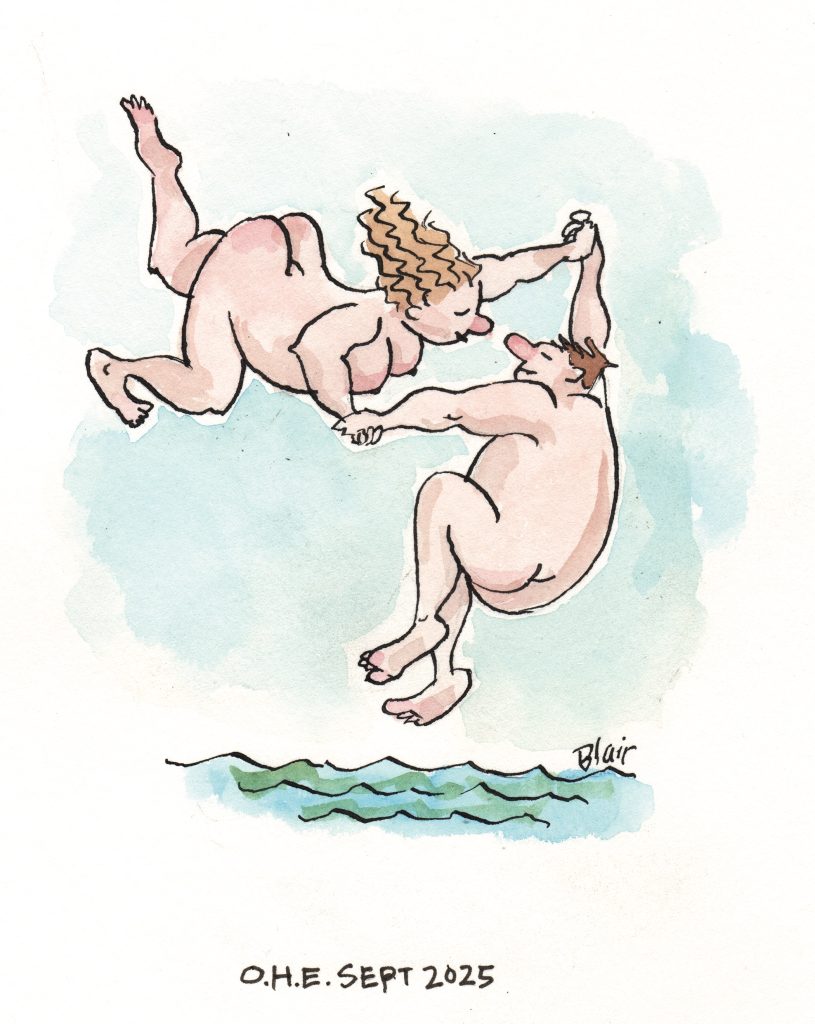
Shucking off suits, cellulite be damned, they hoisted themselves to the prow of the sailboat. There, they proceeded to suck each other’s lips off as he twined his fingers through her curls. 

The rest of us awkwardly averted our eyes as they eventually cannonballed off the bow to swim au naturel. That evening, the lovebirds padded through the lobby scantily clad, sunburned the deepest scarlet of a Key West sunset. 

Checking out days later, we inquired about their, uh, sunburns. The innkeeper leaned close. “They’re Chicagoans. A same time, next year couple,” he whispered. “She’s his secretary. He’s a big deal lawyer.  And they meet up here. Every. Single. Year.”

My husband could barely contain himself as we left, me stunned into silence. “Well, you finally got your wish,” he chortled, doing his best to stifle outright laughter. “Be careful what you wish for,” he managed to choke out as I ignored him, another illusion shattered, our golf cart streaking past a Hollywood-perfect Key West sunrise.

Wandering Billy

WANDERING BILLY

The Right Puffs

All aboard for a goo-goo-googly good time

By Billy Ingram

Chalk it up to DNA?

Being born and raised in the Gate City undoubtedly fostered in me a lifelong love for trains, so christened by our proximity to a railway hub that, from 1851 until the present, has served as a vital artery mainlining material goods and shuttling fine folks from point A to point G. Low moaning emanating from nearby locomotive horns, in unison with an underlying soundtrack of discordant notes struck by squealing, steel wheels straining against their railings, invokes an elemental tonality closely associated, in my mind, with home.

In that spirit, I wandered over to one of the twice-weekly open houses at the Carolina Model Railroaders’ studio, located above downtown’s J. Douglas Galyon Depot. There, aficionados of miniature trains, whether teens or senior citizens, were engaged in laying tracks, assembling aesthetic surroundings and, with the turn of a dial, sending scale-model boxcars, carriages and cabooses speeding around their humble hamlets, surrounded by handmade houses and fake, plastic trees affixed to mossy, green plywood.

I first visited CMR, organized over a half-century ago, in 2016, when participants were simulating an Atlantic & Yadkin ride by rail from Greensboro to Winston-Salem, complete with familiar landmarks recreated with an impressive degree of accuracy. The current layout isn’t as elaborate, but the topography is in constant flux. It’s the journey, not the destination, that keeps everyone committed to continuing this all-American activity.

Brannon Carty is a young filmmaker I met recently who trained his documentarian lens on a different manner of miniature railroad, one criss-crossing the mythical island of Sodor, fluffy-clouded home to Thomas the Tank Engine: the stop-motion animated, toddler-oriented series touting morality tales that fuel youthful imaginations, wherever he whistles ’round the bend.

Thomas the Tank Engine & Friends made its United Kingdom debut in 1984 before crossing the pond in 1989, when it was integrated into PBS’ Shining Time Station, starring George Carlin. The show is based on a series of books that first appeared in the U.K. in 1945, written by Reverend Wilbert Vere Awdry. Awdry’s idea was to entertain his son, Christopher, the Thomas tomes’ succeeding author. Currently, the television program is broadcast in over 121 countries and translated into over 20 languages, suggesting an undeniable universal appeal.

“My older brother was into it when I was a young kid,” Carty says, explaining his budding early-2000s tele-crush. “He grew out of it, I didn’t.” Internet forums fueled his fascination, first in elementary school, then chuffing along into later years. “I was talking to all these other people about Thomas and it kind of evolved into being this community, which is really huge.” Part of the allure, Carty believes, comes from playing with the TV tie-in train sets sold in stores. “It’s the perfect storm of merchandising,” he says, paired with the show’s unique production. “It was shot on 35 millimeter so it doesn’t look like any other kid show.”

Carty earned a bachelor of arts in media studies at UNCG. “2019 was my last year. I was doing an independent study with Professor Wells, who was into documentaries. He said, ‘Hey, do a doc over this semester and, that’s it, you graduate.’” Not sufficiently interested in anything sociopolitical or overly serious, Carty says, “I knew a bunch of adult Thomas fans — I am one. So, I filmed them.” After completing his 45-minute digital dissertation and graduating, Carty decided to continue filming his story. Railroading five fellow filmmakers into his roundhouse, he says, “We wrapped our last interview in 2022 and finished the edit in November 2023.”

Carty recently returned from London, where his Kickstarter-funded documentary, An Unlikely Fandom: The Impact of Thomas the Tank Engine, was screened at a Thomas festival. The film focuses on the peregrinations of a cadre of likable lost boys, newly found, whose one-track minds refuse to apply brakes to a fervent reverence gleaned in earliest childhood memories. That adorable choo-choo with the goo-goo-googly eyes chugging full steam ahead into their hearts. 

This local locomotion picture also tunnels into the making of the television series, featuring extensive interviews with key contributors — the music producer, prop master, animators, picture book author, even Britt Allcroft, the clever British woman who created the original 1984 Thomas the Tank Engine & Friends animated series. The assembled cast of characters are all clearly enchanted yet somewhat surprised by their grownup fans’ keen interest. Superbly shot, edited and paced by Carty and his crew, the film even landed Alec Baldwin, the American narrator for a few seasons.

Allcroft especially comes across as a very sweet, ordinary lady who had the foresight to purchase Thomas’ television rights when no apparent market existed. While it took three years to complete that first season, it was a chance meeting at one of the recording sessions that led to Ringo Starr becoming the program’s original narrator. Also of interest is how divergent, yet alike, the TV version is compared to the 1940s series of books it was based on.

Carty, an avid hiker and climber who’s into fitness, admits that Thomas doesn’t gel well with his less passive pastimes. But “a love for old movies, that’s what led me down this path.” An Unlikely Fandom premiered in November 2023. “Go big or go home,” says Carty ruefully. “We all pulled together to premiere it in the Museum of the Moving Image in New York, which ended up costing so much money.” They flew in creator Britt Allcroft. “She was a little bit surprised that there were so many adult fans. I don’t think she expected it to be so normalized.”

The flying monkeys bestowing awards of excellence have yet to carry this one to heights it deserves, nor has a distributor picked it up yet. Carty, who also narrates the documentary, notes it’s still early. “We’ve just been sort of touring [the film] for the last couple years. I know The Guardian is about to do a piece on it, which we hope will get someone interested.”   

A theory posits that tots tuning into Thomas harbor a latent interest in model trains. Probably should’ve asked when I was down at the Depot watching those young-at-heart men putting their HOs through the paces I imagine Thomas feeling right at home clacking the tracks at Carolina Model Railroaders’ meetups. You may also; new members are welcome at cmrgreensboro.org.

Meanwhile, the erstwhile engine’s 80th Anniversary celebration will be pulling into nearby Spencer, when Day Out With Thomas: The Party Tour puff-puff-puffs up to the N.C. Transportation Museum, arriving September 26–28, then steaming into view again the very next weekend. It’s a genuine bargain at $30 a head, especially considering admission includes a ticket to ride the real Thomas the Tank Engine.

An Amtrak departure from GSO to Spencer will likely be a final opportunity for today’s young’uns to experience what catching a passenger train was like during the golden age of rail travel, to hear “All Aboard!” after entering our breath-taking, magnificently restored, 1927 Beaux-Arts-designed terminal, seemingly frozen in time. For now, anyway. Plans are afoot for the almost century-old Depot’s opulent lobby to be reimagined as a hip entertainment venue, for which I’m not on board.

Simple Life

SIMPLE LIFE

The Light in August

Catch it before it fades

By Jim Dodson

Most mornings before I begin writing (often in the dark before sunrise), I light a candle  that sits on my desk.

Somehow, this small daily act of creating a wee flame gives me a sense of setting the day in motion and being “away” from the madding world before it wakes. I sometimes feel like a monk scribbling in a cave.

It could also be a divine hangover from early years spent serving as an acolyte at church, where I relished lighting the tapers amid the mingling scents of candle wax, furniture polish and old hymnals, a smell that I associated with people of faith in a world that forever hovered above the abyss.

According to one credible source, the word “light” is used more than 500 times in the Bible, throughout both Old and New Testaments. On day one of creation, according to Genesis, God “let there be light” and followed up His artistry on day four by introducing darkness, giving  light even greater meaning. The Book of Isaiah talks about a savior being a “light unto the gentiles to bring salvation to the ends of the world.” Throughout the New Testament, Jesus is called the “Light of the world.”

But spiritual light is not exclusive to Christianity. In the Torah, light is the first thing God creates, meant to symbolize knowledge, enlightenment and God’s presence in the world. Surah 24 of the Quran, meanwhile, a lyrical stanza known as the “Verse of Light,” declares that God is the light of the heavens and the Earth, revealed like a glass lamp shining in the darkness, “illuminating the moon and stars.”

Religious symbolism aside, light is something most of us probably take for granted until we are stopped in our tracks, captivated by the stunning light show of a magnificent sunrise or sunset, a brief and ephemeral painting that vanishes before our eyes.

Sunlight makes sight possible, produces an endless supply of solar energy and can even kill a range of bacteria, including those that cause tetanus, anthrax and tuberculosis. A study from 2018 indicated rooms where sunlight enters throughout the day are significantly freer of germs than rooms kept in darkness.

The intense midday light of summer, on the other hand, is something I’ve never quite come to terms with. Many decades ago, during my first trip to Europe, I was fascinated (and quite pleased, to be honest) to discover that, in most Mediterranean countries, the blazing noonday sun brings life to a near standstill. Shops close and folks retreat to cooler quarters in order to rest, nap or pause for a midday meal of cheese and chilled fruit. I remember stepping into a zinc bar in Seville around noon and finding half the city’s cab drivers hunkered along the bar. The other half, I was informed, were catching z’s in their cabs in shaded alleyways. The city was at a complete, sun-mused halt.

The Spanish ritual of afternoon siesta seems entirely sensible to me (a confirmed post-lunch nap-taker) and is proof of Noel Coward’s timely admonition that “only mad dogs and Englishmen go out in the midday sun.” Spend a late summer week along the Costa del Sol and you can’t avoid running into partying Brits on holiday, most as red as boiled lobsters from too much sun. 

In his raw and gothic 1932 novel, Light in August, a study of lost souls and violent individuals in a Depression-era Southern town, William Faulkner employs the imagery of light to illuminate marginalized people struggling to find both meaning and acceptance in the rigid fundamentalism of the Jim Crow South.

For years, critics have debated the title of the book, with most assuming it is a direct reference to a house fire at the story’s center.

The author begged to differ, however, finally clearing up the mystery: “In August in Mississippi,” he wrote, “there’s a few days somewhere about the middle of the month when suddenly there’s a foretaste of fall, it’s cool, there’s a lambence, a soft, a luminous quality to the light, as though it came not from just today but from back in the old classic times. It might have fauns and satyrs and the gods and — from Greece, from Olympus in it somewhere. It lasts just for a day or two, then it’s gone . . . the title reminded me of that time, of a luminosity older than our Christian civilization.”

I read Light in August in college and, frankly, didn’t much care for it, probably because, when it comes to Southern “lit” (a word that means illumination of a different sort), I’m far more attuned to the works of Reynolds Price and Walker Percy than those of the Sage of Yoknapatawpha County. By contrast, a wonderful book of recent vintage, Anthony Doerr’s All the Light We Cannot See, tells the moving story of a blind, French girl and young, German soldier whose starstruck paths cross in the brutality of World War II’s final days, a poignant tale shot through with images of metaphorical light in a world consumed by darkness.

But I think I understand what Faulkner was getting at. Somewhere about middle-way through August, as the long, hot hours of summer begin to slowly wane, sunlight takes a gentler slant on the landscape and thins out a bit, presaging summer’s end.

I witnessed this phenomenon powerfully during the two decades we lived on a forested coastal hill in Maine, where summers are generally brief and cool affairs, but also prone to punishing mid-season droughts. Many was the July day that I stood watering my parched garden, shaking my cosmic gardener’s fist at the stingy gods of the heavens, having given up simple prayers for rain.

On the plus side, almost overnight come mid-August, the temperatures turned noticeably cooler, often preceding a rainstorm that broke the drought.   

When summer invariably turns off the spigot here in our neck of the Carolina woods, sometime around late June or early July, I still perform a mental tribal rain dance, hoping to conjure afternoon thunderstorms that boil up out of nowhere and dump enough rain to leave the ground briefly refreshed.

I’ve been fascinated by summer thunderstorms since I was a kid living in several small towns during my dad’s newspaper odyssey through the deep South. Under a dome of intense summer heat and sunlight, where “men’s collars wilted before nine in the morning” and “ladies bathed before noon,” to borrow Harper Lee’s famous description of mythical Maycomb, I learned to keep a sharp eye and ear out for darkening skies and the rumble of distant thunder.

I still gravitate to the porch whenever a thunderstorm looms, marveling at the power of nature to remind us of man’s puny place on this great, big, blue planet.

Such storms often leave glorious rainbows in their wake, supposedly a sign (as I long-ago learned in summer Bible School) of God’s promise to never again destroy the world with floods.

Science, meanwhile, explains that rainbows are produced when sunlight strikes raindrops at a precise angle, refracting a spectrum of primary colors.

Whichever reasoning you prefer, rainbows are pretty darn magical.

As the thinning light of August and the candle flame on my desk serve to remind me, the passing days of summer and its rainbows are ephemeral gifts that should awaken us to beauty and gratitude before they disappear.