Poem September 2023

Poem September 2023

Heaven

Take me to a place where thoughts taste like sounds

Where faith feels and passion runs

Where touch can swim and energy flow

Where reasons don’t demand, season’s blossom and suns rise

Where water walks and life don’t pass you by, but instead waits patiently

Where people’s attention spans decades

Allow me to be more, so much more

Where my words are more than food for thought, but rather thoughts that provide food

Where I can be more than a poet

And what I say more than words

Where what I do is more than actions

Where revolution is daily and change is voluntary

Where red lights don’t stop traffic, but instead influence all to go respectfully

Creating infinite synergy

Take me to a place where we all prosper normally

Growing hereditarily, moving toward unity

Soon to be so much more than just inspiring

I want to breathe change and walk freedom

To sing strength and run like the wind

Where I can bleed passion and birth ideas that grow to be the future

Where suits are more than clothes or court cases

But represent a race of people all created equal

Where color is no boundary, where money no discriminating factor

Where like actors we are all just waiting to receive our academy award

Their time in the lime light, but this spectrum touches all of us leaving out no one

That light too bright to be held captive

I want to be there where the stairs lead upward and onward and life never ends

Where goodness and peace transcend and everyone is your friend

It’s too bad the only way to get there is at this life’s end

Heaven

  Josephus III

Poem August 2023

Poem August 2023

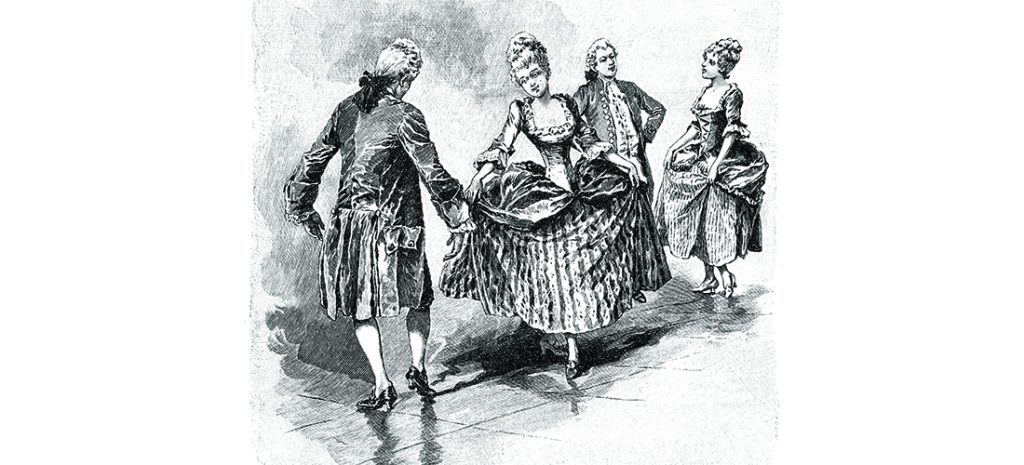
Washington as Count Dracula

Tryon Place, 1791

Washington comes in. He is wearing

black velvet with gold buckles at the knee

and foot,

a sword with finely wrought

steel hilt, in scabbard

of white leather,

a cocked hat with a cockade and a feather,

also black. His powdered hair

is gathered in a black silk bag.

His hands in gloves of yellow

clasp extended hands.

Above his head medallions

of King and Queen

flicker beneath dripping wicks, the little flames

in circles on the chandeliers

surrounded by bits of glass, like worlds

in the sky, the telescopes of astronomers.

The crystals like Newton’s prisms split

the flames, blue, yellow, red, violet.

As in the “The Masque of the Red Death”

the dance goes on in rooms, where colors

glint from rubies in women’s ears.

He bows deeply, his corneas

refract ideas: science

dances from tiaras, bracelets, rings.

The battle of Alamance

was lost. The Regulators’

defeat had finished the rebellion,

or so Tryon thought.

Washington’s eyes grow red.

He leads the minuet.

        — Paul Baker Newman

SPLIT

SPLIT

Fiction by Valerie Nieman Illustration by Jenn Hales

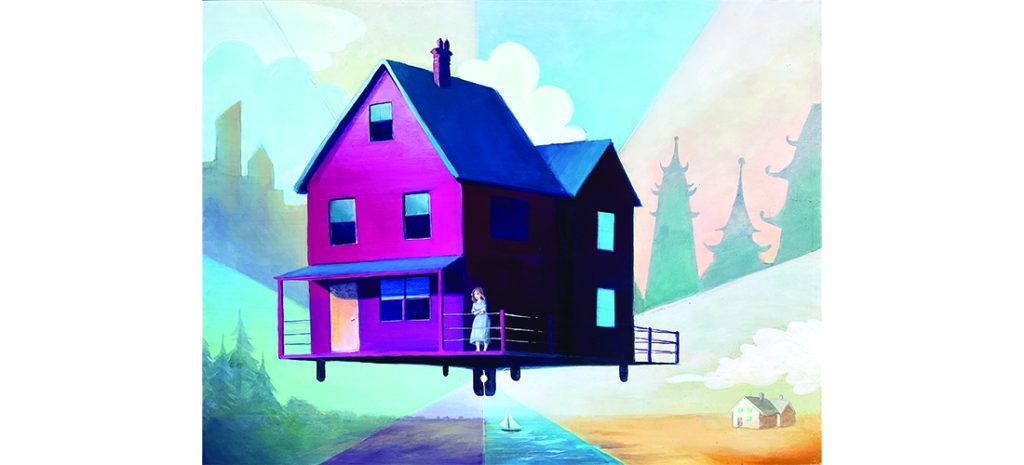
Andi hadn’t been startled awake for several nights, ever since the contractor fixed that foundation problem, but now she sat straight up in bed. Something was wrong. The house, her new home in a new city, remained quiet, all that groaning and cracking having been eliminated by the repairs. It was that other silence — no hum of cars passing on the street, no sounds of a city waking up. And, she realized as she stared into total darkness, no streetlight glow filtering around the blinds.

For a while, she heard nothing. Gradually, light began to show and she heard a chorus of shrieks and whistles — birds? She got up, shuffled to the back door and opened it on a bright dawn, cornfields stretching flat and green in every direction. The rows came right to her steps, tassels waving well above her head. Blackbirds wheeled in huge flocks.

Her house had moved. And she had moved with it.

Even as she tried to make sense of it, speculating that this looked like Iowa — must be, maybe, everyday, common Iowa — nothing to be afraid of, the rest of her brain was rabbiting around the bonkers impossibility of her situation.

She had loved the cottage from the moment the realtor opened the door, but, after moving in, she came to realize there was an uneasiness about it. Day and night, floors creaked and popped without the weight of a footstep. When she reached to put something in a high cupboard, the top of it did not line up with the ceiling. Everything was slightly off one way or another, but that’s the way old houses were. They settled year by year, in a long, uneven conversation with the ground.

She didn’t miss her previous home. It wasn’t that, at all. When her ex abruptly went away (for good this time), and shortly after so did her job, she’d decided she needed something smaller to meet her changed circumstances. Something older, solid, with its own history.

Stay, or go. It hadn’t been a difficult choice. Her former home had no longer felt like home. It just felt like him, his house, cold all the time.

Three different construction dates — 1921, 1927, 1928 — were listed variously on deeds, descriptions and reports. It made no sense. A house was completed or not in a certain year. The cedar-shake cottage had been moved sometime in the 1970s and new sections had been added, a porch, a deck. Extensions that almost seemed to buttress the square main building, pushing out on three sides.

Andi had become fascinated by the idea of house-moving. It wasn’t unusual, of course; houses were moved out of the path of development all the time. Even lighthouses were raised up on rollers and carried inland, away from the encroaching sea. She remembered reading about a town in Minnesota that was hauled away from mining damage by horses and tractors and a steam engine. Elsewhere in North Carolina, the former village of Avalon had been moved when its mill burned down, the little houses incorporated into the neighboring textile town of Mayodan.

History was like that, for a house or a person — gaps in the record, mysteries.

The recommended contractor came within a week — the benefit of a small town, Andi supposed — and rang the doorbell with his ball cap off, gripped in his hands like he was entering a church.

“Miss Andrea?”

“Andi.”

“Miss Andi. I am pleased to meet you.” He paused and glanced inside. “What were you needing done?”

“I’d like you to look at the foundation.” It sounded too — something — to say she heard strange noises. “I understand the house was moved. Is it well supported? The home inspector didn’t mention anything.”

“Well, you are spot on about the move. I remember when they did it. Quite the show, with traffic held up and all. They put an office building where it used to be.” He kept talking as she led him back to the utility room and the trap door to the crawl space, wondering if a man that old (he had only a fringe of white hair around a polished dome) was agile enough to get around under the joists. But she needn’t have worried — he was quickly out of sight, banging around beneath the floor, and it wasn’t long until he came up out of the hole.

“Found your problem.” He turned off his flashlight, dusted off his hands. “The main support beam, a steel beam at that, has been cut in two.”

“What?” That sounded terrifying, as if the house might bend at the center like a cardboard box and fold itself flat.

“Yep. Might have been part of moving it, I don’t know.”

“Is it dangerous?”

“No, no, there’s plenty of support pillars. Just . . . strange.”

She hadn’t been able get the vision of a collapse out of her mind. “Can you put it back together?”

“I can do that, sure. Have to come back with some tools, bolts and such. And good steel.”

And so it was done.

Two mornings after the cornfields appeared, she awoke to the mooing of cows.

She hadn’t ventured into the tall corn, featureless as a sea. Now she looked out on new fields that rolled away over little hills, fields bounded by hedges instead of fences. Brown and white cows. She looked out of windows on each side of the house. Far away she could see a steeple and what appeared to be a castle.

England?

The house did not move on a regular schedule. It stayed in the same place for days, even weeks, then she would hear the wind moaning from a new corner of the eaves and look outside to see — what was that?

She was cautious. When the house set down in a populated area, no one seemed to notice. People apparently could not see the house, but once she stepped off the porch, they could see her. The first time she’d tried, somewhere under a hot, pale sky, black-haired children clamored at her and she ran back inside. They stood for a moment, wide-eyed, letting the stones drop from their hands, and fled.

Did she appear suddenly, popping into view? Was she floating in a bubble like Glinda? No way to tell.

The movement of the house in space and time became wider and wilder. One day she might look out on a Japanese seaside town with little boats and a pagoda, and a couple days later, she’d be in the United States, far to the north, in a logging town at the edge of a redwood forest. The house, severed from a permanent base, had no utilities, but Andi did have a large supply of candles. And a rain barrel that had been strapped to one of the additions.

I am resourceful, she thought. I am doing fine.

Turn and turn and turn again.

The days were long and the nights longer in the wandering house. She missed her friends, especially Nicole, a coworker who had stayed close through both the divorce and her early (forced) retirement from their employer. Nicole had always teased her for overly careful preparation, cautious decision-making. What would she say about this?

Andi even sort of missed her ex. He had been a familiar problem, at least.

She learned how to gather food in exotic places, covering her foreignness with a long, hooded cloak, a souvenir of her role in a college Shakespeare production. Where there was a store, a souk, a market cross, she waited and watched, moving in when the crowds had thinned and the leavings were cheap. The smell of cooked meat made her ravenous.

She could barter jewelry and small items to merchants. Gestures were pretty much universal. As her hair grew unruly and her scrupulously kept-up color faded to salt-and-pepper, with her head down and a hand upturned, she could sometimes gather alms from passersby. No need to speak. Maybe she couldn’t any longer.

Andi fell asleep with the house settled someplace that was high and cold and empty, a steppe. She woke to find it beside a long lake clasped by dark-forested mountains. Well down the shore was a cluster of thatch-roofed cottages.

Hunger drove her to the village and, as she looked for someplace to get food, she was relieved to realize the people were speaking a sort of English. It wasn’t market day, but a house displayed a bush over the door. That meant beer was available, she remembered from a long-ago advertising class.

She nodded to the woman inside, dressed in a bodice and full skirts, her hair covered.

“Beer,” she ventured.

The woman, stout as one of her casks, looked oddly at her.

“Ale?” Andi mimed drinking.

The woman responded by shaking a bucket at her.

Ah. Medieval takeout. She had no pitcher, bucket, anything with which to carry the beer away.

Andi put her hand on a pottery pitcher and indicated that she would buy it. She produced a piece of jewelry she’d brought to trade, an alloy ring decorated with the figure of a nude dancing woman.

The woman backed away, eyes wide, and whispered something that sounded like “elf.” Or “help.”

A man came from outside and she pointed to the ring where it lay. He picked it up and turned it in his dirt-caked fingers, squinted at her, and then spoke to the woman, who hustled off to get someone, a priest, a soldier, someone that Andi didn’t think she should meet.

She gathered up the skirts of her cloak and ran.

The house didn’t move that night, or the next, or the next. She wished it would.

Andi did not go back to the village, fearing people who feared her. Andi imagined the townspeople might think she was something supernatural, in league with the Devil. She also considered that maybe the stylized figure of a naked woman on the ring had offended them. People went past the house, on their way to fields or driving herds of sheep along, without even a glance.

Then a man as dark as a devil stopped right in front, turned and stared into the window.

“I spy a lass, through the window,” he said.

She hid behind the curtain.

“There thou be, though how this house came hither I dinnae ken.” The man began to walk away, and she thought he’d gone until he emerged from the other side, having circled the house. He stepped up onto the porch and came to the door.

“How can you see this house?” she asked, almost whispering into the gap between the old door and the frame.

“Metal calls to me, shaped in some cantrip-time.”

Andi opened the door but stood behind the screen as though that bit of protection would be sufficient to keep out this brawny man. A blacksmith, she realized, his skin and clothing darkened by the smoke of the forge.

“The house moves,” she confided. “It was cut apart underneath and then, when it was fixed, it began moving.”

He cocked his head as he listened, the way a dog turns its head as it tries to tune in its person’s unfamiliar words. “The house is magiked.”

She nodded.

“Gie me leave then to see?”

Andi opened the flimsy door and stood back. The whiff of fire and charcoal came with him. He looked around the room, bemused (What did he make of the black slab of the television, photographs on the wall?) then followed her to the access. Like the old contractor, he moved with the assurance of someone who dealt with problems all the time, physical problems that could be addressed with tools and skill.

He was quickly back up, head and shoulders out of the trap door. He tried to explain the situation, and now she was the one who couldn’t put all the words together. However, she came to understand that he had found the steel beam bridged by the contractor’s plates and bolts.

“Can you fix it?”

“Fixt? Your house is scarcely that,” he said, a smile opening his sooty face. “I’ve a gift from the Fair Folk to forge steel that will nae break nor blunt at the bite. Aye, I can do this task. A wandering heart can be put aright, house or lass alike.”

He heaved himself out of the crawl space. She pulled back, away from his seared hands and leather apron.

“If you do, if you fix — unmend — it, what will happen?”

“The heart was cut in twain to end the wandering. If I take away the clampar, ’twill rest again.”

She thought about the various recorded dates of the house’s construction. Had it skipped from year to year, somehow, appearing and disappearing until it was tamed?

“But where? Where will it be?”

“Why, here, lass! I canna make it skip the sea from one shore to another like a stane from the hand of the giant Benandonner,” he said, laughing. “Here this house stays, and thou with it, or else be ever a-wandering like Will-o’-the-wisp.”

She looked out at the dense forests and the long silvery lake. She was aware of the interest in his merry eyes. And the able heft of the man. Solid, he was.

“My folk will thee like. There’s much eerie hereabouts, m’self not least, though we’ve never seen a lass sa conveyed.”

He offered his fire-marked hand.

“Andi,” she said, as she took it.  OH

A former professor at NC A&T State University and editor for the Greensboro News & Record, Valerie Nieman lives and writes in Rockingham County. Her novel, In the Lonely Backwater, won the Sir Walter Raleigh Award for 2022.

Don’t Let Them Eat Cake

Don’t Let Them Eat Cake

Fiction by Brendan Slocumb     Illustration by Mariano Santillan

He smelled like the cake factory: frosting, the yeasty stench of batter and butter, but more than anything else, sugar. Baked sugar, tangy and sweet, that coated the back of his tongue and the inside of his eyelashes. Leaving the factory at the end of the shift, he could feel the sugar aroma around him like a coat or a fog, always moving with him. Of course, his friends started calling him Bon Bon. He’d hated the nickname, but by now it had hung on him so long that he didn’t mind it.

He ordered another beer and checked his watch. His buddy, Tig, was late, as usual. Meet me at the bar at 6:30 and DONT BE LATE, Tig had texted him. SERIOUS!!!

Now it was 6:49, and he’d finished the first beer and ordered a second. Why Bon Bon had believed Tig that this time actually was urgent, Bon Bon didn’t know. He’d shown up in his work clothes without changing back into his street clothes, the King Arthur Brand cake flour misting up from his pant legs every time he shifted on the bar stool. 

“You makin’ me hungry, buddy,” Alan, the bartender, told him for the third time. “What do you think of carrot cake? You a big fan?”

“I figured you for a chocolate cake man,” Bon Bon said. “That was your wife in the shop the other day, wasn’t it? She bought the 14-inch and the 18-inch. Double chocolate.”

“Wife loves them,” Alan said, buffing the bar and looking away. His A-shirt, with dozens of stains on it — bourbons, whiskeys, wines — barely covered his paunch. Seemed like Alan loved those chocolate cakes, too.

Bon Bon nodded politely, tried to squeeze out a smile and looked again at the door.

“You must get sick of cakes,” Alan said. “All them sweets. That vanilla confetti cake is my favorite.”

“Never touch the stuff,” Bon Bon said. “I only eat salty stuff. You got more of these?” He pushed the empty dish that had contained pretzels and peanuts towards Alan. The first few months at the factory, Bon Bon had eaten so many pastries that he became nauseated by the sight of anything with sugar in it. 

He looked at the clock. It was 6:54. If Tig didn’t show by 7, Bon Bon was out of there. Home, out of the sugar-stenched clothes and into the shower. He imagined hot water sluicing over him, the powdered sugar circling the drain and disappearing. He fumbled in his pocket for his wallet, looking for a ten, when a familiar voice said behind him, “You stink like the inside of a fat woman’s purse, you know that?”

Tig. Of course. “What?” Bon Bon asked him. “What does the inside of someone’s purse smell like? And where were you?”

“They keep cake in them,” Tig said. “The ladies.”

“Nobody keeps cake in their purse,” Bon Bon told him. “That’s the dumbest thing I ever heard you say.” And he’d heard Tig say plenty of stupid things over the years.

“Come on, let’s go.” Tig was already heading toward the door.

“Go where?” Bon Bon said. “Why did you want to meet here? Now we’re leaving? What’s going on?” Bon Bon grabbed a handful of the peanut-pretzel snack from the newly replenished dish, thanked Alan with a wave and trotted to keep up with Tig, who was already outside

By the time Bon Bon caught up with Tig, he was almost to his car, a beat-up dark green Chevy Malibu, whose passenger door had gotten side-swiped years ago and was missing the side mirror and most of the chrome trim. Tig was what Bon Bon’s mother referred to as “a character.” Overalls, sleeveless shirt, dirt-and-oil-coated John Deere trucker cap, Reebok tennis shoes so faded and stained with oil and dirt that their color would forever be a mystery. 

“Get in,” Tig said.

“Where are we going? When will we be back? I can’t just leave my car — ”

“GET IN,” Tig said, almost an order this time.

Bon Bon never knew why he got in the car that night. Maybe because he’d done other stupid things with Tig in the past and this was just par for the course. You wouldn’t believe what Tig just did, Bon Bon imagined texting his friends later tonight. It would be fodder for conversation for days to come.

The car stunk of cigarette smoke and chaw. A spit cup sloshed in the dashboard console. Bon Bon shoved McDonald’s wrappers, Entenmann’s boxes, Dunkin’ bags and miscellaneous trash off the seat, and got in. Before he could even buckle his seat belt, Tig spun the tires and headed out of the parking lot toward the highway.

“What’s this about?” Bon Bon repeated, swallowing the last of the pretzels.

Tig smiled. Drove for a minute, enjoying the power. Then, dramatically, he said, “I’m about to make us rich.”

“No,” Bon Bon said.

“Yep.”

“OK,” Bon Bon said. “Let me out. Turn around. Stop this piece-of-crap and let me out. I told you before. I’m not getting involved in any of your messed-up money-making — ”

“It’s guaranteed cash and you’re already in it,” Tig said without missing a beat.

“Stop the car. I mean it.” 

“Too late. You’re going to thank me in about 12 hours.” 

“What the hell are you talking about? Twelve hours? What did you do? What are we doing?”

“I just made you 23K. I get 27K, you get 23K.” 

“For what?” Bon Bon asked. Frustration and fury boiled in his gut the way it often did when he had to deal with Tig. “You just handing me 23K for sitting here?”

“For coming with me, yeah,” Tig said, darting a glance at him. Bon Bon couldn’t decipher it. “All you gotta do is drive when I get sleepy.” The highway spooled out before them, the endless ripple of white lines bisecting the night. Few cars were out this late, and all seemed to be going in the other direction.

“Hell no. I don’t know what kind of craziness you’re getting into, but I’m out. I gotta work in the morning. Turn around. Take me back to my car.”

Tig laughed. “Bro, they won’t miss you at that cookie house. Besides, in 12 hours, you’ll have enough money to quit that job and do something that doesn’t leave you smelling like a giant cupcake. Lose that dumbass nickname. Grown man named Bon Bon. I’m doing you a favor.”

“Screw you. Dammit, I knew I should have just gone home.” 

The car banked around a wide curve, then through a series of up-and-down humps in the road. If you drove fast enough, it was like riding a roller coaster. For an instant, you could lose your stomach as you crested the rise.

On the descent, a thump came from the trunk.  

“What was that?” Bon Bon looked in the back seat, stacked neatly with big square boxes: Macbook Air, read several. UN3481, read others, with the logos of a battery and a flame. They were all laptop computers. The back-seat floor was the usual sea of fast-food wrappers, napkins and trash. Nothing moved.

The thump came again, as if whatever was back there shifted back to its original position.

“What’s going on?” Bon Bon asked. He couldn’t hide the note of nervousness now in his voice. “What’s in the back seat? Is that stuff stolen? You raid an Apple Store or something?” He tried to imagine how many laptops would be worth $50,000. There’d have to be at least twenty-five, maybe more.

“Nothing. Don’t worry about it.” The car was going faster now, well over 80 mph. 

“I knew it. I freakin’ knew it. What did you do? I’m not dealing in stolen goods, Tig. Stop the car.”

Tig groped in the driver side door. Bon Bon thought at first that Tig was looking for his wallet or maybe a soda bottle. But after a moment Tig retrieved a small triangular object that seemed to absorb the dim lights from the dashboard before it resolved itself into a gun. It glittered as if alive. Tig gripped the handle and then the muzzle was pointing, impossibly, at Bon Bon himself. 

“T, what the . . . ” 

“Just shut up,” Tig said. “I’m doing you a favor. Nobody is getting hurt. We walk away with more money than either of us has ever seen.”

Bon Bon had only seen Tig this erratic once before. It ended with Carl Simmons walking with a permanent limp and Tig spending three years in prison for aggravated assault. Bon Bon stared at the dark muzzle of the gun. His mouth had gone dry, the pretzel crumbs turned to gooey dust on his tongue. He wiped his hands on his pants and could feel the flour and sugar coating his palms. He wanted to scream. Instead he took a deep breath, looked out the window into the dark, trying to ignore the feel of the gun staring at him. “OK man, just tell me where you got all these computers from. And what we’re going to do with them.” 

“The less you know the better,” Tig told him. “Get some rest. You’ll take over in six hours. We gotta make the drop by 8 a.m.” 

Bon Bon had heard that Tig had gotten into some shady business while he was in prison. This whole scenario was making more sense. Tig, and now Bon Bon, were driving stolen electronics over state lines. He wondered if $23,000 was worth getting caught. If the police pulled them over —

Tig turned on the radio with an aggressive punch of his forefinger. Kellie Pickler’s “Red High Heels” deafened them. Bon Bon turned down the volume.

 Over the next two hours, Bon Bon sat in silence, thinking. Tig couldn’t be reasoned with, that was pretty clear. Bon Bon could wait till Tig fell asleep and turn the car around, but what would happen when Tig woke up? Bon Bon glanced down at the gun again, resting lazily on Tig’s thigh, and looked out the window. He could grab his phone and try putting it on mute and dialing 911, but the phone’s light would turn on and Tig would see it for sure. Bon Bon’s palms felt chalky from the mixture of sweat and cake flour dust. The damp, sugary smell from his trousers made him want to retch. 

“Hey,” he said when lights from the next exit glimmered on the horizon. Signs for gas, food, lodging. “I didn’t get dinner when I was sitting there waiting for you, and I’m starving. Do we need gas?” He pretended to stretch and stifle a yawn.

Tig kept his eyes on the road, but his grip tightened for an instant on the gun, then relaxed again. “OK,” he said after a minute. “I am, too. All right. I’ll pump the gas and you get us some food.” Tig took the exit too fast, the car almost on the berm before he overcorrected. Again came the thump from the trunk. “And don’t try anything, man. I’d hate to kill you, you hear me?”

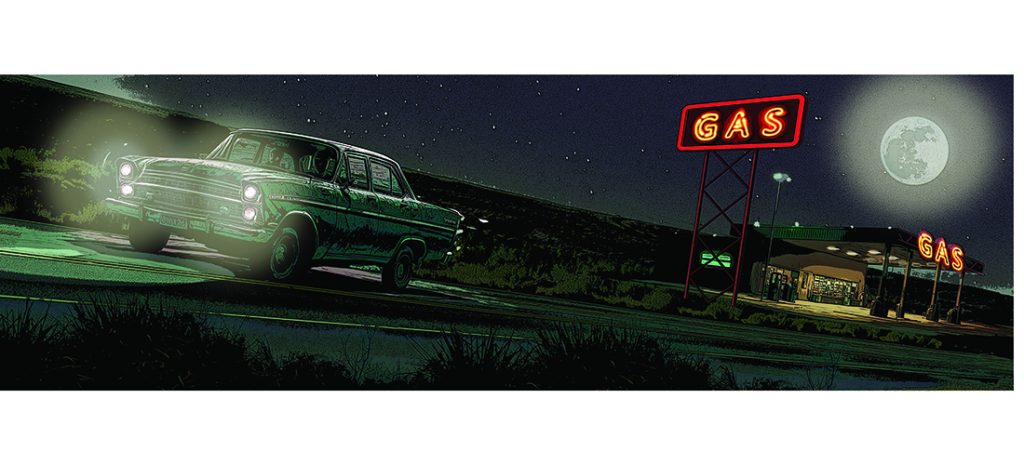
The gas station was a half-mile down the road, its fluorescent lights bright and disorienting. No cars were parked at the pumps. A single beat-up Honda sat tucked against the building. Bon Bon had been hoping for a late-night police cruiser, an RV, anything.

After the car had come to a halt, Bon Bon got out, making sure his movements were slow and casual. He could run in, tell the attendant to call the cops, who could be here in minutes. He glanced over at Tig, who was staring hard at him. He looked away, pulled open the glass door. He could feel Tig’s eyes on him, even in the snack aisle. 

He picked up several bags of  Flamin’ Hot Cheetos, hot chili and roasted lime Takis, jalapeño Kettle potato chips, and honey barbecue and hot mustard pretzels. Then went to the refrigerators on the wall and pulled out four bottles of Pepsi.

At the cash register, Tig’s gaze brushed his shoulders as Bon Bon paid and the clerk stuffed everything in a plastic sack. Again and again, he contemplated saying something but then imagined Tig leveling the gun at them, the bullets spider-webbing the glass.

The door behind them jingled, and Bon Bon jumped. “You almost done, man?” Tig called in.

“Yeah,” Bon Bon said. The clerk put a handful of change on the counter, and Bon Bon swiped it into his palm. “You owe me 18 bucks,” he told Tig as he brushed past him out the door, out into the cool night and the waiting car.

“Oh you’ll get that and more soon, buddy.” Bon Bon could hear the relief in Tig’s voice. “You feel like driving now?”

“Yeah, I can take over,” Bon Bon said. “You eat up. Did you check on the trunk? On whatever fell over back there?”

“Don’t worry about it. It’s fine,” Tig said. 

Bon Bon pulled out of the parking lot as Tig tore open the purple bag of Takis, stuffing a handful into his mouth. “Damn these are good. You want some?” 

Bon Bon shook his head. “In a sec.” He took a sip of Pepsi.

“These things are spicy,” Tig said, playing on the word spicy. “Whooo-eee.” He cracked open his Pepsi and drained half of the bottle. Bon Bon took a sip of his.

Tig didn’t tell him where they were going, just directed him once to turn south, toward the highway running to the coast. Tig broke into the potato chips and Bon Bon munched on pretzels. They passed city after city, and a rest stop in three miles.

“I’m thirsty,” Tig said when he was halfway through the Honey Barbecue Pretzels. “These pretzels are making me thirsty.”

Seinfeld,” Bon Bon told him without looking over. He checked the rearview mirror. The boxes sat primly on the backseat, giving away nothing.

“What?” 

Seinfeld,” Bon Bon said. “That was a running joke on Seinfeld.” The rest area illuminated the road. “Remember, George said it about 200 times during that show?” They passed the entrance, kept going.

“I don’t know what the hell you’re talking about. You got more to drink?” Tig said. 

“There ain’t no more. We drank it all.” 

“That ain’t funny,” Tig said. “I’m seriously thirsty. We gotta stop.”

“OK,” Bon Bon told him. “Next place we see. I need to take a piss, too,” he added.

They passed a sign. “Next Rest Area: 28 Miles.”

“Damn,” Bon Bon said. “Another half-hour.”

“We can make it,” Tig said, staring out at the darkness. But after another 10 minutes he said, “I really gotta go.”

“So do I,” Bon Bon said. “Bad. I’m going to pull over.”

He eased the Chevy onto the shoulder, put on his flashers. “What the hell you think you doin’?” Tig said, spraying pretzel crumbs onto Bon Bon’s shirt. 

“What? You want me to piss myself in the driver’s seat? I didn’t shower after work because somebody wanted me to meet them at 6:30. So now I smell like cupcakes and if I piss myself I’ll smell a lot worse. That is not a good combination. So you’ve got a choice. Either stop yapping in my face and let me pee, or you can drive the rest of the way in a wet seat.” 

He hoped Tig would be too preoccupied to suggest that he pee in the Pepsi bottle. Tig was. 

“Whatever. Don’t do nothin’ stupid.” Tig got out of the car, slammed the door. Again the thump from the trunk, and then another. 

The car’s headlights beamed into the nondescript grass as Bon Bon climbed out, went around the front of the car. As he reached the berm, he stumbled, tripped, and fell. Then got up, close now to Tig.

“Clumsy idiot,” Tig said, laughing, transferring the gun from his right hand to his left, unzipping. “Next rest stop we’re gonna get something to drink. I’m really thirsty. We got how many miles? 15 or — ”

Wham. The rock that Bon Bon had just picked up struck Tig perfectly, right on the temple. Tig dropped, soundless, so quickly that Bon Bon thought for a second that he was pretending. 

But he wasn’t. A moment later he groaned, reaching for his scalp. Bon Bon lunged for the gun, grabbed it and sprinted back to the car.

In a moment, cinders flew and he was back on the highway, heart in his throat, going 70, 80, 90 miles an hour.

After a couple of miles he slowed slightly, pulse still pounding. The thump from the trunk came again. Bon Bon pulled over, popped the trunk, went around back.

Inside, a young boy lay wedged against tires and fabric, his hands and feet bound with zip ties. His eyes were bigger than any eyes Bon Bon had ever seen, with such terror and misery that Bon Bon couldn’t speak for a moment as he loosened the gag. The boy struggled away, a panicked bird.

“Hey, it’s OK,” Bon Bon said. “That piece of garbage can’t hurt you.”

He looked in the front seat for a knife, scissors, anything to cut the ties, but could find nothing. So he carried the boy to the front seat, tried to make him comfortable.  

“I’m taking you to the police,” Bon Bon told him as he adjusted the seat belt. “The bad man won’t hurt you anymore, OK?” He tried to sound as calm and nonthreatening as he could. 

“You smell like a cupcake,” he told Bon Bon accusingly, voice rough.

Bon Bon laughed. “Story of my life,” he said. “I get that a lot.”

The little boy eyed the bag of pretzels, tucked in between the seats. “Can I have some?”

Bon Bon reached past him for the pretzels, fed him a couple at a time.

“These are making me thirsty, “ he said.”

“Do you like Seinfeld, kid?” Bon Bon said as he pulled out his phone and dialed 911.  OH

Brendan Nicholaus Slocumb is a graduate of UNC Greensboro with a degree in music education. He is the author of The Violin Conspiracy and Symphony of Secrets. He is currently working on his third novel.

Bidding Adieu to a “Jewel Box” Home

Bidding Adieu to a “Jewel Box” Home

The Otto Zenke stamp stands the test of time

By Cynthia Adams     Photographs by Bert VanderVeen


Had Robert and Adeline “Addie” Smith not taken on a hybrid midcentury modern/traditional ranch, restoring it to its full, Otto Zenke-era glory, who knows what might have happened?  Would the singular designer’s touches have been lost forever? 

Not a chance.

As you read this, the Smiths will have already decamped from their newly rejuvenated Starmount “jewel box” after living there for less than a year. “We’re starting all over again, like we did last year,” Addie says wistfully. 

“We made a splash and now we must dash,” she says with an upbeat tone of voice but an expression that says otherwise. Leaving a “dream home” in which they’ve invested time and resources came as a surprise, they both stress, although they’ve uprooted before.

They’ve closed on and begun planning a refresh of an 84-year-old sun-soaked cottage in Jacksonville’s historic San Marco neighborhood, Florida.

A difference of night and day, they say. 

Packing up their worldly belongings, setting off with their beloved wirehaired fox terrier, Bobby, for their next reno-venture, seems like déjà vu all over again, in the words of Yogi Berra. 

Robert, a senior project engineer/associate with the global architecture and engineering firm Stantec, has been recently tapped to start a new “bridge group” — or satellite office — for his company in northeast Florida. His territory has grown from West Palm Beach, where the couple formerly lived, to northern Georgia.

Addie, a Pennsylvania-born designer, hopes to recreate some of the magic in their new abode that they felt in one of Greensboro’s most wooded and walking-friendly neighborhoods.

Even, Addie says, with a serious exhale, if the San Marco cottage is half the size of the jewel box and lacks the stylish cleverness designed into its nooks and crannies. 

Bobby seems to agree, taking to his bed looking dejected, tail drooping, but Addie takes notice and calls him over for a treat.


She can’t help but gush about the aesthetic aspects of the Starmount property. “I have to pinch myself; I lived in this work of art.”

Artistry was burnished into its very DNA, she discovered, largely thanks to the home’s builders, who worked hand-in-glove with, arguably, the most renowned Triad designer. (Addie belongs to the American Society of Interior Designers, ASID, both in Philadelphia and Miami, her former home.)

Today, ASID still sponsors an annual Otto Zenke student competition in his honor.

Zenke deserves the following he cultivated, she says. 

More about the former and latter soon, but first, the why.

For if, like the Smiths, you’ve ever poured yourself into a renovation, only to soon discover you must relocate, then best follow Lemony Snicket’s advice to “look away, look away” and read another story in this issue. Because the Smith’s saga may prove too sad.

However, there is another point of view, one which Addie herself offers: “Talk about the passing of the baton to the new owner, Russ La Belle,” she suggests. La Belle, who has Greensboro roots, is president of North Carolina-based Wilmington Machinery, with headquarters incorporated in the Triad.

And so, the story of this house concerns a short but significant tenure given the Smiths’ shared vision. “Our creative thread goes through our person, what we wear, our homes,” she adds philosophically. “Our homes impact us.”

Prior to changing paint colors and refinishing floors to a lighter, blonde look, Addie had weighed all the period touches that would be preserved as well as those that would be added. But before the first brush stroke was applied late last summer, Addie had prepared a detailed notebook of paint colors, renderings and specifications. “I treated myself and Robert as the client,” she explains.

Addie first found the Starmount property in August last year — one she began calling “the Duncan house” after meeting former owners Linda and Randy Duncan. 

The 48-year history of the Duncans’ ownership and their improvements impressed her. As did the home’s beginnings.

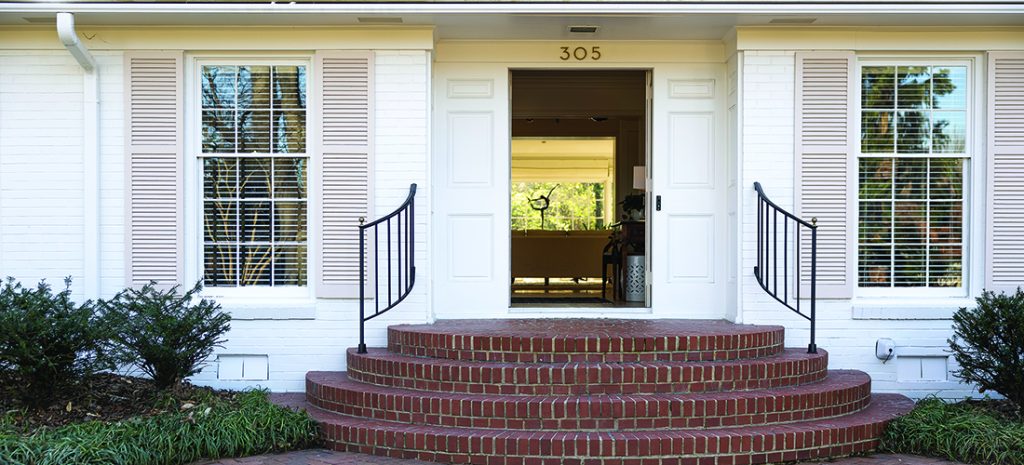
In 1955, Arthur Schwartz, owner of Arthur’s Fine Shoes on North Elm Street, built a ranch style home on Kemp Road West for his family. Linda, who befriended Schwartz, learned that he retained “the well-renown interior designer, Otto Zenke,” confirmation of what Addie felt was true. In fact, she had done a fair amount of sleuthing.

“There are still today some remnants of Mr. Zenke’s handiwork,” she says and points to Zenke’s custom-made brass pulls on folding doors and hardware designed specifically for the built-ins.

These and other identifiable Zenke touches inspired Addie as she planned refurbishments.


On a walk-through, she mentions “the wallpaper in the bar and some of the very unique brass doorknobs in the den and foyer” as further evidence.

The Smiths invited Benjamin Briggs from Preservation Greensboro to have lunch earlier this year at their home to learn more about its provenance — and reveal the redo.

Before Briggs visited, however, the Smiths had already gotten the scoop from the Duncans. The Smith/Duncan luncheon, a true meeting of the minds, “went on for four or five hours.”

The original house plans, which reveal a meticulously designed home, conveyed with the property. Unfortunately, the architect’s name is unknown. “He [the architect] was a visionary.” 

He envisioned the picture windows spanning the main room at the rear of the home — a departure from the norm at the time when such windows were typically on the front elevation. Someone, possibly the Schwartzes, oversaw, or at least supported, some of the home’s best features, Addie speculates. Then, there was the Zenke imprint.

“Otto Zenke was highly influenced by Dorothy Draper,” says Addie, “and she was Baroque or Rococo.” Indeed, Draper, Zenke’s contemporary, was a high-society interior designer credited with inventing Modern Baroque with work that survives today in The Carlyle in New York and in the Greenbrier in White Sulphur Springs, West Virginia. Zenke, who was educated at Pratt, had a local following in the Triad, but also maintained offices in Palm Beach and London. Zenke, in fact, designed homes for the likes of the notable restorationist John Jenrette. “I think Otto had a great commission here.”   

The Schwartzes were design-minded and house-proud, choosing both good form and functionality. 

Addie says the Duncans’ contributions were similarly spot-on. They took ownership in October of 1972 and lived in the house until 2020.

“Linda and Randy Duncan left a legacy that we were able to build on.”

Randy, a former Stanley Furniture Company designer who had recently opened his own firm, added design embellishments and customized paneled doors to a wall of fir bookcases in the den. They feature an original drop-down campaign-style desk. 

“He customized the doors further, just to give them more detail, and added custom hardware.” She traces their still-stylish facades, noting, “I kept this the original fir and stain.”

And more personal details were kept, even retaining “the growth chart on the wall across from the coat closet in the den,” where the Duncans recorded their children’s and grandchildren’s heights

During the mid-eighties, the Duncans added the garage specifically to house Randy’s red 1984 Porsche 911 Carrera Coupe. 

“Work began on the garage fairly quickly and it was completed in 1985,” Linda wrote Addie, “a perfect place for Randy’s ‘midlife crisis.’”

The home was intentionally designed to separate public spaces from bedrooms, found in a private wing.

A main foyer flows into a secondary foyer, which dramatically opens into a living room. 

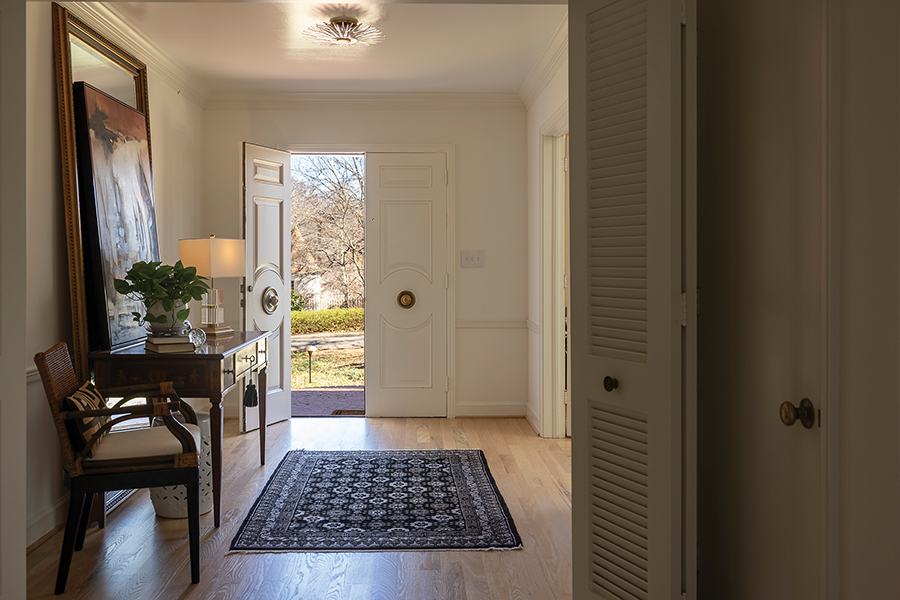
In the foyer, Addie installed Sputnik-style lighting and high gloss ceiling, enhancing their drama. 

She reinforced the Space Race-inspired touches with star-embellished wallpapers and period details.   

“In good design, you have some repetition of form,” says Addie, noting the circular details on the front doors by Zenke, which she repeated throughout.

She points out the unusual, original doorknobs.

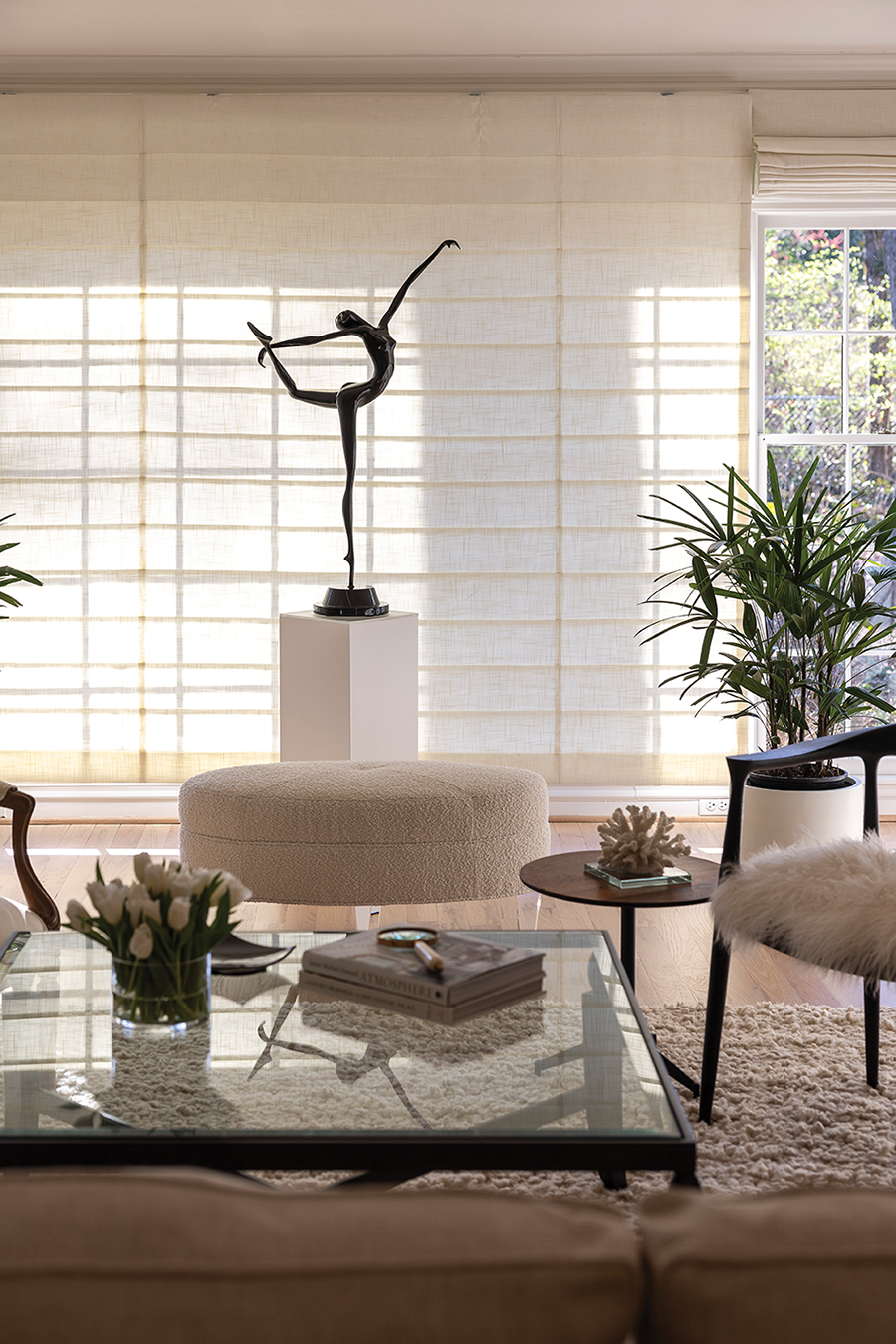
“Do you see the circle repeating in the ballerina [sculpture]?” she asks, referencing a sculpture on a pedestal, set to great effect before a massive bank of windows.

These subliminal, almost unconscious elements repeat, which Addie compares to good grammar and exclamation points in writing. 

“See what I did visually to make it all seem [part of the whole] . . . and balanced?” She considered original design themes even when it came to styling shelves and cabinets.

But she most admires the former living room, where the aforementioned window open to the outdoors. 

In a personal history that Linda Duncan prepared after lunching with the Smiths, she describes also falling in love with the house and its orientation to the outdoors.

“I loved the beautiful old trees. I loved the spaciousness of the interior,” she wrote to the Smiths. 

“Even the landscape architect we hired staged the [flowering plantings and] blossoms so nothing upstages anything else,” says Addie.

She learned that the beautiful tree outside the primary bedroom had been a housewarming gift to the Duncans. There is also an enormous tulip poplar tree nearby, one believed to be over 250 years old. 

“Our arborist loved it,” says Addie.


“He said it was the biggest tulip poplar he’d ever seen,” adds Robert.

She returns to the wall of windows, demonstrating the minimalistic linen shades, which replaced a bank of shutters in the (present day) living room. “Now, open, you get peeks of [the back yard], but when you lower them, you see the shades as a backdrop for the sculpture.” It is part of how good design manipulates space, she says.

“We gravitate here, not to the main designated den.” The den became a work area, and leads to the screened porch.

Before a house next door of the same era was demolished, Addie requested the opportunity to salvage hard-to-find items, each period-perfect. As she turned to refurbishing the rear screened porch Addie used the screen accents and grills from the tear-down. “They’re not made anymore.”

To the front of the house, she returned shutters rescued from under-house storage and installed porch railings, again architectural salvage from next door.

There was more confirmation gained from the Duncans. Addie’s suspicion that the original paper is inside what was the former cocktail bar was verified. She insisted upon keeping the paper, though the nook no longer functioned as a bar. Instead, she used the space to store architectural plans and drawings as her design work room. 

Even in the least visible places details were thorough.   

The hardware there, too, she points out, “is like Mercedes-Benz quality hardware. I don’t think it would be available anywhere,” she says.

She marvels at details like the dedicated lights through the home’s closets and storage areas. “Highly unusual at that time,” she observes.

No walls were removed during the Smiths’ renovation, only certain interior doors — especially those leading into the public rooms — given that contemporary tastes are more open. “We don’t like to be so sequestered as was the preference at the time of the house’s construction,” Addie says.

She used the hallway passageway to the bedrooms as a gallery featuring photos of friends and family. “I love passing through this,” she says, pausing again at the bathroom.

The guest bathroom retained its original appointments and built-ins; softly colored gray tile and hardware remained. “We wouldn’t tear out the vintage bathroom.” The vintage Jack-and-Jill guest bath features a telescoping base for the original white sink and walk-in shower, punctuated by a harlequin wallpaper. 

“This house is like living in a piece of art, the most beautiful home I’ve ever had the privilege of living in,” she says, later slicing a rhubarb and strawberry pie cooked by Robert. Robert used to summer in Ohio, where his grandmother, Pauline, taught him the art of baking. 

He still uses her biscuit cutter, nut chopper and other accoutrements. Those were prized possessions chosen from her estate and put to use.

Robert’s pie has the ideal ratio of tartness to sweetness, and the crust is delicate.

“The crust is basic pie dough from the original Joy of Cooking,” he says. “The flour affects it. Even the water you use can affect it.”

“My favorite rhubarb story is when I first moved South. I remember buying rhubarb at a Publix in Tallahassee and the clerk asked me, ‘What is it? Is this red celery?’”

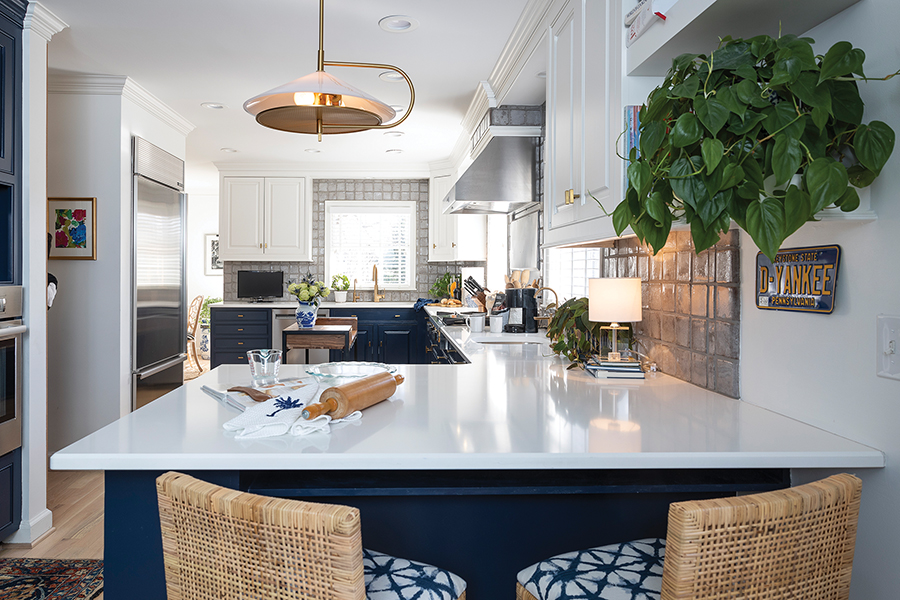
Addie, who also cooks, prepared stuffed pork chops and mashed potatoes for their first date. She does the basic meal cooking, and he does the baking, so both preferred professional-grade appliances.

“It’s been a pleasure to live in this house . . . so beautifully designed and laid out,” she says, sipping a steaming coffee before adding a dollop of chocolate ice cream to her pie. (“The secret,” she insists. “Try it!”)

“If anything,” adds Addie, “things that are old are timeless. And better.”

Without a doubt, that maxim extends in the way the Smiths live, from protecting Grandma’s pie recipe to Otto Zenke’s design touches.  OH

The Wonder Kid

The Wonder Kid

The secret to Glenn Dobrogosz’ success? Seeing through the eyes of a child

By Cassie Bustamante Photographs by Mark Wagoner

In the fall of 1996, after hopscotching across the country chasing zoo careers, Glenn and Tonya Dobrogosz found themselves on the road again, destined for a place that would change their lives forever. The couple was headed to New York State Living Museum at Thompson Park (now Zoo New York) in Watertown, where Glenn would take on his very first directorship role. The day they arrived for his interview, tears rolled down Tonya’s cheeks.

“I’m from Florida!” exclaims Tonya. “And it was as far north as you could go and still be in the United States.”

Glenn, CEO of the Greensboro Science Center, was ready for an opportunity where he could make a real impact and, in his words, Watertown’s zoo was in “rough shape.” Challenge accepted.

His first day in the “office,” he discovered his desk was made from a door on cinderblocks, and the crammed space was shared with two coworkers as well as “a possum that had chronic diarrhea . . . I was humbled pretty quick that day.”

While Glenn worked to greatly improve the Watertown zoo in his six years there, “most importantly, year one . . . Hannah was born.”

Hannah, 25 and the Dobrogoszes’ only child, now lives in a New York City apartment and writes for the popular website, BuzzFeed. She says that whenever she tells people that she grew up living in zoos, they inevitably point out that she lives in New York City: “That’s like a zoo, too,” they joke.

“A dangerous one,” interjects Glenn, who, by the way, considers most snakes “harmless.”

In 2022, Hannah wrote a BuzzFeed piece about her experience of growing up in zoos (buzzfeed.com/hannahdobro/i-lived-in-two-zoos), sharing that although her birth was “in a human hospital like many other human babies,” her next five years were spent living in an old 1918 limestone-block house, smack dab in the middle of the zoo campus. As perk of Glenn’s job, the family resided in the zookeeper’s house, though it came with noisy neighbors — a great horned owl named Big Bird who hooted constantly — and spirited residents.

“Let’s put it this way,” says Glenn, “we had weird experiences.”

“It was very haunted, most definitely,” Tonya chimes in. “I used to hear music all the time, playing a violin.” They later discovered that a gentleman who had lived there — and was now deceased — played the violin. The music echoed from what had once been his room.

With animals — and other-worldlies — aplenty, human neighbors were scarce. “Fortunately Glenn had two coworkers, two girls who worked in his office. We all were pregnant about the same time,” says Tonya. “And we became friends.” Out of this friendship, a “mommies group” was formed that helped both Tonya and Hannah find community.

The social scene wasn’t exactly thriving, but living on the zoo campus provided copious opportunities for family time.

“She used to look out the window in the living room and sit up on the couch and she would sometimes see him out walking around,” says Tonya. “And she’d be knocking!”

And Glenn also came home regularly for lunch with the family. “These were extremely busy times, because when you’re just starting out, you do whatever it takes to succeed. And it was very intense, very stressful because I didn’t know we could do it.” But, he says, “having that ability to come home, give her a hug, walk — that was huge for my mental condition.”

Also just outside the window of their New York zoo home sat a butterfly house, which Hannah, who still considers butterflies among her favorite animals, frequented. That structure, says Glenn, “was the motivation for why we built the butterfly house at the [Greensboro] Science Center.” More so than the building itself, it was seeing Hannah interact with it “because watching her in that space, from the chrysalis to the caterpillar to the butterflies — it was pretty special.” Even today, he says, though “it sounds immature and silly,” he designs “through the eyes of an 8-year-old child.”

His daughter’s fascination with the animal world mirrored his own. Growing up in Raleigh, Glenn recalls that while other kids were playing sports, he was wading knee-deep in a creek that ran, quite literally, through his backyard and “turning over rocks for salamanders and frogs.”


After-hours walks around the zoo are favorite memories among all the Dobrogoszes. “I remember specifically we would go into the gift shop, we would go into the ice cream machine and I would get a drumstick, still my favorite ice cream,” says Hannah, adding that they’d then walk around the zoo together as the sun set. “It’s a child’s dream, really.”

“For me, it really is just taking her little hand in New York and walking that path and we’d mimic the animals,” recalls Glenn of those special evenings together.

While Watertown provided the family with obvious challenges, it provided Glenn the opportunity to see just what he was capable of doing. In fact, “I kinda wrapped my arms around the project and wrote a master plan called Thompson Park 2000 and just presented, presented, presented,” says Glenn, to “whoever would listen.”

His tenacity paid off. “We ended up raising about $3.5 million.” What really helped, Glenn says, was that “there was an army base up there and [we] met a colonel who just loved us and helped clear land, build roads — all free of charge for donuts and pop.” Under Glenn’s six-year directorship, New York State Living Museum became fully accredited, with several new exhibits, landing the spot of number one tourist destination for Watertown.

After successfully transforming the Watertown zoo, the family headed to the Chehaw Zoo in Albany, Georgia. There, Glenn spent a short two-year stint getting it accredited, and then happened to see a job listing for the Greensboro Science Center.

Happy to be closer to his own parents in Raleigh, Glenn and his family made the move to Greensboro in 2004. While this was the first time they didn’t have a campus dwelling, Hannah still recalls special moments involving her dad’s work. “He’d bring animals [to school] and we’d go on field trips to the science center,” she says, adding that, with Glenn as her father, it was “a really special field trip.”

But Glenn has worked to make the science center special for kids — and adults — from all walks of life. In his 19 years in Greensboro, supported by “a team and board that are the best I’ve had,” he’s added SkyWild, the Kiwanis Treehouse and Revolution Ridge. To see the faces of children enjoying new additions at the Greensboro Science Center, it’s clear that it was planned by people who understand what it is to look through their eyes.

One of the recent changes Glenn is proudest of allows accessibility to kids from all socioeconomic backgrounds. The Greensboro Science Center now admits those who show their SNAP (Supplemental Nutrition Assistance Program) cards for just $5, compared to a regular admission fee of $19.50. “I’ll tell ya, it’s been one of the most powerful things we have ever done,” says Glenn. “Seeing kids who normally have no exposure to this and maybe one to two percent could become science-inspired and science-minded — that gets you. Because when you’re out on the boardwalk . . . and you can tell these kids have never seen anything like this before, it’s powerful.”

And Glenn’s work here isn’t done. Due to open in 2025 is a brand-new state-of-the-art biodome which will include a free-flighted aviary, endangered species breeding programs, watery and forested environments, bridges and caves, and playscapes. Once a visitor has traveled through the biodome, they land in “this weird immersive theater that tells the story of conservation in these tropical environments.”

Glenn’s eyes, indeed, sparkle with the excitement of that boy who once tromped through backyard creeks. “I’ve done a lot of things, but I’ve never built or been part of building a rainforest. So it will be a great legacy for Greensboro, I hope.”

His own legacy shines on in his daughter, who reflects his wonder at the natural world. “I have forever been finding reasons to sneak in and see something new,” says Hannah, who visits the science center when she can these days. “I remember when you first got the hippos . . . You, Beth Hemphill [GSC Chief Operating Officer] and I drove out there to see the hippos late at night.”

And now those paired endangered pygmy hippos, Ralph and Holly, have started a family of their own with the recent addition of a baby earlier this year. Are there parallels between how animals and people raise their young? Absolutely, according to Glenn, because there’s “a lot of instinct built into our complex brains.”

So far that instinct, paired with his awe-inspired curiosity, has not steered him wrong. He adds, “I go with my gut on everything. Maybe in raising a child that’s sometimes good, sometimes not good. But, to me, it’s the only way.” It’s certainly worked for the Greensboro Science Center.  OH

Almanac July 2023

Almanac July 2023

July is a recipe for pie.

As the birds blurt out their morning devotions, your mantra is singular and succinct: blueberries. Even the word feels ripe and juicy. You snag a sunhat, load up on water, gather the vessels for the great summer harvest.

Before the heat consumes the day, you step into the balmy morning, bright-eyed and unwavering. The walk to the woody temple is more than a core memory. You know it in your bones. As the robin chants his ancient hymn, you whistle along:

Blue-ber-ries, ber-ries, ber-ries, blue-ber-ries . . . 

At last, you stand before the altar of the sun-loving shrubs, awestruck. Clusters of plump berries nearly drip from sweeping branches. The ripe ones tumble at your touch.

You find your rhythm: three for the basket; one for the tongue. You’ll need six cups for pie. Seventy berries per cup.

One for the basket, three for the tongue. The pop of sweetness fuels you. Pie is nice, but fresh berries are the best berries. Just ask the whistling robin.

As the air becomes syrup, you reach for one last cluster, coaxing a final palmful with purple-stained fingers. One, two, three for the tongue.

On the trek back, belly and baskets brimming, you are one with the great summer harvest. The horizon holds visions of sugar and lemon and lattice crust. Yet nothing could be sweeter than this sun-drenched moment, the salt on your skin, fresh blueberries on the tongue.


Like a Charm

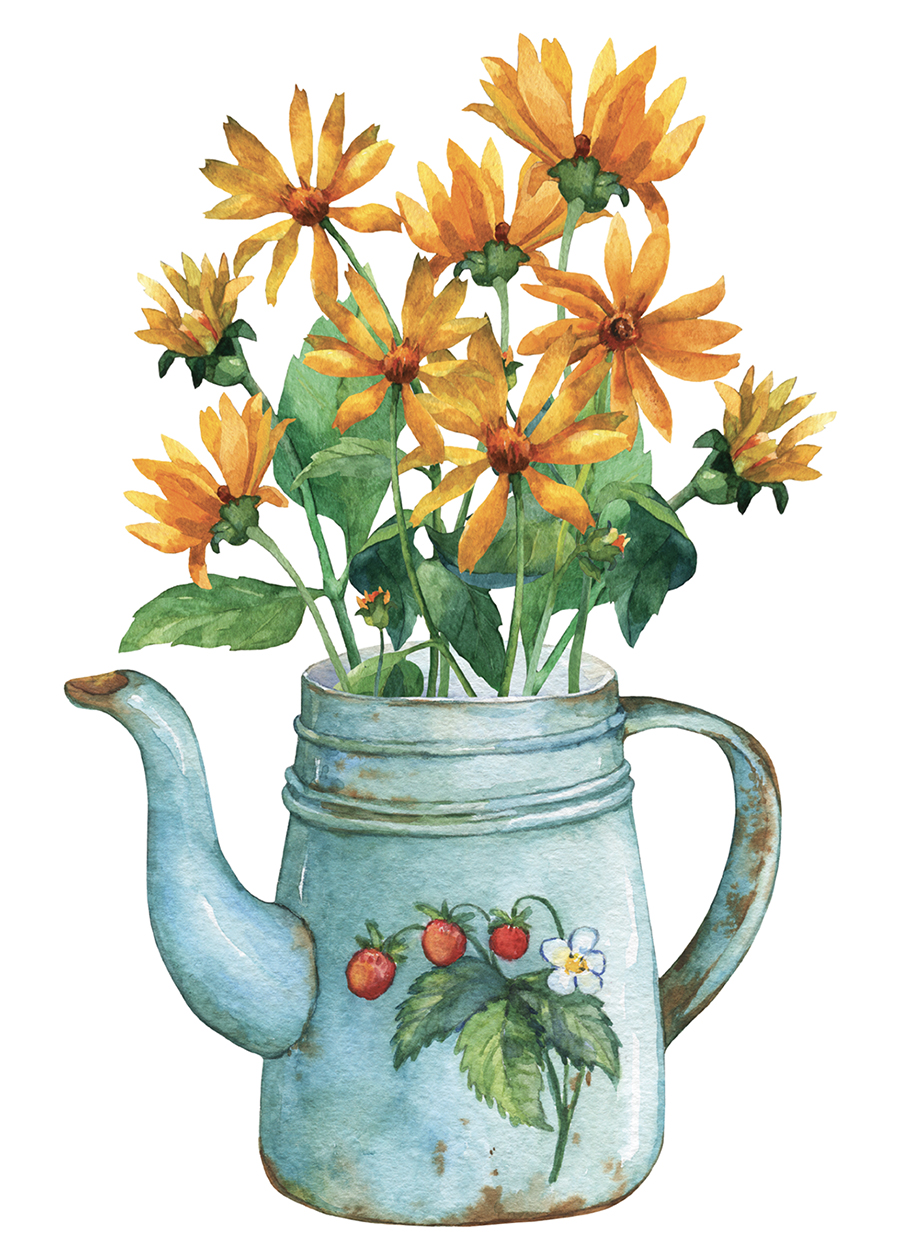
Black-eyed Susan is blooming. Jewelweed, too. And, did you see that brilliant flash of yellow?

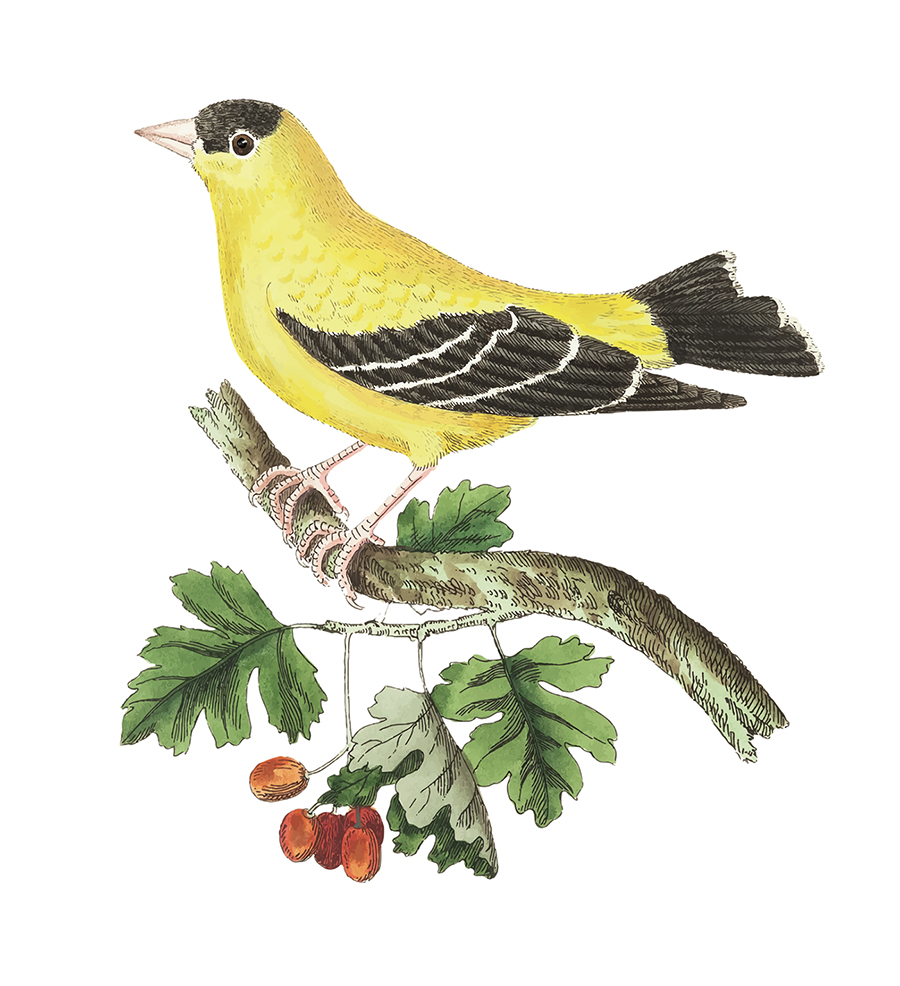
At last, it’s nesting season for the American goldfinch. Where the thistle grows wild and thick, female finches line their nests with — that’s right — fluffy white thistle down.

These late-season breeders undulate through the air as they fly, foraging for thistle and grass seeds in wide-open meadows. Spotting one is a delight. But should you ever see a flock of them (they’re gregarious year-round), consider yourself charmed. A congregation of goldfinches, after all, is called a charm.


Better than any argument is to rise at dawn and pick dew-wet red berries in a cup.    — Wendell Berry


In the Garden

Snap beans and melons and snakes! Oh, my.

The summer garden is brimming with goodness and — if you’re lucky — perhaps a resident garter snake. Harmless to humans (although they may bite in self-defense), these carnivorous wonders feast on slugs, cucumber beetles and other garden pests. They’re not here for the Silver Queen or Cherokee Purples. 

This time of year, female garters may be eating for two. Or, rather, a wriggling knot of live young. Learn how to identify these slithering allies should you peel back the vines to a surprise garden party. Don’t forget your stripes!  PS

Burgin Ross’ Special Collection of Memories

Burgin Ross’ Special Collection of Memories

A 1974 UNCG grad’s African artifacts tell the tale of her journey

By Cynthia Adams     Photographs by Bert VanderVeen


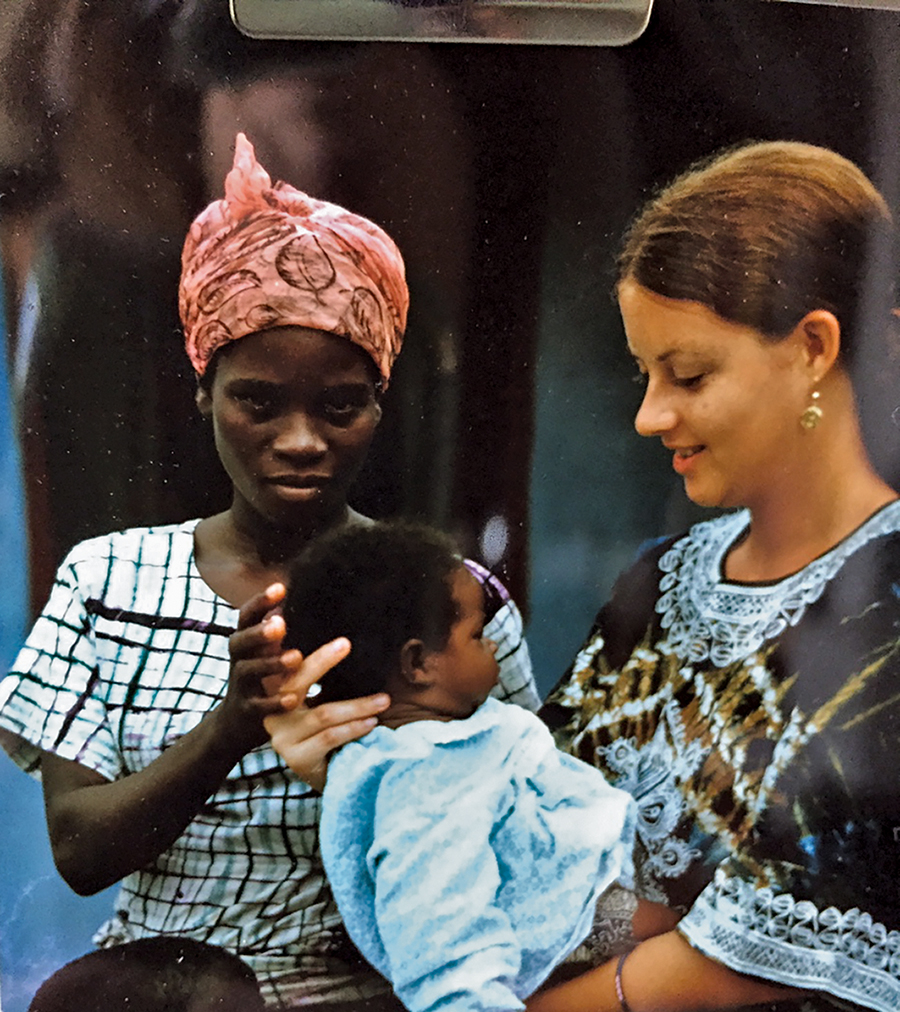
In the summer of 1974, Brenda Burgin Ross, a new graduate of UNCG, said her goodbyes to family in the North Carolina mountains before undertaking a 5,000-mile journey into sub-Saharan Africa. While many of her fellow graduates might prefer a lark abroad, she chose a life-changing experience using her new degree in Liberia, a small country no larger than Ohio.

“I was pretty sheltered,” she says. “I grew up between Marion and Old Fort, east of Asheville. I had never been out of the U.S. before.”

She mocks herself, saying she added extra vowels to words like right, light and night as riiight, liiiight and niiiight when she first arrived in Greensboro. Ross noticed other students pronounced the same words differently, in a clipped way, with a short “i” sound. “I kept my mouth shut in the beginning.”

Ross had entered UNCG as a math major, then changed to nutrition. Once armed with a degree, she signed up with the Peace Corps, requesting placement in Africa.

The gregarious, green-eyed brunette favored low-slung bell bottom jeans and clogs. She was known to her college friends as Burgin — a step toward her new identity.

In June of 1974, just shy of her 22nd birthday, Ross arrived in Monrovia, the capital city of Liberia.

Over six weeks at a Peace Corps training site, volunteers “learned some language, but mostly learned about cultural traditions, local foods, and were given ideas and materials to use in my work as a health volunteer.” The trainees learned a smattering of the nation’s 16 different dialects, although English is the country’s official language. Ross purchased basics such as plates, cups, pots and pans, sheets, towels, and kerosene lamps. Before traveling with an official from the Ministry of Agriculture to the village of Juarzon, she stocked up on “oats, flour, sugar, tins of butter and cheese, and powdered milk”

Ross traveled light, with just a medium-sized suitcase and backpack. Other volunteers filled their cases with toilet paper; she packed contact lens supplies, books, camera equipment and minimal clothing, leaving toiletries and nonessentials behind.

They made their way south over rutted dirt roads with dust swirling during the equatorial dry season. The perpetually hot, dry season would inevitably give way to an equally sweltering rainy season.

“They have two seasons, rainy season and dry season,” Ross learned. “You welcomed dry season, but then all you wanted was a day of rain.”

Their trip took nearly three days.

“Was I eager to have an adventure?” She nods yes. There was an underlying, personal mission, too. Ross’ sights were set upon two goals: first, forging her own identity — complicated by having an identical twin. Secondly, as a child of the Kennedy era, she wanted to use her education do something meaningful, if not noble.

She was well on her way to breaking with her twinned past when she chose the Peace Corps, a decision she had made in 1970. Meanwhile, her twin, Glenda, stayed stateside to enter nursing.


As twins, “we slept in the same bed. Our mother dressed us alike until we were 13 years old. We were called ‘Brenda/Glenda,’ or ‘the twins,’” Ross says with a grimace. “When we got into high school, we developed separate friends and interests.”

In photos, she looks like a young Ashley Judd. “I was a baby, wasn’t I?” she muses.

The Peace Corps was also still young. Founded in 1961, it was a goodwill initiative created by President John Kennedy, who visited Liberia while in office. The nation was founded in 1822 by freed American slaves as Africa’s first independent nation.

As a nutritionist, Ross would serve as an informal ambassador while helping Liberians improve their dietary standards. Ideally, this would boost Liberians’ life spans and their general quality of life.

When the ministry official left her in Juarzon and returned to Monrovia, reality set in.

“From that point, I was on my own.”

There were 35 Peace Corps volunteers placed around the country — but Ross was the only volunteer given a solo assignment. And it “had been four or five years” since a previous volunteer had been placed in Juarzon.

She moved into “a nice house with screens to keep out mosquitos and mice. I had no running water, plumbing or electricity, but [it] had a cement floor and was built of cinder blocks.”

“I wasn’t scared. Except for snakes, rats, dysentery and malaria. I was eager to see the world,” she says. Despite encountering everything she feared, she remained filled with youthful enthusiasm and seldom regretted her decision, apart from the existential loneliness. Books and magazines were hard to come by apart from trips to Monrovia.

“But I had the protection of the U.S. government,” she adds.

She has no memory of the first night in that simple hut. Then, a memorable event. Ross heard drumbeats, then the footsteps of a group of women approaching her house. They called out, insisting she come out to join them.

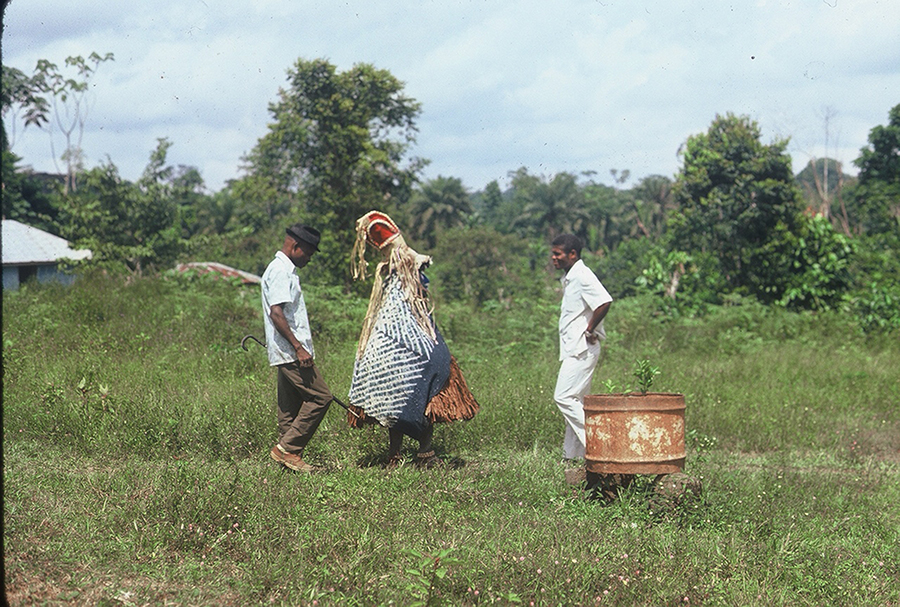
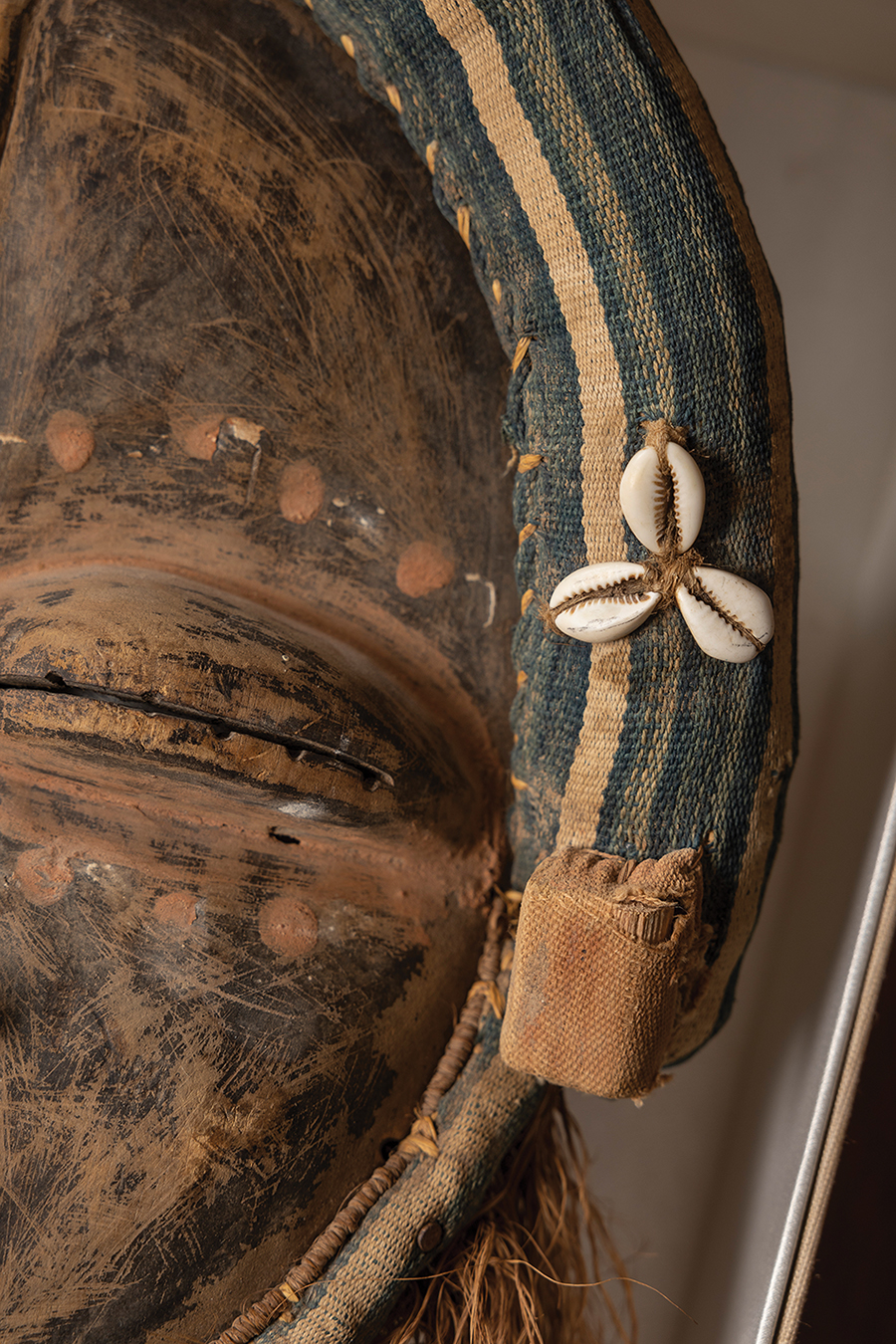
“Within my first few weeks there, I was called out one night to meet ‘the devil.’ Drums were playing, a bonfire was burning, and I initially thought, ‘This is going to be bad.’ Approaching the bonfire, I saw the ‘devil’ dancing. The ‘devil’ is just a spiritual figure covered in cloth, straw and with his face covered by a wooden mask.”


Ross’s adrenaline pumped. “He danced toward me, grabbing me around my waist, at which point I screamed and the villagers laughed.” Ross learned that the masked, dancing devils were purposeful. They came to the village to influence an election or to celebrate an important village elder upon his death. “I knew then that I was safe,” she says, “and that this was the way I was being presented to the village!”

When rainy season arrived, the incessant rain falling on the rooftop didn’t disturb her — but the rats on the roof did. “But they couldn’t get into my house,” she adds.

She swiftly discovered that nutritional advice was the smallest part of her work. Villagers were far more eager to learn skills like hand sewing, knitting and crocheting. Yet Ross’ best attended lecture was when she was invited to discuss birth control.

Because Liberia is polygamous, males faced the challenges of supporting several wives, having fathered multiple children. She noticed men also gathering closer to hear her lecture.

Regardless of their feelings about polygamy, Ross and other volunteers were cautioned against imposing their personal beliefs.

Ross preferred to interact one-on-one, talking to the women as the men worked outside the home. She never refused gifts of food as she went house to house. The village diet was largely vegetarian, although dried fish (“boni”) and canned mackerel were common. “Fish head soup was popular,” given the proximity to the coast.

Local foods included boiled cassava, palm butter, potato greens, collard greens and soups — made of okra, peanut, pumpkin, even palm oil. Limes, lemons, pineapple, papaya, pineapple, tomatoes and coconut were plentiful. Rice, a staple, was mostly imported from China.   

The price of avoiding rudeness meant “I gained 30 pounds,” she says ruefully. While the locals ate from a common bowl, they would bring her a separate bowl and spoon.

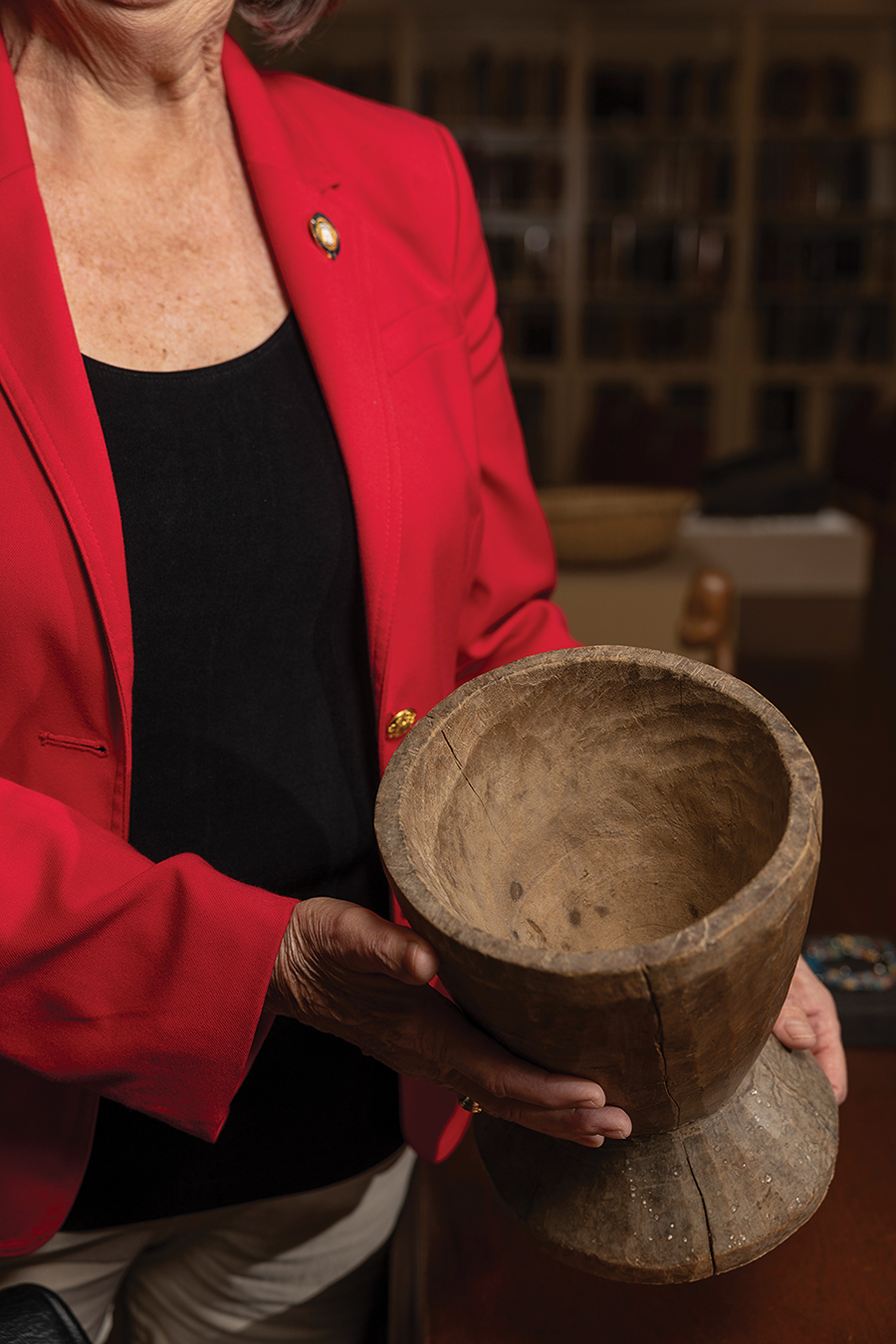
Ross mastered making palm butter using a large mortar and pestle.

“They also have mortars of many different sizes, using them for crushing peanuts for peanut soup, mashing cooked palm nuts for palm butter, or for separating the chaff from the rice kernels they grew.”


Coping with unfamiliar foods, unsafe drinking water and equatorial weather were all difficult. She sought medical help in Monrovia while suffering with dysentery and endured two bouts of malaria. Educating the villagers about boiling drinking and cooking water was an ongoing effort.

And she missed having electricity, running water and indoor toilets.

“I never got used to outhouses,” she stresses. “You had to bang on the side of the outhouse at night, because the snakes would come in seeking the cool.” She also tried to adapt to taking “bucket baths.”

Villagers called her “Missy” and later, “Jahla,” which translated to “happy girl.” No more Brenda/Glenda. 

When a set of twins was born, the sole survivor was named Brenda in her honor. “I often wonder what happened to her, how she’s doing,” Ross muses.

In May of 1976, she left Liberia when her father suffered a fatal heart attack. The Peace Corps flew her home, cutting her two-year assignment a month short. 

In time, Ross, her twin and their spouses opened Los Amigos, a Mexican restaurant in Winston-Salem. She worked in food and nutrition services at Duke University Medical Center and later at numerous corporations. Ultimately, she consulted with hospices and retirement homes while earning a graduate degree in gerontology and teaching. Ross became a UNCG instructor in 2010, eventually becoming an associate professor in nutrition.

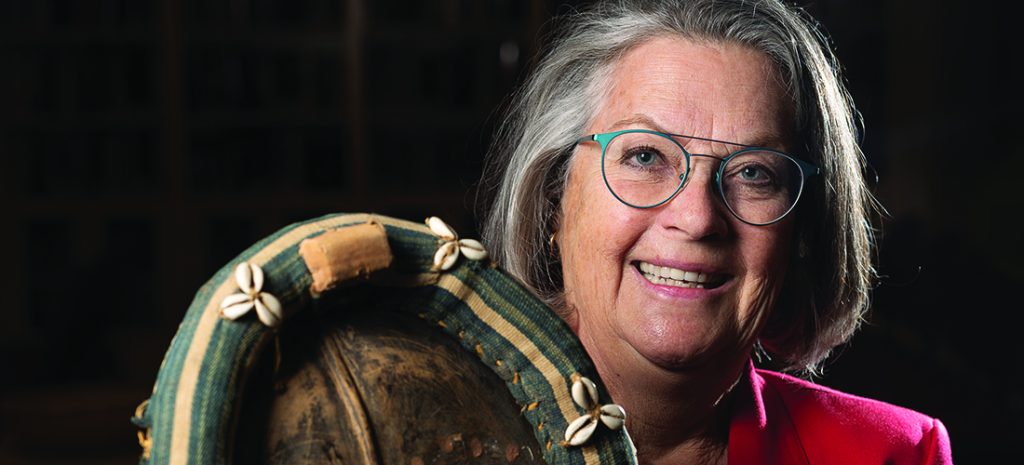
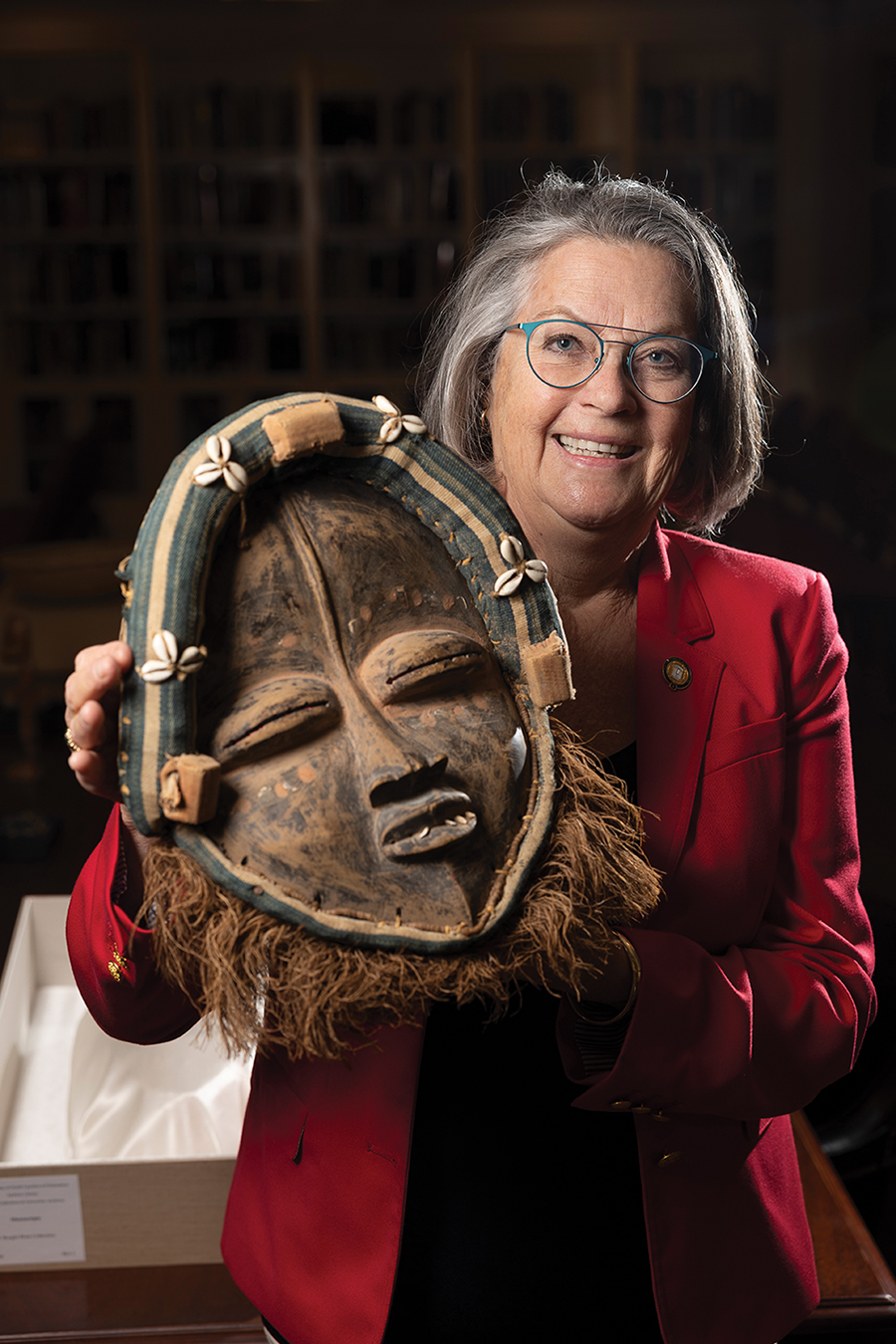
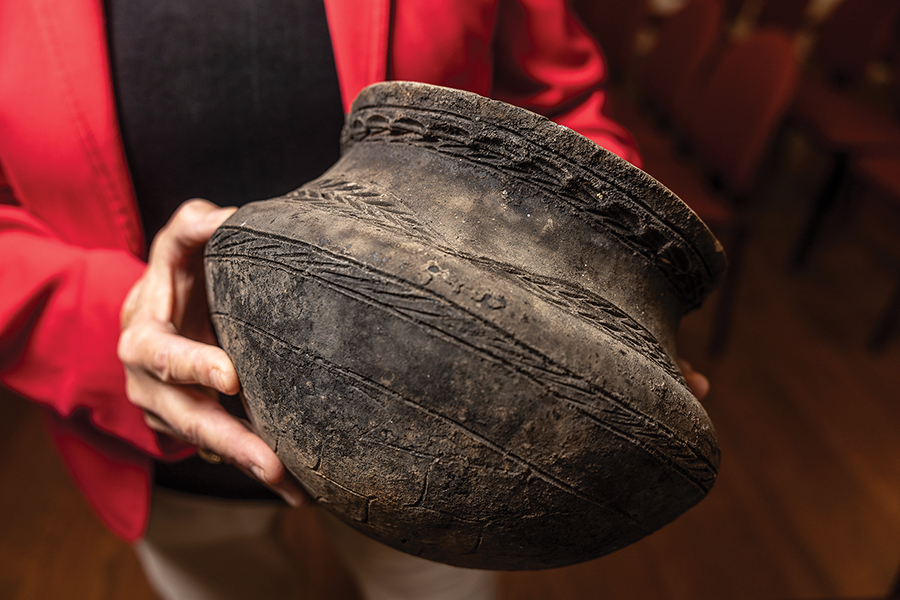
Retiring last year, she made the decision to donate seven Liberian artifacts to UNCG’s Special Collections, pieces that she had kept in her campus office. She called these “precious possessions.”

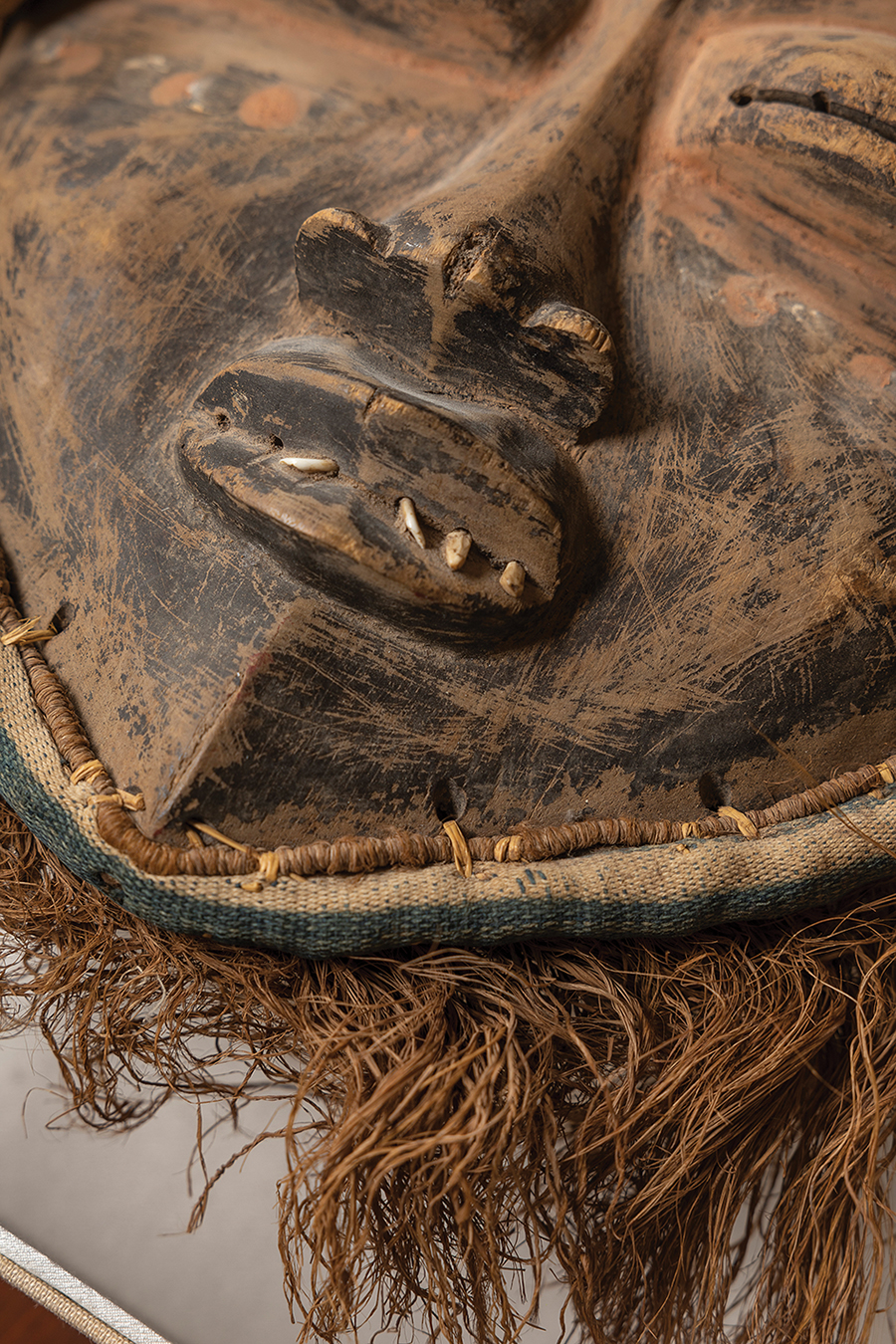
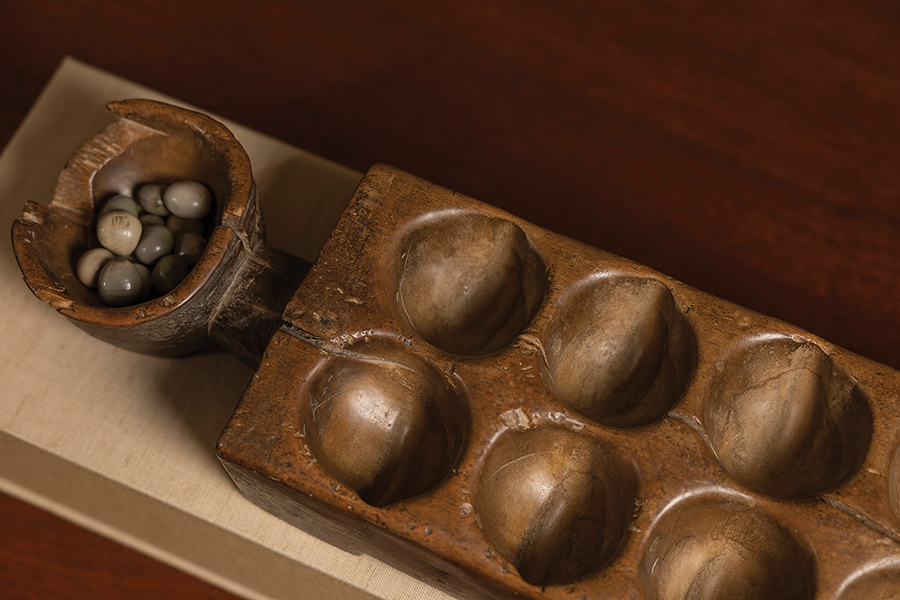
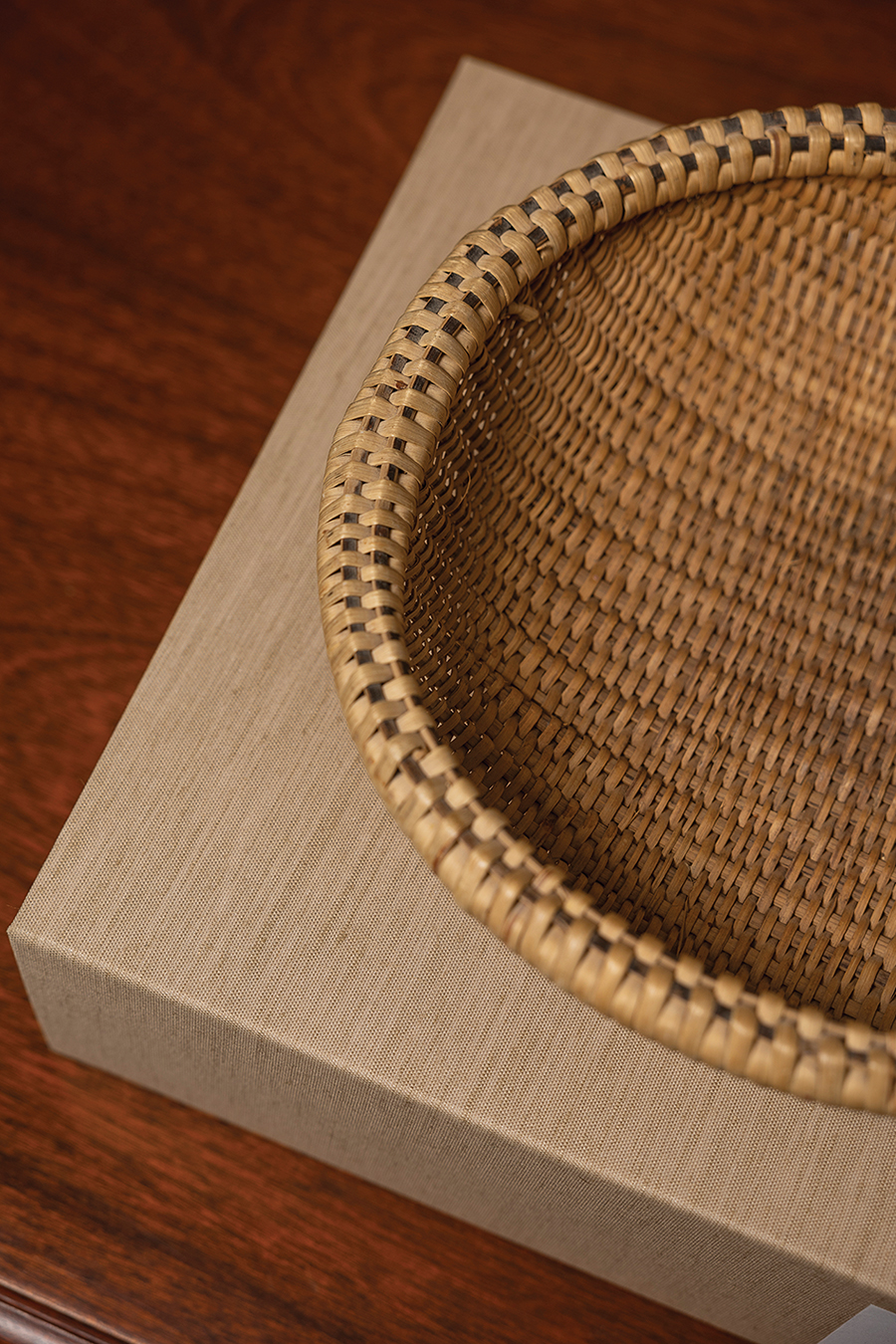
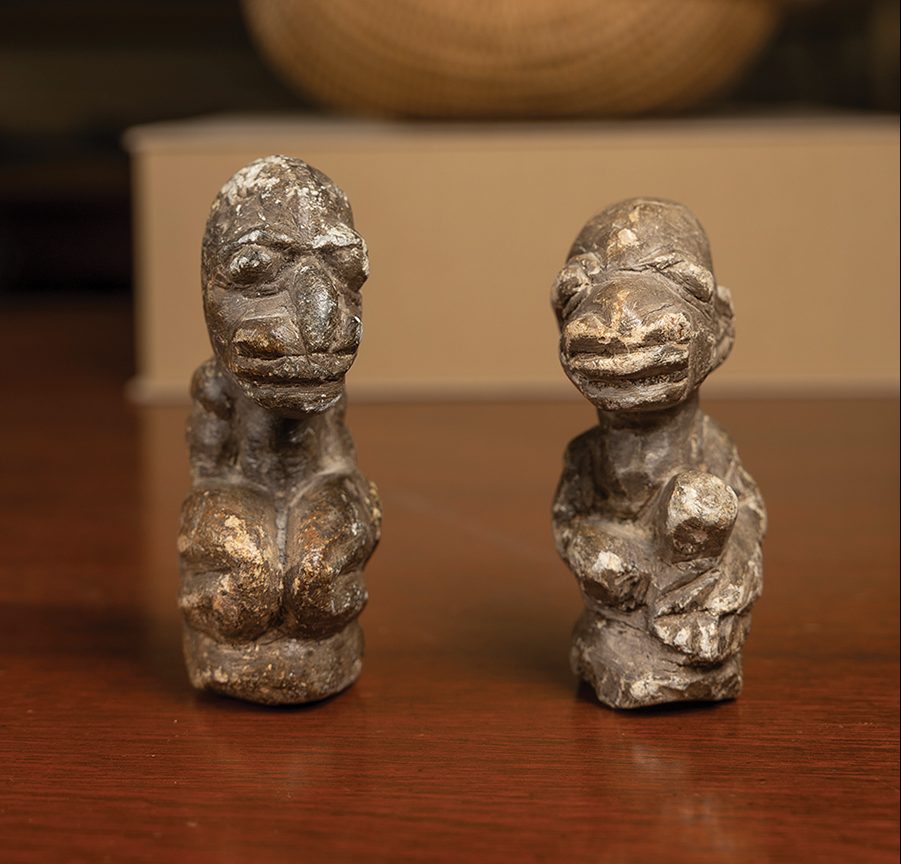
Included were a ceremonial mask, a clay cooking pot, sifting basket, wooden mortar, a primitive “mancala” board game and two bracelets.

“The wooden mortar was used by my friend and neighbor, Esther, to crush dried pepper for cooking. Liberians put hot pepper in every dish they make,” Ross explained when presenting the collection late last year to a group of anthropology faculty, friends and students.

“I was given the mortar the day prior to leaving, along with a live chicken to ‘taken to my ma.’ We cooked the chicken and had a group dinner.”

Ross gave Esther her own mortar, one she had used throughout her stay, in thanks.

“The mancala game was given to me by another Peace Corps volunteer,” she says.

The mask, believed to be Liberian, is the centerpiece of the collection. It is identical to the one the dancing devil wore in Juarzon, a gift from Ed Lipschitz when researching West African masks.

“Ed ate dinner with me every night during the months he stayed in the village,” says Ross. “The mask was a ‘thank you’ for those meals.”

Lipschitz later became a curator at the Smithsonian’s National Museum of African Art.

In passing along the personal artifacts, Ross honors the place that bookended the beginning and end of her career. “None of my career would have happened without my education at UNCG,” she says, adding she is deeply moved by her alma mater’s response to the gifts.

“My story has come full circle.”  OH

Poem July 2023

Poem July 2023

Clay Banks

The creek is old and its banks are steep.

Its flow never stops its work of remaking.

Clay like this wants to keep its form

though scoured by the storm-carried silt,

pitted as by earthbound lightning strikes.

Water is turned by jutting granite,

milky quartz, even soft sandstone,

all of it red with rust going green

as first the ferns unroll their fronds

and vines tease the air with soft thorns

the way childhood returns in old age.


A friend told me how his mother, who

is now constantly looking for her home,

who can’t recognize him or his sister,

was happy to play ball with his toddler,

with his new puppy. She tossed the ball

against the brick patio wall with a spin.

The dog and child ran with confused joy.

Sometimes they fell over each other.

His mother always caught the ball.

She was the only one who seemed to know

exactly where the ball would bounce.

— Paul Jones

Paul Jones is a professor emeritus at The University of North Carolina at Chapel Hill. His latest collection of poetry is called Something Wonderful.

Greensboro’s Jeanaissance

Greensboro’s Jeanaissance

One legacy at a time, denim is on the rise again

By Billy Ingram     Photographs by Mark Wagoner 

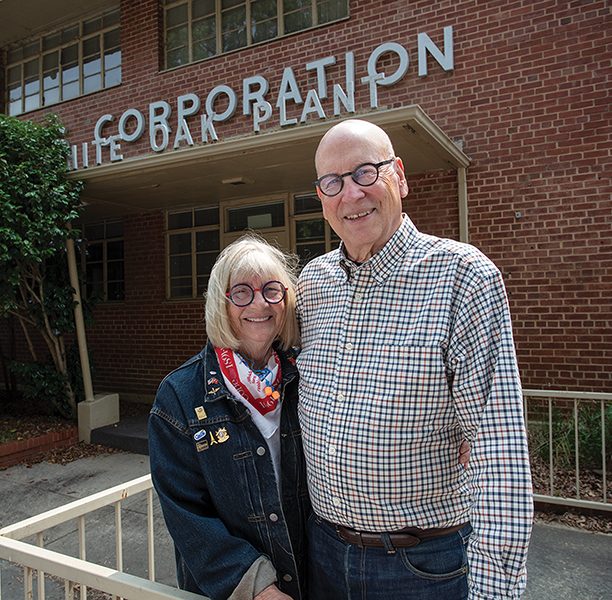
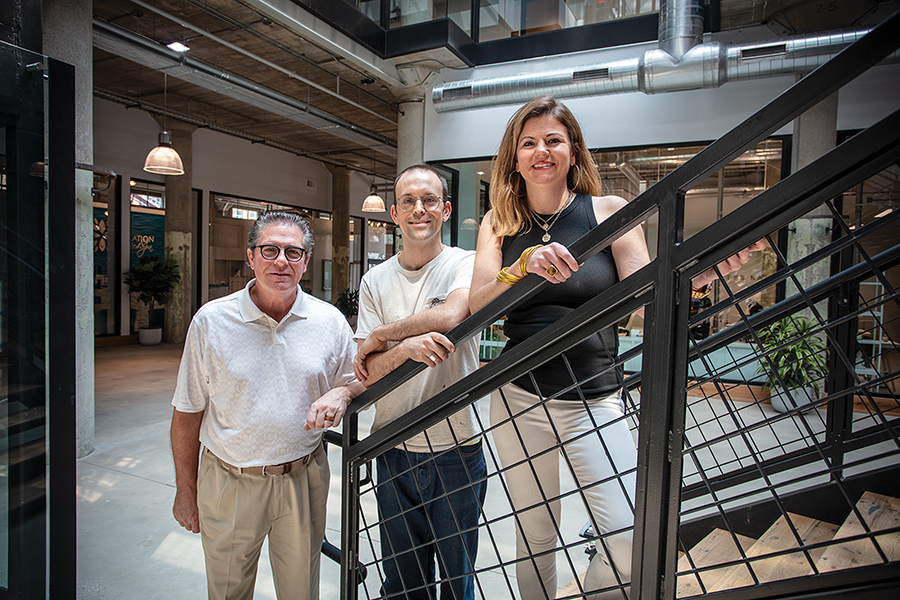
It was a solemn promise Evan Morrison made to his grandmother on her deathbed that would lead to one of the most improbable outcomes imaginable. He’d just returned from grad school in the City of Light and was looking after her. “She asked that I stay here and make Greensboro a better place,” he recalls. Morrison had no way of knowing then that his pathway forward would result in the return of denim manufacturing to our city. Ensconced in his office atop the historic White Oak Mill, he tells me,  “We’ve had so many retirees come here just pouring tears, knowing that this still is happening.”

Denim isn’t just in our jeans. It’s in Greensboro’s — and Evan Morrison’s — genes. Growing up in the Gate City, he attended Buttons and Bows day care in a converted mill house where the walls were adorned in navy and gold, the colors of Cone Mills. His mother worked at Moses Cone Hospital and an aunt was a pattern maker at Blue Bell.

What led to Greensboro becoming the denim capital of the world? The path was forged in the 1890s when two brothers with an entrepreneurial spirit moved to the city and built, first, Proximity Manufacturing Company to produce denim, and then, 15 years later, White Oak Mill, the largest denim mill in the world and the largest cotton mill in the southern United States.

Life was unimaginably rugged in the latter part of the 19th century, which found Americans in need of clothing that could hold up against the elements and rigors of farming. Recognizing that largely untapped market, Baltimore wholesale grocers Moses and Ceasar Cone relocated to Greensboro in 1895 to take advantage of that opportunity. A year later, Cone’s Proximity Cotton Mill, so named because of its adjacency to growing fields and cotton gins, began weaving denim for work clothes. Over the next decade, Cone added two more Greensboro plants, Revolution Cotton Mills and White Oak, producing flannels and denim 24/7.

In a loft above Coe Brothers Grocery on South Elm Street, Hudson Overall Company was formed in 1904. Business was so brisk, the outfit opened a much larger denim factory a block away on South Elm and Lee Street (now Gate City Boulevard) in 1919. Renamed Blue Bell, it became the world’s largest overall manufacturer. Over time, it bought up various regional brands, including Casey Jones Overall and that company’s nascent, largely unrealized Western line, Wranglers. Blue Bell hired Ben Lichtenstein, aka Rodeo Ben, a famous tailor to professional cowboys, movie and bluegrass stars, to design what they called Blue Bell’s Wranglers brand. Introduced to the public in 1947, the name was later shortened to Wrangler.

Organized, it’s been said, by disgruntled Blue Bell employees in the 1930s, Greensboro Overall Company began operations on Carolina Street, manufacturing less expensive Blue Gem coveralls. Both companies’ products were made from Cone fabric. Blue Gem’s label with the radiant gemstone states proudly, “Made of CONE deeptone® DENIM.”

By the 1940s, Cone Mills was number one in the world for denim production, world leader for indigo consumption and world output leader in denim fabric. Levi Strauss & Co. in San Francisco was becoming increasingly dependent on Cone for its 501 line of blue jeans that had become an unlikely fashion statement almost overnight.


At White Oak during the peak years, 3,000 looms were aligned in rows down a cavernous corridor stretching outward so far that if you were positioned at the end of the line, bent down to floor level, and looked forward, the curvature of the earth would only allow you to see where the floor and ceiling converged.

Already in possession of the Lee brand, VF Corporation acquired Greensboro Overall Company and Blue Bell in the 1980s. The Blue Bell label was scuttled while the company focused on Wrangler. VF’s strategy? If their products couldn’t beat the number one jeans manufacturer, Levi’s, having both the number two and three spots would result in more combined sales. It worked and, by the time VF relocated its headquarters to Greensboro in 1998, it had become the world’s largest publicly traded apparel company.

As Evan Morrison pondered the future following his grandmother’s passing in 2013, “I knew I wanted to work in denim. That’s what our city’s known for.” At that time, there were only eight denim mills operating in America. Locally, Cone’s White Oak Mill was running full tilt with several months lead time. “Made in the USA was a major selling point then,” Morrison recalls. “I thought, ‘Well, there’s no brand in Greensboro making jeans or denim products out of cloth woven in Greensboro. So if we start a business like that, we could be the only one of our kind in the Western Hemisphere.’”

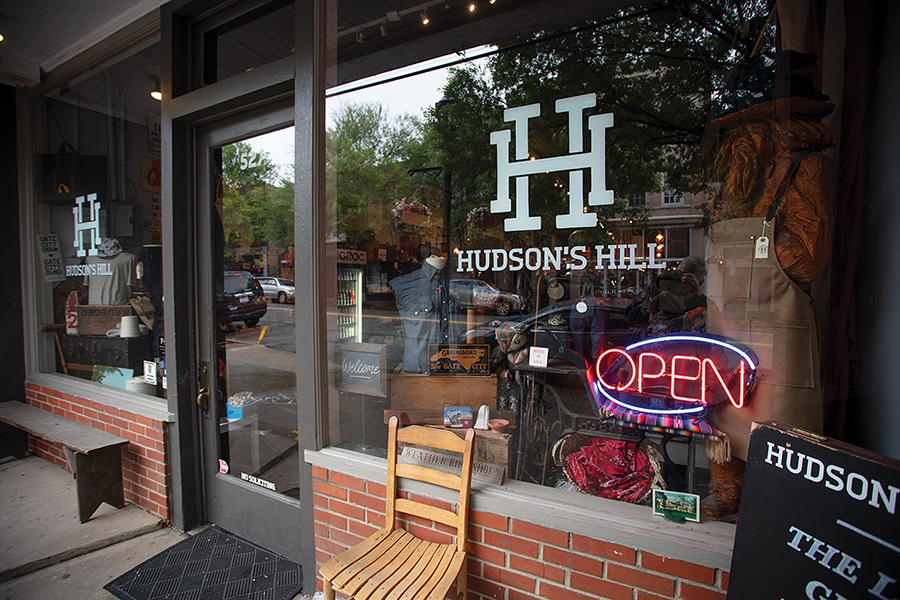
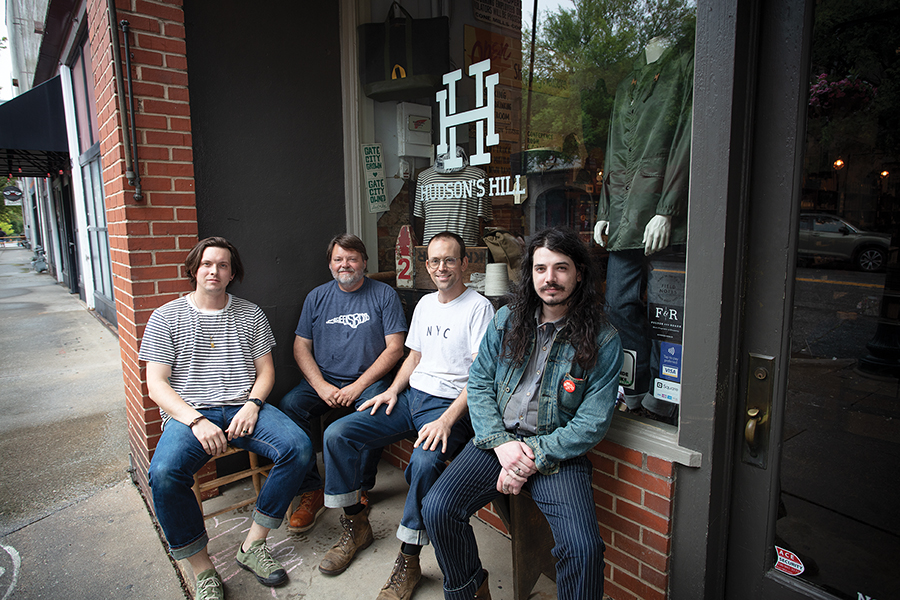
Morrison partnered with William and Tinker Clayton to create Hudson’s Hill in 2013 to market clothing and accessories made from Cone denim. Things were going well until, in 2017, Cone announced that their only active mill, White Oak, was ceasing operations, despite producing 1 million yards a year with 46 weaving looms running nonstop. With that closing, a 122-year legacy of denim manufacturing in Greensboro came to an abrupt end with no reasonable expectation that it would ever return.

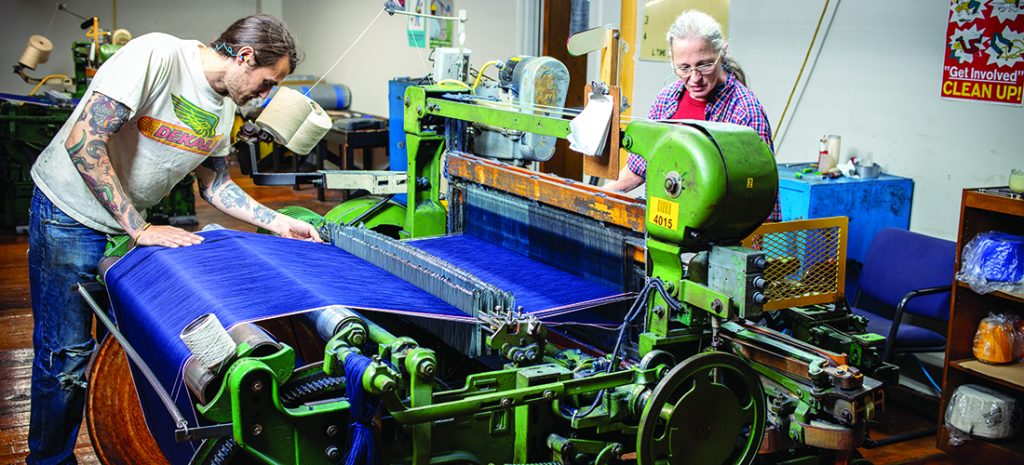
L to R: Evan Morrison, Chip Hardeman, Bud Strickland, Debbie Lindsey and Greg Redelico, representing Proximity Manufacturing Company, a weaving business producing selvage denim woven on Draper shuttle looms at White Oak Mill. Morrison is director of operations; Hardeman is general manager; Strickland is on the board  of advisors; Lindsey is a weaver; and Redelico is superintendent.


“It was like, ‘Oh my God, what are we gonna do?’” Hudson’s Hill’s business model had just imploded. “I cold-called and met with the new owner of the property, Will Dellinger, who owns JW Demolition.” Morrison posited that Cone denim’s methodology was the equivalent to Coca-Cola’s secret recipe. “This is the house that made Levi’s, Blue Bell, Lee, OshKosh and Carhartt famous — when a pair of blue jeans became iconically American. People immigrating to the U.S. have a vivid memory of their first pair of jeans. It was a symbol of a better life.”

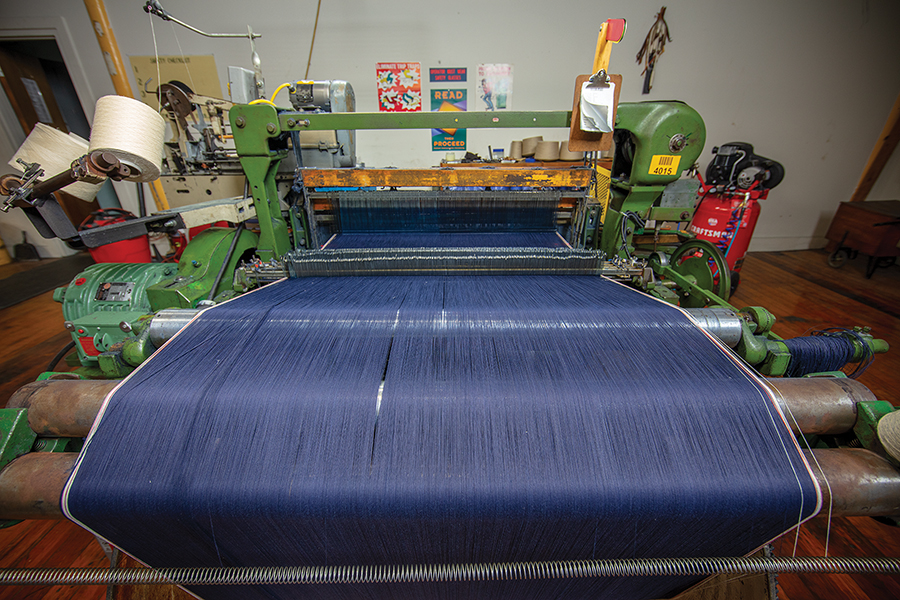
In 2019, with an agreement in place to lease a portion of the White Oak Mill, Evan Morrison and a group of business professionals across the state formed a nonprofit called the White Oak Legacy Foundation, or W.O.L.F. Morrison approached Cone Denim, asking if they could take possession of the remaining two looms at White Oak with a promise that somehow they’d figure out a way to put them to good use. “We drew up a deed of gift that basically says they’ll give them to us through the nonprofit.” When Cone donated those last remaining looms, Morrison points out, “Essentially, they gifted them to the city. So the people of Greensboro now own our history. W.O.L.F. is the nonprofit that cares for it.”


Original founders of Denim 101 Jill Amidon Strickland and Bud Strickland, shown here, helped W.O.L.F. relaunch an education program in 2021 through volunteering. The rebooted Denim 101 has become so popular that every course has a waitlist. When the couple first launched the program several decades ago while working for Cone Mills at White Oak, Bud worked in product development and Jill worked in quality assurance. 


An abundance of Cone Mills veterans in the area possessing a decades-long understanding of supply chains and contacts helped W.O.L.F. map out a workable business plan. “So we started renovating these looms in December of 2019 and, by March of 2020, we were ready to fire them up,” Morrison recalls of the initial run. “We wove our first couple of inches and then, of course, all the plastic parts that had dry rotted broke. So it took another month to find all those parts and rehab the machines to get them back up and running.” By May, those looms were weaving five days a week, “but they don’t weave very fast.” For Morrison, that presented a challenge. “I have an M.B.A., and an entrepreneurial spirit. So let’s figure out how to do as much as we can with what little we’ve got.” Know how to spot a true entrepreneur? “I do all the machine fixing and all of the rebuilding myself,” Morrison says.


L to R: Nick Piornack, Evan Morrison, Karen Little, representing Revolution Mill, located in NE Greensboro, formerly the world’s largest flannel and corduroy mill and part of the Cone Mills family of textile mills, now historically renovated and owned by Self-Help. Since 2013, it has hosted a collection of textile exhibits, ephemeral objects and historical equipment that has helped showcase its history throughout its mixed-use campus. Nick serves as general manager, Evan oversees special projects, while Karen serves as property manager at Revolution Mill.


W.O.L.F. has four defining pillars: Make, Remember, Learn and Create. Working looms represent the “Make” portion of W.O.L.F. “Remember” is being manifested as an American Denim Museum downstairs at White Oak on the heels of Morrison’s previous historical installations at various locations over the last decade. Cruise around town and you’ll spy statues of pairs of blue jeans put in place when Evan Morrison first coined the moniker, Jeansboro, now synonymous with our city.

“The ‘Learn’ side is Denim 101,” Morrison explains. “There used to be a big event here called The Denim School. Designers would come for a couple of days and learn, from bale-to-fabric-to finishing, how things actually got made.” By chance, his across-the-street neighbors, Bud and Jill Amidon Strickland, founded that program in the ’80s. “I asked them to come back on and help us. We’ve put on six sold-out programs and everybody from Gap to Levi’s, Lee, Wrangler, Cone Denim, Cotton Incorporated, with students from N.C. State, A&T, UNCG all attending.”


The “Create” aspect means staying on the cutting edge, just as Cone Mills was recognized worldwide for modernizations. “The first air-conditioned plants,” Morrison points out. “First to develop ‘S’ jeans, which is like a recovery denim that has stretch but doesn’t stretch out. First to weave denim with the new, natural indigo being grown in the United States. So many firsts.”

That spirit of innovation lives on at White Oak. The first pair of jeans in the Western Hemisphere woven on shuttle looms with hemp as a component was recently developed there. “Last year, we wove some of the first ever bio-based, plant-based indigo,” Morrison notes. “It doesn’t use any chemicals, just natural elements.”

To attain a custom shade of denim for a more distinctive look, 20,000 linear yards of yarn has to be ordered. “We can only handle about 4,000,” Morrison says. In order to act big but stay small he came up with the idea of “weft out.” In a typical pair of jeans, “the blue that goes through the loom is called the warp and it gets filled with what’s called weft.” Generally, that weft is white, creating the lighter hue you see inside your jeans. “I thought, ‘What if we just flip the fabric backwards?’ So we started Weft Out, which is our trademark, using filling yarn to create a custom color.”


Morrison unfolds a bolt of a fabric revealing an astonishing effect — vibrant hues of turquoise, gold and orange, with indigo playing a supporting role on the back side. “This is something that we sell to really high end fashion companies for $3,000 [per pair of] jeans. It does take a lot more time.”

A little closer to home than $3,000 jeans, one hopes, is the aforementioned Hudson’s Hill, where Evan Morrison began this journey ten years ago, a stylish storefront situated next door to where Hudson Overall/Blue Bell was established well over a century ago. Stocked exclusively with products made in America, with a hefty percentage produced right here in North Carolina, I liken it to shopping at the Ralph Lauren store in Beverly Hills, albeit more compact.

Inside Hudson’s Hill, hip haberdasher J.R. Hudgins points out a line of jeans not likely found outside of New York or Los Angeles, saying, “Tellason is like an entry level gold standard for the shop right now, affordable for an America made pair of jeans.” A grouping of classically styled jackets catches my eye. “These are from a company called Mr. Freedom,” Hudgins says. “I love them because he’s a French designer who has a very Western aesthetic but with a European cut, higher cut arm holes, much trimmer body, not as boxy.” There are, of course, store-branded jeans and jackets constructed from found dead stock: “Fabric Cone Mills or another local producer stopped making and we found enough to make some pants or jackets out of it,” he explains. “Once these sell, that’s it.”

L to R: William Clayton, Tinker Clayton, Evan Morrison and John Hudgins, representing Hudson’s Hill: The Last Great American-Made General Store, located in downtown Greensboro on S. Elm Street. The Claytons (father and son) and Morrison are co-owners, while Hudgins serves as store manager.    

E-commerce aside, Hudson’s Hill’s local customer base is augmented by visitors here on business from larger cities and abroad. “That’s the clientele for a lot of the higher ticket items,” Hudgins says. “Yes, if our store was in Brooklyn, we’d probably be a lot more successful. But we couldn’t do things the way we do if we weren’t here in Greensboro.”

Headquartered on Green Valley Road, Cone Denim still operates factories in Mexico and China, and — as you read this — it’s relocating its headquarters to Revolution Mill. The circle of life and all that. And still innovating with Flash Finish technology and Mission Zero Waste to be more eco-efficient.

Adjacent to Evan Morrison’s workspace/studio at nearby Revolution Mill, old Cone manufacturing equipment sits on display. “I might be leaving my work at the end of the day, kind of frustrated because something’s gone wrong,” he tells me, “and I’ll walk out of my office and look over and there’s a granddad [crouching down] with his grandkid telling them, ‘I used to work on these machines in this building when I was a young person.’ And that’s the tackling fuel, to quote The Waterboy.”  OH

Those interested in Greensboro history might find Billy Ingram’s book, EYE on GSO, to be perfect summer reading. Available from bookstores and on Amazon.


The Legacy of Moses Cone

© Carol W. Martin/Greensboro History Museum Collection.

Just months after the employees of the combined Proximity, White Oak and Revolution Mills celebrated their fourth annual picnic in 1908, newspapers around the country proclaimed that Moses Cone, the “Denim King,” was dead at the age of 51. However, weaving and manufacturing of denim in Greensboro was still in its infancy.

Having left no last will and testament, under North Carolina law, 50 percent of Cone’s estate would have to be surrendered to the state. His brother, Ceasar, and Moses’ wife, Bertha, negotiated with state officials to park his holdings into an account, allowing Bertha to live comfortably until her death in 1947.

Moses Cone holding his niece, Isabel Cone, ca. 1907.

Photograph © Greensboro History Museum Collection


Per that aforementioned agreement, that trust was then donated, along with a sizable patch of centrally located real estate, for the construction of a hospital to be named for Moses Cone. But there was one stipulation: If the Cone name ceased to be associated with the hospital, ownership would revert to Moses’ living descendants.

That’s why, no matter how many times Cone Health may be purchased, merged or rebranded, the name Cone will always be front and center.


Big Screen Jeans


Right: Stranger Things, Left: Yellowstone

Greensboro’s own Wrangler jeans are taking a noticeable star turn on hot TV series like Yellowstone and Stranger Things. Truth to tell, if you recognize any label or logo in the scene of a television production, it’s almost certainly paid for. 

Product placements are a bit more subtle today than back in the 1980s when characters would play an entire scene in front of a Pepsi machine. Or, think back upon ET’s intergalactic hunger for a relatively unknown candy, Reese’s Pieces, considered the first mega-successful product tie-in of all time after M&Ms passed on the opportunity.

Wrangler’s first product placement campaigns started back in 1947 when their rough-and-ready denim jeans were first introduced to the public, leather labels stitched on the backsides of big name rodeo stars to reach the targeted rugged individual demographic. To a certain extent, that still holds true.

Wrangler is only one of a number of Triad companies that have been purposely inserting their products into scenes and sponsoring television programs since the medium’s earliest days. With deep pockets, Big Tobacco was one of the first industries to see the potential in television. In fact, in the 1950s and ’60s, sponsors had more control over the content of TV programs than the networks did.

  Walker

Headquartered in Greensboro, P. Lorillard Tobacco Company sponsored classic shows like Ted Mack’s Original Amateur Hour, which found Old Gold’s Dancing Cigarette Pack and The Little Matchbox tap-tap-tapping across the small screen in the early-1950s. Lorillard’s Newport logo was featured prominently on ’60s sensations like The Price is Right and Petticoat Junction.

R.J. Reynolds took an integrated sponsorship approach with seamless transitions as a primary advertiser on The Flintstones when that cartoon series debuted in 1960. “Winston tastes good like a cigarette should,” especially when Fred Flintstone and Barney Rubble would sneak around the cave to light one up while the wives continued doing all of the chores. Camels became synonymous with The Phil Silvers Show.

Reynolds’ Kent cigarettes sponsored The Dick Van Dyke Show. Cast members happily puffed away in one minute skits while Steve McQueen stepped out of character to peddle Viceroys on Wanted: Dead or Alive. Vicks VapoRub, manufactured (until 1985) by Greensboro-based company Richardson-Vicks, was another ubiquitous TV advertiser in the 1960s and ’70s.

In 1952, Greensboro’s Burlington Industries became the first textile manufacturer to advertise on television. By the 1960s and ’70s, its brash, bold, percussive spots became woven into the fabric of nighttime television, punctuating programs like The Waltons and The Mary Tyler Moore Show. When Burlington did its yearly opinion survey in 1975, 70 percent of those sampled recognized the brand from watching television.

So the next time you spy a pair of men’s Greensboro jeans on a Western-themed show like Walker or Outer Range, know that Wrangler is continuing a decades-long tradition of Triad firms influencing the television programs we watch in both large and small ways.