Restaurant in Peace

Restaurant in Peace

A look back at bygone ‘Boro eateries

By Billy Ingram

Join us for a retrospective of Greensboro’s rich culinary legacy. Travel back in time to when just about every place someone dined in was locally owned. Patrons not only became friends with the restaurateurs, they were able to watch their children, who served them and ran the cash register, grow into adulthood.

Our journey begins in an era when farm-raised meats and just-picked produce were delivered directly each morning from farms to cafe back doors. Every dish was painstakingly prepared daily from generations-old recipes; adventurous innovators rose up with visions for what an increasingly younger clientele yearned for. Tuck in your bib and dig into the days shortly before the soulless mediocrity of an endless chain of corporate franchises hijacked America’s taste buds.

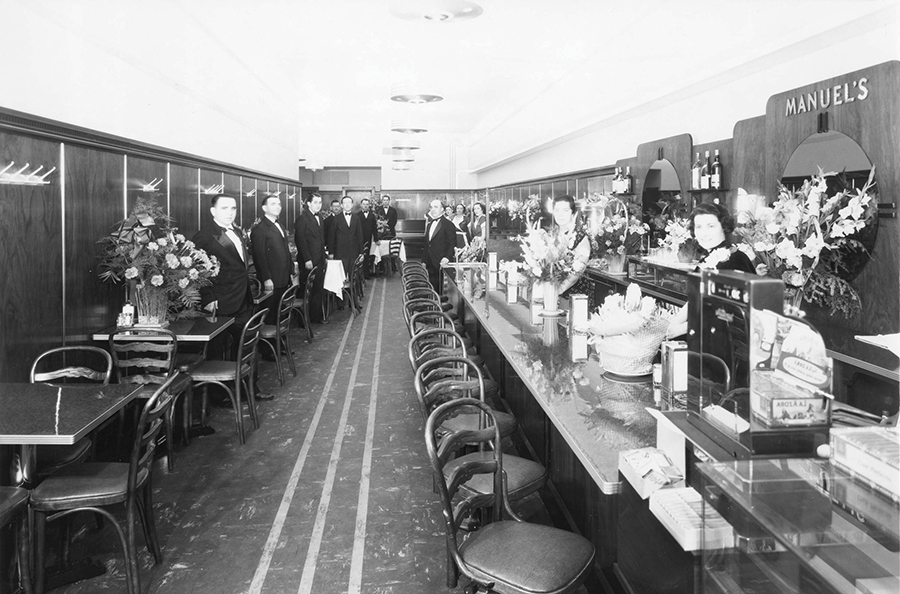
1) Manuel’s Cafe
© Greensboro History Museum

From the early 1920s to the mid 1950s, Manuel’s was the epitome of fine dining downtown, with fresh flowers and linen tablecloths. Men, of course, wouldn’t think of arriving attired in anything but a suit and white gloves were de rigueur for the ladies, though most folks of a certain class dressed like that when they left the house back then any way. Known for its rich, savory spaghetti and massive Western-style steaks, Manuel’s shared the block with Jefferson Standard’s West Market Street entrance. “We serve the very best!”

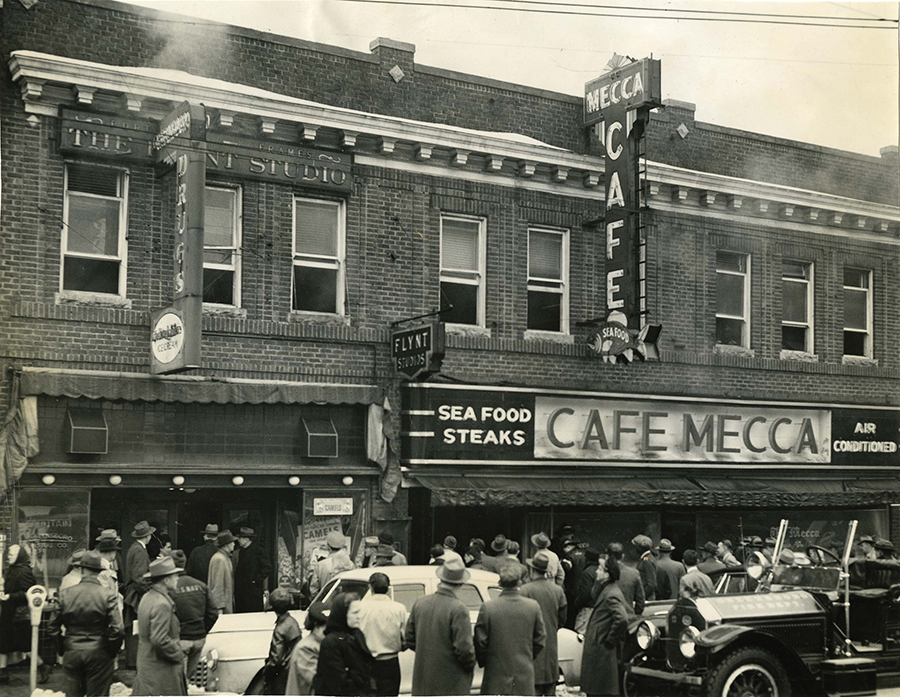
2) Cafe Mecca
© Greensboro History Museum

A little further down West Market during the ’30s and ’40s sat “Greensboro’s Most Popular Restaurant,” Cafe Mecca, serving seafood and steaks but pretty much offering the same menu items as every other local hash house. There was very little ethnic food available in town, but one notable exception was The Lotus Restaurant, launched in the 1930s and specializing in Chinese dishes, facing the Carolina Theatre on Greene Street.

3) Matthew’s Grill
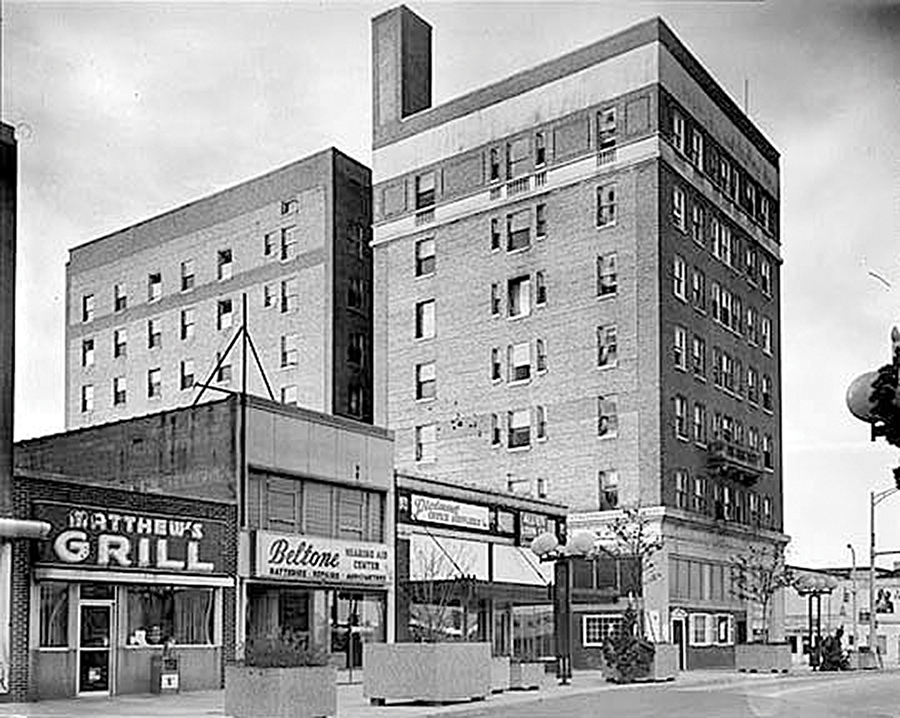
Almost every city eatery from the’30s into the ’80s was owned and operated by Greek immigrants, Matthew’s Grill, aka “The Right Place To Eat,” being no exception. Having learned the business at The Princess Cafe, his sister and son-in-law’s downtown mainstay on South Elm, owner-operator Minas Dascalakis bought Matthew’s, sandwiched between the Greensboro and O.Henry Hotels on North Elm, in 1953. For the next 36 years, that luncheonette’s counter served as a go-to spot for business leaders and city officials. Standard Southern fare dominated the menu — the Sunday Special in the ’60s was braised rabbit — but Dascalakis was always eager to whip up any off-menu Greek speciality a customer craved.

4) Your House
This always dependable, inexpensive diner began life in Greensboro in the mid-’50s, adjacent to the Journey’s End Motel on Battleground, and survived 55 years, long after that motor lodge gave way to a generic shopping center some four decades ago. In its heyday, the restaurant was part of a 12-unit chain founded by the Callicotts in Burlington in 1962. I was also partial to another house, Jan’s House, in that funky dilapidated strip mall on West Market, where you could imagine the chef was flat-topping hash browns between stints behind bars.

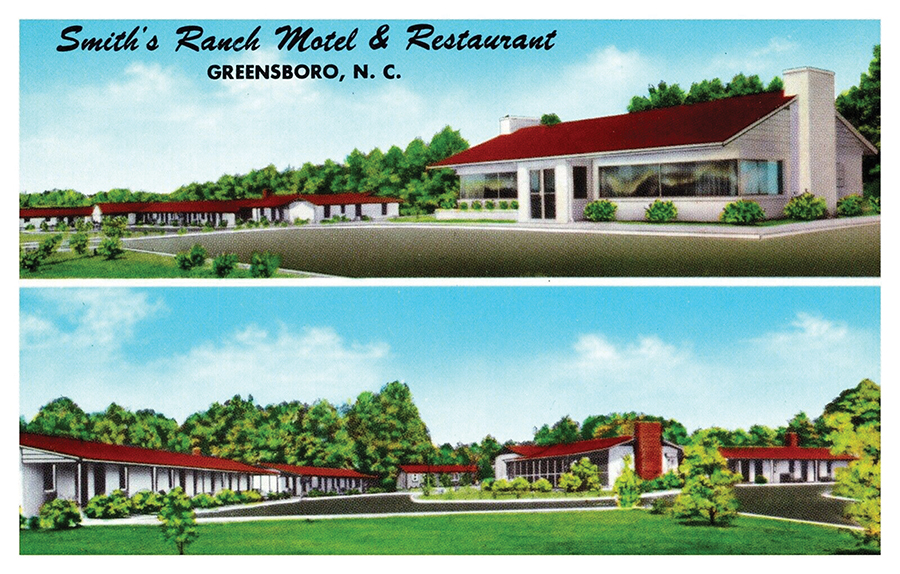
5) Ranch Restaurant
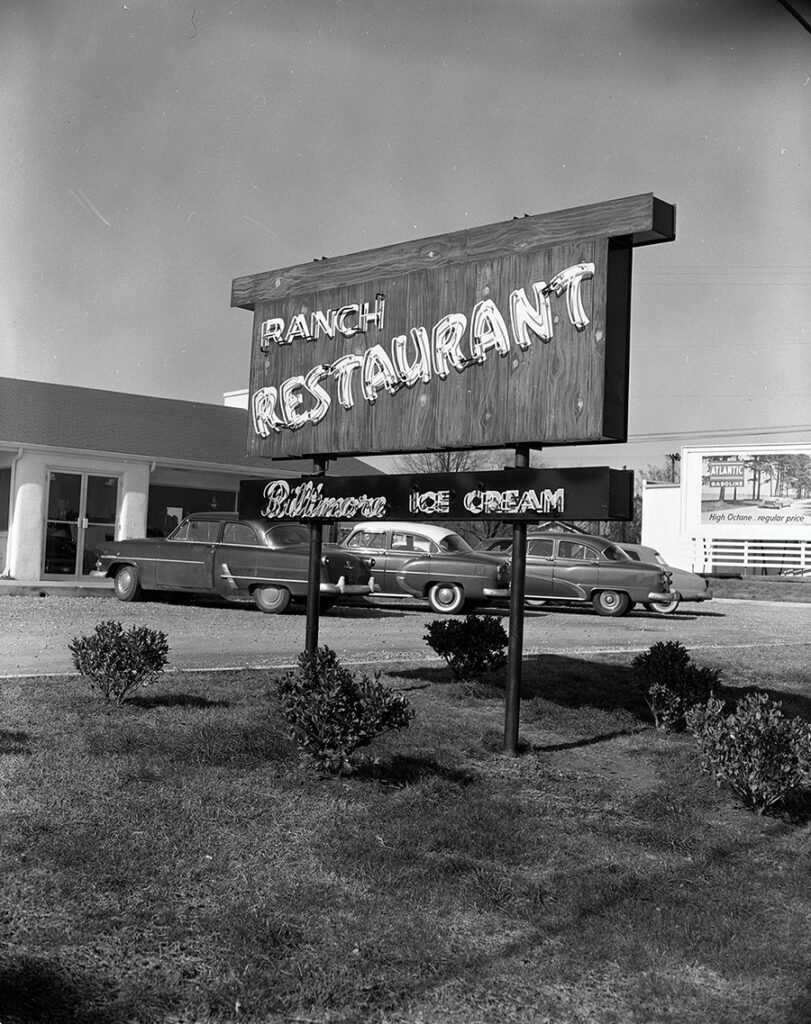
© Greensboro History Museum

Very much like the design and concept of Your House, The Ranch Restaurant was attached to Smith’s Ranch Motel on Randelman Road at what was then the edge of town near Interstates 40 and 85. In 1968, proprietor J. Howard Coble (no relation to U.S. Rep. Howard Coble of Greensboro, whose father was Joe Howard Coble) served up a complete club steak dinner, including salad, french fries and buttered roll for the princely sum of $1.65.

6) Southern Queen Hot Shoppe

Ever notice that streamlined, train car-like building with a stainless steel exterior (recently painted over) attached to the side of La Bamba on Gate City Boulevard? Originally located across the street, this very rare example of a late-1940s Paramount built diner was constructed for Southern Queen Hot Shoppe, a drive-in hangout for post-war hipsters serviced by uniformed “curbers.” The Greensboro Hot Shoppe was one of 70 in seven states at the chain’s height.

7) Airport Restaurant
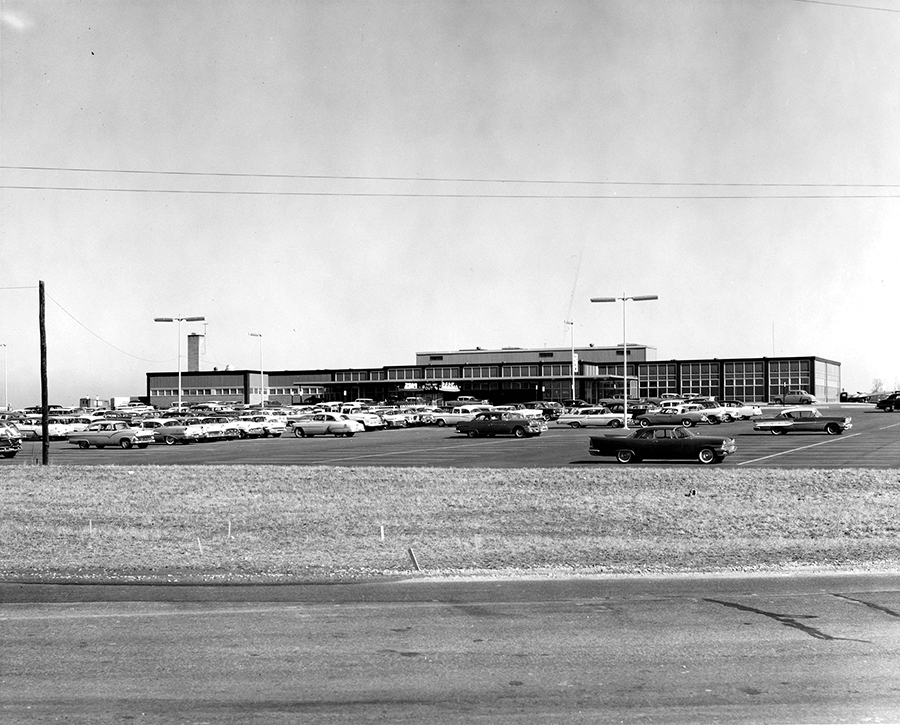
© Carol W. Martin/Greensboro History Museum Collection

According to my dear friend, Margaret Underwood, it was at this out-of-the-way Italian eatery overlooking the tarmac at PTI that chef Steve Bartis, another Greek expat, served the Gate City’s first pizza pie back in the 1950s. According to Margaret, this joint, with a $2.25 Wednesday night buffet, “had the best tossed salads with Roquefort dressing I’ve ever tasted.”

8) Tom Tom Supper Club
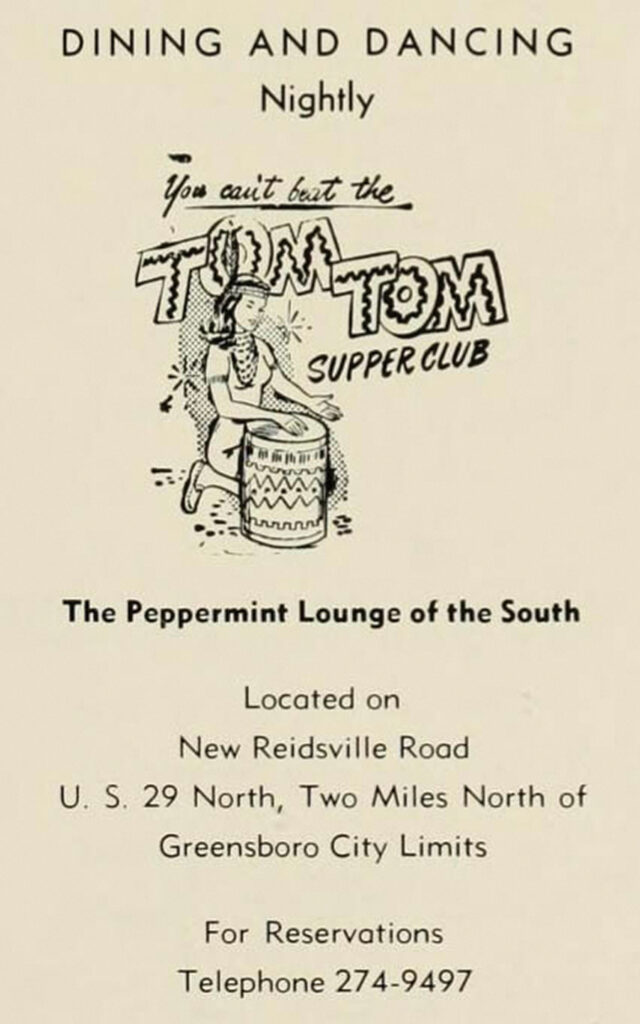
From the 1940s well into the 1970s, supper clubs were all the rage. Communal dining and dancing in grand ballrooms accompanied by live entertainment dished out by B- and C-listers such as Gogi Grant, The Archers, aka “America’s Answer to the Beatles!,” and alleged comedian Joe E. Ross’ wretched stand-up act. In Greensboro alone there were over half-a-dozen supper clubs during the 1960s with names like Queen’s Inn, Canopy, Tropicana (borderline strip joint booking acts such as Ginger “Snapper” Monroe, Exotique), Green’s — famous for its beach-themed oyster bar — and the Plantation on High Point Road (now Gate City Boulevard), where occasional A-listers, including The Ames Brothers and Nat King Cole, performed.

9) S&W Cafeteria / Mayfair Cafeteria
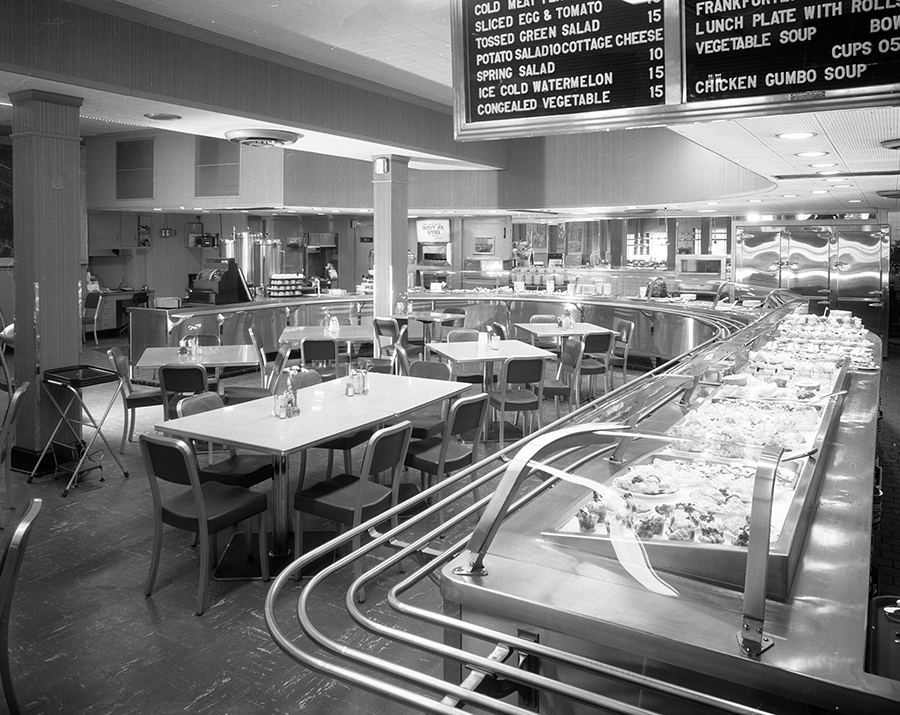
© Carol W. Martin/Greensboro History Museum Collection

Just one of many cafeterias downtown, the S&W was said to be the finest in the nation with an operation that took up three floors. Many felt it was a cut above, both culinarily and with its quietly elegant interior. Both S&W and Mayfair closed in the mid-’60s, when customers began fleeing the center of town for neighborhood retail strips, Friendly Center and, soon to follow in the ’70s, the Four Seasons Mall. 

10) Sunset Hills Restaurant
© Carol W. Martin/Greensboro History Museum Collection

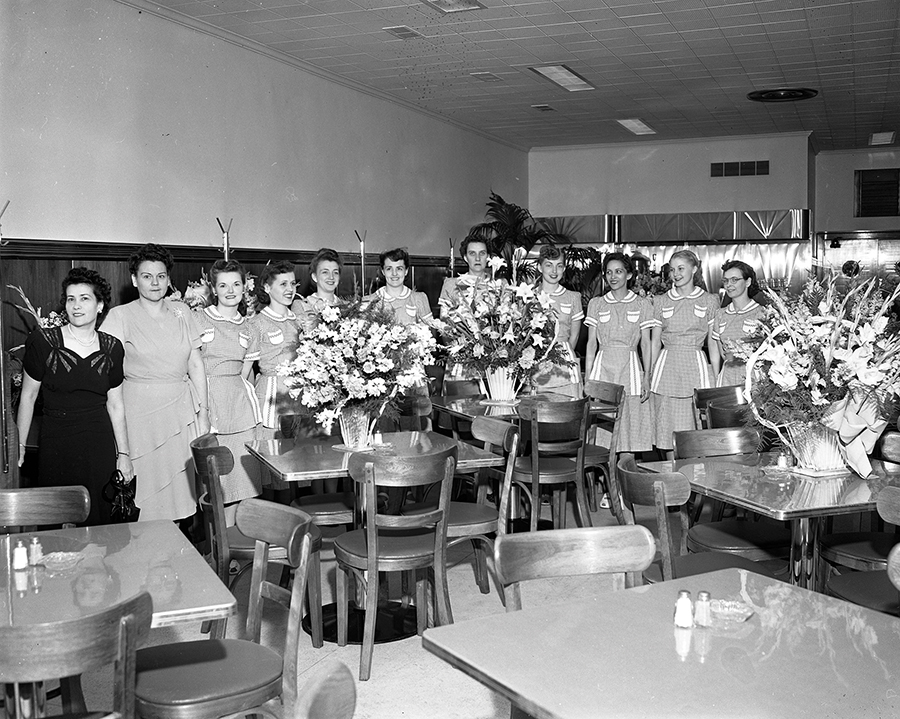
A fine dining establishment named for the neighborhood it bordered, Sunset Hills Restaurant opened its doors in the 1952 at 1618 Friendly Road. Offering live lobsters, thick-cut pork chops and massive steaks served in a refined setting, it closed when the entire block was demolished in the early-1960s to accommodate a modern fire station, where 1618 West is docked currently.

11) Bliss Restaurant
© Carol W. Martin/Greensboro History Museum Collection

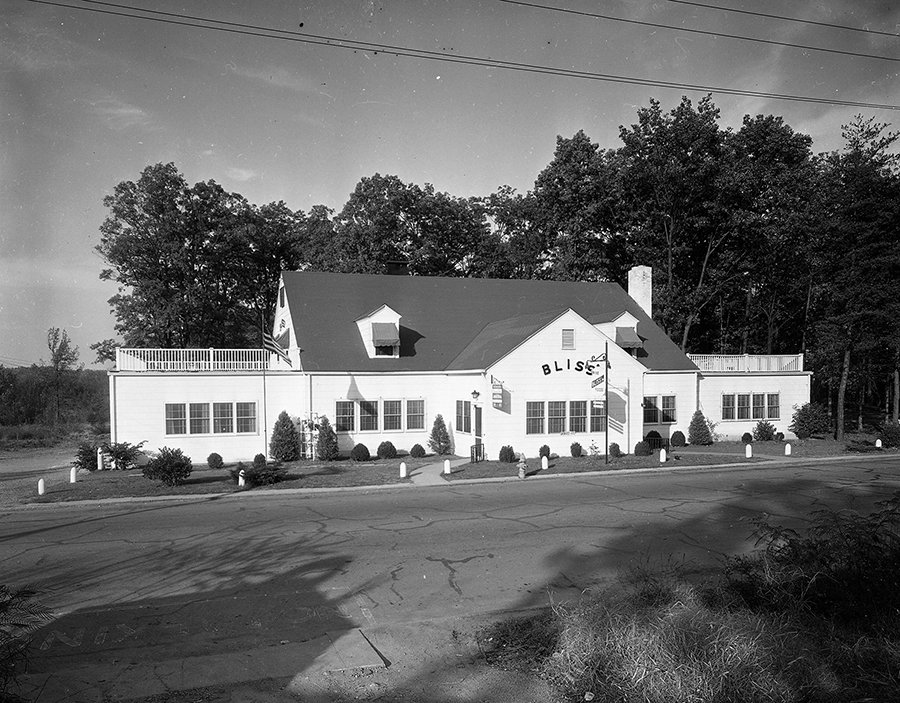
From the corner of Northwood and Huntington, this fine dining establishment seared chops and steaks for the Irving Park set from the 1940s until the mid-’60s when the place, by then renamed Al Bolling’s Charcoal Steak House, was itself reduced to charcoal after an inferno leveled the structure. That location then became home to the greatest multiscreen movie theater this city has ever or will ever know, the Janus. There’s a First Citizen’s Bank there now.

12) IPD / Cellar Anton’s
© Carol W. Martin/Greensboro History Museum Collection

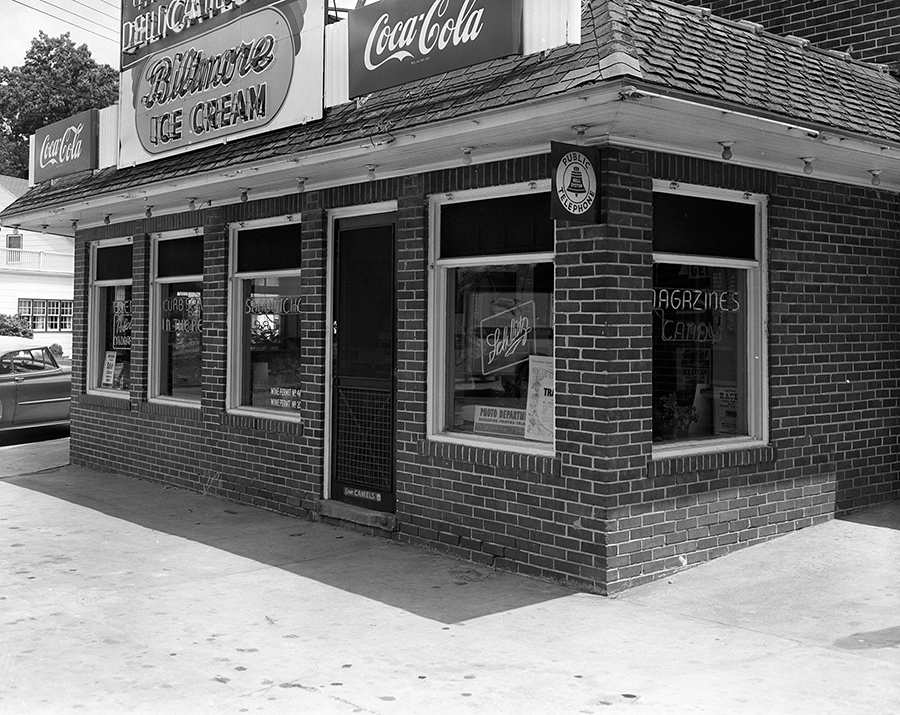
Across Northwood from Bliss, Bill Anton converted a grocery store into a community culinary gathering spot like no other: Irving Park Delicatessen (IPD to regulars). The look, seen here in 1960, changed drastically in later years, but upstairs was the casual cafe where beloved waitress Bertie Johnson warmly welcomed folks, serving up lasagna and beef Leonardo that couldn’t be beat. Downstairs, where maître d’ Fitz Fitzgerald presided, was the more upscale Cellar Anton’s, a cavernous, candlelit old world grotto dominated by a wooden bar for folks “brown bagging.” At the time diners brought their own liquor to be stored behind the bar, then paid a nominal fee for set-ups. When IPD closed a decade ago, an extraordinarily crucial manifestation of what defined Old Greensboro vanished along with it.

13) Casey’s “World’s Best Bar-B-Q”
© Greensboro History Museum

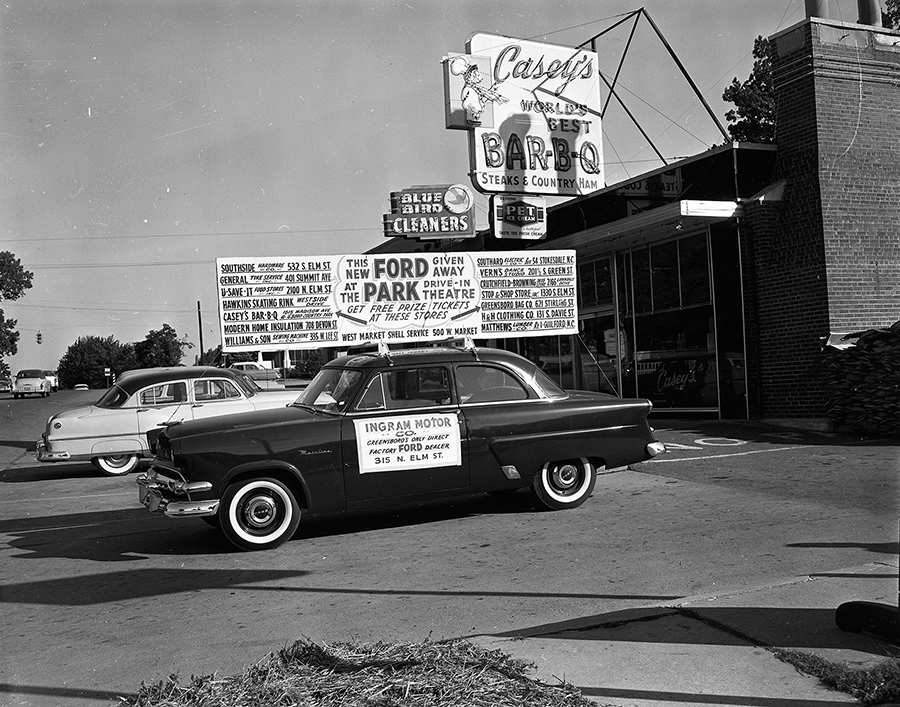
Very popular with the Grimsley High lunch crowd from the ’50s into the ’70s, Casey’s was known for its grab-and-go Whiz Burgers, so named because the patties were slathered in Cheez Whiz. Booths were equipped with tabletop jukeboxes and prominently displayed up front was a check for $5,000 (more than $50,000 adjusted for inflation) signed by Andy Griffith for catering a Los Angeles cast party. He’d wanted his TV co-stars and crew to experience authentic North Carolina barbecue. You may recognize this building — it’s the strip on Friendly where Bandito Bodega is today.

14) Honey’s Drive-In
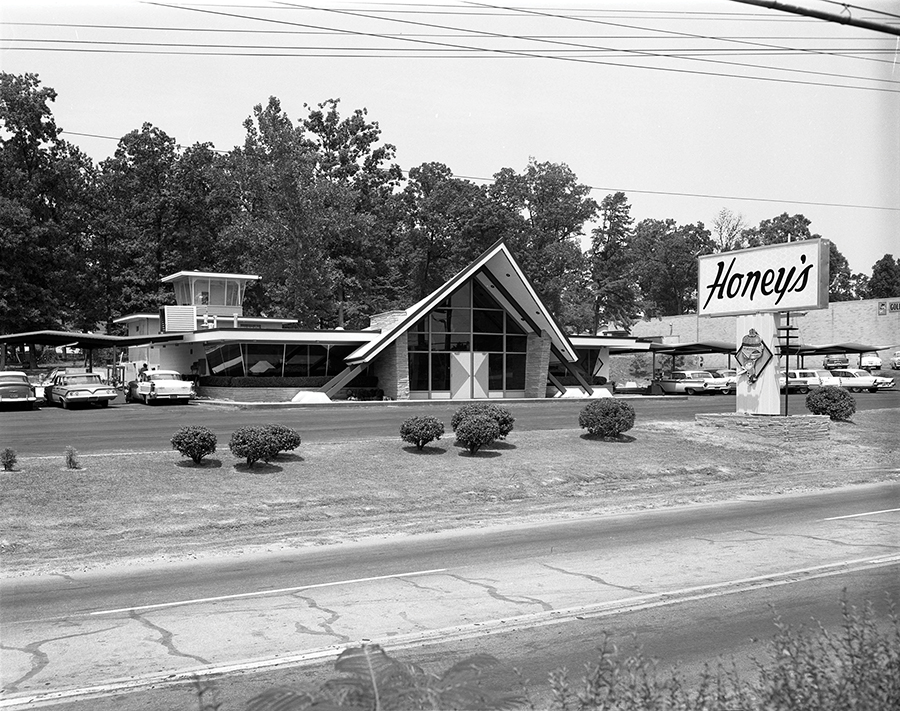
© Carol W. Martin/Greensboro History Museum Collection

With car culture in full swing by the 1950s, cruising High Point Road became a requisite teenage pastime. So the idea of downing King Bee burgers with your date sitting close enough to share your shake in an automobile the size of a small living room made perfect sense. Immaculately coiffed car hops attended to mobile meal-goers, while indoor noshers placed orders via closed-circuit telephone. Behind Honey’s (previously McClure’s) was the fabled Sky Castle, where Greensboro’s grooviest rock’n’roll radio jocks broadcasted live over 1320-AM WCOG. DJs would even take requests from diners as they tuned in while eating, parked in their beaters and crates. A great deal more exciting than current tenant Olive Garden.

15) McClure’s 
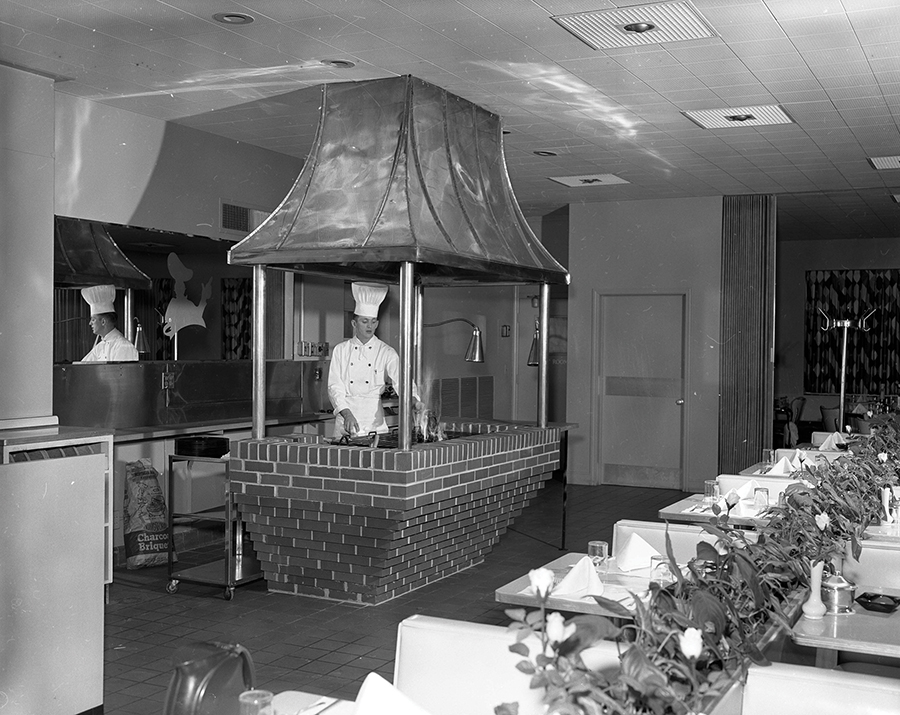
© Carol W. Martin/Greensboro History Museum Collection

After Drew and Devore McClure sold the aforementioned drive-in, they opened this upmarket restaurant around 1964 in the Summit Shopping Center. It was considered the height of mid-century elegance, featuring the “Sir Loin Room,” where rare roast beef was carved to order. A lobster tank anchored the front window, while, in the rear, the comfy Lantern Lounge with tufted leather seating showcased local musical acts on weekends. Very Continental.

16) Jung’s
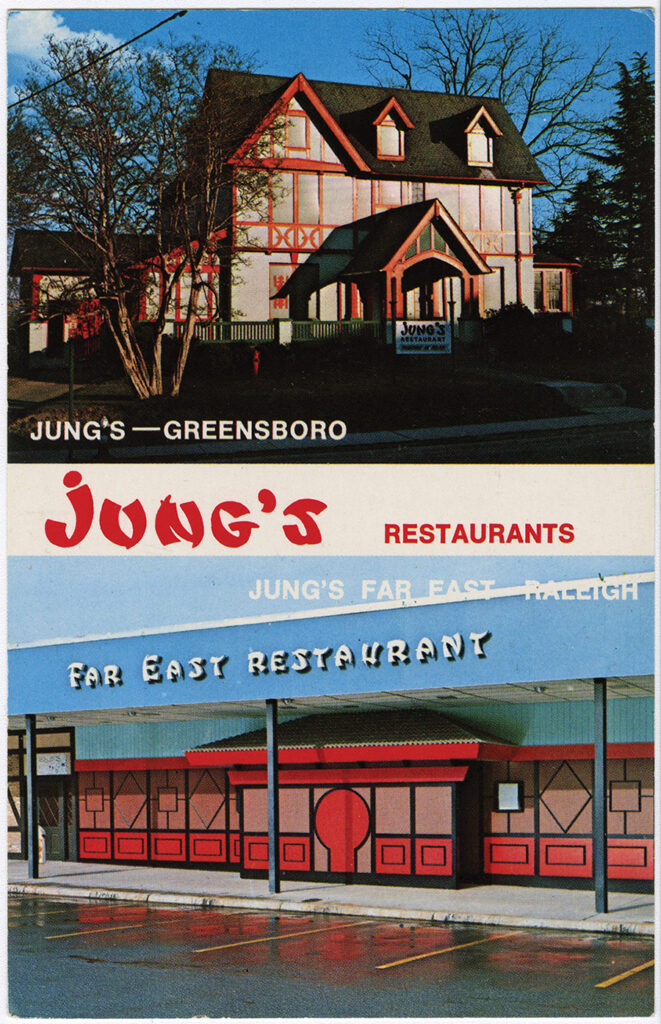
© Greensboro History Museum

In the 1970s and ’80s, this Tudor-inspired house at 314 North Church St. was one of the city’s superlative dining destinations. While Jung’s Chinese & American Restaurant featured beautiful, spacious dining rooms with high ceilings, when I would tag along with my father, he would generally order Chinese spare ribs to-go.

17) Jordan’s Steak House 

Jordan’s Steak House, established in 1972, featured an intimate, 76-seat isle of gentility on Church Street, masked by a nondescript exterior. The most sought after chophouse in the Triad for visitors during High Point Furniture Market, its limited menu ensured exceptional standards. Diners selected the cut of beef they desired from a rolling table-side cart and, in due time, that steak returned grilled to perfection. By 1999, it was well-done the moment mediocre meat merchants Outback and Longhorn rode into town uninvited.

18) Darryl’s 1890

For teenagers in the 1970s, Darryl’s was the place to congregate with friends over frosty $3 pitchers and cheap wine carafes. Immersed in a playfully garish decor obviously inspired by New Orleans cathouses, the atmosphere was unlike any other, almost every station adorned with its own singular theme. The most requested corner was the caged table resembling a jail cell. Lines were long as eager date-nighters clambered to get inside on weekends.

19) Tony’s Pizza
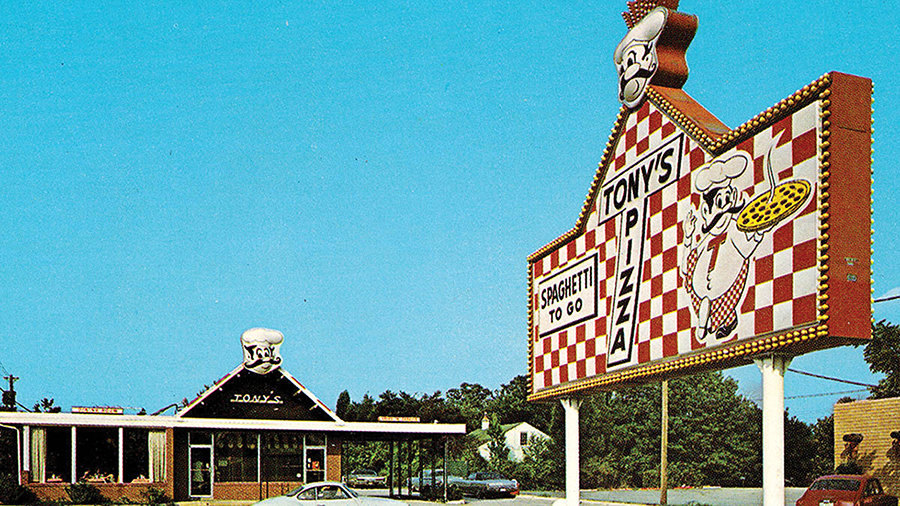
Another hip hangout for high schoolers in the 1970s was Tony’s Pizza on Battleground, an avenue nowhere resembling the congested corridor of car lots and fast food chains we’re accustomed to today. Conceived and owned by Aleck Alexiou, son of The Princess Cafe’s owner, Tony’s was known for its incredible submarine and grinder sandwiches, a relatively new concept for this region.

20) Baskin-Robbins

Can one wax nostalgic over a franchise store in a cinderblock hut? In the 1970s, after movies let out at the Janus Theatres, Baskin-Robbins’ parking lot on Battleground behind IPD became packed tighter than a BR pint, brimming with young people. Business was so brisk Janus launched its own ice cream parlor that failed to dampen the throngs amassing nightly in search for affection over confection anyway. After the Janus’ eight screens flickered out in 2000, the crowds melted away at 31 Flavors, resulting in its slow demise.

As an amuse bouche, here’s a partial list of restaurants that have been around for 45 years or more, still in their original locations, that remain highly recommended: Cafe Pasta; Bernie’s Bar-B-Q; Brown-Gardiner Drug Store’s lunch counter; Lucky 32; Yum-Yum Better Ice Cream; K&W Cafeteria; Lox, Stock & Bagel; First Carolina Delicatessen; Mayberry Ice Cream; and New York Pizza on Tate.  OH

Poem November 2023

Poem November 2023

After Church

When the preacher’s son told me

my aura was part halo, part rainbow,

I saw him see me

saintly. God

appeared instantly and everywhere

that summer:

smiling in the pansies,

reflecting us in the farm pond,

beside us on our bikes,

in the barn fragrant with warm cows,

glinting from the hay chaff,

the slatted light.

God touched us as we touched,

electricity in our fingers,

we were shimmery and dewy,

our skin golden, hair sun-bleached.

Angels sang in our voices.

The moon rose in heaven, love,

heaven in the moon.

— Debra Kaufman

Debra Kaufman’s newest poerty collection, Outwalking the Shadow, is forthcoming from Redhawk Publications.

Agent Of Change

Agent Of Change

How real estate ace Melissa Greer has made a space her own

By Maria Johnson     Photographs by Amy Freeman

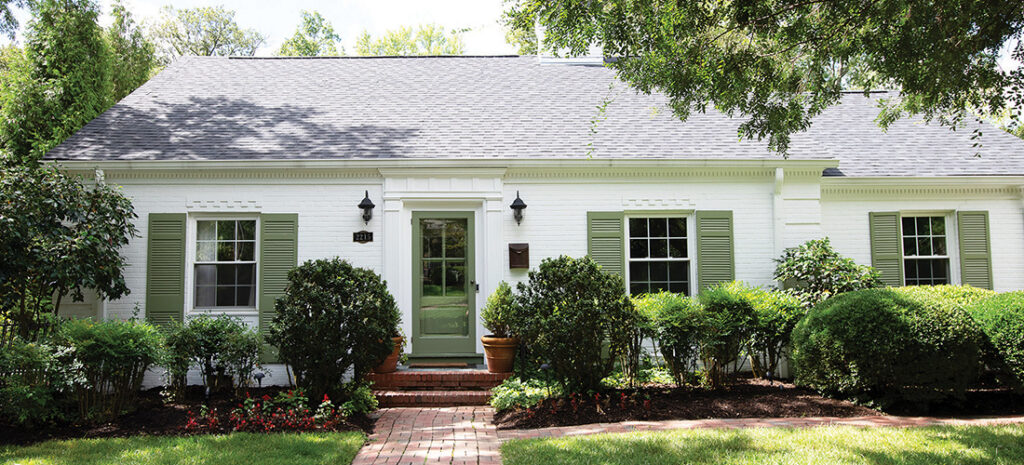
Going by the listing alone, real estate agent Melissa Greer was “meh” about the two-bedroom brick cottage that was built in 1941 and painted white.

But she loved the street, a short, curved and somewhat hidden passage in Greensboro’s venerable Sunset Hills — nothing like the busy cut-through where she lived, just around the corner.

“I like to be a little off the radar,” says Greer, who was house shopping for herself in 2004.

Touring the place for the first time, she took her mother, a brother and a sister. That made four real estate agents in all.

Greer’s mom, the late Johnnye Greer Hunter, a well-respected local broker, had raised a passel of property-savvy children, with four of her five kids making the business their life’s work.

On that summer day, Greer, her mom, her sister, Johnnye Letterman, and her brother, Waban Carter, parked at the curb in front of the cottage, careful not to block the driveway, a real estate no-no. They stuck to the brick walkway leading up to the dark green front door. No slogging through the grass like amateurs.

Greer remembers liking the blue slate on the stoop, the replacement windows and the heavy, metal plaque of house numbers bolted into the wall by the front door.

The place was cozy, classy, solid.

The family walked in and commenced their counterclockwise tour: formal living room stretched across the front, formal dining room buttressing one end. Just behind the dining room, a small square kitchen with a step-down sun porch and a painted wooden deck beyond.

Back inside, next to the kitchen, lay a den with its own full bath, which was a little unusual but could be changed, her family pointed out.

They stuck their heads into the primary bedroom, a second full bath on the hall — this one with a funky fish design laid into the tile floor — and a second bedroom.

What did Greer, the baby of the family, think of the home?

She turned to her pack.

They liked it.

Greer paid asking price.

“I’ll negotiate for other people,” she says. “Not so much for myself.”

She wanted to be a teacher, hence the degree in English education from UNC-Chapel Hill.

But English-teaching jobs were as scarce as properly diagrammed sentences when she graduated, so she kept her job at Peppi’s Pizza Den in Chapel Hill, where she often waited on then-UNC basketball star Michael Jordan.

Greer’s next job was serving at an upscale seafood restaurant in Hilton Head, S.C. Her nocturnal life caught the attention of her mother, who suggested that Greer return to Greensboro to work in her real estate business.

“It was a strong recommendation,” Greer says, laughing at the memory.

Johnnye Greer Hunter was a force, personally and professionally.

As a young woman, Hunter dressed windows at the S.H. Kress & Co. five-and-dime store in downtown Greensboro. She was a hostess at The Lotus, one of the city’s first Chinese restaurants. She managed a local doctor’s office. She copped a real estate license in 1968.

Greer remembers learning to read by quizzing her mom with questions from a real estate textbook.

In the days before computerized listings, Hunter enlisted her children to help with removing and replacing pages in her loose-leaf listing book.

Later, when they could drive, the kids delivered paperwork and keys. They pulled and planted for-sale signs.

Hunter worked for a local agency for several years before joining two other women to form their own company, The Property Shop.

“She was one of the first women to become a leader in the real estate industry. Prior to that, most of the leaders were men,” Greer says. “I think the ’70s was a decade when that started to change.”

In 1978, Hunter branched out again, starting Johnnye Greer Hunter & Associates with her daughter, Johnnye Letterman.

Post-plate slinging, Greer’s first job with the family firm was answering phones and writing advertisements for homes.

She made minimum wage. She asked her mom for a commission-only sales job.

“I didn’t think it could be a whole lot worse,” Greer says. “It was.”

After six months, Greer had not sold a single house.

“You don’t like this, do you?” her mother asked.

“No, ma’am,” Greer answered.

Her mother diagnosed the problem and the cure: Greer had a bad attitude. She had 30 days to shape up. If she didn’t, her mom would help her find another job.

On her mother’s advice, Greer hung a mirror on her office wall. When she talked to clients, she checked the mirror to make sure she was smiling.

People can hear a smile in your voice, her mother assured her.

Thirty days passed. Greer had sold four or five homes, nearly a million dollars’ worth of real estate.

“It changed my life,” Greer says, pausing to remember the full impact of the moment. “It was enough for me to get a Honda Accord with a moon roof. She was making me drive a Pontiac Sunbird.”

It’s hard to overstate just how good Greer is at her job.

Among the 50,000-plus agents working in the Berkshire Hathaway HomeServices network across the country, she has been No. 1, in terms of transactions, for the last two calendar years.

In 2022, she sold 192 homes, either as the listing agent or buyer’s agent. That averages out to more than three homes a week. Lately, the rate has been closer to five homes a week. In July, she closed the books on 19 homes.

“It was a really good month,” she says, cautious of being too content.

There are several reasons Greer kills it at work.

She learned the business from her mom and older siblings.

She puts in 12-hour days.

She employs a small support staff and hires marketing specialists.

She knows Greensboro thoroughly.

She’s also a natural empath, who finds it easy to slip into other people’s skin and understand what makes them happy. It’s a valuable skill for sales people, whether they’re pushing pizzas, prawns, palaces or patio homes.               

It doesn’t hurt that she’s an easy talker with a self-effacing sense of humor and an ability to quickly find common ground with strangers.

“That ‘U’ in conduct is coming in handy,” she says, recalling her report cards from Page High School. A so-so student, she had a lot of friends and did mostly as she was told, she says, dipping into the forbidden only if she was sure she could get away with it.

Her mother sat on her shoulder.

She still does.

“Everything I do, I want her to be proud,” Greer says. “That’s why I don’t have a tattoo, even though I’ve always kinda wanted one. She would never think that was a good idea.”

Her mom had a few maxims about real estate:

Selling homes is a service, not just a sales job, because people’s homes are their havens.

Location, location, location.

If there’s something you don’t like about a home, you can change it, but you can’t change the address (see above).

Greer’s cottage nailed the location part, being in a sought-after neighborhood just a jog from downtown, UNCG, Friendly Center and other city pulse points.

As for changes, Greer shaped the home to her liking, step by step.

She painted walls and refinished hardwoods.

She brought down the wall between the kitchen and den.

She sealed off the full bath’s access to the den and opened it to the primary bedroom on the other side.

She pulled off the old deck and replaced it with a sleek platform of composite planks fenced by black railings.

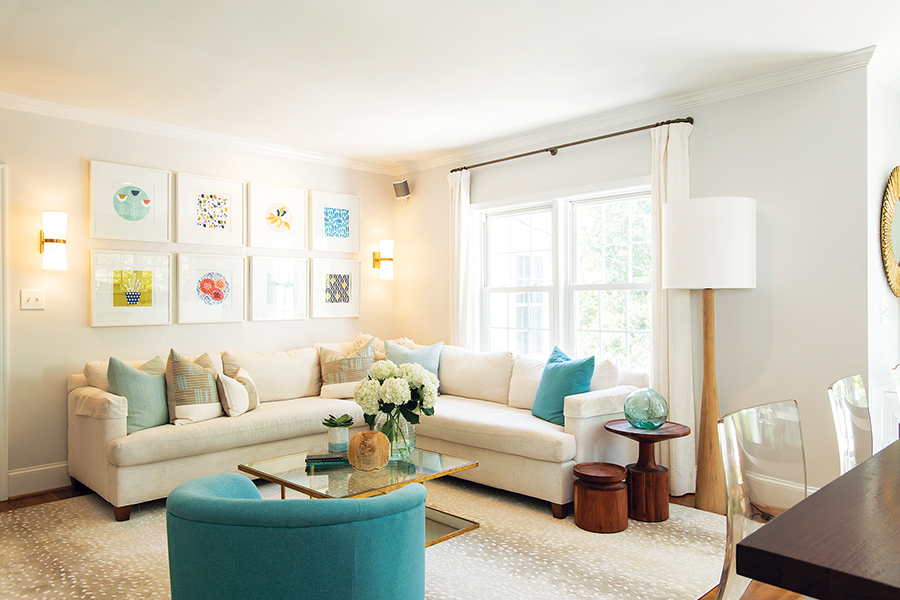
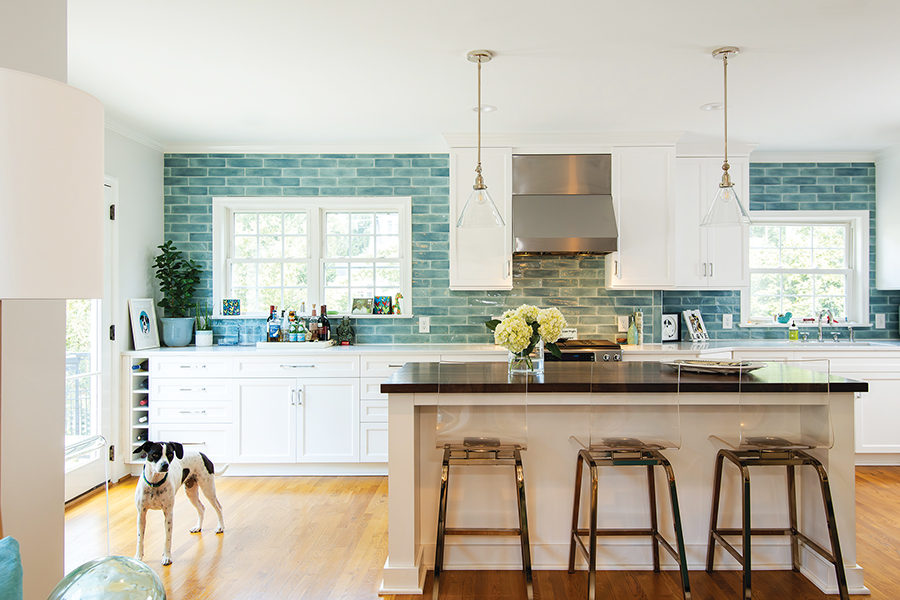
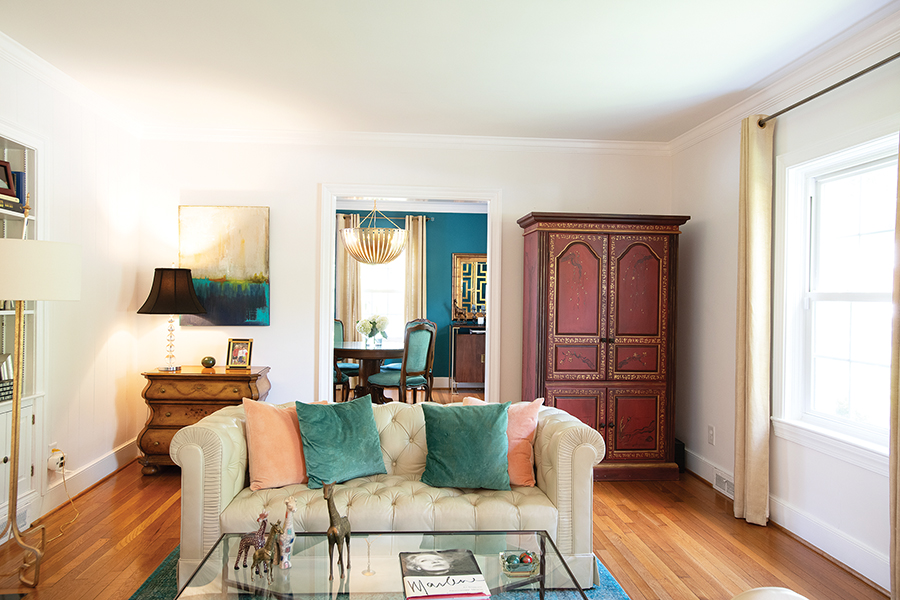
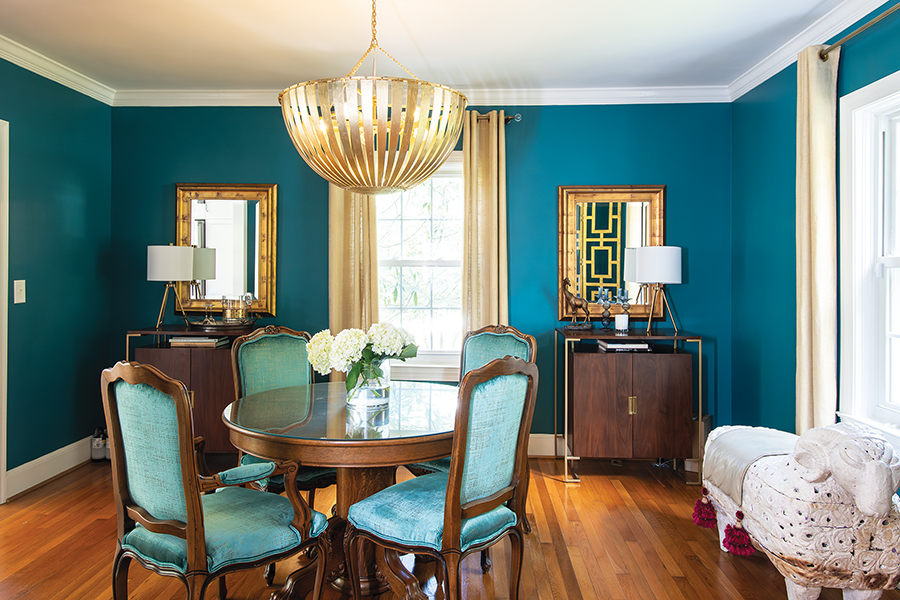
She expanded and updated the kitchen, swallowing up the sun porch to create an even greater great room, an airy teal, white and gold space where Greer and her beloved rescue dog, Macy — named for R&B singer Macy Gray — spend most of their down time.

“That’s her favorite pillow,” Greer says, pointing to the furry, white cushion in the corner of her sectional sofa. “A friend of mine took her picture sitting on that pillow and posted it, and the real Macy Gray ‘liked’ it.”

What’s Greer’s favorite Macy Gray song?

The answer is quick: “I Try.”

About eight years ago, Greer switched the lighting in the dining room, taking down the crystal chandelier that had once belonged to her mother and replacing it with a bowl-shaped fixture with gold ribs.

It was the first change she had made to the house without asking her family’s opinion.

Her sibs came to visit.

Ugh, they said in different words. Maybe because they thought the new fixture was a tad industrial. Maybe because it was not their mother’s.

Whatever the reason, Greer doubted her decision.

But she let the fixture hang.

“Now, they love it,” she says with a smile anyone could hear over the phone.

The podcast episode is called “Stranger Things in Real Estate.”

Greer is sitting at her kitchen island, kibitzing with her friend and marketing guru, Dave Wilson of Tigermoth Creative in Greensboro.

They started the podcast, Melissa Unscripted, back in 2019 to keep Greer current on social media. Already she maintained a presence on Instagram, YouTube, Facebook, LinkedIn and Twitter, now known as X.

“I feel a real responsibility to stay relevant,” says Greer, who nonetheless bristles at the pressure on businesspeople to create and sustain an online brand. “I miss the days when you could do your own thing and disappear. Now that you have to do so much marketing, it’s hard to do that.”

After a cheerful introduction, Wilson asks for examples of weirdness that Greer has witnessed in more than 30 years of selling real estate.

She starts slowly. Once, she showed a home with a bedroom that contained nothing but two mannequins, both wearing clothes. Strange.

What else? Wilson nudges.

Well, once she listed a house with two large crucifixes hanging on the wall, on either side of the bed, in the primary bedroom. A mirrored disco ball hung from the ceiling.

“I said, ‘You gotta pick one. We have to pick a theme,’” she remembers with a laugh.

Wilson prods again: Have you ever walked in on anyone?

“Yes,” Greer says. “I’ve walked in on couples, I’ve walked in on kids skipping school and smoking not-cigarettes. I’ve walked in on people taking naps.”

Haunted houses? Wilson inquires.

Oh, sure, Greer says.

“There’s a website that one of my clients told me about called diedinhouse.com,” she continues. “I’ve actually paid to search things because people want to know.”

Wilson, the marketing man, embraces the curveball with arch humor: “So if we get anything out of this podcast that’s helpful for people buying, it’s diedinhouse.com.”

Greer agrees by continuing full speed ahead. She’s afraid to look up her own house, she tells Wilson, but she used the fee-based service to check her childhood home because she already knew someone had died in there.

“My brother, when I was brushing my teeth and getting ready for bed, he’d hide under my bed,” she says. “And when my mother told me good night and the lights went out, he’d boost the mattress up and say, ‘Ooooou,’ — like a ghost — ‘is that you, George?’ That was the guy’s name. And I’d start screaming.”


The best thing about Greer’s primary bedroom?

Well, no one has died in there. It’s brand new, the latest improvement.

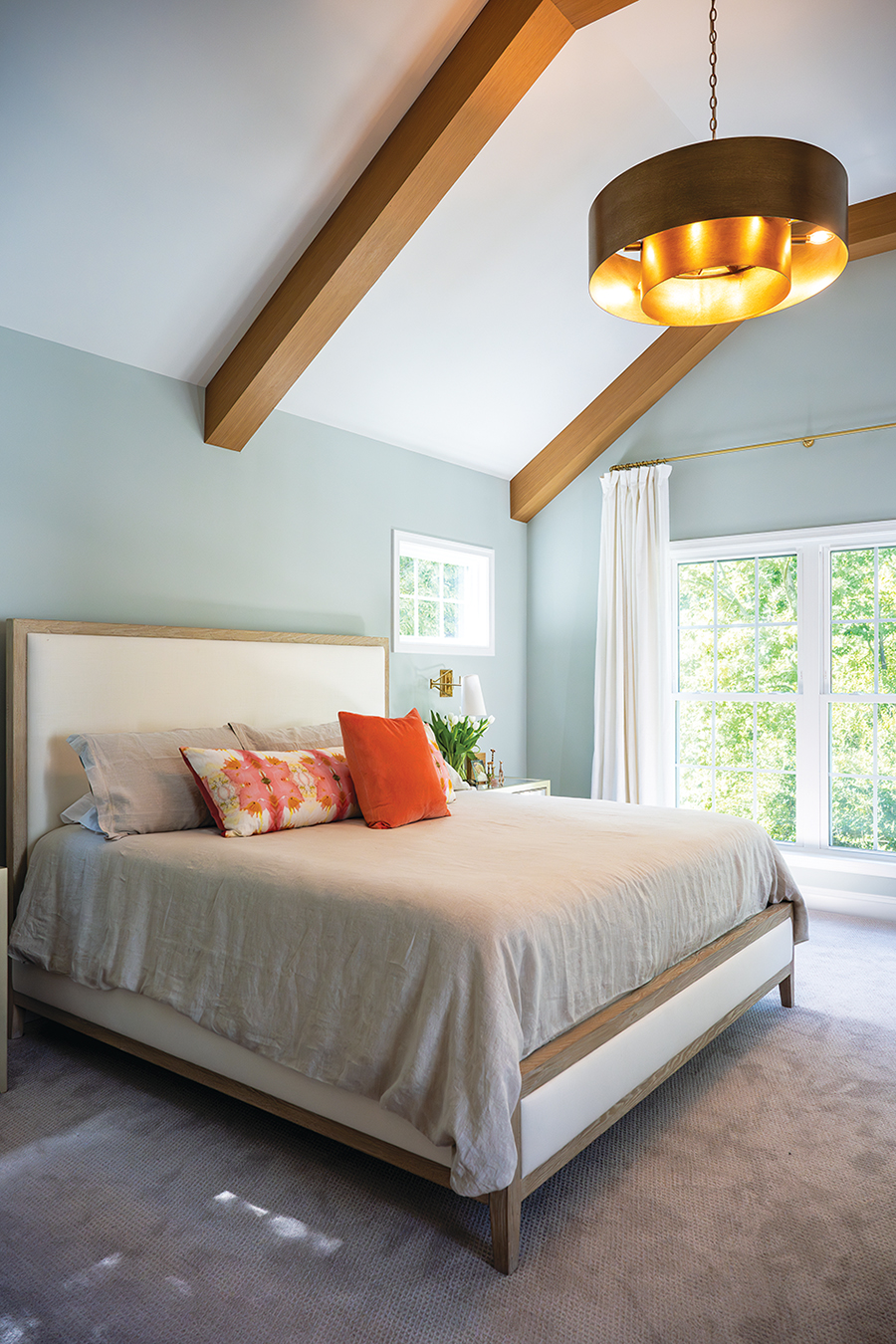
“It’s like a treehouse,” she says, walking into the high-ceilinged suite.

To create the restful perch, which looks into a curtain of green, she ballooned the old bedroom beyond the walk-out basement.

The lofted addition — which covers an outdoor living area below — allowed for the addition of a luxurious bathroom and substantial closet.

“I’ve never had a walk-in closet, so this is cool to me,” she says, beaming as she shows off the space.

It’s hard to believe that a woman who sells million-dollar homes regularly is tickled by such an amenity, but she insists her happiness is genuine.

“I grew up in a small house,” she says. “I always shared a room.”

The new suite, she says, makes the home’s vibe and size — now a little shy of 2,000 square feet — consistent with other upgrades.

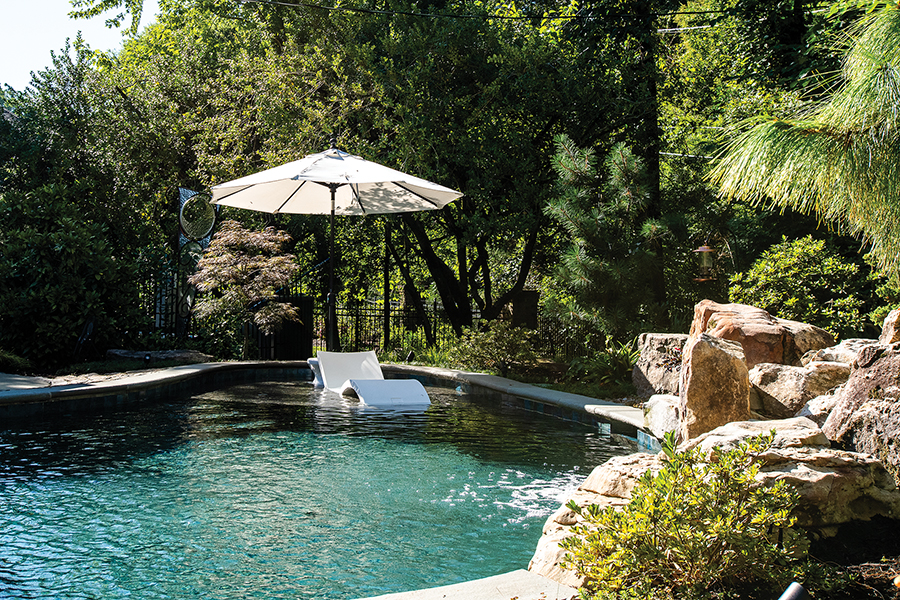
The new view allows her to appreciate one of them. The room overlooks a “pandemic pool” with a stony waterfall that gushes skin-friendly salt water.

“It’s like swimming in a water feature,” says Greer, who likes to float with family and friends. “I call it a cocktail pool.”

She overhauled the yard after the pool was installed in 2021. John Newman Garden Design in Winston-Salem, which also built the waterfall, painted the slope with a Japanese-inspired palette of stone, pine, maple, yucca and barbered, bonsai-style azalea, along with a custom Stonehenge-like bench.

“I like the zen feel of it,” says Greer.

Gradually, she says, she has grown to feel more at home in her cottage — and in her own skin.

“There’s a part of me that’s trying to please other people, always. I don’t think that’s ever going to go away, and that’s a good trait to have in a Realtor, but you develop a certain confidence in yourself so you can create what you want and know that’s a beautiful thing.”  OH

Garden of Earthly Delights

Garden of Earthly Delights

Dr. Steve Ford tames a wooded beast

By Cynthia Adams

Photographs by Lynn Donovan

What would neurologist Steve Ford choose to do after years of healing others?

Dr. Steve Ford’s former work life meant consulting with stroke patients, treating headaches, seizures, neurological issues or chronic pain. Most days were spent scrutinizing patients’ symptoms in a quest to solve what has been described as a “puzzle” inside a patient’s brain. After more than 43 years of stress-filled work attending those living with chronic pain, would the physician heed the admonition to “heal thyself?”

Ford discovered the answer to that particular puzzle lay in the great outdoors.   

In the six years since his retirement, Ford seems to have found an avocation, carving a private woodland garden from the densely forested acreage at Willow Creek, a High Point suburb. 

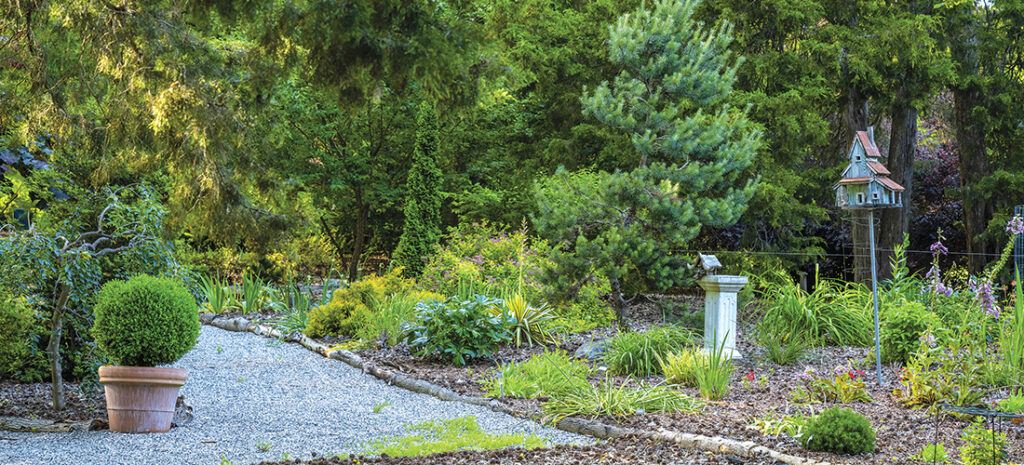
Today, transformed, it is a dreamscape that covers some 2.5 acres. In bringing order to a thick, untamed landscape, he created four pockets of serenity, each designed for cocktail-sipping at dusk in an Adirondack chair or simply enjoying the water sounds, bird calls and, best of all — the soothing sounds of silence.

Water factors heavily into the design of Ford’s gardens. There’s a swimming pool he and his wife, Gillian Overing — also recently retired from a career as an English professor at Wake Forest University — installed when they moved there in 2001, and places aplenty to relax into the charms of a green space tucked inside an urban neighborhood.

Now his daily routine — “whenever the weather’s okay” — is to pull on work clothes and spend hours enhancing his personal vision of peaceful tranquility — toiling in a private retreat. After retiring from a high-stress area of specialization in 2017, Ford could have easily chosen a hobby with less headaches. But he found himself taming not one but three adjoining lots, uncovering all sorts of unexpected possibilities — and a new set of challenges. For instance, a charming footbridge he built to span the brook kept being washed away by storms.

Palms held up in surrender, he explains he’s bowed to the inevitable.

Other projects simply required dogged determination.

Ford had to haul untold barrows of gravel, which he edged with wood, to create walking paths that wouldn’t also wash away during heavy rains and flooding. “All of the paths in the garden were created by me,” he says with modest pride.

The couple has owned the property for 23 years. It offered wooded privacy on both sides of the early-1990 contemporary house, but the rear of the home opened to the Willow Creek golf course, allowing light to flow inside.

Overing, who is British, was born in London. The pair met at Wake Forest “on a blind date set up by friends,” Ford explains. He did his residency at Baptist Hospital after graduating from The Medical University of South Carolina in 1979. “I was in my internship and she was in the first year of her professorship.”

His wife’s true passion, enjoyed since childhood, is horse riding, explains Ford. But his is gardening. 

Yet, as an Englishwoman, she, too, appreciates the outdoors.

“Yes, Gillian enjoys the garden,” he says, smiling, pausing outside their contemporary home, proceeding through the garden gate towards the long, rectangular pool. The pool is flanked by Asian touches with an exotic deciduous tree in the corner. John Newman, a professional landscape designer and friend, helped design the Japanese-themed pool area. Brian Hanson, a fellow retiree and friend, created the Japanese lanterns, which sit near the pool, from concrete.

The graveled pathways leading away from the secluded pool feature more and more native plantings. “I guess the underlying theme is that these are mostly plants that grow naturally in a shaded wetland,” Ford says.

The couple’s border collie, Blanche, was obtained from a Charlottesville, Va., friend and breeder. Blanche (named for Blanche DuBois) is uncharacteristically disinterested in herding, Ford explains, but she excels at loyalty.

Never far from Ford’s side, Blanche follows as he walks a path that leads to a shaded brook. The brook is fed by Abbotts Creek, one of their property’s natural side boundaries.

As peaceful as the effect of trickling water is now, it seems idyllic.

Less so, before.

At first, the property was quite overgrown, so much so that even three years after they had purchased it, “we didn’t even know there was a creek,” given the thickness of the woods engulfing the house. 

“I’m a hands-in-the dirt person,” Ford explains. As he learned more about gardening, he considered being part of a gardening club for years — hard to do with his medical career, he inserts. With a nudge from fellow gardener Martha Yarborough, the couple opened the garden five years ago for a public tour to benefit the Davidson County Master Gardener program.

At the urging of Yarborough, who devotes her own retirement to developing ornamental and vegetable gardens (see September, 2022 O. Henry, “Simple Abundance”) Ford took the Davidson County Master Gardener classes.

Transformed by 2018, his garden was more than ready for public scrutiny. It was opened for public tour and featured in a North Carolina State Extension Master Garden video as an example of what other native gardeners aspire to: “From the dazzling bluebells that cover ancient woodland in the spring to the bright meadows bursting with buttercups in the summer, wild flowers are what make our woods so beautiful, while providing precious nectar for invertebrates.” 

Citing a lettuce-lined path and poolside beds, as well as colonies of ferns along the stream, the introduction promised “. . . the diversity and expanse will amaze and inspire you!”

Now Ford’s focus has turned exclusively to native plants. Walk down one of his pathways and you’ll encounter trillium grandiflorum, trillium x. flexatum, Carolina allspice, and more, each carefully labeled.

There are masses of woodland wildflowers, narcotic in their beauty. There are grasses and sedges. Native ferns that volunteer (sometimes with a helpful assist from Ford).

“The ferns include Christmas ferns, lady ferns, cinnamon ferns, shaggy shield ferns, Japanese painted ferns, ebony spleenwort, ostrich ferns and multiple varieties of maidenhair ferns.”

Mosses, too. All plants that thrive in variable levels of light and high humidity.

“Other flowering plants in the garden include Arum italicum (Italian arum), bear’s breeches, May apple, Solomon’s seal, bloodroot, Jack-in-the-pulpit, Japanese and native pachysandra, Arisaema dracontium, wild ginger and primroses,” Ford says, sometimes citing their botanical names.

“More numerous are the native sessile and trillium cuneatum [or sweet Betsy] that were present before I got involved in the property and have continued to thrive without my cultivation. The same is true about trout lilies that have proliferated in the garden without my cultivation.”

Then there is the tree canopy itself. “The trees that predominate are tulip poplars, sycamores, red cedars and sweet gums, providing the overstory. The understory is populated with American and kousa dogwoods and various Japanese maples, Stewartias, American and Japanese Styrax, deciduous magnolias, azaleas, camelias, rhododendrons, hydrangeas,” says Ford. “I could go on and on, but I think that sounds like enough.”

Now Ford’s routine (when the couple isn’t traveling) is to sink his hands into the soil of the woodland oasis of his own design. Ford once planted Lenten roses, but he points out he is concerned they are too invasive and jokes about taking them out with weed killer.

Those pushy Lenten roses, he says ruefully, have got to go. But as the skies grow grayer and a storm threatens, he heads inside with Blanche padding behind him. She plops on the floor at Ford’s feet where he has settled onto a sofa.

The doctor smiles, reaching to stroke Blanche’s head. When asked the hour he looks mildly surprised, giving a telling answer. Since retirement he finds he has stopped wearing a watch. 

And his smile deepens with the soft sounds of a rhythmic rain as Blanche sighs contentedly.  OH

Dogwood Farms: A Canvas of Color

Dogwood Farms: A Canvas of Color

Flowers by the acre, honey by the jar
and views out of this world

By Ross Howell Jr.    Photographs by Lynn Donovan

As you turn into the gravel driveway at Dogwood Farms in Belews Creek, you’re met with a field of yellow sunflowers stretching into the distance.

Continuing along the driveway, you’ll pass brightly-colored zinnias, purple coneflowers, redbud trees and a brilliant red hibiscus.

I park in the shade of an oak tree and get out of the car. The late-July morning air is still cool. I see Chris Crump, founder and owner of Dogwood Farms, step out of his tidy farmhouse. He’s flanked by his handsome, 11-year-old son, Colt, who wears a farmer’s cap — like his father.

Two chocolate Labs lope up to complete the welcoming committee. They check me out with a few sniffs, then bound off to more interesting pursuits.

Chris and I shake hands. There’s a touch of gray in his beard, and from his grip you recognize he’s a man who’s known years of labor.

And he’s a man who’s mindful of legacy.

“Did you notice the hibiscus next to the driveway?” he asks.

I nod yes.

Chris tells me that the plant first grew at his great-grandmother’s home. It was later transplanted to his grandmother’s new house when it was built, and then to his mother’s. When his mother and father decided to move, he transplanted the red hibiscus to the farm.

“Over the years we’ve separated the roots and given transplants to family members, friends and neighbors,” Chris says.

“I think my grandma would really get a kick out of knowing it’s been shared with so many people,” he chuckles.

Chris grew up in the Sedge Garden section of Winston-Salem. While his parents weren’t serious gardeners, his grandfather was.

“My Grandpa was a huge gardener,” Chris recalls with a smile.

The city of Winston-Salem had more of a country feel to it back then, he tells me. On vacant lots, neighbors often would cultivate community gardens.

“I still remember the smell of the dirt when Grandpa would dig potatoes,” Chris says. Together they’d walk the rows, picking up potatoes and sacking them.

After high school, Chris studied horticulture at Forsyth Tech Community College. Straightaway from earning his degree, he took a job with the North Carolina Department of Transportation.

He worked for NCDOT for 25 years — much of that time, supervising teams who planted and maintained wildflower beds along our roadways. As his boss neared retirement, Chris realized the position would probably fall to him. It wasn’t something he wanted to take on.

“I knew it was time to step away,” Chris says. He left NCDOT in 2001.

He purchased his first parcel of land for Dogwood Farms — 24 acres — in 2003. The farm had been neglected for years and was overgrown with trees, bushes and vines. When Chris’s father took a look at the place, he said, “You’re gonna be working till you die if you buy all that land!” “It’ll be all right,” Chris remembers saying to his dad. “I’ll have plenty of kids to help me.”

But 10 years passed before his son Colt was born.

“I bought this place thinking I’d raise a bunch of kids here,” Chris says. “Turns out, there’s only one.”

“But I think it all happened for a reason,” he adds.

That reason’s about legacy, too.

“In my mind, I’m laying the foundation for him,” Chris says, nodding toward Colt. “I want this place to be something he can build on.”

“He’s an old soul,” Chris continues. “I feel like he’s going to be in some kind of heavy equipment. That’s his thing.”

Chris tells me about Colt’s natural hand-eye coordination, about videos he’s shot of his son operating a 12-ton excavator, spinning it around to clean its tracks, skillfully manipulating the bucket to uproot trees from uncleared ground.

“College isn’t going to be for him, and that’s fine,” says Chris.

I ask Colt about his responsibilities at Dogwood Farms.

“I do the honeybees, the honey,” Colt answers, grinning broadly. “We call it Colt’s Signature Honey.”

Colt explains that the farm will be making its first “pull” from the five beehives on the property in the next few days. He describes the process of cleaning out the hives after winter, feeding the bees to keep them healthy, and spinning and putting the honey in jars so it can be sold.

When I ask him how long he’s been managing the bees, he answers, “Five years.”

So Colt’s been a beekeeper from the age of 6.

He scurries back into the house, since he’s getting materials together to enter sixth grade at Triad Baptist Christian Academy in Kernersville.

Chris and I start walking toward the back section of his yard.

“A friend comes over to help Colt,” Chris says. “He has a lot of experience with producing honey. He’s our bee mentor. Working with the bees has been a great learning tool for Colt — seeing how a business works.”

We stop at the edge of the yard and look back toward the farm entrance and the field of sunflowers.

“When I purchased this place, what I wanted to do had nothing to do with flowers,” Chris says. “I wanted to grow ornamental trees for landscaping.”

Chris had done landscaping on the side and had several friends in the business, so he figured he would be able to establish a market readily. But the Great Recession brought home building nearly to a standstill.

So he bided his time.

Then a friend told him the Rockingham County Cooperative Extension office was offering a class on wholesale cut-flowers farming. He decided to attend, and it sparked an interest.

But he wasn’t sure what route to take. He’d grown flowers to give to neighbors and grew sunflowers for dove hunting. And he’d always grown flowers along the property fronting the road.

Then one day a young photographer stopped in and asked if she could take photographs of the farm. In exchange, she’d make family photos of Chris and Colt for free.

Chris figured, sure, why not?

Later, the photographer said to him, “You need to charge people for coming out to the farm.”

Chris answered, “Nobody’s going to pay to see this farm.”

He shakes his head, smiles at me and says, “I was wrong.”

In 2015, after going through a divorce, Chris decided to get serious about opening Dogwood Farms to the public. He’d also bought an additional tract of land that nearly doubled his acreage.

That year, a professional photographer in Charlotte called Chris. She said she wanted to book four hours of shooting on the farm for clients flying in from California.

“I’ve got some pretty colorful friends that love to pull my chain,” Chris laughs, telling the story.

“So I said, ‘Is this a joke?’ She said, ‘No, a race team owner’s son and his girlfriend want to do engagement photos.’”

“I said, ‘You mean to tell me there’s not a sunflower field somewhere between Santa Monica and Belews Creek?’ And she laughed and said, ‘Apparently not!’”

“I said, ‘Absolutely, bring them on.’”

Chris tells me four vans of equipment and people drove in the day of the shoot. And the pièce de résistance?

“The photographer got one picture of a lightning bug that landed right on the girl’s engagement ring,” Chris says. “They told me that photo was used on billboard advertising for the ring designer out in California. I was blown away.”

Interest in Dogwood Farms seemed to snowball from there, mostly on the internet. Photographers scheduled professional sessions. Individuals and families came to pick flowers and take photos, posting their images to Facebook and Instagram.

He tells me people have visited Dogwood Farms from many states — even as far away as Europe.

“Last year we even had refugees from Ukraine,” Chris says.

Now we turn our gaze toward the back of the property.

Chris tells me in the spring a pair of ospreys built a nest in a cell phone tower visible above the tree line. (Belews Lake is not far away.) He points out a dead tree nearby.

“For weeks I’d watch two ospreys crash into that tree, breaking off dead sticks — four or five feet long — and carry them up to that tower,” Chris says. “It was amazing.”

He turns and points toward the view on the horizon.

“Those are the Sauratown Mountains, and you can see Pilot Mountain right there — it’s kind of hazy today — and right behind those trees is Hanging Rock,” Chris says.

“That’s what brings people to this place — our views,” he adds. “The sunsets here are unrivaled.”

Chris and I hop into his ATV to drive toward the back of the property. We pass another field of sunflowers planted later than the field at the farm entrance. They’ll bloom in a couple weeks. We go past the pond. Just beyond the pond, at the woods edge, are Colt’s beehives. Next is a field of zinnias with plump, green buds that will soon be in bloom, too.

Take a moment to imagine that — a field of zinnias with blossoms of red, orange, yellow and pink, the colors of sunset.

And I haven’t even mentioned the spring season at Dogwood Farms.

“The spring flowers we had this year were just out of this world,” Chris says. People were in awe of his field of red poppies.

When we reach a knoll, Chris stops and cuts off the engine. The sunlight is warmer now. When the breeze stirs, it’s soothing. There’s birdsong all about. Bluebirds, finches. Near the pond, a killdeer calls. Cicadas drone in the trees.

The land rolls away from us into a valley thick with shrubs and saplings. Chris points to the tree line in the distance — the edge of his property. He tells me a little stream there feeds into Belews Creek.

“The creek bed is rock,” he says. “Almost like a rock water slide.” He tells me one day that spot will be another great place for photographs.

“It’s getting these last 10 acres cleared that’s the thing,” he sighs. “And making a way for people to get back in there easily.”

Atop the knoll where we’re sitting are piles of raw earth, moved here when the pond was excavated. Chris explains he’ll use the earth to raise a roadbed through the ravine toward the creek.

Where thickets grow now, he’ll plant Bidens cernua, called nodding bur-marigold.

“Just think of all that valley as a river of yellow,” he muses.

And that’s Chris Crump’s genius. He imagines a landscape canvas and sets about painting it with living things.

He tells me after all the years, all the seasons, all the workdays on the farm, at day’s end, he will pause here a moment to reflect.

“God got you to the end of the day and the sunset’s your reward,” he muses. “It’s like a tribute, so you can say to the good Lord, ‘Thank you.’”

And that’s a legacy, too.

“Sunsets here never get old,” Chris adds.  OH

For more pictures and information on the attractions at Dogwood Farms, follow Dogwood Farms on Facebook, @dogwoodfarmsupick on Instagram or visit www.dogwoodfarmsbelewscreek.com.

Found Objects

Found Objects

What’s old is newly loved

By Cassie Bustamante     Photographs by Bert VanderVeen

If you’ve ever wandered the rows of a flea market or gotten lost in an antique store’s surplus of old oddities, you know that sometimes a certain piece calls out to you. Sometimes it’s a portrait of a woman you’ve never seen, but her image inspires a story in your mind. Maybe it’s the midcentury dresser that reminds you of sleepovers at your grandparents’ place, complete with rusty-orange shag carpeting and wood-paneled walls. Whatever it is, something compels you to bring it home and make it yours. We talked to five local homeowners and asked the question: What’s your favorite find?

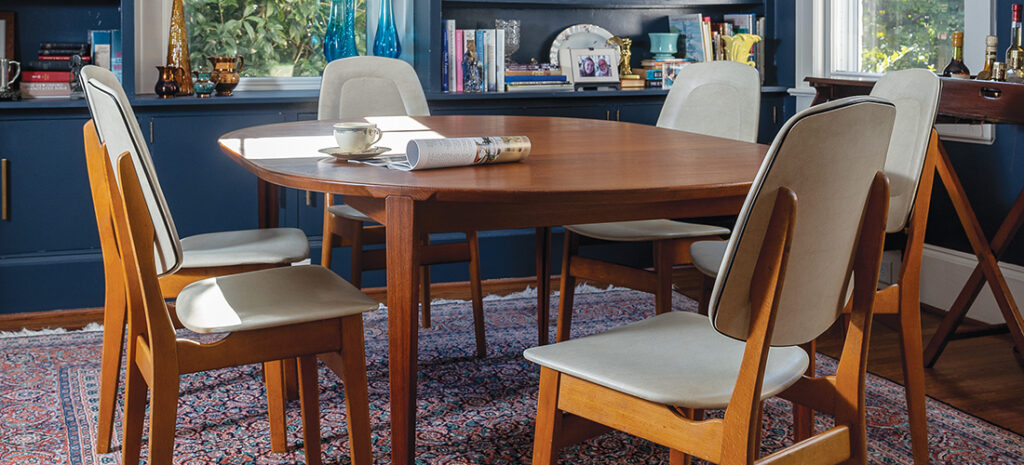
As a lover of all things midcentury — both furniture and accessories, such as McCoy pottery of the era — Linda Hiatt wandered into Lindley Park Vintage, known for its specialty in that particular era. The atomic stars were shining in her favor that Saturday and she discovered a Henry Rosengren Hansen table that was a perfect fit for her home’s aesthetic. “His pieces are hard to find,” she says. Not only did she score the table, but also found midcentury chairs that, while not designed by Rosengren Hansen, fit the vibe.

Thrifter extraordinaire Seth Anderson has filled his family’s home with treasures found across the Triad’s many secondhand stores, not to mention his collection of paintings by his wife, artist Katie Anderson. Favorite find? How about a favorite nook, bursting with vintage gems? “My wife had done this large square encaustic (wax) piece a few years ago but we hadn’t found a home for it,” he says. The artwork serves as “the anchor” and is complemented by scores galore from the Habitat Restore, Salvation Army and several from Goodwill. “The chair I paid $3 for at Goodwill and spray painted, reupholstering the seat with a remnant from Reconsidered Goods.” Clearly, Anderson doesn’t play favorites with his shops either.

Writer Mallory Miranda walked into Antique Market Place with a mission: Find a vintage secretary’s desk. Why? “I wanted a desk that would serve one purpose.” What she didn’t want was a catchall. She fulfilled her quest in one of her favorite stalls, Dori’s Collection. The many compartments in a secretary “are perfect for squirreling away all my notes and tools for future writing adventures.” But the real bonus for a creative spirit? “The desk folds up to conceal all my messy ‘organization.’” To complement it, Miranda found a chair from another era that is a perfect match — its “soulmate” — at The Red Collection on Mill Street.

Sometimes we find exactly what we’re looking for when we aren’t actually looking for it at all. Shante Kirlew, owner of AK London Lifestyle, a beeswax candle company, discovered a 1970s buffet on “a casual stroll” through Goodwill. “I wasn’t looking for anything specific that day, but when I saw her, it was love at first sight,” she says, adding that it harkened back to Saturday morning furniture-polishing sessions at her grandmother’s house when she was a child. It’s her favorite piece in her home for many functional and aesthetic reasons, but “most importantly, it triggers memories of the happiest time in my life.”

When Kristen and Andy Zeiner moved from California to Greensboro in the spring of 2021, they were thrilled to be so close to “The Furniture Capital of the World” and outfitted their new Irving Park digs with staples from Furnitureland South. But their favorite piece is a Red Collection score, a late 1600s mule chest from Wales, which Kristen appreciates because her 95-year-old father, who lives with them, is Welsh. “It has the scent of many adventures in its travels,” she says. “We wish we could hear its stories.” Plus, adds Andy, “Trying to find something new of this quality and with this history would be impossible. And you can be almost certain that your neighbor won’t have the same exact one.” Adding a touch of golden whimsy, signed Michael Lambert “dancing” Modernist pottery, discovered at a California Goodwill for just $20, sits on top.

Lastly, as a former vintage store owner, I had to play in the sandbox of treasures, too. In an old horse stable filled with abandoned finds of a furniture refinisher (and no remnants of horses, mind you), I came across this pair of veneered midcentury cabinets that appear to have been used in an office — hence the locks. After cleaning them with a vinegar solution, I painted them white and gold-leafed the frame of the facade. Inside, each has a shelf and ample storage. It might not surprise you to find that my makeshift nightstand is stuffed with approximately — no exaggeration — 150 books.  OH

Poem October 2023

Poem October 2023

Letting Go

Today the trees release their leaves. The wind

a breath that calls the colors down to earth —

wild dance with crimson, gold, and brown

aloft in death, unfurling flaming fields 

and forest floor. If I could hurl myself 

like this into each ending, long for nothing 

sure or safe, but celebrate the letting go, 


descend, a woman trusting the fall.

I’d release all claim to expectation, 

breathe the air of possibility, 

find beginnings everywhere. 

I’d settle down to loamy earth long enough

to nourish life that waits, growing still

in the summons from a savage world.

      — Pat Riviere-Seel

Pat Riviere-Seel’s latest collection, When There Were Horses, is available from Main Street Rag Publishing Company.

Call It Kismet

Call It Kismet

Joey Marlowe’s Most Excellent Turn of Fate

By Cynthia Adams

Photographs by Amy Freeman


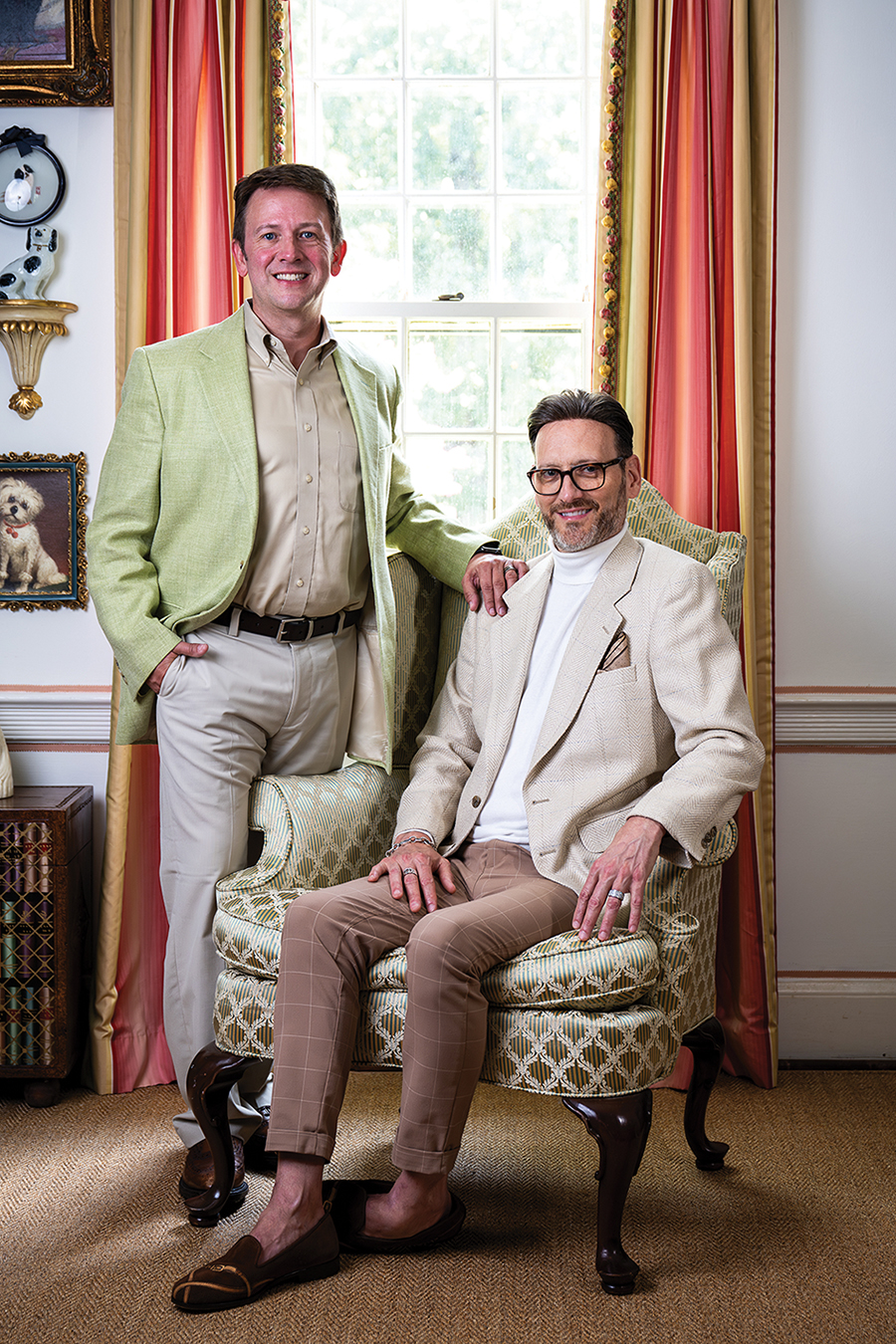
During one of the most competitive real estate markets in modern times, two lucky High Pointers snapped up a radiant Emerywood property when opportunity literally came calling.

A keen intuition paid off for Joey Marlowe, who says Lady Luck pointed the way to a historic High Point home that seemed fated to be his. (In this case, Lady Luck was in the guise of a personal friend, who paid him a call at Boxwood, the antiques emporium he co-owns with Jana Vaughan.)

As his friend described a picture-perfect property set on a shady boulevard, he instantaneously thought, “It’s mine,” sight unseen.

Marlowe’s friend, who had a key, suggested a private showing on behalf of the owner, who actually wanted her to buy it. The seller, having recently remarried, was living in Virginia. Better yet, she had completed a skillful renovation, updating the kitchen and baths, replacing sunroom windows, and completely rebuilding the garage. 

Marlowe’s friend explained that while it simply wouldn’t work for her, she knew this house was perfect for him.

He knew, too.

But there was a complicating factor. His spouse, Chad Collins, who works in real estate himself as managing broker with Marlowe Collins Realty, had zero interest in a change of address.

Collins confirms he was determined not to move. 

“He would have never moved,” Marlowe adds flatly, but he was ready. 

In fact, an indifferent Collins didn’t even go along for the initial look-see. 

“I told him to look at the house first,” he says, nodding to Marlowe. “If you like it, then I’ll come look at it.” 

Turns out, fate wasn’t merely kind — fate was generous. From the curb, Marlowe saw that the Emerywood house possessed undeniable charm, the sort that homeowners and real estate agents mythologize.

With a pleasing symmetry and hip roof, plus fresh upgrades, the seller had retained the most charming aspects — right down to the original phone niche. Details that made Marlowe’s heart sing from his first walkthrough. (What is a home, after all, if not the sum of its parts?) 

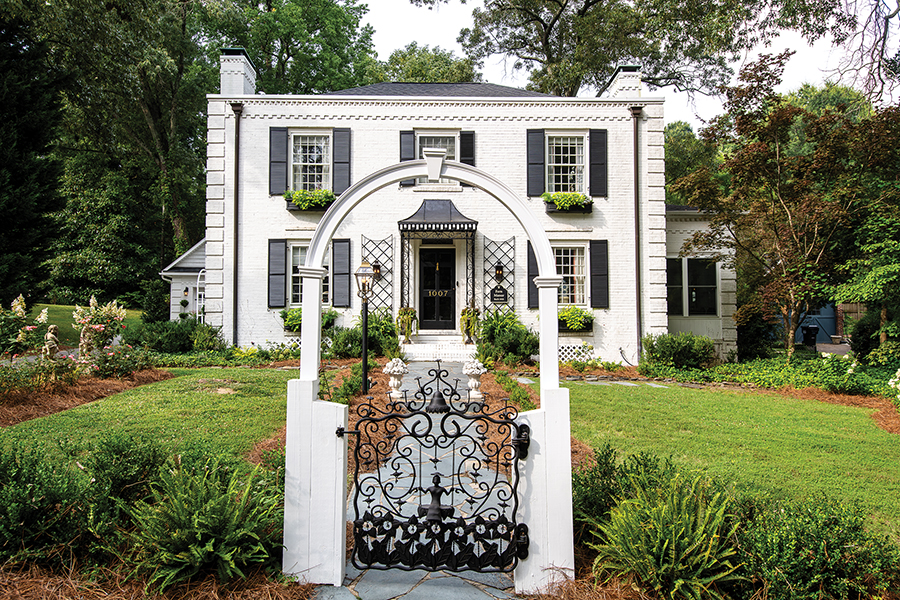
“I was in amazement,” Marlowe says as he parks his SUV before the new white garage, which features a separate apartment. Eugenia topiaries, statuary and a vintage wrought-iron bench lend an English feel, setting the stage.

“Everything was as I envisioned it. The color was right. It was perfect . . . even if I [later] changed it.” He laughs, given his work as a designer includes an inclination to make cosmetic changes.

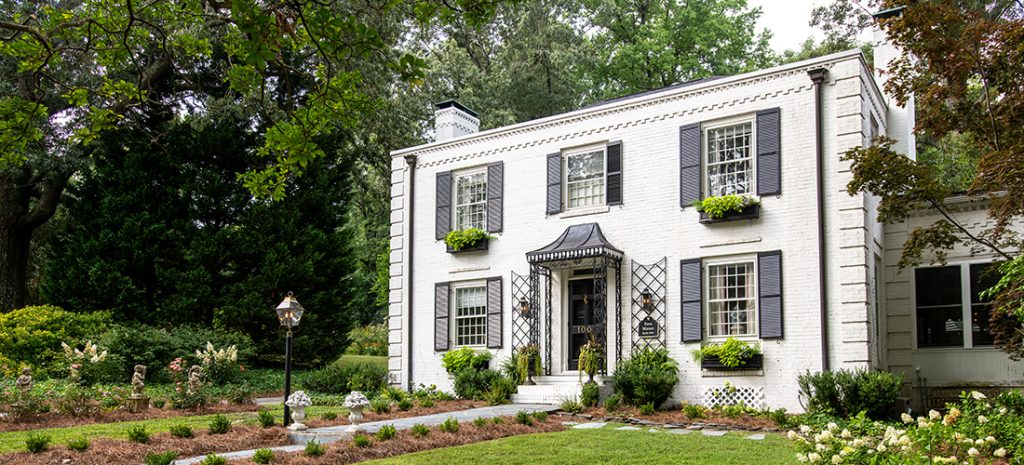
At first blush, however, he saw the manifestation of his dream house fulfilled. The two-story painted brick home, accented with black window boxes, featured a distinctive covered entry with a metal awning. Officially the Shelton House, according to Benjamin Briggs’s inventory of historic High Point architecture, it was the namesake of contractor Roy E. Shelton, who built the home in 1935. Shelton lived there with his wife, Mildred, as Emerywood was being developed. 

It is also believed to be among a few model showcase homes built for the upscale community. The concept home was a “stylish example of Depression-era design,” which just so happens to be one of Marlowe’s favorites. Not only that, according to the inventory, the house is “one of the city’s best examples” of that very style.

“Did I mention it’s English? In the Regency Revival style?” Marlowe asks. 

As the inventory states, it was “an interpretation of late 18th-century residential architecture,” with exterior features that include “delicate” dentil molding, quoins and transom over the front door. Deep wooden panels beneath the front windows give them the illusion of being larger.

A born collector and fervent Anglophile by both hobby and trade, Marlowe admits to falling hard for beautiful things — show him an English antique, collectible or painting and his mind and heart race.

But Collins, who had previously pumped the brakes on relocating, had presented three firm conditions. 

“It has to be the perfect house, it has to fall in our lap and has to be off market, as I wasn’t getting into a bidding war.” He pauses. “And the universe delivered it.” 

Collins says, “I’ve always said to clients, especially couples: You should walk in a home and, within 30 seconds to a minute, you should go, ‘It’s perfect,’ almost in unison.”

Marlowe knew before his feet hit the driveway; Collins later confirmed the inevitable. The house was, in a word, perfect. “So, I was like, ‘OK, we’re moving!’” he recalls.

Given the couple’s 17 years together — long enough to complete one another’s sentences — they agreed that this property checked every box. 

Collins shakes his head, still amazed by their good fortune.


Wanting to ramp up the sense of an English landscape, they planned to add coral roses, hydrangeas, ferns and trellises. 

They envisioned next steps: installing an arbor, window boxes, and updating exterior and interior lighting. Renaming the house Fern Manor, the couple took possession on September 1, 2022, after allowing the seller ample time to transition and empty the garage of stored belongings.

The house was very nearly dubbed Boxwood after the couple set to work within weeks, landscaping and planting 150 boxwoods — if not for the fact that Marlowe had already used the name for his antique business.

“At Boxwood,” Marlowe says “it’s about how you make people feel. People want to stay.”

“As a Realtor, I’m selling not just a structure, but dreams,” explains Collins. “At Boxwood, Joey is selling ideals. A concept.” 

In their home of just a year, they agree on having found both — a dream and an ideal. 

“Home is where it all starts,” Marlowe says, entering the house on a summer’s day. Fountains burble near the side and rear entrances. The delicious smell of Dragon’s Blood incense — “I keep a few sticks of it in my car” — follows him into the house.

He discusses aesthetics, saying how he strives to create that same inviting sense at Boxwood.

Inside, Collins waits in the kitchen, where Dolly Purton, their cat, wraps herself around his legs as he points out something he loves: a coffee nook. The seller converted the small laundry area, creating a counter and installing a hardwired instant hot water unit.

Marlowe, not a coffee lover, winces.   

“Joey could care less,” Collins says, before Marlowe shoots back, “I want the washer/drier back upstairs.” 

The eat-in kitchen, which they describe as Country French in style, wears a neutral coat of Benjamin Moore’s Simply White. There’s a farmhouse sink and generous counterspace. As is the case throughout the house, they only changed cosmetics — paint and wallpaper.

The eat-in island, where they take most of their meals, has a working fireplace, adding actual and visual warmth.

Off the kitchen, the dining room — where they seldom actually dine, Collins confides — is “a gilded chinoiserie fantasy,” with Thibaut wallpaper, faux painting on the ceiling and a white Madcap Cottage chandelier. It goes without saying that Marlowe designed the dining room and, in fact, all the interiors.

Against type, they’ve placed antique leather books in the built-in corner cabinets rather than china. Idiosyncratic and personal is the motif that repeats.

Collins jokes, “When we first met, he said ‘Don’t get used to anything being in the same spot, because it will be constantly moving.’ . . . He’s lived up to that.”

A midcentury painting of an espaliered pear, a gilded mirror and an antique barometer hang on the wall, while white orchids in a cachepot decorate an antique dining table. (Collins gives Marlowe an orchid each Valentine’s Day and anniversary.)

The striped wallpaper in the foyer/front hall is by Cole and Sons. Marlowe already had the paper, purchased for a future home. They’ve used it to create a gallery hall, installing 18th-century small landscape paintings and a silhouette collection Marlowe has been amassing for years.


“As a designer, I say people should design to their personality.” Together, they’ve created a collected look, saying they really like the Georgian period of furnishings.

“I started collecting in the 1990s . . . silhouettes, clocks.” A perfectly scaled tall Scottish clock dating to 1836, slender antique console and gilded mirror surrounded by a selection of their miniature paintings and portraits complete the suitably English-styled foyer.

Marlowe also reused drapes he had made some years ago for a previous home.   

At some point, a downstairs powder room was created from a hall closet. Even it has a collecting theme. “Every room does,” says Marlowe.

The living room has been painted several times in their short tenure, after initially experimenting with a shade of coral. 

“It turned out a very yucky berry ice cream color,” Marlowe frowns. After repeatedly changing and tweaking it, he has finally settled on a neutral Simply White again, adding punch with silk grosgrain edging in coral (his perennially favorite color) at the ceiling. The added detail lends the formal room “a more modern, youthful look.” 

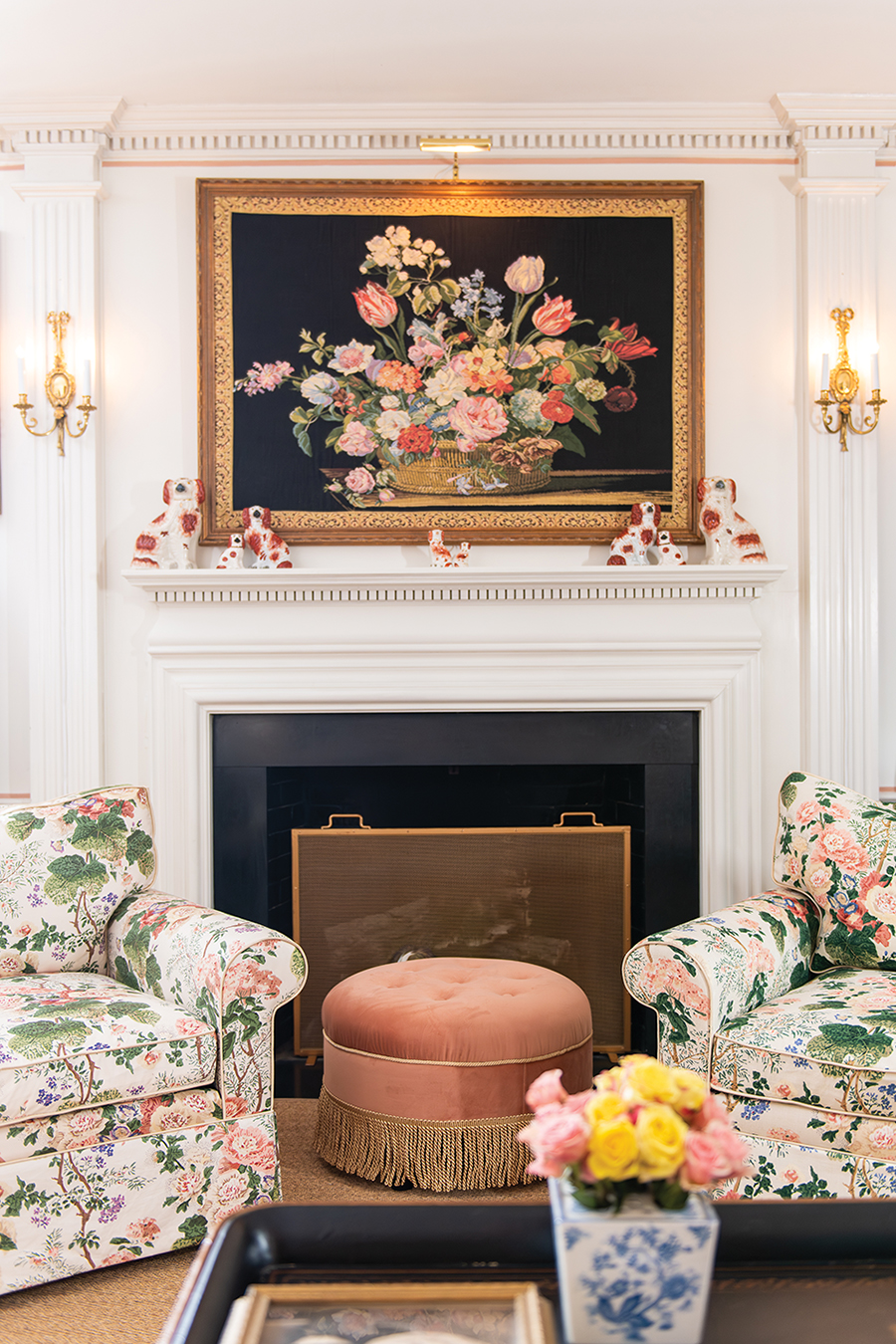
The ribbon also ties into the floral fabric used on the overstuffed arm chairs, upholstered in Lee Joffa’s beloved Hollyhock pattern. 

The room features a favorite find, a green chinoiserie secretary. The room is comfortably furnished with overstuffed armchairs. Family items and collectibles, such as porcelain dogs, add a personal touch. Horses, too. They’re “a thing for Joey,” says Collins, dating to time spent at his grandmother’s farm. 

Their combined style, Collins interjects jokingly, “Is a Kentucky Derby party with pomp and circumstance.”

And, yes, everything is subject to being moved, repeats Collins. At this Marlowe rolls his eyes. Pointing to a striking portrait in a massive frame he shoots a warning look. “That painting,” he insists, “is too darned heavy to ever move again.”

What would they run out with first in case of a fire? 

“The paintings are too big,” the pair quips in sync. (Many are gifts to Marlowe from Collins.) Then Collins turns serious. Thanks to meditation and Buddhism, he is learning non-attachment to possessions. 

“Home is where the heart is; and my home is with him,” he says, indicating Marlowe.

Marlowe, pondering, answers that if there was a fire, he’d “leave with my grandma’s photo. She was very crucial for my development as a child and encouraging me.”

“I’d want you to go with me, too, but — ” and he glances towards Collins, pauses before erupting into laughter, riffing off the moment.

“I think it’d be the family photos. But everything here has a meaning. Everything. There’s a painting of a boy in a little green jacket and his dog,” he says, indicating where it hangs. “He’s my favorite. Chad found it and gave it to me.” 

Thanks to Boxwood, the couple can upcycle and cull their many collections.

“Joey took his hobby and turned it into a successful business,” says Collins, who proudly compares it to the way in which Replacements, Ltd. in Greensboro first evolved.

Marlowe quickly replies: “Let’s just tell the truth; I have a shopping problem.” 

Collins’ favorite room is the sunroom, a television and game room, featuring the home’s only television set. “This is where I love to sit and read; I start and end my day in this room. A true nesting place.” On the sunroom wall is a moody nighttime Victorian scene, the first painting that he ever gave Marlowe. 

It opens to a patio, a shaded fair-weather retreat with a scalloped awning and twinkling lights, where another fountain bubbles and blue porcelains, including Chinese stools for seating. Tables, statuary and potted plants create another space for entertaining, complete with “rooms” designed to move the eye through the landscape.

Back inside, pausing at the bottom of the stairs which are covered in a chevron-patterned runner, Marlowe explains the only practical concern for aging in place at Fernwood Manor. As is typical of older homes, the bedrooms are on the second floor. They’re both still youthful and in their 50s, but he worries. Perhaps, he says, they can eventually create a main suite in the newly rebuilt garage, connecting it to the main house to solve the problem.

He points out a chandelier hanging at the top of the landing, “The first that Chad ever gave me, the first Christmas we were together.”


The primary bedroom has a fireplace flanked by comfortable chairs. The room features recently installed hand-colored chinoiserie paper with twining vines and birds against a soft rose-toned background. They furnished the room with gilded mirrors, chinoiserie lamps, urns and porcelains, and a prized 19th-century signed Italianate painting, among other artworks. 

A canopy bed by Frontgate faces the fireplace, with a tall screen in the corner where an exterior door leading outside was closed and converted into a closet by the seller. It once accessed a deck with a patio roof above the sunporch, which the new owners hope to one day return to its original state.

On display is a collection of personal photos of their younger selves when they met nearly 20 years ago. Collins, who has experimented with short and long hair, has the ability to change his look like a chameleon. 

“And I’m the same preppie I was before,” quips Marlowe. 

The upstairs bathrooms, though refreshed, retain many original details.

The bath that opens to the hall is tailored, crisply accented with black and white and features a striking, original coral-colored wall tile. Marlowe is amazed that his favorite color was already used in the house from its very beginning. The vintage pedestal sink retains original telescoping legs. 


Two guest rooms, decorated in period style right down to the vintage toys, are dedicated to their two grandchildren, Evangeline, 3, and Gabriel, 9. Here, Marlowe used Schumacher paint in his granddaughter’s room, picking up soft rose accents from the Aubusson rug, coverlet and window treatments, and chose a romantic canopy bed.

“This will be Evangeline’s spend-the-night place,” says Marlowe. “She comes over to play, but hasn’t yet spent the night.”

Then there’s the “gentleman’s room” for Gabriel, who comes for sleepovers every other weekend. He sleeps in style in an equestrian themed room with English hunting style wallpaper.

The interiors are complete, but there are ongoing plans for the exterior. They are working on the English garden effect in the front yard, and a more casual garden in the back. There will be an all-white garden created on the driveway side, as they share an additional half lot with their neighbor. 

They’ve ordered a custom-designed shed that will echo the house with French doors and a metal roof from a company in Sanford. It’s being installed in the rear garden and will become a yoga studio for Collins, an avid practitioner.

This house — “a collection of life,” according to Marlowe — is where the couple’s work and personal lives form an aesthetic intersection.   

Both value what they have created here together, a sensibility that only a collected look can give.

“Everything has a story,” he says.

Now he and Collins are writing the next chapter in this, the latest installment in the life of a storied, much-loved house.  OH

Life Imitates Art

Life Imitates Art

And vice versa

By Cassie Bustamante

Photography by Bert VanderVeen

Costuming by Mary McKeithen of Showboat in Southern Pines

Makeup and Hairstyling by Local Honey Salon


“The reason some portraits don’t look true to life,” says Spanish Surrealist artist Salvador Dalí, “is that some people make no effort to resemble their pictures.” Touché, sir.

We scoured the city and found local lookalikes to subjects in famous paintings, and, with a little “effort to resemble,” plus makeup and hair artistry from Local Honey Salon, we’ve recreated those portraits. From Frida to Vincent, six Gate City doppelgängers are walking works of art. Who knows? Next time you’re sipping your cold brew at a local corner café, you may find yourself in a booth next to someone who could be Mona Lisa’s twin — but a whole lot younger — if only she made the effort.


Self-Portrait with a Straw Hat

by Vincent Van Gogh, 1887


Dutch post-impressionistic painter Vincent Van Gogh painted roughly 2,100 works of art in just a decade’s time, but he’s regrettably better known by some for cutting off his ear. In 1890, Van Gogh took his own life after struggling with mental illness. He once said, “If I am worth anything later, I am worth something now. For wheat is wheat, even if people think it is a grass in the beginning.” Today, he’s one of the most celebrated and imitated artists in the world, and his work is worth more than he ever could have dreamed. We’ve recruited the Weatherspoon Art Museum’s two-eared head of communications, Loring Mortenson, to fill Van Gogh’s shoes — and hat — with a little impressionistic artistry from both costumer Mary McEithen and the team at Local Honey.


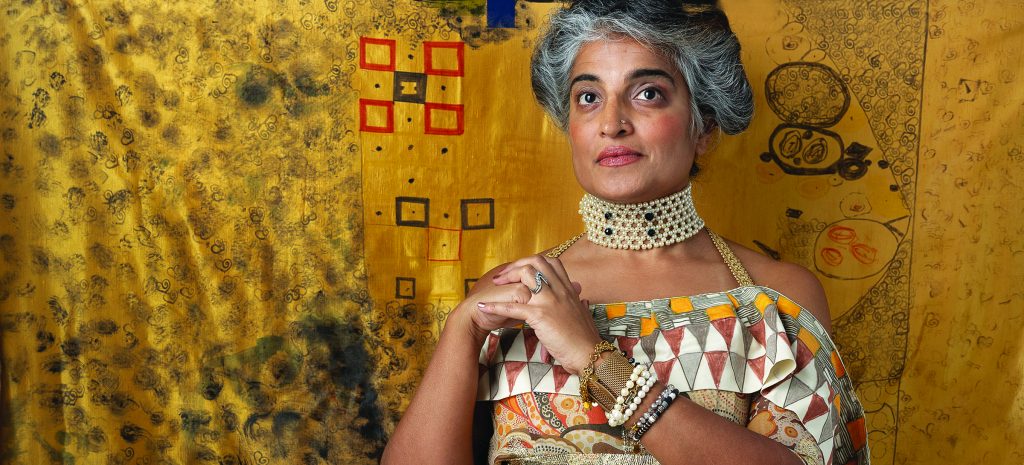
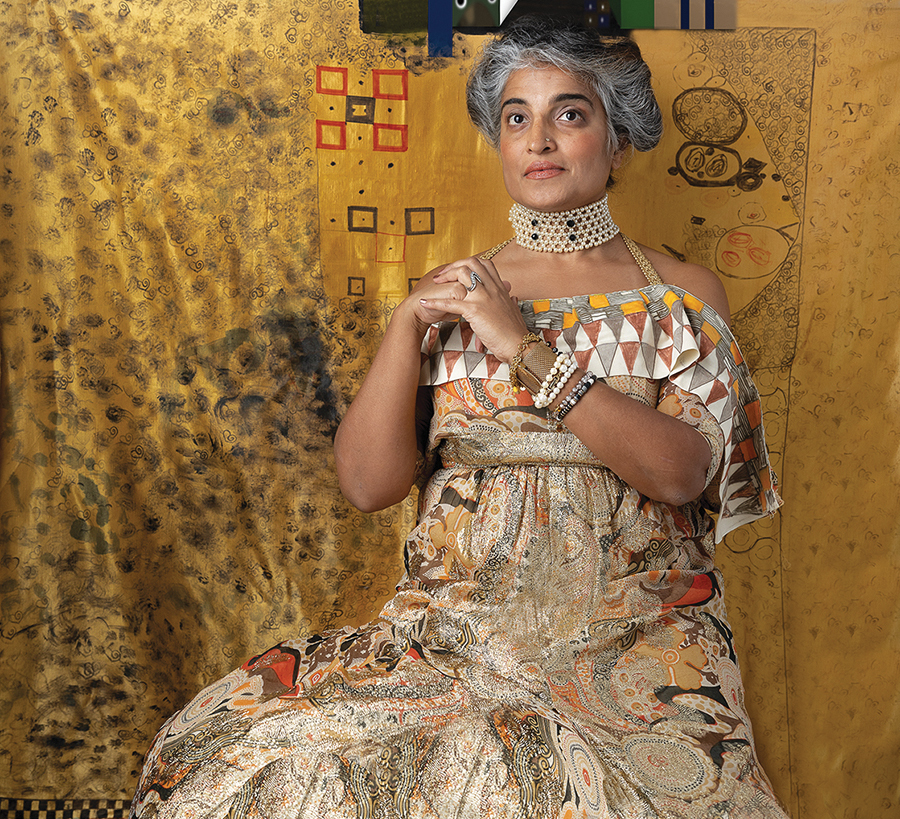
Portrait of Adele Bloch-Bauer I

by Gustav Klimt, 1907


The only subject that Klimt painted twice was Adele Bloch-Bauer, a Jewish Viennese socialite and patron of the arts whose husband, Ferdinand Bloch-Bauer, a Jewish banker and sugar producer, commissioned the artist to create the painting as a gift for Adele’s parents. It’s rumored that Adele became Klimt’s mistress. With a little Midas touch and what Local Honey owner Jay Bulluck calls an “ice cream cone” updo, sustainable fashion lead and GreenHill board member Swati Argade steps into the role of our Adele.


Two Fridas

by Frida Kahlo, 1939


Mexican artist Frida Kahlo was always interested in art from an early age, but it wasn’t until a bus accident derailed her med school path that she decided to pursue it as a career. Kahlo, who was known for her introspective self-portraits and feminism, once said, “Take a lover who looks at you like maybe you are a bourbon biscuit.” Regrettably, her husband, renowned Mexican muralist Diego Rivera, often served his craving for biscuits elsewhere. Their tumultuous marriage ended in 1939 and this painting, she later admitted, reflects the loneliness she felt in her separation from him. You’re not seeing double. Isabella Bueno, a mother of three little ones who is studying to be a Realtor, is seen here twice — quintessential unibrow added, of course — once in a more traditional Mexican costume on the left, and in more contemporary dress on the right.


Lady Agnew of Lochnaw

by John Singer Sargent, 1892


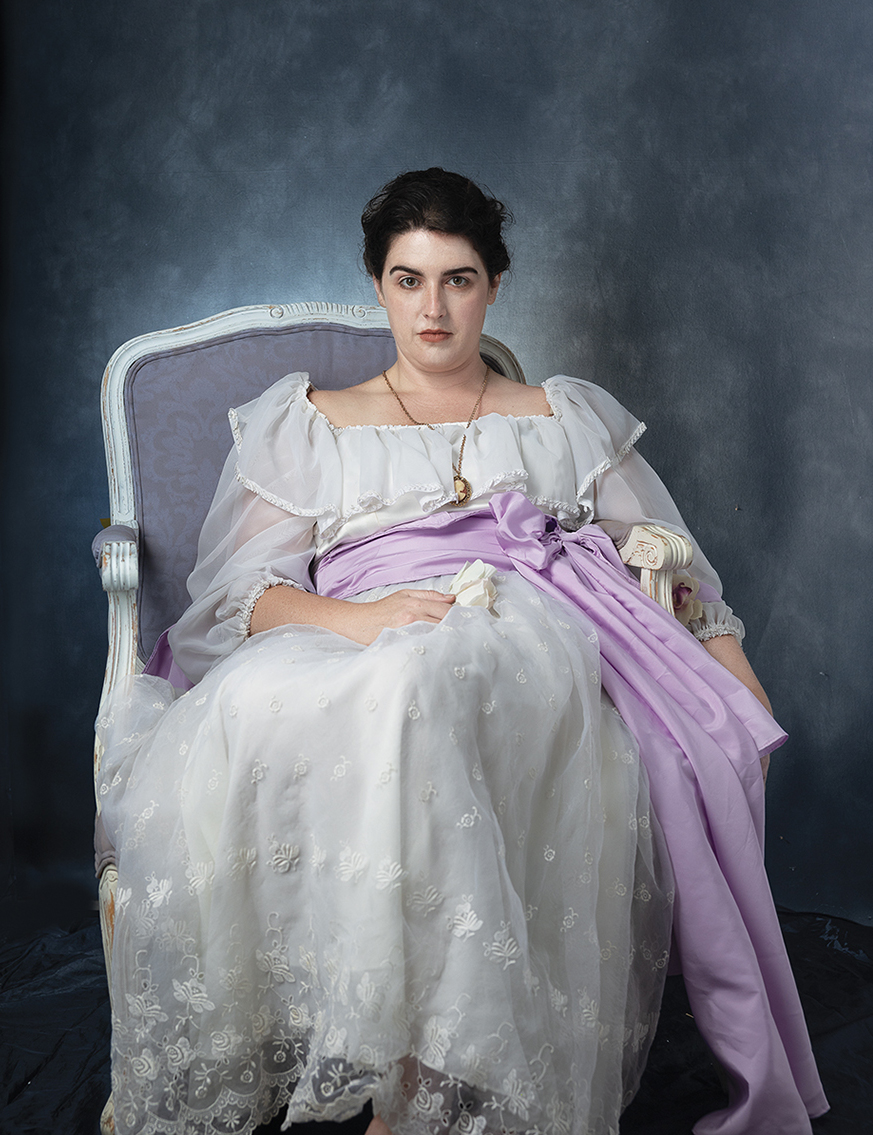
Born into an old Scottish family, Gertrude Agnew was wife to British Sir Andrew Noel Agnew, Ninth Baronet. A socialite who often entertained by throwing lavish garden parties at Lochnaw Castle, just months into her marriage, Lady Agnew contracted influenza and spent much of their first matrimonial year — the same year this portrait was commissioned and completed — in periods of convalesce. So, while it looks as though American expatriate Singer Sargent captured her in slightly amused repose, there’s a good chance she was just taking a much needed breather. Greensboro textile artist, instructor and clothing designer Ann Tilley lounges in luxury as Lady Agnew. We don’t know about you, but we’re seeing double.


Self Portrait

by Henri Matisse, 1918


Nearing the age of 50, French visual artist Henri Matisse created this self portrait during what is commonly referred to as his “return to order,” a pulling back that was also seen in other artists of the post-World-War-I era, including Picasso and Stravinsky. A Matisse sculpture, Madeleine I (1901), can be found at the Weatherspoon Art Museum in a collection donated by Claribel and Etta Cone, sisters to Moses and Ceasar Cone. Matisse, who was a friend to the Cone sisters, once said, “It has bothered me all my life that I do not paint like everybody else.” We say, thank goodness he didn’t. Our own contributing editor, David Claude Bailey, already possessing the glasses and beard — which Bullock treated to “the best beard cut I’ve ever had” — dons the garb and becomes our Henri.


Birth of Venus

by Sandro Botticelli, circa 1485


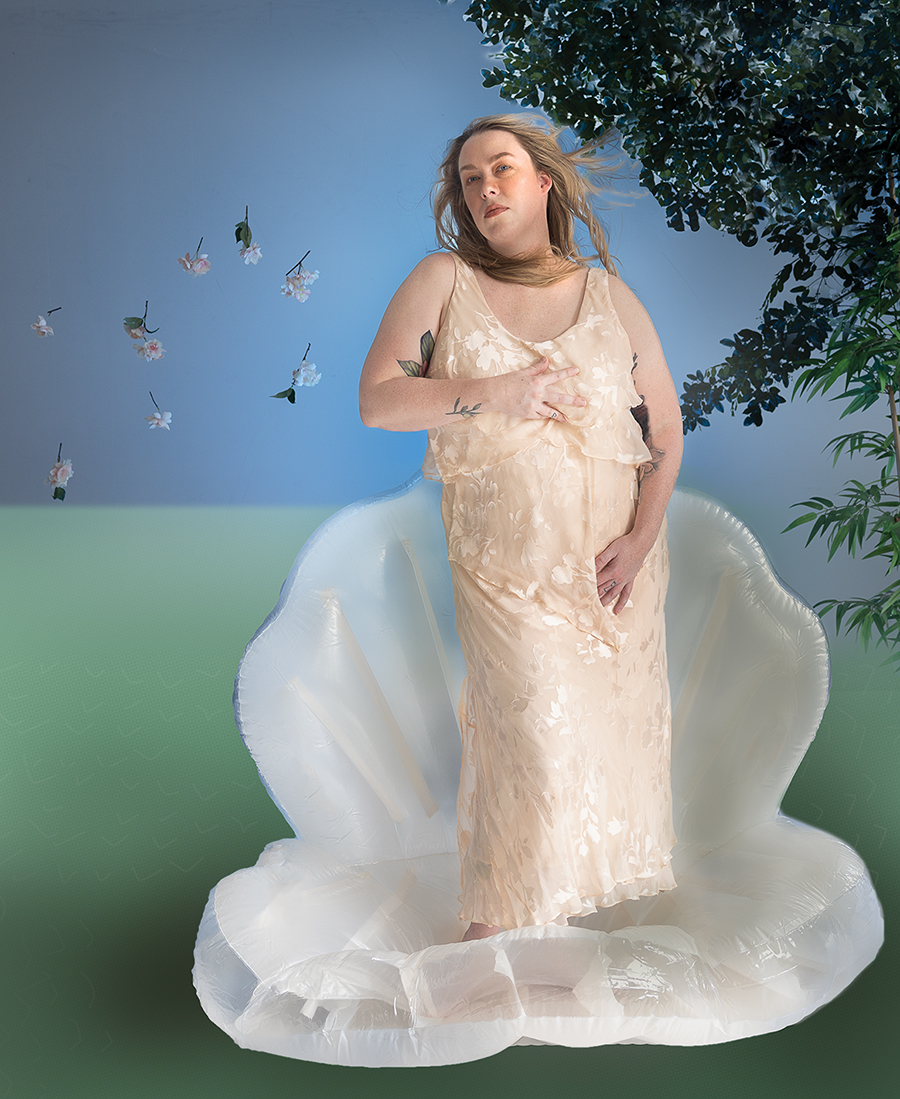
Early-Renaissance painter Sandro Botticelli spent his entire life in Italy, mostly in the same neighborhood in Florence. However, he did spend time in Pisa and Rome, where he frescoed a wall of the Sistine Chapel. The subjects of his art were often mythological or religious figures, but Roman goddess Venus shows up most frequently in his work — here, and in Primavera and Venus and Mars. Botticelli never married, but there is some speculation that he was at least platonically in love with Simonetta Vespucci, who sat as model for many of his paintings, including this one. Upon his death in 1510, his remains were placed next to hers, per his request. Our Venus is photographer Lauren Quinn, who often studies the female figure in her own work.

The Engineer of Sound

The Engineer of Sound

From MerleFest to Tanger, over the last 50 years Cliff Miller has done it all

By Ogi Overman 

Photograph by Mark Wagoner

The early ’70s were a fertile time for bluegrass festivals and fiddlers’ conventions. Spurred by the success of Union Grove and Camp Springs, a new festival sprang up in 1973 in the small community of Angier, 20 miles south of Raleigh. For a startup, it featured an impressive lineup, including a blind guitarist from Deep Gap named Doc Watson. By then, Watson was already a revered figure among music aficionados, if not quite yet a household name.

Running sound for the multistage event was 21-year-old whiz kid Cliff Miller from Asheboro. Even at that young age, Miller had amassed credentials not only as a top-notch sound tech, but as a guitarist/vocalist, repairman, speaker-cabinet builder and innovator of all things having to do with sound reinforcement. During Doc and son Merle’s set, Miller says Doc called out, “Sounds like you’re having a little trouble around 160, son.” That’s musician speak, Miller explains, for his inability to modulate the sound patterns at 160 hertz between the D and G string of Doc’s guitar.

Miller’s response? “So afterward, I went backstage and asked him some questions about resonance and frequencies, and I guess he was impressed that I wanted to learn and wanted to get it right. He seemed to like me, I think.”

Thus was born a relationship that lasted until Doc’s death on May 29, 2012. Miller played alongside the father and son (plus bassist T. Michael Coleman) until Merle’s untimely death in a tractor accident in 1985. He also ran sound for Doc (and anyone who was accompanying him) too many times to count, and, when a festival was conceived at Wilkes Community College in 1988 to honor Merle’s memory, it was Miller who was the driving force behind it. Today, 35 festivals, hundreds of artists and millions of fans later, Miller and his company, SE Systems, are still responsible for every aspect of sound reinforcement at all 13 stages of what is now MerleFest.

But, whether meeting Watson years earlier was kismet or coincidence, Miller would, no doubt, have gone on to an illustrious career due to his own ingenuity, work ethic, talent, good nature and engaging personality.

Former bandmate and lifelong friend T. Michael Coleman says, “He was always the calming voice in the storm, never myopic, always humble and dependable.”

Or as Miller, now 71, self-effacingly says, “I just had a knack for it. Plus, I just liked being around musicians and tinkering with equipment.” Maybe, but Coleman adds, “It’s not what you do but who you are that matters, and Cliff exemplifies that.”

That “knack” began around age 10 when an uncle gave him a Maybelle acoustic guitar. Then, at 14, his parents gifted him an electric guitar for Christmas. “It was Fender Mustang, white with a red pick guard and a Princeton Reverb amp.”

So, he did what every other kid in America at the time did — he started a “combo,” first the Crusaders and then the Chamois. At 16, he managed to take out a loan to buy one of the hot, new Kustom PA systems, whose exteriors were “upholstered” in rolled-and-pleated naugahyde, just like the seats in a hot rod. “That PA became the fifth member of the band,” he says.

Meanwhile, multitasker that Miller is, he and his father converted an old hosiery mill that his dad owned into a workshop, where he learned welding, woodworking and electronics, and began doing repair work. He also went to work at a local radio station, WGRW, earning his third-, second- and first-class radio and telephone license from Elkin Institute in Atlanta. Moreover, right out of high school, he became the service manager at Jerry C. Rowe Music, where he learned how to repair Leslie cabinets, Hammond organs, Fender amps and whatever else was broken. Not long afterward, the store closed, and Miller decided it was time to start his own business, founding Sound Engineering. His first concert under that name was August 21, 1973 — a date he considers his business’s official anniversary — 50 years ago!

“We were doing shows as well as a lot of speaker re-coning and started getting some business from big bands like Chairmen of the Board and Nantucket, as well as well-known local bands like Brice Street,” he recalls.  He’d also added a sales component, becoming an Ampeg amp, Hohner harmonica and Moog synthesizer dealer. Soon he hired guitar collector and salesman J.R. Luther to head up the department. Luther, by the way, is still with the Miller organization some 40 years later. His office walls are covered with at least 50 guitars, each with its own story, not counting the hundreds he has stored in his basement.

As he outgrew one building, and then another, Miller opted to move his operation from Asheboro to Greensboro in 1992. Again he ran out of space twice. As fate would have it, a commercial real estate agent named Tom Townes — who is the brother of “B” Townes, MerleFest’s first general manager — showed him a 57,300 square-foot building on Phoenix Drive, which, after a year of renovation, became SE Systems’ permanent home.

“We’re a three-pronged operation — sales, production and installation — and we have another sales office in Charlotte,” he says.

While his half-century body of work is too vast to elucidate here, a sampling would include:

  • His first ever arena show at the 1987 U.S. Olympic Festival in Carter-Finley Stadium
  • 10 MLB All-Star games
  • Audio director for the Carolina Panthers stadium
  • The Lexington BBQ Festival, where he ran sound and got to know an up-and-coming artist named Taylor Swift
  • Stevens Center shows with Tony Bennett, Dinah Shore, Josh Groban and many renowned stars
  • A concert at the White House with Bill Monroe and Doc Watson, where he met President Jimmy Carter (a letter signed “Jimmy” hangs in the lobby of his facility)
  • Playing with Doc, Merle and T. Michael Coleman on Austin City Limits
The celebrity contact and accolades are endless: In 2006, SE Systems won the MIX Foundation’s Excellence in Audio and Creativity Awards in the “Tour Sound Production” category.

“We went out to San Francisco for the awards with pretty much no chance of winning,” notes Miller, “since our competition was the Rolling Stones, James Taylor and Dave Matthews. Needless to say, it was quite a shock and honor.”

His most recent — and perhaps most challenging — achievement was working alongside the guru of all sound reinforcement, John Meyer, installing the sound system for the Greensboro’s Tanger Center.

“There are 254 speakers every six to eight feet in the walls, ceiling, over the stage and balcony, each with its own enclosure,” explains Miller. That lets sound engineers change the acoustics of the room depending on conditions.

Greensboro Coliseum managing director Matt Brown, who made the decision to hire Miller for the critical Tanger project, is 100 percent certain he got the right man for the job.

“I have the highest regard for Cliff,” says Brown, who has leaned on Miller’s expertise at the Coliseum’s many venues. The performance of the Meyer Constellation system Miller recommended, says Brown, “shows how truly fortunate we are to have such a talented sound engineer in our community.”

Lest one think that Miller’s life has been one of accolades, awards and befriending hundreds of stars in and beyond the bluegrass community, think again. In November 2016, he underwent a successful kidney transplant, receiving an organ donated by well-known local Realtor Kathy Haynes. Shortly after he was back on his feet, the pandemic hit and the entire entertainment world went dark.

“It was a hard spot for us,” he laments. “Life as we knew it, producing shows, stopped dead. We didn’t do a thing for an entire year. I think it made people realize that we are not a business, but an industry.”

Whether it’s a business or an industry, Miller is the same, self-effacing, hard-working individual who’s managed to be a perfectionist without being a jerk. As longtime friend and employee Bob Thornley says, “He’s the best guy I’ve ever worked for — and I’ve worked for a lot.”  OH

Ogi Overman has been a familiar face on the central Carolina alternative and community journalism scene for almost 40 years. He has edited six publications and served as a columnist, reporter and feature writer. He is currently compiling his columns for a book to be titled A Doughnut and a Dream.