Wandering Billy

True Kid Rock

The band that even makes the mamas and papas very happy

By Billy [Eye] Ingram

What is a home without children? Quiet.” — Henry Youngman

Eye had the distinct pleasure to talk music the other day with Chuck Folds who, along with Steve Willard, and Eddie Walker, constitute North Carolina’s most popular children’s act, Big Bang Boom. This whirlwind trio possesses the ability to whip toddlers and grade school youngsters — and even their parents — into a grand mal frenzy: Everyone go-go-ing, pogo-ing and slow mo-ing from the moment this band takes the stage with their almost criminally infectious lyrical concoctions.

Big Bang Boom taps into that frenetic Greensboro sound epitomized by Bus Stop in the 90s. Small wonder, it was Folds, Eddie Walker, Britt “Snuzz” Uzzell and Evan Olson who formed arguably the city’s most successful pop band around 1991. Not much more than a year later, Bus Stop entered and won Dick Clark’s USA Music Challenge — the American Idol of that decade — broadcast on national television.

Bus Stop split up in the mid-’90s. That’s when Folds, along with guitarist/vocalist Steve Willard, concentrated on their touring cover band, Rubberband. All the while, in the back of his mind, Folds was toying with the idea of forming a combo called Big Bang Boom, for no other reason than he liked the name.

“Anybody with kids in the last 20 years knows, when you have small class sizes, like 11 or 12 kids, everybody has to invite everyone in the class to their birthday party.” Attending and/or throwing a dozen birthday parties a year, it’s not long before bouncy castles, The Little Gym, even our spectacular Science Center would fail to jumpstart the youngsters or bored parents, for that matter.

“When my oldest son was about to turn 7,” Folds says, “we were like, oh my God, what are we gonna do this time?” Folds asked long-time collaborator Steve Willard to join him and, “We cleared out the living room, put up a bunch of lights, then played a rock show as a made-up band called Big Bang Boom.” The rug rats went Richter scale nuts, their parents just as enthusiastic. After that electrifying 30 minute set, the adults were inquiring if Folds could perform at their offspring’s next soirée. “Well that’s funny,” he thought. “Because this isn’t really even a thing.”

Chuck Folds was scribbling down children’s songs as an aside, giving little thought to actually recording them, merely musings he noodled around with solely because he had little ones of his own. “I was hired to play bass at a recording session,” he tells me. “The producer, Ralph Covert, had a Disney children’s music show called Ralph’s World. This was around 2002.” Covert handed Folds his latest preschooler oriented CD. That got him thinking about his own roughhewn kiddie compositions and about actually finishing them.

Since forming in 2007, all three Big Bang Boom bandmates compose the songs. They also switch off on lead vocals, backed by Chuck Folds’ buoyantly bumping bass, Steve Willard’s kaleidoscopic guitar riffs and the action punctuated by Bus Stop alumnus Eddie Walker’s pop punk, rat-a-tat-tat, rimshot heavy riffs. The result is an effervescent explosion of irreverent (but respectful) melodic mashups spoofing life’s most basic conundrums.

Folds and his bandmates grew up in the ’70s, were teenagers in the ’80s, before becoming parents in the ’90s. “When they were little, our kids were listening to pop bands like Cake, They Might Be Giants and Weezer,” Folds says. “They liked it. So we approached the arrangement, the production, the instrumentation, the melody, everything, no differently than if we were going to record a song for regular pop radio. We just adjusted the lyrical content to address kids’ and their parents’ point of view.”

Honing their craft, they’d jam on Friday afternoons at the Greensboro Children’s Museum. “One of the ladies working there loved to have us play,” Folds says. “We’d just do it for free practice space. Then we started getting paid, playing for birthday parties.”

There’s a tonal groove you may not be aware of that Big Bang Boom neatly plugged into: Kindie. That is, indie music geared for kindergarteners that won’t drive grown-ups up the bloody wall. “It’s only been in the last decade or so that parent-friendly kindie artists emerged from an underground movement to become more mainstream,” Folds tells me. “It’s all very organic. It’s not run through major labels or record companies. This is all independent.”

You might not be surprised to learn that the kiddos today are so plugged in they have their own music festivals. “We played Lollapalooza in 2012,” Folds says. “You have people going to Lollapalooza that attended when they were in their 20s but now they have kids. So there’s a family stage called Kidsapalooza.” (Even if such a thing had existed when I was growing up, no way my parents would have taken us!)

Can an artist really be taken seriously if their core demographic pedals around on three wheels? In 2013, a band called the Okee Dokee Brothers won the Grammy for Best Children’s Album of the Year for their fourth disc, Can You Canoe? They subsequently garnered three more Grammy nominations. “These guys were like our heroes. That’s what really turned the corner for kindie music,” Folds says. “Because here’s a really freaking good musical group that recorded a great album and they won the Grammy.” Secret Agent 23 Skidoo, a kindie band out of Asheville, hip hopped their way to a Grammy of their own in 2017. “It’s one of the few areas in the music world that’s evolved the way it has,” Folds says. “Kind of like the way rock ’n’ roll came about.”

Word spread rapidly about Big Bang Boom. With their first album, Why Can’t I Have Ice Cream, planting aerosonic earworms into young minds around the world, Parenting magazine raved: “These former rocker dads are creating kids’ music you won’t be embarrassed to blast in the carpool line.” A great example is “Hippie Mom” from the CD Because I Said So!, with jaunty lyrics like, “With pretty flowers in her hair, she’ll let me pick the clothes I wear.” Then it ends with, “You’re so much fun I scream and shout, I want to tell the world about my hippie mom.” Check it out on YouTube.

A song the band opens their live shows with, “Big Bang Boom,” blasts out word salads like, “We’re gonna jump and shout, your underwear is inside out, don’t put boogers in your mouth, someone’s gonna throw you out!” I mean, that’s good advice no matter what your age!

Your chance to experience Big Bang Boom will come during this year’s NC Folk Festival, September 10 and 11. “How many people actually make a decent living off of music? It doesn’t happen very often,” says Folds. As a side gig, he and Steve Willard formed a cover band called SNAP! that entertains at weddings and other private events.  OH

Billy [Eye] Ingram is the author of a new book, Eye on GSO, a series of essays focusing on Greensboro history, all previously published in O.Henry and Yes! Weekly.

Tea Leaf Astrologer

Cancer

(June 21 – July 22)

If ever you’ve ridden a drop tower — one of those gut-in-your-throat “free fall” rides at the carnival — then you can imagine what it feels like to know and love a Cancer. But only those born under the influence of this cardinal water sign know what it’s like to be perpetually at the whim of such sensational pinnacles and descents. This month will be no different, especially with that full supermoon on July 13. May as well enjoy the ride.

Tea leaf “fortunes” for the rest of you:

Leo (July 23 – August 22)

Something needs watering. Hint: It’s not a plant.

Virgo (August 23 – September 22) 

You can’t see the signs if your eyes are closed.

Libra (September 23 – October 22)

Let the tea steep.

Scorpio (October 23 – November 21)

You already know the answer.

Sagittarius (November 22 – December 21)

Keep moving. They’ll come around or they won’t.

Capricorn (December 22 – January 19)

You’re thinking the fun out of it.

Aquarius (January 20 – February 18)

The prize is never inside the box.

Pisces (February 19 – March 20)

Tell it to your dream journal.

Aries (March 21 – April 19) 

Best to get it straight from the source.

Taurus (April 20 – May 20) 

Leave your phone. Forget the umbrella. Let life happen.

Gemini (May 21 – June 20)

The invitation will be obvious. OH

Zora Stellanova has been divining with tea leaves since Game of Thrones’ Starbucks cup mishap of 2019. While she’s not exactly a medium, she’s far from average. She lives in the N.C. foothills with her Sphynx cat, Lyla. 

Art of the State

Super Natural

Davidson artist Elizabeth Bradford celebrates the beauty of the wild

By Liza Roberts

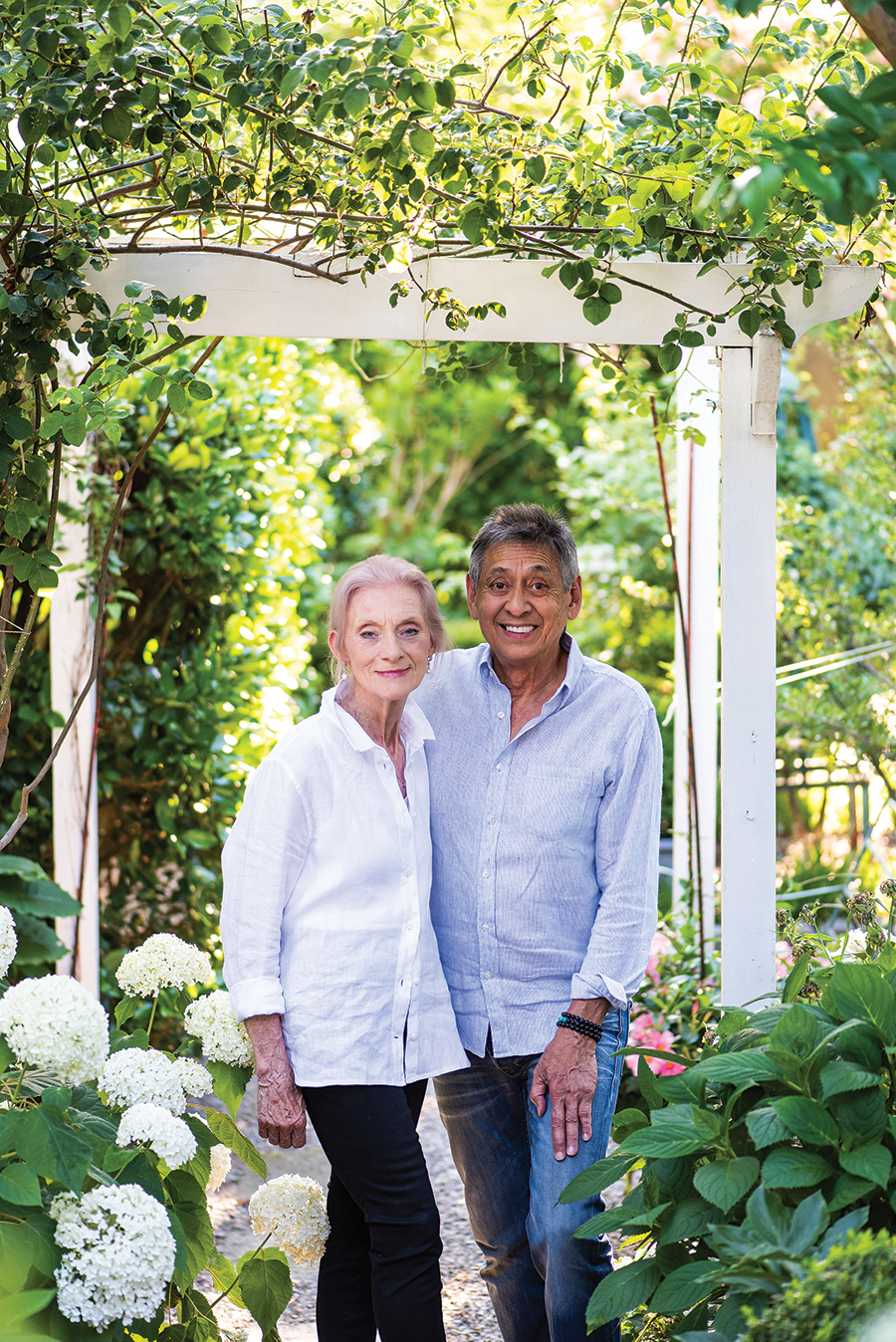
Photograph By Lissa Gotwals

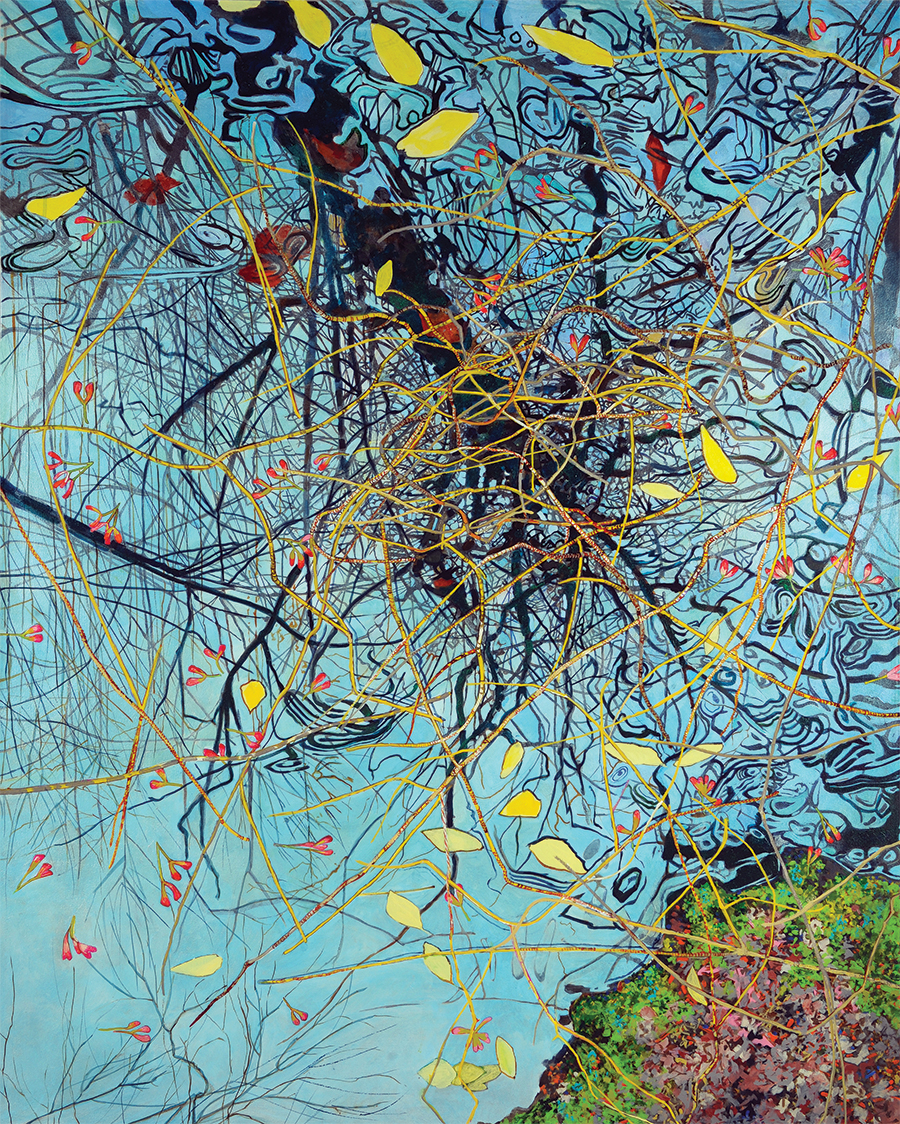
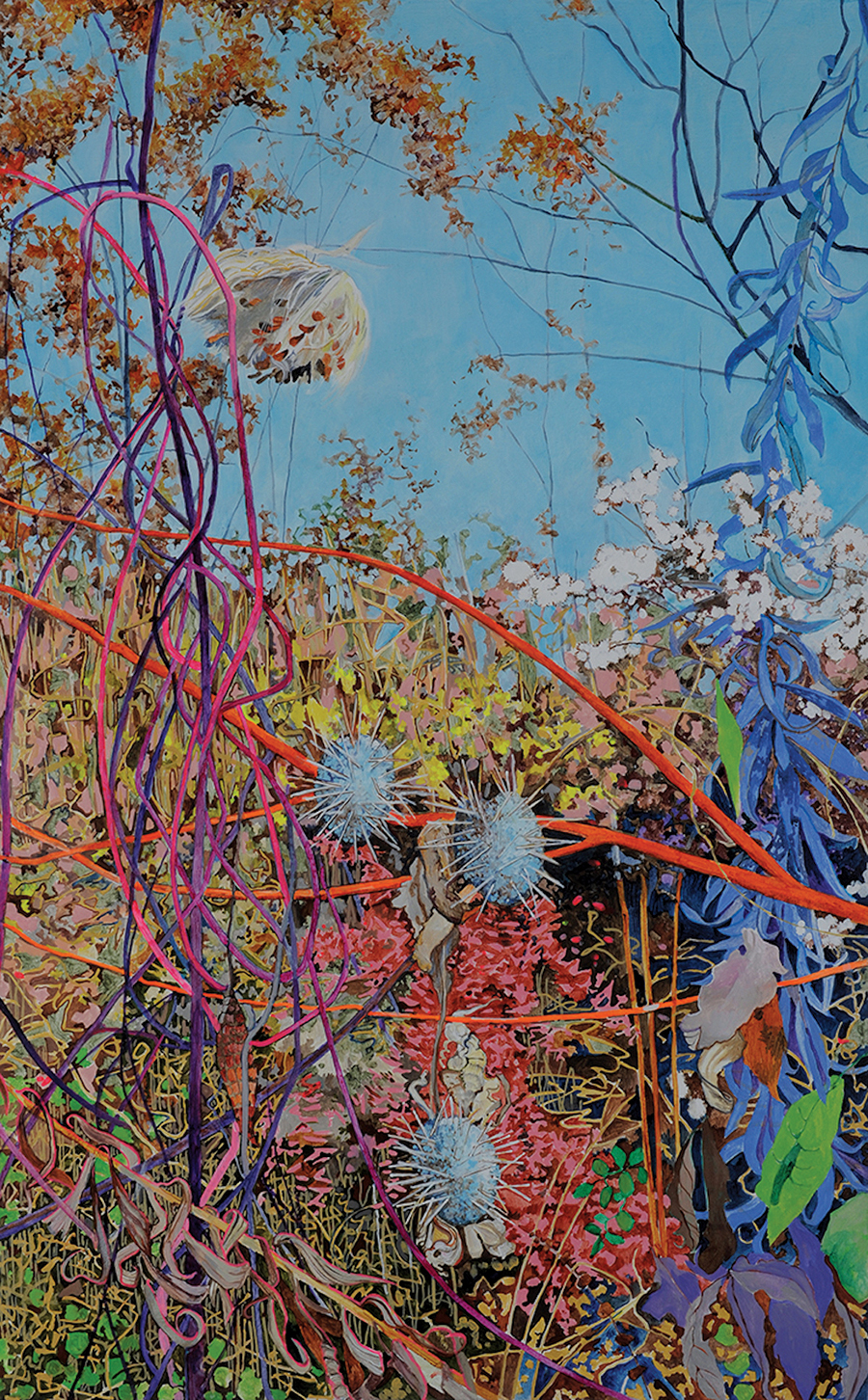
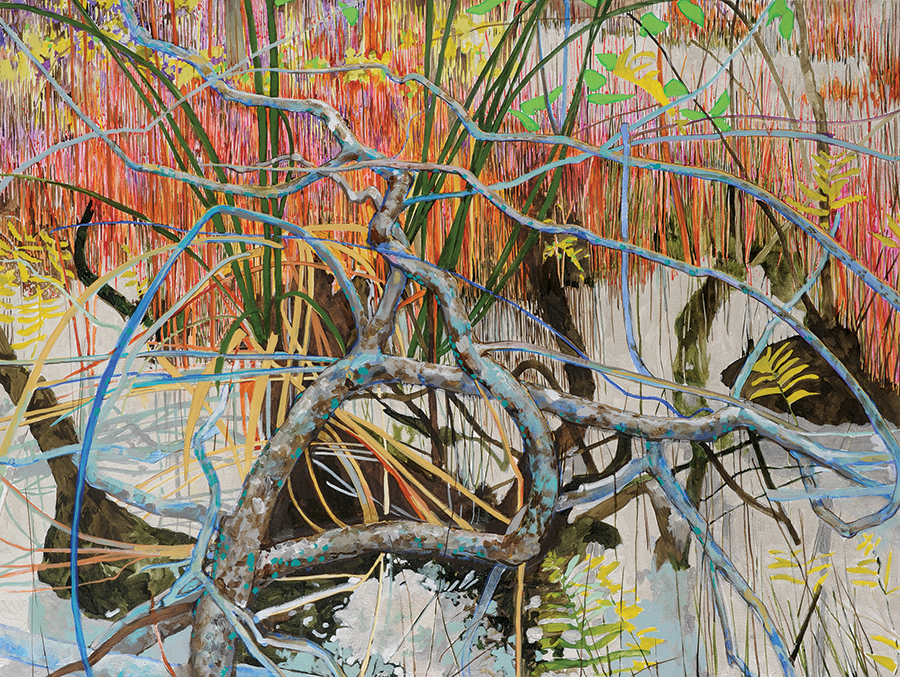
In a former cotton shed in Mecklenburg County, Elizabeth Bradford paints the natural world around her. With extraordinary, saturated colors and meticulous, zoomed-in details, her landscapes can be exotic, surprising, even strange. They are also poetic: meditative celebrations of the beauty, interconnectedness and geometry of the natural world.

On canvases nearly as tall as she is, Bradford takes countless hours over many weeks to paint the magic she finds in nature. Sometimes it’s an eddy of water. Sometimes it’s the messy bank of a receded river, where roots protrude and collide. Trees, fields, ponds, creeks: Bradford finds wonderlands in them all. Representational, but with deep, twisting tentacles into abstraction, her canvases beg the viewer to look hard.

In January 2023, Hidell Brooks Gallery in Charlotte plans a solo exhibition of her art. Wilmington’s Cameron Art Museum exhibited a powerful one-woman show of Bradford’s work, entitled A House of One Room, in 2021. Her paintings are also in the permanent collections of the Mint Museum in Charlotte, the Weatherspoon Art Museum at the University of North Carolina at Greensboro, and the Blowing Rock Art and History Museum, as well as in many top corporate collections.

This University of North Carolina at Chapel Hill graduate considers herself largely self-taught as an artist, but she also studied painting and lithography at Davidson College and worked as an art teacher before devoting herself full time to her craft.

Bradford says her work began to “develop a power” when she started backpacking in the mountains of North Carolina about nine years ago. With two friends, she started “going into a lot of obscure places, wild places, where the world is crazy,” she says. Now armed with a pole-mounted camera, she takes photos as she goes, hundreds of them in the space of a few days’ hike. These images become her inspiration when she returns to the studio. “Truth is stranger than fiction,” she says. “The wild is stranger than anything I can dream up.”


(left) Water’s Edge, (center) Weeds at the Treadwell, (right) Cumberland Island Swamp

The truth is also more meaningful. The wilder the land, the more Bradford says she finds to care about. “I’m on a mission to sensitize people to the beauty of the earth,” she says. To take things “that aren’t obviously beautiful and to render them beautiful.” She does that in large part with unexpected, vibrant oil and sometimes embedded shards of glass, something she once eschewed as a “cheap trick.” But after a number of years of hewing as close to the actual color of the natural world as possible, she decided she was selling herself short. “Why are you being this ascetic?” she says she asked herself. “Why are you denying yourself access to something you love so much? And so I started pumping up the color. And as a result I’ve gotten more imaginative, more intuitive. More soulful.”

She brings all of that to every one of her subjects, most recently weeds. “Weed studies have introduced me to some really cool forms,” she says. “Arabesques and extravagant curves. I’ve been playing with a lot of that . . . I’m always trying to keep moving outward, not just repeating the same things. I keep looking for newness.”

Actively challenging herself has become an ingrained habit, one that began the year Bradford turned 40 and made a promise to herself: “Instead of getting bummed out about getting old, every year for my birthday I would pick something I didn’t think I could do, and I would spend a year trying to do it.” That first year, she decided she would paint a painting every day. A few years ago, she made the commitment to learn French. Lately, she’s begun renovating an 1890s farmhouse, one she discovered deep in the woods on the bank of a creek, far from roads and traffic and noise. A two-hour drive from her (also 1890s-era) Davidson home, it will serve as Bradford’s summer residence and studio. “It’s my dream,” she says.

And so as she ages, Bradford’s world gets more and more interesting — not that boring is an option. “The world is just so complicated and fascinating,” she says. “There are just not enough years of life to do everything you want to do.” OH

This is an excerpt from the forthcoming book Art of the State: Celebrating the Art of North Carolina, to be published by UNC Press this fall.

Home by Design

The Stuff That Really Matters

When one closet door closes, another kind of door opens

By Cynthia Adams

Meet The Minimalists: Two childhood pals named Joshua Fields Millburn and Ryan Nicodemus.

They took Marie Kondo and her sparkling mantra about the joy of clearing and cleaning straight to the trash bin.

Millburn and Nicodemus upped the ante. They want you to quit stuffing your life with, well, stuff and heal your stockpiling-shiny-baubles-like-a-magpie miserable life.

The Minimalists know Kondo beat them to the movement, but their message is different. Organizing and streamlining is not enough.

Nor do they want to sell you nifty organizing bins and accessories, like Real Simple magazine or Kondo.

A nice reorg misses the point. Millburn and Nicodemus say most of us need a life reboot. A new way to make and find meaning — and, spoiler, it won’t come in an Amazon package. It is derived through community and connection.

Tucked into their minimalist philosophy is a scary warning from neuroscientists. It’s the message we’ve been avoiding since we began earning a paycheck. Whenever we troll for goods, whether the perfect white shirt, wine glass or running shoe, we are responding to an ancient evolutionary drive to hunt and gather. Except, this biological imperative no longer serves a purpose; famine is not at the door. Nor is the saber tooth tiger, but you wouldn’t know it by the way shoppers trample others during a Black Friday melee.

That stampede to be first inside Target’s doors? It has never been about the bargain TV. It is about our biology.

Researchers from Carnegie Mellon, MIT and Stanford used fMRI to study the brains of test subjects while clothes shopping.

There were two interesting takeaways. The nucleus accumbens — aka the pleasure center of the brain — lights up when a subject is shown something they desire. The greater the desire, the greater the brain activity.

The greater the prospect of pleasure.

The Minimalists insist our biology is not our destiny. “If poisoned by excess, more poison will not save you.”

Perhaps you’ve discovered The Minimalists on Netflix. Or heard their podcast and began rooting out nearly identical jean jackets, purses and t-shirts stuffed in the closet. Maybe you couldn’t give a happy hoot about minimizing.

But thousands do relate to Millburn and Nicodemus, whose shared quest began with crisis.

In the same month, Milburn lost both his marriage and his mother. (He was reared by a single mother who wrestled with alcoholism.)

Nicodemus, however, who rejected the family business to chase corporate success, successfully navigated the corporate labyrinth. In fact, he was promoted again and again. Yet his victory felt hollow. He was miserable. Meanwhile, Millburn, who had lost everything and ought to have been miserable, was strangely exuberant. Why?

He told Nicodemus he had lost touch with himself, while chasing after shiny, sparkly, things.

He began sorting and evaluating his possessions, wanting fewer possessions and more joy. Remember Marie Kondo’s advice that your belongings must “spark joy”?

Well, have you ever wandered through your home, evaluating an object with that in mind?

Our 1926 house has tiny closets, whose doors the Realtor avoided opening.

A century later, closets tell the story of modern life — repositories for pleasures that flickered briefly before dying in the nucleus accumbens.

My jammed full closets seem to reproach me for my magpie ways.

The Minimalists are opening an entirely different door. OH

Cynthia Adams is a contributing editor to O.Henry.

The Pleasures of Life Dept.

The Eagle’s Gift

A wondrous sighting awakens the belief in magic

By Lindsay Moore

When I returned to my childhood home to live several years ago, I tempered my expectations. It was here I had befriended towering oak trees and written plays among the river rocks adorned with wildflowers, and where my worries had been enveloped by the pawpaws and mountain laurels. I served as protector of this sacred and magic realm. In return, it offered me an imaginative and joy-filled childhood. It was my own Terabithia, Narnia, Fangorn Forest or Hundred Acre Wood.

Regrettably, as adults we leave our mystical lands of childhood behind and the magic fades.

Waking early one brisk fall morning, I made the short trek to the steep steps made of large rocks just below my home. Without my consent and unannounced, tears fell in a steady stream as I stared out over the rippling water.

As I pondered whether to allow myself this moment of vulnerability, through my wet lashes, my eyes came upon the majesty of a winged creature. Gloriously on display as it silently soared just inches above the river’s surface, there it was — a harbinger of hope in the 7-foot wingspan of our nation’s emblem: a bald eagle. At once, I was transported back to the magic of my youth. As it made its way downstream, I wondered if it was just a figment of my imagination.

I held this moment close, fearing that if I shared it, the magic would evaporate. And my soul yearned for magic, longing to experience it once again. Not less than a month later, it happened again. This time, the sound of its calls preceded it. For such a majestic bird, it emitted surprisingly weak-sounding calls that resembled a series of high-pitched whistling or piping notes.

Throughout the winter, my interest in the bald eagle only heightened. I wondered where it lived. Did it have a companion, and, if by chance it did, was there a nest?  In my spare time, I read about eagles to better understand their behavior. I considered the eagle my friend and was certain it was mutual. In early spring, I began hiking the ridge line of the neighboring state park in hopes of catching a closer glimpse.

One evening, my eagle finally revealed itself to me, but it was not alone. In my studies I had learned that male eagles were smaller than their female counterparts and I could now discern that my eagle, in fact, was the male. Looking down, my eyes were drawn nearly 300 feet to the top of a sycamore tree situated along the river. There, I noticed an enormous nest that was easily 8 feet in diameter. With my camera and binoculars in hand, I formulated a plan to trailblaze through the woods below the very next day.

Before I could even see the nest in its entirety, I saw the white head of the female perched on top of a large branch. As I approached the edge of the tree line, my eagle arrived circling above with great prowess. I knew that he had seen me, even though my form was barely visible. As he proudly orbited, I noticed a small eaglet flapping its wings inside the nest. At once, I recognized the gift my friend was offering me. I smiled and stood in silence, extending to him my gratitude and respect.

I knew then that magic could still be elicited, regardless of age — we only need to be vulnerable enough to experience it. OH

Though living alongside the Mayo River in Rockingham County, Lindsay Moore is connected to Greensboro through the spirit of Howard Coble and her love of the local arts scene. 

The Omnivorous Reader

Follow the Money

Ben Franklin’s blueprint for America

By Stephen E. Smith

How is it possible that Ken Burns’ recent four-hour Ben Franklin documentary received ho-hum reviews? Have PBS devotees grown too familiar with Burns’ still-life voiceover production style? Maybe. But the lackluster reviews are more likely the fault of the kite-flying, bifocaled purveyor of the bon mot, old Ben Franklin himself. He’s every American’s everyman, the most human of our Founding Fathers.

We grew up learning about Franklin, and most of us believe we know what needs to be known about the archetypal American Renaissance man. Historian Michael Meyer’s Benjamin Franklin’s Last Bet: The Favorite Founder’s Divisive Death, Enduring Afterlife, and Blueprint for American Prosperity is a timely reminder that there is still much to learn about the influence Franklin continues to wield in 21st century America.

When he died in 1790 at the age of 84, Franklin was not universally mourned by his countrymen. Meyer reminds readers that George Washington and the Congress refused to acknowledge attempts by the French to express their condolences at Franklin’s passing, and John Adams had little good to say about his former diplomatic partner. Among his later detractors were Mark Twain, who wrote that Franklin “early prostituted his talents to the invention of maxims and aphorisms calculated to inflict suffering upon the rising generation of all subsequent ages”, and D.H. Lawrence reveled in revising and ridiculing Franklin’s 13 virtues.

Meyer’s primary focus is on the influence of Franklin’s last will and testament. William, Franklin’s first-born son who had sided with the British during the Revolution, was left worthless property and ephemera, and his daughter and grandchildren received gifts commensurate with the esteem in which he held them. But it was his “Codicil to Last Will and Testament,” a wordy but straightforward document, that morphed into a hydra-headed legal instrument that would vex administrators, the courts and politicians who attempted to oversee and control its ongoing disbursements.

Franklin established endowments for the cities of Philadelphia and Boston. “Having myself been bred to a manual art, printing, in my native town,” Franklin dictated, “and afterwards assisted to set up my business in Philadelphia by kind loans of money from two friends there, which was the foundation of my fortune, and of all the utility in life that may be ascribed to me, I wish to be useful even after my death, if possible, in forming and advancing other young men . . . .”

Franklin left each city £1,000, or about $133,000 in today’s dollars. The funds were intended to provide small loans to manual and industrial workers — cobblers, coopers, blacksmiths, wheelwrights, carpenters, etc. — to be repaid at 5 percent interest over a 10-year period. In addition to offering a helping hand for the socioeconomic class employed in manual labor, the funds’ underlying intention was to promote good citizenship. (“I have considered, that, among artisans, good apprentices are most likely to make good citizens,” Franklin wrote.) If the principal from the bequests were properly administered, the initial investment should have yielded billions in today’s dollars, making Franklin our first billionaire philanthropist.

So, what became of Franklin’s fortune, and where did his generosity lead us? Meyer follows the money, providing a decade-by-decade accounting of the funds’ expenditures while factoring in economic trends, poor oversight by fund managers, legal squabbles, political infighting, and losses incurred during national recessions and depressions.

All of which sounds incredibly boring. But be assured there’s nothing tedious about Meyer’s chronicle. What emerges is a lively and thoroughly researched social history of the country viewed through our evolving economic affluence and the increasingly litigious nature of American society.   

The early ledgers read much like a personalized history of the country: “Turning the musty pages of each loan agreement can feel like reading an old swashbuckling story,” Meyer writes, “bringing the same sense of relief when the last line reveals that a character has made it through. Three cheers for the cabinetmaker Christopher Pigeon, who repaid his debt on time. And a compassionate wag of the head for Paul Revere’s son-in-law, one of only two Boston defaulters.”

Unfortunately, there was skullduggery aplenty in the management and disbursement of Franklin’s gifts. In 1838, Philadelphia’s Franklin Legacy treasurer John Thomason purchased Philadelphia Gas Works stock with Franklin’s bequest, thus impeding the money’s growth and transforming the fund into a tool of corruption and patronage. In 1890, Franklin’s descendants were so aggrieved they felt compelled to file a suit claiming that his bequests should revert to their control.

Boston did not suffer a similar level of financial chicanery. In 1827, William Minot, who administered the fund for 50 years, deposited much of Franklin’s principal into Nathaniel Bowditch’s Massachusetts Hospital Life Insurance Company to acquire interest, thus enabling Boston’s fund balance to surpass Philadelphia’s for the first time. Beantown never trailed again.

In the final analysis, Franklin’s bequests accomplished very little of their original intent. In the days before central banking, loans were difficult to administer in an equitable manner, and many of the later loans suffered default or were not repaid on time. By 1882, Philadelphia had only about $10,000 left in its fund. Franklin had failed to factor in even a single default, and he had no way of foretelling the emergence of liberal credit terms and the growing availability of loans charging less than 5 percent interest. In 1994, the entirety of Boston’s Franklin fund went to the Benjamin Franklin Institute of Technology. The Philadelphia Foundation continues to manage its Franklin Trust Funds for its original purpose.

At this moment of intense political division and national soul searching, Benjamin Franklin’s Last Bet is a timely reminder that we remain a generous people, and that philanthropy lives on in the hearts of ordinary Americans. The popularity of GoFundMe pages is the latest manifestation of our desire to help those in need, an example of the civic-mindedness exercised by the “good citizens” Franklin hoped to encourage. OH

Stephen E. Smith is a retired professor and the author of seven books of poetry and prose. He’s the recipient of the Poetry Northwest Young Poet’s Prize, the Zoe Kincaid Brockman Prize for poetry and four North Carolina Press Awards.

Life’s Funny

Finding Tia

How a lost dog helped humans locate their kindness

By Maria Johnson

It had just stopped raining, but the sky was still rumbling when I saw her that Sunday afternoon.

She was a little bigger than a bread box. Her black-and-white fur was soaked, and her tail was tucked between her legs as she crept out from between some townhouses about 40 yards away.

She looked like a purebred spaniel, a dog someone would be missing. She also looked scared, just like my foxhound must’ve looked when he slipped out of the yard during a thunderstorm last summer. I remembered how my heart sank when I realized he was gone.

I called to the little spaniel.

She turned and ran the other way. I jumped in the car and drove around the neighborhood hoping to catch a glimpse of her, but she’d seemingly vanished.

So I did what I had done last summer. I sent up a flare on NextDoor, a social media app that connects people in neighborhoods.

“Black and white spaniel pup on the loose … Whitehall neighborhood off Lake Jeanette Road just now . . . ”

Within seconds, people responded with sympathetic emojis. One woman connected the dots, linking my post to a fresh “lost dog” notice from another neighborhood that she also followed.

Soon, I heard from one of the dog’s owners, Virginia Masius.

“I think that’s my dog, Tia,” she wrote.

A little more than an hour earlier, Virginia had let Tia out to relieve herself just before the storm hit. In the time it took Virginia, a professional musician, to fetch her coffee cup from upstairs, the sky opened and thunder shook the house. When she stuck her head outside and called Tia, there was no response.

Virginia looked under the deck. No Tia.

Then she saw a gap under the chain-link fence.

Fear grabbed her.

She tried to calm herself. Four-year-old Tia had wandered off before, but she’d always come back shortly, usually muddy and happy, wagging her thumb-like tail.

Virginia walked her neighborhood of Bellwood Village calling Tia’s name as she went. Nothing.

She texted the news to her partner, Margo Freibott, a professional dog groomer who was driving back from a grooming competition in West Virginia.

In her car, Margo listened to Virginia’s text and dictated a reply: “She’ll come back. Leave the basement door open.”

She suggested that Virginia check the neighborhood retention pond, where wildlife often gathered. Tia, nicknamed Bird Dog, often followed her nose down to the pond.

Then Margo roused the employees at her business, A Becoming Pet in Greensboro. One of them, Brianna Davis, blasted out more social media alerts and left the dinner table to join the hunt as bulletins flashed across NextDoor and the Facebook pages of individuals and animal-related groups.

Text chains lit up among friends: Be on the lookout for a black-and-white cocker spaniel.

Into the evening, people in the Lake Jeanette area scanned their surroundings as they walked, jogged, and exercised their own dogs.

Others searched as they drove, tacking extra miles onto their normal routes in hopes of spotting Tia.

It was getting dark when a woman called Margo.

She’d seen a black-and-white cocker spaniel running up an exit ramp for I-840.

Oh, no, Margo thought. More than anything, she feared Tia trying to cross the partially finished interstate loop.

She and Virginia drove up and down the highway until 9:30 p.m.

They went home dejected.

Margo left voice messages at veterinarian offices. She posted Tia’s information on PawBoost, a site devoted to lost-and-found pets.

Virginia put a venison roast on the gas grill outside, hoping that Tia’s nose, sharpened by hunger, would pick up the molecules of sizzling fat.

They left the gate and the back door standing open, just in case.

They couldn’t sleep.

Where was Tia right now? Was she safe? Was she scared?

The next morning brought a glimmer of hope.

A woman who lived on Cottage Place, about a mile away as the crow flies, posted that her doorbell camera had captured an image of Tia at about 11:30 the night before.

Margo and Virginia chucked their Monday routines and combed the area. Nothing.

They studied Google Earth to guess Tia’s most likely path, figuring the shy dog would stick to easements and creeks.

Margo focused on the neighborhoods that hugged those spaces, retracing streets and parking her car to walk behind developments and call Tia’s name.

Virginia concentrated on distributing “REWARD” flyers bearing Tia’s picture. She stuck the pages to utility poles and stop signs. She dropped off copies at a branch library, a fire station and nearby pet stores.

Everyone she talked to promised to help.

On Monday night, someone on NextDoor posted a picture of Tia taken on Bluff Run Drive.

Indeed, Tia had crossed the interstate, perhaps by going through a culvert that channeled a creek under the road.

A handful of searchers descended on the area, hollering Tia’s name until 10 p.m.

That night, Virginia and Margo felt hope slipping.

Would they see Tia again?

They clung to a lifesaver they’d never expected: The knowledge that dozens — if not hundreds of people — had Tia on their minds, too.

That day, they had run across people walking with treats and leashes in hand.

“Are you looking for the cocker spaniel?” people had asked them, not realizing who Margo and Virginia were.

“Yeah,” they answered.

“We are, too,” the strangers said.

Tuesday morning, when Margo made a brief appearance at work across town, a client commented that she didn’t look well. Margo explained that her dog was missing.

“The cocker spaniel?” the woman replied.

Tuesday afternoon pinged with more sightings in the Bluff Run Drive area.

A house painter had seen her. A dentist had seen her. A couple of women who were walking had seen her.

The tips were promising — and maddening. Margo, Virginia and friends drove from sighting to sighting, literally moving in circles.

Finally, they zeroed in on a swath of woods where they believed Tia was hunkered down. No one had seen her for a couple of hours.

Margo decided to use a live trap loaned to her by retired local wildlife trapper Bobby Farrington. He’d advised her to bait the cage with fried chicken.

Virginia ran to Bojangles.

Margo set the pressure-sensitive trap just inside the woods and sent everyone home. She sat in her car and watched for three hours. At dusk, she saw a family of deer enter the woods. They looked like the herd that had frequented her neighborhood retention pond before construction had driven them away.

Had Tia followed her nose to familiar animals and bedded down near them at night?

Was she overnighting with friends?

That night, Margo left for the Raleigh-Durham International Airport to pick up her 25-year-old son Cody, who was flying home from Oregon to get his car. On the way home, they stopped to check the trap. It was 1 a.m.

They shined a flashlight into the woods.

Two yellow eyes reflected back at them.

“I’m going down there,” said Cody.

A few seconds later, he spoke again.

“Mom, it’s Tia.”

Sitting on a sofa in the family’s living room, Margo continuously runs her fingers through Tia’s wavy fur.

Every few minutes, her fingers feel a bump, and Margo checks to see if it’s a scab where a tick was removed. They found 26 ticks on Tia when they got her home.

Tia stank, too. Margo figured that she had been eating the remains of dead animals in the woods. Margo’s employees bathed Tia repeatedly to get the smell out.

The fence where Tia slipped out? It’s more secure than Fort Knox now.

And Tia? She crawls all over a visitor on the other end of the sofa.

“Oh, now you come to me, huh?” I tease.

It’s mid-May, a couple of weeks since Tia returned from her two-and-a-half-day holiday, and she seems as happy-go-lucky as ever.

Her humans, though, are forever stamped by the experience, especially the feeling of community that Tia’s disappearance prompted.

“It makes me get goosebumps,” Margo says.

“We were amazed at the outpouring of support,” adds Virginia, who had recently considered quitting Facebook because of the divisive tone that has run rampant in the last several years.

This time, though, social media — and the feelings awakened by an 18-pound pup — led people to reveal their better sides.

“Just when you think you’re losing faith in humanity, your little dog goes out and shows you otherwise,” says Margo.  OH 

Maria Johnson is a contributing editor of O.Henry magazine. You can reach her at ohenrymaria@gmail.com.

Billy and Lynne Lee’s Collaboration

A Fisher Park fixer-upper serves as a canvas to a world-renowned sculptor and his creative wife

By Cynthia Adams

Photographs by Amy Freeman

Certain houses, even sadly neglected ones, possess a transcendent something or other. 

And some people can sense when a house possesses good bones and can be coaxed back from an insidious decline to a miraculous resurrection.

Billy and Lynn Lee are like that, visionaries who are equal parts artist and restorationist. Billy is a renowned sculptor and UNCG professor emeritus of art, while Lynne is a former textile designer. Together, this formidable duo possess the eye and the dogged tenacity to take on the seven deadly sins of ailing houses — dropped ceilings, peeling walls and moldering floors just for starters — plus issues beyond the visible.

Having spent years in Britain immersed in art and architecture, the Lees acquired a weakness for ailing houses, particularly charming older ones.


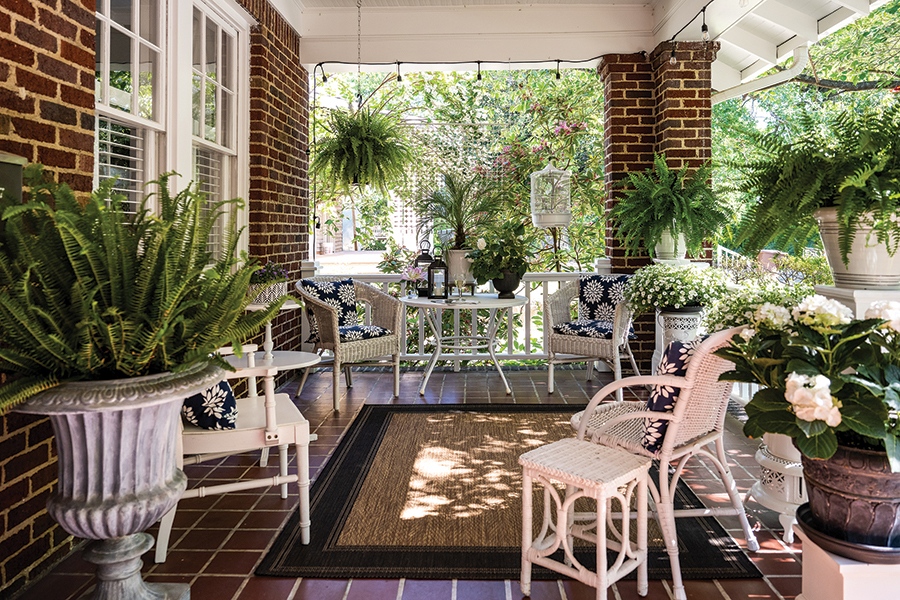
Across town from the Lee’s former home, a languishing Fisher Park bungalow awaited restoration. House rehab, even CPR. Having suffered a serious drubbing from neglect, it somehow, despite all, conveyed possibilities.

The red brick house with, of course, an inviting front porch sat close to the street, one defined by the district’s signature granite curbing.

Yet the bungalow’s best qualities were hidden. For most potential buyers in 1994, the listing sent off-putting distress signals. (I know, having seen the house while house hunting that year.) Not for Lynne.

“I like the feeling of the house,” Lynne says. “From the outside, it looks like a modest, unassuming house. People walk by and don’t even notice it. Inside, it’s a surprise. The rooms are lovely, big.”

Nonetheless, it was besieged with a host of challenges, but none beyond the Lees’ combined talents.


Inside were layers of paint, unsightly sprayed ceilings and the remnants of its student rental past. Clunky dead bolt locks defaced interior doors, and some of the original interior French doors had been removed. Like a lot of bungalows, it had only two bedrooms, one full-sized bathroom in need of repair and another half bath — stranded all the way out on the back porch. The kitchen was woefully dreary and, like everything else, needed attention.

Yet when Lynne was shown the house by her real estate agent, she picked up on something ineffable.

She loved the location. Even as an avid gardener, Lynne was not put off by the tiny front garden, nor by the rear garden, lacking privacy, which had a ramshackle garage and old iron swing. And yet . . . this was a place she could love.

The bungalow was everything their former house was not.

It had possibilities and history.

According to the National Register nomination and city directories, the house was originally built between 1920–24.  Additionally, records shared by Mike Cowhig, a neighbor of the Lees who works in historic preservation, indicate the original occupant was Harry Marks, a merchant who owned the Fashion Hat Store and O.Henry Shirt Company. (In 1939, Marks got into hot water, facing the Federal Trade Commission over accusations his shirts were not preshrunk as advertised.)

Great history. “Great house!” Cowhig adds. 

Also, the nomination noted that bungalows were the most popular and prevalent house style in Fisher Park, where 145 were built. The half-mile-square district also featured 60 foursquares, the next most popular style — but bungalows dominated.

The Lees were ready to ditch their home — “A new build. A small house,” according to Lynn — and go.

That “new” home, convenient to daughter Chloe’s school, was too new. 

Worse, the deck had revealed a disconcerting problem — rot! The Lees were disillusioned that such a new house was sprouting old house problems. 

With Chloe soon to finish school, there was no reason not to look elsewhere, preferably in established neighborhoods.

Lynne recalls beginning their search in earnest. “Our real estate agent took us to four or five houses that day.”

Finally, their agent showed Lynne the bungalow. “When she showed me this house, I said, ‘This is it!’  I knew that, even though it was in a horrible state,” she says.

When she later returned with Billy, he agreed with her assessment.   

They saw the same underlying potential: a good interior layout, good light and good bones, in an ideal location.

Where anyone else might have bolted, seeing only problems, they felt a pull. This house needed them.

Billy and Lynne Lee.

Born on opposite sides of the world, they both arrived as undergraduate art students at Birmingham College of Art and Design in Great Britain with ambitions to excel in the arts. Billy was from Uitenhage, South Africa, while Lynne was born in the U.K.

Billy completed graduate school at the Royal College of Art in London.

“We got married in London before we came over,” says Lynne with a still perceptible, plummy British accent. Billy earned a prestigious Kennedy scholarship to MIT, bringing the couple to the United States.

The Lees formed a creative and artful lifelong partnership. When Billy joined the art faculty at UNCG, they got to know the Gate City.

“Chloe was a little girl, age 7, when we came here to Greensboro,” says Lynne. “We used to go to Fisher Park, taking a picnic, and she would play in a stream.” The fixer-upper was within walking distance of that stream.

“We bought in 1994.  Moved in September,” she says. Damage control began.

“We moved in, redoing downstairs first.” Chloe, now a teen, had the upstairs floor.

Lynne recalls redoing the full bathroom as an early project: “There were only one-and-a-half baths,” she recalls. “It was awful!”

Give-and-take ensued. Initially, Lynne wanted to paint over the exterior red brick, but Billy disagreed. Lynne disliked the living room fireplace, but removal would have cost thousands. So, they whitewashed it.

Stonemason Andrew Leopold Schlosser probably did the stonework, Lynne confides.  (And, yes, that was the great-grandfather of O.Henry’s former contributing editor Jim Schlosser.)

Whereas Lynne originally wanted it banished, she’s now glad it stayed.  “There were other things we needed.  And I like it now.”

She enumerates stages of renovation. “We started work on it, putting in four new ceilings downstairs because somebody had done that textured stuff,” says Lynne, cringing. 

“We replaced all the ceiling moldings. We did it all ourselves.”

Painstakingly.

“We wanted to make changes but in keeping with the original house,” says Lynne. Once you start major changes such as knocking out multiple walls, she says, it’s easy to “lose the original feeling of the house. And that’s a shame.”

Scraping, planing, priming, even plugging holes left by the many dead bolts, a vestige of the rental years. 


“The woodwork in this house had about 12 layers of paint on it.  We did it room-by-room.” 

“Billy even took out the window frames and planed them down to restore them.” Every cabinet and feature in the course of renovation was the duo’s design and handiwork. 

They kept the footprint. Originally, “the kitchen was formerly a pantry, small dining nook and a small kitchen.”  It didn’t make sense, says Lynne, to have three separate, very small places.

“Billy couldn’t work during school time,” says Lynne. He worked during summers when he had a block of time. “So, we did the kitchen in two parts,” says Lynne.

“The first year, we knocked the wall down. The second year, we redid the other half of the kitchen.”

Billy built new kitchen cabinets that extend to the ceiling. He poured concrete countertops, which emulated stone.  Despite really liking them, “Eventually, though, they broke down — perhaps because they required sealing.” They replaced them with quartz.

She would sketch out her ideas, and Billy would execute them. As a sculptor, he was adept at creating and building structures, including custom cabinets in the dining room.

“We redid the utility room, raising the porch roof,” Lynne says.  A downstairs half bath beyond the kitchen received a makeover. 

They never regretted buying their little bungalow, even as the projects expanded and demanded Billy’s summers and free time.  Step by step, the Lees redid everything themselves, “except the electrical wiring and plumbing.”

Was there a moment when they thought, We can’t do this?

“No. I don’t think so. Never,” says Lynne firmly.  Their home and garden became their canvas.

And there was enough affection and excitement to see it through. 

As time allowed, they planned an en suite bath for Chloe’s upstairs’ aerie, which ran the width of the house. 

They had taken care to orient the bed and canopy on the slanting ceiling in such a way that light could still flood the room. Building a standard wall and door for the new bath might block incoming light, which Lynne considered to be the space’s best feature. 

“Billy sandblasted the glass in the door to allow for light,” Lynne says.

They “already had a clawfoot tub we had found in Raleigh,” says Lynne, who sometimes goes upstairs to read, now that Chloe is married and living in the Triangle.

The radiant home of two artists, its magic has been completely revealed.

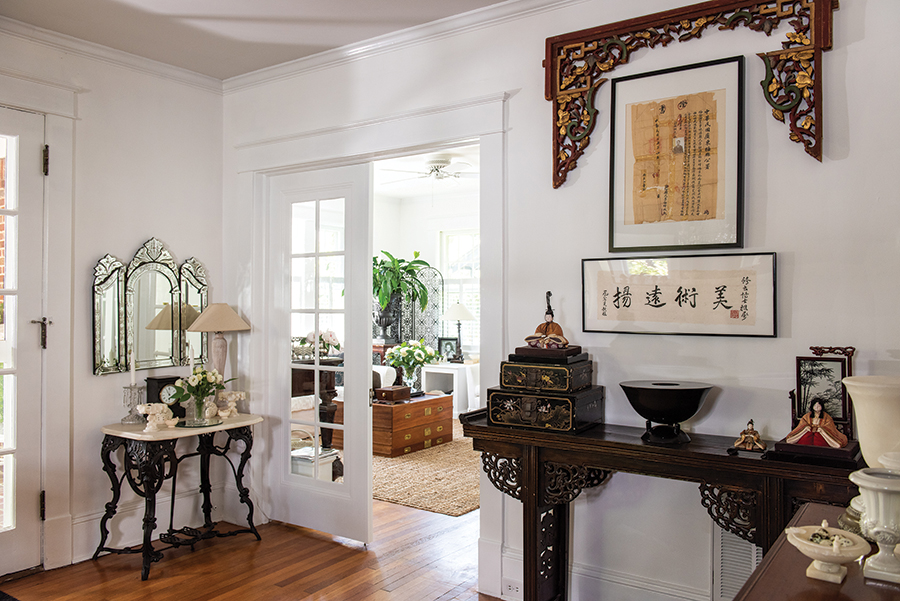
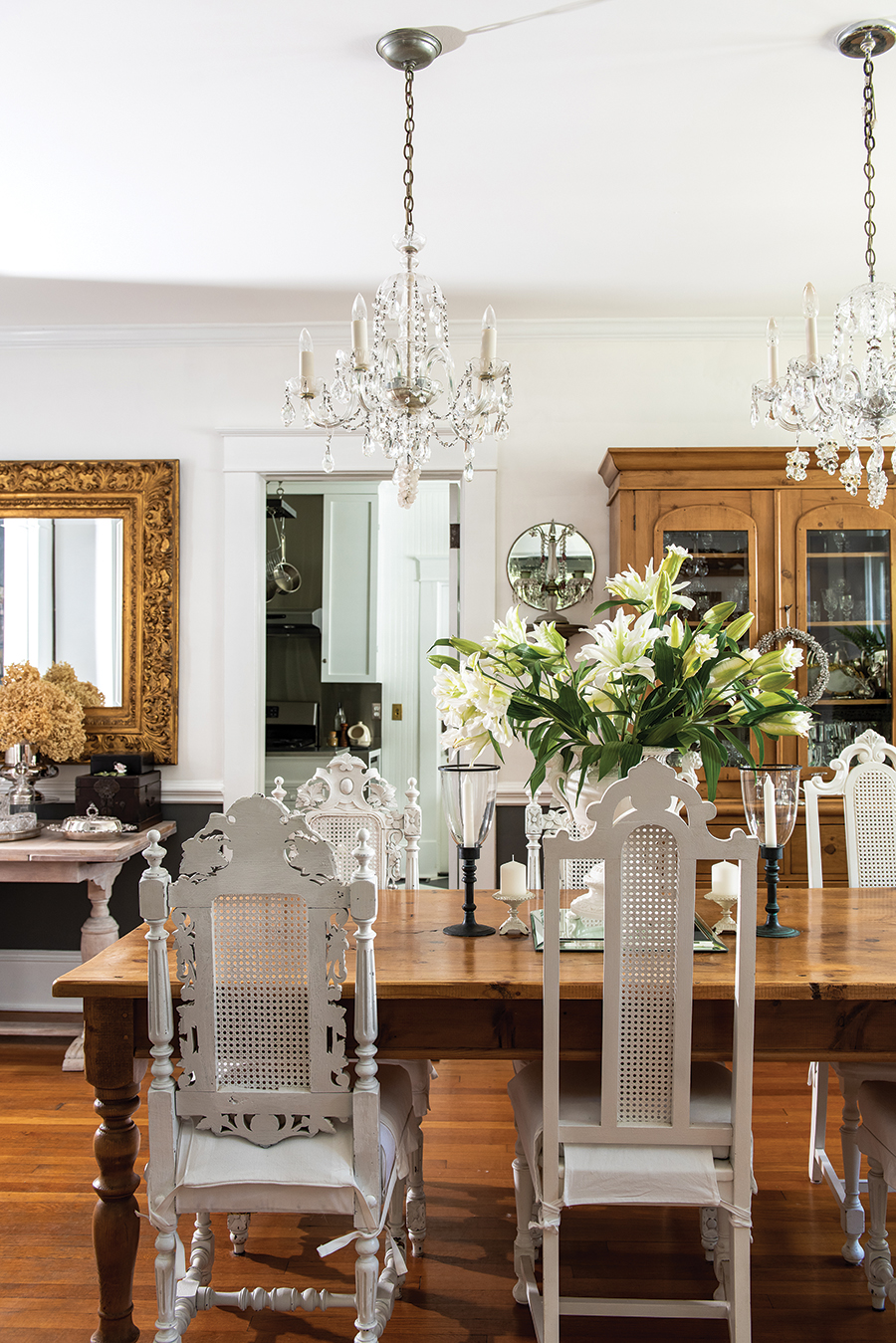
The interiors, replete with custom built-ins, cabinetry, radiator covers and even original crystal door knobs, are like an art installation. 

Unable to resist them when Lynne goes to the grocery, there are always fresh-cut white flowers out, lilies or roses, in creamware or crystal.

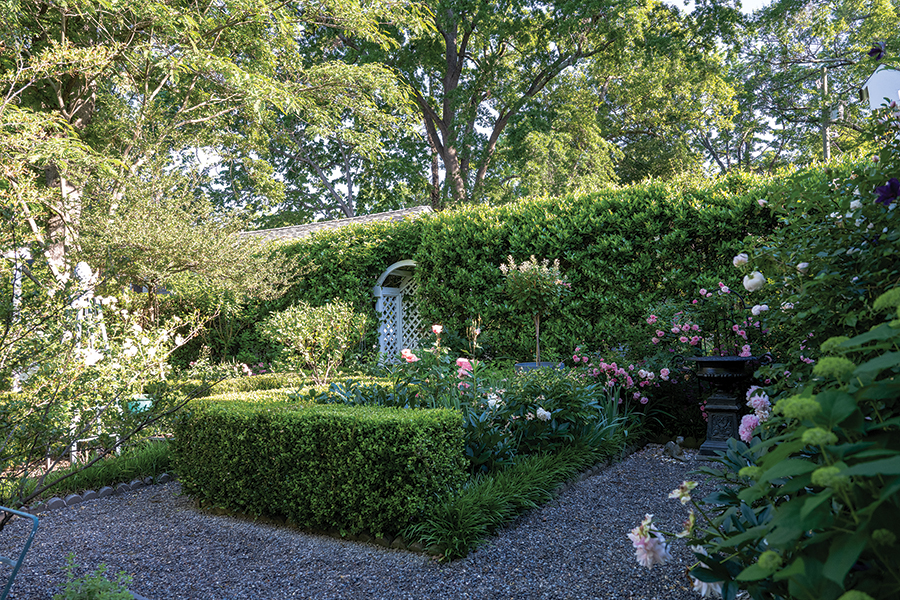
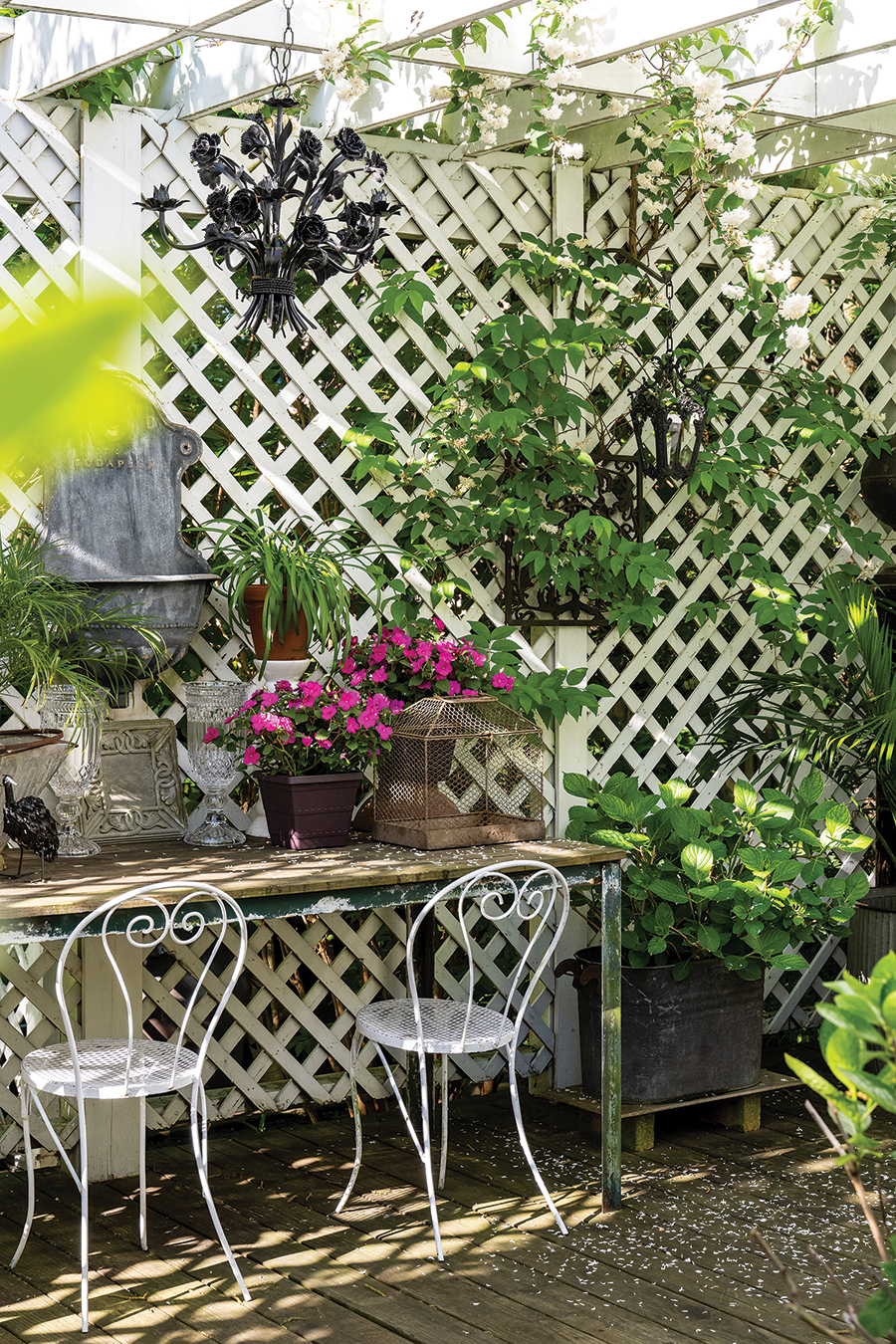
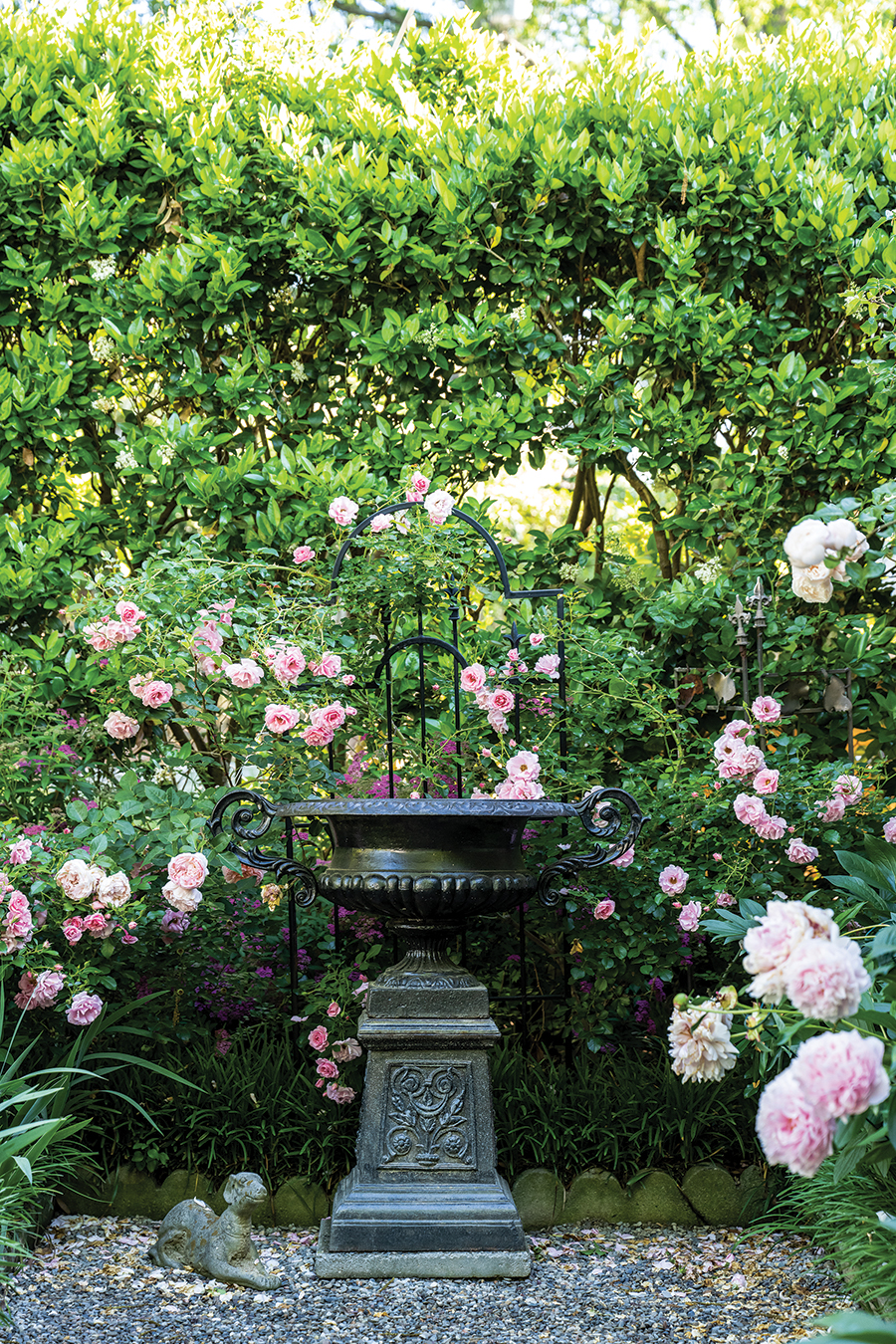
Then there are the garden’s outdoor rooms. Billy created a unifying structure of elevations, pathways and beds. A decade later, he added impressive hardscaping: fencing, trellises, arbors, a pergola and table, even steel tuteurs for the roses, all made by Billy’s two hands. 


The plantings mean a constant blooming palate, from roses and tree peonies in spring giving way to plumbago, hydrangea and annuals in the summer. Lynne masses plantings of bearded irises, garden phlox and lilies. Potted citrus trees — which winter indoors — grow lush outside over summer.

In 2004, their garden was featured in Garden Homes and Outdoor Living. “By placing tall plants and structures strategically, it became a three-dimensional space — like a home without a ceiling,” the writer enthused. “Billy’s forte is structure with the garden; Lynne is the planter.”

For all her gardening devotion, Lynne isn’t a purist. She doesn’t care about the Latin names for flowers. Instead, she cares about the flowers’ colors, favoring whites and pastels, scent and blooming season. (“Nothing lasts long here,” she says ruefully.)

The Lees have “before” pictures, before the present-day vision was realized, when the back garden was neither private nor lovely. 

In time, Billy placed three of his own sculptures outdoors, where they can enjoy them while having coffee or drinks. Greensboro’s Public Art Endowment’s first work is his Guardian II, a large sculpture at 201 South Eugene St., donated by Jane and Richard Levy. One of his pieces was recently acquired by Bill Sherrill for his art collection at Red Oak Brewery.

With an international following, Billy recently published a book of his works, entitled simply Billy Lee. Trevor Richardson, director of Herter Art Gallery at the University of Amherst, brings Billy’s astonishing body of work into focus, commenting that, “Billy Lee’s work could be said to be part of our experience . . . His tenacious way of dealing with it through his art offers — at the very least — a profound source of encouragement to us all.””

Now the house and garden to which Lynne and Billy Lee have given so much of their time and effort is reciprocating. When peonies bloomed in May, Lynne frequently found Billy in the garden with his camera. He was shooting the peonies for their figurative qualities, she explained. And they will inspire new work: sculpture he is considering. OH

Cynthia Adams is a contributing editor to O.Henry Magazine.

Birdwatch

Rare Bird Alert

Keep an eye out for the roseate spoonbill

By Susan Campbell

With its bright pink body, the roseate spoonbill is certainly the most distinctive and garishly colored bird in North America. And what about that odd bill? Although their typical range does not include North Carolina, spoonbills do stray into the extreme southeastern part of our state in late summer into early fall. So, if you keep your eyes peeled at this time of year, you may be lucky enough to spot one.

Research indicates that breeding colonies are found in parts of Florida, Louisiana and Texas. Unfortunately, the birds there are not widespread, even where they are regular. Loss of foraging habitat has restricted roseate spoonbills to protected areas such as wildlife refuges. Water quality has also reduced prey, as sedimentation and chemical pollution have inundated bays and estuaries in the Southeast.

There are several species of spoonbills worldwide, but roseate is the only one found on this continent. Their name comes from the birds’ bright red-pink plumage and spoon-shaped bill tip. Their extremely sensitive mandibles snap shut around food items such as small fish, crustaceans and insects found in the shallow waters they probe. Roseate spoonbills swing their heads side to side as they slowly walk though brackish or saltwater. The types of foods they capture result in their bright feathers.

Those amazing pink feathers put the birds at risk of extinction during the 19th century when many spectacularly colored birds were hunted for their plumes. The wings of roseate spoonbills were, unbelievably, actually sold as fans as well as for hats and other adornments.

When these amazing birds are spotted in our state, they are almost always mixed in with other waterbirds such as herons and egrets. They are extremely gregarious year-round. The best place to scan along the coast beginning in mid-July is Twin Lakes, in the Sunset Beach area. However, individual roseate spoonbills have also been found at Ocean Isle and North Topsail, as well as in the mouth of the Cape Fear in recent years.

Last summer, there were many reports of roseate spoonbills, not only inland in North Carolina but well to our north, including immature birds with their size and unusual bill as well as their pale pink plumage. One roseate spoonbill was sighted in Pinehurst and up to four in Woodlake. If you catch sight of one of these distinctive birds anywhere in the Sandhills or Piedmont, please let me know. OH

Susan Campbell would love to receive your wildlife sightings and photos. Contact her at susan@ncaves.com.

Jasmine Joy & Big Puff

Acupuncturist Heather Grant’s journey

By Ross Howell Jr.  .  Photographs By Lynn Donovan

On walks with Sprinkles, I’d often noted a business sign for Paradox Wellness in front of a two-story brick building on Bessemer Avenue, just around the block from where we live.

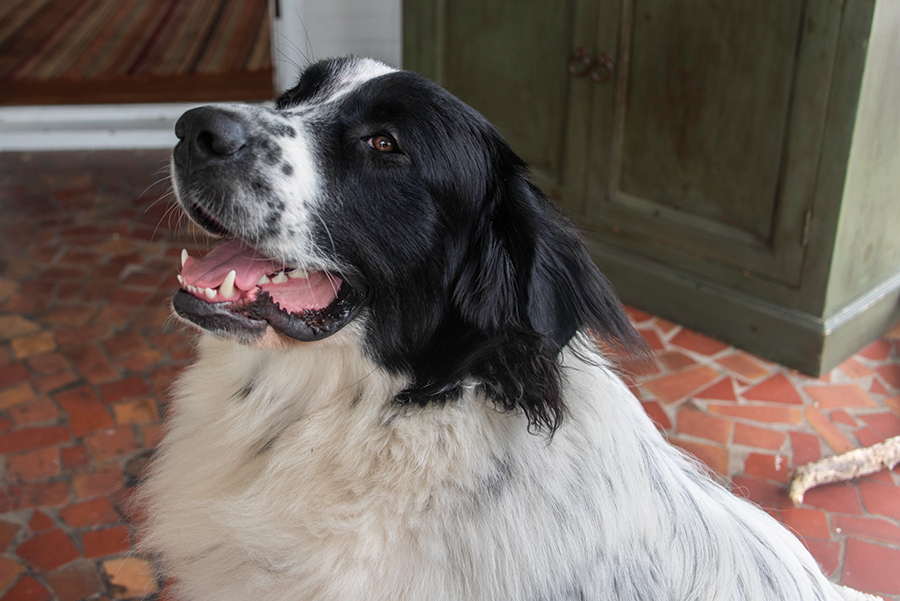
What both Sprinkles and I especially remarked as we passed was a black-and-white dog about the size of a Shetland pony poking his head between the balusters of the upstairs patio.

Turns out he’s a 1-year-old puppy named Big Puff. He’s in training as a service dog and patient greeter.

His person is Heather Grant, DACM (Doctor of Acupuncture and Chinese Medicine), the owner of Paradox Wellness.

And like many dog stories, this one is about a journey.

Heather moved to Greensboro from northern New Jersey when she was a teenager. Her father, an engineer, had taken a new job and was building a house for the family in Lake Jeanette. Heather first attended high school in McLeansville, then transferred to Page High School.

Since she’d taken extra classes as a student in New Jersey, “I had a lot of flexibility my senior year,” Heather says. “It was neat, because I took four art classes and AP chemistry.”

Accepted to North Carolina State University, Heather enrolled in chemical engineering.

“I had no idea what I wanted to do,” she says, “but my Dad’s an engineer, and since I’m really good in math and science, everybody in the family would say, ‘Heather’s going to be an engineer.’”

But an elective class in cultural anthropology at NCSU opened a path quite different from traditional chemical engineering — though it still involved chemistry.

“I wanted to go live with the Yanomami tribe in the rainforest of Brazil,” Heather says, “and learn about their natural medicines.”

So her sophomore year, Heather changed her major to anthropology. She applied to participate in the NCSU ethnographic field school program in Costa Rica.

Not long after she arrived in Costa Rica, a man broke through Heather’s window and assaulted her. To this day she copes with posttraumatic stress disorder.

“I tried to stay in the program but I just couldn’t sleep,” she says. “I decided I didn’t want to be an ethnographer anymore.”

So Heather returned to North Carolina, deciding the Outer Banks might be a good place to heal. She wound up staying there for five years, mostly in Corolla. She found a roommate to share expenses, a woman who had lived on the Outer Banks for more than 40 years.

“My roommate was really neat,” Heather says. Importantly, her roomie taught her a good trade — bartending.

“But I didn’t want to spend my whole life tending bar on the Outer Banks,” she continues. “I wanted to do more.”

Heather describes waking up one night from a dream. “I just felt like I had to go back and finish school,” she says.

As she was leaving the Outer Banks, Heather stopped at Sanderling Resort to get a massage.

“The therapist told me that if I liked what he did, I would love what his wife did with her needles,” Heather says. “That’s how I discovered acupuncture.”

A few months after returning to Greensboro to be near her family, she came across a stray puppy at a gas station off Bessemer Avenue.

It was life changing.

“That was Jasmine Joy,” Heather says. She brought the puppy home: “She was my companion.”

The two lived together in an apartment on Hendrix Street, very near the location of her business today. When Heather found she needed to move out of her apartment, she decided to take an even bigger step.

She loaded puppy Jasmine in her car and traveled cross country to study at Yo San University of Acupuncture and Traditional Chinese Medicine in Los Angeles.

“My study was really intense,” Heather says. Typically, a Master’s degree requires four years of year-round, full-time study. Not only did Heather have to work in order to pay for school and support herself, but she also lost stability function in her left ear in reaction to a medication.

“The spinning was so bad,” she comments, “I was hardly able to open my eyes.”

“That’s when I trained Jasmine to be a service dog,” Heather says. “She just saved me.”

It took Heather five-and-a-half years to complete her degree. After a decade in California, degree and license in hand, she returned to Greensboro.

“I flew on travel miles and Jasmine flew first class so she’d have enough leg room,” she laughs.

Heather opened Paradox Wellness at the corner of Bessemer Avenue and Elm Street on January 4, 2017. Her residence was an upstairs apartment in downtown Greensboro.

Then Jasmine became paralyzed in her hips.

The dog weighed 65 pounds, too heavy for Heather to carry up and down steps.

“I moved into my business because it was on ground level,” she says. “I got her a wheelchair.” And she treated Jasmine with acupuncture every day.

“People thought I should’ve put her down,” Heather adds, “but I see this medicine do miracles all the time.”

Jasmine finally was able to walk again and enjoyed her last few months.

“When she died, I just sat on my couch and stared,” Heather says. “She was a great dog.”

Heather whispers, “I pray about her every day.”

She had no plans to get another dog.

But after moving into her current location, Heather kept having what she calls an “intuition.”

“It was Jasmine, really, saying, ‘Look for a dog, look for a dog,’” Heather recalls.

“And I would say, ‘I’m not ready!’” she continues.

Eventually Heather Googled, and up popped a 25-pound, 10-week-old, last-of-the-litter son of a Newfoundland mother and Great Pyrenees father. Both breeds are heralded for their strength, calm demeanor and size — adults can weigh 150 pounds.

Heather drove out to visit the couple who owned the puppy.

“I told them my heart’s not attached to this,” Heather explains, “but I want to see if we choose each other, you know? So I went over and sat next to him.”

“And he chose me,” Heather says. “When I was first beside him, he was kind of reserved and then he was panting and doing his big smile and the woman said to her husband, ‘I feel good about that, do you feel good about that?’ And he said, ‘I feel good about that,’ and I said, ‘I feel good about that,’ and that was that.”

Almost. Heather, at the time, drove a Fiat. When a friend saw Big Puff in the car, the friend told her, “You’re going to need a new car.”

So she changed her lease to a Ford Ecosport, and realized that vehicle also was too small. Now Heather has a Honda Pilot.

“Having a dog, that’s a lifestyle, that’s a huge commitment,” Heather says.

“I love Puff so much,” she continues. “He brings me so much joy, but he’s not a replacement for Jasmine. I love him in his own special way.”

Then there’s his job. Heather tells me how he loves to greet the patients. He likes to lie outside their treatment rooms, guarding them.  When treatment is finished, he likes to accompany patients to the door.

“I have a lot of people I’m treating with acupuncture for anxiety,” Heather says. “When they come in for the first time, some of them aren’t real excited about the idea of needles, right? But having Puff here helps calm them. They’ll say, ‘I’m so happy he’s here.’”

“Everybody loves Puff,” Heather says.

“I’ve learned in life you can’t plan a lot of things,” she continues. “You have to stay flexible and keep moving forward. I always ask myself, ‘How can I make my dream workable for Puff?’”

We’re sitting in Heather’s office, another point in her journey. The room is painted a dark, soothing color. I see glittering glass jars of Chinese herbs — her apothecary — in an adjoining room.

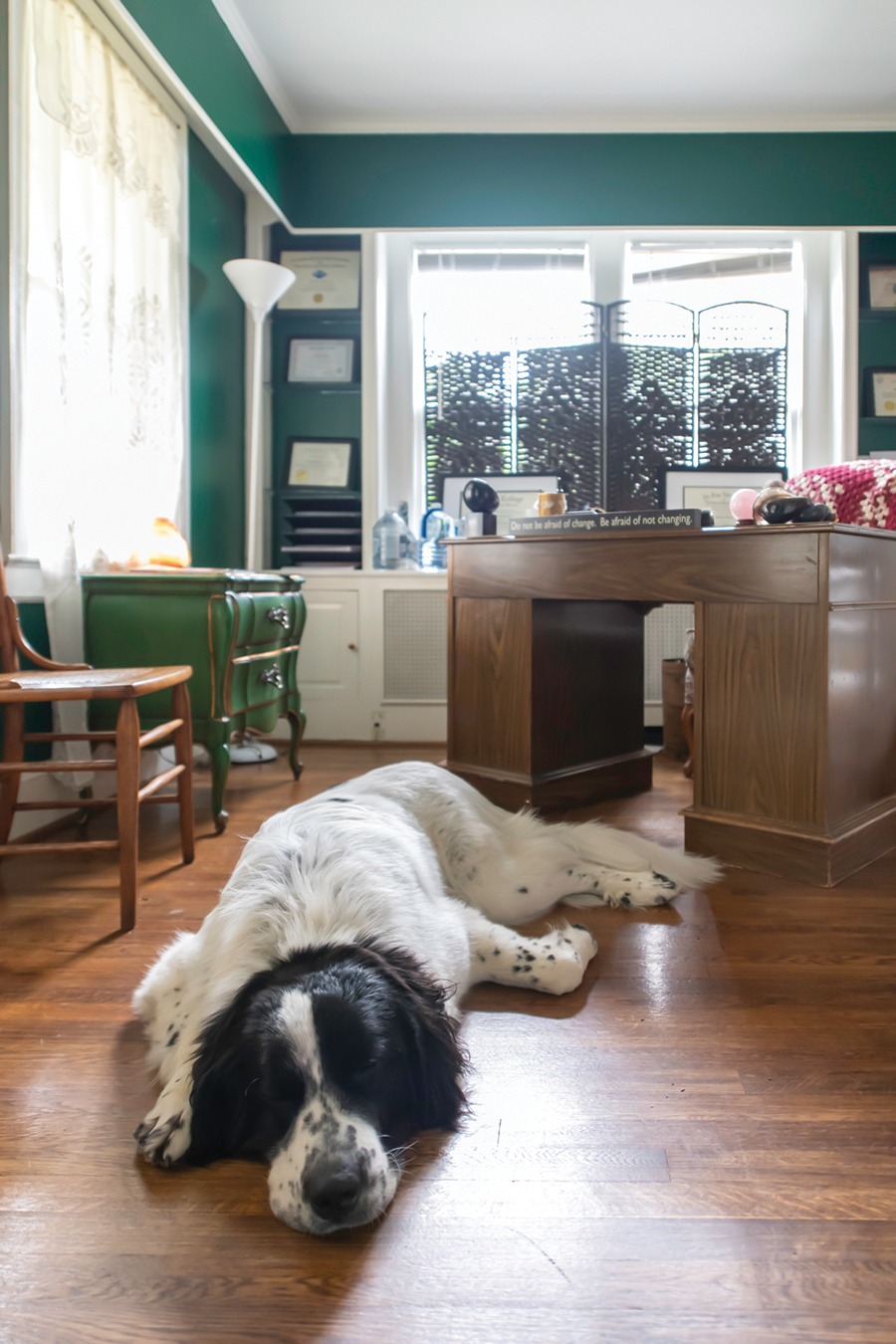
Big Puff lies on the floor by my chair, resting his big head on his paws.

“I found Jasmine right up the street,” Heather says. “I don’t know what the significance of this little block of Fisher Park is, but for some reason, there’s something here that has always pulled me back.”

The windows behind her are decorated with jasmine flowers.Heather explains how patients come to her thinking they have all sorts of individual things wrong with them, while Chinese medicine looks at diagnoses in terms of patterns.

“It’s awesome,” she says. “I treat a lot of difficult cases — Bell’s palsy, Ramsay Hunt syndrome, stroke patients, insomniacs — and I get to watch this medicine create joy in people’s lives.”

“I have what I wanted,” Heather continues. “It just didn’t come to me the way I thought it would. All these beautiful things happen, but it can be hard roads to get there.”

She pauses, reflecting.

“And Puff makes everything so much better,” Heather concludes. Then smiles. OH

Ross Howell Jr.’s novel, Forsaken, was nominated for the 2017 Southern Book Prize in Historical Fiction. It’s available wherever books are sold.