Simple Life

SIMPLE LIFE

The Light in August

Catch it before it fades

By Jim Dodson

Most mornings before I begin writing (often in the dark before sunrise), I light a candle  that sits on my desk.

Somehow, this small daily act of creating a wee flame gives me a sense of setting the day in motion and being “away” from the madding world before it wakes. I sometimes feel like a monk scribbling in a cave.

It could also be a divine hangover from early years spent serving as an acolyte at church, where I relished lighting the tapers amid the mingling scents of candle wax, furniture polish and old hymnals, a smell that I associated with people of faith in a world that forever hovered above the abyss.

According to one credible source, the word “light” is used more than 500 times in the Bible, throughout both Old and New Testaments. On day one of creation, according to Genesis, God “let there be light” and followed up His artistry on day four by introducing darkness, giving  light even greater meaning. The Book of Isaiah talks about a savior being a “light unto the gentiles to bring salvation to the ends of the world.” Throughout the New Testament, Jesus is called the “Light of the world.”

But spiritual light is not exclusive to Christianity. In the Torah, light is the first thing God creates, meant to symbolize knowledge, enlightenment and God’s presence in the world. Surah 24 of the Quran, meanwhile, a lyrical stanza known as the “Verse of Light,” declares that God is the light of the heavens and the Earth, revealed like a glass lamp shining in the darkness, “illuminating the moon and stars.”

Religious symbolism aside, light is something most of us probably take for granted until we are stopped in our tracks, captivated by the stunning light show of a magnificent sunrise or sunset, a brief and ephemeral painting that vanishes before our eyes.

Sunlight makes sight possible, produces an endless supply of solar energy and can even kill a range of bacteria, including those that cause tetanus, anthrax and tuberculosis. A study from 2018 indicated rooms where sunlight enters throughout the day are significantly freer of germs than rooms kept in darkness.

The intense midday light of summer, on the other hand, is something I’ve never quite come to terms with. Many decades ago, during my first trip to Europe, I was fascinated (and quite pleased, to be honest) to discover that, in most Mediterranean countries, the blazing noonday sun brings life to a near standstill. Shops close and folks retreat to cooler quarters in order to rest, nap or pause for a midday meal of cheese and chilled fruit. I remember stepping into a zinc bar in Seville around noon and finding half the city’s cab drivers hunkered along the bar. The other half, I was informed, were catching z’s in their cabs in shaded alleyways. The city was at a complete, sun-mused halt.

The Spanish ritual of afternoon siesta seems entirely sensible to me (a confirmed post-lunch nap-taker) and is proof of Noel Coward’s timely admonition that “only mad dogs and Englishmen go out in the midday sun.” Spend a late summer week along the Costa del Sol and you can’t avoid running into partying Brits on holiday, most as red as boiled lobsters from too much sun. 

In his raw and gothic 1932 novel, Light in August, a study of lost souls and violent individuals in a Depression-era Southern town, William Faulkner employs the imagery of light to illuminate marginalized people struggling to find both meaning and acceptance in the rigid fundamentalism of the Jim Crow South.

For years, critics have debated the title of the book, with most assuming it is a direct reference to a house fire at the story’s center.

The author begged to differ, however, finally clearing up the mystery: “In August in Mississippi,” he wrote, “there’s a few days somewhere about the middle of the month when suddenly there’s a foretaste of fall, it’s cool, there’s a lambence, a soft, a luminous quality to the light, as though it came not from just today but from back in the old classic times. It might have fauns and satyrs and the gods and — from Greece, from Olympus in it somewhere. It lasts just for a day or two, then it’s gone . . . the title reminded me of that time, of a luminosity older than our Christian civilization.”

I read Light in August in college and, frankly, didn’t much care for it, probably because, when it comes to Southern “lit” (a word that means illumination of a different sort), I’m far more attuned to the works of Reynolds Price and Walker Percy than those of the Sage of Yoknapatawpha County. By contrast, a wonderful book of recent vintage, Anthony Doerr’s All the Light We Cannot See, tells the moving story of a blind, French girl and young, German soldier whose starstruck paths cross in the brutality of World War II’s final days, a poignant tale shot through with images of metaphorical light in a world consumed by darkness.

But I think I understand what Faulkner was getting at. Somewhere about middle-way through August, as the long, hot hours of summer begin to slowly wane, sunlight takes a gentler slant on the landscape and thins out a bit, presaging summer’s end.

I witnessed this phenomenon powerfully during the two decades we lived on a forested coastal hill in Maine, where summers are generally brief and cool affairs, but also prone to punishing mid-season droughts. Many was the July day that I stood watering my parched garden, shaking my cosmic gardener’s fist at the stingy gods of the heavens, having given up simple prayers for rain.

On the plus side, almost overnight come mid-August, the temperatures turned noticeably cooler, often preceding a rainstorm that broke the drought.   

When summer invariably turns off the spigot here in our neck of the Carolina woods, sometime around late June or early July, I still perform a mental tribal rain dance, hoping to conjure afternoon thunderstorms that boil up out of nowhere and dump enough rain to leave the ground briefly refreshed.

I’ve been fascinated by summer thunderstorms since I was a kid living in several small towns during my dad’s newspaper odyssey through the deep South. Under a dome of intense summer heat and sunlight, where “men’s collars wilted before nine in the morning” and “ladies bathed before noon,” to borrow Harper Lee’s famous description of mythical Maycomb, I learned to keep a sharp eye and ear out for darkening skies and the rumble of distant thunder.

I still gravitate to the porch whenever a thunderstorm looms, marveling at the power of nature to remind us of man’s puny place on this great, big, blue planet.

Such storms often leave glorious rainbows in their wake, supposedly a sign (as I long-ago learned in summer Bible School) of God’s promise to never again destroy the world with floods.

Science, meanwhile, explains that rainbows are produced when sunlight strikes raindrops at a precise angle, refracting a spectrum of primary colors.

Whichever reasoning you prefer, rainbows are pretty darn magical.

As the thinning light of August and the candle flame on my desk serve to remind me, the passing days of summer and its rainbows are ephemeral gifts that should awaken us to beauty and gratitude before they disappear.

Home Grown

HOME GROWN

The Long Game

Sticking our necks out to see African wildlife

By Cynthia Adams

My first trip to meet my new husband’s South African friends and family included days spent in Kruger National Park. “Park” sounds inadequate. It’s the size of Israel.

Upon arrival, park rangers handled admissions. Today, the 7,576-square-mile park’s entry fees translate to about $28. I can’t recall costs at the time, but it was easily half of that price. Tours are self- or ranger-guided, but we opted for self-guided, which fit our paltry budget.

The map, along with the ranger’s terse warnings, was free:

Enter at your own peril. 

Stay in your car with the windows up.

If you ignore that advice, beware: There are a number of wild, hungry creatures roaming freely within the park that would enjoy dining on you. 

Be assured, you are on your own.

With that, we drove right in. On our own. Car windows, barely cracked open, turned us into a pre-warmed hors d’oeuvre for the ravenous beasties lurking about.

Unlike most public attractions in the U.S. with a slew of warning signs and legal disclaimers, South Africans treated park-goers like adults, assuring you that you alone bear the consequences of your choices. 

True fact: More than 12,000 warning and safety signs are posted at attraction entrances in Disney parks and resorts. Litigious Americans apparently require them. 

We were to remain on our own until reaching one of the park’s intermittent compounds, where we could either camp in a tent or, with a reservation, stay in a small, thatched-roof bungalow (called a rondavel) available for reasonable cost. 

The famous game park was home to all “big five” — lion, elephant, buffalo, rhino and leopard. And, of course, giraffes. We proceeded to find a watering hole where we hoped to spot a big beastie.

Speaking of water: Yes, you are warned at entry not to leave your car, but a day in a car without a potty break is impossible. And, at the time we visited, there were NO easily available restrooms. Just miles and miles of dirt roads. You seldom encountered humans along the way. But you just might find the road blocked by an elephant.

Possessing the bladder of a small child, eventually, I had to stop. Urgently, I summoned my husband to stand guard as I scanned the landscape, vitally aware that the greater number of the wild animals calling Kruger home were not altogether friendly. 

Just after I dropped my shorts, he began waving wildly. Meanwhile, I heard nothing — no snapping of a twig, nor the padding of a paw. Thankfully, no snarling.

NOTHING but my own noisy flow. 

My husband waved more frantically.

My heart stopped. But I was helpless in that moment.

He pointed madly behind me, mouthing something, and I was sure the lions we had been hoping to see since morning had instead found my white, shiny backside and were about to pounce on the snack I had witlessly offered up.  

What an end, I thought, heart thundering. I’ll never live this down, which, actually, would have been true had I been eaten while relieving myself in a public game park.

Imagine the TV reports. Imagine the stern faces of the park rangers, wagging a finger.

Shakily turning, still crouching, I observed that there was no big cat behind me — but two giraffes. Their impossibly slender necks were turned, their lash-rimmed eyes fixated. On me.

Know this: These are enormous animals. It was hard to breathe, given two competing thoughts: relief, given they were not aggressive beasties, and fear they would bolt. But the giraffes stood noiselessly, observing me as if amused, before they pivoted, moving away. Let me re-emphasize this: soundlessly.

In a later trip to another South African public game park, we were again on the lookout for big cats when a group of giraffes came into view. 

We stopped the car, admiring their balletic movements.

Then, without any ado, a female dropped her baby, giving birth where she stood, the calf dangling by the umbilical cord.

I imagine it is rare to witness the birth of a giraffe, but the mother seemed nonplussed. Within minutes, the calf seemed to find its wobbly footing and walked.

Inspired by this, we staked out another watering hole for hours, determined this was a harbinger; this time we might glimpse a big cat. Instead, what we encountered was a roving pack of peculiar wild canines also known as painted dogs.

The mangy-looking, elusive mongrels turned out to be an endangered species and highly protected for their rarity.

And rarely seen.

So help me.

“Tell us about the big game!” friends invariably asked when we returned. We raved about watching rhino. Elephants. Wildebeests. Impala. Springbok. Giraffe. And even unnerving encounters with green-and-black mambas. OK. So what if we didn’t see any lions? (Not then, nor on subsequent game park visits, FYI.)

And as their eyes widened, we dropped our biggest brag: wild dogs.

Like my trousers on that fateful day, their faces promptly fell.

Omnivorous Reader

OMNIVOROUS READER

The Untethering of Time

Finding the truths in historical fiction

By Anne Blythe

These days, as social media platforms and conflicting political rhetoric abound, it can be difficult to discern fact from fiction. It’s tempting to reflect on the past to try to understand what might be prologue.

Sometimes, though, the history that has been fed to us over time turns out to be pure fiction — or at least some version of it. Other times fiction is better able to get to the nitty-gritty truth. Historical fiction with its modern lens on days gone by can release the anchors of time and enhance a reader’s experience and understanding of the past in ways that non-fiction does not always accomplish.

Three North Carolina writers from this genre, to name a few, have taken a stab at blurring the lines between the invented and the real with new historical fiction that spans many decades, and in one case centuries.

Charlotte-based author Joy Callaway transports readers of her seventh book, The Star of Camp Greene: A Novel of WWI, far beyond the Queen City’s modern financial district and tree-lined neighborhoods back to 1918, when the U.S. Army had a training facility about a mile west of what is now Uptown.

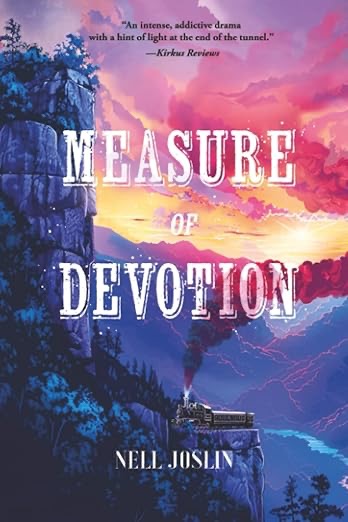
Nell Joslin, a Raleigh lawyer turned writer, takes readers of her debut novel, Measure of Devotion, back to the Civil War era as she chronicles a mother’s harrowing journey from South Carolina, where she was a Union supporter, to the battleground regions of southeastern Tennessee to tend to her critically wounded son, who enlisted with Confederate troops in defiance of his parents’ wishes.

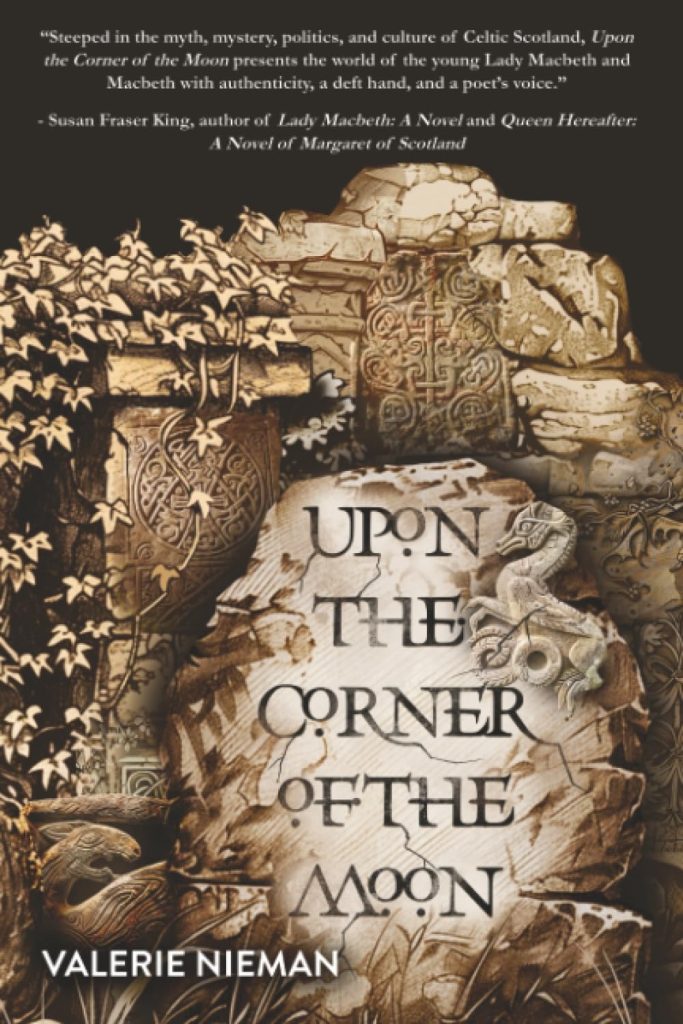
And Reidsville-based Valerie Nieman, a former newspaper reporter and editor turned prolific author, takes readers on a journey to ancient Scotland in Upon the Corner of the Moon in her imagined version of Macbeth’s childhood before he became King of Alba in 1040.

Though the books are very different, each was born from digging through historical documents, archives and histories of the time, as well as a bit of on-the-ground research.

Callaway’s main character, Calla Connelly, is based on the real-life vaudeville star Elsie Janis, a so-called “doughgirl” who sang, spun stories and cartwheeled across the stage for American troops on the Western Front. The Star of Camp Greene opens with Calla toughing her way through a performance in the makeshift Liberty Theatre tent at the North Carolina training camp. The soldiers gathered were all smiles until a pall was cast over her act by the news of deaths in the Flanders battlefields near Brussels.

Despite the push of men moving to the back of the tent to absorb the unwelcome announcement, Calla thought it was important to continue the entertainment, providing a crucial diversion during somber times. But her head hurt. Sweat soaked through her costume as heat flushed through her body before an icy cold set in. The Spanish flu was circulating around the world, claiming more lives than the overseas conflict for which Camp Greene was training soldiers.

Calla was bent on impressing the men enough that word would spread to Gen. John J. Pershing. In her mind, he would make the final decision whether or not she could join the team of performers who traveled overseas to entertain the troops — and thus honor the memory of the fiancé she had lost to the war there. But she couldn’t stop the spinning as she tried desperately to belt out lines from George M. Cohan’s “Over There.”

Stricken with the deadly influenza, Calla ends up in the hospital. While recuperating, she overhears a piece of classified military intelligence resulting in her confinement at the Charlotte camp, where she’s assigned a chaperone until further notice. While prevented from traveling to the front, it opens her to the possibility of new love and gives Callaway an opportunity to explore themes of patriotism and injustice.

Measure of Devotion also tells the story of a war era through a strong, compelling female character. Through vivid and immersive writing, Joslin uses the 36-year-old Susannah Shelburne to bring life to the story of mothers nursing wounded sons near Civil War battlefields.

Susannah, who grew up in Madison County, North Carolina, and her husband, Jacob, live in South Carolina, where they are opposed to slavery in the very land that is fighting to preserve it. Jacob’s family had owned slaves, but the thought of another person being nothing more than property appalled him. After inheriting Hawk, Jacob granted him his freedom and paid him to work for him. They also employed Letty, a character whose homespun wisdom, optimism and love adds a welcome layer to a tender and complicated story.

The Shelburnes’ son, Francis, joined the 6th South Carolina Volunteers in the early years of the war, and on Oct. 29, 1863, his parents receive a telegram letting them know that their son had been severely wounded by shrapnel near his hip joint. Susannah leaves her ailing husband and travels by rail to Lookout Mountain, Tennessee, with hopes of sparing Francis’ leg from amputation while nursing the 21-year-old back to health. He’s in a fevered state when she arrives.

Joslin adroitly and compassionately explores heady themes that divided the country more than 150 years ago, and the hardships and ravages of a nation at war with itself.

Nieman’s Upon the Corner of the Moon is book one of two that explores some of those same issues in 11th-century medieval Scotland. Rather than relying on William Shakespeare’s depiction of Macbeth, Nieman alternates her deeply researched tale of the budding powers of the Macbethian royal court through three voices — Macbeth, Gruach, who becomes his queen, and Lapwing, a fictional poet.

Separately, Macbeth and Gruach are spirited away from their parents to be fostered into adulthood during an era of constant warfare and the unending struggle for power. Nieman ladles up a dense, deeply reported version of these two well-known characters before they meet. We see Macbeth as an adolescent warrior in the making, and Gruach being groomed in Christian and pagan ways to be given away in marriage. Ultimately, what unfolds is a tale of legacy, power and fate.

These three books of historical fiction bring factual bits of the past to the present, leaving much to ponder about their truth.

Wandering Billy

WANDERING BILLY

Justice Delayed…

Diving into the deep end of a 1950s-era poolside predicament

By Billy Ingram

Ah, summer, what power you have to make us suffer and like it.” — Russell Baker

Seventy years ago, in the summer of ’55, a paddling of people numbering in the thousands, swimming-trunked with towels shoulder-slung and slathered in Sea & Ski, descended en masse for the opening day of the newly minted Lindley Park municipal swimming pool. It wasn’t long, however, before that above ground complex began making waves, awash in a clash of cultures that seemed to fall on waterlogged city leaders’ ears.

It’s one of our city’s loveliest and most serene neighborhoods, but, beginning in 1902 before any homes were ever conceived of there, Lindley Park was originally an amusement park, complete with a sprawling lake, casino, dance pavilion, 1,000-seat vaudeville theater, miniature railroad, electric fountain and a cozy cafe. Live entertainment consisted of a trapeze act, a spunky monkey and a chatty parrot who likely ended up as a curiosity in the basement level of Silver’s 5–10¢ and $1.00 Store on South Elm and Washington.

The city’s first public park was named after J. Van Lindley, whose nearby 1,000-plus-acre nursery, established around 1850, was likely one of the largest in the world, with some 1.5 million plants under cultivation. Lindley lent 60 acres of the eastern end of his property to the Greensboro Electric Company with a proviso that they establish an entertainment destination there to coincide with the 1902 debut of the Gate City’s first mass transit system.

For less than a dime, commuters could trolley from North Elm downtown to the farthest western stop on Spring Garden Street, destined for the enchanted land of Lindley Park, where they could spend the day boating, swimming and tightrope gawking. Propelled along rails embedded into brick-lined streets and powered by overhead electrical wiring, a fleet of streetcars criss-crossed the city north to Sunset Drive, south down Asheboro Street (now MLK Drive), and both east and west on Market. 

After the amusement park closed in 1917, Lindley gifted that real estate and another parcel to the city with a caveat — that a spacious, refined community be established there, designed by preeminent Southern landscape architect Earl Sumner Draper, who was behind Charlotte’s Myers Park and High Point’s Emerywood, among other tony neighborhoods. The lake was reduced to a creek with landscaped banks, making it a 107-acre verdant centerpiece to surrounding homes, soon to be constructed in a wide array of architectural styles, favoring Craftsman and Colonial Revival.

Endeavoring to reintroduce recreation to Lindley Park in 1955, the city sunk $200,000 into a public swimming pool designed to accommodate up to 800 sun worshippers, with 10 wide lanes for competition swimming and a cutting-edge aquatic sport scoreboard. There was one other city-owned pool in Greensboro reserved for the Black community built in 1937, located at Windsor Recreation Center on Lee and Benbow streets. After two Black women, Dr. Ann Gist and Ms. J. Everett, were turned away from the Lindley facility in June of 1957, the NAACP petitioned the city to integrate the pools.

Council members and apparatchiks such as Parks and Recreation commissioner Dr. R. M. Taliaferro voiced opposition to any attempt to abrogate the Jim Crow status quo. Current in their minds was the wanton unrest that erupted just a few Junes ago when Atlanta and St. Louis incited white rioters after their swimming pools were integrated.

Facing a potential unruly undertow that city leaders were loath to be swallowed up by, their initial reaction was to nuke the pools, plow them under, before realizing that a legal loophole could serve as a flotation device. At that time, private entities were at liberty to discriminate indiscriminately, so it was resolved to offload these two chlorinated, all-of-a-sudden nuisances at auction, sold to the highest (like-minded) bidder, thereby surreptitiously preserving this pernicious practice. That brazen tactic triggered a preemptive lawsuit (Tonkins v. City of Greensboro) adjudicated downtown in the U.S. Middle District Court.

In May 1958, the court ruled in favor of the defendant but deferred dismissing the suit until 30 days after the sale of the pool “to give the plaintiffs an opportunity to show that the sale was not bona fide in the sense that there was collusion between the defendants and the successful bidder regarding the future use of the pool.” In other words, the plaintiff had a short window of time after the sale to prove it had actually been rigged by the city to enshrine segregation.

On June 3, 1958, J. Spencer Love purchased the “lake-sized” pool at Windsor Center, turning the operation over to David Morehead, executive secretary of the Hayes-Taylor YMCA. The Lindley Park aquatic center was acquired for $85,000 (only 3 years old, what a bargain!) by a hastily assembled coalition calling themselves Greensboro Pool Corporation, one of the organizers being none other than the aforementioned Dr. Taliaferro. No surprise, the Lindley pool would remain whites-only.

Did someone mention collusion? An appeal to Tonkins v. City of Greensboro was filed, one of the attorneys consulting on the case being future Supreme Court Justice and legendary Civil Rights leader Thurgood Marshall. Argued in January 1960, a ruling in March declared that the plaintiffs had not met their burden of proof. While recognizing that Taliaferro had openly opposed desegregating the property and was instrumental in setting up Greensboro Pool Corporation, the judge ruled, “he was a member of a nine-man commission, which serves in an advisory capacity only, legal authority [for the sale] being in the City Council of which he was not a member.”

In 1967, just as an expanding, yet-to-be-named, Wendover Avenue (a road that began as a wagon trail rut in 1753) was carving away some 25 acres of the district, the City of Greensboro reacquired the Lindley Park Pool, making it accessible to all. A year later, a new swimming pool replaced the three-decades-old hole at Windsor Center, which, today, is being reimagined as the Windsor Chavis Nocho Community Complex, a 65,000-square-foot facility with, among many other impressive amenities, a lap pool, lazy river and water slide.

Meanwhile, drowning under innumerable structural and mechanical quagmires, the Lindley Park Pool at 2914 Springwood Dr., now our city’s oldest, has been hung out to dry since 2023 but workers are resolute to rehydrate that concrete crate sometime this season.

Just this morning, I ventured out, hoping to uncover the one remaining remnant from Lindley Park’s initial 15 years as our nascent township’s sideshow. Not shy about wandering around, behind a hilltop home on Masonic Drive, I discovered a dollhouse-like, wooden women’s cabana with dual French doors that once sat lakeside.

Bracketing the neighborhood entryways off Spring Garden are matching stone monuments. Characterized by obelisks boldly asserting themselves where the amusement park’s mammoth arched gateways were positioned on either side of the lake, they were installed in 1924, when Earl Sumner Draper’s master plan was nearing completion. Over a century later, those monuments still warmly welcome visitors and residents alike to a shady little lady known as Lindley Park.

Chaos Theory

CHAOS THEORY

The Game of the Name

An homage to Mark Twain, Ralph Waldo Emerson and Laura Ingalls Wilder

By Cassie Bustamante

When my daughter, Emmy, met her first-year Penn State roommate, Taylor, online this summer, the young women exchanged full names for their roommate request forms.

“Emerson is your full name?” Taylor texted. “It’s really pretty! My mom thought so, too.”

“Yeah,” Emmy replied. “My mom gave us all literary names. I’m named after Ralph Waldo Emerson. My older brother, Sawyer, is named after Tom Sawyer, and my little brother, Wilder, after Laura Ingalls Wilder.”

“That is actually so badass,” messaged Taylor. “I aspire to name my kids after literary legends like your mom.”

As for my own first name, it did not come from literature. Nor did it come from Greek mythology. You know the story — the ill-fated Cassandra, able to see the future with utter clarity but cursed by Apollo to be believed by no one. So many times, I had to explain that wasn’t even close to what my mother had in mind. She’d been just 13 when she heard it on the original vampire soap opera, Dark Shadows, swearing that if she one day had a daughter, she would name her Cassandra, just like the show’s witch. Nine years later, I was born.

“But she was just so beautiful,” my mom said, telling me, in her defense, about how my name had a dark side. Never mind that she was not a good witch by any stretch of the imagination.As a teenager myself, I’d landed on the name Hadley if I ever had a girl. Ah, Hemingway’s wife, right? Alas, that’s not my source. You see, I grew up in a small town in Western Massachusetts. We weren’t far from charming places you may have heard of, like Northampton and Amherst. Nestled between them is the quaint village of Hadley and below that, naturally, is South Hadley, home to my favorite woodsy escape during my high school years: Skinner Mountain. I took countless hikes there with my dad or with friends, sometimes both.

Nearby was a café called the Thirsty Mind, still there today. After a fall hike, we’d reward ourselves with giant chocolate chip cookies and steaming cups of hot cocoa. Or my pals and I would venture there at night, sipping tea and playing Chinese checkers or one of the many other well-loved games the shop had lying around. All that to say, South Hadley holds a special place in my New England-loving heart.

So, when my husband, Chris, and I found ourselves preparing for our first child in 2005, I was sure I was carrying little miss Hadley. That is, until the doctor pointed out that I may want to consider Hudson versus Hadley because there on the ultrasound were very clear boy parts. I spent the next couple of months agonizing over names. As an Enneagram type four (the personality-type system’s “individualist”), I wanted a name I’d never heard on another person before. The English major in me thought perhaps literature could inspire me and I recalled the collections of novels my brother and I had on our shelves as children. One stood out: The Adventures of Tom Sawyer.

Sawyer,” I said aloud to Chris.

It was a good, strong name, he agreed. What he didn’t dare tell me was that there was a character named Sawyer on his current favorite television show, Lost, which began airing just a few months before I found out I was pregnant. By the time someone mentioned it to me, I was already calling the growing baby in my belly Sawyer. It was a done deal.

When Sawyer was 9 months old, we found out his little sister was on the way. And while I still loved the name Hadley, its time had passed.

“What about Emilia?” I asked Chris. “Emilia Bustamante. Doesn’t that sound pretty? And we could call her Emmy.”

“Sounds too Spanish,” he replied dryly.

“Um, you are Cuban,” I said.

“I do like Emmy, though,” he said.

With that in mind, I continued to ponder names. What else could I shorten to Emmy?

Emma? Too common.

Emmet? All I could picture was a washtub-bass-playing Muppet otter.

Emerson, as in Ralph Waldo Emerson, poet, writer, philosopher? Sign this literary-lover up!

Years later, when the last of our gaggle of children was due to arrive, I decided he had to follow the precedent we set with his siblings — a name inspired by a writer or literary character. I was not a Thornton Wilder fan, so apologies to those who think the baby of our family, Wilder, was named for him. But Laura Ingalls Wilder? Yes, indeed. I’ll take Little House over Our Town any day. So infatuated was I as a child that my mother sewed me a floral dress, apron and bonnet so that I could not only appreciate Laura, but I could channel her, too.

And now Wilder will have to go through life probably explaining to people, “No, no. My mom’s a big book nerd, but it’s not that playwright Thornton dude or even the kid from the novel White Noise. Nope — I’m named after some little girl who lived in some little house on some great big prairie.”

“But she was a brilliant writer,” I’ll tell him! And I’ll remind him of the quote of hers I had over his crib when he was a baby: “Some old-fashioned things like fresh air and sunshine are hard to beat. In our mad rush for progress and modern improvements let’s be sure we take along with us all the old-fashioned things worth while.” Like a good name.

Life’s Funny

LIFE'S FUNNY

Wiped Out

A plunge into the dark side of gendered toiletries

By Maria Johnson

Some things you cannot unsee.

Consider the day I go shopping for personal care items, and I’m stopped cold by a stack of imposing black packages on a shelf crammed with otherwise brightly colored products.

I move closer to the interloper.

“Dude Wipes,” the soft-sided package proclaims. “48 flushable wipes. Mint Chill, with mint and eucalyptus oils.”

Wet wipes? Specifically for men?

I scan the package for more clues. My eyes fall on a big one: “XL.”

No other size is available.

Yep. This is definitely a product by men, for men. Since when would a man cop to needing anything other than an extra large?

I flip over the package, hoping for some kind of explanation. Sure enough, there is the origin story:

“Back in the day, we founded DUDE out of our apartment in Chicago. We were so tired of dealing with dry toilet paper during the aftermath of a lunchtime burrito. Something needed to be done. So we created DUDE Wipes to put you back on your game whenever nature calls.”

It is signed “DUDE.”

Simply “DUDE.”

Next to the backstory are directions: “Grab one and wipe, Dude.”

Well, I think to myself, this is a good thing. At least some men will understand the concept of mansplaining now.

Right next to the directions lie an American flag and an assurance — for those worried about foreign-born wipes — that the disposable cloths are “Assembled in the U.S.”

At times like this, I have so many questions. Truly, it’s the downside of curiosity, especially when I’m in a hurry.

But it doesn’t stop me from wondering: Are baby wipes not enough for the XYs among us? Are the tyke towelettes too small? Too flimsy? Too childish?

And burritos? Really? Is that a legit story or just marketers blowing mesquite smoke?

And what’s up with mint chill? Is that a flavor? Or a sensation?

“Huh,” I say aloud.

I look up to see a man and a woman pushing a cart toward me. The narrow aisle requires me to move my cart over. They’re eyeing the package I am holding.

“Have you seen these?” I say, holding up the wipes and offering a faint laugh. “They’re for men.”

They hurry by me. I feel vaguely embarrassed. Will they wheel their cart straight to the manager and report a woman fondling the Dude Wipes?

I tuck the package back onto the shelf and round the corner.

I almost run into Duke Cannon.

Do you know Duke?

Duke Cannon Supply Co.?

You might recognize the blocky “D” on their displays.

They make a relatively new line of grooming products including a hand balm called “Bloody Knuckles,” featuring a label with two old-timey boxers wearing handlebar mustaches and long pants; a lip balm that claims to be “Offensively Large” (what else?); and face and body wipes that fly under the banner of “Cold Shower,” a product clearly meant to chill the overheated front-sides of fellows.

By now, I am indelibly aware that Dude Wipes has their backsides covered.

There’s more.

Duke Cannon also make soaps, apparently for Dude users when they decide it’s time for a deep cleaning.

One product, the “Big Ass Brick of Soap,” is available in the dangerously romantic scent of Midnight Swim; the militarily dominant fragrance of Midway (as in the World War II Battle of Midway?); and the aromatic Buffalo Trace edition, which swears it’s made with real Kentucky straight bourbon whiskey.

Because alcohol cuts grease?

Because everyone wants their employer to catch a whiff of booze on them first thing in the morning?

Should a Duke user not want to risk dropping his soap in the shower, the company also sells a “tactical scrubber,” aka a mesh pouch with a carrying strap.

More effeminate consumers might call this soap on a rope, a fact acknowledged in Duke’s fine print because, seriously, who knows what a tactical scrubber is anyway? Something that goes on a smoke stack in a war zone? Someone who scrubs military intel from classified files?

I think of a potential baby shower gift I saw recently: a “tactical baby carrier” for dad. The product listing showed the midsection of a burly, tattoo-sleeved man. Infant limbs protruded from a heavy-duty sling, which was available in black, camel, olive and camouflage.

The grammarian in me was puzzled. Which word, I wondered, was “tactical” intended to modify?

Was the baby tactical? A little Army Ranger?

Or was the carrier tactical? And if so, in which way? Tactical in the sense that mom finally figured out a way for dad to help carry the load, literally?

As I said, curiosity can stand in the way of efficient shopping. So can nostalgia.

Standing there in front of the Duke display, I’m wistful for the nonbinary days of Jergens and Ivory soap. I turn down the antiperspirant aisle hoping for a whiff of neutrality.

Silly me. Maybe I’ve never noticed we live in a nation so divided by toiletries. Maybe my eyes have been wiped clean by an XL Dude Wipe. Or maybe someone is pranking me.

In any case, I find myself in a heavily-gendered never-never-land, where no one need sweat.

Here, in this fictional world, a teenage boy does not smell like a teenage boy, thanks to a line of deodorants adorned with menacing manga-style cartoon characters with names such as RaptorStrike, Wolfthorn, NightPanther and BearGlove.

Here, women only glow in pastel products that make them smell of rose, nectarine, lavender, vanilla and water lily. Never mind that no one this side of White Lotus season three knows what a water lily smells like; it sounds lovely. And hydrating.

Here, adult men are secure in their black, gray and occasionally fire-engine-red containers filled with products scented to evoke Timber, Deep Sea, Orchard and, because it’s 5 o’clock somewhere, Apple Cider Bourbon, Whiskey Smash and Mint Mojito.

Presumably, one application causes drunkenness, wood-chopping or perhaps winning a marlin fishing tournament.

I briefly consider buying several sticks of the the timber-scented deodorant, smearing my entire body with it, and seeing if that inspires me to hack down the invasive Russian olive shrubs in our backyard.

But I have more pressing plans, underarms and underbrush be damned, so I stoop down to the bottom shelf and grab a stick of boring (and less expensive) Arm & Hammer deodorant.

It feels like an act of rosemary-and-lavender-scented defiance. 

Tea Leaf Astrologer

TEA LEAF ASTROLOGER

Leo

(July 23-August 22)

Outfit, moisturizer or relationship: If it doesn’t shimmer, glitter or downright sparkle, let it go. And while you’re at it, release the urge to draft another birthday reminder text. Don’t you deserve to be celebrated? Of course! But here’s the thing: Nobody can shower you with royalty-level opulence better than you can. When Venus enters your sign on Aug. 25, put on your flashiest threads, crank up some Bruno Mars and treat yourself
to some over-the-top ME time.

Tea leaf “fortunes” for the rest of you:

Virgo (August 23 – September 22)

A certain houseplant requires your attention.

Libra (September 23 – October 22)

Explore a new color palette.

Scorpio (October 23 – November 21)

You’re going to want some reinforcement.

Sagittarius (November 22 – December 21)

Something smells like trouble.

Capricorn (December 22 – January 19)

Trust your instincts.

Aquarius (January 20 – February 18)

Drink more water.

Pisces (February 19 – March 20)

Best to cut the rope.

Aries (March 21 – April 19)

It’s time to delete the app.

Taurus (April 20 – May 20)

You gotta know when to fold ’em.

Gemini (May 21 – June 20)

Butter the popcorn, sweetheart.

Cancer (June 21 – July 22)

Dare you to go all out.

Sazerac August 2025

SAZERAC

August 2025

Unsolicited Advice

August, it turns out, is the month that most babies are born in the United States. Editor Cassie Bustamante and her older brother are both early-month Leos, born a couple years apart. Knowing that, we don’t have to guess what many Americans are up to in early November, when the weather cools and the days darken. Brown chicken brown cow, if ya catch us. We thought we’d share a list of words we’re fond of that sound like they’d make beautiful baby names, but which we beg you not to use for your August child.

Calamity. Sure, it means sudden disaster, but it rolls adorably off the tongue. And wouldn’t Callie be a sweet nickname?

Dash. Em dash, en dash, DoorDash. Frankly, we like all the dashes. It could even be short for Kardashian, but, whatever you do, never — ever — call them Hyphen.

Lattice. Like Gladys — and makes us think of flowering vines. Or atoms arranged in a crystalline solid, whichever floats your boat.

Typhus. Dionysus was the Greek god of wine, vegetation and fertility. His brother, Typhus, may have been the god of lice, chiggers and fleas.

Arugula. She’s feminine but a little peppery, too. And we bet anyone with this name won’t fight you on eating her greens.

Imbroglio. Sounds masculine and Italian and we’re here for it. Google the meaning before you use it, though, or you might find yourself in “an acutely painful or embarrassing misunderstanding.”

Sage Gardener

What’s in a name? Well, everybody who’s had a halfway decent English teacher knows that dandelion is derived from the Anglo-French phrase “dent de lion” (lion’s teeth, from the leaf’s indented teeth). But did you know that tulip comes from the Turkish “tülbent,” meaning turban; or that the petunia’s name is from the Tupi word petíma for tobacco, stemming from how the two plants are botanically related; or that azalea is Greek for dry, parched and withered, so named for its ability to thrive in a dry climate?

Probably not, unless you subscribe to Merriam-Webster’s Word of the Day.

It’s my guess that the author of that piece probably has a copy of Diana Wells’ 100 Flowers and How They Got Their Names, along with William T. Stearns’ Dictionary of Plant Names for Gardeners. And I suspect his or her copy is as tattered as mine is. 

So let’s start with the dogwood, our state flower, whose wood was supposedly used to build the Trojan horse and whose berries turned Odysseus’ men into pigs. That, according to Wells, who also says the tree’s leaves, bark and berries “have been used to intoxicate fish, make gunpowder, soap and dye, make ink and clean teeth.” You’ve doubtless heard the legend that the old, rugged cross was made of dogwood, and Jesus, feeling the tree’s remorse, transformed it henceforth into a twisted dwarf so that it could never be used for another crucifixion. As for its name, I’m understandably partial to the 1922 theory of L.H. Bailey that its leaves were used to shampoo mangy dogs.

The pine, our state tree, springs from the Latin “pinus,” which etymologists guess (they do a lot of that) derives from a form of the verb “pie,” which means “to be fat or to swell,” with their opining it’s a reference to the pine’s sap or pitch.

Let’s just skip over orchid, which comes from the Greek “orchis,” meaning testicle. And who wants to dwell on the origin of forsythia, named after English gardener William Forsyth, whose recipe for Forsyth’s fruit-tree-healing plaster consisted of cow dung, lime and wood ashes amplified by a splash of soapsuds and urine?

Let’s just go back to Merriam-Webster’s Word of the Day, which once featured plant names that sound like insults. Go ahead, call someone a hoary vervain, stink bell, bladderwort or a dodder. I could go on and on, but my editor has a thing about brevity. So I’ll close with my favorite names of wildflowers — whorled tickseed (whorled means a pattern of spirals or concentric circles), Jacob’s ladder, sweet William, Dutchman’s breeches, foam flower, American boneset, Joe Pie weed, white turtlehead and lanceleaf blanket flower. Pure poetry on the stem or vine.  What is it about our wanting to know the names of plants and animals, as if that little tidbit of knowledge gives us some kind of power? And what is it about a plant’s name that seems so intriguing? As my guide once blurted out after two weeks on a tributary in the furthest reaches of the Amazon River, “Bailey, most people just want to know the name of the dingus, and once told, they shut up. But you’re relentless and keep asking questions.” I told him that it was in my job description as a reporter and an incredibly nosy parker. Besides, I said, I was an English major — until I changed my major to Classical Greek. He just shook his head.    

Window on the Past

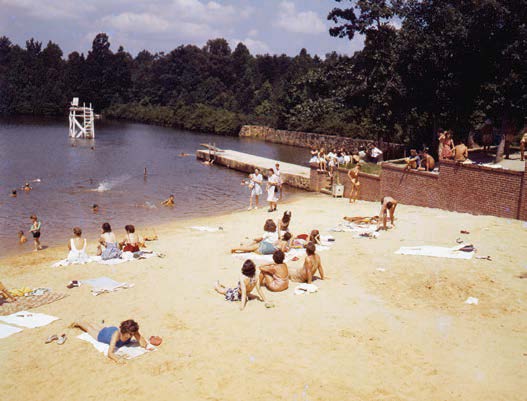
Back in the 1950s when families still swam in Lake Hamilton, most moms chatted on the shore as they kept a watchful eye on their children. But not Betty. She just wanted to be left alone with her magazine. And who can blame her?

Just One Thing

As children, we’re taught to recognize patterns. Our music teacher has us clap out one-two, one-two-three. Our science teacher shows us how to recognize patterns in nature’s wonder — the gills of a mushroom or the arrangement within a DNA molecule. Often, as adults inundated with information, we forget to take a moment to appreciate how patterns stimulate our brains. Weatherspoon’s current exhibit, “Pattern Recognition,” reminds us to find the beauty and meaning in them. Linda Besemer’s Baroquesy, 1999 — featuring acrylic paint over aluminum rod, is part of the Weatherspoon collection on display in this exhibit. California-based Besemer knows a thing or two about pattern recognition and society’s strictures about the use of color. “What’s so predictable about the ‘too colorful’ rejection is that it implies that some color is OK, but too much is unacceptable,” she told Scottish artist and writer David Batchelor just a few years after this piece’s creation. She went on to say that she thinks “that the real problem with color is its containment and regulation.” Which, she says, reminds her of how  artists have regarded the female body throughout the history of Western art. Submerge your mind into Weatherspoon’s world of pattern  — and so much more —  through Jan. 10, 2026. Info: weatherspoonart.org/exhibitions_list/pattern-recognition.

Memory Lane

Leaving Lowe’s on Battleground one weekday, I felt a massive pang of nostalgia. The center of that entire property, directly across from ALDI, was the location of the studio and tower for WBIG 1470 AM radio, where Bob Poole broadcast his enormously popular morning show, Poole’s Paradise, throughout the ’50s, ’60s and ’70s.

The quick-witted, basso-buffo voiced, self-anointed “Duke of Stoneville” relocated to Greensboro from his New York network perch in 1952. Soon after, Bob and my father became drinking buddies. As a toddler visiting WBIG’s “Poole Room” while he was broadcasting live, I joined in whistling his theme song, which made Bob burst out laughing. As a teenager, some mornings I’d drop by the station with joke and trivia books.

After faithfully awakening Gate City denizens for 25 years with an audience share that will never be equalled, Bob Poole signed off mere weeks before his death in 1977. Legendary WCOG DJ Dusty Dunn inherited the “BIG” morning slot. In an interview conducted years ago, Dunn recalled negotiating his contract and, of all things, being asked if he wanted batteries included in his employment package: “I said, ‘Batteries? Batteries for what?’ She said, ‘Well, we gave Bob Poole batteries for his flashlight when he wakes up in the morning so he didn’t have to turn on the lights and wake his wife up.’ I couldn’t believe it!”

On the afternoon of November 20, 1986, after celebrating 60 years on the air, the parent company informed WBIG’s general manager that the station would go dark at 6 that evening. Shocked staffers and longtime on-air personalities gathered for a tearful sign-off led by Dusty Dunn.

That decision was basic economics — a relatively small operation was nestled atop an entire city block along Battleground Avenue’s exploding retail corridor, a plot of dirt far more valuable than any revenue a weak AM radio signal could generate.

The last shred left of WBIG’s existence on Battleground is Edney Ridge Road, separating ALDI and Lowe’s, in the 1950s paved for and christened after the founder of the station whose call letters were an initialism for We Believe In Greensboro.

O.Henry Ending

O.HENRY ENDING

A Wild Ride

Please disembark safely and enjoy your day

By Cassie Bustamante

I stand, feet firmly planted on the ground, next to my two kids, a large, looping rollercoaster looming above our heads. Sawyer, 9, has zero interest in being thrust upside-down — no thank you, sir! Emmy, 8 and not yet tall enough to board, watches wistfully as my husband, Chris, hands me his baseball cap and makes his way alone to the line for the 97-degree drop of Fahrenheit, one of Hersheypark’s wildest rides

Like Emmy, I was the second of two children and much more the thrill seeker than my older brother, Dana. He was no scaredy-cat, but he wasn’t leaping in blindly either. Meanwhile, I boarded the jankiest of old wooden coasters, not an ounce of concern for my safety. If others had ridden before — and walked away OK — that was enough for me. As my height inched slowly up, so did the rides. No more wimpy-hilled kid coasters for me, I was ready to be thrown upside-down-and-around at great speeds and even greater heights.

Thankfully, the summer I turned 11, my parents planned a vacation that would scratch everyone’s itch, a road trip from our home in Massachusetts to Virginia. My father sat on our family-room sofa, knees splayed and a road atlas opened on the coffee table in front of him, sketching out our route on a yellow legal pad. This was the 1980s after all, before the days of Waze.

We took a rolling scenic route through the Blue Ridge Mountains on the way down. Dad’s always been interested in nature photography. In fact, a photo he shot graces the cover of the fall 2009 Chesapeake Magazine. And Mom? Colonial Williamsburg was top of her list. For Dana and me, 12 and 10 at the time, there was bicycling along the Virginia Beach boardwalk and — my thrill-loving heart pitter-pattered at the very thought of it — Busch Gardens, an amusement park where roller coasters, whirling, spinning rides and a white-water-rafting adventure awaited.

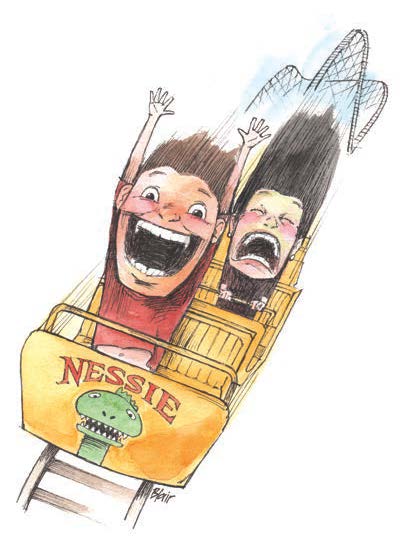
After waiting in line, Dad and I buckled into the Kelly-green seats of the school-bus-yellow Loch Ness Monster ride, which has been thrilling passengers for just as long as I’ve been taking my parents and brother on a wild ride, since 1978. I can’t even tell you what happened, it went so fast. All I know is, as soon as my feet hit the ground, I was shouting, “Again!” Dana joined me for my second ride.

While the Loch Ness was a hard pass for Mom, she put on a brave face for The Big Bad Wolf, a suspension-seat rollercoaster with zero loops. I opted for the very front car and Dana took the seat next to me. Mom sat behind us with another woman, probably mother to some other pair of kiddos. After the Nessie, the Wolf seemed rather tame. However, Mom howled the entire time, screaming as if an actual wolf was chasing her over the entire German-inspired village below. Dana and I were mortified.

But now, standing at Hersheypark with my own two kids, I understand. Something in me changed when I had kids and, at the very thought of a wild rollercoaster ride, my knees quake.

Windswept, Chris returns to where Sawyer, Emmy and I stand. I hand him back his hat to cover the mess his hair has become. “That,” he says with a dramatic pause, “was incredible!” His eyebrows inch up at me. “You want me to stay with the kids so you can have a turn?”

I look him in the eye as a spark of adventure passes briefly through me. I answer confidently, “Not in a million years.”

Birdwatch

BIRDWATCH

Brilliant and Blue

The surprisingly complex blue jay

By Susan Campbell

The blue jay is one of those species most of us instantly recognize: a common bird of woodland and backyard. But how well do we really know it?

This medium-sized, raucous bird can be found at feeders or flying around in treetops at any time of the year, but it hardly seems remarkable at first glance. It turns out that they are more complex and unique creatures than you might think.

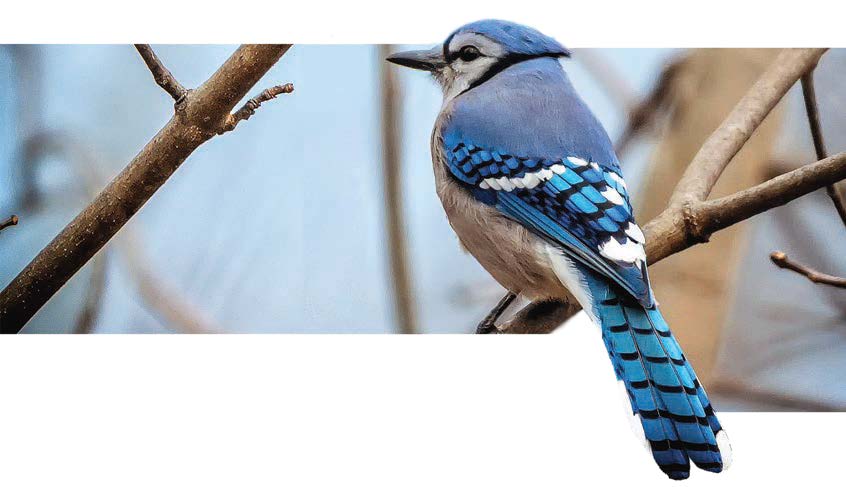
Jays are closely related to crows, which are a highly evolved species. As a result, jays, too, exhibit a relatively advanced degree of intelligence. They have complex social systems. Blue jays remain together as a family for a relatively long period and also mate for life. These birds have dingy gray under parts and upper parts that are various shades of blue with gray and black markings as well as a blue crest.

Not only do they communicate with their voices, but also with body language. Changes in the jay’s crest are one of the most obvious ways they express themselves. Not surprisingly, it is raised when an individual is alarmed or is trying to be intimidating.

The unique black lines, or brindle pattern, on individuals is no doubt recognized by conspecifics. Interestingly, the pigment found in jay feathers is produced by melanin, which is actually brown. It is the structures on the barbs of the bird’s feathers that cause light to reflect in the blue wavelength.

In addition to their bright coloration, jays attract attention with their loud calls. They make a variety of squawks and screams, usually from a perch high in the canopy. Furthermore, they are known to mimic other birds’ calls, especially hawks. Whether this is an alarm tactic or whether they are trying to fool other species is not clear. The great early ornithologist John Audubon interpreted this as a tactic that allowed blue jays to rob nests of smaller birds such as warblers and vireos that were scattered by the hawk sounds. Modern studies of blue jay diets, however, have not found that eggs or nestlings are common foods. In fact, in feeding trials, this species is often outcompeted by other jay species, woodpeckers and blackbirds.

Another mystery is why, in some years, these birds migrate and some years they do not. Blue jays are particularly fond of acorns. So it may be that, in years when oaks are not very prolific, jays move southward in search of their favorite food. How many blue jays will remain in the Piedmont and Sandhills this winter will depend on the mast crop — especially the abundance of white oak acorns. These birds are very capable of gathering seeds in a specialized pouch in their throat and carrying them to nearby holes or crevices where individuals will stash them.

Blue jays have very definite nesting duties. Males collect most of the materials: live twigs, grasses and rootlets. The females create the large cup, incubate and brood the young birds. All the while the male feeds her and then forages for the tiny nestlings. Once the young have developed a good layer of down, the female will join the search for food for the rapidly growing family. It is not unusual for young jays to wander away from the nest before actual fledging occurs, though the parents are not likely to feed the begging youngster unless they return to the nest. It is during this period that people may “rescue” the wayward youngsters.

Finally, reports of “bald” blue jays are not uncommon. Do not be surprised if you see an odd-looking individual at a feeder or bird bath with virtually no feathers on its head, just dark skin. At first this was thought to be caused by feather mites that can be found on all birds to varying degrees. Now it seems there are simply individuals that lose all of their head feathers at once instead of in the normal, staggered fashion. This is more likely in adolescents who are undergoing their very first molt.

The next time you notice one of these noisy, crested blue birds, take a closer look. Blue jays are fascinating — and full of surprises.