Best Laid Plans

BEST LAID PLANS

Best Laid Plans

Natural burials are making a mark in Greensboro

By Cynthia Adams  |  Illustrations by Keith Borshak

Late in December, O.Henry colleague David Bailey sent a riveting text from a state park in Alamance County. An avid hiker devoted to natural places, he shares his discoveries, photographing flora, fauna, mossy streams and waterfalls. But that winter’s day, he made a surprising find.

He stumbled across a tin metal box emblazoned with the words “Remains of Mrs. Brown” with the cryptic “by Googe” below. 

The discovery set my imagination afire, as I just so happened to be gathering information on natural burials and all the alternatives. 

Bailey left the remains undisturbed. He conceded that it could be a prank, meant to trap the curious. (Having once found a pink purse at a gas pump one evening filled with human waste, I could hardly argue.) Mrs. Brown, Bailey remarked dryly, could be a punny metaphor for the same thing.

In any event, moving the box was tantamount to disturbing a gravesite and he decided to let it rest in peace.

But I had a different point of view. Who was Mrs. Brown, I wondered, and why were her remains left carefully, sealed inside a box in the woods?

Was there foul play?

I briefly considered trekking into the woods to search for the confounding box, but it was mere days before Christmas. Perhaps Bailey was right — perhaps this was a memorial honoring Mrs. Brown’s final wish.

I flashed to the natural burial site known as All Souls Natural Burial Ground, which I had recently visited in the fall. It differs from any cemetery you probably know. Yet there is nothing unnatural about All Souls. It simply fulfills the most instinctive of impulses. Rather than embalming and sealing our dead inside coffins — or vases — for perpetuity — All Souls allows the body to rejoin the elements in the quietest of settings.

All Souls occupies 3 acres of wooded terrain in Guilford County. Located on a site adjacent to St. Barnabas Episcopal Church on Jefferson Road, it is among several such sites in North Carolina created in response to an increasing awareness of natural alternatives.

Don’t expect monuments and manicured grass. Instead, engraved, ground-level native stones mark individual sites (each recorded with its GPS coordinates), blending with its surroundings.

Those interred at All Souls are buried in their choice of a simple shroud, a box or a coffin made of biodegradable materials, allowing for the natural decomposition of the body.

Ashes to ashes, as the Book of Common Prayer says. Dust to dust. 

Mind you, none of this is new. It was the preferred way of our not-so-distant ancestors.

*****

Deborah Parker, board president and family liaison at All Souls Natural Burial Association, consults with those wishing to learn more about natural burial in a paneled meeting room filled with folding tables and chairs at St. Barnabas. In her six years of volunteering, she has sat here explaining their purpose many times over. 

Too often, that conversation occurs at the worst possible time. It is far easier when a conversation about final arrangements for our loved ones takes place before any crisis arises, she points out.

According to Parker, Randall Keeney, the retired vicar at St. Barnabas, did all the background advocacy and work to bring All Souls into being. Symbolically, the cemetery opened on November 2, 2019 — All Souls Day. On April 5, 2021, Frederick Westmoreland Jr. was their first natural burial. 

St. Barnabas and All Souls have a symbiotic relationship. “The church owns the graveyard. He [Keeney] did a lot of the groundskeeping when he was here,” she explains. By supporting and participating in natural burials, also known as green burials, Parker and a cadre of volunteers, mostly retirees, now provide the manual and emotional labor of running All Souls. 

At this writing, 26 people have been buried there and 80 have pre-purchased burial sites.

Parker, the family liaison, has been present for all but three of those burials.

“The American way of death is changing a lot,”
she says.

Blue-eyed and white-haired, Parker’s peasant top, Apple Watch and wire-rimmed glasses convey strength combined with compassion. I see both placidity and firmness, a quality the Japanese call “Goju,” meaning, hard and soft. With a wry grin, Parker says, “I can cry easily, yet tolerate no BS.”

On the face of it, the concept of a natural burial is age-old and the premise is simple. Many elders today still recall a time when their dead were bathed, dressed and prepared for burial at home. A number of my ancestors lie in family cemeteries once dotting rural farmlands.

The movement toward the natural interment of our dead is a return to the practices that were commonplace until the 1800s before the Civil War era. In the early days of embalming, reports of alcohol, arsenic and even gasoline were used to preserve the bodies for transport. On shipboard, prominent personages were “pickled” in casks of rum rather than buried at sea.

Gradually the process of burial was relegated to funeral homes, with restriction and regulations sprouting up.

Today, natural burial means many things — it may simply refer to interment in a family cemetery. It may also mean legally opting out of commonplace burial methods, such as embalming and even the use of a casket or a vault. At this writing, online estimates for basic funeral costs are between $7–10,000, although my personal experiences have exceeded that. Costs of a plot and monument are additional.

But how challenging is a return to a less institutional way of dealing with our dead? While the appeal of a different approach is undeniable, it raises questions. Is the red tape formidable?   

Turns out, it is simpler than imagined. Parker’s face sets with resolve. She has now been doing this work for years.  Delving into concepts about death — especially natural burials — has become a raison d’être. 

In the room where she meets those in the process of making final arrangements for themselves or a family member are examples of basic casket options, including a cardboard version. Some even invite others to help decorate it — like one would have friends sign their cast.

North Carolina law, in fact, offers a number of options for interment, she stresses. Embalming is not legally required. “To me, it is like putting your body through so much disrespect,” Parker observes.

So, it heartens Parker that the funeral industry itself has become a supportive partner with natural burials and has participated in most that she has experienced, transporting the dead and providing storage until interment is arranged. Her daughter, Meredith Springs, is an Asheville funeral director who also advocates natural burials.

Funeral homes also handle required legalities, including generating death certificates. But none are required to be handled by the funeral home, according to state law. (You might want to check out Evan Moore’s recent “Can You Bury a Relative at Home in Your Backyard” in the Charlotte Observer: charlotteobserver.com/news/local/article277022153.html.)

You can legally apply for and obtain a death certificate outside a funeral home, but, she warns, this is daunting. “One of the hardest things to do,” in Parker’s experience.

Nonetheless, “the American way of death is changing a lot,” she notes.

Parker, who lectures widely for civic groups and events, explains that a prevalent, mistaken belief is that the deceased must be immediately removed from the home by a funeral home. 

“You can keep the body at home,” she clarifies. “Which gives family members time to be with them.” According to online sources, that time frame is liberal, with few legal restrictions.

In describing personal experiences with her own family, Parker is most affecting. Her brother, Dale Clinard, was the impetus for her “desire and interest to help others have what they wanted” as he prepared his family for his pending death in 1989. He encouraged his family to become involved with the process.

She described the life lessons he imparted, teaching them “no fear of dying.”

At Dale’s death, the family requested a delayed pick up by the funeral home (permissible, she points out), allowing time to bathe and dress him, and affording time with family and friends who visited throughout the night.

“He had such a loving acceptance of death that it made it a lot easier for us,” she recalls.

“He had flowers sent to my parents the day after he died, thanking them for his life,” Parker says, still moved by the memory. 

The experience spurred her to become a hospice volunteer, and led to eventual involvement with natural burial. Each year Parker holds her own workshops in the church’s parish hall to guide others who wish for an intimate, involved experience. If they choose not, so be it, she says.

  All Souls, which helps coordinate the necessities of burial, has a single fee. A total of $3,500 includes the site, costs to open and close the grave, and a flat, native stone for engraving. “All we do here is receive the body — we call them ‘loved ones’ — and bury them.”

A shroud (many use a natural fabric sheet or quilt) or casket are funeral home expenses but it is legal to provide your own. For those who don’t purchase a shroud or a casket, Parker has personally swathed the deceased in a cotton sheet at the funeral home. 

All Souls does require that caskets be biodegradable, hence made of wood, bamboo or cardboard. Willow and seagrass caskets are also accepted — Parker mentions craftspeople at Moss and Thistle Farm near Asheville who commission wicker caskets, which she describes as “beautiful.”

There are no vaults, nor metal, sealed caskets at All Souls.

(There is also no legal requirement necessitating burial 6 feet under, Parker explains. Graves can permissibly be shallower, approximately 3–3.5 feet deep, as is the case at All Souls.) 

Others choose cremation. (All Souls does not accept cremains.) 

Ashes can be fashioned into cremation jewelry rather than buried at all. 

There are other options. One is a process variously called resomation, water cremation or aquamation. Proponents argue it is a greener option than cremation.

Resomation uses water, potassium hydroxide and steam heat to swiftly and fully dissolve the body. At present there are a few resomation chambers in North Carolina, in Charlotte, Hillsborough and Wilmington. Composting is a lesser-known, more green burial option.

            *****

Parker is a sort of culture warrior, advocating for straight talk concerning death as a healthier way of living our lives. She says she stands on the shoulders of many who have worked in the realm of death and dying, including artists. She praises a film, The Last Ecstatic Days, made by an Asheville filmmaker.

Approaching death, the subject, a 36-year-old yogi, said, “I am embodied. I am empowered. I am ecstatic.”

The three words were emblazoned on T-shirts.

She mentions how the very culture surrounding death is changing, thanks to his example and others like former intensive care nurse Julie McFadden. 

“She became a hospice nurse and wrote a book called Nothing to Fear. It is fabulous . . . She’s got stories about her personal experiences with people that are dying. So, in that book, she talks about the ‘D’ words: Death. Dying. And dead.”

Before parting, she leafs through pictures of natural burials she has participated in at All Souls. She describes loved ones giving eulogies surrounded by the moving, natural sounds of birdsong and breezes. An occasional deer meanders through. Burial sites are covered with greenery and flowers at the end. Parker finds these funerals beautifully evocative, even when she does not know the deceased.

She walks along the rustic grounds and pathways, pausing to discuss various people buried there.

Parker mentions another film, A Will for the Woods.

“Put it on your list,” she advises as we part. “And be sure you have your plans in order,” she adds, shoulders squared, a pensive smile dimpling her cheeks. The title had struck me as poetic in the moment. Yet I had no idea that it would prove prescient.

*****

On February 13, the day before Valentine’s Day, Bailey phoned with an update on the mysterious case of Mrs. Brown. 

Returning to the park, he noted police huddled in the parking lot alongside a park ranger, holding the box he had found in December.   

The box was firmly welded shut. “Whoever did this went to a great deal of trouble,” Bailey said, slightly short of breath as the police pried the metal box open.

“Say, do you remember when I told you about discovering it?” he asked.

The police talked in the background as we speculated. Absent foul play, surely, if someone wished for their remains to simply be left in the woods, it must be legal.

Actually, no, the park ranger quickly corrected us. It was illegal to dispose of human remains in public parklands.

This was hardly comparable to a natural burial, I was reminded. 

Later, Bailey texted pictures of possible fire ashes mingled with what looked a whole lot like cremains and visible teeth and bone fragment. I studied the photos, hoping this was all done in innocence.

The box, now with the medical examiner’s office, remains a mystery. A report has yet to be issued. Bailey returned to his own writing.

“It’s your story now,” he emailed. But of course, it wasn’t. 

It was another’s story. Someone — but who? — and their own particular will for the woods.

Home Grown

HOME GROWN

Absolutely Fabulous

Friends who feel like Miami sunshine

By Cynthia Adams

Irene, a food writer pal, called to dish about a posh party thrown by a friend, as the French say, of a certain age in Miami. 

In a story worthy of Netflix, the hostess invited a group of 24 accomplished women, doyennes all, to a birthday gathering featuring the best of everything. No expense was spared on the food, wine or glamour.

Not much impresses Irene, a former New Yorker and Miami transplant, who routinely reviews upscale restaurants, gaining insider knowledge of the city’s competitive food-and-wine scene. She has spent years developing the Miami chapter of Les Dames d’Escoffier, the culinary organization created by Julia Child. 

But this event was something special.

The stellar food her friend, Karen Escalera, served was the work of the late Joël Robuchon’s restaurant, Le Jardinier. The famous Frenchman’s restaurants on three continents earned a total of 31 stars, more than any other chef.    

But what moved Irene most about the party was not the exquisite spread nor the haute couture nor the bejeweled, high-profile guests. It was how many friends Karen had.

“I don’t think I have 24 friends,” she confesses.

We discuss the dynamic of friendships, old and new. We know that the lack of friends curtails longevity and worsens health. And we are a little obsessed with the epidemic of loneliness that hasn’t lifted despite COVID’s decline.

Irene remains stuck on the number 24. 

I begin inventorying my own circle of friends. And decide to seek some expert advice on how many friends are just right. Pew Research would agree that 24 is a big number of friends to have.

The majority (53%) in their survey reported having between one and four close friends. Only 38% report having five or more. I start counting how many I have, but get stuck in deciding what, exactly, constitutes a friend? And what’s the difference between a friend and a close friend. I think about my own circle, which includes college pals, lunch buddies, book club friends and neighbors. Friends we share drinks and laughs with, or take on a road trip. Friends who always know the best restaurants or movies, or will tell you if a dress makes you look like an episode of What Not to Wear? I’ve got a lot of friends, I decide.

But then there are friends you call when misfortune falls, or heartbreak comes — friends you can count on when life is hardest. I decide I don’t have 24 for sure, nor would I want them. Friendships like that require a lot of time and hard work.

In a city of nearly a half million people, where friends aren’t easily made, Irene says she was moved by the deep generosity of their hostess. She jokes she was pleased to be included as the hostess’s newest friend at the birthday bash. “I’ve only known her a decade,” she quips.

But what really demonstrated Karen’s true friendship took place at the party. It was how she showed her deep reverence for her circle of friends. 

“I’ve seen her increasing warmth,” Irene says about Karen. Maybe it comes with age and an increasing appreciation of how much true friends mean, she says. “You see down the road you won’t have this friend forever. It will end.” 

This was made clear when their hostess read from profiles she had written about each of her 24 guests, declared “top-notch friends.” Among them were CEOs and top achievers in fashion, business and hospitality.

“The party was for us,” Irene says in wonderment. “Not for her.” No gifts were to be brought.

And so, Karen, who has lived well and long, ordered herself a great cake. (“It was chocolate, seven layers, with chocolate beads around the outside . . . I cheated on my diet big time for that cake,” says Irene). She offered her circle what she knew and valued: a fabulous fête — and her articulate and heartfelt appreciation for them and who they were and what good friends they are. After the candles were blown out and the profiles were read, 24 friends filed out of Le Jardinière knowing exactly how they felt on Karen’s birthday: They felt absolutely fabulous.

Wandering Billy

WANDERING BILLY

The Patriots Are Coming

Pursed lips and drum licks put the Greene in Greensboro

By Billy Ingram

“I have to prosecute a war with almost insurmountable difficulties. I cannot contemplate my own situation without the greatest degree of anxiety.” — Nathanael Greene before the Battle of Guilford Courthouse

One hundred and thirty-eight years ago, Guilford Courthouse National Military Park was consecrated on 50 untended acres purchased for $700 by Judge David Schenck. It has since expanded into what is now a 250-acre homage to those resolute Patriots who fought and died on March 15, 1781, in a pivotal exchange of cannonballs, lead balls and bayonets, reassuring America’s forthcoming victory in the Revolutionary War.

Ever hear that phrase, “We lost the battle but won the war?” The Battle of Guilford Courthouse is a perfect example. While the British effectively defeated General Nathanael Greene’s Continental Army, in doing so, the Red Coats were left so depleted that Greene’s dogged nemesis, British General Charles Cornwallis, had no choice but to, after another ill-fated fracas, surrender to George Washington at Yorktown.

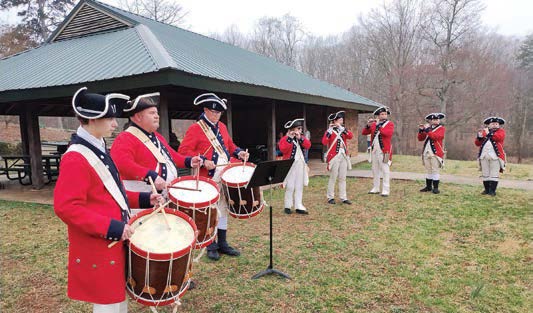
To commemorate that crucial turning point in our nation’s founding, the Guilford Courthouse Fife & Drum Corps was formed 28 years ago by park ranger Stephen Ware, in part to provide a historical soundtrack for increasingly popular Revolutionary War reenactments. While Ware retired in 2019 and Mike Nelson now leads the group, I met up with Chip Cook, a member since 2021, wondering what inspired his and others’ participation in such an anachronistic undertaking.

“If you travel in the northeast — in Connecticut, Rhode Island and Massachusetts — every little town has a fife and drum corps,” which Cook likens to the lure of joining a community band and the Boy Scouts at the same time. “So there are adults and kids involved in it.” There are currently about 10 active members of GCFDC but new recruits are encouraged. “We have members as young as 15, folks from all walks of life. A couple of members from the 82nd Airborne [Division] Band recently joined and they love to perform with us occasionally.”

A drum and fife corps was strategically imperative in times of war before radio messaging. “The commanders depended upon the music not for comfort, although that was helpful, too, but for communication,” Cook explains. When the call went out to, for instance, assemble the unit, or begin marching, reposition a column, prepare to fire or even retreat, the drum and fife corps transmitted those orders by way of melodic themes, known as duty calls, that troops were trained to recognize. On a clear day, they could be heard up to a mile away.

“There was a gentleman’s agreement that you didn’t shoot the musicians. They were considered noncombatants on the field,” Cook explains, noting that the corps might be leading the procession early on but well before the muskets plumed and bullets flew, drummers and fifers, made up mostly of old men and young boys, were repositioned to the rear of the fray.  (After a musician reached the age of 17 they were expected to join in the fighting.)

To quickly identify and assemble instrumentalists when their service was required, “they traditionally wore opposite colors from their infantry regiment, so we wear a red coat with blue trim,” Cook says.

On the 244th anniversary of the Battle of Guilford Courthouse this last March a reenactment took place at Country Park, kicked off with members of the Tryon Palace Fife and Drum Corps as well as Cook’s ensemble. Set against a backdrop of soldiers and horses echoing an impending clashing of combatants, it was an impressive performance, considering the vast repertoire of duty calls memorized and executed in unison with crystal clarity.

“A lot of folks think this is run by the National Park Service. It’s not,” Cook tells me about these annual time tunnelings back to 1781. “It’s an arrangement with the City of Greensboro and the different groups that have participated in these reenactments for many, many years.” A surreal sight, tented encampments erected alongside the lake where, tucked into the woods above, reenactors on both sides would bivouac overnight. “They have a little market in the middle, which is kind of funny because you go through there and everyone’s dressed [for the period] and you pull out your debit card to pay, very much an anachronism there.”

Last summer, the Guilford Courthouse Fife & Drum Corps opened for a performance of Horn in the West, the decades-long running Revolutionary War outdoor drama centered around the exploits of Daniel Boone, on a night when one of the Frontiersman’s descendants was sitting in the audience. In January, they spent a weekend demonstrating their specialized skills at Cowpens National Battlefield in South Carolina. This month, our fluted troupe is bound for Colonial Williamsburg’s Drummer’s Call, a celebration of 18th-century military music also featuring an assemblage of groups from Yorktown, Northern Virginia, Maryland, New Jersey and Pennsylvania. “We’re all volunteers, so we’re spending our own money to do this,” Cook notes. The Corp also participates in grave-marking ceremonies with the Sons of the American Revolution, “and we’ll be in High Point for their Memorial Day event this year.”

Chip Cook himself is a descendant of a Revolutionary War light infantry soldier, Jacob Idol, who resided in Davidson County when he enlisted in 1781. Captured by Tories and remanded to the British at Guilford Courthouse, he escaped following that conflagration, then took part in routing the so-called loyalist Tories at Raft Swamp in Robeson County, the last battle of the war fought in the state of North Carolina.

A century later, no one in 1887 Greensborough had any definitive recollection as to exactly where that decisive Revolutionary War conflict happened when Judge David Schenck began mapping and snapping up the first 50 acres of forest and untamed underbrush. He relied on hand-scrawled maps and written recollections to pinpoint the precise location where warfare waged 106 years earlier. The nonprofit Guilford Battleground Company Schenck founded to oversee the project, one that continues fostering his vision today, gifted the by-then cultivated park to the federal government in 1917. The organization then continued over the decades to purchase and donate adjoining properties as they became available, greatly expanding this verdant sanctuary that pumps millions of dollars into our economy.

In hindsight, Schenck should have acquired a lot more land than he did. Although it’s possible that Cornwallis’ attempt to smother democracy in its cradle potentially spilled over into Country Park’s footprint, just in the last few years historians have discovered that major skirmishes took place where the Brassfield Shopping Center parking lot sits. Alas, you won’t get that tract for $10 or $20 an acre like you could in 1887.

Chaos Theory

CHAOS THEORY

Pirou-what?

Toeing my way into ballet

By Cassie Bustamante

For the last year and a half, my youngest, Wilder, has been learning how to bop with the beat in a weekly dance class. I signed him up for Dance Project’s “Little Rhythms” after a friend casually mentioned that her son had been going and enjoyed it. My own glory days of ballet and tap, which I took until I hit middle school, twirled around in my head. No, I wasn’t the most graceful, but dance is about so much more than that. Plus, to be honest, when I learned that there was no commitment to a recital — you could opt in or opt out — I was stoked. I’d sashayed down that path once before with my daughter and had zero desire to be a “Dance Mom.”

And yet, here I am among other parents, sitting on a bench just outside a mirrored studio while our kiddos move and groove, doing their best to follow their instructor’s lead. Occasionally, I peer in and catch a glimpse of my kindergartener. Is he doing the correct moves? No. But is he having fun? One hundred percent, yes. His cobalt Nikes are flying off the beat and he’s struggling to get the steps right, but his blue eyes reflect the absolute joy he’s finding in movement.

As class progresses week after week and the recital approaches, the question of the performance arrises.

“I just want to watch,” he replies assuredly.

Then, with just a couple of weeks until curtain call, costumes arrive. I haven’t ordered one for Wilder, but, as it turns out, one happens to be there with his name on it.

It could be, perhaps, that he just wants the thrill of dressing up in something fun, but I can see a thought flicker across his little face — he is reconsidering. If we are going to commit to this show, I want utter certainty.

“You know, it means you’ll be dancing on stage in front of the audience. I’ve seen your moves and I know you are a fantastic dancer,” I say, “but I want you to do it because you want to. Are you sure?” He is.

The day arrives and he seems to have absolutely zero pre-show jitters. Frankly, I am in awe. My own heart races as I recall my own dance recital nerves.

Backstage, I kiss him good-bye and leave him in the capable hands of a dance parent volunteer. I take my seat in the audience, surrounded by my parents, my husband, Chris, and my daughter, Emmy.

Finally, Wilder’s class enters from stage right as the backdrop glows in Aladdin-blue. A beat drops as the song starts: You know it’s Will Smith and DJ Khaled! With a little guidance from their teacher, the kids spend the next minute and 20 seconds strutting their stuff to “Friend Like Me.” As the crowd erupts in cheers, I wipe a tear from my eye because seeing my child doing something he loves has made me so uncontainably happy.

As the show comes to an end and all performers return to stage for their final bows, Wilder leads his class out and continues to freestyle until the very end. I know, with certainty, that we’ll be back for dance class in the fall.

So once again, I find myself on that bench, peering in the window of that studio space. Just next to it is a blackboard with neon chalk writing that catches my eye: “Sign up for adult classes!” I glance back through the window. Wilder’s elbows and feet are all over, but his smile stays put. And I think, Why not me?

Back at home, I log onto my computer and register for “Absolute Beginner Adult Ballet.” Sure, I’ve got experience, but that was 40 years ago. At my very first class, I slide peachy-pink ballet slippers onto my feet and find my place along the barre with several other women of all ages. At 46, I still lack grace and coordination, but, as I’ve learned from Wilder, talent is not a prerequisite for enjoyment. The music starts — a piano cover of ABBA’s “Super Trouper” — and I plié, tendu and jeté. Turns out, I am not a dance mom. I am a dancing mom. 

Essay Contest Winner

ESSAY CONTEST WINNER

Questers

A shared sense of adventure

Note from the editor: This was our 2024 essay contest third place winner.

By Dianne Hayter

I have always been a dog walker. Even when I didn’t have one, I found dogs to walk. Or, more likely, dogs who loved to walk found me.

Embedded, however, in thousands of traipsing miles, is a secret, a spoiler alert: My dog walking is a not-so-clever disguise for a wanderlust heart. Truth: My canine companions and I are delighted questers rather than dutiful walkers, making us soul-linked in a way that must have been familiar to the likes of Admiral Byrd and his Antarctic crew or Lewis and Clark and their expeditioners.

There are worse proclivities than finding the bend in a mountain dirt road irresistible. Or that beach dune wall that begs to be climbed before the wind captures and removes them. Curiosity, while it may have killed the cat, is not likely to topple a canine-human team intent on adventure-seeking. 

I lived off Chunns Cove Road near downtown Asheville for several years with my dog, Autumn-Socks, a husky-shepherd mix who was as intelligent as she was beautiful. She came to me as a senior dog from a nearby county’s shelter, but there was nothing retired about Autumn-Socks. She had the endurance and stamina to have donned snow shoes, taken a place at the head of the pack, and pulled in the Iditarod Trail Sled Dog Race in Alaska.

We lost no time in befriending Chance, the neighbor’s Goliath of a dog. A Great Pyrenees-border collie mix, he offered an affable, fun-loving balance to Autumn-Socks’s more focused inclinations. Chance had been penned for some time, and his delight and gratitude at being found and included knew no bounds. With his owner’s permission, Chance accompanied Autumn-Socks and I daily in our explorations.

Chunns Cove is teeming with wildlife, including coyotes, a vast assortment of raptors, large and small foxes, and black bears. The bears, in particular, have become more visible as their territories have been encroached upon by people. As a result, their hibernation cycles are shortened, and food supplies require more and more searching, including pilfering human garbage.

Black bears are not typically aggressive to people, nor do they eat meat. But they are big and bulky, beautifully roaming with their lumbering gait, sometimes on all fours, sometimes standing on their back legs, often with a cub. They are pungent, particularly to a dog’s level of senses, and highly protective of their offspring. A mama bear can weigh from 200 to 800 pounds, and her baby, depending on its age, half that. They seek no friendship with humans, and humans are well served to return the sentiment, despite how tempting it may be to pet and cuddle a bear. Winnie the Pooh was a stuffed toy for a reason.

On a late April morning, Autumn-Socks, Chance and I were almost to the top of Chunns Cove Road, which dead-ends in a mountain cove, just passing in front of an uninhabited house, someone’s mountain retreat. Both dogs were leashed. Neither showed indication of anything out of the ordinary, no stop-still response to a smell, movement, or sound.

That the adult black bear, walking on its back legs, came down the driveway of the house as if to get into its car and drive away was as much of a surprise to Autumn-Socks and Chance as it was to me. If we were surprised, however, the bear’s shock and fear were magnified exponentially. Flailing its front legs, it threw back its head and bellowed as though its enormous claws were being extracted.

Autumn-Socks and Chance, barking in tandem ferociousness, jerked and pulled on their leashes, straining to protect me and themselves, but mostly striving to get closer to the bear. No retreat, no surrender for them. The bear stopped and turned, then ran back towards the house. Almost pathetic in its discombobulation, it came our way again. In the seconds that had passed, I had maneuvered us so that we could return the way we came.

We backed up slowly. I made a conscious effort not to run, fearing we might be chased. The dogs were predictably disappointed, still straining at their leashes and barking maniacally. With not the slightest hesitation, given the opportunity, they would have pursued the bear to the ends of the Earth. I marveled at their unabashed and instantaneous seizing of the situation.

Fifty feet down Chunns Cove Road we started running, both dogs full throttle with me in tow. I looked over my shoulder to see if we were being pursued. The bear had stopped in the middle of the road, looked around briefly, confused as to what had happened, then, on all fours, galloped across the road and disappeared into the woods.

It felt good, a profound relief, to run with the force of our collective adrenalin. No barking. Just the pant of our breathing, the sound of their paws and my shoes lightly bouncing off the pavement, the scratching of my jeans against my squall jacket.

We stopped. Leashes still wrapped around my wrists, I bent over my knees and took several deep breaths. When I looked up, both Autumn-Socks and Chance were looking at me with sparkling eyes, big smiles, lolling heads and dancing feet, communicating the complicit request: Please, please, let’s do it again. I began to laugh, mirthful tears spilling down my cheeks, then sat down, only to lie down, while Autumn-Socks and Chance stood over me, licking my face and nudging me. Get up, we’re ready, let’s go.

At least in this lifetime, I’ll not explore Antarctica like Admiral Byrd or carve out a path in the wilderness of a new continent like Lewis and Clark. But I will keep a dog by my side, one who finds me, in spite of my human limitations, to be an acceptable sojourner to the multifaceted explorations and adventures of an ordinary life.

Poem May 2025

POEM

Erosion Control

We were losing the ridgeline to the dusk
when you asked, “What if I had stayed?”

Ten years is nothing
to a mountain —

unless you clear-cut
and gut it
for someone else
to move in.

I’ve done that too many times —
made my heart a gorge with a river
everyone floats through.


I looked at you
and said, “It wouldn’t have mattered.”

And you stared at me
with eyes
that looked so tired
of trying
to rebuild a rockslide.

  Clint Bowman

Life’s Funny

LIFE'S FUNNY

Well, Shhhhhhhucks

A potty-mouth clean-up is short-bleep-lived

By Maria Johnson

Algorithms are scary things, the way they learn our habits, which is pretty bleep well.

Why else would my newsfeed recommend that I read a piece in The New York Times titled “Curses! A Swearing Expert Mulls the State of Profanity.”

The story promises tips on how to cut back “if you want to.”

What the bleep does that mean?

I’m talking to you, algorithm, you little son of a software bleep.

Are you saying I have a cursing problem?

Well, you’d be partly right.

And partly wrong.

See, most of me is O-bleep-K with cursing. In fact, I love laying down a good oath. There’s a certain catharsis and clarity and energy that comes with damning a bleepity-bleeper to everliving bleep.

Bleep. I feel better just typing that.

But another part of me knows I curse out loud too bleep much, though there’s a camaraderie in hanging with other potty mouths. More on that later.

I also curse a lot to myself when I’m fired up about something, which is pretty bleep often. My awareness of this salty leaning has me thinking that maybe I’ll give up cursing for Lent.

How long is Lent?

What?!

Forty days?

Oh, bleep no.

I could maybe do 40 hours.

Like, one work week, from 9 to 5, with nights and weekends off. Sort of a Lent Soft challenge? Is that a sacrilegious question?

Yes?

All right, all right. Forty bleep days. Without spoken-word profanity.

Or swearing in writing.

But I get to write using bleeps, and I get to keep the sewer in my head.

It’s a start. I gotta do something because this habit is getting worse.

Maybe it’s because I’m an empty-nester. I watch my language around children.

As my grandmother used to say: Little pitchers have big bleep ears.

She didn’t use those exact words, but that’s what she bleep meant.

Because kiddos imitate what they see and hear, my husband and I minded our p’s and q’s — and f’s and s’s — because we didn’t want our sons to blurt out something disrespectful or insulting at the wrong time.

It takes time and maturity to learn how to curse responsibly.

Also, we didn’t want our boys to sound like they were raised in a bleep barn.

Now that our guys don’t live in our bleep barn, I mean house, anymore, I’m not as careful as I used to be. I’ve reverted to my pre-mom setting.

Actually, scratch that.

I’m worse than bleep ever.

Maybe it’s the times we live in.

Have you watched a movie or streamed a TV series lately?

The language is bleep atrocious.

Have you listened to a podcast?

Holy bleep.

Honestly, I don’t like it. But what the bleep am I gonna do? Cancel Max so I can’t watch Hacks any more?

Fat bleep chance. When Season 4 drops, I’m all over that bleep.

Yes, its profane and edgy. It’s also funny as bleep.

So let’s forget about me cutting back on consumption.

I do think there’s room, though, to cut back on my triggers. Namely the news.

Don’t get me wrong; I’m a newshound from the word “go.”

We need to pay attention to what’s going on.

But for the last several years, I’ve hardly been able to watch, read or listen to the news without hollering, “I CANNOT BLEEP BELIEVE THIS!”

I realize my venting doesn’t change diddly-bleep.

But I gotta tell ya: It feels pretty bleep good.

I’d like to clear up one misconception right here: that people who curse a lot don’t have a very good vocabulary.

That’s a load of bleep. I’m not saying that stupid bleeps don’t cuss. But not everyone who cusses is a stupid bleep.

To wit, I do the Spelling Bee every day.

And Wordle.

And a crossword puzzle.

That’s a lot of bleep five-dollar words.

Plus, I’ve been around writers most of my life, and writers are some of the finest cussers I know. We have the verbal palette; many of us just favor the blue hues.

What the bleep?

Maybe this Times story can explain.

Where are my bleep glasses?

Oh, here they are.

Let’s see. Looks like they interviewed a guy named Timothy

Jay, who’s a retired professor of linguistics at the Massachusetts College of Liberal Arts.

Get this bleep: His specialty was studying profanity.

What a bleep fun job that would be.

Ol‘ Timothy says that cursing is indeed more prevalent because society has gotten way more casual.

He blames social media because you can just about write anything on TikTok or X, the platform formerly bleep known as Twitter.

(Aside: When someone comes up with a better verb than “tweet” for the act of reacting with one’s thumbs, please let meknow. I refuse to say: “Gimme a minute to X this.”).

Anyway, Tim says culture is always evolving and just as soon as a taboo becomes acceptable, people will come up with something even taboo-ier.

Translation: Don’t hold your bleep breath for cursing to go away.

He goes on to say that cursing is mostly about conveying intensity of emotion, and not always negative emotion. In some cases, swearing around others indicates belonging and intimacy.

It’s like saying to someone, “You talk like a bleep sailor, but I love you anyway. Also, I trust you not to record this and play it back for my mom.”

The good professor notes that humans get a measurable physical jolt out of swearing.

Roger that bleep

Finally, he says that the only way to curse less is to practice mindfulness about when you curse and why.

Sigh. That’s what AI said, too, when I asked it.

It said to try practicing meditation and yoga instead of cursing.

That’s a lot of bleep Oms.

And box breathing doesn’t charge my battery like swearing does.

I’m thinking my best course of action is to use more curse word substitutes.

Like dang. Or dog. Or freakin. Or fiddlesticks. That’s an oldie and a goodie.

Yeah.

Fiddle-bleep-sticks.

I like the sound of that.

Tea Leaf Astrologer

TEA LEAF ASTROLOGER

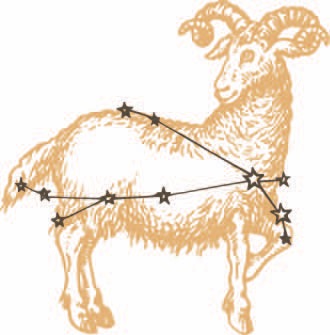
Aries

(March 21 – April 19)

Just as genius requires a touch of madness, passion requires a touch of grace. When Mercury enters your sign on April 16, don’t be surprised to find yourself in an argument sparked by your own bluntness. On that note, this month is a good time to deepen your meditation practice. Don’t have one? Try listening to the sound of water, taking a cold shower, or candle-gazing.
At month’s end, Venus in Aries amplifies your natural urge to take initiative in pursuits of the heart. Remember,
sometimes the poison becomes the medicine.

Tea leaf “fortunes” for the rest of you:

Taurus (April 20 – May 20)

Two words: mud mask.

Gemini (May 21 – June 20)

Decline the deviled eggs.

Cancer (June 21 – July 22)

Let your eyes do the talking.

Leo (July 23 – August 22)

Sign up for the workshop.

Virgo (August 23 – September 22)

Relax the muscles in your face.

Libra (September 23 – October 22)

It’s time for a fresh perspective.

Scorpio (October 23 – November 21)

Eat your spinach.

Sagittarius (November 22 – December 21)

Go fly a kite.

Capricorn (December 22 – January 19)

Keep your bag packed.

Aquarius (January 20 – February 18)

Plant your feet directly on the earth.

Pisces (February 19 – March 20)

Splurge for the one you really want.

Sazerac April 2025

SAZERAC

Just One Thing

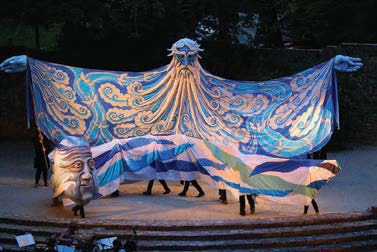
Paperhand Puppet Intervention’s mission is anything but pedestrian: tell stories, beat drums, work up a sweat, push boundaries . . . and steal people’s hearts away all while making the world a better place. Through largerthan- life puppets, Paperhand transports audiences into a world where greed, hate and fear are defeated, while love of the Earth and its creatures triumphs. Combining papier-mâché, house paint, cardboard and silk, puppet-makers in their Saxapahaw studio bring to life characters mythic in scope and kaleidoscopic in hue. Two decades worth of drawings, marionettes, shadow puppets, and clay and papier-mâché characters will be on display at GreenHill Center for NC Art from Saturday, March 22 (public opening 3–5 p.m.), until Saturday, June 21. Check GreenHill’s website for music, performances and hands-on cardboard-puppet fabrication as part of its ArtQuest program, plus a series of events, including a robot-costume family night and parade (April 5), an Earth Day Celebration (April 19), an artist talk (May 14) and a workshop (June 7). Discover how you can change the world with your own two hands, just as as Paperhand Puppets have. Info: www.greenhillnc.org/of-wings-and-fe

Unsolicited Advice

Here at O.Henry, we are all about literacy. After all, our namesake is one of America’s greatest short-story writers. The month of April honors a different kind of literacy — financial. Turns out, our namesake was not so hot at that and, in fact, served five years in Texas prison on charges of embezzlement. So, while we wouldn’t recommend taking money advice from the man himself, here’s our two cents on the subject. Make a grocery list and stick to it. Unless, of course, the Tillamook ice cream is BOGO. Build an emergency fund. Also, define “emergency.” A 401K, as its name suggests, is a very long race, but, when you reach the finish line, the participation trophy is worth it. Put in the work and go the miles. Before you know it, you’ll be retiring in the lap of luxury. Invest. And we don’t mean in Beanie Babies. With the help of a financial advisor, invest in stocks. Or invest in yourself — earn more accreditations or learn new skills that bring added value to your resumé. Cancel unnecessary subscriptions. Lucky for you, there are free magazines for your entertainment. Like the one in your hands.

Tour de Plants

Whether your thumb is vivid green or you’re chlorophyll deficient, The Greensboro Council of Garden Clubs is opening the vine-covered gates on six private — though not necessarily secret — gardens. This year’s tour features the secluded beds in the neighborhoods of Irving Park, Sunset Hills and Starmount Forest. Traipse through backyard wonderlands so enchanting that they exceed Lewis Carroll’s wildest dreams and wander onto front lawns bordered by lush bushes, flowering vines and blooming bulbs galore. You’re sure to head home mulch inspired and ready to dig into your own outdoor oasis. Plus, you’ll have a chance to mingle with club members while exploring how you can become a part of their growing community, too. Plentiful fun awaits! Tickets are $25 each and, as of April 1, can be purchased at A. B. Seed, The Extra Ingredient, Fleet-Plummer, Guilford Garden Center, Plants & Answers: The Big Greenhouse, and Randy McManus Designs. The tour runs from 10 a.m. to 4 p.m., May 17 and 18. Info: facebook.com/gcgcinc.

April Window on the Past

Plot twist? On April 2, 1936, a tornado ripped through the south end of Greensboro. The storm created a path of destruction 11 miles long, extensively damaging some buildings, including the former Blue Bell factory shown here. Restored to its former glory, it serves as home to Centric Brands and Transform GSO on the northwest corner of Gate City Boulevard and South Elm Street.

Our 2025 Writing Contest

When O.Henry’s team decided to put a twist on our annual writing contest, we ended up with what some will see as a twisted creative writing contest. We want you to write your own obituary — a faux-bituary, if you will. But this is no grave matter. No, this is an opportunity to dredge up the wit, humor and magic from your darkest depths. If you need inspiration, google “Idaho witch Holly Blair obituary.” Blair crafted her own whimsical memorial and it had us wishing we’d known her when she was alive. Or take, for instance, Renay Mandel Corren’s obituary, written with such love and hilarity by her son Andy Corren that it went viral, spurring him on to author Dirtbag Queen: A Memoir of My Mother, which released earlier this year. Maybe this is your own memoir in the making. Every day, we’re buried in deadlines and daily housework. Imagine, instead, just being buried — six-feet-under buried — and how you’d want to be remembered.

But first, rules.

Submit no more than 250 words in a digital format – Word or Pages document, a PDF, pasted into an email, or carved into stone and sent via photographs. More than 250 words? You’re dead to us.

One submission per person: Email entries to cassie@ohenrymag.com

Deadline to enter is July 31, 2025.

Winners will be contacted via email and their submissions will be printed in a forthcoming issue.

Lastly, life is short. Have fun with this assignment.

Sage Gardener

In one of my favorite flicks, Tim Burton’s Mars Attacks!, Jack Nicholson as POTUS makes a final appeal to the Martians who have invaded Earth, pleading, “Little people . . . why can’t we all just . . . get along?” His answer comes after he shakes hands with the take-me-to-your-leader commander of the attack, whose hand detaches and proceeds to stab the president in the back, a Martian flag popping up from his corpse.

Let’s admit it. It’s pretty obvious from the evening news that we humans don’t get along very well with one another, and in this dog-eat-dog world, things aren’t much better for man nor beast.

But plants. Those trillium, trout lilies and anemones bursting into bloom all around us, they certainly know how to get along.

Or do they?

Unless you’ve been hiding under a garden rock, one of the hottest horticultural topics in recent years has been plant communication. In an article entitled, “Plants Can Talk. Yes, Really,” Mamta Rawat, a program director at the National Science Foundation, muses, “I think we’re seeing that the complexity [of communication] is just as great with plants as it is with animals.”

And it ain’t all friendly.

Researchers have discovered that leaves can trigger defenses when they detect predators. When some roots sense problems with nutrients, water and predators, they respond accordingly. Plants even signal nearby kin telling them that the ever-dreaded aphids (or Martians) have landed.

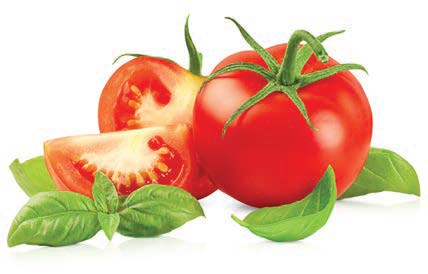
In fact, gardeners have had a solution for this problem for centuries. It’s called companion planting. Basil disorients moths that lay tomato hornworm eggs. Aphids can’t stand garlic! Nasturtiums lure caterpillars away from your kale, cabbage and broccoli. You can read all about these and other suggested pairings at www.almanac.com/companionplanting-guide-vegetables.

Relying on the latest scientific info instead of old wives’ tales, Benedict Vanheems, longtime contributor to Kitchen Garden, Britain’s longest-running garden magazine, digs into which plants love one another and which ones wage war on the competition. Asparagus thrives with petunias and tomatoes close by. And, yes, it makes sense to plant squash so it shades the roots of corn and to plant pole beans to climb up corn stalks. Cabbage loves garlic, nasturtiums and sage as neighbors. Peas pair well with lettuce, radish and spinach. And both zucchini and summer squash love oregano, nasturtiums and zinnias. Chemicals similar to humans’ pheromones are at work in many of these cases.

But what plants don’t play well with others? Sunflowers, walnut trees and fennel are among the plants that are allopathic, meaning they release a toxic chemical from their roots to hamper the growth of certain surrounding plants. Broccoli and cauliflower are happiest at some remove from peppers and tomatoes. And onions and garlic can retard the growth of peas and beans.

Recently, researchers found that some plants even communicate through sounds that can be picked up by other plants and animals. Although I have not heard any of my plants trash talking, plant cells can emit vibrations that other plants sense, letting them know they’re getting a little too close for comfort. Chinese researchers even observed that when they broadcast sound waves of a certain frequency in a field, crop yields improved.

So maybe you ought to talk to your plant companions, but just be sure you use a soft voice and the right frequency.

Simple Life

SIMPLE LIFE

A Spring Awakening

And a journey from darkness to light

By Jim Dodson

I celebrate April’s return every year because it’s the month that a divine awakening changed my life.

It was 1980. I was the senior writer of Atlanta Weekly, the Sunday magazine of the Journal-Constitution, the oldest newspaper magazine in the nation. It was probably the best writing gig in the South. Over the previous three years, I’d covered everything from presidential politics to murders in the “City Too Busy to Hate,” as Atlanta liked to promote itself in those days.

One minute I was interviewing a grand dragon of the Ku Klux Klan in Alabama, the next riding along with the Repo King of Atlanta as he repossessed cars in the city’s most dangerous federal housing project, a shotgun on the seat of his truck. I’d also written several pieces about young women from the South who were drawn to Atlanta’s bright lights only to wind up murdered or missing.

Looking back, though I didn’t realize it then, I was in search of an answer to a question that had no answer.

Three years before I snagged that job, Kristin, my girlfriend back home in North Carolina, was murdered in a botched holdup by three teenage boys at a Hickory steakhouse where she worked as the weekend hostess. I’d left Kristin on a beautiful October Sunday after making plans to get married and move with her to England, where she had a job as an understudy awaiting her in London’s West End.

The low point of my Atlanta odyssey came on a hot July night in 1979. I was working on a cover story about Bob Stivers, the city’s famous medical examiner, whose forensic sleuthing reportedly inspired the popular TV show Quincy. The week before that Saturday night, I’d watched half a dozen autopsies at the ME’s elbow, equally mesmerized and horrified. When Stivers invited me to ride along with the squad that picked up murder victims, I jumped at the chance. Saturday nights were particularly busy in the city that had recently been declared America’s “Murder Capital.”

My new fiancée, Hank Phillippi, was the nighttime weekend anchor at WSB-TV. We shared an old, brick house near the east-side entrance to Piedmont Park. Our weekend routine was to have a glass of wine and watch Saturday Night Live when Hank got home from the studio before midnight.  

On that fateful night, waiting for a call from Bob Stivers’ death crew, as I was standing in the darkness of our backyard, waiting for my dog, Magee, to do her business, I saw a car pull up beside our neighbor’s house. We were friendly with the Emory med students who lived there.

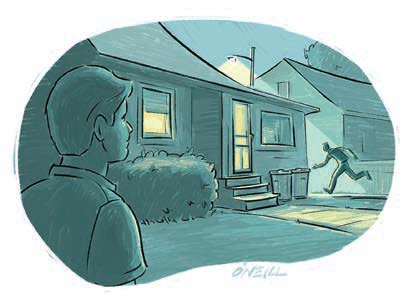
As I watched, a man emerged from the backseat of the car and calmly walked to our neighbor’s backdoor and knocked. A med student still in scrubs opened the door. There was a brief exchange of words, followed by two gunshots. The medical student collapsed on the ground. The assailant bolted for the running car, which sped away.

By the time I reached his side, a young woman from the house was screaming hysterically. I asked her to fetch me a couple towels and call 911.

Fortunately, at that moment, Hank arrived home. She took charge and phoned the police as I cradled the wounded man in my lap, attempting to keep him conscious. He died 15 minutes before cops arrived. “We get drug hits like this every weekend,” the cop said.

I chose not to follow the victim’s body down to the city morgue.

The next morning, though, as I was walking Magee, I heard a chapel bell in the distance softly chiming “Blessed Be the Tie That Binds,” one of my favorite hymns since childhood. Tears filled my eyes.

As Hank slept in, I fetched a cup of coffee, sat on our front steps taking stock of my life, and suddenly realized what was missing. I hadn’t been to church in five years.

I got dressed and went to services at the historic All Saints’ Episcopal Church downtown, famous for feeding the homeless and never locking its front doors. The rector, a wonderful man named Harry Pritchett, gave a powerful sermon about how God finds us in the darkness when we least expect it. It felt like he — or maybe God himself — was speaking directly to me.

Not only did I begin attending All Saints’ regularly, but also made a decision in favor of writing stories that enriched life rather than revealed its dark side. I even set my mind on attending seminary, until a wise old Bishop from Alabama named Bill Stough, the editor of the Bishop’s Fund for World Relief, convinced me to follow a “ministry closer to your heart,” as he put it. “You are a born writer,” he said. “You can serve the Lord better by writing about life than becoming a parish priest.”

Not long after that harrowing summer night, Hank and I called off our engagement, but have remained dear friends for more than 45 years.

As for me, that following April while working on a sample story about youth baseball tryouts, I ventured over to a rundown ball field in my midtown neighborhood, where a desperate league director convinced me to take on the coach-less Orioles. They were a wild bunch, many of whom lived in Federal housing. This was during the peak days of the “Missing and Murdered” crisis affecting Atlanta’s Black teens. I made a deal with my team’s families to drive them home after all games and practices.

I also made a deal with my rambunctious “Birds”: If they played hard and behaved like gentlemen, I would buy them all milkshakes after winning games.

They took the offer to heart. We won the Midtown League Championship in a romp that season, which convinced me to stick around Atlanta for one more year. We went undefeated for a second time. It only cost me 200–300 milkshakes.

I never wrote another crime story again.

Crazy as it sounds, almost a year to the day later, I woke on an April night to find Kristin standing beside my bed. She looked radiant. I thought I must be dreaming, but she was so lifelike, especially when she smiled and spoke. “Pook,” she said, using her pet name for me, “it’s time for you to leave here and go north. That’s where you’ll find what you are looking for. I’ll always love you.”

Days later, I resigned from the magazine, turned down what might have been a dream job in Washington, and headed for a trout stream in Vermont.

God, Kristin and my baseball team found me in the darkness when I least expected it.

It’s been a wonderful life ever since.