Simple Life

Simple Life

Cadillac Joe

While some of his dogwoods are long gone, the legend lives on

By Jim Dodson

As spring broke this year, I had a startling realization.

I may be turning into Cadillac Joe.

His real name was Joe Franks. Mr. Franks and his delightful wife, Ginny, and their two boys, Joe Jr. and Chuck, lived across the street in the old neighborhood where I grew up. I was good friends with the Franks boys. My mom was one of Ginny Franks’ closest chums.

Big Joe was a highly respected lawyer in town, though that’s not what made him something of a local legend.

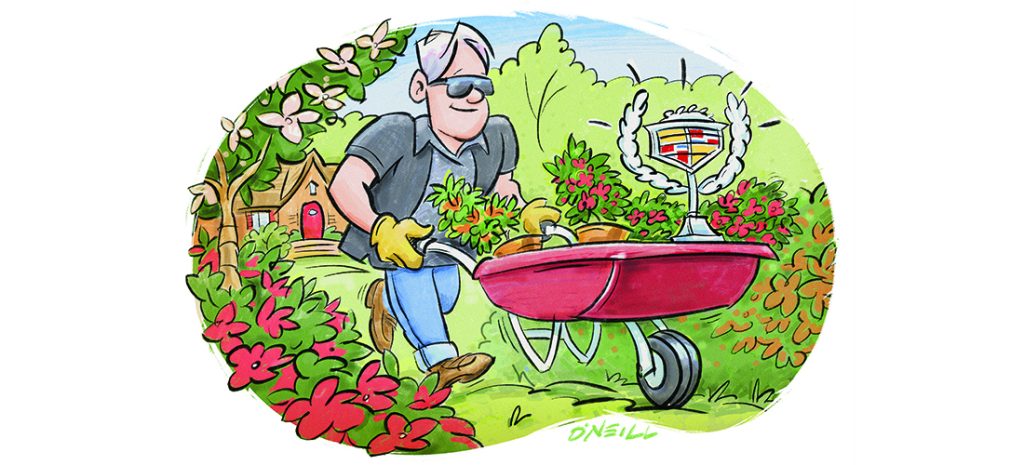
Every spring, the Franks family lawn burst spectacularly into bloom with luscious beds of mature azalea bushes Joe had planted and groomed. During the peak blooming stage, usually around Easter, a constant stream of cars cruised slowly past his house just to take in the impressive floral show — rather like people do at Christmastime to look at over-the-top lighting displays. And thanks to several hundred pink and white dogwood trees that bloomed along the street just as the Franks’ yard exploded in color, Dogwood Drive lived up to its name, including a magnificent Cherokee Brave (pink) and Cherokee Princess (white) that proudly stood for more than half a century.

Over the years, our street — and the Franks house in particular — found their way into numerous newspaper feature sections and a host of top gardening magazines, including a couple big spreads in Southern Living magazine.

What made the show bigger than life was that most Sunday mornings throughout spring and summer, Big Joe Franks lovingly washed or waxed his Cadillac in the Franks family driveway while playing the music of Frank Sinatra. His neighbors must have been fans of Ol’ Blue Eyes because nobody I know of ever complained. My mom even took to calling him Cadillac Joe. Looking back, I’m half convinced Cadillac Joe’s music is the reason I have a thing for Sinatra today.

“Dad sure loved that Cadillac and his azaleas,” Joe Jr. confirmed with a booming laugh when I tracked him down by phone. “And, of course, Sinatra. That was the music of his life. Waxing that Cadillac and growing those azaleas were his passions.”

Joe, the son, is something of a legend, too. He grew up to become a beloved athletic trainer and successful men’s football and women’s golf coach at Grimsley High School. The playing field at Jamieson Stadium is named for “Little Joe Franks,” as my mom called him. Today, Little Joe is semi-retired and lives in Danville, Virginia, where his wife, Dr. Tiffany McKillip Franks, is in her 14th year as president of Averett University.

“So how are your azalea bushes doing?” I asked him.

“The college has plenty of them. I don’t have my dad’s thing for growing them, but I do have a Cadillac Escalade just like Dad. And I recently picked up a second one, an ATS two-door coup. Really nice.”

I wondered if Joe had any idea how many azalea bushes his dad, who passed away in 2001, planted and groomed to perfection.

“At least 250,” Joe said, explaining how Big Joe’s favorites were red, white and pink azaleas. “If you recall,” he added, “there was a huge peach-colored one by the front porch. It was probably seven or eight feet tall.”

I remembered this bush and almost hated to inform him that the bright young college professor who owns the Franks house today is growing artichokes where Cadillac Joe worked his magic each spring.

“Yeah, by the time my mom was ready to give up the house,” Coach Joe told me, “the plants were showing their age and had probably seen their better days. I guess they just dug them up.”

“Don’t worry,” I said, pleased to inform him. “I think I might be channeling Cadillac Joe these days.”

Six years ago, my wife, Wendy, and I moved back to Dogwood Drive, purchasing an old house that sits two doors from the one where I grew up. As she got to work restoring the house’s interior, I got to work outside. To date, I’ve planted more than 30 trees in my yard, including five dogwoods, a trio of southern redbuds and several cherry trees that outrageously bloom every spring. I’ve also planted 24 azaleas and 17 hydrangeas.

A garden-loving psychologist wouldn’t be wrong in suggesting that I’m rebuilding the blooming street of my boyhood. I hail from an old Carolina clan of farmers, gardeners, preachers and storytellers, after all, and grew up hearing legends of the dogwood tree’s origin, one of which holds that long ago the dogwood was a mighty tree — like the oak — that was used to make the cross on which Jesus was crucified. Because of its role in the death of Christ, the legend goes, God both cursed and blessed the little tree. It would never again grow large enough to be used as a cross for a crucifixion. Yet it would also produce beautiful flowers in the spring, just in time for Easter, with petals shaped like a cross, clustered berries resembling a crown of thorns and specks of red that symbolized drops of blood. 

Over the half a century since I’d lived on our street, most of the dogwoods disappeared from yards. In fairness, dogwoods generally only live anywhere from 40–70 years, and the beauties I remember were probably at least already middle-aged. Even so, we count no more than 15 dogwood trees on the entire street.

For that matter, azaleas are also dramatically thin on the ground these days. Maybe they are just too finicky for casual gardeners and the new generation of busy young families that inhabit the neighborhood to keep up with, requiring annual trimming, fertilizing and mulching in order to flourish.

In truth, I was never terribly keen on planting dogwood trees and azaleas bushes until we moved back to Dogwood Drive, at which point a mysterious desire overtook me. Perhaps I am becoming Cadillac Joe 2.0?

Little Joe Franks was pleased when I mentioned this botanical phenomenon.

“That’s great,” he said. “Now all you need is an old Cadillac and the music of Sinatra!”

He may be right. For the moment at least, an aging Subaru and Mary Chapin Carpenter will have to suffice.

Maybe someday I will be remembered as the legend of Outback Jimmy.  OH

Jim Dodson is the founding editor of O.Henry.

Birdwatch

Birdwatch

Working Without a Net

The bold, acrobatic Carolina chickadee

By Susan Campbell

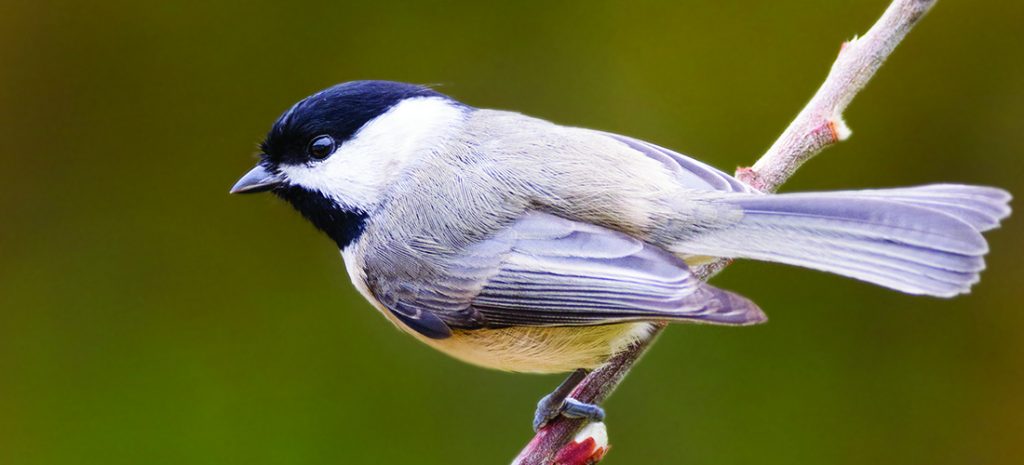
The chickadee is one of the most beloved feeder birds across the country. Central North Carolina is no exception, but “our” chickadee species is the Carolina chickadee, merely one of five different chickadees commonly found in the United States.

Chickadee species are quite similar, but the Carolina averages the smallest — less than 5 inches in length. It also has a range that extends farthest south: from central Florida, throughout the Gulf States and across to central Texas. The Carolina chickadee overlaps with the more widely distributed black-capped chickadee in parts of Pennsylvania, Ohio and Illinois. Black-cappeds and Carolina chickadees are very challenging to separate in areas where they are both found. Subtle differences such as the coloration of the edges of the wing feathers and variations in the calls are used to tell them apart. Here in North Carolina, black-cappeds can be found at the highest elevations of the Appalachians.

Carolina chickadees reside in a variety of woodlands across the state, from the mountains to the Outer Banks. They feed on everything from insect larvae to seeds and berries. Their stout, pointed bill is a useful tool for both picking at and prying open food. And these little birds are quite the acrobats: They have very strong feet, which enable them to easily cling upside down when foraging. Carolina chickadees are regular customers year-round not only at our sunflower seed feeder, but on the suet cage feeder. They are very bold, driving off woodpeckers and wintering warblers to get at the protein-rich offerings.

Our chickadees are not migratory, so the same individuals are around from day to day. Family groups will associate from summer through late winter before the young wander away in search of mates of their own. If they are to do so, it has to happen quickly, because the breeding season starts early for these little birds. Carolina chickadees are looking for empty cavities or a small snag by the end of February. Nests of soft materials are built during the month of March. A thick outer layer of mosses or shredded bark is lined with animal fur or plant down. The nest conceals the eggs and insulates the young during the cool days and nights of early spring.

It is fun to watch female chickadees during their nest building. They are the busy architects with the males looking on, defending the territory from other chickadees or competing nuthatches. Clumps of fine cat or dog hair (puggle undercoat is very popular in our yard) will be gathered by the mouthful if available. Otherwise, chickadees will, believe it or not, seek out mammals such as raccoons and pick loose strands of fur to take back to their nests.

A pair of chickadees may raise four to six young in a year. If eggs are lost to predators or the weather, they may try again, provided it is not too late in the season. Often chickadees are replaced by bluebirds or titmice in birdhouses come May or June, once their young have fledged.

So keep an eye out. You may find you have a pair of these feisty birds that has set up housekeeping nearby, or perhaps you will see a new family of chickadees descend on your feeder like the Flying Wallendas. OH

Susan Campbell would love to receive your wildlife sightings and photographs at susan@ncaves.com.

O.Henry Ending

O.Henry Ending

A Religion of Birds

On a wing and a prayer, a mother attempts to explain life’s greatest mystery

By Sarah Ross Thompson

It’s the first day of preschool. I am making a last-minute sign for my 3-year-old, Owen, to hold while I take his picture on our front steps. You know the ones, complete with name, age and class (Bees). Lastly, I ask him, “Hey, O, what do you want to be when you grow up?”

Without a moment’s hesitation, he replies, “Well, when I die, I want to be a bird.”

Caught somewhere between laughing and crying, I say, “That’s such a nice idea.” And then, because there is still the sign to think about, “You like firefighters a lot, too.”

“Yeah, firefighters, Mommy!” he agrees.

His words, of course, stay with me the rest of the day. After some thought, I realize that the idea must have come from a trip to the Bog Garden months before. He and I had walked hand-in-hand on the trail while his infant sister rode along strapped to my chest in the front-carrier. We fed the ducks, called for owls, noticed the chickadees hopping on their tiny feet, and, toward the end of our walk, came upon a crow that had died. To my surprise, Owen became tremendously emotional, refusing to leave the bird’s side. And because it’s almost impossible to carry a crying 3-year-old down a steep, muddy trail with one baby already strapped to your chest (If you’ve been there, you know), I had no choice but to stay — and breathe — and discuss the afterlife of the crow.

While I believe in God, I am not a churchgoer. I look for God in nature, love and moments of stillness. Moments such as sitting on a muddy trail, holding my babies and trying to make sense of loss in such a beautiful world.

I don’t pretend to actually know what happens to crows after they die. And yet, I can’t bring myself to leave him with that helpless feeling of uncertainty. So instead, I share with Owen bits and pieces of what I hope happens. “We are only seeing this bird’s body. Its soul is in the air all around us,” I say. “You have a soul, I have a soul, and this bird has a soul, and souls live forever. This bird’s soul may even come back as another bird one day.”

He seems to take this in and process it, asking through sniffles and staggered breath, “What kind of bird, Mommy?” I feel almost paralyzed with the awareness and responsibility of how much weight my words carry for him. It’s not until six months later on the first day of preschool that I discover his words carry the same power for me.

Since then we’ve talked a lot about birds. We’ve got bird feeders, birdhouses, birdbaths, you name it. There is absolutely nothing better or easier than going to feed ducks, geese or swans with my now 5- and 2-year-olds. We do it so often that it’s become our own little religion.

Certain things about birds I hold sacred: Red birds remind me of my Mema, yellow birds remind me of my Grandma and, when I see these birds in our yard, I believe they are my grandmothers coming to check in on us. Or maybe to remind me to be still, to look up, to breathe.

And I agree with Owen: When I grow up (and eventually die) I want to be a bird.

It reminds me of that iconic line from The Notebook, “If you’re a bird, I’m a bird.”

But seriously, please God, let me be a bird. I want nothing more than to navigate eternity with my children’s wings flapping by my side.  OH

Sarah Ross Thompson lives in Greensboro with her husband, John, and her children, Owen and Ellie. A psychologist by training, she finds getting lost in the woods and writing little stories to be two of the greatest therapies.

Nature’s Wonders

Nature’s Wonders

Cheeky Chippies

A closer look at this adorable mammal

By Mike Dunn

Our home has a lot of windows, so we can look out and watch the goings-on of our wild neighbors in the yard. After living on this property for several years, I looked out one morning and saw a brown blur racing from a stone wall to a small footbridge. What was that? It moved so fast as it darted between the plants and under the bridge. In a few seconds, I knew the answer: our first chipmunk! I was hooked — chipmunk-watching can be addicting. A few days later, there were two dashing around the yard and, ever since, I have enjoyed observing their antics as they go about their busy lifestyle. I later learned that a group of chipmunks is called a scurry, an appropriate name for these critters, which I think are the cutest of all our native wildlife species.

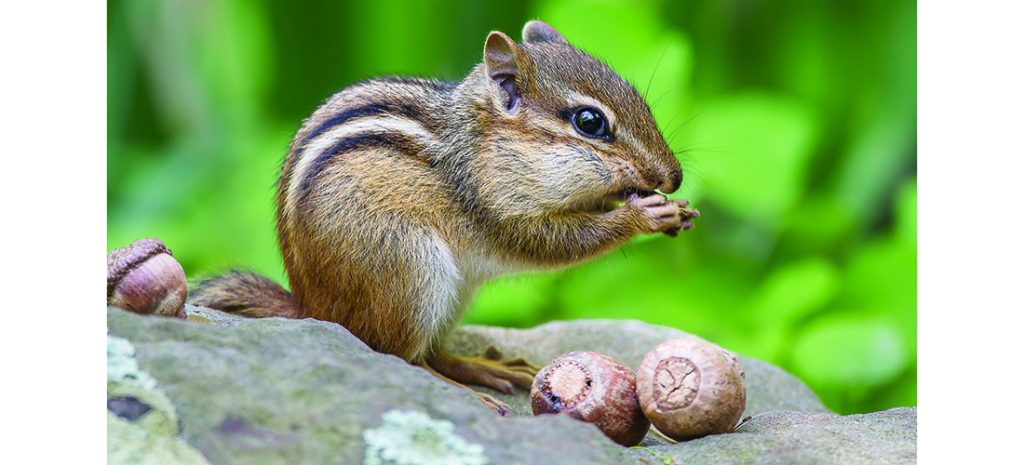
Chipmunks are a type of small ground squirrel, measuring only 8 to 10 inches in total length, including about a 4-inch tail. There are over 20 species of chipmunks in the United States, but our only species here in the Piedmont is the Eastern Chipmunk, Tamias striatus. The genus name, Tamias, is Greek for “storer,” and describes their habit of squirreling away large quantities of food in their burrows. The species name, striatus, means “striped” and refers to their most recognizable physical trait — the alternating dark and light stripes on their cheeks and back. The word chipmunk is from a Native American word meaning “one who descends trees head first.” Though they are a ground squirrel, I have witnessed them run up a tree trunk when startled. They also climb to seek nuts or seeds or to get a better vantage point as they chew on an acorn or scan their territory. 

Another notable feature of chipmunks are their expandable cheek pouches, which they can stuff with seeds, nuts, berries and other food. Each pouch has an opening between the jaw and the cheek that can expand to be the size of half a ping-pong ball. I enjoy watching our “chippies” (a word that I now can’t help calling these little dynamos) run around as they gather nuts and seeds and stuff them in their pouches until their heads are almost three times the original size. Observers have counted as many as 60 sunflower seeds or three acorns being stuffed into one pouch. The quantity they can gather in a short time is impressive. One person recorded a chipmunk hoarding 150 acorns in one day. And famed 19th-century naturalist John Burroughs once observed a chipmunk collect and store 5 quarts of hickory nuts, 2 quarts of chestnuts and a large amount of shelled corn – almost a bushel of food. The pouches are emptied by squeezing the food out with their front feet. Cheek pouches allow chipmunks to quickly gather large amounts of food in preparation for winter and thereby reduce the amount of time they are out in the open exposed to predators.

Chipmunks always seem to be on the lookout for potential danger — probably because they’re on every predator’s dinner menu (hawks, foxes, coyotes, snakes and free-ranging house cats are local dangers). Chipmunks make warning calls to alert others of the presence of predators. Researchers have discerned three main types of alarm calls given by Eastern Chipmunks: a chip-trill — a short high-pitched call made while running to defend territory or escape predators; a high-frequency chipping call made from a stationary position like a prominent rock or log that indicates a threat from a terrestrial predator; and a lower-frequency chucking call when facing a threat from an aerial predator like a hawk (again made while stationary). The repeated low-pitched clucking note of chipmunks is a woodland sound that fooled me years ago when I first heard it, thinking it was some sort of bird. Now when I hear it, I scan the sky for hawks. Once they are spooked, a chipmunk can disappear in a hurry, scampering to their burrow or other shelter, tail held high.

Chipmunks are most active early in the morning, with another peak in late afternoon. I see them forage all across the yard and nearby woods, but they are particularly fond of the areas around the bird feeders (no surprise there) and the rock walls around our two ponds. They have regular paths they take to and from their burrows as they forage. Burrows can be extensive, especially for the females. A tunnel system can consist of several entrances (a main entrance and some escape exit holes) extending a few feet underground and spanning 10 or more feet in length. They may have multiple underground chambers for different purposes like food storage, raising their young, sleeping or even an outhouse. It can be difficult to find a chipmunk burrow since they usually carry away the excess dirt in their cheek pouches, leaving no obvious mound of dirt at the entrance. Plus, they often disguise their burrow entryways. Two years ago, we started finding 1-1/2- to 2-inch holes in our gravel walkway off our deck. One would appear, then get filled in, and another would pop up in a different location. We suspected chipmunks, but it wasn’t until I put a trail camera on one of the holes that it was confirmed. A chipmunk was indeed going in and out and would periodically drag leaves, sticks and even rocks over to hide the hole.

The tunnel system is particularly important in winter, when chipmunks go into torpor, a hibernation-like state of suspended activity with reduced heart rates, body temperature and breathing. Since chipmunks don’t develop a huge layer of body fat like bears do for the winter, they must wake periodically to eat some of their stored food and void waste products. They may stay awake for several days and even wander above ground during warm winter weather. I have even seen chipmunk tracks in the snow in our yard (you remember snow, don’t you?) after a January thaw.

Chipmunks breed in early spring and often again in summer, producing broods of three to five babies. The females nurse their young underground until they venture out after six to eight weeks. I remember seeing the first baby chipmunks in our yard over a decade ago — four bundles of energy about two-thirds the size of the adults, zigzagging everywhere as they chased and tumbled with each other. Soon after, they were on their own, finding new territories and digging their first burrows. Home range is usually pretty small, often only a third of an acre up to about an acre depending on food availability. Life expectancy in the wild is 2 to 3 years.

The distribution of chipmunks in our state is highly variable — some suitable habitats in Wake County have an abundance, others none. Until recently, they were not found in the Coastal Plain, but have shown up in the Wilmington area in recent years (eight new counties were added to their range in 2021). Found in both urban and rural areas, they prefer open woodlands and forest edges with dry ground for digging their burrows.

Some days I see two or three chipmunks darting about the yard and it just makes me smile. I know that a few people dislike these little guys as they may steal a snack out of your garden, but, so far, we have lost only a few bites from low-hanging tomatoes and the occasional bean to our chippies. So I, for one, am glad they have decided to chip and cluck in our woods.  OH

Mike Dunn is a lifelong naturalist educator living on 14 acres of woods in Chatham County. When not chasing chipmunks with a camera, he enjoys camping, canoeing, and observing and sharing the natural world, from NC to Yellowstone and beyond. Learn more at roadsendnaturalist.com.

Life’s Funny

Life’s Funny

Not So Fast

Old dogs learn new appliances

By Maria Johnson

I was warming up a cup of coffee in the microwave.

Bing!

I expected that.

Crack!

I didn’t expect that.

It happened when I opened the door of our built-in microwave, which required me to slightly lift up on the handle, which was necessary because the hinges were bent.

Later, I tried to remember how the hinges had gone south.

Best guess: gravity aided long ago by a young son reaching up to open (i.e. hang on) the door in the process of exploding his Easter Peeps in the microwave because he’d heard that was possible and wondered if that was really true.

The answer was yes. A vivid pink yes.

In any case, the hinges were bent but the door still worked. And, as with so many things that are damaged but still functional, we lived with it and adjusted our behavior slightly as a work-around.

So we tugged upward to open the door.

Several times a day.

For 20-plus years.

What could go wrong?

Standing there, with a detached microwave handle in my hand, it took my uncaffeinated mind a few seconds to grasp what, indeed, could go wrong.

“Oh, no,” my husband said from across the room.

He was focused on the microwave.

“Oh, ****!” I said.

I was focused on the coffee inside the microwave.

I clawed at the edges of the door.

“Stop! You’re gonna break it!” my husband implored.

“Too late!” I barked.

Always good at triage, I was on a mission to save as many fresh-ground lives as I could.

One butter knife later, I calmly sipped my coffee. We surveyed the damage.

The door handle was part of the frame, which was irreparably broken.

A few telephone calls later, we learned that a new door was not available.

The only alternative was to buy a new microwave, which meant buying a new wall oven, too, because they were sold as a single unit, and we didn’t fancy rebuilding the wall.

Luckily, a locally-owned appliance store could order a replacement that would fit perfectly.

In the meantime, we patched the microwave handle as best we could, with black duct tape, upon the advice of our Peep-wrecking son, now an engineer who specializes in — wait for it — superheated, molded plastics.

In other words, you might have to wait a long time to see the benefit of your kid blowing up his Easter candy, but, God willing, the payoff will come when you need it most.

A couple of months later, our father-daughter installers, Dave and Alison, showed up with the new combo. They were lovely, professional people with entertaining stories about Dave’s Maine Coon cat, who eats salad and relaxes in a water-filled bird bath.

Never mind supply chain delays. Those images were worth the wait.

At the end of the installation, Dave gave a quick demonstration of how to use the new appliances, which shared a banner-style control panel across the top. The microwave controls were on the left, under “upper oven.” The regular oven controls were on the right under “lower oven.”

If we were baking something and needed to use the microwave oven at the same time, we would see a split screen of cooking in progress.

Oddly, Dave explained, when the microwave was finished, only the microwave display — not the oven display — would remain on screen unless we pushed the “cancel/off” button on the left side.

“Don’t push the cancel/off button on the right side, or you will turn off the oven. That’s what most people do,” he cautioned. “Got it?”

I rocked my noggin like a bobble-head in a sort of “yes-no-not-really” motion.

“It’s really a design flaw that they should fix,” he said.

I bobbled an affirmation.

“We’ll read the instruction manual,” I said weakly.

After Dave and Alison left, Jeff and I were faced with the horrible truth.

We would have to learn something new.

Together.

At the same time.

It wasn’t gonna be pretty.

One year before, we’d reconfigured our trash can/recycling can setup in the kitchen.

Months later, we were still dropping plastic bottles into the empty under-counter space where the recycling can had been.

We finally we caught on. Though in times of omelet-induced stress, I have been known to toss egg shells into the recycling can, which stands where the trash can used to.

Brain experts would explain this in terms of neural pathways. The more a behavior is repeated, the stronger the nerve connections leading to that behavior. Unused pathways disappear.

That’s why learning new tricks is the best way to slow down mental decline, according to scientists who probably croaked with their microwaves still in boxes.

That night, Jeff and I stared at our new brain trainer.

We wanted to warm up some leftovers.

It took us twice as long to figure out the correct order of steps — five in all — as it did to heat the food.

But we’re gaining on it. We’ve hacked the zapping down to two steps not found in the instruction book.

Turns out, old dogs aren’t half bad at learning new tricks.

And hungry dogs are even better.  OH

Maria Johnson is a contributing editor of O.Henry. Email her at ohenrymaria@gmail.com.

Pleasures of Life

Pleasures of Life

Hats Off to Hats

With a little help from the royal family

By Ruth Moose

I miss wearing, seeing, buying hats. Queen Elizabeth always wore the most elegant, most becoming, absolutely stunning hats. Hats that matched her outfits. Perfect hats. Of course, she did have at her command and fingertips the finest millinery in the land. And she did them proud. What are the chances a newly crowned King Charles III can do half as much for the humble hat?

My grandmother, a country preacher’s wife, owned two hats — one for summer, one for winter. Summer’s hat was a flat pancake of black straw with silk daisies. Winter’s hat was a black felt cloche with a feather or two. She would never have gone to church bareheaded.

Nor without her gloves.

The last time I wore a hat was to a funeral. I had, on a crazy whim, gotten some fairy hair for fun. It was a sort of passing fancy, and the funeral for my sister-in-law was totally unexpected. I could not go to a funeral sporting red and blue and green fairy hair. Since it was January, I dug my black felt cloche from the top closet shelf and very respectfully went to the funeral. I was the only one there wearing a hat.

My mother was not a hat person, so I must have gotten my “hats” gene from my grandmother.

My Great Aunt Denise sold hats in the Peebles department store in Norwood, North Carolina, the town where she lived. It must have been the smallest store in the Peebles chain, yet she sold the most hats.

Every December Peebles paid for Aunt Denise to take the train from Hamlet, North Carolina, to New York to buy for the store. They knew every woman in town depended on her to “know” the market.

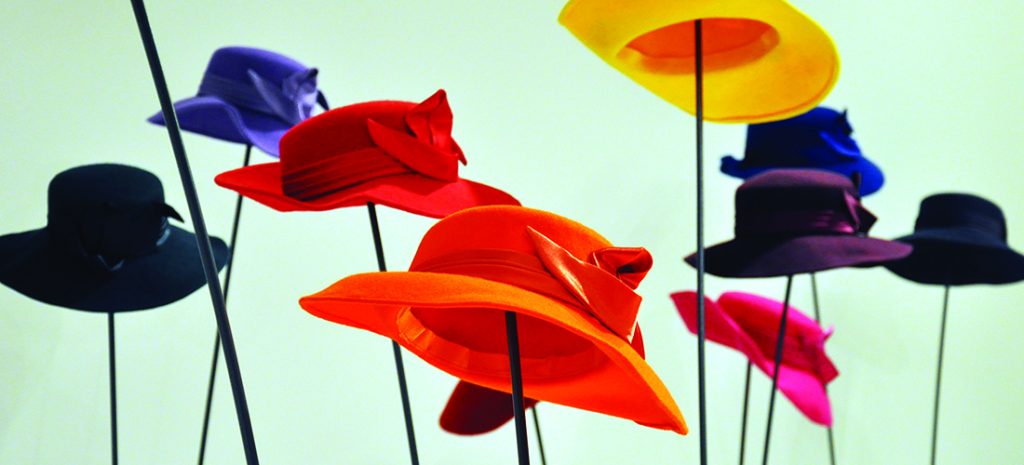
When the women of Norwood came into Aunt Denise’s Peebles, they went directly upstairs to the mezzanine, where Ladies’ Ready to Wear had mannequins with no arms, nor legs, that sat on tables wearing hats in every color, shape and fabric. Wide hats, tall hats, hats with flowers and feathers. Spring hats were pink and yellow, fluffy as frosted cakes. Some had veils or netting. All had ribbons. Fall and winter hats were serious in grays, blacks and browns. Gray hats hugged the mannequins close. They were the colors of rain and fog. Black hats were dark as night, and the women in Norwood knew they had to have at least one for funerals. It might have a feather or a veil, but it had to be a solemn piece.

No salesperson, male or female, ever knew their Ready to Wear clientele better than Aunt Denise knew hers. “Mrs. Cohen, when I was in New York last week and saw this hat, I knew it was just for you. I said to the designer, ‘I know just the lady for that hat.’” And then she’d add, in a whisper, “I only bought one. You won’t see yourself coming and going in this town. No ma’am.” Then she’d hold that hat up like a prize trophy, and Mrs. Cohen would start to reach for it, but Aunt Denise would step back, still holding the hat aloft. “Here,” she’d say, “let me put it on for you.” Then she’d lift it lightly, lay it on like a crown. “There,” she’d say, “don’t you feel like a queen now!”

Do you suppose Charles will feel so good?  OH

Ruth Moose taught creative writing at the University of North Carolina-Chapel Hill for 15 years and tacked on 10 more at Central Carolina Community College.

Omnivorous Reader

Omnivorous Reader

Heart of a Poet

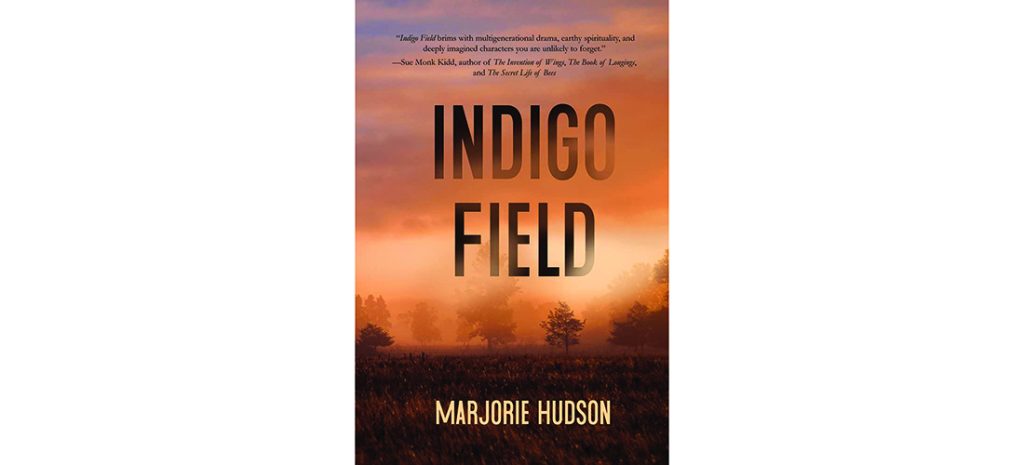
Time, place and eternity meet in Indigo Field

By Stephen E. Smith

On this sunny late-March afternoon, Marjorie Hudson occupies rarefied space: She’s standing in the footprints of F. Scott Fitzgerald, Sherwood Anderson and Thomas Wolfe, reading from her beautifully wrought first novel, Indigo Field, at the Weymouth Center for the Arts & Humanities. Her bright eyes (they might be blue or green; the afternoon light plays tricks) stare out from a shock of white hair (she’s accurately penned the description, “white-blonde hair,” for a character in her novel), and she’s smiling the smile of one who’s realized her dream via pure, implacable determination. In the words of Keats, she’s surprised everyone, including herself, with “a fine excess,” writing that strikes the reader almost as a remembrance. Now all she has to do is sell her masterwork. The literary world needs to know about Indigo Field, and readers need to snatch it off bookstore shelves or download it online.

Hudson is a Midwesterner who settled in North Carolina by way of a lengthy sojourn in Washington, D.C., where she worked for a nature magazine that kept her indoors much of the time.  “We all worked such long hours, we hardly got to go outside,” she says. “All it took for me to jump ship was a visit to a friend (in North Carolina), a rainbow over a farmhouse, and I was hooked. My days were full of freelance writing assignments, sunbathing in the yard, gardening and pond swimming. Whippoorwills chanted outside my window, a sound I’d never heard before. When frogs took over the pond one night in a massive mating ritual, it was better than any nature documentary.”

Thus Indigo Field evolved into a decidedly Southern novel featuring Southern characters immersed in a regional history that emphasizes a strong sense of place. Even so, there’s no forced, ersatz Southernisms in her dialogue, no Hollywood “y’alls,” and, thank God, there’s not a subhuman Faulknerian Snopes in sight. Her characters speak authentically, and they never propagate a phony gesture. Somehow she’s acquired the ability to absorb the Southern landscape she’s adopted as home.

She came by this invaluable knowledge by happening into the perfect job. “One of the many freelance jobs I took to pay the rent was copy-editing novels at Algonquin Books of Chapel Hill,” she says. “I had never read much Southern lit before, and reading the novels of Clyde Edgerton and Jill McCorkle, and the stories of Lee Abbott and Larry Brown was like going to grad school. How a novel all fit together was fascinating. How a short story was constructed was beautiful. And the language! I was learning the rhythms of speech and turns of phrase from my neighbors, my new husband and these stories. I turned to my computer and started a story of my own.”

Hudson’s prose style is clear and concise, and she preserves a delicate balance of empathy for characters who come alive with startling authenticity. Her leapfrogging plot turns sustain the story’s energy and propel the reader ever forward. The Regal House Publishing promotional material provides an accurate precis. “In this novel of moral reckoning, the unjust outcome of a murder trial, and the chance accident that follows, result in a feud that raises the spirits of the dead, forcing enemies to become allies in order to survive.”

Good enough. But the novel’s beauty is more than fancy footwork, deft plotting and the able handling of points of view. Hudson writes with the heart of a poet. Her prose has been worked on (in the best sense) to get rid of that worked-on feeling. Take this transitional passage from Chapter 49: “This great wind rode the eye of a rogue hurricane and spun out lightning and whirlwinds like warriors of a great army. These warriors flattened all they touched, and chose what they touched with care. They touched the new homes of wealthy people and left the old derelict homes of Poolesville, the farmhouses of widows, the trailer parks of the destitute, damaged but still standing. The wind brought lightning strikes so pervasive that many small fires lit rooftops, tall trees and last year’s broomsedge in Indigo Field. . . . This wind skipped from high spot to high spot, so that places that had been raised up were laid low, and places that were low and humble remained intact.”

The writing of Indigo Field took up almost 30 years of Hudson’s life — with time out to write and publish an acclaimed short story collection, Accidental Birds of the Carolinas, and a history/travelogue, Searching for Virginia Dare. “I had 450 pages (of the novel) by 1998, but I didn’t know how to end it and I knew it needed revision.” She set Indigo Field aside, finished a different novel, sent it out, got discouraged, went to graduate school, and all the while the novel kept getting longer and longer. Hudson recalls: “I kept adding layers of things I was fascinated with: parrot colonies, Nike missile sites, archeology. As it got longer and longer, unbeknown to me, New York’s acceptable novel length had gotten shorter and shorter. It was roundly rejected.” So Hudson turned to a small press, Regal House Publishing in Raleigh. Regal reminded her of Algonquin in the old days: “Small, feisty, locally owned. I even knew one of the editors,” she says. “I submitted my 50 pages. They asked for the rest. I got the call a couple of months later. I was still revising. Cutting mostly. I had a whole new version by the time Jaynie called and said ‘Yes.’”

Indigo Field was chosen to be part of Regal’s “Sour Mash Series,” a selection of books centered on the American South’s sense of place and history. Hudson was in the place described by Flannery O’Connor: “The Southern writer operates at a peculiar crossroads where time and place and eternity somehow meet.” After living in North Carolina for almost 40 years, Hudson is a Southern writer, and she’s pretty proud of that.

She’s come a distance, a far piece, to stand before an audience at the Weymouth Center — and all the other audiences she’ll be entertaining in the months to come. She has a novel to sell. It’s demanding work, but Marjorie Hudson is surely up to the task.  OH

Stephen E. Smith is a retired professor and the author of seven books of poetry and prose. He’s the recipient of the Poetry Northwest Young Poet’s Prize, the Zoe Kincaid Brockman Prize for poetry and four North Carolina Press Awards.

Home Grown

Home Grown

Highly (Anxietied) Entertaining

My mother, the hostess with a host of worries

By Cynthia Adams

My mother, while a charming and gracious Southern woman, was driven to the fine edge of sanity by entertaining.

Hosting the Home Demonstration Club (born in the Depression) to discuss homemaking topics such as canning and cake decoration was on par with Princess Margaret making a stop in Hell’s Half Acre. HHA was 30 miles from Monroe, Charlotte, Concord and — well, places where HRH Margaret would never deign to visit. 

“Company” sent seismic waves through our ranch home.

A hair appointment was booked. A trip to Smart Shop for a new dress. High-anxiety calls went to Mama Patty, her mother, who lived for company.

Mama Patty, always baking, was primed and ready for “drop-ins,” her polite term for interlopers. Not so with her youngest, Jonnie Louise (who dropped the “e” on Jonnie in her fifties — Mama Patty had hoped for a boy).

Out came the Electrolux, Johnson’s floor wax and the buffer. Yes, JL owned a buffer. Also, a punch bowl with cut-glass cups; plus, china, crystal, silver, linens, etc.

My older sister and I would vacuum, then hand wax the floors (yeah, Karate Kid stop your sniveling). Then buff. While managing to gripe and argue the entire time. 

Once when I complained that I was too tired to help, Mom gave me one of her diet pills. 

“These are from Dr. Pfeiffer, so they’re safe, but give lots of energy.” 

Those pills became known as Black Beauties on the street — amphetamines. Of course, JL didn’t know this. I grew more jittery than the shuddering buffer, following the oak grain and inhaling the waxy smells as my young heart hammered. 

While show time drew near, we were all banned from the kitchen as soon as cooking commenced.

Mom believed her usual repertoire lacking when it came to the Home Demonstration Club. She would send herself into a complete frenzy — once making a baked Alaska.

By the time the Home Demonstration agent and guests arrived, Mom, the floors and her buffet were perfect — but she was near collapse.

Then there was Mama Patty.

Mama Patty, who had faced devastating losses, lived out her life as if she had only walked among duckies and daisies. Yet she lost a toddler to meningitis. A young husband to an aneurysm. A breast to cancer.

(When questioned about never complaining, she replied, “Self-pity is a cancer! And it will kill you faster,” then proceeded to smock gowns for neighboring newborns and send cakes when someone died.) 

Mama Patty’s house was tidy, cheerful — and full of bad furniture.

At least, the kitchen was cheerful. The table, chairs and counter were red melamine rimmed with chrome. Pound cakes (lemon and chocolate) awaited in Tupperware. A fruit pie chilled in the “Frigidaire” with fried chicken, potato salad and pickles.

A meal was always at the ready and she happily fed whomever graced her doorstep. 

She “went modern,” decorating the den with a brown Naugahyde sofa and recliner, and a braided green rug. She accented with unidentifiable amber glass objects. With the recliner extended, she stretched out to enjoy her soaps, The Edge of Night and Secret Storm.

Mama Patty’s bedrooms were filled with 1940s-era “suites” of brown furniture, which even my kid self recognized as ugly. 

When Mama Patty died, mourners spilled outside the country church, later overwhelming her little house. A weepy-eyed man no one recognized blubbered, “I loved Miss Pat so much!” 

When asked how he knew our grandmother he answered, “Oh, I repaired her appliances.”

Seemed he and his family enjoyed not only regular visits but also her cooking. He once was fixing the washing machine when a bad storm arose; she perfectly innocently insisted he lie down on the bed till it passed. 

Mama Patty feared storms, snapping turtles tangling up her fishing line, snakes and drowning.

All real things to fear. And all of which made my mother’s social anxieties, then and now, an even greater mystery.  OH

Cynthia Adams is a contributing editor to O.Henry magazine.

Wandering Billy

Wandering Billy

A Musical Visionary

Tuning into Tyler Millard

By Billy Ingram

“Those who wish to sing always find a song.”  — Author Unknown

There are few truly revelatory moments in life. Covering the nascent punk/post-punk music scene in East Los Angeles from 1980–83, witnessing teenage bands and young musicians like Red Hot Chili Peppers, Social Distortion, Minutemen, Fishbone and Perry Farrell thrashing through their earliest gigs was one of those moments for me. This week brought another revelation: discovering the music of Tyler Millard.

Singer/songwriter Tyler Millard didn’t pick up a guitar until he was 21. Admittedly, mostly by necessity when life threw him a curveball. And yet, in little over a decade, he’s produced some of the finest original compositions this region has seen since Rhiannon Giddens ascended into the multiple Grammy-winning heavens.

Hard to believe? Check out Tyler’s latest single dropping this month on Spotify, “Gold and Green,” a dreamy ballad lyrically reminiscent of Conor Oberst or David Bazan, sans their concussive bleakness. Those crooners’ caterwauling stands in stark contrast to Tyler, whose haunting harmony reverberates into the mind’s sacred soil reserved for your all-time favorites, as if his soothing assuredness has always existed inside your ears. It’s the fourth single from an album that will be released later this year.

On a recent Saturday night at One Thirteen Brewhouse + Rooftop Bar, I caught a performance by The Ghosts of Liberty, a tight three-piece band Tyler formed with his wife, Emma, joining him on vocals and father Richard Millard on keyboard. For these types of gigs, the combo mixes original tunes with twists on classics such as “Brown-Eyed Girl” and “Tennessee Whiskey.” Elevated by Emma’s classically trained, velveteen voice and stunningly pristine vocal styling, their romantic, anthemic composition, “Sundown to Sunrise,” has racked up close to half-a-million listens on Spotify.

Tyler might actually have an advantage over other singer/songwriters, sonically at least, because he’s sightless — a slightly more accurate description than blind. He can still detect bright sources of light, but little else.

“I’d always had bad vision. It just got a little bit worse every year,” Tyler explains. Majoring in mathematics at UNCW, he was 21 when “driving was starting to get scary for me already.” Forfeiting his driver’s license, he was ultimately diagnosed with retinitis pigmentosa or RP for short. “Honestly, at the time, it was a little bit of a relief because I knew I shouldn’t be driving anymore.”

Finishing his degree and faced with an inability to compete in the sporting events he excelled in, Tyler picked up a guitar, meticulously teaching himself to play. “I wasn’t talented naturally, out of the box. It just never even occurred to me that music would be a part of my life.”

Pretty much every successful creative person I’ve ever encountered has found themselves at a crossroad leading a wholly unanticipated but gratifying future. “As I’ve moved through life, I’ve seen other people cope with mourning their expectations,” Tyler says. “I now recognize that’s kind of what I was going through at the time. You think your life’s going to be one way, then realize everything’s going to be very different.” Feeling fortunate in a way, he adds, “It wasn’t like I had some sort of an accident and lost my vision. I had time to kind of ease into the water.”

As luck would have it, college campuses are a hotbed of wannabe guitar heroes. “So there were tons of people to learn chords from,” Tyler recalls. He admits to being obsessed with mastering the instrument, saying “I think you kind of have to. There’s such a barrier of entry with a guitar. It literally hurts your fingers getting the guitar to become so familiar that it feels like part of your body.”

After an unsettling attempt at teaching high school, Tyler returned to UNCW for grad school in order to teach at the community college level. It was there that he got serious about writing music. “By the time those two years were up, my fate was sealed,” he recalls. “I’d played too much guitar and couldn’t go back. So I moved home to Oak Ridge where my dad lives.”

After earning his teaching certification, he switched gears and instead pulled together his first band. “I was still living at home, so I wasn’t concerned with money as much,” he tells me. The Tyler Millard Band found receptive audiences first in Wilmington, “where I got to see my old friends from college. And we played in Greensboro a bunch when Buckhead [at Plaza Shopping Center] was open.” In 2014, the group released an album, Carolina Blues, which harkens back to Carolina-inspired, shit-kickin’ Southern rock of the ’70s.

In 2018, Tyler’s proposal to his wife, Emma, came in the form of an exquisitely tender refrain he composed then serenaded her with. Together they recorded the song, entitled “Prologue,” with Doug Davis of The Plaids producing, credited to Em & Ty. A poignant, poetic melody sure to dampen dry eyes, “Prologue” is genuinely worthy of becoming a standard performed during every matrimonial party, as commonplace as “Wedding Song (There Is Love).”

By then, Tyler had abandoned the bar band concept for a more practical approach to making a living with music. You might say he did the math. “My dad and I play the wineries around here,” he says. “The economics of it are that the patrons are older and the owners are older, so everybody’s got more money.”

Occasionally joined by Emma, their first set is made up half of covers, half originals. “It takes a little bit of warming up just to get our voices sounding good and we also want to stay sharp on our own material,” Tyler says. “The second two sets are all bangers. We like to end really strong.”

Tyler sings while fingering an electric acoustic Fender Telecaster. Switching off on vocals, Emma strums her own acoustic six-string, forming the nucleus of The Ghosts of Liberty. “We put out three songs and did the whole Nashville thing — production, writing and everything,” recalls Tyler. For several days they hunkered down in Music City, collaborating with professional song stylists “who literally write 10 songs a week sometimes. We would sit in a room and they’d be like, ‘What do you wanna write about?’ Or, ‘Do you have any pieces you’ve been working on, a chunk of a song or anything?’ And we’d take it from there.”

No doubt, Tyler Millard and The Ghosts of Liberty will fast become yet another facet into what is evolving into a recognizable 21st century “Greensboro Sound” exemplified by Laura Jane Vincent, Josh Watson, Emily Stewart, Caleb Caudle, Tom Troyer and so many others. Although those musicians primarily root around in their respective and respectable country folk backyards, Tyler’s solo work is more rock-oriented.

“Another blind friend of mine from London taught me how to mix,” Tyler says. “Right now I’m laying down backing tracks, some drums and bass for us to play along with for bigger shows.” He tells me Taylor Swift’s “Shake It Off” is one of the tunes the band plans to cover “just because it’s kind of cool to turn it into a rock-and-roll and not a pop song.”

Down the road from his dad, Tyler and Emma currently reside in Oak Ridge with their 18-month old daughter, Clara, and Emmett, the dog. “She’s the best,” the proud father says of their baby girl. “All of a sudden she’ll be hugging my leg and I’ll have no warning that was gonna happen, you know? And that makes your day.”  OH

For concert dates, go to tylermillard.com.

Billy Ingram’s first book (mostly) about Greensboro, Hamburger², is available as a free PDF at: tvparty.com/1-hamburger.html.