
Call It Kismet

Call It Kismet

Joey Marlowe’s Most Excellent Turn of Fate

By Cynthia Adams

Photographs by Amy Freeman

     

During one of the most competitive real estate markets in modern times, two lucky High Pointers snapped up a radiant Emerywood property when opportunity literally came calling.

A keen intuition paid off for Joey Marlowe, who says Lady Luck pointed the way to a historic High Point home that seemed fated to be his. (In this case, Lady Luck was in the guise of a personal friend, who paid him a call at Boxwood, the antiques emporium he co-owns with Jana Vaughan.)

As his friend described a picture-perfect property set on a shady boulevard, he instantaneously thought, “It’s mine,” sight unseen.

Marlowe’s friend, who had a key, suggested a private showing on behalf of the owner, who actually wanted her to buy it. The seller, having recently remarried, was living in Virginia. Better yet, she had completed a skillful renovation, updating the kitchen and baths, replacing sunroom windows, and completely rebuilding the garage. 

Marlowe’s friend explained that while it simply wouldn’t work for her, she knew this house was perfect for him.

He knew, too.

But there was a complicating factor. His spouse, Chad Collins, who works in real estate himself as managing broker with Marlowe Collins Realty, had zero interest in a change of address.

Collins confirms he was determined not to move. 

“He would have never moved,” Marlowe adds flatly, but he was ready. 

In fact, an indifferent Collins didn’t even go along for the initial look-see. 

“I told him to look at the house first,” he says, nodding to Marlowe. “If you like it, then I’ll come look at it.” 

Turns out, fate wasn’t merely kind — fate was generous. From the curb, Marlowe saw that the Emerywood house possessed undeniable charm, the sort that homeowners and real estate agents mythologize.

With a pleasing symmetry and hip roof, plus fresh upgrades, the seller had retained the most charming aspects — right down to the original phone niche. Details that made Marlowe’s heart sing from his first walkthrough. (What is a home, after all, if not the sum of its parts?) 

“I was in amazement,” Marlowe says as he parks his SUV before the new white garage, which features a separate apartment. Eugenia topiaries, statuary and a vintage wrought-iron bench lend an English feel, setting the stage.

“Everything was as I envisioned it. The color was right. It was perfect . . . even if I [later] changed it.” He laughs, given his work as a designer includes an inclination to make cosmetic changes.

At first blush, however, he saw the manifestation of his dream house fulfilled. The two-story painted brick home, accented with black window boxes, featured a distinctive covered entry with a metal awning. Officially the Shelton House, according to Benjamin Briggs’s inventory of historic High Point architecture, it was the namesake of contractor Roy E. Shelton, who built the home in 1935. Shelton lived there with his wife, Mildred, as Emerywood was being developed. 

It is also believed to be among a few model showcase homes built for the upscale community. The concept home was a “stylish example of Depression-era design,” which just so happens to be one of Marlowe’s favorites. Not only that, according to the inventory, the house is “one of the city’s best examples” of that very style.

“Did I mention it’s English? In the Regency Revival style?” Marlowe asks. 

As the inventory states, it was “an interpretation of late 18th-century residential architecture,” with exterior features that include “delicate” dentil molding, quoins and transom over the front door. Deep wooden panels beneath the front windows give them the illusion of being larger.

A born collector and fervent Anglophile by both hobby and trade, Marlowe admits to falling hard for beautiful things — show him an English antique, collectible or painting and his mind and heart race.

But Collins, who had previously pumped the brakes on relocating, had presented three firm conditions. 

“It has to be the perfect house, it has to fall in our lap and has to be off market, as I wasn’t getting into a bidding war.” He pauses. “And the universe delivered it.” 

Collins says, “I’ve always said to clients, especially couples: You should walk in a home and, within 30 seconds to a minute, you should go, ‘It’s perfect,’ almost in unison.”

Marlowe knew before his feet hit the driveway; Collins later confirmed the inevitable. The house was, in a word, perfect. “So, I was like, ‘OK, we’re moving!’” he recalls.

Given the couple’s 17 years together — long enough to complete one another’s sentences — they agreed that this property checked every box. 

Collins shakes his head, still amazed by their good fortune.
   

Wanting to ramp up the sense of an English landscape, they planned to add coral roses, hydrangeas, ferns and trellises. 

They envisioned next steps: installing an arbor, window boxes, and updating exterior and interior lighting. Renaming the house Fern Manor, the couple took possession on September 1, 2022, after allowing the seller ample time to transition and empty the garage of stored belongings.

The house was very nearly dubbed Boxwood after the couple set to work within weeks, landscaping and planting 150 boxwoods — if not for the fact that Marlowe had already used the name for his antique business.

“At Boxwood,” Marlowe says “it’s about how you make people feel. People want to stay.”

“As a Realtor, I’m selling not just a structure, but dreams,” explains Collins. “At Boxwood, Joey is selling ideals. A concept.” 

In their home of just a year, they agree on having found both — a dream and an ideal. 

“Home is where it all starts,” Marlowe says, entering the house on a summer’s day. Fountains burble near the side and rear entrances. The delicious smell of Dragon’s Blood incense — “I keep a few sticks of it in my car” — follows him into the house.

He discusses aesthetics, saying how he strives to create that same inviting sense at Boxwood.

Inside, Collins waits in the kitchen, where Dolly Purton, their cat, wraps herself around his legs as he points out something he loves: a coffee nook. The seller converted the small laundry area, creating a counter and installing a hardwired instant hot water unit.

Marlowe, not a coffee lover, winces.   

“Joey could care less,” Collins says, before Marlowe shoots back, “I want the washer/drier back upstairs.” 

The eat-in kitchen, which they describe as Country French in style, wears a neutral coat of Benjamin Moore’s Simply White. There’s a farmhouse sink and generous counterspace. As is the case throughout the house, they only changed cosmetics — paint and wallpaper.

The eat-in island, where they take most of their meals, has a working fireplace, adding actual and visual warmth.

Off the kitchen, the dining room — where they seldom actually dine, Collins confides — is “a gilded chinoiserie fantasy,” with Thibaut wallpaper, faux painting on the ceiling and a white Madcap Cottage chandelier. It goes without saying that Marlowe designed the dining room and, in fact, all the interiors.

Against type, they’ve placed antique leather books in the built-in corner cabinets rather than china. Idiosyncratic and personal is the motif that repeats.

Collins jokes, “When we first met, he said ‘Don’t get used to anything being in the same spot, because it will be constantly moving.’ . . . He’s lived up to that.”

A midcentury painting of an espaliered pear, a gilded mirror and an antique barometer hang on the wall, while white orchids in a cachepot decorate an antique dining table. (Collins gives Marlowe an orchid each Valentine’s Day and anniversary.)

The striped wallpaper in the foyer/front hall is by Cole and Sons. Marlowe already had the paper, purchased for a future home. They’ve used it to create a gallery hall, installing 18th-century small landscape paintings and a silhouette collection Marlowe has been amassing for years.


     

“As a designer, I say people should design to their personality.” Together, they’ve created a collected look, saying they really like the Georgian period of furnishings.

“I started collecting in the 1990s . . . silhouettes, clocks.” A perfectly scaled tall Scottish clock dating to 1836, slender antique console and gilded mirror surrounded by a selection of their miniature paintings and portraits complete the suitably English-styled foyer.

Marlowe also reused drapes he had made some years ago for a previous home.   

At some point, a downstairs powder room was created from a hall closet. Even it has a collecting theme. “Every room does,” says Marlowe.

The living room has been painted several times in their short tenure, after initially experimenting with a shade of coral. 

“It turned out a very yucky berry ice cream color,” Marlowe frowns. After repeatedly changing and tweaking it, he has finally settled on a neutral Simply White again, adding punch with silk grosgrain edging in coral (his perennially favorite color) at the ceiling. The added detail lends the formal room “a more modern, youthful look.” 

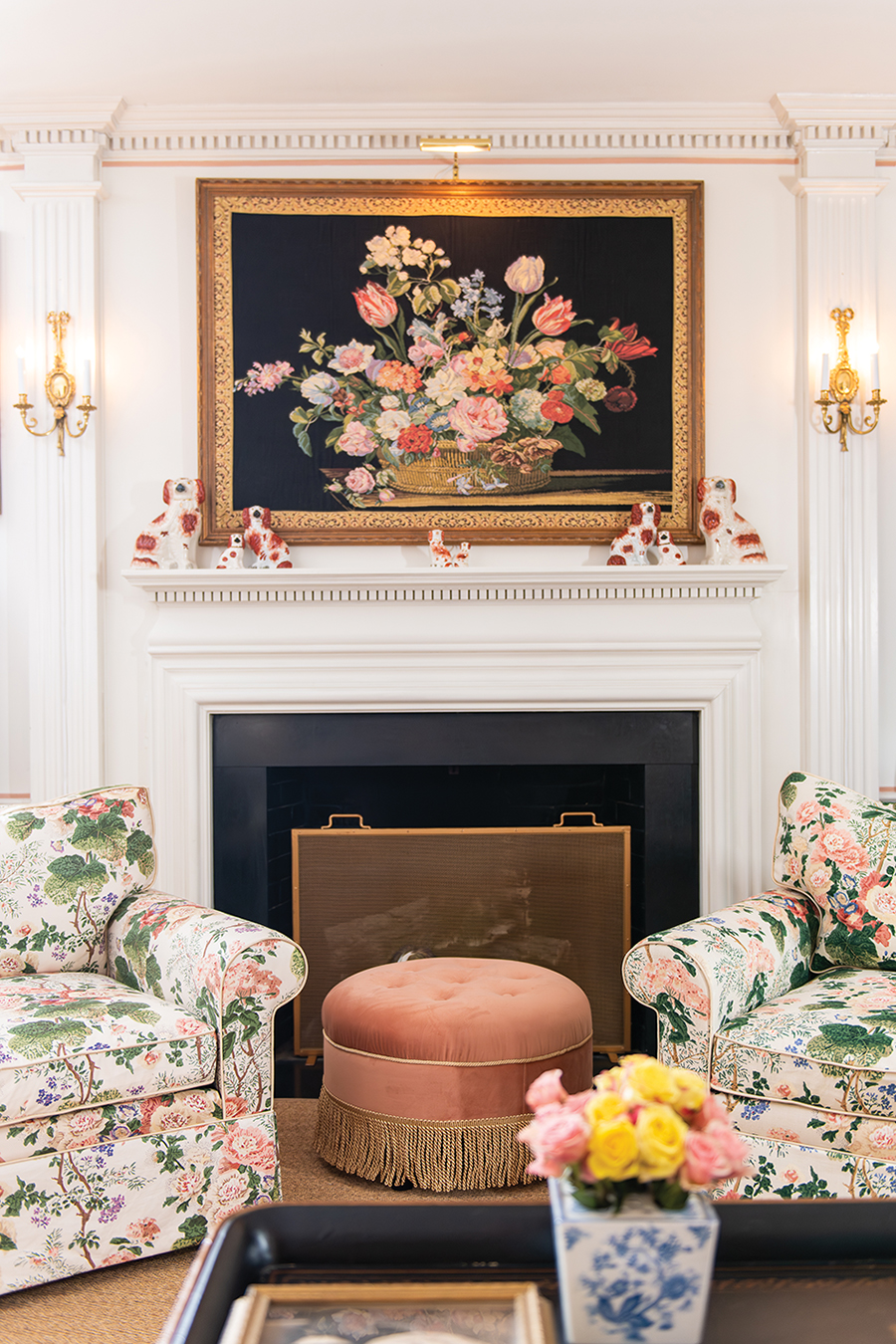
The ribbon also ties into the floral fabric used on the overstuffed arm chairs, upholstered in Lee Joffa’s beloved Hollyhock pattern. 

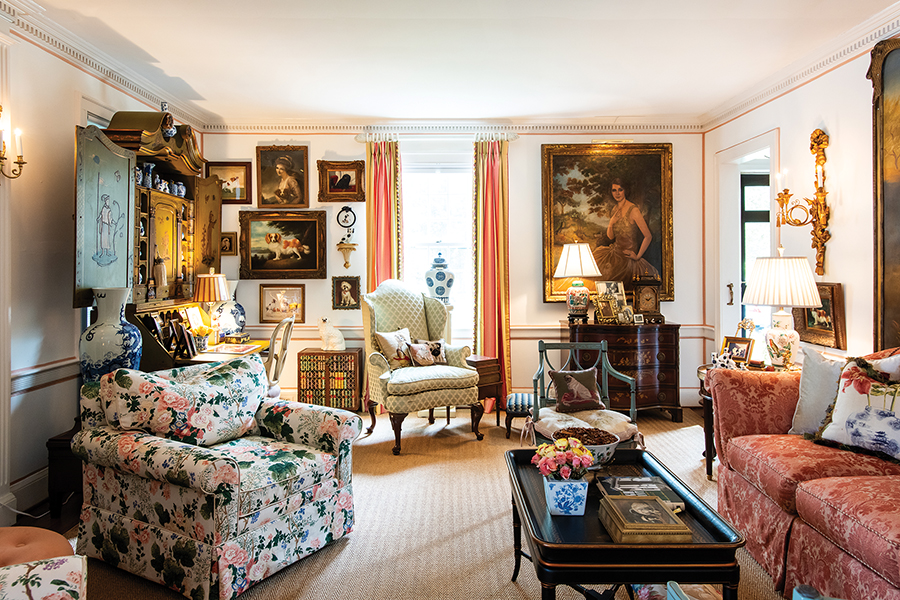
The room features a favorite find, a green chinoiserie secretary. The room is comfortably furnished with overstuffed armchairs. Family items and collectibles, such as porcelain dogs, add a personal touch. Horses, too. They’re “a thing for Joey,” says Collins, dating to time spent at his grandmother’s farm. 

Their combined style, Collins interjects jokingly, “Is a Kentucky Derby party with pomp and circumstance.”

And, yes, everything is subject to being moved, repeats Collins. At this Marlowe rolls his eyes. Pointing to a striking portrait in a massive frame he shoots a warning look. “That painting,” he insists, “is too darned heavy to ever move again.”

What would they run out with first in case of a fire? 

“The paintings are too big,” the pair quips in sync. (Many are gifts to Marlowe from Collins.) Then Collins turns serious. Thanks to meditation and Buddhism, he is learning non-attachment to possessions. 

“Home is where the heart is; and my home is with him,” he says, indicating Marlowe.

Marlowe, pondering, answers that if there was a fire, he’d “leave with my grandma’s photo. She was very crucial for my development as a child and encouraging me.”

“I’d want you to go with me, too, but — ” and he glances towards Collins, pauses before erupting into laughter, riffing off the moment.

“I think it’d be the family photos. But everything here has a meaning. Everything. There’s a painting of a boy in a little green jacket and his dog,” he says, indicating where it hangs. “He’s my favorite. Chad found it and gave it to me.” 

Thanks to Boxwood, the couple can upcycle and cull their many collections.

“Joey took his hobby and turned it into a successful business,” says Collins, who proudly compares it to the way in which Replacements, Ltd. in Greensboro first evolved.

Marlowe quickly replies: “Let’s just tell the truth; I have a shopping problem.” 

Collins’ favorite room is the sunroom, a television and game room, featuring the home’s only television set. “This is where I love to sit and read; I start and end my day in this room. A true nesting place.” On the sunroom wall is a moody nighttime Victorian scene, the first painting that he ever gave Marlowe. 

It opens to a patio, a shaded fair-weather retreat with a scalloped awning and twinkling lights, where another fountain bubbles and blue porcelains, including Chinese stools for seating. Tables, statuary and potted plants create another space for entertaining, complete with “rooms” designed to move the eye through the landscape.

Back inside, pausing at the bottom of the stairs which are covered in a chevron-patterned runner, Marlowe explains the only practical concern for aging in place at Fernwood Manor. As is typical of older homes, the bedrooms are on the second floor. They’re both still youthful and in their 50s, but he worries. Perhaps, he says, they can eventually create a main suite in the newly rebuilt garage, connecting it to the main house to solve the problem.

He points out a chandelier hanging at the top of the landing, “The first that Chad ever gave me, the first Christmas we were together.”
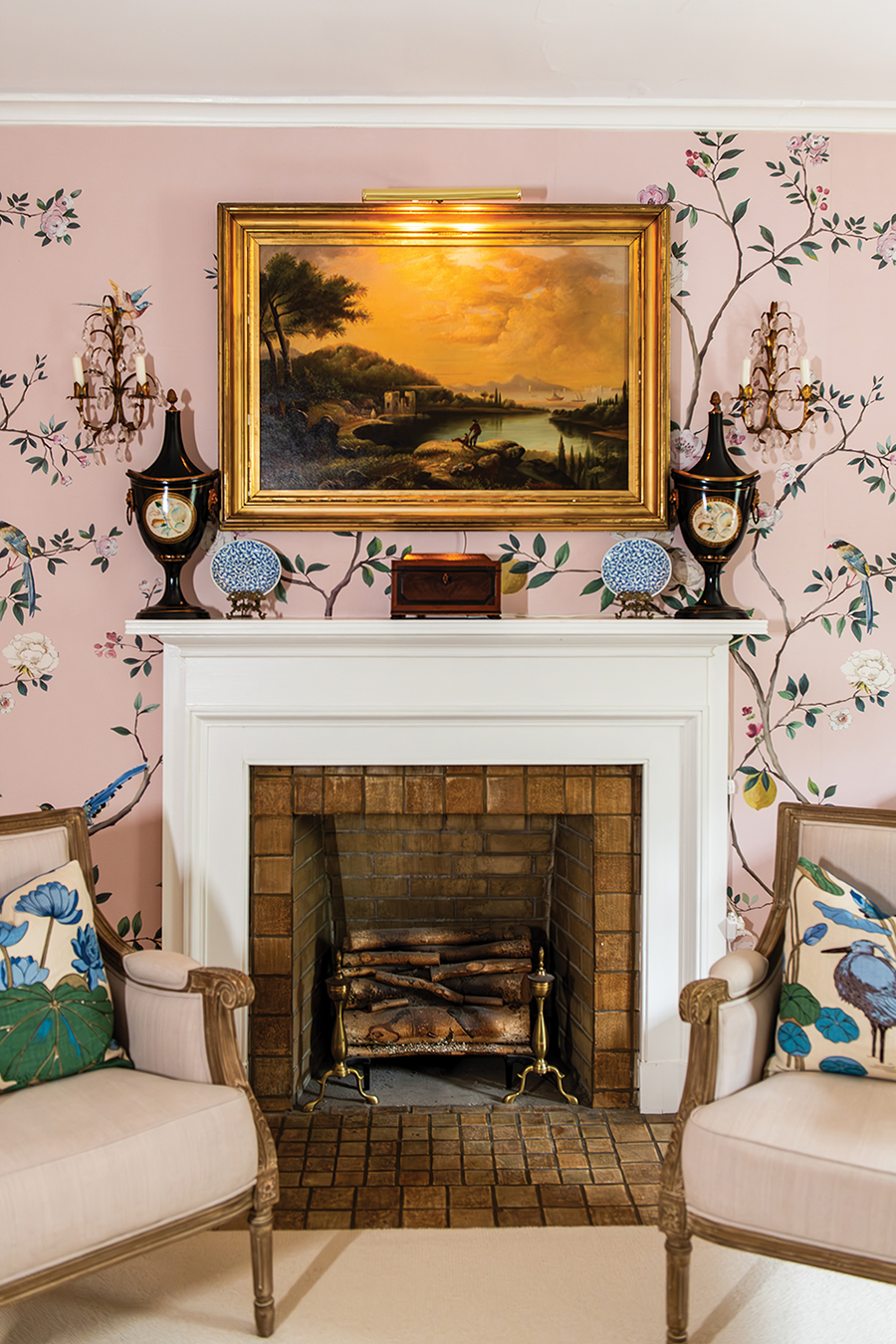

   

The primary bedroom has a fireplace flanked by comfortable chairs. The room features recently installed hand-colored chinoiserie paper with twining vines and birds against a soft rose-toned background. They furnished the room with gilded mirrors, chinoiserie lamps, urns and porcelains, and a prized 19th-century signed Italianate painting, among other artworks. 

A canopy bed by Frontgate faces the fireplace, with a tall screen in the corner where an exterior door leading outside was closed and converted into a closet by the seller. It once accessed a deck with a patio roof above the sunporch, which the new owners hope to one day return to its original state.

On display is a collection of personal photos of their younger selves when they met nearly 20 years ago. Collins, who has experimented with short and long hair, has the ability to change his look like a chameleon. 

“And I’m the same preppie I was before,” quips Marlowe. 

The upstairs bathrooms, though refreshed, retain many original details.

The bath that opens to the hall is tailored, crisply accented with black and white and features a striking, original coral-colored wall tile. Marlowe is amazed that his favorite color was already used in the house from its very beginning. The vintage pedestal sink retains original telescoping legs. 
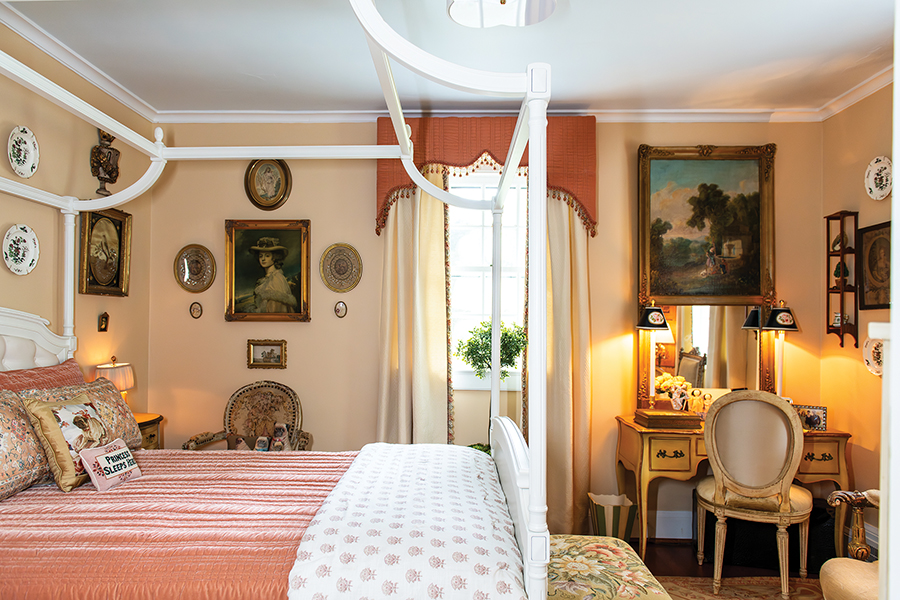
   

Two guest rooms, decorated in period style right down to the vintage toys, are dedicated to their two grandchildren, Evangeline, 3, and Gabriel, 9. Here, Marlowe used Schumacher paint in his granddaughter’s room, picking up soft rose accents from the Aubusson rug, coverlet and window treatments, and chose a romantic canopy bed.

“This will be Evangeline’s spend-the-night place,” says Marlowe. “She comes over to play, but hasn’t yet spent the night.”

Then there’s the “gentleman’s room” for Gabriel, who comes for sleepovers every other weekend. He sleeps in style in an equestrian themed room with English hunting style wallpaper.

The interiors are complete, but there are ongoing plans for the exterior. They are working on the English garden effect in the front yard, and a more casual garden in the back. There will be an all-white garden created on the driveway side, as they share an additional half lot with their neighbor. 

They’ve ordered a custom-designed shed that will echo the house with French doors and a metal roof from a company in Sanford. It’s being installed in the rear garden and will become a yoga studio for Collins, an avid practitioner.

This house — “a collection of life,” according to Marlowe — is where the couple’s work and personal lives form an aesthetic intersection.   

Both value what they have created here together, a sensibility that only a collected look can give.

“Everything has a story,” he says.

Now he and Collins are writing the next chapter in this, the latest installment in the life of a storied, much-loved house.  OH

Birdwatch

Birdwatch

Straying Inland

The great egret pays a visit

By Susan Campbell

’Tis the season of odd sightings: Birds are wandering in all directions. After breeding and ahead of fall migration, it is not uncommon to spot out-of-place individuals here in central North Carolina. One that gets reported annually is the great egret, or mistakenly referred to as a “white crane.” This is a large wading bird with all-white plumage, a long, pointed, bright yellow bill and black legs.

Although far more likely to be found along the coast, individuals or small groups turn up on inland ponds from late July through September. Egrets stalk small fish, frogs, crayfish and other small prey in the shallows. Occasionally they will snatch a snake, small bird or large insect as well. They will roost in thick, older pines over water, where ground predators are not likely to reach them. In coastal areas, they may join dozens or even hundreds of other individuals, finding safety in numbers.

During the breeding season, from March through June, great egrets sport long plumes along their backs. At the turn of the century, the species was nearly wiped out as a result of the millinery trade. Plume hunters decimated rookeries throughout the coastal United States. But, as with most of our wading species, great egrets have made a good recovery. On the verge of extinction, they became the symbol of the National Audubon Society, the oldest and largest bird conservation organization in the United States, originally founded to protect birds from being killed for their feathers.

Great egrets are found in heronries, most often alongside great blue herons, throughout the Coastal Plain. Nesting habitat consists of sturdy trees usually on islands, free of mammalian predators. Simple stick platforms are constructed by the males and placed high in the canopy. Nests can be quite large, being up to a few feet across and a foot or so deep. One to six eggs are laid and incubated for almost four weeks by the female. The young are then fed by both parents for about a month before they are capable of flight. If there is a shortage of food, aggressive larger siblings are known to kill smaller ones. Fledglings may follow their parents for a few weeks or may become independent quickly, if food resources are scarce.

Both great egret adults and young of the year will disperse from their breeding areas to find new feeding areas. They are often seen in late summer on inland lakes, even in our mountain counties. In our area, they may use lakes, beaver ponds, creek or river floodplains, even water hazards on golf courses. They do not tend to stay in one place for very long so, should you come upon an egret this season, enjoy it because it likely will not be around more than a few hours — a day or two at most.   OH

Susan Campbell would love to receive your wildlife sightings and photographs at susan@ncaves.com.

Life Imitates Art

Life Imitates Art

And vice versa

By Cassie Bustamante

Photography by Bert VanderVeen

Costuming by Mary McKeithen of Showboat in Southern Pines

Makeup and Hairstyling by Local Honey Salon


“The reason some portraits don’t look true to life,” says Spanish Surrealist artist Salvador Dalí, “is that some people make no effort to resemble their pictures.” Touché, sir.

We scoured the city and found local lookalikes to subjects in famous paintings, and, with a little “effort to resemble,” plus makeup and hair artistry from Local Honey Salon, we’ve recreated those portraits. From Frida to Vincent, six Gate City doppelgängers are walking works of art. Who knows? Next time you’re sipping your cold brew at a local corner café, you may find yourself in a booth next to someone who could be Mona Lisa’s twin — but a whole lot younger — if only she made the effort.


Self-Portrait with a Straw Hat

by Vincent Van Gogh, 1887


Dutch post-impressionistic painter Vincent Van Gogh painted roughly 2,100 works of art in just a decade’s time, but he’s regrettably better known by some for cutting off his ear. In 1890, Van Gogh took his own life after struggling with mental illness. He once said, “If I am worth anything later, I am worth something now. For wheat is wheat, even if people think it is a grass in the beginning.” Today, he’s one of the most celebrated and imitated artists in the world, and his work is worth more than he ever could have dreamed. We’ve recruited the Weatherspoon Art Museum’s two-eared head of communications, Loring Mortenson, to fill Van Gogh’s shoes — and hat — with a little impressionistic artistry from both costumer Mary McEithen and the team at Local Honey.


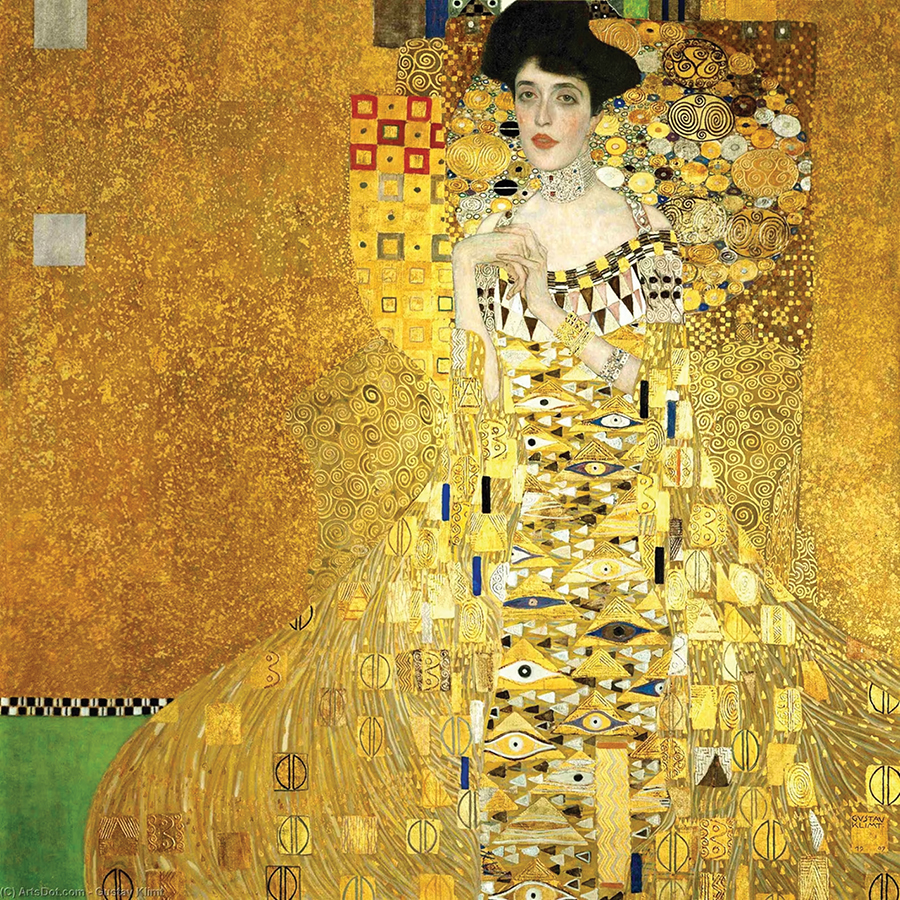
Portrait of Adele Bloch-Bauer I

by Gustav Klimt, 1907


The only subject that Klimt painted twice was Adele Bloch-Bauer, a Jewish Viennese socialite and patron of the arts whose husband, Ferdinand Bloch-Bauer, a Jewish banker and sugar producer, commissioned the artist to create the painting as a gift for Adele’s parents. It’s rumored that Adele became Klimt’s mistress. With a little Midas touch and what Local Honey owner Jay Bulluck calls an “ice cream cone” updo, sustainable fashion lead and GreenHill board member Swati Argade steps into the role of our Adele.


Two Fridas

by Frida Kahlo, 1939


Mexican artist Frida Kahlo was always interested in art from an early age, but it wasn’t until a bus accident derailed her med school path that she decided to pursue it as a career. Kahlo, who was known for her introspective self-portraits and feminism, once said, “Take a lover who looks at you like maybe you are a bourbon biscuit.” Regrettably, her husband, renowned Mexican muralist Diego Rivera, often served his craving for biscuits elsewhere. Their tumultuous marriage ended in 1939 and this painting, she later admitted, reflects the loneliness she felt in her separation from him. You’re not seeing double. Isabella Bueno, a mother of three little ones who is studying to be a Realtor, is seen here twice — quintessential unibrow added, of course — once in a more traditional Mexican costume on the left, and in more contemporary dress on the right.


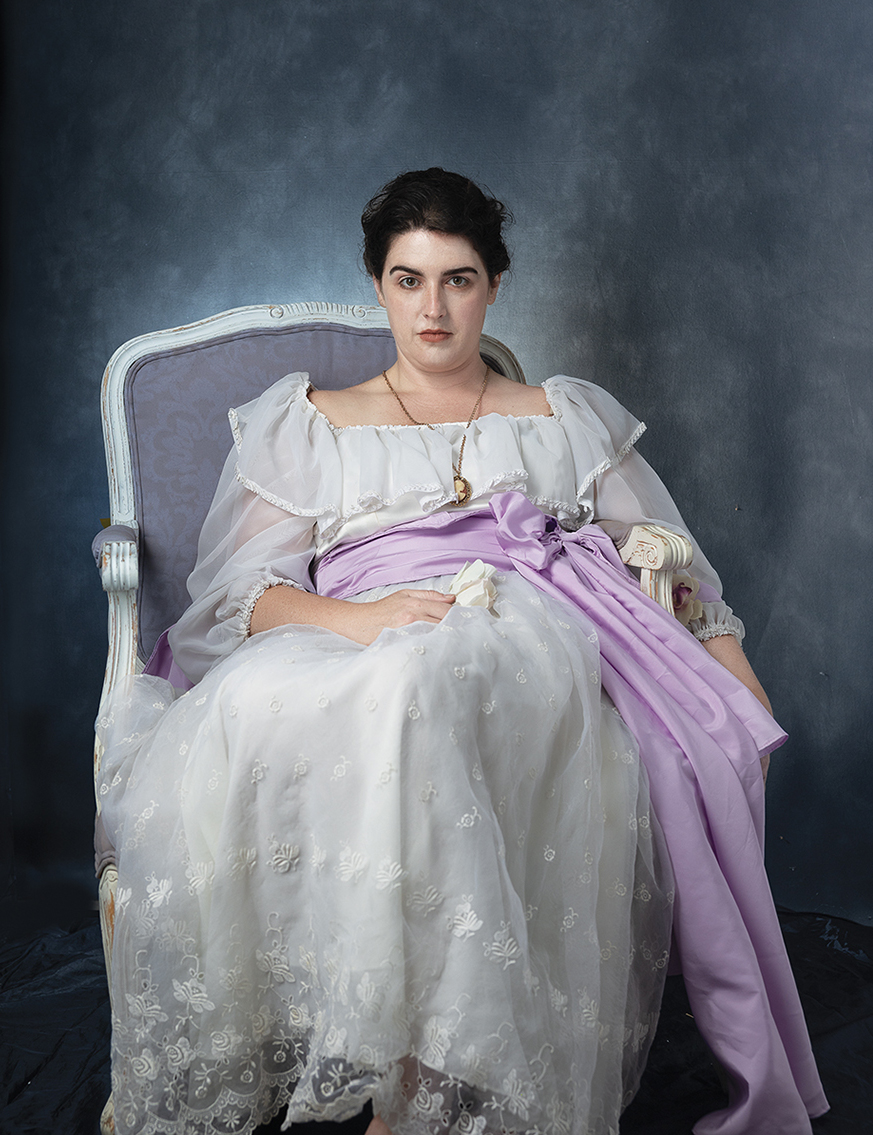
Lady Agnew of Lochnaw

by John Singer Sargent, 1892


Born into an old Scottish family, Gertrude Agnew was wife to British Sir Andrew Noel Agnew, Ninth Baronet. A socialite who often entertained by throwing lavish garden parties at Lochnaw Castle, just months into her marriage, Lady Agnew contracted influenza and spent much of their first matrimonial year — the same year this portrait was commissioned and completed — in periods of convalesce. So, while it looks as though American expatriate Singer Sargent captured her in slightly amused repose, there’s a good chance she was just taking a much needed breather. Greensboro textile artist, instructor and clothing designer Ann Tilley lounges in luxury as Lady Agnew. We don’t know about you, but we’re seeing double.


Self Portrait

by Henri Matisse, 1918


Nearing the age of 50, French visual artist Henri Matisse created this self portrait during what is commonly referred to as his “return to order,” a pulling back that was also seen in other artists of the post-World-War-I era, including Picasso and Stravinsky. A Matisse sculpture, Madeleine I (1901), can be found at the Weatherspoon Art Museum in a collection donated by Claribel and Etta Cone, sisters to Moses and Ceasar Cone. Matisse, who was a friend to the Cone sisters, once said, “It has bothered me all my life that I do not paint like everybody else.” We say, thank goodness he didn’t. Our own contributing editor, David Claude Bailey, already possessing the glasses and beard — which Bullock treated to “the best beard cut I’ve ever had” — dons the garb and becomes our Henri.


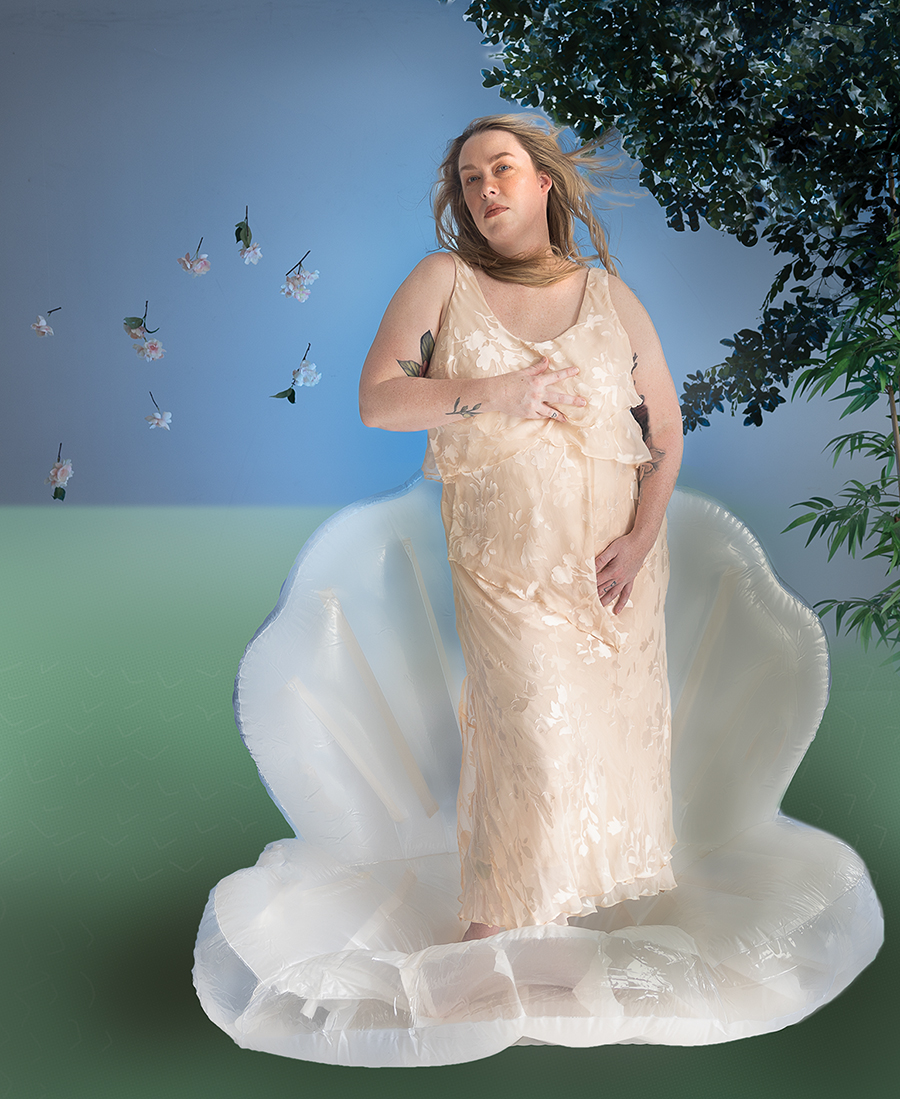
Birth of Venus

by Sandro Botticelli, circa 1485


Early-Renaissance painter Sandro Botticelli spent his entire life in Italy, mostly in the same neighborhood in Florence. However, he did spend time in Pisa and Rome, where he frescoed a wall of the Sistine Chapel. The subjects of his art were often mythological or religious figures, but Roman goddess Venus shows up most frequently in his work — here, and in Primavera and Venus and Mars. Botticelli never married, but there is some speculation that he was at least platonically in love with Simonetta Vespucci, who sat as model for many of his paintings, including this one. Upon his death in 1510, his remains were placed next to hers, per his request. Our Venus is photographer Lauren Quinn, who often studies the female figure in her own work.

Omnivorous Reader

Omnivorous Reader

Portrait of a Rock Icon

The good, the bad and the ugly

By Stephen E. Smith

When organizing the 1967 Monterey Pop Festival, the promoter phoned Chuck Berry to invite him to perform, explaining that the acts were donating their fees to charity. Berry replied, “Chuck Berry has only one charity and that’s Chuck Berry.” End of discussion.

That was Chuck Berry at his most generous, and readers of RJ Smith’s Chuck Berry: An American Life will likely be taken aback by the unsavory details of the life of the man who gave us “Maybellene,” “Roll Over Beethoven,” “Sweet Little Sixteen,” “Back in the U.S.A.,” “Reelin’ and Rockin’,” “School Days,” “You Never Can Tell” and “Johnny B. Goode,” rock ’n’ roll classics that pop culture will not willingly let die.

Smith’s biography has been widely lauded in print, online and over the airways, and his study of Berry’s life is as close to a complete examination available to the public. Court records offer even more objectionable details. This much is certain: The more you read about Chuck Berry’s lifestyle, the less likely you are to ever listen to “Maybellene” with a sense of nostalgia.

Berry grew up in a solid middle-class St. Louis family. He wasn’t a blues guy who spent his youth picking cotton and banging on a catalog guitar. He did, however, suffer discrimination early in his life, and Smith devotes the opening chapters of the biography detailing the effects of Jim Crow on Berry’s formative years.

Berry’s trouble began when he was convicted of armed robbery as a teenager and spent almost three years in juvenile detention. When he was released, he drifted into music, became an early master of the new electric guitar, and created an original sound by combining country music with boogie-woogie.

We can argue about who invented the concept of “rock star,” but certainly Chuck Berry, Elvis Presley and Jerry Lee Lewis could lay claim to the term. Berry’s shtick was to sing with impeccable diction while blasting glib rapid-fire lyrics that teenagers could instantly comprehend and dance to. This straightforward blueprint for early rock ’n’ roll attracted Black audiences in the early ’50s. By the mid-’50s Berry’s fanbase was integrated. In the 1960s, he was playing to almost entirely white crowds, at which point his performance was simply called “rock.”

The bulk of Smith’s biography is taken up with the upsetting stories that accompany Berry’s hundreds of performances. His business plan was straightforward. Berry would sign a contract with a promoter who was responsible for supplying the backup band and amplification equipment. He’d arrive in a Cadillac, also supplied by the promoter, minutes before he was to take the stage. There’d be no rehearsal, no interaction with the band, and he’d demand payment in cash before performing. Berry would count the moola, play for the designated amount of time, duckwalk for the audience’s edification, and bang out the hits for which he was best known. Then he’d exit the stage. If there was an encore, he’d demand additional cash. When the concert was over, he’d pack up his guitar and make a clean getaway.

Generally, the audience loved it, dancing, cheering and having a fine time. Berry made money, the promoter usually made money, and the audience left satisfied. The late Rick Nelson summed it up best in his hit “Garden Party”: “Someone opened the closet door and out stepped Johnny B. Good,/playing guitar like ringing a bell, and looking like he should.” Ray Kroc would have been proud — Berry cooked up musical cheeseburgers, each one a tasty clone of its predecessor. Consistency was the key.

All of which was fine and dandy with American audiences. But there was one overawing problem: Chuck Berry. He was irascible, mercurial, essentially unknowable, and had an affinity for trouble. After serving his time in juvie and achieving fame as a rock ’n’ roller, he began traveling the county with a 14-year-old Native American girl he claimed was his assistant. The cops weren’t buying it and nailed Berry for violating the Mann Act — transporting an underage female across state lines for immoral purposes. He spent two more years in prison. Then the IRS began tracking the cash Berry received for his performances and nailed him for income tax evasion, and late in his career he was busted for installing covert cameras in the restrooms of a restaurant he owned, an act of voyeurism that gave rise to an investigation that uncovered a trove of pornographic material in which Chuck Berry was the star. 

As Berry’s antisocial behavior was becoming common knowledge, he was being roundly honored by the American public. On Whittier Street in St. Louis, the National Register of Historic Places listed his home as a monument, and after his release from prison for violating the Mann Act, NASA blasted gold-plated recordings of Berry’s “Johnny B. Good” into interstellar space aboard Voyagers 1 and 2. (Voyager 1 is now 14.1 billion miles from Earth, a far distance from the prison cells Berry occupied in the ’60s and ’70s.) His IRS indictment was greeted with a universal shrug, and his voyeurism conviction was likewise ignored by the press. Chuck Berry went right on performing and raking in the big bucks, playing out the string until the bitter end.

Smith has included all the facts: the good, of which there’s little enough; the bad; and the ugly, of which there’s plenty. Two questions remain. First, who was Chuck Berry? Did anyone truly know the man? Berry explained his sense of self in an interview: “This is a materialistic, physical world. And you can’t really KNOW anybody else, man, because you can’t even really know yourself. And if you can’t know yourself then sure as hell no one else can. Nobody’s been with you as long as you and you still don’t know yourself real well.”

The second question is more complex, encompassing the American penchant for revering individuals, whether rich, talented or charismatic, who are given to violating legal and social norms. Are we willing to accept outrageous behavior from unrepentant religious leaders, corrupt politicians and wayward rock ’n’ roll stars because they’ve somehow made themselves infamous? Apparently so. After all, nothing is quite as American as hypocrisy. OH

Stephen E. Smith’s latest book, Beguiled by the Frailties of Those Who Precede Us, is available from Kelsay Books, Amazon and Local bookstores.

The Pleasures of Life Dept.

The Pleasures of Life Dept.

The Eras Experience

(Cassie’s Version) 

By Cassie Bustamante


I pause on the pedestrian bridge to Nashville’s Nissan stadium, taking a moment to soak it all in. Together, we are a shimmering rainbow of colors and costumes, arching toward a privileged pot-of-gold: The Taylor Swift Eras Tour. Everywhere I turn, glitter make-up, sequined garments, T-shirts emblazoned with “Not a Lot Going on at the Moment.” I spy two floral-sheeted “ghosts” sporting hats and sunglasses. Even my daughter, Emmy, who lives in leggings and hoodies, is wearing a dress — the first in years. The outfits are almost as over-the-top as Comicon and I’m feeling a little underdressed in my long aqua dress.

What is it that draws a record-breaking crowd of over 210,000 people to one stadium for a weekend of concerts? While I can’t speak for the rest of ’em, this 45-year-old has been a card-carrying Swiftie since the 2008 release of her second album, Fearless. The track that caught my ear? “You Belong with Me,” which speaks to anyone who’s ever been an awkward teen — my hand is up! — sidelined in the friendzone: “She’s cheer captain and I’m on the bleachers/dreaming about the day when you wake up and find/that what you’re looking for has been here the whole time.” Dressed in marching band attire, Swift played that as the opening song on the Fearless Tour. I know because I was there.

For those of you who are Swift-deprived, Taylor is somehow able to turn her joy and anguish into a mix of catchy tunes that are totally relatable, everything from her mother’s battle with cancer to being taken advantage of by an older man. (I’m looking at you, John Mayer.) She’s not afraid to admit to a carnal desire for revenge that most of us pretend doesn’t exist. After listening to an entire album, we’re left feeling like she’s one of us. And that someone out there understands our pain and knows how to celebrate life’s joy with us.

Emmy’s entire childhood has been set to a soundtrack of Taylor Swift, and, as she’s grown into a teen, the songs have become more than just snappy singalongs. During the great stay-at-home of 2020, while my two teens were hiding from their parents and toddler brother behind closed doors, Swift was busy writing two albums worth of songs. Every day felt like the same challenge on repeat, but the releases of Folklore and Evermore drew Emmy out of her room and gave us something to share. Our kitchen Alexa was mighty tired of Taylor that year.

In fact, Emmy’s love for Swift has — dare I say? — outgrown my own, her bedroom a twinkling shrine. So, when a 2023 tour is announced, my husband, Chris, and I decide that an Eras experience will be Emmy’s Christmas and birthday gift. After chatting with friends — Chandra, Erienne, Jessika and her daughter, Vivienne — we all set our sights on Nashville for Swift’s first tour since 2018.

Almost six months later, after lucking out during Ticketmaster’s Swiftgate, the moment is finally near. We enter the stadium and add our LED concert wristband to our arms, already stacked with friendship bracelets we’d made that morning. (Most Eras concertgoers — inspired by the lyrics, “So make the friendship bracelets, take this moment and taste it” — craft beaded bracelets to exchange.)

Everywhere we turn, we see strangers exchanging smiles and bracelets. I take note of boyfriends wearing “Karma” shirts (“Karma is my boyfriend”), fathers sporting pink button-downs that match their daughters’ dresses and friends in matching sequined ensembles. On this night, one thing is clear: We are all unified, in this together. And that’s no easy feat after a few tumultuous years in America. I look at my own little crew, each of us representing different eras, and tears spring to my eyes. I choke them back before Emmy — who rarely cries and teases me for my constant waterworks — notices.

We continue our search for our second tier seats. After struggling to figure out how to reach our level, we decide to ask a stadium attendant for help, a fortuitous encounter that changes everything.

Erienne approaches a young, Black attendant with warm brown eyes. The attendant, let’s just call her Janie, notices the friendship bracelets piled on Erienne’s arm. She smiles shyly and says, “Those are some nice bracelets you have.”

Erienne kindly removes a green beaded strand that reads “Ivy” and hands it to Janie, asking if she’s a fan.

Janie lights up at the gesture. “Well, I wasn’t before last night [the first of the Nashville shows]. But now, I think I am becoming a Swiftie — that’s what it’s called, right?” she asks. “I listened to her music for two hours last night on my way home and, man, she’s talented.”

After a few minutes of us filling Janie in on all the must-know Swiftie info, she directs us to the escalator that will take us to the second level. But then she glances at us sheepishly, walks a few steps down the hall, away from her coworker, nodding for us to follow. “You know, the front few rows of this section are usually empty,” she says. “If y’all come back here around the time the show starts, I can probably get you into those seats.” (We can only assume they’re typically reserved for potential celebrities or special guests.)

Our mouths drop. Front row stadium seats? As in, just behind the floor seats? Quick-thinking Chandra pulls out her phone and exchanges numbers with Janie. We thank her and I give her one more bracelet: a sunny yellow beaded loop with “Happiness” spelled out.

We make our way to our ticketed seats to catch the opening acts, Gayle and Phoebe Bridgers. Just after their sets conclude, Chandra texts Janie, who gives us the thumbs up emoji, signaling that we are good to go. Back in Janie’s section, she breaks our crew of six into two, placing half of us in row A, the other half in row B.

I sit in the front row, Emmy between me and Chandra. Erienne, Jessika and Vivienne pile in just behind us. We all exchange glances of disbelief. Emmy’s face is happier than I’ve ever seen, her blue eyes, one of which is outlined in a pink glitter Lover heart, wide with excitement. Already sweating from the sunshine and body heat of thousands of fans, my palms begin to perspire. I wonder if I am the only one fearing a tap-tap-tap on the shoulder followed by “This isn’t your seat!”

But then a montage of melodies from each era, intermingled with “It’s been a long time coming,” envelopes us. Showtime! Seven background dancers, each trailing a lavender-and-pink parachute, slowly saunter down the length of the catwalk. They come together, parachutes collapsing on top of one another. And when the chutes open back up, there she stands in a gold-and-silver sparkling bodysuit, the first chords of “Miss Americana” barely audible as 70,000 Swifties rejoice.

Once again, I look to my right at Emmy, wanting to capture this moment of her pure joy in my mind, and I am shocked by what I see. Tears — real tears — stream down her cheeks. At that, my own eyes water once again.

The next three-and-a-half hours rush by, all five senses swimming in an experiential tide. Around the stadium, as Swift performs a total of 44 songs — a number that’s almost unheard of in a single-artist concert — our LED bracelets light up in sync, flashing blue, pink, red, purple, yellow or green, depending on the song playing. It’s like a stadium wave as colors seem to magically flow from one section to another in the dark. At one point, during “Bad Blood,” blazing streams of fire shoot forth to the beat around the stage floor, the faces of Swifties around me glowing reddish-orange. Tissue-paper pieces of confetti fall not once, but twice, a kaleidoscope of color swirling in the air as Emmy reaches her hand out, collecting bits to take home as souvenirs. Of course, Swift also pares it down for her mellow Folklore and Evermore eras, a moss-covered piano and raw wood cabin lending a woodsy and mystical vibe.

Just before her surprise songs — she plays two, never repeated, at each concert — Swift emerges in a long, ruffled, emerald-green gown. As she speaks, she notices that her dress sleeve is not on properly, a green ruffle dangling under her armpit rather than gracing her shoulder. She awkwardly maneuvers, trying to get her arm into the hole, but gives up. Shrugging, she laughs it off, saying, “Just pretend you didn’t see that. It’s fine.” And just a few moments later, when she messes up the lyrics on surprise song No. 2, “Out of the Woods,” she giggles and asks the audience to join her in a repeat of the bridge. On stage, in front of all those fans, she’s still that awkward teen she once was and we all fall in love with her a little bit more.

After the show, we make a very slow trek back over the footbridge into downtown Nashville. As tired as everyone is, someone in front of us starts singing “Love Story” and soon the tune travels through the chorus of strangers — strangers who came together for one night, swapping bracelets, stories and costume compliments.

The contagious joy of the concert crowd lingers in my mind as Emmy and I drive home from the Raleigh-Durham Airport. “You know, Emmy, every single person I talked to in that stadium was kind,” I say, my tired eyes focused on the highway in front of me. “That really says a lot about the person Taylor Swift is to have cultivated such a friendly, caring community.”

Emmy nods in agreement. I may have — OK, I have had — many failures as a mother, but I did something right in introducing her to Taylor Swift’s music all those years ago. Not only has it brought the two of us together during some of the hardest times, but it’s helped us find common ground with friends and virtual strangers alike. We continue along, headlights shining in the dark, as I hear Swift’s voice in the back of my mind: Long live all the magic we made.  OH

The Creators of N.C.

The Creators of N.C.

The Adventurous Child

Illustrator Jesse White’s major minors

By Wiley Cash

Photographs By Mallory Cash


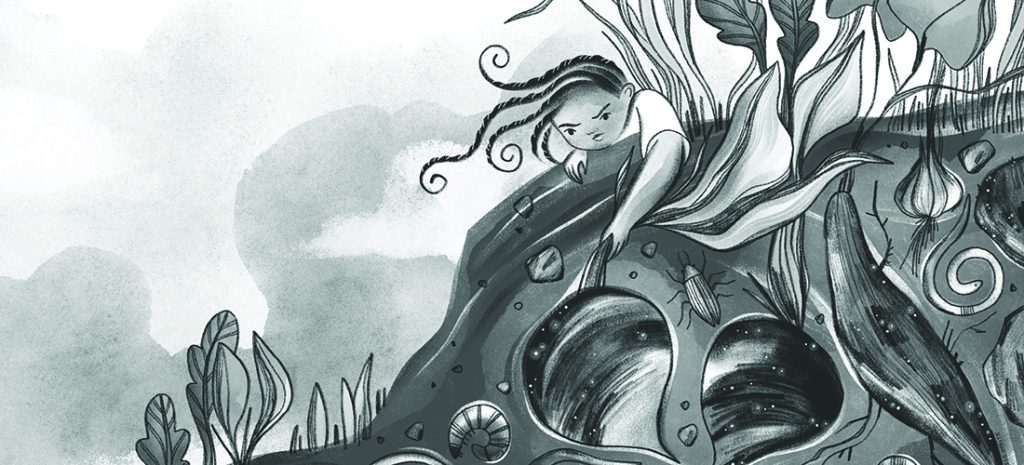
When former teacher Jesse White discovered that her young students’ personalities and identities weren’t reflected in the teaching materials she was provided, she decided to take their education into her own hands, literally: She drew all of her classroom materials by hand in an effort to bring their lives more into her classroom. White, who is now a full-time illustrator, hoped her efforts conveyed how much she valued and believed in each child and how they saw themselves represented in the world. This conviction to portray the world as children see themselves in it comes from her own childhood outside Siler City, where she grew up with her mother, Gwen Overturf, and her father, Eddie White, on 10 acres of land along the Rocky River.

“Childhood is a primary inspiration for me,” she says on a bright afternoon at her home in Durham. “I’m someone who loves nostalgia and likes thinking about ways that we can reconnect with our childhood or just the child inside of us. And so that’s what I do all day; I go back to little Jesse, who was spending a lot of time in the woods with my mom and by myself exploring the rocks near our house, coming up with games, ideas and secret missions that I would go on. My primary inspiration is my childhood and the time that I spent outside in nature.”

Jesse was home-schooled until second grade and spent a lot of time accompanying her mother to various jobs where she worked in landscaping and at a goat dairy. She was left free to explore.

“I would spend a ton of time with the dog and the goats, and go wandering off into the woods.”

When her mother began teaching at the former Community Independent School, Jesse followed. And then she was off to public school for middle and high school.

“I’ve had a pretty big range of educational experiences. Looking back on it, even though there were some difficult transitions, I wouldn’t trade, it for sure. I value a lot of what I picked up and learned at each of those different types of schools,” she says.

But she felt different from other kids. After years of learning to milk goats, roaming the woods and developing elaborate games on her own, how could she not? As an artist, she was more intent on drawing the natural world than superheroes or Barbies.

“I was drawing stuff that my classmates had never really seen before,” she says. “So maybe that’s where that difference showed up.”

Jesse gained inspiration not only from the woods around her, but also from her parents, both of whom were arts-oriented. Her mother, Gwen, had a background in graphic design and experience in education. Although Eddie, her father, had a background in graphic design as well, he designed and built houses for much of her childhood. When she was in middle school, he shifted away from construction and became a full-time artist, creating large-scale metal sculptures and installations, including one for the Hilton Hotel in Kuala Lumpur.

It was in college at UNC-Chapel Hill that Jesse first considered pursuing a career in arts education.

“It was this wonderful answer to what had been missing for me,” she says. “I enjoyed making art, but I was like, ‘Man, this is missing a social aspect somehow. What can I be doing to use this to engage people and help them reflect on their own identities and their own lives and their own learning?’ And so art education blew my mind in that way. I could not only make art, but I could facilitate learning through art.”


Fresh out of graduate school, the first time she stepped into her own classroom, Jesse admits to having “life altering lessons” that she planned to present to her students. She quickly found that having a class of 25 to 32 kids was as much about function as it was creativity. But she absolutely loved it. “It was one of the most exciting and rewarding things that I’ve ever done,” she says, and by her second year she had learned how to balance the practical demands of curriculum and classroom management with her creative ideas on how to engage students.

After four years in the classroom, she decided to go out on her own and pursue a full-time career as an illustrator. Once she focused on her own art, she recalled the power of creating the materials that represented who her students knew themselves to be and the ways in which she once saw herself as a young girl who thrived in the outdoors. The results were illustration after illustration of young girls exploring natural landscapes, much like Jesse had.

“I don’t know why it took me so long to realize this,” she says, smiling, “but I just don’t draw kids inside very much.”

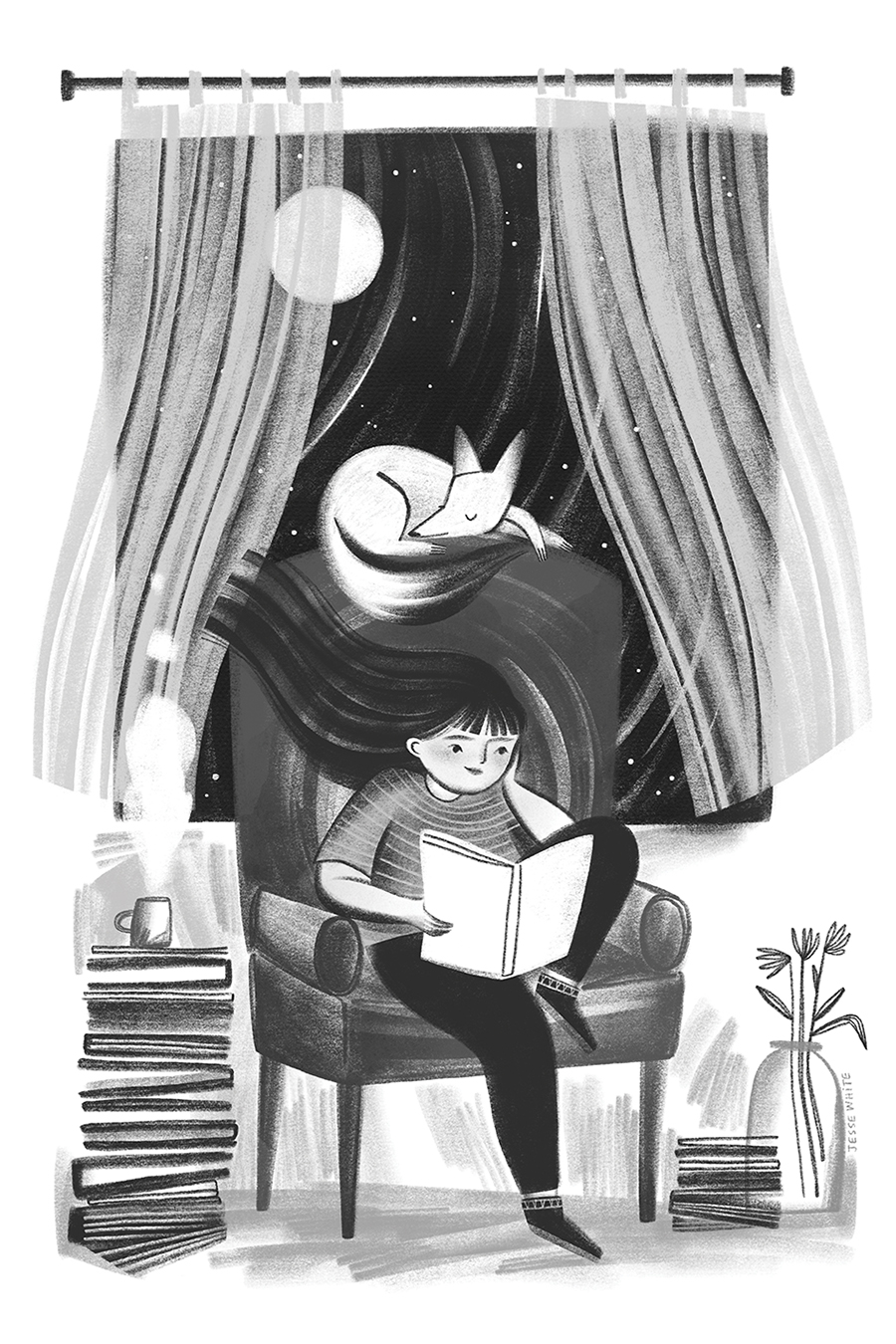
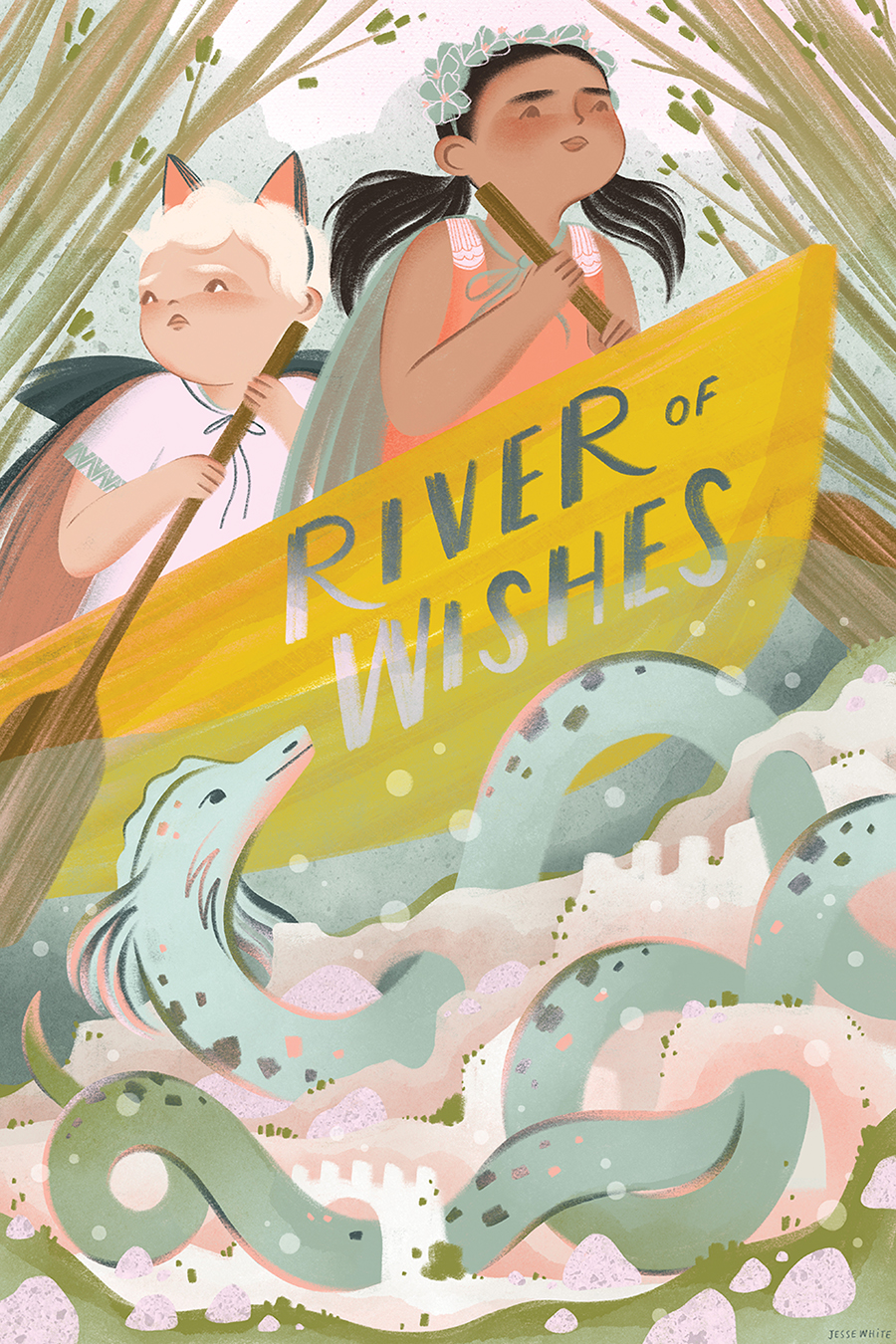
A quick perusal of her website or Instagram page reveals this to be true. In one illustration, a little girl in a rainslicker peers over the bow of a storm-tossed ship, the tentacles of a sea monster snaking below her. In another, a girl sits comfortably atop a rock and pours a cup of tea, a blue snake encircling her neck.

Jesse’s work also reveals a lack of adult characters, something others — including the editors of her forthcoming book, Brave Like Fireweed, which she both wrote and illustrated — have brought to her attention.

“‘We can’t have these kids just wandering by themselves out in the middle of nowhere without any adult supervision,’” she says, paraphrasing her editors. “I totally get that. But a huge focus and motivation for my artwork is to show kids as the capable and intelligent and independent beings that they are, and that doesn’t always require having an adult presence in order to be like that.”

People might also wonder where all the boys are because Jesse’s main characters are primarily young girls. “I’ve always found it to be incredibly important to include girls in my work who are outside, playing, exploring, adventuring, just because that’s not something that they’re always allowed or encouraged to do,” she says. “It’s something that I was allowed and encouraged to do, and that became a really important part of who I am.”

Studies examining children’s books of the past 60 years show that not only have boys been better represented than girls, but girls have also been portrayed as more emotional and less likely to engage in adventurous exploration.

Viewing Jesse’s work, it’s not hard to imagine these girls leaping from the page and striking out for places as yet undiscovered. And it’s not hard to imagine young Jesse doing the same. She still is. OH

Wiley Cash is the Alumni Author-in-Residence at the University of North Carolina at Asheville. His new novel, When Ghosts Come Home, is available wherever books are sold.

Chaos Theory

Chaos Theory

Little Orphan Cassie

The curtain opens on a world of possibility

By Cassie Bustamante

Live theater has had a piece of my heart for almost as long as I can remember. My love affair, especially with musicals, began the summer I turned 6. My mom had taken me to see Annie at the Ogunquit Playhouse in Maine. There, I discovered theater has the power to bring dreams to life.

Before that moment, I’d seen the movie and played the album on my Fisher Price record player, singing along while putting myself in Annie’s tattered orphan shoes. Our family dog, a golden retriever named Butterscotch — far from a mangy street mutt — often found himself locked in my bedroom so that I could pretend he was following me, just like Sandy followed Annie.

Once, I tried to sit in my bedroom window to look woefully out at the sky while musically musing, “Maybe far away, or maybe real nearby . . . ” As the window screen gave to the pressure of my leaning body, my feet caught on the very sill I’d been perched on, holding me in place as the rest of me dangled dangerously a story above our driveway. My older brother, Dana, heard my cries and pulled me back in. (And yes, my parents had told me over and over to stay away from the windows, but when it came to being Annie, I followed no one’s rules.)

“As far as I was concerned, you could have had a much less healthy obsession,” my mom recalls. “You were happy being Annie and acting and singing, so, why not?” Plus, she adds, “It was entertaining.” A talented seamstress, she had sewn me my very own red-and-white dress, just like Annie’s. And, along with those live show tickets, my parents had given me a golden, heart-shaped, broken locket for my birthday.

I knew the songs. I had the locket, the dress and the black, patent-leather shoes. There was just one major problem: my hair. It was long, straight and dirty-blonde, a far cry from a headful of fiery red ringlets.

But in that Ogunquit theater during the final moments of the curtain call, something I’d never imagined was possible happened. After clapping enthusiastically for the actors who played Daddy Warbucks, Miss Hannigan, Grace, Punjab and the other orphans, the last actor emerged to receive her applause. Alyson Kirk, who played the role of Annie, walked to centerstage and whipped off her curly-haired wig to reveal a mane of straight hair that wasn’t red at all.

“Look!” I gasped, telling my mom what this meant for me. “I can be Annie!” In that moment, I realized that in the world of theater, anything is possible.

Now, as a mother, there’s nothing I want more than for my kids to see that their own worlds can stretch as far as their imaginations can reach.

Last year, my husband, Chris, and I introduced our youngest, Wilder, to live theater at the Tanger Center — first, to Paw Patrol Live for his 4th birthday. Then, in September, it was off to Blue’s Clues & You Live.

A week before the Blue’s Clues tour stop in Greensboro, I had a chance to chat with Josh Blackburn, producer of Round Room Live, the company responsible for bringing many Nickelodeon and licensed kids’ shows to life onstage all over the world. Like many of us, his own love for musical theater began during his childhood, evolving into a passion “to show kids opportunity” through his work.

Blackburn says his “favorite part” is watching kids enjoy his live shows, and I understand why. Chris and I were more enthralled by Wilder’s reaction to Blue and company than by what was actually happening on stage, despite the “huggable” and “larger than life puppets.” And it wasn’t just us. Looking around that theater, the faces of many-a-parent were aglow with wonder as they watched their own little ones sing along, dance and dream.

We walked out of the theater together that day, holding hands as we stepped into a world that was, indeed, our oyster.

At 45, I’ve long since outgrown the red-and-white dress and black patent-leather shoes. I’ve said good-bye to my beloved Butterscotch. The broken heart-shaped locket has been lost, perhaps now another child’s treasure. But, until my final curtain call, I am going to continue to let my imagination run wild in this world — with or without a red, curly-haired wig.  OH

Cassie Bustamante is editor of O.Henry magazine.

O.Henry Ending

O.Henry Ending

La Mona Lisa Gioconda

Value is in the eye of the beholder

By:  Cynthia Adams

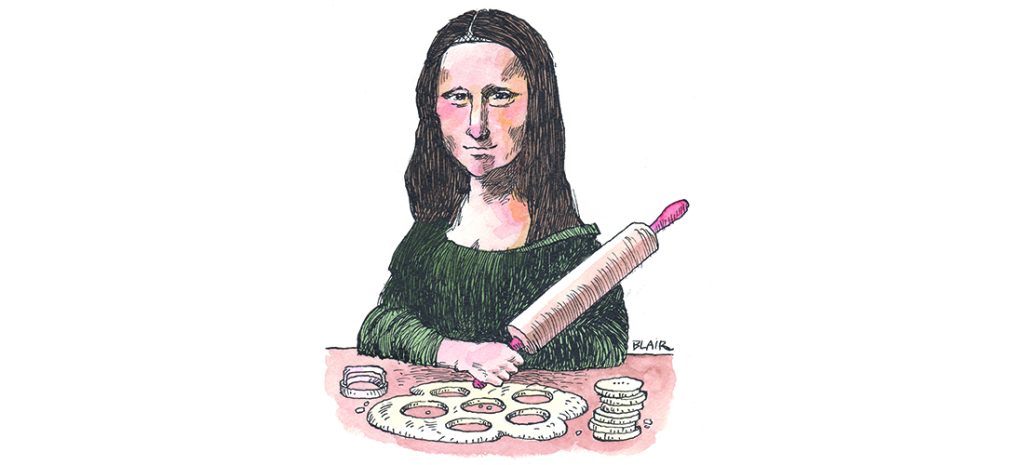
I have a not-so-secret fascination with Mona. Mona and I go way back.

The Italians call the Florentine beauty La Mona Lisa Gioconda — Madam Lisa Giocondo. She is La Joconde to the French.

As Nat King Cole crooned, she is Mona Lisa to the rest of us. 

My first reproduction of Mona was set in a chippy frame beneath wavy glass. This prized possession cost $1 at the former Sedgefield Flea Market. 

More recently, I’ve acquired others: two oversized giclées by Randy Slack titled Mona Ghost and Mona Citrus. I own books on the infamous Louvre thefts and tussles over the world’s most famous portrait, replete with accounts of when she went missing or was subjected to unwarranted attack. Five times and counting, Mona has been either outright stolen (the first time in 1911) or vandalized. Rocks, tea cups and paint have been hurled at the impassive face

Why all this drama? Salvador Dali said Mona with the mystic smile had “a power, unique in all art history, to provoke the most violent and different kinds of aggressions.”

Recently, a film critic reviewing Glass Onion suggested that Mona symbolizes legacy. The villain in the film “wants to be remembered in the same breath as the Mona Lisa . . . standing the test of time.”

Her legacy was burnished with every assault, Mona’s fame escalating after the 1911 heist.

She epitomized Da Vinci’s greatness. No visible brush strokes. The lifelike countenance. Mona’s ambiguous physicality. And . . . that smile. We experience Mona as faintly masculine, lacking eyebrows or lashes (overzealous restoration removed them).

Da Vinci began the commission of Mona, the wife of a wealthy Italian merchant Francesco del Giocondo, in 1503. He worked on it until 1507.

When he left Italy on horseback for France in 1516 at the invitation of an admiring King Francis I, he took Mona’s portrait with him.

Installed by Francis at the Château du Clos Lucé in Amboise, he hung Mona on his bedroom wall. 

He himself regarded her as his opus. (Or not; an art dealer earlier this year argued this: what if the artist wanted to hide her?) Mona held his attention because he never considered her quite finished.

Working in splendid style befitting a genius, he died at age 67 in 1519 in the arms of the weeping King, who called Da Vinci “Father.”

It is entirely possible that Mona’s was the last face he saw at his death.

Afterward, Da Vinci’s painting was claimed by the French King much to the consternation of the Italians. The Chateau was preserved by the French as a Da Vinci Museum.

The embittered Italians want her returned. When first stolen from the Louvre by an ordinary workman in 1911, she was whisked off to Italy.

Mona became an international celebrity. You get the picture: Cabbages and kings alike obsessed over Mona.

I placed Dollar Mona, the chippy, cheap one, over the kitchen stove. There was and is something inspiring about Mona’s presence.

House-poor as we were, Mona somehow sustained our determination to revive and make worthy the tatty kitchen. 

We scraped, painted, plastered and sweated over the monstrous job we faced. We fashioned new cabinet doors and tiled the counters. Too poor to replace the ancient stove, we polished till it gleamed. 

My brother showed up one weekend to reinforce the sagging dining room floor. Slowly, the careworn, early-1900s house responded.

Feeling celebratory, we opened it up for a party. A niece’s ex, famously befuddled, disappeared into the kitchen for an inordinate amount of time. 

What the heck was he doing?

Walking through the butler’s pantry to the kitchen, I overheard as he ground out the words, “That’s the Mona Lisa,” stopping me in my tracks.

“Yeah, I know,” replied my niece.

“Well, they’ve got to have money if they own that,” he said sourly.

Wearing an enigmatic smile of my own, I reversed course and rejoined the party. True enough, even Dollar Mona had grown beyond price.  OH

The Engineer of Sound

The Engineer of Sound

From MerleFest to Tanger, over the last 50 years Cliff Miller has done it all

By Ogi Overman 

Photograph by Mark Wagoner

The early ’70s were a fertile time for bluegrass festivals and fiddlers’ conventions. Spurred by the success of Union Grove and Camp Springs, a new festival sprang up in 1973 in the small community of Angier, 20 miles south of Raleigh. For a startup, it featured an impressive lineup, including a blind guitarist from Deep Gap named Doc Watson. By then, Watson was already a revered figure among music aficionados, if not quite yet a household name.

Running sound for the multistage event was 21-year-old whiz kid Cliff Miller from Asheboro. Even at that young age, Miller had amassed credentials not only as a top-notch sound tech, but as a guitarist/vocalist, repairman, speaker-cabinet builder and innovator of all things having to do with sound reinforcement. During Doc and son Merle’s set, Miller says Doc called out, “Sounds like you’re having a little trouble around 160, son.” That’s musician speak, Miller explains, for his inability to modulate the sound patterns at 160 hertz between the D and G string of Doc’s guitar.

Miller’s response? “So afterward, I went backstage and asked him some questions about resonance and frequencies, and I guess he was impressed that I wanted to learn and wanted to get it right. He seemed to like me, I think.”

Thus was born a relationship that lasted until Doc’s death on May 29, 2012. Miller played alongside the father and son (plus bassist T. Michael Coleman) until Merle’s untimely death in a tractor accident in 1985. He also ran sound for Doc (and anyone who was accompanying him) too many times to count, and, when a festival was conceived at Wilkes Community College in 1988 to honor Merle’s memory, it was Miller who was the driving force behind it. Today, 35 festivals, hundreds of artists and millions of fans later, Miller and his company, SE Systems, are still responsible for every aspect of sound reinforcement at all 13 stages of what is now MerleFest.

But, whether meeting Watson years earlier was kismet or coincidence, Miller would, no doubt, have gone on to an illustrious career due to his own ingenuity, work ethic, talent, good nature and engaging personality.

Former bandmate and lifelong friend T. Michael Coleman says, “He was always the calming voice in the storm, never myopic, always humble and dependable.”

Or as Miller, now 71, self-effacingly says, “I just had a knack for it. Plus, I just liked being around musicians and tinkering with equipment.” Maybe, but Coleman adds, “It’s not what you do but who you are that matters, and Cliff exemplifies that.”

That “knack” began around age 10 when an uncle gave him a Maybelle acoustic guitar. Then, at 14, his parents gifted him an electric guitar for Christmas. “It was Fender Mustang, white with a red pick guard and a Princeton Reverb amp.”

So, he did what every other kid in America at the time did — he started a “combo,” first the Crusaders and then the Chamois. At 16, he managed to take out a loan to buy one of the hot, new Kustom PA systems, whose exteriors were “upholstered” in rolled-and-pleated naugahyde, just like the seats in a hot rod. “That PA became the fifth member of the band,” he says.

Meanwhile, multitasker that Miller is, he and his father converted an old hosiery mill that his dad owned into a workshop, where he learned welding, woodworking and electronics, and began doing repair work. He also went to work at a local radio station, WGRW, earning his third-, second- and first-class radio and telephone license from Elkin Institute in Atlanta. Moreover, right out of high school, he became the service manager at Jerry C. Rowe Music, where he learned how to repair Leslie cabinets, Hammond organs, Fender amps and whatever else was broken. Not long afterward, the store closed, and Miller decided it was time to start his own business, founding Sound Engineering. His first concert under that name was August 21, 1973 — a date he considers his business’s official anniversary — 50 years ago!

“We were doing shows as well as a lot of speaker re-coning and started getting some business from big bands like Chairmen of the Board and Nantucket, as well as well-known local bands like Brice Street,” he recalls.  He’d also added a sales component, becoming an Ampeg amp, Hohner harmonica and Moog synthesizer dealer. Soon he hired guitar collector and salesman J.R. Luther to head up the department. Luther, by the way, is still with the Miller organization some 40 years later. His office walls are covered with at least 50 guitars, each with its own story, not counting the hundreds he has stored in his basement.

As he outgrew one building, and then another, Miller opted to move his operation from Asheboro to Greensboro in 1992. Again he ran out of space twice. As fate would have it, a commercial real estate agent named Tom Townes — who is the brother of “B” Townes, MerleFest’s first general manager — showed him a 57,300 square-foot building on Phoenix Drive, which, after a year of renovation, became SE Systems’ permanent home.

“We’re a three-pronged operation — sales, production and installation — and we have another sales office in Charlotte,” he says.

While his half-century body of work is too vast to elucidate here, a sampling would include:

  • His first ever arena show at the 1987 U.S. Olympic Festival in Carter-Finley Stadium
  • 10 MLB All-Star games
  • Audio director for the Carolina Panthers stadium
  • The Lexington BBQ Festival, where he ran sound and got to know an up-and-coming artist named Taylor Swift
  • Stevens Center shows with Tony Bennett, Dinah Shore, Josh Groban and many renowned stars
  • A concert at the White House with Bill Monroe and Doc Watson, where he met President Jimmy Carter (a letter signed “Jimmy” hangs in the lobby of his facility)
  • Playing with Doc, Merle and T. Michael Coleman on Austin City Limits
The celebrity contact and accolades are endless: In 2006, SE Systems won the MIX Foundation’s Excellence in Audio and Creativity Awards in the “Tour Sound Production” category.

“We went out to San Francisco for the awards with pretty much no chance of winning,” notes Miller, “since our competition was the Rolling Stones, James Taylor and Dave Matthews. Needless to say, it was quite a shock and honor.”

His most recent — and perhaps most challenging — achievement was working alongside the guru of all sound reinforcement, John Meyer, installing the sound system for the Greensboro’s Tanger Center.

“There are 254 speakers every six to eight feet in the walls, ceiling, over the stage and balcony, each with its own enclosure,” explains Miller. That lets sound engineers change the acoustics of the room depending on conditions.

Greensboro Coliseum managing director Matt Brown, who made the decision to hire Miller for the critical Tanger project, is 100 percent certain he got the right man for the job.

“I have the highest regard for Cliff,” says Brown, who has leaned on Miller’s expertise at the Coliseum’s many venues. The performance of the Meyer Constellation system Miller recommended, says Brown, “shows how truly fortunate we are to have such a talented sound engineer in our community.”

Lest one think that Miller’s life has been one of accolades, awards and befriending hundreds of stars in and beyond the bluegrass community, think again. In November 2016, he underwent a successful kidney transplant, receiving an organ donated by well-known local Realtor Kathy Haynes. Shortly after he was back on his feet, the pandemic hit and the entire entertainment world went dark.

“It was a hard spot for us,” he laments. “Life as we knew it, producing shows, stopped dead. We didn’t do a thing for an entire year. I think it made people realize that we are not a business, but an industry.”

Whether it’s a business or an industry, Miller is the same, self-effacing, hard-working individual who’s managed to be a perfectionist without being a jerk. As longtime friend and employee Bob Thornley says, “He’s the best guy I’ve ever worked for — and I’ve worked for a lot.”  OH

Ogi Overman has been a familiar face on the central Carolina alternative and community journalism scene for almost 40 years. He has edited six publications and served as a columnist, reporter and feature writer. He is currently compiling his columns for a book to be titled A Doughnut and a Dream.

Life’s Funny

Life’s Funny

OUTFOXED

How faux predators scare pests — and others

By Maria Johnson

My friend was looking out for me.

“I have to tell you before I forget,” she texted. “About 5:45 p.m. yesterday, I was returning from a cousin’s graduation up the road from you, and as we passed the field behind your house I saw a white-gray wolf in the center of that field! Is that a stuffed wolf, or did I see what I thought I saw? If so, lock the doors and keep your sweet pooch inside.”

I’ll set aside, for a moment, the fact that my friend waited a day to tell me about a possible wolf near my home. She’s busy. And so am I, when I’m not being mauled by an oh-dang-it-WAS-a-real wolf.

In any case, about the same time I read her message, Nextdoor was blowing up with warnings about a creature on the same baseball field.

“Beware!” posted one user. “I saw a very LARGE coyote . . . Came home and Googled it, and it is definitely a coyote.”

I’d already seen the beast, out of the corner of my eye, while driving home.

My heart jumped at the sight of the low-slung, four-legged critter standing in center field.

I slowed down and craned my neck.

Bushy, reddish tail. Pointy face and ears. Fox, I thought.

My mind skipped to my dog, who is a foxhound — tally-ho — but she’s a sweet runt. Was she outside? Had she smelled the intruder? Was she kicking up a fuss? I needed to go see about her.

But first I took another pass at the field. The animal was still there.

“Sonuva . . . ,” I thought. “Bold. Brazen. Possibly rabid. And so . . . very . . . still.”

That’s when it dawned on me: I’d been punked.

The critter was a decoy, designed to fool the Canada geese who sometimes camped in the field and scorched the carpet-like grass with their droppings.

Sure enough, there were no geese around. The plastic carnivore — placed there by the school that maintains the field — had fooled the geese. Among others.

Brilliant.

I thought of how people used other faux predators to scare off unwanted wildlife.

I’ve done it myself, once raiding our sons’ menagerie of plastic animals — a collection amassed over many visits to museums and zoos, as well as that cultural education center, Party City at Halloween — to solve a real-live bird problem.

Robins liked to build their sloppy nests on the pergola over our patio, so to discourage construction, I borrowed a rubber snake, climbed a ladder and placed the pseudo-viper in the robins’ favorite spot.

It worked. We enjoyed a robin-free spring that year — at least on the patio — and forgot about the anti-nesting system until the following year, when, while we were eating on the patio, the rubber snake fell onto the concrete.

It mattered little that the toy landed “Made in China” side up and didn’t move, except for a slight bounce. I was out of my chair and off the patio in milliseconds.

So that was, um, an effective deterrent.

I put the rubber snake back in the toy box and pondered other options for harbinger-of-spring control.

The life-sized rubber vulture that we wired to a fence at Halloween?

That startled trick-or-treaters. And me, every time I pulled into the driveway and saw its hulking black outline.

The 6-foot muslin-wrapped mummy that moaned and darted its eyes side-to-side whenever someone tripped a motion sensor near the front door?

That sent the little ones screaming. Me, too, when I fetched an Amazon package off the front porch a couple of days before Halloween.

The truth was, every time I’d tried to spook a real creature with a faux creature, I’d frightened myself.

The only fake predator I could abide was a swan, which some people plop into their swimming pools to keep away other water birds. Swans, as it turns out, are very territorial, which clashes with my idea of swans as the Switzerland of waterfowl. But, until I wake up as a heron, I’m not gonna sweat it.

Unfortunately, faux swans will not help the chipmunk infestation around the exterior of our home. (See Marianne Gingher’s delightful column about an interior chipmunk in O.Henry’s July issue.)

Apparently, there is no fake animal — startling or friendly — that will deter the hardy citizens of Chip City, a thriving metropolis that lies just under our home, judging from the many subway entrances around our foundation.

Truthfully, I don’t have a problem with the chips, but I do have a problem with their effect on our sweet Millie.

She hounds them with an incessant ark-ark-ark-ark, her best shot at flushing them out from behind the trash bins, even when they have darted out the other side, leaving their scent — adrenaline-spike pee? — which sends her into overdrive.

What to do? On a recent sweltering day, I mixed up a pint of homemade pepper spray, doused the bins, reached up to wipe the sweat from my brow and promptly set my eyelids on fire with eau de cayenne.

I can tolerate a lot of things. But the sound of chipmunks giggling at me is not one of them.

Which is how I found myself using my best vegetable peeler to whittle a bar of Irish Spring around the trash cans while wearing safety glasses to protect myself from a spray of lime-green soap shavings.

It was one of those moments when you ask yourself, “How did I get here?”

Here’s how: According to my rodent-based research, chipmunks and other animals hate the scent of the pungent deodorant soap, which I would describe as refreshingly gagging.

As I whittled, the jingle from the late ’70s Irish Spring TV commercial played in my head. You know the ad: a rugged Irish chap compliments an equally handsome fellow on his manly, soapy smell, and a Farrah Fawcett lookalike chimes in: “Manly, yes, but I like it, too.”

I made a small gagging sound as I whittled, and it wasn’t from the scent.

So far, the Irish Spring method seems to be working.

Either the chips hate the smell, or Millie hates the smell. In either case, she’s staying away from the bins.

Which is good, because I have only one bushy-tailed trick left, and the prospect truly scares me. And much of Nextdoor.  OH

Maria Johnson is a contributing editor of O.Henry. Email her at ohenrymaria@gmail.com.